WO2023205722A1 - Gabaa receptor modulator salts, particles, and uses thereof - Google Patents

Gabaa receptor modulator salts, particles, and uses thereof Download PDF

Info

Publication number
WO2023205722A1
WO2023205722A1 PCT/US2023/065994 US2023065994W WO2023205722A1 WO 2023205722 A1 WO2023205722 A1 WO 2023205722A1 US 2023065994 W US2023065994 W US 2023065994W WO 2023205722 A1 WO2023205722 A1 WO 2023205722A1
Authority
WO
WIPO (PCT)
Prior art keywords
compound
particle
composition
methyl
solid form
Prior art date
Legal status (The legal status is an assumption and is not a legal conclusion. Google has not performed a legal analysis and makes no representation as to the accuracy of the status listed.)
Ceased
Application number
PCT/US2023/065994
Other languages
French (fr)
Inventor
Vikram SUDARSAN
David Garvey
Eve TAYLOR
Sunil Mhaskar
William Brubaker
Current Assignee (The listed assignees may be inaccurate. Google has not performed a legal analysis and makes no representation or warranty as to the accuracy of the list.)
Engrail Therapeutics Inc
Original Assignee
Engrail Therapeutics Inc
Priority date (The priority date is an assumption and is not a legal conclusion. Google has not performed a legal analysis and makes no representation as to the accuracy of the date listed.)
Filing date
Publication date
Application filed by Engrail Therapeutics Inc filed Critical Engrail Therapeutics Inc
Priority to US18/858,125 priority Critical patent/US20250275966A1/en
Priority to AU2023258030A priority patent/AU2023258030A1/en
Priority to CN202380034891.XA priority patent/CN119136800A/en
Priority to EP23792771.0A priority patent/EP4511025A4/en
Priority to CA3248309A priority patent/CA3248309A1/en
Priority to JP2024562840A priority patent/JP2025513560A/en
Priority to KR1020247038450A priority patent/KR20250003894A/en
Publication of WO2023205722A1 publication Critical patent/WO2023205722A1/en
Anticipated expiration legal-status Critical
Priority to MX2024012997A priority patent/MX2024012997A/en
Ceased legal-status Critical Current

Links

Classifications

    • AHUMAN NECESSITIES
    • A61MEDICAL OR VETERINARY SCIENCE; HYGIENE
    • A61LMETHODS OR APPARATUS FOR STERILISING MATERIALS OR OBJECTS IN GENERAL; DISINFECTION, STERILISATION OR DEODORISATION OF AIR; CHEMICAL ASPECTS OF BANDAGES, DRESSINGS, ABSORBENT PADS OR SURGICAL ARTICLES; MATERIALS FOR BANDAGES, DRESSINGS, ABSORBENT PADS OR SURGICAL ARTICLES
    • A61L2/00Disinfection or sterilisation of materials or objects, in general; Accessories therefor
    • A61L2/16Disinfection or sterilisation of materials or objects, in general; Accessories therefor using chemical substances
    • A61L2/18Liquid substances
    • AHUMAN NECESSITIES
    • A61MEDICAL OR VETERINARY SCIENCE; HYGIENE
    • A61KPREPARATIONS FOR MEDICAL, DENTAL OR TOILETRY PURPOSES
    • A61K31/00Medicinal preparations containing organic active ingredients
    • A61K31/33Heterocyclic compounds
    • A61K31/395Heterocyclic compounds having nitrogen as a ring hetero atom, e.g. guanethidine or rifamycins
    • A61K31/495Heterocyclic compounds having nitrogen as a ring hetero atom, e.g. guanethidine or rifamycins having six-membered rings with two or more nitrogen atoms as the only ring heteroatoms, e.g. piperazine or tetrazines
    • A61K31/50Pyridazines; Hydrogenated pyridazines
    • A61K31/5025Pyridazines; Hydrogenated pyridazines ortho- or peri-condensed with heterocyclic ring systems
    • AHUMAN NECESSITIES
    • A61MEDICAL OR VETERINARY SCIENCE; HYGIENE
    • A61LMETHODS OR APPARATUS FOR STERILISING MATERIALS OR OBJECTS IN GENERAL; DISINFECTION, STERILISATION OR DEODORISATION OF AIR; CHEMICAL ASPECTS OF BANDAGES, DRESSINGS, ABSORBENT PADS OR SURGICAL ARTICLES; MATERIALS FOR BANDAGES, DRESSINGS, ABSORBENT PADS OR SURGICAL ARTICLES
    • A61L2/00Disinfection or sterilisation of materials or objects, in general; Accessories therefor
    • A61L2/02Disinfection or sterilisation of materials or objects, in general; Accessories therefor using physical processes
    • A61L2/08Radiation
    • A61L2/10Ultraviolet [UV] radiation
    • AHUMAN NECESSITIES
    • A61MEDICAL OR VETERINARY SCIENCE; HYGIENE
    • A61LMETHODS OR APPARATUS FOR STERILISING MATERIALS OR OBJECTS IN GENERAL; DISINFECTION, STERILISATION OR DEODORISATION OF AIR; CHEMICAL ASPECTS OF BANDAGES, DRESSINGS, ABSORBENT PADS OR SURGICAL ARTICLES; MATERIALS FOR BANDAGES, DRESSINGS, ABSORBENT PADS OR SURGICAL ARTICLES
    • A61L2/00Disinfection or sterilisation of materials or objects, in general; Accessories therefor
    • A61L2/26Accessories
    • AHUMAN NECESSITIES
    • A61MEDICAL OR VETERINARY SCIENCE; HYGIENE
    • A61PSPECIFIC THERAPEUTIC ACTIVITY OF CHEMICAL COMPOUNDS OR MEDICINAL PREPARATIONS
    • A61P25/00Drugs for disorders of the nervous system
    • CCHEMISTRY; METALLURGY
    • C07ORGANIC CHEMISTRY
    • C07CACYCLIC OR CARBOCYCLIC COMPOUNDS
    • C07C309/00Sulfonic acids; Halides, esters, or anhydrides thereof
    • C07C309/01Sulfonic acids
    • C07C309/28Sulfonic acids having sulfo groups bound to carbon atoms of six-membered aromatic rings of a carbon skeleton
    • C07C309/29Sulfonic acids having sulfo groups bound to carbon atoms of six-membered aromatic rings of a carbon skeleton of non-condensed six-membered aromatic rings
    • C07C309/30Sulfonic acids having sulfo groups bound to carbon atoms of six-membered aromatic rings of a carbon skeleton of non-condensed six-membered aromatic rings of six-membered aromatic rings substituted by alkyl groups
    • CCHEMISTRY; METALLURGY
    • C07ORGANIC CHEMISTRY
    • C07CACYCLIC OR CARBOCYCLIC COMPOUNDS
    • C07C309/00Sulfonic acids; Halides, esters, or anhydrides thereof
    • C07C309/01Sulfonic acids
    • C07C309/28Sulfonic acids having sulfo groups bound to carbon atoms of six-membered aromatic rings of a carbon skeleton
    • C07C309/29Sulfonic acids having sulfo groups bound to carbon atoms of six-membered aromatic rings of a carbon skeleton of non-condensed six-membered aromatic rings
    • C07C309/30Sulfonic acids having sulfo groups bound to carbon atoms of six-membered aromatic rings of a carbon skeleton of non-condensed six-membered aromatic rings of six-membered aromatic rings substituted by alkyl groups
    • C07C309/31Sulfonic acids having sulfo groups bound to carbon atoms of six-membered aromatic rings of a carbon skeleton of non-condensed six-membered aromatic rings of six-membered aromatic rings substituted by alkyl groups by alkyl groups containing at least three carbon atoms
    • CCHEMISTRY; METALLURGY
    • C07ORGANIC CHEMISTRY
    • C07CACYCLIC OR CARBOCYCLIC COMPOUNDS
    • C07C55/00Saturated compounds having more than one carboxyl group bound to acyclic carbon atoms
    • C07C55/02Dicarboxylic acids
    • C07C55/08Malonic acid
    • CCHEMISTRY; METALLURGY
    • C07ORGANIC CHEMISTRY
    • C07CACYCLIC OR CARBOCYCLIC COMPOUNDS
    • C07C57/00Unsaturated compounds having carboxyl groups bound to acyclic carbon atoms
    • C07C57/02Unsaturated compounds having carboxyl groups bound to acyclic carbon atoms with only carbon-to-carbon double bonds as unsaturation
    • C07C57/13Dicarboxylic acids
    • C07C57/145Maleic acid
    • CCHEMISTRY; METALLURGY
    • C07ORGANIC CHEMISTRY
    • C07CACYCLIC OR CARBOCYCLIC COMPOUNDS
    • C07C57/00Unsaturated compounds having carboxyl groups bound to acyclic carbon atoms
    • C07C57/02Unsaturated compounds having carboxyl groups bound to acyclic carbon atoms with only carbon-to-carbon double bonds as unsaturation
    • C07C57/13Dicarboxylic acids
    • C07C57/15Fumaric acid
    • CCHEMISTRY; METALLURGY
    • C07ORGANIC CHEMISTRY
    • C07DHETEROCYCLIC COMPOUNDS
    • C07D487/00Heterocyclic compounds containing nitrogen atoms as the only ring hetero atoms in the condensed system, not provided for by groups C07D451/00 - C07D477/00
    • C07D487/02Heterocyclic compounds containing nitrogen atoms as the only ring hetero atoms in the condensed system, not provided for by groups C07D451/00 - C07D477/00 in which the condensed system contains two hetero rings
    • C07D487/04Ortho-condensed systems
    • AHUMAN NECESSITIES
    • A61MEDICAL OR VETERINARY SCIENCE; HYGIENE
    • A61LMETHODS OR APPARATUS FOR STERILISING MATERIALS OR OBJECTS IN GENERAL; DISINFECTION, STERILISATION OR DEODORISATION OF AIR; CHEMICAL ASPECTS OF BANDAGES, DRESSINGS, ABSORBENT PADS OR SURGICAL ARTICLES; MATERIALS FOR BANDAGES, DRESSINGS, ABSORBENT PADS OR SURGICAL ARTICLES
    • A61L2103/00Materials or objects being the target of disinfection or sterilisation
    • A61L2103/05Living organisms or biological materials
    • AHUMAN NECESSITIES
    • A61MEDICAL OR VETERINARY SCIENCE; HYGIENE
    • A61LMETHODS OR APPARATUS FOR STERILISING MATERIALS OR OBJECTS IN GENERAL; DISINFECTION, STERILISATION OR DEODORISATION OF AIR; CHEMICAL ASPECTS OF BANDAGES, DRESSINGS, ABSORBENT PADS OR SURGICAL ARTICLES; MATERIALS FOR BANDAGES, DRESSINGS, ABSORBENT PADS OR SURGICAL ARTICLES
    • A61L2202/00Aspects relating to methods or apparatus for disinfecting or sterilising materials or objects
    • A61L2202/10Apparatus features
    • A61L2202/14Means for controlling sterilisation processes, data processing, presentation and storage means, e.g. sensors, controllers, programs
    • CCHEMISTRY; METALLURGY
    • C07ORGANIC CHEMISTRY
    • C07BGENERAL METHODS OF ORGANIC CHEMISTRY; APPARATUS THEREFOR
    • C07B2200/00Indexing scheme relating to specific properties of organic compounds
    • C07B2200/13Crystalline forms, e.g. polymorphs

Definitions

  • GABA receptors respond to the neurotransmitter gamma-aminobutyric acid (GABA), which is the major inhibitory compound of the vertebrate central nervous system. GABAA receptors occur in all organisms that have a nervous system. Modulation of GABA receptors may therefore be useful in therapeutically addressing diseases or disorders of the central nervous system.
  • GABA neurotransmitter gamma-aminobutyric acid
  • Compound 1 is a GABAA receptor modulator, but has limited bioavailability and a short half-life in mice. Accordingly, there remains a need for GABAA receptor modulator therapeutics, including improved forms of Compound 1.
  • Compound 1 is shown below as a free base (wherein D is deuterium).
  • FIG. 1 shows a particle size distribution plot corresponding to a particle batch generated in Example 1 (particle batch 1).
  • FIG. 2 shows a particle size distribution plot corresponding to a comparator particle batch (particle batch 2a) generated in Example 2.
  • FIG. 3 shows a particle size distribution plot corresponding to another comparator particle batch (particle batch 2b) generated in Example 2.
  • Fig. 4 shows an XRPD (X-Ray Powder Diffraction) trace of form A hemi-fumarate salt of Compound 1.
  • Fig. 5 shows an XRPD trace of form B hemi-fumarate salt of Compound 1.
  • Fig. 6 shows DSC (Differential Scanning Calorimetry) and TGA (Thermogravimetric Analysis) traces of form A hemi-fumarate salt of Compound 1.
  • Fig. 7 shows DSC and TGA traces of form B hemi-fumarate salt of Compound 1.
  • Fig. 8 shows an XRPD trace of form A sulfate salt of Compound 1.
  • Fig. 9 shows an XRPD trace of form A hydrochloride salt of Compound 1.
  • Fig. 10 shows an XRPD trace of form A phosphate salt of Compound 1.
  • Fig. 11 shows an XRPD trace of form B phosphate salt of Compound 1.
  • Fig. 12 shows an XRPD trace of form A tosylate salt of Compound 1.
  • Fig. 13 shows an XRPD trace of form A malonate salt of Compound 1.
  • Fig. 14 shows an XRPD trace of form A maleate salt of Compound 1.
  • composition and “pharmaceutical composition” refer to a mixture of at least one compound described herein with a carrier or a pharmaceutically acceptable carrier, respectively.
  • the pharmaceutical composition facilitates administration of the compound to a patient or subject. Multiple techniques of administering a composition exist including, but not limited to, intravenous, oral, nasal, rectal, intravaginal, aerosol, parenteral, buccal, sublingual, ophthalmic, pulmonary, transdermal and topical administration.
  • an effective amount and “therapeutically effective amount” refer to an amount of therapeutic compound, such as a compound described herein, administered to a subject, either as a single dose or as part of a series of doses, which is effective to produce a desired therapeutic effect.
  • pharmaceutically acceptable carrier means a pharmaceutically acceptable material, composition or carrier, such as a liquid filler, solid filler, stabilizer, dispersing agent, suspending agent, diluent, excipient, thickening agent, solvent, or encapsulating material, involved in carrying or transporting at least one compound described herein within or to the patient such that the compound may perform its intended function.
  • a given carrier must be “acceptable” in the sense of being compatible with the other ingredients of a particular formulation, including the compounds described herein, and not injurious to the patient.
  • salt refers to derivatives of the disclosed compounds wherein the parent compound is modified by converting an existing acid or base moiety to its salt form. Lists of salts are found in "Handbook of Pharmaceutical Salts: Properties, Selection, and Use” (P. Henrich Stahl & Camille G. Wermuth (Eds.), VHCA & Wiley- VCH, 2002), the entire content of which is incorporated herein by reference.
  • a “signal” may present as a component of a broadened peak, a shouldered peak, or a split peak, which result from two or more overlapping or adjacent signals.
  • the term “solid form” includes, but is not limited to, polymorphs, crystalline forms, amorphous forms, solvates, and hydrates of a compound.
  • substituted or “substitution” refers to replacement of hydrogen attached to another group with an atom or group of atoms as the replacement substituent, wherein each substituent is independently selected.
  • treatment refers to the application of one or more specific procedures used for the amelioration of a disease.
  • a “prophylactic” treatment refers to reducing the rate of progression of the disease or condition being treated, delaying the onset of that disease or condition, or reducing the severity of its onset.
  • Compound 1 is a GABAA receptor modulator that can act at the benzodiazepine site of the GABAA receptor as a selective allosteric modulator of the a2, a3, and a5 subtypes.
  • Compound 1 and its salts as described herein are synthesized using any suitable procedures starting from compounds that are available from commercial sources, or are prepared using procedures described herein. General methods for the preparation of a compound as described herein are modified by the use of appropriate reagents and conditions, for the introduction of the various moieties found in the formula as provided herein.
  • Compound 1 may be prepared using the methods described in U.S. Patent Nos. 8,003,646, 8,399,467, or 8,921,366, the entire content of each of which are incorporated by reference. The preparation of a compound corresponding to a non-deuterated form of Compound 1 is described in the Journal of Medicinal Chemistry, 48 (23) : 7089-92 (Carling et al., "7-(l,l-Dimethylethyl)-6-(2-ethyl-2H-l,2,4-triazol-3-ylmethoxy)-3-(2- fluorophenyl)-l,2,4-triazolo[4,3-b]pyridazine: a functionally selective gamma-aminobutyric acid(A) (GABA(A)) alpha2/alpha3-subtype selective agonist that exhibits potent anxiolytic activity but is not sedating in animal models").
  • Compound 1 may be prepared using the methods described in U.S
  • Preparation of a salt of Compound 1 may occur by, for example, contacting Compound 1 with an acid in a solvent solution, and isolating the salt of Compound 1 by removing the solvent.
  • the compound is a hemi-fumarate salt of 3-(2,5- difluorophenyl)-7-[l,l-di(methyl-c/3)ethyl-2,2,2-d3]-6-[(l-methyl-lH-l,2,4-triazol-5- yl) methoxy]- 1, 2, 4-triazolo[4,3-b]pyridazine.
  • the compound is of the formula : wherein X is 0.5, 1, or 2.
  • the sulfate salt of Compound 1 is prepared by combining 880 mg (2.15 mmol) of Compound 1 with 34.2 mL acetone.
  • the sulfate salt of Compound 1 has an XRPD pattern substantially as shown in Fig. 8. In some embodiments, the sulfate salt of Compound 1 has at least one signal, in terms of 20, selected from Table A.
  • the hydrochloride salt of Compound 1 is prepared by combining 1.08 g, (2.65 mmol) of Compound 1 with acetonitrile (36.8 mL, 34 vol).
  • the hydrochloride salt of Compound 1 has an XRPD pattern substantially as shown in Fig. 9. In some embodiments, the hydrochloride salt of Compound 1 has at least one signal, in terms of 29, selected from Table B.
  • the phosphate salt of Compound 1 is prepared by combining 1.04 g (2.53 mmol) with acetone (34.2 mL, 33 vol).
  • the phosphate salt of Compound 1 has an XRPD pattern substantially as shown in Fig. 10 or Fig. 11. In some embodiments, the phosphate salt of Compound 1 has at least one signal, in terms of 20, selected from Table C or Table D.
  • the tosylate salt of Compound 1 is prepared by combining 888 mg (2.17 mmol) with IPA (3.5 mL, 39 vol).
  • tosic acid (3.0 M in water, 725 pL, 1.0 eq) was added.
  • the obtained thin slurry was heated to 40 °C for 2 h with stirring, becoming thicker gradually, and seeded with crystalline Form A ( ⁇ 10 mg).
  • the slurry was cooled to 20 °C at 0.1 °C/min rate and held for 1 h at every 2 °C interval and stirred at 20 °C over the weekend.
  • the solids were isolated by vacuum filtration, air-dried for 2 h. The yield was 87% (1.10 g, 1.89 mmol) of Form A tosylate salt of Compound 1.
  • the tosylate salt of Compound 1 has an XRPD pattern substantially as shown in Fig. 12. In some embodiments, the tosylate salt of Compound 1 has at least one signal, in terms of 20, selected from Table E.
  • the malonate salt of Compound 1 is prepared by combining 1.09 g (2.68 mmol) with toluene (3.5 mL, 32 vol).
  • the malonate salt of Compound 1 has an XRPD pattern substantially as shown in Fig. 13. In some embodiments, the malonate salt of Compound 1 has at least one signal, in terms of 29, selected from Table F.
  • the maleate salt of Compound 1 is prepared by combining 1.09 g (2.67 mmol) with toluene (3.5 mL, 32 vol).
  • the maleate salt of Compound 1 has an XRPD pattern substantially as shown in Fig. 14. In some embodiments, the maleate salt of Compound 1 has at least one signal, in terms of 20, selected from Table G.
  • the compound is an anhydrate, hemihydrate, monohydrate, or dihydrate. In some embodiments, the compound is a solvate. In some embodiments, the compound is in a solid form.
  • the solid form B hemi-fumarate salt has an X-ray powder diffraction pattern comprising a 2-theta signal, based on CuKol radiation (1.54060 A), at about 9.05 ⁇ 0.2°. In some embodiments, the solid form B hemi-fumarate salt has an X-ray powder diffraction pattern comprising 2-theta signals, based on CuKal radiation (1.54060 A), at about 9.05 ⁇ 0.2°, about 15.46 ⁇ 0.2°, about 22.55 ⁇ 0.2°, and about 24.61 ⁇ 0.2°. In some embodiments, the solid form B hemi-fumarate salt has an X-ray powder diffraction pattern substantially as shown in Fig. 5.
  • the solid form B hemi-fumarate salt has a differential scanning calorimetry thermogram comprising an endothermic signal at about 199.6 ⁇ 3.0 (e.g., ⁇ 0.5) °C. In some embodiments, the solid form B hemi-fumarate salt has a differential scanning calorimetry thermogram substantially as shown in Fig. 7. In some embodiments, the solid form B hemi-fumarate salt has a thermogravimetric analysis substantially as shown in Fig. 7.
  • the solid form A hemi-fumarate salt has an X-ray powder diffraction pattern comprising 2-theta signals, based on CuKol radiation (1.54060 A), at about 7.70 ⁇ 0.2° or about 21.80 ⁇ 0.2°. In some embodiments, the solid form A hemi-fumarate salt has an X-ray powder diffraction pattern comprising 2-theta signals, based on CuKol radiation (1.54060 A), at about 7.70 ⁇ 0.2°, about 21.80 ⁇ 0.2°, about 25.44 ⁇ 0.2°, and about 28.75 ⁇ 0.2°.
  • the solid form A hemi-fumarate salt has an X-ray powder diffraction pattern substantially as shown in Fig. 4.
  • the solid form A hemi-fumarate salt has a differential scanning calorimetry thermogram comprising an endothermic signal at about 62.1 ⁇ 3.0 (e.g., ⁇ 0.5) °C, about 195.2 ⁇ 3.0 (e.g., ⁇ 0.5) °C, or both.
  • the solid form A hemi-fumarate salt has a differential scanning calorimetry thermogram substantially as shown in Fig. 6.
  • the solid form A hemi-fumarate salt has a thermogravimetric analysis substantially as shown in Fig. 6.
  • Powders analyzed by XRPD spectroscopy may include components other than the crystalline compound meant to be identified, which may result in signals present in an XRPD diffractogram in addition to those attributed to the crystalline compound to be identified.
  • a particular compound may also include two or more adjacent or overlapping signals.
  • an XRPD signal may present as a component of a broadened peak, a shouldered peak, or a split peak, which result from two or more overlapping or adjacent signals.
  • an XRPD signal may be synonymous with an XRPD peak.
  • the compound or solid form is substantially purified. In some embodiments, the compound or solid form is crystalline.
  • the compound or solid form is prepared by a process comprising precipitating the compound from a solution comprising 3-(2,5-difluorophenyl)-7-[l,l-di(methyl-d3)ethyl-2,2,2-d3]-6-[(l- methyl-lH-l,2,4-triazol-5-yl)methoxy]-l,2,4-triazolo[4,3-b]pyridazine, fumaric acid, and a solvent comprising acetone or acetonitrile.
  • the process comprises drying the precipitated compound.
  • the precipitated compound which may be crystalline, is reduced (e.g., ground, collided, or tumbled) to particles having one or more of the particle characteristics described below.
  • compositions comprising one or more compounds described herein.
  • the compositions are pharmaceutical compositions.
  • the compositions may further comprise a pharmaceutically acceptable carrier.
  • the compound is present in the composition in an amount of at least about 90 % by weight.
  • the composition is a pharmaceutical composition consisting essentially of the compound.
  • particles comprising a compound of the formula: or a salt thereof.
  • the compound is about, or at least about, 75, 80, 85, 90, 95, or 100 % by mass of the particle.
  • the particle comprises a particle surface wherein the particle surface comprises a coating on at least a portion of the particle surface.
  • the coating comprises a film coating.
  • the particle comprises a film coating with a polymer or co-polymer to form microcapsules, which may be used to form chewable taste-masked granules.
  • the coating comprises a polymer or co-polymer.
  • the coating comprises one or more of cellulose acetate phthalate, cellulose acetate trimellate, ethyl cellulose, glycol, hydroxy propyl cellulose, hydroxy propyl methyl cellulose, hydroxy propyl methyl cellulose phthalate, methacrylic acid co-polymer, high molecular weight polyethylene, polyvinyl alcohol, polyvinyl pyrrolidone, starch, or shellac.
  • the coating comprises a varnish (e.g., a non-nutritive varnish).
  • the coating comprises a sugar.
  • the coating comprises a sugar coating.
  • the particles described herein are sugar coated. In some embodiments, the particles described herein are not sugar coated.
  • a dosage form comprising a plurality of particles comprises coated particles wherein the coating is selected, independently for each particle, from a coating described herein. Accordingly, in some embodiments a plurality of particles may include a mixture of enteric coated particles and extended release coated particles.
  • the particles described herein are encapsulated within a coating.
  • the coating is 25 % or less by mass of the coated particle.
  • the particle comprises a diameter of about 0.2-20 pm (e.g., about 1-10 pm, e.g., about 2-6 pm, e.g., about 4 pm).
  • the particles described herein are provided as a composition, comprising a plurality of particles, which may include one or more carriers.
  • the plurality of particles is encapsulated in a capsule, a compression coating, a film coating, or a powder coating.
  • the particles or plurality of particles, whether as a powder, compressed powder, or tablet, are spray coated.
  • the plurality of particles is a loose powder within an ingestible capsule.
  • the plurality of particles is compressed into a friable solid.
  • the plurality of particles comprises one or more of:
  • oral dosage forms comprising a particle, a composition, or a pharmaceutical composition described herein.
  • the oral dosage form comprises a plurality of the particles as a powder or as a compressed powder.
  • the particles, compositions, or pharmaceutical compositions provided herein are housed in at least one container.
  • the particles described herein may be in the form of a composition.
  • the composition is a pharmaceutical composition further comprising a pharmaceutically acceptable carrier.
  • compositions described herein comprise a first pharmaceutical active, which is Compound 1 or a salt thereof, and a second pharmaceutical active, which may be a compound useful in treating a disease or disorder of the central nervous system.
  • Compound 1, and pharmaceutically acceptable salts thereof may be used as described in U.S. Patent Nos. 8,003,646, 8,399,467, or 8,921,366.
  • Compound 1, or a pharmaceutically acceptable salt thereof is described therein as a GABAA receptor modulator, and useful in treating disorders of the central nervous system, including anxiety, convulsions, neuropathic pain, inflammatory pain, and migraine-associated pain.
  • 6,255,305 include the treatment of a variety of disorders of the central nervous system, such as: anxiety disorders, such as panic disorder with or without agoraphobia; agoraphobia without history of panic disorder; animal and other phobias including social phobias; obsessive-compulsive disorder; stress disorders including post-traumatic and acute stress disorder and generalized or substance-induced anxiety disorder; neuroses; convulsions; migraine; and depressive or bipolar disorders, for example single-episode or recurrent major depressive disorder, dysthymic disorder, bipolar I and bipolar II manic disorders, and cyclothymic disorder.
  • 6,500,828 include the treatment of a variety of disorders of the central nervous system, in addition to those described above, such as: psychotic disorders including schizophrenia; neurodegeneration arising from cerebral ischemia; attention deficit hyperactivity disorder; and disorders of circadian rhythm, e.g. in subjects suffering from the effects of jet lag or shift work. Furthermore, uses described in U.S. Patent No.
  • 6,500,828 include disorders for which selective ligands for GABAA receptors may be of benefit such as: pain and nociception; emesis, including acute, delayed and anticipatory emesis, in particular emesis induced by chemotherapy or radiation, as well as post-operative nausea and vomiting; eating disorders, including anorexia nervosa and bulimia nervosa; premenstrual syndrome; muscle spasm or spasticity, e.g. in paraplegic patients; and hearing loss. Additionally, U.S. Patent No. 6,500,828 states that selective ligands for GABAA receptors may also be effective as pre-medication prior to anesthesia or minor procedures such as endoscopy, including gastric endoscopy.
  • neuropathic pain encompasses a range of pain syndromes of diverse origins including diabetic neuropathy, post-herpetic neuralgia, nerve injuries after surgery, pain following paraplegia, hypersensitivity to non-painful stimuli (allodynia), e.g. after surgery or during migraine attacks, spontaneous pain, hyperalgesia, diffuse muscle tenderness of myofacial syndromes, sensory abnormalities of the gastrointestinal tract, e.g.
  • W02006061428 also states that inflammatory pain encompasses pain associated with conditions such as trauma, osteoarthritis, rheumatoid arthritis, post-surgery recovery, and some forms of cancer pain.
  • the particles described herein which include Compound 1, or a pharmaceutically acceptable salt thereof, are useful in treating GABAA receptor related diseases, diseases or disorders of the central nervous system, and diseases or disorders as described above.
  • the particles described herein may be useful as an anxiolytic, anticonvulsant, amnesic, sedative, hypnotic, euphoriant, or muscle relaxant.
  • particles described herein are useful as GABAA receptor modulators, and in treating various disorders or diseases of the central nervous system.
  • particles described herein are useful as an anxiolytic or an analgesic.
  • described herein are methods of treating anxiety or pain in a subject in need thereof, comprising administering to the subject a therapeutically effective amount of a particle described herein.
  • described herein are methods of treating GABAA receptor related diseases or a disease or disorder of the central nervous system in a subject in need thereof, comprising administering to the subject a therapeutically effective amount of the particle, composition, pharmaceutical composition, or oral dosage form described herein.
  • compositions e.g., Compound 1
  • pharmaceutical compositions e.g., Compound 1
  • pharmaceutical compositions e.g., Compound 1
  • dosage levels of the active ingredients may be varied so as to obtain an amount of the active ingredient that is effective to achieve the desired therapeutic response for a particular patient, composition, and mode of administration, without being toxic to the patient.
  • the selected dosage level will depend upon a variety of factors including the activity of the particular compound employed, the time of administration, the rate of excretion of the compound, the duration of the treatment, other drugs, compounds or materials used in combination with the compound, the age, sex, weight, condition, general health, or prior medical history of the patient being treated.
  • Routes of administration of include, without limitation, oral, nasal, rectal, intravaginal, aerosol, parenteral, buccal, sublingual, ophthalmic, pulmonary, or topical administration.
  • the oral or nasal route of administration is an oral inhalational or nasal inhalational route of administration.
  • the compounds for use as described herein may be formulated for administration by any suitable route to achieve the particular method being applied.
  • administration of a compound, a composition, or a combination disclosed herein includes a variety of enteral or parenteral approaches selected from, without limitation: oral administration in any acceptable form, such as, e.g., tablet, liquid (e.g., liquid suspension of particles), capsule, powder, or the like; topical or transdermal administration in any acceptable form, such as, e.g., drops, spray, creams, gels ointments, or patches; buccal, nasal, sublingual, ophthalmic, pulmonary, and/or inhalation administration in any acceptable form; rectal administration in any acceptable form; vaginal administration in any acceptable form; peri- and intra-tissue administration in any acceptable form, such as, e.g., intraperitoneal injection, intramuscular injection, subcutaneous injection, intravenous injection, or intraarticular injection; intravesicular administration in any acceptable form, such as, e.g., catheter instillation; and by placement device, such as, e.g., an implant,
  • Local administration results in significantly more delivery of a compound, a composition, or a combination to a specific location as compared to the entire body of the mammal, whereas, systemic administration results in delivery of a compound, a composition, or a combination to essentially the entire body of the individual.
  • Routes of administration suitable for or treating a central nervous system related disease or disorder as disclosed herein also include both central and peripheral administration.
  • Central administration results in delivery of a compound, a composition, or a combination to essentially the central nervous system of the individual and includes, e.g., nasal administration, intrathecal administration, epidural administration as well as a cranial injection or implant. In some embodiments, central administration is used to administer the compound, composition, or combinations described herein.
  • Central administration by the nasal route which targets drug absorption through the vascular plexus of the nasal cavity, is distinct from administration by nasal inhalation, which delivers drug through the pulmonary system.
  • nasal inhalation which delivers drug through the pulmonary system.
  • nasal inhalation typically uses liquid or dry powder aerosols with mean particle sizes less than about 10 microns
  • central administration may be accomplished using mean particle sizes of about 10 microns or larger.
  • Mists and aerosols can be generated using nebulizers, dry powder inhalers, pressurized aerosols, and atomization pumps. It is also feasible to use nose drops (e.g., a suspension of particles in a liquid) for central administration by the nasal route.
  • Peripheral administration results in delivery of a compound, a composition, or a combination to essentially any area of an individual outside of the central nervous system and encompasses any route of administration other than direct administration to the spine or brain.
  • Kits [0089] In some embodiments, provided herein are packaged particles, packaged compositions, or packaged pharmaceutical compositions, comprising a container holding a therapeutically effective amount of a particle described herein, and instructions for using the particle in accordance with one or more of the methods provided herein.
  • the present particles and associated materials can be finished as a commercial product by the usual steps performed in the present field, for example by appropriate sterilization and packaging steps.
  • the material can be treated by UV/vis irradiation (200-500 nm), for example using photo-initiators with different absorption wavelengths (e.g., Irgacure 184, 2959), preferably water-soluble initiators (e.g., Irgacure 2959).
  • photo-initiators with different absorption wavelengths e.g., Irgacure 184, 2959
  • water-soluble initiators e.g., Irgacure 2959
  • Such irradiation is usually performed for an irradiation time of 1-60 min, but longer irradiation times may be applied, depending on the specific method.
  • the material according to the present disclosure can be finally sterile-wrapped so as to retain sterility until use and packaged (e.g. by the addition of specific product information leaflets) into suitable
  • kits such as for use in the treatment of cancer, can further comprise, for example, administration materials.
  • kits may be designed in various forms based on the specific deficiencies they are designed to treat.
  • the particles or compositions provided herein may be prepared and placed in a container for storage at ambient or elevated temperature.
  • a polyolefin plastic container as compared to, for example, a polyvinyl chloride plastic container
  • discoloration of the particle (e.g., a compound in the particle) or composition may be reduced, whether suspended in a liquid composition (e.g., an aqueous or organic liquid solution), or as a solid.
  • the container may reduce exposure of the container's contents to electromagnetic radiation, whether visible light (e.g., having a wavelength of about 380-780 nm) or ultraviolet (UV) light (e.g., having a wavelength of about 190-320 nm (UV B light) or about 320-380 nm (UV A light)).
  • Some containers also include the capacity to reduce exposure of the container's contents to infrared light, or a second component with such a capacity.
  • Some containers further include the capacity to reduce the exposure of the container's contents to heat or humidity.
  • the containers that may be used include those made from a polyolefin such as polyethylene, polypropylene, polyethylene terephthalate, polycarbonate, polymethylpentene, polybutene, or a combination thereof, especially polyethylene, polypropylene, or a combination thereof.
  • the container is a glass container.
  • the container may further be disposed within a second container, for example, a paper container, cardboard container, paperboard container, metallic film container, or foil container, or a combination thereof, to further reduce exposure of the container's contents to UV, visible, or infrared light.
  • Articles of manufacture benefiting from reduced discoloration, decomposition, or both during storage include dosage forms that include a particle or composition described herein.
  • the particles or compositions provided herein may need storage lasting up to, or longer than, three months; in some cases up to, or longer than one year.
  • the containers may be in any form suitable to contain the contents— for example, a bag, a bottle, or a box.
  • Micronized particles of Compound 1 free base were generated, and subsequently analyzed using a Mastersizer 2000 instrument and a Scirocco 2000 dispersion unit. Data of the particle analysis are shown in Table 1 and Table 2, as well as Fig. 1. Data of non- micronized particles (Examples 2a and 2b, below) used as comparators are shown in Tables 3 and 4, as well as Fig. 2 and Fig. 3.
  • Non-micronized particles of Compound 1 free base were generated, and subsequently analyzed using a Mastersizer 2000 instrument and a Scirocco 2000 dispersion unit. Data of the particle analysis are shown in Table 3 and Table 4, as well as Fig. 2 and Fig. 3.
  • a pharmacokinetic analysis was performed comparing administration of Compound 1 with certain salts of Compound 1 after oral (PO) administration in 3 male cynomolgus monkeys.
  • the subjects received a single PO oral gavage of active pharmaceutical ingredient (API) (e.g., Compound 1 fumarate, Compound 1 sulfate, Compound 1 hydrochloride, Compound 1 phosphate, Compound 1 tosylate, Compound 1 malonate, Compound 1 maleate, or Compound 1 free base) in a capsule at a dose of 30 mg/kg. Following dose administration, the animals were flushed with approximately 10 milliliters of tap water to ensure all API was administered.
  • API active pharmaceutical ingredient
  • Blood samples (0.5 mL) were collected pre-dose, 15 minutes, 30 minutes, and 1, 2, 4, 6, 8, 10, 12, and 24 hours post-dose. Each blood sample was collected from the monkey's femoral, saphenous or other available vein via direct venipuncture, placed into a polypropylene tube containing K2EDTA as the anticoagulant, and gently inverted several times to mix. The blood samples were kept on wet ice until centrifugation. Blood was centrifuged within 10 minutes of collection. The samples were centrifuged at a temperature of 4 °C, at 3,000 g, for 5 minutes.
  • Plasma samples designated for Compound 1 do not require treatment with ascorbic acid.
  • the fumarate salt of Compound 1 had a Cmax of about 3080 ng/mL, which is over 98 % higher than that of Compound 1 (free base; 1550 ng/mL).
  • the fumarate salt of Compound 1 has an AUCiast of 38904 ng-h/mL, which is over 50 % higher than that of Compound 1 (25463 ng-h/mL).
  • a hemi-fumarate Form A (acetonitrile solvate) and hemi-fumarate Form B (nonsolvated) of 3-(2,5-difluorophenyl)-7-[l,l-di(methyl-d3)ethyl-2,2,2-cf3]-6-[(l-methyl-lH- l,2,4-triazol-5-yl)methoxy]-l,2,4-triazolo[4,3-b]pyridazine were prepared.
  • a seed crystal for Form B was prepared by first combining 20.3 mg (0.050 mM) 3-(2,5-difluorophenyl)-7-[l,l- di(methyl-c/3)ethyl-2, 2,2-c/3]-6-[(l-methyl- 1H- 1,2, 4-triazol-5-yl)methoxy]- 1,2,4- triazolo[4,3-b]pyridazine with 1000 pL acetone. Fumaric acid/EtOH was added (248 mg, 1.0 eq) and the sample was continuously stirred while cycling the temperature between 40°C and 5°C (heating and cooling at 2°C/min. with 1 hour hold at 40°C and 5°C) for 48 hours.
  • fumaric acid (575 mg, 1.0 eq) was added, followed by seeding, e.g., with Form B ( ⁇ 10 mg).
  • the slurry was heated to 40 °C for 2 h with stirring and cooled very slowly to 20 °C at 0.1 °C/min rate and held for 1 h at every 2 °C interval and stirred at 20 °C overnight.
  • the solids were isolated by vacuum filtration, air-dried for 4 h. The yield was 79 % (2.02 g, 4.33 mmol) of hemi- fumarate salt Form B.
  • Form A (prepared as above but with acetonitrile instead of acetone) converted to Form B at ambient conditions in one week.
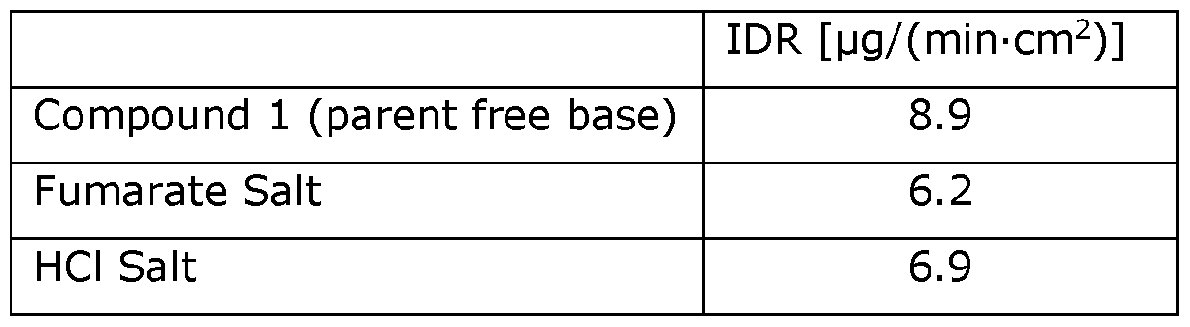
  • the intrinsic dissolution rate was determined by forming compacted pellets of approximately 75 mg of API using a compression force of 1200 pounds of force, and each pellet (die surface area: 0.5 cm 2 ) was immersed into a flat bottom vessel containing 500 mL of medium (aqueous 0.1 N HCI with 1% Tween 80 (polyoxyethylene (20) sorbitan monooleate)), using a Distek 2100A dissolution bath, and Distek Circulator/heater (set to 37 °C), with a paddle speed of 100 rpm. An aliquot of the sample (1 mL) was pulled from dissolution media at 15, 30, 45, 60, 75, 90, 105, and 120 minutes, filtered, and analyzed by HPLC.
  • the slope of the dissolution profile corresponded to an intrinsic dissolution rate of hemifumarate salt Form B of 6.2 pg/(min-cm 2 ) as compared to 8.9 pg/(min-cm 2 ) for Compound 1 (free base).
  • DSC was conducted with a TA Instruments Q200 or Q2000 differential scanning calorimeter equipped with an autosampler and a refrigerated cooling system under 40 mL/min N2 purge. DSC thermograms of samples were obtained at 15 °C/min in crimped Al pans, unless noted otherwise.
  • TGA thermograms were obtained with a TA Instruments Q500 thermogravimetric analyzer under 40 mL/min N2 purge for balance and 60 mL/min for sample in Al pans. TGA thermograms of samples were obtained at 15 °C/min, unless noted otherwise.
  • GVS experiments were conducted on a Surface Measurement Systems DVS- Advantage. The experiments were performed at 25 °C. The instrument was operated in step mode and the relative humidity was increased in 10% RH increments from 40% RH to 75% RH, then decreased from 75% RH to 5% RH, then increased a second time from 5% RH to 95% RH, then decreased from 95% RH to 5% RH.
  • the mass equilibrium criterion was set at 0.003% change in mass over time (dm/dt). A minimum step time of 20 minutes and a maximum step time of 240 minutes were specified.
  • Powder X-ray diffraction patterns were collected for selected salt forms described herein, including hemi-fumarate Form A (acetonitrile solvate) and hemi-fumarate Form B (non-solvated) of 3-(2,5-difluorophenyl)-7-[l,l-di(methyl-c/3)ethyl-2,2,2-cf3]-6-[(l- methyl-lH-l,2,4-triazol-5-yl)methoxy]-l,2,4-triazolo[4,3-b]pyridazine (see Fig. 4 and Fig. 5, respectively).
  • the configuration on the incident beam side was as follows: Goebel mirror, mirror exit slit (0.2 mm), 2.5 deg Seller slits, and beam knife.
  • the configuration on the diffracted beam side was as follows: antiscatter slit (8 mm) and 2.5 deg Soller slits. Samples were mounted flat on zero-background Si wafers. Samples were rotated at 30 rpm.
  • XRPD patterns were imported into Panalytical HighScore Plus v 2.2. The Ka2 contribution was mathematically stripped from the patterns followed by determining the background baseline followed by determining signal positions and relative intensities.
  • XRPD diffractograms were acquired on PANalytical X'Pert Pro diffractometer using Ni-filtered Cu Ka (45 kV/40 mA) radiation and a step size of 0.03° 20 and X’celerator RTMS (Real Time Multi-Strip) detector.
  • Configuration on the incidental beam side variable divergence slits (10 mm irradiated length), 0.04 rad Soller slits, fixed antiscatter slit (0.50°), and 10 mm beam mask.
  • Configuration on the diffracted beam side variable anti-scatter slit (10 mm observed length) and 0.04 rad Soller slits. Samples were mounted flat on zero-background Si wafers. Results are shown in Table 8.
  • Example 7 Oral Non-Human Primate Crossover Study [00110] An objective of this study is to determine the Pharmacokinetic (PK) profile of the Test Article following a single oral administration to four male non-human primate cynomolgus monkeys with one (1) week wash out periods. Dosing and crossover design is as shown in Table 9.
  • Test Article M-3, N-3, or K-13
  • Table 10 summarizes the study results, which show that the fumarate salt of Compound 1 in both micronized and non-micronized form provided superior exposure to Compound 1 as compared to subjects dosed with the free base of Compound 1.
  • IDR intrinsic dissolution rate
  • HPLC for IDR and solid-state stability analyses were conducted with an Agilent 1260 Infinity system equipped with a G1311B Quad pump, G1329B Autosampler, G1330B auto-sampler thermostat, G1316A Thermostatted Column Compartment with a column switch valve, and G4212B diode array detector.

Landscapes

  • Chemical & Material Sciences (AREA)
  • Organic Chemistry (AREA)
  • Health & Medical Sciences (AREA)
  • Public Health (AREA)
  • Animal Behavior & Ethology (AREA)
  • Veterinary Medicine (AREA)
  • Life Sciences & Earth Sciences (AREA)
  • General Health & Medical Sciences (AREA)
  • Epidemiology (AREA)
  • Medicinal Chemistry (AREA)
  • Pharmacology & Pharmacy (AREA)
  • Chemical Kinetics & Catalysis (AREA)
  • General Chemical & Material Sciences (AREA)
  • Engineering & Computer Science (AREA)
  • Bioinformatics & Cheminformatics (AREA)
  • Biomedical Technology (AREA)
  • Neurology (AREA)
  • Neurosurgery (AREA)
  • Nuclear Medicine, Radiotherapy & Molecular Imaging (AREA)
  • Nitrogen Condensed Heterocyclic Rings (AREA)
  • Pharmaceuticals Containing Other Organic And Inorganic Compounds (AREA)
  • Medicinal Preparation (AREA)

Abstract

Described herein are salts (e.g., fumarate salts) of 3-(2,5-difluorophenyl)-7-[1,1-di(methyl-d 3 )ethyl-2,2,2-d 3 ]-6-[(1-methyl-1H-1,2,4-triazol-5-yl)methoxy]-1,2,4-triazolo[4,3-b]pyridazine and particles comprising 3-(2,5-difluorophenyl)-7-[1,1-di(methyl-d 3 )ethyl-2,2,2-d 3 ]-6-[(1-methyl-1H-1,2,4-triazol-5-yl)methoxy]-1,2,4-triazolo[4,3-b]pyridazine or a salt thereof, and uses thereof.

Description

GABAA RECEPTOR MODULATOR SALTS, PARTICLES, AND USES THEREOF
RELATED APPLICATIONS
[001] This application claims priority of U.S. Provisional Patent Application No. 63,333,075, filed April 20, 2023, the entire content of which is incorporated herein by reference.
BACKGROUND
[002] GABA receptors respond to the neurotransmitter gamma-aminobutyric acid (GABA), which is the major inhibitory compound of the vertebrate central nervous system. GABAA receptors occur in all organisms that have a nervous system. Modulation of GABA receptors may therefore be useful in therapeutically addressing diseases or disorders of the central nervous system. 3-(2,5-difluorophenyl)-7-[l,l-di(methyl-cf3)ethyl-2,2,2-ck]-6-[(l-methyl- lH-l,2,4-triazol-5-yl)methoxy]-l,2,4-triazolo[4,3-b]pyridazine (Compound 1) is a GABAA receptor modulator, but has limited bioavailability and a short half-life in mice. Accordingly, there remains a need for GABAA receptor modulator therapeutics, including improved forms of Compound 1.
SUMMARY
[003] Described herein are salts of 3-(2,5-difluorophenyl)-7-[l,l-di(methyl-c/3)ethyl-2,2,2- cb]-6-[(l-methyl-lH-l,2,4-triazol-5-yl)methoxy]-l,2,4-triazolo[4,3-b]pyridazine and uses thereof, as well as particles comprising 3-(2,5-difluorophenyl)-7-[l,l-di(methyl-d3)ethyl- 2,2,2-d3]-6-[(l-methyl-lH-l,2,4-triazol-5-yl)methoxy]-l,2,4-triazolo[4,3-b]pyridazine or a salt thereof and uses thereof.
[004] Compound 1 is shown below as a free base (wherein D is deuterium).
Figure imgf000002_0001
Compound 1
3-(2,5-difluorophenyl)-7-[l,l-di(methyl-cf3)ethyl-2,2,2-c/5]-6-[(l-methyl-lH-l,2,4-triazol-5- yl)methoxy]-l,2,4-triazolo[4,3-b]pyridazine BRIEF DESCRIPTION OF THE DRAWINGS
[005] Fig. 1 shows a particle size distribution plot corresponding to a particle batch generated in Example 1 (particle batch 1).
[006] Fig. 2 shows a particle size distribution plot corresponding to a comparator particle batch (particle batch 2a) generated in Example 2.
[007] Fig. 3 shows a particle size distribution plot corresponding to another comparator particle batch (particle batch 2b) generated in Example 2.
[008] Fig. 4 shows an XRPD (X-Ray Powder Diffraction) trace of form A hemi-fumarate salt of Compound 1.
[009] Fig. 5 shows an XRPD trace of form B hemi-fumarate salt of Compound 1.
[0010] Fig. 6 shows DSC (Differential Scanning Calorimetry) and TGA (Thermogravimetric Analysis) traces of form A hemi-fumarate salt of Compound 1.
[0011] Fig. 7 shows DSC and TGA traces of form B hemi-fumarate salt of Compound 1.
[0012] Fig. 8 shows an XRPD trace of form A sulfate salt of Compound 1.
[0013] Fig. 9 shows an XRPD trace of form A hydrochloride salt of Compound 1.
[0014] Fig. 10 shows an XRPD trace of form A phosphate salt of Compound 1.
[0015] Fig. 11 shows an XRPD trace of form B phosphate salt of Compound 1.
[0016] Fig. 12 shows an XRPD trace of form A tosylate salt of Compound 1.
[0017] Fig. 13 shows an XRPD trace of form A malonate salt of Compound 1.
[0018] Fig. 14 shows an XRPD trace of form A maleate salt of Compound 1.
DETAILED DESCRIPTION
Definitions
[0019] Certain terms, whether used alone or as part of a phrase or another term, are defined below.
[0020] The articles "a" and "an" refer to one or to more than one of the grammatical object of the article.
[0021] Numerical values relating to measurements are subject to measurement errors that place limits on their accuracy. For this reason, all numerical values provided herein, unless otherwise indicated, are to be understood as being modified by the term "about." [0022] The term "amelioration" means a lessening of severity of at least one indicator of a condition or disease, such as a delay or slowing in the progression of one or more indicators of a condition or disease. The severity of indicators may be determined by subjective or objective measures which are known to those skilled in the art.
[0023] The terms "composition" and "pharmaceutical composition" refer to a mixture of at least one compound described herein with a carrier or a pharmaceutically acceptable carrier, respectively. The pharmaceutical composition facilitates administration of the compound to a patient or subject. Multiple techniques of administering a composition exist including, but not limited to, intravenous, oral, nasal, rectal, intravaginal, aerosol, parenteral, buccal, sublingual, ophthalmic, pulmonary, transdermal and topical administration.
[0024] The terms "effective amount" and "therapeutically effective amount" refer to an amount of therapeutic compound, such as a compound described herein, administered to a subject, either as a single dose or as part of a series of doses, which is effective to produce a desired therapeutic effect.
[0025] The term "pharmaceutically acceptable carrier" means a pharmaceutically acceptable material, composition or carrier, such as a liquid filler, solid filler, stabilizer, dispersing agent, suspending agent, diluent, excipient, thickening agent, solvent, or encapsulating material, involved in carrying or transporting at least one compound described herein within or to the patient such that the compound may perform its intended function. A given carrier must be "acceptable" in the sense of being compatible with the other ingredients of a particular formulation, including the compounds described herein, and not injurious to the patient. Other ingredients that may be included in the pharmaceutical compositions described herein are known in the art and described, for example, in "Remington's Pharmaceutical Sciences" (Genaro (Ed.), Mack Publishing Co., 1985), the entire content of which is incorporated herein by reference.
[0026] The term "pharmaceutically acceptable salt" refers to derivatives of the disclosed compounds wherein the parent compound is modified by converting an existing acid or base moiety to its salt form. Lists of salts are found in "Handbook of Pharmaceutical Salts: Properties, Selection, and Use" (P. Henrich Stahl & Camille G. Wermuth (Eds.), VHCA & Wiley- VCH, 2002), the entire content of which is incorporated herein by reference.
[0027] A "signal" may present as a component of a broadened peak, a shouldered peak, or a split peak, which result from two or more overlapping or adjacent signals. [0028] The term "solid form" includes, but is not limited to, polymorphs, crystalline forms, amorphous forms, solvates, and hydrates of a compound.
[0029] The terms "substituted" or "substitution" refers to replacement of hydrogen attached to another group with an atom or group of atoms as the replacement substituent, wherein each substituent is independently selected.
[0030] The terms "treatment" or "treating" refer to the application of one or more specific procedures used for the amelioration of a disease. A "prophylactic" treatment, refers to reducing the rate of progression of the disease or condition being treated, delaying the onset of that disease or condition, or reducing the severity of its onset.
[0031] Recitation of ranges of values herein is merely intended to serve as a shorthand method of referring individually to each separate value falling within the range. Unless otherwise indicated herein, each individual value is incorporated into the specification as if it were individually recited herein. All methods described herein can be performed in any suitable order unless otherwise indicated herein or otherwise clearly contradicted by context. The use of any and all examples, or exemplary language (e.g., "such as") provided herein is intended merely to better illuminate the described subject matter and does not pose a limitation on the scope of the subject matter otherwise claimed. No language in the specification should be construed as indicating any non-claimed element essential to practicing the described subject matter.
[0032] Groupings of alternative elements or embodiments of this disclosure are not to be construed as limitations. Each group member may be referred to and claimed individually or in any combination with other members of the group or other elements found herein. Furthermore, a recited member of a group may be included in, or excluded from, another recited group for reasons of convenience or patentability.
[0033] References have been made to patents and printed publications throughout this specification, each of which are individually incorporated herein by reference in their entirety.
[0034] It is to be understood that the embodiments of this disclosure are illustrative. Accordingly, the present disclosure is not limited to that precisely as shown and described.
Compounds and Solid Forms
[0035] 3-(2,5-difluorophenyl)-7-[l,l-di(methyl-cf5)ethyl-2,2,2-d3]-6-[(l-methyl-lH-l,2,4- triazol-5-yl)methoxy]-l,2,4-triazolo[4,3-b]pyridazine (Compound 1) is a GABAA receptor modulator that can act at the benzodiazepine site of the GABAA receptor as a selective allosteric modulator of the a2, a3, and a5 subtypes. [0036] Compound 1 and its salts as described herein are synthesized using any suitable procedures starting from compounds that are available from commercial sources, or are prepared using procedures described herein. General methods for the preparation of a compound as described herein are modified by the use of appropriate reagents and conditions, for the introduction of the various moieties found in the formula as provided herein.
[0037] In some embodiments, Compound 1 may be prepared using the methods described in U.S. Patent Nos. 8,003,646, 8,399,467, or 8,921,366, the entire content of each of which are incorporated by reference. The preparation of a compound corresponding to a non-deuterated form of Compound 1 is described in the Journal of Medicinal Chemistry, 48 (23) : 7089-92 (Carling et al., "7-(l,l-Dimethylethyl)-6-(2-ethyl-2H-l,2,4-triazol-3-ylmethoxy)-3-(2- fluorophenyl)-l,2,4-triazolo[4,3-b]pyridazine: a functionally selective gamma-aminobutyric acid(A) (GABA(A)) alpha2/alpha3-subtype selective agonist that exhibits potent anxiolytic activity but is not sedating in animal models"). Thus, Compound 1 may be prepared in a similar manner as Carling et al. by substitution with the appropriate corresponding deuterated reagents.
[0038] Preparation of a salt of Compound 1 may occur by, for example, contacting Compound 1 with an acid in a solvent solution, and isolating the salt of Compound 1 by removing the solvent.
[0039] Thus, in some embodiments, provided herein are compounds which are fumarate salts of 3-(2,5-difluorophenyl)-7-[l,l-di(methyl-d3)ethyl-2,2,2-d3]-6-[(l-methyl-lH-l,2,4-triazol- 5-yl)methoxy]-l,2,4-triazolo[4,3-b]pyridazine.
[0040] In some embodiments, the compound is a hemi-fumarate salt of 3-(2,5- difluorophenyl)-7-[l,l-di(methyl-c/3)ethyl-2,2,2-d3]-6-[(l-methyl-lH-l,2,4-triazol-5- yl) methoxy]- 1, 2, 4-triazolo[4,3-b]pyridazine.
[0041] In some embodiments, the compound is of the formula :
Figure imgf000006_0001
wherein X is 0.5, 1, or 2. [0042] In some embodiments, provided herein are compounds which are sulfate salts of 3- (2,5-difluorophenyl)-7-[l,l-di(methyl-cy3)ethyl-2,2,2-d3]-6-[(l-methyl-lH-l,2,4-triazol-5- yl)methoxy]-l,2,4-triazolo[4,3-b]pyridazine. In some embodiments, the sulfate salt of Compound 1 is prepared by combining 880 mg (2.15 mmol) of Compound 1 with 34.2 mL acetone. To the resulting solution (with minimal residual solids), sulfuric acid (2.5 M in water, 861 L, 1.0 eq) was added. The resulting slurry was seeded with crystalline Form A (~10 mg). The slurry was heated to 40 °C (did not dissolve), cooled to 20 °C at 0.1 °C/min (held for 1 h at every 2 °C interval) and stirred at 20 °C overnight. The solids were isolated by vacuum filtration and air-dried overnight. The yield was 83% (905 mg, 1.79 mmol) of Form A sulfate salt of Compound 1.
[0043] In some embodiments, the sulfate salt of Compound 1 has an XRPD pattern substantially as shown in Fig. 8. In some embodiments, the sulfate salt of Compound 1 has at least one signal, in terms of 20, selected from Table A.
Table A. Form A sulfate salt of Compound 1 XRPD signals.
20 [cts] Height [cts] d-spacing [X] ReL Int. [%]
7.29 253 12.1 19
9.25 1331 9.55 100
10.87 408 8.13 31
11.59 221 7.63 17
14.65* 810 6.04 61
14.77* 737 5.99 55
17.04 399 5.20 30
17.39 492 5.10 37
19.68 539 4.51 41
20.58 805 4.31 61
21.17 945 4.19 71
21.79 441 4.08 33
22.01 418 4.03 31
23.29 949 3.82 71
27.17 325 3.28 24
27.92 460 3.19 35
30.09 250 2.97 19
30.62 152 2.92 11 31.27 260 2.86 20
32.92 61 2.72 5
[0044] In some embodiments, provided herein are compounds which are hydrochloride salts of 3-(2,5-difluorophenyl)-7-[l,l-di(methyl- 3)ethyl-2,2,2- 3]-6-[(l-methyl-lH-l,2,4-triazol- 5-yl)methoxy]-l,2,4-triazolo[4,3-b]pyridazine. In some embodiments, the hydrochloride salt of Compound 1 is prepared by combining 1.08 g, (2.65 mmol) of Compound 1 with acetonitrile (36.8 mL, 34 vol). To the resulting solution (with minimal residual solids), hydrochloric acid (3.0 M in water, 883 pL, 1.0 eq) was added. The obtained slurry was seeded with crystalline Form A (~10 mg). The slurry was heated to 40 °C (did not dissolve). The slurry was stirred at 40 °C for 2 h, cooled to 20 °C at 0.1 °C/min rate and held for 1 h at every 2 °C interval and stirred at 20 °C overnight. The solids were isolated by vacuum filtration, air-dried for 3 h. The yield was 77% (0.912 g, 2.05 mmol) of Form A hydrochloride salt of Compound 1.
[0045] In some embodiments, the hydrochloride salt of Compound 1 has an XRPD pattern substantially as shown in Fig. 9. In some embodiments, the hydrochloride salt of Compound 1 has at least one signal, in terms of 29, selected from Table B.
Table B. Form A hydrochloride salt of Compound 1 XRPD signals.
20 [cts] Height [cts] d-spacing [ ] Rel. Int. [%]
Figure imgf000008_0001
100
9.14 450 9.67 21
11.32 225 7.81 10
12.24 60 7.23 3
14.86 144 5.96 7
16.41 338 5.40 15
18.43 891 4.81 41
18.96 296 4.68 14
21.94 190 4.05 9
22.79 1186 3.90 54
24.44 668 3.64 31
25.38 289 3.51 13
27.09 423 3.29 19
27.73 229 3.21 10 30.34 330 2.94 15
38.52 194 2.33 9
[0046] In some embodiments, provided herein are compounds which are phosphate salts of 3-(2,5-difluorophenyl)-7-[l,l-di(methyl-d3)ethyl-2,2,2-c/3]-6-[(l-methyl-lH-l,2,4-triazol-5- yl)methoxy]-l,2,4-triazolo[4,3-b]pyridazine. In some embodiments, the phosphate salt of Compound 1 is prepared by combining 1.04 g (2.53 mmol) with acetone (34.2 mL, 33 vol). To the resulting solution (with minimal residual solids) phosphoric acid (3.0 M in water, 845 pL, 1.0 eq) was added. The obtained slurry was seeded with crystalline Form A (~10 mg). The slurry was heated to 40 °C (did not dissolve). The slurry was stirred at 40 °C for 2 h, cooled to 20 °C at 0.1 °C/min rate and held for 1 h at every 2 °C interval and stirred at 20 °C overnight. The solids were isolated by vacuum filtration, air-dried for 4 h. The yield was 84% (1.07 g, 2.12 mmol) of Form A phosphate salt of Compound 1.
[0047] In some embodiments, the phosphate salt of Compound 1 has an XRPD pattern substantially as shown in Fig. 10 or Fig. 11. In some embodiments, the phosphate salt of Compound 1 has at least one signal, in terms of 20, selected from Table C or Table D.
Table C. Form A phosphate salt of Compound 1 XRPD signals.
20 [cts] Height [cts] d-spacing [X] Rel. Int. [%]
8.76 9711 10.1 100
10.13 102 8.72 1
11.35 113 7.79 1
11.78 154 7.50 2
14.91 710 5.94 7
15.08 704 5.87 7
15.41 531 5.75 5
15.82 253 5.60 3
18.04 282 4.91 3
18.40 244 4.82 3
18.85 189 4.70 2
19.40 215 4.57 2
19.84 1035 4.47 11
20.99 605 4.23 6
21.50 372 4.13 4 22.00 237 4.04 2
24.13 290 3.69
Figure imgf000010_0001
Table D. Form B phosphate salt of Compound 1 XRPD signals.
20 [cts] Height [cts] d-spacing [X] Rel. Int. [%] ............
Figure imgf000010_0002
8.62 2877 10.3 100
9.91 238 8.91 8
10.59 141 8.35 5
12.05 117 7.34 4
14.81 220 5.98 8
17.55 1226 5.05 43
18.51 345 4.79 12
19.28 505 4.60 18
19.49 869 4.55 30
20.83 381 4.26 13
23.27 786 3.82 27
24.20 536 3.67 19
27.24 180 3.27 6
27.84 197 3.20 7
28.36 314 3.14 11
[0048] In some embodiments, provided herein are compounds which are tosylate salts of 3- (2,5-difluorophenyl)-7-[l,l-di(methyl-c/5)ethyl-2,2,2-d3]-6-[(l-methyl-lH-l,2,4-triazol-5- yl)methoxy]-l,2,4-triazolo[4,3-b]pyridazine. In some embodiments, the tosylate salt of Compound 1 is prepared by combining 888 mg (2.17 mmol) with IPA (3.5 mL, 39 vol). To the resulting solution (with minimal residual solids), tosic acid (3.0 M in water, 725 pL, 1.0 eq) was added. The obtained thin slurry was heated to 40 °C for 2 h with stirring, becoming thicker gradually, and seeded with crystalline Form A (~10 mg). The slurry was cooled to 20 °C at 0.1 °C/min rate and held for 1 h at every 2 °C interval and stirred at 20 °C over the weekend. The solids were isolated by vacuum filtration, air-dried for 2 h. The yield was 87% (1.10 g, 1.89 mmol) of Form A tosylate salt of Compound 1. [0049] In some embodiments, the tosylate salt of Compound 1 has an XRPD pattern substantially as shown in Fig. 12. In some embodiments, the tosylate salt of Compound 1 has at least one signal, in terms of 20, selected from Table E.
Table E. Form A tosylate salt of Compound 1 XRPD signals.
20 [cts] Height [cts] d-spacing [K] Rel. Int. [%]
7.59 2125 11.6 77
8.92 503 9.91 18
9.37 2755 9.43 100
11.18 309 7.91 11
12.79 121 6.92 4
13.75 170 6.44 6
14.62 293 6.06 11
15.30 1010 5.79 37
17.35 588 5.11 21
19.25 187 4.61 7
20.81 226 4.26 8
21.64 1280 4.10 46
22.02 322 4.03 12
22.24 273 3.99 10
22.46 179 3.96 7
23.76 371 3.74 13
25.12 238 3.54 9
25.47 289 3.49 10
26.51 120 3.36 4
27.13 140 3.28 5
[0050] In some embodiments, provided herein are compounds which are malonate salts of 3- (2,5-difluorophenyl)-7-[l,l-di(methyl-c/5)ethyl-2,2,2-d3]-6-[(l-methyl-lH-l,2,4-triazol-5- yl)methoxy]-l,2,4-triazolo[4,3-b]pyridazine. In some embodiments, the malonate salt of Compound 1 is prepared by combining 1.09 g (2.68 mmol) with toluene (3.5 mL, 32 vol). To the resulting solution (with minimal residual solids), malonic acid (3.0 M in water, 893 pL, 1.0 eq) was added. The obtained thin slurry was heated to 40 °C for 2 h with stirring and seeded with crystalline Form A (~10 mg). The slurry was cooled to 20 °C at 0.1 °C/min rate and held for 1 h at every 2 °C interval and stirred at 20 °C over several days. The solids were isolated by vacuum filtration, air-dried for 2 h. The yield was 73% (0.996 g, 1.94 mmol) of Form A malonate salt of Compound 1.
[0051] In some embodiments, the malonate salt of Compound 1 has an XRPD pattern substantially as shown in Fig. 13. In some embodiments, the malonate salt of Compound 1 has at least one signal, in terms of 29, selected from Table F.
Table F. Form A malonate salt of Compound 1 XRPD signals.
20 [cts] Height [cts] d-spacing [X] Rel. Int. [%]
7.03 1299 12.6 43
8.00 559 11.0 18
8.53 3039 10.4 100
10.12 2233 8.73 73
11.25 172 7.86 6
12.06 323 7.33 11
12.77 197 6.93 6
15.20 227 5.83 7
15.98 357 5.54 12
16.22 339 5.46 11
17.32 838 5.11 28
17.76 868 4.99 29
18.86 555 4.70 18
21.03 375 4.22 12
21.38 1632 4.15 54
23.54 798 3.78 26
24.93 989 3.57 33
26.96 323 3.30 11
27.77 411 3.21 14
28.14 239 3.2 8
[0052] In some embodiments, provided herein are compounds which are maleate salts of 3- (2,5-difluorophenyl)-7-[l,l-di(methyl-c/3)ethyl-2,2,2-d3]-6-[(l-methyl-lH-l,2,4-triazol-5- yl)methoxy]-l,2,4-triazolo[4,3-b]pyridazine. In some embodiments, the maleate salt of Compound 1 is prepared by combining 1.09 g (2.67 mmol) with toluene (3.5 mL, 32 vol). To the resulting solution (with minimal residual solids), maleic acid (3.0 M in water, 891 pL, 1.0 eq) was added. The obtained thin slurry was seeded with crystalline Form A (~10 mg). The slurry was heated to 40 °C (did not dissolve). The slurry was stirred at 40 °C for 2 h, cooled to 20 °C at 0.1 °C/min rate and held for 1 h at every 2 °C interval and stirred at 20 °C for several days. The solids were isolated by vacuum filtration, air-dried for 4 h. The yield was 91% (1.28 g, 2.43 mmol) of Form A maleate salt of Compound 1.
[0053] In some embodiments, the maleate salt of Compound 1 has an XRPD pattern substantially as shown in Fig. 14. In some embodiments, the maleate salt of Compound 1 has at least one signal, in terms of 20, selected from Table G.
Table G. Form A maleate salt of Compound 1 XRPD signals.
20 [cts] Height [cts] d-spacing [K] ReL Int. [%]
6.83 1552 12.9 34
8.48 4624 10.4 100
11.99 468 7.38 10
12.70 236 6.97 5
14.75 222 6.00 5
15.72 658 5.63 14
16.78 882 5.28 19
17.09 1022 5.18 22
17.28 1003 5.13 22
19.31 316 4.59 7
21.09 745 4.21 16
21.54 2131 4.12 46
22.95 346 3.87 7
23.56 964 3.77 21
24.98 1569 3.56 34
27.04 381 3.29 8
27.22 478 3.27 10
28.12 367 3.17 8
28.53 653 3.13 14 [0054] In some embodiments, the compound is an anhydrate, hemihydrate, monohydrate, or dihydrate. In some embodiments, the compound is a solvate. In some embodiments, the compound is in a solid form.
[0055] In some embodiments, the solid form B hemi-fumarate salt has an X-ray powder diffraction pattern comprising a 2-theta signal, based on CuKol radiation (1.54060 A), at about 9.05 ±0.2°. In some embodiments, the solid form B hemi-fumarate salt has an X-ray powder diffraction pattern comprising 2-theta signals, based on CuKal radiation (1.54060 A), at about 9.05 ±0.2°, about 15.46 ±0.2°, about 22.55 ±0.2°, and about 24.61 ±0.2°. In some embodiments, the solid form B hemi-fumarate salt has an X-ray powder diffraction pattern substantially as shown in Fig. 5. In some embodiments, the solid form B hemi-fumarate salt has a differential scanning calorimetry thermogram comprising an endothermic signal at about 199.6 ±3.0 (e.g., ±0.5) °C. In some embodiments, the solid form B hemi-fumarate salt has a differential scanning calorimetry thermogram substantially as shown in Fig. 7. In some embodiments, the solid form B hemi-fumarate salt has a thermogravimetric analysis substantially as shown in Fig. 7.
[0056] In some embodiments, the solid form A hemi-fumarate salt has an X-ray powder diffraction pattern comprising 2-theta signals, based on CuKol radiation (1.54060 A), at about 7.70 ±0.2° or about 21.80 ±0.2°. In some embodiments, the solid form A hemi-fumarate salt has an X-ray powder diffraction pattern comprising 2-theta signals, based on CuKol radiation (1.54060 A), at about 7.70 ±0.2°, about 21.80 ±0.2°, about 25.44 ±0.2°, and about 28.75 ±0.2°. In some embodiments, the solid form A hemi-fumarate salt has an X-ray powder diffraction pattern substantially as shown in Fig. 4. In some embodiments, the solid form A hemi-fumarate salt has a differential scanning calorimetry thermogram comprising an endothermic signal at about 62.1 ±3.0 (e.g., ±0.5) °C, about 195.2 ±3.0 (e.g., ±0.5) °C, or both. In some embodiments, the solid form A hemi-fumarate salt has a differential scanning calorimetry thermogram substantially as shown in Fig. 6. In some embodiments, the solid form A hemi-fumarate salt has a thermogravimetric analysis substantially as shown in Fig. 6.
[0057] Powders analyzed by XRPD spectroscopy may include components other than the crystalline compound meant to be identified, which may result in signals present in an XRPD diffractogram in addition to those attributed to the crystalline compound to be identified. A particular compound may also include two or more adjacent or overlapping signals. Thus, in some embodiments, an XRPD signal may present as a component of a broadened peak, a shouldered peak, or a split peak, which result from two or more overlapping or adjacent signals. In some embodiments, an XRPD signal may be synonymous with an XRPD peak. [0058] In some embodiments, the compound or solid form is substantially purified. In some embodiments, the compound or solid form is crystalline. In some embodiments, the compound or solid form is prepared by a process comprising precipitating the compound from a solution comprising 3-(2,5-difluorophenyl)-7-[l,l-di(methyl-d3)ethyl-2,2,2-d3]-6-[(l- methyl-lH-l,2,4-triazol-5-yl)methoxy]-l,2,4-triazolo[4,3-b]pyridazine, fumaric acid, and a solvent comprising acetone or acetonitrile. In some embodiments, the process comprises drying the precipitated compound. In some embodiments, the precipitated compound, which may be crystalline, is reduced (e.g., ground, collided, or tumbled) to particles having one or more of the particle characteristics described below.
[0059] In some embodiments, compositions are provided comprising one or more compounds described herein. In some embodiments, the compositions are pharmaceutical compositions. The compositions may further comprise a pharmaceutically acceptable carrier.
[0060] In some embodiments, the compound is present in the composition in an amount of at least about 90 % by weight.
[0061] In some embodiments, the composition is a pharmaceutical composition consisting essentially of the compound.
Particles
[0062] In some embodiments, described herein are particles, comprising a compound of the formula:
Figure imgf000015_0001
or a salt thereof.
[0063] In some embodiments, the compound is about, or at least about, 75, 80, 85, 90, 95, or 100 % by mass of the particle.
[0064] In some embodiments, the particle comprises a particle surface wherein the particle surface comprises a coating on at least a portion of the particle surface. In some embodiments, the coating comprises a film coating. In some embodiments, the particle comprises a film coating with a polymer or co-polymer to form microcapsules, which may be used to form chewable taste-masked granules. In some embodiments, the coating comprises a polymer or co-polymer. In some embodiments, the coating comprises one or more of cellulose acetate phthalate, cellulose acetate trimellate, ethyl cellulose, glycol, hydroxy propyl cellulose, hydroxy propyl methyl cellulose, hydroxy propyl methyl cellulose phthalate, methacrylic acid co-polymer, high molecular weight polyethylene, polyvinyl alcohol, polyvinyl pyrrolidone, starch, or shellac. In some embodiments, the coating comprises a varnish (e.g., a non-nutritive varnish). In some embodiments, the coating comprises a sugar. In some embodiments, the coating comprises a sugar coating. In some embodiments, the particles described herein are sugar coated. In some embodiments, the particles described herein are not sugar coated.
[0065] In some embodiments, a dosage form comprising a plurality of particles comprises coated particles wherein the coating is selected, independently for each particle, from a coating described herein. Accordingly, in some embodiments a plurality of particles may include a mixture of enteric coated particles and extended release coated particles.
[0066] In some embodiments, the particles described herein are encapsulated within a coating.
[0067] In some embodiments of the particles described herein, the coating is 25 % or less by mass of the coated particle.
[0068] In some embodiments, the particle comprises a diameter of about 0.2-20 pm (e.g., about 1-10 pm, e.g., about 2-6 pm, e.g., about 4 pm).
[0069] In some embodiments, the particles described herein are provided as a composition, comprising a plurality of particles, which may include one or more carriers. In some embodiments, the plurality of particles is encapsulated in a capsule, a compression coating, a film coating, or a powder coating. In some embodiments, the particles or plurality of particles, whether as a powder, compressed powder, or tablet, are spray coated. In some embodiments, the plurality of particles is a loose powder within an ingestible capsule. In some embodiments, the plurality of particles is compressed into a friable solid.
[0070] In some embodiments, the plurality of particles comprises one or more of:
1) a surface weighted mean (D3,2) of about 1.5-1.9 pm (e.g., about 1.7 pm);
2) a volume weighted mean diameter (D4,3) of about 3.5-4.5 pm (e.g., about 3.9 pm);
3) a d(0.1) of about 0.5-0.9 pm (e.g., about 0.7 pm); 4) a d(0.5) of about 2.5-3.5 ym (e.g., about 2.9 pm);
5) a d(0.9) of about 6-9 pm (e.g., about 7.8 pm);
6) a span of about 0.7-3.4 (e.g., about 2.4);
7) a uniformity coefficient of about 0.6-1.0 (e.g., about 0.8); or
8) a refractive index of about 1.4-1.6 (e.g., about 1.5).
[0071] In some embodiments, provided herein are oral dosage forms, comprising a particle, a composition, or a pharmaceutical composition described herein. In some embodiments, the oral dosage form comprises a plurality of the particles as a powder or as a compressed powder.
[0072] In some embodiments, the particles, compositions, or pharmaceutical compositions provided herein are housed in at least one container.
Compositions
[0073] In some embodiments, the particles described herein may be in the form of a composition. In some embodiments, the composition is a pharmaceutical composition further comprising a pharmaceutically acceptable carrier.
[0074] In some embodiments, the compositions described herein comprise a first pharmaceutical active, which is Compound 1 or a salt thereof, and a second pharmaceutical active, which may be a compound useful in treating a disease or disorder of the central nervous system.
Methods
[0075] Compound 1, and pharmaceutically acceptable salts thereof, may be used as described in U.S. Patent Nos. 8,003,646, 8,399,467, or 8,921,366. Compound 1, or a pharmaceutically acceptable salt thereof, is described therein as a GABAA receptor modulator, and useful in treating disorders of the central nervous system, including anxiety, convulsions, neuropathic pain, inflammatory pain, and migraine-associated pain.
[0076] Additionally, therapeutic uses of a corresponding non-deuterated form of Compound 1 or other GABA receptor modulators, or a pharmaceutically acceptable salt thereof, are described in U.S. Patent Nos. 6,255,305 or 6,500,828, or W02006061428, the entire content of each of which are incorporated by reference. Uses described in U.S. Patent No. 6,255,305 include the treatment of a variety of disorders of the central nervous system, such as: anxiety disorders, such as panic disorder with or without agoraphobia; agoraphobia without history of panic disorder; animal and other phobias including social phobias; obsessive-compulsive disorder; stress disorders including post-traumatic and acute stress disorder and generalized or substance-induced anxiety disorder; neuroses; convulsions; migraine; and depressive or bipolar disorders, for example single-episode or recurrent major depressive disorder, dysthymic disorder, bipolar I and bipolar II manic disorders, and cyclothymic disorder. Uses described in U.S. Patent No. 6,500,828 include the treatment of a variety of disorders of the central nervous system, in addition to those described above, such as: psychotic disorders including schizophrenia; neurodegeneration arising from cerebral ischemia; attention deficit hyperactivity disorder; and disorders of circadian rhythm, e.g. in subjects suffering from the effects of jet lag or shift work. Furthermore, uses described in U.S. Patent No. 6,500,828 include disorders for which selective ligands for GABAA receptors may be of benefit such as: pain and nociception; emesis, including acute, delayed and anticipatory emesis, in particular emesis induced by chemotherapy or radiation, as well as post-operative nausea and vomiting; eating disorders, including anorexia nervosa and bulimia nervosa; premenstrual syndrome; muscle spasm or spasticity, e.g. in paraplegic patients; and hearing loss. Additionally, U.S. Patent No. 6,500,828 states that selective ligands for GABAA receptors may also be effective as pre-medication prior to anesthesia or minor procedures such as endoscopy, including gastric endoscopy. Uses described in W02006061428 include treatment of pain, e.g., neuropathic, inflammatory, or migraine associated pain. W02006061428 states that neuropathic pain encompasses a range of pain syndromes of diverse origins including diabetic neuropathy, post-herpetic neuralgia, nerve injuries after surgery, pain following paraplegia, hypersensitivity to non-painful stimuli (allodynia), e.g. after surgery or during migraine attacks, spontaneous pain, hyperalgesia, diffuse muscle tenderness of myofacial syndromes, sensory abnormalities of the gastrointestinal tract, e.g. in irritable bowel disease, or chest pain and a large proportion of back pain, and also states that cancer- and AIDS-associated pain also qualify as neuropathic pain. W02006061428 also states that inflammatory pain encompasses pain associated with conditions such as trauma, osteoarthritis, rheumatoid arthritis, post-surgery recovery, and some forms of cancer pain.
[0077] Accordingly, in some embodiments, the particles described herein, which include Compound 1, or a pharmaceutically acceptable salt thereof, are useful in treating GABAA receptor related diseases, diseases or disorders of the central nervous system, and diseases or disorders as described above. In some embodiments, the particles described herein may be useful as an anxiolytic, anticonvulsant, amnesic, sedative, hypnotic, euphoriant, or muscle relaxant. [0078] In some embodiments, particles described herein are useful as GABAA receptor modulators, and in treating various disorders or diseases of the central nervous system.
[0079] In some embodiments, particles described herein are useful as an anxiolytic or an analgesic. Thus, in some embodiments, described herein are methods of treating anxiety or pain in a subject in need thereof, comprising administering to the subject a therapeutically effective amount of a particle described herein.
[0080] In some embodiments, described herein are methods of treating GABAA receptor related diseases or a disease or disorder of the central nervous system in a subject in need thereof, comprising administering to the subject a therapeutically effective amount of the particle, composition, pharmaceutical composition, or oral dosage form described herein.
[0081] While the methods as described refer to the particles described herein, it is to be understood that the particles may be used in conjunction with these methods in the form of a composition or a pharmaceutical composition as well.
[0082] Actual dosage levels of the active ingredients (e.g., the pharmaceutical active compound (e.g., Compound 1) of the particles described herein), the compositions, or the pharmaceutical compositions provided herein may be varied so as to obtain an amount of the active ingredient that is effective to achieve the desired therapeutic response for a particular patient, composition, and mode of administration, without being toxic to the patient.
[0083] In particular, the selected dosage level will depend upon a variety of factors including the activity of the particular compound employed, the time of administration, the rate of excretion of the compound, the duration of the treatment, other drugs, compounds or materials used in combination with the compound, the age, sex, weight, condition, general health, or prior medical history of the patient being treated.
[0084] Routes of administration of include, without limitation, oral, nasal, rectal, intravaginal, aerosol, parenteral, buccal, sublingual, ophthalmic, pulmonary, or topical administration. In some embodiments, the oral or nasal route of administration is an oral inhalational or nasal inhalational route of administration. The compounds for use as described herein may be formulated for administration by any suitable route to achieve the particular method being applied.
[0085] Accordingly, administration of a compound, a composition, or a combination disclosed herein includes a variety of enteral or parenteral approaches selected from, without limitation: oral administration in any acceptable form, such as, e.g., tablet, liquid (e.g., liquid suspension of particles), capsule, powder, or the like; topical or transdermal administration in any acceptable form, such as, e.g., drops, spray, creams, gels ointments, or patches; buccal, nasal, sublingual, ophthalmic, pulmonary, and/or inhalation administration in any acceptable form; rectal administration in any acceptable form; vaginal administration in any acceptable form; peri- and intra-tissue administration in any acceptable form, such as, e.g., intraperitoneal injection, intramuscular injection, subcutaneous injection, intravenous injection, or intraarticular injection; intravesicular administration in any acceptable form, such as, e.g., catheter instillation; and by placement device, such as, e.g., an implant, a stent, a patch, a pellet, a catheter, an osmotic pump, a suppository, a bioerodible delivery system, a non-bioerodible delivery system or another implanted extended or slow release system.
[0086] Local administration results in significantly more delivery of a compound, a composition, or a combination to a specific location as compared to the entire body of the mammal, whereas, systemic administration results in delivery of a compound, a composition, or a combination to essentially the entire body of the individual. Routes of administration suitable for or treating a central nervous system related disease or disorder as disclosed herein also include both central and peripheral administration. Central administration results in delivery of a compound, a composition, or a combination to essentially the central nervous system of the individual and includes, e.g., nasal administration, intrathecal administration, epidural administration as well as a cranial injection or implant. In some embodiments, central administration is used to administer the compound, composition, or combinations described herein.
[0087] Central administration by the nasal route, which targets drug absorption through the vascular plexus of the nasal cavity, is distinct from administration by nasal inhalation, which delivers drug through the pulmonary system. Whereas the latter typically uses liquid or dry powder aerosols with mean particle sizes less than about 10 microns, central administration may be accomplished using mean particle sizes of about 10 microns or larger. Mists and aerosols can be generated using nebulizers, dry powder inhalers, pressurized aerosols, and atomization pumps. It is also feasible to use nose drops (e.g., a suspension of particles in a liquid) for central administration by the nasal route.
[0088] Peripheral administration results in delivery of a compound, a composition, or a combination to essentially any area of an individual outside of the central nervous system and encompasses any route of administration other than direct administration to the spine or brain.
Kits [0089] In some embodiments, provided herein are packaged particles, packaged compositions, or packaged pharmaceutical compositions, comprising a container holding a therapeutically effective amount of a particle described herein, and instructions for using the particle in accordance with one or more of the methods provided herein.
[0090]The present particles and associated materials can be finished as a commercial product by the usual steps performed in the present field, for example by appropriate sterilization and packaging steps. For example, the material can be treated by UV/vis irradiation (200-500 nm), for example using photo-initiators with different absorption wavelengths (e.g., Irgacure 184, 2959), preferably water-soluble initiators (e.g., Irgacure 2959). Such irradiation is usually performed for an irradiation time of 1-60 min, but longer irradiation times may be applied, depending on the specific method. The material according to the present disclosure can be finally sterile-wrapped so as to retain sterility until use and packaged (e.g. by the addition of specific product information leaflets) into suitable containers (boxes, etc.).
[0091] According to further embodiments, the present particles can also be provided in kit form combined with other components necessary for administration of the material to the patient. For example, disclosed kits, such as for use in the treatment of cancer, can further comprise, for example, administration materials.
[0092] The kits may be designed in various forms based on the specific deficiencies they are designed to treat.
[0093] The particles or compositions provided herein may be prepared and placed in a container for storage at ambient or elevated temperature. When the particle or composition is stored in a polyolefin plastic container as compared to, for example, a polyvinyl chloride plastic container, discoloration of the particle (e.g., a compound in the particle) or composition may be reduced, whether suspended in a liquid composition (e.g., an aqueous or organic liquid solution), or as a solid. Without wishing to be bound by theory, the container may reduce exposure of the container's contents to electromagnetic radiation, whether visible light (e.g., having a wavelength of about 380-780 nm) or ultraviolet (UV) light (e.g., having a wavelength of about 190-320 nm (UV B light) or about 320-380 nm (UV A light)). Some containers also include the capacity to reduce exposure of the container's contents to infrared light, or a second component with such a capacity. Some containers further include the capacity to reduce the exposure of the container's contents to heat or humidity. The containers that may be used include those made from a polyolefin such as polyethylene, polypropylene, polyethylene terephthalate, polycarbonate, polymethylpentene, polybutene, or a combination thereof, especially polyethylene, polypropylene, or a combination thereof. In some embodiments, the container is a glass container. The container may further be disposed within a second container, for example, a paper container, cardboard container, paperboard container, metallic film container, or foil container, or a combination thereof, to further reduce exposure of the container's contents to UV, visible, or infrared light. Articles of manufacture benefiting from reduced discoloration, decomposition, or both during storage, include dosage forms that include a particle or composition described herein. The particles or compositions provided herein may need storage lasting up to, or longer than, three months; in some cases up to, or longer than one year. The containers may be in any form suitable to contain the contents— for example, a bag, a bottle, or a box.
[0094] The following examples further illustrate aspects of the present disclosure. However, they are in no way a limitation of the teachings or disclosure as described herein.
EXAMPLES
Example 1
[0095] Micronized particles of Compound 1 free base were generated, and subsequently analyzed using a Mastersizer 2000 instrument and a Scirocco 2000 dispersion unit. Data of the particle analysis are shown in Table 1 and Table 2, as well as Fig. 1. Data of non- micronized particles (Examples 2a and 2b, below) used as comparators are shown in Tables 3 and 4, as well as Fig. 2 and Fig. 3.
Table 1. Micronized particle analysis of Example 1 (see Fig. 1).
Figure imgf000022_0001
Figure imgf000023_0001
Table 2. Micronized particle size distribution data corresponding to Example 1 (see Fig. 1).
Figure imgf000023_0002
Figure imgf000024_0001
Example 2
[0096] Non-micronized particles of Compound 1 free base were generated, and subsequently analyzed using a Mastersizer 2000 instrument and a Scirocco 2000 dispersion unit. Data of the particle analysis are shown in Table 3 and Table 4, as well as Fig. 2 and Fig. 3.
Table 3. Non-micronized particle analysis of Example 2 (Fig. 2).
Figure imgf000024_0002
Figure imgf000025_0001
Table 4. Non-micronized particle analysis of Example 2 (Fig. 3).
Figure imgf000025_0002
Example 3
[0097] Exposure of Compound 1 free base following oral (PO) dose administration of 300 mg/kg/dose of micronized particles (Example 1) and 300 mg/kg/dose non-micronized particles (Example 2) were assessed in male Cynomolgus monkeys. Table 5 describes the study design dosing and schedule. Blood samples were collected in K2EDTA coated polypropylene tubes from the femoral vein and plasma was separated. Samples were drawn at the following time points: pre-dose, 15 min, 30 min, 1, 2, 4, 8, 10, 12, 14, 24, 30, and 48 hours post-dose. The concentrations of Compound 1 were determined by LC-MS/MS and pharmacokinetic parameters were determined using Phoenix WinNonlin v8.0) software. A summary of the pharmacokinetic parameters is shown in Table 6.
Table 5. Study design.
Figure imgf000026_0001
Table 6. Summary of pharmacokinetic parameters of Example 3.
Figure imgf000026_0002
Example 4
[0098] A pharmacokinetic analysis was performed comparing administration of Compound 1 with certain salts of Compound 1 after oral (PO) administration in 3 male cynomolgus monkeys. The subjects received a single PO oral gavage of active pharmaceutical ingredient (API) (e.g., Compound 1 fumarate, Compound 1 sulfate, Compound 1 hydrochloride, Compound 1 phosphate, Compound 1 tosylate, Compound 1 malonate, Compound 1 maleate, or Compound 1 free base) in a capsule at a dose of 30 mg/kg. Following dose administration, the animals were flushed with approximately 10 milliliters of tap water to ensure all API was administered. Animals were observed twice daily and at sample collection time-points for any abnormal clinical and behavioral signs. Body weights were taken prior to dosing and weekly thereafter until study termination. Blood samples (0.5 mL) were collected pre-dose, 15 minutes, 30 minutes, and 1, 2, 4, 6, 8, 10, 12, and 24 hours post-dose. Each blood sample was collected from the monkey's femoral, saphenous or other available vein via direct venipuncture, placed into a polypropylene tube containing K2EDTA as the anticoagulant, and gently inverted several times to mix. The blood samples were kept on wet ice until centrifugation. Blood was centrifuged within 10 minutes of collection. The samples were centrifuged at a temperature of 4 °C, at 3,000 g, for 5 minutes. The resulting plasma (~0.25 mL) was divided into two equal aliquots (125 pL each) into polypropylene tubes, designated as Set A and Set B, after centrifugation. Plasma samples designated for certain metabolites (Set A) were treated with 12.5 pL of 2 M ascorbic acid (plasma: ascorbic acid = 9: 1, v:v) prepared beforehand by combining 0.352 g of ascorbic acid into 1 mL of sterile water in a glass vial and mixing thoroughly. Plasma samples designated for Compound 1 (Set B) do not require treatment with ascorbic acid. Once plasma was prepared, the samples were snap frozen on dry ice. All plasma samples were stored frozen below -70 °C until analyzed. Results are shown in Table 7.
[0099] Surprisingly, the fumarate salt of Compound 1 had a Cmax of about 3080 ng/mL, which is over 98 % higher than that of Compound 1 (free base; 1550 ng/mL). The fumarate salt of Compound 1 has an AUCiast of 38904 ng-h/mL, which is over 50 % higher than that of Compound 1 (25463 ng-h/mL).
Table 7. Pharmacokinetic data.
Figure imgf000028_0001
Example 5
[00100] A hemi-fumarate Form A (acetonitrile solvate) and hemi-fumarate Form B (nonsolvated) of 3-(2,5-difluorophenyl)-7-[l,l-di(methyl-d3)ethyl-2,2,2-cf3]-6-[(l-methyl-lH- l,2,4-triazol-5-yl)methoxy]-l,2,4-triazolo[4,3-b]pyridazine were prepared. A seed crystal for Form B was prepared by first combining 20.3 mg (0.050 mM) 3-(2,5-difluorophenyl)-7-[l,l- di(methyl-c/3)ethyl-2, 2,2-c/3]-6-[(l-methyl- 1H- 1,2, 4-triazol-5-yl)methoxy]- 1,2,4- triazolo[4,3-b]pyridazine with 1000 pL acetone. Fumaric acid/EtOH was added (248 mg, 1.0 eq) and the sample was continuously stirred while cycling the temperature between 40°C and 5°C (heating and cooling at 2°C/min. with 1 hour hold at 40°C and 5°C) for 48 hours. The samples were isolated at 5°C and the suspension was equilibrated with stirring at 20°C for 2 hours. Birefringent solids were harvested by filtration at room temperature and air-dried overnight. 3-(2,5-difluorophenyl)-7-[l,l-di(methyl-d3)ethyl-2,2,2-c/3]-6-[(l-methyl-lH- l,2,4-triazol-5-yl)methoxy]-l,2,4-triazolo[4,3-b]pyridazine (5.51 mmol) was combined with acetone (3.5 mL, 16 vol). To the resulting solution (with minimal residual solids), fumaric acid (575 mg, 1.0 eq) was added, followed by seeding, e.g., with Form B (~10 mg). The slurry was heated to 40 °C for 2 h with stirring and cooled very slowly to 20 °C at 0.1 °C/min rate and held for 1 h at every 2 °C interval and stirred at 20 °C overnight. The solids were isolated by vacuum filtration, air-dried for 4 h. The yield was 79 % (2.02 g, 4.33 mmol) of hemi- fumarate salt Form B. Form A (prepared as above but with acetonitrile instead of acetone) converted to Form B at ambient conditions in one week.
[00101] Selected physicochemical data of Form B were collected. Hemi-fumarate salt Form B was determined to be crystalline by polarized-light microscopy (PLM) and XRPD. DSC analysis showed a very small endotherm at 194.3 °C (AH=1.7 J/g), followed immediately by a sharp endotherm at 199.6 °C (AH = 105 J/g), and TGA analysis showed 0.7% wt loss up to 190 °C (see Fig. 7). Proton NMR confirmed a hemi-salt with 0.5: 1 CI:API ratio. Gravimetric vapor sorption (GVS) analysis showed <0.1% wt moisture uptake between 5-95% RH. No change in the XRPD pattern was observed post GVS.
[00102] The intrinsic dissolution rate was determined by forming compacted pellets of approximately 75 mg of API using a compression force of 1200 pounds of force, and each pellet (die surface area: 0.5 cm2) was immersed into a flat bottom vessel containing 500 mL of medium (aqueous 0.1 N HCI with 1% Tween 80 (polyoxyethylene (20) sorbitan monooleate)), using a Distek 2100A dissolution bath, and Distek Circulator/heater (set to 37 °C), with a paddle speed of 100 rpm. An aliquot of the sample (1 mL) was pulled from dissolution media at 15, 30, 45, 60, 75, 90, 105, and 120 minutes, filtered, and analyzed by HPLC. The slope of the dissolution profile corresponded to an intrinsic dissolution rate of hemifumarate salt Form B of 6.2 pg/(min-cm2) as compared to 8.9 pg/(min-cm2) for Compound 1 (free base).
[00103] Selected physicochemical data of Form A were collected. Hemi-fumarate salt Form A was determined to be crystalline by polarized-light microscopy (PLM) and XRPD. DSC analysis showed a sharp endotherm at 62.1 °C (AH=76 J/g), followed by a sharp endotherm at 195.2 °C (AH=109 J/g), and TGA analysis showed 7% wt loss up to 80 °C (see Fig. 6).
[00104] For PLM, photomicrographs were collected using Olympus BX60 polarized-light microscope equipped with Olympus DP70 camera or Olympus BX51 polarized-light microscope equipped with Olympus DP71 camera.
[00105] Solid-state stability of the fumarate salt of Compound 1 was assessed after storage at the following conditions for 2 and 4 weeks by HPLC and XRPD: 40 °C/75% RH (opened); and 50 °C/ambient RH (closed). No significant changes were observed by either HPLC or XRPD after 4 weeks under these conditions.
[00106] DSC was conducted with a TA Instruments Q200 or Q2000 differential scanning calorimeter equipped with an autosampler and a refrigerated cooling system under 40 mL/min N2 purge. DSC thermograms of samples were obtained at 15 °C/min in crimped Al pans, unless noted otherwise.
[00107] TGA thermograms were obtained with a TA Instruments Q500 thermogravimetric analyzer under 40 mL/min N2 purge for balance and 60 mL/min for sample in Al pans. TGA thermograms of samples were obtained at 15 °C/min, unless noted otherwise. [00108] GVS experiments were conducted on a Surface Measurement Systems DVS- Advantage. The experiments were performed at 25 °C. The instrument was operated in step mode and the relative humidity was increased in 10% RH increments from 40% RH to 75% RH, then decreased from 75% RH to 5% RH, then increased a second time from 5% RH to 95% RH, then decreased from 95% RH to 5% RH. The mass equilibrium criterion was set at 0.003% change in mass over time (dm/dt). A minimum step time of 20 minutes and a maximum step time of 240 minutes were specified.
Example 6
[00109] Powder X-ray diffraction patterns were collected for selected salt forms described herein, including hemi-fumarate Form A (acetonitrile solvate) and hemi-fumarate Form B (non-solvated) of 3-(2,5-difluorophenyl)-7-[l,l-di(methyl-c/3)ethyl-2,2,2-cf3]-6-[(l- methyl-lH-l,2,4-triazol-5-yl)methoxy]-l,2,4-triazolo[4,3-b]pyridazine (see Fig. 4 and Fig. 5, respectively). XRPD diffractograms were acquired on a Bruker D8 Advance system using Cu Ko (XI = 1.54060 A; A2 = 1.54439 A) radiation, X-ray tube voltage and current 40 kV and 40 mA, and a LynxEye position sensitive detector with a 3° 20 opening. The configuration on the incident beam side was as follows: Goebel mirror, mirror exit slit (0.2 mm), 2.5 deg Seller slits, and beam knife. The configuration on the diffracted beam side was as follows: antiscatter slit (8 mm) and 2.5 deg Soller slits. Samples were mounted flat on zero-background Si wafers. Samples were rotated at 30 rpm. Data was collected at a step size of 0.029° 20 and step time of 0.1 second. Data was collected from 2 to 40° 20 for a total scan time of 2 minutes 22 seconds per sample. XRPD patterns were imported into Panalytical HighScore Plus v 2.2. The Ka2 contribution was mathematically stripped from the patterns followed by determining the background baseline followed by determining signal positions and relative intensities. Alternatively, XRPD diffractograms were acquired on PANalytical X'Pert Pro diffractometer using Ni-filtered Cu Ka (45 kV/40 mA) radiation and a step size of 0.03° 20 and X’celerator RTMS (Real Time Multi-Strip) detector. Configuration on the incidental beam side: variable divergence slits (10 mm irradiated length), 0.04 rad Soller slits, fixed antiscatter slit (0.50°), and 10 mm beam mask. Configuration on the diffracted beam side: variable anti-scatter slit (10 mm observed length) and 0.04 rad Soller slits. Samples were mounted flat on zero-background Si wafers. Results are shown in Table 8.
Table 8. XRPD signals for hemi-fumarate Form A and hemi-fumarate Form B of Example 5.
Figure imgf000030_0001
Figure imgf000031_0001
Example 7. Oral Non-Human Primate Crossover Study [00110] An objective of this study is to determine the Pharmacokinetic (PK) profile of the Test Article following a single oral administration to four male non-human primate cynomolgus monkeys with one (1) week wash out periods. Dosing and crossover design is as shown in Table 9.
Table 9.
Figure imgf000032_0001
*34.2 mg/kg fumarate salt of Compound 1 is equivalent on a molar basis to 30 mg/kg free base of Compound 1.
[00111] Four male animals are used for this study, and the four study animals are used for each of three dosing phases with one-week washout periods. Food is withheld overnight prior to dose administration, and food is returned four hours post-dose administration. Water is provided ad libitum by automatic watering device. Two of the four animals are previously treated with Compound 1, and the other two are Compound 1 naive. Test Article (M-3, N-3, or K-13) are provided as capsulized powders; stored at room temperature protected from light in, for example, a polyolefin bottle. Table 10 summarizes the study results, which show that the fumarate salt of Compound 1 in both micronized and non-micronized form provided superior exposure to Compound 1 as compared to subjects dosed with the free base of Compound 1.
Table 10.
Figure imgf000033_0001
[00112] Micronized and non-micronized particles of Compound 1 hemi-fumarate in this example are described in Table 11 (micronized) and Table 12 (non-micronized).
Table 11. Micronized Compound 1 Hemi-Fumarate
Figure imgf000033_0002
Table 12. Non-Micronized Compound 1 Hemi-Fumarate
Figure imgf000033_0003
Example 8. Intrinsic Dissolution Rate
[00113] Determination of intrinsic dissolution rate (IDR) was performed for Compound 1 and seven different salts of Compound 1 according to USP < 1087> in 0.1 N hydrochloric acid with 1% Tween 80 (Polyoxyethylene (80) sorbitan monooleate). Compacted pellets containing approximately 75 mg API were prepared using a compression force of 1200 pounds of force, and each pellet (die surface area: 0.5 cm2) was immersed into a flat bottom vessel containing 500 mL of medium, using a Distek 2100A dissolution bath, and Distek Circulator/heater (set to 37 °C), with a paddle speed of 100 rpm. An aliquot of the sample (1 mL) was pulled from dissolution media at 15, 30, 45, 60, 75, 90, 105, and 120 minutes, filtered, and analyzed by HPLC.
[00114] A summary of the intrinsic dissolution rate and solubility of each compound tested is shown in Table 13 and Table 14.
Table 13. Solubility
Figure imgf000034_0001
Table 14. Intrinsic Dissolution Rate
Figure imgf000034_0002
Figure imgf000035_0001
Example 9. Solid-State Stability
[00115] Solid-state stability of Compound 1 and seven salts of Compound 1, as in Example 8, was assessed after storage at the following conditions for 2 and 4 weeks by HPLC and PXRD: 40 °C/75% RH (opened); and 50 °C/ambient RH (closed).
[00116] No significant changes were observed in HPLC data of compounds exposed to 40 °C/75% RH (opened), and 50 °C/ambient RH (closed) for up to 4 weeks. XRPD analysis of the stability samples showed no significant change in SRPD patterns after 4 weeks in the storage conditions, except in the HCI salt with observation of a small signal at 10° 29 of Compound 1 (free base) at 40 °C/75% RH.
[00117] HPLC for IDR and solid-state stability analyses were conducted with an Agilent 1260 Infinity system equipped with a G1311B Quad pump, G1329B Autosampler, G1330B auto-sampler thermostat, G1316A Thermostatted Column Compartment with a column switch valve, and G4212B diode array detector.
Example 10. Melting Point
[00118] Melting points of Compound 1 and seven of its salts (as in Example 8) were collected, which results are summarized in Table 15.
Table 15. Melting Points
Figure imgf000035_0002
Figure imgf000036_0001

Claims

CLAIMS We claim:
1. A compound, which is a fumarate salt of 3-(2,5-difluorophenyl)-7-[l,l-di(methyl- c/3)ethyl-2,2,2-d3]-6-[(l-methyl-lH-l,2,4-triazol-5-yl)methoxy]-l,2,4-triazolo[4,3- b]pyridazine.
2. The compound of claim 1, which is a hemi-fumarate salt of 3-(2,5-difluorophenyl)-7- [ l,l-di(methyl-c/3)ethyl-2, 2, 2- j]-6-[(l -methyl- 1H- 1,2, 4-triazol-5-yl) methoxy]- 1,2,4- triazolo[4,3-b]pyridazine.
3. The compound of claim 1, which is of the formula :
Figure imgf000037_0001
wherein X is 0.5, 1, or 2.
4. The compound of one of claims 1-3, which is an anhydrate, hemihydrate, monohydrate, or dihydrate.
5. The compound of one of claims 1-3, which is a solvate.
6. The compound of one of claims 1-5, which is in a solid form.
7. The compound of claim 6, wherein the solid form has an X-ray powder diffraction pattern comprising a 2-theta signal, based on CuKal radiation (1.54060 A), at about 9.05 ±0.2°, or based on d-spacing, at about 9.76 A.
8. The compound of claim 6, wherein the solid form has an X-ray powder diffraction pattern comprising 2-theta signals, based on CuKal radiation (1.54060 A), at about 9.05 ±0.2°, about 15.46 ±0.2°, about 22.55 ±0.2°, and about 24.61 ±0.2°, or based on d-spacing, at about 9.76 A, about 5.73 A, about 3.96 A, and about 3.61 A.
9. The compound of claim 6, wherein the solid form has an X-ray powder diffraction pattern substantially as shown in Fig. 5.
10. The compound of claim 6, wherein the solid form has a differential scanning calorimetry thermogram comprising an endothermic signal at about 199.6 ±3.0 (e.g., ±0.5) °C.
11. The compound of claim 6, wherein the solid form has a differential scanning calorimetry thermogram substantially as shown in Fig. 7.
12. The compound of claim 6, wherein the solid form has a thermogravimetric analysis substantially as shown in Fig. 7.
13. The compound of claim 6, wherein the solid form has an X-ray powder diffraction pattern comprising a 2-theta signal based on CuKal radiation (1.54060 A) at about 7.70 ±0.2° or about 21.80 ±0.2°, or based on d-spacing at about 11.5 A or about 4.07 A.
14. The compound of claim 6, wherein the solid form has an X-ray powder diffraction pattern comprising 2-theta signals, based on CuKal radiation (1.54060 A), at about 7.70 ±0.2°, about 21.80 ±0.2°, about 25.44 ±0.2°, and about 28.75 ±0.2°, or based on d-spacing at about 11.5 A, about 4.07 A, about 3.50 A, and about 3.10 A.
15. The compound of claim 6, wherein the solid form has an X-ray powder diffraction pattern substantially as shown in Fig. 4.
16. The compound of claim 6, wherein the solid form has a differential scanning calorimetry thermogram comprising an endothermic signal at about 62.1 ±3.0 (e.g., ±0.5) °C, about 195.2 ±3.0 (e.g., ±0.5) °C, or both.
17. The compound of claim 6, wherein the solid form has a differential scanning calorimetry thermogram substantially as shown in Fig. 6.
18. The compound of claim 6, wherein the solid form has a thermogravimetric analysis substantially as shown in Fig. 6.
19. The compound of one of claims 1-18, which is substantially purified.
20. The compound of one of claims 1-19, which is crystalline.
21. The compound of one of claims 1-20, prepared by a process comprising precipitating the compound from a solution comprising 3-(2,5-difluorophenyl)-7-[l,l-di(methyl-c/3)ethyl-
2,2,2-d.?]-6-[(l-methyl-lH-l,2,4-triazol-5-yl)methoxy]-l,2,4-triazolo[4,3-b]pyridazine, fumaric acid, and a solvent comprising acetone or acetonitrile, the process optionally comprising drying the precipitated compound.
22. A composition, comprising the compound of one of claims 1-21.
23. The composition of claim 22, which is a pharmaceutical composition further comprising a pharmaceutically acceptable carrier.
24. The composition of claim 23, wherein the compound is present in the composition in an amount of at least about 90 % by weight.
25. The composition of claim 22, which is a pharmaceutical composition consisting essentially of the compound.
26. A particle, comprising 3-(2,5-difluorophenyl)-7-[l,l-di(methyl-c/3)ethyl-2,2,2-c/3]-6-
[(1-methyl-lH-l, 2, 4-triazol-5-yl)methoxy]-l, 2, 4-triazolo[4,3-b]py ridazine, or a pharmaceutically acceptable salt thereof, or the composition of one of claims 22-25, wherein the particle comprises one or more of:
1) a specific surface area of about 3.0-4.0 m2/g (e.g., about 3.6); or
2) a diameter of about 0.15-50 pm.
27. The particle of claim 26, wherein the compound is about, or at least about, 75, 80, 85, 90, 95, or 100 % by mass of the particle.
28. The particle of claim 26 or 27, comprising a particle surface wherein the particle surface comprises a coating on at least a portion of the particle surface.
29. The particle of claim 26 or 27, wherein the particle is encapsulated within a coating.
30. The particle of claim 28 or 29, wherein the coating is 25 % or less by mass of the coated particle.
31. The particle of one of claims 26-30, wherein the particle comprises a diameter of about 0.2-20 pm (e.g., about 1-10 pm, e.g., about 2-6 pm, e.g., about 4 pm).
32. The particle of one of claims 26-31, wherein the particle is a solid particle.
33. A composition, comprising the particle of one of claims 26-32.
34. A composition, comprising a plurality of particles of one of claims 26-32.
35. The composition of claim 34, wherein the plurality of particles comprises one or more of:
1) a surface weighted mean (D3,2) of about 1.5-1.9 pm (e.g., about 1.7 pm);
2) a volume weighted mean diameter (D4,3) of about 3.5-4.5 pm (e.g., about 3.9 pm);
3) a d(0.1) of about 0.5-0.9 pm (e.g., about 0.7 pm);
4) a d(0.5) of about 2.5-3.5 pm (e.g., about 2.9 pm);
5) a d(0.9) of about 6-9 pm (e.g., about 7.8 pm);
6) a span of about 0.7-3.4 (e.g., about 2.4);
7) a uniformity coefficient of about 0.6-1.0 (e.g., about 0.8); or
8) a refractive index of about 1.4-1.6 (e.g., about 1.5).
36. A pharmaceutical composition, comprising a pharmaceutically acceptable carrier, and the particle of one of claims 26-32 or the composition of one of claims 33-35.
37. An oral dosage form, comprising the particle of one of claims 26-32, the composition of one of claims 33-35, or the pharmaceutical composition of claim 36.
38. The oral dosage form of claim 37, wherein the oral dosage form comprises a plurality of the particles as a powder or as a compressed powder.
39. The compound of one of claims 1-21, the composition of one of claims 22-25, the particle of one of claims 26-32, the composition of one of claims 33-35, the pharmaceutical composition of claim 36, or the oral dosage form of claim 37 or 38, housed in at least one container.
40. A method of treating GABA receptor related diseases or a disease or disorder of the central nervous system in a subject in need thereof, comprising administering to the subject a therapeutically effective amount of the compound, particle, composition, pharmaceutical composition, or oral dosage form of one of claims 1-39.
41. A compound, which is a sulfate, hydrochloride, phosphate, tosylate, malonate, or maleate salt of 3-(2,5-difluorophenyl)-7-[l,l-di(methyl-d3)ethyl-2,2,2-c/3]-6-[(l-methyl-lH- l,2,4-triazol-5-yl)methoxy]-l,2,4-triazolo[4,3-b]pyridazine.
42. A method, comprising administering to a subject the compound, particle, composition, pharmaceutical composition, or oral dosage form of one of claims 1-39 or the compound of claim 41.
PCT/US2023/065994 2022-04-20 2023-04-20 Gabaa receptor modulator salts, particles, and uses thereof Ceased WO2023205722A1 (en)

Priority Applications (8)

Application Number Priority Date Filing Date Title
US18/858,125 US20250275966A1 (en) 2022-04-20 2023-04-20 Gabaa receptor modulator salts, particles, and uses thereof
AU2023258030A AU2023258030A1 (en) 2022-04-20 2023-04-20 Gabaa receptor modulator salts, particles, and uses thereof
CN202380034891.XA CN119136800A (en) 2022-04-20 2023-04-20 GABAA receptor modulator salts, particles and uses thereof
EP23792771.0A EP4511025A4 (en) 2022-04-20 2023-04-20 GABA<sub>A</sub> receptor modulator salts, particles and uses thereof
CA3248309A CA3248309A1 (en) 2022-04-20 2023-04-20 Gabaa receptor modulator salts, particles, and uses thereof
JP2024562840A JP2025513560A (en) 2022-04-20 2023-04-20 GABAA receptor modulator salts, particles, and uses thereof
KR1020247038450A KR20250003894A (en) 2022-04-20 2023-04-20 GABAA receptor modulator salts, particles, and uses thereof
MX2024012997A MX2024012997A (en) 2022-04-20 2024-10-21 GABAA RECEPTOR MODULATING SALTS, PARTICLES AND THEIR USES

Applications Claiming Priority (2)

Application Number Priority Date Filing Date Title
US202263333075P 2022-04-20 2022-04-20
US63/333,075 2022-04-20

Publications (1)

Publication Number Publication Date
WO2023205722A1 true WO2023205722A1 (en) 2023-10-26

Family

ID=88416518

Family Applications (1)

Application Number Title Priority Date Filing Date
PCT/US2023/065994 Ceased WO2023205722A1 (en) 2022-04-20 2023-04-20 Gabaa receptor modulator salts, particles, and uses thereof

Country Status (9)

Country Link
US (1) US20250275966A1 (en)
EP (1) EP4511025A4 (en)
JP (1) JP2025513560A (en)
KR (1) KR20250003894A (en)
CN (1) CN119136800A (en)
AU (1) AU2023258030A1 (en)
CA (1) CA3248309A1 (en)
MX (1) MX2024012997A (en)
WO (1) WO2023205722A1 (en)

Citations (5)

* Cited by examiner, † Cited by third party
Publication number Priority date Publication date Assignee Title
US6500828B1 (en) * 1999-01-27 2002-12-31 Merck Sharp & Dohme Ltd. Triazolo-pyridazine derivatives as ligands for gaba receptors
US8507487B2 (en) * 2009-12-31 2013-08-13 Hutchison Medipharma Limited Certain triazolopyridines and triazolopyrazines, compositions thereof and methods of use therefor
US20150111895A1 (en) * 2008-08-29 2015-04-23 Concert Pharmaceuticals Inc. Substituted triazolo-pyridazine derivatives
US20150119398A1 (en) * 2012-05-11 2015-04-30 Concert Pharmaceuticals Inc. Form 2 polymorph of 7-(tert-butyl-d9)-3-(2,5-difluorophenyl)-6-((1-methyl-1h-1,2,4-triazol-5-yl)methoxy)-[1,2,4]triazolo[4,3-b]pyridazine
US9814678B2 (en) * 2011-12-12 2017-11-14 Orbis Biosciences, Inc. Sustained release particle formulations

Family Cites Families (2)

* Cited by examiner, † Cited by third party
Publication number Priority date Publication date Assignee Title
US20150099753A1 (en) * 2012-05-11 2015-04-09 Concert Pharmaceuticals Inc. Form 5 polymorph of 7-(tert-butyl-d9)-3-(2,5-difluorophenyl)-6-((1-methyl-1h-1,2,4-triazol-5-yl)methoxy)-[1,2,4]triazolo[4,3-b]pyridazine
US20150158870A1 (en) * 2012-05-11 2015-06-11 Concert Pharmaceuticals Inc. Polymorphs of 7-(tert-butyl-d9)-3-(2,5-difluorophenyl)-6-((1-methyl-1h-1,2,4-triazol-5-yl)methoxy)-[1,2,4]triazolo[4,3-b]pyridazine

Patent Citations (5)

* Cited by examiner, † Cited by third party
Publication number Priority date Publication date Assignee Title
US6500828B1 (en) * 1999-01-27 2002-12-31 Merck Sharp & Dohme Ltd. Triazolo-pyridazine derivatives as ligands for gaba receptors
US20150111895A1 (en) * 2008-08-29 2015-04-23 Concert Pharmaceuticals Inc. Substituted triazolo-pyridazine derivatives
US8507487B2 (en) * 2009-12-31 2013-08-13 Hutchison Medipharma Limited Certain triazolopyridines and triazolopyrazines, compositions thereof and methods of use therefor
US9814678B2 (en) * 2011-12-12 2017-11-14 Orbis Biosciences, Inc. Sustained release particle formulations
US20150119398A1 (en) * 2012-05-11 2015-04-30 Concert Pharmaceuticals Inc. Form 2 polymorph of 7-(tert-butyl-d9)-3-(2,5-difluorophenyl)-6-((1-methyl-1h-1,2,4-triazol-5-yl)methoxy)-[1,2,4]triazolo[4,3-b]pyridazine

Non-Patent Citations (2)

* Cited by examiner, † Cited by third party
Title
KURIYAMA ATSUSHI, OZAKI YUKIHIRO: "Assessment of Active Pharmaceutical Ingredient Particle Size in Tablets by Raman Chemical Imaging Validated using Polystyrene Microsphere Size Standards", AAPS PHARMSCITECH, vol. 15, no. 2, 1 April 2014 (2014-04-01), pages 375 - 387, XP093104545, DOI: 10.1208/s12249-013-0064-9 *
See also references of EP4511025A4 *

Also Published As

Publication number Publication date
US20250275966A1 (en) 2025-09-04
MX2024012997A (en) 2025-02-10
CA3248309A1 (en) 2023-10-26
EP4511025A1 (en) 2025-02-26
EP4511025A4 (en) 2026-04-15
AU2023258030A1 (en) 2024-10-17
JP2025513560A (en) 2025-04-24
KR20250003894A (en) 2025-01-07
CN119136800A (en) 2024-12-13

Similar Documents

Publication Publication Date Title
TR201816244T4 (en) Epidermal growth factor receptor kinase inhibitor salts.
US8309553B2 (en) Anhydrous crystal form of ovrepitant maleate
KR20220066058A (en) Pyruvate Kinase R (PKR) Activating Composition
WO2016026975A1 (en) Salt of (r)-3-(4-(7h-pyrrolo [2,3-d] pyrimidin-4-yl)-lh-pyrazol-l-yl)-3-cyclopentylpropanenitrile with benzenesulfonic acid
JP2024040206A (en) Crystalline form of a compound
EP3426675B1 (en) Crystalline salt forms
CZ2003140A3 (en) Novel form of (R)-N-[5-methyl-8-(4-methylpiperazin-l-yl)-1,2,3,4-tetrahydro-2-naphthyl]-4-morpholinobenzamide
US20250275966A1 (en) Gabaa receptor modulator salts, particles, and uses thereof
US20120022099A1 (en) Novel polymorphic forms of an azabicyclo-trifluoromethyl benzamide derivative
KR20200044020A (en) Salts of compounds and crystalline forms thereof
TW202132311A (en) Solid forms of an s1p-receptor modulator
IL184781A (en) CRYSTALLINE 1H-IMIDAZO[4,5-b]PYRIDIN-5-AMINE, 7-[5-[(CYCLOHEXYLMETHYLAMINO)-METHYL]-1H-INDOL-2-YL]-2-METHYL, SULFATE (1:1), TRIHYDRATE AND ITS PHARMACEUTICAL USES
CA3245090A1 (en) Crystalline forms of (s)-5-benzyl-n-(5-methyl-4-oxo-2,3,4,5-tetrahydropyrido [3,2-b][1,4]oxazepin-3-yl)-4h-1,2,4-triazole-3-carboxamide
AU2004285316A1 (en) Pharmaceutical compositions based on idazoxan salt or one of the polymorphs thereof
HK40116055A (en) Novel sulfate salt forms of isochroman-imidazole structured alpha-2a adrenoceptor agonist
EA051728B1 (en) POLYMORPHIC FORMS OF (R)-OXYBUTYNIN HYDROCHLORIDE
HK40003395B (en) Crystalline salt forms
HK1126767A1 (en) Pyridooxazepine progesteron receptor modulators
HK1126767B (en) Pyridooxazepine progesteron receptor modulators

Legal Events

Date Code Title Description
121 Ep: the epo has been informed by wipo that ep was designated in this application

Ref document number: 23792771

Country of ref document: EP

Kind code of ref document: A1

WWE Wipo information: entry into national phase

Ref document number: 815113

Country of ref document: NZ

Ref document number: AU2023258030

Country of ref document: AU

ENP Entry into the national phase

Ref document number: 2023258030

Country of ref document: AU

Date of ref document: 20230420

Kind code of ref document: A

WWE Wipo information: entry into national phase

Ref document number: 202380034891.X

Country of ref document: CN

WWE Wipo information: entry into national phase

Ref document number: 2024562840

Country of ref document: JP

Ref document number: MX/A/2024/012997

Country of ref document: MX

REG Reference to national code

Ref country code: BR

Ref legal event code: B01A

Ref document number: 112024021694

Country of ref document: BR

WWE Wipo information: entry into national phase

Ref document number: 202417088258

Country of ref document: IN

ENP Entry into the national phase

Ref document number: 20247038450

Country of ref document: KR

Kind code of ref document: A

WWE Wipo information: entry into national phase

Ref document number: 1020247038450

Country of ref document: KR

WWE Wipo information: entry into national phase

Ref document number: 2023792771

Country of ref document: EP

NENP Non-entry into the national phase

Ref country code: DE

ENP Entry into the national phase

Ref document number: 2023792771

Country of ref document: EP

Effective date: 20241120

ENP Entry into the national phase

Ref document number: 112024021694

Country of ref document: BR

Kind code of ref document: A2

Effective date: 20241018

WWP Wipo information: published in national office

Ref document number: MX/A/2024/012997

Country of ref document: MX

WWP Wipo information: published in national office

Ref document number: 18858125

Country of ref document: US