WO2023219021A1 - 積層包装材料 - Google Patents
積層包装材料 Download PDFInfo
- Publication number
- WO2023219021A1 WO2023219021A1 PCT/JP2023/016940 JP2023016940W WO2023219021A1 WO 2023219021 A1 WO2023219021 A1 WO 2023219021A1 JP 2023016940 W JP2023016940 W JP 2023016940W WO 2023219021 A1 WO2023219021 A1 WO 2023219021A1
- Authority
- WO
- WIPO (PCT)
- Prior art keywords
- layer
- film
- packaging material
- resin
- gas barrier
- Prior art date
- Legal status (The legal status is an assumption and is not a legal conclusion. Google has not performed a legal analysis and makes no representation as to the accuracy of the status listed.)
- Ceased
Links
Classifications
-
- C—CHEMISTRY; METALLURGY
- C08—ORGANIC MACROMOLECULAR COMPOUNDS; THEIR PREPARATION OR CHEMICAL WORKING-UP; COMPOSITIONS BASED THEREON
- C08G—MACROMOLECULAR COMPOUNDS OBTAINED OTHERWISE THAN BY REACTIONS ONLY INVOLVING UNSATURATED CARBON-TO-CARBON BONDS
- C08G18/00—Polymeric products of isocyanates or isothiocyanates
- C08G18/06—Polymeric products of isocyanates or isothiocyanates with compounds having active hydrogen
- C08G18/70—Polymeric products of isocyanates or isothiocyanates with compounds having active hydrogen characterised by the isocyanates or isothiocyanates used
- C08G18/72—Polyisocyanates or polyisothiocyanates
- C08G18/80—Masked polyisocyanates
- C08G18/8003—Masked polyisocyanates masked with compounds having at least two groups containing active hydrogen
- C08G18/8006—Masked polyisocyanates masked with compounds having at least two groups containing active hydrogen with compounds of C08G18/32
- C08G18/8009—Masked polyisocyanates masked with compounds having at least two groups containing active hydrogen with compounds of C08G18/32 with compounds of C08G18/3203
- C08G18/8022—Masked polyisocyanates masked with compounds having at least two groups containing active hydrogen with compounds of C08G18/32 with compounds of C08G18/3203 with polyols having at least three hydroxy groups
- C08G18/8029—Masked aromatic polyisocyanates
-
- B—PERFORMING OPERATIONS; TRANSPORTING
- B32—LAYERED PRODUCTS
- B32B—LAYERED PRODUCTS, i.e. PRODUCTS BUILT-UP OF STRATA OF FLAT OR NON-FLAT, e.g. CELLULAR OR HONEYCOMB, FORM
- B32B27/00—Layered products comprising a layer of synthetic resin
-
- B—PERFORMING OPERATIONS; TRANSPORTING
- B32—LAYERED PRODUCTS
- B32B—LAYERED PRODUCTS, i.e. PRODUCTS BUILT-UP OF STRATA OF FLAT OR NON-FLAT, e.g. CELLULAR OR HONEYCOMB, FORM
- B32B27/00—Layered products comprising a layer of synthetic resin
- B32B27/06—Layered products comprising a layer of synthetic resin as the main or only constituent of a layer, which is next to another layer of the same or of a different material
- B32B27/08—Layered products comprising a layer of synthetic resin as the main or only constituent of a layer, which is next to another layer of the same or of a different material of synthetic resin
-
- B—PERFORMING OPERATIONS; TRANSPORTING
- B32—LAYERED PRODUCTS
- B32B—LAYERED PRODUCTS, i.e. PRODUCTS BUILT-UP OF STRATA OF FLAT OR NON-FLAT, e.g. CELLULAR OR HONEYCOMB, FORM
- B32B27/00—Layered products comprising a layer of synthetic resin
- B32B27/16—Layered products comprising a layer of synthetic resin specially treated, e.g. irradiated
-
- B—PERFORMING OPERATIONS; TRANSPORTING
- B32—LAYERED PRODUCTS
- B32B—LAYERED PRODUCTS, i.e. PRODUCTS BUILT-UP OF STRATA OF FLAT OR NON-FLAT, e.g. CELLULAR OR HONEYCOMB, FORM
- B32B27/00—Layered products comprising a layer of synthetic resin
- B32B27/30—Layered products comprising a layer of synthetic resin comprising vinyl (co)polymers; comprising acrylic (co)polymers
-
- B—PERFORMING OPERATIONS; TRANSPORTING
- B32—LAYERED PRODUCTS
- B32B—LAYERED PRODUCTS, i.e. PRODUCTS BUILT-UP OF STRATA OF FLAT OR NON-FLAT, e.g. CELLULAR OR HONEYCOMB, FORM
- B32B27/00—Layered products comprising a layer of synthetic resin
- B32B27/30—Layered products comprising a layer of synthetic resin comprising vinyl (co)polymers; comprising acrylic (co)polymers
- B32B27/306—Layered products comprising a layer of synthetic resin comprising vinyl (co)polymers; comprising acrylic (co)polymers comprising vinyl acetate or vinyl alcohol (co)polymers
-
- B—PERFORMING OPERATIONS; TRANSPORTING
- B32—LAYERED PRODUCTS
- B32B—LAYERED PRODUCTS, i.e. PRODUCTS BUILT-UP OF STRATA OF FLAT OR NON-FLAT, e.g. CELLULAR OR HONEYCOMB, FORM
- B32B27/00—Layered products comprising a layer of synthetic resin
- B32B27/32—Layered products comprising a layer of synthetic resin comprising polyolefins
-
- B—PERFORMING OPERATIONS; TRANSPORTING
- B32—LAYERED PRODUCTS
- B32B—LAYERED PRODUCTS, i.e. PRODUCTS BUILT-UP OF STRATA OF FLAT OR NON-FLAT, e.g. CELLULAR OR HONEYCOMB, FORM
- B32B27/00—Layered products comprising a layer of synthetic resin
- B32B27/34—Layered products comprising a layer of synthetic resin comprising polyamides
-
- B—PERFORMING OPERATIONS; TRANSPORTING
- B32—LAYERED PRODUCTS
- B32B—LAYERED PRODUCTS, i.e. PRODUCTS BUILT-UP OF STRATA OF FLAT OR NON-FLAT, e.g. CELLULAR OR HONEYCOMB, FORM
- B32B27/00—Layered products comprising a layer of synthetic resin
- B32B27/36—Layered products comprising a layer of synthetic resin comprising polyesters
-
- B—PERFORMING OPERATIONS; TRANSPORTING
- B32—LAYERED PRODUCTS
- B32B—LAYERED PRODUCTS, i.e. PRODUCTS BUILT-UP OF STRATA OF FLAT OR NON-FLAT, e.g. CELLULAR OR HONEYCOMB, FORM
- B32B27/00—Layered products comprising a layer of synthetic resin
- B32B27/40—Layered products comprising a layer of synthetic resin comprising polyurethanes
-
- B—PERFORMING OPERATIONS; TRANSPORTING
- B32—LAYERED PRODUCTS
- B32B—LAYERED PRODUCTS, i.e. PRODUCTS BUILT-UP OF STRATA OF FLAT OR NON-FLAT, e.g. CELLULAR OR HONEYCOMB, FORM
- B32B7/00—Layered products characterised by the relation between layers; Layered products characterised by the relative orientation of features between layers, or by the relative values of a measurable parameter between layers, i.e. products comprising layers having different physical, chemical or physicochemical properties; Layered products characterised by the interconnection of layers
- B32B7/02—Physical, chemical or physicochemical properties
- B32B7/027—Thermal properties
-
- B—PERFORMING OPERATIONS; TRANSPORTING
- B32—LAYERED PRODUCTS
- B32B—LAYERED PRODUCTS, i.e. PRODUCTS BUILT-UP OF STRATA OF FLAT OR NON-FLAT, e.g. CELLULAR OR HONEYCOMB, FORM
- B32B7/00—Layered products characterised by the relation between layers; Layered products characterised by the relative orientation of features between layers, or by the relative values of a measurable parameter between layers, i.e. products comprising layers having different physical, chemical or physicochemical properties; Layered products characterised by the interconnection of layers
- B32B7/04—Interconnection of layers
- B32B7/12—Interconnection of layers using interposed adhesives or interposed materials with bonding properties
-
- B—PERFORMING OPERATIONS; TRANSPORTING
- B32—LAYERED PRODUCTS
- B32B—LAYERED PRODUCTS, i.e. PRODUCTS BUILT-UP OF STRATA OF FLAT OR NON-FLAT, e.g. CELLULAR OR HONEYCOMB, FORM
- B32B9/00—Layered products comprising a layer of a particular substance not covered by groups B32B11/00 - B32B29/00
-
- B—PERFORMING OPERATIONS; TRANSPORTING
- B65—CONVEYING; PACKING; STORING; HANDLING THIN OR FILAMENTARY MATERIAL
- B65D—CONTAINERS FOR STORAGE OR TRANSPORT OF ARTICLES OR MATERIALS, e.g. BAGS, BARRELS, BOTTLES, BOXES, CANS, CARTONS, CRATES, DRUMS, JARS, TANKS, HOPPERS, FORWARDING CONTAINERS; ACCESSORIES, CLOSURES, OR FITTINGS THEREFOR; PACKAGING ELEMENTS; PACKAGES
- B65D65/00—Wrappers or flexible covers; Packaging materials of special type or form
- B65D65/38—Packaging materials of special type or form
- B65D65/40—Applications of laminates for particular packaging purposes
-
- B—PERFORMING OPERATIONS; TRANSPORTING
- B65—CONVEYING; PACKING; STORING; HANDLING THIN OR FILAMENTARY MATERIAL
- B65D—CONTAINERS FOR STORAGE OR TRANSPORT OF ARTICLES OR MATERIALS, e.g. BAGS, BARRELS, BOTTLES, BOXES, CANS, CARTONS, CRATES, DRUMS, JARS, TANKS, HOPPERS, FORWARDING CONTAINERS; ACCESSORIES, CLOSURES, OR FITTINGS THEREFOR; PACKAGING ELEMENTS; PACKAGES
- B65D81/00—Containers, packaging elements, or packages, for contents presenting particular transport or storage problems, or adapted to be used for non-packaging purposes after removal of contents
- B65D81/34—Containers, packaging elements, or packages, for contents presenting particular transport or storage problems, or adapted to be used for non-packaging purposes after removal of contents for packaging foodstuffs or other articles intended to be cooked or heated within the package
- B65D81/3446—Containers, packaging elements, or packages, for contents presenting particular transport or storage problems, or adapted to be used for non-packaging purposes after removal of contents for packaging foodstuffs or other articles intended to be cooked or heated within the package specially adapted to be heated by microwaves
- B65D81/3461—Flexible containers, e.g. bags, pouches, envelopes
-
- C—CHEMISTRY; METALLURGY
- C08—ORGANIC MACROMOLECULAR COMPOUNDS; THEIR PREPARATION OR CHEMICAL WORKING-UP; COMPOSITIONS BASED THEREON
- C08G—MACROMOLECULAR COMPOUNDS OBTAINED OTHERWISE THAN BY REACTIONS ONLY INVOLVING UNSATURATED CARBON-TO-CARBON BONDS
- C08G18/00—Polymeric products of isocyanates or isothiocyanates
- C08G18/06—Polymeric products of isocyanates or isothiocyanates with compounds having active hydrogen
- C08G18/28—Polymeric products of isocyanates or isothiocyanates with compounds having active hydrogen characterised by the compounds used containing active hydrogen
- C08G18/2805—Compounds having only one group containing active hydrogen
- C08G18/288—Compounds containing at least one heteroatom other than oxygen or nitrogen
- C08G18/289—Compounds containing at least one heteroatom other than oxygen or nitrogen containing silicon
-
- C—CHEMISTRY; METALLURGY
- C08—ORGANIC MACROMOLECULAR COMPOUNDS; THEIR PREPARATION OR CHEMICAL WORKING-UP; COMPOSITIONS BASED THEREON
- C08G—MACROMOLECULAR COMPOUNDS OBTAINED OTHERWISE THAN BY REACTIONS ONLY INVOLVING UNSATURATED CARBON-TO-CARBON BONDS
- C08G18/00—Polymeric products of isocyanates or isothiocyanates
- C08G18/06—Polymeric products of isocyanates or isothiocyanates with compounds having active hydrogen
- C08G18/28—Polymeric products of isocyanates or isothiocyanates with compounds having active hydrogen characterised by the compounds used containing active hydrogen
- C08G18/40—High-molecular-weight compounds
- C08G18/42—Polycondensates having carboxylic or carbonic ester groups in the main chain
-
- C—CHEMISTRY; METALLURGY
- C09—DYES; PAINTS; POLISHES; NATURAL RESINS; ADHESIVES; COMPOSITIONS NOT OTHERWISE PROVIDED FOR; APPLICATIONS OF MATERIALS NOT OTHERWISE PROVIDED FOR
- C09D—COATING COMPOSITIONS, e.g. PAINTS, VARNISHES OR LACQUERS; FILLING PASTES; CHEMICAL PAINT OR INK REMOVERS; INKS; CORRECTING FLUIDS; WOODSTAINS; PASTES OR SOLIDS FOR COLOURING OR PRINTING; USE OF MATERIALS THEREFOR
- C09D167/00—Coating compositions based on polyesters obtained by reactions forming a carboxylic ester link in the main chain; Coating compositions based on derivatives of such polymers
-
- C—CHEMISTRY; METALLURGY
- C09—DYES; PAINTS; POLISHES; NATURAL RESINS; ADHESIVES; COMPOSITIONS NOT OTHERWISE PROVIDED FOR; APPLICATIONS OF MATERIALS NOT OTHERWISE PROVIDED FOR
- C09D—COATING COMPOSITIONS, e.g. PAINTS, VARNISHES OR LACQUERS; FILLING PASTES; CHEMICAL PAINT OR INK REMOVERS; INKS; CORRECTING FLUIDS; WOODSTAINS; PASTES OR SOLIDS FOR COLOURING OR PRINTING; USE OF MATERIALS THEREFOR
- C09D175/00—Coating compositions based on polyureas or polyurethanes; Coating compositions based on derivatives of such polymers
- C09D175/04—Polyurethanes
- C09D175/06—Polyurethanes from polyesters
-
- C—CHEMISTRY; METALLURGY
- C09—DYES; PAINTS; POLISHES; NATURAL RESINS; ADHESIVES; COMPOSITIONS NOT OTHERWISE PROVIDED FOR; APPLICATIONS OF MATERIALS NOT OTHERWISE PROVIDED FOR
- C09J—ADHESIVES; NON-MECHANICAL ASPECTS OF ADHESIVE PROCESSES IN GENERAL; ADHESIVE PROCESSES NOT PROVIDED FOR ELSEWHERE; USE OF MATERIALS AS ADHESIVES
- C09J167/00—Adhesives based on polyesters obtained by reactions forming a carboxylic ester link in the main chain; Adhesives based on derivatives of such polymers
-
- C—CHEMISTRY; METALLURGY
- C09—DYES; PAINTS; POLISHES; NATURAL RESINS; ADHESIVES; COMPOSITIONS NOT OTHERWISE PROVIDED FOR; APPLICATIONS OF MATERIALS NOT OTHERWISE PROVIDED FOR
- C09J—ADHESIVES; NON-MECHANICAL ASPECTS OF ADHESIVE PROCESSES IN GENERAL; ADHESIVE PROCESSES NOT PROVIDED FOR ELSEWHERE; USE OF MATERIALS AS ADHESIVES
- C09J175/00—Adhesives based on polyureas or polyurethanes; Adhesives based on derivatives of such polymers
- C09J175/04—Polyurethanes
-
- C—CHEMISTRY; METALLURGY
- C09—DYES; PAINTS; POLISHES; NATURAL RESINS; ADHESIVES; COMPOSITIONS NOT OTHERWISE PROVIDED FOR; APPLICATIONS OF MATERIALS NOT OTHERWISE PROVIDED FOR
- C09J—ADHESIVES; NON-MECHANICAL ASPECTS OF ADHESIVE PROCESSES IN GENERAL; ADHESIVE PROCESSES NOT PROVIDED FOR ELSEWHERE; USE OF MATERIALS AS ADHESIVES
- C09J179/00—Adhesives based on macromolecular compounds obtained by reactions forming in the main chain of the macromolecule a linkage containing nitrogen, with or without oxygen, or carbon only, not provided for in groups C09J161/00 - C09J177/00
-
- C—CHEMISTRY; METALLURGY
- C09—DYES; PAINTS; POLISHES; NATURAL RESINS; ADHESIVES; COMPOSITIONS NOT OTHERWISE PROVIDED FOR; APPLICATIONS OF MATERIALS NOT OTHERWISE PROVIDED FOR
- C09J—ADHESIVES; NON-MECHANICAL ASPECTS OF ADHESIVE PROCESSES IN GENERAL; ADHESIVE PROCESSES NOT PROVIDED FOR ELSEWHERE; USE OF MATERIALS AS ADHESIVES
- C09J179/00—Adhesives based on macromolecular compounds obtained by reactions forming in the main chain of the macromolecule a linkage containing nitrogen, with or without oxygen, or carbon only, not provided for in groups C09J161/00 - C09J177/00
- C09J179/02—Polyamines
-
- B—PERFORMING OPERATIONS; TRANSPORTING
- B32—LAYERED PRODUCTS
- B32B—LAYERED PRODUCTS, i.e. PRODUCTS BUILT-UP OF STRATA OF FLAT OR NON-FLAT, e.g. CELLULAR OR HONEYCOMB, FORM
- B32B2250/00—Layers arrangement
- B32B2250/03—3 layers
-
- B—PERFORMING OPERATIONS; TRANSPORTING
- B32—LAYERED PRODUCTS
- B32B—LAYERED PRODUCTS, i.e. PRODUCTS BUILT-UP OF STRATA OF FLAT OR NON-FLAT, e.g. CELLULAR OR HONEYCOMB, FORM
- B32B2250/00—Layers arrangement
- B32B2250/24—All layers being polymeric
-
- B—PERFORMING OPERATIONS; TRANSPORTING
- B32—LAYERED PRODUCTS
- B32B—LAYERED PRODUCTS, i.e. PRODUCTS BUILT-UP OF STRATA OF FLAT OR NON-FLAT, e.g. CELLULAR OR HONEYCOMB, FORM
- B32B2255/00—Coating on the layer surface
- B32B2255/10—Coating on the layer surface on synthetic resin layer or on natural or synthetic rubber layer
-
- B—PERFORMING OPERATIONS; TRANSPORTING
- B32—LAYERED PRODUCTS
- B32B—LAYERED PRODUCTS, i.e. PRODUCTS BUILT-UP OF STRATA OF FLAT OR NON-FLAT, e.g. CELLULAR OR HONEYCOMB, FORM
- B32B2255/00—Coating on the layer surface
- B32B2255/20—Inorganic coating
-
- B—PERFORMING OPERATIONS; TRANSPORTING
- B32—LAYERED PRODUCTS
- B32B—LAYERED PRODUCTS, i.e. PRODUCTS BUILT-UP OF STRATA OF FLAT OR NON-FLAT, e.g. CELLULAR OR HONEYCOMB, FORM
- B32B2255/00—Coating on the layer surface
- B32B2255/20—Inorganic coating
- B32B2255/205—Metallic coating
-
- B—PERFORMING OPERATIONS; TRANSPORTING
- B32—LAYERED PRODUCTS
- B32B—LAYERED PRODUCTS, i.e. PRODUCTS BUILT-UP OF STRATA OF FLAT OR NON-FLAT, e.g. CELLULAR OR HONEYCOMB, FORM
- B32B2255/00—Coating on the layer surface
- B32B2255/26—Polymeric coating
-
- B—PERFORMING OPERATIONS; TRANSPORTING
- B32—LAYERED PRODUCTS
- B32B—LAYERED PRODUCTS, i.e. PRODUCTS BUILT-UP OF STRATA OF FLAT OR NON-FLAT, e.g. CELLULAR OR HONEYCOMB, FORM
- B32B2255/00—Coating on the layer surface
- B32B2255/28—Multiple coating on one surface
-
- B—PERFORMING OPERATIONS; TRANSPORTING
- B32—LAYERED PRODUCTS
- B32B—LAYERED PRODUCTS, i.e. PRODUCTS BUILT-UP OF STRATA OF FLAT OR NON-FLAT, e.g. CELLULAR OR HONEYCOMB, FORM
- B32B2307/00—Properties of the layers or laminate
- B32B2307/30—Properties of the layers or laminate having particular thermal properties
-
- B—PERFORMING OPERATIONS; TRANSPORTING
- B32—LAYERED PRODUCTS
- B32B—LAYERED PRODUCTS, i.e. PRODUCTS BUILT-UP OF STRATA OF FLAT OR NON-FLAT, e.g. CELLULAR OR HONEYCOMB, FORM
- B32B2307/00—Properties of the layers or laminate
- B32B2307/30—Properties of the layers or laminate having particular thermal properties
- B32B2307/306—Resistant to heat
-
- B—PERFORMING OPERATIONS; TRANSPORTING
- B32—LAYERED PRODUCTS
- B32B—LAYERED PRODUCTS, i.e. PRODUCTS BUILT-UP OF STRATA OF FLAT OR NON-FLAT, e.g. CELLULAR OR HONEYCOMB, FORM
- B32B2307/00—Properties of the layers or laminate
- B32B2307/30—Properties of the layers or laminate having particular thermal properties
- B32B2307/308—Heat stability
-
- B—PERFORMING OPERATIONS; TRANSPORTING
- B32—LAYERED PRODUCTS
- B32B—LAYERED PRODUCTS, i.e. PRODUCTS BUILT-UP OF STRATA OF FLAT OR NON-FLAT, e.g. CELLULAR OR HONEYCOMB, FORM
- B32B2307/00—Properties of the layers or laminate
- B32B2307/30—Properties of the layers or laminate having particular thermal properties
- B32B2307/31—Heat sealable
-
- B—PERFORMING OPERATIONS; TRANSPORTING
- B32—LAYERED PRODUCTS
- B32B—LAYERED PRODUCTS, i.e. PRODUCTS BUILT-UP OF STRATA OF FLAT OR NON-FLAT, e.g. CELLULAR OR HONEYCOMB, FORM
- B32B2307/00—Properties of the layers or laminate
- B32B2307/50—Properties of the layers or laminate having particular mechanical properties
- B32B2307/514—Oriented
-
- B—PERFORMING OPERATIONS; TRANSPORTING
- B32—LAYERED PRODUCTS
- B32B—LAYERED PRODUCTS, i.e. PRODUCTS BUILT-UP OF STRATA OF FLAT OR NON-FLAT, e.g. CELLULAR OR HONEYCOMB, FORM
- B32B2307/00—Properties of the layers or laminate
- B32B2307/70—Other properties
- B32B2307/724—Permeability to gases, adsorption
- B32B2307/7242—Non-permeable
-
- B—PERFORMING OPERATIONS; TRANSPORTING
- B32—LAYERED PRODUCTS
- B32B—LAYERED PRODUCTS, i.e. PRODUCTS BUILT-UP OF STRATA OF FLAT OR NON-FLAT, e.g. CELLULAR OR HONEYCOMB, FORM
- B32B2307/00—Properties of the layers or laminate
- B32B2307/70—Other properties
- B32B2307/724—Permeability to gases, adsorption
- B32B2307/7242—Non-permeable
- B32B2307/7244—Oxygen barrier
-
- B—PERFORMING OPERATIONS; TRANSPORTING
- B32—LAYERED PRODUCTS
- B32B—LAYERED PRODUCTS, i.e. PRODUCTS BUILT-UP OF STRATA OF FLAT OR NON-FLAT, e.g. CELLULAR OR HONEYCOMB, FORM
- B32B2307/00—Properties of the layers or laminate
- B32B2307/70—Other properties
- B32B2307/724—Permeability to gases, adsorption
- B32B2307/7242—Non-permeable
- B32B2307/7246—Water vapor barrier
-
- B—PERFORMING OPERATIONS; TRANSPORTING
- B32—LAYERED PRODUCTS
- B32B—LAYERED PRODUCTS, i.e. PRODUCTS BUILT-UP OF STRATA OF FLAT OR NON-FLAT, e.g. CELLULAR OR HONEYCOMB, FORM
- B32B2307/00—Properties of the layers or laminate
- B32B2307/70—Other properties
- B32B2307/732—Dimensional properties
-
- B—PERFORMING OPERATIONS; TRANSPORTING
- B32—LAYERED PRODUCTS
- B32B—LAYERED PRODUCTS, i.e. PRODUCTS BUILT-UP OF STRATA OF FLAT OR NON-FLAT, e.g. CELLULAR OR HONEYCOMB, FORM
- B32B2307/00—Properties of the layers or laminate
- B32B2307/70—Other properties
- B32B2307/732—Dimensional properties
- B32B2307/737—Dimensions, e.g. volume or area
- B32B2307/7375—Linear, e.g. length, distance or width
- B32B2307/7376—Thickness
-
- B—PERFORMING OPERATIONS; TRANSPORTING
- B32—LAYERED PRODUCTS
- B32B—LAYERED PRODUCTS, i.e. PRODUCTS BUILT-UP OF STRATA OF FLAT OR NON-FLAT, e.g. CELLULAR OR HONEYCOMB, FORM
- B32B2439/00—Containers; Receptacles
- B32B2439/02—Open containers
- B32B2439/06—Bags, sacks, sachets
-
- B—PERFORMING OPERATIONS; TRANSPORTING
- B32—LAYERED PRODUCTS
- B32B—LAYERED PRODUCTS, i.e. PRODUCTS BUILT-UP OF STRATA OF FLAT OR NON-FLAT, e.g. CELLULAR OR HONEYCOMB, FORM
- B32B2439/00—Containers; Receptacles
- B32B2439/40—Closed containers
- B32B2439/46—Bags
-
- B—PERFORMING OPERATIONS; TRANSPORTING
- B32—LAYERED PRODUCTS
- B32B—LAYERED PRODUCTS, i.e. PRODUCTS BUILT-UP OF STRATA OF FLAT OR NON-FLAT, e.g. CELLULAR OR HONEYCOMB, FORM
- B32B2439/00—Containers; Receptacles
- B32B2439/70—Food packaging
-
- B—PERFORMING OPERATIONS; TRANSPORTING
- B32—LAYERED PRODUCTS
- B32B—LAYERED PRODUCTS, i.e. PRODUCTS BUILT-UP OF STRATA OF FLAT OR NON-FLAT, e.g. CELLULAR OR HONEYCOMB, FORM
- B32B2439/00—Containers; Receptacles
- B32B2439/80—Medical packaging
Definitions
- the present invention relates to a laminated packaging material used in the field of packaging foods, pharmaceuticals, industrial products, etc. More specifically, the present invention relates to an environmentally friendly laminated packaging material that has excellent gas barrier properties, processability, and toughness, and is convenient.
- packaging materials made of the same recyclable material that is, making them monomaterials.
- materials for monomaterialization for example, polyester-based and polyolefin-based materials are being investigated.
- a pouch that does not use aluminum foil and can be used in a microwave oven is a packaging bag that has gas barrier properties, heat resistance, toughness (tear resistance and pinhole resistance), and high sealability. can be obtained at the same time.
- Patent Document 1 In the design of polyester-based monomaterial packaging materials, a polyester-based sealant with improved low adsorption and heat resistance has been disclosed as an alternative to conventional polyolefin-based sealants (see, for example, Patent Document 1).
- the sealant of Patent Document 1 satisfies heat sealability and heat resistance by separating a layer having heat sealability and other layers and controlling the raw material compositions of these layers separately.
- heat sealability which is inferior to the sealing strength of polyolefin sealants, and in terms of heat resistance, it is currently unable to withstand harsh treatments such as boiling and retort processing. there were.
- a polyolefin heat-sealing resin can be used as a sealant, which has the advantage of ensuring sufficient heat-sealability compared to the above-mentioned polyester sealant.
- the sealant needs to have a certain degree of thickness in order to exhibit sufficient sealing properties, and occupies a large proportion of the package. This point is also a major reason why polyolefin-based monomaterial packaging material design is being promoted.
- polyolefin packaging materials have had the problem of inferior gas barrier performance compared to conventional packaging that has barrier performance.
- polypropylene film has water vapor barrier properties, it does not have a sufficient value compared to, for example, transparent inorganic vapor-deposited polyester film, which is generally considered to have excellent water vapor barrier properties, and it also has very poor oxygen barrier properties. Ta.
- films in which polypropylene films are laminated with polymeric resin compositions that are generally said to have relatively high oxygen barrier properties such as polyvinyl alcohol, ethylene vinyl alcohol copolymers, polyvinylidene chloride resins, and polyacrylonitrile, have been used.
- polymeric resin compositions that are generally said to have relatively high oxygen barrier properties such as polyvinyl alcohol, ethylene vinyl alcohol copolymers, polyvinylidene chloride resins, and polyacrylonitrile.
- gas barrier coating films made using the above-mentioned polymeric resin compositions of polyvinyl alcohol or ethylene vinyl alcohol copolymers are highly dependent on humidity, so gas barrier properties deteriorate under high humidity conditions, and boiling or retorting It also did not have the heat and humidity resistance to withstand sterilization treatments such as sterilization.
- polyvinylidene chloride resin and polyacrylonitrile have low humidity dependence, they have problems such as insufficient barrier value as an absolute value and a high risk of generating harmful substances when disposed of or incinerated. there were.
- the polypropylene film used does not have sufficient heat resistance, and the added heat during printing, lamination, and sterilization causes the film to expand and contract, leading to wrinkles in appearance and a decline in performance.
- Patent Document 5 Regarding the improvement of gas barrier properties of polypropylene films, attempts have been made to develop stable gas barrier properties without humidity dependence by laminating inorganic thin films (for example, Patent Document 5).
- problems such as the absolute value of gas barrier performance (particularly oxygen barrier property) being inferior to conventional polyester vapor-deposited films, and the film being more susceptible to physical damage than the aforementioned coat-type barrier film.
- a polypropylene film has lower dimensional stability than a polyester film and tends to expand and contract, so there has been a problem that the barrier film is easily destroyed.
- Barrier materials made by vapor-depositing polyolefin sealants have also been studied (for example, Patent Document 6), but although they exhibit water vapor barrier performance, they have problems such as insufficient oxygen barrier properties.
- a protective layer having gas barrier properties on the inorganic thin film For example, by coating an inorganic thin film with a water-soluble polymer, an inorganic layered compound, and a metal alkoxide or its hydrolyzate, a composite of an inorganic substance and a water-soluble polymer containing an inorganic layered compound on the inorganic thin film is formed using a sol-gel method. (For example, Patent Document 7). Although this method makes it possible to improve gas barrier performance and suppress physical damage to the inorganic thin film, damage to the inorganic thin film layer is unavoidable when severe physical loads such as bending are applied. This was the current situation.
- a disadvantage of good barrier performance is that volatile components such as residual solvent and foaming gas tend to remain in the layer during adhesive application, leading to problems such as transfer to food and poor appearance.
- volatile components such as residual solvent and foaming gas tend to remain in the layer during adhesive application, leading to problems such as transfer to food and poor appearance.
- it is possible to lengthen the aging time after processing but there is a concern that longer aging times may affect delivery, so it has not been possible to extend the aging time that long.
- environmentally friendly coating materials for the protective layer the number of processing steps required to laminate the protective layer increases, and various solvents may be used during that process. Because of the necessity, there was concern that the burden on the environment would be large. Naturally, there was also the problem that lamination of protective layers also led to increased costs.
- JP 2017-165059 Publication Japanese Patent Application Publication No. 2000-52501 Japanese Patent Application Publication No. 4-359033 JP2003-231221A WO2017/221781 Patent No. 3318479 International publication WO2021/112243
- an object of the present invention is to be able to form a laminate structure made of a resin type with low environmental impact, to improve the gas barrier performance and durability required for packaging materials, and to improve the gas barrier performance and durability required for packaging materials.
- An object of the present invention is to provide a packaging material in which the volatile components of
- the present inventors have discovered that residual volatile components can be removed quickly by laminating them with an adhesive using a laminated film in which a barrier layer having gas barrier performance within a predetermined range is laminated on a base film containing a polyolefin resin layer. It has been found that the barrier performance can be reduced significantly and can be expected to greatly improve the barrier performance after lamination, and that the barrier performance can be maintained even after physical loads such as bending are applied. Furthermore, the present inventors have discovered that by laminating a sealant made of a polyolefin component, it is possible to provide packaging materials that are both environmentally friendly and highly convenient, leading to the completion of the present invention.
- a laminated packaging material comprising at least one base film having a resin layer containing a polyolefin resin as a main component, an adhesive layer and a heat-sealable resin layer, and at least one of the base films.
- the laminated packaging material is characterized by an oxygen permeability value (G) of 65 ml/m2 ⁇ d ⁇ MPa or less after conducting a twist/bend test 25 times at a temperature of 23°C using a Gelboflex tester. Do 1.
- the base film includes the base film (a) and another base film (b), the base film (b) is a laminated barrier film having a resin layer and a gas barrier layer, and the base film (a) and the resin layer constituting the base film (b) have the same type of polyolefin resin as the main constituent; 1. ⁇ 3.
- the laminated packaging material described in any of the above. 5. 1. characterized by having two or less of the base films; ⁇ 4.
- the resin layer constituting the base film and the heat-sealable resin layer have the same type of polyolefin resin as their main constituents.1. ⁇ 5.
- the adhesive layer is made of a polyurethane-based, polyester-based, or polyamine-based resin material. ⁇ 6.
- the gas barrier layer is an inorganic thin film layer made of any one of aluminum, aluminum oxide, silicon oxide, or a composite oxide of silicon oxide and aluminum oxide. ⁇ 7.
- the gas barrier layer is a coating layer made of any one of polyvinyl alcohol resin, polyester resin, or polyurethane resin. ⁇ 8.
- An anchor coat layer is laminated between the base film and the gas barrier layer. ⁇ 9.
- the laminated packaging material described in any of the above. 13. Said 1. ⁇ 12.
- a package in which an object to be packaged is packaged using the laminated packaging material according to any one of items 1 to 12 or the packaging bag according to claim 13.
- the present inventors have been able to provide a packaging material that has the barrier properties and durability required for packaging materials and has low volatile components while being environmentally friendly.
- the packaging material of the present invention is a laminated packaging material comprising at least one base film having a resin layer containing a polyolefin resin as a main component, an adhesive layer and a heat-sealable resin layer. At least one of the material films is a laminated gas barrier film having a gas barrier layer, and the base film (a) having the lowest oxygen permeability among the base films alone was measured under conditions of 23 ° C. x 65% RH.
- the laminated packaging material is characterized in that the barrier value improvement rate before and after lamination is 10 or more, where (P) is the value of oxygen permeability measured under the same conditions.
- the above-mentioned "consisting as a main constituent component” refers to containing 50% by mass or more in the constituent components.
- the packaging material of the present invention includes a base film containing a polyolefin resin as a main component.
- the base film is preferably a base film containing a polypropylene resin as a main component (hereinafter referred to as a polypropylene resin film), and more preferably a stretched film.
- the stretched polypropylene resin film used as the base film in the present invention is preferably a biaxially stretched film.
- the biaxially oriented polypropylene resin film a known biaxially oriented polypropylene resin film can be used, and the raw materials, mixing ratio, etc. thereof are not particularly limited.
- polypropylene homopolymer propylene homopolymer
- random copolymer or block copolymer with propylene as the main component and one or more ⁇ -olefins such as ethylene, butene, pentene, hexene, etc. It may be a combination of these polymers, or a mixture of two or more of these polymers.
- known additives such as antioxidants, antistatic agents, and plasticizers may be added for the purpose of improving physical properties, and for example, petroleum resins and terpene resins may be added.
- the polypropylene resin constituting the base film is preferably a propylene homopolymer that does not substantially contain comonomers other than propylene, and even if it contains a comonomer, the amount of comonomer is 0.5 mol%. It is preferable that it is below.
- the upper limit of the comonomer amount is more preferably 0.3 mol%, and even more preferably 0.1 mol%.
- the biaxially oriented polypropylene resin film used in the present invention may be a single layer film or a laminated film.
- a laminated film is preferable, and the type of laminate, number of layers, lamination method, etc. are not particularly limited, and can be arbitrarily selected from known methods. It is preferable to improve the lamination strength and the adhesive strength of the coating agent by controlling the surface roughness and flexibility of the base film surface.
- melt flow rate melt flow rate between two or more polypropylene resins in a mixture of polypropylene resins, the less the crystallization rate and degree of crystallinity of each polypropylene resin will differ greatly, and the smaller the It is assumed that unevenness is likely to occur.
- each polypropylene resin a polypropylene homopolymer containing no copolymerization component, and a polypropylene resin copolymerized with ethylene and/or an ⁇ -olefin having 4 or more carbon atoms at 5.0 mol% or less can be used.
- the copolymerization component of the copolymerized polypropylene resin is preferably 4.0 mol% or less, more preferably 3.5 mol% or less.
- the copolymerization component of the copolymerized polypropylene resin is preferably 1.0 mol% or more, more preferably 1.5 mol% or more, even more preferably 2.0 mol% or more, and particularly preferably 2.5 mol% or more.
- ⁇ -olefins having 4 or more carbon atoms include 1-butene, 1-hexene, 4-methyl-1-pentene, and 1-octene.
- maleic acid or the like having polarity may be used as another copolymerization component.
- the lower limit of the xylene soluble content of the polypropylene resin constituting the base film is preferably 0.1% by mass.
- the upper limit of the xylene soluble content is preferably 7% by mass, more preferably 6% by mass, and still more preferably 5% by mass.
- the lower limit of the melt flow rate (MFR) (230°C, 2.16 kgf) of the polypropylene resin is preferably 0.5 g/10 minutes.
- the lower limit of MFR is more preferably 1.0 g/10 minutes, still more preferably 2.0 g/10 minutes, particularly preferably 4.0 g/10 minutes, and most preferably 6.0 g/10 minutes. It is. Within the above range, the mechanical load is small and extrusion and stretching become easy.
- the upper limit of MFR is preferably 20 g/10 minutes.
- the upper limit of MFR is more preferably 17 g/10 minutes, still more preferably 16 g/10 minutes, particularly preferably 15 g/10 minutes.
- the base film may be a uniaxially stretched film in the longitudinal direction (MD direction) or the transverse direction (TD direction), but is preferably a biaxially stretched film.
- MD direction longitudinal direction
- TD direction transverse direction
- the stretching method include a simultaneous biaxial stretching method and a sequential biaxial stretching method, but the sequential biaxial stretching method is preferred from the viewpoint of improving flatness, dimensional stability, thickness unevenness, and the like.
- polypropylene resin is heated and melted using a single-screw or twin-screw extruder at a resin temperature of 200°C or higher and 280°C or lower, formed into a sheet through a T-die, and then heated at a temperature of 10°C or higher and 100°C or higher.
- An unstretched sheet is obtained by extrusion onto a chill roll at a temperature of 0.degree. C. or below.
- roll stretching is performed in the longitudinal direction (MD direction) at 120° C. or more and 165° C. or less to 3.0 times or more and 8.0 times or less, and then, after preheating with a tenter, it is stretched in the transverse direction (TD direction) at 155° C.
- MD direction longitudinal direction
- TD direction transverse direction
- heat setting treatment can be performed at a temperature of 165° C. or more and 175° C. or less while allowing relaxation of 1% or more and 15% or less.
- the upper limit of the stretching temperature in the longitudinal direction (MD) is preferably -7°C, more preferably Tm -10°C, and even more preferably Tm -12°C. If it is within the above range, the heating elongation rate can be easily reduced, and since it is difficult to fuse to the stretching rolls and stretch, the quality is less likely to deteriorate.
- the stretching in the longitudinal direction may be performed in two or more stages using three or more pairs of stretching rolls. By dividing into multiple stages, distortion during stretching can be reduced, making it easier to reduce the heating elongation rate.
- the upper limit of the stretching ratio in the width direction (TD) is preferably 15 times, more preferably 12 times, and even more preferably 10 times. If it exceeds the above, the heating elongation rate will be high and it will be easy to break during stretching.
- the lower limit of the TD stretching temperature is preferably 150°C, more preferably 152°C, still more preferably 154°C, particularly preferably 156°C. When the temperature is 150° C. or higher, the stretching is done in a sufficiently softened state, so it is easy to reduce the heating elongation rate.
- the upper limit of the TD stretching temperature is preferably 164°C, more preferably 162°C, and still more preferably 160°C. In order to lower the heating elongation rate, higher temperatures are preferred.
- the lower limit of the heat setting temperature after stretching in the width direction (TD) is preferably 168°C, more preferably 170°C, and even more preferably 173°C.
- the temperature is 168° C. or higher, the heating elongation rate is difficult to increase, and there is no need to perform a long treatment in order to lower the heating elongation rate.
- the lower limit of the relaxation rate is preferably 2%, more preferably 3%. If it is less than the above, the heating elongation rate may become high.
- the film produced in the above process can be wound up into a roll and then annealed off-line.
- the base film used in the present invention preferably contains particles to form protrusions on the film surface in order to impart handling properties (for example, winding properties after lamination).
- Particles to be included in the film include inorganic particles such as silica, kaolinite, talc, calcium carbonate, zeolite, alumina, etc., and heat-resistant polymer particles such as acrylic, PMMA, nylon, polystyrene, polyester, benzoguanamine/formalin condensate, etc. can be mentioned.
- the content of particles in the film is preferably small, for example, preferably 1 ppm or more and 1000 ppm or less.
- the average particle diameter of the particles is preferably 1.0 to 3.0 ⁇ m, more preferably 1.0 to 2.7 ⁇ m.
- the method for measuring the average particle size is to take a photograph with a scanning electron microscope, measure the Feret diameter in the horizontal direction using an image analyzer, and display the average value. Furthermore, from the viewpoint of transparency, it is preferable to select particles having a refractive index similar to that of the resin used.
- we also add antioxidants, ultraviolet absorbers, antistatic agents, pigments, lubricants, nucleating agents, adhesives, antifogging agents, flame retardants, and antiblocking agents. , an inorganic or organic filler, etc. may be included.
- the present invention also aims to improve the mechanical properties of the base film, improve adhesion with the ink layer and adhesive layer laminated on the gas barrier coating layer, and reduce environmental burden.
- Other resins can be used as long as they do not impair the purpose. Examples include polyethylene resins, polypropylene resins different from those mentioned above, random copolymers that are copolymers of propylene and ethylene and/or ⁇ -olefins having 4 or more carbon atoms, and various elastomers.
- the polyethylene resin that can be used for the base film in the present invention is a resin whose main component is ethylene, such as high-pressure low-density polyethylene, linear low-density polyethylene, medium-density polyethylene, and high-density polyethylene.
- ethylene such as high-pressure low-density polyethylene, linear low-density polyethylene, medium-density polyethylene, and high-density polyethylene.
- ⁇ -olefins such as propylene, butene-1, pentene-1, hexene-1, 3-methylbutene-1, 4-methylpentene-1, octene-1, etc.
- Crystalline or low-crystalline to non-crystalline random or block copolymers with monomers such as vinyl acetate, (meth)acrylic acid, and (meth)acrylic esters, or mixtures thereof can be used. .
- the polyethylene resin is contained in an amount of 1% by weight or more and 25% by weight or less based on the total of 100% of the polypropylene resin and polyethylene resin constituting the base material.
- the content is 1% by weight or more, heat seal strength, blocking resistance, and antifogging properties are improved. More preferably, it is 5% by weight or more, and still more preferably 8% by weight or more.
- the content is 20% by weight or less, rigidity can be easily maintained. It is more preferably 18% by weight or less, and still more preferably 15% by weight or less.
- the melting point of the polyethylene resin is preferably in the range of 100°C or more and 135°C or less, more preferably 105°C or more and 130°C or less, from the viewpoint of heat resistance, transparency, mechanical properties, and film formability. Further, the density is measured according to JIS K7112, and is preferably 0.90 g/cm 3 or more and 0.94 g/cm 3 or less, more preferably 0.91 g/cm 3 or more and 0.94 g/cm 3 or less.
- the melt flow rate (MFR) (190°C, 2.16 kgf) of the polyethylene resin is preferably 0.5 g/10 minutes or more, more preferably 1 g/10 minutes or more, even more preferably 2 g/10 minutes or more, From the viewpoint of further stabilizing moldability, it is preferably 20 g/10 minutes or less, more preferably 15 g/10 minutes or less, even more preferably 10 g/10 minutes or less.
- a plant-derived polyethylene resin may be used as the polyethylene resin of the present invention.
- the biobased degree of the polyethylene resin measured in accordance with ISO 16620 is preferably 50% or more and 100% or less, preferably 70% or more and 100% or less, and 80% or more and 100% or less. is even more preferable.
- the thickness of the base film is arbitrarily set according to each use, but the lower limit is preferably 2 ⁇ m or more, more preferably 3 ⁇ m or more, and still more preferably 4 ⁇ m or more.
- the upper limit of the thickness is preferably 300 ⁇ m or less, more preferably 250 ⁇ m or less, even more preferably 200 ⁇ m or less, particularly preferably 150 ⁇ m or less.
- the thickness is thin, handling properties tend to be poor.
- the thickness is large, not only is there a problem in terms of cost, but also when the film is wound into a roll and stored, poor flatness due to curling tends to occur.
- the haze of the base film of the present invention is preferably transparent from the viewpoint of visibility of the contents, specifically preferably 6% or less, more preferably 5% or less, and even more preferably 4%. It is as follows. Haze tends to worsen, for example, when the stretching temperature and heat setting temperature are too high, when the cooling roll (CR) temperature is high and the cooling rate of the stretched raw sheet is slow, and when the low molecular weight is too high. By adjusting it, it can be controlled within the above range.
- the base film layer in the present invention may be subjected to corona discharge treatment, glow discharge treatment, flame treatment, surface roughening treatment, as long as the object of the present invention is not impaired. It may also be treated, printed, decorated, etc. It is generally preferable to use a resin with good adhesion such as polyurethane or polyester for the anchor coat, but the anchor coat layer for improving the barrier in the present invention will be described later.
- the packaging material of the present invention requires at least one base film having a gas barrier layer, but by bonding two or more base films together, it is expected that the toughness and gas barrier performance of the packaging material will be improved. Therefore, you can use them depending on the purpose.
- toughness by using two sheets of biaxially stretched polypropylene film, which generally has high puncture strength, it is possible to use two sheets of different materials, such as polyester film and polyamide film, which are widely used as packaging materials. It becomes possible to design a packaging material that is comparable to the structure.
- gas barrier properties by using two base films, the film located in the middle is less susceptible to the effects of the external environment, such as temperature, humidity, and external bending, resulting in more stable gas barrier performance. able to demonstrate. In this sense, when two base films are used, it is particularly preferable that the coating layer or inorganic thin film layer having gas barrier performance is laminated on the intermediate film.
- At least one of the base films needs to be a laminated base film having a gas barrier layer.
- a gas barrier layer it is necessary to laminate either a coating layer (A) containing an organic substance as a main constituent or an inorganic thin film layer (B) containing an inorganic substance as a main constituent, which will be described later.
- an anchor coat (C) described below can be laminated together with a protective layer for the purpose of protecting the barrier layer.
- a coating layer (A) can be provided as a gas barrier layer.
- the provision of the coating layer (A) will increase the cost due to the increase in the number of steps, and that depending on the thickness of the film, there will be a burden on the environment, such as making it difficult to recycle. There is.
- the coating amount of the coating layer (A) is preferably 0.10 to 0.70 (g/m 2 ).
- the lower limit of the adhesion amount of the coating layer (A) is preferably 0.15 (g/m 2 ) or more, more preferably 0.20 (g/m 2 ) or more, and even more preferably 0.25 (g/m 2 ) . ) or more, and the upper limit is preferably 0.65 (g/m 2 ) or less, more preferably 0.60 (g/m 2 ) or less, even more preferably 0.55 (g/m 2 ) or less.
- the gas barrier properties will improve, but the cohesive force inside the coating layer will be insufficient and the uniformity of the coating layer will also decrease. , unevenness (increased haze, whitening) or defects may occur in the coat appearance, and gas barrier properties and adhesion properties may not be sufficiently developed. In addition, in terms of processability, blocking may occur due to the thick film. Furthermore, there is a concern that it will have a negative impact on the recyclability of the film, and the amount of raw materials, solvents, etc. used will increase, increasing the environmental burden. On the other hand, if the thickness of the coating layer (A) is less than 0.10 (g/m2), sufficient gas barrier properties and interlayer adhesion may not be obtained.
- the resin composition used for the coating layer (A) formed on the surface of the laminated film of the present invention is preferably a polyvinyl alcohol polymer.
- Polyvinyl alcohol-based polymers have vinyl alcohol units as their main constituents, and can be expected to significantly improve barrier performance due to high cohesiveness due to hydrogen bond structures.
- the degree of polymerization and saponification of the polyvinyl alcohol polymer are determined based on the desired gas barrier properties and the viscosity of the aqueous coating solution. Regarding the degree of polymerization, coating is difficult due to the high viscosity of the aqueous solution and the tendency to gel, so a degree of polymerization of 2,600 or less is preferable from the viewpoint of workability of coating.
- the degree of saponification is preferably 90 to 99.7%, more preferably 93 to 99%.
- various copolymerized or modified polyvinyl alcohol polymers such as polyvinyl alcohol polymers copolymerized with ethylene and polyvinyl alcohol polymers modified with silanol, are also used within the range that does not impair processability or productivity. can.
- the coating layer (A) of the present invention may contain an inorganic layered compound.
- the presence of the inorganic layered compound can be expected to have a labyrinth effect against gas, improving gas barrier properties. Furthermore, by adding an inorganic layered compound, the humidity dependence of gas barrier properties can be suppressed.
- the material include clay minerals (including synthetic products thereof) such as smectite, kaolin, mica, hydrotalcite, and chlorite.
- scaly silica or the like can be used as an inorganic layered compound. These may be used alone or in combination of two or more.
- smectite is particularly preferred because it has a high effect of improving water vapor barrier properties.
- the inorganic layered compound one in which metal ions having redox properties, particularly iron ions, are present is preferable.
- montmorillonite which is a type of smectite, is preferred from the viewpoint of coating suitability and gas barrier properties.
- known ones that have been conventionally used in gas barrier agents can be used.
- the following general formula: (X, Y) 2 ⁇ 3 Z 4 O 10 (OH) 2 ⁇ mH 2 O ⁇ (W ⁇ ) (In the formula, X represents Al, Fe (III), or Cr (III).
- Y represents Mg, Fe (II), Represents Mn(II), Ni, Zn, or Li.
- Z represents Si or Al.
- W is K, N Represents a or Ca.
- H 2 O represents interlayer water. m and ⁇ represent positive real numbers. )
- those in which W in the formula is Na are preferred because they cleave in an aqueous medium.
- the size and shape of the inorganic layered compound are not particularly limited, but the particle diameter (length) is preferably 5 ⁇ m or less, more preferably 4 ⁇ m or less, and still more preferably 3 ⁇ m or less. If the particle size is larger than 5 ⁇ m, the dispersibility will be poor, and as a result, the coatability and coat appearance of the coating layer (A) may deteriorate. On the other hand, its aspect ratio is 50 to 5,000, more preferably 100 to 4,000, still more preferably 200 to 3,000.
- the blending ratio of the resin composition and the inorganic layered compound in the coating layer of the present invention is preferably 75/25 to 35/65 (wt%), more preferably 70/30 to 40/60 (wt%), even more preferably 65 /35 to 45/55 (wt%). If the blending ratio of the inorganic layered compound is less than 25%, the barrier performance may be insufficient. On the other hand, if it is more than 65%, there is a risk that the dispersibility will deteriorate, resulting in poor coating properties and poor adhesion.
- the coating layer (A) of the present invention may contain various crosslinking agents for the purpose of improving the cohesive force and heat-and-moisture adhesive properties of the film, within a range that does not impair gas barrier properties or productivity.
- the crosslinking agent include silicon-based crosslinking agents, oxazoline compounds, carbodiimide compounds, epoxy compounds, and isocyanate compounds.
- silicon-based cross-linking agents are particularly preferred from the viewpoint of blending a silicon-based cross-linking agent to cause a cross-linking reaction with a resin composition having a hydroxyl group or an inorganic thin film layer, and improving water-resistant adhesion.
- Commonly used silicon-based crosslinking agents include metal alkoxides and silane coupling agents.
- the metal alkoxide is a compound represented by the general formula M(OR) n (M: metal such as Si or Al, R: alkyl group such as CH 3 or C 2 H 5 ).
- M metal such as Si or Al
- R alkyl group such as CH 3 or C 2 H 5
- Specific examples include tetraethoxysilane [Si(OC 2 H 5 ) 4 ], triisopropoxyaluminum Al [OCH(CH 3 ) 2 ] 3 , and the like.
- silane coupling agents include those having an epoxy group such as 3-glycidoxypropyltrimethoxysilane, those having an amino group such as 3-aminopropyltrimethoxysilane, and those having a mercapto group such as 3-mercaptopropyltrimethoxysilane.
- Examples include those having an isocyanate group such as 3-isocyanatepropyltriethoxysilane, and tris-(3-trimethoxysilylpropyl)isocyanurate.
- an oxazoline compound, a carbodiimide compound, an epoxy compound, etc. may be used in combination. However, if recyclability is important, consideration must be given to the amount of crosslinking agent added.
- the blending amount is preferably 0.05 to 4.00% by mass in the coating layer, more preferably 0.10 to 3.50% by mass, even more preferably 0.15 to 3.00% by mass. Mass%.
- the film will be cured and the cohesive force will be improved, resulting in a film with excellent water-resistant adhesion. If the blending amount exceeds 3.00% by mass, there is a risk that the amount of uncrosslinked portions will increase, or that curing will proceed too much and the film will become hard, resulting in a decrease in adhesiveness. On the other hand, if the blending amount is less than 0.05% by mass, sufficient cohesive force may not be obtained.
- the film haze after lamination of the coating layer (A) is preferably 20% or less, more preferably 18% or less, still more preferably 16% or less, from the viewpoint of visibility of the contents. If the haze is greater than 20%, in addition to greatly deteriorating transparency, there is a concern that surface irregularities may be affected, which may lead to poor appearance in subsequent printing steps and the like. Note that the haze can be adjusted by changing the composition ratio, solvent conditions, film thickness, etc. of the coating layer (A). Here, the haze was evaluated in accordance with JIS K7136 using a turbidity meter (manufactured by Nippon Denshoku, NDH2000).
- the coating method of the resin composition for the coating layer is not particularly limited as long as it is a method of coating the film surface to form a layer.
- conventional coating methods such as gravure coating, reverse roll coating, wire bar coating, and die coating can be employed.
- Pre-drying temperature is preferably 80 to 110°C, more preferably 85 to 105°C, still more preferably 90 to 100°C. If the pre-drying temperature is less than 80°C, there is a risk that the coating layer will be insufficiently dried. Furthermore, if the pre-drying temperature is higher than 110° C., drying will proceed before the coating layer is wetted and spread, which may result in poor appearance.
- the main drying temperature is preferably 110 to 140°C, more preferably 115 to 135°C, even more preferably 120 to 130°C. If the main drying temperature is less than 110°C, the film formation of the coating layer (A) will not proceed, resulting in a decrease in cohesive force and adhesiveness, and as a result, there is a possibility that the barrier properties will also be adversely affected. If the temperature exceeds 140°C, too much heat is applied to the film, which may cause the film to become brittle or cause wrinkles due to heat shrinkage to increase.
- the preferred drying time for pre-drying is 3.0 to 10.0 seconds, more preferably 3.5 to 9.5 seconds, even more preferably 4.0 to 9.0 seconds. Further, the preferred drying time for the main drying is 3.0 to 10.0 seconds, more preferably 3.5 to 9.5 seconds, and still more preferably 4.0 to 9.0 seconds.
- additional heat treatment for 1 to 4 days at as low a temperature as possible, specifically in a temperature range of 40 to 60°C may be helpful in promoting the formation of the coating layer (A). Even more effective.
- an inorganic thin film layer (B) can be provided on the surface of the base film as a gas barrier layer.
- the inorganic thin film layer (B) is a thin film made of metal or inorganic oxide.
- the material forming the inorganic thin film layer is not particularly limited as long as it can be made into a thin film, but from the viewpoint of gas barrier properties, inorganic oxides such as silicon oxide (silica), aluminum oxide (alumina), and a mixture of silicon oxide and aluminum oxide are used. Preferred examples include In particular, a composite oxide of silicon oxide and aluminum oxide is preferred from the standpoint of achieving both flexibility and denseness of the thin film layer.
- the mixing ratio of silicon oxide and aluminum oxide is preferably such that Al is in the range of 20 to 70% by mass in terms of metal content. If the Al concentration is less than 20% by mass, the water vapor barrier property may be lowered. On the other hand, if it exceeds 70% by mass, the inorganic thin film layer tends to become hard, and there is a risk that the film will be destroyed during secondary processing such as printing or lamination, resulting in a decrease in gas barrier properties.
- silicon oxide herein refers to various silicon oxides such as SiO and SiO 2 or mixtures thereof
- aluminum oxide refers to various aluminum oxides such as AlO and Al 2 O 3 or mixtures thereof.
- the thickness of the inorganic thin film layer (B) is usually 1 to 100 nm, preferably 5 to 50 nm. If the film thickness of the inorganic thin film layer (B) is less than 1 nm, it may be difficult to obtain satisfactory gas barrier properties.On the other hand, even if it is excessively thick by exceeding 100 nm, the corresponding improvement in gas barrier properties may not be achieved. No effect can be obtained, and it is rather disadvantageous in terms of bending resistance and manufacturing cost.
- the method for forming the inorganic thin film layer (B) includes physical vapor deposition (PVD) such as vacuum evaporation, sputtering, and ion plating, or chemical vapor deposition (CVD). Any known vapor deposition method may be used as appropriate.
- PVD physical vapor deposition
- CVD chemical vapor deposition
- Any known vapor deposition method may be used as appropriate.
- a typical method for forming the inorganic thin film layer (B) will be explained using a silicon oxide/aluminum oxide thin film as an example.
- a mixture of SiO 2 and Al 2 O 3 or a mixture of SiO 2 and Al is preferably used as the evaporation raw material.
- Particles are usually used as these vapor deposition raw materials, and in this case, the size of each particle is preferably such that the pressure during vapor deposition does not change, and the preferable particle size is 1 mm to 5 mm.
- heating methods such as resistance heating, high frequency induction heating, electron beam heating, laser heating, etc. can be adopted. It is also possible to introduce oxygen, nitrogen, hydrogen, argon, carbon dioxide, water vapor, etc. as a reactive gas, or to adopt reactive vapor deposition using means such as ozone addition or ion assist.
- the film forming conditions can also be changed arbitrarily, such as by applying a bias to the object to be deposited (the laminated film to be subjected to vapor deposition), heating or cooling the object to be deposited.
- the evaporation material, reaction gas, bias of the evaporation target, heating/cooling, etc. can be similarly changed when sputtering or CVD is employed.
- an anchor coat layer (C) when the gas barrier layers described above are laminated, an anchor coat layer (C) may be provided as an auxiliary layer for developing sufficient gas barrier properties and adhesive properties.
- the anchor coat layer By having the anchor coat layer, it is possible to suppress the oligomer and anti-blocking material from coming out from the polypropylene resin.
- in the formation of an inorganic thin film layer not only adhesion but also smoothing of the surface promotes the formation of the inorganic layer and can be expected to improve gas barrier properties.
- gas barrier auxiliary property gas barrier auxiliary property
- the oxygen permeability in an environment of 23 ° C. This is preferable in that it exhibits good gas barrier properties after lamination. More preferably, it is 9000 ml/m 2 ⁇ d ⁇ MPa or less, more preferably 8000 ml/m 2 ⁇ d ⁇ MPa or less.
- the oxygen permeability exceeds 10,000 ml/m 2 ⁇ d ⁇ MPa, sufficient barrier performance cannot be obtained even after the gas barrier layer is laminated, making it difficult to meet applications requiring high gas barrier properties.
- the amount of the anchor coat layer (C) deposited is preferably 0.10 to 0.50 g/m 2 . This allows the anchor coat layer (C) to be uniformly controlled during coating, resulting in a film with less coating unevenness and defects. Furthermore, the anchor coat layer (C) contributes to suppressing oligomer exposure and stabilizes haze after moist heat treatment.
- the amount of adhesion of the anchor coat layer (C) is preferably 0.15 g/m 2 or more, more preferably 0.20 g/m 2 or more, even more preferably 0.35 g/m 2 or more, and preferably 0.50 g /m 2 or less, more preferably less than 0.45 g/m 2 , even more preferably 0.40 g/m 2 or less.
- the adhesion amount of the anchor coat layer (C) exceeds 0.50 g/ m2 , the gas barrier support will improve, but the cohesive force inside the anchor coat layer will be insufficient and the uniformity of the anchor coat layer will also decrease. , causing unevenness and defects in the coat appearance.
- a thick film may cause blocking or increase manufacturing costs.
- the thickness of the anchor coat layer (C) is less than 0.10 g/m 2 , sufficient gas barrier support and interlayer adhesion may not be obtained.
- the resin composition used for the anchor coat layer (C) of the present invention includes urethane-based, polyester-based, acrylic-based, titanium-based, isocyanate-based, imine-based, and polybutadiene-based resins, as well as epoxy-based, isocyanate-based, and melamine-based resins.
- examples include those to which a hardening agent such as the following is added.
- crosslinking agents such as silicon-based crosslinking agents, oxazoline compounds, carbodiimide compounds, and epoxy compounds can be included.
- urethane resin provides barrier properties due to the high cohesiveness of the urethane bonds themselves, as well as the interaction of polar groups with the inorganic thin film layer, as well as flexibility due to the presence of amorphous portions, which can be used under bending loads. This is preferable because damage can be suppressed even in the event of an accident.
- Polyester resin is also suitable since it can be expected to have similar effects.
- it is particularly preferable to contain polyurethane containing polyester and isocyanate as constituent components, and it is more preferable to add a silicon-based crosslinking agent from the viewpoint of improving adhesiveness.
- the urethane resin used for the anchor coat layer (C) of the present invention it is more preferable to use a urethane resin containing an aromatic or araliphatic diisocyanate component as a main component from the viewpoint of gas barrier support.
- a urethane resin containing an aromatic or araliphatic diisocyanate component it is particularly preferable to contain a metaxylylene diisocyanate component.
- the proportion of aromatic or araliphatic diisocyanate in the urethane resin used for the anchor coat layer (C) is within the range of 50 mol% or more (50 to 100 mol%) based on 100 mol% of the polyisocyanate component. It is preferable to do so.
- the proportion of the total amount of aromatic or araliphatic diisocyanate is preferably 60 to 100 mol%, more preferably 70 to 100 mol%, still more preferably 80 to 100 mol%. If the total amount of aromatic or araliphatic diisocyanate is less than 50 mol%, good gas barrier assistance may not be obtained.
- crosslinking agents may be added to the urethane resin used in the anchor coat layer (C) of the present invention for the purpose of improving the cohesive force and moist heat resistant adhesiveness of the film.
- the crosslinking agent include silicon-based crosslinking agents, oxazoline compounds, carbodiimide compounds, and epoxy compounds.
- a silicon-based cross-linking agent is particularly preferred from the viewpoint that water-resistant adhesion to an inorganic thin film layer can be particularly improved by blending the silicon-based cross-linking agent.
- an oxazoline compound, a carbodiimide compound, an epoxy compound, etc. may be used in combination.
- a silane coupling agent is preferable from the viewpoint of crosslinking between an inorganic substance and an organic substance.
- the silane coupling agent hydrolyzable alkoxysilane compounds such as halogen-containing alkoxysilanes (2-chloroethyltrimethoxysilane, 2-chloroethyltriethoxysilane, 3-chloropropyltrimethoxysilane, 3-chloropropyltrimethoxysilane, chloroC2-4 alkyltriC1-4 alkoxysilane such as ethoxysilane), alkoxysilanes with epoxy groups [2-glycidyloxyethyltrimethoxylane, 2-glycidyloxyethyltriethoxysilane, 3-glycidyloxypropyltrimethoxy silane, glycidyloxyC2-4alkyltriC1-4alkoxysilane such as 3-glycidyloxypropyltrimethoxy silane,
- 2-AminoC2-4alkyl)aminoC2-4alkyltriC1-4alkoxysilane 3-[N-(2-aminoethyl)amino]propylmethyldimethoxysilane, 3-[N-(2-aminoethyl)amino ] (amino diC2-4 alkyl diC2-4 alkyl diC1-4 alkoxysilane such as propylmethyldiethoxysilane), alkoxysilane having a mercapto group (2-mercaptoethyltrimethoxysilane, 3-mercaptopropyltrimethoxysilane) , mercaptoC2-4alkyltriC1-4alkoxysilane such as 3-mercaptopropyltriethoxysilane, mercaptodiC2-4alkyldiC1-4alkoxysilane such as 3-mercaptopropylmethyldimethoxysilane, 3-mercaptopropylmethyldiethoxysilane, etc.
- alkoxysilanes having a vinyl group (vinyltriC1-4 alkoxysilanes such as vinyltrimethoxysilane and vinyltriethoxysilane), alkoxysilanes having an ethylenically unsaturated bond group [2-(meth)acryloxyethyltri (Meth)acryloxyC2-4alkyltriC1 such as methoxysilane, 2-(meth)acryloxyethyltriethoxysilane, 3-(meth)acryloxypropyltrimethoxysilane, 3-(meth)acryloxypropyltriethoxysilane, etc.
- vinyltriC1-4 alkoxysilanes such as vinyltrimethoxysilane and vinyltriethoxysilane
- alkoxysilanes having an ethylenically unsaturated bond group [2-(meth)acryloxyethyltri (Meth)acryloxyC2-4alkyltriC1 such as methoxysilane, 2-(me
- Examples include (meth)acryloxydiC2-4alkyldiC1-4alkoxysilanes such as -4 alkoxysilane, 3-(meth)acryloxypropylmethyldimethoxysilane, and 3-(meth)acryloxypropylmethyldiethoxysilane. .
- These silane coupling agents can be used alone or in combination of two or more. Among these silane coupling agents, silane coupling agents having an amino group are preferred.
- the silicon-based crosslinking agent is preferably added in an amount of 0.05 to 4.00% by mass, more preferably 0.10 to 3.50% by mass, and still more preferably 0.15 to 3.00% by mass. It is. Addition of a silicon-based crosslinking agent promotes curing of the film and improves cohesive force, resulting in a film with excellent water-resistant adhesion, and is also expected to be effective in preventing the exposure of oligomers. If the amount added exceeds 3.00% by mass, the film will be cured and the cohesive force will be improved, but some unreacted portions will also be produced, which may reduce the adhesion between the layers. On the other hand, if the amount added is less than 0.05% by mass, sufficient cohesive force may not be obtained.
- the polyester resin used for the anchor coat layer (C) of the present invention is produced by polycondensing a polyhydric carboxylic acid component and a polyhydric alcohol component.
- the molecular weight of the polyester resin is not particularly limited as long as it can provide sufficient film toughness, coating suitability, and solvent solubility as a coating material, but the number average molecular weight is 1,000 to 50,000, more preferably 1,500 to 30,000. be.
- an isocyanate curing agent is used in combination, it is necessary to use a polyester polyol mainly containing alcohol terminals.
- the Tg of the polyester resin used for the anchor coat layer (C) of the present invention is 10° C. or higher. This is because if the temperature is lower than this, the resin becomes sticky after the coating operation and tends to cause blocking, making it difficult to wind up the resin after coating. This is because if the Tg becomes 10° C. or lower, it becomes difficult to prevent blocking even when the pressure near the winding core is high even by adding an anti-blocking material.
- a more preferable temperature of Tg is 15°C or higher, more preferably 20°C or higher.
- the polyester resin used in the anchor coat layer (C) of the present invention is used by polycondensing a polyhydric carboxylic acid component and a polyhydric alcohol component.
- the polyhydric carboxylic acid component of the polyester resin used in the present invention is characterized in that it contains at least one ortho-oriented aromatic dicarboxylic acid or anhydride thereof.
- the ortho-orientation improves solubility in solvents and enables uniform coating on the substrate.
- a uniformly coated film reduces variations in barrier performance, which ultimately contributes to suppressing oligo whitening.
- the ortho-orientation creates a film with excellent flexibility and improves interfacial adhesion, which reduces damage to the base material due to moist heat treatment and leads to suppression of oligomer formation.
- aromatic polycarboxylic acid or its anhydride in which carboxylic acid is substituted at the ortho position examples include orthophthalic acid or its anhydride, naphthalene 2,3-dicarboxylic acid or its anhydride, and naphthalene 1,2-dicarboxylic acid or its anhydride.
- aromatic polycarboxylic acid or its anhydride examples include orthophthalic acid or its anhydride, naphthalene 2,3-dicarboxylic acid or its anhydride, and naphthalene 1,2-dicarboxylic acid or its anhydride.
- Examples include anhydride, anthraquinone 2,3-dicarboxylic acid or its anhydride, and 2,3-anthracenecarboxylic acid or its anhydride. These compounds may have a substituent on any carbon atom of the aromatic ring.
- Examples of the substituent include a chloro group, a bromo group, a methyl group, an ethyl group, an i-propyl group, a hydroxyl group, a methoxy group, an ethoxy group, a phenoxy group, a methylthio group, a phenylthio group, a cyano group, a nitro group, an amino group, Examples include phthalimide group, carboxyl group, carbamoyl group, N-ethylcarbamoyl group, phenyl group, and naphthyl group.
- polyester polyols with a content of 70 to 100 mol% based on 100 mol% of the total polycarboxylic acid components not only have a high barrier property improvement effect but also have excellent solvent solubility, which is essential as a coating material. Particularly preferred.
- aliphatic polycarboxylic acids include succinic acid, adipic acid, azelaic acid, sebacic acid, dodecanedicarboxylic acid, etc.
- unsaturated bond-containing polycarboxylic acids include maleic anhydride, maleic acid, Fumaric acid, etc., 1,3-cyclopentanedicarboxylic acid, 1,4-cyclohexanedicarboxylic acid, etc. as alicyclic polycarboxylic acids, terephthalic acid, isophthalic acid, pyromellitic acid, etc.
- aromatic polycarboxylic acids acids, trimellitic acid, 1,4-naphthalene dicarboxylic acid, 2,5-naphthalene dicarboxylic acid, 2,6-naphthalene dicarboxylic acid, naphthalic acid, biphenyl dicarboxylic acid, diphenic acid and its anhydride, 1,2-bis( Phenoxy)ethane-p,p'-dicarboxylic acid and anhydrides or ester-forming derivatives of these dicarboxylic acids; p-hydroxybenzoic acid, p-(2-hydroxyethoxy)benzoic acid and ester-forming properties of these dihydroxycarboxylic acids Polybasic acids such as derivatives can be used alone or in a mixture of two or more.
- succinic acid 1,3-cyclopentanedicarboxylic acid, isophthalic acid, 2,6-naphthalenedicarboxylic acid, 1,8-naphthalic acid, and diphenic acid are preferred from the viewpoint of organic solvent solubility and gas barrier properties.
- the polyhydric alcohol component of the polyester used in the anchor coat layer (C) of the present invention is not particularly limited as long as it can synthesize a polyester that exhibits gas barrier compensation performance, but examples include ethylene glycol, propylene glycol, butylene glycol, neopentyl glycol, and cyclohexane. It is preferable to contain a polyhydric alcohol component containing at least one selected from the group consisting of dimethanol and 1,3-bishydroxyethylbenzene. Among these, it is most preferable to use ethylene glycol as the main component because it is presumed that the smaller the number of carbon atoms between oxygen atoms, the less the molecular chain becomes excessively flexible and the more difficult oxygen permeation occurs.
- the diols include 1,5-pentanediol, 3-methyl-1,5-pentanediol, 1,6-hexanediol, methylpentanediol, dimethylbutanediol, butylethylpropanediol, diethylene glycol, and triethylene.
- Glycol, tetraethylene glycol, dipropylene glycol, tripropylene glycol, trihydric or higher alcohols include glycerol, trimethylolpropane, trimethylolethane, tris(2-hydroxyethyl)isocyanurate, 1,2,4-butane Examples include triol, pentaerythritol, dipentaerythritol, and the like.
- polyesters containing glycerol and tris(2-hydroxyethyl) isocyanurate have good solubility in organic solvents due to their branched structure and moderately high crosslinking density. It also has an excellent barrier function and is particularly preferably used.
- Catalysts used in the reaction to obtain the polyester of the present invention include tin-based catalysts such as monobutyl tin oxide and dibutyl tin oxide, titanium-based catalysts such as tetra-isopropyl-titanate and tetra-butyl-titanate, and tetra-butyl-zirconate.
- tin-based catalysts such as monobutyl tin oxide and dibutyl tin oxide
- titanium-based catalysts such as tetra-isopropyl-titanate and tetra-butyl-titanate
- tetra-butyl-zirconate examples include acid catalysts such as zirconia catalysts. It is preferable to use a combination of the titanium-based catalyst, such as tetra-isopropyl-titanate or tetra-butyl-titanate, which has high activity for ester reactions, and the zir
- the amount of the catalyst used is 1 to 1000 ppm, more preferably 10 to 100 ppm, based on the total mass of the reaction materials used. If it is less than 1 ppm, it is difficult to obtain the effect as a catalyst, and if it exceeds 1000 ppm, there may be a problem of inhibiting the urethanization reaction when using an isocyanate curing agent.
- the coating agent constituting the anchor coat layer (C) when a polyester resin is used as the main ingredient of the coating agent constituting the anchor coat layer (C), it is particularly preferable to use an isocyanate-based curing agent to form a urethane resin.
- an isocyanate-based curing agent since the coating layer is crosslinked, there is an advantage that heat resistance, abrasion resistance, and rigidity are improved. Therefore, it is easy to use for boiling and retort packaging.
- the coating solution can be diluted and reused, and there is no need for a curing process (so-called aging process).
- aging process a curing process
- the terminal end of the polyester used may be a polyol, a polycarboxylic acid, or a mixture of the two without any problem.
- the resin of the coating layer since the resin of the coating layer is linear, it may not have sufficient heat resistance or abrasion resistance, or it may be difficult to use it for boiling or retort packaging.
- the resin component of the coating material needs to be a polyester polyol.
- an epoxy compound when used as a curing agent, it needs to be a polyester polycarboxylic acid.
- the coating layer is crosslinked, which has the advantage of improved heat resistance, abrasion resistance, and rigidity. Therefore, it is easy to use for boiling and retort packaging.
- the polyester has a hydroxyl group
- at least a portion of the polyisocyanate compound used in the present invention reacts to form a urethane structure, making it highly polar as a resin component, and further strengthening the gas barrier function by coagulating between polymer chains. can.
- the resin of the coating material is a linear resin
- heat resistance and abrasion resistance can be imparted by crosslinking with a trivalent or higher valent polyisocyanate.
- the polyisocyanate compound used in the present invention may be a diisocyanate, a trivalent or higher polyisocyanate, a low-molecular compound, or a high-molecular compound, but if a part of the skeleton contains an aromatic ring or an aliphatic ring, the gas barrier will be improved. Preferred from a functional standpoint.
- isocyanates with an aromatic ring include toluene diisocyanate, diphenylmethane diisocyanate, xylylene diisocyanate, and naphthalene diisocyanate, and isocyanates with an aliphatic ring include hydrogenated xylylene diisocyanate, hydrogenated toluene diisocyanate, isophorone diisocyanate, and norbornene diisocyanate.
- trimers of these isocyanate compounds and excess amounts of these isocyanate compounds and lower amounts, such as ethylene glycol, propylene glycol, trimethylolpropane, glycerin, sorbitol, ethylenediamine, monoethanolamine, diethanolamine, triethanolamine, etc.
- Examples include terminal isocyanate group-containing compounds obtained by reacting with molecularly active hydrogen compounds or polymeric active hydrogen compounds such as various polyester polyols, polyether polyols, and polyamides.
- the method for forming the anchor coat layer (C) is not particularly limited, and conventionally known methods such as a coating method can be employed.
- a coating method can be employed.
- preferable methods include an offline coating method and an inline coating method.
- the conditions for drying and heat treatment during coating will depend on the coating thickness and equipment conditions, but immediately after coating, the coating should be sent to the orthogonal stretching process. It is preferable to dry the film in the preheating zone or stretching zone of the stretching process, and in such a case, the temperature is usually about 50 to 250°C.
- the coating method of the resin composition for the anchor coat layer (C) is not particularly limited as long as it is a method of coating the film surface to form a layer.
- conventional coating methods such as gravure coating, reverse roll coating, wire bar coating, and die coating can be employed.
- the drying temperature at that time is preferably 100 to 145°C, more preferably 110 to 145°C.
- the temperature is 140°C, more preferably 110 to 130°C. If the drying temperature is less than 100°C, the anchor coat layer may be insufficiently dried. On the other hand, if the drying temperature exceeds 145° C., too much heat is applied to the film, which may cause the film to become brittle or shrink, resulting in poor workability.
- a protective layer may be provided on the inorganic thin film layer that is the gas barrier layer.
- processing such as printing can be performed directly on the barrier layer side.
- providing a protective layer will increase the cost due to the additional steps, pollute the environment due to the solvent used, and make recycling difficult depending on the thickness of the film, which may cause environmental burdens. need to be designed.
- the amount of the protective layer deposited is preferably 0.10 to 0.40 (g/m 2 ). This allows the protective layer to be uniformly controlled during coating, resulting in a film with less coating unevenness and defects. Furthermore, the cohesive force of the protective layer (D) itself is improved, and the adhesion between the inorganic thin film layer and the protective layer is also strengthened.
- the amount of adhesion of the protective layer is preferably 0.13 (g/m 2 ) or more, more preferably 0.16 (g/m 2 ) or more, even more preferably 0.19 (g/m 2 ) or more, It is preferably 0.37 (g/m 2 ) or less, more preferably 0.34 (g/m 2 ) or less, even more preferably 0.31 (g/m 2 ) or less. If the amount of the protective layer (D) adhered exceeds 0.40 (g/m 2 ), the cohesive force inside the protective layer will be insufficient and the uniformity of the protective layer will also decrease, resulting in unevenness and defects in the coat appearance. may occur, or gas barrier properties and adhesion properties may not be sufficiently developed. On the other hand, if the thickness of the protective layer is less than 0.10 (g/m 2 ), sufficient gas barrier properties and interlayer adhesion may not be obtained.
- polyvinyl alcohol-based, urethane-based, polyester-based, acrylic-based, titanium-based, isocyanate-based, imine-based, polybutadiene-based resins, etc. are used.
- an epoxy-based, isocyanate-based, melamine-based, silanol-based, or other curing agent may be added.
- the coating method of the resin composition for the protective layer is not particularly limited as long as it is a method of coating the film surface to form a layer.
- conventional coating methods such as gravure coating, reverse roll coating, wire bar coating, and die coating can be employed.
- the drying temperature at that time is preferably 100 to 160°C, more preferably 110 to 150°C, even more preferably is 120-140°C. If the drying temperature is less than 100°C, the protective layer may be insufficiently dried, or the film formation of the protective layer may not proceed, resulting in a decrease in cohesive force and water-resistant adhesion, resulting in a decrease in barrier properties and hand-cutting properties. There is. On the other hand, if the drying temperature exceeds 160° C., too much heat is applied to the film, which may cause the film to become brittle, resulting in a decrease in puncture strength, or shrinkage, resulting in poor workability.
- the protective film by first volatilizing the solvent at a relatively low temperature of 90° C. to 110° C. immediately after coating, and then drying it at 130° C. or higher, since a uniform and transparent film can be obtained. Furthermore, in addition to drying, it is also more effective to perform additional heat treatment in a low temperature range as much as possible in promoting the formation of the protective layer.
- films In the present invention, other films than the base film containing polyolefin resin as a main component may be included within a range that satisfies the monomaterial ratio described below with respect to the packaging material.
- Other films used in the present invention are, for example, films made by melt-extruding plastic and stretching, cooling, and heat setting in the longitudinal direction and/or width direction as necessary. Examples of the plastic include nylon 4. 6.
- polyesters represented by nylon 6, nylon 6/6, and nylon 12 polyesters represented by polyethylene terephthalate, polybutylene terephthalate, polyethylene-2,6-naphthalate, etc., polyvinyl chloride, polyvinylidene chloride, Examples include polyvinyl alcohol, ethylene vinyl alcohol, fully aromatic polyamide, polyamideimide, polyimide, polyetherimide, polysulfone, polystyrene, and polylactic acid.
- films in the present invention can have any thickness depending on desired objectives such as mechanical strength and transparency. Although not particularly limited, it is usually recommended that the thickness be 5 to 250 ⁇ m, and preferably 10 to 60 ⁇ m when used as a packaging material. However, it is necessary to consider the monomaterial ratio of packaging materials, which will be described later.
- the other film in the present invention may be a laminated film of one or more types of plastic films.
- the type of laminate, the number of layers, the method of lamination, etc. are not particularly limited, and can be arbitrarily selected from known methods depending on the purpose.
- the packaging material of the present invention needs to be a laminate with a heat-sealable resin layer formed thereon.
- the heat-sealable resin layer is generally formed by laminating the thermoplastic polymer that forms the heat-sealable resin layer by extrusion lamination or dry lamination. You can also prepare.
- the thermoplastic polymer forming the heat-sealable resin layer may be any thermoplastic polymer as long as it can exhibit sufficient adhesion, but polyolefin-based polyethylene resins such as HDPE, LDPE, and LLDPE, polypropylene resin, and ethylene-vinyl acetate may be used.
- Copolymers ethylene- ⁇ -olefin random copolymers, ionomer resins, etc. can be used.
- LLDPE or polypropylene resin which is highly versatile in terms of durability, sealing strength, price, and monomaterialization, is particularly preferred.
- the thickness of the heat-sealable resin layer is preferably 5 to 100 ⁇ m, more preferably 10 to 95 ⁇ m, and more preferably. is 15 to 90 ⁇ m. If the thickness is less than 5 ⁇ m, sufficient sealing strength may not be obtained, and the seal may not have a firm feel and may be difficult to handle.
- the bag will have a stiff feel and will be difficult to handle as a bag, will require sealing at a higher temperature, and there is a risk that heat wrinkles will occur in the front base film. Moreover, the price may also be high.
- Adhesive layer As the adhesive layer used in the present invention, a general-purpose laminating adhesive can be used.
- a general-purpose laminating adhesive can be used.
- Solvent-based, water-based, or hot-melt adhesives whose main components are polybutadiene-based, wax-based, casein-based, etc. can be used.
- adhesives made by crosslinking polyurethane, polyester, or polyamine resins are preferred.
- care must be taken because if the film becomes too hard due to crosslinking, there is a concern that the barrier performance after bending treatment will deteriorate. It is also effective to add inorganic substances such as particles to improve barrier performance.
- laminating methods for the adhesive layer include direct gravure coating, reverse gravure coating, kiss coating, die coating, roll coating, dip coating, knife coating, spray coating, fontaine coating, and others.
- the thickness after drying is preferably 1 to 8 ⁇ m in order to achieve sufficient adhesion.
- the coating amount is less than 1 ⁇ m, it becomes difficult to bond the entire surface, and the adhesive strength decreases. On the other hand, if the thickness exceeds 8 ⁇ m, it takes time to completely cure the film, unreacted substances tend to remain, and adhesive strength decreases.
- At least one printed layer may be laminated between the base film layer and the heat-sealable resin layer or on the outside thereof.
- a protective layer when directly printing on the inorganic thin film layer, there is a concern that the inorganic thin film layer will be scraped by the pigment in the ink and the barrier will deteriorate, so it is preferable to provide a protective layer. If a printed layer is provided on top of the barrier layer, there is a concern that the penetration effect of the adhesive layer (described later) into the barrier layer will be reduced, so if barrier performance is important, the printed layer should not be in direct contact with the barrier layer. It is preferable to provide it on a different surface.
- aqueous and solvent-based resin-containing printing inks can be preferably used.
- resins used in the printing ink include acrylic resins, urethane resins, polyester resins, vinyl chloride resins, vinyl acetate copolymer resins, and mixtures thereof.
- the printing ink contains known antistatic agents, light blocking agents, ultraviolet absorbers, plasticizers, lubricants, fillers, colorants, stabilizers, lubricants, antifoaming agents, crosslinking agents, anti-blocking agents, antioxidants, etc. It may also contain additives.
- the printing method for providing the printed layer is not particularly limited, and known printing methods such as offset printing, gravure printing, and screen printing can be used.
- known drying methods such as hot air drying, hot roll drying, and infrared drying can be used.
- the packaging material of the present invention can have any conceivable laminated structure, but as mentioned above, from the viewpoint of improving toughness and gas barrier performance, for example, a film with a gas barrier layer laminated thereon may be used.
- One preferred structure is a laminate in which a thermoplastic copolymer having a heat-sealable resin layer and a heat-sealable resin layer are sandwiched between a base film and a heat-sealable resin layer.
- a thermoplastic copolymer having a heat-sealable resin layer and a heat-sealable resin layer are sandwiched between a base film and a heat-sealable resin layer.
- Other suitable configurations include laminating with a white base film or a heat-sealable resin layer to enhance concealing properties, and laminating with an ultraviolet cut film for light-shielding properties.
- the packaging material of the present invention is a laminated packaging material that includes at least one base film having a resin layer containing a polyolefin resin as a main component, an adhesive layer, and a heat-sealable resin layer. Furthermore, at least one of the base films is a laminated gas barrier film having a gas barrier layer.
- the base film (a) having the lowest oxygen permeability among the base films alone has an oxygen permeability value (A) of 30 to 1500 ml/m 2 ⁇ d ⁇ MPa measured under conditions of 23° C. x 65% RH.
- the value of oxygen permeability measured under the same conditions for a laminated packaging material (p) made by laminating the base film with a heat-sealable resin via an adhesive layer is (P).
- the barrier value improvement rate before and after lamination expressed by the following formula (1) is 10 or more.
- Barrier value improvement rate before and after film lamination (A/P) ... Formula (1)
- the barrier performance is greatly improved. Since the oxygen barrier properties of the polypropylene film itself are very poor, even a minute defect in the barrier layer causes the oxygen permeability to be worse than when a polyester film is used as the base material.
- the barrier performance can be compensated by filling these defects with adhesive, but barrier repair is most effective in areas where there are some defects in the barrier layer (i.e., the oxygen permeability (A) of the base film (a) is within the above range). was found to increase. The reason for this is not clear, but the presence of a certain amount of defects allows the adhesive to penetrate uniformly through the barrier layer to the base material interface (a sparse area for a barrier film), which improves the barrier performance of the entire film. We believe that we have We believe that this allows us to achieve the same level of barrier performance as the barrier performance achieved by laminating multiple barrier layers in a single film with fewer barrier layers.
- the oxygen permeability value (G) after carrying out a twist-bending test using a Gelboflex tester 50 times at a temperature of 23°C using the laminated packaging material is 70 ml/m 2 ⁇ d ⁇ MPa or less. characterized by something.
- the packaging material can be made into a packaging material with excellent appearance without generating air bubbles or the like in the laminated body.
- the volatile components have more time to diffuse, so the effects of the present invention are even greater.
- the time required for the volatile components to completely evaporate can be determined by measuring the amount of volatile components evaporated by changing the weight immediately after creating the laminated packaging material (p) in which the base film is bonded to the heat-sealing resin via an adhesive. It can be measured by following it. In the present invention, it is preferable that the time required for the volatile components to disappear is within 30 hours. More preferably within 25 hours, still more preferably within 20 hours.
- the oxygen permeability (A) of the base film (a) is preferably 33 to 1350 ml/m 2 ⁇ d ⁇ MPa, more preferably 36 to 1200 ml/m 2 ⁇ d ⁇ MPa, and still more preferably 39 to 1050 ml/m 2 ⁇ d ⁇ MPa.
- the oxygen permeability (A) is less than 30 ml/ m2 ⁇ d ⁇ MPa, the barrier performance as a single unit improves due to fewer defects in the barrier layer, but the effect of improving barrier performance when used as a packaging material is small. There is also a concern that the bending barrier properties may deteriorate. Furthermore, it takes a longer time for the volatile components of the adhesive to escape.
- oxygen permeability (A) is higher than 1500 ml/m 2 ⁇ d ⁇ MPa, there are too many defects and there is a possibility that the film cannot function as a barrier film even after being bonded together to form a packaging material.
- the barrier value improvement rate (A/P) before and after film lamination is preferably 25 or more, more preferably 50 or more, and still more preferably 75 or more. If (A/P) is less than 10, the effect of improving barrier performance when used as a packaging material will be small, and there is a concern that the flex barrier resistance will deteriorate and the amount of residual volatile components will increase.
- the packaging material of the present invention needs to have an oxygen permeability of 60 ml/m 2 ⁇ d ⁇ MPa or less under conditions of 23° C. and 65% RH in order to exhibit good gas barrier properties. More preferably, it is 50 ml/m 2 ⁇ d ⁇ MPa or less, and still more preferably 40 ml/m 2 ⁇ d ⁇ MPa or less. When the oxygen permeability exceeds 60 ml/m 2 ⁇ d ⁇ MPa, it becomes difficult to support applications requiring high gas barrier properties.
- the oxygen permeability is less than 0.5 ml/ m2 ⁇ d ⁇ MPa, the barrier performance is excellent, but the residual solvent becomes difficult to permeate to the outside of the bag, and the amount transferred to the contents increases relatively. This is not preferable because there is a risk.
- a preferable lower limit of the oxygen permeability is 0.5 ml/m 2 ⁇ d ⁇ MPa or more.
- the packaging material of the present invention preferably has a water vapor permeability of 5.0 g/m 2 ⁇ d or less under conditions of 40° C. and 90% RH in order to exhibit good gas barrier properties. More preferably, it is 4.0 g/m 2 ⁇ d or less, and even more preferably 3.0 g/m 2 ⁇ d or less.
- water vapor permeability exceeds 5.0 g/m 2 ⁇ d, it becomes difficult to support applications requiring high gas barrier properties.
- the water vapor permeability is less than 0.1 g/ m2 , the barrier performance is excellent, but the residual solvent becomes difficult to permeate to the outside of the bag, and the amount transferred to the contents may increase relatively. Undesirable.
- a preferable lower limit of water vapor permeability is 0.1 g/m 2 ⁇ d or more.
- the monomate ratio is 70% or more. It is preferable. More preferably it is 80% or more, still more preferably 90% or more. By setting the monomate ratio within this range, the packaging material can be configured to be easily recycled. If the monomate ratio is less than 70%, recycling may become difficult due to foreign substances derived from different materials.
- polypropylene resin As described above, it is preferable to use a polypropylene resin as the polyolefin resin constituting the base film, but if a polypropylene resin is also used for the heat-sealable resin layer, it can be more easily recycled. If all the polyolefin materials used are polypropylene resins, the structure can be made even easier to recycle.
- the total thickness of each film and adhesive is preferably 20 to 140 ⁇ m. More preferably 25 to 135 ⁇ m, still more preferably 30 to 130 ⁇ m.
- the total thickness of the packaging material is preferably 20 to 140 ⁇ m. More preferably 25 to 135 ⁇ m, still more preferably 30 to 130 ⁇ m.
- the packaging material of the present invention has excellent barrier performance as described above, and is also excellent in visibility and bending resistance, so it can be used as various packaging bodies.
- packaging bodies include boil or retort sterilization applications, frozen food applications, vacuum packaging applications, and microwave heating applications.
- the form of a package using the packaging material of the present invention is not particularly limited, and can take various forms.
- Examples of packaging formats include three-sided/four-sided pouches, standing pouches, and spout pouches.
- the contents to be filled into a packaging bag using the packaging material of the present invention are not particularly limited, and the contents may be liquid, powder, or gel. Moreover, it may be food or non-food.
- Thickness of various films Measured using a dial gauge in accordance with JIS K7130-1999 A method.
- Adhesion amount of coating layer (A) and anchor coat layer (C) In each example and comparative example, at the stage when the prescribed coating layer (A) and anchor coat layer (C) are laminated on the base film, Using each of the obtained laminated films as a sample, cut out a 100 mm x 100 mm test piece from this sample, wipe off the coating layer with either water, ethanol, or acetone, and calculate the adhesion amount from the change in mass of the film before and after wiping. did.
- Adhesive 1 Main agent A: Polyamine/Curing agent A: Epoxy curing adhesive (C93/M100 manufactured by Mitsubishi Gas Chemical Co., Ltd.)
- Adhesive 2 Main agent B: Polyester/Curing agent B: Isocyanate curing adhesive (VM001/VM108CP manufactured by DIC)
- Adhesive 3 Main agent C: Polyester/Curing agent C: Isocyanate curing adhesive (TM569/cat10L manufactured by Toyo Morton Co., Ltd.)
- the packaging materials produced in (5) above were evaluated using an oxygen permeability measuring device (“OX-TRAN (registered trademark) 2” manufactured by MOCON) in accordance with JIS-K7126 B method. /22'') in an atmosphere of a temperature of 23° C. and a humidity of 65% RH.
- the oxygen permeability was measured in the direction in which oxygen permeated from the base film side of the packaging material to the heat-sealable resin layer side.
- the packaging material prepared in (5) above was used as a 112 inch x 8 inch sample piece using a gelbo flex tester (MIL-B131H manufactured by Rigaku Kogyo Co., Ltd.). It is attached in a cylindrical shape with a diameter of 3 (1/2) inches, held at both ends, the initial grip interval is 7 inches, and a 400 degree twist is applied at 3 (1/2) inches of the stroke. The reciprocating motion was repeated 25 times at a rate of 50 times/min under conditions of 23° C. and 65% relative humidity. The oxygen permeability (after the bending treatment) of the obtained packaging material after the bending test was measured in the same manner as above.
- Evaluation criteria for visibility and microwave suitability are that the packaging is transparent and does not use aluminum foil or aluminum vapor deposition for the barrier layer. I marked it as ⁇ .
- PP "FLX80E4" manufactured by Sumitomo Chemical Co., Ltd.: copolymerization monomer amount is 0 mol%; hereinafter "PP-3” A mixture of 70% by weight of 70% by weight was used.
- Propylene polymer (Prime Co., Ltd.) A mixture of 72.2% by weight of polymer prime polypro "F-300SP" (abbreviated as "PP-6") and 3.0% by weight of masterbatch A shown in Table 2 was used.
- the raw resins were melted at 250°C and then extruded from a T-die. It was coextruded into a sheet, cooled and solidified so that the surface layer (B) was in contact with a cooling roll at 40°C, and then stretched 4.5 times in the machine direction (MD) at 125°C.
- both ends of the film in the width direction (TD) are held between clips, and after preheating at 174°C, it is stretched to 8.2 times in the width direction (TD) at 158°C, and 6.7% in the width direction (TD). It was heat-set at 175° C. while being relaxed.
- the film forming conditions at this time were defined as film forming conditions a. In this way, a biaxially oriented polypropylene film having the structure of surface layer (B)/base layer (A)/second surface layer (B) was obtained.
- the base layer (A) contained 27.0% by weight of polypropylene homopolymer PP-2 shown in Table 1, 70.0% by weight of polypropylene homopolymer PP-3 shown in Table 1, [PE-1: Ethylene homopolymer "SLH218" manufactured by Braskem, MFR: 2.3 g/10 minutes, melting point: 126 °C, biobased degree: 84%, density: 0.916 g/cm3] was mixed at a ratio of 3% by weight. The conditions were the same as OPP1, and a 20 ⁇ m biaxially oriented polypropylene film was obtained. Details of this configuration are shown in Table 4.
- PP-4" PP "WFX4M”
- masterbatch A shown in Table 2 by weight.
- a biaxially oriented polypropylene film of 20 ⁇ m was obtained under the same conditions as OPP1 except that a polypropylene film having a thickness of 20 ⁇ m was used. Details of this configuration are shown in Table 4.
- the base material layer (A) contained 99.0% by weight of PP-1 and 1.0% by weight of stearyl diethanolamine stearate (KYM-4K, Matsumoto Yushi Co., Ltd.) as an antistatic agent.
- KYM-4K stearyl diethanolamine stearate
- a 20 ⁇ m biaxially oriented polypropylene film was obtained under the same conditions as OPP-2. Details of this configuration are shown in Table 4.
- Coating layer (A) Details of the coating liquid for forming the coating layer (A) used in the present examples and comparative examples are described below. The materials used in Examples 1 to 12 and Comparative Examples 1 to 4 are shown in Table 6.
- Polyvinyl alcohol resin (a) To 90 parts by mass of purified water, 10 parts by mass of fully saponified polyvinyl alcohol resin (manufactured by Nippon Gosei Kagaku Co., Ltd., trade name: G Polymer OKS8049Q, (saponification degree of 99.0% or more, average degree of polymerization 450) was added, and while stirring. The mixture was heated to 80° C. and then stirred for about 1 hour.Then, the mixture was cooled to room temperature to obtain an almost transparent polyvinyl alcohol solution (PVA solution) with a solid content of 10%.
- PVA solution polyvinyl alcohol solution
- Inorganic layered compound dispersion (b) 5 parts by mass of montmorillonite (trade name: Kunipia F, manufactured by Kunimine Kogyo Co., Ltd.), which is an inorganic layered compound, was added to 95 parts by mass of purified water with stirring, and sufficiently dispersed using a homogenizer at 1500 rpm. Thereafter, the mixture was kept at 23° C. for 1 day to obtain an inorganic layered compound dispersion having a solid content of 5%.
- montmorillonite trade name: Kunipia F, manufactured by Kunimine Kogyo Co., Ltd.
- a coating liquid (resin composition for coating layer) was prepared by mixing each material in the following blending ratio.
- the coating solution prepared above was applied onto the corona-treated surface of the base film by gravure roll coating, pre-dried at 90°C for 4 seconds, and then main-dried at 120°C for 4 seconds to obtain a coating layer.
- Ta The amount of the coating layer deposited at this time was 0.30 g/m2.
- post-heat treatment was performed at 40°C for 2 days (48 hours). In the manner described above, a laminated film provided with a coating layer was produced.
- inorganic thin film layer (B) The method for producing the inorganic thin film layer (A) used in each Example and Comparative Example is described below.
- the materials used in Examples 1 to 12 and Comparative Examples 1 to 7 are shown in Table 5.
- (Formation of inorganic thin film layer 1) As the inorganic thin film layer 1, a composite oxide layer of silicon dioxide and aluminum oxide was formed on the base film or the anchor coat layer by electron beam evaporation. Particulate SiO 2 (purity 99.9%) and A1 2 O 3 (purity 99.9%) of about 3 mm to 5 mm were used as vapor deposition sources.
- the film thickness of the inorganic thin film layer (SiO 2 /A1 2 O 3 composite oxide layer) in the film thus obtained (inorganic thin film layer/coating layer-containing film) was 13 nm.
- inorganic thin film layer 2 As the inorganic thin film layer 2, silicon oxide was deposited on the base film or the anchor coat layer. After reducing the pressure to 10-3 Pa or less using a small vacuum evaporation device (manufactured by ULVAC Kiko Co., Ltd., VWR-400/ERH), silicon oxide was set in the evaporation source B-110 manufactured by Nilaco from the bottom of the substrate. The mixture was heated and evaporated to form a 30 nm thick silicon oxide film on the film. (Formation of inorganic thin film layer 3) As the inorganic thin film layer 3, metal aluminum was deposited on the base film or the anchor coat layer.
- the method for vapor depositing aluminum oxide onto the base film layer is to set the film on the unwinding side of a continuous vacuum vapor deposition machine, run it through a cooling metal drum, and wind up the film.
- the pressure of the continuous vacuum evaporator was reduced to 10-4 Torr or less
- metal aluminum with a purity of 99.99% was loaded into an alumina crucible from the bottom of the cooling drum, the metal aluminum was heated and evaporated, and the vapor contained oxygen. was supplied and deposited on the film while causing an oxidation reaction, thereby forming an aluminum oxide film with a thickness of 10 nm.
- Anchor coat layer (C) The method for producing the anchor coat layer (C) used in each Example and Comparative Example is described below.
- polyester resin (a) polyester resin
- polyester polyol DF-COAT GEC-004C manufactured by DIC Corporation: solid content 30%
- Polyisocyanate crosslinking agent (b) As the polyisocyanate component, a trimethylolpropane adduct of metaxylylene diisocyanate ("Takenate D-110N" manufactured by Mitsui Chemicals, Inc.: solid content 75%) was used.
- Silane coupling agent (c) N-2-(aminoethyl)-3-aminopropyltrimethoxysilane (“KBM-603” manufactured by Shin-Etsu Chemical Co., Ltd.) was used as a silane coupling agent.
- Coating liquid 1 for anchor coat layer 1 A solution of silane coupling agent (c) dissolved in acetone (15% by mass) and isocyanate (b) were mixed in the following ratio and stirred for 10 minutes using a magnetic stirrer. The obtained liquid mixture was diluted with methyl ethyl ketone and 1-methoxy-2-propanol (hereinafter referred to as PGM), and polyester resin (a) was further added to obtain the desired coating liquid 1. The mixing ratio is shown below. Polyester resin (a) 10.62% by mass Isocyanate (b) 4.07% by mass Silane coupling agent (c) *Acetone diluted solution 1.73% by mass Methyl ethyl ketone 69.55% by mass PGM 14.03% by mass
- Coating solution 1 was applied onto the corona-treated surface of the base film by gravure roll coating, pre-dried at 95°C for 4 seconds, and then main-dried at 115°C for 4 seconds to form an anchor coat layer. I got it.
- the amount of adhesion of the anchor coat layer at this time was 0.40 g/m2.
- a post-heat treatment was performed at 40° C. for 4 days (96 hours) to obtain the desired laminated film.
- packaging materials were produced that included a coating layer, an anchor coat layer, an inorganic thin film layer, or a protective layer on each film, and further contained a heat-sealable resin. Note that Table 5 shows the adhesives used.
- each package was used and bonded together by the dry lamination method using the above-mentioned adhesive to obtain a packaging material having the structure shown in Table 6.
- the heat-sealable resin layer one of the following materials was used for the heat-sealable resin layer.
- CPP1 Heat-sealable resin
- Table 6 shows the structure of a package made of a 30 ⁇ m thick unstretched polypropylene film (“P1128” manufactured by Toyobo Co., Ltd.). Moreover, various evaluations were performed on the obtained package. The results are shown in Table 6.
- the present invention greatly improves gas barrier performance by creating a packaging material in which a predetermined barrier layer tailored to the required performance is laminated on a polyolefin base film, and further improves durability to withstand stress loads during processing.
- a sealant made of olefinic components we could contribute to the development of monomaterials while maintaining high sealing properties.
- the packaging material of the present invention can be made into a package with less volatile components and less transfer to food and fewer defects in appearance.
- it can be manufactured easily with fewer processing steps, and volatile components are removed quickly, so it is excellent in both economic efficiency and production stability, and can provide gas barrier packaging with uniform characteristics.
Landscapes
- Chemical & Material Sciences (AREA)
- Organic Chemistry (AREA)
- Engineering & Computer Science (AREA)
- Chemical Kinetics & Catalysis (AREA)
- Mechanical Engineering (AREA)
- Life Sciences & Earth Sciences (AREA)
- Health & Medical Sciences (AREA)
- Medicinal Chemistry (AREA)
- Polymers & Plastics (AREA)
- Food Science & Technology (AREA)
- Physics & Mathematics (AREA)
- Thermal Sciences (AREA)
- Materials Engineering (AREA)
- Wood Science & Technology (AREA)
- Laminated Bodies (AREA)
- Wrappers (AREA)
Abstract
Description
1.ポリオレフィン系樹脂を主たる構成成分とする樹脂層を有する基材フィルムを少なくとも1枚と、接着剤層とヒートシール性樹脂層とを有する積層包装材料であって、前記基材フィルムのうち少なくとも1枚はガスバリア層を有する積層ガスバリアフィルムであって、前記積層基材フィルム単体のうち酸素透過度が最も低い基材フィルム(a)を23℃×65%RH条件下で測定した酸素透過度の値(A)が30~1500ml/m2・d・MPaであり、接着剤層を介して基材フィルムをヒートシール性樹脂と貼り合わせて積層包装材料(p)としたものを同条件下で測定した酸素透過度の値(P)が60ml/m2・d・MPa以下であり、下記式(1)で表される貼合わせ前後のバリア値向上率が10以上であることを特徴とする積層包装材料。
フィルム貼合わせ前後のバリア値向上率=(A/P) ・・・ 式(1)
2.前記積層包装材料を用いてゲルボフレックステスターにてひねり屈曲試験を温度23℃で25回実施した後の酸素透過度の値(G)が65ml/m2・d・MPa以下であることを特徴とする1.に記載の積層包装材料。
3.接着剤を介して基材フィルムをヒートシール樹脂と貼り合わせた積層包装材料(p)を作成した直後から、揮発成分の揮発が無くなるまでに要する時間が30時間以内であることを特徴とする1.または2.に記載の積層包装材料。
4.前記基材フィルムとして、前記基材フィルム(a)と、他の基材フィルム(b)を有し、基材フィルム(b)は樹脂層とガスバリア層を有する積層バリアフィルムであり、基材フィルム(a)と、基材フィルム(b)を構成する樹脂層が同種のポリオレフィン系樹脂を主たる構成成分とする、1.~3.のいずれかに記載の積層包装材料。
5.前記基材フィルムを2枚以下有することを特徴とする、1.~4.のいずれかに記載の積層包装材料。
6.前記基材フィルムを構成する樹脂層と前記ヒートシール性樹脂層が、同種のポリオレフィン系樹脂を主たる構成成分とする1.~5.のいずれかに記載の積層包装材料。
7.前記接着剤層がポリウレタン系、ポリエステル系、又はポリアミン系樹脂のいずれかの材料からなることを特徴とする1.~6.のいずれかに記載の積層包装材料。
8.前記ガスバリア層がアルミニウム、酸化アルミニウム、酸化ケイ素、または酸化ケイ素と酸化アルミニウムの複合酸化物のいずれか一つからなる無機薄膜層であることを特徴とする1.~7.のいずれかに記載の積層包装材料。
9.前記ガスバリア層がポリビニルアルコール樹脂、ポリエステル樹脂、又はポリウレタン樹脂のいずれか一つからなる被覆層であることを特徴とする1.~8.のいずれかに記載の積層包装材料。
10.前記基材フィルムとガスバリア層との間にアンカーコート層が積層されることを特徴とする1.~9.のいずれかに記載の積層包装材料。
11.ボイルまたはレトルト用に使用されることを特徴とする1.~10.のいずれかに記載の積層包装材料。
12.電子レンジ加熱用に使用されることを特徴とする1.~10.のいずれかに記載の積層包装材料。
13.前記1.~12.のいずれかに記載の積層包装材料を用いて構成される包装袋。
14.前記1~12のいずれかに記載の積層包装材料、又は請求項13に記載の包装袋を使用して被包装物が包装されてなる包装体。
[ポリオレフィン系樹脂を主たる構成成分とする基材フィルム]
本発明の包装材料は、ポリオレフィン系樹脂を主たる構成成分とする基材フィルムを備えるものである。基材フィルムは、ポリプロピレン系樹脂を主たる構成成分とする基材フィルム(以下、ポリプロピレン系樹脂フィルムと称する)が好ましく、延伸フィルムであ
ることがより好ましい。本発明で基材フィルムとして用いるポリプロピレン系樹脂延伸フィルムは、二軸延伸フィルムであることが好ましい。二軸延伸ポリプロピレン系樹脂フィ
ルムとしては、公知の二軸延伸ポリプロピレン系樹脂フィルムを使用することが可能であり、その原料、混合比率などは特に限定されない。例えばポリプロピレンホモポリマー(プロピレン単独重合体)であるほか、プロピレンを主成分としてエチレン、ブテン、ペンテン、ヘキセンなどのα-オレフィンから選ばれる1種又は2種以上とのランダム共童合体やブロック共重合体など、あるいはこれらの重合体を2種以上混合した混合体によるものであってもよい。また物性改質を目的として酸化防止剤、帯電防止剤、可塑剤など、公知の添加剤が添加されていてもよく、例えば石油樹脂やテルペン樹脂などが添加されていてもよい。
ポリプロピレン系樹脂の混合物中の2種以上のポリプロピレン系樹脂のメルトフローレート(MFR)の差が小さい方が、それぞれのポリプロピレン系樹脂の結晶化速度や結晶化度が大きく異ならず、表面に微少な凹凸が生成しやすいものと推測している。但し、フィルムの製造時に未延伸シートの冷却速度が遅かったりすると、球晶による表面凹凸が大きくなること、縦延伸あるいは横延伸時に延伸温度が高すぎて表面凹凸が大きくなりやすいため、注意が必要である。
それぞれのポリプロピレン系樹脂としては、共重合成分を含まないポリプロピレン単独重合体、及びエチレンおよび/または炭素数4以上のα-オレフィンを5.0モル%以下で共重合したポリプロピレン樹脂を用いることができる。共重合したポリプロピレン樹脂の共重合成分は4.0モル%以下が好ましく、3.5モル%以下がより好ましい。共重合したポリプロピレン樹脂の共重合成分は1.0モル%以上が好ましく、1.5モル%以上がより好ましく、2.0モル%以上がさらに好ましく、2.5モル%以上が特に好ましい。
炭素数4以上のα-オレフィンとしては、1-ブテン、1-ヘキセン、4-メチル・1-ペンテン、1-オクテンなどが挙げられる。また、その他の共重合成分として極性を有するマレイン酸等を使用しても良い。
から、好ましくは0.1質量%である。キシレン可溶分の上限は好ましくは7質量%であ
り、より好ましくは6質量%であり、さらに好ましくは5質量%である。上記範囲である
と結晶性が向上し、加熱伸び率がより小さくなり、耐熱性が向上する。
まず、長手方向(MD)の延伸温度の上限は好ましくはフィルム融点(Tm)-7℃であり、より好ましくはTm-10℃であり、さらに好ましくはTm-12℃である。上記範囲であると加熱伸び率を小さくしやすく、また延伸ロールに融着し延伸しにくくなるため、品位が低下することも少ない。 なお、長手方向の延伸は3対以上の延伸ロールを使用して、2段階以上の多段階に分けて延伸してもよい。多段階に分けることで延伸時の歪みを低減できることから加熱伸び率を小さくしやすい。
また、TDの延伸温度の下限は好ましくは150℃であり、より好ましくは152℃であり、さらに好ましくは154℃、特に好ましくは156℃である。150℃以上であると充分に軟化した状態で延伸されるため、加熱伸び率を小さくしやすい。TD延伸温度の上限は好ましくは164℃であり、より好ましくは162℃であり、さらに好ましくは160℃である。加熱伸び率を低くするためには温度は高い方が好ましい。
ポリエチレン系樹脂は基材を構成するポリプロピレン系樹脂及びポリエチレン系樹脂の合計100に対して、1重質量%以上25重質量%以下含まれるのが好ましい。1重質量%以上であるとヒートシール強度、耐ブロッキング性や防曇性が向上する。より好ましくは5重質量%以上であり、さらに好ましくは8重質量%以上である。20重質量%以下あると剛性を維持しやすい。より好ましくは18重質量%以下であり、さらに好ましくは15重質量%以下である。
ポリエチレン系樹脂の融点については、耐熱性、透明性、力学特性、製膜性の観点から、好ましくは、100℃以上135℃以下、より好ましくは、105℃以上130℃以下での範囲である。また、密度については、JIS K7112に準じて測定し、0.90g/cm3以上0.94g/cm3以下が好ましく、0.91g/cm3以上0.94g/cm3以下がより好ましい。
ポリエチレン系樹脂のメルトフローレート(MFR)(190℃、2.16kgf)は、好ましくは0.5g/10分以上、より好ましくは1g/10分以上、さらに好ましくは2g/10分以上であり、成形性をより安定化させる観点から、好ましくは20g/10分以下、より好ましくは15g/10分以下、さらに好ましくは10g/10分以下で
ある。
本発明では、前記基材フィルムのうち少なくとも1枚はガスバリア層を有する積層基材フィルムである必要がある。なお、ガスバリア層としては、後述する、有機物を主たる構成成分とする被覆層(A)または無機物を主たる構成成分とする無機薄膜層(B)のいずれかを積層する必要がある。さらに、ガスバリア層のバリア性を補助する目的で、後述のアンカーコート(C)を、バリア層を保護する目的で保護層を併用して積層することもできる。
本発明においては、ガスバリア層として被覆層(A)を有することができる。ただし、本発明では、被覆層(A)を設けることで工程が増えることによるコストアップや、膜厚によってはリサイクルが困難になる等の、環境への負荷が生じることに留意して設計する必要がある。
例えば、下記一般式:
(X,Y)2~3Z4O10(OH)2・mH2O・(Wω)
(式中、Xは、Al、Fe(III)、又はCr(III)を表す。Yは、Mg、Fe(II)、
Mn(II)、Ni、Zn、又はLiを表す。Zは、Si、又はAlを表す。Wは、K、N
a、又はCaを表す。H2Oは、層間水を表す。m及びωは、正の実数を表す。)
これらの中でも、式中のWがNaであるものが水性媒体中でへき開する点から好ましい。
いと、バリア性能が不十分となるおそれがある。一方、65%より多いと分散性が悪くなり塗工性が悪化することや、接着性が悪化するおそれがある。
本発明では、ガスバリア層として前記基材フィルムの表面に無機薄膜層(B)を有することができる。無機薄膜層(B)は金属または無機酸化物からなる薄膜である。無機薄膜層を形成する材料は、薄膜にできるものなら特に制限はないが、ガスバリア性の観点から、酸化ケイ素(シリカ)、酸化アルミニウム(アルミナ)、酸化ケイ素と酸化アルミニウムとの混合物等の無機酸化物が好ましく挙げられる。特に、薄膜層の柔軟性と緻密性を両立できる点からは、酸化ケイ素と酸化アルミニウムとの複合酸化物が好ましい。この複合酸化物において、酸化ケイ素と酸化アルミニウムとの混合比は、金属分の質量比でAlが20~70質量%の範囲であることが好ましい。Al濃度が20質量%未満であると、水蒸気バリア性が低くなる場合がある。一方、70質量%を超えると、無機薄膜層が硬くなる傾向があり、印刷やラミネートといった二次加工の際に膜が破壊されてガスバリア性が低下する虞がある。なお、ここでいう酸化ケイ素とはSiOやSiO2等の各種珪素酸化物又はそれらの混合物であり、酸化アルミニウムとは、AlOやAl2O3等の各種アルミニウム酸化物又はそれらの混合物である。
本発明においては、前述のガスバリア層を積層した際に、充分なガスバリア性や接着性を発現させるための補助層としてアンカーコート層(C)を有してもよい。アンカーコート層を有することにより、ポリプロピレン樹脂からのオリゴマーやアンチブロッキング材の表出を抑制することができる。さらに、アンカーコート層(C)の上に他の層を積層する際に、層間の密着力を高めることもできる。特に、無機薄膜層の形成においては密着力だけでなく、表面を平滑化することで無機層の形成が促進され、ガスバリア性が向上する効果も期待できる。加えて、アンカーコート層(C)そのものにもある一定程度のガスバリア性(ガスバリア補助性とする)を持つ材料を使用することで、前述のガスバリア層を積層した際のフィルムのガスバリア性能も大きく向上させることができる。
特にウレタン樹脂の含有は、ウレタン結合自体の高い凝集性によるバリア性能に加え、極性基が無機薄膜層と相互作用するとともに、非晶部分の存在により柔軟性をも有するため、屈曲負荷がかかった際にもダメージを抑えることができるため好ましい。また、ポリエステル樹脂も同様の効果が期待できるため、好適である。本発明においては、ポリエステル+イソシアネートを構成成分としたポリウレタンを含有するのが特に好ましく、さらに、接着性を向上させることができるという観点から、ケイ素系架橋剤を添加するとより好ましい。
含有することが特に好ましい。上記樹脂を用いることで、芳香環同士のスタッキング効果によりウレタン結合の凝集力を一層高めることができ、結果として良好なガスバリア補助性が得られる。
カルボン酸がオルト位に置換された芳香族多価カルボン酸又はその無水物としては、オルトフタル酸又はその無水物、ナフタレン2,3-ジカルボン酸又はその無水物、ナフタレン1,2-ジカルボン酸又はその無水物、アントラキノン2,3-ジカルボン酸又はその無水物、及び2,3-アントラセンカルボン酸又はその無水物等が挙げられる。これらの化合物は、芳香環の任意の炭素原子に置換基を有していてもよい。該置換基としては、クロロ基、ブロモ基、メチル基、エチル基、i-プロピル基、ヒドロキシル基、メトキシ基、エトキシ基、フェノキシ基、メチルチオ基、フェニルチオ基、シアノ基、ニトロ基、アミノ基、フタルイミド基、カルボキシル基、カルバモイル基、N-エチルカルバモイル基、フェニル基又はナフチル基等が挙げられる。また、これらのポリカルボン酸全成分100モル%に対する含有率が70~100モル%であるポリエステルポリオールであると、バリア性の向上効果が高い上に、コーティング材として必須の溶媒溶解性に優れることから特に好ましい。
ール、1,6-ヘキサンジオール、メチルペンタンジオール、ジメチルブタンジオール、ブチルエチルプロパンジオール、ジエチレングリコール、トリエチレングリコール、テトラエチレングリコール、ジプロピレングリコール、トリプロピレングリコールが、三価以上のアルコールとしては、グリセロール、トリメチロールプロパン、トリメチロールエタン、トリス(2-ヒドロキシエチル)イソシアヌレート、1,2,4-ブタントリオール、ペンタエリスリトール、ジペンタエリスルトール等があげられる。特に、三価のアルコールの内、グリセロール及び、トリス(2-ヒドロキシエチル)イソシアヌレートを併用したポリエステルは、分岐構造に由来して架橋密度も適度に高いことにより有機溶媒溶解性が良好な上、バリア機能も優れており、特に好ましく用いられる。
本発明においては、ガスバリア層である前記無機薄膜層の上に保護層を有してもよい。保護層を有することで、バリア層面側に直接印刷等の加工をすることができるようになる。ただし、本発明では、保護層を設けることで工程が増えることによるコストアップや、使用溶剤の環境汚染、膜厚によってはリサイクルが困難になる等の、環境への負荷が生じることに留意して設計する必要がある。
本発明では包装材料に対する後述のモノマテリアル比率を満たす範囲において、ポリオレフィン系樹脂を主たる構成成分とする基材フィルム以外のその他のフィルムを有してもよい。本発明で用いるその他のフィルムは、例えば、プラスチックを溶融押し出しして、必要に応じ、長手方向及び/又は幅方向に延伸、冷却、熱固定を施したフィルムであり、プラスチックとしては、ナイロン4・6、ナイロン6、ナイロン6・6、ナイロン12などで代表されるポリアミド、ポリエチレンテレフタレート、ポリブチレンテレフタレート、ポリエチレン-2,6-ナフタレートなどで代表されるポリエステルの他、ポリ塩化ビニル、ポリ塩化ビニリデン、ポリビニルアルコール、エチレンビニルアルコール、全芳香族ポリアミド、ポリアミドイミド、ポリイミド、ポリエーテルイミド、ポリスルホン、ポリスチレン、ポリ乳酸などを挙げることができる。
本発明の包装材料において、ヒートシール性樹脂層を形成した積層体とする必要がある。ヒートシール性樹脂層の形成は、ヒートシール性樹脂層を形成する熱可塑性重合体を押出しラミネート法あるいはドライラミネート法によって積層するのが一般的だが、ヒートシール性樹脂層を共押出したりコーティングしたフィルムを準備することもできる。ヒートシール性樹脂層を形成する熱可塑性重合体としては、接着性が充分に発現できるものであればよいが、ポリオレフィン系のHDPE、LDPE、LLDPEなどのポリエチレン樹脂類、ポリプロピレン樹脂、エチレン-酢酸ビニル共重合体、エチレン-α-オレフィンランダム共重合体、アイオノマー樹脂等を使用できる。この中でも耐久性、シール強度、価格、モノマテリアル化の観点から汎用性が高いLLDPEまたはポリプロピレン樹脂が特に好ましいヒートシール性樹脂層の厚みは5~100μmが好ましく、さらに好ましくは10~95μm、より好ましくは15~90μmである。厚みが5μmより薄いと十分なシール強度が得られないことや、腰感がなく取り扱いづらい可能性がある。一方、厚みが100μmを超えると腰感が強く袋としての取り扱い性が低下することや、より高温でのシールが必要となり、表側の基材フィルムに熱シワが生じるおそれがある。また、価格も高額になる恐れがある。
本発明で用いられる接着剤層は、汎用的なラミネート用接着剤が使用できる。たとえば、ポリ(エステル)ウレタン系、ポリエステル系、ポリアミド系、ポリアミン系、エポキシ系、ポリ(メタ)アクリル系、ポリエチレンイミン系、エチレン-(メタ)アクリル酸系、ポリ酢酸ビニル系、(変性)ポリオレフィン系、ポリブタジェン系、ワックス系、カゼイン系等を主成分とする(無)溶剤型、水性型、熱溶融型の接着剤を使用することができる。この中でも、耐熱性と、各基材の寸法変化に追随できる柔軟性、接着剤自体のガスバリア性改善の観点から、ポリウレタン系、ポリエステル系、ポリアミン系樹脂を架橋反応させた接着剤が好ましい。ただし、架橋により膜が硬くなりすぎると屈曲処理後のバリア性能が低下する懸念があるため注意が必要である。また、バリア性能を向上させるために粒子等の無機物を添加するのも効果的である。上記接着剤層の積層方法としては、たとえば、ダイレクトグラビアコート法、リバースグラビアコート法、キスコート法、ダイコート法、ロールコート法、ディップコート法、ナイフコート法、スプレーコート法、フォンテンコート法、その他の方法で塗布することができ、十分な接着性を発現するため、乾燥後の厚みは1~8μmが好ましい。より好ましくは2~7μm、さらに好ましくは3~6μmである。塗工量が1μm未満であると、全面で貼り合せることが困難になり、接着力が低下する。また、8μmを超えると、膜の完全な硬化に時間がかかり、未反応物が残りやすく、接着力が低下する。
さらに、本発明の包装材料には、基材フィルム層とヒートシール性樹脂層との間またはその外側に、印刷層を少なくとも1層以上積層してもよい。ただし、無機薄膜層の上に直接印刷する場合は、インク中の顔料によって無機薄膜層が削られバリア悪化の懸念があるため、保護層を設けるのが好ましい。バリア層の上に印刷層を設けた場合、後述の接着剤層によるバリア層への浸透効果が小さくなる懸念があるため、バリア性能を重視する場合は印刷層はバリア層とは直接接触しないように別の面に設けることが好ましい。
本発明の包装材料としては、考え得る任意の積層構成を取ることができるが、前述の通り、強靭性やガスバリア性能の向上の観点から、例えばガスバリア層を積層したフィルムを、ガスバリア層を有さない基材フィルムとヒートシール性樹脂層を有する熱可塑性共重合体で挟みこむ形でラミネートした積層体が好ましい構成の一つとして挙げられる。その際、印刷層を表側の基材フィルム上に積層することで、ガスバリア層を有するフィルム上に印刷する必要がなくなるという利点も上げられる。その他、隠蔽性を高めるために白色の基材フィルムやヒートシール性樹脂層と貼り合わせたり、遮光性のために紫外線カットフィルムと貼り合わせること等も好適な構成の一つとなる。
フィルム貼合わせ前後のバリア値向上率=(A/P) ・・・ 式(1)
本発明では、使用するフィルムの酸素バリア性能を上記範囲内とし、接着剤を介して別のフィルムと貼り合わせた場合に、バリア性能が大きく改善されることを見出した。ポリプロピレンフィルム自体の酸素バリア性は非常に悪いため、バリア層の微小な欠陥であっても酸素透過度はポリエステルフィルムを基材に使用した場合に比べて悪くなる。この欠陥を接着剤で埋めることでバリア性能の補填ができるが、バリア層の欠陥がある程度存在する(すなわち基材フィルム(a)の酸素透過度(A)が前記範囲)領域において最もバリア補修効果が高まることを見出した。この理由は定かではないが、欠陥がある程度存在することで接着剤がバリア層を介して基材界面(バリア膜としては疎の領域)に均一に浸透し、膜全体のバリア性能を底上げできる効果を有すると考えている。これにより、フィルム単体でバリア層を何層も積層して発現するバリア性能と同レベルのバリア性が少ないバリア層で達成できると考えている。
材料(p)を作成した直後から、揮発成分の揮発量を重量変化で追うことで測定できる。本発明では、揮発成分が無くなるまでに要する時間が30時間以内であることが好ましい。より好ましくは25時間以内、さらに好ましくは20時間以内である。
なお、前述のように基材フィルムを構成するポリオレフィン系樹脂としてポリプロピレン系樹脂を用いることが好ましいが、ヒートシール性樹脂層にもポリプロピレン系樹脂を用いるとよりリサイクルしやすい構成とすることができる。使用するポリオレフィン系素材を全てポリプロピレン系樹脂とすれば、さらにリサイクルしやすい構成とすることができる。
ることができる。包装形態としては、三方・四方パウチ、スタンディングパウチ、スパウ
トパウチ等を例示できる。
JIS K7130-1999 A法に準拠し、ダイアルゲージを用いて測定した。
実施例、比較例で得られた積層フィルム(薄膜積層後)について、蛍光X線分析装置((株)リガク製「supermini200」)を用いて、予め作成した検量線により膜厚組成を測定した。なお、励起X線管の条件として50kV、4.0mAとした。
各実施例および比較例において、基材フィルム上に所定の被覆層(A)・アンカーコート層(C)を積層した段階で得られた各積層フィルムを試料とし、この試料から100mm×100mmの試験片を切り出し、水、エタノールまたはアセトンのいずれかによるコート層の拭き取りを行い、拭き取り前後のフィルムの質量変化から付着量を算出した。
各実施例および比較例で使用した、基材フィルム単体のうち酸素透過度が最も低い基材フィルム(a)について、JIS-K7126 B法に準じて、酸素透過度測定装置(MOCON社製「OX-TRAN(登録商標)2/22」)を用い、温度23℃、湿度65%RHの雰囲気下で、酸素透過度を測定した。なお、酸素透過度の測定は、コート層が積層していない側からコート層側に酸素が透過する方向で行った。
(5) 評価用包装材料の作製
基材フィルムが1枚の場合、実施例、比較例に記載の基材フィルムに各種接着剤を80℃乾燥処理後の厚みが3μmになるよう塗布した後、ヒートシール性樹脂として後述する未延伸ポリプロピレンフィルムまたは直鎖状低密度ポリエチレンフィルムを60℃に加熱した金属ロール上でドライラミネートし、40℃にて96時間以上エージングを施すことにより、評価用のラミネート積層体を得た。
一方、基材フィルムが2枚の場合、実施例、比較例に記載の基材フィルムに各種接着剤を80℃乾燥処理後の厚みが3μmになるよう塗布した後、もう一枚の基材フィルムを60℃に加熱した金属ロール上でドライラミネートして巻き取りロールとした。本ロールに同様の接着剤を80℃乾燥処理後の厚みが3μmになるよう塗布した後、ヒートシール性樹脂として後述する未延伸ポリプロピレンフィルム(CPP1)または直鎖状低密度ポリエチレンフィルムを60℃に加熱した金属ロール上でドライラミネートし、40℃にて96時間以上エージングを施すことにより、評価用の包装材料を得た。
なお、接着剤には以下3種類のいずれかを用いた。各材料の配合比率を表1に示す。
接着剤1:主剤A:ポリアミン/硬化剤A:エポキシ硬化型接着剤(三菱ガス化学社製C93/M100)
接着剤2:主剤B:ポリエステル/硬化剤B:イソシアネート硬化型接着剤(DIC社製VM001/VM108CP)
接着剤3:主剤C:ポリエステル/硬化剤C:イソシアネート硬化型接着剤(東洋モートン株式会社製TM569/cat10L)
上記(5)で作製した包装材料について、JIS-K7126 B法に準じて、酸素透過度測定装置(MOCON社製「OX-TRAN(登録商標)2/22」)を用い、温度23℃、湿度65%RHの雰囲気下で、酸素透過度を測定した。なお、酸素透過度の測定は、包装材料の基材フィルム側からヒートシール性樹脂層側に酸素が透過する方向で行った。
上記(5)で作製した包装材料を112inch×8inchの試料片とし、ゲルボフレックステスター(理学工業(株)社製MIL-B131H)に直径3(1/2)inchの円筒状にして装着し、両端を保持し、初期把持間隔7inchとし、ストロークの3(1/2)inchで、400度のひねりを加えるものでこの動作の繰り返し往復運動を50回/minの速さで25回、23℃、相対湿度65%の条件下で行った。得られた屈曲試験後の包装材料について上記と同様にして酸素透過度(屈曲処理後)を測定した。
上記(5)で作成した包装材料について、JIS-K7129 B法に準じて、水蒸気透過度測定装置(MOCON社製「PERMATRAN-W 3/33MG」)を用い、温度40℃、湿度90%RHの雰囲気下で、水蒸気透過度を測定した。なお、水蒸気透過度の測定は、包装材料の基材フィルム側からヒートシール性樹脂側に向けて水蒸気が透過する方向で行った。
上記(5)で作成した包装材料を10cm四方のサンプルとし、ドライラミネート直後のサンプル重量を測定し、40℃の環境下でサンプルを保管し、5時間毎にそれぞれ重量を測定しその変化を確認した。ドライラミネート直後から重量変化が無くなるまでの時間を、揮発成分が無くなるのに要する時間とした。
上記(5)で作製した包装材料について、モノマテリアル化の評価基準として、各フィルムおよび接着剤の総厚みに対するオレフィン系素材の厚みの比率をモノマテリアル(モノマテ)比率として算出した。
上記(5)で作製した包装材料について、視認・レンジ適性の評価基準として、包装体が透明かつバリア層にアルミ箔またはアルミ蒸着を使用していないものを〇とした。
[基材フィルムの作製]
ポリオレフィン基材フィルムOPP-1~4の作製で使用したポリプロピレン系樹脂原料の詳細、フィルム製膜条件、原料配合比率を表1~4に示す。


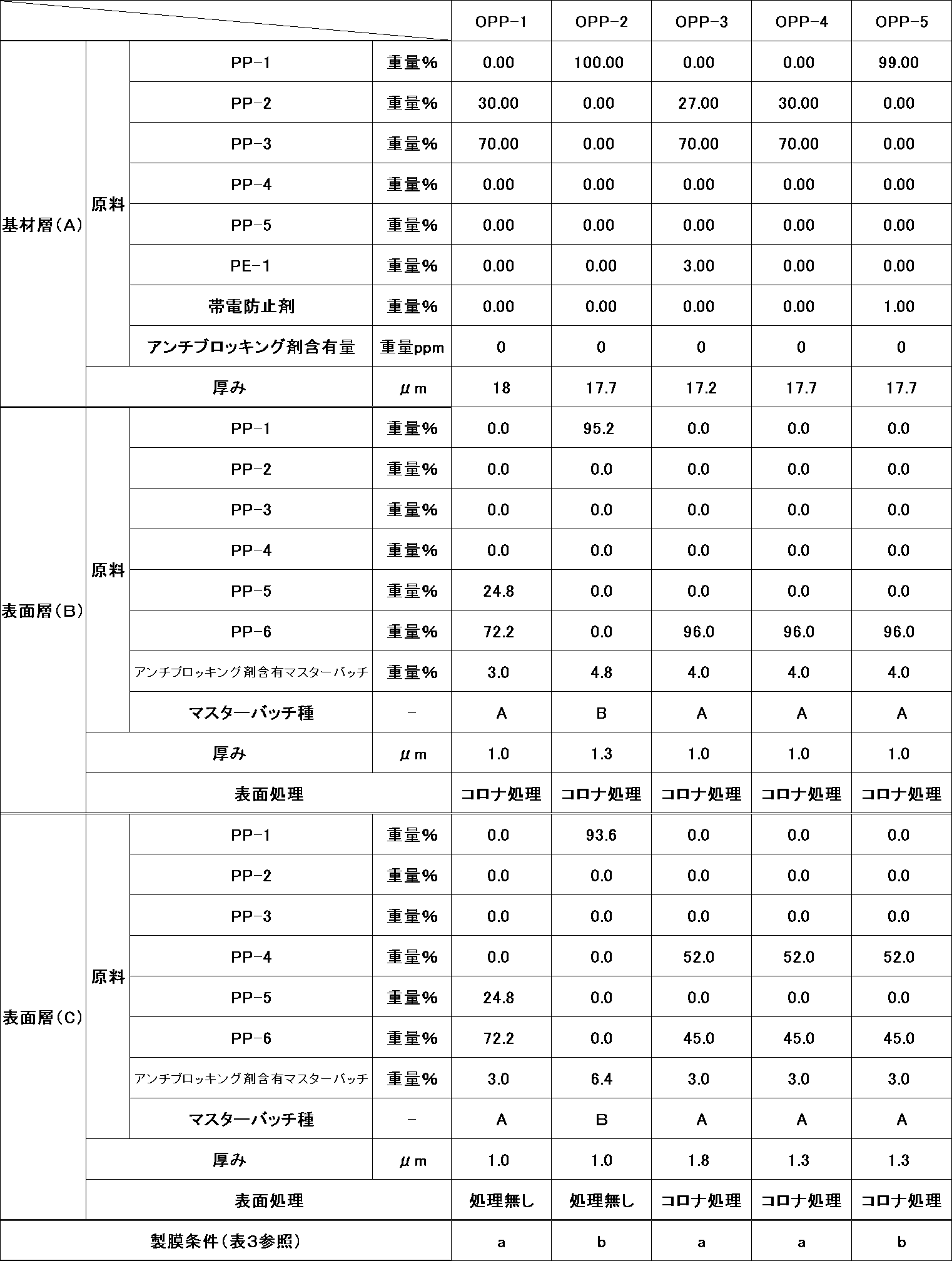
基材層(A)には、表1に示すMn=81,000、Mw=320,000、MFR=2.2g/10分、メソペンタッド分率[mmmm]=99.2%であるプロピレン単独重合体(住友化学(株)製 PP「FS2012」:共重合モノマー量は0mol%;以下「PP-2」と略する)を30重量%、Mn=65,000、Mw=240,000、MFR=7.5g/10分、メソペンタッド分率[mmmm]=98.9%であるプロピレン単独重合体(住友化学(株)製 PP「FLX80E4」:共重合モノマー量は0mol%;以下「PP-3」と略する)を70重量%の割合で配合したものを使用した。
また、表面層(B)には、Mn=55,000、Mw=300,000、MFR=5.6g/10分、であるプロピレン重合体(日本ポリプロ(株)製ノバテック(登録商標)PP「FL4」:「PP-5」と略する)を24.8重量%、Mn=59,000、Mw=310,000、MFR=5.3g/10分、であるプロピレン重合体((株)プライムポリマー製プライムポリプロ「F―300SP」:「PP-6」と略する)を72.2重量%、表2に示すマスターバッチAを3.0重量%の割合で配合したものを使用した。
基材層(A)は45mm押出機、表面層(B)は25mm押出機、第2の表面層(B)は20mm押出機を用いて、それぞれ原料樹脂を250℃で溶融し、Tダイからシート状に共押し出しし、40℃の冷却ロールに表面層(B)が接触するよう冷却固化した後、125℃縦方向(MD)に4.5倍に延伸した。次いでテンター内で、フィルム幅方向(TD)両端をクリップで挟み、174℃で予熱後、158℃で幅方向(TD)に8.2倍に延伸し、幅方向(TD)に6.7%緩和させながら、175℃で熱固定した。このときの製膜条件を製膜条件aとした。
こうして、表面層(B)/基材層(A)/第2の表面層(B)の構成の二軸配向ポリプロピレンフィルムを得た。
二軸配向ポリプロピレンフィルムの表面層(B)の表面を、ソフタル・コロナ・アンド・プラズマGmbH社製のコロナ処理機を用いて、印加電流値:0.75Aの条件で、コロナ処理を施した後、ワインダーで巻き取った。得られたフィルムの厚みは20μm(表面層(B)/基材層(A)/第2の表面層(B)の厚みが1.0μm/18.0μm/1.0μm)であった。本構成の詳細を表4に示す。
基材層(A)に、表1に示すMn=56,000、Mw=310,000、MFR=2.5g/10分、メソペンタッド分率[mmmm]=94.8%であるプロピレン単独重合体(日本ポリプロ(株)製 PP「FL203D」:共重合モノマー量は0mol%;以下「PP-1」と略する)を100重量%使用し、表面層BにはPP-1を95.2重量%、マスターバッチBを4.8重量%の割合で配合し、また表3のbの条件で製膜した以外はOPP1と同じ条件とし、20μmの二軸配向ポリプロピレンフィルムを得た。本構成の詳細を表4に示す。
基材層(A)には、表1に示すポリプロピレン単独重合体PP-2を27.0重量%、表1に示すポリプロピレン単独重合体PP-3を70.0重量%、[PE-1:エチレン単独重合体 Braskem社製「SLH218」、MFR:2.3g/10分,融点:126℃、バイオベース度:84%、密度:0.916g/cm3〕を3重量%の割合で混合した以外はOPP1と同じ条件とし、20μmの二軸配向ポリプロピレンフィルムを得た。本構成の詳細を表4に示す。
(OPP―4)
表面層(C)には表1に示すMn=80,000、Mw=220,000、MFR=7.0g/10分、であるプロピレン-エチレン共重合体(日本ポリプロ(株)製ウィンテック(登録商標)PP「WFX4M」:「PP-4」と略する)を52.0重量%、PP-1を45.0%、表2に示すマスターバッチAを重量3.0%の割合で配合したものを使用した以外はOPP1と同じ条件とし、20μmの二軸配向ポリプロピレンフィルムを得た。本構成の詳細を表4に示す。
(OPP―5)
基材層(A)にはPP-1を99.0重量%、帯電防止剤として、ステアリルジエタノールアミンステアレート(松本油脂(株)KYM-4K)を1.0重量%配合したものを使用した以外は、OPPー2と同じ条件とし、20μmの二軸配向ポリプロピレンフィルムを得た。本構成の詳細を表4に示す。
(蒸着PET) 厚さ12μmの透明蒸着ポリエステルフィルム(東洋紡製「VE100-12μm」)
以下に本実施例及び比較例で使用する被覆層(A)形成用の塗工液の詳細を記す。なお、実施例1~12、及び比較例1~4で使用し、表6に示した。
精製水90質量部に、完全けん化ポリビニルアルコール樹脂(日本合成化学社製、商品名:GポリマーOKS8049Q、(けん化度99.0%以上、平均重合度450)、10質量部を加え、攪拌しながら80℃に加温し、その後約1時間攪拌させた。その後、常温になるまで冷却し、これにより固形分10%のほぼ透明なポリビニルアルコール溶液(PVA溶液)を得た。
無機層状化合物であるモンモリロナイト(商品名:クニピアF、クニミネ工業社製)5質量部を精製水95質量部中に攪拌しながら添加しホモジナイザーにて1500rpmの設定にて充分に分散した。その後、23℃にて1日間保温し固形分5%の無機層状化合物分散液を得た。
下記の配合比率で各材料を混合し、塗布液(被覆層用樹脂組成物)を作成した。
イオン交換水 15.00質量%
イソプロピルアルコール 15.00質量%
ポリビニルアルコール樹脂(a) 30.00質量%
無機層状化合物分散液(b) 40.00質量%
上記調製した塗工液をグラビアロールコート法によって、基材フィルムのコロナ処理面上に塗布し、90℃×4秒で予備乾燥した後、120℃×4秒で本乾燥させ、被覆層を得た。この時の被覆層の付着量は0.30g/m2であった。その後、40℃2日間(48時間)の後加熱処理を施した。以上のようにして、被覆層を備えた積層フィルムを作製した。
以下に各実施例及び比較例で使用する無機薄膜層(A)の作製方法を記す。なお、実施例1~12、及び比較例1~7で使用し、表5に示した。
(無機薄膜層1の形成)
無機薄膜層1として、基材フィルムまたはアンカーコート層上に、二酸化ケイ素と酸化アルミニウムの複合酸化物層を電子ビーム蒸着法で形成した。蒸着源としては、3mm~5mm程度の粒子状SiO2(純度99.9%)とA12O3(純度99.9%)とを用いた。このようにして得られたフィルム(無機薄膜層/被覆層含有フィルム)における無機薄膜層(SiO2/A12O3複合酸化物層)の膜厚は13nmであった。またこの複合酸化物層の組成は、SiO2/A12O3(質量比)=70/30であった。
無機薄膜層2として、基材フィルムまたはアンカーコート層上に酸化ケイ素の蒸着を行った。小型真空蒸着装置(アルバック機工株式会社製、VWR-400/ERH)を使用して、10-3Pa以下に減圧した後、該基板の下部よりニラコ製蒸着源B-110にー酸化ケイ素をセットし加熱蒸発させ、フィルム上に厚さ30nmの酸化ケイ素膜を形成した。
(無機薄膜層3の形成)
無機薄膜層3として、基材フィルムまたはアンカーコート層上に金属アルミニウムの蒸着を行った。小型真空蒸着装置(アルバック機工株式会社製、VWR-400/ERH)を使用して、10-3Pa以下に減圧した後、該基板の下部よりニラコ製蒸着源CF-305Wに純度99.9%のアルミホイルをセットし、金属アルミニウムを加熱蒸発させ、フィルム上に厚さ30nmの金属アルミニウム膜を形成した。
(無機薄膜層4の形成)
無機薄膜層4として、基材フィルムまたはアンカーコート層上に酸化アルミニウムの蒸着を行った。基材フィルム層への酸化アルミニウムを蒸着する方法は、フィルムを連続式真空蒸着機の巻出し側にセットし、冷却金属ドラムを介して走行させフィルムを巻き取る。この時、連続式真空蒸着機を10-4Torr以下に減圧し、冷却ドラムの下部よりアルミナ製るつぼに純度99.99%の金属アルミニウムを装填し、金属アルミニウムを加熱蒸発させ、その蒸気中に酸素を供給し酸化反応させながらフィルム上に付着堆積させ、厚さ10nmの酸化アルミニウム膜を形成した。
以下に各実施例及び比較例で使用したアンカーコート層(C)の作製方法を記す。
[ポリエステル樹脂(a)]
ポリエステル成分として、ポリエステルポリオール(DIC社製「DF-COAT GEC-004C」:固形分30%)を用いた。
ポリイソシアネート成分として、メタキシリレンジイソシアネートのトリメチロールプロパンアダクト体(三井化学社製「タケネートD-110N」:固形分75%)を用いた。
シランカップリング剤として、N-2-(アミノエチル)-3-アミノプロピルトリメトキシシラン(信越化学社製「KBM-603」)を用いた。
シランカップリング剤(c)をアセトンに溶解した溶液(15質量%)およびイソシアネート(b)を下記比率で混合させ、10分間マグネチックスターラ―を用いて撹拌した。得られた調合液をメチルエチルケトンおよび1-メトキシ-2-プロパノール(以下PGM)で希釈し、さらにポリエステル樹脂(a)を添加し、目的の塗工液1を得た。混合比を以下に示す。
ポリエステル樹脂(a) 10.62質量%
イソシアネート(b) 4.07質量%
シランカップリング剤(c)※アセトン希釈液 1.73質量%
メチルエチルケトン 69.55質量%
PGM 14.03質量%
塗工液1を用いて、グラビアロールコート法によって、基材フィルムのコロナ処理面上に塗布し、95℃×4秒で予備乾燥した後、115℃×4秒で本乾燥させ、アンカーコート層を得た。この時のアンカーコート層の付着量は0.40g/m2であった。その後、40℃×4日間(96時間)の後加熱処理を施して、目的の積層フィルムを得た。

(ヒートシール性樹脂)
(CPP1)厚さ30μmの無延伸ポリプロピレンフィルム(東洋紡社製「P1128」)作製した包装体の構成は表6に示す。また、得られた包装体について、各種評価を実施し
た。結果を表6に示す。


Claims (14)
- ポリオレフィン系樹脂を主たる構成成分とする樹脂層を有する基材フィルムを少なくとも1枚と、接着剤層とヒートシール性樹脂層とを有する積層包装材料であって、前記基材フィルムのうち少なくとも1枚はガスバリア層を有する積層ガスバリアフィルムであって、前記積層基材フィルム単体のうち酸素透過度が最も低い基材フィルム(a)を23℃×65%RH条件下で測定した酸素透過度の値(A)が30~1500ml/m2・d・MPaであり、接着剤層を介して基材フィルムをヒートシール性樹脂と貼り合わせて積層包装材料(p)としたものを同条件下で測定した酸素透過度の値(P)が60ml/m2・d・MPa以下であり、下記式(1)で表される貼合わせ前後のバリア値向上率が10以上であることを特徴とする積層包装材料。
フィルム貼合わせ前後のバリア値向上率=(A/P) ・・・ 式(1)
- 前記積層包装材料を用いてゲルボフレックステスターにてひねり屈曲試験を温度23℃で25回実施した後の酸素透過度の値(G)が65ml/m2・d・MPa以下であることを特徴とする請求項1に記載の積層包装材料。
- 接着剤を介して基材フィルムをヒートシール樹脂と貼り合わせた積層包装材料(p)を作成した直後から、揮発成分の揮発が無くなるまでに要する時間が30時間以内であることを特徴とする請求項1または2に記載の積層包装材料。
- 前記基材フィルムとして、前記基材フィルム(a)と、他の基材フィルム(b)を有し、基材フィルム(b)は樹脂層とガスバリア層を有する積層バリアフィルムであり、基材フィルム(a)と、基材フィルム(b)を構成する樹脂層が同種のポリオレフィン系樹脂を主たる構成成分とする、請求項1~3のいずれかに記載の積層包装材料。
- 前記基材フィルムを2枚以下有することを特徴とする、請求項1~4のいずれかに記載の積層包装材料。
- 前記基材フィルムを構成する樹脂層と前記ヒートシール性樹脂層が、同種のポリオレフィン系樹脂を主たる構成成分とする請求項1~5のいずれかに記載の積層包装材料。
- 前記接着剤層がポリウレタン系、ポリエステル系、又はポリアミン系樹脂のいずれかの材料からなることを特徴とする請求項1~6のいずれかに記載の積層包装材料。
- 前記ガスバリア層がアルミニウム、酸化アルミニウム、酸化ケイ素、または酸化ケイ素と酸化アルミニウムの複合酸化物のいずれか一つからなる無機薄膜層であることを特徴とする請求項1~7のいずれかに記載の積層包装材料。
- 前記ガスバリア層がポリビニルアルコール樹脂、ポリエステル樹脂、又はポリウレタン樹脂のいずれか一つからなる被覆層であることを特徴とする請求項1~8のいずれかに記載の積層包装材料。
- 前記基材フィルムとガスバリア層との間にアンカーコート層が積層されることを特徴とする請求項1~9のいずれかに記載の積層包装材料。
- ボイルまたはレトルト用に使用されることを特徴とする請求項1~10のいずれかに記載の積層包装材料。
- 電子レンジ加熱用に使用されることを特徴とする請求項1~10のいずれかに記載の包装材料。
- 請求項1~12のいずれかに記載の積層包装材料を用いて構成される包装袋。
- 請求項1~12のいずれかに記載の積層包装材料、又は請求項13に記載の包装袋を使用して被包装物が包装されてなる包装体。
Priority Applications (4)
| Application Number | Priority Date | Filing Date | Title |
|---|---|---|---|
| EP23803499.5A EP4523909A4 (en) | 2022-05-11 | 2023-04-28 | MULTI-LAYER PACKAGING MATERIAL |
| CN202380038954.9A CN119212871A (zh) | 2022-05-11 | 2023-04-28 | 层叠包装材料 |
| JP2024520415A JPWO2023219021A1 (ja) | 2022-05-11 | 2023-04-28 | |
| KR1020247040383A KR20250009463A (ko) | 2022-05-11 | 2023-04-28 | 적층 포장재료 |
Applications Claiming Priority (2)
| Application Number | Priority Date | Filing Date | Title |
|---|---|---|---|
| JP2022-078322 | 2022-05-11 | ||
| JP2022078322A JP2025119625A (ja) | 2022-05-11 | 2022-05-11 | 積層包装材料 |
Publications (1)
| Publication Number | Publication Date |
|---|---|
| WO2023219021A1 true WO2023219021A1 (ja) | 2023-11-16 |
Family
ID=88730445
Family Applications (1)
| Application Number | Title | Priority Date | Filing Date |
|---|---|---|---|
| PCT/JP2023/016940 Ceased WO2023219021A1 (ja) | 2022-05-11 | 2023-04-28 | 積層包装材料 |
Country Status (6)
| Country | Link |
|---|---|
| EP (1) | EP4523909A4 (ja) |
| JP (2) | JP2025119625A (ja) |
| KR (1) | KR20250009463A (ja) |
| CN (1) | CN119212871A (ja) |
| TW (1) | TW202400416A (ja) |
| WO (1) | WO2023219021A1 (ja) |
Cited By (2)
| Publication number | Priority date | Publication date | Assignee | Title |
|---|---|---|---|---|
| KR102734562B1 (ko) * | 2023-11-24 | 2024-11-26 | 율촌화학 주식회사 | 가열 살균 공정이 가능한 친환경 적층필름, 이를 이용한 친환경 포장재 및 이의 제조방법 |
| WO2025187755A1 (ja) * | 2024-03-07 | 2025-09-12 | 東洋製罐グループホールディングス株式会社 | 包装用積層体 |
Citations (9)
| Publication number | Priority date | Publication date | Assignee | Title |
|---|---|---|---|---|
| JPH04359033A (ja) | 1991-06-03 | 1992-12-11 | Daicel Chem Ind Ltd | 複合フィルムおよびその製造方法 |
| JP2000052501A (ja) | 1998-06-03 | 2000-02-22 | Kuraray Co Ltd | 積層体およびその製造方法 |
| JP3318479B2 (ja) | 1995-11-22 | 2002-08-26 | 東レ株式会社 | 金属酸化物蒸着未延伸ポリプロピレンフイルム |
| JP2003231221A (ja) | 2002-02-13 | 2003-08-19 | Daicel Chem Ind Ltd | カイロ用包装フィルム |
| JP2017165059A (ja) | 2016-03-18 | 2017-09-21 | 東洋紡株式会社 | シーラント用途のポリエステルフィルム、積層体及び包装体 |
| WO2017221781A1 (ja) | 2016-06-23 | 2017-12-28 | 東洋紡株式会社 | 積層ポリプロピレンフィルム |
| JP2019026783A (ja) * | 2017-08-02 | 2019-02-21 | ユニチカ株式会社 | 蒸着用プライマーおよびこれを用いた積層体 |
| WO2021112243A1 (ja) | 2019-12-06 | 2021-06-10 | 凸版印刷株式会社 | ガスバリアフィルム |
| WO2021199637A1 (ja) * | 2020-03-31 | 2021-10-07 | 大日本印刷株式会社 | 積層体、パウチおよび蓋材 |
Family Cites Families (3)
| Publication number | Priority date | Publication date | Assignee | Title |
|---|---|---|---|---|
| JP2016137678A (ja) * | 2015-01-29 | 2016-08-04 | 凸版印刷株式会社 | フィルム積層体及びそれを用いた包装体 |
| JP7087321B2 (ja) * | 2017-09-29 | 2022-06-21 | 東洋紡株式会社 | ラミネート積層体 |
| WO2021065888A1 (ja) * | 2019-09-30 | 2021-04-08 | 大日本印刷株式会社 | バリア性積層体、該バリア性積層体を備える包装容器 |
-
2022
- 2022-05-11 JP JP2022078322A patent/JP2025119625A/ja active Pending
-
2023
- 2023-04-28 WO PCT/JP2023/016940 patent/WO2023219021A1/ja not_active Ceased
- 2023-04-28 KR KR1020247040383A patent/KR20250009463A/ko active Pending
- 2023-04-28 JP JP2024520415A patent/JPWO2023219021A1/ja active Pending
- 2023-04-28 CN CN202380038954.9A patent/CN119212871A/zh active Pending
- 2023-04-28 EP EP23803499.5A patent/EP4523909A4/en active Pending
- 2023-05-08 TW TW112116952A patent/TW202400416A/zh unknown
Patent Citations (9)
| Publication number | Priority date | Publication date | Assignee | Title |
|---|---|---|---|---|
| JPH04359033A (ja) | 1991-06-03 | 1992-12-11 | Daicel Chem Ind Ltd | 複合フィルムおよびその製造方法 |
| JP3318479B2 (ja) | 1995-11-22 | 2002-08-26 | 東レ株式会社 | 金属酸化物蒸着未延伸ポリプロピレンフイルム |
| JP2000052501A (ja) | 1998-06-03 | 2000-02-22 | Kuraray Co Ltd | 積層体およびその製造方法 |
| JP2003231221A (ja) | 2002-02-13 | 2003-08-19 | Daicel Chem Ind Ltd | カイロ用包装フィルム |
| JP2017165059A (ja) | 2016-03-18 | 2017-09-21 | 東洋紡株式会社 | シーラント用途のポリエステルフィルム、積層体及び包装体 |
| WO2017221781A1 (ja) | 2016-06-23 | 2017-12-28 | 東洋紡株式会社 | 積層ポリプロピレンフィルム |
| JP2019026783A (ja) * | 2017-08-02 | 2019-02-21 | ユニチカ株式会社 | 蒸着用プライマーおよびこれを用いた積層体 |
| WO2021112243A1 (ja) | 2019-12-06 | 2021-06-10 | 凸版印刷株式会社 | ガスバリアフィルム |
| WO2021199637A1 (ja) * | 2020-03-31 | 2021-10-07 | 大日本印刷株式会社 | 積層体、パウチおよび蓋材 |
Non-Patent Citations (1)
| Title |
|---|
| See also references of EP4523909A4 |
Cited By (2)
| Publication number | Priority date | Publication date | Assignee | Title |
|---|---|---|---|---|
| KR102734562B1 (ko) * | 2023-11-24 | 2024-11-26 | 율촌화학 주식회사 | 가열 살균 공정이 가능한 친환경 적층필름, 이를 이용한 친환경 포장재 및 이의 제조방법 |
| WO2025187755A1 (ja) * | 2024-03-07 | 2025-09-12 | 東洋製罐グループホールディングス株式会社 | 包装用積層体 |
Also Published As
| Publication number | Publication date |
|---|---|
| EP4523909A1 (en) | 2025-03-19 |
| TW202400416A (zh) | 2024-01-01 |
| JPWO2023219021A1 (ja) | 2023-11-16 |
| KR20250009463A (ko) | 2025-01-17 |
| CN119212871A (zh) | 2024-12-27 |
| EP4523909A4 (en) | 2026-04-15 |
| JP2025119625A (ja) | 2025-08-15 |
Similar Documents
| Publication | Publication Date | Title |
|---|---|---|
| WO2023286679A1 (ja) | 無機薄膜層形成用の積層フィルム | |
| JP7845404B2 (ja) | 包装材料 | |
| WO2023219021A1 (ja) | 積層包装材料 | |
| WO2024225339A1 (ja) | 延伸積層ポリオレフィン系樹脂フィルム、包装材料、包装袋、及び包装体 | |
| JP7816472B2 (ja) | 積層フィルム | |
| JP2025182023A (ja) | 積層フィルム、積層体および包装材料 | |
| WO2024058167A1 (ja) | 包装材料 | |
| WO2025070687A1 (ja) | ラミネート積層体 | |
| WO2024248080A1 (ja) | 包装材料、包装袋、及び包装体 | |
| WO2025164461A1 (ja) | 積層体、包装材料、包装袋、及び包装体 | |
| WO2025192318A1 (ja) | 二軸配向ポリプロピレンフィルムを用いた積層体、包装材料、及び包装体 | |
| JP2026016115A (ja) | 積層フィルム |
Legal Events
| Date | Code | Title | Description |
|---|---|---|---|
| 121 | Ep: the epo has been informed by wipo that ep was designated in this application |
Ref document number: 23803499 Country of ref document: EP Kind code of ref document: A1 |
|
| ENP | Entry into the national phase |
Ref document number: 2024520415 Country of ref document: JP Kind code of ref document: A |
|
| WWE | Wipo information: entry into national phase |
Ref document number: 2401007344 Country of ref document: TH Ref document number: 202380038954.9 Country of ref document: CN |
|
| WWE | Wipo information: entry into national phase |
Ref document number: 202447090510 Country of ref document: IN |
|
| ENP | Entry into the national phase |
Ref document number: 20247040383 Country of ref document: KR Kind code of ref document: A |
|
| WWE | Wipo information: entry into national phase |
Ref document number: 1020247040383 Country of ref document: KR |
|
| WWE | Wipo information: entry into national phase |
Ref document number: 2023803499 Country of ref document: EP |
|
| NENP | Non-entry into the national phase |
Ref country code: DE |
|
| ENP | Entry into the national phase |
Ref document number: 2023803499 Country of ref document: EP Effective date: 20241211 |
|
| WWP | Wipo information: published in national office |
Ref document number: 202380038954.9 Country of ref document: CN |