WO2023219109A1 - 接着剤セット、並びに接着体及びその製造方法 - Google Patents
接着剤セット、並びに接着体及びその製造方法 Download PDFInfo
- Publication number
- WO2023219109A1 WO2023219109A1 PCT/JP2023/017601 JP2023017601W WO2023219109A1 WO 2023219109 A1 WO2023219109 A1 WO 2023219109A1 JP 2023017601 W JP2023017601 W JP 2023017601W WO 2023219109 A1 WO2023219109 A1 WO 2023219109A1
- Authority
- WO
- WIPO (PCT)
- Prior art keywords
- meth
- adhesive
- group
- initiator
- acrylate
- Prior art date
- Legal status (The legal status is an assumption and is not a legal conclusion. Google has not performed a legal analysis and makes no representation as to the accuracy of the status listed.)
- Ceased
Links
Classifications
-
- B—PERFORMING OPERATIONS; TRANSPORTING
- B32—LAYERED PRODUCTS
- B32B—LAYERED PRODUCTS, i.e. PRODUCTS BUILT-UP OF STRATA OF FLAT OR NON-FLAT, e.g. CELLULAR OR HONEYCOMB, FORM
- B32B7/00—Layered products characterised by the relation between layers; Layered products characterised by the relative orientation of features between layers, or by the relative values of a measurable parameter between layers, i.e. products comprising layers having different physical, chemical or physicochemical properties; Layered products characterised by the interconnection of layers
- B32B7/04—Interconnection of layers
- B32B7/12—Interconnection of layers using interposed adhesives or interposed materials with bonding properties
-
- C—CHEMISTRY; METALLURGY
- C09—DYES; PAINTS; POLISHES; NATURAL RESINS; ADHESIVES; COMPOSITIONS NOT OTHERWISE PROVIDED FOR; APPLICATIONS OF MATERIALS NOT OTHERWISE PROVIDED FOR
- C09J—ADHESIVES; NON-MECHANICAL ASPECTS OF ADHESIVE PROCESSES IN GENERAL; ADHESIVE PROCESSES NOT PROVIDED FOR ELSEWHERE; USE OF MATERIALS AS ADHESIVES
- C09J4/00—Adhesives based on organic non-macromolecular compounds having at least one polymerisable carbon-to-carbon unsaturated bond ; adhesives, based on monomers of macromolecular compounds of groups C09J183/00 - C09J183/16
-
- B—PERFORMING OPERATIONS; TRANSPORTING
- B32—LAYERED PRODUCTS
- B32B—LAYERED PRODUCTS, i.e. PRODUCTS BUILT-UP OF STRATA OF FLAT OR NON-FLAT, e.g. CELLULAR OR HONEYCOMB, FORM
- B32B27/00—Layered products comprising a layer of synthetic resin
-
- C—CHEMISTRY; METALLURGY
- C08—ORGANIC MACROMOLECULAR COMPOUNDS; THEIR PREPARATION OR CHEMICAL WORKING-UP; COMPOSITIONS BASED THEREON
- C08F—MACROMOLECULAR COMPOUNDS OBTAINED BY REACTIONS ONLY INVOLVING CARBON-TO-CARBON UNSATURATED BONDS
- C08F220/00—Copolymers of compounds having one or more unsaturated aliphatic radicals, each having only one carbon-to-carbon double bond, and only one being terminated by only one carboxyl radical or a salt, anhydride ester, amide, imide or nitrile thereof
- C08F220/02—Monocarboxylic acids having less than ten carbon atoms; Derivatives thereof
- C08F220/10—Esters
- C08F220/12—Esters of monohydric alcohols or phenols
- C08F220/16—Esters of monohydric alcohols or phenols of phenols or of alcohols containing two or more carbon atoms
- C08F220/18—Esters of monohydric alcohols or phenols of phenols or of alcohols containing two or more carbon atoms with acrylic or methacrylic acids
- C08F220/1811—C10or C11-(Meth)acrylate, e.g. isodecyl (meth)acrylate, isobornyl (meth)acrylate or 2-naphthyl (meth)acrylate
-
- C—CHEMISTRY; METALLURGY
- C08—ORGANIC MACROMOLECULAR COMPOUNDS; THEIR PREPARATION OR CHEMICAL WORKING-UP; COMPOSITIONS BASED THEREON
- C08F—MACROMOLECULAR COMPOUNDS OBTAINED BY REACTIONS ONLY INVOLVING CARBON-TO-CARBON UNSATURATED BONDS
- C08F220/00—Copolymers of compounds having one or more unsaturated aliphatic radicals, each having only one carbon-to-carbon double bond, and only one being terminated by only one carboxyl radical or a salt, anhydride ester, amide, imide or nitrile thereof
- C08F220/02—Monocarboxylic acids having less than ten carbon atoms; Derivatives thereof
- C08F220/10—Esters
- C08F220/26—Esters containing oxygen in addition to the carboxy oxygen
- C08F220/30—Esters containing oxygen in addition to the carboxy oxygen containing aromatic rings in the alcohol moiety
- C08F220/301—Esters containing oxygen in addition to the carboxy oxygen containing aromatic rings in the alcohol moiety and one oxygen in the alcohol moiety
-
- C—CHEMISTRY; METALLURGY
- C08—ORGANIC MACROMOLECULAR COMPOUNDS; THEIR PREPARATION OR CHEMICAL WORKING-UP; COMPOSITIONS BASED THEREON
- C08F—MACROMOLECULAR COMPOUNDS OBTAINED BY REACTIONS ONLY INVOLVING CARBON-TO-CARBON UNSATURATED BONDS
- C08F220/00—Copolymers of compounds having one or more unsaturated aliphatic radicals, each having only one carbon-to-carbon double bond, and only one being terminated by only one carboxyl radical or a salt, anhydride ester, amide, imide or nitrile thereof
- C08F220/02—Monocarboxylic acids having less than ten carbon atoms; Derivatives thereof
- C08F220/52—Amides or imides
- C08F220/54—Amides, e.g. N,N-dimethylacrylamide or N-isopropylacrylamide
-
- C—CHEMISTRY; METALLURGY
- C08—ORGANIC MACROMOLECULAR COMPOUNDS; THEIR PREPARATION OR CHEMICAL WORKING-UP; COMPOSITIONS BASED THEREON
- C08F—MACROMOLECULAR COMPOUNDS OBTAINED BY REACTIONS ONLY INVOLVING CARBON-TO-CARBON UNSATURATED BONDS
- C08F220/00—Copolymers of compounds having one or more unsaturated aliphatic radicals, each having only one carbon-to-carbon double bond, and only one being terminated by only one carboxyl radical or a salt, anhydride ester, amide, imide or nitrile thereof
- C08F220/02—Monocarboxylic acids having less than ten carbon atoms; Derivatives thereof
- C08F220/52—Amides or imides
- C08F220/54—Amides, e.g. N,N-dimethylacrylamide or N-isopropylacrylamide
- C08F220/58—Amides, e.g. N,N-dimethylacrylamide or N-isopropylacrylamide containing oxygen in addition to the carbonamido oxygen, e.g. N-methylolacrylamide, N-(meth)acryloylmorpholine
-
- C—CHEMISTRY; METALLURGY
- C08—ORGANIC MACROMOLECULAR COMPOUNDS; THEIR PREPARATION OR CHEMICAL WORKING-UP; COMPOSITIONS BASED THEREON
- C08K—Use of inorganic or non-macromolecular organic substances as compounding ingredients
- C08K3/00—Use of inorganic substances as compounding ingredients
- C08K3/16—Halogen-containing compounds
-
- C—CHEMISTRY; METALLURGY
- C08—ORGANIC MACROMOLECULAR COMPOUNDS; THEIR PREPARATION OR CHEMICAL WORKING-UP; COMPOSITIONS BASED THEREON
- C08K—Use of inorganic or non-macromolecular organic substances as compounding ingredients
- C08K3/00—Use of inorganic substances as compounding ingredients
- C08K3/34—Silicon-containing compounds
- C08K3/36—Silica
-
- C—CHEMISTRY; METALLURGY
- C08—ORGANIC MACROMOLECULAR COMPOUNDS; THEIR PREPARATION OR CHEMICAL WORKING-UP; COMPOSITIONS BASED THEREON
- C08K—Use of inorganic or non-macromolecular organic substances as compounding ingredients
- C08K5/00—Use of organic ingredients
- C08K5/0091—Complexes with metal-heteroatom-bonds
-
- C—CHEMISTRY; METALLURGY
- C08—ORGANIC MACROMOLECULAR COMPOUNDS; THEIR PREPARATION OR CHEMICAL WORKING-UP; COMPOSITIONS BASED THEREON
- C08K—Use of inorganic or non-macromolecular organic substances as compounding ingredients
- C08K5/00—Use of organic ingredients
- C08K5/04—Oxygen-containing compounds
- C08K5/10—Esters; Ether-esters
- C08K5/12—Esters; Ether-esters of cyclic polycarboxylic acids
-
- C—CHEMISTRY; METALLURGY
- C08—ORGANIC MACROMOLECULAR COMPOUNDS; THEIR PREPARATION OR CHEMICAL WORKING-UP; COMPOSITIONS BASED THEREON
- C08K—Use of inorganic or non-macromolecular organic substances as compounding ingredients
- C08K5/00—Use of organic ingredients
- C08K5/04—Oxygen-containing compounds
- C08K5/15—Heterocyclic compounds having oxygen in the ring
- C08K5/151—Heterocyclic compounds having oxygen in the ring having one oxygen atom in the ring
- C08K5/1535—Five-membered rings
- C08K5/1539—Cyclic anhydrides
-
- C—CHEMISTRY; METALLURGY
- C08—ORGANIC MACROMOLECULAR COMPOUNDS; THEIR PREPARATION OR CHEMICAL WORKING-UP; COMPOSITIONS BASED THEREON
- C08K—Use of inorganic or non-macromolecular organic substances as compounding ingredients
- C08K5/00—Use of organic ingredients
- C08K5/55—Boron-containing compounds
-
- C—CHEMISTRY; METALLURGY
- C08—ORGANIC MACROMOLECULAR COMPOUNDS; THEIR PREPARATION OR CHEMICAL WORKING-UP; COMPOSITIONS BASED THEREON
- C08K—Use of inorganic or non-macromolecular organic substances as compounding ingredients
- C08K9/00—Use of pretreated ingredients
- C08K9/04—Ingredients treated with organic substances
- C08K9/06—Ingredients treated with organic substances with silicon-containing compounds
-
- C—CHEMISTRY; METALLURGY
- C09—DYES; PAINTS; POLISHES; NATURAL RESINS; ADHESIVES; COMPOSITIONS NOT OTHERWISE PROVIDED FOR; APPLICATIONS OF MATERIALS NOT OTHERWISE PROVIDED FOR
- C09J—ADHESIVES; NON-MECHANICAL ASPECTS OF ADHESIVE PROCESSES IN GENERAL; ADHESIVE PROCESSES NOT PROVIDED FOR ELSEWHERE; USE OF MATERIALS AS ADHESIVES
- C09J11/00—Features of adhesives not provided for in group C09J9/00, e.g. additives
- C09J11/02—Non-macromolecular additives
- C09J11/06—Non-macromolecular additives organic
-
- C—CHEMISTRY; METALLURGY
- C09—DYES; PAINTS; POLISHES; NATURAL RESINS; ADHESIVES; COMPOSITIONS NOT OTHERWISE PROVIDED FOR; APPLICATIONS OF MATERIALS NOT OTHERWISE PROVIDED FOR
- C09J—ADHESIVES; NON-MECHANICAL ASPECTS OF ADHESIVE PROCESSES IN GENERAL; ADHESIVE PROCESSES NOT PROVIDED FOR ELSEWHERE; USE OF MATERIALS AS ADHESIVES
- C09J5/00—Adhesive processes in general; Adhesive processes not provided for elsewhere, e.g. relating to primers
-
- C—CHEMISTRY; METALLURGY
- C09—DYES; PAINTS; POLISHES; NATURAL RESINS; ADHESIVES; COMPOSITIONS NOT OTHERWISE PROVIDED FOR; APPLICATIONS OF MATERIALS NOT OTHERWISE PROVIDED FOR
- C09J—ADHESIVES; NON-MECHANICAL ASPECTS OF ADHESIVE PROCESSES IN GENERAL; ADHESIVE PROCESSES NOT PROVIDED FOR ELSEWHERE; USE OF MATERIALS AS ADHESIVES
- C09J2433/00—Presence of (meth)acrylic polymer
Definitions
- the present disclosure relates to an adhesive set, an adhesive body, and a method for manufacturing the same.
- An adhesive composition containing an organic borane complex has been disclosed as an adhesive between plastics such as polyethylene and polypropylene (for example, Patent Document 1).
- the organoborane complex is decomplexed to provide an organoborane by mixing with a decomplexing agent.
- Organoborane acts as an initiator that generates radicals by reacting with oxygen.
- the borinic acid radicals generated here act on the generation of dormant species in atom transfer radical polymerization (ATRP), which sustains growth reactions including surface grafting while suppressing chain transfer or termination reactions of compounds having radically polymerizable groups. do.
- ATRP atom transfer radical polymerization
- such adhesive compositions are required to exhibit sufficient adhesive strength in a short period of time (for example, about 5 hours) from the viewpoint of process compatibility (handling properties).
- process compatibility handling properties
- the main object of the present disclosure is to provide an adhesive set that allows the preparation of an adhesive composition that exhibits sufficient adhesive strength in a short period of time.
- the inventors of the present disclosure conducted studies to solve the above problems and found that by using N,N-disubstituted (meth)acrylamide, the adhesive composition can develop sufficient adhesive strength in a short period of time. , have completed the invention of the present disclosure.
- the present disclosure provides the following adhesive set [1] to [4], the following adhesive body [5], and the following method for manufacturing the adhesive body [6].
- the adhesive set further contains a compound having a group, and at least one of the base agent and the initiator further contains at least one selected from the group consisting of a metal halide salt and a compound having a thiocarbonylthio structure.
- R 5 and R 6 each independently represent an alkylene group.
- [4] The adhesive set according to any one of [1] to [3], wherein the main ingredient further contains a compound having a radically polymerizable group.
- [5] A first adherend, a second adherend, and an adhesive layer that adheres the first adherend and the second adherend to each other, the adhesive layer An adhesive body containing a cured product of an adhesive composition containing the main ingredient and the initiator in the adhesive set according to any one of [1] to [4].
- [6] The method for producing an adhesive body according to [5], wherein the first adherend and the second adherend are bonded to each other via an adhesive composition containing the base agent and the initiator.
- an adhesive set is provided that allows the preparation of an adhesive composition that exhibits sufficient adhesive strength in a short period of time. Further, according to the present disclosure, an adhesive body using such an adhesive set and a method for manufacturing the same are provided.
- a numerical range indicated using "-" indicates a range that includes the numerical values written before and after "-" as the minimum and maximum values, respectively.
- the upper limit value or lower limit value described in one numerical range may be replaced with the upper limit value or lower limit value of another numerical range described step by step. good.
- the upper limit or lower limit of the numerical range may be replaced with the value shown in the Examples.
- (meth)acrylamide means acrylamide or the corresponding methacrylamide.
- (Meth)acrylate means acrylate or the corresponding methacrylate.
- the materials exemplified below may be used alone or in combination of two or more, unless otherwise specified.
- the content of each component in the composition means the total amount of the plurality of substances present in the composition, unless otherwise specified.
- the adhesive set of one embodiment includes a base agent containing a decomplexing agent and an initiator containing an organoborane complex and an N,N-disubstituted (meth)acrylamide.
- an adhesive composition containing a base ingredient and an initiator can be obtained by mixing the base ingredient and an initiator.
- the base agent contains a decomplexing agent.
- the initiator contains an organoborane complex and an N,N-disubstituted (meth)acrylamide. At least one of the main ingredient and the initiator further contains a compound having a radically polymerizable group. At least one of the base agent and the initiator further contains at least one selected from the group consisting of halogenated metal salts and compounds having a thiocarbonylthio structure. At least one of the main ingredient and the initiator may further contain a filler, a plasticizer, or the like. Each component will be explained below.
- the initiator contains an organoborane complex.
- the organoborane complex means an organoborane-Lewis base complex obtained by coordinating an organoborane with a Lewis base to form a complex.
- the organoborane-Lewis base complex is a compound that reacts with a decomplexing agent described below to give an organoborane.
- Organic borane undergoes radical cleavage in the presence of oxygen to generate borinic acid radicals and the like, and therefore can act as an initiator for living radical polymerization.
- the organoborane may be, for example, an alkylborane (BR 3 , R: alkyl group).
- a Lewis base may be, for example, an amine.
- An amine is, for example, a compound having a plurality of amino groups, or a group containing an amino group constituting the amine and an atom (such as an oxygen atom) capable of coordinating with boron in addition to the nitrogen atom of the amino group.
- an atom such as an oxygen atom
- it may be a compound having at least an alkoxy group.
- These compounds can be called polydentate amines because they act as polydentate ligands for organoboranes.
- the organoborane complex may be an alkylborane-amine complex or an alkylborane-polydentate amine complex.
- the organic borane complex include triethylborane-1,3-diaminopropane complex, triethylborane-diethylenetriamine complex, tri-n-butylborane-3-methoxy-1-propylamine complex, and tri-n-butylborane-1,3 -diaminopropane complex, triisobutylborane-1,3-diaminopropane complex, triethylborane-1,6-diaminohexane complex, triisobutylborane-1,3-diaminopropane complex, triisobutylborane-1,6-diaminohexane Examples include complexes.
- the organoborane complex may be a triethylborane-1,3-diaminopropane complex or a tri-n-butylborane-3-methoxy-1-propylamine complex.
- the organic borane complex a commercially available product or a synthetic product may be used.
- the content of the organoborane complex may be 0.1% by mass or more, 1% by mass or more, 3% by mass or more, or 5% by mass or more, based on the total amount of the initiator. From the viewpoint of storage stability, the content of the organoborane complex may be 30% by mass or less, 20% by mass or less, 15% by mass or less, or 10% by mass or less, based on the total amount of the initiator.
- the content of the organoborane complex is 0.01% by mass or more, 0.05% by mass or more, 0.1% by mass or more, or 0.01% by mass or more, based on the total amount of the main agent and initiator. It may be 2% by mass or more. From the viewpoint of the toughness of the adhesive layer, the content of the organoborane complex is 10% by mass or less, 5% by mass or less, 3% by mass or less, or 1% by mass or less, based on the total amount of the main agent and initiator. It's fine.
- the content of the organoborane complex is 0.01 mol% or more, 0.05 mol% or more, 0.1 mol% or more, based on the total amount of the compound having a radically polymerizable group, or It may be 0.5 mol% or more.
- the content of the organoborane complex is 10 mol% or less, 5 mol% or less, 2 mol% or less, or 1 mol% or less, based on the total amount of the compound having a radically polymerizable group. It may be.
- N,N-disubstituted (meth)acrylamide The initiator contains N,N-disubstituted (meth)acrylamide.
- N,N-disubstituted (meth)acrylamide can be a stabilizing agent that can act to stabilize the organoborane complex and can also contribute to stabilizing the adhesive set.
- N,N-disubstituted (meth)acrylamide means a compound in which two hydrogen atoms on the nitrogen atom of (meth)acrylamide are substituted with groups other than hydrogen atoms.
- the N,N-disubstituted (meth)acrylamide may be, for example, a N,N-disubstituted acrylamide.
- the N,N-disubstituted (meth)acrylamide may be, for example, a compound represented by the following formula (1).
- R 1 represents a hydrogen atom or a methyl group.
- R 1 may be a hydrogen atom.
- R 2 and R 3 each independently represent an alkyl group.
- the number of carbon atoms in the alkyl group may be 1 to 20, 1 to 10, 1 to 6, or 1 to 3.
- the alkyl group may be a straight chain alkyl group, a branched alkyl group, or a cyclic alkyl group.
- the number of carbon atoms in the straight chain alkyl group is usually 1 to 20, and may be 1 to 10, 1 to 6, or 1 to 3.
- the number of carbon atoms in the branched alkyl group is usually 3 to 20, and may be 3 to 10 or 3 to 6.
- the number of carbon atoms in the cyclic alkyl group is usually 3 to 20, and may be 3 to 10 or 3 to 6.
- Examples of the straight-chain alkyl group include methyl group, ethyl group, n-propyl group, n-butyl group, n-hexyl group, n-octyl group, n-dodecyl group, n-hexadecyl group, and the like.
- Examples of the branched alkyl group include isopropyl group, isobutyl group, sec-butyl group, tert-butyl group, 2-ethylhexyl group, 3,7-dimethyloctyl group, and 2-hexyldecyl group.
- cyclic alkyl group examples include a cyclopentyl group, a cyclohexyl group, and an adamantyl group.
- the alkyl group may be a methyl group or an ethyl group, or may be a methyl group.
- substituent refers to a group commonly available in the field of organic chemistry. Specific examples of substituents include halogen atoms (fluorine atoms, chlorine atoms, bromine atoms, iodine atoms), cyano groups, alkyl groups having 1 to 10 carbon atoms, aryl groups having 6 to 10 carbon atoms, and carbon atoms. Examples include 1 to 10 alkoxy groups and amino groups.
- R 2 and R 3 may be bonded to each other or bonded to each other via an oxygen atom to form a ring together with the nitrogen atom to which they are bonded.
- the ring formed (heterocycle containing a nitrogen atom, or a heterocycle containing a nitrogen atom and an oxygen atom) may be a four-membered ring or more, a five-membered ring or more, and an eight-membered ring or less, or a seven-membered ring or less. It's good.
- the N,N-disubstituted (meth)acrylamide may be, for example, a compound represented by the following formula (2).
- R 4 represents a hydrogen atom or a methyl group.
- R 4 may be a hydrogen atom.
- R 5 and R 6 each independently represent an alkylene group.
- the alkylene group may have 1 to 20 carbon atoms, 1 to 10 carbon atoms, 1 to 6 carbon atoms, or 1 to 3 carbon atoms.
- the alkylene group may be either a straight chain alkylene group or a branched alkylene group.
- the number of carbon atoms in the straight chain alkylene group is usually 1 to 20, and may be 1 to 10, 1 to 6, or 1 to 3.
- the number of carbon atoms in the branched alkylene group is usually 3 to 20, and may be 3 to 10 or 3 to 6.
- Examples of the linear alkylene group include a methylene group, an ethylene group, a propylene group, a butylene group, a pentylene group, and a hexylene group.
- Examples of the branched alkylene group include an isopropylene group, an isobutylene group, a dimethylpropylene group, and the like. Among these, the alkylene group may be an ethylene group.
- Some of the hydrogen atoms of the alkylene group may be substituted with a substituent.
- the heterocycle containing a nitrogen atom or the heterocycle containing a nitrogen atom and an oxygen atom may be, for example, a morpholine ring.
- N,N-disubstituted (meth)acrylamide examples include N,N-dimethyl (meth)acrylamide, N,N-diethyl (meth)acrylamide, N,N-dipropyl (meth)acrylamide, N,N- 4-( Examples include meth)acryloylmorpholine.
- the N,N-disubstituted (meth)acrylamide may be 4-(meth)acryloylmorpholine or 4-acryloylmorpholine (ACMO).
- N,N-disubstituted (meth)acrylamide has a radically polymerizable group, it can also act as a compound ((meth)acrylamide derivative) having a radically polymerizable group, which will be described later.
- the content of N,N-disubstituted (meth)acrylamide (stabilizer) is 0.1% by mass or more based on the total amount of the initiator, from the viewpoint of developing adhesive strength of the adhesive composition in a short time. , 1% by mass or more, 3% by mass or more, or 5% by mass or more.
- the content of N,N-disubstituted (meth)acrylamide may be 30% by weight or less, 25% by weight or less, 20% by weight or less, or 15% by weight or less, based on the total amount of the initiator.
- the content of N,N-disubstituted (meth)acrylamide (stabilizer) is 0.01 based on the total amount of the main agent and initiator from the viewpoint of developing adhesive strength of the adhesive composition in a short time. It may be at least 0.05% by mass, at least 0.1% by mass, or at least 0.5% by mass. From the viewpoint of the toughness of the adhesive layer, the content of N,N-disubstituted (meth)acrylamide is 10% by mass or less, 7% by mass or less, 5% by mass or less, based on the total amount of the main agent and initiator. Or it may be 3% by mass or less.
- the content of N,N-disubstituted (meth)acrylamide (stabilizer) is 0 based on the total amount of the compound having a radically polymerizable group, from the viewpoint of developing adhesive strength of the adhesive composition in a short time. It may be .01 mol% or more, 0.05 mol% or more, 0.1 mol% or more, or 0.5 mol% or more. From the viewpoint of the toughness of the adhesive layer, the content of N,N-disubstituted (meth)acrylamide is 10 mol% or less, 7 mol% or less, 5 mol% or less based on the total amount of the compound having a radically polymerizable group. or less, or 3 mol% or less.
- the base agent contains a decomplexing agent.
- a decomplexing agent is a compound capable of dissociating a Lewis base in an organoborane complex (organoborane-Lewis base complex) to generate an organoborane. Therefore, by mixing and reacting the organoborane complex contained in the initiator with the decomplexing agent contained in the main agent, it is possible to generate an organic borane that can serve as an initiator for living radical polymerization.
- Examples of the decomplexing agent include acids, acid anhydrides, aldehydes, ⁇ -ketone compounds, and the like. These may be used alone or in combination of two or more.
- Examples of the acid include Lewis acids such as SnCl4 and TiCl4 , Bronsted acids such as aliphatic carboxylic acids, and aromatic carboxylic acids.
- Examples of the acid anhydride include acetic anhydride, propionic anhydride, succinic anhydride, maleic anhydride, phthalic anhydride, and the like.
- Examples of the aldehyde include benzaldehyde, o-, m-, and p-nitrobenzaldehyde.
- the ⁇ -ketone compound examples include methyl acetoacetate, ethyl acetoacetate, t-butyl acetoacetate, and 2-methacryloyloxyethyl acetoacetate.
- the decomplexing agent may be an acid anhydride from the viewpoint of decomplexing reactivity with the organoborane complex and the storage stability of the main ingredient, and from the viewpoint of suppressing the amount of the decomplexing agent blended. , succinic anhydride or maleic anhydride, or maleic anhydride.
- the content of the decomplexing agent is 0.01% by mass or more, 0.1% by mass or more, and 0.2% by mass, based on the total amount of the main agent, from the viewpoint of developing adhesive strength of the adhesive composition in a short time. % or more, or 0.3% by mass or more.
- the content of the decomplexing agent is 10% by mass or less and 5% by mass or less based on the total amount of the base agent, from the viewpoint of securing the working time from applying the adhesive composition to the adherend until bonding. , 3% by weight or less, 2% by weight or less, or 1% by weight or less.
- the content of the decomplexing agent is 0.01% by mass or more, 0.1% by mass or more, based on the total amount of the main agent and initiator, It may be 0.2% by mass or more, or 0.3% by mass or more.
- the content of the decomplexing agent is 10% by mass or less, based on the total amount of the base agent and initiator, from the viewpoint of securing the working time from applying the adhesive composition to the adherend until bonding. It may be 7% by weight or less, 5% by weight or less, 3% by weight or less, or 1% by weight or less.
- the molar ratio of the decomplexing agent to the organoborane complex is, for example, 0.3 or more, 0.5 or more, 0.8 or more, or 1 or more. It may be. When the molar ratio is 1 or more, more sufficient adhesive strength tends to be obtained.
- the molar ratio of the decomplexing agent to the organoborane complex is, for example, 50 or less, 30 or less, 10 or less, 7 or less, 5 or less, or 3 or less. It may be. The smaller the molar ratio, the more sufficient the working time from applying the adhesive composition to the adherend to bonding tends to be secured.
- At least one of the main ingredient and the initiator further contains a compound having a radically polymerizable group.
- a compound having a radically polymerizable group is a compound having a polymerizable group that reacts with radicals. Examples of the radically polymerizable group include (meth)acryloyl group, vinyl group, allyl group, styryl group, alkenyl group, alkenylene group, and maleimide group.
- the compound having a radically polymerizable group may include, for example, a compound having a (meth)acryloyl group.
- compounds having a (meth)acryloyl group include monofunctional (meth)acrylates having one (meth)acryloyl group, polyfunctional (meth)acrylates having two or more (meth)acryloyl groups, and (meth)acrylamide. Examples include derivatives.
- the compound having a (meth)acryloyl group may be a monofunctional (meth)acrylate having one (meth)acryloyl group.
- Monofunctional (meth)acrylates include (meth)acrylic acid; methyl (meth)acrylate, ethyl (meth)acrylate, n-butyl (meth)acrylate, isobutyl (meth)acrylate, tert-butyl (meth)acrylate, n - Pentyl (meth)acrylate, n-hexyl (meth)acrylate, n-octyl (meth)acrylate, isooctyl (meth)acrylate, 2-ethylhexyl (meth)acrylate, isodecyl (meth)acrylate, dodecyl (meth)acrylate (n - Alkyl (meth)acrylates having an alkyl group such as lauryl (meth)acrylate), isomyristyl (meth)acrylate, stearyl (meth)acrylate, and isostearyl acrylate; alkenyl having an alkenyl group such as
- polyfunctional (meth)acrylates include ethylene glycol di(meth)acrylate, diethylene glycol di(meth)acrylate, triethylene glycol di(meth)acrylate, tetraethylene glycol di(meth)acrylate, and polyethylene glycol di(meth)acrylate.
- (meth)acrylamide derivatives include N,N-dimethylaminopropyl(meth)acrylamide, N,N-dimethyl(meth)acrylamide, N-isopropyl(meth)acrylamide, and N,N-diethyl(meth)acrylamide. , N-hydroxyethyl (meth)acrylamide, 4-(meth)acryloylmorpholine, and the like. These may be used alone or in combination of two or more.
- the compound having a radically polymerizable group may include, for example, in addition to a compound having a (meth)acryloyl group, a copolymerizable compound that can be copolymerized with these.
- the copolymerizable compound include compounds having a radically polymerizable group other than the (meth)acryloyl group, such as styrene, 4-methylstyrene, vinylpyridine, vinylpyrrolidone, vinyl acetate, cyclohexylmaleimide, and phenylmaleimide.
- the compound having a radically polymerizable group may be contained in at least one of the main ingredient and the initiator.
- the main ingredient may contain the compound having a radically polymerizable group.
- the content of the compound having a radically polymerizable group is 40% by mass or more, 50% by mass or more, and 60% by mass based on the total amount of the main agent and initiator, from the viewpoint of improving the toughness of the adhesive layer and improving the adhesive strength. % or more, or 65% by mass or more.
- the content of the compound having a radically polymerizable group is 99% by mass or less, based on the total amount of the base agent and initiator, from the viewpoint of suppressing sagging of the applied adhesive composition and suppressing a decrease in toughness of the adhesive layer. It may be 98% by weight or less, 95% by weight or less, 90% by weight or less, 85% by weight or less, or 80% by weight or less.
- At least one of the main agent and the initiator further contains at least one selected from the group consisting of halogenated metal salts and compounds having a thiocarbonylthio structure as a polymerization control agent.
- halogenated metal salts include copper(II) bromide, copper(II) chloride, iron(III) bromide, vanadium(III) bromide, chromium(III) bromide, ruthenium(III) bromide, Examples include copper(I) bromide, iron(II) bromide, manganese(II) bromide, cobalt(II) bromide, nickel(II) bromide, palladium(II) bromide, and the like. These may be used alone or in combination of two or more.
- the metal halide salt may be, for example, copper(II) bromide.
- a compound having a thiocarbonylthio structure can be used without any particular restriction as long as it has a thiocarbonylthio structure.
- a chain transfer agent used in the field of RAFT polymerization Reversible Addition/Fragmentation Chain Transfer
- RAFT agent Reversible Addition/Fragmentation Chain Transfer
- the polymerization control agent may be contained in at least one of the main ingredient and the initiator.
- the main ingredient may contain the polymerization control agent.
- the content of the polymerization control agent is 0 based on the total amount of the main agent and initiator, from the viewpoint of securing the working time from applying the adhesive composition to the adherend until bonding and improving the adhesive strength. It may be .01% by weight or more, 0.02% by weight or more, 0.03% by weight or more, or 0.05% by weight or more. From the viewpoint of storage stability of the main agent, the content of the polymerization control agent is 5% by mass or less, 3% by mass or less, 1% by mass or less, 0.5% by mass or less, based on the total amount of the main agent and initiator. Or it may be 0.1% by mass or less.
- the content of the polymerization control agent is determined based on the total amount of the compound having a radically polymerizable group, from the viewpoint of securing the working time from applying the adhesive composition to the adherend until bonding and improving the adhesive strength. , 0.01 mol% or more, 0.03 mol% or more, 0.05 mol% or more, or 0.08 mol% or more. From the viewpoint of storage stability of the main agent, the content of the polymerization control agent is 5 mol% or less, 3 mol% or less, 1 mol% or less, 0.7 mol% based on the total amount of the compound having a radically polymerizable group. Below, it may be 0.5 mol% or less, or 0.2 mol% or less.
- the filler may be, for example, either an inorganic filler or an organic filler.
- inorganic fillers include silica, alumina, silica-alumina, titania, zirconia, magnesia, kaolin, talc, calcium carbonate, bentonite, mica, sericite, glass flakes, glass fiber, graphite, magnesium hydroxide, and aluminum hydroxide. , antimony trioxide, barium sulfate, zinc borate, wollastonite, xonotrite, whiskers, and other inorganic fine particles.
- the inorganic filler may include silica filler.
- organic filler examples include organic fine particles such as silicone, acrylic silicone, acrylic rubber, MBS (methacrylate-butadiene-styrene), polyamide, and polyimide. These fillers (fine particles) may have a uniform structure or a core-shell type structure. When using an organic filler as the filler, the organic filler may include acrylic core-shell particles.
- the organic filler may contain an antioxidant.
- the content of the antioxidant in the organic filler may be, for example, 15,000 mass ppm or less, 10,000 mass ppm or less, 5,000 mass ppm or less, or 3,000 mass ppm or less.
- the filler may be contained in at least one of the main ingredient and the initiator.
- the main agent may contain a filler including an organic filler, or may contain a filler including acrylic core-shell particles.
- the initiator may contain a filler including an inorganic filler, or may contain a filler including a silica filler.
- the filler content may be 1% by mass or more, 3% by mass or more, or 5% by mass or more, and 40% by mass or less, 35% by mass or less, or 30% by mass, based on the total amount of the base agent and initiator. % or less.
- plasticizer examples include phthalic acid ester compounds, alkyl sulfonic acid ester compounds, and adipic acid ester compounds.
- the plasticizer may be contained in at least one of the base agent and the initiator.
- the content of the plasticizer may be 0.1% by mass or more, 0.3% by mass or more, or 1.0% by mass or more, and 30% by mass or less, 20% by mass or more, based on the total amount of the base agent and initiator. It may be less than 10% by mass, or less than 10% by mass.
- At least one of the main agent and the initiator includes, in addition to the above-mentioned components, a crosslinking agent, an ultraviolet absorber, a dehydrating agent, a pigment, a dye, an antioxidant, an antioxidant, an antistatic agent, a flame retardant, an adhesion imparting agent, It may further contain a dispersant, a solvent, etc.
- the adhesive composition can be prepared by mixing the base agent and the initiator.
- the temperature when mixing the main ingredient and the initiator may be, for example, 10 to 35°C.
- the pot life of the adhesive set may be, for example, 0.1 to 10 minutes.
- the molar ratio of the decomplexing agent in the main agent to the organoborane complex in the initiator is 0.3 or more, It is preferable to mix so that the ratio is 0.5 or more, 0.8 or more, or 1 or more, or 50 or less, 30 or less, 10 or less, 7 or less, 5 or less, or 3 or less.
- the mass ratio of the base agent to the initiator is, for example, 1 or more, 3 or more, or 5 or more, or 200 or less, 100 or more. It is preferable to mix it so that it becomes below or 50 or less.
- the method of mixing the main ingredient and the initiator is not particularly limited as long as both are mixed.
- methods for mixing the base agent and initiator include manual mixing, hand-coating using a normal caulking gun, and quantitative pumps for feeding the raw materials (e.g., gear pumps). , a plunger pump, etc.) and a throttle valve, and a method of mixing using a mechanical rotary mixer, a static mixer, etc.
- a dispenser, hand gun, etc. which has a mechanism in which the main agent and initiator are placed separately, the liquid is sent from each to a nozzle, etc., the two are mixed inside the nozzle, etc., and then discharged from the nozzle tip.
- the mixing of the two and the application of the adhesive composition described below may be performed continuously.
- the prepared adhesive composition can be applied to a predetermined location to form an adhesive layer.
- the formed adhesive layer acts as an adhesive layer for bonding the base materials together because the compound having a radically polymerizable group gradually increases in molecular weight and hardens.
- a conventionally known method such as a method using a dispenser or the like can be applied to a predetermined location.
- the conditions for curing the adhesive composition may be, for example, a curing temperature of 10 to 35°C and a curing time of 24 to 96 hours.
- the adhesive body of one embodiment includes a first adherend, a second adherend, and an adhesive layer that adheres the first adherend and the second adherend to each other.
- the adhesive layer contains a cured product of an adhesive composition containing the base agent and initiator in the adhesive set described above.
- first adherend and the second adherend examples include polypropylene (PP), polyvinyl chloride, acrylonitrile/butadiene/styrene copolymer (ABS), polycarbonate (PC), polyamide (PA), and poly(methacrylate).
- Plastic substrates such as acid methyl acid (PMMA), polyester, epoxy resin, polyurethane (PUR), polyoxymethylene (POM), polyethylene (PE), ethylene/propylene copolymer (EPM), ethylene/propylene/diene polymer (EPDM), Examples include metal substrates such as aluminum, steel, copper, and stainless steel.
- adhesive bodies include plastic laminate substrates, metal laminate substrates, electronic components, semiconductor components, display components, and the like.
- a method for manufacturing an adhesive body includes a step of bonding a first adherend and a second adherend together via an adhesive composition containing a base agent and an initiator.
- the temperature when mixing the main ingredient and the initiator in the adhesive set, the conditions for curing the adhesive composition, etc. may be the same as those described above.
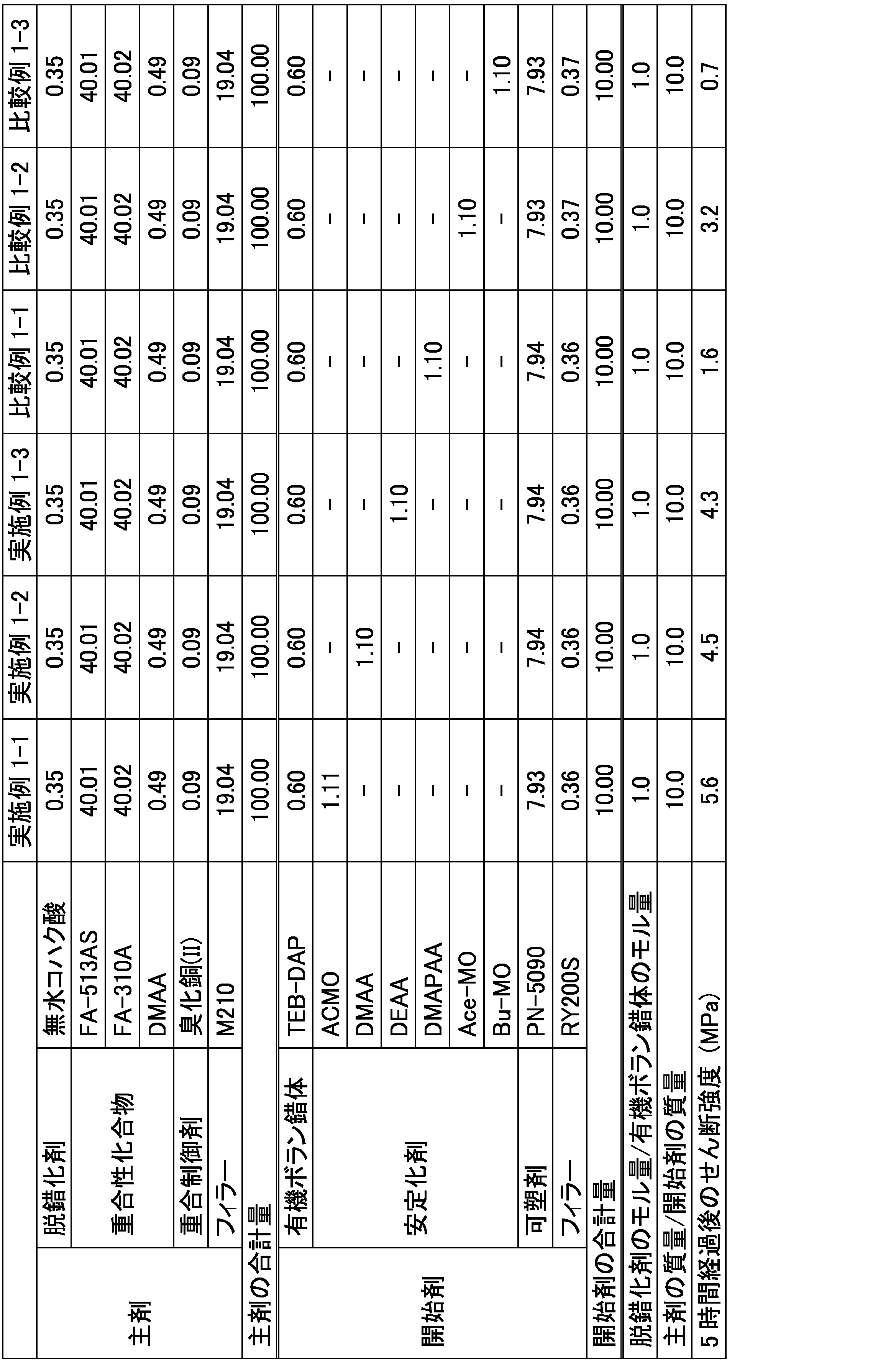
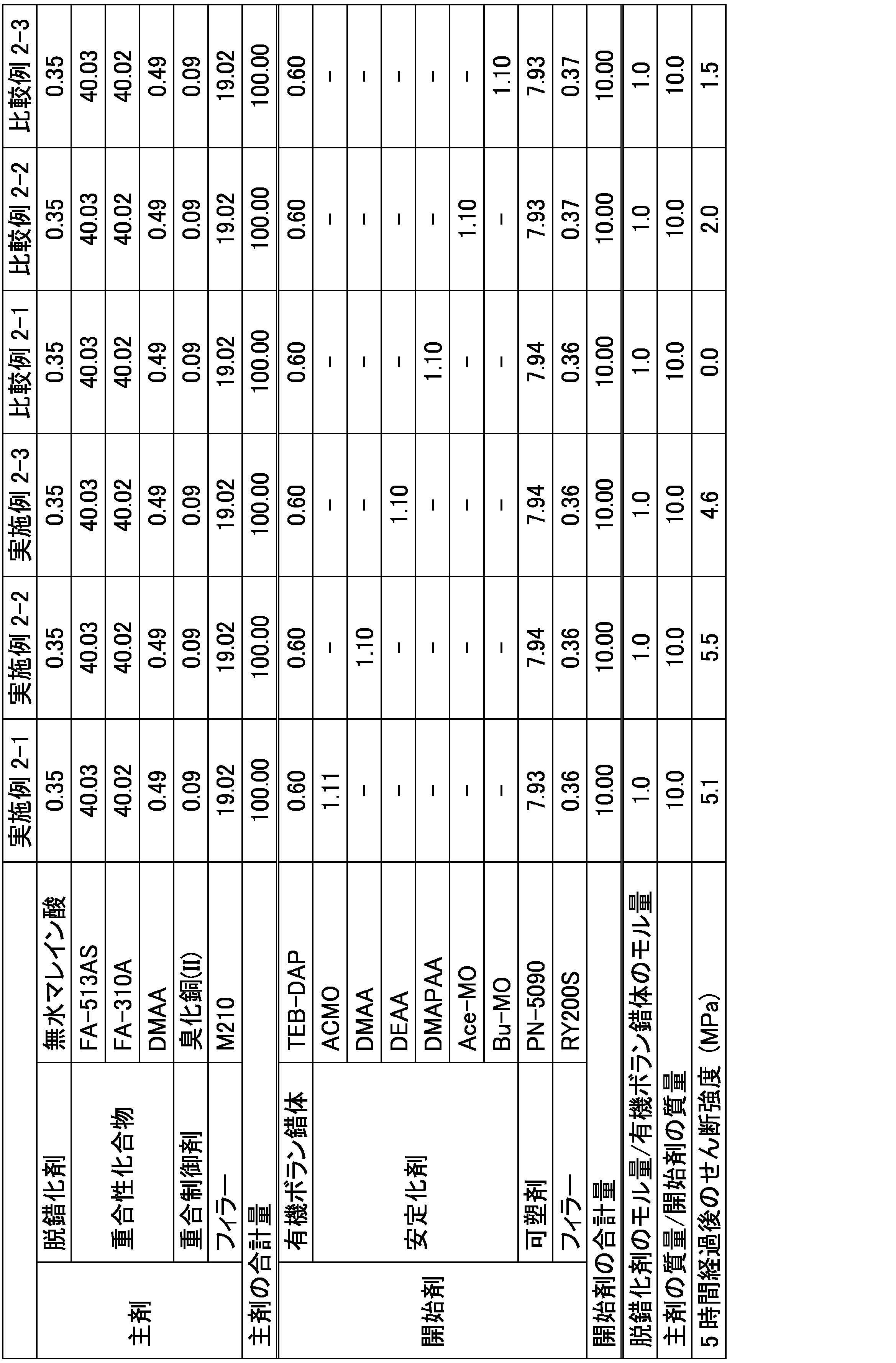
- a decomplexing agent, a compound having a radically polymerizable group, a polymerization control agent, and a filler in the types and proportions (unit: parts by mass) shown in Tables 1 and 2 were weighed out in a plastic bottle, Examples 1-1 to 1-3, 2- Base ingredients of Examples 1 to 2-3 and Comparative Examples 1-1 to 1-3 and 2-1 to 2-3 were prepared.
- the main ingredients of Examples 1-1 to 1-3 and Comparative Examples 1-1 to 1-3 are the same, and the main ingredients of Examples 2-1 to 2-3 and Comparative Examples 2-1 to 2-3 are are the same.
- Two polypropylene substrates (size: 100 mm x 25 mm, thickness: 2 mm) were prepared. On one polypropylene substrate, apply the adhesive composition to a thickness of 0.5 mm, 12.5 mm in the longitudinal direction of the polypropylene substrate, and 25 mm in the lateral direction of the polypropylene substrate. A spacer with a diameter of 0.5 mm was placed. The base ingredients and initiators were mixed by filling each base ingredient and each initiator into a manual dispenser. Using a manual dispenser, the adhesive was applied to the adhesive application area of the polypropylene substrate on which the spacer was placed, and the other polypropylene substrate was bonded together to obtain a laminate.
- the obtained laminate was left to stand at 25° C., and the shear strength was measured 5 hours after bonding.
- the shear test was performed at room temperature (25° C.) using an autograph (manufactured by Shimadzu Corporation, model number: AGS The strength at break was measured, and the shear adhesive strength (MPa) was calculated from the measured value and the adhesive area. The results are shown in Tables 1 and 2.
- the adhesive composition of the example containing N,N-disubstituted (meth)acrylamide has a short period of time compared to the adhesive composition of the comparative example that does not contain such a compound. Sufficient adhesive strength was obtained over time.
Landscapes
- Chemical & Material Sciences (AREA)
- Organic Chemistry (AREA)
- Health & Medical Sciences (AREA)
- Chemical Kinetics & Catalysis (AREA)
- Medicinal Chemistry (AREA)
- Polymers & Plastics (AREA)
- Adhesives Or Adhesive Processes (AREA)
- Adhesive Tapes (AREA)
- Addition Polymer Or Copolymer, Post-Treatments, Or Chemical Modifications (AREA)
Abstract
Description
[1]脱錯化剤を含有する主剤と、有機ボラン錯体及びN,N-二置換(メタ)アクリルアミドを含有する開始剤とを備え、前記主剤及び前記開始剤の少なくとも一方が、ラジカル重合性基を有する化合物をさらに含有し、前記主剤及び前記開始剤の少なくとも一方が、ハロゲン化金属塩及びチオカルボニルチオ構造を有する化合物からなる群より選ばれる少なくとも1種をさらに含有する、接着剤セット。
[2]前記N,N-二置換(メタ)アクリルアミドが、下記式(1)で表される化合物である、[1]に記載の接着剤セット。

[3]前記N,N-二置換(メタ)アクリルアミドが、下記式(2)で表される化合物である、[1]又は[2]に記載の接着剤セット。

[4]前記主剤が、ラジカル重合性基を有する化合物をさらに含有する、[1]~[3]のいずれかに記載の接着剤セット。
[5]第1の被着体と、第2の被着体と、前記第1の被着体及び前記第2の被着体を互いに接着する接着剤層と、を備え、前記接着剤層が、[1]~[4]のいずれかに記載の接着剤セットにおける前記主剤及び前記開始剤を含む接着剤組成物の硬化物を含有する、接着体。
[6][5]に記載の接着体の製造方法であって、前記主剤及び前記開始剤を含む接着剤組成物を介して、前記第1の被着体と前記第2の被着体とを貼り合わせる工程を備える、接着体の製造方法。
一実施形態の接着剤セットは、脱錯化剤を含有する主剤と、有機ボラン錯体及びN,N-二置換(メタ)アクリルアミドを含有する開始剤とを備える。本実施形態の接着剤セットは、主剤及び開始剤を混合することによって、主剤及び開始剤を含む接着剤組成物を得ることができる。
開始剤は、有機ボラン錯体を含有する。有機ボラン錯体とは、有機ボランにルイス塩基を配位させて錯体化した、有機ボラン-ルイス塩基錯体を意味する。有機ボラン-ルイス塩基錯体は、後述の脱錯化剤と反応して、有機ボランを与える化合物である。有機ボランは、酸素存在下でラジカル開裂を生じ、ボリン酸ラジカル等が発生することから、リビングラジカル重合の開始剤として作用し得る。有機ボランは、例えば、アルキルボラン(BR3、R:アルキル基)であってよい。ルイス塩基は、例えば、アミンであってよい。アミンは、例えば、複数のアミノ基を有する化合物、又は、アミンを構成するアミノ基と、当該アミノ基の窒素原子以外に、ホウ素に配位可能な原子(例えば、酸素原子等)を含む基(例えば、アルコキシ基等)とを少なくとも有する化合物であってよい。これらの化合物は、有機ボランに対して多座型配位子として作用することから、多座型アミンということができる。
開始剤は、N,N-二置換(メタ)アクリルアミドを含有する。N,N-二置換(メタ)アクリルアミドは、有機ボラン錯体の安定化に作用し得るとともに、接着剤セットの安定化に寄与し得る安定化剤であり得る。ここで、N,N-二置換(メタ)アクリルアミドとは、(メタ)アクリルアミドの窒素原子上の2個の水素原子が水素原子以外の基に置換された化合物を意味する。N,N-二置換(メタ)アクリルアミドは、例えば、N,N-二置換アクリルアミドであってよい。


主剤は、脱錯化剤を含有する。脱錯化剤とは、有機ボラン錯体(有機ボラン-ルイス塩基錯体)中のルイス塩基を解離させて有機ボランを発生させることができる化合物である。そのため、開始剤に含有される有機ボラン錯体と主剤に含有される脱錯化剤とを混合して反応させることによって、リビングラジカル重合の開始剤となり得る有機ボランを発生させることができる。
主剤及び開始剤の少なくとも一方は、ラジカル重合性基を有する化合物をさらに含有する。ラジカル重合性基を有する化合物は、ラジカルによって反応する重合性基を有する化合物である。ラジカル重合性基としては、例えば、例えば、(メタ)アクリロイル基、ビニル基、アリル基、スチリル基、アルケニル基、アルケニレン基、マレイミド基等が挙げられる。
主剤及び開始剤の少なくとも一方は、重合制御剤としての、ハロゲン化金属塩及びチオカルボニルチオ構造を有する化合物からなる群より選ばれる少なくとも1種をさらに含有する。
フィラーは、例えば、無機フィラー又は有機フィラーのいずれかであってよい。無機フィラーとしては、例えば、シリカ、アルミナ、シリカ-アルミナ、チタニア、ジルコニア、マグネシア、カオリン、タルク、炭酸カルシウム、ベントナイト、マイカ、セリサイト、ガラスフレーク、ガラス繊維、黒鉛、水酸化マグネシウム、水酸化アルミニウム、三酸化アンチモン、硫酸バリウム、ホウ酸亜鉛、ウォラストナイト、ゾノトライト、ウィスカー等の無機微粒子などが挙げられる。フィラーとして無機フィラーを用いる場合、無機フィラーは、シリカフィラーを含んでいてもよい。
可塑剤としては、例えば、フタル酸エステル系化合物、アルキルスルホン酸エステル系化合物、アジピン酸エステル系化合物等が挙げられる。
一実施形態の接着体は、第1の被着体と、第2の被着体と、第1の被着体及び第2の被着体を互いに接着する接着剤層とを備える。接着剤層は、上記の接着剤セットにおける主剤及び開始剤を含む接着剤組成物の硬化物を含有する。
[接着剤セットの作製]
(原料の準備)
・有機ボラン錯体
TEB-DAP:トリエチルボラン-1,3-ジアミノプロパン錯体(分子量:172.1、キシダ化学株式会社)
・安定化剤
ACMO:4-アクリロイルモルホリン(N,N-二置換アクリルアミド、分子量:141.2、KJケミカルズ株式会社)
DMAA:N,N-ジメチルアクリルアミド(N,N-二置換アクリルアミド、分子量:99.1、富士フイルム和光純薬株式会社)
DEAA:N,N-ジエチルアクリルアミド(N,N-二置換アクリルアミド、分子量:127.2、東京化成工業株式会社)
DMAPAA:N-[3-(ジメチルアミノ)プロピル]アクリルアミド(N-一置換アクリルアミド、分子量:156.2、富士フイルム和光純薬株式会社)
Ace-MO:4-アセチルモルホリン(分子量:129.2、東京化成工業株式会社)
Bu-MO:4-イソブチルモルホリン(分子量:143.2、東京化成工業株式会社)
・脱錯化剤
無水マレイン酸(分子量:98.1、富士フイルム和光純薬株式会社)
無水コハク酸(分子量:100.1、富士フイルム和光純薬株式会社)
・ラジカル重合性基を有する化合物(重合性化合物)
FA-513AS:ジシクロペンタニルアクリレート(分子量:206.3、昭和電工マテリアルズ株式会社)
FA-310A:フェノキシエチルアクリレート(分子量:192.2、昭和電工マテリアルズ株式会社)
DMAA:N,N-ジメチルアクリルアミド(分子量:99.1、富士フイルム和光純薬株式会社)
・重合制御剤
臭化銅(II)(分子量:223.4、富士フイルム和光純薬株式会社)
・フィラー
RY200S:フュームドシリカ(シリコーンオイルで表面処理された疎水性フュームドシリカ、日本アエロジル株式会社)
M210:アクリル系コアシェル粒子(株式会社カネカ、酸化防止剤未検出)
・可塑剤
PN-5090:アジピン酸ポリエステル(株式会社ADEKA)
表1及び表2に示す種類及び割合(単位:質量部)で、脱錯化剤、ラジカル重合性基を有する化合物、重合制御剤、及びフィラーを、ポリ瓶に秤取し、自公転ミキサー(株式会社シンキー、あわとり錬太郎)を用いて、2000回転/分の条件で15分間混合し、さらに2000回転/分条件で5分間脱泡し、実施例1-1~1-3、2-1~2-3及び比較例1-1~1-3、2-1~2-3の主剤を調製した。なお、実施例1-1~1-3及び比較例1-1~1-3の主剤は同一であり、実施例2-1~2-3及び比較例2-1~2-3の主剤は同一である。
表1及び表2に示す種類及び割合(単位:質量部)で、有機ボラン錯体、安定化剤、可塑剤、及びフィラーを、ポリ瓶に秤取し、自公転ミキサー(株式会社シンキー、あわとり錬太郎)を用いて、2000回転/分条件で15分間混合し、さらに2000回転/分の条件で5分間脱泡し、実施例1-1~1-3、2-1~2-3及び比較例1-1~1-3、2-1~2-3の開始剤を調製した。
ポリプロピレン基板(大きさ:100mm×25mm、厚さ:2mm)を2枚準備した。一方のポリプロピレン基板上に、接着剤組成物の塗布領域が、厚さ0.5mm、ポリプロピレン基板の長手方向に対して12.5mm、ポリプロピレン基板の短手方向に対して25mmとなるように、厚さ0.5mmのスペーサーを配置した。各主剤及び各開始剤を手動ディスペンサーに充填することによって主剤及び開始剤を混合した。手動ディスペンサーを用いて、スペーサーを配置したポリプロピレン基板の接着剤塗布領域に塗布し、もう一方のポリプロピレン基板を貼り合わせて積層体を得た。得られた積層体を25℃で放置し、貼り合わせてから5時間経過後のせん断強度を測定した。せん断試験は、室温(25℃)で、オートグラフ(株式会社島津製作所製、型番:AGS X Plus、ロードセル:50kN)を用い、チャック間距離100mm、引張り速度5mm/分の条件で測定した。破断したときの強度を測定し、測定値と接着面積とからせん断接着強度(MPa)を算出した。結果を表1及び表2に示す。
Claims (6)
- 脱錯化剤を含有する主剤と、
有機ボラン錯体及びN,N-二置換(メタ)アクリルアミドを含有する開始剤と、
を備え、
前記主剤及び前記開始剤の少なくとも一方が、ラジカル重合性基を有する化合物をさらに含有し、
前記主剤及び前記開始剤の少なくとも一方が、ハロゲン化金属塩及びチオカルボニルチオ構造を有する化合物からなる群より選ばれる少なくとも1種をさらに含有する、
接着剤セット。 - 前記N,N-二置換(メタ)アクリルアミドが、下記式(1)で表される化合物である、
請求項1に記載の接着剤セット。

R1は、水素原子又はメチル基を表す。
R2及びR3は、それぞれ独立にアルキル基を表す。R2及びR3は、互いに結合して、又は、酸素原子を介して互いに結合して、それぞれが結合する窒素原子とともに環を形成していてもよい。] - 前記N,N-二置換(メタ)アクリルアミドが、下記式(2)で表される化合物である、
請求項1に記載の接着剤セット。

R5及びR6は、それぞれ独立にアルキレン基を表す。] - 前記主剤が、ラジカル重合性基を有する化合物をさらに含有する、
請求項1~3のいずれか一項に記載の接着剤セット。 - 第1の被着体と、
第2の被着体と、
前記第1の被着体及び前記第2の被着体を互いに接着する接着剤層と、
を備え、
前記接着剤層が、請求項1~3のいずれか一項に記載の接着剤セットにおける前記主剤及び前記開始剤を含む接着剤組成物の硬化物を含有する、
接着体。 - 請求項5に記載の接着体の製造方法であって、
前記主剤及び前記開始剤を含む接着剤組成物を介して、前記第1の被着体と前記第2の被着体とを貼り合わせる工程を備える、
接着体の製造方法。
Priority Applications (4)
| Application Number | Priority Date | Filing Date | Title |
|---|---|---|---|
| US18/864,553 US20250326951A1 (en) | 2022-05-13 | 2023-05-10 | Adhesive set, adhesive body, and manufacturing method therefor |
| CN202380039610.XA CN119173593A (zh) | 2022-05-13 | 2023-05-10 | 黏合剂套组以及黏合体及其制造方法 |
| KR1020247039630A KR20250010004A (ko) | 2022-05-13 | 2023-05-10 | 접착제 세트, 및 접착체 및 그 제조 방법 |
| EP23803584.4A EP4516866A4 (en) | 2022-05-13 | 2023-05-10 | ADHESIVE AGENT ASSEMBLY, AND ADHESIVE BODY AND METHOD FOR MANUFACTURING THE SAME |
Applications Claiming Priority (2)
| Application Number | Priority Date | Filing Date | Title |
|---|---|---|---|
| JP2022079724A JP2023168082A (ja) | 2022-05-13 | 2022-05-13 | 接着剤セット、並びに接着体及びその製造方法 |
| JP2022-079724 | 2022-05-13 |
Publications (1)
| Publication Number | Publication Date |
|---|---|
| WO2023219109A1 true WO2023219109A1 (ja) | 2023-11-16 |
Family
ID=88730318
Family Applications (1)
| Application Number | Title | Priority Date | Filing Date |
|---|---|---|---|
| PCT/JP2023/017601 Ceased WO2023219109A1 (ja) | 2022-05-13 | 2023-05-10 | 接着剤セット、並びに接着体及びその製造方法 |
Country Status (7)
| Country | Link |
|---|---|
| US (1) | US20250326951A1 (ja) |
| EP (1) | EP4516866A4 (ja) |
| JP (1) | JP2023168082A (ja) |
| KR (1) | KR20250010004A (ja) |
| CN (1) | CN119173593A (ja) |
| TW (1) | TW202400739A (ja) |
| WO (1) | WO2023219109A1 (ja) |
Families Citing this family (1)
| Publication number | Priority date | Publication date | Assignee | Title |
|---|---|---|---|---|
| JP2023168084A (ja) * | 2022-05-13 | 2023-11-24 | 株式会社レゾナック | 接着剤セット、並びに接着体及びその製造方法 |
Citations (6)
| Publication number | Priority date | Publication date | Assignee | Title |
|---|---|---|---|---|
| JP2005514478A (ja) * | 2001-12-31 | 2005-05-19 | スリーエム イノベイティブ プロパティズ カンパニー | Ss−ケトン化合物を含む開始剤系および該開始剤系により製造された接着用組成物 |
| JP2005514489A (ja) | 2001-12-31 | 2005-05-19 | スリーエム イノベイティブ プロパティズ カンパニー | 接着性組成物用の金属塩改質剤 |
| JP2016047901A (ja) * | 2014-08-28 | 2016-04-07 | スリーエム イノベイティブ プロパティズ カンパニー | 2液型接着剤及びそれを含む構造体 |
| JP2018100345A (ja) * | 2016-12-20 | 2018-06-28 | スリーエム イノベイティブ プロパティズ カンパニー | 2液型接着剤及びその硬化物を含む構造体 |
| WO2022107729A1 (ja) * | 2020-11-17 | 2022-05-27 | 昭和電工マテリアルズ株式会社 | 接着剤セット、並びに接着体及びその製造方法 |
| WO2022107210A1 (ja) * | 2020-11-17 | 2022-05-27 | 昭和電工マテリアルズ株式会社 | 接着剤セット、並びに接着体及びその製造方法 |
Family Cites Families (1)
| Publication number | Priority date | Publication date | Assignee | Title |
|---|---|---|---|---|
| JP2023168084A (ja) * | 2022-05-13 | 2023-11-24 | 株式会社レゾナック | 接着剤セット、並びに接着体及びその製造方法 |
-
2022
- 2022-05-13 JP JP2022079724A patent/JP2023168082A/ja active Pending
-
2023
- 2023-05-10 EP EP23803584.4A patent/EP4516866A4/en active Pending
- 2023-05-10 US US18/864,553 patent/US20250326951A1/en active Pending
- 2023-05-10 KR KR1020247039630A patent/KR20250010004A/ko active Pending
- 2023-05-10 WO PCT/JP2023/017601 patent/WO2023219109A1/ja not_active Ceased
- 2023-05-10 CN CN202380039610.XA patent/CN119173593A/zh active Pending
- 2023-05-11 TW TW112117474A patent/TW202400739A/zh unknown
Patent Citations (6)
| Publication number | Priority date | Publication date | Assignee | Title |
|---|---|---|---|---|
| JP2005514478A (ja) * | 2001-12-31 | 2005-05-19 | スリーエム イノベイティブ プロパティズ カンパニー | Ss−ケトン化合物を含む開始剤系および該開始剤系により製造された接着用組成物 |
| JP2005514489A (ja) | 2001-12-31 | 2005-05-19 | スリーエム イノベイティブ プロパティズ カンパニー | 接着性組成物用の金属塩改質剤 |
| JP2016047901A (ja) * | 2014-08-28 | 2016-04-07 | スリーエム イノベイティブ プロパティズ カンパニー | 2液型接着剤及びそれを含む構造体 |
| JP2018100345A (ja) * | 2016-12-20 | 2018-06-28 | スリーエム イノベイティブ プロパティズ カンパニー | 2液型接着剤及びその硬化物を含む構造体 |
| WO2022107729A1 (ja) * | 2020-11-17 | 2022-05-27 | 昭和電工マテリアルズ株式会社 | 接着剤セット、並びに接着体及びその製造方法 |
| WO2022107210A1 (ja) * | 2020-11-17 | 2022-05-27 | 昭和電工マテリアルズ株式会社 | 接着剤セット、並びに接着体及びその製造方法 |
Non-Patent Citations (1)
| Title |
|---|
| See also references of EP4516866A4 |
Also Published As
| Publication number | Publication date |
|---|---|
| TW202400739A (zh) | 2024-01-01 |
| JP2023168082A (ja) | 2023-11-24 |
| EP4516866A4 (en) | 2025-10-08 |
| KR20250010004A (ko) | 2025-01-20 |
| EP4516866A1 (en) | 2025-03-05 |
| US20250326951A1 (en) | 2025-10-23 |
| CN119173593A (zh) | 2024-12-20 |
Similar Documents
| Publication | Publication Date | Title |
|---|---|---|
| JP7816165B2 (ja) | 接着剤セット、並びに接着体及びその製造方法 | |
| WO2023219111A1 (ja) | 接着剤セット、並びに接着体及びその製造方法 | |
| US12258498B2 (en) | Adhesive set, adhesive body, and manufacturing method therefor | |
| WO2023219109A1 (ja) | 接着剤セット、並びに接着体及びその製造方法 | |
| JP5543844B2 (ja) | 2液硬化型アクリル系接着剤 | |
| WO2025013728A1 (ja) | 接着体及びその製造方法 | |
| WO2023219115A1 (ja) | 接着剤セット、並びに接着体及びその製造方法 | |
| WO2026088860A1 (ja) | 接着剤セット、並びに接着体及びその製造方法 | |
| WO2026088859A1 (ja) | トリアルキルボラン-アミン錯体及びアミン化合物の組み合わせの選定方法 | |
| JP2023142631A (ja) | 接着剤セット、接着体及び接着体の製造方法 | |
| WO2025013726A1 (ja) | 接着剤組成物 | |
| JP7848542B2 (ja) | 接着剤セット、接着体及び接着体の製造方法 |
Legal Events
| Date | Code | Title | Description |
|---|---|---|---|
| 121 | Ep: the epo has been informed by wipo that ep was designated in this application |
Ref document number: 23803584 Country of ref document: EP Kind code of ref document: A1 |
|
| WWE | Wipo information: entry into national phase |
Ref document number: 18864553 Country of ref document: US |
|
| WWE | Wipo information: entry into national phase |
Ref document number: 2023803584 Country of ref document: EP |
|
| ENP | Entry into the national phase |
Ref document number: 20247039630 Country of ref document: KR Kind code of ref document: A |
|
| ENP | Entry into the national phase |
Ref document number: 2023803584 Country of ref document: EP Effective date: 20241126 |
|
| NENP | Non-entry into the national phase |
Ref country code: DE |
|
| WWP | Wipo information: published in national office |
Ref document number: 18864553 Country of ref document: US |