WO2023219172A1 - 加工植物性タンパク質含有組成物の製造方法 - Google Patents
加工植物性タンパク質含有組成物の製造方法 Download PDFInfo
- Publication number
- WO2023219172A1 WO2023219172A1 PCT/JP2023/018009 JP2023018009W WO2023219172A1 WO 2023219172 A1 WO2023219172 A1 WO 2023219172A1 JP 2023018009 W JP2023018009 W JP 2023018009W WO 2023219172 A1 WO2023219172 A1 WO 2023219172A1
- Authority
- WO
- WIPO (PCT)
- Prior art keywords
- vegetable protein
- protein
- protease
- derived
- less
- Prior art date
- Legal status (The legal status is an assumption and is not a legal conclusion. Google has not performed a legal analysis and makes no representation as to the accuracy of the status listed.)
- Ceased
Links
Classifications
-
- A—HUMAN NECESSITIES
- A23—FOODS OR FOODSTUFFS; TREATMENT THEREOF, NOT COVERED BY OTHER CLASSES
- A23J—PROTEIN COMPOSITIONS FOR FOODSTUFFS; WORKING-UP PROTEINS FOR FOODSTUFFS; PHOSPHATIDE COMPOSITIONS FOR FOODSTUFFS
- A23J3/00—Working-up of proteins for foodstuffs
- A23J3/30—Working-up of proteins for foodstuffs by hydrolysis
- A23J3/32—Working-up of proteins for foodstuffs by hydrolysis using chemical agents
- A23J3/34—Working-up of proteins for foodstuffs by hydrolysis using chemical agents using enzymes
- A23J3/347—Working-up of proteins for foodstuffs by hydrolysis using chemical agents using enzymes of proteins from microorganisms or unicellular algae
-
- A—HUMAN NECESSITIES
- A23—FOODS OR FOODSTUFFS; TREATMENT THEREOF, NOT COVERED BY OTHER CLASSES
- A23L—FOODS, FOODSTUFFS OR NON-ALCOHOLIC BEVERAGES, NOT OTHERWISE PROVIDED FOR; PREPARATION OR TREATMENT THEREOF
- A23L5/00—Preparation or treatment of foods or foodstuffs, in general; Food or foodstuffs obtained thereby; Materials therefor
- A23L5/20—Removal of unwanted matter, e.g. deodorisation or detoxification
- A23L5/25—Removal of unwanted matter, e.g. deodorisation or detoxification using enzymes
-
- A—HUMAN NECESSITIES
- A23—FOODS OR FOODSTUFFS; TREATMENT THEREOF, NOT COVERED BY OTHER CLASSES
- A23J—PROTEIN COMPOSITIONS FOR FOODSTUFFS; WORKING-UP PROTEINS FOR FOODSTUFFS; PHOSPHATIDE COMPOSITIONS FOR FOODSTUFFS
- A23J1/00—Obtaining protein compositions for foodstuffs; Bulk opening of eggs and separation of yolks from whites
- A23J1/12—Obtaining protein compositions for foodstuffs; Bulk opening of eggs and separation of yolks from whites from cereals, wheat, bran, or molasses
- A23J1/125—Obtaining protein compositions for foodstuffs; Bulk opening of eggs and separation of yolks from whites from cereals, wheat, bran, or molasses by treatment involving enzymes or microorganisms
-
- A—HUMAN NECESSITIES
- A23—FOODS OR FOODSTUFFS; TREATMENT THEREOF, NOT COVERED BY OTHER CLASSES
- A23J—PROTEIN COMPOSITIONS FOR FOODSTUFFS; WORKING-UP PROTEINS FOR FOODSTUFFS; PHOSPHATIDE COMPOSITIONS FOR FOODSTUFFS
- A23J1/00—Obtaining protein compositions for foodstuffs; Bulk opening of eggs and separation of yolks from whites
- A23J1/14—Obtaining protein compositions for foodstuffs; Bulk opening of eggs and separation of yolks from whites from leguminous or other vegetable seeds; from press-cake or oil-bearing seeds
- A23J1/148—Obtaining protein compositions for foodstuffs; Bulk opening of eggs and separation of yolks from whites from leguminous or other vegetable seeds; from press-cake or oil-bearing seeds by treatment involving enzymes or microorganisms
-
- A—HUMAN NECESSITIES
- A23—FOODS OR FOODSTUFFS; TREATMENT THEREOF, NOT COVERED BY OTHER CLASSES
- A23J—PROTEIN COMPOSITIONS FOR FOODSTUFFS; WORKING-UP PROTEINS FOR FOODSTUFFS; PHOSPHATIDE COMPOSITIONS FOR FOODSTUFFS
- A23J3/00—Working-up of proteins for foodstuffs
- A23J3/14—Vegetable proteins
-
- A—HUMAN NECESSITIES
- A23—FOODS OR FOODSTUFFS; TREATMENT THEREOF, NOT COVERED BY OTHER CLASSES
- A23L—FOODS, FOODSTUFFS OR NON-ALCOHOLIC BEVERAGES, NOT OTHERWISE PROVIDED FOR; PREPARATION OR TREATMENT THEREOF
- A23L33/00—Modifying nutritive qualities of foods; Dietetic products; Preparation or treatment thereof
- A23L33/10—Modifying nutritive qualities of foods; Dietetic products; Preparation or treatment thereof using additives
- A23L33/17—Amino acids, peptides or proteins
- A23L33/185—Vegetable proteins
-
- C—CHEMISTRY; METALLURGY
- C12—BIOCHEMISTRY; BEER; SPIRITS; WINE; VINEGAR; MICROBIOLOGY; ENZYMOLOGY; MUTATION OR GENETIC ENGINEERING
- C12N—MICROORGANISMS OR ENZYMES; COMPOSITIONS THEREOF; PROPAGATING, PRESERVING, OR MAINTAINING MICROORGANISMS; MUTATION OR GENETIC ENGINEERING; CULTURE MEDIA
- C12N9/00—Enzymes; Proenzymes; Compositions thereof; Processes for preparing, activating, inhibiting, separating or purifying enzymes
- C12N9/14—Hydrolases (3)
- C12N9/48—Hydrolases (3) acting on peptide bonds (3.4)
- C12N9/50—Proteinases, e.g. Endopeptidases (3.4.21-3.4.25)
- C12N9/52—Proteinases, e.g. Endopeptidases (3.4.21-3.4.25) derived from bacteria or Archaea
- C12N9/54—Proteinases, e.g. Endopeptidases (3.4.21-3.4.25) derived from bacteria or Archaea bacteria being Bacillus
-
- C—CHEMISTRY; METALLURGY
- C12—BIOCHEMISTRY; BEER; SPIRITS; WINE; VINEGAR; MICROBIOLOGY; ENZYMOLOGY; MUTATION OR GENETIC ENGINEERING
- C12N—MICROORGANISMS OR ENZYMES; COMPOSITIONS THEREOF; PROPAGATING, PRESERVING, OR MAINTAINING MICROORGANISMS; MUTATION OR GENETIC ENGINEERING; CULTURE MEDIA
- C12N9/00—Enzymes; Proenzymes; Compositions thereof; Processes for preparing, activating, inhibiting, separating or purifying enzymes
- C12N9/14—Hydrolases (3)
- C12N9/48—Hydrolases (3) acting on peptide bonds (3.4)
- C12N9/50—Proteinases, e.g. Endopeptidases (3.4.21-3.4.25)
- C12N9/58—Proteinases, e.g. Endopeptidases (3.4.21-3.4.25) derived from fungi
-
- C—CHEMISTRY; METALLURGY
- C12—BIOCHEMISTRY; BEER; SPIRITS; WINE; VINEGAR; MICROBIOLOGY; ENZYMOLOGY; MUTATION OR GENETIC ENGINEERING
- C12N—MICROORGANISMS OR ENZYMES; COMPOSITIONS THEREOF; PROPAGATING, PRESERVING, OR MAINTAINING MICROORGANISMS; MUTATION OR GENETIC ENGINEERING; CULTURE MEDIA
- C12N9/00—Enzymes; Proenzymes; Compositions thereof; Processes for preparing, activating, inhibiting, separating or purifying enzymes
- C12N9/14—Hydrolases (3)
- C12N9/48—Hydrolases (3) acting on peptide bonds (3.4)
- C12N9/50—Proteinases, e.g. Endopeptidases (3.4.21-3.4.25)
- C12N9/58—Proteinases, e.g. Endopeptidases (3.4.21-3.4.25) derived from fungi
- C12N9/62—Proteinases, e.g. Endopeptidases (3.4.21-3.4.25) derived from fungi from Aspergillus
-
- C—CHEMISTRY; METALLURGY
- C12—BIOCHEMISTRY; BEER; SPIRITS; WINE; VINEGAR; MICROBIOLOGY; ENZYMOLOGY; MUTATION OR GENETIC ENGINEERING
- C12N—MICROORGANISMS OR ENZYMES; COMPOSITIONS THEREOF; PROPAGATING, PRESERVING, OR MAINTAINING MICROORGANISMS; MUTATION OR GENETIC ENGINEERING; CULTURE MEDIA
- C12N9/00—Enzymes; Proenzymes; Compositions thereof; Processes for preparing, activating, inhibiting, separating or purifying enzymes
- C12N9/14—Hydrolases (3)
- C12N9/78—Hydrolases (3) acting on carbon to nitrogen bonds other than peptide bonds (3.5)
- C12N9/80—Hydrolases (3) acting on carbon to nitrogen bonds other than peptide bonds (3.5) acting on amide bonds in linear amides (3.5.1)
-
- C—CHEMISTRY; METALLURGY
- C12—BIOCHEMISTRY; BEER; SPIRITS; WINE; VINEGAR; MICROBIOLOGY; ENZYMOLOGY; MUTATION OR GENETIC ENGINEERING
- C12P—FERMENTATION OR ENZYME-USING PROCESSES TO SYNTHESISE A DESIRED CHEMICAL COMPOUND OR COMPOSITION OR TO SEPARATE OPTICAL ISOMERS FROM A RACEMIC MIXTURE
- C12P13/00—Preparation of nitrogen-containing organic compounds
- C12P13/04—Alpha- or beta- amino acids
- C12P13/14—Glutamic acid; Glutamine
-
- C—CHEMISTRY; METALLURGY
- C12—BIOCHEMISTRY; BEER; SPIRITS; WINE; VINEGAR; MICROBIOLOGY; ENZYMOLOGY; MUTATION OR GENETIC ENGINEERING
- C12P—FERMENTATION OR ENZYME-USING PROCESSES TO SYNTHESISE A DESIRED CHEMICAL COMPOUND OR COMPOSITION OR TO SEPARATE OPTICAL ISOMERS FROM A RACEMIC MIXTURE
- C12P21/00—Preparation of peptides or proteins
- C12P21/06—Preparation of peptides or proteins produced by the hydrolysis of a peptide bond, e.g. hydrolysate products
-
- C—CHEMISTRY; METALLURGY
- C12—BIOCHEMISTRY; BEER; SPIRITS; WINE; VINEGAR; MICROBIOLOGY; ENZYMOLOGY; MUTATION OR GENETIC ENGINEERING
- C12Y—ENZYMES
- C12Y204/00—Glycosyltransferases (2.4)
-
- C—CHEMISTRY; METALLURGY
- C12—BIOCHEMISTRY; BEER; SPIRITS; WINE; VINEGAR; MICROBIOLOGY; ENZYMOLOGY; MUTATION OR GENETIC ENGINEERING
- C12Y—ENZYMES
- C12Y305/00—Hydrolases acting on carbon-nitrogen bonds, other than peptide bonds (3.5)
- C12Y305/01—Hydrolases acting on carbon-nitrogen bonds, other than peptide bonds (3.5) in linear amides (3.5.1)
- C12Y305/01002—Glutaminase (3.5.1.2)
Definitions
- the present invention relates to a method for producing a processed vegetable protein-containing composition, and more specifically to a method for producing a vegetable protein-containing composition that has been processed to increase the amount of free glutamic acid.
- Non-Patent Document 1 Processing that uses endo-type proteases to cleave proteins is said to be effective in imparting various properties to food materials containing protein, such as improving digestibility and reducing allergens.
- the occurrence of bitter taste in food is an issue in the development of food processing technology. This bitter taste is caused by bitter peptides produced by hydrolyzing proteins in foods.
- a protein is a chain of 100 to 1000 amino acids, which is folded regularly and exists as a spherical mass. There are many hydrophilic amino acids on the outside of the spherical lump, and many hydrophobic amino acids on the inside. When the protein is hydrolyzed, this lump-like structure is destroyed and the hydrophobic amino acids that were on the inside are destroyed. The portion containing a large amount of is cleaved and exposed as a bitter peptide, which causes bitterness (Non-Patent Document 1).
- Non-Patent Document 2 soybean protein (Fujipro F) was treated with protease derived from Bacillus licheniformis to create a protein hydrolyzate, and then this protein hydrolyzate was treated with B. It has been confirmed that ⁇ -glutamylation can be performed with glutaminase derived from C. amyloliquefaciens, and that this reduces bitterness (Non-Patent Document 2).
- glutaminase treatment has been proposed as a treatment to reduce the bitterness of certain protein hydrolysates, but because glutaminase has narrow substrate specificity, the effect of improving the amount of glutamic acid released is limited, and there is still no improvement yet. There is room for
- an object of the present invention is to provide a processing technique that increases the amount of free glutamic acid in a protein hydrolyzate.
- the present inventors have discovered that the amount of free glutamic acid can be dramatically increased by treating a vegetable protein-containing composition with a proteolytic enzyme and protein glutaminase.
- the present invention was completed through further studies based on this knowledge.
- Item 1 A method for producing a processed vegetable protein-containing composition, comprising the step of treating the vegetable protein-containing composition with a proteolytic enzyme and protein glutaminase.
- Item 2. Item 2. The production method according to Item 1, wherein the protease is a protease and/or a peptidase.
- Item 3. Item 3.
- Item 4. 4.
- Item 5. Item 5.
- Item 9. Item 9. The production method according to Item 7 or 8, wherein the bacterial protease is selected from the group consisting of Bacillus stearothermophilus, Bacillus licheniformis, Bacillus amyloliquefaciens, and proteases derived from these Geobacillus genus.
- Item 10. 10 The production method according to any one of Items 2, 3, and 7 to 9, wherein the protease is a bacterial protease or a filamentous fungus peptidase.
- Item 11. Item 11.
- Item 15 A vegetable protein-containing food or drink obtained by the production method according to any one of Items 1 to 14.
- a processing technique that increases the amount of free glutamic acid in a protein hydrolyzate.
- the method for producing a processed vegetable protein-containing composition of the present invention includes a step of treating a vegetable protein-containing composition with a proteolytic enzyme and a protein glutaminase (enzyme treatment step). It is characterized by Since the enzyme treatment step can improve (increase) the amount of free glutamic acid in the composition containing vegetable protein, a composition containing vegetable protein that has been processed to increase the amount of free glutamic acid can be obtained.
- enzyme treatment step can improve (increase) the amount of free glutamic acid in the composition containing vegetable protein, a composition containing vegetable protein that has been processed to increase the amount of free glutamic acid can be obtained.
- Vegetable protein-containing composition The vegetable protein-containing composition used in the present invention contains vegetable protein and water, and is typically a composition for consumption. There are no particular restrictions on the properties of the vegetable protein-containing composition, and examples include fluid properties such as liquid, slurry, and paste (hereinafter, vegetable protein-containing compositions with fluid properties will be referred to as liquid, slurry, and paste). (also collectively referred to as "liquid, etc.”), and solid forms.
- plant protein-containing compositions prepared from non-organized protein materials include (i) plant protein materials (specifically, plant organs of plants from which plant proteins are derived; Liquids obtained by dispersing dry powders of (hereinafter the same shall apply hereinafter) in water, etc., including at least one of materials that have an increased protein content by removing at least a portion of components other than proteins from organs. (ii) The vegetable protein material is crushed and dispersed in water, and if necessary, insoluble matter originating from the skin of the plant material is removed by any means such as centrifugation, filtration, straining bag, or sieve. (iii) Liquid, etc. that is obtained by removing components other than vegetable protein from the liquid, etc.
- Examples include liquids obtained by mixing a dry powder prepared from any of the liquids in (v) to (iii) with water; examples of liquids prepared from structured protein materials include (v) swollen with water; Examples include structured vegetable protein materials.
- the structured vegetable protein material used in the preparation of the specific example (v) above is a food material generally known as a meat substitute (pseudo meat).
- a typical example of a textured vegetable protein material is a material obtained by extruding a raw material mixture containing vegetable protein and water using an extruder or the like, drying or freezing it, and forming a meat-like texture.
- the "meat" imitated by the textured vegetable protein material refers to the muscle of animals that are edible. It is used in a sense that also includes the person's own body.
- the shape of the structured vegetable protein material includes granular and fibrous shapes.
- Granular shapes include lump shapes of various sizes such as small grains (minced), large grains, and block shapes (sizes increase in the order of small grains, large grains, and block shapes); flake shapes, fillet shapes, and slices. Examples include flat shapes of various sizes (flake-type, fillet-type, and slice-type in increasing order) such as molds.
- structured vegetable protein materials include granular vegetable protein and fibrous vegetable protein.
- Granular vegetable protein and fibrous vegetable protein both refer to those defined in the "Japanese Agricultural Standards for Vegetable Protein.”
- the structured vegetable protein material used in the present invention is limited to the granular vegetable protein and fibrous vegetable protein defined above as long as it is a meat-like textured material as described above. isn't it.
- characteristics other than the type of vegetable protein and the content ratio of vegetable protein e.g., properties, moisture content, particle size, temperature, raw materials other than food additives, Food additives, texture, water retention, foreign matter, content
- their measurement methods can comply with the characteristics and measurement methods defined in the "Japanese Agricultural Standards for Vegetable Proteins.”
- the content of vegetable protein contained in the textured vegetable protein material is not particularly limited, but for example, 20% by weight or more, 25% by weight. or 30% by weight or more. From the viewpoint of further enhancing the effect of increasing the amount of free glutamic acid, the content is preferably 35% by weight or more, more preferably 40% by weight or more, and still more preferably 45% by weight or more.
- the upper limit of the content range is not particularly limited, but is, for example, 90% by weight or less, preferably 80% by weight or less, more preferably 70% by weight or less, even more preferably 60% by weight or less, even more preferably 55% by weight or less. Can be mentioned.
- liquid vegetable protein-containing composition is vegetable milk.
- content of vegetable protein material in a vegetable protein-containing composition refers to a vegetable protein-containing composition prepared using a non-organized vegetable protein material. This is the proportion of the dry weight of the components constituting the plant organs contained in the composition, and in the case of a plant protein-containing composition prepared using a structured plant protein material, This refers to the proportion of the dry weight of the protein material.
- the vegetable protein-containing composition is a liquid consisting only of components derived from plant organs and water, as in the specific examples (i) to (iv) above, “vegetable protein material” "content” refers to the proportion of the dry weight of the liquid, etc.
- the "content of vegetable protein material” refers to the content of the vegetable protein material excluding the additives. Refers to the proportion of dry weight of a part. Furthermore, if the vegetable protein-containing composition is a swollen product consisting only of a structured vegetable protein material and water, as in the specific example (v) above, the “content of the vegetable protein material” is , refers to the percentage of dry weight of the composition. When the vegetable protein-containing composition is a swollen material containing the specific example (v) above and an additive, the "content of vegetable protein material” is the dry weight of the portion of the swollen material excluding the additive. Refers to the proportion of
- vegetable proteins include, but are not limited to, legumes such as soybeans, peas, lentils, chickpeas, black beans, fava beans, mung beans, lupine beans, and kidney beans; wheat, barley, oats, Grains such as sorghum, rice, rye, buckwheat, millet, millet, teff, corn, and potato; almonds, coconuts, peanuts, cashews, hazelnuts, pecans, macadamia nuts, pistachios, walnuts, Brazil nuts, pili nuts, chestnuts, sesame, and pine nuts Nuts such as nuts; proteins (natural proteins) contained in seeds such as hemp seeds (industrial hemp), chia seeds, chia, amaranth, canary seeds, flaxseed; Examples include chemically partially degraded proteins; chemically modified proteins using various reagents, and synthetic peptides.
- the above-mentioned vegetable proteins may be used alone or in combination.
- proteins from beans are preferred, and proteins from soybeans, peas, lentils, chickpeas, fava beans, mung beans, and lupin beans are more preferred, and proteins from lupine beans are more preferred.
- proteins from soybeans and peas include protein from soybeans and peas.
- the content of vegetable protein in the vegetable protein-containing composition is not particularly limited, but when the vegetable protein-containing composition is prepared from a non-organized protein material, for example, 0.01 to 50% by weight, 0.05% by weight. -40% by weight, or 0.1-30% by weight, preferably 0.25-25% by weight, or 0.35-15% by weight, more preferably 0.45-10% by weight, or 0.6-9 % by weight, for example 1 to 70% by weight, preferably 5 to 50% by weight, more preferably 10 to 30% by weight, even more preferably when the vegetable protein-containing composition is prepared from a structured protein material. 15 to 25% by weight.
- the content of the vegetable protein material in the vegetable protein-containing composition is not particularly limited, but when the vegetable protein-containing composition is prepared from a non-organized protein material, for example, 0.05 to 50% by weight, Examples include 0.1 to 40% by weight, or 0.5 to 30% by weight, preferably 1 to 25% by weight, or 3 to 20% by weight, more preferably 5 to 15% by weight, or 7 to 12% by weight. , when the vegetable protein-containing composition is prepared from a structured protein material, for example, 20 to 60% by weight, preferably 30 to 50% by weight, more preferably 35 to 45% by weight.
- the vegetable protein contained in the vegetable protein-containing composition is a starchy plant protein such as a grain (preferably barley, sorghum, or rye)
- a vegetable protein-containing composition is preferably pretreated with amylase.
- the amylase typically includes ⁇ -amylase.
- the ⁇ -amylase is not particularly limited, but includes, for example, those of the Aspergillus genus (e.g., Aspergillus oryzae, Aspergillus niga, etc.), the Bacillus genus (e.g., Bacillus amyloliquefaciens), Examples include ⁇ -amylase derived from Bacillus subtilis, Bacillus licheniformis, etc., preferably ⁇ -amylase derived from the genus Bacillus, and more preferably ⁇ -amylase derived from Bacillus. - ⁇ -Amylase derived from Amyloliquefaciens sp.
- Aspergillus genus e.g., Aspergillus oryzae, Aspergillus niga, etc.
- Bacillus genus e.g., Bacillus amyloliquefaciens
- Examples include ⁇ -amylase derived from Bacillus subtilis, Bac
- the amount of ⁇ -amylase to be used is, for example, 0.5 to 100 U, 1 to 50 U, 2 to 25 U, or 3 to 10 U, preferably 4 to 8 U, per 1 g of the vegetable protein-containing composition.
- 1 unit (1U) is the amount of enzyme that reduces the iodine-induced coloration of potato starch by 10% in 1 minute.
- protease any enzyme that can decompose a peptide chain can be used without particular limitation, and typically includes protease and/or peptidase.
- protease refers to endo-type peptidase.
- Proteases are not particularly limited in their origin, but include, for example, proteases derived from filamentous fungi and proteases derived from bacteria.
- protease derived from silk bacteria but for example, Aspergillus, the genus Rhizopus, the genus Mucor (Mucor), the genus Neurospora, the genus (Penicil). LIUM) Authority, Rhizomucor , and proteases derived from the genus Sclerotinia.
- proteases derived from the genus Aspergillus include Aspergillus oryzae, Aspergillus niger, Aspergillus melleus, and Aspergillus japonicus. rgillus japonicus), Aspergillus awamori (Aspergillus awamori), Aspergillus kawachii, Aspergillus sojae, Aspergillus tamarii, Aspergillus foet idus), Aspergillus fumigatus, Aspergillus nidulans, Aspergillus ⁇ Aspergillus aculeatus, Aspergillus candidus, Aspergillus flavus, Aspergillus saitoi , Aspergillus inuii, Aspergillus glaucus, Aspergillus inui Aspergillus caesiellus, Aspergillus clavatus, Aspergillus deflectus,
- proteases derived from the genus Rhizopus include Rhizopus chinensis, Rhizopus delemar, Rhizopus niveus, and Rhizopus oryzae. oryzae) and the like.
- bacterial-derived proteases examples include proteases derived from the genus Bacillus and the genus Geobacillus.
- proteases derived from the genus Bacillus include Bacillus amyloliquefaciens, Bacillus cereus, Bacillus clausii, and Bacillus clausii. Bacillus intermedius ), Bacillus lentus, Bacillus licheniformis, Bacillus stearothermophilus, Bacillus subtilis S subtilis), and Bacillus thermoproteolyticus , and proteases derived from these Geobacillus species.
- the above proteases may be used alone or in combination.
- proteases derived from filamentous fungi from the viewpoint of further enhancing the effect of increasing the amount of free glutamic acid, proteases derived from the genus Aspergillus and proteases derived from the genus Rhizopus are preferred.
- proteases derived from the genus Aspergillus preferred are the proteases derived from Aspergillus oryzae, the proteases derived from Aspergillus niga, and the proteases derived from Aspergillus meleus, from the viewpoint of further enhancing the effect of increasing the amount of free glutamic acid;
- the proteases Rhizopus niveus-derived protease is preferred from the viewpoint of further enhancing the effect of increasing the amount of free glutamic acid.
- bacterial-derived proteases from the viewpoint of further enhancing the effect of increasing the amount of free glutamic acid, Bacillus stearothermophilus-derived protease, Bacillus licheniformis-derived protease, Bacillus amyloliquefaciens-derived protease and These proteases derived from the genus Geobacillus can be mentioned, and more preferred are proteases derived from Geobacillus stearothermophilus, proteases derived from Bacillus amylochaefaciens, and proteases derived from Bacillus licheniformis, and even more preferred are proteases derived from Bacillus licheniformis. derived proteases.
- the amount of protease used is not particularly limited, but the amount used per 1 g of vegetable protein material may be, for example, 110 U or more. From the viewpoint of further enhancing the effect of increasing the amount of free glutamic acid, preferably 200 U or more, 350 U or more, or 500 U or more, more preferably 700 U or more, or 900 U or more, still more preferably 1000 U or more, and still more preferably 1100 U or more.
- the upper limit of the usage range of protease per gram of vegetable protein material is not particularly limited, but for example, 300,000U or less, 150,000U or less, 100,000U or less, 75,000U or less, 50,000U or less, 40,000U or less, 30,000U or less, 25,000U or less, 20,000U or less, 15,000U or less, or 10,000 U or less.
- the amount of protease used per 1 g of vegetable protein is, for example, 110 U or more, and from the viewpoint of further increasing the effect of increasing the amount of free glutamic acid, it is preferably 200 U or more, 350 U or more, or 500 U or more, more preferably Examples include 750U or more, or 1000U or more, more preferably 1200U or more, even more preferably 1300U or more, or 1400U or more.
- the upper limit of the usage range of protease per gram of vegetable protein is not particularly limited, but for example, 600,000U or less, 300,000U or less, 150,000U or less, 100,000U or less, 75,000U or less, 60,000U or less, 50,000U or less, 40,000U or less, 30,000U or less, 25,000U or less, or 20,000 U or less.
- protease activity shall be measured by the Folin method using casein as a substrate. That is, protease activity can be determined by performing an enzymatic reaction using casein as a substrate at a pH set according to the optimum pH of the protease to be measured, and increasing the colored substance in Folin reagent solution equivalent to 1 ⁇ g of tyrosine per minute. The amount of enzyme produced is 1 unit (1U).
- peptidase refers to exo-type peptidase.
- Peptidases are not particularly limited in their origin, but examples thereof include peptidases derived from filamentous fungi, peptidases derived from actinomycetes, and peptidases derived from bacteria.
- Peptidases derived from bacteria are not particularly limited, and include, for example, peptidases derived from the genus Bacillus, Geobacillus, Lactobacillus, Lactococcus, and the like.
- the above peptidases may be used alone or in combination.
- peptidases derived from filamentous fungi are preferably used, and more preferably peptidases derived from the genus Rhizopus (among others Rhizopus oryzae) and the genus Aspergillus (among others Aspergillus oryzae) are mentioned.
- examples include peptidases, and more preferably peptidases derived from the genus Rhizopus (especially Rhizopus oryzae).
- the amount of peptidase to be used is not particularly limited, but in both cases where the vegetable protein-containing composition is prepared from unstructured protein material and from structured protein material, the amount of peptidase used is The amount used is, for example, 0.001 U or more. From the viewpoint of further enhancing the effect of increasing the amount of free glutamic acid, preferably 0.005U or more, 0.01U or more, or 0.015U or more, more preferably 0.025U or more, 0.05U or more, 0.075U or more, or Examples include 0.1U or more, more preferably 0.13U or more, 0.15U or more, 0.18U or more, 0.2U or more, or 0.23U or more, even more preferably 0.25U or more, or 0.27U or more.
- the amount of peptidase used per 1 g of the vegetable protein material is preferably 0.5 U or more, or 1 U or more, more preferably 2. Examples include 5U or more, 5U or more, or 7.5U or more, more preferably 10U or more, 15U or more, or 20U or more, even more preferably 25U or more, or 30U or more, even more preferably 35U or more, or 40U or more.
- the upper limit of the usage range of peptidase per 1 g of vegetable protein material is not particularly limited, but it can be In this case, examples include 500U or less, 300U or less, 200U or less, 100U or less, 75U or less, 50U or less, or 45U or less.
- the upper limit of the range of the amount of peptidase used per 1 g of the vegetable protein material is, for example, 500 U or less, preferably 400 U or less, or 300 U or less, More preferably 200U or less, or 100U or less, still more preferably 80U or less, 70U or less, or 60U or less, even more preferably 55U or less, or 50U or less.
- the amount of peptidase to be used per 1 g of vegetable protein is, for example, 0.000, regardless of whether the vegetable protein-containing composition is prepared from a non-organized protein material or from a structured protein material.
- the amount of free glutamic acid preferably 0.005U or more, 0.01U or more, or 0.015U or more, more preferably 0.025U or more, or 0.05U or more.
- more preferably 0.075U or more or 0.1U or more, even more preferably 0.13U or more, 0.15U or more, 0.18U or more, 0.2U or more, or 0.23U or more, even more preferably 0.
- Examples include 25U or more, or 0.27U or more, particularly preferably 0.3U or more, or 0.33U or more.
- the amount of peptidase used per gram of vegetable protein is preferably 1 U or more, or 2.5 U or more, more preferably 5 U or more, or 10 U or more, more preferably 20 U or more, 30 U or more, or 40 U or more, still more preferably 50 U or more, 60 U or more, or 70 U or more, even more preferably 75 U or more, or 80 U or more.
- the upper limit of the usage range of peptidase per gram of vegetable protein is not particularly limited, but in both cases where the vegetable protein-containing composition is prepared from unstructured protein material and from structured protein material. Also, for example, 1000U or less, 900U or less, 800U or less, 700U or less, 600U or less, 500U or less, 300U or less, 200U or less, 100U or less, or 90U or less.
- the upper limit of the usage range of peptidase per gram of vegetable protein is, for example, 1000 U or less, 800 U or less, 600 U or less, 500 U or less, 400 U. Examples include 300U or less, 200U or less, 150U or less, 100U or less, or 90U or less.
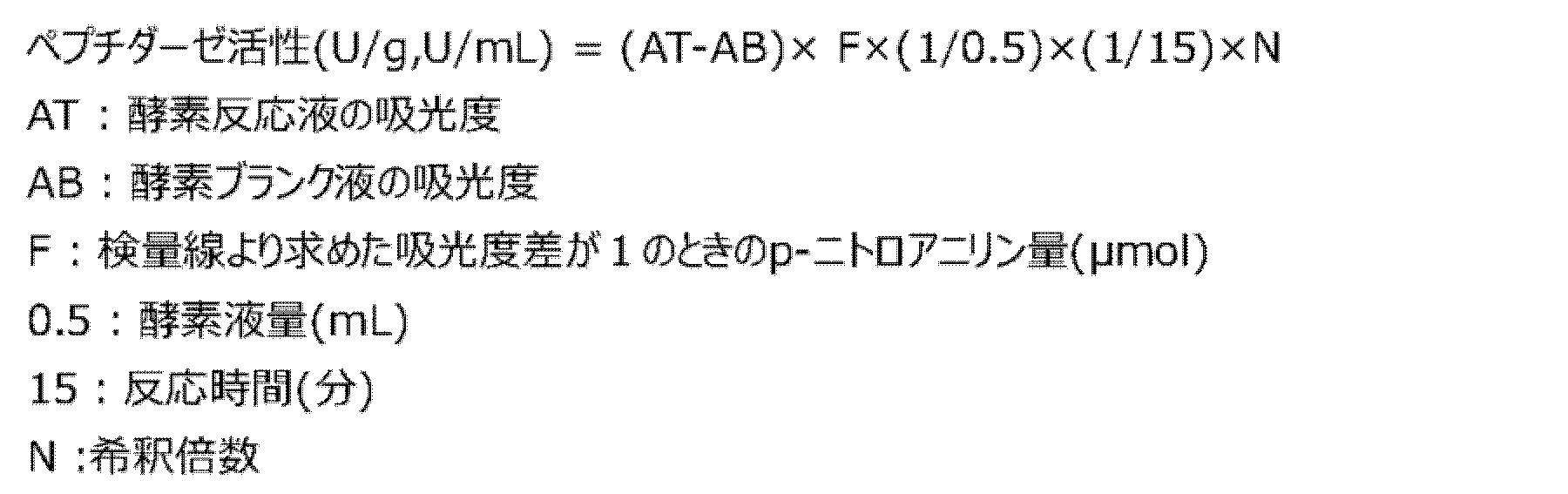
- Peptidase activity shall be measured using L-leucyl-p-nitroanilide hydrochloride as a substrate and by a method based on the 9th edition of the Japan Food Additives Official Standards, specifically, L-leucyl-p- An enzymatic reaction is carried out in a conventional manner using nitroanilide hydrochloride as a substrate, and the activity to produce 1 ⁇ mol of p-nitroaniline per minute is defined as 1 unit (1 U).
- Protein Glutaminase used in the present invention may be any enzyme that exhibits the action of decomposing the amide group-containing side chain of glutamine residues without cleaving peptide bonds or cross-linking proteins, with particular regard to its type and origin. Not limited.
- Examples of protein glutaminase include Chryseobacterium genus and Flavobacterium genus, which are disclosed in JP-A No. 2000-50887, JP-A No. 2001-218590, and International Publication No. 2006/075772. , the genus Empedobacter, the genus Sphingobacterium, the genus Aureobacterium, or the genus Myroides. These protein glutaminases may be used alone or in combination.
- protein glutaminases from the viewpoint of further enhancing the effect of increasing the amount of free glutamic acid, protein glutaminase derived from the genus Chryseobacterium is preferred, and Chryseobacterium proteolyticum is more preferred.
- proteins glutaminase derived from seeds are preferred.
- Protein glutaminase can be prepared from the culture solution of the microorganism from which the protein glutaminase is derived.
- a specific preparation method includes a method of recovering protein glutaminase from the culture solution or cells of the above-mentioned microorganism.
- the enzyme can be isolated and/or purified after the bacterial cells are recovered from the culture solution by filtration, centrifugation, etc., if necessary.
- protein glutaminase non-secreting microorganisms if necessary, after collecting the bacterial cells from the culture solution, crushing the bacterial cells by pressure treatment, ultrasonication, etc.
- Enzymes can be separated and/or purified.
- any known protein separation and/or purification method can be used without particular limitation, such as centrifugation method, UF concentration method, salting out method, ion exchange resin, etc. Examples include various chromatography methods using .
- the isolated and/or purified enzyme can be powdered by a drying method such as freeze drying or vacuum drying, and may be powdered using an appropriate excipient and/or drying aid in the drying method. You can also do that.
- the isolated and/or purified enzyme can be liquefied by adding appropriate additives and sterilizing it by filtration.
- the amount of protein glutaminase to be used is not particularly limited, but in both cases where the vegetable protein-containing composition is prepared from unstructured protein material and from structured protein material, the amount of protein glutaminase used is per 1 g of vegetable protein material. As the usage amount, for example, 0.01U or more can be mentioned. From the viewpoint of further enhancing the effect of increasing the amount of free glutamic acid, the amount of protein glutaminase used per 1 g of vegetable protein material is preferably 0.5 U or more, more preferably 0.75 U or more, and still more preferably 1.0 U or more. , more preferably 1.2 U or more.
- the amount of protein glutaminase used per 1 g of the vegetable protein material is preferably 0.01 U or more, more preferably 0.1 U or more, Or 0.25U or more, more preferably 0.5U or more, or 0.8U or more, still more preferably 1U or more, or 1.2U or more.
- the upper limit of the amount of protein glutaminase to be used per 1 g of vegetable protein material is not particularly limited; Also in the case of Examples include 2U or less.
- the upper limit of the amount of protein glutaminase used per 1 g of the vegetable protein material is, for example, 200 U or less, 150 U or less, 120 U or less, 100 U or less. , 80U or less, 60U or less, 40U or less, 30U or less, 20U or less, 10U or less, 7.5U or less, 5U or less, 2.5U or less, or 2U or less.
- the amount of protein glutaminase to be used per gram of vegetable protein is, for example, 0. Examples include 15U or more.
- the amount of protein glutaminase used per 1 g of vegetable protein is preferably 0.5 U or more, more preferably 0.75 U or more, even more preferably 1.0 U or more, More preferably, it is 1.2 U or more.
- the amount of protein glutaminase used per gram of vegetable protein is preferably 0.1 U or more, or 0.25 U or more, more preferably Examples include 0.5U or more, or 0.75U or more, more preferably 1U or more, or 1.5U or more, still more preferably 2U or more, or 2.5U or more.
- the upper limit of the amount of protein glutaminase to be used per gram of vegetable protein is not particularly limited, but the upper limit of the amount range for protein glutaminase used per 1 g of vegetable protein is not particularly limited; In the case of 7. Examples include 5U or less, 5U or less, or 2.5U or less.
- the upper limit of the amount of protein glutaminase used per gram of vegetable protein is, for example, 400 U or less, 300 U or less, 200 U or less, 100 U or less, Examples include 50U or less, 25U or less, 20U or less, 10U or less, or 5U or less.
- the usage ratio of proteolytic enzyme and protein glutaminase is determined based on the above usage amount for each enzyme, but from the viewpoint of further enhancing the effect of increasing the amount of free glutamic acid, the following usage ratios are preferably used.
- the amount of protein glutaminase used per 1 U of protease is preferably 0.005 mU or more, more preferably 0.01 mU or more, or 0.02 mU or more, still more preferably 0.03 mU or more, 0.04 mU or more, or 0.045 mU. Above, more preferably 0.05 mU or more, 0.075 mU or more, 0.1 mU or more, or 0.15 mU or more.
- the upper limit of the usage range of protein glutaminase per 1 U of protease is, for example, 15 mU or less, and from the viewpoint of further increasing the effect of increasing the amount of free glutamic acid, preferably 12 mU or less, or 10 mU or less, more preferably 8 mU or less, or 6 mU or less, more preferably 5 mU or less, or 4 mU or less, even more preferably 3 mU or less, 2 mU or less, or 1.5 mU or less.
- the amount of protein glutaminase to be used per 1 U of peptidase is preferably 0.001 U or more, regardless of whether the vegetable protein-containing composition is prepared from a non-organized protein material or a structured protein material. , more preferably 0.005U or more, or 0.01U or more, still more preferably 0.015U or more, 0.02U or more, or 0.025U or more, still more preferably 0.03U or more.
- the amount of protein glutaminase used per 1 U of peptidase is more preferably 0.005 U or more, still more preferably 0.01 U or more, or 0.02 U.
- the upper limit of the range of the amount of protein glutaminase used per 1 U of peptidase is, for example, 100 U or less in both cases where the vegetable protein-containing composition is prepared from a non-organized protein material and a structured protein material. From the viewpoint of further enhancing the effect of increasing the amount of free glutamic acid, preferably 75 U or less, 50 U or less, or 40 U or less, more preferably 30 U or less, or 20 U or less, still more preferably 15 U or less, or 10 U or less, and even more preferably Preferably, it is 7U or less, 6U or less, or 5.5U or less.
- the upper limit of the range of the amount of protein glutaminase used per 1 U of peptidase is preferably 3 U or less, more preferably 2 U or less, or 1 U or less, and even more preferably is 0.5U or less, or 0.1U or less, more preferably 0.075U or less, or 0.05U or less.
- benzyloxycarbonyl-L-glutaminylglycine (Z-Gln-Gly) is used as a substrate, and the amount of enzyme that releases 1 ⁇ mol of ammonia per minute is 1 unit (1 U).
- the treatment advances a reaction that liberates glutamic acid in the vegetable protein-containing composition.
- proteolytic enzyme and protein glutaminase are made to act is not particularly limited, and each enzyme may be made to act sequentially in any order, or both enzymes may be made to act simultaneously, but preferably both enzymes are made to act at the same time. can be done.
- Conditions (temperature, pH, time, etc.) for the treatment with proteolytic enzymes and protein glutaminase are appropriately selected depending on the degree of the desired effect of increasing the amount of free glutamic acid.
- the temperature at which the treatment with proteolytic enzymes and protein glutaminase is carried out is not particularly limited, and can be appropriately determined by those skilled in the art depending on the optimal temperature of the enzyme used and/or the thermal characteristics of the vegetable protein-containing composition.
- the temperature is 30°C to 80°C, preferably 40°C to 70°C, more preferably 40°C to 60°C.
- the pH of the reaction system in which the treatment with proteolytic enzymes and protein glutaminase is performed is not particularly limited, and can be appropriately determined by those skilled in the art depending on the optimum pH of the enzyme used and/or the pH characteristics of the vegetable protein-containing composition.
- the pH at 25° C. is, for example, 2 to 9, preferably 3 to 8, more preferably 5 to 7, and even more preferably 6 to 7.
- the time for the treatment with protease and protein glutaminase is, for example, 0.5 to 96 hours, preferably 1 to 72 hours, and more preferably 1 to 30 hours.
- the production method of the present invention can include any other steps in addition to the enzyme treatment step described above.
- Specific examples of other steps include the step of preparing the vegetable protein-containing composition described above as a step performed before the enzyme treatment step, and the step of preparing a composition containing a proteolytic enzyme as a step performed after the enzyme treatment step.
- Examples include a step of deactivating protein glutaminase, a step of filtering the processed vegetable protein-containing composition, and a step of drying the processed vegetable protein-containing composition.
- methods in the drying step include freeze drying, vacuum drying, spray drying, and the like.
- the food and drink containing vegetable protein of the present invention is a processed vegetable protein-containing composition obtained by the above-mentioned "1. Method for producing a composition containing processed vegetable protein" or a food and drink material containing the same. It is a cooked product. In these plant protein-containing foods and drinks of the present invention, the amount of free glutamic acid is increased.
- the cooking method for obtaining the cooked product includes: Any cooking method that is practiced can be used. Specific examples of cooking methods include seasoning, adding food additives, mixing other food and drink materials, heating, fermentation, molding, freezing, and/or baking.
- the properties of the vegetable protein-containing food or drink of the present invention are not particularly limited.
- the properties are determined depending on the properties of the vegetable protein-containing composition and the presence or absence of a drying step in the above manufacturing method, but, for example, , liquid, slurry, paste, and other fluid forms and solid forms.
- Specific examples of solid forms include powder, fine granules, granules, structured forms swollen with water, and dry forms. Examples include organizational form.
- the vegetable protein-containing food/beverage product of the present invention is a cooked product of a processed vegetable protein-containing composition
- the properties include any property of a plant-based alternative food/beverage product of a general animal protein cooked product.
- cooked products are not particularly limited as long as they are plant-based substitute foods and beverages for common animal protein cooked products, and include, for example, substitute milk, substitute meat, substitute cheese, substitute yogurt, and the like.
- the combination of protease and protein glutaminase can improve (increase) the level of free glutamic acid in a composition containing vegetable protein. Therefore, the present invention also provides an agent for improving the amount of free glutamic acid in a vegetable protein-containing composition containing a protease and a protein glutaminase.
- Proteolytic enzyme (1-1) Protease, protease derived from Aspergillus niger, protease derived from Rhizopus niveus, protease derived from Aspergillus oryzae, protease derived from Aspergillus melleus, Bacillus licheniformis-derived protease, Bacillus amyloliquefaciens-derived protease, Geobacillus stearothermophilus-derived protease (1- 2) Peptidase/Peptidase derived from Aspergillus oryzae/Peptidase derived from Rhizopus oryzae (2) Protein glutaminase/Protein glutaminase (PG) derived from Chryseobacterium proteolyticum (3) Glutaminase/Glutaminase derived from Bac
- Proteolytic enzyme (1-1) Protease, protease derived from Aspergillus n
- Vegetable protein-containing composition used in preliminary test examples and Test Examples 1 and 2 liquid vegetable protein-containing composition
- the above vegetable protein material (powder) was mixed with water to prepare a liquid vegetable protein-containing composition.
- the content of the vegetable protein material in the composition was 10% by weight.
- Vegetable protein-containing compositions used in preliminary test examples and Test Examples 1, 3, and 4 (textured vegetable protein material swollen with water) Six times the weight of water was added to 10 g of the above vegetable protein material (textured). The structured vegetable protein material was left to stand at 60° C. for 60 minutes to swell, and after swelling, it was washed away with water. Thereafter, the water was drained to obtain 25 g of a vegetable protein-containing composition (textured vegetable protein material swollen with water) (the content of the protein material in the vegetable protein-containing composition was approximately 40% by weight). .
- Protease activity measurement method (1) Protease activity measurement method (1-1) Protease activity measurement method 0.6% (w/v) casein solution (0.05 mol/L sodium hydrogen phosphate, pH 8.0 [derived from Geobacillus stearothermophilus, In the case of protease derived from Bacillus amyloliquefaciens, Bacillus licheniformis, and Aspergillus melleus] or 0.7% (v/w) lactic acid, pH 3.0 [derived from Aspergillus niger, A For protease derived from Spergillus oryzae and Rhizopus niveus]) 5 mL After heating at 37° C.
- casein solution 0.05 mol/L sodium hydrogen phosphate, pH 8.0 [derived from Geobacillus stearothermophilus, In the case of protease derived from Bacillus amyloliquefaciens, Bacillus licheniformis, and Aspergillus melleus] or 0.7% (
- a trichloroacetic acid test solution (containing 1.8% (w/v) trichloroacetic acid, 1.8% (w/v) sodium acetate and 0.33 mol/L acetic acid [Geobacillus protease derived from stearothermophilus, Bacillus amyloliquefaciens, Bacillus licheniformis, Aspergillus melleus], or containing 0.44 mol/L trichloroacetic acid [Asp In the case of protease derived from Ergillus niger, Aspergillus oryzae, and Rhizopus n]) add 5 mL.
- the mixture was shaken, left at 37° C. for 30 minutes, and filtered.
- the first 3 mL of the filtrate was removed, the next 2 mL of the filtrate was measured, and 5 mL of 0.55 mol/L sodium carbonate test solution and 1 mL of Folin test solution (1 ⁇ 3) were added, shaken well, and left at 37° C. for 30 minutes.
- the absorbance AT at a wavelength of 660 nm was measured using water as a control.
- trichloroacetic acid test solution containing 1.8% (w/v) trichloroacetic acid, 1.8% (w/v) sodium acetate, and 0.33 mol/L acetic acid [Geobacillus stearothermophilus protease derived from Bacillus amyloliquefaciens, Bacillus licheniformis, Aspergillus melleus], or containing 0.44 mol/L trichloroacetic acid [Aspergillus n. In the case of protease derived from Aspergillus oryzae, Rhizopus niveus]) add 5 mL and shake.
- casein solution 0.05 mol/L sodium hydrogen phosphate, pH 8.0 [derived from Geobacillus stearothermophilus, derived from Bacillus amyloliquefaciens, Bacillus lichen] iformis-derived protease, Aspergillus melleus-derived protease] or , 0.7% (v/w) lactic acid, pH 3.0 [For protease derived from Aspergillus niger, Aspergillus oryzae, Rhizopus niveus]) was added, immediately shaken, and left at 37°C for 30 minutes. The absorbance AB was measured for a solution (blank) that was operated in the same manner as the enzyme reaction solution described above.
- casein solution 0.05 mol/L sodium hydrogen phosphate, pH 8.0 [derived from Geobacillus stearothermophilus, derived from Bacillus amyloliquefaciens, Bacillus lichen] iformis-derived protease, Asper
- One unit (1 U) was defined as the amount of enzyme that caused an increase in the colored substance in Folin's reagent solution equivalent to 1 ⁇ g of tyrosine per minute.
- 1 mL, 2 mL, 3 mL, and 4 mL of 1 mg/mL tyrosine standard stock solution (0.2 mol/L hydrochloric acid) were measured, and 0.2 mol/L hydrochloric acid test solution was added to each to make 100 mL.
- 2 mL of each solution was measured, 5 mL of 0.55 mol/L sodium carbonate test solution and 1 mL of Folin test solution (1 ⁇ 3) were added, immediately shaken, and left at 37° C. for 30 minutes.
- absorbance A1, A2, A3, and A4 at a wavelength of 660 nm were measured using a solution obtained by weighing 2 mL of 0.2 mol/L hydrochloric acid test solution and operating in the same manner as above as a control.
- the absorbances A1, A2, A3, and A4 were plotted on the vertical axis, and the amount of tyrosine ( ⁇ g) in 2 mL of each solution was plotted on the horizontal axis, a calibration curve was created, and the amount of tyrosine ( ⁇ g) for an absorbance difference of 1 was determined.
- (1-2) Peptidase activity value measurement method Weigh an appropriate amount of enzyme and add pH 7.0 phosphate buffer (0.01 mol/L) to dissolve or uniformly disperse it to make 50 mL, or further buffer it.
- the sample solution was diluted 10 times, 100 times, or 1000 times using a sample solution.
- a comparison solution was prepared in the same manner as in the preparation of the test solution using a phosphate buffer solution (0.01 mol/L) having a pH of 7.0 instead of the sample solution.
- test solution and comparative solution for which the absorbance was to be measured were cloudy, centrifugation was performed and the supernatant solution was measured.
- the activity of producing 1 ⁇ mol of p-nitroaniline per minute was defined as 1 unit (1 U).
- the amount of ammonia produced in the reaction solution was measured using Ammonia Test Wako (Fuji Film Wako Pure Chemical Industries, Ltd.).
- the ammonia concentration in the reaction solution was determined from a calibration curve representing the relationship between ammonia concentration and absorbance (630 nm) prepared using an ammonia standard solution (ammonium chloride).
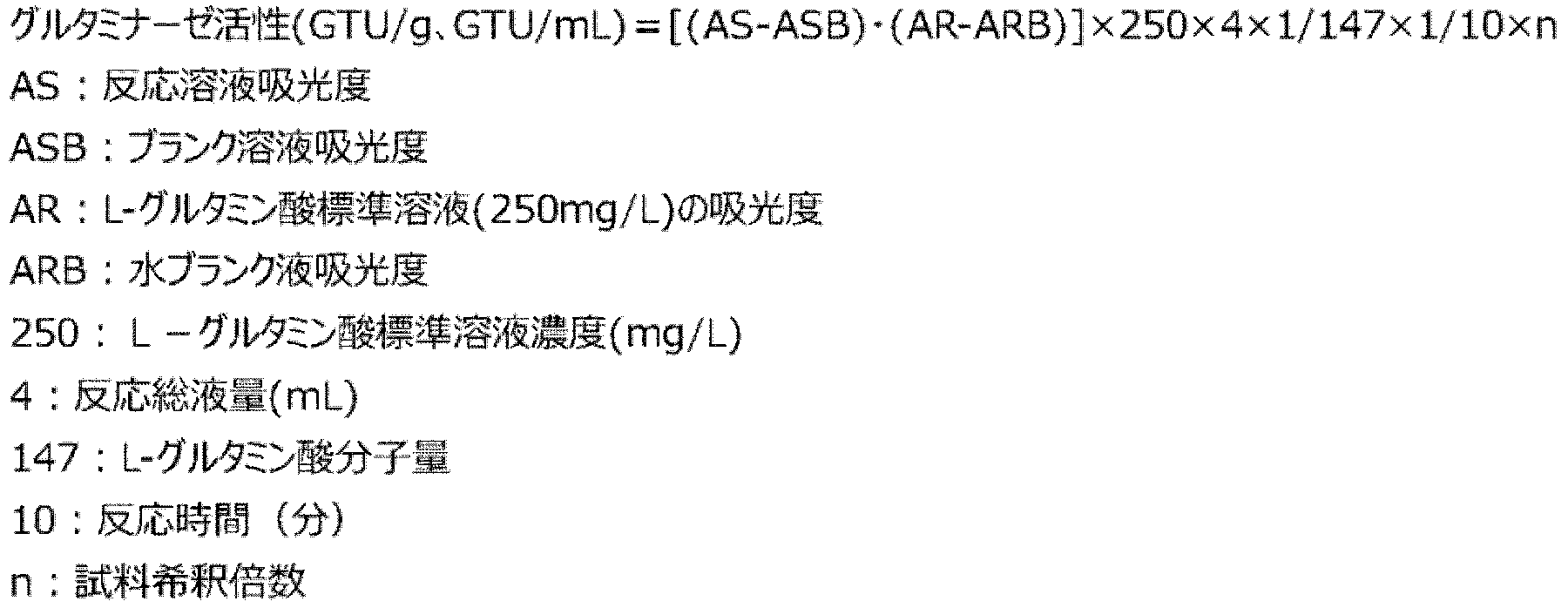
- the activity of protein glutaminase (PG) was calculated from the following formula, where 1 unit (1 U) is the amount of enzyme that produces 1 ⁇ mol of ammonia per minute.
- the reaction liquid volume is 2.1
- the enzyme solution volume is 0.1
- Df is the dilution ratio of the enzyme solution.
- 17.03 is the molecular weight of ammonia.
- the absorbance of the solution obtained by adding the test solution is greater than the absorbance of the solution obtained by adding the comparison solution.
- the test solution and comparative solution for which the absorbance was to be measured were cloudy, centrifugation was performed and the supernatant solution was measured.
- the amount of enzyme that produced 1 ⁇ mol of L-glutamic acid per minute was defined as 1 unit (1 GTU).
- Test Example 1 (1) Experimental method The enzymes shown in Table 3 were used in the indicated amounts (0.3 parts by weight per 100 parts by weight of vegetable protein material for the peptidase derived from R. oryzae, 3 parts by weight for other proteolytic enzymes per 100 parts by weight of vegetable protein material).
- the liquid vegetable protein-containing composition was treated with various enzymes in the same manner as in (1) of the preliminary test example above, except that the processed vegetable protein A liquid composition was obtained.
- Test Example 2 The combinations of enzymes and vegetable protein materials used were changed to those shown in Tables 4 and 5, and for Examples 31 to 33 and 46 to 48, the vegetable protein materials were pretreated with ⁇ -amylase (specifically, To a liquid vegetable protein-containing composition (10% by weight vegetable protein material), ⁇ -amylase was added in an amount of 6.5 U per 1 g of vegetable protein material, and the mixture was heated at 70°C for 0.5 hours. A processed vegetable protein-containing liquid composition was obtained in the same manner as in (1) of Test Example 1, except that the processed vegetable protein-containing liquid composition was changed to (treated and cooled to 50° C.).
- ⁇ -amylase specifically, To a liquid vegetable protein-containing composition (10% by weight vegetable protein material), ⁇ -amylase was added in an amount of 6.5 U per 1 g of vegetable protein material, and the mixture was heated at 70°C for 0.5 hours.
- a processed vegetable protein-containing liquid composition was obtained in the same manner as in (1) of Test Example 1, except that the processed vegetable protein-containing liquid composition was changed to
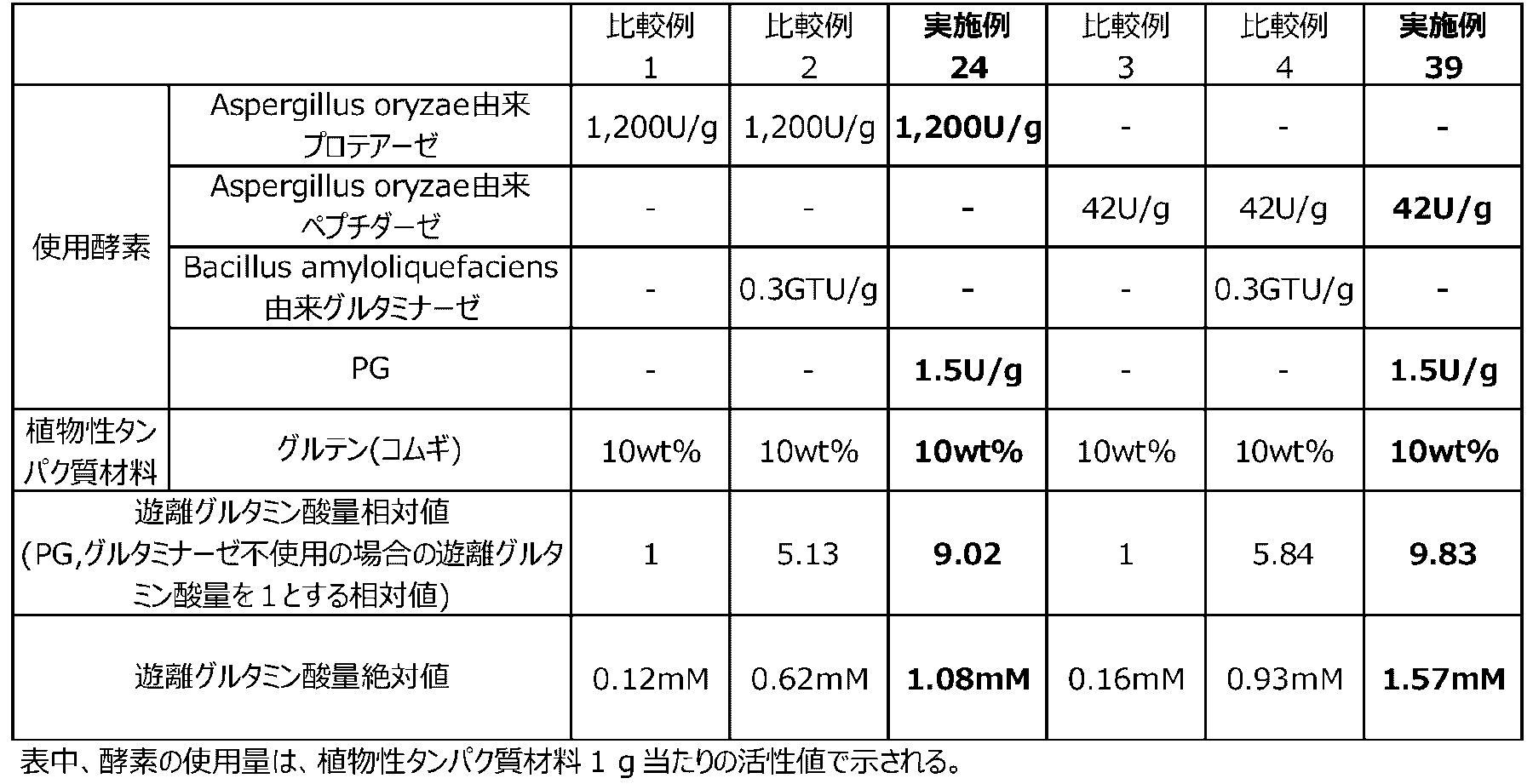
- Comparative Examples 1 and 3 which are vegetable protein-containing liquid compositions, and processed vegetable protein-containing liquid compositions obtained by the same treatment except that glutaminase was used instead of protein glutaminase. A comparison was made with certain comparative examples (Comparative Examples 2 and 4). The results are shown in Table 6.
- the textured vegetable protein-containing food (after seasoning, before baking) was baked at 150° C. for 10 minutes to obtain a patty-shaped textured vegetable protein-containing food (after baking).
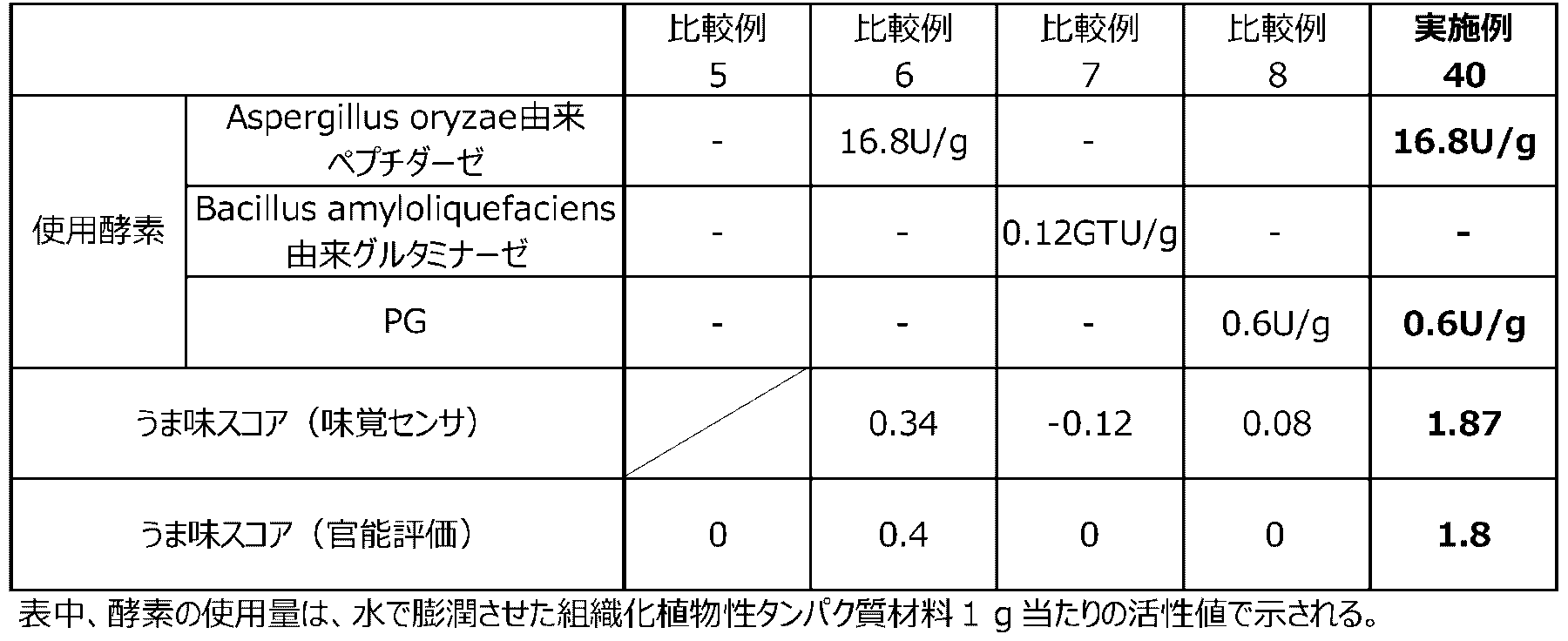
- the obtained food was subjected to umami measurement using a taste sensor (manufactured by Intelligent Sensor Technology, Inc.) and sensory evaluation by six trained panelists to obtain an umami score.
- the degree of umami was evaluated based on the following classification, and the average value was taken as the umami score. The results are shown in Table 7.
- the umami of the food (Example 40) obtained by treating vegetable protein materials with a combination of proteolytic enzymes and protein glutaminase increased, indicating that the amount of free glutamic acid in the food increased. It can be inferred that there has been a significant increase.
- the textured vegetable protein-containing food (after seasoning, before baking) was baked at 150° C. for 10 minutes to obtain a patty-shaped textured vegetable protein-containing food (after baking).
- the resulting food was subjected to sensory evaluation by six trained panelists to obtain a bitterness score.
- the degree of bitterness was evaluated based on the following classification, and the average value was used as the bitterness score.
- the bitterness of the food (Example 40) obtained by treating vegetable protein materials with a combination of proteolytic enzymes and protein glutaminase was suppressed, indicating that the amount of free glutamic acid in the food was suppressed. It can be inferred that the increase was so remarkable that the generation of bitterness due to hydrolysis could be effectively suppressed.
Landscapes
- Life Sciences & Earth Sciences (AREA)
- Chemical & Material Sciences (AREA)
- Engineering & Computer Science (AREA)
- Health & Medical Sciences (AREA)
- Biochemistry (AREA)
- Organic Chemistry (AREA)
- Zoology (AREA)
- Wood Science & Technology (AREA)
- Bioinformatics & Cheminformatics (AREA)
- Genetics & Genomics (AREA)
- Microbiology (AREA)
- Polymers & Plastics (AREA)
- Food Science & Technology (AREA)
- Biotechnology (AREA)
- General Health & Medical Sciences (AREA)
- General Engineering & Computer Science (AREA)
- Nutrition Science (AREA)
- Molecular Biology (AREA)
- General Chemical & Material Sciences (AREA)
- Chemical Kinetics & Catalysis (AREA)
- Biomedical Technology (AREA)
- Medicinal Chemistry (AREA)
- Mycology (AREA)
- Cell Biology (AREA)
- Proteomics, Peptides & Aminoacids (AREA)
- Preparation Of Compounds By Using Micro-Organisms (AREA)
- Enzymes And Modification Thereof (AREA)
- Coloring Foods And Improving Nutritive Qualities (AREA)
Abstract
Description
この苦味は、食品中のタンパク質を加水分解することにより生じた苦味ペプチドに起因する。タンパク質は、アミノ酸が100~1000個、1本の鎖状に結合したものであり、その鎖は規則的に折り畳まれ、球状の塊として存在している。球状の塊の外側には親水性のアミノ酸が、内側には疎水性のアミノ酸が多く存在しており、タンパク質を加水分解すると、この塊状の構造は破壊され、内側に存在していた疎水性アミノ酸を多く含む部分が切断されて苦味ペプチドとして露出し、苦味の原因となる(非特許文献1)。
項1. 植物性タンパク質含有組成物を、タンパク質分解酵素及びプロテイングルタミナーゼで処理する工程を含む、加工植物性タンパク質含有組成物の製造方法。
項2. 前記タンパク質分解酵素がプロテアーゼ及び/又はペプチダーゼである、項1に記載の製造方法。
項3. 前記プロテアーゼを、前記植物性タンパク質1g当たり110U以上用いる、項1又は2に記載の製造方法。
項4. 前記プロテアーゼが糸状菌由来プロテアーゼである、項2又は3に記載の製造方法。
項5. 前記プロテアーゼが、アスペルギルス属及び/又はリゾプス属由来のプロテアーゼである、項2~4のいずれかに記載の製造方法。
項6. 前記プロテアーゼが、アスペルギルス・オリゼ、アスペルギルス・ニガ、アスペルギルス・メレウス、及びリゾプス・ニベウス由来のプロテアーゼからなる群より選択される、項2~5のいずれかに記載の製造方法。
項7. 前記プロテアーゼが、細菌由来プロテアーゼである、項2又は3に記載の製造方法。
項8. 前記細菌由来プロテアーゼが、バチルス属及び/又はジオバチルス属由来のプロテアーゼである、項7のいずれかに記載の製造方法。
項9. 前記細菌由来プロテアーゼが、バチルス・ステアロサーモフィラス、バチルス・リケニフォルミス、バチルス・アミロリケファシエンス及びこれらのジオバチルス属由来のプロテアーゼからなる群より選択される、項7又は8に記載の製造方法。
項10. 前記タンパク質分解酵素が、細菌由来プロテアーゼ及び糸状菌由来ペプチダーゼである、項2、3及び7~9のいずれかに記載の製造方法。
項11. 前記ペプチダーゼが、リゾプス属及び/又はアスペルギルス属由来のペプチダーゼである、項2~10のいずれかに記載の製造方法。
項12. 前記植物性タンパク質が、豆類、穀類、ナッツ類及び種子類からなる群より選択される植物のタンパク質である、項1~11のいずれかに記載の製造方法。
項13. 前記植物性タンパク質含有組成物が液状である、項1~12のいずれかに記載の製造方法。
項14. 前記植物性タンパク質含有組成物が水で膨潤させた組織化植物性タンパク質材料である、項1~12のいずれかに記載の製造方法。
項15. タンパク質分解酵素及びプロテイングルタミナーゼを含む、植物性タンパク質含有組成物の遊離グルタミン酸量向上剤。
項16. 項1~14のいずれかに記載の製造方法によって得られる、植物性タンパク質含有飲食品。
本発明の加工植物性タンパク質含有組成物の製造方法は、植物性タンパク質含有組成物を、タンパク質分解酵素及びプロテイングルタミナーゼで処理する工程(酵素処理工程)を含むことを特徴とする。酵素処理工程によって、植物性タンパク質含有組成物中の遊離グルタミン酸量を向上(増加)させることができるため、遊離グルタミン酸量が増加する加工がされた植物性タンパク質含有組成物が得られる。以下、本発明の加工植物性タンパク質含有組成物の製造方法について詳述する。
本発明で用いられる植物性タンパク質含有組成物は、植物性タンパク質及び水を含み、典型例は飲食用の組成物である。植物性タンパク質含有組成物の性状に特段の制限はなく、例えば、液状、スラリー状、及びペースト状等の流動性を有する性状(以下において、これら流動性を有する性状の植物性タンパク質含有組成物を総括して「液体等」とも記載する)、及び固形状が挙げられる。
タンパク質分解酵素としては、ペプチド鎖を分解できる酵素を特に制限なく用いることができ、典型的には、プロテアーゼ及び/又はペプチダーゼが挙げられる。
本発明において、プロテアーゼとは、エンド型ペプチダーゼを指す。プロテアーゼは、その由来において特に限定されるものではないが、例えば、糸状菌由来プロテアーゼ及び細菌由来プロテアーゼが挙げられる。
本発明において、ペプチダーゼとは、エキソ型ペプチダーゼを指す。ペプチダーゼは、その由来において特に限定されるものではないが、例えば、糸状菌由来ペプチダーゼ、放線菌由来ペプチダーゼ、細菌由来ペプチダーゼが挙げられる。
本発明で用いられるプロテイングルタミナーゼとしては、ペプチド結合の切断及びタンパク質の架橋を伴わずグルタミン残基のアミド基含有側鎖を分解する作用を示す酵素であれば、その種類及び由来等は特に限定されない。プロテイングルタミナーゼの例として、特開2000-50887号公報、特開2001-218590号公報、国際公開第2006/075772号に開示された、クリセオバクテリウム(Chryseobacterium)属、フラボバクテリウム(Flavobacterium)属、エンペドバクター(Empedobacter)属、スフィンゴバクテリウム(Sphingobacterium)属、アウレオバクテリウム(Aureobacterium)属、又はミロイデス(Myroides)属由来のプロテイングルタミナーゼが挙げられる。これらのプロテイングルタミナーゼは、1種を単独で用いてもよいし、複数種を組み合わせて用いてもよい。
酵素処理工程では、当該処理により、植物性タンパク質含有組成物においてグルタミン酸を遊離させる反応を進行させる。
本発明の製造方法は、上記の酵素処理工程の他に、任意の他の工程を含むことができる。他の工程の具体例については、酵素処理工程の前に行われる工程として、上記の植物性タンパク質含有組成物を調製する工程が挙げられ、酵素処理工程の後に行われる工程として、タンパク質分解酵素及びプロテイングルタミナーゼの失活工程、加工植物性タンパク質含有組成物のろ過工程、加工植物性タンパク質含有組成物の乾燥工程等が挙げられる。乾燥工程における方法としては、凍結乾燥、真空乾燥、噴霧乾燥等が挙げられる。
本発明の植物性タンパク質含有飲食品は、上記の「1.加工植物性タンパク質含有組成物の製造方法」によって得られる、加工植物性タンパク質含有組成物又はそれを飲食品材料とする調理品である。これら本発明の植物性タンパク質含有飲食品においては、遊離グルタミン酸量が増加している。
タンパク質分解酵素及びプロテイングルタミナーゼの組み合わせは、植物性タンパク質含有組成物中の遊離グルタミン酸量を向上(増加)させることができる。従って、本発明は、タンパク質分解酵素及びプロテイングルタミナーゼを含む、植物性タンパク質含有組成物の遊離グルタミン酸量向上剤も提供する。
以下の酵素(全て天野エンザイム(株)製)を使用した。
(1)タンパク質分解酵素
(1-1)プロテアーゼ
・Aspergillus niger由来プロテアーゼ
・Rhizopus niveus由来プロテアーゼ
・Aspergillus oryzae由来プロテアーゼ
・Aspergillus melleus由来プロテアーゼ
・Bacillus licheniformis由来プロテアーゼ
・Bacillus amyloliquefaciens由来プロテアーゼ
・Geobacillus stearothermophilus由来プロテアーゼ
(1-2)ペプチダーゼ
・Aspergillus oryzae由来ペプチダーゼ
・Rhizopus oryzae由来ペプチダーゼ
(2)プロテイングルタミナーゼ
・Chryseobacterium proteolyticum由来プロテイングルタミナーゼ(PG)
(3)グルタミナーゼ
・Bacillus amyloliquefaciens由来グルタミナーゼ
(4)α-アミラーゼ
・Bacillus amyloliquefaciens由来α-アミラーゼ
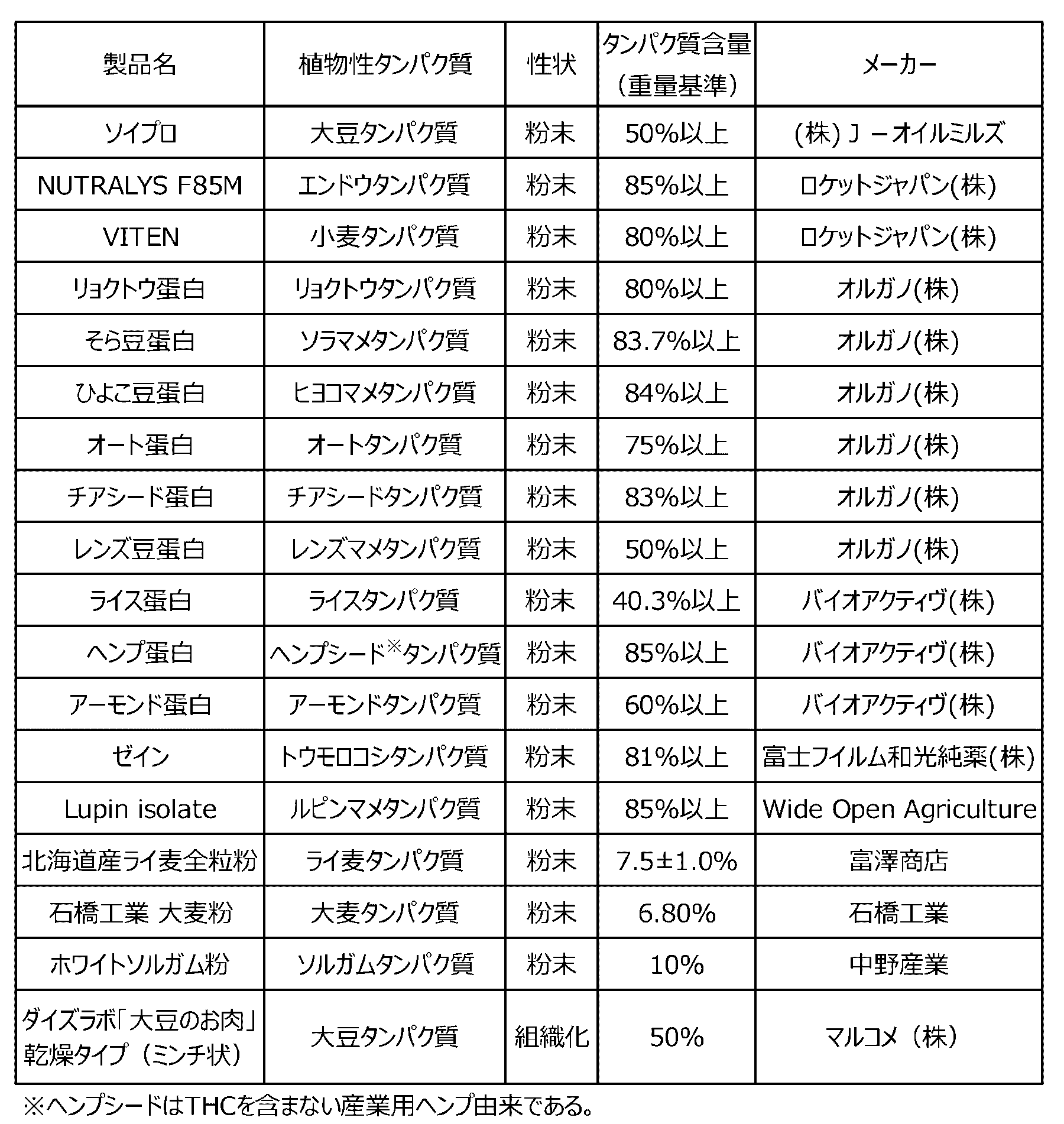
上記の植物性タンパク質材料(粉末)を水と混合させ、液状の植物性タンパク質含有組成物を調製した。当該組成物中の植物性タンパク質材料の含有量は、10重量%とした。
上記の植物性タンパク質材料(組織化)10gに対して6倍重量の水を加えた。60℃で60分間静置して組織化植物性タンパク質材料を膨潤させ、膨潤後、水で洗い流した。その後、水分を切り、植物性タンパク質含有組成物(水で膨潤させた組織化植物性タンパク質材料)25g(植物性タンパク質含有組成物中のタンパク質材料の含有量は、約40重量%)を得た。
(1)タンパク質分解酵素活性値測定法
(1-1)プロテアーゼ活性値測定法
0.6%(w/v)カゼイン溶液(0.05mol/Lリン酸水素ナトリウム、pH8.0[Geobacillus stearothermophilus由来、Bacillus amyloliquefaciens由来、Bacillus licheniformis由来、Aspergillus melleus由来プロテアーゼの場合]又は、0.7%(v/w)乳酸、pH3.0[Aspergillus niger由来、Aspergillus oryzae由来、Rhizopus niveus由来プロテアーゼの場合])5mLを、37℃で10分間加温した後、プロテアーゼを含む試料溶液1mLを加え、直ちに振り混ぜた。この液を37℃で10分間放置した後、トリクロロ酢酸試液(1.8%(w/v)トリクロロ酢酸、1.8%(w/v)酢酸ナトリウム及び0.33mol/L酢酸を含む[Geobacillus stearothermophilus由来、Bacillus amyloliquefaciens由来、Bacillus licheniformis由来、Aspergillus melleus由来プロテアーゼの場合]、又は0.44mol/Lトリクロロ酢酸を含む[Aspergillus niger由来、Aspergillus oryzae由来、Rhizopus niveus由来プロテアーゼの場合])5mLを加えて振り混ぜ、再び37℃で30分間放置し、ろ過した。初めのろ液3mLを除き、次のろ液2mLを量り、0.55mol/L炭酸ナトリウム試液5mL及びフォリン試液(1→3)1mLを加え、よく振り混ぜ、37℃で30分間放置した。この液(酵素反応液)につき、水を対照とし、波長660nmにおける吸光度ATを測定した。
1mg/mLチロシン標準原液(0.2mol/L塩酸)1mL,2mL,3mL及び4mLを量り、それぞれに0.2mol/L塩酸試液を加え、100mLとした。それぞれの液2mLを量り、0.55mol/L炭酸ナトリウム試液5mL及びフォリン試液(1→3)1mLを加え、直ちに振り混ぜ、37℃で30分間放置した。これらの液につき、0.2mol/L塩酸試液2mLを量り上記と同様に操作して得た液を対照とし、波長660nmにおける吸光度A1,A2,A3及びA4を測定した。縦軸に吸光度A1,A2,A3及びA4を、横軸にそれぞれの液2mL中のチロシン量(μg)をとり、検量線を作成し、吸光度差1に対するチロシン量(μg)を求めた。

酵素を適当量量り、pH7.0のリン酸緩衝液(0.01mol/L)を加えて溶解若しくは均一に分散して50mLとしたもの又はこれを更に緩衝液を用いて10倍、100倍若しくは1000倍に希釈したものを試料液とした。L-ロイシル-p-ニトロアニリド塩酸塩を40mg量り、pH7.0のリン酸緩衝液(0.01mol/L、12.5μmol/L硫酸亜鉛含有)を加えて溶かし、100mLとしたものを基質溶液とした。
30mM Z-Gln-Glyを含む0.2Mリン酸バッファー(pH6.5)1mLにプロテイングルタミナーゼを含む試料溶液0.1mLを添加して、37℃、10分間放置した後、0.4M TCA溶液を1mL加えて反応を停止した。ブランクとして、30mM Z-Gln-Glyを含む0.2Mリン酸バッファー(pH6.5)1mLに0.4M TCA試液を1mL加え、さらにプロテイングルタミナーゼを含む試料溶液0.1mLを添加して、37℃で10分間放置した。
前記で得られた溶液についてアンモニアテストワコー(富士フイルム和光純薬)を用い、反応液中に生じたアンモニア量の測定を行った。アンモニア標準液(塩化アンモニウム)を用いて作成したアンモニア濃度と吸光度(630nm)との関係を表す検量線より、反応液中のアンモニア濃度を求めた。

酵素を適当量量り、酢酸緩衝液(0.01mol/L、pH6.0、ポリオキシエチレン(10)オクチルフェニルエーテル含有)を加えて溶解若しくは均一に分散して50mLとしたもの又はこれを更に同緩衝液を用いて10倍若しくは100倍に希釈したものを試料液とした。
1重量%バレイショデンプン基質溶液(0.1mol/L酢酸(pH5.0))10mLを37℃で10分間加温した後、α-アミラーゼを含む試料溶液1mLを加え、直ちに振り混ぜた。この液を37℃で10分間放置した後、この液1mLを0.1mol/L塩酸試液10mLに加え、直ちに振り混ぜた。次に、この液0.5mLを量り、0.0002mol/Lヨウ素試液(日局)10mLを加え、振り混ぜた後、水を対照とし、波長660nmにおける吸光度(AT)を測定した。別に、試料溶液の代わりに水1mLを加えて同様に操作し、吸光度(AB)を測定した。1分間にバレイショデンプンのヨウ素による呈色を10%減少させる酵素量を1単位(1U)とした。

(1)実験方法
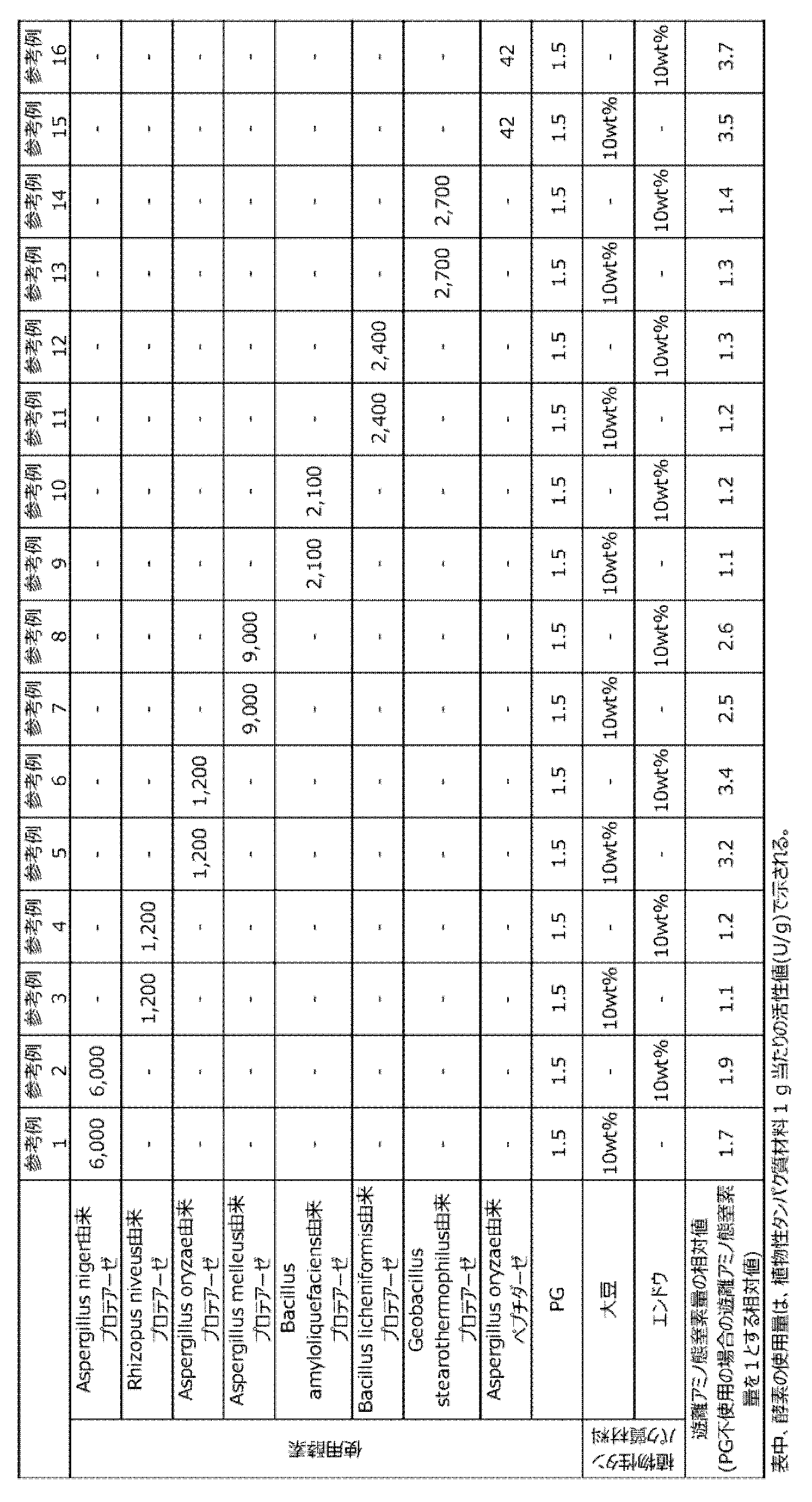
10mLの液状の植物性タンパク質含有組成物(10重量%植物性タンパク質材料)(pH6~7(25℃))に対して、植物性タンパク質材料100重量部当たり3重量部のタンパク質分解酵素と0.3重量部のPGとを添加した。対照実験として、植物性タンパク質材料100重量部当たり3重量部のタンパク質分解酵素のみの試験画分を準備した。50℃で170rpmの振とうにより2時間反応させた。反応後、煮沸にて酵素を失活させ、室温まで冷却することで、加工植物性タンパク質含有液状組成物を得た。
得られた加工植物性タンパク質含有液状組成物を15,000rpmにて5分間遠心分離し、上清を得た。上清を所定の倍率で希釈し、1.0mL希釈液に対してニンヒドリン試薬pH6.7(10%Na2HPO4/12H2O、6%KH2PO4、0.50%ニンヒドリン、0.30%フルクトース)を0.5mL添加した。混合後、16分間煮沸し、570nmの吸光度を測定した。タンパク質分解酵素とPGを用いた場合に得られた遊離アミノ態窒素量を、対照実験(PGを用いなかったことを除いて同様に行った実験)で得られた遊離アミノ態窒素量を1とした場合の相対値として導出した。結果を表2に示す。
(1)実験方法
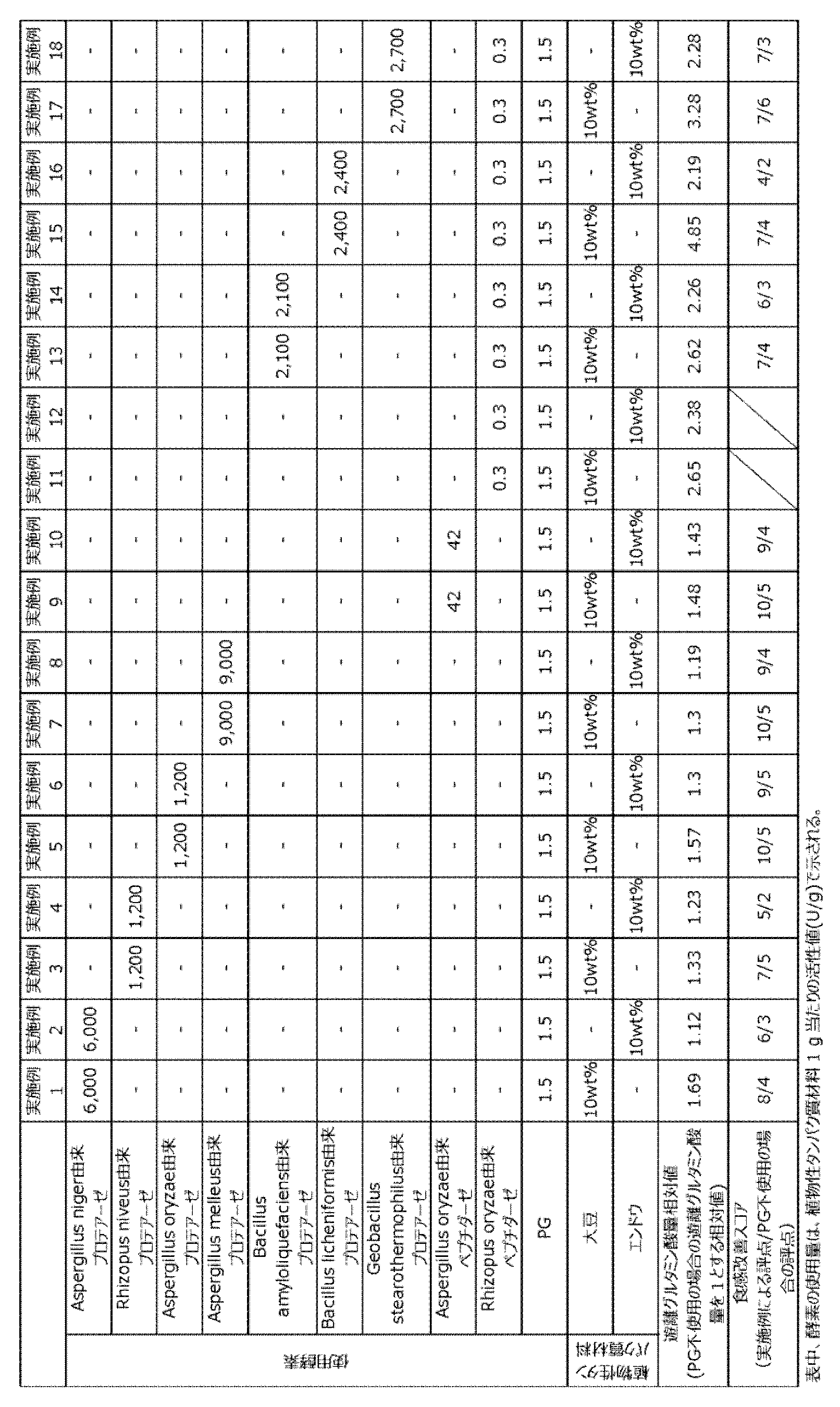
表3に示す酵素を表示の量(R.oryzae由来ペプチダーゼのみ植物性タンパク質材料100重量部当たり0.3重量部、その他のタンパク質分解酵素は植物性タンパク質材料100重量部当たり3重量部に相当)で用いたことを除いて、上記予備試験例の(1)と同様にして、液状の植物性タンパク質含有組成物に対して各種酵素を用いて処理を行い、加工植物性タンパク質含有液状組成物を得た。
得られた加工植物性タンパク質含有液状組成物を15,000rpmにて5分間遠心分離し、上清を、フィルター(0.45μm)ろ過した後、アミノ酸分析装置(Agilent 1260 Infinity II LCシステムを用いたアミノ酸分析)にて、当該プロトコルに従って遊離アミノ酸量を分析した。タンパク質分解酵素とPGを用いた場合に得られた遊離グルタミン酸量を、対照実験(PGを用いなかったことを除いて同様に行った実験)で得られた遊離グルタミン酸量を1とした場合の相対値として導出した。結果を表3に示す。
得られた加工植物性タンパク質含有液状組成物を、訓練されたパネリストにより、食感(具体的には舌触り)を、酵素処理を行わなかったことを除いて同様に処理した植物性タンパク質含有液状組成物のざらついた舌ざわりを1点、ほぼざらつきが認められなくなるほどになめらかな舌ざわりを10点とするVASに基づいて評点した。結果を表3に示す。なお、表3においては、得られた評点(評点Aとする)を、対照実験(PGを用いなかったことを除いて同様に行った実験)で得られた評点(評点Bとする)と並べて、評点A/評点Bの形式で示す。
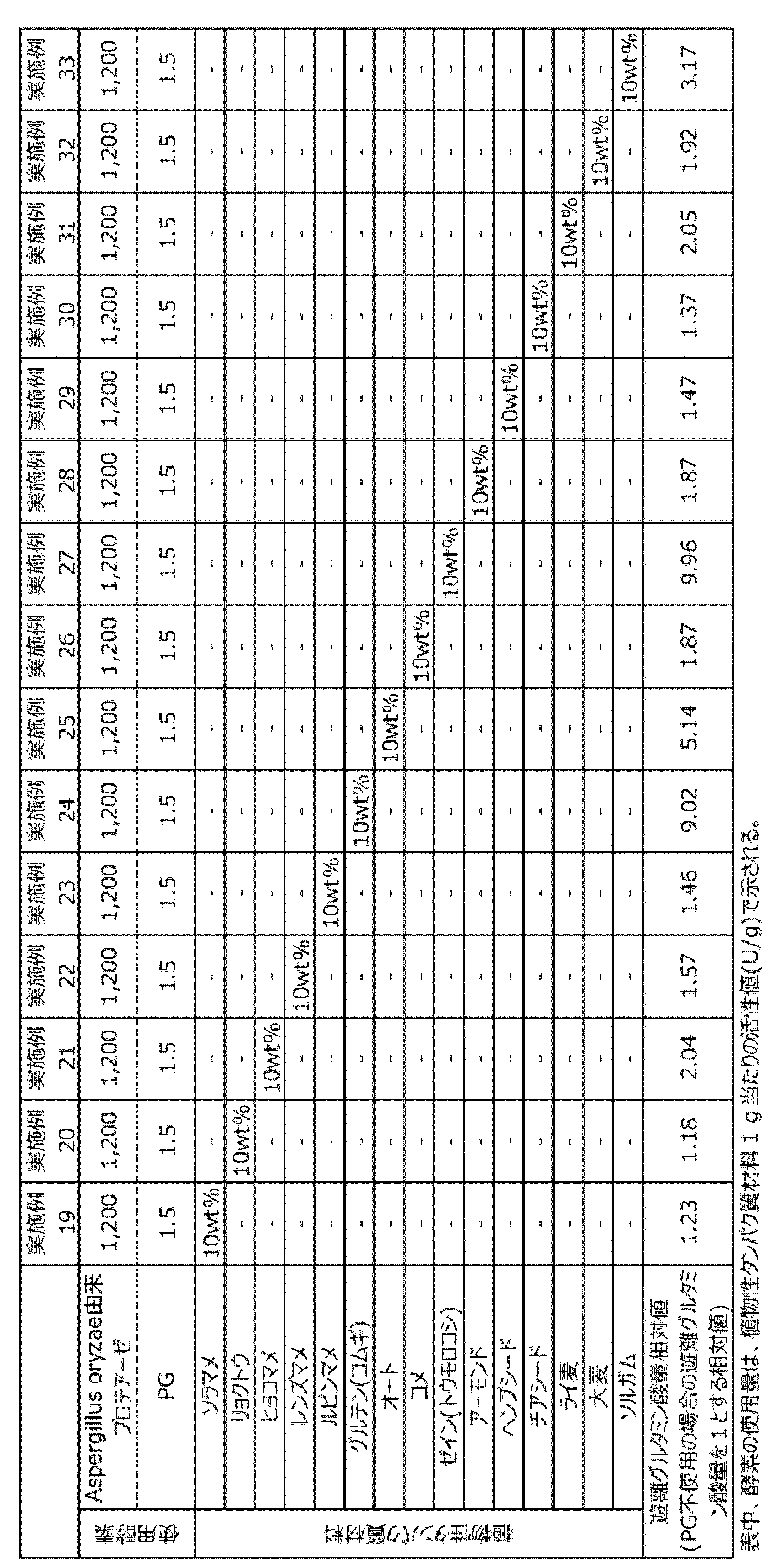
使用酵素及び植物性タンパク質材料の組み合わせとして表4及び表5に示すものに変更し、実施例31~33及び46~48に関しては植物性タンパク質材料をα‐アミラーゼによる前処理を経た(具体的には、液状の植物性タンパク質含有組成物(10重量%の植物性タンパク質材料)に対して、植物性タンパク質材料1g当たり6.5Uとなる量のα‐アミラーゼを加えて70℃で0.5時間処理をし、50℃まで冷却した)ものに変更したことを除いて、試験例1の(1)と同様にして加工植物性タンパク質含有液状組成物を得た。

水で膨潤させた組織化植物性タンパク質材料25gに対して、10mLの水、5mLのオリーブオイル、メチルセルロース(最終濃度2質量%)、及び表7に記載の酵素を表示の量で混合し、パティの形状に成型し、50℃にて1時間インキュベートすることで、組織化植物性タンパク質含有食品(調味後、焼成前)を得た。
2点:比較例5の食品よりかなり強い
1点:比較例5の食品よりやや強い
0点:比較例5の食品と同等
-1点:比較例5の食品よりやや弱い
-2点:比較例5の食品よりかなり弱い
水で膨潤させた組織化植物性タンパク質材料25gに対して、10mLの水、5mLのオリーブオイル、メチルセルロース(最終濃度2質量%)、及び表8に記載の酵素を表示の量で混合し、パティの形状に成型し、50℃にて1時間インキュベートすることで、組織化植物性タンパク質含有食品(調味後、焼成前)を得た。
2点:比較例5の食品よりかなり強い
1点:比較例5の食品よりやや強い
0点:比較例5の食品と同等
-1点:比較例5の食品よりやや弱い
-2点:比較例5の食品よりかなり弱い

Claims (16)
- 植物性タンパク質含有組成物を、タンパク質分解酵素及びプロテイングルタミナーゼで処理する工程を含む、加工植物性タンパク質含有組成物の製造方法。
- 前記タンパク質分解酵素がプロテアーゼ及び/又はペプチダーゼである、請求項1に記載の製造方法。
- 前記プロテアーゼを、前記植物性タンパク質1g当たり110U以上用いる、請求項2に記載の製造方法。
- 前記プロテアーゼが糸状菌由来プロテアーゼである、請求項2に記載の製造方法。
- 前記プロテアーゼが、アスペルギルス属及び/又はリゾプス属由来のプロテアーゼである、請求項2に記載の製造方法。
- 前記プロテアーゼが、アスペルギルス・オリゼ、アスペルギルス・ニガ、アスペルギルス・メレウス、及びリゾプス・ニベウス由来のプロテアーゼからなる群より選択される、請求項2に記載の製造方法。
- 前記プロテアーゼが、細菌由来プロテアーゼである、請求項2に記載の製造方法。
- 前記細菌由来プロテアーゼが、バチルス属及び/又はジオバチルス属由来のプロテアーゼである、請求項7に記載の製造方法。
- 前記細菌由来プロテアーゼが、バチルス・ステアロサーモフィラス、バチルス・リケニフォルミス、バチルス・アミロリケファシエンス及びこれらのジオバチルス属由来のプロテアーゼからなる群より選択される、請求項7に記載の製造方法。
- 前記タンパク質分解酵素が、細菌由来プロテアーゼ及び糸状菌由来ペプチダーゼである、請求項2に記載の製造方法。
- 前記ペプチダーゼが、リゾプス属及び/又はアスペルギルス属由来のペプチダーゼである、請求項2に記載の製造方法。
- 前記植物性タンパク質が、豆類、穀類、ナッツ類及び種子類からなる群より選択される植物のタンパク質である、請求項1に記載の製造方法。
- 前記植物性タンパク質含有組成物が液状である、請求項1に記載の製造方法。
- 前記植物性タンパク質含有組成物が水で膨潤させた組織化植物性タンパク質材料である、請求項1に記載の製造方法。
- タンパク質分解酵素及びプロテイングルタミナーゼを含む、植物性タンパク質含有組成物の遊離グルタミン酸量向上剤。
- 請求項1に記載の製造方法によって得られる、植物性タンパク質含有飲食品。
Priority Applications (4)
| Application Number | Priority Date | Filing Date | Title |
|---|---|---|---|
| EP23803646.1A EP4523546A4 (en) | 2022-05-12 | 2023-05-12 | PROCESS FOR MANUFACTURING PROCESSED VEGETABLE PROTEIN COMPOSITION |
| US18/863,947 US20250302068A1 (en) | 2022-05-12 | 2023-05-12 | Method for producing processed vegetable protein-containing composition |
| CN202380039192.4A CN119997821A (zh) | 2022-05-12 | 2023-05-12 | 含有加工植物性蛋白质的组合物的制造方法 |
| JP2024520508A JPWO2023219172A1 (ja) | 2022-05-12 | 2023-05-12 |
Applications Claiming Priority (4)
| Application Number | Priority Date | Filing Date | Title |
|---|---|---|---|
| JP2022079084 | 2022-05-12 | ||
| JP2022-079084 | 2022-05-12 | ||
| JP2022105971 | 2022-06-30 | ||
| JP2022-105971 | 2022-06-30 |
Publications (1)
| Publication Number | Publication Date |
|---|---|
| WO2023219172A1 true WO2023219172A1 (ja) | 2023-11-16 |
Family
ID=88730410
Family Applications (1)
| Application Number | Title | Priority Date | Filing Date |
|---|---|---|---|
| PCT/JP2023/018009 Ceased WO2023219172A1 (ja) | 2022-05-12 | 2023-05-12 | 加工植物性タンパク質含有組成物の製造方法 |
Country Status (5)
| Country | Link |
|---|---|
| US (1) | US20250302068A1 (ja) |
| EP (1) | EP4523546A4 (ja) |
| JP (1) | JPWO2023219172A1 (ja) |
| CN (1) | CN119997821A (ja) |
| WO (1) | WO2023219172A1 (ja) |
Cited By (2)
| Publication number | Priority date | Publication date | Assignee | Title |
|---|---|---|---|---|
| WO2025159208A1 (ja) * | 2024-01-25 | 2025-07-31 | 天野エンザイム株式会社 | 植物性タンパク質含有液状組成物の呈味変化抑制剤 |
| WO2025202546A1 (en) * | 2024-03-28 | 2025-10-02 | Oddlygood Ltd | A plant-based cheese and a process of manufacturing the same |
Citations (8)
| Publication number | Priority date | Publication date | Assignee | Title |
|---|---|---|---|---|
| JP2000050887A (ja) | 1998-06-04 | 2000-02-22 | Amano Pharmaceut Co Ltd | 新規蛋白質脱アミド酵素、それをコ―ドする遺伝子、その製造法並びにその用途 |
| JP2001218590A (ja) | 1999-12-03 | 2001-08-14 | Amano Enzyme Inc | 新規蛋白質脱アミド酵素、それを生産する微生物、それをコードする遺伝子、その製造法及び用途 |
| WO2006075772A1 (ja) | 2005-01-13 | 2006-07-20 | Ajinomoto Co., Inc. | 乳製品及びその製造方法 |
| WO2021201277A1 (ja) * | 2020-04-03 | 2021-10-07 | 天野エンザイム株式会社 | 蛋白質の脱アミド方法 |
| WO2021251344A1 (ja) * | 2020-06-08 | 2021-12-16 | 天野エンザイム株式会社 | タンパク質の食感改良 |
| WO2022014542A1 (ja) * | 2020-07-13 | 2022-01-20 | 天野エンザイム株式会社 | 植物性タンパク質食品の製造方法 |
| WO2022102723A1 (ja) * | 2020-11-11 | 2022-05-19 | 天野エンザイム株式会社 | 加工植物性タンパク質含有液状組成物の製造方法 |
| WO2022215688A1 (ja) * | 2021-04-05 | 2022-10-13 | アマノ エンザイム ヨーロッパ リミテッド | 加工ヘンプタンパク質含有液状組成物の製造方法 |
Family Cites Families (5)
| Publication number | Priority date | Publication date | Assignee | Title |
|---|---|---|---|---|
| KR101239624B1 (ko) * | 2010-12-30 | 2013-03-07 | 주식회사농심 | 식물성 단백질 가수분해물의 제조방법 |
| CN104522292A (zh) * | 2014-12-31 | 2015-04-22 | 广东食品药品职业学院 | 厚味肽及其制备方法与应用 |
| CN106490298B (zh) * | 2016-11-28 | 2020-05-22 | 华南理工大学 | 一种高分散性植物蛋白及其制备方法 |
| AU2020228355B2 (en) * | 2019-02-25 | 2026-01-29 | International N&H Denmark Aps | Protein hydrolysates with increased yield of N-terminal amino acid |
| WO2021254943A1 (en) * | 2020-06-17 | 2021-12-23 | Dsm Ip Assets B.V. | Umami flavour composition |
-
2023
- 2023-05-12 EP EP23803646.1A patent/EP4523546A4/en active Pending
- 2023-05-12 US US18/863,947 patent/US20250302068A1/en active Pending
- 2023-05-12 CN CN202380039192.4A patent/CN119997821A/zh active Pending
- 2023-05-12 JP JP2024520508A patent/JPWO2023219172A1/ja active Pending
- 2023-05-12 WO PCT/JP2023/018009 patent/WO2023219172A1/ja not_active Ceased
Patent Citations (8)
| Publication number | Priority date | Publication date | Assignee | Title |
|---|---|---|---|---|
| JP2000050887A (ja) | 1998-06-04 | 2000-02-22 | Amano Pharmaceut Co Ltd | 新規蛋白質脱アミド酵素、それをコ―ドする遺伝子、その製造法並びにその用途 |
| JP2001218590A (ja) | 1999-12-03 | 2001-08-14 | Amano Enzyme Inc | 新規蛋白質脱アミド酵素、それを生産する微生物、それをコードする遺伝子、その製造法及び用途 |
| WO2006075772A1 (ja) | 2005-01-13 | 2006-07-20 | Ajinomoto Co., Inc. | 乳製品及びその製造方法 |
| WO2021201277A1 (ja) * | 2020-04-03 | 2021-10-07 | 天野エンザイム株式会社 | 蛋白質の脱アミド方法 |
| WO2021251344A1 (ja) * | 2020-06-08 | 2021-12-16 | 天野エンザイム株式会社 | タンパク質の食感改良 |
| WO2022014542A1 (ja) * | 2020-07-13 | 2022-01-20 | 天野エンザイム株式会社 | 植物性タンパク質食品の製造方法 |
| WO2022102723A1 (ja) * | 2020-11-11 | 2022-05-19 | 天野エンザイム株式会社 | 加工植物性タンパク質含有液状組成物の製造方法 |
| WO2022215688A1 (ja) * | 2021-04-05 | 2022-10-13 | アマノ エンザイム ヨーロッパ リミテッド | 加工ヘンプタンパク質含有液状組成物の製造方法 |
Non-Patent Citations (4)
| Title |
|---|
| "Japan's Specifications and Standards for Food Additives" |
| HABIBI-NAJAFI, M. B., LEE, B. H.: "Bitterness in cheese", FOOD SCI. NUTR., vol. 36, 1996, pages 397 - 411, XP000909718 |
| HIDEYUKI SUZUKIYUKO NAKAFUJITOMOKI TAMURA: "New Preparation Method of Richness Taste Seasoning y-Glutamylation of Protein Hydrolysate Obtained by Protease Treatment", SOY PROTEIN RESEARCH, vol. 17, 2014, pages 42 - 45 |
| See also references of EP4523546A4 |
Cited By (2)
| Publication number | Priority date | Publication date | Assignee | Title |
|---|---|---|---|---|
| WO2025159208A1 (ja) * | 2024-01-25 | 2025-07-31 | 天野エンザイム株式会社 | 植物性タンパク質含有液状組成物の呈味変化抑制剤 |
| WO2025202546A1 (en) * | 2024-03-28 | 2025-10-02 | Oddlygood Ltd | A plant-based cheese and a process of manufacturing the same |
Also Published As
| Publication number | Publication date |
|---|---|
| EP4523546A1 (en) | 2025-03-19 |
| CN119997821A (zh) | 2025-05-13 |
| EP4523546A4 (en) | 2025-12-10 |
| JPWO2023219172A1 (ja) | 2023-11-16 |
| US20250302068A1 (en) | 2025-10-02 |
Similar Documents
| Publication | Publication Date | Title |
|---|---|---|
| US20240016187A1 (en) | Method for producing processed plant-based protein-containing liquid composition | |
| Yasuda et al. | Biochemical aspects of red koji and tofuyo prepared using Monascus fungi | |
| WO2023219172A1 (ja) | 加工植物性タンパク質含有組成物の製造方法 | |
| CN116367729A (zh) | 提高分散稳定性和/或溶解性的加工植物性奶的制造方法 | |
| WO2022215688A1 (ja) | 加工ヘンプタンパク質含有液状組成物の製造方法 | |
| US20160316786A1 (en) | Method for Producing a Wheat Protein Hydrolysate | |
| WO2022097745A1 (ja) | 肉様加工食品の製造方法 | |
| KR102868974B1 (ko) | 관능적 쓴맛개선 및 소화율이 향상된 저분자 발효대두단백 및 그 제조방법 | |
| Putri et al. | Physicochemical and organoleptic characteristics of seasoning from tempe hydrolysates using long treatment of fermentation and proteolytic enzyme proportion | |
| EP4616719A1 (en) | Method for producing textured vegetable protein | |
| CN120379546A (zh) | 含有植物性蛋白质的组合物的香气变化方法及呈味增强方法 | |
| CN116471944A (zh) | 一种含有加工植物性蛋白质的液态组合物的制造方法 | |
| WO2024053745A1 (ja) | 加工植物性タンパク質含有組成物の製造方法 | |
| US12453361B2 (en) | Process for increasing yield in production of plant based products | |
| WO2024257875A1 (ja) | タンパク質含有組成物の改質剤 | |
| WO2024172142A1 (ja) | 加工植物性タンパク質含有液状組成物の製造方法 | |
| CN120676872A (zh) | 加工的含有蛋白质的组合物的制造方法 | |
| WO2025159208A1 (ja) | 植物性タンパク質含有液状組成物の呈味変化抑制剤 | |
| WO2024203332A1 (ja) | 米飯用ほぐれ改良剤及び米飯用ほぐれ改良剤の製造方法 | |
| CN121194701A (zh) | 含有植物性蛋白质的液态组合物的矿物质富集剂 | |
| WO2023085315A1 (ja) | 植物性タンパク質含有組成物の消化性向上剤 | |
| CN119789791A (zh) | 含有植物性蛋白质的液态组合物的口感改善剂 |
Legal Events
| Date | Code | Title | Description |
|---|---|---|---|
| 121 | Ep: the epo has been informed by wipo that ep was designated in this application |
Ref document number: 23803646 Country of ref document: EP Kind code of ref document: A1 |
|
| WWE | Wipo information: entry into national phase |
Ref document number: 18863947 Country of ref document: US |
|
| WWE | Wipo information: entry into national phase |
Ref document number: 2024520508 Country of ref document: JP Ref document number: 202380039192.4 Country of ref document: CN |
|
| WWE | Wipo information: entry into national phase |
Ref document number: 2023803646 Country of ref document: EP |
|
| NENP | Non-entry into the national phase |
Ref country code: DE |
|
| ENP | Entry into the national phase |
Ref document number: 2023803646 Country of ref document: EP Effective date: 20241212 |
|
| WWP | Wipo information: published in national office |
Ref document number: 202380039192.4 Country of ref document: CN |
|
| WWP | Wipo information: published in national office |
Ref document number: 18863947 Country of ref document: US |