WO2023230985A1 - 锂离子电池正极极片、包含其的锂离子电池及用电装置 - Google Patents
锂离子电池正极极片、包含其的锂离子电池及用电装置 Download PDFInfo
- Publication number
- WO2023230985A1 WO2023230985A1 PCT/CN2022/096833 CN2022096833W WO2023230985A1 WO 2023230985 A1 WO2023230985 A1 WO 2023230985A1 CN 2022096833 W CN2022096833 W CN 2022096833W WO 2023230985 A1 WO2023230985 A1 WO 2023230985A1
- Authority
- WO
- WIPO (PCT)
- Prior art keywords
- active material
- positive electrode
- cathode
- particles
- lithium
- Prior art date
- Legal status (The legal status is an assumption and is not a legal conclusion. Google has not performed a legal analysis and makes no representation as to the accuracy of the status listed.)
- Ceased
Links
Images



Classifications
-
- H—ELECTRICITY
- H01—ELECTRIC ELEMENTS
- H01M—PROCESSES OR MEANS, e.g. BATTERIES, FOR THE DIRECT CONVERSION OF CHEMICAL ENERGY INTO ELECTRICAL ENERGY
- H01M4/00—Electrodes
- H01M4/02—Electrodes composed of, or comprising, active material
- H01M4/13—Electrodes for accumulators with non-aqueous electrolyte, e.g. for lithium-accumulators; Processes of manufacture thereof
- H01M4/134—Electrodes based on metals, Si or alloys
-
- H—ELECTRICITY
- H01—ELECTRIC ELEMENTS
- H01M—PROCESSES OR MEANS, e.g. BATTERIES, FOR THE DIRECT CONVERSION OF CHEMICAL ENERGY INTO ELECTRICAL ENERGY
- H01M4/00—Electrodes
- H01M4/02—Electrodes composed of, or comprising, active material
- H01M4/13—Electrodes for accumulators with non-aqueous electrolyte, e.g. for lithium-accumulators; Processes of manufacture thereof
- H01M4/131—Electrodes based on mixed oxides or hydroxides, or on mixtures of oxides or hydroxides, e.g. LiCoOx
-
- C—CHEMISTRY; METALLURGY
- C30—CRYSTAL GROWTH
- C30B—SINGLE-CRYSTAL GROWTH; UNIDIRECTIONAL SOLIDIFICATION OF EUTECTIC MATERIAL OR UNIDIRECTIONAL DEMIXING OF EUTECTOID MATERIAL; REFINING BY ZONE-MELTING OF MATERIAL; PRODUCTION OF A HOMOGENEOUS POLYCRYSTALLINE MATERIAL WITH DEFINED STRUCTURE; SINGLE CRYSTALS OR HOMOGENEOUS POLYCRYSTALLINE MATERIAL WITH DEFINED STRUCTURE; AFTER-TREATMENT OF SINGLE CRYSTALS OR A HOMOGENEOUS POLYCRYSTALLINE MATERIAL WITH DEFINED STRUCTURE; APPARATUS THEREFOR
- C30B29/00—Single crystals or homogeneous polycrystalline material with defined structure characterised by the material or by their shape
- C30B29/10—Inorganic compounds or compositions
- C30B29/16—Oxides
- C30B29/22—Complex oxides
-
- H—ELECTRICITY
- H01—ELECTRIC ELEMENTS
- H01M—PROCESSES OR MEANS, e.g. BATTERIES, FOR THE DIRECT CONVERSION OF CHEMICAL ENERGY INTO ELECTRICAL ENERGY
- H01M10/00—Secondary cells; Manufacture thereof
- H01M10/05—Accumulators with non-aqueous electrolyte
- H01M10/052—Li-accumulators
- H01M10/0525—Rocking-chair batteries, i.e. batteries with lithium insertion or intercalation in both electrodes; Lithium-ion batteries
-
- H—ELECTRICITY
- H01—ELECTRIC ELEMENTS
- H01M—PROCESSES OR MEANS, e.g. BATTERIES, FOR THE DIRECT CONVERSION OF CHEMICAL ENERGY INTO ELECTRICAL ENERGY
- H01M4/00—Electrodes
- H01M4/02—Electrodes composed of, or comprising, active material
- H01M4/04—Processes of manufacture in general
- H01M4/043—Processes of manufacture in general involving compressing or compaction
-
- H—ELECTRICITY
- H01—ELECTRIC ELEMENTS
- H01M—PROCESSES OR MEANS, e.g. BATTERIES, FOR THE DIRECT CONVERSION OF CHEMICAL ENERGY INTO ELECTRICAL ENERGY
- H01M4/00—Electrodes
- H01M4/02—Electrodes composed of, or comprising, active material
- H01M4/36—Selection of substances as active materials, active masses, active liquids
- H01M4/362—Composites
-
- H—ELECTRICITY
- H01—ELECTRIC ELEMENTS
- H01M—PROCESSES OR MEANS, e.g. BATTERIES, FOR THE DIRECT CONVERSION OF CHEMICAL ENERGY INTO ELECTRICAL ENERGY
- H01M4/00—Electrodes
- H01M4/02—Electrodes composed of, or comprising, active material
- H01M4/36—Selection of substances as active materials, active masses, active liquids
- H01M4/362—Composites
- H01M4/364—Composites as mixtures
-
- H—ELECTRICITY
- H01—ELECTRIC ELEMENTS
- H01M—PROCESSES OR MEANS, e.g. BATTERIES, FOR THE DIRECT CONVERSION OF CHEMICAL ENERGY INTO ELECTRICAL ENERGY
- H01M4/00—Electrodes
- H01M4/02—Electrodes composed of, or comprising, active material
- H01M4/36—Selection of substances as active materials, active masses, active liquids
- H01M4/48—Selection of substances as active materials, active masses, active liquids of inorganic oxides or hydroxides
- H01M4/50—Selection of substances as active materials, active masses, active liquids of inorganic oxides or hydroxides of manganese
- H01M4/505—Selection of substances as active materials, active masses, active liquids of inorganic oxides or hydroxides of manganese of mixed oxides or hydroxides containing manganese for inserting or intercalating light metals, e.g. LiMn2O4 or LiMn2OxFy
-
- H—ELECTRICITY
- H01—ELECTRIC ELEMENTS
- H01M—PROCESSES OR MEANS, e.g. BATTERIES, FOR THE DIRECT CONVERSION OF CHEMICAL ENERGY INTO ELECTRICAL ENERGY
- H01M4/00—Electrodes
- H01M4/02—Electrodes composed of, or comprising, active material
- H01M4/36—Selection of substances as active materials, active masses, active liquids
- H01M4/48—Selection of substances as active materials, active masses, active liquids of inorganic oxides or hydroxides
- H01M4/52—Selection of substances as active materials, active masses, active liquids of inorganic oxides or hydroxides of nickel, cobalt or iron
- H01M4/525—Selection of substances as active materials, active masses, active liquids of inorganic oxides or hydroxides of nickel, cobalt or iron of mixed oxides or hydroxides containing iron, cobalt or nickel for inserting or intercalating light metals, e.g. LiNiO2, LiCoO2 or LiCoOxFy
-
- C—CHEMISTRY; METALLURGY
- C01—INORGANIC CHEMISTRY
- C01P—INDEXING SCHEME RELATING TO STRUCTURAL AND PHYSICAL ASPECTS OF SOLID INORGANIC COMPOUNDS
- C01P2006/00—Physical properties of inorganic compounds
- C01P2006/12—Surface area
-
- H—ELECTRICITY
- H01—ELECTRIC ELEMENTS
- H01M—PROCESSES OR MEANS, e.g. BATTERIES, FOR THE DIRECT CONVERSION OF CHEMICAL ENERGY INTO ELECTRICAL ENERGY
- H01M4/00—Electrodes
- H01M4/02—Electrodes composed of, or comprising, active material
- H01M2004/021—Physical characteristics, e.g. porosity, surface area
-
- H—ELECTRICITY
- H01—ELECTRIC ELEMENTS
- H01M—PROCESSES OR MEANS, e.g. BATTERIES, FOR THE DIRECT CONVERSION OF CHEMICAL ENERGY INTO ELECTRICAL ENERGY
- H01M4/00—Electrodes
- H01M4/02—Electrodes composed of, or comprising, active material
- H01M2004/026—Electrodes composed of, or comprising, active material characterised by the polarity
- H01M2004/028—Positive electrodes
-
- H—ELECTRICITY
- H01—ELECTRIC ELEMENTS
- H01M—PROCESSES OR MEANS, e.g. BATTERIES, FOR THE DIRECT CONVERSION OF CHEMICAL ENERGY INTO ELECTRICAL ENERGY
- H01M2220/00—Batteries for particular applications
- H01M2220/10—Batteries in stationary systems, e.g. emergency power source in plant
-
- H—ELECTRICITY
- H01—ELECTRIC ELEMENTS
- H01M—PROCESSES OR MEANS, e.g. BATTERIES, FOR THE DIRECT CONVERSION OF CHEMICAL ENERGY INTO ELECTRICAL ENERGY
- H01M2220/00—Batteries for particular applications
- H01M2220/20—Batteries in motive systems, e.g. vehicle, ship, plane
-
- H—ELECTRICITY
- H01—ELECTRIC ELEMENTS
- H01M—PROCESSES OR MEANS, e.g. BATTERIES, FOR THE DIRECT CONVERSION OF CHEMICAL ENERGY INTO ELECTRICAL ENERGY
- H01M2220/00—Batteries for particular applications
- H01M2220/30—Batteries in portable systems, e.g. mobile phone, laptop
-
- Y—GENERAL TAGGING OF NEW TECHNOLOGICAL DEVELOPMENTS; GENERAL TAGGING OF CROSS-SECTIONAL TECHNOLOGIES SPANNING OVER SEVERAL SECTIONS OF THE IPC; TECHNICAL SUBJECTS COVERED BY FORMER USPC CROSS-REFERENCE ART COLLECTIONS [XRACs] AND DIGESTS
- Y02—TECHNOLOGIES OR APPLICATIONS FOR MITIGATION OR ADAPTATION AGAINST CLIMATE CHANGE
- Y02E—REDUCTION OF GREENHOUSE GAS [GHG] EMISSIONS, RELATED TO ENERGY GENERATION, TRANSMISSION OR DISTRIBUTION
- Y02E60/00—Enabling technologies; Technologies with a potential or indirect contribution to GHG emissions mitigation
- Y02E60/10—Energy storage using batteries
Definitions
- the present application relates to the technical field of lithium batteries, and in particular to a lithium-ion battery positive electrode plate, a lithium-ion battery including the same, and an electrical device.
- lithium-ion batteries are widely used in energy storage power systems such as hydraulic, thermal, wind and solar power stations, as well as power tools, electric bicycles, electric motorcycles, electric vehicles, Military equipment, aerospace and other fields. Due to the great development of lithium-ion batteries, higher requirements have been put forward for their energy density, processing performance, etc.
- This application was made in view of the above-mentioned issues, and its purpose is to provide a lithium-ion battery positive electrode plate that can still achieve high electrode plate pressure at low electrode plate elongation under a relatively high active material loading. real density.
- the first aspect of the present application provides a lithium-ion battery positive electrode sheet, including a positive electrode current collector and a positive electrode film layer disposed on at least one surface of the positive electrode current collector.
- the positive electrode film layer contains the following substances:
- Polycrystalline particles of the first positive electrode active material with a particle size of 11.0 to 20.0 ⁇ m;
- Second positive electrode active material polycrystalline particles with a particle size of 6.0 to 10.5 ⁇ m
- the number of polycrystalline particles of the first cathode active material is a
- the number of polycrystalline particles of the second cathode active material is b
- the number of single crystal particles of the third cathode active material is c
- (a+ b):c is in the range of 5.7:4.3 ⁇ 7.7:2.3.
- this application combines three cathode active materials with different particle sizes in a specific ratio, so that the cathode plate can still obtain high compaction density at low elongation under a higher cathode material loading.
- (a+b):c is in the range of 6.1:3.9 to 7.2:2.8.
- the first polycrystalline particles of cathode active material, the polycrystalline particles of second cathode active material, and the single crystal particles of third cathode active material are all ternary cathode active materials.
- the first positive electrode active material polycrystalline particles, the second positive electrode active material polycrystalline particles and the third positive electrode active material single crystal particles each have the same or different chemical compositions, and all have the chemical formula LiNi a Co b M ( 1-ab) O 2 , where: 0.8 ⁇ a ⁇ 1.0, 0 ⁇ b ⁇ 0.2, and a+b ⁇ 1.0, M is selected from Mn, Al, B, Zr, Sr, Y, Sb, W, Ti, Mg , one or more of Nb.
- the pore volume of the positive electrode film layer is in the range of 1.2 mm 3 /g to 4.0 mm 3 /g.
- the shear stress of the positive electrode piece is in the range of 0.65MPa ⁇ 0.85MPa. This kind of positive electrode piece can ensure that the electrode piece has good toughness after being stretched under high rolling pressure and is not easy to be brittle.
- the Dv50 of the first positive active material polycrystalline particles is 12-16 ⁇ m, and the total mass is A; the Dv50 of the second positive active material polycrystalline particles is 8 to 10 ⁇ m, and the total mass is B; the Dv50 of the third positive electrode active material single crystal particle is 2.5 to 4 ⁇ m, and the total mass is C; (A+B):C is in the range of 6:4 to 8:2 Within, optionally within the range of 6.5:3.5 ⁇ 7.5:2.5.
- the compacted density CPD-IT of the positive active material mixture under a pressure of 1 ton is in the range of 3.0g/cm 3 to 3.2g/cm 3 .
- the BET specific surface area of the positive active material mixture is in the range of 0.5 m 2 /g to 0.7 m 2 /g.
- the positive active material mixture has a Dv99 in the range of 18 ⁇ m to 21 ⁇ m.
- the Dv99 of the positive electrode active material mixture By controlling the Dv99 of the positive electrode active material mixture to be within the above range, the compacted density of the positive electrode sheet can be increased.
- the SPAN value of the first positive active material polycrystalline particles satisfies SPAN ⁇ 1.20, optionally, 0.50 ⁇ SPAN ⁇ 1.00.
- the SPAN value of the polycrystalline particles of the second cathode active material satisfies SPAN ⁇ 1.20, optionally, 1.30 ⁇ SPAN ⁇ 1.50.
- the SPAN value of the third positive electrode active material single crystal particle satisfies SPAN ⁇ 1.70, optionally, 1.10 ⁇ SPAN ⁇ 1.40.
- the tap density TPD of the third cathode active material single crystal particle is ⁇ 1.8g/cm 3 , optionally, 1.2g/cm 3 ⁇ TPD ⁇ 1.5g/cm 3 .
- the tap density of the third cathode active material single crystal particles is within the above range, it has a highly dispersible morphology, thereby further improving the space utilization of the cathode plate and increasing the compaction density of the cathode plate. .
- a second aspect of the application also provides a lithium ion battery, which includes the positive electrode sheet of the first aspect of the application.
- a third aspect of the present application provides a battery module, including the lithium-ion battery of the second aspect of the present application.
- a fourth aspect of the application provides a battery pack, including the battery module of the third aspect of the application.
- a fifth aspect of the present application provides an electrical device, including at least one selected from the lithium ion battery of the second aspect of the present application, the battery module of the third aspect of the present application, or the battery pack of the fourth aspect of the present application. kind.
- Figure 1 is a scanning electron microscope image of the positive electrode plate of Example 1.
- FIG. 2 is a schematic diagram of a lithium-ion battery according to an embodiment of the present application.
- FIG. 3 is an exploded view of the lithium ion battery according to one embodiment of the present application shown in FIG. 2 .
- Figure 4 is a schematic diagram of a battery module according to an embodiment of the present application.
- Figure 5 is a schematic diagram of a battery pack according to an embodiment of the present application.
- FIG. 6 is an exploded view of the battery pack according to an embodiment of the present application shown in FIG. 5 .
- FIG. 7 is a schematic diagram of an electrical device using a lithium-ion battery as a power source according to an embodiment of the present application.
- Ranges disclosed herein are defined in terms of lower and upper limits. A given range is defined by selecting a lower limit and an upper limit that define the boundaries of the particular range. Ranges defined in this manner may be inclusive or exclusive of the endpoints, and may be arbitrarily combined, that is, any lower limit may be combined with any upper limit to form a range. For example, if ranges of 60-120 and 80-110 are listed for a particular parameter, understand that ranges of 60-110 and 80-120 are also expected. Furthermore, if the minimum range values 1 and 2 are listed, and if the maximum range values 3, 4, and 5 are listed, then the following ranges are all expected: 1-3, 1-4, 1-5, 2- 3, 2-4 and 2-5.
- the numerical range “a-b” represents an abbreviated representation of any combination of real numbers between a and b, where a and b are both real numbers.
- the numerical range “0-5" means that all real numbers between "0-5" have been listed in this article, and "0-5" is just an abbreviation of these numerical combinations.
- a certain parameter is an integer ⁇ 2
- the method includes steps (a) and (b), which means that the method may include steps (a) and (b) performed sequentially, or may include steps (b) and (a) performed sequentially.
- step (c) means that step (c) may be added to the method in any order.
- the method may include steps (a), (b) and (c). , may also include steps (a), (c) and (b), may also include steps (c), (a) and (b), etc.
- condition "A or B” is satisfied by any of the following conditions: A is true (or exists) and B is false (or does not exist); A is false (or does not exist) and B is true (or exists) ; Or both A and B are true (or exist).
- the gram capacity of the positive active material can be increased, and on the other hand, the compaction density of the positive electrode sheet under high active material loading can be increased.
- the compaction density of the positive electrode sheet is simply increased by increasing the pressure of the roller, phenomena such as pulverization and particle slippage of the positive active material particles will easily occur, resulting in a larger lengthwise elongation of the positive electrode sheet, such as greater than equal to 0.8%. Excessive pole piece elongation can easily lead to problems such as brittle fracture of the pole piece during winding or hot pressing. Therefore, it is still necessary to develop lithium-ion battery cathode sheets with low elongation and high compaction density under higher active material loading.
- the inventor of the present application found that when two polycrystalline particles of positive electrode active material in a specific particle size range are mixed with a single crystal particle of positive electrode active material in a specific particle size range in a specific ratio as the positive electrode active material, the resulting positive electrode sheet Able to achieve high compaction density at low elongation.
- Single crystal and “polycrystalline” described in this application have common meanings in the technical field of positive active materials.
- polycrystalline particles of cathode active materials refer to spherical agglomerates formed by the accumulation of multiple small crystal grains
- single crystal particles of cathode active materials refer to single crystal grains with clear boundaries formed individually or by the accumulation of several particles. agglomerates or quasi-agglomerates.
- Single crystal and “polycrystalline” can be confirmed by methods well known in the art, such as observing the particle morphology through scanning electron microscopy.
- the present application provides a lithium-ion battery positive electrode sheet, including a positive electrode current collector and a positive electrode film layer disposed on at least one surface of the positive electrode current collector.
- the positive electrode film layer includes the following substances: Cathode active material mixture:
- Polycrystalline particles of the first positive electrode active material with a particle size of 11.0 to 20.0 ⁇ m;
- Second positive electrode active material polycrystalline particles with a particle size of 6.0 to 10.5 ⁇ m
- the number of polycrystalline particles of the first cathode active material is a
- the number of polycrystalline particles of the second cathode active material is b
- the number of single crystal particles of the third cathode active material is c
- (a+ b):c is in the range of 5.7:4.3 ⁇ 7.7:2.3.
- the particle size of a particle refers to the distance between the two farthest points on the particle in a scanning electron microscope (SEM) photograph.
- SEM scanning electron microscope
- the particle size of the particles can be tested using equipment and methods known in the art. For example, use a scanning electron microscope (such as ZEISS Sigma 300) and refer to JY/T010-1996 to obtain a scanning electron microscope photo of the positive electrode plate.
- the number of particles of one type is determined by randomly selecting 10 areas on the positive electrode sheet and taking SEM photos of each area. It is obtained by counting the number of particles that match the particle size range in each test area through SEM photos, and calculating the average number of particles in each test area.
- the polycrystalline particles of the first cathode active material with a particle size of 11.0 to 20.0 ⁇ m serve as the skeleton of the cathode film layer. If the particle size is too large, cracks at the edges of the particles will easily occur, and the gram capacity of the particles will be limited.
- Polycrystalline particles of the second cathode active material with a particle size of 6.0 to 10.5 ⁇ m are used as primary fillers to improve space utilization and improve gram capacity.
- the third cathode active material single crystal particles with a particle size of 1.1 to 5.2 ⁇ m are used as secondary fillers. Because of their high dispersion and pressure resistance, they can fully fill the first cathode active material polycrystalline particles and the second cathode active material. The pores left by the polycrystalline particles of a material.
- setting the numerical ratio of the three (a+b):c in the range of 5.7:4.3 ⁇ 7.7:2.3 can maximize the balance between gram capacity and compaction density.
- (a+b):c ranges from 6.1:3.9 to 7.2:2.8, such as 6.2:3.8.
- the ratio between the number a of the polycrystalline particles of the first cathode active material and the number b of the polycrystalline particles of the second cathode active material can be arbitrarily selected by those skilled in the art according to actual needs.
- a:b can be between 1:9 and 7.5. : Within the range of 2.5.
- the first positive electrode active material polycrystalline particles, the second positive electrode active material polycrystalline particles, and the third positive electrode active material single crystal particles may have a chemical composition of a conventional positive electrode active material in the art.
- the cathode active material may include at least one of the following materials: an olivine-structured lithium-containing phosphate, a lithium transition metal oxide, and their respective modified compounds.
- the present application is not limited to these materials, and other traditional materials that can be used as positive electrode active materials of batteries can also be used. Only one type of these positive electrode active materials may be used alone, or two or more types may be used in combination.
- lithium transition metal oxides may include, but are not limited to, lithium cobalt oxides (such as LiCoO 2 ), lithium nickel oxides (such as LiNiO 2 ), lithium manganese oxides (such as LiMnO 2 , LiMn 2 O 4 ), lithium Nickel cobalt oxide, lithium manganese cobalt oxide, lithium nickel manganese oxide, lithium nickel cobalt manganese oxide (such as LiNi 1/3 Co 1/3 Mn 1/3 O 2 (also referred to as NCM 333 ), LiNi 0.5 Co 0.2 Mn 0.3 O 2 (can also be abbreviated to NCM 523 ), LiNi 0.5 Co 0.25 Mn 0.25 O 2 (can also be abbreviated to NCM 211 ), LiNi 0.6 Co 0.2 Mn 0.2 O 2 (can also be abbreviated to NCM 622 ), LiNi At least one of 0.8 Co 0.1 Mn 0.1 O 2 (also referred to as NCM 811 ), lithium nickel cobalt aluminum oxide (such as Li Li
- the olivine structure contains Examples of lithium phosphates may include, but are not limited to, lithium iron phosphate (such as LiFePO 4 (also referred to as LFP)), composites of lithium iron phosphate and carbon, lithium manganese phosphate (such as LiMnPO 4 ), lithium manganese phosphate and carbon. At least one of composite materials, lithium iron manganese phosphate, and composite materials of lithium iron manganese phosphate and carbon.
- lithium iron phosphate such as LiFePO 4 (also referred to as LFP)
- composites of lithium iron phosphate and carbon such as LiMnPO 4
- LiMnPO 4 lithium manganese phosphate and carbon.
- At least one of composite materials, lithium iron manganese phosphate, and composite materials of lithium iron manganese phosphate and carbon At least one of composite materials, lithium iron manganese phosphate, and composite materials of lithium iron manganese phosphate and carbon.
- the first polycrystalline particles of cathode active material, the polycrystalline particles of second cathode active material, and the single crystal particles of third cathode active material are all ternary cathode active materials.
- the first positive electrode active material polycrystalline particles, the second positive electrode active material polycrystalline particles and the third positive electrode active material single crystal particles each have the same or different chemical compositions, and all have the chemical formula LiNi a Co b M ( 1-ab) O 2 , where: 0.8 ⁇ a ⁇ 1.0, 0 ⁇ b ⁇ 0.2, and a+b ⁇ 1.0, M is selected from Mn, Al, B, Zr, Sr, Y, Sb, W, Ti, Mg , one or more of Nb.
- the pore volume of the positive electrode film layer is in the range of 1.2mm 3 /g ⁇ 4.0mm 3 /g, optionally in the range of 1.2mm 3 /g ⁇ 2.0mm 3 /g.
- Pore volume has a meaning well known in the art.
- the pore volume of the positive electrode film layer can be measured using methods known in the art.
- the shear stress of the positive electrode piece is in the range of 0.65MPa to 0.85MPa.
- the greater tensile strength of such positive electrode pieces can ensure that the electrode pieces obtain better toughness after being stretched under high rolling pressure and are not prone to brittle fracture.
- Shear stress has a meaning well known in the art.
- the shear stress is measured by the following method: take the pole piece to be measured and cut out a sample with a width of 0.02m and a length of 0.1m. The edge of the sample has an exposed current collector for welding the tab.
- the Dv50 of the first positive active material polycrystalline particles is 12 to 16 ⁇ m, such as 12 to 13 ⁇ m, 13 to 16 ⁇ m, and the total mass is A; the second The Dv50 of the polycrystalline particles of the positive active material is 8 to 10 ⁇ m, such as 8 to 9 ⁇ m, 9 to 10 ⁇ m, and the total mass is B; the Dv50 of the third single crystal particle of the positive active material is 2.5 to 4 ⁇ m, such as 2.5 to 3 ⁇ m, 3 ⁇ 4 ⁇ m, and the total mass is C; (A+B):C is in the range of 6:4 ⁇ 8:2, optionally in the range of 6.5:3.5 ⁇ 7.5:2.5.
- the ratio between the total mass A of the polycrystalline particles of the first cathode active material and the total mass B of the polycrystalline particles of the second cathode active material can be arbitrarily selected by those skilled in the art according to actual needs.
- A:B can be in the range of 2:8 ⁇ 7:3 range.
- the volume distribution particle size Dv50 of the positive electrode active material particles and the Dv10, Dv90, and Dv99 mentioned below are well-known concepts in the art.
- Dv10 is the particle size that reaches 10% of the cumulative volume from the small particle size side in the volume-based particle size distribution of particles.
- Dv50 is the particle size that reaches 50% of the cumulative volume from the small particle size side in the volume-based particle size distribution of particles.
- Dv90 is the particle size that reaches 90% of the cumulative volume from the small particle size side in the volume-based particle size distribution of particles.
- Dv99 is the particle size that reaches 99% of the cumulative volume from the small particle size side in the volume-based particle size distribution of particles.
- the testing methods of particle volume distribution particle size Dv10, Dv50, Dv90, and Dv99 can adopt methods known in the art. As an example, you can refer to GB/T 19077-2016/ISO 13320:2009 Particle Size Distribution Laser Diffraction Method, measured using equipment Malvern 3000.
- the compacted density CPD-1T of the positive active material mixture under a pressure of 1 ton is in the range of 3.0g/cm 3 to 3.2g/cm 3 , optionally in the range of 3.1g/cm 3 to 3.2 g/cm 3 range.
- the test method for the compacted density CPD-1T (Compression Density) of the positive active material mixture under 1 ton of pressure can adopt methods known in the art.
- the BET specific surface area of the positive active material mixture is in the range of 0.5 m 2 /g to 0.7 m 2 /g, optionally in the range of 0.59 m 2 /g to 0.63 m 2 /g.
- the BET specific surface area of the positive electrode active material mixture can be measured using methods known in the art. As an example, you can refer to GB/T 19587-2017 "Determination of specific surface area of solid materials by gas adsorption BET method", using the equipment TriStar II 3020 for measurement.
- the SPAN value of the positive active material mixture is in the range of 1.75 to 2.10.
- the positive active material mixture has a Dv99 in the range of 18 ⁇ m to 21 ⁇ m, optionally in the range of 19.5 ⁇ m to 21 ⁇ m.
- the Dv99 of the positive electrode active material mixture By controlling the Dv99 of the positive electrode active material mixture to be within the above range, the compacted density of the positive electrode sheet can be increased.
- the SPAN value of the first positive active material polycrystalline particles satisfies SPAN ⁇ 1.20, optionally, 0.50 ⁇ SPAN ⁇ 1.00.
- the SPAN value of the polycrystalline particles of the second cathode active material satisfies SPAN ⁇ 1.20, optionally, 1.30 ⁇ SPAN ⁇ 1.50.
- the SPAN value of the third cathode active material single crystal particle satisfies SPAN ⁇ 1.70, optionally, 1.10 ⁇ SPAN ⁇ 1.40.
- the tap density TPD of the third cathode active material single crystal particle is ⁇ 1.8g/cm 3 , optionally, 1.2g/cm 3 ⁇ TPD ⁇ 1.5g/cm 3 .
- the tap density of the third cathode active material single crystal particles is within the above range, it has a highly dispersible morphology, thereby further improving the space utilization of the cathode plate and increasing the compaction density of the cathode plate. .
- the testing method of the tap density TPD (Tap Density) of the positive electrode active material particles can adopt methods known in the art.
- TPD Tap Density
- a lithium ion battery is provided.
- lithium-ion batteries typically include positive electrode plates, negative electrode plates, electrolytes and separators.
- active ions are inserted and detached back and forth between the positive and negative electrodes.
- the electrolyte plays a role in conducting ions between the positive and negative electrodes.
- the isolation film is placed between the positive electrode piece and the negative electrode piece. It mainly prevents the positive and negative electrodes from short-circuiting and allows ions to pass through.
- the positive electrode sheet is as defined above and includes a positive electrode current collector and a positive electrode film layer disposed on at least one surface of the positive electrode current collector.
- the positive electrode current collector has two surfaces facing each other in its own thickness direction, and the positive electrode film layer is disposed on any one or both of the two opposite surfaces of the positive electrode current collector.
- the positive electrode current collector may be a metal foil or a composite current collector.
- the metal foil aluminum foil can be used.
- the composite current collector may include a polymer material base layer and a metal layer formed on at least one surface of the polymer material base layer.
- the composite current collector can be formed by forming metal materials (aluminum, aluminum alloys, nickel, nickel alloys, titanium, titanium alloys, silver and silver alloys, etc.) on polymer material substrates (such as polypropylene (PP), polyterephthalate It is formed on substrates such as ethylene glycol ester (PET), polybutylene terephthalate (PBT), polystyrene (PS), polyethylene (PE), etc.).
- PP polypropylene
- PBT polybutylene terephthalate
- PS polystyrene
- PE polyethylene
- the positive electrode film layer optionally further includes a binder.
- the binder may include polyvinylidene fluoride (PVDF), polytetrafluoroethylene (PTFE), vinylidene fluoride-tetrafluoroethylene-propylene terpolymer, vinylidene fluoride-hexafluoropropylene-tetrafluoroethylene At least one of ethylene terpolymer, tetrafluoroethylene-hexafluoropropylene copolymer and fluorine-containing acrylate resin.
- the positive electrode film layer optionally further includes a conductive agent.
- the conductive agent may include at least one of superconducting carbon, acetylene black, carbon black, Ketjen black, carbon dots, carbon nanotubes, graphene and carbon nanofibers.
- the positive electrode sheet can be prepared by dispersing the above-mentioned components for preparing the positive electrode sheet, such as positive active material, conductive agent, binder and any other components in a solvent (such as N -methylpyrrolidone) to form a positive electrode slurry; the positive electrode slurry is coated on the positive electrode current collector, and after drying, cold pressing and other processes, the positive electrode piece can be obtained.
- a solvent such as N -methylpyrrolidone
- the negative electrode sheet includes a negative electrode current collector and a negative electrode film layer disposed on at least one surface of the negative electrode current collector, where the negative electrode film layer includes a negative electrode active material.
- the negative electrode current collector has two opposite surfaces in its own thickness direction, and the negative electrode film layer is disposed on any one or both of the two opposite surfaces of the negative electrode current collector.
- the negative electrode current collector may be a metal foil or a composite current collector.
- the composite current collector may include a polymer material base layer and a metal layer formed on at least one surface of the polymer material base material.
- the composite current collector can be formed by forming metal materials (copper, copper alloy, nickel, nickel alloy, titanium, titanium alloy, silver and silver alloy, etc.) on a polymer material substrate (such as polypropylene (PP), polyterephthalate It is formed on substrates such as ethylene glycol ester (PET), polybutylene terephthalate (PBT), polystyrene (PS), polyethylene (PE), etc.).
- PP polypropylene
- PBT polybutylene terephthalate
- PS polystyrene
- PE polyethylene
- the negative active material may be a negative active material known in the art for batteries.
- the negative active material may include at least one of the following materials: artificial graphite, natural graphite, soft carbon, hard carbon, silicon-based materials, tin-based materials, lithium titanate, and the like.
- the silicon-based material may be selected from at least one of elemental silicon, silicon oxide compounds, silicon carbon composites, silicon nitrogen composites and silicon alloys.
- the tin-based material may be selected from at least one of elemental tin, tin oxide compounds and tin alloys.
- the present application is not limited to these materials, and other traditional materials that can be used as battery negative electrode active materials can also be used. Only one type of these negative electrode active materials may be used alone, or two or more types may be used in combination.
- the negative electrode film layer optionally further includes a binder.
- the binder can be selected from styrene-butadiene rubber (SBR), polyacrylic acid (PAA), polysodium acrylate (PAAS), polyacrylamide (PAM), polyvinyl alcohol (PVA), sodium alginate (SA), poly At least one of methacrylic acid (PMAA) and carboxymethyl chitosan (CMCS).
- the negative electrode film layer optionally further includes a conductive agent.
- the conductive agent may be selected from at least one of superconducting carbon, acetylene black, carbon black, Ketjen black, carbon dots, carbon nanotubes, graphene and carbon nanofibers.
- the negative electrode film layer optionally includes other auxiliaries, such as thickeners (such as sodium carboxymethylcellulose (CMC-Na)) and the like.
- thickeners such as sodium carboxymethylcellulose (CMC-Na)
- the negative electrode sheet can be prepared by dispersing the above-mentioned components for preparing the negative electrode sheet, such as negative active materials, conductive agents, binders and any other components in a solvent (such as deionized water) to form a negative electrode slurry; the negative electrode slurry is coated on the negative electrode current collector, and after drying, cold pressing and other processes, the negative electrode piece can be obtained.
- a solvent such as deionized water
- the electrolyte plays a role in conducting ions between the positive and negative electrodes.
- the type of electrolyte in this application can be selected according to needs.
- the electrolyte can be liquid, gel, or completely solid.
- the electrolyte is an electrolyte solution.
- the electrolyte solution includes electrolyte salts and solvents.
- the electrolyte salt may be selected from the group consisting of lithium hexafluorophosphate, lithium tetrafluoroborate, lithium perchlorate, lithium hexafluoroarsenate, lithium bisfluorosulfonimide, lithium bistrifluoromethanesulfonimide, trifluoromethane At least one of lithium sulfonate, lithium difluorophosphate, lithium difluoroborate, lithium dioxaloborate, lithium difluorodioxalate phosphate and lithium tetrafluoroxalate phosphate.
- the solvent may be selected from the group consisting of ethylene carbonate, propylene carbonate, methylethyl carbonate, diethyl carbonate, dimethyl carbonate, dipropyl carbonate, methylpropyl carbonate, ethylpropyl carbonate, Butylene carbonate, fluoroethylene carbonate, methyl formate, methyl acetate, ethyl acetate, propyl acetate, methyl propionate, ethyl propionate, propyl propionate, methyl butyrate, ethyl butyrate At least one of ester, 1,4-butyrolactone, sulfolane, dimethyl sulfone, methyl ethyl sulfone and diethyl sulfone.
- the electrolyte optionally further includes additives.
- additives may include negative electrode film-forming additives, positive electrode film-forming additives, and may also include additives that can improve certain properties of the battery, such as additives that improve battery overcharge performance, additives that improve battery high-temperature or low-temperature performance, etc.
- a separator film is further included in the lithium ion battery.
- isolation membrane There is no particular restriction on the type of isolation membrane in this application. Any well-known porous structure isolation membrane with good chemical stability and mechanical stability can be used.
- the material of the isolation membrane can be selected from at least one of glass fiber, non-woven fabric, polyethylene, polypropylene and polyvinylidene fluoride.
- the isolation film can be a single-layer film or a multi-layer composite film, with no special restrictions. When the isolation film is a multi-layer composite film, the materials of each layer can be the same or different, and there is no particular limitation.
- the positive electrode piece, the negative electrode piece and the separator film can be made into an electrode assembly through a winding process or a lamination process.
- a lithium-ion battery may include an outer packaging.
- the outer packaging can be used to package the above-mentioned electrode assembly and electrolyte.
- the outer packaging of the lithium-ion battery may be a hard shell, such as a hard plastic shell, an aluminum shell, a steel shell, etc.
- the outer packaging of lithium-ion batteries can also be soft bags, such as bag-type soft bags.
- the material of the soft bag may be plastic, and examples of the plastic include polypropylene, polybutylene terephthalate, polybutylene succinate, and the like.
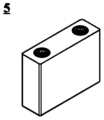
- FIG. 2 shows a lithium-ion battery 5 with a square structure as an example.
- the outer package may include a housing 51 and a cover 53 .
- the housing 51 may include a bottom plate and side plates connected to the bottom plate, and the bottom plate and the side plates enclose a receiving cavity.
- the housing 51 has an opening communicating with the accommodation cavity, and the cover plate 53 can cover the opening to close the accommodation cavity.
- the positive electrode piece, the negative electrode piece and the isolation film can be formed into the electrode assembly 52 through a winding process or a lamination process.
- the electrode assembly 52 is packaged in the containing cavity.
- the electrolyte soaks into the electrode assembly 52 .
- the number of electrode assemblies 52 included in the lithium ion battery 5 can be one or more, and those skilled in the art can select according to specific actual needs.
- lithium-ion batteries can be assembled into battery modules, and the number of lithium-ion batteries contained in the battery module can be one or more. The specific number can be selected by those skilled in the art according to the application and capacity of the battery module.
- FIG. 4 is a battery module 4 as an example.
- a plurality of lithium-ion batteries 5 may be arranged in sequence along the length direction of the battery module 4 .
- the plurality of lithium ion batteries 5 can be fixed by fasteners.
- the battery module 4 may also include a housing having a receiving space in which a plurality of lithium-ion batteries 5 are received.
- the above-mentioned battery modules can also be assembled into a battery pack.
- the number of battery modules contained in the battery pack can be one or more. Those skilled in the art can select the specific number according to the application and capacity of the battery pack.
- the battery pack 1 may include a battery box and a plurality of battery modules 4 disposed in the battery box.
- the battery box includes an upper box 2 and a lower box 3 .
- the upper box 2 can be covered with the lower box 3 and form a closed space for accommodating the battery module 4 .
- Multiple battery modules 4 can be arranged in the battery box in any manner.
- the present application also provides an electrical device, which includes at least one of the lithium-ion battery, battery module, or battery pack provided by the present application.
- the lithium-ion battery, battery module, or battery pack can be used as a power source for the electrical device, or can also be used as an energy storage unit for the electrical device.
- the electric device may include mobile devices (such as mobile phones, laptops, etc.), electric vehicles (such as pure electric vehicles, hybrid electric vehicles, plug-in hybrid electric vehicles, electric bicycles, electric scooters, and electric golf carts). , electric trucks, etc.), electric trains, ships and satellites, energy storage systems, etc., but are not limited to these.
- a lithium-ion battery, a battery module or a battery pack can be selected according to its usage requirements.
- Fig. 7 is an electrical device as an example.
- the electric device is a pure electric vehicle, a hybrid electric vehicle, a plug-in hybrid electric vehicle, etc.
- battery packs or battery modules can be used.
- the device may be a mobile phone, a tablet, a laptop, etc.
- the device is usually required to be thin and light, and can use lithium-ion batteries as a power source.
- the first positive electrode active material polycrystalline particles with Dv50 of 13 ⁇ m, the second positive electrode active material polycrystalline particles with Dv50 of 9 ⁇ m, and the third positive electrode active material single crystal particles with Dv50 of 3 ⁇ m are calculated according to the masses A, B, and C of the three.
- the three cathode active material particles used all have the chemical formula LiNi 0.92 Co 0.06 Mn 0.02 O 2 .
- the slurry is evenly coated on both sides of an aluminum foil with a thickness of 12 ⁇ m.
- the coated pole piece is dried in an oven at 100-130°C for half an hour and then taken out.
- the positive active material loading capacity of the pole piece is 21.5 mg/cm 2 .
- the removed positive electrode pieces were cold-pressed by rollers and tested to obtain data on compaction density, lengthwise elongation, pore volume, and shear stress.
- Figure 1 shows a scanning electron microscope image of the positive electrode plate of Example 1. It can be clearly seen from the figure that the positive active material particles have three different sizes, and the small particles fully fill the gaps between the large particles.
- the three cathode active material particles used all have the chemical formula LiNi 0.92 Co 0.06 Mn 0.02 O 2 .
- the slurry is evenly coated on both sides of an aluminum foil with a thickness of 12 ⁇ m.
- the coated pole piece is dried in an oven at 100-130°C for half an hour and then taken out.
- the positive active material loading capacity of the pole piece is 21.5 mg/cm 2 .
- the removed positive electrode pieces were cold-pressed by rollers and tested to obtain data on compaction density and lengthwise elongation.
- Randomly select 10 areas on the positive electrode plate use a scanning electron microscope ZEISS Sigma 300, refer to JY/T010-1996, and obtain scanning electron microscope photos of each area. In the scanning electron microscope (SEM) photo, the distance between the two furthest points on the particle is measured as the particle size.
- SEM scanning electron microscope
- M is the mass of the small disc with a diameter of 40mm cut out from the positive electrode piece, and the average value is taken by weighing 10 times;
- d is the thickness of the positive electrode piece, and the average thickness is taken by measuring the thickness 10 times;
- A is the diameter of 40mm. The area of the small disc.
- L1 is the distance between the marks before cold pressing, which is 1000mm
- L2 is the distance between the marks after cold pressing.
- the mark is formed as follows: in the central area of the pole piece, take three 1000mm long line segments extending in the length direction of the pole piece at different positions in the width direction of the pole piece, and mark the two endpoints of the line segments.
- L2 is recorded as the average value of the actual measured distance between the two end points of each line segment after cold pressing.
- the edge of the sample has an exposed current collector area for welding the tab; cut a sample with a width of 0.02m and a length of 0.09m.
- the double-sided tape is attached to a steel plate with a width of 0.02m and a length of 0.2m, with one end of the double-sided tape flush with the end of the steel plate; attach the pole piece sample to the double-sided tape, with one end of the sample aligned with the double-sided tape.
- One end of the tape should be flush; a paper tape with a width of 0.02m and a length of 0.15m should be fixed on the exposed current collector surface of the pole piece sample; the end of the steel plate that is not attached to the pole piece should be fixed with the lower clamp of the tensile machine, and the paper Fold the belt upward, fix it with the upper clamp, turn on the tensile machine, and perform 180° continuous stretching at a stretching speed of 0.05m/min; record the maximum load displayed by the tensile machine when the pole piece breaks, and record it as the maximum load of the pole piece. shear stress.
- Examples 1 to 12 all achieve high compaction density at a pole piece length direction elongation of less than 0.8%, so that the compaction density can basically exceed 3.6g/cm 3 .
- Comparative Example 2 only used two positive electrode active material particles. Although it obtained a compacted density of 3.62g/ cm3 , the elongation rate in the length direction of the pole piece was as high as 0.85%. Although Comparative Examples 1, 3, and 4 also used a mixture of two polycrystalline particles with a larger particle size and a single crystal particle with a smaller particle size, the Dv50 value of each particle did not fall within the scope of this application. , so the elongation in the length direction of the pole piece when obtaining high compaction density is higher than 0.8%. Even if the (A+B):C values of Comparative Examples 3 and 4 fall within the scope of the present application, a compacted density higher than 3.6g/ cm3 cannot be achieved at a pole piece lengthwise elongation of less than 0.8%.
Landscapes
- Chemical & Material Sciences (AREA)
- Chemical Kinetics & Catalysis (AREA)
- Electrochemistry (AREA)
- General Chemical & Material Sciences (AREA)
- Engineering & Computer Science (AREA)
- Materials Engineering (AREA)
- Inorganic Chemistry (AREA)
- Manufacturing & Machinery (AREA)
- Composite Materials (AREA)
- Crystallography & Structural Chemistry (AREA)
- Metallurgy (AREA)
- Organic Chemistry (AREA)
- Battery Electrode And Active Subsutance (AREA)
Abstract
Description


Claims (18)
- 一种锂离子电池正极极片,包括正极集流体以及设置在正极集流体至少一个表面的正极膜层,所述正极膜层包含由以下物质组成的正极活性材料混合物:粒径为11.0~20.0μm的第一正极活性材料多晶颗粒;粒径为6.0~10.5μm的第二正极活性材料多晶颗粒;以及粒径为1.1~5.2μm的第三正极活性材料单晶颗粒,其中,所述第一正极活性材料多晶颗粒的数量为a,所述第二正极活性材料多晶颗粒的数量为b,所述第三正极活性材料单晶颗粒的数量为c,(a+b)∶c在5.7∶4.3~7.7∶2.3的范围内。
- 根据权利要求1所述的正极极片,其中,(a+b)∶c在6.1∶3.9~7.2∶2.8的范围内。
- 根据权利要求1或2所述的正极极片,其中,所述第一正极活性材料多晶颗粒、所述第二正极活性材料多晶颗粒和所述第三正极活性材料单晶颗粒均为三元正极活性材料,可选地,所述第一正极活性材料多晶颗粒、所述第二正极活性材料多晶颗粒和所述第三正极活性材料单晶颗粒各自的化学组成相同或不同,并且均具有化学式LiNi aCo bM (1-a-b)O 2,其中:0.8≤a<1.0,0<b<0.2,且a+b<1.0,M选自Mn、Al、B、Zr、Sr、Y、Sb、W、Ti、Mg、Nb中的一种或者多种。
- 根据权利要求1-3中任一项所述的正极极片,其中所述正极膜层的孔隙体积在1.2mm 3/g~4.0mm 3/g的范围内。
- 根据权利要求1-4中任一项所述的正极极片,其剪切应力在0.65MPa~0.85MPa的范围内。
- 根据权利要求1-5中任一项所述的正极极片,其中,所述正极活性材料混合物中,所述第一正极活性材料多晶颗粒的Dv50为12~16μm,且总质量为A;所述第二正极活性材料多晶颗粒的Dv50为8~10μm,且总质量为B;所述第三正极活性材料单晶颗粒的Dv50为2.5~4μm,且总质量为C;(A+B)∶C在6∶4~8∶2的范围内,可选地在6.5∶3.5~7.5∶2.5的范围内。
- 根据权利要求1-6中任一项所述的正极极片,其中,所述正极活性材料混合物在1吨压力下的压实密度CPD-1T在3.0g/cm 3~3.2g/cm 3范围内。
- 根据权利要求1-7中任一项所述的正极极片,其中,所述正极活性材料混合物的BET比表面积在0.5m 2/g~0.7m 2/g范围内。
- 根据权利要求1-8中任一项所述的正极极片,其中,所述正极活性材料混合物的SPAN值在1.70~2.20范围内,其中SPAN=(Dv90-Dv10)/Dv50。
- 根据权利要求1-9中任一项所述的正极极片,其中,所述正极活性材料混合物的Dv99在18μm~21μm范围内。
- 根据权利要求1-10中任一项所述的正极极片,其中,所述第一正极活性材料多晶颗粒的SPAN值满足SPAN≤1.20,可选地,0.50≤SPAN≤1.00。
- 根据权利要求1-11中任一项所述的正极极片,其中,所述第二正极活性材料多晶颗粒的SPAN值满足SPAN≥1.20,可选地,1.30≤SPAN≤1.50。
- 根据权利要求1-12中任一项所述的正极极片,其中,所述第三正极活性材料单晶颗粒的SPAN值满足SPAN≤1.70,可选地,1.10≤SPAN≤1.40。
- 根据权利要求1-13中任一项所述的正极极片,其中,所述第三正极活性材料单晶颗粒的振实密度TPD≤1.8g/cm 3,可选地,1.2g/cm 3≤TPD≤1.5g/cm 3。
- 一种锂离子电池,其特征在于,包括权利要求1~14中任一项所述的正极极片。
- 一种电池模块,其特征在于,包括权利要求15所述的锂离子电池。
- 一种电池包,其特征在于,包括权利要求16所述的电池模块。
- 一种用电装置,其特征在于,包括选自权利要求15所述的锂离子电池、权利要求16所述的电池模块或权利要求17所述的电池包中的至少一种。
Priority Applications (6)
| Application Number | Priority Date | Filing Date | Title |
|---|---|---|---|
| KR1020237038271A KR20230168282A (ko) | 2022-06-02 | 2022-06-02 | 리튬 이온 전지용 양극판, 이를 포함하는 리튬 이온 전지 및 전기 장치 |
| EP22929218.0A EP4312288B1 (en) | 2022-06-02 | 2022-06-02 | Lithium-ion battery positive electrode plate, lithium-ion battery with same, and electrical apparatus |
| CN202280070789.0A CN118140328A (zh) | 2022-06-02 | 2022-06-02 | 锂离子电池正极极片、包含其的锂离子电池及用电装置 |
| PCT/CN2022/096833 WO2023230985A1 (zh) | 2022-06-02 | 2022-06-02 | 锂离子电池正极极片、包含其的锂离子电池及用电装置 |
| JP2023569724A JP7713033B2 (ja) | 2022-06-02 | 2022-06-02 | リチウムイオン電池の正極板、それを含むリチウムイオン電池及び電力利用装置 |
| US18/490,759 US20240055579A1 (en) | 2022-06-02 | 2023-10-20 | Lithium-ion battery positive electrode plate, lithium-ion battery with same, and electrical apparatus |
Applications Claiming Priority (1)
| Application Number | Priority Date | Filing Date | Title |
|---|---|---|---|
| PCT/CN2022/096833 WO2023230985A1 (zh) | 2022-06-02 | 2022-06-02 | 锂离子电池正极极片、包含其的锂离子电池及用电装置 |
Related Child Applications (1)
| Application Number | Title | Priority Date | Filing Date |
|---|---|---|---|
| US18/490,759 Continuation US20240055579A1 (en) | 2022-06-02 | 2023-10-20 | Lithium-ion battery positive electrode plate, lithium-ion battery with same, and electrical apparatus |
Publications (1)
| Publication Number | Publication Date |
|---|---|
| WO2023230985A1 true WO2023230985A1 (zh) | 2023-12-07 |
Family
ID=89026791
Family Applications (1)
| Application Number | Title | Priority Date | Filing Date |
|---|---|---|---|
| PCT/CN2022/096833 Ceased WO2023230985A1 (zh) | 2022-06-02 | 2022-06-02 | 锂离子电池正极极片、包含其的锂离子电池及用电装置 |
Country Status (6)
| Country | Link |
|---|---|
| US (1) | US20240055579A1 (zh) |
| EP (1) | EP4312288B1 (zh) |
| JP (1) | JP7713033B2 (zh) |
| KR (1) | KR20230168282A (zh) |
| CN (1) | CN118140328A (zh) |
| WO (1) | WO2023230985A1 (zh) |
Cited By (3)
| Publication number | Priority date | Publication date | Assignee | Title |
|---|---|---|---|---|
| CN119419380A (zh) * | 2025-01-03 | 2025-02-11 | 曙鹏科技(深圳)有限公司 | 一种卷芯及电池 |
| CN119725676A (zh) * | 2024-12-17 | 2025-03-28 | 欣旺达动力科技股份有限公司 | 二次电池和用电装置 |
| EP4597611A1 (en) * | 2024-01-30 | 2025-08-06 | Samsung Sdi Co., Ltd. | Positive electrode active materials, positive electrodes, and rechargeable lithium batteries |
Families Citing this family (6)
| Publication number | Priority date | Publication date | Assignee | Title |
|---|---|---|---|---|
| CN121709596A (zh) * | 2023-03-01 | 2026-03-20 | 宁德时代新能源科技股份有限公司 | 正极活性物质、正极极片、二次电池、用电装置和制备方法 |
| CN121054631A (zh) * | 2024-05-30 | 2025-12-02 | 创科无线普通合伙 | 一种锂离子电池正极及锂离子电池 |
| CN119993986B (zh) * | 2025-04-11 | 2025-09-19 | 宁德时代新能源科技股份有限公司 | 电池单体、电池装置及用电装置 |
| CN119993980B (zh) * | 2025-04-11 | 2025-09-19 | 宁德时代新能源科技股份有限公司 | 电池单体、电池装置及用电装置 |
| CN121546047A (zh) * | 2025-06-27 | 2026-02-17 | 宁德时代新能源科技股份有限公司 | 锂离子二次电池和用电装置 |
| CN121123247B (zh) * | 2025-11-14 | 2026-03-03 | 深圳市豪鹏科技股份有限公司 | 正极活性材料和正极片及电化学装置 |
Citations (6)
| Publication number | Priority date | Publication date | Assignee | Title |
|---|---|---|---|---|
| US20070099087A1 (en) * | 2004-06-16 | 2007-05-03 | Seimi Chemical Co., Ltd. | Cathode active material powder for lithium secondary battery |
| CN102447107A (zh) * | 2011-10-17 | 2012-05-09 | 江苏科捷锂电池有限公司 | 高密度锂离子电池正极材料钴酸锂及其制备方法 |
| CN108431998A (zh) * | 2015-12-09 | 2018-08-21 | 株式会社村田制作所 | 正极活性物质、正极、电池、电池组、电子设备、电动车辆、蓄电装置及电力系统 |
| CN110098403A (zh) * | 2019-06-11 | 2019-08-06 | 邓丽萍 | 一种三元材料电极浆料的制备方法 |
| CN111384372A (zh) * | 2018-12-29 | 2020-07-07 | 宁德时代新能源科技股份有限公司 | 一种高压实密度正极材料及电化学储能装置 |
| CN113921782A (zh) * | 2021-09-26 | 2022-01-11 | 宁波容百新能源科技股份有限公司 | 一种高压实和高能量密度的超高镍三元正极材料 |
Family Cites Families (15)
| Publication number | Priority date | Publication date | Assignee | Title |
|---|---|---|---|---|
| US20100203387A1 (en) * | 2007-08-09 | 2010-08-12 | Taisuke Yamamoto | Electrode for lithium rechargeable battery and lithium rechargeable battery comprising the electrode |
| CN105529457A (zh) * | 2016-02-24 | 2016-04-27 | 无锡凯力克能源材料有限公司 | 高压实3.7g/cm3 镍钴锰酸锂NCM523三元正极材料的工业化生产方法 |
| HUE063176T2 (hu) * | 2018-03-02 | 2024-01-28 | Umicore Nv | Pozitív elektródaanyag újratölthetõ lítiumionakkumulátorokhoz |
| CN110660961B (zh) * | 2018-06-28 | 2021-09-21 | 宁德时代新能源科技股份有限公司 | 正极片及锂离子电池 |
| CN110970602B (zh) * | 2018-09-29 | 2020-12-11 | 宁德时代新能源科技股份有限公司 | 一种正极活性材料、正极极片以及电化学装置 |
| CN109786714B (zh) * | 2019-01-28 | 2020-10-30 | 李壮 | 一种基于锰酸锂材料的混合正极浆料的制备方法 |
| CN110429252B (zh) * | 2019-07-19 | 2020-11-27 | 宁德新能源科技有限公司 | 正极及电化学装置 |
| JP2020011892A (ja) * | 2019-08-09 | 2020-01-23 | 住友化学株式会社 | リチウム金属複合酸化物粉末、リチウム二次電池用正極活物質、正極、及びリチウム二次電池 |
| CN119208527A (zh) * | 2019-12-19 | 2024-12-27 | 株式会社Lg新能源 | 为改善高温寿命特性而优化的正极和包含其的二次电池 |
| CN114788042B (zh) * | 2019-12-20 | 2024-03-01 | 株式会社Lg新能源 | 锂二次电池用正极和包含所述正极的锂二次电池 |
| JP6780140B1 (ja) * | 2020-01-17 | 2020-11-04 | 住友化学株式会社 | 全固体リチウムイオン電池用混合粉末、全固体リチウムイオン電池用混合ペースト、電極および全固体リチウムイオン電池 |
| JP6935526B2 (ja) * | 2020-02-26 | 2021-09-15 | 住友化学株式会社 | リチウム金属複合酸化物、リチウム二次電池用正極活物質、リチウム二次電池用正極及びリチウム二次電池 |
| CN120089715A (zh) * | 2020-09-03 | 2025-06-03 | 宁德时代新能源科技股份有限公司 | 正极材料、正极极片、锂二次电池、电池模块、电池包及装置 |
| CN116072816A (zh) * | 2020-09-22 | 2023-05-05 | 宁德时代新能源科技股份有限公司 | 一种用于二次电池的正极极片、二次电池、电池模块、电池包和装置 |
| KR102411937B1 (ko) * | 2020-10-29 | 2022-06-22 | 삼성에스디아이 주식회사 | 니켈계 활물질, 이를 포함한 양극 및 리튬이차전지 |
-
2022
- 2022-06-02 KR KR1020237038271A patent/KR20230168282A/ko not_active Ceased
- 2022-06-02 CN CN202280070789.0A patent/CN118140328A/zh active Pending
- 2022-06-02 WO PCT/CN2022/096833 patent/WO2023230985A1/zh not_active Ceased
- 2022-06-02 JP JP2023569724A patent/JP7713033B2/ja active Active
- 2022-06-02 EP EP22929218.0A patent/EP4312288B1/en active Active
-
2023
- 2023-10-20 US US18/490,759 patent/US20240055579A1/en active Pending
Patent Citations (6)
| Publication number | Priority date | Publication date | Assignee | Title |
|---|---|---|---|---|
| US20070099087A1 (en) * | 2004-06-16 | 2007-05-03 | Seimi Chemical Co., Ltd. | Cathode active material powder for lithium secondary battery |
| CN102447107A (zh) * | 2011-10-17 | 2012-05-09 | 江苏科捷锂电池有限公司 | 高密度锂离子电池正极材料钴酸锂及其制备方法 |
| CN108431998A (zh) * | 2015-12-09 | 2018-08-21 | 株式会社村田制作所 | 正极活性物质、正极、电池、电池组、电子设备、电动车辆、蓄电装置及电力系统 |
| CN111384372A (zh) * | 2018-12-29 | 2020-07-07 | 宁德时代新能源科技股份有限公司 | 一种高压实密度正极材料及电化学储能装置 |
| CN110098403A (zh) * | 2019-06-11 | 2019-08-06 | 邓丽萍 | 一种三元材料电极浆料的制备方法 |
| CN113921782A (zh) * | 2021-09-26 | 2022-01-11 | 宁波容百新能源科技股份有限公司 | 一种高压实和高能量密度的超高镍三元正极材料 |
Non-Patent Citations (1)
| Title |
|---|
| See also references of EP4312288A4 * |
Cited By (4)
| Publication number | Priority date | Publication date | Assignee | Title |
|---|---|---|---|---|
| EP4597611A1 (en) * | 2024-01-30 | 2025-08-06 | Samsung Sdi Co., Ltd. | Positive electrode active materials, positive electrodes, and rechargeable lithium batteries |
| CN119725676A (zh) * | 2024-12-17 | 2025-03-28 | 欣旺达动力科技股份有限公司 | 二次电池和用电装置 |
| CN119725676B (zh) * | 2024-12-17 | 2025-11-11 | 欣旺达动力科技股份有限公司 | 二次电池和用电装置 |
| CN119419380A (zh) * | 2025-01-03 | 2025-02-11 | 曙鹏科技(深圳)有限公司 | 一种卷芯及电池 |
Also Published As
| Publication number | Publication date |
|---|---|
| EP4312288A4 (en) | 2025-01-29 |
| JP7713033B2 (ja) | 2025-07-24 |
| CN118140328A (zh) | 2024-06-04 |
| US20240055579A1 (en) | 2024-02-15 |
| EP4312288A1 (en) | 2024-01-31 |
| KR20230168282A (ko) | 2023-12-13 |
| JP2024524821A (ja) | 2024-07-09 |
| EP4312288B1 (en) | 2026-04-22 |
Similar Documents
| Publication | Publication Date | Title |
|---|---|---|
| JP7713033B2 (ja) | リチウムイオン電池の正極板、それを含むリチウムイオン電池及び電力利用装置 | |
| WO2022041259A1 (zh) | 二次电池及其制备方法与包含二次电池的电池模块、电池包及装置 | |
| WO2022032624A1 (zh) | 二次电池及其制备方法与包含二次电池的电池模块、电池包及装置 | |
| WO2025025533A1 (zh) | 电池单体、电池和用电装置 | |
| WO2023108352A1 (zh) | 一种正极活性材料及其相关的极片、二次电池、电池模块、电池包和装置 | |
| CN113748550A (zh) | 二次电池和含有该二次电池的装置 | |
| WO2021217628A1 (zh) | 二次电池、其制备方法及含有该二次电池的装置 | |
| WO2023133844A1 (zh) | 正极极片、二次电池、电池模块、电池包和用电装置 | |
| CN114551800B (zh) | 碳基导电剂、二次电池及用电装置 | |
| WO2023130976A1 (zh) | 正极极片、二次电池、电池模块、电池包和用电装置 | |
| WO2023178690A1 (zh) | 粘结剂及相关的隔离膜、极片、电池、电池模块、电池包和用电装置 | |
| CN116525766B (zh) | 二次电池及用电装置 | |
| CN116565118A (zh) | 正极极片、二次电池、电池模块、电池包和用电装置 | |
| WO2024012166A1 (zh) | 二次电池及用电装置 | |
| CN116724419A (zh) | 硅碳负极材料、负极极片、二次电池、电池模块、电池包和用电装置 | |
| WO2025086600A1 (zh) | 负极极片、电池单体和用电装置 | |
| WO2024065402A1 (zh) | 一种二次电池及用电装置 | |
| CN120015764A (zh) | 一种电池单体、电池装置及用电装置 | |
| CN116053469B (zh) | 正极活性材料、正极极片、二次电池和用电装置 | |
| CN116724002A (zh) | 复合人造石墨及其制备方法及包含所述复合人造石墨的二次电池和用电装置 | |
| WO2024221337A1 (zh) | 一种正极极片、电池及用电装置 | |
| WO2024216596A1 (zh) | 一种二次电池以及用电装置 | |
| WO2023133881A1 (zh) | 正极极片、二次电池、电池模块、电池包和用电装置 | |
| WO2026020380A1 (zh) | 电池单体、电池装置以及用电装置 | |
| WO2024169401A1 (zh) | 负极极片及其制备方法、电池和用电装置 |
Legal Events
| Date | Code | Title | Description |
|---|---|---|---|
| ENP | Entry into the national phase |
Ref document number: 2022929218 Country of ref document: EP Effective date: 20230907 |
|
| ENP | Entry into the national phase |
Ref document number: 20237038271 Country of ref document: KR Kind code of ref document: A |
|
| ENP | Entry into the national phase |
Ref document number: 2023569724 Country of ref document: JP Kind code of ref document: A |
|
| WWE | Wipo information: entry into national phase |
Ref document number: 202280070789.0 Country of ref document: CN |
|
| NENP | Non-entry into the national phase |
Ref country code: DE |
|
| WWR | Wipo information: refused in national office |
Ref document number: 1020237038271 Country of ref document: KR |
|
| WWR | Wipo information: refused in national office |
Ref document number: 1020237038271 Country of ref document: KR |
|
| WWC | Wipo information: continuation of processing after refusal or withdrawal |
Ref document number: 1020237038271 Country of ref document: KR |
|
| WWG | Wipo information: grant in national office |
Ref document number: 2022929218 Country of ref document: EP |