WO2023247688A1 - Washing composition for keratin fibres comprising at least one anionic surfactant, at least one amphoteric or zwitterionic surfactant, at least one glucamide compound and at least one cationic galactomannan gum - Google Patents
Washing composition for keratin fibres comprising at least one anionic surfactant, at least one amphoteric or zwitterionic surfactant, at least one glucamide compound and at least one cationic galactomannan gum Download PDFInfo
- Publication number
- WO2023247688A1 WO2023247688A1 PCT/EP2023/066931 EP2023066931W WO2023247688A1 WO 2023247688 A1 WO2023247688 A1 WO 2023247688A1 EP 2023066931 W EP2023066931 W EP 2023066931W WO 2023247688 A1 WO2023247688 A1 WO 2023247688A1
- Authority
- WO
- WIPO (PCT)
- Prior art keywords
- preferentially
- weight
- alkyl
- poly
- better still
- Prior art date
- Legal status (The legal status is an assumption and is not a legal conclusion. Google has not performed a legal analysis and makes no representation as to the accuracy of the status listed.)
- Ceased
Links
Classifications
-
- A—HUMAN NECESSITIES
- A61—MEDICAL OR VETERINARY SCIENCE; HYGIENE
- A61K—PREPARATIONS FOR MEDICAL, DENTAL OR TOILETRY PURPOSES
- A61K8/00—Cosmetics or similar toiletry preparations
- A61K8/18—Cosmetics or similar toiletry preparations characterised by the composition
- A61K8/30—Cosmetics or similar toiletry preparations characterised by the composition containing organic compounds
- A61K8/33—Cosmetics or similar toiletry preparations characterised by the composition containing organic compounds containing oxygen
- A61K8/37—Esters of carboxylic acids
- A61K8/375—Esters of carboxylic acids the alcohol moiety containing more than one hydroxy group
-
- A—HUMAN NECESSITIES
- A61—MEDICAL OR VETERINARY SCIENCE; HYGIENE
- A61K—PREPARATIONS FOR MEDICAL, DENTAL OR TOILETRY PURPOSES
- A61K8/00—Cosmetics or similar toiletry preparations
- A61K8/18—Cosmetics or similar toiletry preparations characterised by the composition
- A61K8/72—Cosmetics or similar toiletry preparations characterised by the composition containing organic macromolecular compounds
- A61K8/73—Polysaccharides
- A61K8/737—Galactomannans, e.g. guar; Derivatives thereof
-
- A—HUMAN NECESSITIES
- A61—MEDICAL OR VETERINARY SCIENCE; HYGIENE
- A61K—PREPARATIONS FOR MEDICAL, DENTAL OR TOILETRY PURPOSES
- A61K8/00—Cosmetics or similar toiletry preparations
- A61K8/18—Cosmetics or similar toiletry preparations characterised by the composition
- A61K8/30—Cosmetics or similar toiletry preparations characterised by the composition containing organic compounds
- A61K8/40—Cosmetics or similar toiletry preparations characterised by the composition containing organic compounds containing nitrogen
- A61K8/42—Amides
-
- A—HUMAN NECESSITIES
- A61—MEDICAL OR VETERINARY SCIENCE; HYGIENE
- A61K—PREPARATIONS FOR MEDICAL, DENTAL OR TOILETRY PURPOSES
- A61K8/00—Cosmetics or similar toiletry preparations
- A61K8/18—Cosmetics or similar toiletry preparations characterised by the composition
- A61K8/30—Cosmetics or similar toiletry preparations characterised by the composition containing organic compounds
- A61K8/40—Cosmetics or similar toiletry preparations characterised by the composition containing organic compounds containing nitrogen
- A61K8/44—Aminocarboxylic acids or derivatives thereof, e.g. aminocarboxylic acids containing sulfur; Salts; Esters or N-acylated derivatives thereof
-
- A—HUMAN NECESSITIES
- A61—MEDICAL OR VETERINARY SCIENCE; HYGIENE
- A61K—PREPARATIONS FOR MEDICAL, DENTAL OR TOILETRY PURPOSES
- A61K8/00—Cosmetics or similar toiletry preparations
- A61K8/18—Cosmetics or similar toiletry preparations characterised by the composition
- A61K8/30—Cosmetics or similar toiletry preparations characterised by the composition containing organic compounds
- A61K8/40—Cosmetics or similar toiletry preparations characterised by the composition containing organic compounds containing nitrogen
- A61K8/44—Aminocarboxylic acids or derivatives thereof, e.g. aminocarboxylic acids containing sulfur; Salts; Esters or N-acylated derivatives thereof
- A61K8/442—Aminocarboxylic acids or derivatives thereof, e.g. aminocarboxylic acids containing sulfur; Salts; Esters or N-acylated derivatives thereof substituted by amido group(s)
-
- A—HUMAN NECESSITIES
- A61—MEDICAL OR VETERINARY SCIENCE; HYGIENE
- A61K—PREPARATIONS FOR MEDICAL, DENTAL OR TOILETRY PURPOSES
- A61K8/00—Cosmetics or similar toiletry preparations
- A61K8/18—Cosmetics or similar toiletry preparations characterised by the composition
- A61K8/30—Cosmetics or similar toiletry preparations characterised by the composition containing organic compounds
- A61K8/46—Cosmetics or similar toiletry preparations characterised by the composition containing organic compounds containing sulfur
- A61K8/463—Cosmetics or similar toiletry preparations characterised by the composition containing organic compounds containing sulfur containing sulfuric acid derivatives, e.g. sodium lauryl sulfate
-
- A—HUMAN NECESSITIES
- A61—MEDICAL OR VETERINARY SCIENCE; HYGIENE
- A61K—PREPARATIONS FOR MEDICAL, DENTAL OR TOILETRY PURPOSES
- A61K8/00—Cosmetics or similar toiletry preparations
- A61K8/18—Cosmetics or similar toiletry preparations characterised by the composition
- A61K8/30—Cosmetics or similar toiletry preparations characterised by the composition containing organic compounds
- A61K8/60—Sugars; Derivatives thereof
- A61K8/604—Alkylpolyglycosides; Derivatives thereof, e.g. esters
-
- A—HUMAN NECESSITIES
- A61—MEDICAL OR VETERINARY SCIENCE; HYGIENE
- A61Q—SPECIFIC USE OF COSMETICS OR SIMILAR TOILETRY PREPARATIONS
- A61Q5/00—Preparations for care of the hair
- A61Q5/02—Preparations for cleaning the hair
-
- A—HUMAN NECESSITIES
- A61—MEDICAL OR VETERINARY SCIENCE; HYGIENE
- A61Q—SPECIFIC USE OF COSMETICS OR SIMILAR TOILETRY PREPARATIONS
- A61Q5/00—Preparations for care of the hair
- A61Q5/12—Preparations containing hair conditioners
-
- A—HUMAN NECESSITIES
- A61—MEDICAL OR VETERINARY SCIENCE; HYGIENE
- A61K—PREPARATIONS FOR MEDICAL, DENTAL OR TOILETRY PURPOSES
- A61K2800/00—Properties of cosmetic compositions or active ingredients thereof or formulation aids used therein and process related aspects
- A61K2800/20—Chemical, physico-chemical or functional or structural properties of the composition as a whole
- A61K2800/30—Characterized by the absence of a particular group of ingredients
- A61K2800/34—Free of silicones
-
- A—HUMAN NECESSITIES
- A61—MEDICAL OR VETERINARY SCIENCE; HYGIENE
- A61K—PREPARATIONS FOR MEDICAL, DENTAL OR TOILETRY PURPOSES
- A61K2800/00—Properties of cosmetic compositions or active ingredients thereof or formulation aids used therein and process related aspects
- A61K2800/40—Chemical, physico-chemical or functional or structural properties of particular ingredients
- A61K2800/42—Colour properties
- A61K2800/43—Pigments; Dyes
-
- A—HUMAN NECESSITIES
- A61—MEDICAL OR VETERINARY SCIENCE; HYGIENE
- A61K—PREPARATIONS FOR MEDICAL, DENTAL OR TOILETRY PURPOSES
- A61K2800/00—Properties of cosmetic compositions or active ingredients thereof or formulation aids used therein and process related aspects
- A61K2800/40—Chemical, physico-chemical or functional or structural properties of particular ingredients
- A61K2800/54—Polymers characterized by specific structures/properties
- A61K2800/542—Polymers characterized by specific structures/properties characterized by the charge
- A61K2800/5426—Polymers characterized by specific structures/properties characterized by the charge cationic
-
- A—HUMAN NECESSITIES
- A61—MEDICAL OR VETERINARY SCIENCE; HYGIENE
- A61K—PREPARATIONS FOR MEDICAL, DENTAL OR TOILETRY PURPOSES
- A61K2800/00—Properties of cosmetic compositions or active ingredients thereof or formulation aids used therein and process related aspects
- A61K2800/40—Chemical, physico-chemical or functional or structural properties of particular ingredients
- A61K2800/59—Mixtures
- A61K2800/596—Mixtures of surface active compounds
Definitions
- the present invention relates to a composition
- a composition comprising at least one anionic surfactant, at least one amphoteric or zwitterionic surfactant, at least one glucamide compound and at least one cationic galactomannan gum, with a particular weight ratio of the total content of anionic surfactant(s) (i) to the total content of amphoteric or zwitterionic surfactant(s) (ii).
- the invention relates to a process for treating keratin fibres, comprising at least one step of applying to said keratin fibres a composition according to the invention.
- detergent compositions such as shampoos
- surfactants for cleansing and/or washing keratin fibres such as the hair.
- These compositions are applied to wet hair and the foam generated by massaging or rubbing with the hands makes it possible, after rinsing with water, to remove the diverse types of soiling initially present on the hair or the skin.
- shampoos in particular for hair that is sensitized or embrittled to various degrees following the action of atmospheric agents or of repeated mechanical or chemical treatments, containing conditioning agents such as silicones, in order to confer conditioning properties on the keratin fibres, for example a better feel, greater manageability or else easy disentangling.
- washing compositions based on surfactants and silicones have several drawbacks: the environmental profile of the composition (biodegradability, water footprint) is not always optimal, due to the presence of silicone; the start of foaming, the quality and more particularly the amount of foam generated are judged to be insufficient; rapid regreasing of the keratin fibres, accompanied by lankness.
- the hair treated with the composition according to the invention is particularly clean and has good cosmetic properties.
- composition according to the invention has good working qualities, notably a good start of foaming and good foam quality and amount. It has very particularly been noted that the composition according to the invention makes it possible to generate a large amount of foam.
- composition according to the invention has a viscosity suitable for use as a shampoo.
- the composition according to the invention is particularly stable over time, at atmospheric pressure and 25 °C. More particularly, when the composition according to the invention also comprises at least one opacifier, the composition remains homogeneous and no phenomenon of phase separation of the composition was observed.
- a subject of the invention is also a process for treating, in particular cosmetically treating, keratin fibres, in particular human keratin fibres such as the hair, comprising at least one step of applying a composition according to the invention to said keratin fibres.
- keratin fibres according to the present application, more particularly denotes human keratin fibres, and more preferentially the hair;
- fatty alcohol according to the present application is intended to mean an alcohol comprising in its structure a linear or branched, saturated or unsaturated hydrocarbon-based chain comprising from 6 to 40 carbon atoms, preferably from 8 to 30 carbon atoms, more preferentially from 10 to 22 carbon atoms.
- the composition according to the invention has a percentage of natural origin, within the meaning of international standard ISO 16128-2, which is greater than or equal to 90%; more preferentially greater than or equal to 92%; even more preferentially greater than or equal to 94%.
- composition according to the present invention comprises at least one anionic surfactant.
- anionic surfactant means a surfactant, preferably a non-silicone surfactant, which includes, as ionic or ionizable groups, only anionic groups.
- the anionic surfactants can be chosen from sulfate, sulfonate and carboxylic (or carboxylate) surfactants. Needless to say, a mixture of these surfactants may be used.
- the carboxylate anionic surfactants comprise at least one carboxylic or carboxylate function (-COOH or -COO ) and may optionally also comprise one or more sulfate and/or sulfonate functions;
- the sulfonate anionic surfactants comprise at least one sulfonate function (- SO3H or -SO3 ) and may optionally also comprise one or more sulfate functions, but do not comprise any carboxylate functions; and
- the carboxylate anionic surfactants that may be used thus include at least one carboxylic or carboxylate function (-COOH or -COO ).
- the carboxylate anionic surfactants may be chosen from the following compounds: acylglycinates, acyllactylates, acylsarcosinates, acylglutamates; alkyl-D- galactosideuronic acids, alkyl ether carboxylic acids, alkyl(C6-C30 aryl) ether carboxylic acids, alkylamido ether carboxylic acids; and also the salts of these compounds; and mixtures thereof; the alkyl and/or acyl groups of these compounds including from 6 to 30 carbon atoms, notably from 12 to 28, even better still from 14 to 24 or even from 16 to 22 carbon atoms; the aryl group preferably denoting a phenyl or benzyl group; these compounds possibly being polyoxyalkylenated, notably polyoxyethylenated, and then preferably including from 1 to 50 ethylene oxide units and better still from 2 to 10 ethylene oxide units.
- C6-C24 alkyl monoesters of polyglycosidepolycarboxylic acids such as C6-C24 alkyl polyglycoside-citrates, C6-C24 alkyl polyglycoside-tartrates and C6-C24 alkyl polyglycoside-sulfosuccinates, and salts thereof.
- carboxylate anionic surfactants are chosen, alone or as a mixture, from:
- acyl sarcosinates notably C6-C24 or even C12-C20 acyl sarcosinates, such as palmitoyl sarcosinates, and in particular sodium palmitoyl sarcosinate;
- - X denoting a hydrogen atom, an ammonium ion, an ion derived from an alkali metal or an alkaline-earth metal or an ion derived from an organic amine, preferably a hydrogen atom, and
- (C6-C3o)acyl sarcosinates of formula (I) that may be used in the present composition, mention may be made of palmitoyl sarcosinates, stearoyl sarcosinates, myristoyl sarcosinates, lauroyl sarcosinates and cocoyl sarcosinates, in acid form or in salified form.
- - A denotes H, ammonium, Na, K, Li, Mg or a monoethanolamine or triethanolamine residue.
- Rl denotes a C12-C14 alkyl, cocoyl, oleyl, nonylphenyl or octylphenyl radical
- - A denotes a hydrogen or sodium atom
- the sulfonate anionic surfactants that may be used include at least one sulfonate function (-SO3H or -SO3 ).
- (Ce-C24)acyl isethionates preferably (Ci2-Ci8)acyl isethionates; in particular in the form of alkali metal or alkaline-earth metal, ammonium or amino alcohol salts.
- the anionic surfactant(s) of sulfonate type are chosen from C6-C24 and notably C 12-C20 N-acyltaurates, and in particular N-acyl N-methyltaurates, C6-C24 and notably C12-C18 acylisethionates, and also salts thereof and mixtures thereof.
- the anionic surfactant(s) of sulfonate type are chosen from C6-C24 and notably C12-C18 acylisethionates, and also salts thereof and mixtures thereof.
- the sulfate anionic surfactants that may be used include at least one sulfate function (-OSO3H or -OSO3 ).
- the sulfate anionic surfactants be chosen from the following compounds: alkyl sulfates, alkyl ether sulfates, alkylamido ether sulfates, alkylaryl polyether sulfates, monoglyceride sulfates; and the salts of these compounds; the alkyl groups of these compounds including from 6 to 30 carbon atoms, notably from 8 to 28, even better still from 10 to 24 or even from 12 to 22 carbon atoms; the aryl group preferably denoting a phenyl or benzyl group; these compounds possibly being (poly)oxyalkylenated, notably (poly)oxyethylenated, and then preferably including from 1 to 50 ethylene oxide units and better still from 1 to 10 ethylene oxide units.
- the sulfate anionic surfactants are chosen, alone or as a mixture, from:
- alkyl sulfates notably C10-C24 or even C12-C22 alkyl sulfates
- said salt may be chosen from alkali metal salts, such as the sodium or potassium salt, ammonium salts, amine salts and in particular amino alcohol salts, and alkaline-earth metal salts, such as the magnesium salt.
- amino alcohol salts examples include monoethanolamine, diethanolamine and triethanolamine salts, monoisopropanolamine, diisopropanolamine or triisopropanolamine salts, 2-amino-2- methyl-1 -propanol salts, 2-amino-2-methyl-l,3-propanediol salts and tris(hydroxymethyl)aminomethane salts.
- Alkali metal or alkaline-earth metal salts and in particular sodium or magnesium salts are preferably used.
- the anionic surfactant(s) are chosen from sulfate anionic surfactants.
- the anionic surfactant(s) are chosen from alkyl sulfates, alkyl ether sulfates, alkylamido ether sulfates, alkylaryl polyether sulfates, monoglyceride sulfates, the salts of these compounds, and mixtures thereof; the alkyl groups of these compounds preferably comprising from 6 to 30 carbon atoms, notably from 8 to 28, even better still from 10 to 24 or even from 12 to 22 carbon atoms; the aryl group preferably denoting a phenyl or benzyl group; these compounds possibly being (poly)oxyalkylenated, notably (poly)oxyethylenated, and then preferably including from 1 to 50 ethylene oxide units and better still from 1 to 10 ethylene oxide units.
- anionic surfactant(s) are chosen from:
- the anionic surfactant(s) are chosen from C6-C30, better still C8-C24, even better still C10-C24 or even C12-C22 alkyl sulfates.
- the total content of anionic surfactant(s) present in the composition ranges from 0.1% to 25% by weight, more preferentially from 1% to 20% by weight, even more preferentially from 2% to 15% by weight and better still from 5% to 10% by weight relative to the total weight of the composition.
- the total content of sulfate anionic surfactant(s) present in the composition ranges from 0.1% to 25% by weight, more preferentially from 1% to 20% by weight, even more preferentially from 2% to 15% by weight and better still from 5% to 10% by weight relative to the total weight of the composition.
- the total content of C6-C30 alkyl sulfates present in the composition ranges from 0.1% to 25% by weight, more preferentially from 1% to 20% by weight, even more preferentially from 2% to 15% by weight, better still from 5% to 10% by weight, relative to the total weight of the composition.
- composition according to the present invention comprises at least one amphoteric or zwitterionic surfactant.
- amphoteric or zwitterionic surfactant(s), which are preferably non-silicone, used in the composition according to the present invention may notably be derivatives of optionally quaternized aliphatic secondary or tertiary amines, in which derivatives the aliphatic group is a linear or branched chain including from 8 to 22 carbon atoms, said amine derivatives containing at least one anionic group, for instance a carboxylate, sulfonate, sulfate, phosphate or phosphonate group.
- R a represents a Cio to C30 alkyl or alkenyl group derived from an acid RaCOOH preferably present in hydrolyzed copra oil; preferably, R a represents a heptyl, nonyl or undecyl group;
- - Rb represents a P-hydroxyethyl group
- R c represents a carboxymethyl group
- - M + represents a cationic counterion derived from an alkali metal or alkaline- earth metal, such as sodium, an ammonium ion or an ion derived from an organic amine;
- - X represents an organic or mineral anionic counterion, such as that chosen from halides, acetates, phosphates, nitrates, (Ci-C4)alkyl sulfates, (Ci-C4)alkyl- or (Ci-C 4) alkylaryl- sulfonates, in particular methyl sulfate and ethyl sulfate; or alternatively M + and X’ are absent;
- - Y’ represents the group -COOH, -COOZ’ or -CH 2 CH(OH)SO3H or the group CH 2 CH(OH)SO 3 -Z’;
- - Z’ represents a cationic counterion derived from an alkali metal or alkaline- earth metal, such as sodium, an ammonium ion or an ion derived from an organic amine;
- R a ’ represents a Cio to C30 alkyl or alkenyl group of an acid Ra’-COOH which is preferably present in coconut kernel oil or in hydrolyzed linseed oil, preferably R a ’ an alkyl group, notably a C17 group, and its iso form, or an unsaturated C17 group.
- cocoamphodiacetate sold by Rhodia under the trade name Miranol® C2M Concentrate.
- Rd and R e independently of each other, represent a Ci to C4 alkyl or hydroxyalkyl radical
- R a represents a C10 to C30 alkyl or alkenyl group of an acid R a ”-COOH which is preferably present in coconut kernel oil or in hydrolyzed linseed oil;
- amphoteric or zwitterionic surfactants use is advantageously made of (Cs-C 2 o)alkylbetaines, such as cocobetaine, (Cs- C 2 o)alkylamido(C3-C8)alkylbetaines, such as cocamidopropylbetaine, (Cs- C 2 o)alkylamphoacetates, (Cs-C 2 o)alkylamphodiacetates and mixtures thereof.
- amphoteric or zwitterionic surfactant(s) are chosen from (Cs-C 2 o)alkylbetaines, (C8-C 2 o)alkylamido(C3-C8)alkylbetaines, and mixtures thereof; even more preferentially from cocobetaine, cocamidopropylbetaine, and mixtures thereof.
- amphoteric or zwitterionic surfactants are chosen from (Cs- C 2 o)alkylamido(C3-C8)alkylbetaines and most particularly cocamidopropylbetaine.
- the total content of amphoteric or zwitterionic surfactant(s) present in the composition ranges from 0.1% to 15% by weight, more preferentially from 0.5% to 10% by weight, even more preferentially from 1% to 5% by weight relative to the total weight of the composition.
- the total content of (Cs-C2o)alkylbetaine(s) and (Cs- C2o)alkylamido(C3-C8)alkylbetaine(s) present in the composition ranges from 0.1% to 15% by weight, more preferentially from 0.5% to 10% by weight, even more preferentially from 1% to 5% by weight relative to the total weight of the composition.
- the total content of anionic surfactant(s) and amphoteric or zwitterionic surfactant(s) present in the composition is greater than or equal to 2% by weight, and more preferentially greater than or equal to 4% by weight, relative to the total weight of the composition.
- the total content of anionic surfactant(s) and amphoteric or zwitterionic surfactant(s) present in the composition ranges from 4% to 40% by weight, more preferentially from 5% to 25% by weight, even more preferentially from 6% to 20% by weight, better still from 7% to 15% by weight and even better still from 7.5% to 12% by weight, relative to the total weight of the composition.
- the total content of sulfate anionic surfactant(s) and amphoteric or zwitterionic surfactant(s) present in the composition ranges from 4% to 40% by weight, more preferentially from 5% to 25% by weight, even more preferentially from 6% to 20% by weight, better still from 7% to 15% by weight and even better still from 7.5% to 12% by weight, relative to the total weight of the composition.
- the total content of C6-C30 alkyl sulfates and (Cs- C2o)alkylbetaine(s) and (C8-C2o)alkylamido(C3-C8)alkylbetaine(s) present in the composition ranges from 4% to 40% by weight, more preferentially from 5% to 25% by weight, even more preferentially from 6% to 20% by weight, better still from 7% to 15% by weight and even better still from 7.5% to 12% by weight, relative to the total weight of the composition.
- the weight ratio of the total content of anionic surfactant(s) (i) to the total content of amphoteric or zwitterionic surfactant(s) (ii) is less than or equal to 4.3.
- the weight ratio of the total content of anionic surfactant(s) (i) to the total content of amphoteric and zwitterionic surfactant(s) (ii) is between 1 and 4.3; more preferentially between 1.5 and 4.3; even more preferentially less than or equal to 4; better still between 2 and 4; and even better still between 2.1 and 3.9.
- the weight ratio of the total content of sulfate anionic surfactant(s) to the total content of amphoteric and zwitterionic surfactant(s) is between 1 and 4.3; more preferentially between 1.5 and 4.3; even more preferentially less than or equal to 4; better still between 2 and 4; and even better still between 2.1 and 3.9.
- the weight ratio of the total content of C6-C30, alkyl sulfates to the total content of (Cs-C2o)alkylbetaine(s) and (Cs-C2o)alkylamido(C3- Cs)alkylbetaine(s) is between 1 and 4.3; more preferentially between 1.5 and 4.3; even more preferentially less than or equal to 4; better still between 2 and 4; and even better still between 2.1 and 3.9.
- composition according to the invention comprises at least one glucamide compound.
- glucamide compounds which can be used according to the invention are notably described in patent applications WO 92 06154, US 5 194 639 and DE 44 43 645.
- the glucamide compounds are chosen from acylglucamides, more preferentially those having a hydrocarbon-based chain comprising from 4 to 30 carbon atoms (counting the carbon atom of the -C(O)- carbonyl group), preferentially from 6 to 22, better still from 6 to 20 and even better still from 6 to 14.
- the glucamide compounds are chosen from those of general formula (A) below: in which: - the Gl-N group represents a glucamine, of which N is the nitrogen atom of the glucamine,
- composition according to the invention can comprise at least two glucamide groups; more preferentially, the composition according to the invention comprises two glucamide groups.
- glucamide compounds that may be used according to the invention, mention may in particular be made, alone or as a mixture, of: myristoyl methylglucamide, lauroyl methylglucamide, capryloyl methylglucamide, caproyl methylglucamide, cocoyl methylglucamide, nonanoyl methylglucamide, oleyl methylglucamide, sunfloweroyl methylglucamide,
- composition according to the invention comprises at least capryloyl/caproyl methylglucamide.
- the total content of acylglucamide compound(s) present in the composition ranges from 0.01% to 10% by weight, more preferentially from 0.5% to 5% by weight, even more preferentially from 0.8% to 3% by weight relative to the total weight of the composition.
- the total content of acylglucamide compound(s) of which the hydrocarbon-based chain comprises between 4 and 30 carbon atoms, present in the composition ranges from 0.01% to 10% by weight, more preferentially from 0.5% to 5% by weight, even more preferentially from 0.8% to 3% by weight relative to the total weight of the composition.
- the total content of capryloyl/caproyl methylglucamide in the composition ranges from 0.01% to 10% by weight, more preferentially from 0.5% to 5% by weight, even more preferentially from 0.8% to 3% by weight relative to the total weight of the composition.
- the composition according to the present invention also comprises at least one non-ionic surfactant. More preferentially, the composition according to the present invention also comprises at least two non-ionic surfactants.
- non-ionic surfactants that can be used according to the invention may be chosen from:
- - alcohols, a-diols and (Ci-C2o)alkylphenols these compounds being polyethoxylated and/or polypropoxylated and/or polyglycerolated, the number of ethylene oxide and/or propylene oxide groups possibly ranging from 1 to 100, and the number of glycerol groups possibly ranging from 2 to 30; or else these compounds comprising at least one fatty chain including from 8 to 40 carbon atoms and notably from 16 to 30 carbon atoms; in particular, oxyethylenated alcohols comprising at least one saturated or unsaturated, linear or branched Cs to C40 alkyl chain, comprising from 1 to 100 mol of ethylene oxide, preferably from 2 to 50 and more particularly from 2 to 40 mol of ethylene oxide and including one or two fatty chains;
- polyethoxylated fatty amides preferably containing from 2 to 30 ethylene oxide units, polyglycerolated fatty amides including on average from 1 to 5 and in particular from 1.5 to 4 glycerol groups;
- polyoxyalkylenated preferably polyoxyethylenated, fatty acid esters containing from 2 to 150 mol of ethylene oxide, including oxyethylenated plant oils;
- amine oxides such as (C10-C14 alkyl)amine oxides or N-(Cio-Ci4 acyl) aminopropylmorpholine oxides ;
- the non-ionic surfactant(s) are chosen from monoesters of a fatty acid and of (poly)glycerol, alkyl(poly)glycosides, and mixtures thereof.
- the non-ionic surfactant(s) are chosen from monoesters of a C6-C40 fatty acid and of (poly)glycerol, (C6-C3o)alkyl(poly)glycosides, and mixtures thereof.
- monoesters of a fatty acid and of (poly)glycerol that can be used according to the invention, mention may in particular be made of monoesters of a fatty acid and of (poly)glycerol comprising on average from 1 to 30 mol of glycerol; more preferentially from 1 to 10 mol of glycerol, better still from 1 to 5 mol of glycerol.
- the term “average” is intended to mean a number-average.
- the monoester(s) of a fatty acid and of(poly)glycerol can be chosen from monoesters of a C6-C40 fatty acid and of (poly)glycerol; even more preferentially from monoesters of a C8-C30 fatty acid and of (poly)glycerol.
- the monoester(s) of a fatty acid and of (poly)glycerol are chosen from the compounds of formula (X) below: in which:
- - R represents a linear or branched, saturated or unsaturated C5-C39, preferably C7-C29, better still C11-C21, hydrocarbon-based chain;
- - m, p and r represent an integer between 0 and 30, and are such that the sum of the integers m, p and r is between 1 and 30, better still between 1 and 10, and even better still between 1 and 5.
- the monoester(s) of a fatty acid and of (poly)glycerol are chosen from the compounds of formula (XI) below: in which:
- - R represents a linear or branched, saturated or unsaturated C5-C39, preferably C7-C29, better still C11-C21 and even better still C14-C19 hydrocarbon-based chain;
- the hydrocarbon-based chain R is unsaturated.
- the monoester(s) of a fatty acid and of (poly)glycerol are chosen from the monoesters of a fatty acid and of glycerol (i.e. 1 mol of glycerol); preferably from the monoesters of a C6-C40 (even better still C8-C30) and of glycerol; and very particularly from the monoester of oleic acid and of glycerol, the monoester of sapienic acid and of glycerol, the monoester of pamitoleic acid and of glycerol, the monoester of linoleic acid and of glycerol, the monoester of lauric acid and of glycerol, the monoester of myristic acid and of glycerol, the monoester of stearic acid and of glycerol, the monoester of palmitic acid and of glycerol, the monoester of arachidonic acid and of
- the monoester(s) of a fatty acid and of (poly)glycerol are chosen from the monoesters of oleic acid and of (poly)glycerol (such as glyceryl oleate, polyglyceryl-2 oleate or poly glyceryl- 5 oleate), and mixtures thereof.
- the total content of monoester(s) of a fatty acid, preferentially a C6-C40 (even better still C8-C30) fatty acid, and of (poly)glycerol, when they are present in the composition according to the invention is between 0.01% and 10% by weight, more preferentially between 0.05% and 8% by weight, even more preferentially between 0.1% and 5%, even better still between 0.1% and 2% by weight, relative to the total weight of the composition.
- - Ri represents a linear or branched alkyl or alkenyl radical including 6 to 30 carbon atoms and notably 8 to 24 carbon atoms, or an alkylphenyl radical of which the linear or branched alkyl radical includes 6 to 30 carbon atoms and notably 8 to 24 carbon atoms;
- - 1 denotes a value ranging from 0 to 10 and preferably from 0 to 4;
- R 2 represents an alkylene radical including 2 to 4 carbon atoms
- - G denotes glucose, fructose or galactose, preferably glucose; - it being possible for the degree of polymerization, i.e. the value of v, to range from 1 to 15 and preferably from 1 to 4; the mean degree of polymerization more particularly being between 1 and 2.
- the glucoside bonds between the sugar units are generally of 1-6 or 1-4 type and preferably of 1-4 type.
- the alkyl(poly)glycosides are alkyl(poly)glucosides, such as (C6-C3o)alkyl(poly)glucosides. 1,4 (Cs-C24)alkyl(poly)glucosides, and notably coco glucosides, decyl glucosides and caprylyl/capryl glucosides, are most particularly preferred.
- the composition according to the present invention also comprises at least one alkyl(poly)glycoside; better still at least one alkyl(poly)glycoside chosen from (C6-C3o)alkyl(poly)glycosides; even better still from (Cs-C24)alkyl(poly)glycosides; or even from (C8-Ci8)alkyl(poly)glycosides such as coco glucosides, decyl glucosides, caprylyl/capryl glucosides, lauryl glucosides, and mixtures thereof.
- the composition comprises at least one alkyl(poly)glucoside; preferably chosen from (Ce- C3o)alkyl(poly)glucosides; even more preferentially from (Cs- C24)alkyl(poly)glucosides; even better still from (C8-Ci8)alkyl(poly)glucosides such as coco glucosides, decyl glucosides, caprylyl/capryl glucosides, lauryl glucosides, and mixtures thereof.
- the total content of alkyl(poly)glycoside(s), when they are present in the composition according to the invention ranges from 0.01% to 10% by weight, more preferentially from 0.05% to 5% by weight, even more preferentially from 0.1% to 3% by weight and better still from 0.1% to 1% by weight relative to the total weight of the composition.
- the total content of the (C6-C3o)alkyl(poly)glycoside(s), when they are present in the composition according to the invention ranges from 0.01% to 10% by weight, more preferentially from 0.05% to 5% by weight, even more preferentially from 0.1% to 3% by weight, even better still from 0.1% to 1% by weight, relative to the total weight of the composition.
- the total content of the (Cs-C24)alkyl(poly)glycoside(s), when they are present in the composition according to the invention ranges from 0.01% to 10% by weight, more preferentially from 0.05% to 5% by weight, even more preferentially from 0.1 % to 3 % by weight, even better still from 0.1 % to 1 % by weight, relative to the total weight of the composition.
- composition according to the invention also comprises:
- At least one monoester of a fatty acid and of (poly)glycerol preferably chosen from monoesters of a C6-C40 fatty acid and of (poly)glycerol; more preferentially from monoesters of a C8-C30 fatty acid and of (poly)glycerol; even more preferentially from monoesters of a C8-C30 fatty acid and of glycerol, as described above;
- the weight ratio of the total content of alkyl(poly)glycoside(s) (v) to the total content of monoester(s) of a fatty acid and of (poly)glycerol (iv), when they are present in the composition according to the invention is less than or equal to 1, more preferentially less than 1, even more preferentially less than or equal to 0.9, better still between 0.01 and 0.9, even better still less than or equal to 0.8, or even between 0.05 and 0.8, particularly preferably less than or equal to 0.7, and very particularly preferably between 0.1 and 0.7.
- the weight ratio of the total content of (Ce- C3o)alkyl(poly)glycoside(s) (v) to the total content of monoester(s) of a C6-C40 (better still C8-C30) fatty acid and of (poly)glycerol (iv), when they are present in the composition according to the invention is less than or equal to 1, more preferentially less than 1, even more preferentially less than or equal to 0.9, better still between 0.01 and 0.9, even better still less than or equal to 0.8, or even between 0.05 and 0.8, particularly preferably less than or equal to 0.7, and very particularly preferably between 0.1 and 0.7.
- the weight ratio of the total content of (Cs- C24)alkyl(poly)glycoside(s) (v) to the total content of monoester(s) of a C6-C40 fatty acid and of glycerol (iv), when they are present in the composition according to the invention is less than or equal to 1, more preferentially less than 1, even more preferentially less than or equal to 0.9, better still between 0.01 and 0.9, even better still less than or equal to 0.8, or even between 0.05 and 0.8, particularly preferably less than or equal to 0.7, and very particularly preferably between 0.1 and 0.7.
- the weight ratio of the total content of (Ce- C3o)alkyl(poly)glycoside(s) (v) to the total content of monoester(s) of a C6-C40 (better still C 8 -C 30) fatty acid and of glycerol (iv), when they are present in the composition according to the invention is less than or equal to 1, more preferentially less than 1, even more preferentially less than or equal to 0.9, better still between 0.01 and 0.9, even better still less than or equal to 0.8, or even between 0.05 and 0.8, particularly preferably less than or equal to 0.7, and very particularly preferably between 0.1 and 0.7.
- the cationic polymers are not silicone-based (they do not comprise any Si-0 units).
- the cationic polymers may be associative or non-associative.
- the cationic polymer(s) are chosen from non-associative cationic polymers.
- R4 R4, Rs and Re, which may be identical or different, represent an alkyl group containing from 1 to 18 carbon atoms or a benzyl radical, and preferably an alkyl group containing from 1 to 6 carbon atoms;
- the copolymers of family ( 1 ) may also contain one or more units derived from comonomers which may be chosen from the family of acrylamides, methacrylamides, diacetone acrylamides, acrylamides and methacrylamides substituted on the nitrogen with lower (C1-C4) alkyls, acrylic acids or methacrylic acids or esters thereof, vinyllactams such as vinylpyrrolidone or vinylcaprolactam, and vinyl esters.
- C4)alkyltri(Ci-C4)alkylammonium salts such as the polymers obtained by homopolymerization of dimethylaminoethyl methacrylate quaternized with methyl chloride, or by copolymerization of acrylamide with dimethylaminoethyl methacrylate quaternized with methyl chloride, the homo- or copolymerization being followed by crosslinking with an olefinically unsaturated compound, in particular methylenebisacrylamide.
- a crosslinked acrylamide/methacryloyloxyethyltrimethylammonium chloride copolymer (20/80 by weight) in the form of a dispersion comprising 50% by weight of said copolymer in mineral oil may more particularly be used.
- This dispersion is sold under the name Salcare® SC 92 by Ciba.
- Use may also be made of a crosslinked methacryloyloxyethyltrimethylammonium chloride homopolymer comprising approximately 50% by weight of the homopolymer in mineral oil or in a liquid ester.
- These dispersions are sold under the names Salcare® SC 95 and Salcare® SC 96 by Ciba;
- the cellulose ether derivatives including quaternary ammonium groups are notably described in FR 1 492 597, and mention may be made of the polymers sold under the name Ucare Polymer JR (JR 400 LT, JR 125 and JR 30M) or LR (LR 400 and LR 30M) by Amerchol. These polymers are also defined in the CTFA dictionary as quaternary ammoniums of hydroxy ethylcellulose that have reacted with an epoxide substituted with a trimethylammonium group, for instance Polyquaternium-10.
- Cationic cellulose copolymers or cellulose derivatives grafted with a water- soluble quaternary ammonium monomer are notably described in patent US 4 131 576, and mention may be made of hydroxyalkyl celluloses, for instance hydroxymethyl, hydroxyethyl or hydroxypropyl celluloses notably grafted with a methacryloylethyltrimethylammonium, methacrylamidopropyltrimethylammonium or dimethyldiallylammonium salt, for instance Polyquatemium-4.
- the commercial products corresponding to this definition are more particularly the products sold under the names Celquat L 200 and Celquat H 100 by National Starch.
- cationic associative celluloses which may be chosen from quaternized cellulose derivatives, and in particular quaternized celluloses modified with groups including at least one fatty chain, such as linear or branched alkyl groups, linear or branched arylalkyl groups, or linear or branched alkylaryl groups, preferably linear or branched alkyl groups, these groups including at least 8 carbon atoms, notably from 8 to 30 carbon atoms, better still from 10 to 24, or even from 10 to 14, carbon atoms; or mixtures thereof.
- groups including at least one fatty chain such as linear or branched alkyl groups, linear or branched arylalkyl groups, or linear or branched alkylaryl groups, preferably linear or branched alkyl groups, these groups including at least 8 carbon atoms, notably from 8 to 30 carbon atoms, better still from 10 to 24, or even from 10 to 14, carbon atoms; or mixtures thereof.
- quaternized hydroxyethylcelluloses modified with groups including at least one fatty chain, such as linear or branched alkyl groups, linear or branched arylalkyl groups, or linear or branched alkylaryl groups, preferably linear or branched alkyl groups, these groups including at least 8 carbon atoms, notably from 8 to 30 carbon atoms, better still from 10 to 24 or even from 10 to 14 carbon atoms; or mixtures thereof.
- groups including at least one fatty chain such as linear or branched alkyl groups, linear or branched arylalkyl groups, or linear or branched alkylaryl groups, preferably linear or branched alkyl groups, these groups including at least 8 carbon atoms, notably from 8 to 30 carbon atoms, better still from 10 to 24 or even from 10 to 14 carbon atoms; or mixtures thereof.
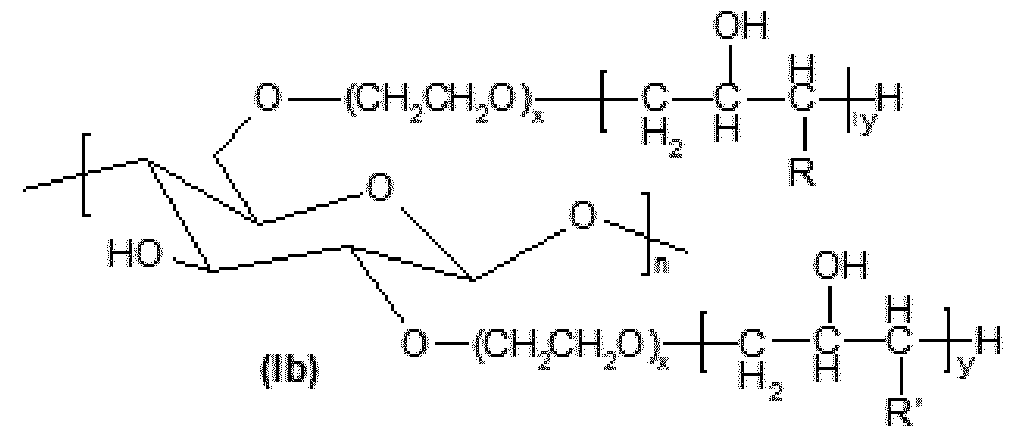
- formula (lb) in which:
- R represents an ammonium group RaRbRcN + -, Q“ in which Ra, Rb and Rc, which may be identical or different, represent a hydrogen atom or a linear or branched Ci to C 30 alkyl, preferably an alkyl, and Q“ represents an anionic counterion such as a halide, for instance a chloride or bromide;
- R’ represents an ammonium group R’aR’bR’cN + -
- x and y which may be identical or different, represent an integer of between 1 and 10 000.
- At least one of the radicals Ra, Rb, Rc, R’a, R’b or R’c represents a linear or branched Cs to C30, better still C10 to C24 or even C10 to C14 alkyl; mention may be made in particular of the dodecyl radical (C12).
- the other radical(s) represent a linear or branched C1-C4 alkyl, notably methyl.
- radicals Ra, Rb, Rc, R’a, R’b or R’c represents a linear or branched Cs to C30, better still C10 to C24 or even C10 to C14 alkyl; mention may be made in particular of the dodecyl radical (C12).
- the other radicals represent a linear or branched C 1 to C4 alkyl, notably methyl.
- R may be a group chosen from -N + (CH3)3, Q’“ and
- R’ may be a group -N + (Ci2H2s)(CH3)2, Q’“.
- aryl radicals preferably denote phenyl, benzyl, naphthyl or anthryl groups. Mention may notably be made of the polymers having the following INCI names:
- the polymers of formula (lb) are, for example, those the viscosity of which is between 2000 and 3000 cPs inclusive, preferentially between 2700 and 2800 cPs.
- Softcat Polymer SL-5 has a viscosity of 2500 cPs
- Softcat Polymer SL-30 has a viscosity of 2700 cPs
- Softcat Polymer SL-60 has a viscosity of 2700 cPs
- Softcat Polymer SL-100 has a viscosity of 2800 cPs.
- Use may also be made of Softcat Polymer SX-1300X with a viscosity of between 1000 and 2000 cPs.
- water-soluble polyaminoamides prepared in particular by polycondensation of an acidic compound with a polyamine; these polyaminoamides can be crosslinked with an epihalohydrin, a diepoxide, a dianhydride, an unsaturated dianhydride, a bis-unsaturated derivative, a bis-halohydrin, a bis-azetidinium, a bis- haloacyldiamine, a bis-alkyl halide or alternatively with an oligomer resulting from the reaction of a difunctional compound which is reactive with a bis-halohydrin, a bis- azetidinium, a bis-haloacyldiamine, a bis-alkyl halide, an epihalohydrin, a diepoxide or a bis-unsaturated derivative; the crosslinking agent being used in proportions ranging from 0.025 to 0.35 mol per amine group of the polyamino amide; these polya
- polyaminoamide derivatives resulting from the condensation of polyalkylene polyamines with polycarboxylic acids followed by alkylation with difunctional agents Mention may be made, for example, of adipic acid/dialkylaminohydroxyalkyldialkylenetriamine polymers in which the alkyl radical includes from 1 to 4 carbon atoms and preferably denotes methyl, ethyl or propyl.
- alkyl radical includes from 1 to 4 carbon atoms and preferably denotes methyl, ethyl or propyl.
- these derivatives mention may be made more particularly of the adipic acid/dimethylaminohydroxypropyl/diethylenetriamine polymers sold under the name Cartaretine F, F4 or F8 by Sandoz;
- Polymers of this type are sold in particular under the name Hercosett 57 by Hercules Inc.
- R12 denotes a hydrogen atom or a methyl radical
- - Y“ is an anion such as bromide, chloride, acetate, borate, citrate, tartrate, bisulfate, bisulfite, sulfate or phosphate.
- X’ is an anion, such as chloride or bromide.
- Mn number- average molar mass
- R19, R20 and R21 which may be identical or different, represent a hydrogen atom or a methyl, ethyl, propyl, P-hydroxyethyl, P-hydroxypropyl or - CH2CH2(OCH2CH2) P OH radical, where p is equal to 0 or to an integer of between 1 and 6, with the proviso that Ris, R19, R20 and R21 do not simultaneously represent a hydrogen atom,
- - r and s which may be identical or different, are integers between 1 and 6,
- - X denotes an anion, such as a halide
- Examples that may be mentioned include the products Mirapol® A 15, Mirapol® ADI, Mirapol® AZ1 and Mirapol® 175 sold by Miranol;
- the weight- average molecular mass of said polymer measured by light scattering, may range preferably from 1000 to 3 000 000 g/mol, more preferentially from 10 000 to 1 000 000 and even more particularly from 100 000 to 500000 g/mol.
- the cationic charge density of these polymers may preferably range from 2 meq/g to 20 meq/g, more preferentially from 2.5 to 15 meq/g and more particularly from 3.5 to 10 meq/g.
- the polymers including units of formula (A) and optionally units of formula (B) are notably sold under the name Lupamin by BASF, for instance, in a non-limiting manner, the products sold under the names Lupamin 9095, Lupamin 5095, Lupamin 1095, Lupamin 9030 (or Luviquat 9030) and Lupamin 9010.
- the total content of cationic galactomannan gum(s) ranges from 0.01% to 10% by weight, more preferentially from 0.05% to 5% by weight, even more preferentially from 0.1 % to 3 % by weight, even better still from 0.1 % to 1 % by weight, relative to the total weight of the composition.
- the total content of additional cationic polymer(s), when they are present in the composition ranges from 0.01% to 10% by weight, more preferentially from 0.05% to 5% by weight, even more preferentially from 0.1% to 3% by weight and better still from 0.1% to 1% by weight relative to the total weight of the composition.
- composition according to the present invention also comprises one or more particles.
- the particles according to the invention are chosen from opacifiers such as mica and glycol distearate, pigments such as titanium dioxide, fragments of one or more plants, and mixtures thereof.
- opacifiers such as mica and glycol distearate
- pigments such as titanium dioxide, fragments of one or more plants, and mixtures thereof.
- fragment means a piece or a part of a plant, obtained, for example, by tearing or milling the plant, or by cutting up said plant.
- fragments of one or more plants is intended to mean that the composition comprises either several fragments of one and the same species of plant, or that the composition comprises several fragments of several different species of plants.
- the viscosity of the composition according to the invention may be evaluated by determining, at a temperature of 25°C, the flow time of an amount of product (for example 90 g of poured product) through a calibrated orifice using a Ford cup viscometer, equipped with a Ford cup with an orifice diameter of 8 mm (cF8).
- the flow time of the composition according to the invention is greater than or equal to 30 seconds, in particular greater than or equal to 50 seconds; in particular between 30 and 300 seconds, or even between 50 and 250 seconds, even better still between 50 and 120 seconds.
- the composition according to the invention also comprises at least one inorganic salt, and more preferentially sodium chloride.
- the inorganic salt(s) are different from the anionic surfactants (i) and from the amphoteric or zwitterionic surfactants (ii), from the particles, and more particularly from all the ingredients described above.
- the total content of inorganic salt(s) present in the composition according to the invention ranges from 0.01% to 5% by weight, more preferentially from 0.05% to 3% by weight, and even more preferentially from 0.1% to 2% by weight relative to the total weight of the composition.
- the composition according to the invention comprises water, that is to say that the medium of the composition is aqueous or aqueous -alcoholic.
- the total water content of the composition according to the invention is between 20% and 98% by weight, more preferentially between 50% and 96% by weight, even more preferentially between 60% and 95% by weight, even better still between 70% and 90% by weight, relative to the total weight of the composition.
- composition according to the invention may also comprise at least one organic solvent.
- the organic solvents are liquid at 25 °C and at atmospheric pressure.
- organic solvent use may particularly be made of those which are water-soluble, such as C1-C7 alcohols, and in particular C1-C7 aliphatic or aromatic mono alcohols, C3-C7 polyols and C3-C7 polyol ethers, which can be used alone or as a mixture with water.
- the organic solvent(s) may be chosen from ethanol, isopropanol, propylene glycol, hexylene glycol and glycerol, and mixtures thereof.
- the composition according to the invention comprises at least one C2-C7, more preferentially C2-C6, polyol, and even more preferentially propylene glycol.
- the total content of C2-C7 organic solvent(s) is between 0.01% and 10% by weight, more preferentially between 0.05% and 5% by weight, and even more preferentially between 0.1% and 1% by weight, relative to the total weight of the composition.
- the pH of the composition is between 3.0 and 9.0, more preferentially between 3.5 and 8.0, even more preferentially between 4.0 and 7.0, and even better still between 4.5 and 6.5.
- additives may be present in the composition according to the invention in an amount ranging from 0 to 20% by weight, relative to the total weight of the composition.
- composition according to the invention may advantageously be in the form of a shampoo.
- the process according to the invention is a process for washing and/or conditioning human keratin fibres, more particularly the hair, comprising at least one step of applying a composition as defined above to said human keratin fibres.
- a step of rinsing the keratin fibres is performed after the step(s) of applying a composition according to the invention to said fibres.
- a subject of the invention is also the use of the composition according to the invention as described above for treating keratin fibres, preferably for washing and/or conditioning keratin fibres.
- compositions Al, A2 and A3 according to the invention are prepared from the ingredients indicated in the table below, the amounts of which are expressed as weight percentages of active material (AM).
- compositions Al, A2 and A3 according to the invention generate a foam of good quality and in large amount.
- Example 2
- compositions Al and A2 of Example 1 (invention) or composition B (comparative) were evaluated.
- compositions Al, A2 and B were respectively applied to 1 g locks of moderately sensitized Caucasian hair (AS20) 27 cm long, in a ratio of 0.4 gram of composition/gram of hair.
- the smooth nature was then evaluated for each of the (dry or wet) treated hair locks, by measuring the friction effort (i.e. friction work in mJ) by means of a Lloyd Instruments tensile-compression testing machine (Ametek®). More particularly, the friction effort between the lock to be evaluated (dry or wet) and two rollers of the tensile-compression testing machine which pass along the lock, from the root to the ends, a constant speed, and which simulate the fingers of the consumer, is measured in mJ.
- compositions Al and A2 according to the invention kept a homogeneous appearance and was white in colour, without any phase separation phenomenon.
- composition Al or A2 according to the invention exhibits conditioning properties that are at least equivalent to, and even better than, in terms of certain properties, the hair treated with the commercial shampoo based on silicone.
- compositions Cl, C2 and C3 according to the invention, and also comparative composition C’ are prepared from the ingredients indicated in the table below, the amounts of which are expressed as weight percentages of active material (AM).
- the hair is rinsed for 20 sec (25 passes between the fingers).
- the hair is then run dry and evaluated while still wet.
- the expert takes the lock between the thumb and index finger and slides the fingers along the lock from the upper part to the ends.
- the expert evaluates whether the hair is soft, whether or not it exhibits rough patches, whether or not it catches the fingers, and whether it feels uniform.
- compositions Cl, C2 and C3 according to the invention were improved compared to that of the comparative composition C’.
- the impact of the invention on the performance results in terms of disentangling was evaluated on wet hair by 1 expert, in a blind test, on a score scale ranging from 0 (poor) to 8 (very good).
- the expert evaluates the ease with which a fine comb passes through the hair, while sliding it from the root to the end.
- compositions Cl, C2 and C3 according to the invention is easier to disentangle compared with the hair treated with comparative composition C’.
- the hair is then rinsed for 10 sec with water at 35 °C and then wrung out.
- composition D 1 For hair treated with composition D 1 according to the invention, the comb got stuck about 3cm after the root (half of the lock).
- composition DI is easier to disentangle compared with the hair treated with comparative composition D2.
- composition DI is more supple compared with the hair treated with comparative composition D2.
- the expert evaluates whether the hair is soft, whether or not it exhibits rough patches, whether or not it catches the fingers, and whether it feels uniform.
- composition DI according to the invention was improved compared to that of the comparative composition D2.
Landscapes
- Health & Medical Sciences (AREA)
- Life Sciences & Earth Sciences (AREA)
- Animal Behavior & Ethology (AREA)
- General Health & Medical Sciences (AREA)
- Public Health (AREA)
- Veterinary Medicine (AREA)
- Birds (AREA)
- Epidemiology (AREA)
- Dermatology (AREA)
- Emergency Medicine (AREA)
- Cosmetics (AREA)
Abstract
Description




Claims
Priority Applications (3)
| Application Number | Priority Date | Filing Date | Title |
|---|---|---|---|
| CN202380041270.4A CN119317423A (en) | 2022-06-22 | 2023-06-22 | Washing composition for keratin fibers comprising at least one anionic surfactant, at least one amphoteric or zwitterionic surfactant, at least one glucamide compound and at least one cationic galactomannan gum |
| US18/877,389 US20250381125A1 (en) | 2022-06-22 | 2023-06-22 | Washing composition for keratin fibres comprising at least one anionic surfactant, at least one amphoteric or zwitterionic surfactant, at least one glucamide compound and at least one cationic galactomannan gum |
| EP23734268.8A EP4543405A1 (en) | 2022-06-22 | 2023-06-22 | Washing composition for keratin fibres comprising at least one anionic surfactant, at least one amphoteric or zwitterionic surfactant, at least one glucamide compound and at least one cationic galactomannan gum |
Applications Claiming Priority (2)
| Application Number | Priority Date | Filing Date | Title |
|---|---|---|---|
| FR2206167A FR3136977B1 (en) | 2022-06-22 | 2022-06-22 | WASHING COMPOSITION FOR KERATIN FIBERS COMPRISING AT LEAST ONE ANIONIC SURFACTANT, AT LEAST ONE AMPHOTERIC OR ZWITTERIONIC SURFACTANT AND AT LEAST ONE GLUCAMIDE COMPOUND |
| FRFR2206167 | 2022-06-22 |
Publications (1)
| Publication Number | Publication Date |
|---|---|
| WO2023247688A1 true WO2023247688A1 (en) | 2023-12-28 |
Family
ID=83188993
Family Applications (1)
| Application Number | Title | Priority Date | Filing Date |
|---|---|---|---|
| PCT/EP2023/066931 Ceased WO2023247688A1 (en) | 2022-06-22 | 2023-06-22 | Washing composition for keratin fibres comprising at least one anionic surfactant, at least one amphoteric or zwitterionic surfactant, at least one glucamide compound and at least one cationic galactomannan gum |
Country Status (5)
| Country | Link |
|---|---|
| US (1) | US20250381125A1 (en) |
| EP (1) | EP4543405A1 (en) |
| CN (1) | CN119317423A (en) |
| FR (1) | FR3136977B1 (en) |
| WO (1) | WO2023247688A1 (en) |
Cited By (1)
| Publication number | Priority date | Publication date | Assignee | Title |
|---|---|---|---|---|
| WO2026082914A1 (en) * | 2024-10-18 | 2026-04-23 | L'oreal | Washing and foaming composition for keratin fibres comprising at least one glucamide, several anionic surfactants, and at least one amino silicone |
Citations (15)
| Publication number | Priority date | Publication date | Assignee | Title |
|---|---|---|---|---|
| FR1492597A (en) | 1965-09-14 | 1967-08-18 | Union Carbide Corp | New cellulose ethers containing quaternary nitrogen |
| US3589578A (en) | 1968-01-20 | 1971-06-29 | Monforts Fa A | Tension-relieving device for stretchable sheet material |
| FR2077143A5 (en) | 1970-01-30 | 1971-10-15 | Gaf Corp | |
| US4031307A (en) | 1976-05-03 | 1977-06-21 | Celanese Corporation | Cationic polygalactomannan compositions |
| US4131576A (en) | 1977-12-15 | 1978-12-26 | National Starch And Chemical Corporation | Process for the preparation of graft copolymers of a water soluble monomer and polysaccharide employing a two-phase reaction system |
| FR2393573A1 (en) | 1977-06-10 | 1979-01-05 | Gaf Corp | HAIR PREPARATIONS CONTAINING A VINYLPYRROLIDONE COPOLYMER |
| WO1992006154A1 (en) | 1990-09-28 | 1992-04-16 | The Procter & Gamble Company | Polyhydroxy fatty acid amide surfactants to enhance enzyme performance |
| US5194639A (en) | 1990-09-28 | 1993-03-16 | The Procter & Gamble Company | Preparation of polyhydroxy fatty acid amides in the presence of solvents |
| DE4443645A1 (en) | 1994-12-08 | 1996-06-13 | Henkel Kgaa | Compsn. contg. sulphated fatty acid-N-poly:hydroxyalkyl amide(s) |
| DE202013011413U1 (en) * | 2013-12-20 | 2014-01-27 | Clariant International Ltd. | Conditioning shampoos containing anionic surfactants, glucamides and fatty alcohols |
| US20150297485A1 (en) * | 2014-04-17 | 2015-10-22 | Evonik Industries Ag | Surfactant compositions and formulations with a high oil content |
| US9271908B2 (en) * | 2011-12-28 | 2016-03-01 | Evonik Industries Ag | Aqueous hair and skin cleaning compositions comprising biotensides |
| US20160143828A1 (en) * | 2013-06-28 | 2016-05-26 | Clariant International Ltd. | Use Of Special N-Alkyl-N-Acylglucamines For Conditioning Hair In Hair Washing Agents |
| WO2019115478A1 (en) * | 2017-12-11 | 2019-06-20 | Clariant International Ltd | Composition for inhibiting micro-organisms |
| US20190365619A1 (en) * | 2018-05-31 | 2019-12-05 | L'oreal | Anti-dandruff cleansing composition |
Family Cites Families (2)
| Publication number | Priority date | Publication date | Assignee | Title |
|---|---|---|---|---|
| US11458084B2 (en) | 2020-02-28 | 2022-10-04 | L'oreal | Hair cleansing composition |
| CN116648232A (en) | 2020-11-13 | 2023-08-25 | 联合利华知识产权控股有限公司 | detergent composition |
-
2022
- 2022-06-22 FR FR2206167A patent/FR3136977B1/en active Active
-
2023
- 2023-06-22 WO PCT/EP2023/066931 patent/WO2023247688A1/en not_active Ceased
- 2023-06-22 EP EP23734268.8A patent/EP4543405A1/en active Pending
- 2023-06-22 US US18/877,389 patent/US20250381125A1/en active Pending
- 2023-06-22 CN CN202380041270.4A patent/CN119317423A/en active Pending
Patent Citations (15)
| Publication number | Priority date | Publication date | Assignee | Title |
|---|---|---|---|---|
| FR1492597A (en) | 1965-09-14 | 1967-08-18 | Union Carbide Corp | New cellulose ethers containing quaternary nitrogen |
| US3589578A (en) | 1968-01-20 | 1971-06-29 | Monforts Fa A | Tension-relieving device for stretchable sheet material |
| FR2077143A5 (en) | 1970-01-30 | 1971-10-15 | Gaf Corp | |
| US4031307A (en) | 1976-05-03 | 1977-06-21 | Celanese Corporation | Cationic polygalactomannan compositions |
| FR2393573A1 (en) | 1977-06-10 | 1979-01-05 | Gaf Corp | HAIR PREPARATIONS CONTAINING A VINYLPYRROLIDONE COPOLYMER |
| US4131576A (en) | 1977-12-15 | 1978-12-26 | National Starch And Chemical Corporation | Process for the preparation of graft copolymers of a water soluble monomer and polysaccharide employing a two-phase reaction system |
| WO1992006154A1 (en) | 1990-09-28 | 1992-04-16 | The Procter & Gamble Company | Polyhydroxy fatty acid amide surfactants to enhance enzyme performance |
| US5194639A (en) | 1990-09-28 | 1993-03-16 | The Procter & Gamble Company | Preparation of polyhydroxy fatty acid amides in the presence of solvents |
| DE4443645A1 (en) | 1994-12-08 | 1996-06-13 | Henkel Kgaa | Compsn. contg. sulphated fatty acid-N-poly:hydroxyalkyl amide(s) |
| US9271908B2 (en) * | 2011-12-28 | 2016-03-01 | Evonik Industries Ag | Aqueous hair and skin cleaning compositions comprising biotensides |
| US20160143828A1 (en) * | 2013-06-28 | 2016-05-26 | Clariant International Ltd. | Use Of Special N-Alkyl-N-Acylglucamines For Conditioning Hair In Hair Washing Agents |
| DE202013011413U1 (en) * | 2013-12-20 | 2014-01-27 | Clariant International Ltd. | Conditioning shampoos containing anionic surfactants, glucamides and fatty alcohols |
| US20150297485A1 (en) * | 2014-04-17 | 2015-10-22 | Evonik Industries Ag | Surfactant compositions and formulations with a high oil content |
| WO2019115478A1 (en) * | 2017-12-11 | 2019-06-20 | Clariant International Ltd | Composition for inhibiting micro-organisms |
| US20190365619A1 (en) * | 2018-05-31 | 2019-12-05 | L'oreal | Anti-dandruff cleansing composition |
Non-Patent Citations (4)
| Title |
|---|
| "CTFA dictionary", 1993 |
| DATABASE GNPD [online] MINTEL; 11 September 2018 (2018-09-11), ANONYMOUS: "Gentle Volume Shampoo", XP093017104, retrieved from https://www.gnpd.com/sinatra/recordpage/5963425/ Database accession no. 5963425 * |
| DATABASE GNPD [online] MINTEL; 18 September 2019 (2019-09-18), ANONYMOUS: "Organic Shampoo", XP093017327, retrieved from https://www.gnpd.com/sinatra/recordpage/6881243/ Database accession no. 6881243 * |
| See also references of EP4543405A1 |
Cited By (2)
| Publication number | Priority date | Publication date | Assignee | Title |
|---|---|---|---|---|
| WO2026082914A1 (en) * | 2024-10-18 | 2026-04-23 | L'oreal | Washing and foaming composition for keratin fibres comprising at least one glucamide, several anionic surfactants, and at least one amino silicone |
| FR3167546A1 (en) * | 2024-10-18 | 2026-04-24 | L'oreal | WASHING AND FOAMING COMPOSITION FOR KERATINIC FIBERS COMPRISING AT LEAST ONE GLUCAMIDE, SEVERAL ANIONIC SURFACTANTS AND AT LEAST ONE AMINO SILICONE |
Also Published As
| Publication number | Publication date |
|---|---|
| US20250381125A1 (en) | 2025-12-18 |
| CN119317423A (en) | 2025-01-14 |
| EP4543405A1 (en) | 2025-04-30 |
| FR3136977B1 (en) | 2025-05-16 |
| FR3136977A1 (en) | 2023-12-29 |
Similar Documents
| Publication | Publication Date | Title |
|---|---|---|
| EP3393597B1 (en) | Hair cosmetic composition comprising silicones and surfactants, and cosmetic treatment process | |
| JP7138436B2 (en) | Cosmetic compositions containing linear olefin sulfonates, non-oxyalkylated anionic surfactants and nonionic and/or amphoteric surfactants, and methods of cosmetic treatment | |
| CN116807915A (en) | Cosmetic compositions and cosmetic treatments containing linear alpha-olefin sulfonates | |
| FR2781367A1 (en) | DETERGENT COSMETIC COMPOSITIONS AND USE | |
| BR112019012943A2 (en) | Cleansing makeup and skin cleansing process | |
| ES2958824T3 (en) | Composition comprising surfactants, cationic polymers and a vegetable oil | |
| WO2019193109A1 (en) | Cosmetic composition comprising a polysaccharide, surfactants and fragments of one or more plants | |
| US11376204B2 (en) | Cosmetic composition comprising anionic surfactants, amphoteric surfac-tants, cationic polymers and liquid fatty substances chosen from fatty alco-hols and fatty esters, and cosmetic treatment process | |
| FR3060326A1 (en) | COMPOSITION COMPRISING AT LEAST TWO ANIONIC SURFACTANTS, A NON-IONIC SURFACTANT AND AN AMPHOTERIC SURFACTANT, AND AT LEAST ONE ORGANOSILANE | |
| EP3813777B1 (en) | Composition comprising at least two different anionic surfactants, non-ionic and amphoteric surfactants, and cationic or amphoteric polymers | |
| FR3060381A1 (en) | COSMETIC COMPOSITION COMPRISING AN ORGANOSILANE, AT LEAST ONE CATIONIC POLYMER AND A PARTICULAR ASSOCIATION OF SURFACTANTS | |
| FR3136978A1 (en) | WASHING COMPOSITION FOR KERATIN FIBERS COMPRISING AT LEAST ONE GLUCAMIDE, A (POLY)GLYCEROL ESTER AND AN ALKYL(POLY)GLYCOSIDE | |
| WO2023247688A1 (en) | Washing composition for keratin fibres comprising at least one anionic surfactant, at least one amphoteric or zwitterionic surfactant, at least one glucamide compound and at least one cationic galactomannan gum | |
| FR3068250B1 (en) | COSMETIC COMPOSITION COMPRISING ORGANOSILANES, CATIONIC POLYMERS, LIQUID FATTY BODIES, PARTICULAR ANIONIC SURFACTANTS, AND NONIONIC AND AMPHOTERIAL SURFACTANTS, METHOD OF COSMETIC TREATMENT AND USE | |
| WO2022117863A1 (en) | Anhydrous solid shampoo based on surfactants and on a fatty acid salt, its method of preparation and a kit | |
| EP3999188A1 (en) | Cosmetic composition comprising anionic and amphoteric surfactants, cationic polysaccharides and unsaturated fatty alcohols, and cosmetic treatment process | |
| FR3068241B1 (en) | COSMETIC COMPOSITION COMPRISING A MIXTURE OF PARTICULAR CARBOXY-LIQUID SURFACTANTS, NONIONIC AND AMPHOTERIC SURFACTANTS, AND CATIONIC PO-LYMERS, COSMETIC TREATMENT METHOD AND USE | |
| EP4601602A1 (en) | Detergent and exfoliating cosmetic hair composition comprising salicylic acid and particles in suspension | |
| WO2026082918A1 (en) | Washing and foaming composition for keratin fibres, comprising at least one glucamide and a particular mixture of surfactants | |
| WO2026082914A1 (en) | Washing and foaming composition for keratin fibres comprising at least one glucamide, several anionic surfactants, and at least one amino silicone | |
| WO2026082919A1 (en) | Washing and foaming composition for keratin fibres comprising at least one glucamide, a particular mixture of surfactants and at least one cationic polysaccharide | |
| WO2026082915A1 (en) | Washing and foaming composition for keratin fibres, comprising at least one glucamide, at least one particular anionic surfactant and at least one particular cationic surfactant | |
| WO2025133303A1 (en) | Composition comprising a particular agent, tocopherol in a specific content and an anionic surfactant and/or an amphoteric or zwitterionic surfactant | |
| WO2023237762A1 (en) | Composition comprising nonionic surfactant(s) of alkylpolyglycoside type, polyol(s), c8-c30 fatty acid ester(s) of sorbitan and cationic polymer(s) | |
| EP4255583A1 (en) | Process for preparing a shampoo from an anhydrous solid surfactant composition |
Legal Events
| Date | Code | Title | Description |
|---|---|---|---|
| 121 | Ep: the epo has been informed by wipo that ep was designated in this application |
Ref document number: 23734268 Country of ref document: EP Kind code of ref document: A1 |
|
| WWE | Wipo information: entry into national phase |
Ref document number: 202380041270.4 Country of ref document: CN |
|
| REG | Reference to national code |
Ref country code: BR Ref legal event code: B01A Ref document number: 112024023550 Country of ref document: BR |
|
| WWE | Wipo information: entry into national phase |
Ref document number: 18877389 Country of ref document: US |
|
| WWP | Wipo information: published in national office |
Ref document number: 202380041270.4 Country of ref document: CN |
|
| WWE | Wipo information: entry into national phase |
Ref document number: 2023734268 Country of ref document: EP |
|
| NENP | Non-entry into the national phase |
Ref country code: DE |
|
| ENP | Entry into the national phase |
Ref document number: 2023734268 Country of ref document: EP Effective date: 20250122 |
|
| ENP | Entry into the national phase |
Ref document number: 112024023550 Country of ref document: BR Kind code of ref document: A2 Effective date: 20241112 |
|
| WWP | Wipo information: published in national office |
Ref document number: 2023734268 Country of ref document: EP |
|
| WWP | Wipo information: published in national office |
Ref document number: 18877389 Country of ref document: US |