WO2023276761A1 - 粉体及び分散体 - Google Patents
粉体及び分散体 Download PDFInfo
- Publication number
- WO2023276761A1 WO2023276761A1 PCT/JP2022/024574 JP2022024574W WO2023276761A1 WO 2023276761 A1 WO2023276761 A1 WO 2023276761A1 JP 2022024574 W JP2022024574 W JP 2022024574W WO 2023276761 A1 WO2023276761 A1 WO 2023276761A1
- Authority
- WO
- WIPO (PCT)
- Prior art keywords
- less
- crystal composition
- mass ppm
- particles
- powder
- Prior art date
- Legal status (The legal status is an assumption and is not a legal conclusion. Google has not performed a legal analysis and makes no representation as to the accuracy of the status listed.)
- Ceased
Links
Images


Classifications
-
- C—CHEMISTRY; METALLURGY
- C01—INORGANIC CHEMISTRY
- C01G—COMPOUNDS CONTAINING METALS NOT COVERED BY SUBCLASSES C01D OR C01F
- C01G23/00—Compounds of titanium
- C01G23/04—Oxides; Hydroxides
- C01G23/043—Titanium sub-oxides
-
- C—CHEMISTRY; METALLURGY
- C01—INORGANIC CHEMISTRY
- C01G—COMPOUNDS CONTAINING METALS NOT COVERED BY SUBCLASSES C01D OR C01F
- C01G23/00—Compounds of titanium
- C01G23/04—Oxides; Hydroxides
-
- C—CHEMISTRY; METALLURGY
- C01—INORGANIC CHEMISTRY
- C01G—COMPOUNDS CONTAINING METALS NOT COVERED BY SUBCLASSES C01D OR C01F
- C01G23/00—Compounds of titanium
-
- C—CHEMISTRY; METALLURGY
- C01—INORGANIC CHEMISTRY
- C01G—COMPOUNDS CONTAINING METALS NOT COVERED BY SUBCLASSES C01D OR C01F
- C01G23/00—Compounds of titanium
- C01G23/003—Titanates
-
- C—CHEMISTRY; METALLURGY
- C01—INORGANIC CHEMISTRY
- C01G—COMPOUNDS CONTAINING METALS NOT COVERED BY SUBCLASSES C01D OR C01F
- C01G23/00—Compounds of titanium
- C01G23/003—Titanates
- C01G23/005—Alkali titanates
-
- C—CHEMISTRY; METALLURGY
- C01—INORGANIC CHEMISTRY
- C01G—COMPOUNDS CONTAINING METALS NOT COVERED BY SUBCLASSES C01D OR C01F
- C01G23/00—Compounds of titanium
- C01G23/003—Titanates
- C01G23/006—Alkaline earth titanates
-
- C—CHEMISTRY; METALLURGY
- C01—INORGANIC CHEMISTRY
- C01G—COMPOUNDS CONTAINING METALS NOT COVERED BY SUBCLASSES C01D OR C01F
- C01G23/00—Compounds of titanium
- C01G23/04—Oxides; Hydroxides
- C01G23/047—Titanium dioxide
-
- C—CHEMISTRY; METALLURGY
- C09—DYES; PAINTS; POLISHES; NATURAL RESINS; ADHESIVES; COMPOSITIONS NOT OTHERWISE PROVIDED FOR; APPLICATIONS OF MATERIALS NOT OTHERWISE PROVIDED FOR
- C09C—TREATMENT OF INORGANIC MATERIALS, OTHER THAN FIBROUS FILLERS, TO ENHANCE THEIR PIGMENTING OR FILLING PROPERTIES ; PREPARATION OF CARBON BLACK ; PREPARATION OF INORGANIC MATERIALS WHICH ARE NO SINGLE CHEMICAL COMPOUNDS AND WHICH ARE MAINLY USED AS PIGMENTS OR FILLERS
- C09C1/00—Treatment of specific inorganic materials other than fibrous fillers; Preparation of carbon black
- C09C1/0081—Composite particulate pigments or fillers, i.e. containing at least two solid phases, except those consisting of coated particles of one compound
- C09C1/0084—Composite particulate pigments or fillers, i.e. containing at least two solid phases, except those consisting of coated particles of one compound containing titanium dioxide
-
- C—CHEMISTRY; METALLURGY
- C01—INORGANIC CHEMISTRY
- C01P—INDEXING SCHEME RELATING TO STRUCTURAL AND PHYSICAL ASPECTS OF SOLID INORGANIC COMPOUNDS
- C01P2002/00—Crystal-structural characteristics
- C01P2002/70—Crystal-structural characteristics defined by measured X-ray, neutron or electron diffraction data
- C01P2002/72—Crystal-structural characteristics defined by measured X-ray, neutron or electron diffraction data by d-values or two theta-values, e.g. as X-ray diagram
-
- C—CHEMISTRY; METALLURGY
- C01—INORGANIC CHEMISTRY
- C01P—INDEXING SCHEME RELATING TO STRUCTURAL AND PHYSICAL ASPECTS OF SOLID INORGANIC COMPOUNDS
- C01P2002/00—Crystal-structural characteristics
- C01P2002/90—Other crystal-structural characteristics not specified above
-
- C—CHEMISTRY; METALLURGY
- C01—INORGANIC CHEMISTRY
- C01P—INDEXING SCHEME RELATING TO STRUCTURAL AND PHYSICAL ASPECTS OF SOLID INORGANIC COMPOUNDS
- C01P2006/00—Physical properties of inorganic compounds
- C01P2006/12—Surface area
-
- C—CHEMISTRY; METALLURGY
- C01—INORGANIC CHEMISTRY
- C01P—INDEXING SCHEME RELATING TO STRUCTURAL AND PHYSICAL ASPECTS OF SOLID INORGANIC COMPOUNDS
- C01P2006/00—Physical properties of inorganic compounds
- C01P2006/22—Rheological behaviour as dispersion, e.g. viscosity, sedimentation stability
-
- C—CHEMISTRY; METALLURGY
- C01—INORGANIC CHEMISTRY
- C01P—INDEXING SCHEME RELATING TO STRUCTURAL AND PHYSICAL ASPECTS OF SOLID INORGANIC COMPOUNDS
- C01P2006/00—Physical properties of inorganic compounds
- C01P2006/60—Optical properties, e.g. expressed in CIELAB-values
- C01P2006/62—L* (lightness axis)
-
- C—CHEMISTRY; METALLURGY
- C01—INORGANIC CHEMISTRY
- C01P—INDEXING SCHEME RELATING TO STRUCTURAL AND PHYSICAL ASPECTS OF SOLID INORGANIC COMPOUNDS
- C01P2006/00—Physical properties of inorganic compounds
- C01P2006/60—Optical properties, e.g. expressed in CIELAB-values
- C01P2006/63—Optical properties, e.g. expressed in CIELAB-values a* (red-green axis)
-
- C—CHEMISTRY; METALLURGY
- C01—INORGANIC CHEMISTRY
- C01P—INDEXING SCHEME RELATING TO STRUCTURAL AND PHYSICAL ASPECTS OF SOLID INORGANIC COMPOUNDS
- C01P2006/00—Physical properties of inorganic compounds
- C01P2006/60—Optical properties, e.g. expressed in CIELAB-values
- C01P2006/64—Optical properties, e.g. expressed in CIELAB-values b* (yellow-blue axis)
-
- C—CHEMISTRY; METALLURGY
- C01—INORGANIC CHEMISTRY
- C01P—INDEXING SCHEME RELATING TO STRUCTURAL AND PHYSICAL ASPECTS OF SOLID INORGANIC COMPOUNDS
- C01P2006/00—Physical properties of inorganic compounds
- C01P2006/80—Compositional purity
Definitions
- the present disclosure relates to powders and dispersions containing particles having a specific low-order titanium oxide crystal composition.
- Low-order titanium oxide also called reduced titanium oxide
- Low-order titanium oxide obtained by reducing titanium dioxide exhibits different colors depending on the ratio (crystal composition) of the constituent elements titanium and oxygen, and the ratio can be adjusted appropriately. It is known that it becomes black by adjusting. Therefore, particles whose surfaces are composed of low-order titanium oxide can be used for various purposes as pigments such as black pigments.
- Patent Literature 1 discloses a cosmetic using a pigment exhibiting dichroism in which the color tone of the appearance color and the interference color are different by forming a single layer of low-order titanium oxide on plate-like particles.
- Patent Document 2 discloses a black titanium oxide powder produced using CaH 2 as a reducing agent.
- Patent Document 3 discloses a titanium oxynitride powder produced by reacting titanium oxide with high-temperature ammonia gas.
- Black pigments containing low-order titanium oxide are generally called black, but they exhibit different shades of black, such as reddish black and bluish black. Also, depending on the color tone, the same blackness may appear brighter or darker. For example, bright colors such as red and yellow have the same blackness, but dark colors such as blue and green appear blacker. Therefore, it is preferable that the degree of freedom in adjusting the color is high so that the color of the black pigment can be selected according to the application of the black pigment.
- an object of one aspect of the present invention is to provide a powder of low-order titanium oxide whose color can be suitably adjusted.
- first particles and second particles having a crystal composition of Ti 2 O 3 , ⁇ -Ti 3 O 5 or Ti 4 O 7 and having crystal compositions different from each other.
- the color can be suitably adjusted.
- the L * value in the L * a * b * color space which is an index for evaluating color
- the L * value of the powder containing the first particles and the second particles is the first can be lower than the L * value of the second particle itself and the L * value of the second particle itself.
- the present invention includes the following aspects.
- a powder containing first particles having a first crystal composition and second particles having a second crystal composition different from the first crystal composition, the powder having the first crystal composition and each of the second crystal composition contains at least one selected from the group consisting of Ti 2 O 3 , ⁇ -Ti 3 O 5 and Ti 4 O 7 .
- One embodiment of the present invention is a powder containing first particles having a first crystal composition and second particles having a second crystal composition different from the first crystal composition.
- the first crystal composition contains at least one selected from the group consisting of Ti 2 O 3 , ⁇ -Ti 3 O 5 and Ti 4 O 7 (hereinafter collectively referred to as "low order titanium oxide").
- the first crystal composition may contain only one selected from the group consisting of Ti 2 O 3 , ⁇ -Ti 3 O 5 and Ti 4 O 7 .
- the first crystal composition may contain two or more selected from the group, may contain Ti 2 O 3 and ⁇ -Ti 3 O 5 , and may contain ⁇ -Ti 3O5 and Ti4O7 .
- the second crystal composition contains at least one selected from the group consisting of Ti 2 O 3 , ⁇ -Ti 3 O 5 and Ti 4 O 7 .
- the second crystal composition in one embodiment, may contain only one selected from the group consisting of Ti 2 O 3 , ⁇ -Ti 3 O 5 and Ti 4 O 7 .
- the second crystal composition may contain two or more selected from the group, may contain Ti 2 O 3 and ⁇ -Ti 3 O 5 , and may contain ⁇ -Ti 3O5 and Ti4O7 .
- the second crystal composition being different from the first crystal composition means that the second crystal composition does not completely match the first crystal composition.
- the first crystal composition is Ti 2 O 3 and ⁇ -Ti 3 O 5 and the second crystal composition is ⁇ -Ti 3 O 5 and Ti 4 O 7
- the second crystal composition is It is different from the one crystal composition.
- the second crystal composition does not completely match the first crystal composition, it has a crystal structure ( ⁇ -Ti 3 O 5 in the above example) that is partially common to the first crystal composition. may have.
- the powder is measured by X-ray diffraction (XRD), and only diffraction peaks attributed to at least one selected from the group consisting of Ti 2 O 3 , ⁇ -Ti 3 O 5 and Ti 4 O 7 are observed. is confirmed by
- Examples of combinations of the first crystal composition and the second crystal composition include the following combinations. (1) The first crystal composition contains Ti 2 O 3 and the second crystal composition contains ⁇ -Ti 3 O 5 . (2) The first crystal composition contains Ti 2 O 3 and the second crystal composition contains Ti 4 O 7 . (3) The first crystal composition contains ⁇ -Ti 3 O 5 and the second crystal composition contains Ti 4 O 7 . In these combinations (1) to (3), each of the first crystal composition and the second crystal composition may contain only one type of each of the above low titanium oxides, and each of the above low titanium oxides may be In addition to, other low order titanium oxide may be further included.
- the low order titanium oxide powder may further contain third particles having a third crystal composition different from the first crystal composition and the second crystal composition.
- the third crystal composition includes at least one crystal composition selected from the group consisting of Ti 2 O 3 , ⁇ -Ti 3 O 5 and Ti 4 O 7 .
- the third crystal composition includes at least one crystal composition selected from the group consisting of Ti 2 O 3 , ⁇ -Ti 3 O 5 and Ti 4 O 7 .
- the third crystalline composition in one embodiment, may include only one crystalline composition selected from the group consisting of Ti 2 O 3 , ⁇ -Ti 3 O 5 and Ti 4 O 7 .
- the third crystal composition may contain two or more crystal compositions selected from the group, and may contain Ti 2 O 3 and ⁇ -Ti 3 O 5 , ⁇ -Ti 3 O 5 and Ti 4 O 7 may be included.
- the third crystal composition is different from the first crystal composition and the second crystal composition means that the third crystal composition does not completely match the first crystal composition and the second crystal composition.
- the first crystal composition is Ti 2 O 3 and ⁇ -Ti 3 O 5
- the second crystal composition is ⁇ -Ti 3 O 5 and Ti 4 O 7
- the third crystal composition is ⁇ - In the case of Ti 3 O 5
- the third crystal composition is different from the first crystal composition and the second crystal composition.
- the third crystal composition is partially common to the first crystal composition and the second crystal composition, respectively. ( ⁇ -Ti 3 O 5 in the above example).
- the low-order titanium oxide powder further contains third particles
- the first crystal composition contains Ti 2 O 3 and the second crystal composition contains ⁇ -Ti 3 O 5 .
- the third crystalline composition may comprise Ti 4 O 7 .
- each of the first crystal composition, the second crystal composition, and the third crystal composition may contain only one type of each low-order titanium oxide, and in addition to the low-order titanium oxide, other It may further contain low order titanium oxide.
- the BET specific surface area of each of the first particles, the second particles, and the third particles is 0.25 m 2 /g or more, 1 m 2 /g or more, 2 m 2 /g or more, 3 m 2 /g or more, or 4 m 2 /g or more, and may be 20 m 2 /g or less, 10 m 2 /g or less, or 8 m 2 /g or less.
- the BET specific surface area of the low order titanium oxide powder may also be within the above range.
- the amount of impurities in each particle of the first particles, the second particles and the third particles is as small as possible.
- the Al content in each particle may preferably be 200 mass ppm or less, 50 mass ppm or less, or 20 mass ppm or less.
- the content of B in each particle may preferably be 50 mass ppm or less, 30 mass ppm or less, or 10 mass ppm or less.
- the content of Ba in each particle may preferably be 50 mass ppm or less, 10 mass ppm or less, or 5 mass ppm or less.
- the content of Ca in each particle may preferably be 100 mass ppm or less, 50 mass ppm or less, or 10 mass ppm or less.
- the content of Cd in each particle may preferably be 10 mass ppm or less, 5 mass ppm or less, or 2 mass ppm or less.
- the Co content in each particle may preferably be 10 mass ppm or less, 5 mass ppm or less, or 2 mass ppm or less.
- the Cr content in each particle may preferably be 100 mass ppm or less, 10 mass ppm or less, or 5 mass ppm or less.
- the Cu content in each particle may preferably be 200 mass ppm or less, 50 mass ppm or less, or 10 mass ppm or less.
- the Fe content in each particle may preferably be 200 mass ppm or less, 50 mass ppm or less, or 10 mass ppm or less.
- the K content in each particle may preferably be 100 mass ppm or less, 5 mass ppm or less, or 1 mass ppm or less.
- the Li content in each particle may preferably be 20 mass ppm or less, 2 mass ppm or less, or 0.5 mass ppm or less.
- the content of Mg in each particle may preferably be 100 mass ppm or less, 10 mass ppm or less, or 1 mass ppm or less.
- the content of Mn in each particle may preferably be 10 mass ppm or less, 5 mass ppm or less, or 2 mass ppm or less.
- the content of Mo in each particle may preferably be 10 mass ppm or less, 5 mass ppm or less, or 2 mass ppm or less.
- the content of Na in each particle may preferably be 50 mass ppm or less, 10 mass ppm or less, 5 mass ppm or less, or 2 mass ppm or less.
- the Ni content in each particle may preferably be 50 mass ppm or less, 20 mass ppm or less, or 10 mass ppm or less.
- the content of P in each particle may preferably be 200 mass ppm or less, 30 mass ppm or less, 10 mass ppm or less, or 5 mass ppm or less.
- the content of Pb in each particle may preferably be 50 mass ppm or less, 5 mass ppm or less, or 2 mass ppm or less.
- the content of Sb in each particle may preferably be 100 mass ppm or less, 20 mass ppm or less, 10 mass ppm or less, or 2 mass ppm or less.
- the Si content in each particle may preferably be 1000 mass ppm or less, 100 mass ppm or less, 30 mass ppm or less, 20 mass ppm or less, or 2 mass ppm or less.
- the Zn content in each particle may preferably be 100 mass ppm or less, 10 mass ppm or less, or 2 mass ppm or less.
- the content of Zr in each particle may preferably be 100 mass ppm or less, 20 mass ppm or less, or 2 mass ppm or less.
- the total content of Na, K and P in each particle may preferably be 2000 mass ppm or less, 1000 mass ppm or less, 500 mass ppm or less, or 100 mass ppm or less.
- the total content of Pb, Cd and Cr in each particle may preferably be 200 mass ppm or less, 100 mass ppm or less, 50 mass ppm or less, or 30 mass ppm or less.
- the amount of each impurity in the low order titanium oxide powder may also be within the above range.
- the amount of impurities was measured by Agilent 5110ICP-OES (manufactured by Agilent Technologies) using a liquid obtained by adding 1 mL each of HF and HCl to 0.1 g of a sample and performing pressurized acid decomposition (150° C., 4 hours). be done.
- the contents of the first particles, the second particles and the third particles in the low order titanium oxide powder are appropriately adjusted according to the desired color.
- the content of each of the first particles, the second particles, and the third particles is, based on the total amount of the low-order titanium oxide powder, for example, 5% by mass or more, 20% by mass or more, 30% by mass or more, 40% by mass or more, 50% by mass or more, 60% by mass or more, 70% by mass or more, 80% by mass or more, or 95% by mass or more, 95% by mass or less, 80% by mass or less, 70% by mass or less, It may be 60% by mass or less, 50% by mass or less, 40% by mass or less, 30% by mass or less, 20% by mass or less, or 5% by mass or less.
- the low order titanium oxide powder exhibits a black color with a predetermined chromaticity due to the inclusion of the above particles.
- the L * value in the L * a * b * color space of the low order titanium oxide powder is preferably 13.0 or less, more preferably 12.0 or less, still more preferably 11.0 or less. It may be 0 or more, 5.0 or more, or 6.0 or more.
- the a * value in the L * a * b * color space of the low order titanium oxide powder is preferably ⁇ 3.0 or more, more preferably ⁇ 2.0 or more, and preferably 8.0 or less, more preferably It is 6.0 or less, more preferably 4.0 or less.
- the b * value in the L * a * b * color space of the low order titanium oxide powder is preferably ⁇ 8.0 or more, more preferably ⁇ 6.0 or more, and still more preferably ⁇ 4.0 or more. is 1.0 or less, more preferably 0.0 or less.
- a colorimetric color difference meter for example, ZE-2000 (manufactured by Nippon Denshoku Industries Co., Ltd.)
- the low-order titanium oxide powder described above is obtained, for example, by mixing first particles and second particles (further, third particles if necessary).
- Mixing may be either dry mixing or wet mixing, and since no solvent is used, there is no need to dry the solvent, so dry mixing is preferable from the viewpoint of reducing production costs during mixing.
- Mixing methods include, for example, mixing with an agate mortar, a ball mill, a pulverizer such as a vibration mill, and various mixers.
- the low-order titanium oxide particles described above are suitably used as pigments (colored fillers) such as black pigments.
- pigments (coloring fillers) are suitably used as colorants, for example, in cosmetics, electronic components such as semiconductors, and paints such as paints and inks.
- the low-order titanium oxide powder is dispersed in, for example, a dispersion medium. That is, another embodiment of the present invention is a dispersion containing the above low order titanium oxide powder and a dispersion medium for dispersing the low order titanium oxide powder.
- the dispersion medium is appropriately selected according to the application of the dispersion, and may be, for example, water, alcohol, ketone, ester, resin, or the like.
- resins include epoxy resins, silicone resins, phenolic resins, melamine resins, urea resins, unsaturated polyesters, fluororesins, polyimides, polyamideimides, polyetherimides, polybutylene terephthalates, polyethylene terephthalates, polyphenylene sulfides, and wholly aromatic resins.
- Polyester polysulfone, liquid crystal polymer, polyethersulfone, polycarbonate, maleimide-modified resin, ABS (acrylonitrile-butadiene-styrene) resin, AAS (acrylonitrile-acrylic rubber-styrene) resin, AES (acrylonitrile-ethylene-propylene-diene-rubber-styrene) Resin or the like may be used.
- the content of the low-order titanium oxide powder in the dispersion is appropriately selected according to the use of the dispersion, and may be, for example, 5% by mass or more and 90% by mass or less based on the total amount of the dispersion. you can
- the content of the dispersion medium in the dispersion is appropriately selected according to the use of the dispersion, and may be, for example, 10% by mass or more and 95% by mass or less based on the total amount of the dispersion.
- TiO 2 powder Toho Titanium Co., Ltd., HT0514: purity 99.9%
- TiH 2 powder Toho Tech Co., Ltd., TCH450: purity 99.8%
- a mixture was obtained by mixing with an Eirich mixer (manufactured by Japan Eirich Co., Ltd.) so as to have a ratio of 3.0/1.
- This mixture was transferred to an alumina crucible and heated in an electric furnace (Fuji Dempa Kogyo Co., Ltd., Hi-Multi 10000) under an Ar atmosphere with the temperature raised to 900° C. at 10° C./min for 12 hours. After heating, the obtained powder was pulverized in a mortar for 5 minutes to obtain particles (Ti 2 O 3 particles) having a crystal composition containing only one kind of Ti 2 O 3 .
- Eirich mixer manufactured by Japan Eirich
- TiO 2 powder Toho Titanium Co., Ltd., HT0514: purity 99.9%
- TiH 2 powder Toho Tech Co., Ltd., TCH450: purity 99.8%
- a mixture was obtained by mixing with an Eirich mixer (manufactured by Japan Eirich Co., Ltd.) so as to have a ratio of 7.0/1.
- This mixture was transferred to an alumina crucible and heated in an electric furnace (Fuji Dempa Kogyo Co., Ltd., Hi-Multi 10000) under an Ar atmosphere with the temperature raised to 900° C. at 10° C./min for 12 hours. After heating, the obtained powder was pulverized in a mortar for 5 minutes to obtain particles (Ti 4 O 7 particles) having a crystal composition containing only one kind of Ti 4 O 7 .
- Powder X-ray diffraction measurement was carried out for each of the above low-order titanium oxide powders. Specifically, a sample horizontal multipurpose X-ray diffractometer (RINT-Ultima IV, manufactured by Rigaku Corporation) was used to measure diffraction patterns under the following measurement conditions. The obtained X-ray diffraction patterns are shown in FIGS.
- the first particles and the second particles can be used to suitably adjust the color.
- the L* value of the powder comprising the first particles and the second particles is the L * value of the first particles themselves and the L * value of the second particles itself.
- Ti 2 O 3 particles have an L * value of 11.2
- ⁇ -Ti 3 O 5 particles have an L * value of 10.8.
- the L * value of titanium oxide powders 1-3 was expected to be between 10.8 and 11.2, but surprisingly, the L * value of low order titanium oxide powders 1-3 was 10.8. lower than
- ND means that it was below the lower limit of detection
- the numerical value in parenthesis means that it was below the lower limit of determination.
- the lower limit of detection and the lower limit of quantification are as follows. (lower limit of detection) Li, Na, Mg, K and Ca: 0.5 mass ppm P: 5 mass ppm Elements other than the above: 2 mass ppm (lower limit of determination) Li, Na, Mg, K and Ca: 2 mass ppm P: 10 mass ppm Elements other than the above: 5 mass ppm
Landscapes
- Chemical & Material Sciences (AREA)
- Organic Chemistry (AREA)
- Life Sciences & Earth Sciences (AREA)
- Environmental & Geological Engineering (AREA)
- General Life Sciences & Earth Sciences (AREA)
- Geology (AREA)
- Inorganic Chemistry (AREA)
- Composite Materials (AREA)
- Inorganic Compounds Of Heavy Metals (AREA)
Abstract
Description
[1] 第一の結晶組成を有する第一の粒子と、第一の結晶組成と異なる第二の結晶組成を有する第二の粒子と、を含有する粉体であって、第一の結晶組成及び第二の結晶組成のそれぞれが、Ti2O3、γ-Ti3O5及びTi4O7からなる群より選ばれる少なくとも一種を含む、粉体。
[2] 第一の結晶組成がTi2O3を含み、第二の結晶組成がγ-Ti3O5を含む、[1]に記載の粉体。
[3] 第一の結晶組成がTi2O3を含み、第二の結晶組成がTi4O7を含む、[1]に記載の粉体。
[4] 第一の結晶組成がγ-Ti3O5を含み、第二の結晶組成がTi4O7を含む、[1]に記載の粉体。
[5] 第一の結晶組成及び第二の結晶組成と異なり、かつ、Ti2O3、γ-Ti3O5及びTi4O7からなる群より選ばれる少なくとも一種を含む第三の結晶組成を有する第三の粒子を更に含有する、[1]~[4]のいずれかに記載の粉体。
[6] [1]~[5]のいずれか一項の記載の粉体と、分散媒と、を含有する分散体。
(1)第一の結晶組成がTi2O3を含み、第二の結晶組成がγ-Ti3O5を含む。
(2)第一の結晶組成がTi2O3を含み、第二の結晶組成がTi4O7を含む。
(3)第一の結晶組成がγ-Ti3O5を含み、第二の結晶組成がTi4O7を含む。
これらの(1)~(3)の組合せにおいて、第一の結晶組成及び第二の結晶組成のそれぞれは、上記の各低次酸化チタン一種のみを含んでいてよく、上記の各低次酸化チタンに加えて他の低次酸化チタンを更に含んでいてもよい。
TiO2の粉末(東邦チタニウム社品、HT0514:純度99.9%)と、TiH2の粉末(トーホーテック社品、TCH450:純度99.8%)とを、TiO2/TiH2のモル比が3.0/1となるようにアイリッヒミキサー(日本アイリッヒ株式会社製)で混合し、混合物を得た。この混合物をアルミナ坩堝に移し、電気炉(富士電波工業株式会社、ハイマルチ10000)にて、Ar雰囲気下で、10℃/分で900℃まで昇温させた状態で12時間加熱した。加熱後、得られた粉末を乳鉢で5分間粉砕することで、Ti2O3の一種のみを含む結晶組成を有する粒子(Ti2O3粒子)を得た。
TiO2の粉末(東邦チタニウム社品、HT0514:純度99.9%)と、TiH2の粉末(トーホーテック社品、TCH450:純度99.8%)とを、TiO2/TiH2のモル比が4.8/1となるようにアイリッヒミキサー(日本アイリッヒ株式会社製)で混合し、混合物を得た。この混合物をアルミナ坩堝に移し、電気炉(富士電波工業株式会社、ハイマルチ10000)にて、Ar雰囲気下で、10℃/分で900℃まで昇温させた状態で12時間加熱した。加熱後、得られた粉末を乳鉢で5分間粉砕することで、γ-Ti3O5の一種のみを含む結晶組成を有する粒子(γ-Ti3O5粒子)を得た。
TiO2の粉末(東邦チタニウム社品、HT0514:純度99.9%)と、TiH2の粉末(トーホーテック社品、TCH450:純度99.8%)とを、TiO2/TiH2のモル比が7.0/1となるようにアイリッヒミキサー(日本アイリッヒ株式会社製)で混合し、混合物を得た。この混合物をアルミナ坩堝に移し、電気炉(富士電波工業株式会社、ハイマルチ10000)にて、Ar雰囲気下で、10℃/分で900℃まで昇温させた状態で12時間加熱した。加熱後、得られた粉末を乳鉢で5分間粉砕することで、Ti4O7の一種のみを含む結晶組成を有する粒子(Ti4O7粒子)を得た。
プラスチックの容器に、上記で得られたTi2O3粒子、γ-Ti3O5粒子及びTi4O7粒子を表1に示す割合(質量%)となるように秤量して入れ、低周波共振音響ミキサー LabRAMII(Resodyn Acoustic Mixers,Inc製)を用いて、出力60Gの条件で3分間混合して、低次酸化チタン粉体No.1~13を得た。
上記の各低次酸化チタン粉体について、粉末X線回折測定を行った。具体的には、試料水平型多目的X線回折装置(リガク社製、RINT-UltimaIV)を用い、下記の測定条件で回折パターンを測定した。得られたX線回折パターンを図1,2に示す。
(測定条件)
X線源:Cu-Kα線(λ=1.54184Å)
管電圧:40kV、管電流:40mA
測定時の光学条件:発散スリット=2/3°
散乱スリット:8mm
受光スリット=0.15mm
回折ピークの位置=2θ(回折角)
スキャン速度:4.0°(2θ)/min、連続スキャン
測定範囲:2θ=10°~80°
上記のTi2O3粒子、γ-Ti3O5粒子、Ti4O7粒子及び各低次酸化チタン粉体について、測色色差計ZE-2000(日本電色工業株式会社製)を用いて色度(L*a*b*色空間におけるL*値、a*値及びb*値)を測定した。より具体的には、まず、暗視野用の円筒で零点補正をした後、標準白色板(X=91.71、Y=93.56、Z=110.52)で標準合わせを行った。次いで、35φ×15Hの丸セルに約3gの粒子を入れて、色度を測定した。結果を表1に示す。
上記のTi2O3粒子、γ-Ti3O5粒子、Ti4O7粒子及び各低次酸化チタン粉体のBET比表面積を、比表面積測定器(Macsorb HM model-1201、Mountech社製)を用いて、窒素ガス吸着で平衡相対圧約0.3により測定し、n=2の平均値として求めた。脱気は、窒素ガスフロー(大気圧)により200℃で10分間行った。結果を表1に示す。

上記のTi2O3粒子、γ-Ti3O5粒子、Ti4O7粒子及び各低次酸化チタン粉体について、Agilent5110ICP-OES(アジレントテクノロジー株式会社製)を用いて元素分析を行った。具体的には、試料0.1gを白金坩堝に秤取り、HF及びHClをそれぞれ1ml添加し、150℃、4時間の条件で加圧酸分解を行った。その後、6mlに定容し、不要残渣が無いことを確認後、ICP発光分光分析を行った。結果を表2に示す。なお、表2中、「ND」は検出下限以下であったこと、括弧書きの数値は定量下限以下であったことを意味する。検出下限及び定量下限は、それぞれ以下のとおりである。
(検出下限)
Li、Na、Mg、K及びCa:0.5質量ppm
P:5質量ppm
上記以外の元素:2質量ppm
(定量下限)
Li、Na、Mg、K及びCa:2質量ppm
P:10質量ppm
上記以外の元素:5質量ppm
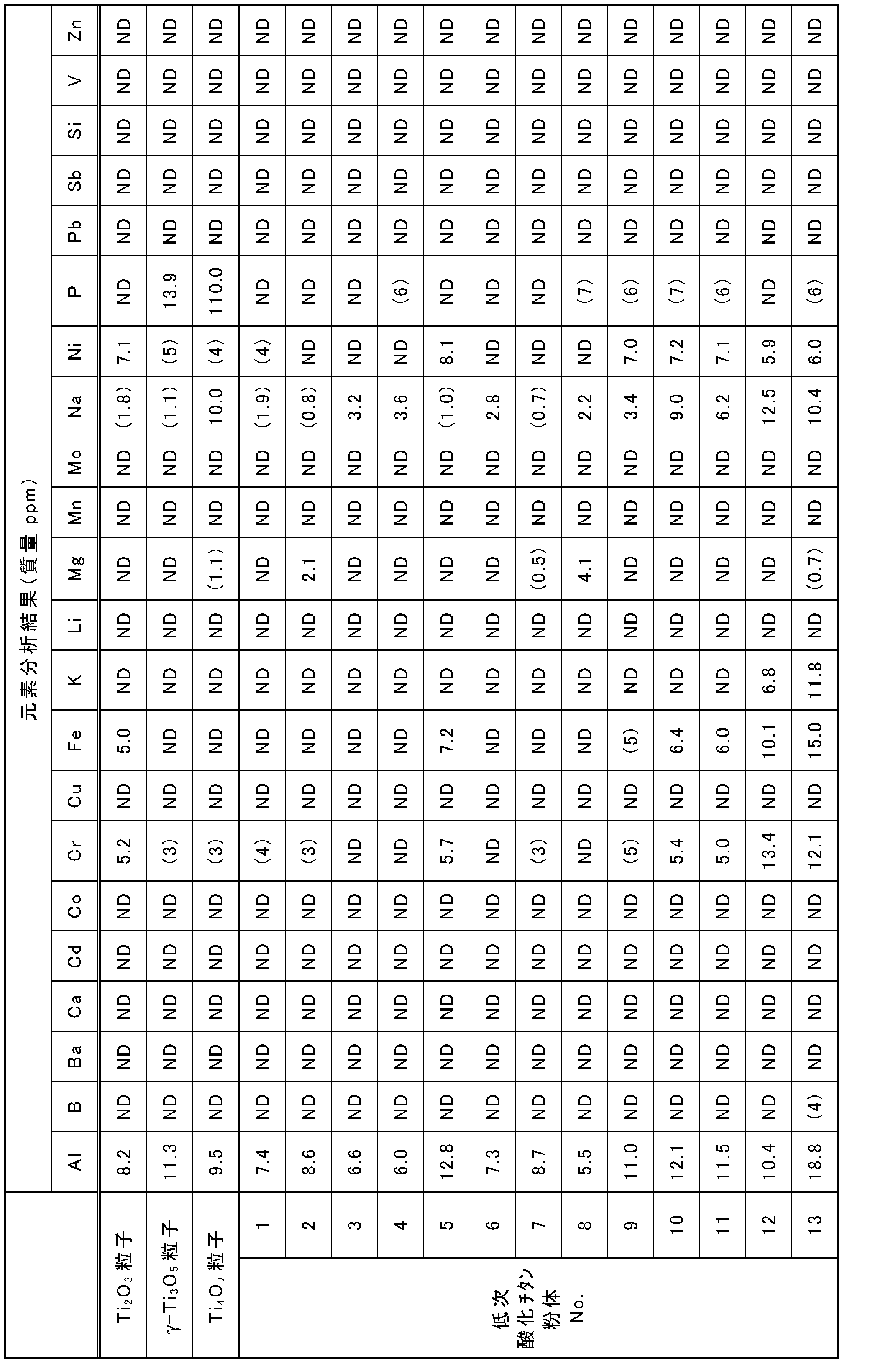
Claims (6)
- 第一の結晶組成を有する第一の粒子と、
前記第一の結晶組成と異なる第二の結晶組成を有する第二の粒子と、を含有する粉体であって、
前記第一の結晶組成及び前記第二の結晶組成のそれぞれが、Ti2O3、γ-Ti3O5及びTi4O7からなる群より選ばれる少なくとも一種を含む、粉体。 - 前記第一の結晶組成がTi2O3を含み、前記第二の結晶組成がγ-Ti3O5を含む、請求項1に記載の粉体。
- 前記第一の結晶組成がTi2O3を含み、前記第二の結晶組成がTi4O7を含む、請求項1に記載の粉体。
- 前記第一の結晶組成がγ-Ti3O5を含み、前記第二の結晶組成がTi4O7を含む、請求項1に記載の粉体。
- 前記第一の結晶組成及び前記第二の結晶組成と異なり、かつ、Ti2O3、γ-Ti3O5及びTi4O7からなる群より選ばれる少なくとも一種を含む第三の結晶組成を有する第三の粒子を更に含有する、請求項1~4のいずれか一項に記載の粉体。
- 請求項1~4のいずれか一項の記載の粉体と、分散媒と、を含有する分散体。
Priority Applications (5)
| Application Number | Priority Date | Filing Date | Title |
|---|---|---|---|
| EP22832909.0A EP4349784A4 (en) | 2021-07-01 | 2022-06-20 | POWDER AND DISPERSION |
| KR1020247000415A KR20240019245A (ko) | 2021-07-01 | 2022-06-20 | 분체 및 분산체 |
| JP2023531824A JP7682271B2 (ja) | 2021-07-01 | 2022-06-20 | 粉体及び分散体 |
| US18/573,868 US20240359998A1 (en) | 2021-07-01 | 2022-06-20 | Powder and dispersion |
| CN202280044240.4A CN117545721A (zh) | 2021-07-01 | 2022-06-20 | 粉体和分散体 |
Applications Claiming Priority (2)
| Application Number | Priority Date | Filing Date | Title |
|---|---|---|---|
| JP2021110079 | 2021-07-01 | ||
| JP2021-110079 | 2021-07-01 |
Publications (1)
| Publication Number | Publication Date |
|---|---|
| WO2023276761A1 true WO2023276761A1 (ja) | 2023-01-05 |
Family
ID=84691753
Family Applications (1)
| Application Number | Title | Priority Date | Filing Date |
|---|---|---|---|
| PCT/JP2022/024574 Ceased WO2023276761A1 (ja) | 2021-07-01 | 2022-06-20 | 粉体及び分散体 |
Country Status (7)
| Country | Link |
|---|---|
| US (1) | US20240359998A1 (ja) |
| EP (1) | EP4349784A4 (ja) |
| JP (1) | JP7682271B2 (ja) |
| KR (1) | KR20240019245A (ja) |
| CN (1) | CN117545721A (ja) |
| TW (1) | TWI873432B (ja) |
| WO (1) | WO2023276761A1 (ja) |
Cited By (3)
| Publication number | Priority date | Publication date | Assignee | Title |
|---|---|---|---|---|
| WO2024166757A1 (ja) * | 2023-02-10 | 2024-08-15 | デンカ株式会社 | 低次酸化チタン粉末 |
| WO2024166756A1 (ja) * | 2023-02-10 | 2024-08-15 | デンカ株式会社 | 低次酸化チタン粉末 |
| WO2024166758A1 (ja) * | 2023-02-10 | 2024-08-15 | デンカ株式会社 | 低次酸化チタン粉末 |
Families Citing this family (1)
| Publication number | Priority date | Publication date | Assignee | Title |
|---|---|---|---|---|
| CR20240236A (es) * | 2021-12-07 | 2024-11-01 | Southwire Co Llc | Conductor aéreo revestido |
Citations (6)
| Publication number | Priority date | Publication date | Assignee | Title |
|---|---|---|---|---|
| JPH05279040A (ja) * | 1992-03-31 | 1993-10-26 | Yamahatsu Sangyo Kk | 黒色酸化チタン系複合顔料粉末 |
| JP2010030842A (ja) | 2008-07-29 | 2010-02-12 | Mitsubishi Materials Corp | 黒色チタン酸窒化物粉末とその製造方法および用途 |
| JP2010280607A (ja) | 2009-06-04 | 2010-12-16 | Kose Corp | 油性化粧料 |
| JP2012214348A (ja) | 2011-04-01 | 2012-11-08 | National Institute For Materials Science | 還元型チタン酸化物合成方法 |
| JP2019012799A (ja) * | 2017-06-30 | 2019-01-24 | 国立大学法人 東京大学 | 電波吸収体 |
| JP2021095301A (ja) * | 2019-12-16 | 2021-06-24 | デンカ株式会社 | 低次酸化チタンの粉末及び分散体 |
Family Cites Families (5)
| Publication number | Priority date | Publication date | Assignee | Title |
|---|---|---|---|---|
| JP5622140B2 (ja) * | 2009-05-01 | 2014-11-12 | 学校法人加計学園 | 複合粒子を含む粉体及びその製造方法 |
| FR2996222B1 (fr) * | 2012-09-28 | 2015-10-09 | Saint Gobain Ct Recherches | Grains fondus de sous oxydes de titane et produits ceramiques comportant de tels grains |
| CN106976905B (zh) * | 2017-03-07 | 2018-08-24 | 中国科学院上海硅酸盐研究所 | 核壳结构的亚氧化钛及其可控制备方法 |
| JP7634015B2 (ja) * | 2020-08-21 | 2025-02-20 | デンカ株式会社 | 特定の低次酸化チタンの結晶組成を有する粒子、並びにその製造方法 |
| US20240092652A1 (en) * | 2021-01-25 | 2024-03-21 | Denka Company Limited | Particles having specific low-order titanium oxide crystal composition, method for producing same, and dispersion |
-
2022
- 2022-06-20 KR KR1020247000415A patent/KR20240019245A/ko active Pending
- 2022-06-20 US US18/573,868 patent/US20240359998A1/en active Pending
- 2022-06-20 WO PCT/JP2022/024574 patent/WO2023276761A1/ja not_active Ceased
- 2022-06-20 JP JP2023531824A patent/JP7682271B2/ja active Active
- 2022-06-20 EP EP22832909.0A patent/EP4349784A4/en not_active Withdrawn
- 2022-06-20 CN CN202280044240.4A patent/CN117545721A/zh active Pending
- 2022-06-27 TW TW111123812A patent/TWI873432B/zh active
Patent Citations (6)
| Publication number | Priority date | Publication date | Assignee | Title |
|---|---|---|---|---|
| JPH05279040A (ja) * | 1992-03-31 | 1993-10-26 | Yamahatsu Sangyo Kk | 黒色酸化チタン系複合顔料粉末 |
| JP2010030842A (ja) | 2008-07-29 | 2010-02-12 | Mitsubishi Materials Corp | 黒色チタン酸窒化物粉末とその製造方法および用途 |
| JP2010280607A (ja) | 2009-06-04 | 2010-12-16 | Kose Corp | 油性化粧料 |
| JP2012214348A (ja) | 2011-04-01 | 2012-11-08 | National Institute For Materials Science | 還元型チタン酸化物合成方法 |
| JP2019012799A (ja) * | 2017-06-30 | 2019-01-24 | 国立大学法人 東京大学 | 電波吸収体 |
| JP2021095301A (ja) * | 2019-12-16 | 2021-06-24 | デンカ株式会社 | 低次酸化チタンの粉末及び分散体 |
Non-Patent Citations (2)
| Title |
|---|
| See also references of EP4349784A4 |
| SUZUKI, FUKUJI. FUKUSHIMA, SHOJI: "Development of new black pigments and its application to cosmetics", JOURNAL OF THE JAPAN SOCIETY OF POWDER AND POWDER METALLURGY., vol. 28, no. 7, 1981, pages 239 - 244 * |
Cited By (3)
| Publication number | Priority date | Publication date | Assignee | Title |
|---|---|---|---|---|
| WO2024166757A1 (ja) * | 2023-02-10 | 2024-08-15 | デンカ株式会社 | 低次酸化チタン粉末 |
| WO2024166756A1 (ja) * | 2023-02-10 | 2024-08-15 | デンカ株式会社 | 低次酸化チタン粉末 |
| WO2024166758A1 (ja) * | 2023-02-10 | 2024-08-15 | デンカ株式会社 | 低次酸化チタン粉末 |
Also Published As
| Publication number | Publication date |
|---|---|
| US20240359998A1 (en) | 2024-10-31 |
| TWI873432B (zh) | 2025-02-21 |
| EP4349784A1 (en) | 2024-04-10 |
| EP4349784A4 (en) | 2024-11-13 |
| JP7682271B2 (ja) | 2025-05-23 |
| CN117545721A (zh) | 2024-02-09 |
| KR20240019245A (ko) | 2024-02-14 |
| JPWO2023276761A1 (ja) | 2023-01-05 |
| TW202311171A (zh) | 2023-03-16 |
Similar Documents
| Publication | Publication Date | Title |
|---|---|---|
| JP7682271B2 (ja) | 粉体及び分散体 | |
| WO2022158390A1 (ja) | 特定の低次酸化チタンの結晶組成を有する粒子及びその製造方法、並びに分散体 | |
| JP7634015B2 (ja) | 特定の低次酸化チタンの結晶組成を有する粒子、並びにその製造方法 | |
| Horsth et al. | Color stability of blue aluminates obtained from recycling and applied as pigments | |
| EP2799500B1 (en) | Composite oxide black pigment and method for producing same | |
| EP1406975B8 (en) | High strength fe-cr brown pigment with excellent weathering | |
| Eticha et al. | Effects of doping iron on the colouring properties of copper chromate pigment | |
| KR19990021940A (ko) | 무기안료의 제조방법 | |
| WO2020031804A1 (ja) | 無機顔料 | |
| Li et al. | Ultrafine V-ZrSiO4 pigment prepared by a bottom-up approach: Particle size evolution and chromatic properties | |
| JP2022114385A (ja) | 橙系無機顔料、被覆顔料、樹脂組成物 | |
| JP7587076B1 (ja) | 微粒子複合酸化物黄色顔料及びその製造方法 | |
| Feng et al. | Novel Co/Ni-free spinel-type CuFe2-x-yCrxMnyO4 high-temperature black ceramic pigment | |
| CN115362132B (zh) | 强着色的铁酸锰彩色颜料 | |
| WO2025094851A1 (ja) | ケイ酸塩系青色顔料及びその製造方法 | |
| WO2024166757A1 (ja) | 低次酸化チタン粉末 | |
| Taşçı | Investigation of the Use of Pink Pigment Obtained by Using Different Mineralizers in Wall Tile Glaze Recipes | |
| WO2024166756A1 (ja) | 低次酸化チタン粉末 | |
| WO2024166758A1 (ja) | 低次酸化チタン粉末 | |
| WO2025181233A1 (en) | Bismuth vanadate pigments comprising a doped core coated with an oxidic coating |
Legal Events
| Date | Code | Title | Description |
|---|---|---|---|
| 121 | Ep: the epo has been informed by wipo that ep was designated in this application |
Ref document number: 22832909 Country of ref document: EP Kind code of ref document: A1 |
|
| WWE | Wipo information: entry into national phase |
Ref document number: 2023531824 Country of ref document: JP |
|
| WWE | Wipo information: entry into national phase |
Ref document number: 202280044240.4 Country of ref document: CN |
|
| ENP | Entry into the national phase |
Ref document number: 20247000415 Country of ref document: KR Kind code of ref document: A |
|
| WWE | Wipo information: entry into national phase |
Ref document number: 2022832909 Country of ref document: EP Ref document number: 1020247000415 Country of ref document: KR |
|
| NENP | Non-entry into the national phase |
Ref country code: DE |
|
| ENP | Entry into the national phase |
Ref document number: 2022832909 Country of ref document: EP Effective date: 20240104 |
|
| WWW | Wipo information: withdrawn in national office |
Ref document number: 2022832909 Country of ref document: EP |