WO2023277040A1 - 消火体 - Google Patents
消火体 Download PDFInfo
- Publication number
- WO2023277040A1 WO2023277040A1 PCT/JP2022/025844 JP2022025844W WO2023277040A1 WO 2023277040 A1 WO2023277040 A1 WO 2023277040A1 JP 2022025844 W JP2022025844 W JP 2022025844W WO 2023277040 A1 WO2023277040 A1 WO 2023277040A1
- Authority
- WO
- WIPO (PCT)
- Prior art keywords
- fire
- layer
- extinguishing agent
- fire extinguishing
- fire extinguisher
- Prior art date
- Legal status (The legal status is an assumption and is not a legal conclusion. Google has not performed a legal analysis and makes no representation as to the accuracy of the status listed.)
- Ceased
Links
Images



Classifications
-
- A—HUMAN NECESSITIES
- A62—LIFE-SAVING; FIRE-FIGHTING
- A62C—FIRE-FIGHTING
- A62C35/00—Permanently-installed equipment
- A62C35/02—Permanently-installed equipment with containers for delivering the extinguishing substance
- A62C35/10—Containers destroyed or opened by flames or heat
-
- A—HUMAN NECESSITIES
- A62—LIFE-SAVING; FIRE-FIGHTING
- A62C—FIRE-FIGHTING
- A62C8/00—Hand tools or accessories specially adapted for fire-fighting, e.g. tool boxes
-
- A—HUMAN NECESSITIES
- A62—LIFE-SAVING; FIRE-FIGHTING
- A62C—FIRE-FIGHTING
- A62C19/00—Hand fire-extinguishers in which the extinguishing substance is expelled by an explosion; Exploding containers thrown into the fire
-
- B—PERFORMING OPERATIONS; TRANSPORTING
- B32—LAYERED PRODUCTS
- B32B—LAYERED PRODUCTS, i.e. PRODUCTS BUILT-UP OF STRATA OF FLAT OR NON-FLAT, e.g. CELLULAR OR HONEYCOMB, FORM
- B32B15/00—Layered products comprising a layer of metal
- B32B15/04—Layered products comprising a layer of metal comprising metal as the main or only constituent of a layer, which is next to another layer of the same or of a different material
- B32B15/08—Layered products comprising a layer of metal comprising metal as the main or only constituent of a layer, which is next to another layer of the same or of a different material of synthetic resin
-
- B—PERFORMING OPERATIONS; TRANSPORTING
- B32—LAYERED PRODUCTS
- B32B—LAYERED PRODUCTS, i.e. PRODUCTS BUILT-UP OF STRATA OF FLAT OR NON-FLAT, e.g. CELLULAR OR HONEYCOMB, FORM
- B32B15/00—Layered products comprising a layer of metal
- B32B15/04—Layered products comprising a layer of metal comprising metal as the main or only constituent of a layer, which is next to another layer of the same or of a different material
- B32B15/08—Layered products comprising a layer of metal comprising metal as the main or only constituent of a layer, which is next to another layer of the same or of a different material of synthetic resin
- B32B15/085—Layered products comprising a layer of metal comprising metal as the main or only constituent of a layer, which is next to another layer of the same or of a different material of synthetic resin comprising polyolefins
-
- B—PERFORMING OPERATIONS; TRANSPORTING
- B32—LAYERED PRODUCTS
- B32B—LAYERED PRODUCTS, i.e. PRODUCTS BUILT-UP OF STRATA OF FLAT OR NON-FLAT, e.g. CELLULAR OR HONEYCOMB, FORM
- B32B15/00—Layered products comprising a layer of metal
- B32B15/04—Layered products comprising a layer of metal comprising metal as the main or only constituent of a layer, which is next to another layer of the same or of a different material
- B32B15/08—Layered products comprising a layer of metal comprising metal as the main or only constituent of a layer, which is next to another layer of the same or of a different material of synthetic resin
- B32B15/088—Layered products comprising a layer of metal comprising metal as the main or only constituent of a layer, which is next to another layer of the same or of a different material of synthetic resin comprising polyamides
-
- B—PERFORMING OPERATIONS; TRANSPORTING
- B32—LAYERED PRODUCTS
- B32B—LAYERED PRODUCTS, i.e. PRODUCTS BUILT-UP OF STRATA OF FLAT OR NON-FLAT, e.g. CELLULAR OR HONEYCOMB, FORM
- B32B15/00—Layered products comprising a layer of metal
- B32B15/04—Layered products comprising a layer of metal comprising metal as the main or only constituent of a layer, which is next to another layer of the same or of a different material
- B32B15/08—Layered products comprising a layer of metal comprising metal as the main or only constituent of a layer, which is next to another layer of the same or of a different material of synthetic resin
- B32B15/09—Layered products comprising a layer of metal comprising metal as the main or only constituent of a layer, which is next to another layer of the same or of a different material of synthetic resin comprising polyesters
-
- B—PERFORMING OPERATIONS; TRANSPORTING
- B32—LAYERED PRODUCTS
- B32B—LAYERED PRODUCTS, i.e. PRODUCTS BUILT-UP OF STRATA OF FLAT OR NON-FLAT, e.g. CELLULAR OR HONEYCOMB, FORM
- B32B15/00—Layered products comprising a layer of metal
- B32B15/20—Layered products comprising a layer of metal comprising aluminium or copper
-
- B—PERFORMING OPERATIONS; TRANSPORTING
- B32—LAYERED PRODUCTS
- B32B—LAYERED PRODUCTS, i.e. PRODUCTS BUILT-UP OF STRATA OF FLAT OR NON-FLAT, e.g. CELLULAR OR HONEYCOMB, FORM
- B32B27/00—Layered products comprising a layer of synthetic resin
- B32B27/06—Layered products comprising a layer of synthetic resin as the main or only constituent of a layer, which is next to another layer of the same or of a different material
- B32B27/08—Layered products comprising a layer of synthetic resin as the main or only constituent of a layer, which is next to another layer of the same or of a different material of synthetic resin
-
- B—PERFORMING OPERATIONS; TRANSPORTING
- B32—LAYERED PRODUCTS
- B32B—LAYERED PRODUCTS, i.e. PRODUCTS BUILT-UP OF STRATA OF FLAT OR NON-FLAT, e.g. CELLULAR OR HONEYCOMB, FORM
- B32B27/00—Layered products comprising a layer of synthetic resin
- B32B27/06—Layered products comprising a layer of synthetic resin as the main or only constituent of a layer, which is next to another layer of the same or of a different material
- B32B27/10—Layered products comprising a layer of synthetic resin as the main or only constituent of a layer, which is next to another layer of the same or of a different material of paper or cardboard
-
- B—PERFORMING OPERATIONS; TRANSPORTING
- B32—LAYERED PRODUCTS
- B32B—LAYERED PRODUCTS, i.e. PRODUCTS BUILT-UP OF STRATA OF FLAT OR NON-FLAT, e.g. CELLULAR OR HONEYCOMB, FORM
- B32B27/00—Layered products comprising a layer of synthetic resin
- B32B27/16—Layered products comprising a layer of synthetic resin specially treated, e.g. irradiated
-
- B—PERFORMING OPERATIONS; TRANSPORTING
- B32—LAYERED PRODUCTS
- B32B—LAYERED PRODUCTS, i.e. PRODUCTS BUILT-UP OF STRATA OF FLAT OR NON-FLAT, e.g. CELLULAR OR HONEYCOMB, FORM
- B32B27/00—Layered products comprising a layer of synthetic resin
- B32B27/28—Layered products comprising a layer of synthetic resin comprising synthetic resins not wholly covered by any one of the sub-groups B32B27/30 - B32B27/42
- B32B27/281—Layered products comprising a layer of synthetic resin comprising synthetic resins not wholly covered by any one of the sub-groups B32B27/30 - B32B27/42 comprising polyimides
-
- B—PERFORMING OPERATIONS; TRANSPORTING
- B32—LAYERED PRODUCTS
- B32B—LAYERED PRODUCTS, i.e. PRODUCTS BUILT-UP OF STRATA OF FLAT OR NON-FLAT, e.g. CELLULAR OR HONEYCOMB, FORM
- B32B27/00—Layered products comprising a layer of synthetic resin
- B32B27/30—Layered products comprising a layer of synthetic resin comprising vinyl (co)polymers; comprising acrylic (co)polymers
- B32B27/304—Layered products comprising a layer of synthetic resin comprising vinyl (co)polymers; comprising acrylic (co)polymers comprising vinyl halide (co)polymers, e.g. PVC, PVDC, PVF, PVDF
-
- B—PERFORMING OPERATIONS; TRANSPORTING
- B32—LAYERED PRODUCTS
- B32B—LAYERED PRODUCTS, i.e. PRODUCTS BUILT-UP OF STRATA OF FLAT OR NON-FLAT, e.g. CELLULAR OR HONEYCOMB, FORM
- B32B27/00—Layered products comprising a layer of synthetic resin
- B32B27/30—Layered products comprising a layer of synthetic resin comprising vinyl (co)polymers; comprising acrylic (co)polymers
- B32B27/306—Layered products comprising a layer of synthetic resin comprising vinyl (co)polymers; comprising acrylic (co)polymers comprising vinyl acetate or vinyl alcohol (co)polymers
-
- B—PERFORMING OPERATIONS; TRANSPORTING
- B32—LAYERED PRODUCTS
- B32B—LAYERED PRODUCTS, i.e. PRODUCTS BUILT-UP OF STRATA OF FLAT OR NON-FLAT, e.g. CELLULAR OR HONEYCOMB, FORM
- B32B27/00—Layered products comprising a layer of synthetic resin
- B32B27/32—Layered products comprising a layer of synthetic resin comprising polyolefins
-
- B—PERFORMING OPERATIONS; TRANSPORTING
- B32—LAYERED PRODUCTS
- B32B—LAYERED PRODUCTS, i.e. PRODUCTS BUILT-UP OF STRATA OF FLAT OR NON-FLAT, e.g. CELLULAR OR HONEYCOMB, FORM
- B32B27/00—Layered products comprising a layer of synthetic resin
- B32B27/34—Layered products comprising a layer of synthetic resin comprising polyamides
-
- B—PERFORMING OPERATIONS; TRANSPORTING
- B32—LAYERED PRODUCTS
- B32B—LAYERED PRODUCTS, i.e. PRODUCTS BUILT-UP OF STRATA OF FLAT OR NON-FLAT, e.g. CELLULAR OR HONEYCOMB, FORM
- B32B27/00—Layered products comprising a layer of synthetic resin
- B32B27/36—Layered products comprising a layer of synthetic resin comprising polyesters
-
- B—PERFORMING OPERATIONS; TRANSPORTING
- B32—LAYERED PRODUCTS
- B32B—LAYERED PRODUCTS, i.e. PRODUCTS BUILT-UP OF STRATA OF FLAT OR NON-FLAT, e.g. CELLULAR OR HONEYCOMB, FORM
- B32B27/00—Layered products comprising a layer of synthetic resin
- B32B27/38—Layered products comprising a layer of synthetic resin comprising epoxy resins
-
- B—PERFORMING OPERATIONS; TRANSPORTING
- B32—LAYERED PRODUCTS
- B32B—LAYERED PRODUCTS, i.e. PRODUCTS BUILT-UP OF STRATA OF FLAT OR NON-FLAT, e.g. CELLULAR OR HONEYCOMB, FORM
- B32B3/00—Layered products comprising a layer with external or internal discontinuities or unevennesses, or a layer of non-planar shape; Layered products comprising a layer having particular features of form
- B32B3/02—Layered products comprising a layer with external or internal discontinuities or unevennesses, or a layer of non-planar shape; Layered products comprising a layer having particular features of form characterised by features of form at particular places, e.g. in edge regions
- B32B3/04—Layered products comprising a layer with external or internal discontinuities or unevennesses, or a layer of non-planar shape; Layered products comprising a layer having particular features of form characterised by features of form at particular places, e.g. in edge regions characterised by at least one layer folded at the edge, e.g. over another layer ; characterised by at least one layer enveloping or enclosing a material
-
- B—PERFORMING OPERATIONS; TRANSPORTING
- B32—LAYERED PRODUCTS
- B32B—LAYERED PRODUCTS, i.e. PRODUCTS BUILT-UP OF STRATA OF FLAT OR NON-FLAT, e.g. CELLULAR OR HONEYCOMB, FORM
- B32B7/00—Layered products characterised by the relation between layers; Layered products characterised by the relative orientation of features between layers, or by the relative values of a measurable parameter between layers, i.e. products comprising layers having different physical, chemical or physicochemical properties; Layered products characterised by the interconnection of layers
- B32B7/04—Interconnection of layers
- B32B7/05—Interconnection of layers the layers not being connected over the whole surface, e.g. discontinuous connection or patterned connection
-
- B—PERFORMING OPERATIONS; TRANSPORTING
- B32—LAYERED PRODUCTS
- B32B—LAYERED PRODUCTS, i.e. PRODUCTS BUILT-UP OF STRATA OF FLAT OR NON-FLAT, e.g. CELLULAR OR HONEYCOMB, FORM
- B32B7/00—Layered products characterised by the relation between layers; Layered products characterised by the relative orientation of features between layers, or by the relative values of a measurable parameter between layers, i.e. products comprising layers having different physical, chemical or physicochemical properties; Layered products characterised by the interconnection of layers
- B32B7/04—Interconnection of layers
- B32B7/12—Interconnection of layers using interposed adhesives or interposed materials with bonding properties
-
- A—HUMAN NECESSITIES
- A62—LIFE-SAVING; FIRE-FIGHTING
- A62C—FIRE-FIGHTING
- A62C3/00—Fire prevention, containment or extinguishing specially adapted for particular objects or places
- A62C3/16—Fire prevention, containment or extinguishing specially adapted for particular objects or places in electrical installations, e.g. cableways
-
- A—HUMAN NECESSITIES
- A62—LIFE-SAVING; FIRE-FIGHTING
- A62D—CHEMICAL MEANS FOR EXTINGUISHING FIRES OR FOR COMBATING OR PROTECTING AGAINST HARMFUL CHEMICAL AGENTS; CHEMICAL MATERIALS FOR USE IN BREATHING APPARATUS
- A62D1/00—Fire-extinguishing compositions; Use of chemical substances in extinguishing fires
-
- B—PERFORMING OPERATIONS; TRANSPORTING
- B32—LAYERED PRODUCTS
- B32B—LAYERED PRODUCTS, i.e. PRODUCTS BUILT-UP OF STRATA OF FLAT OR NON-FLAT, e.g. CELLULAR OR HONEYCOMB, FORM
- B32B2250/00—Layers arrangement
- B32B2250/40—Symmetrical or sandwich layers, e.g. ABA, ABCBA, ABCCBA
-
- B—PERFORMING OPERATIONS; TRANSPORTING
- B32—LAYERED PRODUCTS
- B32B—LAYERED PRODUCTS, i.e. PRODUCTS BUILT-UP OF STRATA OF FLAT OR NON-FLAT, e.g. CELLULAR OR HONEYCOMB, FORM
- B32B2307/00—Properties of the layers or laminate
- B32B2307/30—Properties of the layers or laminate having particular thermal properties
- B32B2307/306—Resistant to heat
- B32B2307/3065—Flame resistant or retardant, fire resistant or retardant
-
- B—PERFORMING OPERATIONS; TRANSPORTING
- B32—LAYERED PRODUCTS
- B32B—LAYERED PRODUCTS, i.e. PRODUCTS BUILT-UP OF STRATA OF FLAT OR NON-FLAT, e.g. CELLULAR OR HONEYCOMB, FORM
- B32B2307/00—Properties of the layers or laminate
- B32B2307/30—Properties of the layers or laminate having particular thermal properties
- B32B2307/31—Heat sealable
-
- B—PERFORMING OPERATIONS; TRANSPORTING
- B32—LAYERED PRODUCTS
- B32B—LAYERED PRODUCTS, i.e. PRODUCTS BUILT-UP OF STRATA OF FLAT OR NON-FLAT, e.g. CELLULAR OR HONEYCOMB, FORM
- B32B2307/00—Properties of the layers or laminate
- B32B2307/40—Properties of the layers or laminate having particular optical properties
- B32B2307/402—Coloured
- B32B2307/4023—Coloured on the layer surface, e.g. ink
-
- B—PERFORMING OPERATIONS; TRANSPORTING
- B32—LAYERED PRODUCTS
- B32B—LAYERED PRODUCTS, i.e. PRODUCTS BUILT-UP OF STRATA OF FLAT OR NON-FLAT, e.g. CELLULAR OR HONEYCOMB, FORM
- B32B2307/00—Properties of the layers or laminate
- B32B2307/70—Other properties
- B32B2307/724—Permeability to gases, adsorption
- B32B2307/7242—Non-permeable
-
- B—PERFORMING OPERATIONS; TRANSPORTING
- B32—LAYERED PRODUCTS
- B32B—LAYERED PRODUCTS, i.e. PRODUCTS BUILT-UP OF STRATA OF FLAT OR NON-FLAT, e.g. CELLULAR OR HONEYCOMB, FORM
- B32B2307/00—Properties of the layers or laminate
- B32B2307/70—Other properties
- B32B2307/732—Dimensional properties
-
- B—PERFORMING OPERATIONS; TRANSPORTING
- B32—LAYERED PRODUCTS
- B32B—LAYERED PRODUCTS, i.e. PRODUCTS BUILT-UP OF STRATA OF FLAT OR NON-FLAT, e.g. CELLULAR OR HONEYCOMB, FORM
- B32B2307/00—Properties of the layers or laminate
- B32B2307/70—Other properties
- B32B2307/738—Thermoformability
-
- B—PERFORMING OPERATIONS; TRANSPORTING
- B32—LAYERED PRODUCTS
- B32B—LAYERED PRODUCTS, i.e. PRODUCTS BUILT-UP OF STRATA OF FLAT OR NON-FLAT, e.g. CELLULAR OR HONEYCOMB, FORM
- B32B2307/00—Properties of the layers or laminate
- B32B2307/70—Other properties
- B32B2307/748—Releasability
-
- B—PERFORMING OPERATIONS; TRANSPORTING
- B32—LAYERED PRODUCTS
- B32B—LAYERED PRODUCTS, i.e. PRODUCTS BUILT-UP OF STRATA OF FLAT OR NON-FLAT, e.g. CELLULAR OR HONEYCOMB, FORM
- B32B2307/00—Properties of the layers or laminate
- B32B2307/70—Other properties
- B32B2307/75—Printability
-
- B—PERFORMING OPERATIONS; TRANSPORTING
- B32—LAYERED PRODUCTS
- B32B—LAYERED PRODUCTS, i.e. PRODUCTS BUILT-UP OF STRATA OF FLAT OR NON-FLAT, e.g. CELLULAR OR HONEYCOMB, FORM
- B32B2439/00—Containers; Receptacles
- B32B2439/40—Closed containers
- B32B2439/46—Bags
-
- B—PERFORMING OPERATIONS; TRANSPORTING
- B32—LAYERED PRODUCTS
- B32B—LAYERED PRODUCTS, i.e. PRODUCTS BUILT-UP OF STRATA OF FLAT OR NON-FLAT, e.g. CELLULAR OR HONEYCOMB, FORM
- B32B2571/00—Protective equipment
Definitions
- the present invention relates to a fire extinguisher.
- Patent Document 1 proposes the use of a fire extinguisher and a fire extinguisher to deal with ignition and fire problems.
- Patent Literature 2 proposes an automatic fire extinguishing device that is dropped from a helicopter.
- Patent Literature 3 proposes an aerosol fire extinguishing device.
- JP-A-9-276440 Japanese Patent Application Laid-Open No. 2015-6302 JP 2017-080023 A
- the present invention has been made in view of the above circumstances, and an object of the present invention is to provide a fire extinguisher that has excellent property stability of a deliquescent extinguishing agent and that can prevent the occurrence and spread of fire.
- One aspect of the present invention includes a packaging bag formed from a base material including a resin layer, and a deliquescent fire extinguishing agent enclosed in the packaging bag, and the packaging bag has a sealing portion on the periphery.
- a fire extinguisher having an adhesion strength between base materials in a sealing portion of 5 N/15 mm or more. With such a fire extinguisher, deterioration of the deliquescent fire extinguishing agent is suppressed by suppressing contact between the extinguishing agent and the outside air with the packaging bag whose peripheral portion is sufficiently sealed. That is, the fire extinguisher is excellent in property stability of the extinguishing agent.
- by providing a fire extinguishing body in advance near the object it becomes possible to extinguish the fire in the initial stage, and it is possible to suppress the spread of the fire to the surroundings.
- the resin layer may contain a polyolefin resin.
- the substrate may have a thickness of 4.5 to 1000 ⁇ m.
- the substrate may further include a gas barrier layer.
- the gas barrier layer may include a metal layer or a metal oxide layer.
- the resin layers may be heat-sealed together in the sealing portion.
- the width of the sealing portion may be 5 mm or more.
- the extinguishing body which is excellent in the property stability of the extinguishing agent which has deliquescent property, and can prevent outbreak and expansion of a fire can be provided.
- the advantages of the invention are briefly summarized below. ⁇ The damage caused by the spread of fire can be minimized. That is, initial fire extinguishing is possible. ⁇ There is no need for a person to carry a fire extinguisher to the area where the fire is to be extinguished after confirming that the fire has broken out. ⁇ Because it can be installed more easily than equipment such as automatic fire extinguishers, there are few restrictions on the installation location and it can be applied according to the necessary location. ⁇ Even if the extinguishing agent is deliquescent, the extinguishing agent can be stably enclosed, so the frequency of extinguishing body replacement can be reduced.
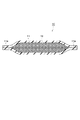
- FIG. 1 is a schematic external view of a fire extinguisher according to one embodiment.
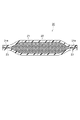
- FIG. 2 is a schematic cross-sectional view of a fire extinguisher according to one embodiment, and is a cross-sectional view along line II-II in FIG.
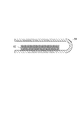
- FIG. 3 is a schematic cross-sectional view of a fire extinguisher according to another embodiment.
- FIG. 4 is a schematic external view of a fire extinguisher according to another embodiment.
- FIG. 5 is a schematic cross-sectional view of a fire extinguisher according to another embodiment.
- FIG. 6 is a schematic diagram showing a method for manufacturing a fire extinguisher according to one embodiment.
- FIG. 7 is a schematic diagram showing a method for manufacturing a fire extinguisher according to another embodiment.
- FIG. 1 is a schematic external view of a fire extinguisher according to one embodiment.
- FIG. 2 is a schematic cross-sectional view of a fire extinguisher according to one embodiment, and is a cross-sectional view along line II-II in FIG.
- the fire extinguisher 10 includes a packaging bag 11 formed from a base material including a resin layer, and a fire extinguishing agent 12 enclosed in the packaging bag.
- the packaging bag 11 has a sealing portion 11a on its peripheral edge, and the base materials are joined together at the sealing portion 11a. In this aspect, it can be said that the resin layers are thermally fused to each other in the sealing portion.
- FIG. 3 is a schematic cross-sectional view of a fire extinguisher according to another embodiment.
- the fire extinguishing body 20 includes a packaging bag 21 formed from a base material including a resin layer, and a fire extinguishing agent 22 enclosed in the packaging bag.
- the packaging bag 21 has a sealing portion 21a on its peripheral edge, and the base materials are bonded to each other with an adhesive 23 at the sealing portion 21a.
- the resin layers are bonded to each other with an adhesive in the sealing portion.
- FIG. 4 is a schematic external view of a fire extinguisher according to another embodiment.
- the fire extinguisher 30 includes a packaging bag 31 formed from a base material including a resin layer, and a fire extinguishing agent (not shown) enclosed in the packaging bag.
- the packaging bag 31 has a sealing portion 31a and a folded portion 31b on its peripheral edge, and the base materials are joined together at the sealing portion 31a.
- the folded portion 31b is formed by using a single substrate instead of a pair of substrates and folding it.
- the sealing portion 31a may conform to the sealing portion 11a or may conform to the sealing portion 21a.
- the adhesion strength between base materials in the sealing portion is 5 N/15 mm or more. Thereby, even if the fire extinguishing agent has deliquescence, the fire extinguishing agent can be stably enclosed. From this point of view, the adhesion strength may be 7 N/15 mm or more, or may be 10 N/15 mm or more. Although the upper limit of the adhesion strength is not particularly limited, it can be set to about 35 N/15 mm because there is a risk of material breakage during strength measurement.
- the adhesion strength can be changed by adjusting the resin layer, adjusting the adhesive, adjusting the heat sealing conditions (heat sealing temperature, pressure, time), and the like.
- the adhesion strength between base materials is measured as follows. That is, a sample is prepared in which the resin layers of the base material are heat-sealed or adhered to each other with an adhesive. The heat-sealed portion or bonded portion of this sample was cut to a width of 15 mm, and was subjected to T-shaped peeling at a peeling speed of 300 mm/min with a tensile tester placed in an environment of room temperature of 23°C in accordance with JIS K 6854-3. The average strength from the start of peeling until the heat-sealed portion or the bonded portion separates is defined as the adhesive strength between the substrates.
- the width of the sealing portion is not particularly limited, but from the viewpoint of property stability of the fire extinguishing agent, it can be, for example, 5 mm or more. It may be ⁇ 40 mm.
- the thickness of the central part of the fire extinguisher is not necessarily limited because it varies depending on the layer structure and the amount of the extinguishing agent enclosed, but from the viewpoint of maintaining the fire extinguishing performance and reducing the thickness so that the installation space does not matter, For example, it can be 2 to 20 mm. Also, the area of the main surface of the fire extinguisher (the surface when the fire extinguisher is viewed from above in the vertical direction) can be, for example, 9 to 620 cm 2 from the viewpoint of fire extinguishing performance and handleability.
- a fire extinguisher is provided in advance on or near an object that may catch fire. When an object catches fire, initial fire extinguishing is performed by the extinguishing body.
- the substrate includes a resin layer.
- Materials for the resin layer include polyolefin (PE, PP, COP, etc.), polyester (PET, etc.), fluorine resin (PTFE, ETFE, EFEP, PFA, FEP, PCTFE, etc.), vinyl resin (PVC, PVA, etc.), acrylic Examples include resins, epoxy resins, polyamides, polyimides, and the like.
- the substrate may be composed of one resin layer made of these materials, or may be composed of a plurality of resin layers. The plurality of resin layers may be made of different materials. When the base material is composed of a plurality of layers, the layers may be adhered to each other with an adhesive (adhesion layer).
- adhesives examples include acrylic adhesives, epoxy adhesives, silicone adhesives, polyolefin adhesives, urethane adhesives, polyvinyl ether adhesives, or synthetic adhesives thereof (e.g., epoxy-urethane synthetic adhesives). adhesives), and the like.
- the resin layer may have thermal adhesiveness (heat melting property).
- a resin layer having heat-fusible properties can be called a heat-fusible layer.
- the thermal adhesive layer can be provided on the innermost layer side of the substrate (the side facing the fire extinguishing agent).
- the sealed portion at the periphery of the packaging bag can be called a heat-sealed portion (heat-sealed portion).
- a polyolefin-based resin is mentioned as a resin having heat-sealing properties. That is, the resin layer may contain a polyolefin resin.
- Polyolefin-based resins include low-density polyethylene resin (LDPE), linear low-density polyethylene resin (LLDPE), medium-density polyethylene resin (MDPE), non-stretched polypropylene resin (CPP) and other polyolefin-based resins, and ethylene vinyl acetate.
- LDPE low-density polyethylene resin
- LLDPE linear low-density polyethylene resin
- MDPE medium-density polyethylene resin
- CPP non-stretched polypropylene resin
- other polyolefin-based resins and ethylene vinyl acetate.
- examples include polyethylene resins such as copolymers and ethylene/ ⁇ -olefin copolymers, and polypropylene resins such as propylene/ethylene random copolymers, propylene/ethylene block copolymers, and propylene/ ⁇ -olefin copolymers.
- polyolefin resins are low-density polyethylene resins (LDPE) and linear low-density polyethylene resins (LLDPE) from the viewpoint of excellent heat sealability, low water vapor permeability and easy suppression of deterioration of extinguishing agents. , or unstretched polypropylene resin (CPP). These resins are transparent and facilitate visual inspection of the extinguishing agent. Therefore, it becomes easy to confirm the replacement timing of the fire extinguisher.
- LDPE low-density polyethylene resins
- LLDPE linear low-density polyethylene resins
- CPP unstretched polypropylene resin
- the substrate may contain a gas barrier layer.
- the gas barrier layer may be provided on the outermost layer side of the substrate, or may be provided as an intermediate layer of the substrate.
- the water vapor permeability of the gas barrier layer is not particularly limited because it can be designed according to the type of extinguishing agent, but it can be 10 g/m 2 /day or less, and 1 g /m 2 /day or less.
- the gas barrier layer includes a metal layer, a metal oxide layer, and the like. Specifically, a metal oxide vapor deposition layer such as an alumina vapor deposition layer and a silica vapor deposition layer, and a metal foil such as an aluminum foil. is mentioned.
- the substrate may further include a resin layer for supporting the gas barrier layer in addition to the resin layer provided as the innermost layer.
- the metal oxide vapor deposition layer may face the extinguishing agent side.
- the thickness of the base material can be appropriately selected according to the usage environment of the fire extinguisher, the allowable space, etc. For example, if the base material is thick, it is easy to suppress water vapor permeation, to obtain strength and rigidity, to obtain a highly planar shape, and to facilitate handling. Also, if the substrate is thin, the fire extinguishing body can be provided in a narrow space.
- the thickness of the substrate may be, for example, 4.5-1000 ⁇ m, may be 12-100 ⁇ m, may be 12-50 ⁇ m.
- the thickness of the resin layer and the gas barrier layer may be appropriately adjusted according to the thickness of the substrate.
- the thickness of the resin layer (the total thickness when the substrate includes a plurality of resin layers) can be, for example, 4.5 to 150 ⁇ m, and may be 10 to 100 ⁇ m.
- the thickness of the gas barrier layer can be, for example, 5 to 100 nm in the case of a metal oxide deposited layer, and 0.8 to 30 ⁇ m in the case of a metal foil.
- the extinguishing agent is not particularly limited, and one having so-called four fire-extinguishing elements (removing action, cooling action, suffocating action, and negative catalytic action) can be appropriately used according to the mode of the object.
- the packaging bag of the present embodiment can be suitably used particularly for a deliquescent fire extinguishing agent.
- deliquescent fire extinguishing agents include general fire extinguishing agents (including powder fire extinguishing agents mainly composed of potassium salts, and general powder extinguishing agents such as sodium hydrogen carbonate and phosphate). .
- Universal extinguishing agents include ABC extinguishing agents, and extinguishing agents for oil and electrical fires include BC extinguishing agents.
- the object is a lithium ion battery
- a BC fire extinguishing agent or other fire extinguishing agent for lithium ion batteries is used.
- the fire extinguishing agent may contain at least one salt of a deliquescent organic salt and an inorganic salt that generally has extinguishing performance.
- Potassium salts, sodium salts, ammonium salts and the like are examples of organic salts that function as fire extinguishing agents.
- a potassium salt can be preferably used as the organic salt.
- organic potassium salts include carboxylic acid potassium salts such as potassium acetate, potassium citrate (tripotassium citrate, dipotassium citrate, monopotassium citrate), potassium tartrate, potassium lactate, potassium oxalate, and potassium maleate. be done. Of these, potassium citrate can be used from the viewpoint of usefulness for the negative catalytic effect of combustion.
- Inorganic salts that function as fire extinguishing agents include potassium salts and sodium salts.
- a potassium salt can be preferably used as the inorganic salt.
- examples of inorganic potassium salts include potassium tetraborate, potassium carbonate, potassium hydrogen carbonate, potassium dihydrogen phosphate, and dipotassium hydrogen phosphate. Of these, potassium hydrogen carbonate can be used from the viewpoint of usefulness for the negative catalytic effect of combustion.
- the organic salt and inorganic salt may be used alone or in combination of two or more.
- the extinguishing agent may contain ingredients other than the salt described above.
- Other components include, for example, an oxidizing agent for improving the reactivity of the salt, and specific examples include potassium chlorate, sodium chlorate, strontium chlorate, ammonium chlorate, magnesium chlorate, and the like.
- Other components include coloring agents, antioxidants, flame retardants, inorganic fillers, fluidity imparting agents, moisture-proof agents, dispersants, UV absorbers, metal catalysts, and the like.
- the amount of fire extinguishing agent can be appropriately selected according to the type of object, the thermal power at the time of ignition, the fire extinguishing time, the allowable space, and the like.
- the amount of extinguishing agent may be, for example, 0.4-3.9 g/cm 2 , may be 1.0-2.5 g/cm 2 , or may be 0.01-1.0 g/cm 2 . and may be between 0.02 and 0.2 g/cm 2 .
- the extinguishing agent may be mixed with the binder. That is, the fire extinguishing agent may be a composition comprising a fire extinguishing agent (fire extinguishing agent component) and a binder.
- the content of the fire extinguishing agent contained in the composition (fire extinguishing agent composition) can be 70 to 97% by mass based on the total amount of the extinguishing agent composition.
- Thermoplastic resins and thermosetting resins can be used as binder resins.
- Polyolefin-based resins such as polyvinyl alcohol-based resins, polyvinyl acetal-based resins, polypropylene-based resins, polyethylene-based resins, poly(1-)butene-based resins, and polypentene-based resins as thermoplastic resins, polystyrene-based resins, acrylonitrile-butadiene-styrene resins, methyl methacrylate-butadiene-styrene resins, ethylene-vinyl acetate resins, ethylene-propylene resins, polycarbonate resins, polyphenylene ether resins, acrylic resins, polyamide resins, polyvinyl chloride resins, and the like.
- Thermosetting resins include natural rubber (NR), isoprene rubber (IR), butadiene rubber (BR), 1,2-polybutadiene rubber (1,2-BR), styrene-butadiene rubber (SBR), chloroprene rubber (CR ), nitrile rubber (NBR), butyl rubber (IIR), ethylene-propylene rubber (EPR, EPDM), chlorosulfonated polyethylene (CSM), acrylic rubber (ACM, ANM), epichlorohydrin rubber (CO, ECO), polyvulcanized rubber (T), silicone rubber (Q), fluororubber (FKM, FZ), urethane rubber (U), polyurethane resin, polyisocyanate resin, polyisocyanurate resin, phenol resin, epoxy resin, and the like.
- the binder resin may contain a curing agent component.
- the fire extinguishing agent may be formed as a fire extinguishing agent layer on the extinguishing agent support layer.
- the use of the fire-extinguishing agent support layer facilitates the handling of the fire-extinguishing agent.
- the fire-extinguishing agent-supporting layer include the layers exemplified as the resin layer of the base material, and specific examples include a polyester resin layer (for example, a PET layer).
- the fire extinguishing agent layer can be formed on the object by applying a coating liquid of a fire extinguishing agent composition containing a liquid medium on the extinguishing agent support layer of the object and drying it.
- Application can be performed by a wet coating method.
- Wet coating methods include gravure coating, comma coating, spray coating, dip coating, curtain coating, spin coating, sponge roll, die coating, and brush coating.
- the viscosity of the coating liquid is preferably 1 to 2000 mPa ⁇ s for the gravure coating method, preferably 500 to 100000 mPa ⁇ s for the comma coating method, and 0.0 mPa ⁇ s for the spray coating method. It is preferably 1 to 4000 mPa ⁇ s.
- the amount of the liquid medium may be appropriately adjusted so that the viscosity of the coating liquid is within the desired range. Viscosity can be measured with a coaxial double-cylinder rotational viscometer.
- the amount of the liquid medium may be appropriately adjusted according to the method of use of the coating liquid, but it can be 40 to 60% by mass based on the total amount of the fire extinguishing agent composition.
- adhesives examples include acrylic adhesives, epoxy adhesives, silicone adhesives, polyolefin adhesives, urethane adhesives, polyvinyl ether adhesives, synthetic adhesives thereof, and the like.
- urethane-based adhesives and epoxy-urethane synthetic adhesives are preferably used as the adhesive from the viewpoint of achieving both adhesion to the substrate under high temperature and high humidity conditions of 85° C.-85% RH and low cost. be able to.
- the periphery of the base material can be joined even if the resin layer does not have heat-sealing properties.
- the sealed portion at the peripheral edge of the packaging bag can be called an adhesive portion.
- the adhesive is used only in the sealing portion, but it may be used on the entire inner surface of the substrate as long as the adhesive does not affect the property stability of the extinguishing agent.
- FIG. 5 is a schematic cross-sectional view of a fire extinguisher according to another embodiment.
- the fire extinguishing body 60 includes a packaging bag 61 formed from a base material, a fire extinguishing agent 62 enclosed in the packaging bag, an adhesive layer 64 (or an adhesive layer) and a release film 65 on one side of the packaging bag, Prepare.
- the substrate includes a resin layer 611 as an inner layer and a gas barrier layer 612 as an outer layer.
- the resin layer 611 and the gas barrier layer 612 are laminated with an adhesive layer 63 interposed therebetween.
- the extinguishing agent 62 is formed as an extinguishing agent layer on the extinguishing agent support layer 613 .
- a release film 65 is provided so as to cover the adhesive layer 64 .
- the release film 65 is peeled off when the fire extinguisher is attached to a desired location, and may be made of resin or paper.
- the fire extinguisher may further comprise a design layer.
- the design layer can be formed by printing or printing. Specific examples of design include a woodgrain tone that is conscious of a living space, a solid pattern of white such as a tile tone, a solid gray tone, a pattern, a pattern, a design, a character pattern, and the like.
- the design layer can be provided on the surface of the packaging bag opposite to the adhesive layer side (the side on which the fire extinguishing body is attached).
- the design layer may be provided in the base material.
- the design layer may be provided inside the gas barrier layer.
- the design layer may have a single layer structure or a multilayer structure.
- the object to be extinguished is not particularly limited as long as it is likely to catch fire. Items that may catch fire include, for example, electric wires, switchboards, distribution boards, control boards, storage batteries (lithium ion batteries, etc.), wallpaper for building materials, building materials such as ceiling materials, and lithium ion battery recovery.
- Items that may catch fire include, for example, electric wires, switchboards, distribution boards, control boards, storage batteries (lithium ion batteries, etc.), wallpaper for building materials, building materials such as ceiling materials, and lithium ion battery recovery.
- the fire extinguisher can be manufactured, for example, by the following manufacturing methods, but is not limited to these.
- FIG. 6 is a schematic diagram showing a method for manufacturing a fire extinguisher according to one embodiment.
- a fire extinguishing body can be obtained by providing a fire extinguishing agent 42 between a pair of base materials 44 and sealing the periphery of the base materials 44 by heat sealing or adhesive. Heat-sealing can be performed using a heat-seal bar under the conditions of, for example, 80 to 140° C., 0.15 to 0.4 MPa, and 0.1 to 50 seconds.
- FIG. 7 is a schematic diagram showing a method for manufacturing a fire extinguisher according to another embodiment. As shown in the figure, one base material 54 is folded back, a fire-extinguishing agent 52 is provided between the facing base materials 54, and the periphery of the base material 54 other than the folded part is joined by heat sealing or an adhesive. A fire extinguishing body can be obtained by sealing.
- one sheet of base material is folded back, and the edges of the opposing base materials are joined with heat sealing or adhesive while leaving the opening. After extinguishing agent is poured through the opening, the opening is joined with heat sealing or adhesive. Then, the extinguishing body can be obtained by sealing.
- a coating liquid containing the extinguishing agent composition is applied on the resin layer or the extinguishing agent support layer to form the extinguishing agent layer.
- a coating liquid containing the extinguishing agent composition is applied on the resin layer or the extinguishing agent support layer to form the extinguishing agent layer.
- the extinguishing agent may be provided between the substrates by placing a resin kneaded with the extinguishing agent on the substrates.
- the extinguishing agent (extinguishing agent-containing layer) may be a layer of a composition containing an extinguishing agent and a binder, or a resin layer containing an extinguishing agent.
- [Invention 1] A packaging bag formed from a base material containing a resin layer, and a deliquescent fire extinguishing agent enclosed in the packaging bag, A fire extinguisher, wherein the packaging bag has a sealing portion on its periphery, and the adhesion strength between the base materials in the sealing portion is 5 N/15 mm or more.
- [Invention 2] The fire extinguishing body according to invention 1, wherein the resin layer contains a polyolefin resin.
- [Invention 3] The fire extinguishing body according to invention 1 or 2, wherein the substrate has a thickness of 4.5 to 1000 ⁇ m.
- invention 4 The fire extinguishing body according to any one of inventions 1 to 3, wherein said substrate further comprises a gas barrier layer.
- invention 5 The fire extinguishing body according to invention 4, wherein the gas barrier layer comprises a metal layer or a metal oxide layer.
- invention 6 The fire extinguishing body according to any one of Inventions 1 to 5, wherein the resin layers are heat-sealed to each other in the sealing portion.
- invention 7 The fire extinguishing body according to any one of Inventions 1 to 6, wherein the width of the sealing portion is 5 mm or more.
- Example 1 Epoxy-urethane synthetic adhesives AD-393 and CAT-EP5 manufactured by Toyo Ink, and IPA as a dilution solvent were prepared. % by mass of dry laminating adhesive was prepared. An LDPE film (manufactured by Mitsui Chemicals Tohcello, Inc., thickness 30 ⁇ m) and a PET film GL-ARH (manufactured by Toppan Printing Co., Ltd., thickness 12 ⁇ m) provided with an alumina deposition layer were prepared.
- LDPE film manufactured by Mitsui Chemicals Tohcello, Inc., thickness 30 ⁇ m
- PET film GL-ARH manufactured by Toppan Printing Co., Ltd., thickness 12 ⁇ m
- the above dry lamination adhesive was applied to the alumina deposition layer side of GL-ARH by a bar coating method using a wire bar #14, dried in an oven at 80 ° C. for 30 seconds, and dry coated. An adhesive layer with an amount of 2 g/m 2 was obtained.
- a desktop laminator FA-570 manufactured by Taisei Laminator Co., Ltd. the corona-treated side of the LDPE film was laminated to the adhesive layer under conditions of lamination temperature of 60° C. and pressure of 0.5 MPa to obtain a laminated film.
- Two 50 mm square samples were cut from the laminated film, and placed in a heat sealer TP-701-B manufactured by Tester Sangyo Co., Ltd. with the LDPE films facing each other.
- the heat-sealed portion of the fire extinguisher obtained in each example was cut into a width of 15 mm to obtain a sample.
- This sample was subjected to T-shaped peeling at a peeling speed of 300 mm / min with a tensile tester placed in an environment of room temperature 23 ° C. in accordance with JIS K 6854-3. The strength was measured until it left. This measurement was performed three times at different positions of the heat-sealed portion, and the average value was taken as the adhesion strength between the substrates.
- the total light transmittance of the extinguishing body obtained in each example was measured. Specifically, using a haze meter (manufactured by BYK), after calibrating the device, fix the sample so that the light entering the integrating sphere from the light source passes through the fire extinguishing agent filled in the bag of the laminated film of the fire extinguishing body. and measured. The total light transmittance was measured immediately after the fire extinguishing body was prepared (initial stage) and after a predetermined time (88 hours or 232 hours) had passed after the fire extinguishing body was placed in the 85° C.-85% Rh constant temperature and humidity chamber.
- the fire extinguisher of the present invention can be suitably used particularly for members used in industrial materials such as building materials, automobile members, aircraft members, and electronic members.
Landscapes
- Business, Economics & Management (AREA)
- Emergency Management (AREA)
- Health & Medical Sciences (AREA)
- Public Health (AREA)
- Chemical & Material Sciences (AREA)
- Chemical Kinetics & Catalysis (AREA)
- General Chemical & Material Sciences (AREA)
- Laminated Bodies (AREA)
Abstract
Description
・炎が燃え広がることによる被害を最小限に留められる。すなわち初期消火が可能である。
・人が火災発生を確認後、消火器を消火対象付近に持ち運び消火活動を行う必要が無い。
・自動消火装置等の設備に比して簡易的に設置できるため、設置場所の制限が少なくかつ必要な箇所に応じて適用することができる。
・消火剤が潮解性を有する場合であっても、消火剤を安定して封入しておくことができるため、消火体の交換頻度を低減することができる。
図1は、一実施形態に係る消火体の模式外観図である。図2は、一実施形態に係る消火体の模式断面図であり、図1におけるII-II線断面図である。消火体10は、樹脂層を含む基材から形成された包装袋11と、包装袋内に封入された消火剤12と、を備える。包装袋11は周縁に封止部11aを有し、封止部11aにおいて基材同士が接合されている。本態様では、封止部において、樹脂層同士が熱融着されていると言うことができる。
基材は樹脂層を含む。樹脂層の材質としては、ポリオレフィン(PE、PP、COP等)、ポリエステル(PET等)、フッ素樹脂(PTFE、ETFE、EFEP、PFA、FEP、PCTFE等)、ビニル樹脂(PVC、PVA等)、アクリル樹脂、エポキシ樹脂、ポリアミド、ポリイミド等が挙げられる。基材は、これらの材質からなる一つの樹脂層から構成されていてよく、複数の樹脂層から構成されていてよい。複数の樹脂層は、それぞれ異なる材質からなるものであってよい。基材が複数の層から構成される場合、層同士は接着剤(接着層)により接着されていてよい。接着剤としては、アクリル系接着剤、エポキシ系接着剤、シリコーン系接着剤、ポリオレフィン系接着剤、ウレタン系接着剤又はポリビニルエーテル系接着剤、またはそれら合成系接着剤(例えば、エポキシ-ウレタン合成系接着剤)、等が挙げられる。
消火剤としては特に制限されず、いわゆる消火の4要素(除去作用、冷却作用、窒息作用、負触媒作用)を有するものを、対象物の態様に応じて適宜用いることができる。本実施形態の包装袋は、特に潮解性を有する消火剤に対し好適に用いることができる。潮解性を有する消火剤としては、一般消火薬剤(カリウム塩を主成分とする粉末系消火剤の他、炭酸水素ナトリウムやリン酸塩等の一般的な粉末系消火剤が挙げられる)が挙げられる。万能な消火剤としてはABC消火剤が挙げられ、油や電気火災用の消火剤としてはBC消火剤が挙げられる。対象物がリチウムイオン電池である場合は、BC消火剤や、その他リチウムイオン電池用の消火剤が用いられる。
塗布はウェットコーティング法にて行うことができる。ウェットコーティング法としては、グラビアコーティング法、コンマコーティング法、スプレーコーティング法、ディップコーティング法、カーテンコート法、スピンコート法、スポンジロール法、ダイコート法、刷毛による塗装等が挙げられる。
塗液の粘度は、例えばグラビアコーティング法であれば、1~2000mPa・sとすることが好ましく、コンマコーティング法であれば500~100000mPa・sとすることが好ましく、スプレーコーティング法であれば0.1~4000mPa・sとすることが好ましい。塗液粘度が所望の範囲になるよう、上記液状媒体の量を適宜に調整すればよい。粘度は共軸二重円筒回転粘度計により測定することができる。
液状媒体の量は、塗液の使用方法に応じて適宜に調整すればよいが、消火剤組成物の全量を基準として40~60質量%とすることができる。
接着剤としては、アクリル系接着剤、エポキシ系接着剤、シリコーン系接着剤、ポリオレフィン系接着剤、ウレタン系接着剤又はポリビニルエーテル系接着剤、またはそれら合成系接着剤、等が挙げられる。これらのうち、85℃-85%RH高温高湿時における基材との密着性、低コストを両立する観点から、接着剤としてはウレタン系接着剤やエポキシ-ウレタン合成系接着剤を好適に用いることができる。
消火対象物としては、発火する虞のあるものであれば特に制限されない。発火する虞のあるものとしては、例えば、対象物としては、電線、配電盤、分電盤、制御盤、蓄電池(リチウムイオン電池等)、建材用壁紙、天井材等の建材、リチウムイオン電池回収用BOX(リサイクルBOX)、ごみ箱、自動車関連部材、コンセント、コンセントカバーなどの各部材が挙げられる。
消火体は、例えば以下の製造方法により製造することができるが、これらに制限されるものではない。
[発明1]
樹脂層を含む基材から形成された包装袋と、前記包装袋内に封入された潮解性を有する消火剤と、を備え、
前記包装袋が周縁に封止部を有し、前記封止部における前記基材間の密着強度が5N/15mm以上である、消火体。
[発明2]
前記樹脂層がポリオレフィン系樹脂を含む、発明1に記載の消火体。
[発明3]
前記基材の厚さが4.5~1000μmである、発明1又は2に記載の消火体。
[発明4]
前記基材がさらにガスバリア層を含む、発明1~3のいずれか一に記載の消火体。
[発明5]
前記ガスバリア層が金属層又は金属酸化物層を含む、発明4に記載の消火体。
[発明6]
前記封止部において、前記樹脂層同士が熱融着されている、発明1~5のいずれか一に記載の消火体。
[発明7]
前記封止部の幅が5mm以上である、発明1~6のいずれか一に記載の消火体。
(実施例1)
東洋インキ製のエポキシ-ウレタン合成系接着剤AD-393とCAT-EP5、希釈溶剤としてIPAを用意し、これらを配合比15:1:25.7で混合後、1分間攪拌し、固形分20質量%のドライラミネート用接着剤を作製した。
LDPEフィルム(三井化学東セロ株式会社製、厚さ30μm)と、アルミナ蒸着層を備えるPETフィルムであるGL-ARH(凸版印刷株式会社製、厚さ12μm)を用意した。
GL-ARHのアルミナ蒸着層側に、上記のドライラミネート用接着剤をワイヤーバー#14を用いてバーコート法にて塗工し、80℃、30秒の条件でオーブンにて乾燥し、ドライ塗布量2g/m2の接着層を得た。
大成ラミネーター製の卓上ラミネーターFA-570を用いて、ラミネート温度60℃、圧力0.5MPaの条件で、上記の接着層にLDPEフィルムのコロナ処理面側を貼合し、積層フィルムを得た。
積層フィルムから50mm角サンプルを2枚切り出し、LDPEフィルムが対向するようにして、テスター産業社製のヒートシーラーTP-701-Bに設置した。そして、熱融着部の幅が1cmとなるように、100℃、0.3MPa、0.5秒間の条件で、幅1cm、長さ30cmのシールバーを用いて、積層フィルムの端部3辺をヒートシールし、積層フィルムの袋を得た。
消火剤として、潮解性を有するモリタ宮田工業株式会社製ABC消火剤を8.2g計量し、積層フィルムの袋内に充填した。
上記のヒートシーラーを用いて、開口部端部を上記と同様の条件でヒートシールし、消火体を作製した。
ヒートシール条件を表1に示すように変更したこと以外は、実施例1と同様にして消火体を作製した。
各例の消火体について下記評価を実施した。結果を表1に示す。
各例で得られた消火体の熱融着部を15mm幅に切り出してサンプルを得た。このサンプルに対し、JIS K 6854-3に準拠し、室温23℃の環境下に置かれた引張試験機で300mm/分の剥離速度でT字剥離したときの、剥離開始から熱融着部が離れるまでの強度を測定した。この測定を、熱融着部の場所を変えて3回行い、その平均値を基材間の密着強度とした。
各例で得られた消火体の全光線透過率を測定した。具体的にはヘイズメーター(BYK社製)を用い、装置の校正実施後、光源から積分球に入る光が消火体の積層フィルムの袋内に充填した消火剤を通過するように、試料を固定して測定した。全光線透過率は、消火体作製直後(初期)と、消火体を85℃-85%Rh恒温恒湿槽に入れた後所定時間(88時間又は232時間)経過した後に測定した。この作業を、測定箇所を変えて3回行い、その平均値を記録した。消火剤の潮解が進むほどに消火剤が透明化して全光線透過率の値が上昇するため、全光線透過率を測定することで消火剤の潮解の程度を把握することができる。

Claims (7)
- 樹脂層を含む基材から形成された包装袋と、前記包装袋内に封入された潮解性を有する消火剤と、を備え、
前記包装袋が周縁に封止部を有し、前記封止部における前記基材間の密着強度が5N/15mm以上である、消火体。 - 前記樹脂層がポリオレフィン系樹脂を含む、請求項1に記載の消火体。
- 前記基材の厚さが4.5~1000μmである、請求項1又は2に記載の消火体。
- 前記基材がさらにガスバリア層を含む、請求項1又は2に記載の消火体。
- 前記ガスバリア層が金属層又は金属酸化物層を含む、請求項4に記載の消火体。
- 前記封止部において、前記樹脂層同士が熱融着されている、請求項1又は2に記載の消火体。
- 前記封止部の幅が5mm以上である、請求項1又は2に記載の消火体。
Priority Applications (5)
| Application Number | Priority Date | Filing Date | Title |
|---|---|---|---|
| EP22833186.4A EP4364820A4 (en) | 2021-07-02 | 2022-06-28 | FIRE EXTINGUISHER |
| CN202280045049.1A CN117545531A (zh) | 2021-07-02 | 2022-06-28 | 灭火体 |
| JP2023531998A JPWO2023277040A1 (ja) | 2021-07-02 | 2022-06-28 | |
| KR1020237041951A KR20240031225A (ko) | 2021-07-02 | 2022-06-28 | 소화체 |
| US18/398,976 US20240226622A9 (en) | 2021-07-02 | 2023-12-28 | Fire extinguishing body |
Applications Claiming Priority (2)
| Application Number | Priority Date | Filing Date | Title |
|---|---|---|---|
| JP2021110930 | 2021-07-02 | ||
| JP2021-110930 | 2021-07-02 |
Related Child Applications (1)
| Application Number | Title | Priority Date | Filing Date |
|---|---|---|---|
| US18/398,976 Continuation US20240226622A9 (en) | 2021-07-02 | 2023-12-28 | Fire extinguishing body |
Publications (1)
| Publication Number | Publication Date |
|---|---|
| WO2023277040A1 true WO2023277040A1 (ja) | 2023-01-05 |
Family
ID=84691444
Family Applications (1)
| Application Number | Title | Priority Date | Filing Date |
|---|---|---|---|
| PCT/JP2022/025844 Ceased WO2023277040A1 (ja) | 2021-07-02 | 2022-06-28 | 消火体 |
Country Status (6)
| Country | Link |
|---|---|
| US (1) | US20240226622A9 (ja) |
| EP (1) | EP4364820A4 (ja) |
| JP (1) | JPWO2023277040A1 (ja) |
| KR (1) | KR20240031225A (ja) |
| CN (1) | CN117545531A (ja) |
| WO (1) | WO2023277040A1 (ja) |
Cited By (5)
| Publication number | Priority date | Publication date | Assignee | Title |
|---|---|---|---|---|
| WO2024219177A1 (ja) * | 2023-04-17 | 2024-10-24 | Toppanホールディングス株式会社 | 消火シート及びこれを備えた自動消火機能を有する装置 |
| WO2024219274A1 (ja) * | 2023-04-20 | 2024-10-24 | Toppanホールディングス株式会社 | 消火体及び消火体を備える消火装置 |
| JP2024153532A (ja) * | 2023-04-17 | 2024-10-29 | Toppanホールディングス株式会社 | 消火シート及びこれを備えた自動消火機能を有する装置 |
| WO2025047615A1 (ja) | 2023-09-01 | 2025-03-06 | Toppanホールディングス株式会社 | 消火材、消火材ロール、及び消火材の製造方法 |
| WO2025229920A1 (ja) * | 2024-04-30 | 2025-11-06 | Toppanホールディングス株式会社 | 消火材パッケージ及び電気設備 |
Families Citing this family (2)
| Publication number | Priority date | Publication date | Assignee | Title |
|---|---|---|---|---|
| US20240194966A1 (en) * | 2022-12-12 | 2024-06-13 | Ford Global Technologies, Llc | Battery thermal suppression systems |
| WO2025206829A1 (ko) * | 2024-03-29 | 2025-10-02 | 주식회사 엘지화학 | 소화 장치 |
Citations (5)
| Publication number | Priority date | Publication date | Assignee | Title |
|---|---|---|---|---|
| JPS5610034U (ja) * | 1979-07-03 | 1981-01-28 | ||
| JPH10201871A (ja) * | 1997-01-22 | 1998-08-04 | Masato Haga | 消火シート |
| WO2014069022A1 (ja) * | 2012-11-02 | 2014-05-08 | 株式会社ニチボウ | 自動消火具 |
| JP2015037445A (ja) * | 2011-07-29 | 2015-02-26 | 株式会社ボネックス | 消火薬剤を封入するための樹脂積層体フィルム |
| WO2018012503A1 (ja) * | 2016-07-12 | 2018-01-18 | 三井化学産資株式会社 | 自動消火装置 |
Family Cites Families (7)
| Publication number | Priority date | Publication date | Assignee | Title |
|---|---|---|---|---|
| JPH09276440A (ja) | 1996-04-15 | 1997-10-28 | Kyoei Kogyosho:Kk | 消火液及びこれを用いた消火器 |
| US5945025A (en) * | 1997-12-08 | 1999-08-31 | Cunningham; James A. | Fire extinguishing composition and method for fire extinguishing |
| JP2003117016A (ja) * | 2001-10-12 | 2003-04-22 | Grand Forum:Kk | 消火用具 |
| JP2015006302A (ja) | 2013-05-31 | 2015-01-15 | 鈴木 義雄 | 自動消火装置 |
| JP6492499B2 (ja) * | 2014-10-02 | 2019-04-03 | 大日本印刷株式会社 | 輸液用包装材料及びそれよりなる輸液バッグ、並びにその製造方法 |
| JP6509709B2 (ja) | 2015-10-27 | 2019-05-08 | 能美防災株式会社 | エアロゾル消火装置 |
| MY198097A (en) * | 2019-09-06 | 2023-07-31 | Hiow San Choo | Composition and method for extinguishing fire |
-
2022
- 2022-06-28 EP EP22833186.4A patent/EP4364820A4/en active Pending
- 2022-06-28 JP JP2023531998A patent/JPWO2023277040A1/ja active Pending
- 2022-06-28 CN CN202280045049.1A patent/CN117545531A/zh active Pending
- 2022-06-28 KR KR1020237041951A patent/KR20240031225A/ko active Pending
- 2022-06-28 WO PCT/JP2022/025844 patent/WO2023277040A1/ja not_active Ceased
-
2023
- 2023-12-28 US US18/398,976 patent/US20240226622A9/en active Pending
Patent Citations (5)
| Publication number | Priority date | Publication date | Assignee | Title |
|---|---|---|---|---|
| JPS5610034U (ja) * | 1979-07-03 | 1981-01-28 | ||
| JPH10201871A (ja) * | 1997-01-22 | 1998-08-04 | Masato Haga | 消火シート |
| JP2015037445A (ja) * | 2011-07-29 | 2015-02-26 | 株式会社ボネックス | 消火薬剤を封入するための樹脂積層体フィルム |
| WO2014069022A1 (ja) * | 2012-11-02 | 2014-05-08 | 株式会社ニチボウ | 自動消火具 |
| WO2018012503A1 (ja) * | 2016-07-12 | 2018-01-18 | 三井化学産資株式会社 | 自動消火装置 |
Non-Patent Citations (1)
| Title |
|---|
| See also references of EP4364820A4 * |
Cited By (8)
| Publication number | Priority date | Publication date | Assignee | Title |
|---|---|---|---|---|
| WO2024219177A1 (ja) * | 2023-04-17 | 2024-10-24 | Toppanホールディングス株式会社 | 消火シート及びこれを備えた自動消火機能を有する装置 |
| JP2024153532A (ja) * | 2023-04-17 | 2024-10-29 | Toppanホールディングス株式会社 | 消火シート及びこれを備えた自動消火機能を有する装置 |
| JP7619416B2 (ja) | 2023-04-17 | 2025-01-22 | Toppanホールディングス株式会社 | 消火シート及びこれを備えた自動消火機能を有する装置 |
| WO2024219274A1 (ja) * | 2023-04-20 | 2024-10-24 | Toppanホールディングス株式会社 | 消火体及び消火体を備える消火装置 |
| JP2024155080A (ja) * | 2023-04-20 | 2024-10-31 | Toppanホールディングス株式会社 | 消火体 |
| JP7694602B2 (ja) | 2023-04-20 | 2025-06-18 | Toppanホールディングス株式会社 | 消火体 |
| WO2025047615A1 (ja) | 2023-09-01 | 2025-03-06 | Toppanホールディングス株式会社 | 消火材、消火材ロール、及び消火材の製造方法 |
| WO2025229920A1 (ja) * | 2024-04-30 | 2025-11-06 | Toppanホールディングス株式会社 | 消火材パッケージ及び電気設備 |
Also Published As
| Publication number | Publication date |
|---|---|
| EP4364820A4 (en) | 2024-09-25 |
| JPWO2023277040A1 (ja) | 2023-01-05 |
| CN117545531A (zh) | 2024-02-09 |
| US20240131374A1 (en) | 2024-04-25 |
| EP4364820A1 (en) | 2024-05-08 |
| US20240226622A9 (en) | 2024-07-11 |
| KR20240031225A (ko) | 2024-03-07 |
Similar Documents
| Publication | Publication Date | Title |
|---|---|---|
| US20240226622A9 (en) | Fire extinguishing body | |
| JP7469507B2 (ja) | 消火体 | |
| US12564745B2 (en) | Fire stopper | |
| JP7787508B2 (ja) | 消火用積層体 | |
| US20250144459A1 (en) | Fire-extinguishing material and fire-extinguishing material package | |
| CN117222451A (zh) | 灭火用层叠体、灭火用层叠体的制造方法以及电子部件 | |
| JP7480904B1 (ja) | 消火材及び消火材パッケージ | |
| JP7694602B2 (ja) | 消火体 | |
| JP2025073593A (ja) | 消火材及び消火機能を有する装置 | |
| WO2025023256A1 (ja) | 消火材及び消火機能を有する装置 | |
| JP2024056393A (ja) | 消火体 | |
| WO2025229920A1 (ja) | 消火材パッケージ及び電気設備 | |
| WO2026105879A1 (ja) | 消火材、消火材パッケージ及び電気設備 | |
| JP2025088203A (ja) | 消火材用組成物ならびに消火材及びその製造方法 | |
| JP2025065837A (ja) | 電池装置 | |
| WO2025079421A1 (ja) | 電池装置及び電池パック | |
| JP2025018359A (ja) | 消火シート | |
| JP2025080492A (ja) | 電池パック | |
| WO2025243977A1 (ja) | 電池パック | |
| JP2024011634A (ja) | 消火材及び消火材パッケージ | |
| JP2023085711A (ja) | 消火体 | |
| JP2022171057A (ja) | 消火用積層体 |
Legal Events
| Date | Code | Title | Description |
|---|---|---|---|
| 121 | Ep: the epo has been informed by wipo that ep was designated in this application |
Ref document number: 22833186 Country of ref document: EP Kind code of ref document: A1 |
|
| WWE | Wipo information: entry into national phase |
Ref document number: 2023531998 Country of ref document: JP |
|
| WWE | Wipo information: entry into national phase |
Ref document number: 202280045049.1 Country of ref document: CN |
|
| WWE | Wipo information: entry into national phase |
Ref document number: 2022833186 Country of ref document: EP |
|
| NENP | Non-entry into the national phase |
Ref country code: DE |
|
| ENP | Entry into the national phase |
Ref document number: 2022833186 Country of ref document: EP Effective date: 20240202 |