WO2023277149A1 - 加工食品 - Google Patents
加工食品 Download PDFInfo
- Publication number
- WO2023277149A1 WO2023277149A1 PCT/JP2022/026325 JP2022026325W WO2023277149A1 WO 2023277149 A1 WO2023277149 A1 WO 2023277149A1 JP 2022026325 W JP2022026325 W JP 2022026325W WO 2023277149 A1 WO2023277149 A1 WO 2023277149A1
- Authority
- WO
- WIPO (PCT)
- Prior art keywords
- less
- mass
- beverage
- processed food
- beer
- Prior art date
- Legal status (The legal status is an assumption and is not a legal conclusion. Google has not performed a legal analysis and makes no representation as to the accuracy of the status listed.)
- Ceased
Links
Classifications
-
- A—HUMAN NECESSITIES
- A23—FOODS OR FOODSTUFFS; TREATMENT THEREOF, NOT COVERED BY OTHER CLASSES
- A23B—PRESERVATION OF FOODS, FOODSTUFFS OR NON-ALCOHOLIC BEVERAGES; CHEMICAL RIPENING OF FRUIT OR VEGETABLES
- A23B2/00—Preservation of foods or foodstuffs, in general
- A23B2/70—Preservation of foods or foodstuffs, in general by treatment with chemicals
- A23B2/725—Preservation of foods or foodstuffs, in general by treatment with chemicals in the form of liquids or solids
- A23B2/729—Organic compounds; Microorganisms; Enzymes
- A23B2/771—Organic compounds containing hetero rings
-
- A—HUMAN NECESSITIES
- A23—FOODS OR FOODSTUFFS; TREATMENT THEREOF, NOT COVERED BY OTHER CLASSES
- A23B—PRESERVATION OF FOODS, FOODSTUFFS OR NON-ALCOHOLIC BEVERAGES; CHEMICAL RIPENING OF FRUIT OR VEGETABLES
- A23B70/00—Preservation of non-alcoholic beverages
- A23B70/10—Preservation of non-alcoholic beverages by addition of preservatives
-
- A—HUMAN NECESSITIES
- A23—FOODS OR FOODSTUFFS; TREATMENT THEREOF, NOT COVERED BY OTHER CLASSES
- A23C—DAIRY PRODUCTS, e.g. MILK, BUTTER OR CHEESE; MILK OR CHEESE SUBSTITUTES; PREPARATION THEREOF
- A23C11/00—Milk substitutes, e.g. coffee whitener compositions
- A23C11/02—Milk substitutes, e.g. coffee whitener compositions containing at least one non-milk component as source of fats or proteins
- A23C11/10—Milk substitutes, e.g. coffee whitener compositions containing at least one non-milk component as source of fats or proteins containing or not lactose but no other milk components as source of fats, carbohydrates or proteins
- A23C11/103—Milk substitutes, e.g. coffee whitener compositions containing at least one non-milk component as source of fats or proteins containing or not lactose but no other milk components as source of fats, carbohydrates or proteins containing only proteins from pulses, oilseeds or nuts, e.g. nut milk
-
- A—HUMAN NECESSITIES
- A23—FOODS OR FOODSTUFFS; TREATMENT THEREOF, NOT COVERED BY OTHER CLASSES
- A23L—FOODS, FOODSTUFFS OR NON-ALCOHOLIC BEVERAGES, NOT OTHERWISE PROVIDED FOR; PREPARATION OR TREATMENT THEREOF
- A23L11/00—Pulses, i.e. fruits of leguminous plants, for production of food; Products from legumes; Preparation or treatment thereof
- A23L11/30—Removing undesirable substances, e.g. bitter substances
- A23L11/33—Removing undesirable substances, e.g. bitter substances using enzymes; Enzymatic transformation of pulses or legumes
-
- A—HUMAN NECESSITIES
- A23—FOODS OR FOODSTUFFS; TREATMENT THEREOF, NOT COVERED BY OTHER CLASSES
- A23L—FOODS, FOODSTUFFS OR NON-ALCOHOLIC BEVERAGES, NOT OTHERWISE PROVIDED FOR; PREPARATION OR TREATMENT THEREOF
- A23L2/00—Non-alcoholic beverages; Dry compositions or concentrates therefor; Preparation or treatment thereof
- A23L2/38—Other non-alcoholic beverages
- A23L2/382—Other non-alcoholic beverages fermented
-
- A—HUMAN NECESSITIES
- A23—FOODS OR FOODSTUFFS; TREATMENT THEREOF, NOT COVERED BY OTHER CLASSES
- A23L—FOODS, FOODSTUFFS OR NON-ALCOHOLIC BEVERAGES, NOT OTHERWISE PROVIDED FOR; PREPARATION OR TREATMENT THEREOF
- A23L2/00—Non-alcoholic beverages; Dry compositions or concentrates therefor; Preparation or treatment thereof
- A23L2/70—Clarifying or fining of non-alcoholic beverages; Removing unwanted matter
- A23L2/84—Clarifying or fining of non-alcoholic beverages; Removing unwanted matter using microorganisms or biological material, e.g. enzymes
-
- A—HUMAN NECESSITIES
- A23—FOODS OR FOODSTUFFS; TREATMENT THEREOF, NOT COVERED BY OTHER CLASSES
- A23L—FOODS, FOODSTUFFS OR NON-ALCOHOLIC BEVERAGES, NOT OTHERWISE PROVIDED FOR; PREPARATION OR TREATMENT THEREOF
- A23L23/00—Soups; Sauces; Preparation or treatment thereof
-
- A—HUMAN NECESSITIES
- A23—FOODS OR FOODSTUFFS; TREATMENT THEREOF, NOT COVERED BY OTHER CLASSES
- A23L—FOODS, FOODSTUFFS OR NON-ALCOHOLIC BEVERAGES, NOT OTHERWISE PROVIDED FOR; PREPARATION OR TREATMENT THEREOF
- A23L29/00—Foods or foodstuffs containing additives; Preparation or treatment thereof
- A23L29/06—Enzymes
-
- C—CHEMISTRY; METALLURGY
- C12—BIOCHEMISTRY; BEER; SPIRITS; WINE; VINEGAR; MICROBIOLOGY; ENZYMOLOGY; MUTATION OR GENETIC ENGINEERING
- C12C—BEER; PREPARATION OF BEER BY FERMENTATION; PREPARATION OF MALT FOR MAKING BEER; PREPARATION OF HOPS FOR MAKING BEER
- C12C11/00—Fermentation processes for beer
- C12C11/11—Post fermentation treatments, e.g. carbonation, or concentration
-
- C—CHEMISTRY; METALLURGY
- C12—BIOCHEMISTRY; BEER; SPIRITS; WINE; VINEGAR; MICROBIOLOGY; ENZYMOLOGY; MUTATION OR GENETIC ENGINEERING
- C12C—BEER; PREPARATION OF BEER BY FERMENTATION; PREPARATION OF MALT FOR MAKING BEER; PREPARATION OF HOPS FOR MAKING BEER
- C12C12/00—Processes specially adapted for making special kinds of beer
-
- C—CHEMISTRY; METALLURGY
- C12—BIOCHEMISTRY; BEER; SPIRITS; WINE; VINEGAR; MICROBIOLOGY; ENZYMOLOGY; MUTATION OR GENETIC ENGINEERING
- C12C—BEER; PREPARATION OF BEER BY FERMENTATION; PREPARATION OF MALT FOR MAKING BEER; PREPARATION OF HOPS FOR MAKING BEER
- C12C5/00—Other raw materials for the preparation of beer
- C12C5/004—Enzymes
-
- C—CHEMISTRY; METALLURGY
- C12—BIOCHEMISTRY; BEER; SPIRITS; WINE; VINEGAR; MICROBIOLOGY; ENZYMOLOGY; MUTATION OR GENETIC ENGINEERING
- C12C—BEER; PREPARATION OF BEER BY FERMENTATION; PREPARATION OF MALT FOR MAKING BEER; PREPARATION OF HOPS FOR MAKING BEER
- C12C5/00—Other raw materials for the preparation of beer
- C12C5/02—Additives for beer
-
- C—CHEMISTRY; METALLURGY
- C12—BIOCHEMISTRY; BEER; SPIRITS; WINE; VINEGAR; MICROBIOLOGY; ENZYMOLOGY; MUTATION OR GENETIC ENGINEERING
- C12G—WINE; PREPARATION THEREOF; ALCOHOLIC BEVERAGES; PREPARATION OF ALCOHOLIC BEVERAGES NOT PROVIDED FOR IN SUBCLASSES C12C OR C12H
- C12G3/00—Preparation of other alcoholic beverages
- C12G3/04—Preparation of other alcoholic beverages by mixing, e.g. for preparation of liqueurs
- C12G3/06—Preparation of other alcoholic beverages by mixing, e.g. for preparation of liqueurs with flavouring ingredients
-
- C—CHEMISTRY; METALLURGY
- C12—BIOCHEMISTRY; BEER; SPIRITS; WINE; VINEGAR; MICROBIOLOGY; ENZYMOLOGY; MUTATION OR GENETIC ENGINEERING
- C12H—PASTEURISATION, STERILISATION, PRESERVATION, PURIFICATION, CLARIFICATION OR AGEING OF ALCOHOLIC BEVERAGES; METHODS FOR ALTERING THE ALCOHOL CONTENT OF FERMENTED SOLUTIONS OR ALCOHOLIC BEVERAGES
- C12H1/00—Pasteurisation, sterilisation, preservation, purification, clarification, or ageing of alcoholic beverages
- C12H1/12—Pasteurisation, sterilisation, preservation, purification, clarification, or ageing of alcoholic beverages without precipitation
- C12H1/14—Pasteurisation, sterilisation, preservation, purification, clarification, or ageing of alcoholic beverages without precipitation with non-precipitating compounds, e.g. sulfiting; Sequestration, e.g. with chelate-producing compounds
Definitions
- the present invention relates to processed foods containing uric acid.
- Patent Literature 1 describes tea containing hydroxytyrosol, which is one of the polyphenol components contained in olives, in a predetermined content together with caffeine for the purpose of providing a fruit juice beverage that retains flavor and freshness in appearance.
- a beverage or coffee drink is described.
- the present invention provides processed foods containing a predetermined amount of uric acid. Specifically, the present invention provides the following aspects [1] to [9].
- [1] A processed food containing uric acid and having a uric acid content (X) of 0.001 ⁇ g/g or more.
- [2] The processed food according to [1] above, wherein the purine content (Y) is 1000 ⁇ g/g or less.
- the ratio of the uric acid content (X) (unit: ⁇ g/g) to the purine content (Y) (unit: ⁇ g/g) [(X)/(Y)] is 0.00001 or more.
- a method for producing the processed food according to any one of [1] to [7] above A method for producing a processed food, comprising a step of adjusting the uric acid content (X).
- a method for stabilizing the properties of a processed food comprising adjusting the uric acid content (X) to 0.001 ⁇ g/g or more.
- the processed food of one preferred aspect of the present invention can be, for example, a processed food with improved stability of various characteristics (for example, flavor stability, appearance stability, etc.).
- Processed food may be any food that has undergone some kind of processing on foodstuffs. (excluding ice and manufactured tobacco belonging to Major Group 76).
- Specific processed foods of one embodiment of the present invention include, for example, processed vegetable products (canned vegetables, bottled vegetables, processed tomatoes, processed mushrooms, salted vegetables, pickled vegetables, frozen vegetable foods, dried vegetables, and boiled vegetables in soy sauce) etc.), processed fruit products (canned fruit, bottled fruit, fruit beverage ingredients, jam, marmalade, fruit butter, fruit pickles, dried fruit, frozen fruit food, etc.), tea products, coffee products, cocoa products, spices, noodles, bread confectionery, prepared beans (bean paste products, boiled beans products, tofu, fried tofu, yuba, frozen tofu, natto, soybean flour, soy milk, peanut products, roasted beans, etc.), konnyaku, meat products (processed meat products, game meat) canned meat, bottled poultry meat, frozen poultry meat, etc.), dairy products (liquid milk, cream, condensed milk, concentrated milk, powdered milk, skimmed milk, concentrated skimmed milk, fermented milk, lactic acid beverages, butter, cheese, curd
- the processed food of one embodiment of the present invention may be a fermented food produced through a fermentation process or a non-fermented food produced without a fermentation process.
- the processed food of one embodiment of the present invention may be a processed food containing a functional ingredient, or a processed food in which the content of the functional ingredient is restricted.
- functional ingredients are generally not essential nutrients for life activities, but various functional ingredients such as health maintenance effects, antioxidant effects, and effects of alleviating the action of harmful substances such as carcinogenic substances. Refers to organic or inorganic components expected to be effective. These ingredients can be incorporated into processed foods and supplemented as nutritional ingredients that perform biological regulatory functions.
- the content of functional ingredients contained in processed foods with a limited content of functional ingredients is less than 1% by mass, less than 7500 ppm by mass, less than 5000 ppm by mass, based on the total amount (100% by mass) of the processed food. less than 2500 mass ppm, less than 1000 mass ppm, less than 750 mass ppm, less than 500 mass ppm, less than 250 mass ppm, less than 100 mass ppm, less than 75 mass ppm, less than 50 mass ppm, less than 25 mass ppm, less than 10 mass ppm, It may be less than 1.0 mass ppm, less than 100 mass ppb, less than 10 mass ppb, less than 1 mass ppb, or less than 0.1 mass ppb.
- the processed food of one aspect of the present invention includes an aspect in which it is a beverage.
- a beverage of one embodiment of the present invention may be a fermented beverage produced through a fermentation process using yeast, or may be a non-fermented beverage.
- the beverage of one aspect of the present invention may be a sweetened beverage or a non-sweetened beverage.
- the beverage of one embodiment of the present invention may be an extracted beverage such as tea or coffee, or may be a non-extracted beverage.
- the beverage of one embodiment of the present invention may be a dairy beverage containing raw milk, powdered milk, or the like, or may be a non-dairy beverage.
- the beverage of one embodiment of the present invention may be an alcoholic beverage with an alcohol content of 1.0 (v/v)% or more, or a non-alcoholic beverage with an alcohol content of less than 1.0 (v/v)%.
- the alcohol content of the alcoholic beverage of one embodiment of the present invention is 1.0 (v/v)% or more, 1.2 (v/v)% or more, 1.4 (v/v)% or more, 1.5 ( v/v)% or more, 1.6 (v/v)% or more, 1.8 (v/v)% or more, 2.0 (v/v)% or more, 2.2 (v/v)% or more , 2.4 (v/v)% or more, 2.5 (v/v)% or more, 2.6 (v/v)% or more, 2.8 (v/v)% or more, 3.0 (v /v)% or more, 3.2 (v/v)% or more, 3.4 (v/v)% or more, 3.5 (v/v)% or more, 3.6 (v/v)% or more, 3.8 (v/v)% or more, 4.0 (v/v)% or more, 4.2 (v/v)% or more, 4.4 (v/v)% or more, 4.5 (v/v)
- the alcohol content of the non-alcoholic beverage of one embodiment of the present invention is less than 1.0 (v/v)%, 0.9 (v/v)% or less, 0.8 (v/v)% or less, 0.7 (v/v)% or less, 0.6 (v/v)% or less, 0.5 (v/v)% or less, 0.4 (v/v)% or less, 0.3 (v/v)% 0.2 (v/v)% or less, 0.1 (v/v)% or less, 0.05 (v/v)% or less, 0.01 (v/v)% or less, 0.0050 ( v/v)% or less, or 0.0025 (v/v)% or less, and may be a non-alcoholic beverage that does not substantially contain alcohol.
- non-alcoholic beverage substantially free of alcohol does not exclude beverages containing a very small amount of alcohol that cannot be detected. Beverages with an alcohol content of 0 (v/v)% by rounding off the first decimal place, beverages with an alcohol content of 0.0 (v/v)% by rounding off the second decimal place, and decimals Non-alcoholic beverages also include beverages with an alcohol content of 0.00 (v/v)% by rounding off to the third place.
- the non-alcoholic beverage of one embodiment of the present invention has an alcohol content of 0.1 (v/v)% or more and less than 1.0 (v/v)%, or 0.2 (v/v)% or more and 1.0%. (v/v)% or less, 0.3 (v/v)% or more and less than 1.0 (v/v)%, 0.4 (v/v)% or more and less than 1.0 (v/v)%, 0.5 (v/v)% or more and less than 1.0 (v/v)%, 0.6 (v/v)% or more and less than 1.0 (v/v)%, 0.7 (v/v) % or more and less than 1.0 (v/v)%, 0.8 (v/v)% or more and less than 1.0 (v/v)%, or 0.9 (v/v)% or more and 1.0 (v /v) %.
- the non-alcoholic beverage may be a non-sweetened beverage such as a non-alcoholic beer-taste beverage, or a sweetened beverage
- alcohol content or “alcohol content” means the content of ethanol and does not include fatty alcohols.
- the "alcohol content” or “alcohol content” is expressed as a volume/volume-based percentage ((v/v)%), and can be measured by any known method. It can be measured, for example, by a vibrating densitometer. Specifically, a sample is prepared by removing carbon dioxide gas from the beverage by filtration or ultrasonic waves, and the sample is subjected to direct-fire distillation, and the density of the obtained distillate is measured at 15 ° C., and the analysis method prescribed by the National Tax Agency (2007 National Tax Agency Directive No.
- the processed food of the present invention contains uric acid.
- uric acid means a compound represented by the following formula, and can be synthesized from oxypurines such as xanthine and hypoxanthine by xanthine oxidase.
- uric acid is distinguished from uric acid, which is produced as a final metabolite from purines, which are one of the constituents of nucleic acids (DNA and RNA) and ATP, in the human body.
- the uric acid content (X) is 0.001 ⁇ g/g or more and 0.003 ⁇ g. /g or more, 0.005 ⁇ g/g or more, 0.007 ⁇ g/g or more, 0.01 ⁇ g/g or more, 0.03 ⁇ g/g or more, 0.05 ⁇ g/g or more, 0.07 ⁇ g/g or more, 0.10 ⁇ g/g g or more, 0.15 ⁇ g/g or more, 0.20 ⁇ g/g or more, 0.25 ⁇ g/g or more, 0.30 ⁇ g/g or more, 0.35 ⁇ g/g or more, 0.40 ⁇ g/g or more, 0.45 ⁇ g/g 0.50 ⁇ g/g or more, 0.55 ⁇ g/g or more, 0.60 ⁇ g/g or more, 0.65 ⁇ g/g or more, 0.70 ⁇ g/g or more, 0.75 ⁇ g/g or more, 0.60 ⁇ g/g or more, 0.65 ⁇ g/g or more
- the uric acid content (X) is 10000 ⁇ g/g or less, 9000 ⁇ g/g or less, 8000 ⁇ g/g or less, 7000 ⁇ g/g or less, 6000 ⁇ g/g or less, 5000 ⁇ g/g or less, 4500 ⁇ g/g or less, 4000 ⁇ g/g or less.
- 4500 ⁇ g/g or less 3000 ⁇ g/g or less, 2500 ⁇ g/g or less, 2200 ⁇ g/g or less, 2000 ⁇ g/g or less, 1800 ⁇ g/g or less, 1600 ⁇ g/g or less, 1500 ⁇ g/g or less, 1300 ⁇ g/g or less, 1200 ⁇ g/g or less , 1100 ⁇ g/g or less, 1000 ⁇ g/g or less, 900 ⁇ g/g or less, 800 ⁇ g/g or less, 700 ⁇ g/g or less, 600 ⁇ g/g or less, 500 ⁇ g/g or less, 450 ⁇ g/g or less, 400 ⁇ g/g or less, 350 ⁇ g/g or less , 300 ⁇ g/g or less, 280 ⁇ g/g or less, 250 ⁇ g/g or less, 220 ⁇ g/g or less, 200 ⁇ g/g or less, 180 ⁇ g/g or less, 160 ⁇ g/g/g
- the uric acid content (X) means the mass of uric acid contained per 1 g of processed food, and when the processed food is liquid, the density of the liquid is converted to 1.0 g/cm 3 . It can also be regarded as the mass of uric acid contained per 1 mL of processed food.
- the uric acid content (X) can be measured by HPLC (high performance liquid chromatography). As specific measurement conditions, for example, the measurement can be performed under the following conditions.
- Measurement sample A liquid prepared by diluting a processed food to be measured 10-fold with distilled water and filtering through a membrane filter with a pore size of 0.2 ⁇ m.
- the processed food may be finely ground as necessary in order to facilitate dilution with distilled water.
- the content of xanthine in the processed food of one embodiment of the present invention is 2.2 ⁇ g/g or less, 2.00 ⁇ g/g or less, 1.90 ⁇ g/g or less, 1.80 ⁇ g/g or less, 1.70 ⁇ g/g or less, 1.60 ⁇ g/g or less 1.50 ⁇ g/g or less 1.40 ⁇ g/g or less 1.30 ⁇ g/g or less 1.20 ⁇ g/g or less 1.10 ⁇ g/g or less 1.00 ⁇ g/g or less 0 .90 ⁇ g/g or less, 0.80 ⁇ g/g or less, 0.70 ⁇ g/g or less, 0.60 ⁇ g/g or less, 0.50 ⁇ g/g or less, 0.40 ⁇ g/g or less, 0.30 ⁇ g/g or less, 0.
- ⁇ g/g or less 20 ⁇ g/g or less, or 0.10 ⁇ g/g or less, preferably 0.00 ⁇ g/g or more, 0.00 ⁇ g/g or more, 0.10 ⁇ g/g or more, 0.20 ⁇ g/g or more, 0.00 ⁇ g/g or more, 0.10 ⁇ g/g or more, 0.20 ⁇ g/g or more, 30 ⁇ g/g or more, 0.40 ⁇ g/g or more, 0.50 ⁇ g/g or more, 0.60 ⁇ g/g or more, 0.70 ⁇ g/g or more, 0.80 ⁇ g/g or more, 0.90 ⁇ g/g or more, 1.00 ⁇ g /g or more, 1.10 ⁇ g/g or more, 1.20 ⁇ g/g or more, 1.30 ⁇ g/g or more, 1.40 ⁇ g/g or more, 1.50 ⁇ g/g or more, 1.60 ⁇ g/g or more, 1.70 ⁇ g/ g or more, 1.80 ⁇
- the uric acid content (X) may be adjusted to a certain amount or less.
- uricase treatment is performed using an additive for processed foods having uricase activity to oxidize uric acid and decompose it into allantoin, thereby containing uric acid. amount can be reduced. Therefore, the processed food of one embodiment of the present invention may be a processed food containing allantoin.
- the content of allantoin is 0.10 ⁇ g/g or more, 0.30 ⁇ g/g or more, 0.50 ⁇ g/g or more, 0.70 ⁇ g/g or more, 1.0 ⁇ g/g or more , 1.2 ⁇ g/g or more, 1.5 ⁇ g/g or more, 1.7 ⁇ g/g or more, 2.0 ⁇ g/g or more, 2.5 ⁇ g/g or more, 3.0 ⁇ g/g or more, 3.5 ⁇ g/g or more, 4.0 ⁇ g/g or more, 4.5 ⁇ g/g or more, 5.0 ⁇ g/g or more, 10.0 ⁇ g/g or more, 15.0 ⁇ g/g or more, 20.0 ⁇ g/g or more, 25.0 ⁇ g/g or more, 30 0 ⁇ g/g or more, 35.0 ⁇ g/g or more, 40.0 ⁇ g/g or more, 45.0 ⁇ g/g or more, 50.0 ⁇ g/
- allantoin changes to an ammonium ion. Therefore, in the processed food of one embodiment of the present invention, the content of allantoin is 9.0 ⁇ g/g or less, 8.0 ⁇ g/g or less, 7.0 ⁇ g/g or less, 6.0 ⁇ g/g or less, 5.0 ⁇ g/g or less. g or less, 4.0 ⁇ g/g or less, 3.0 ⁇ g/g or less, 2.0 ⁇ g/g or less, 1.0 ⁇ g/g or less, or less than 1.0 ⁇ g/g.
- allantoin means a compound represented by the following formula, and can be synthesized, for example, by oxidizing uric acid.
- allantoin which is produced by oxidation of uric acid produced as a final metabolite from purines, which are one of the constituents of nucleic acids (DNA and RNA) and ATP, in the human body.
- the content of allantoin means the mass of allantoin contained per 1 g of processed food, and when the processed food is liquid, 1 mL of processed food that is liquid with the density of the liquid converted to 1.0 g / cm 3 It can also be regarded as the mass of allantoin contained in each.
- the content of allantoin can be measured using LC-MS/MS. Specifically, it can be measured under the following conditions. Measurement sample: A liquid prepared by diluting a processed food to be measured 10-fold with distilled water and filtering through a membrane filter with a pore size of 0.2 ⁇ m.
- the processed food may be finely ground as necessary in order to facilitate dilution with distilled water.
- LCMS-8040 manufactured by Shimadzu Corporation
- the content of purine bodies is preferably as low as possible from the viewpoint of making the processed food suitable for health consciousness in recent years.
- the purine content (Y) is preferably 1000 ⁇ g/g or less, more preferably 800 ⁇ g/g or less, more preferably 600 ⁇ g/g or less, still more preferably 500 ⁇ g/g or less.
- ⁇ g/g or less more preferably 450 ⁇ g/g or less, still more preferably 400 ⁇ g/g or less, even more preferably 350 ⁇ g/g or less, particularly preferably 300 ⁇ g/g or less, and further preferably 250 ⁇ g/g or less, 200 ⁇ g/g or less, 170 ⁇ g /g or less, 150 ⁇ g/g or less, 130 ⁇ g/g or less, 100 ⁇ g/g or less, 90 ⁇ g/g or less, 80 ⁇ g/g or less, 70 ⁇ g/g or less, 60 ⁇ g/g or less, 50 ⁇ g/g or less, 40 ⁇ g/g or less, 30 ⁇ g or less /g or less, less than 25.0 ⁇ g/g, 22.0 ⁇ g/g or less, 21.9 ⁇ g/g or less, 21.8 ⁇ g/g or less, 21.7 ⁇ g/g or less, 21.6 ⁇ g/g or less, 21.5 ⁇ g/g g or
- the purine content (Y) can be determined by adjusting the selection of raw materials and the amount of raw materials used in consideration of the purine content contained in the raw materials used, or by using activated carbon, zeolite, activated clay, etc. It can be adjusted by adsorption treatment of purine bodies, separation treatment by membrane filtration or centrifugation, absorption treatment by the action of yeast, microorganisms, or the like.
- the processed food of one embodiment of the present invention is a fermented processed food
- enzymes such as purine nucleosidase are used to decompose yeast non-utilizable purines such as adenosine and guanosine into assimilable purines
- the purine content (Y) can also be adjusted by reducing assimilable purines through a fermentation process.
- adenine can be converted to hypoxanthine by performing adenine deaminase treatment using an additive for processed foods having adenine deaminase activity, followed by xanthine oxidase treatment, and decomposition by xanthine oxidase can be efficiently performed. be able to.
- guanine can be converted to xanthine by performing guanine deaminase treatment using a processed food additive having guanine deaminase activity followed by xanthine oxidase treatment, and decomposition by xanthine oxidase can be efficiently performed. be able to.
- the xanthine content can be reduced by xanthine oxidase treatment using an additive for processed foods having xanthine oxidase activity to adjust the purine content (Y).
- the purine content (Y) can also be adjusted by performing xanthine oxidase treatment.
- purine means a compound having a purine nucleus structure, and specifically includes purine bases (adenine, guanine, xanthine, hypoxanthine), purine nucleosides (adenosine, guanosine, inosine ), purine nucleotides (adenylic acid, guanylic acid, inosinic acid), low-molecular-weight or high-molecular-weight nucleic acids (oligonucleotides, polynucleotides), and the like.
- purine bases adenine, guanine, xanthine, hypoxanthine
- purine nucleosides adenosine, guanosine, inosine
- purine nucleotides adenylic acid, guanylic acid, inosinic acid
- low-molecular-weight or high-molecular-weight nucleic acids oligonucleotides, polynucleotides
- the above-mentioned “content of purines (Y)” means the total content of purine bases from the group of adenine, guanine, xanthine and hypoxanthine. Then, the above-mentioned “xanthine content” and the above-mentioned “purine content (Y)” are detected using LC-MS/MS ("Guidance on microanalysis of purines in alcoholic beverages", Foundation It can be measured by Japan Food Research Laboratories, Internet (https://www.jfrl.or.jp/storage/file/news_vol4_no23.pdf, searched in August 2015)).
- the uric acid content (X) (unit: ⁇ g /g) and the purine content (Y) (unit: ⁇ g/g) [(X)/(Y)] is preferably 0.00001 or more, more preferably 0.00003 or more, and more preferably is 0.00005 or more, more preferably 0.0001 or more, still more preferably 0.0005 or more, still more preferably 0.001 or more, still more preferably 0.005 or more, particularly preferably 0.01 or more, Furthermore, 0.02 or more, 0.03 or more, 0.05 or more, 0.07 or more, 0.10 or more, 0.30 or more, 0.50 or more, 1.0 or more, 2.0 or more, 3.0 4.0 or more, 5.0 or more, 6.0 or more, 7.0 or more, 8.0 or more, 9.0 or more, or 10.0 or more, and 1000 or less, 800 or less, 600 500 or less, 400 or less, 350 or less, 300 or less, 250 or less, 20 or less, 150 or less
- the uric acid content (X) can also be adjusted by adding uric acid or a salt of uric acid such as sodium urate.
- uric acid has low solubility in water, it may be difficult to prepare processed foods containing high concentrations of uric acid by adding uric acid or uric acid salts.
- uric acid has low solubility in water, it may be difficult to prepare processed foods containing high concentrations of uric acid by adding uric acid or uric acid salts.
- a liquid in which uric acid has a high solubility instead of water but this also requires consideration of the compatibility between the processed food and the liquid.
- a "purine” is a compound having a purine core structure.
- the xanthine oxidase is one of the xanthine oxidoreductase-type enzymes that generate reactive oxygen species. Xanthine can be oxidized to uric acid by xanthine oxidase, and hypoxanthine can be oxidized to uric acid via xanthine.
- xanthine oxidase can convert xanthine and hypoxanthine, which constitute purines contained in raw materials, into uric acid, making it possible to produce processed foods containing a high concentration of uric acid.
- the processed food of one embodiment of the present invention can have a reduced purine content due to the action of xanthine oxidase.
- the processed food of one embodiment of the present invention may retain xanthine oxidase activity or may be already inactivated. That is, the processed food of one embodiment of the present invention may be a processed food having xanthine oxidase activity, or may be a processed food containing a protein having xanthine oxidase activity.
- the xanthine oxidase activity value is 0.01 U or more, 0.05 U or more, 0.1 U or more, 0.3 U or more, 0.5 U or more, and 0.5 U or more. 7U or more, 1.0U or more, 1.5U or more, 2.0U or more, 2.5U or more, 3.0U or more, 3.5U or more, 4.0U or more, 5.0U or more, 5.5U or more, 6.
- 0 U or more 7.0 U or more, 8.0 U or more, 9.0 U or more, or 10.0 U or more, or 10,000 U or less, 9,000 U or less, 8,000 U or less, 7,000 U or less, or It may be 6,000U or less.
- the above-mentioned xanthine oxidase activity value means the relative amount of enzyme when the amount of enzyme that produces 1 ⁇ mol of uric acid per minute under the following conditions is defined as 1 unit (U).
- 1 unit (U) 2.9 ml of 50 mM Tris-HCl buffer and 0.1 ml of 10 mM xanthine aqueous solution were mixed and preheated at 37° C., then 0.01 ml of the solution of the object to be measured was added, mixed gently, and water was used as a control.
- the amount of enzyme when the amount of enzyme that produces 1 ⁇ mol of uric acid per minute is defined as 1 unit (U) from this value is xanthine oxidase. be the activation value.
- the raw material having xanthine oxidase activity is not particularly limited, but includes, for example, raw materials derived from a wide range of biological species ranging from bacteria to mammals and higher plants.
- raw milk of mammals such as cows (unpasteurized raw milk ), microorganisms belonging to the genera Pseudomonas, Escherichia, Arthrobacter, Nocardia, etc., and Enterobacter cloacae.
- a commercially available preparation of xanthine oxidase may be used as a raw material.
- the processed food of one embodiment of the present invention includes processed food having xanthine oxidase activity in which the above raw material having xanthine oxidase activity is used and the xanthine oxidase activity remains. Further, the processed food of one embodiment of the present invention uses the above raw material having xanthine oxidase activity, and although the xanthine oxidase activity has been deactivated, the processed food containing the protein having the xanthine oxidase activity Also includes food. Specifically, raw materials containing proteins having xanthine oxidase activity are used, but processed foods in which xanthine oxidase activity is deactivated by processes such as heating and pH adjustment are also included.
- the processed food of one embodiment of the present invention may be a processed food in which xanthine is converted to uric acid by xanthine oxidase treatment, and then part of the uric acid is converted to allantoin by uricase treatment.
- Such processed food may be a processed food having uricase activity, or a processed food containing a protein having uricase activity.
- the uricase activity value is 0.01 U or more, 0.05 U or more, 0.1 U or more, 0.3 U or more, 0.5 U or more, 0.7 U or more. , 1.0U or more, 1.5U or more, 2.0U or more, 2.5U or more, 3.0U or more, 3.5U or more, 4.0U or more, 5.0U or more, 5.5U or more, 6.0U or more , 7.0 U or more, 8.0 U or more, 9.0 U or more, or 10.0 U or more; It may be 000U or less.
- the uricase activity value means the relative amount of enzyme when the amount of enzyme that produces 1 ⁇ mol of allantoin per minute under the following conditions is defined as 1 unit (U). 2.9 ml of 50 mM Tris-HCl buffer and 0.1 ml of 10 mM uric acid aqueous solution were mixed and preheated at 37° C., then 0.01 ml of the solution of the object to be measured was added, mixed gently, and water was used as a control.
- the change in absorbance at 293 nm per minute is obtained with a spectrophotometer controlled at °C, and the amount of enzyme that produces 1 ⁇ mol of allantoin per minute is defined as 1 unit (U), and the amount of enzyme is defined as uricase activity. value.
- the processed food of one embodiment of the present invention also includes a processed food using a raw material containing purines, a raw material having xanthine oxidase activity, and a raw material having uricase activity.
- the raw material having uricase activity is not particularly limited, but includes, for example, raw materials derived from a wide range of biological species ranging from bacteria to mammals and higher plants, specifically raw milk of mammals such as cows (unpasteurized raw milk). , Pseudomonas, Escherichia, Arthrobacter, Nocardia, etc., and Enterobacter cloacae.
- a commercially available preparation of uricase may be used as a raw material.
- the processed food of one embodiment of the present invention includes a processed food having uricase activity in which raw materials having uricase activity are used and the uricase activity remains.
- the processed food of one embodiment of the present invention includes a processed food that uses a raw material having uricase activity and contains a protein that has had uricase activity, although the uricase activity has been deactivated. .
- raw materials containing protein having uricase activity are used, but processed foods in which uricase activity is deactivated by processes such as heating and pH adjustment are also included.
- Raw materials containing purines are not particularly limited, but examples include barley (barley, wheat, rye, oats, oats, pigeons, oats, etc.), rice (polished rice, brown rice, etc.), corn, and korian.
- the processed food of one embodiment of the present invention may be a processed food containing a high-intensity sweetener, or a processed food in which the content of the high-intensity sweetener is restricted.
- the content of the high-intensity sweetener contained in the processed food in which the content of the high-intensity sweetener is restricted is less than 10.0 parts by mass with respect to 100 parts by mass of the total amount of uric acid contained in the processed food, less than 5.0 parts by weight, less than 2.0 parts by weight, less than 1.0 parts by weight, less than 0.1 parts by weight, less than 0.05 parts by weight, less than 0.01 parts by weight, less than 0.001 parts by weight, or It may be less than 0.0001 part by mass.
- the content of the high-intensity sweetener contained in the processed food in which the content of the high-intensity sweetener is restricted is less than 1000 ppm by mass and 100 ppm by mass based on the total amount (100% by mass) of the processed food.
- the high-intensity sweeteners include both natural high-intensity sweeteners and artificial high-intensity sweeteners.
- A dulcoside B, rubusoside, stevia, stevioside, mogroside IV, mogroside V, monatin sweetener, siamenoside, monatin and its salts (monatin SS, monatin RR, monatin RS, monatin SR), curculin, glycyrrhizic acid and its salts, thaumatin , monellin, mavinlin, brazein, hernandulutin, phyllodurtin, glyciphyllin, phlorizin, trilobatin, bayunoside, osrazine, erythritol, polypodside A, pterocaryoside A, pterocaryoside B, muclodioside, flomysoside I, periandrin I, Abrusoside A, cyclokaryoside I, and the like.
- the processed food of one embodiment of the present invention may be a processed food containing rebaudioside A, or a processed food in which the content of rebaudioside A is restricted.
- the content of rebaudioside A contained in the processed food in which the content of rebaudioside A is restricted is less than 10.0 parts by mass and less than 5.0 parts by mass with respect to 100 parts by mass of the total amount of uric acid contained in the processed food.
- the content of rebaudioside A contained in processed foods with a limited content of rebaudioside A is less than 1000 ppm by mass, less than 100 ppm by mass, less than 10 ppm by mass, based on the total amount (100% by mass) of the processed food. , less than 1 mass ppm, less than 100 mass ppb, less than 10 mass ppb, less than 1 mass ppb, less than 100 mass ppt, less than 10 mass ppt, or less than 1 mass ppt.
- a processed food of one embodiment of the present invention may be a processed food containing erythritol or a processed food with a restricted erythritol content.
- the erythritol content contained in the processed food with a restricted erythritol content is less than 10.0 parts by mass, less than 5.0 parts by mass, 2 Less than 0.0 parts by weight, less than 1.0 parts by weight, less than 0.1 parts by weight, less than 0.05 parts by weight, less than 0.01 parts by weight, less than 0.001 parts by weight, or less than 0.0001 parts by weight good.
- the content of erythritol contained in processed foods with a limited erythritol content is less than 1000 ppm by mass, less than 100 ppm by mass, less than 10 ppm by mass, less than 10 ppm by mass, and 1 It may be less than ppm by weight, less than 100 ppb by weight, less than 10 ppb by weight, less than 1 ppb by weight, less than 100 ppt by weight, less than 10 ppt by weight, or less than 1 ppt by weight.
- the processed food of one embodiment of the present invention may be a beer-taste beverage.
- malt is known as a raw material containing purines.
- a raw material having xanthine oxidase activity together with malt to prepare a beverage having xanthine oxidase activity or a beverage containing protein that had xanthine oxidase activity, Since the content of purines is reduced and the amount of uric acid produced from the purines is increased, it is possible to easily prepare a beverage with a high uric acid content.
- beer-taste beverage refers to an alcohol-containing or non-alcoholic carbonated beverage having a beer-like flavor. Therefore, “beer-taste beverages” include not only beer, which is a malt-fermented beverage obtained by fermenting malt, water, and, if necessary, hops, etc., with yeast, but also beer-flavored beverages.
- the "beer-taste beverage” includes esters and higher alcohols (e.g., isoamyl acetate, ethyl acetate, n-propanol, isobutanol, acetaldehyde, ethyl caproate, linalool, 4- Beer flavoring, including vinyl guaiacol, etc.) is added to include any carbonated beverage having a beer flavor.
- the beer-taste beverage may be a fermented beer-taste beverage that has undergone a fermentation process using yeast, or may be a non-fermented beer-taste beverage that has not undergone a fermentation process.
- the beer-taste beverage may be an alcohol-containing beer-taste beverage having an alcohol content of 1.0 (v/v)% or more, or a non-alcoholic beer-taste beverage having an alcohol content of less than 1.0 (v/v)%. It may be a beverage.
- the alcohol content of the alcohol-containing beer-taste beverage of one embodiment of the present invention is 1.0 (v/v)% or more and 1.5 (v/v) from the viewpoint of making the beverage feel refreshingly stimulating. % or more, 2.0 (v/v)% or more, 2.5 (v/v)% or more, 3.0 (v/v)% or more, 3.5 (v/v)% or more, 4.0 (v/v)% or more, 4.5 (v/v)% or more, 5.0 (v/v)% or more, 5.4 (v/v)% or more, or 5.7 (v/v) % or more, and from the viewpoint of an easy-to-drink beer-taste beverage, 20.0 (v/v)% or less, 17.0 (v/v)% or less, 15.0 (v/v)% or less , 12.0 (v/v)% or less, 10.0 (v/v)% or less, 9.0 (v/v)% or less, 8.0 (v/v)% or less, or 7.0 (
- the alcohol content of the non-alcoholic beer-taste beverage of one embodiment of the present invention is less than 1.0 (v/v)%, 0.9 (v/v)% or less, 0.8 (v/v)% or less, 0 .7 (v/v)% or less, 0.6 (v/v)% or less, 0.5 (v/v)% or less, 0.4 (v/v)% or less, 0.3 (v/v )% or less, 0.2 (v/v)% or less, 0.1 (v/v)% or less, 0.05 (v/v)% or less, 0.01 (v/v)% or less, 0.
- Non-alcoholic beer-taste beverages also include beverages with an alcohol content of 0.00 (v/v)% by rounding off to the third place.
- the non-alcoholic beer-taste beverage of one embodiment of the present invention has an alcohol content of 0.1 (v/v)% or more and less than 1.0 (v/v)%, 0.2 (v/v)% or more and 1 Less than .0 (v/v)%, 0.3 (v/v)% or more and less than 1.0 (v/v)%, 0.4 (v/v)% or more and 1.0 (v/v)% Less than 0.5 (v/v)% or more and less than 1.0 (v/v)%, 0.6 (v/v)% or more and less than 1.0 (v/v)%, 0.7 (v/v) v) % or more and less than 1.0 (v/v)%, 0.8 (v/v)% or more and less than 1.0 (v/v)%, or 0.9 (v/v)% or more and 1.0 It may be a beverage that is less than (v/v)%.
- the non-alcoholic beer-taste beverage may be a non-alcoholic fermented beer-taste beverage produced by removing the alcohol generated in the fermentation process after the fermentation process, and the fermentation process using yeast may be performed by removing alcohol.
- the beer-taste beverage may be a malt-use beer-taste beverage using malt as a raw material, or a malt-free beer-taste beverage that does not use malt, but a malt-use beer-taste beverage is preferable.
- a beer-taste beverage using malted barley is more preferred.
- the beer-taste beverage may be an ale beer-taste beverage brewed through a fermentation process using top-fermenting yeast, or a lager beer-taste beverage brewed through a fermentation process using bottom-fermenting yeast.
- the beer-taste beverage may be a distilled liquor-containing beer-taste beverage containing distilled liquor such as spirits, whiskey, and shochu, and among these, a spirits-containing beer-taste beverage is preferable.
- the beer-taste beverage may be a distilled liquor-free beer-taste beverage that does not contain spirits, or a spirits-free beer-taste beverage that does not contain spirits.
- the beer-taste beverage of a specific embodiment of the present invention may be a fermented-beer-taste beverage, an alcohol-containing fermented-beer-taste beverage, or a fermented-beer-taste beverage using malt.
- the malt ratio is 10% by mass or more, 11% by mass or more, 12% by mass or more, and 13% by mass, from the viewpoint of making the beverage excellent in taste typical of beer-taste beverages.
- % or more 14 mass% or more, 15 mass% or more, 16 mass% or more, 17 mass% or more, 18 mass% or more, 19 mass% or more, 20 mass% or more, 21 mass% or more, 22 mass% or more, 23 mass% % or more, 24% by mass or more, 25% by mass or more, 26% by mass or more, 27% by mass or more, 28% by mass or more, 29% by mass or more, 30% by mass or more, 31% by mass or more, 32% by mass or more, 33% by mass % or more, 34 mass% or more, 35 mass% or more, 36 mass% or more, 37 mass% or more, 38 mass% or more, 39 mass% or more, 40 mass% or more, 41 mass% or more, 42 mass% or more, 43 mass% % or more, 44% by mass or more, 45% by mass or more, 46% by mass or more, 47% by mass or more, 48% by mass or more, 49% by mass or more, 50% by mass or more, 51% by mass or more, 5
- the content of FAN includes the addition of diluted water or carbonated water, the type of raw materials (malt, corn grits, sugar solution, etc.), the amount of raw materials, the type of enzyme, the amount of enzyme (including proteolytic enzymes, etc.) added, Timing of enzyme addition, proteolytic time in the brewing tank, pH in the brewing tank, pH in the brewing process (wort manufacturing process from malt input to yeast addition), wort filtration time, wort preparation Set temperature and holding time for each temperature range, boiling time and pH in the boiling process, raw wort extract concentration in the pre-fermentation liquid, raw wort extract concentration in the fermentation process, fermentation conditions (oxygen concentration, aeration conditions , yeast variety, yeast addition amount, yeast growth number, yeast removal timing, fermentation temperature, fermentation time, pressure setting, carbon dioxide concentration, etc.) can be appropriately set and adjusted.
- the content of FAN is, for example, the revised BCOJ beer analysis method (published by the Brewing Association of Japan, Beer Brewers Association International Technical Committee [Analysis Committee] edited 2013 expanded revision 8.18 It can be measured by the method described in Free Amino Nitrogen.
- the appearance fermentation degree is 0% or higher, 5% or higher, 10% or higher, 15% or higher, 20% or higher, 25% or higher, 30% or higher, 35% or higher. % or more, 40% or more, or 50% or more; % or less, 75% or less, 70% or less, 65% or less, 60% or less, or 55% or less.
- Appearance fermentation degree is determined by the addition of diluted water or carbonated water, the type of raw materials (malt, corn grits, sugar solution, etc.), the amount of raw materials, the type of enzyme, and enzymes (including carbohydrate-degrading enzymes, isomerases, etc.).
- the term “appearance fermentation degree” means the ratio of sugar concentration that yeast can consume as a nutrient source for alcoholic fermentation to the total sugar concentration contained in the pre-fermented liquid.
- the appearance degree of fermentation AA of a beer-taste beverage can be calculated from the following formula (1).
- Formula (1): AA (%) 100 ⁇ (P-Es) / P
- P is an original extract (original wort extract), and is described in “BCOJ Beer Analysis Method (published by the Brewing Association of Japan, edited by the Beer Brewers Association, revised on November 1, 2004)”. It can be measured by the method described.
- “Es” indicates the appearance extract of the beer-taste beverage.
- the carbohydrate content is 0.1 g/100 mL or more, 0.2 g/100 mL or more, 0.3 g/100 mL or more, 0.4 g/100 mL or more, 0.5 g/100 mL or more, 0.6 g/100 mL or more, 0.7 g/100 mL or more, 0.8 g/100 mL or more, 0.9 g/100 mL or more, 1.0 g/100 mL or more, 1.1 g/100 mL or more, 1 2 g/100 mL or more, 1.3 g/100 mL or more, 1.4 g/100 mL or more, 1.5 g/100 mL or more, 1.6 g/100 mL or more, 1.7 g/100 mL or more, 1.8 g/100 mL or more; 9 g/100 mL or more, 2.0 g
- beer-taste beverage may be a reduced-sugar beverage or a zero-sugar beverage, and the specific sugar content is less than 2.0 g/100 mL, 1.9 g/100 mL or less, and 1.8 g/100 mL.
- 1.7 g/100 mL or less 1.6 g/100 mL or less, 1.5 g/100 mL or less, 1.4 g/100 mL or less, 1.3 g/100 mL or less, 1.2 g/100 mL or less, 1.1 g/100 mL or less , 1.0 g/100 mL or less, less than 1.0 g/100 mL, 0.9 g/100 mL or less, 0.8 g/100 mL or less, 0.7 g/100 mL or less, 0.6 g/100 mL or less, 0.5 g/100 mL or less, It may be less than 0.5 g/100 mL, 0.4 g/100 mL or less, 0.3 g/100 mL or less, or 0.2 g/100 mL or less.
- the carbohydrate content includes the addition of diluted water or carbonated water, the type of raw materials (malt, corn grits, sugar solution, etc.), the amount of raw materials, the type of enzyme, and the enzymes (carbolytic enzymes, isomerases, etc.).
- addition amount addition amount, timing of enzyme addition, saccharification time, pH during saccharification, pH in the preparation process (wort manufacturing process from malt input to before yeast addition), wort filtration time, wort preparation Preset temperature and holding time for each temperature range (including during saccharification), raw wort extract concentration in the pre-fermentation liquid, raw wort extract concentration in the fermentation process, fermentation conditions (oxygen concentration, aeration conditions, yeast variety, yeast addition amount, yeast growth number, yeast removal timing, fermentation temperature, fermentation time, pressure setting, carbon dioxide concentration, etc.) can be set and adjusted as appropriate.
- “sugar” is based on the Nutrition Labeling Standards for Foods (Ministry of Health, Labor and Welfare Notification No.
- the amount of carbohydrates in a food can be calculated by subtracting the amount of protein, lipid, dietary fiber, ash and water from the weight of the food.
- the amounts of protein, lipid, dietary fiber, ash and moisture can be measured by methods listed in the Nutrition Labeling Standards. Specifically, the amount of protein was measured by the nitrogen quantitative conversion method, the amount of lipid was measured by the ether extraction method, the amount of dietary fiber was measured by the Prosky method, and the amount of ash was measured by the direct incineration method.
- the amount of water can be measured by the reduced pressure heat drying method.
- the dietary fiber content is 0 g/100 mL or more, 0.1 g/100 mL or more, 0.2 g/100 mL or more, 0.3 g/100 mL or more, 0 .4 g/100 mL or more, or 0.5 g/100 mL or more, 5.0 g/100 mL or less, 4.5 g/100 mL or less, 4.0 g/100 mL or less, 3.5 g/100 mL or less, 3.0 g /100 mL or less, 2.5 g/100 mL or less, 2.0 g/100 mL or less, 1.5 g/100 mL or less, or 1.0 g/100 mL or less.
- dietary fiber is a general term for indigestible ingredients contained in food that are not digested or difficult to digest by digestive enzymes in the human stomach, intestines, etc.
- water-soluble dietary fiber It is roughly divided into insoluble dietary fiber that is insoluble in water.
- water-soluble dietary fibers include indigestible dextrin, polydextrose, guar gum hydrolyzate, pectin, glucomannan, alginic acid, laminarin, fucoidin, and carrageenan.
- insoluble dietary fibers include cellulose, hemicellulose, lignin, chitin and chitosan.
- the dietary fiber may be not only dietary fiber mixed by addition, but also dietary fiber derived from raw materials, or dietary fiber derived from animals and plants, and its origin is not particularly limited.
- the content of dietary fiber depends on the addition of diluted water or carbonated water, the type of raw materials (malt, corn grits, sugar solution, etc.), the amount of raw materials, the type of enzymes, and the enzymes (carbohydrate-degrading enzymes, isomerases, etc.).
- ⁇ added amount added amount, timing of enzyme addition, saccharification time, pH during saccharification, pH in the preparation process (wort manufacturing process from malt input to before yeast addition), wort filtration time, wort preparation Set temperature and holding time for each temperature range (including during saccharification), raw wort extract concentration in the pre-fermentation liquid, raw wort extract concentration in the fermentation process, fermentation conditions (oxygen concentration, aeration conditions, yeast varieties, Yeast addition amount, yeast growth number, yeast removal timing, fermentation temperature, fermentation time, pressure setting, carbon dioxide concentration, etc.) can be appropriately set and adjusted.
- the content of dietary fiber can be measured by the Prosky method.
- the total polyphenol content is 0 mass ppm or more, 5 mass ppm or more, 10 mass ppm or more, 15 mass ppm or more, 20 mass ppm or more, 25 mass ppm or more.
- the total amount of polyphenols depends on the addition of diluted water or carbonated water, the type of raw materials (malt, corn grits, sugar solution, etc.), the amount of raw materials, the type of enzyme, the amount of enzyme added, the timing of enzyme addition, and the amount of Aeration time (mash aeration, etc.), pH in the brewing tank, pH in the brewing process (from malt input to wort production process before yeast addition), wort filtration time, when preparing wort (including saccharification) ), the set temperature and holding time for each temperature range, the concentration of the raw wort extract in the pre-fermentation liquid, the concentration of the raw wort extract in the fermentation process, the fermentation conditions (oxygen concentration, ventilation conditions, yeast variety, amount of yeast added, yeast The number of proliferations, yeast removal timing, fermentation temperature, fermentation time, pressure setting, carbon dioxide concentration, etc.) can be set appropriately.
- the total polyphenol content can be controlled by adjusting the amount of polyphenol-rich raw materials such as barley malt and malt husks. Specifically, the total amount of polyphenols can be increased by increasing the amount of raw materials such as malt with a high polyphenol content.
- the total polyphenol content is, for example, the method described in the revised BCOJ beer analysis method (published by the Brewing Association of Japan, Beer Brewers Association International Technical Committee [Analysis Committee] edited 2013 supplementary revision). can be measured by
- the proline content is 0 mg/100 mL or more, 0.1 mg/100 mL or more, 0.5 mg/100 mL or more, 1.0 mg/100 mL or more; 0 mg/100 mL or more, 3.0 mg/100 mL or more, 4.0 mg/100 mL or more, 5.0 mg/100 mL or more, 6.0 mg/100 mL or more, 7.0 mg/100 mL or more, 8.0 mg/100 mL or more, 9.0 mg /100 mL or more, 10.0 mg/100 mL or more, 12.0 mg/100 mL or more, 15.0 mg/100 mL or more, 17.0 mg/100 mL or more, 20.0 mg/100 mL or more, 25.0 mg/100 mL or more, 30.0 mg/ 100 mL or more, 35.0 mg/100 mL or more, 40.0 mg/100 mL or
- Proline is a type of amino acid that is relatively abundant in barley such as malt and whose content does not change much before and after the fermentation process. By adjusting the proline content, a beer-taste beverage with better taste can be obtained.
- the content of proline can be measured using, for example, an amino acid automatic analyzer model L-8800A manufactured by Hitachi, Ltd., or the like.
- the concentration of the original wort extract is 5.0% by mass or more and 5.1% by mass or more from the viewpoint of making the beverage excellent in taste like a beer-taste beverage. , 5.2% by mass or more, 5.3% by mass or more, 5.4% by mass or more, 5.5% by mass or more, 5.6% by mass or more, 5.7% by mass or more, 5.8% by mass or more, 5.9% by mass or more, 6.0% by mass or more, 6.1% by mass or more, 6.2% by mass or more, 6.3% by mass or more, 6.4% by mass or more, 6.5% by mass or more, 6 7.6% by mass or more, 6.7% by mass or more, 6.8% by mass or more, 6.9% by mass or more, 7.0% by mass or more, 7.1% by mass or more, 7.2% by mass or more; 3% by mass or more, 7.4% by mass or more, 7.5% by mass or more, 7.6% by mass or more, 7.7% by mass or more, 7.8% by mass or more, 7.9% by mass or more, 7.0% by mass or more, 7.1% by mass or more,
- the bitterness value of the beverage is preferably less than 60 BUs, more preferably 55 BUs or less, still more preferably 50 BUs or less, from the viewpoint of making the beverage likely to taste like a beer-taste beverage. More preferably 45 BUs or less, particularly preferably 40 BUs or less, it may be 35 BUs or less, 30 BUs or less, or 25 BUs or less.
- the beverage has a bitterness value of 5 BUs or more, 7 BUs or more, 10 BUs or more, 12 BUs or more, 15 BUs or more, or 17 BUs or more.
- the bitterness value of the beverage is less than 5.0 BUs, 3.0 BUs or less, 2.0 BUs or less, or 1.0 BUs. Below, it may be 0.5 BUs or less, or 0.3 BUs or less.
- the bitterness value of a beverage is an index of the bitterness imparted by hop-derived components containing isohumulone as a main component, and can be controlled by appropriately adjusting the amount of hop-derived components such as hops or hop extracts used.
- the "bitterness value" of a beverage is defined as "8 .15 Bitterness value”.
- the beer-taste beverage may further contain grain-derived spirits as an alcohol component in order to adjust the alcohol content.
- spirits are obtained by saccharifying grains such as wheat, barley, rice, buckwheat, corn, etc. with malt or, if necessary, using an enzyme agent, fermenting with yeast, and then further distilling. means liquor.
- the beer-taste beverage which is the processed food of one embodiment of the present invention, preferably contains spirits made from plants belonging to the gramineous family from the viewpoint of making the beverage having a good taste. More preferably, it contains barley spirits or wheat spirits.
- the color of the beer-taste beverage is not particularly limited, but is amber or golden like regular beer, black like dark beer, or It may be colorless and transparent, or may be given a desired color by adding a coloring agent or the like.
- the color of the beer-taste beverage can be determined with the naked eye, but may be defined by total light transmittance, chromaticity, or the like.
- the chromaticity of the beer-taste beverage is preferably 7.0 EBC or more, more preferably 7.0 EBC or more, from the viewpoint of making the beverage excellent in taste befitting a beer-taste beverage.
- EBC or more more preferably 7.5 EBC or more, still more preferably 8.0 EBC or more, even more preferably 8.5 EBC or more, particularly preferably 9.0 EBC or more, furthermore 9.5 EBC or more, 10.0 EBC or more , 10.5 EBC or more, 11.0 EBC or more, 11.5 EBC or more, 12.0 EBC or more, 12.5 EBC or more, or 13.0 EBC or more, and 200 EBC or less, 180 EBC or less, 160 EBC or less, 140 EBC or less, 120 EBC 100 EBC or less, 80 EBC or less, 70 EBC or less, 60 EBC or less, 50 EBC or less, 40 EBC or less, 35 EBC or less, 30 EBC or less, 27 EBC or less, 25 EBC or less, 23 EBC or less, 20 EBC or less, 18 EBC or less, 16 EBC or less, or 15 EBC or less .
- the “chromaticity” of a beer-taste beverage is defined as “8” in the revised BCOJ beer analysis method (published by the Brewing Association of Japan, edited by the International Technical Committee of the Beer Brewers Association [Analysis Committee] edited in 2013). .8 Chromaticity".
- the “chromaticity” of beer-taste beverages is specified by the unit of chromaticity (EBC unit) defined by the European Brewery Convention. The lower the number, the lighter and brighter the beverage, and the higher the number, the darker and darker the beverage.
- the chromaticity of the beer-taste beverage is determined, for example, by the type of malt used, the mixing ratio when two or more types of malt are used, and the boiling conditions when preparing the pre-fermentation liquid.
- the chromaticity can also be adjusted to be high by increasing the raw wort extract concentration or increasing the malt ratio.
- the pH of the beer-taste beverage is not particularly limited. It may be 8 or less, 4.7 or less, 4.6 or less, 4.55 or less, or 4.5 or less, and from the viewpoint of improving the flavor of beer-taste beverages, 2.0 or more, 2.1 or more, 2.2 or more, 2.3 or more, 2.4 or more, 2.5 or more, 2.6 or more, 2.7 or more, 2.8 or more, 2.9 or more, 3.0 or more, 3.1 or more, 3.2 or more, 3.3 or more, 3.4 or more, 3.5 or more, 3.6 or more, 3.7 or more, 3.8 or more, 3.9 or more, 4.0 or more, 4.1 or more, Alternatively, it may be 4.2 or more.
- ingredients commonly used for each beverage can be used.
- water and malt are used as main raw materials for beer-taste beverages.
- the beer-taste beverage may be a beverage using hops as a raw material, or may be a beverage using no hops.
- preservatives, sweeteners, water-soluble dietary fibers, bittering agents or bitterness-imparting agents, antioxidants, flavors, and acidulants are added depending on the type of each beverage. , salts and the like may be used.
- the raw material of the beverage contains a raw material having xanthine oxidase activity.
- Raw materials having xanthine oxidase activity are as described above, and commercially available preparations of xanthine oxidase may be used as raw materials.
- the raw material containing purines may be contained because the xanthine oxidase activity can convert purines into uric acid.
- the purine-containing raw material is as described above, and malt is preferable when the processed food of one embodiment of the present invention is a beer-taste beverage.
- the malt used as a raw material includes barley, wheat, rye, oats, oats, pigeons, and grains. Seeds of barley such as barley are germinated, dried, and rooted. Barley malt is preferable as the malt used in one aspect of the present invention. Barley malt is one of the most commonly used malts as a raw material for Japanese beer-taste beverages. There are two kinds of barley, such as two-rowed barley and six-rowed barley, and any of them may be used. In addition to normal malt, colored malt can also be used. When using colored malt, different types of colored malt may be appropriately combined and used, or one type of colored malt may be used.
- Grains other than malt may also be used together with malt.
- examples of such grains include wheat (barley, wheat, rye, oats, oats, pigeons, oats, etc.) that do not fall under malt, rice (polished rice, brown rice, etc.), corn, koryan, potato, etc. , beans (soybeans, peas, etc.), buckwheat, sorghum, millet, barley, and starches obtained therefrom, extracts thereof, and the like.
- liquid sugar containing a carbon source yeast extract as a nitrogen source
- protein derived from animals and plants protein derived from animals and plants
- amino acid-containing raw materials such as the above-mentioned grains other than malt (for example, soybean protein, etc.) can be used.
- hops When the processed food of one embodiment of the present invention is a beer-taste beverage using hops, examples of forms of the hops include pellet hops, powdered hops, and hop extracts. As the hops to be used, processed hops such as isoformed hops and reduced hops may be used. When the processed food of one embodiment of the present invention is a beer-taste beverage using hops, the amount of hops to be added is appropriately adjusted. .0001 to 1% by mass.
- a beer-taste beverage using hops as a raw material is a beverage containing iso- ⁇ acids, which are components derived from hops.
- the iso- ⁇ acid content of the beer-taste beverage using hops may be more than 0.1 ppm by mass, or more than 1.0 ppm by mass, based on the total amount (100% by mass) of the beer-taste beverage. There may be.
- the iso- ⁇ acid content in the beer-taste beverage containing no hops may be 0.1 ppm by mass or less based on the total amount (100% by mass) of the beer-taste beverage.
- Preservatives used in one embodiment of the present invention include, for example, benzoic acid; benzoates such as sodium benzoate; benzoate esters such as propyl parahydroxybenzoate and butyl parahydroxybenzoate; and dimethyl dicarbonate.
- a commercially available preparation such as strong sunprezer (a mixture of sodium benzoate and butyl benzoate, manufactured by San-Eigen FFI Co., Ltd.) may be used. These preservatives may be used alone or in combination of two or more.
- the amount of the preservative is preferably 5 to 1200 ppm by mass, based on the total amount (100% by mass) of the beverage. More preferably 10 to 1100 mass ppm, still more preferably 15 to 1000 mass ppm, and even more preferably 20 to 900 mass ppm.
- the beverage may further contain a sweetener.
- Sweeteners used in one embodiment of the present invention include commercially available saccharified solutions obtained by decomposing grain-derived starch with acids or enzymes, saccharides such as commercially available starch syrups, sugars of trisaccharides or higher, sugar alcohols, and natural sweeteners such as stevia. ingredients, artificial sweeteners, and the like. These sweeteners may be used alone or in combination of two or more. The form of these saccharides may be liquid such as solution, or solid such as powder.
- sugars with a higher proportion of maltose may be used by appropriately setting conditions for hydrolysis with an enzyme or acid.
- sucrose, fructose, glucose, maltose, trehalose, maltotriose, solutions of these (sugar solutions), and the like can also be used.
- artificial sweeteners include aspartame, acesulfame potassium (acesulfame K), sucralose, and neotame.
- water-soluble dietary fibers examples include indigestible dextrin, polydextrose, guar gum decomposition products, pectin, glucomannan, alginic acid, laminarin, fucoidin, carrageenan, and the like, from the viewpoint of versatility such as stability and safety. , indigestible dextrin or polydextrose are preferred.
- the beverage may contain a limited amount of high-intensity sweetener. 5.
- the content of the high-intensity sweetener contained in the beverage in which the content of the high-intensity sweetener is restricted is less than 10.0 parts by mass with respect to 100 parts by mass of the total amount of uric acid contained in the beverage; less than 0 parts by weight, less than 2.0 parts by weight, less than 1.0 parts by weight, less than 0.1 parts by weight, less than 0.05 parts by weight, less than 0.01 parts by weight, less than 0.001 parts by weight, or 0. It may be less than 0001 parts by mass.
- the content of the high-intensity sweetener contained in the beverage in which the content of the high-intensity sweetener is restricted is less than 1000 ppm by mass, less than 100 ppm by mass, based on the total amount (100% by mass) of the beverage, Less than 10 mass ppm, less than 1 mass ppm, less than 100 mass ppb, less than 10 mass ppb, less than 1 mass ppb, less than 100 mass ppt, less than 10 mass ppt, or less than 1 mass ppt.
- a specific high-intensity sweetener it is as described above.
- the processed food of one embodiment of the present invention is a beverage
- it may be a beverage in which the content of rebaudioside A is restricted.
- the rebaudioside A beverage contained in the beverage with the restricted rebaudioside A content is less than 10.0 parts by mass and less than 5.0 parts by mass with respect to 100 parts by mass of the total amount of uric acid contained in the beverage. Less than 0 parts by weight, less than 1.0 parts by weight, less than 0.1 parts by weight, less than 0.05 parts by weight, less than 0.01 parts by weight, less than 0.001 parts by weight, or less than 0.0001 parts by weight .
- the content of Rebaudioside A contained in a beverage with a limited Rebaudioside A content is less than 1000 ppm by mass, less than 100 ppm by mass, less than 10 ppm by mass, less than 10 ppm by mass, based on the total amount (100% by mass) of the beverage It may be less than ppm by weight, less than 100 ppb by weight, less than 10 ppb by weight, less than 1 ppb by weight, less than 100 ppt by weight, less than 10 ppt by weight, or less than 1 ppt by weight.
- the processed food of one embodiment of the present invention is a beverage
- it may be a beverage with a restricted erythritol content.
- the content of erythritol contained in a beverage with a limited erythritol content is less than 10.0 parts by mass, less than 5.0 parts by mass, or 2.0 parts by mass with respect to 100 parts by mass of the total amount of uric acid contained in the beverage. It may be less than 1.0 parts by weight, less than 0.1 parts by weight, less than 0.05 parts by weight, less than 0.01 parts by weight, less than 0.001 parts by weight, or less than 0.0001 parts by weight.
- the content of erythritol contained in a beverage with a limited erythritol content is less than 1000 ppm by mass, less than 100 ppm by mass, less than 10 ppm by mass, and 1 ppm by mass, based on the total amount (100% by mass) of the beverage. less than 100 weight ppb, less than 10 weight ppb, less than 1 weight ppb, less than 100 weight ppt, less than 10 weight ppt, or less than 1 weight ppt.
- the beverage may further contain one or more selected from bittering agents and bitterness-imparting agents.
- bittering agents may be used to impart bitterness, and the following bittering agents or bitterness-imparting agents may be used together with hops.
- a bittering agent or a bitterness-imparting agent shown below may be used instead of hops.
- the bittering agent or bitterness-imparting agent is not particularly limited, and those used as bitterness-imparting agents in ordinary beer and low-malt beer can be used.
- bittering agents and bitterness-imparting agents may be used alone or in combination of two or more.
- the beverage may further contain an antioxidant.
- the antioxidant is not particularly limited, and those used as antioxidants in ordinary beer and low-malt beer can be used, and examples thereof include ascorbic acid, erythorbic acid, and catechin. These antioxidants may be used alone or in combination of two or more.
- the beverage may further contain a flavor.
- the flavoring agent is not particularly limited and can be appropriately selected according to each beverage.
- beer flavors include esters, higher alcohols, and the like, and specific examples include n-propanol, isobutanol, and the like. These fragrances may be used alone or in combination of two or more.
- the beverage may further contain an acidulant.
- the acidulant is not particularly limited as long as it is a substance having a sour taste. salt.
- at least one selected from tartaric acid, phosphoric acid, citric acid, gluconic acid, lactic acid, malic acid, phytic acid, acetic acid, succinic acid and salts thereof is preferable, and tartaric acid, phosphoric acid, citric acid, lactic acid, At least one selected from tartaric acid, acetic acid and salts thereof is more preferred, and at least one selected from tartaric acid, phosphoric acid and lactic acid is even more preferred.
- These acidulants may be used alone or in combination of two or more.
- the beverage may further contain salts.
- salts include sodium chloride, acidic potassium phosphate, acidic calcium phosphate, ammonium phosphate, magnesium sulfate, calcium sulfate, potassium metabisulfite, calcium chloride, magnesium chloride, potassium nitrate, and ammonium sulfate. These salts may be used alone or in combination of two or more.
- the processed food of one embodiment of the present invention is a carbonated beverage, it contains carbon dioxide.
- the amount of carbon dioxide gas in the carbonated beverage may be adjusted using carbonation equipment, or may be adjusted by adding carbonated water. Note that when the processed food of one embodiment of the present invention is a beer-taste beverage, the carbon dioxide gas contained in the beer-taste beverage can be the carbon dioxide gas produced in the fermentation process of the beer-taste beverage as it is.
- the carbon dioxide gas concentration is preferably 0.30 (w/w)% or more, more preferably 0.35 (w/w)% or more, and still more preferably 0.40 (w/w)% or more, more preferably 0.42 (w/w)% or more, particularly preferably 0.45 (w/w)% or more, and preferably 0.80 (w/w)% or less, more preferably 0.70 (w/w)% or less, even more preferably 0.60 (w/w)% or less, even more preferably 0.57 (w/w) or less, Particularly preferably, it is 0.55 (w/w)% or less.
- the concentration of carbon dioxide gas is measured by immersing the container containing the target carbonated beverage in a water tank at 20°C for 30 minutes or more while occasionally shaking the beverage to adjust the temperature of the beverage to 20°C. It can be measured using a measuring device (eg, GVA-500 (manufactured by Kyoto Electronics Industry Co., Ltd.), etc.).
- a measuring device eg, GVA-500 (manufactured by Kyoto Electronics Industry Co., Ltd.), etc.
- the carbon dioxide gas pressure of the container - packed beverage may be appropriately adjusted within the above range of the carbon dioxide gas concentration. 0.5 kg/cm 2 or less, or 4.0 kg/cm 2 or less, or 0.20 kg/cm 2 or more, 0.50 kg/cm 2 or more, or 1.0 kg/cm 2 or more. Any combination of these upper and lower limits may be used. cm 2 or less, or 1.0 kg/cm 2 or more and 4.0 kg/cm 2 or less.
- the gas pressure refers to the gas pressure within the container, except in special cases. The pressure is measured by a method well known to those skilled in the art. For example, after fixing the sample heated to 20° C.
- the gas pressure gauge open the stopcock of the gas pressure gauge once to release the gas, close the stopcock again, and can be measured using a method of reading the value when the pointer reaches a certain position by shaking the pointer, or using a commercially available gas pressure measuring device.
- additives may be added to the processed food of one embodiment of the present invention, as necessary, as long as the effects of the present invention are not impaired.
- additives include coloring agents, foaming agents, fermentation promoters, yeast extracts, protein substances such as peptide-containing substances, and seasonings such as amino acids.
- the coloring agent is used to impart a desired color to the processed food, and caramel coloring, cacao coloring, safflower coloring, colored sugar solution, and the like can be used.
- the foam-forming agent is used to form beer-like foam or to retain the foam of the beverage.
- Plant-extracted saponin-based substances such as saponin, plant proteins such as corn and soybean, peptide-containing substances such as collagen peptide, and yeast extract can be used as appropriate.
- Fermentation promoters are used to promote yeast fermentation when the processed food of one embodiment of the present invention is a fermented beer-taste beverage. Vitamins, minerals and the like can be used singly or in combination.
- the processed food of one aspect of the present invention may be a container-packed processed food packed in a container.
- Container processed foods may use containers of any shape and material, and examples of containers include bottles, cans, bottle cans, barrels, PET bottles, paper packs, pouches, back-in boxes, paper bags, and resin bags. , portion packs, and chilled cups, which are appropriately selected according to the type of processed food.
- the present invention also provides a method for stabilizing characteristics of processed food, wherein the processed food is adjusted to have a uric acid content (X) of 0.001 ⁇ g/g or more.
- the processed food containing uric acid can be a processed food with improved stability of characteristics specific to each processed food. Therefore, by adjusting the uric acid content (X) of the processed food to 0.001 ⁇ g/g or more, the characteristics of the processed food can be stabilized.
- the uric acid content (X) of the processed food is adjusted by using raw materials containing uric acid or by adding uric acid in the process of manufacturing the processed food.
- uric acid may be added and adjusted after the production of the processed food.
- adjustment may be made by adding raw materials having xanthine oxidase activity during or after the production of the processed foods.
- a raw material having uricase activity may be added.
- the uric acid content (X) adjusted to stabilize processed foods is as described above.
- the processed food to be stabilized is as described above, and the various components and physical properties contained in the processed food are also as described above.
- a method for producing a processed food according to one embodiment of the present invention may include a step of adjusting the uric acid content (X) in any of the processes for producing each processed food.
- the step of adjusting the uric acid content (X) may be a step of adding uric acid and/or a raw material containing uric acid, or a step of diluting with water or the like. is preferably used, the step (a) of adding a raw material having xanthine oxidase activity is preferred.
- the raw material having xanthine oxidase activity is as described above, but a commercially available xanthine oxidase preparation may be used as the raw material.
- the timing of adding the raw material having xanthine oxidase activity may be any of the manufacturing processes of each processed food, and may be added at once or may be added in multiple portions. .
- step (a1) of adding a raw material having uricase activity may be performed.
- the raw material having uricase activity is as described above, but a commercially available preparation of uricase may be used as the raw material.
- the raw material having uricase activity may be added at any time during the manufacturing process of each processed food, and may be added at once or in multiple portions.
- step (a) and step (a1) heat treatment may be performed after adding the raw material having xanthine oxidase activity.
- the heating temperature may be 20° C. or higher, 25° C. or higher, 30° C. or higher, 35° C. or higher, 40° C. or higher, or 45° C. or higher. , 125° C. or less, 120° C. or less, 115° C. or less, 110° C. or less, 105° C. or less, 100° C. or less, 95° C. or less, 90° C. or less, 85° C. or less, or 80° C. or less.
- the heating time may be 1 minute or more, 10 minutes or more, 20 minutes or more, 30 minutes or more, 40 minutes or more, 50 minutes or more, or 60 minutes or more, and may be 10 hours or less, 9 hours or less, or 8 hours. Thereafter, it may be 7 hours or less, or 6 hours or less.
- the pH of the raw material after adding the additive for processed food is 2.0 or higher, 2.2 or higher, 2.4 or higher, 2.6 or higher, 2.8. 3.0 or more, 3.1 or more, 3.2 or more, 3.3 or more, 3.4 or more, 3.5 or more, 3.6 or more, 3.7 or more, 3.8 or more, 3.9 4.0 or more, 4.1 or more, 4.2 or more, 4.3 or more, 4.4 or more, 4.5 or more, 4.6 or more, 4.7 or more, 4.8 or more, 4.9 or more, or may be 5.0 or more; 6.3 or less, 6.2 or less, 6.1 or less, 6.0 or less, 5.9 or less, 5.8 or less, 5.7 or less, 5.6 or less, 5.5 or less, 5.4 or less, 5.3 or less, 5.2 or less, 5.1 or less, 5.0 or less, 4.9 or less, 4.8 or less, 4.7 or less, 4.6 or less, 4.5 or less, 4.4 or less, It may be 5.0 or more; 6.3 or less,
- the processed food of one embodiment of the present invention thus obtained is filled in a predetermined container and distributed on the market as a product.
- the method for packing the processed food into containers is not particularly limited, and a container packing method well known to those skilled in the art can be used.
- the processed food of one embodiment of the present invention is filled and sealed in a container.
- a container of any shape and material may be used in the container-packing step, and examples of the container include containers described in "3.4 Container-packed processed food".
- the method for producing a processed food according to one aspect of the present invention will be described in detail, taking a method for producing a fermented beer-taste beverage and a non-fermented beer-taste beverage as an example.
- a method for producing a fermented beer-taste beverage which is a processed food according to one aspect of the present invention, includes the following steps (1) to (3), wherein step (a) is Before step (1), simultaneously with any one or more steps of steps (1) to (3), between two steps selected from steps (1) to (3), or step (3) and at least after.
- Step (1) A step of subjecting raw materials to at least one of saccharification, boiling, and removal of solids to obtain a pre-fermentation liquid.
- Step (2) A step of cooling the pre-fermentation liquid obtained in step (1) to obtain a cooled pre-fermentation liquid.
- Step (3) A step of adding yeast to the cooled pre-fermentation solution obtained in step (2) and performing alcoholic fermentation.
- the step (a) can be performed at one or more times of the following (i) to (v). - (i): before step (1) - (ii): simultaneously with at least one step of step (1), step (2), and step (3) - (iii): step (1) and step ( During 2) (iv): between step (2) and step (3) (v): after step (3)
- the method for producing a fermented beer-taste beverage may further include the following step (b) from the viewpoint of obtaining a beverage with a reduced purine content.
- the method for producing a fermented beer-taste beverage may include a step of deactivating the xanthine oxidase activity, such as a step of heating or adjusting pH.
- the present invention also includes fermented beer-taste beverages in which xanthine oxidase activity has been deactivated by heating, pH adjustment, or the like, as long as they have undergone the step (a) of adding a food composition having xanthine oxidase activity.
- the method for producing a fermented beer-taste beverage when producing a beverage with a bitterness value of 5 BUs or more as a raw material, it is preferable to include a step of adding hops. Moreover, when producing a beverage having a bitterness value of less than 5 BUs as a raw material, it is preferable not to include the step of adding hops.
- Step (1) is a step of obtaining a pre-fermentation liquid by subjecting various raw materials to at least one of saccharification treatment, boiling treatment, and solid content removal treatment.
- various raw materials including water and malt are put into a brewing kettle or a brewing tank, and if necessary, before fermentation, enzymes that promote changes in ingredients derived from raw materials. agent may be added.
- Examples of the enzymatic agent include amylase, protease, purine nucleosidase, adenine deaminase, guanine deaminase, deaminase, polyphenol oxidase, glucanase, xylase, pectinase, cellulase, lipase, and glucosidase.
- Article 3 of the Liquor Tax Act and the Notification of Liquor Administrative Laws and Regulations (revised on June 27, 2018), Article 3, "7 Items that are not treated as raw materials for liquor", states "(3) During the brewing process for the purpose of streamlining brewing.
- Enzyme agents corresponding to "the following enzyme agents to be added” can be mentioned. By adding these enzyme agents, the component composition of the resulting fermented beer-taste beverage can be efficiently adjusted.
- various raw materials other than malt, hops, preservatives, sweeteners, water-soluble dietary fibers, bittering agents or bitterness-imparting agents, antioxidants, flavors, acidulants, salts, and the like may be added. These may be added before the saccharification treatment, may be added during the saccharification treatment, or may be added after the saccharification treatment is completed. Alternatively, these may be added after alcoholic fermentation in the next step.
- a mixture of various raw materials is subjected to a saccharification treatment by heating to saccharify the starch of the raw materials.
- the temperature and time of saccharification treatment are determined by considering the type of malt used, the ratio of malt, water and raw materials other than malt, the type and amount of enzymes used, the concentration of raw wort extract in the final beverage, etc. Appropriate adjustment is preferable.
- the saccharification treatment temperature is 35 to 80° C. and the saccharification treatment time is 10 to 360 minutes.
- filtration is performed to obtain a saccharified liquid.
- the saccharified liquid is preferably subjected to boiling treatment.
- hops, a bittering agent, etc. as raw materials when performing this boiling treatment, it is preferable to add these.
- Hops, bittering agents, etc. may be added between the start of boiling of the saccharified liquid and before the end of boiling.
- a pre-fermentation solution may be prepared by adding hot water to malt extract, adding hops, a bittering agent, etc., and subjecting the mixture to boiling treatment.
- liquid sugar containing a carbon source nitrogen sources as amino acid-containing raw materials other than wheat or malt, hops, preservatives, sweeteners, water-soluble dietary fiber, bittering agents
- a bitterness-imparting agent, an antioxidant, a flavoring agent, an acidulant, salts, etc. may be mixed with hot water to prepare a liquid sugar solution, and the liquid sugar solution may be subjected to a boiling treatment to prepare a pre-fermentation solution. good.
- hops they may be added before the boiling process, or may be added between the start of boiling the liquid sugar solution and before the end of boiling.
- Step (2) is a step of cooling the pre-fermentation liquid obtained in step (1) to obtain a cooled pre-fermentation liquid. After the boiling treatment is completed, it is transferred to a whirlpool and cooled to 0 to 20°C. After cooling, the raw wort extract concentration may be adjusted by removing solids such as solidified proteins. Through such treatment, a cooled pre-fermentation liquid is obtained.
- Step (3) is a step of adding yeast to the cooled pre-fermentation liquid obtained in step (2) to perform alcoholic fermentation.
- the yeast used in this step can be appropriately selected in consideration of the type of fermented beverage to be produced, the desired flavor and fermentation conditions, etc. Top-fermenting yeast may be used, and bottom-fermenting yeast may be used. good. Also, wine yeast, yeast for sake brewing (refined sake yeast), wild yeast capable of producing alcohol, and the like may be used.
- the yeast may be added to the raw material as it is in yeast suspension, or a slurry obtained by concentrating the yeast by centrifugation or sedimentation may be added to the pre-fermentation solution. Alternatively, after centrifugation, the supernatant may be completely removed and added.
- the amount of yeast to be added to the stock solution can be set as appropriate, and is, for example, about 5 ⁇ 10 6 cells/mL to 1 ⁇ 10 8 cells/mL.
- fermentation temperature and fermentation period for alcoholic fermentation can be appropriately set.
- fermentation may be performed at 8 to 25° C. for 5 to 10 days.
- the temperature (increase or decrease) or pressure of the fermented liquid may be changed during the fermentation process.
- the yeast may be removed with a filter or the like, and additives such as water, flavor, acidulant, and pigment may be added as necessary.
- a step of removing purines may be performed as step (b) from the viewpoint of obtaining a beverage with a reduced purine content.
- the treatment for removing purines include adsorption treatment for removing purines by adsorption using activated carbon or zeolite.
- a specific adsorption treatment method a known method can be adopted.
- one or more enzyme treatments selected from purine nucleosidase treatment, adenine deaminase treatment, and guanine deaminase treatment may be performed prior to the adsorption treatment.
- purine nucleosidase treatment purine nucleosidase is allowed to act on the fermentation raw material solution before fermentation or the fermentation solution after fermentation in advance, thereby converting adenosine and guanosine in the solution into free purine groups, and converting the free purine groups into free purine groups. At least a portion of the groups can be converted to xanthine, a free purine group that is not assimilable by yeast.
- xanthine among the purines can be preferentially adsorbed and removed, and the purine content in the finally obtained fermented malt beverage can be reduced. can.
- xanthine oxidase treatment after adenine deaminase treatment adenine can be converted to hypoxanthine, and xanthine oxidase can efficiently decompose it.
- guanine deaminase treatment guanine can be converted to xanthine, and decomposition by xanthine oxidase can be efficiently performed.
- These enzyme treatments are not limited in timing as long as they are performed before the adsorption treatment. ) is completed.
- steps known to those skilled in the art in the production of beer-taste beverages such as a storage step and a filtration step, may be performed.
- the fermented beer-taste beverage obtained in this way is filled in a predetermined container and distributed on the market as a product.
- the method for packing the fermented beer-taste beverage into a container is not particularly limited, and a container packing method well known to those skilled in the art can be used.
- the container filling process the fermented beer-taste beverage is filled and sealed in the container.
- a container of any shape and material may be used in the container filling step, and examples of the container are as described above.
- a method for producing a non-fermented beer-taste beverage which is a processed food according to one aspect of the present invention, includes the following steps (1), (2) and (4). , the step (a) before step (1) and simultaneously with any one or more steps of step (1), step (2) and step (4), step (1), step (2) and A method performed between two steps selected from step (4) or at least after step (4) can be mentioned.
- - Step (1) A step of subjecting raw materials to at least one of saccharification, boiling, and removal of solids to obtain a pre-beverage liquid.
- Step (2) A step of cooling the pre-beverage liquid obtained in step (1) to obtain a cooled pre-fermentation liquid.
- - Step (4) A step of adding carbon dioxide gas to the pre-cooled beverage liquid obtained in step (2).
- Steps (1) and (2) are the same as the method for adjusting the "pre-fermentation liquid” and the "cooled pre-fermentation liquid” in the above-described "method for producing a fermented beer-taste beverage".
- step (4) may be performed as it is.
- the pre-beverage liquid obtained in step (1) and / or the pre-cooled beverage liquid obtained in step (2) is further distilled with spirits, whiskey, shochu, etc. Alcohol may be blended to prepare an alcohol-containing beverage.
- carbon dioxide may be added by mixing the pre-cooled beverage liquid obtained in step (2) with carbonated water, or carbon dioxide may be added directly to the undiluted cold beverage. good too.
- Additives such as preservatives, sweeteners, flavoring agents, acidifiers, and pigments may be added as necessary when adding carbon dioxide gas.
- the step (a) can be performed at one or more times of the following (i) to (v). - (i): before step (1) - (ii): simultaneously with at least one step of step (1), step (2), and step (4) - (iii): step (1) and step ( During 2) (iv): between step (2) and step (4) (v): after step (4)
- the step (a) may be performed at the same time as blending distilled liquor such as shochu.
- the method for producing a non-fermented beer-taste beverage may further include the following step (b) from the viewpoint of obtaining a beverage with a reduced purine content.
- - Process (b) The process of performing the process which removes a purine body. In addition, about the process (b), it is the same as the above-mentioned "fermented beer taste drink.”
- step (b) when one or more enzyme treatments selected from purine nucleosidase treatment, adenine deaminase treatment, and guanine deaminase treatment are performed, there is no restriction on the timing of the treatment as long as it is before the adsorption treatment. It may be performed at the same time as (1) or after the step (1), or at the same time as the step (4) or after the step (4).
- the method for producing a non-fermented beer-taste beverage when producing a beverage with a bitterness value of 5 BUs or more as a raw material, it is preferable to include a step of adding hops. Moreover, when producing a beverage having a bitterness value of less than 5 BUs as a raw material, it is preferable not to include the step of adding hops.
- the step of adding hops is preferably performed simultaneously with step (1).
- the non-fermented beer-taste beverage obtained in this way is filled in a predetermined container and distributed on the market as a product.
- the method for packing the non-fermented beer-taste beverage into a container is not particularly limited, and a container packing method well known to those skilled in the art can be used.
- the container filling process the non-fermented beer-taste beverage is filled and sealed in the container.
- a container of any shape and material may be used in the container filling step, and examples of the container are as described above.
- the present invention will be described in more detail below with reference to examples, but the present invention is not limited by these examples.
- the content of uric acid, the content of purines, the content of xanthine, and the xanthine oxidase activity value of the food purine-reducing agent are values measured according to the above-described method.
- Example 1 to 12 and Comparative Examples 1 to 5 the deterioration suppression effect was evaluated based on the following method. (Evaluation method of deterioration suppression effect) For each sample beverage after standing, five panelists who had been trained on a daily basis rated the degree of deterioration of the flavor of the standard sample beverage as “0.0”, and compared the flavor to the standard beverage. When deterioration was judged to be suppressed, evaluation was made with a positive score up to a maximum of +3.0 in increments of +0.1 according to the degree of suppression of deterioration.
- the score was set to "0.0". Then, the average score of the scores of the five panelists was described in each table as an evaluation of the effect of suppressing deterioration of the beverage. At the time of evaluation, we tried to unify the criteria for each panelist's feeling.
- the purine-free beer also exhibits the effect of suppressing deterioration of the flavor and improves the flavor stability by containing uric acid.
- the deterioration suppressing effect of the sample beverages of Examples 7 to 9 was evaluated based on the above method, using the sample beverage of Comparative Example 3 after standing as a reference, and the results are shown in Table 3. result.
- the difference of 1.0 or more in the score between each panelist was not confirmed with respect to the same drink.
- Comparative Example 3 and Examples 7 to 9 before standing still for 3 days no deterioration was observed, confirming that the beverages had the same quality as each other.
- a commercially available non-alcoholic beer-taste beverage (1) to which uric acid was not added was used as a sample beverage. The same amount of these sample beverages was placed in the same type of bottle container, sealed, and allowed to stand in a dark room environment at 50° C. for 3 days.
- Example 12 Comparative Example 5
- a commercially available non-alcoholic beer-taste beverage (2) to which uric acid was not added was used as a sample beverage. The same amount of these sample beverages was placed in the same type of bottle container, sealed, and allowed to stand in a darkroom environment at 50° C. for 3 days.
- the deterioration suppressing effect of the sample beverage of Example 12 was evaluated based on the above method based on the sample beverage of Comparative Example 5 after standing. The results are shown in Table 4. became. For the same drink, no difference in score of 1.0 or more was confirmed between each panelist. Moreover, in Comparative Example 5 and Example 12 before standing for 3 days, no deterioration was observed, confirming that the beverages had the same quality.
- Examples 13-15, Comparative Example 6 As Examples 13 to 15, 10 g of commercially available beer having the xanthine content and uric acid content shown in Table 5 was weighed, and a food purine reducing agent having xanthine oxidase activity was added to the xanthine oxidase activity value shown in Table 5. Each sample was prepared by adding the amount of Moreover, as Comparative Example 6, a sample was prepared by allowing the commercially available beer to stand at 65° C. for 120 minutes without adding the purine-reducing agent for foods. The xanthine content and uric acid content of these samples were measured with the results shown in Table 5. The xanthine content, the uric acid content, and the xanthine oxidase activity value of the food purine-reducing agent are values measured according to the above-described method.
- Table 5 shows that the samples prepared by adding purine reducing agents having xanthine oxidase activity in Examples 13 to 15 reduced xanthine and produced uric acid. From the results of Examples 1 to 4 shown in Table 1, it can be said that the produced uric acid can contribute to improving the flavor stability of beer.
Landscapes
- Chemical & Material Sciences (AREA)
- Engineering & Computer Science (AREA)
- Life Sciences & Earth Sciences (AREA)
- Food Science & Technology (AREA)
- Organic Chemistry (AREA)
- Health & Medical Sciences (AREA)
- Zoology (AREA)
- Wood Science & Technology (AREA)
- Polymers & Plastics (AREA)
- Genetics & Genomics (AREA)
- General Engineering & Computer Science (AREA)
- General Health & Medical Sciences (AREA)
- Bioinformatics & Cheminformatics (AREA)
- Biochemistry (AREA)
- Nutrition Science (AREA)
- Microbiology (AREA)
- Molecular Biology (AREA)
- Agronomy & Crop Science (AREA)
- Botany (AREA)
- Oil, Petroleum & Natural Gas (AREA)
- Coloring Foods And Improving Nutritive Qualities (AREA)
- Food Preservation Except Freezing, Refrigeration, And Drying (AREA)
- Seeds, Soups, And Other Foods (AREA)
- General Preparation And Processing Of Foods (AREA)
- Preparation Of Fruits And Vegetables (AREA)
Abstract
Description
例えば、特許文献1には、香味、外観鮮度の保持された果汁飲料の提供を目的として、オリーブに含まれるポリフェノール成分の一つであるヒドロキシチロソールをカフェインと共に所定の含有量で含む、茶飲料又はコーヒー飲料が記載されている。
[1]
尿酸を含有し、尿酸の含有量(X)が0.001μg/g以上である、加工食品。
[2]
プリン体の含有量(Y)が、1000μg/g以下である、上記[1]に記載の加工食品。
[3]
尿酸の含有量(X)(単位:μg/g)とプリン体の含有量(Y)(単位:μg/g)との比〔(X)/(Y)〕が、0.00001以上である、上記[1]又は[2]に記載の加工食品。
[4]
前記加工食品が、平成2年6月改定の日本標準商品分類にて、中分類72~76に属する加工食品(ただし、中分類76に属する氷及び製造たばこを除く)である、上記[1]~[3]のいずれか一項に記載の加工食品。
[5]
前記加工食品が、ビールテイスト飲料である、上記[1]~[4]のいずれか一項に記載の飲料。
[6]
キサンチンオキシダーゼ活性を有する、上記[1]~[5]のいずれか一項に記載の加工食品。
[7]
キサンチンオキシダーゼ活性を有していたタンパク質を含有する、上記[1]~[5]のいずれか一項に記載の加工食品。
[8]
上記[1]~[7]のいずれか一項に記載の加工食品を製造する方法であって、
尿酸の含有量(X)を調整する工程を有する、加工食品の製造方法。
[9]
尿酸の含有量(X)を0.001μg/g以上に調整した加工食品とする、加工食品が有する特性の安定化方法。
本発明の一態様の加工食品としては、食材に対して何かしらの加工を施した食品であればよく、例えば、平成2年6月改定の日本標準商品分類にて、中分類72~76に属する加工食品(ただし、中分類76に属する氷及び製造たばこを除く)が挙げられる。
本発明の一態様の加工食品は、機能性成分を含む加工食品であってもよく、機能性成分の含有量を制限した加工食品であってもよい。
なお、本明細書において、機能性成分とは、一般に生命活動に必須の栄養素では無いものの、健康維持効果、抗酸化性効果、発がん性物質等の有害物質の作用緩和効果等の様々な機能的効果が期待される有機物成分又は無機物成分を指す。これらの成分は加工食品に取り込まれ、生体の調節機能を果たす栄養成分として補給し得る。
機能性成分の含有量を制限した加工食品に含まれる、機能性成分の含有量は、加工食品の全量(100質量%)基準で、1質量%未満、7500質量ppm未満、5000質量ppm未満、2500質量ppm未満、1000質量ppm未満、750質量ppm未満、500質量ppm未満、250質量ppm未満、100質量ppm未満、75質量ppm未満、50質量ppm未満、25質量ppm未満、10質量ppm未満、1.0質量ppm未満、100質量ppb未満、10質量ppb未満、1質量ppb未満、又は0.1質量ppb未満としてもよい。
本発明の一態様の飲料は、酵母を用いた発酵工程を経て製造された発酵飲料であってもよく、非発酵飲料であってもよい。
本発明の一態様の飲料は、甘味性飲料であってもよく、非甘味性飲料であってもよい。
本発明の一態様の飲料は、茶やコーヒー等の抽出飲料であってもよく、非抽出飲料であってもよい。
本発明の一態様の飲料は、生乳や粉乳等を含む乳飲料であってもよく、非乳飲料であってもよい。
なお、「アルコールを実質的に含まないノンアルコール飲料」とは、検出できない程度の極微量のアルコールを含有する飲料を除くものではない。小数第一位を四捨五入することでアルコール度数が0(v/v)%となる飲料、小数第二位を四捨五入することでアルコール度数が0.0(v/v)%となる飲料、及び小数第三位を四捨五入することでアルコール度数が0.00(v/v)%となる飲料もノンアルコール飲料に包含される。
なお、ノンアルコール飲料としては、ノンアルコールビールテイスト飲料等の非甘味性飲料であってもよく、ソフトドリンク等の甘味性飲料であってもよい。
また、本明細書において、「アルコール度数」又は「アルコール含有量」は、体積/体積基準の百分率((v/v)%)で示されるものとし、公知のいずれの方法によっても測定することができるが、例えば、振動式密度計によって測定することができる。具体的には、飲料から濾過又は超音波によって炭酸ガスを抜いた試料を調製し、そして、その試料を直火蒸留し、得られた留液の15℃における密度を測定し、国税庁所定分析法(平19国税庁訓令第6号、平成19年6月22日改訂)の付表である「第2表 アルコール分と密度(15℃)及び比重(15/15℃)換算表」を用いて換算して求めることができる。また、アルコール度が1.0(v/v)%未満のノンアルコール飲料については、市販のアルコール測定装置や、ガスクロマトグラフィーを用いて測定することもできる。
尿酸を含有する加工食品とすることで、各加工食品に特有の特性(例えば、香味や外観等)の劣化を抑制し、各種特性の安定性を向上させた加工食品となり得る。
なお、本明細書において、尿酸は、下記式で表される化合物を意味し、例えば、キサンチンやヒポキサンチン等のオキシプリンから、キサンチンオキシダーゼによって合成することができる。また、ヒトの生体内において核酸(DNA及びRNA)及びATPの構成成分の一つであるプリン体から最終代謝産物として生じる尿酸とは区別されるものである。
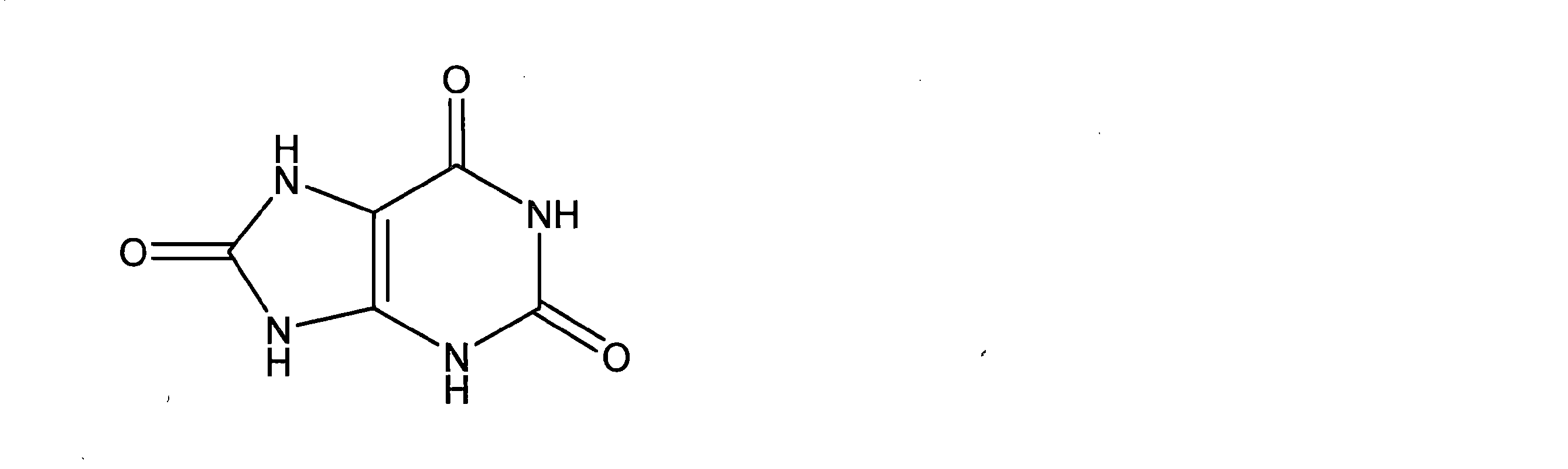
また、尿酸の含有量(X)は、10000μg/g以下、9000μg/g以下、8000μg/g以下、7000μg/g以下、6000μg/g以下、5000μg/g以下、4500μg/g以下、4000μg/g以下、4500μg/g以下、3000μg/g以下、2500μg/g以下、2200μg/g以下、2000μg/g以下、1800μg/g以下、1600μg/g以下、1500μg/g以下、1300μg/g以下、1200μg/g以下、1100μg/g以下、1000μg/g以下、900μg/g以下、800μg/g以下、700μg/g以下、600μg/g以下、500μg/g以下、450μg/g以下、400μg/g以下、350μg/g以下、300μg/g以下、280μg/g以下、250μg/g以下、220μg/g以下、200μg/g以下、180μg/g以下、160μg/g以下、150μg/g以下、140μg/g以下、130μg/g以下、120μg/g以下、110μg/g以下、100μg/g以下、95μg/g以下、90μg/g以下、85μg/g以下、80μg/g以下、75μg/g以下、70μg/g以下、65μg/g以下、60μg/g以下、55μg/g以下、50μg/g以下、45μg/g以下、40μg/g以下、35μg/g以下、30μg/g以下、27μg/g以下、25μg/g以下、22μg/g以下、又は20μg/g以下としてもよい。
なお、本明細書において、尿酸の含有量(X)は、HPLC(高速液体クロマトグラフ法)により測定することができる。具体的な測定条件としては、例えば、以下の条件で測定することができる。
・測定装置:高速液体クロマトグラフChromaster(日立ハイテクノロジーズ社製)
・検出器:5420UV-VIS検出器(日立ハイテクノロジーズ社製)
・カラム:Inertsil ODS-4(4.6mm×250mm、5μm)
・カラム温度:40℃
・移動相:A=74mMリン酸緩衝液(pH=2.2)、B=メタノール、A/B=98/2(体積比)
・流量:1.0mL/分
・注入量:50μL
・測定波長:284nm
尿酸の含有量(X)を一定量以下に調整する方法としては、ウリカーゼ活性を有する加工食品用添加剤を用いたウリカーゼ処理を行うことで、尿酸を酸化してアラントインに分解し、尿酸の含有量を低下させることができる。
そのため、本発明の一態様の加工食品は、アラントインを含む加工食品としてもよい。
そのため、本発明の一態様の加工食品において、アラントインの含有量は、9.0μg/g以下、8.0μg/g以下、7.0μg/g以下、6.0μg/g以下、5.0μg/g以下、4.0μg/g以下、3.0μg/g以下、2.0μg/g以下、1.0μg/g以下、又は1.0μg/g未満としてもよい。

なお、本明細書において、アラントインの含有量は、LC-MS/MSを用いて測定することができる。具体的には、以下の条件で測定することができる。
・測定試料:測定対象となる加工食品を蒸留水で10倍に希釈し、孔径0.2μmメンブランフィルターでろ過して調製した液体。なお、加工食品に固形分が含まれている場合、蒸留水に希釈され易くするために、必要に応じて、当該加工食品を細かく擦り潰してもよい。
・測定装置:LCMS-8040(株式会社島津製作所社製)
・カラム:Discovery HS F5-3(15cm×2.1mm、3μm)
・カラム温度:40℃
・移動相:A=0.03(v/v)%ギ酸水溶液、B=100%アセトニトリル、A/B=90/10(体積比)
・流量:0.3mL/分
・注入量:10μL
本発明の一態様の加工食品において、プリン体の含有量(Y)は、好ましくは1000μg/g以下、より好ましくは800μg/g以下、より好ましくは600μg/g以下、更に好ましくは500μg/g以下、更に好ましくは450μg/g以下、より更に好ましくは400μg/g以下、より更に好ましくは350μg/g以下、特に好ましくは300μg/g以下であり、さらに、250μg/g以下、200μg/g以下、170μg/g以下、150μg/g以下、130μg/g以下、100μg/g以下、90μg/g以下、80μg/g以下、70μg/g以下、60μg/g以下、50μg/g以下、40μg/g以下、30μg/g以下、25.0μg/g未満、22.0μg/g以下、21.9μg/g以下、21.8μg/g以下、21.7μg/g以下、21.6μg/g以下、21.5μg/g以下、21.4μg/g以下、21.3μg/g以下、21.2μg/g以下、21.1μg/g以下、21.0μg/g以下、20.9μg/g以下、20.8μg/g以下、20.7μg/g以下、20.6μg/g以下、20.5μg/g以下、20.4μg/g以下、20.3μg/g以下、20.2μg/g以下、20.1μg/g以下、20μg/g以下、19.9μg/g以下、19.8μg/g以下、19.7μg/g以下、19.6μg/g以下、19.5μg/g以下、19.4μg/g以下、19.3μg/g以下、19.2μg/g以下、19.1μg/g以下、19.0μg/g以下、18.9μg/g以下、18.8μg/g以下、18.7μg/g以下、18.6μg/g以下、18.5μg/g以下、18.4μg/g以下、18.3μg/g以下、18.2μg/g以下、18.1μg/g以下、18.0μg/g以下、17.9μg/g以下、17.8μg/g以下、17.7μg/g以下、17.6μg/g以下、17.5μg/g以下、17.4μg/g以下、17.3μg/g以下、17.2μg/g以下、17.1μg/g以下、17.0μg/g以下、16.9μg/g以下、16.8μg/g以下、16.7μg/g以下、16.6μg/g以下、16.5μg/g以下、16.4μg/g以下、16.3μg/g以下、16.2μg/g以下、16.1μg/g以下、16.0μg/g以下、15.9μg/g以下、15.8μg/g以下、15.7μg/g以下、15.6μg/g以下、15.5μg/g以下、15.4μg/g以下、15.3μg/g以下、15.2μg/g以下、15.1μg/g以下、15μg/g以下、14.9μg/g以下、14.8μg/g以下、14.7μg/g以下、14.6μg/g以下、14.5μg/g以下、14.4μg/g以下、14.3μg/g以下、14.2μg/g以下、14.1μg/g以下、14.0μg/g以下、13.9μg/g以下、13.8μg/g以下、13.7μg/g以下、13.6μg/g以下、13.5μg/g以下、13.4μg/g以下、13.3μg/g以下、13.2μg/g以下、13.1μg/g以下、13.0μg/g以下、12.9μg/g以下、12.8μg/g以下、12.7μg/g以下、12.6μg/g以下、12.5μg/g以下、12.4μg/g以下、12.3μg/g以下、12.2μg/g以下、12.1μg/g以下、12μg/g以下、11.9μg/g以下、11.8μg/g以下、11.7μg/g以下、11.6μg/g以下、11.5μg/g以下、11.4μg/g以下、11.3μg/g以下、11.2μg/g以下、11.1μg/g以下、11.0μg/g以下、10.9μg/g以下、10.8μg/g以下、10.7μg/g以下、10.6μg/g以下、10.5μg/g以下、10.4μg/g以下、10.3μg/g以下、10.2μg/g以下、10.1μg/g以下、10μg/g以下、9.9μg/g以下、9.8μg/g以下、9.7μg/g以下、9.6μg/g以下、9.5μg/g以下、9.4μg/g以下、9.3μg/g以下、9.2μg/g以下、9.1μg/g以下、9.0μg/g以下、8.9μg/g以下、8.8μg/g以下、8.7μg/g以下、8.6μg/g以下、8.5μg/g以下、8.4μg/g以下、8.3μg/g以下、8.2μg/g以下、8.1μg/g以下、8.0μg/g以下、7.9μg/g以下、7.8μg/g以下、7.7μg/g以下、7.6μg/g以下、7.5μg/g以下、7.4μg/g以下、7.3μg/g以下、7.2μg/g以下、7.1μg/g以下、7.0μg/g以下、6.9μg/g以下、6.8μg/g以下、6.7μg/g以下、6.6μg/g以下、6.5μg/g以下、6.4μg/g以下、6.3μg/g以下、6.2μg/g以下、6.1μg/g以下、6.0μg/g以下、5.9μg/g以下、5.8μg/g以下、5.7μg/g以下、5.6μg/g以下、5.5μg/g以下、5.4μg/g以下、5.3μg/g以下、5.2μg/g以下、5.1μg/g以下、5.0μg/g以下、4.9μg/g以下、4.8μg/g以下、4.7μg/g以下、4.6μg/g以下、4.5μg/g以下、4.4μg/g以下、4.3μg/g以下、4.2μg/g以下、4.1μg/g以下、4.0μg/g以下、3.9μg/g以下、3.8μg/g以下、3.7μg/g以下、3.6μg/g以下、3.5μg/g以下、3.4μg/g以下、3.3μg/g以下、3.2μg/g以下、3.1μg/g以下、3.0μg/g以下、2.9μg/g以下、2.8μg/g以下、2.7μg/g以下、2.6μg/g以下、2.5μg/g以下、2.4μg/g以下、2.3μg/g以下、2.2μg/g以下、2.1μg/g以下、2.0μg/g以下、1.9μg/g以下、1.8μg/g以下、1.7μg/g以下、1.6μg/g以下、1.5μg/g以下、1.4μg/g以下、1.3μg/g以下、1.2μg/g以下、1.1μg/g以下、1.0μg/g以下、0.9μg/g以下、0.8μg/g以下、0.7μg/g以下、0.6μg/g以下、0.5μg/g以下、0.4μg/g以下、0.3μg/g以下、又は0.2μg/g以下としてもよく、また、0.0μg/g超、0.1μg/g以上、0.2μg/g以上、0.3μg/g以上、0.4μg/g以上、0.5μg/g以上、0.6μg/g以上、0.7μg/g以上、0.8μg/g以上、0.9μg/g以上、1.0μg/g以上、1.1μg/g以上、1.2μg/g以上、1.3μg/g以上、1.4μg/g以上、1.5μg/g以上、1.6μg/g以上、1.7μg/g以上、1.8μg/g以上、1.9μg/g以上、2.0μg/g以上、2.1μg/g以上、2.2μg/g以上、2.3μg/g以上、2.4μg/g以上、2.5μg/g以上、2.6μg/g以上、2.7μg/g以上、2.8μg/g以上、2.9μg/g以上、3.0μg/g以上、3.1μg/g以上、3.2μg/g以上、3.3μg/g以上、3.4μg/g以上、3.5μg/g以上、3.6μg/g以上、3.7μg/g以上、3.8μg/g以上、3.9μg/g以上、4.0μg/g以上、4.1μg/g以上、4.2μg/g以上、4.3μg/g以上、4.4μg/g以上、4.5μg/g以上、4.6μg/g以上、4.7μg/g以上、4.8μg/g以上、4.9μg/g以上、5.0μg/g以上、5.1μg/g以上、5.2μg/g以上、5.3μg/g以上、5.4μg/g以上、5.5μg/g以上、5.6μg/g以上、5.7μg/g以上、5.8μg/g以上、5.9μg/g以上、6.0μg/g以上、6.1μg/g以上、6.2μg/g以上、6.3μg/g以上、6.4μg/g以上、6.5μg/g以上、6.6μg/g以上、6.7μg/g以上、6.8μg/g以上、6.9μg/g以上、7.0μg/g以上、7.1μg/g以上、7.2μg/g以上、7.3μg/g以上、7.4μg/g以上、7.5μg/g以上、7.6μg/g以上、7.7μg/g以上、7.8μg/g以上、7.9μg/g以上、8.0μg/g以上、8.1μg/g以上、8.2μg/g以上、8.3μg/g以上、8.4μg/g以上、8.5μg/g以上、8.6μg/g以上、8.7μg/g以上、8.8μg/g以上、8.9μg/g以上、9.0μg/g以上、9.1μg/g以上、9.2μg/g以上、9.3μg/g以上、9.4μg/g以上、9.5μg/g以上、9.6μg/g以上、9.7μg/g以上、9.8μg/g以上、9.9μg/g以上、10.0μg/g以上、10.1μg/g以上、10.2μg/g以上、10.3μg/g以上、10.4μg/g以上、10.5μg/g以上、10.6μg/g以上、10.7μg/g以上、10.8μg/g以上、10.9μg/g以上、11.0μg/g以上、11.1μg/g以上、11.2μg/g以上、11.3μg/g以上、11.4μg/g以上、11.5μg/g以上、11.6μg/g以上、11.7μg/g以上、11.8μg/g以上、11.9μg/g以上、12.0μg/g以上、12.1μg/g以上、12.2μg/g以上、12.3μg/g以上、12.4μg/g以上、12.5μg/g以上、12.6μg/g以上、12.7μg/g以上、12.8μg/g以上、12.9μg/g以上、13.0μg/g以上、13.1μg/g以上、13.2μg/g以上、13.3μg/g以上、13.4μg/g以上、13.5μg/g以上、13.6μg/g以上、13.7μg/g以上、13.8μg/g以上、13.9μg/g以上、14.0μg/g以上、14.1μg/g以上、14.2μg/g以上、14.3μg/g以上、14.4μg/g以上、14.5μg/g以上、14.6μg/g以上、14.7μg/g以上、14.8μg/g以上、14.9μg/g以上、15.0μg/g以上、15.1μg/g以上、15.2μg/g以上、15.3μg/g以上、15.4μg/g以上、15.5μg/g以上、15.6μg/g以上、15.7μg/g以上、15.8μg/g以上、15.9μg/g以上、16.0μg/g以上、16.1μg/g以上、16.2μg/g以上、16.3μg/g以上、16.4μg/g以上、16.5μg/g以上、16.6μg/g以上、16.7μg/g以上、16.8μg/g以上、16.9μg/g以上、17.0μg/g以上、17.1μg/g以上、17.2μg/g以上、17.3μg/g以上、17.4μg/g以上、17.5μg/g以上、17.6μg/g以上、17.7μg/g以上、17.8μg/g以上、17.9μg/g以上、18.0μg/g以上、18.1μg/g以上、18.2μg/g以上、18.3μg/g以上、18.4μg/g以上、18.5μg/g以上、18.6μg/g以上、18.7μg/g以上、18.8μg/g以上、18.9μg/g以上、19.0μg/g以上、19.1μg/g以上、19.2μg/g以上、19.3μg/g以上、19.4μg/g以上、19.5μg/g以上、19.6μg/g以上、19.7μg/g以上、19.8μg/g以上、19.9μg/g以上、20.0μg/g以上、20.1μg/g以上、20.2μg/g以上、20.3μg/g以上、20.4μg/g以上、20.5μg/g以上、20.6μg/g以上、20.7μg/g以上、20.8μg/g以上、20.9μg/g以上、21.0μg/g以上、21.1μg/g以上、21.2μg/g以上、21.3μg/g以上、21.4μg/g以上、21.5μg/g以上、21.6μg/g以上、21.7μg/g以上、21.8μg/g以上、又は21.9μg/g以上としてもよい。
本発明の一態様の加工食品が発酵加工食品である場合、プリンヌクレオシダーゼ等の酵素を用いて、アデノシンやグアノシン等の酵母非資化性のプリン体を資化性のプリン体に分解し、発酵工程によって資化性プリン体を低減させて、プリン体の含有量(Y)を調整することもできる。
また、アデニンデアミナーゼ活性を有する加工食品用添加剤を用いたアデニンデアミナーゼ処理を行った後にキサンチンオキシダーゼ処理を行うことで、アデニンをヒポキサンチンに変換することができ、キサンチンオキシダーゼによる分解を効率的に行うことができる。
同様に、グアニンデアミナーゼ活性を有する加工食品用添加剤を用いたグアニンデアミナーゼ処理を行った後にキサンチンオキシダーゼ処理を行うことでも、グアニンをキサンチンに変換することができ、キサンチンオキシダーゼによる分解を効率的に行うことができる。
その上で、後述のとおり、キサンチンオキシダーゼ活性を有する加工食品用添加剤を用いたキサンチンオキシダーゼ処理によって、キサンチンの含有量を低減させて、プリン体の含有量(Y)を調整することもできる。
以上から、本発明の一態様において、プリン体をより低減させた加工食品とする観点から、プリンヌクレオシダーゼ処理、アデニンデアミナーゼ処理、及びグアニンデアミナーゼ処理から選ばれる1種以上の酵素処理を行った後に、キサンチンオキシダーゼ処理を行うことで、プリン体の含有量(Y)を調整することもできる。
また、本明細書において、上記「プリン体の含有量(Y)」とは、アデニン、グアニン、キサンチン、及びヒポキサンチンの群からなるプリン塩基の合計含有量を意味する。
そして、上記「キサンチンの含有量」及び上記「プリン体の含有量(Y)」は、LC-MS/MSを用いて検出する方法(「酒類のプリン体の微量分析のご案内」、財団法人日本食品分析センター、インターネット(https://www.jfrl.or.jp/storage/file/news_vol4_no23.pdf、平成27年8月検索))により測定することができる。
上記のような問題に対して検討したところ、プリン体を含有する原材料と、キサンチンオキシダーゼ活性を有する原材料とを用いて加工食品を調整することで、高濃度の尿酸を含む加工製品を容易に製造し得ることが分かった。
上述のとおり、「プリン体」は、プリン核構造を有する化合物である。ここで、キサンチンオキシダーゼは、活性酸素種を発生させるキサンチンオキシドレダクターゼの型の酵素の一つである。キサンチンオキシダーゼによって、キサンチンは酸化して尿酸とすることができ、ヒポキサンチンは酸化して、キサンチンを経て尿酸とすることができる。つまり、キサンチンオキシダーゼの働きによって、原材料に含まれるプリン体を構成するキサンチン及びヒポキサンチンを尿酸に変化させることができ、高濃度の尿酸を含む加工食品とすることができる。
さらに、本発明の一態様の加工食品は、キサンチンオキシダーゼの働きによって、プリン体の含有量を低減することができる。
なお、本発明の一態様の加工食品は、キサンチンオキシダーゼ活性が残存していてもよく、既に失活していてもよい。つまり、本発明の一態様の加工食品は、キサンチンオキシダーゼ活性を有する加工食品であってもよく、また、キサンチンオキシダーゼ活性を有していたタンパク質を含有する加工食品であってもよい。
50mMトリス塩酸緩衝液2.9ml、10mMキサンチン水溶液0.1mlを混合し、37℃で予備加温した後、測定対象物の溶液0.01mlを添加し、ゆるやかに混和後、水を対照に37℃で制御された分光光度計で1分間あたりの293nmの吸光度変化を求めて、当該値から1分間あたり1μmolの尿酸を生成する酵素量を1単位(U)とした際の酵素量をキサンチンオキシダーゼ活性値とする。
また、市販されているキサンチンオキシダーゼの製剤を原材料として用いてもよい。
なお、本発明の一態様の加工食品は、上述のキサンチンオキシダーゼ活性を有する原材料を用いており、そのキサンチンオキシダーゼ活性が残存する、キサンチンオキシダーゼ活性を有する加工食品をも包含する。
また、本発明の一態様の加工食品は、上述のキサンチンオキシダーゼ活性を有する原材料を用いており、そのキサンチンオキシダーゼ活性は失活しているが、キサンチンオキシダーゼ活性を有していたタンパク質を含有する加工食品をも包含する。具体的には、キサンチンオキシダーゼ活性を有するタンパク質を含む原材料を用いていたが、加熱やpH調整等の過程によってキサンチンオキシダーゼ活性を失活させた加工食品をも包含する。
50mMトリス塩酸緩衝液2.9ml、10mM尿酸水溶液0.1mlを混合し、37℃で予備加温した後、測定対象物の溶液0.01mlを添加し、ゆるやかに混和後、水を対照に37℃で制御された分光光度計で1分間あたりの293nmの吸光度変化を求めて、当該値から1分間あたり1μmolのアラントインを生成する酵素量を1単位(U)とした際の酵素量をウリカーゼ活性値とする。
ウリカーゼ活性を有する原材料としては、特に限定されないが、例えば、バクテリアから哺乳類、高等植物にわたる広範囲の生物種由来の原料が挙げられ、具体的には、牛等の哺乳類の生乳(未殺菌の生乳)、シュードモナス属、エシエリキア属、アースロバクター属、ノカルデイア属等に属する微生物、エンテロバクター・クロアカエ等が挙げられる。
また、市販されているウリカーゼの製剤を原材料として用いてもよい。
なお、本発明の一態様の加工食品は、ウリカーゼ活性を有する原材料を用いており、そのウリカーゼ活性が残存する、ウリカーゼ活性を有する加工食品をも包含する。
また、本発明の一態様の加工食品は、ウリカーゼ活性を有する原材料を用いており、そのウリカーゼ活性は失活しているが、ウリカーゼ活性を有していたタンパク質を含有する加工食品をも包含する。具体的には、ウリカーゼ活性を有するタンパク質を含む原材料を用いていたが、加熱やpH調整等の過程によってウリカーゼ活性を失活させた加工食品をも包含する。
高甘味度甘味料の含有量を制限した加工食品に含まれる、高甘味度甘味料の含有量は、当該加工食品に含まれる尿酸の全量100質量部に対して、10.0質量部未満、5.0質量部未満、2.0質量部未満、1.0質量部未満、0.1質量部未満、0.05質量部未満、0.01質量部未満、0.001質量部未満、又は0.0001質量部未満としてもよい。
また、高甘味度甘味料の含有量を制限した加工食品に含まれる、高甘味度甘味料の含有量は、当該加工食品の全量(100質量%)基準で、1000質量ppm未満、100質量ppm未満、75質量ppm未満、50質量ppm未満、40質量ppm未満、30質量ppm未満、25質量ppm未満、20質量ppm未満、15質量ppm未満、10質量ppm未満、1質量ppm未満、100質量ppb未満、10質量ppb未満、1質量ppb未満、100質量ppt未満、10質量ppt未満、又は1質量ppt未満としてもよい。
なお、高甘味度甘味料としては、天然高甘味度甘味料及び人工高甘味度甘味料の双方が含まれ、例えば、レバウジオシドA、レバウジオシドB、レバウジオシドC、レバウジオシドD、レバウジオシドE、レバウジオシドF、ズルコシドA、ズルコシドB、ルブソサイド、ステビア、ステビオサイド、モグロサイドIV、モグロサイドV、羅漢果甘味料、シアメノサイド、モナチン及びその塩(モナチンSS、モナチンRR、モナチンRS、モナチンSR)、クルクリン、グリシルリジン酸及びその塩、タウマチン、モネリン、マビンリン、ブラゼイン、ヘルナンズルチン、フィロズルチン、グリシフィリン、フロリジン、トリロバチン、バイユノサイド、オスラジン、エリスリトール、ポリポドサイドA、プテロカリオサイドA、プテロカリオサイドB、ムクロジオサイド、フロミソサイドI、ペリアンドリンI、アブルソサイドA及びシクロカリオサイドI等が挙げられる。
レバウジオシドAの含有量を制限した加工食品に含まれる、レバウジオシドAの含有量は、当該加工食品に含まれる尿酸の全量100質量部に対して、10.0質量部未満、5.0質量部未満、2.0質量部未満、1.0質量部未満、0.1質量部未満、0.05質量部未満、0.01質量部未満、0.001質量部未満、又は0.0001質量部未満としてもよい。
また、レバウジオシドAの含有量を制限した加工食品に含まれる、レバウジオシドAの含有量は、当該加工食品の全量(100質量%)基準で、1000質量ppm未満、100質量ppm未満、10質量ppm未満、1質量ppm未満、100質量ppb未満、10質量ppb未満、1質量ppb未満、100質量ppt未満、10質量ppt未満、又は1質量ppt未満としてもよい。
エリスリトールの含有量を制限した加工食品に含まれる、エリスリトールの含有量は、当該加工食品に含まれる尿酸の全量100質量部に対して、10.0質量部未満、5.0質量部未満、2.0質量部未満、1.0質量部未満、0.1質量部未満、0.05質量部未満、0.01質量部未満、0.001質量部未満、又は0.0001質量部未満としてもよい。
また、エリスリトールの含有量を制限した加工食品に含まれる、エリスリトールの含有量は、当該加工食品の全量(100質量%)基準で、1000質量ppm未満、100質量ppm未満、10質量ppm未満、1質量ppm未満、100質量ppb未満、10質量ppb未満、1質量ppb未満、100質量ppt未満、10質量ppt未満、又は1質量ppt未満としてもよい。
本発明の一態様の加工食品としては、ビールテイスト飲料であってもよい。
特に、麦芽ビールテイスト飲料である場合、麦芽はプリン体が含まれる原材料として知られている。ただし、麦芽と共に、キサンチンオキシダーゼ活性を有する原材料を用いて、キサンチンオキシダーゼ活性を有する飲料、もしくは、キサンチンオキシダーゼ活性を有していたタンパク質を含有する飲料となるように調整することで、麦芽に起因したプリン体の含有量を低減しつつ、且つ、プリン体から生じた尿酸が増えるため、尿酸の含有量が高い飲料に容易に調整することができる。
また、ビールテイスト飲料は、酵母を用いて発酵工程を経た発酵ビールテイスト飲料であってもよく、発酵工程を経ない非発酵ビールテイスト飲料であってもよい。
なお、「アルコールを実質的に含まないノンアルコールビールテイスト飲料」とは、検出できない程度の極微量のアルコールを含有する飲料を除くものではない。小数第一位を四捨五入することでアルコール度数が0(v/v)%となる飲料、小数第二位を四捨五入することでアルコール度数が0.0(v/v)%となる飲料、及び小数第三位を四捨五入することでアルコール度数が0.00(v/v)%となる飲料もノンアルコールビールテイスト飲料に包含される。
加えて、ビールテイスト飲料は、原料として麦芽を用いた麦芽使用ビールテイスト飲料であってもよく、麦芽を用いない麦芽不使用ビールテイスト飲料であってもよいが、麦芽使用ビールテイスト飲料が好ましく、大麦麦芽使用ビールテイスト飲料がより好ましい。
他に、ビールテイスト飲料は、上面発酵酵母を用いた発酵工程を経て醸造されたエールビールテイスト飲料であってもよく、下面発酵酵母を用いた発酵工程を経て醸造されたラガービールテイスト飲料であってもよい。
そして、ビールテイスト飲料は、スピリッツ、ウイスキー、焼酎などの蒸留酒を含有する、蒸留酒含有ビールテイスト飲料であってもよく、その中でも、スピリッツ含有ビールテイスト飲料が好ましい。
また、ビールテイスト飲料は、蒸留酒を含まない、蒸留酒非含有ビールテイスト飲料であってもよく、スピリッツを含まない、スピリッツ非含有ビールテイスト飲料であってもよい。
本発明の具体的な態様のビールテイスト飲料としては、発酵ビールテイスト飲料であってもよく、アルコール含有発酵ビールテイスト飲料であってもよく、麦芽使用発酵ビールテイスト飲料であってもよい。
本明細書において、「麦芽比率」とは、平成30年4月1日が施行日の酒税法および酒類行政関係法令等解釈通達に従って計算された値を意味する。
また、本明細書において、FANの含有量は、例えば、改訂BCOJビール分析法(公益財団法人日本醸造協会発行、ビール酒造組合国際技術委員会〔分析委員会〕編集2013年増補改訂の8.18遊離アミノ態窒素に記載されている方法によって測定することができる。
本明細書において、「外観発酵度」とは、発酵前の液に含まれる全糖濃度のうち、酵母がアルコール発酵の栄養源として消費できる糖濃度の占める割合を意味する。例えば、ビールテイスト飲料の外観発酵度AAは、下記式(1)から算出することができる。
式(1):AA(%)=100×(P-Es)/P
上記式(1)中、「P」は、オリジナルエキス(原麦汁エキス)であり、「BCOJビール分析法(日本醸造協会発行、ビール酒造組合編集、2004年11月1日改訂版)」に記載された方法により、測定することができる。
また、「Es」は、ビールテイスト飲料の外観エキスを示す。外観エキスは、例えば、「BCOJビール分析法(日本醸造協会発行、ビール酒造組合編集、2004年11月1日改訂版)」に記載されるように、下記式(2)から算出することができる。
式(2):Es=-460.234+662.649×D-202.414×D2
(式(2)中、Dは、ガス抜きビールテイスト飲料の比重である。)
なお、外観エキス「Es」は、上記式(2)中のDによって負の値になることがあるため、算出される外観発酵度が100%を超える場合がある。
19.6g/100mL以下、19.5g/100mL以下、19.4g/100mL以下、19.3g/100mL以下、19.2g/100mL以下、19.1g/100mL以下、19g/100mL以下、18.9g/100mL以下、18.8g/100mL以下、18.7g/100mL以下、18.6g/100mL以下、18.5g/100mL以下、18.4g/100mL以下、18.3g/100mL以下、18.2g/100mL以下、18.1g/100mL以下、18g/100mL以下、17.9g/100mL以下、17.8g/100mL以下、17.7g/100mL以下、17.6g/100mL以下、17.5g/100mL以下、17.4g/100mL以下、17.3g/100mL以下、17.2g/100mL以下、17.1g/100mL以下、17g/100mL以下、16.9g/100mL以下、16.8g/100mL以下、16.7g/100mL以下、16.6g/100mL以下、16.5g/100mL以下、16.4g/100mL以下、16.3g/100mL以下、16.2g/100mL以下、16.1g/100mL以下、16g/100mL以下、15.9g/100mL以下、15.8g/100mL以下、15.7g/100mL以下、15.6g/100mL以下、15.5g/100mL以下、15.4g/100mL以下、15.3g/100mL以下、15.2g/100mL以下、15.1g/100mL以下、15g/100mL以下、14.9g/100mL以下、14.8g/100mL以下、14.7g/100mL以下、14.6g/100mL以下、14.5g/100mL以下、14.4g/100mL以下、14.3g/100mL以下、14.2g/100mL以下、14.1g/100mL以下、14g/100mL以下、13.9g/100mL以下、13.8g/100mL以下、13.7g/100mL以下、13.6g/100mL以下、13.5g/100mL以下、13.4g/100mL以下、13.3g/100mL以下、13.2g/100mL以下、13.1g/100mL以下、13g/100mL以下、12.9g/100mL以下、12.8g/100mL以下、12.7g/100mL以下、12.6g/100mL以下、12.5g/100mL以下、12.4g/100mL以下、12.3g/100mL以下、12.2g/100mL以下、12.1g/100mL以下、12g/100mL以下、11.9g/100mL以下、11.8g/100mL以下、11.7g/100mL以下、11.6g/100mL以下、11.5g/100mL以下、11.4g/100mL以下、11.3g/100mL以下、11.2g/100mL以下、11.1g/100mL以下、11g/100mL以下、10.9g/100mL以下、10.8g/100mL以下、10.7g/100mL以下、10.6g/100mL以下、10.5g/100mL以下、10.4g/100mL以下、10.3g/100mL以下、10.2g/100mL以下、10.1g/100mL以下、10g/100mL以下、9.9g/100mL以下、9.8g/100mL以下、9.7g/100mL以下、9.6g/100mL以下、9.5g/100mL以下、9.4g/100mL以下、9.3g/100mL以下、9.2g/100mL以下、9.1g/100mL以下、9.0g/100mL以下、8.9g/100mL以下、8.8g/100mL以下、8.7g/100mL以下、8.6g/100mL以下、8.5g/100mL以下、8.4g/100mL以下、8.3g/100mL以下、8.2g/100mL以下、8.1g/100mL以下、8.0g/100mL以下、7.9g/100mL以下、7.8g/100mL以下、7.7g/100mL以下、7.6g/100mL以下、7.5g/100mL以下、7.4g/100mL以下、7.3g/100mL以下、7.2g/100mL以下、7.1g/100mL以下、7.0g/100mL以下、6.9g/100mL以下、6.8g/100mL以下、6.7g/100mL以下、6.6g/100mL以下、6.5g/100mL以下、6.4g/100mL以下、6.3g/100mL以下、6.2g/100mL以下、6.1g/100mL以下、6.0g/100mL以下、5.9g/100mL以下、5.8g/100mL以下、5.7g/100mL以下、5.6g/100mL以下、5.5g/100mL以下、5.4g/100mL以下、5.3g/100mL以下、5.2g/100mL以下、5.1g/100mL以下、5.0g/100mL以下、4.9g/100mL以下、4.8g/100mL以下、4.7g/100mL以下、4.6g/100mL以下、4.5g/100mL以下、4.4g/100mL以下、4.3g/100mL以下、4.2g/100mL以下、4.1g/100mL以下、4.0g/100mL以下、3.9g/100mL以下、3.8g/100mL以下、3.7g/100mL以下、3.6g/100mL以下、3.5g/100mL以下、3.4g/100mL以下、3.3g/100mL以下、3.2g/100mL以下、3.1g/100mL以下、3.0g/100mL以下、2.9g/100mL以下、2.8g/100mL以下、2.7g/100mL以下、2.6g/100mL以下、2.5g/100mL以下、2.4g/100mL以下、2.3g/100mL以下、2.2g/100mL以下、2.1g/100mL以下、又は2.0g/100mL以下としてもよい。
また、当該ビールテイスト飲料は、糖質低減飲料もしくは糖質ゼロ飲料としてもよく、具体的な糖質含有量としては、2.0g/100mL未満、1.9g/100mL以下、1.8g/100mL以下、1.7g/100mL以下、1.6g/100mL以下、1.5g/100mL以下、1.4g/100mL以下、1.3g/100mL以下、1.2g/100mL以下、1.1g/100mL以下、1.0g/100mL以下、1.0g/100mL未満、0.9g/100mL以下、0.8g/100mL以下、0.7g/100mL以下、0.6g/100mL以下、0.5g/100mL以下、0.5g/100mL未満、0.4g/100mL以下、0.3g/100mL以下、又は0.2g/100mL以下としてもよい。
また、本明細書において、「糖質」とは、食品の栄養表示基準(平成15年厚生労働省告示第176号、一部改正平成25年9月27日消費者庁告示第8号)に基づく糖質をいい、具体的には、対象となる食品から、タンパク質、脂質、食物繊維、灰分、アルコール分および水分を除いたものを意味する。そのため、食品中の糖質の量は、当該食品の重量から、タンパク質、脂質、食物繊維、灰分および水分の量を控除することにより算定することができる。
ここで、タンパク質、脂質、食物繊維、灰分および水分の量は、栄養表示基準に掲げる方法により測定することができる。具体的には、タンパク質の量は窒素定量換算法で測定し、脂質の量はエーテル抽出法で測定し、食物繊維の量はプロスキー法で測定し、灰分の量は直接灰化法で測定し、水分の量は減圧加熱乾燥法で測定することができる。
水溶性食物繊維としては、例えば、難消化性デキストリン、ポリデキストロース、グアーガム分解物、ペクチン、グルコマンナン、アルギン酸、ラミナリン、フコイジン、カラギーナン等が挙げられる。また、不溶性食物繊維としては、例えば、セルロース、ヘミセルロース、リグニン、キチン、キトサン等が挙げられる。
本発明においては、食物繊維は、添加により混合する食物繊維だけでなく、原料由来の食物繊維であってもよく、動植物由来の食物繊維であってもよく、その由来は特に制限されない。
なお、食物繊維の含有量は、希釈水または炭酸水の添加、原材料(麦芽、コーングリッツ、糖液等)の種類、原材料の量、酵素の種類、酵素(糖質分解酵素、異性化酵素等も含む)の添加量、酵素の添加のタイミング、糖化時間、糖化時のpH、仕込工程(麦芽投入から酵母添加前までの麦汁製造工程)でのpH、麦汁濾過の時間、麦汁を調製する際(糖化時含む)の各温度領域の設定温度及び保持時間、発酵前液の原麦汁エキス濃度、発酵工程での原麦汁エキス濃度、発酵条件(酸素濃度、通気条件、酵母品種、酵母の添加量、酵母増殖数、酵母の除去タイミング、発酵温度、発酵時間、圧力設定、二酸化炭素濃度等)等を適宜設定して調整できる。
また、本明細書において、食物繊維の含有量は、プロスキー法で測定することができる。
また、総ポリフェノール量は、例えば、大麦麦芽、麦芽のハスク(穀皮)などのポリフェノール含有量の多い原材料の使用量を調整することによって制御できる。具体的には、ポリフェノール含有量の多い麦芽等の原材料の使用量を増やすことにより総ポリフェノール量を増加させることができる。
本明細書において、総ポリフェノール量は、例えば、改訂BCOJビール分析法(公益財団法人日本醸造協会発行、ビール酒造組合国際技術委員会〔分析委員会〕編集2013年増補改訂)に記載されている方法によって測定することができる。
なお、本明細書において、プロリンの含有量は、例えば、株式会社日立製作所製のアミノ酸自動分析装置L-8800A型等を用いて測定することができる。
なお、本発明の一態様の加工食品が、原材料としてホップを用いたビールテイスト飲料である場合、当該飲料の苦味価は、5BUs以上、7BUs以上、10BUs以上、12BUs以上、15BUs以上、又は17BUs以上としてもよい。
また、本発明の一態様の加工食品が、原材料としてホップを用いないビールテイスト飲料である場合、当該飲料の苦味価は、5.0BUs未満、3.0BUs以下、2.0BUs以下、1.0BUs以下、0.5BUs以下、又は0.3BUs以下としてもよい。
なお、飲料の苦味価は、イソフムロンを主成分とするホップ由来成分により与えられる苦味の指標であり、ホップまたはホップエキス等のホップ由来成分の使用量を適宜調整することにより制御できる。
また、本明細書において、飲料の「苦味価」は、改訂BCOJビール分析法(公益財団法人日本醸造協会発行、ビール酒造組合国際技術委員会〔分析委員会〕編集2013年増補改訂)の「8.15 苦味価」に記載された測定法よって測定することができる。
ここで、スピリッツとは、小麦、大麦、米、そば、とうもろこし等の穀物を原料として、麦芽又は必要により酵素剤を用いて糖化し、酵母を用いて発酵させた後、更に蒸留して得られる酒類を意味する。
これらの中でも、本発明の一態様の加工食品であるビールテイスト飲料は、良質な味わいを有する飲料とする観点から、イネ科に属する植物を原料とするスピリッツを含有することが好ましく、麦スピリッツが好ましく、大麦スピリッツ又は小麦スピリッツを含有することがより好ましい。
本明細書において、ビールテイスト飲料の「色度」は、改訂BCOJビール分析法(公益財団法人日本醸造協会発行、ビール酒造組合国際技術委員会〔分析委員会〕編集2013年増補改訂)の「8.8 色度」に記載された測定法よって測定することができる。なお、ビールテイスト飲料の「色度」は、欧州醸造協会(European Brewery Convention)により定められた色度の単位(EBC単位)により特定される。数値が小さいほど色が薄く明るい飲料であり、逆に、数値が大きいほど色が濃く暗い飲料である。
また、本発明の一態様であるビールテイスト飲料の色度は、例えば、使用する麦芽の種類、2種以上の麦芽を併用する場合にはその配合比率、発酵前液を調製する際の煮沸条件等を適宜調整することにより制御できる。より具体的に、例えば、ビールテイスト飲料の色度を高くするには、麦芽として濃色麦芽の配合比率を高くこと、煮沸処理時の温度を高くすること、煮沸時間を長くすること、及び糖化液の調製の際にデコクションを実施すること等により、調整可能である。また、原麦汁エキス濃度を高めることや、麦芽比率を高めることによっても、色度を高く調整することができる。
本発明の一態様の加工食品が飲料である場合、各飲料に一般的に用いられている原材料を使用することができる。例えば、ビールテイスト飲料である場合の主な原材料としては、水及び麦芽を用いる。さらにビールテイスト飲料は、原材料として、ホップを用いた飲料であってもよく、ホップを用いない飲料であってもよい。
また、本発明の一態様の加工食品が飲料である場合、各飲料の種類に応じて、保存料、甘味料、水溶性食物繊維、苦味料又は苦味付与剤、酸化防止剤、香料、酸味料、塩類等を用いてもよい。
また、飲料の原材料として、キサンチンオキシダーゼ活性を有する原材料を含む場合には、キサンチンオキシダーゼ活性によってプリン体を尿酸に変換することができるため、プリン体を含有する原材料を含有してもよい。
プリン体を含有する原材料としては、上述のとおりであり、本発明の一態様の加工食品がビールテイスト飲料の場合、麦芽が好ましい。
本発明の一態様の加工食品がビールテイスト飲料である場合、原材料として用いる麦芽とは、大麦、小麦、ライ麦、カラス麦、オート麦、ハト麦、エン麦などの麦類の種子を発芽させて乾燥させ、除根したものをいい、産地や品種は、いずれのものであってもよい。
本発明の一態様で用いる麦芽としては、大麦麦芽が好ましい。大麦麦芽は、日本のビールテイスト飲料の原料として最も一般的に用いられる麦芽の1つである。大麦には、二条大麦、六条大麦などの種類があるが、いずれを用いてもよい。さらに、通常麦芽のほか、色麦芽なども用いることができる。なお、色麦芽を用いる際には、種類の異なる色麦芽を適宜組み合わせて用いてもよいし、一種類の色麦芽を用いてもよい。
そのような穀物としては、例えば、麦芽には該当しない麦(大麦、小麦、ライ麦、カラス麦、オート麦、ハト麦、エン麦等)、米(白米、玄米等)、とうもろこし、こうりゃん、ばれいしょ、豆(大豆、えんどう豆等)、そば、ソルガム、粟、ひえ、及びそれらから得られたデンプン、これらの抽出物(エキス)等が挙げられる。
本発明の一態様の加工食品が、ホップを用いたビールテイスト飲料である場合、当該ホップの形態としては、例えば、ペレットホップ、粉末ホップ、ホップエキス等が挙げられる。また、用いるホップは、イソ化ホップ、還元ホップ等のホップ加工品を用いてもよい。
本発明の一態様の加工食品が、ホップを用いたビールテイスト飲料である場合、ホップの添加量としては、適宜調製されるが、飲料の原材料の全量(100質量%)基準で、好ましくは0.0001~1質量%である。
一方で、ホップを用いないビールテイスト飲料におけるイソα酸の含有量は、当該ビールテイスト飲料の全量(100質量%)基準で、0.1質量ppm以下であってもよい。
なお、本明細書において、イソα酸の含有量は、改訂BCOJビール分析法(公益財団法人日本醸造協会発行、ビール酒造組合国際技術委員会〔分析委員会〕編集2013年増補改訂)に記載の高速液体クロマトグラフィー(HPLC)分析法により測定された値を意味する。
本発明の一態様の加工食品が飲料である場合、さらに保存料を配合してなる飲料であってもよい。
本発明の一態様で用いる保存料としては、例えば、安息香酸;安息香酸ナトリウム等の安息香酸塩;パラオキシ安息香酸プロピル、パラオキシ安息香酸ブチル等の安息香酸エステル;二炭酸ジメチル等が挙げられる。また、保存料としては、強力サンプレザー(三栄源エフ・エフ・アイ株式会社製、安息香酸ナトリウムと安息香酸ブチルの混合物)等の市販の製剤を用いてもよい。
これらの保存料は、単独で用いてもよく、2種以上を併用してもよい。
本発明の一態様の加工食品が飲料である場合、さらに甘味料を配合してなる飲料としてもよい。
本発明の一態様で用いる甘味料としては、穀物由来のデンプンを酸又は酵素等で分解した市販の糖化液、市販の水飴等の糖類、三糖類以上の糖、糖アルコール、ステビア等の天然甘味料、人工甘味料等が挙げられる。
これらの甘味料は、単独で用いてもよく、2種以上を併用してもよい。
これらの糖類の形態は、溶液等の液体であってもよく、粉末等の固体であってもよい。
また、デンプンの原料穀物の種類、デンプンの精製方法、及び酵素や酸による加水分解等の処理条件についても特に制限はない。例えば、酵素や酸による加水分解の条件を適宜設定することにより、マルトースの比率を高めた糖類を用いてもよい。その他、スクロース、フルクトース、グルコース、マルトース、トレハロース、マルトトリオース及びこれらの溶液(糖液)等を用いることもできる。
また、人工甘味料としては、例えば、アスパルテーム、アセスルファムカリウム(アセスルファムK)、スクラロース、ネオテーム等が挙げられる。
高甘味度甘味料の含有量を制限した飲料に含まれる、高甘味度甘味料の含有量は、当該飲料に含まれる尿酸の全量100質量部に対して、10.0質量部未満、5.0質量部未満、2.0質量部未満、1.0質量部未満、0.1質量部未満、0.05質量部未満、0.01質量部未満、0.001質量部未満、又は0.0001質量部未満としてもよい。
また、高甘味度甘味料の含有量を制限した飲料に含まれる、高甘味度甘味料の含有量は、当該飲料の全量(100質量%)基準で、1000質量ppm未満、100質量ppm未満、10質量ppm未満、1質量ppm未満、100質量ppb未満、10質量ppb未満、1質量ppb未満、100質量ppt未満、10質量ppt未満、又は1質量ppt未満としてもよい。
なお、具体的な高甘味度甘味料としては、上述の通りである。
レバウジオシドAの含有量を制限した飲料に含まれる、レバウジオシドAの飲料は、当該飲料に含まれる尿酸の全量100質量部に対して、10.0質量部未満、5.0質量部未満、2.0質量部未満、1.0質量部未満、0.1質量部未満、0.05質量部未満、0.01質量部未満、0.001質量部未満、又は0.0001質量部未満としてもよい。
また、レバウジオシドAの含有量を制限した飲料に含まれる、レバウジオシドAの含有量は、当該飲料の全量(100質量%)基準で、1000質量ppm未満、100質量ppm未満、10質量ppm未満、1質量ppm未満、100質量ppb未満、10質量ppb未満、1質量ppb未満、100質量ppt未満、10質量ppt未満、又は1質量ppt未満としてもよい。
エリスリトールの含有量を制限した飲料に含まれる、エリスリトールの含有量は、当該飲料に含まれる尿酸の全量100質量部に対して、10.0質量部未満、5.0質量部未満、2.0質量部未満、1.0質量部未満、0.1質量部未満、0.05質量部未満、0.01質量部未満、0.001質量部未満、又は0.0001質量部未満としてもよい。
また、エリスリトールの含有量を制限した飲料に含まれる、エリスリトールの含有量は、当該飲料の全量(100質量%)基準で、1000質量ppm未満、100質量ppm未満、10質量ppm未満、1質量ppm未満、100質量ppb未満、10質量ppb未満、1質量ppb未満、100質量ppt未満、10質量ppt未満、又は1質量ppt未満としてもよい。
本発明の一態様の加工食品が飲料である場合、さらに苦味料及び苦味付与剤から選ばれる1種以上を配合してなる飲料としてもよい。
特に、本発明の一態様の加工食品がビールテイスト飲料である場合、苦味をホップによって付与してもよく、ホップと共に下記に示す苦味料又は苦味付与剤を用いてもよい。また、ホップを用いずに、ホップに代えて下記に示す苦味料又は苦味付与剤を用いてもよい。
苦味料又は苦味付与剤としては、特に限定されず、通常のビールや発泡酒に苦味付与剤として用いられるものが使用でき、例えば、マンネンロウ、レイシ、姫茴香、杜松実、セージ、迷迭香、マンネンタケ、月桂樹、クワシン、カフェイン、アブシンチン、ナリンジン、柑橘抽出物、ニガキ抽出物、コーヒー抽出物、茶抽出物、ゴーヤ抽出物、ハス胚芽抽出物、キダチアロエ抽出物、マンネンロウ抽出物、レイシ抽出物、ローレル抽出物、セージ抽出物、キャラウェイ抽出物等が挙げられる。
これらの苦味料及び苦味付与剤は、単独で用いてもよく、2種以上を併用してもよい。
本発明の一態様の加工食品が飲料である場合、さらに酸化防止剤を配合してなる飲料としてもよい。
酸化防止剤としては、特に限定されず、通常のビールや発泡酒に酸化防止剤として用いられるものが使用でき、例えば、アスコルビン酸、エリソルビン酸、及びカテキン等が挙げられる。
これらの酸化防止剤は、単独で用いてもよく、2種以上を併用してもよい。
本発明の一態様の加工食品が飲料である場合、さらに香料を配合してなる飲料としてもよい。
香料としては、特に限定されず、各飲料に応じて適宜選択することができる。
例えば、本発明の一態様の加工食品がビールテイスト飲料である場合、ビール香料としては、エステルや高級アルコール等が挙げられ、具体的には、n-プロパノール、イソブタノール等が挙げられる。これらの香料は、単独で用いてもよく、2種以上を併用してもよい。
本発明の一態様の加工食品が飲料である場合、さらに酸味料を配合してなる飲料としてもよい。
酸味料としては、酸味を有する物質であれば特に限定されないが、例えば、酒石酸、リン酸、クエン酸、グルコン酸、乳酸、リンゴ酸、フィチン酸、酢酸、コハク酸、グルコノデルタラクトン又はそれらの塩が挙げられる。
これらの中でも、酒石酸、リン酸、クエン酸、グルコン酸、乳酸、リンゴ酸、フィチン酸、酢酸、コハク酸及びそれらの塩から選ばれる少なくとも1種が好ましく、酒石酸、リン酸、クエン酸、乳酸、酒石酸、酢酸及びそれらの塩から選ばれる少なくとも1種がより好ましく、酒石酸、リン酸、及び乳酸から選ばれる少なくとも1種が更に好ましい。
これらの酸味料は、単独で用いてもよく、2種以上を併用してもよい。
本発明の一態様の加工食品が飲料である場合、さらに塩類を配合してなる飲料としてもよい。
塩類としては、例えば、塩化ナトリウム、酸性リン酸カリウム、酸性リン酸カルシウム、リン酸アンモニウム、硫酸マグネシウム、硫酸カルシウム、メタ重亜硫酸カリウム、塩化カルシウム、塩化マグネシウム、硝酸カリウム、硫酸アンモニウム等が挙げられる。
これらの塩類は、単独で用いてもよく、2種以上を併用してもよい。
本発明の一態様の加工食品が炭酸飲料である場合、炭酸ガスを含有する。
炭酸飲料の炭酸ガスの量は、カーボネーション設備を用いて調整してもよく、炭酸水を加えて調整してもよい。なお、本発明の一態様の加工食品がビールテイスト飲料である場合、当該ビールテイスト飲料に含まれる炭酸ガスは、ビールテイスト飲料の発酵工程にて生じた炭酸ガスをそのまま用いることもできる。
なお、本明細書において、炭酸ガス濃度は、対象となる炭酸飲料が入った容器を時々振りながら20℃の水槽に30分間以上浸して、当該飲料が20℃になるよう調整した後に、ガスボリューム測定装置(例えば、GVA-500(京都電子工業株式会社製)等)を用いて測定することができる。
本明細書において、ガス圧とは、特別な場合を除き、容器内におけるガス圧をいう。
圧力の測定は、当業者によく知られた方法、例えば20℃にした試料をガス内圧計に固定した後、一度ガス内圧計の活栓を開いてガスを抜き、再び活栓を閉じ、ガス内圧計を振り動かして指針が一定の位置に達したときの値を読み取る方法を用いて、または市販のガス圧測定装置を用いて測定することができる。
本発明の一態様の加工食品は、本発明の効果を妨げない範囲で、必要に応じて、様々な添加物を添加してもよい。
そのような添加物としては、例えば、着色料、泡形成剤、発酵促進剤、酵母エキス、ペプチド含有物等のタンパク質系物質、アミノ酸等の調味料が挙げられる。
着色料は、加工食品に所望の色を与えるために使用するものであり、カラメル色素、カカオ色素、ベニバナ色素や着色のある糖液等を用いることができる。
泡形成剤は、本発明の一態様の加工食品がビールテイスト飲料である場合に、ビール様の泡を形成させるため、あるいは飲料の泡を保持させるために使用するものであり、大豆サポニン、キラヤサポニン等の植物抽出サポニン系物質、コーン、大豆などの植物タンパク、及び、コラーゲンペプチド等のペプチド含有物、酵母エキスなどを適宜使用することができる。
発酵促進剤は、本発明の一態様の加工食品が発酵ビールテイスト飲料である場合に、酵母による発酵を促進させるために使用するものであり、例えば、酵母エキス、米や麦などの糠成分、ビタミン、ミネラル剤などを単独または組み合わせて使用することができる。
本発明の一態様の加工食品は、容器に詰められた容器詰加工食品であってもよい。容器加工食品はいずれの形態及び材質の容器を用いてもよく、容器の例としては、例えば、ビン、缶、ボトル缶、樽、ペットボトル、紙パック、パウチ、バックインボックス、紙袋、樹脂袋、ポーションパック、チルドカップが挙げられ、加工食品の種類に応じて適宜選択される。
本発明は、尿酸の含有量(X)を0.001μg/g以上に調整した加工食品とする、加工食品が有する特性の安定化方法も提供する。
上述のとおり、尿酸を含有する加工食品は、各加工食品に特有の特性安定性を向上させた加工食品とすることができる。そのため、加工食品に対して、尿酸の含有量(X)を0.001μg/g以上に調整することで、加工食品が有する特性の安定化を図ることができる。
本発明の一態様の安定化方法において、加工食品の尿酸の含有量(X)の調整方法としては、加工食品の製造過程で、尿酸を含む原材料を用いることや、尿酸を添加することで調整してもよく、また、加工食品の製造後に、尿酸を添加して調整してもよい。また、加工食品の原材料としてプリン体を含む原材料を用いる場合には、加工食品の製造過程又は製造後に、キサンチンオキシダーゼ活性を有する原材料を添加することで調整してもよい。さらに、キサンチンオキシダーゼ活性を有する原材料を添加することによりキサンチンから変化した尿酸の含有量(X)を調整するために、さらにウリカーゼ活性を有する原材料を添加してもよい。
本発明の一態様の加工食品の製造方法としては、各加工食品の製造過程のいずれかで、尿酸の含有量(X)を調整する工程を有していればよい。
尿酸の含有量(X)を調整する工程は、尿酸及び/又は尿酸を含む原材料を添加する工程や、水等で希釈する工程であってもよいが、加工食品の原材料としてプリン体を含む原材料を用いる場合には、キサンチンオキシダーゼ活性を有する原材料を添加する工程(a)であることが好ましい。
工程(a)において、キサンチンオキシダーゼ活性を有する原材料は、上述のとおりであるが、市販されているキサンチンオキシダーゼの製剤を原材料として用いてもよい。
工程(a)において、キサンチンオキシダーゼ活性を有する原材料を添加するタイミングは、各加工食品の製造過程のいずれかであればよく、一度に添加してもよく、複数回に分けて添加してもよい。
工程(a1)において、ウリカーゼ活性を有する原材料は、上述のとおりであるが、市販されているウリカーゼの製剤を原材料として用いてもよい。
工程(a1)において、ウリカーゼ活性を有する原材料を添加するタイミングは、各加工食品の製造過程のいずれかであればよく、一度に添加してもよく、複数回に分けて添加してもよい。
当該加熱処理において、加熱温度は、20℃以上、25℃以上、30℃以上、35℃以上、40℃以上、又は45℃以上としてもよく、また、140℃以下、135℃以下、130℃以下、125℃以下、120℃以下、115℃以下、110℃以下、105℃以下、100℃以下、95℃以下、90℃以下、85℃以下、又は80℃以下としてもよい。
また、加熱時間は、1分以上、10分以上、20分以上、30分以上、40分以上、50分以上、又は60分以上としてもよく、また、10時間以下、9時間以下、8時間以下、7時間以下、又は6時間以下としてもよい。
加工食品の容器詰め方法としては、特に限定されず、当業者に周知の容器詰め方法を用いることができる。容器詰め工程によって、本発明の一態様の加工食品は容器に充填及び密閉される。容器詰め工程には、いずれの形態及び材質の容器を用いてもよく、容器の例としては、「3.4 容器詰加工食品」に記載の容器が挙げられる。
以下、本発明の一態様の加工食品の製造方法について、発酵ビールテイスト飲料及び非発酵ビールテイスト飲料の製造方法を例に詳述する。
本発明の一態様の加工食品である発酵ビールテイスト飲料の製造方法としては、下記工程(1)~(3)を有し、前記工程(a)を、工程(1)の前、工程(1)~(3)のいずれか1つ以上の工程と同時に、工程(1)~(3)から選ばれる2つの工程の間に、もしくは、工程(3)の後に少なくとも行う方法が挙げられる。
・工程(1):原材料に対して、糖化処理、煮沸処理、及び固形分除去処理の少なくとも1つの処理を行い、発酵前液を得る工程。
・工程(2):工程(1)で得た発酵前液を冷却し、冷却発酵前液を得る工程。
・工程(3):工程(2)で得た冷却発酵前液に酵母を添加してアルコール発酵を行う工程。
・(i):工程(1)の前
・(ii):工程(1)、工程(2)、及び工程(3)の少なくとも1つの工程と同時
・(iii):工程(1)と工程(2)の間
・(iv):工程(2)と工程(3)の間
・(v):工程(3)の後
・工程(b):プリン体を除去する処理を行う工程。
さらに、発酵ビールテイスト飲料の製造方法において、前記キサンチンオキシダーゼ活性を失活させる工程、例えば、加熱やpH調整等を行う工程等を有してもよい。キサンチンオキシダーゼ活性を有する食品用組成物を添加する工程(a)を経ているものであれば、加熱やpH調整等によってキサンチンオキシダーゼ活性を失活させた発酵ビールテイスト飲料も本発明は包含する。
工程(1)は、各種原材料を用いて、糖化処理、煮沸処理、及び固形分除去処理のうち少なくとも1つの処理を行い、発酵前液を得る工程である。
例えば、各種原材料として、麦芽を用いる場合には、水及び麦芽を含む各種原材料を仕込釜又は仕込槽に投入し、必要に応じて、発酵前に、原材料に由来する成分の変化を促進する酵素剤を添加してもよい。
当該酵素剤としては、例えば、アミラーゼ、プロテアーゼ、プリンヌクレオシダーゼ、アデニンデアミナーゼ、グアニンデアミナーゼ、デアミナーゼ、ポリフェノールオキシダーゼ、グルカナーゼ、キシラーゼ、ペクチナーゼ、セルラーゼ、リパーゼ、グルコシダーゼ等が挙げられる。また、酒税法及び酒類行政関係法令通達(平成30年6月27日改正)の第3条「7酒類の原料として取り扱わない物品」の「(3)酒造の合理化等の目的で醸造工程中に加える次の酵素剤」に該当する酵素剤を挙げられる。
これらの酵素剤を添加することで、得られる発酵ビールテイスト飲料の成分組成を効率よく調整させることができる。麦芽以外の各種原材料としては、ホップ、保存料、甘味料、水溶性食物繊維、苦味料又は苦味付与剤、酸化防止剤、香料、酸味料、塩類等を加えてもよい。これらは、糖化処理を行う前に加えてもよく、糖化処理の途中で加えてもよく、糖化処理の終了後に加えてもよい。また、これらは、次工程のアルコール発酵後に加えてもよい。
糖化処理の温度及び時間は、使用する麦芽の種類や、麦芽比率、水及び麦芽以外の原材料、使用する酵素の種類や量、最終的に得られる飲料の原麦汁エキス濃度等を考慮して適宜調整することが好ましい。例えば、本発明の一態様において、糖化処理の温度は35~80℃であり、糖化処理の時間は10~360分であることが好ましい。糖化処理後に、濾過を行い、糖化液が得られる。
この煮沸処理を行う際に、原材料としてホップや苦味料等を用いる場合には、これらを加えることが好ましい。ホップや苦味料等は、糖化液の煮沸開始から煮沸終了前の間で加えてもよい。
なお、上記の糖化液の代わりに、麦芽エキスに温水を加えたものに、ホップや苦味料等を加えて煮沸処理を行い、発酵前液を調製してもよい。
ホップを用いる場合には、煮沸処理前に加えてもよく、液糖溶液の煮沸開始から煮沸終了前の間で加えてもよい。
工程(2)は、工程(1)で得た発酵前液を冷却し、冷却発酵前液を得る工程である。
煮沸処理終了後には、ワールプールに移送し、0~20℃に冷却する。そして、冷却後に、凝固タンパク等の固形分の除去処理を行い、原麦汁エキス濃度を調整してもよい。
このような処理を経て、冷却発酵前液が得られる。
工程(3)は、工程(2)で得た冷却発酵前液に酵母を添加してアルコール発酵を行う工程である。
本工程で用いる酵母は、製造すべき発酵飲料の種類、目的とする香味や発酵条件等を考慮して適宜選択することができ、上面発酵酵母を用いてもよく、下面発酵酵母を用いてもよい。また、ワイン酵母、日本酒造用酵母(清酒酵母)、アルコールを生成可能な野生酵母等を用いてもよい。
また、本工程の終了後に、ろ過機等で酵母を取り除き、必要に応じて水や香料、酸味料、色素等の添加剤を加えてもよい。
発酵ビールテイスト飲料の製造方法において、さらにプリン体の含有量を低減させた飲料とする観点から、工程(b)として、プリン体を除去する処理を行う工程を実施してもよい。
プリン体を除去する処理としては、例えば、活性炭やゼオライトを用いてプリン体を吸着除去する吸着処理等が挙げられる。具体的な吸着処理の方法としては、公知の方法を採用することができる。
プリンヌクレオシダーゼ処理では、予め、発酵前の発酵原料液又は発酵後の発酵液に対して、プリンヌクレオシダーゼを作用させることで、溶液中のアデノシン及びグアノシンを遊離プリン基に変換し、この遊離プリン基の少なくとも一部を酵母非資化性の遊離プリン基であるキサンチンに変換させることができる。この処理を行った後に、吸着処理を行うことによって、プリン体の中でもキサンチンを優先的に吸着除去することができ、最終的に得られる麦芽発酵飲料中のプリン体の含有量を低減させることができる。
また、アデニンデアミナーゼ処理を行った後にキサンチンオキシダーゼ処理を行うことで、アデニンをヒポキサンチンに変換することができ、キサンチンオキシダーゼによる分解を効率的に行うことができる。
同様に、グアニンデアミナーゼ処理を行った後にキサンチンオキシダーゼ処理を行うことでも、グアニンをキサンチンに変換することができ、キサンチンオキシダーゼによる分解を効率的に行うことができる。
なお、これらの酵素処理は、吸着処理前であれば行う時期の制限はなく、例えば、工程(1)と同時に又は工程(1)の終了後、もしくは、工程(3)と同時に又は工程(3)の終了後に行ってもよい。
このようにして得られた発酵ビールテイスト飲料は、所定の容器に充填され、製品として市場に流通する。
発酵ビールテイスト飲料の容器詰め方法としては、特に限定されず、当業者に周知の容器詰め方法を用いることができる。容器詰め工程によって、発酵ビールテイスト飲料は容器に充填及び密閉される。容器詰め工程には、いずれの形態及び材質の容器を用いてもよく、容器の例としては、上述のとおりである。
本発明の一態様の加工食品である非発酵ビールテイスト飲料の製造方法としては、下記工程(1)、工程(2)及び工程(4)を有し、前記工程(a)を、工程(1)の前、工程(1)、工程(2)及び工程(4)のいずれか1つ以上の工程と同時に、工程(1)、工程(2)及び工程(4)から選ばれる2つの工程の間に、もしくは、工程(4)の後に少なくとも行う方法が挙げられる。
・工程(1):原材料に対して、糖化処理、煮沸処理、及び固形分除去処理の少なくとも1つの処理を行い、飲料前液を得る工程。
・工程(2):工程(1)で得た飲料前液を冷却し、冷却発酵前液を得る工程。
・工程(4):工程(2)で得た冷却飲料前液に、炭酸ガスを加える工程。
なお、非発酵ノンアルコールビールテイスト飲料とする場合は、このまま工程(4)を行ってもよい。
非発酵アルコール含有ビールテイスト飲料とする場合には、工程(1)で得た飲料前液、及び/又は、工程(2)で得た冷却飲料前液に、さらにスピリッツ、ウイスキー、焼酎等の蒸留酒を配合して、アルコール含有飲料に調整してもよい。
なお、炭酸ガスを加える際に、必要に応じて、保存料、甘味料、香料、酸味料、色素等の添加剤を加えてもよい。
・(i):工程(1)の前
・(ii):工程(1)、工程(2)、及び工程(4)の少なくとも1つの工程と同時
・(iii):工程(1)と工程(2)の間
・(iv):工程(2)と工程(4)の間
・(v):工程(4)の後
なお、非発酵アルコール含有ビールテイスト飲料とする場合には、スピリッツ、ウイスキー、焼酎等の蒸留酒を配合する際に同時に、工程(a)を行ってもよい。
・工程(b):プリン体を除去する処理を行う工程。
なお、工程(b)については、上述の「発酵ビールテイスト飲料」と同じである。
また、工程(b)で、プリンヌクレオシダーゼ処理、アデニンデアミナーゼ処理、及びグアニンデアミナーゼ処理から選ばれる1種以上の酵素処理を行う場合、吸着処理前であれば行う時期の制限はなく、例えば、工程(1)と同時に又は工程(1)の終了後、もしくは、工程(4)と同時に又は工程(4)の終了後に行ってもよい。
非発酵ビールテイスト飲料の容器詰め方法としては、特に限定されず、当業者に周知の容器詰め方法を用いることができる。容器詰め工程によって、非発酵ビールテイスト飲料は容器に充填及び密閉される。容器詰め工程には、いずれの形態及び材質の容器を用いてもよく、容器の例としては、上述のとおりである。
(劣化抑制効果の評価方法)
静置後の各サンプル飲料について、日頃から訓練を受けた5人のパネラーが、基準となるサンプル飲料の香味の劣化の程度の評点を「0.0」とし、基準の飲料に比べて香味の劣化が抑制されていると判断される場合は、その劣化の抑制度合いに応じて、+0.1刻みで最高点+3.0までのプラス評点で評価した。一方で、基準の飲料に比べて、香味の劣化が同程度もしくは香味の劣化が進行していると判断される場合は、評点を「0.0」とした。そして、5人のパネラーの評点の平均点を、その飲料の劣化抑制効果の評価として各表に記載した。なお、評価に際して、各パネラー感での基準の統一を図った。
実施例1~4において、市販のビール(尿酸の含有量(X)=0.00μg/g、プリン体の含有量(Y)=120μg/g)に、尿酸を添加して、表1に示す尿酸の含有量(X)となるように調製したものをサンプル飲料とした。また、比較例1では、尿酸を添加前の市販のビールをサンプル飲料とした。
これらのサンプル飲料を、同じ種類の瓶容器にそれぞれ同量入れて、密封した状態で、50℃の暗室環境下で3日間静置した。静置後のサンプル飲料について、静置後の比較例1のサンプル飲料を基準とし、上記方法に基づき、実施例1~4のサンプル飲料の劣化抑制効果の評価を行ったところ、表1に示す結果となった。なお、同じ飲料に対して、各パネラー間での1.0以上の評点の差異は確認されなかった。また、3日間静置前の比較例1及び実施例1~4は、いずれも劣化が見られず、互いに同じ品質の飲料であることを確認している。
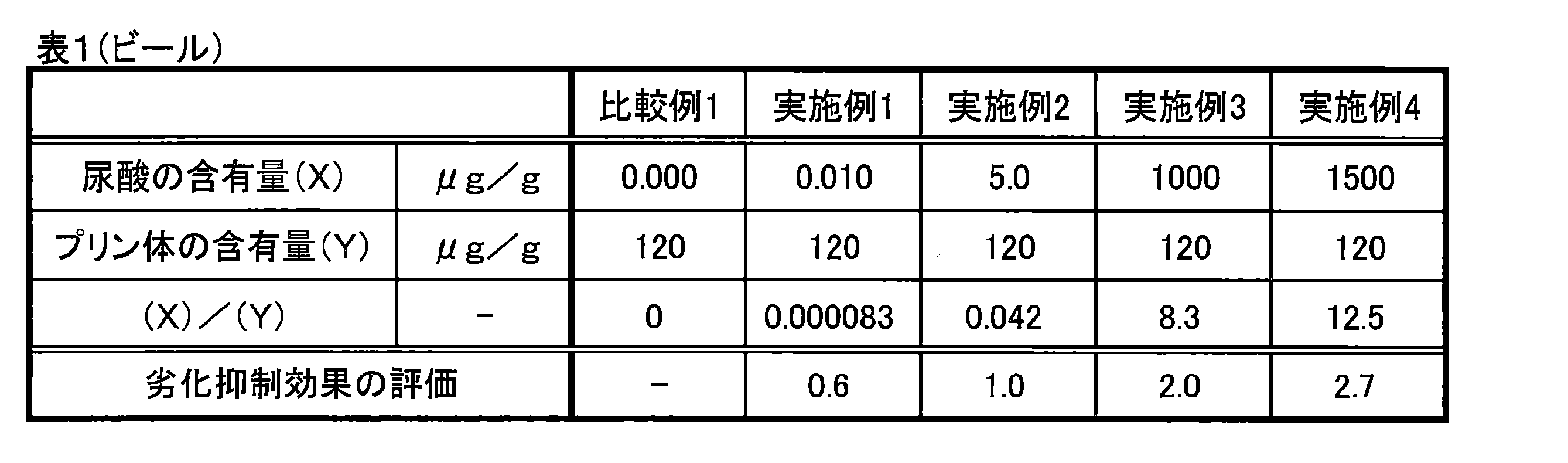
実施例5~6において、市販のプリン体ゼロビール(尿酸の含有量(X)=0.00μg/g、プリン体の含有量(Y)=4.0μg/g)に、尿酸を添加して、表2に示す尿酸の含有量(X)となるように調製したものをサンプル飲料とした。また、比較例2では、尿酸を添加前の市販のプリン体ゼロビールをサンプル飲料とした。
これらのサンプル飲料を、同じ種類の瓶容器にそれぞれ同量入れて、密封した状態で、50℃の暗室環境下で3日間静置した。静置後のサンプル飲料について、静置後の比較例2のサンプル飲料を基準とし、上記方法に基づき、実施例5~6のサンプル飲料の劣化抑制効果の評価を行ったところ、表2に示す結果となった。なお、同じ飲料に対して、各パネラー間での1.0以上の評点の差異は確認されなかった。また、3日間静置前の比較例2及び実施例5~6は、いずれも劣化が見られず、互いに同じ品質の飲料であることを確認している。
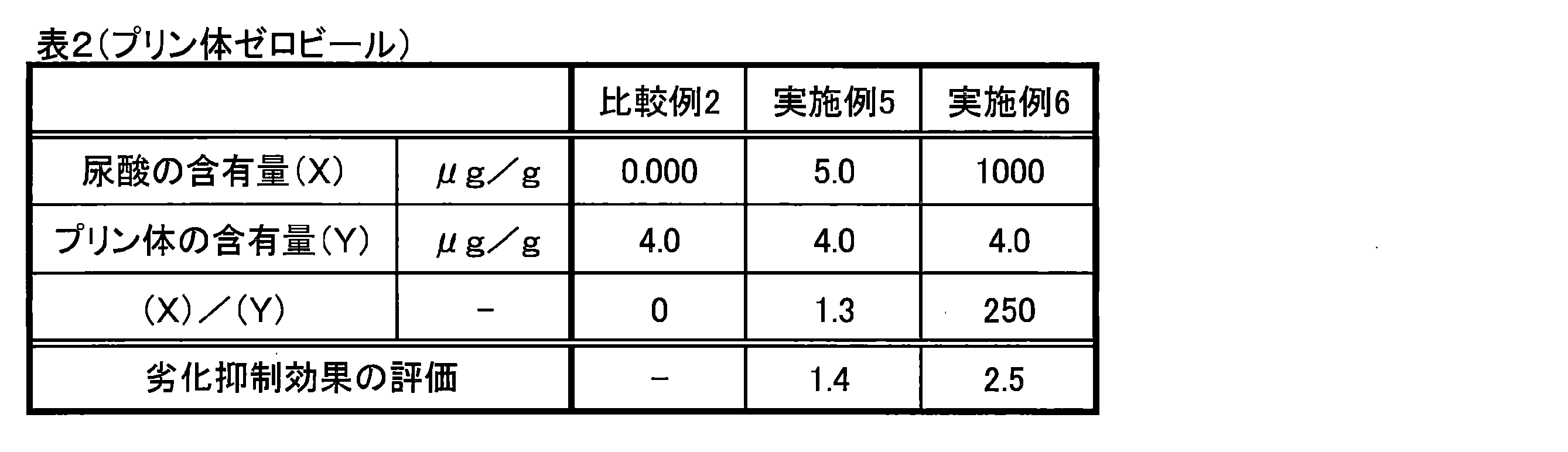
実施例7~9において、市販の豆乳飲料(尿酸の含有量(X)=0.00μg/g、プリン体の含有量(Y)=300μg/g)に、尿酸を添加して、表3に示す尿酸の含有量(X)となるように調製したものをサンプル飲料とした。また、比較例3では、尿酸を添加前の市販の豆乳飲料をサンプル飲料とした。
これらのサンプル飲料を、同じ種類の瓶容器にそれぞれ同量入れて、密封した状態で、50℃の暗室環境下で3日間静置した。静置後のサンプル飲料について、静置後の比較例3のサンプル飲料を基準とし、上記方法に基づき、実施例7~9のサンプル飲料の劣化抑制効果の評価を行ったところ、表3に示す結果となった。なお、同じ飲料に対して、各パネラー間での1.0以上の評点の差異は確認されなかった。また、3日間静置前の比較例3及び実施例7~9は、いずれも劣化が見られず、互いに同じ品質の飲料であることを確認している。

実施例10~11において、市販のノンアルコールビールテイスト飲料(1)(尿酸の含有量(X)=0.00μg/g、プリン体の含有量(Y)=1.0μg/g、アルコール度数=0.0(v/v)%)に、尿酸を添加して、表4に示す尿酸の含有量(X)となるように調製したものをサンプル飲料とした。また、比較例4では、尿酸を添加前の市販のノンアルコールビールテイスト飲料(1)をサンプル飲料とした。
これらのサンプル飲料を、同じ種類の瓶容器にそれぞれ同量入れて、密封した状態で、50℃の暗室環境下で3日間静置した。静置後のサンプル飲料について、静置後の比較例4のサンプル飲料を基準とし、上記方法に基づき、実施例10~11のサンプル飲料の劣化抑制効果の評価を行ったところ、表4に示す結果となった。なお、同じ飲料に対して、各パネラー間での1.0以上の評点の差異は確認されなかった。また、3日間静置前の比較例4及び実施例10~11は、いずれも劣化が見られず、互いに同じ品質の飲料であることを確認している。
実施例12において、市販のノンアルコールビールテイスト飲料(2)(尿酸の含有量(X)=0.00μg/g、プリン体の含有量(Y)=120μg/g、アルコール度数=0.0(v/v)%)に、尿酸を添加して、表4に示す尿酸の含有量(X)となるように調製したものをサンプル飲料とした。また、比較例5では、尿酸を添加前の市販のノンアルコールビールテイスト飲料(2)をサンプル飲料とした。
これらのサンプル飲料を、同じ種類の瓶容器にそれぞれ同量入れて、密封した状態で、50℃の暗室環境下で3日間静置した。静置後のサンプル飲料について、静置後の比較例5のサンプル飲料を基準とし、上記方法に基づき、実施例12のサンプル飲料の劣化抑制効果の評価を行ったところ、表4に示す結果となった。なお、同じ飲料に対して、各パネラー間での1.0以上の評点の差異は確認されなかった。また、3日間静置前の比較例5及び実施例12は、いずれも劣化が見られず、互いに同じ品質の飲料であることを確認している。

実施例13~15として、表5に示すキサンチン含有量及び尿酸含有量を有する市販のビールを10g秤量し、キサンチンオキシダーゼ活性を有する食品用プリン体低減剤を、表5に記載のキサンチンオキシダーゼ活性値となる量で添加し、十分に攪拌し、65℃で120分間静置して、各サンプルを調製した。
また、比較例6として、上記市販のビールに対して、食品用プリン体低減剤を添加せずに、65℃で120分間静置したものをサンプルとした。
これらのサンプルのキサンチン含有量及び尿酸含有量を測定したところ、表5に示す結果となった。なお、キサンチン含有量及び尿酸含有量、並びに、食品用プリン体低減剤のキサンチンオキシダーゼ活性値は、上述の方法に準拠して測定した値である。

Claims (9)
- 尿酸を含有し、尿酸の含有量(X)が0.001μg/g以上である、加工食品。
- プリン体の含有量(Y)が、1000μg/g以下である、請求項1に記載の加工食品。
- 尿酸の含有量(X)(単位:μg/g)とプリン体の含有量(Y)(単位:μg/g)との比〔(X)/(Y)〕が、0.00001以上である、請求項1又は2に記載の加工食品。
- 前記加工食品が、平成2年6月改定の日本標準商品分類にて、中分類72~76に属する加工食品(ただし、中分類76に属する氷及び製造たばこを除く)である、請求項1~3のいずれか一項に記載の加工食品。
- 前記加工食品が、ビールテイスト飲料である、請求項1~4のいずれか一項に記載の飲料。
- キサンチンオキシダーゼ活性を有する、請求項1~5のいずれか一項に記載の加工食品。
- キサンチンオキシダーゼ活性を有していたタンパク質を含有する、請求項1~5のいずれか一項に記載の加工食品。
- 請求項1~7のいずれか一項に記載の加工食品を製造する方法であって、
尿酸の含有量(X)を調整する工程を有する、加工食品の製造方法。 - 尿酸の含有量(X)を0.001μg/g以上に調整した加工食品とする、加工食品が有する特性の安定化方法。
Priority Applications (4)
| Application Number | Priority Date | Filing Date | Title |
|---|---|---|---|
| US18/572,400 US20240237680A1 (en) | 2021-06-30 | 2022-06-30 | Processed food product |
| EP22833295.3A EP4364580A4 (en) | 2021-06-30 | 2022-06-30 | Processed food product |
| JP2023532066A JPWO2023277149A1 (ja) | 2021-06-30 | 2022-06-30 | |
| CN202280043847.0A CN117545367A (zh) | 2021-06-30 | 2022-06-30 | 加工食品 |
Applications Claiming Priority (4)
| Application Number | Priority Date | Filing Date | Title |
|---|---|---|---|
| JP2021109249 | 2021-06-30 | ||
| JP2021-109250 | 2021-06-30 | ||
| JP2021109250 | 2021-06-30 | ||
| JP2021-109249 | 2021-06-30 |
Publications (1)
| Publication Number | Publication Date |
|---|---|
| WO2023277149A1 true WO2023277149A1 (ja) | 2023-01-05 |
Family
ID=84692756
Family Applications (2)
| Application Number | Title | Priority Date | Filing Date |
|---|---|---|---|
| PCT/JP2022/026326 Ceased WO2023277150A1 (ja) | 2021-06-30 | 2022-06-30 | 加工食品の製造方法 |
| PCT/JP2022/026325 Ceased WO2023277149A1 (ja) | 2021-06-30 | 2022-06-30 | 加工食品 |
Family Applications Before (1)
| Application Number | Title | Priority Date | Filing Date |
|---|---|---|---|
| PCT/JP2022/026326 Ceased WO2023277150A1 (ja) | 2021-06-30 | 2022-06-30 | 加工食品の製造方法 |
Country Status (5)
| Country | Link |
|---|---|
| US (2) | US20240237680A1 (ja) |
| EP (2) | EP4364580A4 (ja) |
| JP (2) | JPWO2023277149A1 (ja) |
| TW (2) | TW202308521A (ja) |
| WO (2) | WO2023277150A1 (ja) |
Cited By (1)
| Publication number | Priority date | Publication date | Assignee | Title |
|---|---|---|---|---|
| WO2024005054A1 (ja) * | 2022-06-30 | 2024-01-04 | サントリーホールディングス株式会社 | 加工食品 |
Citations (5)
| Publication number | Priority date | Publication date | Assignee | Title |
|---|---|---|---|---|
| JPS63502557A (ja) * | 1986-02-19 | 1988-09-29 | ソシエテ デ プロデユイ ネツスル ソシエテ アノニム | 酸化保護された食品およびその製造方法 |
| JPH09172962A (ja) * | 1995-12-21 | 1997-07-08 | Yotsuba Nyugyo Kk | 牛乳脂肪球膜含有画分の製造法 |
| JP2009039048A (ja) | 2007-08-09 | 2009-02-26 | Kirin-Tropicana Inc | 果汁飲料の製造方法 |
| JP2014012646A (ja) * | 2012-07-04 | 2014-01-23 | Katayama Chem Works Co Ltd | ニムフェオールを含有する組成物 |
| WO2017104752A1 (ja) * | 2015-12-18 | 2017-06-22 | サントリーホールディングス株式会社 | 発根抑制麦芽の製造方法 |
Family Cites Families (6)
| Publication number | Priority date | Publication date | Assignee | Title |
|---|---|---|---|---|
| ATE223478T1 (de) * | 1995-02-17 | 2002-09-15 | Suntory Ltd | Bierherstellung |
| RU2516349C2 (ru) * | 2012-07-04 | 2014-05-20 | Государственное научное учреждение Краснодарский научно-исследовательский институт хранения и переработки сельскохозяйственной продукции Российской академии сельскохозяйственных наук (ГНУ КНИИХП Россельхозакадемии) | Пищевой функциональный продукт |
| WO2015023928A1 (en) * | 2013-08-15 | 2015-02-19 | Cargill, Incorporated | Sweetener and sweetened compositions incorporating rebaudoside n |
| JP6804928B2 (ja) | 2016-10-19 | 2020-12-23 | アサヒビール株式会社 | ビール様発泡性飲料の製造方法 |
| CN109554376B (zh) * | 2018-11-13 | 2022-03-22 | 广西大学 | 一种碱性尿酸氧化酶及其在检测试剂盒和降低食品中尿酸的应用 |
| CN110684685B (zh) * | 2019-10-14 | 2021-03-30 | 广西大学 | 发酵乳杆菌Lactobacillus fermentum 9-4及其应用 |
-
2022
- 2022-06-30 TW TW111124541A patent/TW202308521A/zh unknown
- 2022-06-30 TW TW111124540A patent/TW202316977A/zh unknown
- 2022-06-30 JP JP2023532066A patent/JPWO2023277149A1/ja active Pending
- 2022-06-30 US US18/572,400 patent/US20240237680A1/en active Pending
- 2022-06-30 EP EP22833295.3A patent/EP4364580A4/en active Pending
- 2022-06-30 WO PCT/JP2022/026326 patent/WO2023277150A1/ja not_active Ceased
- 2022-06-30 EP EP22833296.1A patent/EP4365271A4/en active Pending
- 2022-06-30 US US18/572,421 patent/US20240349758A1/en active Pending
- 2022-06-30 WO PCT/JP2022/026325 patent/WO2023277149A1/ja not_active Ceased
- 2022-06-30 JP JP2023532067A patent/JPWO2023277150A1/ja active Pending
Patent Citations (5)
| Publication number | Priority date | Publication date | Assignee | Title |
|---|---|---|---|---|
| JPS63502557A (ja) * | 1986-02-19 | 1988-09-29 | ソシエテ デ プロデユイ ネツスル ソシエテ アノニム | 酸化保護された食品およびその製造方法 |
| JPH09172962A (ja) * | 1995-12-21 | 1997-07-08 | Yotsuba Nyugyo Kk | 牛乳脂肪球膜含有画分の製造法 |
| JP2009039048A (ja) | 2007-08-09 | 2009-02-26 | Kirin-Tropicana Inc | 果汁飲料の製造方法 |
| JP2014012646A (ja) * | 2012-07-04 | 2014-01-23 | Katayama Chem Works Co Ltd | ニムフェオールを含有する組成物 |
| WO2017104752A1 (ja) * | 2015-12-18 | 2017-06-22 | サントリーホールディングス株式会社 | 発根抑制麦芽の製造方法 |
Non-Patent Citations (4)
| Title |
|---|
| "Free Amino Nitrogen of Revised BCOJ Beer Analysis Method", 1 November 2004, PUBLIC INTEREST INCORPORATED FOUNDATION |
| "Revised BCOJ Beer Analysis Method", 2013, PUBLIC INTEREST INCORPORATED FOUNDATION |
| H19 NATIONAL TAX AGENCY ORDER, no. 6, 22 June 2007 (2007-06-22) |
| See also references of EP4364580A4 |
Cited By (1)
| Publication number | Priority date | Publication date | Assignee | Title |
|---|---|---|---|---|
| WO2024005054A1 (ja) * | 2022-06-30 | 2024-01-04 | サントリーホールディングス株式会社 | 加工食品 |
Also Published As
| Publication number | Publication date |
|---|---|
| WO2023277150A1 (ja) | 2023-01-05 |
| TW202316977A (zh) | 2023-05-01 |
| EP4364580A4 (en) | 2025-06-11 |
| US20240237680A1 (en) | 2024-07-18 |
| US20240349758A1 (en) | 2024-10-24 |
| JPWO2023277149A1 (ja) | 2023-01-05 |
| JPWO2023277150A1 (ja) | 2023-01-05 |
| TW202308521A (zh) | 2023-03-01 |
| EP4365271A1 (en) | 2024-05-08 |
| EP4365271A4 (en) | 2025-06-11 |
| EP4364580A1 (en) | 2024-05-08 |
Similar Documents
| Publication | Publication Date | Title |
|---|---|---|
| JP7052131B1 (ja) | ビールテイスト飲料 | |
| TWI862778B (zh) | 啤酒風味飲料 | |
| JP2021003128A (ja) | ビールテイスト飲料 | |
| JP7228034B2 (ja) | ノンアルコールビールテイスト飲料 | |
| JP7574460B2 (ja) | 加工食品 | |
| SG11202111526SA (en) | Alcohol-free beer-flavored beverage | |
| JP2019106925A (ja) | ビールテイスト飲料 | |
| JP7052132B1 (ja) | ビールテイスト飲料 | |
| WO2023277149A1 (ja) | 加工食品 | |
| JP2022162557A (ja) | ビールテイスト飲料 | |
| JP7018479B2 (ja) | ビールテイスト飲料、およびビールテイスト飲料の製造方法 | |
| CN117545367A (zh) | 加工食品 | |
| JP7808048B2 (ja) | ノンアルコールビールテイスト飲料、ノンアルコールビールテイスト飲料の製造方法、及び、ノンアルコールビールテイスト飲料の苦味の質を改善する方法 | |
| JP7018482B1 (ja) | ビールテイスト飲料、およびビールテイスト飲料の製造方法 | |
| HK40101519A (zh) | 加工食品的制造方法 | |
| HK40101253A (zh) | 加工食品 | |
| JP2022015251A (ja) | ビールテイスト飲料、およびビールテイスト飲料の製造方法 | |
| JP7806010B2 (ja) | 清涼飲料 | |
| JP2023173817A (ja) | 異味抑制用の麹菌組成物 | |
| HK40079596A (en) | Beer-flavored beverage | |
| HK1184337B (en) | Ph-adjusted non-alcoholic beer with low extract content | |
| HK1184337A (en) | Ph-adjusted non-alcoholic beer with low extract content | |
| HK1217611A1 (zh) | 调整ph的低提取物成分的啤酒味饮料 | |
| HK1217611B (en) | Ph-adjusted non-alcoholic beer with low extract content |
Legal Events
| Date | Code | Title | Description |
|---|---|---|---|
| 121 | Ep: the epo has been informed by wipo that ep was designated in this application |
Ref document number: 22833295 Country of ref document: EP Kind code of ref document: A1 |
|
| WWE | Wipo information: entry into national phase |
Ref document number: 2023532066 Country of ref document: JP |
|
| WWE | Wipo information: entry into national phase |
Ref document number: 202280043847.0 Country of ref document: CN Ref document number: 18572400 Country of ref document: US |
|
| WWE | Wipo information: entry into national phase |
Ref document number: 2022833295 Country of ref document: EP |
|
| NENP | Non-entry into the national phase |
Ref country code: DE |
|
| ENP | Entry into the national phase |
Ref document number: 2022833295 Country of ref document: EP Effective date: 20240130 |