WO2023277171A1 - 使用済ゴムの熱分解方法及び熱分解用ゴム材料 - Google Patents
使用済ゴムの熱分解方法及び熱分解用ゴム材料 Download PDFInfo
- Publication number
- WO2023277171A1 WO2023277171A1 PCT/JP2022/026430 JP2022026430W WO2023277171A1 WO 2023277171 A1 WO2023277171 A1 WO 2023277171A1 JP 2022026430 W JP2022026430 W JP 2022026430W WO 2023277171 A1 WO2023277171 A1 WO 2023277171A1
- Authority
- WO
- WIPO (PCT)
- Prior art keywords
- used rubber
- rubber
- elastomer
- medium
- oil
- Prior art date
- Legal status (The legal status is an assumption and is not a legal conclusion. Google has not performed a legal analysis and makes no representation as to the accuracy of the status listed.)
- Ceased
Links
Classifications
-
- C—CHEMISTRY; METALLURGY
- C08—ORGANIC MACROMOLECULAR COMPOUNDS; THEIR PREPARATION OR CHEMICAL WORKING-UP; COMPOSITIONS BASED THEREON
- C08L—COMPOSITIONS OF MACROMOLECULAR COMPOUNDS
- C08L91/00—Compositions of oils, fats or waxes; Compositions of derivatives thereof
-
- B—PERFORMING OPERATIONS; TRANSPORTING
- B09—DISPOSAL OF SOLID WASTE; RECLAMATION OF CONTAMINATED SOIL
- B09B—DISPOSAL OF SOLID WASTE NOT OTHERWISE PROVIDED FOR
- B09B3/00—Destroying solid waste or transforming solid waste into something useful or harmless
- B09B3/40—Destroying solid waste or transforming solid waste into something useful or harmless involving thermal treatment, e.g. evaporation
-
- C—CHEMISTRY; METALLURGY
- C08—ORGANIC MACROMOLECULAR COMPOUNDS; THEIR PREPARATION OR CHEMICAL WORKING-UP; COMPOSITIONS BASED THEREON
- C08C—TREATMENT OR CHEMICAL MODIFICATION OF RUBBERS
- C08C19/00—Chemical modification of rubber
- C08C19/08—Depolymerisation
-
- C—CHEMISTRY; METALLURGY
- C08—ORGANIC MACROMOLECULAR COMPOUNDS; THEIR PREPARATION OR CHEMICAL WORKING-UP; COMPOSITIONS BASED THEREON
- C08J—WORKING-UP; GENERAL PROCESSES OF COMPOUNDING; AFTER-TREATMENT NOT COVERED BY SUBCLASSES C08B, C08C, C08F, C08G or C08H
- C08J11/00—Recovery or working-up of waste materials
- C08J11/04—Recovery or working-up of waste materials of polymers
- C08J11/10—Recovery or working-up of waste materials of polymers by chemically breaking down the molecular chains of polymers or breaking of crosslinks, e.g. devulcanisation
- C08J11/18—Recovery or working-up of waste materials of polymers by chemically breaking down the molecular chains of polymers or breaking of crosslinks, e.g. devulcanisation by treatment with organic material
- C08J11/22—Recovery or working-up of waste materials of polymers by chemically breaking down the molecular chains of polymers or breaking of crosslinks, e.g. devulcanisation by treatment with organic material by treatment with organic oxygen-containing compounds
- C08J11/26—Recovery or working-up of waste materials of polymers by chemically breaking down the molecular chains of polymers or breaking of crosslinks, e.g. devulcanisation by treatment with organic material by treatment with organic oxygen-containing compounds containing carboxylic acid groups, their anhydrides or esters
-
- C—CHEMISTRY; METALLURGY
- C10—PETROLEUM, GAS OR COKE INDUSTRIES; TECHNICAL GASES CONTAINING CARBON MONOXIDE; FUELS; LUBRICANTS; PEAT
- C10G—CRACKING HYDROCARBON OILS; PRODUCTION OF LIQUID HYDROCARBON MIXTURES, e.g. BY DESTRUCTIVE HYDROGENATION, OLIGOMERISATION, POLYMERISATION; RECOVERY OF HYDROCARBON OILS FROM OIL-SHALE, OIL-SAND, OR GASES; REFINING MIXTURES MAINLY CONSISTING OF HYDROCARBONS; REFORMING OF NAPHTHA; MINERAL WAXES
- C10G1/00—Production of liquid hydrocarbon mixtures from oil-shale, oil-sand, or non-melting solid carbonaceous or similar materials, e.g. wood, coal
- C10G1/10—Production of liquid hydrocarbon mixtures from oil-shale, oil-sand, or non-melting solid carbonaceous or similar materials, e.g. wood, coal from rubber or rubber waste
-
- C—CHEMISTRY; METALLURGY
- C07—ORGANIC CHEMISTRY
- C07C—ACYCLIC OR CARBOCYCLIC COMPOUNDS
- C07C2601/00—Systems containing only non-condensed rings
- C07C2601/12—Systems containing only non-condensed rings with a six-membered ring
- C07C2601/16—Systems containing only non-condensed rings with a six-membered ring the ring being unsaturated
-
- C—CHEMISTRY; METALLURGY
- C07—ORGANIC CHEMISTRY
- C07C—ACYCLIC OR CARBOCYCLIC COMPOUNDS
- C07C4/00—Preparation of hydrocarbons from hydrocarbons containing a larger number of carbon atoms
- C07C4/22—Preparation of hydrocarbons from hydrocarbons containing a larger number of carbon atoms by depolymerisation to the original monomer, e.g. dicyclopentadiene to cyclopentadiene
-
- C—CHEMISTRY; METALLURGY
- C08—ORGANIC MACROMOLECULAR COMPOUNDS; THEIR PREPARATION OR CHEMICAL WORKING-UP; COMPOSITIONS BASED THEREON
- C08J—WORKING-UP; GENERAL PROCESSES OF COMPOUNDING; AFTER-TREATMENT NOT COVERED BY SUBCLASSES C08B, C08C, C08F, C08G or C08H
- C08J11/00—Recovery or working-up of waste materials
- C08J11/04—Recovery or working-up of waste materials of polymers
- C08J11/10—Recovery or working-up of waste materials of polymers by chemically breaking down the molecular chains of polymers or breaking of crosslinks, e.g. devulcanisation
- C08J11/12—Recovery or working-up of waste materials of polymers by chemically breaking down the molecular chains of polymers or breaking of crosslinks, e.g. devulcanisation by dry-heat treatment only
-
- C—CHEMISTRY; METALLURGY
- C08—ORGANIC MACROMOLECULAR COMPOUNDS; THEIR PREPARATION OR CHEMICAL WORKING-UP; COMPOSITIONS BASED THEREON
- C08J—WORKING-UP; GENERAL PROCESSES OF COMPOUNDING; AFTER-TREATMENT NOT COVERED BY SUBCLASSES C08B, C08C, C08F, C08G or C08H
- C08J2317/00—Characterised by the use of reclaimed rubber
-
- C—CHEMISTRY; METALLURGY
- C08—ORGANIC MACROMOLECULAR COMPOUNDS; THEIR PREPARATION OR CHEMICAL WORKING-UP; COMPOSITIONS BASED THEREON
- C08J—WORKING-UP; GENERAL PROCESSES OF COMPOUNDING; AFTER-TREATMENT NOT COVERED BY SUBCLASSES C08B, C08C, C08F, C08G or C08H
- C08J2319/00—Characterised by the use of rubbers not provided for in groups C08J2307/00 - C08J2317/00
-
- Y—GENERAL TAGGING OF NEW TECHNOLOGICAL DEVELOPMENTS; GENERAL TAGGING OF CROSS-SECTIONAL TECHNOLOGIES SPANNING OVER SEVERAL SECTIONS OF THE IPC; TECHNICAL SUBJECTS COVERED BY FORMER USPC CROSS-REFERENCE ART COLLECTIONS [XRACs] AND DIGESTS
- Y02—TECHNOLOGIES OR APPLICATIONS FOR MITIGATION OR ADAPTATION AGAINST CLIMATE CHANGE
- Y02W—CLIMATE CHANGE MITIGATION TECHNOLOGIES RELATED TO WASTEWATER TREATMENT OR WASTE MANAGEMENT
- Y02W30/00—Technologies for solid waste management
- Y02W30/50—Reuse, recycling or recovery technologies
- Y02W30/62—Plastics recycling; Rubber recycling
Definitions
- the present invention relates to a method for thermally decomposing used rubber and a rubber material for thermal decomposition.
- Patent Literature 1 describes a technique for thermally decomposing used rubber such as waste tires to recycle materials. Including an internal circulation step of circulating the pyrolysis gas and the oxygen-free gas inside, and from the start of heating of the pyrolysis furnace until the amount of pyrolysis gas generated reaches the maximum value, heating-external circulation A thermal decomposition method is disclosed in which the internal circulation step is performed after the steps are performed and the amount of thermal decomposition gas generated reaches a maximum value.
- an object of the present invention is to provide a method for thermally decomposing used rubber that is excellent in the yield of the monomer component that constitutes the elastomer without lowering the efficiency of thermal decomposition.
- Another object of the present invention is to provide a thermally decomposable rubber material capable of increasing the yield of the monomer component that constitutes the elastomer.
- the present inventors have studied a method of thermally decomposing used rubber containing various elastomers to solve the above problems. and by contacting or swelling with a liquid medium having an endothermic peak temperature, it is possible to increase the yield of monomer components constituting the elastomer without affecting thermal decomposition.
- the method for thermally decomposing used rubber of the present invention is a method for thermally decomposing used rubber, wherein the used rubber has an SP value of 8.3 to 11 (cal/cm 3 ) 1/2 . and having an endothermic peak temperature of 235° C. or higher as measured by thermogravimetry (TGA), and having a liquid state at 150° C., is brought into contact with or swollen in a medium, and then thermally decomposed.
- TGA thermogravimetry
- the rubber material for thermal decomposition of the present invention is a rubber containing at least one elastomer selected from an isoprene skeleton elastomer, a butadiene skeleton elastomer and a styrene skeleton elastomer, a medium having an SP value of 8.3 to 11 (cal/cm 3 ) 1/2 , an endothermic peak temperature measured by thermogravimetry (TGA) of 380° C. or higher, and liquid at 150° C.; characterized by comprising
- TGA thermogravimetry
- the present invention it is possible to provide a method for thermally decomposing used rubber that is excellent in the yield of the monomer component that constitutes the elastomer without lowering the efficiency of thermal decomposition. Further, according to the present invention, it is possible to provide a rubber material for thermal decomposition that can increase the yield of the monomer component that constitutes the elastomer.
- the method for thermally decomposing used rubber of the present invention is a method for thermally decomposing used rubber.
- the used rubber to be thermally decomposed contains elastomers such as isoprene skeleton elastomers, butadiene skeleton elastomers, and styrene skeleton elastomers (hereinafter sometimes simply referred to as "elastomers").
- the elastomer is, for example, an elastomer component having a main skeleton of isoprene units, butadiene units, styrene units, etc.
- natural rubber NR
- synthetic isoprene rubber IR
- styrene-isoprene thermoplastic elastomer SIS
- butadiene rubber BR
- SBR styrene-butadiene rubber
- the elastomer may be an elastomer component other than an isoprene skeleton elastomer, a butadiene skeleton elastomer, and a styrene skeleton elastomer.
- the recovered monomer component it is preferably at least one elastomer selected from an isoprene skeleton elastomer, a butadiene skeleton elastomer, and a styrene skeleton elastomer. It is more preferable to contain an elastomer.
- the content of the elastomer in the rubber component of the used rubber is not particularly limited. It is changed as appropriate according to the type of used rubber.
- the used rubber in the present invention means a rubber material whose use has been completed, such as rubber-based waste. objects, rubber hoses, tubes, and rubber materials such as conveyor belts.
- the used rubber may be vulcanized rubber or unvulcanized rubber.
- the recovered components obtained by thermally decomposing the used rubber are determined by the types of monomers contained.
- the recovered components include isoprene and limonene.
- the recovered component contains butadiene
- the recovered component contains styrene.
- d-, l- and d/l-forms each of which consists of two isoprene units.
- the d-form and l-form are represented by the following general formula (I).
- the butadiene is one of unsaturated hydrocarbons having two double bonds represented by the molecular formula C 4 H 6 and includes 1,3-butadiene.
- the butadiene skeleton elastomer is not particularly limited as long as it has a butadiene skeleton, and a copolymer having a butadiene skeleton and a modified butadiene rubber are also included in the butadiene skeleton elastomer.
- the styrene skeleton elastomer is not particularly limited as long as it has a styrene skeleton, and copolymers and modified elastomers having a styrene skeleton are also included in the styrene skeleton elastomer.
- the used rubber has an SP value of 8.3 to 11 (cal/cm 3 ) 1/2 and has an endothermic value measured by thermogravimetry (TGA). Pyrolysis is carried out after contact or swelling with a medium that has a peak temperature of 235°C or higher and is liquid at 150°C. As a preliminary step to the thermal decomposition, the used rubber has the SP value and the endothermic peak temperature, and is thermally decomposed in a state of being in contact with or swollen in a liquid medium at 150 ° C.
- TGA thermogravimetry
- the yield of the monomer component constituting the elastomer can be increased.
- the contact between the used rubber and the medium and the swelling of the used rubber by the medium are performed as a pre-stage of thermal decomposition, the efficiency of the thermal decomposition process is not lowered.
- the medium used for contacting or swelling the used rubber has an SP value of 8.3 to 11 (cal/cm 3 ) 1/2 .
- the SP value of the medium is 8.3 to 11, the SP value is close to the SP value of the elastomer in the used rubber. is.
- the medium preferably has an SP value of 8.5 to 11 (cal/cm 3 ) 1/2 .
- the SP value is measured by the Fedors method, and can be calculated by the Fedors method described in Polymer Engineering Science, 14, 147 (1974). A material whose SP value is known in advance can also be used.
- the medium used for contacting or swelling the used rubber has an endothermic peak temperature of 380° C. or higher as measured by thermogravimetry (TGA). This is because the endothermic peak temperature is close to the endothermic peak temperature of the elastomer in the used rubber, and the rubber can be given fluidity and easily decomposed by heat.
- the endothermic peak temperature of the medium measured by TGA is preferably 235° C. or higher, more preferably 250° C. or higher.
- the endothermic peak temperature measured by thermogravimetry (TGA) is the endothermic peak temperature when the heating rate is 10° C./min or more, preferably 10 to 20° C./min.
- the endothermic peak temperature can be obtained with a differential thermal balance (for example, "ThermoMass Photo” manufactured by Rigaku Corporation). A material whose endothermic peak temperature is known in advance can also be used.
- the medium used for contacting or swelling the used rubber is liquid at 150°C.
- the medium used for contacting or swelling the used rubber is liquid at 150°C.
- it does not evaporate before reaching the thermal decomposition temperature and is in a liquid state. can lead to It can also be distinguished from the used rubber and resin materials, which are solid at 150°C.
- the mobility of the rubber polymer chains in the spent rubber can be made greater, leading to a state more prone to thermal decomposition.
- the method for swelling the used rubber is not particularly limited. For example, the used rubber is extracted with acetone to remove chemicals and then dried.
- the used rubber is precisely weighed, immersed in oil (medium), and allowed to stand for a certain period of time, whereby the used rubber can be swollen.
- the swelling rate can be calculated from the weight before and after immersion in oil.
- the amount of the medium to be brought into contact is not particularly limited, and if necessary, it may be heated, may be brought into contact with or immersed in the heated medium, or may be heated while being brought into contact with or immersed in the medium.
- the weight average molecular weight (Mw) of the medium is preferably 1000 or less. This is because the used rubber can be brought into a state of being easily decomposed by heat, and the yield of monomer components constituting elastomers such as isoprene and limonene can be further increased. From the same point of view, the weight average molecular weight (Mw) of the medium is preferably 1000 or less.
- the weight average molecular weight (Mw) of the medium is, for example, preferably 100 or more, more preferably 250 or more, more preferably 300 or more, even more preferably 450 or more.
- the weight average molecular weight (Mw) of the medium can be measured, for example, by gel permeation chromatography (GPC).
- the medium preferably has at least one oxygen atom. This is because the used rubber can be brought into a state of being easily decomposed by heat, and the yield of monomer components constituting elastomers such as isoprene and limonene can be further increased.
- the medium contains at least one of fatty acids having 12 to 24 carbon atoms, fatty acid salts and fatty acid esters.
- fatty acids having 12 to 24 carbon atoms, fatty acid salts and fatty acid esters.
- the used rubber can be brought into a state of being easily decomposed by heat, and the yield of the monomer component constituting the elastomer can be further increased.
- fatty acids include myristic acid, palmitic acid, palmitoleic acid, stearic acid, oleic acid, linoleic acid, linolenic acid and erucic acid.
- the medium preferably has at least one ester skeleton in the molecule.
- the used rubber can be brought into a state of being easily decomposed by heat, and the yield of the monomer component constituting the elastomer can be further increased.
- fatty acid esters include monoglycerides, diglycerides, triglycerides, and fatty acid esters (wax esters) with fatty alcohols having 12 to 24 carbon atoms.
- the compound mentioned above can also be used individually and may use a mixture of multiple types.
- the medium may be a mixed oil containing aromatic oil and asphaltene, and an oil that satisfies the conditions of an SP value of 8.3 to 11 and an endothermic peak temperature of 235°C or higher.
- Preferred specific examples of these media include rapeseed oil, soybean oil, olive oil, sunflower oil, safflower oil, corn oil, castor oil, jojoba oil, palm oil, palm stearin, palm olein, oleic acid, linoleic acid, and asphalt mixtures.
- At least one selected from the group consisting of naphthenic oil, stearic acid derivatives and stearic acid glycerides can be used. These may be recycled or discarded, such as waste cooking oil. It is also possible to use media of other origins, provided that the preferred oil and fatty acid composition is similar.
- it may be an oil composed of a group of compounds having a structure such as at least one of the fatty acids, fatty acid salts and fatty acid esters having 12 to 24 carbon atoms described above.
- stearic acid derivatives include stearic acid and metal stearates.
- metal stearates having a melting point of 150° C. or less are preferred.
- the metal of the metal stearate include alkali metals and alkaline earth metals. Among these, Mg, Ca, Zn and the like are preferable, and Zn is particularly preferable.
- the amount of the medium used for contacting or swelling the used rubber is not particularly limited, and can be adjusted as appropriate depending on the type of medium and the state of the used rubber.
- the used rubber is brought into contact with or swelled by the medium, and then thermally decomposed.
- the thermal decomposition method is not particularly limited, and a known thermal decomposition method can be appropriately selected. For example, a contact step of contacting the used rubber with an oxygen-free gas using a pyrolysis furnace, a furnace heating step of heating the pyrolysis furnace, and a pyrolysis treatment apparatus to pyrolyze the used rubber.
- condensed oil including monomer components constituting elastomers such as isoprene and limonene Pyrolysis can be carried out through an oil recovery process for recovering oil).
- the rubber material for pyrolysis of the present invention is a rubber containing at least one elastomer selected from an isoprene backbone elastomer, a butadiene backbone elastomer, and a styrene backbone elastomer; a medium having an SP value of 8.3 to 11 (cal/cm 3 ) 1/2 , an endothermic peak temperature measured by thermogravimetry (TGA) of 380° C. or higher, and liquid at 150° C.; characterized by comprising By thermally decomposing the rubber material for thermal decomposition thus obtained, the yield of the monomer component constituting the elastomer can be increased.
- TGA thermogravimetry
- the configurations of the isoprene-skeletal elastomer and the medium are the same as those described in the method for thermally decomposing used rubber of the present invention.
- Examples 1 to 10 Under the conditions shown in Tables 1 to 3, the same amount of vulcanized rubber (containing high-cis polyisoprene rubber) was brought into contact with a medium and then thermally decomposed. Thermal decomposition was carried out by heating 10 mg of a mixed sample of vulcanized rubber and medium at a heating temperature of 20° C./min in a helium atmosphere. In addition, since the medium shown in Table 1 is liquid at room temperature, thermal decomposition is performed in a swollen state of the vulcanized rubber, and the medium shown in Tables 2 and 3 is not liquid at room temperature. Pyrolysis was carried out while mixed with vulcanized rubber.
- the measured value of Peak Area in each example and each comparative example is an index value when the measured value of Peak Area in Comparative Example 1, in which thermal decomposition was performed without contacting the vulcanized rubber with a medium, was set to 100. Shown in Tables 1-3. The larger the index value, the higher the yield and the better the result.
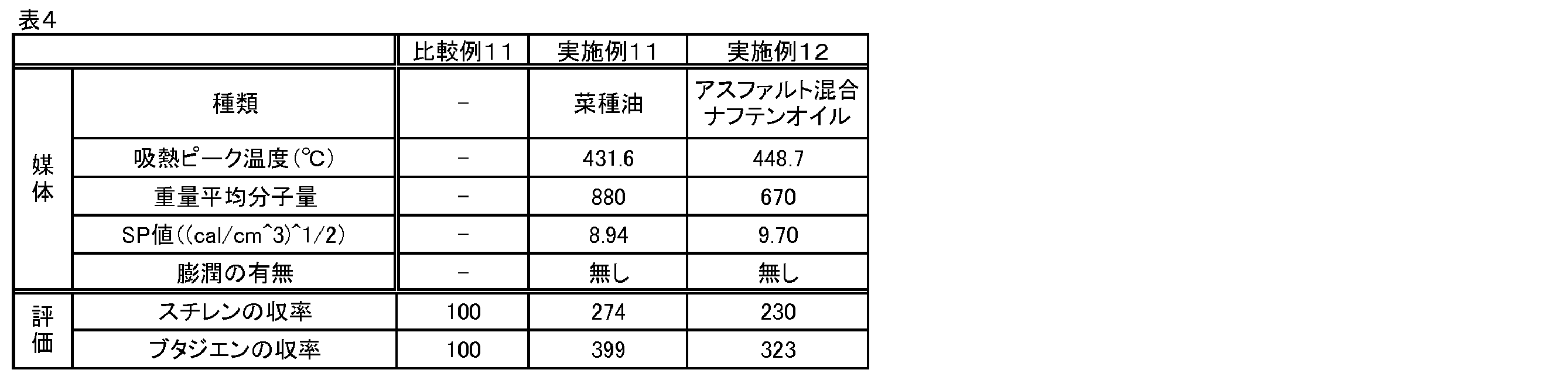
- Example 11 Under the conditions shown in Table 4, the same amount of vulcanized rubber (containing styrene-butadiene rubber (solution-polymerized styrene-butadiene copolymer)) was brought into contact with a medium and then thermally decomposed. Thermal decomposition was carried out by heating 10 mg of a mixed sample of vulcanized rubber and medium at a heating temperature of 20° C./min in a helium atmosphere. The media shown in Table 4 are liquid at room temperature, but thermal decomposition was performed in a state where they were mixed with the vulcanized rubber without causing the vulcanized rubber to swell.
- styrene-butadiene rubber solution-polymerized styrene-butadiene copolymer
- the thermal decomposition method of the used rubber which is excellent in the yield of the monomer component which comprises an elastomer can be provided, without reducing the efficiency of thermal decomposition. Further, according to the present invention, it is possible to provide a rubber material for thermal decomposition that can increase the yield of the monomer component that constitutes the elastomer.
Landscapes
- Chemical & Material Sciences (AREA)
- Organic Chemistry (AREA)
- Chemical Kinetics & Catalysis (AREA)
- General Chemical & Material Sciences (AREA)
- Engineering & Computer Science (AREA)
- Polymers & Plastics (AREA)
- Medicinal Chemistry (AREA)
- Health & Medical Sciences (AREA)
- Oil, Petroleum & Natural Gas (AREA)
- Life Sciences & Earth Sciences (AREA)
- Wood Science & Technology (AREA)
- Physics & Mathematics (AREA)
- Thermal Sciences (AREA)
- Environmental & Geological Engineering (AREA)
- Sustainable Development (AREA)
- Separation, Recovery Or Treatment Of Waste Materials Containing Plastics (AREA)
Abstract
Description
例えば、特許文献1には、廃タイヤ等の使用済ゴムを熱分解して材料をリサイクルする技術は、熱分解を効率的に行うことを目的として、内部循環装置を用いて熱分解処炉の内部で熱分解ガス及び前記無酸素ガスを循環させる内部循環工程を含み、熱分解炉の加熱が開始されてから、熱分解ガスの発生量が最大値となるまでの間は、加熱-外部循環工程を行い、熱分解ガスの発生量が最大値となった後、前記内部循環工程を行うといった熱分解方法が開示されている。
そして、使用済ゴムの熱分解は、上述した熱分解を効率的に行うことに加え、上述したようなエラストマーを構成するモノマー成分の収率を高めることが望まれている。
上記構成を具えることによって、熱分解の効率を低下させることなく、イソプレン及びリモネンの収率を向上させることができる。
SP値が8.3~11(cal/cm3)1/2であり、熱重量測定(TGA)で測定した吸熱ピーク温度が380℃以上であり、且つ、150℃で液状である媒体と、を含むことを特徴とする。
上記構成を具えることによって、エラストマーを構成するモノマー成分の収率を高めることができる。
<使用済ゴムの熱分解方法>
本発明の使用済ゴムの熱分解方法は、使用済ゴムを熱分解する方法である。
ここで、熱分解の対象となる使用済ゴムについては、イソプレン骨格エラストマー、ブタジエン骨格エラストマー、スチレン骨格エラストマー等のエラストマー(以下、単に「エラストマー」ということがある。)を含有する。
前記エラストマーは、イソプレン骨格エラストマー、ブタジエン骨格エラストマー、スチレン骨格エラストマー以外のエラストマー成分であってもよい。ただし、回収後のモノマー成分の利用のしやすさ、有益性等の観点からは、イソプレン骨格エラストマー、ブタジエン骨格エラストマー及びスチレン骨格エラストマーのうちの少なくとも1種のエラストマーであることが好ましく、少なくともイソプレン骨格エラストマーを含有することがより好ましい。
なお、前記使用済ゴムのゴム成分におけるエラストマーの含有量については、特に限定はされない。使用済ゴムの種類に応じて、適宜変更されるものである。
なお、前記使用済ゴムは、加硫ゴムであっても、未加硫ゴムであってもよい。

さらに、前記スチレン骨格エラストマーは、スチレン骨格を有するものであれば特に限定はなく、スチレン骨格を有する共重合体や変性エラストマーについても、前記スチレン骨格エラストマーに含まれる。
前記熱分解の前段階として、使用済ゴムを、上記SP値及び吸熱ピーク温度を有し、且つ、150℃で液状の媒体に接触又は膨潤させた状態で熱分解を行うことで、使用済ゴム中のゴムポリマーの鎖の易動度を大きくし、熱分解しやすい状態へと導くことができる結果、エラストマーを構成するモノマー成分の収率を高めることができる。また、前記使用済ゴムと前記媒体との接触や、前記使用済ゴムの前記媒体による膨潤は、熱分解の前段階として行われるため、熱分解工程の効率が低下することはない。
同様の観点から、前記媒体のSP値は、8.5~11(cal/cm3)1/2であることが好ましい。
なお、前記SP値(溶解度パラメータ)の測定方法は、Fedors法によって測定されたSP値であり、Polymer Engineering Science,14,147(1974)に記載のFedors法により算出することができる。また、予めSP値がわかっている材料を用いることもできる。
同様の観点から、前記媒体のTGAで測定した吸熱ピーク温度は、235℃以上であることが好ましく、250℃以上であることがより好ましい。
なお、前記熱重量測定(TGA)で測定した吸熱ピーク温度については、昇温速度が10℃/分以上のとき、好ましくは10~20℃/分のときの吸熱ピーク温度のことである。前記TGAの測定については、示差熱天秤(例えば、株式会社リガク製「ThermoMass Photo」)によって、吸熱ピーク温度を得ることができる。また、予め吸熱ピーク温度がわかっている材料を用いることもできる。
また、前記使用済ゴムは、前記媒体を用いて膨潤させることが好ましい。使用済ゴム中のゴムポリマーの鎖の易動度をより大きくし、さらに熱分解しやすい状態へと導くことができる。なお、前記使用済ゴムを膨潤させる方法については、特に限定はされない。例えば、前記使用済ゴムをアセトンで抽出し、薬品を除去した後、乾燥させる。その後、前記使用済ゴムを精秤後、オイル(媒体)に浸漬させ、一定時間おくことで、前記使用済ゴムを膨潤させることができる。膨潤率は、オイル浸漬前後の重量から算出することができる。
接触させる媒体の量は特に制限は無く、また必要に応じて加熱してもよく、加熱した媒体に接触又は浸漬させてもよいし、媒体に接触又は浸漬させながら加熱してもよい。
同様の観点から、媒体の重量平均分子量(Mw)は、1000以下であることが好まし。また、前記媒体の重量平均分子量(Mw)は、例えば100以上であることが好ましく、250以上がより好ましく、300以上とすることがより好ましく、450以上とすることが更に好ましい。
なお、前記媒体の重量平均分子量(Mw)は、例えば、ゲルパーミエーションクロマトグラフィー(GPC)によって測定することができる。
なお、上述した化合物は、単独で用いることもできるし、複数種の混合物を用いても良い。
なお、前記ステアリン酸誘導体については、ステアリン酸や、ステアリン酸金属塩が挙げられる。これらの中でも、融点が150℃以下のステアリン酸金属塩であることが好ましい。さらに、前記ステアリン酸金属塩の金属としては、アルカリ金属類、アルカリ土類金属類が挙げられ、これらの中でも、Mg、Ca、Zn等であることが好ましく、Znであることが特に好ましい。
熱分解の方法については、特に限定はされず、公知の熱分解方法を適宜選択することができる。例えば、熱分解炉を用いて、前記使用済ゴムを無酸素ガスと接触させる接触工程と、熱分解炉を加熱する炉加熱工程と、熱分解処理装置を用いて、前記使用済ゴムを熱分解し、熱分解ガスを発生させる熱分解ガス発生工程と、前記熱分解処理装置で発生した熱分解ガスを冷却することにより、凝縮した油分(イソプレンやリモネン等のエラストマーを構成するモノマー成分を含んだ油分)を回収する油分回収工程、を経る熱分解を実施することができる。
本発明の熱分解用ゴム材料は、
イソプレン骨格エラストマー、ブタジエン骨格エラストマー及びスチレン骨格エラストマーのうちの少なくとも1種のエラストマーを含有するゴムと、
SP値が8.3~11(cal/cm3)1/2であり、熱重量測定(TGA)で測定した吸熱ピーク温度が380℃以上であり、且つ、150℃で液状である媒体と、を含むことを特徴とする。
このようにして得られた熱分解用ゴム材料は、熱分解することで、エラストマーを構成するモノマー成分の収率を高めることができる。
表1~3に示す条件で、同量の加硫ゴム(高シスポリイソプレンゴムを含有)に対して、媒体を接触させた後、熱分解を行った。熱分解は、加硫ゴムと媒体の混合試料10mgを、ヘリウム雰囲気下、昇温温度20℃/minで昇温することで行った。
なお、表1に示した媒体は、常温で液状であるため、加硫ゴムを膨潤させた状態で、熱分解を実施し、表2及び3に示した媒体は、常温で液状ではないため、加硫ゴムと混合させた状態で、熱分解を実施した。
なお、使用した媒体の、熱重量測定(TGA)で測定した昇温速度20℃のときの吸熱ピーク温度(℃)、重量平均分子量、Polymer Engineering Science,14,147(1974)に記載のFedors法により算出したSP値((cal/cm3)1/2)、膨潤の有無については、表1~3に示す。
また、比較例8~10の樹脂に関しては、以下の条件で、ゲル透過クロマトグラフィー(GPC)により、平均分子量を測定し、ポリスチレン換算の重量平均分子量を算出した。
・カラム温度:40℃
・注入量:50μL
・キャリアー及び流速:テトラヒドロフラン 0.6mL/min
・サンプル調製:各媒体約2.5mgをテトラヒドロフラン10mLに溶解
さらにまた、比較例6及び7、並びに、実施例14以外の実施例・比較例については、化学構造から重量平均分子量を算出した。
熱分解後、回収したイソプレン及びリモネンの収率を把握するため、示差熱天秤-光イオン化質量分析同時測定装置(リガク製)「Thermo Mass Photo」)を用いて、m/z68:イソプレン及びm/z136:リモネンのデータからMSイオンサーモグラムを作成することで、熱分解後に回収した油分中のイソプレン及びリモネンのPeak Area(A*s/mg)を測定した。
各実施例及び各比較例におけるPeak Areaの測定値については、加硫ゴムに媒体を接触させることなく熱分解を実施した比較例1の、Peak Areaの測定値を100とした時の指数値として表1~3に示す。当該指数値は、大きい程、収率が高く良好な結果であることを示す。


表4に示す条件で、同量の加硫ゴム(スチレン-ブタジエンゴム(溶液重合スチレン-ブタジエン共重合体)を含有)に対して、媒体を接触させた後、熱分解を行った。熱分解は、加硫ゴムと媒体の混合試料10mgを、ヘリウム雰囲気下、昇温温度20℃/minで昇温することで行った。
なお、表4に示した媒体は、常温で液状であるが、加硫ゴムの膨潤はさせず、加硫ゴムと混合させた状態で、熱分解を実施した。
なお、使用した媒体の、熱重量測定(TGA)で測定した昇温速度20℃のときの吸熱ピーク温度(℃)、重量平均分子量、Polymer Engineering Science,14,147(1974)に記載のFedors法により算出したSP値((cal/cm3)1/2)、膨潤の有無については、表4に示す。
Claims (8)
- 使用済ゴムを熱分解する方法であって、
前記使用済ゴムを、SP値が8.3~11(cal/cm3)1/2であり、熱重量測定(TGA)で測定した吸熱ピーク温度が235℃以上であり、且つ、150℃で液状である、媒体に接触又は膨潤させた後、
熱分解を実施することを特徴とする、使用済ゴムの熱分解方法。 - 前記使用済ゴムが、イソプレン骨格エラストマー、ブタジエン骨格エラストマー及びスチレン骨格エラストマーのうちの少なくとも1種のエラストマーを含有することを特徴とする、請求項1に記載の使用済ゴムの熱分解方法。
- 前記使用済ゴムが、少なくともイソプレン骨格エラストマーを含有することを特徴とする、請求項2に記載の使用済ゴムの熱分解方法。
- 前記媒体の重量平均分子量(Mw)が1000以下であることを特徴とする、請求項1又は2に記載の使用済ゴムの熱分解方法。
- 前記媒体は、少なくとも1つの酸素原子を有することを特徴とする、請求項1又は2に記載の使用済ゴムの熱分解方法。
- 前記媒体は、炭素数が12~24の脂肪酸、脂肪酸塩及び脂肪酸エステルのうちの少なくとも1種からなることを特徴とする、請求項5に記載の使用済ゴムの熱分解方法。
- 前記媒体は、菜種油、大豆油、オリーブオイル、ヒマワリ油、紅花油、コーン油、ひまし油、ホホバ油、パーム油、パームステアリン、パームオレイン、オレイン酸、リノール酸、ステアリン酸誘導体及びステアリン酸グリセリドからなる群より選択される少なくとも一種を含むことを特徴とする、請求項1又は2に記載の使用済ゴムの熱分解方法。
- イソプレン骨格エラストマー、ブタジエン骨格エラストマー及びスチレン骨格エラストマーのうちの少なくとも1種のエラストマーを含有するゴムと、
SP値が8.3~11(cal/cm3)1/2であり、熱重量測定(TGA)で測定した吸熱ピーク温度が380℃以上であり、且つ、150℃で液状である媒体と、を含むことを特徴とする、熱分解用ゴム材料。
Priority Applications (4)
| Application Number | Priority Date | Filing Date | Title |
|---|---|---|---|
| JP2023532083A JPWO2023277171A1 (ja) | 2021-06-30 | 2022-06-30 | |
| CN202280046548.2A CN117580903A (zh) | 2021-06-30 | 2022-06-30 | 使用过的橡胶的热分解方法和热分解用橡胶材料 |
| EP22833317.5A EP4365206A4 (en) | 2021-06-30 | 2022-06-30 | Method for pyrolysis of used rubber and rubber material for pyrolysis |
| US18/575,035 US20240301095A1 (en) | 2021-06-30 | 2022-06-30 | Thermal decomposition method of used rubber and rubber material for thermal decomposition |
Applications Claiming Priority (2)
| Application Number | Priority Date | Filing Date | Title |
|---|---|---|---|
| JP2021-109731 | 2021-06-30 | ||
| JP2021109731 | 2021-06-30 |
Publications (1)
| Publication Number | Publication Date |
|---|---|
| WO2023277171A1 true WO2023277171A1 (ja) | 2023-01-05 |
Family
ID=84692772
Family Applications (1)
| Application Number | Title | Priority Date | Filing Date |
|---|---|---|---|
| PCT/JP2022/026430 Ceased WO2023277171A1 (ja) | 2021-06-30 | 2022-06-30 | 使用済ゴムの熱分解方法及び熱分解用ゴム材料 |
Country Status (5)
| Country | Link |
|---|---|
| US (1) | US20240301095A1 (ja) |
| EP (1) | EP4365206A4 (ja) |
| JP (1) | JPWO2023277171A1 (ja) |
| CN (1) | CN117580903A (ja) |
| WO (1) | WO2023277171A1 (ja) |
Cited By (2)
| Publication number | Priority date | Publication date | Assignee | Title |
|---|---|---|---|---|
| WO2025033298A1 (ja) * | 2023-08-04 | 2025-02-13 | 株式会社ブリヂストン | 有機材料の分解方法 |
| WO2025033326A1 (ja) * | 2023-08-04 | 2025-02-13 | 株式会社ブリヂストン | 液状ポリマー、液状ポリマーと再生カーボンブラックとの混合体、及びジエン系モノマーの回収方法 |
Citations (6)
| Publication number | Priority date | Publication date | Assignee | Title |
|---|---|---|---|---|
| US5618852A (en) * | 1995-06-19 | 1997-04-08 | Adkins; Lorato | Used tire process |
| US20120184634A1 (en) * | 2009-09-30 | 2012-07-19 | Huihong Chen | Thermal Regeneration Method of Waste Rubber |
| JP2014172934A (ja) * | 2013-03-06 | 2014-09-22 | Kyushu Institute Of Technology | 未加硫ゴム組成物の分離方法 |
| JP2014237766A (ja) | 2013-06-07 | 2014-12-18 | 株式会社ブリヂストン | 高分子系廃棄物の熱分解方法、及び高分子系廃棄物の熱分解装置 |
| WO2019160088A1 (ja) * | 2018-02-15 | 2019-08-22 | 株式会社ブリヂストン | ゴム組成物製造方法 |
| WO2020220010A1 (en) * | 2019-04-26 | 2020-10-29 | Bridgestone Corporation | Rubber compositions for pneumatic tires |
Family Cites Families (2)
| Publication number | Priority date | Publication date | Assignee | Title |
|---|---|---|---|---|
| CA2300527A1 (en) * | 1999-03-08 | 2000-09-08 | Mir Davood Bahman | Rubber recycling |
| DE102010061480A1 (de) * | 2010-12-22 | 2012-06-28 | Continental Reifen Deutschland Gmbh | Verfahren zur Herstellung von umweltfreundlichen Weichmachern |
-
2022
- 2022-06-30 CN CN202280046548.2A patent/CN117580903A/zh active Pending
- 2022-06-30 EP EP22833317.5A patent/EP4365206A4/en active Pending
- 2022-06-30 US US18/575,035 patent/US20240301095A1/en active Pending
- 2022-06-30 JP JP2023532083A patent/JPWO2023277171A1/ja active Pending
- 2022-06-30 WO PCT/JP2022/026430 patent/WO2023277171A1/ja not_active Ceased
Patent Citations (6)
| Publication number | Priority date | Publication date | Assignee | Title |
|---|---|---|---|---|
| US5618852A (en) * | 1995-06-19 | 1997-04-08 | Adkins; Lorato | Used tire process |
| US20120184634A1 (en) * | 2009-09-30 | 2012-07-19 | Huihong Chen | Thermal Regeneration Method of Waste Rubber |
| JP2014172934A (ja) * | 2013-03-06 | 2014-09-22 | Kyushu Institute Of Technology | 未加硫ゴム組成物の分離方法 |
| JP2014237766A (ja) | 2013-06-07 | 2014-12-18 | 株式会社ブリヂストン | 高分子系廃棄物の熱分解方法、及び高分子系廃棄物の熱分解装置 |
| WO2019160088A1 (ja) * | 2018-02-15 | 2019-08-22 | 株式会社ブリヂストン | ゴム組成物製造方法 |
| WO2020220010A1 (en) * | 2019-04-26 | 2020-10-29 | Bridgestone Corporation | Rubber compositions for pneumatic tires |
Non-Patent Citations (2)
| Title |
|---|
| POLYMER ENGINEERING SCIENCE, vol. 14, 1974, pages 147 |
| See also references of EP4365206A4 |
Cited By (2)
| Publication number | Priority date | Publication date | Assignee | Title |
|---|---|---|---|---|
| WO2025033298A1 (ja) * | 2023-08-04 | 2025-02-13 | 株式会社ブリヂストン | 有機材料の分解方法 |
| WO2025033326A1 (ja) * | 2023-08-04 | 2025-02-13 | 株式会社ブリヂストン | 液状ポリマー、液状ポリマーと再生カーボンブラックとの混合体、及びジエン系モノマーの回収方法 |
Also Published As
| Publication number | Publication date |
|---|---|
| EP4365206A1 (en) | 2024-05-08 |
| CN117580903A (zh) | 2024-02-20 |
| JPWO2023277171A1 (ja) | 2023-01-05 |
| EP4365206A4 (en) | 2025-06-04 |
| US20240301095A1 (en) | 2024-09-12 |
Similar Documents
| Publication | Publication Date | Title |
|---|---|---|
| WO2023277171A1 (ja) | 使用済ゴムの熱分解方法及び熱分解用ゴム材料 | |
| JP3575914B2 (ja) | プラスチックの処理方法及び装置 | |
| JP3866894B2 (ja) | プラスチックの熱分解方法およびこの方法により得られた熱分解生成物 | |
| US20210032557A1 (en) | Catalytic Depolymerisation of Polymeric Materials | |
| Danon et al. | Combined model-free and model-based devolatilisation kinetics of tyre rubbers | |
| Kleps et al. | The use of thermogravimetry in the study of rubber devulcanization | |
| BR112013001058A2 (pt) | processo para converter resíduos de polietileno misto para produzir ceras e graxas através de despolimerização catalítica, processo para converter grânulos primários de polietileno para produzir ceras e graxas através de despolimerização catalítica, cera e graxa convertida | |
| Ren et al. | Thermogravimetric analysis of anthracite and waste plastics by iso-conversional method | |
| Sin et al. | Thermal behaviour and thermodegradation kinetics of poly (vinyl chloride) plasticized with polymeric and oligomeric medium-chain-length poly (3-hydroxyalkanoates) | |
| JPS61221240A (ja) | 硫化グアユール樹脂及びそれを含有するゴム組成物 | |
| McNeill et al. | Degradation of polymer mixtures. IX. Blends of polystyrene with polybutadiene | |
| Aracil et al. | TG–MS analysis of the thermo-oxidative decomposition of polychloroprene | |
| Verbruggen et al. | Influence of the diene monomer on devulcanization of EPDM rubber | |
| Szentannai et al. | Towards the thermal utilisation of non-tyre rubbers–Macroscopic and chemical changes while approaching the process temperature | |
| US7842106B2 (en) | Process for using polymeric waste materials to produce fuel | |
| Mkhize | Pyrolysis process optimisation to maximise limonene production from waste tyres | |
| US20090036569A1 (en) | Process For Recycling Polymeric Waste Materials | |
| CN119156436A (zh) | 从低压废物流中回收热量 | |
| JP2001019792A (ja) | 難燃熱可塑性樹脂より難燃剤を分離する方法 | |
| Zakaria et al. | Oxidative pyrolysis of examination rubber gloves in the integral pyrolysis test plant | |
| Yu et al. | One facile route to prepare high‐strength natural rubber through a green cardanol modification technology | |
| JP3450578B2 (ja) | 廃プラスチック処理方法及び処理装置 | |
| António | Selection of solvent compatible with PMMA | |
| WO2024057098A1 (en) | Method to produce an oil from olefin-based resins by pyrolysis | |
| JP2024065742A (ja) | プラスチックの油化方法 |
Legal Events
| Date | Code | Title | Description |
|---|---|---|---|
| 121 | Ep: the epo has been informed by wipo that ep was designated in this application |
Ref document number: 22833317 Country of ref document: EP Kind code of ref document: A1 |
|
| WWE | Wipo information: entry into national phase |
Ref document number: 2023532083 Country of ref document: JP |
|
| WWE | Wipo information: entry into national phase |
Ref document number: 202280046548.2 Country of ref document: CN |
|
| WWE | Wipo information: entry into national phase |
Ref document number: 2022833317 Country of ref document: EP |
|
| NENP | Non-entry into the national phase |
Ref country code: DE |
|
| ENP | Entry into the national phase |
Ref document number: 2022833317 Country of ref document: EP Effective date: 20240130 |