WO2023282242A1 - 中空粒子、中空粒子の製造方法、樹脂組成物、成形体、及び成形体の製造方法 - Google Patents
中空粒子、中空粒子の製造方法、樹脂組成物、成形体、及び成形体の製造方法 Download PDFInfo
- Publication number
- WO2023282242A1 WO2023282242A1 PCT/JP2022/026655 JP2022026655W WO2023282242A1 WO 2023282242 A1 WO2023282242 A1 WO 2023282242A1 JP 2022026655 W JP2022026655 W JP 2022026655W WO 2023282242 A1 WO2023282242 A1 WO 2023282242A1
- Authority
- WO
- WIPO (PCT)
- Prior art keywords
- hollow particles
- group
- resin
- mass
- parts
- Prior art date
- Legal status (The legal status is an assumption and is not a legal conclusion. Google has not performed a legal analysis and makes no representation as to the accuracy of the status listed.)
- Ceased
Links
Images
Classifications
-
- B—PERFORMING OPERATIONS; TRANSPORTING
- B01—PHYSICAL OR CHEMICAL PROCESSES OR APPARATUS IN GENERAL
- B01J—CHEMICAL OR PHYSICAL PROCESSES, e.g. CATALYSIS OR COLLOID CHEMISTRY; THEIR RELEVANT APPARATUS
- B01J13/00—Colloid chemistry, e.g. the production of colloidal materials or their solutions, not otherwise provided for; Making microcapsules or microballoons
- B01J13/02—Making microcapsules or microballoons
- B01J13/06—Making microcapsules or microballoons by phase separation
- B01J13/14—Polymerisation; cross-linking
- B01J13/16—Interfacial polymerisation
-
- B—PERFORMING OPERATIONS; TRANSPORTING
- B01—PHYSICAL OR CHEMICAL PROCESSES OR APPARATUS IN GENERAL
- B01J—CHEMICAL OR PHYSICAL PROCESSES, e.g. CATALYSIS OR COLLOID CHEMISTRY; THEIR RELEVANT APPARATUS
- B01J13/00—Colloid chemistry, e.g. the production of colloidal materials or their solutions, not otherwise provided for; Making microcapsules or microballoons
- B01J13/02—Making microcapsules or microballoons
- B01J13/06—Making microcapsules or microballoons by phase separation
- B01J13/14—Polymerisation; cross-linking
- B01J13/18—In situ polymerisation with all reactants being present in the same phase
- B01J13/185—In situ polymerisation with all reactants being present in the same phase in an organic phase
-
- B—PERFORMING OPERATIONS; TRANSPORTING
- B01—PHYSICAL OR CHEMICAL PROCESSES OR APPARATUS IN GENERAL
- B01J—CHEMICAL OR PHYSICAL PROCESSES, e.g. CATALYSIS OR COLLOID CHEMISTRY; THEIR RELEVANT APPARATUS
- B01J13/00—Colloid chemistry, e.g. the production of colloidal materials or their solutions, not otherwise provided for; Making microcapsules or microballoons
- B01J13/02—Making microcapsules or microballoons
- B01J13/20—After-treatment of capsule walls, e.g. hardening
- B01J13/203—Exchange of core-forming material by diffusion through the capsule wall
-
- C—CHEMISTRY; METALLURGY
- C08—ORGANIC MACROMOLECULAR COMPOUNDS; THEIR PREPARATION OR CHEMICAL WORKING-UP; COMPOSITIONS BASED THEREON
- C08F—MACROMOLECULAR COMPOUNDS OBTAINED BY REACTIONS ONLY INVOLVING CARBON-TO-CARBON UNSATURATED BONDS
- C08F120/00—Homopolymers of compounds having one or more unsaturated aliphatic radicals, each having only one carbon-to-carbon double bond, and only one being terminated by only one carboxyl radical or a salt, anhydride, ester, amide, imide or nitrile thereof
- C08F120/02—Monocarboxylic acids having less than ten carbon atoms; Derivatives thereof
- C08F120/10—Esters
- C08F120/20—Esters of polyhydric alcohols or polyhydric phenols, e.g. 2-hydroxyethyl (meth)acrylate or glycerol mono-(meth)acrylate
-
- C—CHEMISTRY; METALLURGY
- C08—ORGANIC MACROMOLECULAR COMPOUNDS; THEIR PREPARATION OR CHEMICAL WORKING-UP; COMPOSITIONS BASED THEREON
- C08F—MACROMOLECULAR COMPOUNDS OBTAINED BY REACTIONS ONLY INVOLVING CARBON-TO-CARBON UNSATURATED BONDS
- C08F2/00—Processes of polymerisation
- C08F2/12—Polymerisation in non-solvents
- C08F2/16—Aqueous medium
- C08F2/18—Suspension polymerisation
-
- C—CHEMISTRY; METALLURGY
- C08—ORGANIC MACROMOLECULAR COMPOUNDS; THEIR PREPARATION OR CHEMICAL WORKING-UP; COMPOSITIONS BASED THEREON
- C08F—MACROMOLECULAR COMPOUNDS OBTAINED BY REACTIONS ONLY INVOLVING CARBON-TO-CARBON UNSATURATED BONDS
- C08F2/00—Processes of polymerisation
- C08F2/44—Polymerisation in the presence of compounding ingredients, e.g. plasticisers, dyestuffs, fillers
-
- C—CHEMISTRY; METALLURGY
- C08—ORGANIC MACROMOLECULAR COMPOUNDS; THEIR PREPARATION OR CHEMICAL WORKING-UP; COMPOSITIONS BASED THEREON
- C08F—MACROMOLECULAR COMPOUNDS OBTAINED BY REACTIONS ONLY INVOLVING CARBON-TO-CARBON UNSATURATED BONDS
- C08F20/00—Homopolymers and copolymers of compounds having one or more unsaturated aliphatic radicals, each having only one carbon-to-carbon double bond, and only one being terminated by only one carboxyl radical or a salt, anhydride, ester, amide, imide or nitrile thereof
- C08F20/02—Monocarboxylic acids having less than ten carbon atoms, Derivatives thereof
- C08F20/10—Esters
- C08F20/20—Esters of polyhydric alcohols or polyhydric phenols, e.g. 2-hydroxyethyl (meth)acrylate or glycerol mono-(meth)acrylate
-
- C—CHEMISTRY; METALLURGY
- C08—ORGANIC MACROMOLECULAR COMPOUNDS; THEIR PREPARATION OR CHEMICAL WORKING-UP; COMPOSITIONS BASED THEREON
- C08F—MACROMOLECULAR COMPOUNDS OBTAINED BY REACTIONS ONLY INVOLVING CARBON-TO-CARBON UNSATURATED BONDS
- C08F212/00—Copolymers of compounds having one or more unsaturated aliphatic radicals, each having only one carbon-to-carbon double bond, and at least one being terminated by an aromatic carbocyclic ring
- C08F212/02—Monomers containing only one unsaturated aliphatic radical
- C08F212/04—Monomers containing only one unsaturated aliphatic radical containing one ring
- C08F212/06—Hydrocarbons
- C08F212/12—Monomers containing a branched unsaturated aliphatic radical or a ring substituted by an alkyl radical
-
- C—CHEMISTRY; METALLURGY
- C08—ORGANIC MACROMOLECULAR COMPOUNDS; THEIR PREPARATION OR CHEMICAL WORKING-UP; COMPOSITIONS BASED THEREON
- C08F—MACROMOLECULAR COMPOUNDS OBTAINED BY REACTIONS ONLY INVOLVING CARBON-TO-CARBON UNSATURATED BONDS
- C08F212/00—Copolymers of compounds having one or more unsaturated aliphatic radicals, each having only one carbon-to-carbon double bond, and at least one being terminated by an aromatic carbocyclic ring
- C08F212/34—Monomers containing two or more unsaturated aliphatic radicals
- C08F212/36—Divinylbenzene
-
- C—CHEMISTRY; METALLURGY
- C08—ORGANIC MACROMOLECULAR COMPOUNDS; THEIR PREPARATION OR CHEMICAL WORKING-UP; COMPOSITIONS BASED THEREON
- C08F—MACROMOLECULAR COMPOUNDS OBTAINED BY REACTIONS ONLY INVOLVING CARBON-TO-CARBON UNSATURATED BONDS
- C08F220/00—Copolymers of compounds having one or more unsaturated aliphatic radicals, each having only one carbon-to-carbon double bond, and only one being terminated by only one carboxyl radical or a salt, anhydride ester, amide, imide or nitrile thereof
- C08F220/02—Monocarboxylic acids having less than ten carbon atoms; Derivatives thereof
- C08F220/10—Esters
- C08F220/20—Esters of polyhydric alcohols or phenols, e.g. 2-hydroxyethyl (meth)acrylate or glycerol mono-(meth)acrylate
-
- C—CHEMISTRY; METALLURGY
- C08—ORGANIC MACROMOLECULAR COMPOUNDS; THEIR PREPARATION OR CHEMICAL WORKING-UP; COMPOSITIONS BASED THEREON
- C08F—MACROMOLECULAR COMPOUNDS OBTAINED BY REACTIONS ONLY INVOLVING CARBON-TO-CARBON UNSATURATED BONDS
- C08F222/00—Copolymers of compounds having one or more unsaturated aliphatic radicals, each having only one carbon-to-carbon double bond, and at least one being terminated by a carboxyl radical and containing at least one other carboxyl radical in the molecule; Salts, anhydrides, esters, amides, imides, or nitriles thereof
- C08F222/10—Esters
- C08F222/1006—Esters of polyhydric alcohols or polyhydric phenols
- C08F222/102—Esters of polyhydric alcohols or polyhydric phenols of dialcohols, e.g. ethylene glycol di(meth)acrylate or 1,4-butanediol dimethacrylate
-
- C—CHEMISTRY; METALLURGY
- C08—ORGANIC MACROMOLECULAR COMPOUNDS; THEIR PREPARATION OR CHEMICAL WORKING-UP; COMPOSITIONS BASED THEREON
- C08F—MACROMOLECULAR COMPOUNDS OBTAINED BY REACTIONS ONLY INVOLVING CARBON-TO-CARBON UNSATURATED BONDS
- C08F222/00—Copolymers of compounds having one or more unsaturated aliphatic radicals, each having only one carbon-to-carbon double bond, and at least one being terminated by a carboxyl radical and containing at least one other carboxyl radical in the molecule; Salts, anhydrides, esters, amides, imides, or nitriles thereof
- C08F222/10—Esters
- C08F222/1006—Esters of polyhydric alcohols or polyhydric phenols
- C08F222/104—Esters of polyhydric alcohols or polyhydric phenols of tetraalcohols, e.g. pentaerythritol tetra(meth)acrylate
-
- C—CHEMISTRY; METALLURGY
- C08—ORGANIC MACROMOLECULAR COMPOUNDS; THEIR PREPARATION OR CHEMICAL WORKING-UP; COMPOSITIONS BASED THEREON
- C08F—MACROMOLECULAR COMPOUNDS OBTAINED BY REACTIONS ONLY INVOLVING CARBON-TO-CARBON UNSATURATED BONDS
- C08F226/00—Copolymers of compounds having one or more unsaturated aliphatic radicals, each having only one carbon-to-carbon double bond, and at least one being terminated by a single or double bond to nitrogen or by a heterocyclic ring containing nitrogen
- C08F226/02—Copolymers of compounds having one or more unsaturated aliphatic radicals, each having only one carbon-to-carbon double bond, and at least one being terminated by a single or double bond to nitrogen or by a heterocyclic ring containing nitrogen by a single or double bond to nitrogen
- C08F226/04—Diallylamine
Definitions
- the present disclosure relates to hollow particles, a method for producing the same, a resin composition containing the hollow particles, a molded body containing the hollow particles derived from the hollow particles, and a method for producing the same.
- Hollow particles are particles that have cavities inside the particles, and can scatter light well and have low light transmittance compared to solid particles whose insides are substantially filled with resin. Therefore, it is widely used as an organic pigment with excellent optical properties such as opacity and whiteness, and as a masking agent in water-based paints and paper coating compositions. In recent years, it has also been used as a lightening agent and a heat insulating agent for resins and paints used in various fields such as automobiles, electricity, electronics, and construction.
- the hollow particles maintain a high porosity during kneading with other materials and during molding after kneading. It is desirable to be able to However, when the porosity of hollow particles is increased, the thickness of the shell becomes thin, so that they are easily crushed. Therefore, there is a demand for hollow particles that have a high porosity and are resistant to crushing.
- Patent Documents 1 and 2 after polymerizing a reactive monomer having a radically polymerizable functional group such as a vinyl group and a crosslinkable functional group such as an epoxy group, a polyamine compound or the like is crosslinked. Hollow particles having a shell comprising a polymer crosslinked by an agent are disclosed.
- Patent Documents 1 and 2 tend to have insufficient pressure resistance when the porosity is increased, and it is difficult to achieve both a high porosity and pressure resistance.
- conventional resin compositions in which hollow particles are contained in a resin have the problem that physical properties related to strength against external force, such as tensile strength and bending strength, are lower than those of resin compositions that do not contain hollow particles. This is considered to be due to insufficient adhesion between the hollow particles in the resin composition and the resin.
- the present disclosure provides hollow particles having a high porosity, excellent pressure resistance, and excellent adhesion to a resin, a method for producing the hollow particles, and a resin composition containing the hollow particles.
- a further object of the present disclosure is to provide a molded article containing hollow particles derived from the hollow particles, and a method for producing the molded article.
- the polymer forming the shell contains a large number of crosslinkable monomer units, and the hollow particles having reactive groups on the surface have excellent adhesion to the resin, and even if the porosity is increased, It was found that excellent pressure resistance can be exhibited.
- the present disclosure is a hollow particle comprising a shell containing a resin and a hollow portion surrounded by the shell, the porosity is 50% or more, and the shell is the resin in 100 parts by mass of the total monomer unit It contains a polymer containing 60 to 100 parts by mass of crosslinkable monomer units, has at least one reactive group selected from a hydroxyl group and an amino group on the surface of the hollow particles, and has a hydroxyl value of 0.20 mmol. /g or more, or an amine value of 0.20 mmol/g or more.
- the present disclosure is a hollow particle comprising a shell containing a resin and a hollow portion surrounded by the shell, the porosity is 50% or more, the shell is the resin, and the total monomer unit is 100 parts by mass. containing a polymer containing 60 to 100 parts by mass of crosslinkable monomer units therein, and on the surface of the hollow particles, at least one reactivity selected from the group consisting of carboxy groups, carboxylic anhydride groups and sulfo groups A hollow particle having a group and an acid value of 0.20 mmol/g or more is provided.
- the crosslinkable monomer units preferably include reactive group-containing monomer units and reactive group-free monomer units.
- the content of the reactive group-containing monomer units is preferably 10 parts by mass or more in 100 parts by mass of the crosslinkable monomer units.
- the shell contains 60 to 97 parts by mass of crosslinkable monomer units in 100 parts by mass of all monomer units as the resin, and non-crosslinkable monomer units 3 to 40 parts by mass, and the content of reactive group-containing monomer units is preferably 80 parts by mass or more in 100 parts by mass of the non-crosslinkable monomer units.
- the hollow particles of the present disclosure preferably have a volume average particle diameter of 1 ⁇ m or more.
- the present disclosure also provides a method for producing the hollow particles of the present disclosure having at least one reactive group selected from hydroxyl groups and amino groups described above, preparing a mixture containing a polymerizable monomer, a hydrophobic solvent, a dispersion stabilizer, and an aqueous medium; A step of preparing a suspension in which droplets of a monomer composition containing the polymerizable monomer and the hydrophobic solvent are dispersed in the aqueous medium by suspending the mixed liquid; By subjecting the suspension to a polymerization reaction, a precursor composition containing precursor particles having a hollow portion surrounded by a resin-containing shell and encapsulating the hydrophobic solvent in the hollow portion is prepared.
- a polymerization step to a solvent removal step of removing the hydrophobic solvent contained in the precursor particles;
- a second polymerizable monomer may be added to perform a second polymerization reaction, 60 to 100 parts by mass of a crosslinkable monomer in 100 parts by mass of the polymerizable monomer contained in the mixed liquid, At least one of the polymerizable monomer and the second polymerizable monomer contained in the mixed solution is crosslinkable or non-crosslinkable having at least one reactive group selected from a hydroxyl group and an amino group.
- the present disclosure also provides a method for producing the hollow particles of the present disclosure having at least one reactive group selected from the group consisting of the above-described carboxy group, carboxylic anhydride group and sulfo group, comprising: preparing a mixture containing a polymerizable monomer, a hydrophobic solvent, a dispersion stabilizer, and an aqueous medium; A step of preparing a suspension in which droplets of a monomer composition containing the polymerizable monomer and the hydrophobic solvent are dispersed in the aqueous medium by suspending the mixture; By subjecting the suspension to a polymerization reaction, a precursor composition containing precursor particles having a hollow portion surrounded by a resin-containing shell and encapsulating the hydrophobic solvent in the hollow portion is prepared.
- a polymerization step to a solvent removal step of removing the hydrophobic solvent contained in the precursor particles;
- a second polymerizable monomer may be added to perform a second polymerization reaction, 60 to 100 parts by mass of a crosslinkable monomer in 100 parts by mass of the polymerizable monomer contained in the mixed liquid, At least one of the polymerizable monomer and the second polymerizable monomer contained in the mixed solution has at least one reactive group selected from the group consisting of a carboxy group, a carboxylic anhydride group and a sulfo group.
- a method for producing hollow particles comprising a crosslinkable or non-crosslinkable monomer having
- At least one of the polymerizable monomer and the second polymerizable monomer contained in the mixed liquid is the crosslinkable monomer having the reactive group. preferably included.
- the crosslinkable monomer contained in the mixed liquid preferably contains a reactive group-free monomer.
- the content of the contained monomer is preferably 10 parts by mass or more.
- At least one of the polymerizable monomer and the second polymerizable monomer contained in the mixed liquid contains a non-crosslinkable monomer, and
- the content of the crosslinkable monomer is 60 to 97 parts by mass, and the non-crosslinkable monomer
- the content of the monomer is 3 to 40 parts by mass
- the content of the reactive group-containing monomer is 80 parts by mass or more in the total of 100 parts by mass of the non-crosslinkable monomers.
- the present disclosure also provides a resin composition containing the hollow particles of the present disclosure and a resin having a functional group, wherein the reactive groups on the surface of the hollow particles can react with the functional groups of the resin.
- I will provide a.
- the present disclosure also provides a molded body comprising hollow particles derived from the hollow particles of the present disclosure and a solidified resin, wherein the shell of the hollow particles and the solidified resin are crosslinked. offer.
- the present disclosure provides a step of mixing the hollow particles of the present disclosure with a resin having a functional group capable of reacting with the reactive group on the surface of the hollow particles; solidifying the resin;
- a method for producing a molded body comprising a step of reacting a reactive group possessed by the hollow particles with a functional group possessed by the resin.
- hollow particles having a high porosity, excellent pressure resistance, and excellent adhesion to a resin, a method for producing the hollow particles, and a resin composition containing the hollow particles are provided. can be done. Further, according to the present disclosure as described above, it is possible to provide a molded article containing hollow particles derived from the hollow particles, and a method for producing the molded article.
- a polymerizable monomer is a compound having a functional group capable of addition polymerization (in the present disclosure, sometimes simply referred to as a polymerizable functional group).
- a compound having an ethylenically unsaturated bond as a functional group capable of addition polymerization is generally used as the polymerizable monomer.
- Polymerizable monomers include non-crosslinkable monomers and crosslinkable monomers.
- a non-crosslinkable monomer is a polymerizable monomer having only one polymerizable functional group, and a crosslinkable monomer has two or more polymerizable functional groups, and crosslinks are formed in the resin by a polymerization reaction. It is a polymerizable monomer to form.
- the hollow particle of the present disclosure is a particle comprising a resin-containing shell (outer shell) and a hollow portion surrounded by the shell.
- the hollow portion is a hollow space clearly distinguished from the shell of the hollow particles formed by resin material.
- the shell of the hollow particle may have a porous structure, in which case the hollow portion has a size that can be clearly distinguished from a large number of minute spaces uniformly distributed within the porous structure. have.
- the hollow portion of the hollow particles can be confirmed, for example, by SEM observation of the cross section of the particles or by TEM observation of the particles as they are.
- the hollow portion of the hollow particles may be filled with gas such as air, may be in a state of reduced pressure close to vacuum, or may contain a solvent, depending on the application. Since the hollow particles have a hollow portion inside the particles, it is possible to impart properties such as weight reduction and heat insulation to various compositions, molded articles, and the like to which the hollow particles are added.
- gas such as air
- the hollow particles may be in a state of reduced pressure close to vacuum, or may contain a solvent, depending on the application. Since the hollow particles have a hollow portion inside the particles, it is possible to impart properties such as weight reduction and heat insulation to various compositions, molded articles, and the like to which the hollow particles are added.
- the hollow particles of the present disclosure have a porosity of 50% or more, the shell contains a polymer containing 60 to 100 parts by mass of crosslinkable monomer units in 100 parts by mass of all monomer units, and the hollow particles are has a reactive group on its surface.
- that the hollow particles have reactive groups on the surface means that the reactive groups are fixed to the surface of the shell by covalent bonding.
- the reactive groups possessed on the surface of the hollow particles of the present disclosure are the reactive groups possessed by the crosslinkable monomer units or non-crosslinkable monomer units in the polymer forming the shell exposed on the surface of the hollow particles.
- the reactive group possessed by the crosslinkable monomer unit or the non-crosslinkable monomer unit may be one previously possessed by the polymerizable monomer used for forming the shell, or the polymerizable monomer may be introduced after the polymerization reaction, or may be produced along with the polymerization reaction.
- a polymerization reaction is carried out in a slurry containing an aqueous medium, for example, a polymerizable monomer having an epoxy group is converted to a hydroxyl group through ring-opening of the epoxy group upon contact with water, an alkali or an acid. , it becomes a monomer unit having a hydroxyl group after the polymerization reaction.
- a reactive group may be introduced into the monomer unit by reacting a silane coupling agent having a reactive group such as a thiol group after the polymerization reaction of the polymerizable monomer having a hydroxyl group.
- the hollow particles of the present disclosure have a high content ratio of crosslinkable monomer units in the shell, and the covalent bond network is densely spread in the shell, so that the strength of the shell is high. It is excellent in pressure resistance even if it has In addition, since the hollow particles of the present disclosure have a reactive group on the particle surface, they are excellent in adhesion to the resin, so that deterioration of the physical properties of the resin when the hollow particles are contained in the resin can be suppressed.
- Conventional resin compositions in which hollow particles are contained in a resin have the problem of lower physical properties such as tensile strength and bending strength when formed into molded articles, compared to resin compositions that do not contain hollow particles. rice field.
- the resin having excellent adhesion to the hollow particles of the present disclosure is a resin having a functional group capable of reacting with the reactive groups on the surface of the hollow particles of the present disclosure.
- the reaction between the reactive group possessed by the hollow particles and the functional group possessed by the resin may be a reaction forming a covalent bond.
- the hollow particles of the present disclosure are contained in a resin composition containing a resin having such a functional group, in the process of forming a molded body, the reactive groups possessed on the surface of the hollow particles and the functional groups possessed by the resin Since the groups react with each other to form a crosslinked bond, the interface between the resin and the hollow particles has high adhesiveness.
- the resin composition containing the hollow particles of the present disclosure and the resin acting as a compatibilizer having the functional group even when the resin without the functional group is further contained, adhesion between the hollow particles and the resin It is possible to improve the performance.
- the hollow particles of the present disclosure having a reactive group on the particle surface are dispersed in a resin having a functional group capable of reacting with the reactive group, the polarities of the particles and the resin are close and the affinity is high. As a result, the dispersibility of the hollow particles is improved.
- a molded article containing hollow particles if the hollow particles are aggregated, when the molded article is pressurized, pressure is likely to be applied to the locations where the hollow particles are aggregated, and the hollow particles are likely to be crushed.
- the hollow particles are easily dispersed uniformly, and aggregation of the hollow particles is suppressed. Easy to apply evenly.
- the pressure resistance of the hollow particles tends to be improved, and crushing of the hollow particles tends to be suppressed.
- the reactive groups of the hollow particles and the functional groups of the resin are crosslinked, so that It has a three-dimensional crosslinked structure. This also tends to improve the pressure resistance of the hollow particles and suppress the crushing of the hollow particles.
- the reactive group on the surface of the hollow particle of the present disclosure is a group that provides cross-linking between the hollow particle and the resin by chemical reaction with the functional group of the resin used in combination.
- the reactive groups include hydroxyl group, amino group, epoxy group, thiol group, isocyanate group, carboxy group, carboxylic anhydride group, sulfo group, chlorosulfo group, phosphoric acid group, nitrile group, aziridine group, oxazoline group, An alkoxysilane group, a silanol group, and the like can be mentioned.
- the reactive group those capable of reacting with the functional group of the resin can be appropriately selected and used, and are not particularly limited.
- the number of reactive groups that the hollow particles of the present disclosure have on the surface may be one, or two or more.
- the amino group on the surface of the hollow particles is a monovalent functional group (-NH 2 , -NHR, -NRR') obtained by removing hydrogen from ammonia, primary amine or secondary amine. I wish I had. Among them, --NH 2 or --NHR is preferable, and --NHR is more preferable, from the viewpoint of improving adhesion to the resin.
- R and R' in -NHR and -NRR' represent an organic group.
- R and R' are preferably alkyl groups having 6 or less carbon atoms, more preferably alkyl groups having 4 or less carbon atoms, from the viewpoint of improving the adhesion of the hollow particles to the resin.
- the resin is appropriately selected according to the application.
- the functional group possessed by the resin is carboxyl. or an acidic group such as a carboxylic anhydride group, an epoxy group, a hydroxyl group, an amino group, an isocyanate group, an amide bond, an alkoxycarbonyl group having 1 to 4 carbon atoms, and the like.
- the functional group possessed by the resin is a carboxyl group or a carboxylic anhydride group
- the reactive group possessed by the hollow particles is preferably, for example, a hydroxyl group, an amino group, an epoxy group, an isocyanate group, or the like.
- the reactive group possessed by the hollow particles is preferably, for example, a hydroxyl group, an amino group, a thiol group, a carboxyl group, a carboxylic anhydride group, or the like.
- the functional group possessed by the resin is a hydroxyl group
- the reactive group possessed by the hollow particles is preferably, for example, a carboxy group, a carboxylic anhydride group, a sulfo group, an epoxy group, or the like.
- the reactive group possessed by the hollow particles is preferably, for example, a carboxy group, a carboxylic anhydride group, a sulfo group, an epoxy group, or the like.
- the functional group possessed by the resin is an isocyanate group
- the reactive group possessed by the hollow particles is preferably a hydroxyl group, an amino group, an epoxy group, or the like.
- the functional group possessed by the resin is an amide bond
- the reactive group possessed by the hollow particles is preferably, for example, a carboxy group, a carboxylic anhydride group, or the like.
- the reactive group of the hollow particles is preferably a hydroxyl group or an amino group.
- Hollow particles having a hydroxyl group can be crosslinked with a resin by transesterification with an alkoxycarbonyl group having 1 to 4 carbon atoms contained in the resin.
- the hollow particles having an amino group can be crosslinked with the resin through an aminolysis reaction with an alkoxycarbonyl group having 1 to 4 carbon atoms contained in the resin.
- the reactive groups on the surface of the hollow particles of the present disclosure are excellent in reactivity.
- a hydroxyl group and an amino group are preferable, and from the viewpoint of improving adhesion to these resins, it is more preferable to contain both a hydroxyl group and an amino group.
- the reactive groups on the surface of the hollow particles of the present disclosure are at least selected from the group consisting of carboxy groups, carboxylic anhydride groups, and sulfo groups. One is preferred.
- the reactive group that the hollow particles of the present disclosure have on the surface is preferably at least one selected from a carboxy group and a carboxylic anhydride group.
- the hydroxyl value of the hollow particles is preferably 0.20 mmol / g or more, more preferably 0.20 mmol / g or more, from the viewpoint of improving adhesion with resin and improving pressure resistance. It is 0.30 mmol/g or more, more preferably 0.40 mmol/g or more, and even more preferably 0.50 mmol/g or more.
- the upper limit of the hydroxyl value is not particularly limited, it is preferably 3.00 mmol/g or less, more preferably 2.50 mmol/g or less, and still more preferably 2.00 mmol/g or less from the viewpoint of suppressing a decrease in pressure resistance.
- the hydroxyl value of the hollow particles is preferably at least the lower limit value described above, and preferably at most the upper limit value described above.
- the hydroxyl value of the hollow particles can be used as an indicator of the amount of hydroxyl groups on the surface of the hollow particles. A hydroxyl value is measured according to JIS K 0070.
- the amine value of the hollow particles is preferably 0.20 mmol / g or more, more preferably 0.20 mmol / g or more, from the viewpoint of improving adhesion with resin and improving pressure resistance. is 0.24 mmol/g or more, more preferably 0.25 mmol/g or more.
- the upper limit of the amine value is not particularly limited, it is preferably 0.60 mmol/g or less, more preferably 0.50 mmol/g or less, and still more preferably 0.40 mmol/g or less from the viewpoint of suppressing a decrease in pressure resistance. is.
- the amine value of the hollow particles is preferably at least the lower limit value described above, and preferably at most the upper limit value described above.
- the amine value of the hollow particles can be used as an indicator of the amount of amino groups on the surface of the hollow particles. Amine value is measured according to JIS K7237.
- the acid value of the hollow particles improves adhesion with the resin. From the viewpoint of improving the point and pressure resistance, it is preferably 0.20 mmol/g or more, more preferably 0.24 mmol/g or more, and still more preferably 0.25 mmol/g or more.
- the upper limit of the acid value is not particularly limited, it is preferably 1.00 mmol/g or less, more preferably 0.90 mmol/g or less, and 0.60 mmol/g or less from the viewpoint of suppressing a decrease in pressure resistance. 0.50 mmol/g or less, or 0.40 mmol/g or less.
- the acid value of the hollow particles can be used as an indicator of the amount of acidic groups on the surface of the hollow particles. Acid value is measured according to JIS K 0070.
- the shell of the hollow particles of the present disclosure contains, as a resin, a polymer containing crosslinkable monomer units.
- the polymer forms the skeleton of the shell of the hollow particles, and may further contain non-crosslinkable monomer units.
- the polymer is typically a polymer of polymerizable monomers used in the method for producing hollow particles of the present disclosure, which will be described later.
- the polymer preferably contains a crosslinkable or non-crosslinkable monomer unit having a reactive group, and the adhesion of the hollow particles to the resin and pressure resistance are compatible. Therefore, it is more preferable to contain a crosslinkable monomer unit having a reactive group.
- the crosslinkable monomer unit is a monomer unit derived from a crosslinkable monomer
- the non-crosslinkable monomer unit is a monomer derived from a non-crosslinkable monomer. Units.
- the monomer units other than the crosslinkable monomer units are non-crosslinkable monomer units.
- Crosslinkable monomer Since the crosslinkable monomer has a plurality of ethylenically unsaturated double bonds, the monomers can be linked to each other and the crosslink density of the shell can be increased.
- the crosslinkable monomer include a bifunctional crosslinkable monomer having two polymerizable functional groups and a trifunctional or higher crosslinkable monomer having three or more polymerizable functional groups.
- the crosslinkable monomer may be a reactive group-containing monomer having a reactive group, or a reactive group-free monomer having no reactive group.
- a crosslinkable monomer can be used individually or in combination of 2 or more types, respectively.
- crosslinkable monomers having a reactive group examples include 2-hydroxy-3-methacryloyloxypropyl acrylate, 2-hydroxy-1,3-dimethacryloxypropane (1,3-bis(methacryloyloxy)-2 -propanol), a monomer having a hydroxyl group such as glycerin diacrylate; a monomer having an amino group such as diallylamine; a monomer having an isocyanate group such as 1,1-(bisacryloyloxymethyl)ethyl isocyanate; can be mentioned.
- polybasic acid-modified acrylic oligomers having a carboxy group such as Aronix (registered trademark) M-510 and M-520 manufactured by Toagosei Co., Ltd. have two or more acryloyl groups in one molecule, so they are reactive. It can be used as a crosslinkable monomer having a carboxy group as a group.
- crosslinkable monomers having no reactive group examples include divinylbenzene, divinylbiphenyl, divinylnaphthalene, dicyclopentadiene, ethylidenetetracyclododecene, diallylphthalate, allyl(meth)acrylate, ethylene glycol di(meth) Bifunctional crosslinkable monomers such as acrylates, diethylene glycol di(meth)acrylate, pentaerythritol di(meth)acrylate, tricyclodecanedimethanol di(meth)acrylate; diene monomers such as butadiene and isoprene; and , trimethylolpropane tri(meth)acrylate, ditrimethylolpropane tetra(meth)acrylate, pentaerythritol tri(meth)acrylate, pentaerythritol tetra(meth)acrylate, dipentaerythritol hexa(meth
- crosslinkable monomers having no reactive group examples include polyfunctional urethane acrylate, vinyl-modified or (meth)acrylic-modified polyphenylene ether at both ends, polybutadiene, polyisoprene, block co-polymer of styrene and butadiene. Oligomeric or polymeric types such as polymers (SBS) and block copolymers of styrene and isoprene (SIS) can also be used.
- SBS polymers
- SIS block copolymers of styrene and isoprene
- the crosslinkable monomer unit is a reactive group-containing monomer unit having a reactive group, a reactive group-free monomer unit having no reactive group, or a combination thereof, and is not particularly limited.
- the crosslinkable monomer unit preferably contains a reactive group-containing monomer unit from the viewpoint of compatibility between the adhesiveness of the hollow particles to the resin and the pressure resistance, and from the viewpoint of improving the pressure resistance It preferably contains reactive group-free monomer units, and more preferably contains both reactive group-containing monomer units and reactive group-free monomer units.
- the content of the reactive group-containing monomer unit in 100 parts by mass of the crosslinkable monomer unit is Although it is adjusted appropriately according to the type of the polymer and is not particularly limited, the lower limit is preferably 10 mass in terms of improving the adhesion between the hollow particles and the resin and improving the pressure resistance of the hollow particles. parts or more, more preferably 12 parts by mass or more, still more preferably 15 parts by mass or more, and even more preferably 20 parts by mass or more.
- the upper limit is not particularly limited, and the crosslinkable monomer units may consist of reactive group-containing monomer units. From the viewpoint of improving the pressure resistance of the particles, the amount is preferably 60 parts by mass or less, more preferably 50 parts by mass or less, and even more preferably 40 parts by mass or less.
- the content of the reactive group-free monomer unit in 100 parts by mass of the crosslinkable monomer unit is from the viewpoint of improving pressure resistance, the lower limit is preferably 40 parts by mass or more, more preferably 50 parts by mass or more, and even more preferably 60 parts by mass or more.
- the upper limit is not particularly limited, it is preferably 90 parts by mass or less, more preferably 85 parts by mass, from the viewpoint of sufficiently containing the reactive group-containing monomer units to improve the adhesion between the hollow particles and the resin. It is not more than 80 parts by mass, more preferably not more than 80 parts by mass.
- the crosslinkable monomer unit includes a combination of a bifunctional crosslinkable monomer unit and a trifunctional or higher crosslinkable monomer unit from the viewpoint of improving the pressure resistance of the hollow particles.
- the content of the bifunctional crosslinkable monomer unit in 100 parts by mass of the crosslinkable monomer unit is not particularly limited, but the lower limit is preferably 60 parts by mass or more, more preferably 70 parts by mass or more, from the viewpoint of improving the pressure resistance of the hollow particles, and the upper limit is trifunctional or higher crosslinked.
- a crosslinkable monomer unit derived from a bifunctional crosslinkable monomer is referred to as a "bifunctional crosslinkable monomer unit", and is derived from a trifunctional or higher crosslinkable monomer.
- the crosslinkable monomer unit that does this is called a "trifunctional or higher crosslinkable monomer unit”.
- the crosslinkable monomer unit contains a (meth)acrylic crosslinkable monomer unit from the viewpoint of improving the pressure resistance of the hollow particles. Since a polymerizable monomer having a (meth)acryloyl group as a polymerizable functional group is excellent in reactivity, the use of a (meth)acrylic polymerizable monomer improves the strength of the shell and improves the strength of the hollow particles. Pressure resistance can be improved.
- Examples of (meth)acrylic crosslinkable monomers having a reactive group include, among others, 2-hydroxy-3-methacryloyloxypropyl acrylate, 1,3-bis(methacryloyloxy)-2-propanol, and glycerin diacrylate.
- 2-hydroxy-3-methacryloyloxypropyl acrylate and 1,3-bis(methacryloyloxy)-2-propanol are more preferred.
- Ethylene glycol di(meth)acrylate and pentaerythritol di(meth)acrylate are particularly preferable as the bifunctional (meth)acrylic crosslinkable monomer having no reactive group.
- these bifunctional (meth)acrylic crosslinkable monomers are more preferably bifunctional methacrylic crosslinkable monomers in which the polymerizable functional group is a methacryloyl group.
- Trimethylolpropane tri(meth)acrylate and pentaerythritol tetra(meth)acrylate are particularly preferable as the tri- or more functional (meth)acrylic crosslinkable monomer having no reactive group.
- the (meth)acrylic crosslinkable monomer may be a crosslinkable monomer having at least one methacryloyl group or acryloyl group as a polymerizable functional group, but all polymerizable functional groups is preferably a methacryloyl group or an acryloyl group.
- the methacrylic crosslinkable monomer is a crosslinkable monomer having at least one methacryloyl group as a polymerizable functional group and no acryloyl group, and all the polymerizable functional groups are methacryloyl groups. is preferred.
- the above crosslinkable monomer unit includes a crosslinkable monomer unit derived from a vinyl crosslinkable monomer having a molecular weight of 250 or less and having no reactive group, which also improves the pressure resistance of the hollow particles. It is preferable from the point of view.
- the vinyl-based crosslinkable monomer refers to a crosslinkable monomer in which all polymerizable functional groups are vinyl groups, and the vinyl group here is a (meth)acryloyl group shall not be included.
- vinyl-based crosslinkable monomer having a molecular weight of 250 or less and having no reactive group examples include divinylbenzene, divinylbiphenyl, divinylnaphthalene, and diallyl phthalate, among which divinylbenzene is preferred.
- crosslinkable monomer units in 100 parts by mass of the crosslinkable monomer units, a (meth)acrylic crosslinkable monomer unit and a vinyl crosslinkable monomer having a molecular weight of 250 or less having no reactive group
- the total content of crosslinkable monomer units derived from monomers is preferably more than 60 parts by mass, more preferably 70 parts by mass or more, and even more preferably 75 parts by mass or more.
- the content of the crosslinkable monomer unit is 60 to 100 parts by mass in 100 parts by mass of the total monomer units of the polymer.
- the lower limit is preferably 65 parts by mass or more, more preferably 70 parts by mass or more, and even more preferably 75 parts by mass or more.
- the upper limit of the content of the crosslinkable monomer in 100 parts by mass of the total monomer units is not particularly limited, but the non-crosslinkable monomer unit From the viewpoint of sufficiently exhibiting the function of , it may be 97 parts by mass or less, 95 parts by mass or less, 90 parts by mass or less, or 80 parts by mass or less.
- Non-crosslinkable monomer The polymer may further contain a non-crosslinkable monomer unit within a range that does not impair the effects of the present disclosure.
- the non-crosslinkable monomer may be a reactive group-containing monomer having a reactive group, or a reactive group-free monomer having no reactive group.
- the non-crosslinkable monomers can be used alone or in combination of two or more.
- non-crosslinkable monomers having a reactive group examples include non-crosslinkable monomers having a hydroxyl group such as 2-hydroxyethyl (meth)acrylate; 2-(tert-butylamino)ethyl methacrylate, 4- non-crosslinkable monomers having amino groups such as vinylbenzylamine; non-crosslinkable monomers having epoxy groups such as glycidyl (meth)acrylate and allyl glycidyl ether; styrenesulfonic acid and its alkali metal salts, methacrylsulfonic acid non-crosslinkable monomers having a sulfo group such as sodium, sodium isoprenesulfonate, 2-acrylamido-2-methylpropanesulfonic acid; non-crosslinkable monomers having a thiol group such as allyl mercaptan; 2-(meth) non-crosslinkable monomers having a phosphoric acid group such as acryloyloxyethyl acid phosphate
- non-crosslinkable monomer having a reactive group similarly to the crosslinkable monomer having a reactive group, it is not limited to those having a reactive group in advance as described above, and the reactive group after the polymerization reaction. can be introduced.
- non-crosslinking monomers having a reactive group (meth)acrylic non-crosslinking monomers are preferable from the viewpoint of excellent reactivity.
- non-crosslinkable monomers having no reactive group examples include methyl (meth) acrylate, ethyl (meth) acrylate, butyl (meth) acrylate, 2-ethylhexyl (meth) acrylate, lauryl (meth) acrylate, and the like.
- (Meth)acrylic non-crosslinkable monomers aromatic vinyl monomers such as styrene, vinyltoluene, ⁇ -methylstyrene, p-methylstyrene, ethylvinylbenzene, ethylvinylbiphenyl, ethylvinylnaphthalene; ethylene, propylene , butylene, vinylcyclohexane, norbornene, tricyclododecene, 1,4-methano-1,4,4a,9a-tetrahydrofluorene and other monoolefin monomers.
- aromatic vinyl monomers such as styrene, vinyltoluene, ⁇ -methylstyrene, p-methylstyrene, ethylvinylbenzene, ethylvinylbiphenyl, ethylvinylnaphthalene
- non-crosslinkable monomers having no reactive group (meth)acrylic non-crosslinkable monomers and aromatic vinyl monomers are preferred because they are excellent in reactivity and tend to improve the mechanical properties of the shell.
- Ammers are preferred. At least one selected from butyl acrylate and methyl methacrylate is more preferable as the (meth)acrylic non-crosslinkable monomer. At least one selected from ethylvinylbenzene and styrene is more preferable as the aromatic vinyl monomer.
- the non-crosslinkable monomer unit is a reactive group-containing monomer unit, a reactive group-free monomer unit, or a combination thereof, and is not particularly limited, but the adhesion of the hollow particles to the resin and pressure resistance, it is preferable to contain a reactive group-containing monomer unit.
- the content of the reactive group-containing monomer unit in 100 parts by mass of the non-crosslinkable monomer unit is the same as that of the hollow particles.
- the lower limit is preferably 80 parts by mass or more, more preferably 90 parts by mass or more, and may be 100 parts by mass.
- the upper limit is not particularly limited, and may be, for example, 95 parts by mass or less.
- the content of non-crosslinkable monomer units is 0 to 40 parts by mass in 100 parts by mass of the total monomer units of the polymer.
- the upper limit is preferably 35 parts by mass or less, more preferably 30 parts by mass or less, from the viewpoint of suppressing a decrease in pressure resistance.
- the lower limit is not particularly limited, but may be 3 parts by mass or more, 5 parts by mass or more, or 10 parts by mass from the viewpoint of sufficiently exhibiting the function of the non-crosslinkable monomer unit. or more, or 20 parts by mass or more.
- the content of the reactive group-containing monomer unit in 100 parts by mass of the total monomer units of the polymer is appropriately adjusted according to the type of the reactive group-containing monomer, and is not particularly limited.
- the lower limit is preferably 10 parts by mass or more, more preferably 12 parts by mass or more, still more preferably 15 parts by mass or more, and even more preferably 20 parts by mass, from the viewpoint of improving the adhesion between the hollow particles of the present disclosure and the resin. Part by mass or more.
- the upper limit is not particularly limited, and the polymer may be composed of reactive group-containing monomer units. From the viewpoint of improving the pressure resistance of the particles, the amount is preferably 60 parts by mass or less, more preferably 50 parts by mass or less, and even more preferably 40 parts by mass or less.
- (meth)acrylic polymerizable monomer units and a molecular weight of 250 or less having no reactive group The total content of crosslinkable monomer units derived from the vinyl-based crosslinkable monomer is preferably more than 60 parts by mass, more preferably 70 parts by mass or more, and 75 parts by mass or more. is more preferred.
- the content of the polymer is preferably 90% by mass or more, more preferably 95% by mass or more, based on 100% by mass of the total solid content of the shell.
- the content of the polymer is preferably 90% by mass or more, more preferably 95% by mass or more, based on 100% by mass of the total solid content of the shell.
- the shell provided by the hollow particles of the present disclosure may further contain a polar component.
- a polar component an organic acid or a metal salt thereof, or a polar resin to be described later can be used.
- the specific content of the polar component is as described later in the method for producing hollow particles of the present disclosure.
- the inclusion of a polar component in the shell of the hollow particles and its content can be confirmed by, for example, pyrolysis gas chromatography.
- the total content of the organic acid or its metal salt in the shell is preferably 0.0001 to 0.1% by mass. and more preferably 0.001 to 0.01% by mass.
- the content of the polar resin in the shell is preferably 0.1 to 10.0% by mass, more preferably 0.1% by mass. 3 to 8.0% by mass.
- the content of the polar component is equal to or less than the above upper limit, it is possible to suppress a decrease in the content of the polymer, thereby suppressing a decrease in the strength of the shell and suppressing a decrease in the pressure resistance of the hollow particles. can.
- the hollow particles of the present disclosure have a porosity of 50% or more, preferably 60% or more. When the porosity is equal to or higher than the above lower limit, the hollow particles are excellent in lightness, heat insulation, and the like.
- the upper limit of the porosity of the hollow particles of the present disclosure is not particularly limited, but it is preferably 90% or less, more preferably 80% or less, from the viewpoint of suppressing a decrease in the strength of the hollow particles and improving pressure resistance. and more preferably 70% or less.
- the porosity of the hollow particles of the present disclosure can be calculated from the apparent density D1 and the true density D0 of the hollow particles.
- the method for measuring the apparent density D1 of hollow particles is as follows. First, a measuring flask with a volume of 100 cm 3 is filled with about 30 cm 3 of hollow particles, and the mass of the filled hollow particles is accurately weighed. The volumetric flask filled with hollow particles is then filled precisely to the marked line with isopropanol, taking care not to introduce air bubbles. Accurately weigh the mass of isopropanol added to the volumetric flask, and calculate the apparent density D 1 (g/cm 3 ) of the hollow particles based on the following formula (I).
- Apparent density D 1 [mass of hollow particles]/(100-[mass of isopropanol]/[specific gravity of isopropanol at measurement temperature])
- the apparent density D1 corresponds to the specific gravity of the entire hollow particle when the hollow portion is regarded as part of the hollow particle.
- the method for measuring the true density D0 of the hollow particles is as follows. After pre-pulverizing the hollow particles, about 10 g of pulverized pieces of the hollow particles are filled into a volumetric flask having a capacity of 100 cm 3 , and the mass of the filled pulverized pieces is accurately weighed. After that, isopropanol is added to the volumetric flask in the same manner as the above apparent density measurement, the mass of isopropanol is accurately weighed, and the true density D 0 (g/cm 3 ) of the hollow particles is calculated based on the following formula (II). do.
- True density D 0 [mass of pulverized pieces of hollow particles]/(100-[mass of isopropanol]/[specific gravity of isopropanol at measurement temperature])
- the true density D0 corresponds to the specific gravity of only the shell portion of the hollow particles. As is clear from the above measurement method, the hollow portion is not considered part of the hollow particle when calculating the true density D0 .
- the porosity (%) of the hollow particles is calculated by the following formula (III) from the apparent density D1 and the true density D0 of the hollow particles.
- Formula (III) Porosity (%) 100 - (apparent density D 1 / true density D 0 ) x 100
- the volume average particle diameter of the hollow particles of the present disclosure is not particularly limited, but the pressure resistance is improved, and the cohesion between the hollow particles is reduced, so that excellent dispersibility can be exhibited.
- the lower limit is preferably 1 ⁇ m or more, more preferably 5 ⁇ m or more, and still more preferably 8 ⁇ m or more. It is more preferably 15 ⁇ m or less, still more preferably 13 ⁇ m or less.
- the particle size distribution (volume average particle size (Dv)/number average particle size (Dn)) of the hollow particles may be, for example, 1.1 or more and 2.5 or less. When the particle size distribution is 2.5 or less, particles with little variation in compressive strength characteristics among particles can be obtained. In addition, when the particle size distribution is 2.5 or less, for example, when manufacturing a sheet-like compact, a product having a uniform thickness can be manufactured.
- the volume average particle diameter (Dv) and number average particle diameter (Dn) of the hollow particles are obtained, for example, by measuring the particle diameter of the hollow particles with a particle size distribution analyzer and calculating the number average and volume average, respectively. The values can be the number average particle size (Dn) and the volume average particle size (Dv) of the particles.
- the particle size distribution is obtained by dividing the volume average particle size by the number average particle size.
- the shape of the hollow particles of the present disclosure is not particularly limited as long as a hollow portion is formed inside, but from the viewpoint of pressure resistance, a spherical shape is preferable.
- the hollow particles of the present disclosure may have one or more hollow parts, but from the viewpoint of maintaining a good balance between high porosity and mechanical strength, those having only one hollow part preferable.
- the shell provided in the hollow particles of the present disclosure, and the partition wall that partitions adjacent hollow portions in the case of having two or more hollow portions may be porous, but suppresses a decrease in pressure resistance. From the point of view, it is preferable to be solid.
- the hollow particles of the present disclosure preferably have an average circularity of 0.95 to 1.00, more preferably 0.97 to 1.00.
- the degree of circularity is defined as a value obtained by dividing the perimeter of a circle having the same projected area as the particle image by the perimeter of the projected image of the particle.
- the average circularity in the present disclosure is used as a simple method for quantitatively expressing the shape of particles, and the average circularity indicates 1 when the hollow particles are perfectly spherical, and the surface of the hollow particles The more complicated the shape, the smaller the value.
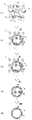
- An example of the image of the shape of the hollow particles of the present disclosure is a bag made of a thin film and inflated with gas, the cross-sectional view of which is shown as the hollow particle 100 in FIG. 1(5). In this example, a thin film is provided on the outside and the inside is filled with gas.
- the particle shape can be confirmed by, for example, SEM or TEM.
- Impurity particles are often mixed in conventional hollow particles.
- the impurity particles are particles having cracks, chips, or holes with a size of 1 ⁇ m or more or 5% or more of the particle diameter.
- the hollow particles of the present disclosure have reduced amounts of such impurity particles.
- the hollow particles of the present disclosure are produced using a polymerizable monomer having a highly polar reactive group, so that the precipitation of the polymer from the hydrophobic solvent and the shelling of the polymer are uniform in the polymerization process. It is presumed that the occurrence of cracks, chips, holes, etc. in the shell is suppressed.
- the ratio of impurity particles is preferably 5% or less, more preferably 4% or less, and still more preferably 2% or less. , particularly preferably 0%.
- the proportion of impurity particles is determined as the number of impurity particles contained in 100 arbitrarily selected particles by observation at a viewing angle of 1000 times using a field emission scanning electron microscope (FE-SEM).
- the method for producing the hollow particles of the present disclosure is not particularly limited as long as it is a method capable of producing the hollow particles of the present disclosure described above.
- it can be produced by an emulsion polymerization method or a suspension polymerization method. can.
- the production method by suspension polymerization is preferable because it is easy to produce hollow particles having the preferred volume average particle diameter described above.
- the method for producing the hollow particles of the present disclosure by suspension polymerization includes, for example, a step of preparing a mixed liquid containing a polymerizable monomer, a hydrophobic solvent, a dispersion stabilizer, and an aqueous medium, and suspending the mixed liquid. a step of preparing a suspension in which droplets of the monomer composition containing the polymerizable monomer and the hydrophobic solvent are dispersed in the aqueous medium by turbidity; and a polymerization reaction of the suspension.
- a hollow particle whose hollow portion is filled with a hydrophobic solvent is sometimes referred to as a "precursor particle", considering it as an intermediate of a hollow particle whose hollow portion is filled with a gas.
- precursor composition means a composition comprising precursor particles.
- a mixed liquid containing a polymerizable monomer, a hydrophobic solvent, a dispersion stabilizer, and an aqueous medium is suspended to cause phase separation between the polymerizable monomer and the hydrophobic solvent
- a suspension is prepared in which droplets having a distribution structure in which the polymerizable monomer is unevenly distributed on the surface side and the hydrophobic solvent is unevenly distributed in the center are dispersed in an aqueous medium, and this suspension is subjected to a polymerization reaction. It follows the basic technique of hardening the surface of the droplets by subjecting them to forming hollow particles with hollows filled with a hydrophobic solvent.
- the method for producing hollow particles includes a step of preparing a mixture, a step of preparing a suspension, a step of subjecting the suspension to a polymerization reaction, and a step of removing the solvent, and further steps other than these steps.
- the preparation and suspension of the mixed solution may be performed simultaneously in one step, such as by adding the materials for preparing the mixed solution while simultaneously suspending the mixture.
- a preferable example of the method for producing the hollow particles is a production method including the following steps.
- Polymerization step By subjecting the suspension to a polymerization reaction, resin (4) a solid-liquid separation step of preparing a precursor composition comprising precursor particles having a hollow surrounded by a shell containing (5) solvent removal step removing the hydrophobic solvent contained in the precursor particles to obtain hollow particles;
- FIG. 1 is a schematic diagram showing an example of the method for producing hollow particles of the present disclosure.
- (1) to (5) in FIG. 1 correspond to the above steps (1) to (5).
- White arrows between each figure indicate the order of each step.
- FIG. 1 is only a schematic diagram for explanation, and the manufacturing method is not limited to the one shown in the diagram.
- the structures, dimensions and shapes of the materials used in each manufacturing method of the present disclosure are not limited to the structures, dimensions and shapes of the various materials in these figures.
- (1) of FIG. 1 is a cross-sectional schematic diagram showing one embodiment of the liquid mixture in the liquid mixture preparation step. As shown in this figure, the mixture contains an aqueous medium 1 and a low-polarity material 2 dispersed in the aqueous medium 1 .
- the low-polarity material 2 means a material that has low polarity and is difficult to mix with the aqueous medium 1 .
- Low polarity material 2 in the present disclosure includes a polymerizable monomer and a hydrophobic solvent.
- (2) of FIG. 1 is a cross-sectional schematic diagram showing one embodiment of the suspension in the suspension preparation step.
- the suspension comprises an aqueous medium 1 and droplets 10 of a monomer composition dispersed in the aqueous medium 1 .
- the droplet 10 of the monomer composition contains a polymerizable monomer and a hydrophobic solvent, but the distribution within the droplet is non-uniform.
- FIG. 1 is a schematic cross-sectional view showing an embodiment of a precursor composition obtained by a polymerization step and containing precursor particles containing a hydrophobic solvent in their hollow portions.
- the precursor composition includes an aqueous medium 1 and precursor particles 20 dispersed in the aqueous medium 1 and containing a hydrophobic solvent 4a in their hollow portions.
- the shell 5 forming the outer surface of the precursor particle 20 is formed by polymerization of the polymerizable monomer in the droplet 10 of the monomer composition. Coalescence is included as a resin.
- (4) of FIG. 1 is a cross-sectional schematic diagram showing one embodiment of the precursor particles after the solid-liquid separation step. (4) of FIG. 1 shows a state where the aqueous medium 1 is removed from the state of (3) of FIG. (5) of FIG. 1 is a schematic cross-sectional view showing one embodiment of the hollow particles after the solvent removal step. (5) of FIG.
- This step is a step of preparing a mixed solution containing a polymerizable monomer, a hydrophobic solvent, a dispersion stabilizer, and an aqueous medium.
- the mixed liquid may further contain other materials as long as the effects of the present disclosure are not impaired.
- the mixture preferably further contains a polymerization initiator, and more preferably contains an oil-soluble polymerization initiator.
- Materials for the mixed liquid are (A) polymerizable monomer, (B) hydrophobic solvent, (C) polymerization initiator, (D) dispersion stabilizer, (E) aqueous medium, and (F) other materials in that order. explain.
- the polymerizable monomer in the mixture contains at least a crosslinkable monomer, and further contains a non-crosslinkable monomer within a range that does not impair the effects of the present disclosure. may contain.
- the crosslinkable monomer and the non-crosslinkable monomer those described above can be used.
- the crosslinkable monomer in the mixed liquid is a reactive group-containing monomer having a reactive group, a reactive group-free monomer having no reactive group, or a combination thereof, and is not particularly limited. .
- the crosslinkable monomer in the mixed solution preferably contains a reactive group-free monomer.
- the polymerizable monomer in the mixed liquid is a reactive group
- the content of the reactive group-containing monomer in 100 parts by mass of the crosslinkable monomer is the ratio between the hollow particles and the resin.
- the lower limit is preferably 10 parts by mass or more, more preferably 12 parts by mass or more, still more preferably 15 parts by mass or more, and even more preferably It is 20 parts by mass or more.
- the upper limit is not particularly limited, and the crosslinkable monomer may consist of a reactive group-containing monomer. From the viewpoint of improving pressure resistance, the amount is preferably 60 parts by mass or less, more preferably 50 parts by mass or less, and even more preferably 40 parts by mass or less.
- the content of the reactive group-free monomer in 100 parts by mass of the crosslinkable monomer is the pressure resistance of the hollow particles.
- the lower limit is preferably 40 parts by mass or more, more preferably 50 parts by mass or more, and still more preferably 60 parts by mass or more.
- the upper limit is not particularly limited, it is preferably 90 parts by mass or less, more preferably 85 parts by mass, from the viewpoint of, for example, sufficiently containing the reactive group-containing monomer to improve the adhesion between the hollow particles and the resin. parts or less, more preferably 80 parts by mass or less.
- the crosslinkable monomer in the mixed solution contains a combination of a bifunctional crosslinkable monomer and a trifunctional or higher crosslinkable monomer from the viewpoint of improving the pressure resistance of the hollow particles.
- a combination of a bifunctional crosslinkable monomer and a trifunctional or higher crosslinkable monomer is included, the content of the bifunctional crosslinkable monomer in 100 parts by mass of the crosslinkable monomer is particularly Although not limited, the lower limit is preferably 60 parts by mass or more, more preferably 70 parts by mass or more, from the viewpoint of improving the pressure resistance of the hollow particles, and the upper limit is a trifunctional or higher crosslinkable monomer. is preferably 90 parts by mass or less, more preferably 85 parts by mass or less, from the viewpoint of sufficiently containing the
- the crosslinkable monomer in the mixed liquid contains a (meth)acrylic crosslinkable monomer from the viewpoint of improving the reactivity and the pressure resistance of the hollow particles.
- the pressure resistance of the hollow particles is also improved if the crosslinkable monomer in the mixed liquid contains a crosslinkable monomer unit derived from a vinyl crosslinkable monomer having a molecular weight of 250 or less and having no reactive group. It is preferable from the viewpoint of improvement.
- the total content of the (meth)acrylic crosslinkable monomer and the vinyl crosslinkable monomer having a molecular weight of 250 or less having no reactive group is although not particularly limited, it is preferably more than 60 parts by mass, more preferably 70 parts by mass or more, and even more preferably 75 parts by mass or more from the viewpoint of improving the pressure resistance of the hollow particles.
- the content of the crosslinkable monomer is preferably 60 parts by mass or more, more preferably 65 parts by mass, with respect to the total mass of 100 parts by mass of the polymerizable monomers in the mixed liquid, from the viewpoint of improving the pressure resistance of the hollow particles. It is at least 70 parts by mass, more preferably at least 75 parts by mass.
- the upper limit of the content of the crosslinkable monomer is not particularly limited, and may be 100 parts by mass. From the viewpoint of sufficiently exhibiting the function of the crosslinkable monomer, it may be 97 parts by mass or less, may be 95 parts by mass or less, may be 90 parts by mass or less, and may be 80 parts by mass or less. There may be.
- the non-crosslinkable monomer in the mixed liquid is a reactive group-containing monomer, a reactive group-free monomer, or Although it is a combination of these, and is not particularly limited, it is preferable to contain a reactive group-containing monomer from the viewpoint of compatibility between the adhesion of the hollow particles to the resin and the pressure resistance.
- the non-crosslinkable monomer in the mixed liquid contains a reactive group-containing monomer
- the content of the reactive group-containing monomer in 100 parts by mass of the non-crosslinkable monomer is the same as that of the hollow particles and the resin.
- the lower limit is preferably 80 parts by mass or more, more preferably 90 parts by mass or more, and may be 100 parts by mass, from the viewpoint of improving the adhesiveness with.
- the upper limit is not particularly limited, and may be, for example, 95 parts by mass or less.
- the content of the non-crosslinkable monomer is From the viewpoint of sufficiently containing the crosslinkable monomer, it is preferably 40 parts by mass or less, more preferably 35 parts by mass or less, and even more preferably 30 parts by mass or less.
- the content of the non-crosslinking monomer may be 0 parts by mass, but from the viewpoint of sufficiently exhibiting the function of the non-crosslinking monomer, it may be 3 parts by mass or more, It may be 5 parts by mass or more, 10 parts by mass or more, or 20 parts by mass or more.
- the content of the polymerizable monomer in the mixed liquid is not particularly limited, but from the viewpoint of improving the strength of the shell and improving the pressure resistance of the hollow particles, hydrophobic
- the content of the polymerizable monomer is preferably 90% by mass or more, more preferably 95% by mass or more, relative to 100% by mass of the total solid content excluding the solvent.
- the hydrophobic solvent used in the above production method is a non-polymerizable and sparingly water-soluble organic solvent. Hydrophobic solvents act as spacer materials that form cavities inside the particles.
- a suspension is obtained in which droplets of the monomer composition containing the hydrophobic solvent are dispersed in the aqueous medium.
- the hydrophobic solvent with low polarity tends to gather inside the droplets of the polymerizable monomer.
- the hydrophobic solvent is distributed inside and the other materials other than the hydrophobic solvent are distributed around the periphery according to their respective polarities. Then, in the polymerization step to be described later, an aqueous dispersion containing hollow particles encapsulating a hydrophobic solvent is obtained. That is, a hollow portion filled with the hydrophobic solvent is formed inside the obtained precursor particles by gathering the hydrophobic solvent inside the particles.
- the hydrophobic solvent is appropriately selected according to the type of the polymerizable monomer, and is not particularly limited.
- Known hydrophobic solvents can be used, for example, esters such as ethyl acetate and butyl acetate; ether esters such as propylene glycol monomethyl ether acetate and propylene glycol monoethyl ether acetate; benzene, toluene, aromatic hydrocarbons such as xylene; aliphatic hydrocarbons such as butane, pentane, hexane, methylhexane, cyclohexane, methylcyclohexane, heptane and octane; and the like.
- hydrophobic solvents can be used alone or in combination of two or more.
- the hydrophobic solvent is at least one selected from the group consisting of aromatic hydrocarbons and aliphatic hydrocarbons, since hollow parts are likely to be formed in the particles and the thickness of the shell is likely to be uniform.
- Hydrocarbon solvents are preferred, aliphatic hydrocarbons are more preferred, and saturated aliphatic hydrocarbons are even more preferred.
- the proportion of the saturated hydrocarbon solvent is preferably 50% by mass or more, more preferably 60% by mass or more, and even more preferably 80% by mass or more.
- the proportion of the saturated hydrocarbon-based solvent is at least the above lower limit, sufficient phase separation occurs within the droplets of the monomer composition, so that hollow particles having only one hollow portion are easily obtained, Generation of porous particles can be suppressed.
- a hydrocarbon-based solvent having 4 to 7 carbon atoms is preferable.
- a hydrocarbon compound having 4 to 7 carbon atoms is easily included in the precursor particles during the polymerization step, and can be easily removed from the precursor particles during the solvent removal step.
- hydrocarbon solvents having 5 or 6 carbon atoms are preferred, and at least one selected from hexane and cyclohexane is particularly preferred.
- crosslinkable monomer when using a vinyl crosslinkable monomer such as divinylbenzene, it is preferable to use hexane, and when using only a (meth)acrylic crosslinkable monomer, use cyclohexane. is preferred.
- the boiling point of the hydrophobic solvent is preferably 130° C. or lower, more preferably 120° C. or lower, from the viewpoint of ease of removal in the solvent removal step described later. From the viewpoint of ease of encapsulation, the temperature is preferably 50° C. or higher, more preferably 60° C. or higher.
- the hydrophobic solvent is a mixed solvent containing a plurality of types of hydrophobic solvents and has a plurality of boiling points
- the boiling point of the solvent with the highest boiling point among the solvents contained in the mixed solvent is the above upper limit value or less. It is preferable that the boiling point of the solvent with the lowest boiling point among the solvents contained in the mixed solvent is equal to or higher than the above lower limit.
- the hydrophobic solvent used in the above production method preferably has a dielectric constant of 3 or less at 20°C.
- the relative dielectric constant is one of the indices that indicate the degree of polarity of a compound.
- the relative permittivity of the hydrophobic solvent is sufficiently low as 3 or less, it is considered that phase separation proceeds rapidly in the polymerizable monomer droplets, and hollow portions are likely to be formed.
- Examples of hydrophobic solvents having a dielectric constant of 3 or less at 20° C. are as follows. The value in parenthesis is the relative permittivity value.
- known literature for example, "Kagaku Binran Basic Edition” edited by The Chemical Society of Japan, Revised 4th Edition, Maruzen Co., Ltd., September 30, 1993, II-498 to II-503 page
- a method for measuring the relative permittivity at 20°C for example, a relative permittivity test that is carried out at a measurement temperature of 20°C in accordance with JIS C 2101:23 of 1999 can be used.
- the porosity of the hollow particles can be adjusted by changing the amount of the hydrophobic solvent in the mixture.
- the polymerization reaction proceeds in a state in which the oil droplets containing the crosslinkable monomer and the like enclose the hydrophobic solvent. tends to be higher.
- the content of the hydrophobic solvent in the mixed liquid is 50 parts by mass or more and 500 parts by mass or less with respect to 100 parts by mass of the polymerizable monomer, so that the particle diameter of the hollow particles can be easily controlled. It is preferable because it is easy to increase the porosity while maintaining the strength of the hollow particles, and it is easy to reduce the amount of residual hydrophobic solvent in the particles.
- the content of the hydrophobic solvent in the mixed liquid is preferably 60 parts by mass or more and 400 parts by mass or less, more preferably 70 parts by mass or more and 300 parts by mass or less with respect to 100 parts by mass of the polymerizable monomer. be.
- the mixture preferably contains an oil-soluble polymerization initiator as a polymerization initiator.
- the oil-soluble polymerization initiator generates radicals inside the droplets of the monomer composition.
- Precursor particles can be produced with a particle size of
- the polymerization initiator does not have the opportunity to contact the polymerizable monomer dispersed in the aqueous medium. In addition to the particles, it is possible to suppress the by-production of extra resin particles such as solid particles having a relatively small particle size.
- the oil-soluble polymerization initiator is not particularly limited as long as it is lipophilic and has a solubility of 2 g/L or less in water at 25°C.
- oil-soluble polymerization initiators include benzoyl peroxide, lauroyl peroxide, t-butyl peroxide-2-ethylhexanoate, 2,2′-azobis(2,4-dimethylvaleronitrile), azobisisobutyronitrile. , 2,2′-azobis(4-methoxy-2,4-dimethylvaleronitrile) and the like.
- the content of the polymerization initiator is preferably 0.1 to 10 parts by mass, more preferably 0.5 to 7 parts by mass, and even more preferably 100 parts by mass of the polymerizable monomer in the mixed liquid. 1 to 5 parts by mass.
- the content of the polymerization initiator is within the above range, the polymerization reaction is sufficiently progressed, the polymerization initiator is less likely to remain after completion of the polymerization reaction, and unexpected side reactions are less likely to proceed.
- the dispersion stabilizer is an agent that disperses droplets of the monomer composition in the aqueous medium in the suspension step.
- examples of dispersion stabilizers include organic water-soluble polymer stabilizers, inorganic water-soluble polymer stabilizers, and inorganic dispersion stabilizers.
- it is easy to control the particle size of the droplets in the suspension the particle size distribution of the resulting hollow particles can be narrowed, and the shell is prevented from becoming too thin, so that the hollow particles can withstand pressure. It is preferable to use an inorganic dispersion stabilizer as the dispersion stabilizer from the viewpoint of suppressing a decrease in .
- inorganic dispersion stabilizers examples include sulfates such as barium sulfate and calcium sulfate; carbonates such as barium carbonate, calcium carbonate and magnesium carbonate; phosphates such as calcium phosphate; metals such as aluminum oxide and titanium oxide. oxides; metal hydroxides such as aluminum hydroxide, magnesium hydroxide, calcium hydroxide, barium hydroxide and ferric hydroxide; and inorganic compounds such as silicon dioxide. These inorganic dispersion stabilizers can be used singly or in combination of two or more.
- the poorly water-soluble inorganic dispersion stabilizer is preferably an inorganic compound having a solubility of 0.5 g or less in 100 g of water.
- the sparingly water-soluble metal salt is preferably an inorganic metal salt having a solubility of 0.5 g or less in 100 g of water.
- the poorly water-soluble inorganic dispersion stabilizer is dispersed in an aqueous medium in the form of colloidal particles, that is, the colloidal dispersion containing the poorly water-soluble inorganic dispersion stabilizer colloidal particles. It is preferable to use it in the state As a result, the particle size distribution of the droplets of the monomer composition can be narrowed, and the residual amount of the inorganic dispersion stabilizer in the resulting hollow particles can be easily reduced by washing.
- the colloidal dispersion containing the sparingly water-soluble inorganic dispersion stabilizer colloidal particles includes, for example, at least one selected from alkali metal hydroxides and alkaline earth metal hydroxides, and a water-soluble polyvalent metal salt (hydroxide excluding alkaline earth metal salts) in an aqueous medium.
- Alkali metal hydroxides include lithium hydroxide, sodium hydroxide, potassium hydroxide and the like.
- Alkaline earth metal hydroxides include barium hydroxide and calcium hydroxide.
- the water-soluble polyvalent metal salt may be any water-soluble polyvalent metal salt other than the compounds corresponding to the alkaline earth metal hydroxides. Examples include magnesium chloride, magnesium phosphate, magnesium sulfate, and the like.
- magnesium metal salts such as calcium chloride, calcium nitrate, calcium acetate and calcium sulfate; aluminum metal salts such as aluminum chloride and aluminum sulfate; barium salts such as barium chloride, barium nitrate and barium acetate; zinc chloride and zinc nitrate , zinc salts such as zinc acetate; Among these, magnesium metal salt, calcium metal salt, and aluminum metal salt are preferred, magnesium metal salt is more preferred, and magnesium chloride is particularly preferred.
- the water-soluble polyvalent metal salts can be used either singly or in combination of two or more.
- the method of reacting at least one selected from the alkali metal hydroxides and alkaline earth metal hydroxides described above with the water-soluble polyvalent metal salt described above in an aqueous medium is not particularly limited.
- a method of mixing at least one aqueous solution selected from alkali metal salts and alkaline earth metal hydroxides with an aqueous solution of a water-soluble polyvalent metal salt can be used.
- Colloidal silica can also be used as a colloidal dispersion containing colloidal particles of a poorly water-soluble inorganic dispersion stabilizer.
- organic water-soluble polymer stabilizers examples include polyvinyl alcohol, polycarboxylic acid, celluloses (hydroxyethyl cellulose, carboxymethyl cellulose, etc.), polyvinylpyrrolidone, and the like.
- inorganic water-soluble polymer compounds include sodium tripolyphosphate.
- the content of the dispersion stabilizer is not particularly limited, but is preferably 0.5 to 10 parts by mass, more preferably 1 part by mass, based on 100 parts by mass of the total mass of the polymerizable monomer and the hydrophobic solvent. .0 to 8.0 parts by mass.
- the content of the dispersion stabilizer is equal to or higher than the above lower limit, the droplets of the monomer composition can be sufficiently dispersed so as not to coalesce in the suspension.
- the content of the dispersion stabilizer is equal to or less than the above upper limit, it is possible to prevent the viscosity of the suspension from increasing during granulation, and to avoid the problem of the suspension clogging the granulator. can.
- the content of the dispersion stabilizer is usually 2 parts by mass or more and 15 parts by mass or less, preferably 3 parts by mass or more and 8 parts by mass or less, relative to 100 parts by mass of the aqueous medium.
- the aqueous medium means a medium selected from the group consisting of water, hydrophilic solvents, and mixtures of water and hydrophilic solvents.
- the hydrophilic solvent in the present disclosure is not particularly limited as long as it mixes well with water and does not cause phase separation.
- hydrophilic solvents include alcohols such as methanol and ethanol; tetrahydrofuran (THF); dimethylsulfoxide (DMSO) and the like.
- aqueous media it is preferable to use water because of its high polarity.
- ion-exchanged water from the viewpoint of reducing the content of metals contained in the shell.
- the mass ratio of water and hydrophilic solvent may be 99:1 to 50:50.
- the mixed liquid may further contain other materials different from the materials (A) to (E) described above within a range that does not impair the effects of the present disclosure.
- the liquid mixture may contain polar components as other materials. By including a polar component in the mixed liquid, the thickness of the shell of the obtained hollow particles can be appropriately adjusted.
- a polar component for example, a polar resin, which will be described later, or an organic acid or a metal salt thereof can be used.
- a polar resin refers to a polymer containing repeating units containing heteroatoms. Specific examples include acrylic resins, polyester resins, vinyl resins containing heteroatoms, and the like. Polar resins typically have a solubility in water of less than 1 g/L.
- the polar resin may be a homopolymer or copolymer of a heteroatom-containing monomer, or a copolymer of a heteroatom-containing monomer and a heteroatom-free monomer. .
- the polar resin is a copolymer of a heteroatom-containing monomer and a heteroatom-free monomer, all repeating units constituting the copolymer are easy to control the particle size of the hollow particles.
- the proportion of heteroatom-containing monomer units is preferably 50% by mass or more, more preferably 70% by mass or more, and still more preferably 90% by mass or more.
- the number average molecular weight (Mn) of the polar resin is not particularly limited, but is preferably in the range of 3000 to 20000 in terms of polystyrene measured by gel permeation chromatography (GPC) using tetrahydrofuran. , more preferably in the range of 4000 or more and 17000 or less, and still more preferably in the range of 6000 or more and 15000 or less.
- GPC gel permeation chromatography
- the content of the polar resin is preferably 0.1 parts by mass or more and 10.0 parts by mass or less, more preferably 0.3 parts by mass, relative to 100 parts by mass of the polymerizable monomer. It is from 0.5 parts by mass to 8.0 parts by mass, and more preferably from 0.5 parts by mass to 8.0 parts by mass.
- the content of the polar resin is at least the above lower limit, the thickness of the shell of the hollow particles can be easily controlled, and when the content of the polar resin is at most the above upper limit, the content of the polymerizable monomer can be prevented from decreasing. Since it can be suppressed, it is possible to suppress the decrease in strength of the shell.
- organic acids include rosin acid and higher fatty acids.
- higher fatty acids include higher fatty acids having 10 to 25 carbon atoms and not containing carbon atoms in the carboxyl group.
- metals used in metal salts of organic acids include alkali metals such as Li, Na and K, and alkaline earth metals such as Mg and Ca. and K are more preferred.
- the total content of the organic acid or its metal salt is preferably 0.0001 part by mass with respect to the total 100 parts by mass of the polymerizable monomer and the hydrophobic solvent. It is 0.02 mass parts or more, more preferably 0.001 mass parts or more and 0.01 mass parts or less, and even more preferably 0.0015 mass parts or more and 0.006 mass parts or less. When the content is at least the lower limit, it is easy to control the shell thickness of the hollow particles.
- a mixed solution can be obtained by mixing each of the above materials and, if necessary, other materials, and appropriately stirring the mixture.
- the oil phase containing lipophilic materials such as (A) the polymerizable monomer, (B) the hydrophobic solvent and (C) the polymerization initiator, (D) the dispersion stabilizer and (E)
- the particles are dispersed with a particle size of about several millimeters.
- the mixed solution preparation step the mixed solution may be obtained by simply mixing each of the above materials and, if necessary, other materials, and stirring them as appropriate.
- an oil phase containing a polymer, a hydrophobic solvent and a polymerization initiator and an aqueous phase containing a dispersion stabilizer and an aqueous medium in advance and mix them to prepare a mixed solution.
- a colloidal dispersion obtained by dispersing a sparingly water-soluble inorganic dispersion stabilizer in the form of colloidal particles in an aqueous medium can be preferably used as the aqueous phase.
- the suspension step is a step of preparing a suspension in which droplets of a monomer composition containing a hydrophobic solvent are dispersed in an aqueous medium by suspending the above-mentioned mixture.
- the suspension method for forming droplets of the monomer composition is not particularly limited. : horizontal in-line disperser such as Cavitron; manufactured by IKA, trade name: vertical in-line disperser such as DRS 2000/5, etc.), high-speed emulsifying disperser (manufactured by Primix Co., Ltd., trade name: T.K. It is carried out using a device capable of strong stirring such as a homomixer (MARK II type, etc.).
- droplets of the monomer composition containing the lipophilic material and having a particle size of about 1 to 20 ⁇ m are uniformly dispersed in the aqueous medium.
- Such droplets of the monomer composition are difficult to observe with the naked eye, and can be observed with a known observation instrument such as an optical microscope.
- the hydrophobic solvent with low polarity tends to collect inside the droplets.
- the resulting droplets have the hydrophobic solvent distributed inside and the material other than the hydrophobic solvent, such as the polymerizable monomer, distributed around the periphery.
- the suspension obtained by the suspension preparation step described above is subjected to a polymerization reaction to have a hollow portion surrounded by a shell containing a resin, and the hollow portion has a hydrophobic
- the first step is to prepare a precursor composition containing precursor particles encapsulating a solvent.
- a second polymerizable monomer is further added to the precursor composition obtained by the first polymerization reaction.
- a second polymerization reaction may be carried out.
- the solvent resistance of the hollow particles can be improved by carrying out the polymerization reaction in two stages in the polymerization process.
- Precursor particles are formed by polymerization of the polymerizable monomer contained in the droplets of the monomer composition and the second polymerizable monomer added as necessary.
- the shell of the precursor particles contains, as a resin, the polymerizable monomer contained in the droplets of the monomer composition and the polymer of the second polymerizable monomer added as necessary.
- the shell portion of the droplet of the monomer composition containing the hydrophobic solvent inside is polymerized, so that inside the obtained precursor particles, a hollow portion filled with the hydrophobic solvent is formed.
- the polymerization system performed in this step is not particularly limited, and for example, a batch system (batch system), a semi-continuous system, a continuous system, or the like can be employed.
- the polymerization temperature is preferably 40-80°C, more preferably 50-70°C.
- the rate of temperature rise when raising the temperature to the polymerization temperature is preferably 20° C./h or more, more preferably 45° C./h or more.
- the rate of temperature increase is usually 100° C./h or less.
- the reaction time for polymerization is preferably 1 to 20 hours, more preferably 2 to 15 hours.
- the stirring speed of the suspension during the polymerization reaction is preferably 20-200 rpm, more preferably 20-100 rpm. When a tetrafunctional or higher crosslinkable monomer is included as the crosslinkable monomer, the stirring speed is preferably 20 to 100 rpm.
- the first polymerization reaction is performed so that the polymerization conversion rate of the polymerizable monomer in the suspension is preferably 93% by mass or more, more preferably 95% by mass or more, and further preferably 98% by mass or more, more preferably 99% by mass or more,
- the second polymerizable monomer added during the second polymerization reaction is not particularly limited, but it improves the solvent resistance of the hollow particles and improves the adhesion between the hollow particles and the resin.
- a crosslinkable or non-crosslinkable monomer having a reactive group is preferred.
- the crosslinkable or non-crosslinkable monomer having a reactive group has high solubility in an aqueous medium, the crosslinkable or non-crosslinkable monomer having a reactive group is used as the second polymerizable monomer.
- part of the second polymerizable monomer may remain dissolved in the aqueous medium and the polymerization reaction may not proceed.
- the theoretical porosity is calculated from the true density D 0 of the obtained hollow particles and the mass of the polymerizable monomer and the hydrophobic solvent used in the production of the hollow particles, and further, the true density D 0 and the theoretical Calculate the theoretical apparent density D2 of the hollow particles from the porosity. Then, from the apparent density D1 and the theoretical apparent density D2 of the hollow particles, the amount of monomer that migrated to the water phase side is calculated, and the amount of monomer that migrates to the water phase side is taken into consideration, and the obtained hollow particles The content of each monomer unit in the polymer contained in the shell of the particle can be calculated.
- the solubility is preferably 2 g/L or more, more preferably 10 g/L or more, still more preferably 15 g/L or more.
- the upper limit of the solubility of the second polymerizable monomer in distilled water at 20° C. is not particularly limited, it is usually 80 g/L or less.
- the molecular weight of the second polymerizable monomer is not particularly limited, it is preferably 300 or less, more preferably 250 or less, from the viewpoint of improving the solvent resistance of the hollow particles.
- the lower limit of the molecular weight is not particularly limited, and is usually 50 or more.
- the amount of the second polymerizable monomer added is is preferably 3 to 50 parts by mass.
- the amount added is more preferably 10 to 50 parts by mass.
- the reaction time of the first polymerization reaction is preferably 0.5 to 5 hours, more preferably 1 to 3 hours, and the reaction time of the second polymerization reaction is , preferably 1 to 6 hours, more preferably 2 to 4 hours.
- At least one of the polymerizable monomer and the second polymerizable monomer contained in the mixed liquid is , preferably contains a crosslinkable or non-crosslinkable monomer having a reactive group, and more preferably contains a crosslinkable monomer having a reactive group.
- the content of the reactive group-containing monomer in the total 100 parts by mass of the polymerizable monomer contained in the mixed liquid and the crosslinkable monomer contained in the second polymerizable monomer is preferably It is 10 parts by mass or more, more preferably 12 parts by mass or more, still more preferably 15 parts by mass or more, and even more preferably 20 parts by mass or more.
- the upper limit is not particularly limited, and the crosslinkable monomer may consist of a monomer containing a reactive group. From the viewpoint of improving the pressure resistance of the particles, the amount is preferably 60 parts by mass or less, more preferably 50 parts by mass or less, and even more preferably 40 parts by mass or less.
- the content is appropriately adjusted according to the type of the monomer, and is not particularly limited, but improves the adhesion between the hollow particles and the resin.
- the non-crosslinkable monomer having a reactive group is preferably 80 parts by mass or more, more preferably 90 parts by mass or more, and may be 100 parts by mass.
- the upper limit is not particularly limited, and may be, for example, 95 parts by mass or less.
- the content of the non-crosslinking monomer is 0 to 40 parts by mass.
- the lower limit of the content of the organic monomer may be 3 parts by mass or more, 5 parts by mass or more, 10 parts by mass or more, or 20 parts by mass or more. good too.
- the upper limit is preferably 35 parts by mass or less, more preferably 30 parts by mass or less, from the viewpoint of suppressing a decrease in pressure resistance of the hollow particles.
- the content of the non-crosslinkable monomer when the content of the non-crosslinkable monomer is at least the lower limit, the crosslinkability in the total 100 parts by mass of the polymerizable monomer and the second polymerizable monomer contained in the mixed liquid
- the upper limit of the content of the monomer may be 97 parts by mass or less, 95 parts by mass or less, 90 parts by mass or less, or 80 parts by mass or less.
- the content of the non-crosslinkable monomer is equal to or less than the upper limit, the crosslinkable monomer in a total of 100 parts by mass of the polymerizable monomer and the second polymerizable monomer contained in the mixed liquid
- the upper limit of the body content may be 65 parts by mass or more, or may be 70 parts by mass or more.
- the content of the crosslinkable or non-crosslinkable monomer having a reactive group is although it is not particularly limited, the lower limit is preferably 10 parts by mass or more, more preferably 12 parts by mass, from the viewpoint of improving the adhesion between the hollow particles of the present disclosure and the resin. parts or more, more preferably 15 parts by mass or more, and even more preferably 20 parts by mass or more.
- the upper limit is not particularly limited, and the polymerizable monomer may consist of a reactive group-containing monomer. From the viewpoint of improving the pressure resistance of the hollow particles, the amount is preferably 60 parts by mass or less, more preferably 50 parts by mass or less, and even more preferably 40 parts by mass or less.
- the (meth)acrylic polymerizable monomer, and the total content of vinyl-based crosslinkable monomers having a molecular weight of 250 or less having no reactive group is preferably more than 60 parts by mass, more preferably 70 parts by mass or more, and 75 parts by mass or more.
- the total content of vinyl-based crosslinkable monomers having a molecular weight of 250 or less and having no functional group is preferably more than 60 parts by mass, more preferably 70 parts by mass or more, and 75 parts by mass or more. is more preferred.
- This step is a step of obtaining a solid content containing precursor particles by performing solid-liquid separation on the precursor composition containing precursor particles obtained by the polymerization step described above.
- a method for solid-liquid separation of the precursor composition is not particularly limited, and a known method can be used.
- Solid-liquid separation methods include, for example, centrifugation, filtration, static separation, etc. Among these, centrifugation or filtration can be employed. may be adopted.
- an optional step such as a pre-drying step may be carried out before carrying out the solvent removal step described below. Examples of the pre-drying step include a step of pre-drying the solid content obtained after the solid-liquid separation step using a drying device such as a dryer or a drying device such as a hand dryer.
- Solvent removal step This step is a step of removing the hydrophobic solvent included in the precursor particles obtained by the solid-liquid separation step. By removing the hydrophobic solvent contained in the precursor particles in air, the hydrophobic solvent inside the precursor particles is replaced with air, and hollow particles filled with gas are obtained.
- in air in this step means an environment where there is no liquid component outside the precursor particles, and a very small amount of hydrophobic solvent outside the precursor particles that does not affect the removal of the solvent. means an environment where there is only a liquid fraction of “In air” can be rephrased as a state in which the precursor particles are not present in the slurry, and can be rephrased as a state in which the precursor particles are present in the dry powder. That is, in this step, it is important to remove the hydrophobic solvent in an environment where the precursor particles are in direct contact with the external gas.
- a method for removing the hydrophobic solvent in the precursor particles in air is not particularly limited, and a known method can be adopted. Examples of the method include a vacuum drying method, a heat drying method, a flash drying method, or a combination of these methods.
- the heating temperature must be higher than the boiling point of the hydrophobic solvent and lower than the maximum temperature at which the shell structure of the precursor particles does not collapse. Therefore, depending on the composition of the shell in the precursor particles and the type of hydrophobic solvent, the heating temperature may be, for example, 50 to 200°C, 70 to 200°C, or 100 to 200°C. Due to the drying operation in air, the hydrophobic solvent inside the precursor particles is replaced by the external gas, resulting in hollow particles in which the hollow portion is filled with gas.
- the drying atmosphere is not particularly limited, and can be appropriately selected depending on the use of the hollow particles. Air, oxygen, nitrogen, argon, etc. can be considered as the dry atmosphere, for example. Further, hollow particles whose insides are temporarily vacuumed can also be obtained by once filling the insides of the hollow particles with gas and then drying them under reduced pressure.
- the hydrophobic solvent contained in the precursor particles is removed in the slurry containing the precursor particles and the aqueous medium without solid-liquid separation of the slurry-like precursor composition obtained in the polymerization step.
- the hydrophobic solvent may be removed by substituting the slurry with an aqueous medium.
- the hydrophobic solvent included in the precursor particles can be removed by bubbling an inert gas through the precursor composition at a temperature equal to or higher than the boiling point of the hydrophobic solvent minus 35°C. can.
- the boiling point of the hydrophobic solvent in the solvent removal step is the boiling point of the solvent contained in the mixed solvent.
- the boiling point is the boiling point of the solvent with the highest boiling point, that is, the highest boiling point among a plurality of boiling points.
- the temperature at which the inert gas is bubbled through the precursor composition is preferably at least the temperature obtained by subtracting 30°C from the boiling point of the hydrophobic solvent in order to reduce the residual amount of the hydrophobic solvent in the hollow particles.
- the temperature is preferably equal to or higher than the temperature minus 20°C.
- the temperature during bubbling is usually a temperature equal to or higher than the polymerization temperature in the polymerization step.
- the temperature during bubbling may be 50° C. or higher and 100° C. or lower.
- the bubbling inert gas is not particularly limited, but examples thereof include nitrogen and argon.
- the bubbling conditions are appropriately adjusted according to the type and amount of the hydrophobic solvent so that the hydrophobic solvent contained in the precursor particles can be removed, and are not particularly limited. /min, and may be bubbled for 1 to 10 hours.
- a water-based slurry in which the inert gas is included in the precursor particles is obtained.
- the hollow particles obtained by solid-liquid separation of this slurry are dried to remove the aqueous medium remaining in the hollow particles, thereby obtaining the hollow particles in which the hollow portion is filled with gas.
- a slurry containing an aqueous medium after removing the hydrophobic solvent contained in the precursor particles, solid-liquid separation is performed, and the aqueous medium in the precursor particles is removed in the air, so that the hollow part is gas.
- the former method has the advantage that the hollow particles are less likely to be crushed in the process of removing the hydrophobic solvent, and the latter method involves bubbling with an inert gas. There is an advantage that the remaining hydrophobic solvent is reduced.
- the hydrophobic organic solvent included in the precursor particles is removed without solid-liquid separation of the slurry-like precursor composition obtained in the polymerization step.
- a method for example, under a predetermined pressure (high pressure, normal pressure or reduced pressure), a method of evaporating the hydrophobic organic solvent contained in the precursor particles from the precursor composition; a method of introducing an inert gas such as nitrogen, argon, or helium or water vapor into the precursor composition under atmospheric pressure, normal pressure, or reduced pressure, and evaporating off.
- (6-a) washing process and (6-b) re-replacement process of the hollow portion may be added.
- (6-a) Washing step In the washing step, before the solid-liquid separation step, an acid or alkali is added to remove the dispersion stabilizer remaining in the precursor composition containing the precursor particles. It is a process of performing When the dispersion stabilizer used is an acid-soluble inorganic dispersion stabilizer, it is preferable to wash by adding an acid to the precursor composition containing the precursor particles. is an inorganic compound that is soluble in alkali, it is preferable to add an alkali to the precursor composition containing the precursor particles for washing.
- the acid is added to the precursor composition containing the precursor particles, and the pH is adjusted to preferably 6.5 or less, more preferably 6.5. It is preferable to adjust as follows.
- inorganic acids such as sulfuric acid, hydrochloric acid and nitric acid, and organic acids such as formic acid and acetic acid can be used. , in particular sulfuric acid, is preferred.
- the hollow portion re-replacement step is a step of replacing the gas or liquid inside the hollow particles with another gas or liquid.
- the environment inside the hollow particles can be changed, molecules can be selectively confined inside the hollow particles, and the chemical structure inside the hollow particles can be modified according to the application.
- the hollow particles of the present disclosure have excellent pressure resistance, they are not easily crushed during kneading with other materials and during molding after kneading. It is particularly suitable as an additive for molded products because it has excellent effects as a material, etc. It is not easily crushed during kneading with resin and during molding after kneading, and has excellent adhesion to resin, so it is suitable for resin molded products. It is particularly preferably used as an additive.
- the hollow particles of the present disclosure can also be contained as a filler in fiber-reinforced moldings formed using a resin and reinforcing fibers.
- the hollow particles of the present disclosure have a high porosity, are resistant to crushing, and have excellent heat resistance, they satisfy the heat insulating properties and cushioning properties (cushion properties) required for undercoat materials, and can be used immediately for thermal paper applications. It also satisfies the required heat resistance.
- the hollow particles of the present disclosure are also useful as plastic pigments with excellent gloss, hiding power, and the like.
- the hollow particles of the present disclosure can enclose useful ingredients such as fragrances, chemicals, agricultural chemicals, and ink ingredients inside by means of immersion treatment, reduced pressure or pressure immersion treatment, etc., so that various It can be used for various purposes.
- the resin composition of the present disclosure contains the hollow particles of the present disclosure described above and a resin.
- the resin composition of the present disclosure contains a resin having a functional group as the resin, and the reactive groups that the hollow particles of the present disclosure have on their surfaces can react with the functional groups of the resin.
- the reaction between the reactive group possessed on the surface of the hollow particles and the functional group possessed by the resin may be any reaction that forms a covalent bond, such as addition reaction, substitution reaction, dehydration condensation reaction, or ester It may be an exchange reaction or the like.
- the resin composition of the present disclosure is in a state before being made into a shape that can be used for various purposes, and is typically liquid.
- the reactive groups possessed by the hollow particles and the functional groups possessed by the resin are typically unreacted, but may partially react to form crosslinked bonds.
- the resin composition of the present disclosure contains hollow particles, it is a resin composition capable of suppressing deterioration in physical properties due to the hollow particles.
- the functional groups possessed by the resin and the reactive groups possessed on the surface of the hollow particles can react to form cross-linked bonds, and the resin and the hollow particles It is presumed that the deterioration of the physical properties when formed into a molded article is suppressed because of the excellent adhesion at the interface with. Even when the resin composition of the present disclosure further contains a resin having no functional group, deterioration in physical properties can be suppressed. This is because the functional group possessed by the resin and the reactive group possessed on the surface of the hollow particles have a high affinity, so that the resin having the functional group tends to be unevenly distributed around the hollow particles in the resin composition.
- the functional group of the resin and the reactive group of the surface of the hollow particles can form a cross-linked bond.
- the hollow particles contained in the resin composition of the present disclosure have a high porosity and excellent pressure resistance, crushing in the resin composition is suppressed.
- the resin composition of the present disclosure is endowed with performance due to the hollow particles, such as weight reduction and thermal insulation.
- the resin contained in the resin composition of the present disclosure does not proceed with the curing reaction of the resin or the crosslinking reaction between the reactive group of the hollow particles and the functional group of the resin when the resin composition is stored. Just do it.
- the storage state of the resin composition of the present disclosure is not particularly limited, but in a normal temperature and normal humidity environment at a temperature of 20 to 40 ° C. and a humidity of 40 to 70% RH, or at a temperature of 0 to 20 ° C. and a humidity of 10 to 30% RH. A low temperature and low humidity environment is preferred.
- the resin contained in the resin composition of the present disclosure includes, for example, a thermosetting resin, a photocurable resin, and a curable resin such as a room temperature curable resin that can be cured at room temperature by addition of a catalyst or the like. Among them, thermosetting resins and room-temperature-setting resins can be preferably used.
- the resin contained in the resin composition of the present disclosure may be an unreacted monomer, prepolymer or macromonomer, may be a polymer, or may be a cured resin such as polyamic acid. It may be a precursor.
- the resin contained in the resin composition of the present disclosure typically functions as a binder (binding agent) by heating, light irradiation, or curing using a curing agent, a polymerization initiator, a catalyst, or the like. do.
- the resin contained in the resin composition of the present disclosure may at least partially have a functional group capable of reacting with the reactive group of the hollow particles, and may further contain a resin having no functional group.
- thermosetting resin a known one can be used and is not particularly limited, but examples include phenolic resins, melamine-based resins, urea-based resins, unsaturated polyester-based resins, epoxy-based resins, polyurethane-based resins, Examples include silicone-based resins, alkyd-based resins, polyimide-based resins, and precursors of these resins before curing.
- an epoxy resin epoxy compound
- a resin having an epoxy group for example, an epoxy resin (epoxy compound)
- a resin having a hydroxyl group and an isocyanate group a resin containing a polyol component and a polyisocyanate component from which a polyurethane resin is derived can be used.
- a polyamic acid which is a precursor of a polyimide resin, can be used as the resin having a carboxy group and an amide group.
- epoxy resins examples include bixylenol type epoxy resin, bisphenol A type epoxy resin, bisphenol F type epoxy resin, bisphenol S type epoxy resin, bisphenol AF type epoxy resin, dicyclopentadiene type epoxy resin, tris Phenol type epoxy resin, naphthol novolak type epoxy resin, phenol novolak type epoxy resin, tert-butyl-catechol type epoxy resin, naphthalene type epoxy resin, naphthol type epoxy resin, anthracene type epoxy resin, glycidylamine type epoxy resin, glycidyl ester type Epoxy resins, cresol novolak type epoxy resins, phenol aralkyl type epoxy resins, biphenyl type epoxy resins, linear aliphatic epoxy resins, epoxy resins having a butadiene structure, alicyclic epoxy resins, heterocyclic epoxy resins, spirocyclic epoxy resins Resin, cyclohexane-type epoxy resin, cyclohex
- a polyurethane resin is obtained by reacting a polyol component and a polyisocyanate component.
- Polyol components from which polyurethane resins are derived include, for example, ethylene glycol, propylene glycol, glycerin, trimethylolpropane, pentaerythritol, sorbitol, sucrose, polyoxypropylene triol, polyester polyol and the like.
- polyisocyanate components for deriving polyurethane-based resins include aliphatic polyisocyanates and aromatic polyisocyanates.
- aliphatic polyisocyanates include tetramethylene diisocyanate, hexamethylene diisocyanate, dodecamethylene diisocyanate, 2,2,4-trimethylhexamethylene diisocyanate, 2,4,4-trimethylhexamethylene diisocyanate, lysine diisocyanate, and 2-methylpentane.
- Polyisocyanates having a chain structure such as -1,5-diisocyanate and 3-methylpentane-1,5-diisocyanate; isophorone diisocyanate, hydrogenated xylylene diisocyanate, 4,4'-dicyclohexylmethane diisocyanate, 1,4-cyclohexane polyisocyanates having a cyclic structure such as diisocyanate, methylcyclohexylene diisocyanate, 1,3-bis(isocyanatomethyl)cyclohexane; and the like.
- aromatic polyisocyanates include tolylene diisocyanate, 2,2′-diphenylmethane diisocyanate, 2,4′-diphenylmethane diisocyanate, 4,4′-diphenylmethane diisocyanate, 4,4′-dibenzyl diisocyanate, 1,5- Naphthylene diisocyanate, xylylene diisocyanate, 1,3-phenylene diisocyanate, 1,4-phenylene diisocyanate, dialkyldiphenylmethane diisocyanate, tetraalkyldiphenylmethane diisocyanate, ⁇ , ⁇ , ⁇ -tetramethylxylylene diisocyanate and the like.
- a polyamic acid which is a precursor of a polyimide resin, is obtained by reacting a tetracarboxylic acid component such as a tetracarboxylic acid dianhydride, a tetracarboxylic acid, or a tetracarboxylic acid derivative such as a tetracarboxylic acid diester with a diamine component.
- a tetracarboxylic acid component such as a tetracarboxylic acid dianhydride, a tetracarboxylic acid, or a tetracarboxylic acid derivative such as a tetracarboxylic acid diester with a diamine component.
- tetracarboxylic acid components include benzophenonetetracarboxylic dianhydride, 4,4'-oxydiphthalic anhydride, pyromellitic acid and its dianhydride, and 3,3',4,4'-biphenyltetracarbox
- the resin having a functional group it is also possible to use a resin having a hydroxyl group such as a phenolic resin; a binder resin having an amino group such as a melamine resin.
- the resin content is not particularly limited, but is usually 40 to 95% by mass, preferably 50 to 95% by mass, based on 100% by mass of the total solid content of the resin composition. Yes, more preferably 70 to 95% by mass, and may be 85 to 95% by mass.
- the content of the resin is at least the above lower limit, the moldability of the resin composition is excellent, and the mechanical strength of the resulting molded article can be improved.
- the content of the resin is equal to or less than the above upper limit value, the hollow particles can be sufficiently contained, so that the effects such as weight reduction of the molded article are excellent.
- the content of the resin having a functional group is not particularly limited, but is preferably 30 to 95% by mass, more preferably 30 to 95% by mass, based on 100% by mass of the total solid content of the resin composition. is 40 to 90% by mass.
- the content of the resin having a functional group is not particularly limited, but is preferably 100 to 1000 parts by mass, more preferably 300 to 900 parts by mass with respect to 100 parts by mass of the hollow particles.
- the hollow particles contained in the resin composition of the present disclosure are the hollow particles of the present disclosure described above.
- the content of the hollow particles is not particularly limited. % or more, and the upper limit is preferably 50% by mass or less, more preferably 30% by mass or less, even more preferably 20% by mass or less, and even more preferably 15% by mass or less.
- the content of the hollow particles is equal to or more than the above lower limit, effects such as weight reduction of the resin composition can be improved.
- the content of the hollow particles is equal to or less than the above upper limit, the resin can be sufficiently contained in the resin composition, thereby suppressing deterioration of physical properties and improving mechanical strength when formed into a molded article. be able to.
- the combination of the hollow particles having a reactive group and the resin having a functional group include, for example, a combination of hollow particles having at least one reactive group selected from the group consisting of a hydroxyl group, an amino group, a carboxyl group, and a carboxylic anhydride group, and an epoxy resin; a hydroxyl group, an amino group.
- the hollow particles having at least one reactive group selected from the group containing a hydroxyl group and an amino group contain both a hydroxyl group and an amino group, so that the adhesion of the hollow particles to the resin is likely to be improved. It is preferable from the point of view.
- the resin composition of the present disclosure may further contain a solvent for dissolving or dispersing each component.
- a known solvent can be used, and is appropriately selected according to the type of resin.
- the resin composition of the present disclosure may further contain additives such as UV absorbers, colorants, heat stabilizers, fillers, etc., as necessary, as long as the effects of the present disclosure are not impaired.
- the resin composition of the present disclosure may contain organic or inorganic reinforcing fibers such as carbon fibers, glass fibers, aramid fibers, and polyethylene fibers.
- the resin composition of the present disclosure includes a curing agent, a curing accelerator, and a thermal polymerization initiator for thermally curing the resin within a range in which the reactive groups of the hollow particles and the functional groups of the resin do not react in a stored state. It may further contain an agent, a catalyst, etc., or a photopolymerization initiator, a polymerization accelerator, a catalyst, etc. for curing the resin by light irradiation.
- the resin composition of the present disclosure is obtained, for example, by mixing the hollow particles of the present disclosure, the resin, and additives, solvents, etc. added as necessary.
- a known method can be used for the mixing method, and there is no particular limitation.
- the mixing conditions for producing the resin composition of the present disclosure are appropriately set to conditions under which the reactive groups possessed by the hollow particles and the functional groups possessed by the resin do not react, and are not particularly limited.
- the molded body of the present disclosure includes hollow particles derived from the hollow particles of the present disclosure described above and a solidified resin, and the shell of the hollow particles and the solidified resin are crosslinked.
- the molded article of the present disclosure may be a molded article made of the resin composition of the present disclosure described above, or a molded article obtained by melt-kneading the hollow particles of the present disclosure and a thermoplastic resin. can be anything.
- a solidified substance refers to a substance that has been solidified with or without undergoing a chemical reaction.
- the solidified resin include a cured resin cured by a curing reaction, a resin solidified by drying, and a thermoplastic resin solidified by cooling.
- the molded article obtained using the resin composition of the present disclosure contains, as a solidified product of the resin, a cured resin cured using a curing agent, a polymerization initiator, a catalyst, or the like as necessary.
- the solidified resin may contain a curing agent or the like.
- a molded body obtained by melt-kneading the hollow particles of the present disclosure and a thermoplastic resin and molding the mixture contains a solidified product obtained by cooling and solidifying the thermoplastic resin as a solidified product of the resin.
- crushing of the hollow particles contained in the molded article is suppressed, and reduction in porosity is suppressed, so performance such as weight reduction and heat insulation is imparted.
- the adhesiveness between the resin and the hollow particles is excellent, deterioration of resin physical properties related to strength against external force such as tensile strength and bending strength is suppressed while containing hollow particles. .
- the method for producing a molded body of the present disclosure includes: a step of mixing the hollow particles of the present disclosure with a resin having a functional group capable of reacting with the reactive groups on the surface of the hollow particles (hereinafter referred to as the first step); a step of solidifying the resin (hereinafter referred to as a second step); A step of reacting the reactive groups possessed by the hollow particles with the functional groups possessed by the resin (hereinafter referred to as the third step).
- the order of the first step, second step and third step is not particularly limited.
- the second step and the third step may be performed after the first step.
- the order of the second step and the third step is not particularly limited. If technically possible, the second step and the third step may be performed simultaneously. Alternatively, the second step may be performed after performing the first step and the third step at the same time.
- a mixture containing at least the hollow particles of the present disclosure and a resin having a functional group capable of reacting with the reactive group on the surface of the hollow particles is prepared.
- the mixture prepared in the first step may further contain a resin having no functional group, and may further contain an additive, a solvent, or the like, if necessary.
- the content of the resin having a functional group is not particularly limited, but is preferably 100 to 1000 parts by mass, more preferably 300 to 900 parts by mass, based on 100 parts by mass of the hollow particles. be.
- the mixture obtained in the first step or a mixture obtained by further adding a curing agent or catalyst for curing the resin to the mixture obtained in the first step is subjected to a chemical reaction.
- a solidified product of the resin is generated.
- the mixture obtained in the first step a mixture obtained by further adding a curing agent or catalyst for curing the resin to the mixture obtained in the first step, or the second step
- the resulting mixture containing the solidified resin and Ryuku particles is reacted under conditions that allow the reaction between the reactive groups of the hollow particles and the functional groups of the resin to form shells of the hollow particles. and the resin are crosslinked.
- the first step may be a step of preparing the resin composition of the present disclosure described above.
- the method of the second step is appropriately selected according to the type of resin, and is not particularly limited. Since the resin composition of the present disclosure typically contains the curable resin described above, it is preferable to use a method for curing the curable resin as the method of the second step. When the curable resin is cured by a curing agent, catalyst, or the like, the curing agent, catalyst, or the like is added in the second step.
- the method for curing the curable resin is not particularly limited, but examples thereof include heating, irradiation with light such as ultraviolet rays or electron beams, and the like. Alternatively, in the case of a curable resin that cures at room temperature with the addition of a catalyst or the like, it may be cured by adding the catalyst or the like and mixing at room temperature.
- the curing agent (crosslinking agent) for curing the above resin can be appropriately selected from known curing agents or crosslinking agents according to the type of resin, and is not particularly limited.
- Curing agents for epoxy resins include, for example, amines, acid anhydrides, imidazoles, thiols, phenols, naphthols, benzoxazines, cyanate esters, and carbodiimides.
- the content of the curing agent is appropriately adjusted according to the type of resin, and is not particularly limited, but may be, for example, 5 to 120 parts by mass with respect to 100 parts by mass of the resin (main agent).
- the resin cured by the curing agent may be a resin having a functional group that reacts with both the reactive group of the hollow particles and the curing agent, or a functional group that reacts only with the reactive group of the hollow particles. and a functional group that reacts only with the curing agent.
- the catalyst for curing the resin can be appropriately selected from known catalysts according to the type of resin, and is not particularly limited.
- the catalyst used for the curing of the polyimide resin that is, the imidization reaction include a combination of an organic acid anhydride and an organic base.
- organic acid anhydrides include acetic anhydride, propionic anhydride, maleic anhydride, and phthalic anhydride.
- organic bases include heterocyclic compounds such as pyridine and picoline; tertiary amines such as triethylamine and N,N-dimethylaniline; and the like.
- the content of the catalyst is appropriately adjusted according to the type of resin, and is not particularly limited.
- the resin composition When curing the resin composition, for example, the resin composition may be applied to a support, dried as necessary, and then cured under curing conditions.
- the material of the support include resins such as polyethylene terephthalate and polyethylene naphthalate; and metals such as copper, aluminum, nickel, chromium, gold and silver.
- a method for applying the resin composition a known method can be used, and examples thereof include dip coating, roll coating, curtain coating, die coating, slit coating, gravure coating and the like.
- the resin composition contains a solvent, it is preferable to dry the resin composition of the present disclosure after the application.
- the drying temperature is preferably a temperature at which the resin composition is not cured from the viewpoint of removing the solvent while the resin composition is in an uncured or semi-cured state, and is usually 20° C. or more and 200° C. Below, it is preferably 30° C. or more and 150° C. or less.
- the drying time is usually 30 seconds or more and 1 hour or less, preferably 1 minute or more and 30 minutes or less.
- the temperature at which the resin composition is cured is appropriately adjusted according to the type of resin, and is not particularly limited. In the case of a thermosetting resin, the temperature is usually 30° C. or higher and 400° C. or lower, preferably 70° C. or higher and 300° C. or lower, more preferably 100° C. or higher and 200° C. or lower.
- the heating method is not particularly limited, and may be performed using, for example, an electric oven.
- the curing time is usually 5 minutes or more and 5 hours or less, preferably 30 minutes or more and 3 hours or less.
- Third step As a method of the third step of reacting the reactive group possessed by the hollow particles with the functional group possessed by the resin, the reactive group and the functional group undergo addition reaction, substitution reaction, dehydration condensation.
- a method of forming a covalent bond by reaction or reaction such as transesterification is appropriately selected according to the types of the reactive group and functional group.
- the method of the third step may be the same method as the curing method in the second step described above.
- the third step is preferably carried out along with the curing reaction of the resin in the second step.
- the resin composition of the present disclosure may be added with a curing agent or By curing the resin composition after adding the catalyst, the second step and the third step can be performed simultaneously.
- the second step and the The third step can be performed simultaneously. If the reaction between the reactive group of the hollow particles and the functional group of the resin does not proceed under the conditions in which the curing reaction of the resin proceeds, the reaction between the reactive group of the hollow particles and the functional group of the resin is not particularly limited.
- the reactive groups of the hollow particles with the functional groups of the resin before the curing reaction of the resin because the reaction proceeds easily.
- the reaction between the reactive groups of the hollow particles and the resin is first added by adding a catalyst. After performing the third step by reacting with a functional group, it is preferable to perform the second step by heating.
- thermoplastic resin is used as the resin. At least part of the thermoplastic resin may have functional groups capable of reacting with the reactive groups of the hollow particles.
- thermoplastic resin and the hollow particles are melt-kneading by melting the thermoplastic resin.
- the temperature during the melt-kneading is not particularly limited as long as it is a temperature at which the thermoplastic resin to be used can be melted.
- the kneading can be performed by a known method and is not particularly limited, but can be performed using a kneading device such as a single-screw kneader or a twin-screw kneader.
- the thermoplastic resin may consist of, for example, only a binder resin, or may further contain a compatibilizer for improving compatibility between the binder resin and the hollow particles. Further, it may be composed only of a binder resin having a functional group, or may be composed of a combination of a binder resin having no functional group and a compatibilizer having a functional group. and a compatibilizer having a functional group in combination.
- thermoplastic resin As a thermoplastic resin that can be used as a binder resin, a known one can be used, and is not particularly limited. Examples include polyvinyl chloride; polyvinylidene chloride; polyvinyl alcohol; ethylene-vinyl alcohol copolymer, ethylene- Ethylene-based copolymers such as vinyl acetate copolymers, ethylene-methyl (meth)acrylate copolymers, ethylene-ethyl (meth)acrylate copolymers, and ethylene-butyl (meth)acrylate copolymers; low density polyethylene (LDPE), linear low density polyethylene (LLDPE), ultra low density polyethylene (ULDPE), medium density polyethylene, high density polyethylene (HDPE), polypropylene homopolymer (PP homopolymer), random polypropylene (random PP), polypropylene-based resins such as block polypropylene (block PP), polybutene-based resins, polybutadiene-based resins, polyis
- modified polyolefin-based resin examples include those similar to those that can be used as a compatibilizer, which will be described later.
- thermoplastic resins can be used alone or in combination of two or more.
- resins having functional groups include, for example, polyvinyl alcohol, ethylene-vinyl alcohol copolymer, binder resins having hydroxyl groups such as cellulose acetate, and polymethyl (meth)acrylate having 1 to 1 carbon atoms.
- Binder resins having an alkoxycarbonyl group of 4 binder resins having an acidic group such as acid-modified polyolefin resins, and the like.
- Polyolefin-based resins in the present disclosure include polymers of one olefin, copolymers of two or more olefins, and one or more olefins and one or more other monomers. contains a copolymer of In the polyolefin resin, which is a copolymer of one or more olefins and one or more other monomers, the copolymerization ratio of the olefins is 50% by mass or more. preferable.
- polyolefin-based resins examples include polyethylene-based resins, polypropylene-based resins, polybutene-based resins, polybutadiene-based resins, polyisoprene-based resins, polycycloolefins, and propylene- ⁇ -olefin copolymers.
- the polyethylene-based resin may be obtained by copolymerizing a small amount of an olefin other than ethylene or another monomer, and the same applies to other polyolefin-based resins.
- a propylene- ⁇ -olefin copolymer is a copolymer of propylene and an ⁇ -olefin other than propylene, and may be copolymerized with a small amount of other monomers.
- a small amount is copolymerized means that the copolymerization ratio may be, for example, 10% by mass or less, or 5% by mass or less.
- the olefin used for synthesizing the polyolefin resin is preferably an alkene having 2 to 30 carbon atoms, more preferably at least one selected from alkenes having 2 to 4 carbon atoms and ⁇ -olefins having 5 to 30 carbon atoms.
- At least one selected from ⁇ -olefins of numbers 2 to 10 is more preferred.
- Other monomers different from olefins that may be used in the synthesis of polyolefin resins include, for example, monomers having 4 to 30 carbon atoms and having unsaturated bonds copolymerizable with olefins. Specifically, vinyl acetate and the like can be mentioned.
- the copolymerization ratio of propylene and ⁇ -olefin is not particularly limited, but the copolymerization ratio of propylene is preferably 50 to 90% by mass, more preferably 70 to 90%. % by mass.
- ⁇ -olefin used in the propylene- ⁇ -olefin copolymer ⁇ -olefins having 2 to 6 carbon atoms are preferred, and ethylene and butene are particularly preferred.
- the content of the binder resin is not particularly limited, but in 100% by mass of the mixture obtained in the first step, that is, in 100% by mass of the molded article, the lower limit is preferably 50 from the viewpoint of improving mechanical strength. It is at least 60% by mass, more preferably at least 60% by mass.
- the upper limit is preferably 95% by mass or less, more preferably 90% by mass or less, from the viewpoint of sufficiently containing the hollow particles. It may be 70% by mass or less.
- the molded article of the present disclosure may contain a compatibilizer in order to improve compatibility between the binder resin and the hollow particles.
- a compatibilizer in order to improve compatibility between the binder resin and the hollow particles.
- the binder resin to be used in combination with the compatibilizer the thermoplastic plastomer is preferable, and the polyolefin resin is more preferable, because of the excellent effect of improving the compatibility between the binder resin and the hollow particles.
- the binder resin does not have a functional group, it preferably contains a compatibilizer as a resin having a functional group from the viewpoint of improving the adhesion between the hollow particles and the resin.
- a modified polyolefin resin can be preferably used as a compatibilizer.
- Modified polyolefin-based resins are preferable in that they have excellent adhesion to the hollow particles and improve the compatibility between the polyolefin-based resin as the binder resin and the hollow particles.
- the polyolefin resin used for the modified polyolefin resin the same kind as the polyolefin resin used as the thermoplastic plastomer described above can be mentioned. preferable.
- Polyolefin-based resins used for the modified polyolefin-based resin include polyethylene-based resins, polypropylene-based resins, polybutadiene-based resins, polyisoprene-based resins, and propylene- ⁇ - Olefin copolymers are preferred, and polypropylene resins are particularly preferred.
- an acidic group such as a carboxy group or a carboxylic anhydride group, and an epoxy group are preferably used. can.
- a carboxylic acid-modified polyolefin resin into which a carboxy group or a carboxylic anhydride group has been introduced is obtained, for example, by grafting at least one selected from ⁇ , ⁇ -unsaturated carboxylic acids and their acid anhydrides onto a polyolefin resin.
- ⁇ , ⁇ -unsaturated carboxylic acids and acid anhydrides thereof include (meth)acrylic acid, maleic acid, fumaric acid, itaconic acid, citraconic acid, and acid anhydrides thereof.
- Maleic acid and maleic acid are preferred, and maleic anhydride is more preferred.
- the carboxylic acid-modified polyolefin resin for example, commercially available products such as Umex series manufactured by Sanyo Chemical Industries, Ltd. may be used.
- the acid value of the carboxylic acid-modified polyolefin resin is not particularly limited, but the lower limit is preferably 3 mgKOH/g or more, more preferably 10 mgKOH/g or more, from the viewpoint of improving compatibility between the binder resin and the hollow particles. , More preferably 15 mgKOH / g or more, the upper limit is preferably 150 mgKOH / g or less, more preferably 120 mgKOH / g or less, still more preferably 100 mgKOH / g or less from the viewpoint of affinity with the binder resin.
- Epoxy-modified polyolefin resins into which epoxy groups have been introduced can be obtained, for example, by copolymerizing polymerizable monomers containing olefins and epoxy group-containing monomers.
- epoxy group-containing monomers include glycidyl (meth)acrylate, allyl glycidyl ether, epoxybutene, and the like.
- the epoxy-modified polyolefin-based resin for example, commercially available products such as Modiper (registered trademark) A4100, A4300, A4400 manufactured by NOF Corporation may be used.
- the lower limit of the weight average molecular weight of the compatibilizer is preferably 10,000 or more, more preferably 15,000 or more, and still more preferably 20,000 or more, and the upper limit of the weight average molecular weight is preferably 60,000. Below, more preferably 55,000 or less, still more preferably 50,000 or less.
- the weight average molecular weight of the compatibilizing agent is at least the above lower limit and at most the above upper limit, the affinity between the binder resin and the hollow particles is improved, and deterioration of the physical properties of the molded article is easily suppressed.
- the weight average molecular weight of the resin is a polystyrene equivalent value measured by gel permeation chromatography (GPC).
- the content of the compatibilizer is not particularly limited, it is preferably 10 to 150 parts by mass, more preferably 20 to 100 parts by mass, and still more preferably 30 to 70 parts by mass with respect to 100 parts by mass of the hollow particles.
- the content of the compatibilizing agent is at least the above lower limit, the effect of suppressing the deterioration of the physical properties when formed into a molded article and improving the mechanical strength is excellent.
- the content of the compatibilizing agent is equal to or less than the above upper limit value, the binder resin and the hollow particles can be sufficiently contained, so that a compact having reduced weight and excellent strength can be obtained.
- 100% by mass of the mixture obtained in the first step that is, in 100% by mass of the molded body, although not particularly limited, in 100% by mass of the total solid content of the resin composition, preferably 30 to 95% by mass, and more It is preferably 40 to 90% by mass, more preferably 60 to 90% by mass.
- the content of the resin having a functional group is not particularly limited, but is preferably 100 to 1000 parts by mass, more preferably 300 to 900 parts by mass with respect to 100 parts by mass of the hollow particles. When the content of the resin having a functional group is at least the above lower limit, the adhesiveness between the resin and the hollow particles can be easily improved. Therefore, it is also excellent in effects such as weight reduction of the molded product.
- preferred combinations of the hollow particles and the resin having a functional group include, for example, a carboxy group and a carboxylic anhydride group. and a hollow particle having at least one reactive group selected from the group consisting of a sulfo group, and a resin having at least one hydroxyl group selected from the group consisting of polyvinyl alcohol, ethylene-vinyl alcohol copolymer, and cellulose acetate.
- the hollow particles having at least one reactive group selected from a hydroxyl group and an amino group and an acid-modified polyolefin resin a combination of hollow particles having a hydroxyl group and an amino group and polymethyl (meth)acrylate A combination etc.
- the hollow particles having at least one reactive group selected from the group containing a hydroxyl group and an amino group contain both a hydroxyl group and an amino group, so that the adhesion of the hollow particles to the resin is likely to be improved. It is preferable from the point of view.
- the mixture containing the hollow particles and the thermoplastic resin prepared in the first step may further contain additives, if necessary.
- additives those that can be used in the resin composition of the present disclosure described above can be similarly used.
- Second step In the second step of curing the resin, the mixture containing the hollow particles and the thermoplastic resin obtained by melt-kneading in the first step is subjected to known molding such as extrusion molding, injection molding, and press molding. It is done by molding into the desired shape by a method.
- Third step As the method of the third step of reacting the reactive group possessed by the hollow particles with the functional group possessed by the resin, a method of forming a covalent bond between the reactive group and the functional group described above may be used. , are appropriately selected according to the types of the reactive group and the functional group.
- the method of the third step is not particularly limited, but examples thereof include heating, addition of additives such as curing agents or catalysts, irradiation with light such as ultraviolet rays or electron beams, and the like.
- the reaction between the reactive groups of the hollow particles and the functional groups of the resin is caused by heat.
- the third step can be performed simultaneously with the first step or the second step.
- the reaction between the reactive group possessed by the hollow particles and the functional group possessed by the resin proceeds by light irradiation, the reactivity possessed by the hollow particles is reduced under the conditions for melt-kneading or molding the thermoplastic resin.
- thermoplastic resin Since the reaction between the group and the functional group possessed by the resin does not proceed, light irradiation for reacting the reactive group possessed by the hollow particles with the functional group possessed by the resin is also applied when the thermoplastic resin is melt-kneaded. may be performed.
- the molded article of the present disclosure is a resin molded article containing the solidified material of the resin described above.
- the content of the resin solidified product contained in the molded article of the present disclosure is not particularly limited. From the point of view, it is preferably 70% by mass or more, more preferably 80% by mass or more, and from the point of sufficiently containing the hollow particles, it is preferably 95% by mass or less, more preferably 90% by mass or less.
- the hollow particles of the molded article of the present disclosure are derived from the hollow particles of the present disclosure described above, that is, the reactive groups that the hollow particles of the present disclosure have on the surface are contained in the resin. It is after reacting with functional groups to form cross-linked bonds.
- the shell of the hollow particles is crosslinked with the solidified resin.
- the cross-linking bond includes, for example, at least one reactive group selected from the group consisting of a hydroxyl group, an amino group, a carboxyl group and a carboxylic anhydride group possessed by the hollow particles and an epoxy group possessed by the resin.
- the cross-linking includes, for example, hydroxyl groups, amino groups, carboxy groups, and carboxylic anhydride groups possessed by the hollow particles.
- a crosslinked bond formed by an addition reaction between at least one reactive group selected from the group consisting of and an epoxy group possessed by the epoxy resin.
- the cross-linking bond is, for example, at least one selected from the group consisting of carboxy groups, carboxylic anhydride groups, and sulfo groups possessed by the hollow particles. and a cross-linking bond formed by a dehydration condensation reaction between the hydroxyl group of the polyol component, and at least one reactive group selected from the hydroxyl group and amino group possessed by the hollow particles, and the polyisocyanate component and a crosslinked bond formed by an addition reaction with an isocyanate group.
- the cross-linking bonds include, for example, at least one reactive group selected from the group consisting of hydroxyl groups and amino groups possessed by the hollow particles, A cross-linking bond formed by a dehydration condensation reaction with a carboxy group of a polyamic acid, and a dehydration condensation reaction between at least one selected from a carboxy group and a carboxylic anhydride group possessed by the hollow particles and an amide bond of the polyamic acid.
- the cross-linking bonds include, for example, at least one reactive group selected from hydroxyl groups and amino groups possessed by the hollow particles and the acid-modified polyolefin and at least one selected from a carboxyl group and a carboxylic anhydride group possessed by a crosslinked bond formed by a dehydration condensation reaction.
- the cross-linking includes, for example, transesterification between the hydroxyl groups possessed by the hollow particles and the methoxycarbonyl groups possessed by the polymethyl (meth) acrylate. Examples include cross-linking formed by reaction and cross-linking formed by aminolysis reaction between an amino group possessed by the hollow particles and a methoxycarbonyl group possessed by polymethyl(meth)acrylate.
- the content of the hollow particles contained in the molded article of the present disclosure is not particularly limited, but is preferably 5% by mass in terms of sufficiently imparting effects such as weight reduction in the total solid content of 100% by mass of the molded article. Above, more preferably 10% by mass or more, preferably 30% by mass or less, more preferably 20% by mass or less, still more preferably 30% by mass or less, more preferably 20% by mass or less, from the viewpoint of suppressing deterioration of the physical properties of the molded product and suppressing deterioration of mechanical strength. is 15% by mass or less.
- the content of the hollow particles is equal to or higher than the above lower limit, effects such as weight reduction of the molded article can be improved.
- the resin can be sufficiently contained in the molded article, so that the deterioration of the physical properties of the molded article can be suppressed and the mechanical strength can be improved. can be done.
- the shape of the molded body is not particularly limited, and can be various shapes that can be molded using the resin composition of the present disclosure, for example, it may be sheet-like, film-like, or plate-like.
- the fibers in the molded body may be in the form of a non-woven fabric, or the molded body may be a fiber-reinforced plastic to which the hollow particles of the present disclosure are added.
- Apps of the resin composition of the present disclosure and the molded article of the present disclosure include, for example, light reflecting materials, heat insulating materials, sound insulating materials, and low dielectric materials used in various fields such as automobiles, electricity, electronics, construction, aviation, and space. etc., food containers, sports shoes, footwear such as sandals, home appliance parts, bicycle parts, stationery, tools, 3D printer filaments, and the like.
- Example 1 (1) Mixed Solution Preparation Step First, the following materials were mixed to form an oil phase. Ethylene glycol dimethacrylate 24 parts Pentaerythritol tetraacrylate 20 parts Divinylbenzene 17 parts Ethylvinylbenzene 13 parts 2-hydroxy-3-methacryloyloxypropyl acrylate 26 parts 2,2'-azobis(2,4-dimethylvaleronitrile) (oil Soluble polymerization initiator, manufactured by Wako Pure Chemical Industries, Ltd., trade name: V-65) 3 parts rosin acid (softening point 150 ° C.
- Solvent removal step The precursor particles obtained in the solid-liquid separation step are heat-treated in a vacuum dryer at 200 ° C. under nitrogen atmosphere for 12 hours to remove the hydrophobicity contained in the particles. After removing the solvent, hollow particles of Example 1 were obtained. The obtained hollow particles were confirmed to be spherical and to have a hollow portion from the results of scanning electron microscope observation and porosity values.
- Example 2 In Example 1, the same procedure as in Example 1 was performed except that the type and amount of the polymerizable monomer to be added to the oil phase were as shown in Table 1 in the above "(1) mixed liquid preparation step". , to obtain the hollow particles of Example 2.
- Example 1 [Examples 3 to 11, Comparative Examples 1 to 3]
- the type and amount of the polymerizable monomer to be added to the oil phase and the type and amount of the hydrophobic solvent were as shown in Table 1 in the above "(1) mixed liquid preparation step".
- Example 1 in the same procedure as in Example 1, to obtain hollow particles of Examples 3-11 and Comparative Examples 1-3.
- Example 12 In Example 1, the material added to the oil phase was changed as follows in the above "(1) mixture preparation step”, and the polymerization reaction of the suspension was carried out in the above "(3) polymerization step”. After that, 15 parts of 2-hydroxy-3-methacryloyloxypropyl acrylate was added to the stirring tank, and stirred at a stirring speed of 100 rpm for 2 hours and 30 minutes under a nitrogen atmosphere at a temperature of 65° C. to obtain a second mixture. Hollow particles of Example 12 were obtained in the same procedure as in Example 1, except that the polymerization reaction was performed.
- Example 12 Ethylene glycol dimethacrylate 65 parts Pentaerythritol tetraacrylate 20 parts 2,2'-azobis (2,4-dimethylvaleronitrile) (oil-soluble polymerization initiator, manufactured by Wako Pure Chemical Industries, Ltd., trade name: V-65) 3 parts Rosin Acid (softening point 150 ° C. or higher, acid value: 150 to 160 mgKOH / g) 0.007 parts Cyclohexane 120 parts (hydrophobic solvent)
- Example 13 In Example 12, the amounts of ethylene glycol dimethacrylate and pentaerythritol tetraacrylate added were changed as shown in Table 1, and 15 parts of 2-hydroxy-3-methacryloyloxypropyl acrylate were substituted during the second polymerization reaction. Then, hollow particles of Example 13 were obtained in the same manner as in Example 12, except that 33 parts of 2-hydroxyethyl methacrylate was added.
- Example 12 100 parts of glycidyl methacrylate was used in place of 65 parts of ethylene glycol dimethacrylate and 20 parts of pentaerythritol tetraacrylate, and 15 parts of 2-hydroxy-3-methacryloyloxypropyl acrylate was used during the second polymerization reaction. Hollow particles of Comparative Example 4 were obtained in the same manner as in Example 12, except that 40 parts of ethylenediamine was added as a cross-linking agent instead of .
- volume average particle size of hollow particles The particle size of hollow particles is measured using a laser diffraction particle size distribution analyzer (manufactured by Shimadzu Corporation, trade name: SALD-2000), and the volume average is calculated to obtain the volume average particle size. diameter.
- Density and porosity of hollow particles 2-1. Measurement of Apparent Density of Hollow Particles First, about 30 cm 3 of hollow particles were packed into a volumetric flask with a capacity of 100 cm 3 , and the mass of the filled hollow particles was accurately weighed. The volumetric flask filled with hollow particles was then filled accurately to the marked line with isopropanol, taking care not to introduce air bubbles. The mass of isopropanol added to the volumetric flask was accurately weighed, and the apparent density D 1 (g/cm 3 ) of the hollow particles was calculated based on the following formula (I).
- Apparent density D 1 [mass of hollow particles]/(100-[mass of isopropanol]/[specific gravity of isopropanol at measurement temperature])
- a sample solution containing hollow particles is subjected to potentiometric titration using a potentiometric device AT-710 (manufactured by Kyoto Electronics Industry Co., Ltd.) using a 0.5 mol / L NaOH aqueous solution as a titrant, and the obtained inflection point was the end point.
- a blank test was performed on a solution to which no hollow particles were added, and the hydroxyl value was calculated from the following formula.
- the amine value of the hollow particles into which an amino group was introduced as a reactive group was measured according to JIS K 7237 by a potentiometric titration method.
- a specific measuring method is as follows. 2 g of the hollow particles were added to 65 mL of a mixed solution of 2-nitrotoluene and acetic acid (volume ratio of 2-nitrotoluene:acetic acid was 9:4) and mixed to obtain a sample solution containing the hollow particles.
- a sample solution containing hollow particles was subjected to potentiometric titration using a potentiometric device AT-710 (manufactured by Kyoto Electronics Industry Co., Ltd.) using a 0.1 mol/L perchloric acid-acetic acid solution as a titrant. The inflection point was taken as the end point. Separately from this main test, a blank test was performed on a solution to which no hollow particles were added, and the amine value was calculated from the following formula.
- Adhesion with Resin 5-1 Adhesion with acid-modified PP
- 0.2 g of hollow particles and acid-modified PP (trade name: Yumex 1001, manufactured by Sanyo Chemical Industries, Ltd., polypropylene segment and carboxylic anhydride segment A mixture was obtained by melting and mixing 0.8 g of highly modified polypropylene having The obtained mixture was spread thinly to about 5 mm in a molten state and then cooled to form a compact. The molded body obtained was split, and the state of the interface between the hollow particles and the resin (acid-modified PP) in the cross section was observed by SEM.
- the percentage of hollow particles that had undergone cohesive failure was calculated, and the adhesion was evaluated according to the following evaluation criteria.
- the hollow particles with cohesive failure are hollow particles in which the shell is cracked, and cohesive failure is more likely to occur as the adhesion between the hollow particles and the resin is higher.
- the hollow particles with cohesive failure maintained the shape of the hollow portion although the shell was cracked.
- Adhesion evaluation criteria A: 40% or more hollow particles undergoing cohesive failure B: 25% or more and less than 40% hollow particles undergoing cohesive failure C: 10% or more and less than 25% of hollow particles undergoing cohesive failure D: No cohesive failure less than 10% hollow particles
- Adhesion to Epoxy Resin 0.2 g of hollow particles was added to 0.8 g of A agent (main agent) of an epoxy adhesive (trade name: Quick 5, manufactured by Konishi Co., Ltd.) and mixed until uniform. A resin composition was obtained. Furthermore, 0.9 g of B agent (curing agent) was added to the obtained resin composition and mixed to obtain a mixture. The obtained mixture was spread thinly to about 2 mm, left at room temperature for 24 hours, and cured to obtain a molded body. The resulting molded body was split, and the state of the interface between the hollow particles and the resin (epoxy resin) in the cross section was observed with an SEM.
- hollow particles calculate the proportion of hollow particles that are cohesively broken, and evaluate the adhesion to the epoxy resin according to the same evaluation criteria as the evaluation criteria for the adhesion to the acid-modified PP described above. evaluated.
- the hollow particles with cohesive failure maintained the shape of the hollow portion although the shell was cracked.
- the void maintenance ratio was calculated by the following formulas (V) to (VII).
- an additive for curing the resin such as a curing agent, a curing accelerator, a catalyst, etc.
- the amount of the solidified resin is the amount of the resin added. and the total amount of these additives added may be used.
- Formula (V): Theoretical specific gravity A1 when all hollow particles maintain voids 1/ ⁇ (Amount of hollow particles (% by mass)/Apparent density D 1 of hollow particles (g/cm 3 )) + (Amount of solidified resin material (% by mass)/Specific gravity of solidified resin material (g/ cm3 )) ⁇
- Formula (VI): Theoretical specific gravity A2 when all hollow particles are crushed 1/ ⁇ (amount of hollow particles (% by mass)/true density D 0 (g/cm 3 ) of hollow particles) + (amount of solidified resin material (% by mass)/specific gravity of solidified resin material (g/ cm3 )) ⁇
- Void maintenance rate (%) ⁇ (A2-specific gravity of obtained compact (g/cm 3 ))/(A2-A1) ⁇ x 100 (Pressure resistance evaluation criteria) A: 0.82 or more and less than 0.84 (void maintenance rate of 80 to 100%) B: 0.84 or more and less than 0.87 (void maintenance rate
- Table 2 shows molded bodies M1 to M26 and CM1 to CM8 produced for evaluation of adhesion to resin for the hollow particles of each example and each comparative example shown in Table 1.
- Molded bodies M1 to M26 contained hollow particles derived from the hollow particles of the present disclosure and solidified resin, and the shells of the hollow particles were crosslinked with the solidified resin.
- the polymer contained in the shell contained monomer units having amino groups
- the amount of amino groups on the particle surface was insufficient, and the amine value was Since it was less than 0.20 mmol/g, the adhesion to the resin was poor.
- the hollow particles obtained in Comparative Example 4 were hollow particles in which a shell was formed by polymerizing glycidyl methacrylate and then cross-linking with ethylenediamine, and were inferior in pressure resistance. It is presumed that the hollow particles obtained in Comparative Example 4 were inferior in pressure resistance because the shell did not contain a crosslinkable monomer unit and the strength of the shell was insufficient.
- the polymer contained in the shell contained 60 to 100 parts by mass of crosslinkable monomer units in 100 parts by mass of all monomer units, and the shell contained Since the polymer contains monomer units having at least one selected from hydroxyl groups and amino groups, the particle surfaces have at least one selected from hydroxyl groups and amino groups, and the hydroxyl value is 0.20 mmol/g. or more, or the amine value was 0.20 mmol / g or more, so even if the porosity is as high as 50% or more, it has excellent pressure resistance and is a functional group capable of forming a cross-linking bond with a hydroxyl group or an amino group.
- the hollow particles obtained in Examples 1 to 6, 9, 10 and 12 were particularly excellent in pressure resistance.
- the hollow particles obtained in these Examples have a high content of crosslinkable monomer units, contain reactive group-free monomer units as crosslinkable monomer units, and (meth)acrylic Since the total content of monomer units and crosslinkable monomer units derived from vinyl crosslinkable monomers having a molecular weight of 250 or less and having no reactive group is large, the effect of improving pressure resistance is excellent. presumed to have been Among them, the hollow particles obtained in Examples 3 to 6 were particularly excellent in pressure resistance.
- the hollow particles obtained in these Examples have a crosslinkable monomer unit content, a (meth)acrylic monomer unit, and a vinyl crosslinkable monomer having a molecular weight of 250 or less and having no reactive group. It is presumed that this is because the total content of crosslinkable monomer units derived from the body was particularly large. Moreover, the hollow particles obtained in Example 7 were also excellent in pressure resistance.
- Example 7 did not contain a reactive group-free monomer unit as a crosslinkable monomer unit, the content of the crosslinkable monomer unit was large, and ( Since the total content of meth)acrylic monomer units and crosslinkable monomer units derived from vinyl crosslinkable monomers having a molecular weight of 250 or less and having no reactive group was large, pressure resistance was improved. It is presumed that it was excellent in the effect of
- Example 12 and 13 although the polymerizable monomer used for forming the shell was the same as in Examples 4 and 8, respectively, the hydroxyl value was slightly lower than in Examples 4 and 8. . This is presumably because, in Examples 12 and 13, part of the polymerizable monomer having a hydroxyl group added during the second polymerization reaction was not incorporated into the shell.
- the content of each monomer unit in Examples 12 and 13 is calculated from the theoretical apparent density D2 calculated from the true density D0 and the theoretical porosity of the hollow particles, and the apparent density D1 of the hollow particles. It can be calculated in consideration of the amount of monomer that has migrated to the aqueous phase side.
- Theoretical porosity (%) (parts by mass of hydrophobic solvent / specific gravity of hydrophobic solvent) / (parts by mass of hydrophobic solvent / specific gravity of hydrophobic solvent + parts by mass of polymerizable monomer / true density D 0 ) ⁇ 100
- Theoretical apparent density D 2 (g/cm 3 ) true density D 0 ⁇ (100-theoretical porosity)
- Amount of monomer transferred to aqueous phase (% by mass) (theoretical apparent density D 2 - apparent density D 1 )/theoretical apparent density D 2 ⁇ 100
- the content of monomer units derived from ethylene glycol dimethacrylate was 67 parts by mass, and the content of monomer units derived from pentaerythritol te
- Example 12 the amount of the monomer (2-hydroxy-3-methacryloyloxypropyl acrylate) that migrated to the aqueous phase was 2.9% by mass based on the total polymerizable monomers.
- EGDMA ethylene glycol dimethacrylate
- EGDMA unit amount (67 parts by mass) charged amount of EGDMA (65 parts by mass) x 100/(100 - monomer amount transferred to aqueous phase (2.9 parts by mass))
- the amount of each monomer unit was calculated in the same manner as in Example 12.
- the content of the monomer unit derived from ethylene glycol dimethacrylate was 52 parts by mass
- the content of monomer units derived from pentaerythritol tetraacrylate was 22 parts by mass
- the content of monomer units derived from 2-hydroxyethyl methacrylate was 26 parts by mass.
- the amount of the monomer (2-hydroxyethyl methacrylate) that migrated to the aqueous phase was 9.5 mass % of the total polymerizable monomers.
- Example 14 In Example 1, the type and amount of the polymerizable monomer and the type and amount of the hydrophobic solvent added to the oil phase were as shown in Table 3 in the above "(1) mixed solution preparation step". , in the same manner as in Example 1, hollow particles of Examples 14 to 29 were obtained.
- the hollow particles obtained in Examples 14-29 were subjected to the above-described measurements performed in Examples 1-13.
- the hollow particles obtained in Examples 18 and 29 were also measured for acid value.
- the acid value of the hollow particles was measured by the same method as in “3-1. Measurement of acid value” in “3. Measurement of hydroxyl value” above. It should be noted that the hollow particles obtained in Examples 14 to 29 had a spherical shape and a hollow portion, except for the impurity particles.
- the hollow particles obtained in Examples 14 to 29 were evaluated for adhesion to acidic PP and adhesion to epoxy resin in the same manner as in Examples 1 to 13.
- PMMA, polyurethane resin, and The adhesion of the polyimide resin to each resin was also evaluated. Evaluation of the adhesion to each resin of PMMA, polyurethane resin, and polyimide resin was performed by preparing a PMMA molded body, a polyurethane resin molded body, or a polyimide resin molded body as follows, and the obtained molding Regarding the body, the adhesion between the hollow particles and each resin was evaluated in the same manner as the evaluation of the adhesion with the acid-modified PP described above. Tables 4 to 6 show the content ratio of each component and the evaluation results, etc.
- molded bodies M A 1 to M A 80 produced for evaluation of the adhesion between the hollow particles and the resin obtained in Examples 14 to 29.
- M A 1 to M A 80, M A 23, 78 and 80 had no reactivity between the reactive groups possessed by the hollow particles and the functional groups possessed by the resin.
- the shell was not crosslinked with the resin set.
- Molded bodies other than these included hollow particles derived from the hollow particles of the present disclosure and solidified resin, and the shell of the hollow particles was crosslinked with the solidified resin.
- PMMA compact 0.2 g of hollow particles and 0.8 g of an acrylic resin (polymethyl methacrylate (PMMA)) were melted and mixed on a hot plate heated to 180° C. or higher to obtain a mixture. The obtained mixture was spread thinly to about 5 mm in a molten state and then cooled to obtain a PMMA compact containing hollow particles.
- PMMA polymethyl methacrylate
- Tables 4 to 6 show molded bodies M A 1 to M A 80 prepared for evaluation of adhesion to the resin for the hollow particles of each example shown in Table 3.
- Each molded body shown in Tables 4 to 6 includes hollow particles derived from the hollow particles of the present disclosure and solidified resin, and the shell of the hollow particles is crosslinked with the solidified resin.
- the hollow particles obtained in Examples 14 to 29 were evaluated for pressure resistance in moldings of PMMA, polyurethane-based resins, and polyimide-based resins, as described below.
- Tables 7 to 9 show the content ratio of each component and the evaluation results, etc. for the molded bodies M P 1 to M P 48 produced for the pressure resistance of the hollow particles obtained in Examples 14 to 29.
- M P 1 to M P 48 M P 13, 46 and 48 had no reactivity between the reactive groups possessed by the hollow particles and the functional groups possessed by the resin.
- the shell was not crosslinked with the resin set. Molded bodies other than these included hollow particles derived from the hollow particles of the present disclosure and solidified resin, and the shell of the hollow particles was crosslinked with the solidified resin.
- ⁇ Pressure resistance in PMMA compact > 0.1 g of hollow particles and an acrylic resin were melted and mixed on a hot plate heated to 180° C. or higher to obtain a resin composition.
- the resulting resin composition was placed in a ⁇ 14 mm heat press mold (manufactured by AS ONE Corporation), placed in a dryer at 230° C. together with the mold, and heated for 15 minutes.
- the removed mold was placed in a heat press machine (model number: H300-15, manufactured by AS ONE Co., Ltd.) set at 90°C, and a 90°C cylinder was placed in the mold. When the temperature of the mold surface dropped to 130° C., a press pressure of 45 MPa was applied to produce a compact.
- the void maintenance ratio was calculated using the formulas (V), (VI) and (VII) described above, and the pressure resistance was evaluated according to the following evaluation criteria.
- Pressure resistance evaluation criteria A: Void maintenance rate is 71 to 100% B: Void maintenance rate is 51 to 70% C: void maintenance rate is 21 to 50% D: void maintenance rate is 0 to 20%
- the cylinder pressure of the press was 3 MPa.
- the specific gravity of the obtained compact was measured.
- the void maintenance ratio was calculated by the above formulas (V), (VI) and (VII), and the pressure resistance was evaluated according to the same evaluation criteria as the "pressure resistance in PMMA compact".
- the polymer contained in the shell was 100 parts by mass of the total monomer units.
- the polymer contained in the shell contains 60 to 100 parts by mass of crosslinkable monomer units, and the polymer contained in the shell contains a monomer unit having at least one selected from hydroxyl groups and amino groups. group, and had a hydroxyl value of 0.20 mmol/g or more, or an amine value of 0.20 mmol/g or more.
- the hollow particles obtained in Examples 16, 20 and 28 were particularly excellent in pressure resistance. It has a high content of crosslinkable monomer units, contains a crosslinkable monomer unit that does not contain a reactive group, and has a (meth)acrylic polymerizable monomer unit and a reactive group. It is presumed that the total content of crosslinkable monomer units derived from vinyl crosslinkable monomers having a molecular weight of 250 or less was large.
- the polymer contained in the shell contained 60 to 100 parts by mass of crosslinkable monomer units in 100 parts by mass of the total monomer units, and the polymer contained in the shell
- the particle surface had a carboxy group and the acid value was 0.20 mmol/g or more. Therefore, as shown in Table 4, the adhesion to the resin in the molded body using the epoxy resin, polyurethane resin, or polyimide resin having a functional group capable of forming a cross-linking bond with the carboxy group was excellent. .
- the porosity is as high as 50% or more, it is excellent in pressure resistance, and as shown in Table 7, it is clear that the pressure resistance in the molded body using polyurethane resin or polyimide resin is particularly excellent was made
- the polymer contained in the shell contained 60 to 100 parts by mass of crosslinkable monomer units in 100 parts by mass of the total monomer units, and the polymer contained in the shell
- the monomer unit having a sulfo group it had a sulfo group on the particle surface and an acid value of 0.20 mmol/g or more.
- the adhesiveness to the resin in the molded article using the epoxy resin or polyurethane resin having a functional group capable of forming a cross-linking bond with a sulfo group was excellent. Moreover, even when the porosity was as high as 50% or more, the pressure resistance was excellent.
- the shell of the hollow particles and the solidified resin were not crosslinked.
- the pressure resistance is equal to or higher than the pressure resistance shown in Table 1, even though the shell of the hollow particle forms a crosslinked bond with the solidified resin. It is presumed that some of the molded bodies shown in Tables 7 to 9 were slightly inferior because stronger external pressure was applied during the production process. Further, the pressure resistance of the hollow particles is greatly affected not only by whether or not the shells of the hollow particles and the solidified resin are crosslinked, but also by the strength of the shells of the hollow particles.
- the shell strength of the hollow particles tends to improve as the total content of the monomer units increases.
- the shell strength of the hollow particles tends to be improved. Therefore, hollow particles having a shell with no cross-linking and having a strong shell may have better pressure resistance than hollow particles having a shell with a weak cross-link. Hollow particles having the same shell strength tend to have improved pressure resistance due to crosslinking between the shell of the hollow particles and the solidified resin.
Landscapes
- Chemical & Material Sciences (AREA)
- Organic Chemistry (AREA)
- Chemical Kinetics & Catalysis (AREA)
- Health & Medical Sciences (AREA)
- Medicinal Chemistry (AREA)
- Polymers & Plastics (AREA)
- Dispersion Chemistry (AREA)
- Addition Polymer Or Copolymer, Post-Treatments, Or Chemical Modifications (AREA)
- Processes Of Treating Macromolecular Substances (AREA)
- Graft Or Block Polymers (AREA)
Abstract
Description
また、従来の中空粒子を樹脂に含有させた樹脂組成物は、中空粒子を含有しない樹脂組成物に比べて、引張強度や曲げ強さ等の外力に対する強度に関する物性が低下するという問題がある。これは、樹脂組成物中の中空粒子と樹脂との密着性が不十分であることに起因すると考えられる。
また、本開示の中空粒子においては、前記シェルが前記樹脂として、全単量体単位100質量部中に、架橋性単量体単位を60~97質量部含み、且つ非架橋性単量体単位を3~40質量部含み、前記非架橋性単量体単位100質量部中、反応性基含有単量体単位の含有量が80質量部以上であることも好ましい。
重合性単量体、疎水性溶剤、分散安定剤、及び水系媒体を含む混合液を調製する工程と、
前記混合液を懸濁させることにより、前記重合性単量体及び前記疎水性溶剤を含む単量体組成物の液滴が前記水系媒体中に分散した懸濁液を調製する工程と、
前記懸濁液を重合反応に供することにより、樹脂を含むシェルに取り囲まれた中空部を有し、かつ、前記中空部に前記疎水性溶剤を内包する前駆体粒子を含む前駆体組成物を調製する重合工程と、
前記前駆体粒子に内包される前記疎水性溶剤を除去する溶剤除去工程と、を有し、
前記重合工程において、前記懸濁液を重合反応に供する第一の重合反応を行った後、更に第二の重合性単量体を添加して、第二の重合反応を行ってもよく、
前記混合液に含まれる重合性単量体100質量部中に、架橋性単量体を60~100質量部含有し、
前記混合液に含まれる重合性単量体及び前記第二の重合性単量体の少なくともいずれかが、水酸基及びアミノ基から選ばれる少なくとも1種の反応性基を有する架橋性又は非架橋性の単量体を含む、中空粒子の製造方法を提供する。
重合性単量体、疎水性溶剤、分散安定剤、及び水系媒体を含む混合液を調製する工程と、
前記混合液を懸濁させることにより、前記重合性単量体及び前記疎水性溶剤を含む単量体組成物の液滴が前記水系媒体中に分散した懸濁液を調製する工程と、
前記懸濁液を重合反応に供することにより、樹脂を含むシェルに取り囲まれた中空部を有し、かつ、前記中空部に前記疎水性溶剤を内包する前駆体粒子を含む前駆体組成物を調製する重合工程と、
前記前駆体粒子に内包される前記疎水性溶剤を除去する溶剤除去工程と、を有し、
前記重合工程において、前記懸濁液を重合反応に供する第一の重合反応を行った後、更に第二の重合性単量体を添加して、第二の重合反応を行ってもよく、
前記混合液に含まれる重合性単量体100質量部中に、架橋性単量体を60~100質量部含有し、
前記混合液に含まれる重合性単量体及び前記第二の重合性単量体の少なくともいずれかが、カルボキシ基、無水カルボン酸基及びスルホ基からなる群から選ばれる少なくとも1種の反応性基を有する架橋性又は非架橋性の単量体を含む、中空粒子の製造方法を提供する。
また、本開示の中空粒子の製造方法においては、前記混合液に含まれる重合性単量体及び前記第二の重合性単量体の少なくともいずれかが、非架橋性単量体を含み、前記混合液に含まれる重合性単量体及び前記第二の重合性単量体の合計100質量部中、前記架橋性単量体の含有量が60~97質量部であり、前記非架橋性単量体の含有量が3~40質量部であり、前記非架橋性単量体の合計100質量部中、反応性基含有単量体の含有量が80質量部以上であることも好ましい。
前記樹脂を固化させる工程と、
前記中空粒子が有する反応性基と、前記樹脂が有する官能基とを反応させる工程とを有する、成形体の製造方法を提供する。
また、本開示において、(メタ)アクリレートとは、アクリレート及びメタクリレートの各々を表し、(メタ)アクリルとは、アクリル及びメタクリルの各々を表し、(メタ)アクリロイルとは、アクリロイル及びメタクリロイルの各々を表す。
また、本開示において、重合性単量体とは、付加重合が可能な官能基(本開示において、単に重合性官能基と称する場合がある)を有する化合物である。本開示において、重合性単量体としては、付加重合が可能な官能基としてエチレン性不飽和結合を有する化合物が一般に用いられる。
重合性単量体としては、非架橋性単量体と、架橋性単量体がある。非架橋性単量体は重合性官能基を1つだけ有する重合性単量体であり、架橋性単量体は重合性官能基を2つ以上有し、重合反応により樹脂中に架橋結合を形成する重合性単量体である。
本開示の中空粒子は、樹脂を含有するシェル(外殻)と、当該シェルに取り囲まれた中空部とを備える粒子である。
本開示において、中空部は、樹脂材料により形成される中空粒子のシェルから明確に区別される空洞状の空間である。中空粒子のシェルは多孔質構造を有していても良いが、その場合には、中空部は、多孔質構造内に均一に分散された多数の微小な空間とは明確に区別できる大きさを有している。
中空粒子が有する中空部は、例えば、粒子断面のSEM観察等により、又は粒子をそのままTEM観察等することにより確認することができる。
また、中空粒子が有する中空部は、用途に応じて、空気等の気体で満たされていてもよいし、真空に近い減圧状態であってもよいし、溶剤を含有していてもよい。
中空粒子は、粒子内部に中空部を有することから、中空粒子を添加した各種組成物及び成形体等に軽量化、断熱化等の性能を付与することができる。
本開示において、中空粒子が表面に反応性基を有するとは、シェルの表面に反応性基が共有結合により固定されていることを意味する。
本開示の中空粒子が表面に有する反応性基は、シェルを形成する重合体中の架橋性単量体単位又は非架橋性単量体単位が有する反応性基が、中空粒子の表面に露出したものを含むことが好ましい。
なお、架橋性単量体単位又は非架橋性単量体単位が有する反応性基は、シェルの形成に用いられる重合性単量体が予め有するものであってもよいし、重合性単量体の重合反応後に導入されるものであってもよいし、重合反応に伴って生成するものであってもよい。水系媒体を含むスラリー中で重合反応を行う場合、例えば、エポキシ基を有する重合性単量体は、水、或いはアルカリ又は酸との接触により、エポキシ基が開環して水酸基に変換されるため、重合反応後においては、水酸基を有する単量体単位となる。
また、例えば、水酸基を有する重合性単量体の重合反応後に、チオール基等の反応性基を有するシランカップリング剤を反応させることにより、単量体単位に反応性基を導入してもよい。
更に、粒子表面に反応性基を有する本開示の中空粒子を、当該反応性基と反応し得る官能基を有する樹脂中に分散させた場合、粒子と樹脂との極性が近く、親和性が高くなることにより、中空粒子の分散性が良好になる。中空粒子を含有する成形体において、中空粒子が凝集していると、成形体の加圧時に、中空粒子が凝集した箇所に圧がかかりやすいため中空粒子が潰れやすい。しかしながら、本開示の中空粒子を、官能基を有する樹脂に含有させて得た成形体は、中空粒子が均一に分散しやすく、中空粒子の凝集が抑制されるため、加圧した際に圧が均一にかかりやすい。そのため、中空粒子の耐圧性が向上し、中空粒子の潰れが抑制される傾向がある。また、本開示の中空粒子を、官能基を有する樹脂に含有させて得た成形体においては、中空粒子の反応性基と樹脂の官能基とが架橋結合していることによって、粒子表面近傍に3次元的な架橋構造を有する。それによっても、中空粒子の耐圧性が向上し、中空粒子の潰れが抑制される傾向がある。
本開示の中空粒子が表面に有する反応性基は、組み合わせて用いる樹脂が有する官能基との化学反応により、中空粒子と樹脂との間に架橋を与える基である。
上記反応性基としては、例えば、水酸基、アミノ基、エポキシ基、チオール基、イソシアネート基、カルボキシ基、無水カルボン酸基、スルホ基、クロロスルホ基、リン酸基、ニトリル基、アジリジン基、オキサゾリン基、アルコキシシラン基、シラノール基等が挙げられる。上記反応性基は、樹脂が有する官能基と反応し得るものを適宜選択して用いることができ、特に限定はされない。また、本開示の中空粒子が表面に有する反応性基は、1種のみであってもよいし、2種以上であってもよい。
なお、本開示において、中空粒子が表面に有するアミノ基は、アンモニア、第一級アミン又は第二級アミンから水素を除去した1価の官能基(-NH2、-NHR、-NRR’)であればよい。中でも、樹脂との密着性を向上する点から-NH2又は-NHRが好ましく、-NHRがより好ましい。ここで、-NHR及び-NRR’におけるR及びR’は有機基を表す。R及びR’は、中空粒子の樹脂との密着性を向上する点から、炭素数6以下のアルキル基が好ましく、炭素数4以下のアルキル基がより好ましい。
樹脂が有する官能基がカルボキシ基又は無水カルボン酸基である場合、中空粒子が有する反応性基としては、例えば、水酸基、アミノ基、エポキシ基、イソシアネート基等が好ましい。
樹脂が有する官能基がエポキシ基である場合、中空粒子が有する反応性基としては、例えば、水酸基、アミノ基、チオール基、カルボキシ基、無水カルボン酸基等が好ましい。
樹脂が有する官能基が水酸基である場合、中空粒子が有する反応性基としては、例えば、カルボキシ基、無水カルボン酸基、スルホ基、エポキシ基等が好ましい。
樹脂が有する官能基がアミノ基である場合、中空粒子が有する反応性基としては、例えば、カルボキシ基、無水カルボン酸基、スルホ基、エポキシ基等が好ましい。
樹脂が有する官能基がイソシアネート基である場合、中空粒子が有する反応性基としては、例えば水酸基、アミノ基、エポキシ基等が好ましい。
樹脂が有する官能基がアミド結合である場合、中空粒子が有する反応性基としては、例えば、カルボキシ基、無水カルボン酸基等が好ましい。
樹脂が有する官能基が炭素数1~4のアルコキシカルボニル基である場合、中空粒子が有する反応性基としては、水酸基及びアミノ基が好ましい。水酸基を有する中空粒子は、樹脂に含まれる炭素数1~4のアルコキシカルボニル基とのエステル交換反応により、樹脂と架橋結合することができる。アミノ基を有する中空粒子は、樹脂に含まれる炭素数1~4のアルコキシカルボニル基とのアミノリシス反応により、樹脂と架橋結合することができる。
本開示の中空粒子が表面に有する反応性基としては、樹脂に含まれるカルボキシ基、無水カルボン酸基、エポキシ基、イソシアネート基及び炭素数1~4のアルコキシカルボニル基との反応性に優れる点から、水酸基及びアミノ基から選ばれる少なくとも1種が好ましく、これらの樹脂との密着性を向上する点から、水酸基及びアミノ基の両方を含むことがより好ましい。樹脂に含まれる水酸基及びアミノ基との反応性に優れる点からは、本開示の中空粒子が表面に有する反応性基としては、カルボキシ基、無水カルボン酸基及びスルホ基からなる群から選ばれる少なくとも1種が好ましい。樹脂に含まれるアミド結合との反応性に優れる点からは、本開示の中空粒子が表面に有する反応性基としては、カルボキシ基及び無水カルボン酸基から選ばれる少なくとも1種が好ましい。
本開示の中空粒子が表面に水酸基及びアミノ基を有する場合も、中空粒子の水酸基価は、上述した下限値以上であることが好ましく、上述した上限値以下であることが好ましい。
中空粒子の水酸基価は、中空粒子が表面に有する水酸基量の指標とすることができる。水酸基価はJIS K 0070に準拠して測定される。
本開示の中空粒子が表面に水酸基及びアミノ基を有する場合も、中空粒子のアミン価は、上述した下限値以上であることが好ましく、上述した上限値以下であることが好ましい。
中空粒子のアミン価は、中空粒子が表面に有するアミノ基量の指標とすることができる。アミン価はJIS K 7237に準拠して測定される。
中空粒子の酸価は、中空粒子が表面に有する酸性基量の指標とすることができる。酸価はJIS K 0070に準拠して測定される。
本開示の中空粒子のシェルは、樹脂として、架橋性単量体単位を含む重合体を含有する。上記重合体は、中空粒子のシェルの骨格を形成するものであり、非架橋性単量体単位を更に含んでいてもよい。上記重合体は、典型的には、後述する本開示の中空粒子の製造方法に用いられる重合性単量体の重合体である。
本開示の中空粒子においては、上記重合体が、反応性基を有する架橋性又は非架橋性の単量体単位を含むことが好ましく、中空粒子の樹脂との密着性及び耐圧性の両立の観点から、反応性基を有する架橋性単量体単位を含むことがより好ましい。
なお、本開示において、架橋性単量体単位は、架橋性単量体に由来する単量体単位であり、非架橋性単量体単位は、非架橋性単量体に由来する単量体単位である。上記重合体において、架橋性単量体単位の含有量が100質量部未満の場合、架橋性単量体単位以外の単量体単位は、非架橋性単量体単位である。
架橋性単量体はエチレン性不飽和二重結合を複数有するため、単量体同士を連結することができ、シェルの架橋密度を高めることができる。
架橋性単量体としては、重合性官能基を2つ有する2官能の架橋性単量体、及び重合性官能基を3つ以上有する3官能以上の架橋性単量体を挙げることができる。
また、架橋性単量体は、反応性基を有する反応性基含有単量体であってもよいし、反応性基を有しない反応性基非含有単量体であってもよい。
架橋性単量体はそれぞれ単独で、または2種以上を組み合わせて使用することができる。
また、反応性基を有しない架橋性単量体としては、多官能ウレタンアクリレート、並びに、両末端をビニル変性又は(メタ)アクリル変性されたポリフェニレンエーテル、ポリブタジエン、ポリイソプレン、スチレンとブタジエンのブロック共重合体(SBS)及びスチレンとイソプレンのブロック共重合体(SIS)等のオリゴマータイプ又は高分子タイプのものも使用することができる。
2官能の架橋性単量体単位と、3官能以上の架橋性単量体単位とを組み合わせて含む場合、架橋性単量体単位100質量部中の2官能の架橋性単量体単位の含有量は、特に限定はされないが、下限としては、中空粒子の耐圧性を向上する点から、好ましくは60質量部以上、より好ましくは70質量部以上であり、上限としては、3官能以上の架橋性単量体単位を十分に含有させる点から、好ましくは90質量部以下であり、より好ましくは85質量部以下である。
なお、本開示においては、2官能の架橋性単量体に由来する架橋性単量体単位を「2官能の架橋性単量体単位」と称し、3官能以上の架橋性単量体に由来する架橋性単量体単位を「3官能以上の架橋性単量体単位」と称する。
反応性基を有する(メタ)アクリル系架橋性単量体としては、中でも、2-ヒドロキシ-3-メタクリロイルオキシプロピルアクリレート、1,3-ビス(メタクリロイルオキシ)-2-プロパノール、及びグリセリンジアクリレートが好ましく、2-ヒドロキシ-3-メタクリロイルオキシプロピルアクリレート、及び1,3-ビス(メタクリロイルオキシ)-2-プロパノールがより好ましい。
反応性基を有しない2官能の(メタ)アクリル系架橋性単量体としては、中でも、エチレングリコールジ(メタ)アクリレート及びペンタエリスリトールジ(メタ)アクリレートが好ましい。また、これらの2官能の(メタ)アクリル系架橋性単量体は、重合性官能基がメタクリロイル基である2官能のメタクリル系架橋性単量体がより好ましい。
反応性基を有しない3官能以上の(メタ)アクリル系架橋性単量体としては、中でも、トリメチロールプロパントリ(メタ)アクリレート及びペンタエリスリトールテトラ(メタ)アクリレートが好ましい。
なお、本開示において、(メタ)アクリル系架橋性単量体は、重合性官能基としてメタクリロイル基又はアクリロイル基を少なくとも1つ有する架橋性単量体であればよいが、全ての重合性官能基がメタクリロイル基又はアクリロイル基であることが好ましい。一方で、メタクリル系架橋性単量体は、重合性官能基としてメタクリロイル基を少なくとも1つ有し、アクリロイル基を有しない架橋性単量体であり、全ての重合性官能基がメタクリロイル基であることが好ましい。
なお、本開示において、ビニル系架橋性単量体とは、全ての重合性官能基がビニル基である架橋性単量体のことをいい、ここでのビニル基には(メタ)アクリロイル基は含まれないものとする。
反応性基を有しない分子量250以下のビニル系架橋性単量体としては、例えば、ジビニルベンゼン、ジビニルビフェニル、ジビニルナフタレン、ジアリルフタレート等を挙げることができ、中でもジビニルベンゼンが好ましい。
上記重合体は、本開示の効果を損なわない範囲で、更に非架橋性単量体単位を含んでいてもよい。上記重合体が、架橋性単量体単位と非架橋性単量体単位を組み合わせて含むことにより、中空粒子のシェルの機械的特性を向上できる場合がある。
また、非架橋性単量体は、反応性基を有する反応性基含有単量体であってもよいし、反応性基を有しない反応性基非含有単量体であってもよい。
非架橋性単量体はそれぞれ単独で、または2種以上を組み合わせて使用することができる。
反応性基を有する非架橋性単量体においても、反応性基を有する架橋性単量体と同様に、上記のような予め反応性基を有するものに限定されず、重合反応後に反応性基を導入可能なものであってもよい。
反応性基を有する非架橋性単量体としては、中でも、反応性に優れる点から、(メタ)アクリル系非架橋性単量体が好ましい。
反応性基を有しない非架橋性単量体としては、中でも、反応性に優れ、シェルの機械的特性が向上しやすい点から、(メタ)アクリル系非架橋性単量体及び芳香族ビニル単量体が好ましい。(メタ)アクリル系非架橋性単量体としては、ブチルアクリレート及びメチルメタクリレートから選ばれる少なくとも1種がより好ましい。芳香族ビニル単量体としては、エチルビニルベンゼン及びスチレンから選ばれる少なくとも1種がより好ましい。
上記非架橋性単量体単位が反応性基含有単量体単位を含有する場合、非架橋性単量体単位100質量部中の反応性基含有単量体単位の含有量は、中空粒子と樹脂との密着性を向上する点から、下限としては、好ましくは80質量部以上、より好ましくは90質量部以上であり、100質量部であってもよい。上限としては、特に限定はされず、例えば、95質量部以下であってもよい。
なお、本開示において固形分とは、溶剤を除く全ての成分であり、液状の重合性単量体等は固形分に含まれるものとする。
本開示の中空粒子が備えるシェルは、更に、極性成分を含有していてもよい。極性成分としては、有機酸又はその金属塩や、後述する極性樹脂を用いることができる。
なお、極性成分の具体的な内容については、後述する本開示の中空粒子の製造方法で述べる通りである。
また、中空粒子のシェル中に極性成分が含まれていること、及びその含有量は、例えば、熱分解ガスクロマトグラフィーにより確認することができる。
一方、本開示の中空粒子のシェルが、極性成分として極性樹脂を含有する場合、シェル中の極性樹脂の含有量は、好ましくは0.1~10.0質量%であり、より好ましくは0.3~8.0質量%である。
極性成分の含有量が上記下限値以上であることにより、中空粒子のシェルの厚みを制御しやすく、中空粒子の耐圧性を向上することができる。一方、極性成分の含有量が上記上限値以下であることにより、重合体の含有割合の低下を抑制できることから、シェルの強度の低下を抑制し、中空粒子の耐圧性の低下を抑制することができる。
本開示の中空粒子は、空隙率が50%以上であり、好ましくは60%以上である。空隙率が上記下限値以上であることにより、中空粒子は、軽量性及び断熱性等に優れる。本開示の中空粒子の空隙率の上限は、特に限定はされないが、中空粒子の強度の低下を抑制し、耐圧性を向上する点から、好ましくは90%以下であり、より好ましくは80%以下であり、更に好ましくは70%以下である。
中空粒子の見かけ密度D1の測定法は以下の通りである。まず、容量100cm3のメスフラスコに約30cm3の中空粒子を充填し、充填した中空粒子の質量を精確に秤量する。次に、中空粒子が充填されたメスフラスコに、気泡が入らないように注意しながら、イソプロパノールを標線まで精確に満たす。メスフラスコに加えたイソプロパノールの質量を精確に秤量し、下記式(I)に基づき、中空粒子の見かけ密度D1(g/cm3)を計算する。
式(I)
見かけ密度D1=[中空粒子の質量]/(100-[イソプロパノールの質量]÷[測定温度におけるイソプロパノールの比重])
見かけ密度D1は、中空部が中空粒子の一部であるとみなした場合の、中空粒子全体の比重に相当する。
式(II)
真密度D0=[中空粒子の粉砕片の質量]/(100-[イソプロパノールの質量]÷[測定温度におけるイソプロパノールの比重])
真密度D0は、中空粒子のうちシェル部分のみの比重に相当する。上記測定方法から明らかなように、真密度D0の算出に当たっては、中空部は中空粒子の一部とはみなされない。
式(III)
空隙率(%)=100-(見かけ密度D1/真密度D0)×100
中空粒子の体積平均粒径(Dv)及び個数平均粒径(Dn)は、例えば、粒度分布測定装置により中空粒子の粒径を測定し、その個数平均及び体積平均をそれぞれ算出し、得られた値をその粒子の個数平均粒径(Dn)及び体積平均粒径(Dv)とすることができる。粒度分布は、体積平均粒径を個数平均粒径で除した値とする。
本開示の中空粒子は、1又は2以上の中空部を有していてもよいが、高い空隙率と、機械強度との良好なバランスを維持する点から、中空部を1つのみ有するものが好ましい。また、本開示の中空粒子が備えるシェル、及び、中空部を2つ以上有する場合に隣接し合う中空部を仕切る隔壁は、多孔質状となっていてもよいが、耐圧性の低下を抑制する点から、密実であることが好ましい。
本開示の中空粒子の形状のイメージの一例は、薄い皮膜からなりかつ気体で膨らんだ袋であり、その断面図は図1の(5)中の中空粒子100の通りである。この例においては、外側に薄い1枚の皮膜が設けられ、その内部が気体で満たされる。
なお、粒子形状は、例えば、SEMやTEMにより確認することができる。
本開示の中空粒子はそのような不純物粒子の量が低減されている。本開示の中空粒子は、極性が高い反応性基を有する重合性単量体を用いて製造されることにより、重合工程において、疎水性溶剤からの重合体の析出と重合体のシェル化が均一に進行しやすいため、シェルの割れ、欠け又は穴の発生等が抑制されると推定される。本開示の中空粒子においては、中空粒子と不純物粒子の合計粒子数を100%としたときに、不純物粒子の割合が、好ましくは5%以下、より好ましくは4%以下、更に好ましくは2%以下、特に好ましくは0%である。
なお、不純物粒子の割合は、電界放出形走査電子顕微鏡(FE-SEM)を用い、倍率1000倍の視野角で観察し、任意に選択した粒子100個に含まれる不純物粒子の個数として求める。
本開示の中空粒子の製造方法は、上述した本開示の中空粒子を製造できる方法であれば特に限定はされず、例えば、乳化重合方法又は懸濁重合法により製造することができる。中でも、上述した好ましい体積平均粒径の中空粒子を製造することが容易な点から、懸濁重合法による製造方法が好ましい。
なお、本開示においては、中空部が疎水性溶剤で満たされた中空粒子を、中空部が気体で満たされた中空粒子の中間体と考えて、「前駆体粒子」と称する場合がある。本開示において「前駆体組成物」とは、前駆体粒子を含む組成物を意味する。
上記中空粒子の製造方法は、混合液を調製する工程と、懸濁液を調製する工程と、懸濁液を重合反応に供する工程と、溶剤を除去する工程とを含み、更にこれら以外の工程を含んでもよい。また、技術的に可能である限り、上記各工程、及び、その他の付加的な工程の2つまたはそれ以上を、一つの工程として同時に行っても良いし、順序を入れ替えて行っても良い。例えば、混合液を調製する材料を投入しながら同時に懸濁を行うというように、混合液の調製と懸濁を一つの工程中で同時に行ってもよい。
(1)混合液調製工程
重合性単量体、疎水性溶剤、分散安定剤、及び水系媒体を含む混合液を調製する工程
(2)懸濁工程
前記混合液を懸濁させることにより、重合性単量体及び疎水性溶剤を含有する単量体組成物の液滴が水系媒体中に分散した懸濁液を調製する工程
(3)重合工程
前記懸濁液を重合反応に供することにより、樹脂を含むシェルに取り囲まれた中空部を有し、かつ前記中空部に疎水性溶剤を内包する前駆体粒子を含む前駆体組成物を調製する工程
(4)固液分離工程
前駆体組成物を固液分離することにより、中空部に疎水性溶剤を内包する前駆体粒子を得る工程、及び
(5)溶剤除去工程
前駆体粒子に内包される疎水性溶剤を除去し、中空粒子を得る工程
図1の(1)は、混合液調製工程における混合液の一実施形態を示す断面模式図である。この図に示すように、混合液は、水系媒体1、及び当該水系媒体1中に分散する低極性材料2を含む。ここで、低極性材料2とは、極性が低く水系媒体1と混ざり合いにくい材料を意味する。本開示において低極性材料2は、重合性単量体及び疎水性溶剤を含む。
図1の(2)は、懸濁液調製工程における懸濁液の一実施形態を示す断面模式図である。懸濁液は、水系媒体1、及び当該水系媒体1中に分散する単量体組成物の液滴10を含む。単量体組成物の液滴10は、重合性単量体及び疎水性溶剤を含んでいるが、液滴内の分布は不均一である。単量体組成物の液滴10は、疎水性溶剤4aと、重合性単量体を含む疎水性溶剤以外の材料4bが相分離し、疎水性溶剤4aが中心部に偏在し、疎水性溶剤以外の材料4bが表面側に偏在し、分散安定剤(図示せず)が表面に付着した構造を有している。
図1の(3)は、重合工程により得られる、中空部に疎水性溶剤を内包する前駆体粒子を含む前駆体組成物の一実施形態を示す断面模式図である。当該前駆体組成物は、水系媒体1、及び当該水系媒体1中に分散する、中空部に疎水性溶剤4aを内包する前駆体粒子20を含む。当該前駆体粒子20の外表面を形成するシェル5は、上記単量体組成物の液滴10中の重合性単量体の重合により形成されたものであり、当該重合性単量体の重合体を樹脂として含む。
図1の(4)は、固液分離工程後の前駆体粒子の一実施形態を示す断面模式図である。この図1の(4)は、上記図1の(3)の状態から水系媒体1を除去した状態を示す。
図1の(5)は、溶剤除去工程後の中空粒子の一実施形態を示す断面模式図である。この図1の(5)は、上記図1の(4)の状態から疎水性溶剤4aを除去した状態を示す。前駆体粒子から疎水性溶剤を除去することにより、気体で満たされた中空部6をシェル5の内部に有する中空粒子100が得られる。
以下、上記5つの工程及びその他の工程について、順に説明する。
本工程は、重合性単量体、疎水性溶剤、分散安定剤、及び水系媒体を含む混合液を調製する工程である。混合液は、本開示の効果を損なわない範囲において、その他の材料を更に含有していてもよい。
混合液は、更に重合開始剤を含有することが好ましく、中でも、油溶性重合開始剤を含有することが好ましい。
混合液の材料について、(A)重合性単量体、(B)疎水性溶剤、(C)重合開始剤、(D)分散安定剤、(E)水系媒体、(F)その他の材料の順に説明する。
上記製造方法において、混合液中の重合性単量体は、少なくとも架橋性単量体を含み、本開示の効果を損なわない範囲において非架橋性単量体を更に含んでいてもよい。
架橋性単量体及び非架橋性単量体としては、上述したものを用いることができる。
混合液中の架橋性単量体は、耐圧性を向上する観点からは、反応性基非含有単量体を含有することが好ましい。後述する重合工程において、第二の重合性単量体として反応性基含有単量体を添加して第二の重合反応を行う場合は、混合液中の重合性単量体は、反応性基含有単量体を含有しなくてもよいが、反応性基を効率的に導入する観点からは、反応性基含有単量体を含有することが好ましい。
2官能の架橋性単量体と、3官能以上の架橋性単量体とを組み合わせて含む場合、架橋性単量体100質量部中の2官能の架橋性単量体の含有量は、特に限定はされないが、下限としては、中空粒子の耐圧性を向上する点から、好ましくは60質量部以上、より好ましくは70質量部以上であり、上限としては、3官能以上の架橋性単量体を十分に含有させる点から、好ましくは90質量部以下であり、より好ましくは85質量部以下である。
また、混合液中の架橋性単量体が、反応性基を有しない分子量250以下のビニル系架橋性単量体に由来する架橋性単量体単位を含むことも、中空粒子の耐圧性を向上する点から好ましい。
混合液に含まれる架橋性単量体100質量部中、(メタ)アクリル系架橋性単量体、及び反応性基を有しない分子量250以下のビニル系架橋性単量体の合計含有量は、特に限定はされないが、中空粒子の耐圧性を向上する点から、60質量部超過であることが好ましく、70質量部以上であることがより好ましく、75質量部以上であることが更に好ましい。
混合液中の非架橋性単量体が反応性基含有単量体を含有する場合、非架橋性単量体100質量部中の反応性基含有単量体の含有量は、中空粒子と樹脂との密着性を向上する点から、下限としては、好ましくは80質量部以上、より好ましくは90質量部以上であり、100質量部であってもよい。上限としては、特に限定はされず、例えば、95質量部以下であってもよい。
上記製造方法で用いられる疎水性溶剤は、非重合性で且つ難水溶性の有機溶剤である。
疎水性溶剤は、粒子内部に中空部を形成するスペーサー材料として働く。後述する懸濁工程において、疎水性溶剤を含む単量体組成物の液滴が水系媒体中に分散した懸濁液が得られる。懸濁工程においては、単量体組成物の液滴内で相分離が発生する結果、極性の低い疎水性溶剤が重合性単量体液滴の内部に集まりやすくなる。最終的に、単量体組成物の液滴においては、その内部に疎水性溶剤が、その周縁に疎水性溶剤以外の他の材料が各自の極性に従って分布する。
そして、後述する重合工程において、疎水性溶剤を内包した中空粒子を含む水分散液が得られる。すなわち、疎水性溶剤が粒子内部に集まることにより、得られる前駆体粒子の内部には、疎水性溶剤で満たされた中空部が形成されることとなる。
中でも、粒子内に中空部が形成されやすく、シェルの厚みが均一になりやすい点から、疎水性溶剤としては、芳香族炭化水素類及び脂肪族炭化水素類からなる群から選ばれる少なくとも1種の炭化水素系溶剤が好ましく、脂肪族炭化水素類がより好ましく、飽和脂肪族炭化水素類が更に好ましい。
炭化水素系溶剤としては、飽和炭化水素系溶剤の割合が50質量%以上であることが好ましく、60質量%以上であることがより好ましく、80質量%以上であることが更に好ましい。飽和炭化水素系溶剤の割合が上記下限値以上であると、単量体組成物の液滴内で相分離が十分に発生することにより、中空部を1つのみ有する中空粒子が得られやすく、多孔質粒子の生成を抑制することができる。
また、炭化水素系溶剤としては、炭素数4~7の炭化水素系溶剤が好ましい。炭素数4~7の炭化水素化合物は、重合工程時に前駆体粒子中に容易に内包され易く、かつ溶剤除去工程時に前駆体粒子中から容易に除去することができる。中でも、炭素数5又は6の炭化水素系溶剤が好ましく、ヘキサン及びシクロヘキサンから選ばれる少なくとも1種が特に好ましい。更に、架橋性単量体として、ジビニルベンゼン等のビニル系架橋性単量体を用いる場合はヘキサンを用いることが好ましく、(メタ)アクリル系架橋性単量体のみを用いる場合はシクロヘキサンを用いることが好ましい。
なお、疎水性溶剤が、複数種類の疎水性溶剤を含有する混合溶剤であり、沸点を複数有する場合は、当該混合溶剤に含まれる溶剤のうち最も沸点が高い溶剤の沸点が上記上限値以下であることが好ましく、当該混合溶剤に含まれる溶剤のうち最も沸点が低い溶剤の沸点が上記下限値以上であることが好ましい。
20℃における比誘電率が3以下の疎水性溶剤の例は、以下の通りである。カッコ内は比誘電率の値である。
ペンタン(1.8)、ヘキサン(1.9)、ヘプタン(1.9)、オクタン(1.9)、シクロヘキサン(2.0)、ベンゼン(2.3)、トルエン(2.4)。
20℃における比誘電率に関しては、公知の文献(例えば、日本化学会編「化学便覧基礎編」、改訂4版、丸善株式会社、平成5年9月30日発行、II-498~II-503ページ)に記載の値、及びその他の技術情報を参照できる。20℃における比誘電率の測定方法としては、例えば、JIS C 2101:1999の23に準拠し、かつ測定温度を20℃として実施される比誘電率試験等が挙げられる。
本開示において、混合液中の疎水性溶剤の含有量は、重合性単量体100質量部に対し、50質量部以上500質量部以下であることが、中空粒子の粒子径を制御しやすく、中空粒子の強度を維持しながら空隙率を高めやすく、粒子内の残留疎水性溶剤量を低減しやすい点から好ましい。混合液中の疎水性溶剤の含有量は、重合性単量体100質量部に対し、好適には60質量部以上400質量部以下であり、より好適には70質量部以上300質量部以下である。
上記製造方法においては、混合液が、重合開始剤として油溶性重合開始剤を含有することが好ましい。油溶性重合開始剤を用いた懸濁重合法においては、単量体組成物の液滴の内部で、油溶性重合開始剤がラジカルを発生させるため、液滴を成長させ過ぎることなく、目的とする粒径の前駆体粒子を製造することができる。また、油溶性重合開始剤を用いた懸濁重合法においては、重合開始剤が、水系媒体中に分散した重合性単量体と接触する機会が存在しないため、目的とする中空部を有する樹脂粒子の他に、比較的粒径の小さい密実粒子等の余分な樹脂粒子が副成することを抑制できる。
分散安定剤は、懸濁工程において、単量体組成物の液滴を水系媒体中に分散させる剤である。分散安定剤としては、例えば、有機系水溶性高分子安定剤、無機系水溶性高分子安定剤、及び無機分散安定剤が挙げられる。本開示においては、懸濁液中で液滴の粒子径をコントロールし易く、得られる中空粒子の粒径分布を狭くできる点、及びシェルが薄くなりすぎることを抑制して、中空粒子の耐圧性の低下を抑制する点から、分散安定剤として、無機分散安定剤を用いることが好ましい。
無機分散安定剤としては、例えば、硫酸バリウム、及び硫酸カルシウム等の硫酸塩;炭酸バリウム、炭酸カルシウム、及び炭酸マグネシウム等の炭酸塩;リン酸カルシウム等のリン酸塩;酸化アルミニウム、及び酸化チタン等の金属酸化物;水酸化アルミニウム、水酸化マグネシウム、水酸化カルシウム、水酸化バリウム及び水酸化第二鉄等の金属水酸化物;二酸化ケイ素等の無機化合物が挙げられる。これらの無機分散安定剤は1種又は2種以上を組み合わせて用いることができる。
上記無機分散安定剤の中でも、難水溶性の無機分散安定剤が好ましく、上述した硫酸塩、炭酸塩、リン酸塩、金属水酸化物等の難水溶性金属塩がより好ましく、金属水酸化物が更に好ましく、水酸化マグネシウムが特に好ましい。
なお、本開示において、難水溶性の無機分散安定剤は、100gの水に対する溶解度が0.5g以下である無機化合物であることが好ましい。難水溶性金属塩は、100gの水に対する溶解度が0.5g以下である無機金属塩であることが好ましい。
本開示においては、特に、難水溶性の無機分散安定剤を、コロイド粒子の形態にて水系媒体に分散させた状態、すなわち、難水溶性の無機分散安定剤コロイド粒子を含有するコロイド分散液の状態で用いることが好ましい。これにより、単量体組成物の液滴の粒径分布を狭くすることができることに加え、洗浄により、得られる中空粒子中における無機分散安定剤の残留量を容易に低く抑えることができる。
難水溶性の無機分散安定剤コロイド粒子を含有するコロイド分散液は、たとえば、水酸化アルカリ金属塩及び水酸化アルカリ土類金属塩から選ばれる少なくとも1種と、水溶性多価金属塩(水酸化アルカリ土類金属塩を除く。)とを水系媒体中で反応させることで調製することができる。
水酸化アルカリ金属塩としては、水酸化リチウム、水酸化ナトリウム、水酸化カリウムなどが挙げられる。水酸化アルカリ土類金属塩としては、水酸化バリウム、水酸化カルシウムなどが挙げられる。
水溶性多価金属塩としては、上記水酸化アルカリ土類金属塩に該当する化合物以外の水溶性を示す多価金属塩であればよいが、例えば、塩化マグネシウム、リン酸マグネシウム、硫酸マグネシウムなどのマグネシウム金属塩;塩化カルシウム、硝酸カルシウム、酢酸カルシウム、硫酸カルシウムなどのカルシウム金属塩;塩化アルミニウム、硫酸アルミニウムなどのアルミニウム金属塩;塩化バリウム、硝酸バリウム、酢酸バリウムなどのバリウム塩;塩化亜鉛、硝酸亜鉛、酢酸亜鉛などの亜鉛塩;などが挙げられる。これらの中でも、マグネシウム金属塩、カルシウム金属塩、およびアルミニウム金属塩が好ましく、マグネシウム金属塩がより好ましく、塩化マグネシウムが特に好ましい。なお、水溶性多価金属塩は、それぞれ単独で、あるいは2種以上を組み合わせて使用することができる。
上記した水酸化アルカリ金属塩及び水酸化アルカリ土類金属塩から選ばれる少なくとも1種と、上記した水溶性多価金属塩とを水系媒体中で反応させる方法としては、特に限定されないが、水酸化アルカリ金属塩及び水酸化アルカリ土類金属塩から選ばれる少なくとも1種の水溶液と、水溶性多価金属塩の水溶液とを混合する方法が挙げられる。
また、難水溶性の無機分散安定剤コロイド粒子を含有するコロイド分散液として、コロイダルシリカを用いることもできる。
有機系水溶性高分子安定剤としては、例えば、ポリビニルアルコール、ポリカルボン酸、セルロース類(ヒドロキシエチルセルロース、カルボキシメチルセルロース等)、ポリビニルピロリドン等が挙げられる。
無機系水溶性高分子化合物としては、例えば、トリポリリン酸ナトリウム等が挙げられる。
また、分散安定剤の含有量は、水系媒体100質量部に対し、通常2質量部以上15質量部以下であり、3質量部以上8質量部以下であることが好ましい。
本開示において水系媒体とは、水、親水性溶剤、及び、水と親水性溶剤との混合物からなる群より選ばれる媒体を意味する。
本開示における親水性溶剤は、水と十分に混ざり合い相分離を起こさないものであれば特に制限されない。親水性溶剤としては、例えば、メタノール、エタノール等のアルコール類;テトラヒドロフラン(THF);ジメチルスルフォキシド(DMSO)等が挙げられる。
水系媒体の中でも、その極性の高さから、水を用いることが好ましい。また、水としては、シェルに含まれる金属の含有量を低減させる点から、イオン交換水を用いることが好ましい。
水と親水性溶剤の混合物を用いる場合には、単量体組成物の液滴を形成する観点から、当該混合物全体の極性が低くなりすぎないことが重要である。この場合、例えば、水と親水性溶剤との質量比(水:親水性溶剤)を99:1~50:50としてもよい。
混合液は、本開示の効果を損なわない範囲において、上述した(A)~(E)の材料とは異なるその他の材料を更に含有していてもよい。
混合液は、その他の材料として、極性成分を含有していてもよい。混合液が極性成分を含むことにより、得られる中空粒子のシェルの厚さを適切に調整できる。
極性成分としては、例えば、後述する極性樹脂、或いは有機酸又はその金属塩を用いることができる。
極性樹脂は、通常、水に対する溶解度が1g/L未満である。
有機酸の金属塩に用いられる金属としては、例えば、Li、Na、K等のアルカリ金属、及びMg、Ca等のアルカリ土類金属等を挙げることができ、中でもアルカリ金属が好ましく、Li、Na及びKから選ばれる少なくとも1種がより好ましい。
混合液調製工程では、前記の各材料及び必要に応じ他の材料を単に混合し、適宜攪拌等することによって混合液を得てもよいが、シェルが均一になりやすい点から、重合性単量体、疎水性溶剤及び重合開始剤を含む油相と、分散安定剤及び水系媒体を含む水相とを予め別に調製し、これらを混合することにより、混合液を調製することが好ましい。本開示においては、難水溶性の無機分散安定剤をコロイド粒子の形態にて水系媒体に分散させたコロイド分散液を、水相として好ましく用いることができる。
このように油相と水相を予め別に調製した上で、これらを混合することにより、シェル部分の組成が均一な中空粒子を製造することができる。
懸濁工程は、上述した混合液を懸濁させることにより、疎水性溶剤を含む単量体組成物の液滴が水系媒体中に分散した懸濁液を調製する工程である。
単量体組成物の液滴を形成するための懸濁方法は特に限定されないが、例えば、インライン型乳化分散機(大平洋機工社製、商品名:マイルダー、及び株式会社ユーロテック製、商品名:キャビトロン等の横型のインライン型分散機;IKA製、商品名:DRS 2000/5等の縦型のインライン型分散機等)、高速乳化分散機(プライミクス株式会社製、商品名:T.K.ホモミクサー MARK II型等)等の強攪拌が可能な装置を用いて行う。
懸濁工程で調製される懸濁液においては、上記親油性材料を含みかつ1~20μm程度の粒径を持つ単量体組成物の液滴が、水系媒体中に均一に分散している。このような単量体組成物の液滴は肉眼では観察が難しく、例えば光学顕微鏡等の公知の観察機器により観察できる。
懸濁工程においては、単量体組成物の液滴中に相分離が生じるため、極性の低い疎水性溶剤が液滴の内部に集まりやすくなる。その結果、得られる液滴は、その内部に疎水性溶剤が、その周縁に重合性単量体等の疎水性溶剤以外の材料が分布することとなる。
本工程は、上述した懸濁液調製工程により得られた懸濁液を重合反応に供することにより、樹脂を含むシェルに取り囲まれた中空部を有し、かつ中空部に疎水性溶剤を内包する前駆体粒子を含む前駆体組成物を調製する工程である。
本工程では、懸濁液を重合反応に供する第一の重合反応を行った後、当該第一の重合反応により得られる前駆体組成物に、更に第二の重合性単量体を添加して、第二の重合反応を行ってもよい。重合工程においてこのように2段階で重合反応を行うことにより、中空粒子の耐溶剤性を向上させることができる場合がある。
前駆体粒子は、単量体組成物の液滴に含まれる重合性単量体、及び必要に応じて添加される第二の重合性単量体の重合により形成される。前駆体粒子が備えるシェルは、単量体組成物の液滴に含まれる重合性単量体、及び必要に応じて添加される第二の重合性単量体の重合体を樹脂として含む。
本工程においては、疎水性溶剤を内部に含む単量体組成物の液滴のシェル部分が重合するため、得られる前駆体粒子の内部には、疎水性溶剤で満たされた中空部が形成される。
重合温度は、好ましくは40~80℃であり、より好ましくは50~70℃である。
重合温度に昇温する際の昇温速度は、好ましくは20℃/h以上、より好ましくは45℃/h以上である。なお、上記昇温速度は、通常、100℃/h以下である。
重合の反応時間は好ましくは1~20時間であり、より好ましくは2~15時間である。
また、重合反応時における懸濁液の攪拌速度は、好ましくは20~200rpm、より好ましくは20~100rpmである。架橋性単量体として4官能以上の架橋性単量体を含む場合は、特に上記攪拌速度が20~100rpmであることが好ましい。
なお、本開示において重合転化率は、第一の重合反応直後の反応液に含まれる、第一の重合反応により生成した粒子の固形分の質量と、第一の重合反応後に未反応のまま残留した重合性単量体の質量から、下記式(IV)により求められる。また、未反応の重合性単量体の質量は、ガスクロマトグラフィー(GC)を用いて測定することができる。
重合転化率(質量%)=100-(未反応の重合性単量体の質量/第一の重合反応により生成した粒子の固形分の質量)×100 式(IV)
なお、反応性基を有する架橋性又は非架橋性の単量体は、水系媒体に対する溶解度が高いため、第二の重合性単量体として反応性基を有する架橋性又は非架橋性の単量体を用いると、第二の重合性単量体の一部が、水系媒体に溶解したまま重合反応が進行しない場合がある。その場合は、得られた中空粒子の真密度D0及び中空粒子の製造に用いた重合性単量体及び疎水性溶剤の質量等から理論空隙率を算出し、更に、真密度D0及び理論空隙率から中空粒子の理論見かけ密度D2を算出する。そして、中空粒子の見かけ密度D1及び理論見かけ密度D2から、水相側に移行した単量体量を算出し、水相側に移行した単量体量を考慮して、得られた中空粒子のシェルに含まれる重合体中の各単量体単位の含有量を算出することができる。
また、第二の重合性単量体としては、第二の重合性単量体がシェルに取り込まれて熱運動を促進しやすく、中空粒子の強度が向上する点から、20℃の蒸留水に対する溶解度が好ましくは2g/L以上、より好ましくは10g/L以上、更に好ましくは15g/L以上である。なお、第二の重合性単量体の20℃の蒸留水に対する溶解度の上限は、特に限定はされないが、通常、80g/L以下である。
また、混合液に含まれる重合性単量体及び第二の重合性単量体の合計100質量部中、非架橋性単量体の含有量は0~40質量部であるが、上記非架橋性単量体の含有量は、下限としては、3質量部以上であってもよく、5質量部以上であってもよく、10質量部以上であってもよく、20質量部以上であってもよい。上限としては、中空粒子の耐圧性の低下を抑制する点から、好ましくは35質量部以下、より好ましくは30質量部以下である。
なお、上記非架橋性単量体の含有量が上記下限値以上である場合、混合液に含まれる重合性単量体及び第二の重合性単量体の合計100質量部中の上記架橋性単量体の含有量の上限は、97質量部以下であってもよく、95質量部以下であってもよく、90質量部以下であってもよく、80質量部以下であってもよい。上記非架橋性単量体の含有量が上記上限値以下である場合、混合液に含まれる重合性単量体及び第二の重合性単量体の合計100質量部中の上記架橋性単量体の含有量の上限は、65質量部以上であってもよく、70質量部以上であってもよい。
同様の観点から、混合液に含まれる重合性単量体及び第二の重合性単量体に含まれる架橋性単量体100質量部中、(メタ)アクリル系架橋性単量体、及び反応性基を有しない分子量250以下のビニル系架橋性単量体の合計含有量が、60質量部超過であることが好ましく、70質量部以上であることがより好ましく、75質量部以上であることが更に好ましい。
本工程は、上述した重合工程により得られる、前駆体粒子を含む前駆体組成物を固液分離することにより、前駆体粒子を含む固体分を得る工程である。
固液分離工程後、後述する溶剤除去工程を実施する前に、予備乾燥工程等の任意の工程を実施してもよい。予備乾燥工程としては、例えば、固液分離工程後に得られた固体分を、乾燥機等の乾燥装置や、ハンドドライヤー等の乾燥器具により予備乾燥する工程が挙げられる。
本工程は、前記固液分離工程により得られた前駆体粒子に内包される疎水性溶剤を除去する工程である。
前駆体粒子に内包される疎水性溶剤を気中にて除去することにより、前駆体粒子内部の疎水性溶剤が空気と入れ替わり、気体で満たされた中空粒子が得られる。
特に、加熱乾燥法を用いる場合には、加熱温度は疎水性溶剤の沸点以上、かつ前駆体粒子のシェル構造が崩れない最高温度以下とする必要がある。したがって、前駆体粒子中のシェルの組成と疎水性溶剤の種類によるが、例えば、加熱温度を50~200℃としてもよく、70~200℃としてもよく、100~200℃としてもよい。
気中における乾燥操作によって、前駆体粒子内部の疎水性溶剤が、外部の気体により置換される結果、中空部を気体が占める中空粒子が得られる。
この方法においては、疎水性溶剤の沸点から35℃差し引いた温度以上の温度で、前駆体組成物に不活性ガスをバブリングすることにより、前駆体粒子に内包される疎水性溶剤を除去することができる。
ここで、前記疎水性溶剤が、複数種類の疎水性溶剤を含有する混合溶剤であり、沸点を複数有する場合、溶剤除去工程での疎水性溶剤の沸点とは、当該混合溶剤に含まれる溶剤のうち最も沸点が高い溶剤の沸点、すなわち複数の沸点のうち最も高い沸点とする。
前駆体組成物に不活性ガスをバブリングする際の温度は、中空粒子中の疎水性溶剤の残留量を低減する点から、疎水性溶剤の沸点から30℃差し引いた温度以上の温度であることが好ましく、20℃差し引いた温度以上の温度であることがより好ましい。なお、バブリングの際の温度は、通常、前記重合工程での重合温度以上の温度とする。特に限定はされないが、バブリングの際の温度を、50℃以上100℃以下としてもよい。
バブリングする不活性ガスとしては、特に限定はされないが、例えば、窒素、アルゴン等を挙げることができる。
バブリングの条件は、疎水性溶剤の種類及び量に応じて、前駆体粒子に内包される疎水性溶剤を除去できるように適宜調整され、特に限定はされないが、例えば、不活性ガスを1~3L/minの量で、1~10時間バブリングしてもよい。
この方法においては、前駆体粒子に不活性ガスが内包された水系スラリーが得られる。このスラリーを固液分離して得られた中空粒子を乾燥し、中空粒子に残留した水系媒体を除去することにより、中空部を気体が占める中空粒子が得られる。
上記(1)~(5)以外の工程としては、例えば、下記(6-a)洗浄工程や下記(6-b)中空部の再置換工程を付加しても良い。
(6-a)洗浄工程
洗浄工程とは、前記固液分離工程前に、前駆体粒子を含む前駆体組成物中に残存する分散安定剤を除去するために、酸またはアルカリを添加して洗浄を行う工程である。使用した分散安定剤が、酸に可溶な無機分散安定剤である場合、前駆体粒子を含む前駆体組成物へ酸を添加して、洗浄を行うことが好ましく、一方、使用した分散安定剤が、アルカリに可溶な無機化合物である場合、前駆体粒子を含む前駆体組成物へアルカリを添加して、洗浄を行うことが好ましい。
また、分散安定剤として、酸に可溶な無機分散安定剤を使用した場合、前駆体粒子を含む前駆体組成物へ酸を添加し、pHを、好ましくは6.5以下、より好ましくは6以下に調整することが好ましい。添加する酸としては、硫酸、塩酸、硝酸等の無機酸、および蟻酸、酢酸等の有機酸を用いることができるが、分散安定剤の除去効率が大きいことや製造設備への負担が小さいことから、特に硫酸が好適である。
中空部の再置換工程とは、中空粒子内部の気体や液体を、他の気体や液体に置換する工程である。このような置換により、中空粒子内部の環境を変えたり、中空粒子内部に選択的に分子を閉じ込めたり、用途に合わせて中空粒子内部の化学構造を修飾したりすることができる。
本開示の中空粒子は、樹脂と強化繊維を用いて形成される繊維強化成形体においても、フィラーとして含有させることができる。
本開示の中空粒子を含有する樹脂製成形体の用途としては、後述する本開示の樹脂組成物及び本開示の成形体の用途と同様のものを挙げることができる。
また、本開示の中空粒子は、高空隙率を有し、潰れ難く、耐熱性にも優れるため、アンダーコート材に要求される断熱性、緩衝性(クッション性)を満たし、感熱紙用途に即した耐熱性も満たす。また、本開示の中空粒子は、光沢、隠ぺい力等に優れたプラスチックピグメントとしても有用である。
更に、本開示の中空粒子は、内部に香料、薬品、農薬、インキ成分等の有用成分を浸漬処理、減圧または加圧浸漬処理等の手段により封入できるため、内部に含まれる成分に応じて各種用途に利用することができる。
本開示の樹脂組成物は、上述した本開示の中空粒子と、樹脂とを含有する。
本開示の樹脂組成物は、樹脂として、官能基を有する樹脂を含有し、上述した本開示の中空粒子が表面に有する反応性基が、樹脂が有する官能基と反応し得る。
本開示の樹脂組成物は、各種用途に使用可能な形状とする前の状態のものであり、典型的には液状である。本開示の樹脂組成物において、中空粒子が有する反応性基、及び樹脂が有する官能基は、典型的には未反応であるが、一部が反応して架橋結合を形成していてもよい。
本開示の樹脂組成物は、中空粒子を含有しているにも関わらず、中空粒子による物性の低下を抑制することができる樹脂組成物である。本開示の樹脂組成物においては、成形体とする過程で、樹脂が有する官能基と、中空粒子が表面に有する反応性基とが反応して架橋結合を形成することができ、樹脂と中空粒子との界面の密着性に優れるため、成形体としたときの物性の低下が抑制されると推定される。
本開示の樹脂組成物は、官能基を有しない樹脂を更に含有する場合においても、物性の低下を抑制することができる。これは、樹脂が有する官能基と、中空粒子の表面に有する反応性基との親和性が高いことにより、樹脂組成物中においては、官能基を有する樹脂が、中空粒子の周囲に偏在しやすく、官能基を有しない樹脂を更に含有する場合においても、樹脂が有する官能基と、中空粒子が表面に有する反応性基とが架橋結合を形成することができるためと推定される。
また、本開示の樹脂組成物に含まれる中空粒子は、空隙率が高く、耐圧性に優れるため、樹脂組成物中において潰れが抑制される。このような中空粒子を含有することにより、本開示の樹脂組成物には、軽量化、断熱化等の中空粒子による性能が付与される。
本開示の樹脂組成物が含有する樹脂は、樹脂組成物の保存状態で、樹脂の硬化反応、又は中空粒子が有する反応性基と、樹脂が有する官能基との架橋反応が進行しないものであればよい。本開示の樹脂組成物の保存状態は、特に限定されないが、温度20~40℃、湿度40~70%RHの常温常湿環境下、又は、温度0~20℃、湿度10~30%RHの低温低湿環境下が好ましい。
本開示の樹脂組成物が含有する樹脂としては、例えば、熱硬化性樹脂、光硬化性樹脂、触媒等の添加により常温で硬化可能な常温硬化性樹脂等の硬化性樹脂を挙げることができる。中でも、熱硬化性樹脂、及び常温硬化性樹脂を好ましく用いることができる。
なお、本開示の樹脂組成物が含有する樹脂は、未反応の単量体、プレポリマー又はマクロモノマーであってもよいし、重合体であってもよいし、ポリアミック酸のような硬化樹脂の前駆体であってもよい。本開示の樹脂組成物が含有する樹脂は、典型的には、加熱、光照射、或いは、硬化剤、重合開始剤、又は触媒等を用いて硬化することにより、バインダー(結着剤)として機能する。
また、本開示の樹脂組成物が含有する樹脂は、少なくとも一部が、中空粒子の反応性基と反応し得る官能基を有するものであればよく、官能基を有しない樹脂を更に含有していてもよい。
ポリウレタン系樹脂を誘導するポリオール成分としては、例えば、エチレングリコール、プロピレングリコール、グリセリン、トリメチロールプロパン、ペンタエリスリトール、ソルビトール、スクロース、ポリオキシプロピレントリオール、ポリエステルポリオール等が挙げられる。
脂肪族ポリイソシアネートとしては、例えば、テトラメチレンジイソシアネート、ヘキサメチレンジイソシアネート、ドデカメチレンジイソシアネート、2,2,4-トリメチルヘキサメチレンジイソシアネート、2,4,4-トリメチルヘキサメチレンジイソシアネート、リジンジイソシアネート、2-メチルペンタン-1,5-ジイソシアネート、3-メチルペンタン-1,5-ジイソシアネートなどの鎖状構造を有するポリイソシアネート;イソホロンジイソシアネート、水素添加キシリレンジイソシアネート、4,4’-ジシクロヘキシルメタンジイソシアネート、1,4-シクロヘキサンジイソシアネート、メチルシクロヘキシレンジイソシアネート、1,3-ビス(イソシアネートメチル)シクロヘキサンなどの環状構造を有するポリイソシアネート;などが挙げられる。
芳香族ポリイソシアネートとしては、例えば、トリレンジイソシアネート、2,2’-ジフェニルメタンジイソシアネート、2,4’-ジフェニルメタンジイソシアネート、4,4’-ジフェニルメタンジイソシアネート、4,4’-ジベンジルジイソシアネート、1,5-ナフチレンジイソシアネート、キシリレンジイソシアネート、1,3-フェニレンジイソシアネート、1,4-フェニレンジイソシアネート、ジアルキルジフェニルメタンジイソシアネート、テトラアルキルジフェニルメタンジイソシアネート、α,α,α,α-テトラメチルキシリレンジイソシアネートなどが挙げられる。
テトラカルボン酸成分としては、例えば、ベンゾフェノンテトラカルボン酸二無水物、4,4’-オキシジフタル酸無水物、ピロメリット酸およびその二無水物、3,3’,4,4’-ビフェニルテトラカルボン酸およびその二無水物等が挙げられる。
ジアミン成分としては、例えば、パラフェニレンジアミン、4,4’ージアミノジフェニルエーテル等が挙げられる。
また、本開示の樹脂組成物において、官能基を有する樹脂の含有量は、特に限定はされないが、樹脂組成物の全固形分100質量%中、好ましくは30~95質量%であり、より好ましくは40~90質量%である。また、官能基を有する樹脂の含有量は、特に限定はされないが、中空粒子100質量部に対し、好ましくは100~1000質量部であり、より好ましくは300~900部である。官能基を有する樹脂の含有量が上記下限値以上であることにより、樹脂と中空粒子との密着性を向上しやすく、一方、上記上限値以下であることにより、中空粒子を十分に含有させることができるため、成形体の軽量化等の効果にも優れる。
本開示の樹脂組成物が含有する中空粒子は、上述した本開示の中空粒子である。
本開示の樹脂組成物において、中空粒子の含有量は、特に限定はされないが、樹脂組成物の全固形分100質量%中に、下限としては、好ましくは5質量%以上、より好ましくは10質量%以上であり、上限としては、好ましくは50質量%以下、より好ましくは30質量%以下、更に好ましくは20質量%以下、より更に好ましくは15質量%以下である。中空粒子の含有量が上記下限値以上であることにより、樹脂組成物の軽量化等の効果を向上することができる。中空粒子の含有量が上記上限値以下であることにより、樹脂組成物中に樹脂を十分に含有させることができるため、成形体としたときの物性の低下を抑制し、機械的強度を向上することができる。
本開示の樹脂組成物は、各成分を溶解若しくは分散させるための溶剤を更に含有していてもよい。溶剤としては公知のものを用いることができ、樹脂の種類に応じて適宜選択される。
本開示の樹脂組成物は、本開示の効果を損なわない範囲で、必要に応じ、紫外線吸収剤、着色剤、熱安定剤、フィラー等の添加剤を更に含有していてもよい。
また、本開示の樹脂組成物は、炭素繊維、ガラス繊維、アラミド繊維、ポリエチレン繊維等の有機又は無機の強化繊維を含有するものであってもよい。
また、本開示の樹脂組成物は、保存状態で中空粒子の反応性基と樹脂の官能基とが反応しない範囲で、上記樹脂を熱により硬化させるための硬化剤、硬化促進剤、熱重合開始剤、触媒等、或いは、上記樹脂を光照射により硬化させるための光重合開始剤、重合促進剤、触媒等を更に含有していてもよい。
本開示の樹脂組成物は、例えば、前記本開示の中空粒子と、前記樹脂と、更に必要に応じて添加される添加剤、溶剤等とを混合することにより得られる。混合方法は、公知の方法を用いることができ、特に限定はされない。
本開示の樹脂組成物を製造する際の混合の条件は、中空粒子が有する反応性基と樹脂が有する官能基とが反応しない条件に適宜設定され、特に限定はされない。
本開示の成形体は、上述した本開示の中空粒子に由来する中空粒子と、樹脂の固化物とを含み、前記中空粒子のシェルと、前記樹脂の固化物とが架橋結合している。
本開示の成形体は、上述した本開示の樹脂組成物を成形体としたものであってもよいし、或いは、本開示の中空粒子と、熱可塑性樹脂とを溶融混練し、成形体としたものであってもよい。
本開示の成形体においては、成形体中に含まれる中空粒子の潰れが抑制されており、空隙率の低下が抑制されているため、軽量化、断熱化等の性能が付与されている。また、本開示の成形体においては、樹脂と中空粒子との密着性に優れるため、中空粒子を含有しながら、引張強度や曲げ強さ等の外力に対する強度に関する樹脂物性の低下が抑制されている。
本開示の成形体が、上述した本開示の樹脂組成物を成形体としたもの、或いは、本開示の中空粒子と熱可塑性樹脂とを溶融混練し、成形体としたもののいずれであっても、本開示の成形体の製造方法は、
本開示の中空粒子と、前記中空粒子が表面に有する反応性基と反応し得る官能基を有する樹脂とを混合する工程(以下、第1工程と称する)と、
前記樹脂を固化させる工程(以下、第2工程と称する)と、
前記中空粒子が有する反応性基と、前記樹脂が有する官能基とを反応させる工程(以下、第3工程と称する)とを有する。
本開示の成形体の製造方法においては、上記第1工程、第2工程及び第3工程の順序は特に限定されない。例えば、上記第1工程の後、上記第2工程及び第3工程を行ってもよい。この場合、上記第2工程及び第3工程の順序は特に限定されない。技術的に可能であれば上記第2工程及び第3工程を同時に行っても良い。或いは、上記第1工程及び第3工程を同時に行った後、上記第2工程を行ってもよい。
上記第1工程で調製する混合物において、官能基を有する樹脂の含有量は、特に限定はされないが、中空粒子100質量部に対し、好ましくは100~1000質量部、より好ましくは300~900部である。
(1)第1工程
本開示の樹脂組成物の成形体を製造する方法において、上記第1工程は、上述した本開示の樹脂組成物を調製する工程であってよい。
上記第2工程の方法は、樹脂の種類に応じて適宜選択され、特に限定はされない。本開示の樹脂組成物は、典型的には上述した硬化性樹脂を含有するため、上記第2の工程の方法は、当該硬化性樹脂が硬化する方法を用いることが好ましい。硬化性樹脂が、硬化剤又は触媒等により硬化する場合は、当該硬化剤又は触媒等は、第2工程で添加される。硬化性樹脂の硬化方法としては、特に限定はされないが、例えば、加熱、紫外線又は電子線等の光照射等を挙げることができる。或いは、触媒等の添加により常温で硬化する硬化性樹脂の場合は、触媒等を添加して常温で混合することにより硬化させてもよい。
上記樹脂を硬化させるための硬化剤(架橋剤)としては、公知の硬化剤又は架橋剤の中から、樹脂の種類に応じて適宜選択することができ、特に限定はされない。
エポキシ系樹脂の硬化剤としては、例えば、アミン類、酸無水物類、イミダゾール類、チオール類、フェノール類、ナフトール類、ベンゾオキサジン類、シアネートエステル類、及びカルボジイミド類等を挙げることができる。
硬化剤の含有量は、樹脂の種類に応じて適宜調整され、特に限定はされないが、例えば、樹脂(主剤)100質量部に対し、5~120質量部であってよい。
なお、硬化剤により硬化する樹脂は、中空粒子が有する反応性基、及び硬化剤のいずれとも反応する官能基を有する樹脂であってもよいし、中空粒子の反応性基とのみ反応する官能基と、硬化剤とのみ反応する官能基とを各々有する樹脂であってもよい。
上記樹脂を硬化させるための触媒は、公知のものの中から、樹脂の種類に応じて適宜選択することができ、特に限定はされない。
ポリイミド系樹脂の硬化、すなわちイミド化反応に用いられる触媒としては、例えば、有機酸無水物及び有機塩基の組み合わせを挙げることができる。有機酸無水物としては、例えば、無水酢酸、無水プロピオン酸、無水マレイン酸、無水フタル酸等が挙げられる。有機塩基としては、ピリジン、ピコリン等の複素環式化合物;トリエチルアミン、N,N-ジメチルアニリン等の3級アミン;等が挙げられる。
触媒の含有量は、樹脂の種類に応じて適宜調整され、特に限定はされない。
前記支持体の材料としては、例えば、ポリエチレンテレフタレート、ポリエチレンナフタレート等の樹脂;銅、アルミ、ニッケル、クロム、金、銀等の金属等を挙げることができる。
樹脂組成物を塗布する方法としては、公知の方法を用いることができ、例えば、ディップコート、ロールコート、カーテンコート、ダイコート、スリットコート、グラビアコート等が挙げられる。
樹脂組成物が溶剤を含有する場合は、前記塗布の後、本開示の樹脂組成物を乾燥させることが好ましい。乾燥温度は、当該樹脂組成物を未硬化又は半硬化の状態としたまま、溶剤を除去する観点から、当該樹脂組成物が硬化しない程度の温度とすることが好ましく、通常、20℃以上200℃以下、好ましくは30℃以上150℃以下である。また、乾燥時間は、通常、30秒間以上1時間以下、好ましくは1分間以上30分間以下である。
樹脂組成物を硬化させる際の温度は、樹脂の種類に応じて適宜調整され、特に限定はされない。熱硬化性樹脂の場合は、通常、30℃以上400℃以下、好ましくは70℃以上300℃以下、より好ましくは100℃以上200℃以下である。加熱の方法は特に制限されず、例えば電気オーブンなどを用いて行えばよい。
また、硬化時間は、通常5分間以上5時間以下、好ましくは30分間以上3時間以下である。
中空粒子が有する反応性基と、樹脂が有する官能基とを反応させる第3工程の方法としては、当該反応性基と官能基とが、付加反応、置換反応、脱水縮合反応、又はエステル交換反応等の反応により共有結合を形成する方法を、当該反応性基及び官能基の種類に応じて適宜選択する。第3工程の方法は、上述した第2工程における硬化方法と同様の方法であってよい。
上記第3工程は、上記第2工程における樹脂の硬化反応に伴って行われることが好ましい。
樹脂の硬化反応に伴って、中空粒子の反応性基と樹脂の官能基とが反応する場合は、本開示の樹脂組成物を所望の形状に硬化させることにより、上記第2工程及び第3工程を同時に行うことができる。例えば、樹脂の硬化反応、及び中空粒子の反応性基と樹脂の官能基との反応が、いずれも硬化剤又は触媒の添加により常温で進行する場合は、本開示の樹脂組成物に硬化剤又は触媒を添加した後、樹脂組成物を硬化させることより、上記第2工程及び第3工程を同時に行うことができる。或いは、樹脂の硬化反応、及び中空粒子の反応性基と樹脂の官能基との反応が、いずれも熱により進行する場合は、本開示の樹脂組成物を加熱することにより、上記第2工程及び第3工程を同時に行うことができる。
樹脂の硬化反応が進行する条件下で、中空粒子の反応性基と樹脂の官能基との反応が進行しない場合は、特に限定はされないが、中空粒子の反応性基と樹脂の官能基との反応が進行しやすい点から、樹脂の硬化反応の前に、中空粒子の反応性基と樹脂の官能基とを反応させることが好ましい。例えば、樹脂の硬化反応が熱により進行し、中空粒子の反応性基と樹脂の官能基との反応が触媒により進行する場合は、まずは触媒を添加することにより中空粒子の反応性基と樹脂の官能基とを反応させて第3工程を行った後、加熱することで第2工程を行うことが好ましい。
この方法では、樹脂として熱可塑性樹脂が用いられる。熱可塑性樹脂の少なくとも一部が、中空粒子の反応性基と反応し得る官能基を有するものであればよい。
熱可塑性樹脂と、中空粒子とを混合する方法は、熱可塑性樹脂を溶融させて行う溶融混練である。当該溶融混練時の温度は、使用する熱可塑性樹脂を溶融できる温度であればよく、特に限定はされないが、中空粒子の潰れを抑制する点から、250℃以下であることが好ましい。
前記混練は、公知の方法で行うことができ、特に限定はされないが、例えば、単軸混練機又は二軸混練機等の混練装置を用いて行うことができる。
バインダー樹脂として使用可能な熱可塑性樹脂としては、公知のものを用いることができ、特に限定はされないが、例えば、ポリ塩化ビニル;ポリ塩化ビニリデン;ポリビニルアルコール;エチレン-ビニルアルコール共重合体、エチレン-酢酸ビニル共重合体、エチレン-メチル(メタ)アクリレート共重合体、エチレン-エチル(メタ)アクリレート共重合体、及びエチレン-ブチル(メタ)アクリレート共重合体等のエチレン系共重合体;低密度ポリエチレン(LDPE)、直線状低密度ポリエチレン(LLDPE)、超低密度ポリエチレン(ULDPE)、中密度ポリエチレン、高密度ポリエチレン(HDPE)等のポリエチレン系樹脂、ポリプロピレンホモポリマー(PPホモポリマー)、ランダムポリプロピレン(ランダムPP)、ブロックポリプロピレン(ブロックPP)等のポリプロピレン系樹脂、ポリブテン系樹脂、ポリブタジエン系樹脂、ポリイソプレン系樹脂、ポリシクロオレフィン、及びプロピレン-α-オレフィン共重合体等のポリオレフィン系樹脂及び当該ポリオレフィン系樹脂を変性させた変性ポリオレフィン系樹脂;スチレン-アクリロニトリル共重合体、及びスチレン-ブタジエン-アクリロニトリル共重合体等のスチレン系共重合体;ポリスチレン;ポリテルペン;ポリアセタール;ポリメチル(メタ)アクリレート;酢酸セルロース;ポリカーボネート;ポリエチレンテレフタレート、及びポリブチレンテレフタレート等のポリエステル系樹脂;熱可塑性ポリウレタン;4フッ化エチレン樹脂(PTFE);エチレン系アイオノマー、ウレタン系アイオノマー、スチレン系アイオノマー、及びフッ素系アイオノマー等のアイオノマー系樹脂;ポリフェニレンサルファイド等の熱可塑性プラストマー;並びに熱可塑性エラストマー等を挙げることができる。なお、バインダー樹脂として使用可能な変性ポリオレフィン系樹脂としては、例えば、後述する相溶化剤として使用可能なものと同様のものを挙げることができる。
これらの熱可塑性樹脂は、それぞれ単独で、又は2種以上を組み合わせて使用することができる。
これらの熱可塑性樹脂のうち、官能基を有する樹脂としては、例えば、ポリビニルアルコール、エチレン-ビニルアルコール共重合体、酢酸セルロース等の水酸基を有するバインダー樹脂、ポリメチル(メタ)アクリレート等の炭素数1~4のアルコキシカルボニル基を有するバインダー樹脂、酸変性ポリオレフィン系樹脂等の酸性基を有するバインダー樹脂等が挙げられる。
ポリオレフィン系樹脂としては、例えば上述したポリエチレン系樹脂、ポリプロピレン系樹脂、ポリブテン系樹脂、ポリブタジエン系樹脂、ポリイソプレン系樹脂、ポリシクロオレフィン、及びプロピレン-α-オレフィン共重合体等を挙げることができる。
ここで、例えばポリエチレン系樹脂とは、エチレン以外のオレフィン又は他の単量体の少量が共重合したものであってもよく、他のポリオレフィン系樹脂においても同様である。プロピレン-α-オレフィン共重合体とは、プロピレンと、プロピレン以外のα-オレフィンとの共重合体であり、更に他の単量体の少量が共重合したものであってもよい。ここで、少量が共重合しているとは、例えば共重合割合が10質量%以下であってもよく、5質量%以下であってもよい。
ポリオレフィン系樹脂の合成に用いられるオレフィンとしては、炭素数2~30のアルケンが好ましく、炭素数2~4のアルケン及び炭素数5~30のα-オレフィンから選ばれる少なくとも1種がより好ましく、炭素数2~10のα-オレフィンから選ばれる少なくとも1種が更に好ましい。
ポリオレフィン系樹脂の合成に使用してもよいオレフィンとは異なる他の単量体としては、例えば、オレフィンと共重合可能な不飽和結合を有する炭素数4~30の単量体を挙げることができ、具体的には、酢酸ビニル等を挙げることができる。
プロピレン-α-オレフィン共重合体において、プロピレンとα-オレフィンとの共重合割合は、特に限定はされないが、プロピレンの共重合割合が好ましくは50~90質量%であり、より好ましくは70~90質量%である。また、プロピレン-α-オレフィン共重合体に用いられるα-オレフィンとしては、炭素数2~6のα-オレフィンが好ましく、エチレン及びブテンが特に好ましい。
本開示の成形体は、バインダー樹脂と中空粒子との相溶性を向上させるために、相溶化剤を含有していてもよい。
バインダー樹脂と中空粒子との相溶性を向上する効果に優れる点から、相溶化剤と組み合わせて用いるバインダー樹脂としては、上記熱可塑性プラストマーが好ましく、ポリオレフィン系樹脂がより好ましい。
また、バインダー樹脂が官能基を有しない場合は、中空粒子と樹脂との密着性を向上する観点から、官能基を有する樹脂として、相溶化剤を含有することが好ましい。
変性ポリオレフィン系樹脂に用いられるポリオレフィン系樹脂としては、上述した熱可塑性プラストマーとして用いられるポリオレフィン系樹脂と同種のものを挙げることができるが、重量平均分子量が後述する好ましい範囲になるものを用いることが好ましい。変性ポリオレフィン系樹脂に用いられるポリオレフィン系樹脂としては、上記熱可塑性プラストマーとの親和性が良好である点から、ポリエチレン系樹脂、ポリプロピレン系樹脂、ポリブタジエン系樹脂、ポリイソプレン系樹脂、及びプロピレン-α-オレフィン共重合体が好ましく、ポリプロピレン系樹脂が特に好ましい。
カルボン酸変性ポリオレフィン系樹脂としては、例えば、三洋化成工業(株)製のユーメックスシリーズ等の市販品を用いてもよい。
エポキシ変性ポリオレフィン系樹脂としては、例えば、日油(株)製のモディパー(登録商標)A4100、A4300、A4400等の市販品を用いてもよい。
なお、本開示において、樹脂の重量平均分子量は、ゲルパーミエーションクロマトグラフィー(GPC)によって測定されるポリスチレン換算値とする。
樹脂を硬化させる第2工程は、上記第1工程での溶融混練により得られる中空粒子と熱可塑性樹脂を含む混合物を、押出成形、射出成形、プレス成形等の公知の成形方法で所望の形状に成形することにより行われる。
中空粒子が有する反応性基と、樹脂が有する官能基とを反応させる第3工程の方法としては、上述した当該反応性基と官能基とが共有結合を形成する方法を、当該反応性基及び官能基の種類に応じて適宜選択する。第3工程の方法としては、特に限定はされないが、例えば、加熱、硬化剤又は触媒等の添加剤の添加、紫外線又は電子線等の光照射等を挙げることができる。中でも、熱可塑性樹脂を用いた成形体の製造方法では、中空粒子が有する反応性基と、樹脂が有する官能基との反応が、熱により進行することが、製造容易性の観点から好ましい。熱可塑性樹脂を用いる場合は、中空粒子と熱可塑性樹脂との混練、及びその後の成形が高温下で行われるため、中空粒子が有する反応性基と、樹脂が有する官能基との反応が熱により進行する場合は、第1工程又は第2工程と同時に第3工程を行うことができる。
一方で、例えば、中空粒子が有する反応性基と、樹脂が有する官能基との反応が光照射により進行する場合は、熱可塑性樹脂を溶融混練又は成形する条件下で、中空粒子が有する反応性基と、樹脂が有する官能基との反応が進行しないため、熱可塑性樹脂を溶融混練する際に、併せて中空粒子が有する反応性基と、樹脂が有する官能基とを反応させるための光照射を行ってもよい。
本開示の成形体は、上述した樹脂の固化物を含有する樹脂成形体である。
本開示の成形体が含有する樹脂の固化物の含有量は、特に限定はされないが、成形体の全固形分100質量%中、成形体の物性の低下を抑制し、機械的強度を向上する点から、好ましくは70質量%以上、より好ましくは80質量%以上であり、中空粒子を十分に含有させる点から、好ましくは95質量%以下、より好ましくは90質量%以下である。
本開示の成形体が有する中空粒子は、上述した本開示の中空粒子に由来するものであり、すなわち、上述した本開示の中空粒子が表面に有していた反応性基が、樹脂に含まれる官能基と反応して架橋結合を形成した後のものである。
本開示の成形体においては、中空粒子のシェルが、上記樹脂の固化物と架橋結合している。当該架橋結合としては、例えば、中空粒子が有していた水酸基、アミノ基、カルボキシ基及び無水カルボン酸基からなる群から選ばれる少なくとも1種の反応性基と、樹脂が有していたエポキシ基との反応により形成された架橋結合;中空粒子が有していたカルボキシ基、無水カルボン酸基及びスルホ基からなる群から選ばれる少なくとも1種の反応性基と、樹脂が有していた水酸基との反応により形成された架橋結合;中空粒子が有していた水酸基及びアミノ基から選ばれる少なくとも1種の反応性基と、樹脂が有していたイソシアネート基との反応により形成された架橋結合;中空粒子が有していた水酸基及びアミノ基から選ばれる少なくとも1種の反応性基と、樹脂が有していたカルボキシ基及び無水カルボン酸基から選ばれる少なくとも1種との反応により形成された架橋結合;及び、中空粒子が有していた水酸基と、樹脂が有していた炭素数1~4のアルコキシカルボニル基との反応により形成された架橋結合を挙げることができる。
より具体的には、エポキシ系樹脂の固化物を含有する本開示の成形体において、上記架橋結合としては、例えば、中空粒子が有していた水酸基、アミノ基、カルボキシ基及び無水カルボン酸基からなる群から選ばれる少なくとも1種の反応性基と、エポキシ系樹脂が有していたエポキシ基との付加反応により形成された架橋結合が挙げられる。
ポリウレタン系樹脂の固化物を含有する本開示の成形体において、上記架橋結合としては、例えば、中空粒子が有していたカルボキシ基、無水カルボン酸基及びスルホ基からなる群から選ばれる少なくとも1種の反応性基と、ポリオール成分の水酸基との脱水縮合反応により形成された架橋結合、及び、中空粒子が有していた水酸基及びアミノ基から選ばれる少なくとも1種の反応性基と、ポリイソシアネート成分のイソシアネート基との付加反応により形成された架橋結合が挙げられる。
ポリイミド系樹脂の固化物を含有する本開示の成形体において、上記架橋結合としては、例えば、中空粒子が有していた水酸基及びアミノ基からなる群から選ばれる少なくとも1種の反応性基と、ポリアミック酸のカルボキシ基との脱水縮合反応により形成された架橋結合、及び中空粒子が有していたカルボキシ基及び無水カルボン酸基から選ばれる少なくとも1種と、ポリアミック酸のアミド結合との脱水縮合反応により形成された架橋結合が挙げられる。
酸変性ポリオレフィンの固化物を含有する本開示の成形体において、上記架橋結合としては、例えば、中空粒子が有していた水酸基及びアミノ基から選ばれる少なくとも1種の反応性基と、酸変性ポリオレフィンが有するカルボキシ基及び無水カルボン酸基から選ばれる少なくとも1種との脱水縮合反応により形成された架橋結合が挙げられる。
ポリメチル(メタ)アクリレートの固化物を含有する本開示の成形体において、上記架橋結合としては、例えば、中空粒子が有していた水酸基と、ポリメチル(メタ)アクリレートが有するメトキシカルボニル基とのエステル交換反応により形成された架橋結合、及び中空粒子が有していたアミノ基と、ポリメチル(メタ)アクリレートが有するメトキシカルボニル基とのアミノリシス反応により形成された架橋結合が挙げられる。
(1)混合液調製工程
まず、下記材料を混合し油相とした。
エチレングリコールジメタクリレート 24部
ペンタエリスリトールテトラアクリレート 20部
ジビニルベンゼン 17部
エチルビニルベンゼン 13部
2-ヒドロキシ-3-メタクリロイルオキシプロピルアクリレート 26部
2,2’-アゾビス(2,4-ジメチルバレロニトリル)(油溶性重合開始剤、和光純薬社製、商品名:V-65) 3部
ロジン酸(軟化点150℃以上、酸価:150~160mgKOH/g) 0.007部
ヘキサン 100部(疎水性溶剤)
次に、攪拌槽において、室温条件下で、イオン交換水494部に塩化マグネシウム(水溶性多価金属塩)17.1部を溶解した水溶液に、イオン交換水121部に水酸化ナトリウム(水酸化アルカリ金属)12.1部を溶解した水溶液を攪拌下で徐々に添加して、水酸化マグネシウムコロイド(難水溶性の金属水酸化物コロイド)分散液(水酸化マグネシウム4部)を調製し、水相とした。
得られた水相と油相を混合することにより、混合液を調製した。
上記混合液調製工程で得た混合液を、分散機(プライミクス株式会社製、商品名:ホモミクサー)により、回転数4,000rpmの条件下で1分間攪拌して懸濁させ、疎水性溶剤を内包した単量体組成物の液滴が水中に分散した懸濁液を調製した。
上記懸濁工程で得た懸濁液を、窒素雰囲気で、40℃から30分かけて65℃まで昇温し(昇温速度:50℃/h)、65℃の温度条件下で1時間30分攪拌して重合反応を行い、前駆体粒子を含む前駆体組成物を得た。
上記前駆体組成物を希硫酸により洗浄(25℃、10分間)して、pHを5.5以下にした。次いで、濾過により水を分離した後、新たにイオン交換水200部を加えて再スラリー化し、水洗浄処理(洗浄、濾過、脱水)を室温(25℃)で数回繰り返し行って、濾過分離して固体分を得た。得られた固体分を乾燥機にて40℃の温度で乾燥させ、疎水性溶剤を内包した前駆体粒子を得た。
上記固液分離工程で得られた前駆体粒子を、真空乾燥機にて、200℃、窒素雰囲気の条件下で12時間加熱処理することで、粒子に内包されていた疎水性溶剤を除去し、実施例1の中空粒子を得た。得られた中空粒子は、走査型電子顕微鏡の観察結果及び空隙率の値から、これらの粒子が球状であり、かつ中空部を有することを確認した。
実施例1において、上記「(1)混合液調製工程」で、油相に添加する重合性単量体の種類及び量を表1に示す通りとした以外は、実施例1と同様の手順で、実施例2の中空粒子を得た。
実施例1において、上記「(1)混合液調製工程」で、油相に添加する重合性単量体の種類及び量、並びに疎水性溶剤の種類及び量を表1に示す通りとした以外は、実施例1と同様の手順で、実施例3~11及び比較例1~3の中空粒子を得た。
実施例1において、上記「(1)混合液調製工程」で、油相に添加する材料を下記の通りに変更し、上記「(3)重合工程」で、懸濁液の重合反応を行った後、引き続き、2-ヒドロキシ-3-メタクリロイルオキシプロピルアクリレート15部を攪拌槽に添加し、窒素雰囲気下、65℃の温度条件下、撹拌速度100rpmで、2時間30分攪拌することで第二の重合反応を行った以外は、実施例1と同様の手順で、実施例12の中空粒子を得た。
<実施例12の油相>
エチレングリコールジメタクリレート 65部
ペンタエリスリトールテトラアクリレート 20部
2,2’-アゾビス(2,4-ジメチルバレロニトリル)(油溶性重合開始剤、和光純薬社製、商品名:V-65) 3部
ロジン酸(軟化点150℃以上、酸価:150~160mgKOH/g) 0.007部
シクロヘキサン 120部(疎水性溶剤)
実施例12において、エチレングリコールジメタクリレート及びペンタエリスリトールテトラアクリレートの添加量を表1に示す通りに変更し、第二の重合反応の際に、2-ヒドロキシ-3-メタクリロイルオキシプロピルアクリレート15部に代えて、メタクリル酸2-ヒドロキシエチル33部を添加した以外は、実施例12と同様の手順で、実施例13の中空粒子を得た。
実施例12において、エチレングリコールジメタクリレート65部及びペンタエリスリトールテトラアクリレート20部に代えて、グリシジルメタクリレート100部を用い、第二の重合反応の際に、2-ヒドロキシ-3-メタクリロイルオキシプロピルアクリレート15部に代えて、架橋剤としてエチレンジアミン40部を添加した以外は、実施例12と同様の手順で、比較例4の中空粒子を得た。
各実施例及び各比較例で得た中空粒子について、以下の測定及び評価を行った。結果を表1に示す。
レーザー回折式粒度分布測定器(島津製作所社製、商品名:SALD-2000)を用いて中空粒子の粒径を測定し、その体積平均を算出して、体積平均粒径とした。
2-1.中空粒子の見かけ密度の測定
まず、容量100cm3のメスフラスコに約30cm3の中空粒子を充填し、充填した中空粒子の質量を精確に秤量した。次に、中空粒子の充填されたメスフラスコに、気泡が入らないように注意しながら、イソプロパノールを標線まで精確に満たした。メスフラスコに加えたイソプロパノールの質量を精確に秤量し、下記式(I)に基づき、中空粒子の見かけ密度D1(g/cm3)を計算した。
式(I)
見かけ密度D1=[中空粒子の質量]/(100-[イソプロパノールの質量]÷[測定温度におけるイソプロパノールの比重])
予め中空粒子を粉砕した後、容量100cm3のメスフラスコに中空粒子の粉砕片を約10g充填し、充填した粉砕片の質量を精確に秤量した。
あとは、上記見かけ密度の測定と同様にイソプロパノールをメスフラスコに加え、イソプロパノールの質量を精確に秤量し、下記式(II)に基づき、中空粒子の真密度D0(g/cm3)を計算した。
式(II)
真密度D0=[中空粒子の粉砕片の質量]/(100-[イソプロパノールの質量]÷[測定温度におけるイソプロパノールの比重])
中空粒子の見かけ密度D1と真密度D0から、下記式(III)に基づき、中空粒子の空隙率を計算した。
式(III)
空隙率(%)=100-(見かけ密度D1/真密度D0)×100
反応性基として水酸基を導入した中空粒子について、JIS K 0070に準拠し、電位差滴定法により水酸基価を測定した。具体的な測定方法は以下の通りである。
2gの中空粒子をエタノール50mLに添加して混合し、中空粒子を含有する試料溶液を得た。中空粒子を含有する試料溶液について、電位差測定装置AT-710(京都電子工業(株)製)を用い、0.1mol/LのKOHアルコール溶液を滴定液として電位差滴定を行い、得られた変曲点を終点とした。この本試験とは別に、中空粒子を含有しない試料溶液について空試験を実施し、下記式より中空粒子の酸価を算出した。
酸価(mmol/g)=(V1-V0)×N×f/S
S:試料溶液の質量
V1:本試験での滴定液量(mL)
V0:空試験での滴定液量(mL)
N:滴定液の濃度(mol/L)
f:滴定液のファクター
無水酢酸18mLをピリジン100mLに溶解して調製したアセチル化薬を5mLに、中空粒子2gを入れて混合し、混合液を得た。得られた混合液を、105℃の湯浴中で1時間加熱し、水冷した後、混合液に精製水を30mL添加し、中空粒子を含有する試料溶液を得た。中空粒子を含有する試料溶液について、電位差測定装置AT-710(京都電子工業(株)製)を用い、0.5mol/LのNaOH水溶液を滴定液として電位差滴定を行い、得られた変曲点を終点とした。この本試験とは別に、中空粒子を添加していない溶液について空試験を実施し、下記式より水酸基価を算出した。
水酸基価(mmol/g)={(V1-V0)×N×f/S}+酸価
S:試料溶液の質量
V1:本試験での滴定液量(mL)
V0:空試験での滴定液量(mL)
N:滴定液の濃度(mol/L)
f:滴定液のファクター
反応性基としてアミノ基を導入した中空粒子について、JIS K 7237に準拠し、電位差滴定法によりアミン価を測定した。具体的な測定方法は以下の通りである。
2-ニトロトルエンと酢酸との混合溶液(2-ニトロトルエン:酢酸の体積比が9:4)65mLに中空粒子2gを入れて混合し、中空粒子を含有する試料溶液を得た。中空粒子を含有する試料溶液について、電位差測定装置AT-710(京都電子工業(株)製)を用い、0.1mol/Lの過塩素酸酢酸溶液を滴定液として電位差滴定を行い、得られた変曲点を終点とした。この本試験とは別に、中空粒子を添加していない溶液について空試験を実施し、下記式よりアミン価を算出した。
アミン価(mmol/g)=(V1-V0)×N×f/S
S:試料溶液の質量
V1:本試験での滴定液量(mL)
V0:空試験での滴定液量(mL)
N:滴定液の濃度(mol/L)
f:滴定液のファクター
5-1.酸変性PPとの密着性
200℃以上に加熱したホットプレートで、中空粒子0.2gと酸変性PP(商品名:ユーメックス1001、三洋化成工業(株)製、ポリプロピレンのセグメントと無水カルボン酸のセグメントを有する高変性ポリプロピレン)0.8gを溶融、混合して混合物を得た。得られた混合物を溶融状態で5mm程度に薄く延ばしてから冷却し、成形体とした。得られた成形体を割り、断面における中空粒子と樹脂(酸変性PP)の界面の状態をSEMで観察した。100個以上の中空粒子を観察し、凝集破壊している中空粒子の割合を算出して、下記評価基準により密着性を評価した。なお、凝集破壊している中空粒子とは、シェルごと割れている状態の中空粒子であり、中空粒子と樹脂の界面の密着性が高いほど、凝集破壊が生じやすい。各実施例において、凝集破壊している中空粒子は、シェルは割れているものの、中空部の形状は維持されていた。
(密着性評価基準)
A:凝集破壊している中空粒子が40%以上
B:凝集破壊している中空粒子が25%以上40%未満
C:凝集破壊している中空粒子が10%以上25%未満
D:凝集破壊している中空粒子が10%未満
エポキシ系接着剤(商品名:クイック5、コニシ(株)製)のA剤(主剤)0.8gに中空粒子0.2gを添加し、均一になるまで混合して樹脂組成物を得た。更に、得られた樹脂組成物にB剤(硬化剤)を0.9g加えて混合して混合物を得た。得られた混合物を2mm程度に薄く延ばしてから常温で24時間放置し、硬化させて成形体とした。得られた成形体を割り、断面における中空粒子と樹脂(エポキシ系樹脂)の界面の状態をSEMで観察した。100個以上の中空粒子を観察し、凝集破壊している中空粒子の割合を算出して、上述した酸変性PPとの密着性の評価基準と同じ評価基準により、エポキシ系樹脂との密着性を評価した。なお、各実施例において、凝集破壊している中空粒子は、シェルは割れているものの、中空部の形状は維持されていた。
200℃以上に加熱したホットプレートで、中空粒子0.1gとポリプロピレン(商品名:ノバテックPP MA1B、日本ポリプロ社製)0.9gを溶融、混合して混合物を得た。得られた混合物を、Φ14mmの熱プレス機用金型(アズワン(株)製)に入れ、金型ごと230℃の乾燥機に入れて15分加熱した。取り出した金型を90℃に設定した熱プレス機(型番:H300-15、アズワン(株)製)に設置し、90℃のシリンダーを金型に入れた。金型表面の温度が130℃に下がった時点でプレス圧30MPaの圧力をかけて成形体を作製した。この際、プレス機のシリンダー圧は2MPaとした。得られた成形体の比重を測定し、下記評価基準により耐圧性を評価した。なお、成形体中の中空粒子の空隙を維持したと仮定した場合の理論比重は0.82である。
更に、下記式(V)~(VII)により空隙維持率を算出した。なお、硬化剤、硬化促進剤、触媒等の樹脂を硬化させるための添加剤を用いた場合は、下記式(V)及び(VI)において、樹脂の固化物の量としては、樹脂の添加量とこれらの添加剤の添加量の合計量を用いてもよい。
式(V):
全ての中空粒子が空隙を維持したときの理論比重A1
=1/{(中空粒子の量(質量%)/中空粒子の見かけ密度D1(g/cm3))+(樹脂の固化物の量(質量%)/樹脂の固化物の比重(g/cm3))}
式(VI):
全ての中空粒子が潰れたときの理論比重A2
=1/{(中空粒子の量(質量%)/中空粒子の真密度D0(g/cm3))+(樹脂の固化物の量(質量%)/樹脂の固化物の比重(g/cm3))}
式(VII):
空隙維持率(%)={(A2ー得られた成形体の比重(g/cm3))/(A2-A1)}×100
(耐圧性評価基準)
A:0.82以上0.84未満(空隙維持率が80~100%)
B:0.84以上0.87未満(空隙維持率が53~79%)
C:0.87以上0.89未満(空隙維持率が36~52%)
D:0.89以上(空隙維持率が0~35%)
FE-SEMを用いて倍率1000倍の視野角で中空粒子を観察し、任意に選択した100個の粒子に含まれる不純物粒子の個数をカウントすることにより、不純物粒子率を算出した。なお、各実施例及び比較例で得られた中空粒子は、不純物粒子以外の粒子は、球状であり、中空部を有するものであった。

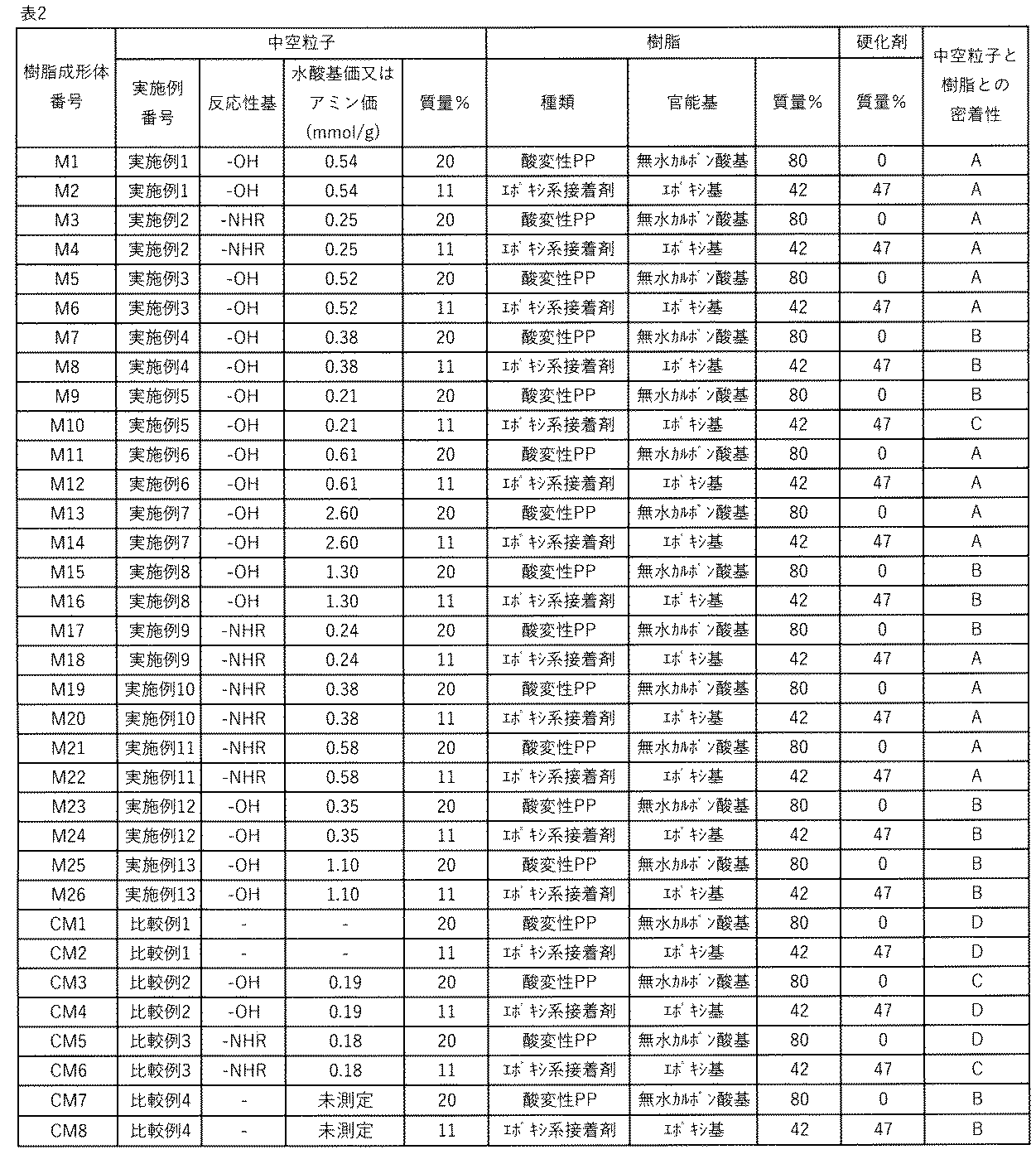
比較例1で得られた中空粒子は、シェルに含まれる重合体が、反応性基を有する単量体単位を含んでおらず、粒子表面に反応性基を十分に有しないものであったため、樹脂との密着性に劣っていた。
比較例2で得られた中空粒子は、シェルに含まれる重合体が、水酸基を有する単量体単位を含んでいたものの、粒子表面に有する水酸基の量が不十分であり、水酸基価が0.20mmol/g未満であったため、樹脂との密着性に劣っていた。
比較例3で得られた中空粒子は、シェルに含まれる重合体が、アミノ基を有する単量体単位を含んでいたものの、粒子表面に有するアミノ基の量が不十分であり、アミン価が0.20mmol/g未満であったため、樹脂との密着性に劣っていた。
比較例4で得られた中空粒子は、グリシジルメタクリレートを重合させた後、エチレンジアミンで架橋することによりシェルが形成された中空粒子であり、耐圧性に劣っていた。比較例4で得られた中空粒子は、シェルが架橋性単量体単位を含んでいないことにより、シェルの強度が不十分であったため、耐圧性に劣っていたと推定される。
中でも、実施例1~6、9、10、12で得られた中空粒子は耐圧性が特に優れていた。これらの実施例で得られた中空粒子は、架橋性単量体単位の含有量が多く、架橋性単量体単位として反応性基非含有単量体単位を含み、且つ、(メタ)アクリル系単量体単位及び反応性基を有しない分子量250以下のビニル系架橋性単量体に由来する架橋性単量体単位の合計含有量が多いものであったため、耐圧性を向上する効果に優れていたと推定される。中でも、実施例3~6で得られた中空粒子は特に耐圧性に優れていた。これらの実施例で得られた中空粒子は、架橋性単量体単位の含有量、及び、(メタ)アクリル系単量体単位及び反応性基を有しない分子量250以下のビニル系架橋性単量体に由来する架橋性単量体単位の合計含有量が特に多かったためと推定される。
また、実施例7で得られた中空粒子も耐圧性に優れていた。実施例7で得られた中空粒子は、架橋性単量体単位として反応性基非含有単量体単位を含んでいなかったものの、架橋性単量体単位の含有量が多く、且つ、(メタ)アクリル系単量体単位及び反応性基を有しない分子量250以下のビニル系架橋性単量体に由来する架橋性単量体単位の合計含有量が多いものであったため、耐圧性を向上する効果に優れていたと推定される。
理論空隙率、理論見かけ密度D2、及び全重合性単量体中の水相側に移行した単量体量を求める計算式は以下の通りである。
理論空隙率(%)=(疎水性溶剤の質量部/疎水性溶剤比重)/(疎水性溶剤の質量部/疎水性溶剤比重+重合性単量体の質量部/真密度D0)×100
理論見かけ密度D2(g/cm3)=真密度D0×(100-理論空隙率)
水相側に移行した単量体量(質量%)=(理論見かけ密度D2-見かけ密度D1)/理論見かけ密度D2×100
実施例12においては、全単量体単位100質量部に対し、エチレングリコールジメタクリレートに由来する単量体単位の含有量が67質量部、ペンタエリスリトールテトラアクリレートに由来する単量体単位の含有量が21質量部、2-ヒドロキシ-3-メタクリロイルオキシプロピルアクリレートに由来する単量体単位の含有量が12質量部であった。
実施例12において、水相側に移行した単量体(2-ヒドロキシ-3-メタクリロイルオキシプロピルアクリレート)量は、全重合性単量体中の2.9質量%であった。これを考慮して、例えばエチレングリコールジメタクリレート(EGDMA)単位は以下のようにして算出した。なお、算出される各単量体単位量は、小数点以下第一位を四捨五入した値とした。
EGDMA単位量(67質量部)=EGDMAの仕込み量(65質量部)×100/(100-水相側に移行した単量体量(2.9質量部))
実施例13においても、実施例12と同様にして各単量体単位量を算出した結果、全単量体単位100質量部に対し、エチレングリコールジメタクリレートに由来する単量体単位の含有量が52質量部、ペンタエリスリトールテトラアクリレートに由来する単量体単位の含有量が22質量部、メタクリル酸2-ヒドロキシエチルに由来する単量体単位の含有量が26質量部であった。なお、実施例13において、水相側に移行した単量体(メタクリル酸2-ヒドロキシエチル)量は、全重合性単量体中の9.5質量%であった。
実施例1において、上記「(1)混合液調製工程」で、油相に添加する重合性単量体の種類及び量、並びに疎水性溶剤の種類及び量を表3に示す通りとした以外は、実施例1と同様の手順で、実施例14~29の中空粒子を得た。
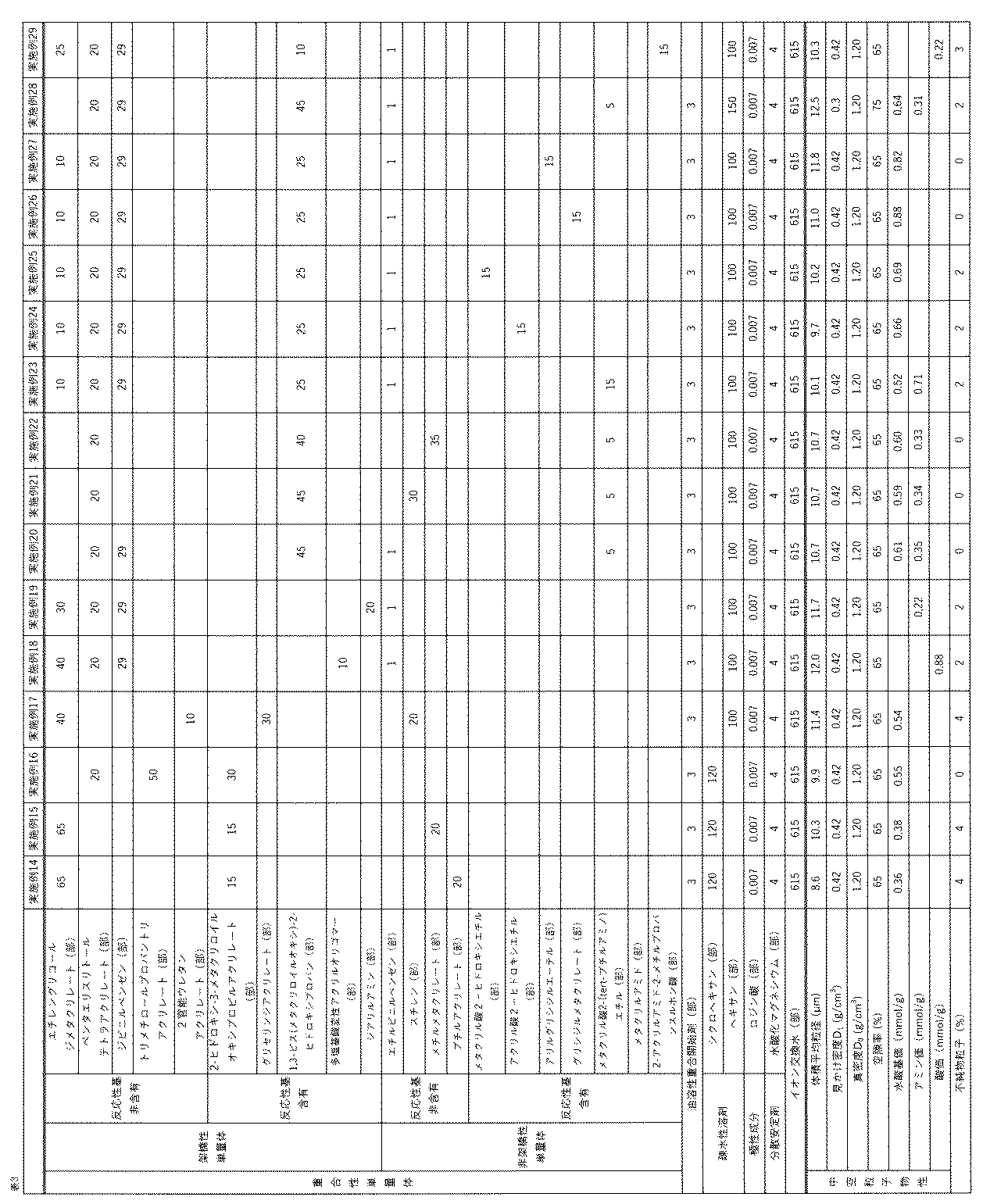
実施例14~29で得た中空粒子と樹脂との密着性の評価のために作製した成形体MA1~MA80について、各成分の含有割合、及び評価結果等を表4~表6に示す。成形体MA1~MA80のうち、MA23、78及び80は、中空粒子が有する反応性基と、樹脂が有する官能基とが反応性を有しないものであったため、中空粒子のシェルは、樹脂の固化物と架橋結合していなかった。これら以外の成形体は、本開示の中空粒子に由来する中空粒子と、樹脂の固化物とを含み、前記中空粒子のシェルが、樹脂の固化物と架橋結合していた。
180℃以上に加熱したホットプレートで、中空粒子0.2gとアクリル樹脂(ポリメチルメタクリレート(PMMA))0.8gを溶融、混合して混合物を得た。得られた混合物を溶融状態で5mm程度に薄く延ばしてから冷却することにより、中空粒子を含有するPMMA成形体を得た。
ポリオール成分0.4gとポリイソシアネート成分0.4gに中空粒子0.2gを添加し、均一になるまで混合した。得られた混合物をアルミ皿に流し込み、200℃で2時間放置し硬化させることにより、中空粒子を含有するポリウレタン系樹脂成形体を得た。
ポリアミック酸0.8gに中空粒子0.2gを添加し、均一になるまで混合した。得られた混合物をアルミ皿に流し込み、350℃で1時間放置しアミック酸の閉環反応によるイミド硬化を行うことにより、中空粒子を含有するポリイミド系樹脂成形体を得た。
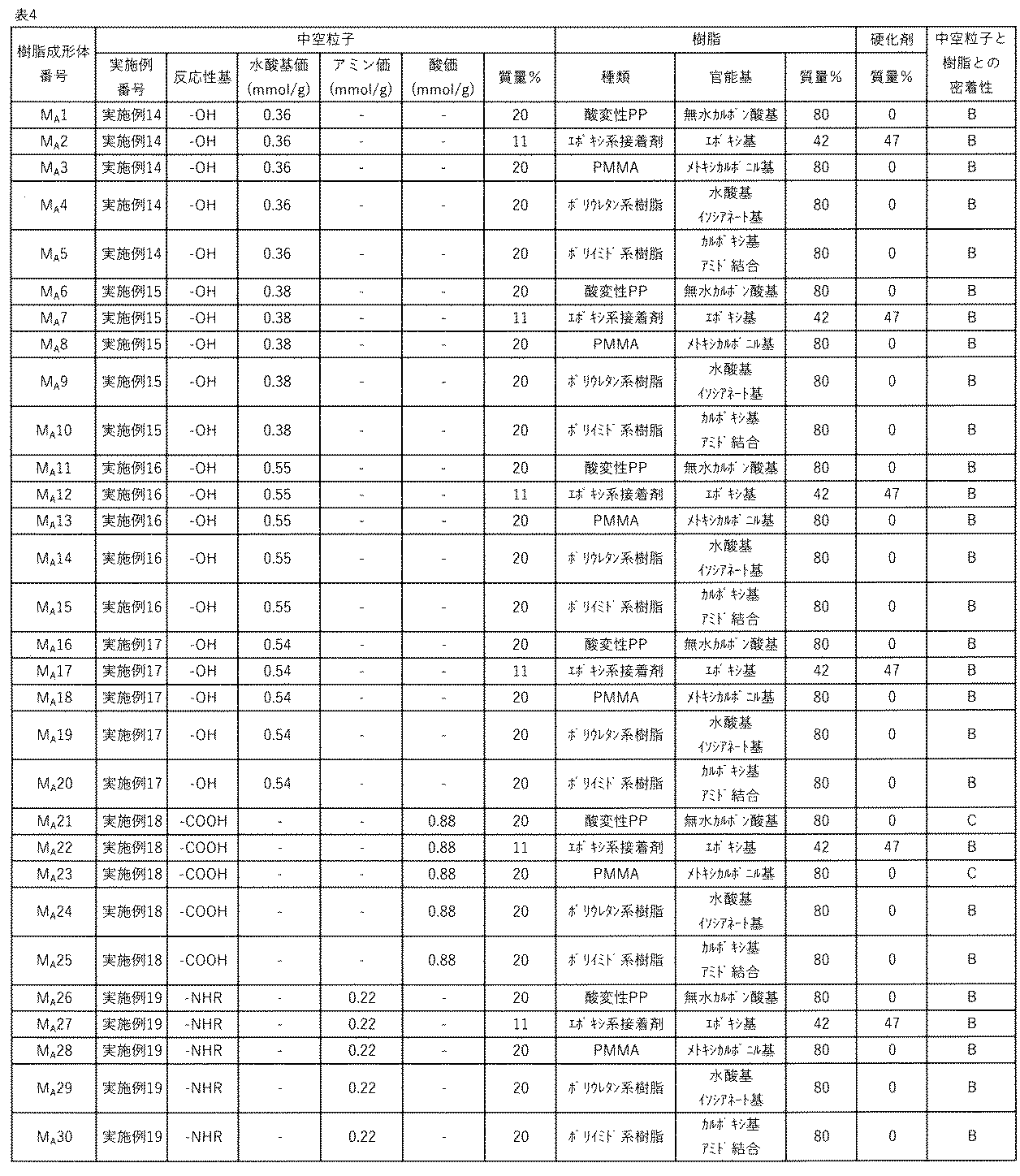
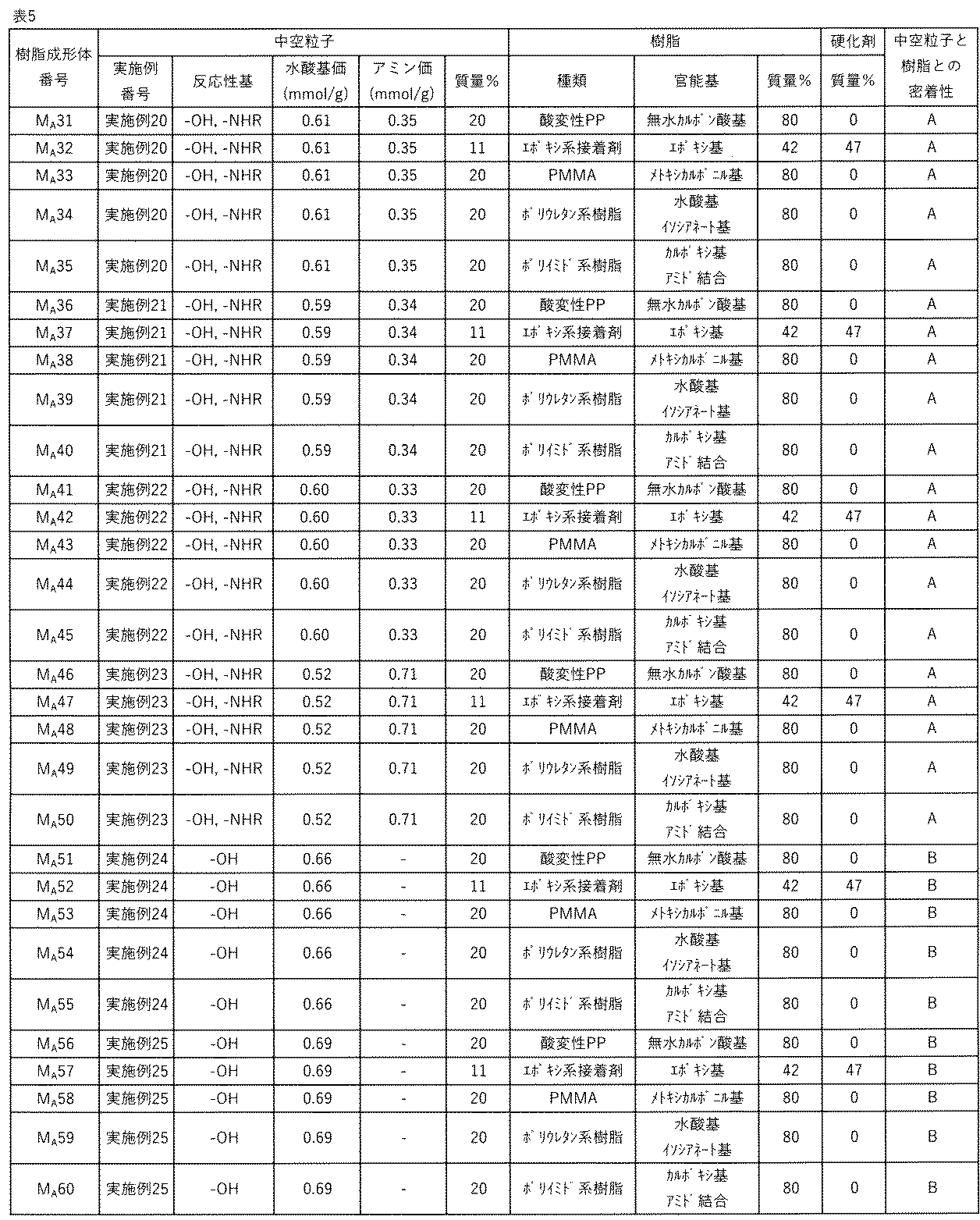
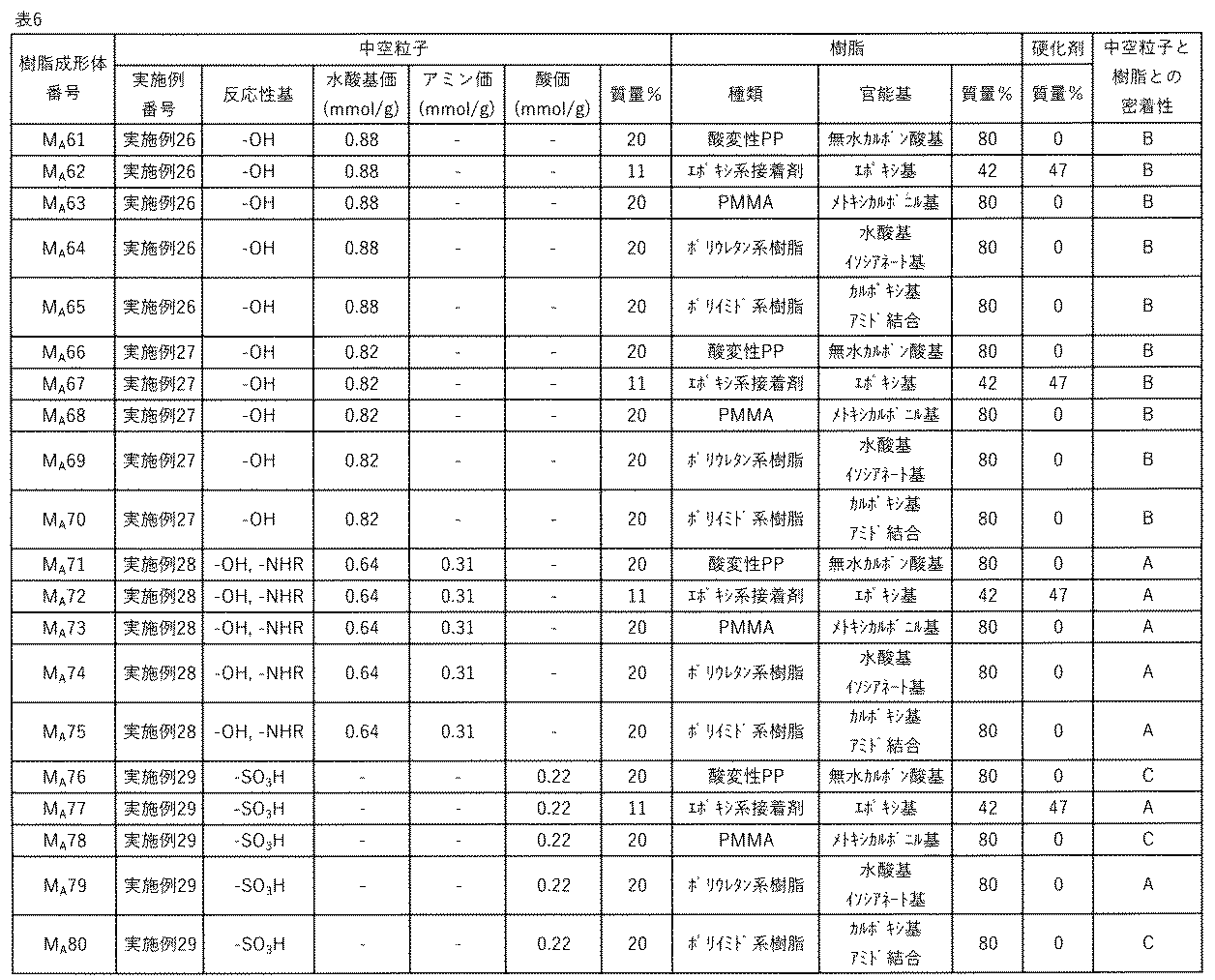
実施例14~29で得た中空粒子の耐圧性のために作製した成形体MP1~MP48について、各成分の含有割合、及び評価結果等を表7~表9に示す。成形体MP1~MP48のうち、MP13、46及び48は、中空粒子が有する反応性基と、樹脂が有する官能基とが反応性を有しないものであったため、中空粒子のシェルは、樹脂の固化物と架橋結合していなかった。これら以外の成形体は、本開示の中空粒子に由来する中空粒子と、樹脂の固化物とを含み、前記中空粒子のシェルが、樹脂の固化物と架橋結合していた。
180℃以上に加熱したホットプレートで、中空粒子0.1gとアクリル樹脂を溶融、混合して樹脂組成物とした。得られた樹脂組成物を、Φ14mmの熱プレス機用金型(アズワン(株)製)に入れ、金型ごと230℃の乾燥機に入れて15分加熱した。取り出した金型を90℃に設定した熱プレス機(型番:H300-15、アズワン(株)製)に設置し、90℃のシリンダーを金型に入れた。金型表面の温度が130℃に下がった時点でプレス圧45MPaの圧力をかけて成形体を作製した。この際、プレス機のシリンダー圧は3MPaとした。得られた成形体の比重を測定した。上述した式(V)、(VI)及び(VII)により空隙維持率を計算し、下記評価基準により耐圧性を評価した。
(耐圧性評価基準)
A:空隙維持率が71~100%
B:空隙維持率が51~70%
C:空隙維持率が21~50%
D:空隙維持率が0~20%
ポリオール成分0.45gとポリイソシアネート0.45gに中空粒子0.1gを添加し、均一になるまで混合した。得られた混合物を、Φ14mmの熱プレス機用金型(アズワン(株)製)に入れ、金型ごと200℃の乾燥機に入れて2時間加熱した。取り出した金型を90℃に設定した熱プレス機(型番:H300-15、アズワン(株)製)に設置し、90℃のシリンダーを金型に入れた。金型表面の温度が130℃に下がった時点でプレス圧45MPaの圧力をかけて成形体を作製した。この際、プレス機のシリンダー圧は3MPaとした。得られた成形体の比重を測定した。上述した式(V)、(VI)及び(VII)により空隙維持率を計算し、上記「PMMA成形体中での耐圧性」と同様の評価基準により耐圧性を評価した。
ポリアミック酸0.9gに中空粒子0.1gを添加し、均一になるまで混合した。得られた混合物を、Φ14mmの熱プレス機1金型(アズワン(株)製)に入れ、金型ごと350℃の乾燥機に入れて2時間加熱した。取り出した金型を90℃に設定した熱プレス機(型番:H300-15、アズワン(株)製)に設置し、90℃のシリンダーを金型に入れた。金型表面の温度が130℃に下がった時点でプレス圧45MPaの圧力をかけて成形体を作製した。この際、プレス機のシリンダー圧は3MPaとした。得られた成形体の比重を測定した。上述した式(V)、(VI)及び(VII)により空隙維持率を計算し、上記「PMMA成形体中での耐圧性」と同様の評価基準により耐圧性を評価した。
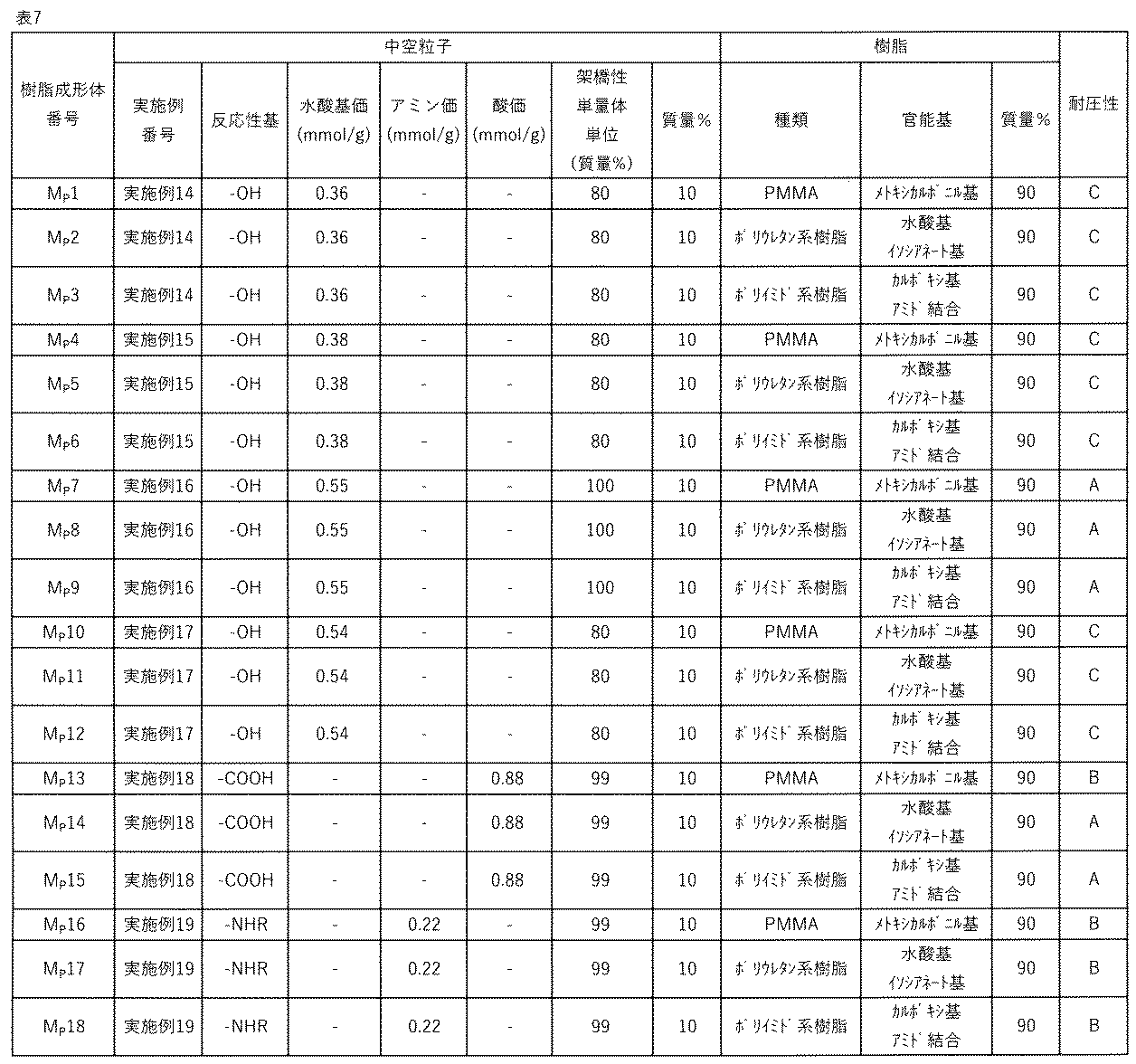
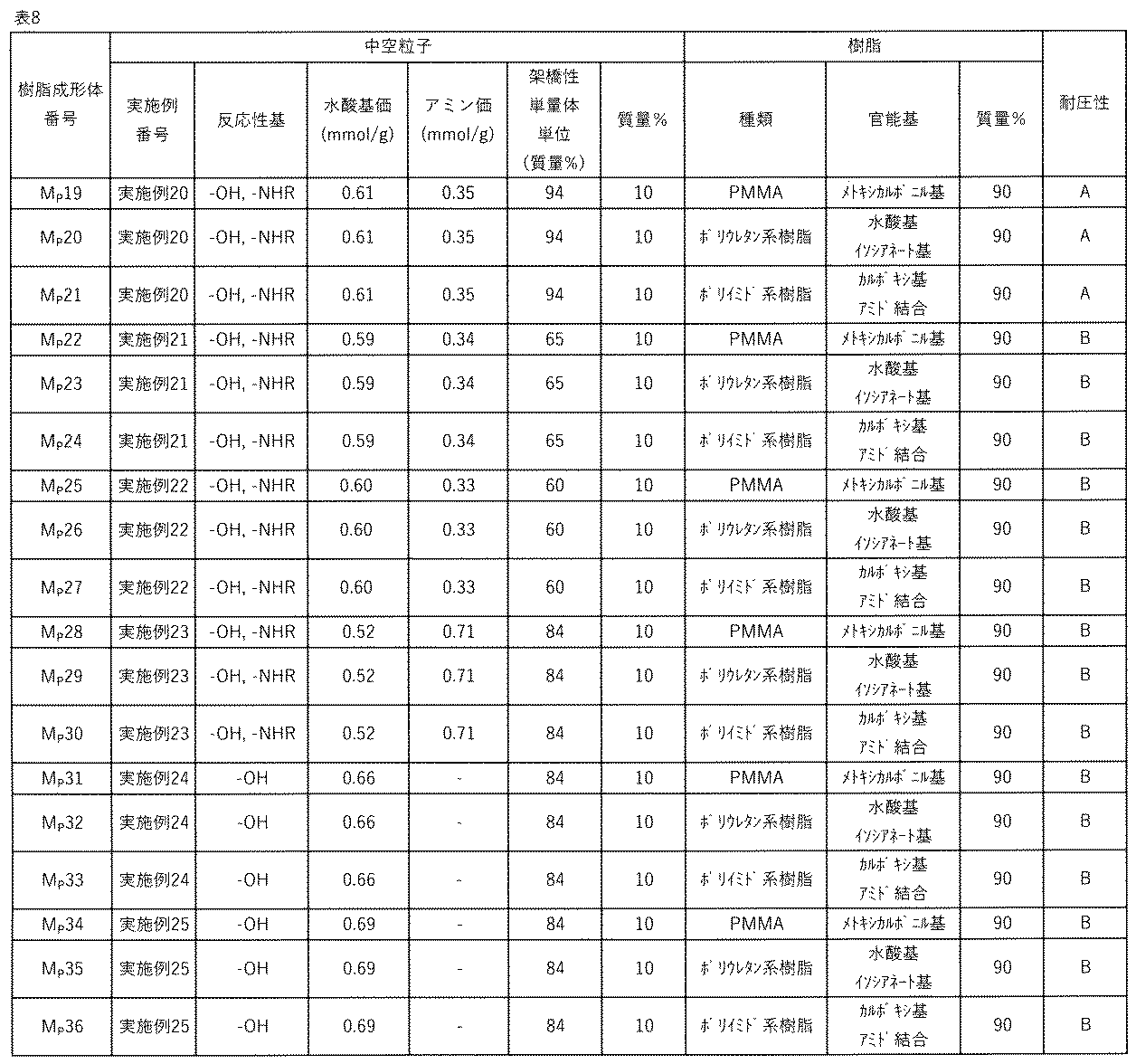
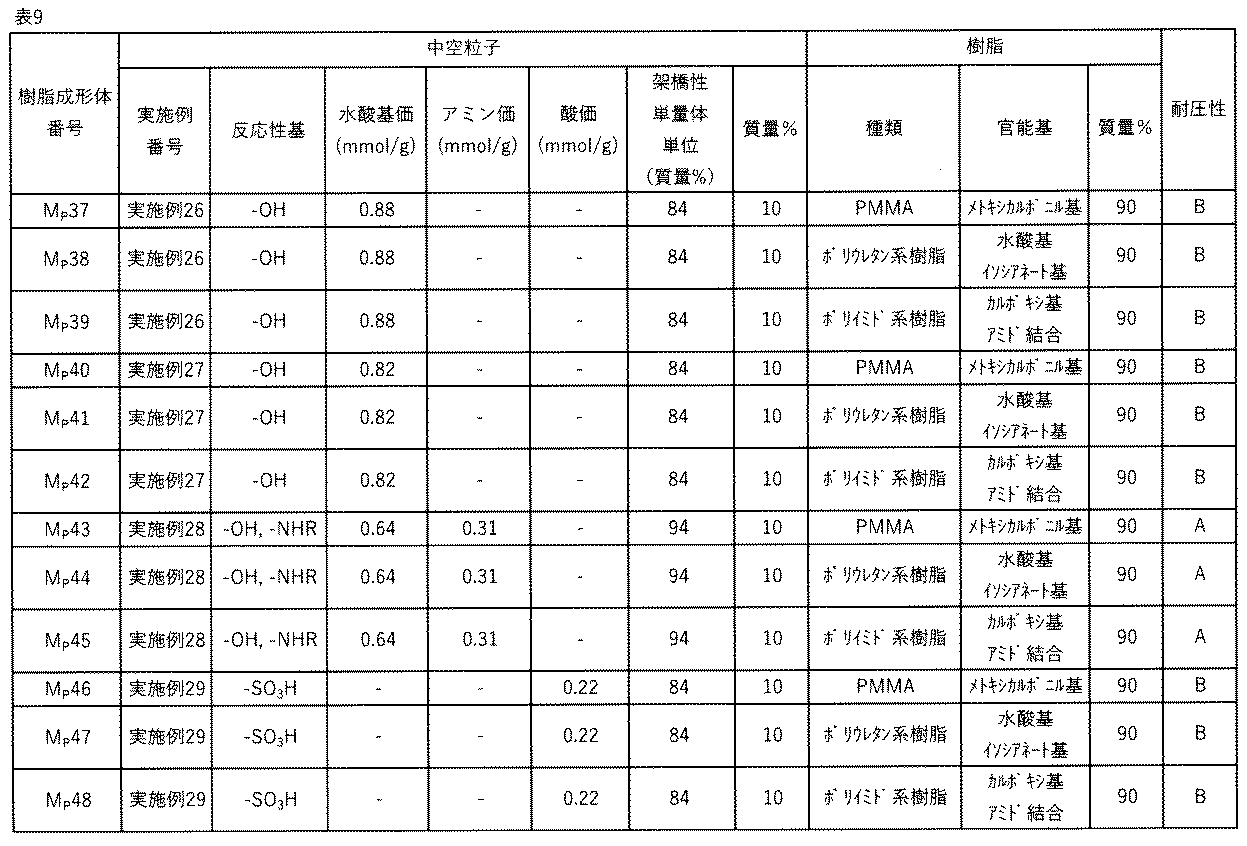
実施例14~17及び19~28で得られた中空粒子は、実施例1~13で得られた中空粒子と同様に、シェルに含まれる重合体が、全単量体単位100質量部中に架橋性単量体単位を60~100質量部含有し、シェルに含まれる重合体が、水酸基及びアミノ基から選ばれる少なくとも1種を有する単量体単位を含むことにより、粒子表面に水酸基及びアミノ基から選ばれる少なくとも1種を有し、水酸基価が0.20mmol/g以上であるか、又はアミン価が0.20mmol/g以上であった。そのため、表4~6に示されるように、水酸基又はアミノ基と架橋結合を形成可能な官能基を有する酸変性PP樹脂、エポキシ系樹脂、PMMA、ポリウレタン系樹脂、又はポリイミド系樹脂を用いた成形体中での樹脂との密着性に優れていた。また、空隙率が50%以上と高くても耐圧性に優れており、表7~9に示されるように、PMMA、ポリウレタン系樹脂、又はポリイミド系樹脂を用いた成形体中では、耐圧性が同等に優れることが明らかにされた。
表4~表6に示す結果から明らかなように、中でも、実施例20~23、28で得られた中空粒子は、酸変性PP樹脂、エポキシ系樹脂、ポリウレタン樹脂又はポリイミド系樹脂を用いた成形体中での樹脂との密着性に優れていた。これは、中空粒子が反応性基として、水酸基及びアミノ基の両方を有していたためと推定される。
また、表7~表9に示す結果から明らかなように、実施例16、20、28で得られた中空粒子は特に耐圧性に優れていた。これは、架橋性単量体単位の含有量が多く、反応性基を含有しない架橋性単量体単位を含み、且つ、(メタ)アクリル系重合性単量体単位、及び反応性基を有しない分子量250以下のビニル系架橋性単量体に由来する架橋性単量体単位の合計含有量が多かったためと推定される。
実施例29で得られた中空粒子は、シェルに含まれる重合体が、全単量体単位100質量部中に架橋性単量体単位を60~100質量部含有し、シェルに含まれる重合体が、スルホ基を有する単量体単位を含むことにより、粒子表面にスルホ基を有し、酸価が0.20mmol/g以上であった。そのため、表6に示されるように、スルホ基と架橋結合を形成可能な官能基を有するエポキシ系樹脂又はポリウレタン樹脂を用いた成形体中での樹脂との密着性に優れていた。また、空隙率が50%以上と高くても、耐圧性に優れていた。
表4に示す成形体MA23、及び表6に示す成形体MA78及び80において、中空粒子と樹脂との密着性が劣っていたのは、中空粒子のシェルが樹脂の固化物と架橋結合していなかったためと推定される。
また、中空粒子の耐圧性は、中空粒子のシェルと樹脂の固化物とが架橋結合しているか否かだけでなく、中空粒子のシェルの強度も大きく影響する。例えば、架橋性単量体単位の含有量が多い程、及び、(メタ)アクリル系単量体単位及び反応性基を有しない分子量250以下のビニル系架橋性単量体に由来する架橋性単量体単位の合計含有量が多いほど、中空粒子のシェル強度は向上する傾向がある。また、反応性基を含まない架橋性単量体単位を含む場合に、中空粒子のシェル強度は向上する傾向がある。そのため、上記架橋結合を形成していてシェルの強度に劣る中空粒子に比べて、上記架橋結合を形成しておらずシェルの強度に優れる中空粒子の方が、耐圧性が優れる場合がある。同等のシェル強度を有する中空粒子では、中空粒子のシェルが樹脂の固化物と架橋結合することにより、中空粒子の耐圧性が向上する傾向がある。例えば、表7に示す実施例18の中空粒子を用いた成形体MP13~MP15を比べると、中空粒子のシェルと樹脂の固化物とが架橋結合していないMP13に比べ、架橋結合しているMP14及びMP15の方が耐圧性に優れていた。
2 低極性材料
4a 疎水性溶剤
4b 疎水性溶剤以外の材料
5 シェル
6 中空部
10 液滴
20 前駆体粒子
100 中空部が気体で満たされた中空粒子
Claims (19)
- 樹脂を含むシェル及び当該シェルに取り囲まれた中空部を備える中空粒子であり、
空隙率が50%以上であり、
前記シェルが前記樹脂として、全単量体単位100質量部中に架橋性単量体単位を60~100質量部含む重合体を含有し、
前記中空粒子の表面に、水酸基及びアミノ基から選ばれる少なくとも1種の反応性基を有し、
水酸基価が0.20mmol/g以上であるか、又はアミン価が0.20mmol/g以上である、中空粒子。 - 樹脂を含むシェル及び当該シェルに取り囲まれた中空部を備える中空粒子であり、
空隙率が50%以上であり、
前記シェルが前記樹脂として、全単量体単位100質量部中に架橋性単量体単位を60~100質量部含む重合体を含有し、
前記中空粒子の表面に、カルボキシ基、無水カルボン酸基及びスルホ基からなる群から選ばれる少なくとも1種の反応性基を有し、
酸価が0.20mmol/g以上である、中空粒子。 - 前記反応性基がスルホ基である、請求項2に記載の中空粒子。
- 前記架橋性単量体単位が、反応性基含有単量体単位及び反応性基非含有単量体単位を含む、請求項1又は2に記載の中空粒子。
- 前記架橋性単量体単位100質量部中、反応性基含有単量体単位の含有量が10質量部以上である、請求項1又は2に記載の中空粒子。
- 前記シェルが前記樹脂として、全単量体単位100質量部中に、架橋性単量体単位を60~97質量部含み、且つ非架橋性単量体単位を3~40質量部含み、
前記非架橋性単量体単位100質量部中、反応性基含有単量体単位の含有量が80質量部以上である、請求項1又は2に記載の中空粒子。 - 体積平均粒径が1μm以上である、請求項1又は2に記載の中空粒子。
- 請求項1に記載の中空粒子を製造する方法であって、
重合性単量体、疎水性溶剤、分散安定剤、及び水系媒体を含む混合液を調製する工程と、
前記混合液を懸濁させることにより、前記重合性単量体及び前記疎水性溶剤を含む単量体組成物の液滴が前記水系媒体中に分散した懸濁液を調製する工程と、
前記懸濁液を重合反応に供することにより、樹脂を含むシェルに取り囲まれた中空部を有し、かつ、前記中空部に前記疎水性溶剤を内包する前駆体粒子を含む前駆体組成物を調製する重合工程と、
前記前駆体粒子に内包される前記疎水性溶剤を除去する溶剤除去工程と、を有し、
前記重合工程において、前記懸濁液を重合反応に供する第一の重合反応を行った後、更に第二の重合性単量体を添加して、第二の重合反応を行ってもよく、
前記混合液に含まれる重合性単量体100質量部中に、架橋性単量体を60~100質量部含有し、
前記混合液に含まれる重合性単量体及び前記第二の重合性単量体の少なくともいずれかが、水酸基及びアミノ基から選ばれる少なくとも1種の反応性基を有する架橋性又は非架橋性の単量体を含む、中空粒子の製造方法。 - 請求項2に記載の中空粒子を製造する方法であって、
重合性単量体、疎水性溶剤、分散安定剤、及び水系媒体を含む混合液を調製する工程と、
前記混合液を懸濁させることにより、前記重合性単量体及び前記疎水性溶剤を含む単量体組成物の液滴が前記水系媒体中に分散した懸濁液を調製する工程と、
前記懸濁液を重合反応に供することにより、樹脂を含むシェルに取り囲まれた中空部を有し、かつ、前記中空部に前記疎水性溶剤を内包する前駆体粒子を含む前駆体組成物を調製する重合工程と、
前記前駆体粒子に内包される前記疎水性溶剤を除去する溶剤除去工程と、を有し、
前記重合工程において、前記懸濁液を重合反応に供する第一の重合反応を行った後、更に第二の重合性単量体を添加して、第二の重合反応を行ってもよく、
前記混合液に含まれる重合性単量体100質量部中に、架橋性単量体を60~100質量部含有し、
前記混合液に含まれる重合性単量体及び前記第二の重合性単量体の少なくともいずれかが、カルボキシ基、無水カルボン酸基及びスルホ基からなる群から選ばれる少なくとも1種の反応性基を有する架橋性又は非架橋性の単量体を含む、中空粒子の製造方法。 - 前記混合液に含まれる重合性単量体及び前記第二の重合性単量体の少なくともいずれかが、前記反応性基を有する架橋性単量体を含む、請求項8又は9に記載の中空粒子の製造方法。
- 前記混合液に含まれる架橋性単量体が、反応性基非含有単量体を含有する、請求項8又は9に記載の中空粒子の製造方法。
- 前記混合液に含まれる重合性単量体及び前記第二の重合性単量体に含まれる架橋性単量体の合計100質量部中、反応性基含有単量体の含有量が10質量部以上である、請求項8又は9に記載の中空粒子の製造方法。
- 前記混合液に含まれる重合性単量体及び前記第二の重合性単量体の少なくともいずれかが、非架橋性単量体を含み、前記混合液に含まれる重合性単量体及び前記第二の重合性単量体の合計100質量部中、前記架橋性単量体の含有量が60~97質量部であり、前記非架橋性単量体の含有量が3~40質量部であり、前記非架橋性単量体の合計100質量部中、反応性基含有単量体の含有量が80質量部以上である、請求項8又は9に記載の中空粒子の製造方法。
- 請求項1又は2に記載の中空粒子と、官能基を有する樹脂とを含有し、
前記中空粒子が表面に有する反応性基が、前記樹脂が有する官能基と反応し得る、樹脂組成物。 - 前記中空粒子と前記官能基を有する樹脂との組み合わせが、水酸基、アミノ基、カルボキシ基、及び無水カルボン酸基からなる群から選ばれる少なくとも1種の反応性基を有する中空粒子と、エポキシ系樹脂との組み合わせ;水酸基、アミノ基、カルボキシ基、無水カルボン酸基及びスルホ基からなる群から選ばれる少なくとも1種の反応性基を有する中空粒子と、ポリオール成分及びポリイソシアネート成分を含む樹脂との組み合わせ;及び、水酸基、アミノ基、カルボキシ基及び無水カルボン酸基からなる群から選ばれる少なくとも1種の反応性基を有する中空粒子と、ポリアミック酸との組み合わせから選ばれるいずれかである、請求項14に記載の樹脂組成物。
- 請求項1又は2に記載の中空粒子に由来する中空粒子と、樹脂の固化物とを含み、前記中空粒子のシェルが、前記樹脂の固化物と架橋結合している、成形体。
- 前記架橋結合が、中空粒子が有していた水酸基、アミノ基、カルボキシ基及び無水カルボン酸基からなる群から選ばれる少なくとも1種の反応性基と、樹脂が有していたエポキシ基との反応により形成された架橋結合;中空粒子が有していたカルボキシ基、無水カルボン酸基及びスルホ基からなる群から選ばれる少なくとも1種の反応性基と、樹脂が有していた水酸基との反応により形成された架橋結合;中空粒子が有していた水酸基及びアミノ基から選ばれる少なくとも1種の反応性基と、樹脂が有していたイソシアネート基との反応により形成された架橋結合;中空粒子が有していた水酸基及びアミノ基から選ばれる少なくとも1種の反応性基と、樹脂が有していたカルボキシ基及び無水カルボン酸基から選ばれる少なくとも1種との反応により形成された架橋結合;及び、中空粒子が有していた水酸基及びアミノ基から選ばれる少なくとも1種と、樹脂が有していた炭素数1~4のアルコキシカルボニル基との反応により形成された架橋結合;から選ばれるいずれかである、請求項16に記載の成形体。
- 請求項1又は2に記載の中空粒子と、前記中空粒子が表面に有する反応性基と反応し得る官能基を有する樹脂とを混合する工程と、
前記樹脂を固化させる工程と、
前記中空粒子が有する反応性基と、前記樹脂が有する官能基とを反応させる工程とを有する、成形体の製造方法。 - 前記中空粒子と前記官能基を有する樹脂との組み合わせが、水酸基、アミノ基、カルボキシ基、及び無水カルボン酸基からなる群から選ばれる少なくとも1種の反応性基を有する中空粒子と、エポキシ系樹脂との組み合わせ;水酸基、アミノ基、カルボキシ基、無水カルボン酸基及びスルホ基からなる群から選ばれる少なくとも1種の反応性基を有する中空粒子と、ポリオール成分及びポリイソシアネート成分を含む樹脂との組み合わせ;水酸基、アミノ基、カルボキシ基及び無水カルボン酸基からなる群から選ばれる少なくとも1種の反応性基を有する中空粒子と、ポリアミック酸との組み合わせ;カルボキシ基、無水カルボン酸基及びスルホ基からなる群から選ばれる少なくとも1種の反応性基を有する中空粒子と、ポリビニルアルコール、エチレン-ビニルアルコール共重合体、及び酢酸セルロースからなる群から選ばれる少なくとも1種の水酸基を有する樹脂との組み合わせ;水酸基及びアミノ基から選ばれる少なくとも1種の反応性基を有する中空粒子と、酸変性ポリオレフィン系樹脂との組み合わせ;及び、水酸基及びアミノ基を有する中空粒子と、ポリメチル(メタ)アクリレートとの組み合わせから選ばれるいずれかである、請求項18に記載の成形体の製造方法。
Priority Applications (7)
| Application Number | Priority Date | Filing Date | Title |
|---|---|---|---|
| US18/574,182 US20240367132A1 (en) | 2021-07-05 | 2022-07-05 | Hollow particles, method for producing hollow particles, resin composition, molded body and method for producing molded body |
| JP2023533129A JPWO2023282242A1 (ja) | 2021-07-05 | 2022-07-05 | |
| EP22837657.0A EP4368646A4 (en) | 2021-07-05 | 2022-07-05 | HOLLOW PARTICLES, METHOD FOR PRODUCING HOLLOW PARTICLES, RESIN COMPOSITION, MOLDED ARTICLE, AND METHOD FOR PRODUCING MOLDED ARTICLE |
| KR1020237044408A KR20240028352A (ko) | 2021-07-05 | 2022-07-05 | 중공 입자, 중공 입자의 제조 방법, 수지 조성물, 성형체, 및 성형체의 제조 방법 |
| EP26156527.9A EP4714536A3 (en) | 2021-07-05 | 2022-07-05 | Hollow particles, method for producing hollow particles, resin composition, molded body and method for producing molded body |
| CN202280044344.5A CN117545549A (zh) | 2021-07-05 | 2022-07-05 | 中空颗粒、中空颗粒的制造方法、树脂组合物、成型体以及成型体的制造方法 |
| US19/399,789 US20260138110A1 (en) | 2021-07-05 | 2025-11-25 | Hollow particles, method for producing hollow particles, resin composition, molded body and method for producing molded body |
Applications Claiming Priority (2)
| Application Number | Priority Date | Filing Date | Title |
|---|---|---|---|
| JP2021-111341 | 2021-07-05 | ||
| JP2021111341 | 2021-07-05 |
Related Child Applications (2)
| Application Number | Title | Priority Date | Filing Date |
|---|---|---|---|
| US18/574,182 A-371-Of-International US20240367132A1 (en) | 2021-07-05 | 2022-07-05 | Hollow particles, method for producing hollow particles, resin composition, molded body and method for producing molded body |
| US19/399,789 Division US20260138110A1 (en) | 2021-07-05 | 2025-11-25 | Hollow particles, method for producing hollow particles, resin composition, molded body and method for producing molded body |
Publications (1)
| Publication Number | Publication Date |
|---|---|
| WO2023282242A1 true WO2023282242A1 (ja) | 2023-01-12 |
Family
ID=84800715
Family Applications (1)
| Application Number | Title | Priority Date | Filing Date |
|---|---|---|---|
| PCT/JP2022/026655 Ceased WO2023282242A1 (ja) | 2021-07-05 | 2022-07-05 | 中空粒子、中空粒子の製造方法、樹脂組成物、成形体、及び成形体の製造方法 |
Country Status (6)
| Country | Link |
|---|---|
| US (2) | US20240367132A1 (ja) |
| EP (2) | EP4714536A3 (ja) |
| JP (1) | JPWO2023282242A1 (ja) |
| KR (1) | KR20240028352A (ja) |
| CN (1) | CN117545549A (ja) |
| WO (1) | WO2023282242A1 (ja) |
Cited By (1)
| Publication number | Priority date | Publication date | Assignee | Title |
|---|---|---|---|---|
| WO2024161932A1 (ja) * | 2023-01-31 | 2024-08-08 | 日本ゼオン株式会社 | 中空粒子、エラストマー組成物、及びエラストマー架橋成形体 |
Families Citing this family (1)
| Publication number | Priority date | Publication date | Assignee | Title |
|---|---|---|---|---|
| WO2021172402A1 (ja) * | 2020-02-25 | 2021-09-02 | 日本ゼオン株式会社 | 中空樹脂粒子の製造方法 |
Citations (5)
| Publication number | Priority date | Publication date | Assignee | Title |
|---|---|---|---|---|
| JPH04279637A (ja) * | 1990-11-28 | 1992-10-05 | Japan Synthetic Rubber Co Ltd | 中空ポリマー微粒子およびその製造方法 |
| JP2006089648A (ja) | 2004-09-24 | 2006-04-06 | Sekisui Chem Co Ltd | 中空樹脂微粒子の製造方法、中空樹脂微粒子、反射防止フィルム用コーティング剤及び反射防止フィルム |
| WO2019177006A1 (ja) | 2018-03-14 | 2019-09-19 | 積水化成品工業株式会社 | 中空粒子、その製造方法及びその用途 |
| WO2020066623A1 (ja) * | 2018-09-28 | 2020-04-02 | 日本ゼオン株式会社 | 中空粒子及びその製造方法、並びに当該中空粒子を含む水分散液 |
| WO2021112110A1 (ja) * | 2019-12-06 | 2021-06-10 | 日本ゼオン株式会社 | 中空粒子、樹脂組成物及び成形体 |
Family Cites Families (10)
| Publication number | Priority date | Publication date | Assignee | Title |
|---|---|---|---|---|
| EP0416616B1 (en) * | 1989-09-06 | 1996-01-03 | Nippon Paint Co., Ltd. | Process for preparing composite hollow particles |
| AU3996800A (en) * | 1998-12-10 | 2000-07-12 | Zms, Llc | Expandable polymeric microspheres, their method of production, and uses and products thereof |
| JP4448930B2 (ja) * | 2000-09-04 | 2010-04-14 | 財団法人新産業創造研究機構 | 中空高分子微粒子及びその製造法 |
| JP2002105104A (ja) * | 2000-09-28 | 2002-04-10 | Kuraray Co Ltd | 中実ポリマー粒子または中空ポリマー粒子の製造方法 |
| JP2005272633A (ja) * | 2004-03-24 | 2005-10-06 | Sanyo Chem Ind Ltd | 中空樹脂粒子及び熱膨張性マイクロカプセル |
| JP5526468B2 (ja) * | 2006-09-29 | 2014-06-18 | 大日本印刷株式会社 | 反射防止積層体 |
| JP6611830B2 (ja) * | 2016-02-05 | 2019-11-27 | 富士フイルム株式会社 | インク組成物、インクセット、画像記録方法、及びインク組成物の製造方法 |
| JP7421320B2 (ja) * | 2019-12-03 | 2024-01-24 | 三井化学株式会社 | 樹脂粒子 |
| US12623198B2 (en) * | 2019-12-06 | 2026-05-12 | Zeon Corporation | Method for producing hollow particles |
| JP7836796B2 (ja) * | 2021-02-24 | 2026-03-27 | 株式会社カネカ | 中空粒子及びその製造方法、並びに、中空粒子の利用 |
-
2022
- 2022-07-05 EP EP26156527.9A patent/EP4714536A3/en active Pending
- 2022-07-05 WO PCT/JP2022/026655 patent/WO2023282242A1/ja not_active Ceased
- 2022-07-05 CN CN202280044344.5A patent/CN117545549A/zh active Pending
- 2022-07-05 JP JP2023533129A patent/JPWO2023282242A1/ja active Pending
- 2022-07-05 KR KR1020237044408A patent/KR20240028352A/ko active Pending
- 2022-07-05 US US18/574,182 patent/US20240367132A1/en active Pending
- 2022-07-05 EP EP22837657.0A patent/EP4368646A4/en active Pending
-
2025
- 2025-11-25 US US19/399,789 patent/US20260138110A1/en active Pending
Patent Citations (5)
| Publication number | Priority date | Publication date | Assignee | Title |
|---|---|---|---|---|
| JPH04279637A (ja) * | 1990-11-28 | 1992-10-05 | Japan Synthetic Rubber Co Ltd | 中空ポリマー微粒子およびその製造方法 |
| JP2006089648A (ja) | 2004-09-24 | 2006-04-06 | Sekisui Chem Co Ltd | 中空樹脂微粒子の製造方法、中空樹脂微粒子、反射防止フィルム用コーティング剤及び反射防止フィルム |
| WO2019177006A1 (ja) | 2018-03-14 | 2019-09-19 | 積水化成品工業株式会社 | 中空粒子、その製造方法及びその用途 |
| WO2020066623A1 (ja) * | 2018-09-28 | 2020-04-02 | 日本ゼオン株式会社 | 中空粒子及びその製造方法、並びに当該中空粒子を含む水分散液 |
| WO2021112110A1 (ja) * | 2019-12-06 | 2021-06-10 | 日本ゼオン株式会社 | 中空粒子、樹脂組成物及び成形体 |
Non-Patent Citations (2)
| Title |
|---|
| "Kagaku Binran, Kiso Hen, Kaitei 4 Ban", 30 September 1993, MARUZEN PUBLISHING CO., LTD., pages: II-498,II-503 |
| See also references of EP4368646A4 |
Cited By (1)
| Publication number | Priority date | Publication date | Assignee | Title |
|---|---|---|---|---|
| WO2024161932A1 (ja) * | 2023-01-31 | 2024-08-08 | 日本ゼオン株式会社 | 中空粒子、エラストマー組成物、及びエラストマー架橋成形体 |
Also Published As
| Publication number | Publication date |
|---|---|
| JPWO2023282242A1 (ja) | 2023-01-12 |
| EP4368646A1 (en) | 2024-05-15 |
| EP4714536A3 (en) | 2026-06-24 |
| EP4368646A4 (en) | 2025-07-23 |
| US20240367132A1 (en) | 2024-11-07 |
| CN117545549A (zh) | 2024-02-09 |
| KR20240028352A (ko) | 2024-03-05 |
| US20260138110A1 (en) | 2026-05-21 |
| EP4714536A2 (en) | 2026-03-25 |
Similar Documents
| Publication | Publication Date | Title |
|---|---|---|
| US12485399B2 (en) | Hollow particles, resin composition and molded body | |
| JP7619394B2 (ja) | 中空樹脂粒子含有シート | |
| EP4446347A1 (en) | Stator and electrical rotating machine | |
| US20260138110A1 (en) | Hollow particles, method for producing hollow particles, resin composition, molded body and method for producing molded body | |
| CN112739778A (zh) | 树脂组合物及其成型体 | |
| CN116194495A (zh) | 中空颗粒 | |
| EP4446350A1 (en) | Hollow particles, method for producing hollow particles, and resin composition | |
| US20250059339A1 (en) | Hollow particles | |
| JP2023086486A (ja) | 中空粒子の製造方法、及び樹脂組成物の製造方法 | |
| WO2025094928A1 (ja) | 中空粒子、中空粒子の製造方法、塗料組成物、及び塗装物品 | |
| JPWO2004026945A1 (ja) | 偏平粒子及びその製造方法 | |
| WO2024095851A1 (ja) | 中空粒子、中空粒子の製造方法、樹脂組成物及び樹脂構造体 | |
| WO2024181103A1 (ja) | 樹脂組成物、プリプレグ、及び成形体 | |
| WO2024070841A1 (ja) | 中空粒子、中空粒子の製造方法、樹脂組成物、樹脂構造体、及び樹脂構造体の製造方法 | |
| CN116848161B (zh) | 中空颗粒 | |
| WO2023163084A1 (ja) | 中空粒子、樹脂組成物、及び樹脂成形体 | |
| WO2024122428A1 (ja) | 樹脂組成物、プリプレグ、金属箔張積層板、及びプリント基板 | |
| Sun et al. | Synthesis, porous structure, and underwater acoustic properties of macroporous cross-linked copolymer beads | |
| WO2022071277A1 (ja) | 樹脂組成物 |
Legal Events
| Date | Code | Title | Description |
|---|---|---|---|
| 121 | Ep: the epo has been informed by wipo that ep was designated in this application |
Ref document number: 22837657 Country of ref document: EP Kind code of ref document: A1 |
|
| WWE | Wipo information: entry into national phase |
Ref document number: 2023533129 Country of ref document: JP |
|
| WWE | Wipo information: entry into national phase |
Ref document number: 202280044344.5 Country of ref document: CN |
|
| WWE | Wipo information: entry into national phase |
Ref document number: 18574182 Country of ref document: US |
|
| WWE | Wipo information: entry into national phase |
Ref document number: 2022837657 Country of ref document: EP |
|
| NENP | Non-entry into the national phase |
Ref country code: DE |
|
| ENP | Entry into the national phase |
Ref document number: 2022837657 Country of ref document: EP Effective date: 20240205 |