WO2023282269A1 - パーキンソン病の予防又は治療薬 - Google Patents
パーキンソン病の予防又は治療薬 Download PDFInfo
- Publication number
- WO2023282269A1 WO2023282269A1 PCT/JP2022/026755 JP2022026755W WO2023282269A1 WO 2023282269 A1 WO2023282269 A1 WO 2023282269A1 JP 2022026755 W JP2022026755 W JP 2022026755W WO 2023282269 A1 WO2023282269 A1 WO 2023282269A1
- Authority
- WO
- WIPO (PCT)
- Prior art keywords
- trisulfide
- pharmaceutically acceptable
- acceptable salt
- compound
- glutathione
- Prior art date
- Legal status (The legal status is an assumption and is not a legal conclusion. Google has not performed a legal analysis and makes no representation as to the accuracy of the status listed.)
- Ceased
Links
Images



Classifications
-
- A—HUMAN NECESSITIES
- A61—MEDICAL OR VETERINARY SCIENCE; HYGIENE
- A61P—SPECIFIC THERAPEUTIC ACTIVITY OF CHEMICAL COMPOUNDS OR MEDICINAL PREPARATIONS
- A61P25/00—Drugs for disorders of the nervous system
- A61P25/14—Drugs for disorders of the nervous system for treating abnormal movements, e.g. chorea, dyskinesia
- A61P25/16—Anti-Parkinson drugs
-
- A—HUMAN NECESSITIES
- A61—MEDICAL OR VETERINARY SCIENCE; HYGIENE
- A61K—PREPARATIONS FOR MEDICAL, DENTAL OR TOILETRY PURPOSES
- A61K31/00—Medicinal preparations containing organic active ingredients
- A61K31/33—Heterocyclic compounds
- A61K31/38—Heterocyclic compounds having sulfur as a ring hetero atom
- A61K31/385—Heterocyclic compounds having sulfur as a ring hetero atom having two or more sulfur atoms in the same ring
-
- A—HUMAN NECESSITIES
- A61—MEDICAL OR VETERINARY SCIENCE; HYGIENE
- A61K—PREPARATIONS FOR MEDICAL, DENTAL OR TOILETRY PURPOSES
- A61K31/00—Medicinal preparations containing organic active ingredients
- A61K31/16—Amides, e.g. hydroxamic acids
- A61K31/164—Amides, e.g. hydroxamic acids of a carboxylic acid with an aminoalcohol, e.g. ceramides
-
- A—HUMAN NECESSITIES
- A61—MEDICAL OR VETERINARY SCIENCE; HYGIENE
- A61K—PREPARATIONS FOR MEDICAL, DENTAL OR TOILETRY PURPOSES
- A61K31/00—Medicinal preparations containing organic active ingredients
- A61K31/185—Acids; Anhydrides, halides or salts thereof, e.g. sulfur acids, imidic, hydrazonic or hydroximic acids
- A61K31/19—Carboxylic acids, e.g. valproic acid
- A61K31/195—Carboxylic acids, e.g. valproic acid having an amino group
- A61K31/197—Carboxylic acids, e.g. valproic acid having an amino group the amino and the carboxyl groups being attached to the same acyclic carbon chain, e.g. gamma-aminobutyric acid [GABA], beta-alanine, epsilon-aminocaproic acid or pantothenic acid
- A61K31/198—Alpha-amino acids, e.g. alanine or edetic acid [EDTA]
-
- A—HUMAN NECESSITIES
- A61—MEDICAL OR VETERINARY SCIENCE; HYGIENE
- A61K—PREPARATIONS FOR MEDICAL, DENTAL OR TOILETRY PURPOSES
- A61K45/00—Medicinal preparations containing active ingredients not provided for in groups A61K31/00 - A61K41/00
- A61K45/06—Mixtures of active ingredients without chemical characterisation, e.g. antiphlogistics and cardiaca
-
- A—HUMAN NECESSITIES
- A61—MEDICAL OR VETERINARY SCIENCE; HYGIENE
- A61P—SPECIFIC THERAPEUTIC ACTIVITY OF CHEMICAL COMPOUNDS OR MEDICINAL PREPARATIONS
- A61P43/00—Drugs for specific purposes, not provided for in groups A61P1/00-A61P41/00
-
- C—CHEMISTRY; METALLURGY
- C07—ORGANIC CHEMISTRY
- C07D—HETEROCYCLIC COMPOUNDS
- C07D341/00—Heterocyclic compounds containing rings having three or more sulfur atoms as the only ring hetero atoms
Definitions
- the present invention relates to preventive or therapeutic agents for Parkinson's disease.
- Parkinson's disease is a neurodegenerative disease that develops due to selective damage to dopaminergic neurons in the substantia nigra and is premised on motor symptoms centered on bradykinesia, tremor, and muscle rigidity.
- the cornerstone of Parkinson's disease treatment is dopamine replacement therapy.
- there are therapeutic problems such as a gradual increase in the amount of drug administered to obtain a therapeutic effect and the development of side effects due to dopamine replacement therapy, and the development of novel therapeutic agents is expected.
- Non-Patent Document 1 lipid oxidation reactions involving iron ions are enhanced, and a phenomenon called ferroptosis, which eventually leads to cell death due to disruption of the cell membrane function, has attracted attention.
- Non-Patent Document 2 Non-Patent Document 2
- Non-Patent Document 3 oxidized dopamine induces denaturation of ⁇ -synuclein and formation of its aggregates, and is involved in pathogenesis and aggravation of Parkinson's disease.
- GSSSG glutathione trisulfide
- GSSH glutathione persulfide
- Non-Patent Document 6 Non-Patent Document 6
- the drug used for nasal drip administration can be administered as a solution and is non-irritating in consideration of reducing the burden on patients in taking medication. It is desirable to be For example, compounds that are highly water-soluble and do not have ionizable functional groups or are ionically neutral are presumed to be suitable drugs.
- an object of the present invention is to search for a compound having such action and to provide a preventive or therapeutic agent for Parkinson's disease.
- the present inventors have found that glutathione trisulfide, lipoic acid trisulfide, pantethine trisulfide and N,N'-diacetyl-L-cysteine trisulfide inhibit the dopamine oxidation reaction that is accelerated in the presence of iron ions. He found this and completed the present invention.
- the present invention provides the following [1] to [64].
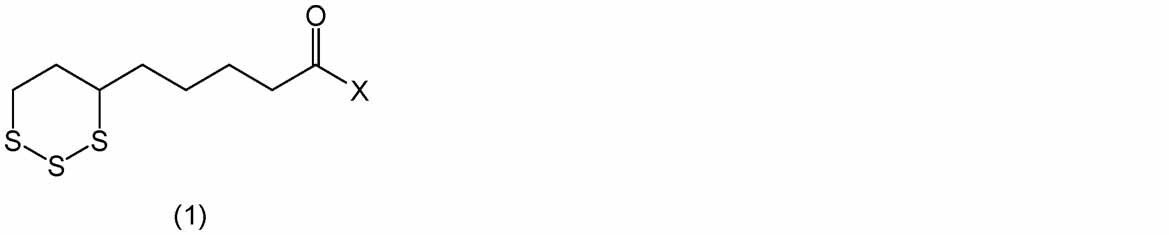
- X represents -OR 1 or -NR 2 R 3
- R 1 represents a hydrogen atom or an alkyl group having 1 to 6 carbon atoms
- R 2 and R 3 each independently , a hydrogen atom or an alkyl group having 1 to 6 carbon atoms
- the alkyl group may have one or more substituents selected from the group consisting of an amino group and a carboxy group.
- compound (1) a pharmaceutically acceptable salt thereof or a cyclodextrin clathrate thereof, pantethine trisulfide or a pharmaceutically acceptable salt thereof, or N,N'- A prophylactic or therapeutic agent which is diacetyl-L-cysteine trisulfide or a pharmaceutically acceptable salt thereof.
- a prophylactic or therapeutic drug containing a drug used for dopamine replacement therapy which is administered in combination with a trisulfide compound, wherein the trisulfide compound is glutathione trisulfide or its pharmaceutical compound (1), a pharmaceutically acceptable salt thereof or a cyclodextrin clathrate thereof, pantethine trisulfide or a pharmaceutically acceptable salt thereof, or N,N'-diacetyl-
- a prophylactic or therapeutic agent which is L-cysteine trisulfide or a pharmaceutically acceptable salt thereof.
- a prophylactic or therapeutic agent for Parkinson's disease containing a trisulfide compound and a drug used for dopamine replacement therapy, wherein the trisulfide compound is glutathione trisulfide or a pharmaceutically acceptable salt thereof; Compound (1), a pharmaceutically acceptable salt thereof or a cyclodextrin clathrate thereof, pantethine trisulfide or a pharmaceutically acceptable salt thereof, or N,N'-diacetyl-L-cysteine trisulfide or A prophylactic or therapeutic agent which is a pharmaceutically acceptable salt thereof.
- the preventive or therapeutic drug according to any one of [1] to [4], wherein the trisulfide compound is glutathione trisulfide or a pharmaceutically acceptable salt thereof.
- the glutathione trisulfide or a pharmaceutically acceptable salt thereof contains at least one selected from the group consisting of glutathione trisulfide, an amino acid salt of glutathione trisulfide, and an alkali metal salt of glutathione trisulfide, The prophylactic or therapeutic drug according to [5].
- the glutathione trisulfide or a pharmaceutically acceptable salt thereof comprises at least one selected from the group consisting of glutathione trisulfide, arginine salt of glutathione trisulfide and sodium salt of glutathione trisulfide, [ 5], the prophylactic or therapeutic drug according to [8] The preventive or therapeutic drug according to any one of [1] to [4], wherein the trisulfide compound is lipoic acid trisulfide or a pharmaceutically acceptable salt thereof. [8-2] The prophylactic or therapeutic agent according to any one of [1] to [4], wherein the trisulfide compound is pantethine trisulfide or a pharmaceutically acceptable salt thereof.
- the drug used for the dopamine replacement therapy is selected from dopamine precursors, dopa decarboxylase inhibitors, catechol-O-methyltransferase inhibitors, monoamine oxidase inhibitors, dopamine release accelerators and dopamine agonists
- the preventive or therapeutic agent according to any one of [1] to [8-4], containing at least one selected from the group consisting of: [10]
- a kit for preventing or treating Parkinson's disease comprising a formulation containing a trisulfide compound and a formulation containing a drug used for dopamine replacement therapy, wherein the trisulfide compound is glutathione trisulfide or A pharmaceutically acceptable salt, compound (1), a pharmaceutically acceptable salt thereof or a cyclodextrin clathrate thereof or pantethine trisulfide or a pharmaceutically acceptable salt thereof or N,N' - a kit which is diacetyl-L-cysteine trisulfide or a pharmaceutically acceptable
- the kit of [10] wherein the formulation containing the trisulfide compound and the formulation containing the drug used for dopamine replacement therapy are administered simultaneously or separately.
- the glutathione trisulfide or a pharmaceutically acceptable salt thereof contains at least one selected from the group consisting of glutathione trisulfide, an amino acid salt of glutathione trisulfide, and an alkali metal salt of glutathione trisulfide, The kit according to [12].
- the glutathione trisulfide or a pharmaceutically acceptable salt thereof comprises at least one selected from the group consisting of glutathione trisulfide, arginine salt of glutathione trisulfide and sodium salt of glutathione trisulfide, [ 12].
- the trisulfide compound is pantethine trisulfide or a pharmaceutically acceptable salt thereof.
- kits of [10] or [11], wherein the trisulfide compound is N,N'-diacetyl-L-cysteine trisulfide or a pharmaceutically acceptable salt thereof.
- the drug used for the dopamine replacement therapy is selected from dopamine precursors, dopa decarboxylase inhibitors, catechol-O-methyltransferase inhibitors, monoamine oxidase inhibitors, dopamine release accelerators and dopamine agonists
- the trisulfide compound includes glutathione trisulfide or a pharmaceutically acceptable salt thereof, compound (1), a pharmaceutically acceptable salt thereof or a cyclodextrin
- N,N'-diacetyl-L-cysteine trisulfide or a pharmaceutically acceptable salt thereof [18] The method of [17], wherein the trisulfide compound and a drug used for dopamine replacement therapy are administered simultaneously or separately. [19] The method of [17] or [18], wherein the trisulfide compound is glutathione trisulfide or a pharmaceutically acceptable salt thereof. [20] The glutathione trisulfide or a pharmaceutically acceptable salt thereof contains at least one selected from the group consisting of glutathione trisulfide, an amino acid salt of glutathione trisulfide, and an alkali metal salt of glutathione trisulfide, The method according to [19].
- the glutathione trisulfide or a pharmaceutically acceptable salt thereof comprises at least one selected from the group consisting of glutathione trisulfide, arginine salt of glutathione trisulfide and sodium salt of glutathione trisulfide, [ 19].
- the drug used for the dopamine replacement therapy is selected from dopamine precursors, dopa decarboxylase inhibitors, catechol-O-methyltransferase inhibitors, monoamine oxidase inhibitors, dopamine release accelerators and dopamine agonists
- the glutathione trisulfide or a pharmaceutically acceptable salt thereof contains at least one selected from the group consisting of glutathione trisulfide, an amino acid salt of glutathione trisulfide, and an alkali metal salt of glutathione trisulfide, A drug used in dopamine replacement therapy for use according to [26].
- the glutathione trisulfide or a pharmaceutically acceptable salt thereof comprises at least one selected from the group consisting of glutathione trisulfide, arginine salt of glutathione trisulfide, and sodium salt of glutathione trisulfide, [ 26] for use in dopamine replacement therapy.
- the drug used for the dopamine replacement therapy is selected from dopamine precursors, dopa decarboxylase inhibitors, catechol-O-methyltransferase inhibitors, monoamine oxidase inhibitors, dopamine release accelerators and dopamine agonists
- the glutathione trisulfide or a pharmaceutically acceptable salt thereof comprises at least one selected from the group consisting of glutathione trisulfide, an amino acid salt of glutathione trisulfide, and an alkali metal salt of glutathione trisulfide, A trisulfide compound for use according to [33].
- the glutathione trisulfide or a pharmaceutically acceptable salt thereof comprises at least one selected from the group consisting of glutathione trisulfide, arginine salt of glutathione trisulfide and sodium salt of glutathione trisulfide, [ 33].
- [36-3] The use of [31] or [32], wherein the trisulfide compound is N,N'-diacetyl-L-cysteine trisulfide or a pharmaceutically acceptable salt thereof Trisulfide compound.
- the drug used for the dopamine replacement therapy is selected from dopamine precursors, dopa decarboxylase inhibitors, catechol-O-methyltransferase inhibitors, monoamine oxidase inhibitors, dopamine release accelerators and dopamine agonists
- the glutathione trisulfide or a pharmaceutically acceptable salt thereof contains at least one selected from the group consisting of glutathione trisulfide, an amino acid salt of glutathione trisulfide, and an alkali metal salt of glutathione trisulfide, The combination according to [40].
- the glutathione trisulfide or a pharmaceutically acceptable salt thereof comprises at least one selected from the group consisting of glutathione trisulfide, arginine salt of glutathione trisulfide, and sodium salt of glutathione trisulfide, [ 40].
- [43-3] The combination of [38] or [39], wherein the trisulfide compound is N,N'-diacetyl-L-cysteine trisulfide or a pharmaceutically acceptable salt thereof.
- the drug used for the dopamine replacement therapy is selected from dopamine precursors, dopa decarboxylase inhibitors, catechol-O-methyltransferase inhibitors, monoamine oxidase inhibitors, dopamine release accelerators and dopamine agonists
- Use of a drug used in dopamine replacement therapy for the manufacture of a drug for the prevention or treatment of Parkinson's disease which is administered in combination with a trisulfide compound, wherein the trisulfide compound is glutathione trisulfide or a pharmaceutically acceptable salt thereof, compound (1), a pharmaceutically acceptable salt thereof or a cyclodextrin clath
- [46] The use of [45], wherein the formulation containing the trisulfide compound and the formulation containing the drug used for dopamine replacement therapy are administered simultaneously or separately.
- the trisulfide compound is glutathione trisulfide or a pharmaceutically acceptable salt thereof.
- the glutathione trisulfide or a pharmaceutically acceptable salt thereof comprises at least one selected from the group consisting of glutathione trisulfide, an amino acid salt of glutathione trisulfide, and an alkali metal salt of glutathione trisulfide, Use according to [47].
- the glutathione trisulfide or a pharmaceutically acceptable salt thereof comprises at least one selected from the group consisting of glutathione trisulfide, arginine salt of glutathione trisulfide, and sodium salt of glutathione trisulfide, [ 47].
- [50-2] The use of [45] or [46], wherein the trisulfide compound is pantethine trisulfide or a pharmaceutically acceptable salt thereof.
- [50-3] The use of [45] or [46], wherein the trisulfide compound is N,N'-diacetyl-L-cysteine trisulfide or a pharmaceutically acceptable salt thereof.
- the drug used for the dopamine replacement therapy is selected from dopamine precursors, dopa decarboxylase inhibitors, catechol-O-methyltransferase inhibitors, monoamine oxidase inhibitors, dopamine release accelerators and dopamine agonists
- Use of a trisulfide compound for the manufacture of a drug for the prevention or treatment of Parkinson's disease characterized in that it is administered in combination with a drug used for dopamine replacement therapy, wherein the trisulfide compound is glutathione trisulfide or a pharmaceutically acceptable salt thereof, compound (1), a pharmaceutically acceptable salt thereof or a cyclodextrin
- [53] The use of [52], wherein the formulation containing the trisulfide compound and the formulation containing the drug used for dopamine replacement therapy are administered simultaneously or separately.
- the trisulfide compound is glutathione trisulfide or a pharmaceutically acceptable salt thereof.
- the glutathione trisulfide or a pharmaceutically acceptable salt thereof contains at least one selected from the group consisting of glutathione trisulfide, an amino acid salt of glutathione trisulfide, and an alkali metal salt of glutathione trisulfide, Use according to [54].
- the glutathione trisulfide or a pharmaceutically acceptable salt thereof comprises at least one selected from the group consisting of glutathione trisulfide, arginine salt of glutathione trisulfide, and sodium salt of glutathione trisulfide, [ 54].
- [57-2] The use of [52] or [53], wherein the trisulfide compound is pantethine trisulfide or a pharmaceutically acceptable salt thereof.
- [57-3] The use of [52] or [53], wherein the trisulfide compound is N,N'-diacetyl-L-cysteine trisulfide or a pharmaceutically acceptable salt thereof.
- the drug used for the dopamine replacement therapy is selected from dopamine precursors, dopa decarboxylase inhibitors, catechol-O-methyltransferase inhibitors, monoamine oxidase inhibitors, dopamine release accelerators and dopamine agonists
- Use of a combination of a drug used for dopamine replacement therapy and a trisulfide compound for the manufacture of a drug for the prevention or treatment of Parkinson's disease wherein the trisulfide compound is glutathione trisulfide or its pharmaceutical a pharmaceutically acceptable salt or compound (1), a pharmaceutically acceptable salt thereof or a cyclodextrin clathrate thereof
- the use of [59], wherein the trisulfide compound is glutathione trisulfide or a pharmaceutically acceptable salt thereof.
- the glutathione trisulfide or a pharmaceutically acceptable salt thereof contains at least one selected from the group consisting of glutathione trisulfide, an amino acid salt of glutathione trisulfide, and an alkali metal salt of glutathione trisulfide, Use according to [60].
- the glutathione trisulfide or a pharmaceutically acceptable salt thereof comprises at least one selected from the group consisting of glutathione trisulfide, arginine salt of glutathione trisulfide and sodium salt of glutathione trisulfide, [ 60].
- the drug used for the dopamine replacement therapy is selected from dopamine precursors, dopa decarboxylase inhibitors, catechol-O-methyltransferase inhibitors, monoamine oxidase inhibitors, dopamine release accelerators and dopamine agonists
- dopamine precursors dopamine precursors
- dopa decarboxylase inhibitors catechol-O-methyltransferase inhibitors
- monoamine oxidase inhibitors oxidase inhibitors
- dopamine release accelerators dopamine agonists
- the therapeutic effect of dopamine replacement therapy may be enhanced, the dosage of drugs used in dopamine replacement therapy may be reduced, and the patient's QOL may be improved by reducing side effects.
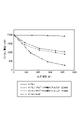
- FIG. 1 is a graph showing that the accelerated oxidation of dopamine in the presence of iron ions is inhibited by glutathione trisulfide.
- FIG. 2 is a graph showing that the accelerated oxidation of dopamine in the presence of iron ions is inhibited by lipoic acid trisulfide.
- FIG. 3 is a graph showing that the accelerated oxidation of dopamine in the presence of iron ions is inhibited by pantethine trisulfide.
- FIG. 4 is a graph showing that the accelerated oxidation of dopamine in the presence of iron ions is inhibited by N,N'-diacetyl-L-cysteine trisulfide.
- the prophylactic or therapeutic agent and prophylactic or therapeutic method of the present invention may be administered or applied to humans.
- the trisulfide compound used in the prophylactic or therapeutic agent of the present invention is glutathione trisulfide or a pharmaceutically acceptable salt thereof, compound (1), a pharmaceutically acceptable salt thereof, or a cyclodextrin inclusion thereof.
- Glutathione trisulfide is represented by formula (2).
- Pantethine trisulfide is represented by formula (2A).
- N,N'-diacetyl-L-cysteine trisulfide is represented by formula (2B).
- pharmaceutically acceptable salts include, for example, salts with inorganic acids such as hydrochloric acid, hydrobromic acid, sulfuric acid, nitric acid, phosphoric acid; acetic acid, succinic acid, fumaric acid, maleic acid, tartaric acid , citric acid, lactic acid, stearic acid, benzoic acid, methanesulfonic acid, ethanesulfonic acid, salts with organic acids such as p-toluenesulfonic acid; salts with alkali metals such as sodium and potassium; alkalis such as calcium and magnesium salts with earth metals; ammonium salts; and salts with amino acids such as arginine.
- inorganic acids such as hydrochloric acid, hydrobromic acid, sulfuric acid, nitric acid, phosphoric acid
- acetic acid succinic acid, fumaric acid, maleic acid, tartaric acid , citric acid, lactic acid, stearic acid, benzoic acid
- the pharmaceutically acceptable salts of glutathione trisulfide and pantethine trisulfide are preferably amino acid salts or alkali metal salts, more preferably arginine salts or sodium salts.
- a pharmaceutically acceptable salt of compound (1) is preferably a salt with an alkali metal, more preferably a sodium salt.
- glutathione trisulfide or a pharmaceutically acceptable salt thereof, compound (1) or a pharmaceutically acceptable salt thereof, pantethine trisulfide or a pharmaceutically acceptable salt thereof, or N,N'-diacetyl- L-cysteine trisulfide or a pharmaceutically acceptable salt thereof may have crystal polymorphs, but is not limited to any crystal form, and is a single crystal form. may also be a mixture.
- glutathione trisulfide or a pharmaceutically acceptable salt thereof, compound (1) or a pharmaceutically acceptable salt thereof, pantethine trisulfide or a pharmaceutically acceptable salt thereof, or N,N'- Diacetyl-L-cysteine trisulfide or its pharmaceutically acceptable salts also include amorphous forms.
- glutathione trisulfide or a pharmaceutically acceptable salt thereof, compound (1) or a pharmaceutically acceptable salt thereof, pantethine trisulfide or a pharmaceutically acceptable salt thereof, or N,N'-diacetyl- L-cysteine trisulfide or a pharmaceutically acceptable salt thereof includes anhydrides and solvates (especially hydrates).
- glutathione trisulfide or a pharmaceutically acceptable salt thereof, compound (1) or a pharmaceutically acceptable salt thereof, pantethine trisulfide or a pharmaceutically acceptable salt thereof, or N,N'-diacetyl- L-cysteine trisulfide or a pharmaceutically acceptable salt thereof may be a co-crystal with an amino acid (eg, arginine).
- Compound (1) in one embodiment, has the formula (3) [In the formula, R 1 represents a hydrogen atom or an alkyl group having 1 to 6 carbon atoms. ] and R 1 can be, for example, a hydrogen atom, a methyl group, an ethyl group, a propyl group, a butyl group, a pentyl group, a hexyl group. Preferably, R 1 is a hydrogen atom, in which case the compound of formula (3) is lipoic acid trisulfide of formula (4).
- Compound (1) in another embodiment, has the formula (5) [wherein R 2 and R 3 each independently represent a hydrogen atom or an alkyl group having 1 to 6 carbon atoms, and the alkyl group is selected from the group consisting of an amino group and a carboxy group. It may have one or more substituents. ].
- R 1 and R 2 may be a hydrogen atom, an alkyl group such as a methyl group, an ethyl group, a propyl group, a butyl group, a pentyl group, and a hexyl group. These alkyl groups may have one or both of an amino group and a carboxy group.
- R 1 and R 2 may be, for example, groups represented by formula (6) (wherein * represents a bond).
- Specific examples of the compound represented by formula (5) include, for example, a compound in which both R 2 and R 3 are hydrogen atoms, and a group represented by formula (6) in which R 2 is a hydrogen atom and R 3 is represented by formula (6). compound.
- the compound represented by the formula (5) is obtained by a step of oxidizing the compound represented by the formula (5a) with an oxidizing agent to obtain a sulfoxide compound (step 1), and reacting the obtained sulfoxide compound with a sulfur source. It can be manufactured by the process (process 2).
- R 1 and R 2 are each independently a hydrogen atom or an alkyl group having 1 to 6 carbon atoms, and the alkyl group is one or more substituents selected from the group consisting of an amino group and a carboxy group. may have ]
- Steps 1 and 2 may be reacted in one pot without isolating the sulfoxide compound.
- the solvent used in step 1 is not particularly limited as long as it dissolves the compound represented by formula (5a) and the oxidizing agent and does not inhibit the oxidation reaction.
- a solvent include water, aqueous sulfuric acid solution, aqueous ethanol solution and aqueous acetonitrile solution, preferably water.
- the amount of solvent used in step 1 can be 1 mL to 500 mL, preferably 10 mL to 20 mL, per 1 g of the compound represented by formula (5a).
- Oxidizing agents used in step 1 include potassium peroxymonosulfate (sold under trade names such as Oxone (registered trademark)), peracetic acid, hydrogen peroxide and sodium periodate. Hydrogen peroxide may be used with catalytic amounts of methyltrioxorhenium. Potassium peroxymonosulfate is the preferred oxidizing agent from the standpoint of safety and cost.
- the amount of the oxidizing agent used can be 0.8 equivalents to 2.0 equivalents, preferably 1.0 equivalents to 1.3 equivalents, relative to 1 equivalent of the compound represented by formula (5a). Equivalent.
- the reaction temperature in step 1 can be -20°C to 30°C, preferably -5°C to 5°C.
- the reaction time in step 1 can be 5 minutes to 24 hours, preferably 0.5 hours to 2 hours.
- the solvent used in step 2 is not particularly limited as long as it dissolves the sulfoxide compound and the sulfur source and does not inhibit the subsequent reaction.
- examples of such a solvent include water, aqueous sulfuric acid solution, aqueous ethanol solution and aqueous acetonitrile solution, preferably water.
- the amount of solvent used in step 2 can be 1 mL to 500 mL, preferably 10 mL to 20 mL, per 1 g of the sulfoxide compound.
- the sulfur source used in step 2 includes sodium sulfide, potassium sulfide, sodium hydrogen sulfide, potassium hydrogen sulfide and hydrogen sulfide.
- the amount of sulfur source used can be from 0.5 equivalents to 4.0 equivalents, preferably from 0.9 equivalents to 1.2 equivalents, relative to one equivalent of the sulfoxide compound.
- the reaction temperature in step 2 can be -20°C to 30°C, preferably -5°C to 25°C.
- the reaction time in step 2 can be 10 minutes to 2 days, preferably 0.5 hours to 2 hours.
- the reaction solvent includes, for example, water, an aqueous sulfuric acid solution, an aqueous ethanol solution, and an aqueous acetonitrile solution, preferably water, and the amount of the solvent is represented by formula (5a). It can be from 1 mL to 500 mL, preferably from 10 mL to 20 mL, for 1 g of the compound used.
- Oxidizing agents used include potassium peroxymonosulfate, peracetic acid, hydrogen peroxide (which may be used with a catalytic amount of methyltrioxorhenium) and sodium periodate, preferably potassium peroxymonosulfate.
- the amount of the oxidizing agent used can be 0.8 equivalents to 2.0 equivalents, preferably 1.0 equivalents to 1.3 equivalents.
- the sulfur source used includes sodium sulfide, potassium sulfide, sodium hydrogen sulfide, potassium hydrogen sulfide and hydrogen sulfide, and the amount of sulfur source used is can be 0.5 equivalents to 4.0 equivalents, preferably 0.9 equivalents to 1.2 equivalents.
- the reaction temperature can be -20°C to 30°C, preferably -5°C to 25°C.
- the reaction time can be from 15 minutes to 2 days, preferably from 1 hour to 4 hours.
- a step of protecting a functional group such as a hydroxy group, a carbonyl group, an amino group and a carboxy group and a step of deprotecting the protected functional group may be included as necessary.
- Protecting groups and protection/deprotection reactions for these functional groups are well known to those skilled in the art, and refer to "Greene's Protective Groups in Organic Synthesis" etc. to select appropriate protecting groups and protection/deprotection reactions. be able to.
- a compound represented by formula (5a) can be produced by condensing lipoic acid and NHR 2 R 3 .
- Solvents for the condensation reaction include, for example, dichloromethane, chloroform and tetrahydrofuran, preferably tetrahydrofuran.
- the amount of solvent can be from 1 mL to 200 mL, preferably from 3 mL to 35 mL, per 1 g of the compound of formula (5a).
- Condensing agents used include, for example, 1-(3-Dimethylaminopropyl)-3-ethylcarbodiimide (EDC) and salts thereof, N,N'-dicyclohexylcarbodiimide (DCC), diisopropylcarbodiimide (DIC) (N-hydroxysuccinimide (NHS) , 1-hydroxybenzotriazole (HOBt) may be used as an additive.).
- the amount of condensing agent used can be 0.8 equivalents to 2.0 equivalents, preferably 1.0 equivalents to 1.5 equivalents, relative to 1 equivalent of the compound represented by formula (5a). Equivalent.
- the temperature of the reaction can be -10°C to 40°C, preferably 15°C to 25°C.
- the reaction time can be from 1 hour to 3 days, preferably from 1 hour to 24 hours.
- the compound represented by the formula (3), wherein R 1 is an alkyl group having 1 to 6 carbon atoms is prepared by oxidizing the compound represented by the formula (3a) with an oxidizing agent to obtain a sulfoxide compound (step 1); And it can be produced by a step (step 2) of reacting the obtained sulfoxide compound with a sulfur source.
- the reaction conditions are the same as above.
- R 1 represents a hydrogen atom or an alkyl group having 1 to 6 carbon atoms.
- a compound represented by formula (3a) can be produced by condensing lipoic acid and R 1 OH. Same as above.
- the compound represented by formula (3), wherein R 1 is an alkyl group having 1 to 6 carbon atoms, can also be produced by condensing lipoic acid trisulfide and R 1 OH.
- the condensation conditions are the same as above.
- the cyclodextrin may be ⁇ -cyclodextrin, ⁇ -cyclodextrin, ⁇ -cyclodextrin or derivatives thereof.
- “derivative” means that at least one hydrogen atom of a hydroxyl group of each cyclodextrin is substituted with an optionally substituted alkyl group or sugar.
- Cyclodextrin derivatives are, for example, methyl- ⁇ -cyclodextrin, methyl- ⁇ -cyclodextrin, methyl- ⁇ -cyclodextrin, dimethyl- ⁇ -cyclodextrin, dimethyl- ⁇ -cyclodextrin, dimethyl- ⁇ -cyclodextrin, hydroxy ethyl- ⁇ -cyclodextrin, hydroxyethyl- ⁇ -cyclodextrin, hydroxyethyl- ⁇ -cyclodextrin, 2-hydroxypropyl- ⁇ -cyclodextrin, 2-hydroxypropyl- ⁇ -cyclodextrin, 2-hydroxypropyl- ⁇ - Cyclodextrin, glucosyl- ⁇ -cyclodextrin, glucosyl- ⁇ -cyclodextrin, glucosyl- ⁇ -cyclodextrin, glucosyl- ⁇ -cyclodextrin, glucosyl- ⁇ -cyclodextrin, maltosyl
- the cyclodextrin clathrate is prepared by dissolving cyclodextrin in a solvent (step a) and adding compound (1) or a pharmaceutically acceptable salt thereof to the resulting solution and stirring (step b) and a step of filtering the stirred liquid, washing with the same solvent as the solvent used in step a, freezing the filtrate, and freeze-drying (step c). Note that the filtration and washing operations in step c may be omitted.
- the solvent used in step a is preferably water.
- the amount of solvent used in step a can be 1-350 ml, preferably 1-80 ml, per 1 g of cyclodextrin.
- the mass ratio of cyclodextrin to compound (1) or a pharmaceutically acceptable salt thereof can be 2-20, preferably 5-16.5.
- the stirring temperature in step b can be 20 to 50°C, and may be room temperature.
- the stirring time in step b can be 0.25 to 40 hours, preferably 2 to 35 hours.
- step b after adding compound (1) or a pharmaceutically acceptable salt thereof, the same solvent as used in step a may be added before stirring.
- the amount of the solvent can be 0-30 ml, preferably 0-20 ml, per 1 g of cyclodextrin.
- the amount of solvent used in step c can be 0-150 ml, preferably 0-20 ml, per 1 g of cyclodextrin.
- the freezing temperature in step c can be -30 to -20°C, preferably -20°C.
- the freezing time in step c can be 10 to 50 hours.
- the freeze-drying in step c can be performed at an absolute pressure of 20 to 100 Pa and an external temperature of 10 to 40°C, preferably 20°C.
- the freeze-drying period in step c can be 1 to 5 days.
- Pantethine trisulfide or a pharmaceutically acceptable salt thereof can be produced by the method described in Patent Document 3.
- N,N'-diacetyl-L-cysteine trisulfide or a pharmaceutically acceptable salt thereof can be produced by the method described in Patent Document 4.
- Drugs used in dopamine replacement therapy are, in one embodiment, dopamine precursors, dopa decarboxylase inhibitors, catechol-O-methyltransferase (COMT) inhibitors, monoamine oxidase (MAOB) inhibitors, dopamine It contains at least one selected from the group consisting of release promoters and dopamine agonists.
- dopamine precursors include levodopa (L-dopa) and the like.
- dopa decarboxylase inhibitors include carbidopa and benserazide.
- COMT inhibitors include, for example, entacapone.
- MAOB inhibitors include, for example, safinamide, selegiline, rasagiline, and the like.
- Dopamine release accelerators include, for example, amantadine.
- Dopamine agonists include, for example, cabergoline, bromocriptine, pergolide, talipexole, pramipexole, ropinirole, rotigotine, apomorphine.
- These drugs may be in the form of pharmaceutically acceptable salts, and these drugs or pharmaceutically acceptable salts thereof may be crystalline or amorphous, and may be anhydrates or solvates (especially water Japanese food) is also acceptable.
- combinations of two or more drugs used for dopamine replacement therapy include a combination of a dopamine precursor and a dopa decarboxylase inhibitor (e.g., a combination of levodopa and carbidopa, a combination of levodopa and benserazide), a dopamine precursor , combination of dopa decarboxylase inhibitor and COMT inhibitor (e.g. combination of levodopa, carbidopa and entacapone), combination of dopamine precursor and dopamine agonist (e.g.
- levodopa and talipexol combination of levodopa and cabergoline, levodopa and ropinirole
- a combination of dopamine precursors and MAOB inhibitors for example, a combination of levodopa and selegiline
- the term "administration in combination” or “combination” means the use of a combination of active ingredients, and (1) a mode of administration as a single preparation containing a drug used in dopamine replacement therapy and a trisulfide compound. and (2) an embodiment in which the drug used in dopamine replacement therapy and the trisulfide compound are administered as separate formulations simultaneously or separately with a time lag.
- a drug used in dopamine replacement therapy may be administered first, or a trisulfide compound may be administered first.
- the drug used in dopamine replacement therapy and the trisulfide compound are formulated separately and administered simultaneously through the same administration route, (ii) the drug used in dopamine replacement therapy and the trisulfide compound A mode in which the sulfide compounds are separately formulated and administered separately by the same administration route with a time lag; (iv) the drug used in dopamine replacement therapy and the trisulfide compound are formulated separately and administered separately with different administration routes at different times.
- both formulations may be mixed immediately before administration.
- “combined administration” or “combined use” in the present invention refers to a mode of use in which the other drug is administered while the action/effect of one of the drugs is manifested in the patient's body. It can also be said. That is, in the present invention, it is preferable to administer such that the drug used in dopamine replacement therapy and the trisulfide compound are present simultaneously in the patient's body, for example, in the blood, and one drug is administered to the patient. It is preferable to administer the other drug within 24 hours after the administration.
- the dosage of the drug used in dopamine replacement therapy is 0.1 to 50 mg per day per kg of body weight (0.1 to 50 mg/kg/day ) is preferred, 0.5 to 20 mg/kg/day is more preferred, and 1 to 10 mg/kg/day is even more preferred.
- the dosage of the trisulfide compound is preferably 0.5 to 800 mg (0.5 to 800 mg/kg/day), more preferably 1 to 400 mg/kg/day, and 2 to 200 mg/kg/day per 1 kg of body weight. day is more preferred.
- the dose of the drug used in dopamine replacement therapy is 0.1-50 mg/kg/day and the dose of the trisulfide compound is 0.5-800 mg/kg/day, and the drug used in dopamine replacement therapy is more preferably 0.5 to 20 mg/kg/day and the dose of the trisulfide compound is 1 to 400 mg/kg/day, and the dose of the drug used in dopamine replacement therapy is 1 to 10 mg/day.
- kg/day and the dose of the trisulfide compound is more preferably 2-200 mg/kg/day.
- the administration frequency of drugs and trisulfide compounds used in dopamine replacement therapy can be 1 to 8 times a day or 1 to 4 times a day. Such an administration frequency is considered to reduce the patient's burden of taking medication and improve compliance with taking medication. As a result, it is expected that the preventive or therapeutic effect and side effect-reducing effect of the present invention will be further improved.
- the dose of the drug may be reduced in stages. For example, there is a method of administering one drug during a drug withdrawal period of the other drug.
- the prophylactic or therapeutic agent for Parkinson's disease of the present invention can be used, for example, orally as tablets, capsules, powders, granules, liquids or syrups, or parenterally as nasal drops, injections, infusions or suppositories. can be administered to These dosage forms can be formulated by known formulation techniques.
- pharmacologically acceptable excipients such as starch, lactose, refined sucrose, glucose, crystalline cellulose, carboxycellulose, carboxymethylcellulose, carboxyethylcellulose, calcium phosphate, magnesium stearate, Gum arabic and the like can be blended, and if necessary, lubricants, binders, disintegrants, coating agents, coloring agents and the like can be blended.
- stabilizers, solubilizers, suspending agents, emulsifiers, buffers, preservatives and the like can be added.
- Example 1 Inhibition study of accelerated oxidation of dopamine in the presence of iron ions . 3.9H 2 O), hydrogen peroxide water as an oxidizing agent, and glutathione trisulfide dihydrate, lipoic acid trisulfide, pantethine trisulfide or N,N'-diacetyl-L-cysteine trisulfide as a trisulfide compound.
- glutathione trisulfide dihydrate lipoic acid trisulfide
- pantethine trisulfide or N,N'-diacetyl-L-cysteine trisulfide as a trisulfide compound.
- Dopamine 2mmol/L Fe 3+ : 2mmol/L Hydrogen peroxide: 1 mol/L
- Glutathione trisulfide 3 concentrations (5, 10 or 20 mmol/L)
- Lipoic acid trisulfide 2 concentrations (10 or 20 mmol/L)
- Pantethine trisulfide 3 concentrations (100, 150 or 200 mmol/L)
- N,N'-diacetyl-L-cysteine trisulfide 3 concentrations (5, 10 or 20 mmol/L)
- the reaction solution was stirred at 25°C and 500 rpm for 6-9 hours.
- the dopamine concentration in the reaction solution was quantified using a high performance liquid chromatograph (HPLC).
- the HPLC conditions are as follows. Detector: UV absorption photometer (measurement wavelength: 280 nm) Column: Inertsil ODS-2 (4.6 mm I.D. x 150 mm, 5 ⁇ m) Column temperature: constant temperature around 35° C. Mobile phase: 0.2 mol/L citric acid aqueous solution was added to 0.2 mol/L disodium hydrogen phosphate aqueous solution to adjust the pH to 3.0. Flow rate: 0.7mL/min Injection volume: 20 ⁇ L Area measurement range: 30 minutes after sample solution injection Preparation of sample solution: 100 ⁇ L of the reaction solution was diluted 10-fold with water to prepare a sample solution. Retention time: dopamine (DA) about 7 minutes
- dopamine oxidation was accelerated in the presence of Fe 3+ and the concentration of dopamine decreased sharply.
- Glutathione trisulfide inhibited dopamine oxidation in the presence of Fe 3+ .
- lipoic acid trisulfide also inhibited dopamine oxidation in the presence of Fe 3+ .
- pantethine trisulfide also inhibited dopamine oxidation in the presence of Fe 3+ , as shown in FIG.
- N,N'-diacetyl-L-cysteine trisulfide also inhibited dopamine oxidation in the presence of Fe 3+ .
- Glutathione trisulfide, lipoic acid trisulfide, pantethine trisulfide and N,N'-diacetyl-L-cysteine trisulfide could effectively suppress dopamine oxidation reaction accelerated in the presence of Fe3 + .
- the problems with conventional dopamine replacement therapy are that symptoms do not improve (wearing off), the effects of the drug suddenly wear off (on-off phenomenon), and side effects of the drug (dyskinesia). etc.) can be effectively dealt with.
- a reaction vessel was charged with 2.0 g (9.02 mmol) of lipoic acid and 40 mL of a 75% aqueous ethanol solution, and cooled to an internal temperature of 0°C. 3.4 g (10.20 mmol) of Oxone (registered trademark) was added thereto and reacted for about 2 hours. After filtering the inorganic salt in the reaction solution, it was washed with 7 mL of ethanol. 5.8 g (24.1 mmol) of sodium sulfide nonahydrate was added to the filtrate and reacted for about 1 hour.
- Reference Example 8 Mal- ⁇ -CD clathrate of lipoic acid trisulfide (racemic) A 50 mL eggplant flask was charged with 24.2 mg (0.839 mmol) of Mal- ⁇ -CD12 and 14 mL of water. After confirming that the contents of the flask had dissolved, 100.4 mg (0.421 mmol) of lipoic acid trisulfide was added, and the inside of the flask was washed with 2 mL of water. After stirring at room temperature for 31 hours, the mixture was filtered, and the inside of the flask and the crystals were washed with 10 mL of water. The resulting filtrate was frozen in a -20°C freezer for 22 hours. It was freeze-dried at an external temperature of 20° C. for about 46 hours to obtain 1180.0 mg of clathrate (white solid).
- Table 2 shows the yield and solubility of the clathrates obtained in Reference Examples 3-9.
- Oxone registered trademark
- Detector UV absorption photometer (measurement wavelength: 220 nm)
- Column LiChrosorb RP-18 (Kanto Kagaku, 4.0 mm ID ⁇ 250 mm, 5 ⁇ m)
- Column temperature constant temperature around 40 ° C.
- Mobile phase A phosphoric acid aqueous solution (pH 3)
- Mobile phase B Methanol
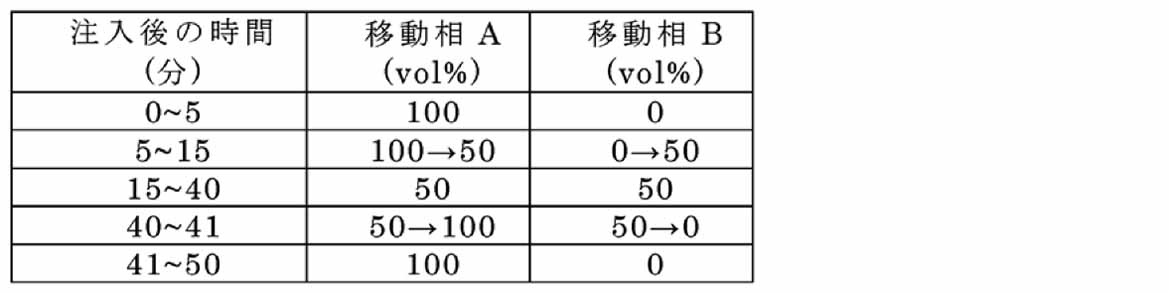
- the concentration gradient was controlled by changing the mixing ratio of mobile phase A and mobile phase B as follows.
- Reference Example 11 Nasal formulation of pantethine trisulfide (10%) Pantethine trisulfide (10% by mass), benzalkonium (0.01% by mass), carboxyvinyl polymer (0.5% by mass), L-arginine (1% by mass), physiological saline (88.49% by mass) ) were mixed and stirred in a vacuum stirrer under light shielding, subjected to filtration sterilization under an aseptic environment, and aseptically filled into a sterilized container to produce a nasal drop preparation containing pantethine trisulfide.
- a reaction vessel was charged with 1.0 g (3.08 mmol) of N,N'-diacetyl-L-cystine and 10 mL of water, and cooled to an internal temperature of 1°C. 1.25 g (3.72 mmol) of Oxone (registered trademark) was added thereto and reacted for about 3 hours. Subsequently, 8.5 mL (3.71 mmol) of a 0.44 mol/L sodium sulfide aqueous solution was added dropwise and reacted for about 3 hours. After adding 33 mL of acetonitrile to the reaction solution, inorganic salts were filtered and washed with 5 mL of acetonitrile.
- the filtrate was concentrated under reduced pressure with an evaporator, and the concentrate was purified with an ODS column (mobile phase: acetonitrile aqueous solution) to obtain 0.2 g (0.56 mmol) of N,N'-diacetyl-L-cysteine trisulfide.
- HPLC conditions are as follows. Detector: UV absorption photometer (measurement wavelength: 220 nm) Column: LiChrosorb RP-18 (Kanto Kagaku, 4.0 x 250 mm, 5 ⁇ m) Column temperature: constant temperature around 40 ° C. Mobile phase: 40% (v / v) acetonitrile aqueous solution flow rate: 0.5 mL / min
- the filtrate was concentrated under reduced pressure with an evaporator, and the concentrate was purified with an ODS column (mobile phase: acetonitrile aqueous solution) to obtain 0.1 g (0.28 mmol) of N,N'-diacetyl-L-cysteine trisulfide.
- HPLC conditions are the same as those described in Reference Example 12.
Landscapes
- Health & Medical Sciences (AREA)
- Chemical & Material Sciences (AREA)
- Medicinal Chemistry (AREA)
- Pharmacology & Pharmacy (AREA)
- Life Sciences & Earth Sciences (AREA)
- Animal Behavior & Ethology (AREA)
- General Health & Medical Sciences (AREA)
- Public Health (AREA)
- Veterinary Medicine (AREA)
- Epidemiology (AREA)
- Engineering & Computer Science (AREA)
- Bioinformatics & Cheminformatics (AREA)
- Biomedical Technology (AREA)
- Neurology (AREA)
- Neurosurgery (AREA)
- Chemical Kinetics & Catalysis (AREA)
- General Chemical & Material Sciences (AREA)
- Nuclear Medicine, Radiotherapy & Molecular Imaging (AREA)
- Organic Chemistry (AREA)
- Psychology (AREA)
- Acyclic And Carbocyclic Compounds In Medicinal Compositions (AREA)
Abstract
Description
[1]ドパミン補充療法に用いられる薬物と組み合わせて投与されることを特徴とする、トリスルフィド化合物を含有するパーキンソン病の予防又は治療薬であって、上記トリスルフィド化合物は、グルタチオントリスルフィド若しくはその製剤学的に許容される塩、式(1)

[2]トリスルフィド化合物と組み合わせて投与されることを特徴とする、ドパミン補充療法に用いられる薬物を含有する予防又は治療薬であって、上記トリスルフィド化合物は、グルタチオントリスルフィド若しくはその製剤学的に許容される塩、化合物(1)、その製剤学的に許容される塩若しくはそれらのシクロデキストリン包接体、パンテチントリスルフィド若しくはその製剤学的に許容される塩又はN,N’-ジアセチル-L-システイントリスルフィド若しくはその製剤学的に許容される塩である、予防又は治療薬。
[3]上記トリスルフィド化合物と上記ドパミン補充療法に用いられる薬物とが、同時に又は別々に投与される、[1]又は[2]に記載の予防又は治療薬。
[4]トリスルフィド化合物と、ドパミン補充療法に用いられる薬物とを含有するパーキンソン病の予防又は治療薬であって、上記トリスルフィド化合物は、グルタチオントリスルフィド若しくはその製剤学的に許容される塩、化合物(1)、その製剤学的に許容される塩若しくはそれらのシクロデキストリン包接体、パンテチントリスルフィド若しくはその製剤学的に許容される塩又はN,N’-ジアセチル-L-システイントリスルフィド若しくはその製剤学的に許容される塩である、予防又は治療薬。
[5]上記トリスルフィド化合物が、グルタチオントリスルフィド又はその製剤学的に許容される塩である、[1]~[4]のいずれかに記載の予防又は治療薬。
[6]上記グルタチオントリスルフィド又はその製剤学的に許容される塩が、グルタチオントリスルフィド、グルタチオントリスルフィドのアミノ酸塩及びグルタチオントリスルフィドのアルカリ金属塩からなる群から選択される少なくとも1種を含む、[5]に記載の予防又は治療薬。
[7]上記グルタチオントリスルフィド又はその製剤学的に許容される塩が、グルタチオントリスルフィド、グルタチオントリスルフィドのアルギニン塩及びグルタチオントリスルフィドのナトリウム塩からなる群から選択される少なくとも1種を含む、[5]に記載の予防又は治療薬。
[8]上記トリスルフィド化合物が、リポ酸トリスルフィド又はその製剤学的に許容される塩である、[1]~[4]のいずれかに記載の予防又は治療薬。
[8-2]上記トリスルフィド化合物が、パンテチントリスルフィド又はその製剤学的に許容される塩である、[1]~[4]のいずれかに記載の予防又は治療薬。
[8-3]上記トリスルフィド化合物が、N,N’-ジアセチル-L-システイントリスルフィド又はその製剤学的に許容される塩である、[1]~[4]のいずれかに記載の予防又は治療薬。
[9]上記ドパミン補充療法に用いられる薬物が、ドパミン前駆体、ドパ脱炭酸酵素阻害剤、カテコール-O-メチル基転移酵素阻害剤、モノアミン酸化酵素阻害剤、ドパミン遊離促進薬及びドパミンアゴニストからなる群から選択される少なくとも1種を含む、[1]~[8―4]のいずれかに記載の予防又は治療薬。
[10]トリスルフィド化合物を含有する製剤と、ドパミン補充療法に用いられる薬物を含有する製剤とを含む、パーキンソン病の予防又は治療用キットであって、上記トリスルフィド化合物は、グルタチオントリスルフィド若しくはその製剤学的に許容される塩、化合物(1)、その製剤学的に許容される塩若しくはそれらのシクロデキストリン包接体又はパンテチントリスルフィド若しくはその製剤学的に許容される塩又はN,N’-ジアセチル-L-システイントリスルフィド若しくはその製剤学的に許容される塩である、キット。
[11]上記トリスルフィド化合物を含有する製剤と、上記ドパミン補充療法に用いられる薬物を含有する製剤とが、同時に又は別々に投与される、[10]に記載のキット。
[12]上記トリスルフィド化合物が、グルタチオントリスルフィド又はその製剤学的に許容される塩である、[10]又は[11]に記載のキット。
[13]上記グルタチオントリスルフィド又はその製剤学的に許容される塩が、グルタチオントリスルフィド、グルタチオントリスルフィドのアミノ酸塩及びグルタチオントリスルフィドのアルカリ金属塩からなる群から選択される少なくとも1種を含む、[12]に記載のキット。
[14]上記グルタチオントリスルフィド又はその製剤学的に許容される塩が、グルタチオントリスルフィド、グルタチオントリスルフィドのアルギニン塩及びグルタチオントリスルフィドのナトリウム塩からなる群から選択される少なくとも1種を含む、[12]に記載のキット。
[15]上記トリスルフィド化合物が、リポ酸トリスルフィド又はその製剤学的に許容される塩である、[10]又は[11]に記載のキット。
[15-2]上記トリスルフィド化合物が、パンテチントリスルフィド又はその製剤学的に許容される塩である、[10]又は[11]に記載のキット。
[15-3]上記トリスルフィド化合物が、N,N’-ジアセチル-L-システイントリスルフィド又はその製剤学的に許容される塩である、[10]又は[11]に記載のキット。
[16]上記ドパミン補充療法に用いられる薬物が、ドパミン前駆体、ドパ脱炭酸酵素阻害剤、カテコール-O-メチル基転移酵素阻害剤、モノアミン酸化酵素阻害剤、ドパミン遊離促進薬及びドパミンアゴニストからなる群から選択される少なくとも1種を含む、[10]~[15-3]のいずれかに記載のキット。
[17]トリスルフィド化合物と、ドパミン補充療法に用いられる薬剤又はその製剤学的に許容される塩とを、それらを必要とする患者に投与する、パーキンソン病の予防又は治療方法であって、上記トリスルフィド化合物は、グルタチオントリスルフィド若しくはその製剤学的に許容される塩、化合物(1)、その製剤学的に許容される塩若しくはそれらのシクロデキストリン包接体、パンテチントリスルフィド若しくはその製剤学的に許容される塩又はN,N’-ジアセチル-L-システイントリスルフィド若しくはその製剤学的に許容される塩である方法。
[18]上記トリスルフィド化合物と、ドパミン補充療法に用いられる薬物とが、同時に又は別々に投与される、[17]に記載の方法。
[19]上記トリスルフィド化合物が、グルタチオントリスルフィド又はその製剤学的に許容される塩である、[17]又は[18]に記載の方法。
[20]上記グルタチオントリスルフィド又はその製剤学的に許容される塩が、グルタチオントリスルフィド、グルタチオントリスルフィドのアミノ酸塩及びグルタチオントリスルフィドのアルカリ金属塩からなる群から選択される少なくとも1種を含む、[19]に記載の方法。
[21]上記グルタチオントリスルフィド又はその製剤学的に許容される塩が、グルタチオントリスルフィド、グルタチオントリスルフィドのアルギニン塩及びグルタチオントリスルフィドのナトリウム塩からなる群から選択される少なくとも1種を含む、[19]に記載の方法。
[22]上記トリスルフィド化合物が、リポ酸トリスルフィド又はその製剤学的に許容される塩である、[17]又は[18]に記載の方法。
[22-2]上記トリスルフィド化合物が、パンテチントリスルフィド又はその製剤学的に許容される塩である、[17]又は[18]に記載の方法。
[22-3]上記トリスルフィド化合物が、N,N’-ジアセチル-L-システイントリスルフィド又はその製剤学的に許容される塩である、[17]又は[18]に記載の方法。
[23]上記ドパミン補充療法に用いられる薬物が、ドパミン前駆体、ドパ脱炭酸酵素阻害剤、カテコール-O-メチル基転移酵素阻害剤、モノアミン酸化酵素阻害剤、ドパミン遊離促進薬及びドパミンアゴニストからなる群から選択される少なくとも1種を含む、[17]~[22-3]のいずれかに記載の方法。
[24]トリスルフィド化合物と組み合わせて投与されることを特徴とする、パーキンソン病の予防又は治療に使用するためのドパミン補充療法に用いられる薬物であって、上記トリスルフィド化合物は、グルタチオントリスルフィド若しくはその製剤学的に許容される塩、化合物(1)、その製剤学的に許容される塩若しくはそれらのシクロデキストリン包接体、パンテチントリスルフィド若しくはその製剤学的に許容される塩である又はN,N’-ジアセチル-L-システイントリスルフィド若しくはその製剤学的に許容される塩である、薬物。
[25]上記トリスルフィド化合物と、上記ドパミン補充療法に用いられる薬物とが、同時に又は別々に投与される、[24]に記載の使用するためのドパミン補充療法に用いられる薬物。
[26]上記トリスルフィド化合物が、グルタチオントリスルフィド又はその製剤学的に許容される塩である、[24]又は[25]に記載の使用するためのドパミン補充療法に用いられる薬物。
[27]上記グルタチオントリスルフィド又はその製剤学的に許容される塩が、グルタチオントリスルフィド、グルタチオントリスルフィドのアミノ酸塩及びグルタチオントリスルフィドのアルカリ金属塩からなる群から選択される少なくとも1種を含む、[26]に記載の使用するためのドパミン補充療法に用いられる薬物。
[28]上記グルタチオントリスルフィド又はその製剤学的に許容される塩が、グルタチオントリスルフィド、グルタチオントリスルフィドのアルギニン塩及びグルタチオントリスルフィドのナトリウム塩からなる群から選択される少なくとも1種を含む、[26]に記載の使用するためのドパミン補充療法に用いられる薬物。
[29]上記トリスルフィド化合物が、リポ酸トリスルフィド又はその製剤学的に許容される塩である、[24]又は[25]に記載の使用するためのドパミン補充療法に用いられる薬物。
[29-2]上記トリスルフィド化合物が、パンテチントリスルフィド又はその製剤学的に許容される塩である、[24]又は[25]に記載の使用するためのドパミン補充療法に用いられる薬物。
[29-3]上記トリスルフィド化合物が、N,N’-ジアセチル-L-システイントリスルフィド又はその製剤学的に許容される塩である、[24]又は[25]に記載の使用するためのドパミン補充療法に用いられる薬物。
[30]上記ドパミン補充療法に用いられる薬物が、ドパミン前駆体、ドパ脱炭酸酵素阻害剤、カテコール-O-メチル基転移酵素阻害剤、モノアミン酸化酵素阻害剤、ドパミン遊離促進薬及びドパミンアゴニストからなる群から選択される少なくとも1種を含む、[24]~[29-3]のいずれかに記載の使用するためのドパミン補充療法に用いられる薬物。
[31]ドパミン補充療法に用いられる薬物と組み合わせて投与されることを特徴とする、パーキンソン病の予防又は治療に使用するためのトリスルフィド化合物であって、上記トリスルフィド化合物は、グルタチオントリスルフィド若しくはその製剤学的に許容される塩、化合物(1)、その製剤学的に許容される塩若しくはそれらのシクロデキストリン包接体、パンテチントリスルフィド若しくはその製剤学的に許容される塩又はN,N’-ジアセチル-L-システイントリスルフィド若しくはその製剤学的に許容される塩である、トリスルフィド化合物。
[32]上記トリスルフィド化合物を含有する製剤と、上記ドパミン補充療法に用いられる薬物を含有する製剤とが、同時に又は別々に投与される、[31]に記載の使用するためのトリスルフィド化合物。
[33]上記トリスルフィド化合物が、グルタチオントリスルフィド又はその製剤学的に許容される塩である、[31]又は[32]に記載の使用するためのトリスルフィド化合物。
[34]上記グルタチオントリスルフィド又はその製剤学的に許容される塩が、グルタチオントリスルフィド、グルタチオントリスルフィドのアミノ酸塩及びグルタチオントリスルフィドのアルカリ金属塩からなる群から選択される少なくとも1種を含む、[33]に記載の使用するためのトリスルフィド化合物。
[35]上記グルタチオントリスルフィド又はその製剤学的に許容される塩が、グルタチオントリスルフィド、グルタチオントリスルフィドのアルギニン塩及びグルタチオントリスルフィドのナトリウム塩からなる群から選択される少なくとも1種を含む、[33]に記載の使用するためのトリスルフィド化合物。
[36]上記トリスルフィド化合物が、リポ酸トリスルフィド又はその製剤学的に許容される塩である、[31]又は[32]に記載の使用するためのトリスルフィド化合物。
[36-2]上記トリスルフィド化合物が、パンテチントリスルフィド又はその製剤学的に許容される塩である、[31]又は[32]に記載の使用するためのトリスルフィド化合物。
[36-3]上記トリスルフィド化合物が、N,N’-ジアセチル-L-システイントリスルフィド又はその製剤学的に許容される塩である、[31]又は[32]に記載の使用するためのトリスルフィド化合物。
[37]上記ドパミン補充療法に用いられる薬物が、ドパミン前駆体、ドパ脱炭酸酵素阻害剤、カテコール-O-メチル基転移酵素阻害剤、モノアミン酸化酵素阻害剤、ドパミン遊離促進薬及びドパミンアゴニストからなる群から選択される少なくとも1種を含む、[31]~[36-3]のいずれかに記載の使用するためのトリスルフィド化合物。
[38]パーキンソン病の予防又は治療に使用するための、トリスルフィド化合物と、ドパミン補充療法に用いられる薬物との組み合わせであって、上記トリスルフィド化合物は、グルタチオントリスルフィド若しくはその製剤学的に許容される塩、化合物(1)、その製剤学的に許容される塩若しくはそれらのシクロデキストリン包接体、パンテチントリスルフィド若しくはその製剤学的に許容される塩又はN,N’-ジアセチル-L-システイントリスルフィド若しくはその製剤学的に許容される塩である、組み合わせ。
[39]上記トリスルフィド化合物を含有する製剤と、上記ドパミン補充療法に用いられる薬物を含有する製剤とが、同時に又は別々に投与される、[38]に記載の組み合わせ。
[40]上記トリスルフィド化合物が、グルタチオントリスルフィド又はその製剤学的に許容される塩である、[38]又は[39]に記載の組み合わせ。
[41]上記グルタチオントリスルフィド又はその製剤学的に許容される塩が、グルタチオントリスルフィド、グルタチオントリスルフィドのアミノ酸塩及びグルタチオントリスルフィドのアルカリ金属塩からなる群から選択される少なくとも1種を含む、[40]に記載の組み合わせ。
[42]上記グルタチオントリスルフィド又はその製剤学的に許容される塩が、グルタチオントリスルフィド、グルタチオントリスルフィドのアルギニン塩及びグルタチオントリスルフィドのナトリウム塩からなる群から選択される少なくとも1種を含む、[40]に記載の組み合わせ。
[43]上記トリスルフィド化合物が、リポ酸トリスルフィド又はその製剤学的に許容される塩である、[38]又は[39]に記載の組み合わせ。
[43-2]上記トリスルフィド化合物が、パンテチントリスルフィド又はその製剤学的に許容される塩である、[38]又は[39]に記載の組み合わせ。
[43-3]上記トリスルフィド化合物が、N,N’-ジアセチル-L-システイントリスルフィド又はその製剤学的に許容される塩である、[38]又は[39]に記載の組み合わせ。
[44]上記ドパミン補充療法に用いられる薬物が、ドパミン前駆体、ドパ脱炭酸酵素阻害剤、カテコール-O-メチル基転移酵素阻害剤、モノアミン酸化酵素阻害剤、ドパミン遊離促進薬及びドパミンアゴニストからなる群から選択される少なくとも1種を含む、[38]~[43-3]のいずれかに記載の組み合わせ。
[45]トリスルフィド化合物と組み合わせて投与されることを特徴とする、パーキンソン病の予防又は治療薬の製造のためのドパミン補充療法に用いられる薬物の使用であって、上記トリスルフィド化合物は、グルタチオントリスルフィド若しくはその製剤学的に許容される塩、化合物(1)、その製剤学的に許容される塩若しくはそれらのシクロデキストリン包接体、パンテチントリスルフィド若しくはその製剤学的に許容される塩又はN,N’-ジアセチル-L-システイントリスルフィド若しくはその製剤学的に許容される塩である、使用。
[46]上記トリスルフィド化合物を含有する製剤と、上記ドパミン補充療法に用いられる薬物を含有する製剤とが、同時に又は別々に投与される、[45]に記載の使用。
[47]上記トリスルフィド化合物が、グルタチオントリスルフィド又はその製剤学的に許容される塩である、[45]又は[46]に記載の使用。
[48]上記グルタチオントリスルフィド又はその製剤学的に許容される塩が、グルタチオントリスルフィド、グルタチオントリスルフィドのアミノ酸塩及びグルタチオントリスルフィドのアルカリ金属塩からなる群から選択される少なくとも1種を含む、[47]に記載の使用。
[49]上記グルタチオントリスルフィド又はその製剤学的に許容される塩が、グルタチオントリスルフィド、グルタチオントリスルフィドのアルギニン塩及びグルタチオントリスルフィドのナトリウム塩からなる群から選択される少なくとも1種を含む、[47]に記載の使用。
[50]上記トリスルフィド化合物が、リポ酸トリスルフィド又はその製剤学的に許容される塩である、[45]又は[46]に記載の使用。
[50-2]上記トリスルフィド化合物が、パンテチントリスルフィド又はその製剤学的に許容される塩である、[45]又は[46]に記載の使用。
[50-3]上記トリスルフィド化合物が、N,N’-ジアセチル-L-システイントリスルフィド又はその製剤学的に許容される塩である、[45]又は[46]に記載の使用。
[51]上記ドパミン補充療法に用いられる薬物が、ドパミン前駆体、ドパ脱炭酸酵素阻害剤、カテコール-O-メチル基転移酵素阻害剤、モノアミン酸化酵素阻害剤、ドパミン遊離促進薬及びドパミンアゴニストからなる群から選択される少なくとも1種を含む、[45]~[50-3]のいずれかに記載の使用。
[52]ドパミン補充療法に用いられる薬物と組み合わせて投与されることを特徴とする、パーキンソン病の予防又は治療薬の製造のためのトリスルフィド化合物の使用であって、上記トリスルフィド化合物は、グルタチオントリスルフィド若しくはその製剤学的に許容される塩、化合物(1)、その製剤学的に許容される塩若しくはそれらのシクロデキストリン包接体、パンテチントリスルフィド若しくはその製剤学的に許容される塩又はN,N’-ジアセチル-L-システイントリスルフィド若しくはその製剤学的に許容される塩である、使用。
[53]上記トリスルフィド化合物を含有する製剤と、上記ドパミン補充療法に用いられる薬物を含有する製剤とが、同時に又は別々に投与される、[52]に記載の使用。
[54]上記トリスルフィド化合物が、グルタチオントリスルフィド又はその製剤学的に許容される塩である、[52]又は[53]に記載の使用。
[55]上記グルタチオントリスルフィド又はその製剤学的に許容される塩が、グルタチオントリスルフィド、グルタチオントリスルフィドのアミノ酸塩及びグルタチオントリスルフィドのアルカリ金属塩からなる群から選択される少なくとも1種を含む、[54]に記載の使用。
[56]上記グルタチオントリスルフィド又はその製剤学的に許容される塩が、グルタチオントリスルフィド、グルタチオントリスルフィドのアルギニン塩及びグルタチオントリスルフィドのナトリウム塩からなる群から選択される少なくとも1種を含む、[54]に記載の使用。
[57]上記トリスルフィド化合物が、リポ酸トリスルフィド又はその製剤学的に許容される塩である、[52]又は[53]に記載の使用。
[57-2]上記トリスルフィド化合物が、パンテチントリスルフィド又はその製剤学的に許容される塩である、[52]又は[53]に記載の使用。
[57-3]上記トリスルフィド化合物が、N,N’-ジアセチル-L-システイントリスルフィド又はその製剤学的に許容される塩である、[52]又は[53]に記載の使用。
[58]上記ドパミン補充療法に用いられる薬物が、ドパミン前駆体、ドパ脱炭酸酵素阻害剤、カテコール-O-メチル基転移酵素阻害剤、モノアミン酸化酵素阻害剤、ドパミン遊離促進薬及びドパミンアゴニストからなる群から選択される少なくとも1種を含む、[52]~[57-3]のいずれかに記載の使用。
[59]パーキンソン病の予防又は治療薬の製造のための、ドパミン補充療法に用いられる薬物と、トリスルフィド化合物との組み合わせの使用であって、上記トリスルフィド化合物は、グルタチオントリスルフィド若しくはその製剤学的に許容される塩又は化合物(1)、その製剤学的に許容される塩若しくはそれらのシクロデキストリン包接体、パンテチントリスルフィド若しくはその製剤学的に許容される塩又はN,N’-ジアセチル-L-システイントリスルフィド若しくはその製剤学的に許容される塩である、使用。
[60]上記トリスルフィド化合物が、グルタチオントリスルフィド又はその製剤学的に許容される塩である、[59]に記載の使用。
[61]上記グルタチオントリスルフィド又はその製剤学的に許容される塩が、グルタチオントリスルフィド、グルタチオントリスルフィドのアミノ酸塩及びグルタチオントリスルフィドのアルカリ金属塩からなる群から選択される少なくとも1種を含む、[60]に記載の使用。
[62]上記グルタチオントリスルフィド又はその製剤学的に許容される塩が、グルタチオントリスルフィド、グルタチオントリスルフィドのアルギニン塩及びグルタチオントリスルフィドのナトリウム塩からなる群から選択される少なくとも1種を含む、[60]に記載の使用。
[63]上記トリスルフィド化合物が、リポ酸トリスルフィド又はその製剤学的に許容される塩である、[59]に記載の使用。
[63-2]上記トリスルフィド化合物が、パンテチントリスルフィド又はその製剤学的に許容される塩である、[59]に記載の使用。
[63-3]上記トリスルフィド化合物が、N,N’-ジアセチル-L-システイントリスルフィド又はその製剤学的に許容される塩である、[59]に記載の使用。
[64]上記ドパミン補充療法に用いられる薬物が、ドパミン前駆体、ドパ脱炭酸酵素阻害剤、カテコール-O-メチル基転移酵素阻害剤、モノアミン酸化酵素阻害剤、ドパミン遊離促進薬及びドパミンアゴニストからなる群から選択される少なくとも1種を含む、[59]~[63-3]のいずれかに記載の使用。





試験には、ドパミン塩酸塩(DA・HCl)、Fe3+源として硝酸鉄(III)9水和物(Fe(NO3)3・9H2O)、酸化剤として過酸化水素水、トリスルフィド化合物として、グルタチオントリスルフィド2水和物、リポ酸トリスルフィド、パンテチントリスルフィド又はN,N’-ジアセチル-L-システイントリスルフィドを用いた。
・10mM DA・HCl水溶液:DA・HClを精製水に溶解して調製した。
・20mM Fe3+溶液:Fe(NO3)3・9H2Oを5mmol/L H2SO4に溶解して調製した。
・40mMグルタチオントリスルフィド溶液:グルタチオントリスルフィド2水和物を0.2mol/L リン酸緩衝液(pH=6.5)に溶解して調製した。
・40mMリポ酸トリスルフィド溶液:リポ酸トリスルフィドを0.2mol/L リン酸緩衝液(pH=6.5)に溶解して調製した。
・400mMパンテチントリスルフィド溶液:パンテチントリスルフィドを0.2mol/L リン酸緩衝液(pH=6.5)に溶解して調製した。
・40mM N,N’-ジアセチル-L-システイントリスルフィド:N,N’-ジアセチル-L-システイントリスルフィドを0.2mol/L リン酸緩衝液(pH=6.5)に溶解して調製した。
ドパミン:2mmol/L
Fe3+:2mmol/L
過酸化水素:1mol/L
グルタチオントリスルフィド:3濃度(5、10又は20mmol/L)
リポ酸トリスルフィド:2濃度(10又は20mmol/L)
パンテチントリスルフィド:3濃度(100、150又は200mmol/L)
N,N’-ジアセチル-L-システイントリスルフィド:3濃度(5、10又は20mmol/L)
検出器:紫外吸光光度計(測定波長:280nm)
カラム:Inertsil ODS-2(4.6mmI.D.×150mm、5μm)
カラム温度:35℃付近の一定温度
移動相:0.2mol/L リン酸水素二ナトリウム水溶液に0.2mol/L クエン酸水溶液を加えてpH3.0に調整した。
流量:0.7mL/min
注入量:20μL
面積測定範囲:試料溶液注入後30分間
試料溶液の調製:反応液100μLを水で10倍希釈し、試料溶液とした。
保持時間:ドパミン(DA) 約7分
<(R)-リポ酸トリスルフィドの製造>


1H-NMR:(CDCl3,400MHz)δ(ppm)=5.36(bs,2H),3.33(m,1H),3.13(m,2H),2.22(m,3H),1.89(m,1H),1.74-1.42(m,6H).
HR-ESI-TOF-MS:m/z 236.0238 ([M-H]-),calcd for[C8H14NOS3]-236.0243.
<リポアミドトリスルフィド(ラセミ体)の製造>

検出器:紫外吸光光度計(測定波長:220nm)
カラム:LiChrosorb RP-18(関東化学、4.0mmI.D.×250mm、5μm)
カラム温度:40℃付近の一定温度
移動相A:リン酸水溶液(pH3)
移動相B:メタノール
移動相の送液:移動相A及び移動相Bの混合比を次のように変えて濃度勾配制御した。

注入量:10μL
面積測定範囲:試料溶液注入後35分間
保持時間:リポアミドスルホキシド(12~13分)、リポアミド(約17分)、リポアミドトリスルフィド(約19分)
以下、「HP」は「ヒドロキシプロピル」、「Me」は「メチル」、「Mal」は「マルトシル」の略称である。

参考例3:リポ酸トリスルフィド(ラセミ体)のβ-CD包接体
100mLナスフラスコに、β-CD1020.0mg(0.899mmol)、水80mLを仕込んだ。フラスコの内容物が溶解したのを確認した後、リポ酸トリスルフィド99.8mg(0.419mmol)を添加し、水20mLでフラスコ内を洗い込んだ。45℃で15分間撹拌後、ろ過し、水10mLでフラスコ内及び結晶を洗浄した。得られたろ液を-20℃の冷凍庫内で23時間凍結した。外温20℃で約4.5日間凍結乾燥し、包接体980.0mg(白色固体)を得た。
50mLナスフラスコに、HP-β-CD1291.0mg、水16mLを仕込んだ。フラスコの内容物が溶解したのを確認した後、リポ酸トリスルフィド100.0mg(0.419mmol)を添加した。室温で約28時間撹拌後、ろ過し、水10mLでフラスコ内及び結晶を洗浄した。得られたろ液を-20℃の冷凍庫内で約2日間凍結した。外温20℃で約2日間凍結乾燥し、包接体1330.0mg(白色固体)を得た。
50mLナスフラスコに、HP-β-CD969.9mg、水10mLを仕込んだ。フラスコの内容物が溶解したのを確認した後、(R)-リポ酸トリスルフィド100.3mg(0.421mmol)を添加し、水4mLでフラスコ内を洗い込んだ。室温で約25時間撹拌後、ろ過し、水12mLでフラスコ内及び結晶を洗浄した。得られたろ液を-20℃の冷凍庫内で15時間凍結した。外温20℃で約2日間凍結乾燥し、包接体1040.0mg(白色固体)を得た。
50mLナスフラスコに、Me-β-CD(数メチル化混合物)1616.0mg、水12mLを仕込んだ。フラスコの内容物が溶解したのを確認した後、リポ酸トリスルフィド101.0mg(0.424mmol)を添加し、水4mLでフラスコ内を洗い込んだ。21時間撹拌後、ろ過し、水12mLでフラスコ内及び結晶を洗浄した。得られたろ液を-20℃の冷凍庫内で20時間凍結させた。外温20℃で約4日間凍結乾燥し、包接体1665.2mg(白色固体)を得た。
50mLナスフラスコに、Me-β-CD(数メチル化混合物)1616.0mg、水16mLを仕込んだ。フラスコの内容物が溶解したのを確認した後、(R)-リポ酸トリスルフィド99.9mg(0.420mmol)を添加し、水4mLでフラスコ内を洗い込んだ。室温で6時間撹拌後、ろ過し、水13mLでフラスコ内及び結晶を洗浄した。得られたろ液を-20℃の冷凍庫内で28時間凍結した。外温20℃で約3日間凍結乾燥し、包接体1610.9mg(白色固体)を得た。
50mLナスフラスコに、Mal-β-CD1224.2mg(0.839mmol)、水14mLを仕込んだ。フラスコの内容物が溶解したのを確認した後、リポ酸トリスルフィド100.4mg(0.421mmol)を添加し、水2mLでフラスコ内を洗い込んだ。室温で31時間撹拌後、ろ過し、水10mLでフラスコ内及び結晶を洗浄した。得られたろ液を-20℃の冷凍庫内で22時間凍結した。外温20℃で約46時間凍結乾燥し、包接体1180.0mg(白色固体)を得た。
50mLナスフラスコに、Mal-β-CD1224.2mg(0.839mmol)、水10mLを仕込んだ。フラスコの内容物が溶解したのを確認した後、(R)-リポ酸トリスルフィド100.1mg(0.420mmol)を添加し、水5mLでフラスコ内を洗い込んだ。室温で4.5時間撹拌後、ろ過し、水11mLでフラスコ内及び結晶を洗浄した。得られたろ液を-20℃の冷凍庫内で24時間凍結した。外温20℃で約41時間凍結乾燥し、包接体1319.6mg(白色固体)を得た。


1H NMR:(D2O,400MHz)δ(ppm)=3.97(s,2H),3.44-3.58(m,10H),3.37(d,J=11.4Hz,2H),3.04(t,J=6.2Hz,4H),2.50(t,J=6.2Hz,4H),0.91(s,6H),0.87(s,6H).
HR-ESI-TOF-MS:m/z 585.2086([M-H]-),calcd for[C22H41N4O8S3]-585.2092.
検出器:紫外吸光光度計(測定波長:220nm)
カラム:LiChrosorb RP-18(関東化学、4.0mm I.D.×250mm、5μm)
カラム温度:40℃付近の一定温度
移動相A:リン酸水溶液(pH3)
移動相B:メタノール
移動相の送液:移動相A及び移動相Bの混合比を次のように変えて濃度勾配制御した。
注入量:5μL
面積測定範囲:試料溶液注入後40分間
保持時間:パンテチンスルホキシド(約20分)、パンテチン(約22分)、パンテチントリスルフィド(約23分)
パンテチントリスルフィド(10質量%)、ベンザルコニウム(0.01質量%)、カルボキシビニルポリマー(0.5質量%)、L-アルギニン(1質量%)、生理的食塩水(88.49質量%)を遮光下、真空撹拌装置内で混合撹拌し、無菌環境下、ろ過滅菌処理し、滅菌済みの容器に無菌充填することにより、パンテチントリスルフィドを含有する点鼻製剤を製造した。

検出器:紫外吸光光度計(測定波長:220nm)
カラム:LiChrosorb RP-18(関東化学、4.0×250mm、5μm)
カラム温度:40℃付近の一定温度
移動相:40%(v/v)アセトニトリル水溶液
流量:0.5mL/min

Claims (11)
- ドパミン補充療法に用いられる薬物と組み合わせて投与されることを特徴とする、トリスルフィド化合物を含有するパーキンソン病の予防又は治療薬であって、
前記トリスルフィド化合物は、
グルタチオントリスルフィド若しくはその製剤学的に許容される塩;
式(1)

パンテチントリスルフィド若しくはその製剤学的に許容される塩;又は
N,N’-ジアセチル-L-システイントリスルフィド若しくはその製剤学的に許容される塩
である、予防又は治療薬。 - トリスルフィド化合物と組み合わせて投与されることを特徴とする、ドパミン補充療法に用いられる薬物を含有する予防又は治療薬であって、
前記トリスルフィド化合物は、
グルタチオントリスルフィド若しくはその製剤学的に許容される塩;
式(1)
パンテチントリスルフィド若しくはその製剤学的に許容される塩;又は
N,N’-ジアセチル-L-システイントリスルフィド若しくはその製剤学的に許容される塩
である、予防又は治療薬。 - 前記トリスルフィド化合物と前記ドパミン補充療法に用いられる薬物とが、同時に又は別々に投与される、請求項1又は2に記載の予防又は治療薬。
- トリスルフィド化合物と、ドパミン補充療法に用いられる薬物とを含有するパーキンソン病の予防又は治療薬であって、
前記トリスルフィド化合物は、
グルタチオントリスルフィド若しくはその製剤学的に許容される塩;
式(1)

パンテチントリスルフィド若しくはその製剤学的に許容される塩;又は
N,N’-ジアセチル-L-システイントリスルフィド若しくはその製剤学的に許容される塩
である、予防又は治療薬。 - 前記トリスルフィド化合物が、グルタチオントリスルフィド又はその製剤学的に許容される塩である、請求項1~4のいずれか一項に記載の予防又は治療薬。
- 前記グルタチオントリスルフィド又はその製剤学的に許容される塩が、グルタチオントリスルフィド、グルタチオントリスルフィドのアミノ酸塩及びグルタチオントリスルフィドのアルカリ金属塩からなる群から選択される少なくとも1種を含む、請求項5に記載の予防又は治療薬。
- 前記グルタチオントリスルフィド又はその製剤学的に許容される塩が、グルタチオントリスルフィド、グルタチオントリスルフィドのアルギニン塩及びグルタチオントリスルフィドのナトリウム塩からなる群から選択される少なくとも1種を含む、請求項5に記載の予防又は治療薬。
- 前記トリスルフィド化合物が、リポ酸トリスルフィド又はその製剤学的に許容される塩である、請求項1~4のいずれか一項に記載の予防又は治療薬。
- 前記トリスルフィド化合物が、パンテチントリスルフィド又はその製剤学的に許容される塩である、請求項1~4のいずれか一項に記載の予防又は治療薬。
- 前記トリスルフィド化合物が、N,N’-ジアセチル-L-システイントリスルフィド又はその製剤学的に許容される塩である、請求項1~4のいずれか一項に記載の予防又は治療薬。
- 前記ドパミン補充療法に用いられる薬物が、ドパミン前駆体、ドパ脱炭酸酵素阻害剤、カテコール-O-メチル基転移酵素阻害剤、モノアミン酸化酵素阻害剤、ドパミン遊離促進薬及びドパミンアゴニストからなる群から選択される少なくとも1種を含む、請求項1~10のいずれか一項に記載の予防又は治療薬。
Priority Applications (4)
| Application Number | Priority Date | Filing Date | Title |
|---|---|---|---|
| CN202280032414.5A CN117320709A (zh) | 2021-07-08 | 2022-07-05 | 帕金森病的预防或治疗药 |
| US18/572,109 US20240293359A1 (en) | 2021-07-08 | 2022-07-05 | Prophylactic or therapeutic drug for parkinson's disease |
| JP2023533152A JPWO2023282269A1 (ja) | 2021-07-08 | 2022-07-05 | |
| EP22837683.6A EP4342464A4 (en) | 2021-07-08 | 2022-07-05 | PROPHYLACTIC OR THERAPEUTIC MEDICINE FOR PARKINSON'S DISEASE |
Applications Claiming Priority (2)
| Application Number | Priority Date | Filing Date | Title |
|---|---|---|---|
| JP2021113378 | 2021-07-08 | ||
| JP2021-113378 | 2021-07-08 |
Publications (1)
| Publication Number | Publication Date |
|---|---|
| WO2023282269A1 true WO2023282269A1 (ja) | 2023-01-12 |
Family
ID=84801700
Family Applications (1)
| Application Number | Title | Priority Date | Filing Date |
|---|---|---|---|
| PCT/JP2022/026755 Ceased WO2023282269A1 (ja) | 2021-07-08 | 2022-07-05 | パーキンソン病の予防又は治療薬 |
Country Status (5)
| Country | Link |
|---|---|
| US (1) | US20240293359A1 (ja) |
| EP (1) | EP4342464A4 (ja) |
| JP (1) | JPWO2023282269A1 (ja) |
| CN (1) | CN117320709A (ja) |
| WO (1) | WO2023282269A1 (ja) |
Cited By (2)
| Publication number | Priority date | Publication date | Assignee | Title |
|---|---|---|---|---|
| WO2025070464A1 (ja) * | 2023-09-28 | 2025-04-03 | 協和ファーマケミカル株式会社 | トリスルフィド化合物を含有する医薬組成物 |
| EP4400103A4 (en) * | 2021-09-09 | 2025-08-20 | Univ Kyushu Nat Univ Corp | METHOD FOR PREVENTING NITRATION OF TYROSINE RESIDUES IN HEPATOCYTE GROWTH FACTOR USING A TRISULFIDE COMPOUND |
Families Citing this family (1)
| Publication number | Priority date | Publication date | Assignee | Title |
|---|---|---|---|---|
| US12552764B2 (en) | 2020-08-27 | 2026-02-17 | Kyowa Pharma Chemical Co., Ltd. | Trisulfide compound and clathrate thereof |
Citations (9)
| Publication number | Priority date | Publication date | Assignee | Title |
|---|---|---|---|---|
| WO2018117186A1 (ja) | 2016-12-20 | 2018-06-28 | 協和発酵バイオ株式会社 | グルタチオントリスルフィド・2水和物の結晶及びその製造方法 |
| JP2019511537A (ja) * | 2016-04-11 | 2019-04-25 | ユニバーシティ・オブ・キャンベラUniversity of Canberra | レボドパ、抗酸化剤及び水性担体を含む眼科用組成物 |
| CN111320603A (zh) * | 2018-12-13 | 2020-06-23 | 江苏同禾药业有限公司 | 一种硫辛酸工艺杂质的制备方法 |
| WO2020158894A1 (ja) * | 2019-01-30 | 2020-08-06 | 協和発酵バイオ株式会社 | ポリスルフィド化合物を含有する組成物 |
| WO2021054149A1 (ja) * | 2019-09-18 | 2021-03-25 | 国立大学法人 熊本大学 | 活性イオウ分子種生体内濃度上昇剤 |
| WO2021200487A1 (ja) | 2020-03-31 | 2021-10-07 | 協和ファーマケミカル株式会社 | トリスルフィド化合物又はセレノトリスルフィド化合物の製造方法 |
| WO2021231476A1 (en) * | 2020-05-12 | 2021-11-18 | The General Hospital Corporation | Glutathione trisulfide (gsssg) in neuroprotection |
| WO2022045052A1 (ja) | 2020-08-27 | 2022-03-03 | 協和ファーマケミカル株式会社 | トリスルフィド化合物 |
| WO2022045212A1 (ja) | 2020-08-27 | 2022-03-03 | 協和ファーマケミカル株式会社 | トリスルフィド化合物及びその包接体 |
Family Cites Families (3)
| Publication number | Priority date | Publication date | Assignee | Title |
|---|---|---|---|---|
| US5668117A (en) * | 1991-02-22 | 1997-09-16 | Shapiro; Howard K. | Methods of treating neurological diseases and etiologically related symptomology using carbonyl trapping agents in combination with previously known medicaments |
| WO2006043532A1 (ja) * | 2004-10-19 | 2006-04-27 | Ono Pharmaceutical Co., Ltd. | パーキンソン病治療剤 |
| CN111699023A (zh) * | 2017-12-07 | 2020-09-22 | C·杜克 | 线粒体靶向、mptp调节以及线粒体反应物质和/或线粒体反应脂质物质的还原 |
-
2022
- 2022-07-05 EP EP22837683.6A patent/EP4342464A4/en active Pending
- 2022-07-05 CN CN202280032414.5A patent/CN117320709A/zh active Pending
- 2022-07-05 US US18/572,109 patent/US20240293359A1/en active Pending
- 2022-07-05 WO PCT/JP2022/026755 patent/WO2023282269A1/ja not_active Ceased
- 2022-07-05 JP JP2023533152A patent/JPWO2023282269A1/ja active Pending
Patent Citations (9)
| Publication number | Priority date | Publication date | Assignee | Title |
|---|---|---|---|---|
| JP2019511537A (ja) * | 2016-04-11 | 2019-04-25 | ユニバーシティ・オブ・キャンベラUniversity of Canberra | レボドパ、抗酸化剤及び水性担体を含む眼科用組成物 |
| WO2018117186A1 (ja) | 2016-12-20 | 2018-06-28 | 協和発酵バイオ株式会社 | グルタチオントリスルフィド・2水和物の結晶及びその製造方法 |
| CN111320603A (zh) * | 2018-12-13 | 2020-06-23 | 江苏同禾药业有限公司 | 一种硫辛酸工艺杂质的制备方法 |
| WO2020158894A1 (ja) * | 2019-01-30 | 2020-08-06 | 協和発酵バイオ株式会社 | ポリスルフィド化合物を含有する組成物 |
| WO2021054149A1 (ja) * | 2019-09-18 | 2021-03-25 | 国立大学法人 熊本大学 | 活性イオウ分子種生体内濃度上昇剤 |
| WO2021200487A1 (ja) | 2020-03-31 | 2021-10-07 | 協和ファーマケミカル株式会社 | トリスルフィド化合物又はセレノトリスルフィド化合物の製造方法 |
| WO2021231476A1 (en) * | 2020-05-12 | 2021-11-18 | The General Hospital Corporation | Glutathione trisulfide (gsssg) in neuroprotection |
| WO2022045052A1 (ja) | 2020-08-27 | 2022-03-03 | 協和ファーマケミカル株式会社 | トリスルフィド化合物 |
| WO2022045212A1 (ja) | 2020-08-27 | 2022-03-03 | 協和ファーマケミカル株式会社 | トリスルフィド化合物及びその包接体 |
Non-Patent Citations (8)
| Title |
|---|
| AKAIKE ET AL.: "Cysteinyl-tRNA synthetase governs cysteine polysulfidation and mitochondrial bioenergetics", NAT. COMMUN., vol. 8, no. 1, 2017, pages 1177 |
| BURBULLA ET AL.: "Dopamine oxidation mediates mitochondrial and lysosomal dysfunction in Parkinson's disease", SCIENCE, vol. 357, no. 6357, 2017, pages 1255 - 1261, XP093103691, DOI: 10.1126/science.aam9080 |
| GILLEREICHMANN: "Iron-dependent functions of mitochondria--relation to neurodegeneration", J NEURAL TRANSM (VIENNA, vol. 118, no. 3, 2011, pages 349 - 59 |
| IDA ET AL.: "Reactive cysteine persulfides and S-polythiolation regulate oxidative stress and redox signaling", PNAS, vol. 111, no. 21, 2014, pages 7606 - 7611, XP055443522, DOI: 10.1073/pnas.1321232111 |
| LAO ET AL.: "Intranasal and subcutaneous administration of dopamine D3 receptor agonists functionally restores nigrostriatal dopamine in MPTP-treated mice", NEUROTOX RES, vol. 24, no. 4, November 2013 (2013-11-01), pages 523 - 31 |
| See also references of EP4342464A4 |
| SMEYNE ET AL.: "COVID-19 infection enhances susceptibility to oxidative-stress induced parkinsonism", MOV DISORD, 17 May 2022 (2022-05-17) |
| ZHANG TIANLI, ONO KATSUHIKO, TSUTSUKI HIROYASU, IHARA HIDESHI, ISLAM WALIUL, AKAIKE TAKAAKI, SAWA TOMOHIRO: "Enhanced Cellular Polysulfides Negatively Regulate TLR4 Signaling and Mitigate Lethal Endotoxin Shock", CELL CHEMICAL BIOLOGY, ELSEVIER, AMSTERDAM, NL, vol. 26, no. 5, 1 May 2019 (2019-05-01), AMSTERDAM, NL , pages 686 - 698.e4, XP055875296, ISSN: 2451-9456, DOI: 10.1016/j.chembiol.2019.02.003 * |
Cited By (2)
| Publication number | Priority date | Publication date | Assignee | Title |
|---|---|---|---|---|
| EP4400103A4 (en) * | 2021-09-09 | 2025-08-20 | Univ Kyushu Nat Univ Corp | METHOD FOR PREVENTING NITRATION OF TYROSINE RESIDUES IN HEPATOCYTE GROWTH FACTOR USING A TRISULFIDE COMPOUND |
| WO2025070464A1 (ja) * | 2023-09-28 | 2025-04-03 | 協和ファーマケミカル株式会社 | トリスルフィド化合物を含有する医薬組成物 |
Also Published As
| Publication number | Publication date |
|---|---|
| EP4342464A4 (en) | 2025-06-04 |
| US20240293359A1 (en) | 2024-09-05 |
| JPWO2023282269A1 (ja) | 2023-01-12 |
| CN117320709A (zh) | 2023-12-29 |
| EP4342464A1 (en) | 2024-03-27 |
Similar Documents
| Publication | Publication Date | Title |
|---|---|---|
| WO2023282269A1 (ja) | パーキンソン病の予防又は治療薬 | |
| JP6566886B2 (ja) | 安定化スルフォラファン | |
| JP5837481B2 (ja) | 糸球体腎炎治療 | |
| US9603828B2 (en) | Sulforaphane isolation and purification | |
| JP2016026196A (ja) | ピルフェニドンを合成するための改善された方法 | |
| KR20060132660A (ko) | 암 치료를 위한 벤조퀴논-함유 안사마이신의 유사체 | |
| WO2009148698A1 (en) | Nanometer-sized prodrugs of nsaids | |
| JP6851989B2 (ja) | 医薬用共結晶及びその用途 | |
| US20240374561A1 (en) | Method for preventing nitration of tyrosine residues in hepatocyte growth factor using trisulfide compound | |
| CN115943140A (zh) | 三硫化物化合物 | |
| AU2007341218B2 (en) | Isosorbide mononitrate derivatives for the treatment of intestinal disorders | |
| JP2017039727A (ja) | プロドラッグとしてのペンタミジンアミドキシム酸エステルおよびそれらの薬物としての使用 | |
| FR2922210A1 (fr) | Nouveaux composes, preparation et utilisations | |
| JP2611949B2 (ja) | メルカプトエタンスルホン酸誘導体及びその製造方法 | |
| US20090036516A1 (en) | Compounds for treating metabolic syndrome | |
| CN115385875A (zh) | 一类紫杉醇衍生物及其制备方法和用途 | |
| US20200140375A1 (en) | Compositions and methods for treating conditions associated with altered tca cycle metabolism | |
| JP2017523953A (ja) | 低置換度ポリミキシン及びその組成物 | |
| FR2795412A1 (fr) | Nouveaux derives d'ammonium quaternaire, leur procede de preparation et les compositions pharmaceutiques qui les contiennent | |
| JP2014503514A (ja) | ガルシノール、シクロデキストリンの複合体およびその方法 | |
| KR20200059221A (ko) | 시포니모드를 포함하는 비경구 제형 | |
| WO2017214680A1 (en) | Adamantane compounds | |
| ITMI20111452A1 (it) | Soluzione basica di acido alfa-lipoico e suoi usi | |
| JP7208624B2 (ja) | 新規化合物、炎症性疾患の予防及び/又は治療のための薬剤、又は、一酸化炭素送達物質 | |
| EP3237015A1 (fr) | Derives hydroxybisphosphoniques hydrosolubles de la doxorubicine |
Legal Events
| Date | Code | Title | Description |
|---|---|---|---|
| 121 | Ep: the epo has been informed by wipo that ep was designated in this application |
Ref document number: 22837683 Country of ref document: EP Kind code of ref document: A1 |
|
| WWE | Wipo information: entry into national phase |
Ref document number: 202280032414.5 Country of ref document: CN |
|
| WWE | Wipo information: entry into national phase |
Ref document number: 2023533152 Country of ref document: JP |
|
| WWE | Wipo information: entry into national phase |
Ref document number: 202347084596 Country of ref document: IN |
|
| WWE | Wipo information: entry into national phase |
Ref document number: 18572109 Country of ref document: US Ref document number: 2022837683 Country of ref document: EP |
|
| ENP | Entry into the national phase |
Ref document number: 2022837683 Country of ref document: EP Effective date: 20231219 |
|
| NENP | Non-entry into the national phase |
Ref country code: DE |