WO2023282939A1 - Perlite-based cementitious materials, concrete, and related techniques - Google Patents

Perlite-based cementitious materials, concrete, and related techniques Download PDF

Info

Publication number
WO2023282939A1
WO2023282939A1 PCT/US2022/016382 US2022016382W WO2023282939A1 WO 2023282939 A1 WO2023282939 A1 WO 2023282939A1 US 2022016382 W US2022016382 W US 2022016382W WO 2023282939 A1 WO2023282939 A1 WO 2023282939A1
Authority
WO
WIPO (PCT)
Prior art keywords
perlite
treated
based cementitious
accordance
expanded perlite
Prior art date
Legal status (The legal status is an assumption and is not a legal conclusion. Google has not performed a legal analysis and makes no representation as to the accuracy of the status listed.)
Ceased
Application number
PCT/US2022/016382
Other languages
French (fr)
Inventor
Sr. Clinton W. PIKE
Current Assignee (The listed assignees may be inaccurate. Google has not performed a legal analysis and makes no representation or warranty as to the accuracy of the list.)
VHSC Ltd
Original Assignee
VHSC Ltd
Priority date (The priority date is an assumption and is not a legal conclusion. Google has not performed a legal analysis and makes no representation as to the accuracy of the date listed.)
Filing date
Publication date
Application filed by VHSC Ltd filed Critical VHSC Ltd
Priority to KR1020247002625A priority Critical patent/KR20240032047A/en
Priority to JP2024501199A priority patent/JP2024525671A/en
Priority to EP22838167.9A priority patent/EP4367075A4/en
Priority to CA3225085A priority patent/CA3225085A1/en
Priority to US18/577,738 priority patent/US20240228375A1/en
Priority to MX2024000484A priority patent/MX2024000484A/en
Publication of WO2023282939A1 publication Critical patent/WO2023282939A1/en
Anticipated expiration legal-status Critical
Ceased legal-status Critical Current

Links

Classifications

    • CCHEMISTRY; METALLURGY
    • C04CEMENTS; CONCRETE; ARTIFICIAL STONE; CERAMICS; REFRACTORIES
    • C04BLIME, MAGNESIA; SLAG; CEMENTS; COMPOSITIONS THEREOF, e.g. MORTARS, CONCRETE OR LIKE BUILDING MATERIALS; ARTIFICIAL STONE; CERAMICS; REFRACTORIES; TREATMENT OF NATURAL STONE
    • C04B26/00Compositions of mortars, concrete or artificial stone, containing only organic binders, e.g. polymer or resin concrete
    • C04B26/02Macromolecular compounds
    • C04B26/04Macromolecular compounds obtained by reactions only involving carbon-to-carbon unsaturated bonds
    • CCHEMISTRY; METALLURGY
    • C04CEMENTS; CONCRETE; ARTIFICIAL STONE; CERAMICS; REFRACTORIES
    • C04BLIME, MAGNESIA; SLAG; CEMENTS; COMPOSITIONS THEREOF, e.g. MORTARS, CONCRETE OR LIKE BUILDING MATERIALS; ARTIFICIAL STONE; CERAMICS; REFRACTORIES; TREATMENT OF NATURAL STONE
    • C04B14/00Use of inorganic materials as fillers, e.g. pigments, for mortars, concrete or artificial stone; Treatment of inorganic materials specially adapted to enhance their filling properties in mortars, concrete or artificial stone
    • C04B14/02Granular materials, e.g. microballoons
    • C04B14/04Silica-rich materials; Silicates
    • C04B14/14Minerals of vulcanic origin
    • C04B14/18Perlite
    • C04B14/185Perlite expanded
    • CCHEMISTRY; METALLURGY
    • C04CEMENTS; CONCRETE; ARTIFICIAL STONE; CERAMICS; REFRACTORIES
    • C04BLIME, MAGNESIA; SLAG; CEMENTS; COMPOSITIONS THEREOF, e.g. MORTARS, CONCRETE OR LIKE BUILDING MATERIALS; ARTIFICIAL STONE; CERAMICS; REFRACTORIES; TREATMENT OF NATURAL STONE
    • C04B14/00Use of inorganic materials as fillers, e.g. pigments, for mortars, concrete or artificial stone; Treatment of inorganic materials specially adapted to enhance their filling properties in mortars, concrete or artificial stone
    • C04B14/02Granular materials, e.g. microballoons
    • C04B14/04Silica-rich materials; Silicates
    • C04B14/06Quartz; Sand
    • CCHEMISTRY; METALLURGY
    • C04CEMENTS; CONCRETE; ARTIFICIAL STONE; CERAMICS; REFRACTORIES
    • C04BLIME, MAGNESIA; SLAG; CEMENTS; COMPOSITIONS THEREOF, e.g. MORTARS, CONCRETE OR LIKE BUILDING MATERIALS; ARTIFICIAL STONE; CERAMICS; REFRACTORIES; TREATMENT OF NATURAL STONE
    • C04B14/00Use of inorganic materials as fillers, e.g. pigments, for mortars, concrete or artificial stone; Treatment of inorganic materials specially adapted to enhance their filling properties in mortars, concrete or artificial stone
    • C04B14/02Granular materials, e.g. microballoons
    • C04B14/04Silica-rich materials; Silicates
    • C04B14/14Minerals of vulcanic origin
    • C04B14/18Perlite
    • CCHEMISTRY; METALLURGY
    • C04CEMENTS; CONCRETE; ARTIFICIAL STONE; CERAMICS; REFRACTORIES
    • C04BLIME, MAGNESIA; SLAG; CEMENTS; COMPOSITIONS THEREOF, e.g. MORTARS, CONCRETE OR LIKE BUILDING MATERIALS; ARTIFICIAL STONE; CERAMICS; REFRACTORIES; TREATMENT OF NATURAL STONE
    • C04B20/00Use of materials as fillers for mortars, concrete or artificial stone according to more than one of groups C04B14/00 - C04B18/00 and characterised by shape or grain distribution; Treatment of materials according to more than one of the groups C04B14/00 - C04B18/00 specially adapted to enhance their filling properties in mortars, concrete or artificial stone; Expanding or defibrillating materials
    • C04B20/0076Use of materials as fillers for mortars, concrete or artificial stone according to more than one of groups C04B14/00 - C04B18/00 and characterised by shape or grain distribution; Treatment of materials according to more than one of the groups C04B14/00 - C04B18/00 specially adapted to enhance their filling properties in mortars, concrete or artificial stone; Expanding or defibrillating materials characterised by the grain distribution
    • CCHEMISTRY; METALLURGY
    • C04CEMENTS; CONCRETE; ARTIFICIAL STONE; CERAMICS; REFRACTORIES
    • C04BLIME, MAGNESIA; SLAG; CEMENTS; COMPOSITIONS THEREOF, e.g. MORTARS, CONCRETE OR LIKE BUILDING MATERIALS; ARTIFICIAL STONE; CERAMICS; REFRACTORIES; TREATMENT OF NATURAL STONE
    • C04B22/00Use of inorganic materials as active ingredients for mortars, concrete or artificial stone, e.g. accelerators or shrinkage compensating agents
    • C04B22/08Acids or salts thereof
    • C04B22/14Acids or salts thereof containing sulfur in the anion, e.g. sulfides
    • C04B22/142Sulfates
    • C04B22/143Calcium-sulfate
    • CCHEMISTRY; METALLURGY
    • C04CEMENTS; CONCRETE; ARTIFICIAL STONE; CERAMICS; REFRACTORIES
    • C04BLIME, MAGNESIA; SLAG; CEMENTS; COMPOSITIONS THEREOF, e.g. MORTARS, CONCRETE OR LIKE BUILDING MATERIALS; ARTIFICIAL STONE; CERAMICS; REFRACTORIES; TREATMENT OF NATURAL STONE
    • C04B24/00Use of organic materials as active ingredients for mortars, concrete or artificial stone, e.g. plasticisers
    • C04B24/24Macromolecular compounds
    • C04B24/26Macromolecular compounds obtained by reactions only involving carbon-to-carbon unsaturated bonds
    • C04B24/2623Polyvinylalcohols; Polyvinylacetates
    • CCHEMISTRY; METALLURGY
    • C04CEMENTS; CONCRETE; ARTIFICIAL STONE; CERAMICS; REFRACTORIES
    • C04BLIME, MAGNESIA; SLAG; CEMENTS; COMPOSITIONS THEREOF, e.g. MORTARS, CONCRETE OR LIKE BUILDING MATERIALS; ARTIFICIAL STONE; CERAMICS; REFRACTORIES; TREATMENT OF NATURAL STONE
    • C04B24/00Use of organic materials as active ingredients for mortars, concrete or artificial stone, e.g. plasticisers
    • C04B24/24Macromolecular compounds
    • C04B24/26Macromolecular compounds obtained by reactions only involving carbon-to-carbon unsaturated bonds
    • C04B24/2641Polyacrylates; Polymethacrylates
    • CCHEMISTRY; METALLURGY
    • C04CEMENTS; CONCRETE; ARTIFICIAL STONE; CERAMICS; REFRACTORIES
    • C04BLIME, MAGNESIA; SLAG; CEMENTS; COMPOSITIONS THEREOF, e.g. MORTARS, CONCRETE OR LIKE BUILDING MATERIALS; ARTIFICIAL STONE; CERAMICS; REFRACTORIES; TREATMENT OF NATURAL STONE
    • C04B28/00Compositions of mortars, concrete or artificial stone, containing inorganic binders or the reaction product of an inorganic and an organic binder, e.g. polycarboxylate cements
    • C04B28/02Compositions of mortars, concrete or artificial stone, containing inorganic binders or the reaction product of an inorganic and an organic binder, e.g. polycarboxylate cements containing hydraulic cements other than calcium sulfates
    • CCHEMISTRY; METALLURGY
    • C04CEMENTS; CONCRETE; ARTIFICIAL STONE; CERAMICS; REFRACTORIES
    • C04BLIME, MAGNESIA; SLAG; CEMENTS; COMPOSITIONS THEREOF, e.g. MORTARS, CONCRETE OR LIKE BUILDING MATERIALS; ARTIFICIAL STONE; CERAMICS; REFRACTORIES; TREATMENT OF NATURAL STONE
    • C04B28/00Compositions of mortars, concrete or artificial stone, containing inorganic binders or the reaction product of an inorganic and an organic binder, e.g. polycarboxylate cements
    • C04B28/02Compositions of mortars, concrete or artificial stone, containing inorganic binders or the reaction product of an inorganic and an organic binder, e.g. polycarboxylate cements containing hydraulic cements other than calcium sulfates
    • C04B28/04Portland cements
    • CCHEMISTRY; METALLURGY
    • C04CEMENTS; CONCRETE; ARTIFICIAL STONE; CERAMICS; REFRACTORIES
    • C04BLIME, MAGNESIA; SLAG; CEMENTS; COMPOSITIONS THEREOF, e.g. MORTARS, CONCRETE OR LIKE BUILDING MATERIALS; ARTIFICIAL STONE; CERAMICS; REFRACTORIES; TREATMENT OF NATURAL STONE
    • C04B28/00Compositions of mortars, concrete or artificial stone, containing inorganic binders or the reaction product of an inorganic and an organic binder, e.g. polycarboxylate cements
    • C04B28/14Compositions of mortars, concrete or artificial stone, containing inorganic binders or the reaction product of an inorganic and an organic binder, e.g. polycarboxylate cements containing calcium sulfate cements
    • CCHEMISTRY; METALLURGY
    • C04CEMENTS; CONCRETE; ARTIFICIAL STONE; CERAMICS; REFRACTORIES
    • C04BLIME, MAGNESIA; SLAG; CEMENTS; COMPOSITIONS THEREOF, e.g. MORTARS, CONCRETE OR LIKE BUILDING MATERIALS; ARTIFICIAL STONE; CERAMICS; REFRACTORIES; TREATMENT OF NATURAL STONE
    • C04B28/00Compositions of mortars, concrete or artificial stone, containing inorganic binders or the reaction product of an inorganic and an organic binder, e.g. polycarboxylate cements
    • C04B28/28Compositions of mortars, concrete or artificial stone, containing inorganic binders or the reaction product of an inorganic and an organic binder, e.g. polycarboxylate cements containing organic polyacids, e.g. polycarboxylate cements, i.e. ionomeric systems
    • CCHEMISTRY; METALLURGY
    • C04CEMENTS; CONCRETE; ARTIFICIAL STONE; CERAMICS; REFRACTORIES
    • C04BLIME, MAGNESIA; SLAG; CEMENTS; COMPOSITIONS THEREOF, e.g. MORTARS, CONCRETE OR LIKE BUILDING MATERIALS; ARTIFICIAL STONE; CERAMICS; REFRACTORIES; TREATMENT OF NATURAL STONE
    • C04B40/00Processes, in general, for influencing or modifying the properties of mortars, concrete or artificial stone compositions, e.g. their setting or hardening ability
    • C04B40/0028Aspects relating to the mixing step of the mortar preparation
    • C04B40/0039Premixtures of ingredients
    • C04B40/0046Premixtures of ingredients characterised by their processing, e.g. sequence of mixing the ingredients when preparing the premixtures
    • CCHEMISTRY; METALLURGY
    • C04CEMENTS; CONCRETE; ARTIFICIAL STONE; CERAMICS; REFRACTORIES
    • C04BLIME, MAGNESIA; SLAG; CEMENTS; COMPOSITIONS THEREOF, e.g. MORTARS, CONCRETE OR LIKE BUILDING MATERIALS; ARTIFICIAL STONE; CERAMICS; REFRACTORIES; TREATMENT OF NATURAL STONE
    • C04B7/00Hydraulic cements
    • C04B7/02Portland cement
    • YGENERAL TAGGING OF NEW TECHNOLOGICAL DEVELOPMENTS; GENERAL TAGGING OF CROSS-SECTIONAL TECHNOLOGIES SPANNING OVER SEVERAL SECTIONS OF THE IPC; TECHNICAL SUBJECTS COVERED BY FORMER USPC CROSS-REFERENCE ART COLLECTIONS [XRACs] AND DIGESTS
    • Y02TECHNOLOGIES OR APPLICATIONS FOR MITIGATION OR ADAPTATION AGAINST CLIMATE CHANGE
    • Y02WCLIMATE CHANGE MITIGATION TECHNOLOGIES RELATED TO WASTEWATER TREATMENT OR WASTE MANAGEMENT
    • Y02W30/00Technologies for solid waste management
    • Y02W30/50Reuse, recycling or recovery technologies
    • Y02W30/91Use of waste materials as fillers for mortars or concrete

Definitions

  • the subject matter of this application may involve, in some cases, interrelated products, alternative solutions to a particular problem, and/or a plurality of different uses of a single system or article.
  • method 1000 optionally may include, as in block 1008, adding at least one of calcium sulfate (CaS04) and calcium sulfite (CaSOs).
  • the amount of calcium sulfate/sulfite may be customized, as desired for a given target application or end-use.
  • the calcium sulfate (CaS04) may constitute about 0.1-1.5 wt% (e.g., about 0.1-0.5 wt%, about 0.5-1 wt%, about 1-1.5 wt%, or any other sub-range in the range of about 0.1-1.5 wt%) of a given mixture produced according to method 1000.
  • the expanded perlite waste may be treated with a quantity of PVA powder in the range of about 0.2 wt% or less (e.g., about 0.05-0.1 wt%, about 0.1-0.15 wt%, about 0.15-0.2 wt%, or any other sub-range in the range of about 0.2 wt% or less).
  • the quantity of PVA powder may be about 0.15 wt% ⁇ 0.05 wt%.
  • Other suitable quantities of PVA powder for treatment of the expanded perlite waste will be apparent in light of this disclosure. Concrete
  • Method 2000 may include, as in block 2008, mixing the (1) treated perlite-based cementitious material, (2) OPC, (3) water, and (4) at least one of sand and rock.
  • the noted materials may be mixed with one another (e.g., all at once or in one or more intermediate combinations) to provide a concrete including a treated perlite-based cementitious material, in accordance with some embodiments. Mixing may be performed as typically done with concrete products. Moreover, the duration of the mixing of the materials related to method 2000 may be customized, as desired for a given target application or end-use. As will be appreciated in light of this disclosure, it may be desirable to ensure that mixing is curtailed with sufficient time to provide for pouring, forming, etc., the concrete as desired.
  • the aforementioned treated perlite-based cementitious material was mixed as follows: (1) raw perlite ore; (2) 0.15 wt% PVA powder; (3) 0.3 wt% WEGO Polycarboxylate-PCX; and (4) 0.05 wt% triethanolamine (TEA) grinding aid.
  • the perlite-based cementitious material had a D90 PSD of 38 pm.
  • a sixth example concrete batch including the following constituent materials was made: (1) treated perlite-based cementitious material;
  • the expanded perlite waste and the expanded perlite each were treated with about 0.15 wt% PVA powder, about 0.3 wt% WEGO Polycarboxylate-PCX, and about 0.05 wt% TEA grinding aid. These materials were mixed together proportionally in a single mill and ground to a D90 PSD of about 38 pm/kg (e.g., about 35 min) in the presence of about 0.15 wt% PVA powder, about 0.3 wt% WEGO Polycarboxylate-PCX, and about 0.05 wt% TEA grinding aid.
  • the data also generally indicate that the mix may hit typical 28-day strengths at or above where an OPC mix alone would, albeit at a lower w/c ratio.
  • the data generally indicate that the use of PVA powder and polycarboxylate material, in combination with mill-based processing, may yield a viable, high-replacement alternative to other pozzolans (e.g., fly ash, slag, etc.) in making cementitious materials and concrete.
  • the data indicate that, at least in some cases, the lightweight nature of the expanded perlite wastes, when processed as described herein, increased from about 7 lbs. /ft 3 to about 12 lbs. /ft 3 but its reactivity was higher than just the raw perlite ore itself.
  • alkali-silica reactivity (ASR) tests indicated that less than about 1% (e.g., about 0.5-0.9% or less) of the alkali in the glass matrix was “available.” Therefore, no problems were seen on material ground down to the disclosed D90 particle sizes when tested on available alkali, as the class C fly ash had more available alkali than the perlite.
  • inclusion of an additive package e.g., lithium carbonate/hydroxide interground with perlite ore/glass at about 0.15-0.3 wt%) may prevent (or otherwise reduce) ASR-related problems, in accordance with some embodiments.

Landscapes

  • Chemical & Material Sciences (AREA)
  • Engineering & Computer Science (AREA)
  • Ceramic Engineering (AREA)
  • Materials Engineering (AREA)
  • Structural Engineering (AREA)
  • Organic Chemistry (AREA)
  • Chemical Kinetics & Catalysis (AREA)
  • Inorganic Chemistry (AREA)
  • Civil Engineering (AREA)
  • Curing Cements, Concrete, And Artificial Stone (AREA)

Abstract

Treated perlite-based cementitious materials, concrete, and related techniques are disclosed. In accordance with some embodiments, a treated perlite-based cementitious material may be produced by intergrinding raw perlite ore, polyvinyl alcohol (PVA) powder, a polycarboxylate material, and (optionally) at least one of calcium sulfate (CaSO4) and calcium sulfite (CaSO3). In accordance with some embodiments, expanded perlite wastes and/or expanded perlite also may be included in the cementitious material. In accordance with some embodiments, raw perlite ore, expanded perlite wastes, and expanded perlite may be combined in providing a cementitious material. In at least some cases, the cementitious material may be provided as an all-in-one powder blend. In accordance with some embodiments, concrete may be produced by mixing the cementitious material with ordinary Portland cement (OPC), sand, rock, and water.

Description

PERLITE-BASED CEMENTITIOUS MATERIALS, CONCRETE, AND
RELATED TECHNIQUES
CROSS-REFERENCE TO RELATED APPLICATIONS
This patent application claims the benefit of: (1) U.S. Provisional Patent Application No. 63/220,392, filed on July 9, 2021; (2) U.S. Provisional Patent Application No. 63/244,447, filed on September 15, 2021; and (3) U.S. Provisional Patent Application No. 63/308,566, filed on February 10, 2022. Each of these patent applications is herein incorporated by reference in its entirety.
FIELD OF THE DISCLOSURE
The present disclosure relates to cementitious materials and, more particularly, to perlite-based cementitious materials, concrete, and techniques.
BACKGROUND
Perlite is a naturally occurring amorphous (non-crystalline) volcanic glass, the composition of which typically includes about 70-75% silicon dioxide, about 12-15% aluminum oxide, about 3-5% potassium oxide, about 3-4% sodium oxide, and traces of iron oxide, magnesium oxide, and calcium oxide. Over time, the raw perlite ore matrix absorbs water. Because of its high water content, perlite expands greatly when subjected to sufficient heating. Typically, the perlite “pops” when heated above about 1,300 °F. The resultant expanded perlite is notably lightweight and absorptive.
SUMMARY
The subject matter of this application may involve, in some cases, interrelated products, alternative solutions to a particular problem, and/or a plurality of different uses of a single system or article.
One example embodiment provides a method. The method includes producing a treated perlite-based cementitious mixture including: perlite; polyvinyl alcohol (PVA) powder; and a polycarboxylate material. In some cases, the perlite is raw perlite ore.
In some cases, producing the treated perlite-based cementitious mixture involves intergrinding the raw perlite ore, the PVA powder, and the polycarboxylate material. In some such instances, the intergrinding is performed until a D90 particle size distribution of about 38 mih is achieved for the treated perlite-based cementitious mixture. In some other such instances, the intergrinding is performed until a D90 particle size distribution of about 28 pm is achieved for the treated perlite-based cementitious mixture.
In some cases, the treated perlite-based cementitious mixture further includes at least one of calcium sulfate (CaSCri) and calcium sulfite (CaSCri). In some such instances, producing the treated perlite-based cementitious mixture involves intergrinding the raw perlite ore, the PVA powder, the polycarboxylate material, and the at least one of calcium sulfate and calcium sulfite.
In some cases, the treated perlite-based cementitious mixture further includes at least one of expanded perlite waste and expanded perlite. In some such instances, producing the treated perlite-based cementitious mixture involves intergrinding the raw perlite ore, the PVA powder, the polycarboxylate material, and the at least one of expanded perlite waste and expanded perlite.
In some cases, the treated perlite-based cementitious mixture further includes expanded perlite waste and expanded perlite. In some such instances, producing the treated perlite-based cementitious mixture involves intergrinding the raw perlite ore, the PVA powder, the polycarboxylate material, the expanded perlite waste, and the expanded perlite.
Another example embodiment provides a method. The method includes producing a concrete including: the treated perlite-based cementitious mixture produced as described above; ordinary Portland cement (OPC); water; and at least one of rock and sand. In some cases, the treated perlite-based cementitious mixture and the OPC are provided in a 50-50 blend. Another example embodiment provides a concrete product including concrete produced as described above.
Another example embodiment provides a composition of matter. The composition of matter includes: perlite; polyvinyl alcohol (PVA) powder; and a polycarboxylate material. In some cases, the perlite is raw perlite ore. In some cases, the composition of matter has a D90 particle size distribution of about 38 pm. In some cases, the composition of matter has a D90 particle size distribution of about 28 pm. In some cases, the composition of matter further includes at least one of calcium sulfate (CaSCri) and calcium sulfite (CaSCf). In some of the aforementioned cases, the composition of matter further includes at least one of expanded perlite waste and expanded perlite. In some of the aforementioned cases, the composition of matter further includes expanded perlite waste and expanded perlite. In some of the aforementioned cases, the composition of matter further includes ordinary Portland cement (OPC). The features and advantages described herein are not all-inclusive and, in particular, many additional features and advantages will be apparent to one of ordinary skill in the art in view of the drawings, specification, and claims. Moreover, it should be noted that the language used in the specification has been selected principally for readability and instructional purposes and not to limit the scope of the inventive subject matter.
BRIEF DESCRIPTION OF THE DRAWINGS
FIG. 1 illustrates a method of making a treated perlite-based cementitious material in accordance with an embodiment of the present disclosure.
FIG. 2 illustrates a method of making concrete in accordance with an embodiment of the present disclosure.
These and other features of the present embodiments will be understood better by reading the following detailed description, taken together with the figures herein described. In the drawings, each identical or nearly identical component that is illustrated in various figures may be represented by a like numeral. For purposes of clarity, not every component may be labeled in every drawing. Furthermore, as will be appreciated in light of this disclosure, the accompanying drawings are not intended to be drawn to scale or to limit the described embodiments to the specific configurations shown.
DETAILED DESCRIPTION
Treated perlite-based cementitious materials, concrete, and related techniques are disclosed. In accordance with some embodiments, a treated perlite-based cementitious material may be produced by intergrinding raw perlite ore, polyvinyl alcohol (PVA) powder, a polycarboxylate material, and (optionally) at least one of calcium sulfate (CaS04) and calcium sulfite (CaSOs). In accordance with some embodiments, expanded perlite wastes and/or expanded perlite also may be included in the cementitious material. In accordance with some embodiments, raw perlite ore, expanded perlite wastes, and expanded perlite may be combined in providing a cementitious material. In at least some cases, the cementitious material may be provided as an all-in-one powder blend. In accordance with some embodiments, concrete may be produced by mixing the cementitious material with ordinary Portland cement (OPC), sand, rock, and water. Numerous configurations and variations will be apparent in light of this disclosure. General Overview
Perlite has a high water demand when mixed in water and, as such, has been of limited utility as a replacement for ordinary Portland cement (OPC). This is due, at least in part, to the reactivity of the raw ore’s amorphous glass being restricted by the high amount of silicates in the glass and almost no calcium in such. In turn, concretes made with perlite normally exhibit dramatically reduced early compressive strengths as compared to typical OPC-based concretes.
Thus, and in accordance with some embodiments of the present disclosure, treated perlite-based cementitious materials, concrete, and related techniques are disclosed. In accordance with some embodiments, a treated perlite-based cementitious material may be produced by intergrinding raw perlite ore, polyvinyl alcohol (PVA) powder, a polycarboxylate material, and (optionally) at least one of calcium sulfate (CaSCri) and calcium sulfite (CaSCri). In accordance with some embodiments, expanded perlite wastes and/or expanded perlite also may be included in the cementitious material. In accordance with some embodiments, raw perlite ore, expanded perlite wastes, and expanded perlite may be combined in providing a cementitious material. In at least some cases, the cementitious material may be provided as an all-in-one powder blend. In accordance with some embodiments, concrete may be produced by mixing the cementitious material with OPC, sand, rock, and water.
As will be appreciated in light of this disclosure, techniques disclosed herein may be utilized in any of a wide range of contexts and applications, including, for example, horticulture, insulation, fills, ceiling tiles, and mortars, among others.
Treated Perlite-Based Cementitious Material
FIG. 1 illustrates a method 1000 of making a treated perlite-based cementitious material in accordance with an embodiment of the present disclosure. As can be seen, method 1000 may include, as in block 1002, adding raw perlite ore. As will be appreciated in light of this disclosure, the raw perlite ore may be sourced as desired for a given target application or end- use. In accordance with some embodiments, the raw perlite ore may be (or otherwise may include) perlite available from Imerys USA, Inc. In accordance with some embodiments, the raw perlite ore may be (or otherwise may include) DICAPERL® perlite available from Dicalite Management Group. The amount of raw perlite ore added may be customized, as desired for a given target application or end-use. In accordance with some embodiments, the raw perlite ore may constitute about 25-50 wt% (e.g., about 25-30 wt%, about 30-35 wt%, about 35- 40 wt%, about 40-45 wt%, about 45-50 wt%, or any other sub-range in the range of about 25- 50 wt%) of a given mixture produced according to method 1000. Other suitable types and quantities of perlite will be apparent in light of this disclosure.
Method 1000 may include, as in block 1004, adding polyvinyl alcohol (PVA) powder. The amount of PVA powder may be customized, as desired for a given target application or end-use. In accordance with some embodiments, the PVA powder may constitute about 0.1- 0.4 wt% (e.g., about 0.1-0.15 wt%, about 0.15-0.2 wt%, about 0.2-0.25 wt%, about 0.25- 0.3 wt%, about 0.3-0.35 wt%, about 0.35-0.4 wt%, or any other sub-range in the range of about 0.1-0.4 wt%) of a given mixture produced according to method 1000. Other suitable quantities of PVA powder will be apparent in light of this disclosure.
Method 1000 may include, as in block 1006, adding one or more polycarboxylate materials. In general, the polycarboxylate material may be any of a wide range of polycarboxylate heteropolymer or copolymer (i.e., made from two monomers) materials. In accordance with some embodiments, the polycarboxylate material may be a high-range water reducer. In some instances, a single polycarboxylate material may be utilized, whereas in other instances, a combination of two or more different polycarboxylate materials may be utilized. In at least some cases, it may be desirable for the polycarboxylate material(s) to be in powder form, though this is not required. The amount of polycarboxylate material(s) added may be customized, as desired for a given target application or end-use. In accordance with some embodiments, the polycarboxylate material(s) may constitute about 0.1-0.3 wt% (e.g., about 0.1-0.15 wt%, about 0.15-0.2 wt%, about 0.2-0.25 wt%, about 0.25-0.3 wt%, or any other sub-range in the range of about 0.1-0.3 wt%) of a given mixture produced according to method 1000. Other suitable quantities of polycarboxylate material(s) will be apparent in light of this disclosure.
In accordance with a specific example embodiment, the polycarboxylate material may be a polycarboxylate copolymer, such as Polycarboxylate-PCX CAS NO. 59233-52-2, available from WEGO Chemical and Mineral Corporation of Great Neck, New York, (hereinafter, WEGO Polycarboxylate-PCX), described as a high-range water reducer. WEGO Polycarboxylate-PCX has the following general chemical structure, where (1) M, Y, and X are leaving groups, (2) R4-R4 are aliphatic carbon chains, (3) ethylene oxide (EO) is a hydrophilic component, and (4) propylene oxide (PO) is a hydrophobic component:
Figure imgf000008_0001
The hydrophilic EO component of WEGO Polycarboxylate-PCX has the following chemical structure:
Figure imgf000008_0002
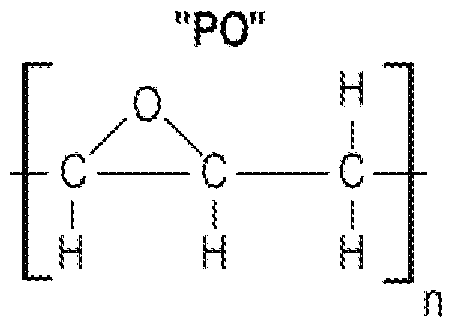
Also, the hydrophobic PO component of WEGO Polycarboxylate-PCX has the following chemical structure:
Figure imgf000008_0003
For WEGO Polycarboxylate-PCX, variables a, b, c, and n may be whole integers greater than or equal to 1, and carbon bonds omitted from the illustrated chemical structure of WEGO Polycarboxylate-PCX may be bonded with hydrogen (H). Furthermore, it should be noted that the M, Y, and X leaving groups are proprietary constituents not known outside of WEGO Chemical and Mineral Corp. Nevertheless, even without knowing the M, Y, and X leaving groups, a person having ordinary skill in the art can utilize techniques disclosed herein, including making use of WEGO’ s commercially available Polycarboxylate-PCX, to produce products, as variously described herein, in accordance with some embodiments of the present disclosure. Also, it should be noted that one or more polycarboxylate materials of chemistry similar to that of WEGO polycarboxylate-PCX may be utilized additionally or alternatively, in accordance with some embodiments.
In accordance with some embodiments, method 1000 optionally may include, as in block 1008, adding at least one of calcium sulfate (CaS04) and calcium sulfite (CaSOs). The amount of calcium sulfate/sulfite may be customized, as desired for a given target application or end-use. In accordance with some embodiments, the calcium sulfate (CaS04) may constitute about 0.1-1.5 wt% (e.g., about 0.1-0.5 wt%, about 0.5-1 wt%, about 1-1.5 wt%, or any other sub-range in the range of about 0.1-1.5 wt%) of a given mixture produced according to method 1000. In accordance with some embodiments, the calcium sulfite (CaSCf ) may constitute about 1.5-3 wt% (e.g., about 1.5-2 wt%, about 2-2.5 wt%, about 2.5-3 wt%, or any other sub-range in the range of about 1.5-3 wt%) of a given mixture produced according to method 1000. Other suitable quantities of calcium sulfate (CaS04) and calcium sulfite (CaSCf) will be apparent in light of this disclosure.
Method 1000 may include, as in block 1010, intergrinding the (1) raw perlite ore, (2) PVA powder, (3) polycarboxylate material(s), and (optionally) (4) calcium sulfate and/or calcium sulfite. The noted materials may be interground with one another (e.g., all at once or in one or more intermediate combinations) to provide a treated perlite-based cementitious material, in accordance with some embodiments. In some instances, a given material may have been ground down prior to beginning method 1000, though in other instances, the grinding down of a given material may occur (at least in part) at one or more points during method 1000.
Intergrinding may be performed utilizing any suitable grinding means, as will be apparent in light of this disclosure. For example, in accordance with some embodiments, intergrinding may be performed, in part or in whole, utilizing a mill with a grinding aid and media. The specific type of mill may be customized, as desired for a given target application or end-use. In some cases, the mill may be, for instance, a rotary mill, such as a ball mill. In accordance with some embodiments, intergrinding may be performed (in part or in whole) utilizing a mill configured as disclosed in U.S. Patent No. 9,254,490 (“Process for Treating Fly Ash and a Rotary Mill Therefor”), the entire disclosure of which is herein incorporated by reference. In accordance with some embodiments, intergrinding may involve a grinding aid and media configured as disclosed in U.S. Patent No. 9,254,490.
The duration of the intergrinding of the materials related to method 1000 may be customized, as desired for a given target application or end-use. For example, in accordance with some embodiments, intergrinding may be performed for about 1-15 minutes. In accordance with some embodiments, intergrinding may be performed for about 3-8 minutes. As will be appreciated in light of this disclosure, the intergrinding of materials may be performed, for example, until a given target particle size distribution is achieved, at least in some instances. For example, in some instances, intergrinding may occur until a D90 particle size distribution in the range of about 20-40 pm (e.g., about 20-25 pm, about 25-30 pm, about 30-35 pm, about 35-40 pm, or any other sub-range in the range of about 20-40 pm) is achieved. In some cases, intergrinding may occur until a D90 particle size distribution of about 38 pm (± 3 pm) is achieved. In some cases, intergrinding may occur until a D90 particle size distribution of about 28 pm (± 3 pm) is achieved. Other suitable durations and target particle size distributions for the materials associated with method 1000 will be apparent in light of this disclosure.
In accordance with some embodiments, method 1000 optionally may include, as in block 1003, adding at least one of (1) expanded perlite waste (produced while expanding raw perlite ore to make “popped” perlite) and (2) expanded perlite. In accordance with some embodiments, both expanded perlite waste and expanded perlite may be combined with raw perlite ore. In accordance with some embodiments, the expanded perlite may be (or otherwise may include) HARBORLITE® thermally expanded perlite available from Imerys USA, Inc. Other suitable types of expanded perlite will be apparent in light of this disclosure.
The amounts of expanded perlite waste and/or expanded perlite may be customized, as desired for a given target application or end-use. In accordance with some embodiments, the expanded perlite waste may constitute about 6 wt% or less (e.g., about 1-2 wt%, about 2- 3 wt%, about 3-4 wt%, about 4-5 wt%, about 5-6 wt%, or any other sub-range in the range of about 6 wt% or less) of a given mixture produced according to method 1000. In accordance with some embodiments, the expanded perlite may constitute about 1 wt% or less (e.g., about 0.25-0.5 wt%, about 0.5-0.75 wt%, about 0.75-1 wt%, or any other sub-range in the range of about 1 wt% or less) of a given mixture produced according to method 1000. Other suitable quantities of expanded perlite waste and expanded perlite will be apparent in light of this disclosure.
In some cases, the expanded perlite waste and/or expanded perlite may be ground down in a mill (e.g., such as any of the mills noted herein) with PVA powder and one or more polycarboxylate materials and then mixed with ground-down perlite ore by intergrinding (e.g., for 1-5 minutes) in such mill. These additive(s) may be prepared as a separate product which may be added to facilitate reactions as described herein, in accordance with some embodiments. In accordance with some embodiments, the expanded perlite waste may be treated with a quantity of PVA powder in the range of about 0.2 wt% or less (e.g., about 0.05-0.1 wt%, about 0.1-0.15 wt%, about 0.15-0.2 wt%, or any other sub-range in the range of about 0.2 wt% or less). In some cases, the quantity of PVA powder may be about 0.15 wt% ± 0.05 wt%. Other suitable quantities of PVA powder for treatment of the expanded perlite waste will be apparent in light of this disclosure. Concrete
FIG. 2 illustrates a method 2000 of making concrete in accordance with an embodiment of the present disclosure. As can be seen, method 2000 may include, as in block 2002, adding the treated perlite-based cementitious material produced via method 1000 (see FIG. 1). The amount of such cementitious material added may be customized, as desired for a given target application or end-use. In accordance with some embodiments, the cementitious material may constitute about 25-50 wt% (e.g., about 25-30 wt%, about 30-35 wt%, about 35-40 wt%, about 40-45 wt%, about 45-50 wt%, or any other sub-range in the range of about 25-50 wt%) of a given concrete produced according to method 2000. Other suitable quantities of cementitious material will be apparent in light of this disclosure.
Method 2000 may include, as in block 2004, adding OPC. The amount of OPC added may be customized, as desired for a given target application or end-use. In accordance with some embodiments, the OPC may constitute about 25-50 wt% (e.g., about 25-30 wt%, about 30-35 wt%, about 35-40 wt%, about 40-45 wt%, about 45-50 wt%, or any other sub-range in the range of about 25-50 wt%) of a given concrete produced according to method 2000. In accordance with some embodiments, the OPC and the treated perlite-based cementitious material may be provided in a 50-50 powder blend ratio. Other suitable quantities of OPC will be apparent in light of this disclosure.
Method 2000 may include, as in block 2006, adding water and at least one of sand and rock. In accordance with some embodiments, the sand may include, for example, screened sand meeting ASTM C989 standards. In accordance with some embodiments, the rock material may include, for example, ¾” limestone rock meeting ASTM C33 standards. The amounts of sand and/or rock added may be customized, as desired for a given target application or end- use. In accordance with some embodiments, the sand may constitute about 45-55 wt% (e.g., about 45-50 wt%, about 50-55 wt%, or any other sub-range in the range of about 45-55 wt%) of a given concrete produced according to method 2000. In accordance with some embodiments, the rock may constitute about 45-55 wt% (e.g., about 45-50 wt%, about 50- 55 wt%, or any other sub-range in the range of about 45-55 wt%) of a given concrete produced according to method 2000. Other suitable types and quantities of sand and rock will be apparent in light of this disclosure.
The water-cement (w/c) ratio for concrete produced according to method 2000 also may be customized, as desired for a given target application or end-use. In some cases, the w/c ratio may be in the range of about 0.2-0.4 (e.g., about 0.2-0.25, about 0.25-0.3, about 0.3-0.35, about 0.35-0.4, or any other sub-range in the range of about 0.25-0.4). In some cases, the w/c ratio may be in the range of about 0.25-0.38 (e.g., about 0.25-0.31, about 0.31-0.38, or any other sub-range in the range of about 0.25-0.38). In some cases, the w/c ratio may be in the range of about 0.2-0.33 (e.g., about 0.2-0.26, about 0.26-0.33, or any other sub-range in the range of about 0.2-0.33). In some cases, the w/c ratio may be in the range of about 0.23-0.3 or 0.23-0.4. Other suitable w/c ratios for materials associated with method 2000 will be apparent in light of this disclosure.
Method 2000 may include, as in block 2008, mixing the (1) treated perlite-based cementitious material, (2) OPC, (3) water, and (4) at least one of sand and rock. The noted materials may be mixed with one another (e.g., all at once or in one or more intermediate combinations) to provide a concrete including a treated perlite-based cementitious material, in accordance with some embodiments. Mixing may be performed as typically done with concrete products. Moreover, the duration of the mixing of the materials related to method 2000 may be customized, as desired for a given target application or end-use. As will be appreciated in light of this disclosure, it may be desirable to ensure that mixing is curtailed with sufficient time to provide for pouring, forming, etc., the concrete as desired.
Example Concrete Batch #1
In accordance with an example embodiment, a first example concrete batch including the following constituent materials was made: (1) treated perlite-based cementitious material; (2) Type 1-2 OPC having typical fineness distribution; (3) screened sand meeting ASTM C989 standards; and (4) water. The treated perlite-based cementitious material was used at about 50 wt% replacement of OPC.
The aforementioned treated perlite-based cementitious material was mixed as follows: (1) raw perlite ore; (2) 0.15 wt% PVA powder; (3) 0.3 wt% WEGO Polycarboxylate-PCX; and (4) 0.05 wt% triethanolamine (TEA) grinding aid. The perlite-based cementitious material had a D90 PSD of 38 pm.
Table 1 below tabulates measured compressive strengths for several cubes of concrete cured at an ambient temperature in the range of about 73 °F (± 3 °F) in conditions meeting ASTM C989 standards. The compressive strengths were obtained by breaking the cubes.
Table 1
Figure imgf000012_0001
Figure imgf000013_0001
Example Concrete Batch #2
In accordance with an example embodiment, a second example concrete batch including the following constituent materials was made: (1) treated perlite-based cementitious material; (2) Type 1-2 OPC having typical fineness distribution; (3) screened sand meeting ASTM C989 standards; and (4) water. The treated perlite-based cementitious material was used at about 50 wt% replacement of OPC.
The aforementioned treated perlite-based cementitious material was mixed as follows: (1) raw perlite ore; (2) 0.15 wt% PVA powder; (3) 0.3 wt% WEGO Polycarboxylate-PCX; and (4) 0.05 wt% triethanolamine (TEA) grinding aid. The perlite-based cementitious material had a D90 PSD of 28 pm.
Table 2 below tabulates measured compressive strengths for several cubes of concrete cured at an ambient temperature in the range of about 73 °F (± 3 °F) in conditions meeting ASTM C989 standards. The compressive strengths were obtained by breaking the cubes.
Table 2
Figure imgf000013_0002
Example Concrete Batch #3
In accordance with an example embodiment, a third example concrete batch including the following constituent materials was made: (1) treated perlite-based cementitious material; (2) Type 1-2 OPC having typical fineness distribution; (3) screened sand meeting ASTM C989 standards; and (4) water. The treated perlite-based cementitious material was used at about 50 wt% replacement of OPC.
The aforementioned treated perlite-based cementitious material was mixed as follows: (1) raw perlite ore; (2) 5 wt% class C fly ash; (3) 0.15 wt% PVA powder; (4) 0.3 wt% WEGO Polycarboxylate-PCX; and (5) 0.05 wt% triethanolamine (TEA) grinding aid. The perlite- based cementitious material had a D90 PSD of 28 pm.
Table 3 below tabulates measured compressive strengths for several cubes of concrete cured at an ambient temperature in the range of about 73 °F (± 3 °F) in conditions meeting ASTM C989 standards. The compressive strengths were obtained by breaking the cubes. Table 3
Figure imgf000014_0001
Example Concrete Batch #4
In accordance with an example embodiment, a fourth example 5.02-sak concrete batch including the following constituent materials was made: (1) treated perlite-based cementitious material; (2) Type 1-2 OPC having typical fineness distribution; (3) ¾” limestone rock meeting ASTM C33 standards; (4) screened sand meeting ASTM C989 standards; and (5) water. The treated perlite-based cementitious material was used at about 50 wt% replacement of OPC. The water-cement (w/c) ratio of this batch was 0.45.
The aforementioned treated perlite-based cementitious material was mixed as follows: (1) about 94.2 wt% raw perlite ore having a D90 PSD of about 36 pm; (2) about 5 wt% expanded perlite fine wastes (generated from the expansion process on perlite ore) having a D90 PSD of about 40 pm; (3) about 0.5 wt% expanded perlite having a D90 PSD of about 25 pm; (4) about 0.05 wt% PVA powder; (5) about 0.2 wt% WEGO Polycarboxylate-PCX; and (6) about 0.05 wt% TEA grinding aid.
Table 4 below tabulates measured compressive strengths for several cylinders of concrete cured at an ambient temperature in the range of about 90 °F (± 3 °F) in conditions meeting ASTM C 989 standards. The compressive strengths were obtained by breaking the cylinders.
Table 4
Figure imgf000014_0002
Example Concrete Batch #5
In accordance with an example embodiment, a fifth example 5.02-sak concrete batch including the following constituent materials was made: (1) treated perlite-based cementitious material; (2) Type 1-2 OPC having typical fineness distribution; (3) ¾” limestone rock meeting ASTM C33 standards; (4) screened sand meeting ASTM C989 standards; and (5) water. The treated perlite-based cementitious material was used at about 50 wt% replacement of OPC. The water-cement (w/c) ratio of this batch was 0.63.
The aforementioned treated perlite-based cementitious material was mixed as follows:
(1) about 94.2 wt% raw perlite ore having a D90 PSD of about 36 pm; (2) about 5 wt% expanded perlite fine wastes (generated from the expansion process on perlite ore) having a D90 PSD of about 40 pm; (3) about 0.5 wt% expanded perlite having a D90 PSD of about 25 pm; (4) about 0.05 wt% PVA powder; (5) about 0.2 wt% WEGO Polycarboxylate-PCX; and (6) about 0.05 wt% TEA grinding aid.
Table 5 below tabulates measured compressive strengths for several cylinders of concrete cured at an ambient temperature in the range of about 90 °F (± 3 °F) in conditions meeting ASTM C 989 standards. The compressive strengths were obtained by breaking the cylinders.
Table 5
Figure imgf000015_0001
Example Concrete Batch #6
In accordance with an example embodiment, a sixth example concrete batch including the following constituent materials was made: (1) treated perlite-based cementitious material;
(2) Type 1-2 OPC having typical fineness distribution; (3) screened sand meeting ASTM C989 standards; and (4) water. The treated perlite-based cementitious material was used at about 50 wt% replacement of OPC.
The aforementioned treated perlite-based cementitious material was mixed as follows: (1) about 93.5 wt% raw perlite ore (e.g., available from Imerys USA, Inc.; sourced from
Colorado) having a D90 PSD of about 38 pm; (2) about 6 wt% expanded perlite waste (e.g., available from Imerys USA, Inc.; sourced from Texas) having a D90 PSD of about 20 pm; and
(3) about 0.5 wt% expanded perlite (e.g., Imerys HARBORLITE® thermally expanded perlite) having a D90 PSD of about 20 pm. The expanded perlite waste and the expanded perlite each were treated with about 0.15 wt% PVA powder, about 0.3 wt% WEGO Polycarboxylate-PCX, and about 0.05 wt% TEA grinding aid. These materials were mixed together proportionally in a single mill and ground to a D90 PSD of about 38 pm/kg (e.g., about 20 min) in the presence of about 0.15 wt% PVA powder, about 0.3 wt% WEGO Polycarboxylate-PCX, and about 0.05 wt% TEA grinding aid.
Table 6 below tabulates measured compressive strengths for several cubes of concrete cured in conditions meeting ASTM C989 standards. The compressive strengths were obtained by breaking the cubes.
Table 6
Figure imgf000016_0001
Example Concrete Batch #7
In accordance with an example embodiment, a seventh example concrete batch including the following constituent materials was made: (1) treated perlite-based cementitious material; (2) Type 1-2 OPC having typical fineness distribution; (3) screened sand meeting ASTM C989 standards; and (4) water. The treated perlite-based cementitious material was used at about 50 wt% replacement of OPC.
The aforementioned treated perlite-based cementitious material was mixed as follows: (1) about 93.5 wt% raw perlite ore (e.g., Dicalite DICAPERL® perlite; sourced from New Mexico) having a D90 PSD of about 38 pm; (2) about 6 wt% expanded perlite waste (e.g., available from Dicalite Management Group; sourced from Maine) having a D90 PSD of about 20 pm; and (3) about 0.5 wt% expanded perlite (e.g., Imerys HARBORLITE® thermally expanded perlite) having a D90 PSD of about 20 pm. The expanded perlite waste and the expanded perlite each were treated with about 0.15 wt% PVA powder, about 0.3 wt% WEGO Polycarboxylate-PCX, and about 0.05 wt% TEA grinding aid. These materials were mixed together proportionally in a single mill and ground to a D90 PSD of about 38 pm/kg (e.g., about 35 min) in the presence of about 0.15 wt% PVA powder, about 0.3 wt% WEGO Polycarboxylate-PCX, and about 0.05 wt% TEA grinding aid.
Table 7 below tabulates measured compressive strengths for several cubes of concrete cured in conditions meeting ASTM C989 standards. The compressive strengths were obtained by breaking the cubes.
Table 7
Figure imgf000016_0002
Figure imgf000017_0001
Analysis & Conclusions
The data of Tables 1-7 above generally indicate that raw perlite ore may be made reactive without grinding down to a very fine particle size (e.g., a D90 of about 28-38 pm may be sufficient). The data also generally indicate the difference in treating the higher surface area particles (smaller size) makes on the results. Additionally, the data generally indicate that coating the surface of the perlite with PVA powder may help to improve the cementitious reaction of the perlite ore, while the polycarboxylate may help to control the water demand, thus permitting good flowability. The data also indicate that these reactions may occur in concrete batches using the same treatment and varying the w/c ratio to obtain good flowability. The data also generally indicate that the mix may hit typical 28-day strengths at or above where an OPC mix alone would, albeit at a lower w/c ratio. Furthermore, the data generally indicate that the use of PVA powder and polycarboxylate material, in combination with mill-based processing, may yield a viable, high-replacement alternative to other pozzolans (e.g., fly ash, slag, etc.) in making cementitious materials and concrete. Also, the data indicate that, at least in some cases, the lightweight nature of the expanded perlite wastes, when processed as described herein, increased from about 7 lbs. /ft3 to about 12 lbs. /ft3 but its reactivity was higher than just the raw perlite ore itself.
Furthermore, testing of the alkali content of the perlite, as variously described herein, showed a total alkali value ranging from about 6-8%. Alkali-silica reactivity (ASR) tests indicated that less than about 1% (e.g., about 0.5-0.9% or less) of the alkali in the glass matrix was “available.” Therefore, no problems were seen on material ground down to the disclosed D90 particle sizes when tested on available alkali, as the class C fly ash had more available alkali than the perlite. In at least some cases, inclusion of an additive package (e.g., lithium carbonate/hydroxide interground with perlite ore/glass at about 0.15-0.3 wt%) may prevent (or otherwise reduce) ASR-related problems, in accordance with some embodiments.
The foregoing description of example embodiments has been presented for the purposes of illustration and description. It is not intended to be exhaustive or to limit the present disclosure to the precise forms disclosed. Many modifications and variations are possible in light of this disclosure. It is intended that the scope of the present disclosure be limited not by this detailed description. Future-filed applications claiming priority to this application may claim the disclosed subject matter in a different manner and generally may include any set of one or more limitations as variously disclosed or otherwise demonstrated herein.

Claims

CLAIMS What is claimed is:
1. A method comprising: producing a treated perlite-based cementitious mixture comprising: perlite; polyvinyl alcohol (PVA) powder; and a polycarboxylate material.
2. The method of claim 1, wherein the perlite is raw perlite ore.
3. The method of claim 1, wherein producing the treated perlite-based cementitious mixture involves intergrinding the raw perlite ore, the PVA powder, and the polycarboxylate material.
4. The method of claim 3, wherein the intergrinding is performed until a D90 particle size distribution of about 38 pm is achieved for the treated perlite-based cementitious mixture.
5. The method of claim 3, wherein the intergrinding is performed until a D90 particle size distribution of about 28 pm is achieved for the treated perlite-based cementitious mixture.
6. The method of claim 1, wherein the treated perlite-based cementitious mixture further comprises at least one of calcium sulfate (CaSCL) and calcium sulfite (CaSCri).
7. The method of claim 6, wherein producing the treated perlite-based cementitious mixture involves intergrinding the raw perlite ore, the PVA powder, the polycarboxylate material, and the at least one of calcium sulfate and calcium sulfite.
8. The method of claim 1, wherein the treated perlite-based cementitious mixture further comprises at least one of expanded perlite waste and expanded perlite.
9. The method of claim 8, wherein producing the treated perlite-based cementitious mixture involves intergrinding the raw perlite ore, the PVA powder, the polycarboxylate material, and the at least one of expanded perlite waste and expanded perlite.
10. The method of claim 1, wherein the treated perlite-based cementitious mixture further comprises expanded perlite waste and expanded perlite.
11. The method of claim 10, wherein producing the treated perlite-based cementitious mixture involves intergrinding the raw perlite ore, the PVA powder, the polycarboxylate material, the expanded perlite waste, and the expanded perlite.
12. A method comprising: producing a concrete comprising: the treated perlite-based cementitious mixture produced according to any of claims 1-11; ordinary Portland cement (OPC); water; and at least one of rock and sand.
13. The method of claim 12, wherein the treated perlite-based cementitious mixture and the OPC are provided in a 50-50 blend.
14. A concrete product comprising concrete produced according to claim 12.
15. A composition of matter comprising: perlite; polyvinyl alcohol (PVA) powder; and a polycarboxylate material.
16. The composition of matter of claim 15, wherein the perlite is raw perlite ore.
17. The composition of matter of claim 15, wherein the composition of matter has a D90 particle size distribution of about 38 pm.
18. The composition of matter of claim 15, wherein the composition of matter has a D90 particle size distribution of about 28 pm.
19. The composition of matter of claim 15, further comprising at least one of calcium sulfate (CaS04) and calcium sulfite (CaSCf ).
20. The composition of matter of any of claims 15-19, further comprising at least one of expanded perlite waste and expanded perlite.
21. The composition of matter of any of claims 15-19, further comprising expanded perlite waste and expanded perlite.
22. The composition of matter of any of claims 15-19, further comprising ordinary Portland cement (OPC).
PCT/US2022/016382 2021-07-09 2022-02-15 Perlite-based cementitious materials, concrete, and related techniques Ceased WO2023282939A1 (en)

Priority Applications (6)

Application Number Priority Date Filing Date Title
KR1020247002625A KR20240032047A (en) 2021-07-09 2022-02-15 Perlitic cementitious materials, concrete, and related technologies
JP2024501199A JP2024525671A (en) 2021-07-09 2022-02-15 Perlite-based cementitious materials, concrete, and related technologies
EP22838167.9A EP4367075A4 (en) 2021-07-09 2022-02-15 PEARLITE-BASED CEMENT MATERIALS, CONCRETE AND RELATED PROCESSES
CA3225085A CA3225085A1 (en) 2021-07-09 2022-02-15 Perlite-based cementitious materials, concrete, and related techniques
US18/577,738 US20240228375A1 (en) 2021-07-09 2022-02-15 Perlite-based cementitious materials, concrete, and related techniques
MX2024000484A MX2024000484A (en) 2021-07-09 2022-02-15 Perlite-based cementitious materials, concrete, and related techniques.

Applications Claiming Priority (6)

Application Number Priority Date Filing Date Title
US202163220392P 2021-07-09 2021-07-09
US63/220,392 2021-07-09
US202163244447P 2021-09-15 2021-09-15
US63/244,447 2021-09-15
US202263308566P 2022-02-10 2022-02-10
US63/308,566 2022-02-10

Publications (1)

Publication Number Publication Date
WO2023282939A1 true WO2023282939A1 (en) 2023-01-12

Family

ID=84801971

Family Applications (1)

Application Number Title Priority Date Filing Date
PCT/US2022/016382 Ceased WO2023282939A1 (en) 2021-07-09 2022-02-15 Perlite-based cementitious materials, concrete, and related techniques

Country Status (7)

Country Link
US (1) US20240228375A1 (en)
EP (1) EP4367075A4 (en)
JP (1) JP2024525671A (en)
KR (1) KR20240032047A (en)
CA (1) CA3225085A1 (en)
MX (1) MX2024000484A (en)
WO (1) WO2023282939A1 (en)

Cited By (1)

* Cited by examiner, † Cited by third party
Publication number Priority date Publication date Assignee Title
WO2024205584A1 (en) * 2023-03-30 2024-10-03 Green Cement Inc. Cement kiln dust (ckd)-based and lime kiln dust (lkd)-based cementitious materials, concrete, and related techniques

Citations (8)

* Cited by examiner, † Cited by third party
Publication number Priority date Publication date Assignee Title
WO2000061519A1 (en) * 1999-04-09 2000-10-19 James Hardie Research Pty Limited Concrete formulation
KR20030025361A (en) * 2001-09-20 2003-03-29 삼손퍼라이트 주식회사 Surface modified-expanded perlite and its usage
US20040094863A1 (en) * 2001-03-01 2004-05-20 Buerge Theodor A. Composite material and shaped article with thermal conductivity and specific gravity on demand
JP2008037663A (en) * 2006-08-01 2008-02-21 Shin Etsu Chem Co Ltd Hydraulic composition
US20120322902A1 (en) 2009-06-05 2012-12-20 Berke Neal S Cementitious foam compositions
CN103086658A (en) 2013-01-21 2013-05-08 山西威凯科技开发有限公司 Production method of three-dimensional skeleton composite board for building
US9254490B2 (en) 2012-10-09 2016-02-09 Vhsc, Ltd. Process for treating fly ash and a rotary mill therefor
US20200331802A1 (en) 2019-04-17 2020-10-22 United States Gypsum Company Aluminate-enhanced type i portland cements with short setting times and cement boards produced therefrom

Family Cites Families (11)

* Cited by examiner, † Cited by third party
Publication number Priority date Publication date Assignee Title
JPS61251530A (en) * 1985-04-30 1986-11-08 Sekisui Plastics Co Ltd Production of glass coated shell granule
JP4679707B2 (en) * 2000-09-28 2011-04-27 電気化学工業株式会社 High-strength cement admixture and cement composition using the same
JP2006096631A (en) * 2004-09-30 2006-04-13 Sekisui Plastics Co Ltd Plastering mortar admixture and mortar composition containing the same
WO2008015767A1 (en) * 2006-08-01 2008-02-07 Denki Kagaku Kogyo Kabushiki Kaisha Cement admixture and cement composition making use of the same
JP2008247651A (en) * 2007-03-29 2008-10-16 Kubota Matsushitadenko Exterior Works Ltd Cement board
JP5965211B2 (en) * 2012-05-17 2016-08-03 ケイミュー株式会社 Cement board
CN103396049B (en) * 2013-08-09 2015-03-04 卫峰 Production method for building wallbody self thermal insulation blocks
JP2015042605A (en) * 2013-08-26 2015-03-05 章夫 丸 Concrete admixture, concrete structure and method of producing concrete structure
US10040725B2 (en) * 2016-07-19 2018-08-07 United States Gypsum Company Lightweight foamed cement, cement board, and methods for making same
JP2018144440A (en) * 2017-03-08 2018-09-20 岡本興産株式会社 Method for producing concrete formwork mainly composed of waste coal ash discharged from thermal power plant
PL3710416T3 (en) * 2017-11-14 2022-02-21 Construction Research & Technology Gmbh USE OF ZINC SALT IN COMBINATION WITH ALKYLAMINES IN MIXTURES OF DRY CEMENT MORTARS

Patent Citations (8)

* Cited by examiner, † Cited by third party
Publication number Priority date Publication date Assignee Title
WO2000061519A1 (en) * 1999-04-09 2000-10-19 James Hardie Research Pty Limited Concrete formulation
US20040094863A1 (en) * 2001-03-01 2004-05-20 Buerge Theodor A. Composite material and shaped article with thermal conductivity and specific gravity on demand
KR20030025361A (en) * 2001-09-20 2003-03-29 삼손퍼라이트 주식회사 Surface modified-expanded perlite and its usage
JP2008037663A (en) * 2006-08-01 2008-02-21 Shin Etsu Chem Co Ltd Hydraulic composition
US20120322902A1 (en) 2009-06-05 2012-12-20 Berke Neal S Cementitious foam compositions
US9254490B2 (en) 2012-10-09 2016-02-09 Vhsc, Ltd. Process for treating fly ash and a rotary mill therefor
CN103086658A (en) 2013-01-21 2013-05-08 山西威凯科技开发有限公司 Production method of three-dimensional skeleton composite board for building
US20200331802A1 (en) 2019-04-17 2020-10-22 United States Gypsum Company Aluminate-enhanced type i portland cements with short setting times and cement boards produced therefrom

Non-Patent Citations (2)

* Cited by examiner, † Cited by third party
Title
no. 59233-52-2
See also references of EP4367075A4

Cited By (1)

* Cited by examiner, † Cited by third party
Publication number Priority date Publication date Assignee Title
WO2024205584A1 (en) * 2023-03-30 2024-10-03 Green Cement Inc. Cement kiln dust (ckd)-based and lime kiln dust (lkd)-based cementitious materials, concrete, and related techniques

Also Published As

Publication number Publication date
JP2024525671A (en) 2024-07-12
EP4367075A4 (en) 2025-05-14
KR20240032047A (en) 2024-03-08
US20240228375A1 (en) 2024-07-11
EP4367075A1 (en) 2024-05-15
MX2024000484A (en) 2024-04-10
CA3225085A1 (en) 2023-01-12

Similar Documents

Publication Publication Date Title
Goble Influence of aggregate surface area on the mechanical properties of mortar
US5509962A (en) Cement containing activated belite
CN108455885B (en) Composite portland cement and preparation method and application thereof
JP4781285B2 (en) Blast furnace slag cement
KR101889783B1 (en) Solidified agent and making method of it using high-calcium fly ash and steel making slags
Bui et al. Performance and microstructural evaluation of rice husk ash–ground granulated blast furnace slag–CFBC fly ash mixtures produced as an eco-cement
US20240228375A1 (en) Perlite-based cementitious materials, concrete, and related techniques
JP2010275124A (en) Ultrahigh early strength cement composition and method for producing the same
CN113735481A (en) Composite early strength mineral admixture and preparation method and application thereof
KR101976650B1 (en) Rapid setting mortar composition using distributing crushed stone and rapid setting concrete composition using the same
US12240783B2 (en) Class C fly ash-based cementitious materials, flowable fill, concrete, and related techniques
CN115893966A (en) Cement-stabilized phosphogypsum bottom ash gravel for road base and preparation method
CN117417135B (en) Cementing material based on calcined clay and preparation method thereof
JP7081939B2 (en) concrete
WO2021262479A1 (en) Lithium-treated calcium aluminate cement (cac)-based products, concretes, and related techniques
JP2005162564A (en) Expansion material for mortar concrete and concrete using it
Tijani et al. Effect of sorghum husk ash and calcium chloride on compressive strength of grade 20 concrete
WO2024205584A1 (en) Cement kiln dust (ckd)-based and lime kiln dust (lkd)-based cementitious materials, concrete, and related techniques
CN110615642A (en) Concrete containing high-activity slag powder and preparation method thereof
Binici et al. Resistance to Thaumasite form of sulphate attack of blended cement mortars
JP2018127372A (en) Expansive admixture for exposed concrete, and exposed concrete containing the same
JP2007145670A (en) Expansive admixture for resin-finished floor, and its use
CN120483555A (en) Low-carbon cement and preparation method thereof
JPH0193450A (en) High-strength additive for secondary product of concrete
CN119683936A (en) A low-temperature, early-strength, low-density cement-based material for deep-water cementing and a preparation method thereof

Legal Events

Date Code Title Description
121 Ep: the epo has been informed by wipo that ep was designated in this application

Ref document number: 22838167

Country of ref document: EP

Kind code of ref document: A1

WWE Wipo information: entry into national phase

Ref document number: 3225085

Country of ref document: CA

WWE Wipo information: entry into national phase

Ref document number: MX/A/2024/000484

Country of ref document: MX

ENP Entry into the national phase

Ref document number: 2024501199

Country of ref document: JP

Kind code of ref document: A

WWE Wipo information: entry into national phase

Ref document number: 18577738

Country of ref document: US

REG Reference to national code

Ref country code: BR

Ref legal event code: B01A

Ref document number: 112024000448

Country of ref document: BR

ENP Entry into the national phase

Ref document number: 20247002625

Country of ref document: KR

Kind code of ref document: A

WWE Wipo information: entry into national phase

Ref document number: 202417008664

Country of ref document: IN

WWE Wipo information: entry into national phase

Ref document number: 2022838167

Country of ref document: EP

NENP Non-entry into the national phase

Ref country code: DE

ENP Entry into the national phase

Ref document number: 2022838167

Country of ref document: EP

Effective date: 20240209

ENP Entry into the national phase

Ref document number: 112024000448

Country of ref document: BR

Kind code of ref document: A2

Effective date: 20240109