WO2023287836A1 - Liquid laundry detergent formulation - Google Patents

Liquid laundry detergent formulation Download PDF

Info

Publication number
WO2023287836A1
WO2023287836A1 PCT/US2022/036887 US2022036887W WO2023287836A1 WO 2023287836 A1 WO2023287836 A1 WO 2023287836A1 US 2022036887 W US2022036887 W US 2022036887W WO 2023287836 A1 WO2023287836 A1 WO 2023287836A1
Authority
WO
WIPO (PCT)
Prior art keywords
formula
laundry detergent
group
liquid laundry
detergent formulation
Prior art date
Legal status (The legal status is an assumption and is not a legal conclusion. Google has not performed a legal analysis and makes no representation as to the accuracy of the status listed.)
Ceased
Application number
PCT/US2022/036887
Other languages
French (fr)
Inventor
Aslin IZMITLI
Michael C. Mitchell
Randara PULUKKODY
Muhunthan Sathiosatham
Michael L. Tulchinsky
Eric Wasserman
Current Assignee (The listed assignees may be inaccurate. Google has not performed a legal analysis and makes no representation or warranty as to the accuracy of the list.)
Dow Global Technologies LLC
Rohm and Haas Co
Original Assignee
Dow Global Technologies LLC
Rohm and Haas Co
Priority date (The priority date is an assumption and is not a legal conclusion. Google has not performed a legal analysis and makes no representation as to the accuracy of the date listed.)
Filing date
Publication date
Application filed by Dow Global Technologies LLC, Rohm and Haas Co filed Critical Dow Global Technologies LLC
Priority to CA3224836A priority Critical patent/CA3224836A1/en
Priority to US18/556,141 priority patent/US20240199990A1/en
Priority to AU2022311786A priority patent/AU2022311786A1/en
Priority to JP2023579208A priority patent/JP2024524255A/en
Priority to CN202280042001.5A priority patent/CN117500904A/en
Priority to EP22751912.1A priority patent/EP4370639A1/en
Publication of WO2023287836A1 publication Critical patent/WO2023287836A1/en
Anticipated expiration legal-status Critical
Ceased legal-status Critical Current

Links

Classifications

    • CCHEMISTRY; METALLURGY
    • C11ANIMAL OR VEGETABLE OILS, FATS, FATTY SUBSTANCES OR WAXES; FATTY ACIDS THEREFROM; DETERGENTS; CANDLES
    • C11DDETERGENT COMPOSITIONS; USE OF SINGLE SUBSTANCES AS DETERGENTS; SOAP OR SOAP-MAKING; RESIN SOAPS; RECOVERY OF GLYCEROL
    • C11D3/00Other compounding ingredients of detergent compositions covered in group C11D1/00
    • C11D3/16Organic compounds
    • C11D3/26Organic compounds containing nitrogen
    • C11D3/33Amino carboxylic acids
    • CCHEMISTRY; METALLURGY
    • C11ANIMAL OR VEGETABLE OILS, FATS, FATTY SUBSTANCES OR WAXES; FATTY ACIDS THEREFROM; DETERGENTS; CANDLES
    • C11DDETERGENT COMPOSITIONS; USE OF SINGLE SUBSTANCES AS DETERGENTS; SOAP OR SOAP-MAKING; RESIN SOAPS; RECOVERY OF GLYCEROL
    • C11D3/00Other compounding ingredients of detergent compositions covered in group C11D1/00
    • C11D3/0005Other compounding ingredients characterised by their effect
    • C11D3/0036Soil deposition preventing compositions; Antiredeposition agents
    • CCHEMISTRY; METALLURGY
    • C11ANIMAL OR VEGETABLE OILS, FATS, FATTY SUBSTANCES OR WAXES; FATTY ACIDS THEREFROM; DETERGENTS; CANDLES
    • C11DDETERGENT COMPOSITIONS; USE OF SINGLE SUBSTANCES AS DETERGENTS; SOAP OR SOAP-MAKING; RESIN SOAPS; RECOVERY OF GLYCEROL
    • C11D3/00Other compounding ingredients of detergent compositions covered in group C11D1/00
    • C11D3/16Organic compounds
    • C11D3/26Organic compounds containing nitrogen
    • C11D3/30Amines; Substituted amines ; Quaternized amines

Definitions

  • the present invention relates to a liquid laundry detergent formulation.
  • Laundry detergents in liquid and gel forms providing excellent overall cleaning are desirable to consumers.
  • Such laundry detergents typically include surfactants among other components to deliver the consumer desired cleaning benefits.
  • surfactants among other components to deliver the consumer desired cleaning benefits.
  • increasing sensitivity for the environment and rising material costs a move to reduce the utilization of surfactants in laundry detergents is growing. Consequently, detergent manufactures are seeking ways to reduce the amount of surfactant per unit dose of the laundry detergent while maintaining overall cleaning performance.
  • One approach for reducing the unit dose of surfactant is to incorporate polymers into the liquid detergent formulations as described by boutique et al. in U.S. Patent Application Publication No. 20090005288.
  • boutique et al. disclose a graft copolymer of polyethylene, polypropylene or polybutylene oxide with vinyl acetate in a weight ratio of from about 1:0.2 to about 1:10 for use in liquid or gel laundry detergent formulations having about 2 to about 20 wt% surfactant.
  • the present invention provides a method of washing a fabric article, comprising: providing a soiled fabric article; providing a liquid laundry detergent formulation according to claim 1 ; providing a wash water; and applying the wash water and the liquid laundry detergent formulation to the soiled fabric to provide a cleaned fabric article.
  • liquid laundry detergent formulations with a cleaning booster as described herein facilitate improvement in primary cleaning performance for sebum soil removal, while imparting good anit-redeposition performance for dust sebum and clay; and also exhibiting desirable biodegradability profiles according to OECD 30 IF protocol.
  • ratios, percentages, parts, and the like are by weight.
  • Weight percentages (or wt%) in the composition are percentages of dry weight, i.e., excluding any water that may be present in the composition.
  • the liquid laundry detergent formulation of the present invention comprises a liquid carrier (preferably, 25 to 97.9 wt% (more preferably, 30 to 95.8 wt%; still more preferably, 40 to 93.5 wt%; yet more preferably, 45 to 91.75 wt%; most preferably, 50 to 89 wt%), based on weight of the liquid laundry detergent formulation, of the liquid carrier); a cleaning surfactant (preferably, 2 to 60 wt% (more preferably, 4 to 50 wt%; still more preferably, 6 to 40 wt%; yet more preferably, 7.5 to 35 wt%; most preferably, 10 to 30 wt%), based on weight of the liquid laundry detergent formulation, of the cleaning surfactant); and a cleaning booster (preferably, 0.1 to 15 wt% (more preferably, 0.2 to 12 wt%; still more preferably, 0.5 to 10 wt%; yet more preferably, 0.75 to 8 wt%; most
  • a liquid carrier preferably
  • the liquid laundry detergent formulation of the present invention comprises a liquid carrier. More preferably, the liquid laundry detergent formulation of the present invention comprises 25 to 97.9 wt% (preferably, 30 to 95.8 wt%; more preferably, 40 to 93.5 wt%; yet more preferably, 45 to 91.75 wt%; most preferably, 50 to 89 wt %), based on weight of the liquid laundry detergent formulation, of a liquid carrier.
  • the liquid laundry detergent formulation of the present invention comprises 25 to 97.9 wt% (preferably, 30 to 95.8 wt%; more preferably, 40 to 93.5 wt%; yet more preferably, 45 to 91.75 wt%; most preferably, 50 to 89 wt%), based on weight of the liquid laundry detergent formulation, of a liquid carrier; wherein the liquid carrier comprises water.
  • the liquid laundry detergent formulation of the present invention comprises 25 to 97.9 wt% (preferably, 30 to 95.8 wt%; more preferably, 40 to 93.5 wt%; yet more preferably, 45 to 91.75 wt%; most preferably, 50 to 89 wt%), based on weight of the liquid laundry detergent formulation, of a liquid carrier; wherein the liquid carrier is water.
  • the liquid carrier optionally includes a water miscible liquid, such as, C1-3 alkanols, C1-3 alkanediols and mixtures thereof. More preferably, the liquid carrier optionally includes 0 to 10 wt% (preferably, 0.2 to 8 wt%; more preferably, 0.5 to 7.5 wt%), based on weight of the liquid carrier, of water miscible liquids; wherein the water miscible liquids are selected from the group consisting of C1-3 alkanols, C1-3 alkanediols (e.g., propylene glycol) and mixtures thereof.
  • a water miscible liquid such as, C1-3 alkanols, C1-3 alkanediols and mixtures thereof.
  • the liquid carrier optionally includes 0 to 10 wt% (preferably, 0.2 to 8 wt%; more preferably, 0.5 to 7.5 wt%), based on weight of the liquid carrier, of water miscible liquids; wherein the water miscible
  • the liquid carrier optionally includes 0 to 10 wt% (preferably, 0.2 to 8 wt%; more preferably, 0.5 to 7.5 wt%), based on weight of the liquid carrier, of water miscible liquids; wherein the water miscible liquids are selected from the group consisting of ethanol, propylene glycol and mixtures thereof.
  • the liquid laundry detergent formulation of the present invention comprises: a cleaning surfactant. More preferably, the liquid laundry detergent formulation of the present invention, comprises: 2 to 60 wt% (preferably, 4 to 50 wt%; more preferably,
  • the liquid laundry detergent formulation of the present invention comprises: 2 to 60 wt% (preferably, 4 to 50 wt%; more preferably, 6 to 40 wt%; yet more preferably, 7.5 to 35 wt%; most preferably, 10 to 30 wt%), based on weight of the liquid laundry detergent formulation, of a cleaning surfactant; wherein the cleaning surfactant is selected from the group consisting of anionic surfactants, nonionic surfactants, cationic surfactants, amphoteric surfactants and mixtures thereof.
  • the liquid laundry detergent formulation of the present invention comprises: 2 to 60 wt% (preferably, 4 to 50 wt%; more preferably, 6 to 40 wt%; yet more preferably, 7.5 to 35 wt%; most preferably, 10 to 30 wt %), based on weight of the liquid laundry detergent formulation, of a cleaning surfactant; wherein the cleaning surfactant is selected from the group consisting of a mixture including an anionic surfactant and a non-ionic surfactant.
  • the liquid laundry detergent formulation of the present invention comprises: 2 to 60 wt% (preferably, 4 to 50 wt%; more preferably, 6 to 40 wt%; yet more preferably, 7.5 to 35 wt%; most preferably, 10 to 30 wt%), based on weight of the liquid laundry detergent formulation, of a cleaning surfactant; wherein the cleaning surfactant includes a mixture of a linear alkyl benzene sulfonate, a sodium lauryl ethoxysulfate and a nonionic alcohol ethoxylate.
  • Anionic surfactants include alkyl sulfates, alkyl benzene sulfates, alkyl benzene sulfonic acids, alkyl benzene sulfonates, alkyl polyethoxy sulfates, alkoxylated alcohols, paraffin sulfonic acids, paraffin sulfonates, olefin sulfonic acids, olefin sulfonates, alpha-sulfocarboxylates, esters of alpha-sulfocarboxylates, alkyl glyceryl ether sulfonic acids, alkyl glyceryl ether sulfonates, sulfates of fatty acids, sulfonates of fatty acids, sulfonates of fatty acid esters, alkyl phenols, alkyl phenol poly ethoxy ether sulfates, 2-acryloxy-alkane-l
  • Preferred anionic surfactants include Cs-2o alkyl benzene sulfates, Cs-2o alkyl benzene sulfonic acid, C8-20 alkyl benzene sulfonate, paraffin sulfonic acid, paraffin sulfonate, alpha-olefin sulfonic acid, alpha-olefin sulfonate, alkoxylated alcohols, Cs-2o alkyl phenols, amine oxides, sulfonates of fatty acids, sulfonates of fatty acid esters, Cs-io alkyl polyethoxy sulfates and mixtures thereof.
  • More preferred anionic surfactants include Cn-ib alkyl benzene sulfonic acid, C12-16 alkyl benzene sulfonate, C12-18 paraffin-sulfonic acid, C12-18 paraffin-sulfonate, C12-16 alkyl polyethoxy sulfate and mixtures thereof.
  • Non-ionic surfactants include alkoxylates (e.g., polyglycol ethers, fatty alcohol polyglycol ethers, alkylphenol poly glycol ethers, end group capped poly glycol ethers, mixed ethers, hydroxy mixed ethers, fatty acid polyglycol esters and mixtures thereof.
  • Preferred non- ionic surfactants include fatty alcohol polyglycol ethers. More preferred non- ionic surfactants include secondary alcohol ethoxylates, ethoxylated 2-ethylhexanol, ethoxylated seed oils, butanol caped ethoxylated 2-ethylhexanol and mixtures thereof.
  • Cationic surfactants include quaternary surface active compounds.
  • Preferred cationic surfactants include quaternary surface active compounds having at least one of an ammonium group, a sulfonium group, a phosphonium group, an iodonium group and an arsonium group. More preferred cationic surfactants include at least one of a dialkyldimethylammonium chloride and alkyl dimethyl benzyl ammonium chloride.
  • Still more preferred cationic surfactants include at least one of Ci 6-i8 dialkyldimethylammonium chloride, a Cs-is alkyl dimethyl benzyl ammonium chloride di-tallow dimethyl ammonium chloride and di-tallow dimethyl ammonium chloride. Most preferred cationic surfactant includes di-tallow dimethyl ammonium chloride.
  • Amphoteric surfactants include betaines, amine oxides, alkylamidoalkylamines, alkyl- substituted amine oxides, acylated amino acids, derivatives of aliphatic quaternary ammonium compounds and mixtures thereof.
  • Preferred amphoteric surfactants include derivatives of aliphatic quaternary ammonium compounds. More preferred amphoteric surfactants include derivatives of aliphatic quaternary ammonium compounds with a long chain group having 8 to 18 carbon atoms. Still more preferred amphoteric surfactants include at least one of C12-14 alkyldimethylamine oxide, 3-(N,N-dimethyl-N-hexadecyl-ammonio)propane- 1-sulfonate,
  • amphoteric surfactants include at least one of C12-14 alkyldimethylamine oxide.
  • the cleaning booster for cleaning dirty laundry is of formula (I); wherein formula (I) is of formula (la) wherein x is 0 to 2 (preferably, 1); wherein each R 10 is independently of formula (VI) wherein the * indicates the point of attachment to formula (la); wherein R 7 is selected from the group consisting of a hydrogen and a Ci-22 alkyl group (preferably, a hydrogen and a Ci-12 alkyl group; more preferably, a hydrogen and a C1-5 alkyl group; still more preferably, a hydrogen and a C1-4 alkyl group; most preferably, a hydrogen and a C4 alkyl group); wherein each R 8 and R 9 is independently selected from the group consisting of a hydrogen and a C1-2 alkyl group, with the proviso that at least one of R 8 and R 9 is a hydrogen in each subunit a; and wherein a is 0 to 30.
  • formula (I) is of formula (la) wherein x is 0 to 2 (preferably, 1); wherein each
  • the cleaning booster of the present invention is of formula (I); wherein formula (I) is of formula (la); wherein an average of 70 to 100 mol% (preferably, 80 to 100 mol%; more preferably, 90 to 100 mol%; most preferably, 95 to 100 mol%) of the R 10 groups are of formula (VI) wherein a is 2 to 30. Still more preferably, the cleaning booster for cleaning dirty laundry of the present invention is of formula (I); wherein formula (I) is of formula (la); wherein an average of 70 to 100 mol% (preferably, 80 to 100 mol%; more preferably, 90 to 100 mol%; most preferably, 95 to 100 mol%) of the R 10 groups are of formula (VI); wherein formula (VI) is of formula (Via)
  • R 11 O— [CH 2 CH(R 12 ) ⁇ 3 ⁇ 4— * (Via) wherein the * indicates the point of attachment to formula (la); wherein R 11 is selected from the group consisting of a hydrogen and a Ci-22 alkyl group (preferably, a hydrogen and a Ci-12 alkyl group; more preferably, a hydrogen and a C1-5 alkyl group; still more preferably, a C1-4 alkyl group; most preferably, a C4 alkyl group); wherein each R 12 is independently selected from the group consisting of a hydrogen and a C1-2 alkyl group; and wherein y is 2 to 30 (preferably, 2 to 25; more preferably, 2 to 17; most preferably, 4 to 12).
  • the cleaning booster for cleaning dirty laundry of the present invention is of formula (I); wherein formula (I) is of formula (la); wherein an average of 70 to 100 mol% (preferably, 80 to 100 mol%; more preferably, 90 to 100 mol%; most preferably, 95 to 100 mol%) of the R 10 groups are of formula (VI); wherein formula (VI) is of formula (VIb)
  • R 13 O — (EO) 3 ⁇ 4 — (PO), — (EO) j — * (VIb) wherein the * indicates the point of attachment to formula (la); wherein R 13 is selected from the group consisting of a hydrogen and a Ci-12 alkyl group (preferably, a hydrogen and a Ci-12 alkyl group; more preferably, a hydrogen and a C1-5 alkyl group; still more preferably, a C1-4 alkyl group; most preferably, a C4 alkyl group); wherein EO is an ethylene oxide group; wherein PO is a propylene oxide group; wherein h is 0 to 30 (preferably, 0 to 5; more preferably, 0 to 2; most preferably, 0 to 1); wherein i is 0 to 30 (preferably, 0 to 10; more preferably, 0 to 7; most preferably, 2 to 5); wherein j is 0 and 30 (preferably, 2 to 10; more preferably, 2 to 8; most preferably, 2 to 6);
  • the liquid laundry detergent formulation of the present invention optionally further comprises a structurant. More preferably, the liquid laundry detergent formulation of the present invention, further comprises 0 to 2 wt% (preferably, 0.05 to 0.8 wt%; more preferably, 0.1 to 0.4 wt%), based on weight of the liquid laundry detergent formulation, of a structurant.
  • the liquid laundry detergent formulation of the present invention further comprises 0 to 2 wt% (preferably, 0.05 to 0.8 wt%; more preferably, 0.1 to 0.4 wt%), based on weight of the liquid laundry detergent formulation, of a structurant; wherein the structurant is a non-poly meric, crystalline hydroxy-functional materials capable of forming thread like structuring systems throughout the liquid laundry detergent formulation when crystallized in situ.
  • the liquid laundry detergent formulation of the present invention optionally further comprises a hydrotrope. More preferably, the liquid laundry detergent formulation of the present invention, optionally further comprises: 0 to 15 wt% (preferably, 0.1 to 12 wt%; more preferably, 0.2 to 10 wt%; most preferably, 0.5 to 7.5 wt%), based on the weight of the liquid laundry detergent formulation, of a hydrotrope.
  • the liquid laundry detergent formulation of the present invention optionally further comprises: 0 to 15 wt% (preferably, 0.1 to 12 wt%; more preferably, 0.2 to 10 wt%; most preferably, 0.5 to 7.5 wt%), based on the weight of the liquid laundry detergent formulation, of a hydrotrope; wherein the hydrotrope is selected from the group consisting of alkyl hydroxides; glycols; urea; monoethanolamine; diethanolamine; triethanolamine; calcium, sodium, potassium, ammonium and alkanol ammonium salts of xylene sulfonic acid, toluene sulfonic acid, ethylbenzene sulfonic acid, naphthalene sulfonic acid and cumene sulfonic acid; salts thereof and mixtures thereof.
  • a hydrotrope is selected from the group consisting of alkyl hydroxides; glycols; urea; monoethanolamine; diethanolamine; triethanolamine; calcium,
  • the liquid laundry detergent formulation of the present invention further comprises: 0 to 15 wt% (preferably, 0.1 to 12 wt%; more preferably, 0.2 to 10 wt%; most preferably, 0.5 to 7.5 wt%), based on the weight of the liquid laundry detergent formulation, of a hydrotrope; wherein the hydrotrope is selected from the group consisting of ethanol, propylene glycol, sodium toluene sulfonate, potassium toluene sulfonate, sodium xylene sulfonate, ammonium xylene sulfonate, potassium xylene sulfonate, calcium xylene sulfonate, sodium cumene sulfonate, ammonium cumene sulfonate and mixtures thereof.
  • a hydrotrope is selected from the group consisting of ethanol, propylene glycol, sodium toluene sulfonate, potassium toluene sulfonate
  • the liquid laundry detergent formulation of the present invention optionally further comprises a fragrance. More preferably, the liquid laundry detergent formulation of the present invention, optionally further comprises: 0 to 10 wt% (preferably, 0.001 to 5 wt%; more preferably, 0.005 to 3 wt%; most preferably, 0.01 to 2.5 wt%), based on the weight of the liquid laundry detergent formulation, of a fragrance.
  • the liquid laundry detergent formulation of the present invention optionally further comprises a builder. More preferably, the liquid laundry detergent formulation of the present invention, optionally further comprises: 0 to 50 wt% (preferably, 5 to 50 wt%; more preferably, 7.5 to 30 wt%), based on the weight of the liquid laundry detergent formulation, of a builder.
  • the liquid laundry detergent formulation of the present invention optionally further comprises: 0 to 50 wt% (preferably, 5 to 50 wt%; more preferably, 7.5 to 30 wt %), based on the weight of the liquid laundry detergent formulation, of a builder; wherein the builder; wherein the builder is selected from the group consisting of inorganic builders (e.g., tripolyphosphate, pyrophosphate); alkali metal carbonates; borates; bicarbonates; hydroxides; zeolites; citrates (e.g., sodium citrate); polycarboxylates; monocarboxylates; aminotrismethylenephosphonic acid; salts of aminotrismethylenephosphonic acid; hydroxyethanediphosphonic acid; salts of hydroxy ethanediphosphonic acid; diethylenetriaminepenta(methylenephosphonic acid); salts of diethylenetriaminepenta(methylenephosphonic acid); ethylenediaminetetraethylene- phosphonic acid; salts
  • the liquid laundry detergent formulation of the present invention optionally further comprises a fabric softener. More preferably, the liquid laundry detergent formulation of the present invention, optionally further comprises: 0 to 10 wt% (preferably, 0.5 to 10 wt%), based on the weight of the liquid laundry detergent formulation, of a fabric softener.
  • the liquid laundry detergent formulation of the present invention optionally further comprises: 0 to 10 wt% (preferably, 0.5 to 10 wt%), based on the weight of the liquid laundry detergent formulation, of a fabric softener; wherein the fabric softener is a cationic coacervating polymer (e.g., cationic hydroxyl ethyl cellulose; polyquaternium polymers and combinations thereof).
  • a fabric softener is a cationic coacervating polymer (e.g., cationic hydroxyl ethyl cellulose; polyquaternium polymers and combinations thereof).
  • the liquid laundry detergent formulation of the present invention optionally further comprises a pH adjusting agent. More preferably, the liquid laundry detergent formulation of the present invention, optionally further comprises a pH adjusting agent; wherein the liquid laundry detergent formulation has a pH from 6 to 12.5 (preferably, 6.5 to 11; more preferably, 7.5 to 10).
  • Bases for adjusting pH include mineral bases such as sodium hydroxide (including soda ash) and potassium hydroxide; sodium bicarbonate; sodium silicate; ammonium hydroxide; and organic bases (e.g., mono-, di- or tri ethanolamine; and 2-dimethylamino-2-methyl- 1 -propanol (DMAMP)).
  • Acids to adjust the pH include mineral acids (e.g., hydrochloric acid, phosphorus acid and sulfuric acid) and organic acids (e.g., acetic acid).
  • the method of washing a fabric article of the present invention comprises: providing a soiled fabric article (preferably, wherein the soiled fabric article is soiled with at least one of sebum oil, dust and clay soil; more preferably, wherein the soiled fabric article is soiled with sebum oils and clay soil)(preferably, wherein the soiled fabric article is selected from the group consisting of stained cotton fabric, stained cotton interlock fabric, stained cotton terry fabric, stained polyester cotton blend fabric, stained polyester knit fabric, stained polyester woven fabric and mixtures thereof; more preferably, wherein the soiled fabric article is at least one of stained cotton fabric and stained cotton interlock fabric); providing a liquid laundry detergent formulation of the present invention; providing a wash water; and applying the wash water and the liquid laundry detergent formulation to the soiled fabric to provide a cleaned fabric article.
  • a soiled fabric article preferably, wherein the soiled fabric article is soiled with at least one of sebum oil, dust and clay soil; more preferably, wherein the soiled fabric
  • the method of washing a fabric article of the present invention comprises: providing a soiled fabric article (preferably, wherein the soiled fabric article is soiled with at least one of sebum oil, dust and clay soil; more preferably, wherein the soiled fabric article is soiled with sebum oils and clay soil)(preferably, wherein the soiled fabric article is selected from the group consisting of stained cotton fabric, stained cotton interlock fabric, stained cotton terry fabric, stained polyester cotton blend fabric, stained polyester knit fabric, stained polyester woven fabric and mixtures thereof; more preferably, wherein the soiled fabric article is at least one of stained cotton fabric and stained cotton interlock fabric); providing a liquid laundry detergent formulation of the present invention; providing a wash water; providing a rinse water; applying the wash water and the liquid laundry detergent formulation to the soiled fabric to provide a cleaned fabric article; and then applying the rinse water to the cleaned fabric article to remove the liquid laundry detergent formulation from the cleaned fabric article.
  • Synthesis S2 EO-terminated block PO-copolymer
  • Potassium hydride 0.4 g was dissolved with stirring, under nitrogen, in ethylene glycol monobutyl ether (20.75 g). Of this mixture, 21.15 g was charged by syringe to a nitrogen-purged reactor. The reactor was sealed and then charged with propylene oxide (41.5 g; 50.0 mL) at 115 °C with a pumping rate of 1 mL/min. A reactor pressure increase was noted as the propylene oxide was added. The reactor contents were allowed to react with the addition of the propylene oxide for 22 hours; during which time the reactor pressure was observed to decrease and then leveled off as the propylene oxide was consumed.
  • NMR analysis suggests the following formula: CH 3 CH 2 CH 2 CH 2 OCH 2 CH 2 0(PO) .68 (EO) .49 H.
  • the FW calculated from the established above empirical formula from NMR was used: 486 Daltons.
  • Synthesis S3 DTPA -ethyl ester using ethanol and sulfuric acid catalyst
  • DTPA 8.5449 g
  • ethanol 168.54 g
  • sulfuric acid (1.2000 g)
  • the flask was fitted with an adapter connected to a three-way mineral oil bubbler that was connected to a nitrogen source in one neck.
  • a condenser that circulates cold tap water was fitted to another neck of the flask.
  • An alcohol thermometer was placed in another neck of the flask and configured to measure the headspace temperature. All necks of the flask were sealed with hydrocarbon grease. The charged and sealed apparatus was placed on top of a heating mantle which was placed on top of a magnetic stirrer. The flask was purged for the duration of the reaction with nitrogen at 2-3 bubbles per second as indicated by an inlet mineral oil bubbler. Seal quality was verified by an exit mineral oil bubbler connected to the condenser. The flask contents were heated to reflux ( ⁇ 78 °C headspace vapor temperature) and held with adequate mixing for a total of 19 hours over a period of several days (with heating and agitation stopped during overnight periods, which periods were not counted as part of the 19 hours).
  • Synthesis S4 DTPA polyester using ethoxylated alcohol and acid catalyst
  • DTPA-ethyl ester prepared according to Synthesis S3 (1.0172 g, 2.0 mmol), AE1 (7.0486 g, 11.8 mmol, 6.0 eq.) and butylstannoic acid (0.0721 g, 0.35 mmol, 18 mol%) were charged to a 250 mL flask with a magnetic stir bar. The flask was sealed with hydrocarbon grease, purged with nitrogen and then heated in an OptiTHERM ® Reaction Block attached to an IKA magnetic heating plate with a set point temperature of 150 °C.
  • Synthesis S5 DTPA polyester using ethoxylated alcohol, diol and acid catalyst
  • DTPA-ethyl ester prepared according to Synthesis S3 (0.9676 g, 1.9 mmol), AE1 (5.3243 g, 8.9 mmol, 4.8 eq.), PEG-300 (0.3712 g, 1.24 mmol, 0.65 eq.) and butylstannoic acid (0.0555 g, 0.27 mmol, 14 mol%) were charged to a 250 mL flask with a magnetic stir bar.
  • the flask was sealed with hydrocarbon grease, purged with nitrogen and then heated in an OptiTHERM ® Reaction Block attached to an IKA magnetic heating plate with a set point temperature of 150 °C. After reaching 133.5 °C, vacuum was applied to the flask contents via a mechanical pump with an intervening solvent trap cooled with a dry ice/acetone bath. The mixing speed was adjusted from a setting of 50 to 300 rpm as the contents of the flask were heated to account for changes in viscosity. The flask contents were held at a temperature of 142-149 °C for six hours under vacuum. The flask contents were then cooled and characterized.
  • Synthesis S6 DTPA polyester using ethoxylated alcohol and acid catalyst
  • DTPA-ethyl ester prepared according to Synthesis S3 (1.1378 g, 2.2 mmol), AE1 (6.9510 g, 13.7 mmol, 6.2 eq.) and butylstannoic acid (0.0798 g, 0.38 mmol, 17 mol%) were charged to a 250 mL flask with a magnetic stir bar. The flask was sealed with hydrocarbon grease, purged with nitrogen and then heated in an OptiTHERM ® Reaction Block attached to an IKA magnetic heating plate with a set point temperature of 150 °C.
  • Synthesis S7 DTPA-penta ethyl ester using ethanol and sulfuric acid catalyst
  • DTPA 5.0008 g
  • ethanol 177.59 g
  • sulfuric acid 1.2118 g
  • the flask was fitted with an adapter connected to a three-way mineral oil bubbler that was connected to a nitrogen source in one neck.
  • a condenser that circulates cold tap water was fitted to another neck of the flask.
  • An alcohol thermometer was placed in another neck of the flask and configured to measure the headspace temperature. All necks of the flask were sealed with hydrocarbon grease. The charged and sealed apparatus was placed on top of a heating mantle which was placed on top of a magnetic stirrer. The flask was purged for the duration of the reaction with nitrogen at 2-3 bubbles per second as indicated by an inlet mineral oil bubbler. Seal quality was verified by an exit mineral oil bubbler connected to the condenser. The flask contents were heated to reflux ( ⁇ 78 °C headspace vapor temperature) and held with adequate mixing for a total of 32 hours over a period of several days (with heating and agitation stopped during overnight periods, which periods were not counted as part of the 32 hours).
  • Synthesis S8 DTPA polyester using alkoxylated butanol and acid catalyst
  • DTPA-ethyl ester prepared according to Synthesis S7 (1.0966 g, 1.86 mmol)
  • EO-terminated block copolymer prepared according to Synthesis SI (5.6161 g, 10.8 mmol, 5.8 eq.)
  • butylstannoic acid (0.0718 g, 0.34 mmol, 18 mol%) were charged to a 250 mL flask with a magnetic stir bar. The flask was sealed with hydrocarbon grease, purged with nitrogen and then heated in an OptiTHERM ® Reaction Block attached to an IKA magnetic heating plate with a set point temperature of 150 °C.
  • Synthesis S9 DTPA-penta ethyl ester using ethanol and sulfuric acid catalyst
  • DTPA 8.0224 g
  • ethanol 304.80 g
  • sulfuric acid 2.2318 g
  • the flask was fitted with an adapter connected to a three-way mineral oil bubbler that was connected to a nitrogen source in one neck.
  • a condenser that circulates cold tap water was fitted to another neck of the flask.
  • An alcohol thermometer was placed in another neck of the flask and configured to measure the headspace temperature. All necks of the flask were sealed with hydrocarbon grease. The charged and sealed apparatus was placed on top of a heating mantle which was placed on top of a magnetic stirrer. The flask was purged for the duration of the reaction with nitrogen at 2-3 bubbles per second as indicated by an inlet mineral oil bubbler. Seal quality was verified by an exit mineral oil bubbler connected to the condenser. The flask contents were heated to reflux ( ⁇ 79 °C headspace vapor temperature) and held with adequate mixing for a total of 20 hours over a period of several days (with heating and agitation stopped during overnight periods, which periods were not counted as part of the 20 hours).
  • Synthesis S10 DTPA polyester using alkoxylated butanol and acid catalyst
  • DTPA-ethyl ester prepared according to Synthesis S9 (4.1987 g, 6.48 mmol)
  • EO-terminated block copolymer prepared according to Synthesis SI (20.0 g, 38.5 mmol, 5.9 eq.)
  • titanium isopropoxide (0.3371 g, 1.19 mmol, 18 mol%) were charged to a 250 mL flask with a magnetic stir bar. The flask was sealed with hydrocarbon grease, purged with nitrogen and then heated in an OptiTHERM ® Reaction Block attached to an IKA magnetic heating plate with a set point temperature of 150 °C.
  • Capryleth-6 carboxylic acid (20.8032 g, 46.91 mmol based on nominal purity of 92 %, 4.1 eq.), A,A,A’,A’-tetrakis(2-hydroxyethyl)ethylenediamine (2.6629 g, 11.4 mmol) and titanium isopropoxide (0.5429 g, 1.9102 mmol, 17 mol%) were charged to a 250 mL flask with a magnetic stir bar. The flask was sealed with hydrocarbon grease, purged with nitrogen and then heated in an OptiTHERM ® Reaction Block attached to an IKA magnetic heating plate with a set point temperature of 150 °C.
  • Synthesis S13 Transesterification of methyl acrylate adduct with alkoxylated butanol [0041] EO-terminated block copolymer prepared according to Synthesis SI (10.3419 g,
  • the mixing speed was adjusted from a setting of 50 to 300 rpm as the contents of the flask were heated to account for changes in viscosity.
  • the flask contents were held at a temperature of 118.9-122.3 °C for six hours under vacuum.
  • the flask contents were then cooled and characterized by NMR to confirm completion of the reaction.
  • Synthesis S15 Transesterification of methyl acrylate adduct with alkoxylated butanol
  • Synthesis SI (10.0539 g, 19.3866 mmol, 4.4 eq.)
  • material prepared according to Synthesis S14 (2.1746 g, 4.4 mmol)
  • titanium isopropoxide (0.1694 g, 0.5960 mmol, 13.6 mol%) were charged to a 250 mL flask with a magnetic stir bar. The flask was sealed with hydrocarbon grease, purged with nitrogen and then heated in an OptiTHERM ® Reaction Block attached to an IKA magnetic heating plate with a set point temperature of 120 °C.
  • Comparative Examples C1-C2 and Examples 1-4 Liquid Laundry Detergent
  • the liquid laundry detergent formulations used in the cleaning tests in the subsequent Examples were prepared having the generic formulation as described in TABLE 2 with the cleaning booster as noted in TABLE3 neutralized to a pH of8.5 were prepared by standard liquid laundry formulation preparation procedures.
  • the stained fabrics and soiled ballasts used in the tests were PCS-S-132 high discriminative sebum BEY pigment and PCS-S-94 sebum/dust ASTM stains from Testfabrics stitched to a pre-shrunk cotton interlock fabric.
  • the size of the cotton interlock was 5x5 cm.
  • the stained swatches were 2.5 x 3 cm.
  • One 5 x 5 cm cut SBL-CFT soil ballast was added to each canister to provide baseline soil to the wash solution.
  • the total surfactant concentration in the wash liquor was 200 ppm.
  • SRI soil removal index
  • the L * , a * and b * values of the stained fabrics were measured pre and post wash with a Mach 5 spectrophotometer from Colour Consult.
  • the L * , a * and b * values for the unwashed, unstained poly cotton fabric was measured in the SRI calculations as follows: loo wherein US is the unwashed stain area, UF is the unwashed (unstained) fabric area, WS is the washed stain area, A E*(US-UF> is the DE * color difference between the unwashed stain and the unwashed fabric and E*(WS-UF> is the DE * color difference between the washed stain and the unwashed fabric.
  • the value of DE * is calculated as
  • the A SRI values provided in TABLE 4 give the difference between the SRI measured for the noted example relative to the SRI measured for Comparative Example Cl. A positive value indicates an increase in soil removal relative to Comparative Example Cl.
  • Comparative Examples C3-C4 and Examples 5-7 Liquid Laundry Detergent
  • the liquid laundry detergent formulation used in the cleaning tests in the subsequent Examples was prepared by combining 0.5 g of a standard liquid laundry detergent formulation with an adjusted pH of 8.5 as described in TABLE 5 with 1.5 g of a 1 w% aqueous solution of the cleaning booster noted in TABLE 6.
  • AE * AEaw - AEb wherein AEaw is measured from fabrics after washing, and AEbw is measured from fabrics before washing. A higher AE * corresponds with better antiredeposition performance.

Landscapes

  • Chemical & Material Sciences (AREA)
  • Life Sciences & Earth Sciences (AREA)
  • Engineering & Computer Science (AREA)
  • Chemical Kinetics & Catalysis (AREA)
  • Oil, Petroleum & Natural Gas (AREA)
  • Wood Science & Technology (AREA)
  • Organic Chemistry (AREA)
  • Detergent Compositions (AREA)

Abstract

A liquid laundry detergent is provided, comprising: liquid carrier; cleaning surfactant; and cleaning booster of formula (I) (I) wherein b is 0-2; wherein c is 2-4; wherein R is selected from hydrogen, C1-22 alkyl and -CH2C(=O)R14; wherein R14 is of formula (VI); wherein R1 is selected from formula (II)-formula (V); (II) wherein R2 is of formula (VI); (III) wherein R3 is of formula (VI); and wherein R4 is selected from hydrogen and methyl group; (IV) wherein R5 is of formula (VI); wherein f is 1-2; and wherein g is 2-10; (V) wherein R6 is of formula (VI); (VI) wherein R7 is selected from hydrogen and C1-22 alkyl group; wherein each R8 and R9 is independently a hydrogen or C1-2 alkyl group, with the proviso that at least one of R8 and R9 is hydrogen in each subunit α; and wherein α is 0-30.

Description

T OITTD LAUNDRY DETERGENT FORMTTT.ATTON
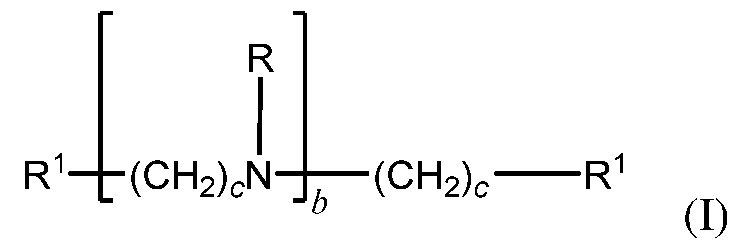
[0001] The present invention relates to a liquid laundry detergent formulation. In particular, the present invention relates to a liquid laundry detergent formulation, comprising a liquid carrier, a cleaning surfactant and a cleaning booster, wherein the cleaning booster is of formula (I),
Figure imgf000002_0001
wherein b is 0 to 2; wherein c is 2 to 4; wherein each R is independently selected from the group consisting of a hydrogen, a Ci-22 alkyl group, an R1 and a -CH2C(=0)R14 group; wherein each R1 is independently selected from the group consisting of formula (II), formula (III), formula (IV) and formula (V); wherein R14 is of formula (VI);
Figure imgf000002_0002
wherein the * indicates the point of attachment to formula (I); wherein each R2 is independently of formula (VI);
Figure imgf000002_0003
wherein the * indicates the point of attachment to formula (I); wherein each R3 is independently according to formula (VI); and wherein each R4 is independently selected from the group consisting of a hydrogen and a methyl group;
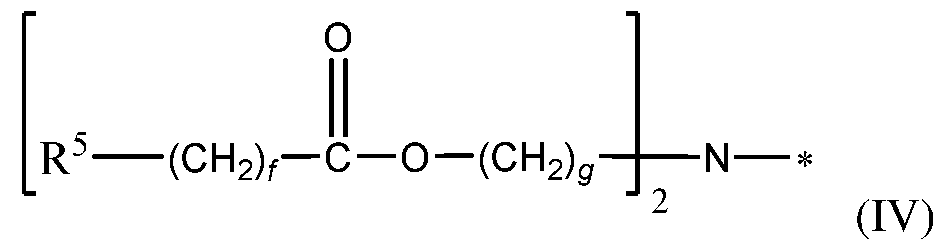
Figure imgf000002_0004
wherein the * indicates the point of attachment to formula (I); wherein each R5 is independently according to formula (VI); wherein/is 1 to 2; and wherein g is 2 to 10;
Figure imgf000003_0001
wherein the * indicates the point of attachment to formula (I); and wherein each R6 is independently according to formula (VI);
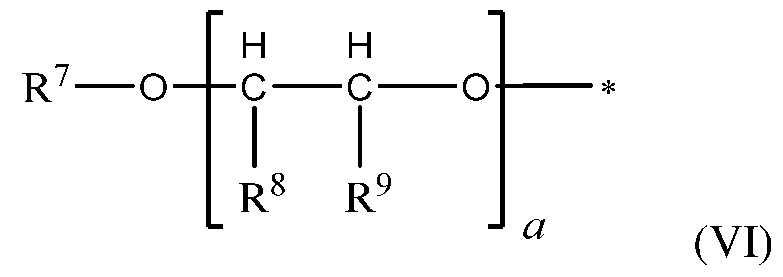
Figure imgf000003_0002
wherein the * indicates the point of attachment to the associated base formula; wherein R7 is selected from the group consisting of a hydrogen and a Ci-22 alkyl group; wherein each R8 and R9 is independently selected from the group consisting of a hydrogen and a C1-2 alkyl group, with the proviso that at least one of R8 and R9 is a hydrogen in each subunit a; and wherein a is 0 to 30.
[0002] Laundry detergents in liquid and gel forms providing excellent overall cleaning are desirable to consumers. Such laundry detergents typically include surfactants among other components to deliver the consumer desired cleaning benefits. Nevertheless, increasing sensitivity for the environment and rising material costs, a move to reduce the utilization of surfactants in laundry detergents is growing. Consequently, detergent manufactures are seeking ways to reduce the amount of surfactant per unit dose of the laundry detergent while maintaining overall cleaning performance.
[0003] One approach for reducing the unit dose of surfactant is to incorporate polymers into the liquid detergent formulations as described by Boutique et al. in U.S. Patent Application Publication No. 20090005288. Boutique et al. disclose a graft copolymer of polyethylene, polypropylene or polybutylene oxide with vinyl acetate in a weight ratio of from about 1:0.2 to about 1:10 for use in liquid or gel laundry detergent formulations having about 2 to about 20 wt% surfactant.
[0004] Notwithstanding, there remains a continuing need for liquid laundry detergent formulations exhibiting maintained primary cleaning performance with a reduced surfactant loading; preferably, while also providing improved anti-redeposition performance. There is also a continuing need for new cleaning boosters with improved biodegradability according to OECD 301F protocol when compared with conventional cleaning boosters. [0005] The present invention provides a liquid laundry detergent formulation, comprising: a liquid carrier; a cleaning surfactant; and a cleaning booster, wherein the cleaning booster is of formula (I)
Figure imgf000004_0001
wherein b is 0 to 2; wherein c is 2 to 4; wherein each R is independently selected from the group consisting of a hydrogen, a Ci-22 alkyl group, an R1 and a -CH2C(=0)R14 group; wherein each R1 is independently selected from the group consisting of formula (II), formula (III), formula (IV) and formula (V); wherein R14 is of formula (VI);
Figure imgf000004_0002
wherein the * indicates the point of attachment to formula (I); wherein each R2 is independently of formula (VI);
Figure imgf000004_0003
wherein the * indicates the point of attachment to formula (I); wherein each R3 is independently according to formula (VI); and wherein each R4 is independently selected from the group consisting of a hydrogen and a methyl group;
Figure imgf000004_0004
wherein the * indicates the point of attachment to formula (I); wherein each R5 is independently according to formula (VI); wherein/is 1 to 2; and wherein g is 2 to 10;
Figure imgf000004_0005
wherein the * indicates the point of attachment to formula (I); and wherein each R6 is independently according to formula (VI);
Figure imgf000005_0001
wherein the * indicates the point of attachment to the associated base formula; wherein R7 is selected from the group consisting of a hydrogen and a Ci-22 alkyl group; wherein each R8 and R9 is independently selected from the group consisting of a hydrogen and a C1-2 alkyl group, with the proviso that at least one of R8 and R9 is a hydrogen in each subunit a; and wherein a is 0 to 30.
[0006] The present invention provides a liquid laundry detergent formulation, comprising: a liquid carrier; a cleaning surfactant; and a cleaning booster, wherein the cleaning booster is of formula (I)
Figure imgf000005_0002
wherein b is 0 to 2; wherein c is 2 to 4; wherein each R is independently selected from the group consisting of a hydrogen, a Ci-22 alkyl group, an R1 and a -CH2C(=0)R14 group; wherein each R1 is independently selected from the group consisting of formula (II), formula (III), formula (IV) and formula (V); wherein R14 is of formula (VI);
Figure imgf000005_0003
wherein the * indicates the point of attachment to formula (I); wherein each R2 is independently of formula (VI);
Figure imgf000005_0004
wherein the * indicates the point of attachment to formula (I); wherein each R3 is independently according to formula (VI); and wherein each R4 is independently selected from the group consisting of a hydrogen and a methyl group;
Figure imgf000006_0001
wherein the * indicates the point of attachment to formula (I); wherein each R5 is independently according to formula (VI); wherein/is 1 to 2; and wherein g is 2 to 10;
Figure imgf000006_0002
wherein the * indicates the point of attachment to formula (I); and wherein each R6 is independently according to formula (VI);
Figure imgf000006_0003
wherein the * indicates the point of attachment to the associated base formula; wherein R7 is selected from the group consisting of a hydrogen and a Ci-22 alkyl group; wherein each R8 and R9 is independently selected from the group consisting of a hydrogen and a C1-2 alkyl group, with the proviso that at least one of R8 and R9 is a hydrogen in each subunit a; and wherein a is 0 to 30, with the proviso that a is 2 to 30 in 70 to 100 mol% of the occurrences of formula (VI) in the cleaning booster.
[0007] The present invention provides a method of washing a fabric article, comprising: providing a soiled fabric article; providing a liquid laundry detergent formulation according to claim 1 ; providing a wash water; and applying the wash water and the liquid laundry detergent formulation to the soiled fabric to provide a cleaned fabric article.
DETAILED DESCRIPTION
[0008] It has been surprisingly found that the liquid laundry detergent formulations with a cleaning booster as described herein facilitate improvement in primary cleaning performance for sebum soil removal, while imparting good anit-redeposition performance for dust sebum and clay; and also exhibiting desirable biodegradability profiles according to OECD 30 IF protocol. [0009] Unless otherwise indicated, ratios, percentages, parts, and the like are by weight. Weight percentages (or wt%) in the composition are percentages of dry weight, i.e., excluding any water that may be present in the composition.
[0010] Preferably, the liquid laundry detergent formulation of the present invention, comprises a liquid carrier (preferably, 25 to 97.9 wt% (more preferably, 30 to 95.8 wt%; still more preferably, 40 to 93.5 wt%; yet more preferably, 45 to 91.75 wt%; most preferably, 50 to 89 wt%), based on weight of the liquid laundry detergent formulation, of the liquid carrier); a cleaning surfactant (preferably, 2 to 60 wt% (more preferably, 4 to 50 wt%; still more preferably, 6 to 40 wt%; yet more preferably, 7.5 to 35 wt%; most preferably, 10 to 30 wt%), based on weight of the liquid laundry detergent formulation, of the cleaning surfactant); and a cleaning booster (preferably, 0.1 to 15 wt% (more preferably, 0.2 to 12 wt%; still more preferably, 0.5 to 10 wt%; yet more preferably, 0.75 to 8 wt%; most preferably 1 to 7.5 wt%), based on weight of the liquid laundry detergent formulation, of the cleaning booster), wherein the cleaning booster is of formula (I)
Figure imgf000007_0001
wherein b is 0 to 2 (preferably, 1); wherein c is 2 to 4 (preferably, 2); wherein each R is independently selected from the group consisting of a hydrogen, a Ci-22 alkyl group and a -CH2C(=0)R14 group (preferably, a hydrogen, a C1-5 alkyl group and a -CH2C(=0)R14 group; more preferably, a hydrogen, a C1-2 alkyl group and a -CH2C(=0)R14; still more preferably, a methyl and a -CH2C(=0)R14 group; most preferably, a -CH2C(=0)R14 group); wherein R14 is of formula (VI); and wherein each R1 is independently selected from the group consisting of formula (II), formula (III), formula (IV) and formula (V) (preferably, formula (II) and formula (III); most preferably, formula (II));
Figure imgf000007_0002
wherein the * indicates the point of attachment to formula (I); wherein each R2 is independently of formula (VI) (i.e., the individual occurrences of R2 in formula (II) can be the same or different from one another);
Figure imgf000008_0001
wherein the * indicates the point of attachment to formula (I); wherein each R3 is independently according to formula (VI); and wherein each R4 is independently selected from the group consisting of a hydrogen and a methyl group;
Figure imgf000008_0002
wherein the * indicates the point of attachment to formula (I); wherein each R5 is independently according to formula (VI); wherein/is 1 to 2; and wherein g is 2 to 10;
Figure imgf000008_0003
wherein the * indicates the point of attachment to formula (I); and wherein each R6 is independently according to formula (VI);
Figure imgf000008_0004
wherein the * indicates the point of attachment to the associated base formula (i.e., formula (II), formula (III), formula (IV) or formula (V)); wherein R7 is selected from the group consisting of a hydrogen and a Ci-22 alkyl group (preferably, a hydrogen and a C 1-12 alkyl group; more preferably, a hydrogen and a C1-5 alkyl group; still more preferably, a hydrogen and a CM alkyl group; most preferably, a hydrogen and a C4 alkyl group); wherein each R8 and R9 is independently selected from the group consisting of a hydrogen and a C1-2 alkyl group, with the proviso that at least one of R8 and R9 is a hydrogen in each subunit a; and wherein a is 0 to 30 (preferably, with the proviso that a is 2 to 30 (preferably, 2 to 25; more preferably, 2 to 17; most preferably, 4 to 12) in 70 to 100 mol% (preferably, 80 to 100 mol%; more preferably, 90 to 100 mol%; most preferably, 95 to 100 mol%) of the occurrences of formula (VI) in the cleaning booster).
[0011] Preferably, the liquid laundry detergent formulation of the present invention, comprises a liquid carrier. More preferably, the liquid laundry detergent formulation of the present invention comprises 25 to 97.9 wt% (preferably, 30 to 95.8 wt%; more preferably, 40 to 93.5 wt%; yet more preferably, 45 to 91.75 wt%; most preferably, 50 to 89 wt %), based on weight of the liquid laundry detergent formulation, of a liquid carrier. Still more preferably, the liquid laundry detergent formulation of the present invention comprises 25 to 97.9 wt% (preferably, 30 to 95.8 wt%; more preferably, 40 to 93.5 wt%; yet more preferably, 45 to 91.75 wt%; most preferably, 50 to 89 wt%), based on weight of the liquid laundry detergent formulation, of a liquid carrier; wherein the liquid carrier comprises water. Most preferably, the liquid laundry detergent formulation of the present invention comprises 25 to 97.9 wt% (preferably, 30 to 95.8 wt%; more preferably, 40 to 93.5 wt%; yet more preferably, 45 to 91.75 wt%; most preferably, 50 to 89 wt%), based on weight of the liquid laundry detergent formulation, of a liquid carrier; wherein the liquid carrier is water.
[0012] Preferably, the liquid carrier optionally includes a water miscible liquid, such as, C1-3 alkanols, C1-3 alkanediols and mixtures thereof. More preferably, the liquid carrier optionally includes 0 to 10 wt% (preferably, 0.2 to 8 wt%; more preferably, 0.5 to 7.5 wt%), based on weight of the liquid carrier, of water miscible liquids; wherein the water miscible liquids are selected from the group consisting of C1-3 alkanols, C1-3 alkanediols (e.g., propylene glycol) and mixtures thereof. Most preferably, the liquid carrier optionally includes 0 to 10 wt% (preferably, 0.2 to 8 wt%; more preferably, 0.5 to 7.5 wt%), based on weight of the liquid carrier, of water miscible liquids; wherein the water miscible liquids are selected from the group consisting of ethanol, propylene glycol and mixtures thereof.
[0013] Preferably, the liquid laundry detergent formulation of the present invention, comprises: a cleaning surfactant. More preferably, the liquid laundry detergent formulation of the present invention, comprises: 2 to 60 wt% (preferably, 4 to 50 wt%; more preferably,
6 to 40 wt%; yet more preferably, 7.5 to 35 wt%; most preferably, 10 to 30 wt%), based on weight of the liquid laundry detergent formulation, of a cleaning surfactant. Still more preferably, the liquid laundry detergent formulation of the present invention, comprises: 2 to 60 wt% (preferably, 4 to 50 wt%; more preferably, 6 to 40 wt%; yet more preferably, 7.5 to 35 wt%; most preferably, 10 to 30 wt%), based on weight of the liquid laundry detergent formulation, of a cleaning surfactant; wherein the cleaning surfactant is selected from the group consisting of anionic surfactants, nonionic surfactants, cationic surfactants, amphoteric surfactants and mixtures thereof. Yet still more preferably, the liquid laundry detergent formulation of the present invention, comprises: 2 to 60 wt% (preferably, 4 to 50 wt%; more preferably, 6 to 40 wt%; yet more preferably, 7.5 to 35 wt%; most preferably, 10 to 30 wt %), based on weight of the liquid laundry detergent formulation, of a cleaning surfactant; wherein the cleaning surfactant is selected from the group consisting of a mixture including an anionic surfactant and a non-ionic surfactant. Most preferably, the liquid laundry detergent formulation of the present invention, comprises: 2 to 60 wt% (preferably, 4 to 50 wt%; more preferably, 6 to 40 wt%; yet more preferably, 7.5 to 35 wt%; most preferably, 10 to 30 wt%), based on weight of the liquid laundry detergent formulation, of a cleaning surfactant; wherein the cleaning surfactant includes a mixture of a linear alkyl benzene sulfonate, a sodium lauryl ethoxysulfate and a nonionic alcohol ethoxylate.
[0014] Anionic surfactants include alkyl sulfates, alkyl benzene sulfates, alkyl benzene sulfonic acids, alkyl benzene sulfonates, alkyl polyethoxy sulfates, alkoxylated alcohols, paraffin sulfonic acids, paraffin sulfonates, olefin sulfonic acids, olefin sulfonates, alpha-sulfocarboxylates, esters of alpha-sulfocarboxylates, alkyl glyceryl ether sulfonic acids, alkyl glyceryl ether sulfonates, sulfates of fatty acids, sulfonates of fatty acids, sulfonates of fatty acid esters, alkyl phenols, alkyl phenol poly ethoxy ether sulfates, 2-acryloxy-alkane-l-sulfonic acid, 2-acryloxy-alkane-l -sulfonate, beta-alkyloxy alkane sulfonic acid, beta-alkyloxy alkane sulfonate, amine oxides and mixtures thereof. Preferred anionic surfactants include Cs-2o alkyl benzene sulfates, Cs-2o alkyl benzene sulfonic acid, C8-20 alkyl benzene sulfonate, paraffin sulfonic acid, paraffin sulfonate, alpha-olefin sulfonic acid, alpha-olefin sulfonate, alkoxylated alcohols, Cs-2o alkyl phenols, amine oxides, sulfonates of fatty acids, sulfonates of fatty acid esters, Cs-io alkyl polyethoxy sulfates and mixtures thereof. More preferred anionic surfactants include Cn-ib alkyl benzene sulfonic acid, C12-16 alkyl benzene sulfonate, C12-18 paraffin-sulfonic acid, C12-18 paraffin-sulfonate, C12-16 alkyl polyethoxy sulfate and mixtures thereof.
[0015] Non-ionic surfactants include alkoxylates (e.g., polyglycol ethers, fatty alcohol polyglycol ethers, alkylphenol poly glycol ethers, end group capped poly glycol ethers, mixed ethers, hydroxy mixed ethers, fatty acid polyglycol esters and mixtures thereof. Preferred non- ionic surfactants include fatty alcohol polyglycol ethers. More preferred non- ionic surfactants include secondary alcohol ethoxylates, ethoxylated 2-ethylhexanol, ethoxylated seed oils, butanol caped ethoxylated 2-ethylhexanol and mixtures thereof. Most preferred non-ionic surfactants include secondary alcohol ethoxylates. [0016] Cationic surfactants include quaternary surface active compounds. Preferred cationic surfactants include quaternary surface active compounds having at least one of an ammonium group, a sulfonium group, a phosphonium group, an iodonium group and an arsonium group. More preferred cationic surfactants include at least one of a dialkyldimethylammonium chloride and alkyl dimethyl benzyl ammonium chloride. Still more preferred cationic surfactants include at least one of Ci6-i8 dialkyldimethylammonium chloride, a Cs-is alkyl dimethyl benzyl ammonium chloride di-tallow dimethyl ammonium chloride and di-tallow dimethyl ammonium chloride. Most preferred cationic surfactant includes di-tallow dimethyl ammonium chloride.
[0017] Amphoteric surfactants include betaines, amine oxides, alkylamidoalkylamines, alkyl- substituted amine oxides, acylated amino acids, derivatives of aliphatic quaternary ammonium compounds and mixtures thereof. Preferred amphoteric surfactants include derivatives of aliphatic quaternary ammonium compounds. More preferred amphoteric surfactants include derivatives of aliphatic quaternary ammonium compounds with a long chain group having 8 to 18 carbon atoms. Still more preferred amphoteric surfactants include at least one of C12-14 alkyldimethylamine oxide, 3-(N,N-dimethyl-N-hexadecyl-ammonio)propane- 1-sulfonate,
3-(N,N-dimethyl-N-hexadecylammonio)-2-hydroxypropane- 1 -sulfonate. Most preferred amphoteric surfactants include at least one of C12-14 alkyldimethylamine oxide.
[0018] Preferably, the liquid laundry detergent formulation of the present invention, comprises: 0.1 to 15 wt% (preferably, 0.2 to 12 wt%; more preferably, 0.5 to 10 wt%; yet more preferably, 0.75 to 8 wt%; most preferably 1 to 7.5 wt%), based on weight of the liquid laundry detergent formulation, of the cleaning booster; wherein the cleaning booster is of formula (I)
Figure imgf000011_0001
wherein b is 0 to 2 (preferably, 1); wherein c is 2 to 4 (preferably, 2); wherein each R is independently selected from the group consisting of a hydrogen, a Ci-22 alkyl group and a -CH2C(=0)R14 group (preferably, a hydrogen, a C1-5 alkyl group and a -CH2C(=0)R14 group; more preferably, a hydrogen, a C1-2 alkyl group and a -CH2C(=0)R14; still more preferably, a methyl and a -CH2C(=0)R14 group; most preferably, a -CH2C(=0)R14 group); wherein R14 is of formula (VI); and wherein each R1 is independently selected from the group consisting of formula (II), formula (III), formula (IV) and formula (V) (preferably, formula (II) and formula (III); most preferably, formula (II));
Figure imgf000012_0001
wherein the * indicates the point of attachment to formula (I); wherein each R2 is independently of formula (VI) (i.e., the individual occurrences of R2 in formula (II) can be the same or different from one another);
Figure imgf000012_0002
wherein the * indicates the point of attachment to formula (I); wherein each R3 is independently according to formula (VI); and wherein each R4 is independently selected from the group consisting of a hydrogen and a methyl group;
Figure imgf000012_0003
wherein the * indicates the point of attachment to formula (I); wherein each R5 is independently according to formula (VI); wherein/is 1 to 2; and wherein g is 2 to 10;
Figure imgf000012_0004
wherein the * indicates the point of attachment to formula (I); and wherein each R6 is independently according to formula (VI);
Figure imgf000012_0005
wherein the * indicates the point of attachment to the associated base formula (i.e., formula (II), formula (III), formula (IV) or formula (V)); wherein R7 is selected from the group consisting of a hydrogen and a Ci-22 alkyl group (preferably, a hydrogen and a C 1-12 alkyl group; more preferably, a hydrogen and a C1-5 alkyl group; still more preferably, a hydrogen and a CM alkyl group; most preferably, a hydrogen and a C4 alkyl group); wherein each R8 and R9 is independently selected from the group consisting of a hydrogen and a C1-2 alkyl group, with the proviso that at least one of R8 and R9 is a hydrogen in each subunit a; and wherein a is 0 to 30 (preferably, wherein a is 2 to 30 (preferably, 2 to 25; more preferably, 2 to 17; most preferably, 4 to 12) in 70 to 100 mol% (preferably, 80 to 100 mol%; more preferably, 90 to 100 mol%; most preferably, 95 to 100 mol%) of the occurrences of formula (VI) in the cleaning booster).
[0019] Preferably, the cleaning booster for cleaning dirty laundry, of the present invention, is of formula (I); wherein formula (I) is of formula (la)
Figure imgf000013_0001
wherein x is 0 to 2 (preferably, 1); wherein each R10 is independently of formula (VI)
Figure imgf000013_0002
wherein the * indicates the point of attachment to formula (la); wherein R7 is selected from the group consisting of a hydrogen and a Ci-22 alkyl group (preferably, a hydrogen and a Ci-12 alkyl group; more preferably, a hydrogen and a C1-5 alkyl group; still more preferably, a hydrogen and a C1-4 alkyl group; most preferably, a hydrogen and a C4 alkyl group); wherein each R8 and R9 is independently selected from the group consisting of a hydrogen and a C1-2 alkyl group, with the proviso that at least one of R8 and R9 is a hydrogen in each subunit a; and wherein a is 0 to 30. More preferably, the cleaning booster of the present invention is of formula (I); wherein formula (I) is of formula (la); wherein an average of 70 to 100 mol% (preferably, 80 to 100 mol%; more preferably, 90 to 100 mol%; most preferably, 95 to 100 mol%) of the R10 groups are of formula (VI) wherein a is 2 to 30. Still more preferably, the cleaning booster for cleaning dirty laundry of the present invention is of formula (I); wherein formula (I) is of formula (la); wherein an average of 70 to 100 mol% (preferably, 80 to 100 mol%; more preferably, 90 to 100 mol%; most preferably, 95 to 100 mol%) of the R10 groups are of formula (VI); wherein formula (VI) is of formula (Via)
R11— O— [CH2CH(R12)<¾— * (Via) wherein the * indicates the point of attachment to formula (la); wherein R11 is selected from the group consisting of a hydrogen and a Ci-22 alkyl group (preferably, a hydrogen and a Ci-12 alkyl group; more preferably, a hydrogen and a C1-5 alkyl group; still more preferably, a C1-4 alkyl group; most preferably, a C4 alkyl group); wherein each R12 is independently selected from the group consisting of a hydrogen and a C1-2 alkyl group; and wherein y is 2 to 30 (preferably, 2 to 25; more preferably, 2 to 17; most preferably, 4 to 12). Most preferably, the cleaning booster for cleaning dirty laundry of the present invention is of formula (I); wherein formula (I) is of formula (la); wherein an average of 70 to 100 mol% (preferably, 80 to 100 mol%; more preferably, 90 to 100 mol%; most preferably, 95 to 100 mol%) of the R10 groups are of formula (VI); wherein formula (VI) is of formula (VIb)
R13 — O — (EO)¾ — (PO), — (EO)j — * (VIb) wherein the * indicates the point of attachment to formula (la); wherein R13 is selected from the group consisting of a hydrogen and a Ci-12 alkyl group (preferably, a hydrogen and a Ci-12 alkyl group; more preferably, a hydrogen and a C1-5 alkyl group; still more preferably, a C1-4 alkyl group; most preferably, a C4 alkyl group); wherein EO is an ethylene oxide group; wherein PO is a propylene oxide group; wherein h is 0 to 30 (preferably, 0 to 5; more preferably, 0 to 2; most preferably, 0 to 1); wherein i is 0 to 30 (preferably, 0 to 10; more preferably, 0 to 7; most preferably, 2 to 5); wherein j is 0 and 30 (preferably, 2 to 10; more preferably, 2 to 8; most preferably, 2 to 6); and wherein h + i +j is 2 to 30 (preferably, 2 to
25; more preferably, 2 to 17; most preferably, 4 to 12).
[0020] Preferably, the liquid laundry detergent formulation of the present invention, optionally further comprises a structurant. More preferably, the liquid laundry detergent formulation of the present invention, further comprises 0 to 2 wt% (preferably, 0.05 to 0.8 wt%; more preferably, 0.1 to 0.4 wt%), based on weight of the liquid laundry detergent formulation, of a structurant. Most preferably, the liquid laundry detergent formulation of the present invention, further comprises 0 to 2 wt% (preferably, 0.05 to 0.8 wt%; more preferably, 0.1 to 0.4 wt%), based on weight of the liquid laundry detergent formulation, of a structurant; wherein the structurant is a non-poly meric, crystalline hydroxy-functional materials capable of forming thread like structuring systems throughout the liquid laundry detergent formulation when crystallized in situ.
[0021] Preferably, the liquid laundry detergent formulation of the present invention, optionally further comprises a hydrotrope. More preferably, the liquid laundry detergent formulation of the present invention, optionally further comprises: 0 to 15 wt% (preferably, 0.1 to 12 wt%; more preferably, 0.2 to 10 wt%; most preferably, 0.5 to 7.5 wt%), based on the weight of the liquid laundry detergent formulation, of a hydrotrope. More preferably, the liquid laundry detergent formulation of the present invention, optionally further comprises: 0 to 15 wt% (preferably, 0.1 to 12 wt%; more preferably, 0.2 to 10 wt%; most preferably, 0.5 to 7.5 wt%), based on the weight of the liquid laundry detergent formulation, of a hydrotrope; wherein the hydrotrope is selected from the group consisting of alkyl hydroxides; glycols; urea; monoethanolamine; diethanolamine; triethanolamine; calcium, sodium, potassium, ammonium and alkanol ammonium salts of xylene sulfonic acid, toluene sulfonic acid, ethylbenzene sulfonic acid, naphthalene sulfonic acid and cumene sulfonic acid; salts thereof and mixtures thereof. Most preferably, the liquid laundry detergent formulation of the present invention, further comprises: 0 to 15 wt% (preferably, 0.1 to 12 wt%; more preferably, 0.2 to 10 wt%; most preferably, 0.5 to 7.5 wt%), based on the weight of the liquid laundry detergent formulation, of a hydrotrope; wherein the hydrotrope is selected from the group consisting of ethanol, propylene glycol, sodium toluene sulfonate, potassium toluene sulfonate, sodium xylene sulfonate, ammonium xylene sulfonate, potassium xylene sulfonate, calcium xylene sulfonate, sodium cumene sulfonate, ammonium cumene sulfonate and mixtures thereof.
[0022] Preferably, the liquid laundry detergent formulation of the present invention, optionally further comprises a fragrance. More preferably, the liquid laundry detergent formulation of the present invention, optionally further comprises: 0 to 10 wt% (preferably, 0.001 to 5 wt%; more preferably, 0.005 to 3 wt%; most preferably, 0.01 to 2.5 wt%), based on the weight of the liquid laundry detergent formulation, of a fragrance.
[0023] Preferably, the liquid laundry detergent formulation of the present invention, optionally further comprises a builder. More preferably, the liquid laundry detergent formulation of the present invention, optionally further comprises: 0 to 50 wt% (preferably, 5 to 50 wt%; more preferably, 7.5 to 30 wt%), based on the weight of the liquid laundry detergent formulation, of a builder. Most preferably, the liquid laundry detergent formulation of the present invention, optionally further comprises: 0 to 50 wt% (preferably, 5 to 50 wt%; more preferably, 7.5 to 30 wt %), based on the weight of the liquid laundry detergent formulation, of a builder; wherein the builder; wherein the builder is selected from the group consisting of inorganic builders (e.g., tripolyphosphate, pyrophosphate); alkali metal carbonates; borates; bicarbonates; hydroxides; zeolites; citrates (e.g., sodium citrate); polycarboxylates; monocarboxylates; aminotrismethylenephosphonic acid; salts of aminotrismethylenephosphonic acid; hydroxyethanediphosphonic acid; salts of hydroxy ethanediphosphonic acid; diethylenetriaminepenta(methylenephosphonic acid); salts of diethylenetriaminepenta(methylenephosphonic acid); ethylenediaminetetraethylene- phosphonic acid; salts of ethylenediaminetetraethylene-phosphonic acid; oligomeric phosphonates; polymeric phosphonates; mixtures thereof.
[0024] Preferably, the liquid laundry detergent formulation of the present invention, optionally further comprises a fabric softener. More preferably, the liquid laundry detergent formulation of the present invention, optionally further comprises: 0 to 10 wt% (preferably, 0.5 to 10 wt%), based on the weight of the liquid laundry detergent formulation, of a fabric softener. Most preferably, the liquid laundry detergent formulation of the present invention, optionally further comprises: 0 to 10 wt% (preferably, 0.5 to 10 wt%), based on the weight of the liquid laundry detergent formulation, of a fabric softener; wherein the fabric softener is a cationic coacervating polymer (e.g., cationic hydroxyl ethyl cellulose; polyquaternium polymers and combinations thereof).
[0025] Preferably, the liquid laundry detergent formulation of the present invention, optionally further comprises a pH adjusting agent. More preferably, the liquid laundry detergent formulation of the present invention, optionally further comprises a pH adjusting agent; wherein the liquid laundry detergent formulation has a pH from 6 to 12.5 (preferably, 6.5 to 11; more preferably, 7.5 to 10). Bases for adjusting pH include mineral bases such as sodium hydroxide (including soda ash) and potassium hydroxide; sodium bicarbonate; sodium silicate; ammonium hydroxide; and organic bases (e.g., mono-, di- or tri ethanolamine; and 2-dimethylamino-2-methyl- 1 -propanol (DMAMP)). Acids to adjust the pH include mineral acids (e.g., hydrochloric acid, phosphorus acid and sulfuric acid) and organic acids (e.g., acetic acid).
[0026] Preferably, the method of washing a fabric article of the present invention, comprises: providing a soiled fabric article (preferably, wherein the soiled fabric article is soiled with at least one of sebum oil, dust and clay soil; more preferably, wherein the soiled fabric article is soiled with sebum oils and clay soil)(preferably, wherein the soiled fabric article is selected from the group consisting of stained cotton fabric, stained cotton interlock fabric, stained cotton terry fabric, stained polyester cotton blend fabric, stained polyester knit fabric, stained polyester woven fabric and mixtures thereof; more preferably, wherein the soiled fabric article is at least one of stained cotton fabric and stained cotton interlock fabric); providing a liquid laundry detergent formulation of the present invention; providing a wash water; and applying the wash water and the liquid laundry detergent formulation to the soiled fabric to provide a cleaned fabric article. More preferably, the method of washing a fabric article of the present invention, comprises: providing a soiled fabric article (preferably, wherein the soiled fabric article is soiled with at least one of sebum oil, dust and clay soil; more preferably, wherein the soiled fabric article is soiled with sebum oils and clay soil)(preferably, wherein the soiled fabric article is selected from the group consisting of stained cotton fabric, stained cotton interlock fabric, stained cotton terry fabric, stained polyester cotton blend fabric, stained polyester knit fabric, stained polyester woven fabric and mixtures thereof; more preferably, wherein the soiled fabric article is at least one of stained cotton fabric and stained cotton interlock fabric); providing a liquid laundry detergent formulation of the present invention; providing a wash water; providing a rinse water; applying the wash water and the liquid laundry detergent formulation to the soiled fabric to provide a cleaned fabric article; and then applying the rinse water to the cleaned fabric article to remove the liquid laundry detergent formulation from the cleaned fabric article.
[0027] Some embodiments of the present invention will now be described in detail in the following Examples.
[0028] Reagents used in the Examples are described in TABLE 1.
TABLE 1
Figure imgf000018_0002
Synthesis SI: EO-terminated block PO-copolvmer
[0029] Potassium hydride (0.5 g) was dissolved with stirring, under nitrogen, in ethylene glycol monobutyl ether (25 g). Of this mixture, 23.6 g was charged by syringe to a nitrogen- purged reactor. The reactor was sealed and then charged with propylene oxide (41.5 g; 50.0 mL) at 120 °C with a pumping rate of 1 A reactor pressure increase was noted as
Figure imgf000018_0001
the propylene oxide was added. The reactor contents were allowed to react with the addition of the propylene oxide for 9 hours; during which time the reactor pressure was observed to decrease and then leveled off as the propylene oxide was consumed. Then ethylene oxide (33.5 g; 38.0 mL) was charged to the reactor contents at 130 °C with a pumping rate of 1 mL/min. The reactor contents were allowed to react with the addition of the ethylene oxide for 4 hours. The reactor was then vented, purged with nitrogen, and the product was recovered. The yield was quantitative. 1 H NMR (CDCL, d, ppm): 0.90 t (3H, CH3), 1.13 m (8.48 H, CH3 of PO), 1.35 m (2H, CH2), 1.55 m (2H, CH2), 3.55 m (35.93 H, CHCTL of PO + CH2CH2 of EO). NMR analysis suggested the following formula for the recovered product: CH3CH2CH2CH2OCH2CH20(PO)2.83(EO)5.36H. GPC (in THF): Mn = 739, Mw = 859, PDI = 1.16. For the purposes of calculating reaction stoichiometries in the referenced Syntheses to follow, the FW calculated from the established above empirical formula from NMR was used: 519 Daltons.
Synthesis S2: EO-terminated block PO-copolymer [0030] Potassium hydride (0.4 g) was dissolved with stirring, under nitrogen, in ethylene glycol monobutyl ether (20.75 g). Of this mixture, 21.15 g was charged by syringe to a nitrogen-purged reactor. The reactor was sealed and then charged with propylene oxide (41.5 g; 50.0 mL) at 115 °C with a pumping rate of 1 mL/min. A reactor pressure increase was noted as the propylene oxide was added. The reactor contents were allowed to react with the addition of the propylene oxide for 22 hours; during which time the reactor pressure was observed to decrease and then leveled off as the propylene oxide was consumed. Then ethylene oxide (28.85 g; 33.0 mL) was charged to the reactor contents at 130 °C with a pumping rate of 1 mL/min. The reactor contents were allowed to react with the addition of the ethylene oxide for 4 hours. The reactor was then vented, purged with nitrogen, and the product was recovered. The yield was 85.4 g (93%). 1 H NMR (CDCL, d, ppm): 0.90 t (3H, CH3), 1.13 m (11.05 H, CH3 of PO), 1.35 m (2H, CH2), 1.55 m (2H, CH2), 3.55 m (31.02 H, CHCH2 of PO + CH2CH2 of EO). NMR analysis suggests the following formula: CH3CH2CH2CH2OCH2CH20(PO) .68(EO) .49H. GPC (in THF): Mn = 641, Mw = 761, PDI = 1.19. For the purposes of calculating reaction stoichiometries in the examples to follow, the FW calculated from the established above empirical formula from NMR was used: 486 Daltons.
Synthesis S3: DTPA -ethyl ester using ethanol and sulfuric acid catalyst [0031] DTPA (8.5449 g), ethanol (168.54 g), and sulfuric acid (1.2000 g) were charged in an open atmosphere to a 500-mL flask containing a magnetic stir bar for stirring. Temperature of the flask contents was controlled by using a heating mantle connected to a variable transformer which was connected to a J-KEM temperature controller unit. The flask was fitted with an adapter connected to a three-way mineral oil bubbler that was connected to a nitrogen source in one neck. A condenser that circulates cold tap water was fitted to another neck of the flask. An alcohol thermometer was placed in another neck of the flask and configured to measure the headspace temperature. All necks of the flask were sealed with hydrocarbon grease. The charged and sealed apparatus was placed on top of a heating mantle which was placed on top of a magnetic stirrer. The flask was purged for the duration of the reaction with nitrogen at 2-3 bubbles per second as indicated by an inlet mineral oil bubbler. Seal quality was verified by an exit mineral oil bubbler connected to the condenser. The flask contents were heated to reflux (~ 78 °C headspace vapor temperature) and held with adequate mixing for a total of 19 hours over a period of several days (with heating and agitation stopped during overnight periods, which periods were not counted as part of the 19 hours). The flask contents were then filtered through paper using a Buchner funnel with vacuum assistance. Calcium carbonate (5.0 g) was added to the filtrate and allowed to stir for 30 minutes before filtering again using vacuum filtration. The filtrate was separated into 2 aliquots that were distilled sequentially. Approximately 100-150 mL of sample was placed in a 250-mL round bottom flask equipped with a magnetic stir bar and a vacuum distillation head and placed under nitrogen atmosphere with a steady nitrogen flow maintained with a bubbler. Distillation with solvent recovery was continued until the rate of solvent recovery slowed markedly. After the first half of the filtrate was subjected to distillation, the remainder of the filtrate was added and the distillation repeated. The product, DTPA-ethyl ester, was obtained as a dark orange-brown viscous liquid. 1 H NMR (acetone-de, d, ppm): 4.91-4.46 (1.87 H), 4.37-4.24 (0.81 H), 4.24-4.10 (5.83 H), 4.01-3.91 (1.69 H), 3.85-3.62 (10.68 H), 3.64-3.54 (0.52 H), 3.46-3.25 (3.55 H), 2.14-1.92 (1.10 H), 1.41-1.16 (13.15 H), 1.16-1.06 (0.58 H). DTPA:ethyl ester groups = 1:4.13. DTPA-ethyl ester active: 98 wt %.
Synthesis S4: DTPA polyester using ethoxylated alcohol and acid catalyst [0032] DTPA-ethyl ester prepared according to Synthesis S3 (1.0172 g, 2.0 mmol), AE1 (7.0486 g, 11.8 mmol, 6.0 eq.) and butylstannoic acid (0.0721 g, 0.35 mmol, 18 mol%) were charged to a 250 mL flask with a magnetic stir bar. The flask was sealed with hydrocarbon grease, purged with nitrogen and then heated in an OptiTHERM® Reaction Block attached to an IKA magnetic heating plate with a set point temperature of 150 °C. After reaching 135 °C, vacuum was applied to the flask contents via a mechanical pump with an intervening solvent trap cooled with a dry ice/acetone bath. The mixing speed was adjusted from a setting of 50 to 300 rpm as the contents of the flask were heated to account for changes in viscosity. The flask contents were held at a temperature of 145-158 °C for six hours under vacuum. The flask contents were then cooled and characterized. The extent of displacement of ethyl groups was estimated by integrated peaks in the quantitative 13C NMR spectra for the methyl groups of AE1 (14.4 ppm) and ethyl ester (14.6 ppm). This ratio was 6.7:1, and since the original ethykDTPA ratio was 4.13:1 and the AEEDTPA ratio was 6.0, the ethykDTPA ratio in the product was 0.9:1 suggesting that ~ 80 % of the ethyl groups had been eliminated.
Synthesis S5: DTPA polyester using ethoxylated alcohol, diol and acid catalyst [0033] DTPA-ethyl ester prepared according to Synthesis S3 (0.9676 g, 1.9 mmol), AE1 (5.3243 g, 8.9 mmol, 4.8 eq.), PEG-300 (0.3712 g, 1.24 mmol, 0.65 eq.) and butylstannoic acid (0.0555 g, 0.27 mmol, 14 mol%) were charged to a 250 mL flask with a magnetic stir bar. The flask was sealed with hydrocarbon grease, purged with nitrogen and then heated in an OptiTHERM® Reaction Block attached to an IKA magnetic heating plate with a set point temperature of 150 °C. After reaching 133.5 °C, vacuum was applied to the flask contents via a mechanical pump with an intervening solvent trap cooled with a dry ice/acetone bath. The mixing speed was adjusted from a setting of 50 to 300 rpm as the contents of the flask were heated to account for changes in viscosity. The flask contents were held at a temperature of 142-149 °C for six hours under vacuum. The flask contents were then cooled and characterized. The extent of displacement of ethyl groups was estimated by integrated peaks in the quantitative 13C NMR spectra for the methyl groups of AE1 (14.4 ppm) and ethyl ester (14.6 ppm). This ratio was 4.6:1, and since the original ethykDTPA ratio was 4.13:1 and the AETDTPA ratio was 4.8:1, the ethykDTPA ratio in the product was 1:1 suggesting that ~ 75 % of the ethyl groups had been eliminated.
Synthesis S6: DTPA polyester using ethoxylated alcohol and acid catalyst [0034] DTPA-ethyl ester prepared according to Synthesis S3 (1.1378 g, 2.2 mmol), AE1 (6.9510 g, 13.7 mmol, 6.2 eq.) and butylstannoic acid (0.0798 g, 0.38 mmol, 17 mol%) were charged to a 250 mL flask with a magnetic stir bar. The flask was sealed with hydrocarbon grease, purged with nitrogen and then heated in an OptiTHERM® Reaction Block attached to an IKA magnetic heating plate with a set point temperature of 150 °C. After reaching 120 °C, vacuum was applied to the flask contents via a mechanical pump with an intervening solvent trap cooled with a dry ice/acetone bath. The mixing speed was adjusted from a setting of 50 to 300 rpm as the contents of the flask were heated to account for changes in viscosity. The flask contents were held at a temperature of 121-149 °C for seven hours under vacuum. The flask contents were then cooled and characterized. The extent of displacement of ethyl groups was estimated by integrated peaks in the quantitative 13C NMR spectra for the methyl groups of AE1 (14.4 ppm) and ethyl ester (14.6 ppm). This ratio was 6.5:1, and since the original ethykDTPA ratio was 4.13:1 and the AETDTPA ratio was 6.2:1, the ethykDTPA ratio in the product was 0.94: 1 suggesting that ~ 75 % of the ethyl groups had been eliminated.
Synthesis S7: DTPA-penta ethyl ester using ethanol and sulfuric acid catalyst [0035] DTPA (5.0008 g), ethanol (177.59 g), and sulfuric acid (1.2118 g) were charged in an open atmosphere to a 500-mL flask containing a magnetic stir bar for stirring. Temperature of the flask contents was controlled by using a heating mantle connected to a variable transformer which was connected to a J-KEM temperature controller unit. The flask was fitted with an adapter connected to a three-way mineral oil bubbler that was connected to a nitrogen source in one neck. A condenser that circulates cold tap water was fitted to another neck of the flask. An alcohol thermometer was placed in another neck of the flask and configured to measure the headspace temperature. All necks of the flask were sealed with hydrocarbon grease. The charged and sealed apparatus was placed on top of a heating mantle which was placed on top of a magnetic stirrer. The flask was purged for the duration of the reaction with nitrogen at 2-3 bubbles per second as indicated by an inlet mineral oil bubbler. Seal quality was verified by an exit mineral oil bubbler connected to the condenser. The flask contents were heated to reflux (~ 78 °C headspace vapor temperature) and held with adequate mixing for a total of 32 hours over a period of several days (with heating and agitation stopped during overnight periods, which periods were not counted as part of the 32 hours). The flask contents were then filtered through paper using a Buchner funnel with vacuum assistance. Calcium carbonate (5.0 g) was added to the filtrate and allowed to stir for 30 minutes before filtering again using vacuum filtration. The filtrate was separated into 2 aliquots that were distilled sequentially. Approximately 100-150 mL of sample was placed in a 250-mL round bottom flask equipped with a magnetic stir bar and a vacuum distillation head and placed under nitrogen atmosphere with a steady nitrogen flow maintained with a bubbler. Distillation with solvent recovery was continued until the rate of solvent recovery slowed markedly. After the first half of the filtrate was subjected to distillation, the remainder of the filtrate was added and the distillation repeated. The product, DTPA-ethyl ester, was obtained as a faint yellow translucent liquid. DTPA:ethyl ester groups = 1:4.17. DTPA-ethyl ester active: 87 wt %.
Synthesis S8: DTPA polyester using alkoxylated butanol and acid catalyst [0036] DTPA-ethyl ester prepared according to Synthesis S7 (1.0966 g, 1.86 mmol), EO-terminated block copolymer prepared according to Synthesis SI (5.6161 g, 10.8 mmol, 5.8 eq.) and butylstannoic acid (0.0718 g, 0.34 mmol, 18 mol%) were charged to a 250 mL flask with a magnetic stir bar. The flask was sealed with hydrocarbon grease, purged with nitrogen and then heated in an OptiTHERM® Reaction Block attached to an IKA magnetic heating plate with a set point temperature of 150 °C. After reaching 133.5 °C, vacuum was applied to the flask contents via a mechanical pump with an intervening solvent trap cooled with a dry ice/acetone bath. The mixing speed was adjusted from a setting of 50 to 300 rpm as the contents of the flask were heated to account for changes in viscosity. The flask contents were held at a temperature of 133-148 °C for five hours under vacuum. The flask contents were then cooled and characterized. The extent of displacement of ethyl groups was estimated by integrated peaks in the quantitative 13C NMR spectra for the methyl groups of the product of Synthesis SI (14.3 ppm) and ethyl ester (14.6 ppm). This ratio was 5.3:1, and since the original ethyhDTPA ratio was 4.17:1 and the alkoxylate:DTPA ratio was 4.1:1, the ethykDTPA ratio in the product was 0.8:1 suggesting that ~ 80 % of the ethyl groups had been eliminated.
Synthesis S9: DTPA-penta ethyl ester using ethanol and sulfuric acid catalyst [0037] DTPA (8.0224 g), ethanol (304.80 g), and sulfuric acid (2.2318 g) were charged in an open atmosphere to a 500-mL flask containing a magnetic stir bar for stirring. Temperature of the flask contents was controlled by using a heating mantle connected to a variable transformer which was connected to a J-KEM temperature controller unit set at 85 °C. The flask was fitted with an adapter connected to a three-way mineral oil bubbler that was connected to a nitrogen source in one neck. A condenser that circulates cold tap water was fitted to another neck of the flask. An alcohol thermometer was placed in another neck of the flask and configured to measure the headspace temperature. All necks of the flask were sealed with hydrocarbon grease. The charged and sealed apparatus was placed on top of a heating mantle which was placed on top of a magnetic stirrer. The flask was purged for the duration of the reaction with nitrogen at 2-3 bubbles per second as indicated by an inlet mineral oil bubbler. Seal quality was verified by an exit mineral oil bubbler connected to the condenser. The flask contents were heated to reflux (~ 79 °C headspace vapor temperature) and held with adequate mixing for a total of 20 hours over a period of several days (with heating and agitation stopped during overnight periods, which periods were not counted as part of the 20 hours). The flask contents were then filtered through paper using a Buchner funnel with vacuum assistance. Calcium carbonate (5.0 g) was added to the filtrate and allowed to stir for 30 minutes before filtering again using vacuum filtration. The filtrate was placed in a 500-mL round bottom flask equipped with a magnetic stir bar and a vacuum distillation head and placed under nitrogen atmosphere with a steady nitrogen flow maintained with a bubbler. Distillation with solvent recovery was continued until the rate of solvent recovery slowed markedly. The product, DTPA-ethyl ester, was obtained as a faint yellow translucent liquid. DTPA:ethyl ester groups = 1:5. DTPA-ethyl ester active: 82 wt %.
Synthesis S10: DTPA polyester using alkoxylated butanol and acid catalyst [0038] DTPA-ethyl ester prepared according to Synthesis S9 (4.1987 g, 6.48 mmol), EO-terminated block copolymer prepared according to Synthesis SI (20.0 g, 38.5 mmol, 5.9 eq.) and titanium isopropoxide (0.3371 g, 1.19 mmol, 18 mol%) were charged to a 250 mL flask with a magnetic stir bar. The flask was sealed with hydrocarbon grease, purged with nitrogen and then heated in an OptiTHERM® Reaction Block attached to an IKA magnetic heating plate with a set point temperature of 150 °C. After reaching 129 °C, vacuum was applied to the flask contents via a mechanical pump with an intervening solvent trap cooled with a dry ice/acetone bath. The mixing speed was adjusted from a setting of 50 to 300 rpm as the contents of the flask were heated to account for changes in viscosity. The flask contents were held at a temperature of 150-152 °C for five hours under vacuum. The flask contents were then cooled and characterized. According to NMR, no ethyl groups remained in the 1 H NMR spectra, and the 13C NMR showed that the carbonyl region is very simple with two peaks for the two types of esters at 168 ppm and 173 ppm.
Synthesis Sll: Ester synthesis
[0039] Capryleth-6 carboxylic acid (20.8032 g, 46.91 mmol based on nominal purity of 92 %, 4.1 eq.), A,A,A’,A’-tetrakis(2-hydroxyethyl)ethylenediamine (2.6629 g, 11.4 mmol) and titanium isopropoxide (0.5429 g, 1.9102 mmol, 17 mol%) were charged to a 250 mL flask with a magnetic stir bar. The flask was sealed with hydrocarbon grease, purged with nitrogen and then heated in an OptiTHERM® Reaction Block attached to an IKA magnetic heating plate with a set point temperature of 150 °C. After reaching 120 °C, vacuum was applied to the flask contents via a mechanical pump with an intervening solvent trap cooled with a dry ice/acetone bath. The mixing speed was adjusted from a setting of 50 to 300 rpm as the contents of the flask were heated to account for changes in viscosity. The flask contents were held at a temperature of 148.3-154.9 °C for 6.5 hours under vacuum. The flask contents were then cooled and characterized via NMR to confirm completion of reaction. 1 H NMR (acetone-fife, d, ppm): 4.47-3.87 (15.2 H), 3.87-3.25 (97.8 H), 2.99-2.79 (4.3 H), 2.79-2.35 (4.8 H), 1.74-1.44 (8.1 H), 1.44-1.14 (40.3 H), 1.00-0.78 (12.0 H). 13C NMR (126 MHz, acetone-fife, d, ppm): 171.06 (2.2 C), 73.36-70.07 (35.5 C), 69.02 (2.7 C), 63.49 (2.8 C), 54.26 (2.8 C), 32.66 (3.6 C), 27.01 (3.3 C), 23.39 (4.0 C), 14.46 (4.0 C).
Synthesis S12: Ethylenediamine-methyl acrylate adduct [0040] A 40 mL glass vial with a pressure relief cap and a magnetic stirrer was charged with methyl acrylate (8.6 g, 100 mmol) and methanol (4 mL). To the contents of the vial was slowly added ethylenediamine (1.5 g, 25 mmol). A slight exotherm was observed during the addition of amine. The resulting solution was then placed on a block heater and stirred at 50 °C for seven hours. Progress of the reaction was monitored by 1 H NMR spectroscopy. Upon complete conversion of amine to tetrasubstituted adduct, methanol was distilled off in a rotary evaporator to yield 9.3 g, 92 % molar yield, of slightly viscous light yellow adduct.
Synthesis S13: Transesterification of methyl acrylate adduct with alkoxylated butanol [0041] EO-terminated block copolymer prepared according to Synthesis SI (10.3419 g,
13.99 mmol, 3.1 eq.), material prepared according to Synthesis S12 (1.8526 g, 4.58 mmol) and titanium isopropoxide (0.1733 g, 0.61 mmol, 13 mol%) were charged to a 250 mL flask with a magnetic stir bar. The flask was sealed with hydrocarbon grease, purged with nitrogen and then heated in an OptiTHERM® Reaction Block attached to an IKA magnetic heating plate with a set point temperature of 120 °C. After reaching 44.4 °C, vacuum was applied to the flask contents via a mechanical pump with an intervening solvent trap cooled with a dry ice/acetone bath. The mixing speed was adjusted from a setting of 50 to 300 rpm as the contents of the flask were heated to account for changes in viscosity. The flask contents were held at a temperature of 118.9-122.3 °C for six hours under vacuum. The flask contents were then cooled and characterized by NMR to confirm completion of the reaction.
Synthesis S14: Adduct from methyl acrylate and 3.3’-diamino-n-methyldipropylamine [0042] Methyl acrylate (8.6 g, 100 mmol) and methanol (4 mL) was charged to a glass vial with a magnetic stir bar and a pressure relief cap. N, /V-bi s( 3 -ami nopropyl ) methyl am i ne (3.5 g, 24 mmol) was then slowly added to the contents of the vial. A slight exotherm was observed during the addition of amine. The resulting solution was then placed on a block heater and stirred at 50°C for 4.5 hours. Progress of the reaction was monitored by 1 H NMR spectroscopy. Upon complete conversion of amine to tetrasubstituted adduct, methanol was distilled off in a rotary evaporator to yield 11 g, 93.6 % molar yield, of slightly viscous light yellow adduct.
Synthesis S15: Transesterification of methyl acrylate adduct with alkoxylated butanol [0043] EO-terminated block copolymer prepared according to Synthesis SI (10.0539 g, 19.3866 mmol, 4.4 eq.), material prepared according to Synthesis S14 (2.1746 g, 4.4 mmol) and titanium isopropoxide (0.1694 g, 0.5960 mmol, 13.6 mol%) were charged to a 250 mL flask with a magnetic stir bar. The flask was sealed with hydrocarbon grease, purged with nitrogen and then heated in an OptiTHERM® Reaction Block attached to an IKA magnetic heating plate with a set point temperature of 120 °C. After reaching 86.4 °C, vacuum was applied to the flask contents via a mechanical pump with an intervening solvent trap cooled with a dry ice/acetone bath. The mixing speed was adjusted from a setting of 50 to 300 rpm as the contents of the flask were heated to account for changes in viscosity. The flask contents were held at a temperature of 117.5-124.7 °C for nine hours under vacuum. The flask contents were then cooled and characterized by NMR to confirm completion of the reaction. Comparative Examples C1-C2 and Examples 1-4: Liquid Laundry Detergent [0044] The liquid laundry detergent formulations used in the cleaning tests in the subsequent Examples were prepared having the generic formulation as described in TABLE 2 with the cleaning booster as noted in TABLE3 neutralized to a pH of8.5 were prepared by standard liquid laundry formulation preparation procedures.
TABLE2
Figure imgf000026_0001
TABLE3
Figure imgf000026_0002
Primary Cleaning Performance
[0045] The primary cleaning performance of the liquid laundry detergent formulations of Comparative Examples C1-C2 and Examples 1-4 were assessed in a Launder- Ometer (SDL Atlas, Model M228AA) at a set test temperature of 22 °C using an 18 minute wash cycle. Twenty of the 1.2 liter canisters were filled with 500 mL of hardness adjusted water at 100 ppm by mass with 2:1 Ca:Mg molar ratio were used for each run. The washed fabrics were rinsed in 300 mL of 100 ppm (2/1 Ca/Mg) hardness adjusted water at ambient temperature for 5 minutes at 260 osc/min pm on an Eberbach E6000 reciprocal shaker. The stained fabrics and soiled ballasts used in the tests were PCS-S-132 high discriminative sebum BEY pigment and PCS-S-94 sebum/dust ASTM stains from Testfabrics stitched to a pre-shrunk cotton interlock fabric. The size of the cotton interlock was 5x5 cm. The stained swatches were 2.5 x 3 cm. One 5 x 5 cm cut SBL-CFT soil ballast was added to each canister to provide baseline soil to the wash solution. The total surfactant concentration in the wash liquor was 200 ppm.
Reflectance measurement and Stain Removal Index (SRI)
[0046] The soil removal index (SRI) for each of the Liquid Laundry Detergent formulations evaluated in Primary Cleaning Performance Test were determined using ASTM Method D4265-14. The average SRI taken from 8 swatches per condition (two swatches per pot, 4 pots) is provided in TABLE 4.
[0047] The L*, a* and b* values of the stained fabrics were measured pre and post wash with a Mach 5 spectrophotometer from Colour Consult. The L*, a* and b* values for the unwashed, unstained poly cotton fabric was measured in the SRI calculations as follows: loo
Figure imgf000027_0001
wherein US is the unwashed stain area, UF is the unwashed (unstained) fabric area, WS is the washed stain area, A E*(US-UF> is the DE* color difference between the unwashed stain and the unwashed fabric and E*(WS-UF> is the DE* color difference between the washed stain and the unwashed fabric. The value of DE* is calculated as
DE* = (AL*2 + Aa 2 + Ab*2)½
The A SRI values provided in TABLE 4 give the difference between the SRI measured for the noted example relative to the SRI measured for Comparative Example Cl. A positive value indicates an increase in soil removal relative to Comparative Example Cl.
TABLE 4
Figure imgf000027_0002
1 available from Stepan Company under the tradename BIO-SOFT® N25-9
Comparative Examples C3-C4 and Examples 5-7: Liquid Laundry Detergent [0048] The liquid laundry detergent formulation used in the cleaning tests in the subsequent Examples was prepared by combining 0.5 g of a standard liquid laundry detergent formulation with an adjusted pH of 8.5 as described in TABLE 5 with 1.5 g of a 1 w% aqueous solution of the cleaning booster noted in TABLE 6. TABLE 5
Figure imgf000028_0001
TABLE 6
Figure imgf000028_0002
Anti-redeposition
[0049] The anti-redeposition performance of the combination of the standard liquid laundry detergent + cleaning booster of Comparative Examples C3-C4 and Examples 5-7 was assessed in a Terg-o-tometer Model 7243ES agitated at 90 cycles per minute with the conditions noted in TABLE 7.
TABLE 7
Figure imgf000028_0003
[0050] The antiredeposition performance was determined by calculating the DE measured with a MACH 5+ instrument (L, a & b). The results are noted in TABLE 8, wherein AE* is according to the equation
AE* = AEaw - AEb wherein AEaw is measured from fabrics after washing, and AEbw is measured from fabrics before washing. A higher AE* corresponds with better antiredeposition performance.
TABLE 8
Figure imgf000029_0001

Claims

We claim:
1. A liquid laundry detergent formulation, comprising: a liquid carrier; a cleaning surfactant; and a cleaning booster, wherein the cleaning booster is of formula (I)
Figure imgf000030_0001
wherein b is 0 to 2; wherein c is 2 to 4; wherein each R is independently selected from the group consisting of a hydrogen, a Ci-22 alkyl group and a -CH2C(=0)R14 group; wherein R14 is of formula (VI); and wherein each R1 is independently selected from the group consisting of formula (II), formula (III), formula (IV) and formula (V);
Figure imgf000030_0002
wherein the * indicates the point of attachment to formula (I); wherein each R2 is independently of formula (VI);
Figure imgf000030_0003
wherein the * indicates the point of attachment to formula (I); wherein each R3 is independently according to formula (VI); and wherein each R4 is independently selected from the group consisting of a hydrogen and a methyl group;
Figure imgf000030_0004
wherein the * indicates the point of attachment to formula (I); wherein each R5 is independently according to formula (VI); wherein/is 1 to 2; and wherein g is 2 to 10;
Figure imgf000031_0001
wherein the * indicates the point of attachment to formula (I); and wherein each R6 is independently according to formula (VI);
Figure imgf000031_0002
wherein the * indicates the point of attachment to the associated base formula; wherein R7 is selected from the group consisting of a hydrogen and a Ci-22 alkyl group; wherein each R8 and R9 is independently selected from the group consisting of a hydrogen and a C1-2 alkyl group, with the proviso that at least one of R8 and R9 is a hydrogen in each subunit a; and wherein a is 0 to 30.
2. The liquid laundry detergent formulation, of claim 1 , wherein the liquid laundry detergent formulation comprises
25 to 97.9 wt%, based on weight of the liquid laundry detergent formulation, of the liquid carrier;
2 to 60 wt%, based on weight of the liquid laundry detergent formulation, of the cleaning surfactant; and
0.1 to 15 wt%, based on weight of the liquid laundry detergent formulation, of the cleaning booster.
3. The liquid laundry detergent formulation of claim 2, wherein the liquid carrier comprises water.
4. The liquid laundry detergent formulation of claim 3, wherein a is 2 to 30 in an average of 70 to 100 mol% of the occurrences of formula (VI) in the cleaning booster.
5. The liquid laundry detergent formulation of claim 3, wherein the cleaning booster of formula (I) is of formula (la)
Figure imgf000032_0001
wherein x is 0 to 2; wherein each R10 is independently of formula (VI).
6. The liquid laundry detergent formulation of claim 5, wherein an average of 70 to 100 mol% of the R10 groups in the cleaning booster are of formula (Via)
R11— O— [CH2CH(R12)<¾— * (Via) wherein the * indicates the point of attachment to formula (la); wherein R1 1 is selected from the group consisting of a hydrogen and a Ci-22 alkyl group; wherein each R12 is independently selected from the group consisting of a hydrogen and a C1-2 alkyl group; and wherein y is 2 to 30.
7. The liquid laundry detergent formulation of claim 5, wherein an average of 70 to 100 mol% of the R10 groups in the cleaning booster are of formula (VIb)
R13 — O — (EO)¾ — (PO), — (EO)j — * (VIb) wherein the * indicates the point of attachment to formula (la); wherein R13 is selected from the group consisting of a hydrogen and a Ci-12 alkyl group; wherein EO is an ethylene oxide group; wherein PO is a propylene oxide group; wherein h is 0 to 30; wherein i is 0 to 30; wherein j is 0 and 30; and wherein h + i +j is 2 to 30.
8. The liquid laundry detergent formulation of claim 7, wherein x is 1.
9. The liquid laundry detergent formulation of claim 8, wherein R13 is a C1-4 alkyl group; wherein h is 0 to 1 ; wherein i is 2 to 5; and 7 is 2 to 6.
10. A method of washing a fabric article, comprising: providing a soiled fabric article; providing a liquid laundry detergent formulation according to claim 1 ; providing a wash water; and applying the wash water and the liquid laundry detergent formulation to the soiled fabric to provide a cleaned fabric article.
PCT/US2022/036887 2021-07-16 2022-07-13 Liquid laundry detergent formulation Ceased WO2023287836A1 (en)

Priority Applications (6)

Application Number Priority Date Filing Date Title
CA3224836A CA3224836A1 (en) 2021-07-16 2022-07-13 Liquid laundry detergent formulation
US18/556,141 US20240199990A1 (en) 2021-07-16 2022-07-13 Liquid laundry detergent formulation
AU2022311786A AU2022311786A1 (en) 2021-07-16 2022-07-13 Liquid laundry detergent formulation
JP2023579208A JP2024524255A (en) 2021-07-16 2022-07-13 Liquid laundry detergent formulations
CN202280042001.5A CN117500904A (en) 2021-07-16 2022-07-13 Liquid laundry detergent formulations
EP22751912.1A EP4370639A1 (en) 2021-07-16 2022-07-13 Liquid laundry detergent formulation

Applications Claiming Priority (2)

Application Number Priority Date Filing Date Title
US202163222451P 2021-07-16 2021-07-16
US63/222,451 2021-07-16

Publications (1)

Publication Number Publication Date
WO2023287836A1 true WO2023287836A1 (en) 2023-01-19

Family

ID=82846340

Family Applications (1)

Application Number Title Priority Date Filing Date
PCT/US2022/036887 Ceased WO2023287836A1 (en) 2021-07-16 2022-07-13 Liquid laundry detergent formulation

Country Status (8)

Country Link
US (1) US20240199990A1 (en)
EP (1) EP4370639A1 (en)
JP (1) JP2024524255A (en)
CN (1) CN117500904A (en)
AR (1) AR126459A1 (en)
AU (1) AU2022311786A1 (en)
CA (1) CA3224836A1 (en)
WO (1) WO2023287836A1 (en)

Cited By (11)

* Cited by examiner, † Cited by third party
Publication number Priority date Publication date Assignee Title
WO2023227375A1 (en) 2022-05-27 2023-11-30 Unilever Ip Holdings B.V. Laundry liquid composition comprising a surfactant, an aminocarboxylate, an organic acid and a fragrance
WO2024213376A1 (en) 2023-04-11 2024-10-17 Unilever Ip Holdings B.V. Composition
WO2024213438A1 (en) 2023-04-11 2024-10-17 Unilever Ip Holdings B.V. Composition
WO2024213430A1 (en) 2023-04-11 2024-10-17 Unilever Ip Holdings B.V. Composition
WO2024213443A1 (en) 2023-04-11 2024-10-17 Unilever Ip Holdings B.V. Composition
WO2025011808A1 (en) 2023-07-11 2025-01-16 Unilever Ip Holdings B.V. Method for treating fabric
WO2025011886A1 (en) 2023-07-11 2025-01-16 Unilever Ip Holdings B.V. Method for treating fabric
EP4570890A1 (en) 2023-12-14 2025-06-18 Unilever IP Holdings B.V. Composition
WO2025124811A1 (en) 2023-12-14 2025-06-19 Unilever Ip Holdings B.V. Composition
EP4663728A1 (en) 2024-06-13 2025-12-17 Unilever IP Holdings B.V. Method for treating fabrics
EP4663729A1 (en) 2024-06-13 2025-12-17 Unilever IP Holdings B.V. Method for treating fabrics

Families Citing this family (1)

* Cited by examiner, † Cited by third party
Publication number Priority date Publication date Assignee Title
US12577504B2 (en) * 2021-07-16 2026-03-17 Dow Global Technologies Llc Liquid laundry detergent

Citations (5)

* Cited by examiner, † Cited by third party
Publication number Priority date Publication date Assignee Title
WO2003040281A1 (en) * 2001-11-08 2003-05-15 Green & Clean, Inc. The active soluble cleaning composite of natural state using soybean fatty acids and the making method thereof
US20090005288A1 (en) 2007-06-29 2009-01-01 Jean-Pol Boutique Laundry detergent compositions comprising amphiphilic graft polymers based on polyalkylene oxides and vinyl esters
US20110271458A1 (en) * 2010-05-05 2011-11-10 Hillary Enselberg Composition and method for removing stains from fabrics
WO2020123240A1 (en) * 2018-12-13 2020-06-18 Dow Global Technologies Llc Liquid laundry detergent formulation
WO2020251763A1 (en) * 2019-06-14 2020-12-17 Dow Global Technologies Llc Detergent formulation for liquid laundry

Family Cites Families (12)

* Cited by examiner, † Cited by third party
Publication number Priority date Publication date Assignee Title
WO1996006908A1 (en) * 1994-08-26 1996-03-07 The Procter & Gamble Company Ethylenediamine disuccinate as detergent builder
US7247607B2 (en) * 2001-11-08 2007-07-24 Green & Clean, Inc. Active soluble cleaning composite of natural state using soybean fatty acids and the making method thereof
CN1687181A (en) * 2005-04-18 2005-10-26 南京大学 Biodegradablc ligand of polyester macromolecule containing diethylene triaminepentaacetic acid, preparation method and application
WO2014158535A1 (en) * 2013-03-14 2014-10-02 The Government Of The United States Of America, As Represented By The Secretary Of The Navy Single-component moisture-curable coatings based on n-substituted urea polymers with extended chains and terminal alkoxysilanes
US9493726B2 (en) * 2014-09-08 2016-11-15 The Procter & Gamble Company Detergent compositions containing a predominantly C15 branched alkyl alkoxylated surfactant
EP3298119B2 (en) * 2015-05-22 2022-05-25 The Procter & Gamble Company Surfactant and detergent compositions containing ethoxylated glycerine
JP7548727B2 (en) * 2015-11-13 2024-09-10 ザ プロクター アンド ギャンブル カンパニー Cleaning compositions containing branched alkyl sulfate surfactants and linear alkyl sulfate surfactants
EP3448977A1 (en) * 2016-04-29 2019-03-06 Novozymes A/S Detergent compositions and uses thereof
AR119899A1 (en) * 2019-09-27 2022-01-19 Dow Global Technologies Llc LIQUID LAUNDRY DETERGENT WITH CLEANING REINFORCEMENT
JP2024524513A (en) * 2021-07-16 2024-07-05 ダウ グローバル テクノロジーズ エルエルシー Cleaning Booster Additive
US12577504B2 (en) * 2021-07-16 2026-03-17 Dow Global Technologies Llc Liquid laundry detergent
WO2023287837A1 (en) * 2021-07-16 2023-01-19 Dow Global Technologies Llc Cleaning booster

Patent Citations (5)

* Cited by examiner, † Cited by third party
Publication number Priority date Publication date Assignee Title
WO2003040281A1 (en) * 2001-11-08 2003-05-15 Green & Clean, Inc. The active soluble cleaning composite of natural state using soybean fatty acids and the making method thereof
US20090005288A1 (en) 2007-06-29 2009-01-01 Jean-Pol Boutique Laundry detergent compositions comprising amphiphilic graft polymers based on polyalkylene oxides and vinyl esters
US20110271458A1 (en) * 2010-05-05 2011-11-10 Hillary Enselberg Composition and method for removing stains from fabrics
WO2020123240A1 (en) * 2018-12-13 2020-06-18 Dow Global Technologies Llc Liquid laundry detergent formulation
WO2020251763A1 (en) * 2019-06-14 2020-12-17 Dow Global Technologies Llc Detergent formulation for liquid laundry

Cited By (11)

* Cited by examiner, † Cited by third party
Publication number Priority date Publication date Assignee Title
WO2023227375A1 (en) 2022-05-27 2023-11-30 Unilever Ip Holdings B.V. Laundry liquid composition comprising a surfactant, an aminocarboxylate, an organic acid and a fragrance
WO2024213376A1 (en) 2023-04-11 2024-10-17 Unilever Ip Holdings B.V. Composition
WO2024213438A1 (en) 2023-04-11 2024-10-17 Unilever Ip Holdings B.V. Composition
WO2024213430A1 (en) 2023-04-11 2024-10-17 Unilever Ip Holdings B.V. Composition
WO2024213443A1 (en) 2023-04-11 2024-10-17 Unilever Ip Holdings B.V. Composition
WO2025011808A1 (en) 2023-07-11 2025-01-16 Unilever Ip Holdings B.V. Method for treating fabric
WO2025011886A1 (en) 2023-07-11 2025-01-16 Unilever Ip Holdings B.V. Method for treating fabric
EP4570890A1 (en) 2023-12-14 2025-06-18 Unilever IP Holdings B.V. Composition
WO2025124811A1 (en) 2023-12-14 2025-06-19 Unilever Ip Holdings B.V. Composition
EP4663728A1 (en) 2024-06-13 2025-12-17 Unilever IP Holdings B.V. Method for treating fabrics
EP4663729A1 (en) 2024-06-13 2025-12-17 Unilever IP Holdings B.V. Method for treating fabrics

Also Published As

Publication number Publication date
AR126459A1 (en) 2023-10-11
CA3224836A1 (en) 2023-01-19
EP4370639A1 (en) 2024-05-22
JP2024524255A (en) 2024-07-05
US20240199990A1 (en) 2024-06-20
AU2022311786A1 (en) 2024-02-08
CN117500904A (en) 2024-02-02

Similar Documents

Publication Publication Date Title
WO2023287836A1 (en) Liquid laundry detergent formulation
EP4370641A1 (en) Liquid laundry detergent
AU2020356460B2 (en) Liquid laundry detergent with cleaning booster
US12577503B2 (en) Cleaning booster additive
CN113166688B (en) Liquid laundry detergent formulations
AU2023295233A1 (en) Laundry detergent formulation
AU2022309881A1 (en) Cleaning booster
EP4532477A1 (en) Liquid laundry detergent formulation
WO2025101312A1 (en) Lactone cleaning booster and liquid laundry detergent
WO2025264358A1 (en) Solid laundry detergent formulation
WO2025101311A1 (en) Cleaning booster and liquid laundry detergent
US20250283015A1 (en) Cleaning booster

Legal Events

Date Code Title Description
121 Ep: the epo has been informed by wipo that ep was designated in this application

Ref document number: 22751912

Country of ref document: EP

Kind code of ref document: A1

WWE Wipo information: entry into national phase

Ref document number: 18556141

Country of ref document: US

WWE Wipo information: entry into national phase

Ref document number: 202280042001.5

Country of ref document: CN

ENP Entry into the national phase

Ref document number: 2023579208

Country of ref document: JP

Kind code of ref document: A

REG Reference to national code

Ref country code: BR

Ref legal event code: B01A

Ref document number: 112023026951

Country of ref document: BR

WWE Wipo information: entry into national phase

Ref document number: 3224836

Country of ref document: CA

WWE Wipo information: entry into national phase

Ref document number: 202417002580

Country of ref document: IN

WWE Wipo information: entry into national phase

Ref document number: 2022311786

Country of ref document: AU

Ref document number: AU2022311786

Country of ref document: AU

ENP Entry into the national phase

Ref document number: 2022311786

Country of ref document: AU

Date of ref document: 20220713

Kind code of ref document: A

WWE Wipo information: entry into national phase

Ref document number: 2022751912

Country of ref document: EP

NENP Non-entry into the national phase

Ref country code: DE

ENP Entry into the national phase

Ref document number: 2022751912

Country of ref document: EP

Effective date: 20240216

ENP Entry into the national phase

Ref document number: 112023026951

Country of ref document: BR

Kind code of ref document: A2

Effective date: 20231220