WO2024002922A1 - Liquid laundry detergent formulation - Google Patents
Liquid laundry detergent formulation Download PDFInfo
- Publication number
- WO2024002922A1 WO2024002922A1 PCT/EP2023/067221 EP2023067221W WO2024002922A1 WO 2024002922 A1 WO2024002922 A1 WO 2024002922A1 EP 2023067221 W EP2023067221 W EP 2023067221W WO 2024002922 A1 WO2024002922 A1 WO 2024002922A1
- Authority
- WO
- WIPO (PCT)
- Prior art keywords
- detergent composition
- laundry detergent
- liquid laundry
- composition according
- apg
- Prior art date
- Legal status (The legal status is an assumption and is not a legal conclusion. Google has not performed a legal analysis and makes no representation as to the accuracy of the status listed.)
- Ceased
Links
Classifications
-
- C—CHEMISTRY; METALLURGY
- C11—ANIMAL OR VEGETABLE OILS, FATS, FATTY SUBSTANCES OR WAXES; FATTY ACIDS THEREFROM; DETERGENTS; CANDLES
- C11D—DETERGENT COMPOSITIONS; USE OF SINGLE SUBSTANCES AS DETERGENTS; SOAP OR SOAP-MAKING; RESIN SOAPS; RECOVERY OF GLYCEROL
- C11D10/00—Compositions of detergents, not provided for by one single preceding group
- C11D10/04—Compositions of detergents, not provided for by one single preceding group based on mixtures of surface-active non-soap compounds and soap
- C11D10/042—Compositions of detergents, not provided for by one single preceding group based on mixtures of surface-active non-soap compounds and soap based on anionic surface-active compounds and soap
-
- C—CHEMISTRY; METALLURGY
- C11—ANIMAL OR VEGETABLE OILS, FATS, FATTY SUBSTANCES OR WAXES; FATTY ACIDS THEREFROM; DETERGENTS; CANDLES
- C11D—DETERGENT COMPOSITIONS; USE OF SINGLE SUBSTANCES AS DETERGENTS; SOAP OR SOAP-MAKING; RESIN SOAPS; RECOVERY OF GLYCEROL
- C11D10/00—Compositions of detergents, not provided for by one single preceding group
- C11D10/04—Compositions of detergents, not provided for by one single preceding group based on mixtures of surface-active non-soap compounds and soap
- C11D10/045—Compositions of detergents, not provided for by one single preceding group based on mixtures of surface-active non-soap compounds and soap based on non-ionic surface-active compounds and soap
-
- C—CHEMISTRY; METALLURGY
- C11—ANIMAL OR VEGETABLE OILS, FATS, FATTY SUBSTANCES OR WAXES; FATTY ACIDS THEREFROM; DETERGENTS; CANDLES
- C11D—DETERGENT COMPOSITIONS; USE OF SINGLE SUBSTANCES AS DETERGENTS; SOAP OR SOAP-MAKING; RESIN SOAPS; RECOVERY OF GLYCEROL
- C11D3/00—Other compounding ingredients of detergent compositions covered in group C11D1/00
- C11D3/16—Organic compounds
- C11D3/20—Organic compounds containing oxygen
- C11D3/2003—Alcohols; Phenols
- C11D3/2065—Polyhydric alcohols
-
- C—CHEMISTRY; METALLURGY
- C11—ANIMAL OR VEGETABLE OILS, FATS, FATTY SUBSTANCES OR WAXES; FATTY ACIDS THEREFROM; DETERGENTS; CANDLES
- C11D—DETERGENT COMPOSITIONS; USE OF SINGLE SUBSTANCES AS DETERGENTS; SOAP OR SOAP-MAKING; RESIN SOAPS; RECOVERY OF GLYCEROL
- C11D3/00—Other compounding ingredients of detergent compositions covered in group C11D1/00
- C11D3/16—Organic compounds
- C11D3/38—Products with no well-defined composition, e.g. natural products
- C11D3/386—Preparations containing enzymes, e.g. protease or amylase
-
- C—CHEMISTRY; METALLURGY
- C11—ANIMAL OR VEGETABLE OILS, FATS, FATTY SUBSTANCES OR WAXES; FATTY ACIDS THEREFROM; DETERGENTS; CANDLES
- C11D—DETERGENT COMPOSITIONS; USE OF SINGLE SUBSTANCES AS DETERGENTS; SOAP OR SOAP-MAKING; RESIN SOAPS; RECOVERY OF GLYCEROL
- C11D1/00—Detergent compositions based essentially on surface-active compounds; Use of these compounds as a detergent
- C11D1/02—Anionic compounds
- C11D1/12—Sulfonic acids or sulfuric acid esters; Salts thereof
- C11D1/29—Sulfates of polyoxyalkylene ethers
-
- C—CHEMISTRY; METALLURGY
- C11—ANIMAL OR VEGETABLE OILS, FATS, FATTY SUBSTANCES OR WAXES; FATTY ACIDS THEREFROM; DETERGENTS; CANDLES
- C11D—DETERGENT COMPOSITIONS; USE OF SINGLE SUBSTANCES AS DETERGENTS; SOAP OR SOAP-MAKING; RESIN SOAPS; RECOVERY OF GLYCEROL
- C11D1/00—Detergent compositions based essentially on surface-active compounds; Use of these compounds as a detergent
- C11D1/66—Non-ionic compounds
- C11D1/662—Carbohydrates or derivatives
-
- C—CHEMISTRY; METALLURGY
- C11—ANIMAL OR VEGETABLE OILS, FATS, FATTY SUBSTANCES OR WAXES; FATTY ACIDS THEREFROM; DETERGENTS; CANDLES
- C11D—DETERGENT COMPOSITIONS; USE OF SINGLE SUBSTANCES AS DETERGENTS; SOAP OR SOAP-MAKING; RESIN SOAPS; RECOVERY OF GLYCEROL
- C11D2111/00—Cleaning compositions characterised by the objects to be cleaned; Cleaning compositions characterised by non-standard cleaning or washing processes
- C11D2111/10—Objects to be cleaned
- C11D2111/12—Soft surfaces, e.g. textile
Definitions
- the present invention relates to liquid laundry detergent formulations with plant based biodegradable surfactant and fermented surfactant.
- Detergent compositions are well known to include a large number of ingredients, offering particular functionality throughout the cleaning process.
- some detergent ingredients have faced scrutiny due to potential environmental concerns most of all for not being sustainable because they are from a non-renewable source and are poorly biodegradable or even persistent in the environment. It is desirable to provide alternatives that have an improved sustainability profile while maintaining compatibility with other detergent ingredients.
- the consumer benefits and performance effects must be maintained.
- Petrochemically derived detergent ingredients are not sustainable because they are derived from a non-renewable source and are often poorly biodegradable or even persistent in the environment.
- the inventors of the present invention have been able to reduce the total amount of surfactant compared to commercially available environmentally friendly detergent while at the same time maintaining wash performance by partly replacing surfactant with enzymes.
- the plant-based green formulation of the present invention is a sustainable and cost-effective formulation as compared to a commercial plant-based benchmark.
- the cost-window provides an opportunity to incorporate more of enzymes to improve wash performance- stain removal, and whiteness.
- the invention provides new detergent where surfactants can be replaced by enzymes, that is more compact than existing environmentally friendly detergent, has a reduced environmental impact compared to traditional fossil-based detergents and maintains wash performance.
- the pH of the formulation is that of 3.3 gram of the liquid laundry detergent composition dissolved in one litre of demineralised water at 25°C.
- Percentage of a product is the product in protonated form where relevant.
- detergent composition refers to compositions that find use in the removal of undesired compounds from items to be cleaned, such as textiles, dishes, and hard surfaces.
- the detergent composition may be used to e.g. clean textiles, dishes and hard surfaces for both household cleaning and industrial cleaning and/or for fabric care.
- the terms encompass any materials/compounds selected for the particular type of cleaning composition desired and the form of the product (e.g., liquid, gel, powder, granulate, paste, or spray compositions) and includes, but is not limited to, detergent compositions (e.g., liquid and/or solid laundry detergents and fine fabric detergents; hard surface cleaning formulations, such as for glass, wood, plastic, ceramic and metal counter tops and windows; carpet cleaners; oven cleaners; fabric fresheners; fabric softeners; and textile and laundry pre-spotters, as well as dish wash detergents).
- detergent compositions e.g., liquid and/or solid laundry detergents and fine fabric detergents
- hard surface cleaning formulations such as for glass, wood, plastic, ceramic and metal counter tops and windows
- carpet cleaners oven cleaners
- fabric fresheners fabric softeners
- textile and laundry pre-spotters as well as dish wash detergents
- the detergent formulation may contain one or more additional enzymes (such as amylases, proteases, peroxidases, cellulases, betaglucanases, xyloglucanases, hemicellulases, xanthanases, xanthan lyases, lipases, acyl transferases, phospholipases, esterases, laccases, catalases, aryl esterases, amylases, alpha-amylases, glucoamylases, cutinases, pectinases, pectate lyases, keratinases, reductases, oxidases, phenoloxidases, lipoxygenases, ligninases, carrageenases, pullulanases, tannases, arabinosidases, hyaluronidases, chondroitinases, xyloglucanases, xylanases,
- additional enzymes such as amylase
- improved wash performance is defined herein as an enzyme displaying an increased wash performance in a detergent composition relative to the wash performance of a reference enzyme, e.g., by increased color clarification and/or anti-pilling effect, when evaluating the fresh samples and/or after the samples have been stored under the same conditions.
- improved wash performance includes wash performance in laundry but also in, e.g., hard surface cleaning such as automated dish wash (ADW).
- ADW automated dish wash
- Plant based surfactants are surfactants based on constituents derived from plants such as palm kernel oil or coconut oil and glucose and vegetable oils respectively.
- the term “textile” means any textile material including yarns, yarn intermediates, fibers, nonwoven materials, natural materials, synthetic materials, and any other textile material, fabrics made of these materials and products made from fabrics (e.g., garments and other articles).
- the textile or fabric may be in the form of knits, wovens, denims, non-wovens, felts, yarns, and towelling.
- the textile may be cellulose based such as natural cellulosics, including cotton, flax/linen, jute, ramie, sisal or coir or manmade cellulosics (e.g. originating from wood pulp) including viscose/rayon, cellulose acetate fibers (tricell), lyocell or blends thereof.
- blends are blends of cotton and/or rayon/viscose with one or more companion material such as wool, synthetic fiber (e.g. polyamide fiber, acrylic fiber, polyester fiber, polyvinyl chloride fiber, polyurethane fiber, polyurea fiber, aramid fiber), and/or cellulose-containing fiber (e.g. rayon/viscose, ramie, flax/linen, jute, cellulose acetate fiber, lyocell).
- Fabric may be conventional washable laundry, for example stained household laundry. When the term fabric or garment is used, it is intended to include the broader term textiles as well.
- wash liquor refers to an aqueous solution containing a detergent composition in dilute form, such as but not limited to a detergent solution containing a laundry detergent composition in dilute form such as the wash liquor in a laundry process.
- Whiteness is defined herein as a broad term with different meanings in different regions and for different consumers. Loss of whiteness can e.g. be due to greying, yellowing, or removal of optical brighteners/hueing agents. Greying and yellowing can be due to soil redeposition, body soils, coloring from e.g. iron and copper ions or dye transfer. Whiteness might include one or several issues from the list below: colorant or dye effects; incomplete stain removal (e.g.
- the present invention concerns a laundry detergent formulation comprising
- anionic surfactant such as AES (Alkyl Ether Sulfate), AS (Alkyl Sulfate), preferably SLES with 1-3 moles of ethoxylation, MES (Methyl Ester Sulphonate), OS (Olefin Sulphonate), Sophorolipids
- non-ionic surfactant such as alkyl polyglucoside (APG), preferably APG, Cs-Ci4 glucoside (alkyl polyglucoside), FAEO- Fatty Alcohol Ethoxylate with 3-9 moles of ethoxylation, Rhamnolipids, Glucamides
- 3-8% builder such as citric acid, or substoichiometric quantities of GLDA (N,N-Dicarbox- ymethyl glutamic acid tetrasodium salt), MGDA (methylglycinediacetic acid trisodium salt), CMI Carboxymethyl inulines, EDDS Ethylenediamine disuccinic acid or preferably sodium citrate
- soap preferably obtained from coco fatty acid or palm kernel oil fatty acid
- solvent preferably polyol such as glycerol
- preservative preferably phenoxyethanol (2-phenoxyethan-1-ol), sodium benzoate, potassium sorbate, organic acids
- viscosity modifier preferably sodium chloride or hydroxy ethyl cellulose Add water to 100%
- Enzymes as desired may be added to the detergent formulation. pH of the final laundry detergent formulation is in the range 8-9, preferably 8.2-8.8, more preferably 8.4-8.6.
- Anionic surfactants are the workhorses of laundry detergents and thus difficult to replace.
- One of the most prominent anionic surfactants is linear alkylbenzenesulfonates (LAS) which contains a spread of chain length, but since LAS is based on non-renewable sources and not allowed in products with ecolabels it is important in the context of the present invention to find alternative anionic surfactant(s) that has a far more sustainable profile. In the pursuit of such alternative to LAS alkyl ethoxysulfates, in particular SLES, has shown useful.
- LAS linear alkylbenzenesulfonates
- Alkyl ethoxysulfates (AES, alkylpoly(oxyethylene) sulfate) have the general formula CH3(CH2)m(OCH2CH2)nOSC>3' and comprise the combination of a nonionic group with an anionic one. It is a common type of anionic for liquid detergents, usually those that are citrate-built.
- SLES is a particular AES with the chemical formula CH3(CH2)ii(OCH2CH2)nOSC>3Na.
- the product is heterogeneous in the number of ethoxy groups, where n is the mean, e.g. SLES, 2EO indicates the presence of two ethoxy groups.
- SLES is prepared by ethoxylation of dodecyl alcohol, which is produced industrially from palm kernel oil or coconut oil and is considered safe for consumer use: tests in the US indicate that it is safe for consumer use and The Australian government's Department of Health and Ageing and its National Industrial Chemicals Notification and Assessment Scheme (NICNAS) have determined that SLES does not react with DNA.
- NICNAS National Industrial Chemicals Notification and Assessment Scheme
- Nonionic surfactants contribute oil emulsification properties to detergents, are mostly easily formulated into liquid detergents. Detergents typically contain 3-10 % nonionic surfactant but liquid formulations may often contain more. There is a broad variety of non-ionic surfactants, of which some are almost used only industrially due to toxicology and biodegradability issues, e.g. alkylphenol ethoxylate (APE).
- APE alkylphenol ethoxylate
- APG alkyl polyglucosides
- APGs may differ in the alkyl chain length, both linear and monobranched, and in the degree of polymerisation of the saccharide.
- APG is considered attractive non-ionic surfactants widely used in the food, pharmaceutical, and cosmetic industries due to their low toxicity, biodegradability, and production from natural renewable resources.
- the alkyl length is in the range 6-16 and the degree of polymerisation is 1-3.
- non-ionic surfactants are bio-based surfactants e.g. wherein the surfactant is a sugar-based non-ionic surfactant which may be a hexyl-p-D-maltopyranoside, thiomaltopyranoside or a cyclic- maltopyranoside, such as described in EP2516606 B1.
- Sophorolipid and rhamnolipid are also considered relevant. Sophorolipids are glycosides and esters of the disaccharide sophorose (beta- D-glucopyranosyl-(1 ⁇ 2-D-glucose) in combination with a hydroxyfatty acid.
- Rhamnolipid is a glycolipid that may be in the form of a mono-rhamnolipid or a di-rhamnolipid which consists of one or two rhamnose groups, and a 3-(hydroxyalkanoyloxy)alkanoic acid (HAA) fatty acid tail, such as 3-hydroxydecanoic acid.
- HAA 3-(hydroxyalkanoyloxy)alkanoic acid
- Sodium citrate i.e. the sodium salt of 2-hydroxypropane-1 ,2,3-tricarboxylate
- Sodium citrate is a widely used builder in liquid detergents. Sodium citrate is produced from renewable raw materials, biodegradable and inexpensive.
- Soap is obtained by the saponification of fat, that is, salts of fatty acid carboxylates such as: CH 3 [CH 2 ]nCH 2 COO-, where n may vary within a particular soap source, e.g. soap made of coco fatty acid comprises the main fatty acids found in coconut oil, i.e. lauric acid (12:0), myristic acid (14:0), palmitic acid (16:0), oleic acid (18:1 omega-9), stearic acid (18:0) and linoleic acid (18:2 omega-6) representing from about 49% down to about 2% of the fatty acids in coco fatty acid.
- soap made of coco fatty acid comprises the main fatty acids found in coconut oil, i.e. lauric acid (12:0), myristic acid (14:0), palmitic acid (16:0), oleic acid (18:1 omega-9), stearic acid (18:0) and linoleic acid (18:2 omega-6) representing from about 49% down to
- the salts are preferably selected from alkali metal salts (in particular sodium (Na) and potassium (K)), MEA (monoethanolamine, i.e., 2-aminoethan-1-ol, NH 2 CH 2 CH 2 OH), DEA (diethanolamine", i.e., 2,2’-iminodiethan-1-ol, NH(CH 2 CH 2 OH) 2 ) and TEA (triethanolamine, i.e., 2,2’,2”-ni- trilotriethan-1 -ol, N(CH 2 CH 2 OH) 3 ). Because of the formation of toxic byproducts in the manufacture of DEA, this ingredient is less desirable as a salt.
- MEA monoethanolamine, i.e., 2-aminoethan-1-ol, NH 2 CH 2 CH 2 OH
- DEA diethanolamine
- TEA triethanolamine, i.e., 2,2’,2”-ni- trilotriethan-1 -ol, N
- soap based on coco fatty acid is preferred along with soaps based on palm kernel fatty acid as these come from renewable, plant-based sources, have mild detergency and used in detergents for cleaning applications.
- Unstructured liquid detergents i.e. isotropic solutions of surfactants and builders may also contain solvents such as ethanol, isopropyl alcohol (propan-2-ol) and polyols.
- Polyols are good solvents for surfactant systems and are typically selected from glycerol (propane-1 , 2, 3-triol), MPG (pro- pane-1 , 2-diol), diethylene glycol (2,2'-Oxydi(ethan-1-ol)) and dipropylene glycol (a mixture of three isomeric chemical compounds, 4-oxa-2,6-heptandiol, 2-(2-hydroxy-propoxy)-propan-1 -ol, and 2-(2-hydroxy-1 -methyl-ethoxy)-propan-1-ol.).
- 2-5% polyol leads to stabilization of enzymes present in the detergent.
- solvents are also often termed hydrotropes; the two terms may be used interchangeably.
- Phenoxyethanol (2-phenoxyethan-1-ol), isothiazolinones such as benzisothiazol-3 (2/7)-one (ProxelTM) and 2-methylisothiazol-3(2/7)-one, Bronopol (2-bromo-2-nitropropane-1 ,3-diol), and lactic acid.
- the various preservatives are subject to varying regulatory restrictions and their effectiveness depends on pH and other ingredients.
- phenoxyethanol, sodium benzoate, potassium sorbate or organic acids are preferred over allergenic isothiazolinones and other formaldehyde releasing preservatives such as Bronopol.
- a liquid detergent composition influence the viscosity of the final product. Some are added more specifically for this purpose, such as amine oxides and betaines. Xanthan gum may also used as a thickener.
- sodium salts e.g. sodium sulfate or magnesium sulfate or magnesium chloride or preferably sodium chloride are favored.
- polymers it is preferred to avoid polymers as they are derived from petrochemical, non-renewa- ble resources, and they can be (partly or fully) replaced by enzymes, in particular DNase, cellulase or xyloglucanase (see e.g. WO 2021/0580222 and WO 2021/058023).
- enzymes in particular DNase, cellulase or xyloglucanase (see e.g. WO 2021/0580222 and WO 2021/058023).
- polymers can be selected from e.g. poly(ethylene imine) and polyethylene and/or polypropylene terephthalates.
- Enzymes may improve the wash performance of the liquid laundry detergent and may be added as desired.
- one or more enzymes are selected for group consisting of amylases, proteases, peroxidases, cellulases, betaglucanases, xyloglucanases, hemicellulases, xanthanases, xanthan lyases, lipases, acyl transferases, phospholipases, esterases, laccases, catalases, aryl esterases, amylases, alpha-amylases, glucoamylases, cutinases, pectinases, pectate lyases, keratinases, reductases, oxidases, phenoloxidases, lipoxygenases, ligninases, carrageenases, pullulanases, tannases, arabinosidases, hyaluronidases, chondroitinases, xyloglucan
- amount of enzyme depends on the type of enzyme as well as the actual wash conditions (e.g. country/region, detergent for colored or white laundry), but in general the amount of enzyme is in the range of 10 ppm to 700 ppm in the liquid detergent.
- liquid laundry detergent formulation comprising the following ingredients (in wt.%) has parity performance with commercially available environmentally friendly liquid laundry detergent Ecover, non bio:
- AES preferably SLES, more preferably SLES, 2EO
- alkyl polyglucoside preferably APG, Cs-Ci4 glucoside
- 0.5% viscosity modifier preferably sodium chloride
- preservative preferably phenoxyethanol (2-phenoxyethan-1-ol)
- the total percentage of surfactant in the above formulation amounts to 14% (including soap), which is well below the level of surfactant in the above mentioned commercially available detergent (17-18%). It is evidenced in the experimental section that the initial decline in wash performance on the stain removal and whiteness caused by the reduced total surfactant level is fully compensated by the addition of enzymes (Medley® Pure 300L and/or the cellulase having SEQ ID NO: 1). Consequently, the inventors of the present invention have replaced surfactants with completely renewable, biodegradable and non-petrochemically derived enzymes while maintaining performance.
- a liquid laundry detergent composition comprising a. 7-9% preferably 8% AES b. 3-5%, preferably 4% APG c. 3-5%, preferably 4% builder d. 1-3%, preferably 2% soap e. 3-5%, preferably 4% polyol 2.
- the liquid laundry detergent composition according to embodiment 1 further comprising less than 0.7% preservative, such as 0.2%-0.7%, preferably 0.4%-0.6% preservative, and a less than 0.7% viscosity modifier, such as 0.2%-0.7%, preferably 0.4%-0.6% viscosity modifier.
- AES is SLES, preferably SLES, 2EO.
- APG is APG, Cs-Ci4 glucoside c.
- Builder is sodium citrate d. Soap is obtained from coco fatty acid e.
- Polyol is glycerol
- liquid laundry detergent composition according to any of embodiments 2 or 3, wherein the preservative is 0.5% phenoxy ethanol and the viscosity modifier is 0.5% sodium chloride.
- a liquid laundry detergent composition according to any of embodiments 1 to 4 comprising a. 8% SLES, 2EO b. 4% C 8 -Ci4 glucoside c. 4% sodium citrate d. 2% soap obtained from coco fatty acid e. 4% glycerol
- liquid laundry detergent composition according to any of the preceding embodiments further comprising one or more enzymes selected for group consisting of amylases, proteases, peroxidases, cellulases, betaglucanases, xyloglucanases, hemicellulases, xanthanases, xanthan lyases, lipases, acyl transferases, phospholipases, esterases, laccases, catalases, aryl esterases, amylases, alpha-amylases, glucoamylases, cutinases, pectinases, pectate lyases, keratinases, reductases, oxidases, phenoloxidases, lipoxygenases, ligninases, carrageenases, pullulanases, tannases, arabino- sidases, hyaluronidases, chondroitinases, xyloglucanases, x
- liquid laundry detergent composition according to any of the preceding embodiments, wherein the pH of the formulation when dissolved 3.3 g/l in demineralised water at 25°C is from pH 4 to 10, preferably from 6 to 9, more preferably from 8 to 9.
- a domestic method for treating a textile comprising the steps of a. Treating a textile with an aqueous solution of 0.15 to 20 g/L, more preferably 1 to
- Plant-based green detergent Table 1 Plant-based green detergent; pH of the detergent is 8.5.
- the swatches include a combination of food, technical stains and soil.
- the fabrics include a combination of cotton, polycotton and synthetic standard textiles.
- Medley® Pure 300 L a liquid enzyme blend comprising protease, amylase, pectate lyase, mannanase and lipase. Medley® Pure 300 L is available from Novozymes A/S upon request.
- Example 1 Terg-o-tometer (TOM) assay for WP
- the terg-o-tometer is an industry standard. 1 L of wash solution is incubated in a water bath temperature-controlled environment. The solution is mixed for 5 min before adding 1 L to each of the beakers. The temperature in the beakers is measured to be 30.0 °C or required temperature. The washed and rinsed swatches are left to dry overnight in a drying cabinet and measured as indicated in table 2 below.
- Wash performance is expressed as a delta remission value (ARem). After washing and rinsing the swatches are spread out flat and allowed to air dry at room temperature overnight. Light reflectance evaluations of the dry swatches are done using a Datacolor 800V reflectance spectrophotometer with large aperture. The measurements are made without UV in the incident light and remission at 460 nm is extracted. Measurement with small aperture through 2 layers (2 of the same type of swatch from the same beaker), 1 measurement on each swatch on the front side marked with beaker and swatch number. Calculating the enzyme effect is done by taking the measurements from washed swatches with enzymes and subtract with the measurements from washed without enzyme for each stain. The total enzyme performance is calculated as the average of individual ARem.
- Example 3 Method for evaluation of Whiteness by TOM assay
- Whiteness is expressed as a delta remission value (ARem).
- ARem delta remission value
- Light reflectance evaluations of the swatches are done using a Datacolor 800V reflectance spectrophotometer with large aperture. The measurements are made without UV in the incident light and Liste- sion at 460 nm is extracted. Measurement with small aperture through 2 layers (2 of the same type of swatch from the same beaker), 1 measurpement on each swatch on the front side marked with beaker and swatch number. Calculating the enzyme effect is done by taking the measurements from washed swatches with enzymes and subtract with the measurements from washed without enzyme for each stain. The total enzyme performance is calculated as the average of individual ARem.
- Example 3 The TOM assay (Example 3) was used to evaluate Whiteness as described in Example 3. Whiteness effect of the following three detergents was evaluated:
- Miele machine eg: Miele 1935 WPSWTL, fuzzy logic disabled
- Standard wash conditions as listed in the table is used for testing.
- the washed and rinsed swatches are left to dry overnight in a drying cabinet and measured as indicated in table 8 below.
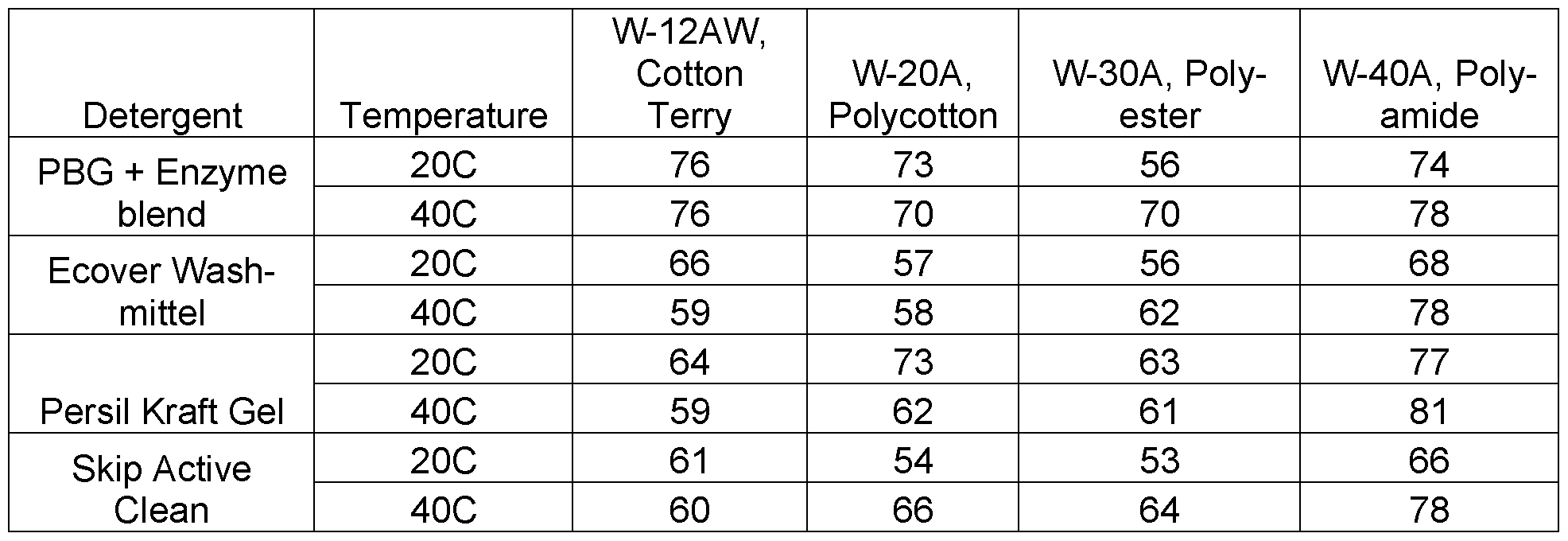
- Table 11a Delta remission at 460 nm values for FSW at 20°C
Landscapes
- Chemical & Material Sciences (AREA)
- Life Sciences & Earth Sciences (AREA)
- Engineering & Computer Science (AREA)
- Chemical Kinetics & Catalysis (AREA)
- Oil, Petroleum & Natural Gas (AREA)
- Wood Science & Technology (AREA)
- Organic Chemistry (AREA)
- Health & Medical Sciences (AREA)
- Emergency Medicine (AREA)
- Detergent Compositions (AREA)
Abstract
Description




Claims
Priority Applications (2)
| Application Number | Priority Date | Filing Date | Title |
|---|---|---|---|
| EP23733005.5A EP4547804A1 (en) | 2022-06-29 | 2023-06-26 | Liquid laundry detergent formulation |
| CN202380047443.3A CN119403911A (en) | 2022-06-29 | 2023-06-26 | Liquid laundry detergent preparations |
Applications Claiming Priority (4)
| Application Number | Priority Date | Filing Date | Title |
|---|---|---|---|
| EP22181758.8 | 2022-06-29 | ||
| EP22181758 | 2022-06-29 | ||
| EP22203604 | 2022-10-25 | ||
| EP22203604.8 | 2022-10-25 |
Publications (1)
| Publication Number | Publication Date |
|---|---|
| WO2024002922A1 true WO2024002922A1 (en) | 2024-01-04 |
Family
ID=86899240
Family Applications (1)
| Application Number | Title | Priority Date | Filing Date |
|---|---|---|---|
| PCT/EP2023/067221 Ceased WO2024002922A1 (en) | 2022-06-29 | 2023-06-26 | Liquid laundry detergent formulation |
Country Status (3)
| Country | Link |
|---|---|
| EP (1) | EP4547804A1 (en) |
| CN (1) | CN119403911A (en) |
| WO (1) | WO2024002922A1 (en) |
Cited By (3)
| Publication number | Priority date | Publication date | Assignee | Title |
|---|---|---|---|---|
| EP4410941A1 (en) | 2023-02-01 | 2024-08-07 | The Procter & Gamble Company | Detergent compositions containing enzymes |
| WO2024163584A1 (en) | 2023-02-01 | 2024-08-08 | Danisco Us Inc. | Subtilisin variants and methods of use |
| WO2025181060A1 (en) | 2024-03-01 | 2025-09-04 | Basf Se | Aqueous compositions, their manufacture and use |
Citations (10)
| Publication number | Priority date | Publication date | Assignee | Title |
|---|---|---|---|---|
| US7939487B2 (en) * | 2008-08-26 | 2011-05-10 | The Clorox Company | Natural cleaners |
| EP2716747A1 (en) * | 2012-10-02 | 2014-04-09 | Henkel AG&Co. KGAA | High-performance mixtures of surfactants and detergent compositions thereof |
| US20160289613A1 (en) * | 2013-12-18 | 2016-10-06 | Henkel Ag & Co. Kgaa | Preservative system for washing agents |
| WO2017216216A1 (en) * | 2016-06-16 | 2017-12-21 | Henkel Ag & Co. Kgaa | Concentrated isotropic liquid detergents containing polymers |
| EP2516606B1 (en) | 2009-12-21 | 2019-01-23 | Danisco US Inc. | Surfactants that improve the cleaning of lipid-based stains treated with lipases |
| CN109609302A (en) * | 2019-01-02 | 2019-04-12 | 郑州君萍化工科技有限公司 | It is a kind of for clothing macula lutea, the cleaning solution of pigment and preparation method |
| US20190112548A1 (en) * | 2016-06-16 | 2019-04-18 | Henkel Ag & Co. Kgaa | Concentrated liquid detergents containing polymers |
| US20200377822A1 (en) * | 2014-04-23 | 2020-12-03 | Gregory van Buskirk | Cleaning Formulations for Chemically Sensitive Individuals: Compositions and Methods |
| WO2021058023A1 (en) | 2019-09-29 | 2021-04-01 | Novozymes A/S | Deoxyribonuclease uses in detergent composition |
| WO2022090320A1 (en) * | 2020-10-28 | 2022-05-05 | Novozymes A/S | Use of lipoxygenase |
-
2023
- 2023-06-26 WO PCT/EP2023/067221 patent/WO2024002922A1/en not_active Ceased
- 2023-06-26 EP EP23733005.5A patent/EP4547804A1/en active Pending
- 2023-06-26 CN CN202380047443.3A patent/CN119403911A/en active Pending
Patent Citations (10)
| Publication number | Priority date | Publication date | Assignee | Title |
|---|---|---|---|---|
| US7939487B2 (en) * | 2008-08-26 | 2011-05-10 | The Clorox Company | Natural cleaners |
| EP2516606B1 (en) | 2009-12-21 | 2019-01-23 | Danisco US Inc. | Surfactants that improve the cleaning of lipid-based stains treated with lipases |
| EP2716747A1 (en) * | 2012-10-02 | 2014-04-09 | Henkel AG&Co. KGAA | High-performance mixtures of surfactants and detergent compositions thereof |
| US20160289613A1 (en) * | 2013-12-18 | 2016-10-06 | Henkel Ag & Co. Kgaa | Preservative system for washing agents |
| US20200377822A1 (en) * | 2014-04-23 | 2020-12-03 | Gregory van Buskirk | Cleaning Formulations for Chemically Sensitive Individuals: Compositions and Methods |
| WO2017216216A1 (en) * | 2016-06-16 | 2017-12-21 | Henkel Ag & Co. Kgaa | Concentrated isotropic liquid detergents containing polymers |
| US20190112548A1 (en) * | 2016-06-16 | 2019-04-18 | Henkel Ag & Co. Kgaa | Concentrated liquid detergents containing polymers |
| CN109609302A (en) * | 2019-01-02 | 2019-04-12 | 郑州君萍化工科技有限公司 | It is a kind of for clothing macula lutea, the cleaning solution of pigment and preparation method |
| WO2021058023A1 (en) | 2019-09-29 | 2021-04-01 | Novozymes A/S | Deoxyribonuclease uses in detergent composition |
| WO2022090320A1 (en) * | 2020-10-28 | 2022-05-05 | Novozymes A/S | Use of lipoxygenase |
Cited By (4)
| Publication number | Priority date | Publication date | Assignee | Title |
|---|---|---|---|---|
| EP4410941A1 (en) | 2023-02-01 | 2024-08-07 | The Procter & Gamble Company | Detergent compositions containing enzymes |
| WO2024163695A1 (en) | 2023-02-01 | 2024-08-08 | The Procter & Gamble Company | Detergent compositions containing enzymes |
| WO2024163584A1 (en) | 2023-02-01 | 2024-08-08 | Danisco Us Inc. | Subtilisin variants and methods of use |
| WO2025181060A1 (en) | 2024-03-01 | 2025-09-04 | Basf Se | Aqueous compositions, their manufacture and use |
Also Published As
| Publication number | Publication date |
|---|---|
| CN119403911A (en) | 2025-02-07 |
| EP4547804A1 (en) | 2025-05-07 |
Similar Documents
| Publication | Publication Date | Title |
|---|---|---|
| EP4547804A1 (en) | Liquid laundry detergent formulation | |
| CN102257109B (en) | Laundry detergent composition | |
| JP2023526263A (en) | Products containing poly α1,3-glucan esters | |
| CA2988279C (en) | Heavy duty laundry detergent | |
| JP5980954B2 (en) | Acid laundry detergent composition | |
| EP3047012B1 (en) | A stain treatment additive | |
| CN104531406B (en) | A kind of fabric detergent compositions and the method for promoting its color protection performance | |
| CA2599224A1 (en) | Detergent compositions with unique builder system for enhanced stain removal | |
| CN104531383B (en) | A kind of liquid detergent composition and the method for adjusting its rheological property | |
| WO2024088520A1 (en) | Liquid detergents and cleaning compositions with improved hydrotrope power | |
| EP4655369A1 (en) | Laundry composition | |
| US20220251478A1 (en) | Laundry Composition | |
| AU2014383650A1 (en) | Washing or cleaning agent having improved foaming characteristics under high soil loading | |
| WO2024088521A1 (en) | Detergents and cleaning compositions with improved anti-redeposition properties | |
| CN112839630A (en) | Cleaning compositions comprising foam boosting silicones | |
| RU2177985C1 (en) | Synthetic cleansing agent for washing and whitening at low temperatures | |
| CN119998430A (en) | Detergents and cleaning compositions with improved degreasing power | |
| WO2024089071A1 (en) | Textile treatment composition for anti-yellowing | |
| WO2023072256A1 (en) | Fabric care composition comprising modified polysaccharides | |
| US9169457B2 (en) | Washing or cleaning agent with cellulose or a cellulose derivative | |
| EP4608948A2 (en) | Detergents and cleaning compositions with improved cleaning performance | |
| US12612578B2 (en) | Laundry detergent compositions | |
| GB2630014A (en) | Phosphonate-free liquid laundry detergent composition | |
| EP4541876A1 (en) | Liquid preservative-free detergent composition | |
| JP2024124376A (en) | Fungicide composition |
Legal Events
| Date | Code | Title | Description |
|---|---|---|---|
| 121 | Ep: the epo has been informed by wipo that ep was designated in this application |
Ref document number: 23733005 Country of ref document: EP Kind code of ref document: A1 |
|
| WWE | Wipo information: entry into national phase |
Ref document number: 202380047443.3 Country of ref document: CN |
|
| WWE | Wipo information: entry into national phase |
Ref document number: 18877509 Country of ref document: US |
|
| WWE | Wipo information: entry into national phase |
Ref document number: 202547004660 Country of ref document: IN |
|
| WWE | Wipo information: entry into national phase |
Ref document number: 2023733005 Country of ref document: EP |
|
| NENP | Non-entry into the national phase |
Ref country code: DE |
|
| ENP | Entry into the national phase |
Ref document number: 2023733005 Country of ref document: EP Effective date: 20250129 |
|
| WWP | Wipo information: published in national office |
Ref document number: 202380047443.3 Country of ref document: CN |
|
| WWP | Wipo information: published in national office |
Ref document number: 2023733005 Country of ref document: EP |