WO2024004602A1 - 熱可塑性樹脂組成物、成形体、及び、検査用icソケットの構成部材 - Google Patents
熱可塑性樹脂組成物、成形体、及び、検査用icソケットの構成部材 Download PDFInfo
- Publication number
- WO2024004602A1 WO2024004602A1 PCT/JP2023/021667 JP2023021667W WO2024004602A1 WO 2024004602 A1 WO2024004602 A1 WO 2024004602A1 JP 2023021667 W JP2023021667 W JP 2023021667W WO 2024004602 A1 WO2024004602 A1 WO 2024004602A1
- Authority
- WO
- WIPO (PCT)
- Prior art keywords
- component
- thermoplastic resin
- group
- resin composition
- mass
- Prior art date
- Legal status (The legal status is an assumption and is not a legal conclusion. Google has not performed a legal analysis and makes no representation as to the accuracy of the status listed.)
- Ceased
Links
Images

Classifications
-
- C—CHEMISTRY; METALLURGY
- C08—ORGANIC MACROMOLECULAR COMPOUNDS; THEIR PREPARATION OR CHEMICAL WORKING-UP; COMPOSITIONS BASED THEREON
- C08K—Use of inorganic or non-macromolecular organic substances as compounding ingredients
- C08K3/00—Use of inorganic substances as compounding ingredients
- C08K3/18—Oxygen-containing compounds, e.g. metal carbonyls
- C08K3/20—Oxides; Hydroxides
- C08K3/22—Oxides; Hydroxides of metals
-
- C—CHEMISTRY; METALLURGY
- C08—ORGANIC MACROMOLECULAR COMPOUNDS; THEIR PREPARATION OR CHEMICAL WORKING-UP; COMPOSITIONS BASED THEREON
- C08G—MACROMOLECULAR COMPOUNDS OBTAINED OTHERWISE THAN BY REACTIONS ONLY INVOLVING UNSATURATED CARBON-TO-CARBON BONDS
- C08G73/00—Macromolecular compounds obtained by reactions forming a linkage containing nitrogen with or without oxygen or carbon in the main chain of the macromolecule, not provided for in groups C08G12/00 - C08G71/00
- C08G73/06—Polycondensates having nitrogen-containing heterocyclic rings in the main chain of the macromolecule
- C08G73/10—Polyimides; Polyester-imides; Polyamide-imides; Polyamide acids or similar polyimide precursors
- C08G73/1075—Partially aromatic polyimides
- C08G73/1082—Partially aromatic polyimides wholly aromatic in the tetracarboxylic moiety
-
- C—CHEMISTRY; METALLURGY
- C08—ORGANIC MACROMOLECULAR COMPOUNDS; THEIR PREPARATION OR CHEMICAL WORKING-UP; COMPOSITIONS BASED THEREON
- C08G—MACROMOLECULAR COMPOUNDS OBTAINED OTHERWISE THAN BY REACTIONS ONLY INVOLVING UNSATURATED CARBON-TO-CARBON BONDS
- C08G73/00—Macromolecular compounds obtained by reactions forming a linkage containing nitrogen with or without oxygen or carbon in the main chain of the macromolecule, not provided for in groups C08G12/00 - C08G71/00
- C08G73/06—Polycondensates having nitrogen-containing heterocyclic rings in the main chain of the macromolecule
- C08G73/10—Polyimides; Polyester-imides; Polyamide-imides; Polyamide acids or similar polyimide precursors
-
- C—CHEMISTRY; METALLURGY
- C08—ORGANIC MACROMOLECULAR COMPOUNDS; THEIR PREPARATION OR CHEMICAL WORKING-UP; COMPOSITIONS BASED THEREON
- C08G—MACROMOLECULAR COMPOUNDS OBTAINED OTHERWISE THAN BY REACTIONS ONLY INVOLVING UNSATURATED CARBON-TO-CARBON BONDS
- C08G73/00—Macromolecular compounds obtained by reactions forming a linkage containing nitrogen with or without oxygen or carbon in the main chain of the macromolecule, not provided for in groups C08G12/00 - C08G71/00
- C08G73/06—Polycondensates having nitrogen-containing heterocyclic rings in the main chain of the macromolecule
- C08G73/10—Polyimides; Polyester-imides; Polyamide-imides; Polyamide acids or similar polyimide precursors
- C08G73/1042—Copolyimides derived from at least two different tetracarboxylic compounds or two different diamino compounds
-
- C—CHEMISTRY; METALLURGY
- C08—ORGANIC MACROMOLECULAR COMPOUNDS; THEIR PREPARATION OR CHEMICAL WORKING-UP; COMPOSITIONS BASED THEREON
- C08K—Use of inorganic or non-macromolecular organic substances as compounding ingredients
- C08K3/00—Use of inorganic substances as compounding ingredients
- C08K3/01—Use of inorganic substances as compounding ingredients characterized by their specific function
- C08K3/013—Fillers, pigments or reinforcing additives
-
- C—CHEMISTRY; METALLURGY
- C08—ORGANIC MACROMOLECULAR COMPOUNDS; THEIR PREPARATION OR CHEMICAL WORKING-UP; COMPOSITIONS BASED THEREON
- C08K—Use of inorganic or non-macromolecular organic substances as compounding ingredients
- C08K7/00—Use of ingredients characterised by shape
- C08K7/16—Solid spheres
- C08K7/18—Solid spheres inorganic
-
- C—CHEMISTRY; METALLURGY
- C08—ORGANIC MACROMOLECULAR COMPOUNDS; THEIR PREPARATION OR CHEMICAL WORKING-UP; COMPOSITIONS BASED THEREON
- C08L—COMPOSITIONS OF MACROMOLECULAR COMPOUNDS
- C08L101/00—Compositions of unspecified macromolecular compounds
-
- C—CHEMISTRY; METALLURGY
- C08—ORGANIC MACROMOLECULAR COMPOUNDS; THEIR PREPARATION OR CHEMICAL WORKING-UP; COMPOSITIONS BASED THEREON
- C08L—COMPOSITIONS OF MACROMOLECULAR COMPOUNDS
- C08L79/00—Compositions of macromolecular compounds obtained by reactions forming in the main chain of the macromolecule a linkage containing nitrogen with or without oxygen or carbon only, not provided for in groups C08L61/00 - C08L77/00
- C08L79/04—Polycondensates having nitrogen-containing heterocyclic rings in the main chain; Polyhydrazides; Polyamide acids or similar polyimide precursors
- C08L79/08—Polyimides; Polyester-imides; Polyamide-imides; Polyamide acids or similar polyimide precursors
-
- G—PHYSICS
- G01—MEASURING; TESTING
- G01R—MEASURING ELECTRIC VARIABLES; MEASURING MAGNETIC VARIABLES
- G01R1/00—Details of instruments or arrangements of the types included in groups G01R5/00 - G01R13/00 and G01R31/00
- G01R1/02—General constructional details
- G01R1/04—Housings; Supporting members; Arrangements of terminals
- G01R1/0408—Test fixtures or contact fields; Connectors or connecting adaptors; Test clips; Test sockets
- G01R1/0433—Sockets for IC's or transistors
-
- H—ELECTRICITY
- H01—ELECTRIC ELEMENTS
- H01R—ELECTRICALLY-CONDUCTIVE CONNECTIONS; STRUCTURAL ASSOCIATIONS OF A PLURALITY OF MUTUALLY-INSULATED ELECTRICAL CONNECTING ELEMENTS; COUPLING DEVICES; CURRENT COLLECTORS
- H01R13/00—Details of coupling devices of the kinds covered by groups H01R12/70 or H01R24/00 - H01R33/00
- H01R13/02—Contact members
- H01R13/22—Contacts for co-operating by abutting
- H01R13/24—Contacts for co-operating by abutting resilient; resiliently-mounted
- H01R13/2407—Contacts for co-operating by abutting resilient; resiliently-mounted characterized by the resilient means
- H01R13/2421—Contacts for co-operating by abutting resilient; resiliently-mounted characterized by the resilient means using coil springs
-
- C—CHEMISTRY; METALLURGY
- C08—ORGANIC MACROMOLECULAR COMPOUNDS; THEIR PREPARATION OR CHEMICAL WORKING-UP; COMPOSITIONS BASED THEREON
- C08K—Use of inorganic or non-macromolecular organic substances as compounding ingredients
- C08K3/00—Use of inorganic substances as compounding ingredients
- C08K3/18—Oxygen-containing compounds, e.g. metal carbonyls
- C08K3/20—Oxides; Hydroxides
- C08K3/22—Oxides; Hydroxides of metals
- C08K2003/2237—Oxides; Hydroxides of metals of titanium
- C08K2003/2241—Titanium dioxide
-
- C—CHEMISTRY; METALLURGY
- C08—ORGANIC MACROMOLECULAR COMPOUNDS; THEIR PREPARATION OR CHEMICAL WORKING-UP; COMPOSITIONS BASED THEREON
- C08K—Use of inorganic or non-macromolecular organic substances as compounding ingredients
- C08K3/00—Use of inorganic substances as compounding ingredients
- C08K3/18—Oxygen-containing compounds, e.g. metal carbonyls
- C08K3/20—Oxides; Hydroxides
- C08K3/22—Oxides; Hydroxides of metals
- C08K2003/2244—Oxides; Hydroxides of metals of zirconium
-
- C—CHEMISTRY; METALLURGY
- C08—ORGANIC MACROMOLECULAR COMPOUNDS; THEIR PREPARATION OR CHEMICAL WORKING-UP; COMPOSITIONS BASED THEREON
- C08K—Use of inorganic or non-macromolecular organic substances as compounding ingredients
- C08K3/00—Use of inorganic substances as compounding ingredients
- C08K3/18—Oxygen-containing compounds, e.g. metal carbonyls
- C08K3/24—Acids; Salts thereof
- C08K3/26—Carbonates; Bicarbonates
- C08K2003/265—Calcium, strontium or barium carbonate
-
- C—CHEMISTRY; METALLURGY
- C08—ORGANIC MACROMOLECULAR COMPOUNDS; THEIR PREPARATION OR CHEMICAL WORKING-UP; COMPOSITIONS BASED THEREON
- C08K—Use of inorganic or non-macromolecular organic substances as compounding ingredients
- C08K3/00—Use of inorganic substances as compounding ingredients
- C08K3/28—Nitrogen-containing compounds
- C08K2003/282—Binary compounds of nitrogen with aluminium
-
- C—CHEMISTRY; METALLURGY
- C08—ORGANIC MACROMOLECULAR COMPOUNDS; THEIR PREPARATION OR CHEMICAL WORKING-UP; COMPOSITIONS BASED THEREON
- C08K—Use of inorganic or non-macromolecular organic substances as compounding ingredients
- C08K3/00—Use of inorganic substances as compounding ingredients
- C08K3/38—Boron-containing compounds
- C08K2003/382—Boron-containing compounds and nitrogen
- C08K2003/385—Binary compounds of nitrogen with boron
-
- C—CHEMISTRY; METALLURGY
- C08—ORGANIC MACROMOLECULAR COMPOUNDS; THEIR PREPARATION OR CHEMICAL WORKING-UP; COMPOSITIONS BASED THEREON
- C08K—Use of inorganic or non-macromolecular organic substances as compounding ingredients
- C08K3/00—Use of inorganic substances as compounding ingredients
- C08K3/10—Metal compounds
- C08K3/14—Carbides
-
- C—CHEMISTRY; METALLURGY
- C08—ORGANIC MACROMOLECULAR COMPOUNDS; THEIR PREPARATION OR CHEMICAL WORKING-UP; COMPOSITIONS BASED THEREON
- C08K—Use of inorganic or non-macromolecular organic substances as compounding ingredients
- C08K3/00—Use of inorganic substances as compounding ingredients
- C08K3/28—Nitrogen-containing compounds
-
- C—CHEMISTRY; METALLURGY
- C08—ORGANIC MACROMOLECULAR COMPOUNDS; THEIR PREPARATION OR CHEMICAL WORKING-UP; COMPOSITIONS BASED THEREON
- C08K—Use of inorganic or non-macromolecular organic substances as compounding ingredients
- C08K3/00—Use of inorganic substances as compounding ingredients
- C08K3/34—Silicon-containing compounds
- C08K3/346—Clay
-
- C—CHEMISTRY; METALLURGY
- C08—ORGANIC MACROMOLECULAR COMPOUNDS; THEIR PREPARATION OR CHEMICAL WORKING-UP; COMPOSITIONS BASED THEREON
- C08K—Use of inorganic or non-macromolecular organic substances as compounding ingredients
- C08K3/00—Use of inorganic substances as compounding ingredients
- C08K3/34—Silicon-containing compounds
- C08K3/36—Silica
-
- G—PHYSICS
- G01—MEASURING; TESTING
- G01R—MEASURING ELECTRIC VARIABLES; MEASURING MAGNETIC VARIABLES
- G01R1/00—Details of instruments or arrangements of the types included in groups G01R5/00 - G01R13/00 and G01R31/00
- G01R1/02—General constructional details
- G01R1/04—Housings; Supporting members; Arrangements of terminals
- G01R1/0408—Test fixtures or contact fields; Connectors or connecting adaptors; Test clips; Test sockets
- G01R1/0433—Sockets for IC's or transistors
- G01R1/0441—Details
- G01R1/0466—Details concerning contact pieces or mechanical details, e.g. hinges or cams; Shielding
-
- G—PHYSICS
- G01—MEASURING; TESTING
- G01R—MEASURING ELECTRIC VARIABLES; MEASURING MAGNETIC VARIABLES
- G01R31/00—Arrangements for testing electric properties; Arrangements for locating electric faults; Arrangements for electrical testing characterised by what is being tested not provided for elsewhere
- G01R31/28—Testing of electronic circuits, e.g. by signal tracer
- G01R31/2851—Testing of integrated circuits [IC]
- G01R31/2855—Environmental, reliability or burn-in testing
- G01R31/286—External aspects, e.g. related to chambers, contacting devices or handlers
- G01R31/2863—Contacting devices, e.g. sockets, burn-in boards or mounting fixtures
-
- H—ELECTRICITY
- H01—ELECTRIC ELEMENTS
- H01R—ELECTRICALLY-CONDUCTIVE CONNECTIONS; STRUCTURAL ASSOCIATIONS OF A PLURALITY OF MUTUALLY-INSULATED ELECTRICAL CONNECTING ELEMENTS; COUPLING DEVICES; CURRENT COLLECTORS
- H01R2201/00—Connectors or connections adapted for particular applications
- H01R2201/20—Connectors or connections adapted for particular applications for testing or measuring purposes
Definitions
- the present invention relates to a thermoplastic resin composition, a molded article, and a component of an IC socket for testing.
- thermoplastic resins that have excellent properties such as moldability, heat resistance, and strength, and are used in a wide range of fields such as automobile parts, mechanical parts, and electrical and electronic parts.
- Thermoplastic resin compositions in which engineering plastics contain functional fillers are also known.
- a thermoplastic resin component containing a crystalline thermoplastic resin and an amorphous thermoplastic resin, a carbon precursor, and a conductive filler are formed from a resin composition containing predetermined amounts of each. It is described that a low-contamination injection molded article can have a surface resistivity that can be strictly controlled to a desired value within a semiconductive region, and that the amount of foreign particles generated is extremely small.
- Patent Document 2 discloses that a flame-retardant polyimide molding material containing a semi-aromatic polyimide resin and a predetermined amount of graphite, carbon fiber, etc. has excellent moldability and can exhibit high flame retardancy. There is.
- Patent Document 3 discloses that the ball guide film 180 constituting the test socket can be composed of a polyimide film that is thin and has excellent wear resistance.
- the flame-retardant polyimide molding material described in Patent Document 2 can be applied to IC sockets for testing.
- the testing IC socket include an IC socket for product testing (test socket), an IC socket for burn-in testing (burn-in socket), and the like.
- test socket IC socket for product testing
- burn-in socket burn-in testing
- a method for producing the member using a molded body containing a thermoplastic resin and an inorganic filler, such as the flame-retardant polyimide molding material includes, for example, cutting the molded body to produce a flat plate; An example of this method is to make a fine through hole in a flat plate into which the measuring device is fitted.
- an example of this method is to make a fine through hole in a flat plate into which the measuring device is fitted.
- the machinability of a molded body there is room for further improvement in the machinability of the molded body and the fine machinability in manufacturing components of IC sockets for testing using the flat plate obtained by cutting.
- the machinability of a molded body there is a problem that when a molded body manufactured by injection molding or the like is cut, if the resulting flat plate surface has large irregularities, it is not suitable for micromachining.
- microfabrication when making a large number of through holes at a narrow pitch in the obtained flat plate, if the hole diameter distribution increases, pattern
- An object of the present invention is to provide a thermoplastic resin composition from which a molded article with excellent cutting workability and fine workability can be produced.
- thermoplastic resin composition containing a specific thermoplastic resin and a specific inorganic filler can solve the above problems. That is, the present invention relates to the following.
- Component (A) at least one member selected from the group consisting of a crystalline thermoplastic resin (a1) with a melting point of 270°C or higher and an amorphous thermoplastic resin (a2) with a glass transition temperature of 200°C or higher.
- the component (A) is a polyimide resin, a polyetherimide resin, a polyetherimide sulfone resin, a polyphenylene sulfide resin, a polyetheretherketone resin, a polyetherketoneketone resin, a liquid crystal polymer, and a wholly aromatic resin other than a liquid crystal polymer.
- thermoplastic resin composition which is at least one selected from the group consisting of polyester resins.
- the component (A) contains a repeating structural unit represented by the following formula (1) and a repeating structural unit represented by the following formula (2), and the repeating structural unit of the formula (1) and the repeating structural unit of the formula (2) )
- Resin composition. (R 1 is a divalent group having 6 to 22 carbon atoms containing at least one alicyclic hydrocarbon structure.
- R 2 is a divalent chain aliphatic group having 5 to 16 carbon atoms.
- X 1 and X 2 are each independently a tetravalent group having 6 to 22 carbon atoms and containing at least one aromatic ring.
- D50 volume median particle size
- the component (B) further contains an inorganic filler (b2) other than the component (b1), and the component (b2) is talc, mica, silica, alumina, silicon nitride, aluminum nitride, boron nitride. , silicon carbide, boron carbide, calcium carbonate, and titanium oxide, the thermoplastic resin composition according to any one of [1] to [5] above.
- a molded article comprising the thermoplastic resin composition according to any one of [1] to [7] above.
- a component of an IC socket for testing obtained by processing the molded article described in [8] above.
- thermoplastic resin composition of the present invention a molded article having excellent cutting workability and fine workability can be produced.
- the molded body is suitable for producing components of IC sockets for inspection, etc.
- FIG. 2 is a schematic plan view showing an embodiment of a component 100 of an IC socket for inspection.
- a molded object having excellent machinability means that a molded object obtained by thermoforming a thermoplastic resin composition is cut into a flat plate-like molded object (hereinafter also simply referred to as a "flat plate”). ) means that a flat plate with low surface roughness on the cut surface can be obtained. Surface roughness can be evaluated by arithmetic mean roughness (Ra). Furthermore, when the flat plate obtained by cutting has little warpage, it is judged that the molded body has better cutting workability.
- through-hole means a fine through-hole having a diameter of, for example, 200 ⁇ m or less, preferably 100 ⁇ m or less, more preferably less than 100 ⁇ m, and the pitch is, for example, in the range of 1 to 5 times the diameter of the through-hole.
- the machinability and micromachinability can be specifically evaluated by the methods described in Examples.
- the content of the component (b1) is 2 to 40 parts by mass, and the content of the component (B) is 2 to 60 parts by mass relative to 100 parts by mass of the component (A).
- the thermoplastic resin composition of the present invention has excellent machinability and machinability by using a thermoplastic resin (A) having predetermined thermophysical properties and a predetermined amount of an inorganic filler (B) containing zirconium oxide (b1).
- a molded body with excellent microprocessability can be produced.
- the volume median particle size (D50) of the zirconium oxide (b1) is preferably 1 ⁇ m or less.
- the wall surfaces of the fine through-holes are also kept smooth, which increases the accuracy of hole formation and is thought to suppress an increase in the pore size distribution and pattern collapse. It is also presumed that by incorporating a predetermined amount of the highly hard component (b1) into the thermoplastic resin (A), the material becomes appropriately brittle and the occurrence of burrs can be suppressed.
- thermoplastic resin (A) (hereinafter also simply referred to as “component (A)” or “thermoplastic resin (A)”) used in the present invention includes a crystalline thermoplastic resin (a1) with a melting point of 270°C or higher and glass. At least one type selected from the group consisting of amorphous thermoplastic resins (a2) having a transition temperature of 200° C. or higher.
- a crystalline thermoplastic resin refers to a resin that has a melting point and a glass transition temperature
- an amorphous thermoplastic resin refers to a resin that has a glass transition temperature but no melting point. Note that resins that have essentially crystallinity but have an extremely slow crystallization rate and that can only be processed in an amorphous state by various molding methods are classified as amorphous thermoplastic resins.
- the crystalline thermoplastic resin (a1) used as component (A) (hereinafter also simply referred to as "component (a1)”) has a melting point of 270 from the viewpoint of producing a molded product with excellent cutting workability and fine workability. It is a crystalline thermoplastic resin with a temperature of °C or higher.
- the melting point of component (a1) is preferably 280°C or higher, more preferably 290°C or higher, and even more preferably 300°C or higher, from the viewpoint of improving the machinability and microprocessability of the molded product obtained.
- the temperature is preferably 400°C or lower, more preferably 380°C or lower, and even more preferably 350°C or lower.
- the melting point of component (a1) can be measured using a differential scanning calorimeter, specifically by the method described in the Examples.
- the glass transition temperature (Tg) of component (a1) is not particularly limited, but from the viewpoint of improving the machinability and fine machinability of the resulting molded product, it is preferably 130°C or higher, more preferably 140°C or higher, and even more preferably The temperature is 150°C or higher, and from the viewpoint of ease of molding, the temperature is preferably 250°C or lower, more preferably 230°C or lower, and still more preferably 200°C or lower.
- the glass transition temperature of component (a1) can be measured using a differential scanning calorimeter, specifically by the method described in the Examples.
- the amorphous thermoplastic resin (a2) used as component (A) has a glass transition property from the viewpoint of producing a molded product with excellent cutting workability and fine workability. It is an amorphous thermoplastic resin with a temperature of 200°C or higher.
- the glass transition temperature (Tg) of component (a2) is preferably 210°C or higher, more preferably 230°C or higher, and even more preferably 250°C or higher, from the viewpoint of improving the machinability and microprocessability of the obtained molded product. be.
- the temperature is preferably 400°C or lower, more preferably 350°C or lower, and even more preferably 300°C or lower.
- the glass transition temperature of component (a2) can be measured by the same method as described above.
- Component (A) includes, for example, polyimide resin, polyamide resin, polyetherimide resin, polyetherimide sulfone resin, polyphenylene sulfide resin, polyetheretherketone resin, polyetherketoneketone resin, polycarbonate resin, polyamideimide resin, polysulfone.
- component (A) is preferably polyimide resin, polyetherimide resin, polyetherimide sulfone resin, polyphenylene sulfide resin, polyether ether, from the viewpoint of producing a molded product with excellent cutting workability and fine workability.
- component (A) is more preferably a polyimide resin, among which polyimide resins having an aliphatic structure (other than wholly aromatic) or polyimides having a bulky structure such as halogen. It is resin.
- component (A) As component (A), component (a1), component (a2), or a mixture of component (a1) and component (a2) can be used. From the viewpoint of improving the machinability and fine machinability of the obtained molded body, it is preferable that component (A) contains component (a1) which is a crystalline thermoplastic resin.
- component (a1) in component (A) is preferably 50% by mass or more, more preferably 60% by mass or more, and even more preferably The content is 70% by mass or more, more preferably 80% by mass or more, even more preferably 90% by mass or more and 100% by mass or less.
- component (A) contains component (a1)
- the component ( a1) is more preferably a polyimide resin, more preferably contains a repeating structural unit represented by the following formula (1) and a repeating structural unit represented by the following formula (2), and the repeating structural unit of the formula (1) and
- the polyimide resin (a1-1) has a content ratio of repeating structural units of the formula (1) to the total repeating structural units of the formula (2) from 20 to 70 mol%.
- R 1 is a divalent group having 6 to 22 carbon atoms containing at least one alicyclic hydrocarbon structure.
- R 2 is a divalent chain aliphatic group having 5 to 16 carbon atoms.
- X 1 and X 2 are each independently a tetravalent group having 6 to 22 carbon atoms and containing at least one aromatic ring.
- the polyimide resin (a1-1) is a crystalline thermoplastic resin, and its form is preferably powder or pellets.
- the polyimide resin is, for example, a polyimide resin that does not have a glass transition temperature (Tg), which is formed by molding a polyimide precursor such as polyamic acid, and then closing the imide ring, or a polyimide resin that is formed at a temperature lower than the glass transition temperature. It is distinguished from polyimide resin, which decomposes.
- R 1 is a divalent group having 6 to 22 carbon atoms and containing at least one alicyclic hydrocarbon structure.
- the alicyclic hydrocarbon structure means a ring derived from an alicyclic hydrocarbon compound, and the alicyclic hydrocarbon compound may be saturated or unsaturated, and the alicyclic hydrocarbon structure may be saturated or unsaturated. It may be a ring or a polycyclic ring.
- alicyclic hydrocarbon structure examples include, but are not limited to, cycloalkane rings such as cyclohexane rings, cycloalkene rings such as cyclohexene, bicycloalkane rings such as norbornane rings, and bicycloalkene rings such as norbornene. Do not mean. Among these, preferred is a cycloalkane ring, more preferred is a cycloalkane ring having 4 to 7 carbon atoms, and even more preferred is a cyclohexane ring.
- the number of carbon atoms in R 1 is 6 to 22, preferably 8 to 17.
- R 1 contains at least one alicyclic hydrocarbon structure, preferably 1 to 3 alicyclic hydrocarbon structures.
- R 1 is preferably a divalent group represented by the following formula (R1-1) or (R1-2).
- (m 11 and m 12 are each independently an integer of 0 to 2, preferably 0 or 1.
- m 13 to m 15 are each independently an integer of 0 to 2, preferably 0 or 1)
- R 1 is particularly preferably a divalent group represented by the following formula (R1-3).
- R1-3 the positional relationship of the two methylene groups with respect to the cyclohexane ring may be cis or trans, and the ratio of cis to trans is Any value is acceptable.
- X 1 is a tetravalent group having 6 to 22 carbon atoms and containing at least one aromatic ring.
- the aromatic ring may be a single ring or a condensed ring, and examples thereof include a benzene ring, a naphthalene ring, an anthracene ring, and a tetracene ring, but are not limited thereto. Among these, benzene rings and naphthalene rings are preferred, and benzene rings are more preferred.
- the number of carbon atoms in X 1 is 6 to 22, preferably 6 to 18.
- X 1 contains at least one aromatic ring, preferably 1 to 3 aromatic rings.
- X 1 is preferably a tetravalent group represented by any of the following formulas (X-1) to (X-4).
- R 11 to R 18 are each independently an alkyl group having 1 to 4 carbon atoms.
- p 11 to p 13 are each independently an integer of 0 to 2, preferably 0.
- p 14 , p 15 , p 16 and p 18 are each independently an integer of 0 to 3, preferably 0.
- p 17 is an integer of 0 to 4, preferably 0.
- Each of 13 is independently a single bond, an ether group, a carbonyl group, or an alkylene group having 1 to 4 carbon atoms.
- X 1 is a tetravalent group having 6 to 22 carbon atoms and containing at least one aromatic ring
- R 12 , R 13 , p 12 and p 13 in formula (X-2) are represented by formula (X-
- the number of carbon atoms in the tetravalent group represented by 2) is selected to be within the range of 10 to 22.
- L 11 , R 14 , R 15 , p 14 and p 15 in formula (X-3) are such that the number of carbon atoms in the tetravalent group represented by formula (X-3) is in the range of 12 to 22.
- L 12 , L 13 , R 16 , R 17 , R 18 , p 16 , p 17 and p 18 in formula (X-4) are tetravalent groups represented by formula (X-4). is selected such that the number of carbon atoms in the group falls within the range of 18 to 22.
- X 1 is particularly preferably a tetravalent group represented by the following formula (X-5) or (X-6).
- R 2 is a divalent chain aliphatic group having 5 to 16 carbon atoms, preferably 6 to 14 carbon atoms, more preferably 7 to 12 carbon atoms, and even more preferably 8 to 10 carbon atoms.
- the chain aliphatic group means a group derived from a chain aliphatic compound, and the chain aliphatic compound may be saturated or unsaturated, and the chain aliphatic group may be saturated or unsaturated. It may be branched or branched, and may contain a heteroatom such as an oxygen atom.
- R 2 is preferably an alkylene group having 5 to 16 carbon atoms, more preferably an alkylene group having 6 to 14 carbon atoms, even more preferably 7 to 12 carbon atoms, and especially preferably an alkylene group having 8 to 10 carbon atoms. It is an alkylene group.
- the alkylene group may be a straight chain alkylene group or a branched alkylene group, but is preferably a straight chain alkylene group.
- R 2 is preferably at least one selected from the group consisting of an octamethylene group and a decamethylene group, particularly preferably an octamethylene group.
- R 2 is a divalent chain aliphatic group having 5 to 16 carbon atoms and containing an ether group.
- the number of carbon atoms is preferably 6 to 14 carbon atoms, more preferably 7 to 12 carbon atoms, and still more preferably 8 to 10 carbon atoms.
- divalent groups represented by the following formula (R2-1) or (R2-2) are preferred.
- (m 21 and m 22 are each independently an integer of 1 to 15, preferably 1 to 13, more preferably 1 to 11, even more preferably 1 to 9.
- m 23 to m 25 are each (Independently, it is an integer from 1 to 14, preferably from 1 to 12, more preferably from 1 to 10, and even more preferably from 1 to 8.)
- R 2 is a divalent chain aliphatic group having 5 to 16 carbon atoms (preferably 6 to 14 carbon atoms, more preferably 7 to 12 carbon atoms, even more preferably 8 to 10 carbon atoms)
- m 21 and m 22 in formula (R2-1) are divalent groups represented by formula (R2-1) having 5 to 16 carbon atoms (preferably 6 to 14 carbon atoms, more preferably 7 carbon atoms). to 12 carbon atoms, more preferably 8 to 10 carbon atoms.
- m 21 +m 22 is 5 to 16 (preferably 6 to 14, more preferably 7 to 12, still more preferably 8 to 10).
- m 23 to m 25 in formula (R2-2) is a divalent group represented by formula (R2-2) having 5 to 16 carbon atoms (preferably 6 to 14 carbon atoms, more preferably The number of carbon atoms is selected to fall within the range of 7 to 12 carbon atoms, more preferably 8 to 10 carbon atoms. That is, m 23 +m 24 +m 25 is 5 to 16 (preferably 6 to 14 carbon atoms, more preferably 7 to 12 carbon atoms, still more preferably 8 to 10 carbon atoms).
- X 2 is defined in the same manner as X 1 in formula (1), and preferred embodiments are also the same.
- the content ratio of the repeating structural unit of formula (1) to the total of the repeating structural unit of formula (1) and the repeating structural unit of formula (2) is 20 to 70 mol%.
- the content ratio of the repeating structural unit of formula (1) is within the above range, it becomes possible to sufficiently crystallize the polyimide resin (a1-1) even in a general injection molding cycle. If the content ratio is less than 20 mol%, thermoformability will decrease, and if it exceeds 70 mol%, crystallinity will decrease, resulting in a decrease in heat resistance.
- the content ratio of the repeating structural unit of formula (1) to the total of the repeating structural unit of formula (1) and the repeating structural unit of formula (2) is preferably 65 mol% or less, More preferably it is 60 mol% or less, and still more preferably 50 mol% or less.
- the content ratio of the repeating structural unit of formula (1) to the total of the repeating structural unit of formula (1) and the repeating structural unit of formula (2) is preferably 20 mol% or more and less than 40 mol%.
- the crystallinity of the polyimide resin (a1-1) will be high, and a resin composition with better heat resistance can be obtained.
- the above content ratio is preferably 25 mol% or more, more preferably 30 mol% or more, even more preferably 32 mol% or more, and even more preferably from the viewpoint of developing high crystallinity. is 35 mol% or less.
- the total content ratio of the repeating constituent units of formula (1) and repeating constituent units of formula (2) to all repeating constituent units constituting the polyimide resin (a1-1) is preferably 50 to 100 mol%, more preferably is 75 to 100 mol%, more preferably 80 to 100 mol%, even more preferably 85 to 100 mol%.
- the polyimide resin (a1-1) may further contain a repeating structural unit of the following formula (3).
- the content ratio of the repeating structural unit of formula (3) to the total of the repeating structural unit of formula (1) and the repeating structural unit of formula (2) is preferably 25 mol % or less.
- the lower limit is not particularly limited as long as it exceeds 0 mol%.
- the content ratio is preferably 5 mol% or more, more preferably 10 mol% or more, while from the viewpoint of maintaining crystallinity, it is preferably 20 mol% or less, more Preferably it is 15 mol% or less.
- R 3 is a divalent group having 6 to 22 carbon atoms containing at least one aromatic ring.
- X 3 is a tetravalent group having 6 to 22 carbon atoms containing at least one aromatic ring.
- R 3 is a divalent group having 6 to 22 carbon atoms and containing at least one aromatic ring.
- the aromatic ring may be a single ring or a condensed ring, and examples thereof include a benzene ring, a naphthalene ring, an anthracene ring, and a tetracene ring, but are not limited thereto. Among these, benzene rings and naphthalene rings are preferred, and benzene rings are more preferred.
- the number of carbon atoms in R 3 is 6 to 22, preferably 6 to 18.
- R 3 contains at least one aromatic ring, preferably 1 to 3 aromatic rings. Further, a monovalent or divalent electron-withdrawing group may be bonded to the aromatic ring.
- Examples of monovalent electron-withdrawing groups include nitro group, cyano group, p-toluenesulfonyl group, halogen, halogenated alkyl group, phenyl group, and acyl group.
- Examples of divalent electron-withdrawing groups include fluorinated alkylene groups (for example, -C(CF 3 ) 2 -, -(CF 2 ) p - (where p is an integer from 1 to 10)).
- examples include -CO-, -SO 2 -, -SO-, -CONH-, -COO-, and the like.
- R 3 is preferably a divalent group represented by the following formula (R3-1) or (R3-2).
- (m 31 and m 32 are each independently an integer of 0 to 2, preferably 0 or 1.
- m 33 and m 34 are each independently an integer of 0 to 2, preferably 0 or 1.
- R 21 , R 22 and R 23 are each independently an alkyl group having 1 to 4 carbon atoms, an alkenyl group having 2 to 4 carbon atoms, or an alkynyl group having 2 to 4 carbon atoms.
- p 21 , p 22 and p 23 are integers of 0 to 4, preferably 0.
- L 21 is a single bond, an ether group, a carbonyl group, or an alkylene group having 1 to 4 carbon atoms.
- R 3 is a divalent group having 6 to 22 carbon atoms and containing at least one aromatic ring
- m 31 , m 32 , R 21 and p 21 in formula (R3-1) are represented by formula (R3-1).
- the number of carbon atoms in the divalent group represented by 1) is selected to be within the range of 6 to 22.
- L 21 , m 33 , m 34 , R 22 , R 23 , p 22 and p 23 in formula (R3-2) have the number of carbon atoms in the divalent group represented by formula (R3-2). It is selected to fall within the range of 12 to 22.
- X 3 is defined in the same manner as X 1 in formula (1), and preferred embodiments are also the same.
- the polyimide resin (a1-1) may further contain a repeating structural unit represented by the following formula (4).
- R 4 is a divalent group containing -SO 2 - or -Si(R x ) (R y ) O-, and R x and R y are each independently a chain aliphatic group having 1 to 3 carbon atoms. group or phenyl group.
- X 4 is a tetravalent group having 6 to 22 carbon atoms and containing at least one aromatic ring.
- X 4 is defined in the same manner as X 1 in formula (1), and preferred embodiments are also the same.
- the polyimide resin (a1-1) has a chain aliphatic group having 5 to 14 carbon atoms at the terminal.
- the chain aliphatic group may be saturated or unsaturated, and may be linear or branched.
- Examples of the saturated chain aliphatic group having 5 to 14 carbon atoms include n-pentyl group, n-hexyl group, n-heptyl group, n-octyl group, n-nonyl group, n-decyl group, n-undecyl group, Lauryl group, n-tridecyl group, n-tetradecyl group, isopentyl group, neopentyl group, 2-methylpentyl group, 2-methylhexyl group, 2-ethylpentyl group, 3-ethylpentyl group, isooctyl group, 2-ethylhexyl group , 3-ethylhexyl group, isononyl group, 2-ethyloctyl group, isodecyl group, isododecyl group, isotridecyl group, isotetradecyl group, and the like.
- Examples of unsaturated chain aliphatic groups having 5 to 14 carbon atoms include 1-pentenyl group, 2-pentenyl group, 1-hexenyl group, 2-hexenyl group, 1-heptenyl group, 2-heptenyl group, 1-octenyl group. , 2-octenyl group, nonenyl group, decenyl group, dodecenyl group, tridecenyl group, tetradecenyl group and the like.
- the chain aliphatic group is preferably a saturated chain aliphatic group, more preferably a saturated straight chain aliphatic group.
- the chain aliphatic group preferably has 6 or more carbon atoms, more preferably 7 or more carbon atoms, even more preferably 8 or more carbon atoms, and preferably 12 or less carbon atoms, more preferably has 10 or less carbon atoms, more preferably 9 or less carbon atoms.
- the number of the above-mentioned chain aliphatic groups may be one, or two or more.
- the chain aliphatic group is particularly preferably at least one selected from the group consisting of n-octyl group, isooctyl group, 2-ethylhexyl group, n-nonyl group, isononyl group, n-decyl group, and isodecyl group. More preferably at least one selected from the group consisting of n-octyl group, isooctyl group, 2-ethylhexyl group, n-nonyl group, and isononyl group, most preferably n-octyl group, isooctyl group, and At least one type selected from the group consisting of 2-ethylhexyl group.
- the polyimide resin (a1-1) preferably has only a chain aliphatic group having 5 to 14 carbon atoms at the end in addition to the terminal amino group and the terminal carboxy group.
- the terminal group has a group other than the above, its content is preferably 10 mol % or less, more preferably 5 mol % or less, based on the chain aliphatic group having 5 to 14 carbon atoms.
- the content of the above-mentioned chain aliphatic group having 5 to 14 carbon atoms in the polyimide resin (a1-1) is determined based on the total repeating structure constituting the polyimide resin (a1-1) from the viewpoint of exhibiting excellent heat aging resistance. It is preferably 0.01 mol% or more, more preferably 0.1 mol% or more, and even more preferably 0.2 mol% or more, based on the total 100 mol% of units.
- the content of the above-mentioned chain aliphatic group having 5 to 14 carbon atoms in the polyimide resin (a1-1) must be It is preferably 10 mol% or less, more preferably 6 mol% or less, and still more preferably 3.5 mol% or less, based on the total 100 mol% of all repeating structural units constituting 1).
- the content of the chain aliphatic group having 5 to 14 carbon atoms in the polyimide resin (a1-1) can be determined by depolymerizing the polyimide resin (a1-1).
- the polyimide resin (a1-1) preferably has a melting point of 360°C or lower and a glass transition temperature of 150°C or higher.
- the melting point of the polyimide resin is preferably 280°C or higher, still more preferably 290°C or higher, from the viewpoint of heat resistance, and preferably 345°C or lower, more preferably 340°C from the viewpoint of achieving high moldability.
- the temperature below is more preferably 335°C or below.
- the glass transition temperature of the polyimide resin (a1-1) is more preferably 160°C or higher, more preferably 170°C or higher from the viewpoint of heat resistance, and from the viewpoint of achieving high moldability, it is preferably The temperature is 250°C or lower, more preferably 230°C or lower, even more preferably 200°C or lower.
- the melting point and glass transition temperature of the polyimide resin (a1-1) can both be measured with a differential scanning calorimeter.
- the polyimide resin (a1-1) was determined to have a cooling rate of 20°C/min after melting the polyimide resin by differential scanning calorimeter measurement.
- the amount of heat of the crystallization exothermic peak observed when cooling is preferably 5.0 mJ/mg or more, and preferably 10.0 mJ/mg or more. is more preferable, and even more preferably 17.0 mJ/mg or more.
- the upper limit of the crystallization calorific value is not particularly limited, but is usually 45.0 mJ/mg or less.
- the melting point, glass transition temperature, and crystallization heat value of the polyimide resin (a1-1) can be specifically measured by the methods described in Examples.
- the logarithmic viscosity of the 0.5% by mass concentrated sulfuric acid solution of the polyimide resin (a1-1) at 30°C is preferably in the range of 0.2 to 2.0 dL/g, more preferably in the range of 0.3 to 1.8 dL/g. It is. If the logarithmic viscosity is 0.2 dL/g or more, sufficient mechanical strength will be obtained when the obtained polyimide resin composition is made into a molded product, and if it is 2.0 dL/g or less, moldability and handling will be improved. Improves sex.
- the logarithmic viscosity ⁇ is determined by measuring the flow times of concentrated sulfuric acid and the polyimide resin solution at 30° C.
- the weight average molecular weight Mw of the polyimide resin (a1-1) is preferably 10,000 to 150,000, more preferably 15,000 to 100,000, still more preferably 20,000 to 80,000, even more preferably The range is from 30,000 to 70,000, more preferably from 35,000 to 65,000. If the weight average molecular weight Mw of the polyimide resin (a1-1) is 10,000 or more, the resulting molded product will have good mechanical strength, and if it is 40,000 or more, the mechanical strength will have good stability. , 150,000 or less, the thermoformability will be good.
- the weight average molecular weight Mw of the polyimide resin (a1-1) can be measured by gel filtration chromatography (GPC) using polymethyl methacrylate (PMMA) as a standard sample.
- the polyimide resin (a1-1) can be produced by reacting a tetracarboxylic acid component and a diamine component.
- the tetracarboxylic acid component contains a tetracarboxylic acid containing at least one aromatic ring and/or a derivative thereof
- the diamine component contains a diamine containing at least one alicyclic hydrocarbon structure and a chain aliphatic diamine. .
- the tetracarboxylic acid containing at least one aromatic ring is preferably a compound in which four carboxy groups are directly bonded to the aromatic ring, and may contain an alkyl group in its structure. Further, the tetracarboxylic acid preferably has 6 to 26 carbon atoms.
- the tetracarboxylic acid include pyromellitic acid, 2,3,5,6-toluenetetracarboxylic acid, 3,3',4,4'-benzophenonetetracarboxylic acid, 3,3',4,4'-biphenyl Tetracarboxylic acid, 1,4,5,8-naphthalenetetracarboxylic acid and the like are preferred. Among these, pyromellitic acid is more preferred.
- Examples of the derivative of tetracarboxylic acid containing at least one aromatic ring include anhydrides or alkyl esters of tetracarboxylic acid containing at least one aromatic ring.
- the tetracarboxylic acid derivative preferably has 6 to 38 carbon atoms.
- tetracarboxylic acid anhydrides include pyromellitic monoanhydride, pyromellitic dianhydride, 2,3,5,6-toluenetetracarboxylic dianhydride, 3,3',4,4'-diphenyl Sulfonetetracarboxylic dianhydride, 3,3',4,4'-benzophenonetetracarboxylic dianhydride, 3,3',4,4'-biphenyltetracarboxylic dianhydride, 1,4,5, Examples include 8-naphthalenetetracarboxylic dianhydride.
- alkyl esters of tetracarboxylic acids include dimethyl pyromellitate, diethyl pyromellitate, dipropyl pyromellitate, diisopropyl pyromellitate, dimethyl 2,3,5,6-toluenetetracarboxylate, 3,3',4 , dimethyl 4'-diphenylsulfonetetracarboxylate, dimethyl 3,3',4,4'-benzophenonetetracarboxylate, dimethyl 3,3',4,4'-biphenyltetracarboxylate, 1,4,5,8 -Dimethyl naphthalenetetracarboxylate and the like.
- the alkyl group preferably has 1 to 3 carbon atoms.
- At least one compound selected from the above may be used alone, or two or more compounds may be used in combination.
- the diamine containing at least one alicyclic hydrocarbon structure preferably has 6 to 22 carbon atoms, such as 1,2-bis(aminomethyl)cyclohexane, 1,3-bis(aminomethyl)cyclohexane, 1,4- Bis(aminomethyl)cyclohexane, 1,2-cyclohexanediamine, 1,3-cyclohexanediamine, 1,4-cyclohexanediamine, 4,4'-diaminodicyclohexylmethane, 4,4'-methylenebis(2-methylcyclohexylamine) , carbondiamine, limonenediamine, isophoronediamine, norbornanediamine, bis(aminomethyl)tricyclo[5.2.1.0 2,6 ]decane, 3,3'-dimethyl-4,4'-diaminodicyclohexylmethane, 4,4'-diaminodicyclohexylpropane and the like are preferred.
- diamines containing an alicyclic hydrocarbon structure generally have structural isomers, but the ratio of cis/trans isomers is not limited.
- the chain aliphatic diamine may be linear or branched, and preferably has 5 to 16 carbon atoms, more preferably 6 to 14 carbon atoms, and still more preferably 7 to 12 carbon atoms. Further, as long as the chain portion has 5 to 16 carbon atoms, an ether bond may be included therebetween.
- chain aliphatic diamines examples include 1,5-pentamethylene diamine, 2-methylpentane-1,5-diamine, 3-methylpentane-1,5-diamine, 1,6-hexamethylene diamine, 1,7-hepta Methylenediamine, 1,8-octamethylenediamine, 1,9-nonamethylenediamine, 1,10-decamethylenediamine, 1,11-undecamethylenediamine, 1,12-dodecamethylenediamine, 1,13-trideca Preferred are methylene diamine, 1,14-tetradecamethylene diamine, 1,16-hexadecamethylene diamine, 2,2'-(ethylenedioxy)bis(ethyleneamine), and the like.
- Chain aliphatic diamines may be used alone or in combination. Among these, chain aliphatic diamines having 8 to 10 carbon atoms can be preferably used, and at least one selected from the group consisting of 1,8-octamethylene diamine and 1,10-decamethylene diamine is particularly preferred. Can be used.
- the amount of diamine containing at least one alicyclic hydrocarbon structure charged relative to the total amount of diamine containing at least one alicyclic hydrocarbon structure and chain aliphatic diamine The molar ratio of is preferably 20 to 70 mol%.
- the molar amount is preferably 25 mol% or more, more preferably 30 mol% or more, even more preferably 32 mol% or more, and from the viewpoint of expressing high crystallinity, preferably 60 mol% or less, more preferably 50 mol% or more. It is less than mol %, more preferably less than 40 mol %, even more preferably less than 35 mol %.
- the diamine component may contain a diamine containing at least one aromatic ring.
- the diamine containing at least one aromatic ring preferably has 6 to 22 carbon atoms, such as orthoxylylene diamine, metaxylylene diamine, paraxylylene diamine, 1,2-diethynylbenzenediamine, 1,3-diethynyl Benzenediamine, 1,4-diethynylbenzenediamine, 1,2-diaminobenzene, 1,3-diaminobenzene, 1,4-diaminobenzene, 4,4'-diaminodiphenyl ether, 3,4'-diaminodiphenyl ether, 4 , 4'-diaminodiphenylmethane, ⁇ , ⁇ '-bis(4-aminophenyl)1,4-diisopropylbenzene, ⁇ , ⁇ '-bis(3-aminophenyl)-1,4-diisoprop
- the molar ratio of the charged amount of diamine containing at least one aromatic ring to the total amount of diamine containing at least one alicyclic hydrocarbon structure and chain aliphatic diamine may be 25 mol% or less.
- the lower limit is not particularly limited as long as it exceeds 0 mol%.
- the molar ratio is preferably 5 mol% or more, more preferably 10 mol% or more, while from the viewpoint of maintaining crystallinity, it is preferably 20 mol% or less, more Preferably it is 15 mol% or less.
- the molar ratio is preferably 12 mol% or less, more preferably 10 mol% or less, still more preferably 5 mol% or less, and even more preferably 0 mol%. .
- the charging ratio of the tetracarboxylic acid component to the diamine component is 0.9 to 1.1 mol of the diamine component per 1 mol of the tetracarboxylic acid component. is preferred.
- a terminal capping agent may be mixed in addition to the tetracarboxylic acid component and the diamine component.
- the terminal capping agent is preferably at least one selected from the group consisting of monoamines and dicarboxylic acids.
- the amount of the terminal capping agent to be used may be any amount that can introduce a desired amount of terminal groups into the polyimide resin (a1-1), and is from 0.0001 to 1 mole of the tetracarboxylic acid and/or its derivative. It is preferably 0.1 mol, more preferably 0.001 to 0.06 mol, and even more preferably 0.002 to 0.035 mol.
- monoamine end-capping agents are preferred as the terminal-capping agent, and the above-mentioned chain aliphatic group having 5 to 14 carbon atoms is introduced to the end of the polyimide resin (a1-1) to improve heat aging resistance.
- monoamines having a linear aliphatic group having 5 to 14 carbon atoms are more preferred, and monoamines having a saturated linear aliphatic group having 5 to 14 carbon atoms are even more preferred.
- the terminal capping agent is particularly preferably at least one selected from the group consisting of n-octylamine, isooctylamine, 2-ethylhexylamine, n-nonylamine, isononylamine, n-decylamine, and isodecylamine. , more preferably at least one selected from the group consisting of n-octylamine, isooctylamine, 2-ethylhexylamine, n-nonylamine, and isononylamine, and most preferably n-octylamine, isooctylamine, and 2-ethylhexylamine.
- polymerization method for producing the polyimide resin (a1-1) As a polymerization method for producing the polyimide resin (a1-1), a known polymerization method can be applied, and the method described in International Publication No. 2016/147996 can be used.
- the content of the polyimide resin (a1-1) in component (A) is determined from the viewpoints of improving the machinability and microprocessability of the resulting molded product, ease of thermoforming, and obtaining low dielectric properties. , preferably 30% by mass or more, more preferably 50% by mass or more, still more preferably 60% by mass or more, even more preferably 70% by mass or more, even more preferably 80% by mass or more, even more preferably 90% by mass. or more, and 100% by mass or less.
- the content of component (A) in the thermoplastic resin composition is preferably 40% by mass or more, more preferably 50% by mass or more, from the viewpoint of thermoformability and improvement of cutting workability and microprocessability of the obtained molded product. It is at least 60% by mass, even more preferably at least 65% by mass, even more preferably at least 70% by mass. In addition, from the viewpoint of improving the machinability and fine machinability of the obtained molded body, preferably 95% by mass or less, more preferably 90% by mass or less, still more preferably 85% by mass or less, even more preferably 80% by mass or less. It is.
- thermoplastic resin composition of the present invention contains an inorganic filler containing zirconium oxide (b1) as component (B).
- the shape of the zirconium oxide (b1) used in the present invention is not particularly limited, and examples thereof include spherical, plate-like, scale-like, columnar, and fibrous shapes. Among these, spherical or plate-shaped particles are preferable, and spherical particles are more preferable, from the viewpoint of improving the machinability and micro-processability of the obtained molded body. The smaller the particle size of zirconium oxide (b1), the better from the viewpoint of improving the machinability and microfabrication properties of the obtained molded body, and from the viewpoint of availability.
- the volume median particle size (D50) of component (b1) is preferably 1 ⁇ m or less, more preferably 0.80 ⁇ m or less, even more preferably is 0.60 ⁇ m or less, more preferably 0.50 ⁇ m or less, even more preferably 0.40 ⁇ m or less.
- the thickness is usually 0.01 ⁇ m or more, more preferably 0.02 ⁇ m or more, and even more preferably It is 0.05 ⁇ m or more. D50 of component (b1) can be measured using a laser diffraction light scattering particle size distribution analyzer.
- zirconium oxide particles used as component (b1) include, for example, the KZ series manufactured by Kyoritsu Materials Co., Ltd., the TZ series manufactured by Tosoh Corporation, the UEP series manufactured by Daiichi Kigenso Kagaku Kogyo Co., Ltd. etc. Among these, KZ series high purity zirconia "KZ-0Y-LSF" manufactured by Kyoritsu Materials Co., Ltd. can be suitably selected.
- the content of component (b1) in component (B) is preferably 20% by mass or more, more preferably 30% by mass or more, and even more preferably 35% by mass or more, even more preferably 40% by mass or more, even more preferably 50% by mass or more, even more preferably 60% by mass or more, and 100% by mass or less, preferably 90% by mass or less, more preferably 80% by mass or more. It is not more than 70% by mass, more preferably not more than 70% by mass.
- the content of component (b1) with respect to 100 parts by mass of component (A) in the thermoplastic resin composition is 2 to 40 parts by mass, from the viewpoint of thermoformability and from the viewpoint of improving the machinability and microprocessability of the obtained molded product. It is preferably 5 to 35 parts by weight, more preferably 5 to 30 parts by weight, even more preferably 10 to 30 parts by weight, even more preferably 20 to 30 parts by weight.
- Component (b2) Inorganic filler other than component (b1)
- Component (B) may be an inorganic filler consisting only of component (b1), or may further contain an inorganic filler (b2) other than component (b1).
- Ingredients (b2) include talc, mica, silica, alumina, wollastonite, silicon nitride, aluminum nitride, boron nitride, silicon carbide, boron carbide, calcium carbonate, titanium oxide, zinc oxide, calcium oxide, magnesium carbonate, carbonate.
- Examples include barium, magnesium sulfate, barium sulfate, antimony trisulfide, tin sulfide, copper sulfide, iron sulfide, bismuth sulfide, zinc sulfide, and one or more of these can be used.
- the component (b2) is preferably talc, mica, silica, alumina, silicon nitride, aluminum nitride, boron nitride, silicon carbide, At least one selected from the group consisting of boron carbide, calcium carbonate, and titanium oxide, more preferably at least one selected from the group consisting of talc, mica, silica, and titanium oxide, still more preferably talc and It is at least one selected from the group consisting of silica, and more preferably talc.
- a hollow inorganic filler such as hollow silica or hollow alumina.
- the shape of component (b2) is also not particularly limited, and examples include spherical, plate-like, scale-like, columnar, and fibrous shapes. Among these, spherical or plate-shaped particles are preferable from the viewpoint of improving the machinability and fine machinability of the obtained molded body, and from the viewpoint of availability.
- the volume median particle size (D50) of component (b2) is preferably 3 ⁇ m or less, more preferably 2 ⁇ m or less, from the viewpoint of improving the machinability and micromachinability of the obtained molded product, and from the viewpoint of availability. , more preferably 1.5 ⁇ m or less, even more preferably 1.2 ⁇ m or less, even more preferably 1 ⁇ m or less.
- the thickness is usually 0.01 ⁇ m or more, more preferably 0.05 ⁇ m or more, and even more preferably It is 0.1 ⁇ m or more. D50 of component (b2) can be measured in the same manner as component (b1).
- the content of component (b2) in component (B) is preferably 80 mass from the viewpoint of thermoformability and improvement of machinability and micromachinability of the resulting molded product.
- % or less more preferably 70% by mass or less, still more preferably 65% by mass or less, even more preferably 60% by mass or less, even more preferably 50% by mass or less, even more preferably 40% by mass or less, and Preferably 1% by mass or more, more preferably 5% by mass or more, still more preferably 10% by mass or more, even more preferably 15% by mass or more, even more preferably 20% by mass or more, even more preferably 30% by mass or more. be.
- the content of component (b2) with respect to 100 parts by mass of component (A) in the thermoplastic resin composition is preferably from the viewpoint of improving the machinability and microprocessability of the molded product obtained. is 1 to 40 parts by weight, more preferably 2 to 30 parts by weight, even more preferably 5 to 30 parts by weight, even more preferably 10 to 20 parts by weight.
- the content of component (B) with respect to 100 parts by mass of component (A) in the thermoplastic resin composition is 2 to 60 parts from the viewpoint of thermoformability and from the viewpoint of improving the cutting workability and microprocessability of the obtained molded product. parts by weight, preferably 5 to 50 parts by weight, more preferably 10 to 45 parts by weight, even more preferably 15 to 45 parts by weight, even more preferably 20 to 45 parts by weight, even more preferably 25 to 45 parts by weight. , and even more preferably 30 to 45 parts by mass.
- the thermoplastic resin composition of the present invention includes reinforcing fibers, a matting agent, a plasticizer, an antistatic agent, an anticoloring agent, an antigelation agent, a coloring agent, a sliding property improver, an antioxidant, a conductive agent, Additives other than component (B), such as a resin modifier, may be blended as necessary.
- Additives other than component (B), such as a resin modifier may be blended as necessary.
- component (B) such as a resin modifier
- a resin modifier such as a resin modifier
- the blending amount it is usually 50% by mass or less in the thermoplastic resin composition, preferably 0.0001 ⁇
- the amount is 30% by weight, more preferably 0.001 to 15% by weight, even more preferably 0.01 to 10% by weight.
- thermoplastic resin (A) can be blended into the thermoplastic resin composition of the present invention as long as the properties thereof are not impaired.
- thermoplastic resin (A) and a resin other than the thermoplastic resin (A) are used together, there is no particular restriction on the blending ratio as long as the properties of the thermoplastic resin composition are not impaired.
- the total content of component (A) and component (B) in the thermoplastic resin composition of the present invention is preferably 30% by mass or more, more preferably 40% by mass or more. , more preferably 50% by mass or more, even more preferably 70% by mass or more, even more preferably 80% by mass or more, even more preferably 90% by mass or more and 100% by mass or less.
- thermoplastic resin composition of the present invention can take any form, it is preferably in the form of pellets.
- the thermoplastic resin composition of the present invention can be prepared, for example, after dry-blending the thermoplastic resin (A), an inorganic filler (B), and various optional components as necessary, or After feeding the inorganic filler (B) and any optional ingredients separately from the feed to the extruder, melt-knead them in the extruder to extrude the strands, and cut the strands to pelletize them. can. Further, by introducing the pellets into various molding machines and thermoforming them by the method described below, a molded article having a desired shape can be easily produced. On the other hand, it is also possible to obtain a molded body without going through the pellet form.
- thermoplastic resin composition of the present invention preferably does not contain a solvent from the viewpoint of forming it into pellet form and compression molding it.
- the content of the solvent in the thermoplastic resin composition is preferably 5% by mass or less, more preferably 1% by mass or less, and still more preferably 0.1% by mass or less.
- the present invention provides a molded article containing the thermoplastic resin composition.
- the molded article of the present invention can be produced by thermoforming the thermoplastic resin composition.
- Thermoforming methods include injection molding, extrusion molding, inflation molding, blow molding, hot press molding (compression molding), vacuum forming, pressure forming, laser molding, welding, welding, etc. Molding is possible using any method.
- Injection molding or extrusion molding is preferable from the viewpoint of performing thermoforming using the pellets described above and cutting the obtained molded product. Particularly, injection molding is preferred from the viewpoint of production efficiency, and extrusion molding is preferred from the viewpoint of higher dimensional stability.
- the method for producing the molded article varies depending on the melting point or glass transition temperature of the thermoplastic resin (A), but when the thermoplastic resin (A) contains the polyimide resin (a1-1), the thermoplastic resin It is preferable to include a step of thermoforming the composition at 290 to 380°C. Thermoforming at temperatures above 380° C. to 400° C. is also possible, but from the viewpoint of suppressing deterioration of the thermoplastic resin (A) and other components, thermoforming at a temperature of 380° C. or lower is preferable. Specific procedures include, for example, the following method.
- an inorganic filler (B) and various optional components as needed are added to the thermoplastic resin (A) and dry blended, and then introduced into an extruder and melted preferably at 290 to 380°C. The mixture is then melt-kneaded and extruded in an extruder to produce pellets.
- the thermoplastic resin (A) is introduced into an extruder and melted preferably at 290 to 380°C, and the inorganic filler (B) and various optional components are introduced therein and heated in the extruder.
- the above-mentioned pellets may be produced by melt-kneading with the plastic resin (A) and extruding it. After the pellets are dried, they are introduced into various molding machines and thermoformed, preferably at 290 to 380° C., to produce molded bodies having a desired shape.
- the molded body obtained by the above thermoforming may be further subjected to cutting or the like to give it a desired shape.
- an injection molded article can be produced using the thermoplastic resin composition, and then cutting can be performed to obtain a molded article having a desired shape.
- the molded body obtained by the above-mentioned thermoforming is preferably further subjected to an annealing treatment from the viewpoint of further improving machinability and fine machinability.
- a molded body obtained by further performing an annealing treatment after thermoforming a thermoplastic resin composition can be cut into a flat plate with low surface roughness on the cut surface and less warpage. Further, using the flat plate, finer through holes can be formed.
- the annealing temperature can be set depending on the type of thermoplastic resin (A) used.
- the annealing treatment temperature is a temperature lower than the melting point of the crystalline thermoplastic resin (a1) from the viewpoint of avoiding deformation of the molded product, and cutting From the viewpoint of further improving processability and microprocessability, and from the viewpoint of avoiding deformation of the molded article, when the melting point of the crystalline thermoplastic resin (a1) is Tm (°C), preferably Tm - 100°C to Tm It is in the range of -20°C.
- the annealing treatment temperature is a temperature lower than the glass transition temperature of the amorphous thermoplastic resin (a2) from the viewpoint of avoiding deformation of the molded product.
- the glass transition temperature of the amorphous thermoplastic resin (a2) is Tg (°C). is in the range of Tg-100°C to Tg-20°C.
- the annealing treatment temperature include, when the thermoplastic resin (A) contains the polyimide resin (a1-1), from the viewpoint of further improving cutting workability and fine workability, and avoiding deformation of the molded body. From this point of view, the temperature is preferably in the range of 200 to 360°C, more preferably 220 to 340°C, even more preferably 240 to 330°C, even more preferably 250 to 320°C.
- the annealing treatment time is not particularly limited, but is preferably in the range of 1 to 120 minutes, more preferably 5 to 60 minutes, from the viewpoint of further improving the machinability and micromachinability of the compact, and from the viewpoint of improving manufacturing efficiency. be.
- the molded body can be annealed using a known heating device. After the annealing treatment, from the viewpoint of suppressing the occurrence of warping of the molded body due to residual stress, slow cooling is preferably performed to a temperature of 100° C. or lower.
- the present invention further provides a component of an IC socket for testing (hereinafter also simply referred to as "member of the present invention” or “member”) obtained by processing the molded body.
- a component of an IC socket for testing hereinafter also simply referred to as "member of the present invention” or “member” obtained by processing the molded body.
- the test IC socket in this specification include an IC socket for product testing (test socket), an IC socket for burn-in test (burn-in socket), and the like.
- the member of the present invention may be any member that constitutes at least a portion of an IC socket for testing, and includes, for example, a substantially flat member used in a region where a device to be tested is mounted. The substantially flat member has a fine through hole into which the device is fitted.
- the member of the present invention can be produced, for example, by the following method.
- thermoforming preferably injection molding
- the thermoplastic resin composition to produce a molded body.
- the molded body is cut using an electric drill or the like to obtain a cut plate.
- This cut plate is micro-machined using an electric drill, a laser, etc. to form a plurality of through holes, thereby obtaining a member having a desired shape.
- FIG. 1 is a schematic plan view showing an embodiment of a component 100 of an IC socket for testing.
- 10 is a cutting plate
- 20 is a through hole forming area.
- the machined plate 10 used for producing the member 100 preferably has a machined surface with low surface roughness from the viewpoint of improving microfabrication properties.
- the arithmetic mean roughness (Ra) of the cut surface of the cut plate 10 is preferably 1 ⁇ m or less, more preferably 0.8 ⁇ m or less, still more preferably 0.6 ⁇ m or less, even more preferably 0.3 ⁇ m or less.
- the arithmetic mean roughness can be specifically measured by the method described in Examples.
- a plurality of through-holes are regularly arranged at a narrow pitch.
- the diameter of the through holes is usually selected in the range of ⁇ 0.01 to 0.20 mm, and the pitch is selected in the range of 0.02 to 0.40 mm.
- the hole diameter is 0.1 mm or more, it is suitable because various probes such as wire probes or spring probes can be used. If the hole diameter is less than 0.1 mm, a wire probe with a smaller diameter can be used for more detailed inspection. This is suitable because it can be adapted.
- the surface roughness of the cut surface is low, resulting in good cutting workability.
- the hole diameter distribution does not increase, pattern collapse, or burrs do not easily occur, and the microprocessability is also good.
- the molded product manufactured by injection molding or the like using the thermoplastic resin composition of the present invention has excellent cutting workability as described above, so it can be used not only for IC socket members but also for gears, bearings, wristwatch housings, etc. It is also highly adaptable to applications that require precision cutting.
- IR measurement of the polyimide resin was performed using "JIR-WINSPEC50" manufactured by JEOL Ltd.
- ⁇ Logarithmic viscosity ⁇ > After drying the polyimide resin at 190 to 200°C for 2 hours, a polyimide resin solution prepared by dissolving 0.100 g of the polyimide resin in 20 mL of concentrated sulfuric acid (96%, manufactured by Kanto Kagaku Co., Ltd.) was used as a measurement sample, and the Cannon-Fenske viscosity was measured. Measurements were made at 30°C using a meter.
- ⁇ Melting point, glass transition temperature, crystallization temperature, crystallization heat value> The melting point Tm, glass transition temperature Tg, crystallization temperature Tc, and crystallization calorific value ⁇ Hm of the polyimide resin were measured using a differential scanning calorimeter device (“DSC-6220” manufactured by SII Nanotechnology Co., Ltd.). .
- a polyimide resin was subjected to a thermal history under the following conditions in a nitrogen atmosphere. The thermal history conditions were as follows: first temperature increase (temperature increase rate: 10°C/min), then cooling (temperature decrease rate: 20°C/min), and then second temperature increase (temperature increase rate: 10°C/min).
- the melting point Tm was determined by reading the peak top value of the endothermic peak observed at the second temperature rise.
- the glass transition temperature Tg was determined by reading the value observed at the second temperature rise.
- the crystallization temperature Tc was determined by reading the peak top value of the exothermic peak observed during cooling. Further, the crystallization calorific value ⁇ Hm (mJ/mg) was calculated from the area of the exothermic peak observed during cooling.
- the half-crystallization time of the polyimide resin was measured using a differential scanning calorimeter device (“DSC-6220” manufactured by SII Nano Technology Co., Ltd.).
- the measurement conditions for polyimide resins with a half-crystalization time of 20 seconds or less are to hold the temperature at 420°C for 10 minutes in a nitrogen atmosphere, completely melt the polyimide resin, and then perform a rapid cooling operation at a cooling rate of 70°C/min.
- the time taken from the appearance of the observed crystallization peak to the peak top was calculated and determined.
- Production example 1 (manufacture of polyimide resin 1) 500 g of 2-(2-methoxyethoxy) ethanol (manufactured by Nippon Nyukazai Co., Ltd.) and pyromellitic dianhydride ( 218.12 g (1.00 mol) of Mitsubishi Gas Chemical Co., Ltd. was introduced, and after nitrogen flow, the mixture was stirred at 150 rpm to form a uniform suspension solution.
- 1,8- A mixed diamine solution was prepared by dissolving 93.77 g (0.65 mol) of octamethylene diamine (manufactured by Kanto Kagaku Co., Ltd.) in 250 g of 2-(2-methoxyethoxy)ethanol.
- the mixed diamine solution was added slowly using a plunger pump. Although heat generation occurred during dropping, the internal temperature was adjusted to within 40 to 80°C.
- Logarithmic viscosity is 1.30 dL/g
- Tm is 323°C
- Tg is 184°C
- Tc is 266°C
- crystallization calorific value is 21.0 mJ/mg
- half crystallization time is less than 20 seconds
- Mw is 55,000. there were.
- Table 1 shows the composition and evaluation results of the polyimide resin in Production Example 1.
- the mol% of the tetracarboxylic acid component and the diamine component in Table 1 is a value calculated from the amount of each component charged at the time of producing the polyimide resin.
- thermoplastic resin compositions and molded bodies (1) Component (A) and component (B) shown in Table 2 were thoroughly mixed by dry blending.
- the obtained mixed powder was mixed with a co-rotating twin-screw kneading extruder ("HK-25D-41D” manufactured by Parker Corporation, screw diameter: 25 mm) at a barrel temperature of 360°C and a screw rotation speed of 120 rpm. ⁇ 3mm strands were extruded. At this time, the discharge amount and dischargeability of the strands were observed, and the manufacturing stability of the resin composition during twin-screw extrusion was evaluated according to the following criteria.
- ⁇ Manufacturing stability during twin screw extrusion> The discharge rate (kg/h) and extrusion properties of the strands extruded from the twin-screw kneading extruder in the above method were observed, and the production stability of the resin composition during twin-screw extrusion was evaluated according to the following criteria.
- C The discharge amount was less than 3 kg/h.
- the strand extruded from the extruder was air-cooled and then pelletized using a pelletizer ("Fan Cutter FC-Mini-4/N” manufactured by Hoshi Plastics Co., Ltd.).
- the obtained pellets (thermoplastic resin composition) were dried at 150° C. for 10 hours and then used for injection molding.
- Injection molding was performed using an injection molding machine (“Roboshot ⁇ -S30iA” manufactured by Fanuc Corporation) at a barrel temperature of 375°C, a mold temperature of 200°C, and a molding cycle of 60 seconds to form a 70 mm x 70 mm x 4 mm thick product.
- a flat plate-shaped injection molded body was produced. The injection moldability at this time was evaluated by the following method.
- thermoplastic resin composition examples 6, 10 to 12 (Production and evaluation of thermoplastic resin composition and molded object (2)) Component (A) and component (B) shown in Table 3 were thoroughly mixed by dry blending.
- the obtained mixed powder was mixed with a co-rotating twin-screw extruder ("HK-25D-41D” manufactured by Parker Corporation, screw diameter: 25 mm) at a barrel temperature of 360°C and a screw rotation speed of 120 rpm. ⁇ 3mm strands were extruded.
- the strand extruded from the extruder was air-cooled and then pelletized using a pelletizer ("Fan Cutter FC-Mini-4/N" manufactured by Hoshi Plastics Co., Ltd.).
- the obtained pellets (thermoplastic resin composition) were dried at 150° C.
- Injection molding was performed using an injection molding machine (“Roboshot ⁇ -S30iA” manufactured by Fanuc Corporation) at a barrel temperature of 375°C, a mold temperature of 200°C, and a molding cycle of 60 seconds to form a 70 mm x 70 mm x 4 mm thick product.
- a flat plate-shaped injection molded body was produced.
- the injection molded product was annealed for 60 minutes at the temperature listed in Table 3 using a constant air temperature incubator (“DN610H” manufactured by Yamato Scientific Co., Ltd.), slowly cooled to room temperature, and the injection molded product was collected. After that, evaluation was performed using the following method.
- the injection molded article obtained by the above method was cut to produce a flat plate measuring 50 mm x 50 mm x 3 mm thick.
- the arithmetic mean roughness (Ra) of a continuous area of 20 mm in length was measured in the direction orthogonal to the cutting direction using a 3D shape measuring device (Keyence Corporation's "VR"). -6000''), and the surface roughness was evaluated according to the following criteria.
- Arithmetic mean roughness is 0.3 ⁇ m or less
- LM series high-precision image dimension measuring device
- A The diameter of all through holes is between ⁇ 0.047 and 0.053 mm.
- C Some of the through holes have diameters exceeding the range of ⁇ 0.047 to 0.053 mm. In Table 3, those for which microfabrication itself was difficult are marked with a "-".
- thermoplastic resin composition of the present invention a molded article having excellent cutting workability and fine workability can be produced.
- the molded body is suitable for producing components of IC sockets for inspection, etc.
Landscapes
- Chemical & Material Sciences (AREA)
- Health & Medical Sciences (AREA)
- Chemical Kinetics & Catalysis (AREA)
- Medicinal Chemistry (AREA)
- Polymers & Plastics (AREA)
- Organic Chemistry (AREA)
- Engineering & Computer Science (AREA)
- Computer Hardware Design (AREA)
- Microelectronics & Electronic Packaging (AREA)
- Physics & Mathematics (AREA)
- General Physics & Mathematics (AREA)
- Compositions Of Macromolecular Compounds (AREA)
- Connecting Device With Holders (AREA)
- Testing Of Individual Semiconductor Devices (AREA)
- Connector Housings Or Holding Contact Members (AREA)
Abstract
Description
エンジニアリングプラスチックに機能性充填材を含有させた熱可塑性樹脂組成物も知られている。例えば特許文献1には、結晶性熱可塑性樹脂と非晶性熱可塑性樹脂とを含有する熱可塑性樹脂成分、炭素前駆体、及び導電性充填材をそれぞれ所定量含有する樹脂組成物から形成された低汚染性の射出成形体が、表面抵抗率を半導電性領域内の所望の値に厳密に制御可能で、異物微粒子の発生量が著しく少ないことが記載されている。
特許文献2には、半芳香族ポリイミド樹脂と、所定量の黒鉛、炭素繊維等とを含有する難燃性ポリイミド成形材料が、成形加工性に優れ、高い難燃性を発現できることが開示されている。
しかしながら従来技術においては、成形体の切削加工性、及び、切削加工により得られた平板を用いて検査用ICソケットの構成部材を製造する際の微細加工性についてはさらなる改善の余地があった。例えば成形体の切削加工性については、射出成形等により製造した成形体を切削加工した際に、得られる平板表面の凹凸が大きいと微細加工に適さないという問題がある。また微細加工性に関しては、得られた平板に狭いピッチで多数の貫通孔を開けた際に、孔径分布の増大、パターン崩れ、バリなどが発生すると、検査用ICソケットの構成部材の製造には不適である。
すなわち本発明は、下記に関する。
[1]成分(A):融点が270℃以上の結晶性熱可塑性樹脂(a1)及びガラス転移温度が200℃以上の非晶性熱可塑性樹脂(a2)からなる群から選ばれる少なくとも1種の熱可塑性樹脂、並びに、
成分(B):酸化ジルコニウム(b1)を含む無機充填材、
を含有する熱可塑性樹脂組成物であって、
前記成分(A)100質量部に対する前記成分(b1)の含有量が2~40質量部であり、
前記成分(A)100質量部に対する前記成分(B)の含有量が2~60質量部である、熱可塑性樹脂組成物。
[2]前記成分(A)がポリイミド樹脂、ポリエーテルイミド樹脂、ポリエーテルイミドスルホン樹脂、ポリフェニレンスルフィド樹脂、ポリエーテルエーテルケトン樹脂、ポリエーテルケトンケトン樹脂、液晶ポリマー、及び液晶ポリマー以外の全芳香族ポリエステル樹脂からなる群から選ばれる少なくとも1種である、上記[1]に記載の熱可塑性樹脂組成物。
[3]前記成分(A)が、下記式(1)で示される繰り返し構成単位及び下記式(2)で示される繰り返し構成単位を含み、該式(1)の繰り返し構成単位と該式(2)の繰り返し構成単位の合計に対する該式(1)の繰り返し構成単位の含有比が20~70モル%のポリイミド樹脂(a1-1)を含む、上記[1]又は[2]に記載の熱可塑性樹脂組成物。

(R1は少なくとも1つの脂環式炭化水素構造を含む炭素数6~22の2価の基である。R2は炭素数5~16の2価の鎖状脂肪族基である。X1及びX2は、それぞれ独立に、少なくとも1つの芳香環を含む炭素数6~22の4価の基である。)
[4]前記成分(b1)の体積中位粒径(D50)が1μm以下である、上記[1]~[3]のいずれか1項に記載の熱可塑性樹脂組成物。
[5]前記成分(b1)が球状粒子である、上記[1]~[4]のいずれか1項に記載の熱可塑性樹脂組成物。
[6]前記成分(B)が、さらに前記成分(b1)以外の無機充填材(b2)を含み、前記成分(b2)が、タルク、マイカ、シリカ、アルミナ、窒化ケイ素、窒化アルミニウム、窒化ホウ素、炭化ケイ素、炭化ホウ素、炭酸カルシウム、及び酸化チタンからなる群から選ばれる少なくとも1種である、上記[1]~[5]のいずれか1項に記載の熱可塑性樹脂組成物。
[7]前記成分(A)100質量部に対する前記成分(b2)の含有量が1~40質量部である、上記[6]に記載の熱可塑性樹脂組成物。
[8]上記[1]~[7]のいずれか1項に記載の熱可塑性樹脂組成物を含む成形体。
[9]上記[8]に記載の成形体を加工して得られる、検査用ICソケットの構成部材。
本明細書において、成形体の切削加工性に優れるとは、熱可塑性樹脂組成物を熱成形して得られた成形体を切削加工して平板状の成形体(以下、単に「平板」ともいう)を作製した際に、切削加工面の面粗度が低い平板が得られることを意味する。面粗度は、算術平均粗さ(Ra)により評価できる。さらに、切削加工により得られた平板の反りが少ない場合には、成形体の切削加工性がより優れると判断する。
本明細書において、成形体の微細加工性に優れるとは、前記平板に狭いピッチで多数の貫通孔を形成した際に、孔径のばらつきが少なく、且つ、パターン崩れ、バリ等が発生し難く外観が良好な貫通孔を形成できることを意味する。ここでいう貫通孔は、直径が例えば200μm以下、好ましくは100μm以下、より好ましくは100μm未満の微細な貫通孔を意味し、ピッチは、例えば貫通孔の直径の1~5倍の範囲である。
切削加工性及び微細加工性は、具体的には実施例に記載の方法により評価できる。
本発明の熱可塑性樹脂組成物は、成分(A):融点が270℃以上の結晶性熱可塑性樹脂(a1)及びガラス転移温度が200℃以上の非晶性熱可塑性樹脂(a2)からなる群から選ばれる少なくとも1種の熱可塑性樹脂、並びに、成分(B):酸化ジルコニウム(b1)を含む無機充填材、を含有する熱可塑性樹脂組成物であって、前記成分(A)100質量部に対する前記成分(b1)の含有量が2~40質量部であり、前記成分(A)100質量部に対する前記成分(B)の含有量が2~60質量部である。
本発明において上記効果が得られる理由は定かではないが、無機充填材としてサブミクロンレベルの微小な酸化ジルコニウム(b1)粒子を用いることにより、切削加工表面に存在する粒子に起因する凹凸が抑制され、低い面粗度を実現できているものと推定される。さらに該成形体に微細な貫通孔を形成した際には、微細な貫通孔の壁面も平滑に保たれるため孔形成の精度が上がり、孔径分布増大やパターン崩れを抑制できると考えられる。そして、熱可塑性樹脂(A)に対し、高硬度の成分(b1)を所定量含有させることで適度に材料が脆化し、バリの発生を抑えることができるものと推定する。
本発明に用いる熱可塑性樹脂(A)(以下、単に「成分(A)」又は「熱可塑性樹脂(A)」ともいう)は、融点が270℃以上の結晶性熱可塑性樹脂(a1)及びガラス転移温度が200℃以上の非晶性熱可塑性樹脂(a2)からなる群から選ばれる少なくとも1種である。
本明細書において結晶性熱可塑性樹脂とは、融点及びガラス転移温度を有する樹脂をいい、非晶性熱可塑性樹脂とは、ガラス転移温度を有するが融点を有さない樹脂をいう。なお、本質的には結晶性を有していても結晶化速度が極めて遅く、種々の成形方法においても非晶状態でしか加工ができない樹脂は、非晶性熱可塑性樹脂に分類される。
成分(A)として用いられる結晶性熱可塑性樹脂(a1)(以下、単に「成分(a1)」ともいう)は、切削加工性及び微細加工性に優れる成形体を作製する観点から、融点が270℃以上の結晶性熱可塑性樹脂である。
成分(a1)の融点は、得られる成形体の切削加工性及び微細加工性向上の観点から、好ましくは280℃以上、より好ましくは290℃以上、更に好ましくは300℃以上である。また、熱成形の容易性の観点からは、好ましくは400℃以下、より好ましくは380℃以下、更に好ましくは350℃以下である。
成分(a1)の融点は、示差走査熱量計装置を用いて、具体的には実施例に記載の方法により測定できる。
成分(a1)のガラス転移温度は、示差走査熱量計装置を用いて、具体的には実施例に記載の方法により測定できる。
成分(A)として用いられる非晶性熱可塑性樹脂(a2)(以下、単に「成分(a2)」ともいう)は、切削加工性及び微細加工性に優れる成形体を作製する観点から、ガラス転移温度が200℃以上の非晶性熱可塑性樹脂である。
成分(a2)のガラス転移温度(Tg)は、得られる成形体の切削加工性及び微細加工性向上の観点から、好ましくは210℃以上、より好ましくは230℃以上、更に好ましくは250℃以上である。また、熱成形の容易性の観点からは、好ましくは400℃以下、より好ましくは350℃以下、更に好ましくは300℃以下である。
成分(a2)のガラス転移温度は、前記と同様の方法により測定できる。
上記の中でも、切削加工性及び微細加工性に優れる成形体を作製する観点から、成分(A)は、好ましくはポリイミド樹脂、ポリエーテルイミド樹脂、ポリエーテルイミドスルホン樹脂、ポリフェニレンスルフィド樹脂、ポリエーテルエーテルケトン樹脂、ポリエーテルケトンケトン樹脂、液晶ポリマー、及び液晶ポリマー以外の全芳香族ポリエステル樹脂からなる群から選ばれる少なくとも1種であり、より好ましくは、ポリイミド樹脂、ポリエーテルイミド樹脂、ポリフェニレンスルフィド樹脂、及びポリエーテルエーテルケトン樹脂からなる群から選ばれる少なくとも1種である。低誘電特性が要求される場合には、成分(A)は、より好ましくはポリイミド樹脂、その中でも脂肪族構造を有する(全芳香族以外の)ポリイミド樹脂や、ハロゲン等の嵩高い構造を有するポリイミド樹脂である。
成分(A)中の成分(a1)の含有量は、得られる成形体の切削加工性及び微細加工性向上の観点から、好ましくは50質量%以上、より好ましくは60質量%以上、更に好ましくは70質量%以上、より更に好ましくは80質量%以上、より更に好ましくは90質量%以上であり、100質量%以下である。

(R1は少なくとも1つの脂環式炭化水素構造を含む炭素数6~22の2価の基である。R2は炭素数5~16の2価の鎖状脂肪族基である。X1及びX2は、それぞれ独立に、少なくとも1つの芳香環を含む炭素数6~22の4価の基である。)
R1は少なくとも1つの脂環式炭化水素構造を含む炭素数6~22の2価の基である。ここで、脂環式炭化水素構造とは、脂環式炭化水素化合物から誘導される環を意味し、該脂環式炭化水素化合物は、飽和であっても不飽和であってもよく、単環であっても多環であってもよい。
脂環式炭化水素構造としては、シクロヘキサン環等のシクロアルカン環、シクロヘキセン等のシクロアルケン環、ノルボルナン環等のビシクロアルカン環、及びノルボルネン等のビシクロアルケン環が例示されるが、これらに限定されるわけではない。これらの中でも、好ましくはシクロアルカン環、より好ましくは炭素数4~7のシクロアルカン環、さらに好ましくはシクロヘキサン環である。
R1の炭素数は6~22であり、好ましくは8~17である。
R1は脂環式炭化水素構造を少なくとも1つ含み、好ましくは1~3個含む。

(m11及びm12は、それぞれ独立に、0~2の整数であり、好ましくは0又は1である。m13~m15は、それぞれ独立に、0~2の整数であり、好ましくは0又は1である。)

なお、上記の式(R1-3)で表される2価の基において、2つのメチレン基のシクロヘキサン環に対する位置関係はシスであってもトランスであってもよく、またシスとトランスの比は如何なる値でもよい。
X1の炭素数は6~22であり、好ましくは6~18である。
X1は芳香環を少なくとも1つ含み、好ましくは1~3個含む。

(R11~R18は、それぞれ独立に、炭素数1~4のアルキル基である。p11~p13は、それぞれ独立に、0~2の整数であり、好ましくは0である。p14、p15、p16及びp18は、それぞれ独立に、0~3の整数であり、好ましくは0である。p17は0~4の整数であり、好ましくは0である。L11~L13は、それぞれ独立に、単結合、エーテル基、カルボニル基又は炭素数1~4のアルキレン基である。)
なお、X1は少なくとも1つの芳香環を含む炭素数6~22の4価の基であるので、式(X-2)におけるR12、R13、p12及びp13は、式(X-2)で表される4価の基の炭素数が10~22の範囲に入るように選択される。
同様に、式(X-3)におけるL11、R14、R15、p14及びp15は、式(X-3)で表される4価の基の炭素数が12~22の範囲に入るように選択され、式(X-4)におけるL12、L13、R16、R17、R18、p16、p17及びp18は、式(X-4)で表される4価の基の炭素数が18~22の範囲に入るように選択される。

R2は炭素数5~16の2価の鎖状脂肪族基であり、好ましくは炭素数6~14、より好ましくは炭素数7~12、更に好ましくは炭素数8~10である。ここで、鎖状脂肪族基とは、鎖状脂肪族化合物から誘導される基を意味し、該鎖状脂肪族化合物は、飽和であっても不飽和であってもよく、直鎖状であっても分岐状であってもよく、酸素原子等のヘテロ原子を含んでいてもよい。
R2は、好ましくは炭素数5~16のアルキレン基であり、より好ましくは炭素数6~14、更に好ましくは炭素数7~12のアルキレン基であり、なかでも好ましくは炭素数8~10のアルキレン基である。前記アルキレン基は、直鎖アルキレン基であっても分岐アルキレン基であってもよいが、好ましくは直鎖アルキレン基である。
R2は、好ましくはオクタメチレン基及びデカメチレン基からなる群から選ばれる少なくとも1種であり、特に好ましくはオクタメチレン基である。

(m21及びm22は、それぞれ独立に、1~15の整数であり、好ましくは1~13、より好ましくは1~11、更に好ましくは1~9である。m23~m25は、それぞれ独立に、1~14の整数であり、好ましくは1~12、より好ましくは1~10、更に好ましくは1~8である。)
なお、R2は炭素数5~16(好ましくは炭素数6~14、より好ましくは炭素数7~12、更に好ましくは炭素数8~10)の2価の鎖状脂肪族基であるので、式(R2-1)におけるm21及びm22は、式(R2-1)で表される2価の基の炭素数が5~16(好ましくは炭素数6~14、より好ましくは炭素数7~12、更に好ましくは炭素数8~10)の範囲に入るように選択される。すなわち、m21+m22は5~16(好ましくは6~14、より好ましくは7~12、更に好ましくは8~10)である。
同様に、式(R2-2)におけるm23~m25は、式(R2-2)で表される2価の基の炭素数が5~16(好ましくは炭素数6~14、より好ましくは炭素数7~12、更に好ましくは炭素数8~10)の範囲に入るように選択される。すなわち、m23+m24+m25は5~16(好ましくは炭素数6~14、より好ましくは炭素数7~12、更に好ましくは炭素数8~10)である。
式(1)の繰り返し構成単位と式(2)の繰り返し構成単位の合計に対する、式(1)の繰り返し構成単位の含有比は、高い結晶性を発現する観点から、好ましくは65モル%以下、より好ましくは60モル%以下、更に好ましくは50モル%以下である。
中でも、式(1)の繰り返し構成単位と式(2)の繰り返し構成単位の合計に対する式(1)の繰り返し構成単位の含有比は20モル%以上、40モル%未満であることが好ましい。この範囲であるとポリイミド樹脂(a1-1)の結晶性が高くなり、より耐熱性に優れる樹脂組成物を得ることができる。
上記含有比は、熱成形性の観点からは、好ましくは25モル%以上、より好ましくは30モル%以上、更に好ましくは32モル%以上であり、高い結晶性を発現する観点から、より更に好ましくは35モル%以下である。
前記含有比は、耐熱性の向上という観点からは、好ましくは5モル%以上、より好ましくは10モル%以上であり、一方で結晶性を維持する観点からは、好ましくは20モル%以下、より好ましくは15モル%以下である。

(R3は少なくとも1つの芳香環を含む炭素数6~22の2価の基である。X3は少なくとも1つの芳香環を含む炭素数6~22の4価の基である。)
R3の炭素数は6~22であり、好ましくは6~18である。
R3は芳香環を少なくとも1つ含み、好ましくは1~3個含む。
また、前記芳香環には1価もしくは2価の電子求引性基が結合していてもよい。1価の電子求引性基としてはニトロ基、シアノ基、p-トルエンスルホニル基、ハロゲン、ハロゲン化アルキル基、フェニル基、アシル基などが挙げられる。2価の電子求引性基としては、フッ化アルキレン基(例えば-C(CF3)2-、-(CF2)p-(ここで、pは1~10の整数である))のようなハロゲン化アルキレン基のほかに、-CO-、-SO2-、-SO-、-CONH-、-COO-などが挙げられる。
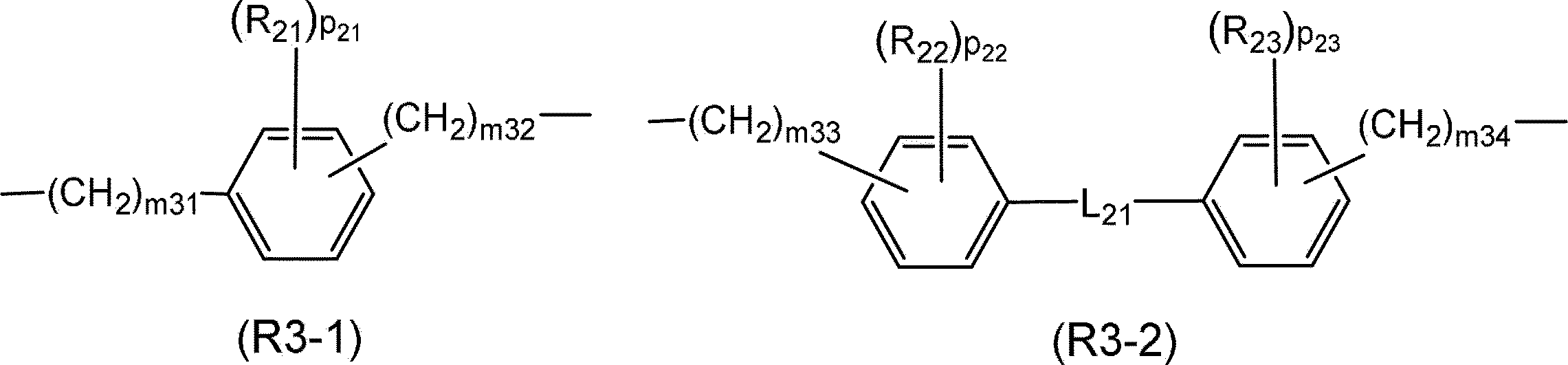
(m31及びm32は、それぞれ独立に、0~2の整数であり、好ましくは0又は1である。m33及びm34は、それぞれ独立に、0~2の整数であり、好ましくは0又は1である。R21、R22、及びR23は、それぞれ独立に、炭素数1~4のアルキル基、炭素数2~4のアルケニル基、又は炭素数2~4のアルキニル基である。p21、p22及びp23は0~4の整数であり、好ましくは0である。L21は、単結合、エーテル基、カルボニル基又は炭素数1~4のアルキレン基である。)
なお、R3は少なくとも1つの芳香環を含む炭素数6~22の2価の基であるので、式(R3-1)におけるm31、m32、R21及びp21は、式(R3-1)で表される2価の基の炭素数が6~22の範囲に入るように選択される。
同様に、式(R3-2)におけるL21、m33、m34、R22、R23、p22及びp23は、式(R3-2)で表される2価の基の炭素数が12~22の範囲に入るように選択される。

(R4は-SO2-又は-Si(Rx)(Ry)O-を含む2価の基であり、Rx及びRyはそれぞれ独立に、炭素数1~3の鎖状脂肪族基又はフェニル基を表す。X4は少なくとも1つの芳香環を含む炭素数6~22の4価の基である。)
X4は、式(1)におけるX1と同様に定義され、好ましい様態も同様である。
該鎖状脂肪族基は、飽和であっても不飽和であってもよく、直鎖状であっても分岐状であってもよい。ポリイミド樹脂(a1-1)が上記特定の基を末端に有すると、耐熱老化性に優れる樹脂組成物を得ることができる。
炭素数5~14の飽和鎖状脂肪族基としては、n-ペンチル基、n-ヘキシル基、n-ヘプチル基、n-オクチル基、n-ノニル基、n-デシル基、n-ウンデシル基、ラウリル基、n-トリデシル基、n-テトラデシル基、イソペンチル基、ネオペンチル基、2-メチルペンチル基、2-メチルヘキシル基、2-エチルペンチル基、3-エチルペンチル基、イソオクチル基、2-エチルヘキシル基、3-エチルヘキシル基、イソノニル基、2-エチルオクチル基、イソデシル基、イソドデシル基、イソトリデシル基、イソテトラデシル基等が挙げられる。
炭素数5~14の不飽和鎖状脂肪族基としては、1-ペンテニル基、2-ペンテニル基、1-ヘキセニル基、2-ヘキセニル基、1-ヘプテニル基、2-ヘプテニル基、1-オクテニル基、2-オクテニル基、ノネニル基、デセニル基、ドデセニル基、トリデセニル基、テトラデセニル基等が挙げられる。
中でも、上記鎖状脂肪族基は飽和鎖状脂肪族基であることが好ましく、飽和直鎖状脂肪族基であることがより好ましい。また耐熱老化性を得る観点から、上記鎖状脂肪族基は好ましくは炭素数6以上、より好ましくは炭素数7以上、更に好ましくは炭素数8以上であり、好ましくは炭素数12以下、より好ましくは炭素数10以下、更に好ましくは炭素数9以下である。上記鎖状脂肪族基は1種のみでもよく、2種以上でもよい。
上記鎖状脂肪族基は、特に好ましくはn-オクチル基、イソオクチル基、2-エチルヘキシル基、n-ノニル基、イソノニル基、n-デシル基、及びイソデシル基からなる群から選ばれる少なくとも1種であり、更に好ましくはn-オクチル基、イソオクチル基、2-エチルヘキシル基、n-ノニル基、及びイソノニル基からなる群から選ばれる少なくとも1種であり、最も好ましくはn-オクチル基、イソオクチル基、及び2-エチルヘキシル基からなる群から選ばれる少なくとも1種である。
またポリイミド樹脂(a1-1)は、耐熱老化性の観点から、末端アミノ基及び末端カルボキシ基以外に、炭素数5~14の鎖状脂肪族基のみを末端に有することが好ましい。上記以外の基を末端に有する場合、その含有量は、好ましくは炭素数5~14の鎖状脂肪族基に対し10モル%以下、より好ましくは5モル%以下である。
ポリイミド樹脂(a1-1)中の上記炭素数5~14の鎖状脂肪族基の含有量は、ポリイミド樹脂(a1-1)を解重合することにより求めることができる。
ポリイミド樹脂(a1-1)の融点、ガラス転移温度は、いずれも示差走査型熱量計により測定することができる。
またポリイミド樹脂(a1-1)は、結晶性、耐熱性、機械的強度、耐薬品性を向上させる観点から、示差走査型熱量計測定により、該ポリイミド樹脂を溶融後、降温速度20℃/分で冷却した際に観測される結晶化発熱ピークの熱量(以下、単に「結晶化発熱量」ともいう)が、5.0mJ/mg以上であることが好ましく、10.0mJ/mg以上であることがより好ましく、17.0mJ/mg以上であることが更に好ましい。結晶化発熱量の上限値は特に限定されないが、通常、45.0mJ/mg以下である。
ポリイミド樹脂(a1-1)の融点、ガラス転移温度、結晶化発熱量は、具体的には実施例に記載の方法で測定できる。
μ=ln(ts/t0)/C
t0:濃硫酸の流れる時間
ts:ポリイミド樹脂溶液の流れる時間
C:0.5(g/dL)
ポリイミド樹脂(a1-1)の重量平均分子量Mwは、ポリメチルメタクリレート(PMMA)を標準試料としてゲルろ過クロマトグラフィー(GPC)法により測定することができる。
ポリイミド樹脂(a1-1)は、テトラカルボン酸成分とジアミン成分とを反応させることにより製造することができる。該テトラカルボン酸成分は少なくとも1つの芳香環を含むテトラカルボン酸及び/又はその誘導体を含有し、該ジアミン成分は少なくとも1つの脂環式炭化水素構造を含むジアミン及び鎖状脂肪族ジアミンを含有する。
鎖状脂肪族ジアミンは1種類あるいは複数を混合して使用してもよい。これらのうち、炭素数が8~10の鎖状脂肪族ジアミンが好適に使用でき、特に1,8-オクタメチレンジアミン及び1,10-デカメチレンジアミンからなる群から選ばれる少なくとも1種が好適に使用できる。
前記モル比は、耐熱性の向上という観点からは、好ましくは5モル%以上、より好ましくは10モル%以上であり、一方で結晶性を維持する観点からは、好ましくは20モル%以下、より好ましくは15モル%以下である。
また、前記モル比は、ポリイミド樹脂の着色を少なくする観点からは、好ましくは12モル%以下、より好ましくは10モル%以下、更に好ましくは5モル%以下、より更に好ましくは0モル%である。
中でも、末端封止剤としてはモノアミン類末端封止剤が好ましく、ポリイミド樹脂(a1-1)の末端に前述した炭素数5~14の鎖状脂肪族基を導入して耐熱老化性を向上させる観点から、炭素数5~14の鎖状脂肪族基を有するモノアミンがより好ましく、炭素数5~14の飽和直鎖状脂肪族基を有するモノアミンが更に好ましい。
末端封止剤は、特に好ましくはn-オクチルアミン、イソオクチルアミン、2-エチルヘキシルアミン、n-ノニルアミン、イソノニルアミン、n-デシルアミン、及びイソデシルアミンからなる群から選ばれる少なくとも1種であり、更に好ましくはn-オクチルアミン、イソオクチルアミン、2-エチルヘキシルアミン、n-ノニルアミン、及びイソノニルアミンからなる群から選ばれる少なくとも1種であり、最も好ましくはn-オクチルアミン、イソオクチルアミン、及び2-エチルヘキシルアミンからなる群から選ばれる少なくとも1種である。
本発明の熱可塑性樹脂組成物は、成分(B)として、酸化ジルコニウム(b1)を含む無機充填材を含有する。
前記熱可塑性樹脂(A)と、所定量の酸化ジルコニウム(b1)を含む無機充填材(B)を用いることにより、切削加工性及び微細加工性に優れる成形体を作製できる。
本発明に用いる酸化ジルコニウム(b1)の形状は特に制限されず、例えば、球状、板状、鱗片状、柱状、繊維状が挙げられる。これらの中でも、得られる成形体の切削加工性及び微細加工性向上の観点から、球状又は板状の粒子であることが好ましく、球状粒子であることがより好ましい。
酸化ジルコニウム(b1)は、得られる成形体の切削加工性及び微細加工性向上の観点、並びに入手性の観点から、粒径が小さい方が好ましい。例えば成分(b1)の体積中位粒径(D50)は、得られる成形体の切削加工性及び微細加工性向上の観点から、好ましくは1μm以下であり、より好ましくは0.80μm以下、更に好ましくは0.60μm以下、より更に好ましくは0.50μm以下、より更に好ましくは0.40μm以下である。また、得られる成形体の切削加工性及び微細加工性向上の観点、入手性、並びに、取り扱い性向上の観点から、通常は0.01μm以上であり、より好ましくは0.02μm以上、更に好ましくは0.05μm以上である。
成分(b1)のD50は、レーザー回折光散乱式粒度分布測定器により測定することができる。
成分(B)は、成分(b1)のみからなる無機充填材であってもよく、さらに成分(b1)以外の無機充填材(b2)を含むこともできる。
成分(b2)としては、タルク、マイカ、シリカ、アルミナ、ワラストナイト、窒化ケイ素、窒化アルミニウム、窒化ホウ素、炭化ケイ素、炭化ホウ素、炭酸カルシウム、酸化チタン、酸化亜鉛、酸化カルシウム、炭酸マグネシウム、炭酸バリウム、硫酸マグネシウム、硫酸バリウム、三硫化アンチモン、硫化錫、硫化銅、硫化鉄、硫化ビスマス、硫化亜鉛等が挙げられ、これらのうち1種又は2種以上を用いることができる。
上記の中でも、得られる成形体の切削加工性及び微細加工性向上の観点から、成分(b2)としては、好ましくはタルク、マイカ、シリカ、アルミナ、窒化ケイ素、窒化アルミニウム、窒化ホウ素、炭化ケイ素、炭化ホウ素、炭酸カルシウム、及び酸化チタンからなる群から選ばれる少なくとも1種であり、より好ましくはタルク、マイカ、シリカ、及び酸化チタンからなる群から選ばれる少なくとも1種であり、更に好ましくはタルク及びシリカからなる群から選ばれる少なくとも1種であり、より更に好ましくはタルクである。なお、低誘電特性をさらに向上させたい場合には、中空シリカ、中空アルミナ等の中空形態の無機充填材を用いることが好ましい。
成分(b2)のD50は、成分(b1)と同様の方法で測定することができる。
本発明の熱可塑性樹脂組成物には、強化繊維、艶消剤、可塑剤、帯電防止剤、着色防止剤、ゲル化防止剤、着色剤、摺動性改良剤、酸化防止剤、導電剤、樹脂改質剤等の成分(B)以外の添加剤を、必要に応じて配合することができる。特に、帯電防止剤として、黒鉛、カーボンブラック、グラファイト、ケッチェンブラック、又はカーボンナノチューブを用いることで、本発明の熱可塑性樹脂組成物の特性を阻害しないような少量の添加においても、十分な帯電防止効果が発現できるため、好適に使用可能である。
上記添加剤を用いる場合、その配合量には特に制限はないが、添加剤の効果を発現させる観点から、熱可塑性樹脂組成物中、通常、50質量%以下であり、好ましくは0.0001~30質量%、より好ましくは0.001~15質量%、更に好ましくは0.01~10質量%である。
本発明の熱可塑性樹脂組成物は、例えば熱可塑性樹脂(A)、無機充填材(B)、及び必要に応じて各種任意成分を添加してドライブレンドした後、あるいは、熱可塑性樹脂(A)の押出機へのフィードとは別の個所より無機充填材(B)及び任意の成分を別フィードした後、押出機内で溶融混練してストランドを押出し、ストランドをカットすることによりペレット化することができる。また、当該ペレットを各種成形機に導入して後述の方法で熱成形することにより、所望の形状を有する成形体を容易に製造することができる。 一方、ペレット形態を経由せずに成形体を取得することも可能である。例えば、熱可塑性樹脂(A)、無機充填材(B)、及び必要に応じて各種任意成分を添加してドライブレンドした後、金型内にブレンド材料を投入し、加熱プレスすることで圧縮成形を行うと、直接成形体を取得することもできる。
本発明の熱可塑性樹脂組成物は、ペレット形態にする観点、及び圧縮成形を行う観点からは、溶剤を含まないことが好ましい。具体的には、熱可塑性樹脂組成物中の溶剤の含有量は、好ましくは5質量%以下、より好ましくは1質量%以下、更に好ましくは0.1質量%以下である。
本発明は、前記熱可塑性樹脂組成物を含む成形体を提供する。
本発明の成形体は、前記熱可塑性樹脂組成物を熱成形することにより製造できる。熱成形方法としては射出成形、押出成形、インフレーション成形、ブロー成形、熱プレス成形(圧縮成形)、真空成形、圧空成形、レーザー成形、溶接、溶着等が挙げられ、熱溶融工程を経る成形方法であればいずれの方法でも成形が可能である。前述したペレットを用いて熱成形を行い、得られた成形体を切削加工する観点からは、射出成形あるいは押出成形が好ましい。特に、生産効率の観点では射出成形、より高い寸法安定性の観点では押出成形が好ましい。
まず、熱可塑性樹脂(A)に、無機充填材(B)及び必要に応じて各種任意成分を添加してドライブレンドした後、これを押出機内に導入して、好ましくは290~380℃で溶融して押出機内で溶融混練及び押出し、ペレットを作製する。あるいは、熱可塑性樹脂(A)を押出機内に導入して、好ましくは290~380℃で溶融し、ここに無機充填材(B)及び必要に応じて各種任意成分を導入して押出機内で熱可塑性樹脂(A)と溶融混練し、押出すことで前述のペレットを作製してもよい。
上記ペレットを乾燥させた後、各種成形機に導入して好ましくは290~380℃で熱成形し、所望の形状を有する成形体を製造することができる。
アニール処理温度は、使用する熱可塑性樹脂(A)の種類に応じて設定することができる。熱可塑性樹脂(A)が結晶性熱可塑性樹脂(a1)である場合、アニール処理温度は、成形体の変形を避ける観点から、結晶性熱可塑性樹脂(a1)の融点未満の温度であり、切削加工性及び微細加工性をより向上させる観点、並びに、成形体の変形を避ける観点から、結晶性熱可塑性樹脂(a1)の融点をTm(℃)とした場合、好ましくはTm-100℃~Tm-20℃の範囲である。熱可塑性樹脂(A)が非晶性熱可塑性樹脂(a2)である場合、アニール処理温度は、成形体の変形を避ける観点から、非晶性熱可塑性樹脂(a2)のガラス転移温度未満の温度であり、切削加工性及び微細加工性をより向上させる観点、並びに、成形体の変形を避ける観点から、非晶性熱可塑性樹脂(a2)のガラス転移温度をTg(℃)とした場合、好ましくはTg-100℃~Tg-20℃の範囲である。
アニール処理温度の具体例は、熱可塑性樹脂(A)が前記ポリイミド樹脂(a1-1)を含む場合には、切削加工性及び微細加工性をより向上させる観点、並びに、成形体の変形を避ける観点から、好ましくは200~360℃、より好ましくは220~340℃、更に好ましくは240~330℃、より更に好ましくは250~320℃の範囲である。
アニール処理時間は特に制限されないが、成形体の切削加工性及び微細加工性をより向上させる観点、並びに製造効率向上の観点から、好ましくは1~120分、より好ましくは5~60分の範囲である。
成形体のアニール処理は、公知の加熱装置を用いて行うことができる。
アニール処理後は、残留応力による成形体の反りの発生を抑制する観点から、好ましくは100℃以下の温度になるまで徐冷を行う。
本発明はさらに、前記成形体を加工して得られる、検査用ICソケットの構成部材(以下、単に「本発明の部材」又は「部材」ともいう)を提供する。
本明細書における検査用ICソケットとしては、製品検査用のICソケット(テストソケット)、バーンインテスト用のICソケット(バーンインソケット)等が挙げられる。
本発明の部材は、検査用ICソケットの少なくとも一部を構成する部材であればよく、例えば、検査の対象となるデバイスを装着する部位に用いる、略平板状の部材が挙げられる。略平板状の部材は、前記デバイスを嵌め込むための微細な貫通孔を有している。
本発明の部材は、例えば次の方法により作製することができる。まず、前記熱可塑性樹脂組成物を用いて熱成形(好ましくは射出成形)を行い、成形体を作製する。次いで、好ましくはアニール処理を行った後、該成形体を電動ドリル等により切削加工して切削加工板を得る。この切削加工板を電動ドリルやレーザー等により微細加工して複数の貫通孔を形成し、所望の形状を有する部材が得られる。
算術平均粗さは、具体的には実施例に記載の方法により測定できる。
また、本発明の熱可塑性樹脂組成物を用いて射出成形等により製造した成形体は、上記のように切削加工性に優れることから、ICソケット部材以外にも、ギヤ、軸受け、腕時計用ハウジング等の精密切削加工を必要とする用途への適応性にも優れる。
ポリイミド樹脂のIR測定は日本電子(株)製「JIR-WINSPEC50」を用いて行った。
ポリイミド樹脂を190~200℃で2時間乾燥した後、該ポリイミド樹脂0.100gを濃硫酸(96%、関東化学(株)製)20mLに溶解したポリイミド樹脂溶液を測定試料とし、キャノンフェンスケ粘度計を使用して30℃において測定を行った。対数粘度μは下記式により求めた。
μ=ln(ts/t0)/C
t0:濃硫酸の流れる時間
ts:ポリイミド樹脂溶液の流れる時間
C:0.5g/dL
ポリイミド樹脂の融点Tm、ガラス転移温度Tg、結晶化温度Tc、及び結晶化発熱量ΔHmは、示差走査熱量計装置(エスアイアイ・ナノテクノロジー(株)製「DSC-6220」)を用いて測定した。
窒素雰囲気下、ポリイミド樹脂に下記条件の熱履歴を課した。熱履歴の条件は、昇温1度目(昇温速度10℃/分)、その後冷却(降温速度20℃/分)、その後昇温2度目(昇温速度10℃/分)である。
融点Tmは昇温2度目で観測された吸熱ピークのピークトップ値を読み取り決定した。ガラス転移温度Tgは昇温2度目で観測された値を読み取り決定した。結晶化温度Tcは冷却時に観測された発熱ピークのピークトップ値を読み取り決定した。
また結晶化発熱量ΔHm(mJ/mg)は冷却時に観測された発熱ピークの面積から算出した。
ポリイミド樹脂の半結晶化時間は、示差走査熱量計装置(エスアイアイ・ナノテクノロジー(株)製「DSC-6220」)を用いて測定した。
半結晶化時間が20秒以下のポリイミド樹脂の測定条件は窒素雰囲気下、420℃で10分保持し、ポリイミド樹脂を完全に溶融させたのち、冷却速度70℃/分の急冷操作を行った際に、観測される結晶化ピークの出現時からピークトップに達するまでにかかった時間を計算し、決定した。
ポリイミド樹脂の重量平均分子量(Mw)は、昭和電工(株)製のゲルろ過クロマトグラフィー(GPC)測定装置「Shodex GPC-101」を用いて下記条件にて測定した。
カラム:Shodex HFIP-806M
移動相溶媒:トリフルオロ酢酸ナトリウム2mM含有HFIP
カラム温度:40℃
移動相流速:1.0mL/min
試料濃度:約0.1質量%
検出器:IR検出器
注入量:100μm
検量線:標準PMMA
ディーンスターク装置、リービッヒ冷却管、熱電対、4枚パドル翼を設置した2Lセパラブルフラスコ中に2-(2-メトキシエトキシ)エタノール(日本乳化剤(株)製)500gとピロメリット酸二無水物(三菱ガス化学(株)製)218.12g(1.00mol)を導入し、窒素フローした後、均一な懸濁溶液になるように150rpmで撹拌した。一方で、500mLビーカーを用いて、1,3-ビス(アミノメチル)シクロヘキサン(三菱ガス化学(株)製、シス/トランス比=7/3)49.79g(0.35mol)、1,8-オクタメチレンジアミン(関東化学(株)製)93.77g(0.65mol)を2-(2-メトキシエトキシ)エタノール250gに溶解させ、混合ジアミン溶液を調製した。この混合ジアミン溶液を、プランジャーポンプを使用して徐々に加えた。滴下により発熱が起こるが、内温は40~80℃に収まるよう調整した。混合ジアミン溶液の滴下中はすべて窒素フロー状態とし、撹拌翼回転数は250rpmとした。滴下が終わったのちに、2-(2-メトキシエトキシ)エタノール130gと、末端封止剤であるn-オクチルアミン(関東化学(株)製)1.284g(0.0100mol)を加えさらに撹拌した。この段階で、淡黄色のポリアミド酸溶液が得られた。次に、撹拌速度を200rpmとした後に、2Lセパラブルフラスコ中のポリアミド酸溶液を190℃まで昇温した。昇温を行っていく過程において、液温度が120~140℃の間にポリイミド樹脂粉末の析出と、イミド化に伴う脱水が確認された。190℃で30分保持した後、室温まで放冷を行い、濾過を行った。得られたポリイミド樹脂粉末は2-(2-メトキシエトキシ)エタノール300gとメタノール300gにより洗浄、濾過を行った後、乾燥機で180℃、10時間乾燥を行い、317gの、結晶性熱可塑性樹脂であるポリイミド樹脂1の粉末を得た。
ポリイミド樹脂1のIRスペクトルを測定したところ、ν(C=O)1768、1697(cm-1)にイミド環の特性吸収が認められた。対数粘度は1.30dL/g、Tmは323℃、Tgは184℃、Tcは266℃、結晶化発熱量は21.0mJ/mg、半結晶化時間は20秒以下、Mwは55,000であった。

・PMDA;ピロメリット酸二無水物
・1,3-BAC;1,3-ビス(アミノメチル)シクロヘキサン
・OMDA;1,8-オクタメチレンジアミン
表2に示す成分(A)及び成分(B)をドライブレンドにより十分混合した。得られた混合粉末を同方向回転二軸混練押出機((株)パーカーコーポレーション製「HK-25D-41D」、スクリュー径:25mm)を用いてバレル温度360℃、スクリュー回転数120rpmで、直径2~3mmのストランドを押し出した。この際のストランドの吐出量及び吐出性を観察し、樹脂組成物の二軸押出時の製造安定性を下記基準により評価した。
前記方法で二軸混練押出機より押し出されたストランドの吐出量(kg/h)及び吐出性を観察し、樹脂組成物の二軸押出時の製造安定性を下記基準により評価した。
AA:吐出量は4kg/h超となり、ストランドが均一に吐出された。
A:吐出量は3~4kg/hとなり、ストランドが均一に吐出された。
B:吐出量は3~4kg/hとなり、ストランドが不均一であるが吐出された。
C:吐出量が3kg/h未満であった。
射出成形機(ファナック(株)製「ロボショットα-S30iA」)を使用して、バレル温度375℃、金型温度200℃、成形サイクル60秒にて射出成形を行い、70mm×70mm×4mm厚さの平板状の射出成形体を作製した。この際の射出成形性について、以下の方法により評価を行った。
以下の3項目により、樹脂組成物の射出成形性を評価した。
前記方法でペレット化した樹脂組成物を前記射出成形機のシリンダーにフィードしている際のトルクを観測し、装置負荷について下記基準により評価した。
A:ペレットをシリンダーにフィードしている際、トルクリミットまで十分な余裕がある。
B:ペレットをシリンダーにフィードしている際、トルクリミット付近であるが成形可能である。
C:ペレットをシリンダーにフィードしている際、トルクリミットとなり容易には成形できない。
前記方法により得られた射出成形体の表面を目視観察し、表面荒れについて下記基準により評価した。
AA:シルバー及び気泡の発生がない。
A:シルバー又は気泡の発生がわずかにある。
B:シルバー又は気泡の発生が全面にではないが多量にある。
C:シルバー又は気泡の発生が全面に且つ多量に観察される。
前記方法により10ショット連続で射出成形を行って得られた射出成形体の表面を目視観察し、焼けについて下記基準により評価した。
AA:10ショットの連続成形時に焼けが見られない。
A:10ショットの連続成形時に焼けが徐々に見られる。
B:1ショット目から焼けが見られる。
C:1ショット目から焼けが見られ、焼けが徐々に強くなる。
以下の方法により、前記射出成形体の切削加工性を評価した。
(切削時の面粗度)
前記方法により得られた射出成形体を切削加工し、50mm×50mm×3mm厚さの平板を作製した。得られた平板の切削加工面上で、切削方向に対して直交方向に向かって、長さ20mmの連続した領域の算術平均粗さ(Ra)を3D形状測定装置((株)キーエンス製「VR-6000」)により測定し、面粗度を下記基準により評価した。
A:算術平均粗さが0.6μm以下
B:算術平均粗さが0.6μm超1μm以下
C:算術平均粗さが1μm超
以下の2項目により、前記平板(切削加工板)の微細加工性を評価した。
(微細孔(100μm)の孔径分布)
図1に示す、前記50mm×50mm×3mm厚さの切削加工板10の中央付近のエリア20(約3mm×3mmの面積内)に、電動ドリル(ドリル直径:Φ0.10mm)を用いて、ピッチ:0.12mmにて貫通孔を24×24個、合計576個開けた。形成した貫通孔の直径を高精度画像寸法測定器((株)キーエンス製「LMシリーズ」)を用いて計測し、該直径の分布に基づいて下記基準で評価した。
A:すべての貫通孔の直径がΦ0.090~0.110mmの間に入っている。
C:貫通孔の直径がΦ0.090~0.110mmの範囲を超えるものが存在する。
上記方法により形成した貫通孔の外観をデジタル顕微鏡((株)キーエンス製「VHX-7000」、倍率:50倍)で観察し、下記基準で評価した。
AA:パターン崩れがなく、バリも少ない。
A:若干のパターン崩れやバリがある。
C:大きなパターン崩れや孔同士の接近、又は、多量のバリがある。

表3に示す成分(A)及び成分(B)をドライブレンドにより十分混合した。得られた混合粉末を同方向回転二軸混練押出機((株)パーカーコーポレーション製「HK-25D-41D」、スクリュー径:25mm)を用いてバレル温度360℃、スクリュー回転数120rpmで、直径2~3mmのストランドを押し出した。
押出機より押し出されたストランドを空冷後、ペレタイザー((株)星プラスチック製「ファンカッターFC-Mini-4/N」)によってペレット化した。得られたペレット(熱可塑性樹脂組成物)は150℃で10時間乾燥を行った後、射出成形に使用した。
射出成形機(ファナック(株)製「ロボショットα-S30iA」)を使用して、バレル温度375℃、金型温度200℃、成形サイクル60秒にて射出成形を行い、70mm×70mm×4mm厚さの平板状の射出成形体を作製した。該射出成形体を、送風定温恒温器(ヤマト科学(株)製「DN610H」)を用いて、表3に記載の温度で60分間アニール処理を行い、常温まで徐冷を行い射出成形体を回収した後、以下の方法により評価を行った。
以下の2項目により、前記アニール処理後の射出成形体の切削加工性を評価した。
(切削時の反り)
前記方法により得られた射出成形体を切削加工し、50mm×50mm×3mm厚さの平板を作製した。得られた平板の反りの状態を、歪ゲージを用いて8方向から確認し、下記基準により評価した。
A:8方向全てが40μm以下の反りである。
B:1か所以上に40μmを超える反りがある。
C:全体に強いうねりがあり、反りの計測が困難である。
前記方法により得られた射出成形体を切削加工し、50mm×50mm×3mm厚さの平板を作製した。得られた平板の切削加工面上で、切削方向に対して直交方向に向かって、長さ20mmの連続した領域の算術平均粗さ(Ra)を3D形状測定装置((株)キーエンス製「VR-6000」)により測定し、面粗度を下記基準により評価した。
AA:算術平均粗さが0.3μm以下
A:算術平均粗さが0.3μm超0.6μm以下
B:算術平均粗さが0.6μm超1μm以下
C:算術平均粗さが1μm超
以下の2項目により、前記平板(切削加工板)の微細加工性を評価した。
(微細孔(50μm)の孔径分布)
図1に示す、前記50mm×50mm×3mm厚さの切削加工板10の中央付近のエリア20(約3mm×3mmの面積内)に、電動ドリル(ドリル直径:Φ0.05mm)を用いて、ピッチ:0.1mmにて貫通孔を4×20個、合計80個開けた。形成した貫通孔の直径を高精度画像寸法測定器((株)キーエンス製「LMシリーズ」)を用いて計測し、該直径の分布に基づいて下記基準で評価した。
A:すべての貫通孔の直径がΦ0.047~0.053mmの間に入っている。
C:貫通孔の直径がΦ0.047~0.053mmの範囲を超えるものが存在する。
なお表3中、微細加工自体が困難であるものについては「-」と表記した。
上記方法により形成した貫通孔の外観をデジタル顕微鏡((株)キーエンス製「VHX-7000」、倍率:50倍)で観察し、下記基準で評価した。
AA:パターン崩れがなく、バリも少ない。
A:若干のパターン崩れやバリがある。
C:大きなパターン崩れや孔同士の接近、又は、多量のバリがある。
なお表3中、微細加工自体が困難であるものについては「-」と表記した。

<熱可塑性樹脂(A)>
(a1-1)製造例1で得られたポリイミド樹脂1
<無機充填材(B)>
(b1)酸化ジルコニウム、共立マテリアル(株)製高純度ジルコニア「KZ-0Y-LSF」、球状粒子、D50:0.2μm、モース硬度:8
(b2-1)シリカ、共立マテリアル(株)製「KS-1」、板状粒子、D50:1.4μm、モース硬度:7
(b2-2)タルク、日本タルク(株)製「ナノエース D-800」、板状粒子、D50:0.8μm、モース硬度:1
(b2-3)マイカ、ヤマグチマイカ製硬質マイカ「A-11」、板状粒子、D50:3μm、モース硬度:2.0~3.2
10:切削加工板
20:貫通孔形成エリア
Claims (9)
- 成分(A):融点が270℃以上の結晶性熱可塑性樹脂(a1)及びガラス転移温度が200℃以上の非晶性熱可塑性樹脂(a2)からなる群から選ばれる少なくとも1種の熱可塑性樹脂、並びに、
成分(B):酸化ジルコニウム(b1)を含む無機充填材、
を含有する熱可塑性樹脂組成物であって、
前記成分(A)100質量部に対する前記成分(b1)の含有量が2~40質量部であり、
前記成分(A)100質量部に対する前記成分(B)の含有量が2~60質量部である、熱可塑性樹脂組成物。 - 前記成分(A)がポリイミド樹脂、ポリエーテルイミド樹脂、ポリエーテルイミドスルホン樹脂、ポリフェニレンスルフィド樹脂、ポリエーテルエーテルケトン樹脂、ポリエーテルケトンケトン樹脂、液晶ポリマー、及び液晶ポリマー以外の全芳香族ポリエステル樹脂からなる群から選ばれる少なくとも1種である、請求項1に記載の熱可塑性樹脂組成物。
- 前記成分(A)が、下記式(1)で示される繰り返し構成単位及び下記式(2)で示される繰り返し構成単位を含み、該式(1)の繰り返し構成単位と該式(2)の繰り返し構成単位の合計に対する該式(1)の繰り返し構成単位の含有比が20~70モル%のポリイミド樹脂(a1-1)を含む、請求項1又は2に記載の熱可塑性樹脂組成物。

(R1は少なくとも1つの脂環式炭化水素構造を含む炭素数6~22の2価の基である。R2は炭素数5~16の2価の鎖状脂肪族基である。X1及びX2は、それぞれ独立に、少なくとも1つの芳香環を含む炭素数6~22の4価の基である。) - 前記成分(b1)の体積中位粒径(D50)が1μm以下である、請求項1~3のいずれか1項に記載の熱可塑性樹脂組成物。
- 前記成分(b1)が球状粒子である、請求項1~4のいずれか1項に記載の熱可塑性樹脂組成物。
- 前記成分(B)が、さらに前記成分(b1)以外の無機充填材(b2)を含み、前記成分(b2)が、タルク、マイカ、シリカ、アルミナ、窒化ケイ素、窒化アルミニウム、窒化ホウ素、炭化ケイ素、炭化ホウ素、炭酸カルシウム、及び酸化チタンからなる群から選ばれる少なくとも1種である、請求項1~5のいずれか1項に記載の熱可塑性樹脂組成物。
- 前記成分(A)100質量部に対する前記成分(b2)の含有量が1~40質量部である、請求項6に記載の熱可塑性樹脂組成物。
- 請求項1~7のいずれか1項に記載の熱可塑性樹脂組成物を含む成形体。
- 請求項8に記載の成形体を加工して得られる、検査用ICソケットの構成部材。
Priority Applications (5)
| Application Number | Priority Date | Filing Date | Title |
|---|---|---|---|
| EP23831051.0A EP4549517A4 (en) | 2022-06-28 | 2023-06-12 | THERMOPLASTIC RESIN COMPOSITION, MOLDED BODY AND CONSTITUENT ELEMENT OF AN IC SOCKET FOR INSPECTION |
| US18/878,150 US20250388735A1 (en) | 2022-06-28 | 2023-06-12 | Thermoplastic resin composition, molded body, and constituting member of ic socket for inspection |
| CN202380048223.2A CN119403887A (zh) | 2022-06-28 | 2023-06-12 | 热塑性树脂组合物、成型体以及检查用ic插座的构成构件 |
| JP2024530642A JPWO2024004602A1 (ja) | 2022-06-28 | 2023-06-12 | |
| KR1020247042675A KR20250027668A (ko) | 2022-06-28 | 2023-06-12 | 열가소성 수지 조성물, 성형체, 및, 검사용 ic소켓의 구성부재 |
Applications Claiming Priority (2)
| Application Number | Priority Date | Filing Date | Title |
|---|---|---|---|
| JP2022-103714 | 2022-06-28 | ||
| JP2022103714 | 2022-06-28 |
Publications (1)
| Publication Number | Publication Date |
|---|---|
| WO2024004602A1 true WO2024004602A1 (ja) | 2024-01-04 |
Family
ID=89382057
Family Applications (1)
| Application Number | Title | Priority Date | Filing Date |
|---|---|---|---|
| PCT/JP2023/021667 Ceased WO2024004602A1 (ja) | 2022-06-28 | 2023-06-12 | 熱可塑性樹脂組成物、成形体、及び、検査用icソケットの構成部材 |
Country Status (7)
| Country | Link |
|---|---|
| US (1) | US20250388735A1 (ja) |
| EP (1) | EP4549517A4 (ja) |
| JP (1) | JPWO2024004602A1 (ja) |
| KR (1) | KR20250027668A (ja) |
| CN (1) | CN119403887A (ja) |
| TW (1) | TW202409207A (ja) |
| WO (1) | WO2024004602A1 (ja) |
Cited By (2)
| Publication number | Priority date | Publication date | Assignee | Title |
|---|---|---|---|---|
| WO2025142176A1 (ja) * | 2023-12-25 | 2025-07-03 | 三菱瓦斯化学株式会社 | プローブカード用部材又はプリント基板検査治具用部材、及びこれらの製造方法 |
| WO2025225252A1 (ja) * | 2024-04-25 | 2025-10-30 | グローバルポリアセタール株式会社 | 樹脂組成物、ペレット、および、成形体 |
Citations (5)
| Publication number | Priority date | Publication date | Assignee | Title |
|---|---|---|---|---|
| JP2016075894A (ja) * | 2014-10-02 | 2016-05-12 | コニカミノルタ株式会社 | 光学フィルム、その製造方法、フレキシブルプリント基板及びled照明 |
| WO2016147996A1 (ja) | 2015-03-19 | 2016-09-22 | 三菱瓦斯化学株式会社 | ポリイミド樹脂 |
| WO2017175679A1 (ja) * | 2016-04-05 | 2017-10-12 | 三菱瓦斯化学株式会社 | ポリイミド樹脂組成物及びその製造方法、並びにポリイミドフィルム |
| JP2018053156A (ja) * | 2016-09-30 | 2018-04-05 | コニカミノルタ株式会社 | ポリイミド樹脂組成物、ポリイミド樹脂組成物の製造方法、透明基板及びディスプレイ用フィルム |
| WO2021024624A1 (ja) | 2019-08-08 | 2021-02-11 | 三菱瓦斯化学株式会社 | 難燃性ポリイミド成形材料及び成形体 |
Family Cites Families (6)
| Publication number | Priority date | Publication date | Assignee | Title |
|---|---|---|---|---|
| CN1311594C (zh) * | 2001-04-03 | 2007-04-18 | 株式会社吴羽 | Ic插座 |
| JP4456916B2 (ja) | 2004-04-05 | 2010-04-28 | 株式会社クレハ | 低汚染性の射出成形体 |
| TWI495404B (zh) * | 2013-06-21 | 2015-08-01 | Chi Mei Corp | 軟性基板用組成物及軟性基板 |
| EP3262117B1 (en) * | 2015-02-23 | 2019-05-08 | SABIC Global Technologies B.V. | Electrical tracking resistance compositions, articles formed therefrom, and methods of manufacture thereof |
| US20180188290A1 (en) | 2015-07-03 | 2018-07-05 | Okins Electronics Co.,Ltd | Test socket, test socket manufacturing method, and jig assembly for test socket |
| CN112119124A (zh) * | 2018-05-17 | 2020-12-22 | 三菱瓦斯化学株式会社 | 聚酰亚胺树脂组合物 |
-
2023
- 2023-06-12 EP EP23831051.0A patent/EP4549517A4/en active Pending
- 2023-06-12 WO PCT/JP2023/021667 patent/WO2024004602A1/ja not_active Ceased
- 2023-06-12 KR KR1020247042675A patent/KR20250027668A/ko active Pending
- 2023-06-12 CN CN202380048223.2A patent/CN119403887A/zh active Pending
- 2023-06-12 JP JP2024530642A patent/JPWO2024004602A1/ja active Pending
- 2023-06-12 US US18/878,150 patent/US20250388735A1/en active Pending
- 2023-06-26 TW TW112123582A patent/TW202409207A/zh unknown
Patent Citations (5)
| Publication number | Priority date | Publication date | Assignee | Title |
|---|---|---|---|---|
| JP2016075894A (ja) * | 2014-10-02 | 2016-05-12 | コニカミノルタ株式会社 | 光学フィルム、その製造方法、フレキシブルプリント基板及びled照明 |
| WO2016147996A1 (ja) | 2015-03-19 | 2016-09-22 | 三菱瓦斯化学株式会社 | ポリイミド樹脂 |
| WO2017175679A1 (ja) * | 2016-04-05 | 2017-10-12 | 三菱瓦斯化学株式会社 | ポリイミド樹脂組成物及びその製造方法、並びにポリイミドフィルム |
| JP2018053156A (ja) * | 2016-09-30 | 2018-04-05 | コニカミノルタ株式会社 | ポリイミド樹脂組成物、ポリイミド樹脂組成物の製造方法、透明基板及びディスプレイ用フィルム |
| WO2021024624A1 (ja) | 2019-08-08 | 2021-02-11 | 三菱瓦斯化学株式会社 | 難燃性ポリイミド成形材料及び成形体 |
Non-Patent Citations (1)
| Title |
|---|
| See also references of EP4549517A4 |
Cited By (2)
| Publication number | Priority date | Publication date | Assignee | Title |
|---|---|---|---|---|
| WO2025142176A1 (ja) * | 2023-12-25 | 2025-07-03 | 三菱瓦斯化学株式会社 | プローブカード用部材又はプリント基板検査治具用部材、及びこれらの製造方法 |
| WO2025225252A1 (ja) * | 2024-04-25 | 2025-10-30 | グローバルポリアセタール株式会社 | 樹脂組成物、ペレット、および、成形体 |
Also Published As
| Publication number | Publication date |
|---|---|
| US20250388735A1 (en) | 2025-12-25 |
| JPWO2024004602A1 (ja) | 2024-01-04 |
| TW202409207A (zh) | 2024-03-01 |
| EP4549517A1 (en) | 2025-05-07 |
| CN119403887A (zh) | 2025-02-07 |
| EP4549517A4 (en) | 2025-10-15 |
| KR20250027668A (ko) | 2025-02-27 |
Similar Documents
| Publication | Publication Date | Title |
|---|---|---|
| JP7635711B2 (ja) | 難燃性ポリイミド成形材料及び成形体 | |
| WO2024004602A1 (ja) | 熱可塑性樹脂組成物、成形体、及び、検査用icソケットの構成部材 | |
| JP6766986B1 (ja) | ポリイミド樹脂組成物 | |
| JPWO2019220966A1 (ja) | ポリイミド樹脂組成物 | |
| TWI794491B (zh) | 聚醯亞胺樹脂組成物 | |
| JP6879438B1 (ja) | ポリイミド樹脂組成物及び成形体 | |
| JP7497721B2 (ja) | ポリイミド樹脂組成物 | |
| JP6927458B1 (ja) | ポリイミド樹脂組成物及び成形体 | |
| JP7040692B1 (ja) | ポリイミド樹脂組成物及び成形体 | |
| WO2025142176A1 (ja) | プローブカード用部材又はプリント基板検査治具用部材、及びこれらの製造方法 | |
| JP7819693B2 (ja) | 熱可塑性ポリイミド樹脂組成物及び成形品 | |
| JP7464050B2 (ja) | ポリイミド樹脂組成物 | |
| WO2023105969A1 (ja) | ポリイミド樹脂組成物及び成形体 | |
| KR20240072166A (ko) | 폴리이미드 수지 조성물 및 성형체 | |
| TW202337962A (zh) | 發光成形體及波長轉換構件 |
Legal Events
| Date | Code | Title | Description |
|---|---|---|---|
| 121 | Ep: the epo has been informed by wipo that ep was designated in this application |
Ref document number: 23831051 Country of ref document: EP Kind code of ref document: A1 |
|
| ENP | Entry into the national phase |
Ref document number: 2024530642 Country of ref document: JP Kind code of ref document: A |
|
| WWE | Wipo information: entry into national phase |
Ref document number: 202380048223.2 Country of ref document: CN |
|
| WWE | Wipo information: entry into national phase |
Ref document number: 18878150 Country of ref document: US |
|
| WWE | Wipo information: entry into national phase |
Ref document number: 2023831051 Country of ref document: EP |
|
| NENP | Non-entry into the national phase |
Ref country code: DE |
|
| ENP | Entry into the national phase |
Ref document number: 2023831051 Country of ref document: EP Effective date: 20250128 |
|
| WWP | Wipo information: published in national office |
Ref document number: 202380048223.2 Country of ref document: CN |
|
| WWP | Wipo information: published in national office |
Ref document number: 1020247042675 Country of ref document: KR |
|
| WWP | Wipo information: published in national office |
Ref document number: 2023831051 Country of ref document: EP |