WO2024004675A1 - 肝臓癌の発症可能性を検査する方法 - Google Patents
肝臓癌の発症可能性を検査する方法 Download PDFInfo
- Publication number
- WO2024004675A1 WO2024004675A1 PCT/JP2023/022224 JP2023022224W WO2024004675A1 WO 2024004675 A1 WO2024004675 A1 WO 2024004675A1 JP 2023022224 W JP2023022224 W JP 2023022224W WO 2024004675 A1 WO2024004675 A1 WO 2024004675A1
- Authority
- WO
- WIPO (PCT)
- Prior art keywords
- target molecule
- gpnmb
- liver cancer
- fibulin
- present
- Prior art date
- Legal status (The legal status is an assumption and is not a legal conclusion. Google has not performed a legal analysis and makes no representation as to the accuracy of the status listed.)
- Ceased
Links
Images


Classifications
-
- G—PHYSICS
- G01—MEASURING; TESTING
- G01N—INVESTIGATING OR ANALYSING MATERIALS BY DETERMINING THEIR CHEMICAL OR PHYSICAL PROPERTIES
- G01N33/00—Investigating or analysing materials by specific methods not covered by groups G01N1/00 - G01N31/00
- G01N33/48—Biological material, e.g. blood, urine; Haemocytometers
- G01N33/50—Chemical analysis of biological material, e.g. blood, urine; Testing involving biospecific ligand binding methods; Immunological testing
- G01N33/53—Immunoassay; Biospecific binding assay; Materials therefor
- G01N33/575—Immunoassay; Biospecific binding assay; Materials therefor for cancer
- G01N33/57525—Immunoassay; Biospecific binding assay; Materials therefor for cancer of the liver or pancreas
-
- C—CHEMISTRY; METALLURGY
- C12—BIOCHEMISTRY; BEER; SPIRITS; WINE; VINEGAR; MICROBIOLOGY; ENZYMOLOGY; MUTATION OR GENETIC ENGINEERING
- C12Q—MEASURING OR TESTING PROCESSES INVOLVING ENZYMES, NUCLEIC ACIDS OR MICROORGANISMS; COMPOSITIONS OR TEST PAPERS THEREFOR; PROCESSES OF PREPARING SUCH COMPOSITIONS; CONDITION-RESPONSIVE CONTROL IN MICROBIOLOGICAL OR ENZYMOLOGICAL PROCESSES
- C12Q1/00—Measuring or testing processes involving enzymes, nucleic acids or microorganisms; Compositions therefor; Processes of preparing such compositions
- C12Q1/68—Measuring or testing processes involving enzymes, nucleic acids or microorganisms; Compositions therefor; Processes of preparing such compositions involving nucleic acids
- C12Q1/6876—Nucleic acid products used in the analysis of nucleic acids, e.g. primers or probes
- C12Q1/6883—Nucleic acid products used in the analysis of nucleic acids, e.g. primers or probes for diseases caused by alterations of genetic material
- C12Q1/6886—Nucleic acid products used in the analysis of nucleic acids, e.g. primers or probes for diseases caused by alterations of genetic material for cancer
-
- G—PHYSICS
- G01—MEASURING; TESTING
- G01N—INVESTIGATING OR ANALYSING MATERIALS BY DETERMINING THEIR CHEMICAL OR PHYSICAL PROPERTIES
- G01N33/00—Investigating or analysing materials by specific methods not covered by groups G01N1/00 - G01N31/00
- G01N33/48—Biological material, e.g. blood, urine; Haemocytometers
- G01N33/50—Chemical analysis of biological material, e.g. blood, urine; Testing involving biospecific ligand binding methods; Immunological testing
- G01N33/53—Immunoassay; Biospecific binding assay; Materials therefor
- G01N33/543—Immunoassay; Biospecific binding assay; Materials therefor with an insoluble carrier for immobilising immunochemicals
- G01N33/54313—Immunoassay; Biospecific binding assay; Materials therefor with an insoluble carrier for immobilising immunochemicals the carrier being characterised by its particulate form
- G01N33/54326—Magnetic particles
-
- G—PHYSICS
- G01—MEASURING; TESTING
- G01N—INVESTIGATING OR ANALYSING MATERIALS BY DETERMINING THEIR CHEMICAL OR PHYSICAL PROPERTIES
- G01N33/00—Investigating or analysing materials by specific methods not covered by groups G01N1/00 - G01N31/00
- G01N33/48—Biological material, e.g. blood, urine; Haemocytometers
- G01N33/50—Chemical analysis of biological material, e.g. blood, urine; Testing involving biospecific ligand binding methods; Immunological testing
- G01N33/53—Immunoassay; Biospecific binding assay; Materials therefor
- G01N33/575—Immunoassay; Biospecific binding assay; Materials therefor for cancer
- G01N33/5758—Immunoassay; Biospecific binding assay; Materials therefor for cancer involving compounds serving as markers for tumours, cancers or neoplasias, e.g. cellular determinants, receptors, heat shock/stress proteins, A-protein, oligosaccharides or metabolites
- G01N33/57585—Immunoassay; Biospecific binding assay; Materials therefor for cancer involving compounds serving as markers for tumours, cancers or neoplasias, e.g. cellular determinants, receptors, heat shock/stress proteins, A-protein, oligosaccharides or metabolites involving compounds identifiable in body fluids
-
- C—CHEMISTRY; METALLURGY
- C12—BIOCHEMISTRY; BEER; SPIRITS; WINE; VINEGAR; MICROBIOLOGY; ENZYMOLOGY; MUTATION OR GENETIC ENGINEERING
- C12Q—MEASURING OR TESTING PROCESSES INVOLVING ENZYMES, NUCLEIC ACIDS OR MICROORGANISMS; COMPOSITIONS OR TEST PAPERS THEREFOR; PROCESSES OF PREPARING SUCH COMPOSITIONS; CONDITION-RESPONSIVE CONTROL IN MICROBIOLOGICAL OR ENZYMOLOGICAL PROCESSES
- C12Q2600/00—Oligonucleotides characterized by their use
- C12Q2600/158—Expression markers
-
- G—PHYSICS
- G01—MEASURING; TESTING
- G01N—INVESTIGATING OR ANALYSING MATERIALS BY DETERMINING THEIR CHEMICAL OR PHYSICAL PROPERTIES
- G01N2333/00—Assays involving biological materials from specific organisms or of a specific nature
- G01N2333/435—Assays involving biological materials from specific organisms or of a specific nature from animals; from humans
- G01N2333/78—Connective tissue peptides, e.g. collagen, elastin, laminin, fibronectin, vitronectin, cold insoluble globulin [CIG]
Definitions
- the present invention relates to a method of testing the possibility of developing liver cancer.
- Liver cancer is a malignant tumor that affects approximately 40,000 people and causes 25,000 deaths annually in Japan. Most people who develop liver cancer have some kind of chronic liver disease, and treatment of chronic liver disease is important for improving the prognosis of liver cancer patients. New therapeutic drugs have made it possible to eliminate the virus in many patients with chronic hepatitis C, but liver carcinogenesis still occurs in some cases even after the virus has been eliminated. Although there are multiple therapeutic drugs for chronic hepatitis B, there are cases in which liver cancer develops even when the drugs are taken orally. For cases of non-alcoholic fatty liver disease and alcoholic liver damage, there is still no treatment other than weight loss and alcohol abstinence, and there are still cases in which liver cancer develops even after weight loss and alcohol abstinence.
- Non-Patent Document 1 ⁇ -fetoprotein, AST, ALT, platelets, and FIB4-index calculated from age have been reported as cancer prediction markers, their diagnostic ability is not sufficient (Non-Patent Document 1).
- An object of the present invention is to provide a method for testing the possibility of developing liver cancer.
- the present inventors have discovered that (1) at least one species selected from the group consisting of Fibulin 3, GPNMB, Fibulin 3 mRNA, and GPNMB mRNA in a biological sample collected from a subject; It has been found that the above problems can be solved by a method for testing the possibility of developing liver cancer, which includes a step of detecting a target molecule.
- the present inventor has completed the present invention as a result of further research based on this knowledge. That is, the present invention includes the following aspects.
- Item 1 The possibility of developing liver cancer, including the step of detecting at least one target molecule selected from the group consisting of Fibulin 3, GPNMB, Fibulin 3 mRNA, and GPNMB mRNA in a biological sample collected from a subject. How to inspect.
- the step (1) is (1a) a step of bringing a binding molecule for the target molecule into contact with the biological sample; and (1b) a step of measuring the amount or concentration of the target molecule bound to the binding molecule.
- the method according to item 1, comprising:
- the step (2) is (2a) determining that the subject has a high possibility of developing liver cancer when the amount or concentration of the target molecule detected in step (1) is equal to or higher than a cutoff value, and/or ( 2b) If the amount or concentration of the target molecule detected in step (1) is below a cutoff value, the method according to item 3 includes the step of determining that the subject has a low possibility of developing liver cancer. Method described.
- Section 5 The method according to any one of Items 1 to 4, wherein the subject is a subject with chronic liver disease.
- Section 6 The method according to any one of Items 1 to 4, wherein the target molecule is at least one selected from the group consisting of Fibulin 3 and GPNMB.
- Section 7 The method according to any one of Items 1 to 4, wherein the biological sample is a body fluid or a sample derived from a body fluid.
- Section 8. 8 The method according to item 7, wherein the body fluid is at least one selected from the group consisting of whole blood, serum, and plasma.
- Section 9 The method according to any one of Items 1 to 4, wherein the subject is a human.
- Section 10 A test drug for the possibility of developing liver cancer, which contains a binding molecule for at least one target molecule selected from the group consisting of Fibulin 3, GPNMB, Fibulin 3 mRNA, and GPNMB mRNA.
- Section 11 Use of a molecule binding to at least one target molecule selected from the group consisting of Fibulin 3, GPNMB, Fibulin 3 mRNA, and GPNMB mRNA for the production of a test agent for the possibility of developing liver cancer.
- Section 12 Use of a molecule binding to at least one target molecule selected from the group consisting of Fibulin 3, GPNMB, Fibulin 3 mRNA, and GPNMB mRNA as a test agent for the possibility of developing liver cancer.
- Section 13 A molecule that binds to at least one target molecule selected from the group consisting of Fibulin 3, GPNMB, Fibulin 3 mRNA, and GPNMB mRNA for use in testing the possibility of developing liver cancer.
- a method for testing the possibility of developing liver cancer can be provided.
- the cumulative liver carcinogenesis rate of all patients with non-alcoholic fatty liver disease in Test Example 1 is shown. Serum Fibulin3 values in each patient group in Test Example 1 are shown. F0 to F4 indicate the stages of fibrosis. Non-HCC indicates a non-carcinogenic group, and HCC indicates a carcinogenic group. **** p ⁇ 0.0001, ** p ⁇ 0.01.
- the cumulative liver carcinogenesis rate of each of the two groups (145 people below 9.0 ⁇ g/mL, 25 people over 9.0 ⁇ g/mL) classified by serum Fibulin3 value in Test Example 1 is shown.
- the cumulative liver carcinogenesis rate after chronic hepatitis C SVR in Test Example 2 is shown.
- the distribution of serum Fibulin3 values before chronic hepatitis C treatment in Test Example 2 is shown. Serum Fibulin3 values in each patient group in Test Example 2 are shown. F0 to F4 indicate the stages of fibrosis. Non-HCC indicates a non-carcinogenic group, and HCC indicates a carcinogenic group. **** p ⁇ 0.0001, *** p ⁇ 0.001. The cumulative liver carcinogenesis rate of each of the two groups (348 people below 15.0 ⁇ g/mL, 122 people over 15.0 ⁇ g/mL) classified by serum Fibulin3 value in Test Example 2 is shown.
- the cumulative liver carcinogenesis rate of each of the two groups (15.4 ⁇ g/mL or less, more than 15.4 ⁇ g/mL) classified by serum GPNMB value in Test Example 4 is shown.
- the results of calculating AUROC based on the time-dependent ROC curve for each of the serum Fibulin3 value and FIB-4 index in Test Example 5 are shown.
- 476 patients overall, 120 patients with advanced fibrosis, and 120 patients with FIB-4 index 2.67 or higher each of the two groups classified by Fibulin3 value (6.7 ⁇ g/mL or higher and lower than 6.7 ⁇ g/mL) Cumulative liver carcinogenesis rate is shown.
- the present invention provides a method for testing the possibility of developing liver cancer .
- (1) Fibulin 3, GPNMB, Fibulin 3 mRNA and GPNMB mRNA in a biological sample collected from a subject A method for testing the possibility of developing liver cancer (herein referred to as "the target molecule of the present invention"), which includes the step of detecting at least one kind of target molecule (herein sometimes referred to as “the target molecule of the present invention”). (It may also be referred to as “the inspection method of the present invention.”). This will be explained below.
- liver cancer to be examined is not particularly limited, and includes hepatocellular carcinoma, cholangiocellular carcinoma, and the like. As liver cancer, hepatocellular carcinoma is preferable. Liver cancer includes all classes, grades, and stages of liver cancer according to various classification standards regarding progression, status, etc.
- the subject may be any mammal, but is preferably a mammal with chronic liver disease.
- mammals include rodents such as mice, rats, hamsters, and guinea pigs; experimental animals such as rabbits; pets such as dogs and cats; livestock such as cows, pigs, goats, horses, and sheep; monkeys, orangutans, and Examples include primates such as chimpanzees and humans, with humans being particularly preferred.
- Chronic liver disease includes, but is not limited to, viral hepatitis and fatty liver disease.
- Viral hepatitis includes, but is not limited to, hepatitis C and hepatitis B.
- Fatty liver disease includes, but is not limited to, non-alcoholic fatty liver disease (NAFLD) and secondary fatty liver disease.
- NAFLD includes non-alcoholic fatty liver (NAFL) and non-alcoholic steatohepatitis (NASH).
- Subjects in the present invention include chronic liver disease patients whose risk of developing liver cancer needs to be evaluated.
- Subjects of the present invention include, but are not limited to, subjects after SVR in hepatitis C, subjects under nucleic acid analog (NUC) administration in hepatitis B, and subjects suffering from NAFLD.
- NUC nucleic acid analog
- fatty liver disease non-alcoholic fatty liver disease (NAFLD), non-alcoholic fatty liver (NAFL) and non-alcoholic steatohepatitis (NASH), NAFLD/NASH Clinical Practice Guidelines 2020 (Japanese Gastrointestinal Edited by the Medical Society and the Japan Society of Hepatology, revised 2nd edition, published November 2020, Nankodo (https://www.jsge.or.jp/guideline/guideline/pdf/nafldnash2020.pdf)), English version (Tokushige) , K. et al. HepatologyResearch.2021;51:1013-1025. and Tokushige, K. et al. Journal of Gastroenterology 2021;56: 951-963.).
- NAFLD/NASH NAFLD/NASH Clinical Practice Guidelines 2020 (Japanese Gastrointestinal Edited by the Medical Society and the Japan Society of Hepatology, revised 2nd edition, published November 2020, Nankodo (https://www.j
- tests to check for the development of liver cancer from viral chronic hepatitis, fatty liver disease, and other liver diseases include the Liver Cancer Treatment Guidelines (edited by the Japanese Society of Hepatology, 2017 edition, supra). Follow definitions from authoritative liver cancer experts, without limitation.
- the biological sample is not particularly limited as long as it can contain the target molecule of the present invention.
- biological samples include body fluids such as whole blood, serum, plasma, follicular fluid, menstrual blood, saliva, cerebrospinal fluid, joint fluid, urine, tissue fluid, sweat, tears, saliva, and samples derived from these body fluids.
- the biological sample may be a biological tissue, preferably a liver tissue, or a sample derived from these tissues.
- Samples derived from body fluids/tissues are not particularly limited as long as they are samples prepared from body fluids/tissues, for example, samples obtained from body fluids/tissues by concentrating or purifying proteins or nucleic acids contained in the body fluids/tissues. Examples include samples.
- the body fluid includes whole blood, serum, plasma, and the like.
- One type of biological sample may be used alone, or two or more types may be used in combination.
- a biological sample can be collected from a subject by methods known to those skilled in the art.
- whole blood can be collected by blood collection using a syringe or the like.
- the blood sampling be performed by a medical worker such as a doctor or nurse.
- Serum is a portion of blood from which blood cells and specific blood coagulation factors have been removed, and can be obtained, for example, as a supernatant after blood has been coagulated.
- Plasma is a portion of blood from which blood cells have been removed, and can be obtained, for example, as a supernatant when blood is subjected to centrifugation under conditions that do not cause clotting.
- Fibulin 3 gene is known, and in the case of humans, for example, the gene NCBIGene ID:2202 is the Fibulin 3 gene.
- Fibulin 3 genes of other biological species can also be easily identified according to known information and/or based on identity analysis with the amino acid and/or nucleotide sequences of known Fibulin 3 genes.
- the amino acid sequence of Fibulin 3 can be easily identified according to known information and/or based on identity analysis with known Fibulin 3 amino acid sequences.
- An example of the amino acid sequence of human Fibulin 3 is the amino acid sequence shown in NCBI Reference No. NP_001034437.1.
- the base sequence of Fibulin 3 mRNA can be easily identified according to known information and/or based on identity analysis with known Fibulin 3 mRNA base sequences.
- An example of the nucleotide sequence of human Fibulin 3 mRNA is the nucleotide sequence shown in NCBI Reference No. NM_001039348.1.
- the GPNMB gene is known, and in the case of humans, for example, the gene NCBIGene ID:10457 is the GPNMB gene.
- GPNMB genes of other biological species can also be easily identified according to known information and/or based on identity analysis with amino acid sequences and/or nucleotide sequences of known GPNMB genes.
- the amino acid sequence of GPNMB can be easily identified according to known information and/or based on identity analysis with known GPNMB amino acid sequences.
- An example of the amino acid sequence of human GPNMB is the amino acid sequence shown in NCBI Reference No. NP_001005340.2.
- the base sequence of GPNMB mRNA can be easily identified according to known information and/or based on identity analysis with known GPNMB mRNA base sequences. Examples of the nucleotide sequence of human GPNMB mRNA include the nucleotide sequence shown in NCBI Reference No. NM_001005340.1.
- the target molecule of the present invention which is the detection target in step (1), includes isoforms and those containing mutations observed between individuals.
- the method for detecting the target molecule of the present invention preferably the method of measuring the amount or concentration of the target molecule of the present invention
- the method is capable of detecting the target molecule.
- examples of such methods include immunoassay. Immunoassays can be widely employed, regardless of direct method, indirect method, homogeneous method, heterogeneous method, competitive method, non-competitive method, etc.
- immunoassays include, for example, ELISA (e.g., direct method, indirect method, sandwich method, competitive method, etc.), radioimmunoassay (RIA), immunoradiometric assay (IRMA), enzyme immunoassay (EIA), sandwich EIA, Examples include immunochromatography, Western blot, immunoprecipitation, slot or dot blot assay, immunohistological staining, fluorescent immunoassay, immunoassay using avidin-biotin or streptavidin-biotin system, and immunoassay using surface plasmon resonance (SPR) method.
- ELISA e.g., direct method, indirect method, sandwich method, competitive method, etc.
- RIA radioimmunoassay
- IRMA immunoradiometric assay
- EIA enzyme immunoassay
- sandwich EIA sandwich EIA
- Examples include immunochromatography, Western blot, immunoprecipitation, slot or dot blot assay, immunohistological staining
- a labeled antibody is directly or indirectly contacted with a binding molecule for the target molecule of the present invention bound to the target molecule of the present invention, and a signal derived from the label of the bound labeled antibody is detected.
- a signal derived from the label of the bound labeled antibody is detected.
- the labeled antibody used in this case or the antibody that mediates the binding molecule to the target molecule of the present invention or the target molecule of the present invention between the labeled antibody and the target molecule of the present invention is not particularly limited, and includes, for example, an antibody against an antibody constant region, an anti-idiotype antibody, etc. etc. can be used.
- the type of label in the label (eg, labeled antibody, etc.) used when detecting the target molecule of the present invention, which is a protein, is not particularly limited.
- the label include fluorescent substances, luminescent substances, dyes, enzymes, colloidal gold, and radioactive isotopes.
- enzyme labels such as peroxidase and alkaline phosphatase are preferred from the viewpoints of safety, economic efficiency, detection sensitivity, and the like.
- the method of detecting the target molecule of the present invention preferably the method of measuring the amount or concentration of the target molecule of the present invention
- the method is capable of detecting the target molecule of the invention.
- examples of such methods include Northern blotting, RNase protection assay, reverse transcription-polymerase chain reaction (RT-PCR) (Weis JH et al., Trends in Genetics 1992;8:263-264.); quantitative real-time RT. - PCR method (Held CA et al., Genome Research 1996;6:986-994.) etc. can be used.
- binding molecules eg, primers, probes, etc.
- Primer pairs and probes can be synthesized based on the nucleotide sequence of the target molecule mRNA of the present invention.
- the base lengths of the primers and probes are not particularly limited.
- the base length of each primer can be 10 to 50 nucleotides, preferably 15 to 30 nucleotides.
- the base length of the probe can range from 10 nucleotides to the full length of the nucleotide sequence complementary to the nucleotide sequence of the mRNA of the target molecule of the present invention, preferably 20 to 150 nucleotides.
- the primer pair and probe may be a natural nucleic acid such as RNA or DNA, or may be a combination of a natural nucleic acid and a chemically modified nucleic acid or a pseudo-nucleic acid, if necessary.
- chemically modified nucleic acids and pseudonucleic acids include PNA (Peptide Nucleic Acid), LNA (Locked Nucleic Acid; registered trademark), methylphosphonate type DNA, phosphorothioate type DNA, 2'-O-methyl type RNA, and the like.
- the primers and probes may also contain fluorescent and/or quencher substances, labeling substances such as radioisotopes (e.g.
- biotin or (strept)avidin or magnetic beads. It may be labeled or modified using a modifier.
- the labeling substance is not limited, and commercially available ones can be used. For example, in the case of fluorescent substances, FITC, Texas, Cy3, Cy5, Cy7, Cyanine3, Cyanine5, Cyanine7, FAM, HEX, VIC, fluorescamine and its derivatives, rhodamine and its derivatives, etc. can be used. If it is a quencher substance, AMRA, DABCYL, BHQ-1, BHQ-2, or BHQ-3, etc. can be used.
- the labeling position of the labeling substance in the primer and probe may be determined as appropriate depending on the characteristics of the modifier and the purpose of use. Generally, the 5' or 3' end is often modified. Further, one primer and probe molecule may be labeled with one or more kinds of labeling substances.
- the design of the nucleotide sequences of primers and probes and the selection of labeling substances are well known and can be found in molecular biology books such as Molecular Cloning: A Laboratory Manual (3rd ed., Cold Spring Harbor Laboratory Press, 2001) by Sambrook, J and Russell, DW. This is disclosed in the experimental protocol.
- One detection method may be used alone, or two or more detection methods may be used in combination.
- step (1) preferably includes (1a) contacting the biological sample with a binding molecule for the target molecule of the present invention, and (1b) contacting the target molecule bound to the binding molecule of the present invention. measuring the amount or concentration of the molecule.
- the binding molecule for the target molecule of the present invention is not particularly limited as long as it selectively (specifically) recognizes the target molecule of the present invention.
- "selectively (specifically) recognize” means that the target molecule of the present invention can be specifically detected, for example, by Western blotting, ELISA, etc., but is not limited thereto. Any detection substance that can be determined by a person skilled in the art to be derived from the target molecule of the present invention may be used.
- Molecules capable of binding to the target molecule of the present invention include polyclonal antibodies, monoclonal antibodies, chimeric antibodies, single chain antibodies, and the above-mentioned molecules having antigen-binding properties, such as Fab fragments and fragments produced by Fab expression libraries. Molecules that include portions of antibodies are included.
- a binding molecule for the target molecule of the present invention that has antigen-binding ability to a polypeptide consisting of at least consecutive amino acids, usually 8 amino acids, preferably 15 amino acids, and more preferably 20 amino acids, of the target molecule of the present invention is also included. , included in the binding molecules for the target molecule of the present invention.
- an oligopeptide having a partial amino acid sequence of the molecule immunizes a non-human animal such as a domestic rabbit, and obtain it from the serum of the immunized animal according to a conventional method.
- a non-human animal such as a mouse is immunized with the target molecule of the present invention expressed in Escherichia coli etc. and purified according to a conventional method, or an oligopeptide having a partial amino acid sequence of the target molecule of the present invention. It can be obtained from hybridoma cells prepared by fusing the obtained spleen cells with myeloma cells (Current protocols in Molecular Biology edit. Ausubel et al. (1987) Published by John Wiley and Sons. Section 11.4 ⁇ 11.11).
- the target molecule of the present invention which is used as an immunizing antigen to produce a binding molecule for the target molecule of the present invention, can be prepared by DNA cloning, construction of each plasmid, transfection into a host, and transformation based on known gene sequence information. It can be obtained by culturing the body and recovering the protein from the culture. These operations are performed according to methods known to those skilled in the art or methods described in literature (Molecular Cloning, T. Maniatis et al., CSH Laboratory (1983), DNA Cloning, DM. Glover, IRL PRESS (1985)). It can be done by
- a recombinant DNA capable of expressing the gene encoding the target molecule of the present invention in a desired host cell is prepared, this is introduced into the host cell, and the transformant is transformed.
- the target protein By culturing and collecting the target protein from the resulting culture, it is possible to obtain a protein as an immunizing antigen for producing a molecule binding to the target molecule of the present invention.
- the partial peptide of the target molecule of the present invention can also be produced by a general chemical synthesis method (peptide synthesis) according to known gene sequence information.
- the binding molecule for the target molecule of the present invention may be prepared using an oligopeptide having a partial amino acid sequence of the target molecule of the present invention.
- the oligo(poly)peptide used for producing a molecule binding to the target molecule of the present invention does not need to have functional biological activity, but may have immunogenic properties similar to the target molecule of the present invention. It is desirable that the Preferably, oligo(poly)peptides having this immunogenic property and consisting of at least 8 consecutive amino acids, preferably 15 amino acids, and more preferably 20 amino acids in the amino acid sequence of the target molecule of the present invention can be exemplified.
- Molecules that bind to such oligo(poly)peptides to the target molecules of the present invention can also be produced by enhancing the immunological response using various adjuvants depending on the host.
- adjuvants include, but are not limited to, Freund's adjuvant, mineral gels such as aluminum hydroxide, and surface adjuvants such as lysolecithin, pluronic polyols, polyanions, peptides, oil emulsions, keyhole limpet hemocyanin and dinitrophenol. It includes the active substance and human adjuvants such as BCG (Bacillus Calmette-Guerin) and Corynebacterium parvum.
- the mode of contact in step (1a) is not particularly limited, and an appropriate mode can be selected depending on the type of the above-mentioned method for detecting the target molecule of the present invention (for example, various immunoassays, etc.).
- Examples of the contact mode include, for example, a mode in which either the protein (antigen) in the biological sample or the binding molecule for the target molecule of the present invention is contacted with only one of them fixed on a solid phase, and a mode in which both of these are fixed on a solid phase. Examples include a mode in which the contact is made in a state where the contact is not performed.
- step (1a) there is preferably an embodiment in which at least one of them is brought into contact with the solid phase while being fixed to the solid phase.
- step (1a) when only one of the two is immobilized on the solid phase, it is preferable to wash the solid phase after immobilization.
- the solid phase is not particularly limited as long as it can immobilize the target molecule of the present invention or a molecule binding to the target molecule of the present invention.
- the solid phase include plates, slides, and membranes containing polystyrene, glass, nitrocellulose, etc. as a main component.
- the solid phase is coated with a component to more easily immobilize the target molecule of the present invention or a molecule binding to the target molecule of the present invention, such as a highly reactive compound (for example, a compound having a highly reactive group, a gold colloid, etc.). It may be something that has been done.
- Examples of compounds having easily reactive groups include groups that can form covalent bonds with proteins, such as (1H-imidazol-1-yl) carbonyl group, succinimidyloxycarbonyl group, epoxy group, and aldehyde group. , amino group, thiol group, carboxyl group, azide group, cyano group, active ester group (1H-benzotriazol-1-yloxycarbonyl group, pentafluorophenyloxycarbonyl group, paranitrophenyloxycarbonyl group, etc.), or halogen Examples thereof include compounds having a carbonyl group (a carbonyl chloride group, a carbonyl fluoride group, a carbonyl bromide group, a carbonyl iodide group), and the like.
- proteins such as (1H-imidazol-1-yl) carbonyl group, succinimidyloxycarbonyl group, epoxy group, and aldehyde group. , amino group, thiol group, carboxyl
- Examples of the compound having an easily reactive group include epoxysilane and polylysine.
- the solid phase is preferably blocked using a bovine serum albumin (BSA) buffer or the like.
- BSA bovine serum albumin
- the mode of measuring the amount or concentration of the target molecule of the present invention in step (1b) is not particularly limited, and may be an appropriate mode depending on the type of the above-mentioned method for detecting the target molecule of the present invention (for example, various immunoassays, etc.). can be selected.
- the measurement can be performed, for example, by quantifying the signal derived from the label of the used label.
- a labeled antibody is brought into contact with a complex of a target molecule of the present invention and a molecule binding to the target molecule of the present invention, and a signal derived from the label of the bound labeled antibody is quantified. This can be done by:
- Standard antibodies can be prepared from commercially available antibodies, for example, by affinity purification using biotin-labeled antigen and streptavidin-agarose resin. First, wells of a suitable ELISA plate are coated with antigen or antibody, and then blocked with BSA buffer. Next, standard antibodies or specimens at various concentrations are added to the wells, left to stand for a certain period of time, and then the wells are washed, and a secondary antibody labeled with peroxidase is added to the wells and left to stand for a certain period of time.
- the wells are washed, a peroxidase substrate is added to the wells, and the wells are allowed to stand for a certain period of time to develop color.
- a reaction stopper such as sulfuric acid
- absorbance is measured using a plate reader.
- the concentration of the target molecule of the present invention in the sample is quantified based on the standard curve.
- the amount of the target molecule of the present invention can be calculated.
- the amount of signal obtained can be directly used as the amount of the target molecule of the present invention.
- the amount of signal obtained and the amount of the target molecule of the present invention are in an inversely proportional relationship, so the amount of signal obtained based on this relationship is The amount of the target molecule can be calculated.
- the concentration of the target molecule of the present invention can be calculated by dividing the amount of the target molecule of the present invention by the amount of the biological sample or the amount of components within the biological sample (for example, the total amount of protein).
- test method of the present invention including step (1), it is possible to provide the amount and/or concentration of the target biomarker, which is an indicator for testing (for example, stratification) for the possibility of developing liver cancer. This can assist in testing for the possibility of developing liver cancer.
- step (1) in addition to detecting or measuring the target molecule of the present invention, it is also possible to detect or measure other biomarkers for testing the possibility of developing liver cancer.
- biomarkers include AFP, FIB-4 index, and the like.
- the testing method of the present invention further includes (2) determining the possibility of developing liver cancer in the subject based on the amount or concentration of the target molecule detected in step (1). , is preferably included.
- Step (2) is more specifically, (2a) determining that the subject has a high possibility of developing liver cancer when the amount or concentration of the target molecule detected in step (1) is equal to or higher than a cutoff value, and/or ( 2b)
- the method may include a step of determining that the subject has a low possibility of developing liver cancer when the amount or concentration of the target molecule detected in step (1) is below a cutoff value.
- the cut-off value is determined by preparing a database that tracks the amount or concentration of each target molecule of the present invention and the presence or absence of liver cancer development for the evaluation population, and then determining the cut-off value of the present invention between people who have developed liver cancer and those who have not developed liver cancer. It is set in advance based on statistical analysis or ROC analysis of the amount or concentration data of the target molecule. Alternatively, the cutoff value can be set each time. When the cutoff value is determined by statistical analysis, for example, the median value, arithmetic mean, or other average value of the data on the amount or concentration of the target molecule of the present invention in the evaluation population can be used.
- the cutoff value based on ROC analysis is such that the vertical axis (sensitivity or true positivity) of the ROC curve graph is 1.0 and the horizontal axis (1- It can be the amount or concentration of the target molecule of the present invention at the point on the ROC curve that has the minimum distance from the point where the specificity (specificity) is 0.0, or the Youden index of the ROC curve (Cancer 1950;3: 32-35.).
- the evaluation population database may be used to set a cutoff value in the method of evaluating the risk of developing liver cancer in a subject, without changing it at all.
- new patients with chronic liver disease including the subject of the present invention, are incorporated into the evaluation population, and while updating the database of the assessment population of chronic liver disease patients as appropriate, the risk of developing liver cancer in the subject of the present invention is determined. It may also be used to set a cutoff value in a method for evaluating.
- the cutoff value is, for example, a percentile value of the amount or concentration value of the target molecule of the present invention in a biological sample in a reference subject group, for example, either the 10th to 90th percentile value or the 30th to 70th percentile value. , or between the 40th and 60th percentiles.
- the cutoff value for serum Fibulin3 concentration is 7 to 13 ⁇ g/mL, preferably 8 to 12 ⁇ g/mL, and more preferably 9 to 11 ⁇ g/mL in the case of a subject with non-alcoholic liver disease.
- the concentration can be, for example, 11 to 21 ⁇ g/mL, preferably 12 to 20 ⁇ g/mL, and more preferably 13 to 19 ⁇ g/mL.
- the cutoff value for serum GPNMB concentration is, for example, 12 to 18 ⁇ g/mL, preferably 13 to 17 ⁇ g/mL, and more preferably 14 to 16 ⁇ g/mL in the case of a subject with nonalcoholic liver disease.
- the concentration can be, for example, 7 to 26 ⁇ g/mL, preferably 8 to 25 ⁇ g/mL, and more preferably 9 to 24 ⁇ g/mL.
- a high possibility of developing liver cancer means, for example, if the probability of developing liver cancer within 5 years is 5% or more, 7% or more, 10% or more, 12% or more, 15% or more, 17% or more, or 20% or more. % or more.
- the upper limit in this case is not particularly limited and can be, for example, 50%, 40%, or 30%.
- a low possibility of developing liver cancer can mean, for example, that the possibility of developing liver cancer within 5 years is less than 5%, 4% or less, 3% or less, 2% or less, or 1% or less.
- the frequency of the test can be, for example, about once every 2 to 4 months.
- the frequency of testing to determine whether or not they are suffering from liver cancer is low (or the frequency is reduced).
- the frequency of the test can be, for example, about once every 12 to 60 months.
- Examples of tests to determine whether a person is suffering from liver cancer include blood tests, image tests, and the like.
- the present invention provides a test agent for the possibility of developing liver cancer (herein referred to as "the test of the present invention”), which includes a molecule binding to the target molecule of the present invention. (Sometimes referred to as “medicine.”) This will be explained below.
- the test drug of the present invention is a drug that tests for the possibility of developing liver cancer.
- the test agent of the present invention may be in the form of a composition containing a molecule that binds to the target molecule of the present invention.
- the composition may contain other components as necessary.
- Other ingredients include, for example, bases, carriers, solvents, dispersants, emulsifiers, buffers, stabilizers, excipients, binders, disintegrants, lubricants, thickeners, humectants, colorants, and fragrances. , chelating agents, and the like.
- the test agent of the present invention may be in the form of a kit containing a molecule binding to the target molecule of the present invention.
- the kit may contain instruments, reagents, etc. that can be used to carry out the testing method of the present invention.
- the binding molecule for the target molecule of the present invention can also be immobilized on any solid phase. Therefore, the test agent of the present invention is in the form of a substrate (e.g., a microarray chip on which a probe is immobilized; as another example, an ELISA plate, etc. on which an antibody is immobilized) on which a molecule binding to the target molecule of the present invention is immobilized. can be provided as.
- a substrate e.g., a microarray chip on which a probe is immobilized; as another example, an ELISA plate, etc. on which an antibody is immobilized
- the solid phase used for immobilization is not particularly limited as long as it can immobilize antibodies, etc., and examples include glass plates, nylon membranes, microbeads, silicon chips, capillaries, and other substrates. can. Immobilization of the detection agent on the solid phase is not particularly limited.
- instruments include test tubes, microtiter plates, agarose particles, latex particles, purification columns, epoxy-coated glass slides, colloidal gold-coated glass slides, and the like.
- reagents include labeled antibodies, standard samples (positive controls, negative controls), and the like.
- labeled antibody various commercially available labeled antibodies can be used depending on the type (eg, isotype) of the binding molecule to the target molecule of the present invention.
- the target molecule of the present invention is used as the standard sample.
- the target molecule of the present invention can be obtained, for example, by culturing cells into which an expression vector for the target molecule of the present invention has been introduced and purifying the cells or the culture supernatant.
- Test example 1 Test for possibility of developing liver cancer 1
- a study was conducted to clarify the usefulness of Fibulin as a predictive marker for hepatocarcinogenesis in patients with chronic liver disease (non-alcoholic fatty liver disease patients).
- the subjects were 170 patients who were diagnosed with non-alcoholic fatty liver disease by liver biopsy and whose clinical course could be ascertained through subsequent follow-up observations. Diagnostic criteria followed guidelines.
- the MBL Code No. CY-8120 CircuLex Human Fibulin-3/EFEMP1 ELISA Kit was used for measurement.
- the serum was uniformly diluted 200 times using the diluent included in the kit and measured.
- a Thermo Fisher Varioskan LUX was used for the measurements.
- Figure 1 shows the cumulative liver carcinogenesis rate for all patients with non-alcoholic fatty liver disease.
- Serum Fibulin3 values in each patient group are shown in Figure 2. Fibulin3 increased as fibrosis progressed, and was found to be significantly higher in carcinogenic cases.
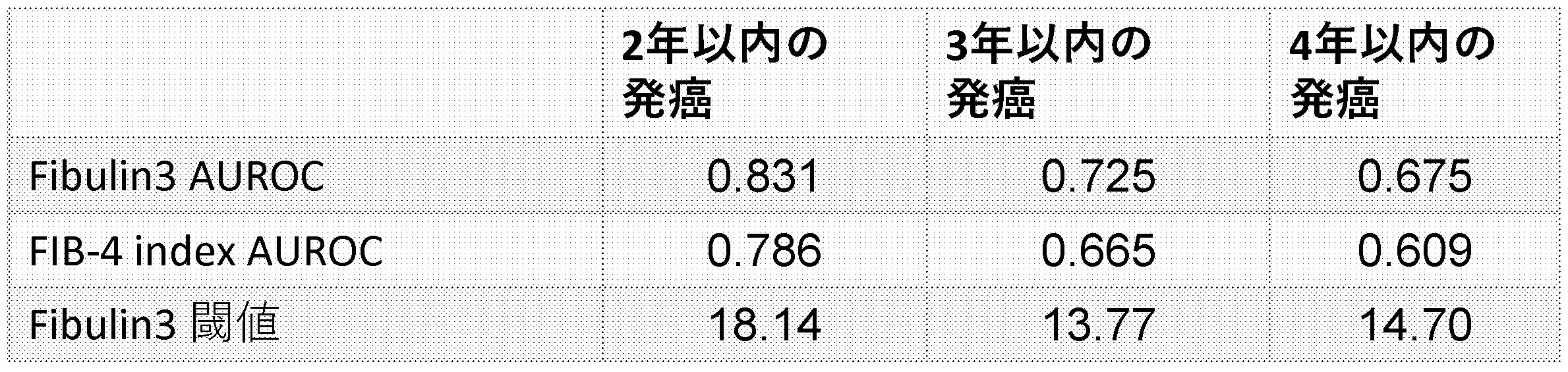
- AUROC was calculated for each of the serum Fibulin3 value and FIB-4 index based on the time-dependent ROC curve.
- the threshold was set using the Youden Index. The results are shown in Table 2. It was found that it is possible to predict the onset of liver carcinogenesis using Fibulin3.
- Figure 3 shows the cumulative liver carcinogenesis rate for each of the two groups (145 patients with ⁇ 9.0 ⁇ g/mL, 25 patients with 9.0 ⁇ g/mL or more) classified by serum Fibulin3 value.
- the verification method used was the Log rank test. It was found that Fibulin3 can be used to stratify the onset of liver cancer.
- Test example 2 Test for possibility of developing liver cancer 2
- the subjects were 470 patients who underwent liver biopsy before DAA treatment for hepatitis C, achieved sustained viral negative response (SVR) with DAA treatment, and had pre-treatment serum stored.
- Diagnosis and treatment of chronic hepatitis C were performed according to the hepatitis C guidelines at the time.
- Serum Fibulin levels were measured from pre-treatment stored serum in the same manner as Test Example 1, and the relationship with hepatocarcinogenesis after SVR was investigated. For samples that exceeded the standard range, the usual 200-fold dilution was further diluted 3-fold and re-measured to calculate the numerical value.
- Table 3 shows patient background.
- Figure 4 shows the cumulative liver carcinogenesis rate after chronic hepatitis C SVR.
- Figure 5 shows the distribution of serum Fibulin3 values before chronic hepatitis C treatment. Serum Fibulin3 levels before hepatitis C treatment were higher than those in NAFLD.
- Table 4 shows a comparison of patient characteristics based on serum Fibulin3 levels.
- Serum Fibulin3 values in each patient group are shown in Figure 6. Fibulin3 increased as fibrosis progressed, and was found to be significantly higher in carcinogenic cases.
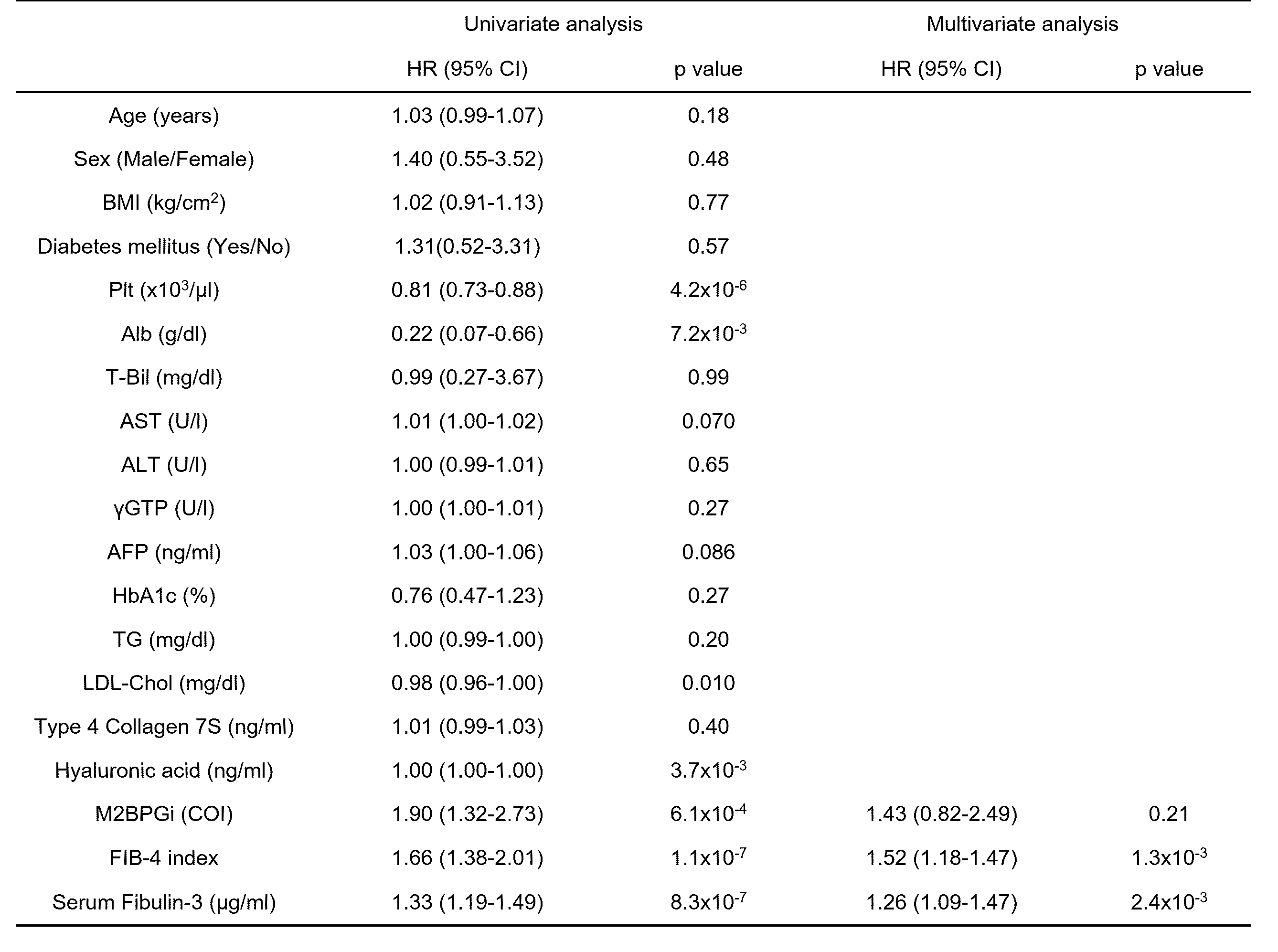
- Table 6 shows the results of multivariate analysis using a model that selected three factors, FIB-4index, AFP, and Fibulin3, which have been reported in previous reports. In this analysis, only Fibulin3 was a significant factor.
- AUROC was calculated for each of the serum Fibulin3 value and FIB-4 index based on the time-dependent ROC curve.
- the threshold was set using the Youden Index. The results are shown in Table 7. It was found that it is possible to predict the onset of liver carcinogenesis using Fibulin3.
- Figure 7 shows the cumulative liver carcinogenesis rate for each of the two groups (348 patients below 15.0 ⁇ g/mL, 122 patients 15.0 ⁇ g/mL or higher) classified by serum Fibulin3 level.
- the verification method used was the Log rank test. It was found that Fibulin3 can be used to stratify the onset of liver cancer.
- the cumulative total of two groups classified by serum Fibulin3 value (348 patients with less than 15.0 ⁇ g/mL, 122 patients with 15.0 ⁇ g/mL or more)
- the liver carcinogenesis rate is shown in Figure 8.
- Test example 3 Test for possibility of developing liver cancer 3
- GPNMB a predictive marker for hepatocarcinogenesis in patients with chronic liver disease (non-alcoholic fatty liver disease patients).
- the subjects were 170 patients who were diagnosed with non-alcoholic fatty liver disease by liver biopsy and whose clinical course could be ascertained through subsequent follow-up observations. Diagnostic criteria followed guidelines.
- Serum GPNMB values were measured using the Human Osteoactivin/GPNMB DuoSet ELISA (Catalog #DY2550 R&D SYSTEMS) from the serum stored at the time of liver biopsy, and the relationship with hepatocarcinogenesis was investigated.
- Serum was measured at a 20-fold dilution using a diluent (1% BSA in PBS).
- a Thermo Fisher Varioskan LUX was used to measure the absorbance at 450 nm to 540 nm, and a standard was used to create a calibration curve with a 4-parameter logistic curve to measure the concentration of each sample.
- Table 8 shows patient background. Of the 170 cases, there were 95 cases of nonalcoholic fatty liver disease (NAFL) and 75 cases of nonalcoholic steatohepatitis (NASH). Based on histopathological diagnosis at the time of liver biopsy, Matteoni classification 1/2 was diagnosed as NAFL, and 3/4 was diagnosed as NASH. Fibrosis was determined according to Kleiner et al.'s NASH CRN scoring system (criteria described in the guidelines).
- Figure 9 shows the serum GPNMB values in each patient group. Serum GPNMB levels were elevated in the NASH group compared to the NAFL group, and were significantly higher in cancer cases.
- AUROC was calculated for each of the serum GPNMB value and FIB-4 index based on the time-dependent ROC curve.
- the threshold was set using the Youden Index.
- the threshold value of serum GPNMB value was 15.468, the AUROC of serum GPNMB value was 0.772, and the AUROC of FIB-4 index was 0.746.
- the AUROC of the serum GPNMB value when looking at carcinogenesis within 4 years was 0.7113
- the AUROC of the serum GPNMB value when looking at carcinogenesis within 5 years was 0.7113.
- Figure 10 shows the cumulative liver carcinogenesis rate for each of the two groups (15.4 ⁇ g/mL or less, >15.4 ⁇ g/mL) classified by serum GPNMB value.
- the verification method used was the Log rank test. It was found that GPNMB can be used to stratify the onset of liver cancer.
- Test example 4 Test for possibility of developing liver cancer 4
- a study was conducted to clarify the usefulness of GPNMB as a predictive marker for hepatocarcinogenesis in patients with chronic liver disease (chronic hepatitis C patients).
- the subjects were 469 patients who underwent liver biopsy before DAA treatment for hepatitis C, achieved sustained viral negative response (SVR) with DAA treatment, and had pre-treatment serum stored.
- Serum GPNMB values were measured from pre-treatment stored serum in the same manner as in Test Example 3, and the relationship with post-SVR liver carcinogenesis was investigated. Table 9 shows the patient background.
- FIG 11 shows the serum GPNMB values in the non-carcinogenic group and the carcinogenic group. GPNMB was found to be significantly higher in cancer cases.
- AUROC was calculated for each of the serum GPNMB value and FIB-4 index based on the time-dependent ROC curve.
- the threshold was set using the Youden Index. The results are shown in Table 11. It was found that it is possible to predict the onset of liver carcinogenesis using GPNMB.
- Figure 12 shows the cumulative liver carcinogenesis rates for each of the two groups (15.4 ⁇ g/mL or less, >15.4 ⁇ g/mL) classified by serum GPNMB value.
- the verification method used was the Log rank test. It was found that GPNMB can be used to stratify the onset of liver cancer.
- Test example 5 Test for possibility of developing liver cancer 5
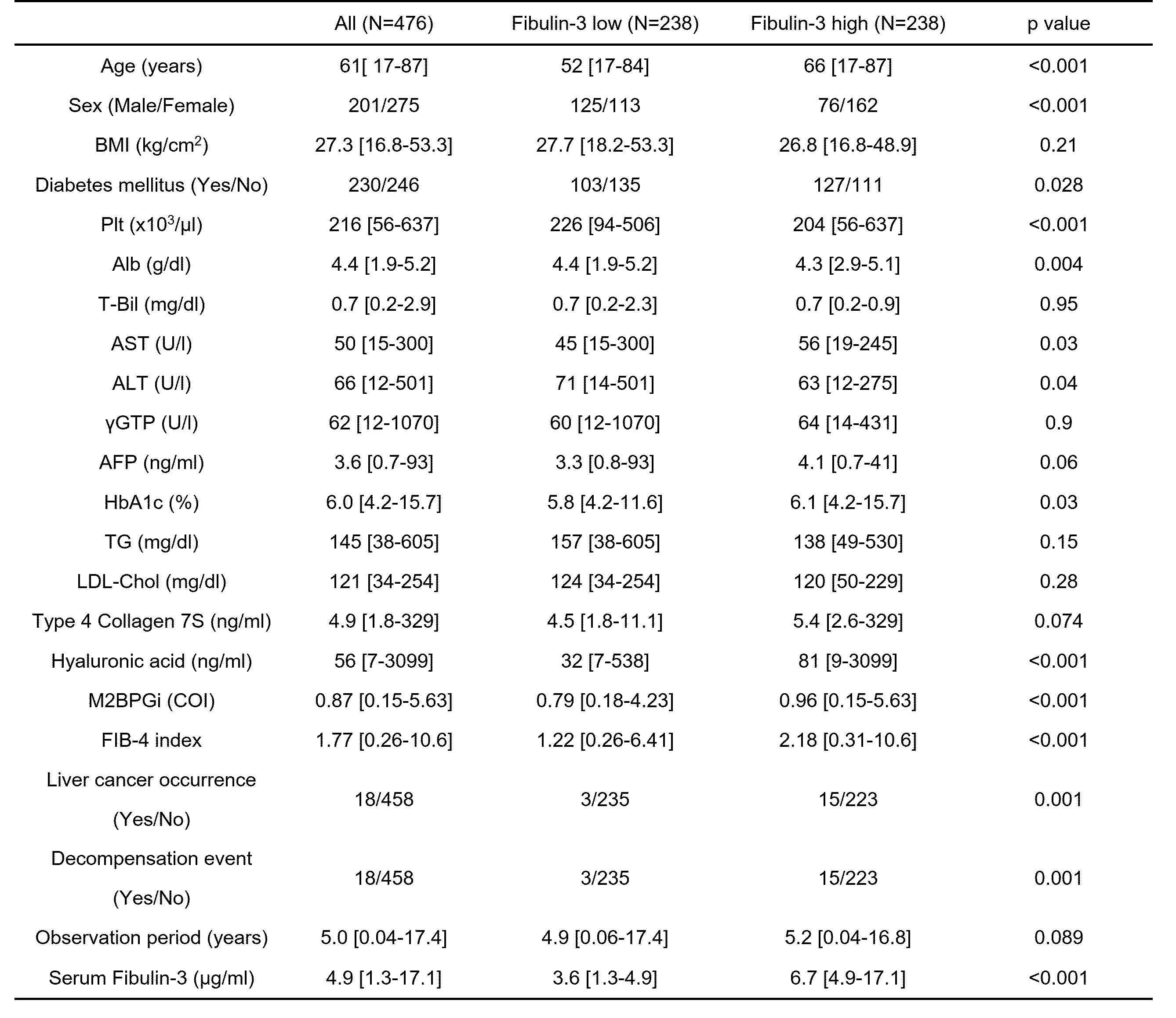
- the subjects were a total of 476 cases, including the 170 cases used in Test Example 1, who were diagnosed with non-alcoholic fatty liver disease by liver biopsy and whose clinical course could be ascertained through subsequent follow-up observations. Diagnostic criteria followed guidelines.
- the MBL Code No. CY-8120 CircuLex Human Fibulin-3/EFEMP1 ELISA Kit was used for measurement. The serum was uniformly diluted 200 times using the diluent included in the kit and measured. A Thermo Fisher Varioskan LUX was used for the measurements.
- Table 12 shows patient background. Stages 3 and 4 were defined as cases of advanced fibrosis using Kleiner et al.'s NASH CRN scoring system (criteria listed in the guidelines).
Landscapes
- Health & Medical Sciences (AREA)
- Life Sciences & Earth Sciences (AREA)
- Immunology (AREA)
- Engineering & Computer Science (AREA)
- Chemical & Material Sciences (AREA)
- Molecular Biology (AREA)
- Urology & Nephrology (AREA)
- Biomedical Technology (AREA)
- Hematology (AREA)
- Pathology (AREA)
- Analytical Chemistry (AREA)
- Biochemistry (AREA)
- Physics & Mathematics (AREA)
- Microbiology (AREA)
- General Health & Medical Sciences (AREA)
- Biotechnology (AREA)
- Food Science & Technology (AREA)
- Medicinal Chemistry (AREA)
- Cell Biology (AREA)
- General Physics & Mathematics (AREA)
- Organic Chemistry (AREA)
- Proteomics, Peptides & Aminoacids (AREA)
- Genetics & Genomics (AREA)
- Wood Science & Technology (AREA)
- Zoology (AREA)
- Oncology (AREA)
- Biophysics (AREA)
- Hospice & Palliative Care (AREA)
- Bioinformatics & Cheminformatics (AREA)
- General Engineering & Computer Science (AREA)
- Measuring Or Testing Involving Enzymes Or Micro-Organisms (AREA)
- Gastroenterology & Hepatology (AREA)
Abstract
Description
(1a)前記対象分子に対する結合性分子と前記生体試料とを接触させる工程、並びに(1b)前記結合性分子に結合した前記対象分子の量又は濃度を測定する工程、
を含む、項1に記載の方法。
を含む、項1に記載の方法。
(2a)前記工程(1)で検出された前記対象分子の量又は濃度がカットオフ値以上である場合に、前記被検体は肝臓癌の発症可能性が高いと判定する工程、及び/又は
(2b)前記工程(1)で検出された前記対象分子の量又は濃度がカットオフ値以下である場合に、前記被検体は肝臓癌の発症可能性が低いと判定する工程
を含む、項3に記載の方法。
本発明は、その一態様において、(1)被検体から採取された生体試料におけるFibulin 3、GPNMB、Fibulin 3 mRNA、及びGPNMB mRNAからなる群より選択される少なくとも1種の対象分子(本明細書において、「本発明の対象分子」と示すこともある。)を検出する工程を含む、肝臓癌の発症可能性を検査する方法(本明細書において、「本発明の検査方法」と示すこともある。)に関する。以下、これについて説明する。
検査対象である肝臓癌は、特に制限されず、肝細胞癌、胆管細胞癌等を包含する。肝臓癌としては、肝細胞癌が好ましい。肝臓癌は、進行度、状態等に関する各種分類基準における全てのクラス、グレード、ステージの肝臓癌を包含する。
本発明の検査方法は、一態様として、さらに、(2)前記工程(1)で検出された前記対象分子の量又は濃度に基づいて、前記被検体の肝臓癌の発症可能性を判定する工程、を含むことが好ましい。
(2a)前記工程(1)で検出された前記対象分子の量又は濃度がカットオフ値以上である場合に、前記被検体は肝臓癌の発症可能性が高いと判定する工程、及び/又は
(2b)前記工程(1)で検出された前記対象分子の量又は濃度がカットオフ値以下である場合に、前記被検体は肝臓癌の発症可能性が低いと判定する工程
を含むことができる。
本発明は、その一態様において、本発明の対象分子に対する結合性分子を含む、肝臓癌の発症可能性の検査薬(本明細書において、「本発明の検査薬」と示すこともある。)に関する。以下、これについて説明する。
慢性肝疾患患者(非アルコール性脂肪性肝疾患患者)におけるFibulinの肝発癌発症予測マーカーとしての有用性を明らかにすることを目的として、試験を行った。対象は、肝生検により非アルコール性脂肪性肝疾患と診断し、以後の経過観察がなされ臨床経過を把握できた170症例である。診断基準はガイドラインに準じた。患者の血液を採取後に血清分離し、血清は-80℃で保管したものを使用した。測定に使用したのはMBL Code No.CY-8120 CircuLex Human Fibulin-3/EFEMP1 ELISA Kitである。血清をキットに付属の希釈液により一律200倍に希釈して測定した。測定にはThermo Fisher Varioskan LUXを用いた。


慢性肝疾患患者(C型慢性肝炎患者)におけるFibulinの肝発癌発症予測マーカーとしての有用性を明らかにすることを目的として、試験を行った。対象は、C型肝炎に対するDAA治療前に肝生検を施行しており、DAA治療により持続的ウイルス陰性化(SVR)が得られ、かつ、治療前保存血清を保管した470例である。C型慢性肝炎の診断およびの治療はその時点でのC型肝炎ガイドラインに準じて行った。治療前の保存血清より、試験例1と同様に血清Fibulin値を測定し、SVR後肝発癌との関連を検討した。スタンダードの範囲を超えたサンプルについては通常200倍希釈のところをさらに3倍希釈して再測定を行い数値を算出した。

C型慢性肝炎治療前血清Fibulin3値の分布を図5に示す。C型肝炎治療前の血清Fibulin3値は、NAFLDの血清Fibulin3値と比較して高値であった。


慢性肝疾患患者(非アルコール性脂肪性肝疾患患者)におけるGPNMBの肝発癌発症予測マーカーとしての有用性を明らかにすることを目的として、試験を行った。対象は、肝生検により非アルコール性脂肪性肝疾患と診断し、以後の経過観察がなされ臨床経過を把握できた170症例である。診断基準はガイドラインに準じた。肝生検時の保存血清より、Human Osteoactivin/GPNMB DuoSet ELISA (Catalog #DY2550 R&D SYSTEMS)を用いて血清GPNMB値を測定し、肝発癌との関連を検討した。血清は希釈液(1% BSA in PBS)にて20倍希釈にて測定した。測定にはThermo Fisher Varioskan LUXを用い吸光度450nm-540nmの数値を測定、スタンダードを用い検量線を4パラメーターロジスティック曲線で作成し各サンプルの濃度を測定した。

慢性肝疾患患者(C型慢性肝炎患者)におけるGPNMBの肝発癌発症予測マーカーとしての有用性を明らかにすることを目的として、試験を行った。対象は、C型肝炎に対するDAA治療前に肝生検を施行しており、DAA治療により持続的ウイルス陰性化(SVR)が得られ、かつ、治療前保存血清を保管した469例である。治療前の保存血清より、試験例3と同様に血清GPNMB値を測定し、SVR後肝発癌との関連を検討した
患者背景を表9に示す。


慢性肝疾患患者(非アルコール性脂肪性肝疾患患者)におけるFibulinが肝発癌発症予測マーカー有用であることの再現性を検討すること目的として、試験を行った。対象は、肝生検により非アルコール性脂肪性肝疾患と診断し、以後の経過観察がなされ臨床経過を把握できた、試験例1で用いた170例を含む計476症例である。診断基準はガイドラインに準じた。患者の血液を採取後に血清分離し、血清は-80℃で保管したものを使用した。測定に使用したのはMBL Code No.CY-8120 CircuLex Human Fibulin-3/EFEMP1 ELISA Kitである。血清をキットに付属の希釈液により一律200倍に希釈して測定した。測定にはThermo Fisher Varioskan LUXを用いた。
Claims (13)
- (1)被検体から採取された生体試料におけるFibulin 3、GPNMB、Fibulin 3 mRNA、及びGPNMB mRNAからなる群より選択される少なくとも1種の対象分子を検出する工程を含む、肝臓癌の発症可能性を検査する方法。
- 前記工程(1)が、
(1a)前記対象分子に対する結合性分子と前記生体試料とを接触させる工程、並びに(1b)前記結合性分子に結合した前記対象分子の量又は濃度を測定する工程、
を含む、請求項1に記載の方法。 - さらに、(2)前記工程(1)で検出された前記対象分子の量又は濃度に基づいて、前記被検体の肝臓癌の発症可能性を判定する工程、
を含む、請求項1に記載の方法。 - 前記工程(2)が、
(2a)前記工程(1)で検出された前記対象分子の量又は濃度がカットオフ値以上である場合に、前記被検体は肝臓癌の発症可能性が高いと判定する工程、及び/又は
(2b)前記工程(1)で検出された前記対象分子の量又は濃度がカットオフ値以下である場合に、前記被検体は肝臓癌の発症可能性が低いと判定する工程
を含む、請求項3に記載の方法。 - 前記被検体が慢性肝疾患を有する被検体である、請求項1~4のいずれかに記載の方法。
- 前記対象分子がFibulin 3及びGPNMBからなる群より選択される少なくとも1種である、請求項1~4のいずれかに記載の方法。
- 前記生体試料が体液又は体液由来の試料である、請求項1~4のいずれかに記載の方法。
- 前記体液が全血、血清、及び血漿からなる群より選択される少なくとも1種である、請求項7に記載の方法。
- 前記被検体がヒトである、請求項1~4のいずれかに記載の方法。
- Fibulin 3、GPNMB、Fibulin 3 mRNA、及びGPNMB mRNAからなる群より選択される少なくとも1種の対象分子に対する結合性分子を含む、肝臓癌の発症可能性の検査薬。
- Fibulin 3、GPNMB、Fibulin 3 mRNA、及びGPNMB mRNAからなる群より選択される少なくとも1種の対象分子に対する結合性分子の、肝臓癌の発症可能性の検査薬の製造のための使用。
- Fibulin 3、GPNMB、Fibulin 3 mRNA、及びGPNMB mRNAからなる群より選択される少なくとも1種の対象分子に対する結合性分子の、肝臓癌の発症可能性の検査薬としての使用。
- 肝臓癌の発症可能性の検査における使用のための、Fibulin 3、GPNMB、Fibulin 3 mRNA、及びGPNMB mRNAからなる群より選択される少なくとも1種の対象分子に対する結合性分子。
Priority Applications (3)
| Application Number | Priority Date | Filing Date | Title |
|---|---|---|---|
| JP2024530684A JPWO2024004675A1 (ja) | 2022-07-01 | 2023-06-15 | |
| EP23831123.7A EP4549942A4 (en) | 2022-07-01 | 2023-06-15 | METHOD FOR ASSESSING THE RISK OF DEVELOPING LIVER CANCER |
| US18/880,373 US20250389721A1 (en) | 2022-07-01 | 2023-06-15 | Method for checking possibility of liver cancer onset |
Applications Claiming Priority (2)
| Application Number | Priority Date | Filing Date | Title |
|---|---|---|---|
| JP2022-106996 | 2022-07-01 | ||
| JP2022106996 | 2022-07-01 |
Publications (1)
| Publication Number | Publication Date |
|---|---|
| WO2024004675A1 true WO2024004675A1 (ja) | 2024-01-04 |
Family
ID=89382112
Family Applications (1)
| Application Number | Title | Priority Date | Filing Date |
|---|---|---|---|
| PCT/JP2023/022224 Ceased WO2024004675A1 (ja) | 2022-07-01 | 2023-06-15 | 肝臓癌の発症可能性を検査する方法 |
Country Status (4)
| Country | Link |
|---|---|
| US (1) | US20250389721A1 (ja) |
| EP (1) | EP4549942A4 (ja) |
| JP (1) | JPWO2024004675A1 (ja) |
| WO (1) | WO2024004675A1 (ja) |
Citations (3)
| Publication number | Priority date | Publication date | Assignee | Title |
|---|---|---|---|---|
| JP2009106191A (ja) * | 2007-10-30 | 2009-05-21 | Univ Of Tokyo | 肝臓癌関連遺伝子、及び肝臓癌リスクの判定方法 |
| JP2012103211A (ja) * | 2010-11-12 | 2012-05-31 | Mitsubishi Chemical Medience Corp | 肝臓がん発症の検出又はリスクの予測方法 |
| JP2015530071A (ja) * | 2012-09-07 | 2015-10-15 | 株式会社 資生堂 | フィブリン3及び/又はサルコグリカンγを指標としたセルライトの評価方法及びセルライト効果薬剤の評価方法 |
Family Cites Families (2)
| Publication number | Priority date | Publication date | Assignee | Title |
|---|---|---|---|---|
| EP2021511A4 (en) * | 2006-05-03 | 2010-02-10 | Geisinger Clinic | METHODS OF DIAGNOSIS AND PREDICTION OF NON ALCOHOLIC STHEATHYPATITIS (NASH) |
| JP2008072952A (ja) * | 2006-09-21 | 2008-04-03 | Kanazawa Univ | 肝内胆管癌を検出するためのマーカー遺伝子 |
-
2023
- 2023-06-15 JP JP2024530684A patent/JPWO2024004675A1/ja active Pending
- 2023-06-15 US US18/880,373 patent/US20250389721A1/en active Pending
- 2023-06-15 EP EP23831123.7A patent/EP4549942A4/en active Pending
- 2023-06-15 WO PCT/JP2023/022224 patent/WO2024004675A1/ja not_active Ceased
Patent Citations (3)
| Publication number | Priority date | Publication date | Assignee | Title |
|---|---|---|---|---|
| JP2009106191A (ja) * | 2007-10-30 | 2009-05-21 | Univ Of Tokyo | 肝臓癌関連遺伝子、及び肝臓癌リスクの判定方法 |
| JP2012103211A (ja) * | 2010-11-12 | 2012-05-31 | Mitsubishi Chemical Medience Corp | 肝臓がん発症の検出又はリスクの予測方法 |
| JP2015530071A (ja) * | 2012-09-07 | 2015-10-15 | 株式会社 資生堂 | フィブリン3及び/又はサルコグリカンγを指標としたセルライトの評価方法及びセルライト効果薬剤の評価方法 |
Non-Patent Citations (19)
| Title |
|---|
| "Clinical Practice Guidelines Panel (EASL recommendations on treatment of hepatitis C: Final update of the series", J HEPATOL, vol. 73, 2020, pages 1170 - 1218 |
| "Current Protocols in Molecular Biology", JOHN WILEY AND SONS, article "1987" |
| "DNA Cloning, DM Glover", 1985, IRL PRESS |
| "Guidelines for the Management of Hepatitis B", JAPAN SOCIETY OF HEPATOLOGY (VERSION 3.4, May 2021 (2021-05-01), Retrieved from the Internet <URL:https://www.jsh.or.jp/lib/files/medical/guidelines/jshguidlines/B_v3.4.pdf> |
| "Japanese Society of Gastroenterology and the Japan Society of Hepatology", November 2020 |
| 2017: "Clinical Practice Guidelines for Hepatocellular Carcinoma", JAPAN SOCIETY OF HEPATOLOGY |
| ALIMENT PHARMACOL THER, vol. 54, no. 10, November 2021 (2021-11-01), pages 1340 - 1349 |
| CANCER, vol. 3, 1950, pages 32 - 35 |
| HELD CA ET AL., GENOME RESEARCH, vol. 6, 1996, pages 986 - 994 |
| HEPATITIS TREATMENT GUIDELINE PREPARATION COMMITTEE OF THE JAPAN SOCIETY OF HEPATOLOGY, July 2020 (2020-07-01) |
| HEPATOLOGY RESEARCH, vol. 50, 2020, pages 892 - 923 |
| HEPATOLOGY, vol. 71, 2020, pages 686 - 721 |
| JAPAN SOCIETY OF HEPATOLOGY, October 2017 (2017-10-01), Retrieved from the Internet <URL:https://www.jsh.or.jp/medical/guidelines/jsh_guidlines/medical/e-xamination_jp_2017.html> |
| SAMBROOK, JRUSSELL, DW: "Molecular Cloning: A Laboratory Manual", 2001, COLD SPRING HARBOR LABORATORY PRESS |
| See also references of EP4549942A4 |
| T. MANIATIS ET AL.: "Molecular Cloning", 1983, CSH LABORATORY |
| TOKUSHIGE, K. ET AL., HEPATOLOGY RESEARCH, vol. 51, 2021, pages 1013 - 1025 |
| TOKUSHIGE, K. ET AL., JOURNAL OF GASTROENTEROLOGY, vol. 56, 2021, pages 951 - 963 |
| WEIS JH ET AL., TRENDS IN GENETICS, vol. 8, 1992, pages 263 - 264 |
Also Published As
| Publication number | Publication date |
|---|---|
| US20250389721A1 (en) | 2025-12-25 |
| JPWO2024004675A1 (ja) | 2024-01-04 |
| EP4549942A1 (en) | 2025-05-07 |
| EP4549942A4 (en) | 2026-02-11 |
Similar Documents
| Publication | Publication Date | Title |
|---|---|---|
| KR101032607B1 (ko) | 간암 진단용 단백질성 마커 | |
| JP6138154B2 (ja) | 乳癌の予測および診断のためのバイオマーカー | |
| JP6691617B2 (ja) | 子癇前症の評価を提供するための方法及び組成物 | |
| KR20070051286A (ko) | 방광암 검출용 소변 표지 | |
| WO2019099706A1 (en) | Markers for the diagnosis and treatment of non-alcoholic steatohepatitis (nash) and advanced liver fibrosis | |
| JP2021511389A (ja) | 脊髄性筋萎縮症を治療する方法 | |
| WO2021251504A1 (ja) | 血中rnaを利用したcovid-19重症化予測方法 | |
| EP1664718A2 (en) | Diagnosis and monitoring of hepatocellular carcinoma | |
| WO2026017138A1 (zh) | 脓毒症相关疾病生物标志物pax5及其用途 | |
| KR20130046457A (ko) | 신규한 대장암 진단용 마커 및 이를 이용한 대장암 진단 키트 | |
| JP5704684B2 (ja) | IgG4関連疾患診断用マーカー及びその利用 | |
| WO2025216127A1 (ja) | クローン性造血及び/又はクローン性造血関連疾患を検査する方法 | |
| EP4278187A1 (en) | Method for the detection of lung cancer | |
| US20240344134A1 (en) | Diagnostic marker for hepatic cancer development in chronic hepatic disease | |
| WO2024004675A1 (ja) | 肝臓癌の発症可能性を検査する方法 | |
| JP2020072705A (ja) | 膀胱癌を検出するための尿マーカー | |
| CN117957445A (zh) | 慢性肝疾病中的肝癌发生的诊断标志物 | |
| JP7239139B2 (ja) | 肝硬変の診断方法、非アルコール性脂肪肝炎及び肝細胞がんの合併症の診断方法並びに非アルコール性脂肪肝炎及び食道胃静脈瘤の合併症の診断方法 | |
| US20200209242A1 (en) | Cancer diagnosis using ki-67 | |
| CN115786490B (zh) | 糖尿病合并结核病标志物及其用途 | |
| JPWO2011138955A1 (ja) | Siaα2−8Siaα2−3Galβ−R糖鎖を持つムチン1の分析方法 | |
| HK40104645A (zh) | 慢性肝疾病中的肝癌发生的诊断标志物 | |
| TWI921387B (zh) | 利用血中胞外體之蛋白質標記之covid-19重症化預測方法 | |
| CN102010903A (zh) | Il-23在肝癌早期病变诊断中的应用 | |
| CN115786491A (zh) | Lcn2、fcn1作为标志物在糖尿病合并结核病诊断、预后及疗效评估中的应用 |
Legal Events
| Date | Code | Title | Description |
|---|---|---|---|
| 121 | Ep: the epo has been informed by wipo that ep was designated in this application |
Ref document number: 23831123 Country of ref document: EP Kind code of ref document: A1 |
|
| WWE | Wipo information: entry into national phase |
Ref document number: 2024530684 Country of ref document: JP |
|
| WWE | Wipo information: entry into national phase |
Ref document number: 18880373 Country of ref document: US |
|
| WWE | Wipo information: entry into national phase |
Ref document number: 2023831123 Country of ref document: EP |
|
| NENP | Non-entry into the national phase |
Ref country code: DE |
|
| ENP | Entry into the national phase |
Ref document number: 2023831123 Country of ref document: EP Effective date: 20250203 |
|
| WWP | Wipo information: published in national office |
Ref document number: 2023831123 Country of ref document: EP |