WO2024024330A1 - 樹脂組成物、および、成形品 - Google Patents
樹脂組成物、および、成形品 Download PDFInfo
- Publication number
- WO2024024330A1 WO2024024330A1 PCT/JP2023/022542 JP2023022542W WO2024024330A1 WO 2024024330 A1 WO2024024330 A1 WO 2024024330A1 JP 2023022542 W JP2023022542 W JP 2023022542W WO 2024024330 A1 WO2024024330 A1 WO 2024024330A1
- Authority
- WO
- WIPO (PCT)
- Prior art keywords
- diamine
- mol
- acid
- derived
- resin composition
- Prior art date
- Legal status (The legal status is an assumption and is not a legal conclusion. Google has not performed a legal analysis and makes no representation as to the accuracy of the status listed.)
- Ceased
Links
Classifications
-
- C—CHEMISTRY; METALLURGY
- C08—ORGANIC MACROMOLECULAR COMPOUNDS; THEIR PREPARATION OR CHEMICAL WORKING-UP; COMPOSITIONS BASED THEREON
- C08G—MACROMOLECULAR COMPOUNDS OBTAINED OTHERWISE THAN BY REACTIONS ONLY INVOLVING UNSATURATED CARBON-TO-CARBON BONDS
- C08G69/00—Macromolecular compounds obtained by reactions forming a carboxylic amide link in the main chain of the macromolecule
- C08G69/02—Polyamides derived from amino-carboxylic acids or from polyamines and polycarboxylic acids
- C08G69/26—Polyamides derived from amino-carboxylic acids or from polyamines and polycarboxylic acids derived from polyamines and polycarboxylic acids
- C08G69/265—Polyamides derived from amino-carboxylic acids or from polyamines and polycarboxylic acids derived from polyamines and polycarboxylic acids from at least two different diamines or at least two different dicarboxylic acids
-
- C—CHEMISTRY; METALLURGY
- C08—ORGANIC MACROMOLECULAR COMPOUNDS; THEIR PREPARATION OR CHEMICAL WORKING-UP; COMPOSITIONS BASED THEREON
- C08G—MACROMOLECULAR COMPOUNDS OBTAINED OTHERWISE THAN BY REACTIONS ONLY INVOLVING UNSATURATED CARBON-TO-CARBON BONDS
- C08G69/00—Macromolecular compounds obtained by reactions forming a carboxylic amide link in the main chain of the macromolecule
- C08G69/02—Polyamides derived from amino-carboxylic acids or from polyamines and polycarboxylic acids
- C08G69/26—Polyamides derived from amino-carboxylic acids or from polyamines and polycarboxylic acids derived from polyamines and polycarboxylic acids
-
- C—CHEMISTRY; METALLURGY
- C08—ORGANIC MACROMOLECULAR COMPOUNDS; THEIR PREPARATION OR CHEMICAL WORKING-UP; COMPOSITIONS BASED THEREON
- C08J—WORKING-UP; GENERAL PROCESSES OF COMPOUNDING; AFTER-TREATMENT NOT COVERED BY SUBCLASSES C08B, C08C, C08F, C08G or C08H
- C08J5/00—Manufacture of articles or shaped materials containing macromolecular substances
- C08J5/04—Reinforcing macromolecular compounds with loose or coherent fibrous material
-
- C—CHEMISTRY; METALLURGY
- C08—ORGANIC MACROMOLECULAR COMPOUNDS; THEIR PREPARATION OR CHEMICAL WORKING-UP; COMPOSITIONS BASED THEREON
- C08J—WORKING-UP; GENERAL PROCESSES OF COMPOUNDING; AFTER-TREATMENT NOT COVERED BY SUBCLASSES C08B, C08C, C08F, C08G or C08H
- C08J5/00—Manufacture of articles or shaped materials containing macromolecular substances
- C08J5/04—Reinforcing macromolecular compounds with loose or coherent fibrous material
- C08J5/0405—Reinforcing macromolecular compounds with loose or coherent fibrous material with inorganic fibres
- C08J5/043—Reinforcing macromolecular compounds with loose or coherent fibrous material with inorganic fibres with glass fibres
-
- C—CHEMISTRY; METALLURGY
- C08—ORGANIC MACROMOLECULAR COMPOUNDS; THEIR PREPARATION OR CHEMICAL WORKING-UP; COMPOSITIONS BASED THEREON
- C08K—Use of inorganic or non-macromolecular organic substances as compounding ingredients
- C08K7/00—Use of ingredients characterised by shape
- C08K7/02—Fibres or whiskers
- C08K7/04—Fibres or whiskers inorganic
- C08K7/14—Glass
-
- C—CHEMISTRY; METALLURGY
- C08—ORGANIC MACROMOLECULAR COMPOUNDS; THEIR PREPARATION OR CHEMICAL WORKING-UP; COMPOSITIONS BASED THEREON
- C08L—COMPOSITIONS OF MACROMOLECULAR COMPOUNDS
- C08L77/00—Compositions of polyamides obtained by reactions forming a carboxylic amide link in the main chain; Compositions of derivatives of such polymers
- C08L77/06—Polyamides derived from polyamines and polycarboxylic acids
-
- C—CHEMISTRY; METALLURGY
- C08—ORGANIC MACROMOLECULAR COMPOUNDS; THEIR PREPARATION OR CHEMICAL WORKING-UP; COMPOSITIONS BASED THEREON
- C08J—WORKING-UP; GENERAL PROCESSES OF COMPOUNDING; AFTER-TREATMENT NOT COVERED BY SUBCLASSES C08B, C08C, C08F, C08G or C08H
- C08J2377/00—Characterised by the use of polyamides obtained by reactions forming a carboxylic amide link in the main chain; Derivatives of such polymers
- C08J2377/06—Polyamides derived from polyamines and polycarboxylic acids
-
- C—CHEMISTRY; METALLURGY
- C08—ORGANIC MACROMOLECULAR COMPOUNDS; THEIR PREPARATION OR CHEMICAL WORKING-UP; COMPOSITIONS BASED THEREON
- C08K—Use of inorganic or non-macromolecular organic substances as compounding ingredients
- C08K7/00—Use of ingredients characterised by shape
- C08K7/02—Fibres or whiskers
Definitions
- the present invention relates to a resin composition and a molded article.
- the present invention relates to a resin composition containing a polyamide resin as a main component.
- Resin molded products are used to reduce the weight and cost of metal molded products.
- polyamide resins which have excellent properties such as heat resistance, chemical resistance, rigidity, abrasion resistance, and moldability, are used for various purposes.
- a low-temperature mold is sometimes used in injection molding or the like.
- crystallization of the polyamide resin may not proceed sufficiently.
- Patent Document 1 discloses that the diamine-derived structural unit is composed of a diamine-derived structural unit and a dicarboxylic acid-derived structural unit, in which 70 mol% or more of the diamine-derived structural unit is derived from xylylene diamine, and the dicarboxylic acid 80 to 150 parts by mass of inorganic fibers and 0.01 to 2 parts by mass of fatty acid metal salt per 100 parts by mass of a polyamide resin in which 70 mol% or more of the structural units derived from the aliphatic dicarboxylic acid having 9 to 18 carbon atoms. and 0.1 to 10 parts by mass of an inorganic crystal nucleating agent.
- Patent Document 1 The resin composition described in Patent Document 1 is a resin composition that maintains high mechanical strength and is sufficiently crystallized even when molded using a low-temperature mold.
- Patent Document 1 contains a fatty acid metal salt and an inorganic crystal nucleating agent.
- Patent Document 1 discloses in Example 6 a resin composition containing a polyamide resin (MP12) composed of meta/para-xylylene diamine and dodecanedioic acid, glass fiber, and talc.
- MP12 polyamide resin
- Example 6 when MP12 is used, the crystallization rate is accelerated and an improvement in the molding cycle can be expected. However, upon further investigation by the present inventor, it was found that when attempting to mold the resin composition containing MP12 described in Example 6, the appearance of the molded product may be poor. In particular, depending on the application, a fast molding cycle and an excellent appearance of the molded product are required.
- the present invention aims to solve such problems, and aims to provide a resin composition and a molded product that have a quick molding cycle and can provide molded products with excellent appearance. shall be.
- the present inventor conducted studies and found that by adjusting the relative viscosity of a xylylene diamine-based polyamide resin such as a polyamide resin composed of xylylene diamine and dodecanedioic acid, We have discovered that the above problems can be solved. Specifically, the above problem was solved by the following means.
- ⁇ 1> Contains reinforcing fibers at a ratio of 10 to 300 parts by mass based on 100 parts by mass of xylylenediamine-based polyamide resin,
- the xylylene diamine-based polyamide resin contains a diamine unit and a dicarboxylic acid unit, the diamine unit contains 70 mol% or more of a xylylene diamine-derived structural unit, and the dicarboxylic acid unit has ⁇ , ⁇ carbon atoms of 11 to 20 carbon atoms.
- - Contains 70 mol% or more of structural units derived from linear aliphatic dicarboxylic acids, and
- the xylylene diamine polyamide resin has a relative viscosity of 1.6 to 2.4. Resin composition.
- ⁇ 2> The resin composition according to ⁇ 1>, wherein 70 mol% or more of the dicarboxylic acid units are derived from dodecanedioic acid and/or tetradecanedioic acid.
- ⁇ 3> The resin composition according to ⁇ 1>, wherein 70 mol% or more of the dicarboxylic acid units are derived from dodecanedioic acid.
- ⁇ 4> 20 to 100 mol% of the diamine units are derived from metaxylylene diamine, and 80 to 0 mol% are derived from para-xylylene diamine, according to any one of ⁇ 1> to ⁇ 3>.
- ⁇ 5> 70 mol% or more of the dicarboxylic acid units are derived from dodecanedioic acid and/or tetradecanedioic acid,
- ⁇ 6> The difference between the terminal amino group concentration and the terminal carboxyl group concentration (
- ⁇ 7> A molded article formed from the resin composition according to any one of ⁇ 1> to ⁇ 6>.
- the present invention has made it possible to provide a resin composition and a molded product that have a quick molding cycle and can provide molded products with excellent appearance.
- this embodiment a mode for carrying out the present invention (hereinafter simply referred to as “this embodiment”) will be described in detail.
- the present embodiment below is an illustration for explaining the present invention, and the present invention is not limited only to this embodiment.
- " ⁇ " is used to include the numerical values described before and after it as a lower limit value and an upper limit value.
- various physical property values and characteristic values are assumed to be at 23° C. unless otherwise stated.
- the number average molecular weight can be measured according to the description in paragraph 0047 of JP 2018-165298A, the contents of which are incorporated herein.
- the melting point (Tm) is a value measured according to differential scanning calorimetry (DSC) in accordance with ISO11357. Specifically, it can be measured according to the description in paragraph 0036 of International Publication No. 2016/084475, the content of which is incorporated herein. If the measurement methods, etc. explained in the standards shown in this specification differ from year to year, unless otherwise stated, they shall be based on the standards as of January 1, 2022.
- the resin composition of the present embodiment contains 10 to 300 parts by mass of reinforcing fibers based on 100 parts by mass of the xylylene diamine polyamide resin, and the xylylene diamine polyamide resin contains diamine units and dicarboxylic acid units.
- the diamine unit contains 70 mol% or more of a constitutional unit derived from xylylenediamine
- the dicarboxylic acid unit contains 70 mol% or more of a constitutional unit derived from an ⁇ , ⁇ -linear aliphatic dicarboxylic acid having 11 to 20 carbon atoms.
- the xylylenediamine-based polyamide resin has a relative viscosity of 1.6 to 2.4.
- a resin composition that has a quick molding cycle and can provide molded products with excellent appearance. That is, in this embodiment, in order to speed up the molding cycle, a xylylenediamine-based polyamide resin containing a structural unit derived from an ⁇ , ⁇ -linear aliphatic dicarboxylic acid having 11 to 20 carbon atoms is used as the polyamide resin. I decided to do so. However, when reinforcing fibers are blended with such xylylenediamine-based polyamide resin, it has been found that if the relative viscosity of the xylylenediamine-based polyamide resin is high, the reinforcing fibers have poor fluidity and the appearance of the molded product is inferior.
- the resin composition of the present embodiment can provide a molded article with excellent mechanical strength such as flexural modulus and impact resistance. Furthermore, the resin composition of the present embodiment has at least one of the following properties: excellent gas barrier properties, low amount of eluate, excellent chemical resistance, low water absorption, and high crystallization rate. We can provide molded products that achieve this goal. These are achieved by using a certain xylylenediamine-based polyamide resin.
- the resin composition of the present embodiment includes a diamine unit and a dicarboxylic acid unit, the diamine unit contains 70 mol% or more of a xylylene diamine-derived constitutional unit, and the dicarboxylic acid unit has ⁇ , ⁇ carbon atoms of 11 to 20 carbon atoms.
- a xylylene diamine polyamide resin containing 70 mol% or more of structural units derived from a linear aliphatic dicarboxylic acid and having a relative viscosity of 1.6 to 2.4 herein simply referred to as "xylylene diamine polyamide resin" (sometimes referred to as "polyamide resin").
- the diamine-derived structural unit of the xylylene diamine polyamide resin is more preferably 75 mol% or more, still more preferably 80 mol% or more, even more preferably 90 mol% or more, even more preferably 95 mol% or more, and especially still more preferably is derived from xylylene diamine (preferably para-xylylene diamine and/or meta-xylylene diamine).
- xylylene diamine it is preferable that 20 to 100 mol% of the diamine-derived structural units are meta-xylylene diamine-derived structural units, and 50 to 100 mol% of the diamine-derived structural units are meth-oxylylene diamine-derived structural units. It is preferable that the structural units are derived from xylylene diamine, and 55 to 80 mol% of the diamine-derived structural units are metaxylylene diamine-derived structural units, and 45 to 20 mol% of the diamine-derived structural units are para-xylylene diamine-derived structural units. More preferably, it is a structural unit derived from xylylene diamine.
- the proportion of paraxylylene diamine By setting the proportion of paraxylylene diamine to 20 mol % or more, the crystallization rate becomes faster and the impact resistance of the obtained molded article tends to improve. Furthermore, by reducing the proportion of metaxylylene diamine, the amount of substances eluted from the molded article can be reduced.
- the total of the constitutional units derived from para-xylylene diamine and the constitutional units derived from meta-xylylene diamine is preferably 80 mol% or more, more preferably 85 mol% or more of the diamine-derived constitutional units, More preferably, it accounts for 90 mol% or more, even more preferably 95 mol% or more, even more preferably 98 mol% or more, and even more preferably 99 mol% or more.
- the upper limit of the total of the structural units derived from para-xylylene diamine and the structural units derived from meta-xylylene diamine is 100 mol%.
- Diamines other than meta-xylylene diamine and para-xylylene diamine that can be used as raw material diamine components for xylylene diamine-based polyamide resins include tetramethylene diamine, pentamethylene diamine, 2-methylpentanediamine, hexamethylene diamine, and heptamethylene.
- Aliphatic diamines such as diamine, octamethylene diamine, nonamethylene diamine, decamethylene diamine, dodecamethylene diamine, 2,2,4-trimethyl-hexamethylene diamine, 2,4,4-trimethylhexamethylene diamine, 1,3- Bis(aminomethyl)cyclohexane, 1,4-bis(aminomethyl)cyclohexane, 1,3-diaminocyclohexane, 1,4-diaminocyclohexane, bis(4-aminocyclohexyl)methane, 2,2-bis(4-amino Alicyclic diamines such as cyclohexyl)propane, bis(aminomethyl)decalin, and bis(aminomethyl)tricyclodecane, aromatic rings such as bis(4-aminophenyl)ether, paraphenylenediamine, and bis(aminomethyl)naphthalene.
- diamines having the above-mentione
- the dicarboxylic acid-derived structural unit of the xylylene diamine polyamide resin used in this embodiment is preferably 75 mol% or more, more preferably 80 mol% or more, even more preferably 90 mol% or more, and even more preferably 95 mol% or more.
- At least 99 mol % of the ⁇ , ⁇ -straight chain aliphatic dicarboxylic acid having 11 to 20 carbon atoms preferably ⁇ , ⁇ -straight chain aliphatic dicarboxylic acid having 11 to 15 carbon atoms
- an ⁇ , ⁇ -straight chain aliphatic dicarboxylic acid having 12 to 14 carbon atoms are preferably 75 mol% or more, more preferably 80 mol% or more, even more preferably 90 mol% or more, and even more preferably 95 mol% or more.
- Examples of preferable ⁇ , ⁇ -straight chain aliphatic dicarboxylic acids having 11 to 20 carbon atoms to be used as the raw dicarboxylic acid component of the xylylenediamine-based polyamide resin used in this embodiment include undecanedioic acid, dodecanedioic acid, Examples include aliphatic dicarboxylic acids such as tridecanedioic acid, tetradecanedioic acid, pentadecanedioic acid, hexadecanedioic acid, heptadecanedioic acid, octadecanedioic acid, nonadecanedioic acid, and icosanedioic acid, which may be used singly or in combination of two or more. Among these, dodecanedioic acid and/or tetradecanedioic acid are preferred.
- a preferred embodiment of the xylylenediamine-based polyamide resin in this embodiment is 70 mol% or more (preferably 80 mol% or more, more preferably 90 mol% or more, still more preferably 95 mol% or more) of the structural units derived from dicarboxylic acid. ) is derived from dodecanedioic acid and/or tetradecanedioic acid (preferably dodecanedioic acid). Dodecanedioic acid and xylylene diamine may be biologically derived raw materials (biomass raw materials).
- the diamine unit is derived from metaxylylene diamine, 80 to 0 mol% is derived from paraxylylene diamine, and 55 to 80 mol % of the diamine unit is derived from paraxylylene diamine. More preferably, % is derived from metaxylylene diamine and 45 to 20 mol% is derived from para-xylylene diamine.
- Dicarboxylic acid components other than the above ⁇ , ⁇ -linear aliphatic dicarboxylic acid having 11 to 20 carbon atoms include phthalic acid compounds such as isophthalic acid, terephthalic acid, orthophthalic acid, 1,2-naphthalenedicarboxylic acid, 1,3 -Naphthalene dicarboxylic acid, 1,4-naphthalene dicarboxylic acid, 1,5-naphthalene dicarboxylic acid, 1,6-naphthalene dicarboxylic acid, 1,7-naphthalene dicarboxylic acid, 1,8-naphthalene dicarboxylic acid, 2,3-naphthalene Examples include isomers of naphthalene dicarboxylic acid such as dicarboxylic acid, 2,6-naphthalene dicarboxylic acid, and 2,7-naphthalene dicarboxylic acid, and one type or a mixture of two or more types can be used.
- phthalic acid compounds
- the xylylenediamine-based polyamide resin used in this embodiment is mainly composed of diamine-derived structural units and dicarboxylic acid-derived structural units, but other structural units are not completely excluded. It goes without saying that it may contain structural units derived from lactams such as ⁇ -caprolactam and laurolactam, and aliphatic aminocarboxylic acids such as aminocaproic acid and aminoundecanoic acid.
- the term "main component” refers to a component in which the total number of diamine-derived structural units and dicarboxylic acid-derived structural units is the largest among all the structural units constituting the xylylenediamine-based polyamide resin.
- the total of diamine-derived structural units and dicarboxylic acid-derived structural units in the xylylenediamine-based polyamide resin preferably accounts for 90% by mass or more, and preferably 95% by mass or more of the total structural units. is more preferable, more preferably 97% by mass or more, even more preferably 99% by mass or more.
- the relative viscosity of the xylylene diamine polyamide resin used in this embodiment is 1.6 to 2.4. By setting it to the above lower limit or more, the crystallization rate of the polyamide resin tends to become faster. In addition, by setting the amount to be equal to or less than the above upper limit, the fluidity of the reinforcing fibers in the resin composition can be improved, and the appearance of the molded product can be improved.
- the relative viscosity of the xylylene diamine polyamide resin used in this embodiment is preferably 1.7 or more, more preferably 1.8 or more, even more preferably 1.9 or more, and 2. More preferably, it is 0 or more.
- the relative viscosity of the xylylene diamine polyamide resin is preferably 2.3 or less, more preferably 2.2 or less.
- the relative viscosity of xylylene diamine-based polyamide resin instead of setting the molar ratio of raw material diamine and raw material dicarboxylic acid to 1:1 when synthesizing xylylene diamine-based polyamide resin, use a slightly excessive amount of dicarboxylic acid or diamine. It can be used for.
- the relative viscosity of the xylylene diamine-based polyamide resin is measured according to the description in the Examples below.
- ) of the xylylenediamine-based polyamide resin is 10 ⁇ mol/g or more.
- is preferably 20 ⁇ mol/g or more, more preferably 30 ⁇ mol/g or more, even more preferably 40 ⁇ mol/g or more, and 170 ⁇ mol/g. It is preferably at most 80 ⁇ mol/g, more preferably at most 80 ⁇ mol/g, even more preferably at most 70 ⁇ mol/g, even more preferably at most 60 ⁇ mol/g.
- the terminal amino group concentration or the terminal carboxyl group concentration of the xylylenediamine-based polyamide resin used in this embodiment, whichever is lower, is preferably 80 ⁇ mol/g or less. By setting such a terminal group concentration, the crystallization rate tends to become faster.
- the terminal group concentration of the lower concentration of the xylylene diamine polyamide resin is more preferably 70 ⁇ mol/g or less, even more preferably 60 ⁇ mol/g or less, and even more preferably 50 ⁇ mol/g or less. , 45 ⁇ mol/g or less is even more preferable.
- the lower limit of the terminal group concentration of the lower concentration of the xylylene diamine polyamide resin is preferably 10 ⁇ mol/g or more, more preferably 15 ⁇ mol/g or more, and 20 ⁇ mol/g or more. It is more preferable that the amount is 25 ⁇ mol/g or more, even more preferably 30 ⁇ mol/g or more.
- the terminal group with a lower concentration of terminal groups is preferably a terminal amino group.
- the terminal group concentration of the xylylene diamine polyamide resin is measured in accordance with the description in the Examples below.
- the melting point of the xylylene diamine polyamide resin used in this embodiment is preferably 180°C or higher, more preferably 200°C or higher, and preferably 280°C or lower, and 240°C or lower. It is more preferable.
- the lower limit of the number average molecular weight (Mn) of the xylylene diamine polyamide resin used in this embodiment is preferably 6,000 or more, more preferably 8,000 or more, and 10,000 or more. It is more preferably 35,000 or less, more preferably 30,000 or less, and even more preferably 25,000 or less. Within this range, heat resistance, elastic modulus, dimensional stability, and moldability will be better.
- the content of the xylylenediamine-based polyamide resin used in this embodiment in the resin composition of this embodiment is preferably 40% by mass or more, more preferably 50% by mass or more, It is more preferably 60% by mass or more, even more preferably 64% by mass or more, and may be 68% by mass or more. By setting it to the above lower limit or more, the surface appearance tends to be improved. Further, the content of the xylylene diamine polyamide resin used in this embodiment in the resin composition of this embodiment is preferably 95% by mass or less, more preferably 90% by mass or less. It is preferably 85% by mass or less, more preferably 80% by mass or less, and even more preferably 80% by mass or less.
- the resin composition of this embodiment may contain only one type of xylylene diamine-based polyamide resin used in this embodiment, or may contain two or more types. When two or more types are included, it is preferable that the total amount falls within the above range.
- the resin composition of this embodiment may contain polyamide resins other than the xylylene diamine-based polyamide resin used in this embodiment without departing from the spirit of the present invention.
- Other polyamide resins are not particularly limited, and known polyamide resins can be used.
- the polyamide resin may be an aliphatic polyamide resin or a semi-aromatic polyamide resin. Examples of the aliphatic polyamide resin include polyamide 4, polyamide 46, polyamide 6, polyamide 66, polyamide 666, polyamide 610, polyamide 612, polyamide 11, polyamide 12, and the like.
- Semi-aromatic polyamide resins include terephthalic acid-based polyamide resins (polyamide 6T, polyamide 9T, polyamide 10T, polyamide 6I6T), xylylene diamine, and ⁇ , ⁇ -linear aliphatic dicarboxylic acid having less than 10 carbon atoms.
- Examples include polyamide resins (MXD6, MP6, etc.). When these other polyamide resins are included, they are preferably included in an amount of 0.1 to 10% by weight, more preferably 0.1 to 5% by weight of the resin composition.
- the total of the xylylene diamine polyamide resin and reinforcing fibers used in this embodiment preferably accounts for 90% by mass or more, and preferably 92% by mass or more of the resin composition. More preferably, it accounts for 94% by mass or more.
- the resin composition of this embodiment contains reinforcing fibers in a proportion of 10 to 300 parts by mass based on 100 parts by mass of the xylylenediamine-based polyamide resin used in this embodiment.
- reinforcing fibers include carbon fibers and glass fibers, and preferably include glass fibers.
- the reinforcing fiber in this embodiment means a fibrous inorganic material, and more specifically, a chopped shape in which 1,000 to 10,000 reinforcing fibers are bundled and cut to a predetermined length. preferable.
- the reinforcing fibers in this embodiment preferably have a number average fiber length of 0.5 to 10 mm, more preferably 1 to 5 mm. By using reinforcing fibers having such a number average fiber length, mechanical strength can be further improved.
- the number average fiber length is determined by randomly extracting the reinforcing fibers whose fiber length is to be measured from the image obtained by observing with an optical microscope, measuring the long sides, and calculating the number average fiber length from the obtained measurement value. calculate. The observation magnification is 20 times, and the number of measurements is 1,000 or more.
- the cross section of the reinforcing fibers may be any shape such as a circle, an ellipse, an oblong, a rectangle, a rectangle with semicircles on both short sides, or a cocoon shape, but a circle is preferable.
- the lower limit of the number average fiber diameter of the reinforcing fibers is preferably 4.0 ⁇ m or more, more preferably 4.5 ⁇ m or more, and even more preferably 5.0 ⁇ m or more.
- the upper limit of the number average fiber diameter of the reinforcing fibers is preferably 15.0 ⁇ m or less, more preferably 12.0 ⁇ m or less.
- the number average fiber diameter of the reinforcing fibers can be determined by randomly extracting the glass fibers whose fiber diameters are to be measured from the image obtained by electron microscopy, and measuring the fiber diameter near the center. Calculated from measured values. The observation magnification is 1,000 times, and the number of measurements is 1,000 or more.
- the number average fiber diameter of glass fibers having a cross section other than circular is the number average fiber diameter when converted to a circle having the same area as the cross section.
- Glass fibers include commonly supplied E glass (Electrical glass), C glass (Chemical glass), A glass (Alkali glass), S glass (High strength glass), D glass, R glass, and alkali-resistant glass. Fibers obtained by melt-spinning glass are used.
- the surface of the glass fiber used in this embodiment is treated with a surface treatment agent such as a silane coupling agent such as ⁇ -methacryloxypropyltrimethoxysilane, ⁇ -glycidoxypropyltrimethoxysilane, or ⁇ -aminopropyltriethoxysilane.
- a surface treatment agent such as a silane coupling agent such as ⁇ -methacryloxypropyltrimethoxysilane, ⁇ -glycidoxypropyltrimethoxysilane, or ⁇ -aminopropyltriethoxysilane.
- a surface treatment agent such as a silane coupling agent such as ⁇ -methacryloxypropyltrimethoxysilane, ⁇ -glycidoxypropyltrimethoxysilane, or ⁇ -aminopropyltriethoxysilane.
- the amount of surface treatment agent applied is preferably 0.01 to 1% by mass of the glass fibers.
- the content of reinforcing fibers (preferably glass fibers) in the resin composition of the present embodiment is 10 parts by mass or more, preferably 15 parts by mass or more, based on 100 parts by mass of the xylylenediamine-based polyamide resin. It is more preferably 20 parts by mass or more, even more preferably 30 parts by mass or more, and even more preferably 40 parts by mass or more.
- the amount By setting the amount to be equal to or more than the lower limit, the mechanical strength of the resulting resin molded product tends to be further improved.
- the content of reinforcing fibers (preferably glass fibers) in the resin composition of the present embodiment is 300 parts by mass or less, and preferably 280 parts by mass or less, based on 100 parts by mass of the xylylenediamine-based polyamide resin. It is preferably 250 parts by mass or less, more preferably 200 parts by mass or less, even more preferably 150 parts by mass or less, even more preferably 100 parts by mass or less, and It may be 90 parts by mass or less. Further, the content of reinforcing fibers (preferably glass fibers) in the resin composition of the present embodiment is preferably 10% by mass or more, more preferably 15% by mass or more, and 20% by mass or more. It is more preferably at least 25% by mass, and may be at least 25% by mass.
- the content of reinforcing fibers (preferably glass fibers) in the resin composition of the present embodiment is preferably 50% by mass or less, more preferably 40% by mass or less, and 35% by mass or less. It may be less than % by mass. When the content is less than or equal to the above upper limit, the appearance of the obtained molded product tends to be further improved.
- the resin composition of this embodiment may contain only one type of reinforcing fiber, or may contain two or more types of reinforcing fiber. When two or more types are included, it is preferable that the total amount falls within the above range.
- the resin composition of this embodiment may contain an impact modifier.
- an impact modifier a wide variety of impact resistance modifiers that can be blended into thermoplastic resins can be used.
- Another example of the impact modifier is polyolefin, preferably acid-modified polyolefin. By using acid-modified polyolefin, the crystallization rate can be increased.
- the acid-modified polyolefin used in this embodiment is obtained, for example, by acid-modifying a polyolefin. Acid modification refers to reacting an acid derivative with a polyolefin in some way.
- the acid-modified polyolefin used in this embodiment is obtained by grafting an acid derivative onto the main chain of a polyolefin or incorporating an acid derivative into the main chain of a polyolefin.
- the polyolefin is preferably a graft polymer in which an acid derivative is grafted onto the main chain of a polyolefin.
- the acid derivative is preferably an acid or an acid anhydride, more preferably an unsaturated carboxylic acid or an anhydride of an unsaturated carboxylic acid, and even more preferably an anhydride of an unsaturated carboxylic acid.
- the unsaturated carboxylic acid is preferably an unsaturated dicarboxylic acid
- the anhydride of the unsaturated carboxylic acid is also preferably an anhydride of the unsaturated dicarboxylic acid.
- acid derivatives maleic acid, maleic anhydride, itaconic acid, itaconic anhydride, 5-norbornene-2,3-dicarboxylic acid, 5-norbornene-2,3-dicarboxylic anhydride, endic acid, endic anhydride acid, citraconic acid, citraconic anhydride, 1-butene-3,4-dicarboxylic acid, 1-butene-3,4-dicarboxylic anhydride are more preferred, maleic acid and maleic anhydride are more preferred, and maleic anhydride is more preferred. Even more preferred.
- the method for modifying the above copolymer with an acid derivative can be carried out by a known technique and is not particularly limited, but for example, a method of copolymerizing the acid derivative and a monomer that is a raw material for the above copolymer , a method of grafting an acid derivative onto the above copolymer, etc. can be used.
- the xylylene diamine-based polyamide resin may be combined with the acid-modified polyolefin.
- the acid-modified polyolefin is preferably made by acid-modifying a copolymer containing a structural unit derived from ethylene and a structural unit derived from an ⁇ -olefin having 3 to 20 carbon atoms with an acid derivative. With such a configuration, impact resistance can be improved more effectively.
- the ⁇ -olefin having 3 to 20 carbon atoms is preferably an ⁇ -olefin having 3 to 10 carbon atoms, more preferably an ⁇ -olefin having 3 to 8 carbon atoms, and even more preferably an ⁇ -olefin having 3 to 5 carbon atoms. ⁇ -olefins having 3 or 4 carbon atoms are more preferred.
- ⁇ -olefins having 3 to 20 carbon atoms include propylene, 1-butene, 1-pentene, 1-hexene, 1-heptene, 1-octene, 1-nonene, 1-decene, 1-undecene, 1 -dodecene, 1-tridecene, 1-tetradecene, 1-pentadecene, 1-hexadecene, 1-heptadecene, 1-octadecene, 1-nonadecene, 1-eicosene, 3-methyl-1-butene, 3-methyl-1-pentene , 3-ethyl-1-pentene, 4-methyl-1-pentene, 4-methyl-1-hexene, 4,4-dimethyl-1-hexene, 4,4-dimethyl-1-pentene, 4-ethyl-1 -hexene, 3-ethyl-1-hexene, 9-methyl-1-decene, 11
- the copolymer containing a structural unit derived from ethylene and a structural unit derived from an ⁇ -olefin having 3 to 20 carbon atoms may contain only one type of repeating unit derived from an ⁇ -olefin having 3 to 20 carbon atoms. , may contain two or more types.
- the above copolymer may be a random polymer or a block polymer.
- the copolymer preferably contains a structural unit derived from an ⁇ -olefin having 3 to 20 carbon atoms in a proportion of 6 to 25 mol% of the total structural units, more preferably 8 to 22 mol%, still more preferably 10 to 25 mol%. ⁇ 20 mol%. With such a configuration, impact resistance can be improved more effectively.
- the copolymer preferably contains ethylene-derived structural units in a proportion of 94 to 75 mol% of the total structural units, more preferably 92 to 78 mol%, still more preferably 90 to 80 mol%. It is. Furthermore, the above-mentioned copolymer may contain other structural units other than the structural units derived from ethylene and the structural units derived from ⁇ -olefin having 3 to 20 carbon atoms. When the acid-modified polyolefin used in this embodiment contains other structural units, it is preferably in the range of 10 mol% or less of the total structural units of the copolymer.
- copolymers include ethylene/propylene copolymer, ethylene/butene copolymer, ethylene/hexene copolymer, ethylene/propylene/dicyclopentadiene copolymer, and ethylene/propylene/5-ethylidene copolymer.
- a 2-norbornene copolymer is exemplified, and an ethylene/butene copolymer is preferred.
- an acid-modified polyolefin used in this embodiment is a maleic anhydride-modified polyolefin, which is a maleic anhydride-modified ethylene/propylene copolymer, ethylene/butene copolymer, ethylene/hexene copolymer, ethylene/ Preferably, it is a propylene/dicyclopentadiene copolymer or an ethylene/propylene/5-ethylidene-2-norbornene copolymer.
- the acid-modified polyolefin used in this embodiment preferably has an acid modification rate of 0.3% by mass or more, more preferably 0.4% by mass or more, and even more preferably 0.5% by mass or more. It is preferably at least 0.6% by mass, even more preferably at least 0.8% by mass, and particularly preferably at least 0.9% by mass. By setting it as such a range, impact resistance can be improved more effectively.
- the upper limit of the acid modification rate is preferably 4.0% by mass or less, more preferably 3.5% by mass or less, even more preferably 3.0% by mass or less, More preferably, it is 2.5% by mass or less. By setting it below the above upper limit, the dispersibility of the acid-modified polyolefin tends to improve. Note that the modification rate by the acid derivative (acid modification rate) in this embodiment is measured according to the description in paragraph 0056 of JP 2018-087319A.
- Examples of commercially available acid-modified polyolefins used in this embodiment include Tafmer (trade name, graft polymer) manufactured by Mitsui Chemicals, Fusabond (trade name) manufactured by DuPont, and Amplify (trade name) manufactured by Dow.
- the content of polyolefin in the resin composition of the present embodiment is preferably 0.1 parts by mass or more, and preferably 1 part by mass or more, based on 100 parts by mass of the xylylenediamine-based polyamide resin, when the polyolefin is included.
- the amount is more preferably 15 parts by mass or less, and even more preferably 10 parts by mass or less.
- the resin composition of this embodiment may contain only one type of polyolefin, or may contain two or more types of polyolefin. When two or more types are included, it is preferable that the total amount falls within the above range.
- the resin composition of this embodiment may contain a crystallization promotion aid.
- the crystallization promoting aid By including the crystallization promoting aid, the molding cycle of the resin composition can be further improved, and the crystallization rate of the resin composition can be increased.
- the nucleating agent may be either an organic nucleating agent or an inorganic nucleating agent, but an inorganic nucleating agent is preferred.
- examples of the inorganic nucleating agent include graphite, molybdenum disulfide, barium sulfate, talc, mica, calcium carbonate, sodium phosphate, boron nitride, and kaolin, and are selected from talc, mica, calcium carbonate, and boron nitride. It is preferable to include one or more types, more preferably to include one or more types selected from talc and calcium carbonate, and still more preferably to include talc.
- the content thereof is preferably 0.1 parts by mass or more, and 0.2 parts by mass or more based on 100 parts by mass of the xylylenediamine-based polyamide resin. It is more preferably 10 parts by mass or less, more preferably 5 parts by mass or less, and even more preferably 3 parts by mass or less.
- the crystallization promoting aid is a carbon material.
- the carbon material include carbon black and carbon nanotubes.
- the content thereof is preferably 0.1 parts by mass or more, and 0.2 parts by mass or more with respect to 100 parts by mass of the xylylenediamine-based polyamide resin. It is more preferably 10 parts by mass or less, more preferably 5 parts by mass or less, and even more preferably 3 parts by mass or less.
- the resin composition of this embodiment may contain only one type of crystallization promoter, or may contain two or more types of crystallization promoters.
- the resin composition of this embodiment may contain other components without departing from the spirit of the invention.
- additives include plasticizers, mold release agents, light stabilizers, antioxidants, ultraviolet absorbers, optical brighteners, anti-dripping agents, antistatic agents, antifogging agents, antiblocking agents, flowability agents, etc. Examples include modifiers, plasticizers, dispersants, antibacterial agents, flame retardants, and copper compounds.
- the contents of the xylylene diamine polyamide resin, reinforcing fibers, and other additives are adjusted so that the total of each component is 100% by mass.
- the resin composition of this embodiment has a high flexural modulus.
- the resin composition of this embodiment is molded into an ISO multi-purpose dumbbell test piece (4 mm thick), and the bending elastic modulus measured at a temperature of 23 ° C. in accordance with ISO 178 is over 6.0 GPa. is preferable, more preferably more than 6.5 GPa, even more preferably more than 7.0 GPa, even more preferably more than 7.5 GPa.
- the upper limit of the flexural modulus is not particularly determined, but 10.0 GPa or less is practical.
- the resin composition of this embodiment preferably has a fast crystallization rate. Specifically, when the resin composition of this embodiment is molded into a 1 mm thick injection molded piece at a mold temperature of 100° C. and crystallized, the molding cycle time is preferably 50 seconds or less.
- the method for producing the resin composition of the present embodiment is not particularly limited, but a method using a single-screw or twin-screw extruder equipped with equipment that can devolatilize from a vent port as a kneader is preferable.
- the xylylenediamine-based polyamide resin, reinforcing fibers, and other additives blended as necessary may be fed all at once to the kneading machine, or after the polyamide resin components are fed, other blending
- the components may be fed sequentially. Alternatively, two or more components selected from each component may be mixed and kneaded in advance. In particular, it is preferable to side feed the reinforcing fibers.
- the method for manufacturing a molded article using the resin composition of the present embodiment is not particularly limited, and may be a molding method generally used for thermoplastic resins, such as injection molding, blow molding, extrusion molding, press molding, etc. method can be applied.
- a particularly preferred molding method is injection molding because of its good fluidity.
- the molded article of this embodiment is formed from the resin composition of this embodiment.
- the molded product of this embodiment can be widely used as an extrusion molded product or an injection molded product.
- the molded product of this embodiment can also be applied to various storage containers, electric/electronic equipment parts, precision equipment parts, office automation (OA) equipment parts, home appliance parts, mechanical mechanism parts, vehicle mechanism parts, and the like.
- OA office automation
- it is suitable for connectors, tanks, ski boots, hydrogen tanks, etc. because it has high strength, high impact resistance, high chemical resistance, low water absorption, and can reduce the amount of eluate.
- in-mold crystallization is possible at low temperatures, it is also suitable for two-color molding with relatively low melting point resins such as polyethylene.
- the internal pressure of the reaction system was continuously reduced to 600 Torr over 10 minutes, and then the reaction was continued for 20 minutes. During this time, the reaction temperature was continuously raised to 250°C.
- a pressure of 0.3 MPa was applied to the inside of the reactor using nitrogen gas, and the polymer was taken out as a strand from a nozzle at the bottom of the polymerization tank, cooled with water, and then cut into pellets to obtain pellets of a molten polymer product.
- the resulting polyamide resin (MP12(30)) had a melting point of 206°C and a relative viscosity of 2.1.
- the internal pressure of the reaction system was continuously reduced to 600 Torr over 10 minutes, and then the reaction was continued for 20 minutes. During this time, the reaction temperature was continuously raised to 260°C.
- a pressure of 0.3 MPa was applied to the inside of the reactor using nitrogen gas, and the polymer was taken out as a strand from a nozzle at the bottom of the polymerization tank, cooled with water, and then cut into pellets to obtain pellets of a molten polymer product.
- the resulting polyamide resin (MP12(40)) had a melting point of 216°C and a relative viscosity of 2.1.
- the internal pressure of the reaction system was maintained at normal pressure, and the internal temperature was continuously raised to 290° C., and the water distilled out along with the dropwise addition of paraxylylenediamine was removed from the system through a partial condenser and a cooler. After the paraxylylene diamine dropwise addition was completed, the reaction was continued for 10 minutes while maintaining the liquid temperature at 290°C. Thereafter, the internal pressure of the reaction system was continuously reduced to 600 Torr over 10 minutes, and then the reaction was continued for 20 minutes. During this time, the reaction temperature was continuously raised to 300°C.
- the resulting polyamide resin (PXD12) had a melting point of 269°C and a relative viscosity of 2.1.
- the internal pressure of the reaction system was maintained at normal pressure, and the internal temperature was continuously raised to 230° C., and the water distilled out along with the dropwise addition of metaxylylenediamine was removed from the system through a partial condenser and a cooler. After the completion of the metaxylylenediamine dropwise addition, the reaction was continued for 10 minutes while maintaining the liquid temperature at 230°C. Thereafter, the internal pressure of the reaction system was continuously reduced to 600 Torr over 10 minutes, and then the reaction was continued for 20 minutes. During this time, the reaction temperature was continuously raised to 240°C.
- the resulting polyamide resin (MXD12) had a melting point of 186°C and a relative viscosity of 2.1.
- the internal pressure of the reaction system was continuously reduced to 600 Torr over 10 minutes, and then the reaction was continued for 20 minutes. During this time, the reaction temperature was continuously raised to 250°C.
- a pressure of 0.3 MPa was applied to the inside of the reactor using nitrogen gas, and the polymer was taken out as a strand from a nozzle at the bottom of the polymerization tank, cooled with water, and then cut into pellets to obtain pellets of a molten polymer product.
- the resulting polyamide resin (MP14(30)) had a melting point of 200°C and a relative viscosity of 2.1.
- the internal pressure of the reaction system was continuously reduced to 600 Torr over 10 minutes, and then the reaction was continued for 20 minutes. During this time, the reaction temperature was continuously raised to 250°C.
- a pressure of 0.3 MPa was applied to the inside of the reactor using nitrogen gas, and the polymer was taken out as a strand from a nozzle at the bottom of the polymerization tank, cooled with water, and then cut into pellets to obtain pellets of a molten polymer product.
- the resulting polyamide resin (MP12(30)) had a melting point of 206°C and a relative viscosity of 1.8.
- the internal pressure of the reaction system was continuously reduced to 600 Torr over 10 minutes, and then the reaction was continued for 20 minutes. During this time, the reaction temperature was continuously raised to 250°C.
- a pressure of 0.3 MPa was applied to the inside of the reactor using nitrogen gas, and the polymer was taken out as a strand from a nozzle at the bottom of the polymerization tank, cooled with water, and then cut into pellets to obtain pellets of a molten polymer product.
- the resulting polyamide resin (MP12(30)) had a melting point of 206°C and a relative viscosity of 2.5.
- the internal pressure of the reaction system was continuously reduced to 600 Torr over 10 minutes, and then the reaction was continued for 20 minutes. During this time, the reaction temperature was continuously raised to 260°C.
- a pressure of 0.3 MPa was applied to the inside of the reactor using nitrogen gas, and the polymer was taken out as a strand from a nozzle at the bottom of the polymerization tank, cooled with water, and then cut into pellets to obtain pellets of a molten polymer product.
- the resulting polyamide resin (MP10) had a melting point of 215°C and a relative viscosity of 2.5.
- the internal pressure of the reaction system was continuously reduced to 600 Torr over 10 minutes, and then the reaction was continued for 20 minutes. During this time, the reaction temperature was continuously raised to 260°C.
- a pressure of 0.3 MPa was applied to the inside of the reactor using nitrogen gas, and the polymer was taken out as a strand from a nozzle at the bottom of the polymerization tank, cooled with water, and then cut into pellets to obtain pellets of a molten polymer product.
- the resulting polyamide resin (MP10(30)) had a melting point of 215°C and a relative viscosity of 2.1.
- PA12 Polyamide 12, manufactured by UBE, product number: UBESTA3024U
- PA6 Polyamide 6, manufactured by UBE, product number: UBE nylon 1022B
- Terminal amino group concentration ([NH 2 ] ⁇ mol/g) 0.2 to 0.5 g of polyamide resin was accurately weighed, and the polyamide was dissolved in 30 mL of a 4/1 volume solution of phenol/ethanol under stirring. After the polyamide was completely dissolved, it was determined by neutralization titration with N/100 hydrochloric acid.
- Terminal carboxyl group concentration ([COOH] ⁇ mol/g) 0.2 to 0.5 g of polyamide resin was accurately weighed, and the polyamide was dissolved in 30 mL of benzyl alcohol at 160 to 180° C. under a nitrogen stream while stirring. After the polyamide was completely dissolved, it was cooled to 80° C. under a nitrogen stream, 10 mL of methanol was added with stirring, and the solution was determined by neutralization titration with an N/100 aqueous sodium hydroxide solution.
- Reinforcing fiber T-275GH, manufactured by Nippon Electric Glass Co., Ltd.
- glass fiber impact resistance modification material Tafmer MH5020, maleic anhydride modified ethylene-butene copolymer, manufactured by Mitsui Chemicals, maleic anhydride modification rate 1.0 mass %
- ⁇ Molding cycle> After drying the pellets obtained by the above manufacturing method at 120°C for 4 hours, they were molded using an injection molding machine (manufactured by Nissei Jushi Kogyo Co., Ltd., "NEX140III") at a cylinder temperature of 200 to 300°C and a mold temperature of 100°C.
- a three-stage plate was injection molded under the following conditions. It can be said that the shorter the molding cycle, the faster the crystallization rate. It was evaluated as follows. 5: The molding cycle time is 50 seconds or less when crystallizing in the mold in a molded piece with a three-stage plate thickness of 1 mmt. 1: Molding when crystallizing in the mold in a molded piece with a three-stage plate thickness of 1 mmt. Cycle time is longer than 50 seconds
- Gas permeability coefficient (g ⁇ mm/m 2 ⁇ day) was calculated from the weight change before and after storage when stored in a constant temperature bath at 60°C for 1000 hours.
- Gas permeability coefficient (g mm/m 2 day) [(mass before storage - mass after storage) x (thickness of test piece)] / [(area of mouth of aluminum cup) x (storage) days)] It was evaluated as follows.
- the ratio (%) of the flexural modulus after immersion in hydrochloric acid to the initial flexural modulus was defined as the flexural modulus retention. It was evaluated as follows. 5: More than 80% 4: More than 70% and less than 80% 3: More than 60% and less than 70% 2: More than 50% and less than 60% 1: Less than 50%
- the contents of reinforcing fibers and impact modifiers are the contents of reinforcing fibers and impact modifiers, respectively, when the total amount of the resin composition is 100% by mass. mass%).
- the resin composition of the present invention was made into a molded article, the molding cycle was quick and the resulting molded article had an excellent appearance (Examples 1 to 10).
- the relative viscosity of the polyamide resin was high (Comparative Example 1), the appearance of the obtained molded product was poor.
Landscapes
- Chemical & Material Sciences (AREA)
- Health & Medical Sciences (AREA)
- Chemical Kinetics & Catalysis (AREA)
- Medicinal Chemistry (AREA)
- Polymers & Plastics (AREA)
- Organic Chemistry (AREA)
- Engineering & Computer Science (AREA)
- Manufacturing & Machinery (AREA)
- Materials Engineering (AREA)
- Inorganic Chemistry (AREA)
- Compositions Of Macromolecular Compounds (AREA)
Abstract
Description
ところで、樹脂組成物の流動性を向上させるためなどの理由により、射出成形などにおいて、低温金型を用いて成形することがある。しかしながら、低温金型を用いて成形すると、ポリアミド樹脂の結晶化が十分に進行しない場合がある。かかる問題を解決するために、特許文献1には、ジアミン由来の構成単位とジカルボン酸由来の構成単位から構成され、ジアミン由来の構成単位の70モル%以上がキシリレンジアミンに由来し、ジカルボン酸由来の構成単位の70モル%以上が炭素数9~18の脂肪族ジカルボン酸に由来するポリアミド樹脂100質量部に対し、無機繊維80~150質量部と、脂肪酸金属塩0.01~2質量部と、無機結晶核剤0.1~10質量部を含む、樹脂組成物が開示されている。
ここで、特許文献1は、実施例6において、メタ/パラキシリレンジアミンとドデカン二酸とからの構成されたポリアミド樹脂(MP12)とガラス繊維とタルクを含む樹脂組成物を開示している。前記実施例6のように、MP12を用いると、結晶化速度が促進し、成形サイクルの向上が期待できる。しかしながら、本発明者がさらに検討を行ったところ、前記実施例6に記載のMP12を含む樹脂組成物を成形しようとすると、成形品の外観が劣る場合があることが分かった。特に、用途によっては、成形サイクルが早く、成形品の外観が優れることが求められる。
本発明は、かかる課題を解決することを目的とするものであって、成形サイクルが早く、かつ、外観に優れた成形品を提供可能な樹脂組成物、および、成形品を提供することを目的とする。
具体的には、下記手段により、上記課題は解決された。
<1>キシリレンジアミン系ポリアミド樹脂100質量部に対し、強化繊維を10~300質量部の割合で含み、
前記キシリレンジアミン系ポリアミド樹脂は、ジアミン単位とジカルボン酸単位を含み、前記ジアミン単位がキシリレンジアミン由来の構成単位を70モル%以上含み、前記ジカルボン酸単位が炭素数11~20のα,ω-直鎖脂肪族ジカルボン酸由来の構成単位を70モル%以上含み、かつ、
前記キシリレンジアミン系ポリアミド樹脂の相対粘度が1.6~2.4である、
樹脂組成物。
<2>前記ジカルボン酸単位の70モル%以上が、ドデカン二酸および/またはテトラデカン二酸に由来する、<1>に記載の樹脂組成物。
<3>前記ジカルボン酸単位の70モル%以上が、ドデカン二酸に由来する、<1>に記載の樹脂組成物。
<4>前記ジアミン単位の20~100モル%がメタキシリレンジアミンに由来し、80~0モル%がパラキシリレンジアミンに由来する、<1>~<3>のいずれか1つに記載の樹脂組成物。
<5>前記ジカルボン酸単位の70モル%以上が、ドデカン二酸および/またはテトラデカン二酸に由来し、
前記ジアミン単位の20~100モル%がメタキシリレンジアミンに由来し、80~0モル%がパラキシリレンジアミンに由来する、<1>に記載の樹脂組成物。
<6>前記キシリレンジアミン系ポリアミド樹脂の末端アミノ基濃度と末端カルボキシル基濃度の差(|末端アミノ基濃度-末端カルボキシル基濃度|)が10μmol/g以上である、<1>~<5>のいずれか1つに記載の樹脂組成物。
<7><1>~<6>のいずれか1つに記載の樹脂組成物から形成された成形品。
なお、本明細書において「~」とはその前後に記載される数値を下限値および上限値として含む意味で使用される。
本明細書において、各種物性値および特性値は、特に述べない限り、23℃におけるものとする。
本明細書において、数平均分子量は、特に述べない限り、特開2018-165298号公報の段落0047の記載に従って測定することができ、この内容は本明細書に組み込まれる。
本明細書において、融点(Tm)は、特に述べない限り、示差走査熱量測定(DSC)に従い、ISO11357に準拠して、測定した値とする。具体的には、国際公開第2016/084475号の段落0036の記載に従って測定することができ、この内容は本明細書に組み込まれる。
本明細書で示す規格で説明される測定方法等が年度によって異なる場合、特に述べない限り、2022年1月1日時点における規格に基づくものとする。
さらに、本実施形態の樹脂組成物は、曲げ弾性率および耐衝撃性等の機械的強度に優れた成形品を提供可能である。また、本実施形態の樹脂組成物は、ガスバリア性に優れること、溶出物量が少ないこと、耐薬品性に優れること、吸水率が低いこと、および、結晶化速度が速いことの少なくとも1つ以上を達成する成形品を提供可能である。これらは、所定のキシリレンジアミン系ポリアミド樹脂を用いることによって達成される。
本実施形態の樹脂組成物は、ジアミン単位とジカルボン酸単位を含み、前記ジアミン単位がキシリレンジアミン由来の構成単位を70モル%以上含み、前記ジカルボン酸単位が炭素数11~20のα,ω-直鎖脂肪族ジカルボン酸由来の構成単位を70モル%以上含み、その相対粘度が1.6~2.4であるキシリレンジアミン系ポリアミド樹脂(本明細書において、単に、「キシリレンジアミン系ポリアミド樹脂」ということがある)を含む。このようなキシリレンジアミン系ポリアミド樹脂を用いることにより、成形サイクルが早く、かつ、外観に優れた成形品を提供可能な樹脂組成物が得られる。
キシリレンジアミン系ポリアミド樹脂は、パラキシリレンジアミン由来の構成単位とメタキシリレンジアミン由来の構成単位の合計が、ジアミン由来の構成単位の好ましくは80モル%以上、より好ましくは85モル%以上、さらに好ましくは90モル%以上、一層好ましくは95モル%以上、より一層好ましくは98モル%以上、さらに一層好ましくは99モル%以上を占めることが好ましい。前記パラキシリレンジアミン由来の構成単位とメタキシリレンジアミン由来の構成単位の合計の上限は100モル%である。
さらに、上記実施形態において、前記ジアミン単位の20~100モル%がメタキシリレンジアミンに由来し、80~0モル%がパラキシリレンジアミンに由来することが好ましく、前記ジアミン単位の55~80モル%がメタキシリレンジアミンに由来し、45~20モル%がパラキシリレンジアミンに由来することがより好ましい。
本実施形態で用いるキシリレンジアミン系ポリアミド樹脂の相対粘度は、1.7以上であることが好ましく、1.8以上であることがより好ましく、1.9以上であることがさらに好ましく、2.0以上であることが一層好ましい。また、キシリレンジアミン系ポリアミド樹脂の相対粘度は、2.3以下であることが好ましく、2.2以下であることがより好ましい。
キシリレンジアミン系ポリアミド樹脂の相対粘度を低くする手段としては、キシリレンジアミン系ポリアミド樹脂を合成する際の原料ジアミンと原料ジカルボン酸のモル比を1:1ではなく、ジカルボン酸またはジアミンをやや過剰に用いることが挙げられる。
キシリレンジアミン系ポリアミド樹脂の相対粘度は、後述する実施例の記載に従って測定される。
キシリレンジアミン系ポリアミド樹脂の末端アミノ基または末端カルボキシル基のうち、末端基濃度が低濃度である方の末端基は、末端アミノ基であることが好ましい。
キシリレンジアミン系ポリアミド樹脂の末端基濃度は後述する実施例の記載に従って測定される。
本実施形態の樹脂組成物は、本実施形態で用いるキシリレンジアミン系ポリアミド樹脂を1種のみ含んでいてもよいし、2種以上含んでいてもよい。2種以上含む場合、合計量が上記範囲となることが好ましい。
他のポリアミド樹脂としては、特に定めるものではなく、公知のポリアミド樹脂を用いることができる。ポリアミド樹脂は、脂肪族ポリアミド樹脂であっても、半芳香族ポリアミド樹脂であってもよい。
脂肪族ポリアミド樹脂としては、ポリアミド4、ポリアミド46、ポリアミド6、ポリアミド66、ポリアミド666、ポリアミド610、ポリアミド612、ポリアミド11、ポリアミド12等が例示される。
半芳香族ポリアミド樹脂としては、テレフタル酸系ポリアミド樹脂(ポリアミド6T、ポリアミド9T、ポリアミド10T、ポリアミド6I6T)、キシリレンジアミンと炭素数10未満のα,ω-直鎖脂肪族ジカルボン酸から構成されるポリアミド樹脂(MXD6、MP6など)などが例示される。
これらの他のポリアミド樹脂は、含まれる場合、樹脂組成物の0.1~10質量%の割合で含まれることが好ましく、0.1~5質量%の割合で含まれることがより好ましい。
本実施形態の樹脂組成物は、本実施形態で用いるキシリレンジアミン系ポリアミド樹脂100質量部に対し、強化繊維を10~300質量部の割合で含む。強化繊維を含むことにより、得られる成形品の機械的強度を向上させることができる。
強化繊維としては、炭素繊維およびガラス繊維が例示され、ガラス繊維を含むことが好ましい。
本実施形態における強化繊維は、数平均繊維長が0.5~10mmのものが好ましく、1~5mmのものがより好ましい。このような数平均繊維長の強化繊維を用いることにより、機械的強度をより向上させることができる。数平均繊維長は光学顕微鏡の観察で得られる画像に対して、繊維長を測定する対象の強化繊維をランダムに抽出してその長辺を測定し、得られた測定値から数平均繊維長を算出する。観察の倍率は20倍とし、測定本数は1,000本以上として行う。概ね、カット長に相当する。
また、強化繊維の断面は、円形、楕円形、長円形、長方形、長方形の両短辺に半円を合わせた形状、まゆ型等いずれの形状であってもよいが、円形が好ましい。ここでの円形は、数学的な意味での円形に加え、本実施形態の技術分野において通常円形と称されるものを含む趣旨である。
強化繊維の数平均繊維径は、下限が、4.0μm以上であることが好ましく、4.5μm以上であることがより好ましく、5.0μm以上であることがさらに好ましい。強化繊維の数平均繊維径の上限は、15.0μm以下であることが好ましく、12.0μm以下であることがより好ましい。このような範囲の数平均繊維径を有する強化繊維を用いることにより、湿熱をした後にもメッキ性により優れた樹脂成形品が得られる。さらに、樹脂成形品を長期間保存した場合や、長期間にわたって熱処理した場合にも、高いメッキ性を維持できる。なお、強化繊維の数平均繊維径は、電子顕微鏡の観察で得られる画像に対して、繊維径を測定する対象のガラス繊維をランダムに抽出し、中央部に近いところで繊維径を測定し、得られた測定値から算出する。観察の倍率は1,000倍とし、測定本数は1,000本以上として行う。円形以外の断面を有するガラス繊維の数平均繊維径は、断面の面積と同じ面積の円に換算したときの数平均繊維径とする。
ガラス繊維は、一般的に供給されるEガラス(Electricalglass)、Cガラス(Chemical glass)、Aガラス(Alkali glass)、Sガラス(High strength glass)、Dガラス、Rガラス、および耐アルカリガラス等のガラスを溶融紡糸して得られる繊維が用いられる。
また、本実施形態の樹脂組成物における強化繊維(好ましくはガラス繊維)の含有量は、樹脂組成物中、10質量%以上であることが好ましく、15質量%以上であることがより好ましく、20質量%以上であることがさらに好ましく、25質量%以上であってもよい。前記下限値以上とすることにより、得られる樹脂成形品の機械的強度がより向上する傾向にある。また、本実施形態の樹脂組成物における強化繊維(好ましくはガラス繊維)の含有量は、樹脂組成物中、50質量%以下であることが好ましく、40質量%以下であることがより好ましく、35質量%以下であってもよい。上記上限値以下とすることにより、得られる成形品の外観がより向上する傾向にある。
本実施形態の樹脂組成物は、強化繊維を1種のみ含んでいてもよいし、2種以上含んでいてもよい。2種以上含む場合、合計量が上記範囲となることが好ましい。
本実施形態の樹脂組成物は、耐衝撃性改質材を含んでいてもよい。
耐衝撃性改質材は、熱可塑性樹脂に配合することができる耐衝撃性改質材を広く用いることができる。
耐衝撃性改質材の他の一例は、ポリオレフィンであり、酸変性ポリオレフィンが好ましい。酸変性ポリオレフィンを用いることにより、結晶化速度を高めることができる。
本実施形態で用いる酸変性ポリオレフィンは、例えば、ポリオレフィンを酸変性して得られるものである。酸変性とは、酸誘導体をポリオレフィンに何らかの形で反応させることをいう。具体的には、本実施形態で用いる酸変性ポリオレフィンは、酸誘導体を、ポリオレフィンの主鎖にグラフトしたり、ポリオレフィンの主鎖に酸誘導体を組み込ませたりすることによって得られる。本実施形態では、ポリオレフィンは、ポリオレフィンの主鎖に酸誘導体がグラフトしたグラフト重合体であることが好ましい。
酸誘導体としては、酸または酸無水物であることが好ましく、不飽和カルボン酸または不飽和カルボン酸の無水物であることがより好ましく、不飽和カルボン酸の無水物であることがさらに好ましい。不飽和カルボン酸は、不飽和ジカルボン酸であることが好ましく、不飽和カルボン酸の無水物も、不飽和ジカルボン酸の無水物であることが好ましい。
酸誘導体としては、マレイン酸、無水マレイン酸、イタコン酸、無水イタコン酸、5-ノルボルネン-2,3-ジカルボン酸、5-ノルボルネン-2,3-ジカルボン酸無水物、エンディック酸、無水エンディック酸、シトラコン酸、無水シトラコン酸、1-ブテン-3,4-ジカルボン酸、1-ブテン-3,4-ジカルボン酸無水物がさらに好ましく、マレイン酸および無水マレイン酸が一層好ましく、無水マレイン酸がより一層好ましい。
尚、本実施形態における樹脂組成物では、キシリレンジアミン系ポリアミド樹脂が酸変性ポリオレフィンと結合している場合もあろう。
炭素数3~20のα-オレフィンとしては、炭素数3~10のα-オレフィンが好ましく、炭素数3~8のα-オレフィンがより好ましく、炭素数3~5のα-オレフィンがさらに好ましく、炭素数3または4のα-オレフィンが一層好ましい。炭素数3~20のα-オレフィンの具体例としては、プロピレン、1-ブテン、1-ペンテン、1-ヘキセン、1-ヘプテン、1-オクテン、1-ノネン、1-デセン、1-ウンデセン、1-ドデセン、1-トリデセン、1-テトラデセン、1-ペンタデセン、1-ヘキサデセン、1-ヘプタデセン、1-オクタデセン、1-ノナデセン、1-エイコセン、3-メチル-1-ブテン、3-メチル-1-ペンテン、3-エチル-1-ペンテン、4-メチル-1-ペンテン、4-メチル-1-ヘキセン、4,4-ジメチル-1-ヘキセン、4,4-ジメチル-1-ペンテン、4-エチル-1-ヘキセン、3-エチル-1-ヘキセン、9-メチル-1-デセン、11-メチル-1-ドデセンおよび12-エチル-1-テトラデセンが例示され、プロピレンおよび1-ブテンが好ましい。
上記エチレン由来の構成単位と炭素数3~20のα-オレフィン由来の構成単位を含む共重合体は、炭素数3~20のα-オレフィン由来の繰り返し単位を1種のみ含んでいてもよいし、2種以上含んでいてもよい。上記共重合体は、ランダム重合体でも、ブロック重合体でもよい。
上記共重合体は、炭素数3~20のα-オレフィン由来の構成単位を全構成単位の6~25モル%の割合で含むことが好ましく、より好ましくは8~22モル%、さらに好ましくは10~20モル%である。このような構成とすることにより、耐衝撃性がより効果的に向上する。
また、上記共重合体は、エチレン由来の構成単位を、全構成単位の94~75モル%の割合で含むことが好ましく、より好ましくは92~78モル%、さらに好ましくは、90~80モル%である。
さらに、上記共重合体は、エチレン由来の構成単位および炭素数3~20のα-オレフィン由来の構成単位以外の他の構成単位を含んでいてもよい。本実施形態で用いる酸変性ポリオレフィンが、他の構成単位を含む場合、上記共重合体の全構成単位の10モル%以下の範囲であることが好ましい。
上記共重合体の具体例としては、エチレン/プロピレン共重合体、エチレン/ブテン共重合体、エチレン/ヘキセン共重合体、エチレン/プロピレン/ジシクロペンタジエン共重合体、エチレン/プロピレン/5-エチリデン-2-ノルボルネン共重合体が例示され、エチレン/ブテン共重合体が好ましい。
尚、本実施形態における酸誘導体による変性率(酸変性率)は、特開2018-087319号公報の段落0056の記載に従って測定される。
本実施形態の樹脂組成物は、ポリオレフィンを1種のみ含んでいてもよいし、2種以上含んでいてもよい。2種以上含む場合、合計量が上記範囲となることが好ましい。
本実施形態の樹脂組成物は、結晶化促進助剤を含んでいてもよい。結晶化促進助剤を含むことにより、樹脂組成物の成形サイクルをより向上させることができ、また、樹脂組成物の結晶化速度を早くすることができる。
核剤としては、有機核剤、無機核剤のいずれであってもよいが、無機核剤が好ましい。無機核剤としては、グラファイト、二硫化モリブデン、硫酸バリウム、タルク、マイカ、炭酸カルシウム、燐酸ソーダ、窒化ホウ素、および、カオリンが例示され、タルク、マイカ、炭酸カルシウム、および、窒化ホウ素から選択される1種以上を含むことが好ましく、タルクおよび炭酸カルシウムから選択される1種以上を含むことがより好ましく、タルクを含むことがさらに好ましい。
本実施形態の樹脂組成物が、核剤を含む場合、その含有量は、キシリレンジアミン系ポリアミド樹脂100質量部に対し、0.1質量部以上であることが好ましく、0.2質量部以上であることがより好ましく、また、10質量部以下であることが好ましく、5質量部以下であることがより好ましく、3質量部以下であることがさらに好ましい。
本実施形態の樹脂組成物が、炭素材料を含む場合、その含有量は、キシリレンジアミン系ポリアミド樹脂100質量部に対し、0.1質量部以上であることが好ましく、0.2質量部以上であることがより好ましく、また、10質量部以下であることが好ましく、5質量部以下であることがより好ましく、3質量部以下であることがさらに好ましい。
本実施形態の樹脂組成物は、本発明の趣旨を逸脱しない範囲で他の成分を含んでいてもよい。このような添加剤としては、可塑剤、離型剤、光安定剤、酸化防止剤、紫外線吸収剤、蛍光増白剤、滴下防止剤、帯電防止剤、防曇剤、アンチブロッキング剤、流動性改良剤、可塑剤、分散剤、抗菌剤、難燃剤、銅化合物などが挙げられる。
なお、本実施形態の樹脂組成物は、各成分の合計が100質量%となるように、キシリレンジアミン系ポリアミド樹脂、強化繊維、および、他の添加剤の含有量等が調整される。
本実施形態の樹脂組成物は、曲げ弾性率が高いことが好ましい。具体的には、本実施形態の樹脂組成物をISO多目的ダンベル試験片(4mm厚)に成形し、ISO178に準拠して、23℃の温度で測定した曲げ弾性率が6.0GPa超であることが好ましく、6.5GPa超であることがより好ましく、7.0GPa超であることがさらに好ましく、7.5GPa超であることが一層好ましい。前記曲げ弾性率の上限値は、特に定めるものではないが、10.0GPa以下が実際的である。
本実施形態の樹脂組成物の製造方法は、特に制限されないが、ベント口から脱揮できる設備を有する単軸または2軸の押出機を混練機として使用する方法が好ましい。上記キシリレンジアミン系ポリアミド樹脂、強化繊維、および、必要に応じて配合される他の添加剤を、混練機に一括して供給してもよいし、ポリアミド樹脂成分を供給した後、他の配合成分を順次供給してもよい。また、各成分から選ばれた2種以上の成分を予め混合、混練しておいてもよい。特に、強化繊維は、サイドフィードすることが好ましい。
本実施形態の成形品は、本実施形態の樹脂組成物から形成される。
本実施形態の成形品は、押出成形品、射出成形品として広く用いることができる。
本実施形態の成形品は、また、各種保存容器、電気・電子機器部品、精密機器部品、オフィスオートメート(OA)機器部品、家電機器部品、機械機構部品、車両機構部品などに適用できる。特に、強度が高く、耐衝撃性が高く、耐薬品性に高く、吸水率が低く、溶出物量を少なくできることから、コネクター、タンク、スキー靴、水素タンクなどに適している。また、低温での金型内結晶化が可能であることから、ポリエチレンなどの比較的低融点の樹脂との二色成形用途にも適している。
実施例で用いた測定機器等が廃番等により入手困難な場合、他の同等の性能を有する機器を用いて測定することができる。
以下のポリアミド樹脂を用いた。
<合成例1 MP12(30)(相対粘度2.1)の合成>
撹拌機、分縮器、冷却器、温度計、滴下槽および窒素ガス導入管を備えたジャケット付反応缶に、精秤した1,12-ドデカン二酸59.60molを入れ、十分窒素置換し、さらに少量の窒素気流下で180℃まで昇温し、1,12-ドデカン二酸を溶解させ均一な流動状態とした。これに、ジアミン成分の30mol%をパラキシリレンジアミン、70mol%をメタキシリレンジアミンとしたパラ/メタキシリレンジアミン60.00molを撹拌下に160分を要して滴下した。この間、反応系内圧は常圧とし、内温を連続的に240℃まで昇温させ、またパラ/メタキシリレンジアミンの滴下とともに留出する水は分縮器および冷却器を通して系外に除いた。パラ/メタキシリレンジアミン滴下終了後、240℃の液温を保持して10分間反応を継続した。その後、反応系内圧を600Torrまで10分間で連続的に減圧し、その後、20分間反応を継続した。この間、反応温度を250℃まで連続的に昇温させた。反応終了後、反応缶内を窒素ガスにて0.3MPaの圧力を掛けポリマーを重合槽下部のノズルよりストランドとして取出し、水冷後ペレット形状に切断し、溶融重合品のペレットを得た。
得られたポリアミド樹脂(MP12(30))の融点は206℃、相対粘度は2.1であった。
撹拌機、分縮器、冷却器、温度計、滴下槽および窒素ガス導入管を備えたジャケット付反応缶に、精秤した1,12-ドデカン二酸59.60molを入れ、十分窒素置換し、さらに少量の窒素気流下で180℃まで昇温し、1,12-ドデカン二酸を溶解させ均一な流動状態とした。これに、ジアミン成分の40mol%をパラキシリレンジアミン、60mol%をメタキシリレンジアミンとしたパラ/メタキシリレンジアミン60.00molを撹拌下に160分を要して滴下した。この間、反応系内圧は常圧とし、内温を連続的に250℃まで昇温させ、またパラ/メタキシリレンジアミンの滴下とともに留出する水は分縮器および冷却器を通して系外に除いた。パラ/メタキシリレンジアミン滴下終了後、250℃の液温を保持して10分間反応を継続した。その後、反応系内圧を600Torrまで10分間で連続的に減圧し、その後、20分間反応を継続した。この間、反応温度を260℃まで連続的に昇温させた。反応終了後、反応缶内を窒素ガスにて0.3MPaの圧力を掛けポリマーを重合槽下部のノズルよりストランドとして取出し、水冷後ペレット形状に切断し、溶融重合品のペレットを得た。
得られたポリアミド樹脂(MP12(40))の融点は216℃、相対粘度は2.1であった。
撹拌機、分縮器、冷却器、温度計、滴下槽および窒素ガス導入管を備えたジャケット付反応缶に、精秤した1,12-ドデカン二酸59.60molを入れ、十分窒素置換し、さらに少量の窒素気流下で180℃まで昇温し、1,12-ドデカン二酸を溶解させ均一な流動状態とした。これに、パラキシリレンジアミン60.00molを撹拌下に160分を要して滴下した。この間、反応系内圧は常圧とし、内温を連続的に290℃まで昇温させ、またパラキシリレンジアミンの滴下とともに留出する水は分縮器および冷却器を通して系外に除いた。パラキシリレンジアミン滴下終了後、290℃の液温を保持して10分間反応を継続した。その後、反応系内圧を600Torrまで10分間で連続的に減圧し、その後、20分間反応を継続した。この間、反応温度を300℃まで連続的に昇温させた。反応終了後、反応缶内を窒素ガスにて0.3MPaの圧力を掛けポリマーを重合槽下部のノズルよりストランドとして取出し、水冷後ペレット形状に切断し、溶融重合品のペレットを得た。
得られたポリアミド樹脂(PXD12)の融点は269℃、相対粘度は2.1であった。
撹拌機、分縮器、冷却器、温度計、滴下槽および窒素ガス導入管を備えたジャケット付反応缶に、精秤した1,12-ドデカン二酸59.60molを入れ、十分窒素置換し、さらに少量の窒素気流下で180℃まで昇温し、1,12-ドデカン二酸を溶解させ均一な流動状態とした。これに、メタキシリレンジアミン60.00molを撹拌下に160分を要して滴下した。この間、反応系内圧は常圧とし、内温を連続的に230℃まで昇温させ、またメタキシリレンジアミンの滴下とともに留出する水は分縮器および冷却器を通して系外に除いた。メタキシリレンジアミン滴下終了後、230℃の液温を保持して10分間反応を継続した。その後、反応系内圧を600Torrまで10分間で連続的に減圧し、その後、20分間反応を継続した。この間、反応温度を240℃まで連続的に昇温させた。反応終了後、反応缶内を窒素ガスにて0.3MPaの圧力を掛けポリマーを重合槽下部のノズルよりストランドとして取出し、水冷後ペレット形状に切断し、溶融重合品のペレットを得た。
得られたポリアミド樹脂(MXD12)の融点は186℃、相対粘度は2.1であった。
撹拌機、分縮器、冷却器、温度計、滴下槽および窒素ガス導入管を備えたジャケット付反応缶に、精秤した1,14-テトラデカン二酸59.60molを入れ、十分窒素置換し、さらに少量の窒素気流下で180℃まで昇温し、1,14-テトラデカン二酸を溶解させ均一な流動状態とした。これに、ジアミン成分の30mol%をパラキシリレンジアミン、70mol%をメタキシリレンジアミンとしたパラ/メタキシリレンジアミン60.00molを撹拌下に160分を要して滴下した。この間、反応系内圧は常圧とし、内温を連続的に240℃まで昇温させ、またパラ/メタキシリレンジアミンの滴下とともに留出する水は分縮器および冷却器を通して系外に除いた。パラ/メタキシリレンジアミン滴下終了後、240℃の液温を保持して10分間反応を継続した。その後、反応系内圧を600Torrまで10分間で連続的に減圧し、その後、20分間反応を継続した。この間、反応温度を250℃まで連続的に昇温させた。反応終了後、反応缶内を窒素ガスにて0.3MPaの圧力を掛けポリマーを重合槽下部のノズルよりストランドとして取出し、水冷後ペレット形状に切断し、溶融重合品のペレットを得た。
得られたポリアミド樹脂(MP14(30))の融点は200℃、相対粘度は2.1であった。
撹拌機、分縮器、冷却器、温度計、滴下槽および窒素ガス導入管を備えたジャケット付反応缶に、精秤した1,12-ドデカン二酸58.50molを入れ、十分窒素置換し、さらに少量の窒素気流下で180℃まで昇温し、1,12-ドデカン二酸を溶解させ均一な流動状態とした。これに、ジアミン成分の30mol%をパラキシリレンジアミン、70mol%をメタキシリレンジアミンとしたパラ/メタキシリレンジアミン60.00molを撹拌下に160分を要して滴下した。この間、反応系内圧は常圧とし、内温を連続的に240℃まで昇温させ、またパラ/メタキシリレンジアミンの滴下とともに留出する水は分縮器および冷却器を通して系外に除いた。パラ/メタキシリレンジアミン滴下終了後、240℃の液温を保持して10分間反応を継続した。その後、反応系内圧を600Torrまで10分間で連続的に減圧し、その後、20分間反応を継続した。この間、反応温度を250℃まで連続的に昇温させた。反応終了後、反応缶内を窒素ガスにて0.3MPaの圧力を掛けポリマーを重合槽下部のノズルよりストランドとして取出し、水冷後ペレット形状に切断し、溶融重合品のペレットを得た。
得られたポリアミド樹脂(MP12(30))の融点は206℃、相対粘度は1.8であった。
撹拌機、分縮器、冷却器、温度計、滴下槽および窒素ガス導入管を備えたジャケット付反応缶に、精秤した1,12-ドデカン二酸60.00molを入れ、十分窒素置換し、さらに少量の窒素気流下で180℃まで昇温し、1,12-ドデカン二酸を溶解させ均一な流動状態とした。これに、ジアミン成分の30mol%をパラキシリレンジアミン、70mol%をメタキシリレンジアミンとしたパラ/メタキシリレンジアミン60.00molを撹拌下に160分を要して滴下した。この間、反応系内圧は常圧とし、内温を連続的に240℃まで昇温させ、またパラ/メタキシリレンジアミンの滴下とともに留出する水は分縮器および冷却器を通して系外に除いた。パラ/メタキシリレンジアミン滴下終了後、240℃の液温を保持して10分間反応を継続した。その後、反応系内圧を600Torrまで10分間で連続的に減圧し、その後、20分間反応を継続した。この間、反応温度を250℃まで連続的に昇温させた。反応終了後、反応缶内を窒素ガスにて0.3MPaの圧力を掛けポリマーを重合槽下部のノズルよりストランドとして取出し、水冷後ペレット形状に切断し、溶融重合品のペレットを得た。
得られたポリアミド樹脂(MP12(30))の融点は206℃、相対粘度は2.5であった。
撹拌機、分縮器、冷却器、温度計、滴下槽および窒素ガス導入管を備えたジャケット付反応缶に、精秤したセバシン酸60.00molを入れ、十分窒素置換し、さらに少量の窒素気流下で180℃まで昇温し、セバシン酸を溶解させ均一な流動状態とした。これに、ジアミン成分の30mol%をパラキシリレンジアミン、70mol%をメタキシリレンジアミンとしたパラ/メタキシリレンジアミン60.00molを撹拌下に160分を要して滴下した。この間、反応系内圧は常圧とし、内温を連続的に250℃まで昇温させ、またパラキシリレンジアミンの滴下とともに留出する水は分縮器および冷却器を通して系外に除いた。パラキシリレンジアミン滴下終了後、250℃の液温を保持して10分間反応を継続した。その後、反応系内圧を600Torrまで10分間で連続的に減圧し、その後、20分間反応を継続した。この間、反応温度を260℃まで連続的に昇温させた。反応終了後、反応缶内を窒素ガスにて0.3MPaの圧力を掛けポリマーを重合槽下部のノズルよりストランドとして取出し、水冷後ペレット形状に切断し、溶融重合品のペレットを得た。
得られたポリアミド樹脂(MP10)の融点は215℃、相対粘度は2.5であった。
撹拌機、分縮器、冷却器、温度計、滴下槽および窒素ガス導入管を備えたジャケット付反応缶に、精秤したセバシン酸59.60molを入れ、十分窒素置換し、さらに少量の窒素気流下で180℃まで昇温し、セバシン酸を溶解させ均一な流動状態とした。これに、ジアミン成分の30mol%をパラキシリレンジアミン、70mol%をメタキシリレンジアミンとしたパラ/メタキシリレンジアミン60.00molを撹拌下に160分を要して滴下した。この間、反応系内圧は常圧とし、内温を連続的に250℃まで昇温させ、またパラキシリレンジアミンの滴下とともに留出する水は分縮器および冷却器を通して系外に除いた。パラキシリレンジアミン滴下終了後、250℃の液温を保持して10分間反応を継続した。その後、反応系内圧を600Torrまで10分間で連続的に減圧し、その後、20分間反応を継続した。この間、反応温度を260℃まで連続的に昇温させた。反応終了後、反応缶内を窒素ガスにて0.3MPaの圧力を掛けポリマーを重合槽下部のノズルよりストランドとして取出し、水冷後ペレット形状に切断し、溶融重合品のペレットを得た。
得られたポリアミド樹脂(MP10(30))の融点は215℃、相対粘度は2.1であった。
PA6:ポリアミド6、UBE社製、品番:UBEナイロン1022B
ポリアミド樹脂の相対粘度は、JISK6933:2013(ISO 307:2007)に従って測定した。
(a)末端アミノ基濃度([NH2]μmol/g)
ポリアミド樹脂0.2~0.5gを精秤し、フェノール/エタノール=4/1容量溶液30mLにポリアミドを撹拌下に溶解した。ポリアミドが完全に溶解した後、N/100塩酸で中和滴定して求めた。
(b)末端カルボキシル基濃度([COOH]μmol/g)
ポリアミド樹脂0.2~0.5gを精秤し、ベンジルアルコール30mLに窒素気流下160~180℃でポリアミドを撹拌下に溶解した。ポリアミドが完全に溶解した後、窒素気流下80℃まで冷却し、撹拌しながらメタノール10mLを加え、N/100水酸化ナトリウム水溶液で中和滴定して求めた。
強化繊維:T-275GH、日本電気硝子社製、ガラス繊維
耐衝撃性改質材料:タフマー MH5020、無水マレイン酸変性エチレン-ブテン共重合体、三井化学社製、無水マレイン酸変性率1.0質量%
<コンパウンド>
後述する表1~3に示す組成となるように、各成分をそれぞれ秤量し、各成分をタンブラーにてブレンドし、二軸押出機(芝浦機械社製、TEM26SS)の根元から投入した。また、ガラス繊維については振動式カセットウェイングフィーダ(クボタ社製、CE-V-1B-MP)を用いて押出機のサイドから上述の二軸押出機に投入し、樹脂成分等と溶融混練し、樹脂組成物ペレットを得た。二軸押出機の温度設定は、240~280℃とした。
上記の製造方法で得られたペレットを120℃で4時間乾燥させた後、射出成形機(日精樹脂工業社製、「NEX140III」)にて、シリンダー温度200~300℃、金型温度100℃の条件で、三段プレートを射出成形した。
成形サイクルが短い方が、結晶化速度が速いと言える。
以下の通り評価した。
5:三段プレートの厚み1mmtの成形片において、金型内結晶化させる場合の成形サイクルタイムが50秒以下
1:三段プレートの厚み1mmtの成形片において、金型内結晶化させる場合の成形サイクルタイムが50秒より長い
上記の製造方法で得られたペレットを120℃で4時間乾燥させた後、射出成形機(日精樹脂工業社製、「NEX140III」)にて、シリンダー温度200~300℃、金型温度100℃、成形サイクル50秒の条件で、三段プレートを射出成形した。「3:厚み1mmtの成形片の外観が良い」の基準を実施例10とし、5人の専門家が判断し、多数決とした。
以下の通り評価した。
5: 厚み1mmtの成形片の外観が非常に良い
3: 厚み1mmtの成形片の外観が良い
1: 厚み1mmtの成形片の外観が悪い
上記の製造方法で得られたペレットを120℃で4時間乾燥させた後、射出成形機(日精樹脂工業社製、「NEX140III」)にて、シリンダー温度200~300℃、金型温度130℃、成形サイクル50秒の条件で、ISO多目的ダンベル試験片(4mm厚)を射出成形した。
ISO178に準拠して、23℃の温度で曲げ弾性率(単位:GPa)を測定した。
以下の通り評価した。
5:7.5GPa超
4:7.0GPa超7.5GPa以下
3:6.5GPa超7.0GPa以下
2:6.0GPa超6.5GPa以下
1:6.0GPa以下
上記の製造方法で得られたペレットを120℃で4時間乾燥させた後、射出成形機(日精樹脂工業社製、「NEX140III」)にて、シリンダー温度200~300℃、金型温度130℃、成形サイクル50秒の条件で、ISO多目的ダンベル試験片(4mm厚)を射出成形した。
ISO179規格に従い、23℃の温度でシャルピー衝撃強さ(ノッチ無し、単位:kJ/m2)の測定を行った。
以下の通り評価した。
5:60kJ/m2超
4:55kJ/m2超60kJ/m2以下
3:50kJ/m2超55kJ/m2以下
2:45kJ/m2超50kJ/m2以下
1:45kJ/m2超
上記の製造方法で得られたペレットを120℃で4時間乾燥させた後、射出成形機(日精樹脂工業社製、「NEX140III」)にて、シリンダー温度200~300℃、金型温度130℃、成形サイクル50秒の条件で、平板試験片(2mm厚)を射出成形した。
アルミニウム製のΦ38mmのカップに、トルエン(45体積%)、イソオクタン(45体積%)、および、エタノール(10体積%)からなる混合溶媒を15cc入れて、パッキンの上に平板試験片を置き、パッキンとカップの口部と同じサイズの穴が開いたアルミニウム製のふたをとりつけて、ねじで締めた。
60℃の恒温槽に1000時間保管した際の、保管前後の重量変化から、ガス透過係数(g・mm/m2・day)を算出した。
ガス透過係数(g・mm/m2・day)=[(保管前の質量-保管後の質量)×(試験片の厚み)]/[(アルミニウム製のカップの口部の面積)×(保管日数)]
以下の通り評価した。
5:2(g・mm/m2・day)以下
4:2(g・mm/m2・day)超4(g・mm/m2・day)以下
3:4(g・mm/m2・day)超6(g・mm/m2・day)以下
2:6(g・mm/m2・day)超10(g・mm/m2・day)以下
1:10(g・mm/m2・day)超
上記の製造方法で得られたペレットを120℃で4時間乾燥させた後、射出成形機(日精樹脂工業社製、「NEX140III」)にて、シリンダー温度200~300℃、金型温度130℃、成形サイクル50秒の条件で、平板試験片(2mm厚)を射出成形した。
アルミニウム製のΦ38mmのカップに、トルエン(45体積%)、イソオクタン(45体積%)、および、エタノール(10体積%)からなる混合溶媒を15cc入れて、パッキンの上に平板試験片を置き、パッキンとカップの口部と同じサイズの穴が開いたアルミニウム製のふたをとりつけて、ねじで締めた。60℃の恒温槽に1000時間保管した際の、試験後のカップ内の内用液を濾過(ろ紙:PTFE、孔径50μm)し、得られた固体溶出物の質量を測定した。
以下の通り評価した。
5:1mg以下
4:1mg超3mg以下
3:3mg超6mg以下
2:6mg超10mg以下
1:10mg超
上記の製造方法で得られたペレットを120℃で4時間乾燥させた後、射出成形機(日精樹脂工業社製、「NEX140III」)にて、シリンダー温度200~300℃、金型温度130℃、成形サイクル50秒の条件で、ISO多目的ダンベル試験片(4mm厚)を射出成形した。
ISO178に準拠して、23℃の温度で曲げ弾性率(単位:GPa)を測定した。
10質量%の塩酸に7日間浸漬し、再度、曲げ弾性率を測定した。初期曲げ弾性率に対する、塩酸浸漬後の曲げ弾性率の割合(%)を曲げ弾性率保持率とした。
以下の通り評価した。
5:80%超
4:70%以上80%未満
3:60%以上70%未満
2:50%以上60%未満
1:50%未満
上記の製造方法で得られたペレットを120℃で4時間乾燥させた後、射出成形機(日精樹脂工業社製、「NEX140III」)にて、シリンダー温度200~300℃、金型温度130℃、成形サイクル50秒の条件で、ISO多目的ダンベル試験片(4mm厚)を射出成形した。
水に120日間浸漬し、初期質量に対する、水浸漬後の質量と初期質量の差の割合(%)を吸水率とした。
吸水率(%)=[(水浸漬後の質量-初期質量)/初期質量]×100
以下の通り評価した。
5:1%以下
4:1%超2%以下
3:2%超3%以下
2:3%超4%以下
1:4%超
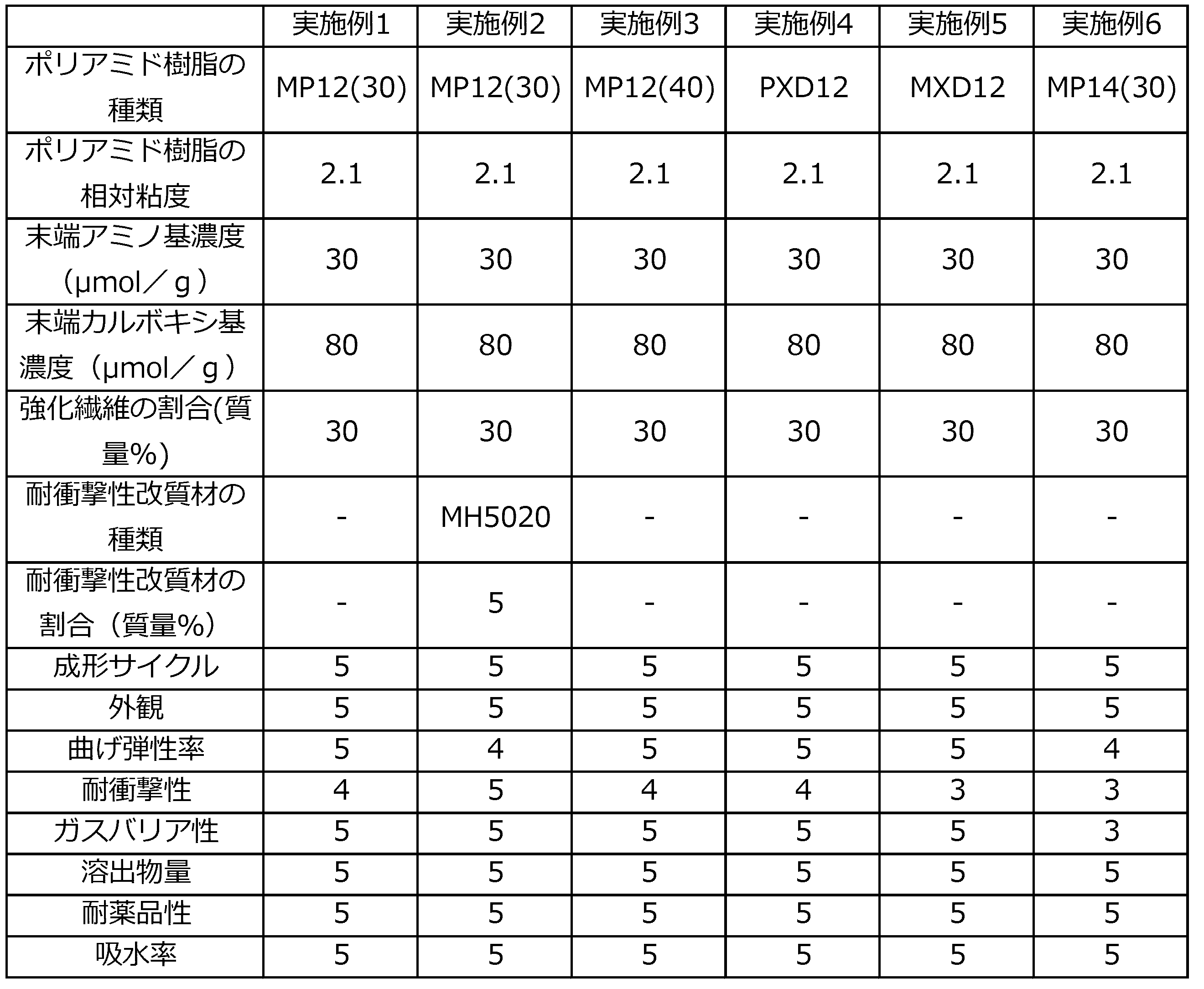


上記結果から明らかなとおり、本発明の樹脂組成物は、成形品としたときに、成形サイクルが早く、かつ、得られる成形品の外観にも優れていた(実施例1~10)。
これに対し、ポリアミド樹脂の相対粘度が高い場合(比較例1)、得られる成形品の外観が劣っていた。また、ポリアミド樹脂として、所定のキシリレンジアミン系ポリアミド樹脂以外のキシリレンジアミン系ポリアミド樹脂(MP10)を用いた場合(比較例2、3)、相対粘度に関係なく、成形サイクルが劣っていた。
また、脂肪族ポリアミド樹脂を用いた場合(比較例4、5)、得られる成形品の外観が劣っていた。
Claims (7)
- キシリレンジアミン系ポリアミド樹脂100質量部に対し、強化繊維を10~300質量部の割合で含み、
前記キシリレンジアミン系ポリアミド樹脂は、ジアミン単位とジカルボン酸単位を含み、前記ジアミン単位がキシリレンジアミン由来の構成単位を70モル%以上含み、前記ジカルボン酸単位が炭素数11~20のα,ω-直鎖脂肪族ジカルボン酸由来の構成単位を70モル%以上含み、かつ、
前記キシリレンジアミン系ポリアミド樹脂の相対粘度が1.6~2.4である、
樹脂組成物。 - 前記ジカルボン酸単位の70モル%以上が、ドデカン二酸および/またはテトラデカン二酸に由来する、請求項1に記載の樹脂組成物。
- 前記ジカルボン酸単位の70モル%以上が、ドデカン二酸に由来する、請求項1に記載の樹脂組成物。
- 前記ジアミン単位の20~100モル%がメタキシリレンジアミンに由来し、80~0モル%がパラキシリレンジアミンに由来する、請求項1~3のいずれか1項に記載の樹脂組成物。
- 前記ジカルボン酸単位の70モル%以上が、ドデカン二酸および/またはテトラデカン二酸に由来し、
前記ジアミン単位の20~100モル%がメタキシリレンジアミンに由来し、80~0モル%がパラキシリレンジアミンに由来する、請求項1に記載の樹脂組成物。 - 前記キシリレンジアミン系ポリアミド樹脂の末端アミノ基濃度と末端カルボキシル基濃度の差(|末端アミノ基濃度-末端カルボキシル基濃度|)が10μmol/g以上である、請求項1~5のいずれか1項に記載の樹脂組成物。
- 請求項1~6のいずれか1項に記載の樹脂組成物から形成された成形品。
Priority Applications (5)
| Application Number | Priority Date | Filing Date | Title |
|---|---|---|---|
| JP2024536847A JPWO2024024330A1 (ja) | 2022-07-25 | 2023-06-19 | |
| KR1020257005610A KR20250044314A (ko) | 2022-07-25 | 2023-06-19 | 수지 조성물, 및, 성형품 |
| US18/997,686 US20260042886A1 (en) | 2022-07-25 | 2023-06-19 | Resin composition and molded article |
| CN202380055593.9A CN119630742A (zh) | 2022-07-25 | 2023-06-19 | 树脂组合物和成型品 |
| EP23846064.6A EP4563661A4 (en) | 2022-07-25 | 2023-06-19 | RESIN COMPOSITION, AND MOLDED ARTICLE |
Applications Claiming Priority (2)
| Application Number | Priority Date | Filing Date | Title |
|---|---|---|---|
| JP2022-117988 | 2022-07-25 | ||
| JP2022117988 | 2022-07-25 |
Publications (1)
| Publication Number | Publication Date |
|---|---|
| WO2024024330A1 true WO2024024330A1 (ja) | 2024-02-01 |
Family
ID=89706038
Family Applications (1)
| Application Number | Title | Priority Date | Filing Date |
|---|---|---|---|
| PCT/JP2023/022542 Ceased WO2024024330A1 (ja) | 2022-07-25 | 2023-06-19 | 樹脂組成物、および、成形品 |
Country Status (6)
| Country | Link |
|---|---|
| US (1) | US20260042886A1 (ja) |
| EP (1) | EP4563661A4 (ja) |
| JP (1) | JPWO2024024330A1 (ja) |
| KR (1) | KR20250044314A (ja) |
| CN (1) | CN119630742A (ja) |
| WO (1) | WO2024024330A1 (ja) |
Cited By (2)
| Publication number | Priority date | Publication date | Assignee | Title |
|---|---|---|---|---|
| WO2025074767A1 (ja) * | 2023-10-02 | 2025-04-10 | 三菱瓦斯化学株式会社 | 樹脂組成物、ペレット、および、成形品 |
| WO2025158762A1 (ja) * | 2024-01-22 | 2025-07-31 | 三菱瓦斯化学株式会社 | 混繊糸、織物および成形品の製造方法 |
Citations (13)
| Publication number | Priority date | Publication date | Assignee | Title |
|---|---|---|---|---|
| JP2011063681A (ja) * | 2009-09-16 | 2011-03-31 | Toyobo Co Ltd | 炭素長繊維強化ポリアミド複合材料 |
| WO2011081099A1 (ja) * | 2009-12-28 | 2011-07-07 | 三菱瓦斯化学株式会社 | ポリアミド化合物 |
| JP2011527369A (ja) * | 2008-07-07 | 2011-10-27 | アルケマ フランス | ポリアミド、このポリアミドを含む組成物、その使用 |
| WO2012077473A1 (ja) * | 2010-12-07 | 2012-06-14 | 三菱瓦斯化学株式会社 | ポリアミド樹脂フィルム及びその製造方法 |
| JP2015054431A (ja) * | 2013-09-11 | 2015-03-23 | 宇部興産株式会社 | 積層チューブ |
| WO2016084475A1 (ja) | 2014-11-28 | 2016-06-02 | 三菱瓦斯化学株式会社 | 圧力容器、ライナーおよび圧力容器の製造方法 |
| JP2018087319A (ja) | 2016-11-18 | 2018-06-07 | 三菱瓦斯化学株式会社 | 樹脂組成物、成形品および成形品の製造方法 |
| JP2018165298A (ja) | 2017-03-28 | 2018-10-25 | 三菱瓦斯化学株式会社 | ポリアミド樹脂の製造方法 |
| JP2019073736A (ja) * | 2017-10-03 | 2019-05-16 | 三菱エンジニアリングプラスチックス株式会社 | 熱可塑性樹脂組成物、樹脂成形品、メッキ付樹脂成形品の製造方法および携帯電子機器部品の製造方法 |
| WO2020137128A1 (ja) * | 2018-12-27 | 2020-07-02 | 宇部興産株式会社 | 積層体 |
| JP2020536153A (ja) * | 2017-10-04 | 2020-12-10 | アルケマ フランス | 熱可塑性粉末組成物及びそのような組成物の3d印刷により製造された強化三次元物体 |
| JP2021028401A (ja) * | 2014-07-30 | 2021-02-25 | 三菱エンジニアリングプラスチックス株式会社 | ポリアミド樹脂組成物および成形品 |
| JP2022054099A (ja) | 2020-09-25 | 2022-04-06 | 三菱エンジニアリングプラスチックス株式会社 | 樹脂組成物、成形品および薄肉成形品の製造方法 |
Family Cites Families (2)
| Publication number | Priority date | Publication date | Assignee | Title |
|---|---|---|---|---|
| JP2009161748A (ja) * | 2007-12-14 | 2009-07-23 | Mitsubishi Engineering Plastics Corp | 繊維強化難燃性熱可塑性樹脂組成物、成形品および繊維強化難燃性熱可塑性樹脂組成物の製造方法 |
| KR20230058004A (ko) * | 2020-08-28 | 2023-05-02 | 미쓰비시 엔지니어링-플라스틱스 코포레이션 | 수지 조성물, 키트, 성형품, 및, 성형품의 제조 방법 |
-
2023
- 2023-06-19 EP EP23846064.6A patent/EP4563661A4/en active Pending
- 2023-06-19 KR KR1020257005610A patent/KR20250044314A/ko active Pending
- 2023-06-19 US US18/997,686 patent/US20260042886A1/en active Pending
- 2023-06-19 JP JP2024536847A patent/JPWO2024024330A1/ja active Pending
- 2023-06-19 CN CN202380055593.9A patent/CN119630742A/zh active Pending
- 2023-06-19 WO PCT/JP2023/022542 patent/WO2024024330A1/ja not_active Ceased
Patent Citations (13)
| Publication number | Priority date | Publication date | Assignee | Title |
|---|---|---|---|---|
| JP2011527369A (ja) * | 2008-07-07 | 2011-10-27 | アルケマ フランス | ポリアミド、このポリアミドを含む組成物、その使用 |
| JP2011063681A (ja) * | 2009-09-16 | 2011-03-31 | Toyobo Co Ltd | 炭素長繊維強化ポリアミド複合材料 |
| WO2011081099A1 (ja) * | 2009-12-28 | 2011-07-07 | 三菱瓦斯化学株式会社 | ポリアミド化合物 |
| WO2012077473A1 (ja) * | 2010-12-07 | 2012-06-14 | 三菱瓦斯化学株式会社 | ポリアミド樹脂フィルム及びその製造方法 |
| JP2015054431A (ja) * | 2013-09-11 | 2015-03-23 | 宇部興産株式会社 | 積層チューブ |
| JP2021028401A (ja) * | 2014-07-30 | 2021-02-25 | 三菱エンジニアリングプラスチックス株式会社 | ポリアミド樹脂組成物および成形品 |
| WO2016084475A1 (ja) | 2014-11-28 | 2016-06-02 | 三菱瓦斯化学株式会社 | 圧力容器、ライナーおよび圧力容器の製造方法 |
| JP2018087319A (ja) | 2016-11-18 | 2018-06-07 | 三菱瓦斯化学株式会社 | 樹脂組成物、成形品および成形品の製造方法 |
| JP2018165298A (ja) | 2017-03-28 | 2018-10-25 | 三菱瓦斯化学株式会社 | ポリアミド樹脂の製造方法 |
| JP2019073736A (ja) * | 2017-10-03 | 2019-05-16 | 三菱エンジニアリングプラスチックス株式会社 | 熱可塑性樹脂組成物、樹脂成形品、メッキ付樹脂成形品の製造方法および携帯電子機器部品の製造方法 |
| JP2020536153A (ja) * | 2017-10-04 | 2020-12-10 | アルケマ フランス | 熱可塑性粉末組成物及びそのような組成物の3d印刷により製造された強化三次元物体 |
| WO2020137128A1 (ja) * | 2018-12-27 | 2020-07-02 | 宇部興産株式会社 | 積層体 |
| JP2022054099A (ja) | 2020-09-25 | 2022-04-06 | 三菱エンジニアリングプラスチックス株式会社 | 樹脂組成物、成形品および薄肉成形品の製造方法 |
Non-Patent Citations (1)
| Title |
|---|
| See also references of EP4563661A4 |
Cited By (2)
| Publication number | Priority date | Publication date | Assignee | Title |
|---|---|---|---|---|
| WO2025074767A1 (ja) * | 2023-10-02 | 2025-04-10 | 三菱瓦斯化学株式会社 | 樹脂組成物、ペレット、および、成形品 |
| WO2025158762A1 (ja) * | 2024-01-22 | 2025-07-31 | 三菱瓦斯化学株式会社 | 混繊糸、織物および成形品の製造方法 |
Also Published As
| Publication number | Publication date |
|---|---|
| EP4563661A1 (en) | 2025-06-04 |
| EP4563661A4 (en) | 2025-10-22 |
| US20260042886A1 (en) | 2026-02-12 |
| CN119630742A (zh) | 2025-03-14 |
| JPWO2024024330A1 (ja) | 2024-02-01 |
| KR20250044314A (ko) | 2025-03-31 |
Similar Documents
| Publication | Publication Date | Title |
|---|---|---|
| CN105829448B (zh) | 半芳香族聚酰胺树脂组合物及其成型品 | |
| JP5945558B2 (ja) | 平らなガラス繊維を用いた強化ポリアミド成形材料およびポリアミド成形材料によって作製された射出成形部品 | |
| JP5722018B2 (ja) | 半芳香族の成形組成物とその使用方法 | |
| JP6911665B2 (ja) | 樹脂組成物、成形品および成形品の製造方法 | |
| CN103154087B (zh) | 聚酰胺树脂成形体 | |
| KR20160041813A (ko) | 유동성 폴리아미드 | |
| CN105017760A (zh) | 聚酰胺模塑组合物及其用途 | |
| CN1329448C (zh) | 聚酰胺模塑材料、可由其生产的模塑制品及其用途 | |
| WO2024024330A1 (ja) | 樹脂組成物、および、成形品 | |
| CN107001793B (zh) | 聚酰胺树脂组合物、成型品、成型品的制造方法 | |
| CN111448257A (zh) | 聚酰胺树脂组合物 | |
| JP2020200405A (ja) | 延伸フィルムおよび多層体 | |
| JP6507949B2 (ja) | ポリアミド樹脂組成物および成形品 | |
| JP6759706B2 (ja) | ポリアミド樹脂組成物 | |
| JP7641133B2 (ja) | 樹脂組成物および成形品 | |
| JP7318839B1 (ja) | 樹脂組成物、成形品、および、成形品の製造方法 | |
| JP7340134B2 (ja) | 樹脂組成物および成形品 | |
| JP2021080344A (ja) | ポリアミド樹脂組成物 | |
| TWI793718B (zh) | 具有二聚酸和二聚胺的脂族和半芳族聚醯胺 | |
| JP7444743B2 (ja) | 尿素scrシステム用部品、キットおよび尿素scrシステム用部品の製造方法 | |
| WO2024024329A1 (ja) | 樹脂組成物、および、成形品 | |
| US20230143084A1 (en) | Polyamide resin composition | |
| JP7742744B2 (ja) | 樹脂組成物、成形品および成形品の製造方法 | |
| WO2023188549A1 (ja) | 樹脂組成物、成形品、および、成形品の製造方法 | |
| JP2024062292A (ja) | 樹脂組成物、ペレット、および、成形品 |
Legal Events
| Date | Code | Title | Description |
|---|---|---|---|
| 121 | Ep: the epo has been informed by wipo that ep was designated in this application |
Ref document number: 23846064 Country of ref document: EP Kind code of ref document: A1 |
|
| WWE | Wipo information: entry into national phase |
Ref document number: 2024536847 Country of ref document: JP |
|
| WWE | Wipo information: entry into national phase |
Ref document number: 202380055593.9 Country of ref document: CN Ref document number: 18997686 Country of ref document: US |
|
| ENP | Entry into the national phase |
Ref document number: 20257005610 Country of ref document: KR Kind code of ref document: A |
|
| WWE | Wipo information: entry into national phase |
Ref document number: 1020257005610 Country of ref document: KR |
|
| WWE | Wipo information: entry into national phase |
Ref document number: 2023846064 Country of ref document: EP |
|
| NENP | Non-entry into the national phase |
Ref country code: DE |
|
| ENP | Entry into the national phase |
Ref document number: 2023846064 Country of ref document: EP Effective date: 20250225 |
|
| WWP | Wipo information: published in national office |
Ref document number: 202380055593.9 Country of ref document: CN |
|
| WWP | Wipo information: published in national office |
Ref document number: 1020257005610 Country of ref document: KR |
|
| WWP | Wipo information: published in national office |
Ref document number: 2023846064 Country of ref document: EP |
|
| WWP | Wipo information: published in national office |
Ref document number: 18997686 Country of ref document: US |