WO2024048079A1 - 有用物質を産生するクローンの産生安定性を予測する方法、情報処理装置、プログラムおよび予測モデル生成方法 - Google Patents
有用物質を産生するクローンの産生安定性を予測する方法、情報処理装置、プログラムおよび予測モデル生成方法 Download PDFInfo
- Publication number
- WO2024048079A1 WO2024048079A1 PCT/JP2023/025263 JP2023025263W WO2024048079A1 WO 2024048079 A1 WO2024048079 A1 WO 2024048079A1 JP 2023025263 W JP2023025263 W JP 2023025263W WO 2024048079 A1 WO2024048079 A1 WO 2024048079A1
- Authority
- WO
- WIPO (PCT)
- Prior art keywords
- data
- clones
- clone
- culture
- prediction
- Prior art date
- Legal status (The legal status is an assumption and is not a legal conclusion. Google has not performed a legal analysis and makes no representation as to the accuracy of the status listed.)
- Ceased
Links
Images





Classifications
-
- G—PHYSICS
- G16—INFORMATION AND COMMUNICATION TECHNOLOGY [ICT] SPECIALLY ADAPTED FOR SPECIFIC APPLICATION FIELDS
- G16B—BIOINFORMATICS, i.e. INFORMATION AND COMMUNICATION TECHNOLOGY [ICT] SPECIALLY ADAPTED FOR GENETIC OR PROTEIN-RELATED DATA PROCESSING IN COMPUTATIONAL MOLECULAR BIOLOGY
- G16B25/00—ICT specially adapted for hybridisation; ICT specially adapted for gene or protein expression
- G16B25/10—Gene or protein expression profiling; Expression-ratio estimation or normalisation
-
- C—CHEMISTRY; METALLURGY
- C07—ORGANIC CHEMISTRY
- C07K—PEPTIDES
- C07K16/00—Immunoglobulins [IG], e.g. monoclonal or polyclonal antibodies
-
- C—CHEMISTRY; METALLURGY
- C12—BIOCHEMISTRY; BEER; SPIRITS; WINE; VINEGAR; MICROBIOLOGY; ENZYMOLOGY; MUTATION OR GENETIC ENGINEERING
- C12N—MICROORGANISMS OR ENZYMES; COMPOSITIONS THEREOF; PROPAGATING, PRESERVING, OR MAINTAINING MICROORGANISMS; MUTATION OR GENETIC ENGINEERING; CULTURE MEDIA
- C12N5/00—Undifferentiated human, animal or plant cells, e.g. cell lines; Tissues; Cultivation or maintenance thereof; Culture media therefor
- C12N5/06—Animal cells or tissues; Human cells or tissues
-
- C—CHEMISTRY; METALLURGY
- C12—BIOCHEMISTRY; BEER; SPIRITS; WINE; VINEGAR; MICROBIOLOGY; ENZYMOLOGY; MUTATION OR GENETIC ENGINEERING
- C12N—MICROORGANISMS OR ENZYMES; COMPOSITIONS THEREOF; PROPAGATING, PRESERVING, OR MAINTAINING MICROORGANISMS; MUTATION OR GENETIC ENGINEERING; CULTURE MEDIA
- C12N5/00—Undifferentiated human, animal or plant cells, e.g. cell lines; Tissues; Cultivation or maintenance thereof; Culture media therefor
- C12N5/10—Cells modified by introduction of foreign genetic material
-
- C—CHEMISTRY; METALLURGY
- C12—BIOCHEMISTRY; BEER; SPIRITS; WINE; VINEGAR; MICROBIOLOGY; ENZYMOLOGY; MUTATION OR GENETIC ENGINEERING
- C12P—FERMENTATION OR ENZYME-USING PROCESSES TO SYNTHESISE A DESIRED CHEMICAL COMPOUND OR COMPOSITION OR TO SEPARATE OPTICAL ISOMERS FROM A RACEMIC MIXTURE
- C12P1/00—Preparation of compounds or compositions, not provided for in groups C12P3/00 - C12P39/00, by using microorganisms or enzymes
-
- G—PHYSICS
- G16—INFORMATION AND COMMUNICATION TECHNOLOGY [ICT] SPECIALLY ADAPTED FOR SPECIFIC APPLICATION FIELDS
- G16B—BIOINFORMATICS, i.e. INFORMATION AND COMMUNICATION TECHNOLOGY [ICT] SPECIALLY ADAPTED FOR GENETIC OR PROTEIN-RELATED DATA PROCESSING IN COMPUTATIONAL MOLECULAR BIOLOGY
- G16B40/00—ICT specially adapted for biostatistics; ICT specially adapted for bioinformatics-related machine learning or data mining, e.g. knowledge discovery or pattern finding
-
- G—PHYSICS
- G16—INFORMATION AND COMMUNICATION TECHNOLOGY [ICT] SPECIALLY ADAPTED FOR SPECIFIC APPLICATION FIELDS
- G16B—BIOINFORMATICS, i.e. INFORMATION AND COMMUNICATION TECHNOLOGY [ICT] SPECIALLY ADAPTED FOR GENETIC OR PROTEIN-RELATED DATA PROCESSING IN COMPUTATIONAL MOLECULAR BIOLOGY
- G16B40/00—ICT specially adapted for biostatistics; ICT specially adapted for bioinformatics-related machine learning or data mining, e.g. knowledge discovery or pattern finding
- G16B40/20—Supervised data analysis
Definitions
- the present disclosure relates to information processing technology and machine learning technology for predicting the production stability of clones that produce useful substances.
- biopharmaceuticals which account for more than half of the products in the world's top 10 pharmaceutical sales rankings and about two-thirds of sales.
- biopharmaceuticals make use of complex proteins and are extremely difficult to chemically synthesize. Therefore, antibody drugs, which are an example of biopharmaceuticals, are produced by inserting a gene corresponding to a desired human protein into, for example, CHO cells (Chinese Hamster Ovary cells), causing the cells to produce the desired protein, which is then extracted and purified. The production method for manufacturing antibody drugs is widely used.
- the clone of the present invention refers to a population of genetically identical cells or cells constituting the population.
- high-quality antibody production ability means that there is a high antibody production ability at the present time, and that the antibody production ability is stable even during a long-term culture period.
- clones created from individual cells with random gene insertion positions vary in antibody production ability, and it is necessary to determine whether each clone has good antibody production ability.
- it is possible to determine whether a clone is a high-producing clone with high antibody production ability or not by a two-week standard test but it is difficult to determine whether the production stability is stable over a long-term culture period. In fact, experimental verification (stability testing) through long-term culture for several months is essential.
- Patent Document 1 proposes a method for predicting the production stability of a clone's recombinant protein several months into the future from gene expression data of the clone obtained at the present time. Furthermore, Non-Patent Document 1 proposes a method for predicting the production stability of a recombinant protein at an early stage of clone development by identifying a marker gene that can predict the stable expression of a recombinant protein at an early stage of clone development. ing.
- Patent Document 1 cannot be said to be sufficient in terms of prediction accuracy.
- genetic analysis of a large number of clones generally requires high costs, the cost reduction effect obtained by predicting the production stability of recombinant proteins is diminished by the cost increase due to genetic analysis for prediction.
- it is conceivable to narrow down the number of clones whose production stability is predicted but this would also reduce the number of clones with high production stability among the prediction targets, and the resultant production stability This resulted in a small number of high clones, making it difficult to simply narrow down the number of clones to be predicted.
- the first problem to be solved by the present disclosure is to provide a means for predicting the production stability of useful substances in clones with high accuracy.
- the second objective is to provide a means to reduce the cost of predicting the production stability of useful substances in clones.
- the present disclosure has been made in view of these circumstances, and provides a method, information processing device, program, and predictive model generation method that can predict the production stability of clones that produce useful substances with high accuracy and at low cost.
- the purpose is to provide
- a method is a method for predicting production stability of a clone producing a useful substance, the method comprising: one or more processors acquiring culture data of one or more types of clones; Analyzing the culture data to limit the clones to be predicted, and predicting the production stability of useful substances by the clones to be predicted using the data measured for the clones to be predicted.
- production stability is predicted by limiting prediction targets based on information obtained from culture data, so production stability is predicted with higher accuracy compared to the case where targets are not limited. becomes possible. Moreover, since the data necessary for prediction can be acquired only for the clones that are the prediction targets, cost reduction is possible.
- the predicted production stability may represent the future state of the clone several months into the future, similar to production stability that has actually been experimentally verified by long-term culture over several months. For example, production stability may be evaluated from the viewpoint of whether the initial production amount is maintained even after long-term culture. According to the first aspect, the results of stability tests that require long-term culture can be predicted with high accuracy and low cost.
- the production stability is defined by the presence or absence of a change in the production amount of the useful substance between the start of culture and after culture for a predetermined period. It's okay.
- a method according to a third aspect of the present disclosure includes, in the method according to the first aspect or the second aspect, one or more processors setting an index obtained from culture data and a threshold regarding the index;
- the configuration may be such that the prediction target is limited based on the value of the index and the threshold value.
- the method according to the fourth aspect of the present disclosure may be configured such that in the method according to the third aspect, the threshold value is adjusted so that the prediction accuracy of production stability is higher than when the prediction target is not limited. .
- the method according to the fifth aspect of the present disclosure may be configured such that in the method according to the third aspect or the fourth aspect, the threshold value is defined using the ranking of the index value.
- the "rank" can be a rank when the index values of a plurality of clones are arranged in descending order or a rank when they are arranged in ascending order.
- the threshold value may be defined as the top 40% of the relative ranking in a population containing multiple clones.
- the prediction target in the method according to any one of the third to fifth aspects, may be a group with a high value of the index.
- the indicator in the method according to any one of the third to sixth aspects, may be the production amount of the useful substance.
- the index in the method according to any one of the third to sixth aspects, may be an integral viable cell density.
- the indicator in the method according to the ninth aspect of the present disclosure, in the method according to any one of the third to sixth aspects, may be lactic acid concentration.
- a method according to a tenth aspect of the present disclosure is a method according to any one of the first to ninth aspects, wherein the data used for predicting production stability includes one or more gene expression levels. It's okay.
- a method according to an eleventh aspect of the present disclosure is a method according to any one of the first to tenth aspects, in which one or more processors receive input of data to be predicted and determine whether the data is stable or unstable.
- the configuration may be such that production stability is predicted using a model that performs two-class classification.
- the model is configured such that the correct stability label is associated with data about a training clone with the same limitations as the prediction target clone.
- the model may be trained by machine learning using a plurality of training data.
- a method according to a thirteenth aspect of the present disclosure is the method according to the twelfth aspect, wherein the plurality of training data includes training data about a plurality of types of clones that produce different useful substances, and the one or more processors It may be configured to predict the production stability of a clone that produces a useful substance different from the useful substance used for training.
- the method according to the fourteenth aspect of the present disclosure is the method according to any one of the first to thirteenth aspects, wherein the useful substance is any one of proteins, peptides, and viruses that are pharmaceutical raw materials. good.
- the useful substance in the method according to any one of the first to fourteenth aspects, may be an antibody or an antibody-like protein.
- the clone in the method according to any one of the first to fifteenth aspects, may be a vertebrate-derived cell.
- the clone in the method according to any one of the first to fifteenth aspects, may be a mammalian-derived cell.
- the clone in the method according to any one of the first to fifteenth aspects, may be a CHO cell or a HEK cell (Human Embryonic Kidney cells).
- An information processing device includes one or more processors and one or more storage devices in which instructions to be executed by the one or more processors are stored, and the one or more processors are , acquire culture data of one or more types of clones that produce useful substances, analyze the culture data to limit the clones to be predicted, and use the data measured for the clones to be predicted to determine the target clones. Predict the stability of production of useful substances by clones.
- the information processing device can be configured to include an aspect similar to the method of any one of the second to eighteenth aspects.
- a program according to a twentieth aspect of the present disclosure provides a computer with a function of acquiring culture data of one or more types of clones producing useful substances, and a function of analyzing the culture data to limit clones to be predicted. and a function of predicting the production stability of a useful substance by a clone to be predicted using data measured for the clone to be predicted.
- the program according to the 20th aspect can be configured to include aspects similar to the method of any one of the 2nd to 18th aspects.
- a predictive model generation method is a predictive model generation method for generating a predictive model that allows a computer to realize a function of predicting the production stability of a clone producing a useful substance, the method comprising: A system including a processor acquires culture data of one or more types of clones, analyzes the culture data to limit the clones to be predicted, and compares the data measured for the clones to be predicted with the correct answer. The method includes performing machine learning using a plurality of training data associated with stability labels, and training the prediction model so that the output of the prediction model in response to the data input approaches the correct stability label.
- the predictive model generation method according to the 21st aspect may include aspects similar to the method of any one of the 2nd to 18th aspects.
- prediction targets are appropriately limited based on information obtained by analyzing culture data, and it becomes possible to predict with high accuracy the production stability of clones that produce useful substances. Further, according to the present disclosure, by limiting the prediction target, the cost of predicting production stability can be suppressed, and prediction can be performed at low cost.
- FIG. 1 is an explanatory diagram showing an overview of the production process of antibody drugs.
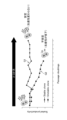
- FIG. 2 is a graph showing an example of changes in antibody production amount depending on clones.
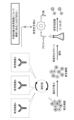
- FIG. 3 is an explanatory diagram outlining the role of stability prediction AI (Artificial Intelligence) realized by this embodiment.
- FIG. 4 is a conceptual diagram of a machine learning model that predicts production stability based on gene expression data.
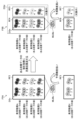
- FIG. 5 is an explanatory diagram showing an overview of the method for predicting production stability of clones according to the present embodiment.
- FIG. 6 is a diagram illustrating an example of a dataset used for model training and evaluation.
- FIG. 7 is a graph showing an example of narrowing down targets using a certain index of culture data.
- FIG. 8 is a chart showing examples of the number of clones and stability labeling of five types of antibody-producing CHO cells prepared as evaluation samples.
- FIG. 9 is a chart showing the number of clones whose antibody production amount falls within the top 40% of the relative ranking for each antibody type and an example of assigning stability labels.
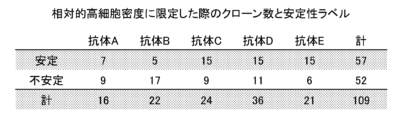
- FIG. 10 is a chart showing the number of clones whose integrated viable cell density value falls within the top 60% of the relative ranking for each antibody type and an example of assigning stability labels.
- FIG. 11 is a chart showing the number of clones whose lactic acid concentration values fall within the top 40% of the relative ranking for each antibody type and examples of stability labeling.
- FIG. 12 is a block diagram showing the functional configuration of the information processing device according to the embodiment.
- FIG. 12 is a block diagram showing the functional configuration of the information processing device according to the embodiment.
- FIG. 13 is a block diagram showing an example of the hardware configuration of the information processing device.
- FIG. 14 is a block diagram illustrating an example of a hardware configuration of a machine learning device that executes machine learning processing to generate a production stability prediction model.
- FIG. 15 is a flowchart illustrating an example of a machine learning method executed by the machine learning device.
- FIG. 16 is a flowchart illustrating an example of an information processing method executed by the information processing apparatus according to the embodiment.
- FIG. 1 is an explanatory diagram showing an overview of the production process of antibody drugs.
- the process to produce an antibody drug includes [1] a cloning phase, [2] a process development phase, and [3] a GMP (Good Manufacturing Practice) manufacturing phase.
- the cloning phase involves adding a vector to animal cells suitable for the production of antibody drugs and genetically recombining them to create multiple clone candidates, and determining the amount of antibody produced from among these multiple candidates. , screening for clones that are excellent in terms of cell proliferation, quality stability in which cell characteristics do not change even after repeated proliferation, and the like.
- the process development phase is a phase in which the screened clones are used to develop production processes (culture conditions, purification conditions, etc.) necessary for GMP production.
- the clones are cultured and propagated under the established production process, and the clones are made to produce antibodies. Furthermore, by purifying the antibody and formulating it, an antibody drug is completed.
- FIG. 2 is a graph showing an example of changes in antibody production amount depending on the clone.
- the vertical axis represents antibody productivity, and the horizontal axis represents elapsed time (time point).
- "Antibody productivity" is expressed by the amount of antibody produced by a clone per unit time.
- Figure 2 shows a graph plotting how the amount of antibodies produced by a clone changes over a long period of time (2-3 months).
- Graph G1 is a graph showing changes in antibody production amount for clones with stable productivity.
- Graph G2 is a graph showing changes in antibody production amount for clones with unstable productivity.
- clones with stable productivity have approximately the same productivity even after 2 to 3 months from the current point, and can maintain productivity that is generally unchanged from the current point.
- the productivity of clones with unstable productivity gradually decreases over a period of 2 to 3 months.
- the "current time” refers to the two-week standard test time or the end of the standard test, that is, the time when culture for determining production stability is started.
- “current antibody productivity” is the amount of antibody produced by a clone per unit time in a two-week standard test.
- the productivity behavior shown in Figure 2 varies depending on the type of clone, and conventionally, each time the type of antibody that a clone is made to produce changes, an experiment similar to that shown in Figure 2 is conducted to stabilize the production of each clone. I had to evaluate my sexuality.
- the embodiments of the present disclosure propose a mechanism for accurately predicting the production stability of antibodies several months into the future based on information obtained from clones at the present time.
- “information obtained from the clone at present” is information obtained from the clone in a two-week standard test.
- Antibody production stability which is a target variable for prediction, can be defined by the presence or absence of a change in the amount of antibody produced between the current time and after several months of culture.
- “several months” is, for example, a period of two months or more, and may be, for example, two to three months. Alternatively, the period may be set until passage is performed a predetermined number of times.
- the period may be determined based on the proliferative ability of the clone, or may be determined based on the cultivation period of the clone during actual antibody production.
- the "current time” is the initial time of culture shown at the left end of the graph in FIG. 2, that is, the time when the two-week standard test is completed, and the time when culture for determining the production stability of antibodies is started.
- Stable productivity means that there is no change in the amount of antibody produced between the present and several months from now. "No change” includes cases where the amount of change is within a permissible range and can be considered as substantially no change.
- "Unstable” productivity means that there is a change in the amount of antibody produced between now and several months later, and in many cases, the amount of antibody produced decreases.
- the threshold value for determining that there is a change in productivity can be set arbitrarily, and may be, for example, ⁇ 30% or ⁇ 20% with respect to the current production amount.
- FIG. 3 is an explanatory diagram illustrating the role of stability prediction AI (Artificial Intelligence) realized by this embodiment.
- AI Artificial Intelligence
- the stability prediction AI predicts the state (changes in productivity) after 2 to 3 months.
- a stability prediction AI that enables this. More specifically, a model is constructed that receives input of current gene expression data (at the time of standard testing) of a clone and outputs a stability label indicating the production stability of a useful substance. More specifically, some of the clones are used for standard tests, and another part is subjected to genetic analysis to obtain gene expression data, so that gene expression data of the clones used for standard tests can be obtained. do.
- the stability label can be expressed as a binary value of "1" indicating “stable” or "0” indicating "unstable”.
- the prediction model for predicting production stability may be a two-class classification model that performs classification into “stable” or "unstable”.
- Gene expression data includes one or more gene levels.
- the gene expression data used in this embodiment includes data obtained by quantifying the gene expression level of each of a plurality of genes.
- Gene expression data can be obtained, for example, by RNA (ribonucleic acid) sequence analysis.
- the value indicating the amount of gene expression is, for example, a count value that takes a positive integer, and can be logarithmically transformed and used as a feature amount.
- FIG. 4 is a conceptual diagram of the machine learning model MLM that predicts production stability based on gene expression data.
- An example of a dataset of training data is shown inside the rectangular frame RF1 in FIG.
- the current gene expression data (at the time of standard testing) of each of a plurality of clones A to N is expressed as a gene expression pattern GEP visualized by a heat map.
- the horizontal axis of the gene expression pattern GEP represents the type of gene, and the gene expression level of each of a plurality of genes is expressed by a two-color gradation (heat map).
- gene expression data can be determined by, for example, obtaining all gene expression data for stable clones and unstable clones, and calculating the number of types of genes a, b, c, d, etc. Preferably, 300 to 400 types are selected using the statistical significance probability of the two groups. If you want to further narrow down the number of gene types, use the selected genes to actually train the machine learning model MLM while increasing or decreasing the number of gene types, and search for the number of types that gives high prediction performance, for example 50 to 100. It is preferable to narrow down the search to genes of different types. In addition, although all gene expression data were acquired here, it is not necessarily necessary to acquire all gene expression data, and some genes may be selected at random and the gene expression data thereof may be acquired.
- red represents a relatively high gene expression level
- blue represents a relatively low gene expression level
- White indicates that the gene expression level is an intermediate value.
- Each of the multiple clones A to N has been confirmed to be “stable” or “unstable” based on experimental verification by culturing for several months after the standard test, and the A stability label (correct label) indicating “stable” or “unstable” is assigned.
- a data set is prepared that includes a plurality of training data in which the current gene expression data of each of the plurality of clones A to N and the correct stability label are associated (linked).
- the machine learning model MLM is trained using the plurality of training data, and the machine learning model MLM is made to learn stable or unstable gene patterns.
- FIG. 4 shows an example in which the machine learning model MLM predicts that unknown clone X is "stable”.
- ⁇ Summary of the embodiment Build a model that predicts the production stability of useful substances by limiting the prediction target ⁇ Since clones that produce useful substances have various characteristics, it is difficult to accurately predict the production stability of all clones regardless of type.
- highly accurate prediction is achieved by limiting the prediction target based on the index obtained from the culture data of each clone at the current time (at the time of the standard test).
- the culture data is general data that can be measured for clones using a culture device or by sampling a portion of a culture solution containing cells and using a dedicated device.
- FIG. 5 is an explanatory diagram showing an overview of the method for predicting production stability of useful substances of clones according to the present embodiment.
- the left diagram F5A in FIG. 5 shows a comparative example in which the prediction target is not limited, and the right diagram F5B in FIG. 5 shows an overview of the method according to this embodiment.
- a data set DSc including training data of multiple types of clones producing useful substances A to D is schematically shown.
- This data set DSc includes training data for a total of 20 clones, 5 clones for each of useful substances A to D.
- the training data is data in which the gene expression data at the time of each standard test and the correct stability label are associated (linked) for the 20 clones.
- Values such as "9", "7", and "6" displayed at the bottom of each clone in FIG. 5 represent measured values of certain culture data of each clone during the standard test. Note that instead of the measured value, the relative level in each clone that can be obtained from the measured value may be expressed.
- the machine learning model MLMc is trained using all the training data of the dataset DSc without limiting the training data, and the unknown useful substance X is produced using the learned (trained) model.
- This study shows that the production stability of multiple types of clones can be predicted. In this case, there are no particular limitations on the multiple types of clones that produce the unknown useful substance Predict production stability for the target. To predict production stability, obtain current gene expression data (at the time of standard testing) for all five types of clones that produce unknown useful substance X, and input it into a learned (trained) model. However, the prediction accuracy is low.
- the prediction target is limited using the value of certain culture data at the time of the standard test as an index.
- a threshold value is determined by focusing on the value of certain culture data, and a population of clones included in the data set DSd is divided into groups. For example, the culture data used as an index is divided into two groups: those whose values are relatively large with respect to the threshold value, and those whose values are relatively small.
- the threshold value is set to ⁇ 5'', and the population whose culture data value as an index is ⁇ 5'' or more is the training target, and the population whose culture data value is smaller than ⁇ 5'' is excluded from the training target.
- a total of 12 clones of training data, 3 clones for each useful substance A to D, are left as targets as shown in the rectangular frame RF4, and the data set DSe containing the training data of these limited groups is machined. Used for training the learning model MLMe.
- the training data of the eight clones shown within the dashed rectangular frame RF5 that is, the training data of the clones that do not satisfy the threshold condition, are excluded from the processing.
- the machine learning model MLMe is trained using the dataset DSe with limited targets.
- a threshold is applied to the value of the culture data used as an index, and prediction is performed limited to those that satisfy the limiting conditions by the threshold (groups whose index value is higher than the threshold).
- the three types of clones shown within the rectangular frame RF6 represent clones applicable to the prediction target.
- the two types of clones shown within the dashed rectangular frame RF7 represent clones that are not subject to prediction.
- Figure 6 shows an example of a dataset used for model training and evaluation.
- the upper part of FIG. 6 shows an example of a data set DSA for a clone that produces antibody A as a useful substance
- the lower part shows an example of a data set DSB for a clone that produces antibody B as a useful substance.
- data sets for clones producing other types of antibodies as useful substances are also similar.
- the data set DSA includes culture data measured for each of the plurality of clones ACLj at the time of the standard test, gene expression data at the time of the standard test, and the correct stability label obtained from the stability test.
- the subscript j represents an index number that identifies a clone.
- the culture data may include, for example, one or more items such as antibody production amount, integral viable cell density (IVCD), lactic acid concentration, and pH.
- the culture data may be general data that can be measured using a dedicated device by sampling a part of the culture medium or the culture medium containing the cells, such as the total number of cells, the amount of cell secreted substances, and the amount of cell produced substances. , an amount of a cell metabolite, and an amount of a medium component.
- the character symbols (symbols with subscript j) in each cell of the table shown in FIG. 6 represent the value of the corresponding data item.
- the number na of clones ACLj included in the data set DSA and the number nb of clones BCLj included in the data set DSB may be different.
- Targets are narrowed down (limited) by focusing on certain indicators of culture data from the datasets of multiple domains (useful substance types) prepared in this way.
- FIG. 7 is a graph showing an example of narrowing down prediction targets using a certain index of culture data.
- On the horizontal axis multiple types of clones that produce each of the multiple useful substances A to E are lined up.
- the vertical axis is the value of a certain index obtained from the culture data during the standard test. Note that the clone shown in FIG. 7 is a clone used for model training (learning).
- the distribution range of a certain index obtained from culture data may differ depending on clones producing different types of useful substances.
- a threshold value is determined for the index value, and the clones are divided into two groups based on the relative size with the threshold value, and the group of clones used for training and the group of clones used for training are If a group of clones is excluded from the training, the number of clones to be trained will vary depending on the types of useful substances produced. For example, if the index threshold is set to 2.5 and a population of clones with values equal to or higher than the threshold are used for training, clones that produce useful substance B will not be used for training.
- the relative top X% refers to the top X% (Top-X%) when a certain index obtained from culture data is arranged in descending order in a population of clones producing each of the useful substances A to D. means. It is preferable that the standard "X%", which corresponds to a threshold value serving as a limiting condition, is adjusted so that the number of samples from each of the useful substances A to E is approximately the same.
- the relative top X% is an example of a "threshold defined using the ranking of index values" in the present disclosure.
- the clone to be predicted is the same as the clone used for training the model. Predictions are made only for the top X% of clones with respect to a certain index obtained from culture data.
- the method for limiting the population of clones used for training may be to set a threshold value by focusing on the value of certain culture data during a standard test, and to set a threshold value based on the relative size relationship with the threshold value. It may be set to the top X% of the value of a certain index obtained from the culture data at the time of the test. In addition, although the relative top X% was used, it may be set as the relative bottom X% depending on a certain index obtained from the culture data.
- the culture data index and threshold for limiting prediction targets may be determined from a prepared data set by repeating hypothesis and verification in a trial and error manner.
- the culture data index and threshold for limiting prediction targets can be determined by performing exploratory analysis from a prepared data set.
- an information processing device including a processor uses a feature selection method such as a filter method to Evaluate the degree of association between each feature and the target variable (stability label) in each of the five domains, and select features with high degree of association in, for example, four or more domains out of the five domains, as features with high domain universality.
- the information processing device focuses on a certain index from all the data, extracts data that satisfies a specific condition as a subset, and evaluates the domain generalizability of the extracted subset based on the number of features with high domain generality. I do.
- the trained model can be used for a limited population (subset) under the same conditions as during training. Therefore, production stability can be robustly predicted for other domains (useful substance species).
- culture data indicators that are effective for limiting prediction targets include, for example, antibody production amount, integrated viable cell density, and lactic acid concentration. It was confirmed that it is possible to predict production stability with high accuracy.
- the useful substance is not limited to antibodies, but may also be antibody-like proteins.
- the useful substance may be any of proteins, peptides, and viruses that are raw materials for pharmaceuticals.
- the clone producing the useful substance may be a vertebrate-derived cell.
- a clone may be, for example, a mammalian-derived cell.
- the clone may be a CHO cell or a HEK cell.
- Example 2 Examples 1 to 3 to which the technology of the present disclosure is applied will be described below.
- the configuration common to each of Examples 1 to 3 is as follows. That is, the useful substance is an antibody, and the producing cells are CHO cells. Multiple types of clones were prepared for each of the five types of antibody-producing CHO cell clones as evaluation samples, and 100 types were analyzed using RNA sequence (RNA-Seq) analysis from the total gene expression level measured in a two-week standard test. Using a logistic regression model that selects the gene expression level as an explanatory variable and classifies it into two classes, stable or unstable, as a learning device, we perform 5-fold cross validation to train (learn) the predictive model and evaluate its performance.
- RNA-Seq RNA sequence analysis
- the 5-fold cross-validation was performed by dividing each of the five antibody species to evaluate the performance using unlearned antibody species. That is, data sets of four antibody species were used as training (learning) data, and the remaining one antibody species data set was used as test data for performance evaluation.
- FIG. 8 is a chart showing examples of the number of clones and stability labeling of five types of antibody-producing CHO cells prepared as evaluation samples.
- Example 1 In Example 1, an example will be described in which stability prediction is performed with the prediction target limited to "relatively high-producing clones.”
- the term "relatively high-producing clone” means a clone that produces a relatively high amount of a useful substance.
- limiting the clones to be trained corresponds to limiting the clones to be predicted by the prediction model in training, that is, to limiting the clones to be predicted by the prediction model.
- the method for limiting the clones for training is to focus on the "antibody production amount" from the culture data of all 182 clones during the standard test, search for a threshold value that will increase the prediction performance of the prediction model, and then select a threshold value for each antibody type.
- the method was to limit the clones to the top 40% of relative rankings.
- the "antibody production amount” can be, for example, the cumulative amount of antibody production over two weeks (14 days) in a standard test. Alternatively, it may be the cumulative amount of antibody production over a certain period, for example, 10 days, during a standard test, or may be divided by the measurement period to obtain the antibody production amount per unit time.
- “Top 40%” is an example of a threshold value.
- FIG. 9 is a chart showing the number of clones whose antibody production amount falls within the top 40% of the relative ranking for each antibody type and an example of assigning stability labels.
- FIG. 9 shows examples of a total of 73 clones corresponding to the top 40% of relative rankings for each antibody type.
- Five-fold cross-validation was performed using a data set for each antibody species including training data in which gene expression data during standard testing of 73 clones shown in FIG. 9 and stability labels were linked.
- the predictive performance of the trained predictive model had a PRAUC value of 0.743.
- Example 2 In Example 2, an example will be described in which stability prediction is performed with the prediction target limited to "clones with relatively high cell density.”
- a method for limiting the clones to be trained for training a prediction model when performing stability prediction by limiting the prediction targets to "clones with relatively high cell density” will be described.
- IVCD integral viable cell density
- the "clone with relatively high cell density” can be obtained, for example, based on the “integral viable cell density (IVCD)” for 2 weeks (14 days) in a standard test. Alternatively, it may be obtained based on the “integral viable cell density (IVCD)" over a certain period of time, for example 10 days, during a standard test. “Top 60%” is an example of a threshold value.
- FIG. 10 is a chart showing the number of clones whose integrated viable cell density value falls within the top 60% of the relative ranking for each antibody type and an example of assigning stability labels.
- FIG. 10 shows examples of a total of 109 clones corresponding to the top 60% of relative rankings for each antibody type.
- Five-fold cross-validation was performed using a data set for each antibody species, including training data in which gene expression data and stability labels during standard testing of 109 clones shown in FIG. 10 were linked.
- the predictive performance of the trained predictive model had a PRAUC value of 0.647. That is, it was confirmed that the performance of the prediction model in which the prediction target was limited according to Example 2 was higher in accuracy than the PRAUC (0.503) of the prediction model according to the comparative example in which the prediction target was not limited.
- Example 3 In Example 3, an example in which stability prediction is performed limited to "clones with relatively high lactic acid concentration" will be described.
- a method for limiting clones to be trained for training a prediction model when performing stability prediction by limiting the prediction targets to "clones with relatively high lactic acid concentration” will be described.
- the "lactic acid concentration" of each clone is obtained by using the median value of the "lactic acid concentration" of the culture solution measured at each time point, for example, every day, as a representative value.
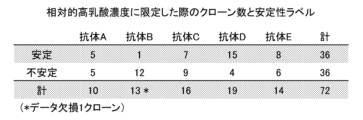
- FIG. 11 is a chart showing examples of the number of clones whose lactic acid concentration value falls within the top 40% of the relative ranking for each antibody type and the assignment of stability labels.
- FIG. 11 shows examples of a total of 72 clones corresponding to the top 40% of relative rankings for each antibody type. The reason why the number of clones is one less than that in FIG. 9 is because there was data missing for one clone in the measurement of lactic acid concentration.
- stability prediction according to the present disclosure is considered to be practical because it can be implemented at low cost by limiting it to targets that can be predicted with high accuracy.
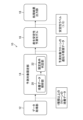
- FIG. 12 is a block diagram showing the functional configuration of the information processing device 10 according to the embodiment.
- the information processing device 10 includes a data acquisition section 12, a prediction target limiting section 14, a production stability prediction model 16, and a processing result output section 18.
- Various functions of the information processing device 10 can be realized by a combination of computer hardware and software.
- the physical form of the information processing device 10 is not particularly limited, and may be a server computer, a workstation, a personal computer, a tablet terminal, or the like.
- the data acquisition unit 12 acquires various data including culture data and gene expression data of one or more types of clones that produce useful substances.
- the prediction target limiting unit 14 includes a culture data analysis unit 20 and a limiting condition determining unit 22, and analyzes the input culture data of one or more types of clones to limit clones to be predicted.
- the culture data analysis unit 20 analyzes culture data.
- the limiting condition determination unit 22 limits the target using a threshold value based on the analysis result of the culture data. Note that, for convenience of explanation, the culture data analysis section 20 and the limiting condition determining section 22 are described separately, but the limiting condition determining section 22 may be included in the culture data analyzing section 20. Further, it may be understood that the culture data analysis section 20 functions as the prediction target limiting section 14.
- the culture data analysis unit 20 can execute a process of determining an index and a threshold value for limiting prediction targets from the input data set.
- the indicators and threshold values that serve as the limiting conditions for prediction targets may be set based on the analysis results by the culture data analysis unit 20, or may be set based on the results of search processing using another information processing device (not shown), etc. This may be set in the prediction target limiting unit 14 as known information that is grasped in advance by.
- a machine learning model is applied to the production stability prediction model 16.
- the production stability prediction model 16 receives input of current gene expression data of the clone to be predicted, predicts the production stability of the clone based on the input gene expression data, and outputs a stability label 2 It may be a classification model.
- the production stability prediction model 16 is trained using target-limited training data by the method explained in the right diagram F5B of FIG.
- the gene expression data input to the production stability prediction model 16 includes one or more gene expression levels.
- the gene expression data input to the production stability prediction model 16 may include data on the expression levels of a plurality of genes.
- the feature quantities used as explanatory variables may be selected by a known feature quantity selection method.
- the processing result output unit 18 outputs processing results including the prediction results of the production stability prediction model 16.
- the processing result output unit 18 may be configured to perform at least one of, for example, displaying the processing results, recording the processing results in a database or the like, and printing the processing results.
- FIG. 13 is a block diagram showing an example of the hardware configuration of the information processing device 10.
- the processing functions of the information processing device 10 are realized using one computer, but the processing functions of the information processing device 10 can also be realized by a computer system configured using a plurality of computers. Good too.
- the information processing device 10 includes a processor 102, a computer readable medium 104 that is a non-temporary tangible object, a communication interface 106, an input/output interface 108, and a bus 110.
- Processor 102 is connected to computer readable media 104, communication interface 106, and input/output interface 108 via bus 110.
- the processor 102 includes a CPU (Central Processing Unit).
- the processor 102 may include a GPU (Graphics Processing Unit).
- Computer-readable medium 104 includes memory 112, which is a main storage device, and storage 114, which is an auxiliary storage device.
- Computer-readable medium 104 may be, for example, a semiconductor memory, a hard disk drive (HDD) device, a solid state drive (SSD) device, or a combination of these.
- Computer-readable medium 104 is an example of a "storage device" in this disclosure.
- the computer-readable medium 104 includes a data storage area 120 that stores various data such as culture data and gene expression data of one or more types of clones. Further, the computer-readable medium 104 stores a plurality of programs including the prediction target limitation program 140, the production stability prediction model 16, the processing result output program 180, and the display control program 190, as well as data.
- the term "program” includes the concept of a program module and includes instructions similar to a program.
- the processor 102 functions as various processing units by executing instructions of programs stored in the computer-readable medium 104.
- the prediction target limitation program 140 includes instructions for executing processing for analyzing culture data and limiting prediction targets.
- the prediction target limitation program 140 may include a culture data analysis program 142 and a limitation condition determination program 144.
- the culture data analysis program 142 includes instructions for executing processing for analyzing culture data of one or more types of clones.
- the culture data analysis program 142 may include an instruction to execute a process of searching for an index and a threshold value for narrowing down prediction targets from the data set.
- the limiting condition determination program 144 utilizes the analysis results of the culture data analysis program 142 and includes an instruction to execute a process of limiting prediction targets based on an index and a threshold value defined as limiting conditions.
- the production stability prediction model 16 includes an instruction to receive input of gene expression data of a clone related to a prediction target that satisfies the limiting conditions and execute a process of predicting production stability.
- the processing result output program 180 includes instructions for executing processing to output processing results including the production stability predicted by the production stability prediction model 16.
- the display control program 190 includes instructions for generating display signals necessary for display output to the display device 154 and for controlling the display of the display device 154.
- the communication interface 106 performs communication processing with an external device by wire or wirelessly, and exchanges information with the external device.
- the information processing device 10 is connected to a communication line (not shown) via a communication interface 106.
- the communication line may be a local area network, a wide area network, or a combination thereof.
- the communication interface 106 can play the role of a data acquisition unit that accepts data input.
- the information processing device 10 may include an input device 152 and a display device 154.
- the input device 152 is configured by, for example, a keyboard, a mouse, a multi-touch panel, or other pointing device, a voice input device, or an appropriate combination thereof.
- the display device 154 is configured by, for example, a liquid crystal display, an organic electro-luminescence (OEL) display, a projector, or an appropriate combination thereof.
- Input device 152 and display device 154 are connected to processor 102 via input/output interface 108 .
- the input device 152 and the display device 154 may be integrally configured like a touch panel, or the information processing device 10, the input device 152, and the display device 154 may be integrally configured like a touch panel tablet terminal. may be configured.
- FIG. 14 is a block diagram illustrating an example of the hardware configuration of a machine learning device 300 that executes machine learning processing to generate the production stability prediction model 16.
- a machine learning device 300 that executes machine learning processing to generate the production stability prediction model 16.
- the processing functions of the machine learning device 300 are realized using one computer, but the processing functions of the machine learning device 300 can also be realized by a computer system configured using multiple computers. Good too.
- the machine learning device 300 includes a processor 302, a computer readable medium 304 that is a non-transitory tangible object, a communication interface 306, an input/output interface 308, and a bus 310.
- Computer readable medium 304 includes memory 312 and storage 314.
- Processor 302 is connected to computer readable media 304, communication interface 306, and input/output interface 308 via bus 310.
- Input device 352 and display device 354 are connected to bus 310 via input/output interface 308.
- the hardware configuration of the machine learning device 300 may be similar to the corresponding elements of the information processing device 10 described in FIG. 6.
- the machine learning device 300 may be a server computer, a personal computer, or a workstation.
- Machine learning device 300 is an example of a "system including one or more processors" in the present disclosure.
- the machine learning device 300 is connected to a communication line (not shown) via a communication interface 306, and is communicably connected to an external device such as a data storage unit 550.
- the data storage unit 550 includes a storage in which datasets including a plurality of training data are stored.
- the data storage unit 550 may store a dataset that includes all data of multiple domains as illustrated in FIG. 6, or a dataset that includes data of only samples limited to prediction targets. It may be saved. Note that the data storage unit 550 may be constructed in the storage 314 within the machine learning device 300.
- the computer readable medium 304 stores a plurality of programs, data, etc. including a prediction target limited program 320, a learning processing program 330, and a display control program 340.
- the prediction target limitation program 320 may be similar to the prediction target limitation program 140 described in FIG. 12.
- the display control program 340 may be similar to the display control program 190 described in FIG. 12.
- the computer readable medium 304 includes a prediction target data storage area 322.
- the prediction target data storage area 322 stores training data corresponding to limited prediction targets. Corresponding training data may be timely sampled by the prediction target limitation program 320 from the datasets stored in the data storage unit 550, or a dataset containing only prediction targets may be extracted in advance as a subset.
- the learning processing program 330 includes a data acquisition program 400, a prediction model 410 that is a machine learning model, a loss calculation program 430, and an optimizer 440.
- the data acquisition program 400 includes instructions for executing the process of acquiring training data from the prediction target data storage area 322. Training data acquired via the data acquisition program 400 is input to the prediction model 410.
- the loss calculation program 430 includes instructions for executing processing for calculating a loss indicating the error between the predicted value of the stability label output from the prediction model 410 and the correct stability label.
- the optimizer 440 includes instructions for calculating an update amount of the parameters of the prediction model 410 from the calculated loss and executing a process of updating the parameters of the prediction model 410.
- the optimizer 440 may optimize parameters using a method such as, for example, stochastic gradient descent (SGD).
- SGD stochastic gradient descent
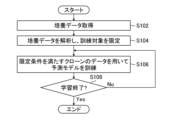
- FIG. 15 is a flowchart illustrating an example of a machine learning method executed by the machine learning device 300.
- the explanation will be given assuming that a data set used for machine learning as illustrated in FIG. 6 is prepared.
- the processor 302 acquires culture data from the prepared data set.
- the processor 302 analyzes the culture data and limits training targets.
- the processor 302 may select data of a target sample that satisfies the limiting conditions or data of a non-target sample that does not meet the limiting conditions, according to a prespecified index and threshold value of the culture data.
- the data may be searched for an index and a threshold value that serve as limiting conditions, and the data of the target sample and the data of the non-target sample may be sorted out.
- step S106 the processor 302 performs machine learning using only the data of the clones that meet the limiting conditions, and trains the predictive model 410. That is, the processor 302 inputs the gene expression data of the sample that satisfies the limiting conditions into the prediction model 410, and calculates a loss indicating the error between the predicted value of the stability label output from the prediction model 410 and the correct stability label. calculate. The processor 302 calculates the update amount of the parameters of the prediction model 410 based on the calculated loss, and updates the parameters. In this way, the processor 302 trains the predictive model 410 so that the output (predicted value) from the predictive model 410 for the data input to the predictive model 410 approaches the correct stability label. Note that the parameters of the prediction model 410 may be updated in mini-batch units.
- the processor 302 determines whether to end learning.
- the learning end condition may be determined based on the loss value, or may be determined based on the number of parameter updates.
- the condition for terminating learning may be that the loss converges within a prescribed range.
- the learning end condition may be that the number of updates reaches a specified number of times.
- a data set for evaluating the performance of the model may be prepared separately from the training data, and it may be determined whether learning is to be completed based on an evaluation value using the evaluation data.
- step S108 determines whether the determination result in step S108 is No. If the determination result in step S108 is No, the processor 302 returns to step S106 and continues the learning process. On the other hand, if the determination result in step S108 is Yes, the processor 302 ends the flowchart of FIG.
- the learned prediction model 410 is incorporated into the information processing device 10 as the production stability prediction model 16.
- the machine learning method executed by the machine learning device 300 can be understood as a method of generating the production stability prediction model 16, and is an example of the prediction model generation method in the present disclosure.
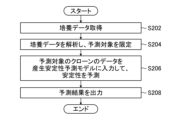
- FIG. 16 is a flowchart illustrating an example of an information processing method executed by the information processing apparatus 10.
- the processor 102 acquires culture data measured for clones that produce useful substances.
- the processor 102 may automatically obtain data from a data storage server (not shown) or the like, or may receive data specification input via a user interface and obtain data about the specified clone. .
- step S204 the processor 102 analyzes the culture data and limits prediction targets.
- the processor 102 limits the prediction targets by applying the same limiting conditions as those used to limit the training targets when training the production stability prediction model 16. Note that after the prediction targets are limited in step S204, gene expression data is measured for the clones corresponding to the prediction targets, thereby reducing workload and Cost reduction is possible.
- step S206 the processor 102 inputs the gene expression data of the clone corresponding to the prediction target into the production stability prediction model 16, and uses the production stability prediction model 16 to predict stability.
- step S208 the processor 102 outputs the prediction result output from the production stability prediction model 16. Based on the predicted results of production stability, production clones can be selected.
- step S208 the processor 102 ends the flowchart of FIG. 16.
- a program that causes a computer to implement part or all of the processing functions in each of the information processing device 10 and the machine learning device 300 according to the embodiment is stored on an optical disk, a magnetic disk, or non-temporary information such as a semiconductor memory or other tangible object. It is possible to record the program on a computer readable medium which is a storage medium and provide the program through this information storage medium.
- the program signal instead of providing the program by storing it in a tangible, non-transitory computer-readable medium, it is also possible to provide the program signal as a download service using a telecommunications line such as the Internet.
- part or all of the processing functions in each of the above-mentioned devices may be realized by cloud computing, and it is also possible to provide it as SaaS (Software as a Service).
- SaaS Software as a Service
- ⁇ About the hardware configuration of each processing unit In the information processing device 10, a data acquisition unit 12, a prediction target limiting unit 14, a stability prediction unit including a production stability prediction model 16, a processing result output unit 18, a culture data analysis unit 20, a limiting condition determination unit 22, and a machine learning device
- the hardware structure of a processing unit that executes various processes such as a learning unit, a loss calculation unit, a parameter update amount calculation unit, a parameter update unit, etc. including the prediction model 410 in 300 is, for example, as shown below.
- processors such as
- processors include programmable logic, which is a processor whose circuit configuration can be changed after manufacturing, such as CPU, GPU, and FPGA (Field Programmable Gate Array), which are general-purpose processors that execute programs and function as various processing units.
- programmable logic which is a processor whose circuit configuration can be changed after manufacturing
- CPU CPU
- GPU GPU
- FPGA Field Programmable Gate Array
- PLDs Programmable Logic Devices
- ASICs Application Specific Integrated Circuits
- One processing unit may be composed of one of these various processors, or may be composed of two or more processors of the same type or different types.
- one processing unit may be configured by a plurality of FPGAs, a combination of a CPU and an FPGA, or a combination of a CPU and a GPU.
- the plurality of processing units may be configured with one processor.
- one processor is configured with a combination of one or more CPUs and software, as typified by computers such as clients and servers. There is a form in which a processor functions as multiple processing units.
- processors that use a single IC (Integrated Circuit) chip, such as System On Chip (SoC), which implements the functions of an entire system including multiple processing units.
- SoC System On Chip
- various processing units are configured using one or more of the various processors described above as a hardware structure.
- circuitry that is a combination of circuit elements such as semiconductor elements.
- the production stability of the clones to be predicted can be predicted with high accuracy.
- RNA-Seq analysis can be performed only on the clones to be predicted, so costs can be reduced compared to the case where genetic analysis is performed on all clones.
Landscapes
- Health & Medical Sciences (AREA)
- Life Sciences & Earth Sciences (AREA)
- Engineering & Computer Science (AREA)
- Genetics & Genomics (AREA)
- Physics & Mathematics (AREA)
- Bioinformatics & Cheminformatics (AREA)
- Biotechnology (AREA)
- Chemical & Material Sciences (AREA)
- General Health & Medical Sciences (AREA)
- Organic Chemistry (AREA)
- Medical Informatics (AREA)
- Biophysics (AREA)
- Zoology (AREA)
- Wood Science & Technology (AREA)
- Theoretical Computer Science (AREA)
- Bioinformatics & Computational Biology (AREA)
- Evolutionary Biology (AREA)
- Spectroscopy & Molecular Physics (AREA)
- Biomedical Technology (AREA)
- Data Mining & Analysis (AREA)
- Biochemistry (AREA)
- Epidemiology (AREA)
- Computer Vision & Pattern Recognition (AREA)
- Molecular Biology (AREA)
- Artificial Intelligence (AREA)
- Public Health (AREA)
- Evolutionary Computation (AREA)
- Bioethics (AREA)
- Software Systems (AREA)
- Databases & Information Systems (AREA)
- Microbiology (AREA)
- General Engineering & Computer Science (AREA)
- Cell Biology (AREA)
- Mycology (AREA)
- Chemical Kinetics & Catalysis (AREA)
- General Chemical & Material Sciences (AREA)
- Proteomics, Peptides & Aminoacids (AREA)
- Medicinal Chemistry (AREA)
- Immunology (AREA)
- Measuring Or Testing Involving Enzymes Or Micro-Organisms (AREA)
Abstract
Description
バイオ医薬品の中でも薬効面と安全面の両立性の高さから市場が拡大している抗体医薬品は、複雑な構造を持つタンパク質である抗体を安定的に産生できる動物細胞のクローンを用いて生産されている。以下では、有用物質として抗体を例にとり説明する。図1は、抗体医薬品の生産工程の概要を示す説明図である。抗体医薬品を生産するまでのプロセスは、[1]クローン作製フェーズと、[2]プロセス開発フェーズと、[3]GMP(Good Manufacturing Practice)製造フェーズと、を含む。
図3は、本実施形態によって実現される安定性予測AI(Artificial Intelligence)の役割を説明する説明図である。図3に示すように、クローン作製フェーズでは、宿主細胞に対して、作りたい有用物質の遺伝子の設計図を導入する遺伝子導入が行われる。例えば、宿主細胞に対して有用物質Aを作る設計図を遺伝子導入した場合は、有用物質Aを産生する細胞が得られる。このような産生細胞は確率的にできるため、有用物質Aを産生しない細胞や産生量が不十分な細胞も作られてしまう。このため、まずはこの段階で簡便な試験を行い、有用物質Aを十分に産生し得る高産生なクローンを選抜することが行われる。
本実施形態では、クローン作製フェーズにおいて、現時点のクローンの情報から、2~3か月先の産生性の変化の有無を推定(予測)すること、すなわち、有用物質の産生安定性を予測することを可能とする安定性予測AIを構築する。より具体的には、クローンの現時点(規格試験時)の遺伝子発現データの入力を受けて有用物質の産生安定性を示す安定性ラベルを出力するモデルを構築する。より詳しくは、クローンの一部を規格試験に用いるクローンとし、別の一部を遺伝子発現データの取得のための遺伝子解析にかけるクローンとすることで、規格試験に用いるクローンの遺伝子発現データを取得する。安安定性ラベルは、「安定」であることを示す値の「1」または「不安定」であることを示す値の「0」の2値で表すことができる。産生安定性を予測する予測モデルは、「安定」または「不安定」のクラス分類を行う2クラス分類モデルであってよい。
有用物質を産生するクローンには様々な特性があるため、種類を問わず全てのクローンの産生安定性を高精度に予測することは難しい。本実施形態では、現時点(規格試験時)の各クローンの培養データから得られる指標に基づき予測対象を限定することにより、高精度な予測を実現する。ここで培養データとは、クローンについて培養装置あるいは細胞を含む培養液を一部サンプリングして専用装置を用いて測定できる一般的なデータである。
図6に、モデルの訓練および評価に用いるデータセットの例を示す。図6の上段には、有用物質としての抗体Aを産生するクローンについてのデータセットDSAの例を示し、下段には有用物質としての抗体Bを産生するクローンについてのデータセットDSBの例を示す。図示は省略するが、有用物質としての他種類の抗体を産生するクローンについてのデータセットも同様である。
図7は、培養データのある指標による予測対象の絞り込みの例を示すグラフである。横軸に、複数の有用物質A~Eのそれぞれを産生する複数種類のクローンが並んでいる。縦軸は、規格試験時の培養データより得られたある指標の値である。なお、図7に示すクローンは、モデルの訓練(学習)に用いるクローンである。
有用物質は、抗体に限らず、抗体様タンパク質であってもよい。有用物質は、医薬品原料であるタンパク質、ペプチド、およびウイルスのうちいずれかであってよい。
有用物質を産生するクローンは、脊椎動物由来細胞であってよい。クローンは、例えば、哺乳類由来細胞であってよい。クローンは、CHO細胞またはHEK細胞であってもよい。
以下、本開示の技術を適用した実施例1~3を説明する。各実施例1~3に共通する構成は次の通りである。すなわち、有用物質を抗体とし、産生細胞をCHO細胞とする。評価サンプルとして5種類の抗体産生CHO細胞のクローンについて、それぞれ複数種のクローンを用意し、RNAシーケンス(RNA-Seq)解析にて2週間の規格試験にて測定した全遺伝子発現レベルから100種類の遺伝子発現レベルを選択して説明変数とし、安定または不安定の2クラスに分類するロジステック回帰モデルを学習器とした、5分割クロスバリデーションを実施して予測モデルの訓練(学習)を行い、性能評価はPRAUC(Area Under the Precision-Recall Curve)を用いた例を示す。説明変数に用いる遺伝子発現レベルの種類数は、実施例1~3において、統計学的な有意確率を用いて選択した300~400種の遺伝子を用いて、種類数を増減させながら予測モデルの訓練(学習)を実際に行い、予測性能が高くなる種類数を探索することで100種類とした。なお、規格試験は、クローン(CHO細胞)の播種数は5×10^5cells/mL、40mLのフラスコで浮遊培養で行った。
実施例1では、予測対象を「相対的高産生なクローン」に限定した安定性予測を行う例を説明する。ここで、「相対的高産生なクローン」とは、有用物質の産生量が相対的に高いクローンを意味する。
これに対し、訓練対象を限定せずに、図8に示す182クローンの全データを含むデータセットを用いて、同様の学習を行い、5分割クロスバリデーションを実施した場合に得られる比較例に係る予測モデルの予測性能はPRAUCの値が0.503であった。なお、予測対象は、訓練対象と同様に対象を限定せずに行うこととする。実施例1によって予測対象を限定した予測モデルの性能は、比較例に係る予測モデルよりも高精度であることが確認された。
実施例2では、予測対象を「相対的に細胞密度の高いクローン」に限定した安定性予測を行う例を説明する。まず、予測対象を「相対的に細胞密度の高いクローン」に限定した安定性予測を行う際の、予測モデルを訓練するための訓練対象のクローンの限定方法について説明する。実施例1と同様に、図8に示す全182クローンの規格試験時の培養データから「積分生存細胞密度(IVCD)」に着目し、予測モデルでの予測性能が高くなるように閾値を探索して、各抗体種で相対順位の上位60%のクローンに限定する方法とした。ここで、「相対的に細胞密度の高いクローン」は、例えば規格試験における2週間(14日間)の「積分生存細胞密度(IVCD)」に基づいて取得することができる。または、規格試験中のある期間、例えば10日間の「積分生存細胞密度(IVCD)」に基づいて取得してもよい。「上位60%」は閾値の一例である。図10は、各抗体種において積分生存細胞密度の値が相対順位の上位60%に該当するクローン数と安定性ラベルの付与例を示す図表である。
実施例3では、「相対的に乳酸濃度の高いクローン」に限定した安定性予測を行う例を説明する。まず、予測対象を「相対的に乳酸濃度の高いクローン」に限定した安定性予測を行う際の、予測モデルを訓練するための訓練対象のクローンの限定方法について説明する。実施例1と同様に、図8に示す全182クローンの2週間の規格試験の培養データからクローンを培養している培養液の「乳酸濃度」に着目し、2週間(14日間)の内の各時点、例えば一日毎に測定された培養液の「乳酸濃度」の中央値を代表値として、各クローンの「乳酸濃度」を取得する。そして、予測モデルでの予測性能が高くなるように閾値を探索して、各抗体種で相対順位の上位40%のクローンに限定する方法とした。「上位40%」は閾値の一例である。図11は、各抗体種において乳酸濃度の値が相対順位の上位40%に該当するクローン数と安定性ラベルの付与例を示す図表である。
図12は、実施形態に係る情報処理装置10の機能的構成を示すブロック図である。情報処理装置10は、データ取得部12と、予測対象限定部14と、産生安定性予測モデル16と、処理結果出力部18と、を備える。情報処理装置10の各種機能は、コンピュータのハードウェアとソフトウェアとの組み合わせによって実現し得る。情報処理装置10の物理的形態は特に限定されず、サーバコンピュータであってもよいし、ワークステーションであってもよく、パーソナルコンピュータあるいはタブレット端末などであってもよい。
図14は、産生安定性予測モデル16を生成するための機械学習の処理を実行する機械学習装置300のハードウェア構成の例を示すブロック図である。ここでは、1台のコンピュータを用いて機械学習装置300の処理機能を実現する例を述べるが、機械学習装置300の処理機能は、複数台のコンピュータを用いて構成されるコンピュータシステムによって実現してもよい。
図15は、機械学習装置300が実行する機械学習方法の例を示すフローチャートである。ここでは、図6に例示したような、機械学習に用いるデータセットが用意されているものとして説明する。ステップS102において、プロセッサ302は、用意されたデータセットから培養データを取得する。
図16は、情報処理装置10が実行する情報処理方法の例を示すフローチャートである。ステップS202において、プロセッサ102は、有用物質を産生するクローンについて測定された培養データを取得する。プロセッサ102は、不図示のデータ保存サーバなどからデータを自動的に取得してもよいし、ユーザインターフェースを介してデータの指定の入力を受け付け、指定されたクローンについてのデータを取得してもよい。
実施形態に係る情報処理装置10および機械学習装置300の各装置における処理機能の一部または全部をコンピュータに実現させるプログラムを、光ディスク、磁気ディスク、もしくは、半導体メモリその他の有体物たる非一時的な情報記憶媒体であるコンピュータ可読媒体に記録し、この情報記憶媒体を通じてプログラムを提供することが可能である。
情報処理装置10におけるデータ取得部12、予測対象限定部14、産生安定性予測モデル16を含む安定性予測部、処理結果出力部18、培養データ解析部20、限定条件判定部22、機械学習装置300における予測モデル410を含む学習部、損失算出部、パラメータ更新量算出部、パラメータ更新部などの各種の処理を実行する処理部(processing unit)のハードウェア的な構造は、例えば、次に示すような各種のプロセッサ(processor)である。
上述した実施形態に係る産生クローンの産生安定性を予測する方法およびその方法を実行する情報処理装置10によれば、次のような効果が得られる。
本開示は上述した実施形態に限定されるものではなく、本開示の技術的思想の趣旨を逸脱しない範囲で種々の変形が可能である。
12 データ取得部
14 予測対象限定部
16 産生安定性予測モデル
18 処理結果出力部
20 培養データ解析部
22 限定条件判定部
102 プロセッサ
104 コンピュータ可読媒体
106 通信インターフェース
108 入出力インターフェース
110 バス
112 メモリ
114 ストレージ
120 データ記憶領域
140 予測対象限定プログラム
142 培養データ解析プログラム
144 限定条件判定プログラム
152 入力装置
154 表示装置
180 処理結果出力プログラム
190 表示制御プログラム
300 機械学習装置
302 プロセッサ
304 コンピュータ可読媒体
306 通信インターフェース
308 入出力インターフェース
310 バス
312 メモリ
314 ストレージ
320 予測対象限定プログラム
322 予測対象データ記憶領域
330 学習処理プログラム
340 表示制御プログラム
352 入力装置
354 表示装置
400 データ取得プログラム
410 予測モデル
430 損失算出プログラム
440 オプティマイザ
550 データ保存部
DSA、DSB データセット
DSc、DSd、DSe データセット
F5A 左図
F5B 右図
G1 グラフ
G2 グラフ
GEP 遺伝子発現パターン
MLM 機械学習モデル
MLMc、MLMe 機械学習モデル
RF1~RF7 矩形枠
S102~S108 機械学習方法のステップ
S202~S208 産生安定性を予測する情報処理方法のステップ
Claims (22)
- 有用物質を産生するクローンの産生安定性を予測する方法であって、
1つ以上のプロセッサが、
1種類以上の前記クローンの培養データを取得することと、
前記培養データを解析して予測対象のクローンを限定することと、
前記予測対象のクローンについて測定されたデータを用いて、前記予測対象のクローンによる前記有用物質の産生安定性を予測することと、
を実行する、方法。 - 前記産生安定性は、培養開始時と所定期間培養後とにおける前記有用物質の産生量の変化の有無により定義される、
請求項1に記載の方法。 - 前記1つ以上のプロセッサが、
前記培養データから得られる指標と、前記指標に関する閾値とを設定し、
前記指標の値と前記閾値とに基づき前記予測対象を限定する、
請求項1に記載の方法。 - 前記閾値は、前記産生安定性の予測精度が前記予測対象を限定しない場合よりも高くなるように調整される、
請求項3に記載の方法。 - 前記閾値は、前記指標の値についての順位を用いて定義される、
請求項3に記載の方法。 - 前記予測対象は、前記指標の値の上位集団である、
請求項3に記載の方法。 - 前記指標は、前記有用物質の産生量である、
請求項3から6のいずれか一項に記載の方法。 - 前記指標は、積分生存細胞密度である、
請求項3から6のいずれか一項に記載の方法。 - 前記指標は、乳酸濃度である、
請求項3から6のいずれか一項に記載の方法。 - 前記産生安定性の予測に用いる前記データは、1つ以上の遺伝子発現レベルを含む、
請求項1から6のいずれか一項に記載の方法。 - 前記1つ以上のプロセッサが、
前記予測対象の前記データの入力を受けて、安定または不安定の2クラス分類を行うモデルを用いて前記産生安定性を予測する、
請求項1から6のいずれか一項に記載の方法。 - 前記モデルは、前記予測対象のクローンと同様の限定をした訓練用のクローンについての前記データと正解の安定性ラベルとが関連付けされた複数の訓練データを用いた機械学習によって訓練されたモデルである、
請求項11に記載の方法。 - 前記複数の訓練データは、産生する有用物質が異なる複数種類のクローンについての前記訓練データを含み、
前記1つ以上のプロセッサが、前記モデルの訓練に使用された有用物質とは別の有用物質を産生するクローンについての産生安定性を予測する、
請求項12に記載の方法。 - 前記有用物質は、医薬品原料であるタンパク質、ペプチド、およびウイルスのうちいずれかである、
請求項1から6のいずれか一項に記載の方法。 - 前記有用物質は、抗体、または抗体様タンパク質である、
請求項1から6のいずれか一項に記載の方法。 - 前記クローンは、脊椎動物由来細胞である、
請求項1から6のいずれか一項に記載の方法。 - 前記クローンは、哺乳類由来細胞である、
請求項1から6のいずれか一項に記載の方法。 - 前記クローンは、CHO細胞またはHEK細胞である、
請求項1から6のいずれか一項に記載の方法。 - 1つ以上のプロセッサと、
前記1つ以上のプロセッサに実行させる命令が記憶される1つ以上の記憶装置と、を備え、
前記1つ以上のプロセッサは、
有用物質を産生するクローンについて1種類以上のクローンの培養データを取得し、
前記培養データを解析して予測対象のクローンを限定し、
前記予測対象のクローンについて測定されたデータを用いて、前記予測対象のクローンによる前記有用物質の産生安定性を予測する、
情報処理装置。 - コンピュータに、
有用物質を産生するクローンについて1種類以上のクローンの培養データを取得する機能と、
前記培養データを解析して予測対象のクローンを限定する機能と、
前記予測対象のクローンについて測定されたデータを用いて、前記予測対象のクローンによる前記有用物質の産生安定性を予測する機能と、
を実現させるプログラム。 - 非一時的かつコンピュータ読取可能な記録媒体であって、請求項20に記載のプログラムが記録された記録媒体。
- 有用物質を産生するクローンの産生安定性を予測する機能をコンピュータに実現させる予測モデルを生成する予測モデル生成方法であって、
1つ以上のプロセッサを含むシステムが、
1種類以上の前記クローンの培養データを取得することと、
前記培養データを解析して予測対象のクローンを限定することと、
前記予測対象に該当するクローンについて測定されたデータと正解の安定性ラベルとが関連付けされた複数の訓練データを用いて機械学習を行い、前記データの入力に対する前記予測モデルの出力が前記正解の安定性ラベルに近づくように前記予測モデルを訓練することと、
を含む予測モデル生成方法。
Priority Applications (4)
| Application Number | Priority Date | Filing Date | Title |
|---|---|---|---|
| JP2024544002A JPWO2024048079A1 (ja) | 2022-08-31 | 2023-07-07 | |
| CN202380059794.6A CN119731310A (zh) | 2022-08-31 | 2023-07-07 | 预测产生有用物质的克隆的产生稳定性的方法、信息处理装置、程序及预测模型生成方法 |
| EP23859849.4A EP4582536A4 (en) | 2022-08-31 | 2023-07-07 | METHOD FOR PREDICTING THE PRODUCTION STABILITY OF A CLONE THAT PRODUCES A USEFUL SUBSTANCE, INFORMATION PROCESSING DEVICE, PROGRAM AND METHOD FOR GENERATION OF A PREDICTION MODEL |
| US19/059,623 US20250191688A1 (en) | 2022-08-31 | 2025-02-21 | Method of predicting production stability of clone that produces useful substance, information processing apparatus, program, and prediction model generation method |
Applications Claiming Priority (2)
| Application Number | Priority Date | Filing Date | Title |
|---|---|---|---|
| JP2022138789 | 2022-08-31 | ||
| JP2022-138789 | 2022-08-31 |
Related Child Applications (1)
| Application Number | Title | Priority Date | Filing Date |
|---|---|---|---|
| US19/059,623 Continuation US20250191688A1 (en) | 2022-08-31 | 2025-02-21 | Method of predicting production stability of clone that produces useful substance, information processing apparatus, program, and prediction model generation method |
Publications (1)
| Publication Number | Publication Date |
|---|---|
| WO2024048079A1 true WO2024048079A1 (ja) | 2024-03-07 |
Family
ID=90099474
Family Applications (1)
| Application Number | Title | Priority Date | Filing Date |
|---|---|---|---|
| PCT/JP2023/025263 Ceased WO2024048079A1 (ja) | 2022-08-31 | 2023-07-07 | 有用物質を産生するクローンの産生安定性を予測する方法、情報処理装置、プログラムおよび予測モデル生成方法 |
Country Status (5)
| Country | Link |
|---|---|
| US (1) | US20250191688A1 (ja) |
| EP (1) | EP4582536A4 (ja) |
| JP (1) | JPWO2024048079A1 (ja) |
| CN (1) | CN119731310A (ja) |
| WO (1) | WO2024048079A1 (ja) |
Cited By (1)
| Publication number | Priority date | Publication date | Assignee | Title |
|---|---|---|---|---|
| WO2025028372A1 (ja) * | 2023-07-31 | 2025-02-06 | 富士フイルム株式会社 | 細胞特性予測装置、細胞特性予測装置の作動方法、および細胞特性予測装置の作動プログラム |
Citations (8)
| Publication number | Priority date | Publication date | Assignee | Title |
|---|---|---|---|---|
| JP2008502365A (ja) * | 2004-06-09 | 2008-01-31 | ザ リージェンツ オブ ザ ユニバーシティ オブ ミシガン | 疾患に対する体液性応答のファージ・マイクロアレイ・プロファイリング法 |
| JP2010517530A (ja) * | 2007-02-01 | 2010-05-27 | セントカー・インコーポレーテツド | 高産生細胞株の選択 |
| WO2016075216A1 (en) | 2014-11-12 | 2016-05-19 | Lek Pharmaceuticals D.D. | Predicting genetically stable recombinant protein production in early cell line development |
| JP2017511688A (ja) * | 2014-01-30 | 2017-04-27 | バリタセル リミテッド | クローンに由来する産生株細胞のパネルの相対的な流加産生力価を予測する方法 |
| JP2021503291A (ja) * | 2017-11-20 | 2021-02-12 | ロンザ リミテッドLonza Limited | 乳酸塩の蓄積を予防しつつ、細胞培養物を増殖させるための方法及びシステム |
| WO2021166824A1 (ja) * | 2020-02-19 | 2021-08-26 | 富士フイルム株式会社 | 細胞培養プロセス探索方法、細胞培養プロセス探索プログラム、細胞培養プロセス探索装置、及び、学習済みモデル |
| JP2021534782A (ja) * | 2018-08-27 | 2021-12-16 | エフ.ホフマン−ラ ロシュ アーゲーF. Hoffmann−La Roche Aktiengesellschaft | 培養装置の性能を検証する方法 |
| JP2022533003A (ja) * | 2019-04-30 | 2022-07-21 | アムジエン・インコーポレーテツド | バイオ医薬品生産における細胞株選択のためのデータ駆動予測モデリング |
Family Cites Families (1)
| Publication number | Priority date | Publication date | Assignee | Title |
|---|---|---|---|---|
| US20220344000A1 (en) * | 2019-09-27 | 2022-10-27 | Glaxosmithkline Intellectual Property Development Limited | Method of predicting production stability of clonal cell lines |
-
2023
- 2023-07-07 JP JP2024544002A patent/JPWO2024048079A1/ja active Pending
- 2023-07-07 EP EP23859849.4A patent/EP4582536A4/en active Pending
- 2023-07-07 WO PCT/JP2023/025263 patent/WO2024048079A1/ja not_active Ceased
- 2023-07-07 CN CN202380059794.6A patent/CN119731310A/zh active Pending
-
2025
- 2025-02-21 US US19/059,623 patent/US20250191688A1/en active Pending
Patent Citations (8)
| Publication number | Priority date | Publication date | Assignee | Title |
|---|---|---|---|---|
| JP2008502365A (ja) * | 2004-06-09 | 2008-01-31 | ザ リージェンツ オブ ザ ユニバーシティ オブ ミシガン | 疾患に対する体液性応答のファージ・マイクロアレイ・プロファイリング法 |
| JP2010517530A (ja) * | 2007-02-01 | 2010-05-27 | セントカー・インコーポレーテツド | 高産生細胞株の選択 |
| JP2017511688A (ja) * | 2014-01-30 | 2017-04-27 | バリタセル リミテッド | クローンに由来する産生株細胞のパネルの相対的な流加産生力価を予測する方法 |
| WO2016075216A1 (en) | 2014-11-12 | 2016-05-19 | Lek Pharmaceuticals D.D. | Predicting genetically stable recombinant protein production in early cell line development |
| JP2021503291A (ja) * | 2017-11-20 | 2021-02-12 | ロンザ リミテッドLonza Limited | 乳酸塩の蓄積を予防しつつ、細胞培養物を増殖させるための方法及びシステム |
| JP2021534782A (ja) * | 2018-08-27 | 2021-12-16 | エフ.ホフマン−ラ ロシュ アーゲーF. Hoffmann−La Roche Aktiengesellschaft | 培養装置の性能を検証する方法 |
| JP2022533003A (ja) * | 2019-04-30 | 2022-07-21 | アムジエン・インコーポレーテツド | バイオ医薬品生産における細胞株選択のためのデータ駆動予測モデリング |
| WO2021166824A1 (ja) * | 2020-02-19 | 2021-08-26 | 富士フイルム株式会社 | 細胞培養プロセス探索方法、細胞培養プロセス探索プログラム、細胞培養プロセス探索装置、及び、学習済みモデル |
Non-Patent Citations (1)
| Title |
|---|
| See also references of EP4582536A4 |
Cited By (1)
| Publication number | Priority date | Publication date | Assignee | Title |
|---|---|---|---|---|
| WO2025028372A1 (ja) * | 2023-07-31 | 2025-02-06 | 富士フイルム株式会社 | 細胞特性予測装置、細胞特性予測装置の作動方法、および細胞特性予測装置の作動プログラム |
Also Published As
| Publication number | Publication date |
|---|---|
| CN119731310A (zh) | 2025-03-28 |
| EP4582536A1 (en) | 2025-07-09 |
| US20250191688A1 (en) | 2025-06-12 |
| EP4582536A4 (en) | 2025-12-03 |
| JPWO2024048079A1 (ja) | 2024-03-07 |
Similar Documents
| Publication | Publication Date | Title |
|---|---|---|
| Nguyen et al. | A comprehensive survey of regulatory network inference methods using single cell RNA sequencing data | |
| Hesami et al. | Machine learning: its challenges and opportunities in plant system biology | |
| Walsh et al. | Harnessing the potential of machine learning for advancing “quality by design” in biomanufacturing | |
| Khan et al. | Toward real-world automated antibody design with combinatorial Bayesian optimization | |
| Refahi et al. | A multiscale analysis of early flower development in Arabidopsis provides an integrated view of molecular regulation and growth control | |
| Liepe et al. | Maximizing the information content of experiments in systems biology | |
| JP2022533003A (ja) | バイオ医薬品生産における細胞株選択のためのデータ駆動予測モデリング | |
| Fournier et al. | Protein language models: is scaling necessary? | |
| Cang et al. | A multiscale model via single-cell transcriptomics reveals robust patterning mechanisms during early mammalian embryo development | |
| US20260088123A1 (en) | Transomic systems and methods of their use | |
| US12148157B1 (en) | Platforms, systems, and methods for identifying and monitoring cell states | |
| Cruz et al. | Hybrid computational modeling methods for systems biology | |
| US20250191688A1 (en) | Method of predicting production stability of clone that produces useful substance, information processing apparatus, program, and prediction model generation method | |
| Zhu et al. | A hybrid constrained continuous optimization approach for optimal causal discovery from biological data | |
| Wise et al. | SMARTS: reconstructing disease response networks from multiple individuals using time series gene expression data | |
| Saadatpour et al. | Discrete dynamic modeling of signal transduction networks | |
| JPWO2024048079A5 (ja) | ||
| Cho et al. | Implicit modeling of the conformational landscape and sequence allows scoring and generation of stable proteins | |
| Liu et al. | An efficient drug design method based on drug-target affinity | |
| Handzlik et al. | Dynamic modeling of transcriptional gene regulatory networks | |
| Durumeric et al. | Explaining classifiers to understand coarse-grained models | |
| Särkkä et al. | Comparison of missing data handling methods for variant pathogenicity predictors | |
| Wu et al. | Bayesian information sharing enhances detection of regulatory associations in rare cell types | |
| US20250022545A1 (en) | Method, apparatus, and program for searching for culture medium composition and estimating cell characteristic | |
| Hu et al. | Introduction to systems biology |
Legal Events
| Date | Code | Title | Description |
|---|---|---|---|
| 121 | Ep: the epo has been informed by wipo that ep was designated in this application |
Ref document number: 23859849 Country of ref document: EP Kind code of ref document: A1 |
|
| WWE | Wipo information: entry into national phase |
Ref document number: 2024544002 Country of ref document: JP |
|
| WWE | Wipo information: entry into national phase |
Ref document number: 202380059794.6 Country of ref document: CN |
|
| WWP | Wipo information: published in national office |
Ref document number: 202380059794.6 Country of ref document: CN |
|
| WWE | Wipo information: entry into national phase |
Ref document number: 2023859849 Country of ref document: EP |
|
| NENP | Non-entry into the national phase |
Ref country code: DE |
|
| ENP | Entry into the national phase |
Ref document number: 2023859849 Country of ref document: EP Effective date: 20250331 |
|
| WWP | Wipo information: published in national office |
Ref document number: 2023859849 Country of ref document: EP |