WO2024070196A1 - 撮像システム、撮像プログラム、及び撮像方法 - Google Patents
撮像システム、撮像プログラム、及び撮像方法 Download PDFInfo
- Publication number
- WO2024070196A1 WO2024070196A1 PCT/JP2023/028050 JP2023028050W WO2024070196A1 WO 2024070196 A1 WO2024070196 A1 WO 2024070196A1 JP 2023028050 W JP2023028050 W JP 2023028050W WO 2024070196 A1 WO2024070196 A1 WO 2024070196A1
- Authority
- WO
- WIPO (PCT)
- Prior art keywords
- image
- subject
- imaging
- images
- best angle
- Prior art date
- Legal status (The legal status is an assumption and is not a legal conclusion. Google has not performed a legal analysis and makes no representation as to the accuracy of the status listed.)
- Ceased
Links
Images



Classifications
-
- H—ELECTRICITY
- H04—ELECTRIC COMMUNICATION TECHNIQUE
- H04N—PICTORIAL COMMUNICATION, e.g. TELEVISION
- H04N5/00—Details of television systems
- H04N5/222—Studio circuitry; Studio devices; Studio equipment
- H04N5/262—Studio circuits, e.g. for mixing, switching-over, change of character of image, other special effects ; Cameras specially adapted for the electronic generation of special effects
- H04N5/268—Signal distribution or switching
-
- H—ELECTRICITY
- H04—ELECTRIC COMMUNICATION TECHNIQUE
- H04N—PICTORIAL COMMUNICATION, e.g. TELEVISION
- H04N23/00—Cameras or camera modules comprising electronic image sensors; Control thereof
- H04N23/60—Control of cameras or camera modules
-
- H—ELECTRICITY
- H04—ELECTRIC COMMUNICATION TECHNIQUE
- H04N—PICTORIAL COMMUNICATION, e.g. TELEVISION
- H04N23/00—Cameras or camera modules comprising electronic image sensors; Control thereof
- H04N23/60—Control of cameras or camera modules
- H04N23/61—Control of cameras or camera modules based on recognised objects
-
- H—ELECTRICITY
- H04—ELECTRIC COMMUNICATION TECHNIQUE
- H04N—PICTORIAL COMMUNICATION, e.g. TELEVISION
- H04N23/00—Cameras or camera modules comprising electronic image sensors; Control thereof
- H04N23/60—Control of cameras or camera modules
- H04N23/66—Remote control of cameras or camera parts, e.g. by remote control devices
-
- H—ELECTRICITY
- H04—ELECTRIC COMMUNICATION TECHNIQUE
- H04N—PICTORIAL COMMUNICATION, e.g. TELEVISION
- H04N23/00—Cameras or camera modules comprising electronic image sensors; Control thereof
- H04N23/60—Control of cameras or camera modules
- H04N23/69—Control of means for changing angle of the field of view, e.g. optical zoom objectives or electronic zooming
-
- H—ELECTRICITY
- H04—ELECTRIC COMMUNICATION TECHNIQUE
- H04N—PICTORIAL COMMUNICATION, e.g. TELEVISION
- H04N23/00—Cameras or camera modules comprising electronic image sensors; Control thereof
- H04N23/60—Control of cameras or camera modules
- H04N23/695—Control of camera direction for changing a field of view, e.g. pan, tilt or based on tracking of objects
-
- H—ELECTRICITY
- H04—ELECTRIC COMMUNICATION TECHNIQUE
- H04N—PICTORIAL COMMUNICATION, e.g. TELEVISION
- H04N23/00—Cameras or camera modules comprising electronic image sensors; Control thereof
- H04N23/80—Camera processing pipelines; Components thereof
-
- H—ELECTRICITY
- H04—ELECTRIC COMMUNICATION TECHNIQUE
- H04N—PICTORIAL COMMUNICATION, e.g. TELEVISION
- H04N23/00—Cameras or camera modules comprising electronic image sensors; Control thereof
- H04N23/90—Arrangement of cameras or camera modules, e.g. multiple cameras in TV studios or sports stadiums
-
- H—ELECTRICITY
- H04—ELECTRIC COMMUNICATION TECHNIQUE
- H04N—PICTORIAL COMMUNICATION, e.g. TELEVISION
- H04N5/00—Details of television systems
- H04N5/222—Studio circuitry; Studio devices; Studio equipment
-
- H—ELECTRICITY
- H04—ELECTRIC COMMUNICATION TECHNIQUE
- H04N—PICTORIAL COMMUNICATION, e.g. TELEVISION
- H04N5/00—Details of television systems
- H04N5/222—Studio circuitry; Studio devices; Studio equipment
- H04N5/262—Studio circuits, e.g. for mixing, switching-over, change of character of image, other special effects ; Cameras specially adapted for the electronic generation of special effects
-
- H—ELECTRICITY
- H04—ELECTRIC COMMUNICATION TECHNIQUE
- H04N—PICTORIAL COMMUNICATION, e.g. TELEVISION
- H04N7/00—Television systems
- H04N7/18—Closed-circuit television [CCTV] systems, i.e. systems in which the video signal is not broadcast
-
- H—ELECTRICITY
- H04—ELECTRIC COMMUNICATION TECHNIQUE
- H04N—PICTORIAL COMMUNICATION, e.g. TELEVISION
- H04N7/00—Television systems
- H04N7/18—Closed-circuit television [CCTV] systems, i.e. systems in which the video signal is not broadcast
- H04N7/181—Closed-circuit television [CCTV] systems, i.e. systems in which the video signal is not broadcast for receiving images from a plurality of remote sources
Definitions
- the present invention relates to an imaging system, imaging program, and imaging method. More specifically, the present invention relates to an imaging system, imaging program, and imaging method that can automatically switch between images captured by multiple cameras and always output images from the best angle to the viewer.
- Patent Document 1 performs switching work based on audio information, and while it is suitable for programs such as talk shows and informational programs that are directed based on the remarks of the performers, no consideration was given to its application to live sports broadcasts, where the relative positions of the players affect the direction of the show.
- the present invention was devised in light of the above, and aims to provide an imaging system, imaging program, and imaging method that can automatically switch between images captured by multiple cameras and always output images from the best angle to the viewer.
- the imaging device of the present invention comprises a plurality of imaging devices which capture images of the same subject from different viewpoints at the same time; a switching determination unit which determines the best angle from images captured by the plurality of imaging devices and selects an imaging device which outputs the image at the best angle; a control unit which instructs the imaging device selected by the switching determination unit to execute at least one of the control processes of zooming out from the subject, zooming in to the subject, tracking the subject, and maintaining the previous screen size; and an output unit which outputs the image captured by the imaging device controlled based on the control process by the control unit.
- a switching determination unit that determines the best angle from the images captured by multiple imaging devices and selects the imaging device that will output the image with the best angle, it is possible to automatically determine from among multiple images the image that can most effectively convey the battle situation to viewers based on an objective judgment rather than a subjective judgment by an operator.
- efficient switching work can be achieved.
- the switching determination unit performs a screen size change process (zooming out, zooming in, tracking) or maintenance process according to the subject's situation immediately after switching from the current image to an image with a different viewpoint, making it possible to perform the most effective image processing according to the subject's situation and output a realistic image to the viewer.
- the switching determination unit also has a detection unit that detects multiple moving objects competing in the stadium as subjects and detects each of the subjects as a rectangle from each frame image of the video captured by the imaging device, making it possible to detect moving objects (including people, animals, cars, etc.) competing in the stadium and identify an area that surrounds a specified range of the detected moving objects.
- the switching determination unit also has a rectangle distance measurement unit that measures the rectangle distance, which is the distance between the central coordinates of the rectangles of the moving objects that are the subjects detected by the detection unit, and when determining the best angle based on the rectangle distance, for example in a competitive martial arts match, it can determine that the best angle is an image from an angle that shows two competing fighters as side-by-side as possible. This means that images in which one fighter is obstructed by overlapping fighters are excluded from the best angle, and an image in which the overall movements of both fighters can always be seen can be output to the viewer.
- the detection unit when the detection unit detects at least two athletes competing in a competition in a stadium and at least one referee who makes a decision to allow the athletes to compete as eligible subjects, the detection unit can select the best angle based on the relative positions of the athletes and the referee by detecting the athletes and the referee who makes a decision to allow the athletes to compete as eligible subjects.
- the switching judgment unit determines that the best angle is the image in which the player and the umpire do not overlap, or the player is positioned further forward than the umpire, and the image in which the distance between the rectangles measured by the distance between the rectangles measurement unit is the longest, it can exclude from the best angles images in which the player is blocked by the umpire's presence, and select from the remaining images an image in which the players are as side-by-side as possible as the best angle. Therefore, it is possible to output to the viewer an image that always allows the overall movements of both players to be grasped, while also taking into account the position of the umpire.
- the detection unit also has a uniform color determination unit that determines the color of the uniforms of the players in the frame images based on the color information, and when detecting a specific person from among the subjects based on the results of the determination by the uniform color determination unit, the uniform colors of the players or referees are registered in advance, and a subject that matches the registered uniform color can be easily detected as a specific person, such as a player or referee.
- the detection unit also has a motion detection unit that identifies the subject using background subtraction or frame-to-frame subtraction, and when the subject identified by the motion detection unit is detected as a rectangle surrounding the subject, for example in a live sports broadcast, the background contained in the frame images obtained from footage of the game can be extracted based on a publicly known algorithm, and the subject, a player or referee, can be easily detected from the difference.
- the zoom-in and zoom-out processes performed by the control unit are performed when the ratio of the rectangular width of the subject detected by the detection unit to the width of a specific frame is greater than a value defined by a predetermined first threshold function, and are performed when the ratio is less than a value defined by a predetermined second threshold function.Since the zoom-in or zoom-out processes are performed according to the ratio of the rectangular width of the subject to the width of the screen frame, an image that always allows the viewer to grasp the entire subject can be output immediately after switching to the image selected by the switching determination unit.
- the tracking process can be performed so that at least two players detected as the subject are always positioned in the center of the screen frame.
- the imaging program of the present invention causes a computer to execute the steps of receiving multiple images of the same subject captured from different viewpoints at the same time, determining the best angle from the multiple images and selecting an imaging device that outputs the image at the best angle, instructing the imaging device that outputs the image at the best angle to execute at least one control process from among a process of zooming out from the subject, a process of zooming in to the subject, a process of tracking the subject, and a process of maintaining the previous screen size, and outputting the image captured by the imaging device controlled based on the control process.
- the best angle can be determined from multiple received images captured from different viewpoints according to a predetermined determination condition.
- the screen size change process or maintenance process is performed according to the subject's situation immediately after switching from the current image to an image with a different viewpoint, so that the most effective image processing can be performed according to the subject's situation, and a realistic image can be output to the viewer.
- the step of selecting an imaging device that will output the best angle image also includes a step of detecting, as subjects, a number of moving objects competing in the stadium, and a rectangle surrounding each of the subjects from each frame image of the image captured by the imaging device, thereby making it possible to detect moving objects (including people, animals, automobiles, etc.) competing in the stadium from among the subjects, and to identify an area surrounding a specified range of the detected moving objects.
- the best angle is an image from an angle that shows two competing fighters as side-by-side as possible in a competition such as martial arts.
- images in which one fighter is obstructed by overlapping fighters are excluded from the best angle, and an image in which the overall movements of both fighters can always be seen can be output to the viewer.
- the step of selecting an imaging device that outputs the best angle image further includes a step of detecting, as subjects, at least two athletes competing in the stadium and at least one referee who makes a decision to allow the athletes to compete, the best angle can be selected based on the relative positions of the athletes and the referee by detecting, as subjects, the athletes competing in the stadium and the referee.
- the step of determining that the image with the longest distance between the rectangles is the best angle includes a step of determining that the image with the longest distance between the rectangles is the best angle from among images in which the players and the umpire do not overlap, or from images in which the players are positioned further forward than the umpire, images in which the players are blocked by the umpire's presence can be excluded from the best angles, and from the remaining images, an image in which the players are as side-by-side as possible can be selected as the best angle. Therefore, it is possible to output to the viewer an image that always allows the overall movements of both players to be grasped, while also taking into account the position of the umpire.
- the step of detecting at least two athletes competing in a stadium as rectangles surrounding each of them includes a step of determining the color of the uniforms of the athletes in the frame image based on predetermined color information, and a step of performing noise processing on the frame image using morphological transformation, the uniform colors of the athletes can be registered in advance, and a subject that matches the registered uniform color can be easily determined to be the athlete to be detected.
- the step of detecting the referee who makes the decision to allow the players to compete includes a step of grayscaling the frame image and a step of performing noise processing on the frame image by morphological transformation, since referee uniforms are generally monochrome with a white or black base, by grayscaling the frame image, it is possible to easily detect the referee as a subject from the frame image.
- the imaging method of the present invention comprises the steps of receiving a plurality of images of the same subject captured at the same time from different viewpoints by imaging devices disposed at different positions, determining the best angle from the plurality of images and selecting an imaging device that outputs the image of the best angle, instructing the imaging device that outputs the image of the best angle to execute at least one control process from among a process of zooming out from the subject, a process of zooming in to the subject, a process of tracking the subject, and a process of maintaining the previous screen size, and outputting the image captured by the imaging device controlled based on the control process.
- the imaging system, imaging program, and imaging method of the present invention automatically switch between images captured by multiple cameras, and can always output images from the best angle to the viewer.
- FIG. 1 is a diagram showing an overall configuration of an imaging system according to an embodiment of the present invention.
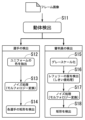
- FIG. 11 is a diagram showing a processing flow in a detection unit.
- FIG. 1 is a diagram showing the process of moving object detection using background subtraction.
- FIG. 13 is a diagram showing a processing flow in a rectangle distance measuring unit.
- FIG. 4 is a diagram showing a processing flow in a control unit.
- the imaging system 1 is applied to live broadcasts of martial arts such as boxing as a sports broadcast, and is mainly composed of multiple imaging devices 10 that capture images of subjects (competing athletes) from different viewpoints, a switching decision unit 20 that selects the image with the best angle from the images output from the imaging devices 10, a control unit 30 that commands predetermined image processing for the image selected by the switching decision unit 20, and an output unit 40 for outputting the image to the outside.
- the imaging device 10 is a digital video camera capable of capturing still and moving images.
- the imaging device 10 has a known structure, and therefore a detailed description will be omitted.
- the imaging device 10 mainly comprises a lens, an aperture, a liquid crystal ND filter (transmittance adjustment unit), and an imaging element, and is provided with an image display unit that displays captured images, or an image storage unit that temporarily stores captured images.
- the lenses include various lenses such as zoom lenses and focus lenses, which focus the subject light onto the exposure surface of the image sensor.
- the aperture is configured so that it is possible to mechanically adjust the amount of subject light by adjusting its opening. These lenses and apertures can control the zoom lens, focus lens, or aperture position, or control the aperture opening, for example, in response to instructions from a lens driver.
- the liquid crystal ND filter is configured to be able to adjust the light transmittance (adjust the density) according to the applied voltage, and by adjusting the transmittance according to the applied voltage, the amount of subject light entering the imaging element is adjusted.
- the image sensor is composed of a CMOS (Complementary Metal Oxide Semiconductor) sensor or a CCD (Charge Coupled Device) sensor.
- the image sensor captures an image by exposing the subject light that has passed through a liquid crystal ND filter to the light.
- the image sensor has multiple pixels (R pixels, G pixels, B pixels), and converts the subject light that has been incident on the exposure surface into an electronic signal for each pixel through photoelectric conversion, and outputs the resulting three primary color signals (R, G, B) as analog image data.
- imaging device 10 multiple imaging devices 10 are installed around the ring in the arena where the martial arts (boxing in the embodiment of the present invention) competition takes place.
- one imaging device 10a, 10b, 10c, and 10d are placed around the square-shaped ring R installed in the boxing arena, that is, at least four imaging devices in total.
- These four imaging devices 10a, 10b, 10c, and 10d make it possible to capture images of the fighters competing on the ring R from different viewpoints.
- the number of imaging devices 10 is not necessarily limited to four, and as long as images from different viewpoints can be obtained, there is no particular limit to the number of imaging devices 10.
- imaging devices 10 In live sports broadcasts of soccer, baseball, etc., imaging devices 10 must be installed at various positions within the large stadium in order to obtain images from different viewpoints, and in this case at least four imaging devices 10 are installed.
- the switching determination unit 20 has a function of selecting the imaging device 10 that captures the image at the best angle from among the images from different viewpoints output from the imaging devices 10, and is composed of a detection unit 21, an inter-rectangle distance measurement unit 22, a uniform color determination unit 23, and a moving object detection unit 24.
- the detection unit 21 has the function of detecting people (athletes competing in the stadium, and judges who make decisions to determine whether the athletes' competition is valid) who are subjects of the images captured by the imaging device 10, and performs detection processing for every certain number of frames of the images output from the imaging device 10. Specifically, frame images are extracted every five frames from the images output from the imaging device 10, and the detection unit 21 performs person detection on the extracted frame images.
- human detection by the detection unit 21 does not necessarily need to be performed based on frame images every five frames, and the timing of performing the detection process can be changed as appropriate.
- the detection of people by the detection unit 21 will be explained based on the process flow in Figure 2.
- a specific frame image is selected from the video output from the imaging device 10, and the moving object detection unit 24 detects moving objects (people) (S11).
- the moving object detection unit 24 detects moving objects (people including players, referees, and spectators) from the video in the frame image.
- the detection result is temporarily stored in the memory unit. If the moving object detection unit 24 cannot detect a moving object, the past detection result temporarily stored in the memory unit is read out and used for subsequent processing. Note that the range of past detection results that can be reused in this case can be set arbitrarily, and is set to 2 seconds in this embodiment of the present invention.
- Motion object detection by the motion detection unit 24 is performed on the selected frame image based on background subtraction.
- Background subtraction is a known image processing method that extracts a target object by calculating the difference between two frame images captured at the same position at different times, for example, the present and the past.
- the background contained in the frame image G acquired from the video of the game is extracted based on a known background subtraction algorithm, and a person is identified as a moving object from the difference.
- Figure 3 shows the process of detecting a moving object from a frame image G using background subtraction.
- a binary first mask image M1 is obtained from the frame image G, in which moving objects (players, referees, spectators) are shown in white and other parts are shown in black.
- a color image C is generated by colorizing the white parts of the first mask image M1 based on the frame image G, and the color of the uniform worn by the player is detected from the acquired color image C (S12).
- uniform colors that can be worn as stipulated in boxing competition rules are registered in advance in the uniform color determination unit 23, the uniform colors worn by the players are extracted from the color image C, and the extracted uniform colors are compared with the uniform colors registered in the uniform color determination unit 23 to identify each of the competing players from within the color image C.
- a second mask image M2 consisting of two values is obtained, with the detected player in white and other people and the background in black. Then, a rectangle that encloses the entire white portion of the second mask image M2 is defined, and one of the players can be detected from the second mask image M2 as a first rectangle B1. By applying the above process to the other opposing player, the other player is detected from the second mask image M2 as a second rectangle B2 (S14).
- a third rectangle B3 that surrounds the first rectangle B1 and the second rectangle B2 can also be defined. This third rectangle B3 is used in the control process in the control unit 30, which will be described later.
- the referee is then detected.
- Referee uniforms are often primarily white or black in color, so in this embodiment of the present invention, the frame image is first converted to grayscale (S15), and the referee's uniform is detected by identifying the brightest "white” in the grayscale image (S16). Then, once the referee has been detected, noise processing is performed on the boundary between the referee and the background in the frame image, similar to the player detection process (S17), and the definition of a rectangle surrounding the entire referee is completed (S18).
- the referee's uniform color defined by the competition rules may be stored in a memory unit in advance, and the referee's uniform may be identified by comparing the uniform color stored in the memory unit with the color in the frame image.
- the rectangle distance measurement unit 22 has the function of measuring the rectangle distance defined for each player by the detection unit 21. Specifically, it defines the center coordinates of a first rectangle B1 and a second rectangle B2 of two competing players in multiple frame images captured by the imaging device 10. It then measures the distance between the center coordinates and defines the image with the longest rectangle distance as the best angle.
- the image with the longest inter-rectangular distance between the players is one in which the players overlap little and are shown side-by-side, providing a composition that allows the movements of each player to be seen best, and this type of image is defined as the best angle in the present invention. Therefore, the imaging device that outputs the image with the longest inter-rectangular distance between the players is selected as the imaging device that outputs the best angle image.
- the rectangle distance measurement unit 22 takes into consideration the relative positional relationship between the player and the referee, and selects from the output images an image in which the player and the referee do not overlap, or an image in which the player is positioned further forward than the referee, and determines the image in which the player's rectangle distance is the longest as the best angle. This makes it possible to prevent an image in which the player's movement is blocked by the referee from being erroneously determined to be the best angle.
- FIG. 4 is a diagram showing the processing flow by the switching determination unit 20.
- the distance between the rectangles of the players in the current frame image captured by the imaging device 10 is measured (S21), and the measurement result is stored in the memory unit.
- the measurement result is stored in the memory unit.
- time elapsed since the previous video change which is the judgment condition in S24, does not necessarily have to be set to 5 seconds and can be set arbitrarily.
- the process proceeds to S25, where it is determined whether the distance between the rectangles of the players is within a predetermined range. That is, in S25, if the distance between the players is close based on the distance between the rectangles measured in S21, the players will be shown overlapping each other in the image, making it difficult for the viewer to understand the situation of the match, so it is determined that switching of the imaging device 10 is necessary and the process proceeds to S23.
- the distance between the players for the purpose of judgment in S25 can be set arbitrarily.
- S23 certain imaging devices 10 are excluded from the switching candidates. Specifically, imaging devices 10 that output frame images in which the rectangle of one of the players is not detected, or in which both players are not detected, and imaging devices 10 that output frame images in which the referee is detected in front of the players, are excluded from the imaging devices 10 that are candidates for switching.
- control unit 30 Next, the control process by the control unit 30 will be described with reference to the flow diagram of Fig. 5.
- the switching determination unit 20 selects the imaging device 10 that outputs the image at the best angle and the imaging device 10 is switched (S31)
- the control unit 30 has a function of instructing the imaging device 10 after the switching to control the output of the image.
- the screen size of the output image of the imaging device 10 after switching is compared with the rectangle detected by the detection unit 21 to determine whether to perform a zoom-out process, a zoom-in process, a tracking process, or a maintenance process that maintains the previous screen size (S32).
- the output image from the imaging device 10 before switching is compared with the output image from the imaging device 10 after switching, and if the output image after switching shows the player large relative to the output screen size, the zoom-out process is performed, and conversely, if the player is small relative to the screen size, the zoom-in process is performed, and the size of the player is adjusted to be appropriate for the screen size.
- a variable threshold process is used to determine which process to perform, based on the width of the rectangle detected by the detection unit 21. Specifically, based on the threshold functions defined by the following equations (1) and (2), if the ratio of the width of the player's rectangle to the screen frame of the frame image is smaller than the value of equation (1), which is the threshold function for the zoom-out process, the zoom-out process is performed, and if it is larger than the value of equation (2), which is the threshold function for the zoom-in process, the zoom-in process is performed. Note that w in equations (1) and (2) is the width of the player's rectangle detected by the detection unit 21. 26064 ⁇ w ⁇ (-1.936) + 1.1 (1) 3500.7 ⁇ w ⁇ (-1.465) + 1.25 (2)
- the zoom-out process and the zoom-in process do not necessarily need to be judged based on the threshold functions of the above-mentioned formulas (1) and (2), and the judgment criteria can be changed as appropriate.
- the tracking process (S35) will be described.
- the central coordinates of a third rectangle B3 that surrounds the two competing players in the frame image captured by the imaging device 10 are defined.
- the deviation between the central coordinates and the central position of the frame image is calculated, and if the deviation is greater than a predetermined amount, it is determined that the player is captured in a position that is shifted from the central position of the frame image, and a pan or tilt tracking process is instructed to the imaging device 10 so that the central coordinates of the third rectangle B3 match the central position of the frame image.
- the tracking process when determining the tracking process, it is not necessary to calculate the amount of deviation between the center coordinates of the third rectangle B3 and the center position of the frame image. For example, it is possible to define the midpoint of a line connecting the center coordinates of the first rectangle B1 and the center coordinates of the second rectangle B2, and calculate the amount of deviation between this midpoint and the center position of the frame image.
- the tracking process is basically constant speed tracking
- accelerated tracking such as accelerating tracking may also be performed depending on the state of the athlete.
- the athletes are not always moving around the ring, but may stop moving on the spot to check each other.
- the initial movement of tracking by the imaging device 10 can be controlled at a constant acceleration to achieve camerawork that does not seem strange to the viewer.
- the screen is updated (S36), and the updated image is output from the output unit 40.
- the previous screen size is maintained as is (S37).
- the present invention can be applied not only to sports broadcasts of martial arts such as boxing, but also to various sports broadcasts such as ball games, swimming, motor sports, and even horse racing in which animals play a leading role, and in such cases, the detection unit 21 detects the cars and animals that are the main characters of each sport as subjects and determines the best angle.
- the imaging system, imaging program, and imaging method of the present invention automatically switch between images captured by multiple cameras, and can always output images from the best angle to the viewer.
Landscapes
- Engineering & Computer Science (AREA)
- Multimedia (AREA)
- Signal Processing (AREA)
- Studio Circuits (AREA)
- Studio Devices (AREA)
- Closed-Circuit Television Systems (AREA)
Abstract
Description
撮像装置10は静止画、及び動画を撮像可能なデジタルビデオカメラである。撮像装置10は公知の構造であるため、詳細な説明は省略するが、主にレンズ、絞り、液晶NDフィルタ(透過率調整部)、撮像素子からなり、撮像された映像を表示する画像表示部、或いは撮像された映像を一時的に記憶する画像記憶部を備えた構成からなるものである。
スイッチング判定部20は、撮像装置10から出力された異なる視点の映像のうち、ベストアングルの映像を撮像する撮像装置10を選択する機能を有しており、検知部21、矩形間距離計測部22、ユニフォーム色判定部23、及び動体検知部24から構成されている。
次に制御部30による制御処理について図5のフロー図に基づいて説明する。制御部30は、スイッチング判定部20によりベストアングルの映像を出力する撮像装置10が選択され、撮像装置10の切り替えが行われた場合に(S31)、切り替え後の撮像装置10に対して映像の出力制御を指示する機能を有している。
26064×w^(-1.936)+1.1 (1)
3500.7×w^(-1.465)+1.25 (2)
スイッチング判定部20で切り替わる撮像装置10が選択され、制御部30により撮像装置10に対する制御が実行されたら、撮像装置10による映像が出力部40により出力される。
10、10a、10b、10c、10d 撮像装置
20 スイッチング判定部
21 検知部
22 矩形間距離計測部
23 ユニフォーム色判定部
24 動体検知部
30 制御部
40 出力部
B1 第1の矩形
B2 第2の矩形
B3 第3の矩形
C カラー画像
G フレーム画像
M1 第1のマスク画像
M2 第2のマスク画像
R リング
Claims (13)
- 同じタイミングで同じ被写体を異なる視点から撮像する複数の撮像装置と、
前記複数の撮像装置で撮像された映像からベストアングルを判定し、該ベストアングルの映像を出力する撮像装置を選択するスイッチング判定部と、
該スイッチング判定部により選択された前記撮像装置に対して、前記被写体からのズームアウト処理、前記被写体へのズームイン処理、前記被写体の追尾処理、及び前回の画面サイズを維持する維持処理、のうちの少なくとも一の制御処理の実行を指示する制御部と、
該制御部による制御処理に基づいて制御された前記撮像装置により撮像された映像を出力する出力部と、を備える
撮像システム。 - 前記スイッチング判定部は、
競技場内において競技を行う複数の動体を前記被写体とし、前記撮像装置により取得された映像の各フレーム画像から、前記被写体のそれぞれを包囲する矩形として検知する検知部と、
前記検知部において検知した前記被写体である動体同士の前記矩形の中心座標間の距離である矩形間距離を計測する矩形間距離計測部と、を有し、
前記矩形間距離に基づいてベストアングルを判定する
請求項1に記載の撮像システム。 - 前記検知部は、競技場内において競技を行う少なくとも2名の選手と、前記選手の競技を成立させるための判定を下す少なくとも1名の審判員を前記被写体として検知し、
前記スイッチング判定部は、前記選手と前記審判員とが重複しない映像、或いは前記選手が前記審判員よりも前面側に位置する映像のうち、前記矩形間距離が最も長い映像をベストアングルと判定する
請求項2に記載の撮像システム。 - 前記検知部は、色情報に基づいてフレーム画像中の前記選手のユニフォームの色を判定するユニフォーム色判定部を有し、
該ユニフォーム色判定部による判定結果に基づいて、前記被写体の中から特定の選手を検知する
請求項3に記載の撮像システム。 - 前記検知部は、背景差分法、又はフレーム間差分法により被写体を特定する動体検知部を有し、
該動体検知部で特定した前記被写体に対して、前記被写体を包囲する矩形として検知する
請求項2または請求項3に記載の撮像システム。 - 前記制御部によるズームイン処理、及びズームアウト処理は、特定のフレーム枠の幅に対する前記検知部で検知された前記被写体の矩形の幅の割合が、所定の第1の閾値関数で定義された値よりも大きい場合にはズームイン処理、所定の第2の閾値関数で定義された値よりも小さい場合にはズームアウト処理を行う
請求項2に記載の撮像システム。 - 前記制御部による追尾処理は、前記検知部で検知された前記被写体の一の矩形、及び他の矩形の各中心座標を結んだ中点と、フレーム画像の中心が略一致するように等速、或いは等加速で追尾する
請求項2に記載の撮像システム。 - 同じタイミングで同じ被写体を異なる視点から撮像された複数の映像を受信するステップと、
前記複数の映像からベストアングルを判定し、該ベストアングルの映像を出力する撮像装置を選択するステップと、
前記ベストアングルの映像を出力する前記撮像装置に対して、前記被写体からのズームアウト処理、前記被写体へのズームイン処理、前記被写体の追尾処理、及び前回の画面サイズを維持する維持処理、のうちから少なくとも一の制御処理の実行を指示するステップと、
前記制御処理に基づいて制御された前記撮像装置により撮像された映像を出力するステップと、をコンピュータに実行させるための
撮像プログラム。 - 前記ベストアングルの映像を出力する撮像装置を選択するステップは、
競技場内において競技を行う複数の動体を被写体とし、前記撮像装置により取得された映像の各フレーム画像から、前記被写体のそれぞれを包囲する矩形として検知するステップと、
前記被写体である動体同士の前記矩形の中心座標間の距離である矩形間距離を計測するステップと、
前記矩形間距離に基づいてベストアングルを判定するステップと、を有する
請求項8に記載の撮像プログラム。 - 前記ベストアングルの映像を出力する撮像装置を選択するステップは、競技場内において競技を行う少なくとも2名の選手と、前記選手の競技を成立させるための判定を下す少なくとも1名の審判員を前記被写体として検知するステップをさらに有し、
前記矩形間距離が最も長い映像をベストアングルと判定するステップは、前記選手と前記審判員とが重複しない映像、或いは前記選手が前記審判員よりも前面側に位置する映像から、前記矩形間距離が最も長い映像をベストアングルと判定するステップを含む
請求項9に記載の撮像プログラム。 - 前記競技場内において競技を行う少なくとも2名の選手を検知するステップは、
所定の色情報に基づいて前記フレーム画像中の前記選手のユニフォームの色を判定するステップと、
前記フレーム画像をモルフォロジー変換によりノイズ処理するステップと、を有する
請求項10に記載の撮像プログラム。 - 前記選手の競技を成立させるための判定を下す審判員を検知するステップは、
前記フレーム画像をグレースケール化するステップと、
前記フレーム画像をモルフォロジー変換によりノイズ処理するステップと、を有する
請求項10に記載の撮像プログラム。 - 異なる位置に配置された撮像装置により、同じタイミングで同じ被写体を異なる視点から撮像された複数の映像を受信する工程と、
前記複数の映像からベストアングルを判定し、該ベストアングルの映像を出力する撮像装置を選択する工程と、
前記ベストアングルの映像を出力する前記撮像装置に対して、前記被写体からのズームアウト処理、前記被写体へのズームイン処理、前記被写体の追尾処理、及び前回の画面サイズを維持する維持処理、のうちから少なくとも一の制御処理の実行を指示する工程と、
前記制御処理に基づいて制御された前記撮像装置により撮像された映像を出力する工程と、を備える
撮像方法。
Priority Applications (3)
| Application Number | Priority Date | Filing Date | Title |
|---|---|---|---|
| EP23869309.7A EP4507290A4 (en) | 2022-09-28 | 2023-08-01 | IMAGING SYSTEM, IMAGING DEVICE AND IMAGING PROCESS |
| CN202380039061.6A CN119156808A (zh) | 2022-09-28 | 2023-08-01 | 成像系统、成像程序和成像方法 |
| JP2024507859A JP7505838B1 (ja) | 2022-09-28 | 2023-08-01 | 撮像システム、撮像プログラム、及び撮像方法 |
Applications Claiming Priority (2)
| Application Number | Priority Date | Filing Date | Title |
|---|---|---|---|
| JP2022154627 | 2022-09-28 | ||
| JP2022-154627 | 2022-09-28 |
Publications (1)
| Publication Number | Publication Date |
|---|---|
| WO2024070196A1 true WO2024070196A1 (ja) | 2024-04-04 |
Family
ID=90477005
Family Applications (1)
| Application Number | Title | Priority Date | Filing Date |
|---|---|---|---|
| PCT/JP2023/028050 Ceased WO2024070196A1 (ja) | 2022-09-28 | 2023-08-01 | 撮像システム、撮像プログラム、及び撮像方法 |
Country Status (4)
| Country | Link |
|---|---|
| EP (1) | EP4507290A4 (ja) |
| JP (1) | JP7505838B1 (ja) |
| CN (1) | CN119156808A (ja) |
| WO (1) | WO2024070196A1 (ja) |
Families Citing this family (1)
| Publication number | Priority date | Publication date | Assignee | Title |
|---|---|---|---|---|
| JP7783583B2 (ja) * | 2024-01-12 | 2025-12-10 | 株式会社ユニゾンシステムズ | 映像出力システム、映像出力プログラム、及び映像出力方法 |
Citations (6)
| Publication number | Priority date | Publication date | Assignee | Title |
|---|---|---|---|---|
| JP2005167517A (ja) * | 2003-12-01 | 2005-06-23 | Olympus Corp | 画像処理装置、画像処理装置のキャリブレーション方法及び画像処理プログラム |
| JP2005295431A (ja) | 2004-04-05 | 2005-10-20 | Nippon Hoso Kyokai <Nhk> | 番組生成システム、コマンド生成装置、及び番組生成プログラム |
| JP2009278437A (ja) * | 2008-05-15 | 2009-11-26 | Sharp Corp | 映像受信装置、映像配信システム及びプログラム |
| JP2017112431A (ja) * | 2015-12-14 | 2017-06-22 | キヤノン株式会社 | 情報処理装置、情報処理方法、およびコンピュータプログラム |
| KR102107055B1 (ko) * | 2018-12-26 | 2020-05-06 | 건국대학교 산학협력단 | 기계학습 기반의 스포츠 중계 영상 추천 방법 및 장치 |
| KR20220053493A (ko) * | 2020-10-22 | 2022-04-29 | 주식회사 픽셀스코프 | 스포츠 중계를 위한 영상을 결정하는 장치, 방법 및 명령을 기록한 기록 매체 |
Family Cites Families (2)
| Publication number | Priority date | Publication date | Assignee | Title |
|---|---|---|---|---|
| WO2015151095A1 (en) * | 2014-04-03 | 2015-10-08 | Pixellot Ltd. | Method and system for automatic television production |
| JP6566799B2 (ja) * | 2015-09-07 | 2019-08-28 | キヤノン株式会社 | 提供装置、提供方法、及びプログラム |
-
2023
- 2023-08-01 WO PCT/JP2023/028050 patent/WO2024070196A1/ja not_active Ceased
- 2023-08-01 JP JP2024507859A patent/JP7505838B1/ja active Active
- 2023-08-01 CN CN202380039061.6A patent/CN119156808A/zh active Pending
- 2023-08-01 EP EP23869309.7A patent/EP4507290A4/en active Pending
Patent Citations (6)
| Publication number | Priority date | Publication date | Assignee | Title |
|---|---|---|---|---|
| JP2005167517A (ja) * | 2003-12-01 | 2005-06-23 | Olympus Corp | 画像処理装置、画像処理装置のキャリブレーション方法及び画像処理プログラム |
| JP2005295431A (ja) | 2004-04-05 | 2005-10-20 | Nippon Hoso Kyokai <Nhk> | 番組生成システム、コマンド生成装置、及び番組生成プログラム |
| JP2009278437A (ja) * | 2008-05-15 | 2009-11-26 | Sharp Corp | 映像受信装置、映像配信システム及びプログラム |
| JP2017112431A (ja) * | 2015-12-14 | 2017-06-22 | キヤノン株式会社 | 情報処理装置、情報処理方法、およびコンピュータプログラム |
| KR102107055B1 (ko) * | 2018-12-26 | 2020-05-06 | 건국대학교 산학협력단 | 기계학습 기반의 스포츠 중계 영상 추천 방법 및 장치 |
| KR20220053493A (ko) * | 2020-10-22 | 2022-04-29 | 주식회사 픽셀스코프 | 스포츠 중계를 위한 영상을 결정하는 장치, 방법 및 명령을 기록한 기록 매체 |
Non-Patent Citations (1)
| Title |
|---|
| See also references of EP4507290A4 |
Also Published As
| Publication number | Publication date |
|---|---|
| JPWO2024070196A1 (ja) | 2024-04-04 |
| EP4507290A4 (en) | 2026-04-15 |
| JP7505838B1 (ja) | 2024-06-25 |
| CN119156808A (zh) | 2024-12-17 |
| EP4507290A1 (en) | 2025-02-12 |
Similar Documents
| Publication | Publication Date | Title |
|---|---|---|
| JP7123523B2 (ja) | 自動的にテレビ番組を制作する方法及びシステム | |
| US10515471B2 (en) | Apparatus and method for generating best-view image centered on object of interest in multiple camera images | |
| DK1899025T3 (en) | IMAGE IMPROVEMENT IN SPORTS RECORDS | |
| US10666861B2 (en) | Method and system for producing a video production | |
| US8237817B2 (en) | Imaging device, imaging device control method and program for imaging device control method | |
| US20090153702A1 (en) | Camera performing photographing in accordance with photographing mode depending on object scene | |
| JP5472506B2 (ja) | 複数の移動対象物の追跡撮影システム及び撮影制御方法 | |
| JP2017531979A (ja) | スポーツ競技場における視覚的な選手追跡のためのシステムおよび方法 | |
| JP5750551B2 (ja) | 複数被写体の距離計測装置及び方法 | |
| US20230274522A1 (en) | Mage processing apparatus, image processing method, and storage medium | |
| GB2402011A (en) | Automated camera control using event parameters | |
| JP7505838B1 (ja) | 撮像システム、撮像プログラム、及び撮像方法 | |
| JP5653395B2 (ja) | 走行競技の順位判定方法及びその装置 | |
| JP7783583B2 (ja) | 映像出力システム、映像出力プログラム、及び映像出力方法 | |
| KR101215058B1 (ko) | 중계방송을 위한 야구 피칭 영상 제공 시스템 | |
| JPWO2024070196A5 (ja) | ||
| JP7518589B1 (ja) | 判定システム、判定プログラム、及び判定方法 | |
| KR102346928B1 (ko) | 화상 처리 장치, 화상 처리 방법 및 프로그램 | |
| JP2023122427A (ja) | 画像処理装置及びその制御方法、プログラム、記憶媒体 | |
| US20250247601A1 (en) | Electronic apparatus, image processing method, and storage medium | |
| JP5228956B2 (ja) | 複数の移動対象物の追跡撮影システム及び撮影制御方法 |
Legal Events
| Date | Code | Title | Description |
|---|---|---|---|
| ENP | Entry into the national phase |
Ref document number: 2024507859 Country of ref document: JP Kind code of ref document: A |
|
| 121 | Ep: the epo has been informed by wipo that ep was designated in this application |
Ref document number: 23869309 Country of ref document: EP Kind code of ref document: A1 |
|
| WWE | Wipo information: entry into national phase |
Ref document number: 2023869309 Country of ref document: EP |
|
| WWE | Wipo information: entry into national phase |
Ref document number: 202380039061.6 Country of ref document: CN Ref document number: 18863657 Country of ref document: US |
|
| ENP | Entry into the national phase |
Ref document number: 2023869309 Country of ref document: EP Effective date: 20241105 |
|
| NENP | Non-entry into the national phase |
Ref country code: DE |