WO2024087375A1 - 正极极片及其制备方法 - Google Patents
正极极片及其制备方法 Download PDFInfo
- Publication number
- WO2024087375A1 WO2024087375A1 PCT/CN2022/142735 CN2022142735W WO2024087375A1 WO 2024087375 A1 WO2024087375 A1 WO 2024087375A1 CN 2022142735 W CN2022142735 W CN 2022142735W WO 2024087375 A1 WO2024087375 A1 WO 2024087375A1
- Authority
- WO
- WIPO (PCT)
- Prior art keywords
- positive electrode
- material layer
- electrode material
- prussian blue
- electrode sheet
- Prior art date
- Legal status (The legal status is an assumption and is not a legal conclusion. Google has not performed a legal analysis and makes no representation as to the accuracy of the status listed.)
- Ceased
Links
Images
Classifications
-
- H—ELECTRICITY
- H01—ELECTRIC ELEMENTS
- H01M—PROCESSES OR MEANS, e.g. BATTERIES, FOR THE DIRECT CONVERSION OF CHEMICAL ENERGY INTO ELECTRICAL ENERGY
- H01M4/00—Electrodes
- H01M4/02—Electrodes composed of, or comprising, active material
- H01M4/13—Electrodes for accumulators with non-aqueous electrolyte, e.g. for lithium-accumulators; Processes of manufacture thereof
- H01M4/136—Electrodes based on inorganic compounds other than oxides or hydroxides, e.g. sulfides, selenides, tellurides, halogenides or LiCoFy
-
- H—ELECTRICITY
- H01—ELECTRIC ELEMENTS
- H01M—PROCESSES OR MEANS, e.g. BATTERIES, FOR THE DIRECT CONVERSION OF CHEMICAL ENERGY INTO ELECTRICAL ENERGY
- H01M4/00—Electrodes
- H01M4/02—Electrodes composed of, or comprising, active material
- H01M4/36—Selection of substances as active materials, active masses, active liquids
- H01M4/58—Selection of substances as active materials, active masses, active liquids of inorganic compounds other than oxides or hydroxides, e.g. sulfides, selenides, tellurides, halogenides or LiCoFy; of polyanionic structures, e.g. phosphates, silicates or borates
-
- H—ELECTRICITY
- H01—ELECTRIC ELEMENTS
- H01M—PROCESSES OR MEANS, e.g. BATTERIES, FOR THE DIRECT CONVERSION OF CHEMICAL ENERGY INTO ELECTRICAL ENERGY
- H01M10/00—Secondary cells; Manufacture thereof
- H01M10/05—Accumulators with non-aqueous electrolyte
- H01M10/054—Accumulators with insertion or intercalation of metals other than lithium, e.g. with magnesium or aluminium
-
- H—ELECTRICITY
- H01—ELECTRIC ELEMENTS
- H01M—PROCESSES OR MEANS, e.g. BATTERIES, FOR THE DIRECT CONVERSION OF CHEMICAL ENERGY INTO ELECTRICAL ENERGY
- H01M10/00—Secondary cells; Manufacture thereof
- H01M10/05—Accumulators with non-aqueous electrolyte
- H01M10/056—Accumulators with non-aqueous electrolyte characterised by the materials used as electrolytes, e.g. mixed inorganic/organic electrolytes
- H01M10/0564—Accumulators with non-aqueous electrolyte characterised by the materials used as electrolytes, e.g. mixed inorganic/organic electrolytes the electrolyte being constituted of organic materials only
- H01M10/0566—Liquid materials
- H01M10/0568—Liquid materials characterised by the solutes
-
- H—ELECTRICITY
- H01—ELECTRIC ELEMENTS
- H01M—PROCESSES OR MEANS, e.g. BATTERIES, FOR THE DIRECT CONVERSION OF CHEMICAL ENERGY INTO ELECTRICAL ENERGY
- H01M10/00—Secondary cells; Manufacture thereof
- H01M10/05—Accumulators with non-aqueous electrolyte
- H01M10/056—Accumulators with non-aqueous electrolyte characterised by the materials used as electrolytes, e.g. mixed inorganic/organic electrolytes
- H01M10/0564—Accumulators with non-aqueous electrolyte characterised by the materials used as electrolytes, e.g. mixed inorganic/organic electrolytes the electrolyte being constituted of organic materials only
- H01M10/0566—Liquid materials
- H01M10/0569—Liquid materials characterised by the solvents
-
- H—ELECTRICITY
- H01—ELECTRIC ELEMENTS
- H01M—PROCESSES OR MEANS, e.g. BATTERIES, FOR THE DIRECT CONVERSION OF CHEMICAL ENERGY INTO ELECTRICAL ENERGY
- H01M10/00—Secondary cells; Manufacture thereof
- H01M10/42—Methods or arrangements for servicing or maintenance of secondary cells or secondary half-cells
- H01M10/4235—Safety or regulating additives or arrangements in electrodes, separators or electrolyte
-
- H—ELECTRICITY
- H01—ELECTRIC ELEMENTS
- H01M—PROCESSES OR MEANS, e.g. BATTERIES, FOR THE DIRECT CONVERSION OF CHEMICAL ENERGY INTO ELECTRICAL ENERGY
- H01M4/00—Electrodes
- H01M4/02—Electrodes composed of, or comprising, active material
- H01M4/04—Processes of manufacture in general
- H01M4/0402—Methods of deposition of the material
- H01M4/0404—Methods of deposition of the material by coating on electrode collectors
-
- H—ELECTRICITY
- H01—ELECTRIC ELEMENTS
- H01M—PROCESSES OR MEANS, e.g. BATTERIES, FOR THE DIRECT CONVERSION OF CHEMICAL ENERGY INTO ELECTRICAL ENERGY
- H01M4/00—Electrodes
- H01M4/02—Electrodes composed of, or comprising, active material
- H01M4/04—Processes of manufacture in general
- H01M4/0402—Methods of deposition of the material
- H01M4/0407—Methods of deposition of the material by coating on an electrolyte layer
-
- H—ELECTRICITY
- H01—ELECTRIC ELEMENTS
- H01M—PROCESSES OR MEANS, e.g. BATTERIES, FOR THE DIRECT CONVERSION OF CHEMICAL ENERGY INTO ELECTRICAL ENERGY
- H01M4/00—Electrodes
- H01M4/02—Electrodes composed of, or comprising, active material
- H01M4/13—Electrodes for accumulators with non-aqueous electrolyte, e.g. for lithium-accumulators; Processes of manufacture thereof
- H01M4/131—Electrodes based on mixed oxides or hydroxides, or on mixtures of oxides or hydroxides, e.g. LiCoOx
-
- H—ELECTRICITY
- H01—ELECTRIC ELEMENTS
- H01M—PROCESSES OR MEANS, e.g. BATTERIES, FOR THE DIRECT CONVERSION OF CHEMICAL ENERGY INTO ELECTRICAL ENERGY
- H01M4/00—Electrodes
- H01M4/02—Electrodes composed of, or comprising, active material
- H01M4/13—Electrodes for accumulators with non-aqueous electrolyte, e.g. for lithium-accumulators; Processes of manufacture thereof
- H01M4/139—Processes of manufacture
- H01M4/1397—Processes of manufacture of electrodes based on inorganic compounds other than oxides or hydroxides, e.g. sulfides, selenides, tellurides, halogenides or LiCoFy
-
- H—ELECTRICITY
- H01—ELECTRIC ELEMENTS
- H01M—PROCESSES OR MEANS, e.g. BATTERIES, FOR THE DIRECT CONVERSION OF CHEMICAL ENERGY INTO ELECTRICAL ENERGY
- H01M4/00—Electrodes
- H01M4/02—Electrodes composed of, or comprising, active material
- H01M4/62—Selection of inactive substances as ingredients for active masses, e.g. binders, fillers
- H01M4/621—Binders
- H01M4/622—Binders being polymers
- H01M4/623—Binders being polymers fluorinated polymers
-
- H—ELECTRICITY
- H01—ELECTRIC ELEMENTS
- H01M—PROCESSES OR MEANS, e.g. BATTERIES, FOR THE DIRECT CONVERSION OF CHEMICAL ENERGY INTO ELECTRICAL ENERGY
- H01M4/00—Electrodes
- H01M4/02—Electrodes composed of, or comprising, active material
- H01M4/62—Selection of inactive substances as ingredients for active masses, e.g. binders, fillers
- H01M4/624—Electric conductive fillers
- H01M4/625—Carbon or graphite
-
- H—ELECTRICITY
- H01—ELECTRIC ELEMENTS
- H01M—PROCESSES OR MEANS, e.g. BATTERIES, FOR THE DIRECT CONVERSION OF CHEMICAL ENERGY INTO ELECTRICAL ENERGY
- H01M4/00—Electrodes
- H01M4/02—Electrodes composed of, or comprising, active material
- H01M4/64—Carriers or collectors
- H01M4/66—Selection of materials
- H01M4/661—Metal or alloys, e.g. alloy coatings
-
- H—ELECTRICITY
- H01—ELECTRIC ELEMENTS
- H01M—PROCESSES OR MEANS, e.g. BATTERIES, FOR THE DIRECT CONVERSION OF CHEMICAL ENERGY INTO ELECTRICAL ENERGY
- H01M4/00—Electrodes
- H01M4/02—Electrodes composed of, or comprising, active material
- H01M2004/021—Physical characteristics, e.g. porosity, surface area
-
- H—ELECTRICITY
- H01—ELECTRIC ELEMENTS
- H01M—PROCESSES OR MEANS, e.g. BATTERIES, FOR THE DIRECT CONVERSION OF CHEMICAL ENERGY INTO ELECTRICAL ENERGY
- H01M4/00—Electrodes
- H01M4/02—Electrodes composed of, or comprising, active material
- H01M2004/026—Electrodes composed of, or comprising, active material characterised by the polarity
- H01M2004/028—Positive electrodes
-
- Y—GENERAL TAGGING OF NEW TECHNOLOGICAL DEVELOPMENTS; GENERAL TAGGING OF CROSS-SECTIONAL TECHNOLOGIES SPANNING OVER SEVERAL SECTIONS OF THE IPC; TECHNICAL SUBJECTS COVERED BY FORMER USPC CROSS-REFERENCE ART COLLECTIONS [XRACs] AND DIGESTS
- Y02—TECHNOLOGIES OR APPLICATIONS FOR MITIGATION OR ADAPTATION AGAINST CLIMATE CHANGE
- Y02E—REDUCTION OF GREENHOUSE GAS [GHG] EMISSIONS, RELATED TO ENERGY GENERATION, TRANSMISSION OR DISTRIBUTION
- Y02E60/00—Enabling technologies; Technologies with a potential or indirect contribution to GHG emissions mitigation
- Y02E60/10—Energy storage using batteries
Definitions
- the present invention relates to the technical field of secondary batteries, and in particular to a positive electrode sheet and a preparation method thereof.
- lithium-ion batteries with higher energy density have gradually replaced traditional lead-acid batteries.
- lithium-ion batteries have advantages such as high energy density and strong charge retention, they are unable to meet long-term large-scale power storage needs due to problems such as limited reserves of lithium-ion raw materials and high costs of lithium-ion batteries.
- sodium-ion batteries have the advantages of abundant reserves, good safety performance, and low cost.
- Prussian blue materials are generally added to the positive electrode to increase the energy density of sodium-ion batteries.
- the present invention aims to solve at least one of the technical problems existing in the prior art.
- the present invention provides a positive electrode plate, the positive electrode plate has a stable crystal structure during discharge, can prevent the release of crystal water into the electrolyte, and increase the safety and cycle stability of the battery.
- the present invention also aims to provide a method for preparing a positive electrode sheet, which is used to prepare the above-mentioned positive electrode sheet.
- the positive electrode sheet comprises: a current collector and a positive electrode material layer.
- the positive electrode material layer is coated on the current collector, and the positive electrode material layer comprises: a Prussian blue material containing crystal water, a conductive agent, an adhesive and a gel non-aqueous electrolyte, and the characteristics of the positive electrode material layer satisfy 0.1 ⁇ R2*(M1+M4/M2+M3*R1 ⁇ 9, wherein M1 is the thermogravimetric loss rate of the Prussian blue material containing crystal water at 200°C to 400°C; M2 is the mass proportion of the conductive agent in the positive electrode material layer; M3 is the mass proportion of the adhesive in the positive electrode material layer; M4 is the mass proportion of the gel non-aqueous electrolyte in the positive electrode material layer; R1 is the resistivity of the positive electrode sheet, in ⁇ m, and R2 is the resistivity of the current collector, in ⁇ m.
- the positive electrode sheet of the embodiment of the present invention when the positive electrode sheet is produced, it is first necessary to mix the Prussian blue material, the conductive agent, the adhesive and the gel non-aqueous electrolyte to obtain a positive electrode slurry, and then coat the positive electrode slurry on the current collector and dry it to obtain a positive electrode sheet, wherein the gel non-aqueous electrolyte has no fluidity.
- the thermogravimetric loss rate of the Prussian blue material, the content of the conductive agent, the content of the adhesive, the content of the gel non-aqueous electrolyte, the resistivity of the positive electrode sheet and the resistivity of the current collector meet the above formula
- the Prussian blue material will have good crystal structure stability, and will not cause side reactions due to excessively high crystal water content, nor will it cause the crystal structure to be destroyed due to too low crystal water content.
- the gel non-aqueous electrolyte with no fluidity will also inhibit the side reactions of the Prussian blue material, so that the positive electrode sheet has good safety and electrochemical performance, thereby increasing the cycle stability of the battery.
- the Prussian blue material is one or more of Li + , Na + , and K + .
- the use of Prussian blue materials containing the above alkali metal ions can make the positive electrode sheet have good electrochemical properties.
- the conductive agent is one or more of conductive carbon black, conductive graphite, carbon nanotubes, and carbon nanofibers.
- the above conductive agent has a low impedance, which can make the positive electrode sheet have good conductivity, thereby improving the electrochemical performance.
- the adhesive is one or more of polyvinylidene fluoride, styrene-butadiene rubber, nitrile-butadiene rubber, polyimide, sodium carboxymethyl cellulose, sodium alginate, polyacrylic acid, and polytetrafluoroethylene.
- the dynamic viscosity of the gel non-aqueous electrolyte is 10 4 Pa ⁇ s to 10 10 Pa ⁇ s.
- the gel non-aqueous electrolyte is configured by a variety of materials. After configuration, the gel non-aqueous electrolyte has no fluidity, which can prevent the crystal water in the Prussian blue material from being replaced into the electrolyte during the battery charging and discharging process, thereby improving the cycle stability of the positive electrode sheet.
- the gel non-aqueous electrolyte includes an electrolyte solute and an organic solvent mixed with the electrolyte solute
- the electrolyte solute includes a sodium salt and an organic solute mixed with the sodium salt
- the concentration of the sodium salt in the organic solute is 0.8 mol/L to 1.2 mol/L.
- the sodium salt and the organic solution are configured in the above ratio to make the gel non-aqueous electrolyte non-fluid, thereby preventing the crystal water in the Prussian blue material from being replaced into the electrolyte during the battery charging and discharging process, thereby improving the cycle stability of the positive electrode sheet.
- the organic solute is one or more of polyethylene oxide (PEO), triethylene glycol divinyl ether (TEGDVE), polyvinylidene fluoride-hexafluoropropylene (PVDF-HFP), and polyacrylonitrile (PAN), and the organic solvent is one of acetonitrile (CH3CN), dimethylformamide (DMF), and anisole (C7H8O).
- PEO polyethylene oxide
- TEGDVE triethylene glycol divinyl ether
- PVDF-HFP polyvinylidene fluoride-hexafluoropropylene
- PAN polyacrylonitrile
- the organic solvent is one of acetonitrile (CH3CN), dimethylformamide (DMF), and anisole (C7H8O).
- the mass ratio of the electrolyte solute, the Prussian blue material containing crystal water, the conductive agent, and the adhesive is (4-6): (90-95): 1: 1.
- the positive electrode slurry can be obtained by mixing the above materials.
- the positive electrode slurry is configured according to the above ratio to prevent the crystal water in the Prussian blue material from being replaced into the electrolyte during the battery charging and discharging process, thereby improving the cycle stability of the positive electrode sheet.
- a method for preparing a positive electrode plate comprising: preparing a positive electrode slurry according to a preset ratio, wherein the positive electrode slurry comprises a gel non-aqueous electrolyte, a Prussian blue material containing crystal water, a conductive agent and a binder; coating the positive electrode slurry on a current collector to form a positive electrode material layer; drying the current collector and the positive electrode material layer to form a positive electrode plate, wherein the characteristics of the positive electrode material layer satisfy 0.1 ⁇ R2*(M1+M4)/((M2+M3)*R1) ⁇ 9; M1 is the thermogravimetric loss rate of the Prussian blue material containing crystal water at 200°C to 400°C; M2 is the mass proportion of the conductive agent in the positive electrode material layer; M3 is the mass proportion of the binder in the positive electrode material layer; M4 is the mass proportion
- the preparation method further includes preparing the gel non-aqueous electrolyte according to a preset ratio, specifically including: uniformly mixing a sodium salt, an organic solute and an organic solvent, wherein the concentration of the sodium salt in the organic solute is 0.8 mol/L to 1.2 mol/L.
- the gel non-aqueous electrolyte prepared according to the above method has no fluidity, which can prevent the crystal water in the Prussian blue material from being replaced into the electrolyte during the battery charging and discharging process, thereby improving the cycle stability of the positive electrode sheet.
- FIG. 1 is a flow chart of a method for preparing a positive electrode sheet according to an embodiment of the present invention.
- a positive electrode sheet according to the first aspect of the present invention is a positive electrode sheet according to the first aspect of the present invention.
- the positive electrode sheet includes: a current collector and a positive electrode material layer.
- the positive electrode material layer is coated on the current collector, and the positive electrode material layer includes: a Prussian blue material containing crystal water, a conductive agent, an adhesive and a gel non-aqueous electrolyte.
- the characteristics of the positive electrode material layer satisfy 0.1 ⁇ R2*(M1+M4)/((M2+M3)*R1) ⁇ 9, wherein M1 is the thermogravimetric loss rate of the Prussian blue material containing crystal water at 200°C to 400°C; M2 is the mass proportion of the conductive agent in the positive electrode material layer; M3 is the mass proportion of the adhesive in the positive electrode material layer; M4 is the mass proportion of the gel non-aqueous electrolyte in the positive electrode material layer; R1 is the resistivity of the positive electrode sheet, in ⁇ m, and R2 is the resistivity of the current collector, in ⁇ m.
- the positive electrode plate of the first aspect of the present invention when the positive electrode plate is produced, it is first necessary to mix the Prussian blue material, the conductive agent, the adhesive and the gel non-aqueous electrolyte to obtain the positive electrode slurry, and then the positive electrode slurry is coated on the current collector and dried to obtain the positive electrode plate, wherein the gel non-aqueous electrolyte has no fluidity.
- the adsorbed water in Prussian blue materials will be removed during the drying process, so it does not affect the crystal structure stability of the material and the cycle stability of the battery.
- the content of crystal water in Prussian blue materials will have a certain impact on the stability of the crystal structure. If the crystal water content is too high, it will cause side reactions during the battery charging and discharging process, resulting in material failure and water molecules being decomposed and producing gas. If the crystal water content is too low, the crystal structure of the material will undergo an irreversible phase change, resulting in the material being electrochemically active to store sodium and unable to be used as a positive electrode material.
- the thermogravimetric loss rate of the Prussian blue material, the content of the conductive agent, the content of the adhesive, the content of the gel non-aqueous electrolyte, the resistivity of the positive electrode plate and the resistivity of the current collector satisfy the above formula
- the Prussian blue material will have good crystal structure stability, will not cause side reactions due to excessively high crystal water content, and will not cause the crystal structure to be destroyed due to excessively low crystal water content.
- the non-flowing gel non-aqueous electrolyte will also inhibit the side reactions of the Prussian blue material, so that the positive electrode plate has good safety and electrochemical properties, thereby increasing the cycle stability of the battery.
- the water in the positive electrode material layer mainly includes crystalline water located in the crystal structure of the Prussian blue material, water adsorbed on the surface of the Prussian blue material particles and water located between particles (collectively referred to as adsorbed water).
- the Prussian blue material is one or more of Li + , Na + , and K + .
- the use of Prussian blue materials containing the above alkali metal ions can make the positive electrode sheet have good electrochemical properties.
- the molecular formula of the Prussian blue material is A x M[M′(Cn( 6 ] y ] , wherein A is one or more alkali metal ions, M is a transition metal, M′ is a transition metal, 0 ⁇ x ⁇ 2, 0 ⁇ y ⁇ 1.
- M is selected from one of Mn, Fe, Co, Ni, Cu, Zn, V, and Cr
- M' is selected from one of Mn, Fe, Co, Ni, Cu, Zn, V, and Cr.
- the conductive agent is one or more of conductive carbon black, conductive graphite, carbon nanotubes, and carbon nanofibers.
- the above conductive agents have low impedance, which can make the positive electrode sheet have good conductivity, thereby improving the electrochemical performance.
- the type of adhesive is not specifically limited here and can be selected according to actual needs.
- the adhesive can be one or more of polyvinylidene fluoride, styrene-butadiene rubber, nitrile-butadiene rubber, polyimide, sodium carboxymethyl cellulose, sodium alginate, polyacrylic acid, and polytetrafluoroethylene.
- the dynamic viscosity of the gel non-aqueous electrolyte is 10 4 Pa ⁇ s to 10 10 Pa ⁇ s.
- the gel non-aqueous electrolyte is configured from a variety of materials. After configuration, the gel non-aqueous electrolyte has no fluidity, which can prevent the crystal water in the Prussian blue material from being replaced into the electrolyte during the battery charge and discharge process, thereby improving the cycle stability of the positive electrode sheet.
- the gel non-aqueous electrolyte includes an electrolyte solute and an organic solvent mixed with the electrolyte solute
- the electrolyte solute includes a sodium salt and an organic solute mixed with the sodium salt
- the concentration of the sodium salt in the organic solute is 0.8 mol/L to 1.2 mol/L.
- the sodium salt and the organic solution are configured in the above ratio to make the gel non-aqueous electrolyte non-fluid, thereby preventing the crystal water in the Prussian blue material from being replaced into the electrolyte during the battery charging and discharging process, thereby improving the cycle stability of the positive electrode sheet.
- the organic solute is one or more of polyethylene oxide (PEO), triethylene glycol divinyl ether (TEGDVE), polyvinylidene fluoride-hexafluoropropylene (PVDF-HFP), and polyacrylonitrile (PAN), and the organic solvent is one of acetonitrile (CH3CN), dimethylformamide (DMF), and anisole (C7H8O).
- PEO polyethylene oxide
- TEGDVE triethylene glycol divinyl ether
- PVDF-HFP polyvinylidene fluoride-hexafluoropropylene
- PAN polyacrylonitrile
- the organic solvent is one of acetonitrile (CH3CN), dimethylformamide (DMF), and anisole (C7H8O).
- the mass ratio of electrolyte solute, Prussian blue material containing crystal water, conductive agent, and adhesive is (4-6): (90-95): 1: 1.
- the positive electrode slurry can be obtained by mixing the above materials.
- the positive electrode slurry is configured according to the above ratio to prevent the crystal water in the Prussian blue material from being replaced into the electrolyte during the battery charging and discharging process, thereby improving the cycle stability of the positive electrode sheet.
- the current collector can be selected from one of aluminum foil, porous aluminum foil, stainless steel foil, and porous stainless steel foil.
- the preparation method of the positive electrode sheet is used to prepare the positive electrode sheet of any one of the above embodiments, comprising: preparing a positive electrode slurry according to a preset ratio, wherein the positive electrode slurry comprises a gel non-aqueous electrolyte, a Prussian blue material containing crystal water, a conductive agent and an adhesive; coating the positive electrode slurry on a current collector to form a positive electrode material layer; drying the current collector and the positive electrode material layer to form a positive electrode sheet, wherein the characteristics of the positive electrode material layer satisfy 0.1 ⁇ R2*(M1+ M4)/((M2+M3)*R1) ⁇ 9; M1 is the thermogravimetric loss rate of the Prussian blue material containing crystal water at 200°C ⁇ 400°C; M2 is the mass proportion of the conductive agent in the positive electrode material layer; M3 is the mass proportion of the adhesive in the positive electrode material layer; M4 is the mass proportion of the gel non-aqueous electrolyt
- the preparation method further includes preparing the gel non-aqueous electrolyte according to a preset ratio, specifically including: uniformly mixing the sodium salt, the organic solute and the organic solvent, wherein the concentration of the sodium salt in the organic solute is 0.8 mol/L to 1.2 mol/L.
- the gel non-aqueous electrolyte prepared according to the above method has no fluidity, which can prevent the crystal water in the Prussian blue material from being replaced into the electrolyte during the battery charging and discharging process, thereby improving the cycle stability of the positive electrode sheet.
- a Prussian blue material containing crystal water, a conductive agent, an adhesive and a gel non-aqueous electrolyte are added to a solvent and stirred evenly, and the mass ratio of the gel non-aqueous electrolyte, the Prussian blue material containing crystal water, the conductive agent and the adhesive is (4-6):(90-95):1:1.
- the drying temperature of the positive electrode sheet is 65° C. to 85° C.
- the adsorbed water can be dried, thereby improving the cycle stability of the positive electrode sheet.
- Embodiment 1 is a diagrammatic representation of Embodiment 1:
- sodium hexafluorophosphate (NaPF 6 ) and polyethylene oxide (PEO) are prepared according to the concentration of sodium hexafluorophosphate (NaPF 6 ) in polyethylene oxide (PEO) being 1 mol/L to obtain an electrolyte solute; then the electrolyte solute is added into an acetonitrile solvent and stirred evenly to obtain a gel non-aqueous electrolyte; then the electrolyte solute is added into the above solution according to the mass ratio of 5:93:1:1 to a Prussian blue positive electrode material, a conductive agent and a binder and stirred evenly to obtain a positive electrode slurry, wherein the chemical formula of the Prussian blue material is Na1.82Mn[Fe(CN) 6 ]0.96 ⁇ 0.97H 2 O, the conductive agent is a carbon nanotube (CNT), and the binder is a polyvinylidene fluoride (PVDF); then the positive electrode slurry is
- the prepared positive electrode sheet is cut into a sheet with a length ⁇ width of 70.5 ⁇ 136.5 mm using a die cutter, and the metal sodium negative electrode sheet is cut into a sheet with a length ⁇ width of 72.5 ⁇ 138.5 mm; then the positive electrode sheet, the electrolyte containing the gel non-aqueous electrolyte, and the negative electrode sheet are assembled in a layer-by-layer manner, and finally sealed with an aluminum-plastic film.
- Embodiment 2 is a diagrammatic representation of Embodiment 1:
- the preparation method of the positive electrode sheet and the battery cell is the same as that of Example 1, except that:
- the electrolyte solute is composed of sodium perchlorate (NaClO 4 ) and triethylene glycol divinyl ether (TEGDVE), and the chemical formula of the Prussian blue material is Na1.74Fe[Fe(CN) 6 ] ⁇ 1.1H 2 O.
- Embodiment 3 is a diagrammatic representation of Embodiment 3
- the preparation method of the positive electrode sheet and the battery cell is the same as that of Example 1, except that:
- the electrolyte solute is composed of sodium hexafluorophosphate (NaPF 6 ) and polyvinylidene fluoride-hexafluoropropylene (PVDF-HFP), and the chemical formula of the Prussian blue material is Na1.65K0.23Mn[Fe(CN) 6 ] ⁇ 1.7H 2 O.
- Embodiment 4 is a diagrammatic representation of Embodiment 4:
- the preparation method of the positive electrode sheet and the battery cell is the same as that of Example 1, except that:
- the electrolyte solute is composed of sodium trifluoromethanesulfonate (NaCF 3 SO 3 ) and polyvinylidene fluoride-hexafluoropropylene (PVDF-HFP), and the chemical formula of the Prussian blue material is Na1.67Fe[Fe(CN) 6 ] ⁇ 0.53H 2 O.
- Embodiment 5 is a diagrammatic representation of Embodiment 5:
- the preparation method of the positive electrode sheet and the battery cell is the same as that of Example 1, except that:
- the electrolyte solute is composed of sodium bis(oxalate)borate (NaBOB) and polyacrylonitrile (PAN), and the chemical formula of the Prussian blue material is Na1.92Fe[Fe(CN) 6 ] ⁇ 0.8H 2 O.
- sodium hexafluorophosphate (NaPF 6 ) and a mixed solution of ethylene carbonate (EC) and diethyl carbonate (DEC) are prepared according to the concentration of sodium hexafluorophosphate (NaPF 6 ) in the mixed solution of ethylene carbonate (EC) and diethyl carbonate (DEC) being 1 mol/L to obtain an electrolyte solution; then, a Prussian blue positive electrode material, a conductive agent and a binder are added into an acetonitrile solution in a mass ratio of 93:1:1 and stirred uniformly to obtain a positive electrode slurry, wherein the chemical formula of the Prussian blue material is Na1.82Mn[Fe(CN) 6 ]0.96 ⁇ 0.97H 2 O, the conductive agent is carbon nanotubes (CNT), and the binder is polyvinylidene fluoride (PVDF); then, the positive electrode slurry is coated on an aluminum foil current collector and dried at 80°
- the prepared positive electrode sheet is cut into a sheet with a length ⁇ width of 70.5 ⁇ 136.5 mm using a die cutter, and the metal sodium negative electrode sheet is cut into a sheet with a length ⁇ width of 72.5 ⁇ 138.5 mm; then the positive electrode sheet, the separator and the negative electrode sheet are assembled in a layer-by-layer manner, and finally sealed with an aluminum-plastic film.
- the preparation method of the positive electrode sheet and the battery cell is the same as that of Comparative Example 1, except that:
- the electrolyte solution is prepared from sodium perchlorate (NaClO 4 ) and a mixed solution of ethylene carbonate (EC) and diethyl carbonate (DEC).
- the chemical formula of the Prussian blue material is Na1.74Fe[Fe(CN) 6 ] ⁇ 1.1H 2 O.
- the preparation method of the positive electrode sheet and the battery cell is the same as that of Example 1, except that:
- the electrolyte solution is composed of sodium hexafluorophosphate (NaPF 6 ) and polyvinylidene fluoride-hexafluoropropylene (PVDF-HFP), and the chemical formula of the Prussian blue material is Na1.65K0.23Mn[Fe(CN) 6 ] ⁇ 1.7H 2 O.
- the preparation method of the positive electrode sheet and the battery cell is the same as that of Example 1, except that:
- the electrolyte solution is prepared from sodium trifluoromethanesulfonate (NaCF 3 SO 3 ) and a mixed solution of ethylene carbonate (EC) and diethyl carbonate (DEC).
- the chemical formula of the Prussian blue material is Na1.67Fe[Fe(CN) 6 ] ⁇ 0.53H 2 O.
- the preparation method of the positive electrode sheet and the battery cell is the same as that of Example 1, except that:
- the electrolyte solution is prepared from sodium bis(oxalato)borate (NaBOB) and a mixed solution of ethylene carbonate (EC) and diethyl carbonate (DEC).
- the chemical formula of the Prussian blue material is Na1.92Fe[Fe(CN) 6 ] ⁇ 0.8H 2 O.
- the resistance test of the positive electrode sheet is performed using the ACCFILM diaphragm resistance testing system of Chuanyuan Technology, including: cutting the positive electrode sheet prepared in the above embodiments and comparative examples into a square test sample of 10 cm ⁇ 10 cm in size, clamping the opposite sides of the test sample between the two conductive terminals of the above resistance testing system, and applying a certain pressure to fix it, and testing the resistance R of the test sample, wherein the diameter of the conductive terminal is 14 mm, the applied pressure is 15 MPa ⁇ 27 MPa, and the sampling time ranges from 5s to 17s.
- the resistivity test method of the current collector is the same as that of the positive electrode sheet. After testing and calculation, the resistivity R2 of the current collector can be obtained. Next, the content of each component in the above positive electrode sheet is measured to obtain the following table.
- the sodium ion battery is subjected to a cycle performance test, at 25°C, the sodium ion battery is charged to 4.0V at a constant current of 1C, then charged to a current of 0.2C at a constant voltage of 4.0V, then left to stand for 5 minutes, discharged to a voltage of 1.5V at a constant current of 1C, and then left to stand for 5 minutes.
- This is a cycle charge and discharge process, and the discharge capacity of this time is recorded as the first cycle discharge capacity of the sodium ion battery.
- the sodium ion battery is subjected to 100 cycles of charge and discharge tests according to the above method, and the discharge capacity of 100 cycles is detected.
- the capacity retention rate (%) of the sodium ion battery after 100 cycles the discharge capacity of the sodium ion battery in the 100th cycle/the discharge capacity of the sodium ion battery in the first cycle ⁇ 100%.
- the soft-pack batteries When testing the gas production of soft-pack batteries, the soft-pack batteries are placed in silicone oil, and the gas production of the batteries is determined by judging the volume change of the air bags in the soft-pack batteries. During the test, the batteries are charged at a voltage of 1.5V-4.0V and a current of 2Ah, and the gas production of the batteries is determined by the change in the liquid level of the silicone oil.
- the Prussian blue material in the positive electrode material layer is Na1.82Mn[Fe(CN)6]0.96 ⁇ 0.47H2O, and its weight loss rate at 40-200°C is 4%, and its weight loss rate at 200-400°C is 1.5%;
- the conductive agent is conductive carbon nanofiber (CNF), and the mass fraction of the conductive carbon nanofiber is 2%;
- the adhesive is nitrile rubber (NBR), and the mass fraction of nitrile rubber is 1%;
- the Prussian blue material in the positive electrode material layer is Na1.74Fe[Fe(CN)6] ⁇ 3.4H2O, and its weight loss rate at 40-200°C is 9.5%, and its weight loss rate at 200-400°C is 7%;
- the conductive agent is conductive carbon nanofiber (CNF), and the mass fraction of the conductive carbon nanofiber is 1.5%;
- the adhesive is nitrile rubber (NBR), and the mass fraction of nitrile rubber is 1.5%;
- the Prussian blue material in the positive electrode material layer is Na1.7K0.3Mn[Fe(CN)6] ⁇ 1.7H2O, and its weight loss rate at 40-200°C is 5.5%, and its weight loss rate at 200-400°C is 3.4%;
- the conductive agent is conductive carbon nanofiber (CNF), and the mass fraction of the conductive carbon nanofiber is 1%;
- the adhesive is nitrile rubber (NBR), and the mass fraction of nitrile rubber is 2%;
- the conductive agent and the adhesive in the present invention are evenly embedded in the positive electrode material layer to form a three-dimensional network structure, which is conducive to the rapid transmission of electrons and the bonding between the particles of each component, thereby improving the specific capacity and cycle stability of the material.
- the gel-state non-aqueous electrolyte composed of sodium salt and organic solution can be evenly coated on the particle surface of the Prussian blue material, construct a sodium ion transmission network in the positive electrode plate, reduce the interface impedance, and ensure the rapid transmission of sodium ions in the positive electrode plate.
- the gel-state non-aqueous electrolyte has no fluidity after molding, so the crystal water in the Prussian blue material will not be replaced in the electrolyte during the charge and discharge process, which not only ensures the stability of the crystal structure of the Prussian blue material, so that the battery has good specific capacity and cycle stability, but also can avoid the release of crystal water into the electrolyte to cause side reactions, thereby increasing the safety and cycle stability of the battery.
Landscapes
- Chemical & Material Sciences (AREA)
- Chemical Kinetics & Catalysis (AREA)
- Electrochemistry (AREA)
- General Chemical & Material Sciences (AREA)
- Engineering & Computer Science (AREA)
- Manufacturing & Machinery (AREA)
- Inorganic Chemistry (AREA)
- Materials Engineering (AREA)
- Physics & Mathematics (AREA)
- Condensed Matter Physics & Semiconductors (AREA)
- General Physics & Mathematics (AREA)
- Battery Electrode And Active Subsutance (AREA)
- Secondary Cells (AREA)
Abstract
本发明公开了一种正极极片及其制备方法,所述正极极片包括:集流体和正极材料层。正极材料层涂覆于集流体上,正极材料层包括:含有结晶水的普鲁士蓝类材料、导电剂、粘接剂和凝胶态非水电解质,正极材料层的特性满足0.1≤R2*(M1+M4)/((M2+M3)*R1)≤9,其中,M1为含有结晶水的普鲁士蓝类材料在200℃~400℃的热重损失率;M2为导电剂在正极材料层中的质量占比;M3为粘接剂在正极材料层中的质量占比;M4为凝胶态非水电解质在正极材料层中的质量占比;R1为正极极片的电阻率,R2为集流体的电阻率。由此,普鲁士蓝类材料会具有良好的晶体结构稳定性,使正极极片具有良好的安全性以及电化学性能,进而增加电池的循环稳定性。
Description
相关申请的交叉引用
本发明要求于2022年10月27日向中国国家知识产权局提交的申请号为202211323844.0、发明名称为“正极极片及其制备方法”的中国专利申请的优先权,其全部内容通过引用结合在本申请中。
本发明涉及二次电池技术领域,具体涉及一种正极极片及其制备方法。
随着电池技术的不断发展,具有更高能量密度的锂离子电池逐渐取代了传统的铅酸电池,锂离子电池虽然有着能量密度高,荷电保持能力强等优点,但是锂离子原料储量有限,锂离子电池成本高等问题,无法满足长远的大规模储电需求。与锂离子电池相比,钠离子电池具有储量丰富,安全性能好,成本低等优势,在钠离子电池制造中,一般在正极极片中加入普鲁士蓝类材料,以增加钠离子电池的能量密度,但普鲁士蓝类材料作为正极在液态电解质中放电时,其晶体结构中的结晶水会伴随钠离子的嵌入脱出发生置换反应,电解液会与置换出的水分子发生化学反应,降低电池安全性及循环稳定性。
发明内容
本发明旨在至少解决现有技术中存在的技术问题之一。为此,本发明提出一种正极极片,所述正极极片在进行放电时晶体结构稳定,可避免结晶水释放至电解液中,增加电池的安全性以及循环稳定性。
本发明还旨在提出一种正极极片的制备方法,所述制备方法用于制备上述正极极片。
根据本发明实施例的正极极片,所述正极极片包括:集流体和正极材料层。所述正极材料层涂覆于所述集流体上,所述正极材料层包括:含有结晶水的普鲁士蓝类材料、导电剂、粘接剂和凝胶态非水电解质,所述正极材料层的特性满足0.1≤R2*(M1+M4/M2+M3*R1≤9,其中,所述M1为含有结晶水的所述普鲁士蓝类材料在200℃~400℃的热重损失率;M2为所述导电剂在所述正极材料层中的质量占比;M3为所述粘 接剂在所述正极材料层中的质量占比;M4为所述凝胶态非水电解质在所述正极材料层中的质量占比;R1为所述正极极片的电阻率,单位为Ω·m,R2为所述集流体的电阻率,单位为Ω·m。
根据本发明实施例的正极极片,在正极极片进行生产时,首先需要将普鲁士蓝类材料、导电剂、粘接剂以及凝胶态非水电解质进行混合,得到正极浆料,再将正极浆料涂覆在集流体上,并进行烘干,从而得到正极极片,其中凝胶态非水电解质无流动性。当普鲁士蓝类材料的热重损失率、导电剂的含量、粘接剂的含量、凝胶态非水电解质的含量、正极极片的电阻率以及集流体的电阻率满足上述公式时,普鲁士蓝类材料会具有良好的晶体结构稳定性,不会因为结晶水含量过高导致副反应发生,也不会因为结晶水含量过低导致晶体结构被破坏,无流动性的凝胶态非水电解质也会对普鲁士蓝类材料的副反应产生抑制作用,从而使正极极片具有良好的安全性以及电化学性能,进而增加电池的循环稳定性。
在一些实施例中,所述普鲁士蓝类材料为Li
+、Na
+、K
+中的一种或几种。选用含有以上碱金属离子的普鲁士蓝类材料,可使正极极片具有良好的电化学性能。
在一些实施例中,所述导电剂为导电炭黑、导电石墨、碳纳米管、碳纳米纤维中的一种或几种。上述导电剂的阻抗较低,可使正极极片的具有良好的导电性,进而提高电化学性能。
在一些实施例中,所述粘接剂为聚偏二氟乙烯、丁苯橡胶、丁晴橡胶、聚酰亚胺、羧甲基纤维素钠、海藻酸钠、聚丙烯酸、聚四氟乙烯中的一种或几种。通过将上述粘接剂加入正极材料层中,可使正极材料层在集流体上具有良好的粘结力,进而提高正极极片的稳定性。
在一些实施例中,所述凝胶态非水电解质的动态粘度为10
4Pa·s~10
10Pa·s。凝胶态非水电解质由多种材料配置,在配置完成后,凝胶态非水电解质无流动性,可防止在电池充放电过程中普鲁士蓝类材料中的结晶水被置换至电解液中,从而提高正极极片的循环稳定性。
进一步地,所述凝胶态非水电解质包括电解质溶质以及与所述电解质溶质混合的有机溶剂,所述电解质溶质包括钠盐以及与所述钠盐混合的有机溶质,所述钠盐在所述有机溶质中的浓度为0.8mol/L~1.2mol/L。将钠盐与有机溶液按照上述比例进行配置,可使凝胶态非水电解质无流动性,进而防止在电池充放电过程中普鲁士蓝类材料中的结晶水被置换至电解液中,从而提高正极极片的循环稳定性。
进一步可选地,所述有机溶质为聚氧化乙烯(PEO)、三乙二醇二乙烯基醚(TEGDVE)、 和聚偏氟乙烯-六氟丙烯(PVDF-HFP)、聚丙烯腈(PAN)中的一种或几种,所述有机溶剂为乙腈(CH3CN)、二甲基甲酰胺(DMF)、苯甲醚(C7H8O)中的一种。
在一些实施例中,所述电解质溶质、含有结晶水的所述普鲁士蓝类材料、所述导电剂、所述粘接剂的质量比为(4~6):(90~95):1:1。将上述材料进行混合后可得到正极浆料,按照上述比例对正极浆料进行配置,可防止在电池充放电过程中普鲁士蓝类材料中的结晶水被置换至电解液中,从而提高正极极片的循环稳定性。
在一些实施例中,M1=0.5%~15%、M2=0.1%~5%、M3=0.1%~5%、M4=0.5%~15%、R1=1~10Ω·m、R2=0.03~0.1Ω·m。通过控制各个材料在正极材料层中的质量占比以及正极极片和集流体的电阻率,可使正极极片在制作完成后具有良好的电化学性能,提高安全性以及循环稳定性。
根据本发明另一方面实施例的正极极片的制备方法,所述制备方法用于制备上述实施例中任一项所述的正极极片,包括:按照预设配比制备正极浆料,其中所述正极浆料包括凝胶态非水电解质、含有结晶水的普鲁士蓝类材料、导电剂和粘接剂;将所述正极浆料涂布在集流体上,形成正极材料层;将所述集流体与正极材料层烘干,形成正极极片,其中,所述正极材料层的特性满足0.1≤R2*(M1+M4)/((M2+M3)*R1)≤9;所述M1为含有结晶水的所述普鲁士蓝类材料在200℃~400℃的热重损失率;M2为所述导电剂在所述正极材料层中的质量占比;M3为所述粘接剂在所述正极材料层中的质量占比;M4为所述凝胶态非水电解质在所述正极材料层中的质量占比;R1为所述正极极片的电阻率,R2为所述集流体的电阻率。由此,按照上述方法制作的正极极片具有良好的导电性以及粘结力,可提高循环稳定性。
在一些实施例中,所述制备方法还包括按照预设配比制备所述凝胶态非水电解质,具体包括:将钠盐、有机溶质和有机溶剂混合均匀,其中所述钠盐在所述有机溶质中的浓度为0.8mol/L~1.2mol/L。。由此,按照上述方法制作的凝胶态非水电解质无流动性,可防止在电池充放电过程中普鲁士蓝类材料中的结晶水被置换至电解液中,从而提高正极极片的循环稳定性。
本发明的附加方面和优点将在下面的描述中部分给出,部分将从下面的描述中变得明显,或通过本发明的实践了解到。
本发明的上述和/或附加的方面和优点从结合下面附图对实施例的描述中将变得明显和容易理解,其中:
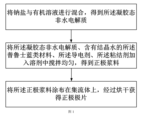
图1是本发明实施例的正极极片制备方法的流程图。
下面详细描述本发明的实施例,所述实施例的示例在附图中示出,其中自始至终相同或类似的标号表示相同或类似的元件或具有相同或类似功能的元件。下面通过参考附图描述的实施例是示例性的,仅用于解释本发明,而不能理解为对本发明的限制。
根据本发明第一方面的正极极片。
正极极片包括:集流体和正极材料层。正极材料层涂覆于集流体上,正极材料层包括:含有结晶水的普鲁士蓝类材料、导电剂、粘接剂和凝胶态非水电解质,正极材料层的特性满足0.1≤R2*(M1+M4)/((M2+M3)*R1)≤9,其中,M1为含有结晶水的普鲁士蓝类材料在200℃~400℃的热重损失率;M2为导电剂在正极材料层中的质量占比;M3为粘接剂在正极材料层中的质量占比;M4为凝胶态非水电解质在正极材料层中的质量占比;R1为正极极片的电阻率,单位为Ω·m,R2为集流体的电阻率,单位为Ω·m。
根据本发明第一方面的正极极片,在正极极片进行生产时,首先需要将普鲁士蓝类材料、导电剂、粘接剂以及凝胶态非水电解质进行混合,得到正极浆料,再将正极浆料涂覆在集流体上,并进行烘干,从而得到正极极片,其中凝胶态非水电解质无流动性。
普鲁士蓝类材料中的吸附水在烘干过程中会被除去,因此不影响材料的晶体结构稳定性以及电池的循环稳定性,但普鲁士蓝类材料中的结晶水的含量会对晶体结构稳定性产生一定影响,若结晶水含量过高,会导致电池充放电过程中产生副反应,导致材料失效以及水分子被分解产气。若结晶水含量过低,则材料的晶体结构会产生不可逆的相变,导致材料是去储钠电化学活性,无法作为正极材料使用。
当普鲁士蓝类材料的热重损失率、导电剂的含量、粘接剂的含量、凝胶态非水电解质的含量、正极极片的电阻率以及集流体的电阻率满足上述公式时,普鲁士蓝类材料会具有良好的晶体结构稳定性,不会因为结晶水含量过高导致副反应发生,也不会因为结晶水含量过低导致晶体结构被破坏,无流动性的凝胶态非水电解质也会对普鲁士蓝类材料的副反应产生抑制作用,从而使正极极片具有良好的安全性以及电化学性能,进而增加电池的循环稳定性。
需要说明的是,正极材料层中的水主要包括位于普鲁士蓝类材料晶体结构中的结晶水、吸附在普鲁士蓝类材料颗粒表面以及位于颗粒与颗粒之间的水(这里统称吸附水)。
在一些实施例中,普鲁士蓝类材料为Li
+、Na
+、K
+中的一种或几种。选用含有以上碱金属离子的普鲁士蓝类材料,可使正极极片具有良好的电化学性能。
在一些实施例中,普鲁士蓝类材料的分子式为A
xM[M′(Cn(
6]
y,其中,A为碱金属离子中的一种或几种,M为过渡金属,M’为过渡金属,0<x≤2,0<y<1。
优选地,M选用Mn、Fe、Co、Ni、Cu、Zn、V、Cr中的一种,M’选用Mn、Fe、Co、Ni、Cu、Zn、V、Cr中的一种。
在一些实施例中,导电剂为导电炭黑、导电石墨、碳纳米管、碳纳米纤维中的一种或几种。上述导电剂的阻抗较低,可使正极极片的具有良好的导电性,进而提高电化学性能。
需要说明的是,这里对粘接剂的种类不做具体限制,可根据实际需要进行选择。粘接剂可以为聚偏二氟乙烯、丁苯橡胶、丁晴橡胶、聚酰亚胺、羧甲基纤维素钠、海藻酸钠、聚丙烯酸、聚四氟乙烯中的一种或几种。通过将上述粘接剂加入正极材料层中,可使正极材料层在集流体上具有良好的粘结力,进而提高正极极片的稳定性。
在一些实施例中,凝胶态非水电解质的动态粘度为10
4Pa·s~10
10Pa·s。凝胶态非水电解质由多种材料配置,在配置完成后,凝胶态非水电解质无流动性,可防止在电池充放电过程中普鲁士蓝类材料中的结晶水被置换至电解液中,从而提高正极极片的循环稳定性。
进一步地,凝胶态非水电解质包括电解质溶质以及与所述电解质溶质混合的有机溶剂,所述电解质溶质包括钠盐以及与所述钠盐混合的有机溶质,所述钠盐在所述有机溶质中的浓度为0.8mol/L~1.2mol/L。将钠盐与有机溶液按照上述比例进行配置,可使凝胶态非水电解质无流动性,进而防止在电池充放电过程中普鲁士蓝类材料中的结晶水被置换至电解液中,从而提高正极极片的循环稳定性。
进一步可选地,所述有机溶质为聚氧化乙烯(PEO)、三乙二醇二乙烯基醚(TEGDVE)、和聚偏氟乙烯-六氟丙烯(PVDF-HFP)、聚丙烯腈(PAN)中的一种或几种,所述有机溶剂为乙腈(CH3CN)、二甲基甲酰胺(DMF)、苯甲醚(C7H8O)中的一种。
在一些实施例中,电解质溶质、含有结晶水的普鲁士蓝类材料、导电剂、粘接剂的质量比为(4~6):(90~95):1:1。将上述材料进行混合后可得到正极浆料,按照上述比例对正极浆料进行配置,可防止在电池充放电过程中普鲁士蓝类材料中的结晶水被置换至电解液中,从而提高正极极片的循环稳定性。
在一些实施例中,M1=0.5%~15%、M2=0.1%~5%、M3=0.1%~5%、M4=0.5%~15%、R1=1~10Ω·m、R2=0.03~0.1Ω·m。通过控制各个材料在正极材料层中的质量占比以及正极极片和集流体的电阻率,可使正极极片在制作完成后具有良好的电化学性能,提高安全性以及循环稳定性。
需要进一步说明的是,这里对正极极片的集流体的种类也不做具体限制,集流体可以选择铝箔、多孔铝箔、不锈钢箔、多孔不锈钢箔中的一种。
根据本发明第二方面的正极极片的制备方法,制备方法用于制备上述实施例中任一项的正极极片,包括:按照预设配比制备正极浆料,其中所述正极浆料包括凝胶态非水电解质、含有结晶水的普鲁士蓝类材料、导电剂和粘接剂;将所述正极浆料涂布在集流体上,形成正极材料层;将所述集流体与正极材料层烘干,形成正极极片,其中,所述正极材料层的特性满足0.1≤R2*(M1+M4)/((M2+M3)*R1)≤9;所述M1为含有结晶水的所述普鲁士蓝类材料在200℃~400℃的热重损失率;M2为所述导电剂在所述正极材料层中的质量占比;M3为所述粘接剂在所述正极材料层中的质量占比;M4为所述凝胶态非水电解质在所述正极材料层中的质量占比;R1为所述正极极片的电阻率,单位为Ω·m,R2为所述集流体的电阻率,单位为Ω·m。由此,按照上述方法制作的正极极片具有良好的导电性以及粘结力,可提高循环稳定性。
在一些实施例中,所述制备方法还包括按照预设配比制备所述凝胶态非水电解质,具体包括:将钠盐、有机溶质和有机溶剂混合均匀,其中所述钠盐在所述有机溶质中的浓度为0.8mol/L~1.2mol/L。由此,按照上述方法制作的凝胶态非水电解质无流动性,可防止在电池充放电过程中普鲁士蓝类材料中的结晶水被置换至电解液中,从而提高正极极片的循环稳定性。
可选地,将含有结晶水的普鲁士蓝类材料、导电剂、粘接剂和凝胶态非水电解质加入溶剂中搅拌均匀,凝胶态非水电解质、含有结晶水的普鲁士蓝类材料、导电剂和粘接剂质量比为(4~6):(90~95):1:1。
进一步地,正极极片的烘干温度为65℃~85℃。由此,可将吸附水进行烘干,从而提高正极极片的循环稳定性。
下面结合具体实施例,对本申请进行进一步阐述,可以理解的是,以下实施例仅用于对本发明进行说明,并不限制本申请的具体范围。
实施例1:
(1)正极极片的制备
首先将六氟磷酸钠(NaPF
6)和聚氧化乙烯(PEO)按照六氟磷酸钠(NaPF
6)在聚氧化乙烯(PEO)中的浓度为1mol/L配置得到电解质溶质;再将电解质溶质加入到乙腈溶剂中搅拌均匀得到凝胶态非水电解质;然后按照电解质溶质与普鲁士蓝类正极材料、导电剂、粘接剂质量比为5:93:1:1的比例加入到上述溶液中搅拌均匀得到正极浆料,其中普鲁士蓝类材料的化学式为Na1.82Mn[Fe(CN)
6]0.96·0.97H
2O,导电剂为碳纳米管 (CNT),粘接剂为聚偏二氟乙烯(PVDF);而后将正极浆料涂布在铝箔集流体上,采用80℃烘干得到正极极片。
(2)电芯的制备
首先将制备好的正极极片用刀模裁成长×宽为70.5×136.5mm的极片,金属钠负极极片裁成长×宽为72.5×138.5mm的极片;然后将正极极片、含有凝胶态非水电解质的电解质以及负极极片按照层层组装(layer-by-layer)的方式进行组装,最后使用铝塑膜密封。
实施例2:
正极极片以及电芯的制备方法与实施例1相同,区别在于,
电解质溶质由高氯酸钠(NaClO
4)和三乙二醇二乙烯基醚(TEGDVE)配置而成,普鲁士蓝类材料的化学式为Na1.74Fe[Fe(CN)
6]·1.1H
2O。
实施例3:
正极极片以及电芯的制备方法与实施例1相同,区别在于,
电解质溶质由六氟磷酸钠(NaPF
6)和聚偏氟乙烯-六氟丙烯(PVDF-HFP)配置而成,普鲁士蓝类材料的化学式为Na1.65K0.23Mn[Fe(CN)
6]·1.7H
2O。
实施例4:
正极极片以及电芯的制备方法与实施例1相同,区别在于,
电解质溶质由三氟甲基磺酸钠(NaCF
3SO
3)和聚偏氟乙烯-六氟丙烯(PVDF-HFP)配置而成,普鲁士蓝类材料的化学式为Na1.67Fe[Fe(CN)
6]·0.53H
2O。
实施例5:
正极极片以及电芯的制备方法与实施例1相同,区别在于,
电解质溶质由双(草酸根)硼酸钠(NaBOB)和聚丙烯腈(PAN)配置而成,普鲁士蓝类材料的化学式为Na1.92Fe[Fe(CN)
6]·0.8H
2O。
对比例1:
(1)正极极片的制备
首先将六氟磷酸钠(NaPF
6)和碳酸乙烯酯(EC)与碳酸二乙酯(DEC)的混合溶液按照六氟磷酸钠(NaPF
6)在碳酸乙烯酯(EC)与碳酸二乙酯(DEC)的混合溶液中的浓度为1mol/L配置得到电解质溶液;然后按照普鲁士蓝类正极材料、导电剂、粘接剂质量比为93:1:1的比例加入到乙腈溶液中搅拌均匀得到正极浆料,其中普鲁士蓝类材料的化学式为Na1.82Mn[Fe(CN)
6]0.96·0.97H
2O,导电剂为碳纳米管(CNT),粘接剂为聚偏二氟乙烯(PVDF);而后将正极浆料涂布在铝箔集流体上,采用80℃烘干得到正极极片。
(2)电芯的制备
首先将制备好的正极极片用刀模裁成长×宽为70.5×136.5mm的极片,金属钠负极极片裁成长×宽为72.5×138.5mm的极片;然后将正极极片、隔膜以及负极极片按照层层组装(layer-by-layer)的方式进行组装,最后使用铝塑膜密封。
对比例2:
正极极片以及电芯的制备方法与对比例1相同,区别在于,
电解质溶液由高氯酸钠(NaClO
4)和碳酸乙烯酯(EC)与碳酸二乙酯(DEC)的混合溶液配置而成,普鲁士蓝类材料的化学式为Na1.74Fe[Fe(CN)
6]·1.1H
2O。
对比例3:
正极极片以及电芯的制备方法与实施例1相同,区别在于,
电解质溶液由六氟磷酸钠(NaPF
6)和聚偏氟乙烯-六氟丙烯(PVDF-HFP)配置而成,普鲁士蓝类材料的化学式为Na1.65K0.23Mn[Fe(CN)
6]·1.7H
2O。
对比例4:
正极极片以及电芯的制备方法与实施例1相同,区别在于,
电解质溶液由三氟甲基磺酸钠(NaCF
3SO
3)和碳酸乙烯酯(EC)与碳酸二乙酯(DEC)的混合溶液配置而成,普鲁士蓝类材料的化学式为Na1.67Fe[Fe(CN)
6]·0.53H
2O。
对比例5:
正极极片以及电芯的制备方法与实施例1相同,区别在于,
电解质溶液由双(草酸根)硼酸钠(NaBOB)和碳酸乙烯酯(EC)与碳酸二乙酯(DEC)的混合溶液配置而成,普鲁士蓝类材料的化学式为Na1.92Fe[Fe(CN)
6]·0.8H
2O。
测试方法:
(1)正极极片的电阻率测试
采用川源科技的ACCFILM膜片电阻测试系统进行正极极片的电阻测试,包括:将上述实施例和对比例制备得到的正极极片裁取成10cm×10cm大小的正方形检测样品,将检测样品的相对两侧夹持于上述电阻测试系统的两个导电端子之间,并施加一定的压力固定,测试检测样品的电阻R,其中导电端子的直径为14mm,施加的压力为15MPa~27MPa,采点时间的范围为5s~17s。
根据公式R1=R·S/L计算出正极极片的电阻率R1,其中S为检测样品的面积;L为检测样品的厚度,即正极极片的厚度
(2)集流体的电阻率测试
集流体电阻率测试与正极极片电阻率测试方法相同,经过测试及计算可得出集流体 的电阻率R2。接下来对上述正极极片中的各组分含量进行测定,得出下表。
表1 实施例1~5和对比例1~5正极极片中各组分含量测定结果

而后对上述正极极片的放电比容量、电流密度以及钠离子电池的循环放电性能和电芯产气量进行检测,得出下表。
表2 实施例1~5和对比例1~5性能指标


其中,在对钠离子电池进行循环性能测试时,在25℃下,将钠离子电池以1C倍率恒流充电至4.0V,之后以4.0V恒压充电至电流为0.2C,之后静置5min,以1C倍率恒流放电至电压为1.5V,再静置5min,此为一个循环充放过程,此次的放电容量记为钠离子电池的第一次循环放电容量,将钠离子电池按照上述方法进行100次循环充放电测试,检测得到100次循环的放电容量。钠离子电池循环100次后的容量保持率(%)=钠离子电池第100次循环的放电容量/钠离子电池第1次循环的放电容量×100%。
在对软包电芯进行产气量测试时,将软包电芯放入硅油中,通过判断软包电芯中气袋的体积变化从而判断电芯的产气量,在进行测试时,将电芯按照1.5V-4.0V的电压,2Ah的电流对电芯进行充电,通过硅油的液位变化判断电芯产气量。
由上述表格中的数据可以看出,在正极材料层中的普鲁士蓝类材料相同时,将钠盐与有机溶液配置形成凝胶态非水电解质,与采用液态电解质相比,钠离子电池的100次循环充放电保持率有明显提高,并且对电池的产气量进行测量可以看出,采用凝胶态凝胶态非水电解质的电解质,没有气体产生。
优选地,正极材料层中的普鲁士蓝类材料为Na1.82Mn[Fe(CN)6]0.96·0.47H2O,其在40~200℃条件下中的失重率为4%,200~400℃条件下的失重率为1.5%;导电剂为导电碳纳米纤维(CNF),导电碳纳米纤维的质量分数为2%,粘接剂为丁腈橡胶(NBR),丁腈橡胶的质量分数为1%,凝胶态非水电解质的质量分数为6%,正极极片的电阻率为1.5Ω·m, 集流体的电阻率为0.04Ω·m,R2×M1/((M2+M3+M4)×R1)=0.012。
优选地,正极材料层中的普鲁士蓝类材料为Na1.74Fe[Fe(CN)6]·3.4H2O,其在40~200℃条件下中的失重率为9.5%,200~400℃条件下的失重率为7%;导电剂为导电碳纳米纤维(CNF),导电碳纳米纤维的质量分数为1.5%,粘接剂为丁腈橡胶(NBR),丁腈橡胶的质量分数为1.5%,凝胶态非水电解质的质量分数为5%,正极极片的电阻率为3Ω·m,集流体的电阻率为0.03Ω·m,R2×M1/((M2+M3+M4)×R1)=0.012。
优选地,正极材料层中的普鲁士蓝类材料为Na1.7K0.3Mn[Fe(CN)6]·1.7H2O,其在40~200℃条件下中的失重率为5.5%,200~400℃条件下的失重率为3.4%;导电剂为导电碳纳米纤维(CNF),导电碳纳米纤维的质量分数为1%,粘接剂为丁腈橡胶(NBR),丁腈橡胶的质量分数为2%,凝胶态非水电解质的质量分数为9%,正极极片的电阻率为3.5Ω·m,集流体的电阻率为0.035Ω·m,R2×M1/((M2+M3+M4)×R1)=0.046。
由此,本发明中的导电剂与粘接剂均匀镶嵌在正极材料层中形成三维网络结构,有利于电子的快速传输和各组分颗粒间的粘结,从而提升材料的比容量和循环稳定性。钠盐与有机溶液组成的凝胶态非水电解质可以均匀的包覆于普鲁士蓝类材料的颗粒表面,在正极极片中构筑钠离子传输网络,降低界面阻抗,保障钠离子在正极极片中快速传输。凝胶态非水电解质在成型后无流动性,因此,在充放电过程中普鲁士蓝类材料中的结晶水不会被置换到电解液中,既保证了普鲁士蓝类材料晶体结构的稳定性,使电池具有良好的比容量以及循环稳定性,又可以避免结晶水释放到电解液中引起副反应的发生,增加了电池的安全性以及循环稳定性。
在本说明书的描述中,参考术语“实施例”、“示例”等的描述意指结合该实施例或示例描述的具体特征、结构、材料或者特点包含于本发明的至少一个实施例或示例中。在本说明书中,对上述术语的示意性表述不一定指的是相同的实施例或示例。而且,描述的具体特征、结构、材料或者特点可以在任何的一个或多个实施例或示例中以合适的方式结合。
尽管已经示出和描述了本发明的实施例,本领域的普通技术人员可以理解:在不脱离本发明的原理和宗旨的情况下可以对这些实施例进行多种变化、修改、替换和变型,本发明的范围由权利要求及其等同物限定。
Claims (11)
- 一种正极极片,其中,所述正极极片包括:集流体;正极材料层,所述正极材料层涂覆于所述集流体上,所述正极材料层包括:含有结晶水的普鲁士蓝类材料、导电剂、粘接剂和凝胶态非水电解质,所述正极材料层的特性满足0.1≤R2*(M1+M4)/((M2+M3)*R1)≤9,其中,所述M1为含有结晶水的所述普鲁士蓝类材料在200℃~400℃的热重损失率;M2为所述导电剂在所述正极材料层中的质量占比;M3为所述粘接剂在所述正极材料层中的质量占比;M4为所述凝胶态非水电解质在所述正极材料层中的质量占比;R1为所述正极极片的电阻率,单位为Ω·m,R2为所述集流体的电阻率,单位为Ω·m。
- 根据权利要求1所述的正极极片,其中,所述普鲁士蓝类材料为Li +、Na +、K +中的一种或几种。
- 根据权利要求1所述的正极极片,其中,所述导电剂为导电炭黑、导电石墨、碳纳米管、碳纳米纤维中的一种或几种。
- 根据权利要求1所述的正极极片,其中,所述粘接剂为聚偏二氟乙烯、丁苯橡胶、丁晴橡胶、聚酰亚胺、羧甲基纤维素钠、海藻酸钠、聚丙烯酸、聚四氟乙烯中的一种或几种。
- 根据权利要求1所述的正极极片,其中,所述凝胶态非水电解质的动态粘度为10 4Pa·s~10 10Pa·s。
- 根据权利要求1或5所述的正极极片,其中,所述凝胶态非水电解质包括电解质溶质以及与所述电解质溶质混合的有机溶剂,所述电解质溶质包括钠盐以及与所述钠盐混合的有机溶质,所述钠盐在所述有机溶质中的浓度为0.8mol/L~1.2mol/L。
- 根据权利要求6所述的正极极片,其中,所述有机溶质为聚氧化乙烯、三乙二醇二乙烯基醚、和聚偏氟乙烯-六氟丙烯、聚丙烯腈中的一种或几种,所述有机溶剂为乙腈、二甲基甲酰胺、苯甲醚中的一种或几种。
- 根据权利要求1-6中任一项所述的正极极片,其中,所述电解质溶质、含有结晶水的所述普鲁士蓝类材料、所述导电剂、所述粘接剂的质量比为(4~6):(90~95):1:1。
- 根据权利要求1-8中任一项所述的正极极片,其中,M1=0.5%~15%、M2=0.1%~5%、M3=0.1%~5%、M4=0.5%~15%、R1=1~10Ω·m、R2=0.03~0.1Ω·m。
- 一种正极极片的制备方法,其中,所述制备方法用于制备权利要求1~5中任一项所述的正极极片,包括:按照预设配比制备正极浆料,其中所述正极浆料包括凝胶态非水电解质、含有结晶水的普鲁士蓝类材料、导电剂和粘接剂;将所述正极浆料涂布在集流体上,形成正极材料层;将所述集流体与正极材料层烘干,形成正极极片,其中,所述正极材料层的特性满足0.1≤R2*(M1+M4)/((M2+M3)*R1)≤9;所述M1为含有结晶水的所述普鲁士蓝类材料在200℃~400℃的热重损失率;M2为所述导电剂在所述正极材料层中的质量占比;M3为所述粘接剂在所述正极材料层中的质量占比;M4为所述凝胶态非水电解质在所述正极材料层中的质量占比;R1为所述正极极片的电阻率,R2为所述集流体的电阻率。
- 根据权利要求10所述的正极极片的制备方法,其中,所述制备方法还包括按照预设配比制备所述凝胶态非水电解质,具体包括:将钠盐与有机溶质混合形成电解质溶质,再将电解质溶质与有机溶剂混合均匀得到凝胶态电解质,其中所述钠盐在所述有机溶质中的浓度为0.8mol/L~1.2mol/L。
Priority Applications (2)
| Application Number | Priority Date | Filing Date | Title |
|---|---|---|---|
| EP22944047.4A EP4383374A4 (en) | 2022-10-27 | 2022-12-28 | POSITIVE ELECTRODE PLATE AND PREPARATION METHOD THEREOF |
| US18/531,742 US20240145705A1 (en) | 2022-10-27 | 2023-12-07 | Positive electrode sheet and preparation method thereof |
Applications Claiming Priority (2)
| Application Number | Priority Date | Filing Date | Title |
|---|---|---|---|
| CN202211323844.0A CN115566143B (zh) | 2022-10-27 | 2022-10-27 | 正极极片及其制备方法 |
| CN202211323844.0 | 2022-10-27 |
Related Child Applications (1)
| Application Number | Title | Priority Date | Filing Date |
|---|---|---|---|
| US18/531,742 Continuation US20240145705A1 (en) | 2022-10-27 | 2023-12-07 | Positive electrode sheet and preparation method thereof |
Publications (1)
| Publication Number | Publication Date |
|---|---|
| WO2024087375A1 true WO2024087375A1 (zh) | 2024-05-02 |
Family
ID=84769473
Family Applications (1)
| Application Number | Title | Priority Date | Filing Date |
|---|---|---|---|
| PCT/CN2022/142735 Ceased WO2024087375A1 (zh) | 2022-10-27 | 2022-12-28 | 正极极片及其制备方法 |
Country Status (4)
| Country | Link |
|---|---|
| US (1) | US20240145705A1 (zh) |
| EP (1) | EP4383374A4 (zh) |
| CN (1) | CN115566143B (zh) |
| WO (1) | WO2024087375A1 (zh) |
Families Citing this family (2)
| Publication number | Priority date | Publication date | Assignee | Title |
|---|---|---|---|---|
| CN117457902B (zh) * | 2023-12-25 | 2025-03-28 | 宁波容百新能源科技股份有限公司 | 一种普鲁士蓝类正极材料及其制备方法、电池 |
| CN120600744A (zh) * | 2024-03-05 | 2025-09-05 | 宁德时代新能源科技股份有限公司 | 钠离子电池正极极片以及钠离子电池 |
Citations (5)
| Publication number | Priority date | Publication date | Assignee | Title |
|---|---|---|---|---|
| CN104247131A (zh) * | 2012-04-17 | 2014-12-24 | 夏普株式会社 | 具有六氰基金属酸盐正极和非金属负极的碱金属和碱土金属离子电池 |
| US20150357630A1 (en) * | 2012-03-28 | 2015-12-10 | Sharp Laboratories Of America, Inc. | Prussian Blue Analogue Electrodes without Zeolitic Water Content |
| CN108075181A (zh) * | 2016-11-14 | 2018-05-25 | 中国科学院上海硅酸盐研究所 | 一种固态或胶态水系碱金属离子电池及其制备方法 |
| CN109728252A (zh) * | 2017-10-30 | 2019-05-07 | 宁德时代新能源科技股份有限公司 | 正极片及其制备方法及钠离子电池 |
| CN109920979A (zh) * | 2017-12-12 | 2019-06-21 | 宁德时代新能源科技股份有限公司 | 正极片及电化学电池 |
Family Cites Families (10)
| Publication number | Priority date | Publication date | Assignee | Title |
|---|---|---|---|---|
| CN102208680B (zh) * | 2011-05-05 | 2014-07-02 | 中国东方电气集团有限公司 | 凝胶电解质及其制备方法、和相应的正极、锂硫电池 |
| US9159502B2 (en) * | 2012-03-28 | 2015-10-13 | Sharp Laboratories Of America, Inc. | Supercapacitor with hexacyanometallate cathode, activated carbon anode, and non-aqueous electrolyte |
| US9559358B2 (en) * | 2012-03-28 | 2017-01-31 | Sharp Laboratories Of America, Inc. | Alkali and alkaline-earth ion batteries with hexacyanometallate cathode and non-metal anode |
| CN108461832A (zh) * | 2017-02-22 | 2018-08-28 | 中国科学院上海硅酸盐研究所 | 一种基于胶体或凝胶电解质的水系碱金属离子电池及其制备方法 |
| CN107591536B (zh) * | 2017-09-02 | 2020-08-11 | 清陶(昆山)能源发展有限公司 | 凝胶复合正极片及其制备方法和制备全固态锂电池的方法 |
| CN109935784B (zh) * | 2017-12-19 | 2020-11-13 | 宁德时代新能源科技股份有限公司 | 正极片及电化学电池 |
| CN114843434B (zh) * | 2021-02-01 | 2024-07-05 | 华为技术有限公司 | 一种电极片、固态电池和电子设备 |
| CN115224231A (zh) * | 2021-04-21 | 2022-10-21 | 中国科学院物理研究所 | 一种固态锂电池正极及其制备方法和应用 |
| CN113437261A (zh) * | 2021-06-22 | 2021-09-24 | 中国电力科学研究院有限公司 | 一种普鲁士蓝类正极片、钠离子电池及制备方法 |
| CN113571760B (zh) * | 2021-07-21 | 2023-05-30 | 南通赛得能源有限公司 | 一种硅碳固态电池及其制备方法 |
-
2022
- 2022-10-27 CN CN202211323844.0A patent/CN115566143B/zh active Active
- 2022-12-28 WO PCT/CN2022/142735 patent/WO2024087375A1/zh not_active Ceased
- 2022-12-28 EP EP22944047.4A patent/EP4383374A4/en active Pending
-
2023
- 2023-12-07 US US18/531,742 patent/US20240145705A1/en active Pending
Patent Citations (5)
| Publication number | Priority date | Publication date | Assignee | Title |
|---|---|---|---|---|
| US20150357630A1 (en) * | 2012-03-28 | 2015-12-10 | Sharp Laboratories Of America, Inc. | Prussian Blue Analogue Electrodes without Zeolitic Water Content |
| CN104247131A (zh) * | 2012-04-17 | 2014-12-24 | 夏普株式会社 | 具有六氰基金属酸盐正极和非金属负极的碱金属和碱土金属离子电池 |
| CN108075181A (zh) * | 2016-11-14 | 2018-05-25 | 中国科学院上海硅酸盐研究所 | 一种固态或胶态水系碱金属离子电池及其制备方法 |
| CN109728252A (zh) * | 2017-10-30 | 2019-05-07 | 宁德时代新能源科技股份有限公司 | 正极片及其制备方法及钠离子电池 |
| CN109920979A (zh) * | 2017-12-12 | 2019-06-21 | 宁德时代新能源科技股份有限公司 | 正极片及电化学电池 |
Also Published As
| Publication number | Publication date |
|---|---|
| EP4383374A1 (en) | 2024-06-12 |
| CN115566143B (zh) | 2024-01-30 |
| US20240145705A1 (en) | 2024-05-02 |
| CN115566143A (zh) | 2023-01-03 |
| EP4383374A4 (en) | 2025-01-01 |
Similar Documents
| Publication | Publication Date | Title |
|---|---|---|
| CN114914393B (zh) | 一种负极片及锂离子电池 | |
| CN109728252B (zh) | 正极片及其制备方法及钠离子电池 | |
| CN109935784B (zh) | 正极片及电化学电池 | |
| CN114665065A (zh) | 一种正极极片及其制备方法和应用 | |
| CN114552125B (zh) | 一种无损补锂复合隔膜及其制备方法和应用 | |
| WO2022267510A1 (zh) | 平板式钠金属电池、电化学装置 | |
| CN114583136A (zh) | 一种高性能锂/钠离子电池的制备方法及电池 | |
| US20190036157A1 (en) | All-solid-state battery, hybrid-structured solid electrolyte membrane and manufacturing methods thereof | |
| CN109920979B (zh) | 正极片及电化学电池 | |
| CN115498164B (zh) | 负极材料、负极浆料、负极片及制备方法和锂离子电池 | |
| CN100546074C (zh) | 一种电极浆料的制备方法 | |
| CN111799437A (zh) | 正极极片及钠离子电池 | |
| CN118248832B (zh) | 一种负极片、电池及用电设备 | |
| CN107994207B (zh) | 锂离子电池及其阴极片 | |
| US20240145705A1 (en) | Positive electrode sheet and preparation method thereof | |
| CN101207190A (zh) | 一种锂离子二次电池正极及包括该正极的锂离子二次电池 | |
| CN104934607A (zh) | 一种钠离子电池电极及其制备方法 | |
| CN116646476A (zh) | 正极极片和锂离子电池 | |
| CN116487594A (zh) | 正极极片及其制备方法、储能装置、用电设备 | |
| CN112615111A (zh) | 一种高保液自修复隔膜及其制备方法、锂离子电池 | |
| CN115440933A (zh) | 负极极片、电池、电池包及用电设备 | |
| CN121601636B (zh) | 基于复合正极活性材料的锂离子电池正极及其制备方法和应用 | |
| CN101315975A (zh) | 电池正极和使用该正极的锂离子电池及它们的制备方法 | |
| CN116417566A (zh) | 一种正极极片及其制备方法、锂离子电池 | |
| CN116554484A (zh) | 凝胶聚合物电解质及固态电池的制备方法 |
Legal Events
| Date | Code | Title | Description |
|---|---|---|---|
| WWE | Wipo information: entry into national phase |
Ref document number: 202327083493 Country of ref document: IN |
|
| ENP | Entry into the national phase |
Ref document number: 2022944047 Country of ref document: EP Effective date: 20231207 |
|
| NENP | Non-entry into the national phase |
Ref country code: DE |