WO2024095821A1 - 金属粉末及び該金属粉末の製造方法並びに金属ペースト - Google Patents
金属粉末及び該金属粉末の製造方法並びに金属ペースト Download PDFInfo
- Publication number
- WO2024095821A1 WO2024095821A1 PCT/JP2023/038294 JP2023038294W WO2024095821A1 WO 2024095821 A1 WO2024095821 A1 WO 2024095821A1 JP 2023038294 W JP2023038294 W JP 2023038294W WO 2024095821 A1 WO2024095821 A1 WO 2024095821A1
- Authority
- WO
- WIPO (PCT)
- Prior art keywords
- metal powder
- metal
- alkyl group
- surfactant
- carbon atoms
- Prior art date
- Legal status (The legal status is an assumption and is not a legal conclusion. Google has not performed a legal analysis and makes no representation as to the accuracy of the status listed.)
- Ceased
Links
Images


Classifications
-
- B—PERFORMING OPERATIONS; TRANSPORTING
- B22—CASTING; POWDER METALLURGY
- B22F—WORKING METALLIC POWDER; MANUFACTURE OF ARTICLES FROM METALLIC POWDER; MAKING METALLIC POWDER; APPARATUS OR DEVICES SPECIALLY ADAPTED FOR METALLIC POWDER
- B22F1/00—Metallic powder; Treatment of metallic powder, e.g. to facilitate working or to improve properties
- B22F1/05—Metallic powder characterised by the size or surface area of the particles
- B22F1/052—Metallic powder characterised by the size or surface area of the particles characterised by a mixture of particles of different sizes or by the particle size distribution
-
- B—PERFORMING OPERATIONS; TRANSPORTING
- B22—CASTING; POWDER METALLURGY
- B22F—WORKING METALLIC POWDER; MANUFACTURE OF ARTICLES FROM METALLIC POWDER; MAKING METALLIC POWDER; APPARATUS OR DEVICES SPECIALLY ADAPTED FOR METALLIC POWDER
- B22F1/00—Metallic powder; Treatment of metallic powder, e.g. to facilitate working or to improve properties
- B22F1/06—Metallic powder characterised by the shape of the particles
- B22F1/065—Spherical particles
-
- B—PERFORMING OPERATIONS; TRANSPORTING
- B22—CASTING; POWDER METALLURGY
- B22F—WORKING METALLIC POWDER; MANUFACTURE OF ARTICLES FROM METALLIC POWDER; MAKING METALLIC POWDER; APPARATUS OR DEVICES SPECIALLY ADAPTED FOR METALLIC POWDER
- B22F1/00—Metallic powder; Treatment of metallic powder, e.g. to facilitate working or to improve properties
- B22F1/10—Metallic powder containing lubricating or binding agents; Metallic powder containing organic material
- B22F1/102—Metallic powder coated with organic material
-
- B—PERFORMING OPERATIONS; TRANSPORTING
- B22—CASTING; POWDER METALLURGY
- B22F—WORKING METALLIC POWDER; MANUFACTURE OF ARTICLES FROM METALLIC POWDER; MAKING METALLIC POWDER; APPARATUS OR DEVICES SPECIALLY ADAPTED FOR METALLIC POWDER
- B22F1/00—Metallic powder; Treatment of metallic powder, e.g. to facilitate working or to improve properties
- B22F1/10—Metallic powder containing lubricating or binding agents; Metallic powder containing organic material
- B22F1/105—Metallic powder containing lubricating or binding agents; Metallic powder containing organic material containing inorganic lubricating or binding agents, e.g. metal salts
-
- B—PERFORMING OPERATIONS; TRANSPORTING
- B22—CASTING; POWDER METALLURGY
- B22F—WORKING METALLIC POWDER; MANUFACTURE OF ARTICLES FROM METALLIC POWDER; MAKING METALLIC POWDER; APPARATUS OR DEVICES SPECIALLY ADAPTED FOR METALLIC POWDER
- B22F1/00—Metallic powder; Treatment of metallic powder, e.g. to facilitate working or to improve properties
- B22F1/10—Metallic powder containing lubricating or binding agents; Metallic powder containing organic material
- B22F1/107—Metallic powder containing lubricating or binding agents; Metallic powder containing organic material containing organic material comprising solvents, e.g. for slip casting
-
- B—PERFORMING OPERATIONS; TRANSPORTING
- B22—CASTING; POWDER METALLURGY
- B22F—WORKING METALLIC POWDER; MANUFACTURE OF ARTICLES FROM METALLIC POWDER; MAKING METALLIC POWDER; APPARATUS OR DEVICES SPECIALLY ADAPTED FOR METALLIC POWDER
- B22F9/00—Making metallic powder or suspensions thereof
- B22F9/16—Making metallic powder or suspensions thereof using chemical processes
- B22F9/18—Making metallic powder or suspensions thereof using chemical processes with reduction of metal compounds
- B22F9/24—Making metallic powder or suspensions thereof using chemical processes with reduction of metal compounds starting from liquid metal compounds, e.g. solutions
Definitions
- the present invention relates to a metal powder for use in forming electrodes and wiring, joining, sealing, etc. in the electronics field, such as semiconductor devices and semiconductor elements, and a method for manufacturing the same.
- the present invention relates to a metal powder with a reduced proportion of non-spherical particles and a method for manufacturing the same.
- metal pastes for such applications, which are made of high-purity (99.9% by mass or more) metals (gold, silver, palladium, copper, etc.) and in which submicron-order (1 ⁇ m or less) metal powder is mixed with an organic solvent, are useful for the above applications (see, for example, Patent Documents 1 to 3).
- a metal paste is applied to the base material using a photoetching method or the like to form a desired shape or pattern.
- the metal paste is then dried and appropriately pre-sintered to form a bump, and a semiconductor chip is placed on the bump.
- the metal powder that constitutes the bump is then sintered by heating and pressurization, becoming a metal powder sintered body, which is a bonding medium.
- the metal paste of the present applicant ensures low-temperature sintering by specifying the purity and average particle size of the metal powder as described above, contributing to a low-temperature bonding process.
- the sintering temperature of the metal powder applied to the metal paste is correlated with the particle size of the metal powder, and the sintering temperature tends to increase as the particle size becomes coarser.
- the purity of the metal powder affects the plastic deformability of the metal powder during sintering, and affects the density of the metal powder sintered body after sintering. Therefore, by specifying the average particle size and using high-purity metal powder, low-temperature sintering is ensured and the increase in resistance of the bonding medium, which is a conductor, is suppressed.
- Methods based on wet reduction methods are also known as methods for producing metal powders while controlling the average particle size in this way.
- a reducing agent and metal salt are supplied to a solution in which ultrafine gold particles (colloidal particles) are dispersed as core particles, and gold is precipitated on the surfaces of the core particles to produce gold powder.
- ultrafine gold particles colloidal particles
- gold is precipitated on the surfaces of the core particles to produce gold powder.
- the metal pastes and metal powders that have been clarified so far have the basic required characteristics such as low-temperature sintering and electrical conductivity (low resistance).
- low-temperature sintering and electrical conductivity low resistance
- the present invention clarifies higher quality metal powders and metal pastes that are used in various processes in the electronics field, such as bonding, electrode formation, and sealing, as well as a method for manufacturing them.
- the present inventors have decided to study the improvement of the particle size distribution of metal powders produced by the wet reduction method for the following reasons. That is, even in the joining process in the electronics field, which requires low-temperature joining, the average particle size of the metal powder should not be the only factor to be evaluated.
- the metal powders produced by the wet reduction method are mostly spherical and regularly shaped metal particles, but some of them may contain non-spherical particles (rod-shaped, plate-shaped, rectangular, etc.). It is believed that such irregular particles do not affect the average particle size and have little effect on the sintering temperature, etc.
- a component of higher quality metal paste/metal powder is one that is composed of spherical particles and suppresses the generation of non-spherical particles. Based on this policy, the inventors decided to optimize the raw materials and manufacturing conditions of the conventional metal powder manufacturing method based on the wet reduction method. As a result, they discovered a metal powder in which the proportion of non-spherical particles is appropriately suppressed, and came up with the present invention.
- the present invention which solves the above problems, is a metal powder characterized in that the average particle size is 0.1 ⁇ m or more and 0.4 ⁇ m or less, and the purity is 99.9 mass% or more, and the metal powder is made of Au, Ag, Cu metals or alloys thereof, and the proportion of non-spherical metal powder particles with a ratio of minor axis a to major axis b (b/a) of 3 or more is 1% or less based on the number of particles.
- the metal powder and its manufacturing method according to the present invention, as well as the metal paste to which this metal powder is applied, are described in more detail below.
- the metal powder according to the present invention is made of high purity (99.9% by mass or more) Au, Ag, Cu metals or alloys thereof.
- the reason why the constituent metals of the metal powder are Au, Ag, and Cu is that they can be sintered at a relatively low temperature by making them into fine powders, and all of them have good electrical conductivity.
- the metal powder may be made of an alloy of the above metals, and an alloy in which Au, Ag, and Cu are alloyed with each other, or an alloy mainly composed of Au, Ag, and Cu (80% by mass or more) can be applied.
- Au is particularly preferable.
- Au is relatively soft and can form a dense sintered body by plastic deformation during sintering, and has excellent electrical conductivity, so that low-resistance joints, bumps, etc. can be formed.
- purity of the metal powder is set to 99.9% by mass or more is that low-purity metals containing impurities are hard and do not easily undergo plastic deformation when forming a sintered body that will become a joining material, etc.
- purity here refers to the concentration of the metal element for metal powders made of any of the metals Au, Ag, and Cu, and to the concentration of the metal and alloy elements for metal powders made of an alloy of Au, Ag, and Cu.
- the average particle size of the metal powder is set to 0.1 ⁇ m or more and 0.4 ⁇ m or less is to optimize the sintering temperature of the metal powder.
- the sintering temperature of the metal powder tends to rise as the average particle size increases.
- the upper limit of the average particle size is set to 0.4 ⁇ m, which is a range that is particularly good for low-temperature sintering.
- the lower limit is set to 0.1 ⁇ m because metal powder with an average particle size less than this value tends to agglomerate when made into a paste.
- metal powder with a particle size of 0.5 ⁇ m or more, which exceeds the upper limit of the average particle size (0.4 ⁇ m) is determined to be coarse particles.
- the average particle size of the metal powder in the present invention is the number average particle size (M N ).
- the observation magnification is preferably 10,000 times or more, more preferably 20,000 times or more and 30,000 times or less.
- the particle size of the metal powder may be measured by measuring the particle size of each metal powder in the photograph/image, or by using computer software such as image analysis software.
- the particle size may be calculated from the long and short axes of the particles in the image using a biaxial method, or the Feret diameter (caliper diameter) based on the length of the sides of a rectangle circumscribing the particles in the image.
- the Feret diameter it is preferable to obtain at least one of the minimum Feret diameter, the maximum Feret diameter, and the average Feret diameter.
- the ratio of non-spherical particles is a predetermined value or less.
- metal powders in which the ratio (b/a) of the minor axis a to the major axis b of the particles is 3 or more are defined as non-spherical particles.
- the ratio of non-spherical particles based on the particle number is 1% or less. Even if the ratio is as small as 1%, non-spherical particles can cause problems in the process of applying and sintering the metal paste in addition to defects in the appearance of the entire metal powder.
- the determination of non-spherical particles by measuring the ratio of the minor axis a to the major axis b can be performed in conjunction with the measurement of the particle diameter and the average particle diameter of the metal powder described above.
- the measured minor axis and major axis are defined as the minor axis a and major axis b, respectively.
- the Feret diameter is defined as the particle diameter
- the minimum Feret diameter and the maximum Feret diameter are defined as the minor axis a and major axis b, respectively.
- the metal powder according to the present invention preferably limits the proportion of coarse metal powder as well as non-spherical particles.
- metal powder according to the present invention in which the average particle size is specified, metal powder with a particle size equal to or larger than the average size is naturally included, so it is difficult to completely eliminate the presence of coarse particles.
- the proportion of coarse metal powder far exceeds the average particle size, it may affect the sintering property. Therefore, it is preferable to consider the presence of coarse particles as well as irregular particles as factors that may affect the quality of the metal powder.
- coarse particles are particles with a size of 0.5 ⁇ m or more, and it is preferable that the proportion of such coarse particles based on the particle number is 10% or less.
- the particle size of the coarse particles can be calculated using the same method as above.
- a compound or derivative derived from a surfactant which is a dispersant, may be bonded to the surface.
- This interfacial activity exists on the powder surface from the stage before the metal powder is made into a metal paste.
- an alkylamine salt or a quaternary ammonium salt having an alkyl group with 14 to 18 carbon atoms may be bonded to at least a part of the metal powder surface.
- an alkylamine salt or a quaternary ammonium salt having an alkyl group with 12 to less than 14 carbon atoms may also be bonded to at least a part of the metal powder surface.
- these compounds do not affect the sintering characteristics of the metal powder, but indicate that a specific surfactant has been applied in the manufacturing process (the metal colloid synthesis process described below).
- the amount is preferably 0.01% to 5% by mass, and more preferably 0.03% to 3% by mass. This is because the adhesion of an excessive amount of the compound may affect the subsequent sintering of the metal powder.
- the present inventors have attempted to improve the wet reduction method, which is a method for producing metal powder, in order to solve the problem of finding a higher quality metal powder than the conventional method.
- a reducing agent and a metal salt are supplied to a solution in which metal colloid particles are dispersed as core particles, and the particles are grown to form (granulate) a metal powder.
- the synthesis of metal colloid particles is also basically based on the wet reduction method, in which a raw material metal salt is mixed with a reducing agent in a solvent to reduce and precipitate the metal to form metal colloid particles.
- a dispersant is mixed together with the metal salt and the reducing agent.
- the dispersant is an additive that binds to the surface of the reduced and precipitated metal colloid particles and suppresses coarsening due to excessive aggregation of the particles.
- a surfactant having an alkyl group cationic surfactant is applied as a dispersant, taking into consideration the binding property to various metals, etc.
- dispersants are essential additives in the metal colloid synthesis process, which bind to the metal colloid particles generated by reduction precipitation and are then used in this state in the subsequent metal powder granulation process.
- a dispersant that is the same as or different from the dispersant used in the metal colloid synthesis process is often added to suppress the aggregation of the metal powder during the growth process.
- it is expected that all or part of the reaction liquid obtained in the metal colloid particle synthesis process will be used. In this case, the dispersant that did not bind to the metal colloid particles in the metal colloid synthesis process will remain in the reaction liquid in the metal powder granulation process.
- the reaction liquid in both the metal colloid particle synthesis process and the metal powder granulation process contains a dispersant.
- the inventors have investigated the effect that the number of carbon atoms in the alkyl group of the surfactant, which is the dispersant, has on the metal colloid particles and gold powder in each of the metal colloid synthesis process and metal powder granulation process, and have obtained the following findings (i) and (ii).
- the metal powder according to the present invention has a reduced ratio of non-spherical particles, and preferably also has a reduced ratio of coarse particles. To produce such metal powder, it is necessary to suppress the growth of non-spherical particles while reducing the variation in particle size distribution. In consideration of the above two findings, it is considered preferable to use a surfactant having an alkyl group with a large number of carbon atoms as a dispersant in the metal colloid synthesis process, and to use a surfactant having an alkyl group with a small number of carbon atoms as a dispersant in the metal powder granulation process.
- a carbon number of 14 is an appropriate threshold for the number of carbon atoms in the alkyl group of a surfactant, which distinguishes between the effect of improving particle size distribution and inhibiting the generation of coarse particles and the effect of inhibiting the generation of non-spherical particles.
- the metal powder according to the present invention can be manufactured by using a surfactant with an alkyl group with 14 or more carbon atoms as an essential dispersant in the metal colloid synthesis process, while including a surfactant with an alkyl group with less than 14 carbon atoms in the metal powder granulation process.
- the method for producing metal powder according to the present invention includes a metal colloid synthesis step of synthesizing metal colloid particles by reacting a metal salt with a reducing agent in a first solvent containing a first dispersant, and a metal powder granulation step of adding a metal salt, a reducing agent, and an arbitrary second dispersant to a second solvent containing the metal colloid particles synthesized in the metal colloid synthesis step to convert the metal colloid particles into metal powder, in which the first solvent in the metal colloid synthesis step contains a surfactant having at least an alkyl group with 14 to 18 carbon atoms as the first dispersant, and the second solvent in the metal powder granulation step contains a surfactant having an alkyl group with 12 to 14 carbon atoms as the second dispersant.
- the first solvent in the metal colloid synthesis step contains a surfactant having at least an alkyl group with 14 to 18 carbon atoms as the first dispersant
- the metal colloid synthesis step is a step of synthesizing metal colloid particles, which are the cores of the metal powder, based on a wet reduction method.
- a metal salt is reacted with a reducing agent in the presence of a dispersant in a first solvent to reduce and precipitate the metal.
- metal salts that serve as raw materials include chloroaurate, gold sulfite, and gold cyanide for Au.
- Ag include silver chloride, silver nitrate, and silver acetate
- examples of Cu include copper chloride, copper nitrate, and copper sulfate.
- reducing agents examples include hydroxylammonium chloride, sodium borohydride, dimethylamine boron, and trisodium citrate dihydrate. These can be mixed in the form of a solution.
- the first solvent is not limited as long as it is a solvent that can dissolve the metal salt, the reducing agent, and the dispersant.
- a polar solvent is preferably used, and specifically, water or an organic solvent such as an alcohol, or a mixed solvent of water and an organic solvent is a preferred solvent.
- a dispersant containing a surfactant having an alkyl group with 14 to 18 carbon atoms is essential as a first dispersant in the solvent (reaction liquid).
- a surfactant having an alkyl group with less than 14 carbon atoms increases the variation in particle size of metal colloid particles in the metal colloid synthesis process, leading to coarsening of the particle size. If such metal colloid particles are grown in the metal powder granulation process, there is a risk of increasing the proportion of non-spherical metal powder.
- a surfactant having an alkyl group with more than 18 carbon atoms is used as a dispersant in the metal colloid synthesis process, when the dispersant is present in the reaction liquid in the metal powder granulation process, it promotes the growth of non-spherical particles such as rod-shaped particles and increases the proportion of non-spherical particles.
- a dispersant containing a surfactant having an alkyl group with 14 to 18 carbon atoms is first applied as a first dispersant in the metal colloid synthesis process. The specific configuration of this first dispersant will be described in detail later together with the configuration of the second dispersant.
- the reaction solution in the metal colloid particle synthesis process only needs to contain the first dispersant (a surfactant having an alkyl group with 14 to 18 carbon atoms), and may also contain a surfactant having an alkyl group with 12 to 14 carbon atoms.
- the first dispersant a surfactant having an alkyl group with 14 to 18 carbon atoms
- the surfactant having an alkyl group with 12 to 14 carbon atoms may also contain a surfactant having an alkyl group with 12 to 14 carbon atoms.
- Metal colloid particles are synthesized by mixing a metal salt, a reducing agent, and a first dispersant into a first solvent.
- the order of mixing these is not particularly limited, and for example, the metal salt (solution) can be added to a mixed solution of the dispersant and reducing agent.
- the metal concentration contained in the reaction solution is preferably 0.01 g/L or more and 1 g/L or less, and more preferably 0.01 g/L or more and 0.1 g/L or less.
- the amount of the reducing agent is preferably 2.5 times or more and 10 times or less than the molar concentration of the metal in the reaction solution.
- the concentration of the dispersing agent is preferably 0.1 g/L or more and 10 g/L or less. If it is less than 0.1 g/L, it will not act as a dispersing agent, and even if it exceeds 10 g/L, there is no effect as a dispersing agent.
- the concentration of the dispersing agent is more preferably 1 g/L or more and 10 g/L or less.
- reaction temperature be 80°C or higher and 90°C or lower. If the temperature is lower than 80°C, the reaction for producing metal colloid particles will not proceed easily, and if the temperature exceeds 90°C, there will be no change in reactivity, and there is a risk of production problems such as significant evaporation of the reaction solution.
- the metal powder granulation step is a step in which the metal colloid particles synthesized in the metal colloid synthesis step are grown to produce a metal powder.
- a metal salt and a reducing agent are added to a second solvent containing the metal colloid particles to grow the metal colloid particles and granulate the metal powder.
- the metal salt and reducing agent added in this step can be the same as the metal salt and reducing agent used in the metal colloid synthesis step. However, the metal salt and reducing agent do not have to be of the same type (composition).
- the reaction liquid synthesized in the metal colloid synthesis process may be used in its entirety in the metal powder granulation process. Also, a portion of the reaction liquid synthesized in the metal colloid synthesis process may be extracted, and the extracted reaction liquid may be used in the metal powder granulation process. In this case, the second solvent will be the same as the first solvent.
- a new solvent may be added to the reaction solution synthesized in the metal colloid synthesis process while using part or all of it.
- Such additional addition of solvent can be performed for the purpose of adjusting the concentration of metal salts, reducing agents, etc., or adjusting the liquid volume to ensure the ease of handling of the reaction solution.
- the same type of solvent as the first solvent can be used as the solvent to be added, and the same solvent as the first solvent may be used.
- a mixed solvent of the solvent added here and the first solvent becomes the second solvent. It is of course possible to add the same solvent as the first solvent here.
- the second solvent is also preferably a polar solvent such as water or alcohol, like the first solvent.
- the second solvent must contain a surfactant having an alkyl group with 12 to less than 14 carbon atoms as a second dispersant.
- a surfactant having an alkyl group with 12 to less than 14 carbon atoms as a second dispersant.
- surfactants with alkyl groups with a large number of carbon atoms have the effect of promoting the growth of non-spherical particles, so surfactants with more than 14 carbon atoms are not actively used.
- a surfactant having an alkyl group with 12 to less than 14 carbon atoms acts as a dispersant for the metal powder without promoting the growth of non-spherical particles, so it is considered to be an essential dispersant (second dispersant) in this process.
- a second dispersant a surfactant having an alkyl group with 12 to less than 14 carbon atoms
- the reaction liquid in the metal colloid synthesis process is used in the metal powder granulation process, and the reaction liquid contains a surfactant having an alkyl group with 12 to less than 14 carbon atoms
- the surfactant acts as a second dispersant.
- the addition of the second dispersant is not necessary.
- the addition of the second dispersant may not be necessary.
- the condition in which the reaction liquid in the metal powder granulation process contains a surfactant having an alkyl group with 12 to less than 14 carbon atoms is a requirement. Details of this second dispersant will be explained later together with the first dispersant.
- reaction liquid in the metal powder granulation process may contain a second dispersant (a surfactant having an alkyl group with 12 to less than 14 carbon atoms), and may also contain a surfactant having an alkyl group with 14 to 18 carbon atoms.
- a second dispersant a surfactant having an alkyl group with 12 to less than 14 carbon atoms
- surfactant having an alkyl group with 14 to 18 carbon atoms may contain a surfactant having an alkyl group with 14 to 18 carbon atoms.
- Metal powder is produced by mixing the metal salt, the reducing agent, and an optional second dispersing agent with the second solvent described above.
- the order of mixing these is not particularly limited.
- the preferred composition of the reaction liquid in the metal powder granulation process is a metal concentration of 10 g/L or more and 150 g/L or less.
- the metal salt added in the metal powder granulation process is a precursor for growing fine metal colloid particles into metal powder with a predetermined average particle size. Therefore, the metal concentration in the metal powder granulation process can be set according to the average particle size of the metal powder to be manufactured. However, since an excessive metal concentration may cause non-uniform nucleation, the above range is preferable.
- the metal concentration in the reaction liquid in the metal powder granulation process is the sum of the mass of the metal in the metal salt added in the metal powder granulation process and the mass of the metal colloid particles that become the nuclei.
- the amount of the reducing agent is preferably mixed at 2.5 times or more and 5 times or less than the molar concentration of the metal in the reaction liquid. If the amount of the reducing agent is too small, there is a risk of unreacted metal salt remaining. Furthermore, if there is too much reducing agent, the reaction can easily become too rapid, making it difficult to control the particle size and also hindering safe and stable production.
- the concentration of the dispersant in the reaction solution in the metal powder granulation process is preferably 1/80 to 1/6 times the metal concentration in the reaction solution.
- concentration value of the dispersant in the reaction solution in the metal colloid synthesis process is used as the standard, it is preferably 1/50 to 2 times the metal concentration.
- the dispersant in the metal powder granulation process is more for maintaining the particle size distribution than for suppressing particle aggregation, and the dispersant concentration does not need to exceed the metal concentration. In this respect, it differs from the dispersant concentration in the metal colloid synthesis process. However, a certain level of dispersant concentration is necessary to maintain the particle size distribution.
- the metal powder granulation process a considerable amount of metal salt is added to increase the metal concentration in order to grow fine metal colloid particles into metal powder of the submicron order, so the addition of a dispersant is preferable.
- the surfactant with an alkyl group having 14 to 16 carbon atoms specified in this invention is capable of suppressing non-spherical particles and coarse particles, so active addition in the metal powder granulation process is permitted. For these reasons, it is preferable to keep the dispersant concentration in the reaction solution within the above range.
- the concentration of the dispersant in the reaction liquid in the metal powder granulation process is calculated based on the total amount of dispersant contained in the reaction liquid, regardless of whether it is bonded to the metal colloid particles.
- the reaction temperature in the metal powder granulation process is preferably between 80°C and 90°C. The reason is that at temperatures below 80°C, unreacted metal salts may remain even if conditions such as the amount of metal salt and reducing agent are suitable. At temperatures above 90°C, the reaction is likely to occur too suddenly, which may hinder the stable production of metal powder.
- surfactants having an alkyl group that are preferred include alkylamine salts and quaternary ammonium salts, which are cationic surfactants.
- quaternary ammonium salts include tetradecyltrimethylammonium salt (alkyl group carbon number 14), pentadecyltrimethylammonium salt (alkyl group carbon number 15), hexadecyltrimethylammonium salt (alkyl group carbon number 16), heptadecyltrimethylammonium salt (carbon number 17), and octadecyltrimethylammonium salt (carbon number 18).
- surfactants that are preferred as the second dispersant include alkylamine salts such as dodecylamine acetate (12 carbon atoms), tridecylamine acetate (13 carbon atoms), dodecylamine hydrochloride (12 carbon atoms), tridecylamine hydrochloride (13 carbon atoms), etc., and quaternary ammonium salts such as dodecyltrimethylammonium salt (12 carbon atoms in the alkyl group) and tridecyltrimethylammonium salt (13 carbon atoms in the alkyl group).
- alkylamine salts such as dodecylamine acetate (12 carbon atoms), tridecylamine acetate (13 carbon atoms), dodecylamine hydrochloride (12 carbon atoms), tridecylamine hydrochloride (13 carbon atoms), etc.
- quaternary ammonium salts such as dodecyltrimethylammonium salt (12 carbon atoms in
- the first solvent in the metal colloid synthesis process contains a surfactant having an alkyl group with 14 to 18 carbon atoms, and it is sufficient that the first solvent contains at least one of the surfactants having an alkyl group with 14 to 18 carbon atoms, and it is not necessary that the first solvent contains all of the surfactants.
- the first solvent may contain multiple types of surfactants within the range of carbon numbers.
- the second solvent may contain two types of surfactants, a surfactant having an alkyl group with 14 carbon atoms (tetradecylamine acetate, etc.) and a surfactant having an alkyl group with 16 carbon atoms (hexadecylamine acetate, etc.).
- the second solvent in the metal powder granulation process may contain at least one of the surfactants having an alkyl group with 12 to 14 carbon atoms.
- the first dispersant preferably has a carbon number of 14 to 16
- the second dispersant preferably has a carbon number of 12.
- first and second dispersants can be used in the following manner: in the metal colloid synthesis process, a surfactant having an alkyl group with 14 to 18 carbon atoms is mixed into a first solvent as a first dispersant; and in the metal powder granulation process, a surfactant having an alkyl group with 12 to less than 14 carbon atoms is added to a second solvent as a second dispersant.
- a form of dispersant useful in the present invention is a mixed dispersant obtained by mixing a surfactant having an alkyl group with 14 to 18 carbon atoms and a surfactant having an alkyl group with 12 to 14 carbon atoms.
- This mixed dispersant can be used only in the metal colloid synthesis process, or in both the metal colloid synthesis process and the metal powder granulation process.
- the dispersant in the metal colloid synthesis process is also included in the metal powder granulation process.
- a surfactant having an alkyl group with 14 to 18 carbon atoms is necessarily added, but if the dispersant at this stage contains a surfactant having an alkyl group with 12 to 14 carbon atoms, this will be included in the reaction liquid in the metal powder granulation process and will act effectively. This makes it possible to eliminate the need to add a dispersant in the metal powder granulation process. Even if a dispersant is added in the metal powder granulation process, there is no need to use different dispersants for each process, which makes it easier to manage chemical solutions.
- surfactants with alkyl groups with a large number of carbon atoms may promote the growth of non-spherical particles, so it is preferable to appropriately adjust the composition of the mixed dispersant.
- the mixed dispersant it is preferable for the mixed dispersant to contain 50% to 80% by mass of surfactants with alkyl groups with 12 to 14 carbon atoms, and 20% to 50% by mass of surfactants with alkyl groups with 14 to 18 carbon atoms.
- the mixed dispersant it is preferable for the mixed dispersant to have a high proportion of surfactants with alkyl groups with 12 to 14 carbon atoms.
- the mixed dispersant may contain a surfactant having an alkyl group with 10 to 12 carbon atoms, in addition to a surfactant having an alkyl group with 12 to 14 carbon atoms and a surfactant having an alkyl group with 14 to 18 carbon atoms.
- a surfactant having an alkyl group with 10 to 12 carbon atoms is not a preferred dispersant in the metal colloid synthesis process, but can function as a dispersant in the metal particle granulation process.
- a surfactant having an alkyl group with 10 to 12 carbon atoms has high solubility in various solvents and is easily lost at a lower temperature during metal paste firing.
- a surfactant having an alkyl group with 10 to 12 carbon atoms is useful for adjusting the solubility and volatility of the mixed dispersant in a solvent, and can be used as a dispersant only when the mixed dispersant is used.
- the content is preferably 10% or less by mass.
- the mixed dispersant preferably contains, by mass%, 50% to 80% of a surfactant having an alkyl group with 12 to less than 14 carbon atoms, and 20% to 50% of a surfactant having an alkyl group with 14 to 16 carbon atoms.
- surfactants having alkyl groups with 14 to 18 carbon atoms surfactants having alkyl groups with 18 or more carbon atoms tend to grow non-spherical particles in the metal powder granulation process, so the content is limited.
- the above metal powder granulation process produces metal powder with the desired average particle size and particle size distribution.
- the metal powder can then be recovered and washed appropriately with alcohol or the like to obtain the metal powder.
- This metal powder may also be subjected to post-treatment with a cyanide solution to remove chlorine, as described in Patent Document 2.
- the metal paste according to the present invention is formed by mixing the above-mentioned metal powder with an organic solvent as a dispersion medium.
- the metal powder and the organic solvent can be mixed at room temperature.
- the above-mentioned additives when added, they may be added simultaneously with the metal powder and the organic solvent or after the metal powder and the organic solvent are mixed.
- the metal powder content in the metal paste is preferably 80% to 99% by mass (based on the mass of the entire paste). If it is less than 80% by mass, bleeding may occur, in which the solvent seeps out of the paste during processes such as paste application, and furthermore, voids may occur during heating, making it difficult to obtain a joint with a suitable bond. Furthermore, if it exceeds 99% by mass, the metal powder may aggregate. A metal powder content of 87 to 96% by mass is more preferable.
- the preferred organic solvent to be used as the dispersion medium is one with a boiling point of 200 to 400°C (atmospheric pressure). If the boiling point of the organic solvent is less than 200°C, the evaporation rate will be too fast, which may cause the metal particles to aggregate, and the solvent may volatilize during the paste application stage, making it difficult to handle. On the other hand, organic solvents with a boiling point of more than 400°C may remain in the joint even after heating.
- Compounds obtained by condensation reaction of monovalent carboxylic acid and polyhydric alcohol are also effective, such as triethylene glycol di-2-ethylhexanoate and triethylene glycol di-2-ethylbutanoate.
- the boiling point of organic solvents tends to depend on the number of carbon atoms, so it is preferable that the solvents used have 5 to 20 carbon atoms. From this viewpoint, aromatic hydrocarbons are also acceptable, and alkylbenzenes, for example, are functionally acceptable.
- organic solvent may be used, but a mixture of two or more organic solvents with different boiling points may also be used. By using organic solvents with low and high boiling points, the organic solvent with the low boiling point can be removed by evaporation during the process of adjusting the metal particle content, making adjustment easier.
- the metal paste according to the present invention is basically composed of two components, metal powder and an organic solvent, but may contain additives as appropriate.
- the additives may contain one or more selected from acrylic resins, cellulose resins, and alkyd resins. The further addition of these resins prevents the metal powder in the paste from agglomerating, forming a more homogeneous joint.
- acrylic resins include methyl methacrylate polymers
- examples of cellulose resins include ethyl cellulose
- alkyd resins include phthalic anhydride resins. Among these, ethyl cellulose is particularly preferred.
- the metal paste according to the present invention is effective for a variety of applications in the electronics field, such as bonding, sealing, and electrode/bump/wiring formation.
- the metal paste according to the present invention is applied to an object such as a substrate or a material to be bonded, and then dried.
- This dried product made of metal powder becomes a precursor for bonding materials, sealing materials, and bumps.
- the dried metal powder After the dried metal powder has been brought to a state appropriate for its intended use, it is sintered by heating and pressurizing.
- a bump-shaped bonding material is formed by applying and drying a metal paste, and a semiconductor element/chip is placed on top of this, and a bond is formed from the sintered gold body by heating and pressurizing.
- the heating temperature for this sintering is preferably between 150°C and 300°C.
- the metal powder according to the present invention is a metal powder in which the ratio of non-spherical particles such as rod-shaped or plate-shaped particles is reduced. According to the present invention, it is possible to improve the properties after making it into a metal paste and the sinterability required for use in applications such as joining and sealing.
- the metal powder according to the present invention can be manufactured by optimizing the dispersant in the wet reduction method.
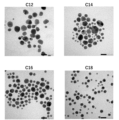
- 4 is a SEM image showing the appearance of gold colloid particles synthesized using surfactants with different alkyl group carbon numbers in the first embodiment.
- 4 is a SEM image showing the appearance of gold powders of Example 1 and Comparative Example produced according to the first embodiment.
- 13 is a SEM image showing the appearance of gold powder produced using the mixed dispersant in Examples 2 and 3 of the second embodiment.
- Au powder was produced as metal powder by a wet reduction method (metal colloid synthesis step and metal powder granulation step).
- metal colloid synthesis step metal colloid synthesis step and metal powder granulation step.
- the content of non-spherical particles was evaluated when surfactants with different carbon numbers were used in the metal powder granulation step.
- alkylamine acetates were used as dispersants in this embodiment: decylamine acetate (alkyl group carbon number: 10), dodecylamine acetate (alkyl group carbon number: 12), tetradecylamine acetate (alkyl group carbon number: 14), hexadecylamine acetate (alkyl group carbon number: 16), and octadecylamine acetate (alkyl group carbon number: 18).
- decylamine acetate alkyl group carbon number: 10
- dodecylamine acetate alkyl group carbon number: 12
- tetradecylamine acetate alkyl group carbon number: 14
- hexadecylamine acetate alkyl group carbon number: 16
- octadecylamine acetate alkyl group carbon number: 18
- the gold colloid particles synthesized using each alkylamine acetate were observed under SEM and the particle size distribution and average particle size (M N ) were measured.
- 5 ⁇ L of the prepared gold colloid particle solution was taken, placed on a grid, and dried, and then observed under a TEM (transmission electron microscope (JEM-1400 manufactured by JEOL Ltd.)) (accelerating voltage 120 V, magnification 150,000 times).
- JEM-1400 manufactured by JEOL Ltd. transmission electron microscope
- magnification 150,000 times accelerating voltage 120 V, magnification 150,000 times.
- the vertical Feret diameter of 200 particles per sample was measured to create a particle size distribution. The median diameter was applied to the average particle size of the gold colloid particles.
- FIG. 1 shows SEM images of gold colloid particles synthesized using each alkylamine acetate (alkyl group carbon number 12, 14, 16, 18).
- the proportion of gold colloid particles having a particle size of 10 nm or less and the average particle size are shown in Table 1.
- alkylamine acetates dodecylamine acetate (alkyl group carbon number: 12) and octadecylamine acetate (alkyl group carbon number: 18).
- dodecylamine acetate alkyl group carbon number: 12
- octadecylamine acetate alkyl group carbon number: 18
- the gold powder was collected by centrifugation, and the particle size distribution and average particle size were measured while performing SEM observation.
- the particle diameter (maximum Feret diameter) of the gold powder particles (400 or more) in the SEM image was measured using image analysis software (software used: MIPAR manufactured by Lightstone Co., Ltd.).
- M N number average particle diameter of the gold powder was calculated.
- the minimum Feret diameter was set as the minor diameter a and the maximum Feret diameter was set as the major diameter b to determine whether the particles were non-spherical, and the presence ratio of non-spherical particles was calculated.
- Second embodiment gold powder was produced using two types of mixed dispersants in both the metal colloid synthesis process and the metal powder granulation process (Examples 2 and 3).
- the dispersants used in this embodiment were decylamine hydrochloride (alkyl group carbon number: 10), dodecylamine acetate (alkyl group carbon number: 12), tetradecylamine acetate (alkyl group carbon number: 14), and hexadecylamine hydrochloride (alkyl group carbon number: 16). It is a mixed dispersant with the following composition.
- the recovered gold powder was observed using an SEM to measure the average particle size, as in the first embodiment, and the proportion of non-spherical particles was calculated. In this embodiment, the proportion of coarse particles was also measured and calculated.
- Figure 3 shows SEM images of the gold powder of Examples 2 and 3 produced in this embodiment. The measurement results of the average particle size, etc. are shown in Table 1. Table 1 also shows the results of the first embodiment (Example 1).
- Table 2 shows that it is possible to produce suitable gold powder free of non-spherical particles even when using a mixed dispersant that is a mixture of surfactants with different ranges of alkyl group carbon numbers.
- a mixed dispersant that is a mixture of surfactants with different ranges of alkyl group carbon numbers.
- the same mixed dispersant is used in both the metal colloid synthesis process and the metal powder granulation process. It is believed that the dispersants with each carbon number in the mixed dispersant work effectively in each process. It was also confirmed that when using a mixed dispersant, it is acceptable to mix in an alkylamine salt with an alkyl group carbon number of 10.
- a gold paste was produced using the gold powder produced in Examples 2 and 3 of the second embodiment.
- the gold paste was produced by mixing menthanol (dihydroterpineol) as an organic solvent with gold powder. The blending ratio of the organic solvent was 10% by weight.
- the gold paste produced was then applied to a substrate and sintered to form bumps, and their shape and resistance value were measured.
- a disk-shaped Al 2 O 3 plate with a diameter of 2 inches was used as the substrate, and the substrate was covered with a metal mask (made of stainless steel) with a thickness of 350 ⁇ m and rectangular holes of 5 mm x 20 mm, and then the gold paste was applied to the entire substrate.
- the gold paste was dropped on the metal mask and spread with a squeegee so that the gold paste was filled inside the holes of the metal mask. After applying the gold paste, the excess paste was wiped off, and the metal mask was removed, followed by heating at 100 ° C for 1 hour to dry, and then heating at 230 ° C for 30 minutes to sinter.
- the gold powder according to the present invention is composed of spherical gold particles with a reduced ratio of non-spherical particles.
- the gold powder according to the present invention has excellent stability and packing properties when applied as a metal paste, in addition to improved appearance when observed under a microscope due to the particle shape and elimination of coarse particles.
- the method for producing gold powder according to the present invention is achieved by optimizing the dispersant used when synthesizing the gold colloid particles that form the core of the gold powder.
- the gold paste according to the present invention has the above characteristics while maintaining low-temperature sintering properties.
- the gold paste according to the present invention is useful in the processes of joining, sealing, electrode and wiring formation in various applications such as electrical and electronic components, semiconductor devices, semiconductor elements, power devices and MEMS.
Landscapes
- Chemical & Material Sciences (AREA)
- Chemical Kinetics & Catalysis (AREA)
- General Chemical & Material Sciences (AREA)
- Engineering & Computer Science (AREA)
- Nanotechnology (AREA)
- Inorganic Chemistry (AREA)
- Manufacture Of Metal Powder And Suspensions Thereof (AREA)
- Powder Metallurgy (AREA)
Abstract
Description
上記のとおり、本発明に係る金属粉末は、高純度(99.9質量%以上)のAu、Ag、Cuの金属又はこれらの合金からなる。金属粉末の構成金属をAu、Ag、Cuとするのは、微細粉末とすることで比較的低温で焼結可能な金属であると共に、いずれも良好な導電性を有する金属だからである。金属粉末は、上記金属の合金からなるものでも良く、Au、Ag、Cuが相互に合金化した合金やAu、Ag、Cuを主成分(80質量%以上)とする合金からなる金属粉末が適用できる。特に好ましいのは、Auである。Auは、比較的軟質で焼結の際の塑性変形で緻密な焼結体を形成でき、導電性に優れることから低抵抗の接合部・バンプ等を形成できる。
上述したように、本発明者等は、従来よりも高品質の金属粉末を見出すという課題に対し、その製造方法である湿式還元法の改良を図っている。湿式還元法による金属粉末の製造方法では、金属のコロイド粒子を核粒子として分散させた溶液に還元剤と金属塩を供給し粒成長させて金属粉末を形成(造粒)している。また、金属コロイド粒子の合成も、基本的に湿式還元法に基づき、原料となる金属塩を溶媒中で還元剤と混合して金属を還元析出させて金属コロイド粒子とする。そして、金属コロイド粒子の合成工程では、金属塩と還元剤と共に分散剤を混合する。分散剤は、還元析出した金属コロイド粒子の表面に結合し、粒子の過剰な凝集による粗大化を抑制する添加剤である。本発明においては、各種金属への結合性等を考慮し、分散剤としてアルキル基を有する界面活性剤(カチオン界面活性剤)を適用する。
そして、使用する界面活性剤のアルキル基の炭素数が大きくなるに従って、金属コロイド粒子の粒子径は小さくなる傾向がある。また、炭素数の増大と共に粒径分布が狭くなり、粒径のばらつきが少ない金属コロイド粒子が生成される。生成する金属コロイド粒子の粒子径が小さいということは、その粒子数は増加することとなる。小粒径の金属コロイド粒子が多数生成することにより、その後の金属粉末造粒工程で金属コロイド粒子が触媒作用を有効に発揮し、均一な粒成長を促して良好な形状の金属粉末を形成すると考えられる。
(ii)一方、金属粉末造粒工程でアルキル基の炭素数が大きい界面活性剤を使用すると、金属粉末の形状に影響を及ぼして非球形粒子の成長が促進される。
これに対して、アルキル基の炭素数が小さい界面活性剤が金属粉末造粒工程で使用されても、金属粉末の粒子形状に及ぼす影響は少ない。
上記のとおり、金属コロイド合成工程は、金属粉末の核となる金属コロイド粒子を湿式還元法に基づき合成する工程である。金属コロイド合成工程では、第1の溶媒中で分散剤の共存下で金属塩と還元剤とを反応させて金属を還元析出する。原料となる金属塩としては、Auについては、塩化金酸塩、亜硫酸金、シアン化金等が挙げられる。また、Agについては、塩化銀、硝酸銀、酢酸銀が、Cuについては、塩化銅、硝酸銅、硫酸銅が挙げられる。また、還元剤としては塩化ヒドロキシルアンモニウム、水素化ホウ素ナトリウム、ジメチルアミンボロン、クエン酸三ナトリウム二水和物等を適用することができる。これらは溶液の形態で混合することができる。第1の溶媒は、金属塩、還元剤、分散剤を溶解できる溶媒であれば制限されるところではない。好ましくは極性溶媒が使用され、具体的には水又はアルコール等の有機溶媒、若しくは水と有機溶媒との混合溶媒が好ましい溶媒である。
金属粉末造粒工程は、上記金属コロイド合成工程で合成した金属コロイド粒子を成長させて金属粉末を生成する工程である。金属粉末造粒工程では、金属コロイド粒子を含む第2の溶媒に、金属塩と還元剤を添加して金属コロイド粒子を成長させて金属粉末を造粒する。この工程で添加する金属塩及び還元剤は、上記した金属コロイド合成工程で使用する金属塩及び還元剤として同じものが使用できる。但し、同じ種類(組成)の金属塩及び還元剤でなくともよい。
上記した通り、本発明に係る金属粉末の製造方法においては、金属コロイド合成工程と金属粉末造粒工程のそれぞれについて、反応液に必須的に含まれる第1、第2の分散剤(界面活性剤)のアルキル基の炭素数を特定する。
上記した金属粉末と分散媒である有機溶剤と混合することで、本発明に係る金属ペーストを形成する。金属ペーストの製造において、金属粉末と有機溶剤との混合は、室温下で行うことができる。また、上記の添加剤を添加する場合には、金属粉末と有機溶剤と同時又は金属粉末と有機溶剤とを混合した後に添加すれば良い。
純水20mLに、分散剤としてアルキルアミン酢酸塩を混合した。この分散剤溶液に、還元剤である塩化ヒドロキシルアンモニウム2mgを加え、80℃で加熱・撹拌して溶解した。そして、この分散剤及び還元剤を含む溶液に塩化金酸水溶液0.45mL(Au量0.32mg(3.6mM))を混合し2時間、80℃を保持して撹拌して金コロイド粒子を合成した。
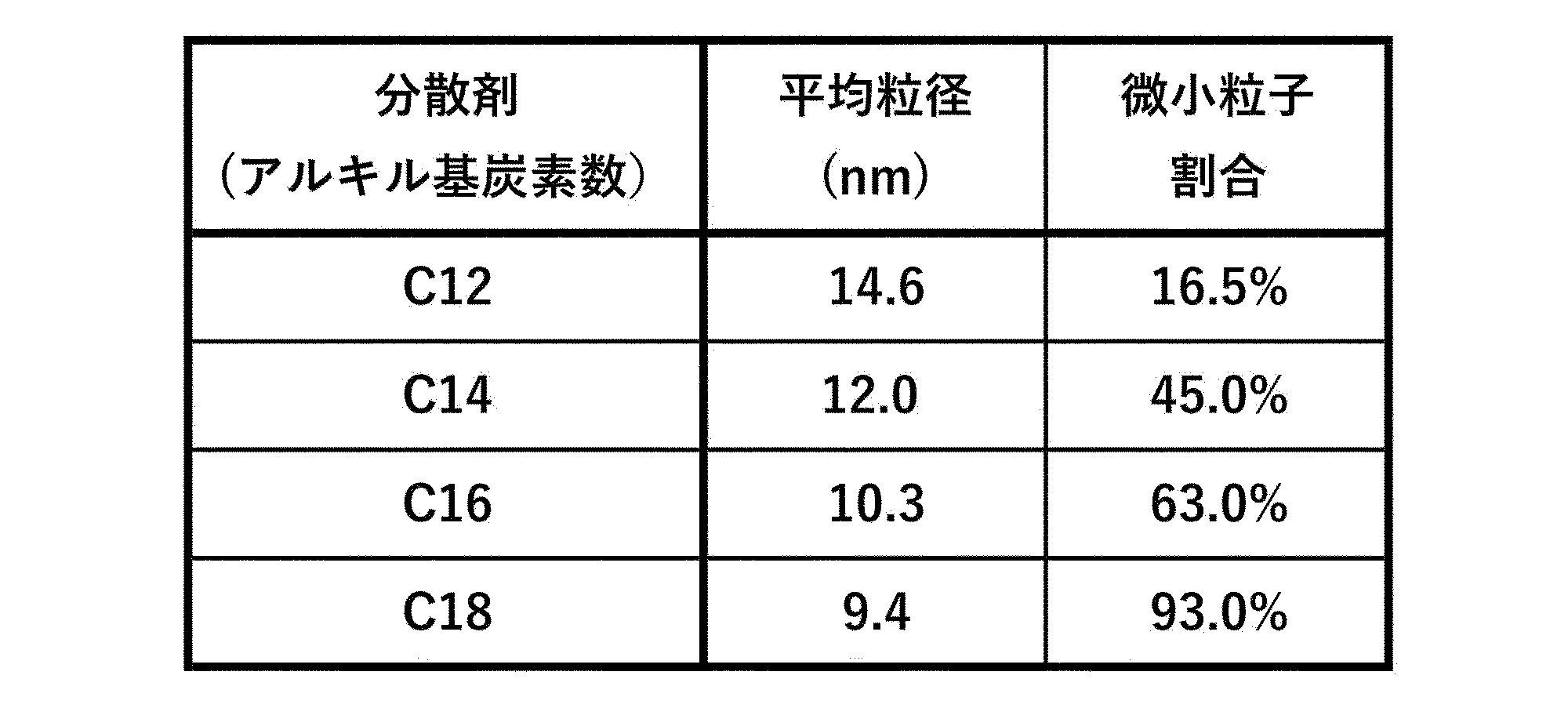
そこで、上記金コロイド合成工程で炭素数18のアルキル基を有する分散剤(オクタデシルアミン酢酸塩)を用いて合成した金コロイド粒子を基にして金粉末の造粒することとした(実施例1)。
還元剤である塩化ヒドロキシルアンモニウム5gを8mLの純水に溶かしてた溶液を添加した。その後、液温が80℃に安定した状態で、造粒用の金塩となる塩化金酸水溶液20mL(Au量2.25g(571mM))を添加し、30分間撹拌して金粉末を製造した。その後、金粉末を回収した。
との混合分散剤であり、以下の構成とした。
・実施例2の混合分散剤
テトラデシルアミン酢酸塩(炭素数14):27質量%
ドデシルアミン酢酸塩(炭素数12):残部
・実施例3の混合分散剤
デシルアミン塩酸塩(アルキル基炭素数10):5質量%
ドデシルアミン酢酸塩(アルキル基炭素数12):60質量%
テトラデシルアミン酢酸塩(アルキル基炭素数14):25質量%
ヘキサデシルアミン塩酸塩(アルキル基炭素数16):10質量%
純水147.2mLに、上述の混合分散剤0.32gを純水12.8mLに溶解させたものを加えた。そして、この分散剤溶液に、還元剤である塩化ヒドロキシルアンモニウム0.016gを5.0mLの純水に溶かしたものを加え、80℃で加熱・撹拌して溶解した。この溶液に塩化金酸の水溶液4.5mL(Au量0.0064g(7.2mM))を混合し1時間、80℃を保持して撹拌した。これにより、赤色透明の金コロイド粒子の溶液を得た。
上記の金コロイド粒子の溶液(反応液)の全量に、分散剤として上記と同じ界面活性剤の混合物2.56gを102.4mLの純水に溶解した溶液を添加し、
還元剤である塩化ヒドロキシルアンモニウム20gを約200mLの純水に溶かして添加した。その後、液温が80℃に安定した状態で、造粒用の金塩である塩化金酸の水溶液100mL(Au量22g(1120mM))を添加し、30分間撹拌して金粉末を製造した。その後、金粉末を回収した。

次に、第2実施形態の実施例2、3で製造し金粉末を使用した金ペーストを製造した。金ペーストは、有機溶剤としてメンタノール(ジヒドロターピネオール)を金粉末に混合して製造した。有機溶剤の配合割合は10重量%とした。そして、作製した金ペーストを基板に塗布し焼結させてバンプを形成し、その形態と抵抗値測定を行った。金ペーストの塗布では、基板として直径2インチの円盤状のAl2O3プレートを使用し、この基板に厚さ350μmで5mm×20mmの矩形の孔を備えるメタルマスク(ステンレス製)を被せた後に基板全面に塗布した。この塗布工程では、メタルマスク上に金ペーストを滴下してスキージで塗り広げ、メタルマスクの孔内部に金ペーストを充填されるようにし。金ペースト塗布後は、余分なペーストを拭き取り、メタルマスクを取り除いた後に100℃で1時間加熱して乾燥させ、その後に230℃で30分加熱して焼結した。
Claims (15)
- 平均粒子径が0.1μm以上0.4μm以下であり、純度99.9質量%以上のAu、Ag、Cuの金属又はこれらの合金からなる金属粉末において、
短径aと長径bとの比(b/a)が3以上である非球形の金属粉末の粒子数基準の存在比率が1%以下であることを特徴とする金属粉末。 - 表面の少なくとも一部に、炭素数14以上18以下のアルキル基を有する界面活性剤が結合してなる請求項1記載の金属粉末。
- 界面活性剤は、アルキルアミン塩、第四級アンモニウム塩である請求項2記載の金属粉末。
- 請求項1~請求項3のいずれかに記載の金属粉末と有機溶剤とからなる金属ペースト。
- 第1の分散剤を含む第1の溶媒中で、金属塩と還元剤とを反応させることで金属コロイド粒子を合成する金属コロイド合成工程と、
前記金属コロイド合成工程で合成した前記金属コロイド粒子を含む第2の溶媒に、金属塩と還元剤と任意の第2の分散剤を添加し、前記金属コロイド粒子を金属粉末とする金属粉末造粒工程と、を含む金属粉末の製造方法であって、
前記金属コロイド合成工程の第1の溶媒は、前記第1の分散剤として、少なくとも炭素数14以上18以下のアルキル基を有する界面活性剤を含み、
前記金属粉末造粒工程の第2の溶媒は、前記第2の分散剤として炭素数12以上14未満のアルキル基を有する界面活性剤を含む、金属粉末の製造方法。 - 金属粉末造粒工程の第2の溶媒は、金属コロイド合成工程で生成した反応液の一部又は全部を含むものである請求項5記載の金属粉末の製造方法。
- 金属コロイド合成工程で、炭素数14以上18以下のアルキル基を有する界面活性剤を第1の分散剤として第1の溶媒に混合し、
金属粉末造粒工程で、炭素数12以上14未満のアルキル基を有する界面活性剤を第2の分散剤として第2の溶媒に添加する請求項5又は請求項6記載の金属粉末の製造方法。 - 金属コロイド合成工程で、炭素数12以上14未満のアルキル基を有する界面活性剤と炭素数14以上18以下のアルキル基を有する界面活性剤とを含む混合分散剤を第1の分散剤として第1の溶媒に混合する請求項5又は請求項6記載の金属粉末の製造方法。
- 金属粉末造粒工程で、炭素数12以上14未満のアルキル基を有する界面活性剤と炭素数14以上18以下のアルキル基を有する界面活性剤とを含む混合分散剤を第2の分散剤として第2の溶媒に混合する請求項8記載の金属粉末の製造方法。
- 混合分散剤は、
炭素数12以上14未満のアルキル基を有する界面活性剤を質量%で50%以上80%以下含み、
炭素数14以上18以下のアルキル基を有する界面活性剤を質量%で20%以上50%以下含み、
残部が炭素数10以上12未満のアルキル基を有する界面活性剤である請求項8記載の金属粉末の製造方法。 - 混合分散剤は、
炭素数12以上14未満のアルキル基を有する界面活性剤を質量%で50%以上80%以下含み、
炭素数14以上18以下のアルキル基を有する界面活性剤を質量%で20%以上50%以下含み、
残部が炭素数10以上12未満のアルキル基を有する界面活性剤である請求項9記載の金属粉末の製造方法。 - 界面活性剤は、アルキルアミン塩、第四級アンモニウム塩である請求項5又は請求項6記載の金属粉末の製造方法。
- 界面活性剤は、アルキルアミン塩、第四級アンモニウム塩である請求項7記載の金属粉末の製造方法。
- 界面活性剤は、アルキルアミン塩、第四級アンモニウム塩である請求項8記載の金属粉末の製造方法。
- 界面活性剤は、アルキルアミン塩、第四級アンモニウム塩である請求項9記載の金属粉末の製造方法。
Priority Applications (3)
| Application Number | Priority Date | Filing Date | Title |
|---|---|---|---|
| CN202380075345.0A CN120129577A (zh) | 2022-10-31 | 2023-10-24 | 金属粉末和该金属粉末的制造方法以及金属糊 |
| KR1020257017439A KR20250107192A (ko) | 2022-10-31 | 2023-10-24 | 금속 분말, 금속 분말의 제조 방법, 및 금속 페이스트 |
| EP23885581.1A EP4613402A4 (en) | 2022-10-31 | 2023-10-24 | METAL POWDER, PROCESS FOR PRODUCING SAID METAL POWDER AND METAL PASTE |
Applications Claiming Priority (2)
| Application Number | Priority Date | Filing Date | Title |
|---|---|---|---|
| JP2022-173878 | 2022-10-31 | ||
| JP2022173878A JP7412714B1 (ja) | 2022-10-31 | 2022-10-31 | 金属粉末及び該金属粉末の製造方法並びに金属ペースト |
Publications (1)
| Publication Number | Publication Date |
|---|---|
| WO2024095821A1 true WO2024095821A1 (ja) | 2024-05-10 |
Family
ID=89534222
Family Applications (1)
| Application Number | Title | Priority Date | Filing Date |
|---|---|---|---|
| PCT/JP2023/038294 Ceased WO2024095821A1 (ja) | 2022-10-31 | 2023-10-24 | 金属粉末及び該金属粉末の製造方法並びに金属ペースト |
Country Status (5)
| Country | Link |
|---|---|
| EP (1) | EP4613402A4 (ja) |
| JP (1) | JP7412714B1 (ja) |
| KR (1) | KR20250107192A (ja) |
| CN (1) | CN120129577A (ja) |
| WO (1) | WO2024095821A1 (ja) |
Families Citing this family (2)
| Publication number | Priority date | Publication date | Assignee | Title |
|---|---|---|---|---|
| JP7308344B1 (ja) * | 2022-11-28 | 2023-07-13 | 田中貴金属工業株式会社 | 金ペースト及び金ペーストの製造方法 |
| JP7615195B2 (ja) * | 2023-03-03 | 2025-01-16 | 山陽特殊製鋼株式会社 | 積層造形用金属粉末 |
Citations (9)
| Publication number | Priority date | Publication date | Assignee | Title |
|---|---|---|---|---|
| JPH0920903A (ja) | 1995-06-30 | 1997-01-21 | Tanaka Kikinzoku Internatl Kk | 単分散球状金粒子粉末の製造方法 |
| JP2006152344A (ja) * | 2004-11-26 | 2006-06-15 | Catalysts & Chem Ind Co Ltd | 金属微粒子および金属微粒子の製造方法 |
| JP2006265585A (ja) * | 2005-03-22 | 2006-10-05 | Dowa Mining Co Ltd | 銅粉の製造法および銅粉 |
| JP2011117021A (ja) * | 2009-12-01 | 2011-06-16 | Harima Chemicals Inc | 金属粉末の製造方法と、該方法により製造される金属粉末 |
| WO2012046641A1 (ja) * | 2010-10-08 | 2012-04-12 | 田中貴金属工業株式会社 | 半導体素子接合用の貴金属ペースト |
| WO2012063747A1 (ja) * | 2010-11-08 | 2012-05-18 | ナミックス株式会社 | 金属粒子及びその製造方法 |
| JP2013206765A (ja) | 2012-03-29 | 2013-10-07 | Tanaka Kikinzoku Kogyo Kk | ダイボンド用導電性ペースト及び該導電性ペーストによるダイボンド方法 |
| JP2015206087A (ja) * | 2014-04-22 | 2015-11-19 | 住友金属鉱山株式会社 | 銀粉及びその製造方法 |
| JP2021025091A (ja) | 2019-08-05 | 2021-02-22 | 田中貴金属工業株式会社 | 金粉末及び該金粉末の製造方法並びに金ペースト |
Family Cites Families (3)
| Publication number | Priority date | Publication date | Assignee | Title |
|---|---|---|---|---|
| CN102675963B (zh) * | 2011-10-25 | 2014-07-09 | 无锡尚宝生物科技有限公司 | 一种纳米颗粒导电墨水的连续制备方法 |
| US20170306172A1 (en) * | 2014-10-02 | 2017-10-26 | Daicel Corporation | Silver particle coating composition |
| JP6996193B2 (ja) * | 2017-09-27 | 2022-01-17 | 昭和電工マテリアルズ株式会社 | 積層体の製造方法 |
-
2022
- 2022-10-31 JP JP2022173878A patent/JP7412714B1/ja active Active
-
2023
- 2023-10-24 WO PCT/JP2023/038294 patent/WO2024095821A1/ja not_active Ceased
- 2023-10-24 EP EP23885581.1A patent/EP4613402A4/en active Pending
- 2023-10-24 CN CN202380075345.0A patent/CN120129577A/zh active Pending
- 2023-10-24 KR KR1020257017439A patent/KR20250107192A/ko active Pending
Patent Citations (10)
| Publication number | Priority date | Publication date | Assignee | Title |
|---|---|---|---|---|
| JPH0920903A (ja) | 1995-06-30 | 1997-01-21 | Tanaka Kikinzoku Internatl Kk | 単分散球状金粒子粉末の製造方法 |
| JP2006152344A (ja) * | 2004-11-26 | 2006-06-15 | Catalysts & Chem Ind Co Ltd | 金属微粒子および金属微粒子の製造方法 |
| JP2006265585A (ja) * | 2005-03-22 | 2006-10-05 | Dowa Mining Co Ltd | 銅粉の製造法および銅粉 |
| JP2011117021A (ja) * | 2009-12-01 | 2011-06-16 | Harima Chemicals Inc | 金属粉末の製造方法と、該方法により製造される金属粉末 |
| WO2012046641A1 (ja) * | 2010-10-08 | 2012-04-12 | 田中貴金属工業株式会社 | 半導体素子接合用の貴金属ペースト |
| JP5613253B2 (ja) | 2010-10-08 | 2014-10-22 | 田中貴金属工業株式会社 | 半導体素子接合用の貴金属ペースト |
| WO2012063747A1 (ja) * | 2010-11-08 | 2012-05-18 | ナミックス株式会社 | 金属粒子及びその製造方法 |
| JP2013206765A (ja) | 2012-03-29 | 2013-10-07 | Tanaka Kikinzoku Kogyo Kk | ダイボンド用導電性ペースト及び該導電性ペーストによるダイボンド方法 |
| JP2015206087A (ja) * | 2014-04-22 | 2015-11-19 | 住友金属鉱山株式会社 | 銀粉及びその製造方法 |
| JP2021025091A (ja) | 2019-08-05 | 2021-02-22 | 田中貴金属工業株式会社 | 金粉末及び該金粉末の製造方法並びに金ペースト |
Non-Patent Citations (1)
| Title |
|---|
| See also references of EP4613402A4 |
Also Published As
| Publication number | Publication date |
|---|---|
| CN120129577A (zh) | 2025-06-10 |
| KR20250107192A (ko) | 2025-07-11 |
| EP4613402A1 (en) | 2025-09-10 |
| JP2024065141A (ja) | 2024-05-15 |
| JP7412714B1 (ja) | 2024-01-15 |
| EP4613402A4 (en) | 2026-01-21 |
Similar Documents
| Publication | Publication Date | Title |
|---|---|---|
| JP4870223B1 (ja) | ペースト状銀粒子組成物、金属製部材接合体の製造方法および金属製部材接合体 | |
| JP6266137B2 (ja) | 金属微粒子含有組成物 | |
| JP5416153B2 (ja) | 導電性ペースト、及びその製造方法、並びに導電接続部材 | |
| JP7412714B1 (ja) | 金属粉末及び該金属粉末の製造方法並びに金属ペースト | |
| KR20080100365A (ko) | 미립 은 입자 제조 방법 및 그 제조 방법으로 얻어진 미립 은 입자 | |
| WO2024095820A1 (ja) | 金粉末及び金粉末の製造方法並びに金ペースト | |
| WO2014080662A1 (ja) | 銅粉及びその製造方法 | |
| JP4662760B2 (ja) | 超微粒銅粉、超微粒銅粉スラリー及び超微粒銅粉スラリーの製造方法 | |
| JP2009252507A (ja) | 微小銀粒子を含有する導電性ペースト及び硬化膜 | |
| JP7480947B2 (ja) | 広分布な粒度分布を持つ銀ナノ粒子の製造方法及び銀ナノ粒子 | |
| Jia et al. | Supersaturated Ag-Cu nanoalloy film for high reliability power electronic packaging | |
| JP5213592B2 (ja) | 銅微粉およびその分散液並びに銅微粉製造法 | |
| WO2016088554A1 (ja) | 接合用金属酸化物粒子、これを含む焼結接合剤、接合用金属酸化物粒子の製造方法、及び電子部品の接合方法 | |
| JP4756652B2 (ja) | ドロップ状銅粉、ドロップ状銅粉の製造方法および導電性ペースト | |
| JP2005281781A (ja) | 銅ナノ粒子の製造方法 | |
| JP6923063B2 (ja) | 銀ペースト及びその製造方法並びに接合体の製造方法 | |
| JP2006265585A (ja) | 銅粉の製造法および銅粉 | |
| CN106607585A (zh) | 金属复合粉末及其生产方法 | |
| WO2021125161A1 (ja) | 銀ペースト及びその製造方法並びに接合体の製造方法 | |
| JP6947280B2 (ja) | 銀ペースト及びその製造方法並びに接合体の製造方法 | |
| CN114845827B (zh) | 银膏及其制造方法以及接合体的制造方法 | |
| KR20190064605A (ko) | 접합재 및 그것을 사용한 접합 방법 | |
| TW202113876A (zh) | 接合性導體膠 | |
| JP2019206760A (ja) | 金属複合粉末およびその製造方法 | |
| JP6626572B2 (ja) | 金属接合材料及びその製造方法、並びにそれを使用した金属接合体の製造方法 |
Legal Events
| Date | Code | Title | Description |
|---|---|---|---|
| 121 | Ep: the epo has been informed by wipo that ep was designated in this application |
Ref document number: 23885581 Country of ref document: EP Kind code of ref document: A1 |
|
| WWE | Wipo information: entry into national phase |
Ref document number: 202380075345.0 Country of ref document: CN |
|
| WWE | Wipo information: entry into national phase |
Ref document number: 2023885581 Country of ref document: EP |
|
| NENP | Non-entry into the national phase |
Ref country code: DE |
|
| ENP | Entry into the national phase |
Ref document number: 2023885581 Country of ref document: EP Effective date: 20250602 |
|
| WWP | Wipo information: published in national office |
Ref document number: 202380075345.0 Country of ref document: CN |
|
| WWP | Wipo information: published in national office |
Ref document number: 1020257017439 Country of ref document: KR |
|
| WWP | Wipo information: published in national office |
Ref document number: 2023885581 Country of ref document: EP |