WO2024111284A1 - 非水電解質および二次電池 - Google Patents
非水電解質および二次電池 Download PDFInfo
- Publication number
- WO2024111284A1 WO2024111284A1 PCT/JP2023/037444 JP2023037444W WO2024111284A1 WO 2024111284 A1 WO2024111284 A1 WO 2024111284A1 JP 2023037444 W JP2023037444 W JP 2023037444W WO 2024111284 A1 WO2024111284 A1 WO 2024111284A1
- Authority
- WO
- WIPO (PCT)
- Prior art keywords
- group
- sulfur
- secondary battery
- compound
- nonaqueous electrolyte
- Prior art date
- Legal status (The legal status is an assumption and is not a legal conclusion. Google has not performed a legal analysis and makes no representation as to the accuracy of the status listed.)
- Ceased
Links
Images

Classifications
-
- H—ELECTRICITY
- H01—ELECTRIC ELEMENTS
- H01M—PROCESSES OR MEANS, e.g. BATTERIES, FOR THE DIRECT CONVERSION OF CHEMICAL ENERGY INTO ELECTRICAL ENERGY
- H01M10/00—Secondary cells; Manufacture thereof
- H01M10/05—Accumulators with non-aqueous electrolyte
- H01M10/056—Accumulators with non-aqueous electrolyte characterised by the materials used as electrolytes, e.g. mixed inorganic/organic electrolytes
- H01M10/0564—Accumulators with non-aqueous electrolyte characterised by the materials used as electrolytes, e.g. mixed inorganic/organic electrolytes the electrolyte being constituted of organic materials only
- H01M10/0566—Liquid materials
- H01M10/0567—Liquid materials characterised by the additives
-
- H—ELECTRICITY
- H01—ELECTRIC ELEMENTS
- H01M—PROCESSES OR MEANS, e.g. BATTERIES, FOR THE DIRECT CONVERSION OF CHEMICAL ENERGY INTO ELECTRICAL ENERGY
- H01M10/00—Secondary cells; Manufacture thereof
- H01M10/05—Accumulators with non-aqueous electrolyte
- H01M10/052—Li-accumulators
-
- H—ELECTRICITY
- H01—ELECTRIC ELEMENTS
- H01M—PROCESSES OR MEANS, e.g. BATTERIES, FOR THE DIRECT CONVERSION OF CHEMICAL ENERGY INTO ELECTRICAL ENERGY
- H01M2300/00—Electrolytes
- H01M2300/0017—Non-aqueous electrolytes
- H01M2300/0025—Organic electrolyte
-
- Y—GENERAL TAGGING OF NEW TECHNOLOGICAL DEVELOPMENTS; GENERAL TAGGING OF CROSS-SECTIONAL TECHNOLOGIES SPANNING OVER SEVERAL SECTIONS OF THE IPC; TECHNICAL SUBJECTS COVERED BY FORMER USPC CROSS-REFERENCE ART COLLECTIONS [XRACs] AND DIGESTS
- Y02—TECHNOLOGIES OR APPLICATIONS FOR MITIGATION OR ADAPTATION AGAINST CLIMATE CHANGE
- Y02E—REDUCTION OF GREENHOUSE GAS [GHG] EMISSIONS, RELATED TO ENERGY GENERATION, TRANSMISSION OR DISTRIBUTION
- Y02E60/00—Enabling technologies; Technologies with a potential or indirect contribution to GHG emissions mitigation
- Y02E60/10—Energy storage using batteries
Definitions
- This disclosure relates to non-aqueous electrolytes and secondary batteries.
- Patent Document 1 proposes "an electrolyte characterized by containing an electrolyte solution containing at least one member selected from the group consisting of paraldehyde and its derivatives.”
- Paraldehyde forms a coating on the surface of the negative electrode inside the secondary battery. This coating suppresses the decomposition reaction of the electrolyte at the negative electrode, improving the high-temperature storage characteristics of the secondary battery. However, the effect of paraldehyde in improving the high-temperature cycle characteristics of the secondary battery and reducing the initial resistance is insufficient.
- One aspect of the present disclosure includes a non-aqueous solvent, a salt that dissolves in the non-aqueous solvent, and an additive that dissolves in the non-aqueous solvent, the additive including a heterocyclic compound and a sulfur-containing compound, and the heterocyclic compound is represented by the general formula (1):
- the present invention relates to a non-aqueous electrolyte for a secondary battery, in which X1 to X3 are each independently an oxygen atom or a sulfur atom, and R1 to R3 are each independently an alkyl group having 1 to 5 carbon atoms in which at least one hydrogen atom may be substituted with a halogen atom.
- Another aspect of the present disclosure relates to a secondary battery comprising a positive electrode, a separator, a negative electrode facing the positive electrode via the separator, and a non-aqueous electrolyte, the non-aqueous electrolyte being the non-aqueous electrolyte for secondary batteries described above.
- This disclosure makes it possible to reduce the initial resistance of a secondary battery and improve its high-temperature cycle characteristics.
- FIG. 1 is a vertical cross-sectional view of a secondary battery according to an embodiment of the present disclosure.
- any of the exemplified lower limits and any of the exemplified upper limits can be arbitrarily combined as long as the lower limit is not equal to or greater than the upper limit.
- one of them may be selected and used alone, or two or more may be used in combination.
- Non-aqueous electrolyte secondary batteries include lithium ion secondary batteries that use a material that reversibly absorbs and releases at least lithium ions as the negative electrode active material, lithium secondary batteries in which lithium metal precipitates at the negative electrode during charging and dissolves during discharging, and solid-state batteries that contain a gel electrolyte.
- the nonaqueous electrolyte secondary battery according to the present disclosure comprises a positive electrode, a negative electrode, and a nonaqueous electrolyte.
- a separator is usually disposed between the positive electrode and the negative electrode.
- the nonaqueous electrolyte usually has lithium ion conductivity.
- the "resistance” in the resistance increase of a secondary battery can be evaluated by the direct current resistance (DCR) of a secondary battery in an initial state after shipment (unused or after less than 10 charge/discharge cycles) in an environment of 25°C.
- the "high temperature cycle characteristics” can be evaluated by the capacity retention rate when the secondary battery is subjected to constant current constant voltage charging (CCCV charging) for a specified number of cycles in an environment of 45°C.
- the "amount of stored gas” can be evaluated by the amount of gas recovered from the battery after storing a charged battery at 80°C for three days.
- the non-aqueous electrolyte includes a non-aqueous solvent, a salt, and an additive.
- the non-aqueous electrolyte including a non-aqueous solvent is usually a liquid electrolyte, but may be in a state in which the fluidity is restricted by a gelling agent or the like.
- a lithium salt is used as the salt.
- the salt and the additive are basically dissolved in the non-aqueous solvent, but as long as the effect of the invention is not significantly impaired, a part of the salt or the additive may not dissolve and may precipitate or separate.
- the additive defined by the general formula described below may be a salt. In that case, another salt is dissolved in the non-aqueous solvent as a supporting electrolyte.
- the non-aqueous electrolyte recovered from the secondary battery It is not necessary for the non-aqueous electrolyte recovered from the secondary battery to contain almost no additives. In this case, the oxidation or reduction products of the additives are contained as coating components on the positive or negative electrode surface. Even in such cases, the additives usually remain in the non-aqueous electrolyte collected from the secondary battery at levels above the detection limit, so it is possible to confirm that the non-aqueous electrolyte contains the additives.
- heterocyclic compounds and sulfur-containing compounds are classified as additives.
- Heterocyclic compounds The heterocyclic compound is represented by the general formula (1):
- X1 to X3 are each independently an oxygen atom or a sulfur atom.
- R1 to R3 are each independently an alkyl group having 1 to 5 carbon atoms in which at least one hydrogen atom may be substituted with a halogen atom.
- the halogen atom may be a fluorine atom, a chlorine atom, or a bromine atom, with a fluorine atom being preferred.
- heterocyclic compound (1) The heterocyclic compound represented by the general formula (1) (hereinafter also referred to as “heterocyclic compound (1)”) is unique among compounds having similar structures, and the resistance of the secondary battery is unlikely to increase, and the resistance can be reduced.
- the heterocyclic compound (1) can improve the high-temperature cycle characteristics of the secondary battery.
- the resistance of the secondary battery remains high, and the effect of improving the high-temperature cycle characteristics is insufficient.
- the resistance of the secondary battery can be significantly reduced.
- the heterocyclic compound (1) is used in combination with a sulfur-containing compound, the high-temperature cycle characteristics of the secondary battery are significantly improved.
- the reason for this synergistic effect is believed to be that when the heterocyclic compound (1) is used in combination with a sulfur-containing compound, a strong hybrid coating is formed as a protective coating on both the positive and negative electrodes.
- the hybrid coating highly suppresses side reactions at high temperatures, reducing gas generation and improving high-temperature cycle characteristics while reducing the charge transfer resistance of the positive and negative electrodes.
- the coating components derived from the heterocyclic compound (1) and sulfur-containing compound that constitute the hybrid coating are presumed to have the effect of suppressing deterioration of the positive electrode active material, for example by interacting with the transition metal elements that constitute the positive electrode active material contained in the positive electrode.
- the positive electrode active material contains a lithium-containing composite oxide that contains a high content of Ni, the effect of suppressing deterioration is remarkable.
- the coating components derived from the heterocyclic compound (1) and sulfur-containing compound that constitute the hybrid coating have the effect of suppressing deterioration of the negative electrode active material by interacting with the elements that constitute the negative electrode active material contained in the negative electrode.
- the effect of suppressing deterioration is particularly remarkable when the negative electrode active material contains a silicon-containing material.
- R1 to R3 preferably have small steric hindrance, and may be, for example, a methyl group, an ethyl group, an ethylene group, a propyl group, or a propylene group. Typically, R1 to R3 are the same group, and may be a methyl group, an ethyl group, an n-propyl group, or an iso-propyl group.
- One or more hydrogen atoms of the alkyl group may be substituted with a halogen atom.
- the halogen atom is preferably a fluorine atom.
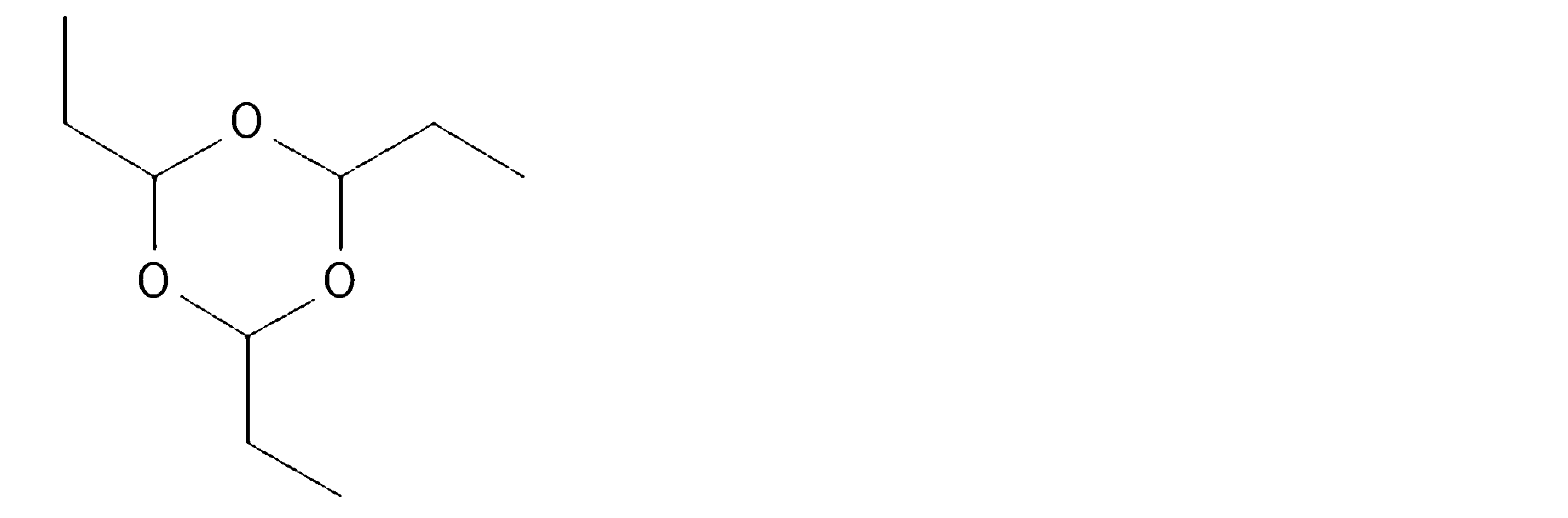
- the heterocyclic compound (1) may be at least one selected from the group consisting of paraldehyde, trithioacetaldehyde, 2,4,6-triethyl-1,3,5-trioxane, 2,4,6-tripropyl-1,3,5-trioxane, and 2,4,6-tris(propan-2-yl)-1,3,5-trioxane (hereinafter also referred to as "triheterocyclic compound (TH)").
- paraldehyde trithioacetaldehyde
- 2,4,6-triethyl-1,3,5-trioxane 2,4,6-tripropyl-1,3,5-trioxane
- 2,4,6-tris(propan-2-yl)-1,3,5-trioxane hereinafter also referred to as "triheterocyclic compound (TH)"
- Paraldehyde is represented by the following formula:
- Trithioacetaldehyde is represented by the following formula:
- the content of the heterocyclic compound (1) in the non-aqueous electrolyte is, for example, 3% by mass or less, and may be 0.01% to 3% by mass, 0.1% to 2.5% by mass, or 0.5% to 2% by mass.
- a hybrid film is formed appropriately, and the charge/discharge reaction is likely to proceed uniformly, which is thought to enhance the effect of suppressing side reactions.
- the heterocyclic compound (1) is consumed to form the film. Therefore, it is sufficient that the non-aqueous electrolyte collected from the secondary battery contains the heterocyclic compound (1) at a concentration equal to or higher than the detection limit.
- the sulfur-containing compound may contain, for example, a hexavalent or tetravalent sulfur atom. That is, the sulfur-containing compound may contain at least one selected from the group consisting of a hexavalent sulfur compound and a tetravalent sulfur compound.
- Hexavalent sulfur compounds are, for example, represented by the general formula (2):
- n 0 or 1.
- R4 may be a fluorine atom, a hydrocarbon group, an imido group, or a silyl group.
- R4 may be a hydrocarbon group, a silyl group, or an alkali metal.
- R5 may be a fluorine atom, a hydrocarbon group, an imido group, or a silyl group.
- R4 and R5 may form a ring. That is, the hexavalent sulfur compound may be a cyclic sulfur compound.
- the sulfur compound (2) may contain two hexavalent sulfurs. In that case, R5 may be an imido group shared by two sulfur atoms, an alkylene group, or an ether group.
- Tetravalent sulfur compounds are, for example, represented by the general formula (3):
- sulfur compound (3) the tetravalent sulfur compound represented by general formula (3) is also referred to as "sulfur compound (3)".
- R6 and R7 may each independently be a hydrocarbon group, a silyl group, or an alkali metal.
- R6 and R7 may be an alkyl group, an alkenyl group, or an aryl group.
- R6 and R7 may be an alkylene group, an alkenylene group, an ether group, or the like, forming a ring.
- the tetravalent sulfur compound may be a cyclic sulfur compound.
- the sulfur compound (3) may contain two tetravalent sulfur atoms. In that case, R6 and R7 may be an alkylene group or an ether group shared by two sulfur atoms.
- R4 to R7 are aliphatic hydrocarbon groups, it is preferable that the steric hindrance is small, and for example, C1-5 hydrocarbon groups having 1 to 5 carbon atoms may be used.
- R4 to R7 are aromatic hydrocarbon groups (aryl groups)
- the number of aromatic rings may be one.
- R4 and R5 or R6 and R7 form a ring, the ring may be a 5-membered ring, a 6-membered ring, or a 7-membered ring.
- R4, R6, and R7 are alkali metals
- the alkali metal may be Li, K, Na, or the like.
- R4 to R7 form a ring, R4 and R5 or R6 and R7 are united to form, for example, an alkylene group, an alkenylene group, an ether group, or the like.
- X1 is a fluorine atom, a hydrocarbon group, an imide group, or a silyl group
- X2 is a hydrocarbon group, a silyl group, or an alkali metal.
- at least one hydrogen atom of the hydrocarbon group may be substituted with a halogen atom.
- X1 in the sulfur compound (4) is a fluorine atom
- X2 is preferably an alkyl group, an alkenyl group, an aryl group, a silyl group, or an alkali metal.
- X1 is a hydrocarbon group
- X1 and X2 may form a ring as an alkylene group, an alkenylene group, an ether group, or the like.
- the sulfur compound (4) may contain two hexavalent sulfurs. In that case, X1 may be an ether group shared by two sulfur atoms, and X2 may be an alkylene group shared by two sulfur atoms.
- the sulfate ester is preferably a C2-4 alkyl sulfate, specifically, ethylene sulfate, propylene sulfate, trimethylene sulfate, butylene sulfate, vinylene sulfate, ethyl sulfate, methyl sulfate, etc.
- the sulfite is preferably a C2-4 alkylene sulfite, specifically, ethylene sulfite (ES), propylene sulfite, trimethylene sulfite, butylene sulfite, vinylene sulfite, etc.
- ES ethylene sulfite
- propylene sulfite propylene sulfite
- trimethylene sulfite trimethylene sulfite
- butylene sulfite vinylene sulfite, etc.
- the sulfonic acid ester is preferably at least one selected from the group consisting of C 3-5 alkane sultone and C 3-5 alkene sultone, specifically 1,3-propane sultone, 1,4-butane sultone, 1,3-propene sultone, etc.
- the sulfur-containing compound may have one or more hydrogen atoms of the compounds exemplified above substituted with a substituent.
- substituents include an alkyl group, a hydroxyalkyl group, a hydroxy group, an alkoxy group, and a halogen atom.
- the number of carbon atoms in the substituent may be 1 to 3.
- the halogen atom is preferably a fluorine atom.
- At least one selected from the group consisting of lithium fluorosulfonate (LiFSO 3 ), 1-propene-1,3-sultone (PRS), ethylene sulfate (DTD), lithium bisfluorosulfonylimide (LiFSI) and 1,5,2,4-dioxadithiane-2,2,4,4-tetraoxide (MMDS) is particularly desirable because it is easily available and has a large effect of reducing resistance while improving high-temperature cycle characteristics.
- At least one selected from the group consisting of ethylene sulfite (ES) and vinyl ethylene sulfite (VES) is particularly desirable because it is easy to obtain and has a significant effect of reducing resistance while improving high-temperature cycle characteristics.
- the content of the sulfur-containing compound in the non-aqueous electrolyte is, for example, 5% by mass or less, and may be 0.01% to 5% by mass, 0.01% to 2.5% by mass, 0.1% to 2.0% by mass, or 0.5% to 1.5% by mass.
- the viscosity of the non-aqueous electrolyte does not increase excessively, a hybrid film is appropriately formed, and the charge/discharge reaction is likely to proceed uniformly, which is thought to enhance the effect of suppressing side reactions.
- the sulfur-containing compound is consumed to form the film. Therefore, it is sufficient that the non-aqueous electrolyte collected from the secondary battery contains the sulfur-containing compound at a concentration equal to or higher than the detection limit.
- the non-aqueous electrolyte may contain additives other than those mentioned above.
- additives include at least one selected from the group consisting of vinylene carbonate, fluoroethylene carbonate, and vinylethylene carbonate.
- Non-aqueous solvent examples include cyclic carbonates, chain carbonates, cyclic carboxylates, chain carboxylates, cyclic ethers, chain ethers, etc.
- the non-aqueous electrolyte may contain one type of non-aqueous solvent or a combination of two or more types.
- Cyclic carbonates include propylene carbonate (PC), ethylene carbonate (EC), fluoroethylene carbonate (FEC), vinylene carbonate (VC), etc.
- chain carbonate esters examples include diethyl carbonate (DEC), ethyl methyl carbonate (EMC), dimethyl carbonate (DMC), etc.
- Cyclic carboxylate esters include gamma-butyrolactone (GBL) and gamma-valerolactone (GVL).
- chain carboxylic acid esters examples include methyl formate, ethyl formate, propyl formate, methyl acetate (MA), ethyl acetate, propyl acetate, methyl propionate, ethyl propionate, and propyl propionate.
- Cyclic ethers include 1,3-dioxolane, 4-methyl-1,3-dioxolane, tetrahydrofuran, and 2-methyltetrahydrofuran.
- chain ethers examples include 1,2-dimethoxyethane, diethyl ether, ethyl vinyl ether, methyl phenyl ether, benzyl ethyl ether, diphenyl ether, dibenzyl ether, 1,2-diethoxyethane, diethylene glycol dimethyl ether, 1,1,2,2-tetrafluoroethyl-2,2,2-trifluoroethyl ether, and 1,1,2,2-tetrafluoroethyl-2,2,3,3-tetrafluoropropyl ether.
- lithium salts are used as salts.
- LiClO4 , LiBF4 , LiPF6 , LiAlCl4, LiSbF6 , LiSCN, LiCF3SO3 , LiCF3CO2 , LiAsF6 , LiB10Cl10 , lower aliphatic lithium carboxylate, LiCl, LiBr, LiI, phosphates, borates , and imide salts can be mentioned.
- phosphates include lithium difluorophosphate ( LiPO2F2 ), lithium difluorobis(oxalato)phosphate ( LiDFBOP ), and lithium tetrafluoro(oxalato)phosphate.
- borates include lithium bis(oxalato)borate (LiBOB), and lithium difluoro(oxalato)borate (LiDFOB).
- imide salts examples include lithium bisfluorosulfonylimide (LiN( FSO2 ) 2 ), lithium bistrifluoromethanesulfonyl imide (LiN( CF3SO2 ) 2 ), lithium trifluoromethanesulfonyl nonafluorobutanesulfonyl imide (LiN( CF3SO2 )( C4F9SO2 )), lithium bispentafluoroethanesulfonyl imide (LiN(C2F5SO2 ) 2 ) , etc.
- the nonaqueous electrolyte may contain one type of lithium salt or a combination of two or more types.
- the concentration of the lithium salt in the non-aqueous electrolyte is, for example, 0.5 mol/L or more and 2 mol/L or less.
- each component in the non-aqueous electrolyte is determined, for example, by gas chromatography under the following conditions.
- Measuring device Shimadzu GC-2010 Plus Column: J&W HP-1 (1 ⁇ m x 60 m) Linear velocity: 30.0 cm/sec Inlet temperature: 270°C Detector: FID 290°C (sens. 10 1 )
- the positive electrode includes a positive electrode current collector and a positive electrode mixture layer provided on the surface of the positive electrode current collector.
- the positive electrode current collector is made of a sheet-like conductive material.
- the positive electrode mixture layer is supported on one or both surfaces of the positive electrode current collector.
- the positive electrode mixture layer is usually a layer or film made of a positive electrode mixture.
- the thickness of the positive electrode mixture layer is, for example, 10 ⁇ m to 150 ⁇ m per side of the positive electrode current collector.
- the positive electrode mixture contains a positive electrode active material as an essential component.
- the positive electrode mixture layer may contain a conductive agent as an optional component.
- conductive agents include carbon-based materials such as carbon black (CB), acetylene black (AB), ketjen black, carbon nanotubes (CNT), graphene, and graphite. These may be used alone or in combination of two or more types.
- the positive electrode mixture layer may contain a binder.
- binders include fluorine-based resins such as polytetrafluoroethylene (PTFE) and polyvinylidene fluoride (PVDF), polyacrylonitrile (PAN), polyimide-based resins, acrylic-based resins, and polyolefin-based resins. These may be used alone or in combination of two or more types.
- a non-porous conductive substrate such as metal foil
- a porous conductive substrate such as a mesh, net, or punched sheet
- examples of materials for the positive electrode current collector include aluminum, aluminum alloys, titanium, and titanium alloys.
- a lithium-containing composite oxide As the positive electrode active material, a lithium-containing composite oxide can be used.
- the lithium-containing composite oxide may have a layered rock salt structure.
- the layered rock salt structure may belong to, for example, space group R-3m, space group C2/m, etc. Among these, a layered rock salt structure belonging to space group R-3m is preferred in terms of high capacity and high stability of the crystal structure.
- the layered rock salt structure of the lithium-containing composite oxide may include a transition metal layer, a Li layer, and an oxygen layer.
- the ratio of Ni to the metal elements other than Li contained in the lithium-containing composite oxide may be 50 atomic % or more, 80 atomic % or more, or 90 atomic % or more.
- the ratio of Co to the metal elements other than Li contained in the lithium-containing composite oxide may be set to 0 atomic % or more and 16 atomic % or less, or 1.5 atomic % or more and 16 atomic % or less.
- the ratio of Al to the metal elements other than Li contained in the lithium-containing composite oxide may be set to 0 atomic % or more and 18.5 atomic % or less, or 4 atomic % or more and 10 atomic % or less.
- the ratio of Mn to the metal elements other than Li contained in the lithium-containing composite oxide may be set to 0 atomic % or more and 50 atomic % or less, or 0 atomic % or more and 30 atomic % or less.
- the content of each metal element contained in the lithium-containing composite oxide is measured, for example, by inductively coupled plasma (ICP) atomic emission spectrometry.
- ICP inductively coupled plasma
- the negative electrode may include a negative electrode current collector and a negative electrode mixture layer provided on the surface of the negative electrode current collector.
- the negative electrode current collector is composed of a sheet-shaped conductive material.
- the negative electrode mixture layer is supported on one or both surfaces of the negative electrode current collector.
- the negative electrode mixture layer is usually a layer or film composed of a negative electrode mixture.
- the thickness of the negative electrode mixture layer is, for example, 10 ⁇ m to 150 ⁇ m per one side of the negative electrode current collector.
- the negative electrode mixture contains a negative electrode active material as an essential component, and may contain a binder, a conductive agent, a thickener, and the like as optional components. As the binder, the conductive agent, and the thickener, known materials can be used.
- Negative electrode active materials include materials that electrochemically absorb and release lithium ions, lithium metal, lithium alloys, etc. Examples of materials that electrochemically absorb and release lithium ions include carbon materials and alloy-based materials.
- carbon materials examples include graphite, easily graphitized carbon (soft carbon), and non-graphitizable carbon (hard carbon).
- soft carbon easily graphitized carbon
- hard carbon non-graphitizable carbon
- graphite is preferred because of its excellent charge/discharge stability and low irreversible capacity.
- Graphite is a carbonaceous material with a developed graphite crystal structure.
- the interplanar spacing d002 of the (002) plane of graphite measured by X-ray diffraction may be, for example, 0.340 nm or less, or 0.3354 nm or more and 0.340 nm or less.
- the crystallite size Lc(002) of graphite may be, for example, 5 nm or more, or 5 nm or more and 200 nm or less.
- the crystallite size Lc(002) is measured, for example, by the Scherrer method.
- An alloy-based material is a material that contains at least one metal that can form an alloy with lithium.
- Such materials include silicon, tin, silicon alloys, tin alloys, silicon oxide, tin oxide, and silicon-containing materials.
- the silicon-containing material includes, for example, a lithium ion conductive phase and a silicon phase dispersed in the lithium ion conductive phase.
- the lithium ion conductive phase may be, for example, a silicon oxide phase, a silicate phase, a carbon phase, or the like.
- the content of the silicon phase dispersed in the lithium ion conductive phase is, for example, 30% by mass or more and 95% by mass or less, and may be 35% by mass or more and 75% by mass or less.
- the silicon-containing material may be used alone or in combination of two or more types.
- the main component of the silicon oxide phase may be silicon dioxide.
- a silicon-containing material including a silicon oxide phase and a silicon phase dispersed in the silicon oxide phase is represented by SiO x , where x is, for example, 0.5 ⁇ x ⁇ 2, and may be 0.8 ⁇ x ⁇ 1.6.
- the silicon oxide phase may be an amorphous phase.
- SiO x is obtained, for example, by the disproportionation reaction of silicon monoxide.
- Silicate phases are preferred because they have a small irreversible capacity.
- silicate phases containing lithium (hereinafter also referred to as lithium silicate phases) are preferably used as lithium ion conductive phases that have a high initial charge/discharge efficiency.
- the lithium silicate phase may be an oxide phase containing lithium (Li), silicon (Si), and oxygen (O), and may contain other elements.
- the atomic ratio of O to Si in the lithium silicate phase: O/Si is, for example, greater than 2 and less than 4.
- O/Si is greater than 2 and less than 3.
- the atomic ratio of Li to Si in the lithium silicate phase: Li/Si is, for example, greater than 0 and less than 4.
- Examples of elements other than Li, Si, and O that may be contained in the lithium silicate phase include iron (Fe), chromium (Cr), nickel (Ni), manganese (Mn), copper (Cu), molybdenum (Mo), zinc (Zn), and aluminum (Al).
- the carbon phase may be composed of, for example, amorphous carbon with low crystallinity (i.e., amorphous carbon).
- amorphous carbon may be, for example, hard carbon, soft carbon, or something else.
- a silicon-containing material in which a silicon phase is dispersed within a carbon phase can be obtained, for example, by pulverizing a mixture of a carbon source and raw silicon while stirring it in a ball mill or the like to form fine particles, and then heat-treating the mixture in an inert atmosphere.
- a silicon source such as carboxymethylcellulose (CMC) or water-soluble resins such as polyvinylpyrrolidone are used as carbon sources.
- a silicon-containing material and a carbon material may be used in combination as the negative electrode active material. Since the volume of the silicon-containing material expands and contracts with charging and discharging, if the proportion of the silicon-containing material in the negative electrode active material increases, poor contact between the negative electrode active material and the negative electrode current collector is likely to occur with charging and discharging. On the other hand, by using a silicon-containing material in combination with a carbon material, it is possible to achieve excellent cycle characteristics while imparting a high capacity to the negative electrode.
- the proportion of the silicon-containing material in the total of the silicon-containing material and the carbon material is, for example, preferably 0.5 to 15 mass%, and more preferably 1 to 10 mass%. This makes it easier to achieve both high capacity and improved cycle characteristics.
- a non-porous conductive substrate such as metal foil
- a porous conductive substrate such as a mesh, net, or punched sheet
- materials for the negative electrode current collector include stainless steel, nickel, nickel alloys, copper, and copper alloys.
- the composition of the silicon-containing material can be determined, for example, by obtaining a backscattered electron image of the cross section of the negative electrode mixture layer using a field emission scanning electron microscope (FE-SEM), observing the particles of the silicon-containing material, and performing elemental analysis on the observed particles of the silicon-containing material.
- FE-SEM field emission scanning electron microscope
- elemental analysis for example, an electron probe micro analyzer (EPMA) analysis is used.
- the negative electrode mixture layer may contain a binder.
- binders include fluororesins (e.g., polytetrafluoroethylene, polyvinylidene fluoride), polyolefin resins (e.g., polyethylene, polypropylene), polyamide resins (e.g., aramid resins), polyimide resins (e.g., polyimide, polyamideimide), acrylic resins (e.g., polyacrylic acid, polymethacrylic acid, acrylic acid-methacrylic acid copolymer, ethylene-acrylic acid copolymer, or salts thereof), vinyl resins (e.g., polyvinyl acetate), and rubber-like materials (e.g., styrene-butadiene copolymer rubber (SBR)).
- fluororesins e.g., polytetrafluoroethylene, polyvinylidene fluoride
- polyolefin resins e.g., polyethylene, poly
- the negative electrode mixture layer may contain a thickener.
- the thickener include cellulose derivatives such as cellulose ether.
- the cellulose derivatives include CMC and its modified products, methylcellulose, and the like.
- Modified CMC also includes salts of CMC.
- the salts include alkali metal salts (e.g., sodium salts) and ammonium salts.
- the thickener may be used alone or in combination of two or more types.
- the negative electrode mixture layer may contain a conductive agent.
- the conductive agent include carbon nanotubes (CNTs) and conductive particles.
- the conductive particles include conductive carbon (carbon black, etc.) and metal powder.
- the conductive agent may be used alone or in combination of two or more types.
- the negative electrode current collector is selected according to the type of non-aqueous electrolyte secondary battery.
- Examples of the negative electrode current collector include sheet-shaped ones. Metal foils and the like may also be used as current collectors. Porous current collectors may also be used. Examples of porous current collectors include mesh-shaped ones, punched sheets, and expanded metals.
- Examples of materials for the negative electrode current collector include stainless steel, nickel, nickel alloys, copper, and copper alloys.
- the separator has high ion permeability and has appropriate mechanical strength and insulation properties.
- a microporous thin film, a woven fabric, or a nonwoven fabric, or a laminate of at least two of these materials can be used as the separator.
- the material of the separator is preferably polyolefin (e.g., polypropylene, polyethylene).
- Non-aqueous electrolyte secondary battery is a structure in which an electrode group consisting of a positive electrode and a negative electrode wound with a separator between them is housed in an exterior body together with an electrolyte.
- this is not limited to this, and other types of electrode groups may be used.
- it may be a laminated type electrode group in which a positive electrode and a negative electrode are laminated with a separator between them.
- the shape of the non-aqueous electrolyte secondary battery is also not limited, and may be, for example, a cylindrical type, a square type, a coin type, a button type, a laminate type, etc.
- FIG. 1 is a vertical cross-sectional view of a cylindrical secondary battery that is an example of this embodiment.
- this disclosure is not limited to the following configuration.
- the non-aqueous electrolyte secondary battery (hereinafter, battery 10) comprises an electrode group 18, a non-aqueous electrolyte (not shown), and a cylindrical battery can 22 with a bottom that accommodates these.
- a sealing body 11 is crimped and fixed to the opening of the battery can 22 via a gasket 21. This seals the inside of the battery.
- the sealing body 11 comprises a valve body 12, a metal plate 13, and an annular insulating member 14 interposed between the valve body 12 and the metal plate 13.
- the valve body 12 and the metal plate 13 are connected to each other at their respective centers.
- a positive electrode lead 15a derived from the positive electrode 15 is connected to the metal plate 13.
- the valve body 12 functions as an external terminal for the positive electrode.
- a negative electrode lead 16a derived from the negative electrode 16 is connected to the inner bottom surface of the battery can 22.
- An annular groove portion 22a is formed near the open end of the battery can 22.
- a first insulating plate 23 is disposed between one end face of the electrode group 18 and the annular groove portion 22a.
- a second insulating plate 24 is disposed between the other end face of the electrode group 18 and the bottom of the battery can 22.
- the electrode group 18 is formed by winding a positive electrode 15 and a negative electrode 16 with a separator 17 interposed therebetween.
- X1 to X3 each independently represent an oxygen atom or a sulfur element;
- a non-aqueous electrolyte for a secondary battery wherein R1 to R3 each independently represent an alkyl group having 1 to 5 carbon atoms in which at least one hydrogen atom may be substituted with a halogen atom.
- the sulfur-containing compound includes at least one selected from the group consisting of a hexavalent sulfur compound and a tetravalent sulfur compound, The hexavalent sulfur compound is represented by the general formula (2):
- the structure is represented by The tetravalent sulfur compound is represented by the general formula (3):
- n is 0 or 1;
- R5 is a fluorine atom, a hydrocarbon group, an imide group or a silyl group;
- R6 and R7 are each independently a hydrocarbon group, a silyl group, or an alkali metal; At least one hydrogen atom of the hydrocarbon group may be substituted with a halogen atom; R4 and R5 may form a ring,
- the hexavalent sulfur compound is represented by the general formula (4):
- X1 is a fluorine atom, a hydrocarbon group, an imide group or a silyl group
- X2 is a hydrocarbon group, a silyl group or an alkali metal
- X1 is a fluorine atom, a hydrocarbon group, an imide group or a silyl group
- X2 is a hydrocarbon group, a silyl group or an alkali metal
- X1 is a fluorine atom, a hydrocarbon group, an imide group or a silyl group
- X2 is a hydrocarbon group, a silyl group or an alkali metal
- 3. The nonaqueous electrolyte for a secondary battery according to claim 2, wherein at least one hydrogen atom of the hydrocarbon group may be substituted with a halogen atom.
- Technique 4 The nonaqueous electrolyte for secondary batteries according to any one of claims 1 to 3, wherein the content of the heterocyclic compound is 3 mass% or less.
- the heterocyclic compound includes at least one selected from the group consisting of paraldehyde, trithioacetaldehyde, 2,4,6-triethyl-1,3,5-trioxane, 2,4,6-tripropyl-1,3,5-trioxane, and 2,4,6-tris(propan-2-yl)-1,3,5-trioxane.
- hexavalent sulfur compound includes at least one selected from the group consisting of lithium fluorosulfonate (LiFSO3), 1-propene-1,3-sultone (PRS), ethylene sulfate (DTD), lithium bisfluorosulfonylimide (LiFSI), and 1,5,2,4-dioxadithiane-2,2,4,4-tetraoxide (MMDS).
- LiFSO3 lithium fluorosulfonate
- PRS 1-propene-1,3-sultone
- DTD ethylene sulfate
- LiFSI lithium bisfluorosulfonylimide
- MMDS 1,5,2,4-dioxadithiane-2,2,4,4-tetraoxide
- the nonaqueous electrolyte for a secondary battery according to any one of claims 1 to 7, wherein the tetravalent sulfur compound includes at least one selected from the group consisting of ethylene sulfite (ES) and vinyl ethylene sulfite (VES).
- the battery includes a positive electrode, a separator, a negative electrode facing the positive electrode via the separator, and a non-aqueous electrolyte.
- the nonaqueous electrolyte is the nonaqueous electrolyte for secondary batteries according to any one of the first to eighth aspects of the present invention.
- Examples 1 to 8 and Comparative Examples 1 to 6 A non-aqueous electrolyte secondary battery was produced and evaluated according to the following procedure.
- PAA-Na sodium polyacrylate
- CMC-Na a sodium salt of CMC
- SBR sulfur-semiconductor
- the contents of PAA-Na, CMC-Na, and SBR in the negative electrode mixture were each 1 mass%.
- the negative electrode slurry was applied to the surface of the copper foil, the coating was dried, and then rolled to form a negative electrode mixture layer (thickness 80 ⁇ m, density 1.6 g/cm 3 ) on both sides of the copper foil, thereby obtaining a negative electrode.
- the concentration of LiPF6 in the non-aqueous electrolyte was 1.0 mol/L.
- the concentration (initial concentration) of the additives in the non-aqueous electrolyte was the value (mass%) shown in Table 1.
- the positive electrode lead was connected to the metal plate of the safety mechanism equipped in the sealing body, and the non-aqueous electrolyte was injected into the battery can, and then the battery can was supported by the annular groove formed in the battery can via a gasket, and the open end of the battery can was crimped to the periphery of the sealing body to complete the lithium ion secondary battery.
- the voltage value was measured when a battery with an SOC of 50% was discharged for 10 seconds at current values of 0A, 0.1A, 0.5A, and 1.0A.
- the relationship between the discharge current value and the voltage value after 10 seconds was approximated to a straight line using the least squares method, and the DCR (initial DCR) was calculated from the absolute value of the slope.
- the relative value (Index) when the DCR of the battery of Comparative Example 1 is set to 100 is shown in Table 1.
- LiFSO 3 Lithium fluorosulfonate PRES: 1-propene-1,3-sultone ES: Ethylene sulfite DTD: Ethylene sulfate
- the heterocyclic compound (1) alone has almost no effect of improving high-temperature cycle characteristics (C1 and C5). It can also be seen that the heterocyclic compound (1) has the effect of reducing initial resistance, albeit slightly (C1 and C4 to C7). On the other hand, it can be seen that the sulfur-containing compound alone rather reduces high-temperature cycle characteristics (C1 to C3). Batteries C1 to C6 are unable to achieve a good balance between low DCR and high high-temperature cycle characteristics.
- batteries E1 to E8 exhibit a good balance between low DCR and high high-temperature cycle characteristics. Also, a comparison between battery C6 and battery E1 shows that such a synergistic effect is specifically achieved with heterocyclic compound (1). Furthermore, it can be seen that the coating derived from the sulfur-containing compound and heterocyclic compound (1) has high thermal stability and is highly effective in suppressing the oxidation-reduction decomposition of the non-aqueous electrolyte, significantly reducing the amount of gas generated during high-temperature storage.
- the nonaqueous electrolyte secondary battery according to the present disclosure is useful as a main power source for mobile communication devices, portable electronic devices, etc.
- the uses of the nonaqueous electrolyte secondary battery are not limited to these.
Landscapes
- Chemical & Material Sciences (AREA)
- Engineering & Computer Science (AREA)
- Manufacturing & Machinery (AREA)
- Chemical Kinetics & Catalysis (AREA)
- Electrochemistry (AREA)
- General Chemical & Material Sciences (AREA)
- Physics & Mathematics (AREA)
- Condensed Matter Physics & Semiconductors (AREA)
- General Physics & Mathematics (AREA)
- Inorganic Chemistry (AREA)
- Secondary Cells (AREA)
Abstract
Description

非水電解質は、非水溶媒と、塩と、添加剤とを含む。非水溶媒を含む非水電解質は、通常は液状の電解液であるが、ゲル化剤などで流動性が制限された状態であってもよい。リチウムイオン二次電池、リチウム金属二次電池等の場合、塩としてリチウム塩が用いられる。塩と添加剤は、基本的には非水溶媒に溶解しているが、発明の効果を大きく損なわなければ、塩または添加剤の一部が溶解せずに析出もしくは分離してもよい。後述の一般式で定義される添加剤は塩であってもよい。その場合、支持電解質として他の塩が非水溶媒に溶解している。
本明細書では、ヘテロ環化合物と硫黄含有化合物は、添加剤に分類される。
ヘテロ環化合物は、一般式(1):




硫黄含有化合物は、S=O構造を含む化合物であればよい。硫黄含有化合物は、例えば、6価または4価の硫黄原子を含む。すなわち、硫黄含有化合物は、6価硫黄化合物および4価硫黄化合物からなる群より選択される少なくとも1種を含んでもよい。


非水溶媒としては、例えば、環状炭酸エステル、鎖状炭酸エステル、環状カルボン酸エステル、鎖状カルボン酸エステル、環状エーテル、鎖状エーテル等が挙げられる。非水電解質は、非水溶媒を1種含んでもよく、2種以上組み合わせて含んでもよい。
リチウムイオン二次電池、リチウム金属二次電池等では、塩としてリチウム塩が用いられる。例えば、LiClO4、LiBF4、LiPF6、LiAlCl4、LiSbF6、LiSCN、LiCF3SO3、LiCF3CO2、LiAsF6、LiB10Cl10、低級脂肪族カルボン酸リチウム、LiCl、LiBr、LiI、リン酸塩、ホウ酸塩、イミド塩が挙げられる。リン酸塩としては、ジフルオロリン酸リチウム(LiPO2F2)、ジフルオロビス(オキサラト)リン酸リチウム(LiDFBOP)、テトラフルオロ(オキサラト)リン酸リチウム等が挙げられる。ホウ酸塩としては、ビス(オキサラト)ホウ酸リチウム(LiBOB)、ジフルオロ(オキサラト)ホウ酸リチウム(LiDFOB)等が挙げられる。イミド塩としては、ビスフルオロスルホニルイミドリチウム(LiN(FSO2)2)、ビストリフルオロメタンスルホン酸イミドリチウム(LiN(CF3SO2)2)、トリフルオロメタンスルホン酸ノナフルオロブタンスルホン酸イミドリチウム(LiN(CF3SO2)(C4F9SO2))、ビスペンタフルオロエタンスルホン酸イミドリチウム(LiN(C2F5SO2)2)等が用いられる。非水電解質は、リチウム塩を、1種含んでもよく、2種以上組み合わせて含んでもよい。
測定装置:島津製作所製 GC-2010 Plus
カラム:J&W製 HP-1(1μm×60m)
線速度:30.0cm/sec
注入口温度:270℃
検出器:FID 290℃(sens.101)
正極は、正極集電体と、正極集電体の表面に設けられた正極合剤層とを備える。正極集電体は、シート状の導電性材料で構成される。正極合剤層は、正極集電体の一方または両方の表面に担持されている。正極合剤層は、通常、正極合剤で構成された層もしくは膜である。正極合剤層の厚みは、例えば正極集電体の片面あたり、10μm~150μmである。正極合剤は、正極活物質を必須成分として含む。
負極は、負極集電体を備え、負極集電体の表面に設けられた負極合剤層を有してもよい。負極集電体は、シート状の導電性材料で構成される。負極合剤層は、負極集電体の一方または両方の表面に担持されている。負極合剤層は、通常、負極合剤で構成された層もしくは膜である。負極合剤層の厚みは、例えば負極集電体の片面あたり、10μm~150μmである。負極合剤は、負極活物質を必須成分として含み、任意成分として、結着剤 導電剤、増粘剤などを含むことができる。結着剤、導電剤、増粘剤としては、公知の材料を利用できる。
正極と負極との間には、セパレータを介在させることが望ましい。セパレータは、イオン透過度が高く、適度な機械的強度および絶縁性を備えている。セパレータとしては、例えば、微多孔薄膜、織布、または不織布、もしくはこれらから選択される少なくとも2つの積層体を用いることができる。セパレータの材質としては、ポリオレフィン(例えば、ポリプロピレン、ポリエチレン)が好ましい。
上記記載によって以下の技術が開示される。
(技術1)
非水溶媒と、前記非水溶媒に溶解する塩と、前記非水溶媒に溶解する添加剤と、を含み 、
前記添加剤は、ヘテロ環化合物と、硫黄含有化合物と、を含み、
前記ヘテロ環化合物は、一般式(1):

X1~X3は、それぞれ独立して、酸素原子または硫黄元素であり、
R1~R3は、それぞれ独立して、水素原子の少なくとも1つがハロゲン原子で置換されていてもよい炭素数1~5のアルキル基である、二次電池用非水電解質。
(技術2)
前記硫黄含有化合物は、6価硫黄化合物および4価硫黄化合物からなる群より選択される少なくとも1種を含み、
前記6価硫黄化合物は、一般式(2):

前記4価硫黄化合物は、一般式(3):

nは、0または1であり、
R4は、
n=0のとき、フッ素原子、炭化水素基、イミド基またはシリル基であり、
n=1のとき、炭化水素基、シリル基またはアルカリ金属であり、
R5は、フッ素原子、炭化水素基、イミド基またはシリル基であり、
R6およびR7は、それぞれ独立して、炭化水素基、シリル基またはアルカリ金属であり、
前記炭化水素基の少なくとも1つの水素原子がハロゲン原子で置換されていてもよく、
R4とR5とが環を構成していてもよく、
R6とR7とが環を構成していてもよい、技術1に記載の二次電池用非水電解質。
(技術3)
前記6価硫黄化合物は、一般式(4):

X1は、フッ素原子、炭化水素基、イミド基またはシリル基であり、
X2は、炭化水素基、シリル基またはアルカリ金属であり、
前記炭化水素基の少なくとも1つの水素原子がハロゲン原子で置換されていてもよい、技術2に記載の二次電池用非水電解質。
(技術4)
前記ヘテロ環化合物の含有率は、3質量%以下である、技術1~3のいずれか1つに記載の二次電池用非水電解質。
(技術5)
前記硫黄含有化合物の含有率は、5質量%以下である、技術1~4のいずれか1つに記載の二次電池用非水電解質。
(技術6)
前記ヘテロ環化合物は、パラアルデヒド、トリチオアセトアルデヒド、2,4,6-トリエチル-1,3,5-トリオキサン、2,4,6-トリプロピル-1,3,5-トリオキサンおよび2,4,6-トリス(プロパン-2-イル)-1,3,5-トリオキサンからなる群より選択される少なくとも1種を含む、技術1~5のいずれか1つに記載の二次電池用非水電解質。
(技術7)
前記6価硫黄化合物は、フルオロスルホン酸リチウム(LiFSO3)、1-プロペン-1,3-スルトン(PRS)、エチレンスルファート(DTD)、リチウムビスフルオロスルホニルイミド(LiFSI)および1,5,2,4-ジオキサジチアン-2,2,4,4-テトラオキシド(MMDS)からなる群より選択される少なくとも1種を含む、技術1~6のいずれか1つに記載の二次電池用非水電解質。
(技術8)
前記4価硫黄化合物は、エチレンスルファイト(ES)およびビニルエチレンスルファイト(VES)からなる群より選択される少なくとも1種を含む、技術1~7のいずれか1つに記載の二次電池用非水電解質。
(技術9)
正極と、セパレータと、前記セパレータを介して前記正極と対向する負極と、非水電解質と、を具備し、
前記非水電解質は、技術1~8のいずれか1つに記載の二次電池用非水電解質である、二次電池。
以下、本発明を実施例および比較例に基づいて具体的に説明するが、本発明は以下の実 施例に限定されるものではない。
下記の手順で、非水電解質二次電池を作製し、評価を行った。
リチウム含有複合酸化物(LiNi0.8Co0.18Al0.02O2)95質量部 に、アセチレンブラック2.5質量部と、ポリフッ化ビニリデン2.5質量部と、適量の N-メチル-2-ピロシドン(NMP)とを加え、混合し、正極スラリーを得た。次に、 アルミニウム箔の表面に正極スラリーを塗布し、塗膜を乾燥させた後、圧延して、アルミ ニウム箔の両面に正極合剤層(厚み95μm、密度3.6g/cm3)を形成し、正極を得た。
負極合剤に適量の水を加え、混合し、負極スラリーを得た。負極合剤には、負極活物質と、結着剤と、導電剤との混合物を用いた。負極活物質には、シリコン含有材料と、黒鉛(平均粒径(D50)25μm)との混合物を用いた。シリコン含有材料には、導電性炭素の導電層で表面が被覆されたSiOx粒子(x=1、平均粒径(D50)5μm)を用いた。負極活物質において、導電層を除くシリコン含有材料と黒鉛との質量比は6:94とした。結着剤には、ポリアクリル酸ナトリウム(PAA-Na)と、CMCのナトリウム塩(CMC-Na)と、SBRとを用いた。負極合剤中のPAA-Na、CMC-Na、およびSBRの含有率はそれぞれ1質量%とした。次に、銅箔の表面に負極スラリーを塗布し、塗膜を乾燥させた後、圧延して、銅箔の両面に負極合剤層(厚み80μm、密度1.6g/cm3)を形成し、負極を得た。
エチレンカーボネート(EC)とエチルメチルカーボネート(EMC)との混合溶媒(EC:EMC=30:70(体積比))に、LiPF6および必要に応じて表1に示す添加剤を溶解させることにより、非水電解質を調製した。非水電解質中のLiPF6の濃度は、1.0mol/Lとした。非水電解質中の添加剤の濃度(初期濃度)は、表1中に示される値(質量%)とした。
上記で得られた正極にAl製の正極リードを取り付け、上記で得られた負極にNi製の負極リードを取り付けた。不活性ガス雰囲気中で、正極と負極とをポリエチレン薄膜(セパレータ)を介して渦巻状に捲回し、捲回型の電極群を作製した。電極群の下端面に第1絶縁板を配置し、電極群を電池缶に挿入し、負極リードを電池缶の底部に抵抗溶接した。電池缶には、内面にニッケルめっきを施した鉄缶を用いた。電極群の上端面に第2絶縁板を配置した後、電池缶の開口端の近傍に、環状溝部を形成した。次に、封口体が具備する安全機構の金属板に正極リードを接続し、上記非水電解質を電池缶に注入した後、電池缶に形成された環状溝部にガスケットを介して支持させ、電池缶の開口端を封口体の周縁にかしめ、リチウムイオン二次電池を完成させた。
25℃の環境下において、電池を0.3Itの電流で電圧が4.2Vになるまで定電流充電し、その後、4.2Vの定電圧で電流が0.05Itになるまで定電圧充電した。次いで、0.3Itの定電流で100分間放電し、充電状態(State of charge:SOC)を50%にした。
45℃環境下で、非水電解質二次電池の電圧が4.2Vになるまで0.5Itの電流で定電流充電を行い、その後、電流が0.05Itになるまで4.2Vの電圧で定電圧充電を行った。10分の休止の後、非水電解質二次電池の電圧が2.5Vになるまで0.7Itの電流で定電流放電を行った。このときの放電容量(Ci)を求めた。このような充電、休止および放電のサイクルを1サイクルとして、300サイクル繰り返し、300サイクル目の放電容量(Cc)を求めた。初期の放電容量Ciを100%としたときの放電容量Ccの比率(%)を容量維持率として求めた。
25℃環境下で、非水電解質二次電池の電圧が4.2Vになるまで0.5Itの電流で定電流充電を行い、その後、電流が0.05Itになるまで4.2Vの電圧で定電圧充電を行った。充電状態の電池を、80℃で3日間保存し、保存後の電池からガスを回収した。比較例1の電池のガス量を100としたときの相対値(Index)を表1に示す。
PAD:パラアルデヒド
TAD:トリチオアセトアルデヒド
TEY:2,4,6-トリエチル-1,3,5-トリオキサン
TPYT:2,4,6-トリプロピル-1,3,5-トリオキサン
TPAT:2,4,6-トリス(プロパン-2-イル)-1,3,5-トリオキサン
TOX:1,3,5-トリオキサン
PRES:1-プロペン-1,3-スルトン
ES:エチレンスルファイト
DTD:エチレンスルファート

Claims (9)
- 非水溶媒と、前記非水溶媒に溶解する塩と、前記非水溶媒に溶解する添加剤と、を含み、
前記添加剤は、ヘテロ環化合物と、硫黄含有化合物と、を含み、
前記ヘテロ環化合物は、一般式(1):

X1~X3は、それぞれ独立して、酸素原子または硫黄元素であり、
R1~R3は、それぞれ独立して、水素原子の少なくとも1つがハロゲン原子で置換されていてもよい炭素数1~5のアルキル基である、二次電池用非水電解質。 - 前記硫黄含有化合物は、6価硫黄化合物および4価硫黄化合物からなる群より選択される少なくとも1種を含み、
前記6価硫黄化合物は、一般式(2):

前記4価硫黄化合物は、一般式(3):

nは、0または1であり、
R4は、
n=0のとき、フッ素原子、炭化水素基、イミド基またはシリル基であり、
n=1のとき、炭化水素基、シリル基またはアルカリ金属であり、
R5は、フッ素原子、炭化水素基、イミド基またはシリル基であり、
R6およびR7は、それぞれ独立して、炭化水素基、シリル基またはアルカリ金属であり、
前記炭化水素基の少なくとも1つの水素原子がハロゲン原子で置換されていてもよく、
R4とR5とが環を構成していてもよく、
R6とR7とが環を構成していてもよい、請求項1に記載の二次電池用非水電解質 - 前記6価硫黄化合物は、一般式(4):

X1は、フッ素原子、炭化水素基、イミド基またはシリル基であり、
X2は、炭化水素基、シリル基またはアルカリ金属であり、
前記炭化水素基の少なくとも1つの水素原子がハロゲン原子で置換されていてもよい、請求項2に記載の二次電池用非水電解質。 - 前記ヘテロ環化合物の含有率は、3質量%以下である、請求項1に記載の二次電池用非水電解質。
- 前記硫黄含有化合物の含有率は、5質量%以下である、請求項1に記載の二次電池用非水電解質。
- 前記ヘテロ環化合物は、パラアルデヒド、トリチオアセトアルデヒド、2,4,6-トリエチル-1,3,5-トリオキサン、2,4,6-トリプロピル-1,3,5-トリオキサンおよび2,4,6-トリス(プロパン-2-イル)-1,3,5-トリオキサンからなる群より選択される少なくとも1種を含む、請求項1に記載の二次電池用非水電解質。
- 前記6価硫黄化合物は、フルオロスルホン酸リチウム、1-プロペン-1,3-スルトン、エチレンスルファート、リチウムビスフルオロスルホニルイミドおよび1,5,2,4-ジオキサジチアン-2,2,4,4-テトラオキシドからなる群より選択される少なくとも1種を含む、請求項1に記載の二次電池用非水電解質。
- 前記4価硫黄化合物は、エチレンスルファイトおよびビニルエチレンスルファイトからなる群より選択される少なくとも1種を含む、請求項1に記載の二次電池用非水電解質。
- 正極と、セパレータと、前記セパレータを介して前記正極と対向する負極と、非水電解質と、を具備し、
前記非水電解質は、請求項1に記載の二次電池用非水電解質である、二次電池。
Priority Applications (3)
| Application Number | Priority Date | Filing Date | Title |
|---|---|---|---|
| EP23894296.5A EP4625584A4 (en) | 2022-11-24 | 2023-10-16 | Non-aqueous electrolyte and secondary battery |
| CN202380080509.9A CN120239917A (zh) | 2022-11-24 | 2023-10-16 | 非水电解质和二次电池 |
| JP2024560007A JPWO2024111284A1 (ja) | 2022-11-24 | 2023-10-16 |
Applications Claiming Priority (2)
| Application Number | Priority Date | Filing Date | Title |
|---|---|---|---|
| JP2022-187287 | 2022-11-24 | ||
| JP2022187287 | 2022-11-24 |
Publications (1)
| Publication Number | Publication Date |
|---|---|
| WO2024111284A1 true WO2024111284A1 (ja) | 2024-05-30 |
Family
ID=91195508
Family Applications (1)
| Application Number | Title | Priority Date | Filing Date |
|---|---|---|---|
| PCT/JP2023/037444 Ceased WO2024111284A1 (ja) | 2022-11-24 | 2023-10-16 | 非水電解質および二次電池 |
Country Status (4)
| Country | Link |
|---|---|
| EP (1) | EP4625584A4 (ja) |
| JP (1) | JPWO2024111284A1 (ja) |
| CN (1) | CN120239917A (ja) |
| WO (1) | WO2024111284A1 (ja) |
Cited By (1)
| Publication number | Priority date | Publication date | Assignee | Title |
|---|---|---|---|---|
| WO2026031895A1 (zh) * | 2024-08-08 | 2026-02-12 | 厦门海辰储能科技股份有限公司 | 电解液、电池和用电系统 |
Citations (3)
| Publication number | Priority date | Publication date | Assignee | Title |
|---|---|---|---|---|
| JP2000260468A (ja) * | 1999-03-09 | 2000-09-22 | Hitachi Maxell Ltd | 非水二次電池 |
| JP2007141494A (ja) | 2005-11-15 | 2007-06-07 | Sony Corp | 電解質,負極および電池 |
| WO2016208738A1 (ja) * | 2015-06-26 | 2016-12-29 | セントラル硝子株式会社 | 非水系電解液用添加剤及びその製法、非水系電解液、非水系電解液二次電池 |
Family Cites Families (3)
| Publication number | Priority date | Publication date | Assignee | Title |
|---|---|---|---|---|
| WO2014101609A1 (zh) * | 2012-12-26 | 2014-07-03 | 中国科学院宁波材料技术与工程研究所 | 一种适用于钛酸锂电池的新型电解液体系 |
| JP5835514B1 (ja) * | 2015-05-27 | 2015-12-24 | 宇部興産株式会社 | リチウム塩化合物、並びにそれを用いた非水電解液、リチウムイオン二次電池、及びリチウムイオンキャパシタ |
| CN113437257A (zh) * | 2021-06-26 | 2021-09-24 | 宁德时代新能源科技股份有限公司 | 锂金属负极极片、电化学装置及电子设备 |
-
2023
- 2023-10-16 WO PCT/JP2023/037444 patent/WO2024111284A1/ja not_active Ceased
- 2023-10-16 EP EP23894296.5A patent/EP4625584A4/en active Pending
- 2023-10-16 JP JP2024560007A patent/JPWO2024111284A1/ja active Pending
- 2023-10-16 CN CN202380080509.9A patent/CN120239917A/zh active Pending
Patent Citations (3)
| Publication number | Priority date | Publication date | Assignee | Title |
|---|---|---|---|---|
| JP2000260468A (ja) * | 1999-03-09 | 2000-09-22 | Hitachi Maxell Ltd | 非水二次電池 |
| JP2007141494A (ja) | 2005-11-15 | 2007-06-07 | Sony Corp | 電解質,負極および電池 |
| WO2016208738A1 (ja) * | 2015-06-26 | 2016-12-29 | セントラル硝子株式会社 | 非水系電解液用添加剤及びその製法、非水系電解液、非水系電解液二次電池 |
Non-Patent Citations (1)
| Title |
|---|
| See also references of EP4625584A1 |
Cited By (1)
| Publication number | Priority date | Publication date | Assignee | Title |
|---|---|---|---|---|
| WO2026031895A1 (zh) * | 2024-08-08 | 2026-02-12 | 厦门海辰储能科技股份有限公司 | 电解液、电池和用电系统 |
Also Published As
| Publication number | Publication date |
|---|---|
| EP4625584A4 (en) | 2026-03-04 |
| JPWO2024111284A1 (ja) | 2024-05-30 |
| CN120239917A (zh) | 2025-07-01 |
| EP4625584A1 (en) | 2025-10-01 |
Similar Documents
| Publication | Publication Date | Title |
|---|---|---|
| JP7116311B2 (ja) | 非水電解液電池用電解液及びそれを用いた非水電解液電池 | |
| JP7116314B2 (ja) | 非水電解液電池用電解液及びそれを用いた非水電解液電池 | |
| CN104205470B (zh) | 非水二次电池用电解液和二次电池 | |
| JP6933216B2 (ja) | 非水電解液及びリチウムイオン二次電池 | |
| JP4992923B2 (ja) | 非水電解質二次電池 | |
| JP7610126B2 (ja) | 非水電解液及び非水電解液電池 | |
| JP5141582B2 (ja) | 非水電解質二次電池 | |
| US8431271B2 (en) | Positive active material for lithium secondary battery and lithium secondary battery | |
| JP7165913B2 (ja) | 非水電解質二次電池 | |
| US9847551B2 (en) | Lithium-ion secondary battery | |
| WO2011117992A1 (ja) | 電池用活物質および電池 | |
| JP2009277395A (ja) | 非水二次電池および非水二次電池システム | |
| WO2015045254A1 (ja) | リチウムチタン複合酸化物 | |
| JP2014060029A (ja) | 非水電解質二次電池 | |
| JP7070676B2 (ja) | 還元型グラフェン系材料 | |
| JP7133776B2 (ja) | 非水電解質二次電池 | |
| WO2014073701A1 (ja) | 正極活物質、リチウム電池および正極活物質の製造方法 | |
| CN118435406A (zh) | 非水电解质二次电池 | |
| WO2024111284A1 (ja) | 非水電解質および二次電池 | |
| JP7553827B2 (ja) | 非水電解液 | |
| JP7763903B2 (ja) | リチウム二次電池 | |
| JP7814002B2 (ja) | 非水電解質二次電池 | |
| JP2024540328A (ja) | リチウム二次電池用非水電解液およびそれを含むリチウム二次電池 | |
| JP2010135115A (ja) | 非水電解質二次電池 | |
| WO2025115698A1 (ja) | 二次電池用非水電解質および二次電池 |
Legal Events
| Date | Code | Title | Description |
|---|---|---|---|
| 121 | Ep: the epo has been informed by wipo that ep was designated in this application |
Ref document number: 23894296 Country of ref document: EP Kind code of ref document: A1 |
|
| WWE | Wipo information: entry into national phase |
Ref document number: 2024560007 Country of ref document: JP |
|
| WWE | Wipo information: entry into national phase |
Ref document number: CN2023800805099 Country of ref document: CN Ref document number: 202380080509.9 Country of ref document: CN |
|
| WWE | Wipo information: entry into national phase |
Ref document number: 202517054045 Country of ref document: IN |
|
| WWE | Wipo information: entry into national phase |
Ref document number: 2023894296 Country of ref document: EP |
|
| NENP | Non-entry into the national phase |
Ref country code: DE |
|
| ENP | Entry into the national phase |
Ref document number: 2023894296 Country of ref document: EP Effective date: 20250624 |
|
| WWP | Wipo information: published in national office |
Ref document number: 202380080509.9 Country of ref document: CN |
|
| WWP | Wipo information: published in national office |
Ref document number: 202517054045 Country of ref document: IN |
|
| WWP | Wipo information: published in national office |
Ref document number: 2023894296 Country of ref document: EP |