WO2024116518A1 - 非水系二次電池機能層用組成物、非水系二次電池用部材及びその製造方法、並びに非水系二次電池 - Google Patents
非水系二次電池機能層用組成物、非水系二次電池用部材及びその製造方法、並びに非水系二次電池 Download PDFInfo
- Publication number
- WO2024116518A1 WO2024116518A1 PCT/JP2023/032014 JP2023032014W WO2024116518A1 WO 2024116518 A1 WO2024116518 A1 WO 2024116518A1 JP 2023032014 W JP2023032014 W JP 2023032014W WO 2024116518 A1 WO2024116518 A1 WO 2024116518A1
- Authority
- WO
- WIPO (PCT)
- Prior art keywords
- functional layer
- secondary battery
- composition
- aqueous secondary
- less
- Prior art date
- Legal status (The legal status is an assumption and is not a legal conclusion. Google has not performed a legal analysis and makes no representation as to the accuracy of the status listed.)
- Ceased
Links
Images

Classifications
-
- H—ELECTRICITY
- H01—ELECTRIC ELEMENTS
- H01M—PROCESSES OR MEANS, e.g. BATTERIES, FOR THE DIRECT CONVERSION OF CHEMICAL ENERGY INTO ELECTRICAL ENERGY
- H01M50/00—Constructional details or processes of manufacture of the non-active parts of electrochemical cells other than fuel cells, e.g. hybrid cells
- H01M50/40—Separators; Membranes; Diaphragms; Spacing elements inside cells
- H01M50/489—Separators, membranes, diaphragms or spacing elements inside the cells, characterised by their physical properties, e.g. swelling degree, hydrophilicity or shut down properties
-
- H—ELECTRICITY
- H01—ELECTRIC ELEMENTS
- H01M—PROCESSES OR MEANS, e.g. BATTERIES, FOR THE DIRECT CONVERSION OF CHEMICAL ENERGY INTO ELECTRICAL ENERGY
- H01M4/00—Electrodes
- H01M4/02—Electrodes composed of, or comprising, active material
- H01M4/13—Electrodes for accumulators with non-aqueous electrolyte, e.g. for lithium-accumulators; Processes of manufacture thereof
-
- H—ELECTRICITY
- H01—ELECTRIC ELEMENTS
- H01M—PROCESSES OR MEANS, e.g. BATTERIES, FOR THE DIRECT CONVERSION OF CHEMICAL ENERGY INTO ELECTRICAL ENERGY
- H01M10/00—Secondary cells; Manufacture thereof
- H01M10/05—Accumulators with non-aqueous electrolyte
- H01M10/052—Li-accumulators
- H01M10/0525—Rocking-chair batteries, i.e. batteries with lithium insertion or intercalation in both electrodes; Lithium-ion batteries
-
- H—ELECTRICITY
- H01—ELECTRIC ELEMENTS
- H01M—PROCESSES OR MEANS, e.g. BATTERIES, FOR THE DIRECT CONVERSION OF CHEMICAL ENERGY INTO ELECTRICAL ENERGY
- H01M10/00—Secondary cells; Manufacture thereof
- H01M10/42—Methods or arrangements for servicing or maintenance of secondary cells or secondary half-cells
- H01M10/4235—Safety or regulating additives or arrangements in electrodes, separators or electrolyte
-
- H—ELECTRICITY
- H01—ELECTRIC ELEMENTS
- H01M—PROCESSES OR MEANS, e.g. BATTERIES, FOR THE DIRECT CONVERSION OF CHEMICAL ENERGY INTO ELECTRICAL ENERGY
- H01M4/00—Electrodes
- H01M4/02—Electrodes composed of, or comprising, active material
- H01M4/04—Processes of manufacture in general
- H01M4/0402—Methods of deposition of the material
-
- H—ELECTRICITY
- H01—ELECTRIC ELEMENTS
- H01M—PROCESSES OR MEANS, e.g. BATTERIES, FOR THE DIRECT CONVERSION OF CHEMICAL ENERGY INTO ELECTRICAL ENERGY
- H01M4/00—Electrodes
- H01M4/02—Electrodes composed of, or comprising, active material
- H01M4/13—Electrodes for accumulators with non-aqueous electrolyte, e.g. for lithium-accumulators; Processes of manufacture thereof
- H01M4/139—Processes of manufacture
-
- H—ELECTRICITY
- H01—ELECTRIC ELEMENTS
- H01M—PROCESSES OR MEANS, e.g. BATTERIES, FOR THE DIRECT CONVERSION OF CHEMICAL ENERGY INTO ELECTRICAL ENERGY
- H01M50/00—Constructional details or processes of manufacture of the non-active parts of electrochemical cells other than fuel cells, e.g. hybrid cells
- H01M50/40—Separators; Membranes; Diaphragms; Spacing elements inside cells
- H01M50/403—Manufacturing processes of separators, membranes or diaphragms
-
- H—ELECTRICITY
- H01—ELECTRIC ELEMENTS
- H01M—PROCESSES OR MEANS, e.g. BATTERIES, FOR THE DIRECT CONVERSION OF CHEMICAL ENERGY INTO ELECTRICAL ENERGY
- H01M50/00—Constructional details or processes of manufacture of the non-active parts of electrochemical cells other than fuel cells, e.g. hybrid cells
- H01M50/40—Separators; Membranes; Diaphragms; Spacing elements inside cells
- H01M50/409—Separators, membranes or diaphragms characterised by the material
- H01M50/411—Organic material
-
- H—ELECTRICITY
- H01—ELECTRIC ELEMENTS
- H01M—PROCESSES OR MEANS, e.g. BATTERIES, FOR THE DIRECT CONVERSION OF CHEMICAL ENERGY INTO ELECTRICAL ENERGY
- H01M50/00—Constructional details or processes of manufacture of the non-active parts of electrochemical cells other than fuel cells, e.g. hybrid cells
- H01M50/40—Separators; Membranes; Diaphragms; Spacing elements inside cells
- H01M50/409—Separators, membranes or diaphragms characterised by the material
- H01M50/411—Organic material
- H01M50/414—Synthetic resins, e.g. thermoplastics or thermosetting resins
-
- H—ELECTRICITY
- H01—ELECTRIC ELEMENTS
- H01M—PROCESSES OR MEANS, e.g. BATTERIES, FOR THE DIRECT CONVERSION OF CHEMICAL ENERGY INTO ELECTRICAL ENERGY
- H01M50/00—Constructional details or processes of manufacture of the non-active parts of electrochemical cells other than fuel cells, e.g. hybrid cells
- H01M50/40—Separators; Membranes; Diaphragms; Spacing elements inside cells
- H01M50/409—Separators, membranes or diaphragms characterised by the material
- H01M50/411—Organic material
- H01M50/414—Synthetic resins, e.g. thermoplastics or thermosetting resins
- H01M50/417—Polyolefins
-
- H—ELECTRICITY
- H01—ELECTRIC ELEMENTS
- H01M—PROCESSES OR MEANS, e.g. BATTERIES, FOR THE DIRECT CONVERSION OF CHEMICAL ENERGY INTO ELECTRICAL ENERGY
- H01M50/00—Constructional details or processes of manufacture of the non-active parts of electrochemical cells other than fuel cells, e.g. hybrid cells
- H01M50/40—Separators; Membranes; Diaphragms; Spacing elements inside cells
- H01M50/409—Separators, membranes or diaphragms characterised by the material
- H01M50/443—Particulate material
-
- H—ELECTRICITY
- H01—ELECTRIC ELEMENTS
- H01M—PROCESSES OR MEANS, e.g. BATTERIES, FOR THE DIRECT CONVERSION OF CHEMICAL ENERGY INTO ELECTRICAL ENERGY
- H01M50/00—Constructional details or processes of manufacture of the non-active parts of electrochemical cells other than fuel cells, e.g. hybrid cells
- H01M50/40—Separators; Membranes; Diaphragms; Spacing elements inside cells
- H01M50/409—Separators, membranes or diaphragms characterised by the material
- H01M50/449—Separators, membranes or diaphragms characterised by the material having a layered structure
-
- H—ELECTRICITY
- H01—ELECTRIC ELEMENTS
- H01M—PROCESSES OR MEANS, e.g. BATTERIES, FOR THE DIRECT CONVERSION OF CHEMICAL ENERGY INTO ELECTRICAL ENERGY
- H01M50/00—Constructional details or processes of manufacture of the non-active parts of electrochemical cells other than fuel cells, e.g. hybrid cells
- H01M50/40—Separators; Membranes; Diaphragms; Spacing elements inside cells
- H01M50/46—Separators, membranes or diaphragms characterised by their combination with electrodes
- H01M50/461—Separators, membranes or diaphragms characterised by their combination with electrodes with adhesive layers between electrodes and separators
-
- H—ELECTRICITY
- H01—ELECTRIC ELEMENTS
- H01M—PROCESSES OR MEANS, e.g. BATTERIES, FOR THE DIRECT CONVERSION OF CHEMICAL ENERGY INTO ELECTRICAL ENERGY
- H01M50/00—Constructional details or processes of manufacture of the non-active parts of electrochemical cells other than fuel cells, e.g. hybrid cells
- H01M50/40—Separators; Membranes; Diaphragms; Spacing elements inside cells
- H01M50/463—Separators, membranes or diaphragms characterised by their shape
-
- Y—GENERAL TAGGING OF NEW TECHNOLOGICAL DEVELOPMENTS; GENERAL TAGGING OF CROSS-SECTIONAL TECHNOLOGIES SPANNING OVER SEVERAL SECTIONS OF THE IPC; TECHNICAL SUBJECTS COVERED BY FORMER USPC CROSS-REFERENCE ART COLLECTIONS [XRACs] AND DIGESTS
- Y02—TECHNOLOGIES OR APPLICATIONS FOR MITIGATION OR ADAPTATION AGAINST CLIMATE CHANGE
- Y02E—REDUCTION OF GREENHOUSE GAS [GHG] EMISSIONS, RELATED TO ENERGY GENERATION, TRANSMISSION OR DISTRIBUTION
- Y02E60/00—Enabling technologies; Technologies with a potential or indirect contribution to GHG emissions mitigation
- Y02E60/10—Energy storage using batteries
Definitions
- the present invention relates to a composition for a functional layer of a non-aqueous secondary battery, a member for a non-aqueous secondary battery and a method for producing the same, and a non-aqueous secondary battery.
- Non-aqueous secondary batteries such as lithium-ion secondary batteries are small, lightweight, have high energy density, and can be repeatedly charged and discharged, and are used in a wide range of applications.
- Secondary batteries generally include battery components such as a positive electrode, a negative electrode, and a separator that isolates the positive electrode and the negative electrode to prevent a short circuit between the positive electrode and the negative electrode.
- non-aqueous secondary batteries such as lithium ion secondary batteries
- components including a porous membrane layer for improving heat resistance and strength, and an adhesive layer for bonding battery components together are used.
- an electrode formed by forming a functional layer on an electrode substrate formed by providing an electrode mixture layer on a current collector, and a separator formed by forming a functional layer on a separator substrate are used as battery components.
- further improvements have been considered in the composition and manufacturing method of the functional layer with the aim of further improving the performance of non-aqueous secondary batteries such as lithium ion secondary batteries.
- Patent Document 1 proposes the use of a composition for a non-aqueous secondary battery adhesive layer in which the degree of change in adhesive strength (pressure sensitivity) satisfies a predetermined relationship when a polyethylene separator and a non-aqueous secondary battery adhesive layer obtained from a composition for a non-aqueous secondary battery adhesive layer are pressurized and bonded under different pressures under predetermined conditions.
- Patent Document 2 discloses a technique for applying a slurry by an inkjet method, the slurry containing a particulate polymer having a predetermined core-shell structure, a polyhydric alcohol compound, and water, and in which the content ratio of the polyhydric alcohol compound to the particulate polymer is within a predetermined range.
- Patent Document 3 discloses a method for applying an adhesive to a separator for a fuel cell, in which an adhesive solution is applied to the surface of the separator by an inkjet method using an ultrafine inkjet device.
- the above-mentioned conventional technology still has room for improvement in terms of firmly bonding battery components together by applying heat and pressure while maintaining inkjet ejection characteristics and imparting excellent battery characteristics to the secondary battery.
- an object of the present invention is to provide a composition for a non-aqueous secondary battery functional layer that can provide a functional layer for a non-aqueous secondary battery that has excellent adhesion while maintaining inkjet ejection characteristics, and that can enable the non-aqueous secondary battery to exhibit excellent battery characteristics.
- Another object of the present invention is to provide a non-aqueous secondary battery member that has excellent adhesiveness and allows the non-aqueous secondary battery to exhibit excellent electrical properties, and a method for producing the same.
- Another object of the present invention is to provide a nonaqueous secondary battery having excellent electrical characteristics.
- the present inventors have conducted extensive research with the aim of solving the above problems.
- the present inventors have newly discovered that, with respect to a composition for a functional layer of a non-aqueous secondary battery used in an inkjet method, when the difference between the surface tension at 30°C, which may be a temperature equivalent to the coating temperature in inkjet coating, and the surface tension at 50°C, which may be a temperature equivalent to the drying temperature of the coating obtained by coating, is equal to or less than a predetermined value, and the viscosity at 30°C is within a predetermined range, it is possible to provide a functional layer for a non-aqueous secondary battery that has excellent adhesion while ensuring inkjet ejection characteristics, and to enable a non-aqueous secondary battery to exhibit excellent battery characteristics, and thus completed the present invention.
- an object of the present invention is to advantageously solve the above problems, and the present invention provides a liquid having a surface tension S30 at 30°C and a surface tension S50 at 50°C that satisfy the following conditions (1) and (2): ( S30 - S50 ) ⁇ 5 mN/m ... (1) 30 mN/m ⁇ S30 ⁇ 50 mN/m (2) Further, the viscosity at 30° C. is characterized by being 1 mPa ⁇ s or more and 50 mPa ⁇ s or less.
- composition for a non-aqueous secondary battery functional layer By using such a composition for a non-aqueous secondary battery functional layer, it is possible to provide a functional layer for a non-aqueous secondary battery that has excellent adhesion while maintaining inkjet ejection characteristics, and to enable the non-aqueous secondary battery to exhibit excellent battery characteristics.
- the surface tension and viscosity of the composition for the functional layer can be measured by the method described in the Examples of this specification.
- composition for non-aqueous secondary battery functional layers described above in [1] preferably has a viscosity at 30°C of 5 mPa ⁇ s or more and 30 mPa ⁇ s or less. If the viscosity is within the above range, the adhesion of the resulting functional layer can be improved, and lithium deposition on the electrode surface during use of the resulting non-aqueous secondary battery and an increase in resistance during repeated use can be suppressed.
- non-aqueous secondary battery functional layer composition of [1] or [2] above, it is preferable to contain a nonionic surfactant. If the non-aqueous secondary battery functional layer composition contains a nonionic surfactant, the battery components can be bonded together more firmly, and the battery characteristics of the resulting secondary battery can be further improved.
- any of the non-aqueous secondary battery functional layer compositions [1] to [3] above further contains a viscosity modifier. If the non-aqueous secondary battery functional layer composition further contains a viscosity modifier, the adhesion of the resulting functional layer can be improved.
- the non-aqueous secondary battery functional layer composition according to any one of the above [1] to [4], it is preferable to contain a particulate polymer having a core-shell structure as adhesive particles.
- the non-aqueous secondary battery functional layer composition contains a particulate polymer having a core-shell structure as adhesive particles, the battery components can be bonded together more firmly.
- the particulate polymer having a core-shell structure as the adhesive particles preferably has at least one glass transition temperature of less than 80°C. If the particulate polymer having a core-shell structure as the adhesive particles has at least one glass transition temperature of less than 80° C., the battery components can be bonded together more firmly.
- the glass transition temperature of the adhesive particles can be measured according to the method described in the Examples section of this specification.
- the volume average particle diameter of the particulate polymer having a core-shell structure as the adhesive particles is preferably 100 nm or more and 1000 nm or less.
- the volume average particle diameter of the particulate polymer having a core-shell structure as the adhesive particles is from 100 nm to 1000 nm, the battery components can be bonded together more firmly.
- the "volume average particle size” refers to a particle size at which the cumulative volume calculated from the small diameter side is 50% in a volume-based particle size distribution measured by a laser diffraction method, and can be measured using the measurement method described in the examples of this specification.
- the present invention also aims to advantageously solve the above-mentioned problems, and provides a method for producing a non-aqueous secondary battery member, comprising: [8] a step of ejecting a functional layer composition according to any one of [1] to [7] above onto a substrate by an inkjet method to form a coating layer, wherein the substrate is an electrode or a separator.
- a coating layer that is an inkjet coating of the functional layer composition of the present invention By disposing a coating layer that is an inkjet coating of the functional layer composition of the present invention on a substrate, a non-aqueous secondary battery member that has excellent adhesion and can provide excellent electrical properties to the non-aqueous secondary battery can be produced.
- the present invention also aims to advantageously solve the above-mentioned problems, and provides a non-aqueous secondary battery member of the present invention, characterized in that: [9] a member in which a functional layer made of any of the functional layer compositions according to [1] to [7] above is disposed on a substrate, the functional layer having a dot pattern with a dot size of 10 ⁇ m or more and 1000 ⁇ m or less, and the substrate is an electrode or a separator.
- a non-aqueous secondary battery member has excellent adhesiveness and can enable the non-aqueous secondary battery to exhibit excellent electrical properties.
- the non-aqueous secondary battery member of the present invention is [10] a member in which a functional layer made of any one of the functional layer compositions [1] to [7] above is disposed on a substrate, the substrate being an electrode or a separator, and the functional layer composition has a penetration rate of 0.4 nL/s or less when the functional layer composition is inkjet coated onto the substrate.
- a non-aqueous secondary battery member has excellent adhesion and can provide excellent electrical properties to a non-aqueous secondary battery.
- the present invention also aims to advantageously solve the above problems, and the nonaqueous secondary battery of the present invention comprises the nonaqueous secondary battery component of [9] or [10] above.
- Such a nonaqueous secondary battery can exhibit excellent electrical characteristics.
- a functional layer for a non-aqueous secondary battery that has excellent adhesion while ensuring inkjet ejection characteristics
- a composition for a non-aqueous secondary battery functional layer that can enable a non-aqueous secondary battery to exhibit excellent battery characteristics.
- a non-aqueous secondary battery member which has excellent adhesiveness and allows the non-aqueous secondary battery to exhibit excellent electrical properties, and a method for producing the same.
- a nonaqueous secondary battery having excellent electrical characteristics can be provided.
- FIG. 2 is an explanatory diagram showing a process for producing a laminate for a nonaqueous secondary battery in Examples and Comparative Examples.
- the composition for non-aqueous secondary battery functional layer of the present invention is used when forming a functional layer for non-aqueous secondary batteries provided in the non-aqueous secondary battery member of the present invention.
- the non-aqueous secondary battery member of the present invention is provided with a functional layer formed using the composition for non-aqueous secondary battery functional layer of the present invention.
- the non-aqueous secondary battery of the present invention is provided with the non-aqueous secondary battery member of the present invention.
- the composition for functional layer of the present invention can form a functional layer that is a layer that can perform a function corresponding to the functional component to be blended.
- the functional layer can be an adhesive layer.
- the functional component is a heat-resistant component such as heat-resistant particles
- the functional layer can be a heat-resistant layer.
- the functional component is an electrode active material
- the functional layer can be an electrode mixture layer.
- the composition for functional layer of the present invention is an adhesive layer composition.
- Non-aqueous secondary battery functional layer composition The non-aqueous secondary battery functional layer composition of the present invention is characterized in that the surface tension S30 at 30°C and the surface tension S50 at 50°C satisfy the following conditions (1) and (2), and further, the viscosity at 30°C is 1 mPa ⁇ s or more and 50 mPa ⁇ s or less.
- S30 - S50 ⁇ 5 mN/m ... (1) 30 mN/m ⁇ S30 ⁇ 50 mN/m ...
- the non-aqueous secondary battery functional layer composition of the present invention can adhere battery components well to each other while ensuring inkjet ejection characteristics.
- the functional layer composition of the present invention can firmly adhere battery components to each other even when applied at a low basis weight, so that the internal resistance of the resulting secondary battery can be suppressed from increasing, and the output characteristics can be effectively improved.
- a non-aqueous secondary battery including a non-aqueous secondary battery component having a functional layer formed using the non-aqueous secondary battery functional layer composition of the present invention has the advantage that the adhesive strength of the functional layer is less deteriorated with repeated use, and therefore the resistance is less increased with repeated use.
- the surface tension of the non-aqueous secondary battery functional layer composition must satisfy the following conditions (1) and (2) in terms of the surface tension S30 at 30° C. and the surface tension S50 at 50° C. ( S30 - S50 ) ⁇ 5 mN/m ... (1) 30 mN/m ⁇ S30 ⁇ 50 mN/m ... (2) Furthermore, the viscosity of the non-aqueous secondary battery functional layer composition at 30° C. must be in the range of 1 mPa ⁇ s to 50 mPa ⁇ s.
- the value of (S 30 -S 50 ) is the difference between the surface tension at 30°C, which may be a temperature equivalent to the coating temperature in inkjet coating, and the surface tension at 50°C, which may be a temperature equivalent to the drying temperature of the coating obtained by coating.
- the value of (S 30 -S 50 ) must be 5 mN/m or less, and is preferably 4 mN/m or less.
- the lower limit of the value of (S 30 -S 50 ) is not particularly limited, but is usually more than 0 mN/m.
- the surface tension (S 30 ) of the non-aqueous secondary battery functional layer composition at 30° C. must be 30 mN/m or more and 50 mN/m or less. Furthermore, the surface tension (S 30 ) is preferably 35 mN/m or more, more preferably 37 mN/m or more, preferably 47 mN/m or less, more preferably 45 mN/m or less, and even more preferably 41 mN/m or less. If the surface tension is within the above range, inkjet coating can be performed well. In particular, if the surface tension (S 30 ) value at 30° C. is equal to or less than the upper limit, the adhesiveness of the resulting functional layer can be increased, and the adhesiveness decrease due to repeated charging and discharging of the resulting secondary battery can be suppressed, and the resistance increase in the cycle test can be suppressed.
- the viscosity of the non-aqueous secondary battery functional layer composition at 30° C. must be 1 mPa ⁇ s or more and 50 mPa ⁇ s or less. Furthermore, the viscosity of the non-aqueous secondary battery functional layer composition at 30 ° C. is preferably 40 mPa ⁇ s or less, more preferably 30 mPa ⁇ s or less, even more preferably 20 mPa ⁇ s or less, particularly preferably 15 mPa ⁇ s or less, preferably 5 mPa ⁇ s or more, and more preferably 9 mPa ⁇ s or more.
- the viscosity of the non-aqueous secondary battery functional layer composition at 30 ° C. is within the above range, inkjet coating can be efficiently performed. More specifically, if the viscosity of the non-aqueous secondary battery functional layer composition at 30 ° C. is the above lower limit or more, the adhesion of the obtained functional layer can be improved. In addition, if the viscosity of the non-aqueous secondary battery functional layer composition at 30 ° C. is the above upper limit or less, lithium deposition on the electrode surface during use of the obtained non-aqueous secondary battery and resistance increase during repeated use can be suppressed.
- the solid content concentration of the non-aqueous secondary battery functional layer composition is preferably 3.0% by mass or more, more preferably 4.5% by mass or more, even more preferably 9.5% by mass or more, preferably 20.0% by mass or less, and even more preferably 15.0% by mass or less. If the solid content concentration is the above lower limit value or more, it is possible to suppress the occurrence of convection in the functional layer composition during drying, and to prevent the coated area from becoming too small, thereby improving the adhesion of the resulting functional layer. In addition, if the solid content concentration is the above upper limit value or less, inkjet coating can be performed well.
- the non-aqueous secondary battery functional layer composition preferably contains, as its constituent components, a particulate polymer having a core-shell structure as adhesive particles, a nonionic surfactant, and a solvent.
- the non-aqueous secondary battery functional layer composition is a slurry composition in which a particulate polymer is dispersed in a solvent such as water, and may contain other optional components in addition to these.
- the particulate polymer having a core-shell structure has a core part and a shell part covering the outer surface of the core part.
- the shell portion may cover the entire outer surface of the core portion, or may cover only a portion of the outer surface of the core portion. Even if the outer surface of the core portion appears to be completely covered by the shell portion, if a hole that communicates between the inside and outside of the shell portion is formed, the shell portion is a shell portion that partially covers the outer surface of the core portion.
- the particulate polymer may have any component other than the core and shell portions described above, so long as the intended effect is not significantly impaired.
- the particulate polymer may have a portion inside the core portion that is formed of a polymer other than the core portion.
- the seed particles used when producing the particulate polymer by the seed polymerization method may remain inside the core portion.
- the particulate polymer has only the core portion and the shell portion.
- the glass transition temperature of the polymer in the core portion of the particulate polymer is preferably ⁇ 50° C. or higher, more preferably ⁇ 45° C. or higher, even more preferably ⁇ 40° C. or higher, and preferably less than 80° C., more preferably 10° C. or lower, and even more preferably 0° C. or lower.
- the glass transition temperature of the polymer in the core portion is equal to or higher than the lower limit, the inkjet ejection characteristics can be improved.
- the glass transition temperature of the polymer in the core portion is equal to or lower than the upper limit, the adhesiveness of the obtained functional layer can be further improved.
- the glass transition temperature of the core polymer can be adjusted, for example, by changing the types and ratio of monomers used in preparing the core polymer.
- monomers used to prepare the core polymer include vinyl chloride monomers such as vinyl chloride and vinylidene chloride; vinyl acetate monomers such as vinyl acetate; aromatic vinyl monomers such as styrene, ⁇ -methylstyrene, styrenesulfonic acid, butoxystyrene, and vinylnaphthalene; vinylamine monomers such as vinylamine; vinylamide monomers such as N-vinylformamide and N-vinylacetamide; methyl acrylate, ethyl acrylate, butyl acrylate, 2-ethylhexyl acrylate, and methyl methacrylate.
- vinyl chloride monomers such as vinyl chloride and vinylidene chloride
- vinyl acetate monomers such as vinyl acetate
- aromatic vinyl monomers such as styrene, ⁇ -methylstyrene, styrenesulfonic acid, butoxystyrene, and vinylnaphthalene
- the monomers include fluorine-free (meth)acrylic acid ester monomers such as ethyl methacrylate, butyl methacrylate, and cyclohexyl methacrylate; (meth)acrylamide monomers such as acrylamide and methacrylamide; (meth)acrylonitrile monomers such as acrylonitrile and methacrylonitrile; fluorine-containing (meth)acrylic acid ester monomers such as 2-(perfluorohexyl)ethyl methacrylate and 2-(perfluorobutyl)ethyl acrylate; maleimide; and maleimide derivatives such as phenylmaleimide.
- fluorine-free (meth)acrylic acid ester monomers such as ethyl methacrylate, butyl methacrylate, and cyclohexyl methacrylate
- (meth)acrylamide monomers such as acrylamide and methacrylamide
- (meth)acrylic means acrylic and/or methacrylic
- (meth)acrylonitrile means acrylonitrile and/or methacrylonitrile.
- a (meth)acrylic acid ester monomer as the monomer used for preparing the core polymer, and it is more preferable to use a combination of a (meth)acrylic acid ester monomer and an aromatic vinyl monomer, or a combination of a (meth)acrylic acid ester monomer and a (meth)acrylonitrile monomer, and it is particularly preferable to use a combination of a (meth)acrylic acid ester monomer and an aromatic vinyl monomer.
- the core polymer contains at least a (meth)acrylic acid ester monomer unit, it is more preferable to contain a (meth)acrylic acid ester monomer unit and an aromatic vinyl monomer unit or a (meth)acrylonitrile monomer unit, and it is even more preferable to contain a (meth)acrylic acid ester monomer unit and an aromatic vinyl monomer unit.
- "containing a monomer unit” means that "a polymer obtained by using the monomer contains a repeating unit derived from the monomer”.
- the term "(meth)acrylic acid ester monomer” refers to a monofunctional (meth)acrylic acid ester monomer having only one polymerization reactive group.
- the proportion of (meth)acrylic acid ester monomer units in the core polymer is preferably 5% by mass or more, more preferably 10% by mass or more, and particularly preferably 20% by mass or more, with the total repeating units (total monomer units) contained in the core polymer being 100% by mass, and is preferably 80% by mass or less, and more preferably 70% by mass or less.
- the proportion of the aromatic vinyl monomer unit in the core polymer is, from the viewpoint of further increasing the adhesive strength exerted by the functional layer, preferably 15% by mass or more, more preferably 20% by mass or more, and particularly preferably 25% by mass or more, based on the total repeating units (total monomer units) contained in the core polymer being 100% by mass, and is preferably 95% by mass or less, more preferably 80% by mass or less, and particularly preferably 70% by mass or less.
- the core polymer may also contain an acid group-containing monomer unit.
- the acid group-containing monomer include monomers having an acid group, such as monomers having a carboxylic acid group, monomers having a sulfonic acid group, and monomers having a phosphoric acid group.
- Examples of the monomer having a carboxylic acid group include monocarboxylic acid and dicarboxylic acid.
- Examples of the monocarboxylic acid include acrylic acid, methacrylic acid, and crotonic acid.
- Examples of the dicarboxylic acid include maleic acid, fumaric acid, and itaconic acid.
- Examples of monomers having a sulfonic acid group include vinyl sulfonic acid, methyl vinyl sulfonic acid, (meth)allyl sulfonic acid, (meth)acrylic acid-2-ethyl sulfonate, 2-acrylamido-2-methylpropanesulfonic acid, and 3-allyloxy-2-hydroxypropanesulfonic acid.
- examples of monomers having a phosphate group include 2-(meth)acryloyloxyethyl phosphate, methyl-2-(meth)acryloyloxyethyl phosphate, and ethyl-(meth)acryloyloxyethyl phosphate.
- (meth)allyl means allyl and/or methallyl
- (meth)acryloyl means acryloyl and/or methacryloyl.
- the acid group-containing monomer a monomer having a carboxylic acid group is preferred, among which a monocarboxylic acid is preferred, and (meth)acrylic acid is more preferred.
- the acid group-containing monomer may be used alone or in combination of two or more kinds in any ratio.
- the proportion of acid group-containing units in the core polymer is preferably 0.1% by mass or more, more preferably 1% by mass or more, and preferably 15% by mass or less, and more preferably 10% by mass or less, with the total repeating units (total monomer units) contained in the core polymer being 100% by mass.
- the core polymer preferably contains crosslinkable monomer units.
- a crosslinkable monomer is a monomer that can form a crosslinked structure during or after polymerization by heating or irradiation with energy rays.
- crosslinkable monomers include polyfunctional monomers having two or more polymerization reactive groups in the monomer.
- polyfunctional monomers include divinyl monomers such as divinylbenzene, 1,3-butadiene, isoprene, and allyl methacrylate; di(meth)acrylic acid ester monomers such as ethylene dimethacrylate, diethylene glycol dimethacrylate, ethylene glycol dimethacrylate, diethylene glycol diacrylate, and 1,3-butylene glycol diacrylate; tri(meth)acrylic acid ester monomers such as trimethylolpropane trimethacrylate and trimethylolpropane triacrylate; ethylenically unsaturated monomers containing epoxy groups such as allyl glycidyl ether and glycidyl methacrylate; and ⁇ -methacryloxypropyltrimethoxysilane.
- di(meth)acrylic acid ester monomers are more preferred. These may be
- the proportion of crosslinkable monomer units in the core polymer is preferably 0.1% by mass or more, preferably 10% by mass or less, more preferably 5% by mass or less, and particularly preferably 3% by mass or less, with the total repeating units (total monomer units) contained in the core polymer being 100% by mass.
- the glass transition temperature of the polymer of the shell part of the particulate polymer is preferably 50° C. or higher, more preferably 53° C. or higher, and preferably 200° C. or lower, more preferably 120° C. or lower, and even more preferably 105° C. or lower. If the glass transition temperature of the polymer of the shell part is equal to or higher than the lower limit, the inkjet ejection characteristics can be further improved. On the other hand, if the glass transition temperature of the polymer of the shell part is equal to or lower than the upper limit, the particulate polymer becomes appropriately soft, and therefore the adhesive strength provided by the functional layer can be further increased.
- the glass transition temperature of the shell polymer can be adjusted, for example, by changing the types and ratio of monomers used in preparing the shell polymer.
- the glass transition temperature of the polymer in the shell portion is preferably at least 25°C higher, and more preferably at least 50°C higher, than the glass transition temperature of the polymer in the core portion described above, from the viewpoint of maintaining the shape of the particulate polymer in the nonaqueous secondary battery and suppressing an increase in resistance.
- the monomers used to prepare the polymer of the shell portion include the same monomers as those exemplified as the monomers that can be used to prepare the polymer of the core portion. Moreover, such monomers may be used alone or in combination of two or more kinds in any ratio.
- the polymer of the shell portion it is preferable to use at least one of a (meth)acrylic acid ester monomer and an aromatic vinyl monomer as the monomer used to prepare the polymer of the shell portion, and it is more preferable to use both a (meth)acrylic acid ester monomer and an aromatic vinyl monomer.
- the polymer of the shell portion it is preferable for the polymer of the shell portion to contain at least one of a (meth)acrylic acid ester monomer unit and an aromatic vinyl monomer unit, and it is more preferable for it to contain both a (meth)acrylic acid ester monomer unit and an aromatic vinyl monomer unit.
- the proportion of (meth)acrylic acid ester monomer units in the shell polymer is preferably 10% by mass or more, more preferably 20% by mass or more, and even more preferably 32.5% by mass or more, preferably 90% by mass or less, and more preferably 85% by mass or less, with the total repeating units (total monomer units) contained in the shell polymer being 100% by mass.
- the proportion of aromatic vinyl monomer units in the polymer of the shell portion is preferably 50% by mass or more, more preferably 65% by mass or more, and preferably 99% by mass or less, and more preferably 95% by mass or less, with the total repeating units (total monomer units) contained in the polymer of the shell portion being 100% by mass.
- the shell polymer may contain an acid group-containing monomer unit in addition to the (meth)acrylic acid ester monomer unit and the aromatic vinyl monomer unit.
- the acid group-containing monomer may be a monomer having an acid group, such as a monomer having a carboxylic acid group, a monomer having a sulfonic acid group, or a monomer having a phosphoric acid group.
- the acid group-containing monomer may be the same monomer as the acid group-containing monomer that can be used to form the core.
- a monomer having a carboxylic acid group is preferable, among which a monocarboxylic acid is more preferable, and (meth)acrylic acid is further preferable.
- the acid group-containing monomer may be used alone or in combination of two or more kinds in any ratio.
- the proportion of the acid group-containing monomer units in the polymer of the shell portion is preferably 0.1% by mass or more, more preferably 0.4% by mass or more, even more preferably 0.7% by mass or more, preferably 15% by mass or less, more preferably 10% by mass or less, and even more preferably 5% by mass or less, based on 100% by mass of all repeating units (all monomer units) contained in the polymer of the shell portion.
- the polymer of the shell portion may contain a hydroxyl group-containing monomer unit.
- the proportion of the hydroxyl group-containing monomer units in the polymer of the shell portion is preferably 0.1% by mass or more, more preferably 0.4% by mass or more, even more preferably 0.7% by mass or more, preferably 15% by mass or less, more preferably 10% by mass or less, and even more preferably 5% by mass or less, based on 100% by mass of all repeating units (total monomer units) contained in the polymer of the shell portion.
- the polymer of the shell portion may contain a crosslinkable monomer unit.
- the crosslinkable monomer include the same monomers as those exemplified as the crosslinkable monomers that can be used in the polymer of the core portion. Among these, di(meth)acrylic acid ester monomers and allyl methacrylate are preferred.
- the crosslinkable monomer may be used alone or in combination of two or more types in any ratio.
- the mass ratio of the shell part to the total of the core part and the shell part is preferably 2 mass% or more, preferably 15 mass% or less, and more preferably 10 mass% or less. If the mass ratio of the shell part is equal to or more than the lower limit, the inkjet discharge characteristics can be further improved. Also, if the mass ratio of the shell part is equal to or less than the upper limit, the adhesive strength provided by the functional layer can be further increased, and the secondary battery can exhibit even better battery characteristics.
- the mass proportion of the shell portion in the total of the core portion and the shell portion is determined from the ratio of the thickness of the core portion to the thickness of the shell portion, which will be described later, and the specific gravity of the particulate polymer.
- the volume average particle diameter of the particulate polymer having a core-shell structure is preferably 100 nm or more, more preferably 200 nm or more, preferably 1500 nm or less, more preferably 900 nm or less, even more preferably 800 nm or less, and even more preferably 700 nm or less. If the volume average particle diameter of the particulate polymer having a core-shell structure is 100 nm or more, it is possible to suppress the deterioration of battery characteristics due to the increase in resistance of the secondary battery caused by blocking the lithium ion path of the substrate (electrode or separator). In addition, if the volume average particle diameter is 1500 nm or less, it is possible to further suppress nozzle clogging when the non-aqueous secondary battery functional layer composition is applied by the inkjet method, and it is possible to improve the inkjet discharge characteristics.
- the ratio of the average thickness of the shell portion to the volume average particle diameter of the particulate polymer having a core-shell structure is preferably 0.1% or more, more preferably 0.5% or more, and preferably 15% or less, more preferably 10% or less. If the average thickness of the shell portion is equal to or greater than the lower limit, the inkjet ejection characteristics can be further improved. Also, if the average thickness of the shell portion is equal to or less than the upper limit, the adhesive strength provided by the functional layer can be further increased.
- the average thickness of the shell part of the particulate polymer having a core-shell structure is obtained by observing the cross-sectional structure of the particulate polymer having a core-shell structure using a transmission electron microscope (TEM). Specifically, the maximum thickness of the shell part in the cross-sectional structure of the particulate polymer is measured using a TEM, and the average value of the maximum thickness of the shell part of 20 or more arbitrarily selected particles of the particulate polymer is taken as the average thickness of the shell part.
- TEM transmission electron microscope
- the shell part is composed of polymer particles, and the particles that compose the shell part do not overlap each other in the radial direction of the particulate polymer particles, and the polymer particles compose the shell part in a single layer, the number-average particle diameter of the particles that compose the shell part is taken as the average thickness of the shell part.
- the particulate polymer having the above-mentioned core-shell structure can be prepared, for example, by using the monomer of the core polymer and the monomer of the shell polymer, and polymerizing them stepwise while changing the ratio of the monomers over time.
- the particulate polymer can be prepared by a continuous multi-stage emulsion polymerization method and a multi-stage suspension polymerization method in which the polymer of the previous stage is successively covered with the polymer of the later stage.
- anionic surfactants such as sodium dodecylbenzenesulfonate and sodium dodecyl sulfate
- nonionic surfactants such as polyoxyethylene nonylphenyl ether and sorbitan monolaurate
- cationic surfactants such as octadecylamine acetate
- peroxides such as t-butylperoxy-2-ethylhexanoate, potassium persulfate, and cumene peroxide
- azo compounds such as 2,2'-azobis(2-methyl-N-(2-hydroxyethyl)-propionamide and 2,2'-azobis(2-amidinopropane) hydrochloride can be used as polymerization initiators.
- the polymerization procedure is as follows: first, the monomers that form the core portion and the emulsifier are mixed and emulsion-polymerized all at once to obtain a particulate polymer that forms the core portion. Then, the monomers that form the shell portion are polymerized in the presence of the particulate polymer that forms the core portion, thereby obtaining a particulate polymer having the above-mentioned core-shell structure.
- the monomer that forms the polymer of the shell part is supplied to the polymerization system in multiple separate portions or continuously.
- the polymer that constitutes the shell part is formed in a particulate form, and this particle bonds with the core part to form a shell part that partially covers the core part.
- the amount of the particulate polymer having a core-shell structure is preferably 3.0% by mass or more, more preferably 5.0% by mass or more, preferably 20.0% by mass or less, and more preferably 15% by mass or less, based on the total mass of the functional layer composition being 100% by mass. If the amount of the particulate polymer having a core-shell structure is equal to or more than the lower limit, the adhesiveness of the resulting functional layer can be further improved, and further, the adhesiveness of the resulting secondary battery can be suppressed from decreasing due to repeated charging and discharging, and the resistance increase in the cycle test can be suppressed. In addition, if the amount of the particulate polymer having a core-shell structure is equal to or less than the upper limit, the internal resistance of the resulting secondary battery can be suppressed from increasing, and the output characteristics can be improved.
- the degree of swelling of the particulate polymer in the electrolyte can be measured by the method described in the examples of this specification.
- the composition for non-aqueous secondary battery functional layer preferably contains a nonionic surfactant. If the composition for functional layer contains a nonionic surfactant, the battery components can be bonded more firmly to each other, and the battery characteristics of the obtained secondary battery can be further improved.
- the nonionic surfactant is not particularly limited, and examples thereof include compounds having a polyalkylene oxide structure such as ethylene oxide-propylene oxide copolymer, polyoxyalkylene alkyl ether, polyoxyalkylene alkylphenyl ether, polyethylene glycol fatty acid ester, and polyoxyethylene sorbitan fatty acid ester; sorbitan fatty acid ester; and glycerin fatty acid ester.
- the nonionic surfactant it is preferable to use a compound having a polyalkylene oxide structure from the viewpoint of increasing the adhesiveness of the obtained functional layer and reducing the internal resistance of the obtained non-aqueous secondary battery, and ethylene oxide-propylene oxide copolymer and polyoxyalkylene alkyl ether are preferable.
- polyalkylene oxide structure refers to a structure in which an alkylene oxide unit such as an ethylene oxide unit or a propylene oxide unit is repeated two or more times.
- the content of the nonionic surfactant is preferably 0.01% by mass or more, more preferably 0.03% by mass or more, preferably 1.0% by mass or less, more preferably 0.5% by mass or less, and even more preferably 0.2% by mass or less, with the total mass of the functional layer composition being 100% by mass. If the content of the nonionic surfactant is equal to or greater than the lower limit, the adhesion of the resulting functional layer can be improved and the internal resistance of the resulting nonaqueous secondary battery can be reduced. Furthermore, if the content of the nonionic surfactant is equal to or less than the upper limit, inkjet coating can be carried out well.
- the functional layer composition may contain other components in addition to those described above.
- other components include particulate polymers not having a core-shell structure, heat-resistant particles, electrode active materials, and any additives.
- the functional layer formed by the functional layer composition can function as a "heat-resistant layer”.
- the functional layer formed by the functional layer composition can function as an "electrode mixture layer”.
- the glass transition temperature of the particulate polymer having no core-shell structure is preferably ⁇ 40° C. or higher, more preferably ⁇ 35° C. or higher, even more preferably ⁇ 30° C. or higher, and preferably 0° C. or lower, more preferably ⁇ 10° C. or lower, and even more preferably ⁇ 20° C. or lower. If the glass transition temperature of the particulate polymer having no core-shell structure is ⁇ 40° C. or higher, the adhesiveness of the resulting functional layer can be improved. On the other hand, if the glass transition temperature of the particulate polymer having no core-shell structure is 0° C. or lower, the detachment of components from the substrate can be suppressed.
- Monomers used to prepare a particulate polymer that does not have a core-shell structure include the same monomers as those exemplified as monomers that can be used to manufacture the core polymer of the particulate polymer that has the core-shell structure described above.
- monomers that can be used to manufacture the core polymer of the particulate polymer that has the core-shell structure described above.
- it is preferable to use (meth)acrylic acid ester monomers, aromatic vinyl monomers, acid group-containing monomers, and crosslinkable monomers as monomers used to prepare a particulate polymer that does not have a core-shell structure. Note that such monomers may be used alone or in combination of two or more types in any ratio.
- the proportion of (meth)acrylic acid ester monomer units in the particulate polymer not having a core-shell structure is preferably 40% by mass or more, more preferably 50% by mass or more, and even more preferably 60% by mass or more, preferably 85% by mass or less, more preferably 80% by mass or less, and even more preferably 75% by mass or less, with the total repeating units (total monomer units) contained in the polymer being 100% by mass.
- the proportion of aromatic vinyl monomer units in a particulate polymer not having a core-shell structure is preferably 10% by mass or more, more preferably 15% by mass or more, even more preferably 20% by mass or more, preferably 40% by mass or less, more preferably 35% by mass or less, and even more preferably 30% by mass or less, with the total repeating units (total monomer units) contained in the polymer being 100% by mass.
- the proportion of acid group-containing monomer units in a particulate polymer that does not have a core-shell structure is preferably 0.5% by mass or more, more preferably 1% by mass or more, even more preferably 2% by mass or more, preferably 10% by mass or less, more preferably 7% by mass or less, and even more preferably 5% by mass or less, assuming that all repeating units (total monomer units) contained in the polymer are 100% by mass.
- the proportion of crosslinkable monomer units in the particulate polymer not having a core-shell structure is preferably 0.2% by mass or more, more preferably 0.5% by mass or more, and even more preferably 1% by mass or more, preferably 5% by mass or less, more preferably 4% by mass or less, and even more preferably 3% by mass or less, with the total repeating units (total monomer units) contained in the polymer being 100% by mass.
- the volume average particle diameter of the particulate polymer having no core-shell structure is preferably 50 nm or more, more preferably 100 nm or more, even more preferably 200 nm or more, and is preferably 600 nm or less, more preferably 500 nm or less, and even more preferably 400 nm or less. If the volume average particle diameter of the particulate polymer having no core-shell structure is within the above-mentioned range, the adhesiveness of the obtained functional layer can be improved.
- composition for functional layer contains a content of the particulate polymer not having a core-shell structure in the composition for functional layer.
- the content of the particulate polymer not having a core-shell structure in the composition for functional layer can be appropriately adjusted within a range in which the desired effects of the present invention can be obtained, but is preferably 5 parts by mass or more, more preferably 10 parts by mass or more, per 100 parts by mass of the particulate polymer having a core-shell structure. If the content of the particulate polymer not having a core-shell structure is equal to or more than the above lower limit, the particulate polymer can be prevented from falling off from the substrate.
- the particulate polymer without core-shell structure is not particularly limited, and can be prepared, for example, by polymerizing the monomer composition containing the above-mentioned monomer in an aqueous solvent such as water.
- the ratio of each monomer in the monomer composition is usually the same as the ratio of each monomer unit in the particulate polymer without core-shell structure.
- the polymerization method and polymerization reaction are not particularly limited, and can be used known polymerization method and polymerization reaction.
- composition for the functional layer may contain heat-resistant particles as an optional component.
- the composition for the functional layer further contains heat-resistant particles, the heat resistance of the resulting functional layer can be improved.
- the heat-resistant particles are not particularly limited, and examples thereof include particles made of inorganic materials (i.e., inorganic particles) and particles made of organic materials (i.e., organic particles) that are stable and electrochemically stable in the usage environment of the non-aqueous secondary battery. Note that, as the heat-resistant particles, inorganic particles and organic particles may be used alone, or inorganic particles and organic particles may be used in combination.
- inorganic particles examples include inorganic oxide particles such as aluminum oxide (alumina, Al 2 O 3 ), aluminum oxide hydrate (boehmite, AlOOH), gibbsite (Al(OH) 3 ), silicon oxide, magnesium oxide (magnesia), magnesium hydroxide, calcium oxide, titanium oxide (titania), barium titanate (BaTiO 3 ), ZrO, and alumina-silica composite oxide; nitride particles such as aluminum nitride and boron nitride; covalent crystal particles such as silicon and diamond; sparingly soluble ion crystal particles such as barium sulfate, calcium fluoride, and barium fluoride; clay particles such as talc and montmorillonite; and the like. These particles may be subjected to element substitution, surface treatment, solid solution formation, and the like as necessary.
- the inorganic particles may be used alone or in combination of two or more kinds.
- Organic particles are particles made of a polymer that does not have adhesive properties, unlike the above-mentioned predetermined particulate polymers (particulate polymers having a core-shell structure and particulate polymers not having a core-shell structure).
- examples of the organic particles include various crosslinked polymer particles such as crosslinked polymethylmethacrylate, crosslinked polystyrene, crosslinked polydivinylbenzene, styrene-divinylbenzene copolymer crosslinked products, polystyrene, polyimide, polyamide, polyamideimide, melamine resin, phenolic resin, benzoguanamine-formaldehyde condensate, and the like, heat-resistant polymer particles such as polysulfone, polyacrylonitrile, polyaramid, polyacetal, thermoplastic polyimide, and their modified products and derivatives, as well as heat-resistant organic particles disclosed in International Publication No. 2019/065416.
- the organic particles may be used alone or in combination of two or more types.
- the organic particles are composed of a polymer that does not have adhesive properties.
- the glass transition temperature of the polymer constituting the organic particles is preferably 150° C. or higher.
- inorganic particles and organic particles composed of a polymer having a glass transition temperature of 150°C or higher are preferred, inorganic particles are more preferred, and particles made of alumina (alumina particles), particles made of boehmite (boehmite particles), particles made of barium sulfate (barium sulfate particles) and particles made of magnesium hydroxide (magnesium hydroxide particles) are even more preferred.
- Electrode active material is not particularly limited, and known positive electrode active materials and negative electrode active materials can be used (for example, see JP 2013-145763 A).
- the optional additives include components such as a surface tension modifier, a dispersant different from the dispersant used in the polymerization, a drying inhibitor, a viscosity modifier, a reinforcing material, and an electrolyte additive. These are not particularly limited as long as they do not affect the battery reaction, and known components can be used. Note that these components may be used alone or in combination of two or more at any ratio.
- the composition for the functional layer contains a viscosity modifier. If the composition for the functional layer contains a viscosity modifier, the adhesion of the resulting functional layer can be further improved.
- examples of viscosity modifiers include natural polymers, semi-synthetic polymers, and synthetic polymers.
- Natural polymers examples include polysaccharides and proteins derived from plants or animals, as well as fermentation products of these with microorganisms and heat treatment products of these. These natural polymers can be classified into plant-derived natural polymers, animal-derived natural polymers, and microbial-derived natural polymers.
- natural plant polymers include gum arabic, tragacanth gum, galactan, guar gum, carob gum, karaya gum, carrageenan, pectin, quince seed, alkecolloids (gasso extract), starch (derived from rice, corn, potato, wheat, etc.), and glycyrrhizin.
- natural animal polymers include collagen, casein, albumin, and gelatin.
- natural microbial polymers include xanthan gum, dextran, succinoglucan, and pullulan.
- the semi-synthetic polymer includes a cellulose-based semi-synthetic polymer, which can be classified into a nonionic cellulose-based semi-synthetic polymer, an anionic cellulose-based semi-synthetic polymer, and a cationic cellulose-based semi-synthetic polymer.
- nonionic cellulose-based semi-synthetic polymers include alkyl celluloses such as methyl cellulose, methyl ethyl cellulose, ethyl cellulose, and microcrystalline cellulose; and hydroxyalkyl celluloses such as hydroxyethyl cellulose, hydroxybutyl methyl cellulose, hydroxypropyl cellulose, hydroxypropyl methyl cellulose, hydroxyethyl methyl cellulose, hydroxypropyl methyl cellulose stearoxy ether, carboxymethyl hydroxyethyl cellulose, alkyl hydroxyethyl cellulose, and nonoxynyl hydroxyethyl cellulose.
- alkyl celluloses such as methyl cellulose, methyl ethyl cellulose, ethyl cellulose, and microcrystalline cellulose
- hydroxyalkyl celluloses such as hydroxyethyl cellulose, hydroxybutyl methyl cellulose, hydroxypropyl cellulose, hydroxypropyl methyl cellulose,
- Anionic cellulose-based semi-synthetic polymers include those in which the above nonionic cellulose-based semi-synthetic polymers are substituted with various derivative groups, and their salts (sodium salts, ammonium salts, etc.). Specific examples include sodium cellulose sulfate, methyl cellulose, methyl ethyl cellulose, ethyl cellulose, carboxymethyl cellulose (CMC), cellulose nanofiber (CNF), and salts thereof.
- Examples of cationic cellulose-based semi-synthetic polymers include low-nitrogen hydroxyethyl cellulose dimethyl diallyl ammonium chloride (polyquaternium-4), O-[2-hydroxy-3-(trimethylammonio)propyl]hydroxyethyl cellulose chloride (polyquaternium-10), and O-[2-hydroxy-3-(lauryldimethylammonio)propyl]hydroxyethyl cellulose chloride (polyquaternium-24).
- Synthetic polymers examples include polyacrylates such as sodium polyacrylate and ammonium polyacrylate, polyvinyl alcohol, polyvinyl acetal, polyethylene oxide, polyvinylpyrrolidone, copolymers of (meth)acrylic acid or acrylates and vinyl alcohol, copolymers of (meth)acrylic acid or acrylates and acrylic esters, completely or partially saponified products of maleic anhydride or copolymers of maleic acid or fumaric acid and vinyl acetate, modified polyvinyl alcohol, modified polyacrylic acid, polyethylene glycol, polycarboxylic acids, ethylene-vinyl alcohol copolymers, vinyl acetate polymers, and acrylamide polymers into which a carboxylic acid group has been introduced.
- polyacrylates such as sodium polyacrylate and ammonium polyacrylate
- polyvinyl alcohol polyvinyl acetal, polyethylene oxide, polyvinylpyrrolidone
- a synthetic polymer as the viscosity modifier.
- the synthetic polymer is water-soluble.
- a water-soluble synthetic polymer hereinafter also referred to as a water-soluble polymer
- the water-soluble polymer a linear or branched water-soluble polymer can be used, and among them, a linear water-soluble polymer is preferable.
- the water-soluble polymer to be blended as the viscosity modifier is preferably a polyacrylate, a polyethylene glycol, a polyvinylpyrrolidone, a polyvinyl acetal, and a polyvinyl alcohol.
- the viscosity modifier has a ( -CH2 -CHR-) n structure (n is 500 or more and 3500 or less, R is hydrogen or a substituent) and a skeletal structure such as an ethylene oxide chain, it can contribute to the dispersion stability of the particulate polymer through hydrophobic interactions with the particulate polymer and hydrophilic interactions with the solvent (water).
- the weight-average molecular weight of the viscosity modifier is preferably 50,000 or more, preferably 500,000 or less, and more preferably 150,000 or less. If the weight-average molecular weight of the viscosity modifier is equal to or greater than the lower limit, a sufficient thickening effect can be exhibited, and the adhesiveness and ejectability can be further improved. If the weight-average molecular weight of the viscosity modifier is equal to or less than the upper limit, the ejectability can be further improved, and the generation of satellites and mist caused by stringing of droplets during ejection can be suppressed, thereby ensuring a good ejection amount and further improving the adhesiveness of the resulting functional layer.
- the weight-average molecular weight of the viscosity modifier can be measured as a polystyrene equivalent value using gel permeation chromatography.
- the amount of the viscosity modifier in the functional layer composition is preferably 0.2 mass% or more, more preferably 0.3 mass% or more, preferably 1.0 mass% or less, and more preferably 0.5 mass% or less, based on 100 mass% of the total solid content in the functional layer composition. If the amount of the viscosity modifier is equal to or more than the lower limit, the adhesion of the resulting functional layer can be improved. If the amount of the viscosity modifier is equal to or less than the upper limit, lithium deposition on the electrode surface during use of the resulting nonaqueous secondary battery and an increase in resistance during repeated use can be suppressed.
- the solvent that can be blended in the functional layer composition is not particularly limited, and examples thereof include water, organic solvents, and mixtures thereof.
- the organic solvent is not particularly limited, and examples thereof include cyclic aliphatic hydrocarbons such as cyclopentane and cyclohexane, aromatic hydrocarbons such as toluene and xylene, ketones such as ethyl methyl ketone and cyclohexanone, esters such as ethyl acetate, butyl acetate, ⁇ -butyrolactone, and ⁇ -caprolactone, nitriles such as acetonitrile and propionitrile, ethers such as tetrahydrofuran and ethylene glycol diethyl ether, and alcohols such as methanol, ethanol, isopropanol, ethylene glycol, propylene glycol, and ethylene glycol monomethyl ether.
- water organic solvents
- the organic solvent is not particularly limited, and examples thereof include
- the method for preparing the composition for non-aqueous secondary battery functional layer of the present invention is not particularly limited, and for example, the composition can be prepared by stirring and mixing a particulate polymer, a nonionic surfactant, and any other components in the presence of a solvent.
- the stirring and mixing method is not particularly limited, and can be performed by a known method. Specifically, a general stirring vessel, a ball mill, a sand mill, a bead mill, a pigment disperser, an ultrasonic disperser, a crusher, a homogenizer, a planetary mixer, a film mix, etc. can be used.
- the mixing conditions are not particularly limited, but the mixture can usually be performed at a temperature in the range of room temperature to 80° C. for 10 minutes to several hours.
- the non-aqueous secondary battery member is a member in which a functional layer made of a functional layer composition is disposed on a substrate.
- the substrate can be an electrode, a separator, or a current collector.
- the substrate is preferably an electrode or a separator.
- the substrate is a separator, when a lithium ion secondary battery is formed, deposition of lithium on the electrode surface can be effectively suppressed.
- the electrode as the substrate is not particularly limited and may be a known electrode.
- the electrode may be an electrode formed by forming an electrode mixture layer on one or both sides of a current collector, or an electrode formed by further forming a porous membrane layer on an electrode mixture layer, which is a component of the electrode.
- the current collector, electrode mixture layer and porous membrane layer are not particularly limited, and any current collector, electrode mixture layer and porous membrane layer that can be used in the field of secondary batteries, such as those described in JP-A-2013-145763, can be used.
- the separator as the substrate is not particularly limited, and known separators such as organic separators can be used.
- the organic separator is a porous member made of an organic material.
- organic separators include microporous membranes or nonwoven fabrics containing polyolefin resins such as polyethylene and polypropylene, aromatic polyamide resins, etc., and polyethylene microporous membranes and nonwoven fabrics are preferred because of their excellent strength.
- a ceramic-coated separator in which a heat-resistant ceramic such as alumina is applied onto the separator can also be used.
- the separator may have a porous membrane layer formed on one or both sides thereof.
- the porous membrane layer refers to a layer containing non-conductive particles as described in, for example, JP 2013-145763 A.
- the substrate preferably satisfies the attribute that the penetration rate of the functional layer composition when the functional layer composition is inkjet coated is 0.4 nL/s or less. Furthermore, from the viewpoint of increasing adhesion and enabling the secondary battery to exhibit excellent battery performance, the substrate preferably has a penetration rate of the functional layer composition when the functional layer composition is inkjet coated is 0.3 nL/s or less.
- the lower limit of the penetration rate is not particularly limited, and may be 0 nL/s, i.e., the substrate has poor permeability to the functional layer composition.
- the substrate preferably has a surface roughness (Sa) of 2.5 ⁇ m or less, and more preferably 0.4 ⁇ m or less.
- the lower limit of the surface roughness (Sa) is not particularly limited, but may be 0.05 ⁇ m or more.
- the functional layer made of the composition for functional layer is a dried product obtained by drying the composition for functional layer for non-aqueous secondary batteries of the present invention. Therefore, the functional layer made of the composition for functional layer may contain various components that can be contained in the composition for functional layer described above.
- the functional layer may not only be disposed on the substrate, but also have a part of it permeate into the substrate.
- the particulate polymer described above as a component that can be contained in the composition for functional layer exists in particulate form in the composition for functional layer, but may be in particulate form or any other form in the functional layer made of the composition for functional layer.
- the functional layer is not particularly limited and can be formed to fill any pattern in a planar view, such as a stripe pattern, a dot pattern, or a grid pattern.
- the functional layer has a dot pattern.
- a functional layer having a dot pattern can be formed, for example, by forming a coating layer of a functional layer composition by an inkjet method using a coating machine and drying the coating layer.
- the dot size of the dot pattern of the functional layer is preferably 10 ⁇ m or more in diameter, more preferably 50 ⁇ m or more, even more preferably 100 ⁇ m or more, and preferably 1000 ⁇ m or less, more preferably 300 ⁇ m or less, and even more preferably 150 ⁇ m or less. If the diameter of the dots in the functional layer is equal to or greater than the lower limit, the adhesive strength that can be exerted by the functional layer can be increased. On the other hand, if the diameter of the dots in the functional layer is equal to or less than the upper limit, a decrease in the output characteristics of the secondary battery can be suppressed.
- each dot constituting the dot pattern of the functional layer may be a solid circle in plan view, or a hollow circle in plan view, in other words, a doughnut shape.
- the dot shape is solid or hollow is determined by a number of factors, and may involve, for example, the permeability of the functional layer composition to the substrate on which the functional layer is formed, as well as the viscosity and surface tension of the functional layer composition itself.
- the dot is a hollow circle in plan view, that is, a doughnut shape, it is preferable that the proportion of the hollow portion is small.
- the difference between the outer diameter of the dot and the diameter of the hollow portion (hereinafter sometimes referred to as the "inner diameter of the dot") (hereinafter also referred to as the "contour width" of the functional layer) is large.
- the difference is preferably 30 ⁇ m or more, and more preferably 53 ⁇ m or more. Since the dot may be a solid shape, there is no particular upper limit to the difference.
- the functional layer preferably has a basis weight of 0.02 g/ m2 or more, preferably 1.0 g/ m2 or less, and more preferably 0.70 g/ m2 or less. If the basis weight of the functional layer is equal to or more than the lower limit, the adhesive strength between the electrode and the separator can be sufficiently ensured. If the basis weight of the functional layer is equal to or less than the upper limit, the output characteristics of the secondary battery can be sufficiently high.
- the method for producing a non-aqueous secondary battery member is characterized by including a step (coating step) of forming a coating layer by ejecting the above-mentioned functional layer composition onto a substrate by an inkjet process.
- a coating layer which is an inkjet coating of the functional layer composition
- a non-aqueous secondary battery member having excellent adhesion and capable of enabling a non-aqueous secondary battery to exhibit excellent electrical properties can be produced.
- the method for producing a non-aqueous secondary battery component may include, following the coating step described above, a step of drying the coating layer applied to the substrate (drying step).
- ⁇ Coating process> droplets of the non-aqueous secondary battery functional layer composition of the present invention are applied onto a substrate through a nozzle of an inkjet coater.
- the substrate may be any of the above-mentioned.
- the inkjet coater may be a conventionally known one.
- the coating conditions using the inkjet method are not particularly limited as long as the non-aqueous secondary battery functional layer composition can be applied onto a substrate, and can be appropriately adjusted according to the desired shape of the resulting functional layer (planar shape, dot diameter, dot thickness, basis weight, etc.).
- the coating layer formed on the substrate is dried to form a functional layer made of the dried product of the functional layer composition on the substrate.
- the drying method is not particularly limited and can be a known method, and examples of the drying method include a drying method using a heating device such as a heater, a dryer, or a heat roller.
- the drying conditions are not particularly limited, but the drying temperature is preferably 90° C. or less, and the drying time is preferably 1 second or more and 120 seconds or less.
- the nonaqueous secondary battery of the present invention includes the nonaqueous secondary battery member of the present invention.
- the nonaqueous secondary battery of the present invention includes, for example, electrodes (positive and negative electrodes), an electrolyte, and a separator.
- electrodes positive and negative electrodes
- electrolyte an electrolyte
- separator a separator
- the electrodes used in the secondary battery of the present invention are not limited, and known electrodes can be used.
- the separators used in the secondary battery of the present invention are not limited, and known separators can be used.
- it is preferable that at least one of the electrodes or the separator is a battery member for the nonaqueous secondary battery of the present invention that includes the functional layer of the present invention.
- the electrolyte used in the secondary battery of the present invention is usually an organic electrolyte solution in which a supporting electrolyte is dissolved in an organic solvent.
- a lithium salt is used as the supporting electrolyte.
- the lithium salt include LiPF 6 , LiAsF 6 , LiBF 4 , LiSbF 6 , LiAlCl 4 , LiClO 4 , CF 3 SO 3 Li, C 4 F 9 SO 3 Li, CF 3 COOLi, (CF 3 CO) 2 NLi, (CF 3 SO 2 ) 2 NLi, (C 2 F 5 SO 2 ) NLi, etc.
- LiPF 6 , LiClO 4 , and CF 3 SO 3 Li are preferred, and LiPF 6 is particularly preferred, because they are easily dissolved in the solvent and show a high degree of dissociation.
- the electrolyte may be used alone or in any combination of two or more kinds in any ratio. Usually, the lithium ion conductivity tends to be higher when a supporting electrolyte with a higher degree of dissociation is used, so the lithium ion conductivity can be adjusted by the type of supporting electrolyte.
- the organic solvent used in the electrolytic solution is not particularly limited as long as it can dissolve the supporting electrolyte, but for example, carbonates such as dimethyl carbonate (DMC), ethylene carbonate (EC), diethyl carbonate (DEC), propylene carbonate (PC), butylene carbonate (BC), and ethyl methyl carbonate (EMC); esters such as ⁇ -butyrolactone and methyl formate; ethers such as 1,2-dimethoxyethane and tetrahydrofuran; sulfur-containing compounds such as sulfolane and dimethyl sulfoxide; and the like are preferably used. A mixture of these solvents may also be used.
- carbonates such as dimethyl carbonate (DMC), ethylene carbonate (EC), diethyl carbonate (DEC), propylene carbonate (PC), butylene carbonate (BC), and ethyl methyl carbonate (EMC)
- esters such as ⁇ -butyrolactone and methyl formate
- carbonates are preferably used because they have a high dielectric constant and a wide stable potential region, and a mixture of ethylene carbonate and ethyl methyl carbonate is more preferably used.
- the electrolyte may also contain known additives, such as vinylene carbonate (VC), fluoroethylene carbonate (FEC), and ethyl methyl sulfone.
- the secondary battery of the present invention can be manufactured, for example, by stacking the separator and electrode laminates having the functional layer of the present invention, and wrapping or folding the stacked body according to the shape of the battery as necessary, placing the stacked body in a device container (battery container), injecting an electrolyte into the device container, and sealing the device container.
- the stacked body may also be manufactured by stacking the stacked body and additional battery members (electrodes and/or separators, etc.).
- the secondary battery of the present invention may be provided with an overcurrent prevention element such as a fuse or a PTC element, an expanded metal, a lead plate, etc., as necessary, in order to prevent an internal pressure rise, overcharging and discharging, etc.
- an overcurrent prevention element such as a fuse or a PTC element, an expanded metal, a lead plate, etc.
- the shape of the secondary battery may be, for example, a coin type, a button type, a sheet type, a cylindrical type, a square type, a flat type, or any other type.
- the present invention will be specifically described below based on examples, but the present invention is not limited to these examples.
- the terms "%" and “parts” that represent amounts are based on mass unless otherwise specified.
- the ratio of a monomer unit formed by polymerizing a certain monomer in the polymer usually coincides with the ratio (feed ratio) of the certain monomer to the total monomers used in the polymerization of the polymer, unless otherwise specified.
- ⁇ Glass transition temperature> The aqueous dispersion of the particulate polymer prepared in each production example was dried at a temperature of 130°C for 1 hour to prepare a measurement sample. 10 mg of the measurement sample was weighed into an aluminum pan, and a differential scanning calorimetry (DSC) curve was obtained by measuring the temperature range of -100°C to 200°C at a heating rate of 10°C/min under the conditions specified in JIS Z8703 using a differential thermal analysis measuring device (SII Nanotechnology Inc.'s "EXSTAR DSC6220"). An empty aluminum pan was used as a reference.
- DSC differential scanning calorimetry
- the intersection point between the baseline immediately before the endothermic peak of the DSC curve where the differential signal (DDSC) is 0.05 mW/min/mg or more appears and the tangent of the DSC curve at the inflection point that first appears after the endothermic peak was determined as the glass transition temperature (°C).
- the glass transition temperature of the core part of the particulate polymer was obtained based on the peak with the stronger intensity, and the glass transition temperature of the shell part of the particulate polymer was obtained based on the peak with the weaker intensity.
- volume average particle diameter of the particulate polymer prepared in each production example was measured by a laser diffraction method. Specifically, the prepared aqueous dispersion solution containing the particulate polymer (solid content concentration 0.1 mass%) was used as a sample, and the particle diameter was determined as the particle diameter at which the cumulative volume calculated from the small diameter side was 50% in the particle size distribution (volume basis) obtained by a laser diffraction type particle size distribution measuring device (manufactured by Beckman Coulter, Inc., product name "LS-13 320”), and the volume average particle diameter D50 (nm) was determined.
- LS-13 320 laser diffraction type particle size distribution measuring device
- ⁇ Surface tension of functional layer composition The surface tension of the functional layer composition prepared in the Examples and Comparative Examples was measured by a platinum plate method using a high-performance surface tensiometer (manufactured by Kyowa Interface Science Co., Ltd., "DY-500"). The measurement was repeated three times, and the average surface tension was calculated from the measured values, and this average was used as the surface tension of the functional layer composition. The measurement temperatures were 30°C and 50°C. The value ( S30 - S50 ) was calculated for the surface tension S30 at 30°C and the surface tension S50 at 50°C.
- ⁇ Surface roughness (Sa)> The electrodes (negative and positive electrodes) and separators prepared in each Example and Comparative Example were observed using a laser displacement meter microscope (Keyence, model: VK-X1000). Measurements were performed in any 500 ⁇ m square area for each electrode and separator, and the arithmetic mean height was calculated. The average values of the arithmetic mean heights obtained by performing the same measurements as above at a total of 10 points on the electrode and separator were taken as the surface roughness (Sa) [ ⁇ m] of the electrode and the surface roughness (Sa) [ ⁇ m] of the separator, respectively.
- ⁇ Functional Layer Weight> The basis weight of the functional layer was calculated from the difference in mass per unit area before the functional layer composition was supplied onto the substrate and after the functional layer composition was supplied and dried.
- ⁇ Functional layer dot diameter (outer and inner diameter), edge width, coated area> The adhesive composition prepared in each Example and Comparative Example was supplied to the same electrode or separator as the electrode or separator used in each Example and Comparative Example, and the adhesive composition was dried under the same conditions as the Example and Comparative Example to form a functional layer. Then, the dot diameter (outer diameter and inner diameter) of the functional layer was measured using a laser microscope (Keyence Corporation, "VK-X1000"). The measurement was performed on 20 dots, and the arithmetic average value was taken as each diameter. The difference between the obtained outer diameter and inner diameter was calculated as the edge width of the functional layer. In addition, the coated area per dot was measured by extracting the coated area from the laser microscope image by binarization. The number of measurements was 20, and the arithmetic average value was taken as the coated area.
- the change over time in the residual amount when supplied onto the PET film was taken as the drying rate, and the change over time in the residual amount when supplied onto the substrate was taken as the total rate of penetration and drying, and the two were subtracted to calculate the penetration rate (nL / s) of the functional layer composition into the substrate.
- Electrode (negative or positive electrode) and a separator (at least one of which has a functional layer) similar to the electrodes and separators prepared in each of the Examples and Comparative Examples were pressed with a press roll at a temperature of 25° C., a linear pressure of 20 kgf/cm, and a line speed of 1 m/min, and the laminate after bonding (i.e., a laminate in which one electrode (negative or positive electrode) and one separator are bonded via a functional layer) was cut out and sampled as a test piece.
- the laminate after bonding i.e., a laminate in which one electrode (negative or positive electrode) and one separator are bonded via a functional layer
- the cellophane tape used was that specified in JIS Z1522.
- the cellophane tape was fixed to a horizontal test table.
- One end of the separator was then pulled vertically upward at a pulling speed of 50 mm/min to measure the stress when it was peeled off. This measurement was carried out a total of six times, and the average stress value was calculated as the peel strength, and the adhesion (dry adhesion) between the electrode and the separator was evaluated according to the following criteria.
- a higher peel strength indicates a higher adhesion between the electrode and the separator.
- A++ Peel strength is 4.0 N/m or more.
- A+ Peel strength is 3.0 N/m or more and less than 4.0 N/m.
- A: Peel strength is 2.0 N/m or more and less than 3.0 N/m.
- B: Peel strength is 1.0 N/m or more and less than 2.0 N/m.
- C Peel strength is 0.5 N/m or more and less than 1.0 N/m.
- D Peel strength is less than
- the lithium ion secondary batteries manufactured in the examples and comparative examples were charged at constant current and constant voltage (CCCV) up to 4.3 V in an atmosphere at 25° C. to prepare cells.
- the prepared cells were discharged to 3.0 V by a constant current method of 0.2 C and 1 C in an atmosphere at ⁇ 10° C. to obtain the electric capacity.
- These measurements were performed on five lithium ion secondary battery cells, and the average value of the obtained discharge capacity retention rate was evaluated as the output characteristic according to the following criteria. The larger this value, the more excellent the output characteristic.
- B The average discharge capacity retention rate is less than 90%.
- This monomer composition for forming a core part was continuously added to the reactor over 3 hours and subjected to a polymerization reaction at a temperature of 80 ° C. By continuing the polymerization until the polymerization conversion rate reached 95%, an aqueous dispersion containing a particulate polymer constituting the core part was obtained. Next, a shell forming monomer composition containing 1.3 parts of styrene as an aromatic monovinyl monomer, 0.65 parts of butyl acrylate, and 0.05 parts of methacrylic acid as an acidic group-containing monomer was continuously fed to this aqueous dispersion over 60 minutes to continue polymerization.
- Neoperex G15 manufactured by Kao Chemical Corporation
- emulsifier 70.0 parts of 2-ethylhexyl acrylate as a monofunctional (meth)acrylic acid ester monomer
- 25.0 parts of styrene as an aromatic monovinyl monomer 1.7 parts of allyl glycidyl ether and 0.3 parts of allyl methacrylate as crosslinkable monomers
- 3.0 parts of acrylic acid as an acidic group-containing monomer were mixed to obtain a monomer composition.
- This monomer composition was continuously added to the reactor over 4 hours to carry out polymerization.
- Example 1 Preparation of Functional Layer Composition> The aqueous dispersion of particulate polymer 1 obtained in Production Example 1 and the aqueous dispersion of particulate polymer 2 obtained in Production Example 2 were mixed so that the mass ratio of the solid content was 100:10, and further, ion-exchanged water was added to dilute the mixture so that the solid content concentration was 10.5%.
- ethylene oxide-propylene oxide copolymer (NOPTEX (registered trademark) ED052) as nonionic surfactant B, water-soluble acrylic acid-based dispersant (ARON (registered trademark) A-6114), and propylene glycol as drying inhibitor were further added in the mass ratios shown in Table 2, and the solid content concentration was adjusted to 10%, to obtain a functional layer composition as an adhesive layer composition.
- Various attributes of the obtained functional layer composition were measured. The results are shown in Table 1.
- ⁇ Preparation of negative electrode substrate> In a 5 MPa pressure vessel equipped with a stirrer, 33 parts of 1,3-butadiene, 3.5 parts of itaconic acid, 63.5 parts of styrene, 0.4 parts of sodium dodecylbenzenesulfonate as an emulsifier, 150 parts of ion-exchanged water, and 0.5 parts of potassium persulfate as a polymerization initiator were added, and after thorough stirring, the temperature was heated to 50 ° C. to start polymerization. When the polymerization conversion rate reached 96%, the reaction was stopped by cooling to obtain a mixture containing a binder for the negative electrode mixture layer (SBR).
- SBR negative electrode mixture layer
- a 5% aqueous sodium hydroxide solution was added to the mixture containing the binder for the negative electrode mixture layer, and the pH was adjusted to 8, and then unreacted monomers were removed by heating and reduced pressure distillation. Thereafter, the mixture was cooled to a temperature of 30 ° C. or less to obtain an aqueous dispersion containing the desired binder for the negative electrode mixture layer.
- the obtained mixture was added with 1.5 parts of the aqueous dispersion containing the above-mentioned binder for the negative electrode composite layer in terms of solid content, and ion-exchanged water, and the final solid content concentration was adjusted to 52%, and further mixed for 10 minutes. This was defoamed under reduced pressure to obtain a non-aqueous secondary battery negative electrode slurry composition with good fluidity.
- the obtained slurry composition for non-aqueous secondary battery negative electrode was applied to both sides of a 20 ⁇ m thick copper foil current collector with a comma coater so that the film thickness after drying was about 150 ⁇ m, and then dried.
- This drying was performed by conveying the copper foil at a speed of 0.5 m/min in an oven at a temperature of 60 ° C. for 2 minutes. Then, the copper foil was heated at a temperature of 120 ° C. for 2 minutes to obtain a negative electrode raw sheet before pressing. This negative electrode raw sheet before pressing was rolled with a roll press to obtain a negative electrode raw sheet after pressing with a negative electrode composite layer thickness of 80 ⁇ m.
- the obtained slurry composition for non-aqueous secondary battery positive electrode was applied to both sides of a 20 ⁇ m thick aluminum foil current collector using a comma coater so that the film thickness after drying was about 150 ⁇ m, and then dried. This drying was performed by conveying the aluminum foil at a speed of 0.5 m/min in an oven at a temperature of 60° C. for 2 minutes. Then, the aluminum foil was heated at a temperature of 120° C. for 2 minutes to obtain a positive electrode blank. The obtained positive electrode blank was then rolled using a roll press machine to obtain a pressed positive electrode blank having a positive electrode mixture layer.
- a laminate was prepared as shown in Fig. 1.
- reference numeral 91 denotes a conveying roller
- reference numeral 92 denotes a heat roller.
- a functional layer composition was supplied from an inkjet head of an inkjet coating machine 52 (Konica Corporation, KM1024 (shear mode type)) onto one surface of the separator raw roll 20A, and the negative electrode raw roll 30A unwound from the negative electrode raw roll and the separator raw roll 20A were bonded together with pressure rollers 61 and 62.
- a functional layer composition was supplied from an inkjet head of an inkjet coating machine 51 (Konica Corporation, KM1024 (shear mode type)) onto the other surface of the separator raw roll 20A, and the positive electrode raw roll 10A unwound from the positive electrode raw roll and the laminate of the separator raw roll 20A and the negative electrode raw roll 30A were bonded together with pressure rollers 61 and 62.
- an inkjet coating machine 51 Konica Corporation, KM1024 (shear mode type)
- a functional layer composition was supplied from the inkjet head of an inkjet coating machine 53 (Konica Corporation, KM1024 (shear mode type)) to the surface of the positive electrode raw roll 10A opposite to the separator raw roll 20A side, and the separator 40 that had been cut in advance was placed on the positive electrode raw roll 10A, the separator raw roll 20A, and the negative electrode raw roll 30A laminated with the separator 40 by pressure rollers 61 and 62.
- an inkjet coating machine 53 Konica Corporation, KM1024 (shear mode type)
- a functional layer composition was supplied from the inkjet head of an inkjet coating machine 54 (Konica Corporation, KM1024 (shear mode type)) onto the separator 40, and the separator was cut by a cutting machine 70 to obtain a laminate in which the negative electrode, separator, positive electrode, and separator were laminated in this order.
- the lamination using the pressure rollers 61 and 62 was performed at a temperature of 25 ° C. and a pressure of 2 MPa.
- the supplied functional layer composition was dried by using a heat roller 92 as a part of the conveying roller 91 (drying temperature: 50° C., drying time: 1 second).
- the functional layer composition was supplied from the coaters 51 to 54 so that the functional layer composition was in a uniform dot pattern.
- the dot size was 130 ⁇ m in diameter (outer diameter 130 ⁇ m, inner diameter 65 ⁇ m), and the intervals were 300 ⁇ m pitch.
- the functional layer composition had a basis weight of 0.1 g/ m2 .
- the coated area per dot was measured to be 9955 ⁇ m2.
- Example 2 In producing the secondary battery, various operations, measurements, and evaluations were carried out in the same manner as in Example 1, except that the separator used was changed to a ceramic-coated separator (surface roughness Sa: 0.2 ⁇ m) prepared as follows. The results are shown in Table 2.
- a ceramic-coated separator was prepared according to the method disclosed in Example 1 of WO 2022/230711. In this production, alumina (manufactured by Sumitomo Chemical Co., Ltd., "AKP3000", volume average particle size: 0.7 ⁇ m) was used as the heat-resistant ceramic.
- the obtained ceramic-coated separator had a structure in which a ceramic coating layer having a thickness of 2.0 ⁇ m was arranged on both sides of a separator substrate (a microporous membrane made of polyethylene; thickness: 12 ⁇ m; Gurley value: 100 s/100 cc).
- Example 3 In manufacturing the secondary battery, various operations, measurements, and evaluations were carried out in the same manner as in Example 1, except that the separator used was changed to a ceramic-coated separator (surface roughness Sa: 0.4 ⁇ m) prepared as follows. The results are shown in Table 2.
- a ceramic-coated separator was produced in the same manner as in Example 3, except that the alumina used as the heat-resistant ceramic was changed to alumina having a volume average particle size of 0.3 ⁇ m (manufactured by Sumitomo Chemical Co., Ltd., "AKP30").
- Example 4 In producing the secondary battery, an adhesive composition was prepared in the same manner as in Example 1, except that a laminate produced as follows was used as the laminate, and a secondary battery was produced. Then, various measurements and evaluations were performed in the same manner as in Example 1. The results are shown in Table 2.
- a positive electrode original film surface roughness Sa: 0.2 ⁇ m
- the same separator original film as used in Example 1 was used as the original film 10A and the original film 30A
- a negative electrode cut out from a negative electrode original film produced in the same manner as in Example 1 was used as the substrate 40. Except for this, a laminate was obtained by performing the same operations as in Example 1.
- Example 5 In producing the secondary battery, an adhesive composition was prepared in the same manner as in Example 1, except that a laminate produced as follows was used as the laminate, and a secondary battery was produced. Then, various measurements and evaluations were performed in the same manner as in Example 1. The results are shown in Table 2.
- a negative electrode original film surface roughness Sa: 1.9 ⁇ m
- the same separator original film as used in Example 1 was used as the original film 10A and the original film 30A
- a positive electrode cut out from a positive electrode original film produced in the same manner as in Example 1 was used as the substrate 40. Except for this, a laminate was obtained by performing the same operations as in Example 1.
- Example 6 In preparing the composition for the functional layer, various operations, measurements, and evaluations were carried out in the same manner as in Example 1, except that the blending amount of the nonionic surfactant B and the amount of water were changed as shown in Table 2. The results are shown in Table 2.
- Example 7 In preparing the composition for the functional layer, various operations, measurements, and evaluations were carried out in the same manner as in Example 1, except that the blending amount of each particulate polymer and the amount of water were changed as shown in Table 2. The results are shown in Table 2.
- Example 8 In preparing the composition for the functional layer, polyoxyalkylene alkyl ether (Noigen (registered trademark) LF-80X) was used as nonionic surfactant A in place of nonionic surfactant B so as to give a concentration of 0.03 mass%, and the amount of water was changed as shown in Table 2. Except for these points, various operations, measurements, and evaluations were carried out in the same manner as in Example 1. The results are shown in Table 2.
- Example 9 In producing the secondary battery, various operations, measurements, and evaluations were performed in the same manner as in Example 8, except that the separator used was changed to a ceramic-coated separator (surface roughness Sa: 0.2 ⁇ m) produced in the same manner as in Example 2. The results are shown in Table 2.
- Example 10 In producing the secondary battery, various operations, measurements, and evaluations were performed in the same manner as in Example 8, except that the separator used was changed to a ceramic-coated separator (surface roughness Sa: 0.4 ⁇ m) produced in the same manner as in Example 3. The results are shown in Table 2.
- Example 11 In producing the secondary battery, an adhesive composition was prepared in the same manner as in Example 8, except that a laminate produced as follows was used as the laminate, and a secondary battery was produced. Various measurements and evaluations were then performed in the same manner as in Example 8. The results are shown in Table 2.
- a positive electrode original film surface roughness Sa: 0.2 ⁇ m
- a negative electrode cut out from a negative electrode original film produced in the same manner as in Example 8 was used as the substrate 40. Except for this, a laminate was obtained by performing the same operation as in Example 8.
- Example 12 In producing the secondary battery, an adhesive composition was prepared in the same manner as in Example 8, except that a laminate produced as follows was used as the laminate, and a secondary battery was produced. Then, various measurements and evaluations were performed in the same manner as in Example 8. The results are shown in Table 2.
- a negative electrode original film (surface roughness Sa: 1.9 ⁇ m) produced in the same manner as in Example 8 was used as the original film 20A shown in FIG. 1
- the same separator original film as used in Example 8 was used as the original film 10A and the original film 30A
- a positive electrode cut out from a positive electrode original film produced in the same manner as in Example 8 was used as the substrate 40. Except for this, a laminate was obtained by performing the same operation as in Example 8.
- Example 13 In preparing the composition for the functional layer, various operations, measurements, and evaluations were carried out in the same manner as in Example 8, except that the blending amount of the nonionic surfactant A and the amount of water were changed as shown in Table 2. The results are shown in Table 2.
- Example 14 In preparing the composition for the functional layer, various operations, measurements, and evaluations were carried out in the same manner as in Example 8, except that the blending amount of each particulate polymer and the amount of water were changed as shown in Table 2. The results are shown in Table 2.
- Example 15 to 19 In preparing the functional layer composition, the aqueous dispersion of the particulate polymer 1 obtained in Production Example 1 and the aqueous dispersion of the particulate polymer 2 obtained in Production Example 2 were mixed so that the mass ratio of the solid content was 100:10, and further, ion-exchanged water was added to dilute the mixture so that the solid content concentration was 10.5%.
- ethylene oxide-propylene oxide copolymer Noptex (registered trademark) ED052
- nonionic surfactant B water-soluble acrylic acid-based dispersant
- propylene glycol as drying inhibitor
- ammonium salt polyacrylic acid weight average molecular weight 100,000
- Example 20 In preparing the composition for the functional layer, various operations, measurements, and evaluations were carried out in the same manner as in Example 15, except that the viscosity modifier was changed to polyvinylpyrrolidone (average molecular weight: 100,000). The results are shown in Table 3.
- Example 21 In preparing the composition for the functional layer, various operations, measurements, and evaluations were carried out in the same manner as in Example 15, except that the viscosity modifier was changed to polyethylene glycol (average molecular weight: 100,000). The results are shown in Table 3.
- Example 22 In preparing the composition for the functional layer, various operations, measurements, and evaluations were carried out in the same manner as in Example 15, except that the viscosity modifier was changed to polyvinyl alcohol (average molecular weight: 100,000). The results are shown in Table 3.
- Comparative Example 1 In preparing the composition for the functional layer, various operations, measurements, and evaluations were carried out in the same manner as in Example 1, except that no nonionic surfactant was added and the amount of water was changed as shown in Table 2. The results are shown in Table 2.
- Comparative Example 2 In preparing the composition for the functional layer, various operations were attempted in the same manner as in Example 1, except that the blending amount of the nonionic surfactant A and the amount of water were changed as shown in Table 2. However, since inkjet ejection was not possible and the secondary battery manufacturing process could not be completed, evaluations other than the inkjet ejection property could not be performed.
- a composition for a non-aqueous secondary battery functional layer in which the surface tension S30 at 30°C and the surface tension S50 at 50°C satisfy condition (1) ( S30 - S50 ) ⁇ 5 mN/m and condition (2) 30 mN/m ⁇ S30 ⁇ 50 mN/m, and further, the viscosity at 30°C is 1 mPa ⁇ s or more and 50 mPa ⁇ s or less, can provide a functional layer for a non-aqueous secondary battery that has excellent adhesion while ensuring inkjet discharge characteristics, and can enable the non-aqueous secondary battery to exhibit excellent battery characteristics.
- a functional layer for a non-aqueous secondary battery that has excellent adhesion while ensuring inkjet ejection characteristics
- a composition for a non-aqueous secondary battery functional layer that can enable a non-aqueous secondary battery to exhibit excellent battery characteristics.
- a non-aqueous secondary battery member which has excellent adhesiveness and allows the non-aqueous secondary battery to exhibit excellent electrical properties, and a method for producing the same.
- a nonaqueous secondary battery having excellent electrical characteristics can be provided.
Landscapes
- Chemical & Material Sciences (AREA)
- Chemical Kinetics & Catalysis (AREA)
- Electrochemistry (AREA)
- General Chemical & Material Sciences (AREA)
- Engineering & Computer Science (AREA)
- Manufacturing & Machinery (AREA)
- Materials Engineering (AREA)
- Cell Separators (AREA)
Abstract
Description
また本発明は、接着性に優れ、かつ、非水系二次電池に優れた電気的特性を発揮させ得る非水系二次電池用部材及びその製造方法を提供することを目的とする。
また本発明は、電気的特性に優れる非水系二次電池を提供することを目的とする。
(S30-S50)<5mN/m ・・・(1)
30mN/m≦S30≦50mN/m ・・・(2)
さらに、30℃での粘度が1mPa・s以上50mPa・s以下であることを特徴とする。
このような非水系二次電池機能層用組成物を用いれば、インクジェット吐出特性を確保しつつ、接着性に優れる非水系二次電池用機能層を提供することができ、かつ、非水系二次電池に優れた電池特性を発揮させることができる。
なお、機能層用組成物の表面張力及び粘度は、本明細書の実施例に記載した方法により測定することができる。
非水系二次電池機能層用組成物がノニオン性界面活性剤を含有していれば、電池部材同士を一層強固に接着させることができるとともに、得られる二次電池の電池特性を一層高めることができる。
非水系二次電池機能層用組成物が接着粒子としてコアシェル構造を有する粒子状重合体を含有していれば、電池部材同士を一層強固に接着させることができる。
接着粒子としてのコアシェル構造を有する粒子状重合体が、少なくとも1つの80℃未満のガラス転移温度を有していれば、電池部材同士を一層強固に接着させることができる。
なお、接着粒子のガラス転移温度は、本明細書の実施例に記載の方法に従って測定することができる。
接着粒子としての前記コアシェル構造を有する粒子状重合体の体積平均粒子径が100nm以上1000nm以下であれば、電池部材同士を一層強固に接着させることができる。
なお、「体積平均粒子径」とは、レーザー回折法で測定された体積基準の粒子径分布において、小径側から計算した累積体積が50%となる粒子径を表し、本明細書の実施例に記載の測定方法を用いて測定することができる。
上記本発明の機能層用組成物のインクジェット塗工物である塗工層を基材上に配置することにより、接着性に優れ、かつ、非水系二次電池に優れた電気的特性を発揮させ得る非水系二次電池用部材を製造することができる。
かかる非水系二次電池用部材は、接着性に優れ、かつ、非水系二次電池に優れた電気的特性を発揮させることができる。
また本発明によれば、接着性に優れ、かつ、非水系二次電池に優れた電気的特性を発揮させ得る非水系二次電池用部材及びその製造方法を提供することができる。
また本発明によれば、電気的特性に優れる非水系二次電池を提供することができる。
ここで、本発明の非水系二次電池機能層用組成物は、本発明の非水系二次電池用部材に備えられる非水系二次電池用機能層を形成する際に用いられる。本発明の非水系二次電池用部材は、本発明の非水系二次電池機能層用組成物を用いて形成された機能層を備える。また、本発明の非水系二次電池は、本発明の非水系二次電池用部材を備える。本発明の機能層用組成物は、配合する機能性成分に対応する機能を奏しうる層である機能層を形成しうる。例えば、機能性成分が接着粒子などの接着性成分である場合には、機能層は接着層でありうる。また、例えば、機能性成分が、耐熱性粒子などの耐熱性成分である場合には、機能層は耐熱層でありうる。さらには、機能性成分が、電極活物質である場合には、機能層は電極合材層でありうる。中でも、本発明の機能層用組成物が接着層用組成物であることが好ましい。
本発明の非水系二次電池機能層用組成物は、30℃での表面張力S30と、50℃での表面張力S50とが、下記条件(1)及び(2)を満たし、さらに、30℃での粘度が1mPa・s以上50mPa・s以下であることを特徴とする。
(S30-S50)<5mN/m ・・・(1)
30mN/m≦S30≦50mN/m ・・・(2)
かかる本発明の非水系二次電池機能層用組成物は、インクジェット吐出特性を確保しつつ、電池部材同士を良好に接着させることができる。特に、本発明の機能層用組成物は、少ない目付量で塗工した場合であっても電池部材同士を強固に接着させ得るため、得られる二次電池の内部抵抗が高まることを抑制し、出力特性を効果的に高めることができる。また、本発明の非水系二次電池機能層用組成物を用いて形成した機能層を有する非水系二次電池用部材を備える非水系二次電池は、繰り返し使用に伴う機能層の接着力の劣化が少ないため、繰り返し使用に伴う抵抗上昇が少ないという利点もある。
非水系二次電池機能層用組成物の表面張力は、上記の通り、30℃での表面張力S30と、50℃での表面張力S50とが、下記条件(1)及び(2)を満たすことを必要とする。
(S30-S50)<5mN/m ・・・(1)
30mN/m≦S30≦50mN/m ・・・(2)
さらに、非水系二次電池機能層用組成物の30℃での粘度が1mPa・s以上50mPa・s以下であることを必要とする。
表面張力の差:(S30-S50)の値は、インクジェット塗工における塗工温度相当の温度でありうる30℃での表面張力と、塗工により得られた塗工物の乾燥温度相当の温度でありうる50℃での表面張力との差分である。(S30-S50)の値は、5mN/m以下であることが必要であり、4mN/m以下であることが好ましい。また、(S30-S50)の値の下限値は、特に限定されないが、通常、0mN/m超である。(S30-S50)の値が上記上限値以下であれば、得られる機能層において、機能層用組成物の含有成分が偏析することを効果的に抑制することができ、これにより、機能層により発揮されうる接着性を高めることができる。その理由は明らかではないが、(S30-S50)の値が上記上限値以下である、ということは、表面張力の値の温度依存性が低いことを意味し、基材上に機能層用組成物が塗工されてから乾燥するまでの間に組成物に生じうる対流が抑制され、機能層用組成物の含有成分が偏析しにくくなるためであると推察される。
非水系二次電池機能層用組成物の30℃での表面張力(S30)は、30mN/m以上50mN/m以下である必要がある。さらに、表面張力(S30)は、35mN/m以上が好ましく、37mN/m以上がより好ましく、47mN/m以下であることが好ましく、45mN/m以下であることがより好ましく、41mN/m以下であることが更に好ましい。表面張力が上記範囲内であれば、インクジェット塗工を良好に実施することができる。特に、30℃での表面張力(S30)の値が上記上限値以下であれば、得られる機能層の接着性を高めて、ひいては、得られる二次電池の充放電の繰り返しに伴う接着性の低下も抑制することができ、サイクル試験での抵抗上昇を抑制することができる。
非水系二次電池機能層用組成物の30℃での粘度は、1mPa・s以上50mPa・s以下である必要がある。さらに、非水系二次電池機能層用組成物の30℃での粘度は、40mPa・s以下であることが好ましく、30mPa・s以下であることがより好ましく、20mPa・s以下であることが更に好ましく、15mPa・s以下であることが特に好ましく、5mPa・s以上であることが好ましく、9mPa・s以上であることがより好ましい。非水系二次電池機能層用組成物の30℃での粘度が上記範囲内であれば、インクジェット塗工を効率的に実施することができる。より具体的には、非水系二次電池機能層用組成物の30℃での粘度が上記下限値以上であれば、得られる機能層の接着性を高めることができる。また、非水系二次電池機能層用組成物の30℃での粘度が上記上限値以下であれば、得られる非水系二次電池の使用時における電極表面へのリチウム析出、及び繰り返し使用に際した抵抗上昇を抑制することができる。
非水系二次電池機能層用組成物の固形分濃度は、3.0質量%以上であることが好ましく、4.5質量%以上であることがより好ましく、9.5質量%以上であることが更に好ましく、20.0質量%以下であることが好ましく、15.0質量%以下であることが更に好ましい。固形分濃度が上記下限値以上であれば、乾燥時に機能層用組成物に対流が起こりやすくすることを抑制し、塗工部面積が過小とならないようにすることができ、得られる機能層の接着性を高めることができる。また、固形分濃度が上記上限値以下であれば、インクジェット塗工を良好に実施することができる。
コアシェル構造を有する粒子状重合体は、コア部と、コア部の外表面を覆うシェル部とを備えるコアシェル構造を有している。コアシェル構造を有する粒子状重合体を用いることで、得られる機能層の接着性を一層高めることができる。
‐ガラス転移温度‐
粒子状重合体のコア部の重合体のガラス転移温度は、-50℃以上であることが好ましく、-45℃以上であることがより好ましく、-40℃以上であることが更に好ましく、80℃未満であることが好ましく、10℃以下であることがより好ましく、0℃以下であることが更に好ましい。コア部の重合体のガラス転移温度が上記下限以上であれば、インクジェット吐出特性を向上させることができる。一方、コア部の重合体のガラス転移温度が上記上限以下であれば、得られる機能層の接着性を一層高めることができる。
なお、コア部の重合体のガラス転移温度は、例えば、コア部の重合体の調製に用いる単量体の種類や割合を変更することにより、調整することができる。
コア部の重合体を調製するために用いる単量体としては、例えば、塩化ビニル、塩化ビニリデン等の塩化ビニル系単量体;酢酸ビニル等の酢酸ビニル系単量体;スチレン、α-メチルスチレン、スチレンスルホン酸、ブトキシスチレン、ビニルナフタレン等の芳香族ビニル単量体;ビニルアミン等のビニルアミン系単量体;N-ビニルホルムアミド、N-ビニルアセトアミド等のビニルアミド系単量体;メチルアクリレート、エチルアクリレート、ブチルアクリレート、2-エチルヘキシルアクリレート、メチルメタクリレート、エチルメタクリレート、ブチルメタクリレート、シクロヘキシルメタクリレート等のフッ素非含有(メタ)アクリル酸エステル単量体;アクリルアミド、メタクリルアミド等の(メタ)アクリルアミド単量体;アクリロニトリル、メタクリロニトリル等の(メタ)アクリロニトリル単量体;2-(パーフルオロヘキシル)エチルメタクリレート、2-(パーフルオロブチル)エチルアクリレート等のフッ素含有(メタ)アクリル酸エステル単量体;マレイミド;フェニルマレイミド等のマレイミド誘導体などが挙げられる。また、これらは、1種類を単独で用いてもよく、2種類以上を任意の比率で組み合わせて用いてもよい。
なお、本発明において、(メタ)アクリルとは、アクリル及び/又はメタクリルを意味し、(メタ)アクリロニトリルとは、アクリロニトリル及び/又はメタクリロニトリルを意味する。
なお、本発明において、「単量体単位を含む」とは、「その単量体を用いて得た重合体中に単量体由来の繰り返し単位が含まれている」ことを意味する。
また、本発明において、「(メタ)アクリル酸エステル単量体」とは、重合反応性基を1個のみ有する単官能(メタ)アクリル酸エステル単量体を指すものとする。
また、コア部の重合体が(メタ)アクリル酸エステル単量体単位と芳香族ビニル単量体単位とを含む場合、コア部の重合体における芳香族ビニル単量体単位の割合は、機能層により奏される接着強度を一層高める観点から、コア部の重合体に含まれる全繰り返し単位(全単量体単位)を100質量%として、15質量%以上であることが好ましく、20質量%以上であることがより好ましく、25質量%以上であることが特に好ましく、95質量%以下であることが好ましく、80質量%以下であることがより好ましく、70質量%以下であることが特に好ましい。
また、スルホン酸基を有する単量体としては、例えば、ビニルスルホン酸、メチルビニルスルホン酸、(メタ)アリルスルホン酸、(メタ)アクリル酸-2-スルホン酸エチル、2-アクリルアミド-2-メチルプロパンスルホン酸、3-アリロキシ-2-ヒドロキシプロパンスルホン酸などが挙げられる。
さらに、リン酸基を有する単量体としては、例えば、リン酸-2-(メタ)アクリロイルオキシエチル、リン酸メチル-2-(メタ)アクリロイルオキシエチル、リン酸エチル-(メタ)アクリロイルオキシエチルなどが挙げられる。
なお、本発明において、(メタ)アリルとは、アリル及び/又はメタリルを意味し、(メタ)アクリロイルとは、アクリロイル及び/又はメタクリロイルを意味する。
これらの中でも、酸基含有単量体としては、カルボン酸基を有する単量体が好ましく、中でもモノカルボン酸が好ましく、(メタ)アクリル酸がより好ましい。
また、酸基含有単量体は、1種類を単独で用いてもよく、2種類以上を任意の比率で組み合わせて用いてもよい。
‐ガラス転移温度‐
粒子状重合体のシェル部の重合体のガラス転移温度は、50℃以上であることが好ましく、53℃以上であることがより好ましく、200℃以下であることが好ましく、120℃以下であることがより好ましく、105℃以下であることが更に好ましい。シェル部の重合体のガラス転移温度が上記下限以上であれば、インクジェット吐出特性を一層向上させることができる。一方、シェル部の重合体のガラス転移温度が上記上限以下であれば、粒子状重合体が適度に柔らかくなるため、機能層により奏される接着強度を一層高めることができる。
シェル部の重合体のガラス転移温度は、例えば、シェル部の重合体の調製に用いる単量体の種類や割合を変更することにより、調整することができる。
シェル部の重合体を調製するために用いる単量体としては、例えば、コア部の重合体を製造するために用いうる単量体として例示した単量体と同様の単量体が挙げられる。また、このような単量体は、1種類を単独で用いてもよく、2種類以上を任意の比率で組み合わせて用いてもよい。
これらの中でも、酸基含有単量体としては、カルボン酸基を有する単量体が好ましく、中でもモノカルボン酸がより好ましく、(メタ)アクリル酸がさらに好ましい。
また、酸基含有単量体は、1種類を単独で用いてもよく、2種類以上を任意の比率で組み合わせて用いてもよい。
そして、シェル部の重合体における酸基含有単量体単位の割合は、シェル部の重合体に含まれる全繰り返し単位(全単量体単位)を100質量%として、0.1質量%以上であることが好ましく、0.4質量%以上であることがより好ましく、0.7質量%以上であることが更に好ましく、15質量%以下であることが好ましく、10質量%以下であることがより好ましく、5質量%以下であることが更に好ましい。酸基含有単量体単位の割合を上記範囲に収めることにより、粒子状重合体の分散性を向上させ、機能層により奏される接着強度を一層高めることができる。
そして、シェル部の重合体における水酸基含有単量体単位の割合は、シェル部の重合体に含まれる全繰り返し単位(全単量体単位)を100質量%として、0.1質量%以上であることが好ましく、0.4質量%以上であることがより好ましく、0.7質量%以上であることが更に好ましく、15質量%以下であることが好ましく、10質量%以下であることがより好ましく、5質量%以下であることが更に好ましい。水酸基含有単量体単位の割合を上記範囲に収めることにより、粒子状重合体の分散性を向上させ、機能層により奏される接着強度を一層高めることができる。
コアシェル構造を有する粒子状重合体は、コア部とシェル部の合計に占めるシェル部の質量割合が2質量%以上であることが好ましく、15質量%以下であることが好ましく、10質量%以下であることがより好ましい。シェル部の質量割合が上記下限以上であれば、インクジェット吐出特性を一層向上させることができる。また、シェル部の質量割合が上記上限以下であれば、機能層により奏される接着強度を一層高めることができるとともに、二次電池に一層優れた電池特性を発揮させ得る。
ここで、コア部とシェル部の合計に占めるシェル部の質量割合は、後述するコア部とシェル部の厚みの比率と、粒子状重合体の比重から求められる。
コアシェル構造を有する粒子状重合体の体積平均粒子径は、100nm以上であることが好ましく、200nm以上であることがより好ましく、1500nm以下であることが好ましく、900nm以下であることがより好ましく、800nm以下であることが更に好ましく、700nm以下であることが一層好ましい。コアシェル構造を有する粒子状重合体の体積平均粒子径が100nm以上であれば、基材(電極もしくはセパレータ)のリチウムイオンのパス経路を阻害することによる二次電池の抵抗上昇による電池特性の悪化を抑制することができる。また、体積平均粒子径が1500nm以下であれば、非水系二次電池機能層用組成物をインクジェット法で塗工した場合のノズルの詰まりを更に抑制することができ、インクジェット吐出特性を向上させることができる。
コアシェル構造を有する粒子状重合体の体積平均粒子径に対するシェル部の平均厚みの比率は、好ましくは0.1%以上、より好ましくは0.5%以上、好ましくは15%以下、より好ましくは10%以下である。シェル部の平均厚みが上記下限以上であれば、インクジェット吐出特性を一層向上させることができる。また、シェル部の平均厚みが上記上限以下であれば、機能層により奏される接着強度を一層高めることができる。
そして、上述したコアシェル構造を有する粒子状重合体は、例えば、コア部の重合体の単量体と、シェル部の重合体の単量体とを用い、経時的にそれらの単量体の比率を変えて段階的に重合することにより、調製することができる。具体的には、粒子状重合体は、先の段階の重合体を後の段階の重合体が順次に被覆するような連続した多段階乳化重合法及び多段階懸濁重合法によって調製することができる。
コアシェル構造を有する粒子状重合体の配合量は、機能層用組成物の全質量を100質量%として、3.0質量%以上であることが好ましく、5.0質量%以上であることがより好ましく、20.0質量%以下であることが好ましく、15質量%以下であることがより好ましい。コアシェル構造を有する粒子状重合体の配合量が上記下限値以上であれば、得られる機能層の接着性を一層高めることができ、さらに、得られる二次電池の充放電の繰り返しに伴う接着性の低下も抑制することができ、サイクル試験での抵抗上昇を抑制することができる。また、コアシェル構造を有する粒子状重合体の配合量が上記上限値以下であれば、得られる二次電池の内部抵抗が上昇することを抑制し、出力特性を高めることができる。
コアシェル構造を有する粒子状重合体の電解液(体積比:エチレンカーボネート/ジエチルカーボネート=3/7の混合溶媒に対して1mol/Lの濃度でLiPF6を溶解した液)に対する膨潤度(以下、単に「膨潤度」と略記する場合がある。)は、特に範囲を指定しないが、電池特性を良好に維持する観点からは、電解液に対して溶解しないことが好ましい。なお、同様の理由において、任意成分であるコアシェル構造を有しない粒子状重合体についても、電解液に対して溶解しないことが好ましい。
なお、粒子状重合体の上記電解液に対する膨潤度は、本明細書の実施例に記載の方法により測定することができる。
非水系二次電池機能層用組成物は、ノニオン性界面活性剤を含有することが好ましい。機能層用組成物がノニオン性界面活性剤を含有していれば、電池部材同士を一層強固に接着させることができるとともに、得られる二次電池の電池特性を一層高めることができる。ノニオン性界面活性剤としては、特に限定されることなく、エチレンオキサイド-プロピレンオキサイド共重合体、ポリオキシアルキレンアルキルエーテル、ポリオキシアルキレンアルキルフェニルエーテル、ポリエチレングリコール脂肪酸エステル、ポリオキシエチレンソルビタン脂肪酸エステル等のポリアルキレンオキサイド構造を有する化合物;ソルビタン脂肪酸エステル;グリセリン脂肪酸エステル;などが挙げられる。中でも、ノニオン性界面活性剤としては、得られる機能層の接着性を高め且つ得られる非水系二次電池の内部抵抗を低減する観点から、ポリアルキレンオキサイド構造を有する化合物を用いることが好ましく、エチレンオキサイド-プロピレンオキサイド共重合体及びポリオキシアルキレンアルキルエーテルが好ましい。なお、本明細書中において、「ポリアルキレンオキサイド構造」とは、エチレンオキサイド単位、プロピレンオキサイド単位等のアルキレンオキサイド単位が2回以上繰り返されてなる構造を指すものとする。
機能層用組成物は、上記以外にその他の成分を含有していてもよい。かかるその他の成分としては、コアシェル構造を有しない粒子状重合体、耐熱性粒子、電極活物質、任意の添加剤等をあげることができる。例えば、機能層用組成物が、その他の成分として耐熱性粒子を含有する場合には、機能層用組成物により形成される機能層は、「耐熱層」として機能しうる。また、機能層用組成物が、電極活物質を含有する場合には機能層用組成物により形成される機能層は、「電極合材層」として機能しうる。
ここで、コアシェル構造を有しない粒子状重合体のガラス転移温度は、-40℃以上であることが好ましく、-35℃以上であることがより好ましく、-30℃以上であることが更に好ましく、0℃以下であることが好ましく、-10℃以下であることがより好ましく、-20℃以下であることが更に好ましい。コアシェル構造を有しない粒子状重合体のガラス転移温度が-40℃以上であれば、得られる機能層の接着性を高めることができる。一方、コアシェル構造を有しない粒子状重合体のガラス転移温度が0℃以下であれば、基材からの成分の脱落を抑制することができる。
コアシェル構造を有しない粒子状重合体の体積平均粒子径は、50nm以上であることが好ましく、100nm以上であることがより好ましく、200nm以上であることが更に好ましく、600nm以下であることが好ましく、500nm以下であることがより好ましく、400nm以下であることが更に好ましい。コアシェル構造を有しない粒子状重合体の体積平均粒子径が上記所定範囲内であれば、得られる機能層の接着性を高めることができる。
機能層用組成物中のコアシェル構造を有しない粒子状重合体の含有量は、本発明の所望の効果が得られる範囲内で適宜調整することができるが、コアシェル構造を有する粒子状重合体100質量部当たり、5質量部以上であることが好ましく、10質量部以上であることがより好ましい。コアシェル構造を有しない粒子状重合体の含有量が上記下限以上であれば、基材からの粒子状重合体の脱落を抑制することができる。
コアシェル構造を有しない粒子状重合体は、特に限定されることなく、例えば、上述した単量体を含む単量体組成物を、例えば水などの水系溶媒中で重合することにより調製することができる。ここで、単量体組成物中の各単量体の割合は、通常、コアシェル構造を有しない粒子状重合体中の各単量体単位の割合と同様とする。そして、重合方法及び重合反応としては、特に限定されず、公知の重合方法及び重合反応を用いることができる。
機能層用組成物は任意成分として耐熱性粒子を含んでいてもよい。機能層用組成物が耐熱性粒子を更に含めば、得られる機能層の耐熱性を向上できる。
無機粒子としては、酸化アルミニウム(アルミナ、Al2O3)、酸化アルミニウムの水和物(ベーマイト、AlOOH)、ギブサイト(Al(OH)3)、酸化ケイ素、酸化マグネシウム(マグネシア)、水酸化マグネシウム、酸化カルシウム、酸化チタン(チタニア)、チタン酸バリウム(BaTiO3)、ZrO、アルミナ-シリカ複合酸化物等の無機酸化物粒子;窒化アルミニウム、窒化ホウ素等の窒化物粒子;シリコン、ダイヤモンド等の共有結合性結晶粒子;硫酸バリウム、フッ化カルシウム、フッ化バリウム等の難溶性イオン結晶粒子;タルク、モンモリロナイト等の粘土粒子;などが挙げられる。これらの粒子は、必要に応じて元素置換、表面処理、固溶体化等が施されていてもよい。なお、無機粒子は、1種を単独で使用してもよいし、2種以上を組み合わせて用いてもよい。
有機粒子は、上述した所定の粒子状重合体(コアシェル構造を有する粒子状重合体、及び、コアシェル構造を有さない粒子状重合体)とは異なり、接着性を有さない重合体からなる粒子である。ここで、有機粒子としては、架橋ポリメタクリル酸メチル、架橋ポリスチレン、架橋ポリジビニルベンゼン、スチレン-ジビニルベンゼン共重合体架橋物、ポリスチレン、ポリイミド、ポリアミド、ポリアミドイミド、メラミン樹脂、フェノール樹脂、ベンゾグアナミン-ホルムアルデヒド縮合物、などの各種架橋高分子粒子や、ポリスルフォン、ポリアクリロニトリル、ポリアラミド、ポリアセタール、熱可塑性ポリイミドなどの耐熱性高分子粒子、並びにこれらの変性体及び誘導体、並びに、国際公開第2019/065416号に開示された耐熱性の有機粒子などが挙げられる。なお、有機粒子は、1種を単独で使用してもよいし、2種以上を組み合わせて用いてもよい。また、上述したとおり、有機粒子は接着性を有さない重合体で構成される。具体的には、有機粒子を構成する重合体のガラス転移温度は、150℃以上であることが好ましい。
電極活物質としては特に限定されず、既知の正極活物質及び負極活物質を用いることができる(例えば特開2013-145763号公報参照)。
任意の添加剤としては、表面張力調整剤、上記重合に使用される分散剤とは異なる分散剤、乾燥防止剤、粘度調整剤、補強材、電解液添加剤等の成分が挙げられる。これらは、電池反応に影響を及ぼさないものであれば特に限られず、公知のものを使用することができる。なお、これらの成分は、1種類を単独で用いてもよく、2種類以上を任意の比率で組み合わせて用いてもよい。
天然高分子としては、例えば、植物または動物由来の多糖類および蛋白質、並びにこれらの微生物等による発酵処理物、これらの熱処理物が挙げられる。
そしてこれらの天然高分子は、植物系天然高分子、動物系天然高分子および微生物産出天然高分子等に分類することができる。
植物系天然高分子としては、例えば、アラビアガム、トラガカントガム、ガラクタン、グアガム、キャロブガム、カラヤガム、カラギーナン、ペクチン、クインスシード(マルメロ)、アルケコロイド(ガッソウエキス)、澱粉(コメ、トウモロコシ、馬鈴薯、小麦等に由来するもの)、グリチルリチンが挙げられる。動物系天然高分子としては、例えば、コラーゲン、カゼイン、アルブミン、ゼラチンが挙げられる。微生物産生天然高分子としては、例えば、キサンタンガム、デキストラン、サクシノグルカン、プルランが挙げられる。
半合成高分子としては、セルロース系半合成高分子が挙げられる。そしてセルロース系半合成高分子は、ノニオン性セルロース系半合成高分子、アニオン性セルロース系半合成高分子およびカチオン性セルロース系半合成高分子に分類することができる。
合成系高分子としては、ポリアクリル酸ナトリウム及びポリアクリル酸アンモニウムなどのポリアクリル酸塩、ポリビニルアルコール、ポリビニルアセタール、ポリエチレンオキシド、ポリビニルピロリドン、(メタ)アクリル酸またはアクリル酸塩とビニルアルコールとの共重合体、(メタ)アクリル酸またはアクリル酸塩とアクリル酸エステルとの共重合体、無水マレイン酸またはマレイン酸もしくはフマル酸と酢酸ビニルとの共重合体の完全または部分ケン化物、変性ポリビニルアルコール、変性ポリアクリル酸、ポリエチレングリコール、ポリカルボン酸、エチレン-ビニルアルコール共重合体、酢酸ビニル重合体、カルボン酸基が導入されたアクリルアミド重合体などが挙げられる。
機能層用組成物に配合しうる溶媒としては、特に限定されることなく、例えば、水、有機溶媒及びそれらの混合物を用いることができる。なお、有機溶媒としては、特に限定されることなく、シクロペンタン、シクロヘキサン等の環状脂肪族炭化水素類;トルエン、キシレン等の芳香族炭化水素類;エチルメチルケトン、シクロヘキサノン等のケトン類;酢酸エチル、酢酸ブチル、γ-ブチロラクトン、ε-カプロラクトン等のエステル類;アセトニトリル、プロピオニトリル等のニトリル類;テトラヒドロフラン、エチレングリコールジエチルエーテル等のエーテル類;メタノール、エタノール、イソプロパノール、エチレングリコール、プロピレングリコール、エチレングリコールモノメチルエーテル等のアルコール類などが挙げられる。
上述した中でも、設備が簡素化される観点から、水を用いることが好ましい。
上述した溶媒の少なくとも一部は、非水系二次電池用部材の製造工程において、乾燥等によって除去されてもよいものとする。
本発明の非水系二次電池機能層用組成物の調製方法は、特に限定されず、例えば、粒子状重合体、ノニオン性界面活性剤、及び任意のその他の成分とを溶媒の存在下で攪拌及び混合して調製することができる。ここで、攪拌混合方法は特に限定されることなく、既知の方法で行うことができる。具体的には、一般的な撹拌容器、ボールミル、サンドミル、ビーズミル、顔料分散機、超音波分散機、らい潰機、ホモジナイザー、プラネタリーミキサー、フィルミックスなどを用いることができる。混合条件は特に限定されないが、通常、室温以上80℃以下の範囲で、10分間以上数時間以下行うことができる。
非水系二次電池用部材は、機能層用組成物よりなる機能層が基材上に配置されてなる部材である。ここで、基材は、電極、セパレータ、又は集電体でありうる。中でも、基材が電極又はセパレータであることが好ましい。例えば、基材がセパレータである場合には、リチウムイオン二次電池を形成した場合に、電極表面にリチウムが析出することを効果的に抑制することができる。
基材としての電極としては、特に限定されることはなく既知の電極を用いることができる。例えば、電極としては、集電体の片面又は両面に電極合材層を形成してなる電極からなる電極、あるいは、電極の構成要素である電極合材層上に多孔膜層を更に形成してなる電極を用いることができる。
なお、集電体、電極合材層及び多孔膜層としては、特に限定されることなく、例えば特開2013-145763号公報に記載のもの等、二次電池の分野において使用され得る任意の集電体、電極合材層及び多孔膜層を使用し得る。
また、セパレータは、片面又は両面に多孔膜層が形成されていてもよい。多孔膜層とは、例えば特開2013-145763号公報に記載されているような非導電性粒子を含む層を指す。
機能層用組成物よりなる機能層は本発明の非水系二次電池用機能層用組成物を乾燥してなる乾燥物である。したがって、機能層用組成物よりなる機能層は、上述した機能層用組成物に含有されうる各種の含有成分を含みうる。機能層は、基材上に配置されるのみならず、その一部が基材中に浸透して存在しうる。また、機能層用組成物に含有されうる成分として上述した粒子状重合体は、機能層用組成物中では粒子形状で存在するが、機能層用組成物よりなる機能層中では、粒子形状であってもよいし、その他の任意の形状であってもよい。
非水系二次電池用部材の製造方法は、上述した機能層用組成物を、基材上にインクジェット工法で吐出して塗工層を形成するステップ(塗工工程)を含むことを特徴とする。機能層用組成物のインクジェット塗工物である塗工層を基材上に配置することにより、接着性に優れ、かつ、非水系二次電池に優れた電気的特性を発揮させ得る非水系二次電池用部材を製造することができる。
塗工工程では、本発明の非水系二次電池機能層用組成物の液滴を、インクジェット方式の塗工機のノズルを介して、基材上に塗工する。基材としては上記したものを用いることができる。インクジェット方式の塗工機は従来公知のものを用いることができる。
インクジェット法による塗工条件は、非水系二次電池機能層用組成物を基材上に塗工可能であれば特に限定されず、得られる機能層の所望の形態(平面視形状、ドットの直径、ドットの厚さ、及び目付量など)に応じて適宜調整することができる。
乾燥工程では、基材上に形成された塗工層を乾燥して、機能層用組成物の乾燥物からなる機能層を基材上に形成する。乾燥方法としては、特に限定されず公知の方法を用いることができ、乾燥方法の例としては、ヒーター、ドライヤー、ヒートローラなどの加熱装置を用いた乾燥法が挙げられる。乾燥条件は特に限定されないが、乾燥温度は好ましくは90℃以下で、乾燥時間は、好ましくは1秒間以上120秒間以下である。
本発明の非水系二次電池は、本発明の非水系二次電池用部材を備える。本発明の非水系二次電池は、例えば、電極(正極及び負極)と、電解液と、セパレータとを備える。特に、本発明の非水系二次電池では、正極及び負極の少なくとも一方とセパレータとが接着層としての本発明の非水系二次電池用機能層を介して貼り合わされていることが好ましい。本発明の非水系二次電池は、本発明の非水系二次電池用部材を備えているので、優れた電池特性を発揮し得る。
また、電解液には、既知の添加剤、例えば、ビニレンカーボネート(VC)、フルオロエチレンカーボネート(FEC)やエチルメチルスルホンなどを添加してもよい。
本発明の二次電池は、例えば、本発明の機能層を備える、セパレータ及び電極の積層体を重ね合わせて得られる重ね合わせ体を、必要に応じて、電池形状に応じて巻く、折るなどしてデバイス容器(電池容器)に入れ、デバイス容器に電解液を注入して封口することにより製造することができる。また、重ね合わせ体は、積層体と、追加の電池部材(電極及び/又はセパレータなど)とを重ね合わせて作製してもよい。また、本発明の二次電池には、内部の圧力上昇、過充放電等の発生を防止するために、必要に応じて、ヒューズ、PTC素子等の過電流防止素子、エキスパンドメタル、リード板などを設けてもよい。二次電池の形状は、例えば、コイン型、ボタン型、シート型、円筒型、角形、扁平型など、何れであってもよい。
実施例及び比較例における各種の測定及び評価については、以下の方法に従って行った。
各製造例で調製した粒子状重合体の水分散液を温度130℃下で1時間乾燥することにより測定試料とした。測定試料10mgをアルミパンに計量し、示差熱分析測定装置(エスアイアイ・ナノテクノロジー社製「EXSTAR DSC6220」)にて、測定温度範囲-100℃~200℃の間で、昇温速度10℃/分で、JIS Z8703に規定された条件下で測定を実施し、示差走査熱量分析(DSC)曲線を得た。なお、リファレンスとして空のアルミパンを用いた。この昇温過程で、微分信号(DDSC)が0.05mW/分/mg以上となるDSC曲線の吸熱ピークが出る直前のベースラインと、吸熱ピーク後に最初に現れる変曲点でのDSC曲線の接線との交点を、ガラス転移温度(℃)として求めた。なお、コアシェル構造を有する粒子状重合体については、2つのピークが検出されたが、強度が強いピークに基づき粒子状重合体のコア部のガラス転移温度を取得し、強度が弱いピークに基づき粒子状重合体のシェル部のガラス転移温度として取得した。
各製造例で調製した粒子状重合体の体積平均粒子径は、レーザー回折法にて測定した。具体的には、調製した粒子状重合体を含む水分散溶液(固形分濃度0.1質量%)を試料とし、レーザー回折式粒子径分布測定装置(ベックマン・コールター社製、製品名「LS-13 320」)により得られた粒度分布(体積基準)において、小径側から計算した累積体積が50%となる粒子径として求め、体積平均粒子径D50(nm)とした。
各製造例で調製した粒子状重合体の水分散液を乾燥し、得られた乾燥物0.2g程度を温度200℃、圧力5MPaのプレス条件で2分間プレスし、フィルムを得た。得られたフィルムを1cm角に裁断して試験片とし、この試験片の質量W2(g)を測定した。次いで、試験片を、電解液(体積比:エチレンカーボネート/ジエチルカーボネート=3/7の混合溶媒に対して1mol/Lの濃度でLiPF6を溶解した液)に温度60℃で72時間浸漬した。その後、試験片を当該電解液から取り出し、表面の混合溶媒を拭き取り、試験片の質量W3(g)を測定した。そして、下記式に従って、膨潤度(%)を算出した。
膨潤度(%)=W3/W2×100
実施例、比較例で調製した機能層用組成物の表面張力は、高機能表面張力計(協和界面科学社製、「DY-500」)を使用し、白金プレート法にて測定した。繰り返し数は3回とし、測定値から表面張力の平均値を求めて、当該平均値を機能層用組成物の表面張力とした。測定温度は30℃及び50℃とした。そして、30℃での表面張力S30と、50℃での表面張力S50とについて、(S30-S50)の値を算出した。
JIS Z8803:1991に準じて、単一円筒形回転粘度計(ブルックフィールドB型粘度計)を用い、回転数:60rpm、温度:30℃の条件下で測定した。
各実施例及び比較例で作製した電極(負極又及び正極)及びセパレータを、レーザー変位計顕微鏡(キーエンス製、型式:VK-X1000)を用いて観察した。電極及びセパレータのそれぞれについて、任意の500μm四方の領域にて測定し、算術平均高さを算出した。電極及びセパレータの合計10箇所で上記同様の測定をして得られた算術平均高さの平均値を、それぞれ電極の表面粗さ(Sa)[μm]、セパレータの表面粗さ(Sa)[μm]とした。
基材上において、機能層用組成物を供給する前と、機能層用組成物を供給して乾燥した後との単位面積当たりの質量差から、機能層の目付量を求めた。
各実施例及び比較例で調製した接着用組成物を、各実施例及び比較例において用いた電極又はセパレータと同様の電極又はセパレータに供給し、各実施例及び比較例と同様の条件で接着用組成物を乾燥し、機能層を形成した。そして、レーザー顕微鏡(キーエンス社製、「VK-X1000」)を用いて、機能層のドット径(外形及び内径)を測定した。なお、測定は20個のドットについて実施し、その算術平均値を各径とした。得られた外径及び内径の差分を、機能層の輪郭幅として算出した。
また、レーザー顕微鏡画像から、1個のドットあたりの塗工部面積を、二値化により塗工部を抽出して測定した。測定数は20個とし、その算術平均値を塗工部面積とした。
高速度カメラを用いてインクジェット方式の塗工機のインクジェットヘッドから基材及びPETフィルムへと機能層用組成物を供給する様子を撮影し、機能層用組成物の基材への浸透速度を測定した。具体的には、基材に供給された機能層用組成物の高さh、幅2aを画像解析から測定し、欠球の体積式V=πh/6×(3a2+h2)から基材上の残留量を求めた。PETフィルム上に供給した際の残留量の経時変化を乾燥速度、基材上に供給した際の残留量の経時変化を浸透及び乾燥の合計速度とし、両者を差し引くことで機能層用組成物の基材への浸透速度(nL/s)として算出した。
各実施例及び比較例で製造した非水系二次電池機能層用組成物について、高性能ヘッド搭載吐出実験キット(IJK-200S、マイクロジェット社製)を用いて吐出試験を実施した。そして、吐出特性を以下の基準で評価した。
A:吐出可能。
B:吐出不可能
各実施例、比較例で準備した、電極(負極又は正極)及びセパレータと同様の電極及びセパレータ(少なくとも一方が機能層を有する)を、温度25℃、線圧20kgf/cmのプレス条件でライン速度1m/minにて、プレスロールでプレスし、貼り合わせた後の積層体(すなわち、1枚の電極(負極又は正極)と、1枚のセパレータとが、機能層を介して接着されてなる積層体)を切り出して採取し、試験片とした。
これらの試験片を、それぞれ、電極の集電体側の面を下にして、電極の集電体側の表面にセロハンテープを貼り付けた。この際、セロハンテープとしてはJIS Z1522に規定されるものを用いた。また、セロハンテープは水平な試験台に固定しておいた。そして、セパレータの一端を鉛直上方に引張り速度50mm/minで引っ張って剥がしたときの応力を測定した。
この測定を合計6回行い、応力の平均値をピール強度として求めて、電極とセパレータとの接着性(ドライ接着性)を下記の基準で評価した。
ピール強度が大きいほど、電極とセパレータとの接着性が高いことを示す。
A++:ピール強度が4.0N/m以上
A+:ピール強度が3.0N/m以上4.0N/m未満
A:ピール強度が2.0N/m以上3.0N/m未満
B:ピール強度が1.0N/m以上2.0N/m未満
C:ピール強度が0.5N/m以上1.0N/m未満
D:ピール強度が0.5N/m未満
実施例、比較例で製造したリチウムイオン二次電池を、温度-10℃の環境下、1Cの定電流で充電深度(SOC)100%まで満充電した。また、満充電した二次電池を解体して負極を取り出し、負極が有する負極合材層の表面状態を観察した。そして、負極合材層の表面に析出したリチウムの面積を測定し、負極表面へのリチウム析出率=(析出したリチウムの面積/負極合材層の表面の面積)×100(%)を算出した。そして、以下の基準で評価した。負極表面へのリチウム析出率が低いほど、充電時における負極表面へのリチウム析出が抑制されていることを示す。
A:リチウム析出率が5%未満
B:リチウム析出率が5%以上
実施例、比較例で製造したリチウムイオン二次電池を、温度25℃の雰囲気下で、4.3Vまで定電流定電圧(CCCV)充電し、セルを準備した。準備したセルを、温度-10℃の雰囲気下で、0.2C及び1Cの定電流法によって3.0Vまで放電し、電気容量を求めた。そして、電気容量の比(=(1Cでの電気容量/0.2Cでの電気容量)×100(%))で表される放電容量維持率を求めた。これらの測定を、リチウムイオン二次電池5セルについて行い、求められた放電容量維持率の平均値を、出力特性として、以下の基準で評価した。この値が大きいほど、出力特性に優れることを示す。
A:放電容量維持率の平均値が90%以上
B:放電容量維持率の平均値が90%未満
作製したリチウムイオン二次電池を加圧治具で1MPaの面圧になるように締結した後、45℃でのサイクル試験を実施した。サイクル試験条件を1C CC+CV充電(4.3V、1/50C Cut)、1C CC放電(3.0V Cut)として、充放電サイクルを500回繰り返した。その後、加圧治具締結したまま、25℃に降温し、上記<出力特性>と同様にして出力特性を測定した。サイクル前後での抵抗維持率(%)(=サイクル試験後の放電容量維持率/サイクル試験前の放電容量維持率×100)を算出し、下記の基準で評価した。サイクル前後での抵抗維持率が大きい程、サイクル試験での抵抗上昇が小さいことを示している。
A:抵抗維持率が75%以上
B:抵抗維持率が60%以上75%未満
C:抵抗維持率が40%以上60%未満
D:抵抗維持率が40%未満
<粒子状重合体1の製造>
撹拌機を備えた反応器に、イオン交換水100部、過硫酸アンモニウム0.3部を、それぞれ供給し、気相部を窒素ガスで置換し、温度80℃に昇温した。一方、別の容器で、イオン交換水40部、乳化剤としてドデシルベンゼンスルホン酸ナトリウム0.2部、芳香族モノビニル単量体としてのスチレン28.3部、単官能(メタ)アクリル酸エステル単量体としての2-エチルヘキシルアクリレート66.6部、酸性基含有単量体としてメタクリル酸3部、架橋性単量体としてのエチレングリコールジメタクリレート0.1部を混合して、コア部形成用単量体組成物を得た。このコア部形成用単量体組成物を3時間かけて前記反応器に連続的に添加して温度80℃で重合反応を行った。重合転化率が95%になるまで重合を継続させることにより、コア部を構成する粒子状の重合体を含む水分散液を得た。次いで、この水分散液に、芳香族モノビニル単量体としてのスチレン1.3部、アクリル酸ブチル0.65部、及び酸性基含有単量体としてメタクリル酸0.05部を含むシェル部形成用単量体組成物を60分間かけて連続で供給し、重合を継続した。重合転化率が98%になった時点で冷却して反応を停止することにより、粒子状重合体1を含む水分散液を調製した。
得られた粒子状重合体1の体積平均粒子径、膨潤度、及びガラス転移温度を測定した。結果を表1に示す。
また、透過型電子顕微鏡(TEM)を用いて粒子状重合体の断面構造を観測することにより、粒子状重合体が、シェル部がコア部の外表面を部分的に覆っているコアシェル構造を有することを確認した。
<粒子状重合体2の製造>
撹拌機を備えた反応器に、イオン交換水90部、及び過流酸アンモニウム0.5部を、それぞれ供給し、気相部を窒素ガスで置換し、温度80℃に昇温した。一方、別の容器でイオン交換水15部、乳化剤としてのネオぺレックスG15(花王ケミカル社製)1.0部、そして単官能(メタ)アクリル酸エステル単量体としての2-エチルヘキシルアクリレート70.0部、芳香族モノビニル単量体としてのスチレン25.0部、架橋性単量体としてのアリルグリシジルエーテル1.7部及びアリルメタクリレート0.3部、ならびに、酸性基含有単量体としてのアクリル酸3.0部を混合して単量体組成物を得た。
この単量体組成物を4時間かけて前記反応器に連続的に添加して重合を行った。連続添加中は、温度80℃で反応を行った。連続添加終了後、さらに温度80℃で3時間撹拌して反応を終了した。
得られた水分散体を温度25℃に冷却後、これに水酸化ナトリウム水溶液を添加してpHを8.0に調整し、その後スチームを導入して未反応の単量体を除去し、コアシェル構造を有しない粒子状重合体2の水分散液を得た。そして、製造例1と同様にして各種測定を行った。結果を表1に示す。
<機能層用組成物の調製>
製造例1で得られた粒子状重合体1の水分散液と、製造例2で得られた粒子状重合体2の水分散液とを、固形分量の質量比が100:10になるように混合し、さらに、イオン交換水を加えて、固形分濃度が10.5%になるように希釈した。得られた混合物に対して、ノニオン性界面活性剤Bとしてのエチレンオキサイド-プロピレンオキサイド共重合体(ノプテックス(登録商標)ED052)、水溶性アクリル酸系分散剤(アロン(登録商標)A-6114)、及び乾燥防止剤としてのプロピレングリコールを表2に示す質量割合で更に加えて、固形分濃度が10%になるように調整し、接着層用組成物としての機能層用組成物を得た。得られた機能層用組成物について、各種の属性を測定した。結果を表1に示す。
撹拌機付き5MPa耐圧容器に、1,3-ブタジエン33部、イタコン酸3.5部、スチレン63.5部、乳化剤としてドデシルベンゼンスルホン酸ナトリウム0.4部、イオン交換水150部及び重合開始剤としての過硫酸カリウム0.5部を入れ、十分に撹拌した後、温度50℃に加温して重合を開始した。重合転化率が96%になった時点で冷却して反応を停止し、負極合材層用結着材(SBR)を含む混合物を得た。上記負極合材層用結着材を含む混合物に、5%水酸化ナトリウム水溶液を添加して、pH8に調整後、加熱減圧蒸留によって未反応単量体の除去を行った。その後、温度30℃以下まで冷却し、所望の負極合材層用結着材を含む水分散液を得た。
次に、負極活物質としての人造黒鉛(体積平均粒子径:15.6μm)100部、粘度調整剤としてのカルボキシメチルセルロースナトリウム塩(日本製紙社製、製品名「MAC350HC」)の2%水溶液を固形分相当で1部、及びイオン交換水を混合して固形分濃度68%に調整した後、温度25℃で60分間さらに混合した。更に、イオン交換水で固形分濃度を62%に調整した後、温度25℃で15分間更に混合した。得られた混合液に、上記の負極合材層用結着材を含む水分散液を固形分相当で1.5部、及びイオン交換水を入れ、最終固形分濃度が52%となるように調整し、さらに10分間混合した。これを減圧下で脱泡処理して流動性の良い非水系二次電池負極用スラリー組成物を得た。
得られた非水系二次電池負極用スラリー組成物を、コンマコーターで、集電体である厚さ20μmの銅箔の両面上に、乾燥後の膜厚が150μm程度になるように塗布し、乾燥させた。この乾燥は、銅箔を0.5m/分の速度で温度60℃のオーブン内を2分間かけて搬送することにより行った。その後、温度120℃にて2分間加熱処理して、プレス前の負極原反を得た。このプレス前の負極原反をロールプレスで圧延して、負極合材層の厚みが80μmのプレス後の負極原反を得た。
正極活物質としての体積平均粒子径12μmのLiCoO2を100部と、導電材としてのアセチレンブラック(デンカ株式会社製、製品名「HS-100」)を2部と、結着材としてのポリフッ化ビニリデン(クレハ社製、製品名「#7208」)を固形分相当で2部と、溶媒としてのN-メチルピロリドンとを混合して全固形分濃度を70%とした。これらをプラネタリーミキサーにより混合し、非水系二次電池正極用スラリー組成物を得た。
得られた非水系二次電池正極用スラリー組成物を、コンマコーターで、集電体である厚さ20μmのアルミ箔の両面上に、乾燥後の膜厚が150μm程度になるように塗布し、乾燥させた。この乾燥は、アルミ箔を0.5m/分の速度で温度60℃のオーブン内を2分間かけて搬送することにより行った。その後、温度120℃にて2分間加熱処理して、正極原反を得た。
そして、得られた正極原反を、ロールプレス機を用いて圧延することにより、正極合材層を備えるプレス後の正極原反を得た。
ポリエチレン(PE)製のセパレータ原反(製品名 旭化成製「ND412」;表面粗さSa:0.1μm)を準備した。
作製した機能層用組成物、負極原反、正極原反及びセパレータ原反を用いて、図1に示すようにして積層体を作製した。なお、図1中、符号91は搬送ローラを示し、符号92はヒートローラを示す。
具体的には、セパレータ原反ロールから繰り出したセパレータ原反20Aを10m/分の速度で搬送しつつ、セパレータ原反20Aの一方の表面上に、インクジェット方式の塗工機52(コニカ社製、KM1024(シアモードタイプ))のインクジェットヘッドから機能層用組成物を供給し、負極原反ロールから繰り出された負極原反30Aとセパレータ原反20Aとを圧着ローラ61,62で貼り合わせた。また、セパレータ原反20Aの他方の表面上に、インクジェット方式の塗工機51(コニカ社製、KM1024(シアモードタイプ))のインクジェットヘッドから機能層用組成物を供給し、正極原反ロールから繰り出された正極原反10Aと、セパレータ原反20A及び負極原反30Aの積層体とを圧着ローラ61,62で貼り合わせた。更に、正極原反10Aのセパレータ原反20A側とは反対側の表面に、インクジェット方式の塗工機53(コニカ社製、KM1024(シアモードタイプ))のインクジェットヘッドから機能層用組成物を供給し、予め切断しておいたセパレータ40を載置した後、正極原反10A、セパレータ原反20A及び負極原反30Aの積層体と、セパレータ40とを圧着ローラ61,62で貼り合わせた。そして、インクジェット方式の塗工機54(コニカ社製、KM1024(シアモードタイプ))のインクジェットヘッドからセパレータ40上へと機能層用組成物を供給した後、切断機70で切断して、負極、セパレータ、正極、セパレータがこの順で積層されてなる積層体を得た。なお、圧着ローラ61,62を用いた貼り合わせは、温度25℃、圧力2MPaで行った。
さらに、供給した機能層用組成物は、搬送ローラ91の一部にヒートローラ92を用いることで乾燥した(乾燥温度:50℃、乾燥時間:1秒間)。
また、上記で作製した積層体を5つ重ね合わせ、温度25℃、圧力2MPaで10秒間プレスして得られた重ね合わせ体を作製し、外装としてのアルミ包材外装で包み、電解液(溶媒:エチレンカーボネート/ジエチルカーボネート/ビニレンカーボネート=68.5/30/1.5(体積比)、電解質:濃度1MのLiPF6)を注液した。その後、アルミ包材外装の開口を温度150℃のヒートシールで閉口して、容量800mAhの積層型リチウムイオン二次電池を作製した。得られた二次電池の負極表面へのリチウム析出率、出力特性、及びサイクル試験での抵抗上昇を評価した。結果を表2に示す。
二次電池の製造にあたり、用いるセパレータを下記に従って作製したセラミックコーティングセパレータ(表面粗さSa:0.2μm)に変更した以外は実施例1と同様にして、各種操作、測定、及び評価を行った。結果を表2に示す。
<セラミックコーティングセパレータの作製>
国際公開第2022/230711号の実施例1に開示された方法に従って、セラミックコーティングセパレータを作成した。この製造にあたり、耐熱性セラミックとしてはアルミナ(住友化学社製、「AKP3000」、体積平均粒子径:0.7μm)を用いた。得られたセラミックコーティングセパレータは、セパレータ基材(ポリエチレン製の微多孔膜;厚み:12μm;ガーレー値:100s/100cc)の両面にそれぞれ厚みが2.0μmのセラミックコーティング層が配置されてなる構造を有していた。
二次電池の製造にあたり、用いるセパレータを下記に従って作製したセラミックコーティングセパレータ(表面粗さSa:0.4μm)に変更した以外は実施例1と同様にして、各種操作、測定、及び評価を行った。結果を表2に示す。
<セラミックコーティングセパレータの作製>
耐熱性セラミックとして用いるアルミナを、体積平均粒子径が0.3μmのアルミナ(住友化学社製、「AKP30」)に変更した以外は実施例3と同様にして、セラミックコーティングセパレータを作製した。
二次電池の製造にあたり、積層体として、以下のようにして製造した積層体を用いた以外は、実施例1と同様にして接着用組成物を調製し、二次電池を作製した。そして、実施例1と同様にして各種測定及び評価を行った。結果を表2に示す。
<積層体の製造>
積層体を製造する際に、図1に示す原反20Aとして、実施例1と同様にして作製した正極原反(表面粗さSa:0.2μm)を使用し、原反10A及び原反30Aとして、実施例1で使用したものと同じセパレータ原反を使用し、基材40として、実施例1と同様にして作製した負極原反から切り出した負極を使用した以外は、実施例1と同様の操作を行うことで、積層体を得た。
二次電池の製造にあたり、積層体として、以下のようにして製造した積層体を用いた以外は、実施例1と同様にして接着用組成物を調製し、二次電池を作製した。そして、実施例1と同様にして各種測定及び評価を行った。結果を表2に示す。
<積層体の製造>
積層体を製造する際に、図1に示す原反20Aとして、実施例1と同様にして作製した負極原反(表面粗さSa:1.9μm)を使用し、原反10A及び原反30Aとして、実施例1で使用したものと同じセパレータ原反を使用し、基材40として、実施例1と同様にして作製した正極原反から切り出した正極を使用した以外は、実施例1と同様の操作を行うことで、積層体を得た。
機能層用組成物の調製にあたり、ノニオン性界面活性剤Bの配合量及び水の量を表2に示す通りに変更した以外は実施例1と同様にして、各種操作、測定、及び評価を実施した。結果を表2に示す。
機能層用組成物の調製にあたり、各粒子状重合体の配合量、及び、水の量を表2に示す通りに変更した以外は実施例1と同様にして、各種操作、測定、及び評価を実施した。結果を表2に示す。
機能層用組成物の調製にあたり、ノニオン性界面活性剤Bに代えて、ノニオン性界面活性剤Aとしてポリオキシアルキレンアルキルエーテル(ノイゲン(登録商標) LF-80X)を0.03質量%となるように用い、水の配合量を表2に示す通りに変更した。これらの点以外は実施例1と同様にして、各種操作、測定、及び評価を実施した。結果を表2に示す。
二次電池の製造にあたり、用いるセパレータを実施例2と同様にして製造したセラミックコーティングセパレータ(表面粗さSa:0.2μm)に変更した以外は実施例8と同様にして、各種操作、測定、及び評価を行った。結果を表2に示す。
二次電池の製造にあたり、用いるセパレータを実施例3と同様にして製造したセラミックコーティングセパレータ(表面粗さSa:0.4μm)に変更した以外は実施例8と同様にして、各種操作、測定、及び評価を行った。結果を表2に示す。
二次電池の製造にあたり、積層体として、以下のようにして製造した積層体を用いた以外は、実施例8と同様にして接着用組成物を調製し、二次電池を作製した。そして、実施例8と同様にして各種測定及び評価を行った。結果を表2に示す。
<積層体の製造>
積層体を製造する際に、図1に示す原反20Aとして、実施例8と同様にして作製した正極原反(表面粗さSa:0.2μm)を使用し、原反10A及び原反30Aとして、実施例1で使用したものと同じセパレータ原反を使用し、基材40として、実施例8と同様にして作製した負極原反から切り出した負極を使用した以外は、実施例8と同様の操作を行うことで、積層体を得た。
二次電池の製造にあたり、積層体として、以下のようにして製造した積層体を用いた以外は、実施例8と同様にして接着用組成物を調製し、二次電池を作製した。そして、実施例8と同様にして各種測定及び評価を行った。結果を表2に示す。
<積層体の製造>
積層体を製造する際に、図1に示す原反20Aとして、実施例8と同様にして作製した負極原反(表面粗さSa:1.9μm)を使用し、原反10A及び原反30Aとして、実施例8で使用したものと同じセパレータ原反を使用し、基材40として、実施例8と同様にして作製した正極原反から切り出した正極を使用した以外は、実施例8と同様の操作を行うことで、積層体を得た。
機能層用組成物の調製にあたり、ノニオン性界面活性剤Aの配合量及び水の量を表2に示す通りに変更した以外は実施例8と同様にして、各種操作、測定、及び評価を実施した。結果を表2に示す。
機能層用組成物の調製にあたり、各粒子状重合体の配合量、及び、水の量を表2に示す通りに変更した以外は実施例8と同様にして、各種操作、測定、及び評価を実施した。結果を表2に示す。
機能層用組成物の調製にあたり、製造例1で得られた粒子状重合体1の水分散液と、製造例2で得られた粒子状重合体2の水分散液とを、固形分量の質量比が100:10になるように混合し、さらに、イオン交換水を加えて、固形分濃度が10.5%になるように希釈した。得られた混合物に対して、ノニオン性界面活性剤Bとしてのエチレンオキサイド-プロピレンオキサイド共重合体(ノプテックス(登録商標)ED052)、水溶性アクリル酸系分散剤(アロン(登録商標)A-6114)、乾燥防止剤としてのプロピレングリコール、及び粘度調整剤としてのアンモニウム塩のポリアクリル酸(重量平均分子量10万)を、表3に示す質量割合でそれぞれ加えて、固形分濃度が10%になるように調整し、接着層用組成物としての機能層用組成物を得た。かかる点以外は、実施例1と同様にして、各種操作、測定、及び評価を行った。結果を表3に示す。
機能層用組成物の調製にあたり、粘度調整剤をポリビニルピロリドン(平均分子量10万)に変更した以外は、実施例15と同様にして、各種操作、測定、及び評価を実施した。結果を表3に示す。
機能層用組成物の調製にあたり、粘度調整剤をポリエチレングリコール(平均分子量10万)に変更した以外は、実施例15と同様にして、各種操作、測定、及び評価を実施した。結果を表3に示す。
機能層用組成物の調製にあたり、粘度調整剤をポリビニルアルコール(平均分子量10万)に変更した以外は、実施例15と同様にして、各種操作、測定、及び評価を実施した。結果を表3に示す。
機能層用組成物の調製にあたり、ノニオン性界面活性剤を配合せず、水の量を表2に示す通りに変更した以外は、実施例1と同様にして各種操作、測定、及び評価を実施した。結果を表2に示す。
機能層用組成物の調製にあたり、ノニオン性界面活性剤Aの配合量及び水の量を表2に示す通りに変更した以外は実施例1と同様にして、各種操作等を試みた。しかし、インクジェット吐出ができず、二次電池の製造工程を完了することができなかったため、インクジェット吐出性以外の評価を行うことができなかった。
「2EHA」は、2-エチルヘキシルアクリレートを示し、
「AN」は、アクリロニトリルを示し、
「St」は、スチレンを示し、
「MAA」は、メタクリル酸を示し、
「AA」は、アクリル酸を示し、
「AGE」は、アリルグリシジルエーテルを示し、
「AMA」は、アリルメタクリレートを示し、
「EDMA」は、エチレングリコールジメタクリレートを示し、
「BA」は、ブチルアクリレートを示し、
「SP」は、セパレータ(セラミックコーティングなし)を示し、
「CCS」は、セラミックコーティングセパレータを示す。
また、表3において、
「PVP」は、ポリビニルピロリドンを示し、
「PEG」は、ポリエチレングリコールを示し、
「PVAL」は、ポリビニルアルコールを示す。

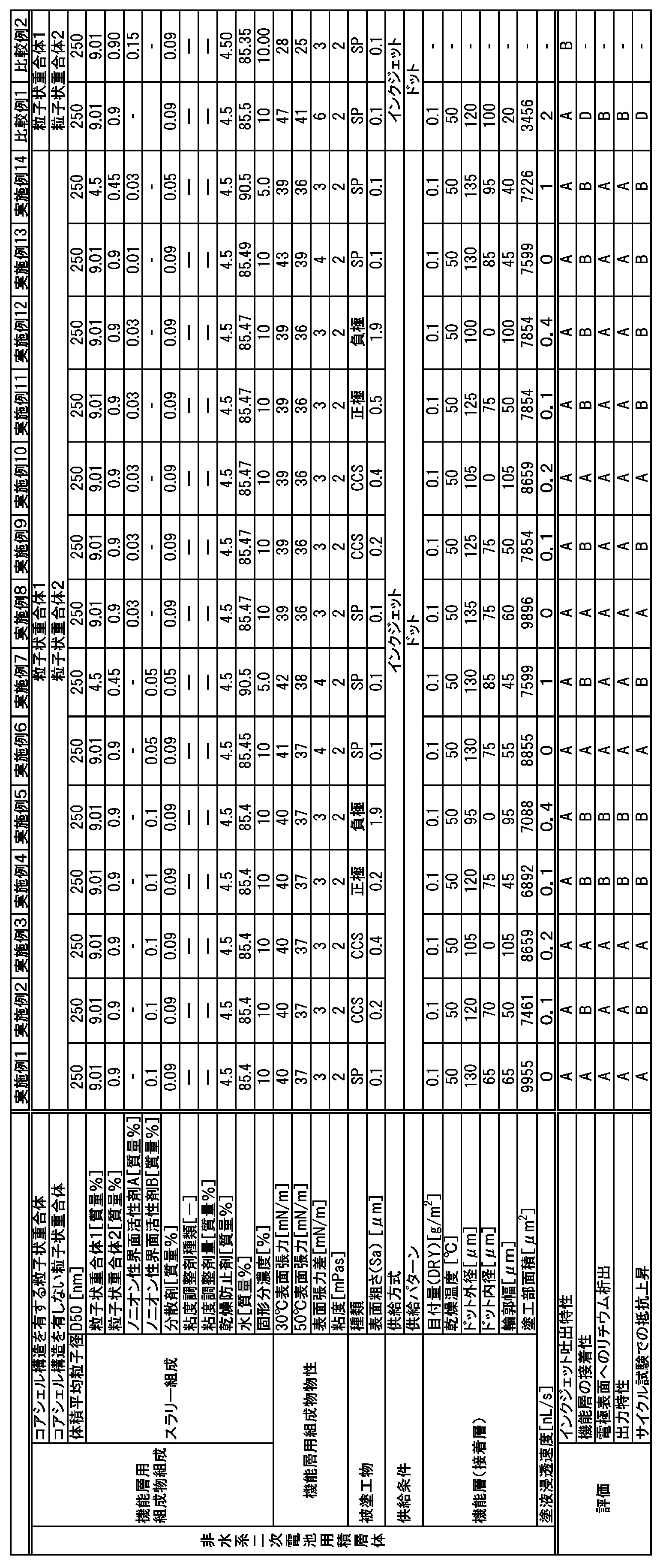
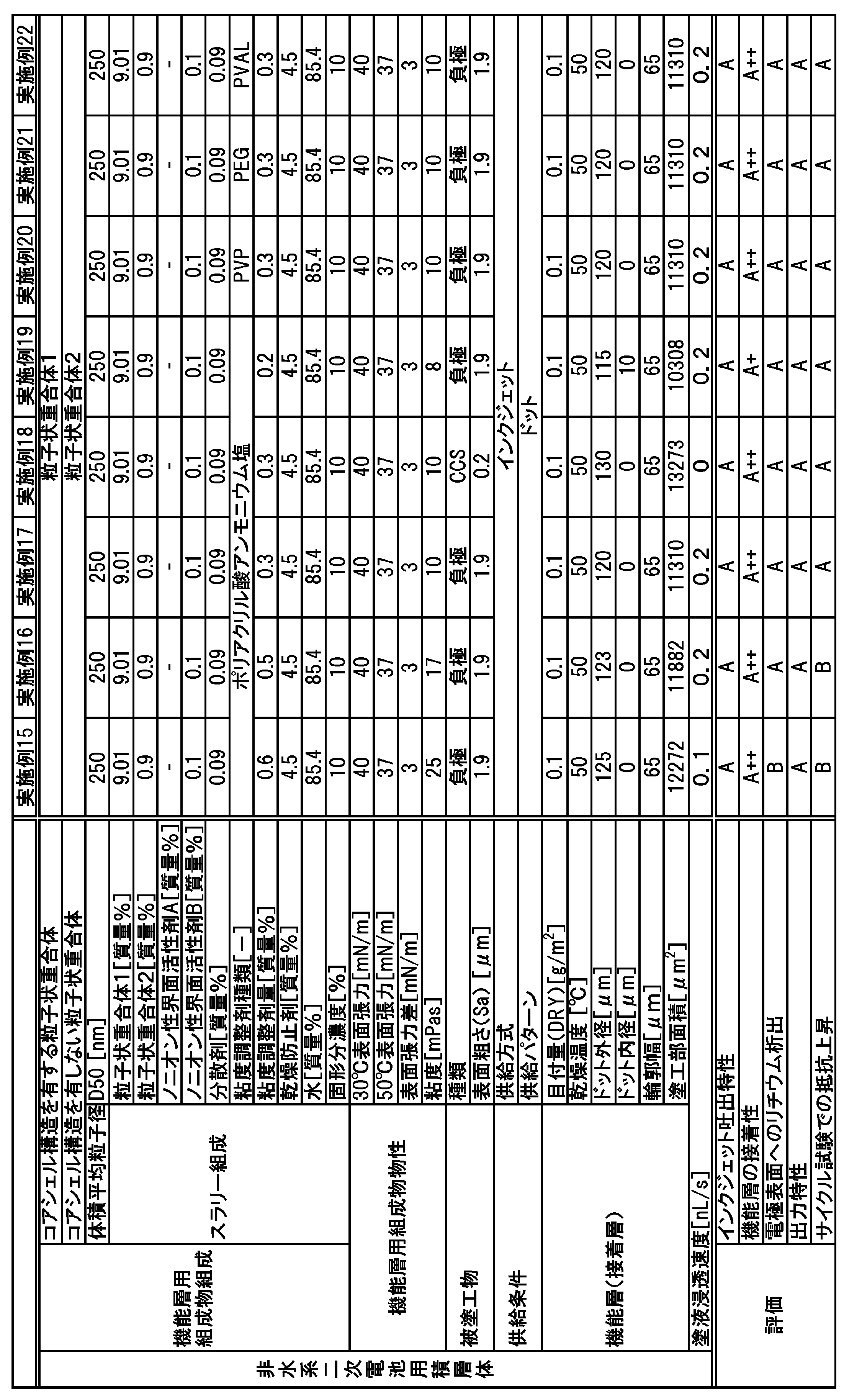
また、表3に示す結果から、30℃での粘度が所定の範囲内である場合に、得られる機能層の接着性を高めるとともに、得られる非水系二次電池の使用時における電極表面へのリチウム析出、及び繰り返し使用に際した抵抗上昇を抑制することができたことが分かる。
また本発明によれば、接着性に優れ、かつ、非水系二次電池に優れた電気的特性を発揮させ得る非水系二次電池用部材及びその製造方法を提供することができる。
また本発明によれば、電気的特性に優れる非水系二次電池を提供することができる。
20A セパレータ原反
30A 負極原反
40 セパレータ
51~54 塗工機(ノズルヘッド)
61,62 圧着ローラ
70 切断機
91 搬送ローラ
92 ヒートローラ
Claims (11)
- 30℃での表面張力S30と、50℃での表面張力S50とが、下記条件(1)及び(2)を満たし、
(S30-S50)<5mN/m ・・・(1)
30mN/m≦S30≦50mN/m ・・・(2)
さらに、30℃での粘度が1mPa・s以上50mPa・s以下である、
非水系二次電池機能層用組成物。 - 30℃での粘度が5mPa・s以上30mPa・s以下である、請求項1に記載の非水系二次電池機能層用組成物。
- ノニオン性界面活性剤を含む、請求項1に記載の非水系二次電池機能層用組成物。
- 粘度調整剤を更に含む、請求項1に記載の非水系二次電池機能層用組成物。
- 接着粒子としてのコアシェル構造を有する粒子状重合体を含む、請求項1に記載の非水系二次電池機能層用組成物。
- 前記接着粒子としての前記コアシェル構造を有する粒子状重合体が、少なくとも1つの80℃未満のガラス転移温度を有する、請求項5に記載の非水系二次電池機能層用組成物。
- 前記接着粒子としての前記コアシェル構造を有する粒子状重合体の体積平均粒子径が100nm以上1000nm以下である、請求項5に記載の非水系二次電池機能層用組成物。
- 請求項1~7の何れかに記載の機能層用組成物を、基材上にインクジェット工法で吐出して塗工層を形成するステップを含み、
前記基材が、電極又はセパレータである、
非水系二次電池用部材の製造方法。 - 請求項1~7の何れかに記載の機能層用組成物よりなる機能層が基材上に配置されてなる部材であり、
前記機能層が、ドットサイズ10μm以上1000μm以下のドットパターンを有し、
前記基材が、電極又はセパレータである、
非水系二次電池用部材。 - 請求項1~7の何れかに記載の機能層用組成物よりなる機能層が基材上に配置されてなる部材であり、
前記基材が電極又はセパレータであり、
前記基材に対して前記機能層用組成物をインクジェット塗工した場合の、前記機能層用組成物の浸透速度が、0.4nL/s以下である、
非水系二次電池用部材。 - 請求項9に記載の非水系二次電池用部材を備える、非水系二次電池。
Priority Applications (4)
| Application Number | Priority Date | Filing Date | Title |
|---|---|---|---|
| JP2024561172A JPWO2024116518A1 (ja) | 2022-11-30 | 2023-08-31 | |
| EP23897178.2A EP4645566A1 (en) | 2022-11-30 | 2023-08-31 | Composition for nonaqueous secondary battery functional layer, member for nonaqueous secondary battery, method for manufacturing member for nonaqueous secondary battery, and nonaqueous secondary battery |
| CN202380078282.4A CN120188324A (zh) | 2022-11-30 | 2023-08-31 | 非水系二次电池功能层用组合物、非水系二次电池用构件及其制造方法以及非水系二次电池 |
| KR1020257017154A KR20250114307A (ko) | 2022-11-30 | 2023-08-31 | 비수계 이차 전지 기능층용 조성물, 비수계 이차 전지용 부재 및 그 제조 방법, 그리고 비수계 이차 전지 |
Applications Claiming Priority (2)
| Application Number | Priority Date | Filing Date | Title |
|---|---|---|---|
| JP2022-192182 | 2022-11-30 | ||
| JP2022192182 | 2022-11-30 |
Publications (1)
| Publication Number | Publication Date |
|---|---|
| WO2024116518A1 true WO2024116518A1 (ja) | 2024-06-06 |
Family
ID=91323309
Family Applications (1)
| Application Number | Title | Priority Date | Filing Date |
|---|---|---|---|
| PCT/JP2023/032014 Ceased WO2024116518A1 (ja) | 2022-11-30 | 2023-08-31 | 非水系二次電池機能層用組成物、非水系二次電池用部材及びその製造方法、並びに非水系二次電池 |
Country Status (5)
| Country | Link |
|---|---|
| EP (1) | EP4645566A1 (ja) |
| JP (1) | JPWO2024116518A1 (ja) |
| KR (1) | KR20250114307A (ja) |
| CN (1) | CN120188324A (ja) |
| WO (1) | WO2024116518A1 (ja) |
Citations (8)
| Publication number | Priority date | Publication date | Assignee | Title |
|---|---|---|---|---|
| JP2013145763A (ja) | 2013-04-30 | 2013-07-25 | Nippon Zeon Co Ltd | 二次電池多孔膜用スラリー組成物、二次電池用電極、二次電池用セパレータおよび二次電池 |
| JP2013194153A (ja) * | 2012-03-21 | 2013-09-30 | Sumitomo Chemical Co Ltd | 改質ポリオレフィン微多孔膜の製造方法 |
| WO2019065416A1 (ja) | 2017-09-28 | 2019-04-04 | 日本ゼオン株式会社 | 非水系二次電池機能層用組成物、非水系二次電池用機能層および非水系二次電池 |
| JP2020113532A (ja) * | 2019-01-08 | 2020-07-27 | 株式会社リコー | 電極合材用液体組成物、電極の製造方法及び電気化学素子の製造方法 |
| JP2020119888A (ja) * | 2019-01-28 | 2020-08-06 | 株式会社リコー | 液体組成物 |
| WO2022209997A1 (ja) * | 2021-03-30 | 2022-10-06 | 日本ゼオン株式会社 | 非水系二次電池接着層用組成物、非水系二次電池用接着層およびその製造方法、非水系二次電池用積層体およびその製造方法、ならびに、非水系二次電池 |
| WO2022230711A1 (ja) | 2021-04-28 | 2022-11-03 | 日本ゼオン株式会社 | 電気化学素子機能層用組成物及びその製造方法、電気化学素子用機能層、電気化学素子用積層体、並びに電気化学素子 |
| WO2022230621A1 (ja) * | 2021-04-28 | 2022-11-03 | 日本ゼオン株式会社 | 非水系二次電池用積層体、接着用組成物及び非水系二次電池 |
Family Cites Families (2)
| Publication number | Priority date | Publication date | Assignee | Title |
|---|---|---|---|---|
| JP4196740B2 (ja) | 2003-06-10 | 2008-12-17 | トヨタ自動車株式会社 | 燃料電池用セパレータへの接着剤塗布方法 |
| CN112088446B (zh) | 2018-05-17 | 2023-06-20 | 日本瑞翁株式会社 | 非水系二次电池用浆料、非水系二次电池用间隔件、非水系二次电池用电极、非水系二次电池用层叠体以及非水系二次电池 |
-
2023
- 2023-08-31 JP JP2024561172A patent/JPWO2024116518A1/ja active Pending
- 2023-08-31 WO PCT/JP2023/032014 patent/WO2024116518A1/ja not_active Ceased
- 2023-08-31 CN CN202380078282.4A patent/CN120188324A/zh active Pending
- 2023-08-31 KR KR1020257017154A patent/KR20250114307A/ko active Pending
- 2023-08-31 EP EP23897178.2A patent/EP4645566A1/en active Pending
Patent Citations (8)
| Publication number | Priority date | Publication date | Assignee | Title |
|---|---|---|---|---|
| JP2013194153A (ja) * | 2012-03-21 | 2013-09-30 | Sumitomo Chemical Co Ltd | 改質ポリオレフィン微多孔膜の製造方法 |
| JP2013145763A (ja) | 2013-04-30 | 2013-07-25 | Nippon Zeon Co Ltd | 二次電池多孔膜用スラリー組成物、二次電池用電極、二次電池用セパレータおよび二次電池 |
| WO2019065416A1 (ja) | 2017-09-28 | 2019-04-04 | 日本ゼオン株式会社 | 非水系二次電池機能層用組成物、非水系二次電池用機能層および非水系二次電池 |
| JP2020113532A (ja) * | 2019-01-08 | 2020-07-27 | 株式会社リコー | 電極合材用液体組成物、電極の製造方法及び電気化学素子の製造方法 |
| JP2020119888A (ja) * | 2019-01-28 | 2020-08-06 | 株式会社リコー | 液体組成物 |
| WO2022209997A1 (ja) * | 2021-03-30 | 2022-10-06 | 日本ゼオン株式会社 | 非水系二次電池接着層用組成物、非水系二次電池用接着層およびその製造方法、非水系二次電池用積層体およびその製造方法、ならびに、非水系二次電池 |
| WO2022230711A1 (ja) | 2021-04-28 | 2022-11-03 | 日本ゼオン株式会社 | 電気化学素子機能層用組成物及びその製造方法、電気化学素子用機能層、電気化学素子用積層体、並びに電気化学素子 |
| WO2022230621A1 (ja) * | 2021-04-28 | 2022-11-03 | 日本ゼオン株式会社 | 非水系二次電池用積層体、接着用組成物及び非水系二次電池 |
Non-Patent Citations (1)
| Title |
|---|
| See also references of EP4645566A1 |
Also Published As
| Publication number | Publication date |
|---|---|
| KR20250114307A (ko) | 2025-07-29 |
| CN120188324A (zh) | 2025-06-20 |
| EP4645566A1 (en) | 2025-11-05 |
| JPWO2024116518A1 (ja) | 2024-06-06 |
Similar Documents
| Publication | Publication Date | Title |
|---|---|---|
| JP7583612B2 (ja) | 非水系二次電池接着層用組成物、非水系二次電池用電池部材およびその製造方法、並びに非水系二次電池用積層体の製造方法および非水系二次電池の製造方法 | |
| JP7306272B2 (ja) | 非水系二次電池機能層用組成物、非水系二次電池用電池部材、非水系二次電池用積層体の製造方法、および非水系二次電池 | |
| JP7363777B2 (ja) | 非水系二次電池用スラリー、非水系二次電池用セパレータ、非水系二次電池用電極、非水系二次電池用積層体および非水系二次電池 | |
| JP7512894B2 (ja) | 非水系二次電池機能層用組成物、非水系二次電池用機能層、非水系二次電池用セパレータ、および非水系二次電池 | |
| US11807698B2 (en) | Binder for non-aqueous secondary battery porous membrane-use, composition for non-aqueous secondary battery porous membrane-use, porous membrane for non-aqueous secondary battery-use, and non-aqueous secondary battery | |
| US10388930B2 (en) | Laminate for non-aqueous secondary battery, method of manufacturing the same, and non-aqueous secondary battery | |
| US10186699B2 (en) | Laminate for non-aqueous secondary battery, and method for manufacturing non-aqueous secondary battery member | |
| JPWO2016017066A1 (ja) | 非水系二次電池機能層用組成物、非水系二次電池用機能層付き基材、非水系二次電池用積層体の製造方法および非水系二次電池 | |
| US20200127263A1 (en) | Binder composition for non-aqueous secondary battery porous membrane, slurry composition for non-aqueous secondary battery porous membrane, porous membrane for non-aqueous secondary battery, and non-aqueous secondary battery and production method therefor | |
| CN106463675A (zh) | 非水系二次电池功能层用组合物、非水系二次电池用功能层和非水系二次电池 | |
| JP7306271B2 (ja) | 非水系二次電池機能層用組成物、非水系二次電池用電池部材、非水系二次電池用積層体の製造方法、および、非水系二次電池 | |
| US20180130987A1 (en) | Composition for non-aqueous secondary battery functional layer, functional layer for non-aqueous secondary battery, and non-aqueous secondary battery | |
| JP6515574B2 (ja) | 非水系二次電池機能層用バインダー、非水系二次電池機能層用組成物、非水系二次電池用機能層および非水系二次電池 | |
| KR20240004328A (ko) | 비수계 이차 전지용 적층체, 접착용 조성물 및 비수계 이차 전지 | |
| JP7823656B2 (ja) | 非水系二次電池接着層用組成物、非水系二次電池用接着層およびその製造方法、非水系二次電池用積層体およびその製造方法、ならびに、非水系二次電池 | |
| EP3382777A1 (en) | Composition for nonaqueous secondary battery adhesive layers, adhesive layer for nonaqueous secondary batteries, and nonaqueous secondary battery | |
| JP2017103031A (ja) | 非水系二次電池用積層体 | |
| WO2022209997A1 (ja) | 非水系二次電池接着層用組成物、非水系二次電池用接着層およびその製造方法、非水系二次電池用積層体およびその製造方法、ならびに、非水系二次電池 | |
| US11482727B2 (en) | Composition for non-aqueous secondary battery porous membrane, porous membrane for non-aqueous secondary battery, and non-aqueous secondary battery | |
| JP6693101B2 (ja) | 非水系二次電池機能層用組成物、非水系二次電池機能層用組成物の製造方法、非水系二次電池用機能層及び非水系二次電池 | |
| EP4645566A1 (en) | Composition for nonaqueous secondary battery functional layer, member for nonaqueous secondary battery, method for manufacturing member for nonaqueous secondary battery, and nonaqueous secondary battery | |
| WO2023008165A1 (ja) | 非水系二次電池用積層体、非水系二次電池用積層体の製造方法及び非水系二次電池 |
Legal Events
| Date | Code | Title | Description |
|---|---|---|---|
| 121 | Ep: the epo has been informed by wipo that ep was designated in this application |
Ref document number: 23897178 Country of ref document: EP Kind code of ref document: A1 |
|
| WWE | Wipo information: entry into national phase |
Ref document number: 2024561172 Country of ref document: JP |
|
| WWE | Wipo information: entry into national phase |
Ref document number: 202380078282.4 Country of ref document: CN |
|
| WWP | Wipo information: published in national office |
Ref document number: 202380078282.4 Country of ref document: CN |
|
| WWE | Wipo information: entry into national phase |
Ref document number: 2023897178 Country of ref document: EP |
|
| NENP | Non-entry into the national phase |
Ref country code: DE |
|
| ENP | Entry into the national phase |
Ref document number: 2023897178 Country of ref document: EP Effective date: 20250630 |
|
| WWP | Wipo information: published in national office |
Ref document number: 1020257017154 Country of ref document: KR |
|
| WWP | Wipo information: published in national office |
Ref document number: 2023897178 Country of ref document: EP |