WO2024122348A1 - 樹脂組成物及び成形体 - Google Patents
樹脂組成物及び成形体 Download PDFInfo
- Publication number
- WO2024122348A1 WO2024122348A1 PCT/JP2023/042046 JP2023042046W WO2024122348A1 WO 2024122348 A1 WO2024122348 A1 WO 2024122348A1 JP 2023042046 W JP2023042046 W JP 2023042046W WO 2024122348 A1 WO2024122348 A1 WO 2024122348A1
- Authority
- WO
- WIPO (PCT)
- Prior art keywords
- group
- resin composition
- resin
- carbon atoms
- formula
- Prior art date
- Legal status (The legal status is an assumption and is not a legal conclusion. Google has not performed a legal analysis and makes no representation as to the accuracy of the status listed.)
- Ceased
Links
Images

Classifications
-
- C—CHEMISTRY; METALLURGY
- C08—ORGANIC MACROMOLECULAR COMPOUNDS; THEIR PREPARATION OR CHEMICAL WORKING-UP; COMPOSITIONS BASED THEREON
- C08J—WORKING-UP; GENERAL PROCESSES OF COMPOUNDING; AFTER-TREATMENT NOT COVERED BY SUBCLASSES C08B, C08C, C08F, C08G or C08H
- C08J5/00—Manufacture of articles or shaped materials containing macromolecular substances
- C08J5/18—Manufacture of films or sheets
-
- C—CHEMISTRY; METALLURGY
- C08—ORGANIC MACROMOLECULAR COMPOUNDS; THEIR PREPARATION OR CHEMICAL WORKING-UP; COMPOSITIONS BASED THEREON
- C08G—MACROMOLECULAR COMPOUNDS OBTAINED OTHERWISE THAN BY REACTIONS ONLY INVOLVING UNSATURATED CARBON-TO-CARBON BONDS
- C08G73/00—Macromolecular compounds obtained by reactions forming a linkage containing nitrogen with or without oxygen or carbon in the main chain of the macromolecule, not provided for in groups C08G12/00 - C08G71/00
- C08G73/06—Polycondensates having nitrogen-containing heterocyclic rings in the main chain of the macromolecule
- C08G73/10—Polyimides; Polyester-imides; Polyamide-imides; Polyamide acids or similar polyimide precursors
-
- C—CHEMISTRY; METALLURGY
- C08—ORGANIC MACROMOLECULAR COMPOUNDS; THEIR PREPARATION OR CHEMICAL WORKING-UP; COMPOSITIONS BASED THEREON
- C08G—MACROMOLECULAR COMPOUNDS OBTAINED OTHERWISE THAN BY REACTIONS ONLY INVOLVING UNSATURATED CARBON-TO-CARBON BONDS
- C08G73/00—Macromolecular compounds obtained by reactions forming a linkage containing nitrogen with or without oxygen or carbon in the main chain of the macromolecule, not provided for in groups C08G12/00 - C08G71/00
- C08G73/06—Polycondensates having nitrogen-containing heterocyclic rings in the main chain of the macromolecule
- C08G73/10—Polyimides; Polyester-imides; Polyamide-imides; Polyamide acids or similar polyimide precursors
- C08G73/1003—Preparatory processes
- C08G73/1007—Preparatory processes from tetracarboxylic acids or derivatives and diamines
- C08G73/101—Preparatory processes from tetracarboxylic acids or derivatives and diamines containing chain terminating or branching agents
- C08G73/1017—Preparatory processes from tetracarboxylic acids or derivatives and diamines containing chain terminating or branching agents in the form of (mono)amine
-
- C—CHEMISTRY; METALLURGY
- C08—ORGANIC MACROMOLECULAR COMPOUNDS; THEIR PREPARATION OR CHEMICAL WORKING-UP; COMPOSITIONS BASED THEREON
- C08G—MACROMOLECULAR COMPOUNDS OBTAINED OTHERWISE THAN BY REACTIONS ONLY INVOLVING UNSATURATED CARBON-TO-CARBON BONDS
- C08G73/00—Macromolecular compounds obtained by reactions forming a linkage containing nitrogen with or without oxygen or carbon in the main chain of the macromolecule, not provided for in groups C08G12/00 - C08G71/00
- C08G73/06—Polycondensates having nitrogen-containing heterocyclic rings in the main chain of the macromolecule
- C08G73/10—Polyimides; Polyester-imides; Polyamide-imides; Polyamide acids or similar polyimide precursors
- C08G73/1042—Copolyimides derived from at least two different tetracarboxylic compounds or two different diamino compounds
-
- C—CHEMISTRY; METALLURGY
- C08—ORGANIC MACROMOLECULAR COMPOUNDS; THEIR PREPARATION OR CHEMICAL WORKING-UP; COMPOSITIONS BASED THEREON
- C08G—MACROMOLECULAR COMPOUNDS OBTAINED OTHERWISE THAN BY REACTIONS ONLY INVOLVING UNSATURATED CARBON-TO-CARBON BONDS
- C08G73/00—Macromolecular compounds obtained by reactions forming a linkage containing nitrogen with or without oxygen or carbon in the main chain of the macromolecule, not provided for in groups C08G12/00 - C08G71/00
- C08G73/06—Polycondensates having nitrogen-containing heterocyclic rings in the main chain of the macromolecule
- C08G73/10—Polyimides; Polyester-imides; Polyamide-imides; Polyamide acids or similar polyimide precursors
- C08G73/1075—Partially aromatic polyimides
- C08G73/1082—Partially aromatic polyimides wholly aromatic in the tetracarboxylic moiety
-
- C—CHEMISTRY; METALLURGY
- C08—ORGANIC MACROMOLECULAR COMPOUNDS; THEIR PREPARATION OR CHEMICAL WORKING-UP; COMPOSITIONS BASED THEREON
- C08J—WORKING-UP; GENERAL PROCESSES OF COMPOUNDING; AFTER-TREATMENT NOT COVERED BY SUBCLASSES C08B, C08C, C08F, C08G or C08H
- C08J3/00—Processes of treating or compounding macromolecular substances
- C08J3/12—Powdering or granulating
-
- C—CHEMISTRY; METALLURGY
- C08—ORGANIC MACROMOLECULAR COMPOUNDS; THEIR PREPARATION OR CHEMICAL WORKING-UP; COMPOSITIONS BASED THEREON
- C08J—WORKING-UP; GENERAL PROCESSES OF COMPOUNDING; AFTER-TREATMENT NOT COVERED BY SUBCLASSES C08B, C08C, C08F, C08G or C08H
- C08J3/00—Processes of treating or compounding macromolecular substances
- C08J3/20—Compounding polymers with additives, e.g. colouring
-
- C—CHEMISTRY; METALLURGY
- C08—ORGANIC MACROMOLECULAR COMPOUNDS; THEIR PREPARATION OR CHEMICAL WORKING-UP; COMPOSITIONS BASED THEREON
- C08L—COMPOSITIONS OF MACROMOLECULAR COMPOUNDS
- C08L71/00—Compositions of polyethers obtained by reactions forming an ether link in the main chain; Compositions of derivatives of such polymers
- C08L71/08—Polyethers derived from hydroxy compounds or from their metallic derivatives
- C08L71/10—Polyethers derived from hydroxy compounds or from their metallic derivatives from phenols
- C08L71/12—Polyphenylene oxides
-
- C—CHEMISTRY; METALLURGY
- C08—ORGANIC MACROMOLECULAR COMPOUNDS; THEIR PREPARATION OR CHEMICAL WORKING-UP; COMPOSITIONS BASED THEREON
- C08L—COMPOSITIONS OF MACROMOLECULAR COMPOUNDS
- C08L79/00—Compositions of macromolecular compounds obtained by reactions forming in the main chain of the macromolecule a linkage containing nitrogen with or without oxygen or carbon only, not provided for in groups C08L61/00 - C08L77/00
- C08L79/04—Polycondensates having nitrogen-containing heterocyclic rings in the main chain; Polyhydrazides; Polyamide acids or similar polyimide precursors
- C08L79/08—Polyimides; Polyester-imides; Polyamide-imides; Polyamide acids or similar polyimide precursors
-
- C—CHEMISTRY; METALLURGY
- C08—ORGANIC MACROMOLECULAR COMPOUNDS; THEIR PREPARATION OR CHEMICAL WORKING-UP; COMPOSITIONS BASED THEREON
- C08J—WORKING-UP; GENERAL PROCESSES OF COMPOUNDING; AFTER-TREATMENT NOT COVERED BY SUBCLASSES C08B, C08C, C08F, C08G or C08H
- C08J2379/00—Characterised by the use of macromolecular compounds obtained by reactions forming in the main chain of the macromolecule a linkage containing nitrogen with or without oxygen, or carbon only, not provided for in groups C08J2361/00 - C08J2377/00
- C08J2379/04—Polycondensates having nitrogen-containing heterocyclic rings in the main chain; Polyhydrazides; Polyamide acids or similar polyimide precursors
- C08J2379/08—Polyimides; Polyester-imides; Polyamide-imides; Polyamide acids or similar polyimide precursors
-
- C—CHEMISTRY; METALLURGY
- C08—ORGANIC MACROMOLECULAR COMPOUNDS; THEIR PREPARATION OR CHEMICAL WORKING-UP; COMPOSITIONS BASED THEREON
- C08J—WORKING-UP; GENERAL PROCESSES OF COMPOUNDING; AFTER-TREATMENT NOT COVERED BY SUBCLASSES C08B, C08C, C08F, C08G or C08H
- C08J2471/00—Characterised by the use of polyethers obtained by reactions forming an ether link in the main chain; Derivatives of such polymers
- C08J2471/08—Polyethers derived from hydroxy compounds or from their metallic derivatives
- C08J2471/10—Polyethers derived from hydroxy compounds or from their metallic derivatives from phenols
- C08J2471/12—Polyphenylene oxides
Definitions
- the present invention relates to a resin composition and a molded article.
- Polyimide resins are useful engineering plastics that have high thermal stability, high strength, and high solvent resistance due to the rigidity of their molecular chains, resonance stabilization, and strong chemical bonds, and are used in a wide range of fields.
- polyimide resins have high heat resistance, they do not exhibit thermoplasticity and have the problem of low moldability.
- polyimide resins with thermoplasticity have been reported.
- Thermoplastic polyimide resins have excellent moldability in addition to the heat resistance that polyimide resins inherently have. Therefore, thermoplastic polyimide resins can be used for molded products used in harsh environments where general-purpose thermoplastic resins such as nylon and polyester could not be used.
- Patent Document 1 discloses a film having low dielectric properties made of a thermoplastic polyimide resin, and describes that the film can be applied to high-frequency circuit boards, copper-clad laminates, etc.
- Patent Document 2 discloses that a resin composition containing a predetermined liquid crystal polymer and a specific crystalline thermoplastic polyimide resin has excellent handleability when molten, is easy to melt-knead and extrude, and can achieve both a low dielectric constant and a low dielectric loss tangent.
- An object of the present invention is to provide a resin composition having excellent low dielectric properties and good film formability, and a molded article containing the resin composition.
- the present inventors have found that the above-mentioned problems can be solved by a resin composition containing a polyimide resin in which specific different polyimide structural units are combined in a specific ratio, and an aromatic resin having a specific structure, in a predetermined ratio. That is, the present invention relates to the following.
- a resin composition comprising: a polyimide resin (A) containing a repeating structural unit represented by the following formula (1) and a repeating structural unit represented by the following formula (2), wherein the content ratio of the repeating structural unit of the formula (1) to the total content of the repeating structural units of the formula (1) and the repeating structural units of the formula (2) is 20 to 70 mol %, and a resin represented by the following formula (5) or an acid-modified product thereof (B), wherein the ratio of the content of the component (B) to the total content of the components (A) and (B) [(B)/ ⁇ (A)+(B) ⁇ ] is 0.50 or less.
- R1 is a divalent group having 6 to 22 carbon atoms containing at least one alicyclic hydrocarbon structure.
- R2 is a divalent chain aliphatic group having 5 to 16 carbon atoms.
- X1 and X2 are each independently a tetravalent group having 6 to 22 carbon atoms containing at least one aromatic ring.
- R 51 to R 55 and R 61 to R 64 are each independently a hydrogen atom, a hydroxyl group, or an alkyl group having 1 to 4 carbon atoms, and R 65 is a hydrogen atom or an alkyl group having 1 to 4 carbon atoms.
- n is the number of repeating structural units and is a number of 10 or more.
- the present invention provides a resin composition that has excellent low dielectric properties and good film moldability, and a molded article that contains the resin composition.
- FIG. 1 is a schematic diagram showing a method for preparing a sample (ultrathin section) used for observation with a field emission scanning transmission electron microscope (FE-STEM).
- FE-STEM field emission scanning transmission electron microscope
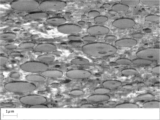
- 1 is a micrograph of a cross section of the resin composition (pellet) of Example 5 cut in a direction perpendicular to the machine direction (MD), observed by FE-STEM.
- the resin composition of the present invention contains a polyimide resin (A) that contains a repeating structural unit represented by the following formula (1) and a repeating structural unit represented by the following formula (2), and the content ratio of the repeating structural unit of the formula (1) to the total content of the repeating structural units of the formula (1) and the repeating structural units of the formula (2) is 20 to 70 mol %; and a resin represented by the following formula (5) or an acid-modified product thereof (B), in which the ratio of the content of the component (B) to the total content of the components (A) and (B) [(B)/ ⁇ (A)+(B) ⁇ ] is 0.50 or less.
- R1 is a divalent group having 6 to 22 carbon atoms containing at least one alicyclic hydrocarbon structure.
- R2 is a divalent chain aliphatic group having 5 to 16 carbon atoms.
- X1 and X2 are each independently a tetravalent group having 6 to 22 carbon atoms containing at least one aromatic ring.
- R 51 to R 55 and R 61 to R 64 are each independently a hydrogen atom, a hydroxyl group, or an alkyl group having 1 to 4 carbon atoms, and R 65 is a hydrogen atom or an alkyl group having 1 to 4 carbon atoms.
- n is the number of repeating structural units and is a number of 10 or more.
- the resin composition of the present invention contains the polyimide resin (A) obtained by combining specific different polyimide structural units in the above-mentioned specific ratio, and the resin represented by the formula (5) or an acid-modified product thereof (B) in a predetermined ratio, and thus has excellent low dielectric properties and good film formability.
- the reason why the above-mentioned effects are obtained in the present invention is not clear, but is thought to be as follows.
- Both component (A) and component (B) are thermoplastic resins having low dielectric properties, component (A) is a crystalline thermoplastic resin, and component (B) is an amorphous thermoplastic resin.
- component (A) having excellent moldability as a crystalline thermoplastic resin and by using component (A) and component (B) in a specific ratio, it becomes possible for component (A) and component (B) to have a micro-nano level finely dispersed structure (microphase separation structure).
- component (A) and component (B) form a sea-island structure as a microphase separation structure
- component (A) is likely to be present on the sea side. This suppresses discoloration and the like resulting from oxidative deterioration of component (B), and is believed to have improved film moldability by extrusion while maintaining low dielectric properties.
- the resin composition of the present invention can be a resin composition having high crystallinity derived from component (A) by having the mass ratio [(B)/ ⁇ (A)+(B) ⁇ ] be 0.50 or less.
- the resulting resin composition and molded article are also excellent in, for example, solder reflow resistance.
- the crystallinity of the resin composition can be determined using the heat of fusion as an index.
- the resin composition of the present invention allows the production of molded articles that have a low coefficient of linear thermal expansion and excellent dimensional stability.
- the polyimide resin (A) used in the present invention contains a repeating structural unit represented by the following formula (1) and a repeating structural unit represented by the following formula (2), and the content of the repeating structural unit of the formula (1) relative to the total of the repeating structural units of the formula (1) and the repeating structural units of the formula (2) is 20 to 70 mol %.
- R1 is a divalent group having 6 to 22 carbon atoms containing at least one alicyclic hydrocarbon structure.
- R2 is a divalent chain aliphatic group having 5 to 16 carbon atoms.
- X1 and X2 are each independently a tetravalent group having 6 to 22 carbon atoms containing at least one aromatic ring.
- the polyimide resin (A) used in the present invention is a thermoplastic resin, and is preferably in the form of a powder or pellets.
- Thermoplastic polyimide resins are formed, for example, by molding a polyimide precursor such as polyamic acid and then closing the imide rings, and are distinguished from polyimide resins that do not have a glass transition temperature (Tg) or polyimide resins that decompose at a temperature lower than the glass transition temperature.
- Tg glass transition temperature
- R1 is a divalent group containing at least one alicyclic hydrocarbon structure and having 6 to 22 carbon atoms.
- the alicyclic hydrocarbon structure means a ring derived from an alicyclic hydrocarbon compound, and the alicyclic hydrocarbon compound may be saturated or unsaturated, and may be monocyclic or polycyclic.
- alicyclic hydrocarbon structure examples include, but are not limited to, a cycloalkane ring such as a cyclohexane ring, a cycloalkene ring such as a cyclohexene ring, a bicycloalkane ring such as a norbornane ring, and a bicycloalkene ring such as norbornene.
- a cycloalkane ring is preferred, a cycloalkane ring having 4 to 7 carbon atoms is more preferred, and a cyclohexane ring is even more preferred.
- R1 has 6 to 22 carbon atoms, and preferably 8 to 17 carbon atoms.
- R1 contains at least one alicyclic hydrocarbon structure, and preferably contains 1 to 3 alicyclic hydrocarbon structures.
- R 1 is preferably a divalent group represented by the following formula (R1-1) or (R1-2).
- ( m11 and m12 each independently represent an integer of 0 to 2, preferably 0 or 1.
- m13 to m15 each independently represent an integer of 0 to 2, preferably 0 or 1.)
- R 1 is particularly preferably a divalent group represented by the following formula (R1-3).
- R1-3 the positional relationship of the two methylene groups to the cyclohexane ring may be either cis or trans, and the ratio of cis to trans may be any value.
- X1 is a tetravalent group having 6 to 22 carbon atoms and containing at least one aromatic ring.
- the aromatic ring may be a single ring or a condensed ring, and examples thereof include, but are not limited to, a benzene ring, a naphthalene ring, an anthracene ring, and a tetracene ring. Among these, a benzene ring and a naphthalene ring are preferred, and a benzene ring is more preferred.
- X1 has 6 to 22 carbon atoms, and preferably 6 to 18 carbon atoms.
- X1 contains at least one aromatic ring, and preferably contains 1 to 3 aromatic rings.
- X1 is preferably a tetravalent group represented by any one of the following formulae (X-1) to (X-4).
- R 11 to R 18 are each independently an alkyl group having 1 to 4 carbon atoms.
- p 11 to p 13 are each independently an integer of 0 to 2, preferably 0.
- p 14 , p 15 , p 16 and p 18 are each independently an integer of 0 to 3, preferably 0.
- p 17 is an integer of 0 to 4, preferably 0.
- L 11 to L 13 are each independently a single bond, an ether group, a carbonyl group or an alkylene group having 1 to 4 carbon atoms.) Since X1 is a tetravalent group containing at least one aromatic ring and having 6 to 22 carbon atoms, R12 , R13 , p12 , and p13 in formula (X-2) are selected so that the number of carbon atoms of the tetravalent group represented by formula (X-2) is in the range of 10 to 22.
- L 11 , R 14 , R 15 , p 14 and p 15 in formula (X-3) are selected so that the number of carbon atoms in the tetravalent group represented by formula (X-3) falls within the range of 12 to 22, and L 12 , L 13 , R 16 , R 17 , R 18 , p 16 , p 17 and p 18 in formula (X-4) are selected so that the number of carbon atoms in the tetravalent group represented by formula (X-4) falls within the range of 18 to 22.
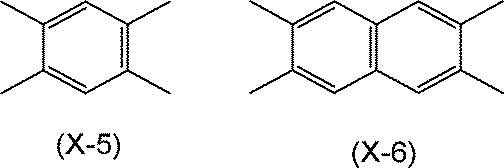
- X1 is particularly preferably a tetravalent group represented by the following formula (X-5) or (X-6).
- R2 is a divalent chain aliphatic group having 5 to 16 carbon atoms, preferably 6 to 14 carbon atoms, more preferably 7 to 12 carbon atoms, and even more preferably 8 to 10 carbon atoms.
- the chain aliphatic group means a group derived from a chain aliphatic compound, and the chain aliphatic compound may be saturated or unsaturated, may be linear or branched, and may contain a heteroatom such as an oxygen atom.
- R2 is preferably an alkylene group having 5 to 16 carbon atoms, more preferably an alkylene group having 6 to 14 carbon atoms, even more preferably an alkylene group having 7 to 12 carbon atoms, and particularly preferably an alkylene group having 8 to 10 carbon atoms.
- the alkylene group may be a linear alkylene group or a branched alkylene group, but is preferably a linear alkylene group.
- R2 is preferably at least one selected from the group consisting of an octamethylene group and a decamethylene group, and particularly preferably an octamethylene group.
- R2 is a divalent chain aliphatic group containing an ether group and having 5 to 16 carbon atoms.
- the number of carbon atoms is preferably 6 to 14, more preferably 7 to 12, and even more preferably 8 to 10.
- a divalent group represented by the following formula (R2-1) or (R2-2) is preferred.
- ( m21 and m22 each independently represent an integer of 1 to 15, preferably 1 to 13, more preferably 1 to 11, and even more preferably 1 to 9.
- m23 to m25 each independently represent an integer of 1 to 14, preferably 1 to 12, more preferably 1 to 10, and even more preferably 1 to 8.
- R 2 is a divalent chain aliphatic group having 5 to 16 carbon atoms (preferably 6 to 14 carbon atoms, more preferably 7 to 12 carbon atoms, and even more preferably 8 to 10 carbon atoms)
- m 21 and m 22 in formula (R2-1) are selected so that the number of carbon atoms in the divalent group represented by formula (R2-1) is in the range of 5 to 16 (preferably 6 to 14 carbon atoms, more preferably 7 to 12 carbon atoms, and even more preferably 8 to 10 carbon atoms).
- m 21 +m 22 is 5 to 16 (preferably 6 to 14, more preferably 7 to 12, and even more preferably 8 to 10).
- m 23 to m 25 in formula (R2-2) are selected so that the carbon number of the divalent group represented by formula (R2-2) is in the range of 5 to 16 (preferably 6 to 14 carbon atoms, more preferably 7 to 12 carbon atoms, and even more preferably 8 to 10 carbon atoms).
- m 23 + m 24 + m 25 is 5 to 16 (preferably 6 to 14 carbon atoms, more preferably 7 to 12 carbon atoms, and even more preferably 8 to 10 carbon atoms).
- X2 is defined in the same manner as X1 in formula (1), and the preferred embodiments are also the same.
- the content ratio of the repeating structural unit of formula (1) to the total of the repeating structural unit of formula (1) and the repeating structural unit of formula (2) is 20 to 70 mol %.
- the content ratio of the repeating structural unit of formula (1) is within the above range, it becomes possible to sufficiently crystallize the polyimide resin even in a general injection molding cycle. If the content ratio is less than 20 mol %, the moldability decreases, and if it exceeds 70 mol %, the crystallinity decreases, and therefore the heat resistance decreases.
- the content ratio of the repeating structural unit of formula (1) to the total of the repeating structural units of formula (1) and formula (2) is preferably 65 mol % or less, more preferably 60 mol % or less, and even more preferably 50 mol % or less.
- the content ratio of the repeating structural unit of formula (1) to the total of the repeating structural units of formula (1) and formula (2) is preferably 20 mol % or more and less than 40 mol %.
- the above content ratio is preferably 25 mol% or more, more preferably 30 mol% or more, and even more preferably 32 mol% or more, and from the viewpoint of expressing high crystallinity, it is even more preferably 35 mol% or less.
- the total content ratio of the repeating units of formula (1) and the repeating units of formula (2) to all repeating units constituting polyimide resin (A) is preferably 50 to 100 mol%, more preferably 75 to 100 mol%, even more preferably 80 to 100 mol%, and even more preferably 85 to 100 mol%.
- the polyimide resin (A) may further contain a repeating unit of the following formula (3).
- the content ratio of the repeating unit of the formula (3) to the total of the repeating unit of the formula (1) and the repeating unit of the formula (2) is preferably 25 mol% or less.
- the lower limit is not particularly limited, and it is sufficient that it is more than 0 mol%.
- the content ratio is preferably 5 mol % or more, more preferably 10 mol % or more, while from the viewpoint of maintaining crystallinity, the content ratio is preferably 20 mol % or less, more preferably 15 mol % or less.
- R3 is a divalent group having 6 to 22 carbon atoms containing at least one aromatic ring.
- X3 is a tetravalent group having 6 to 22 carbon atoms containing at least one aromatic ring.
- R3 is a divalent group having 6 to 22 carbon atoms and containing at least one aromatic ring.
- the aromatic ring may be a single ring or a condensed ring, and examples thereof include, but are not limited to, a benzene ring, a naphthalene ring, an anthracene ring, and a tetracene ring. Among these, a benzene ring and a naphthalene ring are preferred, and a benzene ring is more preferred.
- R3 has 6 to 22 carbon atoms, and preferably 6 to 18 carbon atoms.
- R3 contains at least one aromatic ring, and preferably contains 1 to 3 aromatic rings.
- a monovalent or divalent electron-withdrawing group may be bonded to the aromatic ring.
- the monovalent electron-withdrawing group include a nitro group, a cyano group, a p-toluenesulfonyl group, a halogen, a halogenated alkyl group, a phenyl group, and an acyl group.
- divalent electron-withdrawing group examples include a halogenated alkylene group such as a fluorinated alkylene group (e.g., -C(CF 3 ) 2 -, -(CF 2 ) p - (wherein p is an integer of 1 to 10)), as well as -CO-, -SO 2 -, -SO-, -CONH-, -COO-, and the like.
- a fluorinated alkylene group e.g., -C(CF 3 ) 2 -, -(CF 2 ) p - (wherein p is an integer of 1 to 10)
- R3 is preferably a divalent group represented by the following formula (R3-1) or (R3-2).
- ( m31 and m32 each independently represent an integer of 0 to 2, preferably 0 or 1.
- m33 and m34 each independently represent an integer of 0 to 2, preferably 0 or 1.
- R21 , R22 , and R23 each independently represent an alkyl group having 1 to 4 carbon atoms, an alkenyl group having 2 to 4 carbon atoms, or an alkynyl group having 2 to 4 carbon atoms.
- p21 , p22 , and p23 each independently represent an integer of 0 to 4, preferably 0.
- L21 represents a single bond, an ether group, a carbonyl group, or an alkylene group having 1 to 4 carbon atoms.
- R 3 is a divalent group containing at least one aromatic ring and having 6 to 22 carbon atoms
- m 31 , m 32 , R 21 and p 21 in formula (R3-1) are selected so that the number of carbon atoms of the divalent group represented by formula (R3-1) falls within the range of 6 to 22.
- L 21 , m 33 , m 34 , R 22 , R 23 , p 22 and p 23 in formula (R3-2) are selected so that the divalent group represented by formula (R3-2) has 12 to 22 carbon atoms.
- X3 is defined in the same manner as X1 in formula (1), and the preferred embodiments are also the same.
- the polyimide resin (A) may further contain a repeating unit represented by the following formula (4).
- R 4 is a divalent group containing -SO 2 - or -Si(R x )(R y )O-, and R x and R y each independently represent a chain aliphatic group having 1 to 3 carbon atoms or a phenyl group.
- X 4 is a tetravalent group containing at least one aromatic ring and having 6 to 22 carbon atoms.
- X4 is defined in the same manner as X1 in formula (1), and the preferred embodiments are also the same.
- the terminal structure of the polyimide resin (A) is not particularly limited, but it is preferable that the polyimide resin (A) has a chain aliphatic group having 5 to 14 carbon atoms at the terminal.
- the chain aliphatic group may be saturated or unsaturated, and may be linear or branched.
- Examples of the saturated chain aliphatic group having 5 to 14 carbon atoms include an n-pentyl group, an n-hexyl group, an n-heptyl group, an n-octyl group, an n-nonyl group, an n-decyl group, an n-undecyl group, a lauryl group, an n-tridecyl group, an n-tetradecyl group, an isopentyl group, a neopentyl group, a 2-methylpentyl group, a 2-methylhexyl group, a 2-ethylpentyl group, a 3-ethylpentyl group, an isooctyl group, a 2-ethylhexyl group, a 3-ethylhexyl group, an isononyl group, a 2-ethyloctyl group, an isodecyl group, an iso
- Examples of the unsaturated linear aliphatic group having 5 to 14 carbon atoms include a 1-pentenyl group, a 2-pentenyl group, a 1-hexenyl group, a 2-hexenyl group, a 1-heptenyl group, a 2-heptenyl group, a 1-octenyl group, a 2-octenyl group, a nonenyl group, a decenyl group, a dodecenyl group, a tridecenyl group, and a tetradecenyl group.
- the chain aliphatic group is preferably a saturated chain aliphatic group, more preferably a saturated linear chain aliphatic group.
- the chain aliphatic group preferably has 6 or more carbon atoms, more preferably 7 or more carbon atoms, even more preferably 8 or more carbon atoms, and preferably has 12 or less carbon atoms, more preferably 10 or less carbon atoms, even more preferably 9 or less carbon atoms.
- the chain aliphatic group may be of only one kind or of two or more kinds.
- the chain aliphatic group is particularly preferably at least one selected from the group consisting of an n-octyl group, an isooctyl group, a 2-ethylhexyl group, an n-nonyl group, an isononyl group, an n-decyl group, and an isodecyl group, further preferably at least one selected from the group consisting of an n-octyl group, an isooctyl group, a 2-ethylhexyl group, an n-nonyl group, and an isononyl group, and most preferably at least one selected from the group consisting of an n-octyl group, an isooctyl group, and a 2-ethylhexyl group.
- the polyimide resin (A) preferably has, at its terminal, only a chain aliphatic group having 5 to 14 carbon atoms, in addition to a terminal amino group and a terminal carboxy group.
- the content thereof is preferably 10 mol % or less, more preferably 5 mol % or less, based on the chain aliphatic group having 5 to 14 carbon atoms.
- the content of the chain aliphatic group having 5 to 14 carbon atoms in the polyimide resin (A) is preferably 0.01 mol% or more, more preferably 0.1 mol% or more, and even more preferably 0.2 mol% or more, based on 100 mol% of the total of all repeating units constituting the polyimide resin (A).
- the content of the chain aliphatic group having 5 to 14 carbon atoms in the polyimide resin (A) is preferably 10 mol% or less, more preferably 6 mol% or less, and even more preferably 3.5 mol% or less, based on 100 mol% of the total of all repeating units constituting the polyimide resin (A).
- the content of the chain aliphatic group having 5 to 14 carbon atoms in the polyimide resin (A) can be determined by depolymerizing the polyimide resin (A).
- the polyimide resin (A) preferably has a melting point of 360° C. or less and a glass transition temperature of 150° C. or more.
- the melting point of the polyimide resin (A) is more preferably 280° C. or more, and even more preferably 290° C. or more from the viewpoint of heat resistance, and is preferably 345° C. or less, more preferably 340° C. or less, and even more preferably 335° C. or less from the viewpoint of high moldability.
- the glass transition temperature of the polyimide resin (A) is more preferably 160° C. or more, and even more preferably 170° C. or more from the viewpoint of heat resistance, and is preferably 250° C. or less, more preferably 230° C.
- the melting point and glass transition temperature of the polyimide resin (A) can both be measured by a differential scanning calorimeter.
- the polyimide resin (A) is preferably 5.0 mJ/mg or more, more preferably 10.0 mJ/mg or more, and even more preferably 17.0 mJ/mg or more in the heat of the crystallization exothermic peak observed when the polyimide resin (A) is melted and then cooled at a temperature drop rate of 20° C./min by differential scanning calorimetry.
- the upper limit of the heat of crystallization is not particularly limited, but is usually 45.0 mJ/mg or less.
- the melting point, glass transition temperature and heat of crystallization of the polyimide resin (A) can be specifically measured by the method described in the Examples.
- the logarithmic viscosity of a 0.5% by mass solution of polyimide resin (A) in concentrated sulfuric acid at 30° C. is preferably in the range of 0.2 to 2.0 dL/g, more preferably 0.3 to 1.8 dL/g. If the logarithmic viscosity is 0.2 dL/g or more, sufficient mechanical strength is obtained when the resulting resin composition is molded into a molded article, and if it is 2.0 dL/g or less, moldability and handleability are good.
- the weight average molecular weight Mw of the polyimide resin (A) is preferably in the range of 10,000 to 150,000, more preferably 15,000 to 100,000, even more preferably 20,000 to 80,000, still more preferably 30,000 to 70,000, and even more preferably 35,000 to 65,000. If the weight average molecular weight Mw of the polyimide resin (A) is 10,000 or more, the mechanical strength of the obtained molded article becomes good, if it is 40,000 or more, the stability of the mechanical strength becomes good, and if it is 150,000 or less, the moldability becomes good.
- the weight average molecular weight Mw of the polyimide resin (A) can be measured by gel permeation chromatography (GPC) using polymethyl methacrylate (PMMA) as a standard sample.
- the polyimide resin (A) can be produced by reacting a tetracarboxylic acid component containing at least one aromatic ring-containing tetracarboxylic acid and/or a derivative thereof with a diamine component containing at least one alicyclic hydrocarbon structure and a chain aliphatic diamine.
- the tetracarboxylic acid containing at least one aromatic ring is preferably a compound in which four carboxy groups are directly bonded to the aromatic ring, and may contain an alkyl group in the structure.
- the tetracarboxylic acid preferably has 6 to 26 carbon atoms.
- pyromellitic acid, 2,3,5,6-toluenetetracarboxylic acid, 3,3',4,4'-benzophenonetetracarboxylic acid, 3,3',4,4'-biphenyltetracarboxylic acid, 1,4,5,8-naphthalenetetracarboxylic acid, etc. are preferred. Among these, pyromellitic acid is more preferred.
- Examples of derivatives of tetracarboxylic acids containing at least one aromatic ring include anhydrides or alkyl esters of tetracarboxylic acids containing at least one aromatic ring.
- the tetracarboxylic acid derivatives preferably have 6 to 38 carbon atoms.
- anhydrides of tetracarboxylic acids include pyromellitic monoanhydride, pyromellitic dianhydride, 2,3,5,6-toluenetetracarboxylic dianhydride, 3,3',4,4'-diphenylsulfonetetracarboxylic dianhydride, 3,3',4,4'-benzophenonetetracarboxylic dianhydride, 3,3',4,4'-biphenyltetracarboxylic dianhydride, and 1,4,5,8-naphthalenetetracarboxylic dianhydride.
- alkyl esters of tetracarboxylic acids include dimethyl pyromelliticate, diethyl pyromelliticate, dipropyl pyromelliticate, diisopropyl pyromelliticate, dimethyl 2,3,5,6-toluenetetracarboxylate, dimethyl 3,3',4,4'-diphenylsulfonetetracarboxylate, dimethyl 3,3',4,4'-benzophenonetetracarboxylate, dimethyl 3,3',4,4'-biphenyltetracarboxylate, and dimethyl 1,4,5,8-naphthalenetetracarboxylate.
- the alkyl group preferably has 1 to 3 carbon atoms.
- the tetracarboxylic acid and/or its derivative containing at least one aromatic ring may be at least one compound selected from the above, or two or more compounds may be used in combination.
- the carbon number of the diamine containing at least one alicyclic hydrocarbon structure is preferably 6 to 22, and examples thereof include 1,2-bis(aminomethyl)cyclohexane, 1,3-bis(aminomethyl)cyclohexane, 1,4-bis(aminomethyl)cyclohexane, 1,2-cyclohexanediamine, 1,3-cyclohexanediamine, 1,4-cyclohexanediamine, 4,4'-diaminodicyclohexylmethane, 4,4'-methylenebis(2-methylcyclohexylamine), carvonediamine, limonenediamine, isophoronediamine, norbornanediamine, bis(aminomethyl)tricyclo[5.2.1.0 2,6 ]decane, 3,3'-dimethyl-4,4'-diaminodicyclohexylmethane, and 4,4'-diaminodicyclohexylpropane.
- Diamines containing an alicyclic hydrocarbon structure generally have structural isomers, but the ratio of cis/trans isomers is not limited.
- the chain aliphatic diamine may be linear or branched, and has a carbon number of preferably 5 to 16, more preferably 6 to 14, and even more preferably 7 to 12. In addition, if the carbon number of the chain portion is 5 to 16, an ether bond may be contained therebetween.
- chain aliphatic diamine for example, 1,5-pentamethylenediamine, 2-methylpentane-1,5-diamine, 3-methylpentane-1,5-diamine, 1,6-hexamethylenediamine, 1,7-heptamethylenediamine, 1,8-octamethylenediamine, 1,9-nonamethylenediamine, 1,10-decamethylenediamine, 1,11-undecamethylenediamine, 1,12-dodecamethylenediamine, 1,13-tridecamethylenediamine, 1,14-tetradecamethylenediamine, 1,16-hexadecamethylenediamine, 2,2'-(ethylenedioxy)bis(ethyleneamine), and the like are preferable.
- the chain aliphatic diamine may be used alone or in combination of two or more.
- a chain aliphatic diamine having 8 to 10 carbon atoms is preferably used, and in particular, at least one selected from the group consisting of 1,8-octamethylenediamine and 1,10-decamethylenediamine is preferably used.
- the molar ratio of the amount of diamine containing at least one alicyclic hydrocarbon structure charged to the total amount of diamine containing at least one alicyclic hydrocarbon structure and chain aliphatic diamine is preferably 20 to 70 mol%.
- the molar amount is preferably 25 mol% or more, more preferably 30 mol% or more, and even more preferably 32 mol% or more, and from the viewpoint of expressing high crystallinity, it is preferably 60 mol% or less, more preferably 50 mol% or less, even more preferably less than 40 mol%, and even more preferably 35 mol% or less.
- the diamine component may also contain a diamine containing at least one aromatic ring.
- the diamine containing at least one aromatic ring preferably has 6 to 22 carbon atoms, and examples thereof include orthoxylylenediamine, metaxylylenediamine, paraxylylenediamine, 1,2-diethynylbenzenediamine, 1,3-diethynylbenzenediamine, 1,4-diethynylbenzenediamine, 1,2-diaminobenzene, 1,3-diaminobenzene, 1,4-diaminobenzene, 4,4'-diaminodiphenyl ether, 3,4'-diaminodiphenyl ether, 4,4'-diaminodiphenylmethane, ⁇ , ⁇ '-bis(4-aminophenyl)1,4-diisopropylbenzene, ⁇ , ⁇ '-bis(3-aminophenyl)-1,4-di
- the molar ratio of the amount of the diamine containing at least one aromatic ring to the total amount of the diamine containing at least one alicyclic hydrocarbon structure and the chain aliphatic diamine is preferably 25 mol% or less.
- the lower limit is not particularly limited as long as it is more than 0 mol%.
- the molar ratio is preferably 5 mol % or more, more preferably 10 mol % or more, while from the viewpoint of maintaining crystallinity, the molar ratio is preferably 20 mol % or less, more preferably 15 mol % or less.
- the molar ratio is preferably 12 mol % or less, more preferably 10 mol % or less, even more preferably 5 mol % or less, and still more preferably 0 mol %.
- the ratio of the amount of the tetracarboxylic acid component to the amount of the diamine component is preferably 0.9 to 1.1 moles of the diamine component per mole of the tetracarboxylic acid component.
- a terminal blocking agent may be mixed in addition to the tetracarboxylic acid component and the diamine component.
- the terminal blocking agent is preferably at least one selected from the group consisting of monoamines and dicarboxylic acids.
- the amount of the terminal blocking agent used may be any amount that allows a desired amount of terminal groups to be introduced into the polyimide resin (A), and is preferably 0.0001 to 0.1 mol, more preferably 0.001 to 0.06 mol, and even more preferably 0.002 to 0.035 mol, per mol of the tetracarboxylic acid and/or its derivative.
- a monoamine end-capping agent is preferable, and from the viewpoint of improving heat aging resistance by introducing the above-mentioned chain aliphatic group having 5 to 14 carbon atoms into the end of the polyimide resin (A), a monoamine having a chain aliphatic group having 5 to 14 carbon atoms is more preferable, and a monoamine having a saturated linear aliphatic group having 5 to 14 carbon atoms is even more preferable.
- the end-capping agent is particularly preferably at least one selected from the group consisting of n-octylamine, isooctylamine, 2-ethylhexylamine, n-nonylamine, isononylamine, n-decylamine, and isodecylamine, further preferably at least one selected from the group consisting of n-octylamine, isooctylamine, 2-ethylhexylamine, n-nonylamine, and isononylamine, and most preferably at least one selected from the group consisting of n-octylamine, isooctylamine, and 2-ethylhexylamine.
- a known polymerization method can be applied as the polymerization method for producing polyimide resin (A), and the method described in WO 2016/147996 can be used.
- the resin composition of the present invention contains a polyimide resin (A) and a resin represented by the following formula (5) or an acid-modified product thereof (B).
- R 51 to R 55 and R 61 to R 64 are each independently a hydrogen atom, a hydroxyl group, or an alkyl group having 1 to 4 carbon atoms, and R 65 is a hydrogen atom or an alkyl group having 1 to 4 carbon atoms.
- n is the number of repeating structural units and is a number of 10 or more.
- the alkyl group having 1 to 4 carbon atoms in R 51 to R 55 and R 61 to R 65 may be either linear or branched, and examples thereof include a methyl group, an ethyl group, an n-propyl group, an isopropyl group, an n-butyl group, an isobutyl group, a sec-butyl group, and a tert-butyl group.
- a methyl group, an ethyl group, an n-propyl group, or an isopropyl group is preferred, and a methyl group is more preferred.
- R 51 , R 53 , R 61 and R 63 are preferably a hydrogen atom or an alkyl group having 1 to 4 carbon atoms, more preferably a hydrogen atom or a methyl group, and further preferably a hydrogen atom.
- R 52 , R 54 , R 62 and R 64 are preferably a hydrogen atom or an alkyl group having 1 to 4 carbon atoms, more preferably a hydrogen atom or a methyl group, and even more preferably a methyl group.
- R 65 is preferably a hydrogen atom.
- n is a number of 10 or more, and more preferably 20 or more.
- the resin represented by the formula (5) is preferably poly(2,6-dimethyl-1,4-phenylene ether), which is a resin represented by the following formula (5-1). (In the formula, n is the same as above.)
- the acid-modified product of the resin represented by the formula (5) includes a resin obtained by modifying the resin represented by the formula (5) with a carboxylic acid or a carboxylic acid derivative.
- a carboxylic acid or the carboxylic acid derivative an unsaturated carboxylic acid or its derivative is preferable from the viewpoint of reactivity with the resin represented by the formula (5).
- the unsaturated carboxylic acid include acrylic acid, methacrylic acid, maleic acid, fumaric acid, itaconic acid, crotonic acid, citraconic acid, sorbic acid, mesaconic acid, angelic acid, etc.
- the derivatives of the unsaturated carboxylic acid include acid anhydrides, esters, amides, imides, and metal salts, and among these, acid anhydrides are preferred.
- the acid-modified product of the resin represented by the formula (5) is preferably a resin obtained by modifying the resin represented by the formula (5) with maleic acid or a maleic acid derivative (a maleic acid-modified product of the resin represented by the formula (5)), and more preferably a resin obtained by modifying the resin represented by the formula (5) with maleic anhydride, from the viewpoints of obtaining low dielectric properties, improving film formability, and availability.
- Examples of the maleic acid modified resin represented by the formula (5) include resins having structures represented by the following formula (5-2) and/or formula (5-3). (In the formula, R 51 to R 55 , R 61 , R 63 , R 64 , R 65 and n are the same as defined above.)
- the acid modification rate of the acid modified product of the resin represented by formula (5) is preferably 0.01 to 5.0 mass%, more preferably 0.05 to 3.0 mass%, even more preferably 0.1 to 2.0 mass%, and even more preferably 0.2 to 1.0 mass%, from the viewpoints of obtaining low dielectric properties, improving film formability, and availability.
- the acid modification rate here refers to the content (mass%) of structures derived from acid in the acid modified product.
- the acid modification rate refers to the content (mass%) of structures derived from maleic anhydride in the acid modified product.
- component (B) is preferably a resin represented by formula (5) above or a maleic acid modified product thereof, more preferably a resin represented by formula (5) above, and even more preferably a resin represented by formula (5-1) above, which is poly(2,6-dimethyl-1,4-phenylene ether).
- the intrinsic viscosity of component (B) measured in chloroform at 30°C is preferably 0.20 to 0.60 dL/g, more preferably 0.30 to 0.50 dL/g, and even more preferably 0.30 to 0.45 dL/g, from the viewpoints of obtaining low dielectric properties and improving film formability.
- the ratio of the mass content of component (B) to the total mass content of components (A) and (B) in the resin composition [(B)/ ⁇ (A)+(B) ⁇ ] is 0.50 or less, preferably 0.40 or less, more preferably 0.30 or less, even more preferably 0.20 or less, and even more preferably 0.15 or less, from the viewpoint of improving film moldability.
- the lower limit is more than 0, and from the viewpoint of obtaining low dielectric properties, it is preferably 0.005 or more, more preferably 0.01 or more, even more preferably 0.05 or more, and even more preferably 0.10 or more.
- the content of component (A) in the resin composition is not particularly limited as long as it is within the range in which the above-mentioned [(B)/ ⁇ (A)+(B) ⁇ ] is 0.50 or less, but from the viewpoint of obtaining low dielectric properties and improving film moldability, it is preferably 50 to 99.9 mass%, more preferably 60 to 99.5 mass%, even more preferably 70 to 99.5 mass%, even more preferably 80 to 99 mass%, even more preferably 80 to 98 mass%, and even more preferably 80 to 95 mass%.
- the content of component (B) in the resin composition is not particularly limited as long as the above-mentioned [(B)/ ⁇ (A)+(B) ⁇ ] is within a range of 0.50 or less, but from the viewpoint of obtaining low dielectric properties and improving film moldability, it is preferably 0.1 to 50 mass%, more preferably 0.5 to 40 mass%, even more preferably 0.5 to 30 mass%, even more preferably 1 to 20 mass%, even more preferably 2 to 20 mass%, and even more preferably 5 to 20 mass%.
- the resin composition of the present invention may contain additives such as fillers, reinforcing fibers, matting agents, plasticizers, antistatic agents, coloring inhibitors, antigelling agents, colorants, sliding property improvers, antioxidants, conductive agents, resin modifiers, and compatibilizers, as necessary.
- additives such as fillers, reinforcing fibers, matting agents, plasticizers, antistatic agents, coloring inhibitors, antigelling agents, colorants, sliding property improvers, antioxidants, conductive agents, resin modifiers, and compatibilizers, as necessary.
- the amount of the additives used in the resin composition is usually 50% by mass or less, preferably 0.0001 to 30% by mass, more preferably 0.001 to 15% by mass, and even more preferably 0.01 to 10% by mass.
- the resin composition of the present invention can be blended with resins other than component (A) and component (B) to the extent that the properties are not impaired.
- a highly heat-resistant thermoplastic resin is preferable, and examples thereof include polyamide resin, polyester resin, polyimide resin other than polyimide resin (A), polycarbonate resin, polyetherimide resin, polyamideimide resin, polyphenylene etherimide resin, polyphenylene sulfide resin, polysulfone resin, polyethersulfone resin, polyarylate resin, liquid crystal polymer, polyetheretherketone resin, polyetherketone resin, polyetherketoneketone resin, polyetheretherketoneketone resin, polybenzimidazole resin, and fluorine-based resin.
- fluorine-based resin polytetrafluoroethylene, perfluoroalkylvinylether copolymer, tetrafluoroethylene-ethylene copolymer, polyvinylidene fluoride, and polychlorotrifluor
- one or more selected from the group consisting of polyetherimide resins, polyphenylene sulfide resins, and polyether ether ketone resins are preferred, from the viewpoint of low water absorption, liquid crystal polymers are preferred, and from the viewpoint of obtaining high flame retardancy, one or more selected from the group consisting of polyphenylene sulfide resins, polytetrafluoroethylene, and perfluoroalkyl vinyl ether copolymers are preferred.
- resins other than the components (A) and (B) are used in combination, there are no particular limitations on the amount of such resins added, so long as the properties of the resin composition are not impaired.
- the total content of component (A) and component (B) in the resin composition of the present invention is preferably 30% by mass or more, more preferably 40% by mass or more, even more preferably 50% by mass or more, even more preferably 70% by mass or more, even more preferably 80% by mass or more, even more preferably 90% by mass or more, even more preferably 95% by mass or more, and is 100% by mass or less.
- the resin composition of the present invention preferably does not contain a solvent from the viewpoint of forming a pellet.
- the content of the solvent in the resin composition is preferably 5% by mass or less, more preferably 1% by mass or less, and even more preferably 0.1% by mass or less.
- the resin composition of the present invention may take any form, but from the viewpoint of obtaining excellent low dielectric properties by forming a microphase separation structure described later, it is preferably one obtained by melt kneading at a temperature exceeding the melting point of component (A), and more preferably a pellet obtained by melt kneading at a temperature exceeding the melting point of component (A). That is, it is preferable that component (A) in the resin composition of the present invention has been subjected to a heat history, and the resin composition is distinguished from a resin composition containing component (A) in a powder state.
- the resin composition of the present invention has thermoplasticity, for example, after component (A), component (B), and various optional components as required are added and dry blended, or after component (B) and optional components are separately fed from a location other than the feeding of component (A) to the extruder, the mixture is melt-kneaded in the extruder to extrude strands, and the strands are cut to form pellets. Moreover, the pellets can be introduced into various molding machines and thermoformed by the method described below to easily produce molded articles having desired shapes.
- the pellets made of the resin composition of the present invention and the molded article obtained by molding the resin composition have a microphase-separated structure.
- the microphase-separated structure is a phase-separated structure at the micro to nano level formed by phase separation between component (A) and component (B), and may be a sea-island structure or a co-continuous structure, but a sea-island structure is preferable.
- either component may form the "sea” depending on the mass ratio of component (A) and component (B) in the pellet, but from the viewpoint of obtaining excellent film formability, it is preferable that component (A) forms the "sea".
- Whether or not the pellet or molded article has a microphase-separated structure can be determined by observing the surface or cross section of the pellet or molded article with a scanning transmission electron microscope (STEM).
- the heat of fusion (Hm) of the resin composition of the present invention is preferably 10 mJ/mg or more, more preferably 12 mJ/mg or more, even more preferably 15 mJ/mg or more, and even more preferably 18 mJ/mg or more, from the viewpoint of improving crystallinity, film moldability, and the solder reflow resistance of the obtained molded body.
- the upper limit is not particularly limited, but is usually 45.0 mJ/mg or less.
- the heat of fusion (Hm) can be specifically measured by the method described in the Examples.
- the present invention provides a molded article comprising the resin composition.
- the shape of the molded article is not particularly limited, and examples thereof include a sheet, a film, a strand, a filament, etc. These may be intermediate parts of industrial products or final products. From the viewpoint of effectively exerting the effects of the present invention, the molded article of the present invention is preferably a film.
- the thickness of the film is not particularly limited, but the thickness of the film produced by the extrusion molding method is usually 500 ⁇ m or less, preferably 200 ⁇ m or less, more preferably less than 100 ⁇ m, even more preferably 80 ⁇ m or less, and even more preferably 60 ⁇ m or less.
- the lower limit of the film thickness is usually 5 ⁇ m or more, preferably 10 ⁇ m or more.
- the term "film thickness" refers to the average thickness of the film.
- the film-shaped molded product includes not only a resin film, but also a resin layer constituting a multilayer laminate, a coating layer, and the like.
- the molded article of the present invention can be easily produced by thermoforming.
- Thermoforming methods include injection molding, extrusion molding, inflation molding, blow molding, hot press molding, vacuum molding, compressed air molding, laser molding, welding, and adhesion, and any molding method that involves a thermal melting step can be used.
- extrusion molding is preferred, and molding can be performed, for example, in a temperature range of 290°C to 400°C, preferably 290°C to 360°C.
- the pellets produced by the above method are dried, and then the pellets are introduced into various molding machines and thermoformed to produce a molded body having the desired shape.
- the resin composition and molded article of the present invention have low dielectric properties, and can achieve, for example, a dielectric constant of 3.0 or less and a dielectric loss tangent of 0.005 or less at a measurement frequency of 10 GHz.
- the dielectric constant is preferably 2.90 or less, more preferably 2.85 or less, even more preferably 2.70 or less, even more preferably 2.50 or less, and even more preferably 2.40 or less, and the dielectric loss tangent is preferably 0.004 or less, more preferably 0.003 or less.
- the dielectric constant and dielectric loss tangent can be specifically measured by the method described in the Examples.
- the resin composition and molded article of the present invention exhibit a low CTE.
- the absolute value of the coefficient of linear thermal expansion of the molded article obtained by molding the resin composition in the temperature range of 23 to 210°C, measured in accordance with JIS K7197:2012 can be preferably 100 ppm/°C or less, more preferably 90 ppm/°C or less, even more preferably 85 ppm/°C or less, still more preferably 80 ppm/°C or less, still more preferably 75 ppm/°C or less, and still more preferably 70 ppm/°C or less.
- the molded article used for the CTE measurement is preferably a non-stretched molded article, and more preferably an injection molded article.
- an injection molded article there may be a flow direction (MD) and a direction perpendicular thereto (TD), and the CTE may differ between the MD and TD.
- MD flow direction
- TD direction perpendicular thereto
- the average of the absolute values of the thermal expansion coefficients in the MD and TD is within the above range.
- the average of the absolute values of the thermal expansion coefficients in the MD and TD means ⁇ (absolute value of the thermal expansion coefficient in the MD) + (absolute value of the thermal expansion coefficient in the TD) ⁇ /2.
- the absolute value of the coefficient of linear thermal expansion in at least one of MD and TD, preferably in MD is preferably 55 ppm/°C or less, more preferably 50 ppm/°C or less.
- the coefficient of linear thermal expansion of the molded body is a value measured in compression mode by thermomechanical analysis (TMA method), and specifically, it can be measured by the method described in the examples.
- the resin composition and molded article of the present invention are useful in a wide variety of applications requiring a low dielectric constant and a low dielectric dissipation factor, such as 5G or 6th generation mobile communication system (6G) related members using a frequency band of 70 G to 300 GHz (smartphones, flexible printed circuit boards, metal foil laminates such as copper-clad laminates, antennas, antenna substrates, etc.), various antennas other than those mentioned above (microwave antennas, millimeter wave antennas, waveguide slot antennas, horn antennas, lens antennas, printed antennas, triplate antennas, microstrip antennas, patch antennas, etc.), various antenna substrates (antenna substrates for 77 GHz vehicle-mounted millimeter wave radar, antenna substrates for terahertz wave radar, antenna substrates for aircraft radar, antenna substrates for caterpillar-type special vehicles, antenna substrates for WiGig, etc.), wire coating materials (low dielectric wire coating materials, etc.), bonding sheets, insulating
- 6G 6th
- IR measurement ⁇ Infrared spectroscopic analysis (IR measurement)>
- the IR measurement of the polyimide resin was carried out using a JIR-WINSPEC50 manufactured by JEOL Ltd.
- ⁇ Logarithmic Viscosity ⁇ > The polyimide resin was dried at 190 to 200° C. for 2 hours, and then 0.100 g of the polyimide resin was dissolved in 20 mL of concentrated sulfuric acid (96%, manufactured by Kanto Chemical Co., Ltd.) to prepare a polyimide resin solution for measurement, and measurement was performed at 30° C. using a Cannon-Fenske viscometer.
- the measurement sample was subjected to the following thermal history under a nitrogen atmosphere: first heating (heating rate 10° C./min), then cooling (cooling rate 20° C./min), then second heating (heating rate 10° C./min).
- the melting point Tm was determined by reading the peak top value of the endothermic peak observed during the second heating.
- the glass transition temperature Tg was determined by reading the value observed during the second heating.
- the crystallization temperature Tc was determined by reading the peak top value of the exothermic peak observed during cooling. For Tm, Tg, and Tc, when multiple peaks were observed, the peak top value of each peak was read.
- the heat of fusion Hm was calculated from the area of the heat of fusion peak (endothermic peak) observed near the melting point when the measurement sample was heated to a temperature above the melting point at a heating rate of 10°C/min to melt, cooled at a heating rate of 20°C/min, and melted again at a heating rate of 10°C/min.
- the heat of crystallization Hc was calculated from the area of the heat of crystallization peak observed when the measurement sample was heated to a temperature above the melting point at a heating rate of 10°C/min to melt, and then cooled at a heating rate of 20°C/min.
- ⁇ Crystallization half time> The half-crystallization time of the polyimide resin was measured using a differential scanning calorimeter (DSC-6220, manufactured by SII NanoTechnology, Inc.). The polyimide resin was kept at 420°C for 10 minutes in a nitrogen atmosphere to completely melt the polyimide resin, and then rapidly cooled at a cooling rate of 70°C/min. The time taken from the appearance of the observed crystallization peak to the peak top was calculated. In Table 1, a half crystallization time of 20 seconds or less is indicated as " ⁇ 20".
- ⁇ Heat distortion temperature (HDT)> Using the resin used in each example alone or the resin composition obtained in each example, a molded body of 80 mm x 10 mm x 4 mm thick was produced by the injection molding method described below and used for the measurements. The measurement was performed in flatwise in accordance with JIS K7191-1,2:2015. Specifically, the heat distortion temperature was measured using a HDT tester "Auto-HDT3D-2" (manufactured by Toyo Seiki Seisakusho Co., Ltd.) under the conditions of a support distance of 64 mm, a load of 1.80 MPa, and a heating rate of 120 ° C./hour.
- CTE Coefficient of linear thermal expansion
- thermomechanical analysis (TMA) measurement was performed using a thermomechanical analyzer "TMA7100C” manufactured by Hitachi High-Tech Science Co., Ltd., in a nitrogen gas flow (150 mL/min), under a load of 49 mN in compression mode, and at a temperature increase rate of 5°C/min, with the temperature increased to 23 to 300°C.
- TMA measurement was performed in the flow direction (MD) of the injection molded body and in the direction perpendicular thereto (TD), and the CTE was obtained from the measured value at 23 to 210°C.
- (CTE of MD + CTE of TD)/2 was taken as the average value of the CTEs of MD and TD.
- Production Example 1 (Production of Polyimide Resin 1) 500 g of 2-(2-methoxyethoxy)ethanol (manufactured by Nippon Nyukazai Co., Ltd.) and 218.12 g (1.00 mol) of pyromellitic dianhydride (manufactured by Mitsubishi Gas Chemical Co., Ltd.) were introduced into a 2 L separable flask equipped with a Dean-Stark apparatus, a Liebig condenser, a thermocouple, and four paddle blades, and after nitrogen flow, the mixture was stirred at 150 rpm to obtain a uniform suspension solution.
- 2-(2-methoxyethoxy)ethanol manufactured by Nippon Nyukazai Co., Ltd.
- 218.12 g (1.00 mol) of pyromellitic dianhydride manufactured by Mitsubishi Gas Chemical Co., Ltd.
- the mixed diamine solution was dropped under nitrogen flow conditions, and the stirring blade rotation speed was 250 rpm. After the drop was completed, 130 g of 2-(2-methoxyethoxy)ethanol and 1.284 g (0.010 mol) of n-octylamine (manufactured by Kanto Chemical Co., Ltd.), which is an end-capping agent, were added and further stirred. At this stage, a pale yellow polyamic acid solution was obtained. Next, the stirring speed was increased to 200 rpm, and the polyamic acid solution in the 2L separable flask was heated to 190°C. During the temperature increase, precipitation of polyimide resin powder and dehydration due to imidization were confirmed when the liquid temperature was between 120 and 140°C.
- polyimide resin 1 crystalline thermoplastic polyimide resin 1 (hereinafter also simply referred to as “polyimide resin 1”) powder.
- the IR spectrum of the polyimide resin 1 was measured, and characteristic absorption of the imide ring was observed at ⁇ (C ⁇ O) 1768, 1697 (cm ⁇ 1 ).
- the inherent viscosity was 1.30 dL/g, Tm was 323° C., Tg was 184° C., Tc was 266° C., heat of fusion was 21.0 mJ/mg, heat of crystallization was 20.3 mJ/mg, crystallization half time was 20 seconds or less, and Mw was 55,000.
- Production Example 2 (Production of Polyimide Resin 2) 769 g of 2-(2-methoxyethoxy)ethanol (manufactured by Nippon Nyukazai Co., Ltd.) and 174.50 g (0.80 mol) of pyromellitic dianhydride (manufactured by Mitsubishi Gas Chemical Co., Ltd.) were introduced into a 2 L separable flask equipped with a Dean-Stark apparatus, a Liebig condenser, a thermocouple, and four paddle blades, and after nitrogen flow, the mixture was stirred at 150 rpm to obtain a uniform suspension solution.
- 2-(2-methoxyethoxy)ethanol manufactured by Nippon Nyukazai Co., Ltd.
- pyromellitic dianhydride manufactured by Mitsubishi Gas Chemical Co., Ltd.
- the mixed diamine solution was dropped under nitrogen flow conditions, and the stirring blade rotation speed was 250 rpm. After the drop was completed, 10 g of 2-(2-methoxyethoxy)ethanol and 1.027 g (0.008 mol) of n-octylamine (manufactured by Kanto Chemical Co., Ltd.), which is an end-capping agent, were added and further stirred. At this stage, a pale yellow polyamic acid solution was obtained. Next, the stirring speed was increased to 200 rpm, and the polyamic acid solution in the 2L separable flask was heated to 185°C. During the temperature increase, precipitation of polyimide resin powder and dehydration due to imidization were confirmed when the liquid temperature was between 120 and 140°C.
- polyimide resin 2 crystalline thermoplastic polyimide resin 2 (hereinafter also simply referred to as “polyimide resin 2”) powder.
- Polyimide resin 2 had a Tm of 344° C., a Tg of 166° C., a Tc of 299° C., a heat of fusion of 40 mJ/mg, a heat of crystallization of 35 mJ/mg, and a Mw of 36,000.
- compositions and evaluation results of the polyimide resins obtained in Production Examples 1 and 2 are shown in Table 1.
- the mole percentages of the tetracarboxylic acid component and diamine component in Table 1 are values calculated from the amounts of each component charged when the polyimide resin was produced.
- Example 1 (Preparation and Evaluation of Resin Composition) The powder of polyimide resin 1 obtained in Production Example 1 and the powder of poly(2,6-dimethyl-1,4-phenylene ether) ("PX100F” manufactured by Polyxylenol Singapore Pte.
- the strand extruded from the extruder was air-cooled and then pelletized with a pelletizer ("Fan Cutter FC-Mini-4/N" manufactured by Hoshi Plastics Co., Ltd.).
- the obtained pellets were dried at 80°C for 12 hours and then used for injection molding.
- injection molding machine FANUC Corporation's "ROBOSHOT ⁇ -S30iA"
- injection molding was performed at a barrel temperature of 360°C, a mold temperature of 180°C, and a molding cycle of 67 seconds to produce injection molded articles of a predetermined shape to be used in the above evaluation.
- a film was produced by the method described in the above-mentioned evaluation of "film formability".
- the pellets, injection molded articles and films thus obtained were subjected to various evaluations by the methods described above. The results are shown in Table 2.
- Examples 2 to 4 Comparative Examples 2 to 4 Pellets, injection molded articles, and films were produced in the same manner as in Example 1, except that the powder of polyimide resin 1 obtained in Production Example 1 and the powder of poly(2,6-dimethyl-1,4-phenylene ether) "PX100F" were used in the ratio shown in Table 2 and injection molding was performed with a molding cycle in the range of 52 to 77 seconds (Example 2: 52 seconds, Example 3: 65 seconds, Example 4: 67 seconds, Comparative Example 2: 67 seconds, Comparative Example 3: 72 seconds, Comparative Example 4: 77 seconds), and various evaluations were performed. The results are shown in Table 2.
- Comparative Example 1 The powder of polyimide resin 1 obtained in Production Example 1 was melt-kneaded and extruded using a Labo Plastomill (manufactured by Toyo Seiki Seisakusho Co., Ltd.) at a barrel temperature of 360°C and a screw rotation speed of 150 rpm. The strand extruded from the extruder was air-cooled and then pelletized using a pelletizer (Hoshi Plastics Co., Ltd.'s "Fan Cutter FC-Mini-4/N"). The obtained pellets were dried at 150°C for 12 hours and then used for injection molding.
- a Labo Plastomill manufactured by Toyo Seiki Seisakusho Co., Ltd.
- the strand extruded from the extruder was air-cooled and then pelletized using a pelletizer (Hoshi Plastics Co., Ltd.'s "Fan Cutter FC-Mini-4/N"). The obtained pellets were dried at 150°C for 12 hours and then used for injection molding.
- Example 5 Comparative Examples 5 to 7 Pellets, injection molded articles, and films were prepared and various evaluations were carried out in the same manner as described above, except that in Example 1, "PX100L” manufactured by Polyxylenol Singapore Pte. Ltd. was used in place of "PX100F” as poly(2,6-dimethyl-1,4-phenylene ether) in the proportions shown in Table 3. The results are shown in Table 3.
- Comparative Example 8 In Comparative Example 1, polyimide resin 2 obtained in Production Example 2 was used instead of polyimide resin 1, and the barrel temperature during injection molding was changed to 360° C., and the mold temperature was changed to 180° C., and pellets, injection molded articles, and films were produced and various evaluations were performed in the same manner as described above. The results are shown in Table 3.
- Example 6 Pellets, injection molded articles, and films were prepared in the same manner as in Example 1, except that polyimide resin 2 obtained in Production Example 2 and "PX100L” manufactured by Polyxylenol Singapore Pvt. Ltd. as poly(2,6-dimethyl-1,4-phenylene ether) were used in the ratios shown in Table 3, and various evaluations were performed. The results are shown in Table 3.
- Example 7 In Example 5, instead of “PX100L", maleic anhydride modified polyphenylene ether ("Iupiace PME-80" manufactured by Mitsubishi Engineering Plastics Corporation, maleic anhydride modification rate: 0.38% by mass) was used, and the barrel temperature during injection molding was changed to 360°C and the mold temperature to 160°C. Except for this, pellets, injection molded articles, and films were produced and various evaluations were performed in the same manner as above. The results are shown in Table 3.
- the resin compositions of the present examples have good film formability. Furthermore, the molded articles made of the resin compositions of Examples 1 to 5 and 7 exhibited lower dielectric properties and lower CTE than the molded article of Comparative Example 1 made of component (A), and in particular, exhibited a lower CTE in the MD. The molded article made of the resin composition of Example 6 also exhibited lower dielectric properties than the molded article of Comparative Example 8 made of component (A). Moreover, it is understood that the resin compositions of Examples 1 to 5 and 7 have a higher heat of fusion Hm than those of Comparative Examples 2 to 7, that is, have a higher crystallinity.
- Example 5 Furthermore, the morphology of the pellets obtained in Example 5 was confirmed by the following method.
- the pellet obtained in Example 5 was cut using an ultramicrotome (Leica Microsystems'"EMUC7") in a direction perpendicular to the flow direction (MD) of the pellet as shown in Figure 1 (i.e., so that the TD cross section is visible) to prepare an ultrathin section.
- MD flow direction
- Figure 1 1 is the pellet and 2 is the ultrathin section.
- the slice was stained in the gas phase of ruthenium tetroxide for 30 minutes, and then observed in transmission using a field emission scanning transmission electron microscope (FE-STEM, Carl Zeiss Gemini SEM500) with an acceleration voltage of 30 kV, column mode: Normal, aperture size: 20 ⁇ m, working distance: 3.6 mm, detection signal: aSTEM A, and observation magnification: 10,000 times, using a STEM detector (FIG. 2).
- FE-STEM Carl Zeiss Gemini SEM500
- FIG. 2 the dark areas correspond to the stained areas
- the light areas correspond to the non-stained areas.
- the dark areas were determined to be composed of resin (B) that is easily stained by ruthenium tetroxide.
- Examples 8 to 11 Pellets, injection molded articles, and films were produced in the same manner as in Example 1, except that the powder of polyimide resin 1 obtained in Production Example 1 and the powder of poly(2,6-dimethyl-1,4-phenylene ether) "PX100F" were used in the ratios shown in Table 4, additives were further added in the amounts shown in Table 4, and injection molding was performed with a molding cycle of 61 to 88 seconds. The results are shown in Table 4. The oxygen index shown in Table 4 was evaluated by the following method.
Landscapes
- Chemical & Material Sciences (AREA)
- Health & Medical Sciences (AREA)
- Chemical Kinetics & Catalysis (AREA)
- Medicinal Chemistry (AREA)
- Polymers & Plastics (AREA)
- Organic Chemistry (AREA)
- Engineering & Computer Science (AREA)
- Manufacturing & Machinery (AREA)
- Materials Engineering (AREA)
- Macromolecular Compounds Obtained By Forming Nitrogen-Containing Linkages In General (AREA)
- Compositions Of Macromolecular Compounds (AREA)
- Manufacture Of Macromolecular Shaped Articles (AREA)
Abstract
Description
ポリイミド樹脂は高耐熱性である反面、熱可塑性を示さず、成形加工性が低いという問題があったが、近年、熱可塑性を有するポリイミド樹脂も報告されている。熱可塑性ポリイミド樹脂はポリイミド樹脂が本来有している耐熱性に加え、成形加工性にも優れる。そのため熱可塑性ポリイミド樹脂は、汎用の熱可塑性樹脂であるナイロンやポリエステルは適用できなかった過酷な環境下で使用される成形体への適用も可能である。
また特許文献2には、所定の液晶ポリマーと、特定の結晶性熱可塑性ポリイミド樹脂とを含有する樹脂組成物が、溶融時の取り扱い性に優れるとともに溶融混練及び押出が容易であり、且つ低誘電率と低誘電正接とを両立し得ることが開示されている。
本発明の課題は、優れた低誘電特性を有し、フィルム成形性が良好な樹脂組成物、及び該樹脂組成物を含む成形体を提供することにある。
すなわち本発明は、下記に関する。
[1]下記式(1)で示される繰り返し構成単位及び下記式(2)で示される繰り返し構成単位を含み、該式(1)の繰り返し構成単位と該式(2)の繰り返し構成単位の合計に対する該式(1)の繰り返し構成単位の含有比が20~70モル%のポリイミド樹脂(A)と、下記式(5)で示される樹脂又はその酸変性物(B)とを含有し、前記成分(A)及び前記成分(B)の合計含有質量に対する前記成分(B)の含有質量の割合[(B)/{(A)+(B)}]が0.50以下である、樹脂組成物。
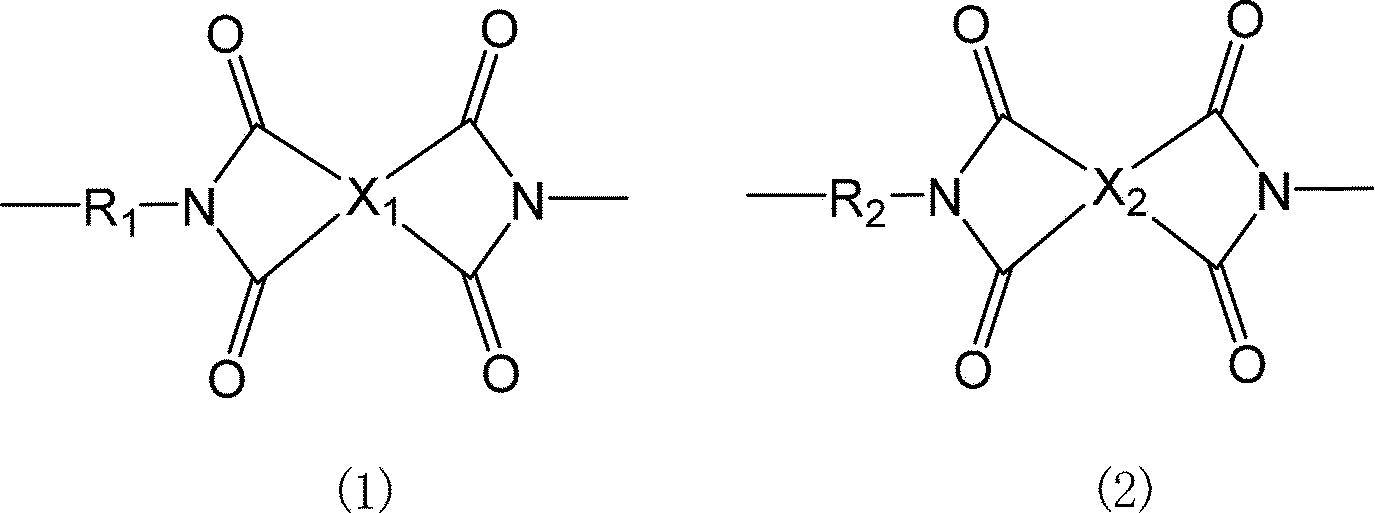
(R1は少なくとも1つの脂環式炭化水素構造を含む炭素数6~22の2価の基である。R2は炭素数5~16の2価の鎖状脂肪族基である。X1及びX2は、それぞれ独立に、少なくとも1つの芳香環を含む炭素数6~22の4価の基である。)
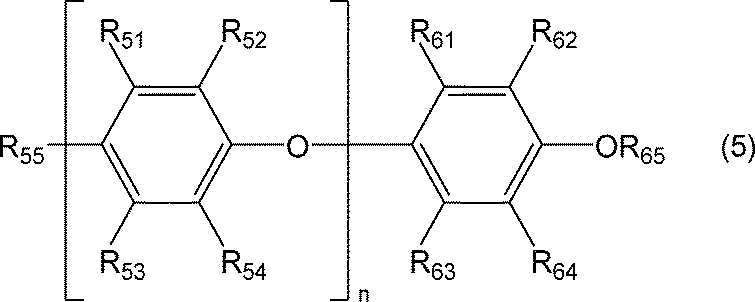
(R51~R55、及びR61~R64はそれぞれ独立に、水素原子、ヒドロキシ基、又は炭素数1~4のアルキル基であり、R65は水素原子又は炭素数1~4のアルキル基である。nは繰り返し構成単位数であり、10以上の数である。)
[2]前記樹脂組成物中の前記成分(A)及び前記成分(B)の合計含有量が50質量%以上である、上記[1]に記載の樹脂組成物。
[3]前記成分(B)の、クロロホルム中、30℃において測定した固有粘度が0.20~0.60dL/gである、上記[1]又は[2]に記載の樹脂組成物。
[4]前記樹脂組成物が前記成分(A)の融点を超える温度で溶融混練して得られたものである、上記[1]~[3]のいずれか1項に記載の樹脂組成物。
[5]前記樹脂組成物からなるペレットがミクロ相分離構造を有する、上記[1]~[4]のいずれか1項に記載の樹脂組成物。
[6]測定周波数10GHzにおける誘電率が3.0以下で且つ誘電正接が0.005以下である、上記[1]~[5]のいずれか1項に記載の樹脂組成物。
[7]前記樹脂組成物を成形して得られる成形体の、JIS K7197:2012に準拠して測定される、温度23~210℃の範囲における熱線膨張係数の絶対値が100ppm/℃以下である、上記[1]~[6]のいずれか1項に記載の樹脂組成物。
[8]上記[1]~[7]のいずれか1項に記載の樹脂組成物を含む成形体。
[9]前記成形体がフィルムである、上記[8]に記載の成形体。
本発明の樹脂組成物は、下記式(1)で示される繰り返し構成単位及び下記式(2)で示される繰り返し構成単位を含み、該式(1)の繰り返し構成単位と該式(2)の繰り返し構成単位の合計に対する該式(1)の繰り返し構成単位の含有比が20~70モル%のポリイミド樹脂(A)と、下記式(5)で示される樹脂又はその酸変性物(B)とを含有し、前記成分(A)及び前記成分(B)の合計含有質量に対する前記成分(B)の含有質量の割合[(B)/{(A)+(B)}]が0.50以下である。

(R1は少なくとも1つの脂環式炭化水素構造を含む炭素数6~22の2価の基である。R2は炭素数5~16の2価の鎖状脂肪族基である。X1及びX2は、それぞれ独立に、少なくとも1つの芳香環を含む炭素数6~22の4価の基である。)

(R51~R55、及びR61~R64はそれぞれ独立に、水素原子、ヒドロキシ基、又は炭素数1~4のアルキル基であり、R65は水素原子又は炭素数1~4のアルキル基である。nは繰り返し構成単位数であり、10以上の数である。)
本発明において上記効果が得られる理由は定かではないが、次のように考えられる。
成分(A)及び成分(B)はいずれも低誘電特性を有する熱可塑性樹脂であり、成分(A)は結晶性熱可塑性樹脂、成分(B)は非晶性熱可塑性樹脂である。成分(A)及び成分(B)を用いることで、優れた低誘電特性を有する樹脂組成物が得られる。
しかしながら通常、結晶性熱可塑性樹脂と非晶性熱可塑性樹脂とは相溶化し難く、これらをコンパウンドして得られた樹脂組成物は、射出成形により成形体を作製することは可能であっても、押出法によるフィルム成形においては成形性が低く、外観良好なフィルムを作製することが困難になる場合があった。
本発明では、結晶性熱可塑性樹脂として成形加工性に優れる成分(A)を使用し、且つ、成分(A)と成分(B)とを特定の割合で用いることで、成分(A)と成分(B)とがマイクロ~ナノレベルの微分散構造(ミクロ相分離構造)をとることが可能になる。特に、前記質量割合[(B)/{(A)+(B)}]が0.50以下であることで、成分(A)と成分(B)とがミクロ相分離構造として海島構造を形成する場合には、海側に成分(A)が存在しやすくなる。これにより成分(B)の酸化劣化に由来するヤケ等が抑制されるため、低誘電特性を維持しながら、押出法によるフィルム成形性を向上させることができたと考えられる。
さらに本発明の樹脂組成物によれば、熱線膨張係数が低く、寸法安定性に優れる成形体の作製が可能である。
本発明に用いるポリイミド樹脂(A)は、下記式(1)で示される繰り返し構成単位及び下記式(2)で示される繰り返し構成単位を含み、該式(1)の繰り返し構成単位と該式(2)の繰り返し構成単位の合計に対する該式(1)の繰り返し構成単位の含有比が20~70モル%である。
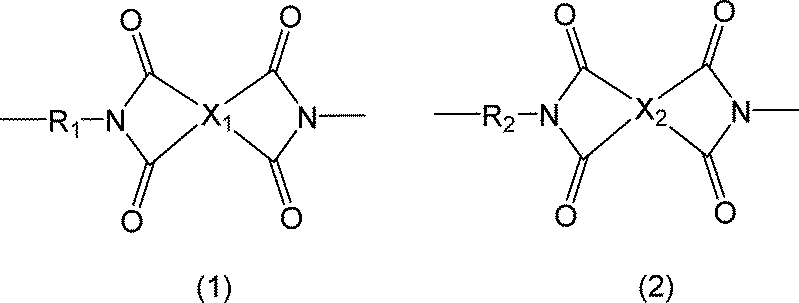
(R1は少なくとも1つの脂環式炭化水素構造を含む炭素数6~22の2価の基である。R2は炭素数5~16の2価の鎖状脂肪族基である。X1及びX2は、それぞれ独立に、少なくとも1つの芳香環を含む炭素数6~22の4価の基である。)
R1は少なくとも1つの脂環式炭化水素構造を含む炭素数6~22の2価の基である。ここで、脂環式炭化水素構造とは、脂環式炭化水素化合物から誘導される環を意味し、該脂環式炭化水素化合物は、飽和であっても不飽和であってもよく、単環であっても多環であってもよい。
脂環式炭化水素構造としては、シクロヘキサン環等のシクロアルカン環、シクロヘキセン等のシクロアルケン環、ノルボルナン環等のビシクロアルカン環、及びノルボルネン等のビシクロアルケン環が例示されるが、これらに限定されるわけではない。これらの中でも、好ましくはシクロアルカン環、より好ましくは炭素数4~7のシクロアルカン環、さらに好ましくはシクロヘキサン環である。
R1の炭素数は6~22であり、好ましくは8~17である。
R1は脂環式炭化水素構造を少なくとも1つ含み、好ましくは1~3個含む。

(m11及びm12は、それぞれ独立に、0~2の整数であり、好ましくは0又は1である。m13~m15は、それぞれ独立に、0~2の整数であり、好ましくは0又は1である。)

なお、上記の式(R1-3)で表される2価の基において、2つのメチレン基のシクロヘキサン環に対する位置関係はシスであってもトランスであってもよく、またシスとトランスの比は如何なる値でもよい。
X1の炭素数は6~22であり、好ましくは6~18である。
X1は芳香環を少なくとも1つ含み、好ましくは1~3個含む。

(R11~R18は、それぞれ独立に、炭素数1~4のアルキル基である。p11~p13は、それぞれ独立に、0~2の整数であり、好ましくは0である。p14、p15、p16及びp18は、それぞれ独立に、0~3の整数であり、好ましくは0である。p17は0~4の整数であり、好ましくは0である。L11~L13は、それぞれ独立に、単結合、エーテル基、カルボニル基又は炭素数1~4のアルキレン基である。)
なお、X1は少なくとも1つの芳香環を含む炭素数6~22の4価の基であるので、式(X-2)におけるR12、R13、p12及びp13は、式(X-2)で表される4価の基の炭素数が10~22の範囲に入るように選択される。
同様に、式(X-3)におけるL11、R14、R15、p14及びp15は、式(X-3)で表される4価の基の炭素数が12~22の範囲に入るように選択され、式(X-4)におけるL12、L13、R16、R17、R18、p16、p17及びp18は、式(X-4)で表される4価の基の炭素数が18~22の範囲に入るように選択される。
R2は炭素数5~16の2価の鎖状脂肪族基であり、好ましくは炭素数6~14、より好ましくは炭素数7~12、更に好ましくは炭素数8~10である。ここで、鎖状脂肪族基とは、鎖状脂肪族化合物から誘導される基を意味し、該鎖状脂肪族化合物は、飽和であっても不飽和であってもよく、直鎖状であっても分岐状であってもよく、酸素原子等のヘテロ原子を含んでいてもよい。
R2は、好ましくは炭素数5~16のアルキレン基であり、より好ましくは炭素数6~14、更に好ましくは炭素数7~12のアルキレン基であり、なかでも好ましくは炭素数8~10のアルキレン基である。前記アルキレン基は、直鎖アルキレン基であっても分岐アルキレン基であってもよいが、好ましくは直鎖アルキレン基である。
R2は、好ましくはオクタメチレン基及びデカメチレン基からなる群から選ばれる少なくとも1種であり、特に好ましくはオクタメチレン基である。

(m21及びm22は、それぞれ独立に、1~15の整数であり、好ましくは1~13、より好ましくは1~11、更に好ましくは1~9である。m23~m25は、それぞれ独立に、1~14の整数であり、好ましくは1~12、より好ましくは1~10、更に好ましくは1~8である。)
なお、R2は炭素数5~16(好ましくは炭素数6~14、より好ましくは炭素数7~12、更に好ましくは炭素数8~10)の2価の鎖状脂肪族基であるので、式(R2-1)におけるm21及びm22は、式(R2-1)で表される2価の基の炭素数が5~16(好ましくは炭素数6~14、より好ましくは炭素数7~12、更に好ましくは炭素数8~10)の範囲に入るように選択される。すなわち、m21+m22は5~16(好ましくは6~14、より好ましくは7~12、更に好ましくは8~10)である。
同様に、式(R2-2)におけるm23~m25は、式(R2-2)で表される2価の基の炭素数が5~16(好ましくは炭素数6~14、より好ましくは炭素数7~12、更に好ましくは炭素数8~10)の範囲に入るように選択される。すなわち、m23+m24+m25は5~16(好ましくは炭素数6~14、より好ましくは炭素数7~12、更に好ましくは炭素数8~10)である。
式(1)の繰り返し構成単位と式(2)の繰り返し構成単位の合計に対する、式(1)の繰り返し構成単位の含有比は、高い結晶性を発現する観点から、好ましくは65モル%以下、より好ましくは60モル%以下、更に好ましくは50モル%以下である。
中でも、式(1)の繰り返し構成単位と式(2)の繰り返し構成単位の合計に対する式(1)の繰り返し構成単位の含有比は20モル%以上、40モル%未満であることが好ましい。この範囲であるとポリイミド樹脂(A)の結晶性が高くなり、より耐熱性に優れる樹脂組成物を得ることができる。
上記含有比は、成形加工性の観点からは、好ましくは25モル%以上、より好ましくは30モル%以上、更に好ましくは32モル%以上であり、高い結晶性を発現する観点から、より更に好ましくは35モル%以下である。
前記含有比は、耐熱性の向上という観点からは、好ましくは5モル%以上、より好ましくは10モル%以上であり、一方で結晶性を維持する観点からは、好ましくは20モル%以下、より好ましくは15モル%以下である。

(R3は少なくとも1つの芳香環を含む炭素数6~22の2価の基である。X3は少なくとも1つの芳香環を含む炭素数6~22の4価の基である。)
R3の炭素数は6~22であり、好ましくは6~18である。
R3は芳香環を少なくとも1つ含み、好ましくは1~3個含む。
また、前記芳香環には1価もしくは2価の電子求引性基が結合していてもよい。1価の電子求引性基としてはニトロ基、シアノ基、p-トルエンスルホニル基、ハロゲン、ハロゲン化アルキル基、フェニル基、アシル基などが挙げられる。2価の電子求引性基としては、フッ化アルキレン基(例えば-C(CF3)2-、-(CF2)p-(ここで、pは1~10の整数である))のようなハロゲン化アルキレン基のほかに、-CO-、-SO2-、-SO-、-CONH-、-COO-などが挙げられる。

(m31及びm32は、それぞれ独立に、0~2の整数であり、好ましくは0又は1である。m33及びm34は、それぞれ独立に、0~2の整数であり、好ましくは0又は1である。R21、R22、及びR23は、それぞれ独立に、炭素数1~4のアルキル基、炭素数2~4のアルケニル基、又は炭素数2~4のアルキニル基である。p21、p22及びp23は0~4の整数であり、好ましくは0である。L21は、単結合、エーテル基、カルボニル基又は炭素数1~4のアルキレン基である。)
なお、R3は少なくとも1つの芳香環を含む炭素数6~22の2価の基であるので、式(R3-1)におけるm31、m32、R21及びp21は、式(R3-1)で表される2価の基の炭素数が6~22の範囲に入るように選択される。
同様に、式(R3-2)におけるL21、m33、m34、R22、R23、p22及びp23は、式(R3-2)で表される2価の基の炭素数が12~22の範囲に入るように選択される。
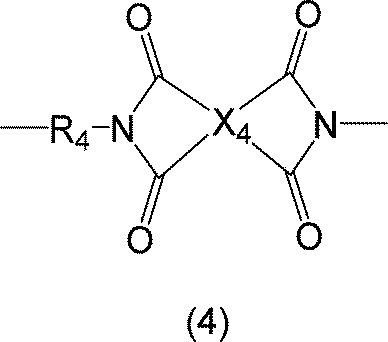
(R4は-SO2-又は-Si(Rx)(Ry)O-を含む2価の基であり、Rx及びRyはそれぞれ独立に、炭素数1~3の鎖状脂肪族基又はフェニル基を表す。X4は少なくとも1つの芳香環を含む炭素数6~22の4価の基である。)
X4は、式(1)におけるX1と同様に定義され、好ましい様態も同様である。
該鎖状脂肪族基は、飽和であっても不飽和であってもよく、直鎖状であっても分岐状であってもよい。ポリイミド樹脂(A)が上記特定の基を末端に有すると、耐熱老化性に優れる樹脂組成物を得ることができる。
炭素数5~14の飽和鎖状脂肪族基としては、n-ペンチル基、n-ヘキシル基、n-ヘプチル基、n-オクチル基、n-ノニル基、n-デシル基、n-ウンデシル基、ラウリル基、n-トリデシル基、n-テトラデシル基、イソペンチル基、ネオペンチル基、2-メチルペンチル基、2-メチルヘキシル基、2-エチルペンチル基、3-エチルペンチル基、イソオクチル基、2-エチルヘキシル基、3-エチルヘキシル基、イソノニル基、2-エチルオクチル基、イソデシル基、イソドデシル基、イソトリデシル基、イソテトラデシル基等が挙げられる。
炭素数5~14の不飽和鎖状脂肪族基としては、1-ペンテニル基、2-ペンテニル基、1-ヘキセニル基、2-ヘキセニル基、1-ヘプテニル基、2-ヘプテニル基、1-オクテニル基、2-オクテニル基、ノネニル基、デセニル基、ドデセニル基、トリデセニル基、テトラデセニル基等が挙げられる。
中でも、上記鎖状脂肪族基は飽和鎖状脂肪族基であることが好ましく、飽和直鎖状脂肪族基であることがより好ましい。また耐熱老化性を得る観点から、上記鎖状脂肪族基は好ましくは炭素数6以上、より好ましくは炭素数7以上、更に好ましくは炭素数8以上であり、好ましくは炭素数12以下、より好ましくは炭素数10以下、更に好ましくは炭素数9以下である。上記鎖状脂肪族基は1種のみでもよく、2種以上でもよい。
上記鎖状脂肪族基は、特に好ましくはn-オクチル基、イソオクチル基、2-エチルヘキシル基、n-ノニル基、イソノニル基、n-デシル基、及びイソデシル基からなる群から選ばれる少なくとも1種であり、更に好ましくはn-オクチル基、イソオクチル基、2-エチルヘキシル基、n-ノニル基、及びイソノニル基からなる群から選ばれる少なくとも1種であり、最も好ましくはn-オクチル基、イソオクチル基、及び2-エチルヘキシル基からなる群から選ばれる少なくとも1種である。
またポリイミド樹脂(A)は、耐熱老化性の観点から、末端アミノ基及び末端カルボキシ基以外に、炭素数5~14の鎖状脂肪族基のみを末端に有することが好ましい。上記以外の基を末端に有する場合、その含有量は、好ましくは炭素数5~14の鎖状脂肪族基に対し10モル%以下、より好ましくは5モル%以下である。
ポリイミド樹脂(A)中の上記炭素数5~14の鎖状脂肪族基の含有量は、ポリイミド樹脂(A)を解重合することにより求めることができる。
ポリイミド樹脂(A)の融点、ガラス転移温度は、いずれも示差走査型熱量計により測定することができる。
またポリイミド樹脂(A)は、結晶性、耐熱性、機械的強度、耐薬品性を向上させる観点から、示差走査型熱量計測定により、該ポリイミド樹脂(A)を溶融後、降温速度20℃/分で冷却した際に観測される結晶化発熱ピークの熱量(以下、単に「結晶化熱量」ともいう)が、5.0mJ/mg以上であることが好ましく、10.0mJ/mg以上であることがより好ましく、17.0mJ/mg以上であることが更に好ましい。結晶化熱量の上限値は特に限定されないが、通常、45.0mJ/mg以下である。
ポリイミド樹脂(A)の融点、ガラス転移温度、結晶化熱量は、具体的には実施例に記載の方法で測定できる。
μ=ln(ts/t0)/C
t0:濃硫酸の流れる時間
ts:ポリイミド樹脂溶液の流れる時間
C:0.5(g/dL)
ポリイミド樹脂(A)の重量平均分子量Mwは、ポリメチルメタクリレート(PMMA)を標準試料としてゲルろ過クロマトグラフィー(GPC)法により測定することができる。
ポリイミド樹脂(A)は、テトラカルボン酸成分とジアミン成分とを反応させることにより製造することができる。該テトラカルボン酸成分は少なくとも1つの芳香環を含むテトラカルボン酸及び/又はその誘導体を含有し、該ジアミン成分は少なくとも1つの脂環式炭化水素構造を含むジアミン及び鎖状脂肪族ジアミンを含有する。
鎖状脂肪族ジアミンは1種類あるいは複数を混合して使用してもよい。これらのうち、炭素数が8~10の鎖状脂肪族ジアミンが好適に使用でき、特に1,8-オクタメチレンジアミン及び1,10-デカメチレンジアミンからなる群から選ばれる少なくとも1種が好適に使用できる。
前記モル比は、耐熱性の向上という観点からは、好ましくは5モル%以上、より好ましくは10モル%以上であり、一方で結晶性を維持する観点からは、好ましくは20モル%以下、より好ましくは15モル%以下である。
また、前記モル比は、ポリイミド樹脂(A)の着色を少なくする観点からは、好ましくは12モル%以下、より好ましくは10モル%以下、更に好ましくは5モル%以下、より更に好ましくは0モル%である。
中でも、末端封止剤としてはモノアミン類末端封止剤が好ましく、ポリイミド樹脂(A)の末端に前述した炭素数5~14の鎖状脂肪族基を導入して耐熱老化性を向上させる観点から、炭素数5~14の鎖状脂肪族基を有するモノアミンがより好ましく、炭素数5~14の飽和直鎖状脂肪族基を有するモノアミンが更に好ましい。
末端封止剤は、特に好ましくはn-オクチルアミン、イソオクチルアミン、2-エチルヘキシルアミン、n-ノニルアミン、イソノニルアミン、n-デシルアミン、及びイソデシルアミンからなる群から選ばれる少なくとも1種であり、更に好ましくはn-オクチルアミン、イソオクチルアミン、2-エチルヘキシルアミン、n-ノニルアミン、及びイソノニルアミンからなる群から選ばれる少なくとも1種であり、最も好ましくはn-オクチルアミン、イソオクチルアミン、及び2-エチルヘキシルアミンからなる群から選ばれる少なくとも1種である。
本発明の樹脂組成物は、ポリイミド樹脂(A)と、下記式(5)で示される樹脂又はその酸変性物(B)とを含有する。

(R51~R55、及びR61~R64はそれぞれ独立に、水素原子、ヒドロキシ基、又は炭素数1~4のアルキル基であり、R65は水素原子又は炭素数1~4のアルキル基である。nは繰り返し構成単位数であり、10以上の数である。)
R52、R54、R62、及びR64は、好ましくは水素原子又は炭素数1~4のアルキル基であり、より好ましくは水素原子又はメチル基であり、さらに好ましくはメチル基である。
R65は、好ましくは水素原子である。
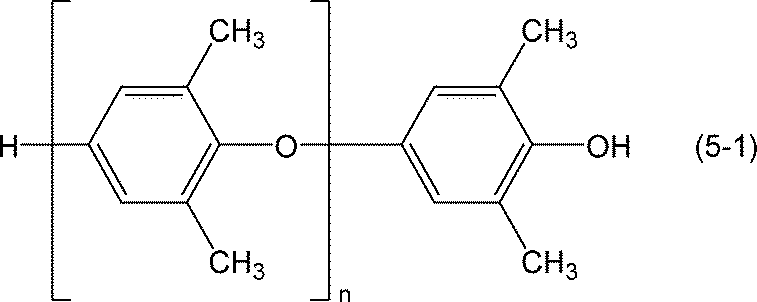
(式中、nは前記と同じである。)
不飽和カルボン酸としては、アクリル酸、メタクリル酸、マレイン酸、フマル酸、イタコン酸、クロトン酸、シトラコン酸、ソルビン酸、メサコン酸、アンゲリカ酸等が挙げられる。また、不飽和カルボン酸の誘導体としては、酸無水物、エステル、アミド、イミド、及び金属塩等が挙げられ、これらの中でも酸無水物が好ましい。
上記の中でも、前記式(5)で示される樹脂の酸変性物は、低誘電特性を得る観点、フィルム成形性向上の観点及び入手性の観点から、好ましくは、前記式(5)で示される樹脂をマレイン酸又はマレイン酸誘導体で変性した樹脂(前記式(5)で示される樹脂のマレイン酸変性物)であり、より好ましくは、前記式(5)で示される樹脂を無水マレイン酸で変性した樹脂である。


(式中、R51~R55、R61、R63、R64、R65、及びnは前記と同じである。)
前記式(5)で示される樹脂を無水マレイン酸で変性した樹脂(マレイン酸変性物)の市販品としては、三菱エンジニアリングプラスチックス(株)製「ユピエースPME-80」(無水マレイン酸変性率0.38質量%)等が挙げられる。
樹脂組成物中の成分(A)及び成分(B)の合計含有質量に対する成分(B)の含有質量の割合[(B)/{(A)+(B)}]は、フィルム成形性向上の観点から、0.50以下であり、好ましくは0.40以下、より好ましくは0.30以下、更に好ましくは0.20以下、より更に好ましくは0.15以下である。また、下限は0超であり、低誘電特性を得る観点から、好ましくは0.005以上、より好ましくは0.01以上、更に好ましくは0.05以上、より更に好ましくは0.10以上である。
本発明の樹脂組成物には、充填剤、強化繊維、艶消剤、可塑剤、帯電防止剤、着色防止剤、ゲル化防止剤、着色剤、摺動性改良剤、酸化防止剤、導電剤、樹脂改質剤、相容化剤等の添加剤を、必要に応じて配合することができる。
上記添加剤を用いる場合、その配合量には特に制限はないが、低誘電特性及びフィルム成形性を維持しつつ添加剤の効果を発現させる観点から、樹脂組成物中、通常、50質量%以下であり、好ましくは0.0001~30質量%、より好ましくは0.001~15質量%、更に好ましくは0.01~10質量%である。
これらの中でも、耐熱性、成形加工性、強度及び耐溶剤性の観点から、ポリエーテルイミド樹脂、ポリフェニレンサルファイド樹脂、及びポリエーテルエーテルケトン樹脂からなる群から選ばれる1種以上が好ましく、低吸水性の観点からは液晶ポリマーが好ましく、高い難燃性を得る観点からはポリフェニレンサルファイド樹脂、ポリテトラフルオロエチレン、及びパーフルオロアルキルビニルエーテル共重合体からなる群から選ばれる1種以上が好ましい。
成分(A)及び成分(B)以外の樹脂を併用する場合、樹脂組成物の特性が阻害されない範囲であれば、その配合量には特に制限はない。
本発明の樹脂組成物は任意の形態をとることができるが、後述するミクロ相分離構造を形成することにより優れた低誘電特性を得る観点から、好ましくは成分(A)の融点を超える温度で溶融混練して得られたものであり、より好ましくは成分(A)の融点を超える温度で溶融混練して得られたペレットである。すなわち本発明の樹脂組成物中の成分(A)には熱履歴が施されていることが好ましく、該樹脂組成物は、成分(A)を粉末状態で含有する樹脂組成物とは区別される。
本発明の樹脂組成物は熱可塑性を有するため、例えば成分(A)、成分(B)、及び必要に応じて各種任意成分を添加してドライブレンドした後、あるいは、成分(A)の押出機へのフィードとは別の個所より成分(B)及び任意の成分を別フィードした後、押出機内で溶融混練してストランドを押出し、ストランドをカットすることによりペレット化することができる。また、当該ペレットを各種成形機に導入して後述の方法で熱成形することにより、所望の形状を有する成形体を容易に製造することができる。
ペレット又は成形体がミクロ相分離構造を有しているか否かについては、ペレット又は成形体の表面又は断面を走査型透過電子顕微鏡(STEM)で観察することによって判別できる。
融解熱量(Hm)は、具体的には実施例に記載の方法により測定できる。
本発明は、前記樹脂組成物を含む成形体を提供する。成形体の形状は特に制限されず、例えば、シート、フィルム、ストランド、フィラメント等が挙げられる。これらは工業製品の中間部材であってもよく、最終製品であってもよい。
本発明の効果を有効に発揮する観点から、本発明の成形体は、好ましくはフィルムである。該フィルムの厚さは特に制限されないが、押出成形法により作製されるフィルムとの厚さとしては、通常、500μm以下、好ましくは200μm以下、より好ましくは100μm未満、更に好ましくは80μm以下、より更に好ましくは60μm以下である。フィルムの厚さの下限値は、通常、5μm以上、好ましくは10μm以上である。
本明細書において「フィルムの厚さ」とは、フィルムの厚さの平均値を意味する。またフィルム形状の成形体には、樹脂フィルムの形態の他、多層積層板を構成する樹脂層の形態、コーティング層の形態等が含まれる。
フィルム形状の成形体を製造する場合には、押出成形が好ましく、例えば290℃以上400℃以下、好ましくは290℃以上360℃以下の温度範囲での成形が可能である。
本発明の樹脂組成物及び成形体は低誘電特性を有し、例えば、測定周波数10GHzにおける誘電率が3.0以下で且つ誘電正接が0.005以下を達成することができる。該誘電率は、好ましくは2.90以下、より好ましくは2.85以下、更に好ましくは2.70以下、より更に好ましくは2.50以下、より更に好ましくは2.40以下であり、誘電正接は、好ましくは0.004以下、より好ましくは0.003以下である。誘電率及び誘電正接は、具体的には実施例に記載の方法により測定できる。
本発明の樹脂組成物及び成形体は低CTEを示す。例えば、樹脂組成物を成形して得られる成形体の、JIS K7197:2012に準拠して測定される、温度23~210℃の範囲における熱線膨張係数の絶対値を、好ましくは100ppm/℃以下、より好ましくは90ppm/℃以下、更に好ましくは85ppm/℃以下、より更に好ましくは80ppm/℃以下、より更に好ましくは75ppm/℃以下、より更に好ましくは70ppm/℃以下とすることができる。
なお、延伸が施された成形体であるとCTEの値が変動するため、CTE測定に用いる成形体は、好ましくは無延伸の成形体であり、より好ましくは射出成形体である。
射出成形体においても、流れ方向(MD)とそれに直交する方向(TD)が存在し、MDとTDとでCTEが異なる場合がある。この場合は、MD及びTDの熱線膨張係数の絶対値の平均が上記範囲であることが好ましい。ここで、MD及びTDの熱線膨張係数の絶対値の平均とは、{(MDの熱線膨張係数の絶対値)+(TDの熱線膨張係数の絶対値)}/2を意味する。
さらに、寸法安定性の観点から、MD又はTDのうち少なくとも一方、好ましくはMDの熱線膨張係数の絶対値が55ppm/℃以下であることが好ましく、50ppm/℃以下であることがより好ましい。
成形体の熱線膨張係数は、熱機械分析(TMA法)により圧縮モードで測定される値であり、具体的には実施例に記載の方法で測定できる。
本発明の樹脂組成物及び成形体は、低誘電率及び低誘電正接が要求される用途、例えば、5G、又は70G~300GHzの周波数帯を使用する第6世代移動通信システム(6G)関連部材(スマートフォン、フレキシブルプリント基板、銅張積層板等の金属箔積層板、アンテナ、アンテナ基板等)、上記以外の、各種アンテナ(マイクロ波用アンテナ、ミリ波用アンテナ、導波管スロットアンテナ、ホーンアンテナ、レンズアンテナ、プリントアンテナ、トリプレートアンテナ、マイクロストリップアンテナ、パッチアンテナ等)、各種アンテナ基板(77GHz車載ミリ波レーダのアンテナ基板、テラヘルツ波レーダのアンテナ基板、航空機用レーダのアンテナ基板、キャタピラ式特殊車両用アンテナ基板、WiGigのアンテナ基板等)、電線被覆材(低誘電電線被覆材等)、ボンディングシート、絶縁フィルム、炭素繊維強化プラスチック(CFRP)用原料、高周波回路基板、プリント配線基板、チップオンフィルム(COF)フレキシブル基板、多層積層板、LED搭載基板、産業用ロボット基板、家庭用ロボットの通信用基板、半導体素子材料、高周波デバイス用ウエハ、Wi-fiチップ、無線通信デバイス、伝送線路(同軸線路、ストリップ線路、マイクロストリップ線路、コプレナー線路、平行線路等)、ベアリング用コート、断熱軸、トレー、各種ベルト(シームレスベルト等)、耐熱低誘電テープ、耐熱低誘電チューブ、各種センサ(タッチセンサ等)、各種レーダ(車載用レーダ、航空宇宙用レーダ等)、レドーム(レーダードーム)、光通信モジュール(TOSA/ROSA)、8k-TVのケーブルモバイル端末又はデジタル家電(タブレット端末、ノートPC、薄型TV、巻き取り式TV、デジカメ、スマートグラス、スマートウォッチ等)、基地局(マクロセル基地局、スモールセル基地局、C-RAN基地局等)、ドローン(商業用ドローン、長距離移動ドローン等)、監視カメラ、室内又は屋外サーバ、人工衛星、宇宙ステーション用通信機器等に適用できる。
ポリイミド樹脂のIR測定は日本電子(株)製「JIR-WINSPEC50」を用いて行った。
ポリイミド樹脂を190~200℃で2時間乾燥した後、該ポリイミド樹脂0.100gを濃硫酸(96%、関東化学(株)製)20mLに溶解したポリイミド樹脂溶液を測定試料とし、キャノンフェンスケ粘度計を使用して30℃において測定を行った。対数粘度μは下記式により求めた。
μ=ln[(ts/t0)/C]
t0:濃硫酸の流れる時間
ts:ポリイミド樹脂溶液の流れる時間
C:0.5g/dL
各例で使用した樹脂単独、又は、各例で得られた樹脂組成物の融点Tm、ガラス転移温度Tg、結晶化温度Tc、融解熱量Hm、及び結晶化熱量Hcは、示差走査熱量計装置(TA Instruments社製「DSC-25」)を用いて測定した。結晶化温度Tcの測定において、ポリイミド樹脂については樹脂粉末、結晶性熱可塑性樹脂組成物についてはペレットを測定試料として用いた。
窒素雰囲気下、測定試料に下記条件の熱履歴を課した。熱履歴の条件は、昇温1度目(昇温速度10℃/分)、その後冷却(降温速度20℃/分)、その後昇温2度目(昇温速度10℃/分)である。
融点Tmは昇温2度目で観測された吸熱ピークのピークトップ値を読み取り決定した。ガラス転移温度Tgは昇温2度目で観測された値を読み取り決定した。結晶化温度Tcは冷却時に観測された発熱ピークのピークトップ値を読み取り決定した。なおTm、Tg及びTcに関して、ピークが複数観測されたものについては各ピークのピークトップ値を読み取った。
融解熱量Hm(mJ/mg)は、測定試料を昇温速度10℃/分にて、融点以上の温度まで加熱して溶融させた後、降温速度20℃/分で冷却し、再度、昇温速度10℃/分で溶融させた際に観測される融点付近の融解熱量ピーク(吸熱ピーク)の面積から算出した。また結晶化熱量Hc(mJ/mg)は、測定試料を昇温速度10℃/分にて、融点以上の温度まで加熱して溶融させた後、降温速度20℃/分で冷却した際に観測される結晶化発熱ピークの面積から算出した。
ポリイミド樹脂の半結晶化時間は、示差走査熱量計装置(エスアイアイ・ナノテクノロジー(株)製「DSC-6220」)を用いて測定した。
窒素雰囲気下、420℃で10分保持し、ポリイミド樹脂を完全に溶融させたのち、冷却速度70℃/分の急冷操作を行った際に、観測される結晶化ピークの出現時からピークトップに達するまでにかかった時間を計算した。なお表1中、半結晶化時間が20秒以下である場合は「<20」と表記した。
ポリイミド樹脂の重量平均分子量(Mw)は、昭和電工(株)製のゲルろ過クロマトグラフィー(GPC)測定装置「Shodex GPC-101」を用いて下記条件にて測定した。
カラム:Shodex HFIP-806M
移動相溶媒:トリフルオロ酢酸ナトリウム2mM含有ヘキサフルオロイソプロパノール(HFIP)
カラム温度:40℃
移動相流速:1.0mL/min
試料濃度:約0.1質量%
検出器:IR検出器
注入量:100μm
検量線:標準PMMA
各例で使用した樹脂単独、又は、各例で得られた樹脂組成物を用いて、後述する射出成型法により80mm×10mm×厚さ4mmの成形体を製造し、測定に使用した。
測定はJIS K7191-1,2:2015に準拠して、フラットワイズでの試験を実施した。具体的には、HDT試験装置「Auto-HDT3D-2」((株)東洋精機製作所製)を用いて、支点間距離64mm、荷重1.80MPa、昇温速度120℃/時間の条件にて熱変形温度を測定した。
各例で使用した樹脂単独、又は、各例で得られた樹脂組成物のペレットを、ラボプラストミルTダイ押出成形装置((株)東洋精機製作所製、押出機Φ20mm、L/D=25、Tダイのダイス幅150mm、リップ幅0.4mm)に投入し、押出温度310~350℃、目標厚さ50μmの条件にて約15分間押出成形を行い、フィルムを作製した。押出成形中のフィルムを目視観察し、フィルム成形性を下記基準で評価した。
A:フィルム表面にブツ、目ヤニが見られない。
B:フィルム表面にブツ、目ヤニが若干見られるが、許容範囲である。
C:フィルム表面にブツ、目ヤニが多数発生している。
各例で使用した樹脂単独、又は、各例で得られた樹脂組成物を用いて、「フィルム成形性」評価に記載の方法により厚さ50~60μmのフィルムを製造し、測定に使用した。キーサイド・テクノロジー(株)製「PNAネットワークアナライザ N5222B」及び(株)関東電子応用開発製の空洞共振器「CP531」を用い、IEC 62810に準拠して、空洞共振器摂動法により、温度23℃、湿度50%、測定周波数10GHzにおいて、誘電率及び誘電正接を測定した。測定値はn=2の平均値とした。フィルムは温度23℃、湿度50%で24時間以上状態調節を行った後、速やかに測定に使用した。
CTEはJIS K7197:2012に準拠して測定した。各例で使用した樹脂単独、又は、各例で得られた樹脂組成物のペレットを用いて、後述する方法によりJIS K 7139:2009 多目的試験片 タイプA1の射出成形体を作製した。この射出成形体の平行部から、5mm×4mm×10mmのサイズに切り出した試験片を測定に使用した。
上記試験片を測定試料として、(株)日立ハイテクサイエンス製の熱機械分析装置「TMA7100C」を用いて、窒素気流中(150mL/min)、圧縮モードで荷重49mN、昇温速度5℃/分の条件で23~300℃まで昇温して熱機械分析(TMA)測定を行った。TMA測定は射出成形体の流れ方向(MD)及びそれに直交する方向(TD)について行い、23~210℃における測定値からCTEを求めた。また、(MDのCTE+TDのCTE)/2を、MD及びTDのCTEの平均値とした。
ディーンスターク装置、リービッヒ冷却管、熱電対、4枚パドル翼を設置した2Lセパラブルフラスコ中に2-(2-メトキシエトキシ)エタノール(日本乳化剤(株)製)500gとピロメリット酸二無水物(三菱ガス化学(株)製)218.12g(1.00mol)を導入し、窒素フローした後、均一な懸濁溶液になるように150rpmで撹拌した。一方で、500mLビーカーを用いて、1,3-ビス(アミノメチル)シクロヘキサン(三菱ガス化学(株)製、シス/トランス比=7/3)49.79g(0.35mol)、1,8-オクタメチレンジアミン(関東化学(株)製)93.77g(0.65mol)を2-(2-メトキシエトキシ)エタノール250gに溶解させ、混合ジアミン溶液を調製した。この混合ジアミン溶液を、プランジャーポンプを使用して徐々に加えた。滴下により発熱が起こるが、内温は40~80℃に収まるよう調整した。混合ジアミン溶液の滴下中はすべて窒素フロー状態とし、撹拌翼回転数は250rpmとした。滴下が終わったのちに、2-(2-メトキシエトキシ)エタノール130gと、末端封止剤であるn-オクチルアミン(関東化学(株)製)1.284g(0.010mol)を加えさらに撹拌した。この段階で、淡黄色のポリアミド酸溶液が得られた。次に、撹拌速度を200rpmとした後に、2Lセパラブルフラスコ中のポリアミド酸溶液を190℃まで昇温した。昇温を行っていく過程において、液温度が120~140℃の間にポリイミド樹脂粉末の析出と、イミド化に伴う脱水が確認された。190℃で30分保持した後、室温まで放冷を行い、濾過を行った。得られたポリイミド樹脂粉末は2-(2-メトキシエトキシ)エタノール300gとメタノール300gにより洗浄、濾過を行った後、乾燥機で180℃、10時間乾燥を行い、317gの結晶性熱可塑性ポリイミド樹脂1(以下、単に「ポリイミド樹脂1」ともいう)の粉末を得た。
ポリイミド樹脂1のIRスペクトルを測定したところ、ν(C=O)1768、1697(cm-1)にイミド環の特性吸収が認められた。対数粘度は1.30dL/g、Tmは323℃、Tgは184℃、Tcは266℃、融解熱量は21.0mJ/mg、結晶化熱量は20.3mJ/mg、半結晶化時間は20秒以下、Mwは55,000であった。
ディーンスターク装置、リービッヒ冷却管、熱電対、4枚パドル翼を設置した2Lセパラブルフラスコ中に2-(2-メトキシエトキシ)エタノール(日本乳化剤(株)製)769gとピロメリット酸二無水物(三菱ガス化学(株)製)174.50g(0.80mol)を導入し、窒素フローした後、均一な懸濁溶液になるように150rpmで撹拌した。一方で、500mLビーカーを用いて、1,3-ビス(アミノメチル)シクロヘキサン(三菱ガス化学(株)製、シス/トランス比=7/3)22.76g(0.16mol)、1,8-オクタメチレンジアミン(関東化学(株)製)92.33g(0.64mol)を2-(2-メトキシエトキシ)エタノール250gに溶解させ、混合ジアミン溶液を調製した。この混合ジアミン溶液を、プランジャーポンプを使用して徐々に加えた。滴下により発熱が起こるが、内温は40~80℃に収まるよう調整した。混合ジアミン溶液の滴下中はすべて窒素フロー状態とし、撹拌翼回転数は250rpmとした。滴下が終わったのちに、2-(2-メトキシエトキシ)エタノール10gと、末端封止剤であるn-オクチルアミン(関東化学(株)製)1.027g(0.008mol)を加えさらに撹拌した。この段階で、淡黄色のポリアミド酸溶液が得られた。次に、撹拌速度を200rpmとした後に、2Lセパラブルフラスコ中のポリアミド酸溶液を185℃まで昇温した。昇温を行っていく過程において、液温度が120~140℃の間にポリイミド樹脂粉末の析出と、イミド化に伴う脱水が確認された。185℃で30分保持した後、室温まで放冷を行い、濾過を行った。得られたポリイミド樹脂粉末はメタノール600gにより洗浄、濾過を行った後、乾燥機で185℃、10時間乾燥を行い、256gの結晶性熱可塑性ポリイミド樹脂2(以下、単に「ポリイミド樹脂2」ともいう)の粉末を得た。
ポリイミド樹脂2のTmは344℃、Tgは166℃、Tcは299℃、融解熱量は40mJ/mg、結晶化熱量は35mJ/mg、Mwは36,000であった。
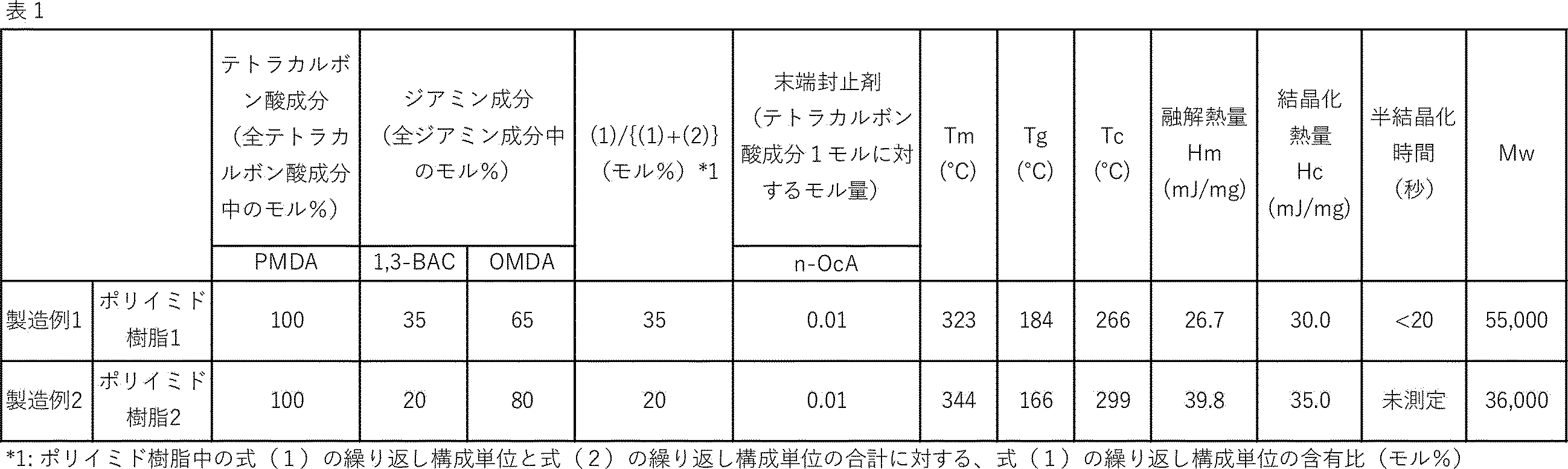
・PMDA;ピロメリット酸二無水物
・1,3-BAC;1,3-ビス(アミノメチル)シクロヘキサン
・OMDA;1,8-オクタメチレンジアミン
・n-OcA;n-オクチルアミン
製造例1で得られたポリイミド樹脂1の粉末と、成分(B)であるポリ(2,6-ジメチル-1,4-フェニレンエーテル)(ポリキシレノールシンガポール社製「PX100F」、Tg=207℃、クロロホルム中で測定した30℃における固有粘度=0.37dL/g)の粉末とを、表2に示す割合でドライブレンドした後、同方向回転二軸混練押出機((株)パーカーコーポレーション製「HK-25D」、スクリュー径25mmΦ、L/D=41)を用いて、バレル温度330~340℃、スクリュー回転数120rpmの条件で溶融混練し押し出した。押出機より押し出されたストランドを空冷後、ペレタイザー((株)星プラスチック製「ファンカッターFC-Mini-4/N」)によってペレット化した。得られたペレットは80℃、12時間乾燥を行った後、射出成形に使用した。
射出成形機(ファナック(株)製「ロボショットα-S30iA」)を使用して、バレル温度360℃、金型温度180℃、成形サイクル67秒にて射出成形を行い、前記評価に用いる所定の形状の射出成形体を作製した。
また、前記「フィルム成形性」評価に記載の方法によりフィルムを作製した。
得られたペレット、射出成形体又はフィルムを用いて、前述した方法で各種評価を行った。結果を表2に示す。
製造例1で得られたポリイミド樹脂1の粉末と、ポリ(2,6-ジメチル-1,4-フェニレンエーテル)「PX100F」の粉末とを表2に示す割合で用い、成形サイクル52~77秒の範囲(実施例2:52秒、実施例3:65秒、実施例4:67秒、比較例2:67秒、比較例3:72秒、比較例4:77秒)で射出成形を行ったこと以外は、実施例1と同様にしてペレット及び射出成形体、並びにフィルムを作製し、各種評価を行った。結果を表2に示す。
製造例1で得られたポリイミド樹脂1の粉末をラボプラストミル((株)東洋精機製作所製)を用いてバレル温度360℃、スクリュー回転数150rpmで溶融混練し押し出した。押出機より押し出されたストランドを空冷後、ペレタイザー((株)星プラスチック製「ファンカッターFC-Mini-4/N」)によってペレット化した。得られたペレットは150℃、12時間乾燥を行った後、射出成形に使用した。
射出成形機(ファナック(株)製「ROBOSHOT α-S30iA」)を使用して、バレル温度350℃、金型温度200℃、成形サイクル50秒として射出成形を行い、前記評価(HDT測定)に用いる所定の形状の射出成形体を作製した。
また、前記「フィルム成形性」評価に記載の方法によりフィルムを作製した。
得られたペレット、射出成形体又はフィルムを用いて、前述した方法で各種評価を行った。結果を表2に示す。

実施例1において、ポリ(2,6-ジメチル-1,4-フェニレンエーテル)として「PX100F」に替えてポリキシレノールシンガポール社製「PX100L」を表3に示す割合で用いたこと以外は、前記と同様にしてペレット及び射出成形体、並びにフィルムを作製し、各種評価を行った。結果を表3に示す。
比較例1において、ポリイミド樹脂1に替えて、製造例2で得られたポリイミド樹脂2を用い、射出成形時のバレル温度を360℃、金型温度を180℃に変更したこと以外は、前記と同様にしてペレット及び射出成形体、並びにフィルムを作製し、各種評価を行った。結果を表3に示す。
実施例1において、製造例2で得られたポリイミド樹脂2と、ポリ(2,6-ジメチル-1,4-フェニレンエーテル)としてポリキシレノールシンガポール社製「PX100L」とを表3に示す割合で用いたこと以外は、前記と同様にしてペレット及び射出成形体、並びにフィルムを作製し、各種評価を行った。結果を表3に示す。
実施例5において、「PX100L」に替えて、無水マレイン酸変性ポリフェニレンエーテル(三菱エンジニアリングプラスチックス(株)製「ユピエースPME-80」、無水マレイン酸変性率:0.38質量%)を用い、射出成形時のバレル温度を360℃、金型温度を160℃に変更したこと以外は、前記と同様にしてペレット及び射出成形体、並びにフィルムを作製し、各種評価を行った。結果を表3に示す。

<成分(A)>
・ポリイミド樹脂1:製造例1で得られた結晶性熱可塑性ポリイミド樹脂1
・ポリイミド樹脂2:製造例2で得られた結晶性熱可塑性ポリイミド樹脂2
<成分(B)>
・PX100F:ポリ(2,6-ジメチル-1,4-フェニレンエーテル)、ポリキシレノールシンガポール社製「PX100F」、Tg=207℃、クロロホルム中で測定した30℃における固有粘度=0.37dL/g
・PX100L:ポリ(2,6-ジメチル-1,4-フェニレンエーテル)、ポリキシレノールシンガポール社製「PX100L」、Tg=210℃、クロロホルム中で測定した30℃における固有粘度=0.47dL/g
・PME80:無水マレイン酸変性ポリフェニレンエーテル、三菱エンジニアリングプラスチックス(株)製「ユピエースPME-80」、無水マレイン酸変性率0.38質量%
また実施例1~5、7の樹脂組成物は比較例2~7よりも融解熱量Hmが高く、すなわち高結晶性であることがわかる。
実施例5で得られたペレットを、ウルトラミクロトーム(ライカマイクロシステムズ製「EM UC7」を用いて、図1に示すようにペレットの流れ方向(MD)に対し直交する方向に(すなわち、TD断面が出るように)切断し、超薄切片を作製した。図1において、1はペレット、2は超薄切片である。
この切片を30分、四酸化ルテニウムの気相中で染色した後、フィールドエミッション型走査型透過電子顕微鏡(FE-STEM、カールツァイス製「Gemini SEM500」)を用いて、加速電圧:30kV、カラムモード:Normal、アパーチャサイズ:20μm、作動距離:3.6mm、検出信号:aSTEM A、観察倍率:1万倍で、STEM検出器を用いて透過観察した(図2)。図2の観察画像において、暗い部分は染色部、明るい部分が非染色部に相当する。観察画像において、色が濃い部分は、四酸化ルテニウムにより染色されやすい樹脂(B)で構成されていると判断した。
図2より、実施例5で得られたペレット中では、ポリイミド樹脂(A)と樹脂(B)とが海島構造を形成していることがわかる。また、ポリイミド樹脂(A)が海部、樹脂(B)が島部を形成していると推定される。
製造例1で得られたポリイミド樹脂1の粉末と、ポリ(2,6-ジメチル-1,4-フェニレンエーテル)「PX100F」の粉末とを表4に示す割合で用い、さらに、表4に示す量の添加剤を配合して、成形サイクル61~88秒で射出成形を行ったこと以外は、実施例1と同様にしてペレット及び射出成形体、並びにフィルムを作製し、各種評価を行った。結果を表4に示す。
なお表4に記載の酸素指数は、以下の方法で評価した。
各例で使用した樹脂単独、及び各例で製造した樹脂組成物を用いて、前記方法により80mm×10mm×厚さ4mmの射出成形体を作製した。この成形体を試験片として、キャンドル燃焼試験機D型(東洋精機製作所製)を用いて、JIS K 7201:1995に準拠した方法で酸素指数を測定した。酸素指数が高いほど、難燃性に優れることを意味する。
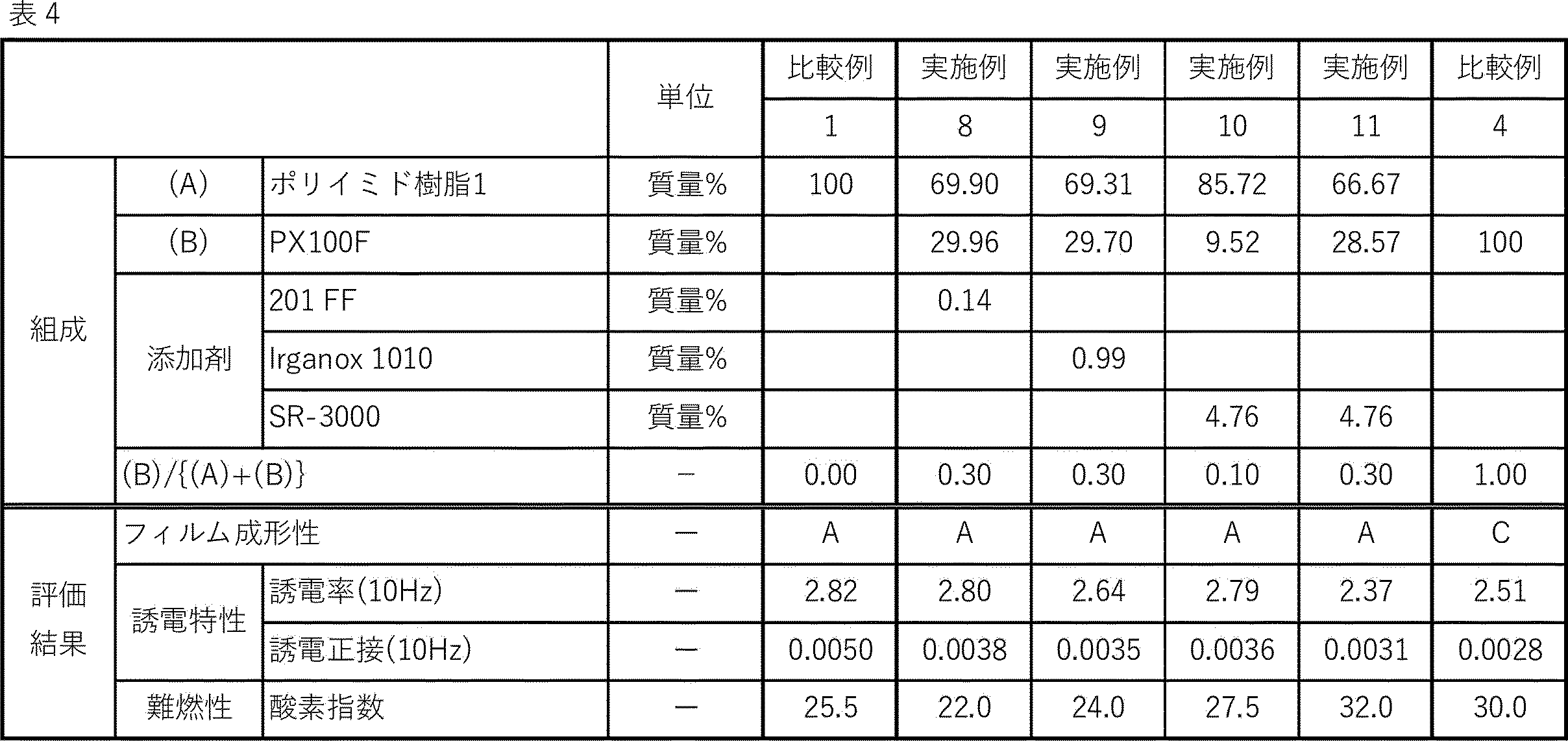
<成分(A)>
・ポリイミド樹脂1:製造例1で得られた結晶性熱可塑性ポリイミド樹脂1
<成分(B)>
・PX100F:ポリ(2,6-ジメチル-1,4-フェニレンエーテル)、ポリキシレノールシンガポール社製「PX100F」、Tg=207℃、クロロホルム中で測定した30℃における固有粘度=0.37dL/g
<添加剤>
・201 FF:PolyAd Services GmbH製「201FF Stabilizer」、酸化防止剤、KI/CuI/Zn Stearate=80/10/10(質量比)
・Irganox 1010:ペンタエリスリトールテトラキス[3-(3,5-ジ-tert-ブチル-4-ヒドロキシフェニル)プロピオネート]、BASFジャパン(株)製、フェノール系酸化防止剤
・SR-3000:大八化学工業(株)製、縮合リン酸エステル系難燃剤
Claims (9)
- 下記式(1)で示される繰り返し構成単位及び下記式(2)で示される繰り返し構成単位を含み、該式(1)の繰り返し構成単位と該式(2)の繰り返し構成単位の合計に対する該式(1)の繰り返し構成単位の含有比が20~70モル%のポリイミド樹脂(A)と、下記式(5)で示される樹脂又はその酸変性物(B)とを含有し、前記成分(A)及び前記成分(B)の合計含有質量に対する前記成分(B)の含有質量の割合[(B)/{(A)+(B)}]が0.50以下である、樹脂組成物。

(R1は少なくとも1つの脂環式炭化水素構造を含む炭素数6~22の2価の基である。R2は炭素数5~16の2価の鎖状脂肪族基である。X1及びX2は、それぞれ独立に、少なくとも1つの芳香環を含む炭素数6~22の4価の基である。)

(R51~R55、及びR61~R64はそれぞれ独立に、水素原子、ヒドロキシ基、又は炭素数1~4のアルキル基であり、R65は水素原子又は炭素数1~4のアルキル基である。nは繰り返し構成単位数であり、10以上の数である。) - 前記樹脂組成物中の前記成分(A)及び前記成分(B)の合計含有量が50質量%以上である、請求項1に記載の樹脂組成物。
- 前記成分(B)の、クロロホルム中、30℃において測定した固有粘度が0.20~0.60dL/gである、請求項1又は2に記載の樹脂組成物。
- 前記樹脂組成物が前記成分(A)の融点を超える温度で溶融混練して得られたものである、請求項1~3のいずれか1項に記載の樹脂組成物。
- 前記樹脂組成物からなるペレットがミクロ相分離構造を有する、請求項1~4のいずれか1項に記載の樹脂組成物。
- 測定周波数10GHzにおける誘電率が3.0以下で且つ誘電正接が0.005以下である、請求項1~5のいずれか1項に記載の樹脂組成物。
- 前記樹脂組成物を成形して得られる成形体の、JIS K7197:2012に準拠して測定される、温度23~210℃の範囲における熱線膨張係数の絶対値が100ppm/℃以下である、請求項1~6のいずれか1項に記載の樹脂組成物。
- 請求項1~7のいずれか1項に記載の樹脂組成物を含む成形体。
- 前記成形体がフィルムである、請求項8に記載の成形体。
Priority Applications (4)
| Application Number | Priority Date | Filing Date | Title |
|---|---|---|---|
| CN202380081970.6A CN120303346A (zh) | 2022-12-05 | 2023-11-22 | 树脂组合物和成形体 |
| JP2024521110A JP7586379B2 (ja) | 2022-12-05 | 2023-11-22 | 樹脂組成物及び成形体 |
| EP23900467.4A EP4632009A4 (en) | 2022-12-05 | 2023-11-22 | RESIN COMPOSITION AND MOLDED BODY |
| KR1020257017263A KR20250119530A (ko) | 2022-12-05 | 2023-11-22 | 수지 조성물 및 성형체 |
Applications Claiming Priority (2)
| Application Number | Priority Date | Filing Date | Title |
|---|---|---|---|
| JP2022-194171 | 2022-12-05 | ||
| JP2022194171 | 2022-12-05 |
Publications (1)
| Publication Number | Publication Date |
|---|---|
| WO2024122348A1 true WO2024122348A1 (ja) | 2024-06-13 |
Family
ID=91379273
Family Applications (1)
| Application Number | Title | Priority Date | Filing Date |
|---|---|---|---|
| PCT/JP2023/042046 Ceased WO2024122348A1 (ja) | 2022-12-05 | 2023-11-22 | 樹脂組成物及び成形体 |
Country Status (6)
| Country | Link |
|---|---|
| EP (1) | EP4632009A4 (ja) |
| JP (1) | JP7586379B2 (ja) |
| KR (1) | KR20250119530A (ja) |
| CN (1) | CN120303346A (ja) |
| TW (1) | TW202436509A (ja) |
| WO (1) | WO2024122348A1 (ja) |
Cited By (2)
| Publication number | Priority date | Publication date | Assignee | Title |
|---|---|---|---|---|
| WO2025225251A1 (ja) * | 2024-04-25 | 2025-10-30 | グローバルポリアセタール株式会社 | 樹脂組成物、ペレット、および、成形体 |
| JP7798243B1 (ja) * | 2024-07-08 | 2026-01-14 | 三菱瓦斯化学株式会社 | ポリイミド樹脂粉末組成物の製造方法 |
Citations (7)
| Publication number | Priority date | Publication date | Assignee | Title |
|---|---|---|---|---|
| JPS59500723A (ja) * | 1983-03-29 | 1984-04-26 | ゼネラル エレクトリツク カンパニイ | ポリエ−テルイミド−ポリフエニレンエ−テルブレンド |
| JPH03502107A (ja) * | 1987-07-06 | 1991-05-16 | ゼネラル・エレクトリック・カンパニイ | ポリエーテルイミドと官能化されたポリフェニレンエーテルのブレンドおよびコポリマー |
| JPH07188552A (ja) * | 1993-12-27 | 1995-07-25 | Mitsui Toatsu Chem Inc | ポリイミド系樹脂組成物 |
| JP2003335867A (ja) * | 2002-03-15 | 2003-11-28 | Sekisui Chem Co Ltd | 熱可塑性樹脂組成物の製造方法及び熱可塑性樹脂組成物 |
| WO2016147996A1 (ja) | 2015-03-19 | 2016-09-22 | 三菱瓦斯化学株式会社 | ポリイミド樹脂 |
| JP2018044137A (ja) * | 2015-09-30 | 2018-03-22 | 荒川化学工業株式会社 | 樹脂組成物、接着剤、フィルム状接着材、接着シート、多層配線板、樹脂付銅箔、銅張積層板、プリント配線板 |
| JP2022063409A (ja) * | 2020-10-12 | 2022-04-22 | 東レ株式会社 | 樹脂組成物、樹脂シート、積層体、及び多層回路基板 |
Family Cites Families (7)
| Publication number | Priority date | Publication date | Assignee | Title |
|---|---|---|---|---|
| EP1666532B1 (en) * | 2003-09-12 | 2014-11-05 | Asahi Kasei Chemicals Corporation | Conductive resin composition and molded object |
| EP1995280B1 (en) * | 2006-03-17 | 2016-08-24 | Mitsubishi Engineering-Plastics Corporation | Flame retardant polyamide resin composition and molding |
| CN101495573B (zh) * | 2006-08-08 | 2011-06-22 | 三菱工程塑料株式会社 | 导电性树脂组合物和将其成型而得到的成型品 |
| JP6766986B1 (ja) * | 2019-03-14 | 2020-10-14 | 三菱瓦斯化学株式会社 | ポリイミド樹脂組成物 |
| KR102899627B1 (ko) * | 2019-11-19 | 2025-12-15 | 미쯔비시 가스 케미칼 컴파니, 인코포레이티드 | 수지 조성물, 수지 성형체 및 그의 제조방법 |
| EP4177295A4 (en) | 2020-07-03 | 2023-11-22 | Mitsubishi Gas Chemical Company, Inc. | Resin composition and molded article |
| US20240199810A1 (en) | 2021-03-26 | 2024-06-20 | Mitsubishi Gas Chemical Company, Inc. | Method for producing polyimide resin powder |
-
2023
- 2023-11-22 JP JP2024521110A patent/JP7586379B2/ja active Active
- 2023-11-22 WO PCT/JP2023/042046 patent/WO2024122348A1/ja not_active Ceased
- 2023-11-22 KR KR1020257017263A patent/KR20250119530A/ko active Pending
- 2023-11-22 EP EP23900467.4A patent/EP4632009A4/en active Pending
- 2023-11-22 CN CN202380081970.6A patent/CN120303346A/zh active Pending
- 2023-11-28 TW TW112145958A patent/TW202436509A/zh unknown
Patent Citations (7)
| Publication number | Priority date | Publication date | Assignee | Title |
|---|---|---|---|---|
| JPS59500723A (ja) * | 1983-03-29 | 1984-04-26 | ゼネラル エレクトリツク カンパニイ | ポリエ−テルイミド−ポリフエニレンエ−テルブレンド |
| JPH03502107A (ja) * | 1987-07-06 | 1991-05-16 | ゼネラル・エレクトリック・カンパニイ | ポリエーテルイミドと官能化されたポリフェニレンエーテルのブレンドおよびコポリマー |
| JPH07188552A (ja) * | 1993-12-27 | 1995-07-25 | Mitsui Toatsu Chem Inc | ポリイミド系樹脂組成物 |
| JP2003335867A (ja) * | 2002-03-15 | 2003-11-28 | Sekisui Chem Co Ltd | 熱可塑性樹脂組成物の製造方法及び熱可塑性樹脂組成物 |
| WO2016147996A1 (ja) | 2015-03-19 | 2016-09-22 | 三菱瓦斯化学株式会社 | ポリイミド樹脂 |
| JP2018044137A (ja) * | 2015-09-30 | 2018-03-22 | 荒川化学工業株式会社 | 樹脂組成物、接着剤、フィルム状接着材、接着シート、多層配線板、樹脂付銅箔、銅張積層板、プリント配線板 |
| JP2022063409A (ja) * | 2020-10-12 | 2022-04-22 | 東レ株式会社 | 樹脂組成物、樹脂シート、積層体、及び多層回路基板 |
Non-Patent Citations (1)
| Title |
|---|
| See also references of EP4632009A1 |
Cited By (3)
| Publication number | Priority date | Publication date | Assignee | Title |
|---|---|---|---|---|
| WO2025225251A1 (ja) * | 2024-04-25 | 2025-10-30 | グローバルポリアセタール株式会社 | 樹脂組成物、ペレット、および、成形体 |
| JP7798243B1 (ja) * | 2024-07-08 | 2026-01-14 | 三菱瓦斯化学株式会社 | ポリイミド樹脂粉末組成物の製造方法 |
| WO2026014081A1 (ja) * | 2024-07-08 | 2026-01-15 | 三菱瓦斯化学株式会社 | ポリイミド樹脂粉末組成物の製造方法 |
Also Published As
| Publication number | Publication date |
|---|---|
| KR20250119530A (ko) | 2025-08-07 |
| JPWO2024122348A1 (ja) | 2024-06-13 |
| TW202436509A (zh) | 2024-09-16 |
| CN120303346A (zh) | 2025-07-11 |
| JP7586379B2 (ja) | 2024-11-19 |
| EP4632009A1 (en) | 2025-10-15 |
| EP4632009A4 (en) | 2026-03-25 |
Similar Documents
| Publication | Publication Date | Title |
|---|---|---|
| JP7586379B2 (ja) | 樹脂組成物及び成形体 | |
| KR102802449B1 (ko) | 수지성형체 | |
| JP7713777B2 (ja) | ポリイミド樹脂組成物 | |
| JP7771953B2 (ja) | 樹脂組成物及び成形体 | |
| JP7497721B2 (ja) | ポリイミド樹脂組成物 | |
| CN113454144B (zh) | 聚酰亚胺树脂组合物 | |
| TWI854197B (zh) | 聚醯亞胺樹脂粉末之製造方法 | |
| EP4632008A1 (en) | Resin composition and molded body | |
| TWI888645B (zh) | 聚醯亞胺樹脂組成物及成形體 | |
| JP7666759B1 (ja) | ポリイミド樹脂組成物、成形体及びその製造方法、金属箔積層板 | |
| CN117043232B (zh) | 聚酰亚胺树脂粉末的制造方法 | |
| CN118765307A (zh) | 聚酰亚胺树脂组合物和成型体 | |
| KR20240072166A (ko) | 폴리이미드 수지 조성물 및 성형체 | |
| TW202337955A (zh) | 聚醯亞胺樹脂組成物及成形體 |
Legal Events
| Date | Code | Title | Description |
|---|---|---|---|
| WWE | Wipo information: entry into national phase |
Ref document number: 2024521110 Country of ref document: JP |
|
| 121 | Ep: the epo has been informed by wipo that ep was designated in this application |
Ref document number: 23900467 Country of ref document: EP Kind code of ref document: A1 |
|
| WWE | Wipo information: entry into national phase |
Ref document number: 202380081970.6 Country of ref document: CN |
|
| WWE | Wipo information: entry into national phase |
Ref document number: 2023900467 Country of ref document: EP |
|
| NENP | Non-entry into the national phase |
Ref country code: DE |
|
| WWP | Wipo information: published in national office |
Ref document number: 202380081970.6 Country of ref document: CN |
|
| ENP | Entry into the national phase |
Ref document number: 2023900467 Country of ref document: EP Effective date: 20250707 |
|
| WWP | Wipo information: published in national office |
Ref document number: 1020257017263 Country of ref document: KR |
|
| WWP | Wipo information: published in national office |
Ref document number: 2023900467 Country of ref document: EP |