WO2024127704A1 - インキセット及び印刷物の製造方法 - Google Patents
インキセット及び印刷物の製造方法 Download PDFInfo
- Publication number
- WO2024127704A1 WO2024127704A1 PCT/JP2023/028406 JP2023028406W WO2024127704A1 WO 2024127704 A1 WO2024127704 A1 WO 2024127704A1 JP 2023028406 W JP2023028406 W JP 2023028406W WO 2024127704 A1 WO2024127704 A1 WO 2024127704A1
- Authority
- WO
- WIPO (PCT)
- Prior art keywords
- ink
- water
- dispersed particles
- resin
- white
- Prior art date
- Legal status (The legal status is an assumption and is not a legal conclusion. Google has not performed a legal analysis and makes no representation as to the accuracy of the status listed.)
- Ceased
Links
Classifications
-
- B—PERFORMING OPERATIONS; TRANSPORTING
- B41—PRINTING; LINING MACHINES; TYPEWRITERS; STAMPS
- B41J—TYPEWRITERS; SELECTIVE PRINTING MECHANISMS, i.e. MECHANISMS PRINTING OTHERWISE THAN FROM A FORME; CORRECTION OF TYPOGRAPHICAL ERRORS
- B41J2/00—Typewriters or selective printing mechanisms characterised by the printing or marking process for which they are designed
- B41J2/005—Typewriters or selective printing mechanisms characterised by the printing or marking process for which they are designed characterised by bringing liquid or particles selectively into contact with a printing material
- B41J2/01—Ink jet
- B41J2/21—Ink jet for multi-colour printing
- B41J2/2107—Ink jet for multi-colour printing characterised by the ink properties
- B41J2/2114—Ejecting specialized liquids, e.g. transparent or processing liquids
-
- B—PERFORMING OPERATIONS; TRANSPORTING
- B41—PRINTING; LINING MACHINES; TYPEWRITERS; STAMPS
- B41J—TYPEWRITERS; SELECTIVE PRINTING MECHANISMS, i.e. MECHANISMS PRINTING OTHERWISE THAN FROM A FORME; CORRECTION OF TYPOGRAPHICAL ERRORS
- B41J2/00—Typewriters or selective printing mechanisms characterised by the printing or marking process for which they are designed
- B41J2/005—Typewriters or selective printing mechanisms characterised by the printing or marking process for which they are designed characterised by bringing liquid or particles selectively into contact with a printing material
- B41J2/01—Ink jet
- B41J2/21—Ink jet for multi-colour printing
- B41J2/2107—Ink jet for multi-colour printing characterised by the ink properties
- B41J2/2114—Ejecting specialized liquids, e.g. transparent or processing liquids
- B41J2/2117—Ejecting white liquids
-
- B—PERFORMING OPERATIONS; TRANSPORTING
- B41—PRINTING; LINING MACHINES; TYPEWRITERS; STAMPS
- B41M—PRINTING, DUPLICATING, MARKING, OR COPYING PROCESSES; COLOUR PRINTING
- B41M3/00—Printing processes to produce particular kinds of printed work, e.g. patterns
- B41M3/008—Sequential or multiple printing, e.g. on previously printed background; Mirror printing; Recto-verso printing; using a combination of different printing techniques; Printing of patterns visible in reflection and by transparency; by superposing printed artifacts
-
- C—CHEMISTRY; METALLURGY
- C09—DYES; PAINTS; POLISHES; NATURAL RESINS; ADHESIVES; COMPOSITIONS NOT OTHERWISE PROVIDED FOR; APPLICATIONS OF MATERIALS NOT OTHERWISE PROVIDED FOR
- C09D—COATING COMPOSITIONS, e.g. PAINTS, VARNISHES OR LACQUERS; FILLING PASTES; CHEMICAL PAINT OR INK REMOVERS; INKS; CORRECTING FLUIDS; WOODSTAINS; PASTES OR SOLIDS FOR COLOURING OR PRINTING; USE OF MATERIALS THEREFOR
- C09D11/00—Inks
- C09D11/02—Printing inks
- C09D11/10—Printing inks based on artificial resins
- C09D11/106—Printing inks based on artificial resins containing macromolecular compounds obtained by reactions only involving carbon-to-carbon unsaturated bonds
- C09D11/108—Hydrocarbon resins
-
- C—CHEMISTRY; METALLURGY
- C09—DYES; PAINTS; POLISHES; NATURAL RESINS; ADHESIVES; COMPOSITIONS NOT OTHERWISE PROVIDED FOR; APPLICATIONS OF MATERIALS NOT OTHERWISE PROVIDED FOR
- C09D—COATING COMPOSITIONS, e.g. PAINTS, VARNISHES OR LACQUERS; FILLING PASTES; CHEMICAL PAINT OR INK REMOVERS; INKS; CORRECTING FLUIDS; WOODSTAINS; PASTES OR SOLIDS FOR COLOURING OR PRINTING; USE OF MATERIALS THEREFOR
- C09D11/00—Inks
- C09D11/30—Inkjet printing inks
- C09D11/32—Inkjet printing inks characterised by colouring agents
- C09D11/322—Pigment inks
-
- C—CHEMISTRY; METALLURGY
- C09—DYES; PAINTS; POLISHES; NATURAL RESINS; ADHESIVES; COMPOSITIONS NOT OTHERWISE PROVIDED FOR; APPLICATIONS OF MATERIALS NOT OTHERWISE PROVIDED FOR
- C09D—COATING COMPOSITIONS, e.g. PAINTS, VARNISHES OR LACQUERS; FILLING PASTES; CHEMICAL PAINT OR INK REMOVERS; INKS; CORRECTING FLUIDS; WOODSTAINS; PASTES OR SOLIDS FOR COLOURING OR PRINTING; USE OF MATERIALS THEREFOR
- C09D11/00—Inks
- C09D11/30—Inkjet printing inks
- C09D11/38—Inkjet printing inks characterised by non-macromolecular additives other than solvents, pigments or dyes
-
- C—CHEMISTRY; METALLURGY
- C09—DYES; PAINTS; POLISHES; NATURAL RESINS; ADHESIVES; COMPOSITIONS NOT OTHERWISE PROVIDED FOR; APPLICATIONS OF MATERIALS NOT OTHERWISE PROVIDED FOR
- C09D—COATING COMPOSITIONS, e.g. PAINTS, VARNISHES OR LACQUERS; FILLING PASTES; CHEMICAL PAINT OR INK REMOVERS; INKS; CORRECTING FLUIDS; WOODSTAINS; PASTES OR SOLIDS FOR COLOURING OR PRINTING; USE OF MATERIALS THEREFOR
- C09D11/00—Inks
- C09D11/30—Inkjet printing inks
- C09D11/40—Ink-sets specially adapted for multi-colour inkjet printing
Definitions
- An embodiment of the present invention relates to an ink set that includes a water-based white inkjet ink and a water-based yellow inkjet ink, and a method for producing a printed material using the ink set.
- Inkjet printing which is one type of digital printing method, records characters and/or images by ejecting ink from the nozzles of an inkjet head and depositing it on a substrate.
- inkjet printing methods have other advantages such as low noise during printing, inexpensive printing equipment, and ease of colorization, and are increasingly being used not only in office and home use but also in industrial use.
- water-based inkjet inks In the past, inkjet printing for industrial applications has been carried out using solvent inks or UV-curable inks. However, in recent years, there has been an increasing demand for water-based inks, due to concerns about worker health and the environment. In this application, the water-based inks used in inkjet printing methods are also referred to simply as "water-based inkjet inks.”
- the color reproducibility and lightfastness of a print are greatly influenced by the colorants selected for the inks used to produce the print, particularly the three process colors of yellow, cyan, and magenta.
- the colorants selected for the inks used to produce the print particularly the three process colors of yellow, cyan, and magenta.
- C.I. Pigment Yellow 155 is known as a colorant used in yellow water-based inkjet inks (water-based yellow inkjet inks).
- C.I. Pigment Yellow 155 has features such as high light resistance, and being less harmful since it does not contain heavy metals such as nickel or halogens such as chlorine.
- there are problems such as its high hydrophobicity making it difficult to maintain its stable presence in water-based yellow inkjet ink, and its relatively low coloring power.
- Patent Documents 2 and 3 Various studies have been conducted to date with the aim of solving the above problems.
- transparent substrates such as polyethylene terephthalate (PET) film and polypropylene film, as well as porous and colored (non-white) substrates such as kraft paper and liner paper are also used.
- PET polyethylene terephthalate
- non-white substrates such as kraft paper and liner paper.
- a method is sometimes adopted in which a white ink is printed before printing an ink that exhibits a process color.
- the layer printed using the white ink is required to have excellent hiding power.
- the white ink must not interfere with the image formation of the ink that is printed later.
- Patent Document 4 relates to an inkjet recording method in which an aqueous white inkjet ink containing a urethane resin and not containing a high-boiling point alkyl polyol-based solvent is printed on a soft packaging film, and then a colored aqueous inkjet ink is printed on the layer of the aqueous white inkjet ink.
- Pigment Yellow 155 is produced as the above-mentioned colored aqueous inkjet ink, and inkjet printing is performed on a polypropylene film or a nylon film together with the aqueous white inkjet ink.
- the inventors have studied and found that when the aqueous white inkjet ink and the aqueous yellow inkjet ink disclosed in the above examples are used to print on porous substrates such as craft paper and liner paper, it is not always possible to obtain a printed matter with excellent image quality.
- there are concerns about the ejection stability of the above-mentioned aqueous yellow inkjet ink depending on the conditions of use, there are concerns about the ejection stability of the above-mentioned aqueous yellow inkjet ink.
- Patent Document 5 also discloses a set of inks that can produce printed matter with excellent substrate adhesion, beading (the coalescence and shrinkage of adjacent ink droplets) suppression, and various resistances, including a metal oxide-containing water-based white inkjet ink and a C.I. Pigment Yellow 155-containing water-based yellow inkjet ink, each of which contains a siloxane-based surface modifier and urethane resin particles and has a specified amount of dissolved oxygen.
- the water-based white inkjet ink specifically disclosed in the examples of Patent Document 5 contains only 5% by mass of titanium oxide ultrafine particles with a primary particle diameter of 15 nm ("STR-100W” manufactured by Sakai Chemical Industry Co., Ltd.) as a colorant, so it is easy to imagine that a layer printed using the water-based white inkjet ink will have poor hiding power.
- Patent Document 6 discloses a set of an aqueous white inkjet ink containing a white pigment having cation responsiveness and a non-white aqueous inkjet ink containing a non-white pigment having a larger absolute value of zeta potential than the white pigment. It also describes that the use of the set improves the whiteness and hiding power of a layer printed using the aqueous white inkjet ink, as well as the color development of a layer of a non-white aqueous inkjet ink printed on the layer.
- the substrate used in the examples of Patent Document 6 is only a fabric substrate, and it is not shown whether a printed matter with excellent image quality can be formed on a substrate such as a polyethylene terephthalate (PET) film or a polypropylene film, which are often used in the packaging and label printing market.
- PET polyethylene terephthalate
- the primary particle size of titanium oxide (white pigment) used in the production of the aqueous white inkjet ink in the examples of Patent Document 6 and the average particle size of a dispersion produced using the titanium oxide are not shown in the examples. Naturally, these particle sizes greatly affect the hiding power of a layer printed using the aqueous white inkjet ink.
- the inventors have found that the image quality of the final print (e.g., uniformity in solid prints, fine line reproducibility, etc.) can deteriorate depending on the average particle size of the dispersion, but there is no description of such effects in Patent Document 6.
- a "solid print” refers to a print in which the surface of the substrate is completely covered with ink.
- the layer printed with white ink and the layer printed with yellow ink are also referred to as the “white ink layer” and the “yellow ink layer”, respectively.
- a print in which yellow ink is printed on top of the white ink layer is also simply referred to as a "print”.
- the image quality of the printed matter specifically refers to the uniformity of solid printed matter (hereinafter, also referred to as "solid uniformity" in this application) and fine line reproducibility.
- the present invention has been made to solve the above-mentioned problems, and its purpose is to provide an ink set that includes a water-based white inkjet ink capable of forming a white ink layer with excellent hiding power, and a water-based yellow inkjet ink capable of forming printed matter with excellent solid uniformity, fine line reproducibility, and visibility, in which each water-based inkjet ink also has excellent ejection stability.
- the inventors have conducted intensive research and have found an ink set that meets the requirements below, including an inorganic white pigment-containing water-based white inkjet ink and a C.I. Pigment Yellow 155-containing water-based yellow inkjet ink, and have completed the present invention.
- An ink set comprising an aqueous white inkjet ink and an aqueous yellow inkjet ink used for printing on a layer formed by printing the aqueous white inkjet ink
- the water-based white inkjet ink comprises dispersed particles of an inorganic white pigment (PW);
- the water-based yellow inkjet ink comprises dispersed particles of C.I.
- Pigment Yellow 155 An ink set, wherein the content of the dispersed particles (PW) relative to the total amount of the water-based white inkjet ink is WW (mass %), the average particle diameter and density of the dispersed particles (PW) are SW (nm) and DW (g/cm 3 ), respectively, and the content of the dispersed particles (PY) relative to the total amount of the water-based yellow inkjet ink is WY (mass %), satisfies all of the following formulas (1) to (4): 150 ⁇ SW ⁇ 350 (1) 6 ⁇ W ⁇ 30 (2) 0.010 ⁇ SW ⁇ DW ⁇ WW ⁇ [9.0 ⁇ 10 6 ⁇ (SW 2 ⁇ DW)] (3) 0.30 ⁇ (WY ⁇ DW/WW) ⁇ 1.5 (4) [2] The ink set according to [1], wherein the inorganic white pigment comprises titanium oxide treated with alumina.
- the water-based white inkjet ink further contains a polyolefin resin as a binder resin
- the water-based white inkjet ink further comprises, as a surface conditioner (AW), at least one selected from the group consisting of siloxane-based surface conditioners and acetylene diol-based surface conditioners;
- AW surface conditioner
- AY surface conditioner
- a method for producing a printed matter using the ink set according to any one of [1] to [5], A method for producing a printed matter, comprising the steps of: ejecting the water-based white inkjet ink from an inkjet head onto a substrate (step 1); ejecting the water-based yellow inkjet ink from an inkjet head onto a layer formed by printing the water-based white inkjet ink (step 2); and drying the water-based white inkjet ink and the water-based yellow inkjet ink on the substrate (step 3), in this order.
- the disclosure of this application is related to the subject matter described in Japanese Patent Application No. 2022-201213, filed on December 16, 2022, the entire disclosure of which is incorporated herein by reference.
- an ink set that includes a water-based white inkjet ink capable of forming a white ink layer with excellent hiding properties, and a water-based yellow inkjet ink capable of forming printed matter with excellent solid uniformity, fine line reproducibility, and visibility, in which each water-based inkjet ink also has excellent ejection stability.
- C.I. Pigment Yellow 155 is a yellow pigment that is often used as a colorant for aqueous yellow inkjet inks.
- C.I. Pigment Yellow 155 has problems such as being highly hydrophobic and not having high coloring power.
- inorganic white pigments such as titanium oxide and zinc oxide, which are used as colorants in aqueous white inkjet inks, generally have a high affinity with water. Therefore, when an aqueous white inkjet ink containing the inorganic white pigment is printed on a highly hydrophobic substrate such as a plastic substrate, the surface of the white ink layer may become microscopically uneven. In addition, the above unevenness may also occur when printing on porous substrates such as some paper substrates. And when an aqueous yellow inkjet ink containing C.I. Pigment Yellow 155 is printed on a white ink layer having such an uneven surface, the C.I. Pigment Yellow 155 may not spread uniformly on the white ink layer, which may result in problems such as uneven solid prints and poor fine line reproducibility.
- the hiding power of the white ink layer is insufficient and/or the surface of the white ink layer is uneven, it is believed that the visibility of the yellow ink layer printed on top of the white ink layer is likely to decrease.
- the above problem can be solved by optimizing the characteristics and blending amount of the dispersed particles containing an inorganic white pigment contained in the aqueous white inkjet ink, and determining the blending amount of the dispersed particles containing C.I. Pigment Yellow 155 in the aqueous yellow inkjet ink used in combination according to the characteristics and blending amount of the dispersed particles.
- the composition satisfies all of the following formulas (1) to (4).
- the set of the aqueous white inkjet ink and the aqueous yellow inkjet ink thus constituted provided a white ink layer with excellent hiding power, and a printed matter with excellent uniformity, fine line reproducibility, and visibility in a solid printed matter, and also provided excellent ejection stability for both inks.
- the above formula (1) specifies the average particle diameter (SW) of the dispersed particles (PW).
- SW average particle diameter
- PW dispersed particles
- SW is also included in equation (3) described below, and the value of SW is determined so as to satisfy the requirements of equation (3).
- the above formula (2) specifies the upper and lower limits of the content (WW) of dispersed particles (PW) contained in the aqueous white inkjet ink. If the content is 6% by mass or more, a white ink layer with excellent hiding power is obtained, and further, even when printed on a highly hydrophobic substrate, the dispersed particles (PW) spread evenly on the substrate, suppressing unevenness in the white ink layer. On the other hand, by setting the content to 30% by mass or less, clogging of the dispersed particles (PW) in the inkjet head is reduced, regardless of the average particle size, and an aqueous white inkjet ink with excellent ejection stability is obtained.
- the above formula (3) also specifies the content (WW) of dispersed particles (PW), but in this formula (3), the WW is limited based on the average particle size and density of the dispersed particles (PW).
- the inequality consisting of the left side and middle side of the formula (3) represents the area occupied by the dispersed particles (PW) contained in a certain amount of the aqueous white inkjet ink when it is assumed that they are arranged in one layer.
- each dispersed particle (PW) is proportional to SW3 and the mass of each dispersed particle (PW) is proportional to (DW ⁇ SW3 )
- the number of dispersed particles (PW) contained in a certain amount of the aqueous white inkjet ink is proportional to WW/(DW ⁇ SW3 ).
- the area occupied by each dispersed particle (PW) on the plane is proportional to SW2
- the area occupied by the dispersed particles (PW) contained in a certain amount of the aqueous white inkjet ink is proportional to [WW/(DW ⁇ SW3 )] ⁇ SW2 , that is, WW/(DW ⁇ SW).
- the constants on the left side of formula (3) are values that the present inventors found as a result of their investigations.
- a sufficient amount of dispersed particles (PW) is present on the white ink layer.
- PW dispersed particles
- the printed matter formed on the white ink layer using the aqueous yellow inkjet ink has excellent solid uniformity (particularly solid uniformity on porous substrates) and fine line reproducibility.
- the constant on the left side of formula (3) i.e., the value corresponding to the minimum value of WW/(SW ⁇ DW)
- the constant on the left side of formula (3) is preferably 0.012, more preferably 0.013, and particularly preferably 0.014.
- the inequality consisting of the middle and right sides of the above formula (3) expresses that the settling velocity of the dispersed particles (PW) in the water-based white inkjet ink is proportional to the product of SW2 and DW. Specifically, it can be derived from the gravity acting on the dispersed particles (PW) during settling and the resistance force against the settling.
- the above formula (1) is also a value related to the settling of dispersed particles (PW), but the inventors found that simply satisfying formula (1) does not completely eliminate the adverse effects of the settling of dispersed particles (PW), and as a result of continuing intensive research, they derived the constant on the right side of the above formula (3). That is, in an aqueous white inkjet ink that satisfies the inequality consisting of the middle and right sides of formula (3), the settling of dispersed particles (PW) can be suppressed to a higher level, and the ejection stability is greatly improved.
- the constant on the right side of formula (3) i.e., the value corresponding to the maximum value of WW ⁇ SW2 ⁇ DW, is preferably 8.0 ⁇ 106 , more preferably 7.5 ⁇ 106 , and particularly preferably 7.0 ⁇ 106 .
- the above formula (4) is a comparison, on a volume basis, of the amount of dispersed particles (PW) contained in the white ink layer and the amount of dispersed particles (PY) of C.I. Pigment Yellow 155 contained in the yellow ink layer formed thereon.
- PW dispersed particles
- PY dispersed particles
- the constant on the left side of formula (4) is preferably 0.40, more preferably 0.50, and particularly preferably 0.60.
- the constant on the right side of formula (4) is preferably 1.3, and particularly preferably 1.1.
- the ink set includes an aqueous white inkjet ink containing an inorganic white pigment and an aqueous yellow inkjet ink containing C.I. Pigment Yellow 155, and by each ink satisfying the above-mentioned conditions, it is possible to easily realize the above ink set that has excellent ejection stability and produces a white ink layer with excellent hiding power, as well as a printed matter with excellent solid uniformity, fine line reproducibility, and visibility.
- the following provides a detailed explanation of the constituent materials of the ink set according to an embodiment of the present invention, as well as the water-based white inkjet ink (hereinafter simply referred to as the “white ink (of the present invention”)) and water-based yellow inkjet ink (hereinafter simply referred to as the “yellow ink (of the present invention”)) that constitute the ink set.
- the white ink of the present invention and the yellow ink of the present invention are collectively referred to as the "inks of the present invention.”
- the white ink of the present invention contains dispersed particles (PW) containing an inorganic white pigment.
- the yellow ink of the present invention contains dispersed particles (PY) containing C.I. Pigment Yellow 155.
- methods for stably dispersing a water-insoluble colorant in an aqueous medium include (1) a method of coating at least a part of the surface of the water-insoluble colorant with a dispersing resin, (2) a method of adsorbing a water-soluble and/or water-dispersible surfactant onto the surface of the water-insoluble colorant, and (3) a method of chemically or physically introducing a hydrophilic functional group onto the surface of the water-insoluble colorant and dispersing it in an aqueous medium without a dispersing resin or a surfactant.
- the "state in which the dispersing resin coats the water-insoluble colorant” may be any of the following: (1-1) a state in which the dispersing resin is adsorbed onto the surface of the water-insoluble colorant, (1-2) a state in which the dispersing resin is present so as to coat the surface of the water-insoluble colorant (a so-called “microcapsule type"), and (1-3) a so-called “islands in the sea type” particle state in which the water-insoluble colorant is the island and the dispersing resin is the sea.
- the term “dispersed particles” refers to particles that contain at least a water-insoluble colorant and maintain a dispersed state in an aqueous medium.
- the term “dispersed particles” refers to particles that contain the water-insoluble colorant and a dispersion resin that coats the water-insoluble colorant.
- the term “dispersed particles” refers to particles that contain the water-insoluble colorant and a surfactant that is adsorbed to the water-insoluble colorant.
- the term “dispersed particles” refers to the water-insoluble colorant itself.
- the water-insoluble colorant is specifically an inorganic white pigment in the case of the white ink of the present invention, and C.I. Pigment Yellow 155 in the case of the yellow ink of the present invention. It is preferable that both of these water-insoluble colorants are dispersed by the method (1) listed above, that is, the method using a dispersing resin. As described above, inorganic white pigments have a high affinity for water.
- Pigment Yellow 155 has a low affinity for water, it is difficult to stably disperse it in the yellow ink of the present invention containing an aqueous medium, but by covering its surface with a dispersion resin, it becomes possible to stably disperse it in the aqueous medium, and as a result, the ejection stability of the yellow ink is improved.
- the use of dispersed particles formed by the above method (1-1) significantly improves ejection stability.
- the use of dispersed particles formed by the above method (1-2) or (1-3) in a white ink improves the hiding power of the white ink layer, and the use of such dispersed particles in a yellow ink improves the uniformity of solid prints.
- the average particle diameter (SW) of the dispersed particles (PW) is determined so as to satisfy the above formulas (1) and (3).
- SW as an absolute value is 150 to 350, but since the effect of the above formula (1) is preferably expressed, the lower limit of formula (1) is preferably 180, and particularly preferably 200.
- the upper limit of formula (1) is preferably 330, and particularly preferably 310.
- the average particle diameter of the dispersed particles (PY) is preferably 60 to 250 nm, more preferably 80 to 220 nm, and particularly preferably 100 to 200 nm. Furthermore, from the viewpoint of obtaining a printed matter excellent in all of the solid uniformity, fine line reproducibility, and visibility, the value obtained by dividing the average particle diameter (SW) (nm) of the dispersed particles (PW) by the average particle diameter (nm) of the dispersed particles (PY) is preferably 1 to 3, and more preferably 1.2 to 2.5.
- the "average particle size of dispersed particles” refers to the volume-based median size (D50), which is measured using a Microtrac-Bell Nanotrac UPA-EX150, diluting the sample with water as necessary.
- the density (DW) of the dispersed particles (PW) is determined so as to satisfy the above formulas (3) and (4).
- the "density of dispersed particles” in this application can be measured, for example, by the method shown below. A certain amount of the dispersion of dispersed particles, or the white ink or yellow ink containing the dispersed particles, is weighed out and subjected to ultracentrifugation (for example, at 30,000 rpm for 4 hours). The precipitate is then separated and dried, and the density of the dried precipitate is measured by the method described in JIS Z 8807 (for example, a method using a pycnometer). Note that the sample may be diluted with a small amount of water when undergoing the ultracentrifugation process.
- the density of the dispersed particles can be calculated, for example, by the method shown below.
- a certain amount of the white ink or yellow ink containing dispersed particles is weighed out and subjected to ultracentrifugation (e.g., 4 hours at 30,000 rpm).
- the precipitate is then separated and dried, and the mass of the precipitate is precisely weighed (referred to as W0 (g)).
- W1 (g) the content of the water-insoluble colorant contained in the sample white ink or yellow ink
- W2 (g) the amount of dispersed resin contained in the dispersed particles
- the density of the resin particles can then be calculated from the above W1 and W2, the density of the water-insoluble colorant (referred to as D1 (g/ cm3 )), and the density of the dispersed resin (referred to as D2 (g/ cm3 )) using the following formula (5):
- the dispersed particles when the dispersed particles are dispersed by the method (1) listed above, the dispersed particles contain a dispersion resin.
- the type of dispersion resin that can be used in the white ink of the present invention and the yellow ink of the present invention is not particularly limited.
- (meth)acrylic resin, styrene-maleic anhydride resin, urethane resin, urethane-(meth)acrylic resin, polyester resin (polycondensation product of polyvalent carboxylic acid and polyhydric alcohol), etc. can be used, but are not limited to these.
- (meth)acrylic resin refers to acrylic resin and/or methacrylic resin
- (anhydrous)maleic acid refers to maleic acid and/or maleic anhydride
- the monomers constituting the above (meth)acrylic resin may also include styrene-based monomers such as styrene, ⁇ -methylstyrene, 4-t-butylstyrene, p-methoxystyrene, 4-t-butoxystyrene, sodium p-styrenesulfonate, and divinylbenzene.
- the dispersion resin can be synthesized by known methods or a commercially available product can be used. There are no particular limitations on the structure, and resins having, for example, a random structure, a block structure, a comb structure, a star structure, etc. can be used.
- the dispersed particles (PY) contain a dispersed resin
- the dispersed resin has an aromatic ring structure. Since the C.I. Pigment Yellow 155 contained in the dispersed particles (PY) has multiple aromatic ring structures, ⁇ - ⁇ interactions occur between these aromatic rings, making it possible for the C.I. Pigment Yellow 155 and the dispersed resin to be firmly bound. As a result, the ejection stability of the yellow ink is greatly improved. In addition, since the affinity of the dispersed particles (PY) to various substrates is improved, the visibility and solid uniformity of the printed matter are improved regardless of the substrate.
- the amount of aromatic ring structures relative to the total amount of dispersed resin is preferably 10 to 80% by mass, more preferably 15 to 75% by mass, and particularly preferably 20 to 70% by mass.
- the “amount of aromatic ring structures” refers to the mass ratio of monomers having aromatic ring structures to the total amount of monomers constituting the dispersed resin.
- the dispersion resin contains an ethylene oxide group.
- an ethylene oxide group By introducing an ethylene oxide group into the dispersion resin, the hydrophilicity of the dispersion resin is improved, and the dispersion stability of the dispersed particles is improved, resulting in improved ejection stability of the white ink and yellow ink.
- the dispersed particles (PY) and the dispersed particles (PW) both contain a dispersion resin containing an ethylene oxide group the affinity between the white ink layer and the yellow ink is particularly improved, making it possible to obtain a printed matter with excellent solid uniformity and fine line reproducibility.
- the amount of ethylene oxide groups relative to the total amount of the dispersion resin in both the dispersed particles (PY) and the dispersed particles (PW) is preferably 5 to 50 mass%, and particularly preferably 10 to 40 mass%.
- the value calculated by the following formula (6) is used as the content of ethylene oxide groups.
- the content of the monomers having ethylene oxide groups and the number of moles of the ethylene oxide groups added are measured, for example, by NMR (nuclear magnetic resonance) measurement, and the content of the ethylene oxide groups is calculated by the following formula (6).
- ni is the number of moles of ethylene oxide groups added to a monomer having an ethylene oxide group among the monomers constituting the dispersion resin
- Mi is the molecular weight of the monomer having an ethylene oxide group
- Wi is the blending ratio (mass %) of the monomer having an ethylene oxide group to the total amount of monomers constituting the dispersion resin.
- "44.05" is the molecular weight of the ethylene oxide group.
- the above-mentioned dispersion resin may be a water-soluble resin or a water-insoluble resin.
- affinity between the white ink and the highly hydrophobic substrate and the affinity between the white ink layer and the yellow ink being increased, improving the concealing properties of the white ink layer, the uniformity of the solid print, the reproducibility of fine lines, and the visibility, as well as improving the dispersion stability of C.I.
- the dispersion resin forming the state (1-1) among the above-listed dispersion resins is a water-soluble resin, and that the dispersion resin forming the state (1-2) is a water-insoluble resin.
- water-soluble resin refers to a resin whose 1% by weight aqueous solution at 20°C is transparent to the naked eye. Resins that do not fall under the category of “water-soluble resin (polymer)” are referred to as “water-insoluble resin (polymer)” in this application.
- the acid value of the water-soluble dispersion resin is preferably 30 to 375 mgKOH/g.
- the dispersed particles can be stably present in the white ink or yellow ink, improving the ejection stability of the white ink or yellow ink.
- the dispersed resin contained in the dispersed particles (PW) and the dispersed resin contained in the dispersed particles (PY) are both water-soluble resins having acid values within the above range, the affinity between the white ink layer containing the dispersed particles (PW) and the yellow ink is increased, improving the solid uniformity, fine line reproducibility, and visibility of the printed matter.
- the acid value of the water-soluble dispersion resin is more preferably 65 to 350 mgKOH/g, even more preferably 100 to 300 mgKOH/g, and particularly preferably 120 to 280 mgKOH/g.
- the acid value of the water-insoluble dispersion resin is preferably 0 to 100 mgKOH/g.
- the water-insoluble dispersion resin does not dissolve in the aqueous inkjet ink, and the dispersion stability of the dispersed particles and the ejection stability of the white ink and/or yellow ink containing the dispersed particles are improved.
- the dispersion resin contained in the dispersed particles (PW) is a water-insoluble resin having an acid value within the above range, it has a high affinity with C.I. Pigment Yellow 155 in the yellow ink printed later, and therefore the solid uniformity and fine line reproducibility of the printed matter are improved.
- the acid value of the water-insoluble dispersion resin is more preferably 1 to 90 mgKOH/g, even more preferably 3 to 80 mgKOH/g, and particularly preferably 5 to 75 mgKOH/g.
- the acid value (residual acid value) of the dispersion resin after crosslinking treatment is preferably 5 to 140 mgKOH/g, more preferably 10 to 120 mgKOH/g, and particularly preferably 20 to 90 mgKOH/g.
- the presence of a certain amount of acid groups allows the dispersed particles to remain stable in the ink, improving ejection stability, and further increasing the affinity with C.I. Pigment Yellow 155 in the yellow ink printed later, improving the solid uniformity and fine line reproducibility of the printed matter.
- the affinity with the polyolefin resin is also increased, resulting in particularly excellent solid uniformity and fine line reproducibility of the printed matter, regardless of the type of substrate.
- the "acid value (of a resin)” refers to the number of milligrams of potassium hydroxide required to neutralize the acid groups contained in 1 g of the resin.
- the resin e.g., (meth)acrylic resin, urethane resin, urethane-(meth)acrylic resin, etc.
- the theoretical value calculated by the following method is used as the acid value of the resin.
- the resin e.g., polyester resin, etc.
- the actual value measured by the following method is used as the acid value of the resin.
- the acid value can be calculated by the following formula (7).
- (Acid value) (mg KOH / g) ⁇ (va x na x Wa) ⁇ (100 x Ma) ⁇ x 56.11 x 1000 (7)
- 56.11 is the molecular weight of potassium hydroxide.
- the actual acid value is measured, for example, by potentiometric titration.
- potentiometric titration Specifically, using an automatic potentiometric titrator AT-610 manufactured by Kyoto Electronics Manufacturing Co., Ltd., the resin is dissolved in an ethanol/toluene mixed solvent, and then titrated with a 0.1 mol/L potassium hydroxide-ethanol solution, and the acid value is calculated from the resulting titration curve.
- the acid group in the dispersing resin is neutralized with a base in order to increase the solubility in the white ink and yellow ink and improve the dispersion stability of the dispersed particles as well as the ejection stability of the white ink and yellow ink.
- bases for neutralizing the dispersing resin include alkanolamines such as diethanolamine, triethanolamine, and N-methyldiethanolamine; ammonia water; alkali metal hydroxides such as lithium hydroxide, sodium hydroxide, and potassium hydroxide; and alkali metal carbonates such as sodium carbonate, sodium hydrogen carbonate, and potassium carbonate.
- the weight-average molecular weight of the dispersed resin is preferably in the range of 1,000 to 200,000, and more preferably in the range of 5,000 to 100,000.
- the resin particles can maintain a stable dispersed state in water.
- the weight-average molecular weight is 1,000 or more, the dispersed resin is less likely to dissolve in the water-soluble organic solvents present in the white ink and yellow ink, improving the dispersion stability of the dispersed particles, and as a result, improving the ejection stability of the white ink and yellow ink.
- the weight-average molecular weight is 200,000 or less, the viscosity of the white ink and yellow ink is kept low, which also results in excellent ejection stability from the inkjet head, making it possible to print stably over a long period of time.
- the weight average molecular weight of the resin is a polystyrene equivalent value that can be measured, for example, by a method conforming to JIS K 7252.
- a specific example of the measurement method is a method using a GPC measurement device (Tosoh HLC-8120GPC) equipped with a Tosoh TSKgel column and an RI detector, and using THF as the developing solvent.
- the dispersion resin may also function as a binder resin.
- the blending amount of the dispersion resin is preferably 40 to 250% by mass relative to the water-insoluble colorant.
- the blending amount of the dispersion resin is preferably 1 to 60% by mass relative to the water-insoluble colorant.
- the ratio of the content of the dispersion resin to the content of the water-insoluble colorant is more preferably 2 to 50% by mass, even more preferably 3 to 40% by mass, and most preferably 4 to 35% by mass.
- Inorganic white pigment Any inorganic compound known in the art may be used as the inorganic white pigment contained in the white ink of the present invention. Specifically, titanium oxide (density: 3.8 to 4.2 [g/cm 3 ]), zinc oxide (density: 5.6 [g/cm 3 ]), zirconium oxide (density: 5.9 [g/cm 3 ]), silicon oxide (silica) (density: 2.2 to 2.7 [g/cm 3 ]), lithopone (a mixture of barium sulfate and zinc sulfide) (density: 4.1 to 4.4 g/cm 3 ), etc. may be used. Note that the inorganic white pigments listed above may be made into hollow particles in order to improve the hiding power of the white ink layer and to adjust the density of the dispersed particles (PW) so as to satisfy the above-mentioned formulas (3) and (4).
- PW dispersed particles
- titanium oxide and/or zinc oxide as the inorganic white pigment, and it is particularly preferable to use titanium oxide, because the white ink layer has excellent hiding power and it is easy to manufacture dispersed particles (PW) that satisfy the above-mentioned formulas (1) to (4).
- the primary particle diameter of the inorganic white pigment i.e., the particle diameter of the inorganic white pigment itself, is preferably 150 to 320 nm, more preferably 180 to 300 nm, and particularly preferably 200 to 280 nm. If the primary particle diameter of the inorganic white pigment is within the above range, it is easy to manufacture dispersed particles (PW) that satisfy the above-mentioned formulas (1) to (4). In addition, light that enters the white ink layer is likely to be diffusely reflected by the inorganic white pigment having the above primary particle diameter, and therefore the concealment properties are also good. Furthermore, the ejection stability of the white ink also tends to improve.
- the "primary particle diameter” refers to a particle diameter obtained by taking a scanning electron microscope (SEM) image of the target particle, measuring the diameter (equivalent circle diameter) of each of 100 particles randomly selected from the image, and calculating the average value.
- SEM scanning electron microscope
- the oil absorption of the inorganic white pigment is preferably 10 to 30 mL/100 g, more preferably 12 to 25 mL/100 g, and particularly preferably 15 to 22 mL/100 g.
- the use of an inorganic white pigment having an oil absorption within the above range improves dispersibility with the dispersion resin, improving the dispersion stability of the inorganic white pigment, the ejection stability of the white ink, and the hiding power of the white ink layer. As a result, the uniformity, fine line reproducibility, and visibility of solid prints are also improved.
- oil absorption amount in this application is a value measured by the method described in JIS K 5101-13-1.
- the surface of the inorganic white pigment preferably titanium oxide
- the amount of surface treatment with alumina is preferably 0.2 to 7 mass % of the total mass of the inorganic white pigment (preferably titanium oxide), and particularly preferably 0.5 to 5 mass %.
- the surface of the inorganic white pigment is treated with an organic compound in addition to alumina.
- an organic compound By treating with an organic compound, the affinity between the dispersion resin and the inorganic white pigment is increased, and the dispersion stability and ejection stability are improved.
- the affinity between the white ink and the highly hydrophobic substrate and the affinity between the white ink layer and the yellow ink are improved, improving the hiding power of the white ink layer, the uniformity of the solid print, the fine line reproducibility, and the visibility.
- organic compounds include polyhydric alcohols, organosilicon compounds, alkanolamines, higher fatty acids, metal salts of higher fatty acids, and organometallic compounds.
- Examples of the polyhydric alcohol include trimethylolethane, trimethylolpropane, tripropanolethane, hexanetriol, pentaerythritol, sorbitol, etc.
- Examples of the organosilicon compound include organosilanes such as aminosilane compounds, epoxysilane compounds, (meth)acrylicsilane compounds, vinylsilane compounds, mercaptosilane compounds, alkylsilane compounds, halogenated alkylsilane compounds, and phenylsilane compounds; organopolysiloxanes such as polydimethylsiloxane, poly(methylhydro)siloxane, or alkyl-modified, epoxy-modified, (meth)acrylic-modified, and polyether-modified versions of these; organosilazanes such as alkyldisilazanes and alkyltrisilazanes; and the like.
- Examples of the higher fatty acids include stearic acid, lauric acid, etc.
- Examples of the metal salts of the higher fatty acids include magnesium salts and zinc salts of stearic acid and lauric acid.
- Examples of the organometallic compound include titanium-based coupling agents, aluminum-based coupling agents, zirconium-based coupling agents, etc.
- alkanolamines are the same as the examples of alkanolamine-based solvents that can be used as water-soluble organic solvents described below.
- organic compounds selected from the group consisting of polyhydric alcohols, organic silicon compounds, and alkanolamines, from the viewpoint of increasing the affinity between the dispersion resin and the inorganic white pigment and improving the dispersion stability and ejection stability.
- the amount of surface treatment with the organic compound is 0.03 to 3 mass%, more preferably 0.06 to 2 mass%, and particularly preferably 0.1 to 1.5 mass%, relative to the mass of the inorganic white pigment.
- the content of the inorganic white pigment contained in the white ink of the present invention is preferably 4 to 30% by mass in the white ink, more preferably 6 to 25% by mass, even more preferably 8 to 20% by mass, and particularly preferably 10 to 18% by mass. If the content of the inorganic white pigment is within the above range, the concealing properties of the white ink layer and the ejection stability of the white ink will be good. As a result, the uniformity, fine line reproducibility, and visibility of solid prints will also be improved. However, as mentioned above, the content of the inorganic white pigment is determined so as to satisfy the above formulas (2) to (4).
- the yellow ink of the present invention contains dispersed particles including C.I. Pigment Yellow 155 (PY).
- C.I. Pigment Yellow 155 may be a commercially available product or may be a synthetic product.
- An example of a method for synthesizing C.I. Pigment Yellow 155 is the method described in the examples of JP-A-2016-89020.
- C.I. Pigment Yellow 155 may also be a solid solution pigment with another pigment (for example, an organic yellow pigment, which will be described later).
- another pigment for example, an organic yellow pigment, which will be described later.
- the content of C.I. Pigment Yellow 155 in the solid solution pigment is preferably 50% by mass or more, more preferably 70% by mass or more, and particularly preferably 80% by mass or more.
- the primary particle size of C.I. Pigment Yellow 155 is preferably 50 to 200 nm, more preferably 70 to 150 nm.
- the specific surface area of C.I. Pigment Yellow 155 is preferably 30 to 80 m 2 /g, more preferably 40 to 70 m 2 /g.
- a yellow ink using C.I. Pigment Yellow 155 having a primary particle size and/or specific surface area within the above ranges is excellent in ejection stability and in visibility of printed matter.
- the specific surface area in this application is a value measured by the BET method, and can be measured, for example, using a FlowSorb III 2310 manufactured by Shimadzu Corporation.
- the use of C.I. Pigment Yellow 155 having a specific surface area within the above range improves the dispersibility of the dispersion resin, improving the dispersion stability of the C.I. Pigment Yellow 155 and the ejection stability of the yellow ink, as well as the uniformity and visibility of solid prints.
- the content of C.I. Pigment Yellow 155 in the yellow ink of the present invention is preferably 1 to 10% by mass, more preferably 2 to 7% by mass, and particularly preferably 1.5 to 4% by mass. If the content of C.I. Pigment Yellow 155 is within the above range, when combined with the white ink of the present invention, a printed matter with excellent visibility and fine line reproducibility can be obtained. In addition, the ejection stability of the yellow ink also tends to improve. However, as described above, the content of C.I. Pigment Yellow 155 is determined so as to satisfy the above formula (4).
- the content of these colorants is preferably 1 to 50% by mass, more preferably 2 to 40% by mass, and particularly preferably 3 to 35% by mass, relative to the content of the inorganic white pigment and C.I. Pigment Yellow 155.
- the dispersed particles (PW) contained in the white ink of the present invention and the dispersed particles (PY) contained in the yellow ink of the present invention may each contain a colorant derivative.
- a colorant derivative having the same partial structure as the water-insoluble colorant contained in the dispersed particles is used, the affinity of the water-insoluble colorant with the dispersion resin and the surfactant is significantly improved, and the dispersion stability of the dispersed particles and the ejection stability of the white ink and yellow ink containing the dispersed particles are improved.
- the dispersed particles (PY) contain a colorant derivative
- the C.I. Pigment Yellow 155 contained in the dispersed particles (PY) is firmly bound to the dispersion resin and the surfactant, suppressing the hydrophobicity of the C.I. Pigment Yellow 155, which also leads to improved uniformity of solid prints and fine line reproducibility.
- the structure has the same partial structure as the water-insoluble colorant used in combination with the colorant derivative.
- a compound having an organic pigment as the basic skeleton and having a substituent introduced into the molecule can be preferably used.
- the substituent for example, a sulfo group, a sulfonate group, a carboxyl group, a carboxylate group, a phthalimidoalkyl group, etc. can be preferably used.
- an alkali metal cation an ammonium ion, a primary ammonium cation, a secondary ammonium cation, a tertiary ammonium cation, a quaternary ammonium cation, etc. can be used.
- the amount used is preferably 0.05 to 10% by mass, more preferably 0.1 to 5% by mass, and particularly preferably 0.2 to 3% by mass, based on the content of the water-insoluble colorant.
- the dispersed particles (PW), dispersed particles (PY), and other dispersed particles described below can be produced by a conventionally known method.
- a water-soluble resin in the case of dispersed particles (PW)
- the water-insoluble colorant contains an inorganic white pigment
- the water-insoluble colorant contains C.I. Pigment Yellow 155
- the water-insoluble colorant contains a colorant described below
- the following method A can be mentioned as a method for producing a dispersion of dispersed particles containing the water-insoluble colorant.
- Method A A method in which a resin dispersion aqueous solution containing a water-soluble resin dispersion, water, and optionally a water-soluble organic solvent is prepared in advance, and a water-insoluble colorant and, optionally, a water-soluble organic solvent, a surfactant, a preservative, etc. are added to the resin dispersion aqueous solution, mixed and stirred (premixed), and then a dispersion treatment is performed using a conventionally known dispersing machine. After the dispersion treatment, coarse components may be removed by centrifugation, filtration, etc.
- aqueous solution in this application refers to a solution containing an aqueous solvent and components dispersed and/or dissolved in the aqueous solvent.
- Method B A water-insoluble dispersion resin is dissolved in an organic solvent such as methyl ethyl ketone, and the dispersion resin is neutralized as necessary to prepare a dispersion resin solution.
- the dispersion resin solution may also contain water.
- a dispersion treatment is performed using a conventionally known dispersing machine. Thereafter, the organic solvent is distilled off by reduced pressure distillation, and, if necessary, centrifugal separation, filtration, etc. are performed to remove coarse components. After the organic solvent is removed, a crosslinking treatment may be carried out by adding a crosslinking agent (e.g., a polyepoxy compound or a polycarbodiimide compound). After the crosslinking treatment, the coarse components may be removed again.
- a crosslinking agent e.g., a polyepoxy compound or a polycarbodiimide compound
- Method C A water-soluble resin dispersion solution containing a water-soluble resin dispersion having a carboxyl group, water, and optionally a water-soluble organic solvent is prepared in advance.
- a water-insoluble colorant and, if necessary, a water-soluble organic solvent, a surfactant, a preservative, etc. are added to this aqueous resin dispersion solution, mixed and stirred (premixed), and then a dispersion process is performed using a conventionally known dispersing machine.
- a crosslinking process is performed by adding a crosslinking agent (e.g., a polyepoxy compound, a polycarbodiimide compound) to make the water-soluble resin dispersion water-insoluble.
- a crosslinking agent e.g., a polyepoxy compound, a polycarbodiimide compound
- Method D A water-insoluble colorant is added to a mixture of hydrophobic monomers constituting a dispersion resin, and after mixing and stirring, a dispersion process is performed using a conventionally known dispersing machine to prepare a monomer mixture in which the water-insoluble colorant is dispersed.
- the monomer mixture in which the water-insoluble colorant is dispersed is mixed with an emulsifier aqueous solution prepared in advance, and a hydrophobic material (hydrophobe) is further added to disperse the monomer mixture in water (O/W type mini-emulsion).
- a polymerization initiator is added to polymerize the monomer. After the polymerization, the mixture may be centrifuged, filtered or the like to remove coarse components.
- the above-mentioned method D can be used as a method for producing a dispersion liquid of dispersed particles containing the water-insoluble colorant, and the following method E can also be used.
- Method E A planetary mixer, Henschel mixer, Banbury mixer, kneader, etc.
- a water-insoluble colorant a dispersion resin
- water a water-soluble organic solvent, a surfactant, etc.
- melt-kneading is further performed using a twin-screw extrusion kneader, etc.
- water and, if necessary, a water-soluble organic solvent, a surfactant, a preservative, etc. are mixed with the obtained kneaded product, and, if necessary, a further pulverization treatment is performed using a conventionally known wet pulverizer or disperser.
- the obtained kneaded product may be pulverized.
- the product After mixing the kneaded product with water or the subsequent pulverization treatment, the product may be centrifuged, filtered, or the like to remove coarse components.
- the white ink of the present invention may contain dispersed particles containing a water-insoluble colorant other than the inorganic white pigment in addition to the dispersed particles (PW).
- the yellow ink of the present invention may contain dispersed particles containing a water-insoluble colorant other than C.I. Pigment Yellow 155 in addition to the dispersed particles (PY).
- dispersed particles contained in the white ink other than the dispersed particles (PW) are referred to as “dispersed particles (P2W)," and the dispersed particles contained in the yellow ink other than the dispersed particles (PY) are referred to as “dispersed particles (P2Y).” Dispersed particles (P2W) and dispersed particles (P2Y) are collectively referred to as “other dispersed particles.”
- Water-insoluble colorants that can be used in the above-mentioned dispersed particles include organic white pigments such as hollow resin particles, solid (non-hollow) resin particles, and alkylene bismelamine compounds; fluorescent pigments such as fluorescent dye-resin solid solutions and fluorescent lumogen pigments; organic blue pigments; organic violet pigments; and organic green pigments.
- Water-insoluble colorants that can be used in the above-mentioned dispersed particles (P2Y) include organic yellow pigments (excluding C.I. Pigment Yellow 155); organic red pigments; organic orange pigments; and organic green pigments.
- Examples of the organic blue pigment include C.I. Pigment Blue 15, 15:3, 15:4, 15:6, 16, 60, 64, 79, and the like.
- Examples of the organic violet pigment include C.I. Pigment Violet 19, 23, 29, 32, 36, 37, 42, and 50.
- Examples of the organic green pigment include C.I. Pigment Green 7, 10, 36, 48, and the like.
- Examples of the organic yellow pigment include C.I.
- organic red pigment examples include C.I.
- Examples of the organic orange pigment include C.I. Pigment Orange 1, 2, 3, 5, 7, 13, 14, 15, 16, 22, 34, 36, 38, 40, 43, 47, 48, 49, 51, 52, 53, 60, 61, 62, 64, 65, 66, 69, 71, and 73.
- a solid solution pigment may be used as the organic blue pigment, organic violet pigment, organic green pigment, organic yellow pigment, organic red pigment, and organic orange pigment listed above.
- the white ink of the present invention contains dispersed particles (P2W) including the organic white pigments, fluorescent pigments, etc. listed above, which improves the concealing properties of the layer made of the white ink. Furthermore, when the white ink is printed on a highly hydrophobic substrate, the white ink layer tends to become smooth, improving the solid uniformity and fine line reproducibility of the printed matter.
- the content of the dispersed particles (P2W) contained in the white ink is preferably 1 to 40 mass % of the content of the dispersed particles (PW) contained in the white ink, and particularly preferably 2 to 30 mass %.
- the layer made of the white ink has a bluish white color, improving the beauty of the color of the white ink layer. Furthermore, since the above pigments exhibit a color opposite to yellow, the visibility and fine line reproducibility of the printed matter are significantly improved.
- the content of the dispersed particles (P2W) contained in the white ink is preferably 0.05 to 10 mass % of the content of the dispersed particles (PW) contained in the white ink, and particularly preferably 0.1 to 5 mass %.
- the color of the yellow ink can be adjusted to a suitable one, and it is possible to improve the visibility of printed matter, the beauty of color, color reproducibility, fine line reproducibility, and the like.
- the content of the dispersed particles (P2Y) contained in the yellow ink is preferably 2 to 60 mass %, more preferably 5 to 50 mass %, and particularly preferably 10 to 40 mass % of the content of the dispersed particles (PY) contained in the yellow ink.
- Both the white ink of the present invention and the yellow ink of the present invention may contain a binder resin.
- the term "binder resin” refers to a resin having a function of adhering a layer made of the aqueous inkjet ink to a substrate and/or a function of imparting abrasion resistance, water resistance, chemical resistance (solvent resistance, acidic solution resistance, basic solution resistance, etc.) to the layer.
- the binder resin may be a water-soluble resin, resin particles, or a combination of both.
- resin particles in this application refers to one form of the water-insoluble resin described above, and refers to particles whose volume-based median diameter (D50) of the target resin in water mixed solution is 5 to 1,000 nm, as measured using a dynamic light scattering particle size distribution measuring device (e.g., Nanotrac UPA-EX150 manufactured by Microtrac-Bell).
- the adsorbed water-soluble resin is considered to be a resin that constitutes the dispersed particles (PW) and dispersed particles (PY).
- the water-soluble resin that is not adsorbed is treated as a binder resin.
- the resin particles can contain resins with a large weight-average molecular weight, and can reduce the viscosity of the white ink and yellow ink, allowing a larger amount of resin to be blended while maintaining ejection stability.
- the resin particles are suitable for improving the scratch resistance of the white ink layer and printed matter.
- a white ink containing resin particles as a binder resin is printed on a porous substrate, it functions to fill the pores present in the porous substrate, improving the solid uniformity and fine line reproducibility of the printed matter.
- the volume-based median diameter (D50) of the binder resin is preferably 10 to 300 nm, more preferably 20 to 240 nm, and particularly preferably 30 to 180 nm.
- the acid value of the binder resin is preferably 0 to 85 mgKOH/g, more preferably 0 to 60 mgKOH/g, and particularly preferably 0 to 40 mgKOH/g.
- a weight-average molecular weight of 10,000 or more is preferable because it can provide suitable abrasion resistance to the printed matter.
- a weight-average molecular weight of 80,000 or less is preferable because it can maintain suitable ejection stability from the inkjet head.
- the type of resin used as the binder resin is not particularly limited, but examples include (meth)acrylic resin, urethane resin, (meth)acrylic-urethane resin, vinyl chloride resin, polyolefin resin, polyester resin, etc.
- the white ink of the present invention and the yellow ink of the present invention preferably contain a polyolefin resin as a binder resin.
- a polyolefin resin does not adversely affect the dispersion state of the dispersed particles (PW) and dispersed particles (PY), the ejection stability is unlikely to deteriorate even in inks to which a certain amount of the polyolefin resin is added.
- the polyolefin resin itself is a relatively highly hydrophobic material, it is considered that when a white ink containing a polyolefin resin is printed on a highly hydrophobic substrate, a part of the polyolefin resin is oriented at the interface with the substrate.
- the white ink spreads on the highly hydrophobic substrate without forming unevenness, improving the concealment of the white ink layer, as well as the solid uniformity and fine line reproducibility of the printed matter.
- the white ink and the yellow ink both contain a polyolefin resin, the affinity between the white ink layer printed with the white ink and the yellow ink is improved, improving the solid uniformity and fine line reproducibility.
- the white ink and yellow ink of the present invention contain polyolefin resin (preferably polyolefin resin particles), the content is preferably 0.5 to 5 mass % in terms of solid content in the total amount of the white ink and yellow ink, and particularly preferably 1 to 4 mass %.
- the polyolefin resin content is 5 mass % or less, the solid uniformity and fine line reproducibility are improved, especially on highly hydrophobic substrates.
- the white ink and yellow ink of the present invention contain a binder resin (excluding cases where the binder resin is a polyolefin resin) in addition to the resin contained in the dispersed particles, from the viewpoint of optimally exhibiting the effects of the binder resin blend described above, the content of the binder resin is preferably in the range of 1 to 20 mass % in terms of solid content of the total amount of the white ink and yellow ink, more preferably in the range of 2 to 15 mass %, and particularly preferably in the range of 3 to 10 mass %.
- the dispersed resin may also function as a binder resin.
- Whether the dispersed resin also functions as a binder resin can be determined by applying an aqueous dispersion of the dispersed particles, diluted with water as necessary, to a substrate (e.g., a PET substrate) and drying (e.g., by leaving the film for 2 minutes in an 80°C environment) to determine whether the film adheres to the substrate.
- the adhesion can be evaluated, for example, by attaching cellophane tape to the film after drying, peeling off the cellophane tape, and visually checking whether 50% or more of the film remains on the substrate.
- the above-mentioned suitable amount of binder resin is the amount when the dispersed particles do not contain a dispersed resin or when the dispersed particles contain a dispersed resin that does not function as a binder resin.
- the dispersed particles may not contain a binder resin different from the dispersed resin (excluding the case where the binder resin is a polyolefin resin).
- the content of the dispersed resin in terms of solid content is preferably in the range of 0.2 to 10 mass %, more preferably in the range of 0.5 to 3 mass %, and particularly preferably in the range of 0.8 to 2 mass %, of the total amount of the white ink and the yellow ink.
- Both the white ink of the present invention and the yellow ink of the present invention preferably contain a surface conditioner.
- the surface conditioner can be used for the purpose of adjusting the surface tension to ensure wetting and spreading on the substrate and the white ink layer, and to improve the concealing property of the white ink layer, as well as the solid uniformity, fine line reproducibility and visibility of the printed matter.
- an excessive amount of the surface conditioner is added and the surface tension becomes too low, or if a specific type of surface conditioner is used, the nozzle surface of the inkjet head may become wet with the aqueous inkjet ink, which may not only impair the ejection stability but also adversely affect the solid uniformity and fine line reproducibility.
- the surface conditioner contained in the white ink is collectively referred to as “surface conditioner (AW)” and the surface conditioner contained in the yellow ink is collectively referred to as “surface conditioner (AY).”
- the white ink and yellow ink of the present invention use a siloxane-based and/or acetylene diol-based surface conditioner as the surface conditioner.
- the siloxane-based and/or acetylene diol-based surface conditioner has a more suitable orientation speed to the interface than other surface conditioners, and therefore the ejection stability of the white ink and yellow ink, the wet-spreading property of the white ink on the substrate, and the wet-spreading property of the yellow ink on the white ink layer are improved, improving the hiding property of the white ink layer, as well as the solid uniformity, fine line reproducibility, and visibility of the printed matter; and that the adhesion of the white ink layer and the printed matter to the highly hydrophobic substrate is reinforced by chemical interaction via the siloxane-based and/or acetylene diol-based surface conditioner.
- the total content thereof is preferably 0.2 to 4 mass% of the total amount of the ink, more preferably 0.4 to 3.5 mass%, even more preferably 0.7 to 3.2 mass%, and particularly preferably 1 to 3 mass%.
- the term "surface modifier” refers to a compound that has hydrophilic and hydrophobic sites in its molecular structure and that can adjust the surface tension of the white ink and yellow ink to which it is added. For example, if the difference in surface tension between an aqueous inkjet ink to which 1.0 mass % of the target compound has been added and an aqueous inkjet ink to which the compound has not been added is 3 mN/m or more, the compound is a "surface modifier" in this application.
- static surface tension refers to the surface tension measured by the Wilhelmy method in an environment of 25°C, and can be measured using, for example, Kyowa Interface Science Co., Ltd.'s CBVP-Z and a platinum plate.
- acetylene diol surface conditioner examples include, but are not limited to, 2,4,7,9-tetramethyl-5-decyne-4,7-diol, 2,5,8,11-tetramethyl-6-dodecyne-5,8-diol, hexadec-8-yne-7,10-diol, 6,9-dimethyl-tetradec-7-yne-6,9-diol, 7,10-dimethylhexadec-8-yne-7,10-diol, and ethylene oxide and/or propylene oxide adducts thereof.
- one or more selected from the group consisting of an ethylene oxide adduct and/or a propylene oxide adduct of 2,4,7,9-tetramethyl-5-decyne-4,7-diol, and an ethylene oxide adduct of 2,5,8,11-tetramethyl-6-dodecyne-5,8-diol can be particularly preferably used.
- acetylene diol-based surface conditioners may be used alone or in combination of two or more.
- siloxane-based surface conditioner examples include 8032 ADDITIVE, FZ-2104, FZ-2120, FZ-2122, FZ-2162, FZ-2164, FZ-2166, FZ-2404, FZ-7001, FZ-7002, FZ-7006, L-7001, L-7002, SF8427, SF8428, SH3748, SH3749, SH3771M, SH3772M, SH3773M, SH3775M, and SH8400, all of which are manufactured by Dow Corning Toray Co., Ltd.
- Examples include the Silface SAG series from Nissin Chemical Industry Co., Ltd.
- a siloxane-based surface conditioner in which one or more ethylene oxide groups and/or propylene oxide groups have been introduced into the side chain and/or both ends of the polydimethylsiloxane chain is preferably used, and a siloxane-based surface conditioner in which an ethylene oxide group and/or propylene oxide group has been introduced into at least the side chain is particularly preferably used.
- These siloxane-based surface conditioners may be used alone or in combination of two or more types.
- the siloxane-based surface conditioner and the acetylene diol surface conditioner are not too large molecules. Specifically, it is preferable to select a surface conditioner having a molecular weight of 100 to 6,000, more preferably a surface conditioner having a molecular weight of 180 to 4,000, and particularly preferably a surface conditioner having a molecular weight of 220 to 3,000.
- a surface conditioner having a kinetic viscosity at 25°C of 10 to 450 mm 2 /s more preferably a surface conditioner having a kinetic viscosity of 20 to 400 mm 2 /s, and particularly preferably a surface conditioner having a kinetic viscosity of 40 to 300 mm 2 /s.
- the kinetic viscosity can be measured, for example, using an Ubbelohde viscometer.
- the content of the siloxane-based surface conditioner is preferably 20 to 500% by mass, more preferably 25 to 400% by mass, and particularly preferably 35 to 300% by mass, when the content of the acetylenic diol surface conditioner is taken as 100% by mass.
- Surface conditioner (AW) and surface conditioner (AY) may each contain a surface conditioner other than a siloxane-based surface conditioner and an acetylene diol surface conditioner, so long as the hiding power of the white ink layer, the solid uniformity of the printed matter, the fine line reproducibility and visibility, and the ejection stability are not impaired.
- surface conditioners other than a siloxane-based surface conditioner and an acetylene diol surface conditioner include acrylic surface conditioners, fluorine-based surface conditioners, and polyoxyalkylene alkyl ether surface conditioners.
- the total amount of surface conditioner added is preferably 0.2 to 5 mass% of the total amount of the aqueous inkjet ink, more preferably 0.4 to 4 mass%, and particularly preferably 0.7 to 3.5 mass%.
- the function of the surface conditioner described above can be fully exerted, and by making it 5 mass% or less, the storage stability and ejection stability of the aqueous inkjet ink can be maintained at an appropriate level.
- the ratio of the content of the surface conditioner (AY) to the content of the surface conditioner (AW) is preferably 0.9 to 1.6, more preferably 1.0 to 1.5, and particularly preferably 1.05 to 1.4.
- Both the white ink of the present invention and the yellow ink of the present invention preferably contain a water-soluble organic solvent.
- the aqueous inkjet ink containing a water-soluble organic solvent has excellent wetting and spreading properties on the substrate and the white ink layer, and therefore the concealing properties of the white ink layer, as well as the solid uniformity, fine line reproducibility and visibility of the printed matter are improved.
- the storage stability of the white ink and the yellow ink can be made suitable, and as a result, the ejection stability is also improved.
- the "water-soluble organic solvent” refers to an organic solvent having a solubility of 1% by mass or more in water at 25°C.
- the type of water-soluble organic solvent contained in the white ink and yellow ink is not particularly limited, and any conventionally known organic solvent can be used.
- any conventionally known organic solvent can be used.
- glycol monoether solvents examples include diethylene glycol monomethyl ether, diethylene glycol monoethyl ether, diethylene glycol monopropyl ether, diethylene glycol monoisopropyl ether, diethylene glycol monobutyl ether, diethylene glycol monoisobutyl ether, diethylene glycol monohexyl ether, diethylene glycol monoisohexyl ether, diethylene glycol mono-2-ethylhexyl ether, triethylene glycol monomethyl ether, triethylene glycol monoethyl ether, triethylene glycol monobutyl ether, triethylene glycol monoisobutyl ether, tetraethylene glycol monomethyl ether, tetraethylene glycol monoethyl ether, tetraethylene glycol monobutyl ether, propylene glycol monomethyl ether, propylene glycol monoethyl ether, propylene glycol monopropyl ether, propylene glycol monomethyl ether, propy
- polyol-based solvents examples include 1,2-ethanediol (ethylene glycol), 1,2-propanediol (propylene glycol), 1,3-propanediol, 1,2-butanediol, 1,3-butanediol, 1,4-butanediol, 2,3-butanediol, 1,2-pentanediol, 1,5-pentanediol, 1,2-hexanediol, 2,2-dimethyl-1,3-propanediol, 2-methyl-1,3-propanediol, 2-ethyl-
- Examples of such polyols include alkanediols such as 2-methyl-1,3-propanediol, 3-methyl-1,3-butanediol, 3-methyl-1,5-pentanediol, 2-methyl-2-propyl-1,3-propanediol, 2-methylpentanedio
- 1,2-propanediol 1,2-butanediol, 1,3-butanediol, 2,3-butanediol, 1,2-pentanediol, 1,5-pentanediol, 1,2-hexanediol, diethylene glycol monopropyl ether, propylene glycol monomethyl ether, propylene glycol monoethyl ether, propylene glycol monopropyl ether, dipropylene glycol monopropyl ether, and dipropylene glycol monobutyl ether, in terms of achieving both excellent ejection stability, moisture retention, and drying properties of the aqueous inkjet ink, as well as image quality of the laminate and prevention of delamination between adjacent layers.
- water-soluble organic solvents that can be used include monool-based solvents such as ethanol, n-propanol, isopropanol, n-butanol, isobutanol, t-butanol, 3-methoxy-1-butanol, and 3-methoxy-3-methyl-1-butanol; glycol diethers such as diethylene glycol diethyl ether, diethylene glycol ethyl methyl ether, diethylene glycol isopropyl methyl ether, diethylene glycol butyl methyl ether, triethylene glycol dimethyl ether, triethylene glycol butyl methyl ether, and tetraethylene glycol dimethyl ether; pyrrolidone-based solvents such as 2-pyrrolidone, N-methyl-2-pyrrolidone, N-ethyl-2-pyrrolidone, and 1-(2-hydroxyethyl)-2-pyrrolidone; and alkanol
- the weighted average of the boiling points of the water-soluble organic solvent and water at 1 atmosphere is preferably 105 to 160°C, more preferably 108 to 150°C, and particularly preferably 110 to 140°C.
- the weighted average of the boiling points at 1 atmosphere is a value obtained by adding together the product of the boiling points at 1 atmosphere calculated for each water-soluble organic solvent and water and the mass ratio to the total amount of the water-soluble organic solvent and water.
- the total amount of water-soluble organic solvents contained in the white ink and yellow ink is preferably 3 to 45% by mass, based on the total amount of the white ink and yellow ink, respectively. Furthermore, from the viewpoints of ejection stability from the inkjet head, the hiding power of the white ink layer, and improved solid uniformity, fine line reproducibility, and visibility of the printed matter, it is more preferable that it is 5 to 40% by mass, and especially preferable that it is 8 to 35% by mass.
- the aqueous inkjet ink may contain additives such as a crosslinking agent, a thermal polymerization initiator, an infrared absorbing agent, an ultraviolet absorbing agent, a preservative, a thickener, etc.
- the amount of these additives added is preferably 0.01 to 10% by mass based on the total mass of the aqueous inkjet ink.
- the white ink of the present invention and the yellow ink of the present invention are each preferably adjusted to have a viscosity at 25° C. of 3 to 20 mPa ⁇ s.
- This viscosity range exhibits stable ejection characteristics not only in heads having a frequency of 4 to 10 KHz, but also in high-frequency heads of 10 to 70 KHz.
- by setting the viscosity at 25° C. to 4 to 10 mPa ⁇ s stable ejection can be achieved even when used with an inkjet head having a design resolution of 600 dpi or more.
- the above viscosity can be measured using an E-type viscometer (TVE25L type viscometer manufactured by Toki Sangyo Co., Ltd.) and 1 ml of the white ink or yellow ink.
- the white ink of the present invention and the yellow ink of the present invention each preferably have a static surface tension at 25°C of 18 to 35 mN/m, and particularly preferably 20 to 32 mN/m.
- the static surface tension of the white ink at 25°C is preferably 0.5 to 3 mN/m higher, and particularly preferably 0.8 to 2.5 mN/m higher, than the static surface tension of the yellow ink at 25°C.
- the white ink and the yellow ink of the present invention containing the above-mentioned components are produced, for example, through the following process.
- the production methods of the white ink and the yellow ink are not limited to the following.
- the coarse particles contained in the mixture are removed by a method such as filtration separation or centrifugation to obtain a white ink and a yellow ink.
- a method for filtration separation a conventionally known method can be appropriately used.
- the filter pore size is not particularly limited as long as it can remove coarse particles, dust, etc., but is preferably 0.3 to 5 ⁇ m, more preferably 0.5 to 3 ⁇ m.
- a single type of filter may be used, or multiple types may be used in combination.
- the ink set according to the embodiment of the present invention may be composed of only white ink and yellow ink, but depending on the application, it may be further combined with an aqueous inkjet ink having a color other than the white ink and yellow ink.
- an aqueous inkjet ink having a color other than the white ink and yellow ink.
- black ink can improve the blackness and increase the visibility of characters, etc.
- the ink set according to the embodiment of the present invention can be further combined with a pretreatment liquid containing resin particles and used in the form of an ink-pretreatment liquid set. More specifically, the white ink can be printed on a layer (also referred to as a "pretreatment layer" in this application) formed by applying a pretreatment liquid containing resin particles onto a substrate.
- a pretreatment layer also referred to as a "pretreatment layer” in this application
- the high affinity between the white ink and the pretreatment layer can enhance the wet spreadability of the white ink. As a result, it is possible to improve the hiding power of the white ink layer, as well as the solid uniformity and fine line reproducibility of the printed matter.
- the resin particles in the pretreatment liquid fill the pores, so that the wet spreadability of the white ink is also improved, and the hiding power of the white ink layer, as well as the solid uniformity and fine line reproducibility of the printed matter are improved.
- the resin type of the resin particles contained in the pretreatment liquid is the same as the resin type of the dispersed resin.
- the difference between the amount of the monomer having an aromatic ring structure relative to the total amount of monomers constituting the dispersion resin and the amount of the monomer having an aromatic ring structure relative to the total amount of monomers constituting the resin particles is preferably 30% by mass or less, more preferably 20% by mass or less, and particularly preferably 10% by mass or less.
- the amount of the aromatic ring structure relative to the total amount of resin constituting the resin particles in the pretreatment liquid is preferably 15% by mass or less (may be 0% by mass), more preferably 10% by mass or less (may be 0% by mass), and particularly preferably 5% by mass or less (may be 0% by mass).
- the affinity between the pretreatment layer and the white ink is improved, and the hiding power of the white ink layer, as well as the solid uniformity and fine line reproducibility of the printed matter are improved.
- the difference between the acid value of the resin particles and the acid value of each dispersed resin is preferably 50 mgKOH/g or less, more preferably 30 mgKOH/g or less, and particularly preferably 20 mgKOH/g or less.
- the pretreatment liquid contains a flocculant in addition to the resin particles.
- a layer ink-coagulating pretreatment layer
- the white ink and yellow ink By then landing the white ink and yellow ink on the ink-coagulating layer, bleeding between ink droplets and color unevenness can be prevented, and the solid uniformity and fine line reproducibility of the printed matter can be significantly improved.
- the term "flocculant” refers to a component contained in the white ink and the yellow ink that can destroy the dispersion state of dispersed particles and cause them to flocculate.
- the flocculant that can be suitably used in the white ink of the present invention and the pretreatment liquid to be combined with the yellow ink of the present invention preferably contains at least one selected from metal salts and cationic polymer compounds, from the viewpoint of suitably exhibiting the effects of the flocculant described above.
- a metal salt as the flocculant, and it is particularly preferable to contain a salt of a polyvalent metal ion selected from the group consisting of Ca 2+ , Mg 2+ , and Al 3+ .
- the content thereof is preferably 0.5 to 25% by mass, and particularly preferably 1 to 20% by mass, based on the total amount of the pretreatment liquid.
- the static surface tension of the pretreatment liquid at 25°C is preferably 20 to 45 mN/m, more preferably 23 to 40 mN/m, from the viewpoint of improving the hiding power of the white ink layer, as well as the solid uniformity and fine line reproducibility of the printed matter when used in combination with the above-mentioned white ink and yellow ink. It is particularly preferably 25 to 37 mN/m. Furthermore, from the viewpoint of the hiding power of the white ink layer, the static surface tension of the pretreatment liquid at 25°C is preferably 1 to 10 mN/m higher, particularly preferably 2 to 8 mN/m higher, than the static surface tension of the white ink at 25°C.
- Examples of a method for producing a printed matter using the white ink of the present invention and the yellow ink of the present invention include a method which performs the following steps in this order: ejecting the white ink of the present invention from an inkjet head onto a substrate (step 1); ejecting the yellow ink of the present invention from an inkjet head onto a layer (white ink layer) formed by printing the white ink (step 2); and drying the white ink and yellow ink on the substrate (step 3).
- the inkjet head scanning method may be either a single pass method in which ink is ejected onto the substrate only once for recording, or a serial method in which ejection and recording are performed while a short shuttle head is scanned back and forth in a direction perpendicular to the substrate transport direction.
- a serial method it is necessary to adjust the ejection timing taking into account the movement of the inkjet head, and deviations in the landing position are likely to occur. Therefore, when printing white and yellow inks, a single pass method, particularly a method in which the substrate is passed under a fixed inkjet head, is preferably used.
- the inkjet head drive method there are no particular limitations on the inkjet head drive method, and any known method can be used, such as the drop-on-demand method (pressure pulse method) that uses the vibration pressure of a piezoelectric element, or the thermal inkjet (Bubble Jet (registered trademark)) method that heats the ink to form bubbles and uses the resulting pressure.
- the drop-on-demand method pressure pulse method
- the thermal inkjet Bubble Jet (registered trademark) method that heats the ink to form bubbles and uses the resulting pressure.
- the amount of ink droplets ejected from the inkjet head is preferably 0.2 to 30 picoliters, more preferably 1 to 20 picoliters, as this has a significant effect in reducing the drying load and also improves the uniformity of solid areas and the reproducibility of fine lines in printed matter.
- the drying methods used in step 3 above include heat drying, hot air drying, infrared drying (e.g., infrared with a wavelength of 700 to 2500 nm), microwave drying, and drum drying.
- the drying temperature be 35 to 100°C.
- the hot air temperature be 50 to 250°C.
- 50% or more of the integrated value of the total output of the infrared rays used for infrared irradiation is in the wavelength region of 700 to 1500 nm.
- the above drying methods may be used alone, or multiple methods may be used in succession, or they may be used simultaneously in combination.
- the ink can be dried more quickly than when each method is used alone.
- a step of drying the white ink layer may be provided between steps 1 and 2.
- the white ink layer on the substrate may be completely dried using a method similar to the drying method used in step 3 described above.
- Step 2 may also be performed when a certain amount of water (and water-soluble organic solvent) remains in the white ink layer.
- the energy given to the white ink layer may be adjusted before using the above method, or a room temperature air drying method or a visible light drying method may be adopted.
- ⁇ Substrate> In the production of printed matter using the ink set according to the present invention, it is possible to suitably print on conventionally known substrates, but as described above, it is particularly suitable for printing on highly hydrophobic substrates and porous substrates.
- the highly hydrophobic substrates include thermoplastic resin substrates such as polyvinyl chloride sheets, PET films, polypropylene films, polyethylene films, nylon films, and polystyrene films, metal substrates such as aluminum foil, and glass substrates.
- Specific examples of porous substrates include uncoated paper substrates such as fine paper, medium-quality paper, PPC paper, wood-burning paper, kraft paper, and recycled paper, and uncoated paperboard substrates such as liner paper, Manila cardboard, and uncoated cardboard.
- the substrates listed above may be transparent, translucent, or opaque, but since the present invention uses a white ink that can produce a white ink layer with high hiding power, it is preferable that the substrate is transparent or translucent, or opaque and non-white. Two or more of the substrates listed above may be laminated together, or a peelable adhesive layer or the like may be provided on the opposite side of the printed surface of the white ink and yellow ink. Note that an adhesive layer or the like may be provided on the printed surface after the printed matter is produced.
- the substrate used in the printing according to the present invention may be in the form of a roll or a sheet.
- the substrates with high hydrophobicity listed above it is also preferable to subject the substrates with high hydrophobicity listed above to a surface modification method such as corona treatment or plasma treatment before applying the white ink (or the pretreatment liquid when a pretreatment liquid is used in combination).
- white inorganic pigments 1 to 12 shown in Table 1 below were prepared.
- the reaction was allowed to proceed for 3 hours at 110 ° C., and then 0.6 parts of V-601 was added, and the reaction was continued for another 1 hour at 110 ° C. After that, the reaction system was cooled to room temperature, and then 11.7 parts of potassium hydroxide were added to neutralize the mixture, and 100 parts of water were added. Then, the mixed solution was heated to 100 ° C. or higher to distill off butanol, and then the solid content concentration was adjusted to 30% using water to obtain an aqueous solution of the dispersion resin 1, which is a water-soluble resin.
- aqueous solutions of dispersion resins 2 to 12 (each with a solids concentration of 30%), all of which are water-soluble resins, were produced in the same manner as for dispersion resin 1 above, except that the type and amount of polymerizable monomer used to produce the dispersion resin and the amount of potassium hydroxide added after the polymerization reaction were changed as shown in Table 2 below.
- Table 2 below also lists the weight average molecular weights and acid values of dispersion resins 1 to 12.
- the reaction system was cooled to room temperature, and then 60 parts of toluene and 55 parts of benzyl methacrylate as a polymerizable monomer were added to the reaction vessel, and the atmosphere was replaced with nitrogen gas.
- the reaction vessel was then heated to 75°C and the polymerization reaction was carried out for 3 hours, synthesizing a polymer (dispersion resin 13) having a block structure in which polybenzyl methacrylate was added to the hydrophilic block.
- Dispersion Resin 13 solids concentration 30%.
- the weight average molecular weight of Dispersion Resin 13 measured by the method described above was 21,000, and the acid value calculated using the above formula (6) was 234 (mgKOH/g).
- the internal temperature was cooled to 210 ° C., and then 3 parts of fumaric acid and 0.005 parts of 4-tert-butylcatechol (polymerization inhibitor) were added, and the reaction was continued for another 30 minutes. Thereafter, the pressure in the reaction vessel was reduced and maintained at 8.3 kPa for 1 hour, thereby synthesizing a dispersion resin 14.
- the weight average molecular weight of the dispersion resin 14 was 18,000 and the acid value was 28 (mgKOH / g).
- the polymerizable monomers initially charged into the reaction vessel were 70 parts of bisphenol A propylene oxide adduct (total number of moles of propylene oxide groups added ⁇ 4), 13 parts of fumaric acid, and 13 parts of terephthalic acid, and the polymerizable monomers charged after 1 hour of reaction were 2 parts of fumaric acid and 2 parts of terephthalic acid.
- An aqueous solution of dispersion resin 15 (solid concentration 30%) was produced in the same manner as dispersion resin 14 above.
- the weight average molecular weight of dispersion resin 15 was 15,000, and the acid value was 35 (mg KOH/g).
- Dispersion resins 16-17 In addition to the above dispersion resins 1 to 15, the following commercially available sodium polyacrylate and styrene-maleic anhydride resin were used as dispersion resins 16 to 17. When using dispersion resins 16 to 17, they were mixed with water in advance to prepare aqueous solutions with a solid content concentration of 30%.
- Dispersion resin 17 XIBOND 220 (manufactured by POLYSCOPE POLYMER) Weight average molecular weight 15,000, acid value 120 mgKOH/g)
- aqueous dispersions of dispersed particles PW1a to PW21a (aqueous dispersions of PW1a to PW19a had a solid content concentration of 55%, aqueous dispersion of PW20a had a solid content concentration of 52%, and aqueous dispersion of PW21a had a solid content concentration of 54%).
- the above-mentioned method for producing the dispersed particles corresponds to the above-mentioned method A.
- the average particle diameter of the mixture was measured at regular intervals, and when the average particle diameter reached about 350 nm, the circulation dispersion was terminated to produce an aqueous dispersion of dispersed particles PW22a (solid concentration 24%).
- the above-mentioned method for producing the dispersed particles PW22a corresponds to the above-mentioned method A.
- the solids concentration of the aqueous dispersions of the dispersed particles PW1c to PW10c and the residual acid value of the dispersed resin after the crosslinking treatment are also shown in Table 5.
- the details of the abbreviations of the polyepoxy compounds shown in Table 5 are as follows: BDGE: 1,4-butanediol diglycidyl ether DEGGE: diethylene glycol diglycidyl ether TMPGE: trimethylolpropane triglycidyl ether
- aqueous dispersions of dispersed particles PY1a to PY14a (aqueous dispersions of PY1a to PY7a and PY10a to PY14a have a solid content concentration of 26%, aqueous dispersion of PY8a has a solid content concentration of 24%, and aqueous dispersion of PY9a has a solid content concentration of 22.5%).
- An aqueous dispersion of dispersed particles PY15a (solid content concentration: 26%) was produced in the same manner as for the aqueous dispersion of dispersed particles PY1a, except that the circulating dispersion time was adjusted.
- the average particle size of dispersed particles PY15a was 115 nm.
- aqueous dispersions of dispersed particles PY16a-1 to 3 (all with a solid content of 26 %) were produced in the same manner as for the aqueous dispersion of dispersed particles PY1a, except that C.I.
- the above-mentioned method for producing the dispersed particles corresponds to the above-mentioned method A.
- Table 8 above also lists the solids concentration of the aqueous dispersions of dispersed particles PY1c to PY4c, and the residual acid value of the dispersed resin after crosslinking treatment.
- aqueous dispersion of dispersed particles PY1d (solid content concentration 26%) was produced in the same manner as in the aqueous dispersion of dispersed particles PY1a described above, except that C.I. Pigment Yellow 74 was used as the water-insoluble colorant.
- the average particle diameter of dispersed particles PY1d was 135 nm.
- each raw material was added while stirring the mixture in the mixing vessel. Thereafter, the mixture was stirred until it became sufficiently uniform, and then filtered through a membrane filter having a pore size of 1.2 ⁇ m to produce white ink PW1aI-1.
- the materials used in the production of the white ink will be described in detail below.
- the weighted average boiling points of the water-soluble organic solvent and water contained in the white ink PW1aI-1 at atmospheric pressure is 120.4° C.
- the amount of the surface conditioner (AW) contained in the white ink PW1aI-1 is 1.5% by mass.
- white inks PW1aI-2 to 4, PW2aI, PW3aI-1 to 9, PW4aI to PW21aI, PW1bI to PW6bI, PW7bI-1 to 5, PW8bI to PW16bI, and PW1cI to PW10cI were produced in the same manner as for white ink PW1aI-1 described above, except that the type and amount of aqueous dispersion of dispersed particles added to the mixing vessel was changed as shown in Table 9 below.
- each raw material was added. Thereafter, the mixture was stirred until it became sufficiently uniform, and then the mixture was filtered through a membrane filter having a pore size of 1.2 ⁇ m to produce white ink PW20aI.
- White ink PW1dI was produced in the same manner as in the production of white ink PW1aI-1 described above, except that 21.04 parts of an aqueous dispersion of dispersed particles PW3a (solid concentration: 55%) and 9.65 parts of an aqueous dispersion of dispersed particles PW1d (solid concentration: 30%) were used in combination as the aqueous dispersion of dispersed particles.
- each raw material was added while stirring the mixture in the mixing vessel. Thereafter, the mixture was stirred until it became sufficiently uniform, and then filtered through a membrane filter having a pore size of 1.2 ⁇ m to produce yellow ink PY1aI-1.
- the weighted average boiling points of the water-soluble organic solvent and water contained in the yellow ink PY1aI-1 at atmospheric pressure was 119.6° C., and the amount of the surface conditioner (AY) contained in the yellow ink PY1aI-1 was 1.8% by mass.
- Yellow inks PY1aI-2 to 9, PY10aI to PY15aI, PY16aI-1 to 3, PY2aI to PY8aI, PY1bI to PY6bI, and PY1cI to PY4cI were produced in the same manner as for yellow ink PY1aI-1 described above, except that the type and amount of aqueous dispersion of dispersed particles added to the mixing vessel was changed as shown in Table 10 below.
- each raw material was added while stirring the mixture in the mixing vessel. Thereafter, the mixture was stirred until it became sufficiently uniform, and then the mixture was filtered through a membrane filter having a pore size of 1.2 ⁇ m to produce yellow ink PY9aI.
- Yellow ink PY1dI was produced in the same manner as in the production of yellow ink PY1aI-1 described above, except that 6.35 parts of an aqueous dispersion of dispersed particles PY1a (solid content concentration: 26%) and 2.11 parts of an aqueous dispersion of dispersed particles PW1d (solid content concentration: 26%) were used in combination as the aqueous dispersion of dispersed particles.
- Solid print A solid image with a printing rate of 100% was printed using the ink filled in the upstream inkjet head, and another solid image with a printing rate of 100% was printed using the ink filled in the downstream inkjet head so as to completely overlap the above solid image.
- Line print A solid image with a printing rate of 100% was printed using the ink filled in the upstream inkjet head, and a one-dot line image was printed using the ink filled in the downstream inkjet head so as to completely overlap the above solid image.
- Character print Using the ink filled in the upstream inkjet head, a solid image with a printing rate of 100% was printed, and using the ink filled in the downstream inkjet head, kanji characters in MS Mincho font were printed randomly in 4 point, 6 point, and 8 point fonts, 20 of each, so as to completely overlap the above solid image.
- PET substrate polyethylene terephthalate film "FE2001" (thickness 12 ⁇ m) manufactured by Futamura Corporation
- Kraft paper base material unbleached, unglazed kraft paper (basis weight 80 g/m 2 ) manufactured by Mitsuyama Co., Ltd.
- a printout (black letter printout) was prepared in advance on a craft paper substrate (OK Prince wood-free, basis weight 64 g/ m2 , manufactured by Oji Paper Co., Ltd.) in which 10 kanji characters each in MS Mincho font were randomly printed in black at 8 point, 12 point, and 18 point.
- the black letter printout was overlaid on the lower part of the letter printout printed on the PET substrate in which no letters were printed in yellow ink (white ink layer).
- the letter portion of the black letter printout was then visually inspected from the white ink layer side to evaluate the concealment.
- the evaluation criteria were as follows, with "A”, "B", and "C” deemed usable.
- A Even after waiting for 3 hours, there were no clogged nozzles.
- B Even after waiting for 1 hour, there were no clogged nozzles. However, after waiting for 3 hours, one or more clogged nozzles occurred.
- C After waiting for 1 hour, there were 1 to 9 clogged nozzles.
- D After waiting for 1 hour, there were 10 or more clogged nozzles or no ink was ejected.
- Example 1 to 98 the combinations of white ink and yellow ink satisfied all of the above formulas (1) to (4), and it was confirmed that the combinations had a practically usable level of quality in all of the solid uniformity, fine line reproducibility, visibility of the yellow ink layer, hiding power of the white ink layer, and ejection stability.
- Example 4 and Examples 84 to 87 the comparison between Example 11 and Examples 88 to 91, the comparison between Example 1 and Example 92, and the comparison between Example 29 and Example 93
- the influence on the evaluation results when the average particle diameter of the dispersed particles (PY) and the ratio of SW (average particle diameter of the dispersed particles (PW)) to the average particle diameter of the dispersed particles (PY) are changed can be confirmed.
- Examples 94 to 98 were prepared by examining the effect on the above-mentioned characteristics when the amount of aromatic ring structures contained in the dispersion resin was changed. As a result, it was confirmed that in Examples 95 to 98, in which the amount of aromatic ring structures was 10 to 80% by mass, all evaluation results were "A" or "B,” and it was shown that the above-mentioned problem of the present invention can be suitably solved by using a dispersion resin having the above-mentioned amount of aromatic ring structures. In particular, in Examples 96 and 97, all evaluation results were "A,” and it was confirmed that it is extremely suitable to set the amount of aromatic ring structures to 20 to 70% by mass in order to solve the above-mentioned problem of the present invention.
- Comparative Example 1 is a system that does not satisfy the inequality consisting of the left side and middle side of the above formula (3) and the inequality of the above formula (4), and the evaluation results showed that the thin line reproducibility on the craft paper substrate and the concealment of the white ink layer were poor.
- the inequality consisting of the left side and middle side of the above formula (3) was not satisfied, it is believed that partial bias of the dispersed particles (PW) occurred on the white ink layer, and the thin line reproducibility deteriorated. The same result was observed in Comparative Example 3.
- Comparative Example 7 did not satisfy the inequality consisting of the middle side and right side of the above formula (3), and the solid uniformity of the printed matter on the PET substrate and the ejection stability of the white ink did not reach a practically usable level.
- the white ink layer was formed, the dispersed particles (PW) caused excessive and biased sedimentation and were unevenly deposited on the substrate, which is believed to have led to deterioration of the solid uniformity, especially in printed matters on hydrophobic and flat substrates such as PET substrates.
- the value of WY x DW/WW in the above formula (4) is less than 0.3. In these systems, it is believed that the amount of dispersed particles (PY) deposited on the white ink layer is too small, and deterioration in fine line reproducibility and visibility was observed, particularly in kraft paper, which is a porous substrate, and solid uniformity and fine line reproducibility also deteriorated in prints on PET substrates. Conversely, in Comparative Example 6, the value of WY x DW/WW in the above formula (4) is greater than 1.5, and it is believed that the presence of an excessive amount of dispersed particles (PY) deteriorated fine line reproducibility and yellow ink ejection stability.
- Comparative Example 8 reproduces the combination of white ink composition W1 and color ink composition C1 described in the examples of Patent Document 4 mentioned above. As with Comparative Example 1 mentioned above, this system does not satisfy the inequality consisting of the left and middle sides of formula (3) above, nor the inequality of formula (4) above, and deterioration in solid uniformity on the kraft paper substrate and yellow ink ejection stability was confirmed. In addition, although it was at a level sufficient for practical use, the thin line reproducibility on the kraft paper substrate was at the "C" level, which was not necessarily a good result.
- TEGO Glide 440 siloxane-based surface conditioner manufactured by Evonik (polydimethylsiloxane having ethylene oxide and propylene oxide groups introduced at both ends)
- Nonion EH-208 Polyoxyalkylene alkyl ether surface conditioner (polyoxyethylene-2-ethylhexyl ether) manufactured by NOF Corporation
- Proxel GXL preservative manufactured by Arch Chemicals (20% dipropylene glycol solution of 1,2-benzothiazolin-3-one)
- Examples 99 to 125 Printed matter was produced by the above-mentioned method using the combination of white ink and yellow ink shown in Table 15, and the above-mentioned evaluations 1 to 5 were carried out using the obtained printed matter. The evaluation results are shown in Table 16.
- Examples 99 to 125 the types and amounts of binder resin, water-soluble organic solvent, and surface conditioner that make up the white ink and yellow ink were changed. However, since all of the inks satisfied the above formulas (1) to (4), the evaluation results confirmed that they all had sufficient quality for practical use in terms of solid uniformity, fine line reproducibility, visibility of the yellow ink layer, hiding power of the white ink layer, and ejection stability.
- Example 2 in Tables 11 and 12, and Examples 116 to 122 in Tables 15 and 16 it is possible to confirm the effect that the ratio of the content of the surface conditioner (AY) in the yellow ink to the content of the surface conditioner (AW) in the white ink has on solving the problem of the present invention.
- Examples 2, 116 to 119, 121, and 122 where the ratio is 0.9 to 1.6, all evaluation results were "A" or "B,” indicating that the problem of the present invention described above can be suitably solved by adjusting the ratio.
- all evaluation results were "A,” confirming that a ratio of 1.05 to 1.4 is extremely suitable for solving the problem of the present invention described above.
Landscapes
- Chemical & Material Sciences (AREA)
- Life Sciences & Earth Sciences (AREA)
- Engineering & Computer Science (AREA)
- Materials Engineering (AREA)
- Wood Science & Technology (AREA)
- Organic Chemistry (AREA)
- Chemical Kinetics & Catalysis (AREA)
- Inks, Pencil-Leads, Or Crayons (AREA)
- Ink Jet (AREA)
- Ink Jet Recording Methods And Recording Media Thereof (AREA)
Abstract
Description
[1]水性ホワイトインクジェットインキと、前記水性ホワイトインクジェットインキが印刷されてなる層の上に印刷するために使用される、水性イエローインクジェットインキとを含むインキセットであって、
前記水性ホワイトインクジェットインキが、無機白色顔料の分散粒子(PW)を含み、
前記水性イエローインクジェットインキが、C.I.ピグメントイエロー155の分散粒子(PY)を含み、
前記水性ホワイトインクジェットインキの全量に対する、前記分散粒子(PW)の含有量を、WW(質量%)、前記分散粒子(PW)の平均粒子径及び密度を、それぞれSW(nm)、及び、DW(g/cm3)、前記水性イエローインクジェットインキの全量に対する、前記分散粒子(PY)の含有量を、WY(質量%)、としたとき、下記式(1)~(4)をすべて満たす、インキセット。
150≦SW≦350 (1)
6≦WW≦30 (2)
0.010×SW×DW≦WW≦[9.0×10⁶÷(SW2×DW)] (3)
0.30≦(WY×DW/WW)≦1.5 (4)
[2]前記無機白色顔料が、アルミナで処理された酸化チタンを含む、[1]に記載のインキセット。
[3]前記水性ホワイトインクジェットインキが、更に、バインダー樹脂としてポリオレフィン樹脂を含み、
前記水性イエローインクジェットインキが、更に、バインダー樹脂としてポリオレフィン樹脂を含む、[1]または[2]に記載のインキセット。
[4]前記水性ホワイトインクジェットインキが、更に、表面調整剤(AW)として、シロキサン系表面調整剤及びアセチレンジオール系表面調整剤からなる群から選択される少なくとも1種を含み、
前記水性イエローインクジェットインキが、更に、表面調整剤(AY)として、シロキサン系表面調整剤及びアセチレンジオール系表面調整剤からなる群から選択される少なくとも1種を含む、[1]~[3]のいずれかに記載のインキセット。
[5]前記水性ホワイトインクジェットインキ中に含まれる前記表面調整剤(AW)の含有量に対する、前記水性イエローインクジェットインキ中に含まれる前記表面調整剤(AY)の含有量の比が、0.9~1.6である、[4]に記載のインキセット。
[6][1]~[5]のいずれかに記載のインキセットを用いた、印刷物の製造方法であって、
基材上に前記水性ホワイトインクジェットインキをインクジェットヘッドから吐出する工程(工程1)、前記水性ホワイトインクジェットインキが印刷されてなる層上に、前記水性イエローインクジェットインキをインクジェットヘッドから吐出する工程(工程2)、及び、前記基材上の、前記水性ホワイトインクジェットインキ及び前記水性イエローインクジェットインキを乾燥する工程(工程3)を、この順に行う、印刷物の製造方法。
本願の開示は、2022年12月16日に出願された特願2022-201213号に記載の主題と関連しており、その全ての開示内容は引用によりここに援用される。
150≦SW≦350 (1)
6≦WW≦30 (2)
0.010×SW×DW≦WW≦9.0×10⁶÷(SW2×DW) (3)
0.30≦(WY×DW/WW)≦1.5 (4)
当該式(3)の左辺と中辺とからなる不等式は、一定量の水性ホワイトインクジェットインキ中に含まれる分散粒子(PW)を1層に並べたと仮定したときに占める面積を表している。具体的には、分散粒子(PW)1個あたりの体積がSW3に比例し、当該分散粒子(PW)1個あたりの質量が(DW×SW3)に比例することから、一定量の水性ホワイトインクジェットインキ中に含まれる分散粒子(PW)の個数は、WW/(DW×SW3)に比例する。そして、当該分散粒子(PW)を1層に並べたと仮定すると、当該平面上で分散粒子(PW)1個あたりが占める面積はSW2に比例することから、一定量の水性ホワイトインクジェットインキ中に含まれる分散粒子(PW)が占める面積は、[WW/(DW×SW3)]×SW2、すなわち、WW/(DW×SW)に比例することになる。
まず、本発明のホワイトインキに含まれる分散粒子(PW)、及び、本発明のイエローインキに含まれる分散粒子(PY)に関して、以下にその構成材料等を詳説する。
上述した通り、無機白色顔料は、水に対する親和性が高いため、分散樹脂で被覆することにより、例えば、疎水性の大きな基材に対して本発明のホワイトインキを印刷する場合であっても、当該基材との親和性が高まり、ホワイトインキ層の表面の凸凹の形成を抑制することができ、隠蔽性が向上する。
また、分散樹脂で被覆された無機白色顔料を含む上記ホワイトインキ層の上に、分散樹脂で被覆されたC.I.ピグメントイエロー155が印刷されることになるため、両者の親和性が向上し、ベタ均一性や細線再現性が向上する。加えて、C.I.ピグメントイエロー155は水に対する親和性が低いため、水系媒体を含む本発明のイエローインキ中で安定的に分散させることは難しいが、その表面を分散樹脂で覆うことによって、上記水系媒体中でも安定的に分散させることが可能となり、結果としてイエローインキの吐出安定性が向上する。
(樹脂粒子の密度)(g/cm3)=W0/{W1/D1+W2/D2} (5)
上述した通り、分散粒子が、上記列挙したうちの(1)の方法で分散されている場合、当該分散粒子は、分散樹脂を含む。
(エチレンオキサイド基の含有量)(質量%)=Σ[(ni×44.05÷Mi)×Wi] (6)
(酸価)(mgKOH/g)={(va×na×Wa)÷(100×Ma)}×56.11×1000 (7)
本発明のホワイトインキに含まれる無機白色顔料として、従来既知の無機化合物を任意に使用することができる。具体的には、酸化チタン(密度:3.8~4.2[g/cm3])、酸化亜鉛(密度:5.6[g/cm3])、酸化ジルコニウム(密度:5.9[g/cm3])、酸化ケイ素(シリカ)(密度:2.2~2.7[g/cm3])、リトポン(硫酸バリウムと硫化亜鉛との混合物)(密度4.1~4.4g/cm3)等が使用できる。なお、ホワイトインキ層の隠蔽性を向上させる点、ならびに、上述した式(3)及び式(4)を満たすように分散粒子(PW)の密度を調整する点から、上記列挙した無機白色顔料を中空粒子化してもよい。
上述した通り、本発明のイエローインキは、C.I.ピグメントイエロー155を含む分散粒子(PY)を含む。
分散粒子(PW)及び分散粒子(PY)が、上記列挙したうちの(1-3)の方法で分散されている場合、それぞれ、無機白色顔料以外の着色剤、及び、C.I.ピグメントイエロー155以外の着色剤(本願では総称して「その他着色剤」とも呼ぶ)を含んでもよい。当該その他着色剤として使用できる着色剤の具体例は、後述する「その他分散粒子」に使用できる着色剤の例と同様である。
本発明のホワイトインキに含まれる分散粒子(PW)、及び、本発明のイエローインキに含まれる分散粒子(PY)は、それぞれ、着色剤誘導体を含んでもよい。特に、分散粒子が上記(1)または(2)の方法で水系媒体中に分散される場合であって、かつ、当該分散粒子に含まれる水不溶性着色剤と同一の部分構造を有する着色剤誘導体が使用される場合、当該水不溶性着色剤と、分散樹脂や界面活性剤との親和性が著しく向上し、当該分散粒子の分散安定性、及び当該分散粒子を含む、ホワイトインキ及びイエローインキの吐出安定性が向上する。また、分散粒子(PY)が着色剤誘導体を含む場合、上述した効果に加えて、当該分散粒子(PY)に含まれるC.I.ピグメントイエロー155が分散樹脂や界面活性剤と強固に結びつくことで、当該C.I.ピグメントイエロー155の疎水性の大きさが抑制され、ベタ印刷物の均一性や、細線再現性の向上にもつながる。
分散粒子(PW)、分散粒子(PY)、及び、後述するその他分散粒子は、従来既知の方法で製造することが可能である。
(方法A)
あらかじめ、水溶性の分散樹脂と、水と、必要に応じて水溶性有機溶剤とを含む分散樹脂水性化溶液を作製する。この分散樹脂水溶液に、水不溶性着色剤、ならびに、必要に応じて、水溶性有機溶剤、界面活性剤、防腐剤等を添加し、混合及び撹拌(プレミキシング)した後、従来既知の分散機を用いて分散処理を行う方法。
なお上記分散処理後に、遠心分離、濾過等を行い、粗大成分を除去してもよい。また、本願における「水性化溶液」は、水性溶媒と、当該水性溶媒に分散及び/または溶解した成分とを含む溶液を指す。
(方法B)
メチルエチルケトン等の有機溶媒に水不溶性の分散樹脂を溶解させ、必要に応じて当該分散樹脂を中和した、分散樹脂溶液を作製する。こなお、当該分散樹脂溶液は、水を含んでいてもよい。この顔料分散樹脂溶液に、水不溶性着色剤と、水と、必要に応じて、水溶性有機溶剤、界面活性剤、防腐剤等とを添加し、混合及び撹拌(プレミキシング)した後、従来既知の分散機を用いて分散処理を行う。その後、減圧蒸留により上記有機溶媒を留去し、必要に応じて、遠心分離、濾過等を行い、粗大成分を除去する方法。
なお、有機溶媒の留去後に、架橋剤(例えば、ポリエポキシ化合物、ポリカルボジイミド化合物)の添加による架橋処理を施してもよい。また上記架橋処理後に、(再度)粗大成分を除去してもよい。
(方法C)
あらかじめ、カルボキシ基を有する水溶性の分散樹脂と、水と、必要に応じて水溶性有機溶剤とを含む分散樹脂水性化溶液を作製する。この分散樹脂水溶液に、水不溶性着色剤、及び、必要に応じて、水溶性有機溶剤、界面活性剤、防腐剤等を添加し、混合・撹拌(プレミキシング)した後、従来既知の分散機を用いて分散処理を行う。その後、架橋剤(例えば、ポリエポキシ化合物、ポリカルボジイミド化合物)の添加による架橋処理によって、上記水溶性の分散樹脂を水不溶化させる方法。
なお上記架橋処理後に、遠心分離、濾過等を行い、粗大成分を除去してもよい。
(方法D)
分散樹脂を構成する疎水性単量体の混合物に、水不溶性着色剤を添加し、混合及び撹拌した後、従来既知の分散機を用いて分散処理を行い、水不溶性着色剤が分散した単量体混合物を作製する。次いで、この水不溶性着色剤が分散した単量体混合物と、あらかじめ作成しておいた乳化剤水溶液とを混合し、更に疎水性材料(ハイドロホーブ)を添加することで、上記単量体混合物を水中に分散させる(O/W型ミニエマルジョン)。その後、重合開始剤を添加して上記単量体を重合させる方法。
なお、上記重合ののち、遠心分離、濾過等を行い、粗大成分を除去してもよい。
(方法E)
プラネタリミキサー、ヘンシェルミキサー、バンバリーミキサー、ニーダー等を使用し、固形分濃度が50質量%以上となるように、水不溶性着色剤、分散樹脂、及び、必要に応じて、水、水溶性有機溶剤、界面活性剤等を混合(混練)したのち、必要に応じて、更に二軸押出混練機等を使用して溶融混練を行う。その後、水、及び、必要に応じて水溶性有機溶剤、界面活性剤、防腐剤等と、得られた混練物とを混合し、また必要に応じ、従来既知の湿式粉砕機または分散機を用いて更に粉砕処理を施す方法。
なお、(溶融)混練処理後に、得られた混練物を粉砕してもよい。また、混練物と水との混合、あるいは、その後の粉砕処理後に、遠心分離、濾過等を行い、粗大成分を除去してもよい。
本発明のホワイトインキは、分散粒子(PW)の他に、無機白色顔料以外の水不溶性着色剤を含む分散粒子を含んでもよい。また本発明のイエローインキは、分散粒子(PY)の他に、C.I.ピグメントイエロー155以外の水不溶性着色剤を含む分散粒子を含んでもよい。
上記有機ブルー顔料として、C.I.ピグメントブルー15、15:3、15:4、15:6、16、60、64、79等が挙げられる。
上記有機バイオレット顔料として、C.I.ピグメントバイオレット19、23、29、32、36、37、42、50等が挙げられる。
上記有機グリーン顔料として、C.I.ピグメントグリーン7、10、36、48等が挙げられる。
上記有機イエロー顔料として、C.I.ピグメントイエロー1、2、3、5、12、13,14、16、17、24、73、74、83、87、93、94、95、97、98、109、110、111、112、120、126、127、128、129、137、138、139、147、150、151、154、166、167、168、170、180、185、213等が挙げられる。
上記有機レッド顔料として、C.I.ピグメントレッド2、5、7、9、12、17、22、23、31、48:1、48:2、48:3、48:4、49:1、49:2、57:1、57:2、112、122、123、146、147、149、150、166、168、170、171、175、176、177、178、184、188、202、207、209、254、255、260、264、266、269、282等が挙げられる。
上記有機オレンジ顔料として、C.I.ピグメントオレンジ1、2、3,5、7、13、14、15、16、22、34、36、38、40、43、47、48、49、51、52、53、60、61、62、64、65、66、69、71、73等が挙げられる。
なお、上記列挙した有機ブルー顔料、有機バイオレット顔料、有機グリーン顔料、有機イエロー顔料、有機レッド顔料、及び、有機オレンジ顔料として、固溶体顔料を使用してもよい。
続いて、本発明のホワイトインキに含まれる分散粒子(PW)以外の構成材料、ならびに、本発明のイエローインキに含まれる分散粒子(PY)以外の構成材料に関して、以下に詳説する。なお、以下に示す、各構成材料の好適な材料種、スペック、配合量等に関しては、特に断りのない限り、ホワイトインキ及びイエローインキにおいて共通である。
本発明のホワイトインキ、及び、本発明のイエローインキは、ともに、バインダー樹脂を含んでもよい。本願における「バインダー樹脂」とは、水性インクジェットインキからなる層を基材に対して密着させる機能、及び/または、当該層に耐擦過性、耐水性、化学的耐性(耐溶剤性、耐酸性溶液性、耐塩基性溶液性等)等を付与する機能を有する樹脂を指す。
分散粒子がバインダー樹脂としての機能を有する分散樹脂を含む場合、吐出安定性の向上の観点から、当該分散樹脂とは異なるバインダー樹脂(ただし当該バインダー樹脂がポリオレフィン樹脂である場合を除く)を含まなくてもよいし、含む場合は、ホワイトインキ及びイエローインキの全量中、固形分換算で0.2~10質量%の範囲であることが好ましく、より好ましくは0.5~3質量%の範囲であり、特に好ましくは0.8~2質量%の範囲である。
本発明のホワイトインキ、及び、本発明のイエローインキは、ともに、表面調整剤を含むことが好ましい。表面調整剤は、表面張力を調整することで、基材上及びホワイトインキ層上での濡れ広がり性を確保し、当該ホワイトインキ層の隠蔽性、ならびに、印刷物のベタ均一性、細線再現性及び視認性を向上させる、という目的で使用できる。一方で、過剰量の表面調整剤を添加して表面張力が低くなりすぎる、あるいは、特定の種類の表面調整剤を使用すると、インクジェットヘッドのノズル面が水性インクジェットインキで濡れてしまい、吐出安定性が損なわれるだけでなく、上記ベタ均一性や細線再現性にも悪影響を及ぼす恐れがある。
なかでも、上述した、基材上でのホワイトインキの濡れ広がり性、及び、ホワイトインキ層上でのイエローインキの濡れ広がり性が良好なものとなるという観点から、2,4,7,9-テトラメチル-5-デシン-4,7-ジオールのエチレンオキサイド付加物及び/またはプロピレンオキサイド付加物、及び、2,5,8,11-テトラメチル-6-ドデシン-5,8-ジオールのエチレンオキサイド付加物からなる群から選択される1種以上が、特に好適に使用できる。なお、これらのアセチレンジオール系表面調整剤は、1種のみを使用してもよいし、2種以上を併用してもよい。
ビックケミー社製のBYK-331、BYK-333、BYK-345、BYK-346、BYK-347、BYK-348、BYK-349、BYK-3420、BYK-3450、BYK-3451、BYK-3550、BYK-3560、BYK-3565、 エボニック社製のTEGO Wet 240、TEGO Wet 250、TEGO Wet 260、TEGO Wet 270、TEGO Wet 280、TEGO Glide 410、TEGO Glide 432、TEGO Glide 435、TEGO Glide 440、TEGO Glide 450、TEGO Twin 4000、TEGO Twin4100、
信越化学工業社製のKF-351A、KF-352A、KF-353、KF-354L、KF-355A、KF-615A、KF-640、KF-642、KF-643、KF-644、KF-945、KF-6011、KF-6012、KF-6015、KF-6017、KF-6020、KF-6204、X-22-4515、
日信化学工業社のシルフェイスSAGシリーズ等が挙げられる。
特に、上述した、基材上でのホワイトインキの濡れ広がり性、及び、ホワイトインキ層上でのイエローインキの濡れ広がり性が良好なものとなるという観点から、1個以上のエチレンオキサイド基及び/またはプロピレンオキサイド基を、ポリジメチルシロキサン鎖の側鎖及び/または両末端に導入したシロキサン系表面調整剤が好適に使用でき、少なくとも側鎖にエチレンオキサイド基及び/またはプロピレンオキサイド基が導入されたシロキサン系表面調整剤が、特に好適に使用できる。これらのシロキサン系表面調整剤に関しても、1種のみ使用してもよいし、2種以上を併用してもよい。
本発明のホワイトインキ、及び、本発明のイエローインキは、ともに、水溶性有機溶剤を含むことが好ましい。水溶性有機溶剤を含む水性インクジェットインキは、基材上及びホワイトインキ層上での濡れ広がり性に優れるため、当該ホワイトインキ層の隠蔽性、ならびに、印刷物のベタ均一性、細線再現性及び視認性が向上する。また、ホワイトインキ及びイエローインキの保存安定性を好適なものとすることができ、結果として、吐出安定性も向上する。なお本願における「水溶性有機溶剤」とは、25℃の水に対する溶解度が1質量%以上である有機溶剤を指す。
水性インクジェットインキは、上述した成分の他に、必要に応じて、架橋剤、熱重合開始剤、赤外線吸収剤、紫外線吸収剤、防腐剤、増粘剤等の添加剤を適宜に添加することができる。これらの添加剤の添加量は、水性インクジェットインキの全質量に対して、0.01~10質量%であることが好適である。
本発明のホワイトインキ、及び、本発明のイエローインキは、それぞれ、25℃における粘度を3~20mPa・sに調整することが好ましい。この粘度領域であれば、4~10KHzの周波数を有するヘッドだけではなく、10~70KHzの高周波数のヘッドにおいても、安定した吐出特性を示す。特に、25℃における粘度を4~10mPa・sとすることで、600dpi以上の設計解像度を有するインクジェットヘッドに対して用いても、安定的に吐出させることができる。なお、上記粘度はE型粘度計(東機産業社製TVE25L型粘度計)を用い、ホワイトインキまたはイエローインキ1mlを使用して測定することができる。
上述した成分を含む、本発明のホワイトインキ、及び、本発明のイエローインキは、例えば、以下のプロセスを経て製造される。ただし、ホワイトインキ及びイエローインキの製造方法は以下に限定されるものではない。
上述した方法で製造した水不溶性着色剤を含む分散粒子の分散液に、その他分散粒子の分散液、水、バインダー樹脂、表面調整剤、水溶性有機溶剤等を適宜加えたのち、撹拌及び混合する。なお、必要に応じて上記混合物を40~100℃の範囲で加熱しながら、撹拌及び混合してもよい。
上記混合物に含まれる粗大粒子を、濾過分離、遠心分離等の手法により除去し、ホワイトインキ及びイエローインキとする。濾過分離の方法としては、従来既知の方法を適宜用いることができる。またフィルター開孔径は、粗大粒子、ダスト等が除去できるものであれば、特に制限されないが、好ましくは0.3~5μm、より好ましくは0.5~3μmである。また濾過を行う際は、フィルターは単独種を用いても、複数種を併用してもよい。
本発明の実施形態であるインキセットは、ホワイトインキ及びイエローインキのみからなるものであってもよいが、用途に応じて、上記ホワイトインキ及びイエローインキ以外の色を呈する水性インクジェットインキを更に組み合わせて使用することもできる。なかでも、シアンインキ及びマゼンタインキと組み合わせて使用することで、色再現性に特段に優れた印刷物を得ることが可能となる。また、ブラックインキを追加することで黒色感を向上させ、文字などの視認性を上げることができる。
本発明の実施形態であるインキセットは、更に、樹脂粒子を含む前処理液と組み合わせ、インキ-前処理液セットの形態で使用することもできる。より具体的には、樹脂粒子を含む前処理液を基材上に付与することで形成される層(本願では「前処理層」とも呼ぶ)の上に、ホワイトインキを印刷することができる。そして、上記基材が疎水性の大きな基材である場合は、ホワイトインキと前処理層との親和性の高さにより、当該ホワイトインキの濡れ広がり性を高めることができる。その結果、ホワイトインキ層の隠蔽性、ならびに、印刷物のベタ均一性及び細線再現性を向上することが可能となる。一方、上記基材が多孔質の基材である場合は、前処理液中の樹脂粒子が細孔を埋めるため、やはりホワイトインキの濡れ広がり性が向上し、ホワイトインキ層の隠蔽性、ならびに、印刷物のベタ均一性及び細線再現性が向上する。
本発明のホワイトインキ、及び、本発明のイエローインキを用いた印刷物の製造方法として、例えば、基材上に本発明のホワイトインキをインクジェットヘッドから吐出する工程(工程1)、当該ホワイトインキが印刷されてなる層(ホワイトインキ層)上に、本発明のイエローインキをインクジェットヘッドから吐出する工程(工程2)、及び、当該基材上の、上記ホワイトインキ及び上記イエローインキを乾燥する工程(工程3)を、この順に行う方法が挙げられる。
本発明によるインキセットを使用する印刷物の製造では、従来既知の基材に対して好適に印刷することが可能であるが、上述した通り、疎水性の大きな基材、及び、多孔質の基材に対して特に好適に印刷できる。上記疎水性の大きな基材の具体例として、ポリ塩化ビニルシート、PETフィルム、ポリプロピレンフィルム、ポリエチレンフィルム、ナイロンフィルム、ポリスチレンフィルム等の熱可塑性樹脂基材、アルミニウム箔等の金属基材、ガラス基材等が挙げられる。また、多孔質の基材の具体例として、上質紙、中質紙、PPC用紙、更紙、クラフト紙、再生紙等の非塗工洋紙基材、ライナー紙、マニラボール紙、ノーコートボール紙等の非塗工板紙基材等が挙げられる。
<白色無機顔料の準備>
本実施例で使用する白色無機顔料として、下表1に示す白色無機顔料1~12を準備した。

(分散樹脂1~12の水性化溶液の製造)
ガス導入管、温度計、コンデンサー、撹拌機を備えた反応容器に、ブタノール93.4部を仕込み、窒素ガスで置換した。反応容器内を110℃に加熱し、重合性単量体としてアクリル酸30部、スチレン35部、ラウリルメタクリレート35部、及び、重合開始剤としてV-601(和光純薬製)6部の混合物を2時間かけて滴下し、重合反応を行った。滴下終了後に110℃で3時間反応させた後、V-601を0.6部添加し、更に110℃で1時間反応を継続した。その後、反応系を室温まで冷却した後、水酸化カリウムを11.7部添加して中和したのち、水を100部添加した。その後、混合溶液を100℃以上に加熱してブタノールを留去したのち、水を用いて固形分濃度が30%になるように調整することで、水溶性樹脂である分散樹脂1の水性化溶液を得た。なお、上記に記載した方法で測定した、分散樹脂1の重量平均分子量は16,000、上記式(6)を用いて算出した酸価は234(mgKOH/g)であった。

ガス導入管、温度計、コンデンサー、撹拌機を備えた反応容器に、トルエン20部、重合性単量体としてアクリル酸30部、メチルメタクリレート15部、重合開始剤として2,2’-アゾビスイソブチロニトリル0.5部、及び、2-(ドデシルチオカルボノチオイルチオ)-イソ酪酸2.0部を仕込み、窒素ガスで置換した。反応容器内を75℃に加熱し、3時間重合反応を行うことで、アクリル酸とメチルメタクリレートとからなる共重合体(親水ブロック)を得た。
ガス導入管、温度計、コンデンサー、撹拌機を備えた反応容器に、ビスフェノールAプロピレンオキサイド付加物(プロピレンオキサイド基の付加モル数の総計≒4)を17部、ビスフェノールAエチレンオキサイド付加物(エチレンオキサイド基の付加モル数の総計≒4)を55部、フマル酸25部、及び、2-エチルヘキサン酸スズを0.5部、を仕込んだのち、容器内を窒素置換した後、内温を235℃へ昇温し、そのまま1時間反応させた。次いで、内温を210℃まで冷却した後、フマル酸を3部と、4-tert-ブチルカテコール(重合禁止剤)を0.005部とを加え、そのまま更に30分反応させた。その後、反応容器内の圧力を下げ、8.3kPaにて1時間保持することで、分散樹脂14を合成した。なお、分散樹脂14の重量平均分子量は18,000、酸価は28(mgKOH/g)であった。
上記分散樹脂1~15に加えて、市販品である、下記ポリアクリル酸ナトリウム、及び、下記スチレン-無水マレイン酸樹脂を、分散樹脂16~17として使用した。なお、分散樹脂16~17を使用する際は、あらかじめ水と混合し、固形分濃度30%の水性化溶液とした。
・分散樹脂16:ポリアクリル酸ナトリウム粉末(富士フイルム和光純薬社製) 重量平均分子量6,000、酸価597mgKOH/g)
・分散樹脂17:XIBOND 220(POLYSCOPE POLYMER社製) 重量平均分子量15,000、酸価120mgKOH/g)
(分散粒子PW1a~PW21aの水分散液の製造)
表3に示した、水不溶性着色剤、分散樹脂の水性化溶液、及び、水を、当該表3に示した配合量で、撹拌機を備えた混合容器中に、水、分散樹脂の水性化溶液、水不溶性着色剤の順に投入したのち、1時間撹拌(プレミキシング)を行った。その後、直径0.5mmのジルコニアビーズ1,800gを充填したシンマルエンタープライゼス社製「ダイノーミル」(容積0.6L)を用いて8時間循環分散を行い、分散粒子PW1a~PW21aの水分散液(PW1a~PW19aの水分散液は固形分濃度55%、PW20aの水分散液は固形分濃度52%、PW21aの水分散液は固形分濃度54%)を製造した。
なお、上述した分散粒子の製造方法は、上述した方法Aに相当する。
表3に示した、水不溶性着色剤、分散樹脂の水性化溶液、及び、水を、当該表3に示した配合量で、撹拌機を備えた混合容器中に、水、分散樹脂、水不溶性着色剤の順に投入した。次いで1時間、混合物を撹拌(プレミキシング)した後、直径0.5mmのジルコニアビーズ1,800gを充填したシンマルエンタープライゼス社製「ダイノーミル」(容積0.6L)を用いて循環分散を開始した。そして、一定時間ごとに、混合物の平均粒子径を測定し、当該平均粒子径が約350nmになったところで、上記循環分散を終了することで、分散粒子PW22aの水分散液(固形分濃度24%)を製造した。
なお、上述した分散粒子PW22aの製造方法は、上述した方法Aに相当する。

あらかじめ、表4に示した種類及び量の分散樹脂の水性化溶液をメチルエチルケトン0.5kgと混合し、分散樹脂溶液を作製した。この分散樹脂溶液の全量を、撹拌機を備えた混合容器中に投入したのち、撹拌しながら、メチルエチルケトン0.3kgと、水1.17kgとを更に投入し、30分間撹拌した。その後、表3に示した種類及び量の水不溶性着色剤を上記混合容器内に投入し、1時間撹拌(プレミキシング)を行ったのち、直径0.5mmのジルコニアビーズ1,800gを充填したシンマルエンタープライゼス社製「ダイノーミル」(容積0.6L)を用いて8時間循環分散を行った。そして、得られた分散液に、水を0.5kg加えたのち、エバポレータを用いて、メチルエチルケトンを減圧留去するとともに、当該減圧留去時に留去した水と同量の水を、当該減圧留去後に加えることで、分散粒子PW1b~PW16bの水分散液(全て、固形分濃度55%)を製造した。
なお、上述した分散粒子の製造方法は、上述した方法Bに相当する。
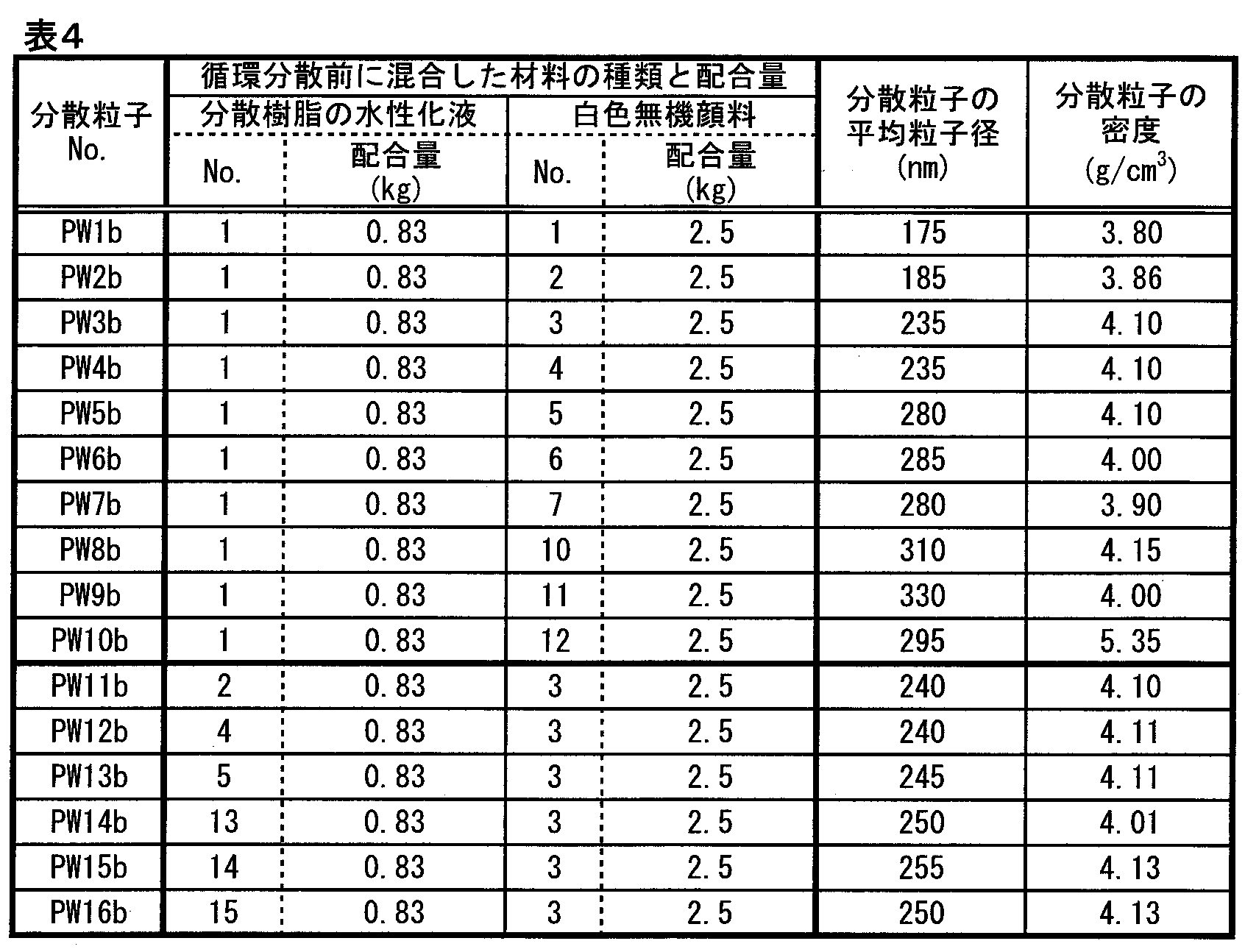
表5に示した量の分散粒子の水分散液に、当該表5に示した種類及び量のポリエポキシ化合物と、水とを添加して混合し、60℃下に24時間静置した。そして、孔径5μmのメンブレンフィルターで濾過を行い、分散粒子PW1c~PW10cの水分散液を製造した。
なお、上述した分散粒子の製造方法は、上述した方法Cに相当する。

BDGE:1,4-ブタンジオールジグリシジルエーテル
DEGGE:ジエチレングリコールジグリシジルエーテル
TMPGE:トリメチロールプロパントリグリシジルエーテル
上記で製造した分散粒子に加えて、市販品である、ROPAQUE(登録商標)ULTRA(ダウ・ケミカル社製(メタ)アクリル中空樹脂粒子、平均粒子径380nm、固形分濃度30%)を、分散粒子PW1dの水分散液として使用した。
表6に示した、C.I.ピグメントイエロー155(一次粒子径90nm、比表面積61m2/g)、分散樹脂の水性化溶液、及び、水を、当該表6に示した配合量で、撹拌機を備えた混合容器中に、水、分散樹脂の水性化溶液、C.I.ピグメントイエロー155の順に投入したのち、1時間撹拌(プレミキシング)を行った。その後、直径0.5mmのジルコニアビーズ1,800gを充填したシンマルエンタープライゼス社製「ダイノーミル」(容積0.6L)を用いて5時間循環分散を行い、分散粒子PY1a~PY14aの水分散液(PY1a~PY7a、PY10a~PY14aの水分散液は固形分濃度26%、PY8aの水分散液は固形分濃度24%、PY9aの水分散液は固形分濃度22.5%)を製造した。
また、循環分散の時間を調整した以外は、分散粒子PY1aの水分散液と同様の方法により、分散粒子PY15aの水分散液(固形分濃度26%)を製造した。分散粒子PY15aの平均粒子径は115nmであった。
更に、水不溶性着色剤として、一次粒子径が160nm、かつ、比表面積が34m2/gであるC.I.ピグメントイエロー155を使用し、循環分散の時間を調整した以外は、分散粒子PY1aの水分散液と同様の方法により、分散粒子PY16a-1~3の水分散液(全て、固形分濃度26%)を製造した。分散粒子PY16a-1~3の平均粒子径は、それぞれ、195nm、220nm、265nmであった。
なお、上述した分散粒子の製造方法は、上述した方法Aに相当する。

あらかじめ、表7に示した種類及び量の分散樹脂の水性化溶液をメチルエチルケトン0.5kgと混合し、分散樹脂溶液を作製した。この分散樹脂溶液の全量を、撹拌機を備えた混合容器中に投入したのち、撹拌しながら、メチルエチルケトン0.3kgと、水1kgとを更に投入し、30分間撹拌した。その後、表3に示した種類及び量の水不溶性着色剤を上記混合容器内に投入し、1時間撹拌(プレミキシング)を行ったのち、直径0.5mmのジルコニアビーズ1,800gを充填したシンマルエンタープライゼス社製「ダイノーミル」(容積0.6L)を用いて5時間循環分散を行った。そして、得られた分散液に、水を0.8kg加えたのち、エバポレータを用いて、メチルエチルケトンを減圧留去するとともに、当該減圧留去時に留去した水と同量の水を、当該減圧留去後に加えることで、分散粒子PY1b~PY6bの水分散液(全て、固形分濃度26%)を製造した。
なお、上述した分散粒子の製造方法は、上述した方法Bに相当する。

表8に示した量の分散粒子の水分散液に、当該表8に示した種類及び量のポリエポキシ化合物と、水とを添加して混合し、60℃下に24時間静置した。そして、孔径5μmのメンブレンフィルターで濾過を行い、分散粒子PY1c~PY4cの水分散液を製造した。
なお、上述した分散粒子の製造方法は、上述した方法Cに相当する。
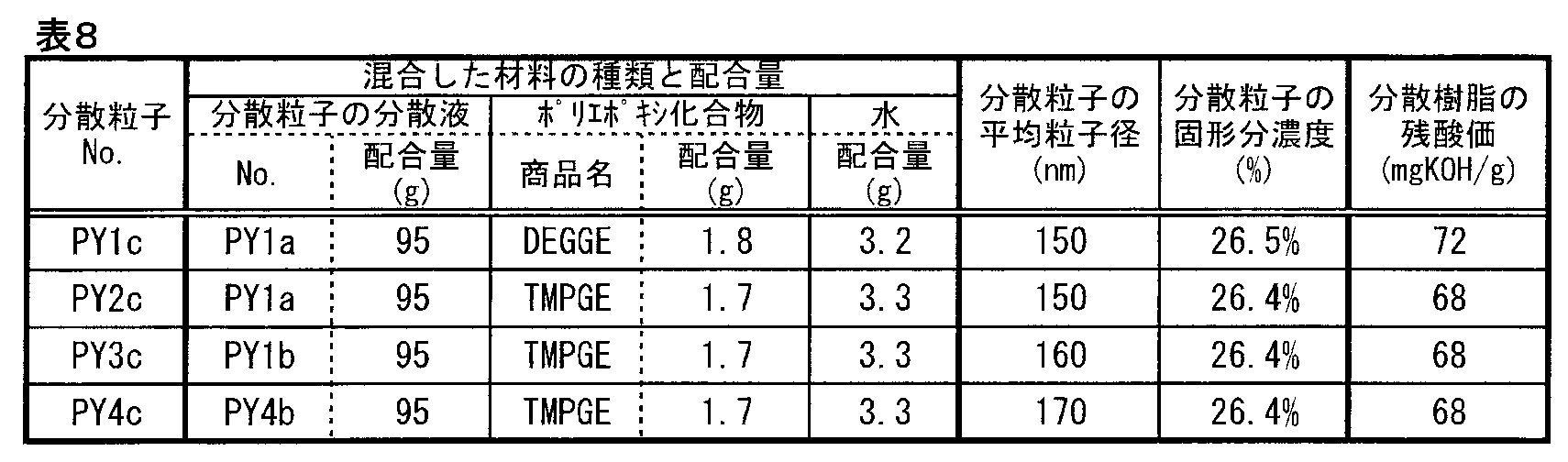
水不溶性着色剤としてC.I.ピグメントイエロー74を使用した以外は、上述した分散粒子PY1aの水分散液と同様の方法により、分散粒子PY1dの水分散液(固形分濃度26%)を製造した。なお、分散粒子PY1dの平均粒子径は、135nmであった。
<ホワイトインキPW1aI-1~4、PW2aI、PW3aI-1~9、PW4aI~PW21aI、PW1bI~PW6bI、PW7bI-1~5、PW8bI~PW16bI、PW1cI~PW10cIの製造>
10.55部の分散粒子PW1aの水分散液(固形分濃度55%)、10部のイオン交換水、20部の1,2-プロパンジオール、12.4部のQE-1042(星光PMC社製(メタ)アクリル樹脂粒子、固形分濃度40.5%)、2.9部のAQUACER 515(ビックケミー社製ポリオレフィン樹脂粒子、固形分濃度35%)、1部のサーフィノール465(日信化学工業社製アセチレンジオール系表面調整剤)、0.5部のTEGO Glide 440(エボニック社製シロキサン系表面調整剤)、及び、0.1部のプロキセルGXL(アーチケミカルズ社製防腐剤)を、先に記載したものから順番に、撹拌機を備えた混合容器中に投入したのち、インク組成物の総量が100部となるように、更に、イオン交換水を添加した。なお、混合容器内の混合物を撹拌しながら、各原料を投入した。その後、混合物が十分に均一になるまで撹拌したのち、孔径1.2μmのメンブレンフィルターで当該混合物の濾過を行い、ホワイトインキPW1aI-1を製造した。
なお、上記ホワイトインキの製造に使用した材料の詳細については、後述する。また、上記ホワイトインキPW1aI-1に含まれる水溶性有機溶剤及び水の、1気圧下における沸点の加重平均値は120.4℃であり、当該ホワイトインキPW1aI-1に含まれる、表面調整剤(AW)の量は、1.5質量%である。

50部の分散粒子PW22aの水分散液(固形分濃度24%)、15.83部のイオン交換水、15部の1,2-プロパンジオール、2部の1,2-ヘキサンジオール、13.3部のタケラックW-6061(三井化学製ウレタン樹脂粒子、固形分濃度30%)、2.9部のAQUACER 515(ビックケミー社製ポリオレフィン樹脂粒子、固形分濃度35%)、0.5部のBYK-348(ビックケミー社製シロキサン系表面調整剤)、0.3部のサーフィノールDF-110D(日信化学工業社製アセチレンジオール系表面調整剤、有効成分32%)、0.1部のトリエタノールアミン、0.05部のエチレンジアミン四酢酸、及び、0.02部のベンゾトリアゾールを、先に記載したものから順番に、撹拌機を備えた混合容器中に投入した。なお、混合容器内の混合物を撹拌しながら、各原料を投入した。その後、混合物が十分に均一になるまで撹拌したのち、孔径1.2μmのメンブレンフィルターで当該混合物の濾過を行い、ホワイトインキPW20aIを製造した。
分散粒子の水分散液として、21.04部の分散粒子PW3aの水分散液(固形分濃度55%)と、9.65部の分散粒子PW1dの水分散液(固形分濃度30%)とを併用した以外は、上述したホワイトインキPW1aI-1と同様の方法により、ホワイトインキPW1dIを製造した。
3.27部の分散粒子PY1aの水分散液(固形分濃度26%)、20部のイオン交換水、20部の1,2-プロパンジオール、12.4部のQE-1042(星光PMC社製(メタ)アクリル樹脂粒子、固形分濃度40.5%)、2.9部のAQUACER 515(ビックケミー社製ポリオレフィン樹脂粒子、固形分濃度35%)、1.2部のサーフィノール465(日信化学工業社製アセチレンジオール系表面調整剤)、0.6部のTEGO Glide 440(エボニック社製シロキサン系表面調整剤)、及び、0.1部のプロキセルGXL(アーチケミカルズ社製防腐剤)を、先に記載したものから順番に、撹拌機を備えた混合容器中に投入したのち、組成物の総量が100部となるように、更に、イオン交換水を添加した。なお、混合容器内の混合物を撹拌しながら、各原料を投入した。その後、混合物が十分に均一になるまで撹拌したのち、孔径1.2μmのメンブレンフィルターで当該混合物の濾過を行い、イエローインキPY1aI-1を製造した。
なお、上記イエローインキの製造に使用した材料の詳細については、後述する。また、上記イエローインキPY1aI-1に含まれる水溶性有機溶剤及び水の、1気圧下における沸点の加重平均値は119.6℃であり、当該イエローインキPY1aI-1に含まれる、表面調整剤(AY)の量は、1.8質量%である。

26.67部の分散粒子PY9aの水分散液(固形分濃度22.5%)、48.66部のイオン交換水、15部の1,2-プロパンジオール、4部の1,2-ヘキサンジオール、3.3部のタケラックW-6061(固形分濃度30%)、1.4部のAQUACER 515(固形分濃度35%)、0.5部のBYK-348、0.3部のサーフィノールDF-110D(有効成分32%)、0.1部のトリエタノールアミン、0.05部のエチレンジアミン四酢酸、及び、0.02部のベンゾトリアゾールを、先に記載したものから順番に、撹拌機を備えた混合容器中に投入した。なお、混合容器内の混合物を撹拌しながら、各原料を投入した。その後、混合物が十分に均一になるまで撹拌したのち、孔径1.2μmのメンブレンフィルターで当該混合物の濾過を行い、イエローインキPY9aIを製造した。
分散粒子の水分散液として、6.35部の分散粒子PY1aの水分散液(固形分濃度26%)と、2.11部の分散粒子PW1dの水分散液(固形分濃度26%)とを併用した以外は、上述したイエローインキPY1aI-1と同様の方法により、イエローインキPY1dIを製造した。
基材を搬送できるコンベヤの上部に、京セラ社製インクジェットヘッド「KJ4B-1200」(設計解像度1,200dpi、ノズル径20μm)を2個設置し、搬送方向の上流側のインクジェットヘッドから、ホワイトインキ、イエローインキの順番に充填した。次いで、後述する基材をコンベヤ上に固定したのち、当該コンベヤを一定速度で駆動させ、当該基材がインクジェットヘッドの設置部の下方を通過する際に、上流側及び下流側のインクジェットヘッドから、ホワイトインキ及びイエローインキをドロップボリューム2pLで吐出し、画像を印刷した。そして印刷後速やかに、印刷物を70℃エアオーブンに投入し3分間乾燥させることで、印刷物を作製した。
ベタ印刷物:上流側のインクジェットヘッドに充填されたインキを用いて、印字率100%のベタ画像を印刷し、下流側のインクジェットヘッドに充填されたインキを用いて、上記ベタ画像に完全に重なるように、印字率100%のベタ画像を印刷した。
ライン印刷物:上流側のインクジェットヘッドに充填されたインキを用いて、印字率100%のベタ画像を印刷し、下流側のインクジェットヘッドに充填されたインキを用いて、上記ベタ画像に完全に重なるように、1ドットのライン画像を印刷した。
文字印刷物:上流側のインクジェットヘッドに充填されたインキを用いて、印字率100%のベタ画像を印刷し、下流側のインクジェットヘッドに充填されたインキを用いて、上記ベタ画像に完全に重なるように、MS明朝体からなる漢字を、4ポイント・6ポイント・8ポイントで、それぞれ20個ずつランダムで印刷した。
PET基材:フタムラ社製ポリエチレンテレフタレートフィルム「FE2001」(厚さ12μm)
クラフト紙基材:美津山社製両更未晒クラフト紙(坪量80g/m2)
表11に示した、ホワイトインキ及びイエローインキの組み合わせにて、上述した方法で印刷物を作製し、得られた当該印刷物を用いて、以下に示す評価を行った。また評価結果は、表12に示した通りであった。


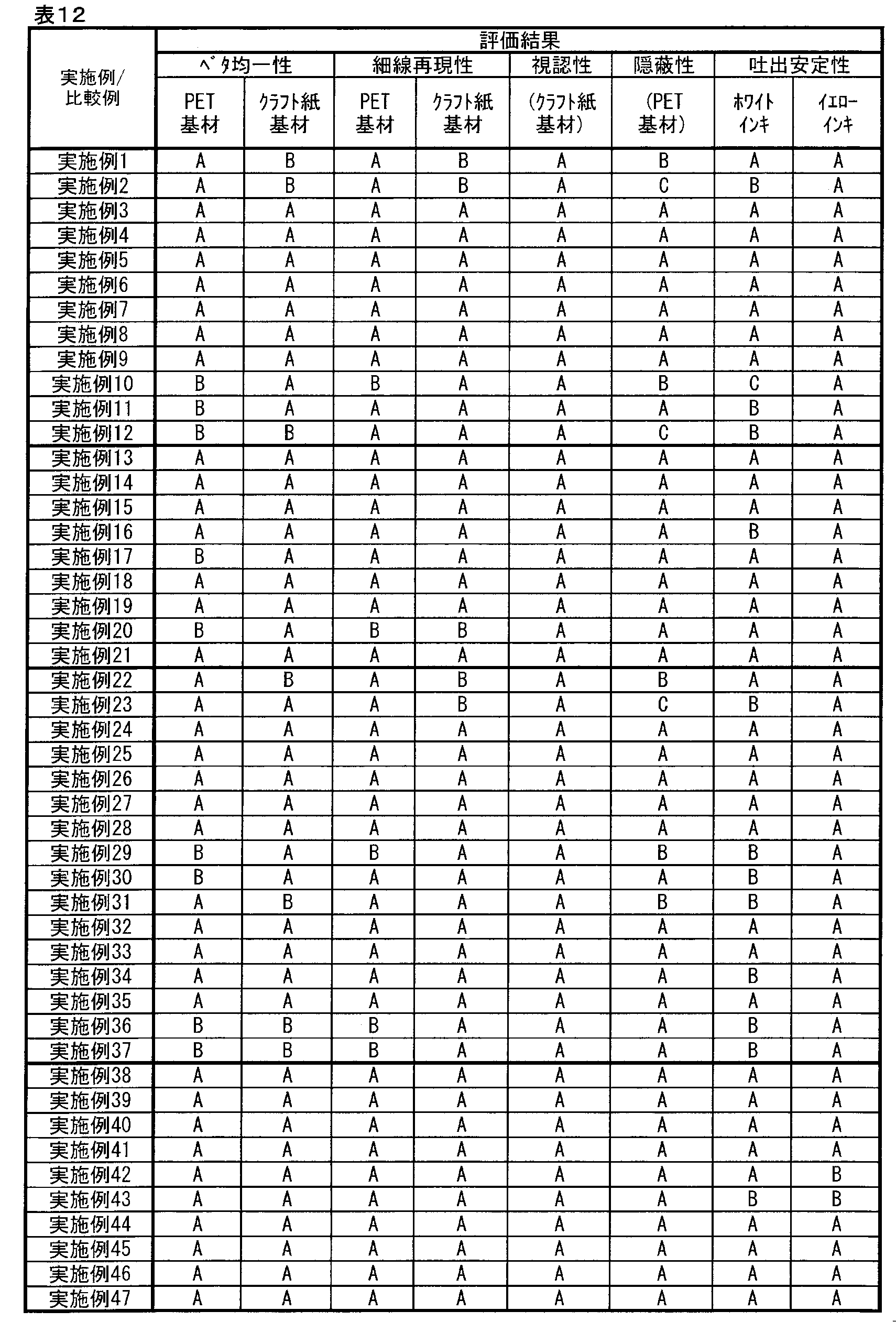
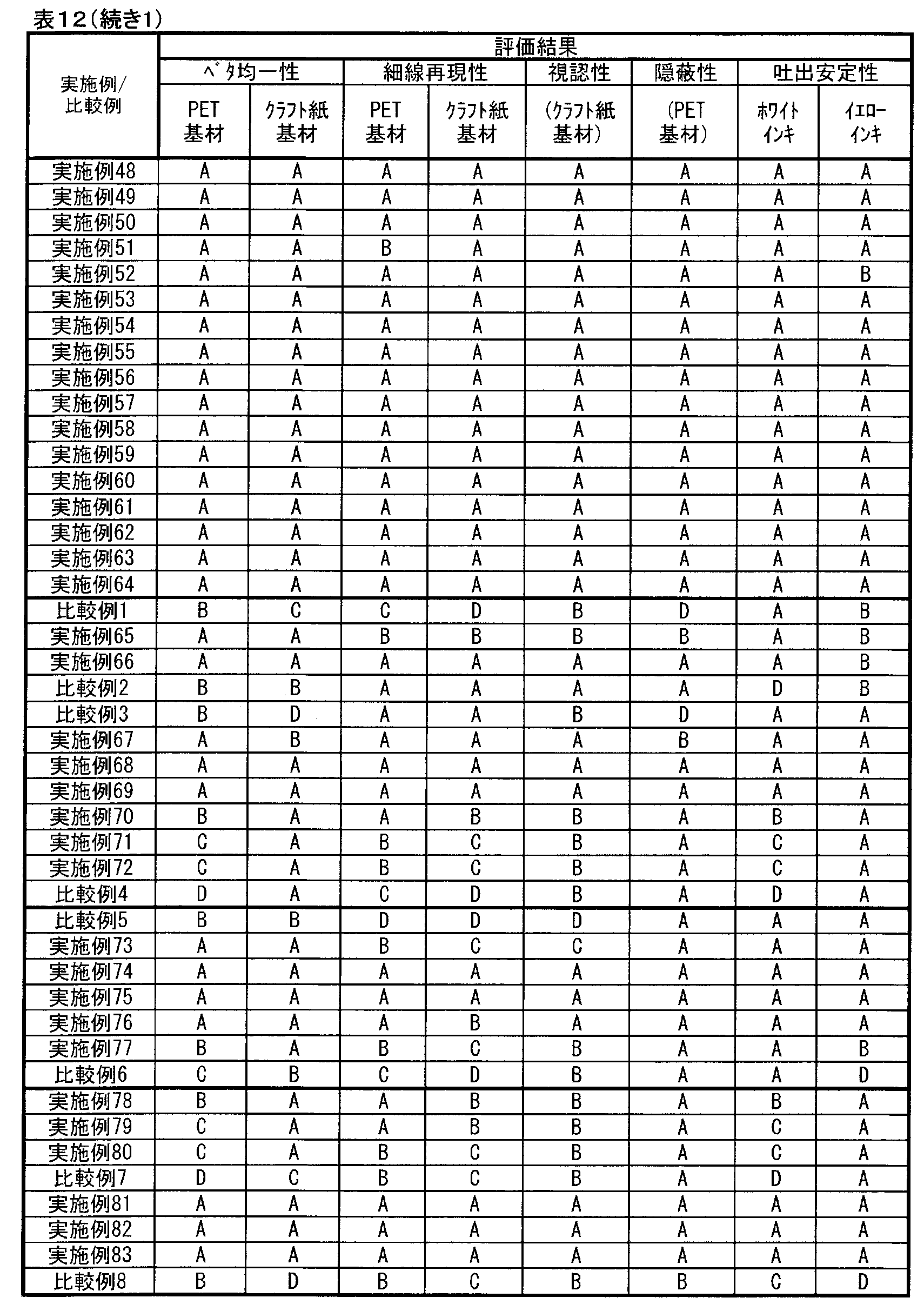

PET基材及びクラフト紙基材のそれぞれについて作製したベタ印刷物について、イエローインキによるベタ画像部分を目視で確認することで、ベタ均一性の評価を行った。評価基準は下記の通りとし、「A」、「B」、「C」を実使用可能とした。
A:ベタは均一であった
B:ベタは概ね均一であった
C:ベタにやや不均一さが見られた
D:ベタは明らかに不均一であった
PET基材及びクラフト紙基材のそれぞれについて作製したライン印刷物について、イエローインキによるライン画像部分を目視で確認することで、細線再現性の評価を行った。評価基準は下記の通りとし、「A」、「B」、「C」を実使用可能とした。
A:細線に滲みは見られなかった
B:細線に若干滲みが見られた
C:細線に、比較的大きな滲みが見られた
D:細線の滲みが顕著であった
クラフト紙基材上に印刷した文字印刷物について、イエローインキによる文字画像部分を目視で確認することで、視認性の評価を行った。評価基準は下記の通りとし、「A」、「B」、「C」を実使用可能とした。
A:4ポイントで印刷された文字がすべて判読可能であった
B:4ポイントで印刷された文字の中に判読不可能な文字が存在したが、6ポイントで印刷された文字がすべて判読可能であった
C:6ポイントで印刷された文字の中に判読不可能な文字が存在したが、8ポイントで印刷された文字がすべて判読可能であった
D:8ポイントで印刷された文字の中に判読不可能な文字が存在した
あらかじめ、クラフト紙基材(王子製紙社製OKプリンス上質、坪量64g/m2)上に、MS明朝体からなる漢字が、8ポイント、12ポイント、及び、18ポイントでそれぞれ10個ずつランダムに、黒色で印刷された印刷物(黒色文字印刷物)を準備した。次いで、PET基材上に印刷した文字印刷物のうち、イエローインキによる文字が印刷されていない部分(ホワイトインキ層)の下部に、上記黒色文字印刷物を重ねた。そして、ホワイトインキ層側から、上記黒色文字印刷物の文字部分を目視で確認することで、隠蔽性の評価を行った。評価基準は下記の通りとし、「A」、「B」、「C」を実使用可能とした。
A:8ポイント、12ポイント、16ポイントの文字が、全て判読できなかった
B:8ポイント及び12ポイントの文字は判読できなかったが、16ポイントの文字の中に、判読できるものが存在した
C:8ポイントの文字は判読できなかったが、12ポイント及び16ポイントの文字の中に、判読できるものが存在した
D:8ポイントの文字の中に、判読できるものが存在した
上記印刷物の作製で使用した印刷装置を使用し、基材の搬送方向の最も下流側に設置したインクジェットヘッド1個に、上記で製造したホワイトインキ及びイエローインキをそれぞれ充填した。
次いで、ノズルチェックパターンを印刷し、全てのノズル(吐出口)から正常にインキが吐出されていることを確認してから、25℃の環境下で所定時間、印刷装置を待機させた後、再度ノズルチェックパターンの印刷を行った。そして、ノズル抜けの有無を目視確認することで、吐出安定性の評価を行った。評価基準は下記のとおりとし、「A」、「B」、「C」を実使用可能とした。
A:3時間待機させた後に印刷しても、ノズル抜けが全くなかった
B:1時間待機させた後に印刷してもノズル抜けが全くなかったが、3時間待機させた後に印刷すると、1本以上のノズル抜けが発生した
C:1時間待機させた後に印刷すると、1~9本のノズル抜けが発生した
D:1時間待機させた後に印刷すると、10本以上のノズル抜けが発生した、あるいは、インキがまったく吐出されなかった
実施例4及び実施例84~87の比較、実施例11及び実施例88~91の比較、実施例1と実施例92との比較、ならびに、実施例29と実施例93との比較では、分散粒子(PY)の平均粒子径、及び、当該分散粒子(PY)の平均粒子径に対するSW(分散粒子(PW)の平均粒子径)の比率を変化させたときの、評価結果への影響が確認できる。そして、分散粒子(PY)の平均粒子径が60~250nmであり、かつ、上記比率が1.2~2.5である系は、ベタ均一性、細線再現性、視認性、吐出安定性の全てに優れる結果となった。
また実施例94~98は、分散樹脂に含まれる芳香環構造の量を変化させた際に、上記特性に与える影響を検討したものである。その結果、芳香環構造の量が10~80質量%である実施例95~98において、全ての評価結果が「A」または「B」となることが確認され、上記量の芳香環構造を有する分散樹脂を使用することで、上述した本発明の課題が好適に解決できることが示された。特に、実施例96、97では、全ての評価結果が「A」となっており、上述した本発明の課題の解決にあたって、芳香環構造の量を20~70質量%とすることが極めて好適であることが確認された。
<ホワイトインキPW3aI-10~31の製造>
下表13の各列に記載した配合処方になるように、撹拌機を備えた混合容器中に、分散粒子PW3aの水分散液、ならびに、当該表13に示した各材料を投入した。投入後、混合物が十分に均一になるまで撹拌したのち、孔径1.2μmのメンブレンフィルターで当該混合物の濾過を行い、ホワイトインキPW3aI-10~31を製造した。


下表14の各列に記載した配合処方になるように、撹拌機を備えた混合容器中に、分散粒子PY1aの水分散液、ならびに、当該表14に示した各材料を投入した。投入後、混合物が十分に均一になるまで撹拌したのち、孔径1.2μmのメンブレンフィルターで当該混合物の濾過を行い、イエローインキPY1aI-10~31を製造した。


1,2-PD:1,2-プロパンジオール(1気圧下における沸点=188℃)
1,3-BD:1,3-プロパンジオール(1気圧下における沸点=207℃)
1,5-PeD:1,5-ペンタンジオール(1気圧下における沸点=239℃)
MP:プロピレングリコールモノメチルエーテル(1気圧下における沸点=121℃)
PP:プロピレングリコールモノプロピルエーテル(1気圧下における沸点=150℃)
DPM:ジプロピレングリコールモノメチルエーテル(1気圧下における沸点=190℃)
QE-1042:星光PMC社製(メタ)アクリル樹脂粒子、メディアン径(体積基準)=40nm、酸価=33mgKOH/g、固形分濃度40.5%
HE-1335:星光PMC社製(メタ)アクリル樹脂粒子、メディアン径(体積基準)=90nm、酸価=84mgKOH/g、固形分濃度45.5%
RE-1075:星光PMC社製(メタ)アクリル樹脂粒子、メディアン径(体積基準)=100nm、酸価=15mgKOH/g、固形分濃度47%
KT-9204:エリーテルKT-9204(ユニチカ社製ポリエステル樹脂粒子、酸価=7mgKOH/g、固形分濃度30%)
WBR-2101:アクリットWBR-2101(大成ファインケミカル社製ウレタン樹脂粒子、酸価=10mgKOH/g、固形分濃度27%)
AQUACER 515:ビックケミー社製ポリオレフィン樹脂粒子、メディアン径(体積基準)=40nm、固形分濃度35%
AQUACER 539:ビックケミー社製ポリオレフィン樹脂粒子、メディアン径(体積基準)=60nm、固形分濃度35%
サーフィノール465:日信化学工業社製アセチレンジオール系表面調整剤(2,4,7,9-テトラメチル-5-デシン-4,7-ジオールのエチレンオキサイド付加物)
TEGO Glide 440:エボニック社製シロキサン系表面調整剤(両末端にエチレンオキサイド基及びプロピレンオキサイド基が導入されたポリジメチルシロキサン)
ノニオン EH-208:日油社製ポリオキシアルキレンアルキルエーテル系表面調整剤(ポリオキシエチレン-2-エチルヘキシルエーテル)
プロキセルGXL:アーチケミカルズ社製防腐剤(1,2-ベンゾチアゾリン-3-オンの20%ジプロピレングリコール溶液)
表15に示した、ホワイトインキ及びイエローインキの組み合わせにて、上述した方法で印刷物を作製し、得られた当該印刷物を用いて、上述した評価1~5を行った。また評価結果は、表16に示した通りであった。


Claims (6)
- 水性ホワイトインクジェットインキと、前記水性ホワイトインクジェットインキが印刷されてなる層の上に印刷するために使用される、水性イエローインクジェットインキとを含むインキセットであって、
前記水性ホワイトインクジェットインキが、無機白色顔料の分散粒子(PW)を含み、
前記水性イエローインクジェットインキが、C.I.ピグメントイエロー155の分散粒子(PY)を含み、
前記水性ホワイトインクジェットインキの全量に対する、前記分散粒子(PW)の含有量を、WW(質量%)、前記分散粒子(PW)の平均粒子径及び密度を、それぞれSW(nm)、及び、DW(g/cm3)、前記水性イエローインクジェットインキの全量に対する、前記分散粒子(PY)の含有量を、WY(質量%)、としたとき、下記式(1)~(4)をすべて満たす、インキセット。
150≦SW≦350 (1)
6≦WW≦30 (2)
0.010×SW×DW≦WW≦[9.0×10⁶÷(SW2×DW)] (3)
0.30≦(WY×DW/WW)≦1.5 (4)
- 前記無機白色顔料が、アルミナで処理された酸化チタンを含む、請求項1に記載のインキセット。
- 前記水性ホワイトインクジェットインキが、更に、バインダー樹脂としてポリオレフィン樹脂を含み、
前記水性イエローインクジェットインキが、更に、バインダー樹脂としてポリオレフィン樹脂を含む、請求項1または2に記載のインキセット。 - 前記水性ホワイトインクジェットインキが、更に、表面調整剤(AW)として、シロキサン系表面調整剤及びアセチレンジオール系表面調整剤からなる群から選択される少なくとも1種を含み、
前記水性イエローインクジェットインキが、更に、表面調整剤(AY)として、シロキサン系表面調整剤及びアセチレンジオール系表面調整剤からなる群から選択される少なくとも1種を含む、請求項1~3のいずれか1項に記載のインキセット。 - 前記水性ホワイトインクジェットインキ中に含まれる前記表面調整剤(AW)の含有量に対する、前記水性イエローインクジェットインキ中に含まれる前記表面調整剤(AY)の含有量の比が、0.9~1.6である、請求項4に記載のインキセット。
- 請求項1~5のいずれかに記載のインキセットを用いた、印刷物の製造方法であって、
基材上に前記水性ホワイトインクジェットインキをインクジェットヘッドから吐出する工程(工程1)、前記水性ホワイトインクジェットインキが印刷されてなる層上に、前記水性イエローインクジェットインキをインクジェットヘッドから吐出する工程(工程2)、及び、前記基材上の、前記水性ホワイトインクジェットインキ及び前記水性イエローインクジェットインキを乾燥する工程(工程3)を、この順に行う、印刷物の製造方法。
Priority Applications (1)
| Application Number | Priority Date | Filing Date | Title |
|---|---|---|---|
| EP23903010.9A EP4636046A4 (en) | 2022-12-16 | 2023-08-03 | INKS AND PRINT PRODUCTION METHOD |
Applications Claiming Priority (2)
| Application Number | Priority Date | Filing Date | Title |
|---|---|---|---|
| JP2022201213 | 2022-12-16 | ||
| JP2022-201213 | 2022-12-16 |
Publications (1)
| Publication Number | Publication Date |
|---|---|
| WO2024127704A1 true WO2024127704A1 (ja) | 2024-06-20 |
Family
ID=89852837
Family Applications (1)
| Application Number | Title | Priority Date | Filing Date |
|---|---|---|---|
| PCT/JP2023/028406 Ceased WO2024127704A1 (ja) | 2022-12-16 | 2023-08-03 | インキセット及び印刷物の製造方法 |
Country Status (3)
| Country | Link |
|---|---|
| EP (1) | EP4636046A4 (ja) |
| JP (2) | JP7431399B1 (ja) |
| WO (1) | WO2024127704A1 (ja) |
Families Citing this family (1)
| Publication number | Priority date | Publication date | Assignee | Title |
|---|---|---|---|---|
| WO2025225451A1 (ja) * | 2024-04-22 | 2025-10-30 | Dic株式会社 | 顔料分散体、顔料分散体の製造方法、及び該顔料分散体を含むインクジェットインク |
Citations (11)
| Publication number | Priority date | Publication date | Assignee | Title |
|---|---|---|---|---|
| JP2009024072A (ja) | 2007-07-19 | 2009-02-05 | Seiko Epson Corp | インクセット |
| JP2014094495A (ja) | 2012-11-09 | 2014-05-22 | Seiko Epson Corp | インクジェット記録方法 |
| JP2016089020A (ja) | 2014-11-04 | 2016-05-23 | クラリアント・インターナシヨナル・リミテツド | C.i.ピグメントイエロー155とその製造方法、その顔料を用いた顔料組成物と着色剤組成物、及びそれらの着色剤としての使用 |
| JP2016112701A (ja) * | 2014-12-11 | 2016-06-23 | コニカミノルタ株式会社 | インクジェット記録方法およびインクジェット記録装置 |
| JP2017186534A (ja) | 2016-03-16 | 2017-10-12 | 株式会社リコー | インクセット、イエローインク、インク収容容器、インクジェット印刷装置、インクジェット印刷方法 |
| JP2018111742A (ja) | 2017-01-06 | 2018-07-19 | 大日精化工業株式会社 | 顔料分散液、水性インクジェットインク、及び顔料分散液の製造方法 |
| JP2019065246A (ja) * | 2017-10-05 | 2019-04-25 | 株式会社リコー | 白色インク、インクセット、印刷物の製造方法、及び液体吐出装置 |
| JP2019077070A (ja) * | 2017-10-23 | 2019-05-23 | ローランドディー.ジー.株式会社 | 表面が合成樹脂製の皮革のインクジェット印刷方法、および表面が合成樹脂製の皮革用の水性インクジェットインク |
| JP2022040645A (ja) | 2020-08-31 | 2022-03-11 | セイコーエプソン株式会社 | インクジェットインク組成物セット及びインクジェット記録方法 |
| JP2022100822A (ja) | 2020-12-24 | 2022-07-06 | 花王株式会社 | インクジェット記録用水系インク |
| JP2022146841A (ja) * | 2021-03-22 | 2022-10-05 | 株式会社リコー | インクセット、画像形成方法、及び画像形成装置 |
Family Cites Families (2)
| Publication number | Priority date | Publication date | Assignee | Title |
|---|---|---|---|---|
| JP6375019B1 (ja) * | 2017-05-30 | 2018-08-15 | 東洋インキScホールディングス株式会社 | インクジェット用水性インキ、及び印刷物の製造方法 |
| EP3901220B1 (en) * | 2018-12-17 | 2025-06-18 | artience Co., Ltd. | Aqueous inkjet yellow ink, ink set, and method for producing printed matter |
-
2023
- 2023-08-03 EP EP23903010.9A patent/EP4636046A4/en active Pending
- 2023-08-03 WO PCT/JP2023/028406 patent/WO2024127704A1/ja not_active Ceased
- 2023-08-10 JP JP2023130571A patent/JP7431399B1/ja active Active
- 2023-12-21 JP JP2023215578A patent/JP2024086709A/ja active Pending
Patent Citations (11)
| Publication number | Priority date | Publication date | Assignee | Title |
|---|---|---|---|---|
| JP2009024072A (ja) | 2007-07-19 | 2009-02-05 | Seiko Epson Corp | インクセット |
| JP2014094495A (ja) | 2012-11-09 | 2014-05-22 | Seiko Epson Corp | インクジェット記録方法 |
| JP2016089020A (ja) | 2014-11-04 | 2016-05-23 | クラリアント・インターナシヨナル・リミテツド | C.i.ピグメントイエロー155とその製造方法、その顔料を用いた顔料組成物と着色剤組成物、及びそれらの着色剤としての使用 |
| JP2016112701A (ja) * | 2014-12-11 | 2016-06-23 | コニカミノルタ株式会社 | インクジェット記録方法およびインクジェット記録装置 |
| JP2017186534A (ja) | 2016-03-16 | 2017-10-12 | 株式会社リコー | インクセット、イエローインク、インク収容容器、インクジェット印刷装置、インクジェット印刷方法 |
| JP2018111742A (ja) | 2017-01-06 | 2018-07-19 | 大日精化工業株式会社 | 顔料分散液、水性インクジェットインク、及び顔料分散液の製造方法 |
| JP2019065246A (ja) * | 2017-10-05 | 2019-04-25 | 株式会社リコー | 白色インク、インクセット、印刷物の製造方法、及び液体吐出装置 |
| JP2019077070A (ja) * | 2017-10-23 | 2019-05-23 | ローランドディー.ジー.株式会社 | 表面が合成樹脂製の皮革のインクジェット印刷方法、および表面が合成樹脂製の皮革用の水性インクジェットインク |
| JP2022040645A (ja) | 2020-08-31 | 2022-03-11 | セイコーエプソン株式会社 | インクジェットインク組成物セット及びインクジェット記録方法 |
| JP2022100822A (ja) | 2020-12-24 | 2022-07-06 | 花王株式会社 | インクジェット記録用水系インク |
| JP2022146841A (ja) * | 2021-03-22 | 2022-10-05 | 株式会社リコー | インクセット、画像形成方法、及び画像形成装置 |
Non-Patent Citations (1)
| Title |
|---|
| See also references of EP4636046A1 |
Also Published As
| Publication number | Publication date |
|---|---|
| JP7431399B1 (ja) | 2024-02-15 |
| JP2024086551A (ja) | 2024-06-27 |
| EP4636046A4 (en) | 2026-04-22 |
| JP2024086709A (ja) | 2024-06-27 |
| EP4636046A1 (en) | 2025-10-22 |
Similar Documents
| Publication | Publication Date | Title |
|---|---|---|
| JP6388243B1 (ja) | 前処理液、及び前記前処理液を含むインキセット | |
| JP6164323B1 (ja) | 水性インクジェットインキ | |
| JP6814365B1 (ja) | 前処理液、インキセット、及び印刷物 | |
| JP2020075436A (ja) | 前処理液、及び前記前処理液を含むインキセット | |
| JP7277678B1 (ja) | 記録液セット、印刷物の製造方法、及び、印刷物 | |
| WO2023047706A1 (ja) | 水性記録液セット、及び、印刷物の製造方法 | |
| WO2025126538A1 (ja) | 水性インクジェットインキ及び印刷物 | |
| JP7431399B1 (ja) | インキセット及び印刷物の製造方法 | |
| JP7463608B1 (ja) | 水性インクジェットインキ及び印刷物 | |
| JP2017165982A (ja) | 水性インクジェットインキ | |
| WO2025109781A1 (ja) | 水性インクジェットインキ及び印刷物 | |
| JP7494727B2 (ja) | 前処理液、およびそれを用いた水性インクジェットインキセット、印刷物、印刷物の製造方法 | |
| JP7726421B1 (ja) | 水性インクジェットインキ及び印刷物 | |
| JP7784514B1 (ja) | 水性インクジェットインキ及び印刷物 | |
| JP7571911B1 (ja) | 水性インクジェットインキ及び印刷物 | |
| JP7784515B1 (ja) | 水性インクジェットインキ及び印刷物 | |
| JP7750335B1 (ja) | 水性インクジェットインキ及び印刷物 | |
| WO2025178024A1 (ja) | 水性インクジェットブラックインキ及び印刷物 | |
| WO2025069579A1 (ja) | 水性インクジェットインキ及び印刷物 | |
| JP2025094887A (ja) | 水性インクジェットインキ及び印刷物 | |
| JP2023089421A (ja) | 前処理液、水性インクジェットインキセット、および印刷物の製造方法 |
Legal Events
| Date | Code | Title | Description |
|---|---|---|---|
| 121 | Ep: the epo has been informed by wipo that ep was designated in this application |
Ref document number: 23903010 Country of ref document: EP Kind code of ref document: A1 |
|
| WWE | Wipo information: entry into national phase |
Ref document number: 2023903010 Country of ref document: EP |
|
| NENP | Non-entry into the national phase |
Ref country code: DE |
|
| ENP | Entry into the national phase |
Ref document number: 2023903010 Country of ref document: EP Effective date: 20250716 |
|
| WWP | Wipo information: published in national office |
Ref document number: 2023903010 Country of ref document: EP |