WO2024128109A1 - 液晶ポリエステル繊維およびその製造方法 - Google Patents
液晶ポリエステル繊維およびその製造方法 Download PDFInfo
- Publication number
- WO2024128109A1 WO2024128109A1 PCT/JP2023/043770 JP2023043770W WO2024128109A1 WO 2024128109 A1 WO2024128109 A1 WO 2024128109A1 JP 2023043770 W JP2023043770 W JP 2023043770W WO 2024128109 A1 WO2024128109 A1 WO 2024128109A1
- Authority
- WO
- WIPO (PCT)
- Prior art keywords
- liquid crystal
- crystal polyester
- polyester fiber
- fiber
- temperature
- Prior art date
- Legal status (The legal status is an assumption and is not a legal conclusion. Google has not performed a legal analysis and makes no representation as to the accuracy of the status listed.)
- Ceased
Links
Classifications
-
- D—TEXTILES; PAPER
- D01—NATURAL OR MAN-MADE THREADS OR FIBRES; SPINNING
- D01F—CHEMICAL FEATURES IN THE MANUFACTURE OF ARTIFICIAL FILAMENTS, THREADS, FIBRES, BRISTLES OR RIBBONS; APPARATUS SPECIALLY ADAPTED FOR THE MANUFACTURE OF CARBON FILAMENTS
- D01F6/00—Monocomponent artificial filaments or the like of synthetic polymers; Manufacture thereof
- D01F6/78—Monocomponent artificial filaments or the like of synthetic polymers; Manufacture thereof from copolycondensation products
- D01F6/84—Monocomponent artificial filaments or the like of synthetic polymers; Manufacture thereof from copolycondensation products from copolyesters
-
- C—CHEMISTRY; METALLURGY
- C08—ORGANIC MACROMOLECULAR COMPOUNDS; THEIR PREPARATION OR CHEMICAL WORKING-UP; COMPOSITIONS BASED THEREON
- C08G—MACROMOLECULAR COMPOUNDS OBTAINED OTHERWISE THAN BY REACTIONS ONLY INVOLVING UNSATURATED CARBON-TO-CARBON BONDS
- C08G63/00—Macromolecular compounds obtained by reactions forming a carboxylic ester link in the main chain of the macromolecule
- C08G63/02—Polyesters derived from hydroxycarboxylic acids or from polycarboxylic acids and polyhydroxy compounds
- C08G63/60—Polyesters derived from hydroxycarboxylic acids or from polycarboxylic acids and polyhydroxy compounds derived from the reaction of a mixture of hydroxy carboxylic acids, polycarboxylic acids and polyhydroxy compounds
- C08G63/605—Polyesters derived from hydroxycarboxylic acids or from polycarboxylic acids and polyhydroxy compounds derived from the reaction of a mixture of hydroxy carboxylic acids, polycarboxylic acids and polyhydroxy compounds the hydroxy and carboxylic groups being bound to aromatic rings
-
- D—TEXTILES; PAPER
- D01—NATURAL OR MAN-MADE THREADS OR FIBRES; SPINNING
- D01D—MECHANICAL METHODS OR APPARATUS IN THE MANUFACTURE OF ARTIFICIAL FILAMENTS, THREADS, FIBRES, BRISTLES OR RIBBONS
- D01D10/00—Physical treatment of artificial filaments or the like during manufacture, i.e. during a continuous production process before the filaments have been collected
- D01D10/02—Heat treatment
-
- D—TEXTILES; PAPER
- D01—NATURAL OR MAN-MADE THREADS OR FIBRES; SPINNING
- D01D—MECHANICAL METHODS OR APPARATUS IN THE MANUFACTURE OF ARTIFICIAL FILAMENTS, THREADS, FIBRES, BRISTLES OR RIBBONS
- D01D5/00—Formation of filaments, threads, or the like
- D01D5/08—Melt spinning methods
-
- D—TEXTILES; PAPER
- D01—NATURAL OR MAN-MADE THREADS OR FIBRES; SPINNING
- D01D—MECHANICAL METHODS OR APPARATUS IN THE MANUFACTURE OF ARTIFICIAL FILAMENTS, THREADS, FIBRES, BRISTLES OR RIBBONS
- D01D5/00—Formation of filaments, threads, or the like
- D01D5/08—Melt spinning methods
- D01D5/084—Heating filaments, threads or the like, leaving the spinnerettes
-
- D—TEXTILES; PAPER
- D01—NATURAL OR MAN-MADE THREADS OR FIBRES; SPINNING
- D01F—CHEMICAL FEATURES IN THE MANUFACTURE OF ARTIFICIAL FILAMENTS, THREADS, FIBRES, BRISTLES OR RIBBONS; APPARATUS SPECIALLY ADAPTED FOR THE MANUFACTURE OF CARBON FILAMENTS
- D01F6/00—Monocomponent artificial filaments or the like of synthetic polymers; Manufacture thereof
- D01F6/58—Monocomponent artificial filaments or the like of synthetic polymers; Manufacture thereof from homopolycondensation products
- D01F6/62—Monocomponent artificial filaments or the like of synthetic polymers; Manufacture thereof from homopolycondensation products from polyesters
-
- D—TEXTILES; PAPER
- D01—NATURAL OR MAN-MADE THREADS OR FIBRES; SPINNING
- D01F—CHEMICAL FEATURES IN THE MANUFACTURE OF ARTIFICIAL FILAMENTS, THREADS, FIBRES, BRISTLES OR RIBBONS; APPARATUS SPECIALLY ADAPTED FOR THE MANUFACTURE OF CARBON FILAMENTS
- D01F6/00—Monocomponent artificial filaments or the like of synthetic polymers; Manufacture thereof
- D01F6/58—Monocomponent artificial filaments or the like of synthetic polymers; Manufacture thereof from homopolycondensation products
- D01F6/62—Monocomponent artificial filaments or the like of synthetic polymers; Manufacture thereof from homopolycondensation products from polyesters
- D01F6/625—Monocomponent artificial filaments or the like of synthetic polymers; Manufacture thereof from homopolycondensation products from polyesters derived from hydroxy-carboxylic acids, e.g. lactones
-
- D—TEXTILES; PAPER
- D10—INDEXING SCHEME ASSOCIATED WITH SUBLASSES OF SECTION D, RELATING TO TEXTILES
- D10B—INDEXING SCHEME ASSOCIATED WITH SUBLASSES OF SECTION D, RELATING TO TEXTILES
- D10B2331/00—Fibres made from polymers obtained otherwise than by reactions only involving carbon-to-carbon unsaturated bonds, e.g. polycondensation products
- D10B2331/04—Fibres made from polymers obtained otherwise than by reactions only involving carbon-to-carbon unsaturated bonds, e.g. polycondensation products polyesters, e.g. polyethylene terephthalate [PET]
- D10B2331/041—Fibres made from polymers obtained otherwise than by reactions only involving carbon-to-carbon unsaturated bonds, e.g. polycondensation products polyesters, e.g. polyethylene terephthalate [PET] derived from hydroxy-carboxylic acids, e.g. lactones
-
- D—TEXTILES; PAPER
- D10—INDEXING SCHEME ASSOCIATED WITH SUBLASSES OF SECTION D, RELATING TO TEXTILES
- D10B—INDEXING SCHEME ASSOCIATED WITH SUBLASSES OF SECTION D, RELATING TO TEXTILES
- D10B2401/00—Physical properties
- D10B2401/06—Load-responsive characteristics
- D10B2401/063—Load-responsive characteristics high strength
-
- D—TEXTILES; PAPER
- D10—INDEXING SCHEME ASSOCIATED WITH SUBLASSES OF SECTION D, RELATING TO TEXTILES
- D10B—INDEXING SCHEME ASSOCIATED WITH SUBLASSES OF SECTION D, RELATING TO TEXTILES
- D10B2505/00—Industrial
- D10B2505/02—Reinforcing materials; Prepregs
Definitions
- the present invention relates to liquid crystal polyester fibers and a method for producing the same.
- Liquid crystal polyester fiber is a fiber made from liquid crystal polyester with a rigid molecular structure. It is known that the molecular chains are highly oriented in the fiber axis direction during melt spinning, and that by further applying heat treatment at high temperature for a long time, it has the highest strength of any synthetic fiber obtained by melt spinning. It is also known that heat treatment increases the molecular weight of liquid crystal polyester fiber and raises the melting point, improving heat resistance and dimensional stability, and it can be used for general industrial materials, civil engineering and construction materials, various reinforcing materials, electrical and electronic component materials, protective clothing, and other applications. For example, mechanical properties are required for reinforcing material applications, and for electronic component applications such as circuit board materials, in addition to the mechanical properties required for reinforcing materials, heat resistance that can withstand heat processing during component installation is required.
- Patent Document 1 (WO 2019/142692) describes that by heat treating liquid crystal polyester fibers having a lengthwise orientation degree of 89% or more and 95% or less at a temperature of 250°C or more, it is possible to obtain liquid crystal polyester fibers having a tensile strength of 25 cN/dtex or more and 30 cN/dtex or less and having high strength.
- Patent Document 2 JP Patent Publication 2010-43380A discloses a fiber manufacturing material made of a liquid crystal polyester having repeating units, such as structural units derived from aromatic hydroxycarboxylic acid, structural units derived from aromatic dicarboxylic acid, and structural units derived from aromatic diol, with 40 mol% or more of these structural units being 2,6-naphthalenediyl groups, and having a flow onset temperature of 280 to 320°C, and describes that it is possible to obtain liquid crystal polyester fibers with high heat resistance.
- repeating units such as structural units derived from aromatic hydroxycarboxylic acid, structural units derived from aromatic dicarboxylic acid, and structural units derived from aromatic diol, with 40 mol% or more of these structural units being 2,6-naphthalenediyl groups, and having a flow onset temperature of 280 to 320°C, and describes that it is possible to obtain liquid crystal polyester fibers with high heat resistance.
- Patent Document 3 JP 2022-6590 A describes a production method in which liquid crystal polyester is processed into a fiber form by a melt spinning method and heated at a temperature of 330° C. or higher, and describes a liquid crystal polyester fiber having a maximum crystallite size of 120 ⁇ 10 ⁇ 10 m or more and improved heat resistance.
- liquid crystal polyester fibers are strong against stress in the tensile direction, they are relatively weak against stress in the compressive direction, and depending on the application, further improvement in their mechanical properties is required.
- reinforcing fibers used in rubber materials such as tires, timing belts, and rubber hoses are subjected to stress in both the tensile and compressive directions relative to the fiber axis, so high strength and fatigue resistance against both types of stress is required.
- Patent Document 1 describes the mechanical properties of liquid crystal polyester fibers, including improved tensile strength, but there is room for further improvement in tensile strength, and does not describe compressive strength or fatigue resistance.
- Patent Document 2 describes how liquid crystal polyester can be easily spun into fibers by reducing the viscosity during melt spinning, and how fibers with high heat resistance can be obtained. Although the thread-drawing properties of liquid crystal polyester are evaluated, the physical properties of the obtained fibers are not evaluated, and no mechanical properties are described.
- Patent Document 3 describes increasing the melting point of liquid crystal polyester fibers, but does not describe the mechanical properties of the liquid crystal polyester fibers that are actually obtained.
- the present invention aims to solve the above problems and provide a liquid crystal polyester fiber that not only has excellent tensile strength and compressive strength, but also has excellent fatigue resistance against tensile deformation and compressive deformation.
- the inventors of the present invention conducted extensive research to achieve the above-mentioned objective, and found that, depending on the liquid crystal polyester raw material used and the conditions during melt spinning of the liquid crystal polyester fiber, unmelted matter and voids are generated in the fiber, and the presence of these causes a decrease in the mechanical properties of the fiber. Then, as a result of further research, they found that by using a liquid crystal polyester having a specific weight average molecular weight and melting point, and adjusting the conditions in the extruder and the spinning temperature conditions to melt-knead and spin the molten resin so as to apply shear to the molten resin, it is possible to suppress the generation of unmelted matter and voids and to achieve high orientation.
- a liquid crystal polyester fiber having a melting point of 335°C or more and less than 360°C (preferably 337°C or more and 358°C or less, more preferably 340°C or more and 355°C or less), as measured by a differential scanning calorimeter in a nitrogen atmosphere at a heating rate of 10°C/min, a crystallinity of 45 to 60% (preferably 46 to 58%, more preferably 48 to 55%), and a total number of unmelted objects and voids having a major axis of 5 ⁇ m or more contained per 5 cm of a single yarn of 3 or less (preferably 2 or less, more preferably 1 or less).
- a liquid crystalline polyester fiber according to aspect 1 or 2 wherein the degree of orientation in the fiber axis direction in the crystalline component is 97% or more and less than 100%.
- a fiber structure comprising at least a part of the liquid crystal polyester fiber according to any one of aspects 1 to 6.
- a composite material comprising the liquid crystal polyester fiber according to any one of aspects 1 to 6 as a reinforcing fiber.
- Aspect 9 A method for producing the liquid crystal polyester fiber according to any one of aspects 1 to 6, comprising the steps of:
- the liquid crystal polyester has a weight average molecular weight in terms of polystyrene measured by GPC of 50,000 or more and 160,000 or less (preferably 60,000 or more and 150,000 or less, more preferably 80,000 or more and 130,000 or less) and a melting point Mp0 measured by a differential scanning calorimeter in a nitrogen atmosphere at a heating rate of 10°C/min of 300°C or more (preferably 300 to 340°C, more preferably 305 to 330°C), as follows: (1) Extruder temperature: Mp 0 +15°C to Mp 0 +35°C (preferably Mp 0 +16°C to Mp 0 +30°C, more preferably Mp 0 +17°C to Mp 0 +25°C) (2) Extruder screw peripheral speed
- a step of subjecting the obtained raw spinning yarn to a heat treatment comprising: [Aspect 10] The method for producing a liquid crystal polyester fiber according to claim 9, wherein the extruder is a twin-screw extruder. [Aspect 11] The method for producing a liquid crystal polyester fiber according to aspect 9 or 10, wherein the heat treatment temperature is 250 to 350° C. (preferably 255 to 320° C., more preferably 260 to 315° C., and even more preferably 280 to 310° C.).
- the liquid crystal polyester fiber of the present invention includes a liquid crystal polyester.
- the liquid crystal polyester is composed of, for example, a structural unit derived from an aromatic diol, an aromatic dicarboxylic acid, an aromatic hydroxycarboxylic acid, etc., and the structural unit derived from an aromatic diol, an aromatic dicarboxylic acid, or an aromatic hydroxycarboxylic acid is not particularly limited in chemical composition as long as it does not impair the effects of the present invention.
- the liquid crystal polyester may contain a structural unit derived from an aromatic diamine, an aromatic hydroxyamine, or an aromatic aminocarboxylic acid, as long as it does not impair the effects of the present invention.
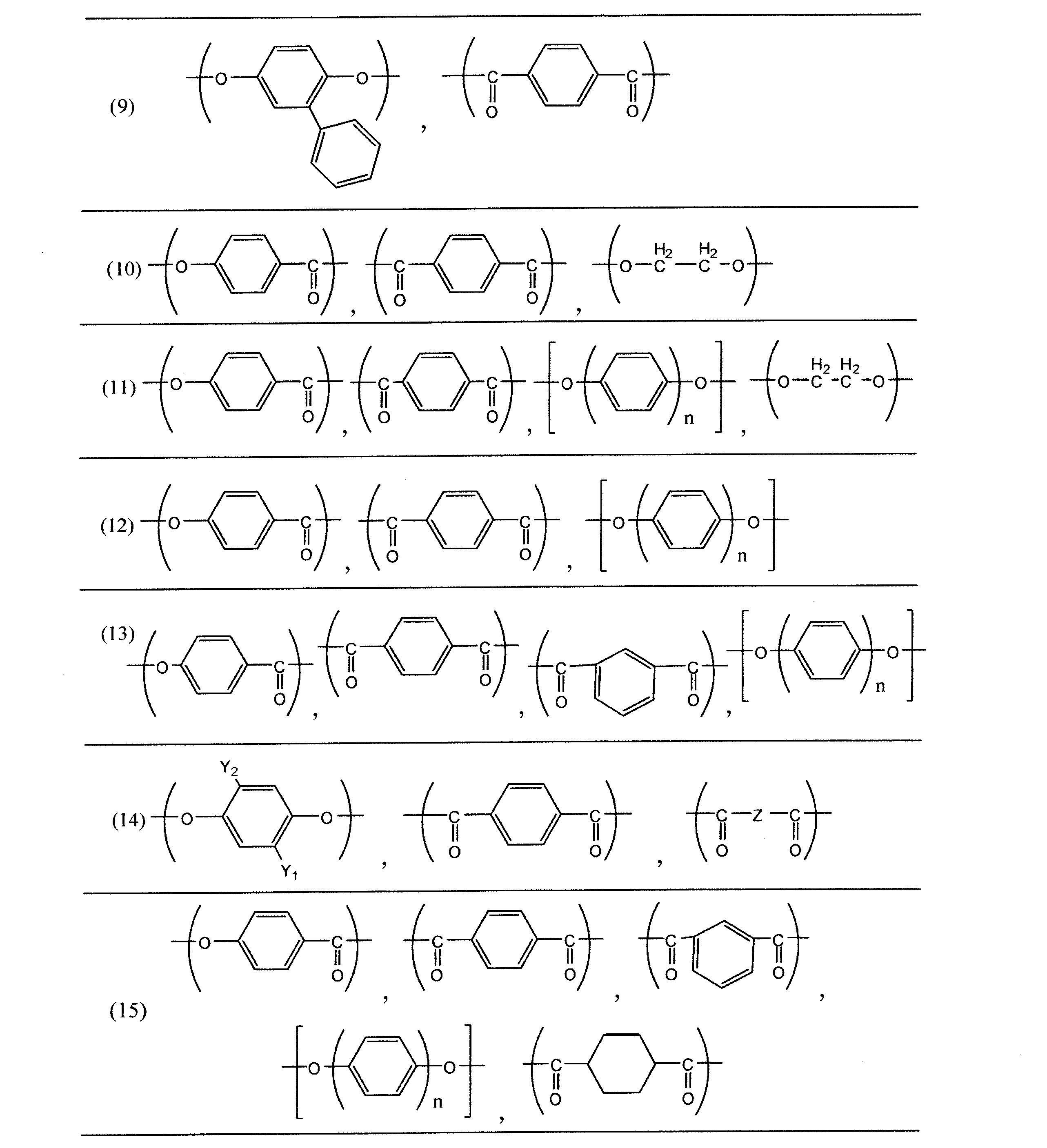
- examples of preferred structural units are shown in Table 1.
- m is an integer from 0 to 2
- Y in the formula, in the range of 1 to the maximum number that can be substituted each independently includes a hydrogen atom, a halogen atom (e.g., a fluorine atom, a chlorine atom, a bromine atom, an iodine atom, etc.), an alkyl group (e.g., an alkyl group having 1 to 4 carbon atoms such as a methyl group, an ethyl group, an isopropyl group, a t-butyl group, etc.), an alkoxy group (e.g., a methoxy group, an ethoxy group, a isopropoxy group, a n-butoxy group, etc.), an aryl group (e.g., a phenyl group, a naphthyl group, etc.), an aralkyl group (e.g., a benzyl group (phenyl
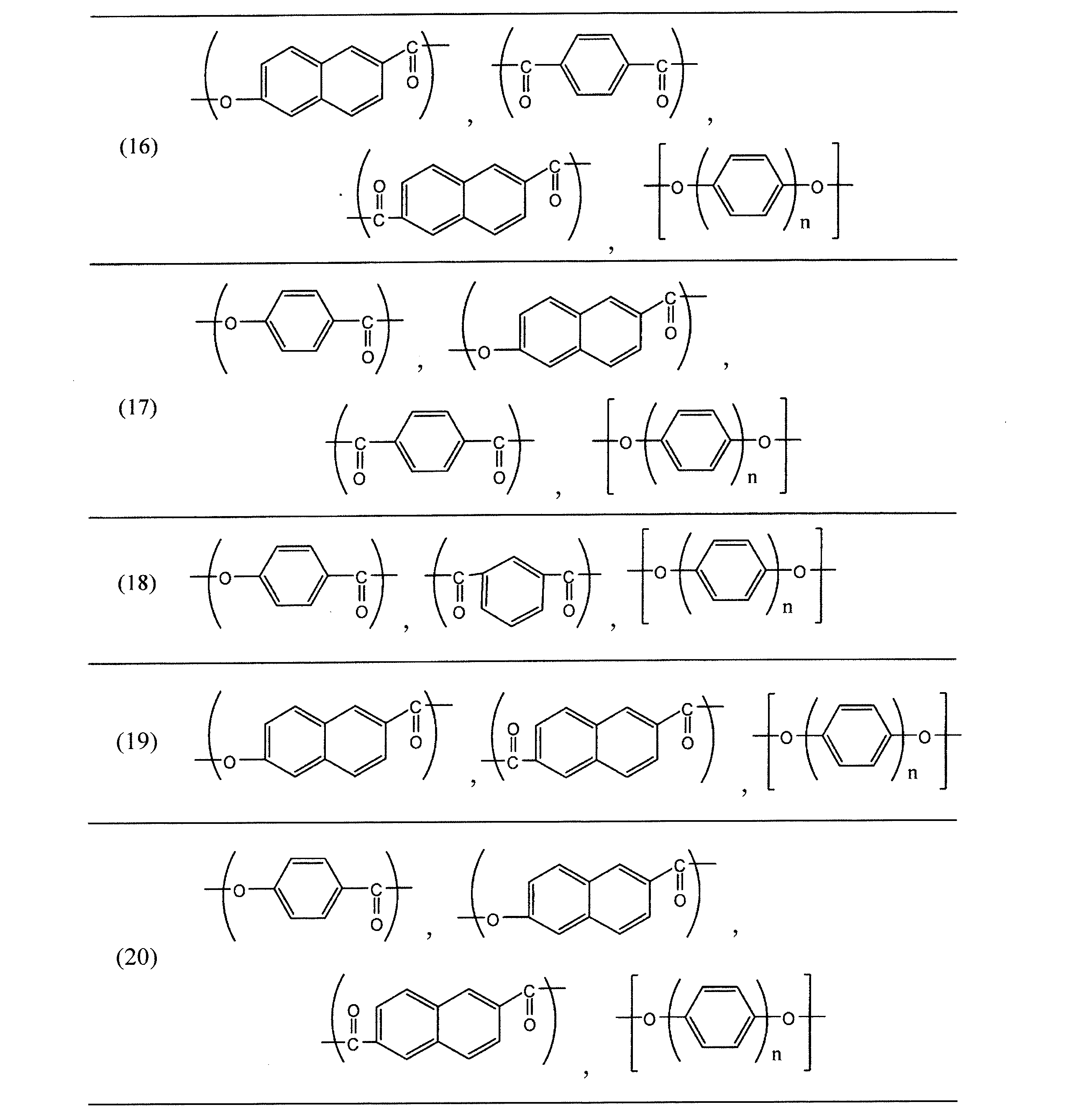
- More preferred structural units include the structural units described in examples (1) to (20) in Tables 2, 3, and 4 below.
- a structural unit in the formula is a structural unit that can exhibit multiple structures, two or more of such structural units may be combined and used as structural units that constitute the polymer.
- the liquid crystal polyester may preferably contain at least one structural unit selected from the group consisting of a structural unit represented by the following formula (I) (structural unit (I)), a structural unit represented by the following formula (II) (structural unit (II)), a structural unit represented by the following formula (III) (structural unit (III)), and a structural unit represented by the following formula (IV) (structural unit (IV)).
- Ar 1 is at least one selected from the group consisting of a phenylene group, a naphthylene group, and a biphenylylene group
- Ar 2 , Ar 3 , and Ar 4 are each independently at least one selected from the group consisting of a phenylene group, a naphthylene group, a biphenylylene group, and a diphenyletherdiyl group
- the hydrogen atoms in the aromatic rings of Ar 1 , Ar 2 , Ar 3 , and Ar 4 may each independently be substituted with a halogen atom, an alkyl group, an alkoxy group, an aryl group, an aralkyl group, an aryloxy group, or an aralkyloxy group.
- the structural unit (I) is a structural unit derived from an aromatic hydroxycarboxylic acid, and is preferably a structural unit in which Ar 1 is a 1,4-phenylene group (structural unit derived from 4-hydroxybenzoic acid), or a structural unit in which Ar 1 is a 2,6-naphthylene group (structural unit derived from 6-hydroxy-2-naphthoic acid).
- the structural unit (II) is a structural unit derived from an aromatic dicarboxylic acid
- Ar 2 is preferably a structural unit which is a 1,4-phenylene group (structural unit derived from terephthalic acid), a structural unit which is a 1,3-phenylene group (structural unit derived from isophthalic acid), a structural unit which is a 2,6-naphthylene group (structural unit derived from 2,6-naphthalenedicarboxylic acid), or a structural unit which is a diphenylether-4,4'-diyl group (structural unit derived from diphenylether-4,4'-dicarboxylic acid).
- the structural unit (III) is a structural unit derived from an aromatic diol
- Ar 3 is preferably a structural unit which is a 1,4-phenylene group (structural unit derived from hydroquinone), a structural unit which is a 4,4'-biphenylylene group (structural unit derived from 4,4'-dihydroxybiphenyl), a structural unit which is a phenyl-1,4-phenylene group (structural unit derived from phenylhydroquinone), or a structural unit which is a diphenylether-4,4'-diyl group (structural unit derived from 4,4'-dihydroxydiphenyl ether).
- the structural unit (IV) is a structural unit derived from an aromatic hydroxyamine, and is preferably a structural unit in which Ar 4 is a 1,4-phenylene group (a structural unit derived from 4-aminophenol), or a structural unit in which Ar 4 is a 4,4'-biphenylylene group (a structural unit derived from 4-amino-4'-hydroxybiphenyl).
- the content of the structural unit (I) in the liquid crystal polyester may be 20 to 80 mol %, preferably 30 to 75 mol %, and more preferably 40 to 70 mol %, based on the total amount of all structural units.
- the content of the structural unit (II) in the liquid crystal polyester may be 10 to 40 mol %, preferably 12.5 to 35 mol %, and more preferably 15 to 30 mol %, based on the total amount of all structural units.
- the total content of the structural units (III) and (IV) in the liquid crystal polyester may be 10 to 40 mol %, preferably 12.5 to 35 mol %, and more preferably 15 to 30 mol %, based on the total amount of all structural units.
- the molar ratio of the content of the structural unit (II) to the total content of the structural units (III) and (IV), expressed as (II)/[(III)+(IV)], may be 90/100 to 100/90, preferably 95/100 to 100/95, more preferably 98/100 to 100/98, and even more preferably 100/100, from the viewpoint of increasing the molecular weight of the liquid crystal polyester and improving its mechanical properties.
- the liquid crystal polyester may contain two or more types of each of the structural units (I) to (IV).
- the above content of each structural unit represents the content of all structural units corresponding to each structural unit.
- the content of structural unit (I) represents the total content of those units.
- the liquid crystal polyester may have a total content of the structural units (I) to (IV) of, for example, 90 mol% or more, preferably 95 mol% or more, more preferably 99 mol% or more, and even more preferably 100 mol%, based on the total amount of all structural units.
- the liquid crystal polyester is preferably a combination having a naphthalene skeleton as a structural unit.
- the total content of structural units containing 2,6-naphthylene groups in the liquid crystal polyester may be 40 mol% or more, preferably 50 mol% or more, more preferably 65 mol% or more, even more preferably 68 mol% or more, even more preferably 70 mol% or more, and may be 90 mol% or less, preferably 85 mol% or less, more preferably 83 mol% or less, and even more preferably 80 mol% or less, with respect to the total amount of all structural units.
- a structural unit (I) (a structural unit derived from 6-hydroxy-2-naphthoic acid) in which Ar 1 is a 2,6-naphthylene group and a structural unit (II) (a structural unit derived from 2,6-naphthalenedicarboxylic acid) in which Ar 2 is a 2,6-naphthylene group are preferable.
- the liquid crystal polyester fiber may contain thermoplastic polymers such as polyethylene terephthalate, modified polyethylene terephthalate, polyolefin, polycarbonate, polyamide, polyphenylene sulfide, polyether ether ketone, and fluororesin, as long as the effect of the present invention is not impaired. It may also contain various additives such as inorganic substances such as titanium oxide, kaolin, silica, and barium oxide, colorants such as carbon black, dyes, and pigments, antioxidants, ultraviolet absorbers, and light stabilizers.
- thermoplastic polymers such as polyethylene terephthalate, modified polyethylene terephthalate, polyolefin, polycarbonate, polyamide, polyphenylene sulfide, polyether ether ketone, and fluororesin, as long as the effect of the present invention is not impaired. It may also contain various additives such as inorganic substances such as titanium oxide, kaolin, silica, and barium oxide, colorants such as carbon black, dyes,
- the liquid crystal polyester fiber of the present invention may contain 50% or more by weight of liquid crystal polyester, preferably 80% or more by weight, more preferably 90% or more by weight, even more preferably 95% or more by weight, and even more preferably 99.9% or more by weight.
- the liquid crystal polyester fiber of the present invention has a melting point of 335°C or more and less than 360°C, measured by a differential scanning calorimeter in a nitrogen atmosphere at a heating rate of 10°C/min.
- the liquid crystal polyester fiber of the present invention has a high melting point and excellent heat resistance.
- the melting point of the liquid crystal polyester fiber may be preferably 337°C or more and 358°C or less, more preferably 340°C or more and 355°C or less.
- the melting point of the liquid crystal polyester fiber is a value measured by the method described in the examples below.
- the liquid crystal polyester fiber of the present invention has a crystallinity of 45 to 60%.
- the liquid crystal polyester fiber of the present invention has excellent mechanical properties because the crystallinity is in a specific range. If the crystallinity is too low, the orientation in the fiber axis direction tends to be low, and the tensile strength and compressive strength tend to be low. If the crystallinity is too high, the toughness tends to be impaired, and the compressive strength and disk fatigue resistance tend to deteriorate.
- the crystallinity of the liquid crystal polyester fiber may be preferably 46 to 58%, more preferably 48 to 55%.
- the liquid crystal polyester fiber of the present invention has a total number of unmelted objects and voids with a major axis of 5 ⁇ m or more per 5 cm of single yarn of 3 or less.
- unmelted objects are derived from the liquid crystal polyester that did not melt during spinning and remain undissolved. They generally refer to microcrystals having an orientation different from the crystals oriented in the fiber axis direction, and can be confirmed by observation with a polarizing microscope.
- voids are residual bubbles generated by decomposition gases generated from the resin during spinning or bubbles generated due to poor melt-kneading, and refer to bubbles present inside or on the sides of the fiber, and can be confirmed by observation with a microscope using transmitted light.
- the liquid crystal polyester fiber of the present invention has excellent mechanical properties because it not only has a crystallinity within a specific range, but also has few unmelted matters and voids. If unmelted matters or voids are present in the fiber, the locations are locally weak defects, and when a force in the tensile direction is applied, the locations become the starting points for breakage, resulting in low tensile strength. It is also known that when a force in the compressive direction is applied to liquid crystal polyester fibers, buckling deformation called kink bands occurs, causing a decrease in strength, and kink bands originating from unmelted matters and voids tend to occur, resulting in low compressive strength. In addition, since unmelted matters and voids are defects that occur during spinning, the presence of such defects (especially voids) makes it easy for the single fiber fineness to change, and the uniformity of the obtained fiber is easily impaired.
- unmelted objects and voids with a long diameter (maximum diameter) of 5 ⁇ m or more are measured.
- the total number of unmelted objects and voids with a long diameter of 5 ⁇ m or more contained per 5 cm of single yarn may be preferably 2 or less, more preferably 1 or less.
- the total number of unmelted objects and voids is a value measured by the method described in the examples below.
- the liquid crystal polyester fiber of the present invention may have a degree of orthorhombic crystallinity in the crystal components of 20% or more.
- Liquid crystal polyester has crystal components of orthorhombic and hexagonal systems, and if the degree of orthorhombic crystallinity in these crystal components is high, the heat resistance and mechanical properties tend to be further improved.
- the degree of orthorhombic crystallinity can be adjusted by the composition of the liquid crystal polyester used and manufacturing conditions such as spinning conditions and heat treatment conditions.
- the degree of orthorhombic crystallinity may be preferably 26% or more, more preferably 27% or more.
- the upper limit of the degree of orthorhombic crystallinity is not particularly limited, but may be, for example, 35% or less.
- the liquid crystal polyester fiber of the present invention may have a degree of orientation in the fiber axis direction of the crystalline components of 97% or more and less than 100%.
- the degree of orientation is an index showing the degree to which the crystalline components are oriented in the fiber axis direction, and the higher the degree of orientation, the more likely it is that the mechanical properties can be improved.
- the degree of orientation of the liquid crystal polyester fiber is calculated from the azimuth angle profile obtained by wide-angle X-ray diffraction measurement, and is a value measured by the method described in the examples below.
- the liquid crystal polyester fiber of the present invention may have a tensile strength of 27 cN/dtex or more, preferably 28 cN/dtex or more, and more preferably 30 cN/dtex or more.
- the upper limit of the tensile strength is not particularly limited, but may be, for example, about 40 cN/dtex.
- the tensile strength of the liquid crystal polyester fiber is a value measured by the method described in the examples below.
- the liquid crystal polyester fiber of the present invention may have a compressive strength of 0.70 cN/dtex or more, preferably 0.75 cN/dtex or more, and more preferably 0.80 cN/dtex or more.
- the upper limit of the compressive strength is not particularly limited, but may be, for example, about 1.5 cN/dtex.
- the compressive strength of the liquid crystal polyester fiber is a value measured by the method described in the examples below.
- the liquid crystal polyester fiber of the present invention may have a strength retention rate of 50% or more, preferably 55% or more, and more preferably 60% or more, in a disk fatigue test performed by the method described in the Examples below.
- the single fiber fineness of the liquid crystal polyester fiber of the present invention can be appropriately selected depending on the application, etc.
- the single fiber fineness may be 50 dtex or less, preferably 15 dtex or less, and more preferably 10 dtex or less.
- a fine fineness is preferable, for example, 7 dtex or less.
- the lower limit of the single fiber fineness is not particularly limited, but may be, for example, about 0.01 dtex.
- the single fiber fineness is a value measured by the method described in the examples below.
- the liquid crystal polyester fiber of the present invention may have a coefficient of variation of single fiber fineness of 7% or less, preferably 6% or less, and more preferably 5% or less. In electronic component applications, etc., thinner fibers and fabrics are required as products become smaller. When the single fiber diameter is smaller, uniformity of the fibers is particularly necessary, so even with finer fibers, it is preferable that the variation in single fiber fineness is small.
- the coefficient of variation of single fiber fineness can be calculated by the standard deviation of single fiber fineness ( ⁇ )/single fiber fineness (average value) (x) ⁇ 100, and is a value measured by the method described in the examples below.
- the liquid crystal polyester fiber of the present invention may be a monofilament or a multifilament.
- the number of filaments can be appropriately selected depending on the application, etc.
- the number of filaments may be 2 to 5,000, preferably 3 to 4,000, and more preferably 5 to 3,000.
- the total fineness of the liquid crystal polyester fiber of the present invention can be appropriately selected depending on the application, etc., and may be, for example, 50,000 dtex or less, preferably 10,000 dtex or less, more preferably 2,000 dtex or less, and even more preferably 600 dtex or less. From the viewpoint of responding to miniaturization in electronic component applications, etc., a fine fineness is preferable, and may be, for example, 300 dtex or less. In addition, the lower limit of the total fineness is not particularly limited, but may be, for example, about 1 dtex.
- the method for producing a liquid crystal polyester fiber of the present invention comprises the steps of: A liquid crystal polyester having a weight average molecular weight in terms of polystyrene measured by GPC of 50,000 to 160,000 and a melting point Mp0 measured by a differential scanning calorimeter in a nitrogen atmosphere at a heating rate of 10°C/min of 300°C or higher is selected from the following (1) to (3): (1) Extruder temperature: Mp 0 +15°C to Mp 0 +35°C (2) Extruder screw peripheral speed: 10 to 40 m/min (3) Spinneret temperature: Extruder temperature -15°C to extruder temperature -5°C A step of obtaining a raw spun yarn by spinning under conditions satisfying the above. The method may also include at least a step of subjecting the obtained raw spun yarn to a heat treatment.
- liquid crystal polyester having a specific weight average molecular weight and melting point as the raw material resin, it is easy to increase the crystallinity in the spinning process and the heat treatment process, so that it is possible to obtain a liquid crystal polyester fiber having a high crystallinity and melting point as a fiber after heat treatment.
- the inventors of the present invention have found that such liquid crystal polyesters are prone to the generation of unmelted matter and voids.
- liquid crystal polyesters having a relationship of a high melting point relative to a specific weight average molecular weight range tend to have a low melt viscosity, so that shear is difficult to be applied during melt kneading, and the unmelted matter does not completely melt, remaining as foreign matter.
- the melt kneading temperature is set high to reduce the unmelted matter, decomposition gas is generated and voids are generated.
- the generation of unmelted matter and/or voids causes frequent breakage during spinning, making it difficult to stably obtain uniform fibers, and may also cause the improvement of the crystallinity of the fibers to be hindered.
- this liquid crystal polyester has a low melt viscosity, so that the discharge is unstable and fineness unevenness is likely to occur, and also that it is difficult to apply shear during discharge, making it difficult to highly orient and to increase the crystallinity. Therefore, in the present invention, the temperature in the extruder and the peripheral speed of the screw are adjusted to apply shear at a temperature at which decomposition gas is not generated and the liquid crystal polyester is not deteriorated, thereby promoting melting and suppressing the generation of unmelted matter and voids.
- the spinneret temperature is adjusted to be lower than the extruder temperature upstream of it in a specific relationship, the viscosity of the liquid crystal polyester is increased, the discharge is stabilized, and the fineness unevenness is suppressed, and shear is applied during discharge to orient and promote crystallization.
- the spinning conditions are adjusted to reduce unmelted matter and voids, and the crystallinity-adjusted spinning raw yarn is heat-treated, making it possible to obtain the above-mentioned liquid crystal polyester fiber.
- the weight average molecular weight of the liquid crystal polyester used in the present invention is preferably 50,000 or more and 160,000 or less, more preferably 60,000 or more and 150,000 or less, and even more preferably 80,000 or more and 130,000 or less.
- Liquid crystal polyesters having such weight average molecular weights have high molecular chain mobility, and the molecular chains are densely packed during heat treatment, which tends to increase the crystallinity.
- the weight average molecular weight is calculated as the polystyrene-equivalent weight average molecular weight in gel permeation chromatography (GPC), and is a value measured by the method described in the examples below.
- the melting point (hereinafter, sometimes referred to as Mp 0 ) of the liquid crystal polyester used in the present invention is preferably 300°C or higher, more preferably 300 to 340°C, and even more preferably 305 to 330°C.
- Mp 0 The melting point of the liquid crystal polyester used in the present invention.
- the melting point is a main absorption peak temperature observed by measuring with a differential scanning calorimeter (DSC) in accordance with the JIS K 7121 test method.
- the polymer may be heated at a rate of 50° C./min to a temperature 50° C. higher than the expected flow temperature, completely melted at that temperature for 3 minutes, cooled to 50° C. at a rate of 80° C./min, and then the endothermic peak may be measured at a heating rate of 10° C./min.
- the liquid crystal polyester used in the present invention may have a melt viscosity of 3 to 28 Pa ⁇ s, preferably 4 to 25 Pa ⁇ s, and more preferably 5 to 20 Pa ⁇ s at a shear rate of 1216 sec ⁇ 1 at Mp 0 +15° C.
- the melt viscosity is a value measured by the method described in the examples below.
- the liquid crystal polyester used in the present invention may be a liquid crystal polyester having the above-mentioned structural units.
- a combination having a naphthalene skeleton as a structural unit is preferable, and more preferably, the liquid crystal polyester may be one in which the total content of structural units containing 2,6-naphthylene groups is 40 mol% or more relative to the total amount of all structural units.
- Liquid crystal polyesters can be synthesized by known polycondensation methods.
- monomers to be subjected to polycondensation various aromatic hydroxycarboxylic acids, aromatic dicarboxylic acids, aromatic diols, and aromatic hydroxyamines may be used.
- carboxylic acid derivatives such as acylated products of hydroxyl groups obtained by activating the terminals of these monomers, esterified products of carboxyl groups, acid halides, and acid anhydrides may be used.
- the polycondensation may be carried out in the presence of various polymerization catalysts, such as organotin catalysts (dialkyltin oxides, etc.), antimony catalysts (antimony trioxide, etc.), titanium catalysts (titanium dioxide, etc.), alkali metal salts or alkaline earth metal salts of carboxylic acids (potassium acetate, etc.), Lewis acid salts ( BF3 , etc.), and the like.
- organotin catalysts dialkyltin oxides, etc.
- antimony catalysts antimony trioxide, etc.
- titanium catalysts titanium catalysts (titanium dioxide, etc.)
- alkali metal salts or alkaline earth metal salts of carboxylic acids (potassium acetate, etc.), Lewis acid salts ( BF3 , etc.), and the like.
- thermoplastic polymers and various additives may be added to the liquid crystal polyester as long as the effects of the present invention are not impaired.
- the liquid crystal polyester is fed into an extruder, where it is heated and melt-kneaded by the rotation of the screw.
- the molten mixture is then metered by a gear pump, transported to the spinning head, and discharged through a spinneret.
- the resulting thread is wound up to obtain the raw spun yarn.
- heating can be performed by a known heating means such as a heater, and the extruder temperature may be Mp 0 +15° C. to Mp 0 +35° C., preferably Mp 0 +16° C. to Mp 0 +30° C., and more preferably Mp 0 +17° C. to Mp 0 +25° C., relative to the melting point Mp 0 of the liquid crystal polyester.
- the extruder temperature means the maximum temperature in the extruder.
- the rotation of the screw applies shear between the screw and the inner wall of the cylinder (barrel) and between the screws themselves.
- the peripheral speed of the screw may be 10 to 40 m/min, preferably 15 to 35 m/min, and more preferably 17 to 25 m/min.
- peripheral speed of the screw When the peripheral speed of the screw is equal to or lower than the upper limit, air bubbles are unlikely to be trapped in the kneaded resin, so that voids are unlikely to remain, and heat generation due to shear is not too large, so that decomposition gas generation and resin deterioration are unlikely to occur.
- the total residence time in the device from when the liquid crystal polyester is fed into the extruder until it is discharged from the spinneret may be 60 minutes or less, preferably 40 minutes or less, and more preferably 30 minutes or less, from the viewpoint of suppressing resin deterioration and decomposition.
- air bubbles may be generated during melt kneading due to gas generation from decomposition or air entrapment, so in order to prevent the generation of voids, it is preferable to degas the extruder by reducing the pressure inside the extruder, for example by installing a vent in the extruder and connecting a vacuum pump or the like.
- the degree of vacuum may be 100 kPa or less in absolute pressure, preferably 80 kPa or less, and more preferably 60 kPa or less.
- extruder known extruders such as a single screw extruder or a multi-screw extruder (two or more screws) can be used, and a twin screw extruder is preferred from the viewpoint of improving kneading properties and degassing properties.
- the molten mixture obtained by melt-kneading in the extruder is supplied to a spinning head and discharged from a spinneret having a specific temperature.
- the spinneret temperature may be extruder temperature -15°C to extruder temperature -5°C.
- the spinneret temperature may be Mp 0 +5°C to Mp 0 +15°C with respect to the melting point Mp 0 of the liquid crystal polyester.
- Melt spinning can be carried out by known or conventional methods, and the molten mixture is discharged from a spinneret having the above-mentioned specific temperature, and the spun raw yarn can be obtained by winding it up using a godet roller or the like.
- the heat treatment method is not particularly limited, and may be, for example, a batch-type heat treatment or a continuous heat treatment by conveying.
- the melting point (Mp) of the raw yarn can be measured by the same method as the melting point of the liquid crystal polyester fiber.
- the material in a batch-type heat treatment, may be wound around a bobbin in a packaged state, or in a skein or tow state, and it is preferable to perform the heat treatment in a packaged state, as this simplifies the equipment and improves productivity.
- the bobbin must be able to withstand the temperature of solid-state polymerization, and is preferably made of a metal such as aluminum, brass, iron, or stainless steel.
- the conveyance method may be either contact conveyance (for example, conveyor method, support roll method, heat treatment method using heated rollers) or non-contact conveyance (roll-to-roll method).
- the treatment path does not have to be a straight line, and turning rollers or guides may be placed within the device to appropriately change the length, angle, curvature, etc. of the treatment path during heat treatment.
- the heat treatment process can be carried out by a known method, such as atmospheric heating or contact heating.
- the atmosphere used is preferably air, an inert gas (e.g., nitrogen, argon), or a combination thereof. There is no problem if the heat treatment is carried out under reduced pressure.
- the heat treatment temperature may be 250 to 350°C, preferably 255 to 320°C, more preferably 260 to 315°C, and even more preferably 280 to 310°C. By setting the temperature in such a range, the crystallinity can be increased appropriately.
- the heat treatment temperature may be lower than the melting point (Mp) of the raw spun yarn to be subjected to the heat treatment step in order to prevent melting, and may be, for example, in the range of 250 to 350°C, Mp-50°C or higher and lower than Mp°C, preferably Mp-40°C or higher and lower than Mp°C, and more preferably Mp-30°C or higher and lower than Mp°C.
- the heat treatment time of the heat treatment step can be set appropriately depending on the heat treatment method and heat treatment temperature. For example, it can be set within the range of 15 minutes to 30 hours, preferably 2 to 24 hours, and more preferably 3 to 20 hours.
- the heat treatment time here refers to the holding time at a specified heat treatment temperature (for example, the maximum temperature).
- the strength ratio of the liquid crystal polyester fiber before and after the heat treatment process may be 1.5 times or more, preferably 1.8 times or more, and more preferably 2.0 times or more.
- the upper limit of the strength ratio of the liquid crystal polyester fiber before and after the heat treatment process is not particularly limited, but may be, for example, 10 times or less.
- the strength ratio before and after the heat treatment process refers to the value obtained by dividing the tensile strength of the liquid crystal polyester fiber after the heat treatment process by the tensile strength of the liquid crystal polyester fiber (raw spinning yarn) before the heat treatment process.
- a known oil agent may be added before the heat treatment step to improve the bundling of the fibers and to prevent fusion during heat treatment.
- the liquid crystal polyester fiber of the present invention can be used as a reinforcing fiber for producing a composite material.
- a fiber structure at least partially containing the liquid crystal polyester fiber can be used as an intermediate material for producing a composite material.
- the fiber structure containing the liquid crystal polyester fiber of the present invention can be used in any fiber form, such as staple fiber, short cut fiber, filament yarn, spun yarn, string-like material, rope, etc., and can also be used as various fabrics, such as nonwoven fabrics, woven fabrics, knitted fabrics, etc., using the liquid crystal polyester fiber. Such fibers and fabrics can be manufactured using the liquid crystal polyester fiber by known methods.
- the fiber structure of the present invention may be a combination of liquid crystal polyester fiber and other fibers, so long as the effect of the present invention is not impaired.
- a composite fiber using liquid crystal polyester fiber and other fibers e.g., a mixed yarn in which liquid crystal polyester fiber is mixed with other fibers, etc.
- composite fabrics using liquid crystal polyester fiber and other fibers e.g., mixed fabrics in which liquid crystal polyester fiber is mixed with other fibers, and laminates of fabrics made of liquid crystal polyester fiber and fabrics made of other fibers, etc.
- the fiber structure may be a composite fiber or composite fabric containing fused fibers that form the matrix of the composite material as the other fibers.
- the liquid crystal polyester fiber of the present invention can be used in the form of various fiber structures for various applications such as general industrial materials, civil engineering and construction materials, various reinforcing materials, electrical and electronic component materials, and protective clothing.
- various fiber products such as tension members (electric wires, optical fibers, etc.), heater wire core threads, cords for various electrical products such as earphone cords, ropes, sling belts, ropes, lifelines, fishing lines, fishing nets, longlines, land nets (safety nets, golf driving range nets, etc.), catheters, reinforcing materials for plastics, concrete, and rubber, base fabrics for printed circuit boards, sail cloths, protective clothing, and protective gloves.
- liquid crystal polyester fibers with fine fineness can be used for electronic component applications such as base fabrics for printed circuit boards.
- the composite material may be any material that can be obtained by using liquid crystal polyester fibers as reinforcing fibers and molding a matrix resin.
- the liquid crystal polyester fibers can be molded using the above-mentioned fiber structure.
- the matrix resin may be a resin generally used in composite materials, and may be a thermosetting resin or a thermoplastic resin.
- thermosetting resin include epoxy resin, unsaturated polyester resin, vinyl ester resin, bismaleimide resin, phenol resin, urea resin, melamine resin, thermosetting polyimide resin, thermosetting polyurethane resin, and benzoxazine resin.
- thermoplastic resin is not particularly limited as long as it has a softening temperature lower than the melting point of the liquid crystal polyester fiber of the present invention, and examples thereof include vinyl resins (polymers or derivatives consisting of monomers having a vinyl group CH 2 ⁇ CH- or a vinylidene group CH 2 ⁇ C ⁇ ); polyamide resins such as aliphatic polyamide resins (polyamide 6, polyamide 66, polyamide 11, polyamide 12, polyamide 610, polyamide 612, etc.) and semi-aromatic polyamide resins; polyester resins such as polyethylene terephthalate, polytrimethylene terephthalate, polybutylene terephthalate, and polyethylene naphthalate; fluorine resins such as polytetrafluoroethylene resins; polysulfone resins and polyethersulfone resins; polyetherketone resins, polyetheretherketone resins, polyetherketoneketone resins, and other polyetherketone resins; polycarbonate resins; polyphenylene
- the melting point was determined as the main absorption peak temperature observed using a differential scanning calorimeter (DSC; Shimadzu Corporation's "DSC60A Plus") in accordance with JIS K 7121. Specifically, 4 to 6 mg of the sample was placed in an aluminum pan and sealed in the DSC apparatus, and nitrogen was passed as a carrier gas at a flow rate of 200 mL/min, and the endothermic peak derived from the liquid crystal polyester was measured when the temperature was raised from 25°C at a rate of 10°C/min.
- DSC differential scanning calorimeter
- melt viscosity of resin chips (granular molded body)
- the melt viscosity of the raw resin was measured using a melt viscosity measuring device (Capillograph 1C manufactured by Toyo Seiki Co., Ltd.).
- the resin chips were filled into the cylinder of the device, and the melt viscosity was measured at a shear rate of 1216 sec - 1 under each temperature condition of Mp0+15°C with respect to the melting point Mp0 of the liquid crystal polyester (the melting point of the liquid crystal polyester of the resin chips measured above) using a capillary of 1.00 mm ⁇ 10 mm.
- the liquid crystal polyester fiber was attached to a fiber holder, and wide-angle X-ray diffraction (WAXD) measurement was performed by irradiating X-rays perpendicular to the fiber axis using a transmission method under the following measurement conditions.
- Measurement device Bruker "D8 Discover I ⁇ S" Detector: 2D PSPC ⁇ VANTEC-500
- X-ray source Cu Current: 1mA Voltage: 50 kV Exposure time: 10 minutes
- Camera length 17cm Detector position (2 ⁇ ): 20°
- Measurement temperature room temperature (about 25°C)
- Peak A peak top position near 19°
- peak B peak top position near 20.5°
- peak C peak top position near 27°
- the sum of all fitting functions was fitted using the least squares method so that the difference between the baseline-corrected profile data and the baseline-corrected sum was minimized.
- the peak areas of these fitting functions were calculated as the amounts of crystallinity (A), (B), and (C), respectively.
- Crystallinity (%) ⁇ (A)+(B)+(C) ⁇ / ⁇ (A)+(B)+(C)+(D) ⁇ 100
- Orthorhombic crystallinity The degree of orthorhombic crystallinity was calculated from the following formula using the crystal amount (A) of peak A derived from hexagonal crystals and the crystal amount (B) of peak B derived from orthorhombic crystals calculated from the X-ray diffraction profile (profile data after baseline correction) in the above crystallinity measurement.
- Orthorhombic crystallinity (%) (B)/ ⁇ (A)+(B) ⁇ 100
- the half-width of the peak observed in the baseline-corrected profile data was calculated.
- the stage When the stage is rotated 45° from this state and the fiber is observed in a state in which the entire fiber becomes dark (dark field), if there is an unmelted material, that part will shine and can be confirmed.
- the number of unmelted materials with a major axis (maximum diameter) of 5 ⁇ m or more was counted within a range of 5 cm of the yarn length.
- the number of unmelted materials was counted for five single fibers, and the average number was taken as the number of unmelted materials with a major axis of 5 ⁇ m or more contained per 5 cm of single fiber.
- Total fineness, single fiber fineness Based on JIS L 1013:2010 8.3.1 A method, the liquid crystal polyester fiber was wound into a skein of 1m per turn x 100 turns (total 100m) using a measuring device "Wrap Reel by Motor Drive” manufactured by Daiei Scientific Instruments Co., Ltd., and the weight (g) was multiplied by 100 to perform measurements twice per level, and the average value was taken as the total fineness (dtex) of the obtained liquid crystal polyester fiber. The quotient obtained by dividing this value by the number of filaments was taken as the single fiber fineness (dtex).
- Single fiber fineness variation coefficient Fifteen single fibers were taken out from the liquid crystal polyester fiber (multifilament). Using a Denier Computer DC-11 manufactured by Search Control Electric Co., Ltd., the single fiber fineness was measured under the condition that an initial load of 0.1 g per 0.9 dtex was applied to a single fiber having a measurement length of 50 mm. The standard deviation of the measured values of the single fiber fineness of the 15 fibers was divided by the average value, and the result was multiplied by 100 to calculate the single fiber fineness variation coefficient (%).
- Dipping treatment was carried out using a dipping solution containing 1 wt% Marpomace (70%; Matsumoto Yushi Seiyaku Co., Ltd.), 4 wt% Denacol EX313 (Nagase Chemtex Co., Ltd.), 0.3 wt% sodium hydroxide aqueous solution (10%), and 94.7 wt% water. The sample was then dried at 150°C for 30 seconds and then heat-treated at 240°C for 30 seconds. Second time: Dipping treatment was carried out using the RFL liquid as the dipping liquid. After that, it was dried at 150 ° C for 30 seconds, and then heat-treated at 240 ° C for 30 seconds.
- the RFL liquid was prepared as follows. A liquid containing 3.3 wt% resorcinol, 2.46 wt% formaldehyde (37%), 1.4 wt% sodium hydroxide aqueous solution (10%), and 32.2 wt% water was aged at a temperature of 25 ° C for 6 hours. B liquid containing 52.86 wt% VP latex (JSR-0650; 40%; manufactured by JSR Corporation) and 7.78 wt% water was mixed with the aged A liquid, and then aged at a temperature of 25 ° C for 16 hours to obtain the RFL liquid.
- a disk fatigue test was carried out by the Goodrich method under the following conditions with reference to JIS L 1017:2002.
- the dipped cords taken out from the rubber composite specimens before and after the disk fatigue test were subjected to tensile tests six times per sample under conditions of a test length of 20 cm and a tensile speed of 10 cm/min, using an autograph "AGS-100B" manufactured by Shimadzu Corporation, with reference to JIS L 1013:2010 8.5.1, and the average tensile strength was measured as the tensile strength (N) of the dipped cord before and after the disk fatigue test.
- the strength retention (%) was calculated from the following formula.
- Strength retention rate (%) (tensile strength of dipped cord after disk fatigue test)/(tensile strength of dipped cord before disk fatigue test) ⁇ 100
- Example 1 The liquid crystal polyester chips (granular molded bodies) obtained in Reference Example 1 were dried with hot air at 120 ° C. for 4 hours or more. Thereafter, the mixture was put into a ⁇ 15 mm twin-screw extruder (manufactured by Technovel Co., Ltd., "KZW15TW-45MG-NH (-700)"), melt-kneaded at a heater temperature of 330 ° C. and a screw peripheral speed of 18 m / min, and the molten kneaded product was supplied to the spinning head while being metered with a gear pump. At this time, a vacuum pump (Orion Machinery Co., Ltd.
- dry pump "KRF40A-V-01B” was connected via a metal tube from the vent part in the middle of the twin-screw extruder, and the resin-unfilled space in the twin-screw extruder was decompressed to 50 kPa.
- the temperature setting from the extruder outlet to the spinning head was set to 330 ° C.
- the spinneret temperature setting was set to 315 ° C.
- the spinning head was equipped with a spinneret with a hole diameter of 0.10 mm ⁇ , a land length of 0.14 mm, and 50 holes, and the molten mixture was discharged at a discharge rate of 28 g/min and wound around a bobbin at a winding speed of 1000 m/min to obtain a liquid crystal polyester fiber spinning raw yarn.
- a 2% by weight aqueous solution of sodium dodecyl phosphate manufactured by Fujifilm Wako Pure Chemical Industries, Ltd., Wako First Grade
- the amount of this aqueous solution applied was 1.4 g/min, and the adhesion ratio of sodium dodecyl phosphate to the spinning raw yarn was calculated to be 0.1% by weight.
- Example 2 A liquid crystalline polyester fiber was obtained in the same manner as in Example 1, except that the liquid crystalline polyester obtained in Reference Example 2 was used, the heater temperature of the extruder and the temperature from the extruder outlet to the spinning head during spinning were set to 320°C, and the spinneret temperature was set to 310°C.
- Example 3 A liquid crystal polyester fiber was obtained in the same manner as in Example 1, except that a spinneret with a hole diameter of 0.08 mm ⁇ , a land length of 0.11 mm, and 100 holes was used and the output rate during spinning was 17 g/min.
- Example 4 A liquid crystal polyester fiber was obtained in the same manner as in Example 1, except that the screw peripheral speed of the extruder during spinning was set to 15 m/min, the heater temperature of the extruder and the temperature from the extruder outlet to the spinning head were set to 325° C., and the spinneret temperature was set to 315° C.
- Example 5 A liquid crystalline polyester fiber was obtained in the same manner as in Example 1, except that the spinneret temperature during spinning was set to 320°C.
- Example 6 A liquid crystalline polyester fiber was obtained in the same manner as in Example 1, except that the raw spinning yarn was heat-treated at 330° C. for 8 hours.
- Example 1 A liquid crystal polyester fiber was obtained in the same manner as in Example 1, except that the peripheral speed of the screw of the extruder during spinning was set to 7 m/min.
- Example 2 A liquid crystal polyester fiber was obtained in the same manner as in Example 1, except that the peripheral speed of the screw of the extruder during spinning was set to 45 m/min.
- Example 3 A liquid crystal polyester fiber was obtained in the same manner as in Example 1, except that the heater temperature of the extruder and the temperature from the extruder outlet to the spinning head during spinning were set to 320°C, and the spinneret temperature was set to 310°C.
- Example 4 A liquid crystal polyester fiber was obtained in the same manner as in Example 1, except that the spinneret temperature during spinning was set to 340°C.
- Example 5 A liquid crystal polyester fiber was obtained in the same manner as in Example 1, except that the heater temperature of the extruder and the temperature from the extruder outlet to the spinning head during spinning were set to 360°C, and the spinneret temperature was set to 350°C.
- Example 6 A liquid crystalline polyester fiber was obtained in the same manner as in Example 1, except that the liquid crystalline polyester obtained in Reference Example 3 was used, the heater temperature of the extruder and the temperature from the extruder outlet to the spinning head during spinning were set to 340°C, and the spinneret temperature was set to 325°C.
- Example 7 A spun raw yarn was obtained in the same manner as in Example 1, except that the liquid crystal polyester obtained in Reference Example 4 was used, the heater temperature of the extruder and the temperature from the extruder outlet to the spinning head during spinning were set to 310° C., and the spinneret temperature was set to 310° C. Next, a liquid crystal polyester fiber was obtained in the same manner as in Example 1, except that the obtained spun raw yarn was heat-treated at 270° C. for 5 hours.
- Example 8 A liquid crystalline polyester fiber was obtained in the same manner as in Example 1, except that the raw spinning yarn was heat-treated at 245° C. for 8 hours.
- Example 9 A liquid crystalline polyester fiber was obtained in the same manner as in Example 1, except that the raw spinning yarn was heat-treated at 355° C. for 8 hours.
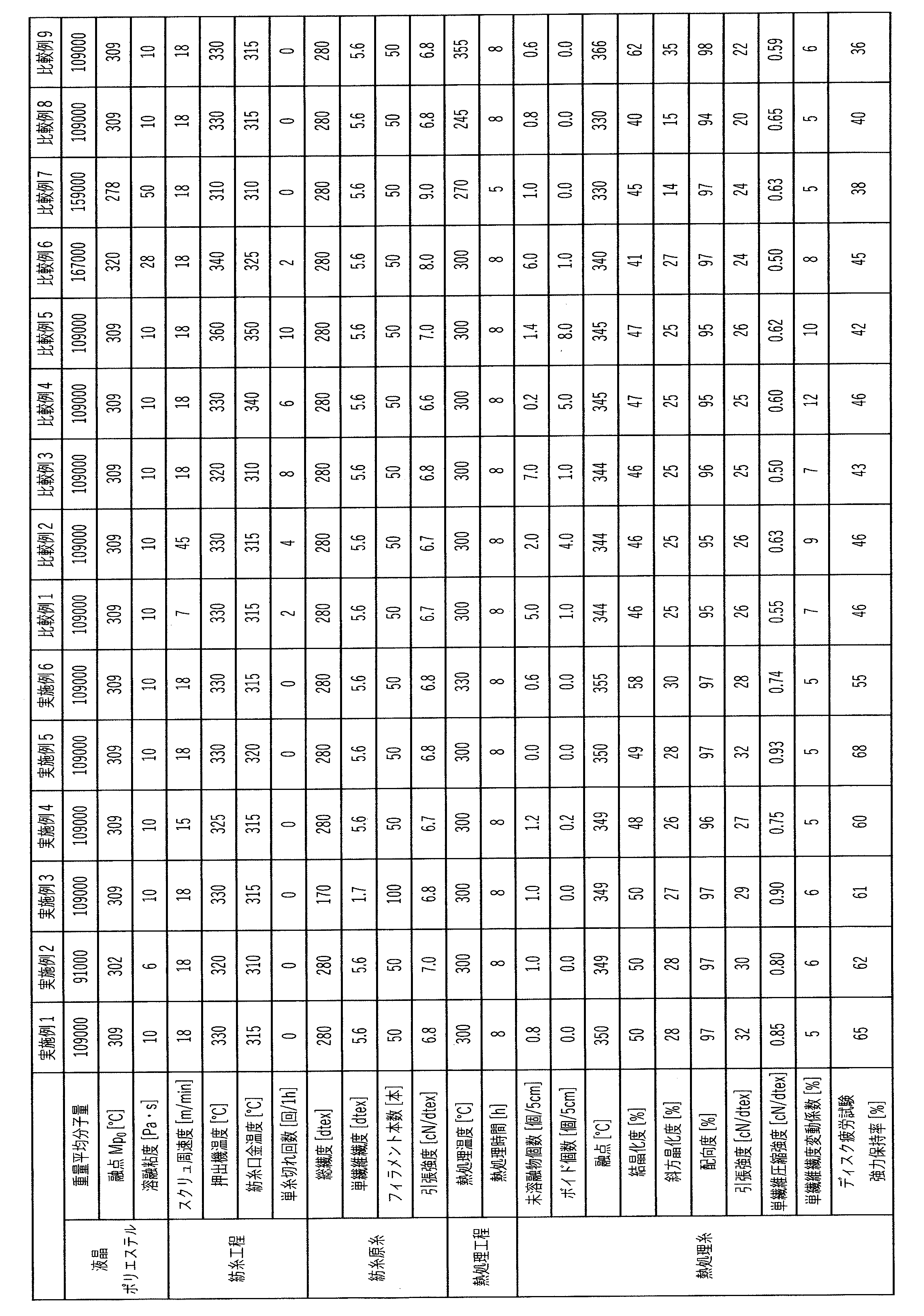
- Examples 1 to 6 a specific liquid crystal polyester is used as the raw resin, and melt mixing and melt spinning are performed under specific conditions, which reduces unmelted material and voids, and allows the melting point and crystallinity to be adjusted to specific ranges.
- the liquid crystal polyester fibers of Examples 1 to 6 have excellent tensile strength and compressive strength, excellent disk fatigue resistance, and excellent uniformity of single fiber fineness.
- Comparative Examples 1 to 5 Although the same liquid crystal polyester raw resin is used as in Examples 1 and 3 to 6, the temperature in the extruder, the screw peripheral speed, or the spinneret temperature are not within a specific range, resulting in the formation of many unmelted materials or voids. As a result, the liquid crystal polyester fibers of Comparative Examples 1 to 5 have lower tensile strength and compressive strength, inferior disk fatigue resistance, and a large coefficient of variation in single fiber fineness, resulting in variation, compared to Examples 1 to 6.
- the liquid crystal polyester raw resin has a large weight average molecular weight, so it is difficult to melt in the extruder, and unmelted material remains. Also, perhaps due to the low mobility of the molecular chains, the molecular chains cannot be densely packed during heat treatment, and the degree of crystallinity cannot be increased. Therefore, the liquid crystal polyester fiber of Comparative Example 6 has lower tensile strength and compressive strength than Examples 1 to 6, is inferior in disk fatigue resistance, and has a large coefficient of variation in single fiber fineness, resulting in variation.
- Comparative Example 7 the melting point of the liquid crystal polyester raw resin is low, so even if the spun raw yarn is heat-treated, the melting point cannot be sufficiently increased. Therefore, the liquid crystal polyester fiber of Comparative Example 7 has lower heat resistance than Examples 1 to 6.
- Comparative Examples 8 and 9 although there was little unmelted material or voids, the crystallinity was outside the specific range. Therefore, the liquid crystal polyester fibers of Comparative Examples 8 and 9 had lower tensile strength and compressive strength than Examples 1 to 6, and were inferior in disk fatigue resistance.
- the liquid crystal polyester fiber of the present invention can be used for various applications such as general industrial materials, civil engineering and construction materials, various reinforcing materials, electrical and electronic component materials, and protective clothing, and can be used, for example, as a reinforcing fiber for composite materials.
Landscapes
- Engineering & Computer Science (AREA)
- Textile Engineering (AREA)
- Chemical & Material Sciences (AREA)
- Chemical Kinetics & Catalysis (AREA)
- Mechanical Engineering (AREA)
- General Chemical & Material Sciences (AREA)
- Physics & Mathematics (AREA)
- Thermal Sciences (AREA)
- Health & Medical Sciences (AREA)
- Medicinal Chemistry (AREA)
- Polymers & Plastics (AREA)
- Organic Chemistry (AREA)
- Artificial Filaments (AREA)
Abstract
Description
〔態様1〕
示差走査熱量計により、窒素雰囲気下、10℃/分の昇温速度で測定した融点が335℃以上360℃未満(好ましくは337℃以上358℃以下、より好ましくは340℃以上355℃以下)であり、結晶化度が45~60%(好ましくは46~58%、より好ましくは48~55%)であり、かつ単糸5cm当たりに含まれる長径5μm以上の未溶融物およびボイドの合計数が3個以下(好ましくは2個以下、より好ましくは1個以下)である、液晶ポリエステル繊維。
〔態様2〕
態様1に記載の液晶ポリエステル繊維であって、結晶成分における斜方晶化度が20%以上(好ましくは26%以上、より好ましくは27%以上)である、液晶ポリエステル繊維。
〔態様3〕
態様1または2に記載の液晶ポリエステル繊維であって、結晶成分における繊維軸方向の配向度が97%以上100%未満である、液晶ポリエステル繊維。
〔態様4〕
態様1~3のいずれか一態様に記載の液晶ポリエステル繊維であって、引張強度が27cN/dtex以上(好ましくは28cN/dtex以上、より好ましくは30cN/dtex以上)である、液晶ポリエステル繊維。
〔態様5〕
態様1~4のいずれか一態様に記載の液晶ポリエステル繊維であって、単繊維の圧縮強度が0.70cN/dtex以上(好ましくは0.75cN/dtex以上、より好ましくは0.80cN/dtex以上)である、液晶ポリエステル繊維。
〔態様6〕
態様1~5のいずれか一態様に記載の液晶ポリエステル繊維であって、単繊維繊度が7dtex以下であり、かつ単繊維繊度の変動係数が7%以下(好ましくは6%以下、より好ましくは5%以下)である、液晶ポリエステル繊維。
〔態様7〕
態様1~6のいずれか一態様に記載の液晶ポリエステル繊維を少なくとも一部に含んで構成された繊維構造物。
〔態様8〕
態様1~6のいずれか一態様に記載の液晶ポリエステル繊維を強化繊維として含む複合材。
〔態様9〕
態様1~6のいずれか一態様に記載の液晶ポリエステル繊維を製造する方法であって、
GPCにおけるポリスチレン換算の重量平均分子量が50000以上160000以下(好ましくは60000以上150000以下、より好ましくは80000以上130000以下)であり、かつ示差走査熱量計により、窒素雰囲気下、10℃/分の昇温速度で測定した融点Mp0が300℃以上(好ましくは300~340℃、より好ましくは305~330℃)である液晶ポリエステルを、以下の(1)~(3):
(1)押出機温度:Mp0+15℃~Mp0+35℃(好ましくはMp0+16℃~Mp0+30℃、より好ましくはMp0+17℃~Mp0+25℃)
(2)押出機のスクリュ周速度:10~40m/min(好ましくは15~35m/min、より好ましくは17~25m/min)
(3)紡糸口金温度:押出機温度-15℃~押出機温度-5℃
を満たす条件で紡糸して紡糸原糸を得る工程と、
得られた紡糸原糸に対して熱処理する工程と、
を少なくとも備える、液晶ポリエステル繊維の製造方法。
〔態様10〕
態様9に記載の製造方法であって、押出機が二軸押出機である、液晶ポリエステル繊維の製造方法。
〔態様11〕
態様9または10に記載の製造方法であって、熱処理温度が250~350℃(好ましくは255~320℃、より好ましくは260~315℃、さらに好ましくは280~310℃)である、液晶ポリエステル繊維の製造方法。
本発明の液晶ポリエステル繊維は、液晶ポリエステルを含む。液晶ポリエステルとしては、例えば芳香族ジオール、芳香族ジカルボン酸、芳香族ヒドロキシカルボン酸等に由来する構成単位からなり、本発明の効果を損なわない限り、芳香族ジオール、芳香族ジカルボン酸、芳香族ヒドロキシカルボン酸に由来する構成単位は、その化学的構成については特に限定されるものではない。また、本発明の効果を阻害しない範囲で、液晶ポリエステルは、芳香族ジアミン、芳香族ヒドロキシアミンまたは芳香族アミノカルボン酸に由来する構成単位を含んでいてもよい。例えば、好ましい構成単位としては、表1に示す例が挙げられる。



-O-Ar1-CO- (I)
-CO-Ar2-CO- (II)
-O-Ar3-O- (III)
-O-Ar4-NH- (IV)
(式中、Ar1は、フェニレン基、ナフチレン基およびビフェニリレン基からなる群から選択される少なくとも一種であり、Ar2、Ar3およびAr4は、それぞれ独立して、フェニレン基、ナフチレン基、ビフェニリレン基およびジフェニルエーテルジイル基からなる群から選択される少なくとも一種であり、Ar1、Ar2、Ar3およびAr4の芳香環の水素原子は、それぞれ独立して、ハロゲン原子、アルキル基、アルコキシ基、アリール基、アラルキル基、アリールオキシ基またはアラルキルオキシ基で置換されていてもよい)
本発明の液晶ポリエステル繊維の製造方法は、
GPCにおけるポリスチレン換算の重量平均分子量が50000以上160000以下であり、かつ示差走査熱量計により、窒素雰囲気下、10℃/分の昇温速度で測定した融点Mp0が300℃以上である液晶ポリエステルを、以下の(1)~(3):
(1)押出機温度:Mp0+15℃~Mp0+35℃
(2)押出機のスクリュ周速度:10~40m/min
(3)紡糸口金温度:押出機温度-15℃~押出機温度-5℃
を満たす条件で紡糸して紡糸原糸を得る工程と、
得られた紡糸原糸に対して熱処理する工程と、を少なくとも備えていてもよい。
一方で、本発明の発明者らは、このような液晶ポリエステルは、未溶融物およびボイドが発生しやすいことを見出した。すなわち、特定の重量平均分子量の範囲に対して融点が高いという関係を有している液晶ポリエステルは、溶融粘度が低い傾向にあるため、溶融混練時にせん断がかかりにくく、完全には溶融しきらずに未溶融物が異物として残存してしまう。また、未溶融物を減らすために溶融混練温度を高く設定すると、分解ガスが発生してボイドが生じてしまう。この未溶融物および/またはボイドの発生によって、紡糸時に断糸が多発し、均一な繊維を安定的に得ることが困難になるとともに、繊維の結晶化度の向上が阻害される原因にもなり得る。さらに、この液晶ポリエステルは、溶融粘度が低いことで、吐出が安定せず繊度斑が生じやすく、また、吐出時にもせん断がかかりにくいため、高度に配向できず結晶化度を高めることが困難であることも見出した。
そこで、本発明では、押出機での温度およびスクリュの周速度を調整して、分解ガスが発生せず、液晶ポリエステルが劣化しない温度でせん断をかけることで溶融を促進し、未溶融物およびボイドの発生を抑制している。さらに、紡糸口金温度をその上流側の押出機温度よりも特定の関係で低くなるように調整することで、液晶ポリエステルの粘度を高くして吐出を安定させて繊度斑を抑制するとともに、吐出時にもせん断をかけて配向させて結晶化を促進することができる。このように、本発明では、特定の重量平均分子量および融点を有する液晶ポリエステルを原料として用いた場合であっても、紡糸条件を調整して未溶融物およびボイドを低減し、結晶性を調整した紡糸原糸を熱処理することによって、上述の液晶ポリエステル繊維を得ることを可能としている。
本発明の液晶ポリエステル繊維は、複合材を製造するための強化繊維として使用することができる。強化繊維として使用するにあたり、液晶ポリエステル繊維を少なくとも一部に含む繊維構造体を複合材製造の中間材料として使用することができる。
本発明において、複合材は、液晶ポリエステル繊維を強化繊維として用い、マトリックス樹脂を成形して得ることができるものであればよい。液晶ポリエステル繊維は上記繊維構造体を用いて成形することができる。
溶媒としてペンタフルオロフェノール/クロロホルム=1/2(重量比)の混合溶媒を用い、溶媒中の液晶ポリエステルの濃度が0.03重量%となるように溶解させ、GPC測定用試料とした。これを、高速GPC測定装置(東ソー株式会社製、「HLC-8420GPC」)を用いて下記条件で測定し、標準ポリスチレン換算により重量平均分子量を求めた。
カラム:TSKgel guardcolumn SuperH-L 4.6mm×3.5cm 1本、
TSKgel SuperH2000 6.0mmID×15cm 1本、
TSKgel SuperHM-H 6.0mmID×15cm 2本
検出器:RI検出器
温度:40℃
流速:0.6mL/分
注入量:100μL
JIS K 7121に準拠し、示差走査熱量計(DSC;株式会社島津製作所製「DSC60A Plus」)を用いて測定し、観察される主吸収ピーク温度を融点とした。具体的には、前記DSC装置に、試料を4~6mgをとりアルミ製パンへ封入した後、キャリヤーガスとして窒素を200mL/分の流量で流し、25℃から10℃/分で昇温したときの液晶ポリエステル由来の吸熱ピークを測定した。
原料樹脂の溶融粘度は、溶融粘度測定装置(東洋精機株式会社製キャピログラフ1C)を用いて測定した。樹脂チップを装置シリンダ内に充填し、1.00mmφ×10mmのキャピラリーを用いて、液晶ポリエステルの融点Mp0(上記で測定した樹脂チップの液晶ポリエステルの融点)に対してMp0+15℃の各温度条件下、せん断速度1216sec-1での溶融粘度を測定した。
液晶ポリエステル繊維を繊維専用ホルダーに装着し、下記測定条件で透過法にて、繊維軸に対して直交方向にX線を入射させ、広角X線回折(WAXD)測定を行った。
測定装置:ブルカー社製「D8 Discover IμS」
検出器:2次元PSPC・VANTEC-500
X線源:Cu
電流:1mA
電圧:50kV
露光時間:10分
コリメーター径:0.5mm
カメラ長:17cm
検出器位置(2θ):20°
サンプル位置(ω):10°
煽り角(Ψ):90°
測定温度:室温(約25℃)
積分範囲:2θ=5~35°、γ(方位角)=250~290°
ステップ幅:0.05°(回折角)
ピークA:擬フォークト関数(α=1)
ピークB:擬フォークト関数(α=0)
ピークC:擬フォークト関数(α=0.5)
結晶化度(%)={(A)+(B)+(C)}/{(A)+(B)+(C)+(D)}×100
上記結晶化度の測定でX線回折プロファイル(ベースライン補正後のプロファイルデータ)から算出した六方晶に由来するピークAの結晶量(A)および斜方晶に由来するピークBの結晶量(B)を用いて、下記式から斜方晶化度を算出した。
斜方晶化度(%)=(B)/{(A)+(B)}×100
上記結晶化度の測定条件での広角X線回折測定において、下記条件により、横軸が方位角(γ)、縦軸が強度である方位角プロファイルを得た。
積分範囲:γ=225~315°、2θ=19.0~21.0°
ステップ幅:0.5°
配向度(%)=(180-半値幅)/180×100
液晶ポリエステル繊維(マルチフィラメント)から単繊維を1本取り出し、顕微鏡(株式会社ニコン製「ECLIPSE Ci-E」)を用いて透過照明による顕微鏡観察を糸長5cmの範囲で行い、長径(最大径)のサイズが5μm以上のボイドの個数をカウントした。単繊維5本についてボイドの個数をカウントし、その平均個数を単繊維5cm当たりに含まれる長径5μm以上のボイドの個数とした。
上記ボイドの測定と同じ試料について、偏光顕微鏡観察(クロスニコル)を行った。具体的には、同じ顕微鏡を用いて、顕微鏡のステージの上下に偏光子「鋭敏色偏光ポラライザーユニットC-TP」と検光子「鋭敏色偏光アナライザーユニットC-IA」をセットし、偏光子と検光子の透過軸を互いに直交させた状態(クロスニコル)で試料を観察した。液晶ポリエステル繊維は高度に配向しており光学的異方性(複屈折性)を有するため、ある角度で観察した際に繊維全体が光った状態(明視野)で観察できる。この状態から45°ステージを回転させ、繊維全体が暗くなった状態(暗視野)で繊維を観察した場合に、未溶融物が存在すると、その部分が光って確認できる。このような方法により、糸長5cmの範囲で、長径(最大径)のサイズが5μm以上の未溶融物の個数をカウントした。単繊維5本について未溶融物の個数をカウントし、その平均個数を単繊維5cm当たりに含まれる長径5μm以上の未溶融物の個数とした。
JIS L 1013:2010 8.3.1 A法に基づき、株式会社大栄科学精器製作所製検尺器「Wrap Reel by Motor Driven」を用いて液晶ポリエステル繊維を1周1m×100周(計100m)のカセに巻き、その重量(g)を100倍して1水準当たり2回の測定を行い、その平均値を、得られた液晶ポリエステル繊維の総繊度(dtex)とした。また、この値をフィラメント本数で除した商を単繊維繊度(dtex)とした。
JIS L 1013:2010 8.5.1を参考に、株式会社島津製作所製オートグラフ「AGS-100B」を用いて、試験長20cm、引張速度10cm/分の条件で、糸条1サンプルにつき8回の引張試験を行い、その平均引張強力(cN)を上述の方法で測定した総繊度(dtex)で割り、引張強度(cN/dtex)を算出した。
液晶ポリエステル繊維(マルチフィラメント)から単繊維1本を取り出し、この単繊維をガラスプレートの上にその端部からはみ出るように乗せて接着剤で固定した。はみ出た単繊維のガラスプレート端部より繊維直径の1.5倍の長さ離れた位置を、集束イオンビーム(Focused Ion Beam:FIB)装置で切断した。これにより、繊維軸に対して正確に直交する断面を有する、単繊維圧縮強度測定用サンプルを作製した。単繊維圧縮試験機(THKプレシジョン株式会社製「型式B20-049」)を用いて、測定用サンプルの切断面に対して、200nm/secの速度で圧子を押し付け、押圧力-歪み曲線を取得した。この測定を5つの各サンプルに対して行い、5回の試験から得られた押圧力-歪み曲線の降伏点における押圧力の平均値を算出した。その平均押圧力を上述の方法で測定した単繊維繊度で割り、単繊維の圧縮強度(cN/dtex)を算出した。
液晶ポリエステル繊維(マルチフィラメント)から単繊維を15本取り出した。サーチ制御電機有限会社製「Denier Computer DC-11」を用いて、測定長50mmの単繊維に0.9dtex当たり0.1gの初荷重をかける条件で単繊維繊度を測定した。15本の単繊維繊度の測定値の標準偏差を平均値で割り、100倍した値を単繊維繊度変動係数(%)として算出した。
総繊度280dtexの液晶ポリエステル繊維6本を合糸(総繊度170dtexの場合は10本を合糸;総繊度が約1700dtexになるように合糸)して328T/mの下撚り(Z撚)をかけ、その下撚糸3本を合糸して268T/mの上撚り(S撚り)をかけ、コードを作製した。
1回目:
マーポマーセ(70%;松本油脂製薬株式会社製)を1重量%、デナコールEX313(ナガセケムテックス株式会社製)を4重量%、水酸化ナトリウム水溶液(10%)を0.3重量%、水94.7重量%を混合したディップ液を使用してディッピング処理を行った。その後、150℃で30秒間乾燥した後、240℃で30秒間熱処理した。
2回目:
RFL液をディップ液として使用してディッピング処理を行った。その後、150℃で30秒間乾燥した後、240℃で30秒間熱処理した。なお、RFL液は以下のように調製した。レゾルシノール3.3重量%、ホルムアルデヒド(37%)2.46重量%、水酸化ナトリウム水溶液(10%)1.4重量%、水32.2重量%を混合したA液を25℃の温度で6時間熟成した。VPラテックス(JSR-0650;40%;JSR株式会社製)52.86重量%、水7.78重量%を混合したB液を、熟成済みのA液と混合した後、25℃の温度で16時間熟成しRFL液とした。
装置:ディスク疲労試験機(株式会社マイズ試験機製)
ディスク間隔:24.5mm
歪み量:2%(伸長率、圧縮率)
回転数:2500rpm
温度:100℃
回数:30万回
強力保持率(%)=(ディスク疲労試験後ディップコードの引張強力)/(ディスク疲労試験前ディップコードの引張強力)×100
6-ヒドロキシ-2-ナフトエ酸20.66g(60モル%)、2,6-ナフタレンジカルボン酸7.91g(20モル%)、ヒドロキノン3.02g(15モル%)、4,4’-ジヒドロキシビフェニル1.70g(5モル%)、無水酢酸20.55g、および重合触媒として酢酸カリウム3.77mgを反応容器に投入し、窒素雰囲気下でアセチル化(160℃、還流下約2時間)後、280℃0.5時間、320℃1時間、360℃1時間保持し、続いて減圧処理(100Pa)を発泡が収まったのが確認されるまで(30~120分間)行い、その後、窒素置換をして、液晶ポリエステルを得た。得られた液晶ポリエステルは、重量平均分子量が109000、融点が309℃であった。
6-ヒドロキシ-2-ナフトエ酸19.74g(60モル%)、2,6-ナフタレンジカルボン酸7.56g(20モル%)、ヒドロキノン0.96g(5モル%)、4,4’-ジヒドロキシビフェニル4.88g(15モル%)、無水酢酸19.64g、および重合触媒として酢酸カリウム3.77mgを反応容器に投入し、窒素雰囲気下でアセチル化(160℃、還流下約2時間)後、280℃0.5時間、320℃1時間、360℃2時間保持し、続いて減圧処理(100Pa)を発泡が収まったのが確認されるまで(30~120分間)行い、その後、窒素置換をして、液晶ポリエステルを得た。得られた液晶ポリエステルは、重量平均分子量が91000、融点が302℃であった。
重合反応時の最高温度を365℃に変更した以外は参考例1と同様にして液晶ポリエステルを得た。得られた液晶ポリエステルは、重量平均分子量が167000、融点が320℃であった。
4-ヒドロキシ安息香酸22.64g(73モル%)、6-ヒドロキシ-2-ナフトエ酸11.41g(27モル%)、無水酢酸23.38g、および酢酸カリウム3.77mgを反応容器に投入し、窒素雰囲気下でアセチル化(160℃、還流下約2時間)後、250℃0.5時間、280℃1時間、320℃1時間保持し、続いて30分間減圧処理(100Pa)を行い、発泡が収まったのが確認された後、窒素置換をして、液晶ポリエステルを得た。得られた液晶ポリエステルは、重量平均分子量が159000、融点が278℃であった。
参考例1で得られた液晶ポリエステルのチップ(粒状成型体)を120℃で4時間以上熱風乾燥させた。その後、Φ15mm二軸押出機(株式会社テクノベル製、「KZW15TW-45MG-NH(-700)」)に投入し、ヒーター温度330℃、スクリュ周速度18m/minで溶融混練し、ギアポンプで計量しつつ紡糸頭に溶融混練物を供給した。このとき、二軸押出機の途中のベント部より金属管を介して減圧ポンプ(オリオン機械株式会社製ドライポンプ「KRF40A-V-01B」)を接続し、二軸押出機内の樹脂非充満空間を50kPaまで減圧を行った。また、押出機出口から紡糸頭までの温度設定は330℃とし、紡糸口金温度設定を315℃とした。紡糸頭には孔径0.10mmφ、ランド長0.14mm、孔数50個の紡糸口金を備え、吐出量28g/分で溶融混練物を吐出し、巻き取り速度1000m/分でボビンに巻き取り液晶ポリエステル繊維の紡糸原糸を得た。この際、紡糸口金直下に配置したオイリングガイドから、2重量%のドデシルリン酸ナトリウム(富士フイルム和光純薬工業株式会社製、和光一級)水溶液を紡糸原糸に付与した。この水溶液の付与量は1.4g/分であり、紡糸原糸に対するドデシルリン酸ナトリウムの付着比率は計算上0.1重量%であった。
参考例2で得られた液晶ポリエステルを使用し、紡糸時の押出機のヒーター温度および押出機出口から紡糸頭までの温度設定を320℃とし、紡糸口金温度設定を310℃にしたこと以外は実施例1と同様にして液晶ポリエステル繊維を得た。
孔径0.08mmφ、ランド長0.11mm、孔数100個の紡糸口金を使用し、紡糸時の吐出量を17g/分にしたこと以外は実施例1と同様にして液晶ポリエステル繊維を得た。
紡糸時の押出機のスクリュ周速度を15m/minとし、押出機のヒーター温度および押出機出口から紡糸頭までの温度設定を325℃とし、紡糸口金温度設定を315℃にしたこと以外は実施例1と同様にして液晶ポリエステル繊維を得た。
紡糸時の紡糸口金温度設定を320℃にしたこと以外は実施例1と同様にして液晶ポリエステル繊維を得た。
紡糸原糸に対して、330℃で8時間熱処理を行うこと以外は実施例1と同様にして液晶ポリエステル繊維を得た。
紡糸時の押出機のスクリュ周速度を7m/minにしたこと以外は実施例1と同様にして液晶ポリエステル繊維を得た。
紡糸時の押出機のスクリュ周速度を45m/minにしたこと以外は実施例1と同様にして液晶ポリエステル繊維を得た。
紡糸時の押出機のヒーター温度および押出機出口から紡糸頭までの温度設定を320℃とし、紡糸口金温度設定を310℃にしたこと以外は実施例1と同様にして液晶ポリエステル繊維を得た。
紡糸時の紡糸口金温度設定を340℃にしたこと以外は実施例1と同様にして液晶ポリエステル繊維を得た。
紡糸時の押出機のヒーター温度および押出機出口から紡糸頭までの温度設定を360℃とし、紡糸口金温度設定を350℃にしたこと以外は実施例1と同様にして液晶ポリエステル繊維を得た。
参考例3で得られた液晶ポリエステルを使用し、紡糸時の押出機のヒーター温度および押出機出口から紡糸頭までの温度設定を340℃とし、紡糸口金温度設定を325℃にしたこと以外は実施例1と同様にして液晶ポリエステル繊維を得た。
参考例4で得られた液晶ポリエステルを使用し、紡糸時の押出機のヒーター温度および押出機出口から紡糸頭までの温度設定を310℃とし、紡糸口金温度設定を310℃としたこと以外は実施例1と同様にして紡糸原糸を得た。次に、得られた紡糸原糸に対して、270℃で5時間熱処理を行うこと以外は実施例1と同様にして液晶ポリエステル繊維を得た。
紡糸原糸に対して、245℃で8時間熱処理を行うこと以外は実施例1と同様にして液晶ポリエステル繊維を得た。
紡糸原糸に対して、355℃で8時間熱処理を行うこと以外は実施例1と同様にして液晶ポリエステル繊維を得た。
Claims (11)
- 示差走査熱量計により、窒素雰囲気下、10℃/分の昇温速度で測定した融点が335℃以上360℃未満であり、結晶化度が45~60%であり、かつ単糸5cm当たりに含まれる長径5μm以上の未溶融物およびボイドの合計数が3個以下である、液晶ポリエステル繊維。
- 請求項1に記載の液晶ポリエステル繊維であって、結晶成分における斜方晶化度が20%以上である、液晶ポリエステル繊維。
- 請求項1または2に記載の液晶ポリエステル繊維であって、結晶成分における繊維軸方向の配向度が97%以上100%未満である、液晶ポリエステル繊維。
- 請求項1または2に記載の液晶ポリエステル繊維であって、引張強度が27cN/dtex以上である、液晶ポリエステル繊維。
- 請求項1または2に記載の液晶ポリエステル繊維であって、単繊維の圧縮強度が0.70cN/dtex以上である、液晶ポリエステル繊維。
- 請求項1または2に記載の液晶ポリエステル繊維であって、単繊維繊度が7dtex以下であり、かつ単繊維繊度の変動係数が7%以下である、液晶ポリエステル繊維。
- 請求項1または2に記載の液晶ポリエステル繊維を少なくとも一部に含んで構成された繊維構造物。
- 請求項1または2に記載の液晶ポリエステル繊維を強化繊維として含む複合材。
- 請求項1または2に記載の液晶ポリエステル繊維を製造する方法であって、
GPCにおけるポリスチレン換算の重量平均分子量が50000以上160000以下であり、かつ示差走査熱量計により、窒素雰囲気下、10℃/分の昇温速度で測定した融点Mp0が300℃以上である液晶ポリエステルを、以下の(1)~(3):
(1)押出機温度:Mp0+15℃~Mp0+35℃
(2)押出機のスクリュ周速度:10~40m/min
(3)紡糸口金温度:押出機温度-15℃~押出機温度-5℃
を満たす条件で紡糸して紡糸原糸を得る工程と、
得られた紡糸原糸に対して熱処理する工程と、
を少なくとも備える、液晶ポリエステル繊維の製造方法。 - 請求項9に記載の製造方法であって、押出機が二軸押出機である、液晶ポリエステル繊維の製造方法。
- 請求項9に記載の製造方法であって、熱処理温度が250~350℃である、液晶ポリエステル繊維の製造方法。
Priority Applications (4)
| Application Number | Priority Date | Filing Date | Title |
|---|---|---|---|
| KR1020257019705A KR103000850B1 (ko) | 2022-12-14 | 2023-12-07 | 액정 폴리에스테르 섬유 및 그 제조 방법 |
| JP2024564325A JP7742952B2 (ja) | 2022-12-14 | 2023-12-07 | 液晶ポリエステル繊維およびその製造方法 |
| EP23903396.2A EP4636142A4 (en) | 2022-12-14 | 2023-12-07 | LIQUID CRYSTAL POLYESTER FIBER AND ASSOCIATED PRODUCTION PROCESS |
| CN202380085500.7A CN120344727A (zh) | 2022-12-14 | 2023-12-07 | 液晶聚酯纤维及其制造方法 |
Applications Claiming Priority (2)
| Application Number | Priority Date | Filing Date | Title |
|---|---|---|---|
| JP2022-199789 | 2022-12-14 | ||
| JP2022199789 | 2022-12-14 |
Publications (1)
| Publication Number | Publication Date |
|---|---|
| WO2024128109A1 true WO2024128109A1 (ja) | 2024-06-20 |
Family
ID=91484968
Family Applications (1)
| Application Number | Title | Priority Date | Filing Date |
|---|---|---|---|
| PCT/JP2023/043770 Ceased WO2024128109A1 (ja) | 2022-12-14 | 2023-12-07 | 液晶ポリエステル繊維およびその製造方法 |
Country Status (5)
| Country | Link |
|---|---|
| EP (1) | EP4636142A4 (ja) |
| JP (1) | JP7742952B2 (ja) |
| CN (1) | CN120344727A (ja) |
| TW (1) | TW202430585A (ja) |
| WO (1) | WO2024128109A1 (ja) |
Citations (7)
| Publication number | Priority date | Publication date | Assignee | Title |
|---|---|---|---|---|
| WO2008105439A1 (ja) * | 2007-02-28 | 2008-09-04 | Toray Industries, Inc. | 液晶ポリエステル繊維およびその製造方法 |
| JP2010043380A (ja) | 2008-08-13 | 2010-02-25 | Sumitomo Chemical Co Ltd | 繊維製造用材料並びにこれを用いた繊維及び不織布 |
| JP2011202290A (ja) * | 2010-03-24 | 2011-10-13 | Toray Ind Inc | 液晶ポリエステル繊維およびその製造方法 |
| JP2014167174A (ja) * | 2013-02-28 | 2014-09-11 | Toray Ind Inc | 液晶ポリエステル繊維およびその製造方法 |
| WO2019142692A1 (ja) | 2018-01-18 | 2019-07-25 | 住友化学株式会社 | 液晶ポリエステル繊維 |
| WO2021205757A1 (ja) * | 2020-04-10 | 2021-10-14 | 株式会社クラレ | 液晶ポリエステル繊維およびその製造方法 |
| JP2022006590A (ja) | 2020-06-24 | 2022-01-13 | 住友化学株式会社 | 液晶ポリエステル繊維及び液晶ポリエステル繊維の製造方法 |
Family Cites Families (1)
| Publication number | Priority date | Publication date | Assignee | Title |
|---|---|---|---|---|
| US9011743B2 (en) * | 2009-03-11 | 2015-04-21 | Toray Industries, Inc. | Liquid crystal polyester fibers and method for producing the same |
-
2023
- 2023-12-07 EP EP23903396.2A patent/EP4636142A4/en active Pending
- 2023-12-07 CN CN202380085500.7A patent/CN120344727A/zh active Pending
- 2023-12-07 WO PCT/JP2023/043770 patent/WO2024128109A1/ja not_active Ceased
- 2023-12-07 JP JP2024564325A patent/JP7742952B2/ja active Active
- 2023-12-14 TW TW112148680A patent/TW202430585A/zh unknown
Patent Citations (7)
| Publication number | Priority date | Publication date | Assignee | Title |
|---|---|---|---|---|
| WO2008105439A1 (ja) * | 2007-02-28 | 2008-09-04 | Toray Industries, Inc. | 液晶ポリエステル繊維およびその製造方法 |
| JP2010043380A (ja) | 2008-08-13 | 2010-02-25 | Sumitomo Chemical Co Ltd | 繊維製造用材料並びにこれを用いた繊維及び不織布 |
| JP2011202290A (ja) * | 2010-03-24 | 2011-10-13 | Toray Ind Inc | 液晶ポリエステル繊維およびその製造方法 |
| JP2014167174A (ja) * | 2013-02-28 | 2014-09-11 | Toray Ind Inc | 液晶ポリエステル繊維およびその製造方法 |
| WO2019142692A1 (ja) | 2018-01-18 | 2019-07-25 | 住友化学株式会社 | 液晶ポリエステル繊維 |
| WO2021205757A1 (ja) * | 2020-04-10 | 2021-10-14 | 株式会社クラレ | 液晶ポリエステル繊維およびその製造方法 |
| JP2022006590A (ja) | 2020-06-24 | 2022-01-13 | 住友化学株式会社 | 液晶ポリエステル繊維及び液晶ポリエステル繊維の製造方法 |
Non-Patent Citations (1)
| Title |
|---|
| See also references of EP4636142A1 |
Also Published As
| Publication number | Publication date |
|---|---|
| JP7742952B2 (ja) | 2025-09-22 |
| EP4636142A4 (en) | 2026-08-12 |
| KR20250112801A (ko) | 2025-07-24 |
| EP4636142A1 (en) | 2025-10-22 |
| JPWO2024128109A1 (ja) | 2024-06-20 |
| TW202430585A (zh) | 2024-08-01 |
| CN120344727A (zh) | 2025-07-18 |
Similar Documents
| Publication | Publication Date | Title |
|---|---|---|
| US10584429B2 (en) | Method of producing liquid crystal polyester fibers | |
| US8673174B2 (en) | Liquid crystalline polyester fiber and process for production of the same | |
| JP5286827B2 (ja) | 液晶ポリエステル繊維 | |
| EP2799600A1 (en) | Liquid-crystalline polyester multifilament | |
| KR101537131B1 (ko) | 폴리에틸렌나프탈레이트 섬유 및 그 제조 방법 | |
| KR101917900B1 (ko) | 고무 보강용 폴리에스테르 섬유 및 그 제조 방법 | |
| CN115398048B (zh) | 液晶聚酯纤维及其制造方法 | |
| JP7472787B2 (ja) | 液晶ポリエステルマルチフィラメントおよびそれからなる高次加工製品 | |
| JP2025143512A (ja) | 液晶ポリエステル繊維およびその製造方法 | |
| JP2010084301A (ja) | 液晶ポリエステル繊維 | |
| JPH0246689B2 (ja) | ||
| JP7742952B2 (ja) | 液晶ポリエステル繊維およびその製造方法 | |
| JP5934005B2 (ja) | ゴム補強用繊維コード及びそれを用いてなるゴム・繊維複合体 | |
| JP5115471B2 (ja) | 液晶性ポリエステル繊維及びその製造方法 | |
| KR20170091968A (ko) | 내피로도가 우수한 폴리에틸렌테레프탈레이트 코드의 제조방법 | |
| JP2565676B2 (ja) | 芳香族ポリエステル繊維の製造法 | |
| WO2024210040A1 (ja) | 液晶ポリエステル繊維 | |
| KR101746029B1 (ko) | 고강도 및 치수안정성이 우수한 폴리에틸렌테레프탈레이트 원사의 제조방법 | |
| KR20250114511A (ko) | 용융 이방성 방향족 폴리에스테르 섬유 및 그 제조 방법 | |
| JPS63256739A (ja) | ポリエステルマルチフイラメント糸 |
Legal Events
| Date | Code | Title | Description |
|---|---|---|---|
| 121 | Ep: the epo has been informed by wipo that ep was designated in this application |
Ref document number: 23903396 Country of ref document: EP Kind code of ref document: A1 |
|
| WWE | Wipo information: entry into national phase |
Ref document number: 2024564325 Country of ref document: JP |
|
| WWE | Wipo information: entry into national phase |
Ref document number: CN2023800855007 Country of ref document: CN Ref document number: 202380085500.7 Country of ref document: CN |
|
| WWE | Wipo information: entry into national phase |
Ref document number: 2023903396 Country of ref document: EP |
|
| NENP | Non-entry into the national phase |
Ref country code: DE |
|
| WWP | Wipo information: published in national office |
Ref document number: 202380085500.7 Country of ref document: CN |
|
| ENP | Entry into the national phase |
Ref document number: 2023903396 Country of ref document: EP Effective date: 20250714 |
|
| WWP | Wipo information: published in national office |
Ref document number: 1020257019705 Country of ref document: KR |
|
| WWP | Wipo information: published in national office |
Ref document number: 2023903396 Country of ref document: EP |