WO2024128307A1 - エチレン-ビニルアルコール共重合体樹脂組成物ペレットの製造方法 - Google Patents
エチレン-ビニルアルコール共重合体樹脂組成物ペレットの製造方法 Download PDFInfo
- Publication number
- WO2024128307A1 WO2024128307A1 PCT/JP2023/045002 JP2023045002W WO2024128307A1 WO 2024128307 A1 WO2024128307 A1 WO 2024128307A1 JP 2023045002 W JP2023045002 W JP 2023045002W WO 2024128307 A1 WO2024128307 A1 WO 2024128307A1
- Authority
- WO
- WIPO (PCT)
- Prior art keywords
- evoh
- mass
- pellets
- extruder
- ethylene
- Prior art date
- Legal status (The legal status is an assumption and is not a legal conclusion. Google has not performed a legal analysis and makes no representation as to the accuracy of the status listed.)
- Ceased
Links
Images


Classifications
-
- B—PERFORMING OPERATIONS; TRANSPORTING
- B29—WORKING OF PLASTICS; WORKING OF SUBSTANCES IN A PLASTIC STATE IN GENERAL
- B29B—PREPARATION OR PRETREATMENT OF THE MATERIAL TO BE SHAPED; MAKING GRANULES OR PREFORMS; RECOVERY OF PLASTICS OR OTHER CONSTITUENTS OF WASTE MATERIAL CONTAINING PLASTICS
- B29B13/00—Conditioning or physical treatment of the material to be shaped
- B29B13/06—Conditioning or physical treatment of the material to be shaped by drying
- B29B13/065—Conditioning or physical treatment of the material to be shaped by drying of powder or pellets
-
- B—PERFORMING OPERATIONS; TRANSPORTING
- B29—WORKING OF PLASTICS; WORKING OF SUBSTANCES IN A PLASTIC STATE IN GENERAL
- B29B—PREPARATION OR PRETREATMENT OF THE MATERIAL TO BE SHAPED; MAKING GRANULES OR PREFORMS; RECOVERY OF PLASTICS OR OTHER CONSTITUENTS OF WASTE MATERIAL CONTAINING PLASTICS
- B29B7/00—Mixing; Kneading
- B29B7/30—Mixing; Kneading continuous, with mechanical mixing or kneading devices
- B29B7/58—Component parts, details or accessories; Auxiliary operations
- B29B7/72—Measuring, controlling or regulating
-
- B—PERFORMING OPERATIONS; TRANSPORTING
- B29—WORKING OF PLASTICS; WORKING OF SUBSTANCES IN A PLASTIC STATE IN GENERAL
- B29B—PREPARATION OR PRETREATMENT OF THE MATERIAL TO BE SHAPED; MAKING GRANULES OR PREFORMS; RECOVERY OF PLASTICS OR OTHER CONSTITUENTS OF WASTE MATERIAL CONTAINING PLASTICS
- B29B9/00—Making granules
- B29B9/02—Making granules by dividing preformed material
- B29B9/06—Making granules by dividing preformed material in the form of filamentary material, e.g. combined with extrusion
-
- B—PERFORMING OPERATIONS; TRANSPORTING
- B29—WORKING OF PLASTICS; WORKING OF SUBSTANCES IN A PLASTIC STATE IN GENERAL
- B29B—PREPARATION OR PRETREATMENT OF THE MATERIAL TO BE SHAPED; MAKING GRANULES OR PREFORMS; RECOVERY OF PLASTICS OR OTHER CONSTITUENTS OF WASTE MATERIAL CONTAINING PLASTICS
- B29B9/00—Making granules
- B29B9/02—Making granules by dividing preformed material
- B29B9/06—Making granules by dividing preformed material in the form of filamentary material, e.g. combined with extrusion
- B29B9/065—Making granules by dividing preformed material in the form of filamentary material, e.g. combined with extrusion under-water, e.g. underwater pelletizers
-
- B—PERFORMING OPERATIONS; TRANSPORTING
- B29—WORKING OF PLASTICS; WORKING OF SUBSTANCES IN A PLASTIC STATE IN GENERAL
- B29B—PREPARATION OR PRETREATMENT OF THE MATERIAL TO BE SHAPED; MAKING GRANULES OR PREFORMS; RECOVERY OF PLASTICS OR OTHER CONSTITUENTS OF WASTE MATERIAL CONTAINING PLASTICS
- B29B9/00—Making granules
- B29B9/12—Making granules characterised by structure or composition
-
- B—PERFORMING OPERATIONS; TRANSPORTING
- B29—WORKING OF PLASTICS; WORKING OF SUBSTANCES IN A PLASTIC STATE IN GENERAL
- B29B—PREPARATION OR PRETREATMENT OF THE MATERIAL TO BE SHAPED; MAKING GRANULES OR PREFORMS; RECOVERY OF PLASTICS OR OTHER CONSTITUENTS OF WASTE MATERIAL CONTAINING PLASTICS
- B29B9/00—Making granules
- B29B9/16—Auxiliary treatment of granules
-
- B—PERFORMING OPERATIONS; TRANSPORTING
- B29—WORKING OF PLASTICS; WORKING OF SUBSTANCES IN A PLASTIC STATE IN GENERAL
- B29C—SHAPING OR JOINING OF PLASTICS; SHAPING OF MATERIAL IN A PLASTIC STATE, NOT OTHERWISE PROVIDED FOR; AFTER-TREATMENT OF THE SHAPED PRODUCTS, e.g. REPAIRING
- B29C48/00—Extrusion moulding, i.e. expressing the moulding material through a die or nozzle which imparts the desired form; Apparatus therefor
- B29C48/001—Combinations of extrusion moulding with other shaping operations
- B29C48/0022—Combinations of extrusion moulding with other shaping operations combined with cutting
-
- B—PERFORMING OPERATIONS; TRANSPORTING
- B29—WORKING OF PLASTICS; WORKING OF SUBSTANCES IN A PLASTIC STATE IN GENERAL
- B29C—SHAPING OR JOINING OF PLASTICS; SHAPING OF MATERIAL IN A PLASTIC STATE, NOT OTHERWISE PROVIDED FOR; AFTER-TREATMENT OF THE SHAPED PRODUCTS, e.g. REPAIRING
- B29C48/00—Extrusion moulding, i.e. expressing the moulding material through a die or nozzle which imparts the desired form; Apparatus therefor
- B29C48/03—Extrusion moulding, i.e. expressing the moulding material through a die or nozzle which imparts the desired form; Apparatus therefor characterised by the shape of the extruded material at extrusion
- B29C48/04—Particle-shaped
-
- B—PERFORMING OPERATIONS; TRANSPORTING
- B29—WORKING OF PLASTICS; WORKING OF SUBSTANCES IN A PLASTIC STATE IN GENERAL
- B29C—SHAPING OR JOINING OF PLASTICS; SHAPING OF MATERIAL IN A PLASTIC STATE, NOT OTHERWISE PROVIDED FOR; AFTER-TREATMENT OF THE SHAPED PRODUCTS, e.g. REPAIRING
- B29C48/00—Extrusion moulding, i.e. expressing the moulding material through a die or nozzle which imparts the desired form; Apparatus therefor
- B29C48/25—Component parts, details or accessories; Auxiliary operations
- B29C48/285—Feeding the extrusion material to the extruder
-
- B—PERFORMING OPERATIONS; TRANSPORTING
- B29—WORKING OF PLASTICS; WORKING OF SUBSTANCES IN A PLASTIC STATE IN GENERAL
- B29C—SHAPING OR JOINING OF PLASTICS; SHAPING OF MATERIAL IN A PLASTIC STATE, NOT OTHERWISE PROVIDED FOR; AFTER-TREATMENT OF THE SHAPED PRODUCTS, e.g. REPAIRING
- B29C48/00—Extrusion moulding, i.e. expressing the moulding material through a die or nozzle which imparts the desired form; Apparatus therefor
- B29C48/25—Component parts, details or accessories; Auxiliary operations
- B29C48/36—Means for plasticising or homogenising the moulding material or forcing it through the nozzle or die
- B29C48/395—Means for plasticising or homogenising the moulding material or forcing it through the nozzle or die using screws surrounded by a cooperating barrel, e.g. single screw extruders
-
- B—PERFORMING OPERATIONS; TRANSPORTING
- B29—WORKING OF PLASTICS; WORKING OF SUBSTANCES IN A PLASTIC STATE IN GENERAL
- B29C—SHAPING OR JOINING OF PLASTICS; SHAPING OF MATERIAL IN A PLASTIC STATE, NOT OTHERWISE PROVIDED FOR; AFTER-TREATMENT OF THE SHAPED PRODUCTS, e.g. REPAIRING
- B29C48/00—Extrusion moulding, i.e. expressing the moulding material through a die or nozzle which imparts the desired form; Apparatus therefor
- B29C48/25—Component parts, details or accessories; Auxiliary operations
- B29C48/36—Means for plasticising or homogenising the moulding material or forcing it through the nozzle or die
- B29C48/50—Details of extruders
- B29C48/76—Venting, drying means; Degassing means
-
- C—CHEMISTRY; METALLURGY
- C08—ORGANIC MACROMOLECULAR COMPOUNDS; THEIR PREPARATION OR CHEMICAL WORKING-UP; COMPOSITIONS BASED THEREON
- C08F—MACROMOLECULAR COMPOUNDS OBTAINED BY REACTIONS ONLY INVOLVING CARBON-TO-CARBON UNSATURATED BONDS
- C08F216/00—Copolymers of compounds having one or more unsaturated aliphatic radicals, each having only one carbon-to-carbon double bond, and at least one being terminated by an alcohol, ether, aldehydo, ketonic, acetal or ketal radical
- C08F216/02—Copolymers of compounds having one or more unsaturated aliphatic radicals, each having only one carbon-to-carbon double bond, and at least one being terminated by an alcohol, ether, aldehydo, ketonic, acetal or ketal radical by an alcohol radical
- C08F216/04—Acyclic compounds
- C08F216/06—Polyvinyl alcohol ; Vinyl alcohol
-
- C—CHEMISTRY; METALLURGY
- C08—ORGANIC MACROMOLECULAR COMPOUNDS; THEIR PREPARATION OR CHEMICAL WORKING-UP; COMPOSITIONS BASED THEREON
- C08J—WORKING-UP; GENERAL PROCESSES OF COMPOUNDING; AFTER-TREATMENT NOT COVERED BY SUBCLASSES C08B, C08C, C08F, C08G or C08H
- C08J3/00—Processes of treating or compounding macromolecular substances
- C08J3/12—Powdering or granulating
-
- C—CHEMISTRY; METALLURGY
- C08—ORGANIC MACROMOLECULAR COMPOUNDS; THEIR PREPARATION OR CHEMICAL WORKING-UP; COMPOSITIONS BASED THEREON
- C08J—WORKING-UP; GENERAL PROCESSES OF COMPOUNDING; AFTER-TREATMENT NOT COVERED BY SUBCLASSES C08B, C08C, C08F, C08G or C08H
- C08J3/00—Processes of treating or compounding macromolecular substances
- C08J3/20—Compounding polymers with additives, e.g. colouring
-
- C—CHEMISTRY; METALLURGY
- C08—ORGANIC MACROMOLECULAR COMPOUNDS; THEIR PREPARATION OR CHEMICAL WORKING-UP; COMPOSITIONS BASED THEREON
- C08J—WORKING-UP; GENERAL PROCESSES OF COMPOUNDING; AFTER-TREATMENT NOT COVERED BY SUBCLASSES C08B, C08C, C08F, C08G or C08H
- C08J3/00—Processes of treating or compounding macromolecular substances
- C08J3/20—Compounding polymers with additives, e.g. colouring
- C08J3/205—Compounding polymers with additives, e.g. colouring in the presence of a continuous liquid phase
- C08J3/2053—Compounding polymers with additives, e.g. colouring in the presence of a continuous liquid phase the additives only being premixed with a liquid phase
- C08J3/2056—Compounding polymers with additives, e.g. colouring in the presence of a continuous liquid phase the additives only being premixed with a liquid phase the polymer being pre-melted
-
- C—CHEMISTRY; METALLURGY
- C08—ORGANIC MACROMOLECULAR COMPOUNDS; THEIR PREPARATION OR CHEMICAL WORKING-UP; COMPOSITIONS BASED THEREON
- C08L—COMPOSITIONS OF MACROMOLECULAR COMPOUNDS
- C08L23/00—Compositions of homopolymers or copolymers of unsaturated aliphatic hydrocarbons having only one carbon-to-carbon double bond; Compositions of derivatives of such polymers
- C08L23/26—Compositions of homopolymers or copolymers of unsaturated aliphatic hydrocarbons having only one carbon-to-carbon double bond; Compositions of derivatives of such polymers modified by chemical after-treatment
-
- C—CHEMISTRY; METALLURGY
- C08—ORGANIC MACROMOLECULAR COMPOUNDS; THEIR PREPARATION OR CHEMICAL WORKING-UP; COMPOSITIONS BASED THEREON
- C08L—COMPOSITIONS OF MACROMOLECULAR COMPOUNDS
- C08L29/00—Compositions of homopolymers or copolymers of compounds having one or more unsaturated aliphatic radicals, each having only one carbon-to-carbon double bond, and at least one being terminated by an alcohol, ether, aldehydo, ketonic, acetal or ketal radical; Compositions of hydrolysed polymers of esters of unsaturated alcohols with saturated carboxylic acids; Compositions of derivatives of such polymers
- C08L29/02—Homopolymers or copolymers of unsaturated alcohols
- C08L29/04—Polyvinyl alcohol; Partially hydrolysed homopolymers or copolymers of esters of unsaturated alcohols with saturated carboxylic acids
-
- B—PERFORMING OPERATIONS; TRANSPORTING
- B29—WORKING OF PLASTICS; WORKING OF SUBSTANCES IN A PLASTIC STATE IN GENERAL
- B29K—INDEXING SCHEME ASSOCIATED WITH SUBCLASSES B29B, B29C OR B29D, RELATING TO MOULDING MATERIALS OR TO MATERIALS FOR MOULDS, REINFORCEMENTS, FILLERS OR PREFORMED PARTS, e.g. INSERTS
- B29K2023/00—Use of polyalkenes or derivatives thereof as moulding material
- B29K2023/04—Polymers of ethylene
- B29K2023/08—Copolymers of ethylene
- B29K2023/086—EVOH, i.e. ethylene vinyl alcohol copolymer
-
- C—CHEMISTRY; METALLURGY
- C08—ORGANIC MACROMOLECULAR COMPOUNDS; THEIR PREPARATION OR CHEMICAL WORKING-UP; COMPOSITIONS BASED THEREON
- C08J—WORKING-UP; GENERAL PROCESSES OF COMPOUNDING; AFTER-TREATMENT NOT COVERED BY SUBCLASSES C08B, C08C, C08F, C08G or C08H
- C08J2323/00—Characterised by the use of homopolymers or copolymers of unsaturated aliphatic hydrocarbons having only one carbon-to-carbon double bond; Derivatives of such polymers
- C08J2323/02—Characterised by the use of homopolymers or copolymers of unsaturated aliphatic hydrocarbons having only one carbon-to-carbon double bond; Derivatives of such polymers not modified by chemical after treatment
- C08J2323/04—Homopolymers or copolymers of ethene
- C08J2323/08—Copolymers of ethene
-
- C—CHEMISTRY; METALLURGY
- C08—ORGANIC MACROMOLECULAR COMPOUNDS; THEIR PREPARATION OR CHEMICAL WORKING-UP; COMPOSITIONS BASED THEREON
- C08J—WORKING-UP; GENERAL PROCESSES OF COMPOUNDING; AFTER-TREATMENT NOT COVERED BY SUBCLASSES C08B, C08C, C08F, C08G or C08H
- C08J2329/00—Characterised by the use of homopolymers or copolymers of compounds having one or more unsaturated aliphatic radicals, each having only one carbon-to-carbon double bond, and at least one being terminated by an alcohol, ether, aldehydo, ketonic, acetal, or ketal radical; Hydrolysed polymers of esters of unsaturated alcohols with saturated carboxylic acids; Derivatives of such polymer
- C08J2329/02—Homopolymers or copolymers of unsaturated alcohols
- C08J2329/04—Polyvinyl alcohol; Partially hydrolysed homopolymers or copolymers of esters of unsaturated alcohols with saturated carboxylic acids
Definitions
- the present invention relates to a method for producing ethylene-vinyl alcohol copolymer resin composition pellets.
- Ethylene-vinyl alcohol copolymer (hereinafter sometimes referred to as EVOH) is a polymeric material with excellent gas barrier properties, fuel barrier properties, oil resistance, aroma retention, and antistatic properties, and is widely used after being molded into films, sheets, containers, etc.
- EVOH Ethylene-vinyl alcohol copolymer
- a method is known in which trace components such as acidic substances and/or metal salts are added to EVOH, and a method is known in which at least one additive selected from carboxylic acids, boron compounds, phosphoric acid compounds, alkali metal salts, and alkaline earth metal salts is blended to improve long-run properties and suppress appearance defects such as gels and bumps.
- a known method for incorporating such additives into EVOH is to immerse EVOH hydrous pellets in an aqueous solution in which the additives are dissolved, thereby impregnating the pellets with the additives (see, for example, Patent Document 1).
- this method requires a long time to uniformly impregnate the EVOH pellets with the additives.
- a treatment bath and treatment tower are required for immersing the EVOH pellets, as well as wastewater treatment and recovery facilities for disposing of the treatment liquid after use.
- Example 1 of Patent Document 2 describes how EVOH hydrous pellets with a moisture content of 39% by mass are fed into an extruder, dehydrated in a dehydration slit, and then an aqueous solution containing additives is added and melt-kneaded, followed by pelletization, to obtain hydrous EVOH resin composition pellets containing additives and with a moisture content of 20% by mass. It also describes how the obtained hydrous EVOH resin composition pellets are dried in a hot air dryer to obtain EVOH resin composition pellets with a moisture content of 0.2% by mass.
- Example 4 of Patent Document 3 describes how EVOH hydrous pellets with a moisture content of 32% by mass are introduced into a hot air dryer to reduce the moisture content of the pellets to 9.9% by mass, then fed into an extruder, where an aqueous solution containing additives is added and melt-kneaded, and the pellets are then degassed through a vent port using a vacuum pump before being discharged from the extruder and subsequently pelletized, thereby obtaining EVOH resin composition pellets containing additives and with a moisture content of 0.2% by mass.
- the pellets obtained in this way have a sufficiently low moisture content that they can be directly subjected to melt molding.
- the present invention has been made to solve the above problems, and provides a method for efficiently obtaining EVOH resin composition pellets by improving the production speed when adding additives to water-containing EVOH in an extruder.
- the average residence time of the ethylene-vinyl alcohol copolymer in the extruder is 300 seconds or less. It is also preferable that the aqueous solution or aqueous dispersion added in the melt-kneading step (II) is an aqueous solution in which at least one additive selected from carboxylic acids, boron compounds, phosphoric acid compounds, alkali metal salts, and alkaline earth metal salts is dissolved.
- liquid water or water vapor from at least one location in the extruder in the melt-kneading step (II), and in this case, it is more preferable to discharge liquid water or water vapor from a position downstream of the position where the aqueous solution or aqueous dispersion is added.
- the method for producing ethylene-vinyl alcohol copolymer resin composition pellets which includes the steps of: (A) introducing an ethylene-vinyl alcohol copolymer solution containing 50 parts by mass or more of alcohol having a boiling point of 100°C or less per 100 parts by mass of ethylene-vinyl alcohol copolymer into a container, contacting the ethylene-vinyl alcohol copolymer with steam in the container to extract the alcohol together with the steam, and extracting a hydrous ethylene-vinyl alcohol copolymer from the container; (B) feeding the hydrous ethylene-vinyl alcohol copolymer into an extruder, melt-kneading the copolymer, and discharging the copolymer from the extruder; and (C) cutting the hydrous ethylene-vinyl alcohol copolymer discharged from the extruder, and supplying the hydrous ethylene-vinyl alcohol copolymer pellets obtained through these steps to the first drying step (I).
- the method for producing EVOH resin composition pellets of the present invention can improve the production speed when adding additives to the water-containing EVOH in the extruder, and efficiently produce EVOH resin composition pellets.
- "efficiently” means that even if the production speed is improved (the residence time of the water-containing EVOH in the extruder is reduced), leakage of EVOH from the extruder is suppressed, and foaming of the EVOH discharged from the extruder is also suppressed.
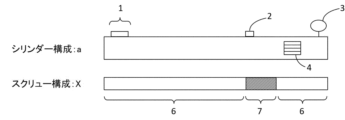
- FIG. 1 is a diagram showing a cylinder configuration a and a screw configuration X of a twin-screw extruder in Examples 1 to 7 and Comparative Examples 1 and 2.
- FIG. 1 is a diagram showing a cylinder configuration b and a screw configuration Y of the twin-screw extruder in Example 8 and Comparative Examples 3 to 6.
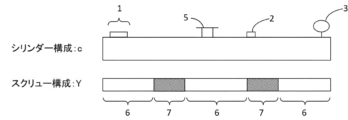
- FIG. 1 is a diagram showing a cylinder configuration c and a screw configuration Y of a twin-screw extruder in Comparative Examples 7 and 8.
- FIG. 1 shows a cylinder configuration d and a screw configuration X of a twin-screw extruder in Comparative Examples 9 and 10.
- the present invention includes a first drying step (I) of introducing ethylene-vinyl alcohol copolymer hydrous pellets having a moisture content W0 of 25 to 50% by mass into a dryer to reduce the moisture content W1 of the pellets to 5 to 25% by mass;
- EVOH is usually obtained by saponifying an ethylene-vinyl ester copolymer.
- the copolymerization of ethylene and vinyl ester may be any of solution polymerization, suspension polymerization, emulsion polymerization, and bulk polymerization. It may also be either continuous or batchwise.
- An example of the polymerization conditions for solution polymerization is shown below.
- the solvent used is preferably an alcohol having a boiling point of 100°C or less, in terms of the solubility of the ethylene-vinyl ester copolymer and EVOH, ease of handling, and the ability to efficiently replace alcohol with water.
- the boiling point is more preferably 80°C or less, and even more preferably 70°C or less.
- Examples of alcohols having a boiling point of 100°C or less include methanol, ethanol, n-propyl alcohol, isopropyl alcohol, and t-butyl alcohol, with methanol being particularly preferred.
- Initiators used in the polymerization include, for example, azonitrile initiators such as 2,2-azobisisobutyronitrile, 2,2-azobis-(2,4-dimethylvaleronitrile), 2,2-azobis-(4-methoxy-2,4-dimethylvaleronitrile), and 2,2-azobis-(2-cyclopropylpropionitrile), and organic peroxide initiators such as isobutyryl peroxide, cumyl peroxy neodecanoate, diisopropyl peroxycarbonate, di-n-propyl peroxy dicarbonate, t-butyl peroxy neodecanoate, lauroyl peroxide, benzoyl peroxide, and t-butyl hydroperoxide.
- azonitrile initiators such as 2,2-azobisisobutyronitrile, 2,2-azobis-(2,4-dimethylvaleronitrile), 2,2-azobis-(4-methoxy-2,4-d
- Vinyl esters include fatty acid vinyl esters such as vinyl acetate, vinyl propionate, and vinyl pivalate, with vinyl acetate being preferred.
- monomers that can be copolymerized with these such as ⁇ -olefins such as propylene, butylene, isobutylene, pentene, hexene, ⁇ -octene, and ⁇ -dodecene; 3-acyloxy-1-propene, 3-acyloxy-1-butene, 4-acyloxy-1-butene, 3,4-diacyloxy-1-butene, 3-acyloxy-4-methyl-1-butene, 4-acyloxy ...
- siloxy-2-methyl-1-butene 4-acyloxy-3-methyl-1-butene, 3,4-diacyloxy-2-methyl-1-butene, 4-acyloxy-1-pentene, 5-acyloxy-1-pentene, 4,5-diacyloxy-1-pentene, 4-acyloxy-1-hexene, 5-acyloxy-1-hexene, 6-acyloxy-1-hexene, 5,6-diacyloxy-1-hexene, It is also possible to carry out polymerization in the presence of small amounts of alkenes having an ester group such as 1,3-diacetoxy-2-methylenepropane; unsaturated acids such as acrylic acid, methacrylic acid, crotonic acid, maleic acid, itaconic acid, and the like, anhydrides, salts, and mono- or dialkyl esters thereof; nitriles such as acrylonitrile and methacrylonitrile; amides such as acrylamide and methacrylamide;
- the content of other monomer units than ethylene, vinyl ester, and vinyl alcohol in the EVOH is preferably 20 mol % or less, and in some cases may be preferably 10 mol % or less, 5 mol % or less, 3 mol % or less, 1 mol % or less, or 0.1 mol % or less.
- the EVOH does not have to contain the other monomer units.
- the polymerization conditions are preferably as follows: (1) Temperature: preferably 20 to 90°C, more preferably 40 to 70°C. (2) Time (average residence time in the case of a continuous system): preferably 2 to 15 hours, more preferably 3 to 11 hours. (3) Polymerization rate: preferably 10 to 90%, more preferably 30 to 80%, based on the charged vinyl ester. (4) Resin content in the solution after polymerization: preferably 5 to 85% by mass, more preferably 20 to 70% by mass.
- a polymerization inhibitor is added as necessary, unreacted ethylene gas is evaporated and removed, and then unreacted vinyl ester is expelled.
- a method for expelling unreacted vinyl ester for example, a method is adopted in which the polymerization solution from which ethylene has been removed is continuously fed at a constant rate from the top of a tower packed with Raschig rings, and vapor of an organic solvent, preferably an alcohol with a boiling point of 100°C or less, and optimally methanol, is blown into the bottom of the tower, a mixed vapor of the organic solvent and unreacted vinyl ester is distilled from the top of the tower, and the copolymer solution from which unreacted vinyl ester has been removed is taken out from the bottom of the tower.
- an organic solvent preferably an alcohol with a boiling point of 100°C or less, and optimally methanol
- An alkali catalyst is added to the copolymer solution from which the unreacted vinyl ester has been removed, and the vinyl ester component in the copolymer is saponified.
- the saponification method can be either continuous or batchwise.
- the alkali catalyst sodium hydroxide, potassium hydroxide, alkali metal alcoholate, etc. are used.
- methanol is preferable as the solvent used for saponification.
- the saponification conditions are as follows. (1) Concentration of ethylene-vinyl ester copolymer in solution: 10 to 50% by mass (2) Reaction temperature: 30 to 150° C. (3) Amount of catalyst used: 0.005 to 0.6 equivalents (per vinyl ester component) (4) Time (average residence time in the case of continuous type): 10 minutes to 6 hours
- reaction temperature and catalyst amount within the following ranges. Reaction temperature: 70 to 150°C. Amount of catalyst used: 0.005 to 0.1 equivalent (per vinyl ester component).
- the saponification degree of the EVOH used in the present invention is 95 mol% or more. If the saponification degree is less than 95 mol%, it is not preferable because the torque applied to the extruder may increase when the production speed is increased.
- the saponification degree is preferably 98 mol% or more, more preferably 99 mol% or more, and even more preferably 99.5 mol% or more.
- the saponification degree can be adjusted arbitrarily depending on the conditions.
- the saponification degree of EVOH may be considered to be the same in the EVOH hydrous pellets introduced in the first drying step (I) and in the EVOH resin composition pellets after the second drying step (IV). Therefore, the saponification degree of EVOH satisfies the above numerical range in both the EVOH hydrous pellets introduced in the first drying step (I) and the EVOH resin composition pellets after the second drying step (IV).
- the ethylene unit content of the EVOH used in the present invention is 20 to 60 mol%. If the ethylene unit content is less than 20 mol%, the affinity for water is too high, and EVOH is likely to leak from the dehydration slit in the melt-kneading step (II). Note that either water vapor or liquid water may be discharged from the dehydration slit in this specification. To effectively prevent EVOH from leaking, the ethylene unit content is more preferably 24 mol% or more, and even more preferably 28 mol% or more. On the other hand, an ethylene unit content of 60 mol% or less improves the gas barrier properties of EVOH.
- the ethylene unit content is preferably 50 mol% or less, and even more preferably 45 mol% or less.
- the ethylene unit content of EVOH may be considered to be the same in both the EVOH hydrous pellets introduced in the first drying step (I) and the EVOH resin composition pellets after the second drying step (IV). Therefore, the ethylene unit content of EVOH satisfies the above numerical range in both the EVOH hydrous pellets introduced in the first drying step (I) and the EVOH resin composition pellets after the second drying step (IV).
- a solution containing EVOH is obtained by the saponification process.
- the solution containing EVOH is simply referred to as EVOH solution, but here, the term EVOH solution also includes a paste-like solution that is not completely uniform as a whole and has undergone phase separation.
- a mixed vapor of a solvent and water is supplied from the bottom of a tower-type vessel, and the EVOH solution is supplied from a position above the supply position of the mixed vapor, thereby replacing a part of the solvent present in the supplied EVOH solution with water, and a high-concentration EVOH solution can be obtained.
- the concentration of EVOH in the EVOH solution supplied to the tower-type vessel is preferably 15 to 50 mass%, more preferably 25 to 40 mass%. It is also preferable that the ratio of the supply amount of the EVOH solution to the supply amount of the mixed vapor (solution supply amount/vapor supply amount) is 100/400 to 100/8 by mass. It is also preferable that the water content in the mixed vapor is 20 to 70 mass%.
- the solvent used for the mixed vapor is preferably an alcohol with a boiling point of 130°C or less, and examples of such alcohol include alcohols such as methanol, ethanol, propanol, and butanol. Alcohols with a boiling point of 100°C or less are more preferable, and among them, methanol is preferable because it is easily available, inexpensive, has a low boiling point, and is easy to handle.
- the high-concentration EVOH solution thus obtained typically contains 50 parts by mass or more of alcohol with a boiling point of 100°C or less per 100 parts by mass of EVOH.
- the content of the alcohol is preferably 1000 parts by mass or less, and more preferably 500 parts by mass or less. By keeping the alcohol content within this range, the fluidity of the EVOH solution is ensured and efficient resin production is possible.
- the alcohol used here is preferably methanol.
- the EVOH solution may also contain water together with the alcohol, and preferably contains 10 to 500 parts by mass of water.
- a suitable method for obtaining the EVOH hydrous pellets used in the present invention is, for example, a method in which the highly concentrated EVOH aqueous solution obtained as described above is subjected to the following steps (A), (B) and (C) in this order. That is, the EVOH solution containing 50 parts by mass or more of alcohol having a boiling point of 100° C.
- the alcohol in the EVOH solution can be efficiently replaced with water, and the water content and temperature of EVOH can be easily adjusted.
- the method for contacting the EVOH solution introduced into the container with water vapor within the container is not particularly limited, and may be either a continuous or batch method.
- the shape of the container is also not particularly limited, but a tower-type container is preferable for the continuous method, and a tank-type container is preferable for the batch method. From the viewpoint of production efficiency, the continuous method is industrially preferable.
- tower-type containers include plate towers such as perforated plate towers and bubble cap towers, and packed towers containing ring-type packing.
- the amount of steam introduced is preferably 0.3 to 30 times, more preferably 0.5 to 10 times, and even more preferably 0.7 to 5 times, the mass ratio relative to the amount of EVOH solution introduced.
- the steam brought into contact with the EVOH solution may contain 10 parts by mass or less of the solvent (alcohol) per 100 parts by mass of steam, but in order to efficiently remove the solvent (alcohol), it is preferable that the steam does not contain the solvent (alcohol).
- the alcohol vapor and water vapor drawn out from the top of the tower are condensed in a condenser and recovered as an alcohol aqueous solution, which can be purified and reused as necessary.
- the EVOH solution comes into direct contact with water vapor inside the vessel, and the solvent (alcohol) content gradually decreases, during which time the EVOH remains in a swollen paste form, and can be drawn out of the vessel while retaining its fluidity and without gelling.
- EVOH dissolves in a methanol/water mixed solvent at normal pressure, for example at a temperature of about 60-70°C, but does not dissolve under normal pressure when the solvent is water alone. However, in the presence of pressurized water vapor at a temperature of, for example, 90°C or higher, EVOH can retain its fluidity even when it contains essentially only water.
- the temperature inside the container is preferably 100 to 150°C. If the temperature inside the container is less than 100°C, the fluidity of the hydrous EVOH will be insufficient, and there is a risk of gelling or blockage inside the container. A temperature of 110°C or higher is more preferable, and 120°C or higher is even more preferable. On the other hand, if the temperature inside the container exceeds 150°C, the EVOH may deteriorate. A temperature of 140°C or lower is more preferable.
- the pressure inside the container is preferably 0.1 MPa or more, more preferably 0.15 MPa or more, and even more preferably 0.2 MPa or more.
- the pressure inside the container is preferably 0.6 MPa or less, more preferably 0.5 MPa or less, and even more preferably 0.4 MPa or less.
- step (B) the water-containing EVOH discharged from the container is fed to an extruder, melt-kneaded, and the copolymer is discharged from the extruder.
- the water content of the water-containing EVOH introduced into the extruder is 10 to 90% by mass. If the water content is less than 10% by mass, the melt viscosity of the water-containing EVOH becomes too high, making it impossible to extrude the water-containing EVOH from the tip of the extruder, or the melt temperature becomes high to ensure fluidity, causing the EVOH to deteriorate and its color to deteriorate.
- the water content is preferably 20% by mass or more, more preferably 30% by mass or more, even more preferably 40% by mass or more, and particularly preferably 45% by mass or more.
- the melt viscosity of the water-containing EVOH becomes too low, and when the water content of the water-containing EVOH is reduced, the EVOH is likely to leak out together with the discharged water.
- the water content is preferably 80% by mass or less, more preferably 70% by mass or less, even more preferably 60% by mass or less, and particularly preferably 55% by mass or less.
- the water content of the water-containing EVOH introduced into the extruder is measured by the method described in the examples below.
- the content of alcohol having a boiling point of 100°C or less in the hydrous EVOH introduced into the extruder in step (B) is preferably 10% by mass or less, more preferably 5% by mass or less, even more preferably 1% by mass or less, and particularly preferably 0.5% by mass or less.
- the hydrous EVOH introduced into the extruder may contain, for example, about 0.1 to 5% by mass, calculated as metal, of alkali metal salts, which are residues of the catalyst used in the saponification step, and may also contain by-product salts and other impurities.
- the content of components other than EVOH, water, and alcohol having a boiling point of 100°C or less in the hydrous EVOH supplied to the extruder is preferably 10% by mass or less, more preferably 5% by mass or less, even more preferably 3% by mass or less, and particularly preferably 1% by mass or less.
- the extruder used in step (B) may be a single-screw or multi-screw extruder, but a twin-screw extruder is preferred.
- the L/D of the extruder is preferably 8 to 30, more preferably 9 to 25, and even more preferably 10 to 20.
- the cylinder of the extruder is provided with an inlet for the water-containing EVOH, through which the water-containing EVOH is introduced, and then melt-kneaded by the rotation of the screw disposed inside the cylinder, and discharged from the discharge port at the tip of the cylinder. At this time, it is preferable to provide a dehydration slit in the cylinder to remove moisture.
- the water content of the water-containing EVOH discharged from the extruder is preferably 25 to 50% by mass. If the water content is 25% by mass or more, the melt viscosity of the water-containing EVOH will be low, and the water-containing EVOH will tend to be easily discharged. The water content is more preferably 30% by mass or more. On the other hand, if the water content is 50% by mass or less, the melt viscosity of the water-containing EVOH will be high, and leakage of EVOH will tend to be suppressed. The water content is more preferably 40% by mass or less.
- step (C) the hydrous EVOH discharged from the extruder is cut to obtain hydrous EVOH pellets.
- the method is not particularly limited, and examples include a method of directly cutting the hydrous EVOH (molten state) discharged from the extruder, and a method of extruding the hydrous EVOH discharged from the extruder into a coagulating liquid to solidify and then cut. Among these, a method of directly cutting the hydrous EVOH is preferred. As a method of directly cutting the hydrous EVOH discharged from the extruder, a hot cutting method or an underwater cutting method is adopted.
- the size of the produced hydrous EVOH pellets can be, for example, a diameter of 1 mm to 10 mm in the case of a spherical (or nearly spherical) shape, and a diameter of 1 mm to 10 mm in the case of a cylindrical shape, and a length of 1 mm to 10 mm in the case of a cylindrical shape.
- This method of cutting hydrous EVOH in a molten state is more productive than the method of extruding an EVOH solution into a coagulating liquid, coagulating it into strands, and then cutting it, as described below, because it is not necessary to consider the take-up speed at which strands can be stably formed.
- the hydrous EVOH pellets obtained in this manner are subjected to the first drying step (I).
- Another method for obtaining the EVOH hydrous pellets used in the present invention is to extrude the high-concentration EVOH aqueous solution from a nozzle into a coagulating liquid in the form of strands, coagulate them in a water bath, and then cut them.
- the coagulating liquid is water, but may contain a small amount of alcohol.
- the coagulated strands are cut into pellets with a cutter.
- a strand cutter is preferably used as the cutter.
- the size of the obtained pellets can be, for example, a diameter of 1 mm to 10 mm and a length of 1 mm to 10 mm in the case of a cylindrical shape, and a diameter of 1 mm to 10 mm in the case of a spherical shape.
- the EVOH hydrous pellets obtained in this manner can also be subjected to the first drying step (I).
- the EVOH hydrous pellets obtained in the above manner contain an alkaline catalyst, by-product salts such as sodium acetate and potassium acetate, and other impurities, which may be removed by neutralization and washing as necessary. In this case, some catalyst residues such as sodium acetate may remain in the EVOH hydrous pellets.
- the thus obtained hydrous EVOH pellets having a moisture content W0 of 25 to 50 mass% are introduced into a dryer, and the moisture content W1 of the pellets is reduced to 5 to 25 mass%.
- the hydrous EVOH pellets introduced into the dryer are porous and have a high drying speed, so that they can be dried at a low drying temperature in a short time.
- the moisture content W0 at the time of introduction into the dryer is 25 to 50% by mass.
- the moisture content W0 is 25% by mass or more, the color of the obtained EVOH resin composition pellets becomes good, and it is preferably 30% by mass or more.
- the moisture content W0 is less than 25% by mass, the average residence time can be shortened even if the pellets are directly subjected to the melt-kneading step (II), so there is little point in adopting the first drying step (I).
- the moisture content W0 exceeds 50% by mass, there is a risk of sticking in the dryer and a risk of a decrease in the drying efficiency.
- the moisture content W0 is preferably 45% by mass or less.
- the dryer used in the first drying step (I) is not particularly limited as long as it can dry the pellets while maintaining their shape.
- a hot air dryer or the like can be used.
- the drying method can be a fluidized drying method using a fluidized dryer or a static drying method using a static dryer, but the fluidized drying method is preferred in order to prevent the pellets from sticking together. These methods may also be used in combination, and a method can be adopted in which the pellets are first dried using the fluidized drying method and then dried using the static drying method.
- the drying temperature is not particularly limited, but it is preferable to dry at 40 to 150°C for 0.1 to 15 hours.
- the EVOH hydrous pellets introduced into the dryer can be dried quickly even at low temperatures, and thermal degradation can be suppressed.
- the drying temperature is more preferably 50°C or higher, and even more preferably 60°C or higher.
- the drying temperature is more preferably 120°C or lower, even more preferably 100°C or lower, and optimally 90°C or lower.
- the drying time varies depending on the drying temperature and the desired moisture content, but is more preferably 0.2 hours or more, and even more preferably 0.5 hours or more. It is more preferably 5 hours or less, and even more preferably 3 hours or less. Drying may be done in air or in an inert gas such as nitrogen. When drying in an inert gas, thermal degradation is less likely to occur even if the drying temperature is set higher.
- the water content W 1 of the EVOH hydrous pellets obtained by drying in the first drying step (I) is 5 to 25% by mass, and the decrease in water content (W 0 -W 1 ) in this step is 10 to 45% by mass. If the water content W 1 is less than 5% by mass, the resin temperature in the extruder in the melt-kneading step (II) becomes too high, and the hydrous EVOH discharged from the extruder is likely to foam.
- the water content W 1 is preferably 7% by mass or more, and more preferably 10% by mass or more.
- the water content W 1 exceeds 25% by mass, the water content in the extruder in the melt-kneading step (II) becomes too high, and the EVOH leaks from the dewatering slit or the discharged EVOH composition foams.
- the water content W 1 is preferably 22% by mass or less, and more preferably 18% by mass or less.
- the decrease in moisture content (W 0 -W 1 ) is less than 10% by mass, there is little point in providing the first drying step (I).
- the decrease in moisture content (W 0 -W 1 ) is preferably 15% by mass or more, more preferably 20% by mass or more.
- the decrease in moisture content (W 0 -W 1 ) exceeds 45% by mass, it is difficult to dry the pellets in a short time while maintaining their shape.
- the decrease in moisture content (W 0 -W 1 ) is preferably 35% by mass or less, more preferably 30% by mass or less.
- the pellets obtained in the first drying step (I) are introduced into an extruder, and an aqueous solution or aqueous dispersion containing the additive is added and melt-kneaded.
- the additive may be an aqueous solution in which the additive is dissolved in water, or a dispersion in which the additive is dispersed in water.
- an aqueous solution in which at least one additive selected from carboxylic acids, boron compounds, phosphoric acid compounds, alkali metal salts, and alkaline earth metal salts is dissolved is preferable.
- the carboxylic acid contained in the aqueous solution is not particularly limited. Examples include acetic acid, lactic acid, oxalic acid, succinic acid, benzoic acid, and citric acid, but carboxylic acids with 4 or less carbon atoms are preferred. Among these, acetic acid is preferred from the standpoint of cost, ease of availability, and other factors.
- the content of the carboxylic acid in the dried EVOH resin composition pellets of the present invention is preferably 10 to 5000 ppm, since if the content is too low, discoloration may occur during melt molding, and if the content is too high, interlayer adhesion may become insufficient.
- the content of the carboxylic acid is more preferably 30 ppm or more, and even more preferably 50 ppm or more.
- the content of the carboxylic acid is more preferably 1000 ppm or less, and even more preferably 500 ppm or less.
- the boron compounds contained in the aqueous solution include, but are not limited to, boric acids, boric acid esters, borate salts, and boron hydrides.
- boric acids include orthoboric acid, metaboric acid, and tetraboric acid
- borate esters include triethyl borate and trimethyl borate
- borates include alkali metal salts, alkaline earth metal salts, and borax of the above-mentioned various borates.
- orthoboric acid hereinafter simply referred to as boric acid is preferred.
- the content of the boron compound in the dried EVOH resin composition pellets of the present invention is preferably 10 to 2000 ppm, more preferably 50 to 1000 ppm, in terms of boron.
- Examples of the phosphoric acid compound contained in the aqueous solution include various acids such as phosphoric acid and phosphorous acid, and their salts.
- the phosphate may be contained in the form of primary phosphate, secondary phosphate, or tertiary phosphate, and the cationic species is not particularly limited, but is preferably an alkali metal salt or an alkaline earth metal salt. Among them, it is preferable to add the phosphoric acid compound in the form of sodium dihydrogen phosphate, potassium dihydrogen phosphate, disodium hydrogen phosphate, or dipotassium hydrogen phosphate.
- the content of the phosphoric acid compound in the EVOH resin composition pellets after drying of the present invention is preferably 1 to 1000 ppm in terms of phosphate radical.
- the content of the phosphoric acid compound is less than 1 ppm, it may be easy to cause coloring during melt molding. Also, if it exceeds 1000 ppm, it may be easy to cause gels and bumps in the molded product.
- the alkali metal salt contained in the aqueous solution includes aliphatic carboxylates, aromatic carboxylates, and phosphates.
- aliphatic carboxylates For example, sodium acetate, potassium acetate, sodium phosphate, lithium phosphate, sodium stearate, potassium stearate, and the sodium salt of ethylenediaminetetraacetic acid. Of these, sodium acetate, potassium acetate, and sodium phosphate are preferred.
- the content of the alkali metal salt in the EVOH resin composition pellets of the present invention after drying is preferably 5 to 5,000 ppm in terms of the alkali metal element. More preferably, it is 20 to 1,000 ppm, and even more preferably, it is 30 to 750 ppm.
- the alkaline earth metal salt contained in the aqueous solution may be magnesium salt, calcium salt, barium salt, beryllium salt, etc., with magnesium salt and calcium salt being particularly preferred.
- the anion species of the alkaline earth metal salt is not particularly limited, but acetate and phosphate are preferred.
- the content of the alkaline earth metal salt in the dried EVOH resin composition pellets of the present invention is preferably 10 to 1000 ppm, more preferably 20 to 500 ppm, calculated as metal. If the content of the alkaline earth metal salt is less than 10 ppm, the effect of improving the long-run properties may be insufficient. Furthermore, if it exceeds 1000 ppm, the resin may be more likely to become discolored when melted.
- the dispersion liquid added to the hydrous EVOH can be a colloid of inorganic particles such as colloidal silica, colloidal titania, or colloidal zirconia, or a dispersion liquid of inorganic particles with a larger particle size.
- the extruder used in the melt-kneading step (II) may be a single-screw extruder or a multi-screw extruder, but a twin-screw extruder is preferred.
- the L/D of the extruder is preferably 10 to 55, more preferably 20 to 47.
- the cylinder of the extruder is provided with an inlet for EVOH hydrous pellets, through which the EVOH hydrous pellets are introduced, melt-kneaded by the rotation of the screw arranged inside the cylinder, and discharged from the discharge port at the tip of the cylinder.
- the resin temperature inside the extruder is preferably 120 to 210°C. If the resin temperature is too low, the screw torque may become too large, so a temperature of 140°C or higher is more preferable, and 150°C or higher is even more preferable. On the other hand, if the resin temperature is too high, the resulting EVOH resin composition pellets will be prone to foaming, and may become discolored or gel if melt-kneaded for a long period of time. Therefore, the resin temperature is more preferably 200°C or lower, and even more preferably 190°C or lower.
- the extruder used in the melt-kneading step (II) is provided with an additive introduction section downstream of the pellet introduction port. From the additive introduction section, an aqueous solution or aqueous dispersion containing additives is injected into the molten water-containing EVOH and melt-kneaded.
- the amount of the aqueous solution or aqueous dispersion added is preferably 1 to 30 parts by mass per 100 parts by mass of the dry weight of EVOH. If the amount added is less than 1 part by mass, it may be difficult to achieve a uniform blend, and more preferably 2 parts by mass or more, and even more preferably 5 parts by mass or more.
- the amount added is more preferably 20 parts by mass or less, and even more preferably 15 parts by mass or less.
- the melt kneading step (II) it is preferable to discharge liquid water or water vapor from at least one location of the extruder. This can reduce the moisture content of the water-containing EVOH in the extruder.
- the method for discharging liquid water or water vapor is not particularly limited, but a dehydration slit or a vacuum vent can be used.
- a dehydration slit is preferably used.
- Either water vapor or liquid water may be discharged from the dehydration slit, but it is preferable to discharge water vapor from the viewpoint of removing the latent heat of vaporization and removing heat.
- the average residence time of the EVOH in the extruder is 300 seconds or less.
- the average residence time is more preferably 200 seconds or less, even more preferably 100 seconds or less, and particularly preferably 40 seconds or less.
- the average residence time is usually 5 seconds or more.
- the molten resin composition discharged from the extruder is cut to obtain hydrous EVOH resin composition pellets having a water content W2 of 5 to 20% by mass.
- the cutting method is not particularly limited, and examples thereof include a method of directly cutting the hydrous EVOH resin composition in a molten state discharged from the extruder, and a method of extruding the hydrous EVOH resin composition discharged from the extruder into a coagulating liquid to solidify and then cut.
- a method of directly cutting the hydrous EVOH resin composition is preferred.
- a hot cutting method, an underwater cutting method, or the like is adopted as a method of directly cutting the hydrous EVOH resin composition discharged from the extruder.
- the size of the hydrous EVOH resin composition pellets produced can be, for example, a diameter of 1 mm to 10 mm in the case of a spherical (or approximately spherical) shape, and a diameter of 1 mm to 10 mm in the case of a cylindrical shape, and a length of 1 mm to 10 mm in the case of a cylindrical shape.
- the moisture content W2 of the EVOH resin composition water-containing pellets obtained in the cutting step (III) is 5 to 20% by mass.
- the moisture content W2 5% by mass or more the temperature of the molten resin in the melt-kneading step (II) can be lowered, so that the thermal deterioration of EVOH during melt-kneading can be suppressed.
- the moisture content W2 is 5% by mass or more, it is not necessary to provide a vacuum vent in the extruder to reduce the moisture content, and the equipment can be simplified.
- the moisture content W2 20% by mass or less it is possible to suppress the leakage of EVOH from the dewatering slit even when the extruder is operated at high speed, and the productivity can be improved.
- the EVOH resin composition hydrous pellets thus obtained in the cutting step (III) are subjected to the second drying step (IV).
- the dryer used in the second drying step (IV) is not particularly limited as long as it can dry the pellets while maintaining their shape.
- a hot air dryer or the like can be used.
- the drying method may be a fluidized drying method using a fluidized dryer or a static drying method using a static dryer, or a combination of these methods may be used.
- a method in which the pellets are first dried at a relatively low temperature using a fluidized dryer, and then dried at a high temperature using a static dryer is preferably used.
- the drying temperature and drying time are not particularly limited, but the drying temperature is preferably 50 to 150°C, and the drying time is preferably 1 hour to 7 days.
- the drying temperatures of both are included in the above temperature range, and the sum of the drying times of both is included in the above drying time.
- the drying temperature is more preferably 60°C or higher, even more preferably 70°C or higher, and particularly preferably 80°C or higher.
- the drying temperature is more preferably 140°C or lower, even more preferably 130°C or lower, and particularly preferably 120°C or lower.
- the drying time is more preferably 2 hours or more, even more preferably 5 hours or more. Also, it is more preferably 5 days or less, and even more preferably 3 days or less.
- drying temperature of the latter method 5°C or higher than the drying temperature of the former method, and it is even more preferable to set it 10°C or higher.
- it may be dried in air or in an inert gas such as nitrogen. When drying in an inert gas, heat deterioration is less likely to occur even if the drying temperature is set higher.
- the moisture content W3 of the EVOH resin composition pellets obtained by drying in the second drying step (IV) is 0.5% by mass or less.
- the moisture content W3 is preferably 0.4% by mass or less, and more preferably 0.3% by mass or less.
- the moisture content W3 is usually 0.01% by mass or more, and reducing the moisture content W3 more than necessary only increases energy consumption.
- EVOH resin composition pellets can be obtained efficiently.
- the EVOH resin composition pellets thus obtained can be formed by melt molding into various molded articles such as films, sheets, containers, pipes, and fibers, and can also be used for a variety of other purposes.
- This treatment liquid was transferred to a 50 mL measuring flask and made up to 100 mL with ion-exchanged water to prepare a measurement sample solution.
- the contents of metal elements, boron elements, and phosphorus elements in the sample solution were measured using an ICP emission spectrometer ("OPTIMA4300DV" manufactured by PerkinElmer Co., Ltd.). From the obtained values, the metal salt content (metal ion content) in terms of metal elements, the content of boron compounds in terms of boron elements, and the content of phosphorus compounds in terms of phosphorus radicals in the EVOH resin composition pellets were determined.
- Foaming 100 g of EVOH resin composition pellets were obtained by cutting and drying the resin composition discharged from the extruder, and the percentage (mass%) of pellets showing defects in shape such as dents, trapped air bubbles, foaming, etc. was calculated and evaluated according to the following criteria. When the evaluation was C, it was determined that efficient production was not possible. (evaluation) A: Less than 1% by mass B: 1% by mass or more and less than 5% by mass C: 5% by mass or more
- Example 1 An EVOH solution containing 100 parts by mass of EVOH having an ethylene unit content of 32 mol% and a saponification degree of 99.8 mol%, 100 parts by mass of methanol, 50 parts by mass of water, and 2 parts by mass of sodium acetate in terms of sodium was continuously supplied to the top plate of a plate tower having a diameter of 0.6 m and 10 plates at a rate of 521 kg/hr, and steam was blown into the bottom plate of the plate tower at a rate of 600 kg/hr to allow the EVOH solution and steam to come into countercurrent contact in the plate tower.
- the temperature in the tower was 130°C, and the pressure in the tower was 3 kg/ cm2 .
- Methanol vapor and water vapor were distilled off from the top of the plate tower, and were condensed in a condenser to be recovered as an aqueous methanol solution.
- a water-containing EVOH composition was continuously withdrawn from the bottom of the plate tower.
- This aqueous EVOH composition contained 100 parts by mass of EVOH, 0.05 parts by mass of methanol, 105 parts by mass of water, and 2 parts by mass of sodium acetate calculated as sodium.
- the screw rotation speed at this time was 1000 rpm.
- the EVOH hydrous composition obtained from the discharge port contained 0.03 parts by mass of methanol, 68 parts by mass of water (water content of 40% by mass), and 1.2 parts by mass of sodium acetate converted to sodium, per 100 parts by mass of EVOH, and had a temperature of 118°C.
- this EVOH hydrous composition was extruded through a die having six holes with a hole diameter of 3 mm, and cut with a hot cutter with eight blades at a distance of 0.05 mm from the die to obtain EVOH hydrous pellets.
- the cutter blade rotation speed was 2500 rpm.
- the obtained pellets were fed at 348 kg/hr to the top of a tower-type processor with a diameter of 1.2 m and a height of 4 m.
- a 0.5 g/L aqueous acetic acid solution (50°C) was charged to the bottom of the processor at 500 L/hr, and the pellets and the aqueous acetic acid solution were brought into countercurrent contact within the processor.
- the aqueous acetic acid solution was discharged from the top of the processor, and washed pellets were continuously removed from the bottom of the processor.
- the moisture content of the washed EVOH hydrous pellets was 40% by mass, and 0.002% by mass of sodium acetate remained in the pellets, calculated as sodium.
- the thus obtained EVOH hydrous pellets (ethylene unit content 32 mol%, saponification degree 99.8 mol%) having a moisture content W 0 of 40% by mass were fed into a fluidized bed dryer and dried at 80° C. for 60 minutes.
- the cylinder configuration and screw configuration of the twin-screw extruder are shown in FIG. 1.
- the resin temperature measured by the temperature sensor 3 was set to 160° C., and an aqueous solution of acetic acid/boric acid/sodium acetate/magnesium acetate/potassium dihydrogen phosphate was added from the additive introduction section 2.
- the amount of the aqueous solution fed per unit time was 20.8 L/hr.
- the aqueous solution contained 3.5 g/L of acetic acid, 15 g/L of boric acid, 7.7 g/L of sodium acetate trihydrate, 3.1 g/L of magnesium acetate tetrahydrate, and 1.7 g/L of potassium dihydrogen phosphate.
- twin-screw extruder The specifications of the twin-screw extruder are as follows: A pellet supply section 1, an additive introduction section 2, and a dewatering slit 4 are arranged in the twin-screw extruder cylinder (cylinder configuration a, screw configuration X) shown in Figure 1.
- the screw is a combination of a full-flight screw 6 and a reverse-flight screw 7 as shown in Figure 1. Furthermore, a temperature sensor 3 is arranged at the end of the cylinder.
- the molten water-containing EVOH resin composition discharged from the twin-screw extruder was cut with a hot cutter to obtain water-containing pellets of EVOH resin composition.
- the water-containing pellets of EVOH resin composition immediately after the production had a water content W2 of 10% by mass, the discharge amount of EVOH from the twin-screw extruder was 208 kg/hour (not including the amount of water contained), and the residence time was 25 seconds.
- EVOH resin composition pellets were continuously produced, and the leakage and foaming of EVOH were evaluated according to the methods described in (4) and (5) above. The results are shown in Table 1.
- the water-containing pellets of EVOH resin composition obtained were dried at 90° C.
- EVOH resin composition pellets having a water content W3 of 0.2% by mass.
- the obtained EVOH resin composition pellets were subjected to quantitative determination of the carboxylic acid, metal salt, boron compound and phosphorus compound according to the methods described in (2) to (3) above.
- the acetic acid content was 260 ppm
- the boric acid content was 260 ppm calculated as boron
- the phosphoric acid content was 90 ppm calculated as phosphate radical
- the sodium ion content was 125 ppm
- the potassium ion content was 35 ppm
- the magnesium ion content was 35 ppm.
- Examples 2, 3, 5 to 7, Comparative Examples 1 and 2 EVOH resin composition pellets were prepared in the same manner as in Example 1, and analyzed and evaluated in the same manner as in Example 1, except that the ethylene unit content and moisture content W0 of the EVOH hydrous pellets, the drying temperature and drying time in the first drying step, and the resin temperature, amount of aqueous solution added, EVOH discharge amount and residence time in the melt-kneading step were changed as shown in Table 1.
- the discharge amount and residence time were adjusted by adjusting the feed rate of the EVOH hydrous pellets to the twin-screw extruder, and the rotation speed of the extruder was adjusted according to the production speed. The results are shown in Table 1.
- All of the dried EVOH resin composition pellets contained trace components at the same levels as in Example 1, with the acetic acid content being within the range of 240-300 ppm, the boric acid content being within the range of 240-270 ppm in terms of boron, the phosphoric acid content being within the range of 85-95 ppm in terms of phosphate radical, the sodium ion content being within the range of 120-140 ppm, the potassium ion content being within the range of 30-40 ppm, and the magnesium ion content being within the range of 30-40 ppm. Note that even when the following examples and comparative examples contained trace components at the same levels as in Example 1, the values were within the above ranges.
- Example 4 EVOH resin composition pellets were prepared in the same manner as in Example 1, except that the drying temperature in the first drying step, and the resin temperature and the amount of aqueous solution added in the melt-kneading step were changed as shown in Table 1, and the aqueous solution containing additives was changed to an aqueous solution containing 1.8 g/L of acetic acid, 8 g/L of boric acid, 3.8 g/L of sodium acetate trihydrate, 1.5 g/L of magnesium acetate tetrahydrate, and 0.9 g/L of potassium dihydrogen phosphate. The pellets were analyzed and evaluated in the same manner as in Example 1. The results are shown in Table 1. The obtained dried EVOH resin composition pellets contained trace components at the same level as in Example 1.
- Example 8 The drying temperature in the first drying step, and the cylinder configuration, resin temperature, and aqueous solution addition amount in the melt-kneading step were changed as shown in Table 1, and the aqueous solution containing additives was changed to an aqueous solution containing 7.0 g/L of acetic acid, 30 g/L of boric acid, 15.4 g/L of sodium acetate trihydrate, 6.2 g/L of magnesium acetate tetrahydrate, and 3.4 g/L of potassium dihydrogen phosphate. Except for this, EVOH resin composition pellets were produced in the same manner as in Example 1, and analyzed and evaluated in the same manner as in Example 1. Here, as shown in FIG. 2, the screw configuration when the cylinder configuration is b in this specification is Y. The results are shown in Table 1. The obtained dried EVOH resin composition pellets contained trace components at the same level as in Example 1.
- Dry EVOH resin composition pellets were prepared in the same manner as in Example 1, except that the ethylene unit content, degree of saponification and water content W0 of the EVOH hydrous pellets, as well as the cylinder configuration, resin temperature, amount of aqueous solution added, EVOH discharge amount and residence time in the melt-kneading step were changed as shown in Table 1, and drying was not performed in the first drying step.
- the concentrations of additives in the aqueous solution added to the extruder in Comparative Example 5 were the same as in Example 8. The results are shown in Table 1. All of the dried EVOH resin composition pellets contained trace components to the same extent as in Example 1.
- Dry EVOH resin composition pellets were prepared in the same manner as in Example 1, except that the ethylene unit content and degree of saponification of the EVOH hydrous pellets, and the cylinder configuration, resin temperature, amount of aqueous solution added, EVOH discharge amount, and residence time in the melt-kneading step were changed as shown in Table 1, and analyzed and evaluated in the same manner as in Example 1.
- the screw configuration is Y.
- the concentration of the additives in the aqueous solution added to the extruder was the same as in Example 8. The results are shown in Table 1.
- the obtained dry EVOH resin composition pellets contained trace components to the same extent as in Example 1.
- Example 4 the screw configuration when the cylinder configuration is d in this specification is X.
- concentration of the additive in the aqueous solution added to the extruder is the same as in Example 4.
- the results are shown in Table 1. All of the dried EVOH resin composition pellets contained trace components at the same level as in Example 1.
Landscapes
- Engineering & Computer Science (AREA)
- Mechanical Engineering (AREA)
- Chemical & Material Sciences (AREA)
- Health & Medical Sciences (AREA)
- Chemical Kinetics & Catalysis (AREA)
- Medicinal Chemistry (AREA)
- Polymers & Plastics (AREA)
- Organic Chemistry (AREA)
- General Chemical & Material Sciences (AREA)
- Processing And Handling Of Plastics And Other Materials For Molding In General (AREA)
- Processes Of Treating Macromolecular Substances (AREA)
Abstract
Description
第1乾燥工程(I)で得られたペレットを押出機に導入し、添加剤を含む水溶液又は水分散液を添加して溶融混練する溶融混練工程(II)、
前記押出機から吐出された溶融樹脂組成物を切断することにより、含水率W2が5~20質量%のエチレン-ビニルアルコール共重合体樹脂組成物含水ペレットを得る切断工程(III)、及び
切断工程(III)で得られた含水ペレットを乾燥して、含水率W3が0.5質量%以下のエチレン-ビニルアルコール共重合体樹脂組成物ペレットを得る第2乾燥工程(IV)を有し、
第1乾燥工程(I)における含水率の減少(W0-W1)が10~45質量%であり、
前記エチレン-ビニルアルコール共重合体のエチレン単位含有量が20~60モル%であり、ケン化度が95モル%以上である、エチレン-ビニルアルコール共重合体樹脂組成物ペレットの製造方法を提供することによって解決される。
第1乾燥工程(I)で得られたペレットを押出機に導入し、添加剤を含む水溶液又は水分散液を添加して溶融混練する溶融混練工程(II)、
前記押出機から吐出された溶融樹脂組成物を切断することにより、含水率W2が5~20質量%のエチレン-ビニルアルコール共重合体樹脂組成物含水ペレットを得る切断工程(III)、及び
切断工程(III)で得られた含水ペレットを乾燥して、含水率W3が0.5質量%以下のエチレン-ビニルアルコール共重合体樹脂組成物ペレットを得る第2乾燥工程(IV)を有し、
第1乾燥工程(I)における含水率の減少(W0-W1)が10~45質量%であり、
前記エチレン-ビニルアルコール共重合体のエチレン単位含有量が20~60モル%であり、ケン化度が95モル%以上である、エチレン-ビニルアルコール共重合体樹脂組成物ペレットの製造方法である。
(1)温度;好ましくは20~90℃、より好ましくは40℃~70℃。
(2)時間(連続式の場合は平均滞留時間);好ましくは2~15時間、より好ましくは3~11時間。
(3)重合率;仕込みビニルエステルに対して、好ましくは10~90%、より好ましくは30~80%。
(4)重合後の溶液中の樹脂分;好ましくは5~85質量%、より好ましくは20~70質量%。
(1)溶液中のエチレン-ビニルエステル共重合体の濃度;10~50質量%
(2)反応温度;30~150℃
(3)触媒使用量;0.005~0.6当量(ビニルエステル成分当り)
(4)時間(連続式の場合、平均滞留時間);10分~6時間
反応温度;70~150℃。
触媒使用量;0.005~0.1当量(ビニルエステル成分当り)。
ハロゲン水分率分析装置を用い、乾燥温度180℃、乾燥時間20分、サンプル量10gの条件で、実施例及び比較例で得られたペレットの含水率を、加熱乾燥質量測定法により測定した。ペレットの含水率は、下記式を用いて求めた。
含水率(質量%)=[(乾燥前質量-乾燥後質量)/乾燥前質量]×100
実施例及び比較例で得られた乾燥EVOH樹脂組成物ペレット20gをイオン交換水100mLに投入し、95℃で6時間加熱抽出した。得られた抽出液を、フェノールフタレインを指示薬として0.01mol/Lの水酸化ナトリウム溶液にて中和滴定することによって、乾燥EVOH樹脂組成物ペレット中のカルボン酸含有量を算出した。
実施例及び比較例で得られたEVOH樹脂組成物ペレット0.5gをテフロン(登録商標)製圧力容器に入れ、ここに濃硝酸5mLを加えて室温で30分間分解させた。分解後に前記圧力容器に蓋をし、湿式分解装置(株式会社アクタック製の「MWS-2」)により150℃で10分間、次いで180℃で5分間加熱することでさらに分解を行い、その後室温まで冷却した。この処理液を50mLのメスフラスコに移しイオン交換水でメスアップして測定用試料溶液とした。ICP発光分光分析装置(パーキンエルマー社製の「OPTIMA4300DV」)により前記試料溶液中の金属元素、ホウ素元素及びリン元素の含有量を測定した。得られた値から、EVOH樹脂組成物ペレット中の、金属元素換算の金属塩含有量(金属イオン含有量)、ホウ素元素換算のホウ素化合物の含有量及びリン酸根換算のリン酸化合物の含有量を求めた。
実施例及び比較例に記載の方法により、EVOH樹脂組成物ペレットを連続的に製造し、二軸押出機に備えられている水又は蒸気の排出口である脱水スリットに、EVOHが漏れ出した白い痕がついているか、又は水蒸気の排出口であるベント口に樹脂が付着しているかを目視で確認し、下記評価基準に従って評価した。評価がCの場合は効率良く生産できないと判断した。
A:10日以上連続運転しても、排出口にEVOHが漏れ出した痕が見られなかった。
B:7日以上10日未満の連続運転で、排出口にEVOHが漏れ出した痕が見られた。
C:7日未満の連続運転で、排出口にEVOHが漏れ出した痕が見られた。またはベント口に樹脂が付着していた。
押出機吐出後の樹脂組成物を切断して乾燥させたEVOH樹脂組成物ペレットを100g採取し、当該ペレットにおける、くぼみ、気泡咬み込み、発泡などの形状不良が見られるペレットの割合(質量%)を求め、以下の基準で評価した。評価がCの場合は効率よく生産できないと判断した。
(評価)
A:1質量%未満
B:1質量%以上5質量%未満
C:5質量%以上
エチレン単位含有量32モル%、ケン化度99.8モル%のEVOH100質量部に対し、メタノール100質量部、水50質量部及び酢酸ナトリウムをナトリウム換算で2質量部を含むEVOH溶液を、塔径0.6m、段数10段の棚段塔の最上段に521kg/hrで連続的に供給し、該棚段塔の最下段に水蒸気を600kg/hrで吹き込んでEVOH溶液と水蒸気を該棚段塔内で向流接触させた。塔内の温度は130℃、塔内の圧力は3kg/cm2であった。該棚段塔の塔頂部からメタノール蒸気と水蒸気を留去し、これらは凝縮器で凝縮してメタノール水溶液として回収した。また、該棚段塔の塔底部からEVOH含水組成物を連続的に抜き出した。このEVOH含水組成物は、EVOH100質量部に対し、メタノールを0.05質量部、水を105質量部及び酢酸ナトリウムをナトリウム換算で2質量部含むものであった。
形式: 二軸押出機
L/D: 45.5
口径: 30mmφ
スクリュー:同方向完全噛合型
回転数: 300rpm
ダイス口径:3.0mmφ
EVOH含水ペレットのエチレン単位含有量及び含水率W0、第1乾燥工程における乾燥温度及び乾燥時間、並びに溶融混練工程における樹脂温度、水溶液添加量、EVOH吐出量及び滞留時間を表1に示されるとおりに変更した以外は、実施例1と同様の方法でEVOH樹脂組成物ペレットを作製し、実施例1と同様に分析及び評価した。なお、本願の実施例及び比較例では、EVOH含水ペレットの二軸押出機への供給速度を調整することで吐出量と滞留時間を調整し、生産速度に応じて押出機の回転数を調整した。結果を表1に示す。いずれの乾燥EVOH樹脂組成物ペレットでも実施例1と同程度の微量成分が含まれており、酢酸含有量は240~300ppm、ホウ酸含有量はホウ素換算値で240~270ppm、リン酸含有量はリン酸根換算値で85~95ppm、ナトリウムイオン含有量は120~140ppm、カリウムイオン含有量は30~40ppm、マグネシウムイオン含有量は30~40ppmの範囲内であった。なお、以下の実施例及び比較例において実施例1と同程度の微量成分が含まれていた場合にも、上記数値の範囲内であったということである。
第1乾燥工程における乾燥温度、並びに溶融混練工程における樹脂温度及び水溶液添加量を表1に示されるとおりに変更し、添加剤を含む水溶液を、酢酸を1.8g/L、ホウ酸を8g/L、酢酸ナトリウム・3水和物を3.8g/L、酢酸マグネシウム・4水和物を1.5g/L、リン酸二水素カリウムを0.9g/L含有する水溶液に変更した以外は、実施例1と同様の方法でEVOH樹脂組成物ペレットを作製し、実施例1と同様に分析及び評価した。結果を表1に示す。得られた乾燥EVOH樹脂組成物ペレットには実施例1と同程度の微量成分が含まれていた。
第1乾燥工程における乾燥温度、並びに溶融混練工程におけるシリンダー構成、樹脂温度及び水溶液添加量を表1に示されるとおりに変更し、添加剤を含む水溶液を、酢酸を7.0g/L、ホウ酸を30g/L、酢酸ナトリウム・3水和物を15.4g/L、酢酸マグネシウム・4水和物を6.2g/L、リン酸二水素カリウムを3.4g/L含有する水溶液に変更した以外は、実施例1と同様の方法でEVOH樹脂組成物ペレットを作製し、実施例1と同様に分析及び評価した。ここで、図2に示すとおり、本明細書においてシリンダー構成をbとした場合のスクリュー構成はYである。結果を表1に示す。得られた乾燥EVOH樹脂組成物ペレットには実施例1と同程度の微量成分が含まれていた。
EVOH含水ペレットのエチレン単位含有量、ケン化度及び含水率W0、並びに溶融混練工程におけるシリンダー構成、樹脂温度、水溶液添加量、EVOH吐出量及び滞留時間を表1に示されるとおりに変更し、第1乾燥工程における乾燥を行わなかった以外は、実施例1と同様の方法で乾燥EVOH樹脂組成物ペレットを作製し、実施例1と同様に分析及び評価した。比較例5で押出機中に添加した水溶液中の添加剤の濃度は実施例8と同じである。結果を表1に示す。いずれの乾燥EVOH樹脂組成物ペレットでも実施例1と同程度の微量成分が含まれていた。
EVOH含水ペレットのエチレン単位含有量及びケン化度、並びに溶融混練工程におけるシリンダー構成、樹脂温度、水溶液添加量、EVOH吐出量及び滞留時間を表1に示されるとおりに変更した以外は、実施例1と同様の方法で乾燥EVOH樹脂組成物ペレットを作製し、実施例1と同様に分析及び評価した。ここで、図3に示すとおり、本明細書においてシリンダー構成をcとした場合のスクリュー構成はYである。押出機中に添加した水溶液中の添加剤の濃度は実施例8と同じである。結果を表1に示す。得られた乾燥EVOH樹脂組成物ペレットには実施例1と同程度の微量成分が含まれていた。
溶融混練工程における水溶液添加量、EVOH吐出量及び滞留時間を表1に示されるとおりに変更した以外は、実施例7と同様の方法で乾燥EVOH樹脂組成物ペレットを作製しようとしたが、押出機にかかるトルクが上昇して溶融混練が不可能になったので、それ以降の工程を取りやめた。
EVOH含水ペレットのケン化度及び含水率W0、並びに溶融混練工程におけるシリンダー構成、樹脂温度、水溶液添加量、EVOH吐出量及び滞留時間を表1に示されるとおりに変更し、第1乾燥工程では、静置型熱風乾燥機を用いて65℃で60分乾燥してから静置型熱風乾燥機を用いて80℃で25分間乾燥して、ペレットの含水率W1を9.9質量%とし、切断工程の後に第2乾燥工程を設けなかった以外は、実施例1と同様の方法で乾燥EVOH樹脂組成物ペレットを作製し、実施例1と同様に分析及び評価した。ここで、図4に示すとおり、本明細書においてシリンダー構成をdとした場合のスクリュー構成はXである。また、押出機中に添加した水溶液中の添加剤の濃度は実施例4と同じである。結果を表1に示す。いずれの乾燥EVOH樹脂組成物ペレットでも実施例1と同程度の微量成分が含まれていた。
EVOH含水ペレットのケン化度及び含水率W0及び第1乾燥工程における乾燥時間を表1に示されるとおり変更した以外は、実施例1と同様の方法で乾燥EVOH樹脂組成物ペレットを作製しようとしたが、第1乾燥工程にてEVOH含水ペレット同士が膠着したため、それ以降の工程をとりやめた。

2 添加剤導入部
3 温度センサー
4 脱水スリット
5 ベント
6 フルフライトスクリュー
7 逆フライトスクリュー
Claims (6)
- 含水率W0が25~50質量%のエチレン-ビニルアルコール共重合体含水ペレットを乾燥機に導入し、該ペレットの含水率W1を5~25質量%に低下させる第1乾燥工程(I)、
第1乾燥工程(I)で得られたペレットを押出機に導入し、添加剤を含む水溶液又は水分散液を添加して溶融混練する溶融混練工程(II)、
前記押出機から吐出された溶融樹脂組成物を切断することにより、含水率W2が5~20質量%のエチレン-ビニルアルコール共重合体樹脂組成物含水ペレットを得る切断工程(III)、及び
切断工程(III)で得られた含水ペレットを乾燥して、含水率W3が0.5質量%以下のエチレン-ビニルアルコール共重合体樹脂組成物ペレットを得る第2乾燥工程(IV)を有し、
第1乾燥工程(I)における含水率の減少(W0-W1)が10~45質量%であり、
前記エチレン-ビニルアルコール共重合体のエチレン単位含有量が20~60モル%であり、ケン化度が95モル%以上である、エチレン-ビニルアルコール共重合体樹脂組成物ペレットの製造方法。 - 溶融混練工程(II)において、押出機内でのエチレン-ビニルアルコール共重合体の平均滞留時間が300秒以下である、請求項1に記載の製造方法。
- 溶融混練工程(II)において、添加される前記水溶液又は水分散液が、カルボン酸、ホウ素化合物、リン酸化合物、アルカリ金属塩及びアルカリ土類金属塩から選ばれる少なくとも1種の添加剤が溶解した水溶液である、請求項1又は2に記載の製造方法。
- 溶融混練工程(II)において、前記押出機の少なくとも1箇所から液体水又は水蒸気を排出する、請求項1~3のいずれかに記載の製造方法。
- 溶融混練工程(II)において、水溶液又は水分散液が添加される位置よりも下流の位置から液体水又は水蒸気を排出する、請求項4に記載の製造方法。
- エチレン-ビニルアルコール共重合体100質量部に対し、沸点が100℃以下のアルコールを50質量部以上含有するエチレン-ビニルアルコール共重合体溶液を容器に導入し、前記容器内で水蒸気と接触させて前記アルコールを水蒸気とともに導出し、含水エチレン-ビニルアルコール共重合体を前記容器から導出する工程(A);前記含水エチレン-ビニルアルコール共重合体を押出機に供給し、溶融混練した後、前記共重合体を該押出機から吐出する工程(B);及び該押出機から吐出された含水エチレン-ビニルアルコール共重合体を切断する工程(C)
を経て得られたエチレン-ビニルアルコール共重合体含水ペレットを、前記第1乾燥工程(I)に供給する、請求項1~5のいずれかに記載の製造方法。
Priority Applications (4)
| Application Number | Priority Date | Filing Date | Title |
|---|---|---|---|
| KR1020257023921A KR20250123902A (ko) | 2022-12-16 | 2023-12-15 | 에틸렌-비닐알코올 공중합체 수지 조성물 펠렛의 제조방법 |
| JP2024564441A JPWO2024128307A1 (ja) | 2022-12-16 | 2023-12-15 | |
| EP23903588.4A EP4635698A1 (en) | 2022-12-16 | 2023-12-15 | Method for manufacturing ethylene-vinyl alcohol copolymer resin composition pellets |
| CN202380093860.1A CN120752122A (zh) | 2022-12-16 | 2023-12-15 | 乙烯-乙烯醇共聚物树脂组合物粒料的制造方法 |
Applications Claiming Priority (2)
| Application Number | Priority Date | Filing Date | Title |
|---|---|---|---|
| JP2022-201212 | 2022-12-16 | ||
| JP2022201212 | 2022-12-16 |
Publications (1)
| Publication Number | Publication Date |
|---|---|
| WO2024128307A1 true WO2024128307A1 (ja) | 2024-06-20 |
Family
ID=91485939
Family Applications (1)
| Application Number | Title | Priority Date | Filing Date |
|---|---|---|---|
| PCT/JP2023/045002 Ceased WO2024128307A1 (ja) | 2022-12-16 | 2023-12-15 | エチレン-ビニルアルコール共重合体樹脂組成物ペレットの製造方法 |
Country Status (6)
| Country | Link |
|---|---|
| EP (1) | EP4635698A1 (ja) |
| JP (1) | JPWO2024128307A1 (ja) |
| KR (1) | KR20250123902A (ja) |
| CN (1) | CN120752122A (ja) |
| TW (1) | TW202432640A (ja) |
| WO (1) | WO2024128307A1 (ja) |
Cited By (1)
| Publication number | Priority date | Publication date | Assignee | Title |
|---|---|---|---|---|
| WO2025063161A1 (ja) * | 2023-09-21 | 2025-03-27 | 三菱ケミカル株式会社 | エチレン-ビニルアルコール共重合体樹脂ペレットの製造方法 |
Citations (9)
| Publication number | Priority date | Publication date | Assignee | Title |
|---|---|---|---|---|
| JPS6466262A (en) | 1987-09-07 | 1989-03-13 | Kuraray Co | Ethylene-vinyl alcohol copolymer composition |
| JP2002284886A (ja) * | 2001-01-22 | 2002-10-03 | Kuraray Co Ltd | エチレン−ビニルアルコール共重合体樹脂組成物の製造方法 |
| JP2002284811A (ja) | 2001-01-19 | 2002-10-03 | Kuraray Co Ltd | エチレン−ビニルアルコール共重合体樹脂の製造方法 |
| WO2004009313A1 (ja) | 2002-07-18 | 2004-01-29 | Kuraray Co., Ltd. | エチレン−ビニルアルコール共重合体ペレットの製造方法 |
| WO2011118648A1 (ja) * | 2010-03-25 | 2011-09-29 | 株式会社クラレ | 樹脂組成物、その製造方法及び多層構造体 |
| WO2016104649A1 (ja) * | 2014-12-24 | 2016-06-30 | 株式会社クラレ | ポリメタアリルアルコール樹脂組成物及びそれを用いた成形体 |
| WO2016104648A1 (ja) * | 2014-12-24 | 2016-06-30 | 株式会社クラレ | ポリメタアリルアルコール樹脂組成物及びそれを用いた成形体 |
| JP2021021037A (ja) * | 2019-07-30 | 2021-02-18 | 株式会社クラレ | 樹脂ペレット、及び成形体の製造方法 |
| JP2023092920A (ja) * | 2021-12-22 | 2023-07-04 | 株式会社クラレ | エチレン-ビニルアルコール共重合体を含むペレット及びその製造方法 |
-
2023
- 2023-12-15 TW TW112149023A patent/TW202432640A/zh unknown
- 2023-12-15 EP EP23903588.4A patent/EP4635698A1/en active Pending
- 2023-12-15 JP JP2024564441A patent/JPWO2024128307A1/ja active Pending
- 2023-12-15 WO PCT/JP2023/045002 patent/WO2024128307A1/ja not_active Ceased
- 2023-12-15 CN CN202380093860.1A patent/CN120752122A/zh active Pending
- 2023-12-15 KR KR1020257023921A patent/KR20250123902A/ko active Pending
Patent Citations (9)
| Publication number | Priority date | Publication date | Assignee | Title |
|---|---|---|---|---|
| JPS6466262A (en) | 1987-09-07 | 1989-03-13 | Kuraray Co | Ethylene-vinyl alcohol copolymer composition |
| JP2002284811A (ja) | 2001-01-19 | 2002-10-03 | Kuraray Co Ltd | エチレン−ビニルアルコール共重合体樹脂の製造方法 |
| JP2002284886A (ja) * | 2001-01-22 | 2002-10-03 | Kuraray Co Ltd | エチレン−ビニルアルコール共重合体樹脂組成物の製造方法 |
| WO2004009313A1 (ja) | 2002-07-18 | 2004-01-29 | Kuraray Co., Ltd. | エチレン−ビニルアルコール共重合体ペレットの製造方法 |
| WO2011118648A1 (ja) * | 2010-03-25 | 2011-09-29 | 株式会社クラレ | 樹脂組成物、その製造方法及び多層構造体 |
| WO2016104649A1 (ja) * | 2014-12-24 | 2016-06-30 | 株式会社クラレ | ポリメタアリルアルコール樹脂組成物及びそれを用いた成形体 |
| WO2016104648A1 (ja) * | 2014-12-24 | 2016-06-30 | 株式会社クラレ | ポリメタアリルアルコール樹脂組成物及びそれを用いた成形体 |
| JP2021021037A (ja) * | 2019-07-30 | 2021-02-18 | 株式会社クラレ | 樹脂ペレット、及び成形体の製造方法 |
| JP2023092920A (ja) * | 2021-12-22 | 2023-07-04 | 株式会社クラレ | エチレン-ビニルアルコール共重合体を含むペレット及びその製造方法 |
Non-Patent Citations (1)
| Title |
|---|
| See also references of EP4635698A1 |
Cited By (1)
| Publication number | Priority date | Publication date | Assignee | Title |
|---|---|---|---|---|
| WO2025063161A1 (ja) * | 2023-09-21 | 2025-03-27 | 三菱ケミカル株式会社 | エチレン-ビニルアルコール共重合体樹脂ペレットの製造方法 |
Also Published As
| Publication number | Publication date |
|---|---|
| JPWO2024128307A1 (ja) | 2024-06-20 |
| CN120752122A (zh) | 2025-10-03 |
| TW202432640A (zh) | 2024-08-16 |
| EP4635698A1 (en) | 2025-10-22 |
| KR20250123902A (ko) | 2025-08-18 |
Similar Documents
| Publication | Publication Date | Title |
|---|---|---|
| JP3805685B2 (ja) | エチレン−ビニルアルコール共重合体樹脂の製造方法 | |
| US6838029B2 (en) | Method for producing ethylene-vinyl alcohol copolymer resin | |
| JP4294586B2 (ja) | エチレン−ビニルアルコール共重合体ペレットの製造方法 | |
| JP5241472B2 (ja) | エチレン−ビニルアルコール共重合体組成物、およびエチレン−ビニルアルコール共重合体ペレットの製造方法 | |
| CN101910293B (zh) | 乙烯-乙烯醇共聚物组合物的制造方法、及乙烯-乙烯醇共聚物颗粒的制造方法 | |
| JP4953528B2 (ja) | エチレン−ビニルアルコール共重合体含水組成物の製造方法 | |
| US6613833B2 (en) | Method for producing aqueous ethylene-vinyl alcohol copolymer composition | |
| JP4454816B2 (ja) | エチレン−ビニルアルコール共重合体ペレットの製造方法 | |
| JP7822964B2 (ja) | エチレン-ビニルアルコール共重合体樹脂組成物の製造方法 | |
| EP4635698A1 (en) | Method for manufacturing ethylene-vinyl alcohol copolymer resin composition pellets | |
| JP7797428B2 (ja) | エチレン-ビニルアルコール共重合体多孔質ペレットおよびその製造方法 | |
| JP7701939B2 (ja) | エチレン-ビニルアルコール共重合体含水ペレットの製造方法 | |
| JP4393684B2 (ja) | エチレン−ビニルアルコール共重合体ペレットの製造方法 | |
| JP2025007790A (ja) | エチレン-ビニルアルコール共重合体を含む乾燥ペレットの製造方法 | |
| JP5059085B2 (ja) | エチレン−ビニルアルコール共重合体ペレットの製造方法 | |
| JP2022094520A (ja) | エチレン-ビニルアルコール共重合体ペレットの製造方法 | |
| JP2023092920A (ja) | エチレン-ビニルアルコール共重合体を含むペレット及びその製造方法 | |
| JP2024005772A (ja) | エチレン-ビニルエステル共重合体ケン化物ペレットの製造方法 | |
| JP2024005771A (ja) | エチレン-ビニルエステル共重合体ケン化物ペレットの製造方法 | |
| JP2010100782A (ja) | エチレン−ビニルアルコール共重合体およびそのペレットの製造方法 |
Legal Events
| Date | Code | Title | Description |
|---|---|---|---|
| 121 | Ep: the epo has been informed by wipo that ep was designated in this application |
Ref document number: 23903588 Country of ref document: EP Kind code of ref document: A1 |
|
| WWE | Wipo information: entry into national phase |
Ref document number: 2024564441 Country of ref document: JP |
|
| ENP | Entry into the national phase |
Ref document number: 1020257023921 Country of ref document: KR Free format text: ST27 STATUS EVENT CODE: A-0-1-A10-A15-NAP-PA0105 (AS PROVIDED BY THE NATIONAL OFFICE) |
|
| WWE | Wipo information: entry into national phase |
Ref document number: 1020257023921 Country of ref document: KR Ref document number: 2023903588 Country of ref document: EP |
|
| NENP | Non-entry into the national phase |
Ref country code: DE |
|
| ENP | Entry into the national phase |
Ref document number: 2023903588 Country of ref document: EP Effective date: 20250716 |
|
| WWE | Wipo information: entry into national phase |
Ref document number: 11202503988R Country of ref document: SG |
|
| WWP | Wipo information: published in national office |
Ref document number: 11202503988R Country of ref document: SG |
|
| WWE | Wipo information: entry into national phase |
Ref document number: 202380093860.1 Country of ref document: CN |
|
| WWP | Wipo information: published in national office |
Ref document number: 1020257023921 Country of ref document: KR |
|
| WWP | Wipo information: published in national office |
Ref document number: 202380093860.1 Country of ref document: CN |
|
| WWP | Wipo information: published in national office |
Ref document number: 2023903588 Country of ref document: EP |