WO2024135602A1 - インク、インクカートリッジ、及びインクジェット記録方法 - Google Patents
インク、インクカートリッジ、及びインクジェット記録方法 Download PDFInfo
- Publication number
- WO2024135602A1 WO2024135602A1 PCT/JP2023/045243 JP2023045243W WO2024135602A1 WO 2024135602 A1 WO2024135602 A1 WO 2024135602A1 JP 2023045243 W JP2023045243 W JP 2023045243W WO 2024135602 A1 WO2024135602 A1 WO 2024135602A1
- Authority
- WO
- WIPO (PCT)
- Prior art keywords
- particles
- ink
- resin component
- resin
- refractive index
- Prior art date
- Legal status (The legal status is an assumption and is not a legal conclusion. Google has not performed a legal analysis and makes no representation as to the accuracy of the status listed.)
- Ceased
Links
Classifications
-
- B—PERFORMING OPERATIONS; TRANSPORTING
- B41—PRINTING; LINING MACHINES; TYPEWRITERS; STAMPS
- B41J—TYPEWRITERS; SELECTIVE PRINTING MECHANISMS, i.e. MECHANISMS PRINTING OTHERWISE THAN FROM A FORME; CORRECTION OF TYPOGRAPHICAL ERRORS
- B41J2/00—Typewriters or selective printing mechanisms characterised by the printing or marking process for which they are designed
- B41J2/005—Typewriters or selective printing mechanisms characterised by the printing or marking process for which they are designed characterised by bringing liquid or particles selectively into contact with a printing material
- B41J2/01—Ink jet
- B41J2/21—Ink jet for multi-colour printing
- B41J2/2107—Ink jet for multi-colour printing characterised by the ink properties
- B41J2/2114—Ejecting specialized liquids, e.g. transparent or processing liquids
- B41J2/2117—Ejecting white liquids
-
- B—PERFORMING OPERATIONS; TRANSPORTING
- B41—PRINTING; LINING MACHINES; TYPEWRITERS; STAMPS
- B41J—TYPEWRITERS; SELECTIVE PRINTING MECHANISMS, i.e. MECHANISMS PRINTING OTHERWISE THAN FROM A FORME; CORRECTION OF TYPOGRAPHICAL ERRORS
- B41J2/00—Typewriters or selective printing mechanisms characterised by the printing or marking process for which they are designed
- B41J2/005—Typewriters or selective printing mechanisms characterised by the printing or marking process for which they are designed characterised by bringing liquid or particles selectively into contact with a printing material
- B41J2/01—Ink jet
- B41J2/17—Ink jet characterised by ink handling
- B41J2/175—Ink supply systems ; Circuit parts therefor
- B41J2/17503—Ink cartridges
- B41J2/17513—Inner structure
-
- B—PERFORMING OPERATIONS; TRANSPORTING
- B41—PRINTING; LINING MACHINES; TYPEWRITERS; STAMPS
- B41J—TYPEWRITERS; SELECTIVE PRINTING MECHANISMS, i.e. MECHANISMS PRINTING OTHERWISE THAN FROM A FORME; CORRECTION OF TYPOGRAPHICAL ERRORS
- B41J2/00—Typewriters or selective printing mechanisms characterised by the printing or marking process for which they are designed
- B41J2/005—Typewriters or selective printing mechanisms characterised by the printing or marking process for which they are designed characterised by bringing liquid or particles selectively into contact with a printing material
- B41J2/01—Ink jet
- B41J2/17—Ink jet characterised by ink handling
- B41J2/175—Ink supply systems ; Circuit parts therefor
- B41J2/17503—Ink cartridges
- B41J2/17526—Electrical contacts to the cartridge
- B41J2/1753—Details of contacts on the cartridge, e.g. protection of contacts
-
- B—PERFORMING OPERATIONS; TRANSPORTING
- B41—PRINTING; LINING MACHINES; TYPEWRITERS; STAMPS
- B41J—TYPEWRITERS; SELECTIVE PRINTING MECHANISMS, i.e. MECHANISMS PRINTING OTHERWISE THAN FROM A FORME; CORRECTION OF TYPOGRAPHICAL ERRORS
- B41J2/00—Typewriters or selective printing mechanisms characterised by the printing or marking process for which they are designed
- B41J2/005—Typewriters or selective printing mechanisms characterised by the printing or marking process for which they are designed characterised by bringing liquid or particles selectively into contact with a printing material
- B41J2/01—Ink jet
- B41J2/17—Ink jet characterised by ink handling
- B41J2/175—Ink supply systems ; Circuit parts therefor
- B41J2/17503—Ink cartridges
- B41J2/17553—Outer structure
-
- C—CHEMISTRY; METALLURGY
- C09—DYES; PAINTS; POLISHES; NATURAL RESINS; ADHESIVES; COMPOSITIONS NOT OTHERWISE PROVIDED FOR; APPLICATIONS OF MATERIALS NOT OTHERWISE PROVIDED FOR
- C09D—COATING COMPOSITIONS, e.g. PAINTS, VARNISHES OR LACQUERS; FILLING PASTES; CHEMICAL PAINT OR INK REMOVERS; INKS; CORRECTING FLUIDS; WOODSTAINS; PASTES OR SOLIDS FOR COLOURING OR PRINTING; USE OF MATERIALS THEREFOR
- C09D11/00—Inks
- C09D11/02—Printing inks
- C09D11/10—Printing inks based on artificial resins
- C09D11/102—Printing inks based on artificial resins containing macromolecular compounds obtained by reactions other than those only involving unsaturated carbon-to-carbon bonds
-
- C—CHEMISTRY; METALLURGY
- C09—DYES; PAINTS; POLISHES; NATURAL RESINS; ADHESIVES; COMPOSITIONS NOT OTHERWISE PROVIDED FOR; APPLICATIONS OF MATERIALS NOT OTHERWISE PROVIDED FOR
- C09D—COATING COMPOSITIONS, e.g. PAINTS, VARNISHES OR LACQUERS; FILLING PASTES; CHEMICAL PAINT OR INK REMOVERS; INKS; CORRECTING FLUIDS; WOODSTAINS; PASTES OR SOLIDS FOR COLOURING OR PRINTING; USE OF MATERIALS THEREFOR
- C09D11/00—Inks
- C09D11/02—Printing inks
- C09D11/10—Printing inks based on artificial resins
- C09D11/106—Printing inks based on artificial resins containing macromolecular compounds obtained by reactions only involving carbon-to-carbon unsaturated bonds
-
- C—CHEMISTRY; METALLURGY
- C09—DYES; PAINTS; POLISHES; NATURAL RESINS; ADHESIVES; COMPOSITIONS NOT OTHERWISE PROVIDED FOR; APPLICATIONS OF MATERIALS NOT OTHERWISE PROVIDED FOR
- C09D—COATING COMPOSITIONS, e.g. PAINTS, VARNISHES OR LACQUERS; FILLING PASTES; CHEMICAL PAINT OR INK REMOVERS; INKS; CORRECTING FLUIDS; WOODSTAINS; PASTES OR SOLIDS FOR COLOURING OR PRINTING; USE OF MATERIALS THEREFOR
- C09D11/00—Inks
- C09D11/30—Inkjet printing inks
- C09D11/32—Inkjet printing inks characterised by colouring agents
- C09D11/322—Pigment inks
-
- C—CHEMISTRY; METALLURGY
- C09—DYES; PAINTS; POLISHES; NATURAL RESINS; ADHESIVES; COMPOSITIONS NOT OTHERWISE PROVIDED FOR; APPLICATIONS OF MATERIALS NOT OTHERWISE PROVIDED FOR
- C09D—COATING COMPOSITIONS, e.g. PAINTS, VARNISHES OR LACQUERS; FILLING PASTES; CHEMICAL PAINT OR INK REMOVERS; INKS; CORRECTING FLUIDS; WOODSTAINS; PASTES OR SOLIDS FOR COLOURING OR PRINTING; USE OF MATERIALS THEREFOR
- C09D11/00—Inks
- C09D11/30—Inkjet printing inks
- C09D11/36—Inkjet printing inks based on non-aqueous solvents
-
- C—CHEMISTRY; METALLURGY
- C09—DYES; PAINTS; POLISHES; NATURAL RESINS; ADHESIVES; COMPOSITIONS NOT OTHERWISE PROVIDED FOR; APPLICATIONS OF MATERIALS NOT OTHERWISE PROVIDED FOR
- C09D—COATING COMPOSITIONS, e.g. PAINTS, VARNISHES OR LACQUERS; FILLING PASTES; CHEMICAL PAINT OR INK REMOVERS; INKS; CORRECTING FLUIDS; WOODSTAINS; PASTES OR SOLIDS FOR COLOURING OR PRINTING; USE OF MATERIALS THEREFOR
- C09D11/00—Inks
- C09D11/30—Inkjet printing inks
- C09D11/38—Inkjet printing inks characterised by non-macromolecular additives other than solvents, pigments or dyes
-
- G—PHYSICS
- G06—COMPUTING OR CALCULATING; COUNTING
- G06K—GRAPHICAL DATA READING; PRESENTATION OF DATA; RECORD CARRIERS; HANDLING RECORD CARRIERS
- G06K15/00—Arrangements for producing a permanent visual presentation of the output data, e.g. computer output printers
- G06K15/02—Arrangements for producing a permanent visual presentation of the output data, e.g. computer output printers using printers
- G06K15/021—Adaptations for printing on specific media
- G06K15/023—Adaptations for printing on specific media for printing on transparent media
Definitions
- the present invention relates to ink, ink cartridges, and inkjet recording methods.
- white images are sometimes recorded on recording media other than white, such as transparent film, translucent film, and colored paper.
- white pigments such as titanium oxide are used in inks for recording white images.
- titanium oxide is greater than that of materials used in inks of other colors. This results in a large difference in specific gravity with the solvent, which makes it more likely to settle in the ink.
- titanium oxide with a larger particle size is used or the titanium oxide content is increased in an attempt to improve hiding power and whiteness, the titanium oxide will be more likely to settle.
- a white ink containing rutile-type titanium oxide with an average particle size of 300 nm or more and a urethane resin has been proposed as an ink that is excellent in whiteness and is easy to redisperse even if the pigment settles (Patent Document 1).
- the settling velocity V of large particles in the ink can be calculated from Stokes' equation (Equation (A) below).
- V ⁇ g( ⁇ S- ⁇ )d 2 ⁇ /18 ⁇ ...(A)
- d particle diameter
- g gravitational acceleration
- ⁇ S particle density
- ⁇ density of dispersion medium
- ⁇ viscosity of dispersion medium
- the settling velocity V increases in proportion to the square of the particle diameter, meaning that the larger the particle diameter, the easier it is for the particle to settle.
- the specific gravity of rutile titanium oxide is greater than other common materials used in inks, and the settling velocity is faster. For this reason, the titanium oxide used as a pigment in the white ink proposed in Patent Document 1 settles relatively easily.
- the recorded image is required to have not only a high concealment rate, but also excellent abrasion resistance.
- an inkjet ink containing first particles, second particles, and a resin component, characterized in that the refractive index of the first particles is 2.10 or more, the volume-based cumulative 50% particle diameter of the first particles is 100 nm or less, the refractive index of the second particles is 1.50 or less, the volume-based cumulative 50% particle diameter of the second particles is 120 nm or more, the resin component is at least one type selected from the group consisting of resin particles and solvent-soluble resins, the refractive index of the resin component is 1.50 or more, and the content (mass %) of the first particles is 1.1 times or more and 5.5 times or less in mass ratio to the content (mass %) of the resin component.
- the present invention makes it possible to record images with excellent hiding power and abrasion resistance, and also provides an inkjet ink with excellent sedimentation resistance.
- the present invention also provides an ink cartridge and an inkjet recording method that use this ink.
- FIG. 1 is a cross-sectional view illustrating an embodiment of an ink cartridge of the present invention. 1 is a perspective view of a main part of an inkjet recording apparatus used in an inkjet recording method of the present invention.
- FIG. 2 is a perspective view of a head cartridge of an inkjet recording apparatus used in the inkjet recording method of the present invention.
- the present invention will be described in more detail below with reference to preferred embodiments.
- the salt when the compound is a salt, the salt is present in the aqueous ink in the form of dissociated ions, but for convenience, it will be expressed as "containing a salt.”
- inkjet ink may be simply referred to as "ink.”
- Physical property values are values at room temperature (25°C) unless otherwise specified.
- the ink of the present invention is an inkjet ink containing first particles, second particles, and a resin component.
- the first particles have a refractive index of 2.10 or more, and a cumulative 50% particle diameter based on volume of 100 nm or less.
- the second particles have a refractive index of 1.50 or less, and a cumulative 50% particle diameter based on volume of 120 nm or more.
- the resin component is at least one type selected from the group consisting of resin particles and solvent-soluble resins, and has a refractive index of 1.50 or more.
- the content (mass%) of the first particles is 1.1 times or more and 5.5 times or less in mass ratio to the content (mass%) of the resin component.
- FIGs. 1 and 2 are schematic diagrams showing the drying process of the ink.
- the ink contains first particles having a refractive index of 2.10 or more and a cumulative 50% particle diameter based on volume of 100 nm or less.
- Substances with a refractive index of 2.10 or more have a relatively high refractive index, and examples of such compounds include metal oxides such as titanium oxide and zirconia.
- Such compounds have a high specific gravity compared to general materials used in inks, and according to Stokes' law, they are compounds that tend to sediment.
- the ink also contains second particles having a refractive index of 1.50 or less and a cumulative 50% particle diameter based on volume of 120 nm or more.
- the second particles are particles with a particle diameter of 120 nm or more, which is larger than the first particles, but are a compound with a refractive index of 1.50 or less and have a smaller specific gravity than the first particles, which is thought to suppress sedimentation.
- the second particles will aggregate and then the first particles will aggregate.
- the first particles 1 and the resin component 3 are homogeneously mixed (so-called sea-island structure).
- the first particles 1 are dispersed and present in the dry film 4 as shown in FIG. 2.
- the first particles 1 have a small particle diameter and can transmit light.
- the first particles 1 have a high refractive index of 2.10 or more, so the refractive index of the formed dry film 4 can be increased.
- the second particles 2 have a large particle diameter and can scatter light.
- the refractive index of the second particles 2 is lower than the refractive index of the formed dry film 4, so that a sufficient refractive index difference can be achieved, and light can be sufficiently scattered to improve the concealment of the image.
- the resin component exists between the first particles and the second particles, and can fix them and increase the strength of the formed dry film. It is believed that the above mechanism makes it possible to record images with excellent hiding power and abrasion resistance, while also improving sedimentation resistance.
- the content (mass %) of the first particles in the ink is 1.1 to 5.5 times the content (mass %) of the resin component in terms of mass ratio, and the ink contains a relatively large amount of the first particles. Therefore, when the ink dries further and the resin component 3 turns into a film, a dry film 4 is formed in which the first particles 1 are uniformly dispersed, as shown in FIG. 2. If the mass ratio is less than 1.1 times, the resin component is too much relative to the first particles, and the refractive index of the dry film formed does not increase. As a result, there is almost no difference in the refractive index between the dry film and the second particles, and an image with excellent hiding power cannot be recorded. On the other hand, if the mass ratio is more than 5.5 times, the resin component is too little to exert the effect of fixing the first and second particles, and an image with excellent abrasion resistance cannot be obtained.
- the refractive index of the first particles is less than 2.10, the refractive index of the formed dried film 4 is not increased, and a sufficient refractive index difference with the resin particles 2 cannot be achieved. As a result, an image with excellent hiding power cannot be obtained. If the volume-based cumulative 50% particle diameter of the first particles exceeds 100 nm, the first particles tend to settle in the ink due to their large specific gravity as described above. As a result, the ink does not have sedimentation resistance. Furthermore, it was found that the image does not have hiding power. In addition, if the refractive index of the second particles is more than 1.50, the difference in refractive index with the dried film formed is too small, and an image with excellent hiding power cannot be obtained.
- the volume-based cumulative 50% particle diameter of the second particles is less than 120 nm, the particle diameter becomes too small to scatter light. As a result, an image with excellent hiding power cannot be obtained.
- the ink does not contain resin particles or a solvent-soluble resin as a resin component, the first particles will aggregate during the formation of the dried film, and a dried film in which the first particles are mixed with the resin component as shown in FIG. 2 cannot be formed. As a result, an image with excellent hiding power and abrasion resistance cannot be obtained.
- the ink of the present invention is an inkjet ink containing first particles, second particles, and a resin component.
- the ink of the present invention may be an aqueous ink or an oil-based ink. Of these, an aqueous ink is preferable.
- the ink of the present invention does not need to be an ink that cures upon irradiation with light, that is, a so-called photocurable ink. Therefore, it is not necessary to contain a polymerizable monomer.
- the components constituting the ink and the physical properties of the ink will be described below.
- the first particles are particles having a relatively high refractive index of 2.10 or more, preferably 2.50 to 2.80.
- the content (mass %) of the first particles in the ink is preferably 5.0% to 45.0% by mass, and more preferably 7.0% to 38.0% by mass, based on the total mass of the ink.
- the volume-based cumulative 50% particle diameter (D 50 ) of the first particle is 100 nm or less, preferably 5 nm to 60 nm, from the viewpoint of transmitting light without scattering and from the viewpoint of sedimentation rate.
- average particle diameter it means “volume-based cumulative 50% particle diameter (D 50 )”.
- This "volume-based cumulative 50% particle diameter (D 50 )" is the diameter of a particle that is 50% accumulated from the small particle diameter side based on the total volume of the measured particles in a particle diameter accumulation curve, and can be measured using a particle size distribution measuring device using a dynamic light scattering method.
- the measurement conditions are, for example, SetZero: 30 seconds, number of measurements: 3 times, measurement time: 180 seconds, shape: aspheric, refractive index: 2.60.
- a particle size analyzer using a dynamic light scattering method for example, the product name "UPA-EX150", manufactured by Nikkiso
- the particle size distribution measuring device and the measurement conditions are not limited to those described above.
- the first particle examples include titanium oxide and zirconia.
- the first particle is preferably at least one selected from the group consisting of titanium oxide and zirconia, and more preferably titanium oxide.
- the titanium oxide may have a particle surface coated with alumina or zirconia.
- the titanium oxide may be coated with an inorganic oxide such as silica, zinc oxide, or zirconia, or an organic substance such as polyol.
- titanium oxide of the rutile type which has low photocatalytic activity.
- industrial production methods of titanium oxide include the sulfuric acid method and the chlorine method. Titanium oxide produced by either production method can be used.
- the titanium oxide does not need to have a so-called core-shell structure. In other words, it is not necessary for the titanium oxide to be a material in which the surface of the core particle is coated with a shell layer made of titanium oxide.
- Zirconia is an oxide of zirconium (zirconium dioxide), which is a group 4 element like titanium.
- zirconium dioxide zirconium dioxide
- a dry method of refining zircon ore by electric melting can be mentioned.
- a wet method of melting zircon ore with sodium hydroxide, separating silica, decomposing it with hydrochloric acid, and hydrolyzing it to obtain zirconium oxychloride (ZrOCl 2 ) for purification can be mentioned.
- Zirconia manufactured by any manufacturing method can be used. Among them, the wet method is preferred because it can obtain high purity zirconia.
- Zirconia has three types of crystal phases, monoclinic, tetragonal, and cubic, and transitions to a stable crystal phase depending on the temperature, so it is preferable to use stabilized zirconia with yttria added.
- the zeta potential of the first particles is preferably -30 mV or less, and more preferably -40 mV or less. It is also preferably -60 mV or more.
- the pH of aqueous ink is usually in the range of 7.0 to 10.0.
- the zeta potential of the first particles is preferably -30 mV or less, and more preferably -40 mV or less, within the pH range of 7.0 to 10.0. It is also preferably -60 mV or more.
- the zeta potential is a physical property that serves as an indicator of the charged state of the particle surface, and can be measured by electrophoretic light scattering.
- the second particles are particles having a relatively low refractive index of 1.50 or less, preferably 1.20 to 1.45.
- the content (mass %) of the second particles in the ink is preferably 12.0% to 50.0% by mass, and more preferably 15.0% to 40.0% by mass, based on the total mass of the ink.
- the volume-based cumulative 50% particle size (D 50 ) of the second particles is 120 nm or more, preferably 140 nm or more and 400 nm or less, and more preferably 140 nm or more and 300 nm or less, from the viewpoint of scattering light.
- the second particles include silica particles, silicone-based particles, and polytetrafluoroethylene resin particles.
- the second particles are preferably at least one selected from the group consisting of silica particles, silicone-based particles, and polytetrafluoroethylene resin particles.
- silica particles colloidal silica in which silica fine particles having a particle diameter of 120 nm to 500 nm are dispersed in water can be used.
- colloidal silica in which silica particles having a particle diameter of 120 nm to 400 nm are dispersed in water.
- Colloidal silica is monodispersed and does not have a fixed structure, so the particle diameter is unlikely to increase and it is unlikely to affect the ejection properties of the ink.
- Colloidal silica can be manufactured by, for example, the water glass method in which sodium silicate is reacted with sulfuric acid to synthesize it, or the alkoxide method in which alkyl silicate is hydrolyzed under a basic catalyst.
- Silicone particles are particles made of silicone. Silicone is a polymer formed by linking silicon atoms through siloxane bonds (...Si-O-Si). Silicones include silicone rubber and silsesquioxanes with polyhedral clusters. Methods for producing silicone particles include dispersing a composition containing divinyl polydimethyl silicone and polyhydrogen methyl silicone at both ends in water in the presence of a surfactant, and then curing the composition in the presence of a catalyst. Silsesquioxanes can also be produced, for example, by hydrolyzing a trifunctional organosilicon monomer.
- the PTFE resin that makes up the polytetrafluoroethylene (PTFE) resin particles is a so-called fluororesin, composed of fluorine atoms and carbon atoms.
- This PTFE resin is known as a resin with a remarkably low refractive index.
- the zeta potential of the second particles is preferably -5 mV or less.
- the pH of aqueous ink is usually in the neutral to weakly alkaline range, specifically in the range of 7.0 to 10.0.
- the zeta potential of the second particles is preferably -5 mV or less within the pH range of 7.0 to 10.0. It is also preferably -30 mV or more.
- the absolute value of the zeta potential of the second particles is smaller than the absolute value of the zeta potential of the first particles.
- the ink of the present invention contains a resin component.
- a resin component By containing a resin component, it is possible to record an image that is excellent not only in abrasion resistance but also in glossiness, compared to an ink that does not substantially contain a resin component, and the ink can be made suitable for fields such as commercial printing.
- the refractive index of the resin component is 1.50 or more, preferably 1.50 or more and 1.70 or less.
- the content (mass%) of the resin component in the ink is preferably 2.5 mass% or more and 17.0 mass% or less, based on the total mass of the ink, and more preferably 2.5 mass% or more and 14.0 mass% or less.
- a resin dispersant (resin dispersant) is used to disperse the first particles and the second particles in the ink, such a resin dispersant is also included in the "resin component".
- the resin component is at least one selected from the group consisting of resin particles and solvent-soluble resins.
- the resin component include acrylic resins, urethane resins, urea resins, polysaccharides, and polypeptides. Of these, acrylic resins and urethane resins are preferred, and acrylic resins composed of units derived from (meth)acrylic acid or (meth)acrylic acid esters are even more preferred.
- the acrylic resin one having a hydrophilic unit and a hydrophobic unit as constituent units is preferable.
- a resin having a hydrophilic unit derived from (meth)acrylic acid and a hydrophobic unit derived from at least one of a monomer having an aromatic ring and a (meth)acrylic acid ester is preferable.
- a resin having a hydrophilic unit derived from (meth)acrylic acid and a hydrophobic unit derived from at least one of a monomer of styrene and ⁇ -methylstyrene is preferable.
- the hydrophilic unit is a unit having a hydrophilic group such as an anionic group.
- the hydrophilic unit can be formed, for example, by polymerizing a hydrophilic monomer having a hydrophilic group.
- hydrophilic monomers having a hydrophilic group include acidic monomers having a carboxylic acid group such as (meth)acrylic acid, itaconic acid, maleic acid, and fumaric acid, and anionic monomers such as anhydrides and salts of these acidic monomers.
- Examples of cations constituting the salts of acidic monomers include ions of lithium, sodium, potassium, ammonium, and organic ammonium.
- the hydrophobic unit is a unit that does not have a hydrophilic group such as an anionic group.
- the hydrophobic unit can be formed, for example, by polymerizing a hydrophobic monomer that does not have a hydrophilic group such as an anionic group.
- hydrophobic monomers include monomers having an aromatic ring such as styrene, ⁇ -methylstyrene, and benzyl (meth)acrylate; and (meth)acrylic acid ester monomers such as methyl (meth)acrylate, butyl (meth)acrylate, and 2-ethylhexyl (meth)acrylate.
- the ink of the present invention is an aqueous ink
- resin particles water-dispersible resin
- the resin constituting the resin particles can be appropriately selected from the same resins as those described above.
- the ink of the present invention when the ink of the present invention is an oil-based ink, it is preferable that the ink contains a solvent-soluble resin as a resin component.
- the solvent-soluble resin is a resin that can be dissolved in a water-insoluble organic solvent used in an oil-based ink, which will be described later.
- the solvent-soluble resin may be any resin that dissolves in an organic solvent. Examples of the solvent-soluble resin include acrylic resin, styrene-butadiene copolymer resin, urethane resin, polyvinyl acetal resin, polyester resin, phosphate polyester resin, epoxy resin, melamine resin, phenol resin, phenoxy resin, cellulose derivative resin, and fluorine-based polymer.
- a resin can be determined to be a solvent-soluble resin when the particle size is not measured when the cumulative 50% particle size on a volume basis is measured using the particle size distribution measuring device using the dynamic light scattering method described above. On the other hand, when the particle size is measured, the resin can be determined to be a resin particle.
- the content (mass %) of the first particles is a mass ratio of 1.1 to 5.5 times, preferably 1.1 to 5.0 times, to the content (mass %) of the resin component.
- the ratio of the content (volume %) of the second particles to the total content (volume %) of the first particles, the second particles, and the resin component is preferably 40.0% or more and 70.0% or less, and more preferably 45.0% or more and 65.0% or less.
- the ratio of the content (volume %) of the first particles to the total content (volume %) of the first particles and the resin component is preferably 30.0% or more and 60.0% or less, and more preferably 35.0% or more and 55.0% or less.
- the content of the second particles is less than 40.0%, even if the refractive index difference is sufficient, the second particles capable of scattering light with a low refractive index may be insufficient, and an image with sufficient concealment may not be obtained.
- the content of the second particles is more than 70.0%, there are too many second particles capable of scattering light with a low refractive index, and the first particles and resin components that increase the refractive index of the resin film formed may be insufficient, and an image with sufficient concealment may not be obtained.
- the content of the first particles is less than 30.0%, even if the first particles are present, the refractive index of the dried film formed is not increased so much, and the refractive index difference with the second particles becomes small.
- an image with sufficient concealment may not be obtained.
- the content of the first particles is more than 60.0%, there may be a shortage of resin components that can fix the first particles and the second particles, and an image with sufficient abrasion resistance may not be obtained.
- the zeta potential of the resin particles used as the resin component is preferably -30 mV or less.
- the absolute value of the zeta potential of the second particles is preferably smaller than both the absolute value of the zeta potential of the first particles and the absolute value of the zeta potential of the resin component. This makes it easier for the first particles and the resin component to be uniformly mixed together in the ink immediately after it is applied to the recording medium, as the first particles and the resin component will aggregate almost simultaneously after the aggregation of the second particles. As a result, an image with further improved hiding power can be recorded.
- the zeta potential of the resin particles is preferably -60 mV or more, and more preferably -50 mV or more.
- the resin component is preferably a non-crosslinked resin.
- a non-crosslinked resin means a resin that does not substantially contain units derived from crosslinkable monomers.
- the refractive index (n 2 ) of the second particles and the refractive index (n M ) of the dry film formed from the first particles and the resin component preferably satisfy the relationship of the following formula (1), and more preferably satisfy the relationship of the following formula (1-1).
- n 2 and n M satisfy the relationship of the following formula (1), the difference between the refractive index of the dry film formed from the first particles and the resin component and the refractive index of the second particles can be further increased, and the concealing property of the recorded image can be further improved.
- the refractive index nM of the dry film formed of the first particles and the resin component can be calculated according to the following formula (B).
- n M [ ⁇ (M 1 /D 1 ) ⁇ n 1 ⁇ + ⁇ (M 3 /D 3 ) ⁇ n 3 ⁇ ]/ ⁇ (M 1 /D 1 )+(M 3 /D 3 ) ⁇ ...
- M 1 mass of the first particle (g)
- D 1 Density of the first particle (g/cm 3 )
- n1 refractive index of the first particle
- M3 mass (g) of the resin component
- D3 Density of resin component (g/ cm3 )
- n3 refractive index of resin component
- the ink is an aqueous ink or an oil-based (solvent-based) ink, each of which contains a liquid medium.
- a liquid medium of the aqueous ink it is preferable to use water or an aqueous medium which is a mixed solvent of water and a water-soluble organic solvent.
- water it is preferable to use deionized water (ion-exchanged water).
- the content (mass %) of water in the ink is preferably 40.0 mass % or more and 95.0 mass % or less based on the total mass of the ink.
- water-soluble organic solvent there are no particular limitations on the water-soluble organic solvent, so long as it is water-soluble (preferably one that dissolves in water at any ratio at 25°C). Specifically, monohydric or polyhydric alcohols, alkylene glycols, glycol ethers, nitrogen-containing polar compounds, and sulfur-containing polar compounds can be used.
- the content (mass %) of the water-soluble organic solvent in the ink is preferably 5.0 mass % or more and 50.0 mass % or less, based on the total mass of the ink, and more preferably 10.0 mass % or more and 40.0 mass % or less. If the content of the water-soluble organic solvent is less than 5.0 mass %, reliability such as sticking resistance may be insufficient.
- water-insoluble organic solvents such as hydrocarbon compounds, ketones, ethers, acetates, and aromatic compounds.
- the water-soluble organic solvents described above for use in the water-based ink may also be used.
- the content (mass %) of the organic solvent in the oil-based ink is preferably 50.0% by mass or more and 95.0% by mass or less, based on the total mass of the ink.
- the ink may contain, if necessary, water-soluble organic compounds that are solid at room temperature, such as polyhydric alcohols such as trimethylolpropane and trimethylolethane, and urea derivatives such as urea and ethyleneurea.
- the ink may contain, if necessary, various additives, such as surfactants, pH adjusters, rust inhibitors, preservatives, antifungal agents, antioxidants, reduction inhibitors, evaporation promoters, and chelating agents.
- the ink Since the ink is applied to the inkjet method, it is preferable to appropriately control the physical properties of the ink.
- the surface tension of the aqueous ink at 25° C. is preferably 10 mN/m or more and 60 mN/m or less, and more preferably 20 mN/m or more and 40 mN/m or less.
- the viscosity of the aqueous ink at 25° C. is preferably 1.0 mPa ⁇ s or more and 10.0 mPa ⁇ s or less.
- the pH of the aqueous ink at 25° C. is preferably 7.0 or more and 10.0 or less, and more preferably 9.0 or more and 10.0 or less.
- the surface tension of the oil-based ink at 25°C is preferably 15.0 mN/m or more and 40.0 mN/m or less, and more preferably 18.0 mN/m or more and 36.0 mN/m or less. Also, the viscosity of the oil-based ink at 25°C is preferably 1.5 mPa ⁇ s or more and 40.0 mPa ⁇ s or less.
- the ink cartridge of the present invention includes ink and an ink storage section that stores the ink.
- the ink stored in the ink storage section is the ink of the present invention described above.
- FIG. 3 is a cross-sectional view that shows a schematic diagram of an embodiment of the ink cartridge of the present invention.
- an ink supply port 12 for supplying ink to a recording head is provided on the bottom surface of the ink cartridge.
- the inside of the ink cartridge is an ink storage section for storing ink.
- the ink storage section is composed of an ink storage chamber 14 and an absorber storage chamber 16, which are communicated with each other via a communication port 18.
- the absorber storage chamber 16 is also communicated with the ink supply port 12.
- the ink storage chamber 14 stores liquid ink 20, and the absorber storage chamber 16 stores absorbers 22 and 24 that hold the ink in an impregnated state.
- the ink storage section may not have an ink storage chamber that stores liquid ink, and may be in a form in which the entire amount of ink stored is held by the absorber.
- the ink storage section may not have an absorber, and may be in a form in which the entire amount of ink stored is stored in a liquid state.
- the ink cartridge may be configured to have an ink container and a recording head.
- the inkjet recording method of the present invention is a method of ejecting the ink of the present invention described above from an inkjet recording head to record an image on a recording medium.
- Methods for ejecting the ink include a method of applying mechanical energy to the ink and a method of applying thermal energy to the ink.
- the steps of the inkjet recording method may be known.
- an image when recording an image using white ink, general inkjet recording methods can be applied as is. Also, when using white ink as a base treatment for color inks, an image can be recorded by applying color inks (inks such as black, cyan, magenta, and yellow) so that they overlap at least a portion of the area where the white ink has been applied. It can also be used for back printing, where white ink is applied so that it overlaps at least a portion of the area where the color ink has been applied.
- color inks inks such as black, cyan, magenta, and yellow
- FIGS. 4A and 4B are schematic diagrams showing an example of an inkjet recording device used in the inkjet recording method of the present invention, with FIG. 4A being a perspective view of the main parts of the inkjet recording device, and FIG. 4B being a perspective view of a head cartridge.
- the inkjet recording device is provided with a conveying means (not shown) for conveying a recording medium 32, and a carriage shaft 34.
- a head cartridge 36 can be mounted on the carriage shaft 34.
- the head cartridge 36 is equipped with recording heads 38 and 40, and is configured so that an ink cartridge 42 can be set thereon.
- any recording medium may be used on which an image is recorded using the ink of the present invention. Since the ink of the present invention is capable of recording images in white and other colors with excellent concealment properties, it can be suitably used on recording media other than white, such as transparent film, translucent film, and colored paper.
- Multi-pass printing is preferred, in which the application of ink to a unit area on the recording medium is performed in multiple relative scans between the recording head and the recording medium.
- the application of white ink and the application of color ink to a unit area are each performed using different relative scans. This lengthens the time until the inks come into contact, making it easier to suppress mixing.
- the unit area can be set to any area, such as one pixel or one band.
- Preparing materials> (First particle) The types of first particles 1 to 7 shown in Table 1 were prepared. The average particle size of the particles (cumulative 50% particle size based on volume (D 50 )) was measured using a particle size distribution measuring device (trade name "UPA-EX150", manufactured by Nikkiso Co., Ltd.) by dynamic light scattering. The first particles 4, which are titanium oxide powder, were dispersed in methyl ethyl ketone using a dispersant (trade name "Disperbyk-111", manufactured by BYK Japan Co., Ltd.).
- zirconia beads (10 ⁇ m diameter, manufactured by Niimi Sangyo Co., Ltd.) and a paint shaker (manufactured by Toyo Seiki Co., Ltd.) were used.
- the first particles 6, which are titanium oxide powder were prepared by mixing 30.0 parts of P25, which is a mixed crystal of 70% anatase type crystal and 30% rutile type crystal, with 70.0 parts of ion-exchanged water, and stirring the mixture for 10 minutes while cooling with ice using an ultrasonic homogenizer (UD-200, manufactured by Tommy Seiko Co., Ltd.) to disperse the particles in water.
- UD-200 ultrasonic homogenizer
- the first particles 7 were prepared from yttrium oxide powder using the alumina fine particle dispersion method described in the literature (Chemical Engineering Journal, Vol. 29 (2003) No. 6, pp. 753-759). Specifically, a 5% aqueous solution of polyacrylic acid (Sigma-Aldrich) with a molecular weight of 2,000 was prepared, and yttrium oxide powder (Adachi Shin Sangyo) was added to this to give a solids concentration of 10% to prepare a suspension. The prepared suspension was shaken for 24 hours using a shaker (product name "SR-1D", Taitec) at a rate of 300 times per minute to obtain a liquid containing yttrium oxide (yttrium oxide content: 10%).
- a shaker product name "SR-1D", Taitec
- the zeta potentials of first particles 1 to 5 and 7 in the pH range of 7 to 10 were all in the range of -30 mV to -50 mV.
- the zeta potential of first particle 6 was -7.3 mV.
- the above zeta potentials were calculated by measuring the mobility of the particles using a zeta potential measuring device based on electrophoresis (product name "ELSZ-2000ZS", manufactured by Otsuka Electronics).
- Second particles 1 to 9 The types of second particles 1 to 9 shown in Table 2 were prepared.
- Silica of second particles 1 to 6 was prepared from tetraethyl orthosilicate (manufactured by Tokyo Chemical Industry Co., Ltd.) in an alcohol mixed solvent by the Stöber method. In this case, the particle size of these particles was controlled by selecting and using either methanol/ethanol or ethanol/isopropanol as the alcohol mixed solvent.
- a silica sol in which the dispersion medium was replaced with water was prepared by redispersing the sediment obtained by centrifuging the silica/alcohol mixed solvent dispersion in water using an ultrasonic cleaner.
- the second particles 7 were silica powder (product name "Silicasol MP-2040", manufactured by Nissan Chemical Industries, Ltd.).
- the second particles 8 were prepared as follows. PTFE powder (product name "Lubron L2", manufactured by Daikin Industries, Ltd.) was dispersed in a mixed solvent of n-propanol and a fluorine-based solvent (product name "Zeorolla”, manufactured by Zeon Corporation) using a fluorine-based polymer dispersant (product name "GF-400”, manufactured by Toagosei Co., Ltd.). A homogenizer (product name "Ultra Turrax”, manufactured by IKA, Germany) was used for dispersion.
- the dispersion liquid in which the PTFE powder was dispersed in the mixed solvent was centrifuged to settle the PTFE powder, and then the solvent was replaced with methyl ethyl ketone by redispersing it in methyl ethyl ketone using a homogenizer.
- the second particles 8 which are a methyl ethyl ketone dispersion liquid of the PTFE powder, were prepared.
- the second particles 9 were prepared using the preparation method of ink 3 in Example 1 of WO 2018/190848. Specifically, an alumina particle dispersion containing 10% amphoteric alumina particles (product name "DISPAL 11N7-80", dispersed particle diameter 240 nm, manufactured by Sasol) was prepared. The pH of the alumina particle dispersion was adjusted to 4.0 with a strong acid (1 mol/L hydrochloric acid), and the alumina particle dispersion was mixed until uniform using a propeller mixer (manufactured by Esco), and then pulverized using a bead mill to obtain a liquid containing alumina particles (alumina particle content: 10%).
- a propeller mixer manufactured by Esco
- the zeta potential of second particle 7 in the pH range of 7 to 10 was within the range of -30 mV to -40 mV
- the zeta potential of second particle 8 was within the range of -30 mV to -40 mV.
- Resin components 1 to 5 (resin particles) and resin component 6 (solvent-soluble resin) of the types shown in Table 3 were prepared.
- the zeta potential of resin particle 3 in the pH range of 7 to 10 was -7.3 mV.
- Resin particles 1 to 3 are all non-crosslinked resins, and resin particles 4 and 5 are crosslinked resins.
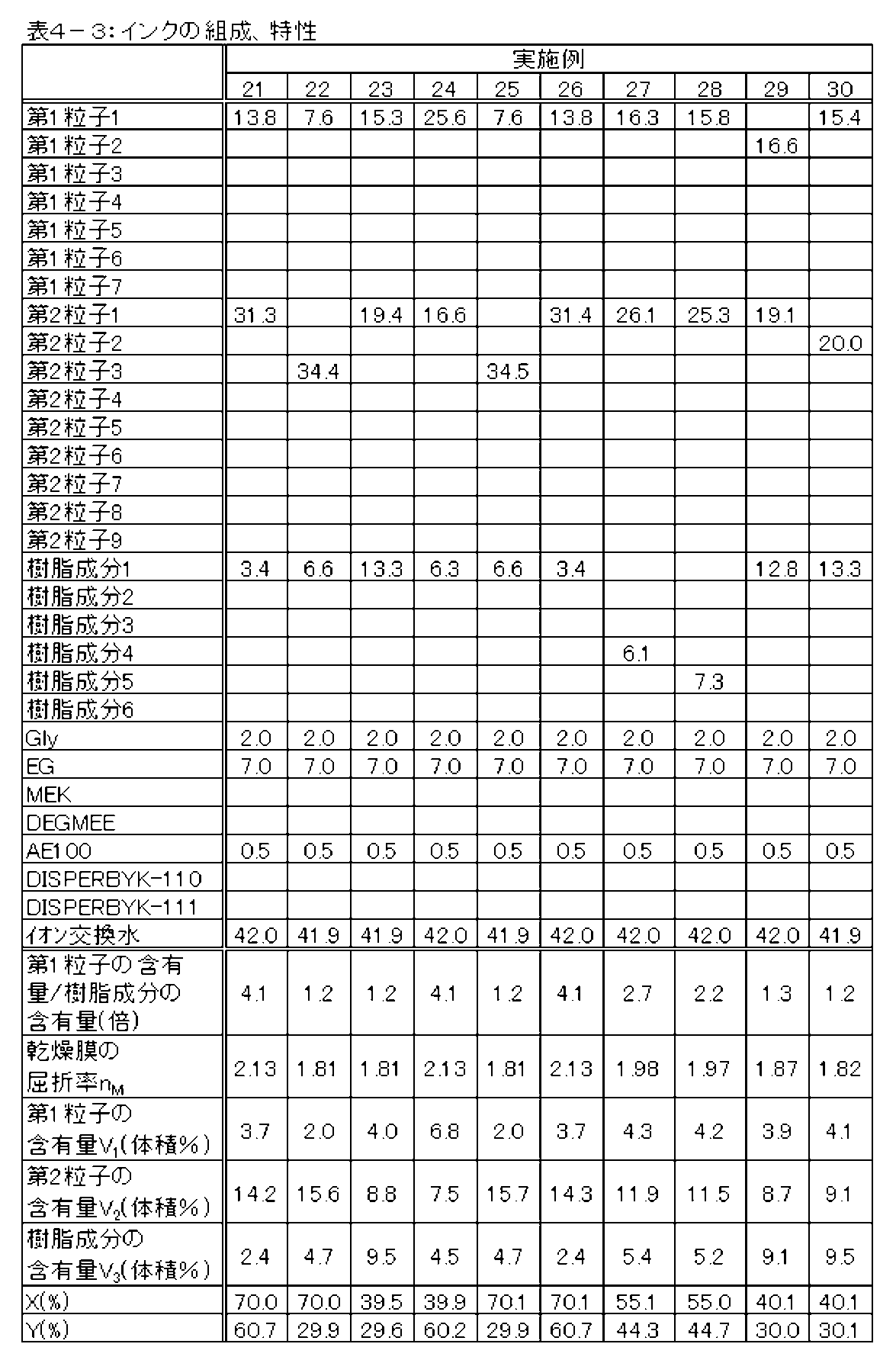
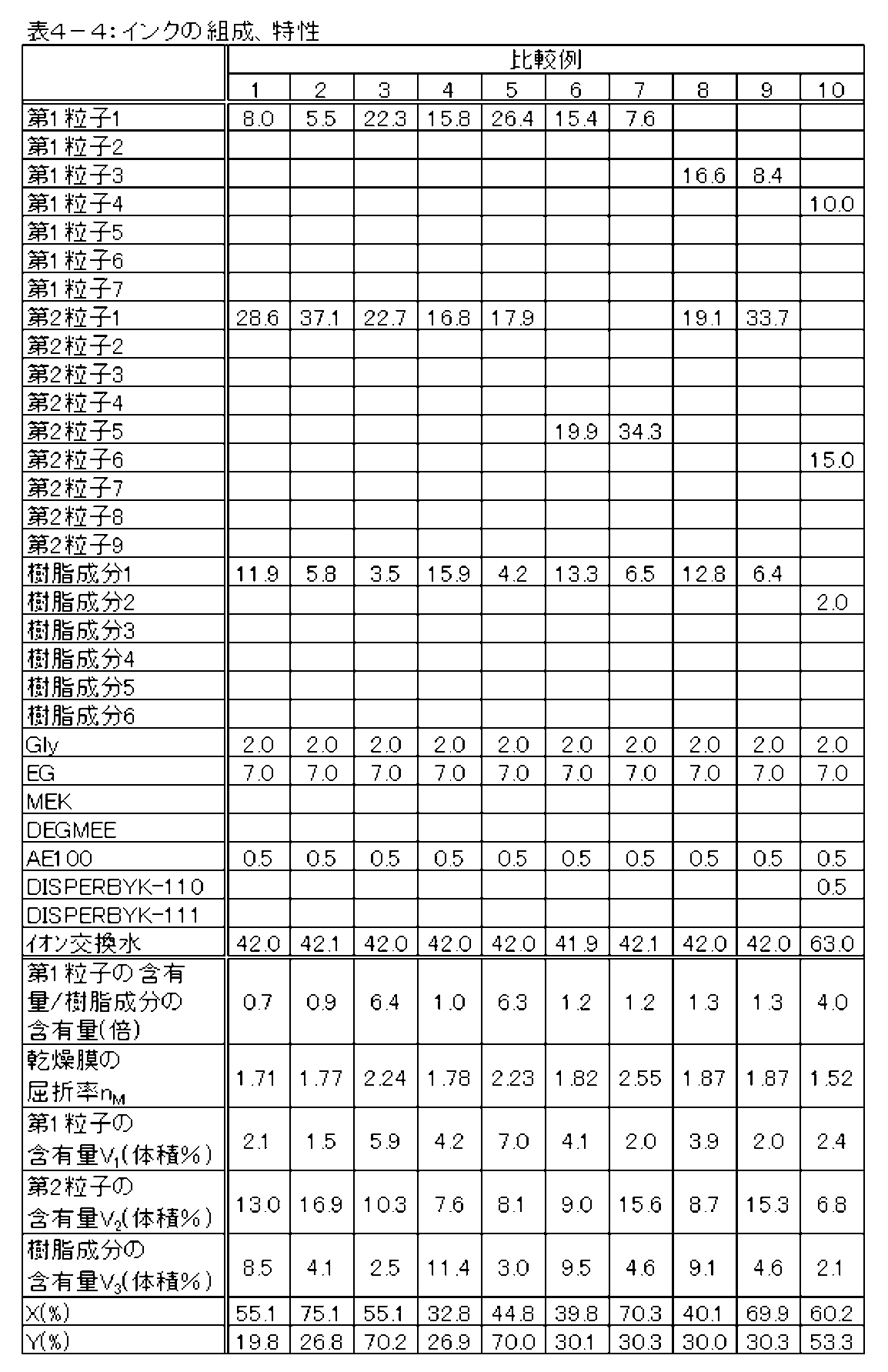
- ⁇ Ink Preparation> The components were mixed to obtain the composition (unit: %) shown in the upper rows of Tables 4-1 to 4-5, and potassium hydroxide was then added to adjust the pH to within the range of 8 to 9.
- Each ink was prepared by pressure filtration using a microfilter (manufactured by Fujifilm) with a pore size of 3.0 ⁇ m.
- the properties of each ink prepared are shown in the lower rows of Tables 4-1 and 4-2.
- the abbreviations in Tables 4-1 and 4-2 have the following meanings.
- the "refractive index of the dried film, n M " is a value calculated according to the above-mentioned formula (A).
- the following phosphate polyester polymer is the resin component.
- Gly Glycerin (Kishida Chemical)
- EG Ethylene glycol (Kishida Chemical)
- AE100 Nonionic surfactant (manufactured by Kawaken Fine Chemicals)
- DISPERBYK-110 Phosphate polyester polymer (manufactured by BYK Japan)
- DISPERBYK-111 Phosphate polyester polymer (manufactured by BYK Japan)
- X and Y are values calculated according to the following formulas (1) and (2), respectively.
- X ⁇ V 2 /(V 1 +V 2 +V 3 ) ⁇ 100...(1)
- Y ⁇ V 1 /(V 1 +V 3 ) ⁇ 100
- V 1 Content (volume%) of the first particle
- V 2 Content of second particles (volume %)
- V3 Resin component content (volume %) It should be noted that V3 is calculated including the phosphoric acid polyester polymer, which is the resin component.
- the prepared inks were filled into ink cartridges, and the ink cartridges were set in an inkjet recording device (trade name "PIXUS PRO10S", manufactured by Canon) equipped with a recording head that ejects liquid by the action of thermal energy.
- the recording duty of a solid image recorded under the conditions of applying 8 ink droplets with a mass of 3.5 ng per droplet to a unit area of 1/600 inch x 1/600 inch with a resolution of 600 dpi x 600 dpi is defined as 100%.
- ink was ejected from the ejection port in the lower half of the longitudinal direction of the recording head to record an image of 50 mm x 50 mm on the recording medium.
- the recorded image was dried with hot air at 80 ° C for 5 minutes, and then heat-treated in a thermostatic chamber at 100 ° C for 1 hour.
- the temperature of the hot air is the temperature at the hot air outlet, and was measured using a molded surface sensor (product name "MF-O-K", manufactured by Toa Denki).
- a PET film product name "LLRPCF1372", manufactured by Sakurai
- cut into A4 size was used as the recording medium.
- the concealment rate of the recorded image was measured and calculated according to this method using a concealment rate test paper (manufactured by TP Giken Co., Ltd., with an inspection certificate from the Japan Paint Inspection Association). Furthermore, the concealment property of the image was evaluated according to the following evaluation criteria.
- the prepared ink was placed in a cylindrical sample container to a height of 24 mm, and centrifuged at a centrifugal force of 100 G for 10 hours. After centrifugation, the height (mm) of the supernatant was measured, and the sedimentation resistance of the ink was evaluated according to the following evaluation criteria. Next, the centrifuged sample container was tilted 90° to remove the liquid portion. After that, the sample container was returned to its original position, and the presence or absence of sediment (sediment that had lost fluidity) at the bottom was confirmed, and if sediment was present, the thickness of the sediment from the bottom was measured.
- B The average thickness of the precipitate was more than 1 mm and 5 mm or less.
- C The average thickness of the precipitate was more than 5 mm.
- the recording medium on which the image was recorded was set in a friction tester (trade name "Crockmeter”, manufactured by Toyo Seiki Seisakusho), and the surface of the image was rubbed back and forth 10 times with a cotton cloth. Thereafter, the state of the image was visually observed, and the scratch resistance of the image was evaluated according to the following evaluation criteria.
- B The ink was transferred to the cotton cloth, and the cotton cloth was stained with the ink, but the surface of the recording medium underneath the image was not revealed.
- C The ink was transferred to the cotton cloth, the color of the ink was stained on the cotton cloth, and the surface of the recording medium below the image was also revealed.
- Example 13 The evaluation result for the hiding power of Example 13 was "A", the same as Example 1, but Example 1 was superior.
- Second particle 3 Resin component 4: Dry film
Landscapes
- Chemical & Material Sciences (AREA)
- Life Sciences & Earth Sciences (AREA)
- Engineering & Computer Science (AREA)
- Materials Engineering (AREA)
- Wood Science & Technology (AREA)
- Organic Chemistry (AREA)
- Chemical Kinetics & Catalysis (AREA)
- Inks, Pencil-Leads, Or Crayons (AREA)
Abstract
Description
V={g(ρS-ρ)d2}/18μ ・・・(A)
d:粒子径
g:重力加速度
ρS:粒子の密度
ρ:分散媒体の密度
μ:分散媒体の粘度
また、第2粒子の屈折率が1.50超であると、形成される乾燥膜との屈折率差が小さくなりすぎて、隠蔽性に優れた画像が得られない。第2粒子の体積基準の累積50%粒子径が120nm未満であると、粒子径が小さくなりすぎて、光を散乱させることができない。その結果、隠蔽性に優れた画像が得られない。インクが、樹脂成分として、樹脂粒子や溶剤溶解性樹脂を含有しないと、乾燥膜の形成の際に、第1粒子が凝集してしまい、図2のような第1粒子が樹脂成分に混ざり合ったような状態の乾燥膜が形成できない。その結果、隠蔽性及び耐擦過性に優れた画像が得られない。
本発明のインクは、第1粒子、第2粒子、及び樹脂成分を含有するインクジェット用のインクである。本発明のインクは、水性インクであっても、油性インクであってもよい。なかでも、水性インクであることが好ましい。なお、本発明のインクは、光を照射して硬化するインク、いわゆる光硬化性インクである必要はない。そのため、重合性の単量体を含有する必要はない。以下、インクを構成する各成分及びインクの物性などについて説明する。
第1粒子は、その屈折率が2.10以上、好ましくは2.50以上2.80以下である、屈折率が相対的に高い粒子である。インク中の、第1粒子の含有量(質量%)は、インク全質量を基準として、5.0質量%以上45.0質量%以下であることが好ましく、7.0質量%以上38.0質量%以下であることがさらに好ましい。
第2粒子は、その屈折率が1.50以下、好ましくは1.20以上1.45以下である、屈折率が相対的に低い粒子である。インク中の、第2粒子の含有量(質量%)は、インク全質量を基準として、12.0質量%以上50.0質量%以下であることが好ましく、15.0質量%以上40.0質量%以下であることがさらに好ましい。
本発明のインクは、樹脂成分を含有する。樹脂成分を含有することで、樹脂成分を実質的に含有しないインクに比して、耐擦過性だけでなく、光沢性にも優れた画像を記録することが可能となり、商業印刷などの分野に好適なインクとすることができる。樹脂成分の屈折率は、1.50以上、好ましくは1.50以上1.70以下である。インク中の、樹脂成分の含有量(質量%)は、インク全質量を基準として、2.5質量%以上17.0質量%以下であることが好ましく、2.5質量%以上14.0質量%以下であることがさらに好ましい。なお、第1粒子や第2粒子をインク中に分散させるための樹脂製の分散剤(樹脂分散剤)を用いた場合、このような樹脂分散剤も「樹脂成分」に含まれる。
n2+0.4≦nM ・・・(1)
n2+0.5≦nM ・・・(1-1)
nM=[{(M1/D1)×n1}+{(M3/D3)×n3}]/{(M1/D1)+(M3/D3)} ・・・(B)
M1:第1粒子の質量(g)
D1:第1粒子の密度(g/cm3)
n1:第1粒子の屈折率
M3:樹脂成分の質量(g)
D3:樹脂成分の密度(g/cm3)
n3:樹脂成分の屈折率
インクは、液媒体をそれぞれ含有する水性インク又は油性(溶剤系)インクである。水性インクの液媒体としては、水、又は水及び水溶性有機溶剤の混合溶媒である水性媒体を用いることが好ましい。水としては、脱イオン水(イオン交換水)を用いることが好ましい。インク中の、水の含有量(質量%)は、インク全質量を基準として、40.0質量%以上95.0質量%以下であることが好ましい。
インクは、上記した成分以外にも必要に応じて、トリメチロールプロパン、トリメチロールエタンなどの多価アルコール類や、尿素、エチレン尿素などの尿素誘導体などの、常温で固体の水溶性有機化合物を含有してもよい。さらに、インクは、必要に応じて、界面活性剤、pH調整剤、防錆剤、防腐剤、防黴剤、酸化防止剤、還元防止剤、蒸発促進剤、及びキレート化剤などの種々の添加剤を含有してもよい。
インクは、インクジェット方式に適用するインクであるので、その物性を適切に制御することが好ましい。インクが水性インクである場合、25℃における水性インクの表面張力は、10mN/m以上60mN/m以下であることが好ましく、20mN/m以上40mN/m以下であることがさらに好ましい。また、25℃における水性インクの粘度は、1.0mPa・s以上10.0mPa・s以下であることが好ましい。25℃における水性インクのpHは、7.0以上10.0以下であることが好ましく、9.0以上10.0以下であることがさらに好ましい。
本発明のインクカートリッジは、インクと、このインクを収容するインク収容部とを備える。そして、このインク収容部に収容されているインクが、上記で説明した本発明のインクである。図3は、本発明のインクカートリッジの一実施形態を模式的に示す断面図である。図3に示すように、インクカートリッジの底面には、記録ヘッドにインクを供給するためのインク供給口12が設けられている。インクカートリッジの内部はインクを収容するためのインク収容部となっている。インク収容部は、インク収容室14と、吸収体収容室16とで構成されており、これらは連通口18を介して連通している。また、吸収体収容室16はインク供給口12に連通している。インク収容室14には液体のインク20が収容されており、吸収体収容室16には、インクを含浸状態で保持する吸収体22及び24が収容されている。インク収容部は、液体のインクを収容するインク収容室を持たず、収容されるインク全量を吸収体により保持する形態であってもよい。また、インク収容部は、吸収体を持たず、インクの全量を液体の状態で収容する形態であってもよい。さらには、インク収容部と記録ヘッドとを有するように構成された形態のインクカートリッジとしてもよい。
本発明のインクジェット記録方法は、上記で説明した本発明のインクをインクジェット方式の記録ヘッドから吐出して記録媒体に画像を記録する方法である。インクを吐出する方式としては、インクに力学的エネルギーを付与する方式や、インクに熱エネルギーを付与する方式が挙げられる。本発明においては、インクに熱エネルギーを付与してインクを吐出する方式を採用することが特に好ましい。本発明のインクを用いること以外、インクジェット記録方法の工程は公知のものとすればよい。
(第1粒子)
表1に示す種類の第1粒子1~7を準備した。粒子の平均粒子径(体積基準の累積50%粒子径(D50))は、動的光散乱法による粒子径分布測定装置(商品名「UPA-EX150」、日機装製)を使用して測定した。酸化チタンの粉末である第1粒子4は、分散剤(商品名「Disperbyk-111」、ビックケミージャパン製)を用いてメチルエチルケトン中に分散させた。分散させる際には、ジルコニアビーズ(10μm径、ニイミ産業製)及びペイントシェーカー(東洋精機製)を使用した。また、酸化チタンの粉末である第1粒子6は、アナターゼ型結晶70%とルチル型結晶30%の混合結晶である、P25 30.0部にイオン交換水70.0部を混合し、超音波ホモジナイザー(UD-200 トミー精工製)を用いて氷冷しながら10分間撹拌して、水中に分散させた。

表2に示す種類の第2粒子1~9を準備した。第2粒子1~6のシリカについては、アルコール混合溶媒中、Stober法によりテトラエチルオルトシリケート(東京化成工業製)から調製した。その際、これらの粒子の粒子径は、アルコール混合溶媒として、メタノール/エタノール及びエタノール/イソプロパノールのいずれかを選択して用いることによって制御した。シリカ/アルコール混合溶媒分散液を遠心分離して得た沈降物を、超音波洗浄機を使用して水中に再分散させることにより、分散媒体を水に置換したシリカゾルを調製した。
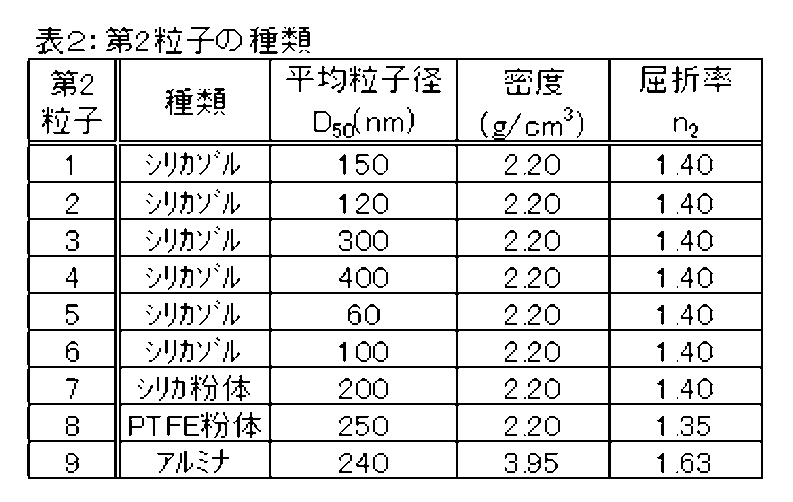
表3に示す種類の樹脂成分1~5(樹脂粒子)及び樹脂成分6(溶剤溶解性樹脂)を準備した。ゼータ電位測定装置を使用して測定及び算出した、pH7~10の範囲内における樹脂粒子1、2、4、及び5のゼータ電位は、いずれも-30mVから-50mVの範囲内であった。一方、pH7~10の範囲内における樹脂粒子3のゼータ電位は、-7.3mVであった。樹脂粒子1~3は、いずれも非架橋樹脂であり、樹脂粒子4及び5は架橋樹脂である。

表4-1~表4-5の上段に示す組成(単位:%)となるように各成分を混合した後、水酸化カリウムを添加してpHを8~9の範囲内に調整した。ポアサイズ3.0μmのミクロフィルター(富士フイルム製)にて加圧ろ過し、各インクを調製した。調製した各インクの特性を表4-1及び表4-2の下段に示す。表4-1及び表4-2中の略号の意味は以下に示す通りである。また、「乾燥膜の屈折率nM」は、前述の式(A)にしたがって算出した値である。下記のリン酸ポリエステル系ポリマーは、樹脂成分である。
・Gly:グリセリン(キシダ化学製)
・EG:エチレングリコール(キシダ化学製)
・AE100:ノニオン性界面活性剤(川研ファインケミカル製)
・DISPERBYK-110:リン酸ポリエステル系ポリマー(ビックケミージャパン製)
・DISPERBYK-111:リン酸ポリエステル系ポリマー(ビックケミージャパン製)
X={V2/(V1+V2+V3)}×100 ・・・(1)
Y={V1/(V1+V3)}×100 ・・・(2)
V1:第1粒子の含有量(体積%)
V2:第2粒子の含有量(体積%)
V3:樹脂成分の含有量(体積%)
なお、V3は樹脂成分である上記のリン酸ポリエステル系ポリマーも含めて算出される。



調製したインクをインクカートリッジにそれぞれ充填し、熱エネルギーの作用により液体を吐出させる記録ヘッドを搭載したインクジェット記録装置(商品名「PIXUS PRO10S」、キヤノン製)にセットした。本実施例では、解像度が600dpi×600dpiで、1/600インチ×1/600インチの単位領域に、1滴当たりの質量が3.5ngであるインク滴を8滴付与する条件で記録したベタ画像の記録デューティを100%と定義する。上記のインクジェット記録装置を使用し、記録ヘッドの長手方向の下半分の吐出口からインクを吐出して、50mm×50mmの画像を記録媒体に記録した。記録ヘッドの長手方向の半分の長さ分、記録媒体を搬送した後、記録した画像を80℃の温風で5分間乾燥させた後、100℃の恒温槽中で1時間熱処理した。温風の温度は、温風出口における温度であり、モールド型表面センサー(商品名「MF-O-K」、東亜電器製)を使用して測定した。記録媒体としては、PETフィルム(商品名「LLRPCF1372」、桜井製)をA4サイズに切り出したものを用いた。本発明においては、以下に示す各項目の評価基準で、「A」及び「B」を許容できるレベル、「C」を許容できないレベルとした。評価結果を表5に示す。
ISO2471:2008に準拠した方法にしたがって、記録した画像の隠蔽率を測定及び算出するとともに、画像の隠蔽性を評価した。ISO2471:2008では、試験対象の紙を白色板及び黒色板でそれぞれ裏当てして反射率を測定し、下記式(C)から隠蔽率を算出する。
隠蔽率=(R0/R∞)×100 ・・・(C)
R0:黒色板を裏当てして測定した反射率
R∞:白色板を裏当てして測定した反射率
A:画像の隠蔽率が、52%以上であった。
B:画像の隠蔽率が、44%以上52%未満であった。
C:画像の隠蔽率が、44%未満であった。
調製したインクを円柱状の試料容器に高さ24mmとなるように入れ、100Gの遠心力で10時間遠心分離した。遠心分離後、上澄み部分の高さ(mm)を測定し、以下に示す評価基準にしたがってインクの耐沈降性を評価した。次に、遠心分離した試料容器を90°傾けて液体部分を除去した。その後、試料容器を元に戻した状態で底部における沈殿物(流動性を失った沈降物)の有無を確認し、沈殿物が存在していた場合には、底部からの沈殿物の厚さを測定した。
A:沈殿物の平均厚さが、1mm以下であった。
B:沈殿物の平均厚さが、1mmを超えて5mm以下であった。
C:沈殿物の平均厚さが、5mmを超えていた。
画像を記録した記録媒体を摩擦試験機(商品名「クロックメーター」、東洋精機製作所製)にセットし、画像表面を綿布で10往復擦った。
その後、画像の状態を目視で観察し、以下に示す評価基準にしたがって画像の耐擦過性を評価した。
A:インクが綿布に移行せず、綿布にインクの色がつかなかった。
B:インクが綿布に移行して、綿布にインクの色がついたが、画像の下の記録媒体の表面は現れなかった。
C:インクが綿布に移行して、綿布にインクの色がつき、画像の下の記録媒体の表面も現れた。

2:第2粒子
3:樹脂成分
4:乾燥膜
Claims (13)
- 第1粒子、第2粒子、及び樹脂成分を含有するインクジェット用のインクであって、
前記第1粒子の屈折率が、2.10以上であり、
前記第1粒子の体積基準の累積50%粒子径が、100nm以下であり、
前記第2粒子の屈折率が、1.50以下であり、
前記第2粒子の体積基準の累積50%粒子径が、120nm以上であり、
前記樹脂成分が、樹脂粒子、及び溶剤溶解性樹脂からなる群より選ばれる少なくとも1種であり、
前記樹脂成分の屈折率が、1.50以上であり、
前記第1粒子の含有量(質量%)が、前記樹脂成分の含有量(質量%)に対する質量比率で、1.1倍以上5.5倍以下であることを特徴とするインク。 - 前記第2粒子の屈折率(n2)と、前記第1粒子及び前記樹脂成分で形成される乾燥膜の屈折率(nM)とが、下記式(1)の関係を満たす請求項1に記載のインク。
n2+0.4≦nM ・・・(1) - 前記第1粒子が、酸化チタン、及びジルコニアからなる群より選ばれる少なくとも1種である請求項1又は2に記載のインク。
- 前記第1粒子が、酸化チタンである請求項1乃至3のいずれか1項に記載のインク。
- 前記第2粒子が、シリカ粒子、シリコーン系粒子、及びポリテトラフルオロエチレン樹脂粒子からなる群より選ばれる少なくとも1種である請求項1乃至4のいずれか1項に記載のインク。
- 前記第1粒子、前記第2粒子、及び前記樹脂成分の合計含有量(体積%)に対する、前記第2粒子の含有量(体積%)の割合が、40.0%以上70.0%以下であり、
前記第1粒子及び前記樹脂成分の合計含有量(体積%)に対する、前記第1粒子の含有量(体積%)の割合が、30.0%以上60.0%以下である請求項1乃至5のいずれか1項に記載のインク。 - 前記第2粒子のゼータ電位の絶対値が、前記第1粒子のゼータ電位の絶対値よりも小さい請求項1乃至6のいずれか1項に記載のインク。
- 前記第2粒子のゼータ電位の絶対値が、前記第1粒子のゼータ電位の絶対値及び前記樹脂成分のゼータ電位の絶対値のいずれよりも小さい請求項1乃至7のいずれか1項に記載のインク。
- 前記樹脂成分が、非架橋樹脂である請求項1乃至8のいずれか1項に記載のインク。
- 前記第1粒子の体積基準の累積50%粒子径が、60nm以下である請求項1乃至9のいずれか1項に記載のインク。
- 前記第2粒子の体積基準の累積50%粒子径が、140nm以上である請求項1乃至10のいずれか1項に記載のインク。
- インクと、前記インクを収容するインク収容部とを備えたインクカートリッジであって、
前記インクが、請求項1乃至11のいずれか1項に記載のインクであることを特徴とするインクカートリッジ。 - インクをインクジェット方式の記録ヘッドから吐出して記録媒体に画像を記録するインクジェット記録方法であって、
前記インクが、請求項1乃至11のいずれか1項に記載のインクであることを特徴とするインクジェット記録方法。
Priority Applications (2)
| Application Number | Priority Date | Filing Date | Title |
|---|---|---|---|
| EP23906962.8A EP4636047A1 (en) | 2022-12-23 | 2023-12-18 | Ink, ink cartridge, and inkjet recording method |
| US19/244,474 US20250313710A1 (en) | 2022-12-23 | 2025-06-20 | Ink, ink cartridge, and ink jet recording method |
Applications Claiming Priority (6)
| Application Number | Priority Date | Filing Date | Title |
|---|---|---|---|
| JP2022207097 | 2022-12-23 | ||
| JP2022207098 | 2022-12-23 | ||
| JP2022-207098 | 2022-12-23 | ||
| JP2022-207097 | 2022-12-23 | ||
| JP2023-205592 | 2023-12-05 | ||
| JP2023205592A JP2024091485A (ja) | 2022-12-23 | 2023-12-05 | インク、インクカートリッジ、及びインクジェット記録方法 |
Related Child Applications (1)
| Application Number | Title | Priority Date | Filing Date |
|---|---|---|---|
| US19/244,474 Continuation US20250313710A1 (en) | 2022-12-23 | 2025-06-20 | Ink, ink cartridge, and ink jet recording method |
Publications (1)
| Publication Number | Publication Date |
|---|---|
| WO2024135602A1 true WO2024135602A1 (ja) | 2024-06-27 |
Family
ID=91588639
Family Applications (1)
| Application Number | Title | Priority Date | Filing Date |
|---|---|---|---|
| PCT/JP2023/045243 Ceased WO2024135602A1 (ja) | 2022-12-23 | 2023-12-18 | インク、インクカートリッジ、及びインクジェット記録方法 |
Country Status (3)
| Country | Link |
|---|---|
| US (1) | US20250313710A1 (ja) |
| EP (1) | EP4636047A1 (ja) |
| WO (1) | WO2024135602A1 (ja) |
Citations (10)
| Publication number | Priority date | Publication date | Assignee | Title |
|---|---|---|---|---|
| JPS58122974A (ja) * | 1982-01-19 | 1983-07-21 | Dainippon Toryo Co Ltd | ジエツト印刷用白色インク組成物 |
| JP2011231201A (ja) * | 2010-04-27 | 2011-11-17 | Seiko Epson Corp | 白色インク組成物およびこれを用いた記録物 |
| JP2013060513A (ja) | 2011-09-13 | 2013-04-04 | Seiko Epson Corp | 捺染用白色インクジェットインク |
| US20140123874A1 (en) * | 2011-06-10 | 2014-05-08 | Hewlett-Packard Development Company, L.P. | White Ink-Jet Inks |
| JP2014095058A (ja) * | 2012-11-12 | 2014-05-22 | Mimaki Engineering Co Ltd | インクジェット印刷用インク |
| JP2014189558A (ja) * | 2013-03-26 | 2014-10-06 | Seiko Epson Corp | インクジェット記録用の白色系インク組成物 |
| JP2016137482A (ja) * | 2015-01-23 | 2016-08-04 | キヤノン株式会社 | 膜形成方法、画像形成方法、膜、およびインク組成物 |
| WO2018190848A1 (en) | 2017-04-13 | 2018-10-18 | Hewlett-Packard Development Company, L.P. | White inks |
| JP2019112602A (ja) * | 2017-12-26 | 2019-07-11 | セイコーエプソン株式会社 | 白色顔料組成物及びその乾燥体、塗布方法、塗布物、インクジェット記録方法、記録物、並びにインクジェットプリンター |
| JP2021155502A (ja) * | 2020-03-25 | 2021-10-07 | セイコーエプソン株式会社 | 白色顔料組成物及び記録物 |
-
2023
- 2023-12-18 EP EP23906962.8A patent/EP4636047A1/en active Pending
- 2023-12-18 WO PCT/JP2023/045243 patent/WO2024135602A1/ja not_active Ceased
-
2025
- 2025-06-20 US US19/244,474 patent/US20250313710A1/en active Pending
Patent Citations (10)
| Publication number | Priority date | Publication date | Assignee | Title |
|---|---|---|---|---|
| JPS58122974A (ja) * | 1982-01-19 | 1983-07-21 | Dainippon Toryo Co Ltd | ジエツト印刷用白色インク組成物 |
| JP2011231201A (ja) * | 2010-04-27 | 2011-11-17 | Seiko Epson Corp | 白色インク組成物およびこれを用いた記録物 |
| US20140123874A1 (en) * | 2011-06-10 | 2014-05-08 | Hewlett-Packard Development Company, L.P. | White Ink-Jet Inks |
| JP2013060513A (ja) | 2011-09-13 | 2013-04-04 | Seiko Epson Corp | 捺染用白色インクジェットインク |
| JP2014095058A (ja) * | 2012-11-12 | 2014-05-22 | Mimaki Engineering Co Ltd | インクジェット印刷用インク |
| JP2014189558A (ja) * | 2013-03-26 | 2014-10-06 | Seiko Epson Corp | インクジェット記録用の白色系インク組成物 |
| JP2016137482A (ja) * | 2015-01-23 | 2016-08-04 | キヤノン株式会社 | 膜形成方法、画像形成方法、膜、およびインク組成物 |
| WO2018190848A1 (en) | 2017-04-13 | 2018-10-18 | Hewlett-Packard Development Company, L.P. | White inks |
| JP2019112602A (ja) * | 2017-12-26 | 2019-07-11 | セイコーエプソン株式会社 | 白色顔料組成物及びその乾燥体、塗布方法、塗布物、インクジェット記録方法、記録物、並びにインクジェットプリンター |
| JP2021155502A (ja) * | 2020-03-25 | 2021-10-07 | セイコーエプソン株式会社 | 白色顔料組成物及び記録物 |
Non-Patent Citations (2)
| Title |
|---|
| KAGAKU KOGAKU, RONBUNSHU, vol. 29, no. 6, 2003, pages 753 - 759 |
| See also references of EP4636047A1 |
Also Published As
| Publication number | Publication date |
|---|---|
| EP4636047A1 (en) | 2025-10-22 |
| US20250313710A1 (en) | 2025-10-09 |
Similar Documents
| Publication | Publication Date | Title |
|---|---|---|
| JP3927851B2 (ja) | インクジェット記録方法、インクジェット記録装置、記録物の製造方法 | |
| CN103124775B (zh) | 用于喷墨油墨的氧化物颜料分散体 | |
| EP2718381B1 (en) | White ink-jet inks | |
| US10570300B2 (en) | White inks | |
| CN107532024B (zh) | 非牛顿白色墨水 | |
| CN106133071B (zh) | 白色油墨 | |
| JP2011225867A (ja) | 水性顔料分散液の製造方法 | |
| CN107429090B (zh) | 白色颜料分散体 | |
| CN107636086A (zh) | 白色墨水 | |
| CN107406705A (zh) | 用于喷墨成像的流体套装 | |
| CN108026400B (zh) | 白色墨水 | |
| WO2024135602A1 (ja) | インク、インクカートリッジ、及びインクジェット記録方法 | |
| JP2024091485A (ja) | インク、インクカートリッジ、及びインクジェット記録方法 | |
| CN115926536B (zh) | 水性墨、墨盒、喷墨记录方法、氧化钛颗粒分散液及其生产方法和水性墨的生产方法 | |
| JP7071149B2 (ja) | インクジェット記録方法及びインクジェット記録装置 | |
| EP3921380A1 (en) | White ink compositions | |
| JP7451634B2 (ja) | 水性インク、インクカートリッジ、及びインクジェット記録方法 | |
| JP4498222B2 (ja) | インクジェット記録方法 | |
| JP7451633B2 (ja) | 水性インク、インクカートリッジ、インクジェット記録方法、酸化チタン粒子の分散液、酸化チタン粒子の分散液の製造方法、及び水性インクの製造方法 | |
| JP2023125908A (ja) | インクジェット記録方法、及びインクジェット記録装置 | |
| US10364367B2 (en) | Non-newtonian inkjet inks | |
| EP4163341A1 (en) | Aqueous ink, ink cartridge and ink jet recording method | |
| JP2000256593A (ja) | インクジェット記録用インクおよびインクジェット記録方法 | |
| JP2023066996A (ja) | 水性インク、インクカートリッジ、及びインクジェット記録方法 | |
| JP2023125910A (ja) | インクジェット記録方法、及びインクジェット記録装置 |
Legal Events
| Date | Code | Title | Description |
|---|---|---|---|
| 121 | Ep: the epo has been informed by wipo that ep was designated in this application |
Ref document number: 23906962 Country of ref document: EP Kind code of ref document: A1 |
|
| WWE | Wipo information: entry into national phase |
Ref document number: 2023906962 Country of ref document: EP |
|
| NENP | Non-entry into the national phase |
Ref country code: DE |
|
| ENP | Entry into the national phase |
Ref document number: 2023906962 Country of ref document: EP Effective date: 20250723 |
|
| ENP | Entry into the national phase |
Ref document number: 2023906962 Country of ref document: EP Effective date: 20250723 |
|
| ENP | Entry into the national phase |
Ref document number: 2023906962 Country of ref document: EP Effective date: 20250723 |
|
| WWP | Wipo information: published in national office |
Ref document number: 2023906962 Country of ref document: EP |