WO2024136231A1 - 리튬 이차 전지용 양극 활물질 및 이를 포함하는 리튬 이차 전지 - Google Patents
리튬 이차 전지용 양극 활물질 및 이를 포함하는 리튬 이차 전지 Download PDFInfo
- Publication number
- WO2024136231A1 WO2024136231A1 PCT/KR2023/020022 KR2023020022W WO2024136231A1 WO 2024136231 A1 WO2024136231 A1 WO 2024136231A1 KR 2023020022 W KR2023020022 W KR 2023020022W WO 2024136231 A1 WO2024136231 A1 WO 2024136231A1
- Authority
- WO
- WIPO (PCT)
- Prior art keywords
- active material
- positive electrode
- metal oxide
- electrode active
- secondary battery
- Prior art date
- Legal status (The legal status is an assumption and is not a legal conclusion. Google has not performed a legal analysis and makes no representation as to the accuracy of the status listed.)
- Ceased
Links
Images



Classifications
-
- H—ELECTRICITY
- H01—ELECTRIC ELEMENTS
- H01M—PROCESSES OR MEANS, e.g. BATTERIES, FOR THE DIRECT CONVERSION OF CHEMICAL ENERGY INTO ELECTRICAL ENERGY
- H01M10/00—Secondary cells; Manufacture thereof
- H01M10/05—Accumulators with non-aqueous electrolyte
- H01M10/052—Li-accumulators
-
- C—CHEMISTRY; METALLURGY
- C01—INORGANIC CHEMISTRY
- C01G—COMPOUNDS CONTAINING METALS NOT COVERED BY SUBCLASSES C01D OR C01F
- C01G53/00—Compounds of nickel
- C01G53/05—Hydroxides; Oxyhydroxides
-
- C—CHEMISTRY; METALLURGY
- C01—INORGANIC CHEMISTRY
- C01G—COMPOUNDS CONTAINING METALS NOT COVERED BY SUBCLASSES C01D OR C01F
- C01G53/00—Compounds of nickel
- C01G53/40—Complex oxides containing nickel and at least one other metal element
- C01G53/42—Complex oxides containing nickel and at least one other metal element containing alkali metals, e.g. LiNiO2
-
- H—ELECTRICITY
- H01—ELECTRIC ELEMENTS
- H01M—PROCESSES OR MEANS, e.g. BATTERIES, FOR THE DIRECT CONVERSION OF CHEMICAL ENERGY INTO ELECTRICAL ENERGY
- H01M10/00—Secondary cells; Manufacture thereof
- H01M10/05—Accumulators with non-aqueous electrolyte
- H01M10/052—Li-accumulators
- H01M10/0525—Rocking-chair batteries, i.e. batteries with lithium insertion or intercalation in both electrodes; Lithium-ion batteries
-
- H—ELECTRICITY
- H01—ELECTRIC ELEMENTS
- H01M—PROCESSES OR MEANS, e.g. BATTERIES, FOR THE DIRECT CONVERSION OF CHEMICAL ENERGY INTO ELECTRICAL ENERGY
- H01M4/00—Electrodes
- H01M4/02—Electrodes composed of, or comprising, active material
-
- H—ELECTRICITY
- H01—ELECTRIC ELEMENTS
- H01M—PROCESSES OR MEANS, e.g. BATTERIES, FOR THE DIRECT CONVERSION OF CHEMICAL ENERGY INTO ELECTRICAL ENERGY
- H01M4/00—Electrodes
- H01M4/02—Electrodes composed of, or comprising, active material
- H01M4/36—Selection of substances as active materials, active masses, active liquids
-
- H—ELECTRICITY
- H01—ELECTRIC ELEMENTS
- H01M—PROCESSES OR MEANS, e.g. BATTERIES, FOR THE DIRECT CONVERSION OF CHEMICAL ENERGY INTO ELECTRICAL ENERGY
- H01M4/00—Electrodes
- H01M4/02—Electrodes composed of, or comprising, active material
- H01M4/36—Selection of substances as active materials, active masses, active liquids
- H01M4/362—Composites
- H01M4/364—Composites as mixtures
-
- H—ELECTRICITY
- H01—ELECTRIC ELEMENTS
- H01M—PROCESSES OR MEANS, e.g. BATTERIES, FOR THE DIRECT CONVERSION OF CHEMICAL ENERGY INTO ELECTRICAL ENERGY
- H01M4/00—Electrodes
- H01M4/02—Electrodes composed of, or comprising, active material
- H01M4/36—Selection of substances as active materials, active masses, active liquids
- H01M4/362—Composites
- H01M4/366—Composites as layered products
-
- H—ELECTRICITY
- H01—ELECTRIC ELEMENTS
- H01M—PROCESSES OR MEANS, e.g. BATTERIES, FOR THE DIRECT CONVERSION OF CHEMICAL ENERGY INTO ELECTRICAL ENERGY
- H01M4/00—Electrodes
- H01M4/02—Electrodes composed of, or comprising, active material
- H01M4/36—Selection of substances as active materials, active masses, active liquids
- H01M4/48—Selection of substances as active materials, active masses, active liquids of inorganic oxides or hydroxides
- H01M4/50—Selection of substances as active materials, active masses, active liquids of inorganic oxides or hydroxides of manganese
- H01M4/505—Selection of substances as active materials, active masses, active liquids of inorganic oxides or hydroxides of manganese of mixed oxides or hydroxides containing manganese for inserting or intercalating light metals, e.g. LiMn2O4 or LiMn2OxFy
-
- H—ELECTRICITY
- H01—ELECTRIC ELEMENTS
- H01M—PROCESSES OR MEANS, e.g. BATTERIES, FOR THE DIRECT CONVERSION OF CHEMICAL ENERGY INTO ELECTRICAL ENERGY
- H01M4/00—Electrodes
- H01M4/02—Electrodes composed of, or comprising, active material
- H01M4/36—Selection of substances as active materials, active masses, active liquids
- H01M4/48—Selection of substances as active materials, active masses, active liquids of inorganic oxides or hydroxides
- H01M4/52—Selection of substances as active materials, active masses, active liquids of inorganic oxides or hydroxides of nickel, cobalt or iron
- H01M4/525—Selection of substances as active materials, active masses, active liquids of inorganic oxides or hydroxides of nickel, cobalt or iron of mixed oxides or hydroxides containing iron, cobalt or nickel for inserting or intercalating light metals, e.g. LiNiO2, LiCoO2 or LiCoOxFy
-
- C—CHEMISTRY; METALLURGY
- C01—INORGANIC CHEMISTRY
- C01P—INDEXING SCHEME RELATING TO STRUCTURAL AND PHYSICAL ASPECTS OF SOLID INORGANIC COMPOUNDS
- C01P2002/00—Crystal-structural characteristics
- C01P2002/50—Solid solutions
- C01P2002/52—Solid solutions containing elements as dopants
-
- C—CHEMISTRY; METALLURGY
- C01—INORGANIC CHEMISTRY
- C01P—INDEXING SCHEME RELATING TO STRUCTURAL AND PHYSICAL ASPECTS OF SOLID INORGANIC COMPOUNDS
- C01P2002/00—Crystal-structural characteristics
- C01P2002/60—Compounds characterised by their crystallite size
-
- C—CHEMISTRY; METALLURGY
- C01—INORGANIC CHEMISTRY
- C01P—INDEXING SCHEME RELATING TO STRUCTURAL AND PHYSICAL ASPECTS OF SOLID INORGANIC COMPOUNDS
- C01P2002/00—Crystal-structural characteristics
- C01P2002/80—Crystal-structural characteristics defined by measured data other than those specified in group C01P2002/70
- C01P2002/85—Crystal-structural characteristics defined by measured data other than those specified in group C01P2002/70 by XPS, EDX or EDAX data
-
- C—CHEMISTRY; METALLURGY
- C01—INORGANIC CHEMISTRY
- C01P—INDEXING SCHEME RELATING TO STRUCTURAL AND PHYSICAL ASPECTS OF SOLID INORGANIC COMPOUNDS
- C01P2004/00—Particle morphology
- C01P2004/01—Particle morphology depicted by an image
- C01P2004/03—Particle morphology depicted by an image obtained by SEM
-
- C—CHEMISTRY; METALLURGY
- C01—INORGANIC CHEMISTRY
- C01P—INDEXING SCHEME RELATING TO STRUCTURAL AND PHYSICAL ASPECTS OF SOLID INORGANIC COMPOUNDS
- C01P2004/00—Particle morphology
- C01P2004/01—Particle morphology depicted by an image
- C01P2004/04—Particle morphology depicted by an image obtained by TEM, STEM, STM or AFM
-
- C—CHEMISTRY; METALLURGY
- C01—INORGANIC CHEMISTRY
- C01P—INDEXING SCHEME RELATING TO STRUCTURAL AND PHYSICAL ASPECTS OF SOLID INORGANIC COMPOUNDS
- C01P2004/00—Particle morphology
- C01P2004/30—Particle morphology extending in three dimensions
- C01P2004/32—Spheres
-
- C—CHEMISTRY; METALLURGY
- C01—INORGANIC CHEMISTRY
- C01P—INDEXING SCHEME RELATING TO STRUCTURAL AND PHYSICAL ASPECTS OF SOLID INORGANIC COMPOUNDS
- C01P2004/00—Particle morphology
- C01P2004/50—Agglomerated particles
-
- C—CHEMISTRY; METALLURGY
- C01—INORGANIC CHEMISTRY
- C01P—INDEXING SCHEME RELATING TO STRUCTURAL AND PHYSICAL ASPECTS OF SOLID INORGANIC COMPOUNDS
- C01P2004/00—Particle morphology
- C01P2004/60—Particles characterised by their size
- C01P2004/61—Micrometer sized, i.e. from 1-100 micrometer
-
- C—CHEMISTRY; METALLURGY
- C01—INORGANIC CHEMISTRY
- C01P—INDEXING SCHEME RELATING TO STRUCTURAL AND PHYSICAL ASPECTS OF SOLID INORGANIC COMPOUNDS
- C01P2004/00—Particle morphology
- C01P2004/80—Particles consisting of a mixture of two or more inorganic phases
-
- C—CHEMISTRY; METALLURGY
- C01—INORGANIC CHEMISTRY
- C01P—INDEXING SCHEME RELATING TO STRUCTURAL AND PHYSICAL ASPECTS OF SOLID INORGANIC COMPOUNDS
- C01P2004/00—Particle morphology
- C01P2004/80—Particles consisting of a mixture of two or more inorganic phases
- C01P2004/82—Particles consisting of a mixture of two or more inorganic phases two phases having the same anion, e.g. both oxidic phases
- C01P2004/84—Particles consisting of a mixture of two or more inorganic phases two phases having the same anion, e.g. both oxidic phases one phase coated with the other
-
- C—CHEMISTRY; METALLURGY
- C01—INORGANIC CHEMISTRY
- C01P—INDEXING SCHEME RELATING TO STRUCTURAL AND PHYSICAL ASPECTS OF SOLID INORGANIC COMPOUNDS
- C01P2004/00—Particle morphology
- C01P2004/80—Particles consisting of a mixture of two or more inorganic phases
- C01P2004/82—Particles consisting of a mixture of two or more inorganic phases two phases having the same anion, e.g. both oxidic phases
- C01P2004/84—Particles consisting of a mixture of two or more inorganic phases two phases having the same anion, e.g. both oxidic phases one phase coated with the other
- C01P2004/86—Thin layer coatings, i.e. the coating thickness being less than 0.1 time the particle radius
-
- C—CHEMISTRY; METALLURGY
- C01—INORGANIC CHEMISTRY
- C01P—INDEXING SCHEME RELATING TO STRUCTURAL AND PHYSICAL ASPECTS OF SOLID INORGANIC COMPOUNDS
- C01P2006/00—Physical properties of inorganic compounds
- C01P2006/40—Electric properties
-
- C—CHEMISTRY; METALLURGY
- C01—INORGANIC CHEMISTRY
- C01P—INDEXING SCHEME RELATING TO STRUCTURAL AND PHYSICAL ASPECTS OF SOLID INORGANIC COMPOUNDS
- C01P2006/00—Physical properties of inorganic compounds
- C01P2006/80—Compositional purity
-
- H—ELECTRICITY
- H01—ELECTRIC ELEMENTS
- H01M—PROCESSES OR MEANS, e.g. BATTERIES, FOR THE DIRECT CONVERSION OF CHEMICAL ENERGY INTO ELECTRICAL ENERGY
- H01M4/00—Electrodes
- H01M4/02—Electrodes composed of, or comprising, active material
- H01M2004/026—Electrodes composed of, or comprising, active material characterised by the polarity
- H01M2004/028—Positive electrodes
-
- Y—GENERAL TAGGING OF NEW TECHNOLOGICAL DEVELOPMENTS; GENERAL TAGGING OF CROSS-SECTIONAL TECHNOLOGIES SPANNING OVER SEVERAL SECTIONS OF THE IPC; TECHNICAL SUBJECTS COVERED BY FORMER USPC CROSS-REFERENCE ART COLLECTIONS [XRACs] AND DIGESTS
- Y02—TECHNOLOGIES OR APPLICATIONS FOR MITIGATION OR ADAPTATION AGAINST CLIMATE CHANGE
- Y02E—REDUCTION OF GREENHOUSE GAS [GHG] EMISSIONS, RELATED TO ENERGY GENERATION, TRANSMISSION OR DISTRIBUTION
- Y02E60/00—Enabling technologies; Technologies with a potential or indirect contribution to GHG emissions mitigation
- Y02E60/10—Energy storage using batteries
Definitions
- These embodiments relate to a positive electrode active material for a lithium secondary battery and a lithium secondary battery containing the same.
- a cathode active material for a lithium secondary battery includes a metal oxide in the form of a single particle and including a layered structure; and a coating layer located on the surface of the metal oxide and including a layered structure, wherein the average value of the interplanar distance of the layered structure included in the coating layer may be smaller than the average value of the interplanar distance of the layered structure included in the metal oxide.
- a lithium secondary battery includes the positive electrode; cathode; and electrolyte;
- the cathode active material for a lithium secondary battery modifies the surface structure so that the interplanar distance of the layered structure included in the coating layer located on the surface of the metal oxide is shorter than the interplanar distance of the layered structure included in the metal oxide, thereby generating electricity.
- a lithium secondary battery with excellent chemical performance can be implemented.
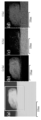
- Figure 1 is an SEM image measured at 20,000 times magnification for the positive electrode active material prepared according to Example 2.
- Figure 2 is an SEM image measured at 20,000 times magnification for the positive electrode active material prepared according to Example 4.
- Figure 3 is an SEM image measured at 20,000 times magnification for the positive electrode active material prepared according to Comparative Example 3.
- Figure 4(a) shows a cross-sectional image of the positive electrode active material manufactured according to Example 2 after milling with a Focused Ion Beam (SEIKO 3050SE) (FIB).
- SEIKO 3050SE Focused Ion Beam
- Figures 4(b), 4(c), and 4(d) show EDS (Energy dispersed spectroscopy, Oxford The results are shown after analysis using .
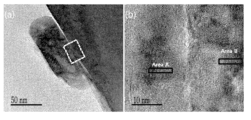
- Figure 5(a) is an image measured using a high resolution transmission electron microscope (HRTEM) equipment for the positive electrode active material manufactured according to Example 2.
- HRTEM transmission electron microscope
- FIG. 5(b) is an enlarged HRTEM image of the rectangular area indicated by the dotted line in FIG. 5(a).
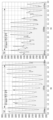
- Figure 6(a) is the result of measuring the interplanar distance of 10 layers in the layered structure of Area A (coating layer) in 5(b).
- Figure 6(b) is the result of measuring the interplanar distance of 10 layers in the layered structure of Area B (single particle base material) in 5(b).
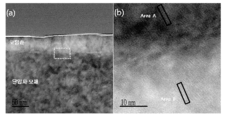
- Figure 7(a) is an image measured using a high resolution transmission electron microscope (HRTEM) equipment for the positive electrode active material manufactured according to Comparative Example 3.
- HRTEM transmission electron microscope
- FIG. 7(b) is an enlarged HRTEM image of the rectangular area indicated by the dotted line in FIG. 7(a).
- Figure 8(a) is the result of measuring the interplanar distance of 10 layers in the layered structure of Area A (coating layer) in 7(b).
- Figure 8(b) is the result of measuring the interplanar distance of 10 layers in the layered structure of Area B (single particle base material) in 7(b).
- Figure 9 is an SEM image of the positive electrode active material prepared according to Example 9 measured at 5,000 times magnification.
- first, second, and third are used to describe, but are not limited to, various parts, components, regions, layers, and/or sections. These terms are used only to distinguish one portion, component, region, layer or section from another portion, component, region, layer or section. Accordingly, the first part, component, region, layer or section described below may be referred to as the second part, component, region, layer or section without departing from the scope of the present invention.
- the positive electrode active material for a lithium secondary battery includes a metal oxide in the form of a single particle and including a layered structure, a coating layer located on the surface of the metal oxide and including a layered structure, and a layered structure included in the coating layer.
- the average value of the interplanar distance may be smaller than the average value of the interplanar distance of the layered structure included in the metal oxide.
- the average value of the interplanar distance of the layered structure included in the coating layer may be 0.48 nm or less, more specifically in the range of 0.45 nm to 0.48 nm.
- the electrochemical performance of a lithium secondary battery to which the positive electrode active material according to this embodiment is applied can be dramatically improved.
- the positive electrode active material may have a Li/Ni cation mixing ratio of 1.5% or less, more specifically 1.1 to 1.4%. If the Li/Ni cation mixing ratio is too large, the Li layer may easily collapse, which may significantly reduce the lifespan characteristics of the battery. Additionally, if the Li/Ni cation mixing ratio is too small, the irreversible site in the bulk portion of the positive electrode active material may increase and lithium ion mobility may decrease, resulting in decreased resistance and output characteristics. Therefore, when the Li/Ni cation mixing ratio satisfies the above range, a positive electrode active material with low resistance and improved lifespan can be implemented, which has an advantageous effect.
- Li/Ni cation mixing ratio refers to the amount of Ni substituted at the Li site.
- the coating layer may include at least one of Co, Al, W, V, Ti, Nb, Ce, B, and P. Since the coating layer contains at least one of the above elements, the surface structure of the positive electrode active material of this embodiment can be modified.
- the coating layer includes Co, and the content of Co included in the coating layer may be higher than the content of Co included in the metal oxide. In this way, when the coating layer contains Co and its content is higher than that of the metal oxide, a positive electrode active material with excellent lifespan and resistance characteristics can be implemented.
- the average thickness of the coating layer may range from 30 nm to 60 nm.
- the coating layer thickness satisfies the above range, a positive electrode active material with excellent room temperature resistance and high temperature lifespan characteristics and a significantly reduced high temperature resistance increase rate can be provided.
- the content of Co contained in the coating layer may range from 0.5 mol% to 3.5 mol%, based on the entire coating layer. Since the coating layer contains Co within the above range, the surface structure of the positive electrode active material of this example can be modified.
- the metal oxide includes nickel, cobalt, and manganese, and the nickel content in the entire metal oxide may be greater than the sum of the cobalt and manganese contents.
- the content of nickel in the metal oxide particles may be 0.8 mol or more based on 1 mol of nickel, cobalt, and manganese. More specifically, the nickel content may range from 0.8 to 0.99, 0.85 to 0.99, and 0.88 to 0.99.
- a positive electrode active material with high output characteristics can be implemented.
- the positive electrode active material of this example having this composition has a higher energy density per volume, so it can improve the capacity of the battery to which it is applied, and is also very suitable for use in electric vehicles.
- the metal oxide may further include a doping element, and the doping element may include at least one of Al, Zr, Nb, Mo, W, Ti, Ce, Mg, B, P, V, Sr, and B. .
- the content of the doping element may range from 0.0005 mole to 0.04 mole or 0.001 mole to 0.03 mole, based on 1 mole of the total of the nickel, cobalt, manganese, and doping elements.
- the doping element refers to the doping amount of the doping element included in the finally obtained positive electrode active material.
- positive electrode active materials selection of doping elements is important to ensure longevity and various electrochemical performances.
- the properties of the positive electrode active material can be improved by applying various doping elements as described above.
- the doping element may include Zr and Al.
- Zr acts as a kind of pillar and stabilizes the layered structure by alleviating the contraction of the lithium ion path during the charging and discharging process. This phenomenon can increase cycle life by reducing cation mixing and increasing lithium diffusion coefficient.
- Al ions move to the tetragonal lattice site, preventing the layered structure from deteriorating into a spinel structure in which lithium ions do not move smoothly.
- the content of Zr is 0.001 mol to 0.01 mol, more specifically, 0.001 mol to 0.006 mol, 0.001 mol to 0.005 mol, or 0.0015 mol to 0.005 mol, based on 1 mol of the total of the nickel, cobalt, manganese, and doping elements. It may be in the molar range. When the Zr doping amount satisfies the above range, the rate of increase in high temperature resistance can be reduced and excellent lifespan characteristics can be secured.
- the content of Al is 0.001 mol to 0.03 mol, more specifically, 0.004 mol to 0.025 mol, 0.0045 mol to 0.025 mol, or 0.005 mol to 0.025 mol, based on 1 mol of the total of the nickel, cobalt, manganese, and doping elements. It may be in the molar range. When the Al doping amount satisfies the above range, high temperature lifespan and thermal stability can be further improved.
- the average grain size of the metal oxide may be 200 nm or more, more specifically, 200 nm to 350 nm or 220 nm to 300 nm.
- the average grain size can be defined as a single particle.
- crystallization has progressed well, and residual lithium on the surface of the positive electrode active material can be reduced and the lifespan characteristics of the lithium secondary battery can be further improved.
- the average grain size is defined as measured by the method below.
- Equipment optic is set to Incident slit 1/2 deg, Receiving slit 8.0 mm
- Receiving optic is set to Graphite (002) and Soller slit is set to 3.8.
- the average particle diameter (D50) of the positive electrode active material may be 2.5 ⁇ m or more, more specifically 3.0 ⁇ m to 5.0 ⁇ m.
- D50 The average particle diameter of the positive electrode active material
- the average particle diameter (D50) of the positive electrode active material may be 2.5 ⁇ m or more, more specifically 3.0 ⁇ m to 5.0 ⁇ m.
- a positive electrode active material in the form of a single particle with a single particle size distribution can be manufactured. Therefore, when the average particle diameter of the positive electrode active material of this example satisfies the above range, a lithium secondary battery with excellent electrochemical properties can be implemented.
- the positive electrode active material of this embodiment may further include a positive electrode active material containing a metal oxide in the form of secondary particles in which primary particles are aggregated.
- a positive electrode active material containing the metal oxide in the form of a single particle, and a metal oxide in the form of secondary particles having an average particle diameter (D50) larger than the average particle diameter (D50) of the positive electrode active material containing the metal oxide in the form of a single particle may include a positive electrode active material containing.
- the positive electrode active material containing a metal oxide in the form of single particles and the positive active material containing a metal oxide in the form of secondary particles are mixed and used in a bimodal form as described above, it is advantageous because the mixture density of the electrode can be increased. .
- the mixing ratio of the positive electrode active material containing metal oxide in the form of single particles and the positive electrode active material containing metal oxide in the form of secondary particles is a weight ratio (single particle: secondary particle) of 30:70. to 10:90 or 25:75 to 15:85.
- the density of the electrode mixture can be increased.
- the positive electrode active material containing the metal oxide in the form of the single particle and the secondary particle may have the same composition or may have different compositions.
- both positive electrode active materials including metal oxides in the form of single particles and secondary particles may include nickel, cobalt, manganese, and doping elements.
- the positive electrode active material containing the metal oxide in the form of secondary particles includes nickel, cobalt, and manganese, and the content of nickel in the entire metal oxide in the form of secondary particles is the sum of the contents of cobalt and manganese. It could be something bigger.
- the content of nickel in the metal oxide particles in the form of secondary particles may be 0.8 mol or more based on 1 mol of nickel, cobalt, and manganese. More specifically, the nickel content may range from 0.8 to 0.99, 0.85 to 0.99, and 0.88 to 0.99.
- the metal oxide in the form of secondary particles further includes a doping element, and the doping element includes at least one of Al, Zr, Nb, Mo, W, Ti, Ce, Mg, B, P, V, Sr, and B. can do.
- doping element The detailed description and content of the doping element are the same as those of the positive electrode active material containing the above-mentioned single particle metal oxide and will be omitted here.
- the average particle diameter (D50) of the positive electrode active material containing the metal oxide in the form of secondary particles may be in the range of 10 ⁇ m to 20 ⁇ m, or 12 ⁇ m to 17 ⁇ m.
- D50 the average particle diameter of the positive electrode active material containing a metal oxide in the form of secondary particles satisfies the above range, large and small particles can be located in an appropriate distribution in the bimodal positive electrode active material, thereby increasing the energy of the lithium secondary battery. Density can be improved.
- a lithium secondary battery including a positive electrode containing the positive electrode active material according to the above-described embodiment of the present invention, a negative electrode, and an electrolyte located between the positive electrode and the negative electrode.
- the positive electrode includes a current collector and a positive electrode active material layer formed on the current collector, and the characteristics of the positive electrode active material constituting the positive electrode active material layer are the same as those described above. Therefore, detailed description of the positive electrode active material will be omitted.
- the current collector may be, for example, stainless steel, aluminum, nickel, titanium, calcined carbon, or aluminum or stainless steel surface treated with carbon, nickel, titanium, silver, or the like.
- the positive electrode active material layer may include a binder and a conductive material.
- the binder serves to adhere the positive electrode active material particles to each other and also to adhere the positive electrode active material to the current collector.
- the conductive material is used to provide conductivity to the electrode, and in the battery being constructed, any electronically conductive material can be used as long as it does not cause chemical change.
- the positive electrode is manufactured by mixing an active material, a conductive material, and a binder in a solvent to prepare an active material composition, and applying this composition to a current collector. Since this electrode manufacturing method is widely known in the field, detailed description will be omitted in this specification.
- the solvent may be N-methylpyrrolidone, but is not limited thereto.
- the negative electrode includes a current collector and a negative electrode active material layer formed on the current collector, and the negative electrode active material layer includes a negative electrode active material.
- the negative electrode active material includes a material capable of reversibly intercalating/deintercalating lithium ions, lithium metal, an alloy of lithium metal, a material capable of doping and dedoping lithium, or a transition metal oxide.
- the material capable of reversibly intercalating/deintercalating lithium ions is a carbon material.
- Any carbon-based negative electrode active material commonly used in lithium ion secondary batteries can be used, and a representative example is crystalline carbon. , amorphous carbon, or a combination of these can be used.
- the lithium metal alloy includes lithium and Na, K, Rb, Cs, Fr, Be, Mg, Ca, Sr, Si, Sb, Pb, In, Zn, Ba, Ra, Ge, Al and Sn. Any alloy of metals of choice may be used.
- Materials capable of doping and dedoping lithium include Si, SiO It is an element selected from the group consisting of rare earth elements and combinations thereof, but not Si), Sn, SnO 2 , Sn-Y (Y is an alkali metal, alkaline earth metal, Group 13 element, Group 14 element, transition metal, rare earth elements selected from the group consisting of elements and combinations thereof, but not Sn).
- transition metal oxide examples include vanadium oxide and lithium vanadium oxide.
- the anode active material layer also includes a binder and, optionally, may further include a conductive material.
- the binder includes polyvinyl alcohol, carboxymethyl cellulose/styrene-butadiene rubber, hydroxypropylene cellulose, diacetylene cellulose, polyvinyl chloride, polyvinylpyrrolidone, polytetrafluoroethylene, polyvinylidene fluoride, polyethylene, or Polypropylene, etc. may be used, but are not limited thereto.
- the binder may be mixed in an amount of 1% to 30% by weight based on the total amount of the composition for forming the negative electrode active material layer.
- the conductive material is not particularly limited as long as it has conductivity without causing chemical changes in the battery, and specifically includes graphite such as natural graphite and artificial graphite; Carbon black such as acetylene black, Ketjen black, channel black, furnace black, lamp black, and summer black; Conductive fibers such as carbon fiber and metal fiber; Metal powders such as carbon fluoride, aluminum, and nickel powder; Conductive whiskeys such as zinc oxide and potassium titanate; Conductive metal oxides such as titanium oxide; Conductive materials such as polyphenylene derivatives may be used.
- the conductive material may be mixed in an amount of 0.1% to 30% by weight based on the total amount of the composition for forming the negative electrode active material layer.
- the current collector may be selected from the group consisting of copper foil, nickel foil, stainless steel foil, titanium foil, nickel foam, copper foam, a polymer substrate coated with a conductive metal, and combinations thereof.
- the negative electrode is manufactured by mixing an active material, a conductive material, and a binder in a solvent to prepare an active material composition, and applying this composition to a current collector. Since this electrode manufacturing method is widely known in the field, detailed description will be omitted in this specification.
- the solvent may be N-methylpyrrolidone, but is not limited thereto.
- the electrolyte may include an organic liquid electrolyte, an inorganic liquid electrolyte, a solid polymer electrolyte, a gel-type polymer electrolyte, a solid inorganic electrolyte, and a molten inorganic electrolyte that can be used when manufacturing a lithium secondary battery. It is not limited to these.
- the organic liquid electrolyte may include an organic solvent and a lithium salt.
- the organic solvent serves as a medium through which ions involved in the electrochemical reaction of the battery can move.
- the lithium salt is a substance that dissolves in an organic solvent and acts as a source of lithium ions in the battery, enabling the basic operation of a lithium secondary battery and promoting the movement of lithium ions between the anode and the cathode.
- a separator may exist between the positive and negative electrodes.
- Such separators may be polyethylene, polypropylene, polyvinylidene fluoride, or a multilayer film of two or more layers thereof, such as polyethylene/polypropylene two-layer separator, polyethylene/polypropylene/polyethylene three-layer separator, polypropylene/polyethylene/poly.
- a mixed multilayer film such as a propylene three-layer separator can be used.
- Lithium secondary batteries can be classified into lithium ion batteries, lithium ion polymer batteries, and lithium polymer batteries depending on the type of separator and electrolyte used, and can be classified into cylindrical, prismatic, coin, pouch, etc. depending on their shape. Depending on the size, it can be divided into bulk type and thin film type. The structures and manufacturing methods of these batteries are widely known in this field, so detailed descriptions are omitted.
- Example 1 Single particle positive electrode active material, 600°C, 6hr heat treatment
- the precursor was prepared by a general coprecipitation method.
- NiSO 4 ⁇ 6H 2 O was used as a nickel raw material
- CoSO 4 ⁇ 7H 2 O was used as a cobalt raw material
- MnSO 4 ⁇ H 2 O was used as a manganese raw material.
- NH 4 (OH) was added as a chelating agent to the coprecipitation reactor, and NaOH was used to adjust pH.
- the precipitate obtained through the coprecipitation process was filtered, washed with distilled water, and dried in an oven at 100°C for 24 hours to prepare a positive electrode active material precursor.
- composition of the prepared precursor was (Ni 0.98 Co 0.01 Mn 0.01 )(OH) 2 and the average particle diameter (D50) was about 4 ⁇ m.
- a positive electrode active material with a coating layer formed was manufactured in the same manner as in Example 1, except that the heat treatment conditions when forming the coating layer were adjusted as shown in Table 1 below.
- a precursor was prepared in the same manner as in Example 1, except that the composition was ( Ni 0.92 Co 0.04 Mn 0.04 ) ( OH ) 2 and the average particle diameter (D50) was about 14.5 ⁇ m.
- Post-treatment was a mixture of approximately 0.35 g of boric acid (H3 B O 3 ) per 100 cathode materials and heat treatment at 250-300°C for 5 hours in an air atmosphere.
- a bimodal positive electrode active material was prepared by mixing the positive electrode active material prepared in (2) above and the positive electrode active material prepared according to Example 4 at a weight ratio of 8:2.
- a precursor was prepared in the same manner as in Example 1.
- the positive electrode active material prepared according to Comparative Example 1 was subjected to additional heat treatment at 660°C for 6 hours to prepare the positive active material according to Comparative Example 2.
- a positive electrode active material was prepared in the same manner as Comparative Example 1.
- a coin-type half cell was prepared as follows.
- the positive electrode active material polyvinylidene fluoride binder (Product name: KF1120), and carbon black conductive material were mixed at a weight ratio of 96.5:1.5:2, and this mixture was mixed with N-methyl-2 so that the solid content was about 30% by weight.
- -A positive electrode active material slurry was prepared by adding it to pyrrolidone (N-Methyl-2-pyrrolidone) solvent.
- the slurry was coated on aluminum foil (thickness: 15 ⁇ m), which is a positive electrode current collector, using a doctor blade, dried, and rolled to prepare a positive electrode.
- the loading amount of the positive electrode was about 15 mg/cm 2 , the electrode thickness was about 65 ⁇ m, and the rolling density was about 3.4 g/cm 3 or more.
- a 2032 coin-type half cell was manufactured by a conventional method using the positive electrode, lithium metal negative electrode (thickness 300 ⁇ m, MTI), electrolyte, and polypropylene separator.
- Residual lithium was measured using METTLER TOLEDO's T50 model, and particle size was measured using microtrac's S3500 model.
- the coin-type half-cell manufactured according to the experimental preparation was aged at room temperature (25°C) for 10 hours, and then a charge/discharge test was performed.
- Lifespan characteristics were measured 50 times under 0.5C charge/1.0C discharge conditions at high temperature (45 o C).
- the room temperature initial resistance (DC-IR (Direct current internal resistance)) is calculated by charging the battery at 25°C and discharging at 0.2C and 0.2C under constant current-constant voltage 2.5V to 4.25V and 1/20C cut-off conditions. This was performed once, and the voltage value was measured 60 seconds after applying the discharge current at 4.25V charging at 100%, and then calculated.
- the resistance increase rate was measured in the same manner as the initial resistance measurement method after 30 cycle life compared to the resistance initially measured at high temperature (45°C) (room temperature initial resistance), and the increase rate was converted into percentage (%).
- Crystalline size of the positive electrode active materials prepared according to Examples 1 to 8 and Comparative Examples 1 to 3 was measured using X'Pert powder (PANalytical) XRD equipment using CuK ⁇ ray as a target line.
- Equipment optic is set to Incident slit 1/2 deg, Receiving slit 8.0 mm
- Receiving optic is set to Graphite (002) and Soller slit is set to 3.8.
- Figure 1 is an SEM image measured at 20,000 times magnification for the positive electrode active material prepared according to Example 2
- Figure 2 is an SEM image measured at 20,000 times magnification for the positive electrode active material prepared according to Example 4.
- Figure 3 is an SEM image measured at 20,000 times magnification for the positive electrode active material prepared according to Comparative Example 3.
- Figure 4(a) shows a cross-sectional image of the positive electrode active material manufactured according to Example 2 after milling with a Focused Ion Beam (SEIKO 3050SE) (FIB).
- SEIKO 3050SE Focused Ion Beam
- Figures 4(b), 4(c), and 4(d) show EDS (Energy dispersed spectroscopy, Oxford The results are shown after analysis using .
- Figure 5(a) is an image measured using a high resolution transmission electron microscope (HRTEM) equipment for the positive electrode active material manufactured according to Example 2, and Figure 5(b) is an image indicated by the dotted line in Figure 5(a). This is an HRTEM image that enlarges a rectangular area.
- HRTEM transmission electron microscope
- Figure 6(a) is the result of measuring the interplanar distance of 10 layers in the layered structure of Area A (coating layer) in Figure 5(b)
- Figure 6(b) is the result of measuring the interplanar distance of Area B (single particle) in Figure 5(b). This is the result of measuring the interplanar distance of 10 layers in the layered structure of the base material.
- the interplanar distance was specifically measured by line profile analysis of HR-TEM images using the Gatan DigitalMicrograph program.
- the total distance of Area A is 4.67nm and the total distance of Area B is 4.82nm. Therefore, the average interplanar distance of the 10 layers of Area A (coating layer) is 0.467nm, and the average interplanar distance of the 10 layers of Area B is 0.482nm.
- the metal oxide of the positive electrode active material prepared according to Example 2 and the coating layer located on the surface of the metal oxide both have a layered structure, but the average interplanar distance of the coating layer is smaller than the average interplanar distance of the metal oxide.
- Figure 7(a) is an image measured using a high resolution transmission electron microscope (HRTEM) equipment for the positive electrode active material prepared according to Comparative Example 3, and Figure 7(b) is indicated by the dotted line in Figure 7(a). This is an HRTEM image that enlarges a rectangular area.
- HRTEM transmission electron microscope
- Figure 8(a) is the result of measuring the interplanar distance of 10 layers in the layered structure of Area A (coating layer) in Figure 7(b)
- Figure 8(b) is the result of measuring the interplanar distance of Area B (single particle) in Figure 7(b).
- the interplanar distance was specifically measured by line profile analysis of HR-TEM images using the Gatan DigitalMicrograph program.
- the total distance of Area A is 4.82nm and the total distance of Area B is 4.81nm. Therefore, the average interplanar distance of the 10 layers of Area A (coating layer) is 0.482nm, and the average interplanar distance of the 10 layers of Area B is 0.481nm.
- Figure 9 is an SEM image measured at 5,000 times magnification of the positive electrode active material prepared according to Example 9. In other words, it is about a positive electrode active material manufactured in a bimodal form.
- the positive electrode active material according to one embodiment is in the form of a single particle, and by modifying the surface structure so that a coating layer including a stripe shape is located on the surface, a positive active material with improved discharge capacity, room temperature resistance, high temperature lifespan, and high temperature resistance characteristics can be implemented. It has a very advantageous effect in that it has
- the present invention is not limited to the above-mentioned embodiments, but can be manufactured in various different forms, and those skilled in the art will be able to form other specific forms without changing the technical idea or essential features of the present invention. You will be able to understand that this can be implemented. Therefore, the embodiments described above should be understood in all respects as illustrative and not restrictive.
Landscapes
- Chemical & Material Sciences (AREA)
- Electrochemistry (AREA)
- General Chemical & Material Sciences (AREA)
- Chemical Kinetics & Catalysis (AREA)
- Inorganic Chemistry (AREA)
- Composite Materials (AREA)
- Organic Chemistry (AREA)
- Engineering & Computer Science (AREA)
- Manufacturing & Machinery (AREA)
- Materials Engineering (AREA)
- Battery Electrode And Active Subsutance (AREA)
- Crystallography & Structural Chemistry (AREA)
- Metallurgy (AREA)
Abstract
Description
| 구분 | 코팅층 형성 공정 | |
| 열처리 온도 (℃) | 열처리 시간 (hr) | |
| 실시예1 | 600 | 6 |
| 실시예2 | 620 | 6 |
| 실시예3 | 640 | 6 |
| 실시예4 | 660 | 6 |
| 실시예5 | 680 | 6 |
| 실시예6 | 700 | 6 |
| 실시예7 | 720 | 6 |
| Residual Lithium [wt%] |
입자 크기 [D50, um] |
Crystalline size [nm] |
Cation mixing (%) |
0.2C 충전 용량 [mAh/g] | 0.2C 방전 용량 [mAh/g] | 효율 [%] |
상온 저항 [Ω] |
고온 수명 [%] |
고온 저항 증가율 [%] |
|||
| LiOH | Li2CO3 | Total | ||||||||||
| 비교예 1 | 0.81 | 0.32 | 1.13 | 3.4 | 253 | 1.4 | 249.7 | 212.4 | 85.0 | 46.5 | 90.5 | 45.2 |
| 비교예 2 | 0.18 | 0.60 | 0.78 | 3.7 | 254 | 1.3 | 248.5 | 214.0 | 86.1 | 45.8 | 91.0 | 40.1 |
| 비교예 3 | 0.10 | 0.14 | 0.24 | 3.8 | 239 | 1.7 | 246.3 | 214.6 | 87.1 | 28 | 91.8 | 72.8 |
| 실시예 1 | 0.13 | 0.50 | 0.63 | 3.8 | 264 | 1.1 | 248.6 | 214.8 | 86.4 | 45.3 | 91.7 | 38.4 |
| 실시예 2 | 0.14 | 0.49 | 0.63 | 3.8 | 264 | 1.5 | 249.1 | 216.9 | 87.1 | 40.5 | 92.4 | 37.6 |
| 실시예 3 | 0.14 | 0.43 | 0.57 | 3.8 | 257 | 1.4 | 247.4 | 216.6 | 87.6 | 38.2 | 92.4 | 35.6 |
| 실시예 4 | 0.14 | 0.39 | 0.53 | 3.8 | 253 | 1.2 | 248.6 | 217.2 | 87.4 | 36.6 | 92.6 | 34.1 |
| 실시예 5 | 0.12 | 0.42 | 0.53 | 3.8 | 253 | 1.4 | 247.8 | 216.3 | 87.3 | 36.6 | 92.2 | 34.0 |
| 실시예 6 | 0.14 | 0.38 | 0.53 | 3.8 | 248 | 1.3 | 247.8 | 215.3 | 86.9 | 34.1 | 91.1 | 37.8 |
| 실시예 7 | 0.12 | 0.44 | 0.56 | 3.9 | 247 | 1.4 | 248.7 | 215.9 | 86.8 | 35.1 | 90.4 | 38.8 |
| 실시예 8 | 0.14 | 0.25 | 0.39 | - | - | 0.3 | 245.5 | 219.2 | 89.3 | 32.8 | 94.1 | 37.7 |
Claims (16)
- 단입자 형태이며 층상 구조를 포함하는 금속 산화물; 그리고상기 금속 산화물 표면에 위치하며 층상 구조를 포함하는 코팅층;을 포함하고,상기 코팅층에 포함되는 층상 구조의 면간 거리 평균 값은 상기 금속 산화물에 포함되는 층상 구조의 면간 거리 평균 값 보다 작은, 리튬 이차 전지용 양극 활물질.
- 제1항에 있어서,상기 코팅층에 포함되는 층상 구조의 면간 거리 평균 값은 0.48nm 이하인, 리튬 이차 전지용 양극 활물질.
- 제1항에 있어서,상기 양극 활물질은 Li/Ni cation mixing 비율이 1.5% 이하인, 리튬 이차 전지용 양극 활물질.
- 제1항에 있어서,상기 코팅층은 Co, Al, W, V, Ti, Nb, Ce, B 및 P 중 적어도 하나를 포함하는, 리튬 이차 전지용 양극 활물질.
- 제4항에 있어서,상기 코팅층은 Co를 포함하고,상기 코팅층에 포함되는 Co의 함량은 상기 금속 산화물에 포함되는 Co의 함량 보다 높은, 리튬 이차 전지용 양극 활물질.
- 제5항에 있어서,상기 코팅층 내 포함되는 Co의 함량은, 상기 코팅층 전체를 기준으로, 0.5몰% 내지 3.5몰% 범위인, 리튬 이차 전지용 양극 활물질.
- 제1항에 있어서,상기 코팅층의 평균 두께는 30nm 내지 60nm 범위인, 리튬 이차 전지용 양극 활물질.
- 제1항에 있어서,상기 금속 산화물은 니켈, 코발트 및 망간을 포함하고,상기 금속 산화물 전체에서 상기 니켈의 함량은 상기 코발트 및 망간 함량의 합 보다 큰, 리튬 이차 전지용 양극 활물질.
- 제8항에 있어서,상기 금속 산화물은 도핑 원소를 더 포함하고,상기 도핑 원소는 Al, Zr, Nb, Mo, W, Ti, Ce, Mg, B, P, V, Sr 및 B 중 적어도 하나를 포함하는, 리튬 이차 전지용 양극 활물질.
- 제1항에 있어서,상기 금속 산화물의 결정립 크기는 200nm 이상인, 리튬 이차 전지용 양극 활물질.
- 제1항에 있어서,상기 양극 활물질은 1차 입자가 응집된 2차 입자 형태의 금속 산화물을 더 포함하는 양극 활물질을 더 포함하는, 리튬 이차 전지용 양극 활물질.
- 제11항에 있어서,상기 2차 입자 형태의 금속 산화물을 포함하는 양극 활물질의 평균 입경(D50)은 상기 단입자 형태의 금속 산화물을 포함하는 양극 활물질의 평균 입경(D50) 보다 큰, 리튬 이차 전지용 양극 활물질.
- 제11항에 있어서,상기 2차 입자 형태의 금속 산화물은 니켈, 코발트 및 망간을 포함하고,상기 2차 입자 형태의 금속 산화물 전체에서 상기 니켈의 함량은 상기 코발트 및 망간 함량의 합 보다 큰, 리튬 이차 전지용 양극 활물질.
- 제13항에 있어서,상기 2차 입자 형태의 금속 산화물은 도핑 원소를 더 포함하고,상기 도핑 원소는 Al, Zr, Nb, Mo, W, Ti, Ce, Mg, B, P, V, Sr 및 B 중 적어도 하나를 포함하는, 리튬 이차 전지용 양극 활물질.
- 제11항에 있어서,상기 단입자 및 상기 2차 입자 형태의 금속 산화물을 포함하는 양극 활물질의 조성은 동일하거나 상이한, 리튬 이차 전지용 양극 활물질.
- 제1항 내지 제15항 중 어느 한 항의 양극 활물질을 포함하는 양극;음극; 및전해질;을 포함하는 리튬 이차 전지.
Priority Applications (4)
| Application Number | Priority Date | Filing Date | Title |
|---|---|---|---|
| EP23907517.9A EP4641665A4 (en) | 2022-12-23 | 2023-12-06 | ACTIVE CATHODE MATERIAL FOR RECHARGEABLE LITHIUM BATTERIES, AND RECHARGEABLE LITHIUM BATTERIES INCLUDING IT |
| JP2025531146A JP2026505144A (ja) | 2022-12-23 | 2023-12-06 | リチウム二次電池用正極活物質およびこれを含むリチウム二次電池 |
| CN202380088133.6A CN120418981A (zh) | 2022-12-23 | 2023-12-06 | 锂二次电池正极活性材料及包括它的锂二次电池 |
| US19/228,041 US20250300171A1 (en) | 2022-12-23 | 2025-06-04 | Cathode active material for rechargeable lithium battery, and rechargeable lithium battery comprising same |
Applications Claiming Priority (2)
| Application Number | Priority Date | Filing Date | Title |
|---|---|---|---|
| KR1020220183303A KR102683637B1 (ko) | 2022-12-23 | 2022-12-23 | 리튬 이차 전지용 양극 활물질 및 이를 포함하는 리튬 이차 전지 |
| KR10-2022-0183303 | 2022-12-23 |
Related Child Applications (1)
| Application Number | Title | Priority Date | Filing Date |
|---|---|---|---|
| US19/228,041 Continuation-In-Part US20250300171A1 (en) | 2022-12-23 | 2025-06-04 | Cathode active material for rechargeable lithium battery, and rechargeable lithium battery comprising same |
Publications (1)
| Publication Number | Publication Date |
|---|---|
| WO2024136231A1 true WO2024136231A1 (ko) | 2024-06-27 |
Family
ID=91589218
Family Applications (1)
| Application Number | Title | Priority Date | Filing Date |
|---|---|---|---|
| PCT/KR2023/020022 Ceased WO2024136231A1 (ko) | 2022-12-23 | 2023-12-06 | 리튬 이차 전지용 양극 활물질 및 이를 포함하는 리튬 이차 전지 |
Country Status (6)
| Country | Link |
|---|---|
| US (1) | US20250300171A1 (ko) |
| EP (1) | EP4641665A4 (ko) |
| JP (1) | JP2026505144A (ko) |
| KR (5) | KR102683637B1 (ko) |
| CN (1) | CN120418981A (ko) |
| WO (1) | WO2024136231A1 (ko) |
Cited By (1)
| Publication number | Priority date | Publication date | Assignee | Title |
|---|---|---|---|---|
| WO2026089386A1 (ko) * | 2024-10-21 | 2026-04-30 | 주식회사 엘지화학 | 양극 활물질, 이를 포함하는 양극 및 리튬 이차전지 |
Citations (4)
| Publication number | Priority date | Publication date | Assignee | Title |
|---|---|---|---|---|
| KR20150070853A (ko) * | 2013-12-17 | 2015-06-25 | 삼성에스디아이 주식회사 | 복합 양극 활물질, 이를 포함하는 양극, 리튬 전지, 및 이의 제조방법 |
| KR20210031325A (ko) * | 2019-09-11 | 2021-03-19 | 주식회사 엘지화학 | 이차전지용 양극재 및 이를 포함하는 리튬 이차전지 |
| KR20210079126A (ko) * | 2019-12-19 | 2021-06-29 | 주식회사 포스코 | 양극 활물질, 이의 제조 방법, 및 이를 포함하는 리튬 이차 전지 |
| KR20220160919A (ko) * | 2021-05-28 | 2022-12-06 | 삼성에스디아이 주식회사 | 리튬 이차 전지용 양극 활물질, 이의 제조 방법 및 이를 포함하는 리튬 이차 전지 |
Family Cites Families (13)
| Publication number | Priority date | Publication date | Assignee | Title |
|---|---|---|---|---|
| JP5002872B2 (ja) * | 2001-08-09 | 2012-08-15 | トヨタ自動車株式会社 | リチウム二次電池用正極活物質、リチウム二次電池用正極及びリチウム二次電池並びにリチウム二次電池用正極活物質の製造方法 |
| KR100822012B1 (ko) * | 2006-03-30 | 2008-04-14 | 한양대학교 산학협력단 | 리튬 전지용 양극 활물질, 그 제조 방법 및 그를 포함하는리튬 이차 전지 |
| KR101689212B1 (ko) * | 2011-12-07 | 2016-12-26 | 삼성에스디아이 주식회사 | 리튬 이차전지용 양극 활물질, 이의 제조방법 및 이를 포함하는 리튬 이차 전지 |
| KR101555594B1 (ko) * | 2014-10-02 | 2015-10-06 | 주식회사 에코프로 | 리튬 이차 전지용 양극활물질 및 이를 포함하는 리튬 이차 전지 |
| KR101918345B1 (ko) * | 2015-04-30 | 2018-11-13 | 주식회사 엘지화학 | 이차전지용 양극활물질, 이의 제조방법 및 이를 포함하는 이차전지 |
| US10903490B2 (en) * | 2016-08-02 | 2021-01-26 | Ecopro Bm Co., Ltd. | Lithium complex oxide for lithium secondary battery positive active material and method of preparing the same |
| HUE069404T2 (hu) * | 2017-12-04 | 2025-03-28 | Samsung Sdi Co Ltd | Pozitív aktív anyag újratölthetõ lítium akkumulátor számára, annak elõállítási eljárása és újratölthetõ lítium akkumulátor, amely tartalmaz pozitív elektródát, amely magában foglal pozitív aktív anyagot |
| KR102654264B1 (ko) * | 2018-08-13 | 2024-04-02 | 에스케이온 주식회사 | 리튬 이차 전지용 양극 활물질, 이의 제조방법 및 이를 포함하는 리튬 이차 전지 |
| KR102144056B1 (ko) * | 2019-12-24 | 2020-08-12 | 주식회사 에스엠랩 | 양극활물질, 이의 제조방법 및 이를 포함하는 양극을 포함한 리튬이차전지 |
| US12537196B2 (en) * | 2020-01-29 | 2026-01-27 | Lg Energy Solution, Ltd. | Positive electrode active material for secondary battery and lithium secondary battery including the same |
| GB202004475D0 (en) * | 2020-03-27 | 2020-05-13 | Johnson Matthey Plc | Cathode material and process |
| CN116057732A (zh) * | 2020-12-01 | 2023-05-02 | 株式会社Lg化学 | 正极活性材料前体、其制备方法以及使用其制备正极活性材料的方法 |
| CN114122385B (zh) * | 2022-01-26 | 2022-04-26 | 瑞浦能源有限公司 | 一种锂离子电池用低钴三元正极材料及其制备方法、锂离子电池正极极片和锂离子电池 |
-
2022
- 2022-12-23 KR KR1020220183303A patent/KR102683637B1/ko active Active
-
2023
- 2023-12-06 CN CN202380088133.6A patent/CN120418981A/zh active Pending
- 2023-12-06 WO PCT/KR2023/020022 patent/WO2024136231A1/ko not_active Ceased
- 2023-12-06 JP JP2025531146A patent/JP2026505144A/ja active Pending
- 2023-12-06 EP EP23907517.9A patent/EP4641665A4/en active Pending
-
2024
- 2024-06-26 KR KR1020240083499A patent/KR20240108344A/ko active Pending
-
2025
- 2025-06-04 US US19/228,041 patent/US20250300171A1/en active Pending
-
2026
- 2026-02-24 KR KR1020260033986A patent/KR20260039952A/ko active Pending
- 2026-02-24 KR KR1020260033988A patent/KR20260040195A/ko active Pending
- 2026-02-24 KR KR1020260033987A patent/KR20260040194A/ko active Pending
Patent Citations (4)
| Publication number | Priority date | Publication date | Assignee | Title |
|---|---|---|---|---|
| KR20150070853A (ko) * | 2013-12-17 | 2015-06-25 | 삼성에스디아이 주식회사 | 복합 양극 활물질, 이를 포함하는 양극, 리튬 전지, 및 이의 제조방법 |
| KR20210031325A (ko) * | 2019-09-11 | 2021-03-19 | 주식회사 엘지화학 | 이차전지용 양극재 및 이를 포함하는 리튬 이차전지 |
| KR20210079126A (ko) * | 2019-12-19 | 2021-06-29 | 주식회사 포스코 | 양극 활물질, 이의 제조 방법, 및 이를 포함하는 리튬 이차 전지 |
| KR20220160919A (ko) * | 2021-05-28 | 2022-12-06 | 삼성에스디아이 주식회사 | 리튬 이차 전지용 양극 활물질, 이의 제조 방법 및 이를 포함하는 리튬 이차 전지 |
Non-Patent Citations (2)
| Title |
|---|
| CHEN SHI, HE TAO, SU YUEFENG, LU YUN, BAO LIYING, CHEN LAI, ZHANG QIYU, WANG JING, CHEN RENJIE, WU FENG: "Ni-Rich LiNi 0.8 Co 0.1 Mn 0.1 O 2 Oxide Coated by Dual-Conductive Layers as High Performance Cathode Material for Lithium-Ion Batteries", APPLIED MATERIALS & INTERFACES, AMERICAN CHEMICAL SOCIETY, US, vol. 9, no. 35, 6 September 2017 (2017-09-06), US , pages 29732 - 29743, XP055822110, ISSN: 1944-8244, DOI: 10.1021/acsami.7b08006 * |
| See also references of EP4641665A1 * |
Cited By (1)
| Publication number | Priority date | Publication date | Assignee | Title |
|---|---|---|---|---|
| WO2026089386A1 (ko) * | 2024-10-21 | 2026-04-30 | 주식회사 엘지화학 | 양극 활물질, 이를 포함하는 양극 및 리튬 이차전지 |
Also Published As
| Publication number | Publication date |
|---|---|
| JP2026505144A (ja) | 2026-02-12 |
| KR20260040195A (ko) | 2026-03-24 |
| KR20260040194A (ko) | 2026-03-24 |
| KR102683637B1 (ko) | 2024-07-10 |
| US20250300171A1 (en) | 2025-09-25 |
| KR20240108344A (ko) | 2024-07-09 |
| EP4641665A1 (en) | 2025-10-29 |
| EP4641665A4 (en) | 2026-05-06 |
| KR102683637B9 (ko) | 2025-11-13 |
| CN120418981A (zh) | 2025-08-01 |
| KR20260039952A (ko) | 2026-03-23 |
| KR20240102078A (ko) | 2024-07-03 |
Similar Documents
| Publication | Publication Date | Title |
|---|---|---|
| WO2023121147A1 (ko) | 리튬 이차 전지용 양극 활물질, 이의 제조방법 및 이를 포함하는 리튬 이차 전지 | |
| WO2019221497A1 (ko) | 이차전지용 양극 활물질, 그 제조방법 및 이를 포함하는 리튬 이차전지 | |
| WO2022139290A1 (ko) | 리튬 이차 전지용 양극 활물질, 이의 제조방법 및 이를 포함하는 리튬 이차 전지 | |
| WO2021034020A1 (ko) | 양극 활물질, 이의 제조 방법, 및 이를 포함하는 리튬 이차 전지 | |
| WO2023033606A1 (ko) | 리튬 이차 전지용 양극 활물질, 이의 제조방법 및 이를 포함하는 리튬 이차 전지 | |
| WO2018101808A1 (ko) | 리튬이차전지용 니켈계 활물질 전구체, 그 제조방법, 이로부터 형성된 리튬이차전지용 니켈계 활물질 및 이를 포함하는 양극을 함유한 리튬이차전지 | |
| WO2018101806A1 (ko) | 리튬이차전지용 니켈계 활물질 전구체, 그 제조방법, 이로부터 형성된 리튬이차전지용 니켈계 활물질 및 이를 포함하는 양극을 함유한 리튬이차전지 | |
| WO2022211507A1 (ko) | 리튬 이차 전지용 양극 활물질 및 이를 포함하는 리튬 이차 전지 | |
| WO2014119973A1 (ko) | 리튬 이차전지용 양극 활물질, 이의 제조 방법 및 이를 이용한 리튬 이차전지 | |
| WO2021125877A1 (ko) | 양극 활물질, 이의 제조 방법, 및 이를 포함하는 리튬 이차 전지 | |
| WO2019059647A2 (ko) | 리튬 이차전지용 양극재, 이의 제조방법, 이를 포함하는 리튬 이차전지용 양극 및 리튬 이차전지 | |
| WO2022092477A1 (ko) | 리튬 이차전지용 양극 활물질의 제조 방법 | |
| WO2020180125A1 (ko) | 리튬 이차전지 | |
| WO2023121155A1 (ko) | 리튬 이차 전지용 양극 활물질, 이를 포함하는 양극 및 이를 포함하는 리튬 이차 전지 | |
| WO2024005553A1 (ko) | 양극 활물질, 이의 제조방법, 및 이를 포함하는 양극 및 리튬 이차전지 | |
| WO2024096295A1 (ko) | 양극활물질, 이의 제조방법, 및 상기 양극활물질을 포함하는 리튬이차전지 | |
| WO2021010730A1 (ko) | 양극재, 이를 포함하는 리튬 이차전지용 양극 및 리튬 이차전지 | |
| WO2021080384A1 (ko) | 양극 활물질, 이를 포함하는 양극 및 리튬 이차전지 | |
| WO2022092488A1 (ko) | 리튬 이차 전지용 양극 활물질, 이의 제조 방법 및 이를 포함하는 리튬 이차 전지 | |
| WO2022169270A1 (ko) | 양극 활물질 및 이의 제조방법 | |
| WO2024136232A1 (ko) | 리튬 이차 전지용 양극 활물질 및 이를 포함하는 리튬 이차 전지 | |
| WO2024096209A1 (ko) | 리튬 복합 산화물 및 이를 포함하는 이차전지용 양극활물질 | |
| WO2024136230A1 (ko) | 리튬 이차 전지용 양극 활물질 및 이를 포함하는 리튬 이차 전지 | |
| WO2021125869A1 (ko) | 양극 활물질, 이의 제조 방법, 및 이를 포함하는 리튬 이차 전지 | |
| WO2025042172A1 (ko) | 양극 활물질의 제조 방법 |
Legal Events
| Date | Code | Title | Description |
|---|---|---|---|
| 121 | Ep: the epo has been informed by wipo that ep was designated in this application |
Ref document number: 23907517 Country of ref document: EP Kind code of ref document: A1 |
|
| ENP | Entry into the national phase |
Ref document number: 2025531146 Country of ref document: JP Kind code of ref document: A |
|
| WWE | Wipo information: entry into national phase |
Ref document number: 2025531146 Country of ref document: JP |
|
| WWE | Wipo information: entry into national phase |
Ref document number: 202380088133.6 Country of ref document: CN |
|
| WWE | Wipo information: entry into national phase |
Ref document number: 2023907517 Country of ref document: EP |
|
| NENP | Non-entry into the national phase |
Ref country code: DE |
|
| ENP | Entry into the national phase |
Ref document number: 2023907517 Country of ref document: EP Effective date: 20250723 |
|
| WWP | Wipo information: published in national office |
Ref document number: 202380088133.6 Country of ref document: CN |
|
| ENP | Entry into the national phase |
Ref document number: 2023907517 Country of ref document: EP Effective date: 20250723 |
|
| ENP | Entry into the national phase |
Ref document number: 2023907517 Country of ref document: EP Effective date: 20250723 |
|
| WWP | Wipo information: published in national office |
Ref document number: 2023907517 Country of ref document: EP |