WO2024142446A1 - 硬化性樹脂組成物、接着剤、封止材、硬化物、半導体装置及び電子デバイス - Google Patents
硬化性樹脂組成物、接着剤、封止材、硬化物、半導体装置及び電子デバイス Download PDFInfo
- Publication number
- WO2024142446A1 WO2024142446A1 PCT/JP2023/027618 JP2023027618W WO2024142446A1 WO 2024142446 A1 WO2024142446 A1 WO 2024142446A1 JP 2023027618 W JP2023027618 W JP 2023027618W WO 2024142446 A1 WO2024142446 A1 WO 2024142446A1
- Authority
- WO
- WIPO (PCT)
- Prior art keywords
- curable resin
- resin composition
- component
- group
- cured product
- Prior art date
- Legal status (The legal status is an assumption and is not a legal conclusion. Google has not performed a legal analysis and makes no representation as to the accuracy of the status listed.)
- Ceased
Links
Classifications
-
- C—CHEMISTRY; METALLURGY
- C09—DYES; PAINTS; POLISHES; NATURAL RESINS; ADHESIVES; COMPOSITIONS NOT OTHERWISE PROVIDED FOR; APPLICATIONS OF MATERIALS NOT OTHERWISE PROVIDED FOR
- C09J—ADHESIVES; NON-MECHANICAL ASPECTS OF ADHESIVE PROCESSES IN GENERAL; ADHESIVE PROCESSES NOT PROVIDED FOR ELSEWHERE; USE OF MATERIALS AS ADHESIVES
- C09J11/00—Features of adhesives not provided for in group C09J9/00, e.g. additives
- C09J11/02—Non-macromolecular additives
- C09J11/04—Non-macromolecular additives inorganic
-
- C—CHEMISTRY; METALLURGY
- C08—ORGANIC MACROMOLECULAR COMPOUNDS; THEIR PREPARATION OR CHEMICAL WORKING-UP; COMPOSITIONS BASED THEREON
- C08L—COMPOSITIONS OF MACROMOLECULAR COMPOUNDS
- C08L63/00—Compositions of epoxy resins; Compositions of derivatives of epoxy resins
-
- C—CHEMISTRY; METALLURGY
- C08—ORGANIC MACROMOLECULAR COMPOUNDS; THEIR PREPARATION OR CHEMICAL WORKING-UP; COMPOSITIONS BASED THEREON
- C08G—MACROMOLECULAR COMPOUNDS OBTAINED OTHERWISE THAN BY REACTIONS ONLY INVOLVING UNSATURATED CARBON-TO-CARBON BONDS
- C08G59/00—Polycondensates containing more than one epoxy group per molecule; Macromolecules obtained by polymerising compounds containing more than one epoxy group per molecule using curing agents or catalysts which react with the epoxy groups
- C08G59/18—Macromolecules obtained by polymerising compounds containing more than one epoxy group per molecule using curing agents or catalysts which react with the epoxy groups ; e.g. general methods of curing
- C08G59/20—Macromolecules obtained by polymerising compounds containing more than one epoxy group per molecule using curing agents or catalysts which react with the epoxy groups ; e.g. general methods of curing characterised by the epoxy compounds used
-
- C—CHEMISTRY; METALLURGY
- C08—ORGANIC MACROMOLECULAR COMPOUNDS; THEIR PREPARATION OR CHEMICAL WORKING-UP; COMPOSITIONS BASED THEREON
- C08G—MACROMOLECULAR COMPOUNDS OBTAINED OTHERWISE THAN BY REACTIONS ONLY INVOLVING UNSATURATED CARBON-TO-CARBON BONDS
- C08G59/00—Polycondensates containing more than one epoxy group per molecule; Macromolecules obtained by polymerising compounds containing more than one epoxy group per molecule using curing agents or catalysts which react with the epoxy groups
- C08G59/18—Macromolecules obtained by polymerising compounds containing more than one epoxy group per molecule using curing agents or catalysts which react with the epoxy groups ; e.g. general methods of curing
- C08G59/40—Macromolecules obtained by polymerising compounds containing more than one epoxy group per molecule using curing agents or catalysts which react with the epoxy groups ; e.g. general methods of curing characterised by the curing agents used
- C08G59/4007—Curing agents not provided for by the groups C08G59/42 - C08G59/66
-
- C—CHEMISTRY; METALLURGY
- C08—ORGANIC MACROMOLECULAR COMPOUNDS; THEIR PREPARATION OR CHEMICAL WORKING-UP; COMPOSITIONS BASED THEREON
- C08G—MACROMOLECULAR COMPOUNDS OBTAINED OTHERWISE THAN BY REACTIONS ONLY INVOLVING UNSATURATED CARBON-TO-CARBON BONDS
- C08G59/00—Polycondensates containing more than one epoxy group per molecule; Macromolecules obtained by polymerising compounds containing more than one epoxy group per molecule using curing agents or catalysts which react with the epoxy groups
- C08G59/18—Macromolecules obtained by polymerising compounds containing more than one epoxy group per molecule using curing agents or catalysts which react with the epoxy groups ; e.g. general methods of curing
- C08G59/68—Macromolecules obtained by polymerising compounds containing more than one epoxy group per molecule using curing agents or catalysts which react with the epoxy groups ; e.g. general methods of curing characterised by the catalysts used
-
- C—CHEMISTRY; METALLURGY
- C08—ORGANIC MACROMOLECULAR COMPOUNDS; THEIR PREPARATION OR CHEMICAL WORKING-UP; COMPOSITIONS BASED THEREON
- C08G—MACROMOLECULAR COMPOUNDS OBTAINED OTHERWISE THAN BY REACTIONS ONLY INVOLVING UNSATURATED CARBON-TO-CARBON BONDS
- C08G65/00—Macromolecular compounds obtained by reactions forming an ether link in the main chain of the macromolecule
- C08G65/02—Macromolecular compounds obtained by reactions forming an ether link in the main chain of the macromolecule from cyclic ethers by opening of the heterocyclic ring
- C08G65/04—Macromolecular compounds obtained by reactions forming an ether link in the main chain of the macromolecule from cyclic ethers by opening of the heterocyclic ring from cyclic ethers only
- C08G65/06—Cyclic ethers having no atoms other than carbon and hydrogen outside the ring
- C08G65/16—Cyclic ethers having four or more ring atoms
- C08G65/18—Oxetanes
-
- C—CHEMISTRY; METALLURGY
- C08—ORGANIC MACROMOLECULAR COMPOUNDS; THEIR PREPARATION OR CHEMICAL WORKING-UP; COMPOSITIONS BASED THEREON
- C08K—Use of inorganic or non-macromolecular organic substances as compounding ingredients
- C08K3/00—Use of inorganic substances as compounding ingredients
- C08K3/10—Metal compounds
-
- C—CHEMISTRY; METALLURGY
- C08—ORGANIC MACROMOLECULAR COMPOUNDS; THEIR PREPARATION OR CHEMICAL WORKING-UP; COMPOSITIONS BASED THEREON
- C08K—Use of inorganic or non-macromolecular organic substances as compounding ingredients
- C08K3/00—Use of inorganic substances as compounding ingredients
- C08K3/18—Oxygen-containing compounds, e.g. metal carbonyls
-
- C—CHEMISTRY; METALLURGY
- C08—ORGANIC MACROMOLECULAR COMPOUNDS; THEIR PREPARATION OR CHEMICAL WORKING-UP; COMPOSITIONS BASED THEREON
- C08K—Use of inorganic or non-macromolecular organic substances as compounding ingredients
- C08K3/00—Use of inorganic substances as compounding ingredients
- C08K3/18—Oxygen-containing compounds, e.g. metal carbonyls
- C08K3/24—Acids; Salts thereof
- C08K3/26—Carbonates; Bicarbonates
-
- C—CHEMISTRY; METALLURGY
- C08—ORGANIC MACROMOLECULAR COMPOUNDS; THEIR PREPARATION OR CHEMICAL WORKING-UP; COMPOSITIONS BASED THEREON
- C08K—Use of inorganic or non-macromolecular organic substances as compounding ingredients
- C08K5/00—Use of organic ingredients
- C08K5/04—Oxygen-containing compounds
- C08K5/14—Peroxides
-
- C—CHEMISTRY; METALLURGY
- C09—DYES; PAINTS; POLISHES; NATURAL RESINS; ADHESIVES; COMPOSITIONS NOT OTHERWISE PROVIDED FOR; APPLICATIONS OF MATERIALS NOT OTHERWISE PROVIDED FOR
- C09D—COATING COMPOSITIONS, e.g. PAINTS, VARNISHES OR LACQUERS; FILLING PASTES; CHEMICAL PAINT OR INK REMOVERS; INKS; CORRECTING FLUIDS; WOODSTAINS; PASTES OR SOLIDS FOR COLOURING OR PRINTING; USE OF MATERIALS THEREFOR
- C09D163/00—Coating compositions based on epoxy resins; Coating compositions based on derivatives of epoxy resins
-
- C—CHEMISTRY; METALLURGY
- C09—DYES; PAINTS; POLISHES; NATURAL RESINS; ADHESIVES; COMPOSITIONS NOT OTHERWISE PROVIDED FOR; APPLICATIONS OF MATERIALS NOT OTHERWISE PROVIDED FOR
- C09D—COATING COMPOSITIONS, e.g. PAINTS, VARNISHES OR LACQUERS; FILLING PASTES; CHEMICAL PAINT OR INK REMOVERS; INKS; CORRECTING FLUIDS; WOODSTAINS; PASTES OR SOLIDS FOR COLOURING OR PRINTING; USE OF MATERIALS THEREFOR
- C09D171/00—Coating compositions based on polyethers obtained by reactions forming an ether link in the main chain; Coating compositions based on derivatives of such polymers
-
- C—CHEMISTRY; METALLURGY
- C09—DYES; PAINTS; POLISHES; NATURAL RESINS; ADHESIVES; COMPOSITIONS NOT OTHERWISE PROVIDED FOR; APPLICATIONS OF MATERIALS NOT OTHERWISE PROVIDED FOR
- C09J—ADHESIVES; NON-MECHANICAL ASPECTS OF ADHESIVE PROCESSES IN GENERAL; ADHESIVE PROCESSES NOT PROVIDED FOR ELSEWHERE; USE OF MATERIALS AS ADHESIVES
- C09J11/00—Features of adhesives not provided for in group C09J9/00, e.g. additives
- C09J11/02—Non-macromolecular additives
- C09J11/06—Non-macromolecular additives organic
-
- C—CHEMISTRY; METALLURGY
- C09—DYES; PAINTS; POLISHES; NATURAL RESINS; ADHESIVES; COMPOSITIONS NOT OTHERWISE PROVIDED FOR; APPLICATIONS OF MATERIALS NOT OTHERWISE PROVIDED FOR
- C09J—ADHESIVES; NON-MECHANICAL ASPECTS OF ADHESIVE PROCESSES IN GENERAL; ADHESIVE PROCESSES NOT PROVIDED FOR ELSEWHERE; USE OF MATERIALS AS ADHESIVES
- C09J163/00—Adhesives based on epoxy resins; Adhesives based on derivatives of epoxy resins
-
- C—CHEMISTRY; METALLURGY
- C09—DYES; PAINTS; POLISHES; NATURAL RESINS; ADHESIVES; COMPOSITIONS NOT OTHERWISE PROVIDED FOR; APPLICATIONS OF MATERIALS NOT OTHERWISE PROVIDED FOR
- C09J—ADHESIVES; NON-MECHANICAL ASPECTS OF ADHESIVE PROCESSES IN GENERAL; ADHESIVE PROCESSES NOT PROVIDED FOR ELSEWHERE; USE OF MATERIALS AS ADHESIVES
- C09J171/00—Adhesives based on polyethers obtained by reactions forming an ether link in the main chain; Adhesives based on derivatives of such polymers
-
- H—ELECTRICITY
- H10—SEMICONDUCTOR DEVICES; ELECTRIC SOLID-STATE DEVICES NOT OTHERWISE PROVIDED FOR
- H10W—GENERIC PACKAGES, INTERCONNECTIONS, CONNECTORS OR OTHER CONSTRUCTIONAL DETAILS OF DEVICES COVERED BY CLASS H10
- H10W74/00—Encapsulations, e.g. protective coatings
- H10W74/40—Encapsulations, e.g. protective coatings characterised by their materials
- H10W74/47—Encapsulations, e.g. protective coatings characterised by their materials comprising organic materials, e.g. plastics or resins
-
- C—CHEMISTRY; METALLURGY
- C08—ORGANIC MACROMOLECULAR COMPOUNDS; THEIR PREPARATION OR CHEMICAL WORKING-UP; COMPOSITIONS BASED THEREON
- C08K—Use of inorganic or non-macromolecular organic substances as compounding ingredients
- C08K3/00—Use of inorganic substances as compounding ingredients
- C08K3/18—Oxygen-containing compounds, e.g. metal carbonyls
- C08K3/24—Acids; Salts thereof
- C08K3/26—Carbonates; Bicarbonates
- C08K2003/267—Magnesium carbonate
-
- C—CHEMISTRY; METALLURGY
- C08—ORGANIC MACROMOLECULAR COMPOUNDS; THEIR PREPARATION OR CHEMICAL WORKING-UP; COMPOSITIONS BASED THEREON
- C08K—Use of inorganic or non-macromolecular organic substances as compounding ingredients
- C08K2201/00—Specific properties of additives
- C08K2201/011—Nanostructured additives
-
- C—CHEMISTRY; METALLURGY
- C08—ORGANIC MACROMOLECULAR COMPOUNDS; THEIR PREPARATION OR CHEMICAL WORKING-UP; COMPOSITIONS BASED THEREON
- C08K—Use of inorganic or non-macromolecular organic substances as compounding ingredients
- C08K3/00—Use of inorganic substances as compounding ingredients
- C08K3/18—Oxygen-containing compounds, e.g. metal carbonyls
- C08K3/20—Oxides; Hydroxides
- C08K3/22—Oxides; Hydroxides of metals
-
- C—CHEMISTRY; METALLURGY
- C09—DYES; PAINTS; POLISHES; NATURAL RESINS; ADHESIVES; COMPOSITIONS NOT OTHERWISE PROVIDED FOR; APPLICATIONS OF MATERIALS NOT OTHERWISE PROVIDED FOR
- C09J—ADHESIVES; NON-MECHANICAL ASPECTS OF ADHESIVE PROCESSES IN GENERAL; ADHESIVE PROCESSES NOT PROVIDED FOR ELSEWHERE; USE OF MATERIALS AS ADHESIVES
- C09J2203/00—Applications of adhesives in processes or use of adhesives in the form of films or foils
- C09J2203/326—Applications of adhesives in processes or use of adhesives in the form of films or foils for bonding electronic components such as wafers, chips or semiconductors
-
- C—CHEMISTRY; METALLURGY
- C09—DYES; PAINTS; POLISHES; NATURAL RESINS; ADHESIVES; COMPOSITIONS NOT OTHERWISE PROVIDED FOR; APPLICATIONS OF MATERIALS NOT OTHERWISE PROVIDED FOR
- C09J—ADHESIVES; NON-MECHANICAL ASPECTS OF ADHESIVE PROCESSES IN GENERAL; ADHESIVE PROCESSES NOT PROVIDED FOR ELSEWHERE; USE OF MATERIALS AS ADHESIVES
- C09J2463/00—Presence of epoxy resin
Definitions
- the present invention relates to a curable resin composition, an adhesive, a sealing material, a cured product, a semiconductor device, and an electronic device.
- Curable resin compositions containing cationically polymerizable compounds are used as adhesives in the electronics field because the cured products have excellent properties such as adhesion, electrical insulation, chemical resistance, and mechanical strength.
- Patent Document 1 describes a thermal polymerization initiator system that can be cured by low-temperature heating, and contains an iodonium salt compound containing, for example, an aryl group for initiating the polymerization reaction of a cationic polymerizable compound, and a radical polymerization initiator that is an organic peroxide.
- Patent Document 1 describes an adhesive composition to which a corrosion inhibitor made of a metal hydroxide or metal oxide can be added or mixed for the purpose of preventing corrosion of the adherend.
- a corrosion inhibitor may reduce the curing properties of the adhesive.
- a composition that can be cured by heating at or below 100°C and/or by exposure to ultraviolet light, for example, to bond dissimilar materials may be required.
- the present invention therefore aims to provide a curable resin composition that can be cured, for example, by heating at 100°C or less and/or by UV irradiation, and that inhibits corrosion of the adherend, an adhesive, a sealant, a cured product obtained by curing these, and a semiconductor device and an electronic device that include the cured product.
- the means for solving the above problems are as follows, and the present invention includes the following aspects.
- (C) The curable resin composition according to [1], wherein the component (C) is 0.1 to 15 parts by mass per 1 part by mass of the component (B).
- the iodonium salt is decomposed by heating to generate a protonic acid H + X - .
- This protonic acid is coordinated to the functional group of the cationic curable resin, and the functional group to which the protonic acid is coordinated is attacked by the functional group of another cationic curable resin to generate a cation that becomes an active species, and a polymerization reaction proceeds.
- the aryl iodide generated by the decomposition of the iodonium salt by heating reacts with water vapor in the air to generate a corrosive gas (hydrogen iodide).
- Aliphatic epoxy resins include polyglycidyl ethers of polyhydric alcohols or their alkylene oxide adducts.
- Specific examples of aliphatic epoxy compounds contained in aliphatic epoxy resins include ethylene glycol diglycidyl ether, diethylene glycol diglycidyl ether, propylene glycol diglycidyl ether, 1,4-butanediol diglycidyl ether, neopentyl glycol diglycidyl ether, 1,6-hexanediol diglycidyl ether, glycerin diglycidyl ether, trimethylolpropane triglycidyl ether (such as Epolite 100MF manufactured by Kyoeisha Chemical Co., Ltd.), and polyethylene glycol diglycidyl ether.
- examples of aliphatic cyclic epoxy resins include hydrogenated bisphenol A diglycidyl ether (such as jER YX8000 manufactured by Mitsubishi Chemical Corporation).
- the oxetane group equivalent of the oxetane resin is preferably 100 g/eq to 500 g/eq, and may be 110 g/eq to 300 g/eq.
- a cured product can be obtained by curing, for example, by heating at a low temperature of 100°C or less, preferably 80°C or less, and/or by ultraviolet irradiation.
- the oxetane group equivalent of the oxetane resin may be 250 g/eq or less.
- component (B) include diphenyliodonium hexafluoroarsenate, di(4-chlorophenyl)iodonium hexafluoroarsenate, di(4-bromophenyl)iodonium hexafluoroarsenate, phenyl(4-methoxyphenyl)iodonium hexafluoroarsenate, 4-methylphenyl-4-(1-methylethyl)phenyliodonium hexafluorophosphate, 4-methylphenyl-4-(1-methylethyl)phenyliodonium tri(pentafluoroethyl)trifluorophosphate (e.g., IK-1 manufactured by San-Apro Co., Ltd.), 4-methylphenyl-4-(1-methylethyl)phenyliodonium tetrakis(pentafluorophenyl)borate, 4-methylphenyl-4-((1
- ion trapping agents containing Bi or Sb that are not layered compounds cannot trap iodide ions with a large ionic radius.
- the ion trapping agent of component (C) is a layered compound containing at least one atom selected from the group consisting of Zr, Mg and Al, the interlayer distance is preferably about 4 ⁇ to 13 ⁇ .
- the curing reaction of the cationic curable resin can be rapidly advanced, and a cured product can be obtained by heating at a low temperature, for example, below 100°C, preferably below 80°C.
- Component (D) is a radical source, and when component (D) is a peroxydicarbonate-type organic peroxide, it is easy to generate carbonate radicals without decarboxylation.
- the organic peroxide of component (D) preferably has a one-hour half-life temperature of 50°C to 80°C, or may be 55°C to 75°C, and preferably 55°C to 70°C.
- component (D) is a peroxydicarbonate-type organic peroxide
- examples of the organic peroxide include di(secondary butyl) peroxydicarbonate (e.g., Luperox 225 manufactured by Arkema Yoshitomi Co., Ltd.), dicetyl peroxydicarbonate (e.g., Perkadox 24L manufactured by Nouryon), and di(4-tert-butylcyclohexyl) peroxydicarbonate (e.g., Peroyl TCP manufactured by NOF Corp.).
- Examples of component (D) include 1,1,3,3-tetramethylbutylperoxy-2-ethylhexanoate (e.g., Perocta O manufactured by NOF Corp.).
- the curable resin composition may contain at least one selected from the group consisting of (E) a photosensitizer, (F) a photoradical generator, and (G) a filler (hereinafter also referred to as “component (E)", “component (F)", and “component (G)", respectively).
- the curable resin composition may further contain at least one selected from the group consisting of (H) a coupling agent and (I) a colorant such as a pigment (hereinafter also referred to as “component (H)” and “component (I)", respectively).
- At least one component selected from the group consisting of (H) a coupling agent and (I) a colorant may be included as an optional component.
- the photosensitizer is a component for increasing the sensitivity of the iodonium salt to light.
- the photosensitizer include thioxanthone derivatives, carbonyl compounds, organic sulfur compounds, persulfides, redox compounds, azo and diazo compounds, halogen compounds, photoreducible dyes, and the like, with thioxanthone derivatives being preferred.
- the photoradical generator is a radical source together with the organic peroxide of component (D), and generates an alkyl radical by irradiation with light, reductively decomposes the iodonium salt, generates an acid (cation: H + ) by light, and promotes the polymerization reaction.
- the curable resin composition of the present invention contains a peroxydicarbonate-type organic peroxide as the organic peroxide of component (D), it is not necessary to contain the photoradical generator (F).
- the average particle size of the filler is not particularly limited, but in order to improve fluidity, injectability, coatability, adhesion, etc., it is preferably 0.01 ⁇ m or more and less than 10 ⁇ m, and particularly preferably 0.012 ⁇ m or more and 5 ⁇ m or less.
- the average particle size of the filler can be measured using a laser diffraction particle size distribution measuring device, a dynamic light scattering nanotrack particle size distribution meter, etc.
- the average particle size may be the 50% cumulative particle size in the volume-based particle size distribution, or the 50% cumulative particle size in the number-based particle size distribution.
- the coupling agent has two or more different functional groups in the molecule, one of which is a functional group that chemically bonds with an inorganic material, and the other is a functional group that chemically bonds with an organic material.
- the adhesion of the curable resin composition can be improved when bonding different materials such as a camera module or a sensor module.
- silane coupling agents examples include vinyl groups, epoxy groups, styryl groups, methacryl groups, acrylic groups, amino groups, isocyanurate groups, ureido groups, mercapto groups, sulfide groups, and isocyanate groups.
- the colorant can be used for the purpose of coloring the curable resin composition.
- the colorant include pigments, dyes, and pigments. Known colorants such as red, blue, green, yellow, black, and white can be used as the colorant.
- the pigment include black colorants such as carbon black, graphite, iron oxide, titanium black, anthraquinone, cobalt oxide, copper oxide, manganese, antimony oxide, nickel oxide, perylene, aniline, molybdenum sulfide, and bismuth sulfide.
- black colorants such as carbon black, graphite, iron oxide, titanium black, anthraquinone, cobalt oxide, copper oxide, manganese, antimony oxide, nickel oxide, perylene, aniline, molybdenum sulfide, and bismuth sulfide.
- commercially available pigments include titanium black 13M, 13M-C, and 13M-T manufactured by Mitsubishi Materials Electronic Chemicals Co., Ltd.
- the content of component (A) in the curable resin composition is preferably 40 to 95 mass%, more preferably 45 to 90 mass%, and even more preferably 50 to 85 mass%, based on 100 mass% of the total amount of the curable resin composition. If the content of component (A) in the curable resin composition is 40 to 90 mass%, based on 100 mass% of the total amount of the curable resin composition, a cured product can be obtained by heating at a low temperature of, for example, 100°C or less, preferably 80°C or less, and/or by irradiating with ultraviolet light.
- the curable resin composition contains, as component (A), at least one selected from the group consisting of component (A1) an epoxy resin having a ring skeleton in the molecule with an epoxy group equivalent of 100 g/eq to 1000 g/eq and component (A2) an oxetane resin
- component (A1) an epoxy resin having a ring skeleton in the molecule with an epoxy group equivalent of 100 g/eq to 1000 g/eq
- component (A2) an oxetane resin when the total amount of component (A) is taken as 100 mass%, the total amount of components (A1) and (A2) is preferably 20 to 100 mass%, more preferably 30 to 90 mass%, and even more preferably 30 to 70 mass%.
- component (A) when the total amount of component (A) is taken as 100 mass%, component (A) may be at least one component selected from the group consisting of components (A1) and (A2) (the total amount of components (A1) and (A2) is 100 mass%).
- component (A) when the total amount of components (A1) and (A2) is less than 100% by mass, the remainder excluding components (A1) and (A2) may be at least one selected from the group consisting of epoxy resins not having a ring structure in the molecule (e.g., aliphatic epoxy resins, etc.), polystyrene compounds, and vinyl ether compounds.
- component (A) in the curable resin composition contains an epoxy resin having a ring skeleton with an epoxy group equivalent of 100 g/eq to 1000 g/eq in the molecule of component (A1)
- the ratio 1 of the number of epoxy group equivalents in the epoxy resin of component (A1) to the number of functional group equivalents contained in component (A) is preferably 0.01 to 1.0, more preferably 0.2 to 0.9, and even more preferably 0.4 to 0.8.
- the oxetane resin of component (A2) is preferably 0 to 40 mass%, more preferably 0 to 30 mass%, and even more preferably 0 to 20 mass%, when the total amount of component (A) is taken as 100 mass%.
- a cured product can be obtained by heating at a low temperature of, for example, 100°C or less, preferably 80°C or less, and/or by irradiation with ultraviolet light.
- the ratio 2 of the number of oxetane group equivalents in the oxetane resin of component (A2) to the number of functional group equivalents contained in component (A) is preferably 0.01 to 0.8, more preferably 0.1 to 0.6, and even more preferably 0.1 to 0.4.
- the blending ratio of component (A1) to component (A2) in component (A) in the curable resin composition (component (A1):component (A2)) is preferably 100:0 to 60:40 by mass, more preferably 99:1 to 70:30, and even more preferably 98:2 to 80:20. If the blending ratio of component (A1) to component (A2) in component (A) is 100:0 to 60:40, a cured product can be obtained by heating at a low temperature of, for example, 100°C or less, preferably 80°C or less, and/or by UV irradiation.
- the amount of component (B) in the curable resin composition is preferably 0.1 to 10.0 parts by mass, more preferably 0.5 to 8 parts by mass, and even more preferably 1.0 to 5 parts by mass, per 100 parts by mass of component (A), in order to cure the composition by heating at a low temperature, for example, below 100°C, preferably below 80°C, and/or by exposure to ultraviolet light.
- the amount of component (C) in the curable resin composition is preferably 0.1 to 15 parts by mass, more preferably 0.2 to 10 parts by mass, and even more preferably 0.25 to 5 parts by mass, per part by mass of component (B).
- the content of component (C) is preferably 0.1 to 15% by mass, more preferably 0.1 to 10% by mass, and may be 0.5 to 10% by mass, per 100% by mass of the total amount of the curable resin composition.
- the amount of component (D) in the thermosetting resin composition is preferably 0 to 10.0 parts by mass, more preferably 0.1 to 8 parts by mass, and even more preferably 0.5 to 5 parts by mass, per 100 parts by mass of component (A).
- thermosetting resin composition contains component (D)
- the blending ratio of components (B) and (D) is preferably approximately equal, and may be 25:75 to 75:25 by mass, 30:70 to 70:30, 40:60 to 60:40, or 50:50 by mass.
- the amount of the photoradical generator of component (F) in the curable resin composition may be 0 to 3.0 mass%, 0.05 to 3.0 mass%, 0.05 to 2.0 mass%, or 0.1 to 1.0 mass%, relative to 100 mass% of the total amount of the curable resin composition.
- the amount of the filler of component (G) in the curable resin composition may be 0 to 50 mass%, 1 to 45 mass%, or 3 to 40 mass%, relative to 100 mass% of the total amount of the curable resin composition.
- the curable resin composition can be produced by mixing component (A), component (B) and component (C).
- the curable resin composition can be produced by further mixing component (D), component (E), component (F), component (G), component (H), component (I) and other optional components as necessary.
- the curable resin composition may be produced by mixing each component together with an additive as necessary. Each component is introduced simultaneously or separately into an appropriate mixer, and if necessary, the components are stirred and mixed while melting by heating to obtain a curable resin composition.
- the method for producing the curable resin composition is not particularly limited.
- the curable resin composition is preferably liquid or paste-like at room temperature, for example, 20°C to 30°C.
- the viscosity of the curable resin composition is preferably 200 Pa ⁇ s or less, or may be 190 Pa ⁇ s or less, or preferably 1 Pa ⁇ s or more, measured using a Brookfield rotational viscometer (HBDV-I type or RVDV-I type, spindle: SC4-14 spindle, rotation speed: 50 rpm, measurement temperature: 25°C) immediately after the resin composition is prepared (for example, within 30 minutes) and after the curable resin composition is left to stand for a predetermined time at room temperature, for example, 20°C to 30°C.
- the viscosity of the curable resin composition at 20°C to 30°C measured by the above-mentioned method may be 3 Pa ⁇ s to 10 Pa ⁇ s.
- Adhesive or sealant The curable resin composition can be used as an adhesive or sealant for fixing, joining or protecting components constituting an electronic device, a camera module or a sensor module, and can also be used as an adhesive or sealant containing the curable resin composition.
- the curable resin composition can be supplied using a jet dispenser, an air dispenser, etc. Also, it can be supplied by a known coating method (dip coating, spray coating, bar coater coating, gravure coating, reverse gravure coating, spin coater coating, etc.) and a known printing method (lithographic printing, carton printing, metal printing, offset printing, screen printing, gravure printing, flexographic printing, inkjet printing, etc.).
- a known coating method dip coating, spray coating, bar coater coating, gravure coating, reverse gravure coating, spin coater coating, etc.
- a known printing method lithographic printing, carton printing, metal printing, offset printing, screen printing, gravure printing, flexographic printing, inkjet printing, etc.
- the resin composition is thermosetting and can be cured by heating at a temperature of 100°C or less, preferably 80°C or less, more preferably 75°C or less, even more preferably 70°C or more, preferably 45°C or more, and more preferably 55°C or more.
- the heating time for curing the curable resin composition is preferably 15 minutes to 4 hours, more preferably 30 minutes to 2 hours, and even more preferably 30 minutes to 60 minutes.
- the resin composition is ultraviolet curable and can be cured with an integrated light amount of 500 to 5000 mJ/ cm2 , preferably at a wavelength of 300 to 500 nm.
- Cured product A cured product is obtained by curing the curable resin composition, adhesive or sealant containing the curable resin composition.
- the cured product obtained by curing the curable resin composition at 80°C for 60 minutes has a glass transition temperature (Tg) measured using a dynamic viscoelasticity measuring device (e.g., DMA7100 manufactured by Hitachi High-Tech Science Corporation) of preferably 0°C to 150°C, more preferably 1°C to 120°C, even more preferably 2°C to 90°C, and even more preferably 3°C to 70°C.
- Tg glass transition temperature measured using a dynamic viscoelasticity measuring device
- a cured product with a low Tg is likely to react with aryl iodide in the resin composition and water vapor, and is likely to generate corrosive gas.
- the curable resin composition, adhesive or sealant containing the curable resin composition is considered to have a more significant corrosive gas capture effect by component (C) as the ion trapping agent captures the generated corrosive gas.
- the glass transition temperature can be measured by referring to the method in the examples described below.
- the curable resin composition When the curable resin composition is used as an adhesive or a sealant containing the curable resin composition for fixing, bonding or protecting an electronic component, an electronic device containing a cured product obtained by curing the curable resin composition, the adhesive or the sealant containing the curable resin composition is obtained.
- the electronic device may be a semiconductor device containing a semiconductor element. Examples of the electronic device include a mobile phone, a smartphone, a notebook computer, a tablet terminal, a camera module, and the like.
- the curable resin composition, the adhesive or the sealant containing the curable resin composition is used for fixing, bonding or protecting an electronic component, and can be cured by heating at a low temperature of 100 ° C. or less, preferably 80 ° C. or less, and a highly reliable electronic device in which corrosion to the adherend is suppressed can be provided.
- A1-3 ADEKA GLYCIROL (registered trademark) ED-509S (manufactured by ADEKA Corporation) p-tert-butylphenyl glycidyl ether, molecular weight of 206, epoxy group equivalent of 206/eq.
- A1-4 jER YX8000 (manufactured by Mitsubishi Chemical Corporation), hydrogenated bisphenol A diglycidyl ether, molecular weight 410, epoxy group equivalent 205 g/eq.
- A1-5) Celloxide (registered trademark) 2021P (manufactured by Daicel Corporation), 3',4'-epoxycyclomethyl 3,4-epoxycyclohexane carboxylate, molecular weight of 260, epoxy group equivalent of 130 g/eq.
- A2-2 OXT-101 (manufactured by Toagosei Co., Ltd.), 3-ethyl-3-hydroxymethyloxetane (oxetane alcohol), molecular weight 116, oxetane group equivalent 116 g/eq.
- C-2) IXEPLAS (registered trademark)-A2 (manufactured by Toagosei Co., Ltd.), components: Zr, Mg, Al-based, average particle size of primary particles (primary particle size): 200 nm (catalog value) (C-3): Hydrotalcite (manufactured by Fujifilm Wako Pure Chemical Industries, Ltd.), average particle size of primary particles: 20 ⁇ m (C-4): IXE (registered trademark)-700F (manufactured by Toagosei Co., Ltd.), components: Mg, Al-based, anion exchange-based, average particle size (median diameter) of primary particles: 1.5 ⁇ m (1500 nm) (catalog value) (C-5): SWMNA-010-1 (manufactured by Toda Kogyo Co., Ltd.), components: Mg, Al-based, anion exchange-based, average particle size of primary particles (primary particle size): 300 nm (C-2)
- D-3) Perocta O (manufactured by NOF Corporation), 1,1,3,3-tetramethylbutylperoxy-2-ethylhexanoate, 1-hour half-life temperature of 84°C, molecular weight of 272.4, SADT of 40°C.
- Photoradical generator (F-1) Omnirad (registered trademark) 184 (manufactured by IGM Resins), 1-hydroxycyclohexyl phenyl ketone
- G Filler
- G-1 SE5200SEE (manufactured by Admatechs Co., Ltd.), high-purity synthetic spherical silica.
- G-2) Cabosil (registered trademark) TS720 (manufactured by Cabot Japan Co., Ltd.), hydrophobic silica.
- Discoloration evaluation heating The resin composition was applied by stencil printing to a size of 6 mm ⁇ (diameter: 6 mm) and a thickness of 600 ⁇ m on a copper-plated glass epoxy board (NEMA or ANSI standard FR4 board) with a width of 3 cm, a height of 3 cm, and a thickness of 1 mm. Then, it was thermally cured at 80°C for 60 minutes in a blower dryer. The obtained test piece was left in a constant temperature and high humidity chamber for 500 hours under conditions of a temperature of 85°C and a humidity of 85%. The test piece was removed from the constant temperature and humidity chamber, and it was visually confirmed whether the copper around the cured resin composition had discolored.
- NEMA copper-plated glass epoxy board
Landscapes
- Chemical & Material Sciences (AREA)
- Organic Chemistry (AREA)
- Chemical Kinetics & Catalysis (AREA)
- Polymers & Plastics (AREA)
- Health & Medical Sciences (AREA)
- Medicinal Chemistry (AREA)
- Inorganic Chemistry (AREA)
- Life Sciences & Earth Sciences (AREA)
- Engineering & Computer Science (AREA)
- Materials Engineering (AREA)
- Wood Science & Technology (AREA)
- Epoxy Resins (AREA)
- Structures Or Materials For Encapsulating Or Coating Semiconductor Devices Or Solid State Devices (AREA)
Abstract
Description
(B)ヨードニウム塩を含む酸発生剤、及び、
(C)Zr、Mg及びAlからなる選択される少なくとも1種の原子を含むイオントラップ剤、を含む硬化性樹脂組成物である。
[2]前記成分(C)が、前記成分(B)の1質量部に対して、0.1~15質量部である、前記[1]に記載の硬化性樹脂組成物である。
[3]前記成分(C)が、両イオン交換型のイオントラップ剤である、前記[1]又は[2]に記載の硬化性樹脂組成物である。
[4]前記成分(C)の1次粒子の平均粒径が30nm~3000nmである、前記[1]~[3]のいずれかに記載の硬化性樹脂組成物である。
[5]前記成分(A)が、
(A1)エポキシ基当量が100g/eq~1000g/eqであり、環骨格を分子内に有するエポキシ樹脂、及び
(A2)オキセタン樹脂からなる群から選択される少なくとも1種を含む、前記[1]~[4]のいずれかに記載の硬化性樹脂組成物である。
[6](D)有機過酸化物をさらに含む、前記[1]~[5]のいずれかに記載の硬化性樹脂組成物である。
[7]前記成分(B)に含まれるヨードニウム塩が、下記式(1)で表されるヨードニウム塩化合物である、前記[1]~[6]のいずれかに記載の硬化性樹脂組成物である。

[8]前記式(1)中のZ-が、BF4 -、SbF6-、AsF6 -、B(C6F5)4 -、又はGa(C6F5)4 -、C(CF3SO2)3 -、あるいは[P(RF)aF6-a]-、[C(RFSO2)3]-、又は[N(RFSO2)2]-(式中、RFは、それぞれ独立して、水素原子の少なくとも一部がフッ素原子で置換されているアルキル基であり、aは0~5の整数であり、aが2以上の整数である場合、複数存在するRFは、互いに同一でもよく異なっていてもよい。)、前記[7]に記載の硬化性樹脂組成物である。
[9]前記[1]~[8]のいずれかに記載の硬化性樹脂組成物を含む、接着剤又は封止材である。
[10]前記[1]~[8]のいずれかに記載の硬化性樹脂組成物、前記[9]に記載の接着剤又は封止材、を硬化させて得られる、硬化物である。
[11]前記[9]又は[10]に記載の硬化物を含む半導体装置である。
[12]前記[9]又は[10]に記載の硬化物を含む電子デバイスである。
本発明の第一の実施形態に係る硬化性樹脂組成物は、(A)カチオン硬化性樹脂(以下、「成分(A)」ともいう。)、及び(B)ヨードニウム塩を含む酸発生剤(以下、「成分(B)」ともいう。)及び(C)Zr、Mg及びAlからなる選択される少なくとも1種の原子を含むイオントラップ剤(以下、「成分(C)」ともいう。)、を含む硬化性樹脂組成物である。
成分(A)のカチオン硬化性樹脂は、分子内に1以上のカチオン重合性基を有する樹脂をいう。カチオン重合性基としては、エポキシ基、オキセタニル基、ビニルエーテル基等が挙げられる。カチオン硬化性樹脂は、エポキシ樹脂、オキセタン樹脂、ポリスチレン系化合物、及びビニルエーテル化合物等が挙げられる。成分(A)のカチオン硬化性樹脂は、100℃以下、好ましくは80℃以下の低温の加熱及び/又は紫外線照射により硬化する硬化物を得るために、分子量が100~800であるものが好ましく、110~780でもよい。
成分(B)の酸発生剤に含まれるヨードニウム塩が、下記式(1)で表されるヨードニウム化合物であることが好ましい。

成分(C)のイオントラップ剤は、Zr、Mg及びAlからなる群から選択される少なくとも1種の原子を含み、層状化合物であることが好ましい。層状化合物は、Zr2+又はMg2+の一部が、Al3+に置き換えられた構造のため層間は正に帯電しており、アニオンと相互作用することができ、層間にイオン捕捉する性質を持つ。そのため、Zr、Mg及びAlからなる群から選択される少なくとも1種の原子を含み、層状化合物である成分(C)のイオントラップ剤は、イオン半径の大きいヨウ化物イオンを捕捉することができるため好ましい。一方で、層状化合物ではない、BiやSbを含むイオントラップ剤は、イオン半径の大きいヨウ化物イオンを捕捉することができないと考えられる。成分(C)のイオントラップ剤が、Zr、Mg及びAlからなる群から選択される少なくとも1種の原子を含む層状化合物である場合は、層間距離が4Åから13Å程度のものが好ましい。
MgpAlq(OH)u(CO3)r・nH2O (2)
(式(2)中、p、q、r及びsは正数であり、2p+3q-r-2s=0を満たす。また、nは水和の数を示し、0または正数である。)
硬化性樹脂組成物は、(D)有機過酸化物(以下、「成分(D)」ともいう。)をさらに含むことが好ましい。成分(D)の有機過酸化物は、パーオキシジカーボネート型の有機過酸化物であることが好ましい。有機過酸化物の中でも成分(D)のパーオキシジカーボネート型の有機過酸化物は、カーボネートラジカルを生成する。生成されたカーボネートラジカルは、硬化性樹脂組成物中に含まれる他の化合物からの水素を引き抜く反応が早く、カーボネートラジカルから第一級アルキルラジカルのような不安定なアルキルラジカルが生成される。不安定なアルキルラジカルは反応性が高く、ラジカルレドックス反応が起こりやすいため、酸素による硬化阻害の反応速度に比べて速いと考えられる。そのため、成分(D)のパーオキシジカーボネート型の有機過酸化物は、カチオン硬化性樹脂の硬化反応を速やかに進行させることができると考えられる。
硬化性樹脂組成物は、成分(D)の有機過酸化物として、パーオキシジカーボネート型の有機過酸化物を含むことにより、例えば100℃以下、好ましく80℃以下の低温の加熱により硬化させることができる。
光増感剤は、ヨードニウム塩の光への感度を高めるための成分である。光増感剤としては、チオキサントン誘導体、カルボニル化合物、有機硫黄化合物、過硫化物、レドックス系化合物、アゾ及びジアゾ化合物、ハロゲン化合物、光還元性色素等が挙げられ、チオキサントン誘導体が好ましい。チオキサントン誘導体の具体例としては、イソプロピルチオキサントン、2,4-ジエチルチオキサントン、2-クロロチオキサントン、2,4-ジエチルチオキサントン、2-クロロチオキサントン、チオキサントンアンモニウム塩等が挙げられ、2,4-ジエチルチオキサントンが好ましい。
光ラジカル発生剤は、成分(D)の有機過酸化物とともに、ラジカル源であり、光の照射によってアルキルラジカルを生成し、ヨードニウム塩を還元的に分解し、光によって酸(カチオン:H+)を生成し、重合反応を促進させる。本発明の硬化性樹脂組成物が、成分(D)の有機過酸化物として、パーオキシジカーボネート型の有機過酸化物を含む場合は、(F)光ラジカル発生剤を含まなくてもよい。硬化性樹脂組成物に、(F)光ラジカル発生剤を含む場合には、光によってアルキルラジカルを生成して、ヨードニウム塩を還元的に分解し、光によっても酸(カチオン:H+)を生成して、重合反応をより促進させる。光ラジカル発生剤としては、例えば1-ヒドロキシシクロヘキシルフェニルケトン(例えば、IGM Resins社製のOmnirad(登録商標)184等)、1-[4-(2-ヒドロキシエトキシ)-フェニル]-2-ヒドロキシ-2-メチル-1-プロパン-1-オン、2-ヒドロキシ-1-{4-[4-(2-ヒドロキシ-2-メチル-プロピオニル)-ベンジル]フェニル}-2-メチル-プロパン-1-オン、2-ヒドロキシ-2-メチル-1-フェニルプロパン-1-オン等が挙げられる。
充填剤は、硬化性樹脂組成物の流動性、注入性、塗工性、密着性等を向上するための成分である。硬化性樹脂組成物に充填剤が含まれていると、例えば厚さが100μm以下、好ましくは50μm以下となるように薄膜状に硬化させた硬化物が得られる。充填剤は、公知の無機充填剤又は有機充填剤が挙げられる。充填剤は、1種を使用してもよく、2種以上を併用してもよい。
カップリング剤は、分子中に2つ以上の異なった官能基を有しており、その一つは、無機質材料と化学結合する官能基であり、他の一つは、有機質材料と化学結合する官能基である。硬化性樹脂組成物がカップリング剤を含有することによって、カメラモジュールやセンサモジュール等のように異種材料を接着する場合に硬化性樹脂組成物の密着性を向上させることができる。
着色剤は、硬化性樹脂組成物を着色する目的で用いることができる。着色剤としては、例えば、顔料、染料、色素等を用いることができる。着色剤は、赤、青、緑、黄、黒、白等の公知の着色剤を用いることができ、顔料としては、例えば黒色の着色剤としては、カーボンブラック系、黒鉛系、酸化鉄系、チタンブラック、アンスラキノン系、酸化コバルト系、酸化銅系、マンガン系、酸化アンチモン系、酸化ニッケル系、ペリレン系、アニリン系、硫化モリブデン、硫化ビスマス等が挙げられる。市販品としては、例えば顔料として、三菱マテリアル電子化成株式会社製のチタンブラック13M、13M-C、13M-T等を挙げることができる。
硬化性樹脂組成物は、成分(A)、成分(B)及び成分(C)を混合することにより製造できる。硬化性樹脂組成物は、さらに必要に応じて成分(D)、成分(E)、成分(F)、成分(G)、成分(H)、成分(I)、その他の任意成分を混合することにより製造できる。硬化性樹脂組成物は、必要に応じて添加材とともに、各成分を、混合して製造してもよい。各成分は適切な混合機に同時に、又は、別々に導入し、必要であれば加熱により溶融しながら撹拌して混合し、硬化性樹脂組成物を得ることができる。硬化性樹脂組成物の製造方法は特に限定されない。硬化性樹脂組成物は、各成分となる原料を、撹拌装置及び加熱装置を備えたライカイ機、ヘンシェルミキサー、ロールミル、3本ロールミル、ボールミル、プラネタリーミキサー、ビーズミル等の混合機によって混合することで製造することができる。また、2以上の装置を適宜組み合わせて使用し、硬化性樹脂組成物を製造してもよい。
硬化性脂組成物は、電子デバイス、カメラモジュール又はセンサモジュールを構成する部品同士を固定、接合又は保護するための接着剤、封止材として使用することができ、硬化性樹脂組成物を含む接着剤又は封止材としても使用できる。
硬化性樹脂組成物は、ジェットディスペンサー、エアーディスペンサー等を使用して供給することができる。また、公知のコーティング法(ディップ塗工、スプレー塗工、バーコーター塗工、グラビア塗工、リバースグラビア塗工、スピンコータ塗工等)及び公知の印刷法(平板印刷、カルトン印刷、金属印刷、オフセット印刷、スクリーン印刷、グラビア印刷、フレキソ印刷、インクジェット印刷等)により供給することができる。
樹脂組成物は、熱硬化性であり、100℃以下、好ましくは80℃以下、より好ましく75℃以下、さらに好ましくは70℃以上、好ましくは45℃以上、より好ましくは55℃以上の温度で加熱することにより硬化させることができる。硬化性樹脂組成物を硬化させるための加熱時間は、15分間以上4時間以内であること好ましく、30分間以上2時間以内であることがより好ましく、30分間以上60分間以内であることがさらに好ましい。また、樹脂組成物は、紫外線硬化性であり、好ましくは300~500nmの波長で、積算光量500~5000mJ/cm2にて硬化させることができる。
硬化性樹脂組成物、硬化性樹脂組成物を含む接着剤又は封止材を硬化させることによって、硬化物が得られる。硬化性樹脂組成物を、80℃で60分間硬化させてなる硬化物は、動的粘弾性測定装置(例えば日立ハイテクサイエンス株式会社製のDMA7100等)を使用して測定したガラス転移温度(Tg)が0℃~150℃であることが好ましく、1℃~120℃であることがより好ましく、2℃~90℃であることがさらに好ましく、3℃~70℃であることがよりさらに好ましい。硬化物のTgが低いほど、樹脂組成物中の官能基当量数が少なくなり、架橋密度が疎となる。そのため、Tgの低い硬化物は、樹脂組成物中のアリールヨーダイドと水蒸気が反応しやすく、腐食性ガスが発生しやすい。硬化性樹脂組成物、硬化性樹脂組成物を含む接着剤又は封止材は、発生した腐食性ガスをイオントラップ剤が捕捉するため、Tgが低いほど、成分(C)による腐食性ガスの捕捉効果がより顕著となると考えられる。ガラス転移温度の測定は、後述する実施例における方法を参照することができる。
硬化性樹脂組成物は、硬化性樹脂組成物を含む接着剤又は封止材を、電子部品の固定、接合又は保護に使用した場合は、硬化性樹脂組成物、硬化性樹脂組成物を含む接着剤又は封止材を硬化させてなる硬化物を含む電子デバイスが得られる。電子デバイスは、半導体素子を含む半導体装置であってもよい。電子デバイスは、例えば携帯電話、スマートフォン、ノートパソコン、タブレット端末、カメラモジュール等が挙げられる。硬化性樹脂組成物、硬化性樹脂組成物を含む接着剤又は封止材を、電子部品の固定、接合又は保護に使用し、100℃以下、好ましくは80℃以下の低温の加熱で硬化が可能であり、被着体への腐食が抑制された信頼性の高い、電子デバイスを提供することができる。
成分(A1):環骨格を分子内に有するエポキシ樹脂
(A1-1):AER9000(旭化成株式会社製)、エポキシ樹脂とビスフェノールA骨格に、ポリアルキレンオキサイド構造が付加されている化合物を含む、特殊エポキシ樹脂、分子量が760、エポキシ基当量が380g/eq。
(A1-2):EPICLON(登録商標)EXA-850CRP(DIC株式会社製)、ビスフェノールA型エポキシ樹脂、分子量が344、エポキシ基当量が172g/eq。
(A1-3):アデカグリシロール(登録商標)ED-509S(株式会社ADEKA製)p-tert-ブチルフェニルグリシジルエーテル、分子量が206、エポキシ基当量が206/eq。
(A1-4):jER YX8000(三菱ケミカル株式会社製)、水素化ビスフェノールAジグリシジルエーテル、分子量が410、エポキシ基当量が205g/eq。
(A1-5):セロキサイド(登録商標)2021P(株式会社ダイセル製)、3’,4’-エポキシシクロメチル3,4-エポキシシクロヘキサンカルボキシレート、分子量が260、エポキシ基当量が130g/eq。
成分(A2):オキセタン樹脂
(A2-1):OXT-221(東亞合成株式会社製)、3-エチル-3{[(3-エチルオキセタン-3-イル)メトキシ]メチル}オキセタン、分子量214、オキセタン基当量が107g/eq。
(A2-2):OXT-101(東亞合成株式会社製)、3-エチル-3-ヒドロキシメチルオキセタン(オキセタンアルコール)、分子量116、オキセタン基当量が116g/eq。
(B-1):Bluesil(登録商標)PI2074(ELKEM SILICONES社製)、4-イソプロピル-4’-メチルジフェニルヨードニウムテトラキス(ペンタフルオロフェニル)ボラート
(B-2):IK-1FG(サンアプロ株式会社製)
(C-1):IXEPLAS(登録商標)-A1(東亞合成株式会社製)、成分:Zr、Mg、Al系、1次粒子の平均粒径(1次粒子径):500nm(カタログ値)
(C-2):IXEPLAS(登録商標)-A2(東亞合成株式会社製)、成分:Zr、Mg、Al系、1次粒子の平均粒径(1次粒子径):200nm(カタログ値)
(C-3):ハイドロタルサイト(富士フイルム和光純薬株式会社製)、1次粒子の平均粒径:20μm
(C-4):IXE(登録商標)-700F(東亞合成株式会社製)、成分:Mg、Al系、陰イオン交換系、1次粒子の平均粒径(メジアン径):1.5μm(1500nm)(カタログ値)
(C-5):SWMNA-010-1(戸田工業株式会社製)、成分:Mg、Al系、陰イオン交換系、1次粒子の平均粒径(1次粒子径):300nm
(C-6):SWMNA-050-1(戸田工業株式会社製)、成分:Mg、Al系、陰イオン交換系、1次粒子の平均粒径(1次粒子径):60nm
(C-7):IXEPLAS(登録商標)-B1(東亞合成株式会社製)、成分:Zr、Bi系、1次粒子の平均粒径(1次粒子径):200nm(カタログ値)
(C’-8):IXE(登録商標)-500(東亞合成株式会社製)、成分:Bi系、陰イオン交換系、1次粒子の平均粒径(メジアン径):1.5μm(1500nm)(カタログ値)
(D-1):Perkadox 24L(Nouryon社製)、ジセチルパーオキシジカーボネート、1時間半減期温度が65℃、分子量が570.9、SADTが40℃。
(D-2):パーロイルTCP(日油株式会社製)、ジ(4-tert-ブチルシクロヘキシル)パーオキシジカーボネート、1時間半減期温度が58℃、分子量が398.5、SADTが45℃。
(D-3):パーオクタO(日油株式会社製)、1,1,3,3-テトラメチルブチルパーオキシ-2-エチルヘキサノエート、1時間半減期温度が84℃、分子量が272.4、SADTが40℃。
(E-1):DETX、2,4-ジエチルチオキサントン(日本化薬株式会社製)
(F-1):Omnirad(登録商標)184(IGM Resins社製)、1-ヒドロキシシクロヘキシルフェニルケトン
(G-1):SE5200SEE(株式会社アドマテックス製)、高純度合成球状シリカ。
(G-2):キャボシル(登録商標)TS720(キャボットジャパン株式会社製)、疎水性シリカ。
(H-1):シランカップリング剤、S530(JNC株式会社製)、2-(3,4-エポキシシクロヘキシル)エチルトリメトキシシラン。
(I-1):チタンブラック13M(三菱マテリアル電子化成株式会社製)
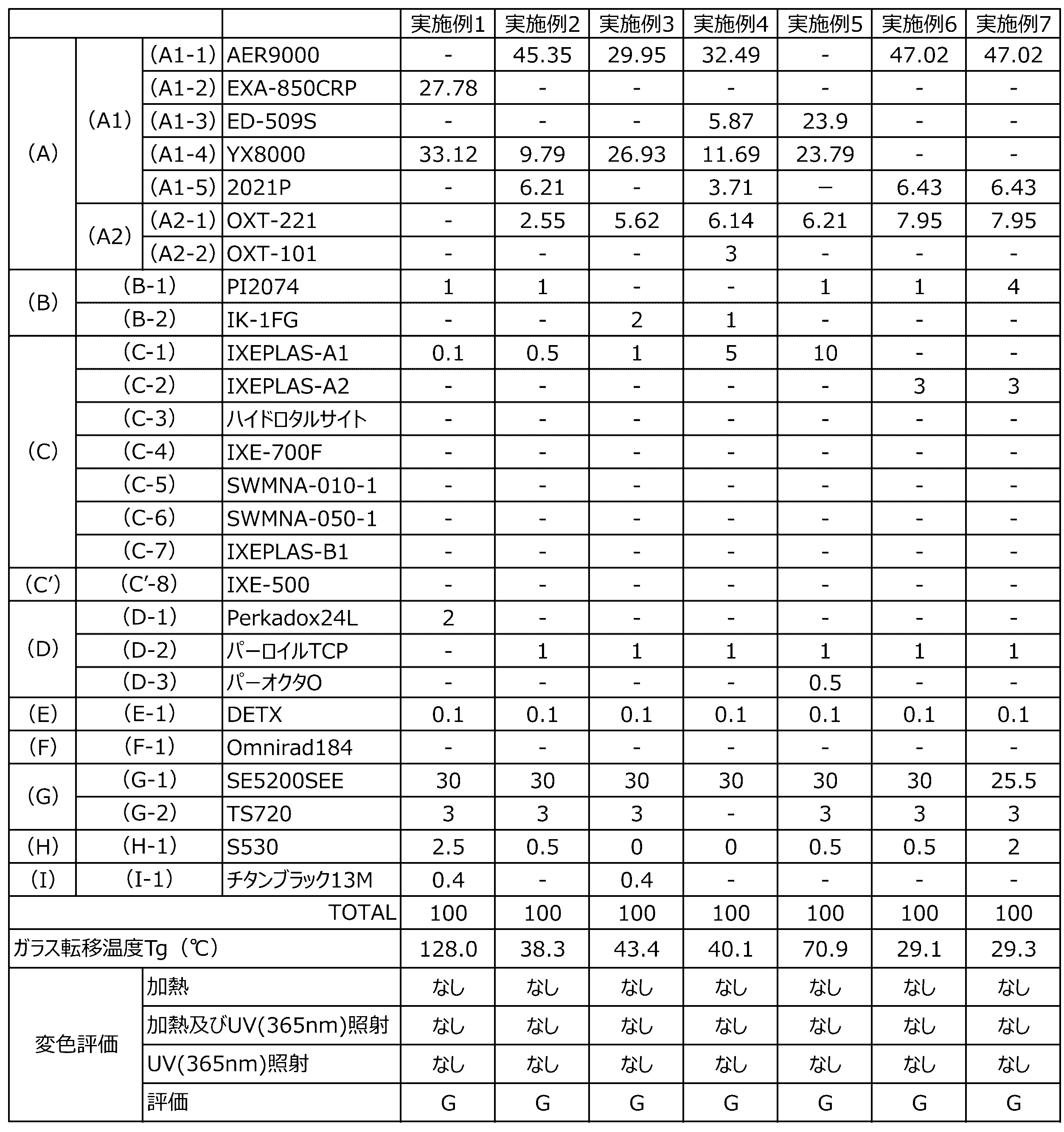
表1~3に示す配合割合に従って、3本ロールミルを用いて各量の各成分を混合することにより、硬化性樹脂組成物を調製した。表1~3において、硬化性樹脂組成物に含まれる各成分の配合割合を示す数字は、特に断りのない限り、質量部を表す。表中、各成分は、製品名又は商品名の主に記号を記載した。また、表中、「-」の記号は、該当する項目がないことを示す。
イオントラップ剤は、走査型電子顕微鏡(SEM)で観察し、得られたSEM画像のSEM画像解析により測定した任意の50個の1次粒子の算術平均値をいう。成分(C)のイオントラップ剤として、市販品を用いる場合には、1次粒子の平均粒径は、カタログ値であってよい。
実施例1~7、11~16、18及び比較例1~4の各硬化性樹脂組成物を、エクセリタス・テクノロジーズ社製UV LED照射装置AC475を用いて、積算光量2000mJ/cm2(ウシオ電機株式会社製UIT-250(受光機UVD-365を接続)にて測定)照射後、80℃で60分間、送風乾燥機を用いて加熱することにより、硬化物を得た。実施例8~10、17の各硬化性樹脂組成物は80℃で60分間、送風乾燥機を用いて加熱することにより、硬化物を得た。各硬化物について以下の測定を行った。結果を表1~3に示す。
日本工業規格JIS C6481に準じて測定した。具体的には、まず、厚さ3mmのガラス板のシリコーン系離型剤を塗布した。その上に、硬化した際の膜厚が400±150μmとなるようにスペーサー(耐熱テープを重ねたもの)を2箇所に配置した。次に、スペーサー間に硬化性樹脂組成物を塗布し、気泡を巻き込まないように、表面にシリコーン系離型剤を塗布した別のガラス板で挟み込んだ。実施例1~7、11~16、18及び比較例1~4の各硬化性樹脂組成物に対して、エクセリタス・テクノロジーズ社製UV LED照射装置AC475を用いて、積算光量2000mJ/cm2(ウシオ電機株式会社製UIT-250(受光機UVD-365を接続))にて測定)で、UV照射によるUV硬化処理を行い、各硬化性樹脂組成物を硬化させた硬化物を得た。また、実施例8~10、17の各硬化性樹脂組成物は、送風乾燥機を用いて加熱することにより、各硬化性樹脂組成物を硬化させた硬化物を得た。最後に、これらの硬化物を、シリコーン系離型剤が塗布されたガラス板から剥がした後、カッターで所定寸法(縦10mm、横40mm)に切り取り、試験片を得た。なお、切り口はサンドペーパーで滑らかにした。この硬化物を、動的熱機械測定装置(DMA)(セイコーインスツル社製)を用いて、-20℃~200℃の範囲、周波数10Hz、昇温速度3℃/min、ひずみ振幅5μm、引張法で、初期のTgを測定した。Tgは、硬化物の貯蔵弾性率(E’)及び損失弾性率(E”)を測定し、E”/E’から求められる誘電正接(tanδ)のピーク温度をTgとして求めた。
銅めっきされた幅3cm、高さ3cm、厚み1mmのガラスエポキシ基板(NEMA又はANSI規格のFR4基板)上に、樹脂組成物を6mmφ(直径:6mm)の大きさ、600μmの厚さで孔版印刷により塗布した。その後、送風乾燥機中で80℃、60分で熱硬化させた。得られた試験片を、温度85℃及び湿度85%の条件下で、恒温高湿漕内に500時間放置した。恒温恒湿漕から試験片を取り出し、硬化した樹脂組成物周囲の銅が変色しているかを目視で確認した。変色が確認された場合、硬化物から変色部分までの長さ(単位:mm)を測定した。この試験片を用いて求められた変色性が加熱後の変色性と定義された。加熱後の変色性は好ましくは1mm以下である。より好ましくは0.5mm以下、さらに好ましくは0.1mm以下である。
銅めっきされた幅3cm、高さ3cm、厚み1mmのガラスエポキシ基板(NEMA又はANSI規格のFR4基板)上に、樹脂組成物を6mmφ(直径:6mm)の大きさ、600μmの厚さで孔版印刷により塗布した。その後、樹脂組成物を塗布した面の垂直方向から、エクセリタス・テクノロジーズ社製UV LED照射装置AC475を用いて、積算光量2000mJ/cm2(ウシオ電機株式会社製UIT-250(受光機UVD-365を接続)にて測定)で硬化させた。得られた試験片を、温度85℃及び湿度85%の条件下で、恒温高湿漕内に500時間放置した。恒温恒湿漕から試験片を取り出し、硬化した樹脂組成物周囲の銅が変色しているかを目視で確認した。変色が確認された場合、硬化物から変色部分までの長さ(単位:mm)を測定した。この試験片を用いて求められた変色性が紫外線照射後の変色性と定義された。紫外線照射後の変色性は好ましくは1mm以下である。より好ましくは0.5mm以下、さらに好ましくは0.1mm以下である。
銅めっきされた幅3cm、高さ3cm、厚み1mmのガラスエポキシ基板(NEMA又はANSI規格のFR4基板)上に、樹脂組成物を6mmφ(直径:6mm)の大きさ、600μmの厚さで孔版印刷により塗布した。その後、樹脂組成物を塗布した面の垂直方向から、エクセリタス・テクノロジーズ社製UV LED照射装置AC475を用いて、積算光量2000mJ/cm2(ウシオ電機株式会社製UIT-250(受光機UVD-365を接続)にて測定)で硬化させた。さらに送風乾燥機中で80℃、60分で熱硬化させた。得られた試験片を、温度85℃及び湿度85%の条件下で、恒温高湿漕内に500時間放置した。恒温恒湿漕から試験片を取り出し、硬化した樹脂組成物周囲の銅が変色しているかを目視で確認した。変色が確認された場合、硬化物から変色部分までの長さ(単位:mm)を測定した。この試験片を用いて求められた変色性が加熱及び紫外線照射後の変色性と定義された。加熱及び紫外線照射後の変色性は好ましくは1mm以下である。より好ましくは0.5mm以下、さらに好ましくは0.1mm以下である。
加熱による場合、紫外線(UV)照射による場合、加熱及び紫外線(UV)照射による場合のいずれも変色が認められなかった場合を「G(Good)」と評価した。いずれの評価においても変色が1mm以下である場合は、「A(Average)」と評価した。加熱及び紫外線(UV)照射による場合のいずれかで変色が1mmを超えて認められた場合は、「B(Bad)」と評価した。成分(E)又は成分(F)が含まれず、紫外線照射により硬化しない場合は「―」と評価した。


Claims (12)
- (A)カチオン硬化性樹脂、
(B)ヨードニウム塩を含む酸発生剤、及び、
(C)Zr、Mg及びAlからなる群から選択される少なくとも1種の原子を含むイオントラップ剤、を含む硬化性樹脂組成物。 - 前記成分(C)が、前記成分(B)1質量部に対して、0.1~15質量部である、請求項1に記載の硬化性樹脂組成物。
- 前記成分(C)が、両イオン交換型のイオントラップ剤である、請求項1又は2に記載の硬化性樹脂組成物。
- 前記成分(C)の1次粒子の平均粒子径が30nm~3000nmである、請求項1~3のいずれか1項に記載の硬化性樹脂組成物。
- 前記成分(A)が、
(A1)エポキシ基当量が100g/eq~1000g/eqであり、環骨格を分子内に有するエポキシ樹脂、及び
(A2)オキセタン樹脂からなる群から選択される少なくとも1種を含む、請求項1~4のいずれか1項に記載の硬化性樹脂組成物。 - (D)有機過酸化物をさらに含む、請求項1~5のいずれか1項に硬化性樹脂組成物。
- 前記成分(B)に含まれるヨードニウム塩が、下記式(1)で表されるヨードニウム塩化合物である、請求項1~6のいずれか1項に記載の硬化性樹脂組成物。

- 前記式(1)中のZ-が、BF4 -、SbF6-、AsF6 -、B(C6F5)4 -、又はGa(C6F5)4 -、C(CF3SO2)3 -、あるいは[P(RF)aF6-a]-、[C(RFSO2)3]-、又は[N(RFSO2)2]-(式中、RFは、それぞれ独立して、水素原子の少なくとも一部がフッ素原子で置換されているアルキル基であり、aは0~5の整数であり、aが2以上の整数である場合、複数存在するRFは、互いに同一でもよく異なっていてもよい。)、請求項7に記載の硬化性樹脂組成物。
- 請求項1~8のいずれか1項に記載の硬化性樹脂組成物を含む、接着剤又は封止材。
- 請求項1~8のいずれか1項に記載の硬化性樹脂組成物、請求項9に記載の接着剤又は封止材、を硬化させて得られる、硬化物。
- 請求項10に記載の硬化物を含む半導体装置。
- 請求項10に記載の硬化物を含む電子デバイス。
Priority Applications (4)
| Application Number | Priority Date | Filing Date | Title |
|---|---|---|---|
| EP23911230.3A EP4644456A4 (en) | 2022-12-27 | 2023-07-27 | Composition of hardening resin, adhesive, encapsulating agent, cured product, semiconductor device and electronic device |
| CN202380080555.9A CN120225586A (zh) | 2022-12-27 | 2023-07-27 | 固化性树脂组合物、粘结剂、密封材料、固化物、半导体装置以及电子器件 |
| KR1020257011194A KR20250128290A (ko) | 2022-12-27 | 2023-07-27 | 경화성 수지 조성물, 접착제, 봉지재, 경화물, 반도체 장치, 및 전자 디바이스 |
| JP2024567192A JPWO2024142446A1 (ja) | 2022-12-27 | 2023-07-27 |
Applications Claiming Priority (2)
| Application Number | Priority Date | Filing Date | Title |
|---|---|---|---|
| JP2022-210519 | 2022-12-27 | ||
| JP2022210519 | 2022-12-27 |
Publications (1)
| Publication Number | Publication Date |
|---|---|
| WO2024142446A1 true WO2024142446A1 (ja) | 2024-07-04 |
Family
ID=91717033
Family Applications (1)
| Application Number | Title | Priority Date | Filing Date |
|---|---|---|---|
| PCT/JP2023/027618 Ceased WO2024142446A1 (ja) | 2022-12-27 | 2023-07-27 | 硬化性樹脂組成物、接着剤、封止材、硬化物、半導体装置及び電子デバイス |
Country Status (6)
| Country | Link |
|---|---|
| EP (1) | EP4644456A4 (ja) |
| JP (1) | JPWO2024142446A1 (ja) |
| KR (1) | KR20250128290A (ja) |
| CN (1) | CN120225586A (ja) |
| TW (1) | TW202426595A (ja) |
| WO (1) | WO2024142446A1 (ja) |
Cited By (2)
| Publication number | Priority date | Publication date | Assignee | Title |
|---|---|---|---|---|
| WO2025204845A1 (ja) * | 2024-03-25 | 2025-10-02 | ナミックス株式会社 | 樹脂組成物、接着剤、封止材、硬化物、半導体装置及び電子部品 |
| WO2025204847A1 (ja) * | 2024-03-25 | 2025-10-02 | ナミックス株式会社 | 樹脂組成物、接着剤、封止材、硬化物、半導体装置及び電子部品 |
Citations (5)
| Publication number | Priority date | Publication date | Assignee | Title |
|---|---|---|---|---|
| WO2011055784A1 (ja) * | 2009-11-05 | 2011-05-12 | 日立化成工業株式会社 | 熱重合系開始剤システム及び接着剤組成物 |
| JP2014081611A (ja) * | 2012-09-28 | 2014-05-08 | Taiyo Ink Mfg Ltd | 光硬化性樹脂組成物、プリント配線板、及び光硬化性樹脂組成物の製造方法 |
| JP2016046300A (ja) * | 2014-08-20 | 2016-04-04 | 日立化成株式会社 | 半導体接続部封止用接着剤及びこれを用いた半導体装置の製造方法、半導体装置 |
| JP2017082027A (ja) * | 2015-10-22 | 2017-05-18 | 信越化学工業株式会社 | フォトカプラー一次封止用熱硬化性エポキシ樹脂組成物 |
| JP2019099726A (ja) * | 2017-12-06 | 2019-06-24 | 住友ベークライト株式会社 | エポキシ樹脂および電子装置 |
Family Cites Families (1)
| Publication number | Priority date | Publication date | Assignee | Title |
|---|---|---|---|---|
| JP7779018B2 (ja) * | 2020-04-07 | 2025-12-03 | Dic株式会社 | 接着シート、ならびに該接着シートを用いた積層体及びその製造方法 |
-
2023
- 2023-07-27 EP EP23911230.3A patent/EP4644456A4/en active Pending
- 2023-07-27 CN CN202380080555.9A patent/CN120225586A/zh active Pending
- 2023-07-27 WO PCT/JP2023/027618 patent/WO2024142446A1/ja not_active Ceased
- 2023-07-27 KR KR1020257011194A patent/KR20250128290A/ko active Pending
- 2023-07-27 JP JP2024567192A patent/JPWO2024142446A1/ja active Pending
- 2023-08-08 TW TW112129672A patent/TW202426595A/zh unknown
Patent Citations (5)
| Publication number | Priority date | Publication date | Assignee | Title |
|---|---|---|---|---|
| WO2011055784A1 (ja) * | 2009-11-05 | 2011-05-12 | 日立化成工業株式会社 | 熱重合系開始剤システム及び接着剤組成物 |
| JP2014081611A (ja) * | 2012-09-28 | 2014-05-08 | Taiyo Ink Mfg Ltd | 光硬化性樹脂組成物、プリント配線板、及び光硬化性樹脂組成物の製造方法 |
| JP2016046300A (ja) * | 2014-08-20 | 2016-04-04 | 日立化成株式会社 | 半導体接続部封止用接着剤及びこれを用いた半導体装置の製造方法、半導体装置 |
| JP2017082027A (ja) * | 2015-10-22 | 2017-05-18 | 信越化学工業株式会社 | フォトカプラー一次封止用熱硬化性エポキシ樹脂組成物 |
| JP2019099726A (ja) * | 2017-12-06 | 2019-06-24 | 住友ベークライト株式会社 | エポキシ樹脂および電子装置 |
Non-Patent Citations (1)
| Title |
|---|
| See also references of EP4644456A4 * |
Cited By (2)
| Publication number | Priority date | Publication date | Assignee | Title |
|---|---|---|---|---|
| WO2025204845A1 (ja) * | 2024-03-25 | 2025-10-02 | ナミックス株式会社 | 樹脂組成物、接着剤、封止材、硬化物、半導体装置及び電子部品 |
| WO2025204847A1 (ja) * | 2024-03-25 | 2025-10-02 | ナミックス株式会社 | 樹脂組成物、接着剤、封止材、硬化物、半導体装置及び電子部品 |
Also Published As
| Publication number | Publication date |
|---|---|
| EP4644456A4 (en) | 2026-03-25 |
| TW202426595A (zh) | 2024-07-01 |
| JPWO2024142446A1 (ja) | 2024-07-04 |
| EP4644456A1 (en) | 2025-11-05 |
| CN120225586A (zh) | 2025-06-27 |
| KR20250128290A (ko) | 2025-08-27 |
Similar Documents
| Publication | Publication Date | Title |
|---|---|---|
| CN107001583B (zh) | 光及热固化性树脂组合物、固化物以及层积体 | |
| CN101410432B (zh) | 光学材料用固化性组合物和光波导 | |
| TWI745366B (zh) | 硬化性樹脂組成物、乾膜、硬化物及印刷配線板 | |
| JP6024265B2 (ja) | 放熱塗料組成物とそれを用いた放熱部材 | |
| JP6092165B2 (ja) | 信頼性に優れた感光性樹脂組成物及びその製造方法 | |
| TWI913441B (zh) | 硬化性樹脂組成物 | |
| CN115315498A (zh) | 可双重固化粘合剂组合物 | |
| EP4644456A1 (en) | Curable resin composition, adhesive, sealing material, cured product, semiconductor device, and electronic device | |
| EP4644457A1 (en) | Curable resin composition, adhesive, sealing material, cured product, semiconductor apparatus, and electronic device | |
| JP6539437B2 (ja) | カチオン重合性組成物 | |
| TW201934645A (zh) | 樹脂組成物及其硬化物、接著劑、半導體裝置,以及電子零件 | |
| JP6353306B2 (ja) | 高分子エポキシ樹脂を含む光学シート状接着剤用樹脂組成物、該組成物よりなる光学シート用接着剤、及びその硬化物、並びに、前記組成物に使用する高分子エポキシ樹脂の製造方法 | |
| JP7481011B2 (ja) | 熱カチオン重合性樹脂組成物 | |
| WO2005014686A1 (ja) | 光硬化型樹脂組成物及びそれを用いたフラットパネルディスプレイ用シール剤 | |
| JP6109636B2 (ja) | 光硬化性樹脂組成物 | |
| JP7053485B2 (ja) | プリント配線板用の硬化性絶縁性組成物、ドライフィルム、硬化物、プリント配線板およびプリント配線板用の硬化性絶縁性組成物の製造方法 | |
| JP5409276B2 (ja) | 透明複合材料 | |
| JP2016122153A (ja) | 新規感光性樹脂組成物とその応用 | |
| WO2024142448A1 (ja) | 硬化性樹脂組成物、接着剤、封止材、硬化物、半導体装置及び電子デバイス | |
| WO2023021891A1 (ja) | 紫外線硬化性組成物 | |
| JP6251894B2 (ja) | エネルギー線感受性組成物 | |
| WO2025205910A1 (ja) | 重合性組成物、接着剤、封止材、硬化物、半導体装置及び電子部品 | |
| WO2025204845A1 (ja) | 樹脂組成物、接着剤、封止材、硬化物、半導体装置及び電子部品 | |
| TW202615535A (zh) | 硬化性樹脂組成物 | |
| JP2020105265A (ja) | 活性エネルギー線硬化性接着剤組成物、偏光板用接着剤組成物、偏光板用接着剤、及びそれを用いた偏光板 |
Legal Events
| Date | Code | Title | Description |
|---|---|---|---|
| 121 | Ep: the epo has been informed by wipo that ep was designated in this application |
Ref document number: 23911230 Country of ref document: EP Kind code of ref document: A1 |
|
| WWE | Wipo information: entry into national phase |
Ref document number: 2024567192 Country of ref document: JP |
|
| WWE | Wipo information: entry into national phase |
Ref document number: 202380080555.9 Country of ref document: CN |
|
| WWE | Wipo information: entry into national phase |
Ref document number: 202517059960 Country of ref document: IN |
|
| WWP | Wipo information: published in national office |
Ref document number: 202380080555.9 Country of ref document: CN |
|
| WWP | Wipo information: published in national office |
Ref document number: 202517059960 Country of ref document: IN |
|
| WWE | Wipo information: entry into national phase |
Ref document number: 2023911230 Country of ref document: EP |
|
| NENP | Non-entry into the national phase |
Ref country code: DE |
|
| ENP | Entry into the national phase |
Ref document number: 2023911230 Country of ref document: EP Effective date: 20250728 |
|
| ENP | Entry into the national phase |
Ref document number: 2023911230 Country of ref document: EP Effective date: 20250728 |
|
| WWP | Wipo information: published in national office |
Ref document number: 1020257011194 Country of ref document: KR |
|
| WWP | Wipo information: published in national office |
Ref document number: 2023911230 Country of ref document: EP |