WO2024143343A1 - 遮光剤を含む皮膜からなる硬質カプセル、硬質カプセル調製液、及び硬質カプセルの調製方法 - Google Patents
遮光剤を含む皮膜からなる硬質カプセル、硬質カプセル調製液、及び硬質カプセルの調製方法 Download PDFInfo
- Publication number
- WO2024143343A1 WO2024143343A1 PCT/JP2023/046599 JP2023046599W WO2024143343A1 WO 2024143343 A1 WO2024143343 A1 WO 2024143343A1 JP 2023046599 W JP2023046599 W JP 2023046599W WO 2024143343 A1 WO2024143343 A1 WO 2024143343A1
- Authority
- WO
- WIPO (PCT)
- Prior art keywords
- hard capsule
- mass
- capsule
- light
- hard
- Prior art date
- Legal status (The legal status is an assumption and is not a legal conclusion. Google has not performed a legal analysis and makes no representation as to the accuracy of the status listed.)
- Ceased
Links
Images

Classifications
-
- A—HUMAN NECESSITIES
- A61—MEDICAL OR VETERINARY SCIENCE; HYGIENE
- A61K—PREPARATIONS FOR MEDICAL, DENTAL OR TOILETRY PURPOSES
- A61K9/00—Medicinal preparations characterised by special physical form
- A61K9/48—Preparations in capsules, e.g. of gelatin, of chocolate
- A61K9/4816—Wall or shell material
-
- A—HUMAN NECESSITIES
- A23—FOODS OR FOODSTUFFS; TREATMENT THEREOF, NOT COVERED BY OTHER CLASSES
- A23P—SHAPING OR WORKING OF FOODSTUFFS, NOT FULLY COVERED BY A SINGLE OTHER SUBCLASS
- A23P10/00—Shaping or working of foodstuffs characterised by the products
- A23P10/30—Encapsulation of particles, e.g. foodstuff additives
-
- A—HUMAN NECESSITIES
- A61—MEDICAL OR VETERINARY SCIENCE; HYGIENE
- A61K—PREPARATIONS FOR MEDICAL, DENTAL OR TOILETRY PURPOSES
- A61K8/00—Cosmetics or similar toiletry preparations
- A61K8/02—Cosmetics or similar toiletry preparations characterised by special physical form
- A61K8/0241—Containing particulates characterized by their shape and/or structure
-
- A—HUMAN NECESSITIES
- A61—MEDICAL OR VETERINARY SCIENCE; HYGIENE
- A61K—PREPARATIONS FOR MEDICAL, DENTAL OR TOILETRY PURPOSES
- A61K8/00—Cosmetics or similar toiletry preparations
- A61K8/02—Cosmetics or similar toiletry preparations characterised by special physical form
- A61K8/11—Encapsulated compositions
-
- A—HUMAN NECESSITIES
- A61—MEDICAL OR VETERINARY SCIENCE; HYGIENE
- A61K—PREPARATIONS FOR MEDICAL, DENTAL OR TOILETRY PURPOSES
- A61K8/00—Cosmetics or similar toiletry preparations
- A61K8/18—Cosmetics or similar toiletry preparations characterised by the composition
- A61K8/19—Cosmetics or similar toiletry preparations characterised by the composition containing inorganic ingredients
-
- A—HUMAN NECESSITIES
- A61—MEDICAL OR VETERINARY SCIENCE; HYGIENE
- A61K—PREPARATIONS FOR MEDICAL, DENTAL OR TOILETRY PURPOSES
- A61K8/00—Cosmetics or similar toiletry preparations
- A61K8/18—Cosmetics or similar toiletry preparations characterised by the composition
- A61K8/19—Cosmetics or similar toiletry preparations characterised by the composition containing inorganic ingredients
- A61K8/20—Halogens; Compounds thereof
-
- A—HUMAN NECESSITIES
- A61—MEDICAL OR VETERINARY SCIENCE; HYGIENE
- A61K—PREPARATIONS FOR MEDICAL, DENTAL OR TOILETRY PURPOSES
- A61K8/00—Cosmetics or similar toiletry preparations
- A61K8/18—Cosmetics or similar toiletry preparations characterised by the composition
- A61K8/72—Cosmetics or similar toiletry preparations characterised by the composition containing organic macromolecular compounds
- A61K8/73—Polysaccharides
- A61K8/731—Cellulose; Quaternized cellulose derivatives
-
- A—HUMAN NECESSITIES
- A61—MEDICAL OR VETERINARY SCIENCE; HYGIENE
- A61K—PREPARATIONS FOR MEDICAL, DENTAL OR TOILETRY PURPOSES
- A61K9/00—Medicinal preparations characterised by special physical form
- A61K9/48—Preparations in capsules, e.g. of gelatin, of chocolate
- A61K9/4883—Capsule finishing, e.g. dyeing, aromatising, polishing
-
- A—HUMAN NECESSITIES
- A61—MEDICAL OR VETERINARY SCIENCE; HYGIENE
- A61Q—SPECIFIC USE OF COSMETICS OR SIMILAR TOILETRY PREPARATIONS
- A61Q19/00—Preparations for care of the skin
-
- A—HUMAN NECESSITIES
- A23—FOODS OR FOODSTUFFS; TREATMENT THEREOF, NOT COVERED BY OTHER CLASSES
- A23L—FOODS, FOODSTUFFS OR NON-ALCOHOLIC BEVERAGES, NOT OTHERWISE PROVIDED FOR; PREPARATION OR TREATMENT THEREOF
- A23L33/00—Modifying nutritive qualities of foods; Dietetic products; Preparation or treatment thereof
- A23L33/10—Modifying nutritive qualities of foods; Dietetic products; Preparation or treatment thereof using additives
-
- A—HUMAN NECESSITIES
- A61—MEDICAL OR VETERINARY SCIENCE; HYGIENE
- A61K—PREPARATIONS FOR MEDICAL, DENTAL OR TOILETRY PURPOSES
- A61K2800/00—Properties of cosmetic compositions or active ingredients thereof or formulation aids used therein and process related aspects
- A61K2800/10—General cosmetic use
-
- A—HUMAN NECESSITIES
- A61—MEDICAL OR VETERINARY SCIENCE; HYGIENE
- A61K—PREPARATIONS FOR MEDICAL, DENTAL OR TOILETRY PURPOSES
- A61K2800/00—Properties of cosmetic compositions or active ingredients thereof or formulation aids used therein and process related aspects
- A61K2800/40—Chemical, physico-chemical or functional or structural properties of particular ingredients
- A61K2800/41—Particular ingredients further characterized by their size
- A61K2800/412—Microsized, i.e. having sizes between 0.1 and 100 microns
-
- A—HUMAN NECESSITIES
- A61—MEDICAL OR VETERINARY SCIENCE; HYGIENE
- A61K—PREPARATIONS FOR MEDICAL, DENTAL OR TOILETRY PURPOSES
- A61K2800/00—Properties of cosmetic compositions or active ingredients thereof or formulation aids used therein and process related aspects
- A61K2800/40—Chemical, physico-chemical or functional or structural properties of particular ingredients
- A61K2800/60—Particulates further characterized by their structure or composition
- A61K2800/65—Characterized by the composition of the particulate/core
- A61K2800/651—The particulate/core comprising inorganic material
Definitions
- This specification discloses a hard capsule having a coating containing a light-blocking agent, a hard capsule preparation solution, and a method for preparing a hard capsule.
- An example of an embodiment of the present invention is as follows.
- Item 1. A hard capsule comprising a film containing a cellulose compound and a light-shielding agent,
- the light-shielding agent contains calcium carbonate having a median diameter by volume of 0.7 ⁇ m to 3.8 ⁇ m,
- the content of the light-shielding agent in the shell is 3% by mass to 20% by mass, where the total amount of the shell components of the hard capsule excluding water is 100% by mass.
- Hard capsule Item 2.
- Item 2. The hard capsule according to item 1, wherein the cellulose compound is hydroxypropyl methylcellulose.
- Item 3. Item 3.
- a “hard capsule” refers to a type of capsule in which the capsule shell is manufactured first and then the contents are filled into the manufactured capsule shell. Usually, it consists of a cap portion and a body portion, and is also called a hard capsule or a two-piece capsule.
- the "hard capsule” of the present invention does not include soft capsules manufactured by filling the contents between two pieces of film and gluing the films together, seamless capsules manufactured by dropping the contents together with a coating solution into a coagulating liquid, and microcapsules prepared by incorporating active ingredients inside through precipitation or emulsification of a base material.
- Hydroxypropyl methylcellulose may be used alone or in any combination of two or more kinds, but any of them may have a "hypromellose viscosity value" of 300 to 5000, preferably 300 to 1500, more preferably 300 to 960.
- hydroxypropyl methylcellulose viscosity value means the sum of the viscosity (mPa ⁇ s) of a 2% by mass aqueous solution of hydroxypropyl methylcellulose used in the production of the capsule film at 20°C ⁇ 0.1°C multiplied by the ratio (parts by mass) of the viscosity to 100 parts by mass of the total amount of hydroxypropyl methylcellulose.
- the "hydroxypropyl methylcellulose viscosity value” is 600, which is "6 mPa ⁇ s x 100 parts by mass.”
- the "hydroxypropyl methylcellulose viscosity value” is 540, calculated as "4 mPa ⁇ s x 30 parts by mass + 6 mPa ⁇ s x 70 parts by mass.”
- the lower the molecular weight the lower the viscosity value. Also, when the molecular weight is low, i.e., the viscosity value is low, the solubility of the hard capsule is good, but on the other hand, it tends to be more likely to crack.
- the "hydroxypropyl methylcellulose viscosity value" is preferably 300 to 960.
- a value of 500 to 1500 is preferable.
- the content of the cellulose compound in the hard capsule shell is the remaining amount obtained by subtracting the total amount of shell components other than the cellulose compound, such as gelling agents, gelling assistants, light-blocking agents, plasticizers, lubricants, sequestering agents, colorants, light-blocking agents, etc., which will be described later.
- the shell components other than the cellulose compound do not include water.
- the gelation of the cellulose compound during film formation can be promoted by adding (1) a gelling agent, or (2) a gelling agent and a gelling assistant.
- Gelling agents include, for example, those capable of gelling the hard capsule preparation liquid, such as carrageenan, pectin, and gellan gum. These can be used alone or in any combination of two or more types.
- carrageenan is the most suitable, since it has high gel strength and exhibits excellent gelling properties even when used in small amounts in the presence of specific ions.
- Three types of carrageenan are generally known: kappa-carrageenan, iota-carrageenan, and lambda-carrageenan.
- kappa- and iota-carrageenan which have a relatively high degree of gelling ability and hardness, can be preferably used, and kappa-carrageenan is more preferably used.
- Pectin can be classified into LM pectin and HM pectin depending on the degree of esterification, and gellan gum can be classified into acylated gellan gum (native gellan gum) and deacylated gellan gum depending on whether it is acylated or not, but in the present invention, either can be used without distinction.
- the content of the gelling agent contained in the hard capsule shell is not limited as long as the hard capsule shell can be formed by the cold gel method.
- the content of the gelling agent can be 0.05 to 10% by mass, preferably 0.1 to 9.5% by mass, more preferably 0.2 to 9% by mass, and even more preferably 0.3 to 8% by mass, assuming that the total of the hard capsule shell components excluding water is 100% by mass.
- the gelling aid can be selected according to the type of gelling agent used.
- the gelling aid has the effect of promoting the gelling of the gelling agent. Alternatively, it may contribute to the promotion of gelling by directly acting on the cellulose compound to raise or lower the gelling temperature or cloud point temperature.
- examples of gelling aids that can be used in combination include compounds that can generate one or more of sodium ions, potassium ions, ammonium ions, and calcium ions in an aqueous solution for kappa-carrageenan, such as sodium chloride, potassium chloride, potassium phosphate, ammonium chloride, ammonium acetate, and calcium chloride.
- calcium carbonate used as a light-blocking agent in the present invention also produces small amounts of calcium ions in the hard capsule preparation liquid, so when gellan gum and/or iota-carrageenan are used as the gelling agent, the hard capsule preparation liquid can be gelled without adding a gelling auxiliary.
- the content of the gelling aid contained in the hard capsule shell may be set according to the content of the gelling agent.
- the content of the gelling aid may be in the range of more than 0 to 2.2% by mass, preferably 0.1 to 2.1% by mass, more preferably 0.2 to 1.9% by mass, and even more preferably 0.3 to 1.6% by mass, when the total of the hard capsule shell components excluding water is taken as 100% by mass.
- the content of the gelling aid may be in the range of 0 to 2.2% by mass, preferably 0.1 to 2.1% by mass, more preferably 0.2 to 1.9% by mass, and even more preferably 0.3 to 1.6% by mass, when the total of the hard capsule shell components excluding water is taken as 100% by mass.
- the light-blocking agent includes calcium carbonate.
- calcium carbonate produced by crushing limestone is called heavy calcium carbonate.
- Calcium carbonate produced industrially is called light calcium carbonate, precipitated calcium carbonate, or synthetic calcium carbonate. Either type of calcium carbonate may be used for the hard capsule shell, but ground calcium carbonate is preferred.
- the Dv50 of calcium carbonate is preferably 0.5 ⁇ m to 7 ⁇ m if the transmittance is to be 40% or less, preferably 0.6 ⁇ m to 5 ⁇ m if the transmittance is to be 30% or less, and preferably 0.9 ⁇ m to 3.8 ⁇ m if the transmittance is to be 20% or less.
- Heavy calcium carbonates include precipitated calcium carbonate A (Bihoku Powder Industry, Dv50: 2.16 ⁇ m, *the name is precipitated calcium carbonate but the manufacturer says it is heavy calcium carbonate), Aragen (Carfain, Dv50: 5.05 ⁇ m), Caltex 5 (Maruo Calcium, Dv50: 1.82 ⁇ m), ACE-30 (Carfain, Dv50: 1.89 ⁇ m), ACE-35 (Carfain, Dv50: 2.04 ⁇ m), Calmigen A (Bihoku Powder Industry, Dv50: 2.12 ⁇ m), Nanox 25A (Maruo Calcium, Dv50: 3.02 ⁇ m), Nanox 30 (Maruo Calcium, Dv50: 2.21 ⁇ m), Calcy F (Sankyo Seifun, Dv50: 2.44 ⁇ m), and Criston SS food additive (Carfain, Dv50: 3.02 ⁇ m).
- Calpin F Yamamoto Kogyo, Dv50: 2.63 ⁇ m
- Calessen I As precipitated calcium carbonate, Calpin F (Yabashi Kogyo, Dv50: 2.63 ⁇ m), Calessen I (Shiraishi Kogyo, Dv50: 0.39 ⁇ m), CAL ACE-ST (Maruo Calcium, Dv50: 0.51 ⁇ m), etc. can be used.
- the Dv50 value is the median diameter per volume unit, and indicates the actual value measured using the laser diffraction method described in JIS Z 8825.
- the content of the light-blocking agent in the hard capsule shell is, for example, 3% to 20% by mass, assuming that the total amount of the hard capsule shell components excluding water is 100% by mass. It is preferably 6% to 20% by mass.
- the hard capsule shell may contain plasticizers, lubricants, metal blocking agents, colorants, light blocking agents, residual moisture (also simply called moisture), etc. as hard capsule shell components as necessary.
- the plasticizer is not particularly limited as long as it can be used in pharmaceutical or food compositions, but examples include dioctyl adipate, adipate polyester, epoxidized soybean oil, epoxy hexahydrophthalic acid diester, kaolin, triethyl citrate, glycerin, glycerin fatty acid ester, sesame oil, dimethylpolysiloxane-silicon dioxide mixture, D-sorbitol, medium chain fatty acid triglyceride, sugar alcohol liquid derived from corn starch, triacetin, concentrated glycerin, castor oil, furan, etc.
- plasticizers examples include phytosterol, diethyl phthalate, dioctyl phthalate, dibutyl phthalate, butylphthalyl butyl glycolate, propylene glycol, polyoxyethylene (105) polyoxypropylene (5) glycol, polysorbate 80, macrogol 1500, macrogol 400, macrogol 4000, macrogol 600, macrogol 6000, isopropyl myristate, cottonseed oil/soybean oil mixture, glycerin monostearate, and isopropyl linoleate.
- the amount is usually 15% by mass or less, assuming that the total amount of the hard capsule shell components excluding water is 100% by mass. It can be added preferably in an amount of 13% by mass or less, more preferably 11% by mass or less, and even more preferably 8% by mass or less.
- Sequestering agents include ethylenediaminetetraacetic acid, acetic acid, boric acid, citric acid, gluconic acid, lactic acid, phosphoric acid, tartaric acid, or salts thereof, metaphosphate, dihydroxyethylglycine, lecithin, ⁇ -cyclodextrin, or combinations thereof.
- lubricant there are no particular limitations on the lubricant, so long as it can be used in pharmaceutical or food compositions. Examples include calcium stearate, magnesium stearate, sodium stearyl fumarate, carnauba wax, starch, sucrose fatty acid esters, light anhydrous silicic acid, macrogol, talc, hydrogenated vegetable oil, etc.
- colorants include acacia tannin powder, turmeric extract, methyl rosaniline chloride, yellow iron oxide, yellow ferric oxide, Opaspray K-1-24904, orange essence, brown iron oxide, carbon black, caramel, carmine, carotene liquid, ⁇ -carotene, photosensitizer No. 201, licorice extract, gold leaf, kumazasa extract, black iron oxide, light anhydrous silicic acid, ketket, zinc oxide, titanium oxide, ferric oxide, disazo yellow, Food Blue No. 1 and its aluminum lake, Food Blue No. 2 and its aluminum lake, Food Yellow No.
- colorants include acacia tannin powder, turmeric extract, methyl rosaniline chloride, yellow iron oxide, yellow ferric oxide, Opaspray K-1-24904, orange essence, brown iron oxide, carbon black, caramel, carmine, carotene liquid, ⁇ -carotene, photosensitizer No. 201, licorice extract, gold leaf, kumazasa extract, black
- Examples of light-blocking agents include titanium oxide, ferric oxide, yellow ferric oxide, black ferric oxide, food blue no. 1 aluminum lake, food blue no. 2 aluminum lake, food yellow no. 4 aluminum lake, food yellow no. 5 aluminum lake, food green no. 3 aluminum lake, food red no. 2 aluminum lake, food red no. 3 aluminum lake, food red no. 102 aluminum lake, food red no. 104 aluminum lake, food red no. 105 aluminum lake, food red no. 106 aluminum lake, and food red no. 40 aluminum lake.
- the capsule shell after preparation usually contains a few percent of residual moisture.
- the molded capsule is dried at a temperature between 30°C and 100°C, it settles to a predetermined saturated residual moisture value corresponding to the solid content and composition of the capsule.
- the time it takes to settle to the saturated moisture value is shorter when the drying process is performed at a higher temperature.
- the residual moisture also depends on the environmental humidity during storage of the capsule, but it changes almost reversibly.
- the saturated moisture value after sufficient drying process at 30 to 100°C converges to a constant value when the capsule is further stored for several days at a constant temperature and relative humidity.
- the saturated moisture value after storage for several days at room temperature and a relative humidity of 43% is used.
- the saturated moisture value of the residual moisture at room temperature and 43% relative humidity is preferably at least 1% relative to the total mass of the capsule shell, more preferably 2% or more, and even more preferably 3% or more.
- the residual moisture is preferably too much, it may react with the drug filled inside when stored for a long period of time, so it is preferably 8% or less, and more preferably 6% or less.
- the residual saturated moisture content can be expressed as the moisture content in the loss on drying, and can be measured as follows.
- a sample (hard capsule or film) is placed in a desiccator in an atmosphere of a constant humidity state with a saturated aqueous solution of potassium carbonate, sealed, and conditioned at 25°C for one week. In addition, an atmosphere of about 43% relative humidity can be created in the presence of a saturated aqueous solution of potassium carbonate.
- the sample After measuring the mass (wet mass) of the sample after conditioned humidity, the sample is then heated and dried at 105°C for two hours, and the mass (dry mass) of the sample is measured again.
- the ratio of the amount of moisture (moisture content) reduced by heating and drying at 105°C for two hours is calculated from the difference between the mass (wet mass) before drying and the mass (dry mass) after drying according to the following formula.
- a metal applicator When preparing a cast film using the thermal gel method, a metal applicator is placed on a glass surface or PET film maintained at 60°C, and the preparation liquid at room temperature is poured in and moved at a constant speed to prepare a uniform wet film with a film thickness of 100 ⁇ m after drying. The wet film is then dried at about 60°C for about 1 hour, and then further dried at room temperature for about 10 hours to obtain a cast film.
- applicators with gaps of 0.4 mm to 1.5 mm can be used appropriately to obtain a film with a uniform film thickness of 100 ⁇ m.
- the toughness (toughness, MJ/m3) can be obtained as an index of crack resistance (reference: Aqueous Polymeric Coating For Pharmaceutical Dosage Forms, 4th edition, CRC Press, 2017, Chapter 4).
- the toughness which is an index of resistance to cracking, is preferably 2.0 MJ/m3 or more. If the toughness falls below 0.6 MJ/m3, the coating will be significantly more susceptible to cracking even with normal handling.
- the method for preparing hard capsules includes a step of preparing a capsule preparation liquid by the above-mentioned method or by purchasing a capsule preparation liquid, and a preparation step of immersing a capsule molding pin in the capsule preparation liquid, pulling it up, gelling the solution that adheres to the capsule molding pin, and then drying the gelled shell at 20 to 80°C.
- hard capsules prepared by the cold gel method can be prepared through the following molding steps.
- a step of immersing capsule-forming pins in a capsule preparation liquid (immersion liquid) containing a cellulose compound (and, if necessary, a gelling agent or a gelling assistant) immersion step
- (2) A step of pulling up the capsule-molding pin from the capsule-preparing liquid (immersion liquid) and gelling the capsule-preparing liquid adhering to the outer surface of the pin (gelling step); (3) A step of drying the gelled capsule film (gelled coating) formed on the outer surface of the capsule molding pin (drying step); (4) A process of detaching the dried capsule film (skin) from the capsule molding pin (detachment process). If necessary, the following heating step may be carried out after the step (4).
- the capsule preparation liquid when a solution containing a gelling agent such as carrageenan is used as the capsule preparation liquid (immersion liquid), the solution gels at a temperature of 50°C or less, and the temperature around the capsule manufacturing machine is usually set to 35°C or less, preferably 30°C or less, and preferably room temperature, and the above gelation step (2) can be carried out by allowing the capsule preparation liquid attached to the outer surface of the capsule molding pin to cool (cold gel method).
- a solution containing a gelling agent such as carrageenan
- the thickness of the hard capsule shell is usually in the range of 50 to 200 ⁇ m.
- the thickness of the side wall of the capsule is usually 70 to 150 ⁇ m, and more preferably 80 to 120 ⁇ m, for capsules currently on the market.
- Hard capsules come in a variety of sizes, including No. 00, No. 0, No. 1, No. 2, No. 3, No. 4, and No. 5, and any size of hard capsule can be used in the present invention. It should be noted that a capsule shell can also be obtained by a solidification method that does not involve gelation and relies solely on the evaporation and drying of water from the capsule preparation solution.
- the filling of the contents into the hard capsules can be carried out using a known capsule filling machine described in JP-A-2007-144014, JP-A-2000-226097, etc., such as a fully automatic capsule filling machine (model name: LIQFIL super 80/150, manufactured by Qualicaps Co., Ltd.) or a capsule filling and sealing machine (model name: LIQFIL super FS, manufactured by Qualicaps Co., Ltd.).
- a fully automatic capsule filling machine model name: LIQFIL super 80/150, manufactured by Qualicaps Co., Ltd.
- a capsule filling and sealing machine model name: LIQFIL super FS, manufactured by Qualicaps Co., Ltd.
- the fitting portion may be sealed with a band seal as described in JP 2005-187412 A or JP 2009-504630 A.
- the use of the hard capsule of the present invention is not particularly limited, but preferred applications include oral preparations and inhalation preparations.
- an enteric capsule can be made by adding a coating of an enteric base material to the surface of the capsule shell.
- An enteric capsule can also be made by using an enteric base material in whole or in part for the capsule shell itself.
- the contents of hard capsules may include one or more drug ingredients selected from the group consisting of tonics, antipyretics, analgesics, and anti-inflammatory drugs, psychotropic drugs, anti-anxiety drugs, antidepressants, hypnotics, sedatives, antispasmodics, central nervous system drugs, cerebral metabolism improvers, cerebral circulation improvers, antiepileptic drugs, sympathetic stimulants, gastrointestinal drugs, antacids, antiulcer drugs, antitussives and expectorants, antiemetics, respiratory stimulants, bronchodilators, allergy drugs, dental and oral drugs, antihistamines, cardiac stimulants, arrhythmia drugs, diuretics, blood pressure lowering drugs, vasoconstrictors, coronary vasodilators, peripheral vasodilators, antihyperlipidemic drugs, choleretic drugs, antibiotics, chemotherapy drugs, diabetes drugs, osteoporosis drugs, antirheumatic drugs, skeletal muscle relaxants, antispas
- These medicinal ingredients are not particularly limited and may be any of a wide variety of known ingredients, but specific examples include the ingredients described in paragraphs [0055] to [0060] of the pamphlet of WO2006/070578. WO2006/070578 is incorporated herein by reference.
- Examples of functional ingredients include, but are not limited to, stevia, ceramide, taurine, saponin, lecithin, dextrin, dokudami, niacin, natto bacteria, bittern, lactic acid bacteria, saw palmetto, honey, pearl barley, plum extract, pantothenic acid, hyaluronic acid, vitamin A, vitamin K, vitamin C, vitamin D, vitamin B1, vitamin B2, vitamin B6, vitamin B12, quercetin, protein, propolis, molokheiya, folic acid, lycopene, linoleic acid, rutin, and reishi mushroom.
- Experimental Example 1 Measurement of transmittance and strength using a film-like capsule membrane
- the measured value changes depending on the thickness of the capsule membrane, especially the membrane thickness of the capsule body into which the metal indenter is pressed. It is important to compare the transmittance and strength evaluations by making the thickness of the test membrane uniform. For this reason, in order to evaluate the transmittance and strength that depend on the component composition of the hard capsule, instead of the hard capsule molded by the dipping method, a film having the same component composition as the hard capsule was prepared by the casting method for each component composition of the hard capsule membrane, and the transmittance and strength were evaluated using the film. In the following, instead of the hard capsule molded by the dipping method, a film having the same component composition as the hard capsule was prepared and evaluated, but the film has excellent thickness uniformity and excellent evaluation reproducibility, and well reflects the transmittance and strength of the capsule membrane.
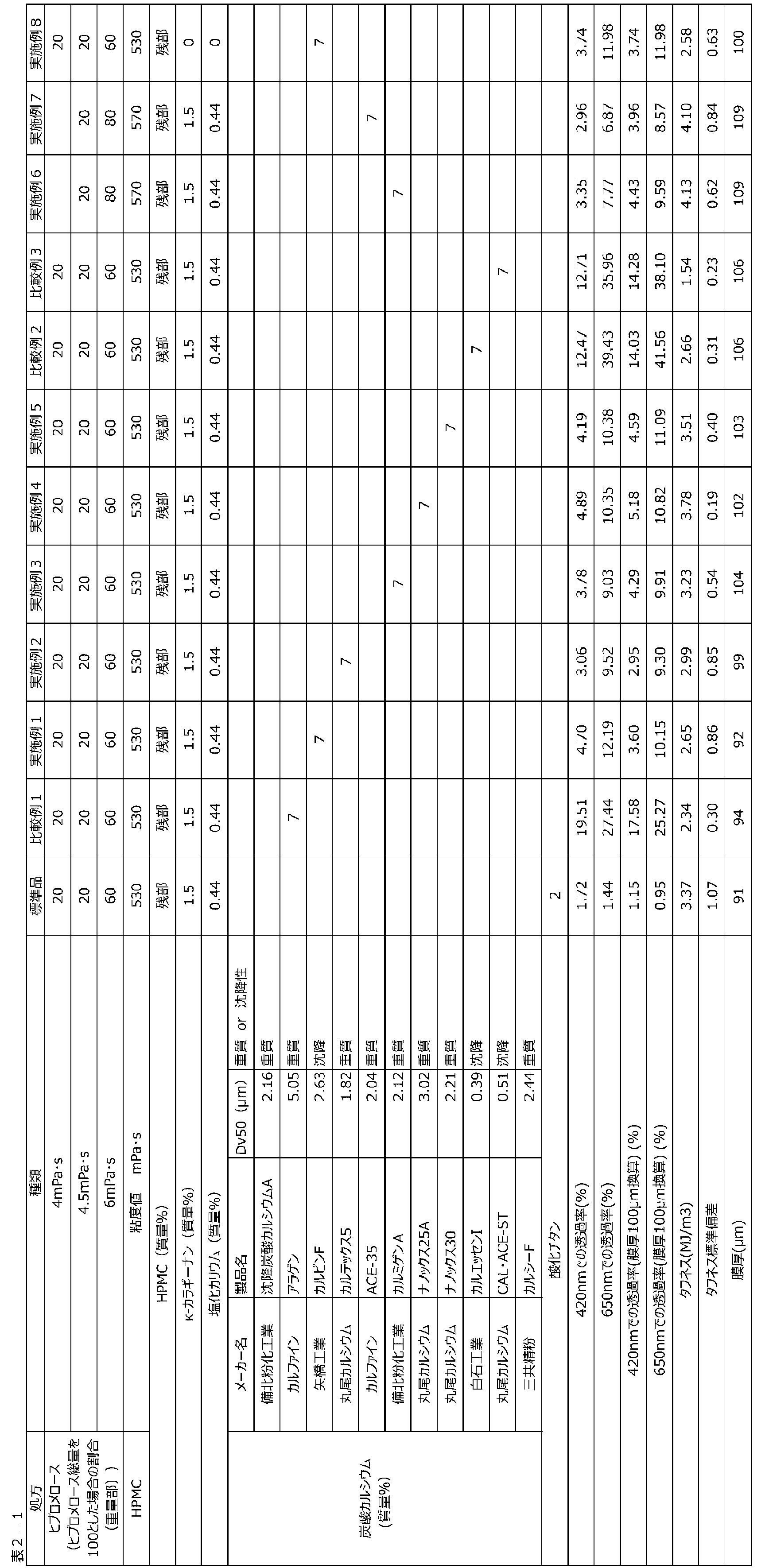
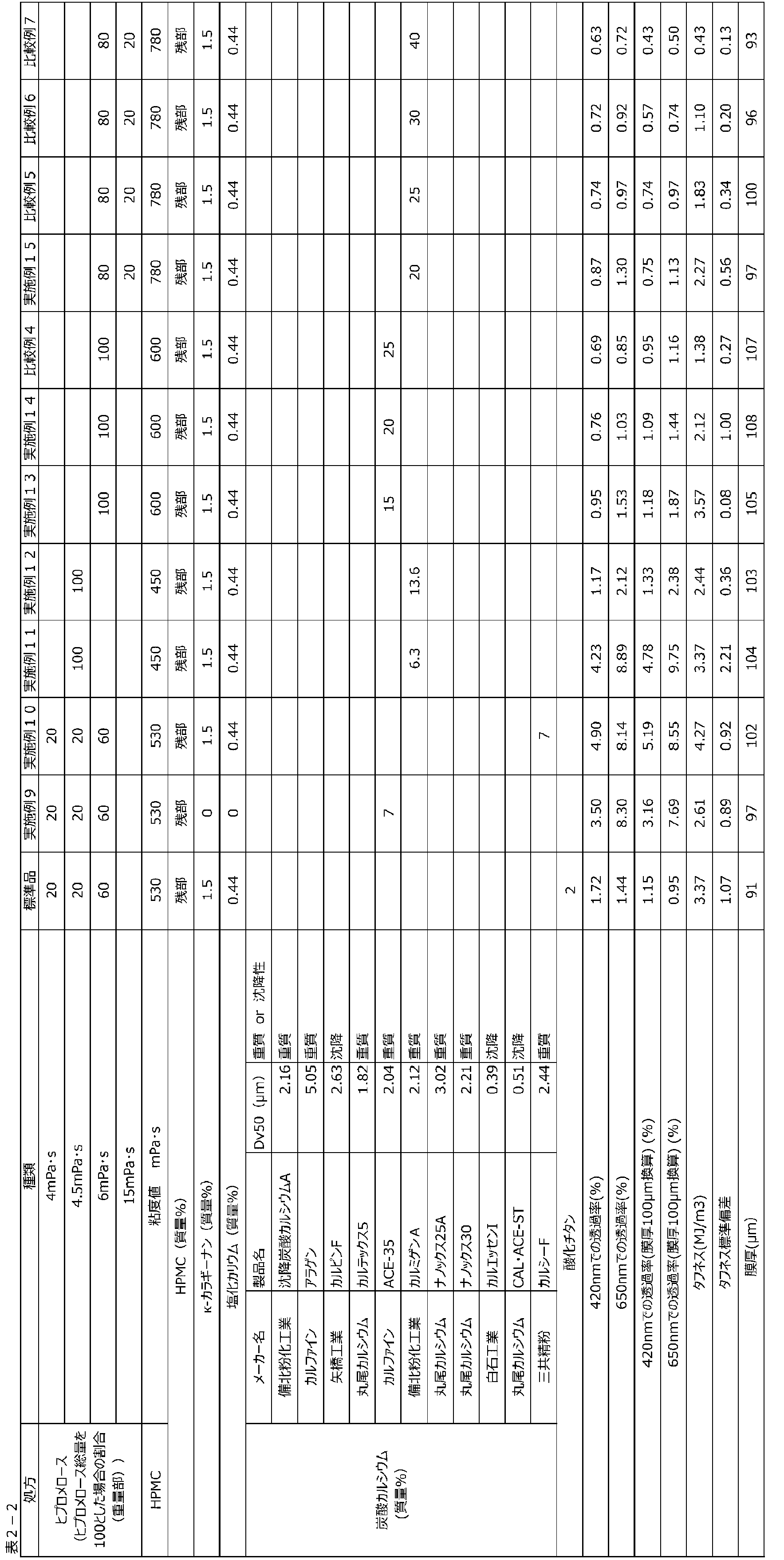
- Hard capsule preparation solution The compositions of the standard, examples, and comparative hard capsules prepared by adding calcium carbonate are shown in Tables 2-1 and 2-2.
- HPMC Hard capsule preparation solution
- jellies were prepared by changing the blend ratio of HPMC shown in i, ii, and iii below.
- Substitution type 2910 Shin-Etsu Chemical, viscosity value 6
- Substitution type 2910 Lotte Fine Chemical, viscosity value 4.5
- Substitution type 2208 Shin-Etsu Chemical, viscosity value 4
- the following heavy calcium carbonates were used: precipitated calcium carbonate A (Bihoku Powder Industry, Dv50: 2.16 ⁇ m), Aragen (Carfain, Dv50: 5.05 ⁇ m), Caltex 5 (Maruo Calcium, Dv50: 1.82 ⁇ m), ACE-35 (Carfain, Dv50: 2.04 ⁇ m), Calmigen A (Bihoku Powder Industry, Dv50: 2.12 ⁇ m), Nanox 25A (Maruo Calcium, Dv50: 3.02 ⁇ m), Nanox 30 (Maruo Calcium, Dv50: 2.21 ⁇ m), and Calcy F (Sankyo Seifun, Dv50: 2.44 ⁇ m).
- the hard capsule preparation liquid prepared by the thermal gel method was prepared according to the following method. After heating the pure water to 80°C, HPMC was added and dispersed, and the mixture was left to stand for 30 minutes, and air bubbles were removed by vacuum degassing. The mixture was then cooled to room temperature while being stirred with a three-one motor, and stirred for 1 hour with the three-one motor. After that, calcium carbonate was added and stirred to thoroughly disperse the calcium carbonate uniformly, preparing a jelly-like capsule preparation liquid. An 11-22% by mass aqueous dispersion of calcium carbonate was prepared in advance, and it was homogenized (9,000 rpm, 15 minutes) using a homogenizer (IKA, generator used: S25N-25F) before being added.
- IKA homogenizer
- Cast films were prepared using the thermal gel method as follows. A metal applicator was placed on a glass surface or PET film held at 60°C, and the preparation liquid at room temperature was poured in and moved at a constant speed to prepare a uniform film of 100 ⁇ m. The film was then dried at 60°C for 1 hour, and then at room temperature for approximately 10 hours. Applicators with gaps of 0.4 mm to 1.5 mm were used appropriately to obtain a uniform film thickness of 100 ⁇ m. The thickness of the prepared cast film was within 100 ⁇ m ⁇ 10 ⁇ m.
- a tensile test was performed at a tensile speed of 50 mm/min and a chuck distance of 59 mm.
- the equipment used was a Shimadzu Corporation universal testing machine EZ-LX.
- the tensile test evaluated the elongation of the test piece and the test force applied during the test.
- the nominal stress ⁇ which was the test force divided by the initial cross-sectional area
- the nominal strain which was the elongation of the test piece divided by the initial length, were calculated.
- the toughness (MJ/m3) of the film was calculated from the area under the obtained stress-strain curve. The toughness was measured eight times for each test piece, and the average value and standard deviation (1 SD) were calculated.
- Results Tables 2-1 and 2-2 show the compositions of the standard product, examples, and comparative examples, as well as the transmittance at 420 nm and 650 nm, the transmittance converted to a film thickness of 100 ⁇ m, toughness, and standard deviation of toughness.
- the transmittance at a measurement light wavelength of 650 nm exceeded 20% in Comparative Examples 1 to 3, but was below 20% in Examples 1 to 15.
- the transmittance at a measurement light wavelength of 420 nm exceeded 10% in Comparative Examples 1 to 3, but was below 10% in Examples 1 to 15.
- Comparative Examples 4 to 7 had the same transmittance as the coatings of the Examples, but the toughness was below 2.0 MJ/m3, and the film strength was inferior to the coatings of the Examples. Therefore, it was considered preferable to add calcium carbonate in an amount of less than 25% by mass.
Landscapes
- Health & Medical Sciences (AREA)
- Life Sciences & Earth Sciences (AREA)
- Animal Behavior & Ethology (AREA)
- Veterinary Medicine (AREA)
- Public Health (AREA)
- General Health & Medical Sciences (AREA)
- Epidemiology (AREA)
- Chemical & Material Sciences (AREA)
- Birds (AREA)
- Pharmacology & Pharmacy (AREA)
- Medicinal Chemistry (AREA)
- Inorganic Chemistry (AREA)
- Dermatology (AREA)
- Engineering & Computer Science (AREA)
- Food Science & Technology (AREA)
- Polymers & Plastics (AREA)
- Medicinal Preparation (AREA)
Abstract
Description
このような状況に鑑み、酸化チタン以外の成分を医薬品、医薬部外品、食品、および化粧品用のカプセルに遮光剤として配合する試みがなされている。
項1.
セルロース化合物、及び遮光剤を含む皮膜からなる硬質カプセルであって、
前記遮光剤は、体積単位のメディアン径が0.7μm~3.8μmの炭酸カルシウムを含み、
前記皮膜に含まれる遮光剤の含有量は、水分を除く硬質カプセルの皮膜成分合計を100質量%とした場合に、3質量%~20質量%である、
硬質カプセル。
項2.
前記セルロース化合物が、ヒドロキシプロピルメチルセルロースである、項1に記載の硬質カプセル。
項3.
さらに、前記皮膜が(1)ゲル化剤、又は(2)ゲル化剤とゲル化補助剤を含む、項2に記載の硬質カプセル。
項4.
セルロース化合物、遮光剤、及び水性溶媒を含む硬質カプセル調製液であって、
前記遮光剤は、体積単位のメディアン径が0.7μm~3.8μmの炭酸カルシウムを含み、
調製液の水性溶媒以外の成分合計を100質量%とした場合における水性溶媒以外の皮膜成分合計中の遮光剤の含有量が、3質量%~20質量%である、
硬質カプセル調製液。
項5.
前記セルロース化合物が、ヒドロキシプロピルメチルセルロースである、項4に記載の硬質カプセル調製液。
項6.
さらに、(1)ゲル化剤、又は(2)ゲル化剤とゲル化補助剤を含む、項5に記載の硬質カプセル調製液。
項7.
下記工程を含む硬質カプセルの調製方法:
項4に記載の硬質カプセル調製液を使用して、冷ゲル法により硬質カプセルを調製する工程。
硬質カプセルは、セルロース化合物、及び遮光剤を含む皮膜からなる。遮光剤は、メディアン径(Dv50)が0.7μm~3.8μmの炭酸カルシウムを含む。
硬質カプセルに使用されるヒドロキシプロピルメチルセルロースには、日本薬局方で定められる表1に規定されるヒプロメロースが含まれる。

<分子量>
非置換構造単位:162.14
置換構造単位:約180(置換度1.19)、約210(置換度2.37)
重合体:約13,000(n=約70)~約200,000(n=約1000)。
セルロース化合物は、(1)ゲル化剤、又は(2)ゲル化剤、及びゲル化補助剤を添加することにより、皮膜形成の際のゲル化を促進することができる。
また、本発明において遮光剤として使用する炭酸カルシウムも、硬質カプセル調製液中でわずかに、カルシウムイオンを生じるため、ゲル化剤としてジェランガム、及び/又はイオタ-カラギーナンを使用する場合、ゲル化補助剤を加えなくても硬質カプセル調製液をゲル化させることができる。
硬質カプセル皮膜には、どちらの炭酸カルシウムを使用してもよいが、好ましくは重質炭酸カルシウムである。
なお、レーザー回折法及び同法によって得られる粒径、平均粒径、体積分立などの定義は、JIS Z 8825による。
残留飽和水分量は乾燥減量での含水率で表すことができ、その測定は、以下のようにして行うことができる。
デシケータに、炭酸カリウム飽和水溶液を入れて恒湿状態とした雰囲気中に試料(硬質カプセル、又はフィルム)を入れ密閉し、25℃で1週間調湿する。なお、炭酸カリウム飽和水溶液の存在下では、相対湿度約43%の雰囲気を作成することができる。調湿後の試料の質量(湿質量)を測定した後、次いで当該試料を105℃で2時間加熱乾燥し、再度試料の質量(乾燥質量)を測定する。乾燥前の質量(湿質量)と乾燥後の質量(乾燥質量)の差から、下式に従って、105℃で2時間加熱乾燥することによって減少する水分量の割合(含水率)を算出する。

硬質カプセルの透過性を評価する場合、被験皮膜の厚みをそろえて比較することが重要である。このため、例えば、硬質カプセルの透過性は、硬質カプセル調製液の各成分組成と同一成分組成である調製液を用いて、キャスト法によりフィルムを調製し、当該キャストフィルムを用いて透過性を評価する。
キャストフィルムの調製方法は、次のとおりである。
上記方法により調製したキャストフィルムについて、例えば、5mm×75mmのダンベル形状(JIS K-7161-2-1BAで規定)にカットしたダンベル状試験片を作製する。このダンベル状試験片を使用して、例えば、小型卓上試験機(島津製作所EZ-LX)を用いて引張試験を行うことができる。具体的には、フィルムの両端をホルダーにセット(ギャップ長59mm)し、引張速度50mm/minで引張、フィルムの伸びとフィルム内に生じる応力(引張応力)-伸び率(ひずみ)曲線を取得する。破断点に至るまでの引張応力-伸び率曲線の積分値から、割れにくさの指標として靱性(タフネス、MJ/m3)を求めることができる(文献:Aqueous Polymeric Coating For Pharmaceutical Dosage Forms, 4th edition, CRC Press、2017、Chapter 4)。
本態様の硬質カプセルを調製するための硬質カプセル調製液(以下、単に「調製液ともいう」)は、水性溶媒と上記1.で述べた皮膜成分を含む。水性溶媒として好ましくは水、エタノール、及びこれらの混合物、より好ましくは水である。
硬質カプセル調製液(浸漬液ともいう)の調製方法は、特に制限されない。例えば約70~80℃程度に加熱した精製水に、必要に応じてゲル化剤やゲル化補助剤を溶解した後、水溶性セルロース化合物を分散させて、これを所望の浸漬液の温度(通常35~60℃、より好ましくは40~60℃)まで冷却して水溶性セルロース化合物を溶解させて均一なカプセル調製液(浸漬液)を調製する方法;ならびに水溶性セルロース化合物を約70~80℃程度の熱水に分散し、これをいったん冷却して水溶性セルロース化合物を溶解させた後に、必要に応じてゲル化剤やゲル化補助剤を添加し溶解し、再び加温して30~50℃程度に調整して均一なカプセル調製液(浸漬液)を調製して、所望の浸漬液の温度に調整する方法、などを制限なく使用することができる。さらには、後述の熱ゲル化による成形方法においては、ゲル化剤及びゲル化補助剤を加えることなく、水溶性セルロース化合物を約70~90℃程度の熱水に分散し、これをいったん室温近傍もしくはそれ以下に冷却して水溶性セルロース化合物を溶解させて硬質カプセルを調製する方法を用いることができる。
カプセル調製液に含まれる各成分の濃度は、後述する。
より具体的には、冷ゲル法により調製される硬質カプセルは下記の成型工程を経て調製することができる。
(2)カプセル調製液(浸漬液)からカプセル成型用ピンを引き上げて、当該ピンの外表面に付着したカプセル調製液をゲル化する工程(ゲル化工程)、
(3)カプセル成型用ピンの外表面に被覆形成されたゲル化カプセルフィルム(ゲル化皮膜)を乾燥する工程(乾燥工程)、
(4)乾燥したカプセルフィルム(皮膜)をカプセル成型用ピンから脱離する工程(脱離工程)。
なお、必要に応じて上記(4)の工程後に下記の加熱工程を行なってもよい。
(5)上記のゲル化工程(2)後の、乾燥工程(3)の前後若しくは同時に、または脱離工程(4)後に、ゲル化カプセルフィルム(ゲル化皮膜)を30~150℃で加熱処理する工程(加熱工程)。
硬質カプセルに内容物を充填する方法は、特に制限されない。
内容物の硬質カプセル内への充填は、特開2007-144014号公報、特開2000-226097号公報等に記載の公知のカプセル充填機、例えば全自動カプセル充填機(型式名:LIQFILsuper80/150、クオリカプス社製)、カプセル充填・シール機(型式名:LIQFILsuperFS、クオリカプス社製)等を用いて実施することができる。
本発明の硬質カプセルの用途は、特に制限されない。好ましくは、経口製剤、及び吸引製剤等を挙げることができる。
また硬質カプセルから薬剤を徐放させることもできる。徐々に薬剤が溶出させる場合は、カプセル皮膜表面に徐放性の皮膜をコーティングしてもよい。
硬質カプセル剤の内容物は、特に制限されず、ヒトまたは動物の医薬品、医薬部外品、化粧料、および食品を、制限なく挙げることができる。
内容物の形状も特に問わない。例えば、液状物、ゲル状物、粉末状、顆粒状、錠剤状、ペレット状、またこれらの混合形状(ハイブリッド状)であってもよい。
しかし、本発明は、実施例に限定して解釈されるものではない。
硬質カプセルの透過率及び強度を評価する場合、カプセル皮膜の厚み、特に金属圧子を押し込むカプセル胴部の皮膜厚みによって測定値が変化する。透過率及び強度の評価は、被験皮膜の厚みをそろえて比較することが重要である。このため、硬質カプセルの各成分組成に依存する透過率及び強度の評価は、ディッピング法によって成形された硬質カプセルのかわりに、硬質カプセルの各成分組成と同一成分組成であるフィルムを硬質カプセル皮膜の成分組成毎にキャスト法により作成し、当該フィルムを用いて透過率及び強度の評価を行った。以下では、ディッピング法によって成形された硬質カプセルのかわりに、硬質カプセルの各成分組成と同一成分組成であるフィルムを作成して評価を行っているが、当該フィルムは、厚みの均一性に優れ評価の再現性に優れており、かつカプセル皮膜としての透過率及び強度をよく反映するものである。
標準品、実施例、及び比較例として炭酸カルシウムを添加して調製した各硬質カプセルの組成を表2-1及び表2-2に示す。HPMCについては、下記i、ii、iiiに示すHPMCのブレンド比を変えてゼリーを調製した。
i.置換度タイプ2910、信越化学、粘度値6
ii.置換度タイプ2910、ロッテファインケミカル、粘度値4.5
iii.置換度タイプ2208、信越化学、粘度値4
標準品には、遮光剤として酸化チタンを添加した。
冷ゲル法によるキャストフィルムの調製は、次のように行った。室温に保持したガラス面上またはペットフィルム上に金属性のアプリケータを設置し、50℃~60℃のカプセル調製液を流しこみ一定速度で移動させ100μmの均一なフィルムを調製した。その後、室温~30℃で10時間程度乾燥を行った。
遮光性の評価は、紫外可視分光光度計(島津製作所UV―1850)を用いて透過率を評価することによって行った。透過率は、サンプルフィルム測定時の透過光強度の値をサンプルフィルムをセットしていないサンプルブランク時の透過光強度の値で割ることで求めた。乾燥後のキャストフィルムを10mm × 20mmの短冊状にカットしサンプルフィルムとして紫外可視分光光度計の光経路を遮るように垂直に置き、透過光の光強度を測定し測定波長650nm、420nmにおける透過率を算出した。
上記方法により調製したキャストフィルムについて、5mm×75mmのダンベル形状(JIS K-7161-2-1BAで規定)にカットしダンベル状試験片とした。ダンベル状試験片を、飽和塩水溶液を備えたガラス製デシケータ内に静置し、デシケータを25℃の恒温槽にて一週間以上保管することで調湿を行った。低湿度条件(25℃、22%RH)として酢酸カリウムの飽和塩水溶液を用いた。
タフネスの測定は、各試験片に対して8回行い、平均値と、標準偏差(1SD)を求めた。
表2-1及び表2-2に、標準品、実施例、及び比較例の組成と、420 nm及び650 nmの透過率、膜厚を100μmに換算した時の透過率、タフネス、タフネスの標準偏差を示す。
Claims (7)
- セルロース化合物、及び遮光剤を含む皮膜からなる硬質カプセルであって、
前記遮光剤は、体積単位のメディアン径が0.7μm~3.8μmの炭酸カルシウムを含み、
前記皮膜に含まれる遮光剤の含有量は、水分を除く硬質カプセルの皮膜成分合計を100質量%とした場合に、3質量%~20質量%である、
硬質カプセル。 - 前記セルロース化合物が、ヒドロキシプロピルメチルセルロースである、請求項1に記載の硬質カプセル。
- さらに、前記皮膜が(1)ゲル化剤、又は(2)ゲル化剤とゲル化補助剤を含む、請求項2に記載の硬質カプセル。
- セルロース化合物、遮光剤、及び水性溶媒を含む硬質カプセル調製液であって、
前記遮光剤は、体積単位のメディアン径が0.7μm~3.8μmの炭酸カルシウムを含み、
調製液の水性溶媒以外の成分合計を100質量%とした場合における水性溶媒以外の皮膜成分合計中の遮光剤の含有量が、3質量%~20質量%である、
硬質カプセル調製液。 - 前記セルロース化合物が、ヒドロキシプロピルメチルセルロースである、請求項4に記載の硬質カプセル調製液。
- さらに、(1)ゲル化剤、又は(2)ゲル化剤とゲル化補助剤を含む、請求項5に記載の硬質カプセル調製液。
- 下記工程を含む硬質カプセルの調製方法:
請求項4に記載の硬質カプセル調製液を使用して、冷ゲル法により硬質カプセルを調製する工程。
Priority Applications (3)
| Application Number | Priority Date | Filing Date | Title |
|---|---|---|---|
| CN202380085146.8A CN120282802A (zh) | 2022-12-27 | 2023-12-26 | 包含含有遮光剂的膜的硬胶囊、硬胶囊制备液以及硬胶囊的制备方法 |
| JP2024567845A JPWO2024143343A1 (ja) | 2022-12-27 | 2023-12-26 | |
| EP23912122.1A EP4643880A4 (en) | 2022-12-27 | 2023-12-26 | Hard capsule comprising a coating containing a light-blocking agent, hard capsule preparation solution, and hard capsule preparation method |
Applications Claiming Priority (4)
| Application Number | Priority Date | Filing Date | Title |
|---|---|---|---|
| JP2022-210113 | 2022-12-27 | ||
| JP2022210113 | 2022-12-27 | ||
| JP2023084623 | 2023-05-23 | ||
| JP2023-084623 | 2023-05-23 |
Publications (1)
| Publication Number | Publication Date |
|---|---|
| WO2024143343A1 true WO2024143343A1 (ja) | 2024-07-04 |
Family
ID=91718020
Family Applications (1)
| Application Number | Title | Priority Date | Filing Date |
|---|---|---|---|
| PCT/JP2023/046599 Ceased WO2024143343A1 (ja) | 2022-12-27 | 2023-12-26 | 遮光剤を含む皮膜からなる硬質カプセル、硬質カプセル調製液、及び硬質カプセルの調製方法 |
Country Status (4)
| Country | Link |
|---|---|
| EP (1) | EP4643880A4 (ja) |
| JP (1) | JPWO2024143343A1 (ja) |
| CN (1) | CN120282802A (ja) |
| WO (1) | WO2024143343A1 (ja) |
Cited By (1)
| Publication number | Priority date | Publication date | Assignee | Title |
|---|---|---|---|---|
| CN119656129A (zh) * | 2024-12-20 | 2025-03-21 | 汤臣倍健股份有限公司 | 一种新型无钛遮光软胶囊及其制备方法 |
Citations (21)
| Publication number | Priority date | Publication date | Assignee | Title |
|---|---|---|---|---|
| US3508678A (en) | 1968-04-29 | 1970-04-28 | Parke Davis & Co | Locking capsule |
| US3823843A (en) | 1972-10-26 | 1974-07-16 | Lilly Co Eli | Locking capsule |
| US4040536A (en) | 1975-05-05 | 1977-08-09 | R. P. Scherer Corporation | Locking hard gelatin capsule |
| US4069819A (en) | 1973-04-13 | 1978-01-24 | Societa Farmaceutici S.P.A. | Inhalation device |
| US4210140A (en) | 1977-02-10 | 1980-07-01 | Allen & Hanburys Limited | Device for dispensing medicaments |
| US4822618A (en) | 1986-05-15 | 1989-04-18 | Lilly Industries Limited | Capsules |
| JPH07124462A (ja) * | 1993-11-04 | 1995-05-16 | Warner Lambert Kk | 天然カルシウム含有硬カプセル |
| US5769267A (en) | 1995-11-09 | 1998-06-23 | Warner-Lambert Company | Container |
| JP2000226097A (ja) | 1999-02-03 | 2000-08-15 | Shionogi Qualicaps Kk | カプセル充填機 |
| JP2005187412A (ja) | 2003-12-26 | 2005-07-14 | Shionogi Qualicaps Co Ltd | 硬質カプセル剤の製造方法 |
| WO2006070578A1 (ja) | 2004-12-28 | 2006-07-06 | Qualicaps Co., Ltd. | 硬カプセルのバンドシール |
| JP2007144014A (ja) | 2005-11-30 | 2007-06-14 | Qualicaps Co Ltd | カプセル充填装置および方法 |
| WO2008156027A1 (ja) | 2007-06-20 | 2008-12-24 | Qualicaps Co., Ltd. | 非透明皮膜組成物 |
| JP2009504630A (ja) | 2005-08-12 | 2009-02-05 | ワーナー−ランバート カンパニー リミテッド ライアビリティー カンパニー | 基剤としてヒドロキシプロピルメチルセルロース(hpmc)を用いるハードカプセルのバンド処理法。 |
| US7669596B2 (en) | 2002-12-31 | 2010-03-02 | Novartis Pharma Ag | Aerosolization apparatus with rotating capsule |
| US20100300440A1 (en) | 2003-03-20 | 2010-12-02 | Galephar P.R. Inc. | Dry powder inhaler system |
| WO2019219693A1 (en) | 2018-05-14 | 2019-11-21 | Capsugel Belgium Nv | Capsules with opacifier |
| WO2021069590A1 (en) | 2019-10-10 | 2021-04-15 | Capsugel France SAS | Gelatin capsules with ground calcium carbonate |
| WO2021145296A1 (ja) * | 2020-01-14 | 2021-07-22 | カプスゲル・ジャパン株式会社 | セルロース誘導体を基剤とする機械的強度および酸素透過性が改善された硬カプセル |
| JP2022123274A (ja) * | 2021-02-12 | 2022-08-24 | クオリカプス株式会社 | 腸溶性硬質カプセル |
| JP2022549359A (ja) * | 2019-09-27 | 2022-11-24 | ハーキュリーズ エルエルシー | 二酸化チタン非含有白色フィルムコーティング組成物、その調製方法及びその使用方法 |
Family Cites Families (1)
| Publication number | Priority date | Publication date | Assignee | Title |
|---|---|---|---|---|
| CN113209041A (zh) * | 2021-05-13 | 2021-08-06 | 青岛益青生物科技股份有限公司 | 一种新配方羟丙甲纤维素空心胶囊及其制备方法 |
-
2023
- 2023-12-26 WO PCT/JP2023/046599 patent/WO2024143343A1/ja not_active Ceased
- 2023-12-26 CN CN202380085146.8A patent/CN120282802A/zh active Pending
- 2023-12-26 EP EP23912122.1A patent/EP4643880A4/en active Pending
- 2023-12-26 JP JP2024567845A patent/JPWO2024143343A1/ja active Pending
Patent Citations (22)
| Publication number | Priority date | Publication date | Assignee | Title |
|---|---|---|---|---|
| US3508678A (en) | 1968-04-29 | 1970-04-28 | Parke Davis & Co | Locking capsule |
| US3823843A (en) | 1972-10-26 | 1974-07-16 | Lilly Co Eli | Locking capsule |
| US4069819A (en) | 1973-04-13 | 1978-01-24 | Societa Farmaceutici S.P.A. | Inhalation device |
| US4040536A (en) | 1975-05-05 | 1977-08-09 | R. P. Scherer Corporation | Locking hard gelatin capsule |
| US4210140A (en) | 1977-02-10 | 1980-07-01 | Allen & Hanburys Limited | Device for dispensing medicaments |
| US4822618A (en) | 1986-05-15 | 1989-04-18 | Lilly Industries Limited | Capsules |
| JPH07124462A (ja) * | 1993-11-04 | 1995-05-16 | Warner Lambert Kk | 天然カルシウム含有硬カプセル |
| US5769267A (en) | 1995-11-09 | 1998-06-23 | Warner-Lambert Company | Container |
| JP2000226097A (ja) | 1999-02-03 | 2000-08-15 | Shionogi Qualicaps Kk | カプセル充填機 |
| US7669596B2 (en) | 2002-12-31 | 2010-03-02 | Novartis Pharma Ag | Aerosolization apparatus with rotating capsule |
| US20100300440A1 (en) | 2003-03-20 | 2010-12-02 | Galephar P.R. Inc. | Dry powder inhaler system |
| JP2005187412A (ja) | 2003-12-26 | 2005-07-14 | Shionogi Qualicaps Co Ltd | 硬質カプセル剤の製造方法 |
| WO2006070578A1 (ja) | 2004-12-28 | 2006-07-06 | Qualicaps Co., Ltd. | 硬カプセルのバンドシール |
| JP2009504630A (ja) | 2005-08-12 | 2009-02-05 | ワーナー−ランバート カンパニー リミテッド ライアビリティー カンパニー | 基剤としてヒドロキシプロピルメチルセルロース(hpmc)を用いるハードカプセルのバンド処理法。 |
| JP2007144014A (ja) | 2005-11-30 | 2007-06-14 | Qualicaps Co Ltd | カプセル充填装置および方法 |
| WO2008156027A1 (ja) | 2007-06-20 | 2008-12-24 | Qualicaps Co., Ltd. | 非透明皮膜組成物 |
| WO2019219693A1 (en) | 2018-05-14 | 2019-11-21 | Capsugel Belgium Nv | Capsules with opacifier |
| JP2021523917A (ja) * | 2018-05-14 | 2021-09-09 | キャプシュゲル・ベルジウム・エヌ・ヴィ | 不透明化剤を含むカプセル |
| JP2022549359A (ja) * | 2019-09-27 | 2022-11-24 | ハーキュリーズ エルエルシー | 二酸化チタン非含有白色フィルムコーティング組成物、その調製方法及びその使用方法 |
| WO2021069590A1 (en) | 2019-10-10 | 2021-04-15 | Capsugel France SAS | Gelatin capsules with ground calcium carbonate |
| WO2021145296A1 (ja) * | 2020-01-14 | 2021-07-22 | カプスゲル・ジャパン株式会社 | セルロース誘導体を基剤とする機械的強度および酸素透過性が改善された硬カプセル |
| JP2022123274A (ja) * | 2021-02-12 | 2022-08-24 | クオリカプス株式会社 | 腸溶性硬質カプセル |
Non-Patent Citations (2)
| Title |
|---|
| "Aqueous Polymeric Coating For Pharmaceutical Dosage Forms", 2017, CRC PRESS |
| See also references of EP4643880A1 |
Cited By (1)
| Publication number | Priority date | Publication date | Assignee | Title |
|---|---|---|---|---|
| CN119656129A (zh) * | 2024-12-20 | 2025-03-21 | 汤臣倍健股份有限公司 | 一种新型无钛遮光软胶囊及其制备方法 |
Also Published As
| Publication number | Publication date |
|---|---|
| EP4643880A4 (en) | 2026-04-01 |
| JPWO2024143343A1 (ja) | 2024-07-04 |
| EP4643880A1 (en) | 2025-11-05 |
| CN120282802A (zh) | 2025-07-08 |
Similar Documents
| Publication | Publication Date | Title |
|---|---|---|
| JP5253235B2 (ja) | 腸溶性カプセル | |
| US20090010975A1 (en) | Non-transparent composition for film | |
| JP7198205B2 (ja) | 腸溶性硬質カプセル | |
| ES3019391T3 (en) | Hard capsule having improved hardness, and method for manufacturing same | |
| JP2009196961A (ja) | 腸溶性カプセル | |
| JP5289429B2 (ja) | 硬質カプセル剤 | |
| WO2024143343A1 (ja) | 遮光剤を含む皮膜からなる硬質カプセル、硬質カプセル調製液、及び硬質カプセルの調製方法 | |
| ES3015728T3 (en) | Hard capsule showing improved deposition of gelling adjuvant and method for preparation thereof | |
| JP7719609B2 (ja) | 腸溶性硬質カプセル | |
| JP5328768B2 (ja) | 硬質カプセル剤 | |
| HK40128629A (zh) | 包含含有遮光剂的膜的硬胶囊、硬胶囊制备液以及硬胶囊的制备方法 | |
| JP7472028B2 (ja) | 強度が改善された硬質カプセル、及びその製造方法 | |
| EP4591883A1 (en) | Light-shielding hard capsule containing magnesium oxide | |
| CA3268262A1 (en) | Light-shielding hard capsule comprising magnesium oxide | |
| HK40121748A (zh) | 含有氧化镁的遮光硬胶囊 | |
| HK40115670A (en) | Hard capsule, prepared solution for hard capsule, and method for preparing hard capsule | |
| EP4442255A1 (en) | Hard capsule, prepared solution for hard capsule, and method for preparing hard capsule |
Legal Events
| Date | Code | Title | Description |
|---|---|---|---|
| 121 | Ep: the epo has been informed by wipo that ep was designated in this application |
Ref document number: 23912122 Country of ref document: EP Kind code of ref document: A1 |
|
| WWE | Wipo information: entry into national phase |
Ref document number: 2024567845 Country of ref document: JP |
|
| WWE | Wipo information: entry into national phase |
Ref document number: CN2023800851468 Country of ref document: CN Ref document number: 202380085146.8 Country of ref document: CN |
|
| WWP | Wipo information: published in national office |
Ref document number: 202380085146.8 Country of ref document: CN |
|
| WWE | Wipo information: entry into national phase |
Ref document number: 2023912122 Country of ref document: EP |
|
| NENP | Non-entry into the national phase |
Ref country code: DE |
|
| ENP | Entry into the national phase |
Ref document number: 2023912122 Country of ref document: EP Effective date: 20250728 |
|
| ENP | Entry into the national phase |
Ref document number: 2023912122 Country of ref document: EP Effective date: 20250728 |
|
| WWP | Wipo information: published in national office |
Ref document number: 2023912122 Country of ref document: EP |