WO2024143401A1 - 画像解析システム、画像解析方法、および画像解析プログラム - Google Patents
画像解析システム、画像解析方法、および画像解析プログラム Download PDFInfo
- Publication number
- WO2024143401A1 WO2024143401A1 PCT/JP2023/046750 JP2023046750W WO2024143401A1 WO 2024143401 A1 WO2024143401 A1 WO 2024143401A1 JP 2023046750 W JP2023046750 W JP 2023046750W WO 2024143401 A1 WO2024143401 A1 WO 2024143401A1
- Authority
- WO
- WIPO (PCT)
- Prior art keywords
- mask
- instance
- semantic
- image
- segmentation
- Prior art date
- Legal status (The legal status is an assumption and is not a legal conclusion. Google has not performed a legal analysis and makes no representation as to the accuracy of the status listed.)
- Ceased
Links
Images



Classifications
-
- G—PHYSICS
- G06—COMPUTING OR CALCULATING; COUNTING
- G06V—IMAGE OR VIDEO RECOGNITION OR UNDERSTANDING
- G06V20/00—Scenes; Scene-specific elements
- G06V20/60—Type of objects
- G06V20/69—Microscopic objects, e.g. biological cells or cellular parts
- G06V20/695—Preprocessing, e.g. image segmentation
-
- G—PHYSICS
- G06—COMPUTING OR CALCULATING; COUNTING
- G06T—IMAGE DATA PROCESSING OR GENERATION, IN GENERAL
- G06T7/00—Image analysis
- G06T7/10—Segmentation; Edge detection
- G06T7/11—Region-based segmentation
-
- G—PHYSICS
- G06—COMPUTING OR CALCULATING; COUNTING
- G06V—IMAGE OR VIDEO RECOGNITION OR UNDERSTANDING
- G06V10/00—Arrangements for image or video recognition or understanding
- G06V10/70—Arrangements for image or video recognition or understanding using pattern recognition or machine learning
- G06V10/82—Arrangements for image or video recognition or understanding using pattern recognition or machine learning using neural networks
Definitions
- An image analysis method is performed by an image analysis system having at least one processor.
- the image analysis method includes the steps of acquiring a target image showing one or more objects having a substrate and a coating region on the substrate, inputting the target image into an instance segmentation model that performs instance segmentation to set at least one instance mask corresponding to at least one of the one or more objects, inputting the target image into a semantic segmentation model that performs semantic segmentation to set a semantic mask indicating a contour and a coating region of an object set consisting of the at least one object, and identifying the contour and coating region of each of the at least one object based on the at least one instance mask and the semantic mask.
- the coating region can be formed by depositing powder or granular particles on the substrate, or by applying a liquid coating agent or a coating agent containing a metal on the substrate.
- a plurality of coating regions separated from each other can be provided on a single substrate.
- the coating region can be formed by one or more coating elements arranged on the substrate. Examples of coating elements include individual particles. Particles arranged on the substrate as coating elements can be understood as protrusions.
- the coating region may be understood as a convex portion that is raised above the surface of the substrate, or as a collection of dense protrusions. At least some of the components may be different between the substrate and the coating region, or all of the components may be the same.
- Both the substrate and the coating region may be organic or inorganic compounds, or may contain both organic and inorganic compounds.
- the object may be a particulate matter.
- the particulate matter comprises a core particle and a number of microparticles disposed on a surface of the core particle.
- the microparticles have a diameter smaller than the diameter of the core particle.
- the core particle is an example of a substrate, each microparticle is an example of a coating element, and a collection of multiple microparticles is an example of a coating region.
- FIG. 1 is a diagram showing an example of a functional configuration of an evaluation system 10 to which an image analysis system according to the present disclosure is applied.
- the evaluation system 10 includes a processor 101 as a hardware component.
- the processor 101 is, for example, a CPU (Central Processing Unit), a DSP (Digital Signal Processor), or a GPU (Graphics Processing Unit).
- the evaluation system 10 further includes, as hardware components, a main storage device composed of RAM and ROM, an auxiliary storage device composed of a flash memory, a hard disk, etc., an input device such as a keyboard and a mouse, an output device such as a monitor and a speaker, and a communication module that executes data communication between an external device.
- Each functional module of the evaluation system 10 is realized by the processor 101 executing a program stored in the auxiliary storage device.
- the evaluation program for causing a computer to function as the evaluation system 10 includes program code for implementing each functional module of the evaluation system 10.
- This evaluation program includes the image analysis program of the present disclosure.
- the evaluation program may be provided in a state in which it is recorded on a non-transitory recording medium, such as a CD-ROM, DVD-ROM, or semiconductor memory.
- the evaluation program may be provided via a communications network as a data signal superimposed on a carrier wave.
- the provided evaluation program is stored, for example, in an auxiliary storage device.
- the evaluation system 10 may be composed of one computer, or may be composed of a collection of multiple computers, i.e., a distributed system. Examples of computers that may be used for the evaluation system 10 include various types of computers such as personal computers, workstations, tablet terminals, and smartphones. When multiple computers are used for the evaluation system 10, a single evaluation system 10 is logically constructed by connecting these computers via a communication network such as the Internet or an intranet.
- the evaluation system 10 may be realized as a client-server system such as a cloud system, or may be realized by a standalone computer.
- FIG. 1 shows a teacher image database 41 and an original image database 42 as examples of external storage.
- the teacher image database 41 is a storage that stores at least one teacher image used for machine learning.
- the original image database 42 is a storage that stores at least one original image 51 showing at least one object.
- the teacher image database 41 and the original image database 42 may be integrated into a single database.
- the evaluation system 10 communicates with a learning device 30 via a communication network.
- the learning device 30 is a computer or computer system that generates the trained model 20.
- the learning device 30 may be a component of the evaluation system 10 or may be provided outside the evaluation system 10. Since the trained model 20 is portable between computer systems, the evaluation system 10 can also use a trained model 20 provided from another computer or computer system. The generation of the trained model 20 by the learning device 30 corresponds to the learning phase.
- the processor 101 functions as a preprocessing unit 11, an instance segmentation unit 12, a first semantic segmentation unit 13, a second semantic segmentation unit 14, an identification unit 15, a postprocessing unit 16, and a calculation unit 17. These functional modules correspond to the operation phase in which the generated trained model 20 is used.
- the preprocessing unit 11 is a functional module that performs preprocessing on the original image 51 to generate a target image 52 showing one or more objects.
- the instance segmentation unit 12 is a functional module that performs instance segmentation on the target image 52 and sets at least one instance mask corresponding to at least one object in the target image 52.
- the instance segmentation unit 12 sets the instance mask using an instance segmentation model 21, which is an example of a trained model 20.
- the instance mask is a mask that is set for each object by instance segmentation so that individual objects can be distinguished from one another.
- the second semantic segmentation unit 14 is a functional module that performs semantic segmentation of the coating region of the object set on the target image 52 and sets a semantic mask indicating the coating region.
- this semantic mask is also referred to as the second semantic mask.
- the second semantic mask is set for a coating set consisting of at least one coating region corresponding to the object set.
- the second semantic segmentation unit 14 sets the second semantic mask using the second semantic segmentation model 23, which is a trained model 20 that performs semantic segmentation of the coating region of the object set.
- the identification unit 15 is a functional module that identifies the contour and coating area of an object in the target image 52 based on at least one instance mask, a first semantic mask, and a second semantic mask.
- the post-processing unit 16 is a functional module that performs post-processing on the target image 52 in which the object has been identified.
- the calculation unit 17 is a functional module that calculates an evaluation value for the coverage of each identified object.
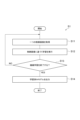
- Fig. 2 is a flowchart showing an example of the process as a process flow S1.
- the process flow S1 corresponds to a learning phase.
- the process flow S1 is executed for each of the instance segmentation model 21, the first semantic segmentation model 22, and the second semantic segmentation model 23, and is therefore a process common to these three types of trained models.
- the learning device 30 performs learning based on the teacher image.
- the learning device 30 inputs the teacher image into a machine learning model including a neural network, and obtains an estimation result output from the machine learning model. Based on the error between the estimation result and the label of the teacher image, the learning device 30 updates the parameters in the machine learning model using a method such as backpropagation. For example, the learning device 30 updates the weights of the neural network.
- the learning device 30 performs learning using Mask R-CNN to generate the instance segmentation model 21, and performs learning using U-Net to generate the first and second semantic segmentation models 22, 23.
- step S13 the learning device 30 determines whether or not to end the machine learning. If the learning device 30 determines that a predetermined end condition is not met (NO in step S13), the process returns to step S11. In the repetitive process, the learning device 30 acquires the next teacher image in step S11, and executes learning based on that teacher image in step S12. On the other hand, if the learning device 30 determines that the end condition is met (YES in step S13), the process proceeds to step S14.
- the end condition may be set based on the error, or may be set based on the number of teacher images to be processed, i.e., the number of times of learning. Alternatively, the learning device 30 may evaluate the performance of the machine learning model using given validation data, and end the machine learning if the evaluation meets a given criterion.
- step S14 the learning device 30 outputs the machine learning model for which machine learning has been completed as the trained model 20 (the instance segmentation model 21, the first semantic segmentation model 22, or the second semantic segmentation model 23).
- the learning device 30 stores the trained model 20 in an auxiliary storage device of the evaluation system 10.
- the process flow S1 is executed for each of the instance segmentation model 21, the first semantic segmentation model 22, and the second semantic segmentation model 23.
- These three types of trained models 20 are used by the evaluation system 10.
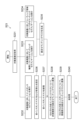
- Fig. 3 is a flowchart showing an example of the process as a process flow S2.
- Fig. 4 is a flowchart showing the details of the process of identifying the target from the target image.
- the pre-processing unit 11 obtains the raw image 51 from the raw image database 42.
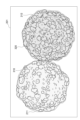
- the raw image 51 showing the particulate matter is an SEM image obtained by imaging a plurality of particulate matter collected on a carbon tape with a scanning electron microscope (SEM).
- the preprocessing unit 11 performs preprocessing on the original image 51 to generate a target image 52. If auxiliary information such as text, scale marks, etc. is written in the original image 51, the preprocessing unit 11 may remove the auxiliary information by image processing such as cropping to generate a target image 52 that does not include the auxiliary information. The preprocessing unit 11 may perform histogram equalization on the original image 51 to generate a target image 52 with high contrast, i.e., a target image 52 that depicts the target object more clearly. In this way, the preprocessing may include at least one of the removal of auxiliary information and histogram equalization.
- step S23 the instance segmentation unit 12, the first semantic segmentation unit 13, the second semantic segmentation unit 14, and the identification unit 15 work together to identify an object from the target image 52. The details of this process will be described with reference to Figure 4.
- step S231 the instance segmentation unit 12, the first semantic segmentation unit 13, and the second semantic segmentation unit 14 each obtain a target image 52 from the pre-processing unit 11.
- step S232 the instance segmentation unit 12 performs instance segmentation on the target image 52.
- the instance segmentation unit 12 inputs the target image 52 to the instance segmentation model 21 and obtains an instance mask estimated by this trained model.
- the instance segmentation unit 12 sets at least one instance mask corresponding to at least one of the one or more objects appearing in the target image 52.
- the first semantic segmentation unit 13 performs semantic segmentation for contours on the target image 52.
- the first semantic segmentation unit 13 inputs the target image 52 to the first semantic segmentation model 22 and obtains a first semantic mask estimated by this trained model.
- the first semantic segmentation unit 13 sets a first semantic mask that indicates the contour of an object set consisting of at least one object appearing in the target image 52.
- step S234 the second semantic segmentation unit 14 performs semantic segmentation of the coating region on the target image 52.
- the second semantic segmentation unit 14 inputs the target image 52 to the second semantic segmentation model 23 and obtains a second semantic mask estimated by this trained model. As a result, the second semantic segmentation unit 14 sets a second semantic mask that indicates the coating set.
- step S235 the identification unit 15 combines the first semantic mask and the second semantic mask to generate a combined semantic mask that indicates both the contours and the coating areas of the object set.
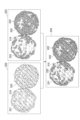
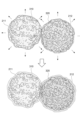
- FIG. 6 is a diagram showing an example of semantic segmentation.
- FIG. 6 shows a portion of the target image 52 processed by the first semantic segmentation unit 13 as partial image 202, and a portion of the target image 52 processed by the second semantic segmentation unit 14 as partial image 203. Both partial images 202 and 203 correspond to partial image 201 shown in FIG. 5.
- a first semantic mask 221 is set for a set of objects 310 and 320
- a second semantic mask 222 is set for a set of coating regions on the objects 310 and 320.
- the second semantic mask 222 is set for coating regions or coating elements having an area or height equal to or greater than a predetermined threshold.
- Such a result of the second semantic mask 222 is due to the label set for the teacher image. Since semantic masks do not distinguish between two or more objects of the same type, the first semantic mask 221 does not distinguish between the objects 310 and 320, and the second semantic mask 222 does not distinguish between individual coating regions. As described above, the accuracy of the shape of the semantic mask is relatively high.
- the outer edge of the first semantic mask 221 approximately matches the contours of the objects 310 and 320
- the outer edge of the second semantic mask 222 approximately matches the contours of the individual coating regions.
- the partial image 204 is obtained by combining the partial images 202 and 203. Partial image 204 shows a combined semantic mask consisting of both the first semantic mask 221 and the second semantic mask 222.
- the identification unit 15 sets a provisional instance mask and a provisional center of gravity based on each instance mask obtained by the instance segmentation unit 12.
- the identification unit 15 sets each instance mask as a provisional instance mask as is, and sets the center of gravity of each instance mask as a provisional center of gravity as is.
- FIG. 7 is a diagram showing an example of dilating a temporary instance mask.
- the identification unit 15 dilates each of the temporary instance masks 211 and 212. Through this process, the dilated temporary instance mask 211 covers the entire object 310, and the dilated instance mask 212 covers the entire object 320.
- FIG. 8 shows an example of mask replacement, and corresponds to FIG. 7. As shown in FIG. 7, the provisional instance masks of objects 310 and 320 overlap within range 240. Thus, there is an overlap between the two objects.
- the post-processing unit 16 performs post-processing on the target image 52 in which the object has been identified.
- the post-processing unit 16 may delete or invalidate instance information of an object that is located at the edge of the target image 52 and is not entirely captured in the image.
- the calculation unit 17 calculates the diameter of the particulate matter 330, i.e., the particle size.
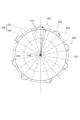
- the calculation unit 17 virtually divides the particulate matter 330 into n equal parts along the circumferential direction centered on the provisional center of gravity 333, and sets n fan-shaped sections.
- the calculation unit 17 calculates the radius of the particulate matter 330 in each fan-shaped section.
- the calculation unit 17 calculates the radius for the i-th fan-shaped section as follows. That is, the calculation unit 17 sets sample points for each angle ⁇ on the contour of the particulate matter 330 across the i-th fan-shaped section and the (i+1)-th fan-shaped section.
- the calculation unit 17 may exclude the sector sections that correspond to the contours that correspond to the overlapping portions, calculate the radius of each of the remaining sector sections, and obtain the particle diameter as twice the average value of the calculated radii.
- the calculation unit 17 virtually divides the particulate matter 330 every 20° to set 18 sector sections 401, 402, 403, 404, ....
- the calculation unit 17 sets sample points every 2° across sector sections 401 and 402, and calculates the distance 411 from the virtual center of gravity 333 for each sample point. The calculation unit 17 then obtains the average of the top three distances 411 as the radius in sector section 401.
- the calculation unit 17 obtains the bottom p distances, and obtains the average value L ave of the p distances as the lowest point. Then, the calculation unit 17 obtains the difference between the two average values H ave and L ave as the height of the fine particle 332 in the i-th fan-shaped section. By also using the sample points of the next sector section to calculate the radius of the fine particles 332 in a certain sector section, it is possible to suppress errors in height that may occur due to the presence of fine particles 332 on the boundary of the sector section or the presence of distorted fine particles 332. The calculation unit 17 calculates the average value of the heights in the n sector sections, and obtains the average value as the height of the fine particles 332 of the particulate matter 330.
- the calculation unit 17 may exclude the fan-shaped sections corresponding to the contours corresponding to the overlapping portions, calculate the height of the fine particles 332 for each of the remaining fan-shaped sections, and determine the average value of the calculated heights as the height of the fine particles 332 of the particulate matter 330.
- the original image may be provided from a device other than a database, for example directly from an imaging device such as a SEM, camera, etc.
- the identification unit 15 generates an integrated semantic mask by combining the first semantic mask and the second semantic mask, but the semantic mask indicating the contours and coating regions of the object set may be set by another method.
- the image analysis system may input the target image into a semantic segmentation model that performs semantic segmentation of both the contours and coating regions of the object set, and set the semantic mask.
- the processing procedure of the method executed by at least one processor is not limited to the example in the above embodiment.
- some of the above-mentioned steps may be omitted, or the steps may be executed in a different order.
- any two or more of the above-mentioned steps may be combined, or some of the steps may be modified or deleted.
- other steps may be executed in addition to the above-mentioned steps.
- at least one of the pre-processing and post-processing of the target image may be omitted. Dilation of the tentative instance mask may also be omitted.
- At least one processor At least one processor; the at least one processor: acquiring an image of an object showing one or more objects having a substrate and a coating area on the substrate; inputting the object image into an instance segmentation model that performs instance segmentation to set at least one instance mask corresponding to at least one object among the one or more objects; inputting the object image into a semantic segmentation model that performs semantic segmentation to generate a semantic mask indicating contours and coating regions of an object set consisting of the at least one object; identifying, for each of the at least one object, the contour and the coating area of the object based on the at least one instance mask and the semantic mask; Image analysis system.
- the at least one processor for each of the at least one instance mask, replacing the instance mask with a corresponding portion of the semantic mask to identify the contour and the coating area of the object corresponding to the instance mask.
- the one or more objects include a first object and a second object adjacent to each other; the at least one instance mask includes a first instance mask corresponding to the first object and a second instance mask corresponding to the second object; the at least one processor: Dividing an overlapping portion of the first instance mask and the second instance mask into a first portion corresponding to the first instance mask and a second portion corresponding to the second instance mask; replacing the non-overlapping portion and the first portion of the first instance mask with the corresponding portion of the semantic mask to identify the contour and the coating area of the first object; replacing the non-overlapping portion and the second portion of the second instance mask with the corresponding portion of the semantic mask to identify the contour and the coating area of the second object; 3.
- two types of image segmentation, instance segmentation and semantic segmentation are performed, and two types of masks are set for each object. Then, based on the two types of masks, the contour and coating area are identified for each object.
Landscapes
- Engineering & Computer Science (AREA)
- Theoretical Computer Science (AREA)
- General Physics & Mathematics (AREA)
- Physics & Mathematics (AREA)
- Computer Vision & Pattern Recognition (AREA)
- Health & Medical Sciences (AREA)
- Multimedia (AREA)
- General Health & Medical Sciences (AREA)
- Evolutionary Computation (AREA)
- Medical Informatics (AREA)
- Artificial Intelligence (AREA)
- Software Systems (AREA)
- Computing Systems (AREA)
- Databases & Information Systems (AREA)
- Life Sciences & Earth Sciences (AREA)
- Biomedical Technology (AREA)
- Molecular Biology (AREA)
- Image Analysis (AREA)
- Analysing Materials By The Use Of Radiation (AREA)
Abstract
Description
本開示に係る画像解析システムは、画像に写る対象物を特定するコンピュータシステムである。一例では、画像解析システムは画像に写る対象物の輪郭およびコーティング領域を特定する。
図1は、本開示に係る画像解析システムが適用された評価システム10の機能構成の一例を示す図である。評価システム10はハードウェア構成要素としてプロセッサ101を備える。プロセッサ101は例えばCPU(Central Processing Unit)、DSP(Digital Signal Processor)、またはGPU(Graphics Processing Unit)である。評価システム10はハードウェア構成要素として更に、RAMおよびROMで構成される主記憶装置と、フラッシュメモリ、ハードディスク等で構成される補助記憶装置と、キーボード、マウス等の入力装置と、モニタ、スピーカ等の出力装置と、外部装置との間のデータ通信を実行する通信モジュールとを備える。評価システム10の各機能モジュールは、補助記憶装置に格納されたプログラムをプロセッサ101が実行することで実現される。
以下では、評価システム10に関連する処理の例を説明すると共に、本開示に係る画像解析方法および評価方法の例を説明する。以下の例では対象物として粒子状物質を示し、コーティング要素としてコア粒子上の個々の微粒子を示す。
図2を参照しながら、学習済みモデル20の生成について説明する。図2はその処理の一例を処理フローS1として示すフローチャートである。処理フローS1は学習フェーズに相当する。処理フローS1はインスタンスセグメンテーションモデル21、第1セマンティックセグメンテーションモデル22、および第2セマンティックセグメンテーションモデル23のそれぞれについて実行され、したがって、これら3種類の学習済みモデルに共通の処理である。
図3および図4を参照しながら、対象画像を解析して対象物を評価する処理について説明する。図3はその処理の一例を処理フローS2として示すフローチャートである。図4は対象画像から対象物を特定する処理の詳細を示すフローチャートである。
CV値=(標準偏差)/(中位径)
以上、本開示に係る技術をその様々な例に基づいて詳細に説明した。しかし、本開示は上記の例に限定されるものではない。本開示に係る技術については、その要旨を逸脱しない範囲で様々な変形が可能である。
上記の様々な例から把握されるとおり、本開示は以下に示す態様を含む。
(付記1)
少なくとも一つのプロセッサを備え、
前記少なくとも一つのプロセッサが、
基材と該基材上のコーティング領域とを有する1以上の対象物を示す対象画像を取得し、
インスタンスセグメンテーションを実行するインスタンスセグメンテーションモデルに前記対象画像を入力して、前記1以上の対象物のうち少なくとも一つの対象物に対応する少なくとも一つのインスタンスマスクを設定し、
セマンティックセグメンテーションを実行するセマンティックセグメンテーションモデルに前記対象画像を入力して、前記少なくとも一つの対象物から成る対象物集合の輪郭およびコーティング領域を示すセマンティックマスクを設定し、
前記少なくとも一つのインスタンスマスクと前記セマンティックマスクとに基づいて、前記少なくとも一つの対象物のそれぞれについて、該対象物の前記輪郭および前記コーティング領域を特定する、
画像解析システム。
(付記2)
前記少なくとも一つのプロセッサが、前記少なくとも一つのインスタンスマスクのそれぞれについて、該インスタンスマスクを、前記セマンティックマスクのうち対応する部分に置換して、該インスタンスマスクに対応する前記対象物の前記輪郭および前記コーティング領域を特定する、
付記1に記載の画像解析システム。
(付記3)
前記1以上の対象物が、隣り合う第1対象物および第2対象物を含み、
前記少なくとも一つのインスタンスマスクが、前記第1対象物に対応する第1インスタンスマスクと、前記第2対象物に対応する第2インスタンスマスクとを含み、
前記少なくとも一つのプロセッサが、
前記第1インスタンスマスクおよび前記第2インスタンスマスクの重複部分を、前記第1インスタンスマスクに対応する第1部分と前記第2インスタンスマスクに対応する第2部分とに分割し、
前記第1インスタンスマスクの非重複部分および前記第1部分を、前記セマンティックマスクのうち前記対応する部分に置換して、前記第1対象物の前記輪郭および前記コーティング領域を特定し、
前記第2インスタンスマスクの非重複部分および前記第2部分を、前記セマンティックマスクのうち前記対応する部分に置換して、前記第2対象物の前記輪郭および前記コーティング領域を特定する、
付記2に記載の画像解析システム。
(付記4)
前記少なくとも一つのプロセッサが、
前記重複部分の各画素について、該画素から前記第1インスタンスマスクの第1重心までの距離と、該画素から前記第2インスタンスマスクの第2重心までの距離とに基づいて、該画素を前記第1インスタンスマスクおよび前記第2インスタンスマスクの一方に割り当て、これにより前記重複部分を前記第1部分と前記第2部分とに分割する、
付記3に記載の画像解析システム。
(付記5)
前記少なくとも一つのプロセッサが、
前記少なくとも一つのインスタンスマスクのそれぞれを膨張させ、
前記膨張させた少なくとも一つのインスタンスマスクと前記セマンティックマスクとに基づいて、前記少なくとも一つの対象物のそれぞれについて前記輪郭および前記コーティング領域を特定する、
付記1~4のいずれか一つに記載の画像解析システム。
(付記6)
前記少なくとも一つのプロセッサが、
前記輪郭についてのセマンティックセグメンテーションを実行する第1セマンティックセグメンテーションモデルに前記対象画像を入力して、前記対象物集合の前記輪郭を示す第1セマンティックマスクを設定し、
前記コーティング領域についてのセマンティックセグメンテーションを実行する第2セマンティックセグメンテーションモデルに前記対象画像を入力して、前記コーティング領域を示す第2セマンティックマスクを設定し、
前記第1セマンティックマスクおよび前記第2セマンティックマスクを合成して、前記対象物集合の前記輪郭および前記コーティング領域を示す前記セマンティックマスクを設定する、
付記1~5のいずれか一つに記載の画像解析システム。
(付記7)
前記対象物が粒子状物質である、
付記1~6のいずれか一つに記載の画像解析システム。
(付記8)
前記基材がコア粒子であり、
前記コーティング領域が複数の微粒子の集合である、
付記7に記載の画像解析システム。
(付記9)
少なくとも一つのプロセッサを備える画像解析システムにより実行される画像解析方法であって、
基材と該基材上のコーティング領域とを有する1以上の対象物を示す対象画像を取得するステップと、
インスタンスセグメンテーションを実行するインスタンスセグメンテーションモデルに前記対象画像を入力して、前記1以上の対象物のうち少なくとも一つの対象物に対応する少なくとも一つのインスタンスマスクを設定するステップと、
セマンティックセグメンテーションを実行するセマンティックセグメンテーションモデルに前記対象画像を入力して、前記少なくとも一つの対象物から成る対象物集合の輪郭およびコーティング領域を示すセマンティックマスクを設定するステップと、
前記少なくとも一つのインスタンスマスクと前記セマンティックマスクとに基づいて、前記少なくとも一つの対象物のそれぞれについて、該対象物の前記輪郭および前記コーティング領域を特定するステップと、
を含む画像解析方法。
(付記10)
基材と該基材上のコーティング領域とを有する1以上の対象物を示す対象画像を取得するステップと、
インスタンスセグメンテーションを実行するインスタンスセグメンテーションモデルに前記対象画像を入力して、前記1以上の対象物のうち少なくとも一つの対象物に対応する少なくとも一つのインスタンスマスクを設定するステップと、
セマンティックセグメンテーションを実行するセマンティックセグメンテーションモデルに前記対象画像を入力して、前記少なくとも一つの対象物から成る対象物集合の輪郭およびコーティング領域を示すセマンティックマスクを設定するステップと、
前記少なくとも一つのインスタンスマスクと前記セマンティックマスクとに基づいて、前記少なくとも一つの対象物のそれぞれについて、該対象物の前記輪郭および前記コーティング領域を特定するステップと、
をコンピュータに実行させる画像解析プログラム。
Claims (10)
- 少なくとも一つのプロセッサを備え、
前記少なくとも一つのプロセッサが、
基材と該基材上のコーティング領域とを有する1以上の対象物を示す対象画像を取得し、
インスタンスセグメンテーションを実行するインスタンスセグメンテーションモデルに前記対象画像を入力して、前記1以上の対象物のうち少なくとも一つの対象物に対応する少なくとも一つのインスタンスマスクを設定し、
セマンティックセグメンテーションを実行するセマンティックセグメンテーションモデルに前記対象画像を入力して、前記少なくとも一つの対象物から成る対象物集合の輪郭およびコーティング領域を示すセマンティックマスクを設定し、
前記少なくとも一つのインスタンスマスクと前記セマンティックマスクとに基づいて、前記少なくとも一つの対象物のそれぞれについて、該対象物の前記輪郭および前記コーティング領域を特定する、
画像解析システム。 - 前記少なくとも一つのプロセッサが、前記少なくとも一つのインスタンスマスクのそれぞれについて、該インスタンスマスクを、前記セマンティックマスクのうち対応する部分に置換して、該インスタンスマスクに対応する前記対象物の前記輪郭および前記コーティング領域を特定する、
請求項1に記載の画像解析システム。 - 前記1以上の対象物が、隣り合う第1対象物および第2対象物を含み、
前記少なくとも一つのインスタンスマスクが、前記第1対象物に対応する第1インスタンスマスクと、前記第2対象物に対応する第2インスタンスマスクとを含み、
前記少なくとも一つのプロセッサが、
前記第1インスタンスマスクおよび前記第2インスタンスマスクの重複部分を、前記第1インスタンスマスクに対応する第1部分と前記第2インスタンスマスクに対応する第2部分とに分割し、
前記第1インスタンスマスクの非重複部分および前記第1部分を、前記セマンティックマスクのうち前記対応する部分に置換して、前記第1対象物の前記輪郭および前記コーティング領域を特定し、
前記第2インスタンスマスクの非重複部分および前記第2部分を、前記セマンティックマスクのうち前記対応する部分に置換して、前記第2対象物の前記輪郭および前記コーティング領域を特定する、
請求項2に記載の画像解析システム。 - 前記少なくとも一つのプロセッサが、
前記重複部分の各画素について、該画素から前記第1インスタンスマスクの第1重心までの距離と、該画素から前記第2インスタンスマスクの第2重心までの距離とに基づいて、該画素を前記第1インスタンスマスクおよび前記第2インスタンスマスクの一方に割り当て、これにより前記重複部分を前記第1部分と前記第2部分とに分割する、
請求項3に記載の画像解析システム。 - 前記少なくとも一つのプロセッサが、
前記少なくとも一つのインスタンスマスクのそれぞれを膨張させ、
前記膨張させた少なくとも一つのインスタンスマスクと前記セマンティックマスクとに基づいて、前記少なくとも一つの対象物のそれぞれについて前記輪郭および前記コーティング領域を特定する、
請求項1~4のいずれか一項に記載の画像解析システム。 - 前記少なくとも一つのプロセッサが、
前記輪郭についてのセマンティックセグメンテーションを実行する第1セマンティックセグメンテーションモデルに前記対象画像を入力して、前記対象物集合の前記輪郭を示す第1セマンティックマスクを設定し、
前記コーティング領域についてのセマンティックセグメンテーションを実行する第2セマンティックセグメンテーションモデルに前記対象画像を入力して、前記コーティング領域を示す第2セマンティックマスクを設定し、
前記第1セマンティックマスクおよび前記第2セマンティックマスクを合成して、前記対象物集合の前記輪郭および前記コーティング領域を示す前記セマンティックマスクを設定する、
請求項1~4のいずれか一項に記載の画像解析システム。 - 前記対象物が粒子状物質である、
請求項1~4のいずれか一項に記載の画像解析システム。 - 前記基材がコア粒子であり、
前記コーティング領域が複数の微粒子の集合である、
請求項7に記載の画像解析システム。 - 少なくとも一つのプロセッサを備える画像解析システムにより実行される画像解析方法であって、
基材と該基材上のコーティング領域とを有する1以上の対象物を示す対象画像を取得するステップと、
インスタンスセグメンテーションを実行するインスタンスセグメンテーションモデルに前記対象画像を入力して、前記1以上の対象物のうち少なくとも一つの対象物に対応する少なくとも一つのインスタンスマスクを設定するステップと、
セマンティックセグメンテーションを実行するセマンティックセグメンテーションモデルに前記対象画像を入力して、前記少なくとも一つの対象物から成る対象物集合の輪郭およびコーティング領域を示すセマンティックマスクを設定するステップと、
前記少なくとも一つのインスタンスマスクと前記セマンティックマスクとに基づいて、前記少なくとも一つの対象物のそれぞれについて、該対象物の前記輪郭および前記コーティング領域を特定するステップと、
を含む画像解析方法。 - 基材と該基材上のコーティング領域とを有する1以上の対象物を示す対象画像を取得するステップと、
インスタンスセグメンテーションを実行するインスタンスセグメンテーションモデルに前記対象画像を入力して、前記1以上の対象物のうち少なくとも一つの対象物に対応する少なくとも一つのインスタンスマスクを設定するステップと、
セマンティックセグメンテーションを実行するセマンティックセグメンテーションモデルに前記対象画像を入力して、前記少なくとも一つの対象物から成る対象物集合の輪郭およびコーティング領域を示すセマンティックマスクを設定するステップと、
前記少なくとも一つのインスタンスマスクと前記セマンティックマスクとに基づいて、前記少なくとも一つの対象物のそれぞれについて、該対象物の前記輪郭および前記コーティング領域を特定するステップと、
をコンピュータに実行させる画像解析プログラム。
Priority Applications (2)
| Application Number | Priority Date | Filing Date | Title |
|---|---|---|---|
| EP23912179.1A EP4618014A4 (en) | 2022-12-27 | 2023-12-26 | IMAGE ANALYSIS SYSTEM, METHOD AND PROGRAM |
| CN202380037386.0A CN120457452A (zh) | 2022-12-27 | 2023-12-26 | 图像分析系统、图像分析方法及图像分析程序 |
Applications Claiming Priority (2)
| Application Number | Priority Date | Filing Date | Title |
|---|---|---|---|
| JP2022-210268 | 2022-12-27 | ||
| JP2022210268A JP2024093718A (ja) | 2022-12-27 | 2022-12-27 | 画像解析システム、画像解析方法、および画像解析プログラム |
Publications (1)
| Publication Number | Publication Date |
|---|---|
| WO2024143401A1 true WO2024143401A1 (ja) | 2024-07-04 |
Family
ID=91718142
Family Applications (1)
| Application Number | Title | Priority Date | Filing Date |
|---|---|---|---|
| PCT/JP2023/046750 Ceased WO2024143401A1 (ja) | 2022-12-27 | 2023-12-26 | 画像解析システム、画像解析方法、および画像解析プログラム |
Country Status (4)
| Country | Link |
|---|---|
| EP (1) | EP4618014A4 (ja) |
| JP (1) | JP2024093718A (ja) |
| CN (1) | CN120457452A (ja) |
| WO (1) | WO2024143401A1 (ja) |
Cited By (1)
| Publication number | Priority date | Publication date | Assignee | Title |
|---|---|---|---|---|
| CN119863620A (zh) * | 2024-12-04 | 2025-04-22 | 中国科学院遗传与发育生物学研究所 | 用于对视频数据进行标注的方法、设备和存储介质 |
Citations (3)
| Publication number | Priority date | Publication date | Assignee | Title |
|---|---|---|---|---|
| JP2016061722A (ja) | 2014-09-19 | 2016-04-25 | 日立化成株式会社 | 導電粒子形状評価装置及び導電粒子形状評価方法 |
| JP2020201243A (ja) * | 2019-06-05 | 2020-12-17 | 国立大学法人電気通信大学 | センシングシステム、及びセンシング方法 |
| JP2022050347A (ja) * | 2020-09-17 | 2022-03-30 | エボニック オペレーションズ ゲーエムベーハー | 被覆加工表面の定性的または定量的特徴付け |
Family Cites Families (1)
| Publication number | Priority date | Publication date | Assignee | Title |
|---|---|---|---|---|
| CN114897816B (zh) * | 2022-05-09 | 2024-06-14 | 安徽工业大学 | 基于改进掩膜的Mask R-CNN矿物颗粒识别以及粒度检测方法 |
-
2022
- 2022-12-27 JP JP2022210268A patent/JP2024093718A/ja active Pending
-
2023
- 2023-12-26 CN CN202380037386.0A patent/CN120457452A/zh active Pending
- 2023-12-26 EP EP23912179.1A patent/EP4618014A4/en active Pending
- 2023-12-26 WO PCT/JP2023/046750 patent/WO2024143401A1/ja not_active Ceased
Patent Citations (3)
| Publication number | Priority date | Publication date | Assignee | Title |
|---|---|---|---|---|
| JP2016061722A (ja) | 2014-09-19 | 2016-04-25 | 日立化成株式会社 | 導電粒子形状評価装置及び導電粒子形状評価方法 |
| JP2020201243A (ja) * | 2019-06-05 | 2020-12-17 | 国立大学法人電気通信大学 | センシングシステム、及びセンシング方法 |
| JP2022050347A (ja) * | 2020-09-17 | 2022-03-30 | エボニック オペレーションズ ゲーエムベーハー | 被覆加工表面の定性的または定量的特徴付け |
Non-Patent Citations (1)
| Title |
|---|
| See also references of EP4618014A1 |
Cited By (1)
| Publication number | Priority date | Publication date | Assignee | Title |
|---|---|---|---|---|
| CN119863620A (zh) * | 2024-12-04 | 2025-04-22 | 中国科学院遗传与发育生物学研究所 | 用于对视频数据进行标注的方法、设备和存储介质 |
Also Published As
| Publication number | Publication date |
|---|---|
| EP4618014A1 (en) | 2025-09-17 |
| JP2024093718A (ja) | 2024-07-09 |
| CN120457452A (zh) | 2025-08-08 |
| EP4618014A4 (en) | 2025-09-17 |
Similar Documents
| Publication | Publication Date | Title |
|---|---|---|
| KR102805684B1 (ko) | 비지도 학습 기반 웨이퍼 불량 패턴 검출 방법 및 그 장치 | |
| CN114283332A (zh) | 一种模糊聚类遥感影像分割方法、系统、终端及存储介质 | |
| CN109146920B (zh) | 一种可嵌入式实现的目标跟踪方法 | |
| CN115131596B (zh) | 缺陷分类装置、方法以及程序 | |
| JP2005235222A (ja) | 物体の追跡方法およびその装置 | |
| WO2021032062A1 (zh) | 图像处理模型生成方法、图像处理方法、装置及电子设备 | |
| JP2009545045A (ja) | パターン分類方法 | |
| CN113436223B (zh) | 点云数据的分割方法、装置、计算机设备和存储介质 | |
| CN114882215B (zh) | 一种煤矸光电分选图像颗粒集料区域形选识别方法 | |
| KR20200129314A (ko) | 고해상도 항공 이미지내의 물체를 감지하기 위한 단일 단계 고밀도 피라미드 특징 네트워크 | |
| CN120807853B (zh) | 一种基于bim的工程建筑构件模型构建方法及系统 | |
| CN115457044A (zh) | 基于类激活映射的路面裂缝分割方法 | |
| CN106295716A (zh) | 一种基于视频信息的交通运动目标分类方法及装置 | |
| CN117992765A (zh) | 基于动态新兴标记的偏标签学习方法、装置、设备及介质 | |
| WO2024143401A1 (ja) | 画像解析システム、画像解析方法、および画像解析プログラム | |
| CN117788735A (zh) | 基于栅格划分的动态点云去除方法 | |
| CN116266359A (zh) | 目标物的跟踪方法、装置、计算机设备和存储介质 | |
| Guermazi et al. | A dynamically weighted loss function for unsupervised image segmentation | |
| US20250316052A1 (en) | Training Method for Training a Machine Learning Algorithm, Segmentation Method, Computer Program Product and Segmentation Device | |
| CN117173195A (zh) | 一种基于Transformer的3D实例分割方法、系统和设备 | |
| JP2008084076A (ja) | 画像処理装置、方法およびプログラム | |
| CN120526229B (zh) | 基于数字图像和深度学习算法的矿物颗粒识别与分级方法 | |
| CN114022404A (zh) | 一种通信设备的检测方法、装置及电子设备 | |
| CN116051959B (zh) | 一种目标检测方法、装置 | |
| WO2021005745A1 (ja) | 情報処理装置、プログラム及び情報処理方法 |
Legal Events
| Date | Code | Title | Description |
|---|---|---|---|
| 121 | Ep: the epo has been informed by wipo that ep was designated in this application |
Ref document number: 23912179 Country of ref document: EP Kind code of ref document: A1 |
|
| WWE | Wipo information: entry into national phase |
Ref document number: 202380037386.0 Country of ref document: CN |
|
| WWE | Wipo information: entry into national phase |
Ref document number: 2023912179 Country of ref document: EP |
|
| ENP | Entry into the national phase |
Ref document number: 2023912179 Country of ref document: EP Effective date: 20250609 |
|
| NENP | Non-entry into the national phase |
Ref country code: DE |
|
| WWP | Wipo information: published in national office |
Ref document number: 202380037386.0 Country of ref document: CN |
|
| WWP | Wipo information: published in national office |
Ref document number: 2023912179 Country of ref document: EP |