WO2024143442A1 - 会合が制御されたポリペプチド - Google Patents
会合が制御されたポリペプチド Download PDFInfo
- Publication number
- WO2024143442A1 WO2024143442A1 PCT/JP2023/046857 JP2023046857W WO2024143442A1 WO 2024143442 A1 WO2024143442 A1 WO 2024143442A1 JP 2023046857 W JP2023046857 W JP 2023046857W WO 2024143442 A1 WO2024143442 A1 WO 2024143442A1
- Authority
- WO
- WIPO (PCT)
- Prior art keywords
- polypeptide
- region
- modification
- nucleic acid
- antibody
- Prior art date
- Legal status (The legal status is an assumption and is not a legal conclusion. Google has not performed a legal analysis and makes no representation as to the accuracy of the status listed.)
- Ceased
Links
Images



























Classifications
-
- C—CHEMISTRY; METALLURGY
- C07—ORGANIC CHEMISTRY
- C07K—PEPTIDES
- C07K16/00—Immunoglobulins [IG], e.g. monoclonal or polyclonal antibodies
- C07K16/18—Immunoglobulins [IG], e.g. monoclonal or polyclonal antibodies against material from animals or humans
- C07K16/28—Immunoglobulins [IG], e.g. monoclonal or polyclonal antibodies against material from animals or humans against receptors, cell surface antigens or cell surface determinants
- C07K16/2803—Immunoglobulins [IG], e.g. monoclonal or polyclonal antibodies against material from animals or humans against receptors, cell surface antigens or cell surface determinants against the immunoglobulin superfamily
- C07K16/283—Immunoglobulins [IG], e.g. monoclonal or polyclonal antibodies against material from animals or humans against receptors, cell surface antigens or cell surface determinants against the immunoglobulin superfamily against Fc-receptors, e.g. CD16, CD32, CD64
-
- C—CHEMISTRY; METALLURGY
- C07—ORGANIC CHEMISTRY
- C07K—PEPTIDES
- C07K16/00—Immunoglobulins [IG], e.g. monoclonal or polyclonal antibodies
-
- C—CHEMISTRY; METALLURGY
- C07—ORGANIC CHEMISTRY
- C07K—PEPTIDES
- C07K16/00—Immunoglobulins [IG], e.g. monoclonal or polyclonal antibodies
- C07K16/18—Immunoglobulins [IG], e.g. monoclonal or polyclonal antibodies against material from animals or humans
- C07K16/28—Immunoglobulins [IG], e.g. monoclonal or polyclonal antibodies against material from animals or humans against receptors, cell surface antigens or cell surface determinants
- C07K16/30—Immunoglobulins [IG], e.g. monoclonal or polyclonal antibodies against material from animals or humans against receptors, cell surface antigens or cell surface determinants from tumour cells
- C07K16/303—Liver or Pancreas
-
- C—CHEMISTRY; METALLURGY
- C07—ORGANIC CHEMISTRY
- C07K—PEPTIDES
- C07K16/00—Immunoglobulins [IG], e.g. monoclonal or polyclonal antibodies
- C07K16/18—Immunoglobulins [IG], e.g. monoclonal or polyclonal antibodies against material from animals or humans
- C07K16/36—Immunoglobulins [IG], e.g. monoclonal or polyclonal antibodies against material from animals or humans against blood coagulation factors
-
- C—CHEMISTRY; METALLURGY
- C07—ORGANIC CHEMISTRY
- C07K—PEPTIDES
- C07K2317/00—Immunoglobulins specific features
- C07K2317/30—Immunoglobulins specific features characterized by aspects of specificity or valency
- C07K2317/31—Immunoglobulins specific features characterized by aspects of specificity or valency multispecific
-
- C—CHEMISTRY; METALLURGY
- C07—ORGANIC CHEMISTRY
- C07K—PEPTIDES
- C07K2317/00—Immunoglobulins specific features
- C07K2317/50—Immunoglobulins specific features characterized by immunoglobulin fragments
- C07K2317/52—Constant or Fc region; Isotype
-
- C—CHEMISTRY; METALLURGY
- C07—ORGANIC CHEMISTRY
- C07K—PEPTIDES
- C07K2317/00—Immunoglobulins specific features
- C07K2317/50—Immunoglobulins specific features characterized by immunoglobulin fragments
- C07K2317/52—Constant or Fc region; Isotype
- C07K2317/526—CH3 domain
-
- C—CHEMISTRY; METALLURGY
- C07—ORGANIC CHEMISTRY
- C07K—PEPTIDES
- C07K2317/00—Immunoglobulins specific features
- C07K2317/90—Immunoglobulins specific features characterized by (pharmaco)kinetic aspects or by stability of the immunoglobulin
- C07K2317/92—Affinity (KD), association rate (Ka), dissociation rate (Kd) or EC50 value
-
- C—CHEMISTRY; METALLURGY
- C07—ORGANIC CHEMISTRY
- C07K—PEPTIDES
- C07K2317/00—Immunoglobulins specific features
- C07K2317/90—Immunoglobulins specific features characterized by (pharmaco)kinetic aspects or by stability of the immunoglobulin
- C07K2317/94—Stability, e.g. half-life, pH, temperature or enzyme-resistance
Definitions
- the present invention has been made in consideration of these circumstances, and an object of the present invention is to provide, for example, a polypeptide having a controlled inter-polypeptide association, a method for producing a polypeptide having a controlled association, a method for controlling polypeptide association, a nucleic acid encoding a polypeptide having a controlled association, and a composition containing the nucleic acid.
- nucleic acid wherein the modifications in multiple types of polypeptides are different from one another.
- nucleic acid wherein the combination of the multiple different modifications is a combination shown in Table 7.
- nucleic acid in which a first polypeptide having the modification has an increased ability to form an association with a polypeptide having the modification, compared to a polypeptide in which the modification is not introduced.
- the nucleic acid which is RNA, DNA, or a vector or plasmid carrying the nucleic acid.
- nucleic acid, wherein the first polypeptide is a polypeptide whose association is controlled.
- the present disclosure further relates to the following: Note that the following inventions also incorporate the technical features described in [1] to [22] above as appropriate.
- a polypeptide with controlled association said polypeptide having an Fc region with an alteration introduced therein, wherein the alteration introduced into the Fc region makes said polypeptide more likely to associate with a polypeptide having said alteration at the Fc region than a polypeptide not having said alteration.
- the polypeptide which is less likely to associate with a polypeptide that does not have the modification introduced therein than with a polypeptide having the modification introduced therein.
- C cysteine
- the polypeptide, wherein the disulfide bridge is a bridge between cysteines modified (introduced) in the Fc region.
- polypeptide which is more likely to associate with a polypeptide having the modification than with a polypeptide in which the modification has not been introduced, due to a combination of the effects of at least (2) disulfide bridges and (3) electrostatic charges.
- the polypeptide, wherein the electrostatic charge effect is caused by one or more charged amino acids modified (introduced) in the Fc region.
- the polypeptide, wherein the charged amino acid to be introduced is a positively charged amino acid and/or a negatively charged amino acid.
- nucleic acid is RNA, DNA, or a vector or plasmid carrying the nucleic acid.
- RNA is mRNA, genomic RNA, or circularized RNA.
- polypeptide containing an Fc region is an antibody.
- polypeptide containing the Fc region is a single domain antibody.
- polypeptide containing an Fc region is IgG.
- polypeptide comprising the Fc region does not associate with endogenous IgG.
- a method for expressing in a cell a polypeptide in which association between polypeptides comprising an Fc region is controlled comprising the steps of: (a) preparing a nucleic acid encoding a polypeptide comprising an Fc region such that the polypeptide comprising the Fc region is modified to a polypeptide that is more likely to associate with a polypeptide having the modification than with a polypeptide in which the modification is not introduced, by at least one of the following mechanisms: (1) steric complementarity, (2) disulfide bridges, and (3) electrostatic charge; (b) introducing the nucleic acid of step (a) into a cell.
- the nucleic acid is RNA, DNA, or a vector or plasmid carrying the nucleic acid.
- the RNA is mRNA, genomic RNA, or circularized RNA.
- the polypeptide containing the Fc region is an antibody.
- the method, wherein the polypeptide containing the Fc region is a single domain antibody.
- the method, wherein the polypeptide containing an Fc region is IgG.
- a method for producing a pharmaceutical composition comprising a vesicle containing a nucleic acid encoding a polypeptide in which association between Fc regions is controlled, the method comprising the steps of: (a) obtaining a nucleic acid encoding a polypeptide having an Fc region with an alteration, the polypeptide being more likely to associate with a polypeptide having the alteration than with a polypeptide not having the alteration due to at least one of the following mechanisms: (1) steric complementarity, (2) disulfide bridges, and (3) electrostatic charge; (b) contacting the vesicles with the nucleic acid of step (a).
- a pharmaceutical composition comprising the nucleic acid or the polypeptide and a pharma- ceutically acceptable carrier.
- a pharmaceutical composition comprising a nucleic acid encoding a polypeptide having an Fc region with controlled association.
- the pharmaceutical composition comprising the nucleic acid encapsulated in a vesicle.
- a pharmaceutical composition comprising a nucleic acid encoding a polypeptide having an Fc region with controlled association, and a vesicle.
- the pharmaceutical composition wherein the vesicle is a lipid nanoparticle (LNP), a virus, an extracellular vesicle (EV), or a liposome.
- LNP lipid nanoparticle
- EV extracellular vesicle
- nucleic acid is RNA, DNA, or a vector or plasmid carrying the nucleic acid.
- nucleic acid is RNA, DNA, or a vector or plasmid carrying the nucleic acid.
- the pharmaceutical composition for expressing in a cell a polypeptide in which association between Fc regions is controlled.
- the present disclosure relates to the following: [Aspect 1] A nucleic acid encoding a first polypeptide, the first polypeptide having an Fc region with an alteration introduced therein; A nucleic acid in which a first polypeptide is more likely to associate with a first polypeptide having an Fc region having an alteration introduced into the Fc region than a first polypeptide having an Fc region without the alteration.
- a method for obtaining a polypeptide having controlled association comprising the steps of obtaining a nucleic acid encoding said polypeptide, expressing the nucleic acid, wherein the polypeptide comprises an Fc region; A method in which the polypeptide is more likely to associate with a polypeptide having the modification at the Fc region due to the modification introduced into the Fc region than a polypeptide having an Fc region without the modification.
- a method for obtaining a polypeptide having controlled association comprising the steps of obtaining a nucleic acid encoding said polypeptide, expressing the nucleic acid, wherein the polypeptide comprises an Fc region;
- a method in which the polypeptide is more likely to associate with a polypeptide having the modification at the Fc region due to the modification introduced into the Fc region than a polypeptide having an Fc region without the modification.
- a method for controlling homomeric association of a polypeptide comprising the steps of obtaining a nucleic acid encoding said polypeptide, expressing the nucleic acid, wherein the polypeptide comprises an Fc region; A method in which the polypeptide is more likely to associate with a polypeptide having the modification at the Fc region due to the modification introduced into the Fc region than a polypeptide having an Fc region without the modification. [Aspect 22] 1.
- a method for promoting homozygous expression of a polypeptide comprising the steps of obtaining a nucleic acid encoding the polypeptide, expressing the nucleic acid, wherein the polypeptide comprises an Fc region; A method in which the polypeptide is more likely to associate with a polypeptide having the modification at the Fc region due to the modification introduced into the Fc region than a polypeptide having an Fc region without the modification. [Aspect 23] the second polypeptide having an altered Fc region; The composition of claim 4, wherein the second polypeptide is more likely to associate with the third polypeptide at the Fc region than with the second polypeptide due to a modification introduced in the Fc region.
- composition according to embodiment 1, wherein the Fc region into which the alterations have been introduced comprises amino acid alterations at one or more pairs of positions selected from the pairs of positions (a) to (d) according to EU numbering as follows: (a) Positions 394 and 405 (b) Positions 366, 368, and 407 (c) positions 347, 360, 399, 405, and 409 (d) positions 356, 392, 399, and 439.
- the Fc region into which the modification has been introduced has W, F, Y at position 394 (a) according to EU numbering.
- A, S, T, C, G, V at position 405 (b) W, Y, F at position 366 A, S, T, C, V, G at position 368 V, L, I, M, A, S, T, C, N, Q at position 407 (c) R, K, Y, H at position 347 E, D at position 360 V, L, I, M, S, T, C, H, A, N, Q, G at position 399 T, A, V, S, C, N, D, G at position 405 W, F, Y, H at position 409 (d) K, R at position 356 D, E at position 392 K, R at position 399 E, D at position 439 25.
- the Fc region into which the modification has been introduced has a W, F at position 394 (a) according to EU numbering.
- the present disclosure relates to the following: [Aspect 29]
- the composition according to embodiment 1, wherein the Fc region into which the alterations have been introduced comprises amino acid alterations at one or more pairs of positions selected from the pairs of positions (a) to (d) according to EU numbering as follows: (a) Positions 345, 347, 360, 366, 399, 407, and 409 (b) positions 356, 399, 409, and 439 (c) positions 356, 392, 399, and 409 (d) Positions 392, 399, and 409.
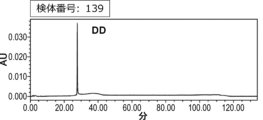
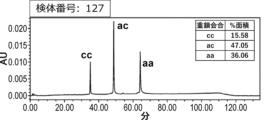
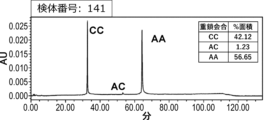
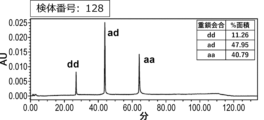
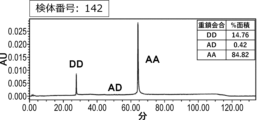
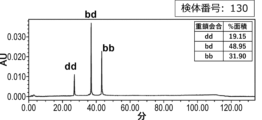
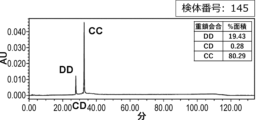
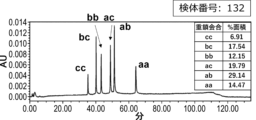
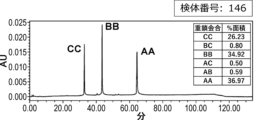
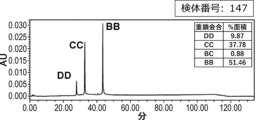
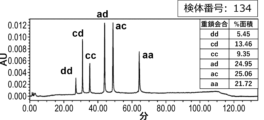
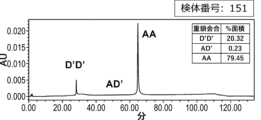
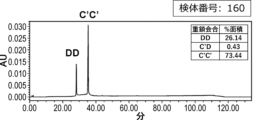
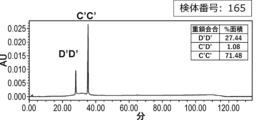
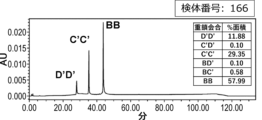
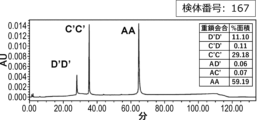
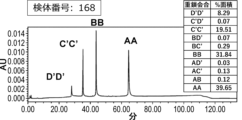
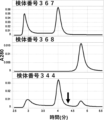
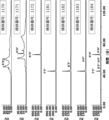
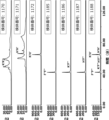
- Figure 3-16 shows the analysis results of simultaneous expression of two antibodies with CH3 modifications. Each peak position was assigned based on the elution position of one antibody during expression.
- Figure 3-17 shows the analysis results of simultaneous expression of two antibodies without CH3 modification. Each peak position was assigned based on the elution position of one antibody during expression.
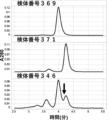
- Figure 3-18 shows the analysis results of simultaneous expression of two antibodies with CH3 modifications. Each peak position was assigned based on the elution position of one antibody during expression.
- Figure 3-19 shows the analysis results of simultaneous expression of two antibodies without CH3 modification. Each peak position was assigned based on the elution position of one antibody during expression.
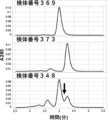
- Figure 3-20 shows the analysis results of simultaneous expression of two antibodies with CH3 modifications. Each peak position was assigned based on the elution position of one antibody during expression.
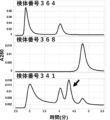
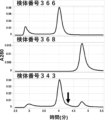
- Figures 5 to 9 show the analysis of the elution positions of sample antibodies with CH3 modifications, and the heavy chain homodimerization ability when the full-length heavy chain and Fc fragment were co-expressed.
- Figures 5 to 10 show the analysis of the elution position of a preparation antibody without CH3 modification and the heavy chain homodimerization ability when the full-length heavy chain and Fc fragment were co-expressed.
- Figures 5 to 11 show the analysis of the elution positions of standard antibodies with CH3 modifications, and the heavy chain homodimerization ability when the full-length heavy chain and Fc fragment were co-expressed.
- FIG. 6-7 show the results of peak assignment in the CIEX analysis of sample No. 1176.
- Various sample antibodies prepared by expressing various combinations of the various plasmids used for the expression of sample No. 1176 were analyzed, and the peaks of the intended heavy chain homodimer and heavy chain heterodimer, as well as other unintended peaks, were assigned.
- the heavy chain associations assigned to the peaks in the figures are shown.
- Figures 6-8 show the results of peak assignment in the CIEX analysis of sample No. 1180.
- amino acids are described by the one-letter or three-letter code or both, e.g., Ala/A, Leu/L, Arg/R, Lys/K, Asn/N, MeA, Asp/D, Phe/F, Cys/C, Pro/P, Gln/Q, Ser/S, Glu/E, Thr/T, Gly/G, Trp/W, His/H, Tyr/Y, Ile/I, or Val/V.
- a polypeptide may be derived from a natural biological source or produced by recombinant technology, but need not necessarily be translated from a specified nucleic acid. It may be generated in any manner, including chemical synthesis.
- a polypeptide described herein may be, in one embodiment, 10 amino acids or more, 20 amino acids or more, 25 amino acids or more, 50 amino acids or more, 75 amino acids or more, 100 amino acids or more, 200 amino acids or more, 500 amino acids or more, 1,000 amino acids or more in size.
- the polypeptide of the present disclosure is produced in vivo.
- the polypeptide of the present disclosure can be produced in vivo by introducing a nucleic acid encoding the polypeptide of the present disclosure into a living body.
- the polypeptide of the present disclosure is a polypeptide expressed in vivo.
- a polypeptide (an antibody in one embodiment) may be produced in bacteria, particularly if glycosylation and Fc effector functions are not required.
- antibody fragments and polypeptides see, for example, U.S. Patent Nos. 5,648,237, 5,789,199, and 5,840,523. (See also Charlton, Methods in Molecular Biology, Vol. 248 (BKC Lo, ed., Humana Press, Totowa, NJ, 2003), pp. 245-254, which describes the expression of polypeptide (antibody) fragments in E. coli.)
- the polypeptide may be isolated in a soluble fraction from the bacterial cell paste and may be further purified.
- eukaryotic microbes such as filamentous fungi or yeast, including fungal and yeast strains in which the glycosylation pathways have been "humanized,” resulting in the production of polypeptides (antibodies in one embodiment) with partial or fully human glycosylation patterns
- eukaryotic microbes such as filamentous fungi or yeast, including fungal and yeast strains in which the glycosylation pathways have been "humanized,” resulting in the production of polypeptides (antibodies in one embodiment) with partial or fully human glycosylation patterns
- polypeptide (antibody)-encoding vectors See Gerngross, Nat. Biotech. 22:1409-1414 (2004) and Li et al., Nat. Biotech. 24:210-215 (2006)).
- Host cells derived from multicellular organisms invertebrate and vertebrate
- invertebrate cells include plants and insect cells.
- Recombinant production of the polypeptides (antibodies in one embodiment) described herein can be performed in a manner similar to that described above by using a host cell that contains (e.g., is transformed by) one or more vectors that contain nucleic acids encoding an amino acid sequence that includes the entire polypeptide (antibody) or a portion of the polypeptide (antibody).
- the polypeptide of the present disclosure also includes a polypeptide that has undergone post-translational modification.
- an example of the polypeptide that has undergone post-translational modification includes an antibody that has undergone pyroglutamylation at the N-terminus of the heavy chain variable region and/or deletion of lysine at the C-terminus of the heavy chain. It is known in the art that such post-translational modification by pyroglutamylation at the N-terminus and deletion of lysine at the C-terminus has no effect on the activity of the antibody (Analytical Biochemistry, 2006, Vol. 348, p. 24-39).
- polypeptides and the like are used for convenience of distinction. The use of these terms is not intended to confer a particular order or orientation, unless otherwise specified.
- the polypeptide may be a TCR (T cell receptor) or a part of a TCR.
- the polypeptides of the present disclosure may be expressed in in vivo cells.
- intracellular expression of the polypeptide of the present disclosure is achieved by introducing the nucleic acid encoding the polypeptide of the present disclosure into target cells. Any standard method can be used to introduce nucleic acid into cells.For example, it includes microinjection, ballistic injection, electroporation, calcium phosphate precipitation, liposome, and transfection with retrovirus, adenovirus, adeno-associated virus, and vaccinia vector carrying the nucleic acid of interest.
- the nucleic acid encoding the polypeptide of the present disclosure can be introduced into the cells of a subject (in one embodiment, a human) by in vivo and ex vivo methods.
- the nucleic acid is directly injected into the subject, for example, at the site where treatment is required.
- the nucleic acid is introduced into cells using transfection with a viral vector (e.g., adenovirus, type I herpes simplex virus, or adeno-associated virus) and lipid-based systems (useful lipids for lipid-mediated gene transfer are, for example, DOTMA, DOPE, and DC-Chol) (for a review of specific gene marking and gene therapy protocols, see Anderson et al., Science 256:808-813 (1992) and WO93/25673 and the references cited therein).
- a viral vector e.g., adenovirus, type I herpes simplex virus, or adeno-associated virus
- lipid-based systems useful lipids for
- Intracellular expression of intrabodies can, in one embodiment, be achieved by introducing a nucleic acid encoding an antibody or a fragment thereof into the target cell.
- One or more nucleic acids encoding all or a portion of an antibody, including a polypeptide of the present disclosure can be delivered to the target cell such that one or more intrabodies are expressed.
- the polypeptides of the present disclosure, in which inter-polypeptide association is controlled can be used for the intracellular production of intrabodies.
- the polypeptide of the present disclosure may be a polypeptide having a variable region.
- the term "variable region” or “variable domain” refers to the domain of an antibody's heavy or light chain that is involved in binding the antibody to an antigen.
- the heavy and light chain variable domains (VH and VL, respectively) of natural antibodies usually have a similar structure, with each domain containing four conserved framework regions (FR) and three hypervariable regions (HVR). (See, for example, Kindt et al. Kuby Immunology, 6th ed., WH Freeman and Co., page 91 (2007).)
- a single VH or VL domain can confer antigen-binding specificity.
- HVR or CDR The polypeptide of the present disclosure is in one embodiment an antibody and may have HVRs or CDRs.
- the term "hypervariable region” or “HVR” as used herein refers to each region of an antibody variable domain that is hypervariable in sequence (“complementarity determining region” or “CDR") and/or forms structurally defined loops ("hypervariable loops") and/or contains antigen contact residues ("antigen contacts”).
- CDRs complementarity determining region
- CDRs complementarity determining regions
- antibodies typically contain six HVRs: three in the VH (H1, H2, H3) and three in the VL (L1, L2, L3).
- Exemplary HVRs herein include the following: (a) hypervariable loops occurring at amino acid residues 26-32 (L1), 50-52 (L2), 91-96 (L3), 26-32 (H1), 53-55 (H2), and 96-101 (H3) (Chothia and Lesk, J. Mol. Biol.
- HVR residues and other residues in the variable domain are numbered herein according to Kabat et al., supra.
- HVR-H1, HVR-H2, HVR-H3, HVR-L1, HVR-L2, and HVR-L3 are also referred to as "H-CDR1", “H-CDR2", “H-CDR3”, “L-CDR1”, “L-CDR2”, and “L-CDR3”, respectively.
- the polypeptide of the disclosure is an antibody and may have a variable region that comprises a framework.
- a polypeptide of the present disclosure may have a variable region that comprises a framework.
- "Framework" or "FR" refers to variable domain residues other than hypervariable region (HVR) residues.
- the FR of a variable domain typically consists of four FR domains: FR1, FR2, FR3, and FR4. Accordingly, the HVR and FR sequences typically appear in VH (or VL) in the following order: FR1-H1(L1)-FR2-H2(L2)-FR3-H3(L3)-FR4.
- the polypeptides of the present disclosure are antibodies.
- antibody is used herein in the broadest sense and encompasses a variety of antibody structures, including, but not limited to, monoclonal antibodies, polyclonal antibodies, monospecific antibodies, and antibody fragments, so long as they exhibit the desired antigen-binding activity.
- the polypeptides of the present disclosure are antibodies, and are not limited to a particular antibody class.
- the "class" of an antibody refers to the type of constant domain or region present in the antibody's heavy chain.
- the heavy chain constant domains corresponding to the different classes of immunoglobulins are called ⁇ , ⁇ , ⁇ , ⁇ , and ⁇ , respectively.
- the polypeptides of the present disclosure may be humanized antibodies.
- a "humanized” antibody refers to a chimeric antibody that contains amino acid residues from non-human HVRs and human FRs.
- a humanized antibody contains substantially all of at least one, and typically two, variable domains, in which all or substantially all HVRs (e.g., CDRs) correspond to those of a non-human antibody and all or substantially all FRs correspond to those of a human antibody.
- a humanized antibody may optionally contain at least a portion of an antibody constant region derived from a human antibody.
- Polynucleotides can include modified nucleotides, such as methylated nucleotides and their analogs.
- the sequence of nucleotides can be interrupted by non-nucleotide components.
- Polynucleotides can include modifications made after synthesis, such as conjugation to a label.
- the RNA of the present disclosure includes, for example, mRNA, genomic RNA, and circularized RNA.
- Examples of 5'-cap structures are cap0 (methylation of the first nucleobase, e.g., m7GpppN), cap1 (additional methylation of the ribose of the nucleotide adjacent to m7GpppN), cap2 (additional methylation of the ribose of the second nucleotide downstream of m7GpppN), cap3 (additional methylation of the ribose of the third nucleotide downstream of m7GpppN), cap4 (additional methylation of the ribose of the fourth nucleotide downstream of m7GpppN), ARCA (anti-reverse cap analog), modified ARCA (e.g., phosphothioate modified ARCA), inosine, N1-methyl-guanosine, 2'-fluoro-guanosine, 7-deaza-guanosine, 8-oxo-guanosine, 2-amino
- the polynucleotide of the present disclosure may include a 5' untranslated region (UTR) and a 3' untranslated region (UTR).
- the untranslated region may include a structure that promotes translation, such as an IRES (internal ribosome entry site).
- the nucleic acid encoding the polypeptide of the present disclosure is RNA (e.g., mRNA).
- the RNA includes one or more elements of a coding sequence (CDS), 5'UTR, 3'UTR, Cap, and poly A tail.
- the coding region includes a start codon and a stop codon.
- the RNA of the present disclosure may have one, more, or all uridines replaced with pseudouridine (N1-methylpseudouridine).
- the polynucleotides of the present disclosure may be formulated with a delivery agent, such as a lipidoid, liposome, lipoplex, lipid nanoparticle, polymeric compound, peptide, protein, cell, nanoparticle mimic, nanotube, or conjugate.
- the delivery agent may include a lipid, such as a lipid selected from the group consisting of cholesterol, fecosterol, sitosterol, ergosterol, campesterol, stigmasterol, brassicasterol, tomatidine, ursolic acid, alpha-tocopherol, and mixtures thereof.
- Fc region or “Fc domain” are used interchangeably and refer to a region in an antibody molecule that includes a hinge or a portion thereof, and a fragment consisting of the CH2 and CH3 domains.
- the Fc region of the IgG class refers to, for example, but is not limited to, a region from cysteine 226 (EU numbering) to the C-terminus, or from proline 230 (EU numbering) to the C-terminus.
- the Fc region exhibits 80% or more, preferably 90% or more, more preferably 95% or more, and most preferably 98% or more of the binding affinity to Fc receptors as the native IgG1 Fc region (or a polypeptide comprising the native IgG1 Fc region).
- the Fc region (or a polypeptide having the Fc region) binds to an Fc receptor.
- the Fc receptor is an Fc ⁇ receptor.
- the Fc receptor is a human Fc receptor.
- the Fc receptor is an activating Fc receptor.
- the Fc receptor is an activating human Fc ⁇ receptor, more specifically human Fc ⁇ RIIIa, Fc ⁇ RI, or Fc ⁇ RIIa.
- Fc receptor refers to a receptor that binds to the Fc region of an antibody.
- the FcR is a native human FcR.
- the FcR is one that binds IgG antibodies (gamma receptors), including receptors of the Fc ⁇ RI, Fc ⁇ RII, and Fc ⁇ RIII subclasses, including allelic variants and alternatively spliced forms of these receptors.
- Fc ⁇ RII receptors include Fc ⁇ RIIA ("activating receptor") and Fc ⁇ RIIB ("inhibiting receptor”), which have similar amino acid sequences that differ primarily in their cytoplasmic domains.
- Activating receptor Fc ⁇ RIIA contains an immunoreceptor tyrosine-based activation motif (ITAM) in its cytoplasmic domain.
- Inhibiting receptor Fc ⁇ RIIB contains an immunoreceptor tyrosine-based inhibition motif (ITIM) in its cytoplasmic domain.
- ITAM immunoreceptor tyrosine-based activation motif
- ITIM immunoreceptor tyrosine-based inhibition motif
- Fc receptor Fc receptor
- Fc receptor also encompassed by the term “Fc receptor” herein.
- the term “Fc receptor” or “FcR” also includes the neonatal receptor FcRn, which is responsible for regulating maternal IgG transfer to the fetus (Guyer et al., J. Immunol. 117:587 (1976) and Kim et al., J. Immunol. 24:249 (1994)) and immunoglobulin homeostasis. Methods for measuring binding to FcRn are known (see, e.g., Ghetie and Ward., Immunol.
- Fc ⁇ Receptor Fc ⁇ receptor refers to a receptor capable of binding to the Fc domain of an IgG1, IgG2, IgG3, or IgG4 monoclonal antibody and includes all members of a family of proteins substantially encoded by Fc ⁇ receptor genes.
- Fc ⁇ receptors are not limited to these examples.
- Fc ⁇ receptors include, but are not limited to, those derived from humans, mice, rats, rabbits, and monkeys.
- Fc ⁇ receptors may be from any organism.
- Mouse Fc ⁇ receptors include, but are not limited to, Fc ⁇ RI (CD64), Fc ⁇ RII (CD32), Fc ⁇ RIII (CD16), and Fc ⁇ RIII-2 (CD16-2), as well as unidentified mouse Fc ⁇ receptors, Fc ⁇ receptor isoforms, and allotypes thereof.
- Such preferred Fc ⁇ receptors include, for example, human Fc ⁇ RI (CD64), Fc ⁇ RIIA (CD32), Fc ⁇ RIIB (CD32), Fc ⁇ RIIIA (CD16), and/or Fc ⁇ RIIIB (CD16).
- the polynucleotide and amino acid sequences of Fc ⁇ RI are set forth in RefSeq Accession Nos. NM_000566.3 and NP_000557.1, respectively; the polynucleotide and amino acid sequences of Fc ⁇ RIIA are set forth in RefSeq Accession Nos.
- an Fc ⁇ receptor has binding activity to the Fc domain of an IgG1, IgG2, IgG3, or IgG4 monoclonal antibody can be assessed by ALPHA screens (amplified luminescence proximity homogeneous assays), surface plasmon resonance (SPR)-based BIACORE methods, and others, in addition to the FACS and ELISA formats described above (Proc. Natl. Acad. Sci. USA (2006) 103 (11), 4005-4010).
- ALPHA screens amplified luminescence proximity homogeneous assays
- SPR surface plasmon resonance
- Fc ⁇ Receptor Binding Activity The binding activity of an Fc region (Fc domain) to any of the Fc ⁇ receptors, Fc ⁇ RI, Fc ⁇ RIIA, Fc ⁇ RIIB, Fc ⁇ RIIIA, and/or Fc ⁇ RIIIB, can be assessed using the FACS and ELISA formats described above, as well as ALPHA screens (amplified luminescence proximity homogeneous assays) and surface plasmon resonance (SPR)-based BIACORE methods (Proc. Natl. Acad. Sci. USA (2006) 103 (11), 4005-4010).
- ALPHA screens amplified luminescence proximity homogeneous assays
- SPR surface plasmon resonance
- the ALPHA screen is carried out by ALPHA technology, which uses two types of beads: donor beads and acceptor beads, and is based on the following principle: A luminescence signal is detected only if the molecule linked to the donor bead interacts biologically with the molecule linked to the acceptor bead and the two beads are located in close proximity. A photosensitizer in the donor bead is excited by laser light and converts oxygen around the bead into excited singlet oxygen. When the singlet oxygen diffuses around the donor bead and reaches the nearby acceptor bead, it induces a chemiluminescence reaction in the acceptor bead. This reaction ultimately produces light.
- a luminescence signal is detected only if the molecule linked to the donor bead interacts biologically with the molecule linked to the acceptor bead and the two beads are located in close proximity.
- a photosensitizer in the donor bead is excited by laser light and converts oxygen around the bead into excited singlet oxygen. When the singlet oxygen diffuses
- the singlet oxygen generated by the donor bead will not reach the acceptor bead and the chemiluminescence reaction will not occur.
- a biotin-labeled antigen-binding molecule or antibody is immobilized on donor beads, and an Fc ⁇ receptor tagged with glutathione S-transferase (GST) is immobilized on acceptor beads.
- GST glutathione S-transferase
- the Fc ⁇ receptor interacts with a polypeptide containing a wild-type Fc region, resulting in a signal at 520-620 nm.
- a polypeptide with an untagged mutant Fc region competes with a polypeptide containing a wild-type Fc region for interaction with the Fc ⁇ receptor. Relative binding affinity can be determined by quantifying the decrease in fluorescence as a result of competition.
- Methods for biotinylating polypeptides such as antibodies using, for example, Sulfo-NHS-biotin are known.
- a suitable method for adding a GST tag to an Fc ⁇ receptor includes a method involving fusing a polypeptide encoding an Fc ⁇ receptor and a polypeptide encoding GST in frame, expressing the gene using a cell into which a vector carrying the fusion gene has been introduced, and then purifying the gene using a glutathione column.
- the induced signals can preferably be analyzed by fitting to a one-site competition model based on non-linear regression analysis using software such as, for example, GRAPHPAD PRISM (GraphPad; San Diego).
- One of the substances for observing the interaction is immobilized on the gold film of the sensor chip as a ligand.
- SPR signal When light is applied from the back of the sensor chip so that total reflection occurs at the interface between the gold film and the glass, the intensity of the reflected light is partially reduced at a certain site (SPR signal).
- the other substance for observing the interaction is injected onto the surface of the sensor chip as an analyte. When the analyte binds to the ligand, the mass of the immobilized ligand molecule increases.
- the polypeptides having an altered Fc region of the present disclosure retain Fc functions.
- a polypeptide having an altered Fc region of the present disclosure maintains the physicochemical properties of a polypeptide having a wild-type Fc region (in one embodiment, a wild-type IgG antibody, for example, wild-type IgG1).
- the physicochemical properties include the monomer rate of the polypeptide, thermal stability (for example, the thermal transition midpoint (Tm) value), antibody yield, etc.
- a polypeptide having an altered Fc region of the present disclosure does not change, does not decrease, or does not significantly decrease in the monomer rate, Tm value, or polypeptide (antibody) yield of the polypeptide, compared to the polypeptide (antibody) before the alteration.
- the monomer ratio of a polypeptide is not significantly reduced means that the monomer ratio is not reduced by 50% or more compared to a polypeptide having a wild-type Fc region, preferably not reduced by 30% or more, more preferably not reduced by 10% or more, and even more preferably not reduced by 5% or more.
- the monomer percentage of a polypeptide is measured by the following method. It is evaluated by size exclusion chromatography (SEC) analysis using ACQUITY UPLC H-Class (Waters).
- the running buffer is 50 mM phosphate buffer, pH 7.0 (Isekyu) containing 300 mM sodium chloride, and the analytical column is a custom-made TSKgel SuperSW3000 column (4.6 mm x 15 cm, 4 ⁇ m, Gel Lot 89R) (TOSOH). Chromatograms are recorded at a wavelength of UV 215 nm.
- the sample is diluted to 0.1 mg/mL and 10 ⁇ L is injected.
- the column temperature is set to 30°C, and measurements are performed for 10 minutes at a flow rate of 0.35 mL/min. Data analysis is performed using Empower3 (Waters).
- Empower3 Waters
- the peak area ratio (%) of the antibody monomer peak, aggregate, and degradation product estimated from an antibody standard sample (e.g., Tocilizumab) is calculated, and the monomer percentage is obtained.
- the Tm of a polypeptide is not significantly reduced means that the Tm value is not reduced by 30°C or more compared to a polypeptide having a wild-type Fc region. Preferably, it is not reduced by 20°C or more. More preferably, it is not reduced by 10°C or more. Even more preferably, it is not reduced by 5°C or more. Even more preferably, it is not reduced by 2°C or more.
- the Tm of a polypeptide (antibody Fc region) is evaluated by differential scanning fluorimetry (DSF).
- Tm determined by this method shows a good correlation with the Tm determined by differential scanning calorimetry, which is widely known as a method for evaluating the thermal stability of antibodies (Journal of Pharmaceutical Science 2010;4: 1707-1720).
- 5000-fold concentrated SYPRO orange protein gel stain (Invitrogen) was diluted 50-fold with 0.5 M PBS (Sigma), and 18 ⁇ L of the polypeptide solution containing Fc diluted to 0.1 mg/mL was mixed with 2 ⁇ L of this detection dye.
- not significantly decreasing the polypeptide (antibody) yield means that the polypeptide (antibody) yield is not decreased by 95% or more compared to a polypeptide having a wild-type Fc region. Preferably, it is not decreased by 80% or more. More preferably, it is not decreased by 50% or more. Even more preferably, it is not decreased by 30% or more. Even more preferably, it is not decreased by 10% or more.
- Polypeptide (antibody) yield is obtained by the following method.
- Plasmids encoding the full-length heavy and light chains of the antibody are transfected at a mass ratio of 1:1 or 1:2 into Expi293-F cells (Thermo Fisher Scientific) at 2E+6 cells/mL, a total of 1 ⁇ g per mL, and transiently expressed.
- ExpiFectamine293 transfection kit (Thermo Fisher Scientific) is used.
- the culture supernatant is collected and purified using MonoSpin ProA (GL science) or MonoSpin ProG (GL science).
- the amount of antibody purified at this time (mg) is the polypeptide (antibody) yield.
- the expression reduction rate can be calculated by expressing and purifying a polypeptide with a wild-type Fc region and a polypeptide with amino acid modifications in the Fc region in the same manner, and comparing the yields.
- the polypeptide having an altered Fc region of the present disclosure has an FcRn-binding ability or an Fc ⁇ R-binding ability that is not changed, not reduced, or not significantly reduced by the alteration of the CH3 interface, compared to the polypeptide (antibody) before alteration.
- the FcRn-binding ability of a polypeptide is not significantly reduced means that the KD value for FcRn is not 50-fold or more higher, preferably not 10-fold or more higher, more preferably not 2-fold or more higher, and even more preferably not 1.1-fold or more higher, as compared to a polypeptide having a wild-type Fc region.
- KD values for FcRn are obtained as follows. Binding to human fetal Fc receptor (FcRn) is assessed using Biacore T200 (Cytiva). The running buffer is 50 mM phosphate buffer, 150 mM NaCl, 0.05 w/v%-P20, pH 6.0, and the assessment is performed at 25°C. rProtein L (BioVision) is immobilized on Series S CM4 (Cytiva) as a ligand capture molecule. However, in the case of antibody molecules that do not bind to Protein L, other capture molecules such as Protein A or Protein G may be used. Approximately 400 RU of antibody are captured by interacting the antibody solution prepared in running buffer with this CM4 sensor chip.
- the human FcRn protein used in this measurement is prepared using the method described in WO2010107110. Human FcRn was diluted to 0, 250, 500, 1000, 2000, and 4000 nM in running buffer and allowed to bind to the captured antibodies. The chip was regenerated with 10 mM Glycine-HCl (pH 1.5) and measurements were performed by repeatedly capturing antibodies. The KD (M) of each antibody for FcRn was calculated using the Steady state model with Biacore T200 Evaluation Software 3.2.1. The binding ability to human FcRn can be compared by calculating the ratio of the KD value of a polypeptide with amino acid modifications in the Fc region to that of a polypeptide with a wild-type Fc region.
- the amount of Fc ⁇ R binding per captured amount of antibody is measured by the following method.
- the binding activity of the prepared Fc variants to each human Fc ⁇ receptor is evaluated using Biacore T200 (Cytiva).
- the running buffer used was 50 mM phosphate buffer, 150 mM NaCl, 0.05 w/v% P20, pH 7.4, and the evaluation was performed at 25°C.
- rProtein L BioVision
- the antibody solution prepared in the running buffer was then allowed to interact with this CM4 sensor chip, capturing approximately 500 RU of antibody for human Fc ⁇ RIa measurement and 2000 RU for other human Fc ⁇ R measurements.
- the human Fc ⁇ R protein used in this measurement was prepared by the method described in WO2022220275. Human Fc ⁇ Rs were diluted in running buffer to 8nM for Fc ⁇ RIa and 1000nM for the other Fc ⁇ Rs, and allowed to bind to the captured antibodies. The chip was regenerated using 10mM Glycine-HCl (pH 1.5), and antibodies were repeatedly captured and measured. The binding activity of each antibody to each Fc ⁇ R was evaluated by calculating the Fc ⁇ R binding amount (RU) per unit antibody amount using Biacore T200 Evaluation Software version 3.2.1.
- a polypeptide (antibody in one embodiment) having an altered Fc region of the present disclosure has the same binding ability to FcRn and the same binding ability to Fc ⁇ R as a wild-type polypeptide (e.g., IgG1).
- the polypeptides of the present disclosure have affinity between themselves (for example, between CH3s).
- the polypeptide of the present disclosure binds to FcRn or Fc ⁇ R.
- the binding can be evaluated by the affinity of the polypeptide of the present disclosure for FcRn or Fc ⁇ R.
- “Affinity” refers to the strength of non-covalent interaction between one binding site of a molecule (e.g., a polypeptide or an antibody) and its binding partner (e.g., FcRn).
- the affinity of a molecule X to its partner Y can generally be expressed by the dissociation constant (KD), which is the ratio of the dissociation rate constant and the association rate constant (koff and kon, respectively).
- Affinity can be measured by established methods known in the art, including those described herein.
- a specific method for measuring affinity is surface plasmon resonance (SPR).
- KD is measured by radiolabeled antigen binding assay (RIA).
- RIA is performed using the Fab version of the antibody of interest and its antigen.
- the solution binding affinity of a polypeptide to an analyte is measured by equilibrating the polypeptide with a minimal concentration of ( 125 I)-labeled antigen in the presence of an increasing series of unlabeled antigens, and then capturing the bound analyte with a plate coated with an anti-polypeptide antibody.
- control of association of the present disclosure is control of association between homologous polypeptides, and in one embodiment, control of association between homologous heavy chains or between homologous CH3s.
- association of a polypeptide having an altered Fc region with a polypeptide having a wild-type Fc region is controlled.
- association of the modified CH3 with the wild-type CH3 is controlled.
- the controlled association of the present disclosure includes controlled association between any polypeptides, for example any polypeptide comprising an Fc region.
- the present disclosure relates to a polypeptide (also referred to as a "polypeptide of the present disclosure") having an Fc region with a modification introduced into it.
- the polypeptide of the present disclosure is in one embodiment an antibody, and may have a variable region or variable domain.
- the disclosure relates to a polypeptide having an altered heavy chain Fc region, a heavy chain CH3.
- a polypeptide of the disclosure comprises a heavy chain Fc region.
- the polypeptide comprises, for example, a CH3 region.
- the polypeptide of the present disclosure is an antibody heavy chain.
- the polypeptide of the present disclosure can have an antigen-binding domain, a heavy chain variable region and/or a light chain variable region.
- a polypeptide having an Fc region incorporating a modification of the present disclosure is more likely to associate with a polypeptide having the modification than a polypeptide that does not have the modification.
- a polypeptide having an Fc region incorporating a modification of the present disclosure associates less with a polypeptide that does not have the modification than with a polypeptide that has the modification.
- the polypeptide having the Fc region in which the modification of the present disclosure is introduced is less likely to form a heterodimer with another polypeptide that does not have the modification. In one embodiment, the polypeptide of the present disclosure is less likely to form a heterodimer than a homodimer. In one embodiment, the polypeptide of the present disclosure is more likely to form a homodimer than a heterodimer. In one embodiment, a polypeptide having an Fc region into which a modification of the present disclosure has been introduced has an increased ability to form an association with a polypeptide having the modification, compared to a polypeptide without the modification.
- polypeptides having an Fc region into which a modification of the present disclosure has been introduced associate with each other.
- the polypeptides of the present disclosure form homomers (homodimers, homodimerized bodies).
- the polypeptide of the present disclosure exhibits stronger homodimer-promoting ability compared to a control (e.g., a polypeptide before modification, wild-type IgG, etc.).
- the polypeptide of the present disclosure is a polypeptide in which the association between the polypeptides is controlled.
- the association is between Fc regions and between CH3 regions.
- the polypeptides of the present disclosure do not associate or are poorly associated with endogenous IgG or antibody fragments comprising the Fc region thereof.
- the polypeptide of the present disclosure having an introduced modification is more likely to associate with a polypeptide having the introduced modification than with a polypeptide not having the introduced modification due to at least one of the following effects: (1) steric complementarity (also referred to as “steric hindrance”), (2) disulfide bridges (also referred to as “disulfide bonds”), or (3) electrostatic charge (also referred to as "charge") caused by the introduced modification.
- modifications introduced into the polypeptides of the present disclosure are modifications that result in (1) steric complementarity (also referred to as "steric hindrance”), (2) disulfide bridges (also referred to as “disulfide bonds”), or (3) electrostatic charges.
- the modification that causes steric complementarity (steric hindrance) of the present disclosure includes modifying amino acid residues present in a region that causes association between polypeptides (e.g., the CH3 interface) to bulky amino acids and/or small amino acids.
- the amino acid residues are simultaneously modified to bulky and small amino acids.
- the original small or non-bulky amino acids before modification are substituted with bulky amino acids, or the original bulky or non-bulky amino acids are substituted with small amino acids.
- An embodiment of the "bulky amino acid” is an amino acid having a molecular weight larger than that of the amino acid before modification.
- Examples of bulky amino acids include tyrosine (Y), tryptophan (W), arginine (R), histidine (H), phenylalanine (F), leucine (L), valine (V), isoleucine (I), methionine (M), serine (S), threonine (T), cysteine (C), asparagine (N), glutamine (Q), lysine (K), aspartic acid (D), and glutamic acid (E).
- An embodiment of the "small amino acid” is an amino acid having a molecular weight smaller than that of the amino acid before modification.
- small amino acids include alanine (A), threonine (T), leucine (L), valine (V), asparagine (N), serine (S), isoleucine (I), methionine (M), glycine (G), cysteine (C), glutamine (Q), lysine (K), arginine (R), histidine (H), aspartic acid (D), and glutamic acid (E).
- the protrusion is constructed, for example, by replacing a small amino acid side chain at the interface of the polypeptide of the present disclosure with a larger side chain (e.g., tyrosine or tryptophan).
- a compensatory cavity (hole) of the same or similar size as the protrusion is created at the interface of the polypeptide, for example, by replacing a large amino acid side chain with a smaller one (e.g., alanine or threonine).
- the steric complementarity is due to the presence of a knob and a hole in the Fc region.
- the modification introduced into the polypeptide of the present disclosure is a modification that introduces a knob and a hole into the Fc region.
- the knob and the hole in the Fc region induce or promote homodimer formation of the polypeptide of the present disclosure.
- both the knob and the hole are introduced into the same molecule of a polypeptide of the disclosure.
- amino acid modifications for steric complementarity include, for example, the following modifications (amino acid substitutions): Q347E, T350V, L351Y, S354Y, Y349T, E357N, S364H, T366W, T366Y, T366V, T366L, L368A, K370E, K392L, T394W, T394F, D399V, D399M, F405A, F405L, F405T, Y
- T394W/F405A (“/" means that all the modifications before and after are included; the same applies below), T366W/L368A/Y407V, T366Y/Y407T, T366W/Y407A, T366Y/T394W/F405A/Y407T, E357N/K370E/D399V/F405T/K409W, Y349T/S364H/T394F/F405A, T394F/F405A, Q347E/S354Y/T366Y/Y407T, T350V/L351Y/T366L/T394W/F405A, K392L/T394W/F405A/Y407V, T350V
- the modification introduced into the polypeptide of the present disclosure is a modification that generates disulfide bridges (disulfide bonds) between the modified polypeptides.
- modifications that introduce disulfide bridges include, for example, substituting an amino acid residue other than cysteine with cysteine.
- the modification is the introduction of one or more cysteines into the Fc region, hi one embodiment, the modification is the substitution of one or more amino acids in the Fc region with cysteines.
- disulfide bridges are formed between the modified polypeptides, stabilizing the homodimer.
- At least one amino acid substitution to a cysteine residue is introduced into a polypeptide having an Fc region, such that a disulfide bridge is formed between the introduced cysteine and a pre-existing cysteine.
- at least two amino acid substitutions to cysteine residues are introduced into a polypeptide having an Fc region, and disulfide bridges are formed between the introduced cysteines.
- disulfide bridges are formed between the polypeptides of the present disclosure.
- a disulfide bridge is formed between an engineered (introduced) cysteine in one of the polypeptides forming the homodimer and a corresponding cysteine at the same position in the other polypeptide.
- the disulfide bridge is formed between an engineered (introduced) cysteine in one polypeptide forming the homodimer and a cysteine at a different position in the other polypeptide.
- sites for amino acid modification (substitution) to cysteine for disulfide bridges (disulfide bond control) include the following sites in the Fc region. 349th, 351st, 354th, 356th, 357th, 392nd, 394th, 397th, 399th (EU numbering)
- modification (substitution with cysteine) of one or more of the above sites is combined.
- the modification introduced into the polypeptide of the present disclosure is a modification that introduces two or more amino acids having opposite charges.
- "Having an opposite charge” means, for example, that when at least one of two or more amino acid residues is selected from amino acid residues included in either one of the above groups (a) and (b), the remaining amino acid residues are selected from amino acid residues included in the other group.
- the modifications to be introduced into the polypeptide of the present disclosure can be a combination of multiple types of modifications.
- the combination of the multiple types of modifications is a combination selected from the group consisting of (1) steric complementarity, (2) disulfide bridges, and (3) electrostatic charges.
- modifications introduced into the polypeptides of the present disclosure include modifications that introduce all of: (1) steric complementarity, (2) disulfide bridges, and (3) electrostatic charges.
- an IgG format is used as the antibody format to be modified in the present disclosure.
- a wild-type IgG with no modification in Fc or an IgG with modification in Fc is used.
- various antibody formats such as a format in which Fc is linked to VHH or scFv, or an antibody format in which amino acid modifications that change Fc function are introduced can be used.
- an IgG format in which the Fc region is deglycosylated or includes modifications that enhance binding to FcRn, inhibit binding to Fc ⁇ R, and promote hexamer formation can be used.
- a polypeptide including Fab, VHH, or scFv, or an Ig format including an Fc linked to a polypeptide other than Fab, VHH, or scFv can be used.
- an IgG format including amino acid modifications that do not affect the Fc interface can be used.
- the amino acid modifications of the present disclosure that promote homodimer formation can be used simultaneously with amino acid modifications that promote heterodimer formation (e.g., knobs-into-holes modifications, etc.).
- the present disclosure relates to a method for co-expressing homodimers and heteroaggregates.
- the method comprises: obtaining a nucleic acid encoding a first polypeptide; obtaining a nucleic acid encoding a second polypeptide; obtaining a nucleic acid encoding a third polypeptide; and/or expressing said nucleic acid; has.
- the Fc region into which the modifications have been introduced includes an Fc region into which modifications (for example, a combination of modifications) that show strong inhibition of heteromeric association have been introduced.
- modifications for example, a combination of modifications
- Examples of the combination of modifications that show strong inhibition of heteromeric association include the amino acid modifications shown in Tables 19 to 21.
- the Fc region into which the alterations have been introduced contains amino acid alterations at one or more pairs of positions selected from the pairs of positions according to EU numbering shown below in (a) to (d).
- (a) Positions 394 and 405 (b) Positions 366, 368, and 407 (c) positions 347, 360, 399, 405, and 409 (d) positions 356, 392, 399, and 439.
- the Fc region into which the alteration has been introduced has W, F, Y at position 394 (a) according to EU numbering.
- the amino acid sequence includes at least one amino acid selected from the group consisting of:
- the Fc region into which the alteration has been introduced comprises a W, F at position 394 (
- the amino acid sequence includes at least one amino acid selected from the group consisting of:
- the Fc region into which the alterations have been introduced contains amino acid alterations at one or more pairs of positions selected from the pairs of positions according to EU numbering shown below in (a) to (d).
- the Fc region into which the alteration has been introduced has an R,E R, K at position 347 D, E at position 360 At position 366, V M, Q, N, H, I, F, Y, T, S, V, L at position 399 At position 407, A V, Q, N, H, L, I, F, Y, T, S at position 409 (b) K, R, H at position 356 K, R, H at position 399 E, D at position 409 E, D at position 439 (c) K, R, H at position 356 D, E at position 392 K, R, H at position 399 D, E at position 409 (d) D, E at position 392 K, R at position 399 D, E at position 409
- the amino acid sequence includes at least one amino acid selected from the group consisting of:
- Polypeptide Purification Polypeptides (antibodies in one embodiment) prepared as described herein may be purified by techniques known in the art, such as, for example, high performance liquid chromatography, ion exchange chromatography, gel electrophoresis, affinity chromatography, and size exclusion chromatography.
- the actual conditions used to purify a particular protein will depend in part on factors such as net charge, hydrophobicity, hydrophilicity, and the like, and will be apparent to one of skill in the art.
- Affinity chromatography purification can use an antibody, ligand, receptor, or antigen to which the polypeptide binds.
- affinity chromatography purification of a polypeptide (e.g., an antibody) of the present disclosure can use a matrix with protein A or protein G. Sequential protein A or G affinity chromatography and size exclusion chromatography can be used to isolate the polypeptide.
- the purity of the polypeptide of the present disclosure can be determined by any of a variety of well-known analytical methods, including gel electrophoresis and high pressure liquid chromatography.
- the composition of the present disclosure in one embodiment, comprises: a nucleic acid encoding a first polypeptide; A nucleic acid encoding a second polypeptide; and a nucleic acid encoding a third polypeptide.
- the first polypeptide has an Fc region into which a modification has been introduced, and the modification introduced into the Fc region makes the first polypeptide more likely to associate with a first polypeptide having the modification at its Fc region than a first polypeptide having an Fc region without the modification.
- the second polypeptide is more likely to associate with the third polypeptide than with the second polypeptide.
- the second polypeptide has an Fc region with an alteration introduced therein, the alteration introduced in the Fc region making the second polypeptide more likely to associate with the third polypeptide at the Fc region than the second polypeptide.
- the dose can be selected, for example, from the range of 0.001 mg to 100,000 mg per patient.
- the dose of the pharmaceutical composition of the present disclosure is not limited to these doses.
- the pharmaceutical composition of the present disclosure is a pharmaceutical composition comprising the nucleic acid of the present disclosure.
- the pharmaceutical composition is a pharmaceutical composition comprising the nucleic acid of the present disclosure encapsulated in a vesicle.
- the vesicle include lipid nanoparticles (LNPs), viruses, extracellular vesicles (EVs), liposomes, and the like.
- a polypeptide of the present disclosure in one embodiment, by administering a nucleic acid molecule encoding a polypeptide of the present disclosure (an antibody in one embodiment) directly to a subject, administering the nucleic acid molecule in a state in which it is contained (encapsulated) in a vesicle, or transferring a nucleic acid molecule encoding a polypeptide of the present disclosure to a subject via electroporation, or administering a cell containing a nucleic acid molecule encoding a polypeptide of the present disclosure to be expressed and secreted to a subject.
- the present disclosure relates to a method for promoting homozygous expression of a polypeptide.
- the method in one embodiment comprises the steps of obtaining a nucleic acid encoding the polypeptide; expressing the nucleic acid, wherein the polypeptide comprises an Fc region; This method is such that, due to a modification introduced into the Fc region, the polypeptide is more likely to associate with a polypeptide having the modification at the Fc region than a polypeptide having an Fc region without the modification.
- SEQ ID NOs: 1 to 60, 78 to 101, and 104 to 114 are full-length heavy chains
- SEQ ID NO: 61 is a light chain
- SEQ ID NOs: 62 to 77, and 102 to 103 are Fc fragments.
- the numerical value "0" in the table shown in the examples is interpreted as having the same significant digits as other numerical values in the same column. For example, if the significant digits of other numerical values in the same column are up to one decimal place, "0" is interpreted as "0.0".
- Plasmids expressing the full-length heavy chain with these amino acid modifications and the Fc fragment below the hinge region without modifications were created by methods known to those skilled in the art.
- these two plasmids and a plasmid encoding the light chain were simultaneously expressed in mammalian cells, full-length IgG heavy chain homodimers, Fc fragment homodimers, and heterodimers in which the two are associated were formed.
- the expression ratios of these three can be analyzed by size exclusion chromatography (SEC) analysis because of differences in molecular weight.
- SEC size exclusion chromatography
- the peak area ratios were calculated and compared with that of (WT) human IgG1 without the modifications. If heavy chain homodimer formation is promoted, it is expected that the heterodimer area ratio will be lower than that of WT-IgG1.
- the gene combinations and sequence numbers of each antibody used in screening are shown in Table 1.
- Example 3 Evaluation of physicochemical properties of antibodies with amino acid modifications introduced into CH3 interface The effects of CH3 interface modifications on antibody expression level, monomer content (%), and thermal denaturation midpoint temperature (Tm) were compared.
- the yields of the antibodies prepared in Example 2 are shown in Table 3.
- the monomer content in the purified antibody was evaluated by the SEC analysis method described in Example 1. In analyzing the SEC analysis results, components eluted on the higher molecular weight side than the monomer were collectively regarded as aggregates, and components eluted on the lower molecular weight side than the monomer were collectively regarded as decomposition products, and the monomer content (%) was calculated.
- the analytical results are shown in Table 3.
- the fluorescence change with temperature was observed at 470 nm (excitation wavelength) / 555 nm (emission wavelength).
- the temperature at which the fluorescence transition was observed was determined using the Rotor-Gene Q Series Software (QIAGEN) from the data obtained, and this value was taken as the Tm value.
- the antibody used in this test had a Fab Tm of approximately 95°C, which is significantly higher than the Tms of CH2 and CH3. Therefore, in this test, the Tm value observed at the lowest temperature was considered to be the Tm value change due to the Fc modification and was used for comparison. The results are shown in Table 3.
- Example 5 Identification of amino acid modification pairs capable of simultaneously expressing multiple antibodies
- a gene was created in which the amino acid modifications shown in Table 4 were also introduced into the Fc fragment of IgG1. These were exhaustively combined to search for a modification pair that would promote heavy chain homodimer formation between the modified Fcs.
- the light chain of SEQ ID NO: 61 was used for expression.
- the antibody was expressed by a method similar to that described in Example 1.
- the homodimerization-promoting ability of each modification pair was determined by whether the amount of heterodimerized body after SEC analysis was reduced compared to that of the same modification pair (for example, when WT-IgGs are expressed together, the amount of heterodimerized body is 52%, so a combination showing an amount of heterodimerized body of less than 52% can be determined to be a pair that has the ability to promote homodimerization).
- the sequence numbers used in the experiment, their combinations, and the formation rate of heterodimers are shown in Table 5. It is assumed that modification pairs that have a relationship that suppresses heterodimerization in the experimental results will not cause hetero-association no matter how many combinations are used.
- Example 6 Confirmation of simultaneous expression of multiple antibodies by ion exchange chromatography (IEC)
- IEC ion exchange chromatography
- pairs capable of simultaneous expression of two or more antibodies were identified.
- multiple IgG antibodies with modifications were simultaneously expressed in Expi293F.
- the plasmids were used for transfection so that the total mass ratio of the plasmid encoding the heavy chain to the plasmid encoding the light chain was 1:1.
- the heavy chains were used so that the mass ratio of each heavy chain was equal.
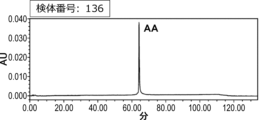
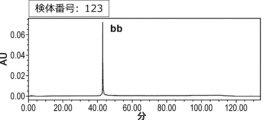
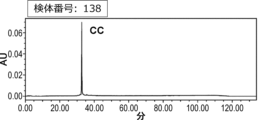
- Each antibody after purification with Protein A was analyzed by ion exchange chromatography (IEC).
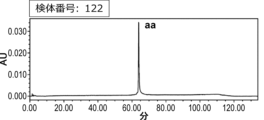
- an antibody in which the same heavy chain of SEQ ID NO: 1 homodimerizes and has a common light chain is shown as aa.
- aa an antibody in which the same heavy chain of SEQ ID NO: 1 homodimerizes and has a common light chain
- Example 8 Evaluation of human Fc ⁇ receptor binding of antibodies with modifications introduced into the CH3 region
- the binding activity of the prepared variants to each human Fc ⁇ receptor was evaluated using Biacore T200 (Cytiva).
- the running buffer was 50 mM phosphate buffer, 150 mM NaCl, 0.05 w/v%-P20, pH 7.4, and the evaluation was performed at 25°C.
- rProtein L BioVision was immobilized on Series S CM4 (Cytiva) as a ligand capture molecule.
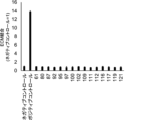
- Example 9 Evaluation of ECM binding of antibodies with modifications introduced into the CH3 region Next, the effect of heavy chain homoassociation-promoting modified antibodies on non-specific binding was confirmed.
- a system for evaluating binding to extracellular matrix (ECM) is known as a system for evaluating non-specific binding in vitro, and this assay system was used for evaluation (US patent 2014/0080153). The results of the measurement are shown in Figure 4. The binding to ECM was the same whether or not the CH3 interface was modified.
- Example 10 Evaluation of heavy chain homodimer formation ability between different IgG subclasses In Examples 1-9, evaluation was performed using antibodies of the IgG1 subclass. However, other IgG subclasses (IgG2, IgG4) are also important as therapeutic antibodies, and when preventing association with endogenous antibodies in the body, it is important that heavy chain heterodimers are not formed between different subclasses. Here, some of the modifications that showed strong heavy chain homodimer formation ability in IgG1 were also applied to different IgG subclasses, and the heavy chain homodimer formation ability was confirmed by SEC analysis.
- the template subclass used for antibody expression, amino acid modifications, sequence numbers, and area ratios are shown in Table 13 (if no modifications were introduced, "-" is displayed).
- Antibody expression and analysis were performed according to the method described in Example 1. However, since affinity purification with Protein A is difficult for pairs including IgG3, they were purified using MonoSpin ProG (GL science).
- the results in Table 13 show that all of the subclass pairs, IgG1, IgG2, and IgG4, have the ability to form heavy chain homodimers.
- analysis of the combination of WT-IgG1, IgG2, and IgG4 with WT-IgG3 revealed that WT-IgG1, IgG2, and IgG4 are inherently less likely to pair with IgG3. Therefore, these amino acid modifications that do not form heavy chain heterodimers between IgG1, IgG2, and IgG4 are considered to be less likely to form heavy chain hetero-associations with WT-IgG3.
- Example 11 Evaluation of heavy chain homodimer formation ability in antibodies with different IgG formats and Fc modifications
- a basic IgG format was used, and a wild-type IgG with no modifications other than CH3 interface control was used for the Fc.
- various antibody formats such as formats in which Fc is linked to VHH or scFv, and antibodies into which amino acid modifications that change Fc function have been introduced.
- some of the modifications that showed strong heavy chain homodimer formation ability in IgG were applied to various antibody formats and Fc-modified antibodies, and the heavy chain homodimer formation ability was confirmed by SEC analysis.
- the heavy chain backbone or amino acid modifications contained therein (and their functions) of the template antibody used for antibody expression, the amino acid modifications that promote heavy chain homodimer formation, the sequence number, and the area ratio are shown in Table 14 (if no modification was introduced, it is written as "-").
- Antibody expression and analysis were performed according to the method described in Example 1. However, aggregate components were detected for antibodies containing the E345R/E430G/S440Y modifications that promote hexamer formation of IgG in SEC analysis. In addition, complete separation of homo- and hetero-aggregates was difficult for pairs containing the scFv.LH-Fc or scFv.HL-Fc formats.
- the samples with 0% hetero-association (%), 95% or more monomer rate of homodimer, Tm of 65°C or more, and yield (mg) of 0.15 mg or more are sample numbers 80, 87, 92, 95, 97, 100, 102, 109, 111, 119, and 121, and the modifications contained in these samples also have excellent heavy chain homodimer formation ability and physicochemical properties.
- this modification set can be used as an alternative to the set of modifications T366V/D399M/Y407A/K409V, E356K/D399K/K409E/K439E, E356K/K392D/D399K/K409D, K392D/D399K/K409D, and E356K/K392D/D399K/K439E and can be applied as an Fc modification that allows expression of multiple homodimers.
- amino acid modifications that suppressed the percentage of hetero-assembly to 10% or less in Table 15 are shown in Table 20. Each of these amino acid combinations may be more preferable modifications that suppress hetero-assembly. Furthermore, amino acid modifications that suppressed the rate of hetero-assembly to 0% in Table 15 are shown in Table 21. Each of these amino acid combinations may be further preferred hetero-assembly-suppressing modifications.
- Example 13 Evaluation of simultaneous expression of homodimers and hetero-associates
- the amino acid modifications found in the present invention that promote homodimer formation may be used simultaneously with amino acid modifications that promote heterodimer formation (e.g., knob-into-hole modifications, etc.).
- amino acid modifications that promote heterodimer formation e.g., knob-into-hole modifications, etc.
- some of the modifications that showed strong heavy chain homodimer formation ability in IgG were co-expressed with an antibody containing a knob-into-hole modification, and the efficiency (%) of the formation of the desired homodimer and heterodimer when co-expressed with WT-IgG1 was compared by IEC analysis.
- Antibody preparation and IEC analysis were performed according to the method described in Example 6.
- Table 22 Combinations of heavy chain heterodimer-promoting variants and heavy chain homodimer-promoting variants, and various preparations of unintended aggregates.
- the amino acid modifications contained in the heavy chains represented by the heavy chain abbreviations in the table are as follows.
- knob-into-hole modifications were used to promote heteroassembly, but other reported modifications can also be used.
- SEED strand-exchange engineered domain
- TCR heterodimeric T-cell receptor
- BEAT Fc heterodimeric T-cell receptor
- T366W/S354C-T366S/L368A/Y407V/Y349C K409D/K392D-D399K/E356K
- S364H/F405A-Y349T/T394F D221E/P228E/L368E-D221R/P228R/K409R
- F405L-K409R T350V/T366L/K392L/T394W-T350V/L351Y/F405A/Y407V
- a modification that promotes homodimer formation a modification set that does not have a modification of the same residue number as the amino acid modification that promotes hetero-association, or a modification set that has significantly different amino acid properties (in terms of size and charge) is more preferable because it is assumed that unintended association promotion due to each modification is unlikely to occur.
- one hetero-association and one homo-association were expressed, but the number of samples to be expressed simultaneously is not limited to this.
- modifications with different modified residue numbers are preferentially combined.
- it is possible to express multiple amino acid modifications that promote homo-associations which are composed of amino acids with different properties even if they contain modifications with the same amino acid residue numbers that promote the multiple hetero-associations. This makes it possible to simultaneously express multiple hetero-associations and multiple homo-associations with high purity.
- Example 14 Evaluation of the ability to promote heavy chain homodimer formation in a mammalian cell expression system using mRNA Next, it was verified whether the effect of promoting homodimer formation could be obtained even when transfected into mammalian cells as messenger RNA (mRNA) instead of a plasmid.
- mRNA messenger RNA
- mRNA containing sequences encoding the antibody heavy and light chains listed in Tables 23 and 24 various antibodies listed in Table 25 were transiently expressed in mammalian cells by a method known to those skilled in the art, and purified by a method known to those skilled in the art.
- the prepared mRNA was transfected into 1 mL of Expi293 cells at 2.5E+6 cells/mL at the mass ratio shown in Table 25, and the antibody was transiently expressed.
- the culture supernatant was collected 4 days after transfection, and the antibody was purified by a method known to those skilled in the art.
- the prepared antibodies were analyzed according to the IEC method described in Example 6, and the area ratios at the time of triple-chain transfection are shown in Table 25.
- the ratio of hetero-aggregates was significantly reduced in constructs containing amino acid modifications that promote homodimer formation.
- Example 15 Preparation of mRNA-encapsulated lipid nanoparticles (mRNA-LNP)
- the lipid nanoparticles (mRNA-LNP) encapsulating mRNA shown in Tables 23 and 24 were prepared by the general lipid composition and preparation method described in the literature (Hou X, et al., Nat Rev Mater. 2021;6(12):1078-1094., Weng Y, et al., Biotechnol Adv. 2020 May-Jun;40:107534, Webb C, et al., Mol Pharm. 2022 Apr 4;19(4):1047-1058.).
- the mRNA-LNP was prepared by mixing the lipid ethanol solution and the mRNA aqueous solution at a ratio of 1:3 (vol/vol) using NanoAssemblr Ignite (Precision NanoSystems).
- the prepared mRNA-LNP was diluted with approximately 3 times the volume of PBS, and then the external buffer components were replaced with PBS using an Amicon 100 kDa centrifugal filter (Millipore) and concentrated to the desired concentration.
- the resulting mRNA-LNP was filtered using a 0.22 ⁇ m sterile filter.
- the final mRNA-LNP was stored at ⁇ 80°C until further use.
- the particle size, polydispersity index (PdI), and zeta potential of the mRNA-LNP were measured using a Zetasizer NanoZS (Malvern Panalytical).
- the mRNA-LNP samples were diluted 20-fold in PBS before particle size and PdI measurements, and 170-fold in 10 mM phosphate buffer (pH 7.2) before zeta potential measurements.
- Total RNA concentration and free RNA in mRNA-LNP samples were determined by a fluorescence-based assay (Ribogreen® reagent, ThermoFisherScientific). Encapsulation efficiency was calculated as (total RNA - free RNA)/total RNA.
- mRNA-LNP samples were appropriately diluted with 1x TBE buffer containing 1% Triton-X100 and Ribogreen® reagent to determine total RNA, or diluted with 1x TBE buffer containing Ribogreen® reagent alone to determine free RNA.
- a standard curve was used to generate mRNA-LNPs and was generated by utilizing starting RNA solution diluted in 1x TBE buffer containing Ribogreen® reagent +/- 1.0% Triton-X100.
- RNA-LNP sample was incubated at room temperature for about 5 minutes in the absence of light and measured using a SpectraMax M3 Microplate Reader (Molecular Devices) with excitation, auto cutoff, and emission wavelengths set at 488 nm, 515 nm, and 525 nm, respectively. Total RNA and free RNA were determined from the appropriate standard curves.
- LNPs were prepared with encapsulation >90%, particle size ⁇ 100 nm, and PdI ⁇ 0.1. LNPs encapsulating the corresponding mRNAs were mixed to obtain the combinations of mRNAs 1 to 3 shown in Table 26, and subjected to the in vivo test of Example 16.
- Example 16 Evaluation of the ability to promote heavy chain homodimer formation in in vivo expression in mice using mRNA-LNP To verify the in vivo effect of amino acid modifications that promote heavy chain homodimer formation, the mRNA-LNP prepared in Example 15 was intravenously administered at 1.0 mg RNA/kg to C57BL6/J mice (male, 6 weeks old). The names of the mRNA-LNPs used in the in vivo test, the mRNAs contained therein and their mass ratios, and the abbreviations of the expression samples are shown in Table 26. Whole blood was collected from the jugular vein of the mice 3 and 7 days after administration, and plasma was collected after centrifugation at 4°C, 12,000 rpm for 5 minutes.
- the antibodies were labeled with biotin and Alexa Fluor 647 using the Fisher Scientific and Alexa Fluor 647 Antibody Labeling Kit (A20186, Life Technologies).
- biotin and Alexa Fluor 647 using the Fisher Scientific and Alexa Fluor 647 Antibody Labeling Kit (A20186, Life Technologies).
- A20186, Life Technologies For homodimer measurements, collected plasma or plasma diluted 2-200 times with C57BL/6J (male, 8 weeks old, Jackson Laboratory Japan) pooled plasma was mixed with an equal volume of Rexxip A-max (P0004821, Gyros Protein Technologies).
- the plasma mixed with an equal volume of Rexxip A-max was mixed 1:1:1 with biotin-labeled antibody and Alexa Fluor 647-labeled antibody diluted with Rexxip A (P0004820, Gyros Protein Technologies) (final concentration of biotin-labeled antibody and Alexa Fluor 647-labeled antibody was 1 ug/mL) and incubated for 2 hours at room temperature.
- the plasma sample was mixed with biotin-labeled TIA0124-rabbitFc and Alexa Fluor 647-labeled TIA0124-rabbitFc at a ratio of 1:1:1.
- plasma samples were mixed with biotin-labeled Human GPC3 Core Protein and Alexa Fluor 647-labeled Human GPC3 Core Protein at a ratio of 1:1:1.
- plasma samples were mixed with biotin-labeled rAQ8-mIgG2b and Alexa Fluor 647-labeled rAQ8-mIgG2b in a 1:1:1 ratio.
- plasma samples were mixed 1:1:1 with biotin-labeled rAJ540-rbtIgG and Alexa Fluor 647-labeled rAJ540-rbtIgG.
- the incubated samples were measured using a Gyrolab xP workstation or Gyrolab xPand.
- a Gyrolab Bioaffy 1000 (P0004253, Gyros Protein Technologies) was used as a measurement disk.
- a mixture of the biotin-labeled antibody, Alexa Fluor 647-labeled antibody, and plasma sample incubated as described above was added to the measurement disk, and the biotin-labeled antibody-homodimer-Alexa Fluor 647-labeled antibody complex was captured in the reaction layer in the disk.
- the amount of the captured complex was detected by the fluorescent signal of Alexa647 (Detect PMT 1%).
- the fluorescent signal of Alexa647 was analyzed by Gyro Evaluator (version 3.7.2.5976, Gyros Protein Technologies).
- the collected plasma was diluted 3-5 times with pooled plasma from C57BL/6J mice (male, 8 weeks old, Jackson Laboratory Japan) and mixed with an equal volume of Rexxip A-max (P0004821, Gyros Protein Technologies).
- the plasma mixture was measured using a Gyrolab xP workstation or Gyrolab xPand.
- a Gyrolab Bioaffy 1000 (P0004253, Gyros Protein Technologies) was used as the measurement disk.
- Biotin-labeled antibodies diluted to 25 ug/mL with PBS 0.05% Tween 20 (P3563, SIGMA-ALDRICH) were added to the measurement disk and immobilized in the reaction layer inside the disk.
- the expression of anti-CD3/GPC3 heterodimers was suppressed by 72 to 878 times or more, and the expression of anti-FIXa/FX heterodimers was suppressed by 241 to 446 times or more.
- the inhibitory effect of the heterodimers on expression continued even 7 days after administration, with the anti-CD3/GPC3 heterodimer showing 84- to 717-fold or more inhibition of expression, and the anti-FIXa/FX heterodimer showing 184- to 375-fold or more inhibition of expression. This demonstrated that the designed molecule can suppress the expression of heterodimers in vivo.
Landscapes
- Health & Medical Sciences (AREA)
- Chemical & Material Sciences (AREA)
- Organic Chemistry (AREA)
- Immunology (AREA)
- Life Sciences & Earth Sciences (AREA)
- Medicinal Chemistry (AREA)
- Biophysics (AREA)
- General Health & Medical Sciences (AREA)
- Genetics & Genomics (AREA)
- Biochemistry (AREA)
- Molecular Biology (AREA)
- Proteomics, Peptides & Aminoacids (AREA)
- Hematology (AREA)
- Gastroenterology & Hepatology (AREA)
- Cell Biology (AREA)
- Peptides Or Proteins (AREA)
- Micro-Organisms Or Cultivation Processes Thereof (AREA)
- Preparation Of Compounds By Using Micro-Organisms (AREA)
Abstract
Description
さらに、一態様として、Fc間の会合が制御されたポリペプチド、Fc間の会合が制御されたポリペプチドの製造方法、Fc間の会合が制御されたポリペプチドの生体内での発現、およびFc間の会合の制御方法を提供することにある。また、本開示は、その一態様として、CH3間の界面における会合が制御された抗体、2つ以上の抗体を効率的に同時発現する方法を提供することを目的とする。
即ち、本発明者らによって見出された知見によって、同種重鎖間の会合を制御することが可能である。また、本開示は同種重鎖間の会合の制御に適用可能なだけではなく、任意のFcを含むポリペプチド間の会合を制御することが可能である。
さらに本発明者らは、本開示のFc間の会合が制御された抗体が、Fcの機能を保持していることを確認した。
本開示は、ポリペプチド間の会合が制御されたポリペプチド、会合が制御されたポリペプチドの製造方法、ポリペプチドの会合制御方法、会合が制御されたポリペプチドをコードする核酸、および該核酸を含有する組成物等に関する。
[1] 第一のポリペプチドをコードする核酸であって、
該第一のポリペプチドは、改変が導入されたFc領域を有し、
Fc領域に導入された改変により第一のポリペプチドは、該改変が導入されていないFc領域を有する第一のポリペプチドよりも該改変を有している第一のポリペプチドとFc領域で会合しやすい、核酸。
[1-1] 前記第一のポリペプチドは、該改変を有するポリペプチドよりも該改変が導入されていないポリペプチドと会合しにくい、前記核酸。
[1-1-1] 前記第一のポリペプチドが、該改変が導入されていない他のポリペプチドとヘテロ二量体を形成しにくい、前記核酸。
[1-1-2] ホモ二量体よりもヘテロ二量体を形成しにくい、前記核酸。
[1-1-3] 前記第一のポリペプチドが、内因性のIgGまたはそのFc領域を含む抗体断片と会合しない、もしくは会合しにくい、前記核酸。
[1-2] 該改変を有する第一のポリペプチド同士が会合する、前記核酸。
[1-2-1] 該改変を有する第一のポリペプチドがホモ体を形成する、前記核酸。
[1-2-2] ヘテロ二量体よりもホモ二量体を形成しやすい、前記核酸。
[1-2-3] 前記第一のポリペプチドが、対照(例えば、野生型IgG)と比較して、強いホモ二量体促進力を示す、前記核酸。
[1-2-4] 第一のポリペプチド以外のポリペプチド(例えば、第二のポリペプチド)のホモ二量体がさらに形成される、前記核酸。
[1-2-5] 1もしくは複数種のポリペプチドのホモ二量体が形成される、前記核酸。
[1-2-6] 複数種のポリペプチドにおける改変がそれぞれ異なる、前記核酸。
[1-2-7] それぞれ異なる複数種の改変の組み合わせが、表7に示される組み合わせである、前記核酸。
[1-3] 該改変を有する第一のポリペプチドが、該改変が導入されていないポリペプチドと比べて、該改変を有するポリペプチドとの会合体形成能が上昇した、前記核酸。
[1-4] 前記核酸が、RNA、DNA、または、該核酸を担持するベクターもしくはプラスミドである、前記核酸。
[1-5] 前記第一のポリペプチドが、会合が制御されたポリペプチドである、前記核酸。
[1-5-1] 前記会合がFc領域間の会合である、前記核酸。
[1-6] 前記第一のポリペプチドがCH3を有する、前記核酸。
[1-6-1] 前記会合が、CH3間の界面における会合である、前記核酸。
[1-6-2] 該改変がCH3における改変である、前記核酸。
[2] 前記第一のポリペプチドは、導入された改変による(1)立体相補性(「立体障害」とも記載)、(2)ジスルフィド架橋(「ジスルフィド結合」とも記載)、(3)静電電荷(「電荷」とも記載)、の少なくとも一つの作用により、該改変が導入されていないFc領域を有する第一のポリペプチドよりも該改変を有している第一のポリペプチドとFc領域で会合しやすい、前記核酸。
[2-1] 前記立体相補性が、該Fc領域にノブ(Knob)とホール(Hole)があることによって生じる、前記核酸。
[2-1-1] 前記改変が、該Fc領域にノブとホールを導入する改変である、前記核酸。
[2-1-2] 前記Fc領域のノブとホールにより、前記第一のポリペプチドのホモ二量体形成が誘導される、前記核酸。
[2-1-3] 第一のポリペプチドに、ノブとホールが全て導入される、前記核酸。
[2-1-4] 少なくとも(1)立体相補性、および、(3)静電電荷、の作用の組み合わせにより該改変が導入されていないポリペプチドよりも該改変を有しているポリペプチドと会合しやすい、前記核酸。
[2-2] 前記ジスルフィド架橋が、Fc領域中の1もしくは複数のアミノ酸のシステイン(C)への置換によって形成される、前記核酸。
[2-2-1] 前記改変が、Fc領域中へ1もしくは複数のシステインを導入する改変である、前記核酸。
[2-2-2] 前記改変が、Fc領域中の1もしくは複数のアミノ酸のシステインへの置換である、前記核酸。
[2-2-3] 前記ジスルフィド架橋が、Fc領域中で改変(導入)されたシステイン間の架橋である、前記核酸。
[2-2-4] 少なくとも(2)ジスルフィド架橋、および、(3)静電電荷、の作用の組み合わせにより該改変が導入されていないポリペプチドよりも該改変を有しているポリペプチドと会合しやすい、前記核酸。
[2-3] 前記静電電荷の作用が、Fc領域中で改変(導入)された1もしくは複数の電荷アミノ酸によって生じる、前記核酸。
[2-3-1] 前記導入する電荷アミノ酸が正電荷アミノ酸および/または負電荷アミノ酸である、前記核酸。
[2-3-2] Fc領域中の少なくとも2つのアミノ酸が、正電荷アミノ酸および負電荷アミノ酸へ置換された、前記核酸。
[2-3-3] 前記正電荷アミノ酸が、リジン(K)、アルギニン(R)、ヒスチジン(H)から選択され、および/または、前記負電荷アミノ酸が、アスパラギン酸(D)、グルタミン酸(E)から選択される、前記核酸。
[2-4] 前記作用が、(1)立体相補性、(2)ジスルフィド架橋、および、(3)静電電荷から選択される複数(2つもしくは3つ)の作用(組み合わせ)である、前記核酸。
[3] 前記[1]に記載の核酸と、
第二のポリペプチドをコードする核酸を含み、
該第二のポリペプチドは、改変が導入されたFc領域を有し、
Fc領域に導入された改変により第二のポリペプチドは、該改変が導入されていないFc領域を有する第二のポリペプチドよりも該改変を有している第二のポリペプチドとFc領域で会合しやすい、組成物。
[3-1] 該第二のポリペプチドにおける改変が、前記第一のポリペプチドにおける改変と異なる、前記組成物。
[3-2] 前記第二のポリペプチドにおける前記作用が、前記第一のポリペプチドにおける前記作用と異なる、前記組成物。
[3-3] 改変前の第二のポリペプチドと、改変前の第一のポリペプチドのアミノ酸配列が異なる、前記組成物。
[3-4] 前記第一または第二のポリペプチドと異なるポリペプチド(一態様として、第三および/または第四のポリペプチド)をコードする核酸をさらに含む、前記組成物。
[4] 前記[1]に記載の核酸と、
第二のポリペプチドをコードする核酸と、
第三のポリペプチドをコードする核酸と、を含み、
該第二のポリペプチドは、該第二のポリペプチドよりも該第三のポリペプチドと会合しやすい、組成物。
[5] 前記[2]記載の核酸と、
第二のポリペプチドをコードする核酸を含む組成物であって、該第二のポリペプチドは、該第一のポリペプチドが有する前記改変を有さない、組成物。
[6] 前記第一のポリペプチドに導入された改変と、前記第二のポリペプチド導入された改変は、異なる改変である、前記組成物。
[7] 前記第二のポリペプチドは、導入された改変による(1)立体相補性、(2)ジスルフィド架橋、(3)静電電荷、の少なくとも一つの作用により、該改変が導入されていないFc領域を有する第二のポリペプチドよりも該改変を有している第二のポリペプチドとFc領域で会合しやすい、前記組成物。
[7-1] 前記第二のポリペプチドにおける改変が、前記第一のポリペプチドにおける改変と異なる、前記組成物。
[7-2] 前記第二のポリペプチドにおける前記作用が、前記第一のポリペプチドにおける前記作用と異なる、前記組成物。
[8] Fc領域に導入された改変は、表2記載の改変の少なくとも一つである、前記核酸もしくは組成物。
[9] Fc領域に導入された改変は、表4記載の改変の少なくとも一つである、前記核酸もしくは組成物。
[10] 前記第一のポリペプチドに導入された改変と、前記第二のポリペプチド導入された改変は、表6記載の改変の組み合わせの少なくとも一つである、前記核酸もしくは組成物。
[11] 前記ポリペプチドが抗体である、前記核酸もしくは組成物。
[12] 前記Fc領域がIgGのFc領域である、前記核酸もしくは組成物。
[13] 改変が導入されたポリペプチドは、改変前ポリペプチドの機能を保持している、前記核酸もしくは組成物。
[14] 改変が導入されたFc領域がIgGのFcの機能を保持している、前記核酸もしくは組成物。
[15] 前記Fc領域が、IgG1、2、3、4のいずれか由来である、前記核酸もしくは組成物。
[16] 前記核酸もしくは組成物が導入された宿主細胞。
[17] 前記核酸から発現したポリペプチド。
[18] ポリペプチドをコードする核酸を含む組成物であって、
該ポリペプチドは、改変が導入されたFc領域を有し、
該改変が表2で示す少なくとも一つの改変である、組成物。
[19] 改変が導入されたFc領域を有するポリペプチドであって、導入された改変による(1)立体相補性、(2)ジスルフィド架橋、(3)静電電荷、の少なくとも一つの作用により、該改変が導入されていないFc領域を有するポリペプチドよりも該改変を有しているポリペプチドとFc領域で会合しやすい、ポリペプチド。
[19-1] 該改変が、CH3における改変である、前記ポリペプチド。
[20] 会合が制御されたポリペプチドを得る方法であって
該ポリペプチドをコードする核酸を得るステップ、
該核酸を発現させるステップ、とを有し
該ポリペプチドは、Fc領域を有し、
Fc領域に導入された改変により該ポリペプチドは、該改変が導入されていないFc領域を有するポリペプチドよりも該改変を有しているポリペプチドとFc領域で会合しやすい、方法。
[20-1] 前記発現が、インビボ(in vivo)、エクスビボ(ex vivo)、またはインビトロ(in vitro)での発現である、前記方法。
[21] ポリペプチドのホモ体の会合を制御する方法であって
該ポリペプチドをコードする核酸を得るステップ、
該核酸を発現させるステップ、とを有し
該ポリペプチドは、Fc領域を有し、
Fc領域に導入された改変により該ポリペプチドは、該改変が導入されていないFc領域を有するポリペプチドよりも該改変を有しているポリペプチドとFc領域で会合しやすい、方法。
[22] ポリペプチドのホモ体の発現を促進する方法であって
該ポリペプチドをコードする核酸を得るステップ、
該核酸を発現させるステップ、とを有し
該ポリペプチドは、Fc領域を有し、
Fc領域に導入された改変により該ポリペプチドは、該改変が導入されていないFc領域を有するポリペプチドよりも該改変を有しているポリペプチドとFc領域で会合しやすい、方法。
[101] 会合制御されたポリペプチドであって、該ポリペプチドは、改変が導入されたFc領域を有し、Fc領域に導入された改変により該ポリペプチドは、該改変が導入されていないポリペプチドよりも該改変を有しているポリペプチドとFc領域で会合しやすい、ポリペプチド。
[101-1] 前記ポリペプチドは、該改変を有するポリペプチドよりも該改変が導入されていないポリペプチドと会合しにくい、前記ポリペプチド。
[101-1-1] 前記ポリペプチドが、該改変を有さない他のポリペプチドとヘテロ二量体を形成しにくい、前記ポリペプチド。
[101-1-2] ホモ二量体よりもヘテロ二量体を形成しにくい、前記ポリペプチド。
[101-1-3] 前記ポリペプチドが、内因性のIgGまたはそのFc領域を含む抗体断片と会合しない、もしくは会合しにくい、前記ポリペプチド。
[101-2] 該改変を有するポリペプチド同士が会合する、前記ポリペプチド。
[101-2-1] 該改変を有するポリペプチドがホモ体を形成する、前記ポリペプチド。
[101-2-2] ヘテロ二量体よりもホモ二量体を形成しやすい、前記ポリペプチド。
[101-2-3] 対照(例えば、野生型IgG)と比較して、強いホモ二量体促進力を示す、前記ポリペプチド。
[101-3] 該改変を有するポリペプチドが、該改変を有さないポリペプチドと比べて、該改変を有するポリペプチドとの会合体形成能が上昇した、前記ポリペプチド。
[101-3-1] 前記会合がFc領域間の会合である、前記ポリペプチド。
[101-4] 前記ポリペプチドがCH3を有する、前記ポリペプチド。
[101-4-1] 前記会合が、CH3間の界面における会合である、前記ポリペプチド。
[101-4-2] 前記改変がCH3における改変である、前記ポリペプチド。
[102] 前記ポリペプチドは、導入された改変による(1)立体相補性、(2)ジスルフィド架橋、(3)静電電荷、の少なくとも一つの作用により、該改変が導入されていないポリペプチドよりも該改変を有しているポリペプチドとFc領域で会合しやすい、前記ポリペプチド。
[102-1] 前記立体相補性が、該Fc領域にノブ(Knob)とホール(Hole)があることによって生じる、前記ポリペプチド。
[102-1-1] 前記改変が、該Fc領域にノブとホールを導入する改変である、前記ポリペプチド。
[102-1-2] 前記Fc領域のノブとホールにより、前記第一のポリペプチドのホモ二量体形成が誘導される、前記ポリペプチド。
[102-1-3] 第一のポリペプチドに、ノブとホールが全て導入される、前記ポリペプチド。
[102-2] 前記ジスルフィド架橋が、Fc領域中の1もしくは複数のアミノ酸のシステイン(C)への置換によって形成される、前記ポリペプチド。
[102-2-1] 前記改変が、Fc領域中へ1もしくは複数のシステインを導入する改変である、前記ポリペプチド。
[102-2-2] 前記改変が、Fc領域中の1もしくは複数のアミノ酸のシステインへの置換である、前記ポリペプチド。
[102-2-3] 前記ジスルフィド架橋が、Fc領域中で改変(導入)されたシステイン間の架橋である、前記ポリペプチド。
[102-2-4] 少なくとも(2)ジスルフィド架橋、および、(3)静電電荷、の作用の組み合わせにより該改変が導入されていないポリペプチドよりも該改変を有しているポリペプチドと会合しやすい、前記ポリペプチド。
[102-3] 前記静電電荷の作用が、Fc領域中で改変(導入)された1もしくは複数の電荷アミノ酸によって生じる、前記ポリペプチド。
[102-3-1] 前記導入する電荷アミノ酸が正電荷アミノ酸および/または負電荷アミノ酸である、前記ポリペプチド。
[102-3-2] Fc領域中の少なくとも2つのアミノ酸が、正電荷アミノ酸および負電荷アミノ酸へ置換された、前記ポリペプチド。
[102-3-3] 前記正電荷アミノ酸が、リジン(K)、アルギニン(R)、ヒスチジン(H)から選択され、および/または、前記負電荷アミノ酸が、アスパラギン酸(D)、グルタミン酸(E)から選択される、前記ポリペプチド。
[102-4] 前記作用が、(1)立体相補性、(2)ジスルフィド架橋、および、(3)静電電荷から選択される複数(2つもしくは3つ)の作用(組み合わせ)である、前記ポリペプチド。
[103] Fc領域に導入された改変は、表2記載の改変の少なくとも一つである、前記ポリペプチド。
[104] Fc領域に導入された改変は、表4記載の改変の少なくとも一つである、前記ポリペプチド。
[105] 前記立体相補性は、ノブ・イントゥ・ホールを含む、前記ポリペプチド。
[106] 前記ポリペプチドが抗体である、前記ポリペプチド。
[107] 前記Fc領域がIgGのFc領域である、前記ポリペプチド。
[108] 前記Fc領域が、IgG1、2、3、4のいずれか由来である、前記ポリペプチド。
(a) Fc領域に改変が導入されたポリペプチドをコードする核酸を取得する工程であって、ここで、該ポリペプチドは、(1)立体相補性、(2)ジスルフィド架橋、(3)静電電荷、の少なくとも一つの作用により、該改変が導入されていないポリペプチドよりも該改変を有しているポリペプチドと会合しやすいポリペプチドである、工程;
(b) 前記核酸を宿主細胞へ導入し、宿主細胞を該核酸が発現するように培養する工程;
(c) 前記宿主細胞の培養物からポリペプチドを回収する工程。
[201-1] 前記ポリペプチドにおいて、(1)立体相補性、(2)ジスルフィド架橋、(3)静電電荷の作用が生じるように、Fc領域へ改変を導入する工程をさらに含む、前記方法。
[202-2] Fc領域に導入する改変が、表2または表4に記載の改変の少なくとも一つである、前記方法。
[202] 以下の工程を含む、Fc領域間の会合が制御されたポリペプチドの製造方法:
(a) Fc領域を含むポリペプチドをコードする核酸を、該ポリペプチドが、(1)立体相補性、(2)ジスルフィド架橋、(3)静電電荷、の少なくとも一つの作用により、該改変が導入されていないポリペプチドよりも該改変を有しているポリペプチドと会合しやすいポリペプチドとなるように改変する工程;
(b) 前記改変された核酸を宿主細胞へ導入し、宿主細胞を該核酸が発現するように培養する工程;
(c) 前記宿主細胞の培養物からポリペプチドを回収する工程。
[203] Fc領域を含むポリペプチド間の会合を制御する方法であって、該ポリペプチドが、(1)立体相補性、(2)ジスルフィド架橋、(3)静電電荷、の少なくとも一つの作用により、該改変が導入されていないポリペプチドよりも該改変を有しているポリペプチドと会合しやすいポリペプチドとなるように改変することを含む、方法。
[204] 以下の工程を含む、Fc領域を含むポリペプチド間の会合が制御されたポリペプチドを、生体内で生成させる方法:
(a) Fc領域を含むポリペプチドが、(1)立体相補性、(2)ジスルフィド架橋、(3)静電電荷、の少なくとも一つの作用により、該改変が導入されていないポリペプチドよりも該改変を有しているポリペプチドと会合しやすいポリペプチドへ改変されたものとなるように、Fc領域を含むポリペプチドをコードする核酸を調製する工程;
(b) 工程(a)の核酸を、生体内へ導入する工程。
[204-1] 前記ポリペプチドにおいて、(1)立体相補性、(2)ジスルフィド架橋、(3)静電電荷の作用が生じるように、Fc領域へ改変を導入する工程を含む、前記方法。
[204-2] 前記核酸がベシクルに包含された、前記方法。
[204-3] 前記核酸とベシクルとを接触させる工程を含む、前記方法。
[204-4] 前記ベシクルが脂質ナノ粒子(LNP)、ウイルス、細胞外小胞(EV)、リポソームである、前記方法。
[204-5] 前記核酸が、RNA、DNA、または、該核酸を担持するベクターもしくはプラスミドである、前記方法。
[204-6] 前記RNAがmRNA、ゲノムRNA、環状化RNAである、前記方法。
[204-7] 前記Fc領域を含むポリペプチドが抗体である、前記方法。
[204-8] 前記Fc領域を含むポリペプチドがシングルドメイン抗体である、前記方法。
[204-9] 前記Fc領域を含むポリペプチドがIgGである、前記方法。
[204-10] 前記Fc領域を含むポリペプチドが内因性IgGと会合しない、前記方法。
[204-11] 前記Fc領域を含むポリペプチドが野生型IgGのFcの機能を保持している、前記方法。
[204-12] 前記核酸を、対象へ投与する工程を含む、前記方法。
[204-13] 前記対象がヒトである、前記方法。
[204-14] 前記Fc領域を含むポリペプチドがヒト化抗体またはヒト抗体である、前記方法。
[205] 以下の工程を含む、Fc領域を含むポリペプチド間の会合が制御されたポリペプチドを、細胞で発現させる方法:
(a) Fc領域を含むポリペプチドが、(1)立体相補性、(2)ジスルフィド架橋、(3)静電電荷、の少なくとも一つの作用により、該改変が導入されていないポリペプチドよりも該改変を有しているポリペプチドと会合しやすいポリペプチドへ改変されたものとなるように、Fc領域を含むポリペプチドをコードする核酸を調製する工程;
(b) 工程(a)の核酸を、細胞へ導入する工程。
[205-1] 前記ポリペプチドにおいて、(1)立体相補性、(2)ジスルフィド架橋、(3)静電電荷の作用が生じるように、Fc領域へ改変を導入する工程を含む、前記方法。
[205-2] 前記核酸が、RNA、DNA、または、該核酸を担持するベクターもしくはプラスミドである、前記方法。
[205-3] 前記RNAがmRNA、ゲノムRNA、環状化RNAである、前記方法。
[205-4] 前記Fc領域を含むポリペプチドが抗体である、前記方法。
[205-5] 前記Fc領域を含むポリペプチドがシングルドメイン抗体である、前記方法。
[205-6] 前記Fc領域を含むポリペプチドがIgGである、前記方法。
[205-7] 前記細胞がヒト細胞である、前記方法。
[205-8] インビボ(in vivo)、エクスビボ(ex vivo)、またはインビトロ(in vitro)での方法である、前記方法。
[206] Fc領域を有する複数種のポリペプチドを細胞で発現させる方法であって、同種のポリペプチド間の会合が制御された方法:
(a) Fc領域を含む第一のポリペプチドが、(1)立体相補性、(2)ジスルフィド架橋、(3)静電電荷、の少なくとも一つの作用により、該改変が導入されていないポリペプチドよりも該改変を有しているポリペプチドと会合しやすいポリペプチドへ改変されたものとなるように、Fc領域を含むポリペプチドをコードする核酸を調製する工程;
(b) Fc領域を含む第二のポリペプチドが、(1)立体相補性、(2)ジスルフィド架橋、(3)静電電荷、の少なくとも一つの作用により、該改変が導入されていないポリペプチドよりも該改変を有しているポリペプチドと会合しやすいポリペプチドへ改変されたものとなるように、Fc領域を含むポリペプチドをコードする核酸を調製する工程; ここで、該第二のポリペプチドにおける改変は、該第一のポリペプチドにおける改変とは異なる、工程。
[206-1] Fc領域を有する複数種のポリペプチドを細胞で発現させて、同種のポリペプチドのホモ体を形成させる、前記方法。
[206-2] 発現させる複数種のポリペプチドにおける改変がそれぞれ異なる、前記方法。
[206-3] それぞれ異なる複数種の改変の組み合わせが、表7に示される組み合わせである、前記方法。
[207] Fc領域を有する複数種のポリペプチドの会合を制御する方法であって、同種のポリペプチド間の会合が制御された方法であり、ここで、該複数種のポリペプチドは、(1)立体相補性、(2)ジスルフィド架橋、(3)静電電荷、の少なくとも一つの作用により、該改変が導入されていないポリペプチドよりも該改変を有しているポリペプチドと会合しやすいポリペプチドとなるように改変が導入されており、さらにここで、該複数種のポリペプチドにおける改変はそれぞれ異なる、前記方法。
[207-1] それぞれ異なる複数種の改変の組み合わせが、表7に示される組み合わせである、前記方法。
[208] 以下の工程を含む、Fc領域間の会合が制御されたポリペプチドをコードする核酸を包含するベシクルを含む医薬組成物の製造方法:
(a) Fc領域に改変が導入されたポリペプチドをコードする核酸を取得する工程であって、ここで、該ポリペプチドは、(1)立体相補性、(2)ジスルフィド架橋、(3)静電電荷、の少なくとも一つの作用により、該改変が導入されていないポリペプチドよりも該改変を有しているポリペプチドと会合しやすいポリペプチドである、工程;
(b) 工程(a)の核酸とベシクルを接触させる工程。
[208-1] 前記ベシクルが脂質ナノ粒子(LNP)、ウイルス、細胞外小胞(EV)、リポソームである、前記方法。
[208-2] さらに医薬的に許容される担体と接触させる、前記方法。
[208-3] 前記核酸が、RNA、DNA、または、該核酸を担持するベクターもしくはプラスミドである、前記方法。
[301-1] 会合が制御されたFc領域を有するポリペプチドをコードする核酸を含む、医薬組成物。
[301-2] ベシクルに包含(封入)された前記核酸を含む、前記医薬組成物。
[301-3] 会合が制御されたFc領域を有するポリペプチドをコードする核酸、および、ベシクルを含む、医薬組成物。
[301-4] 前記ベシクルが脂質ナノ粒子(LNP)、ウイルス、細胞外小胞(EV)、リポソームである、前記医薬組成物。
[301-5] 前記核酸が、RNA、DNA、または、該核酸を担持するベクターもしくはプラスミドである、前記医薬組成物。
[301-6] Fc領域間の会合が制御されたポリペプチドを生体内で生成するための、前記医薬組成物。
[301-7] Fc領域間の会合が制御されたポリペプチドを細胞で発現させるための、前記医薬組成物。
[態様1]
第一のポリペプチドをコードする核酸であって、
該第一のポリペプチドは、改変が導入されたFc領域を有し、
Fc領域に導入された改変により第一のポリペプチドは、該改変が導入されていないFc領域を有する第一のポリペプチドよりも該改変を有している第一のポリペプチドとFc領域で会合しやすい、核酸。
[態様2]
前記第一のポリペプチドは、導入された改変による(1)立体相補性、(2)ジスルフィド架橋、(3)静電電荷、の少なくとも一つの作用により、該改変が導入されていないFc領域を有する第一のポリペプチドよりも該改変を有している第一のポリペプチドとFc領域で会合しやすい態様1記載の核酸。
[態様3]
本開示1記載の核酸と、
第二のポリペプチドをコードする核酸を含み、
該第二のポリペプチドは、改変が導入されたFc領域を有し、
Fc領域に導入された改変により第二のポリペプチドは、該改変が導入されていないFc領域を有する第二のポリペプチドよりも該改変を有している第二のポリペプチドとFc領域で会合しやすい、組成物。
[態様4]
態様1記載の核酸と、
第二のポリペプチドをコードする核酸と、
第三のポリペプチドをコードする核酸と、を含み、
該第二のポリペプチドは、該第二のポリペプチドよりも該第三のポリペプチドと会合しやすい、組成物。
[態様5]
態様2記載の核酸と、
第二のポリペプチドをコードする核酸を含む組成物であって、該第二のポリペプチドは、該第一のポリペプチドが有する前記改変を有さない、組成物。
[態様6]
前記第一のポリペプチドに導入された改変と、前記第二のポリペプチド導入された改変は、異なる改変である態様3記載の組成物。
[態様7]
前記第二のポリペプチドは、導入された改変による(1)立体相補性、(2)ジスルフィド架橋、(3)静電電荷、の少なくとも一つの作用により、該改変が導入されていないFc領域を有する第二のポリペプチドよりも該改変を有している第二のポリペプチドとFc領域で会合しやすい態様3記載の組成物。
[態様8]
Fc領域に導入された改変は、表2記載の改変の少なくとも一つである態様1記載の核酸。
[態様9]
Fc領域に導入された改変は、表4記載の改変の少なくとも一つである態様1記載の核酸。
[態様10]
前記第一のポリペプチドに導入された改変と、前記第二のポリペプチド導入された改変は、表6記載の改変の組み合わせの少なくとも一つである態様6の核酸。
[態様11]
前記ポリペプチドが抗体である、態様1記載の核酸。
[態様12]
前記Fc領域が、IgGのFc領域である態様1記載の核酸。
[態様13]
改変が導入されたポリペプチドは、改変前ポリペプチドの機能を保持している態様1記載の核酸。
[態様14]
改変が導入されたFc領域がIgGのFcの機能を保持している、態様12記載の核酸。
[態様15]
前記Fc領域が、IgG1、2、3、4のいずれか由来である態様1記載の核酸。
[態様16]
態様1、2、8~14のいずれかに記載の核酸、または、態様3~7のいずれかに記載の組成物が導入された宿主細胞。
[態様17]
態様1記載の核酸から発現したポリペプチド。
[態様18]
ポリペプチドをコードする核酸を含む組成物であって、
該ポリペプチドは、改変が導入されたFc領域を有し、
該改変が表2で示す少なくとも一つの改変である、組成物。
[態様19]
改変が導入されたFc領域を有するポリペプチドであって、導入された改変による(1)立体相補性、(2)ジスルフィド架橋、(3)静電電荷、の少なくとも一つの作用により、該改変が導入されていないFc領域を有するポリペプチドよりも該改変を有しているポリペプチドとFc領域で会合しやすい、ポリペプチド。
[態様20]
会合が制御されたポリペプチドを得る方法であって
該ポリペプチドをコードする核酸を得るステップ、
該核酸を発現させるステップ、とを有し
該ポリペプチドは、Fc領域を有し、
Fc領域に導入された改変により該ポリペプチドは、該改変が導入されていないFc領域を有するポリペプチドよりも該改変を有しているポリペプチドとFc領域で会合しやすい、方法。
[態様21]
ポリペプチドのホモ体の会合を制御する方法であって
該ポリペプチドをコードする核酸を得るステップ、
該核酸を発現させるステップ、とを有し
該ポリペプチドは、Fc領域を有し、
Fc領域に導入された改変により該ポリペプチドは、該改変が導入されていないFc領域を有するポリペプチドよりも該改変を有しているポリペプチドとFc領域で会合しやすい、方法。
[態様22]
ポリペプチドのホモ体の発現を促進する方法であって
該ポリペプチドをコードする核酸を得るステップ、
該核酸を発現させるステップ、とを有し
該ポリペプチドは、Fc領域を有し、
Fc領域に導入された改変により該ポリペプチドは、該改変が導入されていないFc領域を有するポリペプチドよりも該改変を有しているポリペプチドとFc領域で会合しやすい、方法。
[態様23]
前記第二のポリペプチドは、改変が導入されたFc領域を有し、
Fc領域に導入された改変により第二のポリペプチドは、該第二のポリペプチドよりも前記第三のポリペプチドとFc領域で会合しやすい、態様4記載の組成物。
[態様24]
前記改変が導入されたFc領域は、以下の(a)~(d)に示すEUナンバリングによる位置の組より選択される1組または2組以上の位置にアミノ酸改変を含む、態様1記載の組成物:
(a)位置394、および405
(b)位置366、368、および407
(c)位置347、360、399、405、および409
(d)位置356、392、399、および439。
[態様25]
前記改変が導入されたFc領域は、EUナンバリングによる
(a)位置394における、W、F、Y
位置405における、A、S、T、C、G、V
(b)位置366における、W、Y、F
位置368における、A、S、T、C、V、G
位置407における、V、L、I、M、A、S、T、C、N、Q
(c)位置347における、R、K、Y、H
位置360における、E、D
位置399における、V、L、I、M、S、T、C、H、A、N、Q、G
位置405における、T、A、V、S、C、N、D、G
位置409におけるW、F、Y、H
(d)位置356における、K、R
位置392における、D、E
位置399における、K、R
位置439における、E、D
からなる群より選択される少なくとも一つのアミノ酸を含む、態様24記載の組成物。
[態様26]
前記改変が導入されたFc領域は、EUナンバリングによる
(a)位置394における、W、F
位置405における、A、S、T、G
(b)位置366における、W、Y、F
位置368における、A、T、C、V、G
位置407における、V、L、I、M、A、C
(c)位置347における、R、K、Y、H
位置360における、E、D
位置399における、V、L、I、M、S、T、C、H、A、N、G
位置405における、T、A、V
位置409におけるW、F、Y
(d)位置356における、K
位置392における、D
位置399における、K
位置439における、E
からなる群より選択される少なくとも一つのアミノ酸を含む、態様24記載の組成物。
[態様27]
Fc領域に導入された改変は、表15記載の改変の少なくとも一つである態様1記載の核酸。
[態様28]
Fc領域に導入された改変は、表17記載の改変の少なくとも一つである態様1記載の核酸。
[態様29]
前記改変が導入されたFc領域は、以下の(a)~(d)に示すEUナンバリングによる位置の組より選択される1組または2組以上の位置にアミノ酸改変を含む、態様1記載の組成物:
(a)位置345、347、360、366、399、407、および409
(b)位置356,399,409,および439
(c)位置356,392,399,および409
(d)位置392,399,および409。
[態様30]
前記改変が導入されたFc領域は、EUナンバリングによる
(a)位置345における、R、E
位置347における、R、K
位置360における、D、E
位置366における、V
位置399における、M、Q、N、H、I、F、Y、T、S、V、L
位置407における、A
位置409における、V、Q、N、H、L、I、F、Y、T、S
(b)位置356における、K、R、H
位置399における、K、R、H
位置409における、E、D
位置439における、E、D
(c)位置356における、K、R、H
位置392における、D、E
位置399における、K、R、H
位置409における、D、E
(d)位置392における、D、E
位置399における、K、R
位置409における、D、E
からなる群より選択される少なくとも一つのアミノ酸を含む、態様29記載の組成物。
以下の定義および詳細な説明は、本明細書において説明する本開示の理解を容易にするために提供される。
アミノ酸
本明細書において、アミノ酸は、1文字コードもしくは3文字コードまたはその両方、例えば、Ala/A、Leu/L、Arg/R、Lys/K、Asn/N、Meあ、Asp/D、Phe/F、Cys/C、Pro/P、Gln/Q、Ser/S、Glu/E、Thr/T、Gly/G、Trp/W、His/H、Tyr/Y、Ile/I、またはVal/Vによって記載される。
ポリペプチドのアミノ酸配列中のアミノ酸改変(本明細書において「アミノ酸置換」または「アミノ酸変異」とも記載される)のためには、部位特異的変異誘発法(Kunkelら(Proc. Natl. Acad. Sci. USA (1985) 82, 488-492))および重複伸長PCRなどの公知の方法が適宜採用され得る。さらに、非天然アミノ酸に置換するためのアミノ酸改変方法として、いくつかの公知の方法もまた採用され得る(Annu. Rev. Biophys. Biomol. Struct. (2006) 35, 225-249;およびProc. Natl. Acad. Sci. U.S.A. (2003) 100 (11), 6353-6357)。例えば、終止コドンの1つであるUAGコドン(アンバーコドン)の相補的アンバーサプレッサーtRNAに非天然アミノ酸が結合したtRNAを含む無細胞翻訳系 (Clover Direct (Protein Express)) を用いることができる。
さらに、本明細書において、アミノ酸の改変を示す表現として、特定の位置を表す数字の前および後に、それぞれ改変前および改変後のアミノ酸の1文字コードまたは3文字コードを示す表現が、適宜使用され得る。例えば、抗体可変領域中に含まれるアミノ酸を置換する際に用いられるE345Kという改変は、345位(EUナンバリングによる)におけるGlu(E)の、Lys(K)による置換を表す。すなわち、数字はEUナンバリングによるアミノ酸の位置を示し、数字の前に記載される1文字または3文字のアミノ酸コードは置換前のアミノ酸を示し、数字の後に記載される1文字または3文字のアミノ酸コードは置換後のアミノ酸を示す。
本明細書で用いられる用語「ポリペプチド」は、アミド結合(ペプチド結合としても知られる)によって直鎖状に連結された単量体(アミノ酸)で構成される分子を指す。用語「ポリペプチド」は、特定の長さの産物を指すものではない。用語「ポリペプチド」はまた、限定されないが、グリコシル化、アセチル化、リン酸化、アミド化、公知の保護基/ブロッキング基による誘導体化、タンパク質切断、または非天然アミノ酸による修飾を含む、ポリペプチドの発現後修飾の産物を指すことも意図する。ポリペプチドは、天然の生物学的供給源に由来してもよく、または組換え技術によって産生されてもよいが、必ずしも指定の核酸から翻訳される必要はない。それは、化学合成を含む、任意の方法で生成されてもよい。本明細書において記載されるポリペプチドは、一態様として、10アミノ酸以上、20アミノ酸以上、25アミノ酸以上、50アミノ酸以上、75アミノ酸以上、100アミノ酸以上、200アミノ酸以上、500アミノ酸以上、1,000アミノ酸以上のサイズのものであってもよい。
本開示のポリペプチドは、一態様として、生体内で生産される。例えば、本開示のポリペプチドをコードする核酸を、生体内へ導入することにより、本開示のポリペプチドを生体内で生産することができる。一態様として、本開示のポリペプチドは、生体内で発現されたポリペプチドである。
例えば、米国特許第4,816,567号に記載されるとおり、抗体または抗原結合分子であるポリペプチドは組換えの方法や構成を用いて製造することができる。1つの態様において、本明細書に記載のポリペプチドをコードする、単離された核酸が提供される。そのような核酸は、一態様として、重鎖Fc領域を有するポリペプチドをコードしてもよい。さらなる態様において、このような核酸を含む1つまたは複数のベクター(例えば、発現ベクター)が提供される。さらなる態様において、このような核酸を含む宿主細胞が提供される。このような態様の1つでは、宿主細胞は、重鎖Fc領域を含むアミノ酸配列をコードする核酸を含むベクターを含む(例えば、形質転換されている)。一態様において、宿主細胞は、真核性である(例えば、チャイニーズハムスター卵巣 (CHO) 細胞)またはリンパ系の細胞(例えば、Y0、NS0、Sp2/0細胞))。一態様において、ポリペプチドの発現に好適な条件下で、上述のとおり当該ポリペプチドをコードする核酸を含む宿主細胞を培養すること、および任意で、当該ポリペプチドを宿主細胞(または宿主細胞培養培地)から回収することを含む、本開示の会合が制御されたポリペプチドを作製する方法が提供される。
ポリペプチド(一態様として抗体)をコードするベクターのクローニングまたは発現に好適な宿主細胞は、本明細書に記載の原核細胞または真核細胞を含む。例えば、ポリペプチド(一態様として抗体)は、特にグリコシル化およびFcエフェクター機能が必要とされない場合は、細菌で製造してもよい。細菌での抗体断片およびポリペプチドの発現に関して、例えば、米国特許第5,648,237号、第5,789,199号、および第5,840,523号を参照のこと。(加えて、大腸菌 (E. coli) におけるポリペプチド(抗体)断片の発現について記載したCharlton, Methods in Molecular Biology, Vol. 248 (B.K.C. Lo, ed., Humana Press, Totowa, NJ, 2003), pp.245-254も参照)発現後、ポリペプチドは細菌細胞ペーストから可溶性フラクション中に単離されてもよく、またさらに精製することができる。
原核生物に加え、部分的なまたは完全なヒトのグリコシル化パターンを伴うポリペプチド(一態様として抗体)の産生をもたらす、グリコシル化経路が「ヒト化」されている菌類および酵母の株を含む、糸状菌または酵母などの真核性の微生物は、ポリペプチド(抗体)コードベクターの好適なクローニングまたは発現宿主である。(Gerngross, Nat. Biotech. 22:1409-1414 (2004)および Li et al., Nat. Biotech. 24:210-215 (2006) 参照)
多細胞生物(無脊椎生物および脊椎生物)に由来するものもまた、グリコシル化された抗体の発現のために好適な宿主細胞である。無脊椎生物細胞の例は、植物および昆虫細胞を含む。昆虫細胞との接合、特にSpodoptera frugiperda細胞の形質転換に用いられる、数多くのバキュロウイルス株が同定されている。
植物細胞培養物も、宿主として利用することができる。例えば、米国特許第5,959,177号、第6,040,498号、第6,420,548号、第7,125,978号、および第6,417,429号(トランスジェニック植物でポリペプチド(一態様として抗体)を産生するための、PLANTIBODIES(商標)技術を記載)を参照できる。
脊椎動物細胞もまた宿主として使用できる。例えば、浮遊状態で増殖するように適応された哺乳動物細胞株は、有用であろう。有用な哺乳動物宿主細胞株の他の例は、SV40で形質転換されたサル腎CV1株 (COS-7);ヒト胎児性腎株(Graham et al., J. Gen Virol. 36:59 (1977) などに記載の293または293細胞);仔ハムスター腎細胞 (BHK);マウスセルトリ細胞(Mather, Biol. Reprod. 23:243-251 (1980) などに記載のTM4細胞);サル腎細胞 (CV1);アフリカミドリザル腎細胞 (VERO-76);ヒト子宮頸部癌細胞 (HELA);イヌ腎細胞 (MDCK);Buffalo系ラット肝細胞 (BRL 3A);ヒト肺細胞 (W138);ヒト肝細胞 (Hep G2);マウス乳癌 (MMT 060562);TRI細胞(例えば、Mather et al., Annals N.Y. Acad. Sci. 383:44-68 (1982) に記載);MRC5細胞;および、FS4細胞などである。他の有用な哺乳動物宿主細胞株は、DHFR- CHO細胞 (Urlaub et al., Proc. Natl. Acad. Sci. USA 77:4216 (1980)) を含むチャイニーズハムスター卵巣 (CHO) 細胞;およびY0、NS0、およびSp2/0などの骨髄腫細胞株を含む。ポリペプチド(抗体)産生に好適な特定の哺乳動物宿主細胞株の総説として、例えば、Yazaki and Wu, Methods in Molecular Biology, Vol. 248 (B.K.C. Lo, ed., Humana Press, Totowa, NJ), pp. 255-268 (2003) を参照できる。
ポリペプチド等に関して、本明細書で用いられる用語「第1の」、「第2の」等は、区別するという利便性のために用いられる。これらの用語の使用は、別段明示しない限り、特定の順序または向きを付与することを意図しない。
ポリペプチドは、TCR (T細胞受容体)またはTCRの一部であってもよい。
本開示のポリペプチドは、一態様として、生体内細胞で発現させてもよい。
本開示のポリペプチドの細胞内発現は、一態様として、本開示のポリペプチドをコードする核酸を標的細胞に導入することによって達成される。細胞に核酸を導入する方法としては、任意の標準的な方法が使用され得る。例えば、マイクロインジェクション、バリスティックインジェクション、エレクトロポレーション、リン酸カルシウム沈降、リポソーム、ならびに目的の核酸を保持するレトロウイルス、アデノウイルス、アデノ随伴ウイルス、およびワクシニアベクターを用いたトランスフェクションが挙げられる。
一態様において、本開示のポリペプチドをコードする核酸は、インビボおよびエクスビボ方法によって、対象(一態様として、ヒト)の細胞に導入され得る。インビボ送達の1つの例において、核酸は、対象に、例えば処置が必要とされる部位に、直接注射される。インビボ送達のさらなる例において、核酸は、ウイルスベクター(例えば、アデノウイルス、I型単純ヘルペスウイルス、またはアデノ随伴ウイルス)を用いたトランスフェクションおよび脂質ベースのシステム(脂質に媒介された遺伝子移入のために有用な脂質は、例えばDOTMA、DOPE、およびDC-Cholである)を用いて細胞に導入される(特定の遺伝子マーキングおよび遺伝子療法プロトコルの総説については、Anderson et al., Science 256:808-813 (1992)およびWO93/25673ならびにそれらで引用されている参考文献を参照のこと)。エクスビボ処置の例においては、対象の細胞が取り出され、それらの単離された細胞に核酸が導入され、そして改変された細胞が対象に直接投与されるかまたは、例えば対象に移植される多孔質膜内に封入される(例えば、米国特許第4,892,538号および第5,283,187号を参照のこと)。核酸のエクスビボ送達において共通して使用されているベクターは、一態様として、レトロウイルスベクターである。
一態様として、本開示のポリペプチドは、イントラボディ(細胞内発現抗体)として細胞内で発現させることができる。
本明細書で用いられる用語「イントラボディ」は、例えばMarasco, Gene Therapy 4: 11-15 (1997);Kontermann, Methods 34: 163-170 (2004);米国特許第6,004,940号および第6,329,173号;米国特許出願公開第2003/0104402号、ならびにPCT公開 WO2003/077945に記載される、細胞内で発現され、標的分子に選択的に結合することができる、抗体またはその抗原結合断片のことをいう(例えば、細胞内抗体を生成する遺伝子療法の使用に関する、1996年3月14日公開のWO96/007321も参照)。
イントラボディの細胞内発現は、一態様として、抗体またはその断片をコードする核酸を標的細胞に導入することによって達成され得る。本開示のポリペプチドを含む抗体のすべてまたは一部分をコードする1つまたは複数の核酸は、1つまたは複数のイントラボディが発現されるように、標的細胞に送達され得る。
一態様として、ポリペプチド間の会合が制御された本開示のポリペプチドは、イントラボディの細胞内での生産に利用できる。
本開示のポリペプチドは、一態様として、シングルドメイン抗体を有するポリペプチドであってもよい。
本明細書において、用語「シングルドメイン抗体」は、該ドメインがそれ単独で抗原結合活性を発揮できる限りは、その構造によって限定されない。一般的な抗体、例えば、IgG抗体は、可変領域がVHおよびVLのペアリングによって形成されている状態で抗原結合活性を示すのに対して、シングルドメイン抗体のそれ自体のドメイン構造は、別のドメインとのペアリングなしにそれ単独で抗原結合活性を発揮できることが公知である。通常、シングルドメイン抗体は、比較的低い分子量を有し、単量体の形態で存在する。
シングルドメイン抗体の例としては、これらに限定されないが、軽鎖を生来欠いているラクダ科の動物のVHHおよびサメVNARなどの抗原結合分子、および抗体VHドメインの全体もしくは一部または抗体VLドメインの全体もしくは一部を含有する抗体断片が挙げられる。抗体VHドメインまたは抗体VLドメインの全体または一部を含有する抗体断片であるシングルドメイン抗体の例としては、これらに限定されないが、米国特許第6,248,516号B1などに記載されているようなヒト抗体VHまたはヒト抗体VLを起源とする、人工的に調製したシングルドメイン抗体が挙げられる。本開示のいくつかの態様において、1つのシングルドメイン抗体は、3種類のCDR(CDR1、CDR2、およびCDR3)を有する。
本開示のシングルドメイン抗体の一態様としては、scFv-Fc、またはVHH-Fcが挙げられる。
本開示のポリペプチドは、一態様として、可変領域を有するポリペプチドであってもよい。
用語「可変領域」または「可変ドメイン」は、抗体を抗原へと結合させることに関与する、抗体の重鎖または軽鎖のドメインを指す。天然型抗体の重鎖および軽鎖の可変ドメイン(それぞれVHおよびVL)は、通常、各ドメインが4つの保存されたフレームワーク領域 (FR) および3つの超可変領域 (HVR) を含む、類似の構造を有する。(例えば、Kindt et al. Kuby Immunology, 6th ed., W.H. Freeman and Co., page 91 (2007) 参照。)1つのVHまたはVLドメインで、抗原結合特異性を与えることができる。さらに、ある特定の抗原に結合する抗体は、当該抗原に結合する抗体からのVHまたはVLドメインを使ってそれぞれVLまたはVHドメインの相補的ライブラリをスクリーニングして、単離されてもよい。(例えばPortolano et al., J. Immunol. 150:880-887 (1993); Clarkson et al., Nature 352:624-628 (1991) 参照。)
本開示のポリペプチドは、一態様として抗体であり、HVRまたはCDRを有してもよい。
本明細書で用いられる用語「超可変領域」または「HVR」は、配列において超可変であり(「相補性決定領域」または「CDR」(complementarity determining region))、および/または構造的に定まったループ(「超可変ループ」)を形成し、および/または抗原接触残基(「抗原接触」)を含む、抗体の可変ドメインの各領域を指す。超可変領域(HVR)は、「相補性決定領域」(CDR)とも称され、これらの用語は、本明細書では、抗原結合領域を形成する可変領域の部分に関して相互に交換可能に用いられる。通常、抗体は6つのHVRを含む:VHに3つ(H1、H2、H3)、およびVLに3つ(L1、L2、L3)である。本明細書での例示的なHVRは、以下のものを含む:
(a) アミノ酸残基26-32 (L1)、50-52 (L2)、91-96 (L3)、26-32 (H1)、53-55 (H2)、および96-101 (H3)のところで生じる超可変ループ (Chothia and Lesk, J. Mol. Biol. 196:901-917 (1987));
(b) アミノ酸残基24-34 (L1)、50-56 (L2)、89-97 (L3)、31-35b (H1)、50-65 (H2)、 および95-102 (H3)のところで生じるCDR (Kabat et al., Sequences of Proteins of Immunological Interest, 5th Ed. Public Health Service, National Institutes of Health, Bethesda, MD (1991));
(c) アミノ酸残基27c-36 (L1)、46-55 (L2)、89-96 (L3)、30-35b (H1)、47-58 (H2)、および93-101 (H3) のところで生じる抗原接触 (MacCallum et al. J. Mol. Biol. 262: 732-745 (1996));ならびに、
(d) HVRアミノ酸残基46-56 (L2)、47-56 (L2)、48-56 (L2)、49-56 (L2)、26-35 (H1)、26-35b (H1)、49-65 (H2)、93-102 (H3)、および94-102 (H3)を含む、(a)、(b)、および/または(c)の組合せ。
別段示さない限り、HVR残基および可変ドメイン中の他の残基(例えば、FR残基)は、本明細書では上記のKabatらに従ってナンバリングされる。
HVR-H1、HVR-H2、HVR-H3、HVR-L1、HVR-L2、およびHVR-L3は、それぞれ、「H-CDR1」、「H-CDR2」、「H-CDR3」、「L-CDR1」、「L-CDR2」、および「L-CDR3」とも記載される。
一態様として、本開示のポリペプチドは抗体であり、フレームワークを含む可変領域を有してもよい。
一態様として、本開示のポリペプチドはフレームワークを含む可変領域を有してもよい。
「フレームワーク」または「FR」は、超可変領域 (HVR) 残基以外の、可変ドメイン残基を指す。可変ドメインのFRは、通常4つのFRドメイン:FR1、FR2、FR3、およびFR4からなる。それに応じて、HVRおよびFRの配列は、通常次の順序でVH(またはVL)に現れる:FR1-H1(L1)-FR2-H2(L2)-FR3-H3(L3)-FR4。
一態様として、本開示のポリペプチドは抗体である。本明細書で用語「抗体」は、最も広い意味で使用され、所望の抗原結合活性を示す限りは、これらに限定されるものではないが、モノクローナル抗体、ポリクローナル抗体、単一特異性抗体、および抗体断片を含む、種々の抗体構造を包含する。
一態様において、本開示のポリペプチドは抗体であり、特定の抗体のクラスに限定されない。
抗体の「クラス」は、抗体の重鎖に備わる定常ドメインまたは定常領域のタイプを指す。抗体には5つの主要なクラスがある:IgA、IgD、IgE、IgG、およびIgMである。そして、このうちいくつかはさらにサブクラス(アイソタイプ)に分けられてもよい。例えば、IgG1、IgG2、IgG3、IgG4、IgA1、およびIgA2である。異なるクラスの免疫グロブリンに対応する重鎖定常ドメインを、それぞれ、α、δ、ε、γ、およびμと呼ぶ。
別段示さない限り、軽鎖定常領域中のアミノ酸残基は、本明細書ではKabatらに従ってナンバリングされ、重鎖定常領域中のアミノ酸残基のナンバリングは、Kabat et al., Sequences of Proteins of Immunological Interest, 5th Ed. Public Health Service, National Institutes of Health, Bethesda, MD, 1991に記載されているような、EUインデックスとも呼ばれる、EUナンバリングシステムに従う。
一態様として、本開示のポリペプチドはキメラ抗体であってもよい。
用語「キメラ」抗体は、重鎖および/または軽鎖の一部分が特定の供給源または種に由来する一方で、重鎖および/または軽鎖の残りの部分が異なった供給源または種に由来する抗体を指す。同様に、用語「キメラ抗体可変ドメイン」は、重鎖および/または軽鎖可変領域の一部分が特定の供給源または種に由来する一方で、重鎖および/または軽鎖可変領域の残りの部分が異なった供給源または種に由来する抗体可変領域を指す。
一態様として、本開示のポリペプチドはヒト化抗体であってもよい。
「ヒト化」抗体は、非ヒトHVRからのアミノ酸残基およびヒトFRからのアミノ酸残基を含む、キメラ抗体を指す。ある態様では、ヒト化抗体は、少なくとも1つ、典型的には2つの可変ドメインの実質的にすべてを含み、当該可変領域においては、すべてのもしくは実質的にすべてのHVR(例えばCDR)は非ヒト抗体のものに対応し、かつ、すべてのもしくは実質的にすべてのFRはヒト抗体のものに対応する。ヒト化抗体は、任意で、ヒト抗体に由来する抗体定常領域の少なくとも一部分を含んでもよい。
一態様として、本開示のポリペプチドはヒト抗体であってもよい。
「ヒト抗体」は、ヒトもしくはヒト細胞によって産生された抗体またはヒト抗体レパートリーもしくは他のヒト抗体コード配列を用いる非ヒト供給源に由来する抗体のアミノ酸配列に対応するアミノ酸配列を備える抗体である。
一態様として本開示は、本開示のポリペプチドをコードする核酸に関する。
一態様として、核酸は、RNA、DNA、または、該核酸を担持するベクターもしくはプラスミドである。
本明細書で相互に交換可能に使用される「核酸」または「ポリヌクレオチド」は、任意の長さのヌクレオチドのポリマーを指し、DNAおよびRNAを含む。ヌクレオチドは、デオキシリボヌクレオチド、リボヌクレオチド、修飾ヌクレオチドもしくは塩基、および/またはそれらのアナログ、またはDNAもしくはRNAポリメラーゼによってまたは合成反応によってポリマーに組み込まれ得る任意の物質であり得る。ポリヌクレオチドは、メチル化ヌクレオチドおよびそれらのアナログなどの修飾ヌクレオチドを含み得る。ヌクレオチドの配列に、非ヌクレオチド成分が割り込んでいてもよい。ポリヌクレオチドは、標識へのコンジュゲーションなどの、合成後になされる修飾を含み得る。
一態様として、本開示のRNAは、例えば、mRNA、ゲノムRNA、環状化RNAが挙げられる。
本開示のポリヌクレオチドは、少なくとも1つのポリ(A)配列、および/または少なくとも1つのポリ(C)配列、および/または少なくとも1つのヒストンステムループ配列/構造を含んでいてもよい。
一態様として本開示は、本開示の核酸を担持するベクターに関する。
本明細書で用いられる用語「ベクター」は、それが連結されたもう1つの核酸を増やすことができる、核酸分子を指す。この用語は、自己複製核酸構造としてのベクター、および、それが導入された宿主細胞のゲノム中に組み入れられるベクターを含む。あるベクターは、自身が動作的に連結された核酸の、発現をもたらすことができる。そのようなベクターは、本明細書では「発現ベクター」とも称される。ベクターは、ウイルスまたはエレクトロポレーションを用いて宿主細胞に導入することができる。しかしながら、ベクターの導入は、in vitroでの方法に限定されない。例えば、ベクターは、インビボでの方法を用いて対象に直接導入することもできる。
一態様として本開示は、本開示の核酸が導入された宿主細胞に関する。一態様において、宿主細胞は、本開示のポリペプチドを発現する細胞である。細胞は真核細胞でも原核細胞でも良い。
用語「宿主細胞」、「宿主細胞株」、および「宿主細胞培養物」は、相互に交換可能に用いられ、例えば、外来核酸が導入された細胞(そのような細胞の子孫を含む)を指す。宿主細胞は「形質転換体」および「形質転換細胞」を含み、これには初代の形質転換細胞および継代数によらずその細胞に由来する子孫を含む。子孫は、親細胞と核酸の内容において完全に同一でなくてもよく、変異を含んでいてもよい。
また、一態様として、前記宿主細胞から発現したポリペプチドに関する。
本開示において、用語「Fc領域」または「Fcドメイン」は、相互に交換可能に用いられ、抗体分子中の、ヒンジまたはその一部、ならびにCH2およびCH3ドメインからなる断片を含む領域を指す。IgGクラスのFc領域は、例えば、システイン226(EU ナンバリング)からC末端まで、またはプロリン230(EUナンバリング)からC末端までの領域を意味するが、それに限定されない。Fc領域は、好ましくは、例えば、IgG1、IgG2、IgG3、またはIgG4モノクローナル抗体を、ペプシンなどのタンパク質分解酵素で部分消化した後に、プロテインAカラムまたはプロテインGカラムに吸着された画分を再溶出することによって取得することができる。そのようなタンパク質分解酵素は、適宜設定される酵素の反応条件(例えば、pH)の下で制限的にFabまたはF(ab')2を形成するように全長抗体を消化することができる限り、特に限定されない。その例には、ペプシンおよびパパインが含まれ得る。
一態様として、例えば、天然型IgGに由来するFc領域を、改変前の「Fc領域」として用いることができる。ここで、天然型IgGとは、天然に見出されるIgGと同一のアミノ酸配列を含有し、免疫グロブリンγ遺伝子により実質的にコードされる抗体のクラスに属するポリペプチドを意味する。天然型ヒトIgGとは、例えば、天然型ヒトIgG1、天然型ヒトIgG2、天然型ヒトIgG3、または天然型ヒトIgG4を意味する。天然型IgGにはまた、自然発生的にそれに由来するバリアントなども含まれる。遺伝子多型に基づく複数のアロタイプ配列が、ヒトIgG1、ヒトIgG2、ヒトIgG3、およびヒトIgG4抗体の定常領域としてSequences of proteins of immunological interest, NIH Publication No.91-3242に記載されており、それらはいずれも、本開示において用いることができる。特に、ヒトIgG1の配列は、EUナンバリング356~358位のアミノ酸配列として、DELまたはEEMを有してもよい。
本明細書において記載される一態様において、Fc領域はIgG Fc領域である。一態様において、Fc領域は、IgG1、IgG2、IgG3、IgG4のFc領域である。また、一態様において、Fc領域は、ヒトIgG1 Fc領域である。
一態様において、本開示のFc領域を有するポリペプチドは、改変前のポリペプチドと比較して、ヒトFcRnまたはFcγRに対して同程度の結合親和性を示す。
一態様において、Fc領域(Fcドメイン)は、天然型IgG1 Fc領域と比較して、Fc受容体に対する同程度の結合親和性を示す。一態様において、Fc領域(または該Fc領域を有するポリペプチド)は、天然型IgG1 Fc領域(または天然型IgG1 Fc領域を含むポリペプチド)と比較して、80%以上、好ましくは90%以上、より好ましくは95%以上、および最も好ましくは98%以上のFc受容体に対する結合親和性を示す。
一態様において、Fc領域(または該Fc領域を有するポリペプチド)は、Fc受容体に結合する。一態様において、Fc受容体はFcγ受容体である。一態様において、Fc受容体はヒトFc受容体である。一態様において、Fc受容体は活性化Fc受容体である。特定の態様において、Fc受容体は、活性化ヒトFcγ受容体、より具体的にはヒトFcγ RIIIa、Fcγ RI、またはFcγ RIIaである。
改変が導入されたFc領域(変異体Fcドメイン)は、当技術分野において周知の遺伝学的方法または化学的方法を用いて、アミノ酸の欠失、置換、挿入、または改変によって調製することができる。遺伝学的方法には、コードDNA配列の部位特異的変異誘発、PCR、および遺伝子合成等が含まれ得る。正確なヌクレオチドの変化は、例えば配列決定によって検証することができる。
Fc受容体への結合は、例えば、ELISAによって、またはBIAcore機器(GE Healthcare)などの標準的な機器装置を用いる表面プラズモン共鳴(SPR)によって容易に決定することができ、Fc受容体等は、組換え発現によって得られてもよい。
用語「Fc受容体」または「FcR」は、抗体のFc領域に結合する受容体を指す。いくつかの態様において、FcRは、天然型ヒトFcRである。いくつかの態様において、FcRは、IgG抗体に結合するもの(ガンマ受容体)であり、FcγRI、FcγRII、およびFcγRIIIサブクラスの受容体を含み、これらの受容体の対立遺伝子バリアントおよび選択的スプライシングによる形態も含まれる。FcγRII受容体は、FcγRIIA(「活性化受容体」)およびFcγRIIB(「阻害受容体」)を含み、これらは主としてその細胞質ドメインにおいて相違する類似のアミノ酸配列を有する。活性化受容体FcγRIIAは、その細胞質ドメインに免疫受容体チロシン活性化モチーフ (immunoreceptor tyrosine-based activation motif: ITAM) を含む。阻害受容体FcγRIIBは、その細胞質ドメインに免疫受容体チロシン阻害モチーフ(immunoreceptor tyrosine-based inhibition motif: ITIM)を含む。(例えば、Daeron, Annu. Rev. Immunol. 15:203-234 (1997) を参照のこと。)FcRは、例えば、Ravetch and Kinet, Annu. Rev. Immunol 9:457-92 (1991);Capel et al., Immunomethods 4:25-34 (1994);およびde Haas et al., J. Lab. Clin. Med 126:330-41 (1995)において総説されている。将来同定されるものを含む他のFcRも、本明細書の用語「Fc受容体」に包含される。
用語「Fc受容体」または「FcR」はまた、母体のIgGの胎児への移動(Guyer et al., J. Immunol. 117:587 (1976)およびKim et al., J. Immunol. 24:249 (1994))ならびに免疫グロブリンのホメオスタシスの調節を担う、新生児型受容体FcRnを含む。FcRnへの結合を測定する方法は公知である(例えば、Ghetie and Ward., Immunol. Today 18(12):592-598 (1997); Ghetie et al., Nature Biotechnology, 15(7):637-640 (1997); Hinton et al., J. Biol. Chem. 279(8):6213-6216 (2004); WO2004/92219 (Hinton et al.)参照)。
Fcγ受容体は、IgG1、IgG2、IgG3、またはIgG4モノクローナル抗体のFcドメインに結合し得る受容体を指し、これにはFcγ受容体遺伝子によって実質的にコードされるタンパク質のファミリーに属するすべてのメンバーが含まれる。ヒトにおいて、このファミリーには、アイソフォームFcγRIa、FcγRIb、およびFcγRIcを含むFcγRI (CD64);アイソフォームFcγRIIa(アロタイプH131およびR131を含む)、FcγRIIb(FcγRIIb-1およびFcγRIIb-2を含む)、およびFcγRIIcを含むFcγRII (CD32);ならびにアイソフォームFcγRIIIa(アロタイプV158およびF158を含む)およびFcγRIIIb(アロタイプFcγRIIIb-NA1およびFcγRIIIb-NA2を含む)を含むFcγRIII (CD16);ならびに未同定のヒトFcγ受容体、Fcγ受容体アイソフォーム、およびそれらのアロタイプのすべてが含まれる。しかしながら、Fcγ受容体はこれらの例に限定されない。Fcγ受容体には、これらに限定されないが、ヒト、マウス、ラット、ウサギ、およびサルに由来するものが含まれる。Fcγ受容体は任意の生物に由来してよい。マウスFcγ受容体には、これらに限定されないが、FcγRI (CD64)、FcγRII (CD32)、FcγRIII (CD16)、およびFcγRIII-2 (CD16-2)、ならびに未同定のマウスFcγ受容体、Fcγ受容体アイソフォーム、およびそれらのアロタイプのすべてが含まれる。そのような好ましいFcγ受容体には、例えば、ヒトFcγRI (CD64)、FcγRIIA (CD32)、FcγRIIB (CD32)、FcγRIIIA (CD16)、および/またはFcγRIIIB (CD16) が含まれる。FcγRIのポリヌクレオチド配列およびアミノ酸配列は、それぞれRefSeq登録番号NM_000566.3およびRefSeq登録番号NP_000557.1に示され;FcγRIIAのポリヌクレオチド配列およびアミノ酸配列は、それぞれRefSeq登録番号BC020823.1およびRefSeq登録番号AAH20823.1に示され;FcγRIIBのポリヌクレオチド配列およびアミノ酸配列は、それぞれRefSeq登録番号BC146678.1およびRefSeq登録番号AAI46679.1に示され;FcγRIIIAのポリヌクレオチド配列およびアミノ酸配列は、それぞれRefSeq登録番号BC033678.1およびRefSeq登録番号AAH33678.1に示され;ならびにFcγRIIIBのポリヌクレオチド配列およびアミノ酸配列は、それぞれRefSeq登録番号BC128562.1およびRefSeq登録番号AAI28563.1に示される。Fcγ受容体がIgG1、IgG2、IgG3、またはIgG4モノクローナル抗体のFcドメインに対する結合活性を有するかどうかは、上記のFACSおよびELISAフォーマットに加えて、ALPHAスクリーン(増幅発光近接ホモジニアスアッセイ)、表面プラズモン共鳴 (SPR) ベースのBIACORE法、およびその他によって評価することができる (Proc. Natl. Acad. Sci. USA (2006) 103 (11), 4005-4010)。
FcγRI、FcγRIIA、FcγRIIB、FcγRIIIA、および/またはFcγRIIIBのいずれかのFcγ受容体に対するFc領域(Fcドメイン)の結合活性は、上記のFACSおよびELISAフォーマット、ならびにALPHAスクリーン(増幅発光近接ホモジニアスアッセイ)および表面プラズモン共鳴 (SPR) ベースのBIACORE法を用いることによって評価することができる (Proc. Natl. Acad. Sci. USA (2006) 103 (11), 4005-4010)。
ALPHAスクリーンは、2種類のビーズ:ドナービーズおよびアクセプタービーズを用いる、下記の原理に基づいたALPHA技術によって実施される。ドナービーズに連結された分子がアクセプタービーズに連結された分子と生物学的に相互作用し、かつ2つのビーズが近接して位置する場合にのみ、発光シグナルが検出される。ドナービーズ内の光増感剤は、レーザー光によって励起されて、ビーズ周辺の酸素を励起状態の一重項酸素に変換する。一重項酸素がドナービーズ周辺に拡散し、近接して位置するアクセプタービーズに到達すると、アクセプタービーズ内の化学発光反応が誘導される。この反応によって最終的に光が放出される。ドナービーズに連結された分子がアクセプタービーズに連結された分子と相互作用しないのであれば、ドナービーズによって生成される一重項酸素はアクセプタービーズに到達せず、化学発光反応は起こらない。
例えば、ビオチン標識された抗原結合分子または抗体をドナービーズに固定化し、グルタチオンSトランスフェラーゼ (GST) でタグ付けされたFcγ受容体をアクセプタービーズに固定化する。競合的変異Fc領域を含むポリペプチドの非存在下では、Fcγ受容体は、野生型Fc領域を含むポリペプチドと相互作用し、結果として520~620 nmのシグナルを誘導する。タグ付けされていない変異Fc領域を有するポリペプチドは、野生型Fc領域を含むポリペプチドと、Fcγ受容体との相互作用に関して競合する。競合の結果としての蛍光の減少を定量化することによって、相対的結合親和性を決定することができる。Sulfo-NHS-ビオチンなどを用いて抗体などのポリペプチドをビオチン化する方法は公知である。GSTタグをFcγ受容体に付加するための適切な方法には、Fcγ受容体をコードするポリペプチドとGSTをコードするポリペプチドをインフレームで融合し、該融合遺伝子を保有するベクターが導入された細胞を用いて該遺伝子を発現させ、次いでグルタチオンカラムを用いて精製することを伴う方法が含まれる。誘導されたシグナルは好ましくは、例えば、GRAPHPAD PRISM(GraphPad;San Diego)などのソフトウェアを用いて非線形回帰分析に基づく一部位競合モデルに適合させることにより、解析することができる。
相互作用を観察するための物質の一方を、リガンドとしてセンサーチップの金薄膜上に固定化する。金薄膜とガラスとの境界面で全反射が起こるようにセンサーチップの裏面から光を当てると、ある特定の部位において反射光の強度が部分的に低下する(SPRシグナル)。相互作用を観察するための他方の物質を、分析物としてセンサーチップの表面上に注入する。分析物がリガンドに結合すると、固定化リガンド分子の質量が増加する。これにより、センサーチップの表面上の溶媒の屈折率が変化する。屈折率の変化は、SPRシグナルの位置のシフトを引き起こす(逆に、解離するとシグナルは元の位置にシフトして戻る)。Biacoreシステムでは、上記のシフトの量(すなわち、センサーチップ表面上での質量の変化)を縦軸にプロットし、そのようにして経時的な質量の変化を測定データとして表示する(センサーグラム)。センサーグラムの曲線から動態パラメーター(会合速度定数 (ka) および解離速度定数 (kd))が決定され、これら2つの定数の比率から親和性 (KD) が決定される。BIACORE法では、阻害アッセイが好ましく用いられる。そのような阻害アッセイの例は、Proc. Natl. Acad. Sci. USA (2006) 103(11), 4005-4010に記載されている。
本開示の改変されたFc領域を有するポリペプチドは、一態様として、Fcの機能を保持する。
本開示の改変されたFc領域を有するポリペプチドは、一態様として、野生型Fc領域を有するポリペプチド(一態様として野生型IgG抗体、例えば、野生型IgG1)の物理化学的性質を維持する。物理化学的性質は、一態様として、ポリペプチドの単量体率、熱安定性(例としてThermal transition midpoint (Tm)値)、抗体収量等が挙げられる。本開示の改変されたFc領域を有するポリペプチド(一態様として抗体)は、一態様として、改変前のポリペプチド(抗体)と比較して、ポリペプチドの単量体率、Tm値、ポリペプチド(抗体)収量が変化しない、もしくは、低下しない、または、大きく低下しない。
ポリペプチドの単量体率は次に示す方法により測定される。ACQUITY UPLC H-Class(Waters)を用いたサイズ排除クロマトグラフィー(SEC)分析により評価される。ランニングバッファーに300 mMの塩化ナトリウムを含む50 mMリン酸緩衝液, pH7.0(伊勢久)を、分析カラムにはTSKgel SuperSW3000特注カラム(4.6 mm x15 cm, 4μm、Gel Lot 89R)(TOSOH)を使用する。クロマトグラムはUV215 nmの波長により記録される。サンプルは0.1 mg/mLに希釈され、10μL注入される。カラム温度は30℃に設定し、流速0.35 mL/minで10分間測定を行う。Empower3(Waters)を用いてデータ解析を実施する。抗体標準試料(例えばTocilizumab)から推定される抗体の単量体ピーク、会合体、分解物のピーク面積比率(%)を算出し、単量体率が求められる。
ポリペプチド(抗体Fc領域)のTmは示査走査型蛍光定量法(DSF)により評価される。本手法により決定されるTmは、抗体の熱安定性評価法として広く知られている示査走査型熱量計により決定されるTmと良好な相関を示すことが既に報告されている(Journal of Pharmaceutical Science 2010;4: 1707-1720)。5000倍濃度のSYPRO orange protein gel stain(invitrogen)を0.5 M PBS(Sigma)により50倍希釈し、0.1 mg/mLに希釈されたFcを含むポリペプチド溶液18μLがこの検出用色素2μLと混合された。20μLの混合溶液は測定用チューブに分注され、Rotor-Gene Q(QIAGEN)をもちいて240℃/hrの昇温速度で30℃から99℃まで温度を上昇させた。昇温度に伴う蛍光変化が470 nm(励起波長)/ 555 nm(蛍光波長)において観測された。取得されたデータはRotor-Gene Q Series Software(QIAGEN)により蛍光遷移が認められた温度が決定され、最も低い値(Tm1)をFc領域に由来するTm値とした。ただし、Fc領域に融合されたポリペプチドドメインに由来するTm値がFcのTm値と同等もしくは低い場合、Tm1値はFcに由来するTmとは言えないため、このような場合においてはFcドメイン単体を調製して比較するか、Fc領域に融合されたポリペプチドドメインを酵素で切断して測定するなどしてFc領域(CH3, CH2)に由来するTmを別途アサインする必要がある。
ポリペプチド(抗体)収量は次の方法により得られる。抗体の全長重鎖及び軽鎖をコードするプラスミドを質量比で1:1もしくは1:2の比率で2E+6細胞/mLのExpi293-F細胞(Thermo Fisher Scientific)、1mLに合計1μgトランスフェクションし、一過的に発現する。トランスフェクションには、ExpiFectamine293 transfection kit(Thermo Fisher Scientific)を使用する。トランスフェクションから4日後に培養上製は回収され、MonoSpin ProA (GL science)もしくは MonoSpin ProG (GL science)を用いて精製された。この時精製された抗体量 (mg)をポリペプチド(抗体)収量とする。野生型Fc領域を有するポリペプチドとFc領域にアミノ酸改変を有するポリペプチドを同じ方法で発現、精製し、収量を比較することで発現低下率を算出することができる。
本開示の改変されたFc領域を有するポリペプチドは、一態様として、野生型Fc領域を有するポリペプチド(一態様として野生型IgG抗体、例えば、野生型IgG1)のFc機能を維持する。Fc機能は、一態様として、FcRnまたはFcγRへの結合能力が挙げられる。本開示の改変されたFc領域を有するポリペプチド(一態様として抗体)は、一態様として、改変前のポリペプチド(抗体)と比較して、CH3界面の改変によりFcRnへの結合能力、FcγRへの結合能力が変化しない、もしくは、低下しない、または、大きく低下しない。
一態様として、ポリペプチドのFcRnへの結合能力が大きく低下しないとは野生型Fc領域を有するポリペプチドと比較してFcRnへのKD値が50倍以上大きくならない。好ましくは、10倍以上大きくならない。さらに好ましくは、2倍以上大きくならない。さらに好ましくは1.1倍以上大きくならない。
本開示のポリペプチドは、一態様として、該ポリペプチド間(例えば、CH3間)で親和性を有する。
本開示のポリペプチドは、一態様として、FcRnまたはFcγRと結合する。当該結合は、本開示のポリペプチドのFcRnまたはFcγRとの親和性によって評価することができる。
「親和性」は、分子(例えば、ポリペプチドまたは抗体)の結合部位1個と、分子の結合パートナー(例えば、FcRn)との間の、非共有結合的な相互作用の強度を指す。分子Xの、そのパートナーYに対する親和性は、一般的に、解離速度定数と会合速度定数(それぞれkoffおよびkon)との比である、解離定数(KD)により表すことができる。親和性は、本明細書に記載のものを含む、当技術分野において公知の確立した方法によって測定することができる。親和性を測定するための具体的な方法は、表面プラズモン共鳴(SPR)である。
一態様において、KDは、放射性標識抗原結合測定法 (radiolabeled antigen binding assay: RIA) によって測定される。一態様において、RIAは、目的の抗体のFabバージョンおよびその抗原を用いて実施される。例えば、測定対象に対するポリペプチドの溶液中結合親和性は、非標識抗原の漸増量系列の存在下で最小濃度の (125I) 標識抗原によりポリペプチドを平衡化させ、次いで結合した測定対象を抗ポリペプチド抗体でコーティングされたプレートにより捕捉することによって測定される。(例えば、Chen et al., J. Mol. Biol. 293:865-881(1999) を参照のこと)。
別の態様によれば、Kdは、BIACORE(登録商標)表面プラズモン共鳴アッセイを用いて測定される。例えば、BIACORE(登録商標)-2000またはBIACORE(登録商標)-3000 (BIAcore, Inc., Piscataway, NJ) を用いる測定法が挙げられる。
本開示の会合の制御は、一態様として、同種ポリペプチド間の会合の制御であり、一態様として、同種重鎖間もしくは同種CH3間の会合の制御である。
一態様として、改変されたFc領域を有するポリペプチドと野生型Fc領域を有するポリペプチドの会合が制御される。
一態様として、改変されたCH3と野生型CH3の会合が制御される。
一態様として、本開示の会合の制御には、任意のポリペプチド、例えば、任意のFc領域を含むポリペプチド間の会合の制御が含まれる。
会合の「制御」は、一態様として、本開示の改変が導入されたポリペプチド間の会合の促進、本開示のポリペプチドのホモ二量体形成の促進、上昇である(ここでいうホモ二量体形成は、2つの同一のポリペプチドが会合した二量体分子のことを指す。抗体の場合は特に、任意のFc領域を含む2つの同一のポリペプチドが会合した成分を含む分子を指す)。一態様として、会合の「制御」は、本開示のポリペプチドのヘテロ二量体形成の抑制、阻害である。なお、ここでいうヘテロ二量体形成は、異なる2つのポリペプチドが会合した二量体分子のことを指す。抗体の場合は特に、任意のFc領域を含む異なる2つのポリペプチドが会合した成分を含む分子を指す。あるいは異なる複数のポリペプチドが会合した成分としてヘテロ会合体と記す場合もある。
本開示は、一態様として、改変が導入されたFc領域を有するポリペプチド(「本開示のポリペプチド」とも記載される)に関する。
本開示のポリペプチドは、一態様として抗体であり、可変領域もしくは可変ドメインを有してもよい。
一態様として、本開示は、改変が導入された重鎖Fc領域、重鎖CH3を有するポリペプチドに関する。
一態様として、本開示のポリペプチドは、重鎖Fc領域を有する。一態様としてポリペプチドは、例えば、CH3領域を含む。
一態様として、本開示のポリペプチドは、抗体重鎖である。本開示のポリペプチドは、抗原結合ドメイン、重鎖可変領域および/または軽鎖可変領域を有することができる。
一態様として、本開示の改変が導入されたFc領域を有するポリペプチドは、該改変を有していないポリペプチドよりも、該改変を有しているポリペプチドと会合しやすい。
一態様として、本開示の改変が導入されたFc領域を有するポリペプチドは、該改変を有するポリペプチドよりも、該改変を有していないポリペプチドと会合しにくい。
一態様として、本開示の改変が導入されたFc領域を有するポリペプチドは、該改変を有さない他のポリペプチドとヘテロ二量体を形成しにくい。一態様として、本開示のポリペプチドは、ホモ二量体よりもヘテロ二量体を形成しにくい。一態様として、本開示のポリペプチドは、ヘテロ二量体よりもホモ二量体を形成しやすい。
一態様として、本開示の改変が導入されたFc領域を有するポリペプチドは、該改変を有さないポリペプチドと比べて、該改変を有するポリペプチドとの会合体形成能が上昇している。
一態様として、本開示の改変が導入されたFc領域を有するポリペプチドは、該改変を有するポリペプチド同士で会合する。
一態様として、本開示のポリペプチドはホモ体(ホモ二量体、ホモ二量化体)を形成する。
一態様として、本開示のポリペプチドは、対照(例えば、改変前のポリペプチド、野生型IgG等)と比較して、強いホモ二量体促進力を示す。
一態様として、本開示のポリペプチドは、ポリペプチド間の会合が制御されたポリペプチドである。一態様として、該会合はFc領域間、CH3間の会合である。
一態様として、本開示のポリペプチドは、内因性のIgGまたはそのFc領域を含む抗体断片と会合しない、もしくは会合しにくい。
本開示のポリペプチドは、一態様として、導入された改変による(1)立体相補性(「立体障害」とも記載)、(2)ジスルフィド架橋(「ジスルフィド結合」とも記載)、(3)静電電荷(「電荷」とも記載)、の少なくとも一つの作用により、該改変を有していないポリペプチドよりも該改変を有しているポリペプチドと会合しやすい。
本開示のポリペプチドに導入される改変は、一態様として、(1)立体相補性(「立体障害」とも記載)、(2)ジスルフィド架橋(「ジスルフィド結合」とも記載)、(3)静電電荷、を生じる改変である。
本開示の立体相補性(立体障害)を生じる改変は、一態様として、ポリペプチド間の会合を生じる領域(例えば、CH3界面)に存在するアミノ酸残基をかさ高いアミノ酸、および/または小さなアミノ酸に改変することが挙げられる。一態様として、かさ高いアミノ酸と小さなアミノ酸に同時に改変する。一態様として、改変前の元の小さなアミノ酸またはかさ高くないアミノ酸をかさ高いアミノ酸へ置換する、または、元のかさ高いアミノ酸またはかさ高くないアミノ酸を小さなアミノ酸へ置換することが挙げられる。
「小さなアミノ酸」の一態様としては、改変前のアミノ酸の分子量より小さいアミノ酸が挙げられる。小さいアミノ酸として、例えば、アラニン(A)、スレオニン(T)、ロイシン(L)、バリン(V)、アスパラギン(N)、セリン(S)、イソロイシン(I)、メチオニン(M)、グリシン(G)、システイン(C)、グルタミン(Q)、リジン(K)、アルギニン(R)、ヒスチジン(H)、アスパラギン酸(D)、グルタミン酸(E)が挙げられる。
一態様において、該改変は、Fc領域における突起(「ノブ」)改変と、空隙(「ホール」)改変とを含む、いわゆる「ノブ-イントゥ-ホール」改変である。ノブ-イントゥ-ホールテクノロジーは、例えば、米国特許第5,731,168号;米国特許第7,695,936号;Ridgway et al., Prot Eng 9, 617-621 (1996);およびCarter, J Immunol Meth 248, 7-15 (2001)に記載されている。突起(ノブ)は、例えば、本開示のポリペプチドの界面の小さなアミノ酸側鎖を、より大きな側鎖(例えば、チロシンまたはトリプトファン)で置き換えることによって構築される。突起と同じまたは同様のサイズの補償的な空隙(ホール)は、例えば、大きなアミノ酸側鎖をより小さなもの(例えば、アラニンまたはスレオニン)で置き換えることによってポリペプチドの界面に作出される。
一態様において、立体相補性は、Fc領域にノブ(Knob)とホール(Hole)があることに起因する。本開示のポリペプチドへ導入される改変は、一態様として、該Fc領域にノブとホールを導入する改変である。Fc領域のノブとホールにより、本開示のポリペプチドのホモ二量体形成が誘導もしくは促進される。
一態様において、本開示のポリペプチドの同じ分子中へ、ノブとホールの双方が導入される。
一態様において、ポリペプチドのFc領域のCH3ドメインにおいて、アミノ酸残基は、より大きな側鎖体積を有するアミノ酸残基で置き換えられ(ノブの構築)、さらに、同一ポリペプチド中の他のアミノ酸部位において、より小さな側鎖体積を有するアミノ酸残基で置き換えられる空隙が生成される(ホールの構築)。
突起および空隙は、ポリペプチドをコードする核酸を例えば部位特異的変異誘発によって変更することによって、またはペプチド合成によって、作ることができる。
347位、349位、350位、351位、354位、357位、364位、366位、368位、370位、392位、394位、399位、405位、407位、409位(EUナンバリング)
一態様として、立体相補性(立体障害制御)のためのアミノ酸改変は、例えば、以下の改変(アミノ酸置換)が挙げられる。
Q347E、T350V、L351Y、S354Y、Y349T、E357N、S364H、T366W、T366Y、T366V、T366L、L368A、K370E、K392L、T394W、T394F、D399V、D399M、F405A、F405L、F405T、Y407V、Y407T、Y407A、K409R、K409W、K409V
立体相補性(立体障害制御)のためのアミノ酸改変の組み合わせとしては、一態様として、以下を例示できる。
T394W/F405A(「/」は前後の改変を全て含むことを意味する; 以下同様)、T366W/L368A/Y407V、T366Y/Y407T、T366W/Y407A、T366Y/T394W/F405A/Y407T、E357N/K370E/D399V/F405T/K409W、Y349T/S364H/T394F/F405A、T394F/F405A、Q347E/S354Y/T366Y/Y407T、T350V/L351Y/T366L/T394W/F405A、K392L/T394W/F405A/Y407V、 T350V/L351Y/T366L/K392L/T394W/F405A/Y407V
本開示のポリペプチドにおいて導入される改変は、一態様として、改変されたポリペプチド間においてジスルフィド架橋(ジスルフィド結合)を生じる改変である。
本開示のポリペプチドにおいて、ジスルフィド架橋を導入する改変は、例えば、システイン以外のアミノ酸残基をシステインへ置換することが挙げられる。
一態様において、該改変は、Fc領域中へ1もしくは複数のシステインを導入する改変である。一態様において、該改変は、Fc領域中の1もしくは複数のアミノ酸のシステインへの置換である。
一態様において、改変されたポリペプチド間にジスルフィド架橋が形成され、ホモ二量体が安定化する。
一態様として、Fc領域を有するポリペプチドに対してシステイン残基への少なくとも1つのアミノ酸置換を導入し、導入したシステインと、既に存在するシステインとの間でジスルフィド架橋が形成される。
一態様として、Fc領域を有するポリペプチドに対してシステイン残基への少なくとも2つのアミノ酸置換を導入し、導入したシステインの間でジスルフィド架橋が形成される。
一態様として、ジスルフィド架橋は、本開示のポリペプチド間で形成される。
一態様において、ジスルフィド架橋は、ホモ二量体を形成する一方のポリペプチドにおいて改変(導入)されたシステインと、他方のポリペプチドの対応する同じ位置のシステインとの間で形成される。
一態様において、ジスルフィド架橋は、ホモ二量体を形成する一方のポリペプチドにおいて改変(導入)されたシステインと、他方のポリペプチドにおける異なる位置のシステインとの間で形成される。
ジスルフィド架橋(ジスルフィド結合制御)のためのシステインへのアミノ酸改変(置換)の部位としては、一態様として、Fc領域上の以下の部位を例示することができる。
349位、351位、354位、356位、357位、392位、394位、397位、399位(EUナンバリング)
一態様として、上記部位の1もしくは複数の部位の改変(システインへの置換)が組み合わされる。
ジスルフィド架橋(ジスルフィド結合制御)のためのシステインへのアミノ酸改変の組み合わせとしては、一態様として、以下を例示できる。
K392C/D399C、Y349C/E356C、Y349C/E357C、L351C/S354C、T394C/V397C
一態様として、これらの改変が組み合わされる。
組み合わされた改変(システインへの置換)の一態様として、例えば、以下が挙げられる。
Y349C/E357C/K392C/D399C、Y349C/L351C/S354C/E357C、Y349C/E357C/T394C/V397C、Y349C/E357C/K392C/T394C/V397C/D399C、K392C/T394C/V397C/D399C、 L351C/S354C/K392C/D399C
本開示のポリペプチドにおいて導入される改変は、一態様として、電荷を有するアミノ酸を導入する改変である。一態様として、本開示のポリペプチド中のアミノ酸残基を、電荷を有するアミノ酸残基へ置換することが挙げられる。
一態様において、静電電荷の作用は、Fc領域中で改変(導入)された1もしくは複数の電荷アミノ酸によって生じる。
一態様において、「電荷を有するアミノ酸残基」(電荷アミノ酸)は、例えば、以下の群のいずれか1つに含まれるアミノ酸残基から選択される:
(a) グルタミン酸(E)およびアスパラギン酸(D)、ならびに
(b) リジン(K)、アルギニン(R)、およびヒスチジン(H)。
本開示のポリペプチドにおいて導入される改変は、一態様として、反対の電荷を有する2以上のアミノ酸を導入する改変である。
「反対の電荷を有する」とは、例えば、2つ以上のアミノ酸残基のうちの少なくとも1つのアミノ酸残基が、上記の群(a)および(b)のうちいずれか1つに含まれるアミノ酸残基から選択される場合に、残りのアミノ酸残基が他の群に含まれるアミノ酸残基から選択されることを意味する。
一般的に正の電荷を帯びたアミノ酸(正電荷アミノ酸)としては、リジン(K)、アルギニン(R)、ヒスチジン(H)が知られている。負の電荷を帯びたアミノ酸(負電荷アミノ酸)としては、グルタミン酸(E)、アスパラギン酸(D)が知られている。
一態様として、前記正電荷アミノ酸が、リジン(K)、アルギニン(R)、ヒスチジン(H)から選択され、および/または、前記負電荷アミノ酸が、アスパラギン酸(D)、グルタミン酸(E)から選択される。
345位、347位、351位、356位、357位、360位、366位、370位、392位、399位、409位、439位(EUナンバリング)
一態様として、上記部位の1もしくは複数の部位の改変が組み合わされる。
一態様として、正電荷アミノ酸への改変のための部位として、例えば、以下が挙げられる。
345位、347位、351位、356位、357位、366位、399位
一態様として、負電荷アミノ酸への改変のための部位として、例えば、以下が挙げられる。
351位、360位、370位、392位、409位、439位
345位を正電荷アミノ酸へ改変、かつ、360位を負電荷アミノ酸へ改変
347位を正電荷アミノ酸へ改変、かつ、360位を負電荷アミノ酸へ改変
357位を正電荷アミノ酸へ改変、かつ、370位を負電荷アミノ酸へ改変
399位を正電荷アミノ酸へ改変、かつ、409位を負電荷アミノ酸へ改変
399位を正電荷アミノ酸へ改変、かつ、392位を負電荷アミノ酸へ改変
366位を正電荷アミノ酸へ改変、かつ、351位を負電荷アミノ酸へ改変
351位を正電荷アミノ酸へ改変、かつ、366位を負電荷アミノ酸へ改変
356位を正電荷アミノ酸へ改変、かつ、439位を負電荷アミノ酸へ改変
組み合わされる改変として、例えば、以下が挙げられる。
「357位を正電荷アミノ酸へ改変、かつ、370位を負電荷アミノ酸へ改変」と「399位を正電荷アミノ酸へ改変、かつ、409位を負電荷アミノ酸へ改変」
「356位を正電荷アミノ酸へ改変、かつ、439位を負電荷アミノ酸へ改変」と「399位を正電荷アミノ酸へ改変、かつ、409位を負電荷アミノ酸へ改変」
「356位を正電荷アミノ酸へ改変、かつ、439位を負電荷アミノ酸へ改変」と「357位を正電荷アミノ酸へ改変、かつ、370位を負電荷アミノ酸へ改変」
「356位を正電荷アミノ酸へ改変、かつ、439位を負電荷アミノ酸へ改変」と「399位を正電荷アミノ酸へ改変、かつ、392位を負電荷アミノ酸へ改変」
「357位を正電荷アミノ酸へ改変、かつ、370位を負電荷アミノ酸へ改変」と「399位を正電荷アミノ酸へ改変、かつ、392位を負電荷アミノ酸へ改変」
「399位を正電荷アミノ酸へ改変、かつ、409位を負電荷アミノ酸へ改変」と「392位を負電荷アミノ酸へ改変」
「399位を正電荷アミノ酸へ改変、かつ、409位を負電荷アミノ酸へ改変」と「392位を負電荷アミノ酸へ改変」と「356位を正電荷アミノ酸へ改変」
「356位を正電荷アミノ酸へ改変、かつ、439位を負電荷アミノ酸へ改変」と「357位を正電荷アミノ酸へ改変、かつ、370位を負電荷アミノ酸へ改変」と「399位を正電荷アミノ酸へ改変、かつ、409位を負電荷アミノ酸へ改変」
E345K/K360E、E345R/K360E、Q347R/K360D、Q347R/K360E、E357K/K370E、D399K/K409E、D399K/K409D、D399R/K409E、D399R/K409D、K392E/D399K、K392D/D399K、K392E/D399R、K392D/D399R、L351D/T366K、L351E/T366K、L351K/T366D、L351K/T366E、E356K/K439E
これらの改変は、一態様として、複数組み合わせることができる。例えば、以下の改変が挙げられる。
E357K/K370E/D399K/K409E、E356K/D399K/K409E/K439E、E356K/E357K/K370E/K439E、E356K/K392D/D399K/K439E、E357K/K370E/K392D/D399K、K392D/D399K/K409D、E356K/K392D/D399K/K409D、E356K/E357K/K370E/D399K/K409E/K439E
本開示のポリペプチドに導入される改変は、一態様において、複数種の改変を組み合わせることができる。
一態様において、該複数種の改変の組み合わせは、前記(1)立体相補性、(2)ジスルフィド架橋、(3)静電電荷、から選択される組み合わせである。
一態様において、(1)立体相補性と(2)ジスルフィド架橋との組み合わせ、(1)立体相補性と(3)静電電荷との組み合わせ、(2)ジスルフィド架橋と(3)静電電荷との組み合わせである。
本開示のポリペプチドに導入される改変には、一態様において、(1)立体相補性、(2)ジスルフィド架橋、および、(3)静電電荷、の全てが導入される改変が含まれる。
Q347R/K360E/D399V/F405T/K409W、E345R/Q347R/K360D/T366V/D399M/Y407A/K409V、 E345R/K360E/D399M/Y407A/K409V
Y349C/E357C/K392D/D399K、E357K/K370E/T394C/V397C、Y349C/E357C/K370E、E357K/K370E/K392C/D399C、K392D/T394C/V397C/D399K
T394W/F405A(立体障害)
T366W/L368A/Y407V(立体障害)
Q347R/K360E/D399V/F405T/K409W(立体障害 + 電荷)
T394F/F405A(立体障害)
E356K/D399K/K409E/K439E(電荷)
Q347E/S354Y/T366Y/Y407T(立体障害)
K392L/T394W/F405A/Y407V(立体障害)
E356K/K392D/D399K/K439E(電荷)
K392D/D399K/K409D(電荷)
Y349C/E357C/K392D/D399K(電荷 + ジスルフィド結合)
E345R/Q347R/K360D/T366V/D399M/Y407A/K409V(立体障害 + 電荷)
E356K/K392D/D399K/K409D(電荷)
E345R/K360E/D399M/Y407A/K409V(立体障害 + 電荷)
T350V/L351Y/T366L/K392L/T394W/F405A/Y407V(立体障害)
また、一態様として、表16~18で示されるアミノ酸改変が挙げられる。一態様として、本明細書において開示されたアミノ酸改変を組み合わせることもできる。例えば、表19~21で示されるアミノ酸改変の組み合わせが挙げられる。
当該改変の組み合わせは、一態様として、2抗体の同時発現の際に使用できる。実施例6で示すように、実験結果でヘテロ二量体を抑制するような関係にある改変ペア同士は、いくつ組み合わせてもヘテロ会合を起こさないことが想定されことから、2抗体の同時発現だけではなく、3抗体、4抗体、5抗体、あるいはそれ以上の抗体の同時発現にも使用できる。
本開示におけるアミノ酸残基の「改変」とは、具体的には、元のアミノ酸残基を他のアミノ酸残基へ置換すること、元のアミノ酸残基を欠失させること、新たなアミノ酸残基を付加すること等を指す。一態様において、該改変は、元のアミノ酸残基を他のアミノ酸残基へ置換することを指す。
本開示のポリペプチドにおいて導入される改変は、前記(1)立体相補性、(2)ジスルフィド架橋、(3)静電電荷、の改変のみに限定されず、一態様として、さらに、これらの改変以外の改変が含まれていてもよい。
IgG抗体の重鎖C末端配列のヘテロジェニティーとして、C末端アミノ酸のリジン残基の欠損、および、C末端の2アミノ酸のグリシン、リジン両方の欠損によるC末端カルボキシル基のアミド化が報告されている(Anal Biochem. 2007 Jan 1;360(1):75-83.)。したがって、本開示のポリペプチドが抗体の場合、一態様として、重鎖Fc領域C末端のヘテロジェニティーを低減させるために、C末端のリジン、またはC末端のリジンおよびグリシンを欠損させたIgGを用いることができる。
一態様として、前記改変は、ポリペプチドの界面を形成する領域へ導入される。一態様として、前記改変は、Fc領域を有するポリペプチドのFc領域において界面を形成する領域へ導入される。一態様において、CH3の界面を形成する領域へ導入される。
本開示における「界面」とは、通常、会合(相互作用)する際の会合面を指し、界面を形成するアミノ酸残基とは、通常、その会合に供されるポリペプチド領域に含まれる1もしくは複数のアミノ酸残基であって、一態様として、会合の際に接近し相互作用に関与するアミノ酸残基を言う。
本開示において、改変に供するポリペプチド中のアミノ酸残基は、Fc領域またはCH3領域に限られない。一態様として、ポリペプチド間の界面を形成する領域においてアミノ酸残基が改変される。当業者であれば、市販のソフトウェアを用いたホモロジーモデリング等により、界面を形成するアミノ酸残基を同定することができる。次いでこれらの位置のアミノ酸残基を、会合を制御するように改変に供することが可能である。
改変されるアミノ酸残基は、一態様として、界面を形成するポリペプチド領域間において、会合の際に互いに接近するアミノ酸残基である。
一態様として本開示の改変に供する抗体フォーマットは、IgGフォーマットが用いられる。例えば、Fcに改変を含まない野生型IgG、またはFcに改変を含むIgGが使用される。一態様として、VHHやscFvにFcが連結されたフォーマットなどの様々な抗体フォーマットや、Fc機能を変更するアミノ酸改変が導入された抗体フォーマットを用いることができる。一態様として、Fc領域が脱糖鎖体である場合や、FcRnへの結合増強、FcγRへの結合抑制、Hexamer形成促進の改変を含むIgGフォーマットを用いることができる。一態様として、Fab、VHH、scFvを含むポリペプチド、または、Fab、VHH、scFv以外のポリペプチドが連結されたFcを含むIgフォーマットを使用することも可能である。一態様としては、Fc界面に影響を与えないアミノ酸改変を含むIgGフォーマットを用いることができる。
一態様として、本開示のホモ二量体形成を促進するアミノ酸改変は、ヘテロ二量体形成を促進するアミノ酸改変(例えばノブ-イントゥ-ホール改変など)と同時に使用できる。
本開示は、一態様として、ホモ二量体およびヘテロ会合体を同時発現させる方法に関する。
該方法は、一態様として、
第一のポリペプチドをコードする核酸を得るステップ;
第二のポリペプチドをコードする核酸を得るステップ;
第三のポリペプチドをコードする核酸を得るステップ;および/または
該核酸を発現させるステップ;
を有する。
ここで、一態様として、該第一のポリペプチドは、改変が導入されたFc領域を有し、Fc領域に導入された改変により第一のポリペプチドは、該改変が導入されていないFc領域を有する第一のポリペプチドよりも該改変を有している第一のポリペプチドとFc領域で会合しやすい。
ここで、一態様として、該第二のポリペプチドは、該第二のポリペプチドよりも該第三のポリペプチドと会合しやすい。
ここで、一態様として、該第二のポリペプチドは、改変が導入されたFc領域を有し、Fc領域に導入された改変により第二のポリペプチドは、該第二のポリペプチドよりも前記第三のポリペプチドとFc領域で会合しやすい。
ヘテロ二量体形成を促進するアミノ酸改変としては、一態様として、後述の実施例13で示す改変が挙げられる。
一態様として、前記改変が導入されたFc領域は、強いヘテロ会合抑制を示す改変(例えば、改変の組み合わせ)が導入されたFc領域が挙げられる。強いヘテロ会合抑制を示す改変の組み合わせとしては、例えば、表19~表21に示すアミノ酸改変が挙げられる。
一態様として、前記改変が導入されたFc領域は、以下の(a)~(d)に示すEUナンバリングによる位置の組より選択される1組または2組以上の位置にアミノ酸改変を含む。
(a)位置394、および405
(b)位置366、368、および407
(c)位置347、360、399、405、および409
(d)位置356、392、399、および439。
一態様として、前記改変が導入されたFc領域は、EUナンバリングによる
(a)位置394における、W、F、Y
位置405における、A、S、T、C、G、V
(b)位置366における、W、Y、F
位置368における、A、S、T、C、V、G
位置407における、V、L、I、M、A、S、T、C、N、Q
(c)位置347における、R、K、Y、H
位置360における、E、D
位置399における、V、L、I、M、S、T、C、H、A、N、Q、G
位置405における、T、A、V、S、C、N、D、G
位置409におけるW、F、Y、H
(d)位置356における、K、R
位置392における、D、E
位置399における、K、R
位置439における、E、D
からなる群より選択される少なくとも一つのアミノ酸を含む。
一態様として、前記改変が導入されたFc領域は、EUナンバリングによる
(a)位置394における、W、F
位置405における、A、S、T、G
(b)位置366における、W、Y、F
位置368における、A、T、C、V、G
位置407における、V、L、I、M、A、C
(c)位置347における、R、K、Y、H
位置360における、E、D
位置399における、V、L、I、M、S、T、C、H、A、N、G
位置405における、T、A、V
位置409におけるW、F
(d)位置356における、K
位置392における、D
位置399における、K
位置439における、E
からなる群より選択される少なくとも一つのアミノ酸を含む。
一態様として、前記改変が導入されたFc領域は、以下の(a)~(d)に示すEUナンバリングによる位置の組より選択される1組または2組以上の位置にアミノ酸改変を含む。
(a)位置345、347、360、366、399、407、および409
(b)位置356,399,409,および439
(c)位置356,392,399,および409
(d)位置392,399,および409。
一態様として、前記改変が導入されたFc領域は、EUナンバリングによる
(a)位置345における、R、E
位置347における、R、K
位置360における、D、E
位置366における、V
位置399における、M、Q、N、H、I、F、Y、T、S、V、L
位置407における、A
位置409における、V、Q、N、H、L、I、F、Y、T、S
(b)位置356における、K、R、H
位置399における、K、R、H
位置409における、E、D
位置439における、E、D
(c)位置356における、K、R、H
位置392における、D、E
位置399における、K、R、H
位置409における、D、E
(d)位置392における、D、E
位置399における、K、R
位置409における、D、E
からなる群より選択される少なくとも一つのアミノ酸を含む。
本明細書において記載されるように調製されたポリペプチド(一態様として抗体)は、例えば、高速液体クロマトグラフィー、イオン交換クロマトグラフィー、ゲル電気泳動、アフィニティークロマトグラフィー、およびサイズ排除クロマトグラフィー等の当技術分野において公知の技術によって精製されてもよい。特定のタンパク質を精製するために用いられる実際の条件は、正味電荷、疎水性、親水性等の因子に一部依存し、当業者に明らかである。アフィニティークロマトグラフィー精製では、ポリペプチドが結合する、抗体、リガンド、受容体、または抗原を用いることができる。例えば、本開示のポリペプチド(例えば、抗体)のアフィニティークロマトグラフィー精製では、プロテインAまたはプロテインGを有するマトリックスが用いられてもよい。ポリペプチドを単離するために、連続したプロテインAまたはGアフィニティークロマトグラフィーおよびサイズ排除クロマトグラフィーを用いることができる。本開示のポリペプチドの純度は、ゲル電気泳動および高圧液体クロマトグラフィー等を含む、さまざまな周知の分析方法のいずれかによって決定することができる。
一態様として、本開示のポリペプチドをコードする核酸を含む組成物に関する。
該組成物は、一態様として、第一のポリペプチドをコードする核酸を含む組成物であって、該第一のポリペプチドは、改変が導入されたFc領域を有し、Fc領域に導入された改変により第一のポリペプチドは、該改変を有していないポリペプチドよりも該改変を有しているポリペプチドと会合しやすい、組成物である。
本開示の組成物は、一態様として、第二のポリペプチドをコードする核酸を含み、該第二のポリペプチドは、改変が導入されたFc領域を有し、Fc領域に導入された改変により第二のポリペプチドは、該改変を有していないポリペプチドよりも該改変を有しているポリペプチドと会合しやすい、組成物である。
本開示の組成物は、一態様として、前記第一または第二のポリペプチドと異なるさらに複数種のポリペプチド(一態様として、第三および/または第四のポリペプチド)をコードする核酸を含めることができる。
第一のポリペプチドをコードする核酸;
第二のポリペプチドをコードする核酸;および
第三のポリペプチドをコードする核酸。
ここで、
一態様として、該第一のポリペプチドは、改変が導入されたFc領域を有し、Fc領域に導入された改変により第一のポリペプチドは、該改変が導入されていないFc領域を有する第一のポリペプチドよりも該改変を有している第一のポリペプチドとFc領域で会合しやすい。
一態様として、該第二のポリペプチドは、該第二のポリペプチドよりも該第三のポリペプチドと会合しやすい。
一態様として、該第二のポリペプチドは、改変が導入されたFc領域を有し、Fc領域に導入された改変により第二のポリペプチドは、該第二のポリペプチドよりも前記第三のポリペプチドとFc領域で会合しやすい。
一態様において、本開示は、本開示の核酸又はポリペプチド(一態様として抗体)を含む医薬組成物(薬学的組成物)を提供する。本開示は一態様として、本開示の核酸または本開示のポリペプチド、および、医薬的(薬学的)に許容される担体を含む組成物(医薬組成物)に関する。
本開示の医薬組成物は、一態様として、所望の純度を有するポリペプチド(一態様として抗体)を、1つまたは複数の任意の医薬的(薬学的)に許容される担体 (Remington's Pharmaceutical Sciences 16th edition, Osol, A. Ed. (1980)) と混合することによって、凍結乾燥製剤または水溶液の形態で、調製される。薬学的に許容される担体は、概して、用いられる際の投与量および濃度ではレシピエントに対して非毒性であり、これらに限定されるものではないが、以下のものを含む:リン酸塩、クエン酸塩、および他の有機酸などの緩衝液;アスコルビン酸およびメチオニンを含む、抗酸化剤;保存料(オクタデシルジメチルベンジル塩化アンモニウム;塩化ヘキサメトニウム;塩化ベンザルコニウム;塩化ベンゼトニウム;フェノール、ブチル、またはベンジルアルコール;メチルまたはプロピルパラベンなどのアルキルパラベン;カテコール;レソルシノール;シクロヘキサノール;3-ペンタノール;およびm-クレゾールなど);低分子(約10残基未満)ポリペプチド;血清アルブミン、ゼラチン、または免疫グロブリンなどのタンパク質;ポリビニルピロリドンなどの親水性ポリマー;グリシン、グルタミン、アスパラギン、ヒスチジン、アルギニン、またはリジンなどのアミノ酸;グルコース、マンノース、またはデキストリンを含む、単糖、二糖、および他の炭水化物;EDTAなどのキレート剤;スクロース、マンニトール、トレハロース、ソルビトールなどの、砂糖類;ナトリウムなどの塩形成対イオン類;金属錯体(例えば、Zn-タンパク質錯体);および/またはポリエチレングリコール (PEG) などの非イオン系表面活性剤。
本開示の医薬組成物は、一態様として、本開示の核酸を含む医薬組成物である。該医薬組成物は、一態様として、ベシクルに包含(封入)された本開示の核酸を含む医薬組成物である。該ベクシルとしては、例えば、脂質ナノ粒子(LNP)、ウイルス、細胞外小胞(EV)、リポソーム等が挙げられる。
必要に応じて、本開示のポリペプチド(一態様として抗体)を対象内で直接発現させるために、本開示のポリペプチドをコードする核酸分子を含むベクターを、対象に導入してもよい。対象としては、例えば、ヒト、非ヒト動物、エクスビボ細胞、インビトロ細胞が挙げられる。使用することが可能なベクターの例としては、アデノウイルスであるが、これに限定されない。本開示のポリペプチド(一態様として抗体)をコードする核酸分子を対象に直接投与すること、核酸分子をベシクルに包含した(封入された)状態で投与すること、またはエレクトロポレーションを介して本開示のポリペプチドをコードする核酸分子を対象に移入すること、または発現および分泌させるべき本開示のポリペプチドをコードする核酸分子を含む細胞を対象に投与して、対象において本開示のポリペプチド(一態様として抗体)を発現させることも可能である。
一態様として、本開示は、Fc間の会合が制御されたポリペプチドの生体内での発現に関する。本開示のポリペプチドは、一態様として野生型IgGとは会合しない抗体であるため、生体内での抗体発現を指向した際に均一で安全な複数抗体による治療薬提供を可能にする。一態様として、生体内での治療用抗体を発現させる場合、内因性IgGと会合しないことが副作用の低減に繋がる。
対象への導入は、一態様として、mRNA封入脂質ナノ粒子(mRNA-LNP)を用いることができる。
本開示は、一態様として、ポリペプチド間の会合が制御されたポリペプチドを取得する方法に関する。
該方法は、一態様として、
該ポリペプチドをコードする核酸を得るステップ、
該核酸を発現させるステップ、とを有する。
前記ポリペプチドは、一態様としてFc領域を有し、Fc領域に導入された改変により、該改変を有していないポリペプチドよりも該改変を有しているポリペプチドと会合しやすい。
前記発現は、一態様として、インビボ(in vivo)、エクスビボ(ex vivo)、またはインビトロ(in vitro)での発現である。
本明細書において、「ステップ」の語句は、「工程」、「段階」と相互に交換可能に用いられる。
本開示は、一態様として、会合が制御されたポリペプチドの製造方法に関する。該製造方法は、一態様として、Fc領域の会合が制御されたポリペプチドの製造方法である。
該製造方法は、一態様として、以下の工程を含む方法である。
(a) Fc領域に改変が導入されたポリペプチドをコードする核酸を取得する工程;
(b) 前記核酸を宿主細胞へ導入し、宿主細胞を該核酸が発現するように培養する工程;
(c) 前記宿主細胞の培養物からポリペプチドを回収する工程。
前記製造方法は、一態様として、前記ポリペプチドにおいて、(1)立体相補性、(2)ジスルフィド架橋、(3)静電電荷の作用が生じるように、Fc領域へ改変を導入する工程をさらに含む。
該製造方法は、一態様として、以下の工程を含む方法である。
(a) Fc領域を含むポリペプチドをコードする核酸を、該ポリペプチドが、(1)立体相補性、(2)ジスルフィド架橋、(3)静電電荷、の少なくとも一つの作用により、該改変を有していないポリペプチドよりも該改変を有しているポリペプチドと会合しやすいポリペプチドとなるように改変する工程;
(b) 前記改変された核酸を宿主細胞へ導入し、宿主細胞を該核酸が発現するように培養する工程;
(c) 前記宿主細胞の培養物からポリペプチドを回収する工程。
該方法は、一態様として、Fc領域を含むポリペプチド間の会合を制御する方法である。一態様として、CH3間の会合を制御する方法である。
該方法は、一態様として、該ポリペプチドが、(1)立体相補性、(2)ジスルフィド架橋、(3)静電電荷、の少なくとも一つの作用により、該改変を有していないポリペプチドよりも該改変を有しているポリペプチドと会合しやすいポリペプチドとなるように改変することを含む。
一態様として、ポリペプチドのホモ体の会合を制御する方法は、
該ポリペプチドをコードする核酸を得るステップ、
該核酸を発現させるステップ、とを有し
該ポリペプチドは、Fc領域を有し、
Fc領域に導入された改変により該ポリペプチドは、該改変が導入されていないFc領域を有するポリペプチドよりも該改変を有しているポリペプチドとFc領域で会合しやすい、方法である。
該方法は、一態様として、該ポリペプチドをコードする核酸を得るステップ、
該核酸を発現させるステップ、とを有し
該ポリペプチドは、Fc領域を有し、
Fc領域に導入された改変により該ポリペプチドは、該改変が導入されていないFc領域を有するポリペプチドよりも該改変を有しているポリペプチドとFc領域で会合しやすい、方法である。
以下の実施例は、本願発明の一態様であり、これらの態様へ限定されない。なお、配列表において、配列番号1~60、78~101、104~114は全長重鎖、配列番号61は軽鎖、配列番号62~77、102~103はFc断片である。(配列番号115~620については表14以降を参照)
なお、実施例で掲載された表における数値「0」は、記載されている同じカラムの他の数値と同様の有効数字を有するものと解釈される。例えば、同じカラムの他の数値の有効数字が小数第一位までである場合、「0」は「0.0」と解釈される。
複数の抗体を細胞内で同時に発現させるために、まず2抗体の重鎖間ヘテロ二量体形成が静電力、ジスルフィド結合形成、あるいは立体障害の観点で不利であり、ホモ二量体形成にとって有利であるようなCH3界面に位置するアミノ酸改変を探索した。コンセプトを図1に示した。抗体Aと抗体Bの重鎖のヘテロ二量化を促進することを目的としたアミノ酸改変はこれまでに複数報告されている(以下列挙)。従ってホモ二量化を促進するための残基にも同様の残基が利用できる可能性があると考えた。
- WO2006106905 - 会合制御によるポリペプチド製造方法
- An efficient route to human bispecific IgG (Nat Biotechnol. 1998 Jul;16(7):677-81. doi: 10.1038/nbt0798-677.)
- Efficient generation of stable bispecific IgG1 by controlled Fab-arm exchange (Proc Natl Acad Sci U S A. 2013 Mar 26;110(13):5145-50. doi: 10.1073/pnas.1220145110.)
- Immunoglobulin Fc Heterodimer Platform Technology: From Design to Applications in Therapeutic Antibodies and Proteins (Front Immunol. 2016 Oct 6;7:394. doi: 10.3389/fimmu.2016.00394. eCollection 2016.)
精製された抗体はACQUITY UPLC H-Class(Waters)を用いたサイズ排除クロマトグラフィー(SEC)分析により評価された。ランニングバッファーに300 mMの塩化ナトリウムを含む50 mMリン酸緩衝液, pH7.0(伊勢久)を、分析カラムにはTSKgel SuperSW3000特注カラム(4.6 mm x15 cm, 4μm)(TOSOH)を用いた。クロマトグラムはUV215 nmの波長により記録された。Empower3(Waters)を用いてデータ解析を実施した。表1の抗体の分析は図2の代表例に示すように全長重鎖ホモ二量体成分、Fc断片とのヘテロ二量体成分、Fc断片のホモ二量体成分の3成分に分けて各面積比率を計算してパーセント表示した。図2では検体番号61及び62(表2)で調製した各標品を合わせて示し、SEC分析で3成分が正しく分離できることを確認した。分析結果は表1に示された。この分析においてWT-IgG1のヘテロ会合体の割合が51.7%であったため、この割合以下を示したアミノ酸改変は重鎖ホモ二量体化を促進する改変と考えられる。
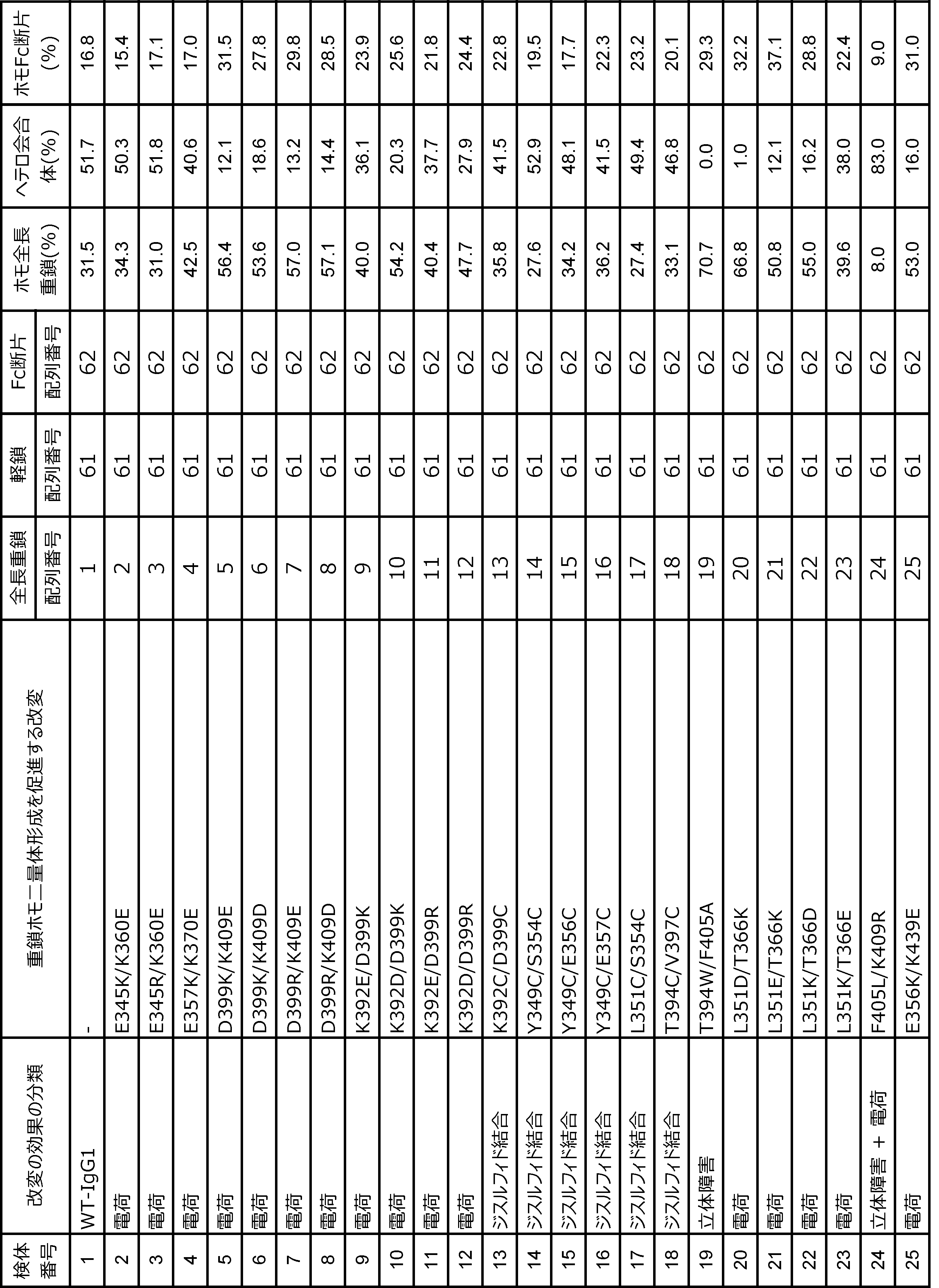

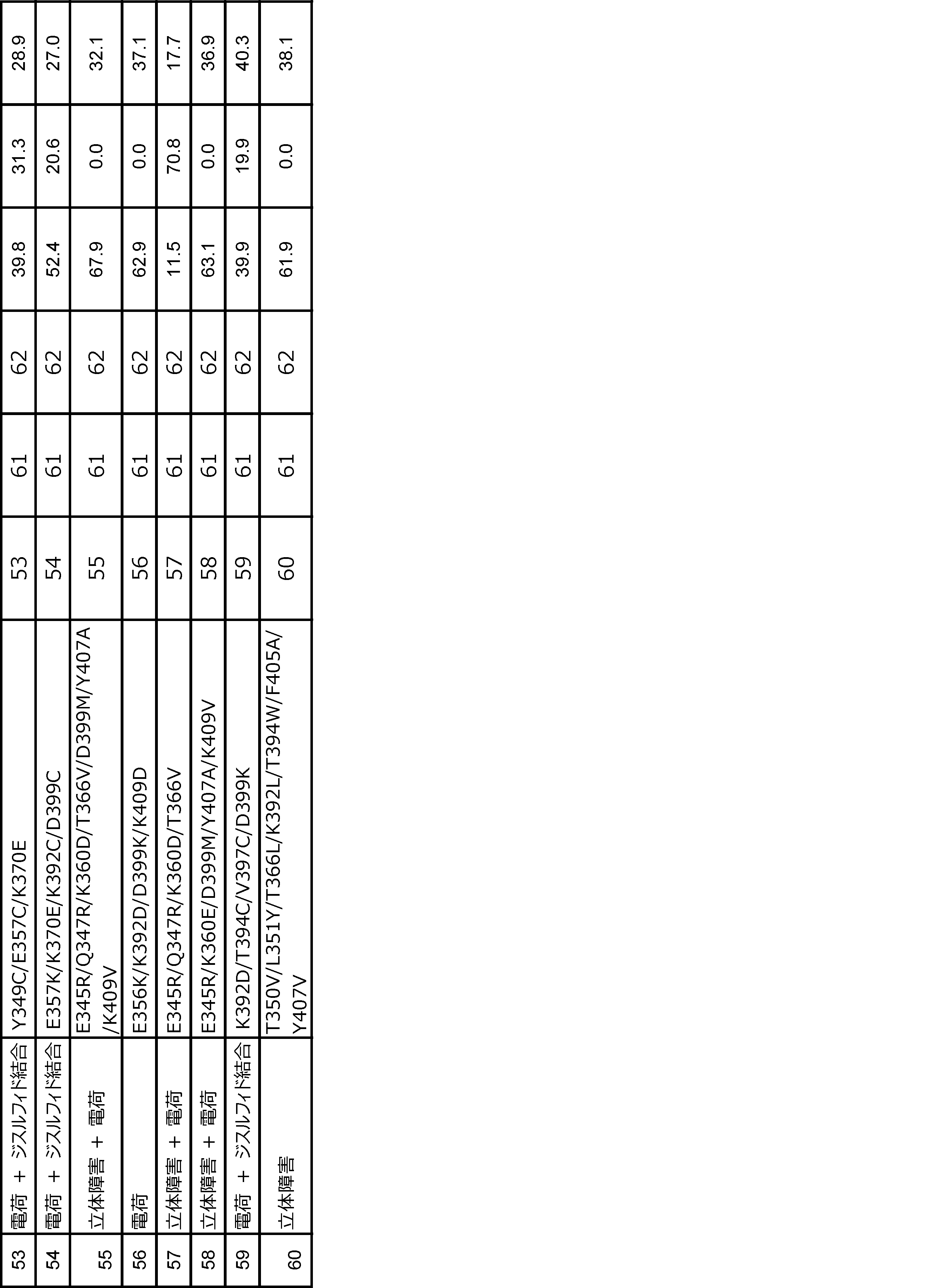
次にこれらのCH3界面のアミノ酸改変が抗体の物理化学的性質に及ぼす影響を確認するために表2の抗体が調製された。抗体は当業者公知の方法で作製された遺伝子を用いて実施例1に記載の方法で哺乳動物細胞に一過性に発現され、精製された。全長重鎖及び軽鎖をコードするプラスミドは質量比で1:1もしくは1:2でトランスフェクションに使用された。
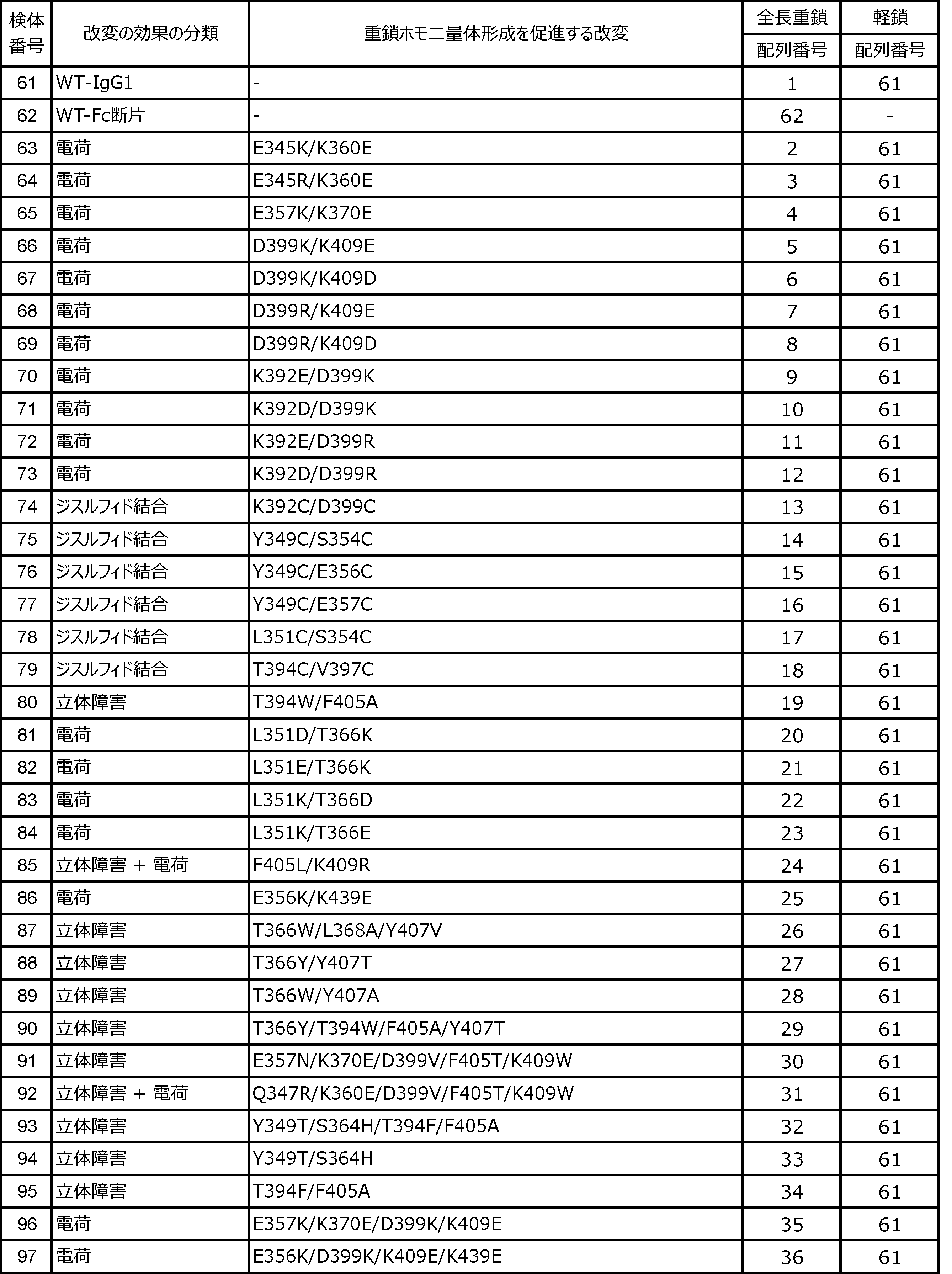
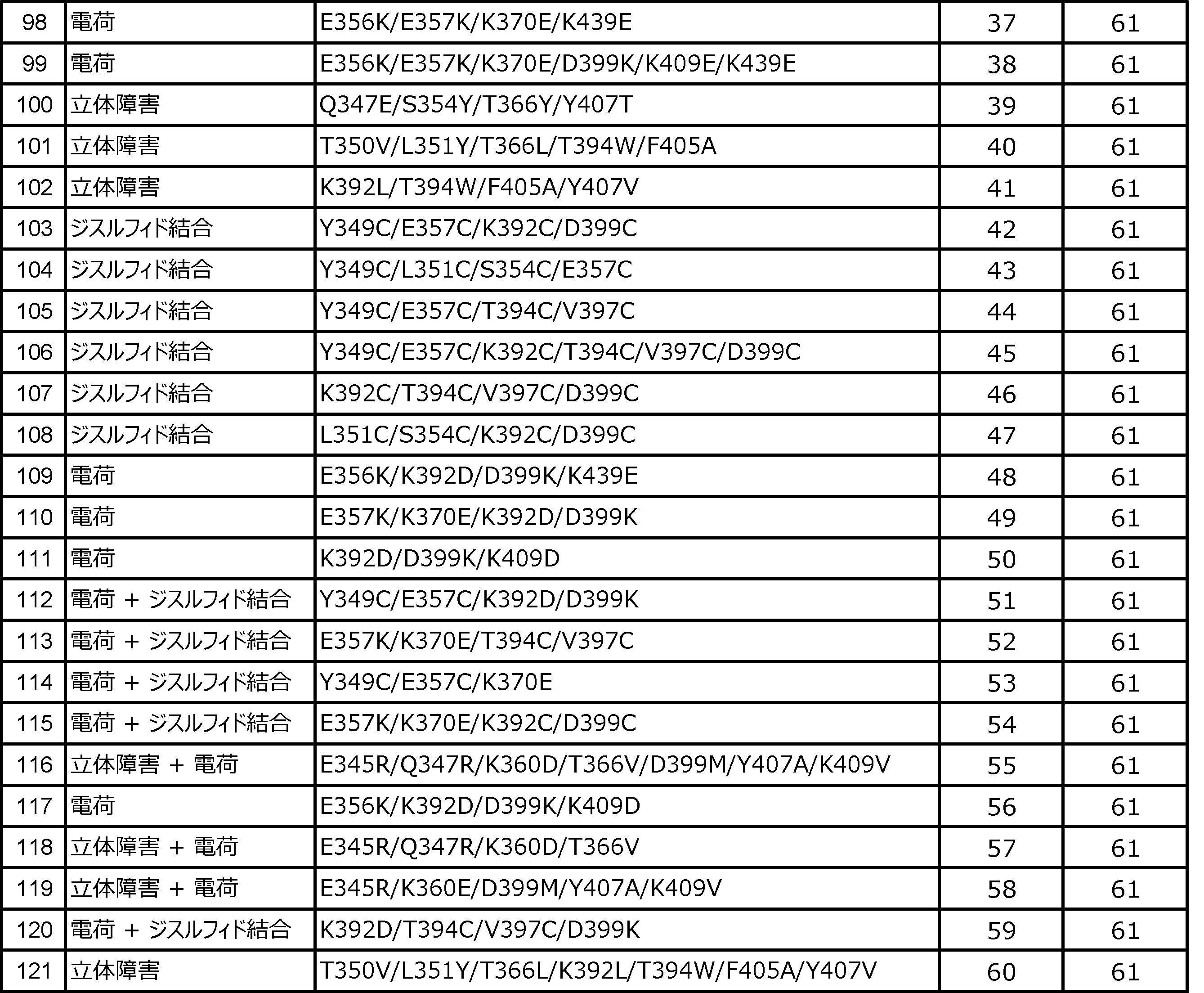
CH3界面の改変が及ぼす抗体の発現量、単量体含有量(%)、熱変性中点温度(Tm)への影響が比較された。実施例2で調製された抗体の収量が表3に示された。
また、精製抗体中の単量体含有量が実施例1に記載されたSEC分析方法により評価された。SEC分析結果の解析は単量体よりも高分子量側に溶出した成分を一括して会合体として、また単量体よりも低分子側に溶出した成分を一括して分解物として、単量体含有量(%)を算出した。解析結果は表3に示された。
アミノ酸改変が行われた抗体のTmは示査走査型蛍光定量法(DSF)により評価された。本手法により決定されるTmは、抗体の熱安定性評価法として広く知られている示査走査型熱量計により決定されるTmと良好な相関を示すことが既に報告されている(Journal of Pharmaceutical Science 2010;4: 1707-1720)。
5000倍濃度のSYPRO orange protein gel stain(invitrogen)をPBS(Sigma)により希釈し、抗体溶液がこの検出用色素と混合された。20 μLの混合溶液は測定用チューブに分注され、Rotor-Gene Q(QIAGEN)をもちいて240℃/hrの昇温速度で30℃から99℃まで温度を上昇させた。昇温度に伴う蛍光変化が470 nm(励起波長)/ 555 nm(蛍光波長)において観測された。
取得されたデータはRotor-Gene Q Series Software(QIAGEN)により蛍光遷移が認められた温度が決定され、この値をTm値とした。本試験に用いた抗体はFabのTmが(95℃程度)であり CH2、CH3のTmよりも顕著に大きい。そのため本試験では最も低温度で見られたTm値をFc改変に起因するTm値変化と考えて比較に用いた。結果を表3に示した。
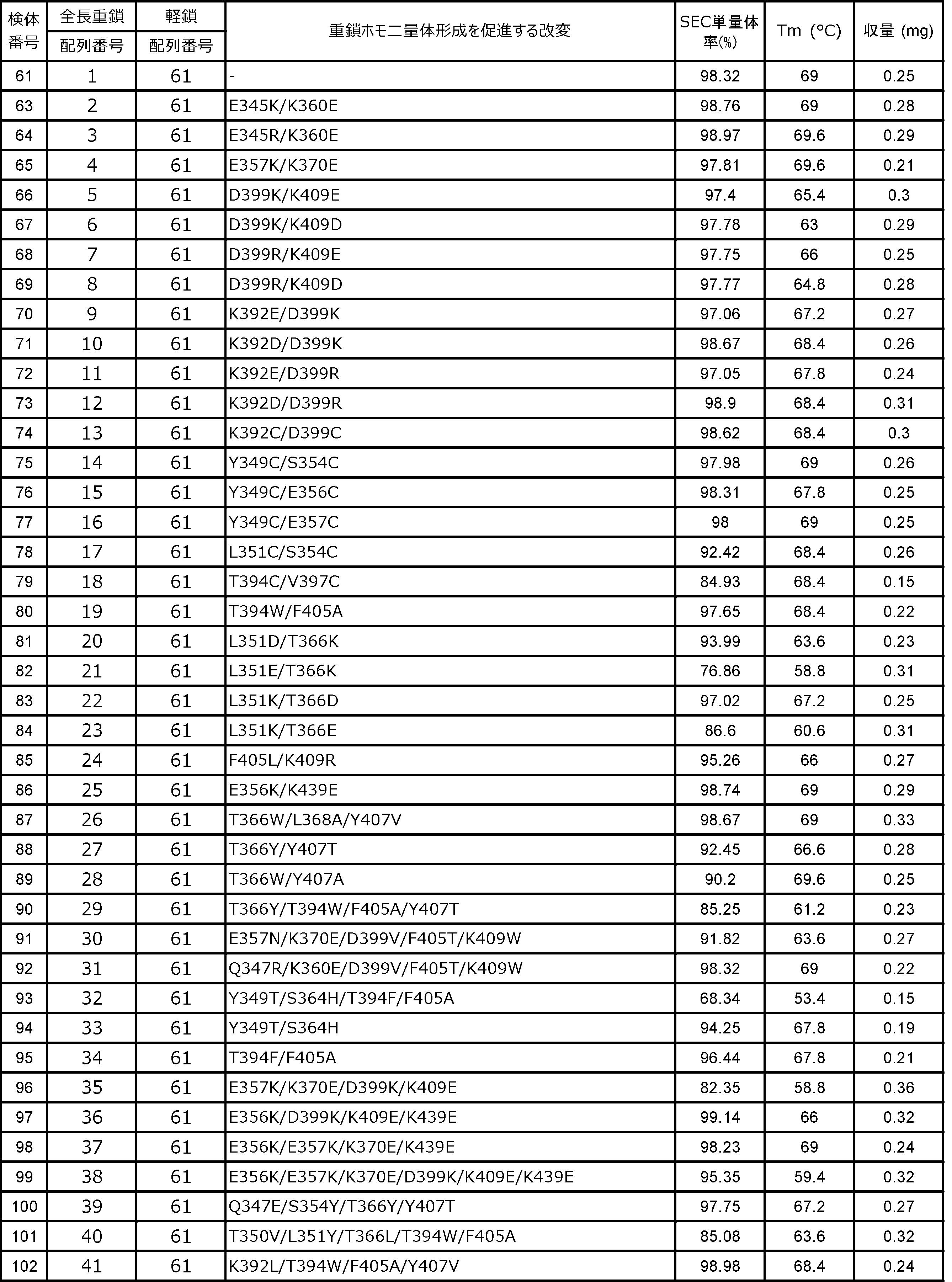
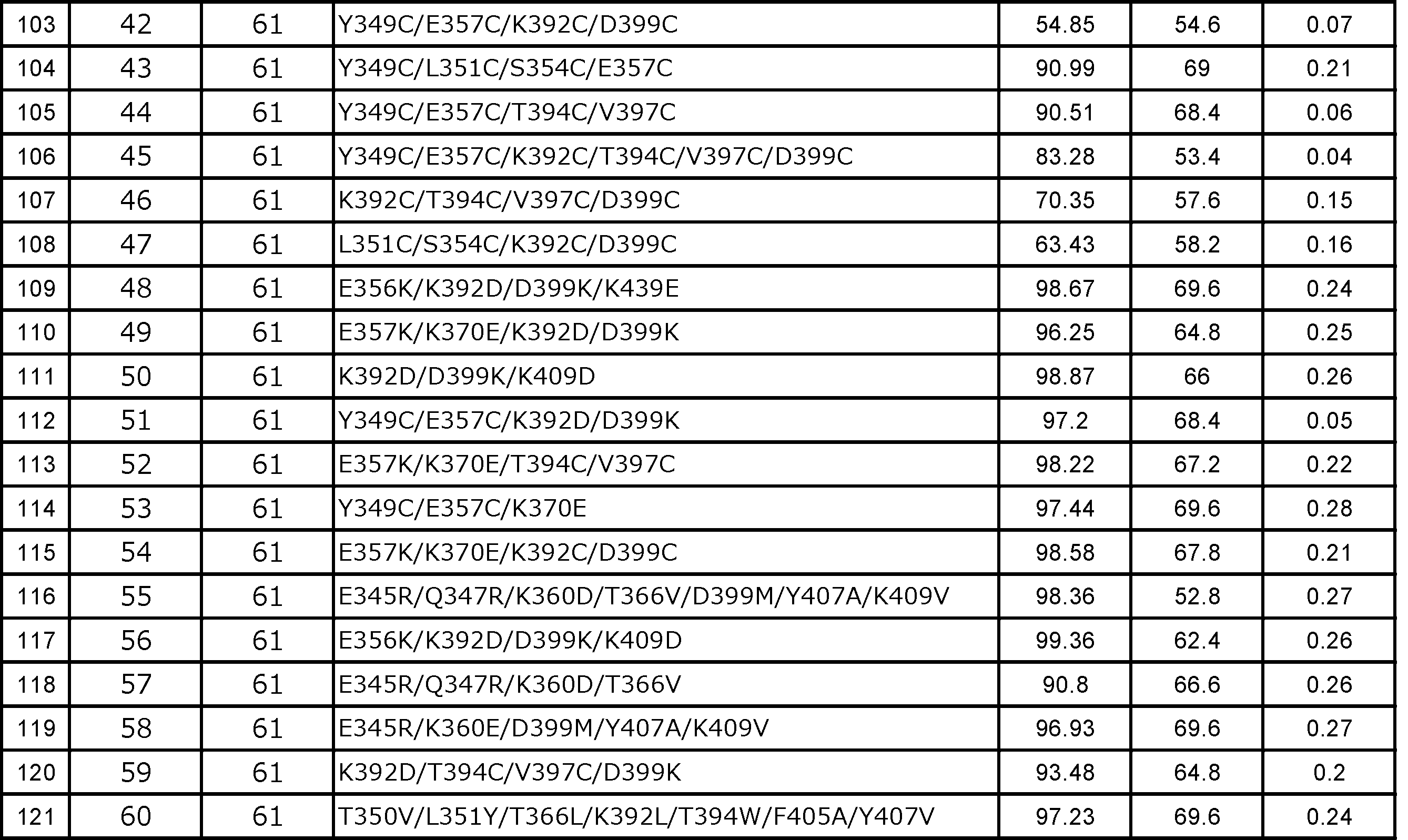
表1に示した全長重鎖、軽鎖、Fc断片の発現後のSEC分析の結果において、WT-IgG1のヘテロ二量体の形成割合(51.7%)よりも低いヘテロ二量体形成率を示した改変ペアは全て一定の重鎖ホモ二量体形成を促進する改変であるといえる。当初から想定されたように、重鎖ヘテロ会合促進のために報告された改変は必ずしも重鎖ホモ二量体化を促進する結果にはならなかった。特に、検体番号24、33、57では大きく重鎖のヘテロ二量化を促進する結果となり、期待した効果を得ることが出来なかった。また、抗体の良好な物理化学的性質を維持することも困難であり、SEC分析後の単量体率を大きく減少させる改変や、Tm値を下げてしまう改変、抗体収量が減少してしまう改変が見られた。この実験的事実は重鎖のヘテロ二量体化を促進する改変ペアと重鎖のホモ二量体化を促進する改変は必ずしも同一ではなく、1種類の重鎖間でホモ二量体化を促進し、良好な物理化学的性質を維持するアミノ酸改変ペアを見出す重要性を示唆した。本発明者は表1に示した様々な抗体を評価することで、特に強力に重鎖ヘテロ二量化を抑制し、重鎖ホモ二量化を促進するアミノ酸改変を見出した。これらの選抜した抗体を表4に示した。これらの抗体はいずれも、WT-IgG1と比較して抗体の発現量は同等であり、単量体の形成率も高く、Fc領域のTmも同等であった(ただし、検体番号112の抗体収量のみWT-IgG1と比べて低下が見られた)。
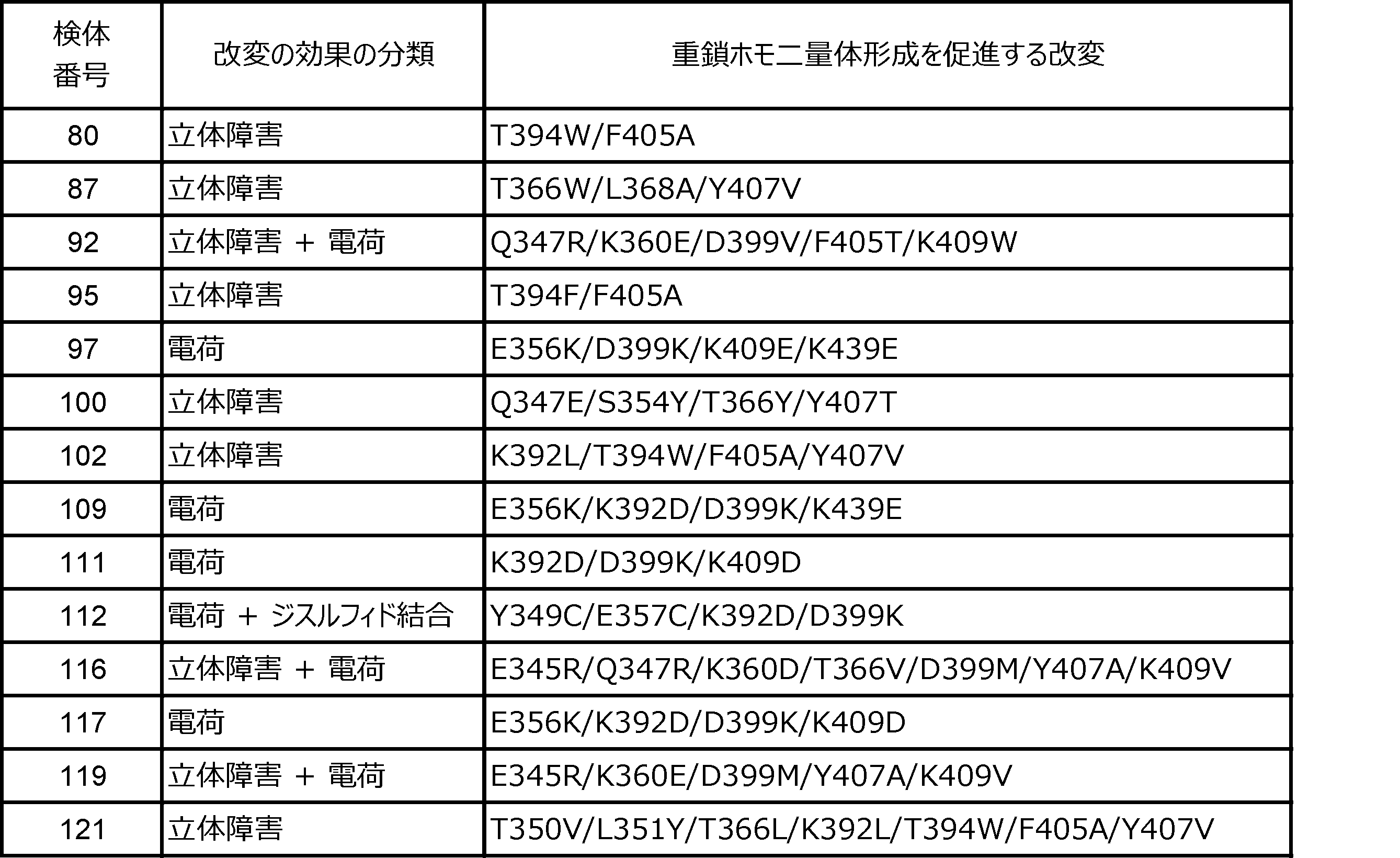
次に、複数の抗体を同時に発現できるアミノ酸改変ペアを同定するために表4に示したアミノ酸改変をIgG1のFc断片にも導入したような遺伝子を作成した。これらの網羅的な組み合わせを行い、改変されたFc間で重鎖ホモ二量体形成を促進するような改変ペアを探索した。発現には配列番号61の軽鎖を使用した。抗体は実施例1に記載の方法と同様の方法で発現された。各改変ペアのホモ二量体化促進能力はSEC分析後のヘテロ二量化体量が同一改変ペアの場合と比較して減少するかどうかで判断した(例えばWT-IgG同士を発現させた場合はヘテロ二量化体量が52%であるため、52%未満のヘテロ二量化体量を示す組み合わせはホモ二量体化促進能力があるペアであると判断できる)。実験に使用した配列番号とその組み合わせ、及びヘテロ二量体の形成割合を表5に示した。実験結果でヘテロ二量体を抑制するような関係にある改変ペア同士は、いくつ組み合わせてもヘテロ会合を起こさないことが想定される。よって、2抗体の同時発現だけではなく、3抗体、4抗体、5抗体、6抗体、7抗体、8抗体、9抗体、あるいはそれ以上の抗体の同時発現にも使用できる。
より具体的には、表5で10%未満のヘテロ会合体量を示したアミノ酸改変ペアが組み合わせに使用できる。表6にこれらの組み合わせから構成される有効なアミノ酸改変ペア (<10%組み合わせ1-3512) が示された。
また、さらに強力な重鎖ホモ会合促進能力を有するペア(表5で0%のヘテロ会合体量を示したアミノ酸改変ペア)のみから構成されるアミノ酸改変ペア(0%組み合わせ1-744)が表7に示された。表5, 6, 7において改変を導入していない場合はWTと表記された。


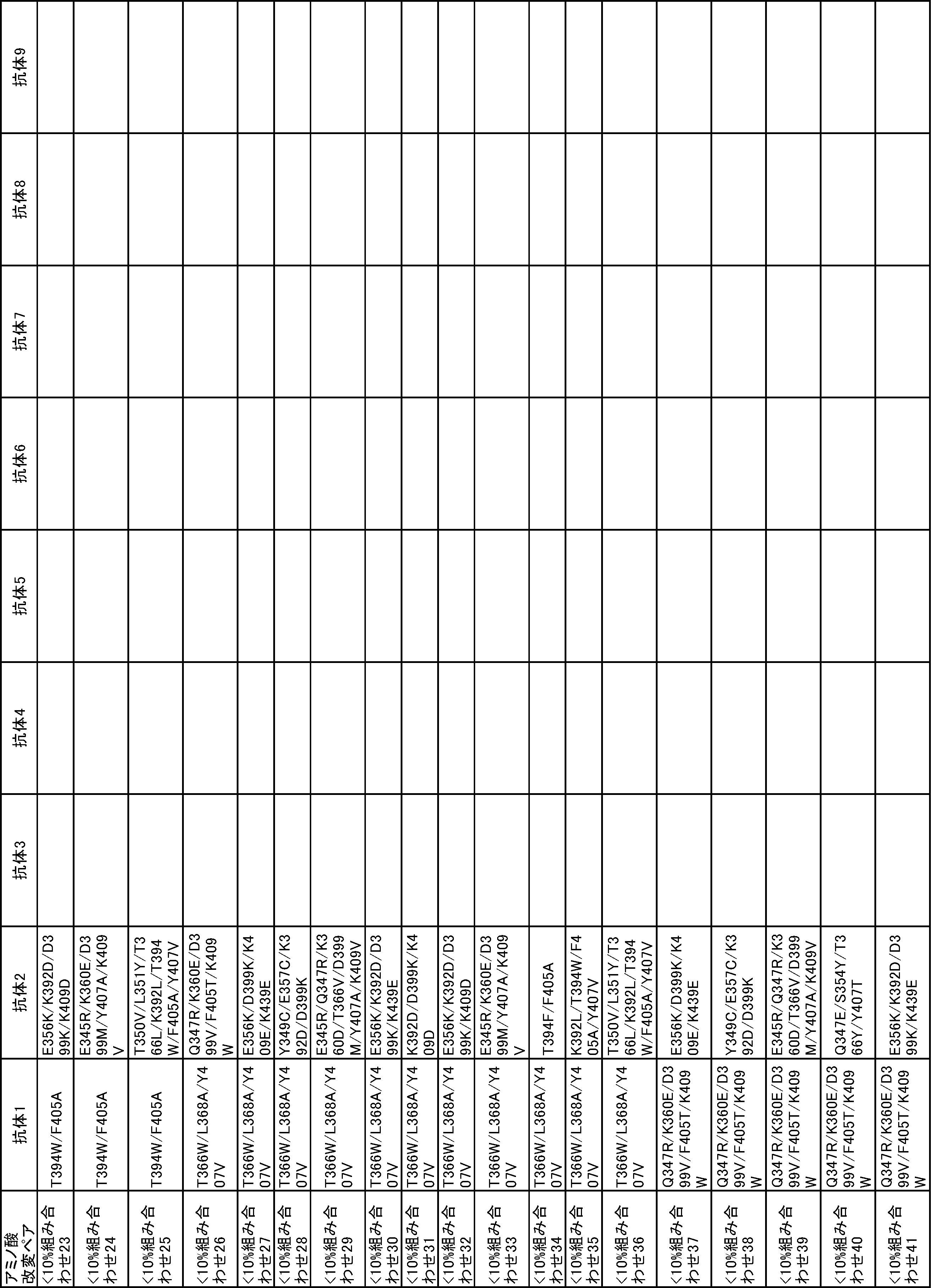
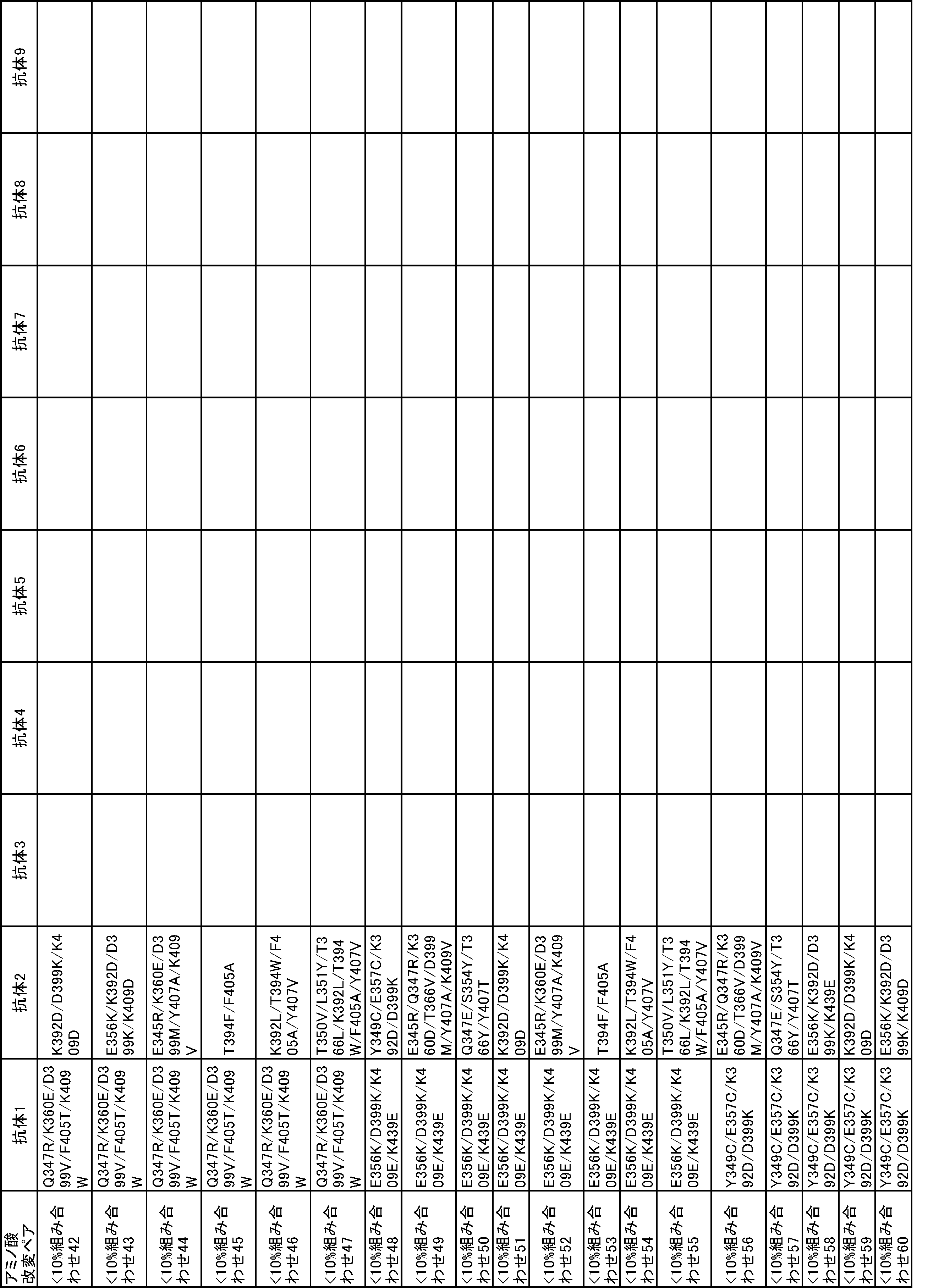
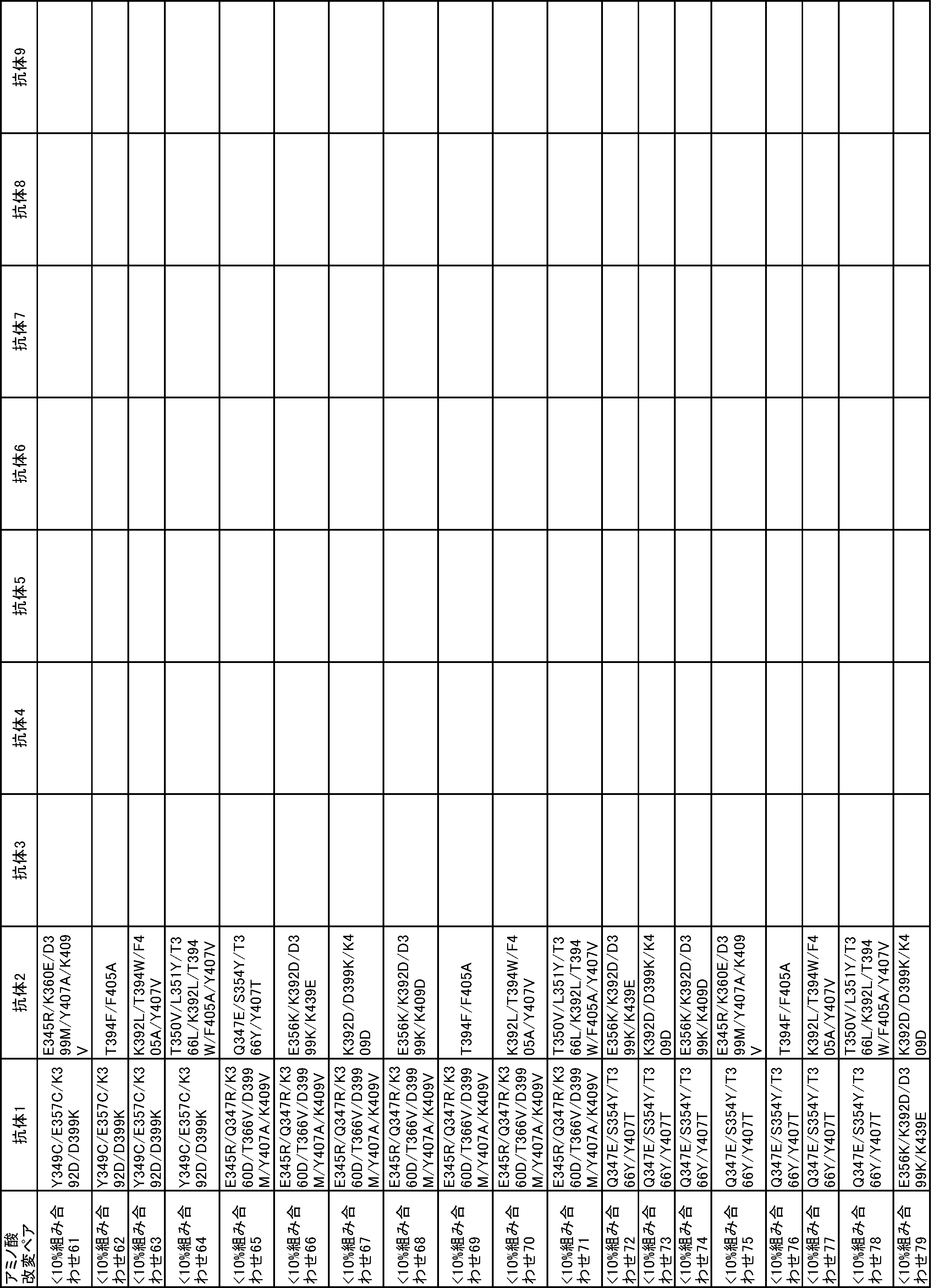
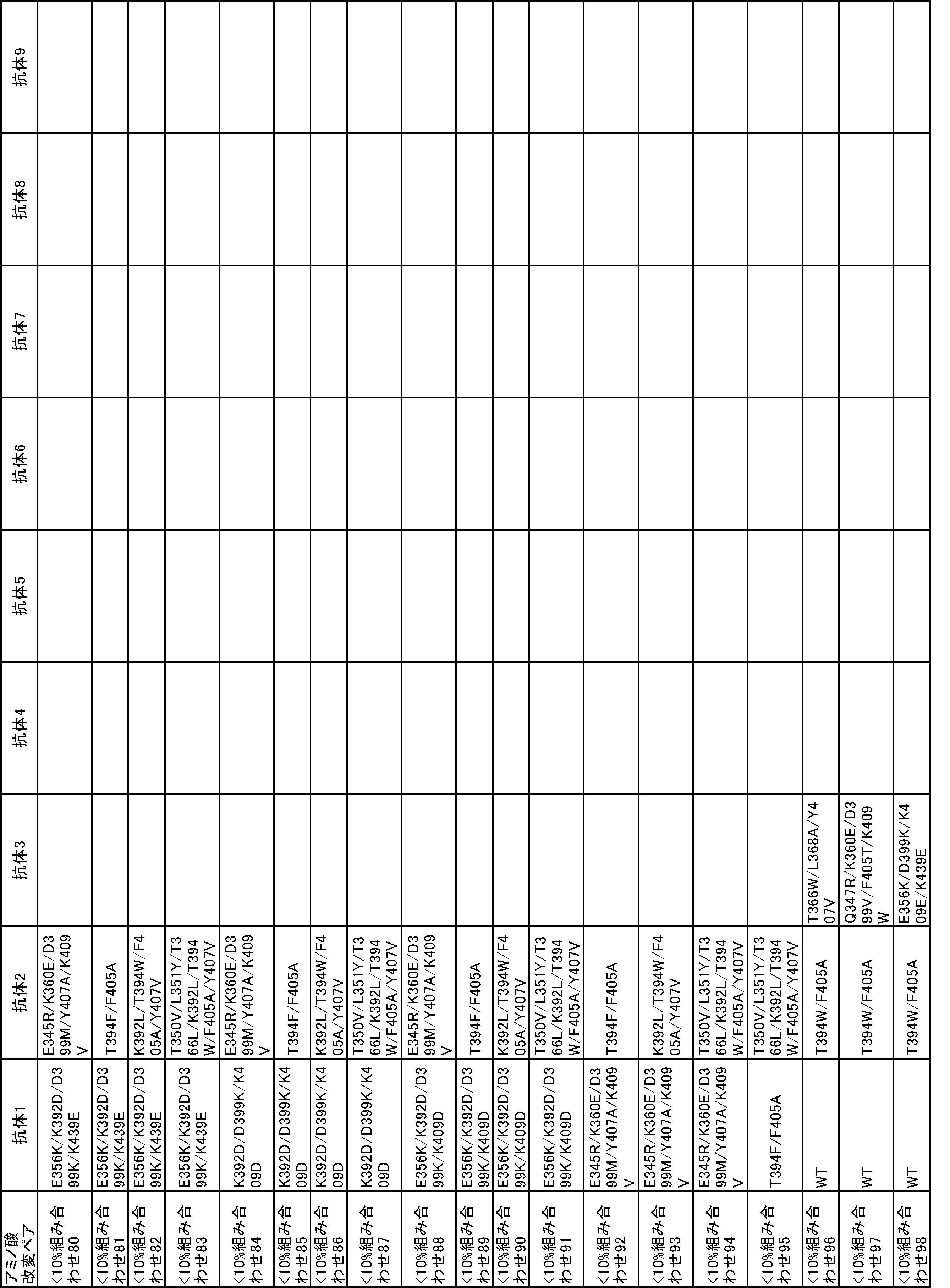
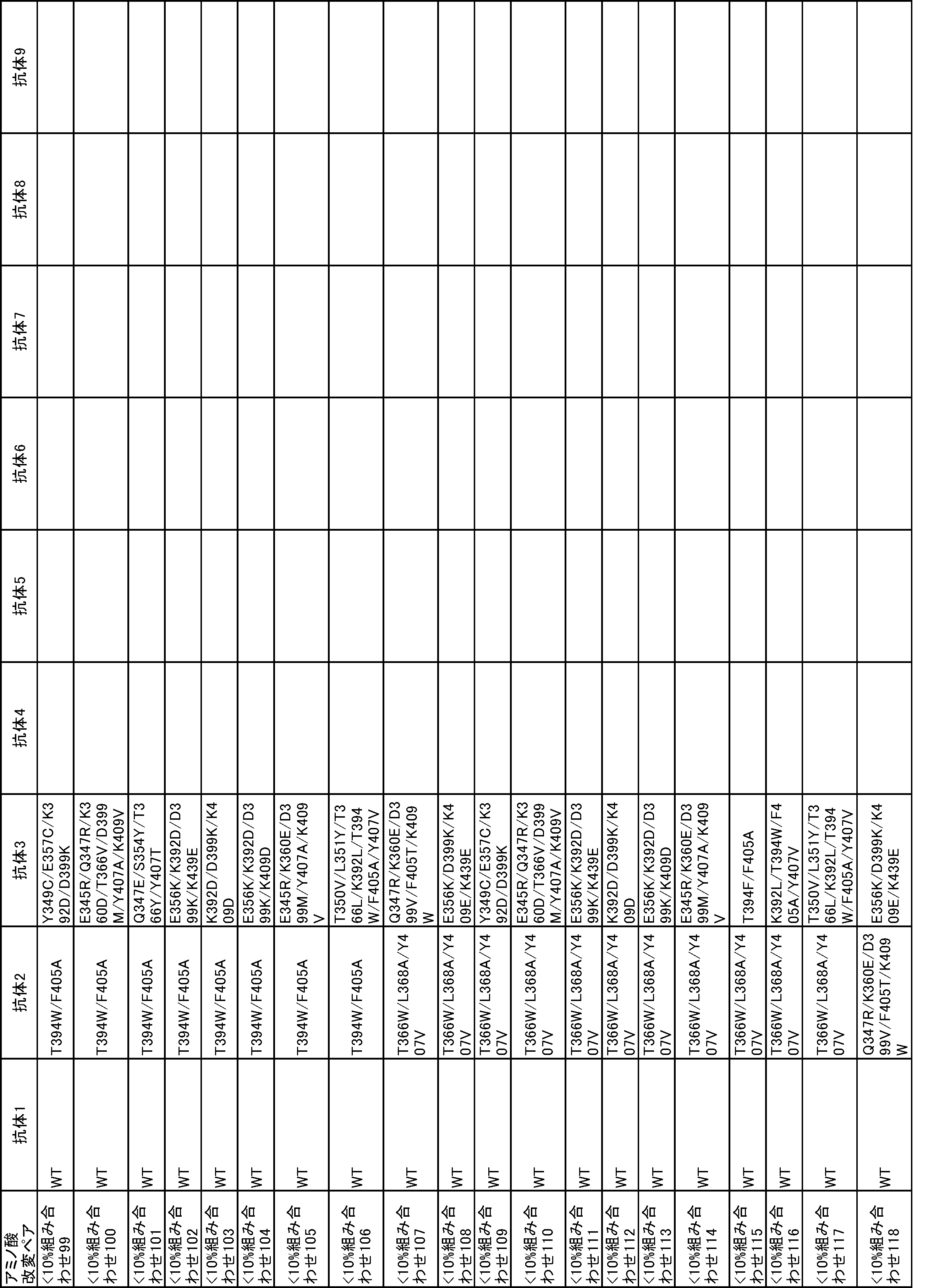
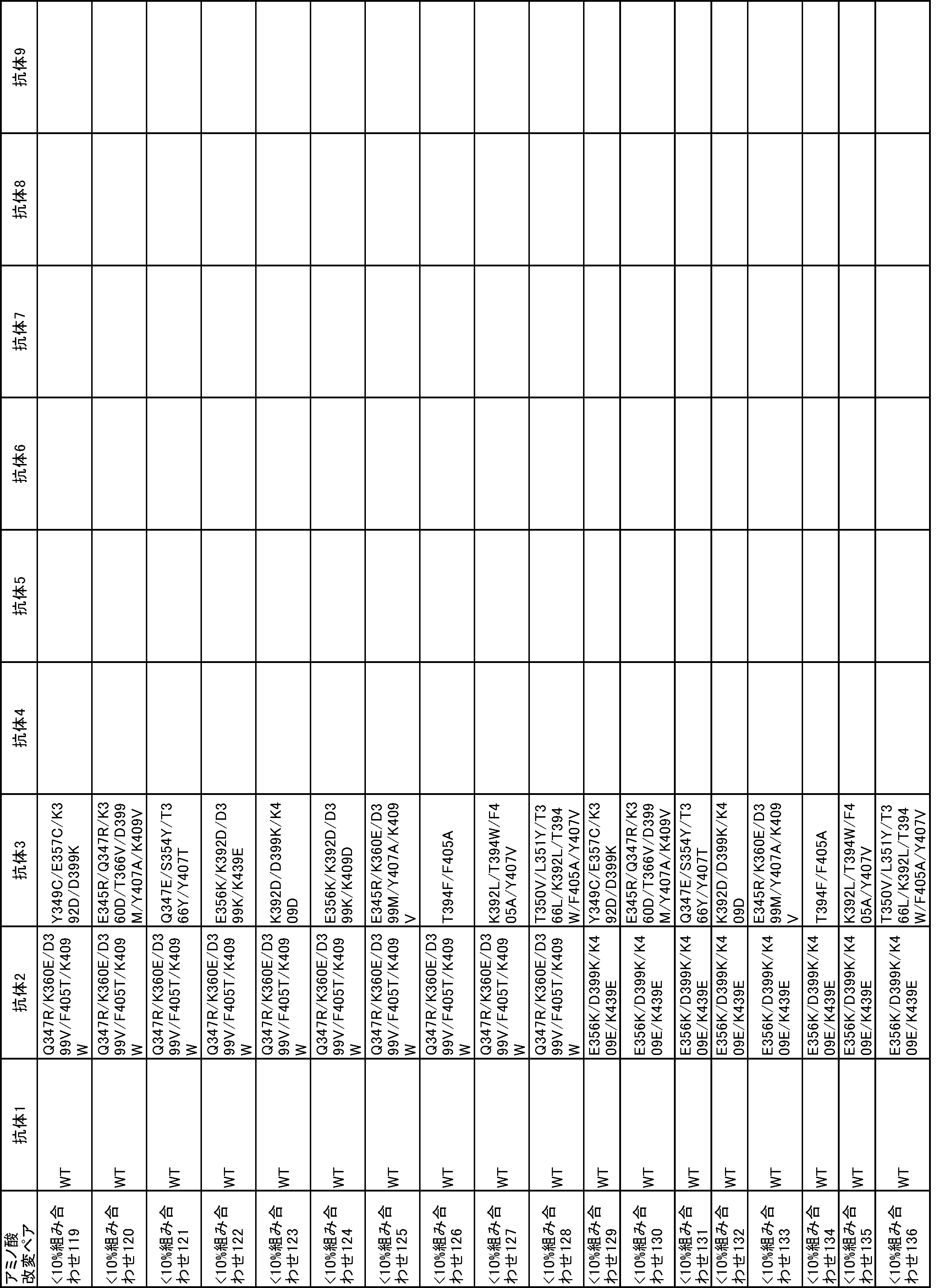

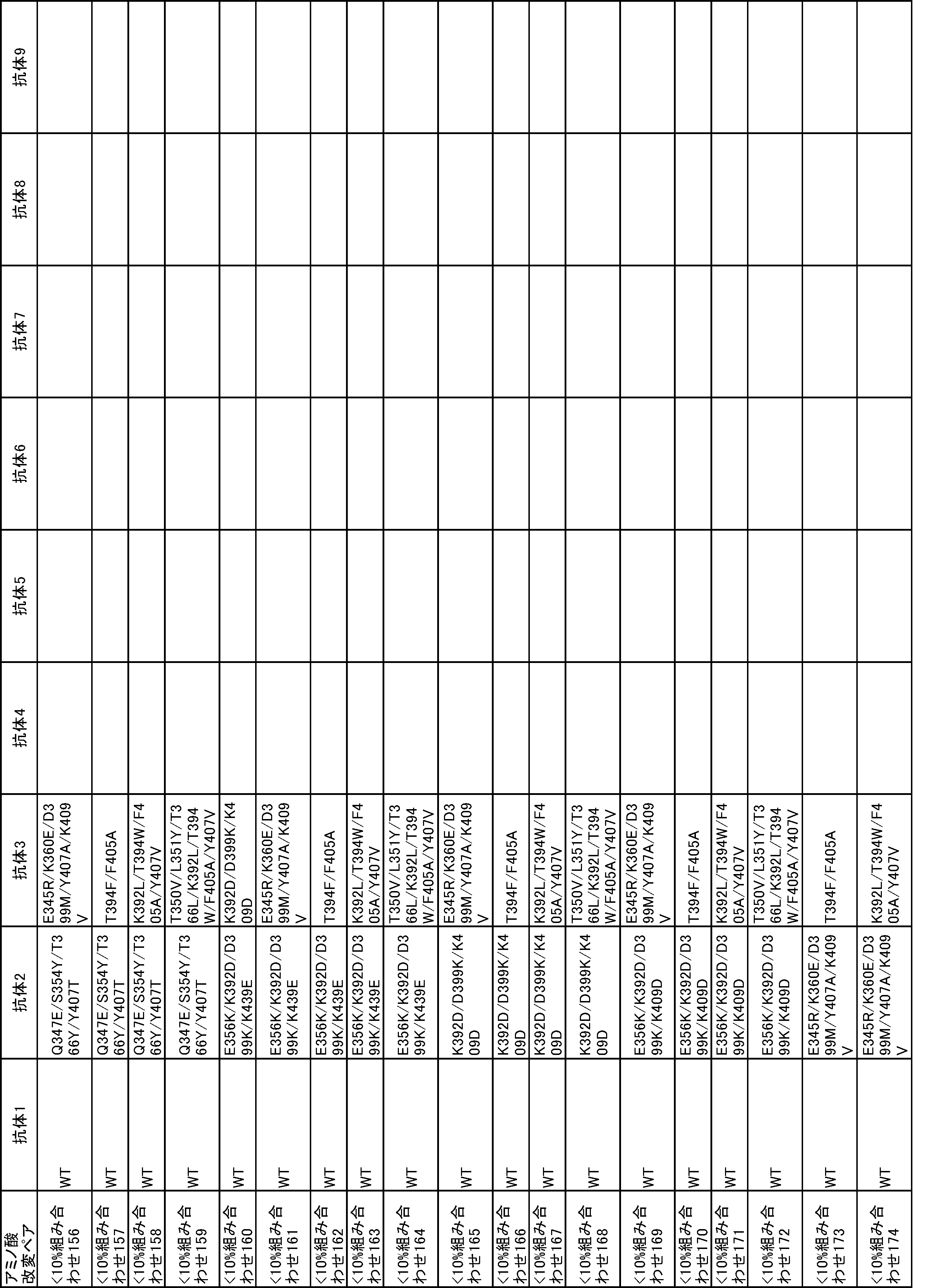
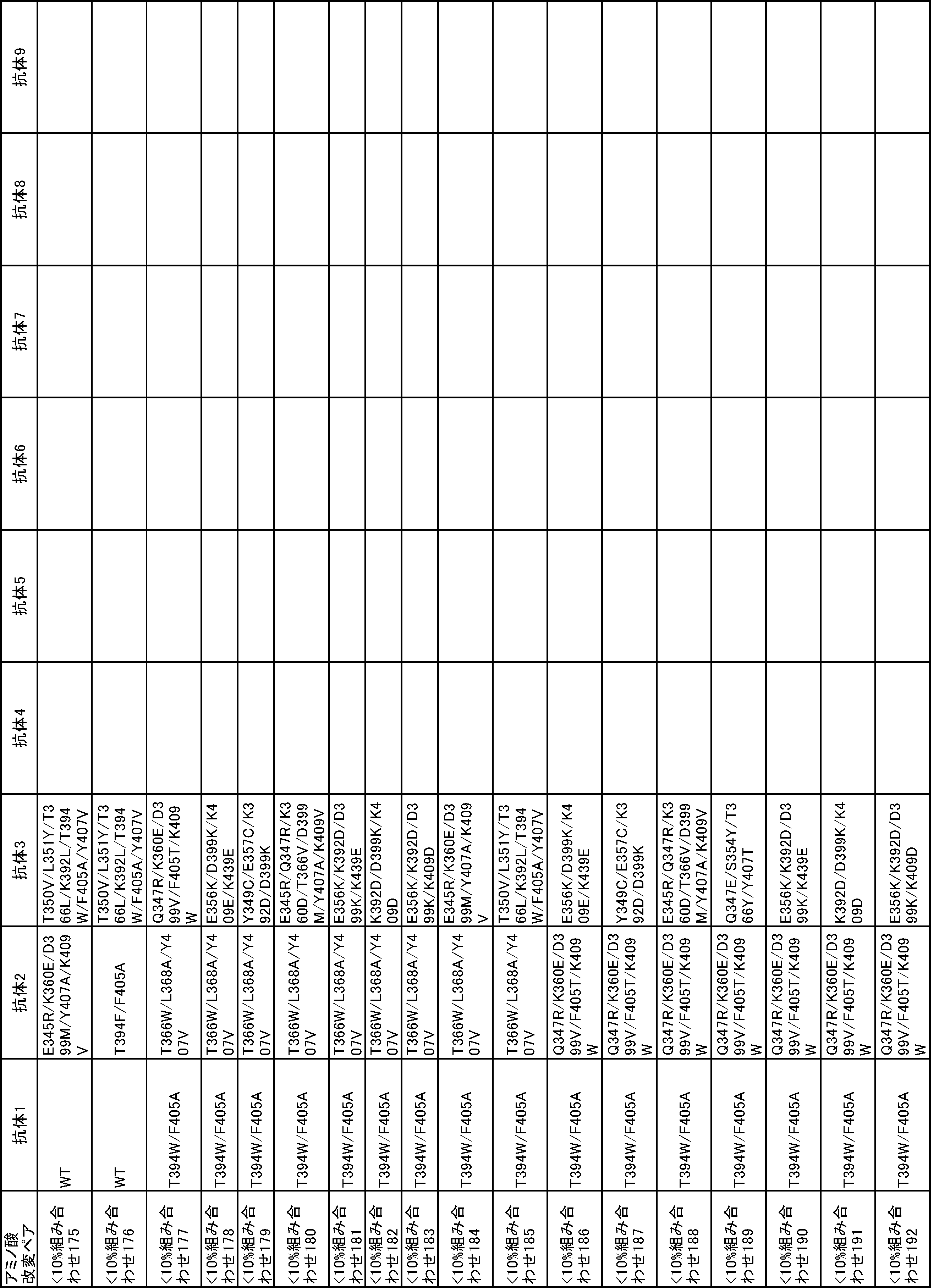

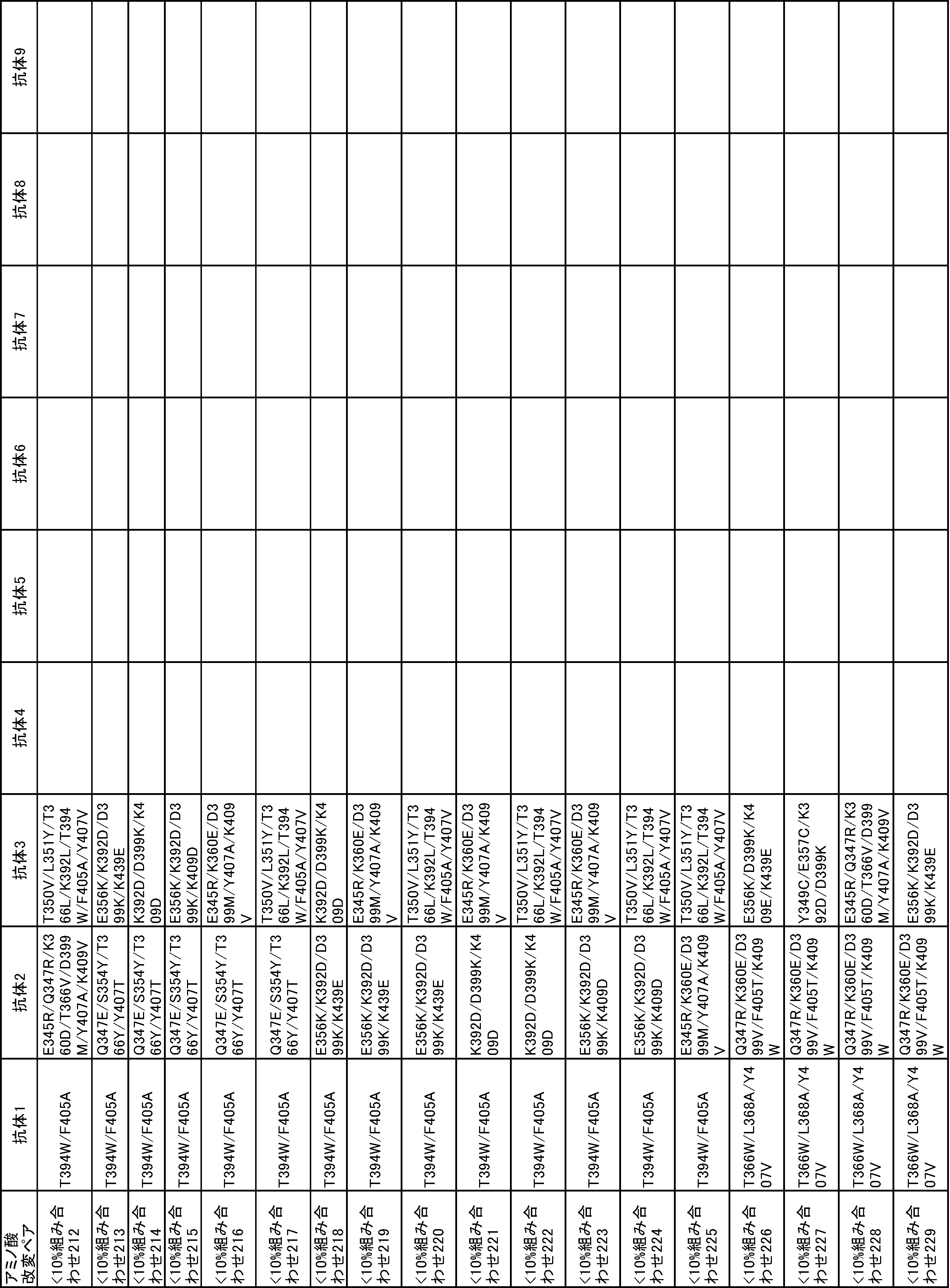

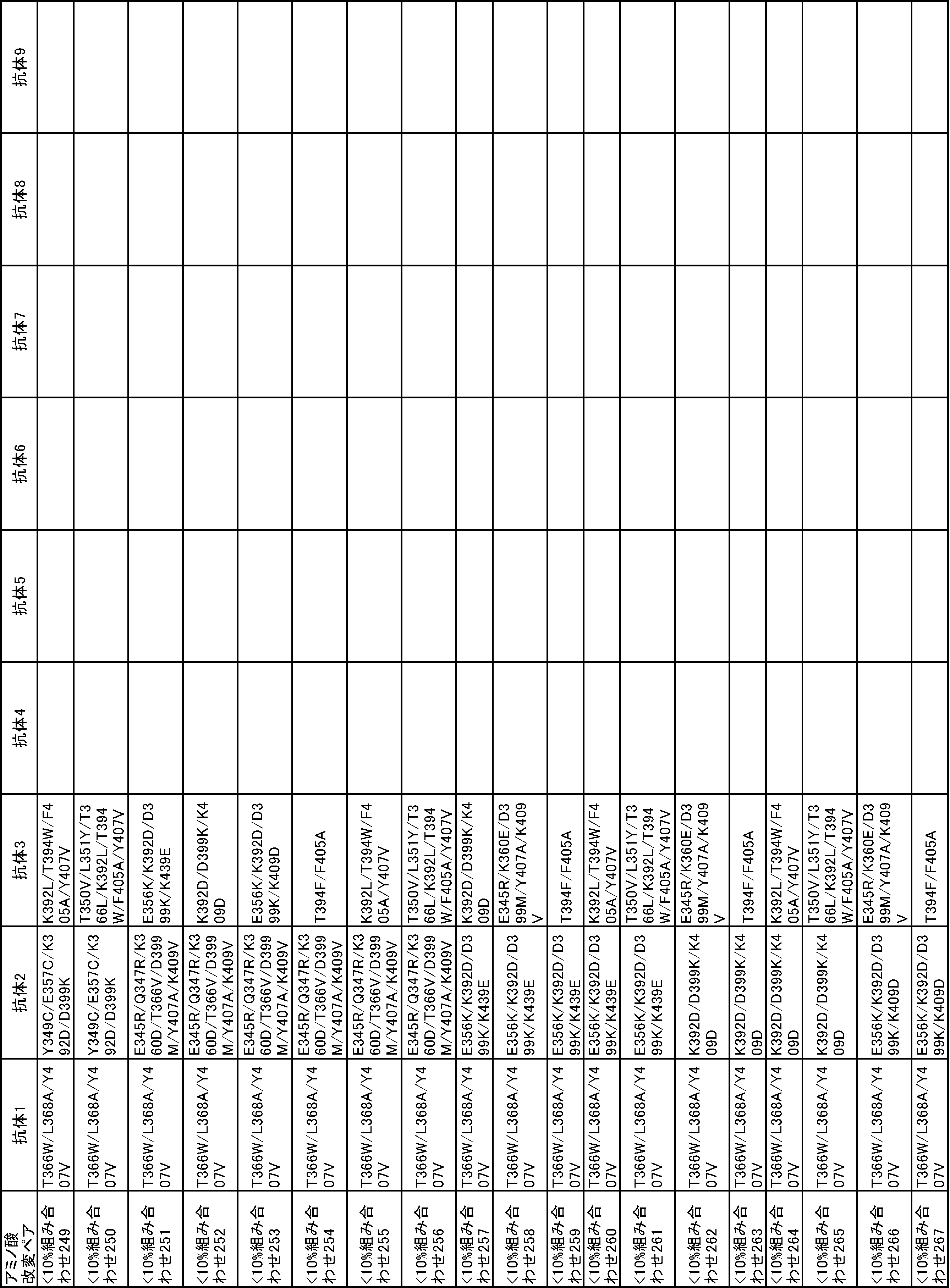


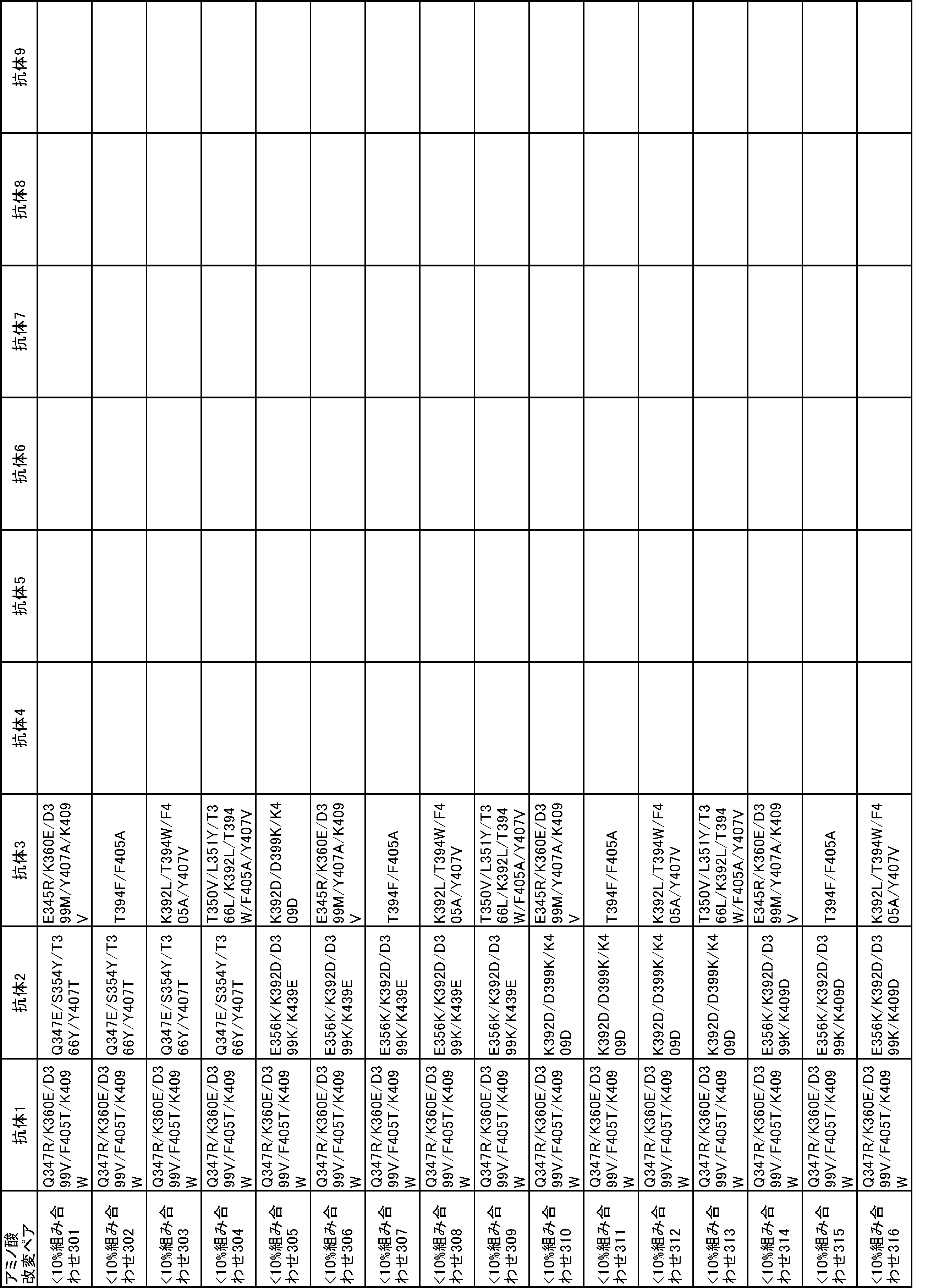

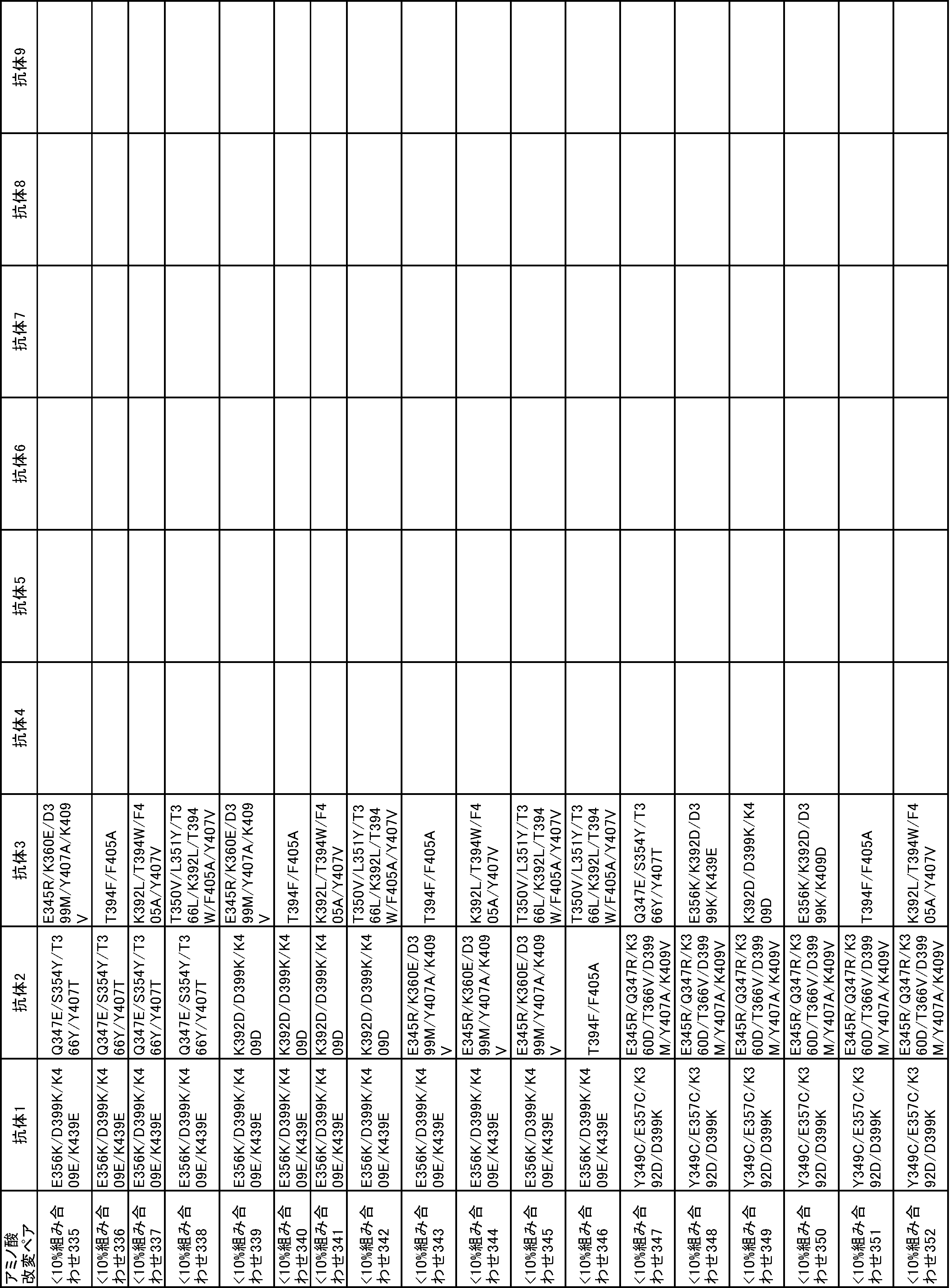
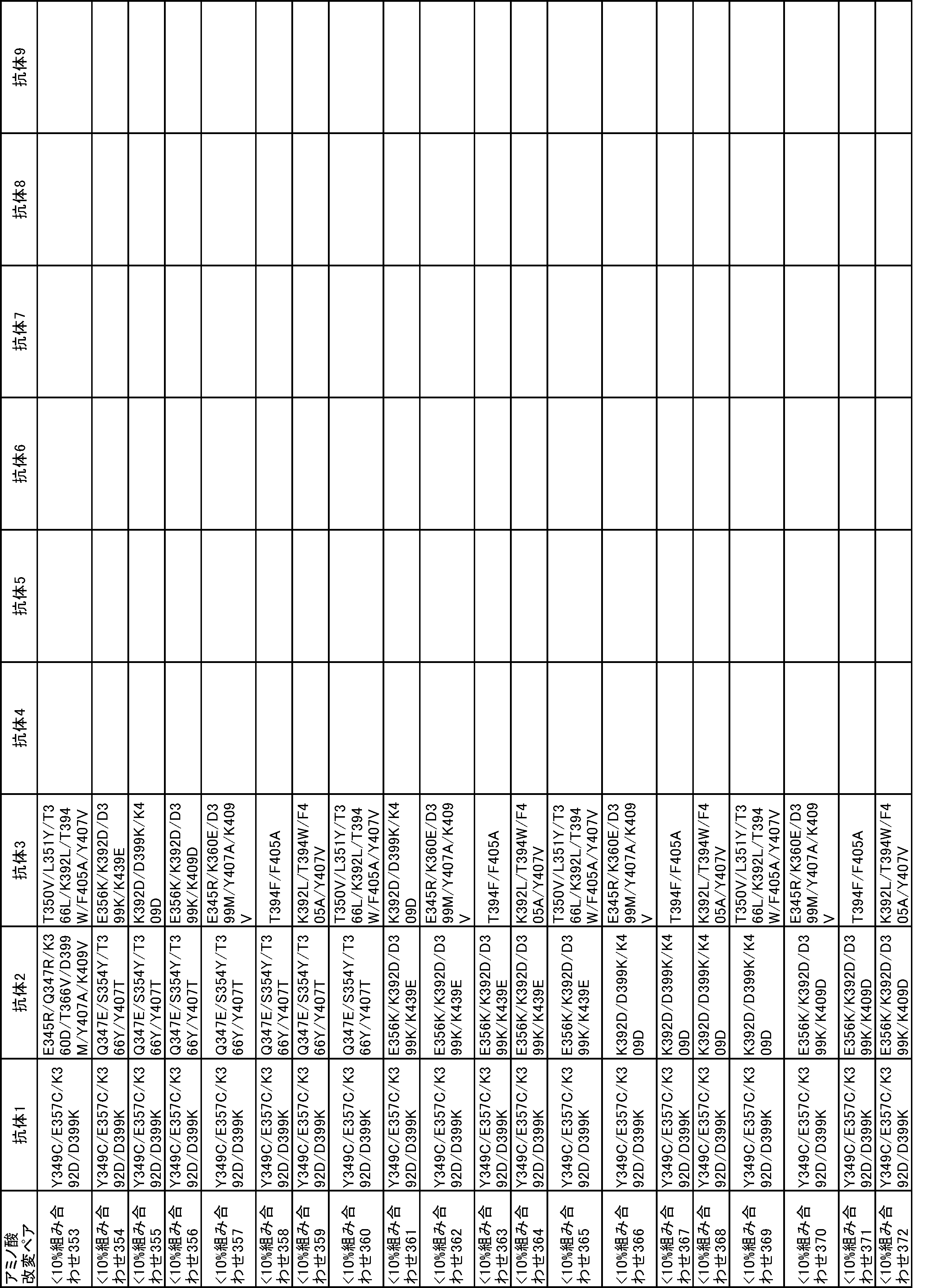
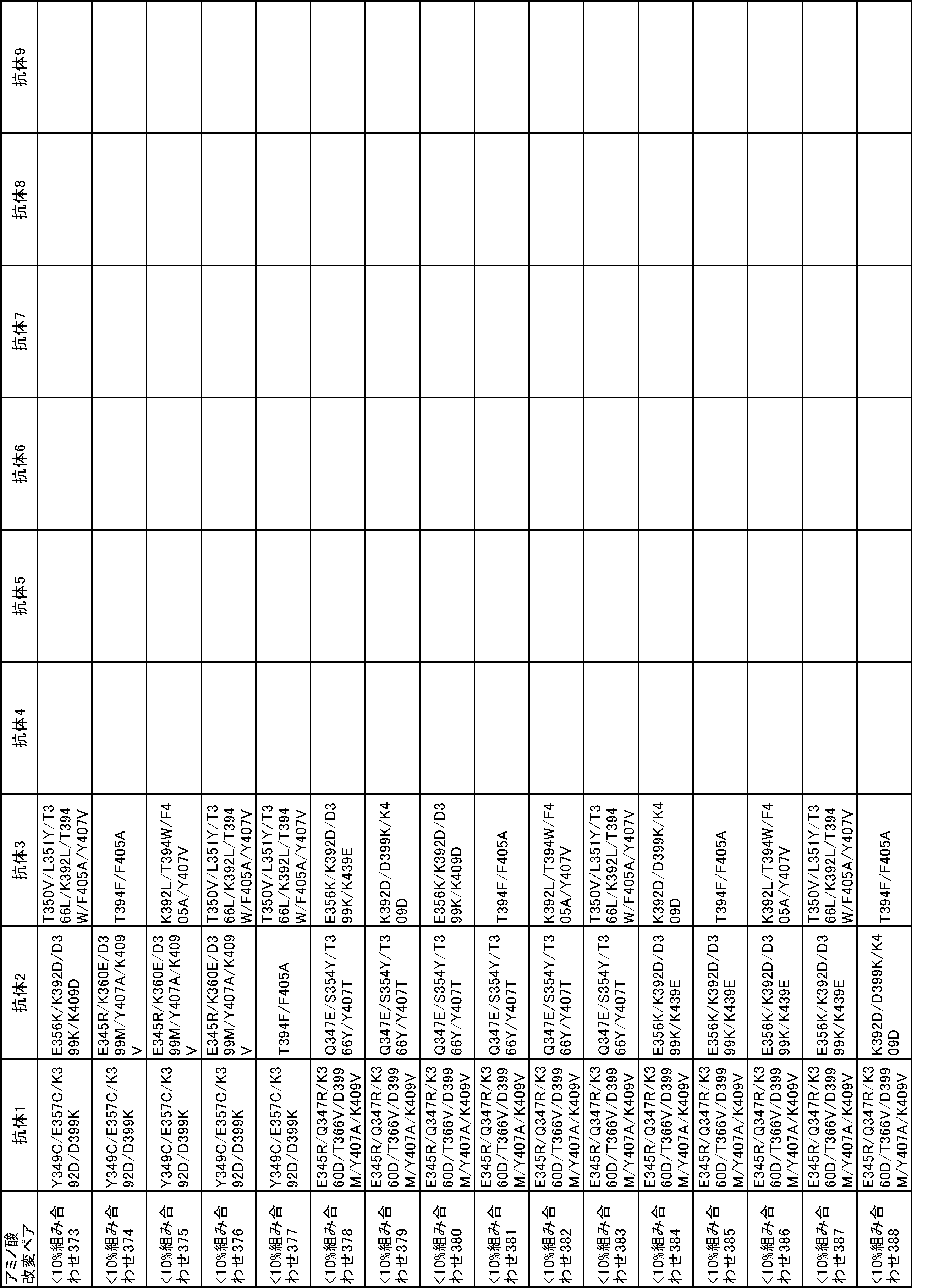
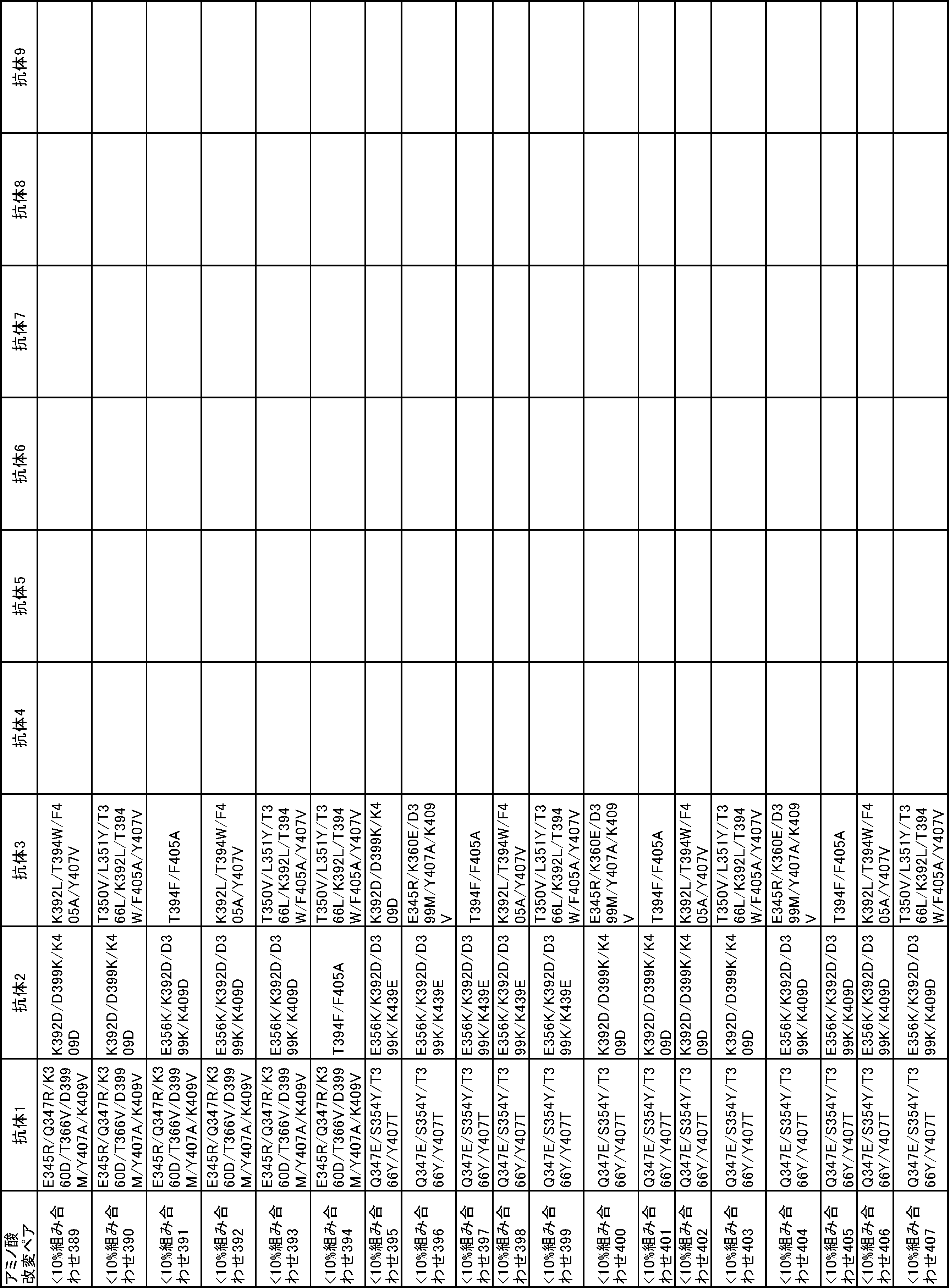
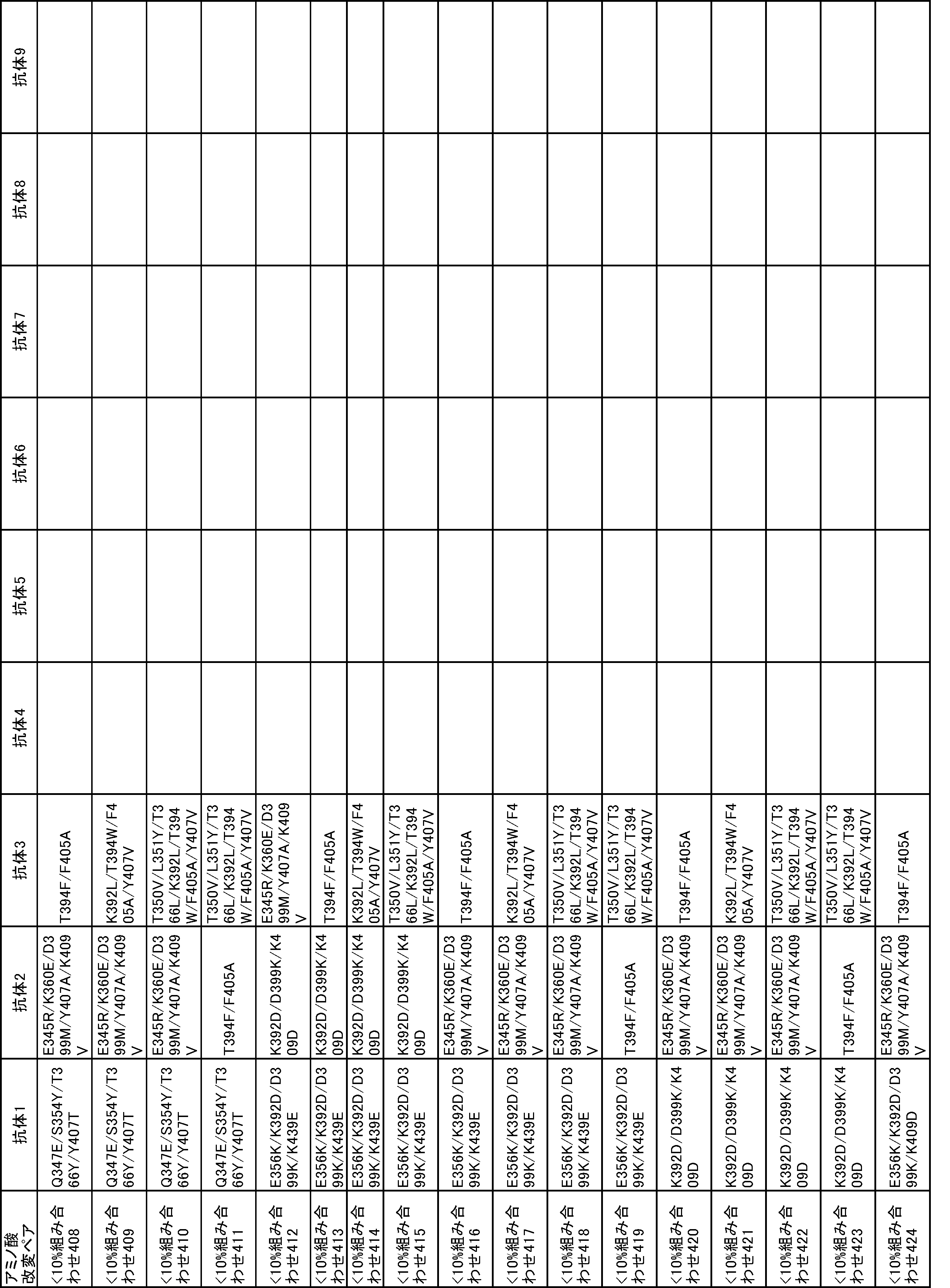

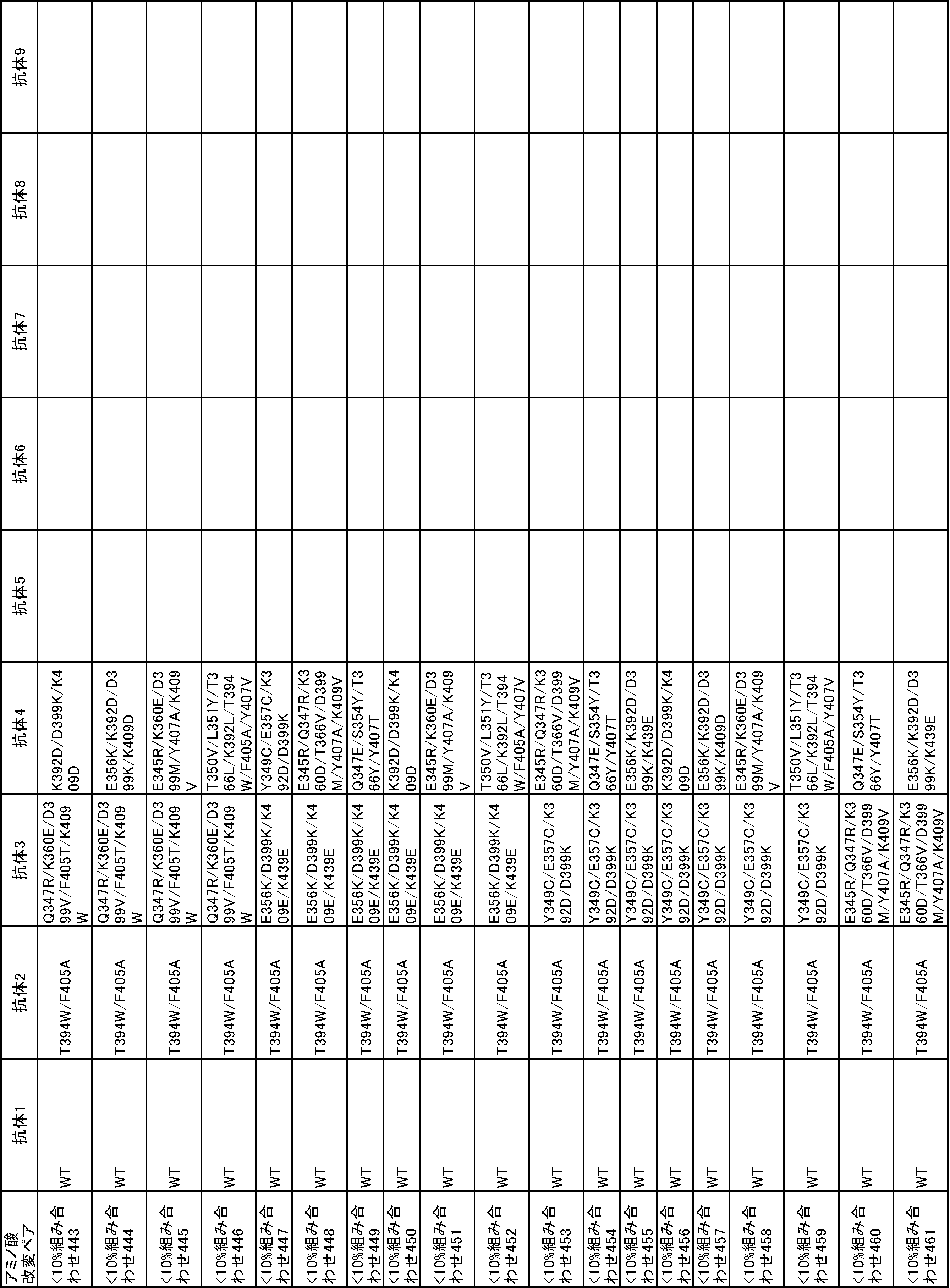


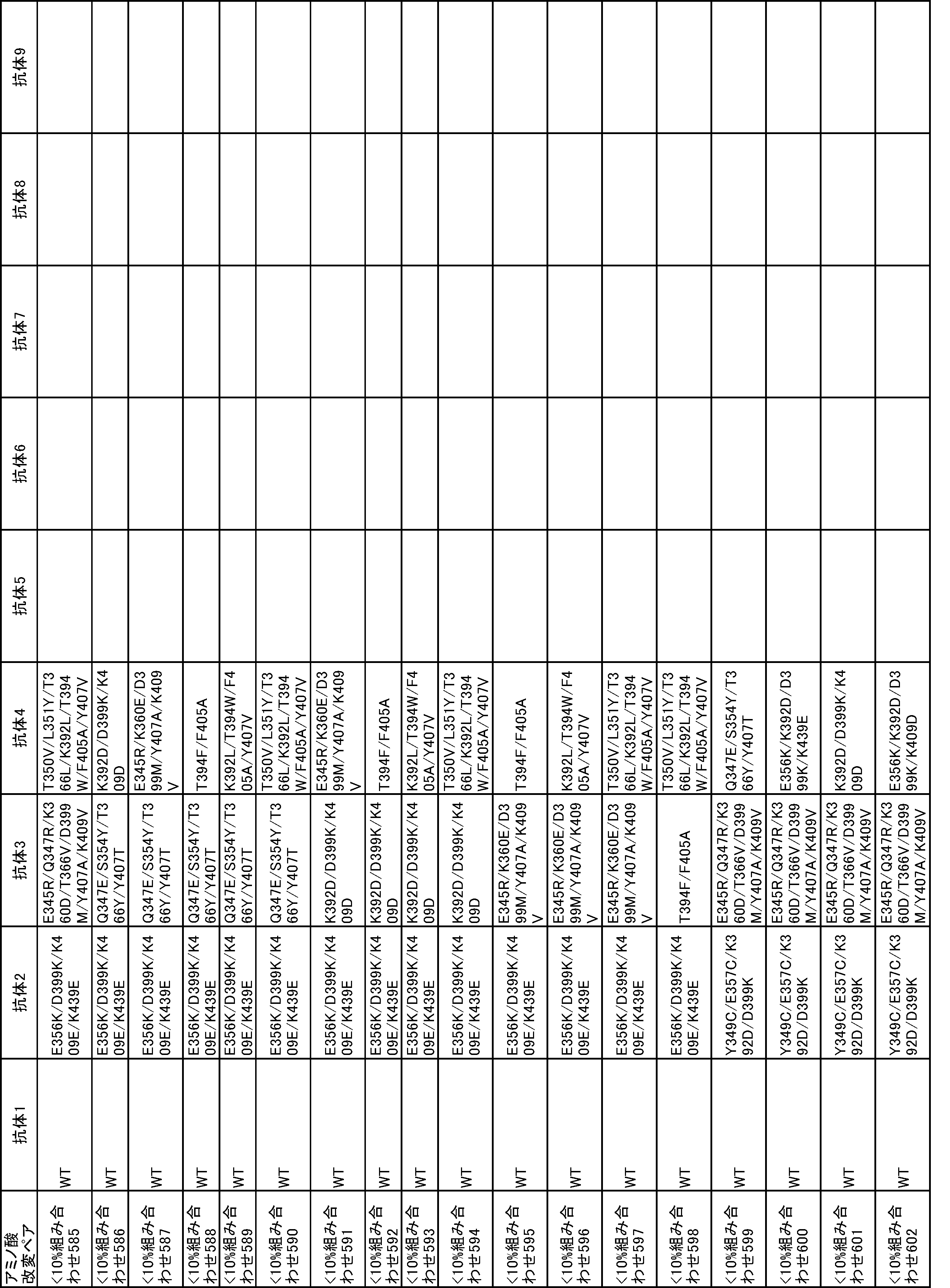
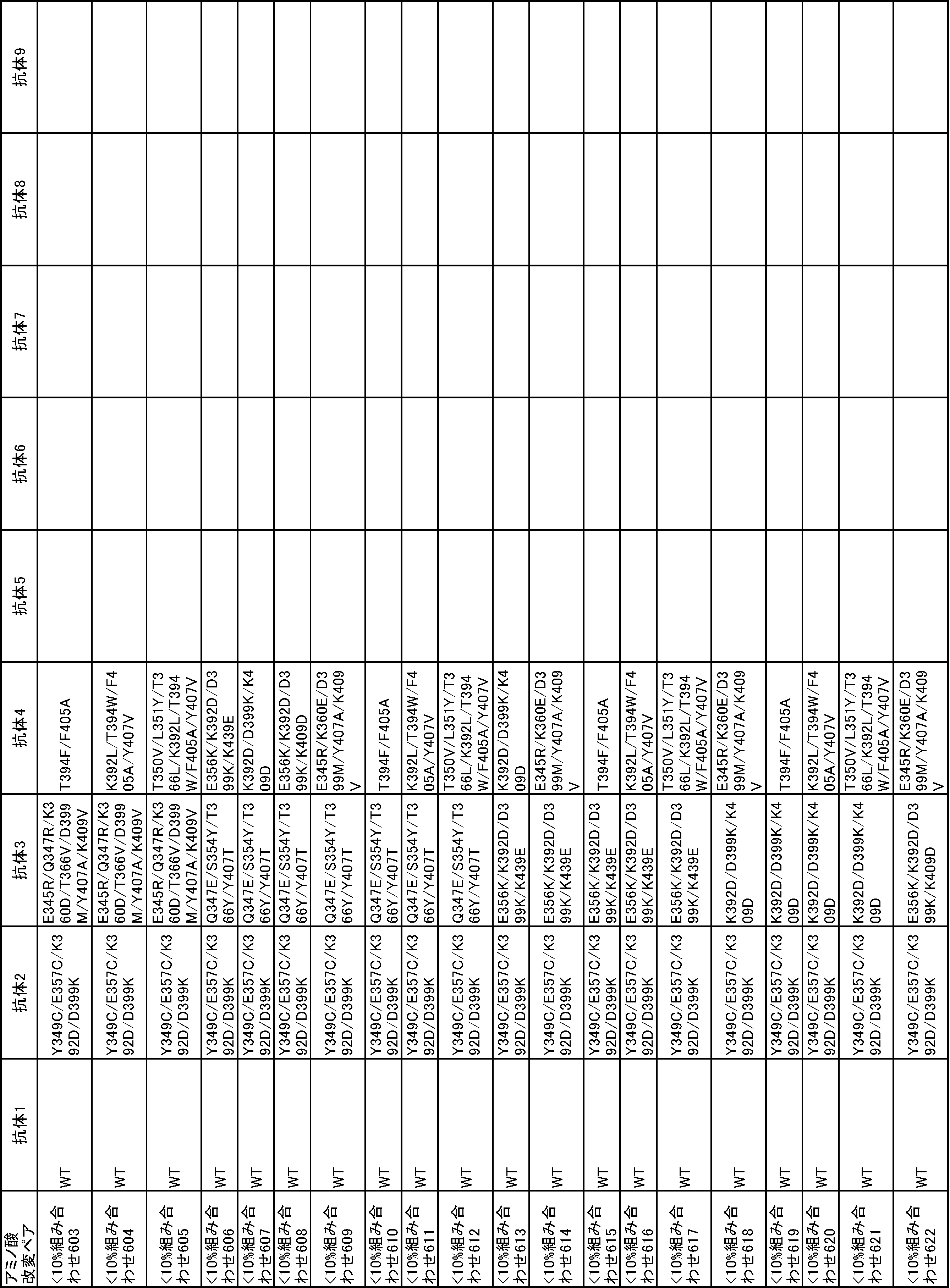
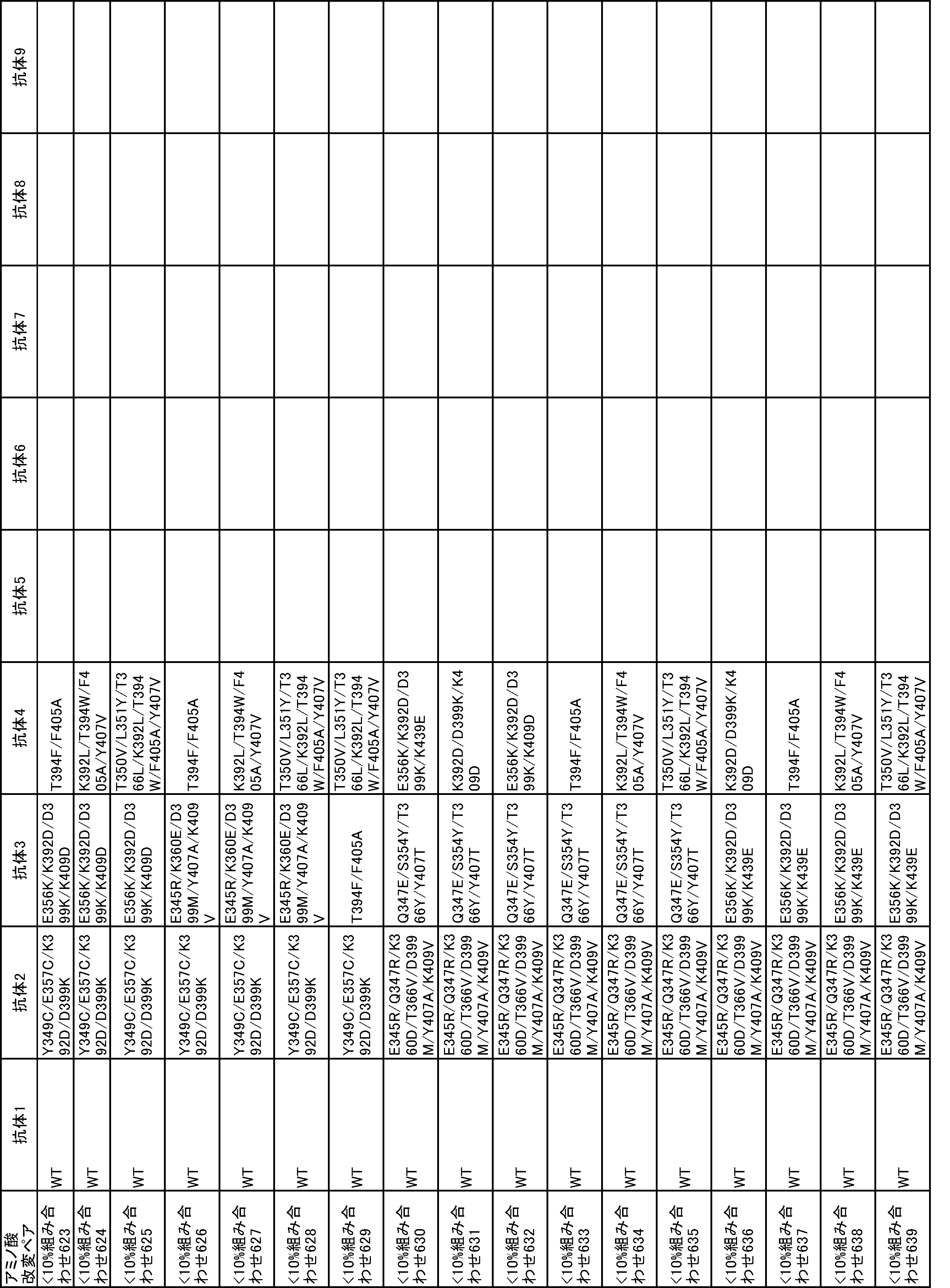

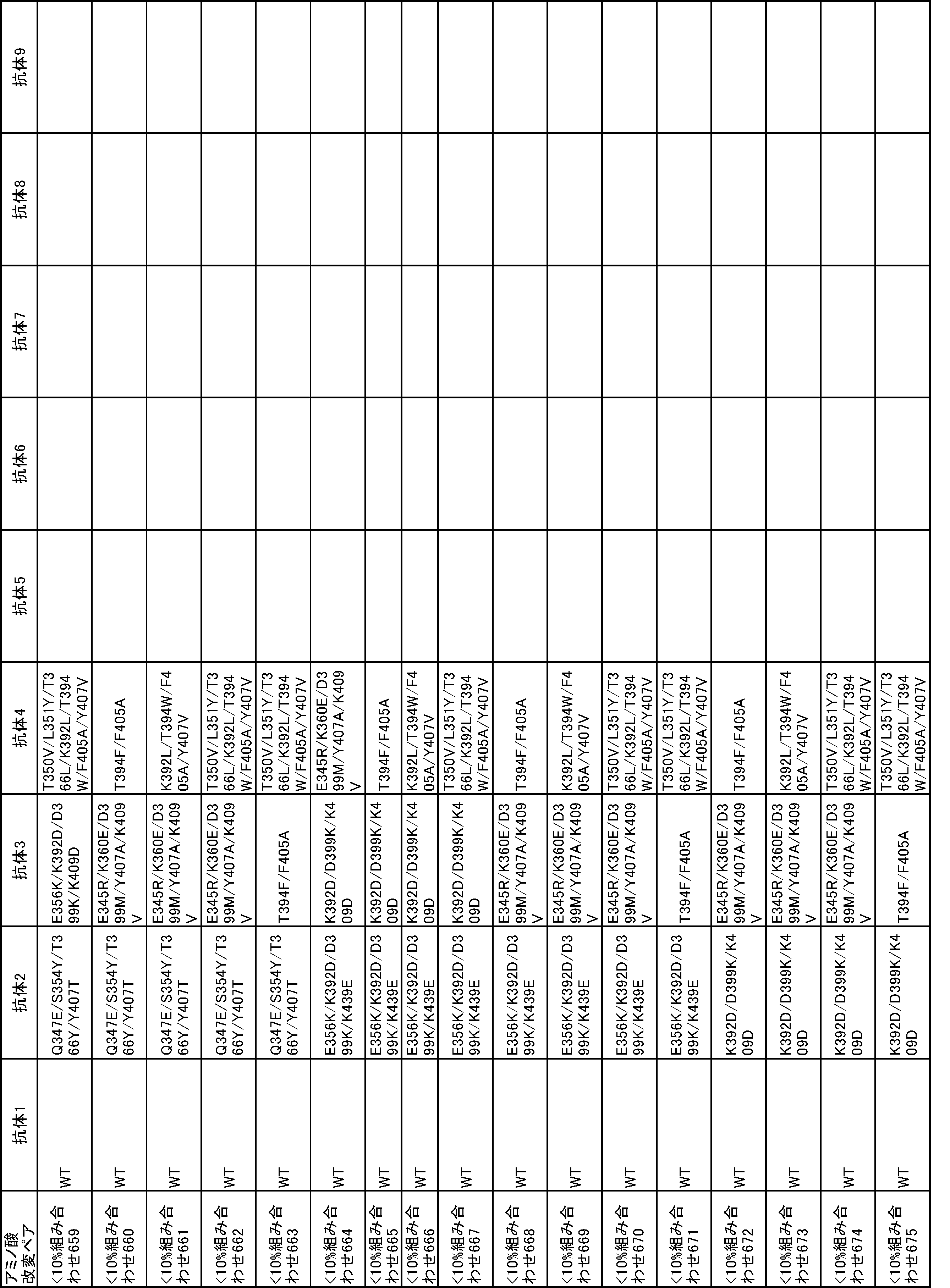

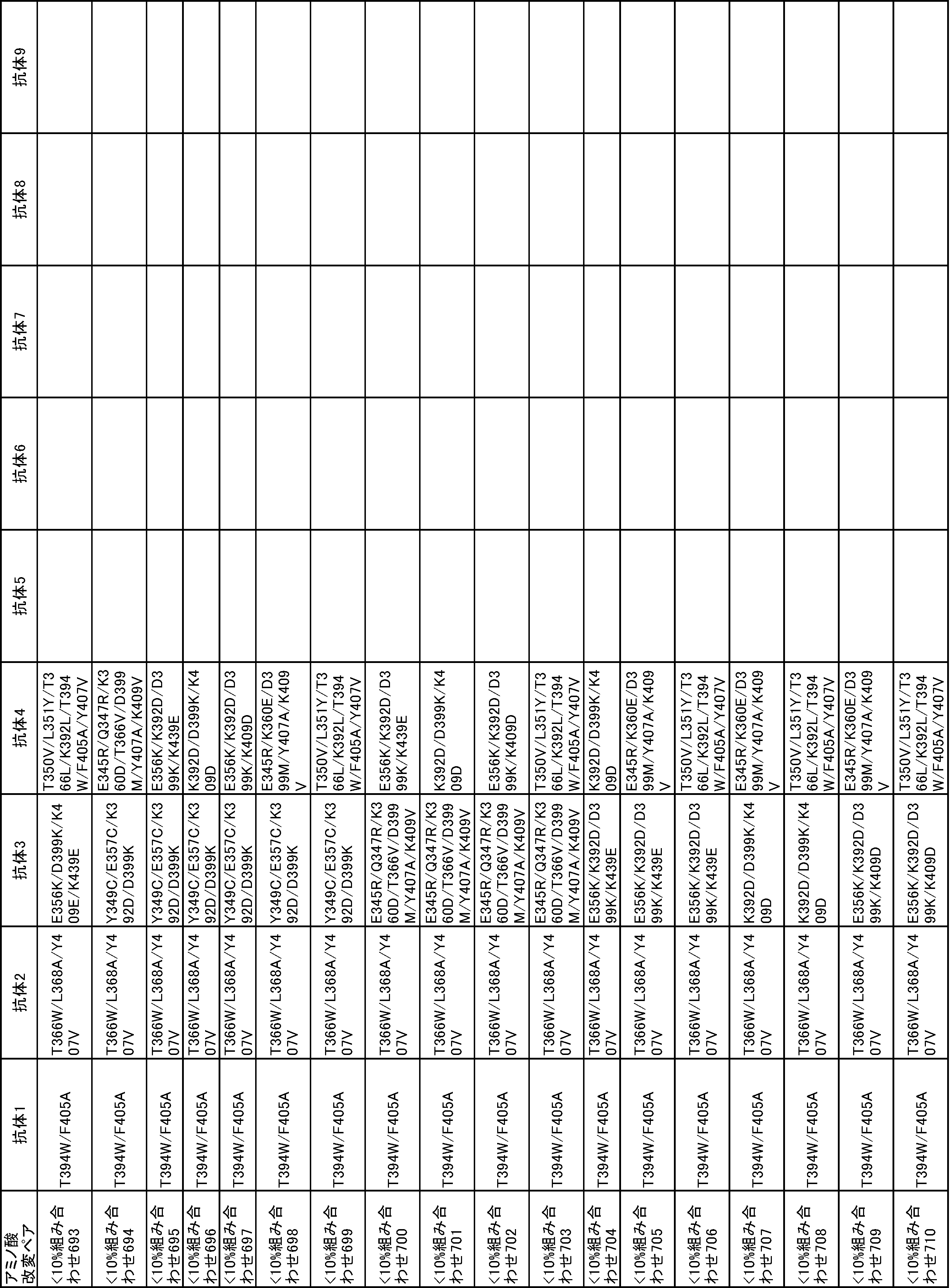

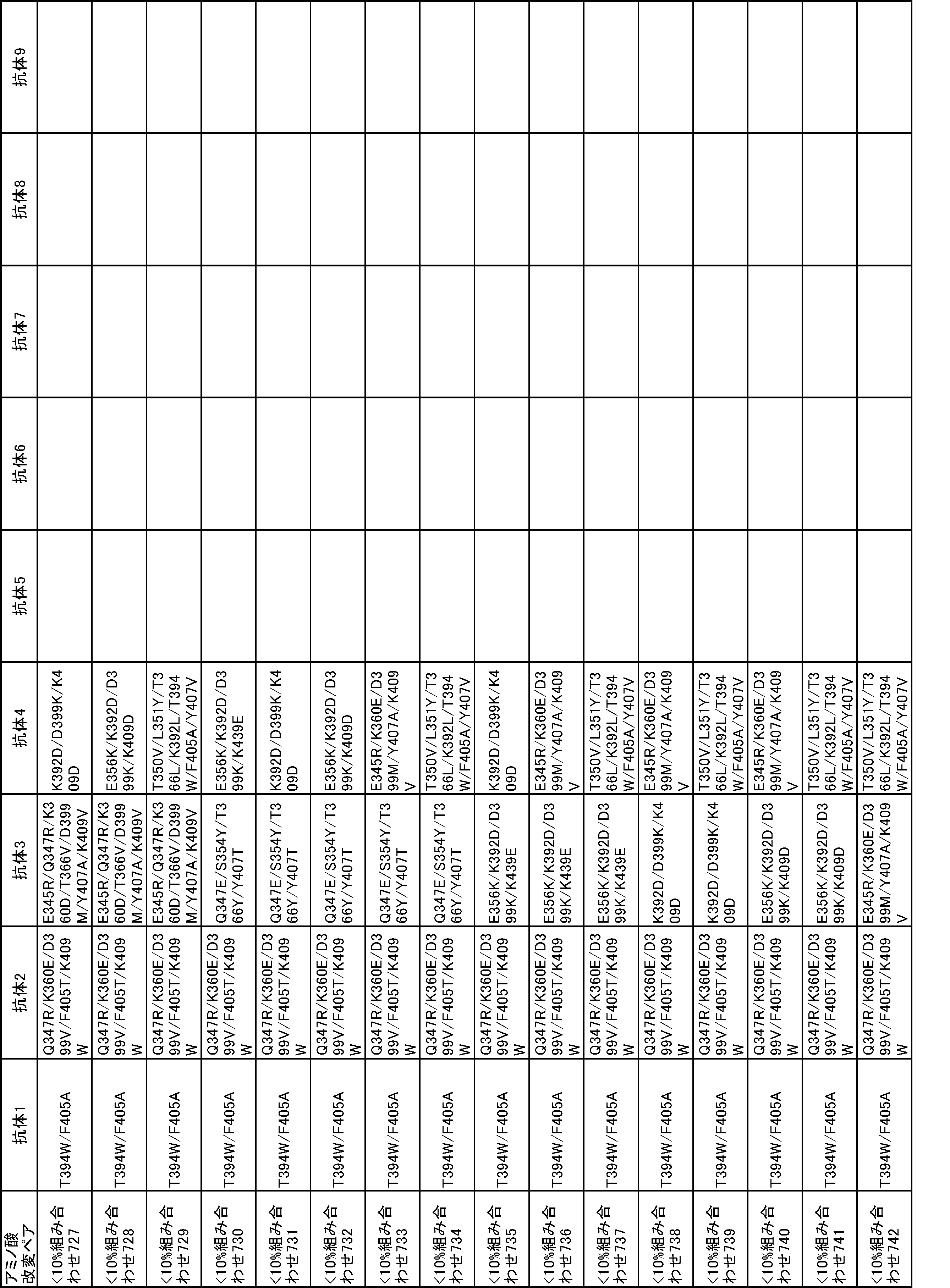


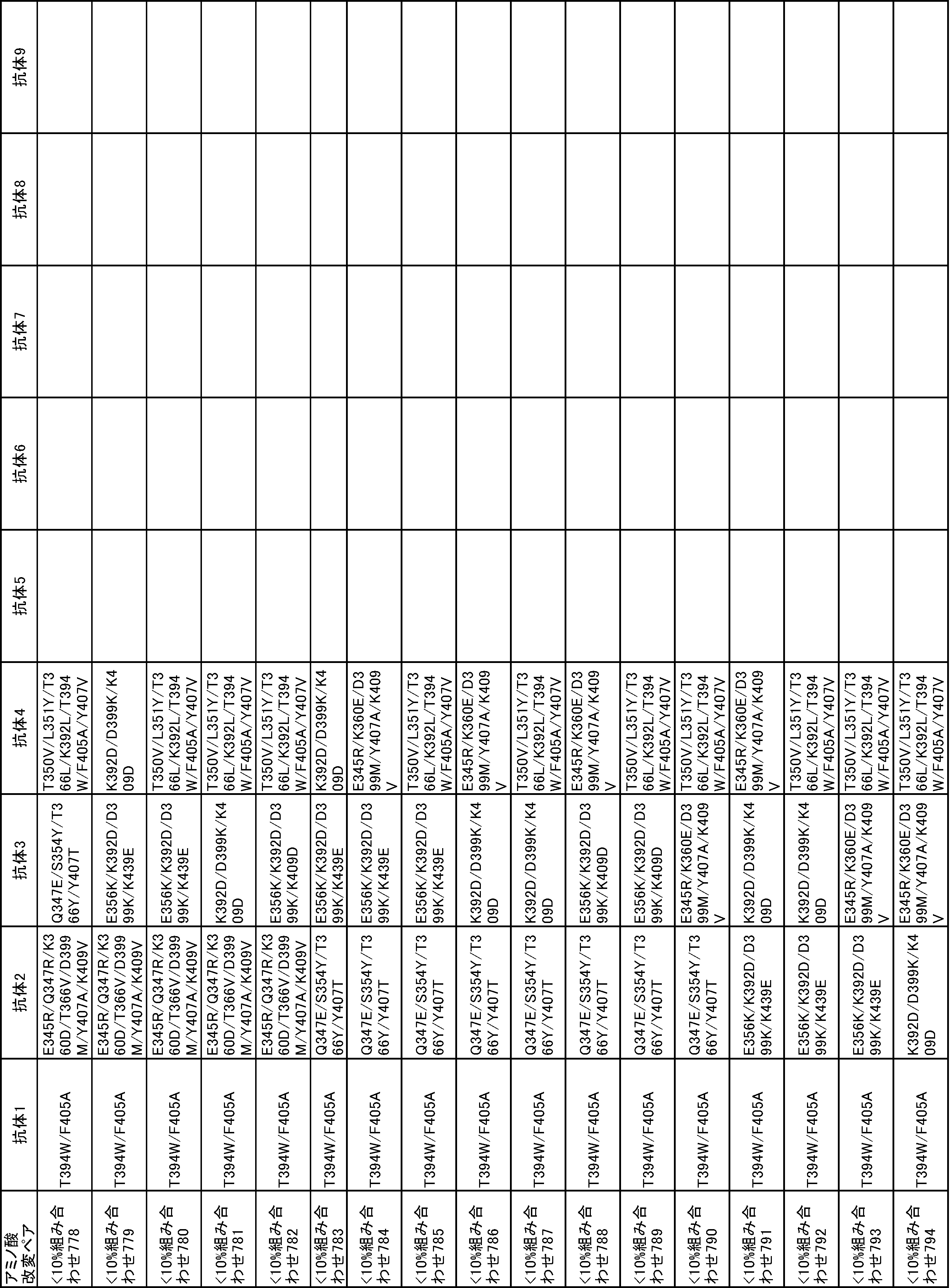

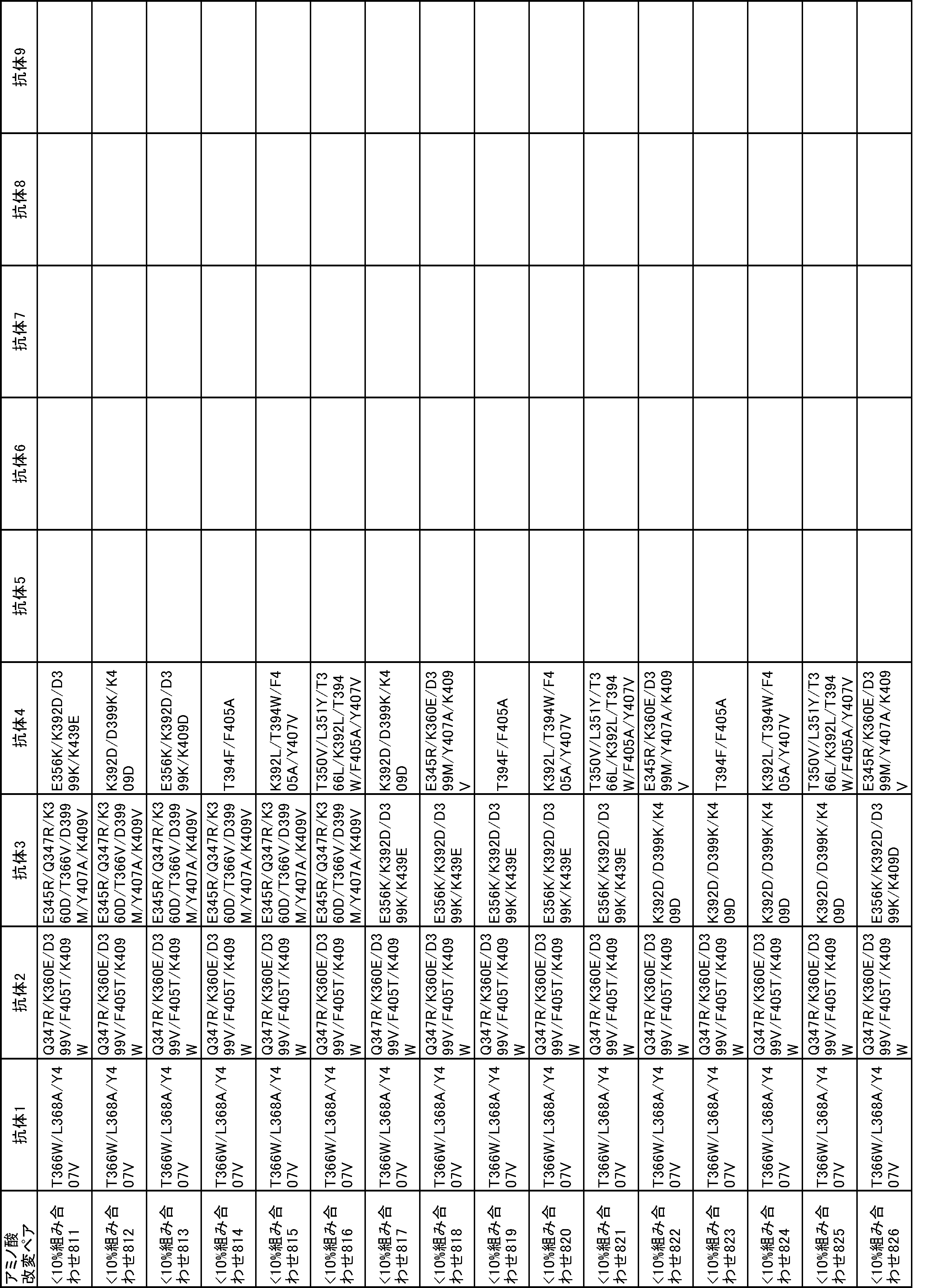
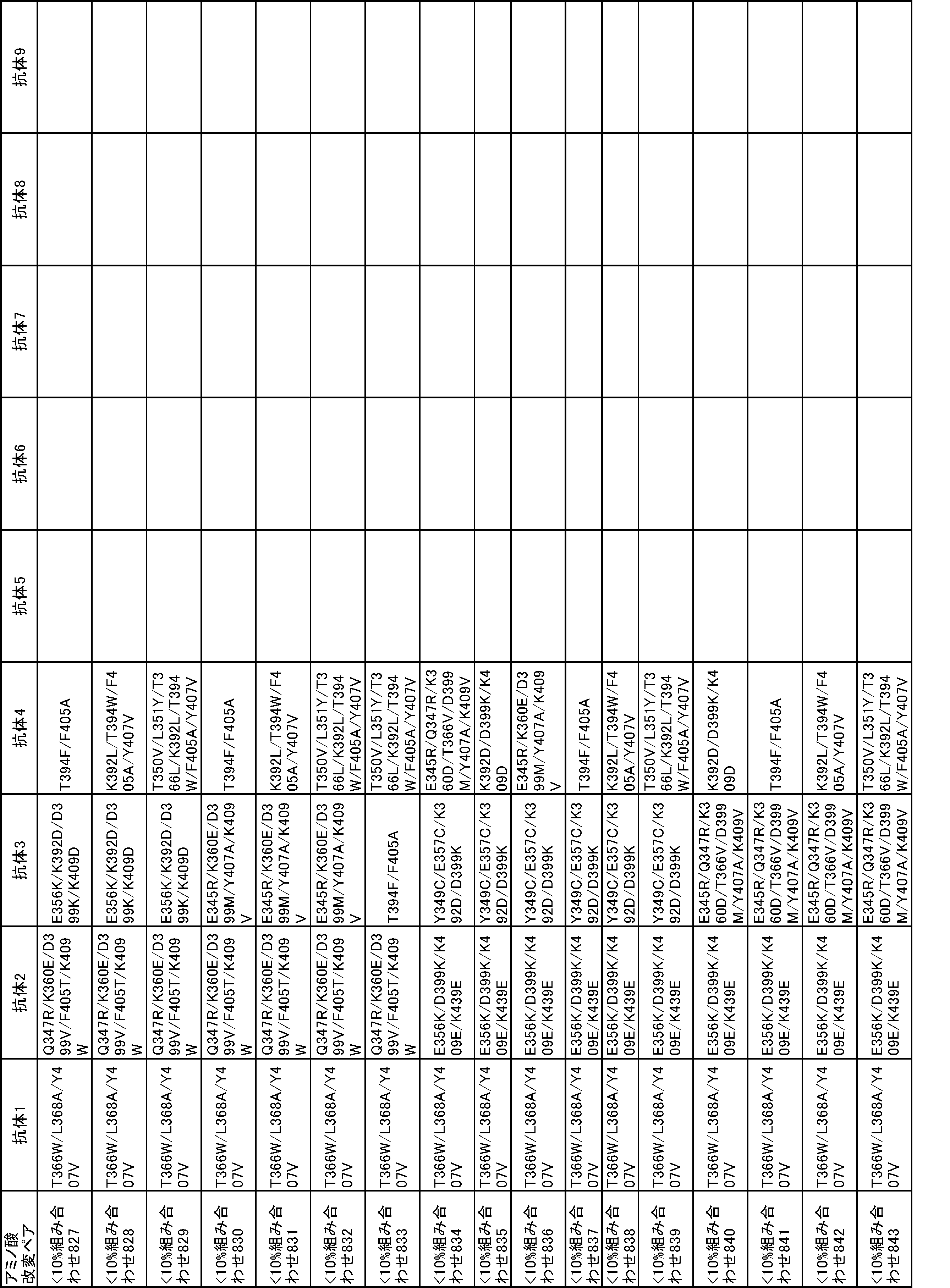
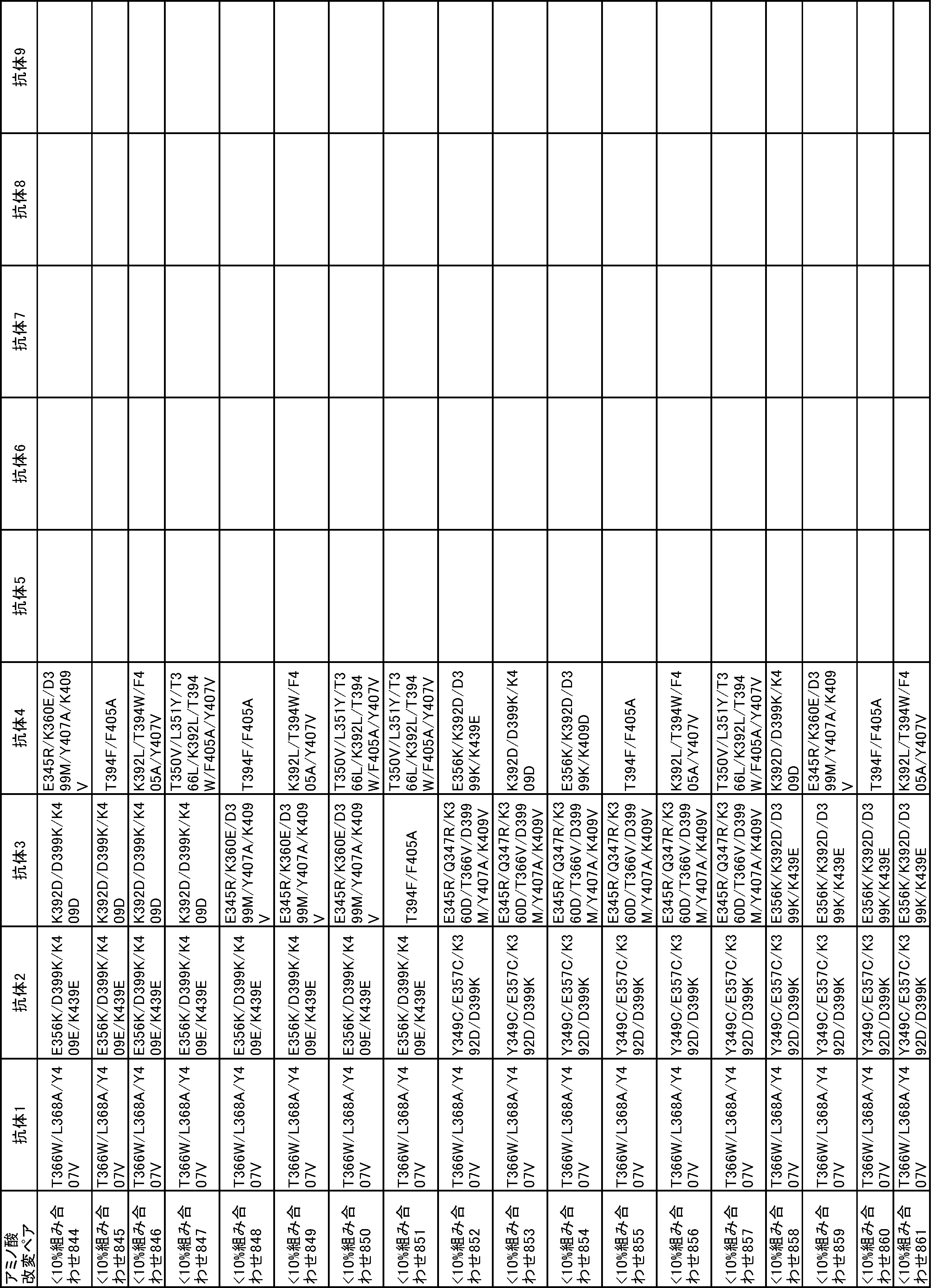
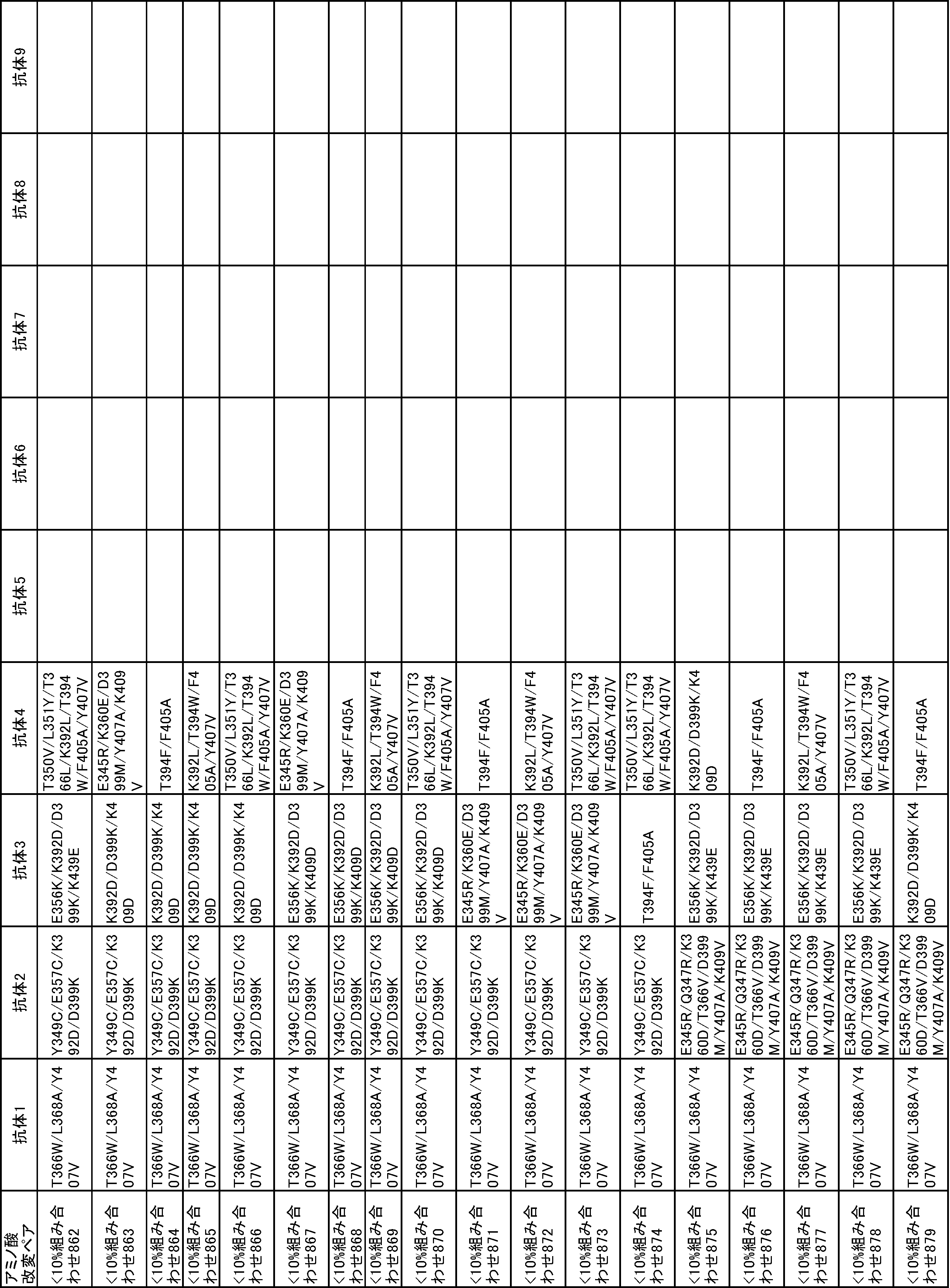
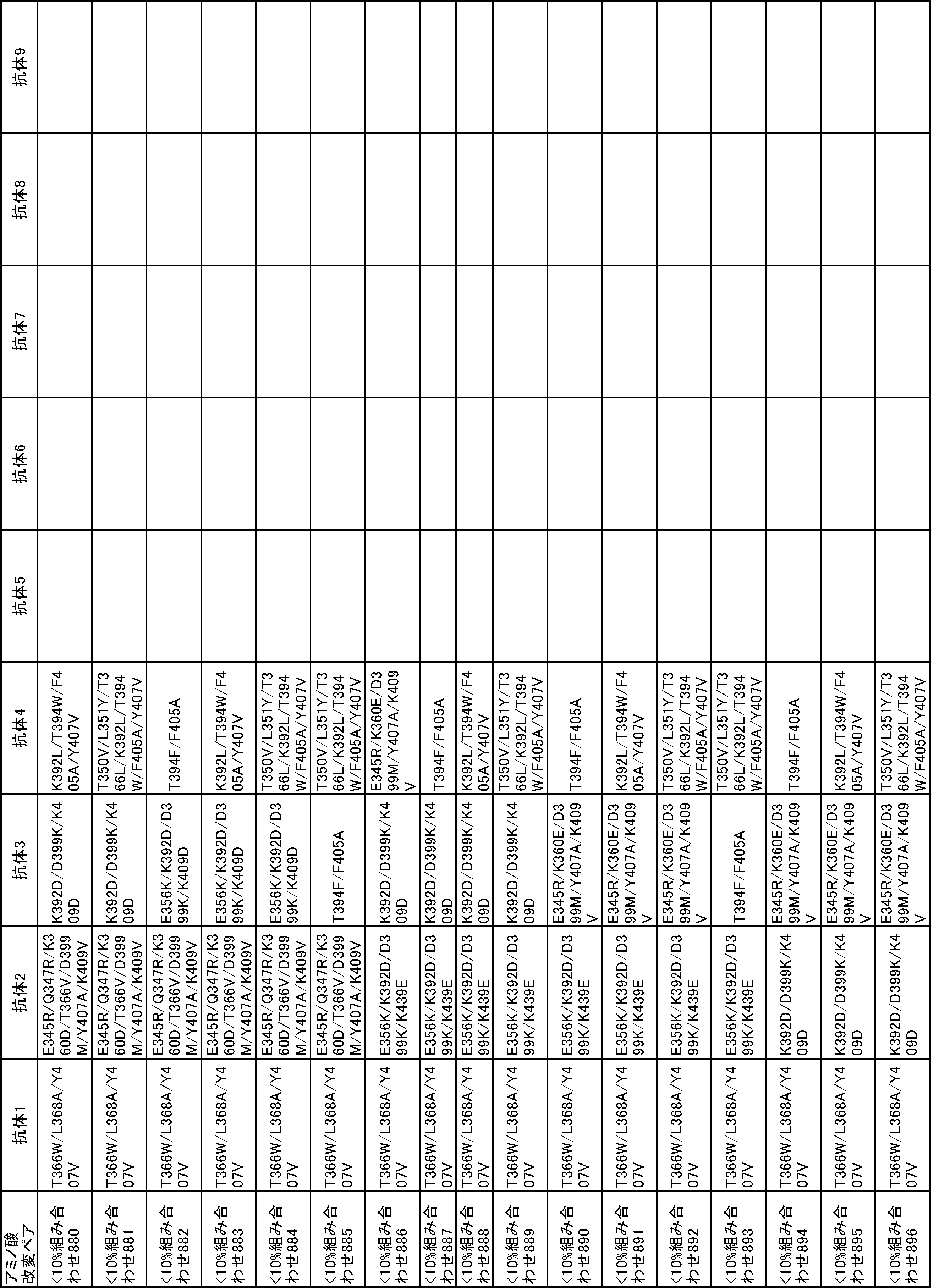


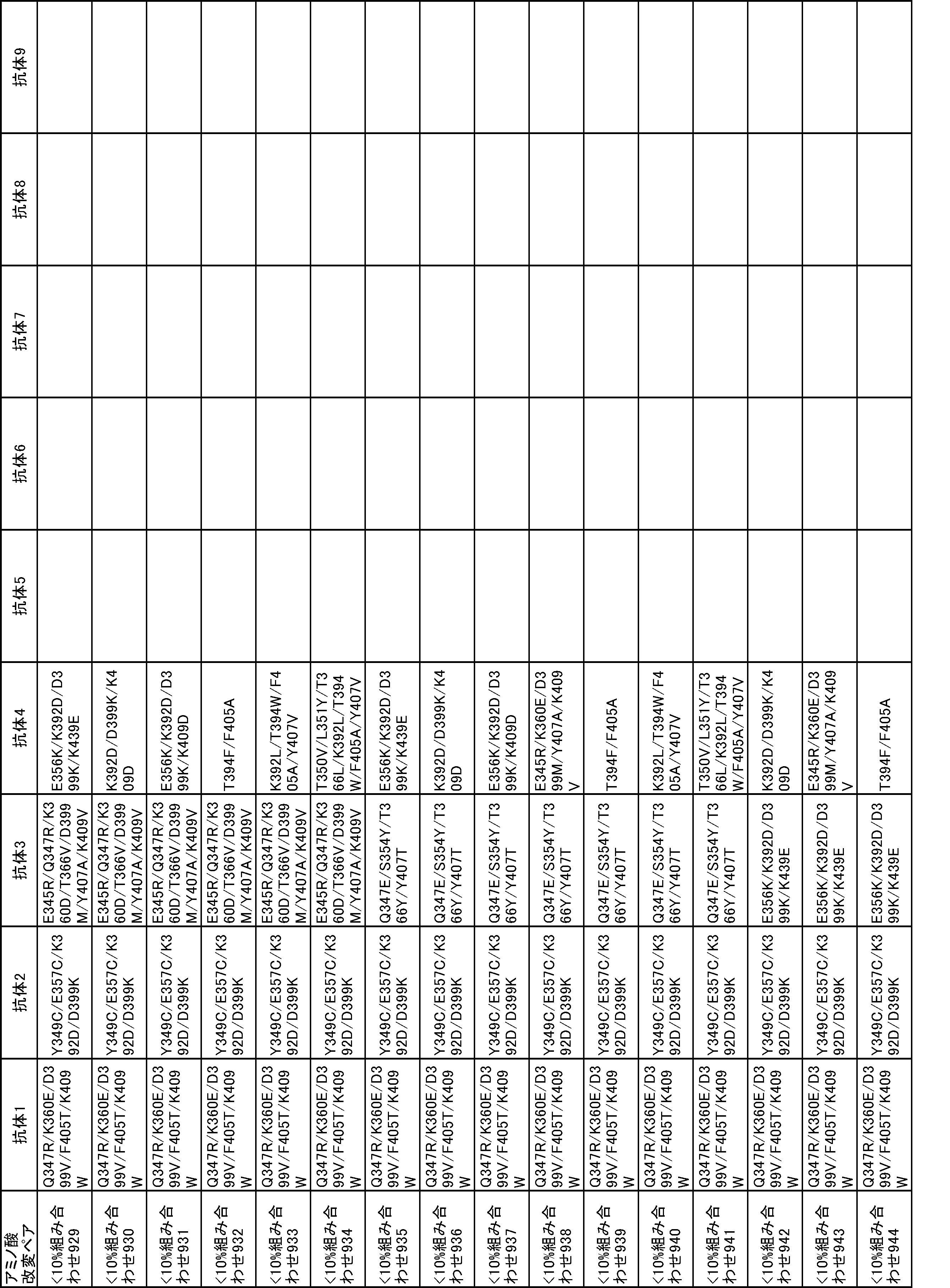
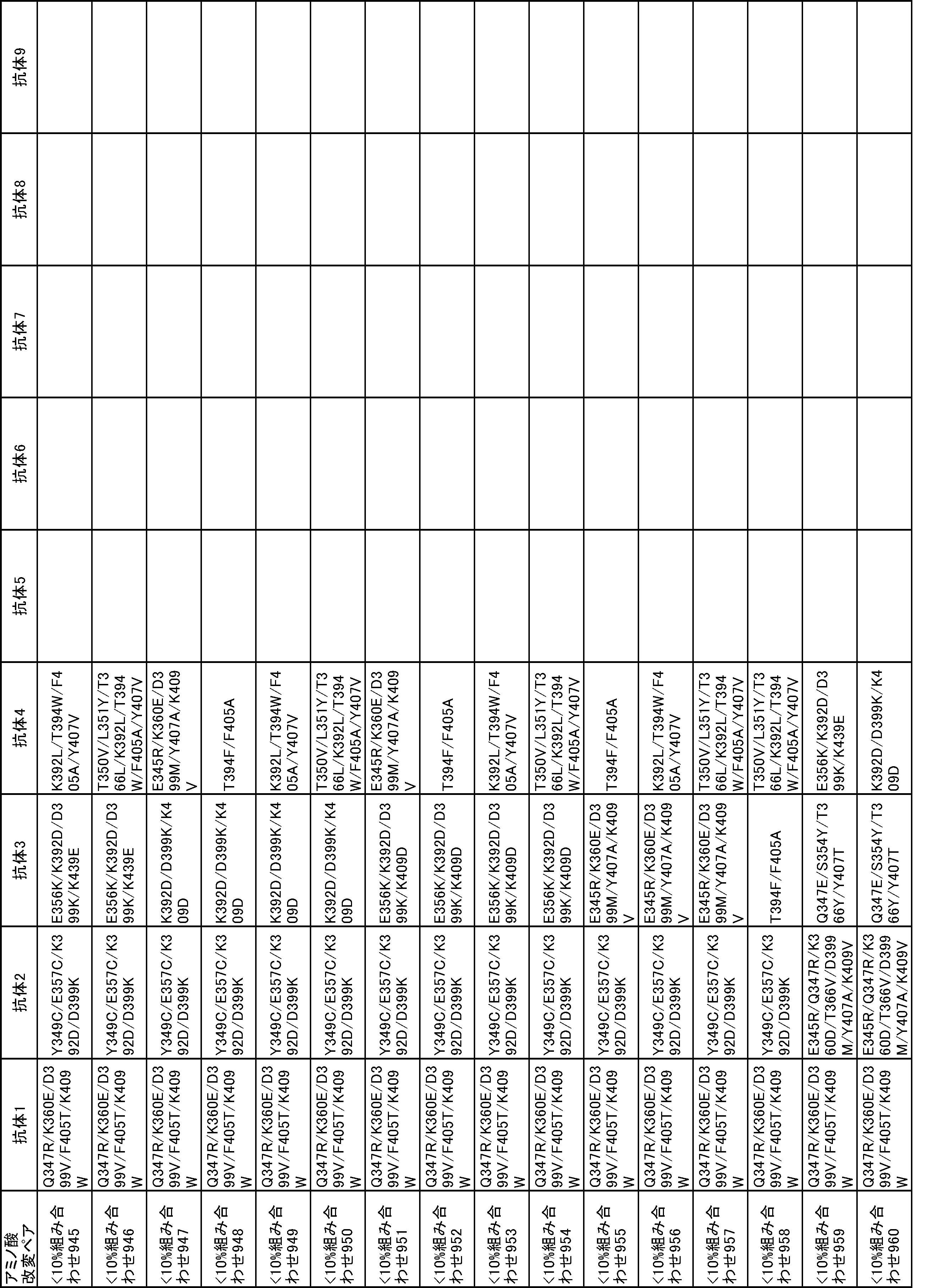
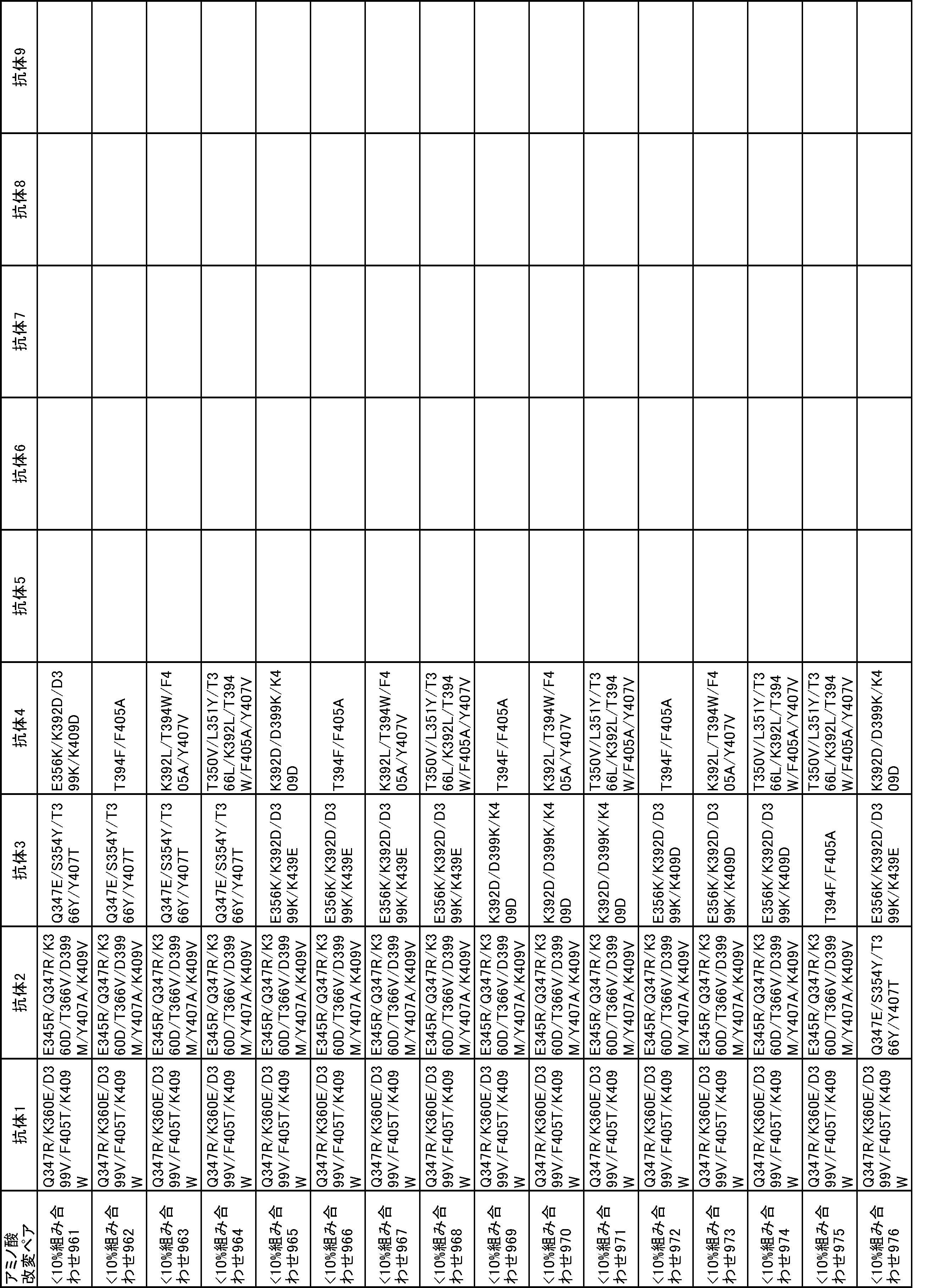
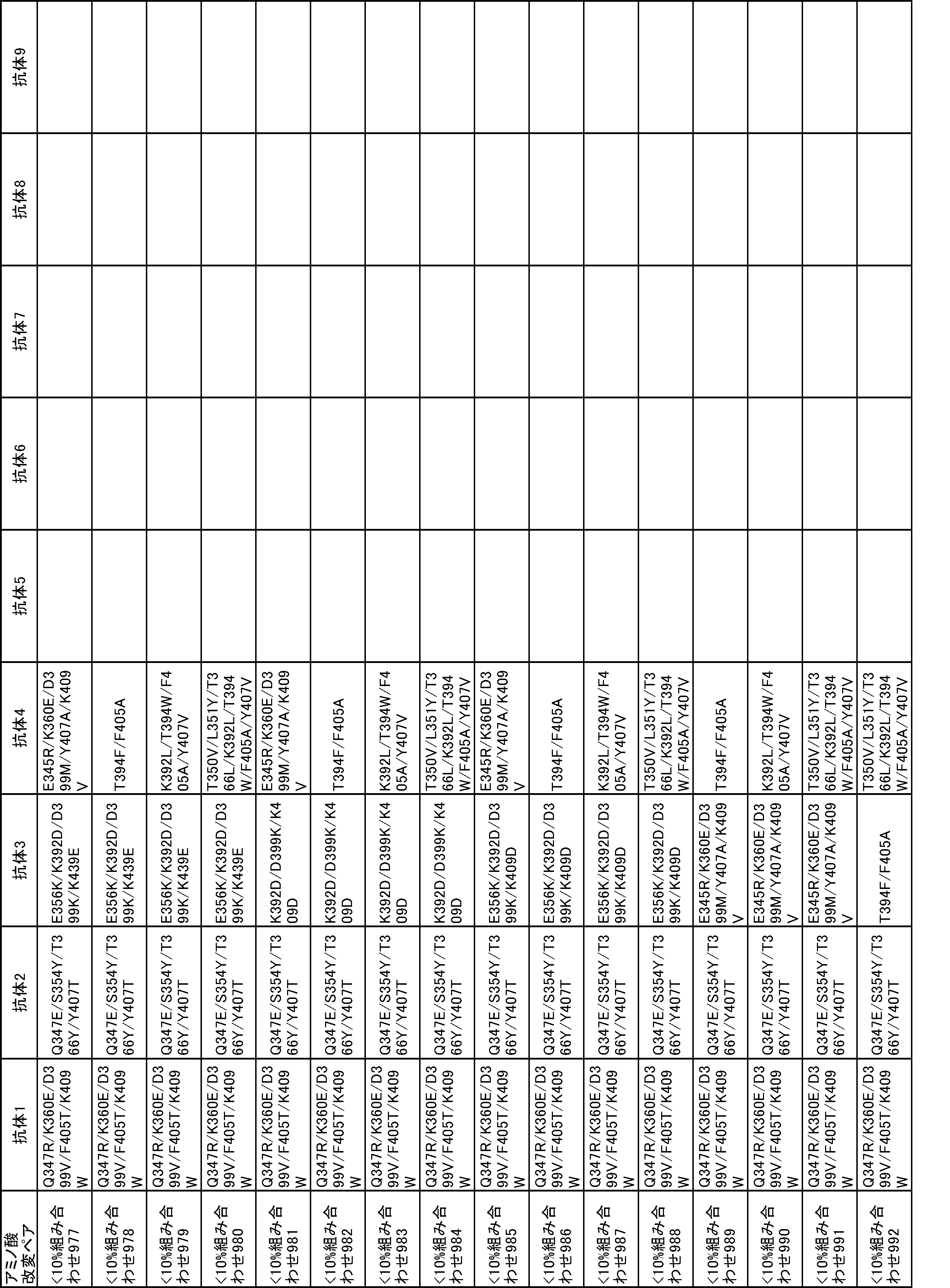

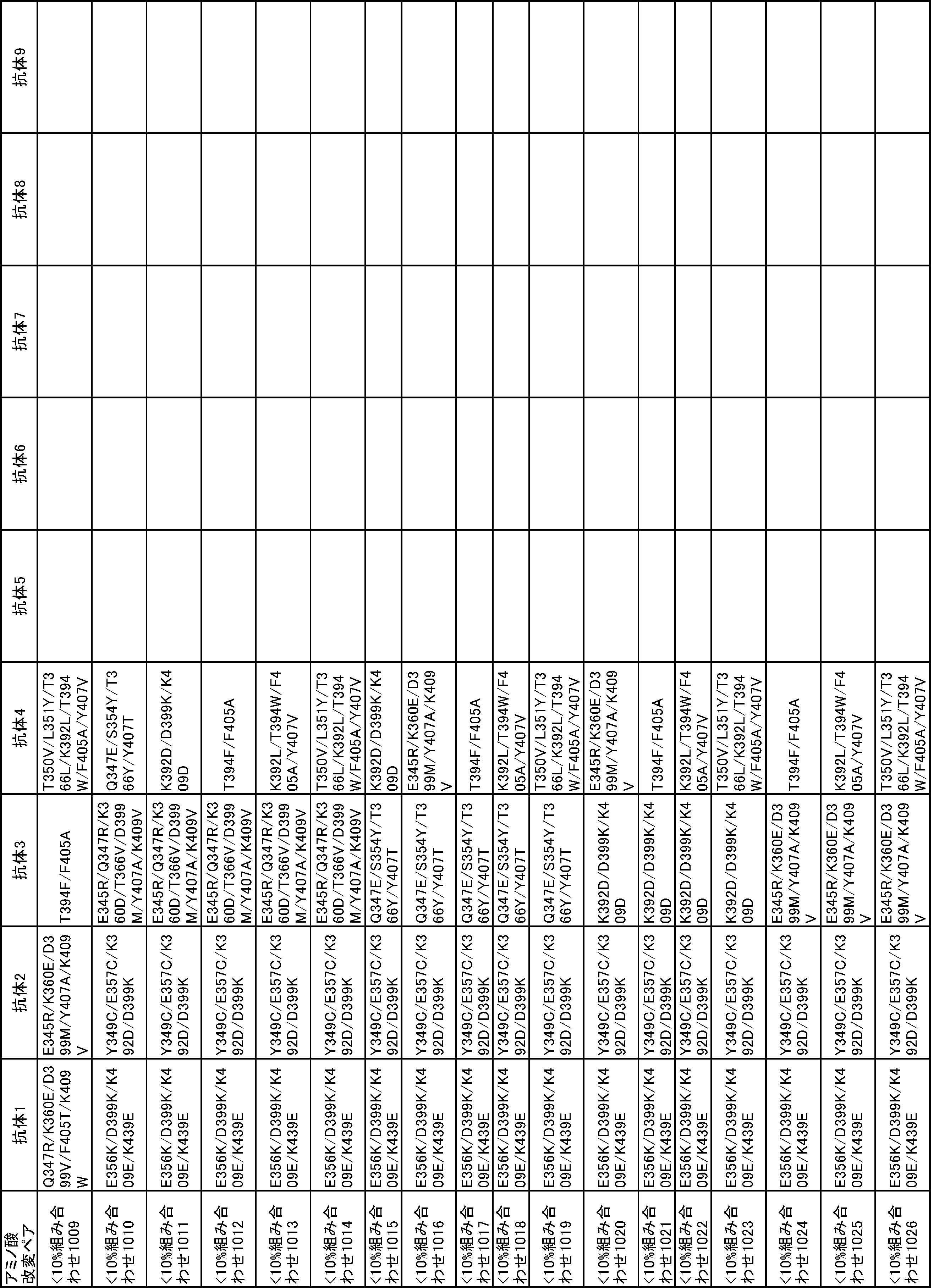


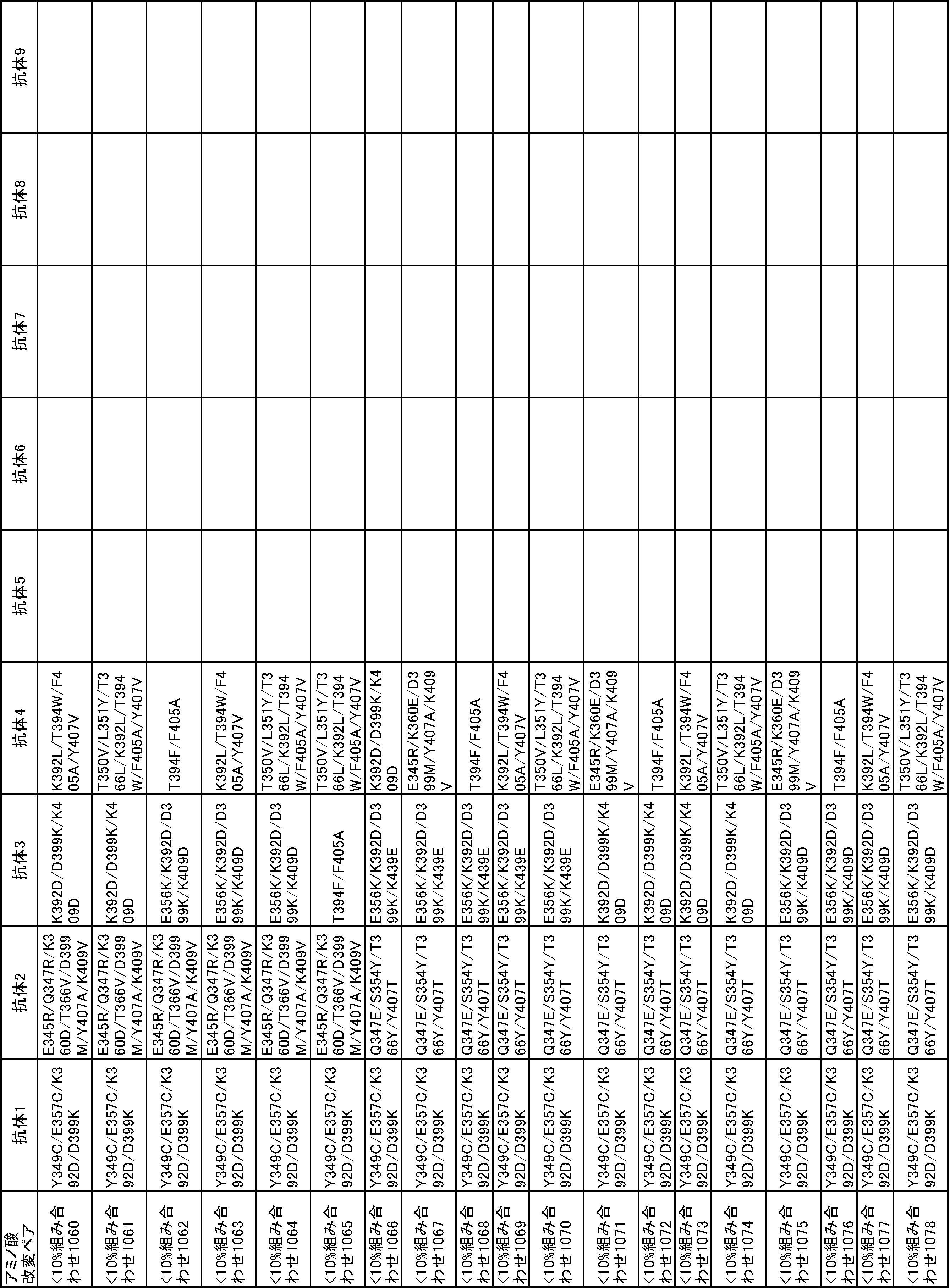
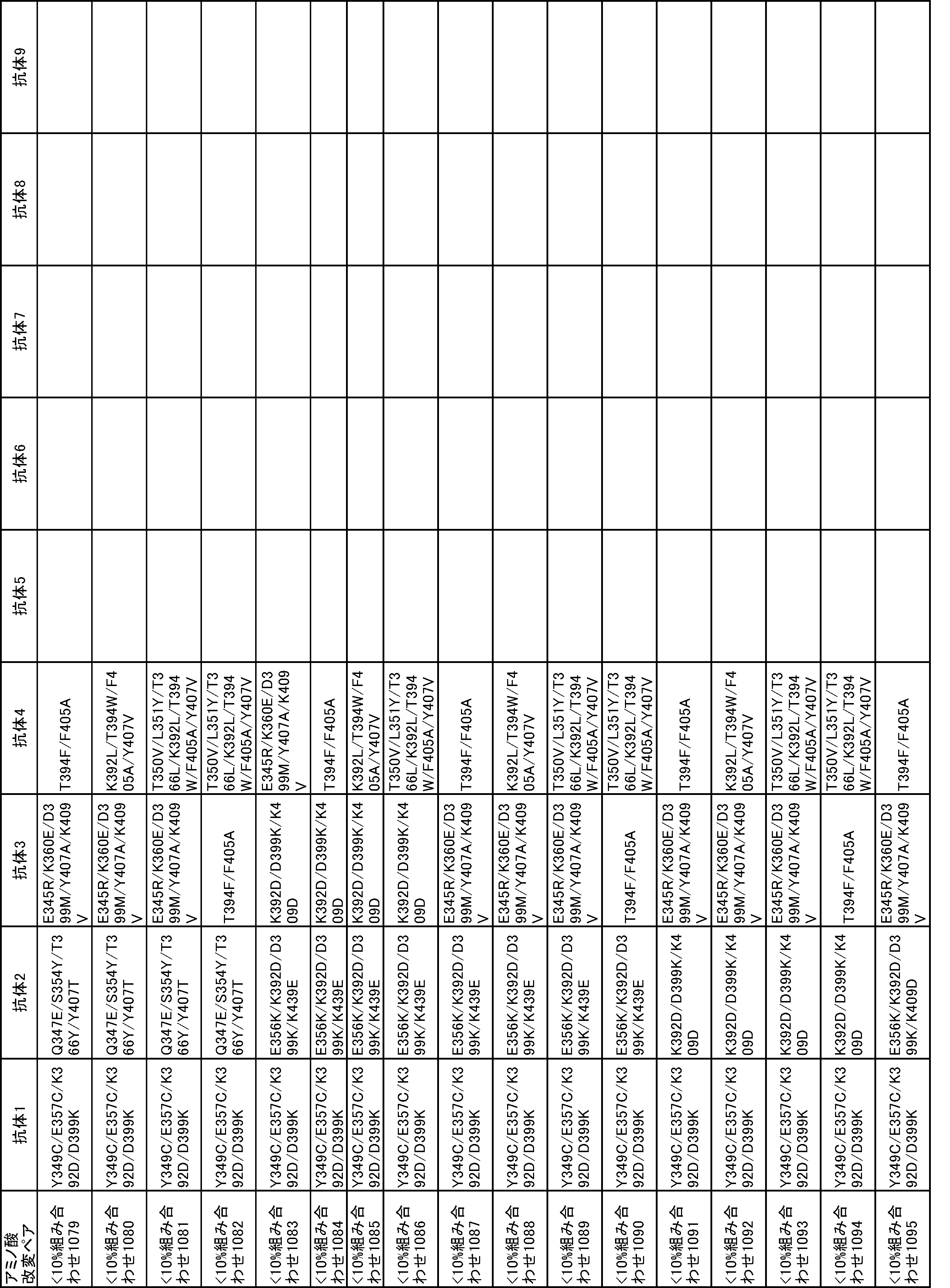

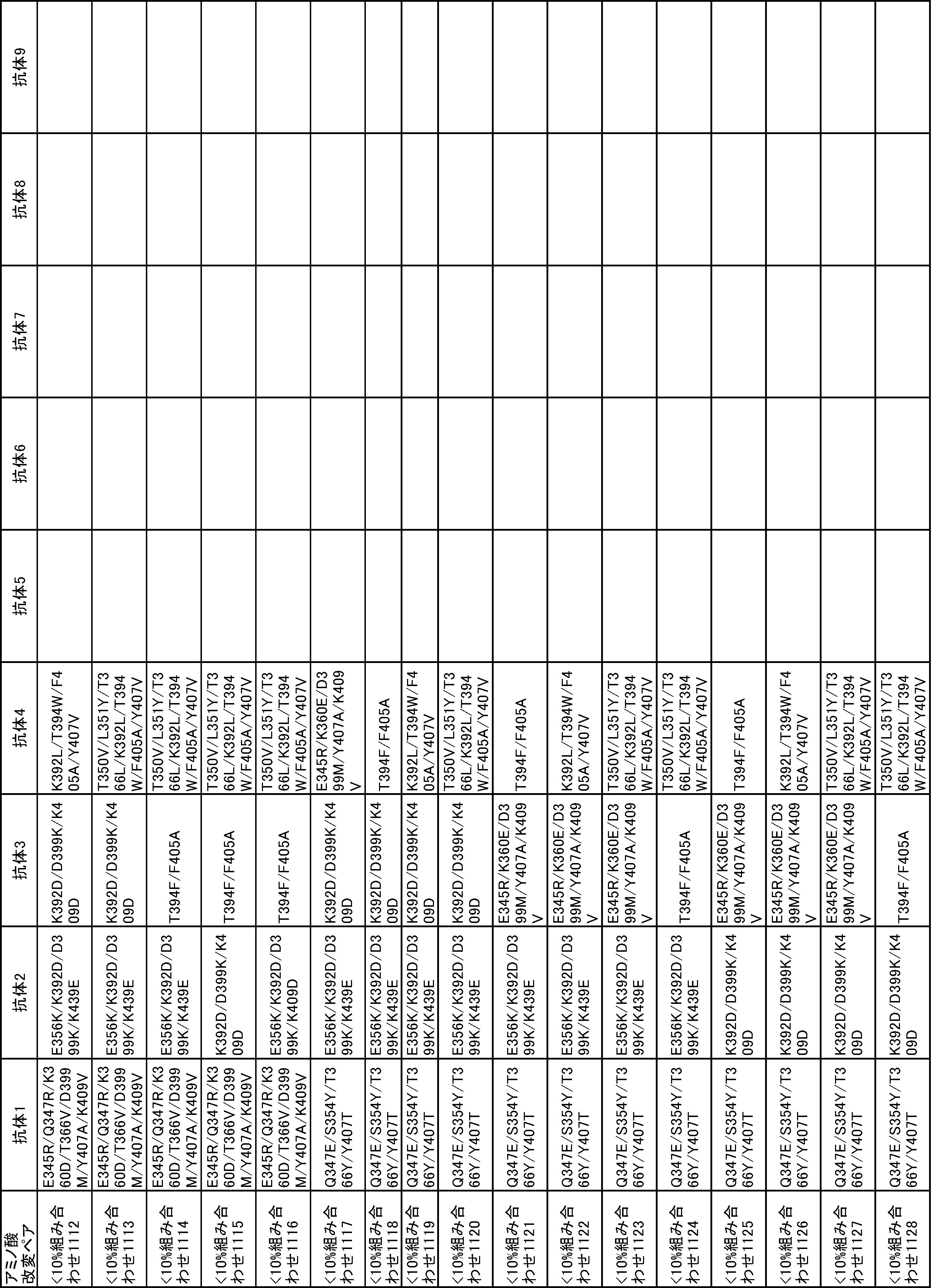

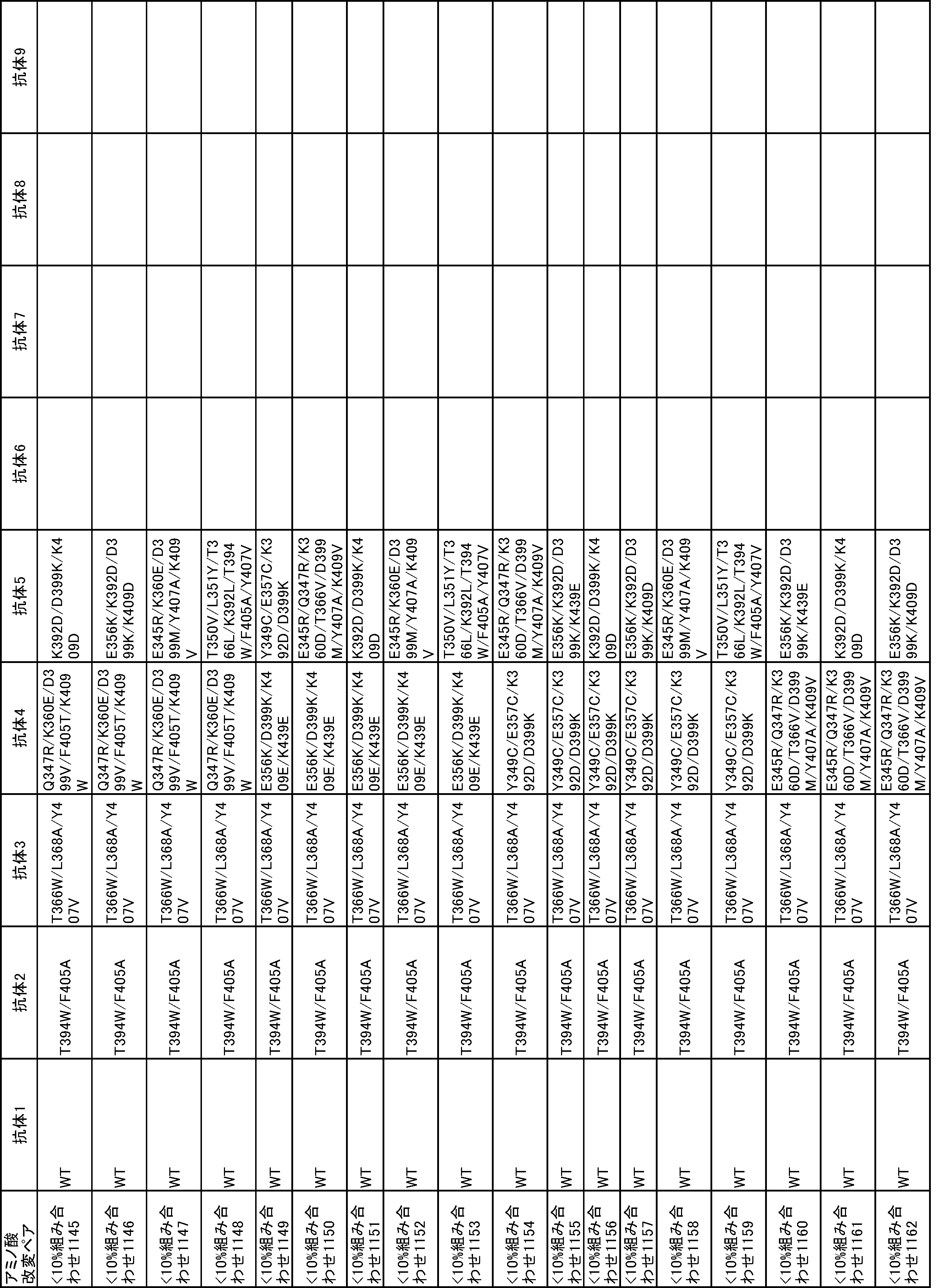
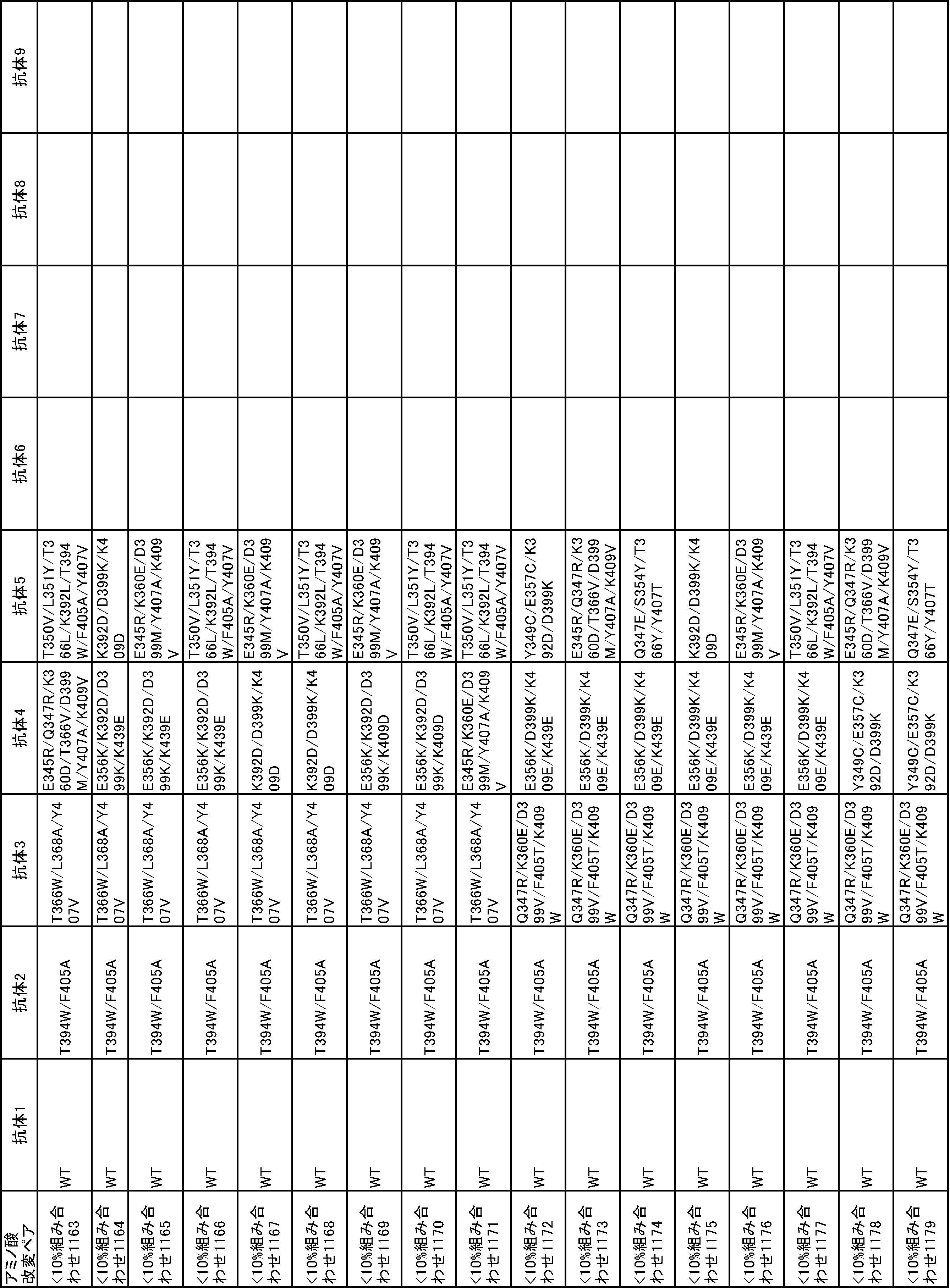
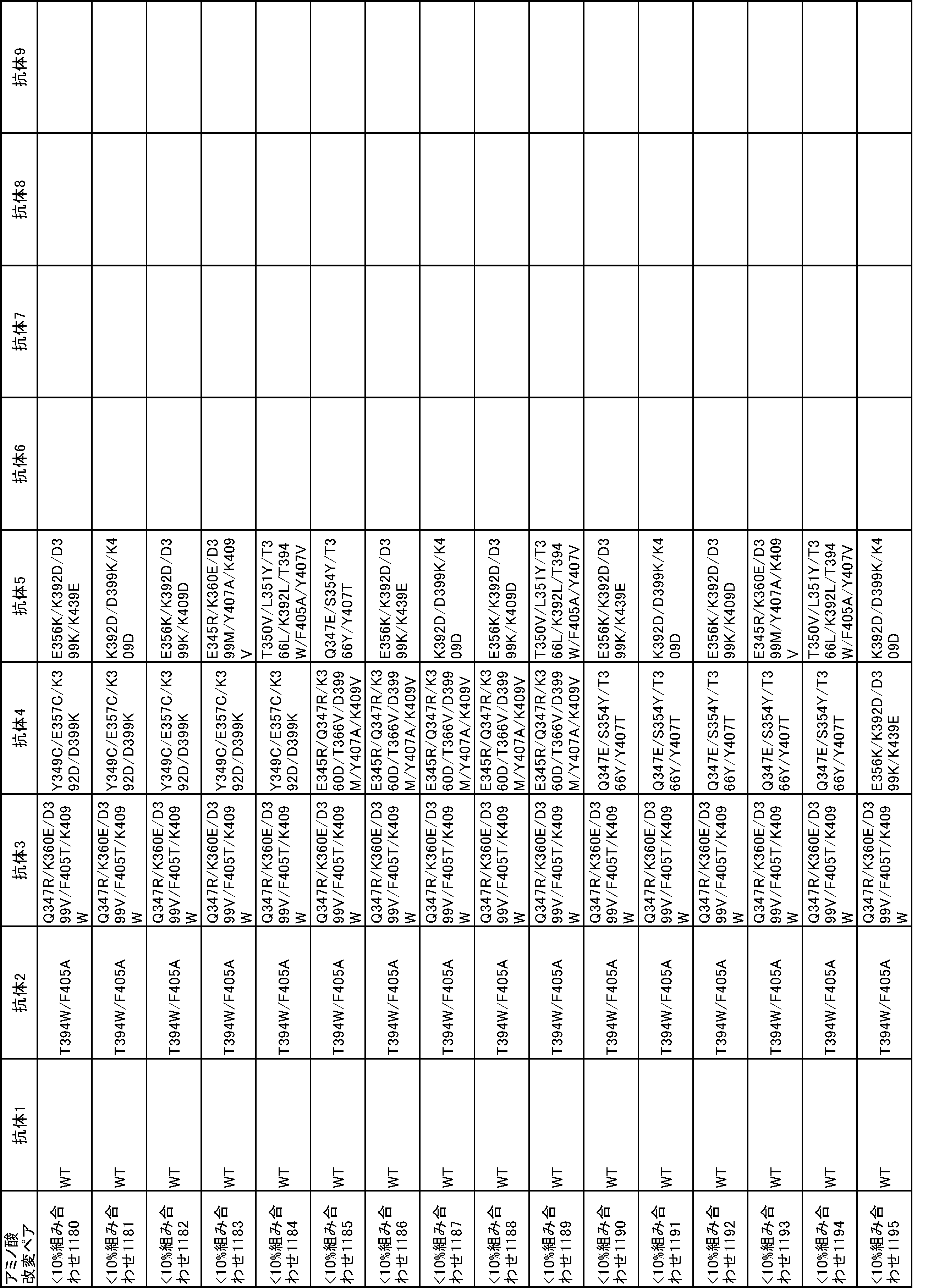


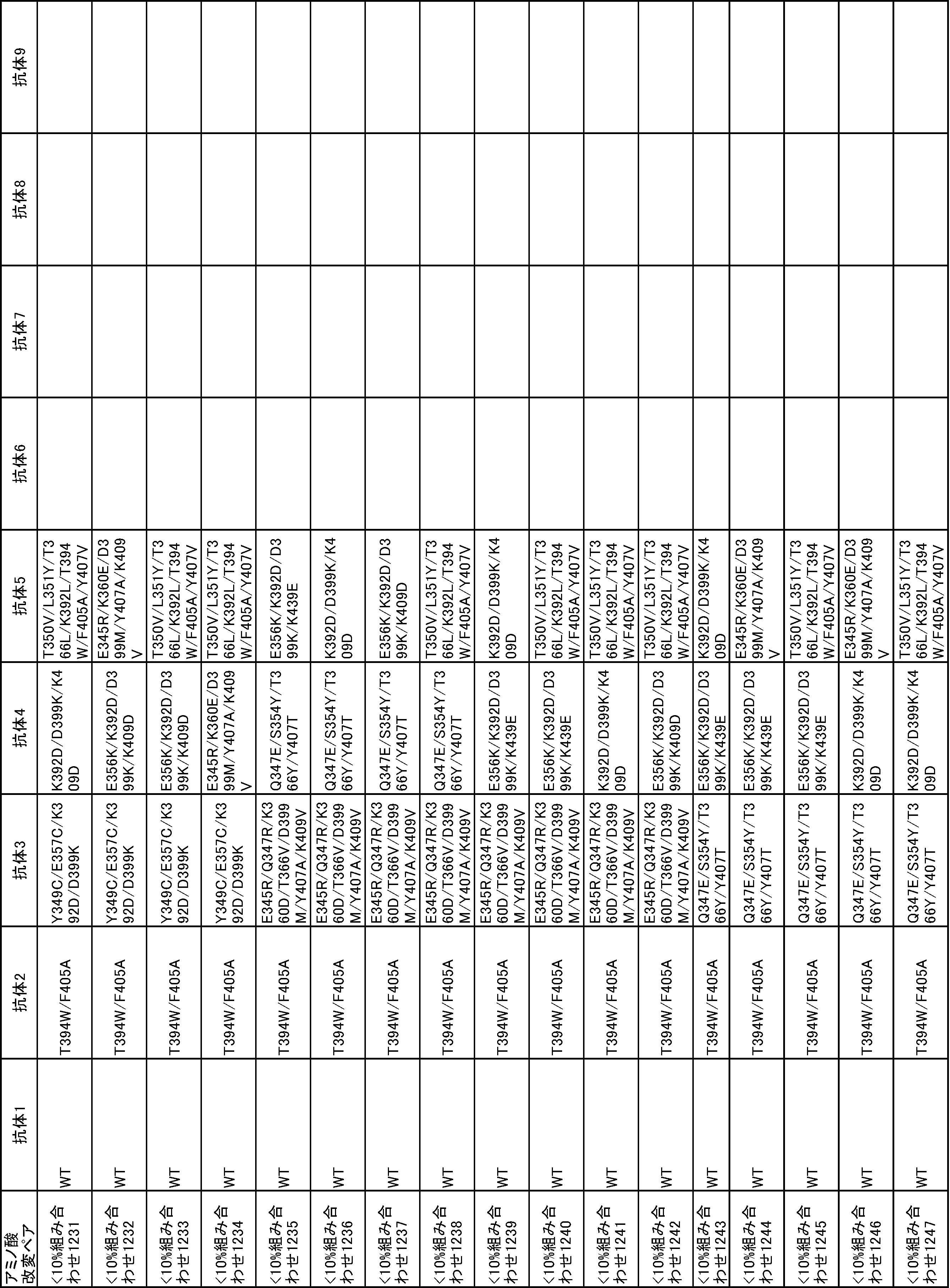
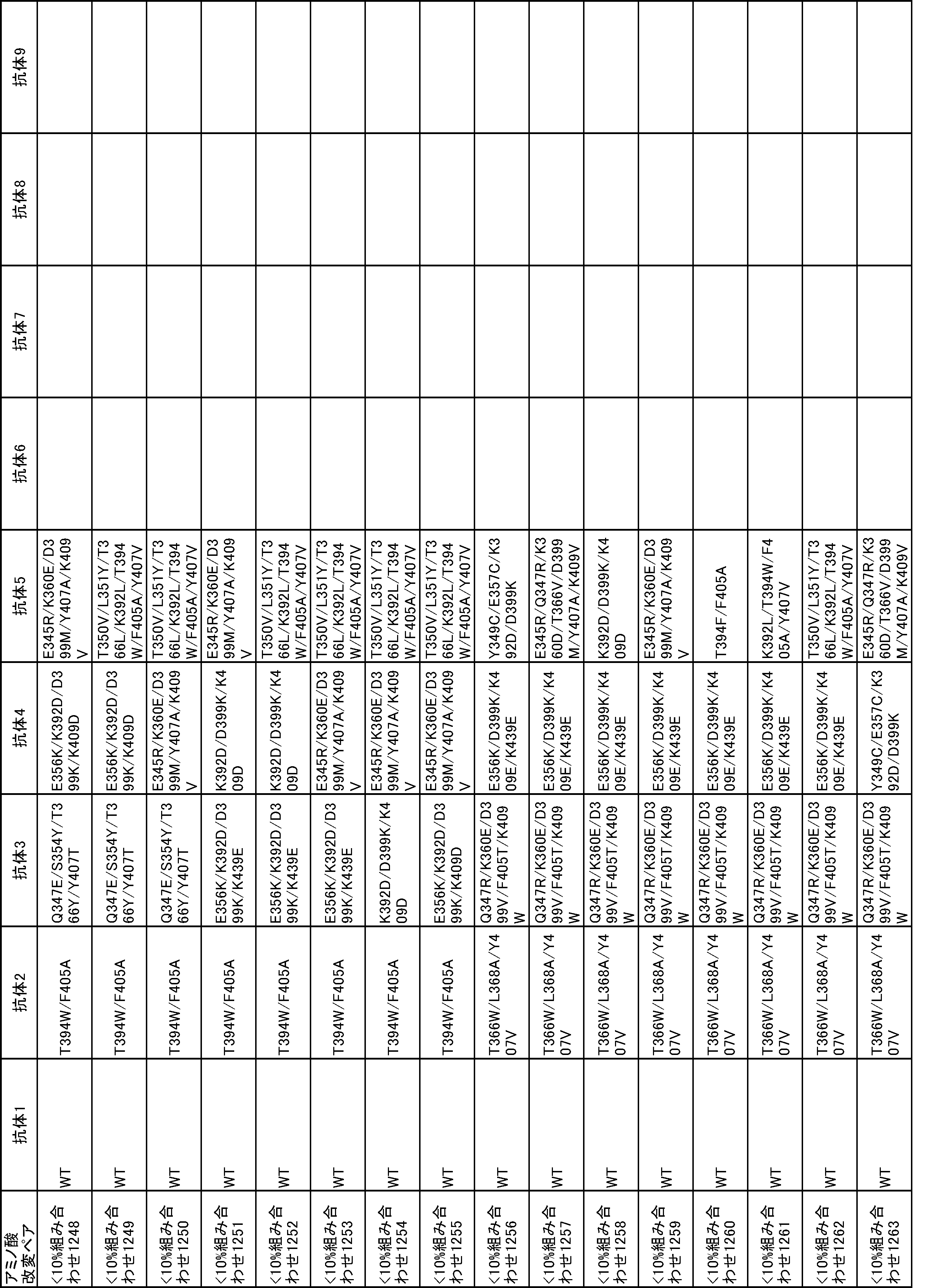
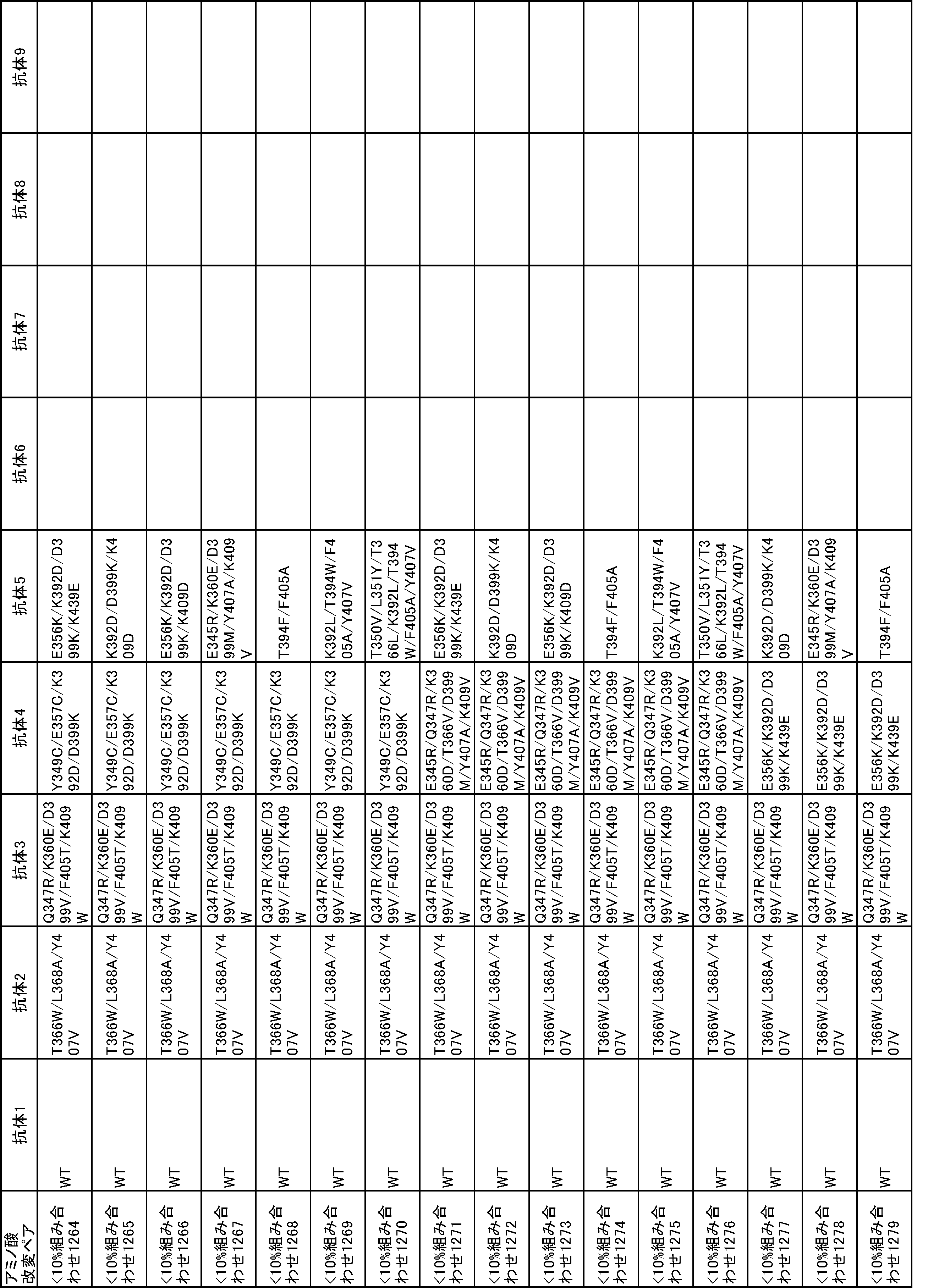
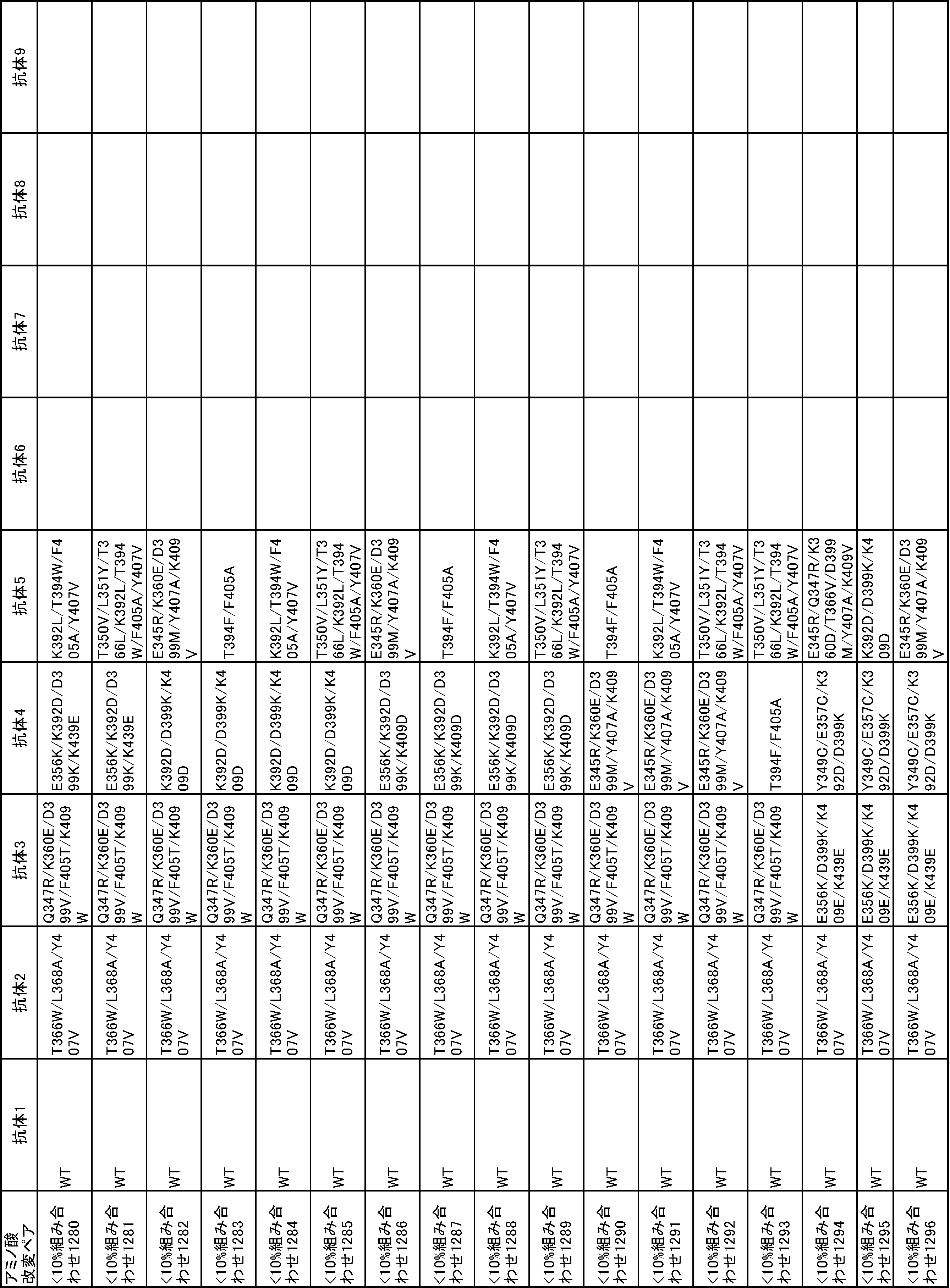

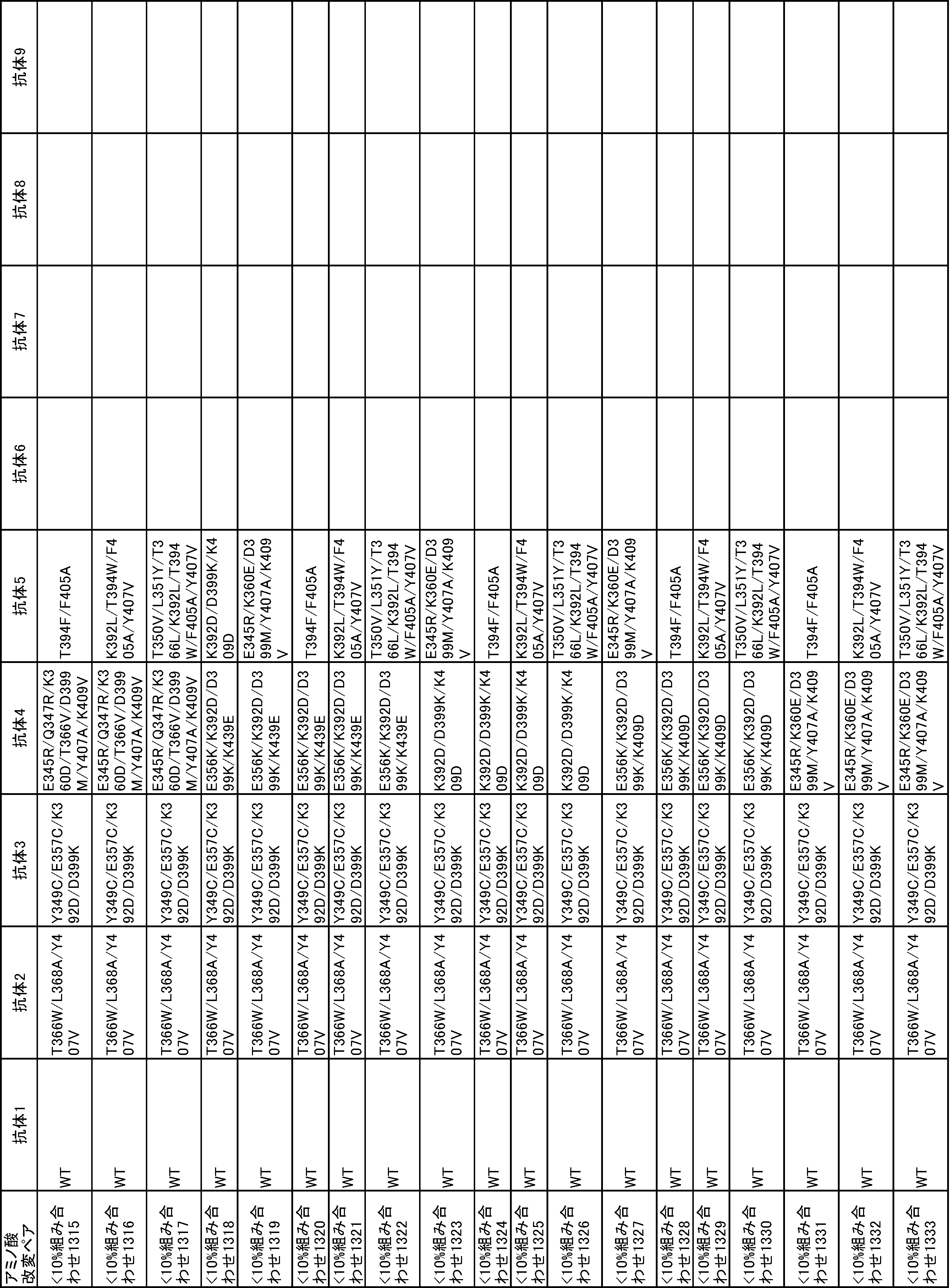

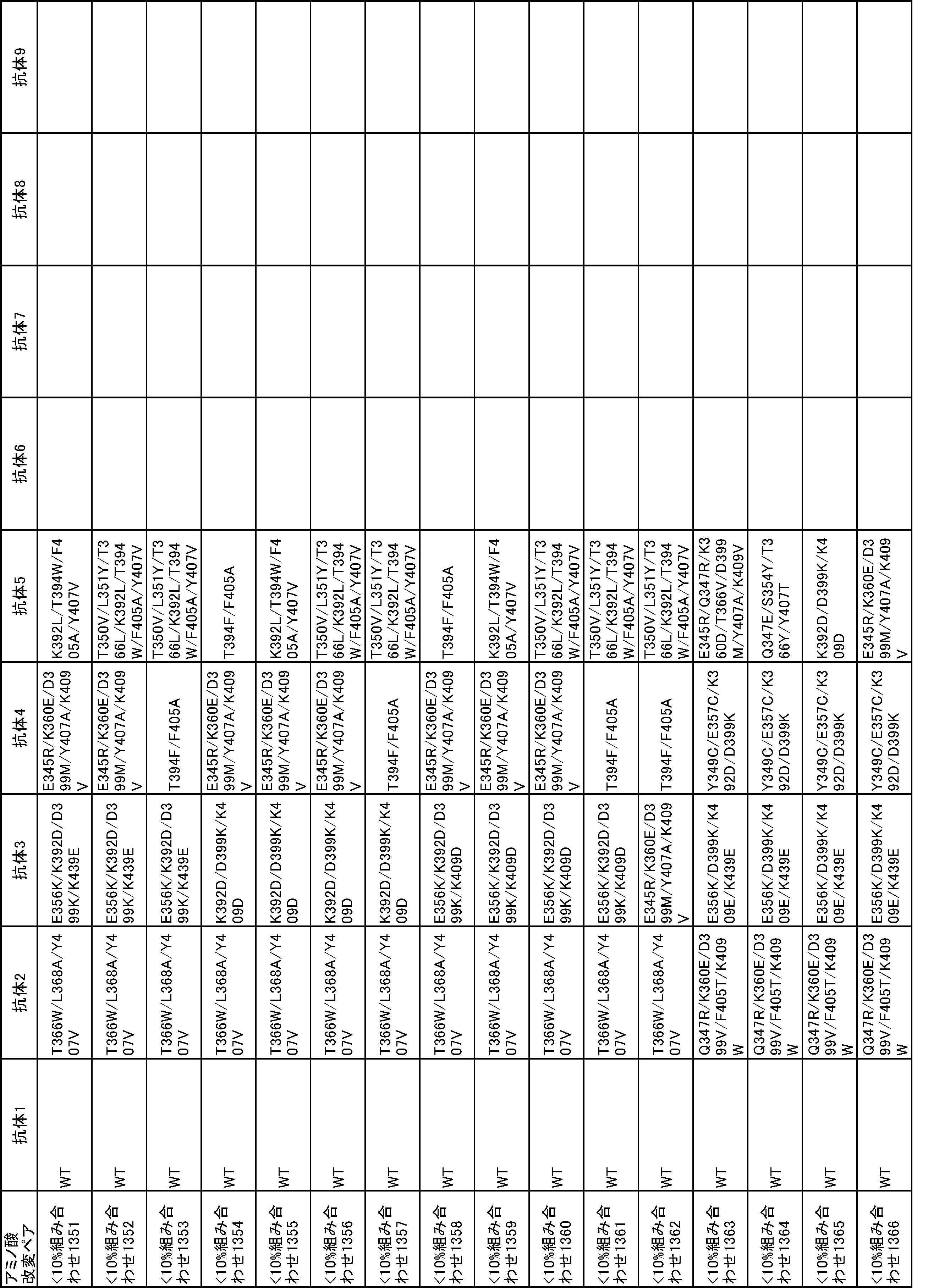

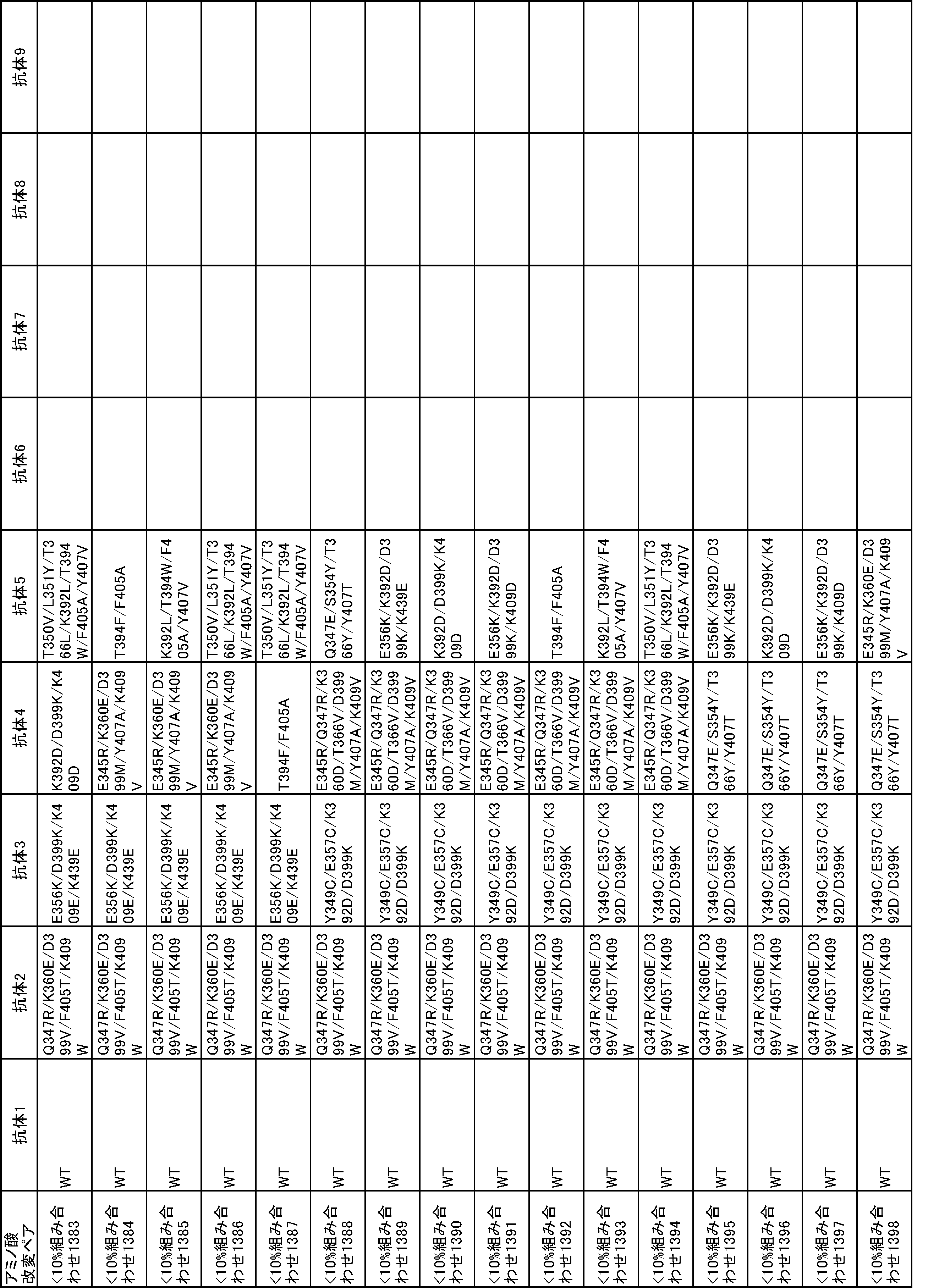
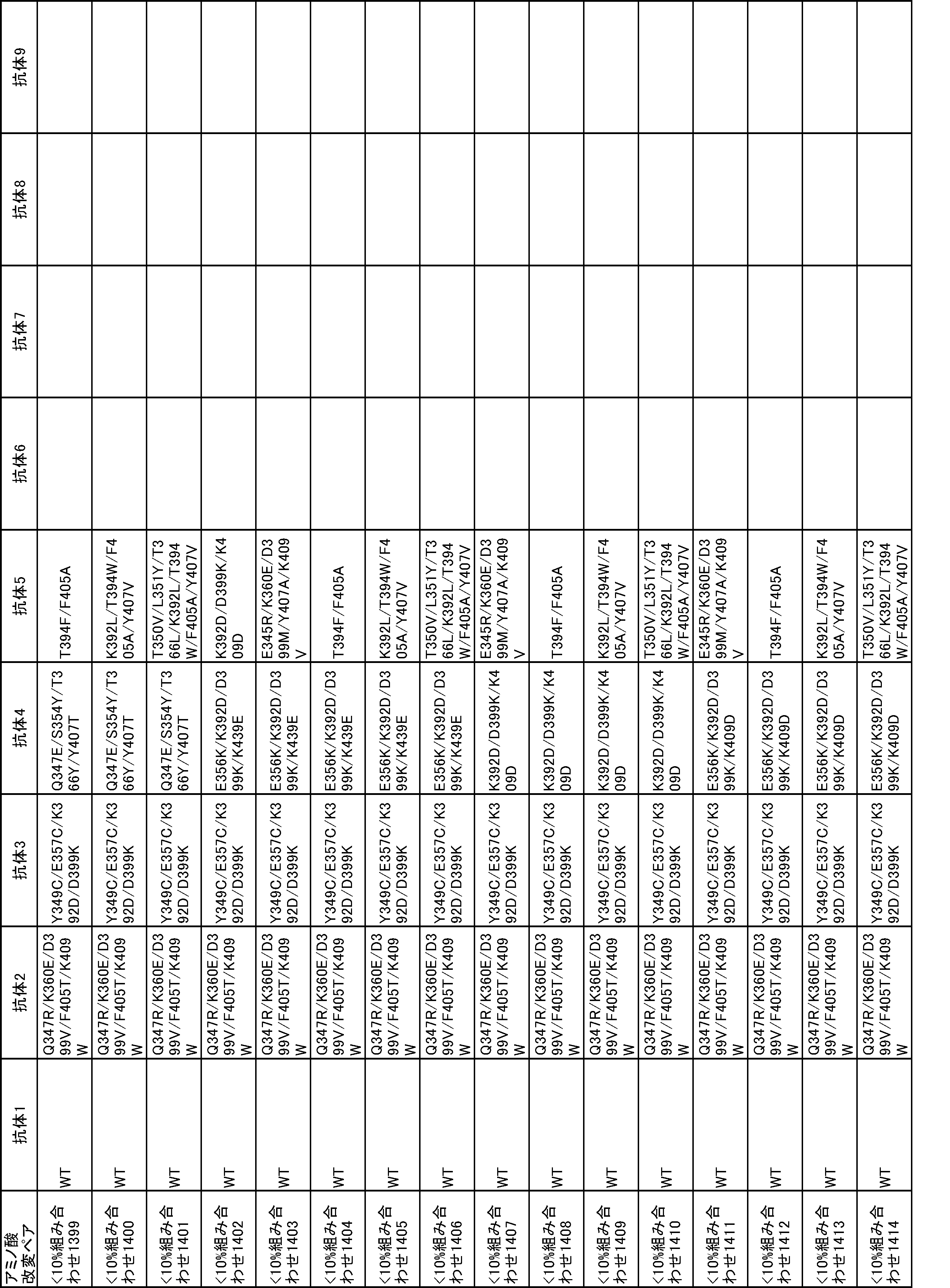


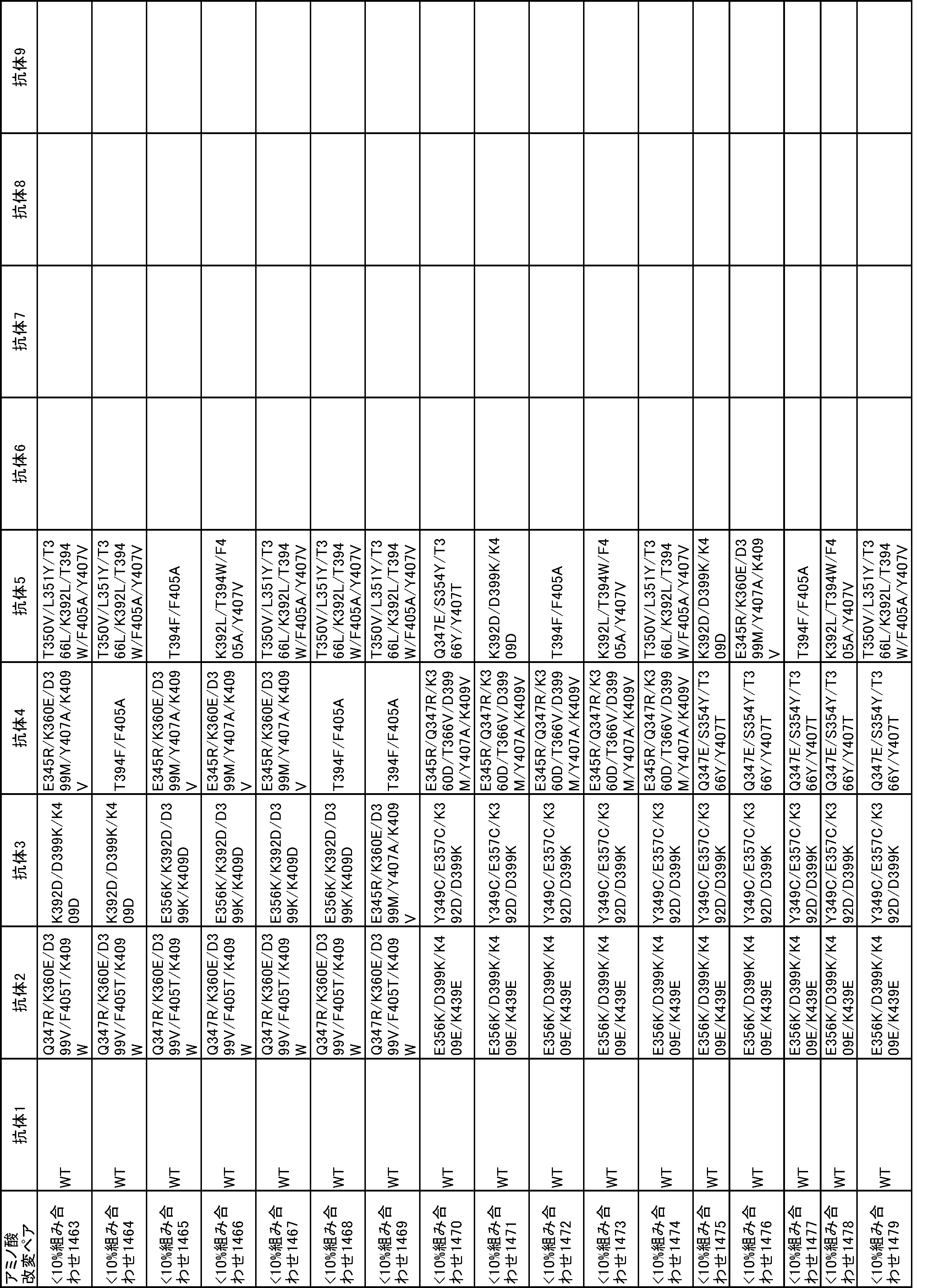
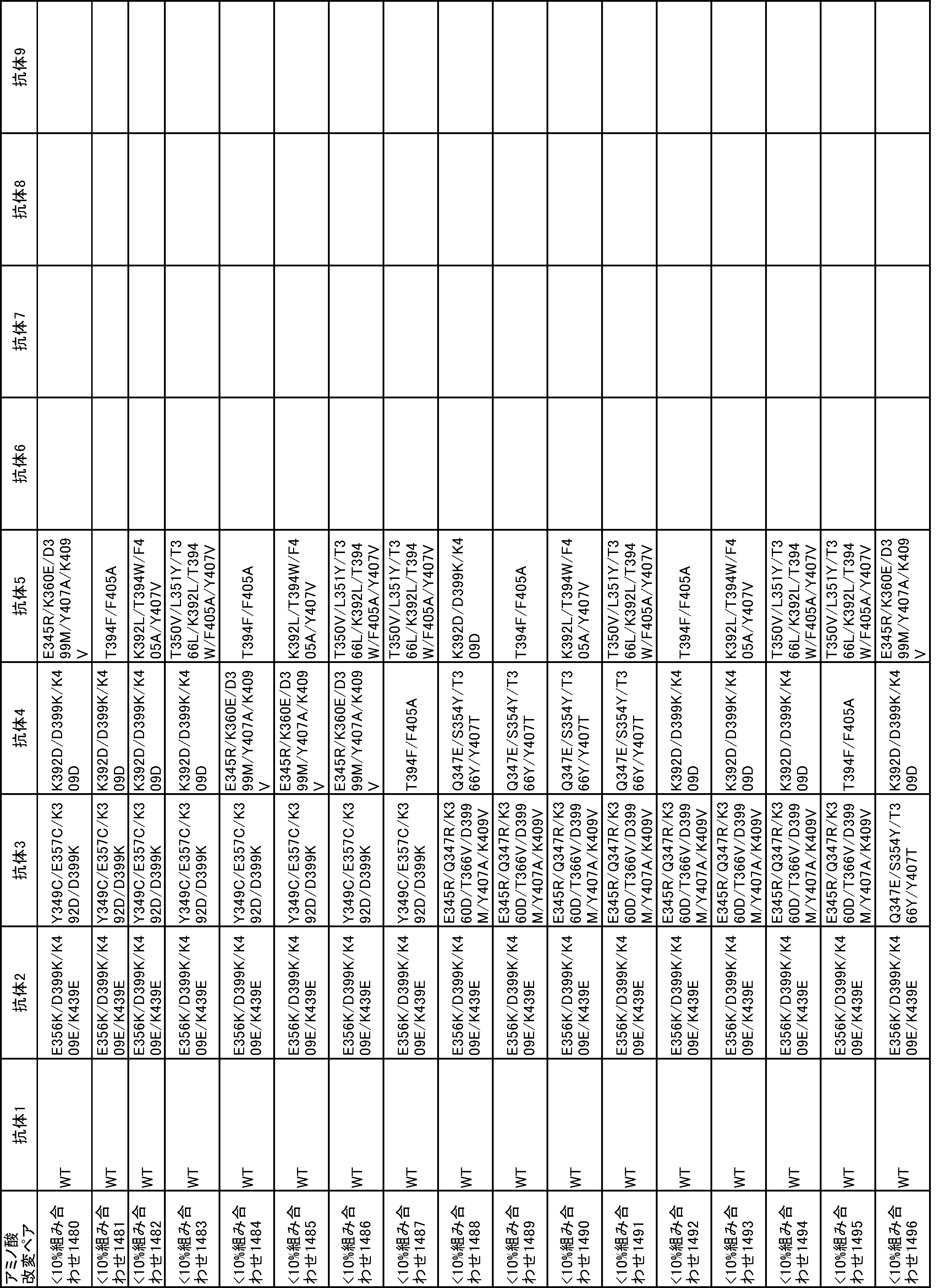


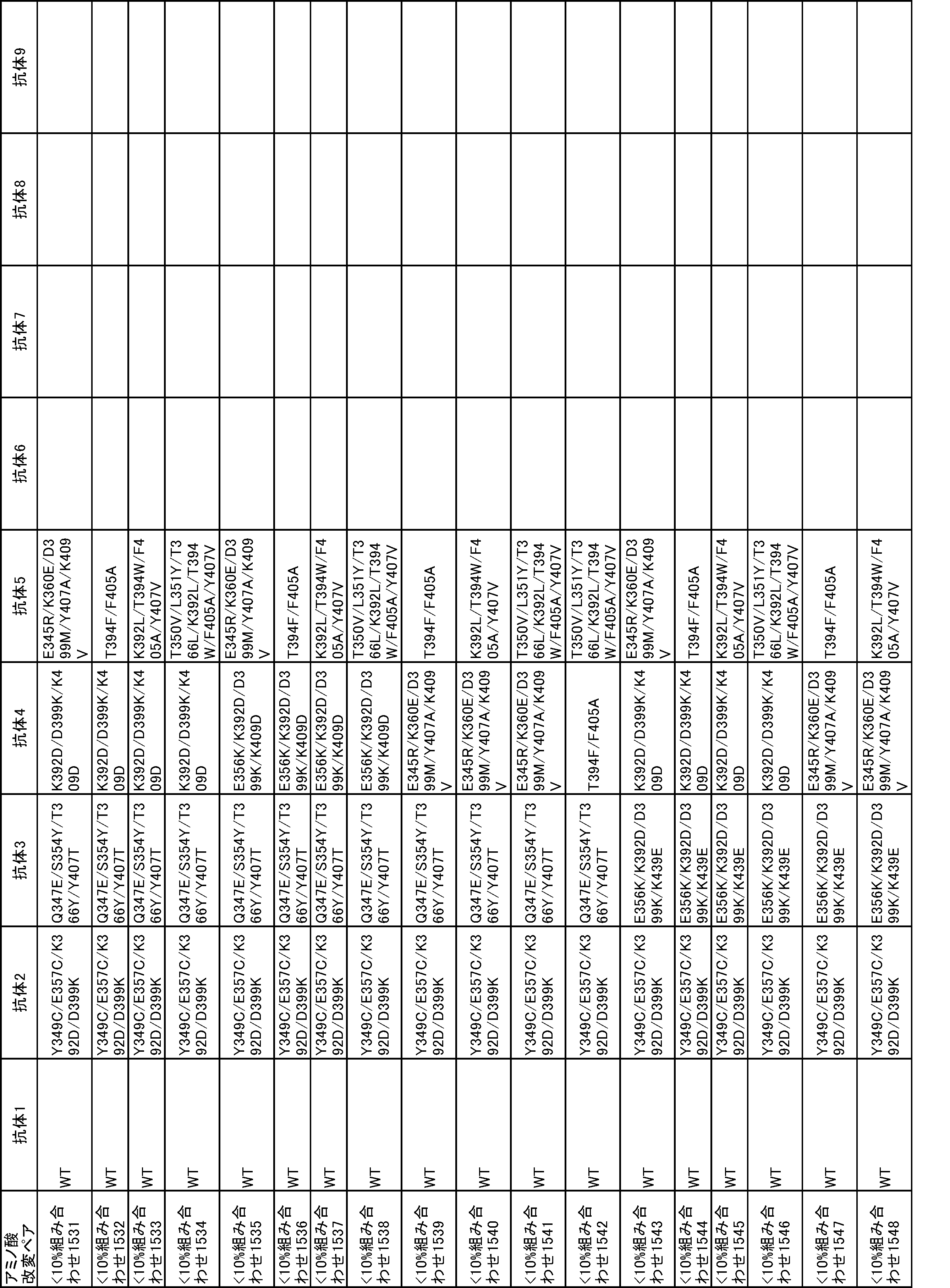


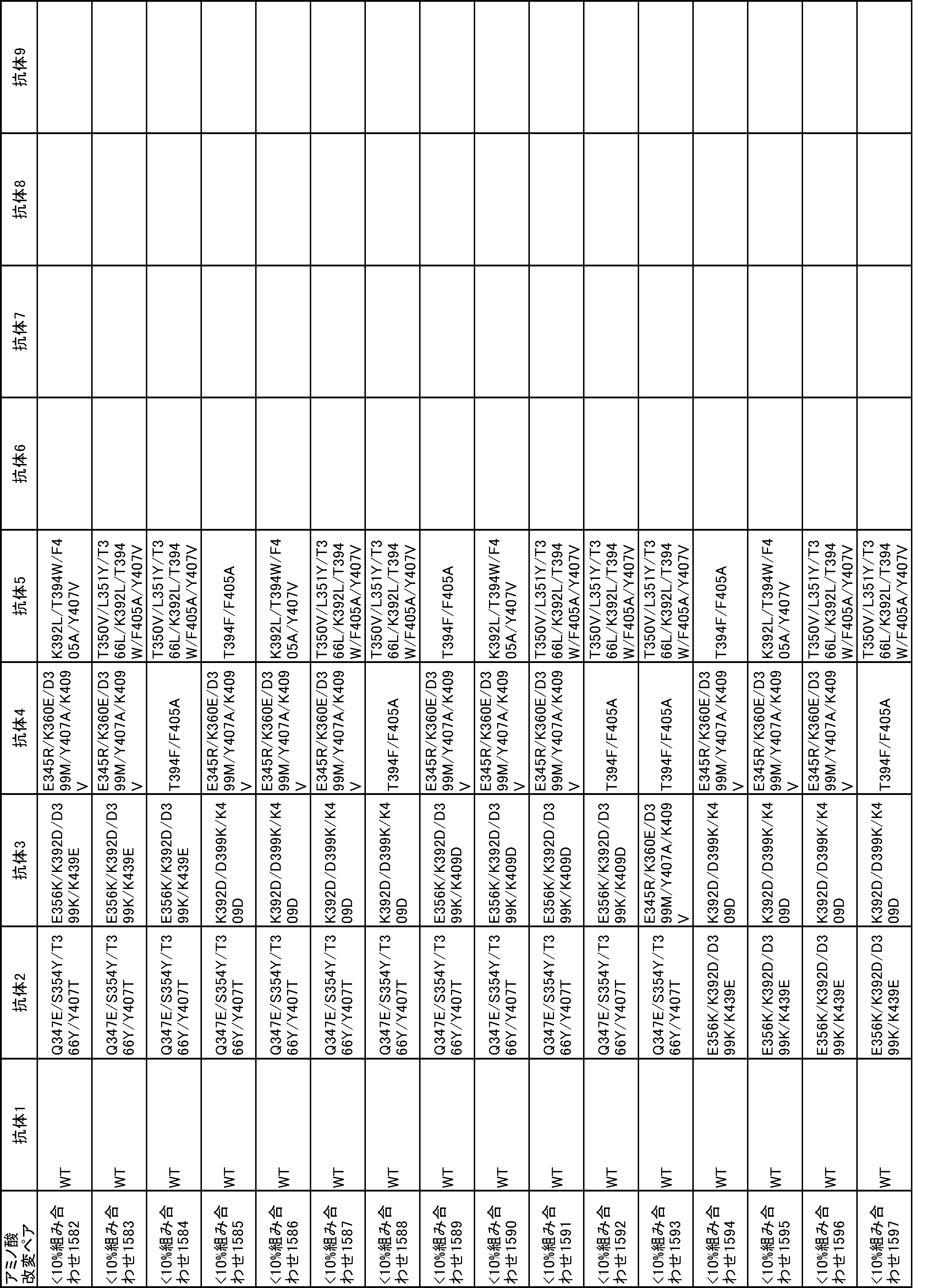
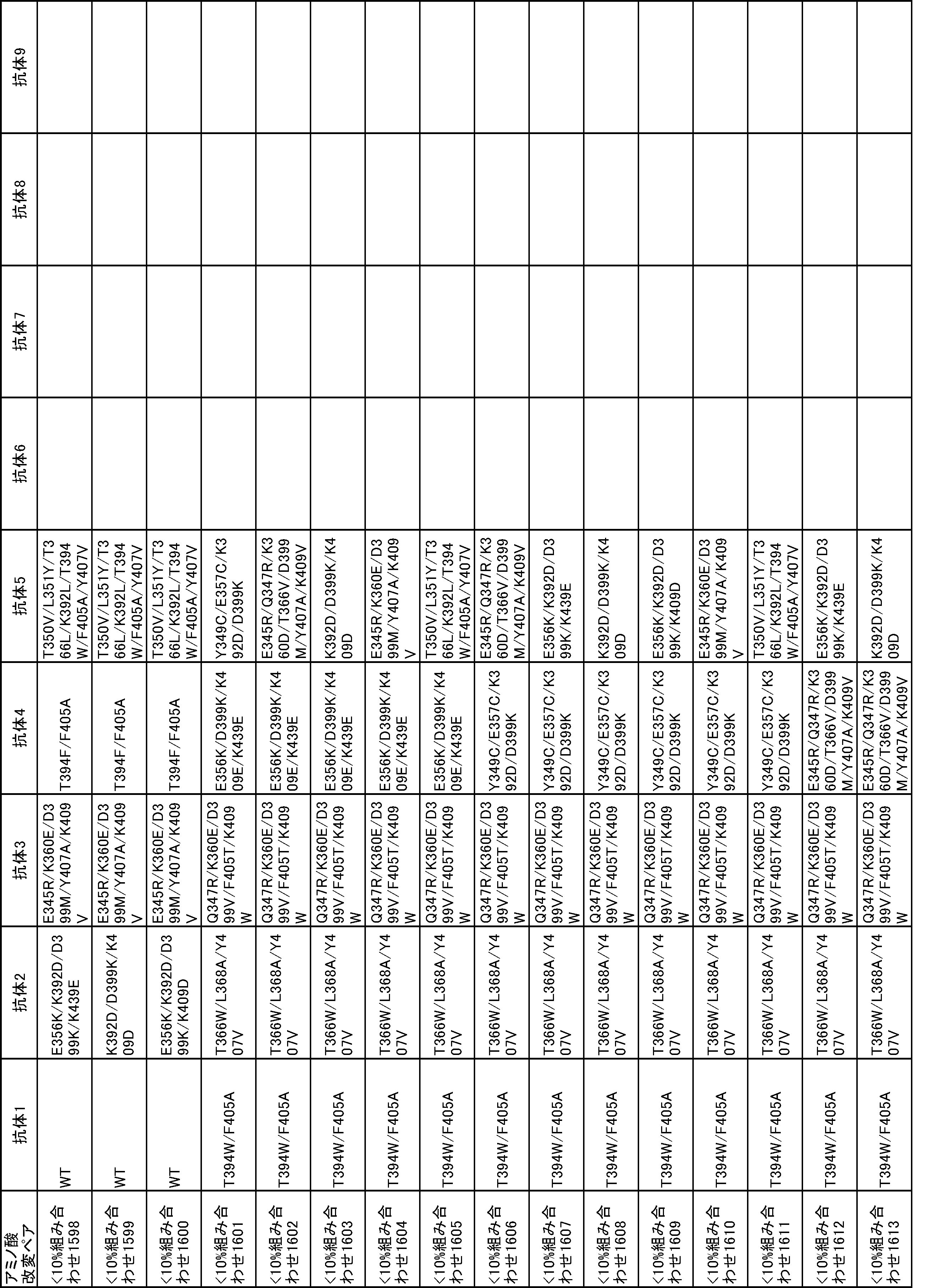


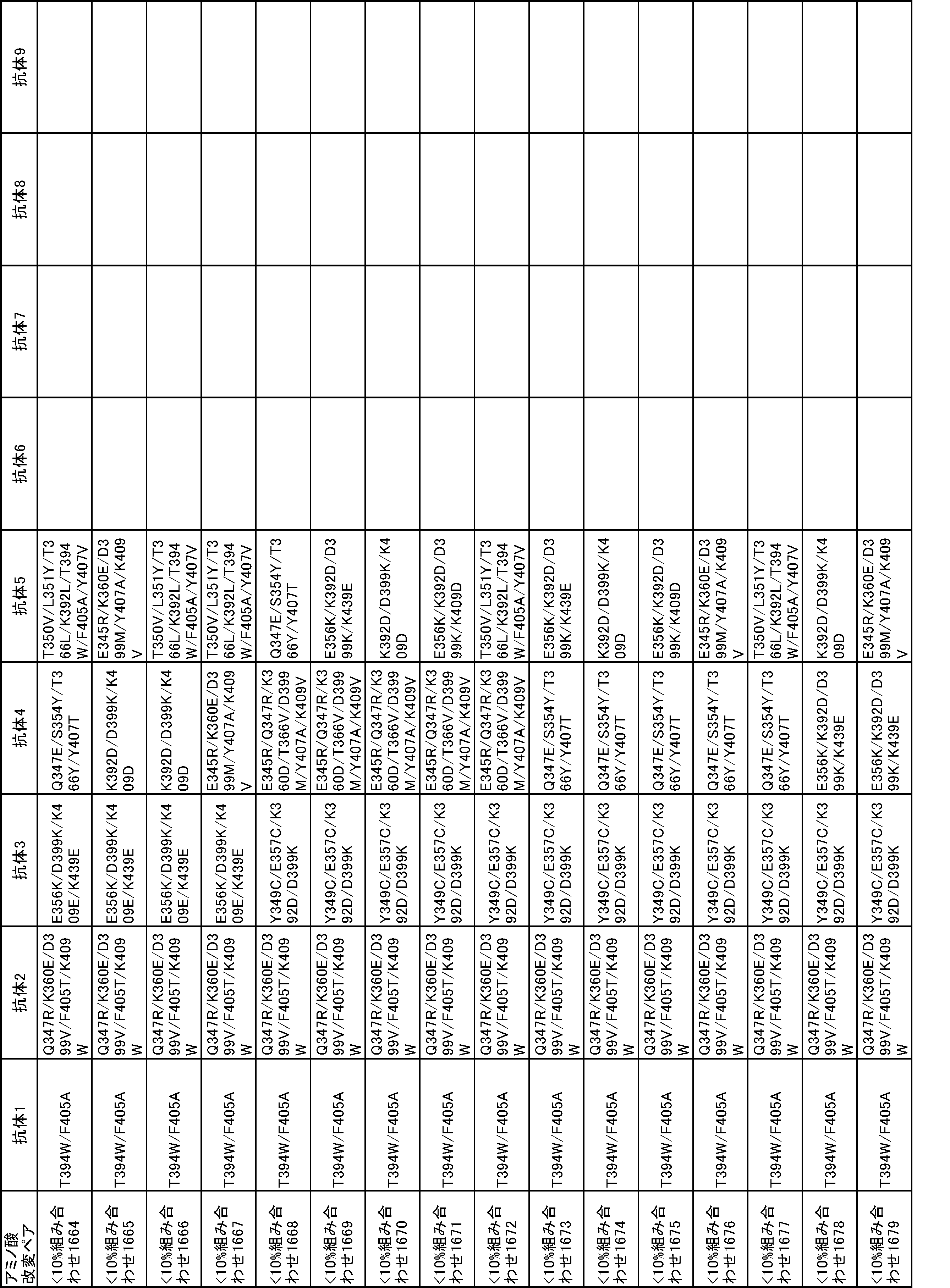
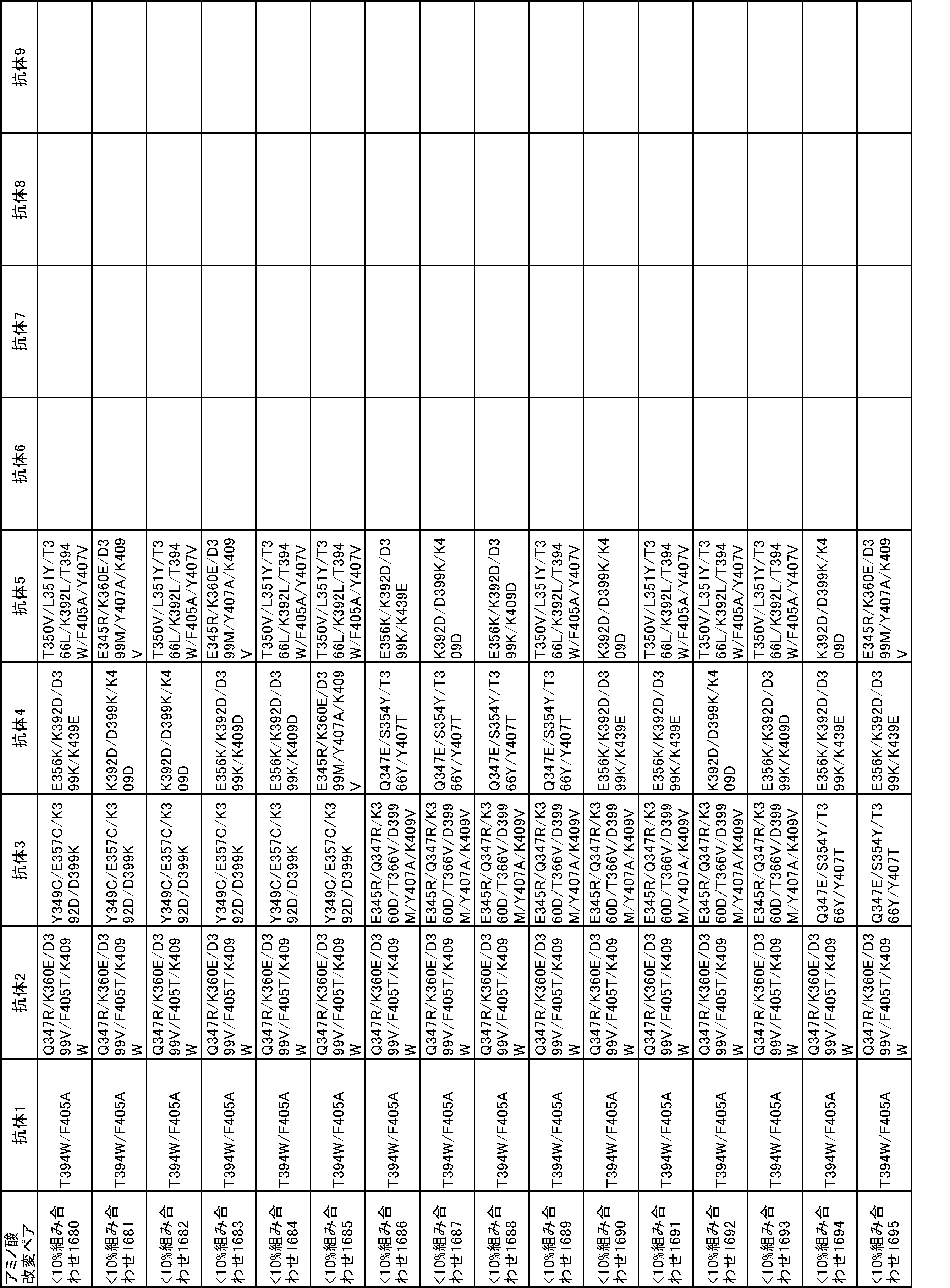
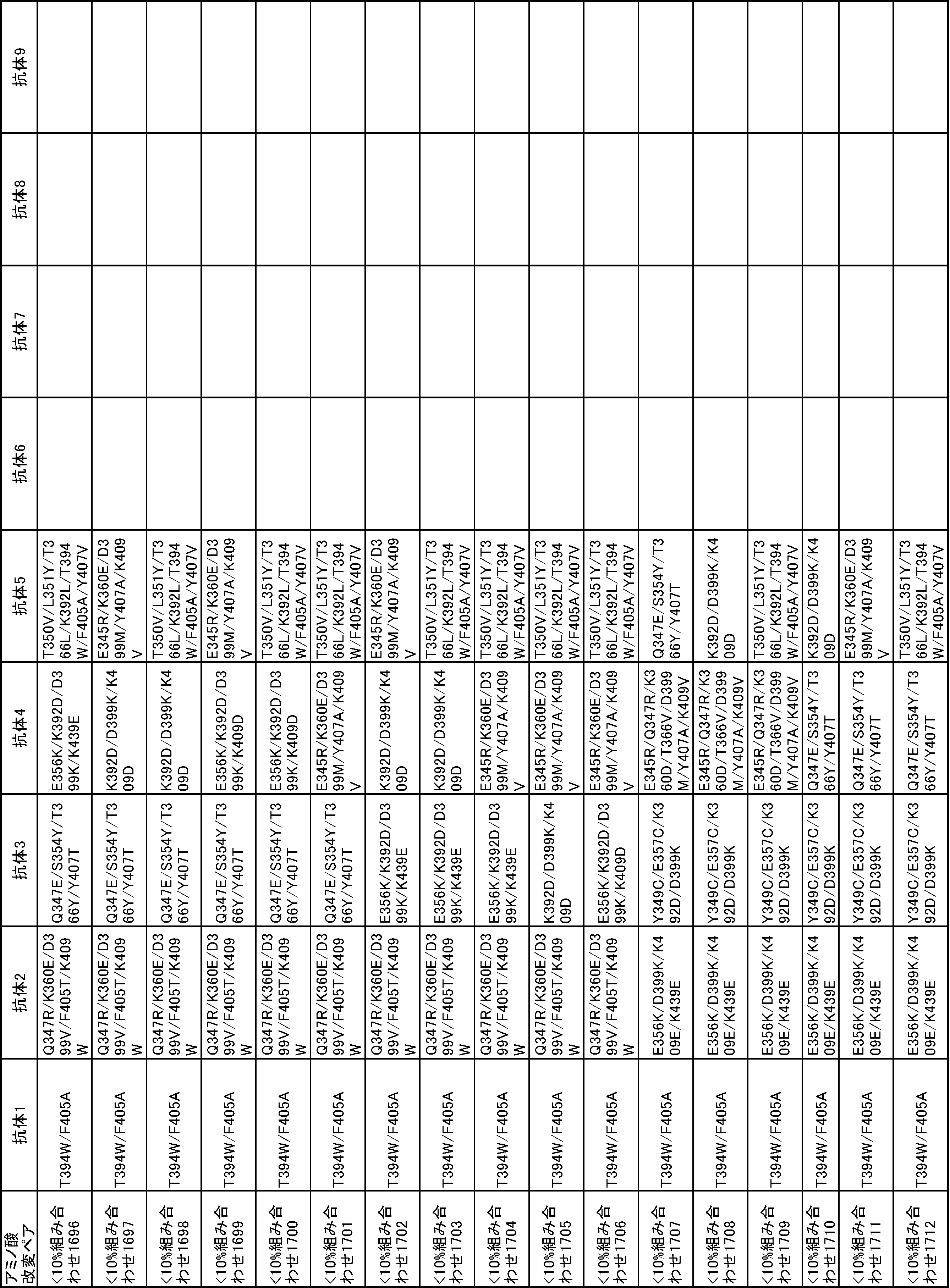
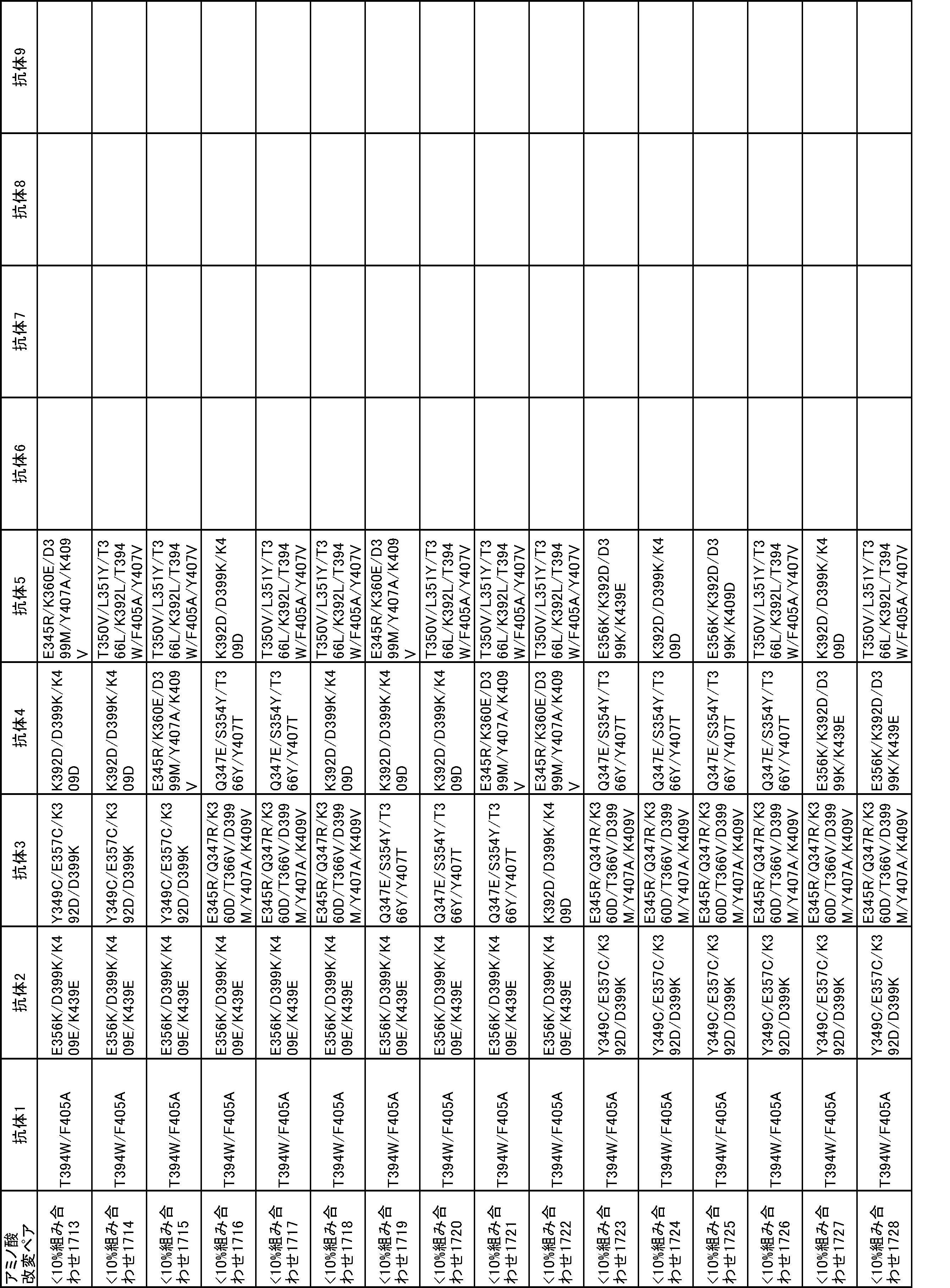


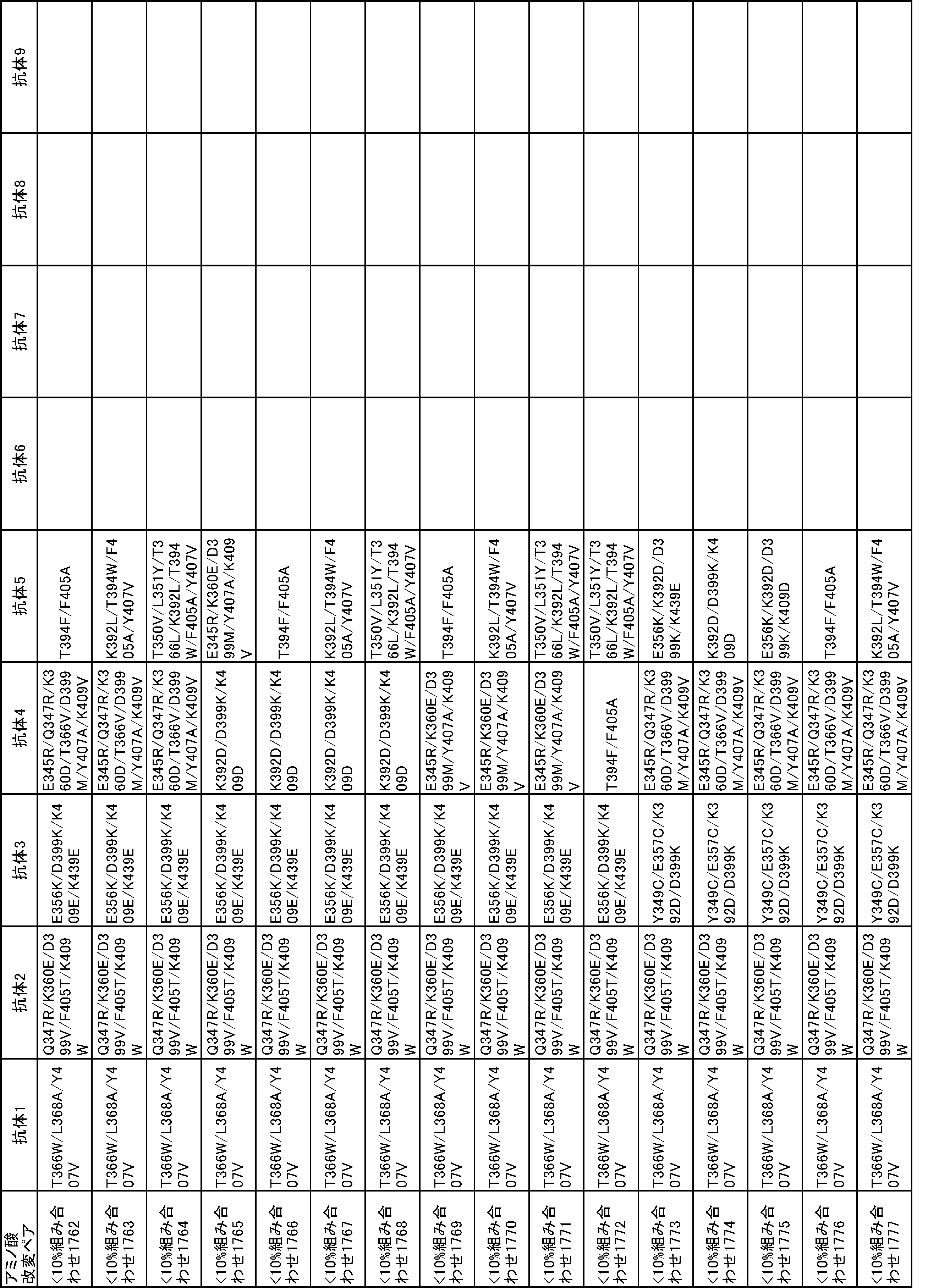
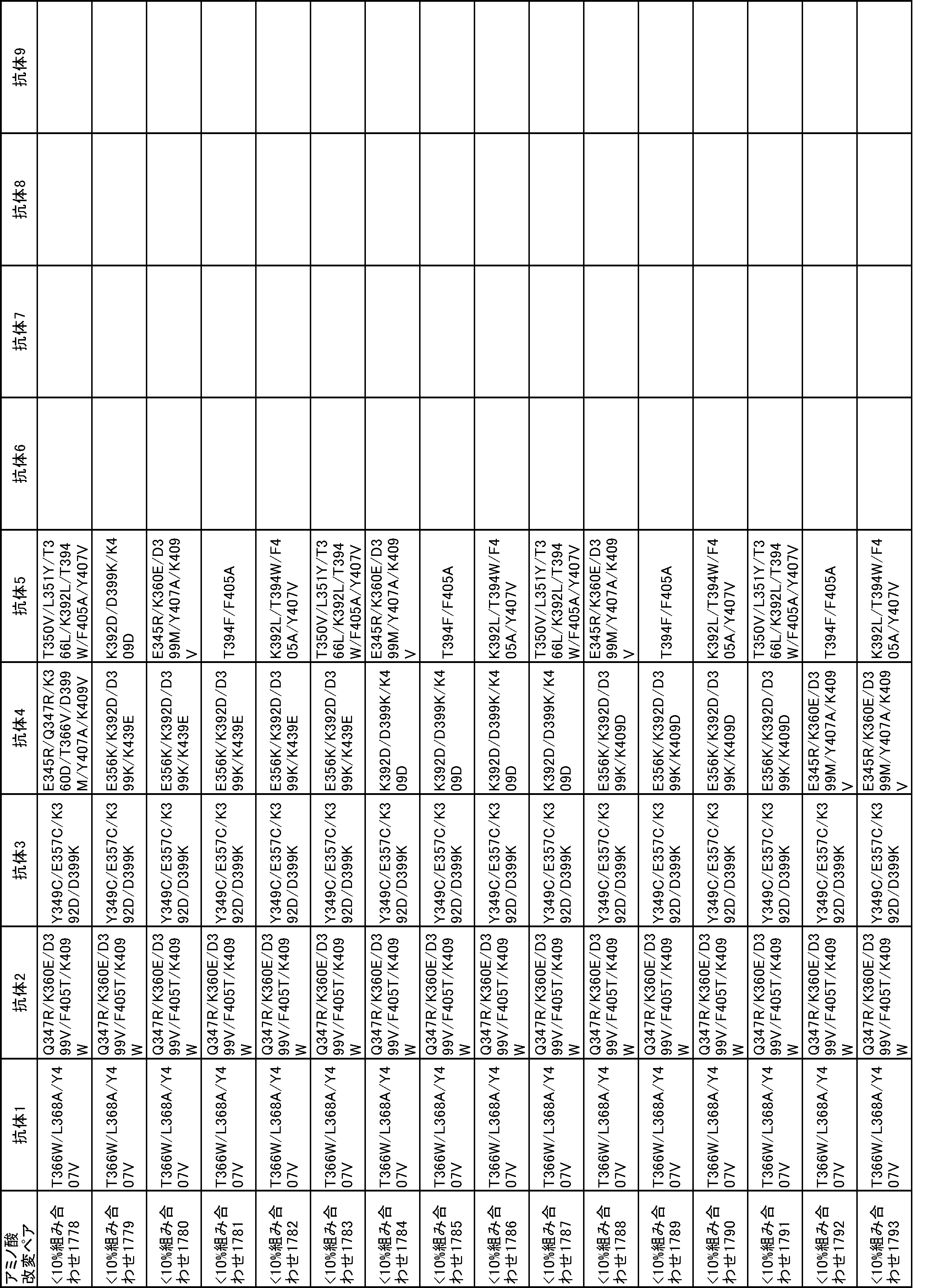
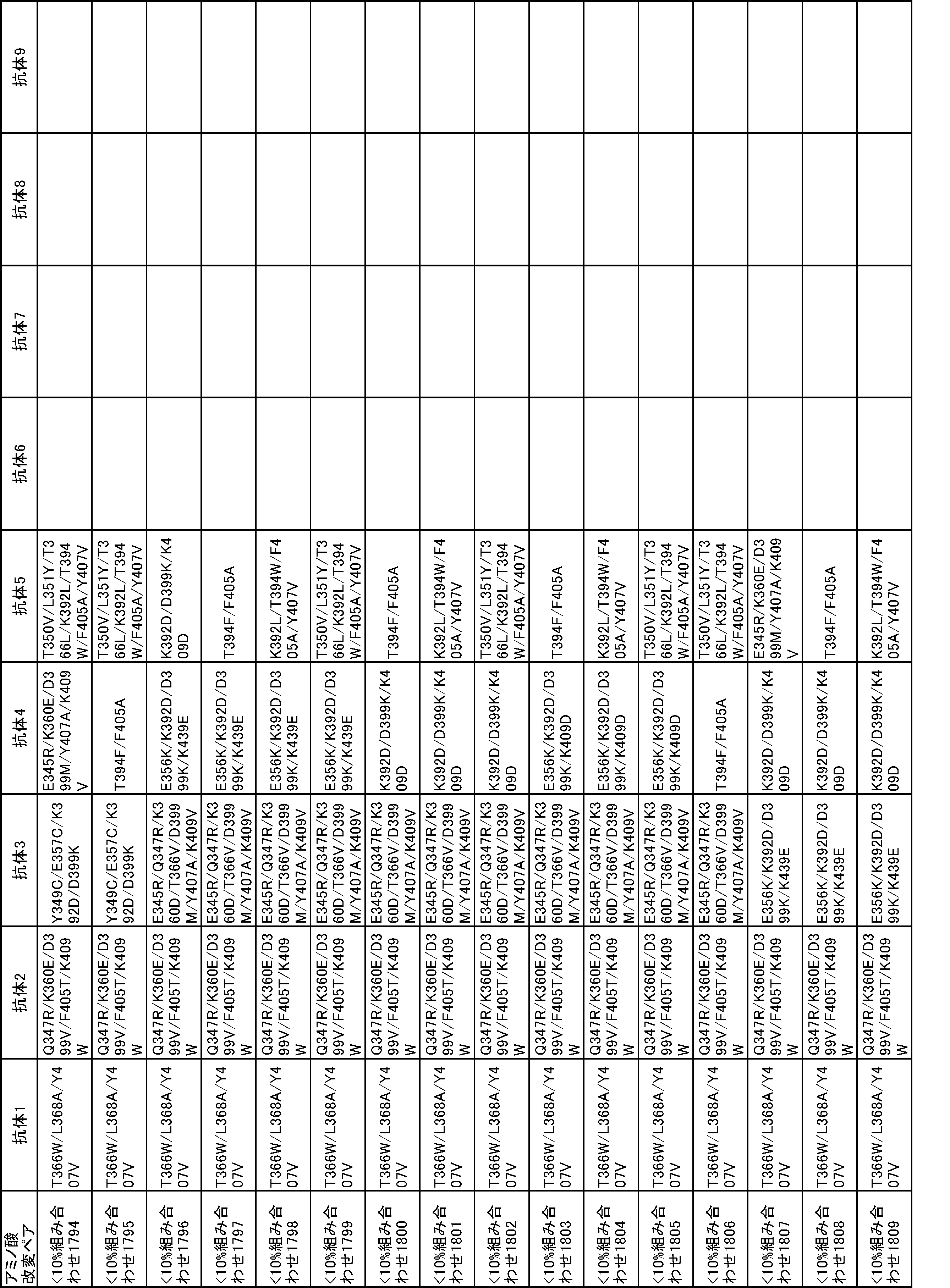
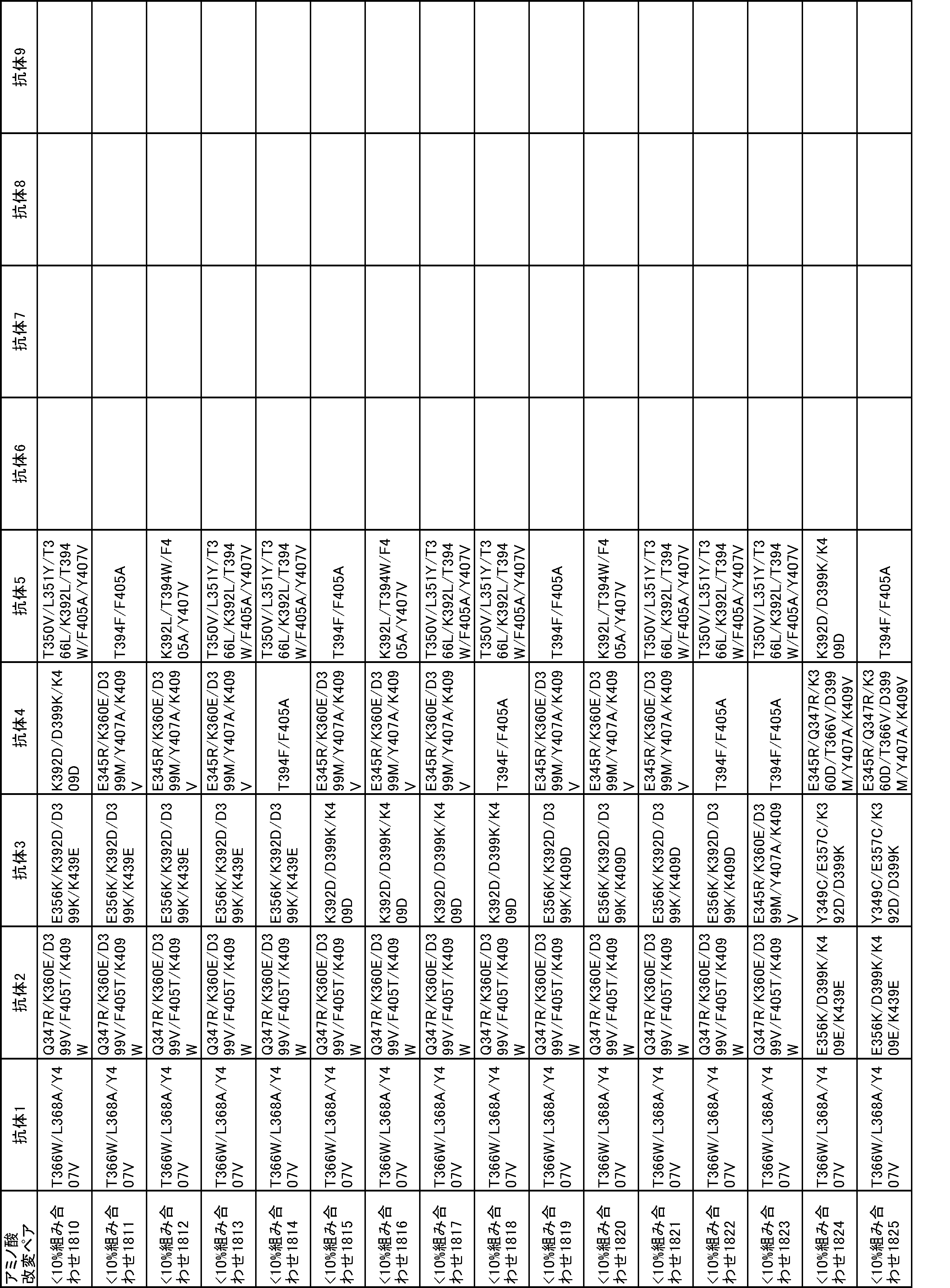
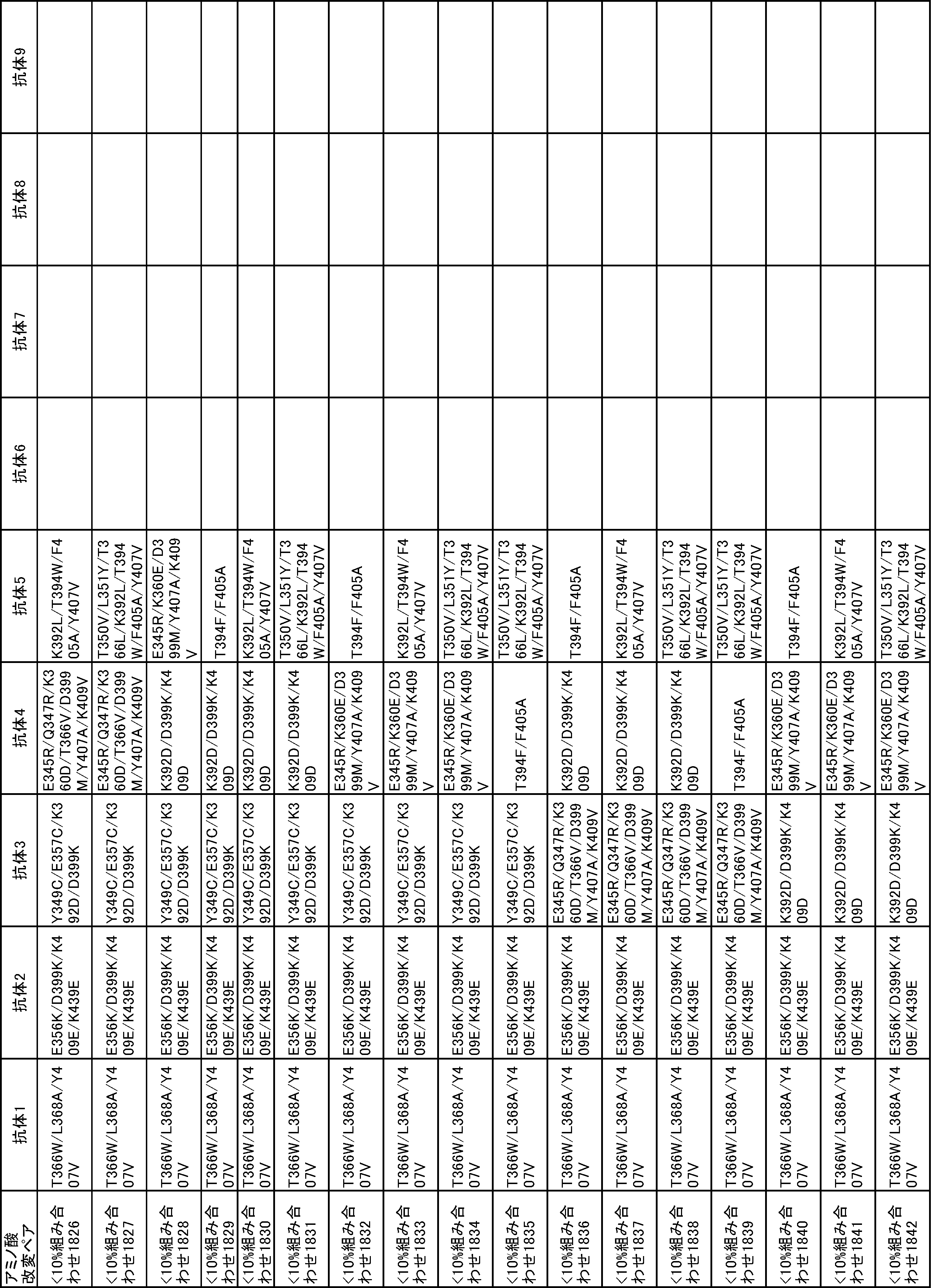

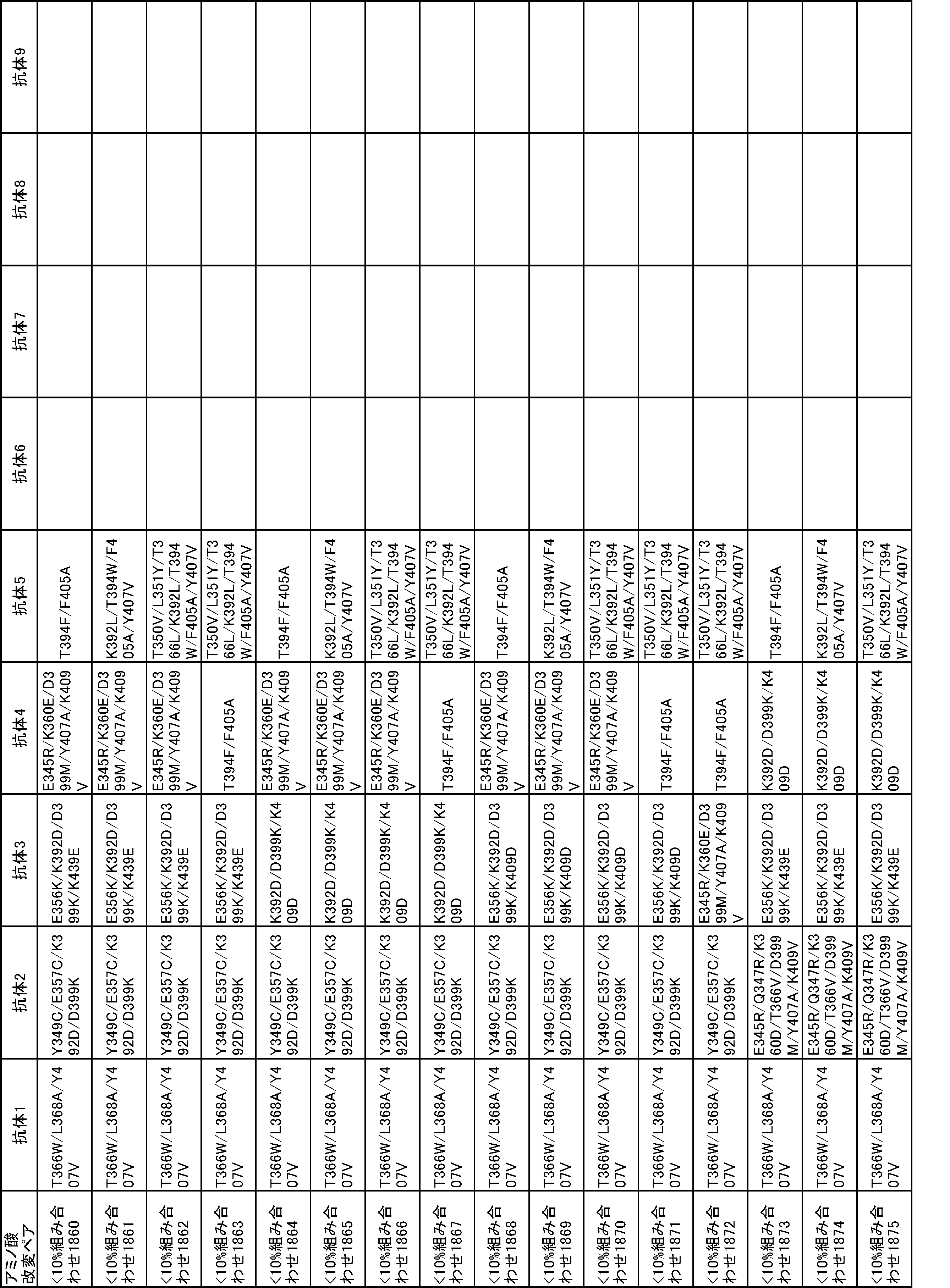
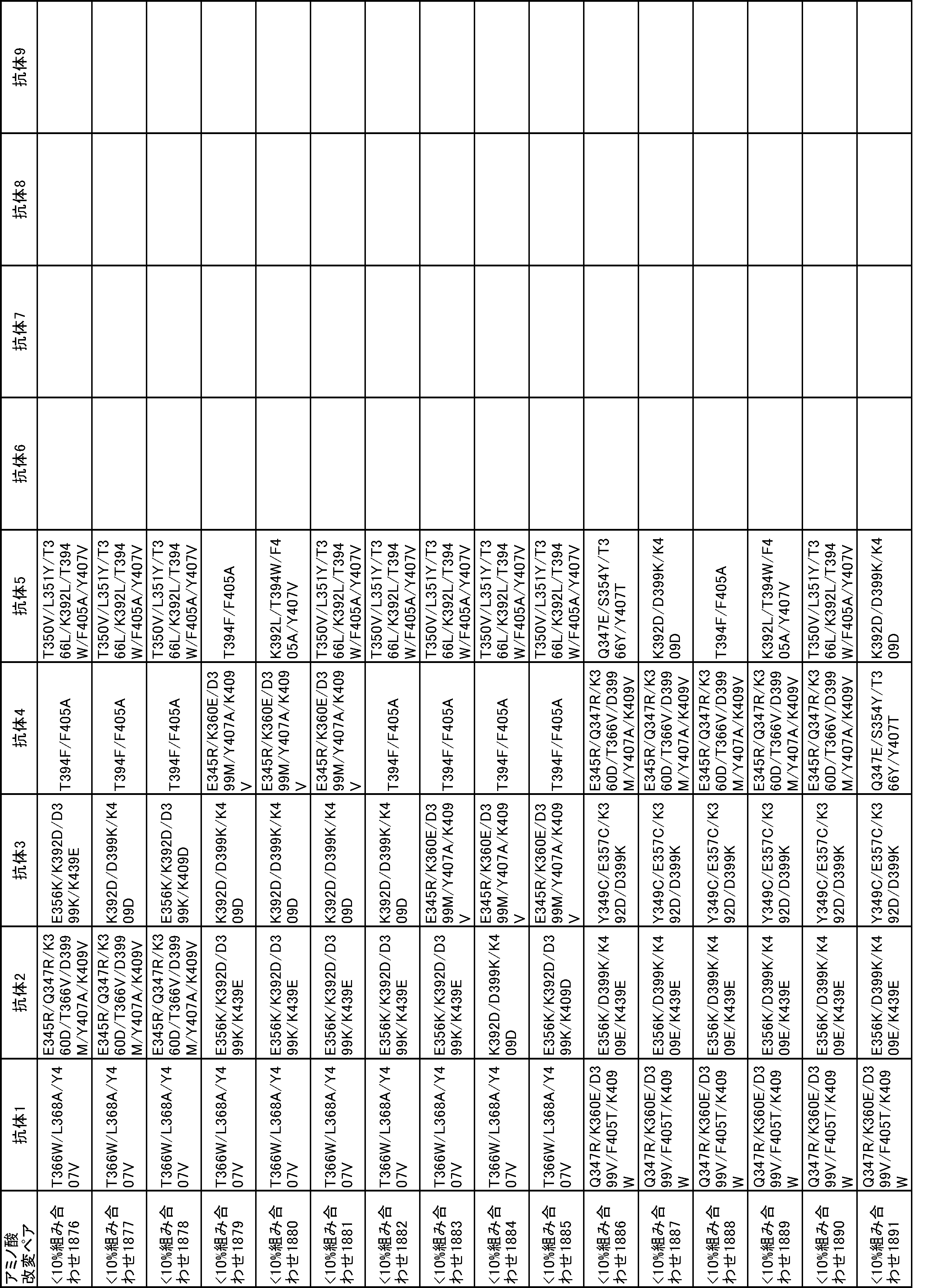


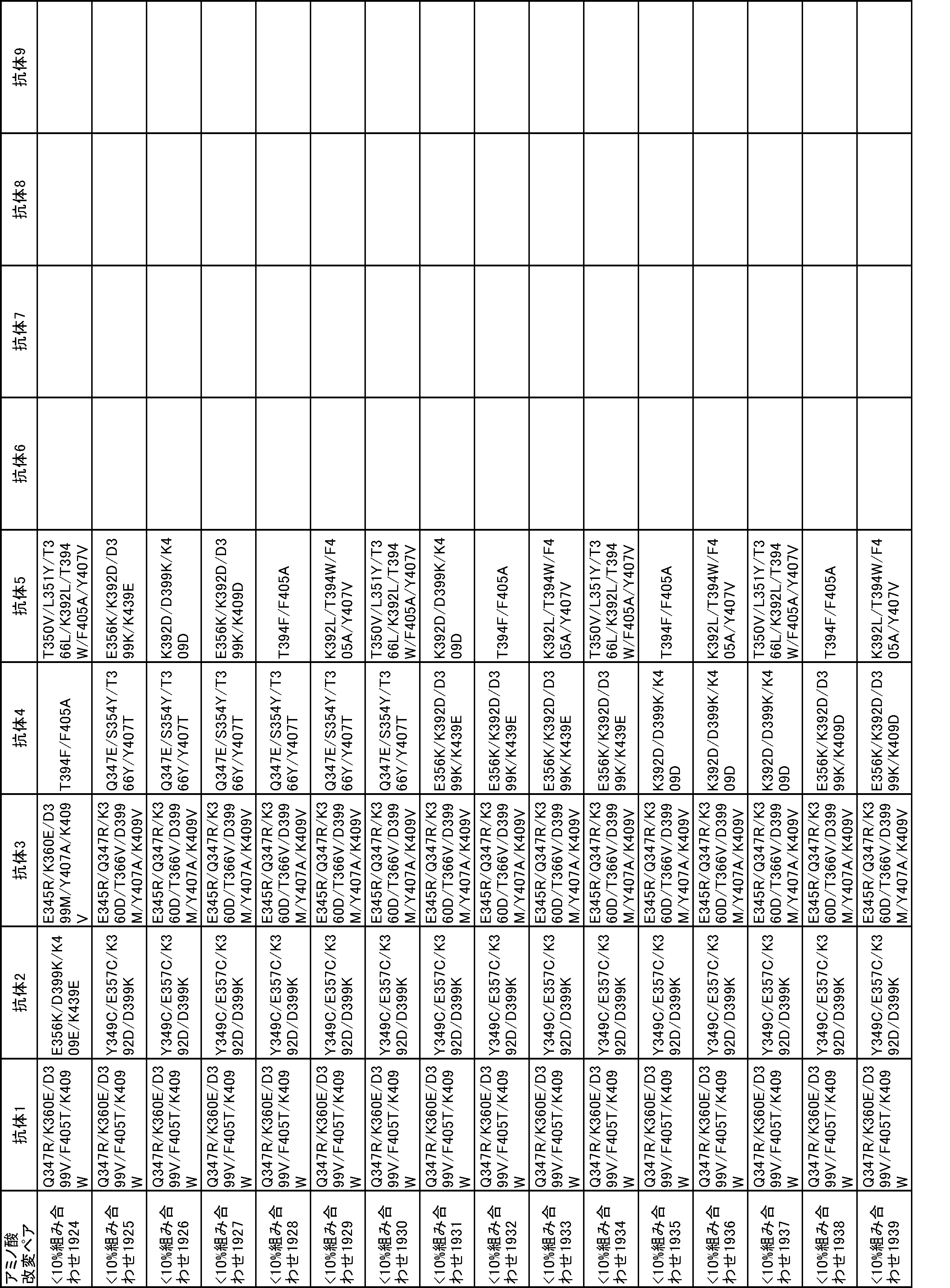

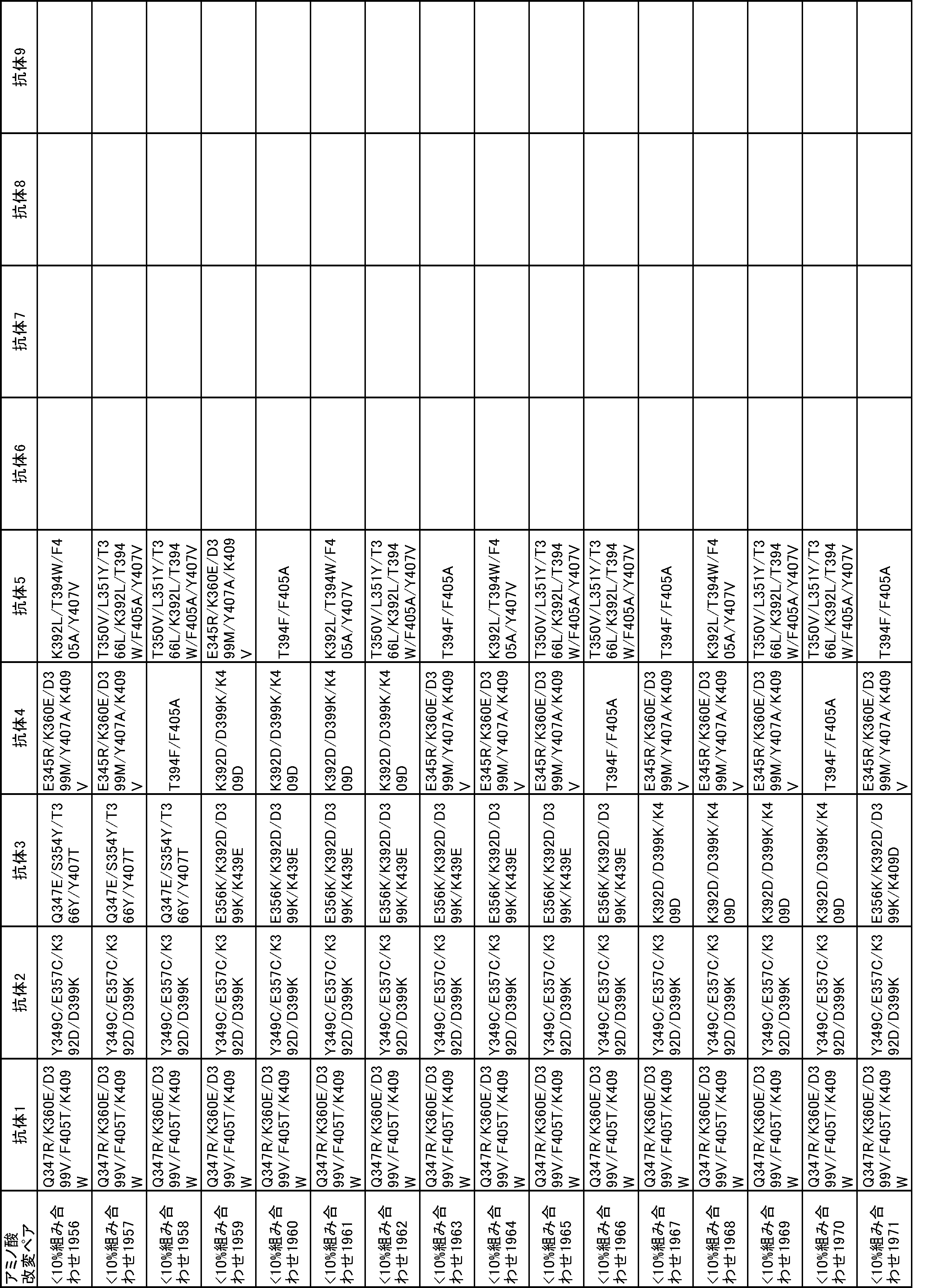
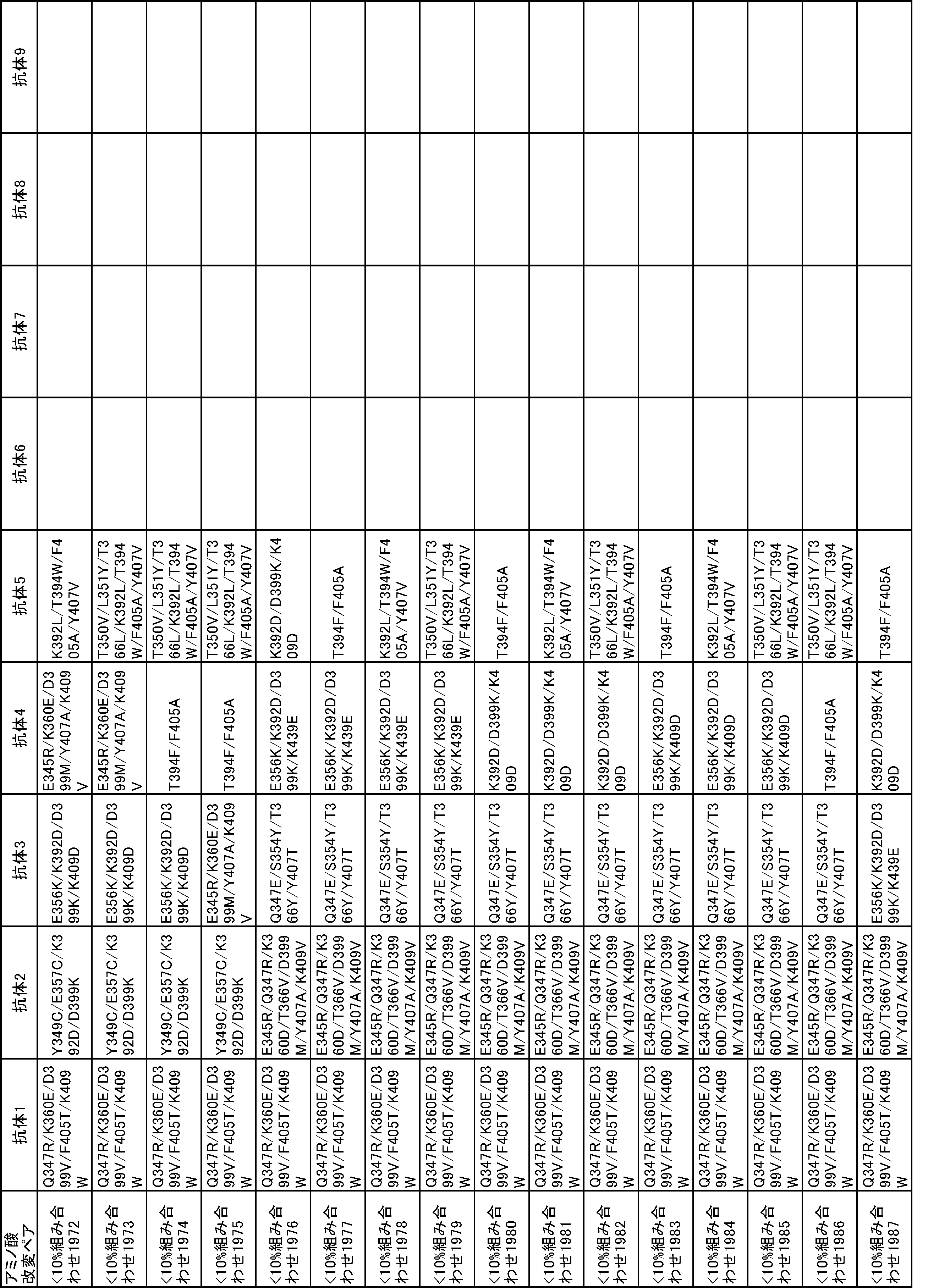

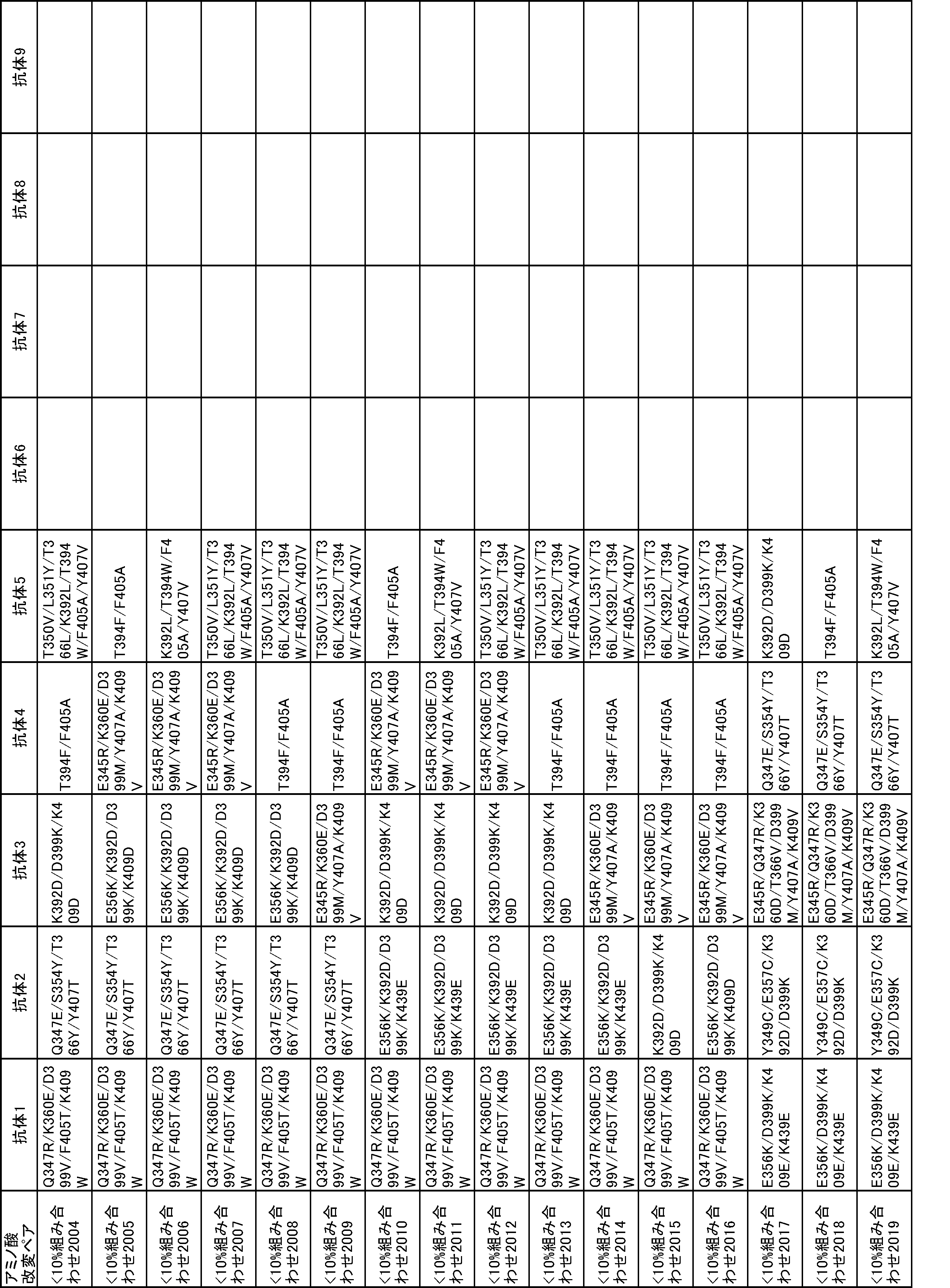
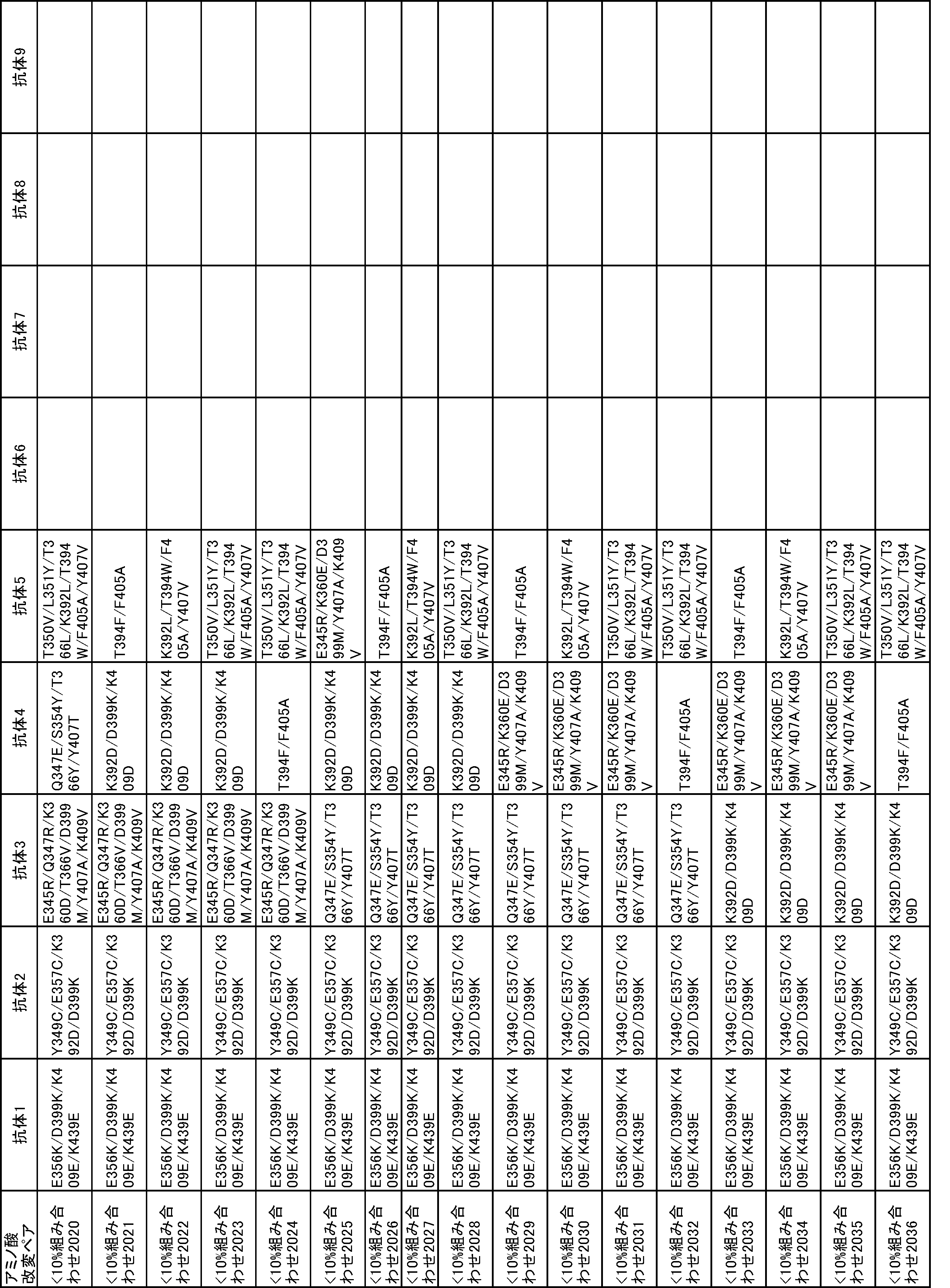
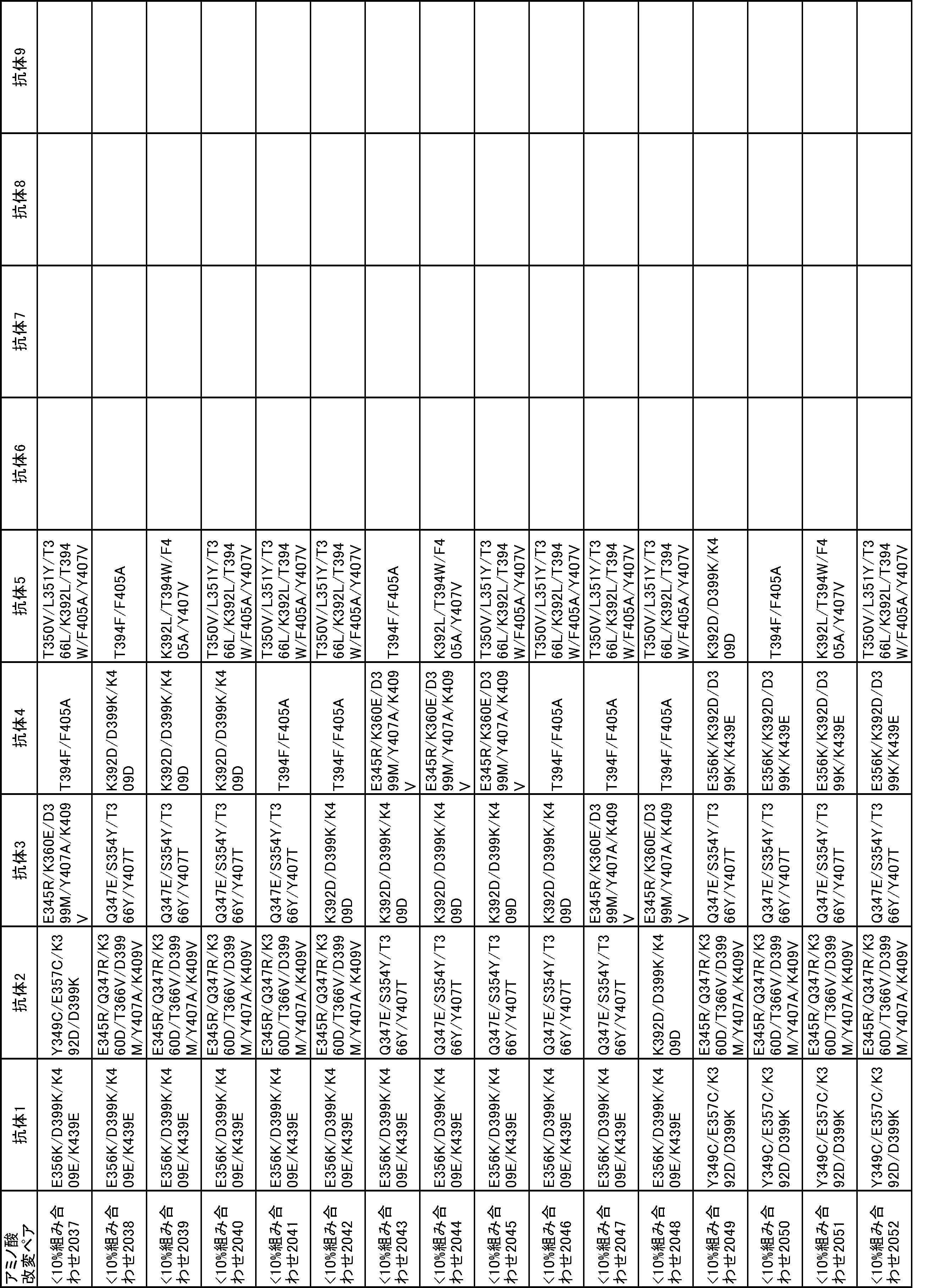
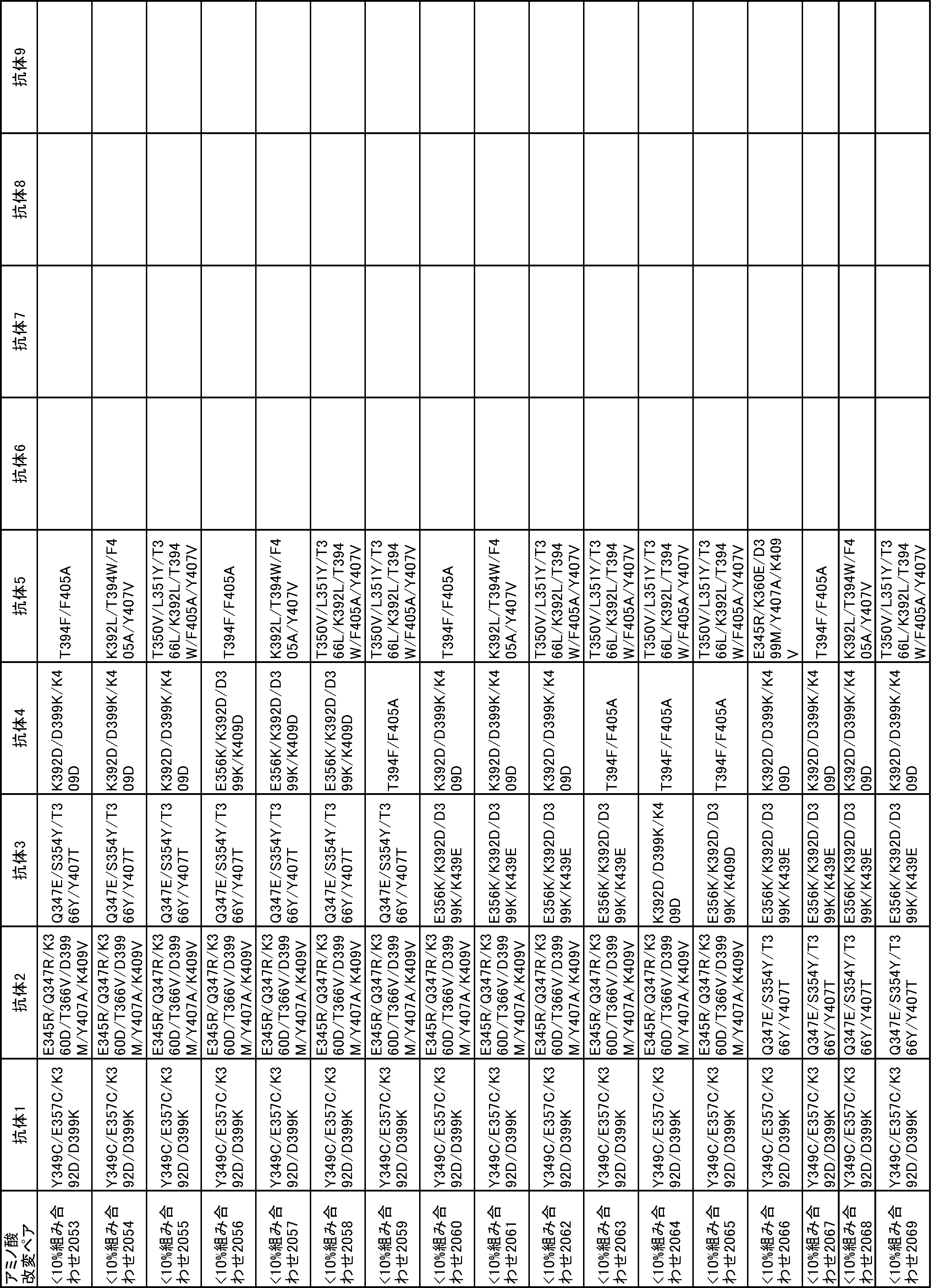

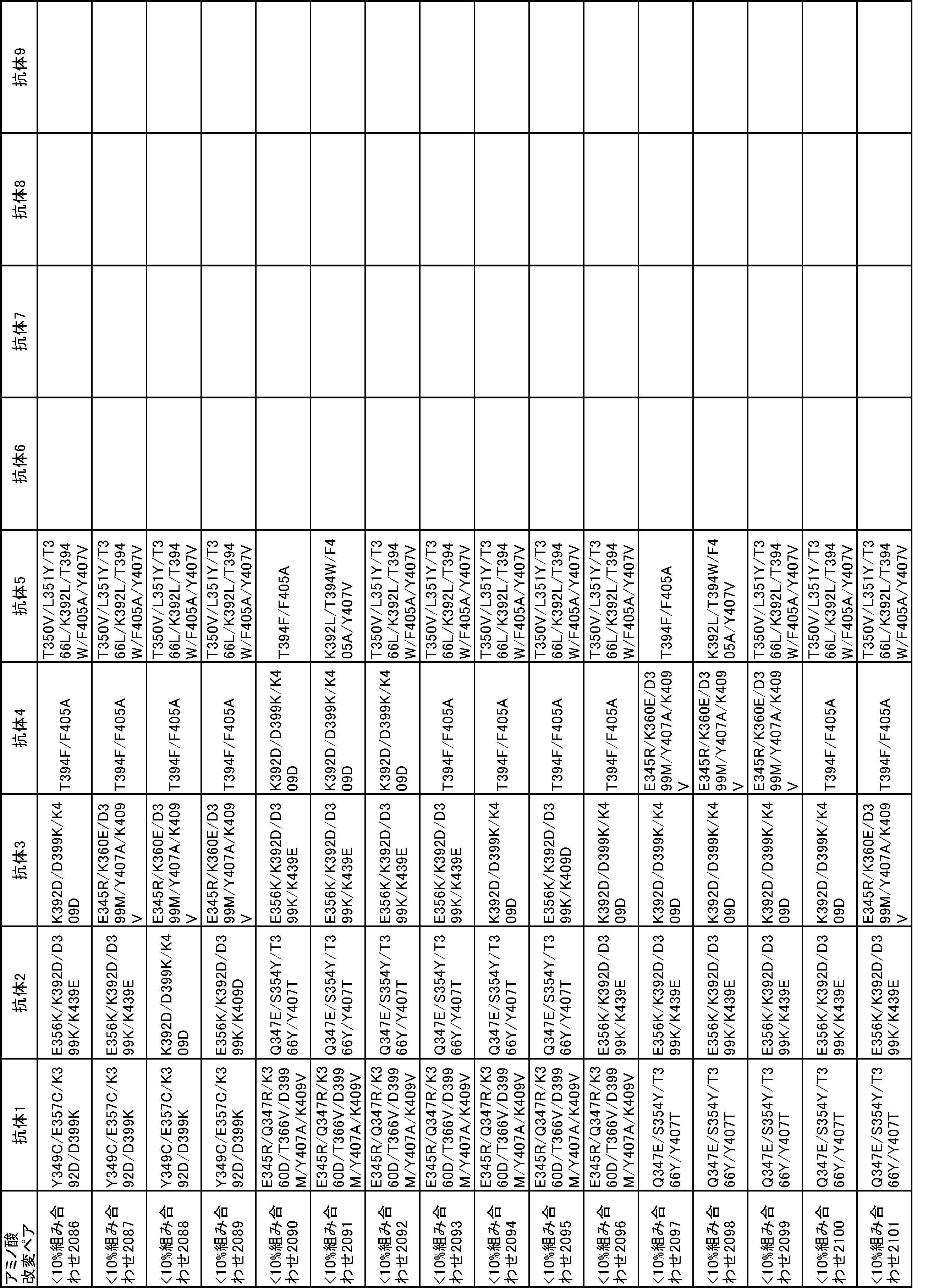
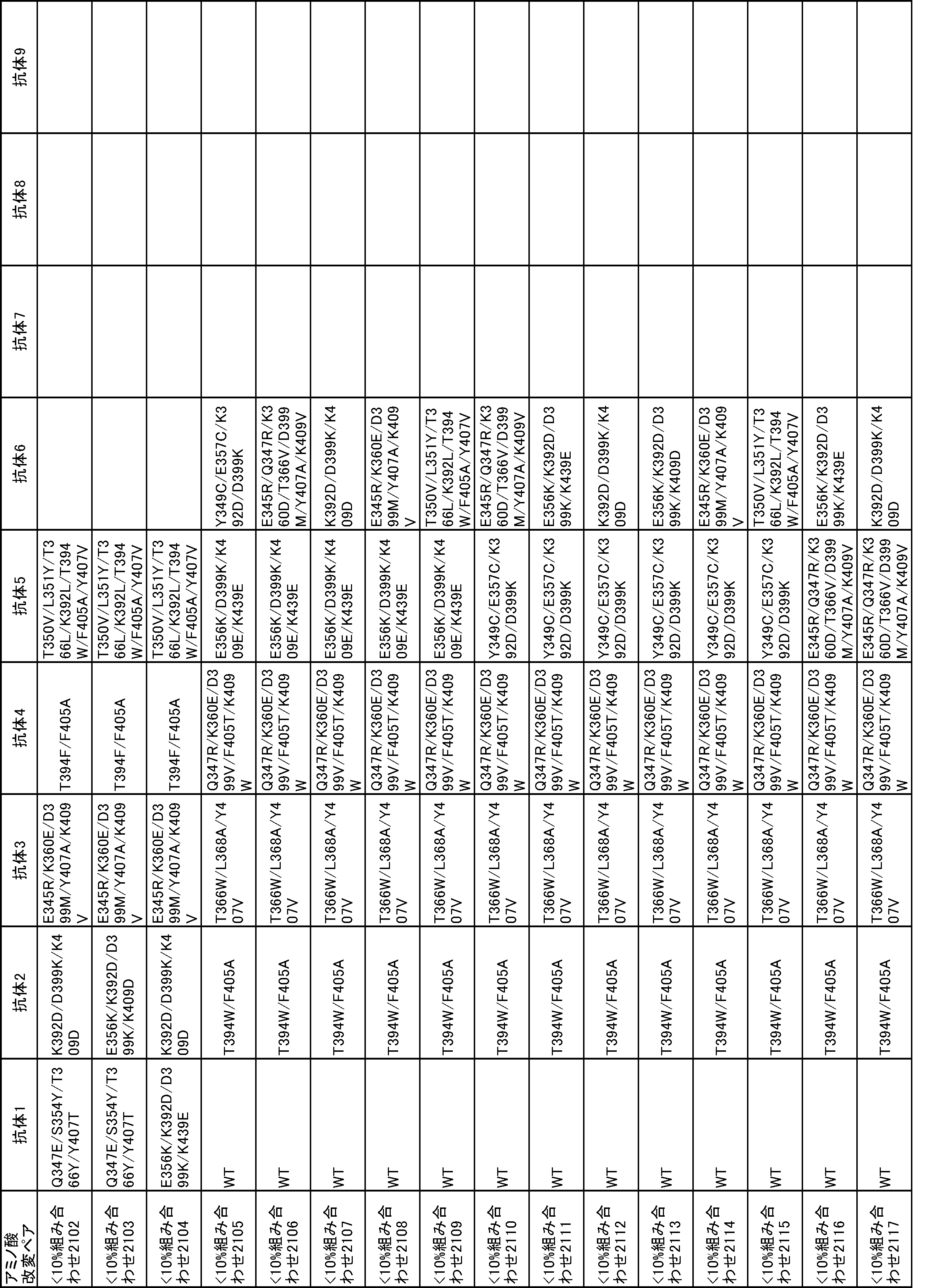
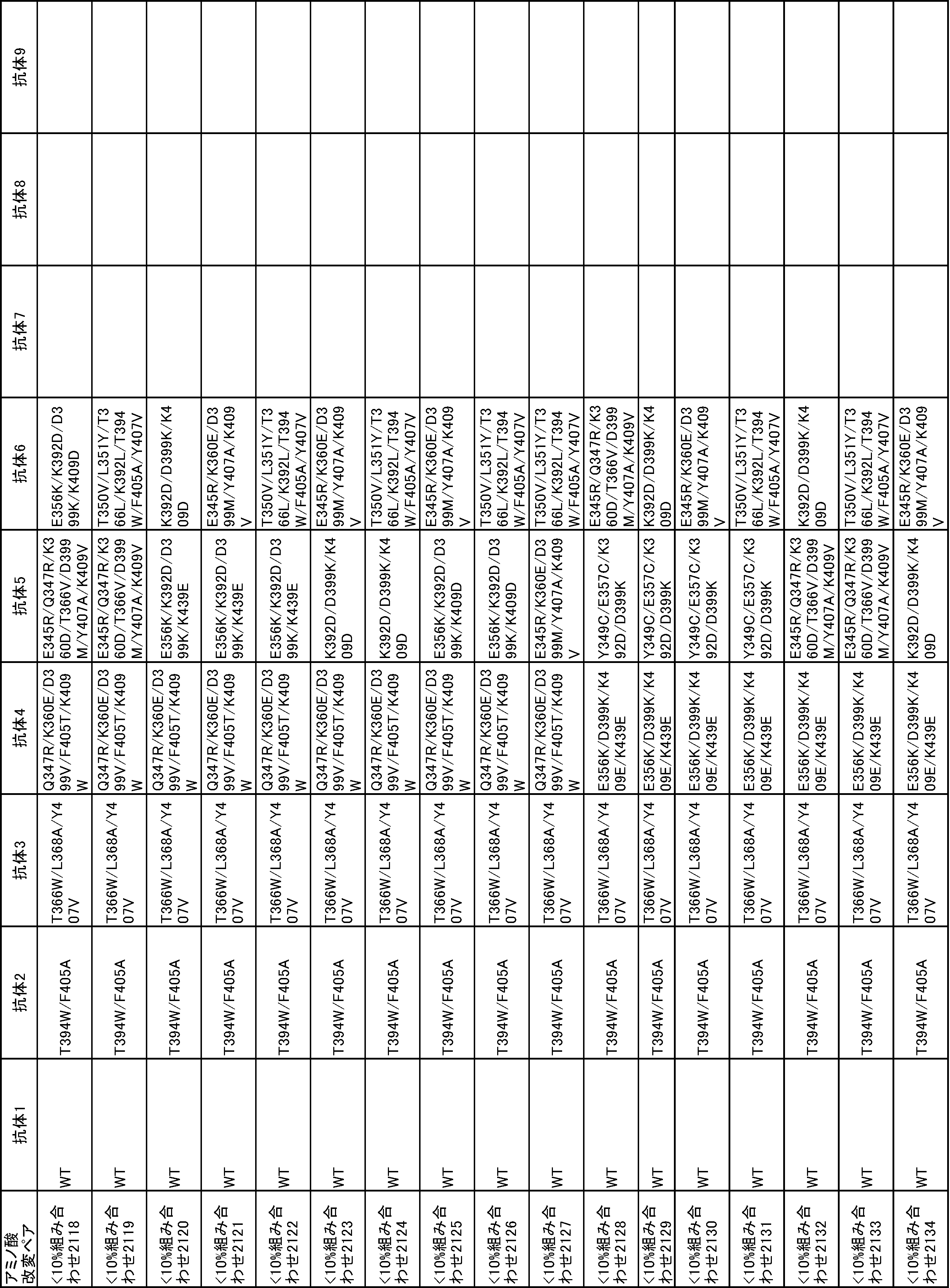


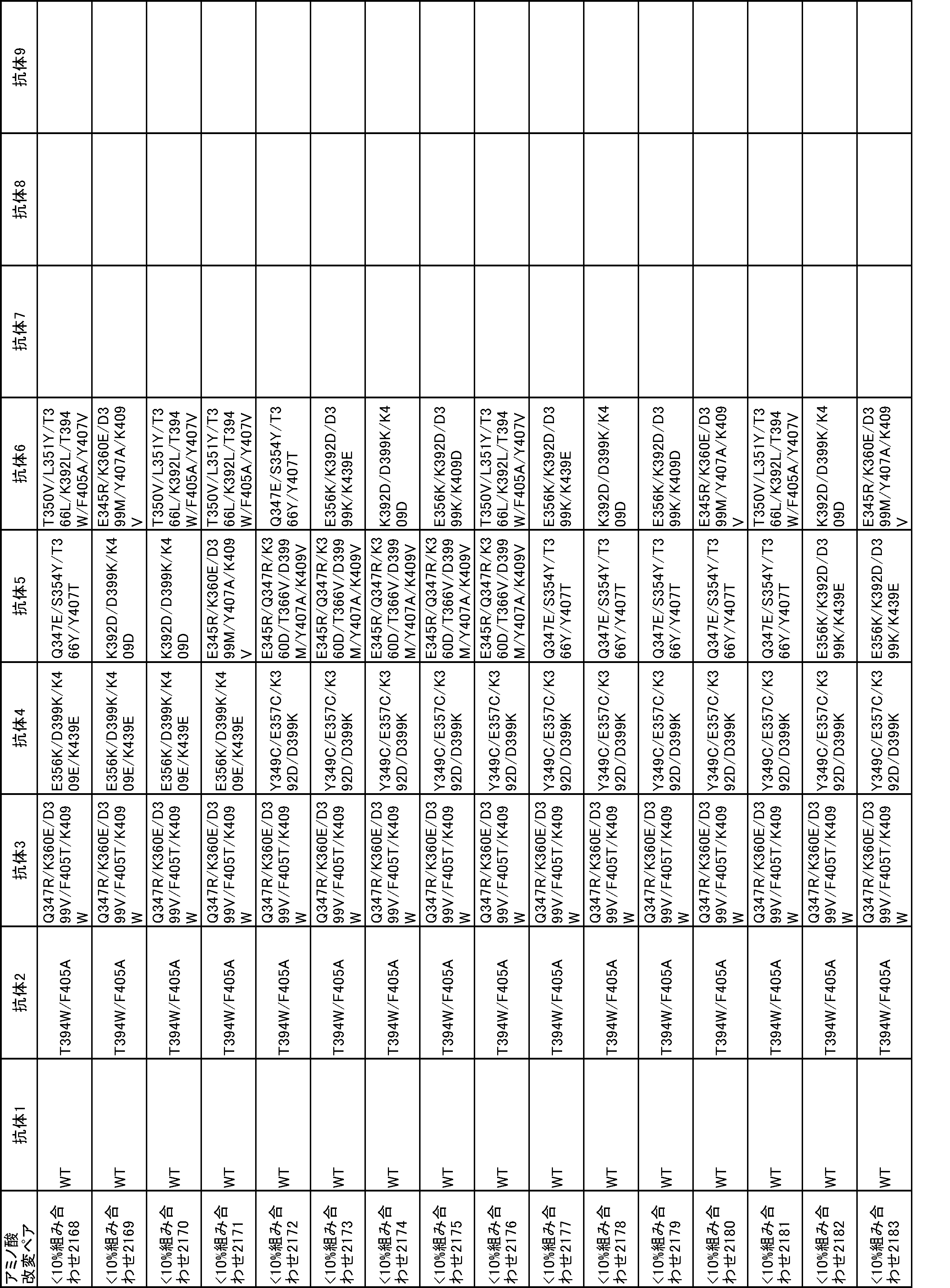


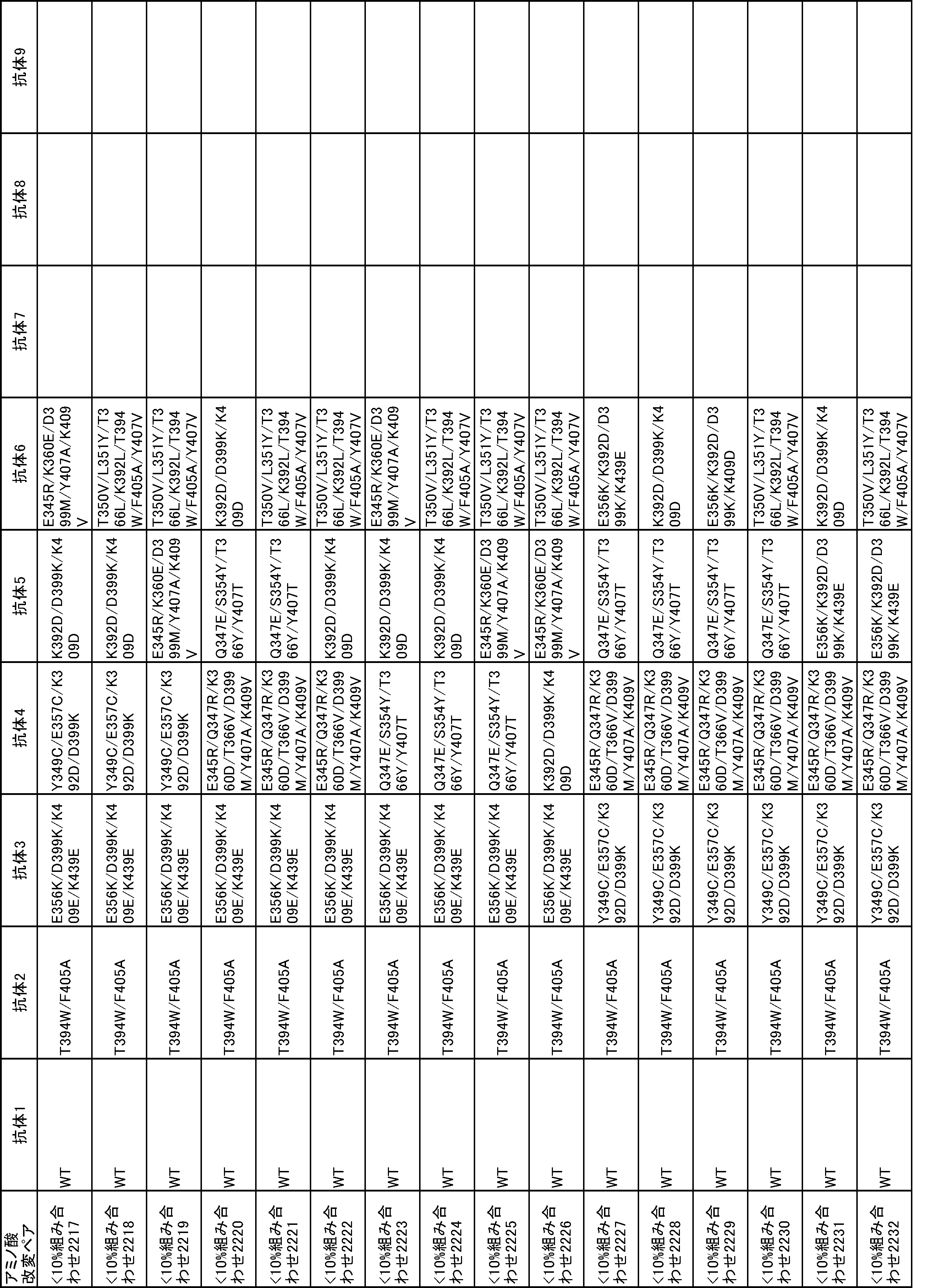
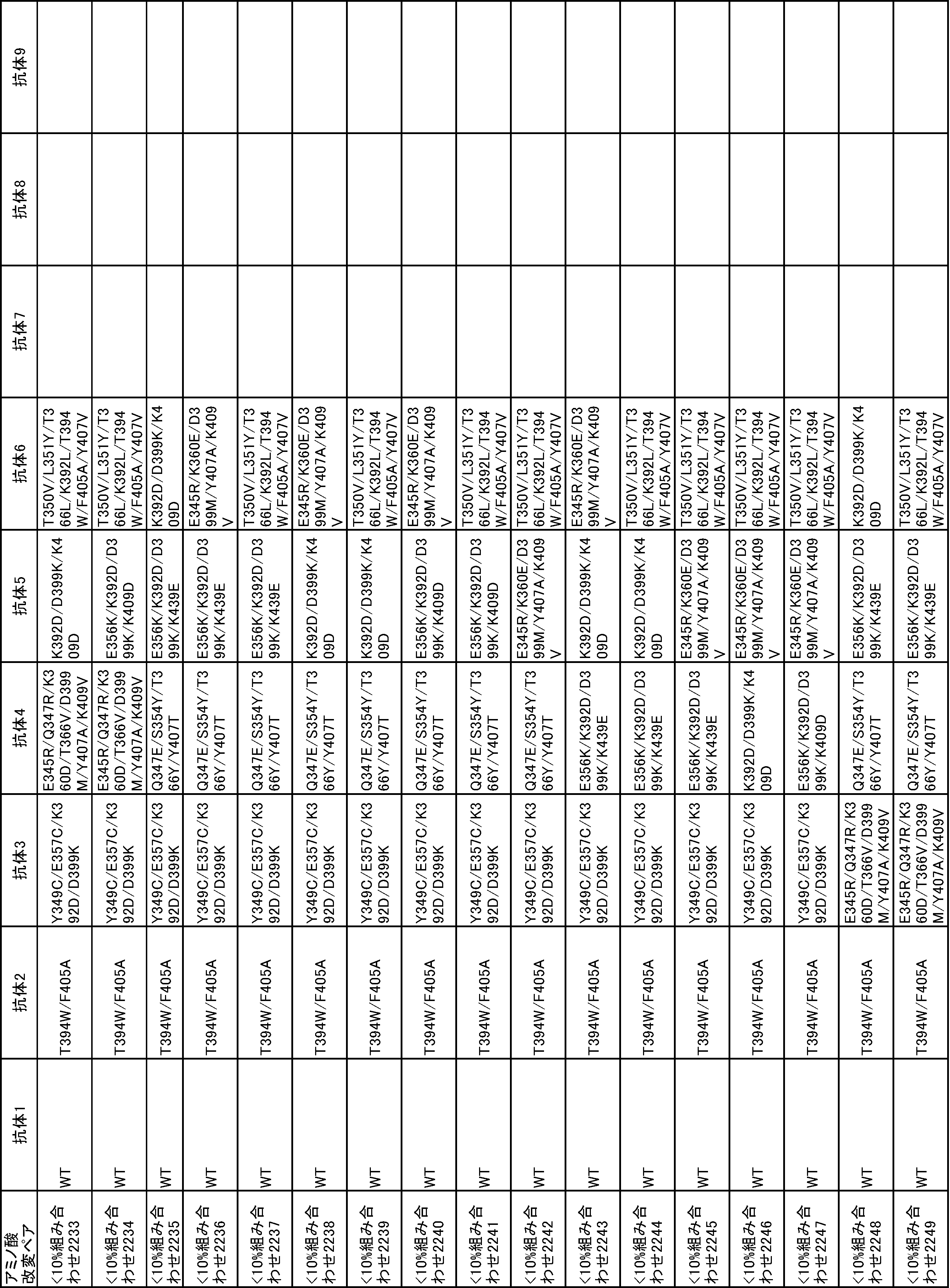
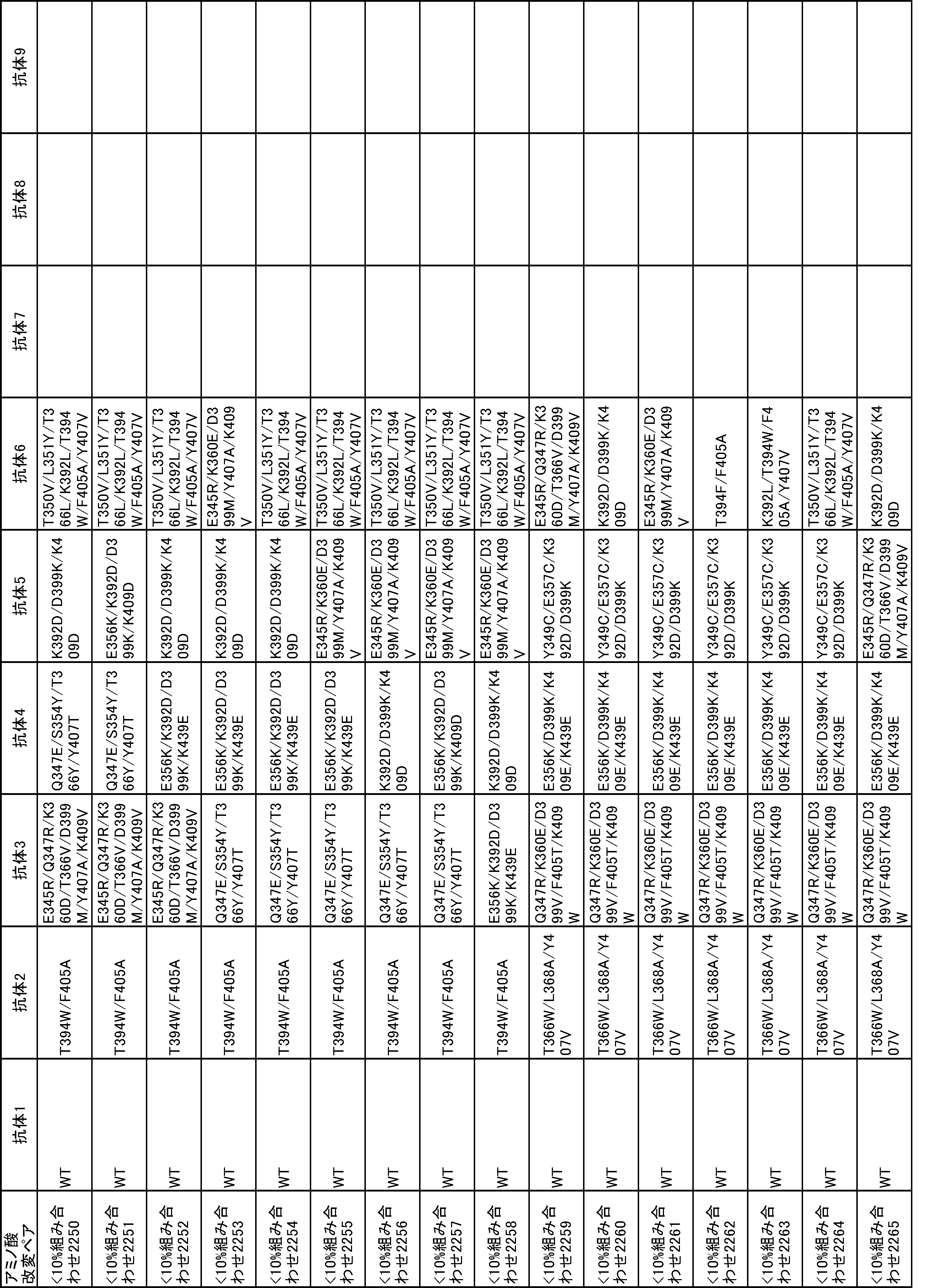
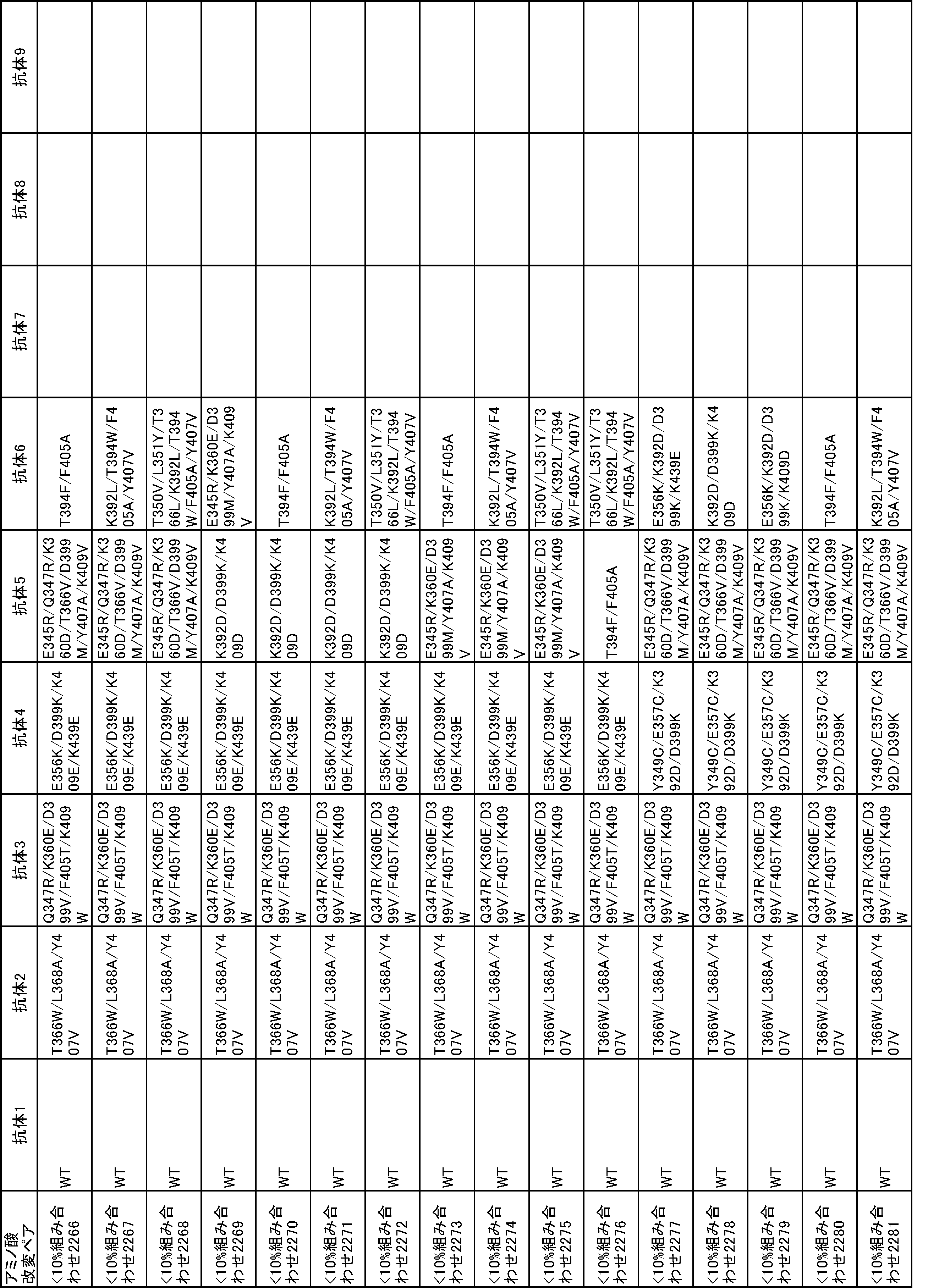

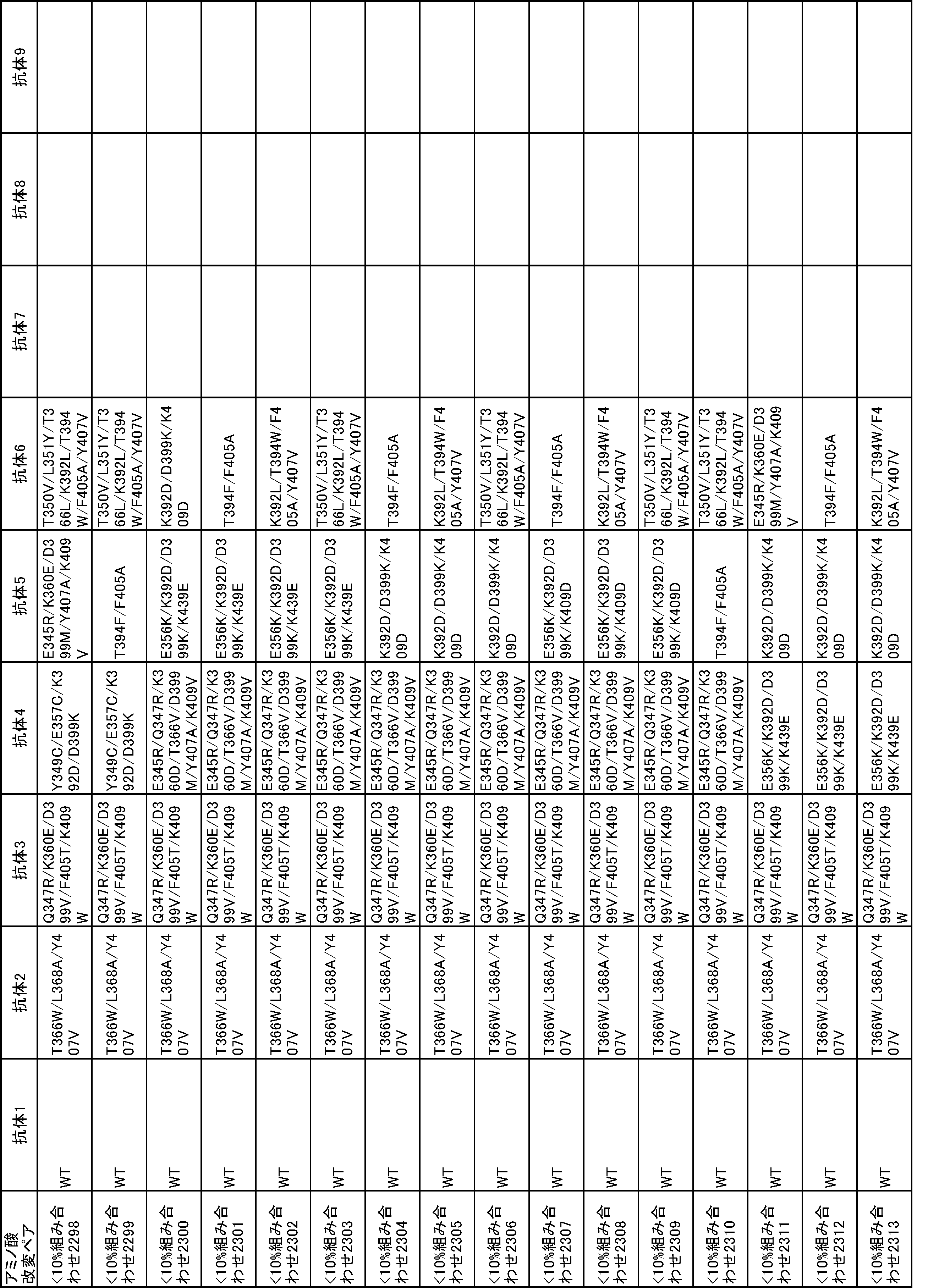
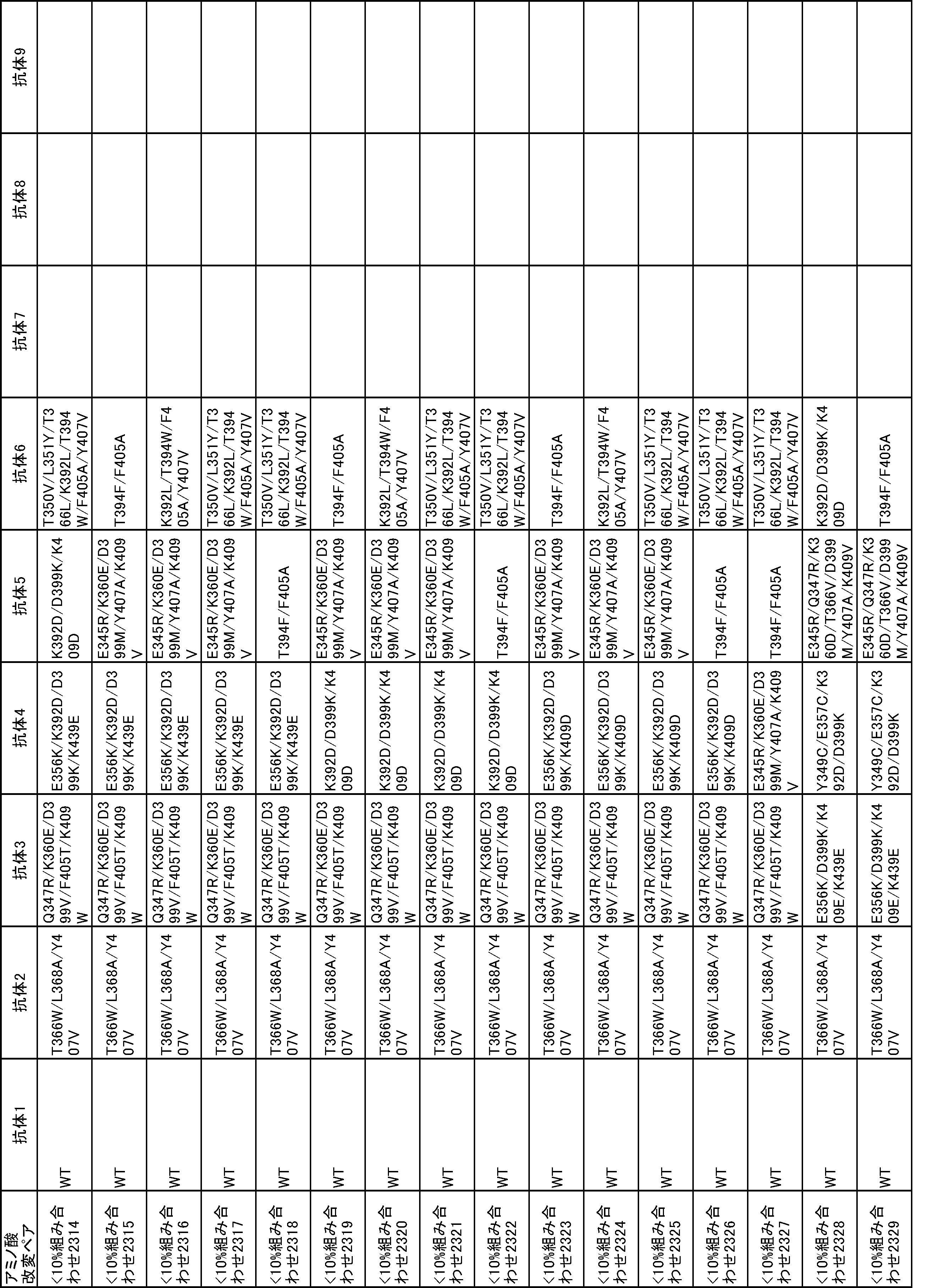
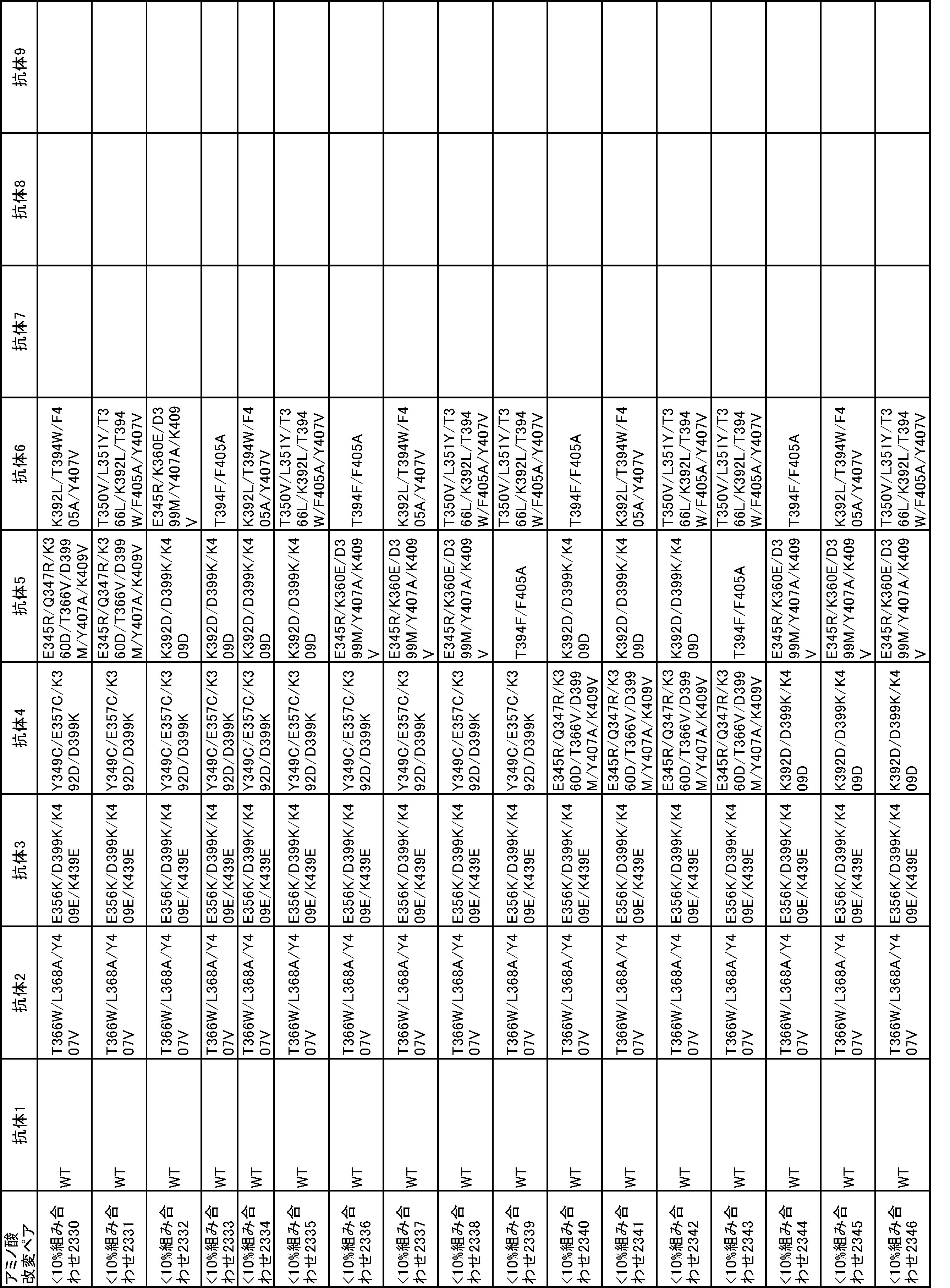
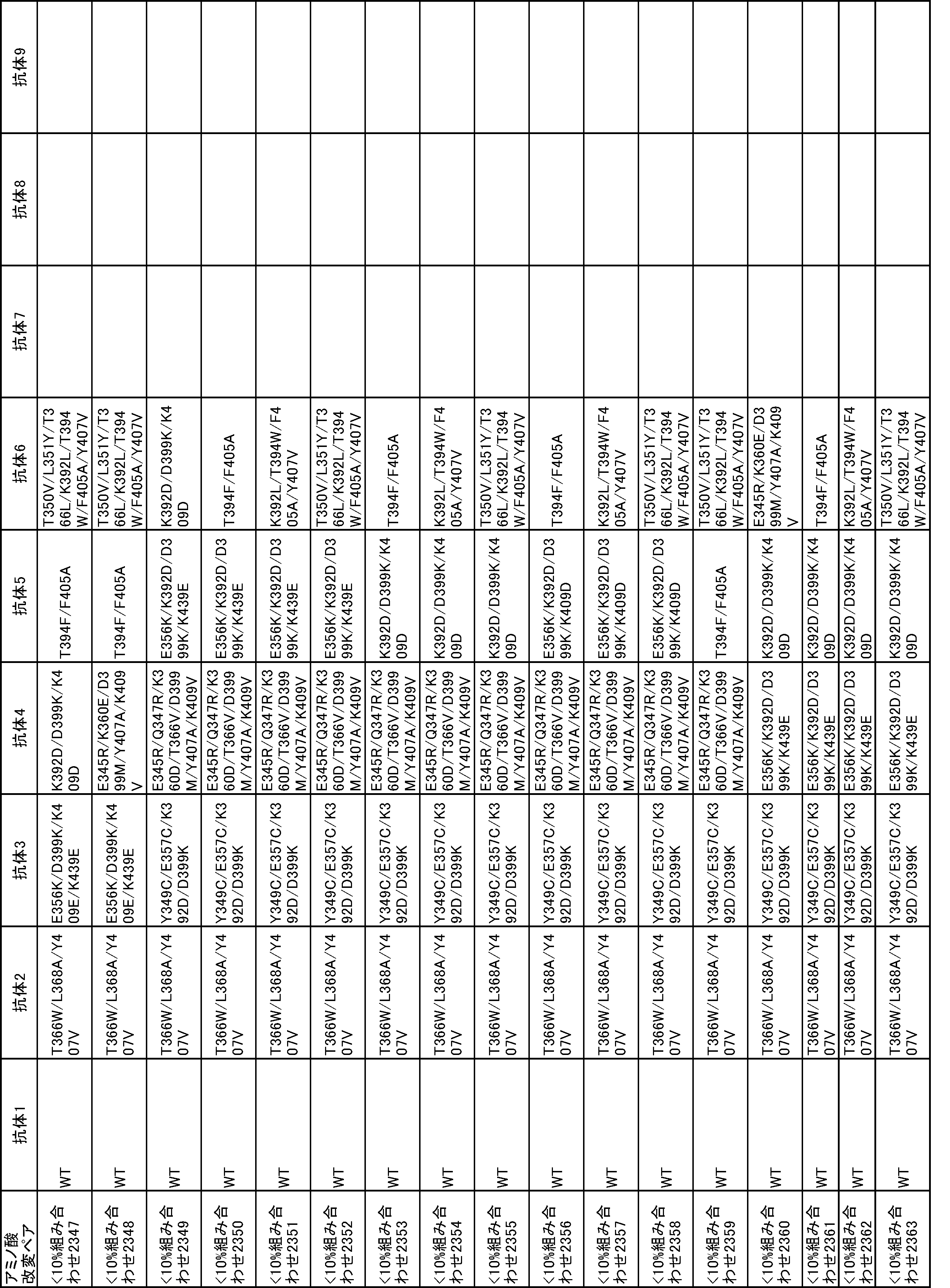
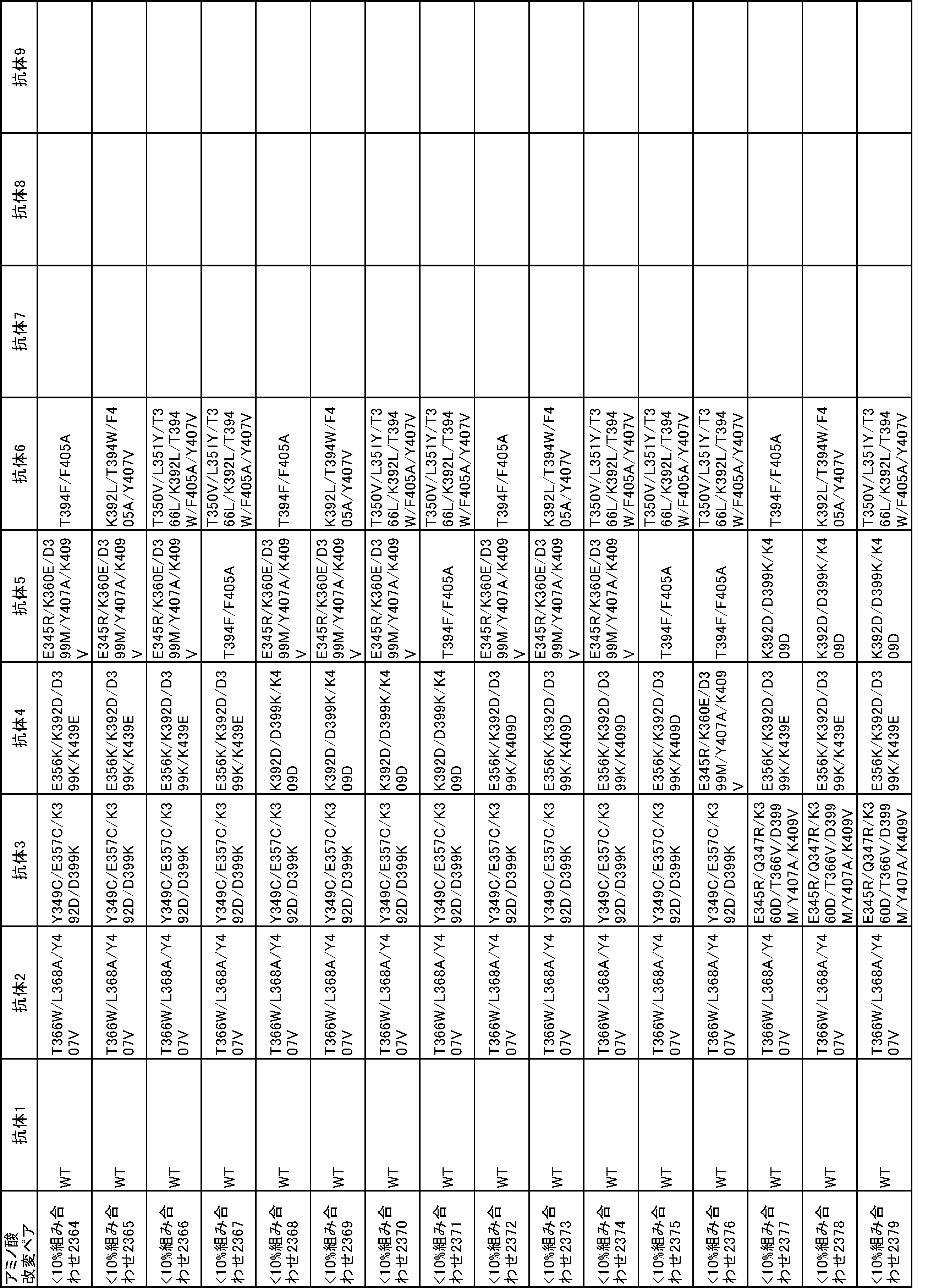
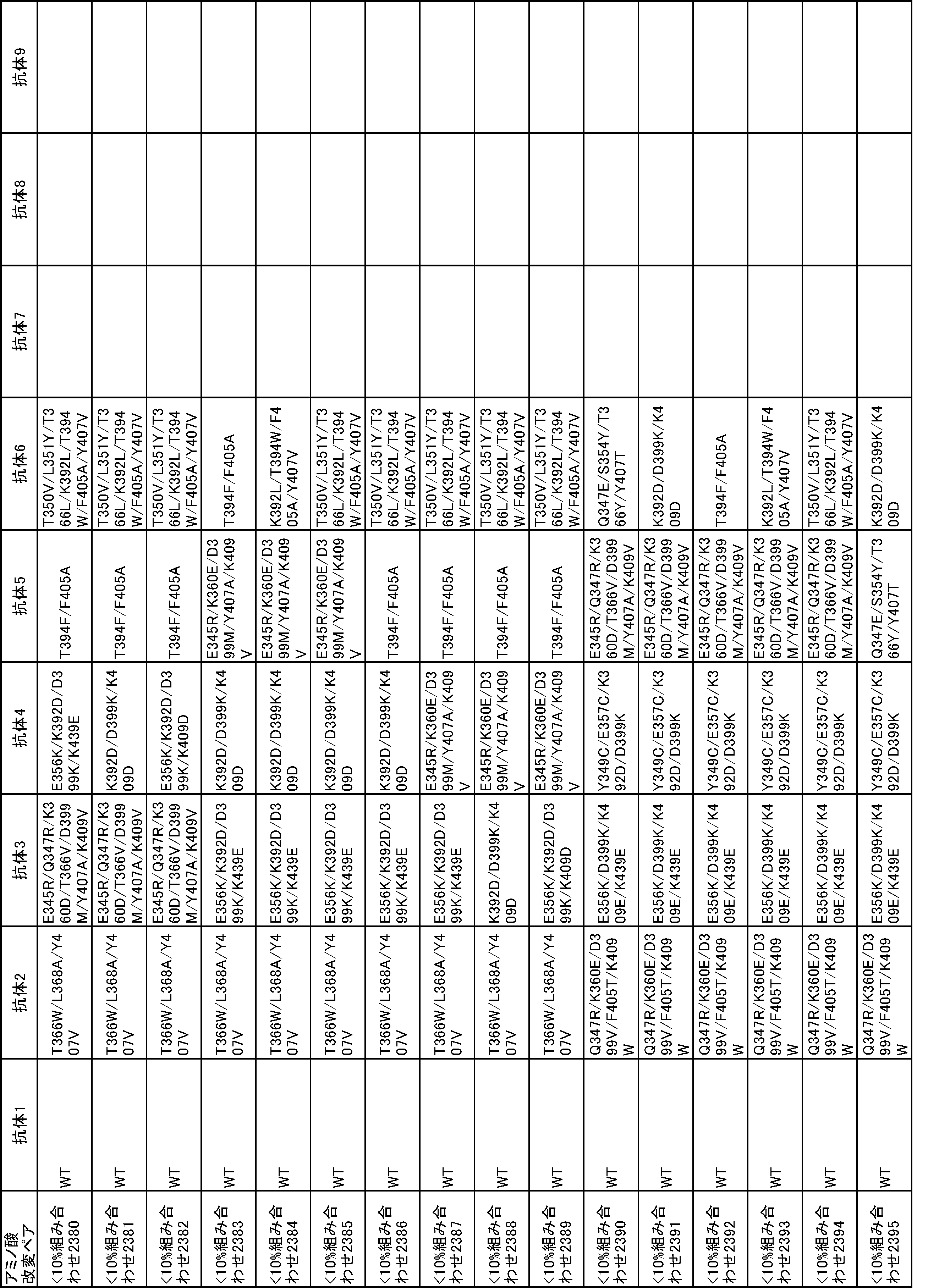

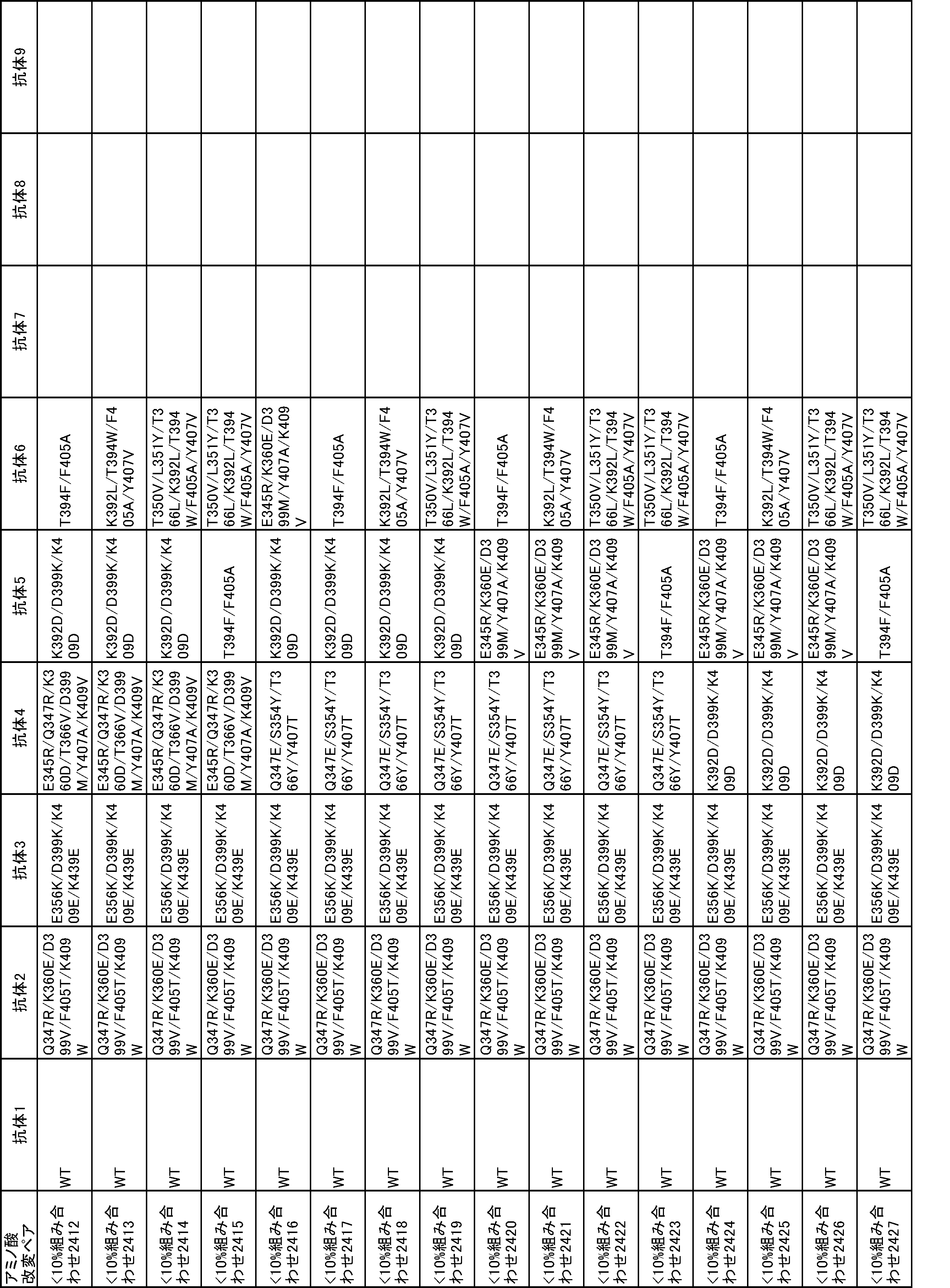
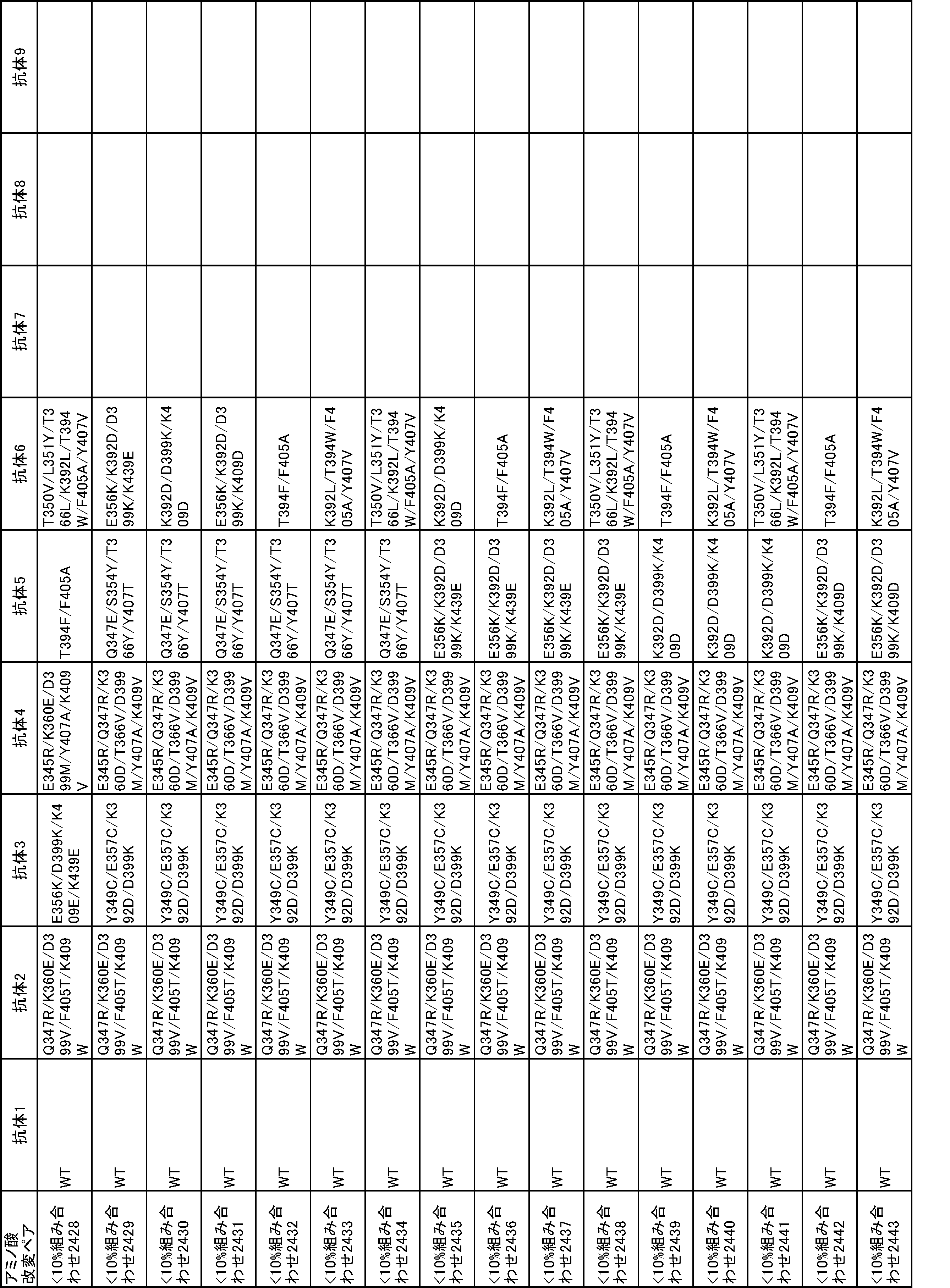

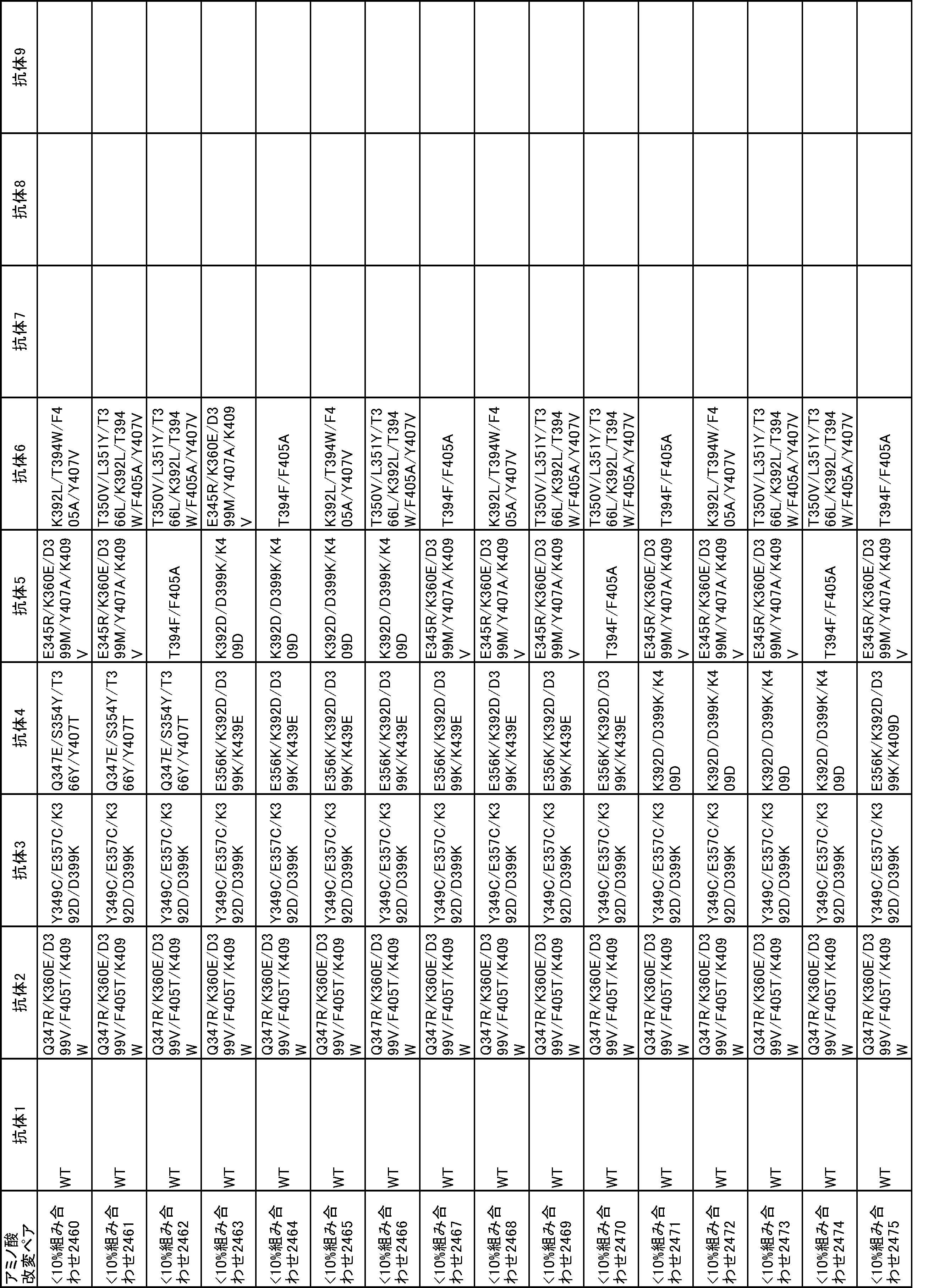
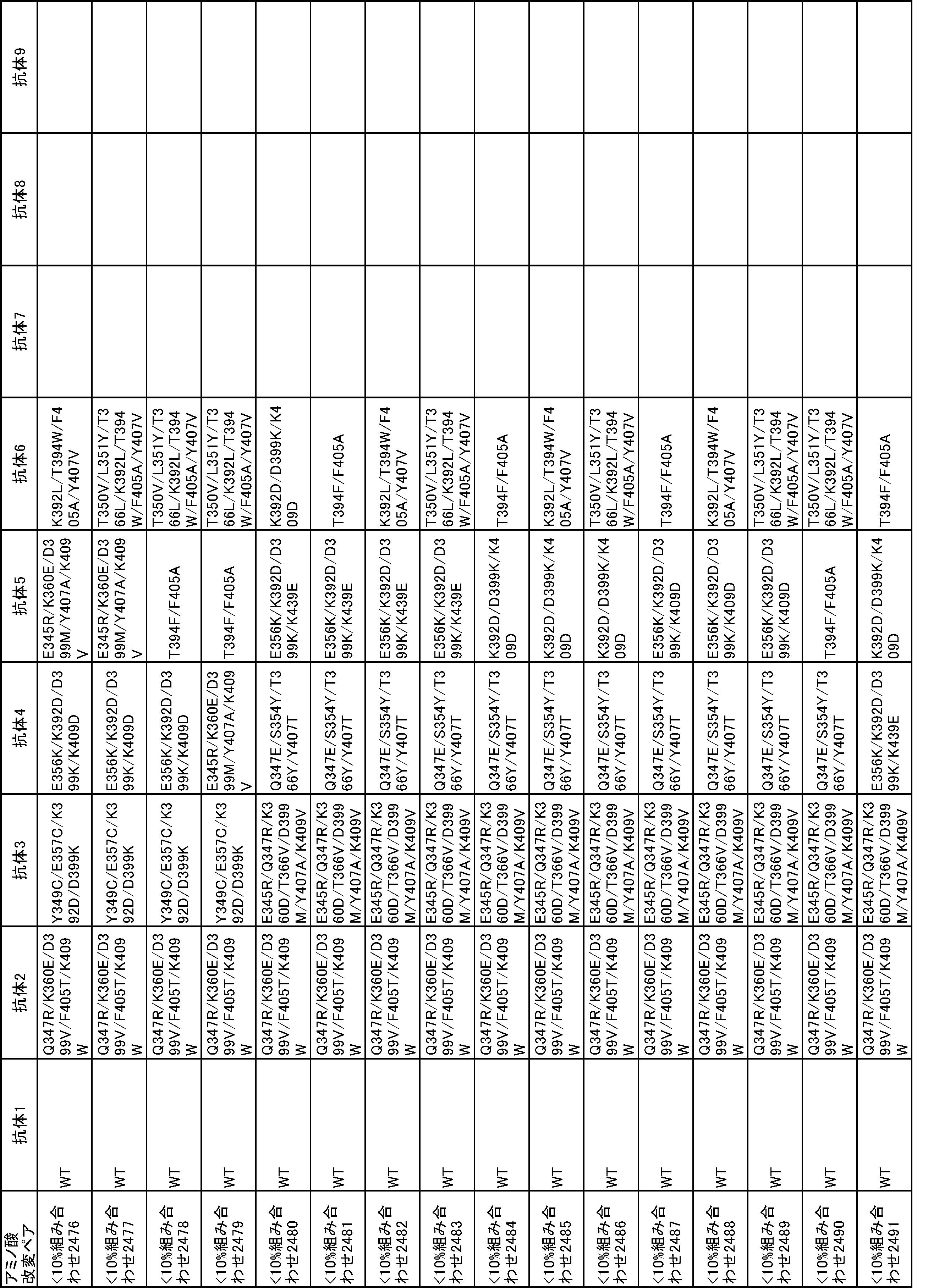


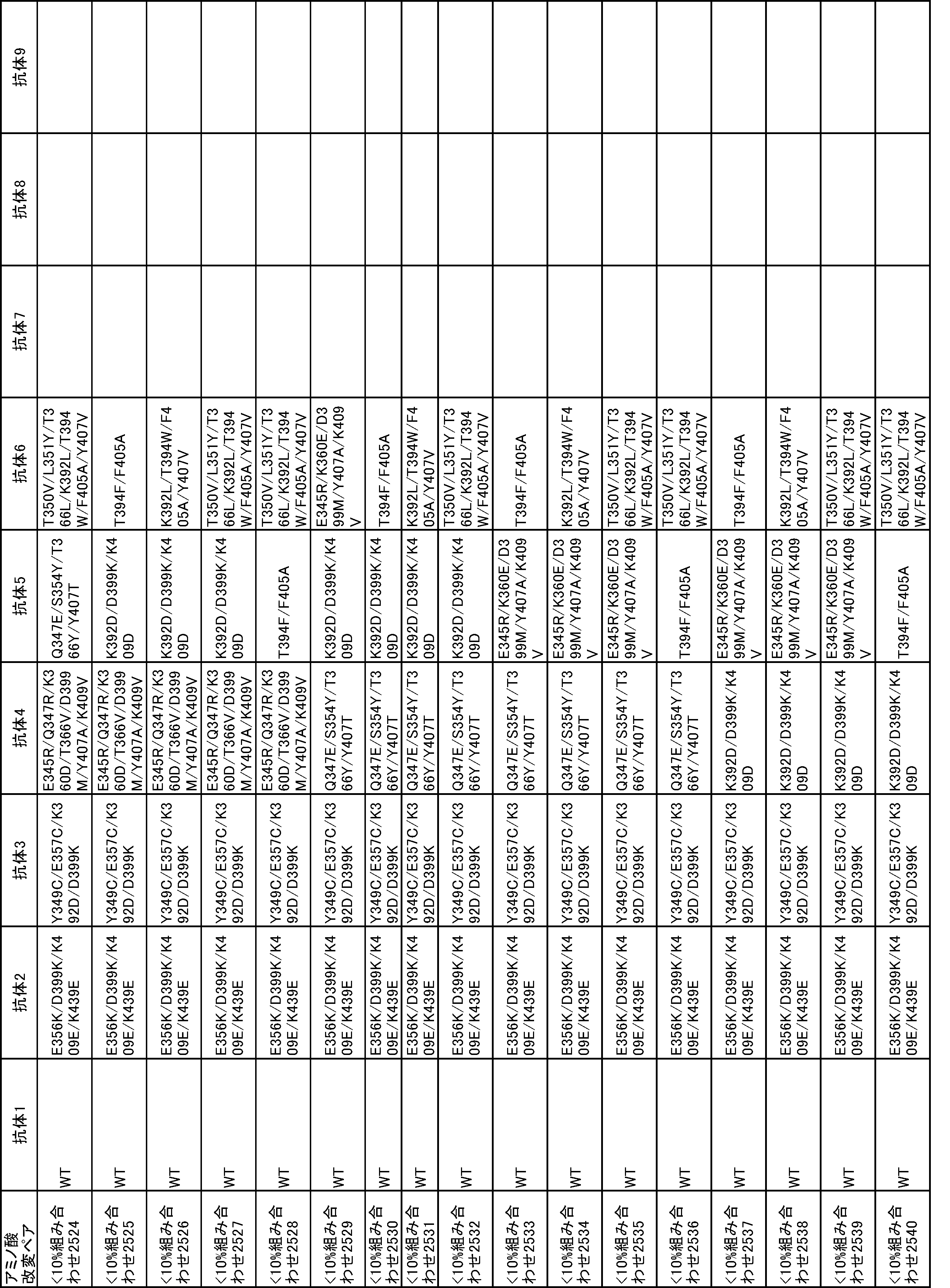
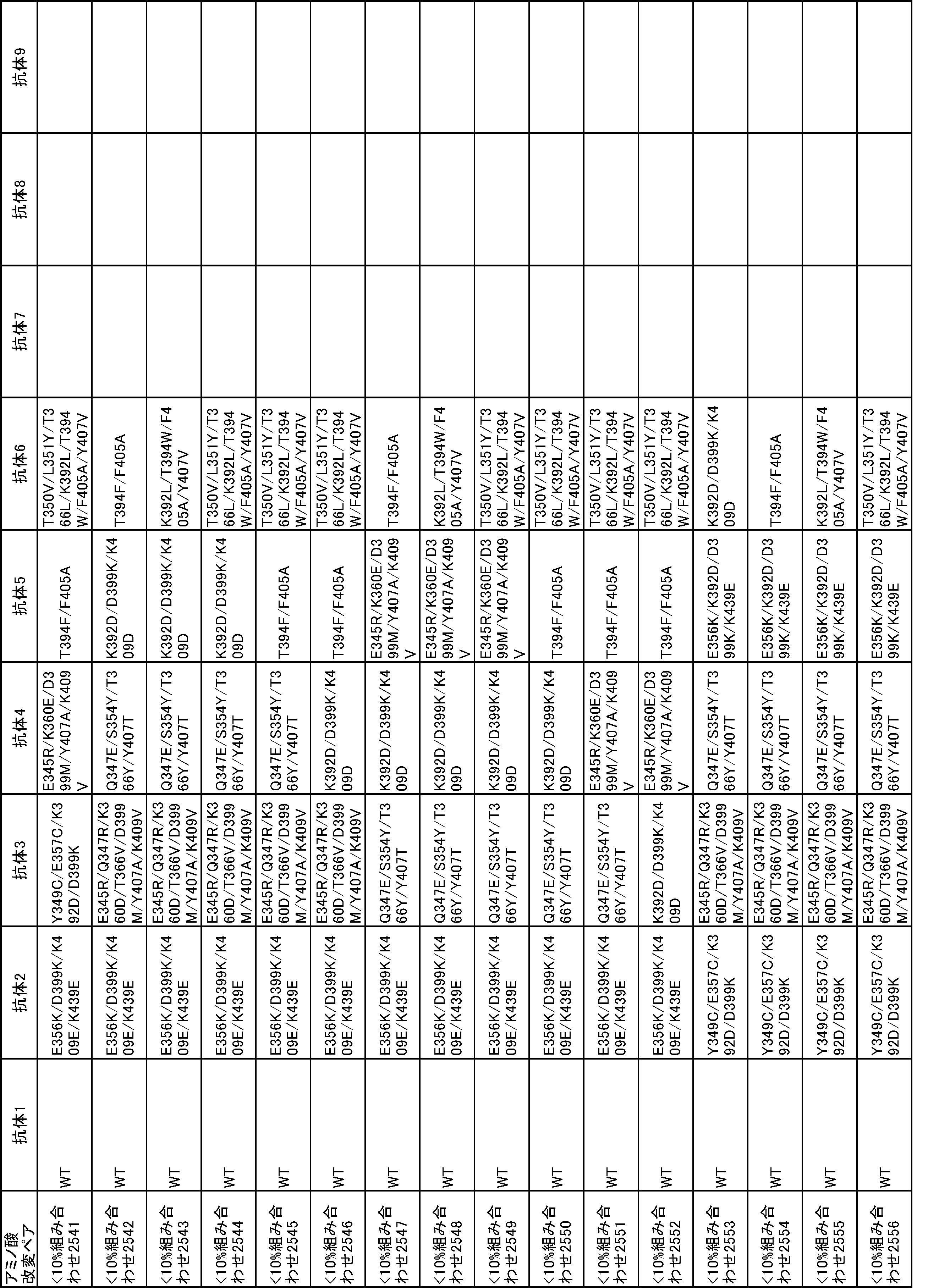
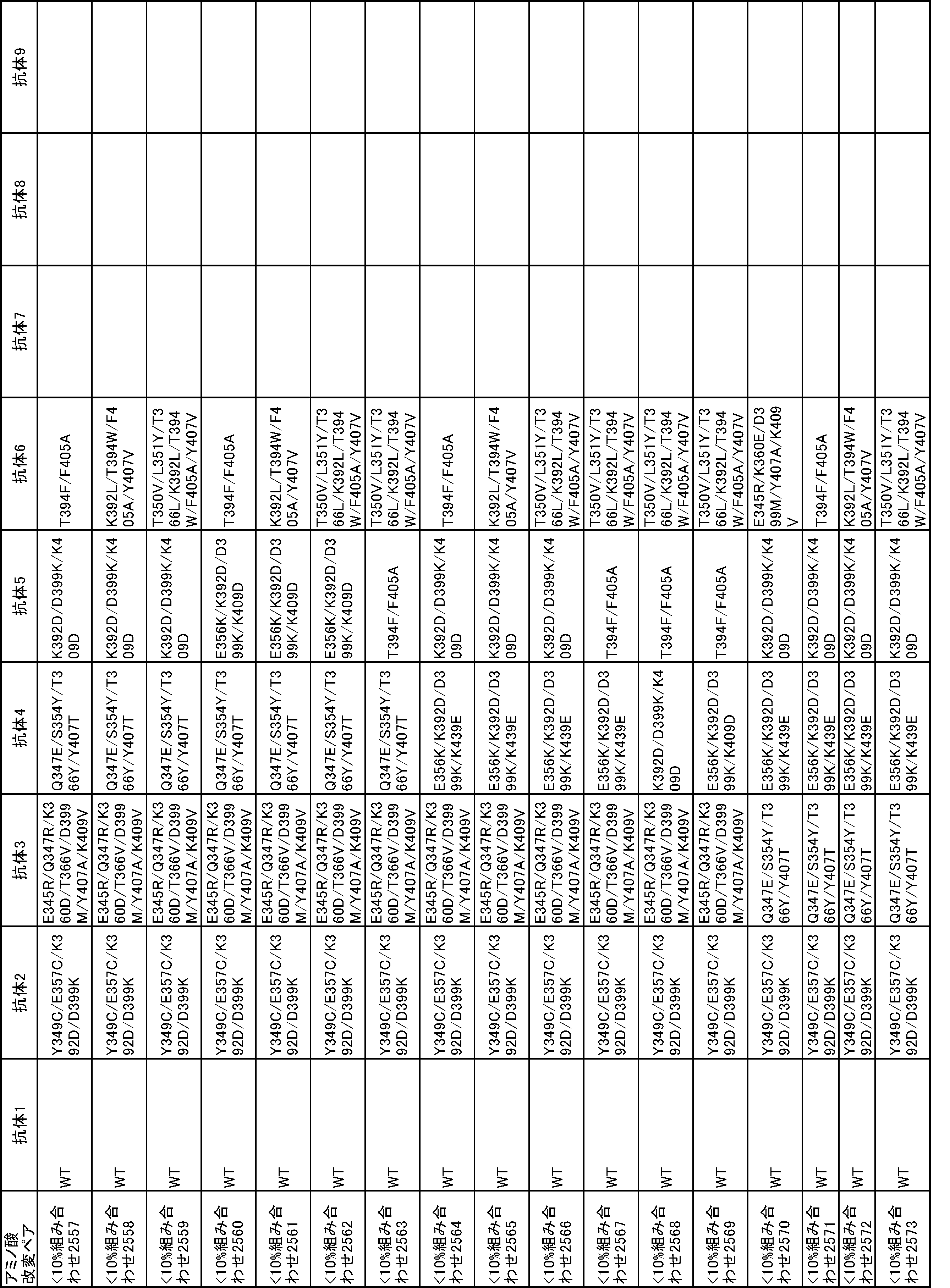
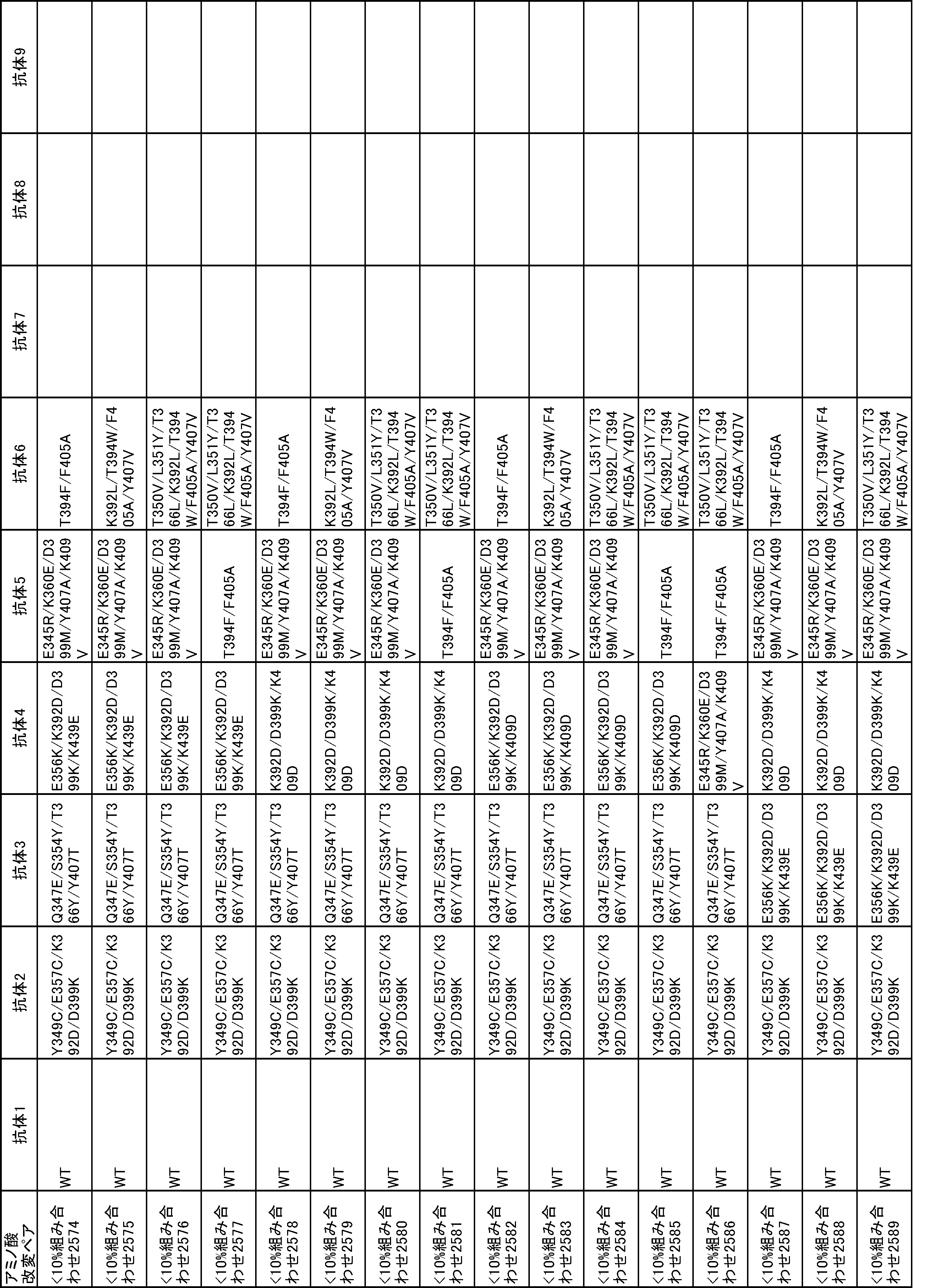


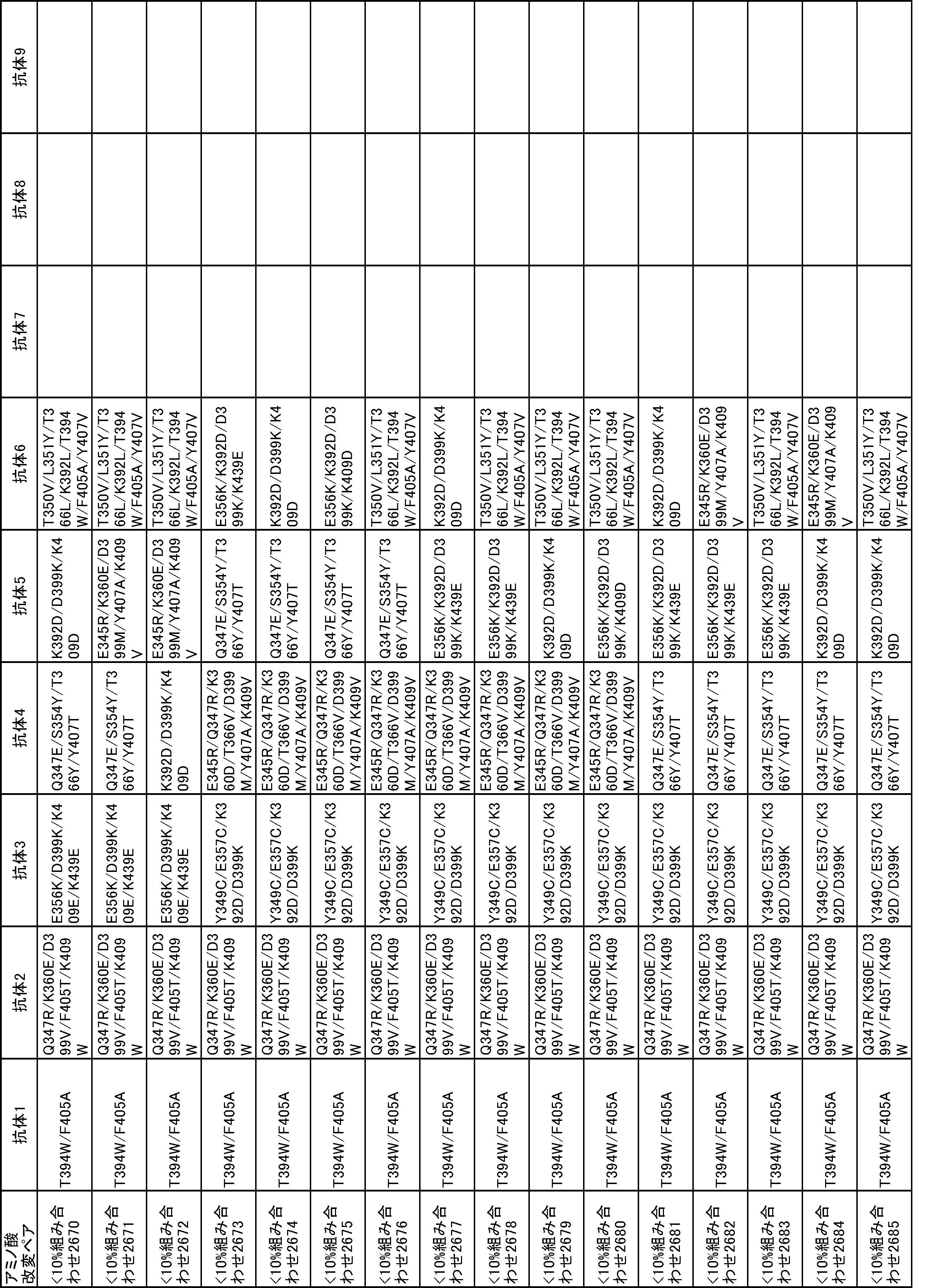
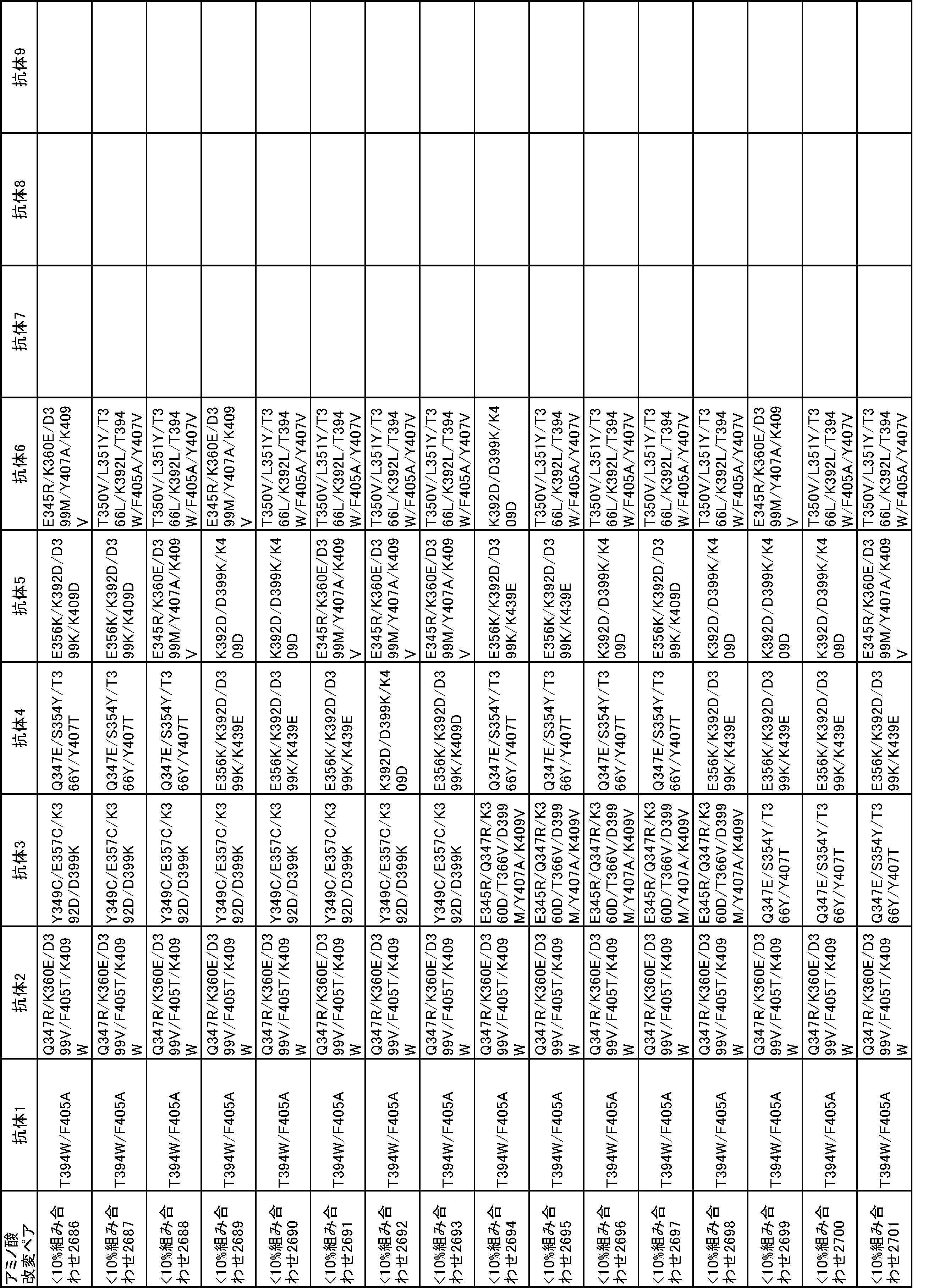
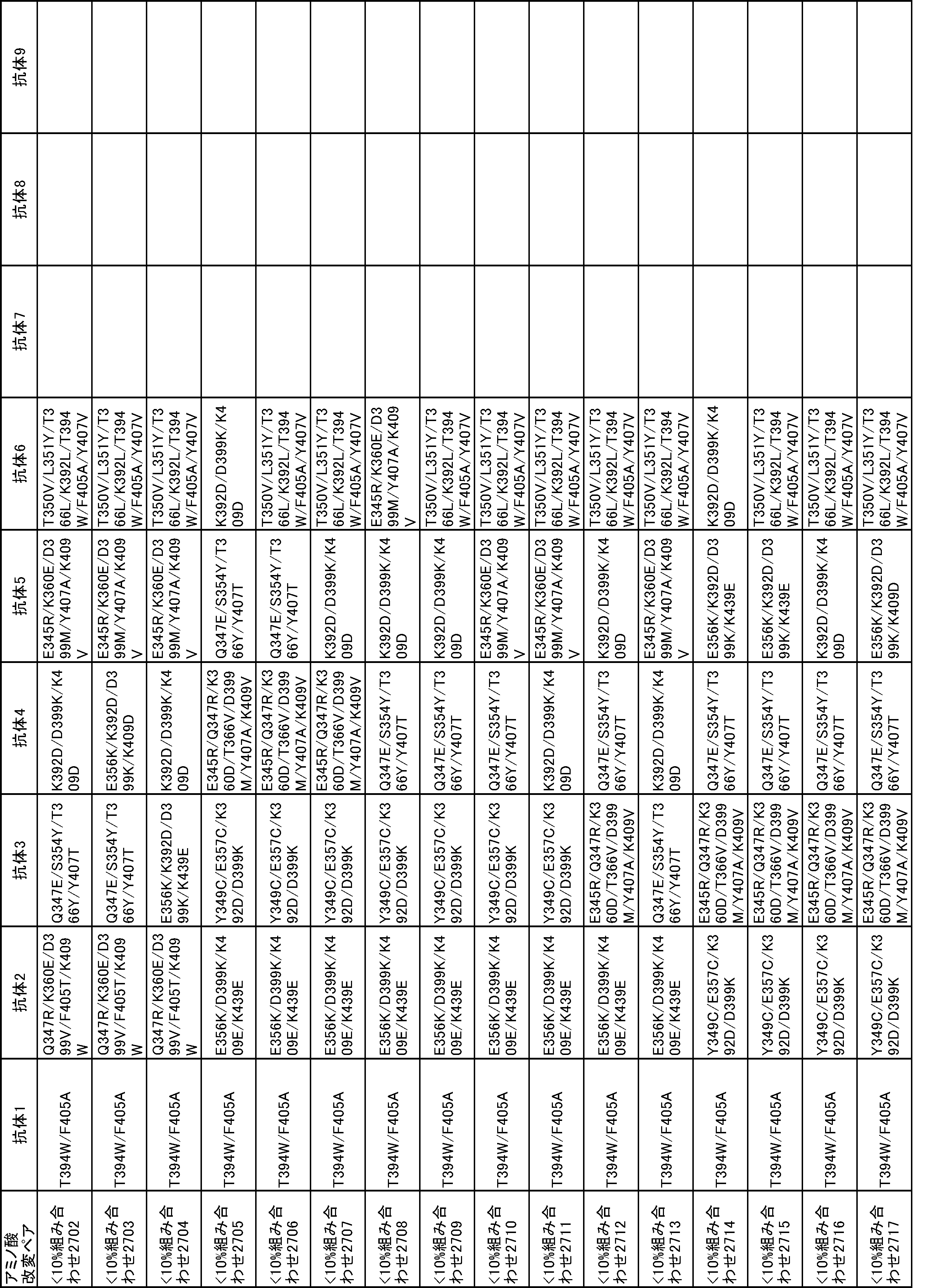
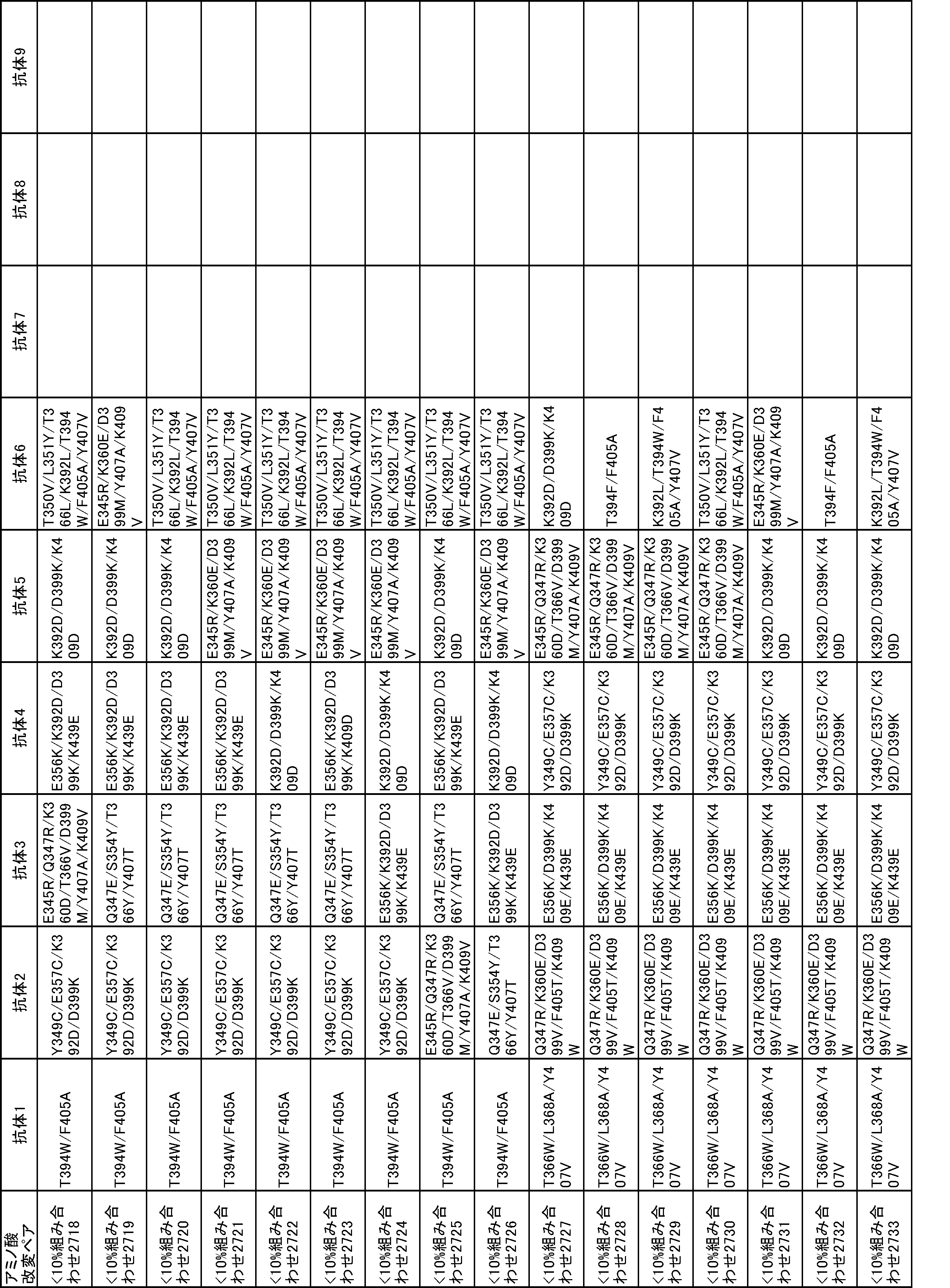
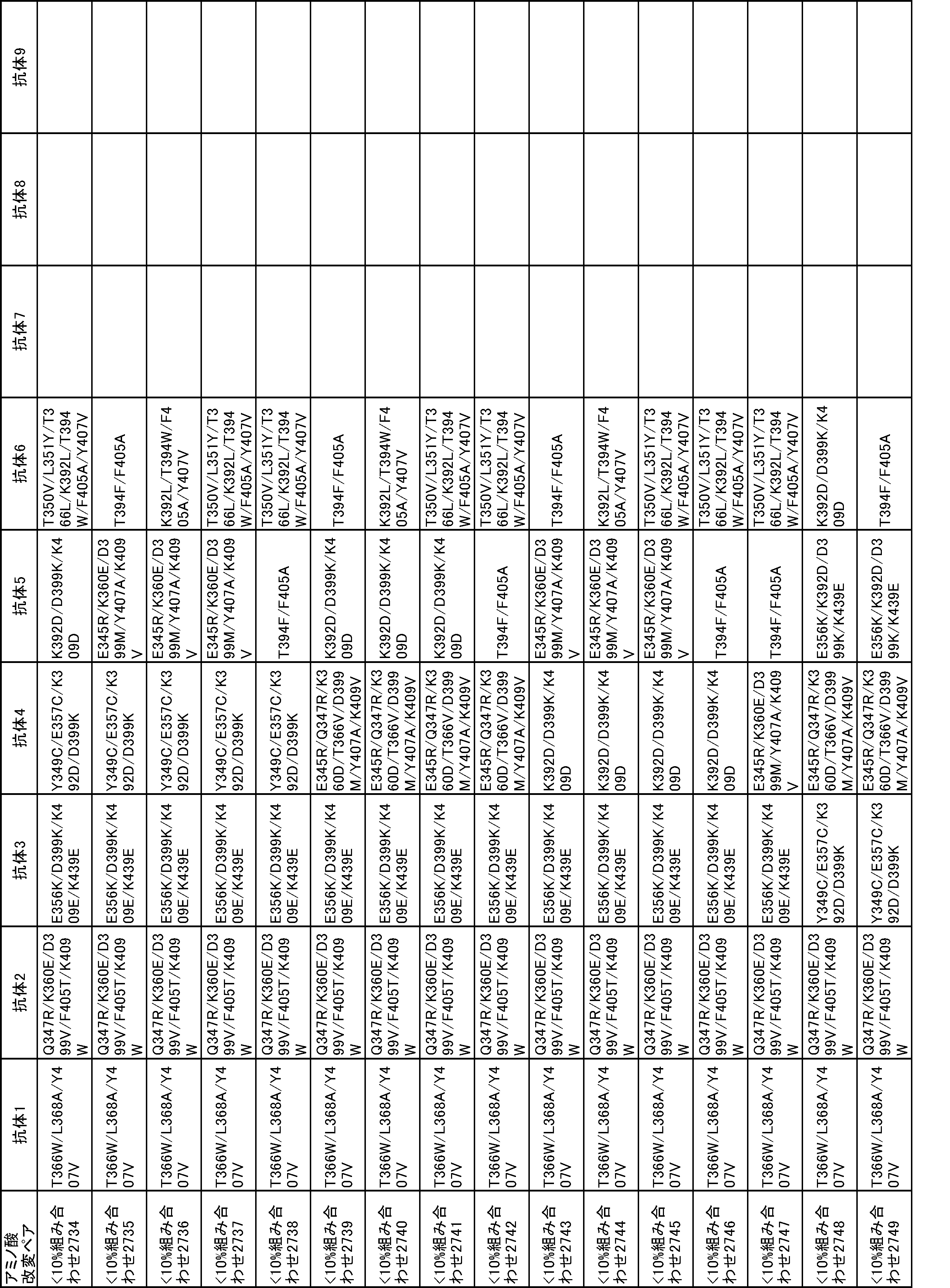


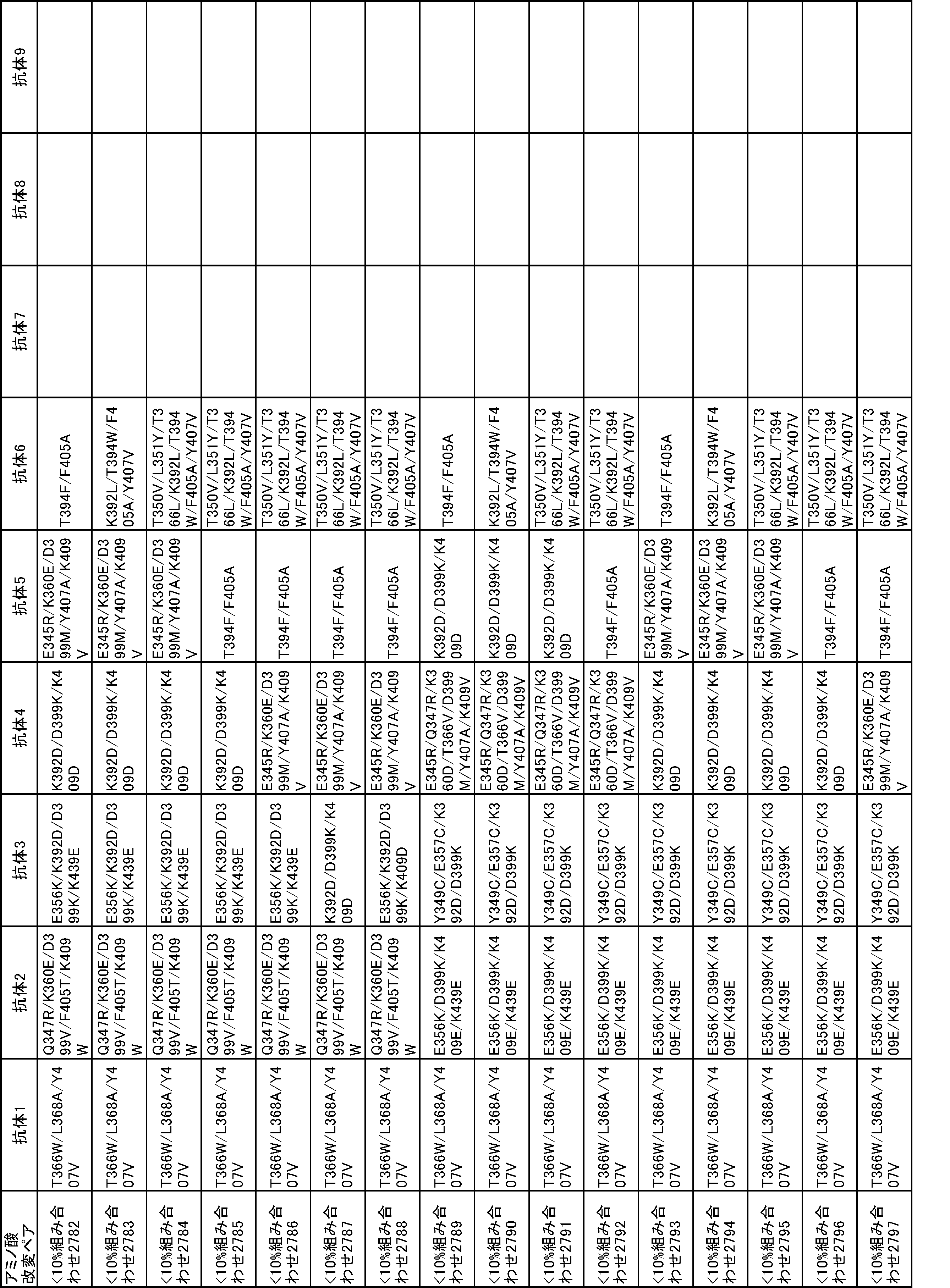

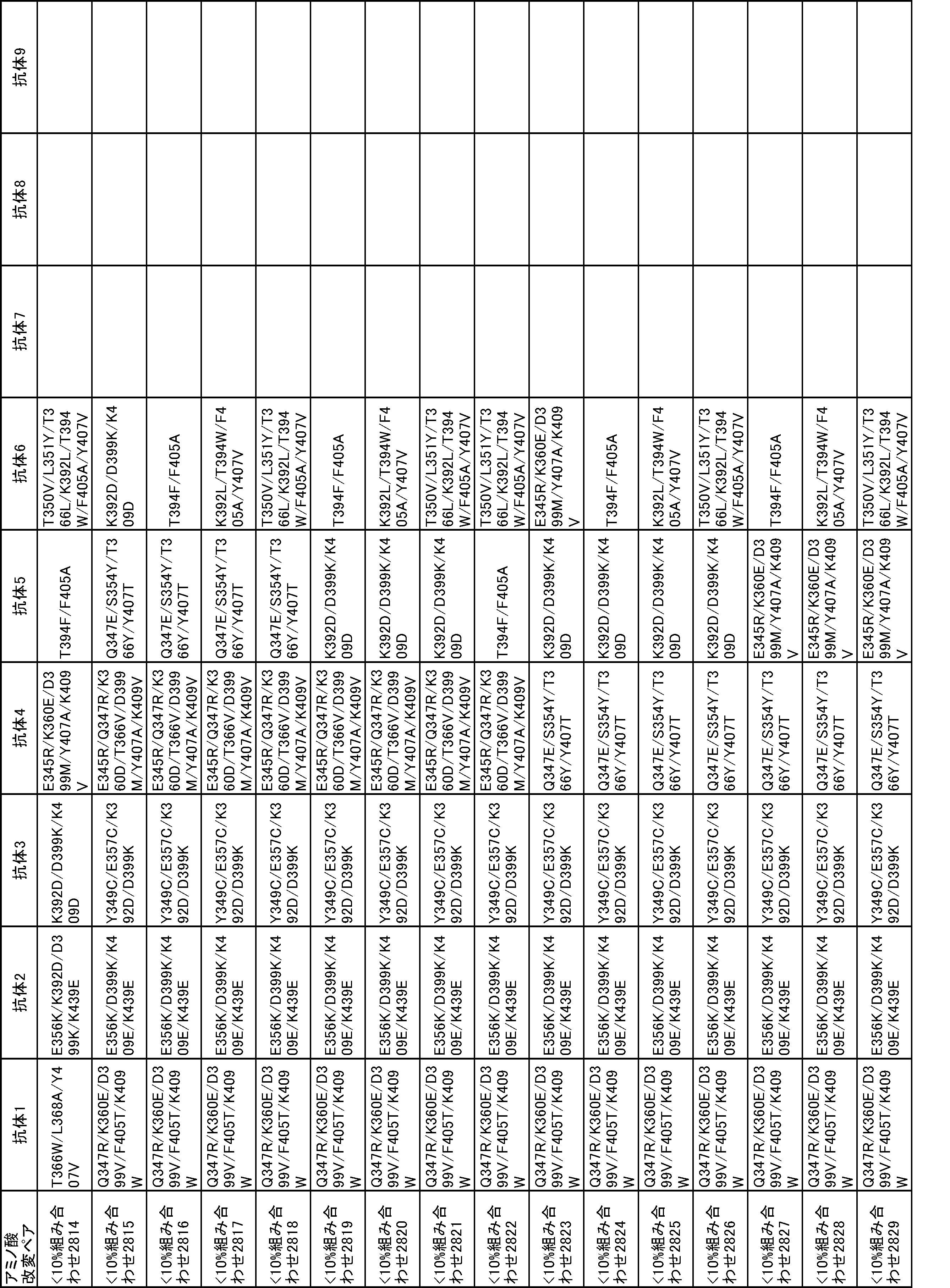
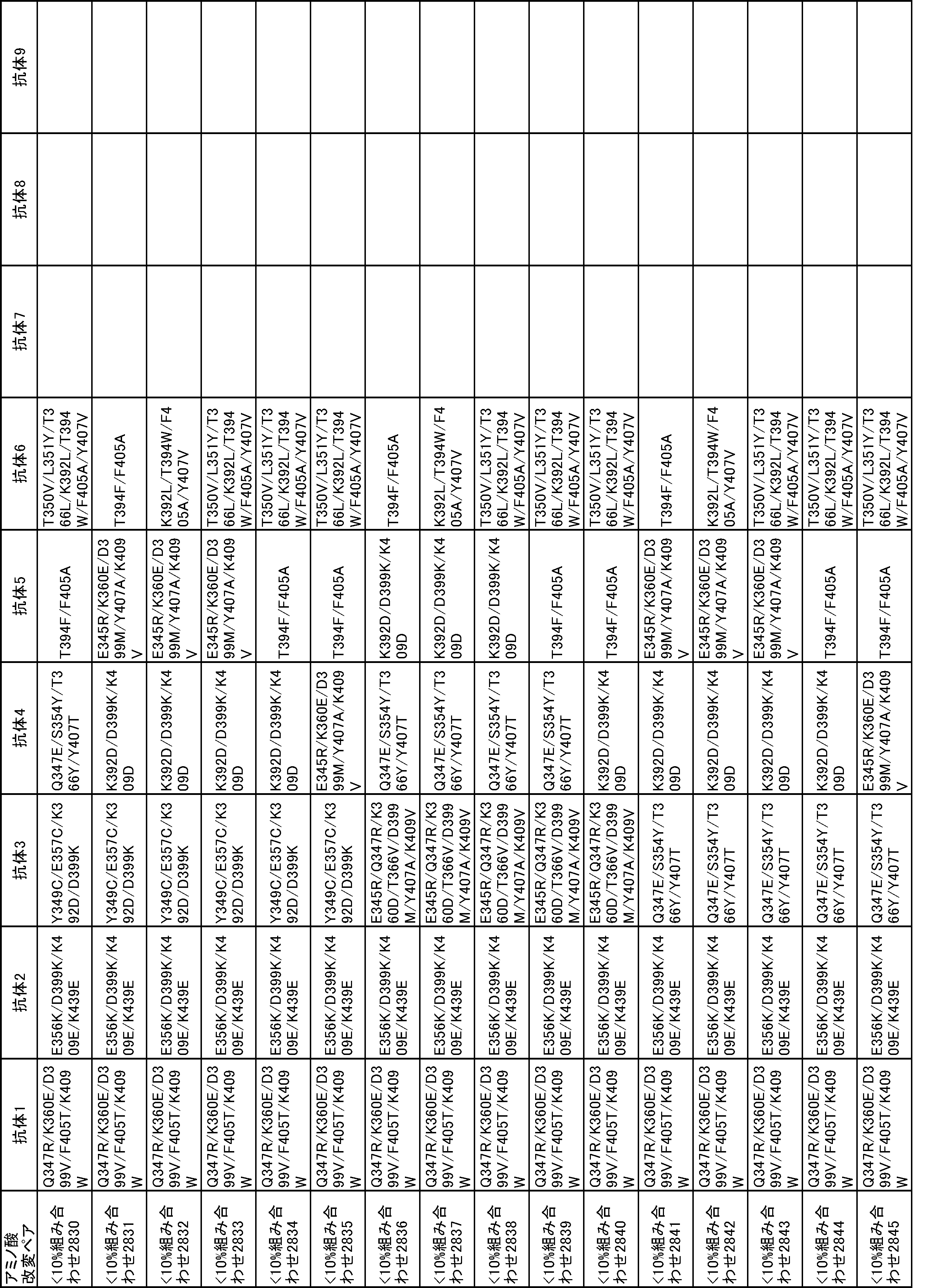
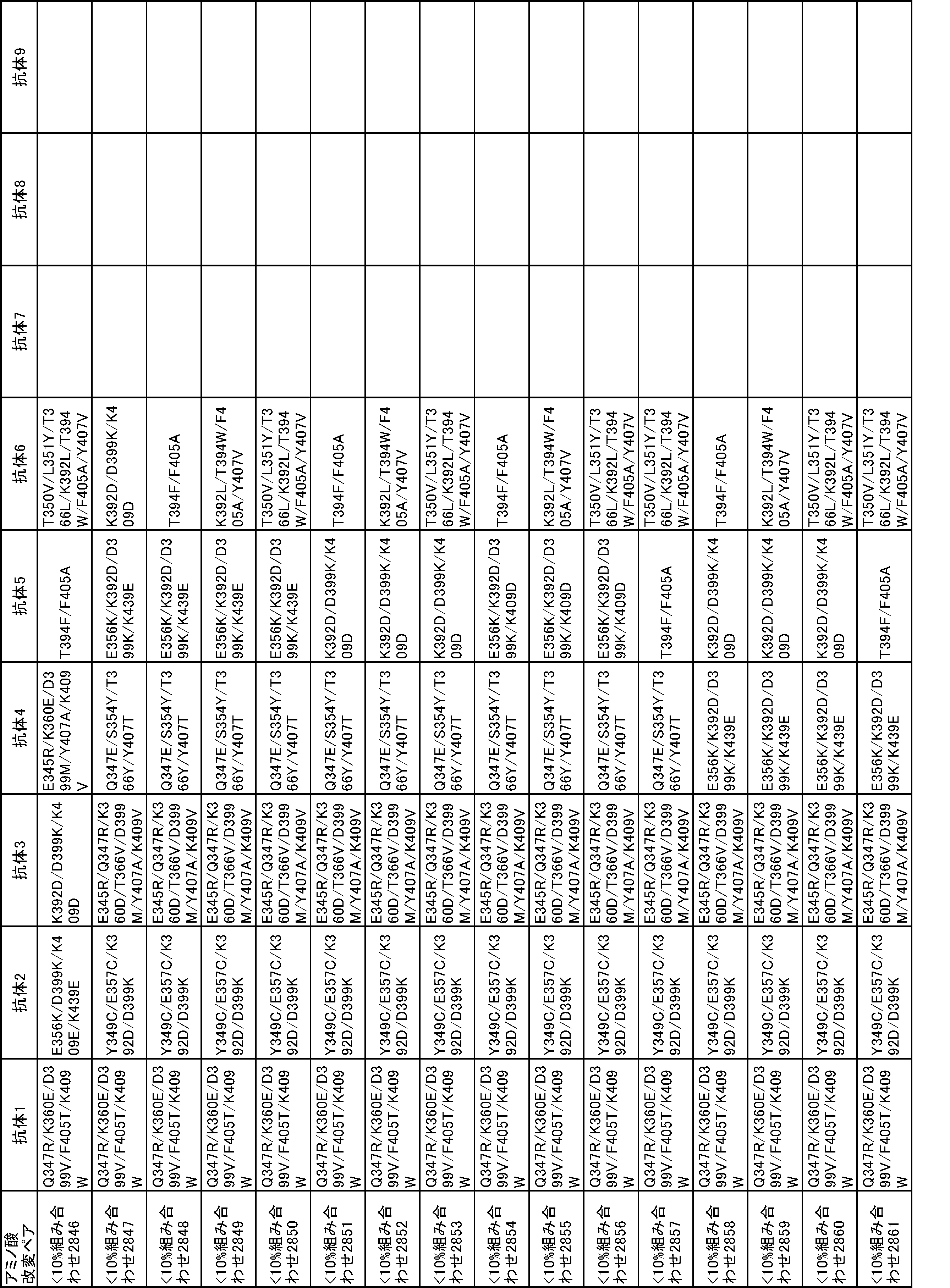

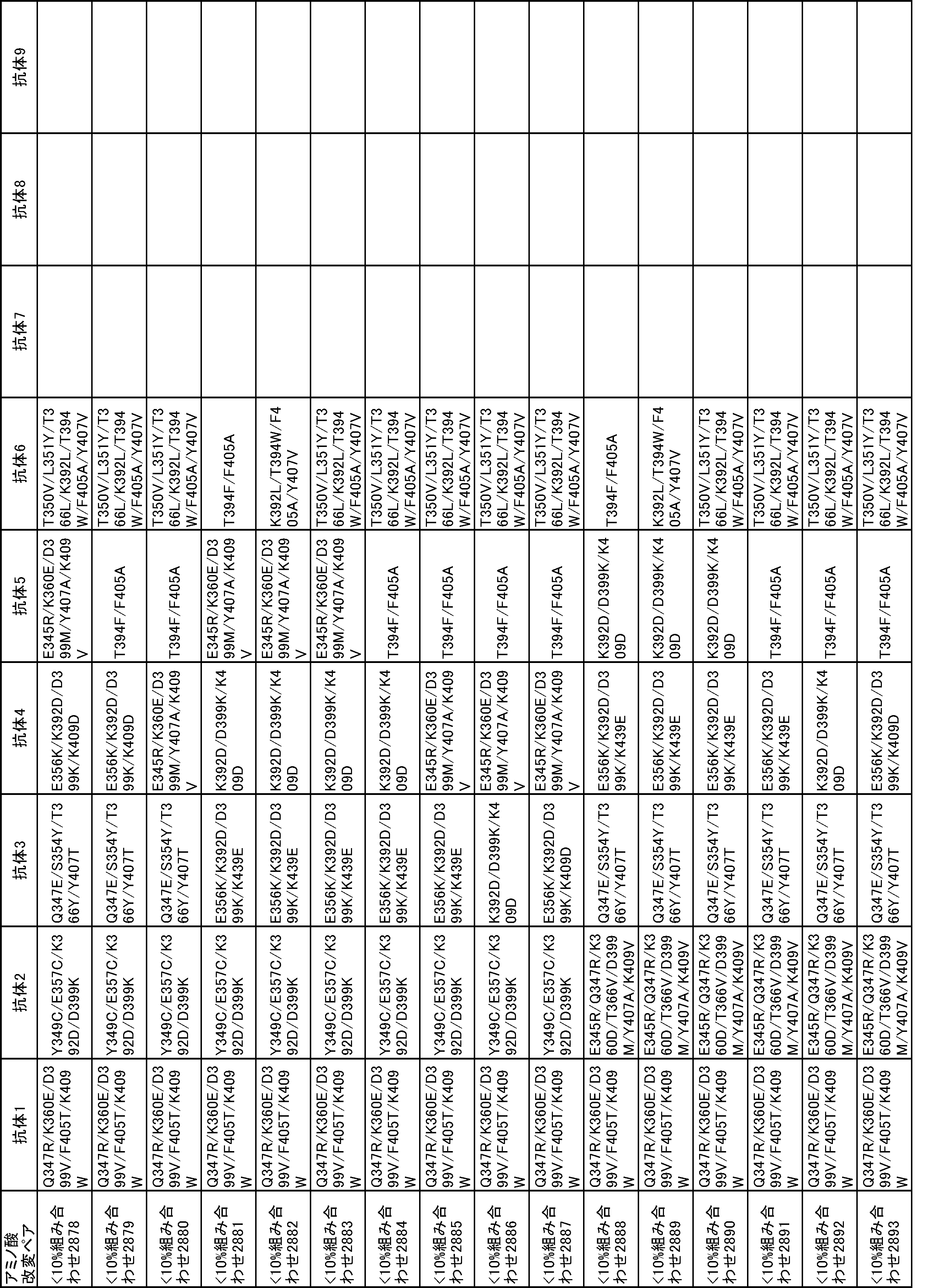
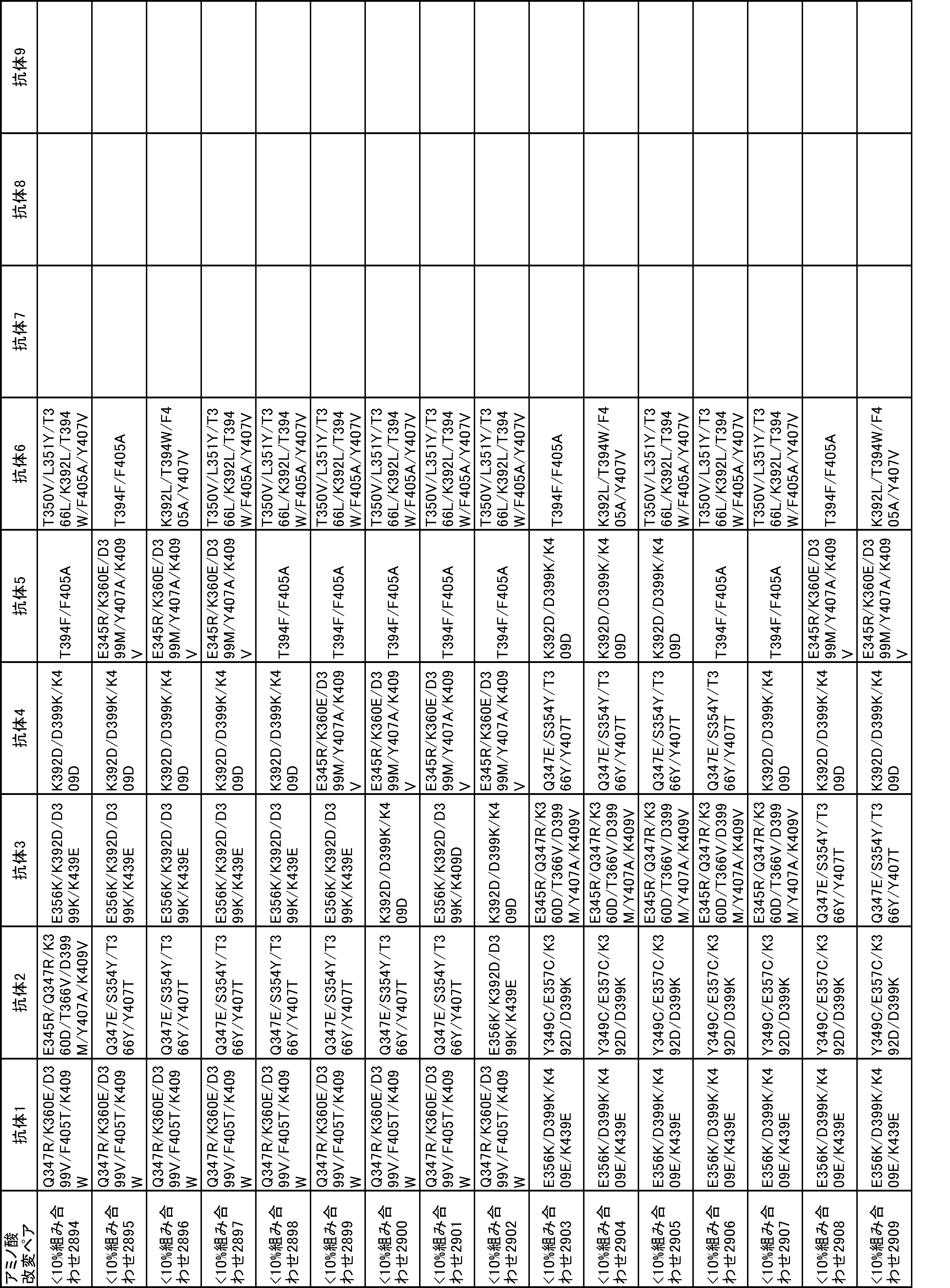
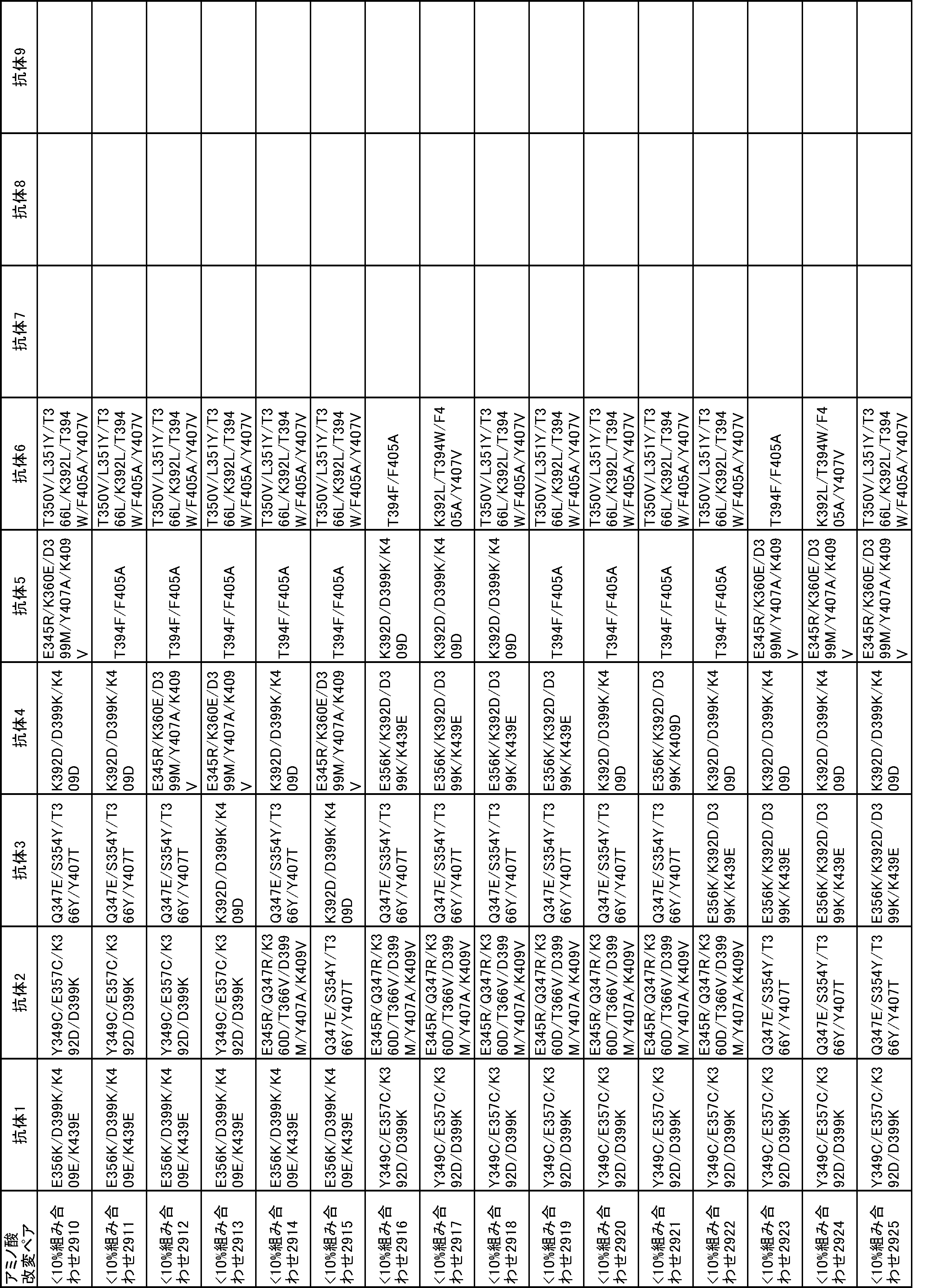
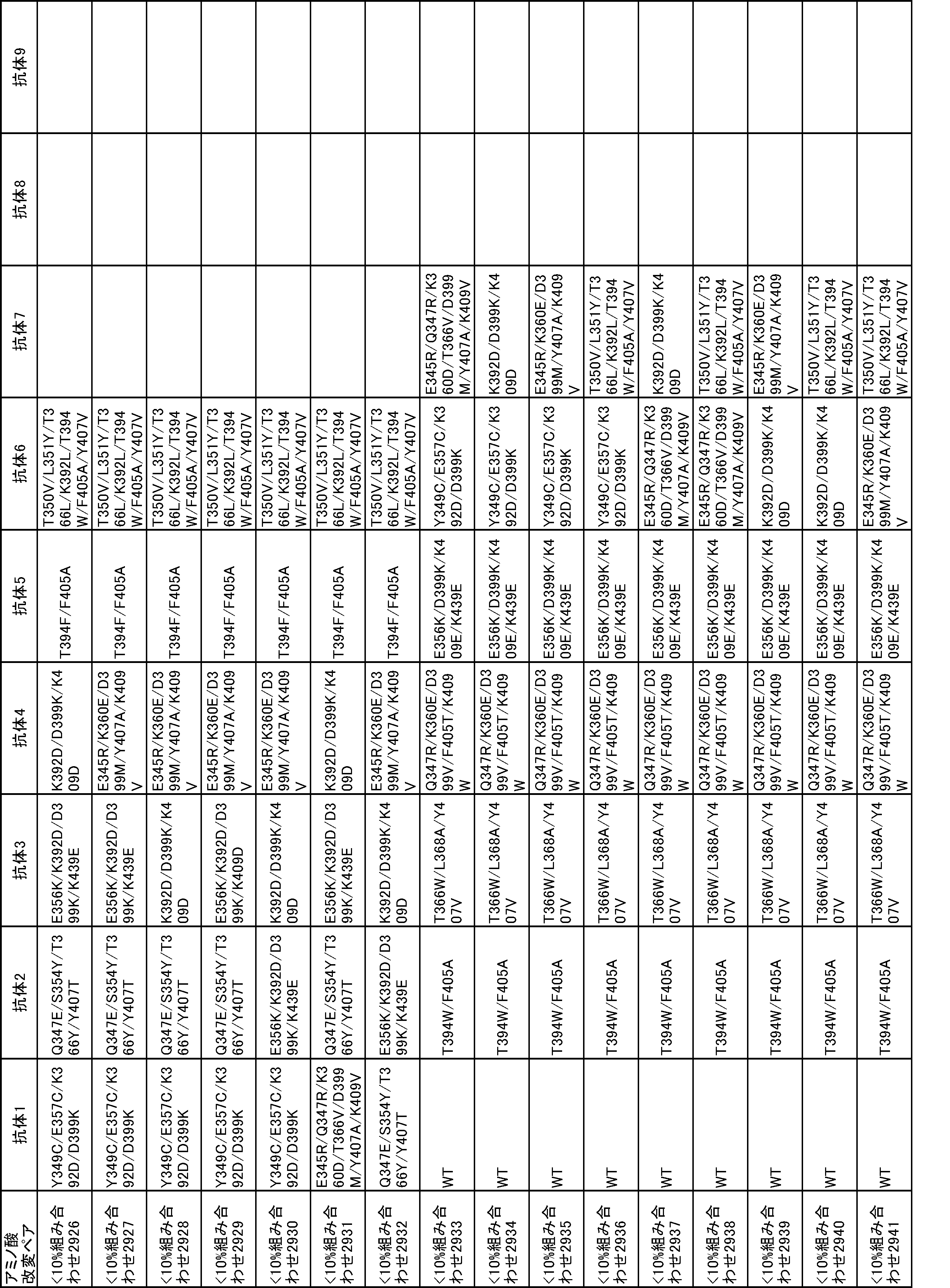

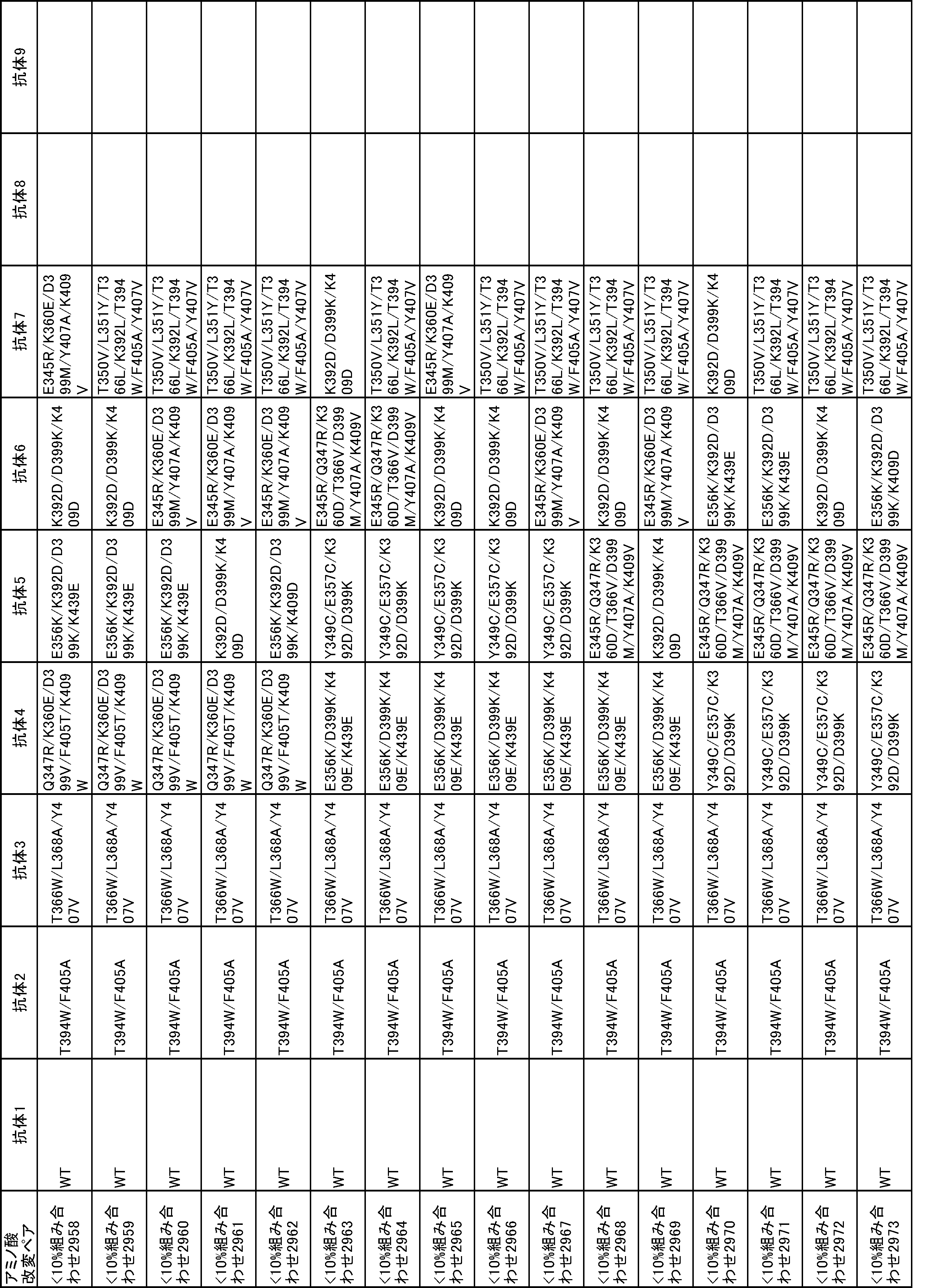


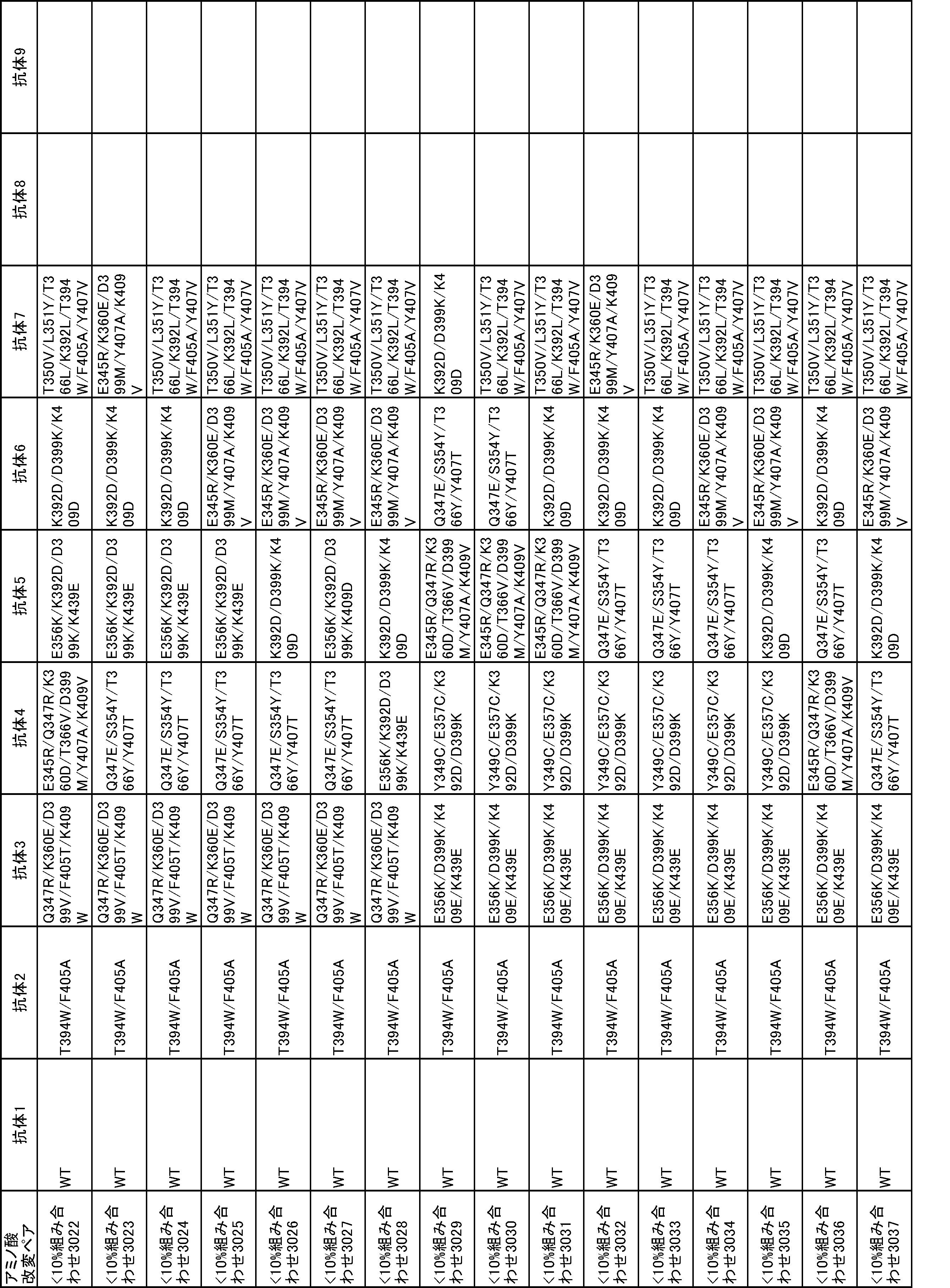

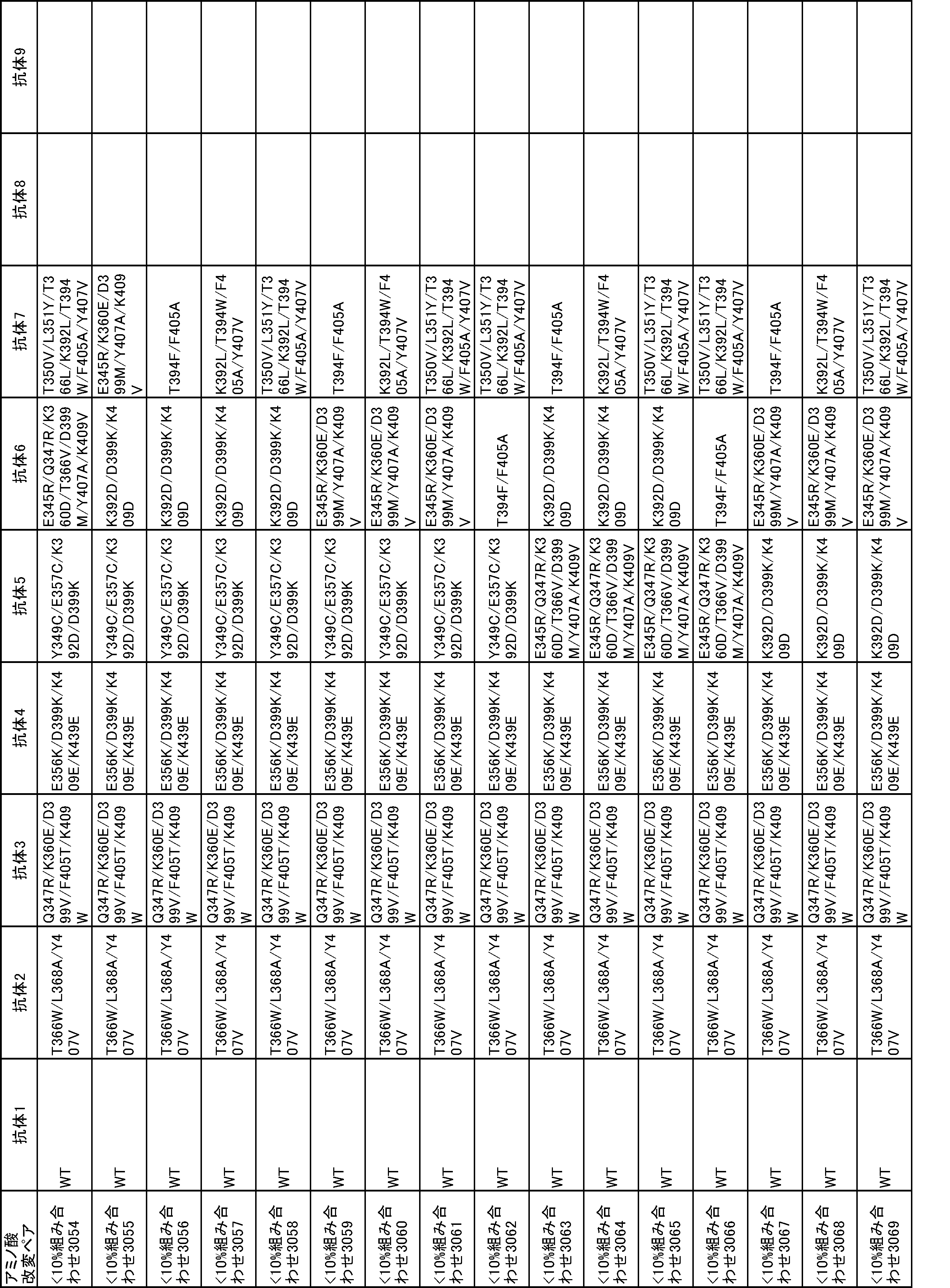
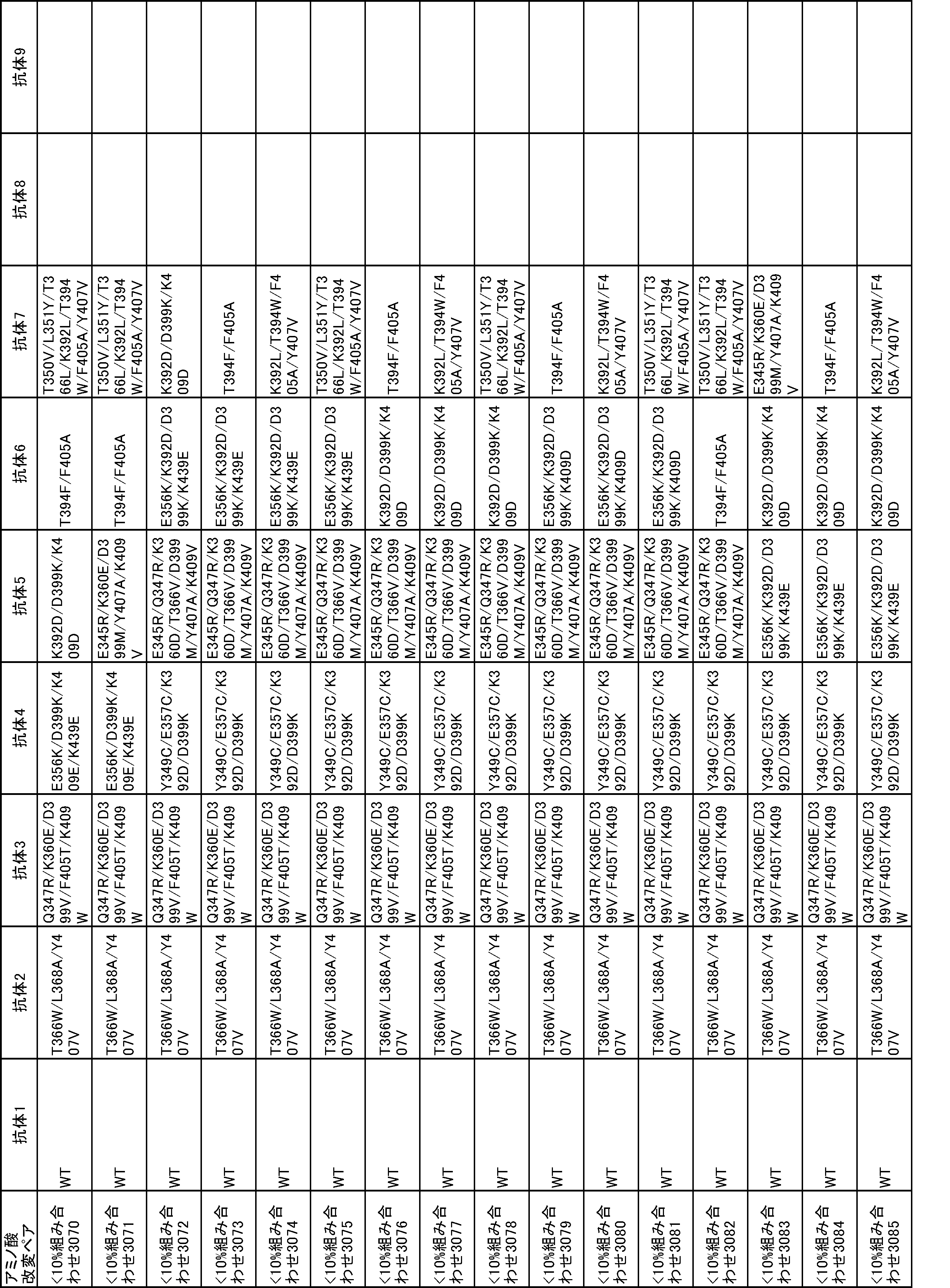
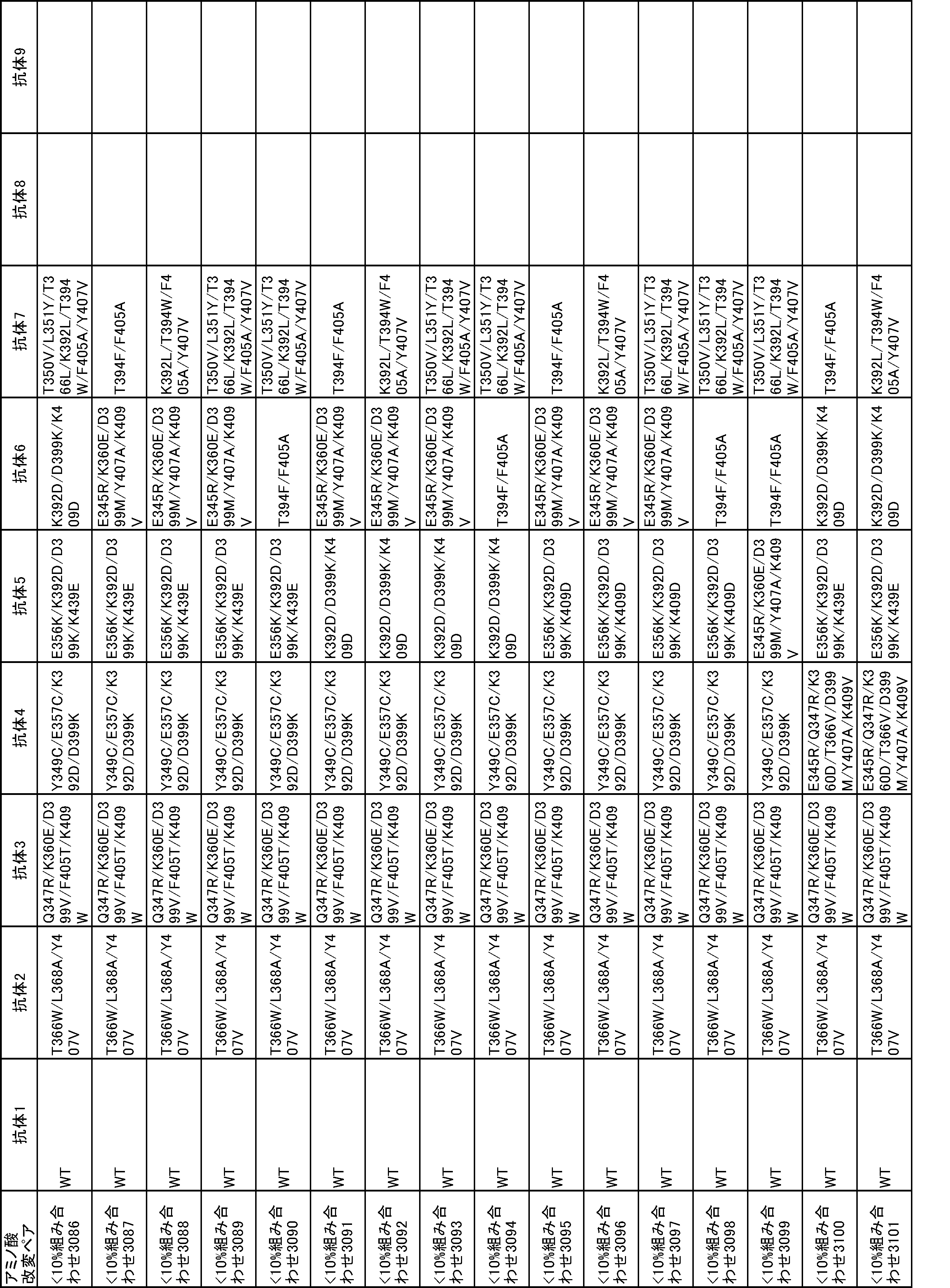

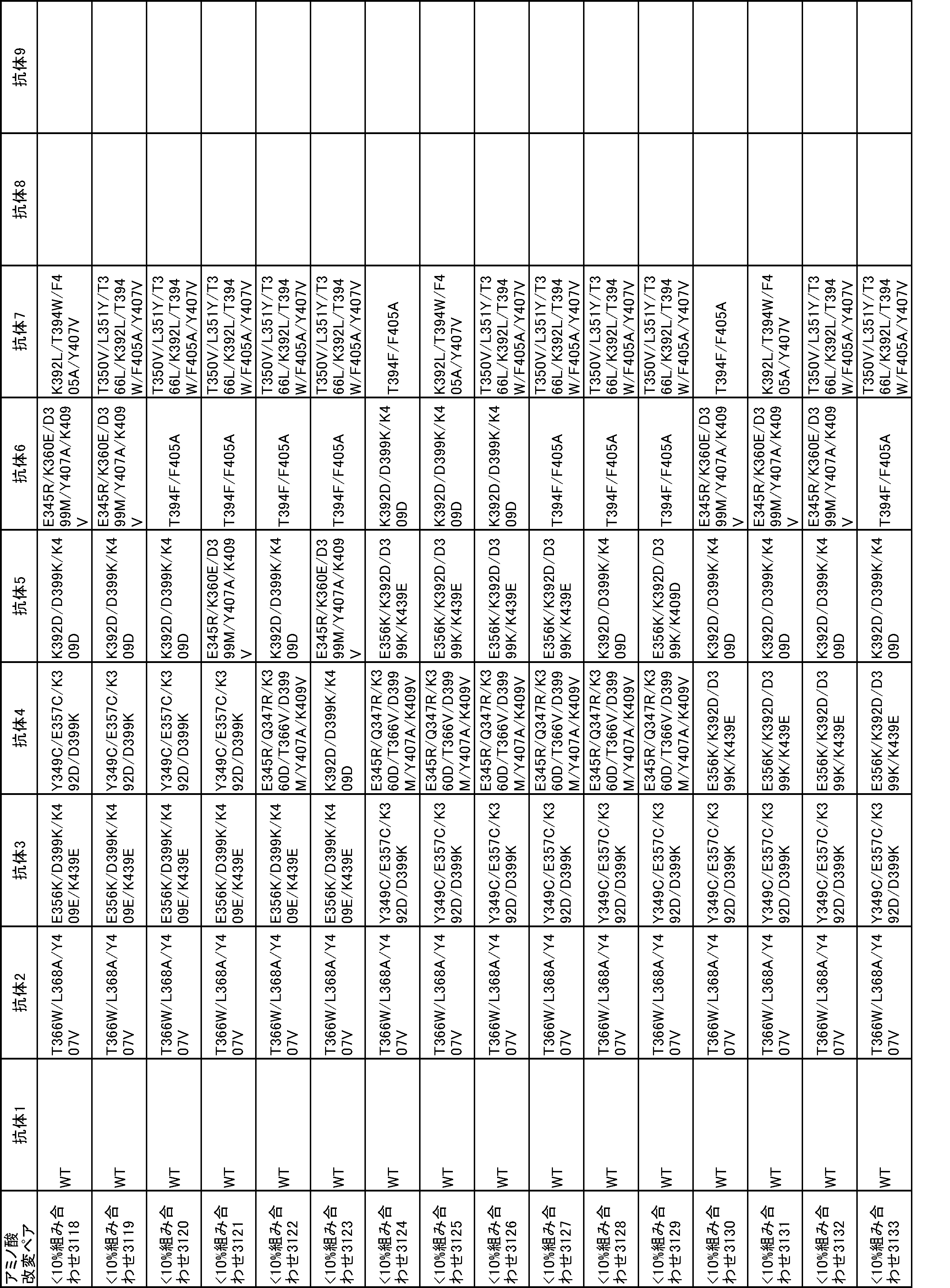
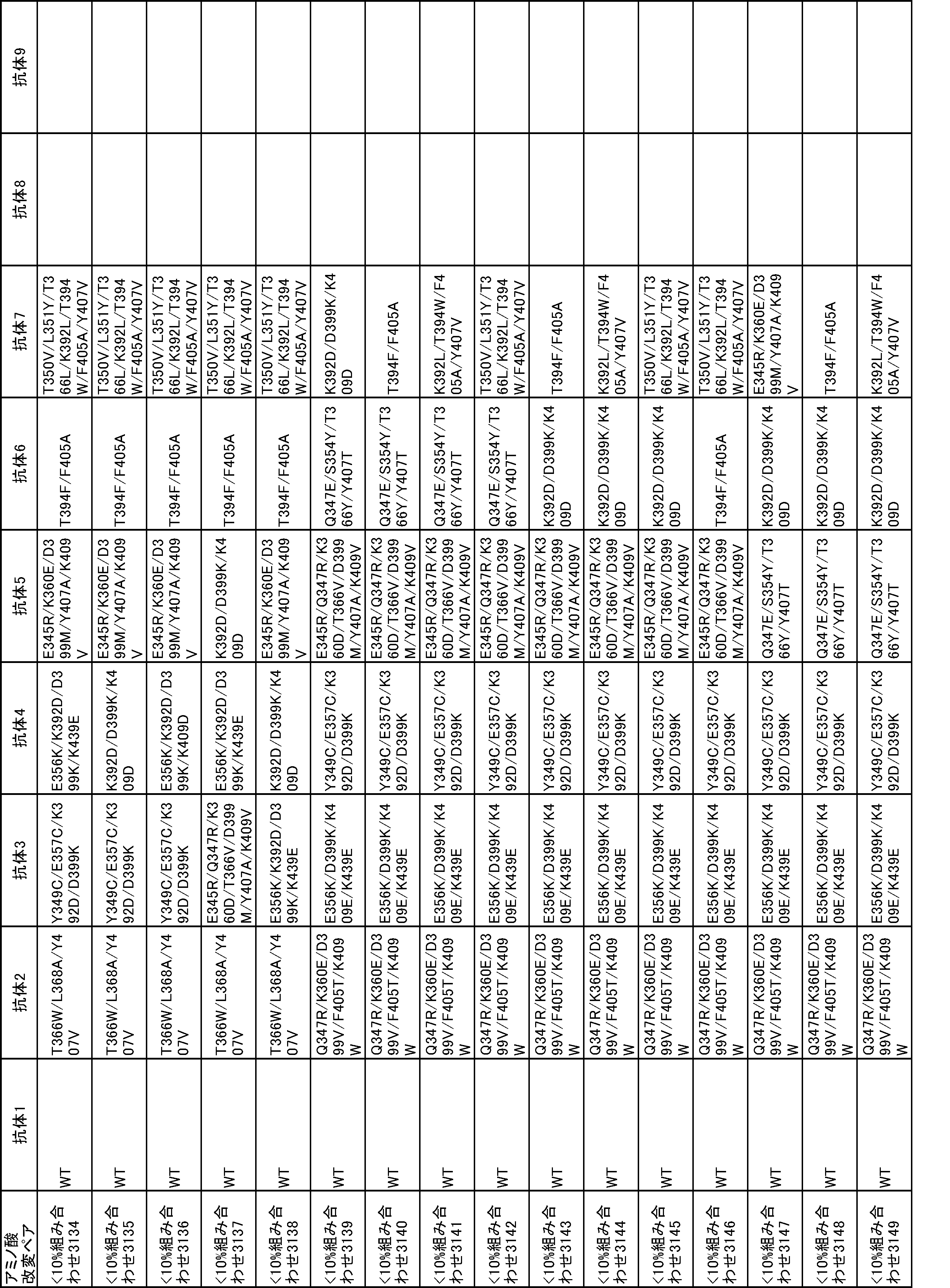
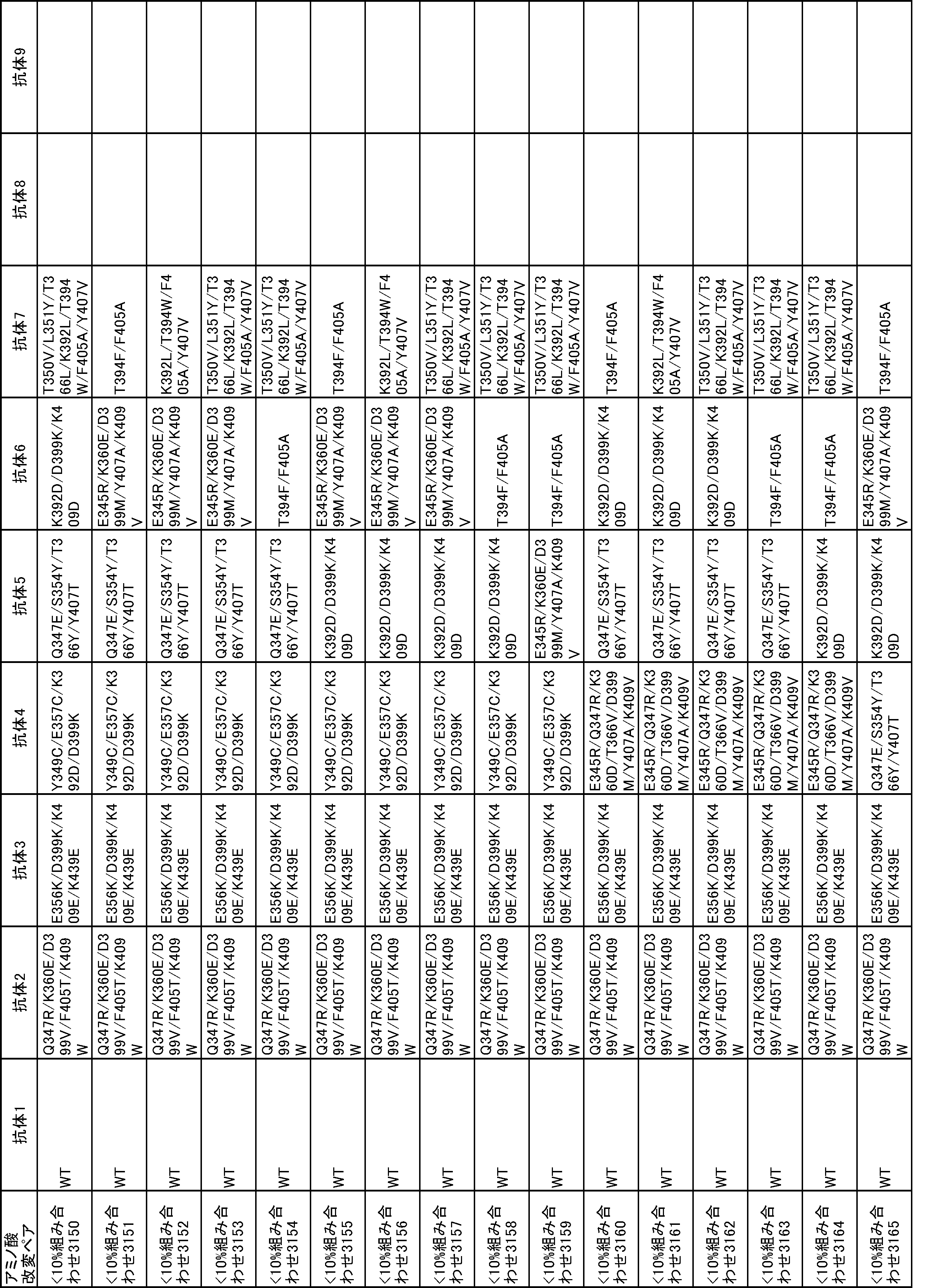

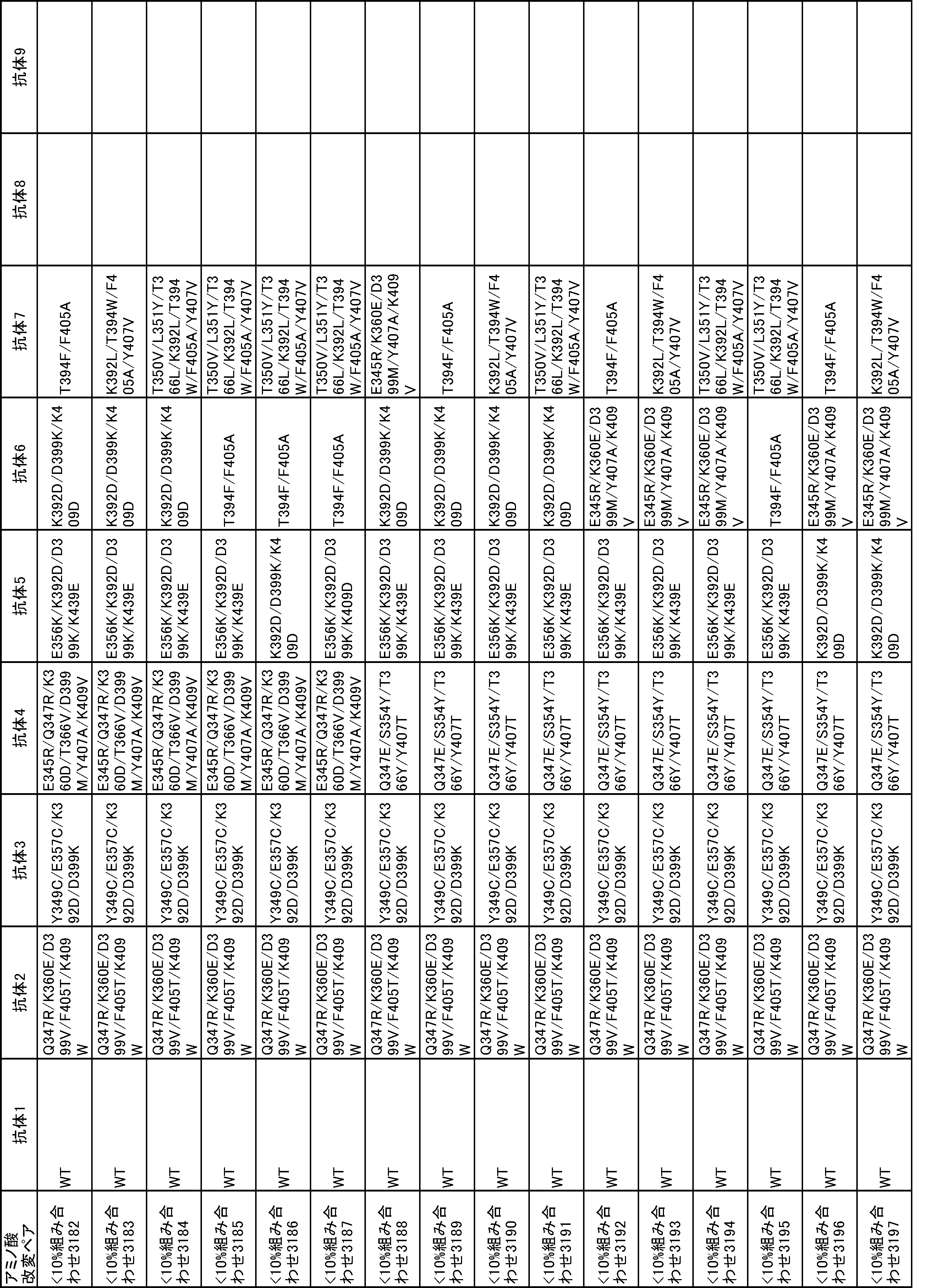
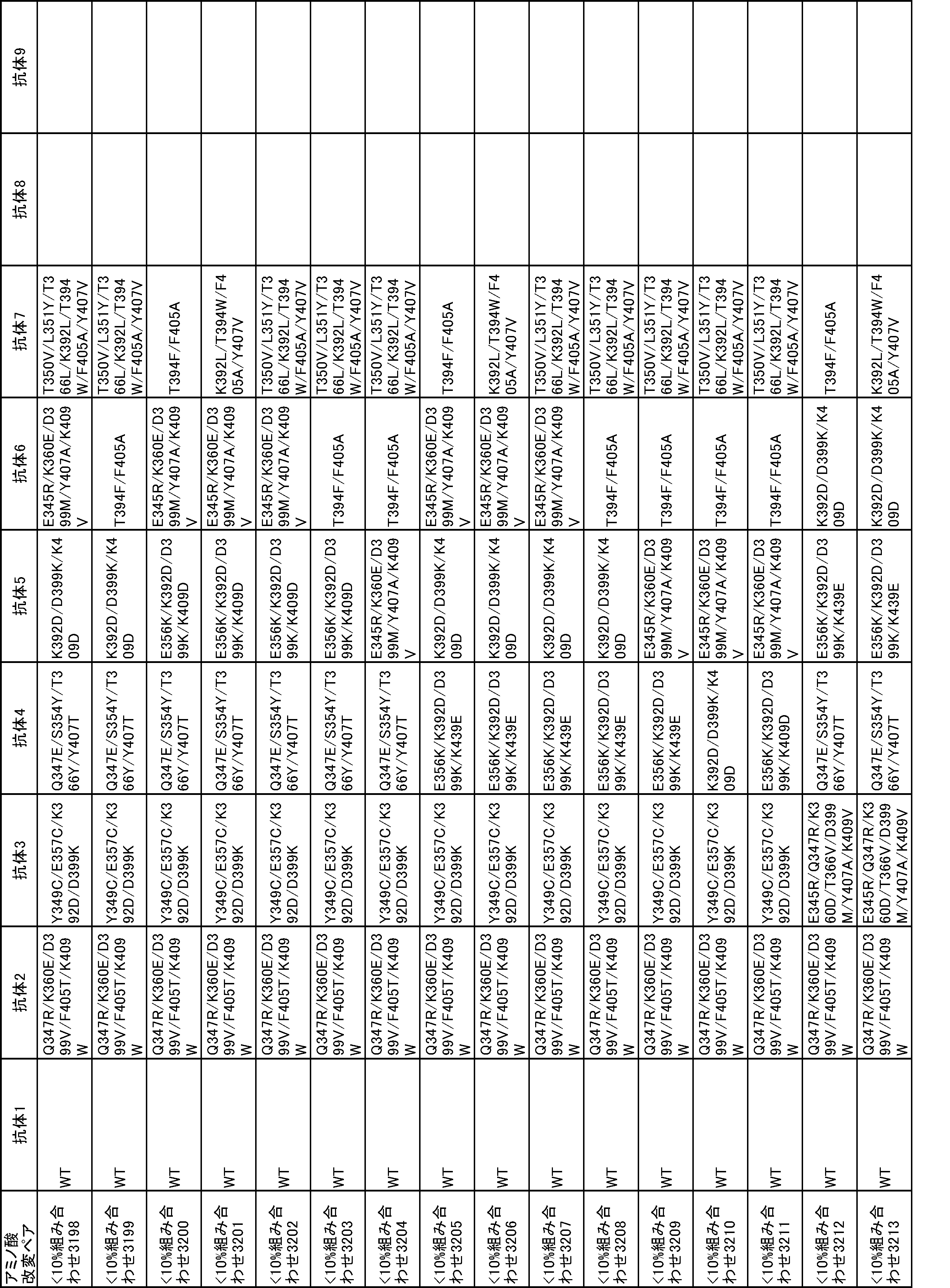
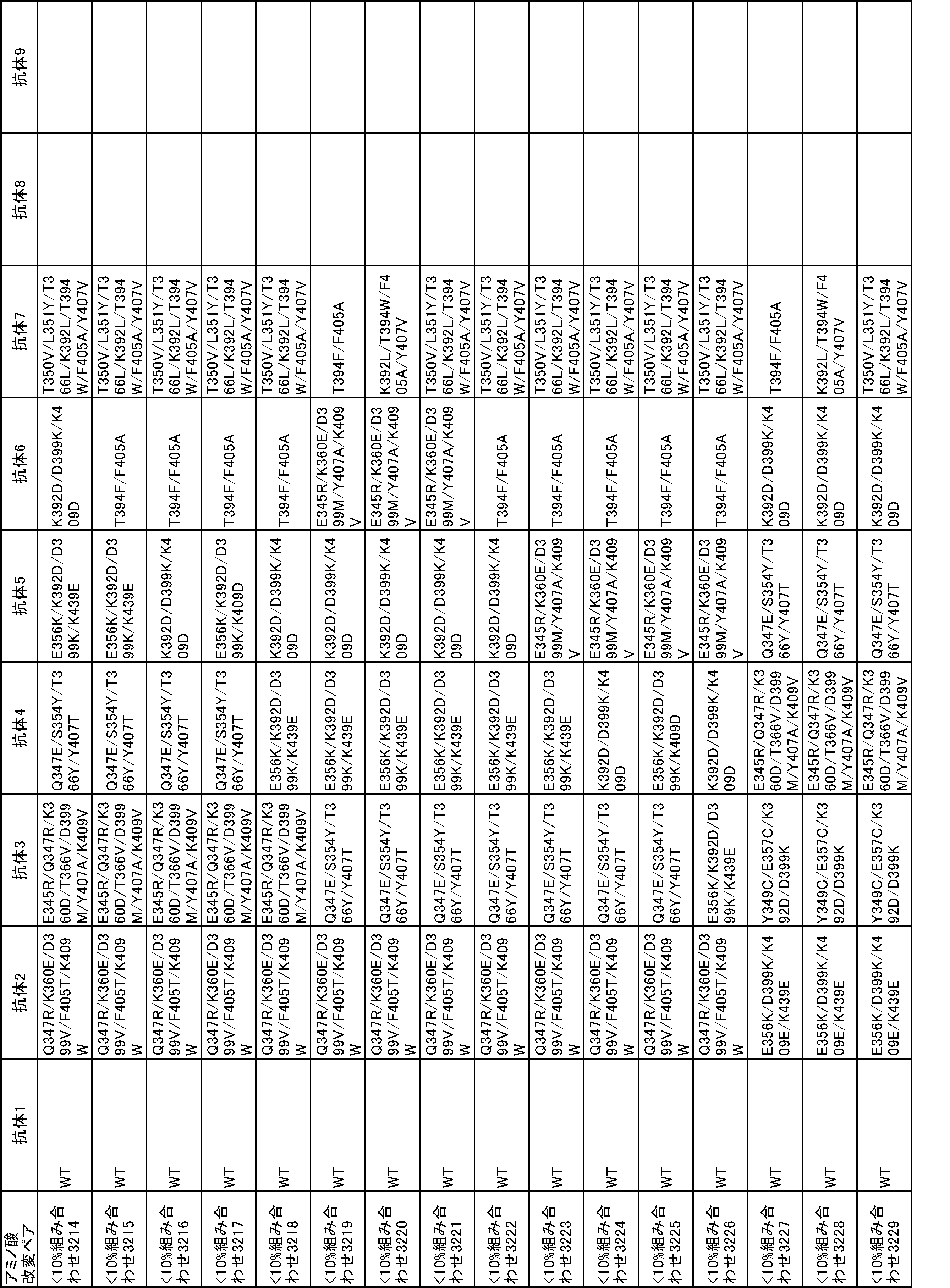
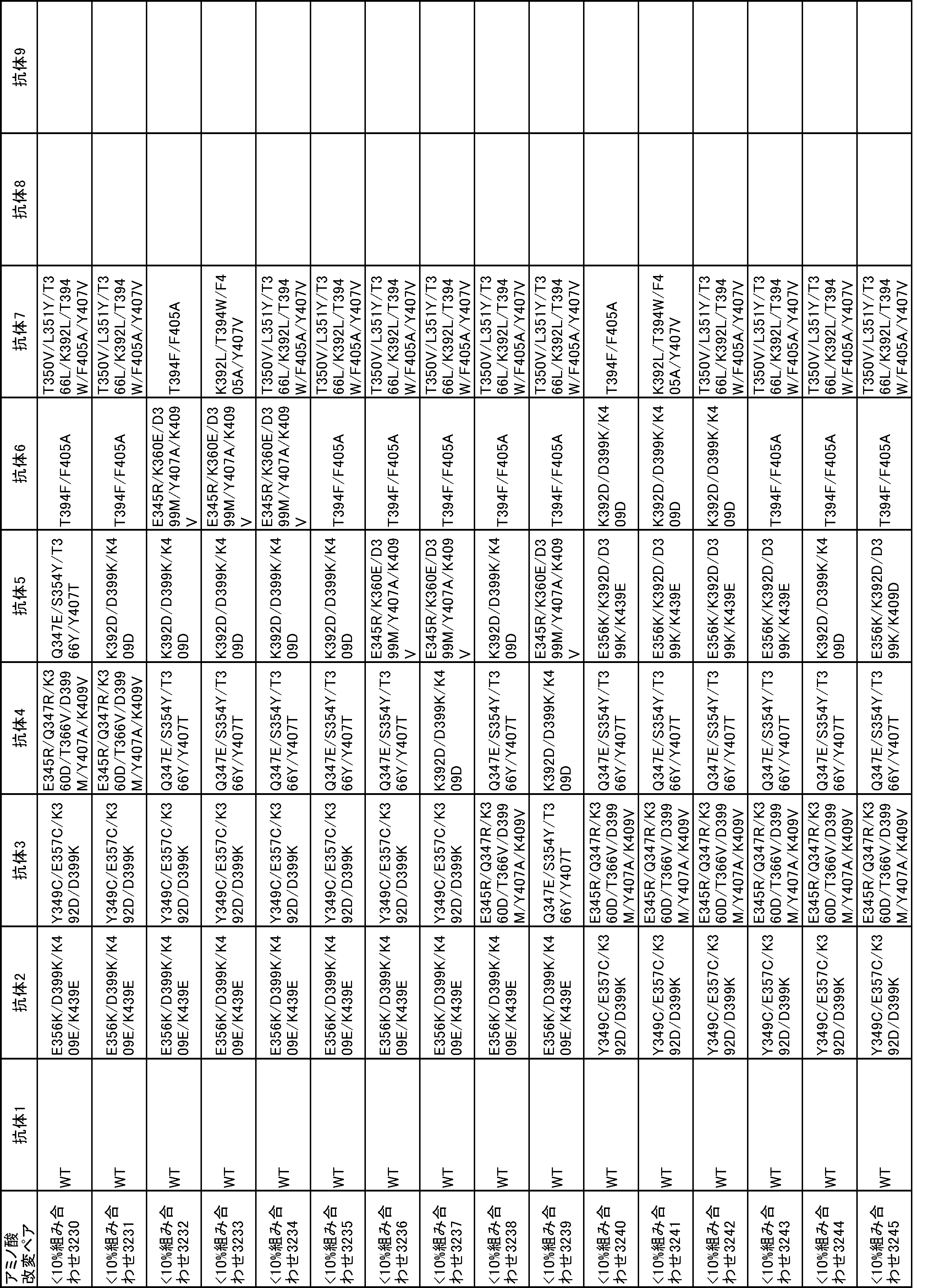
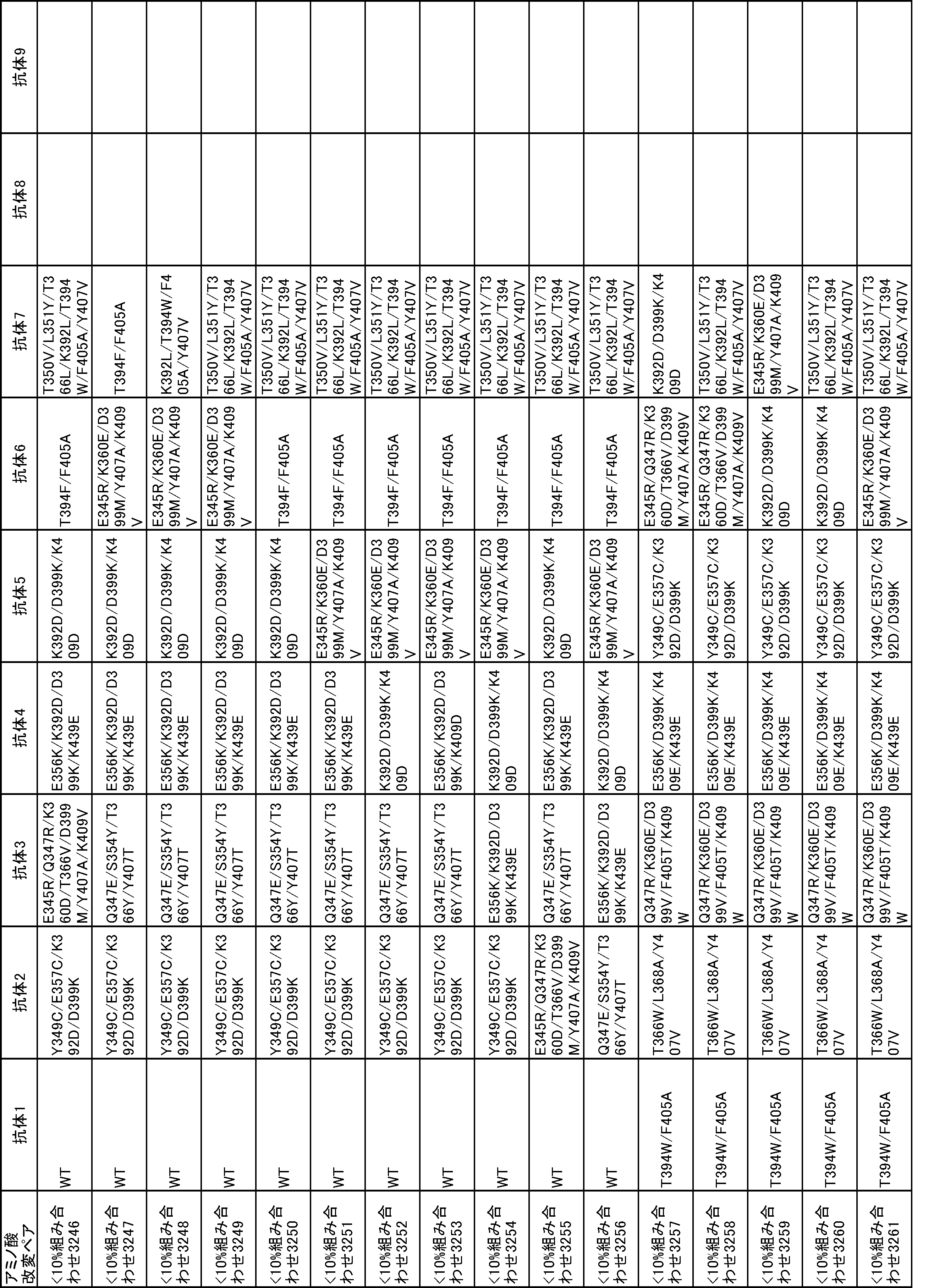
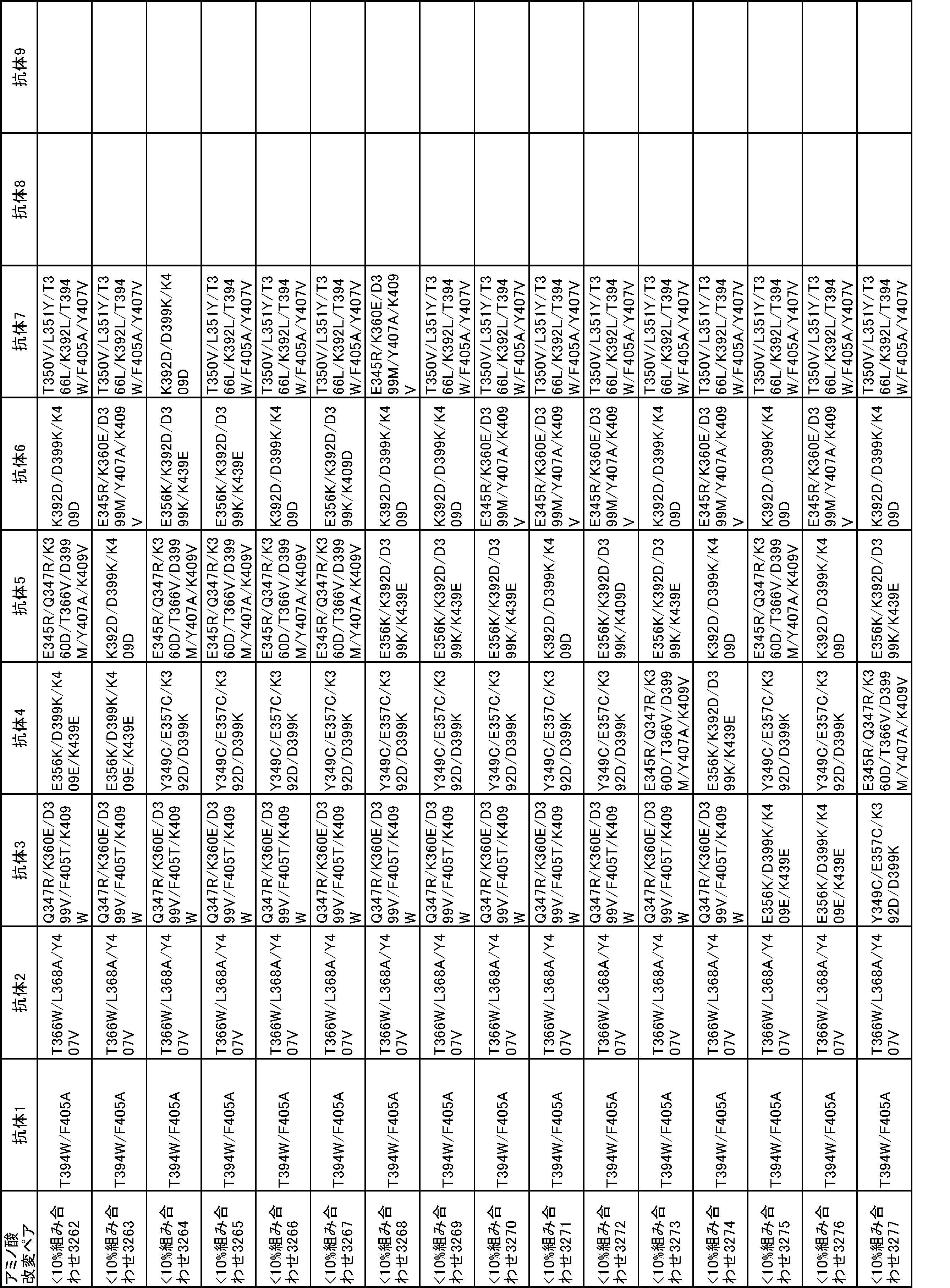

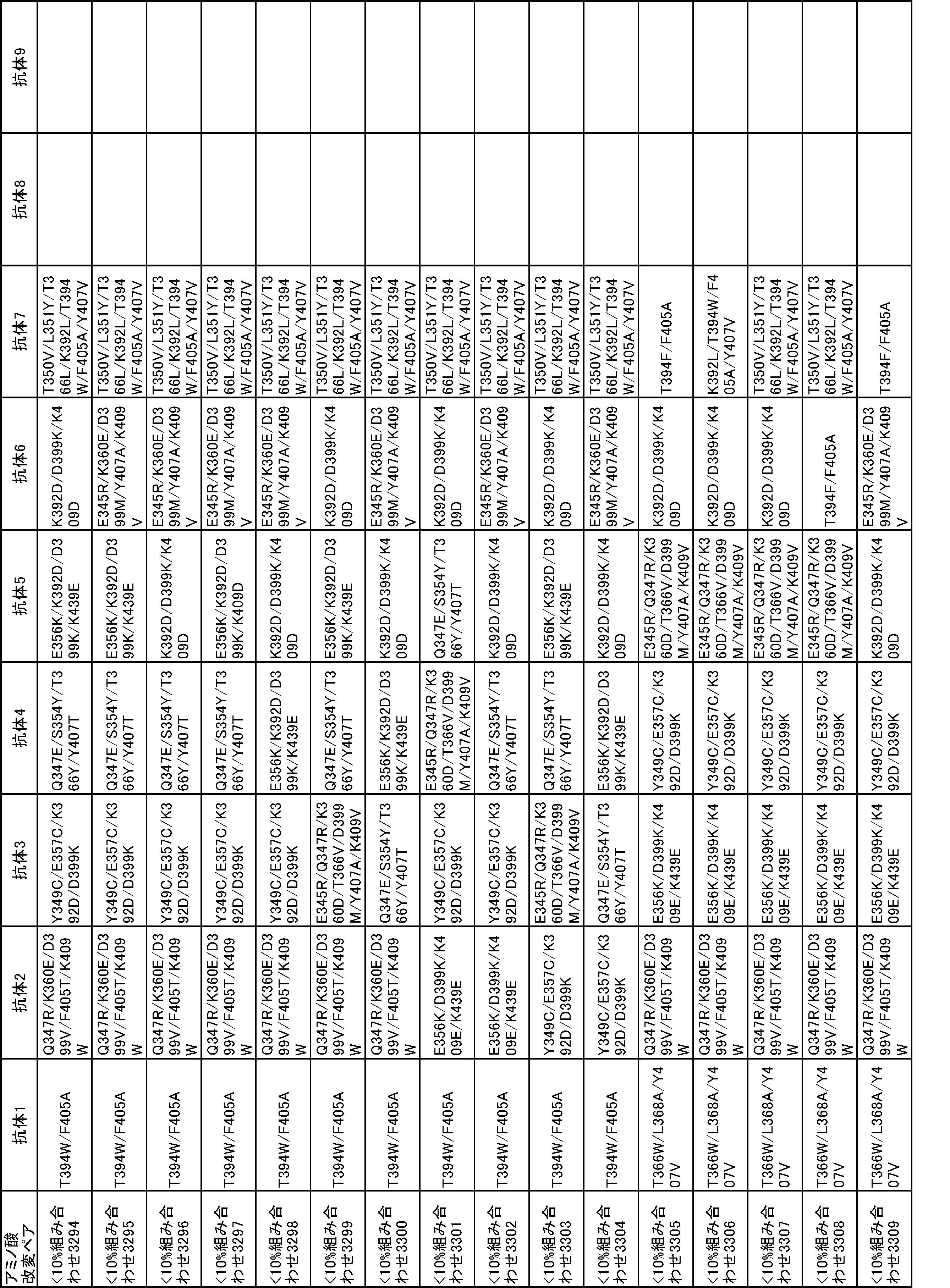
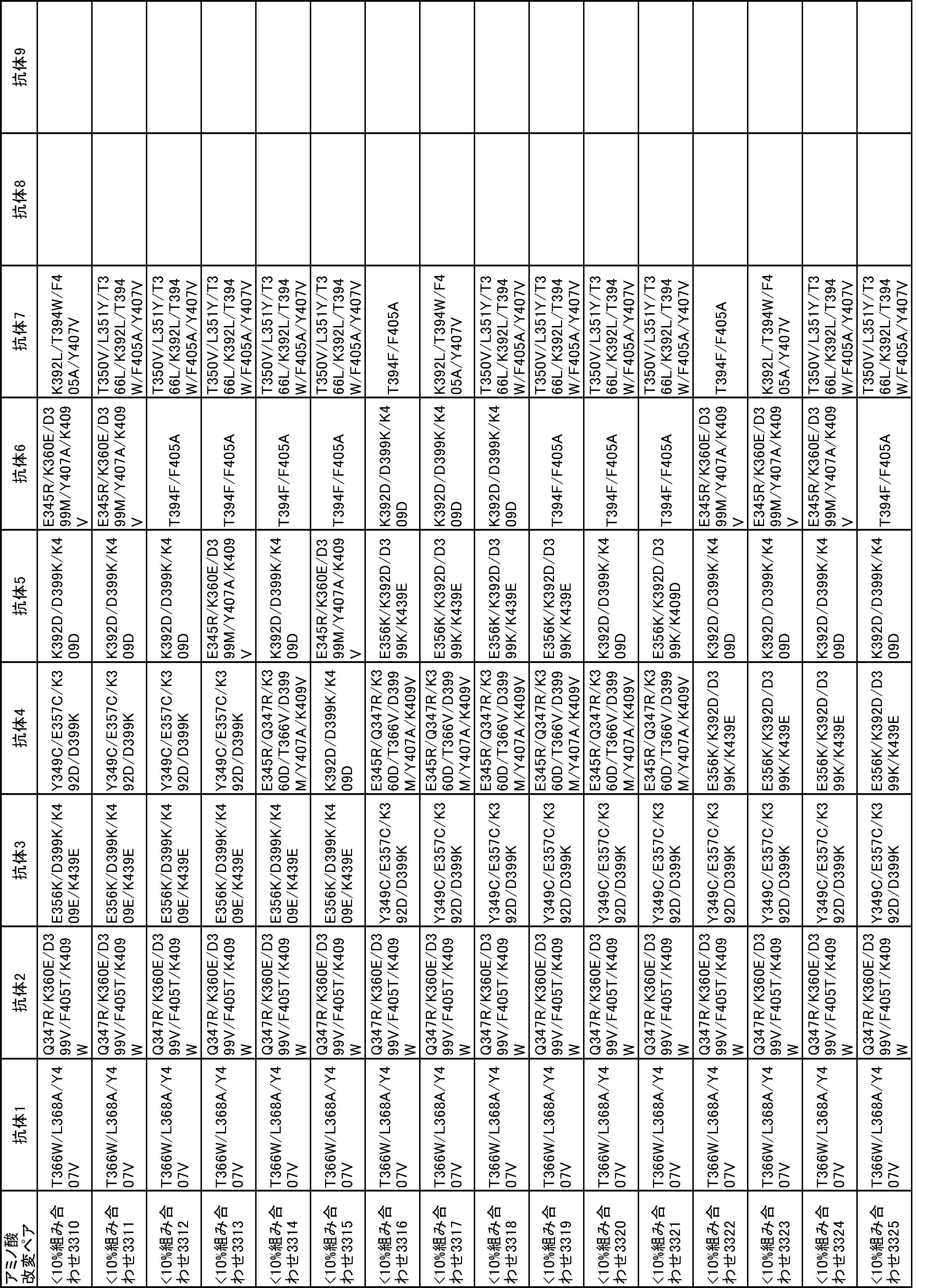

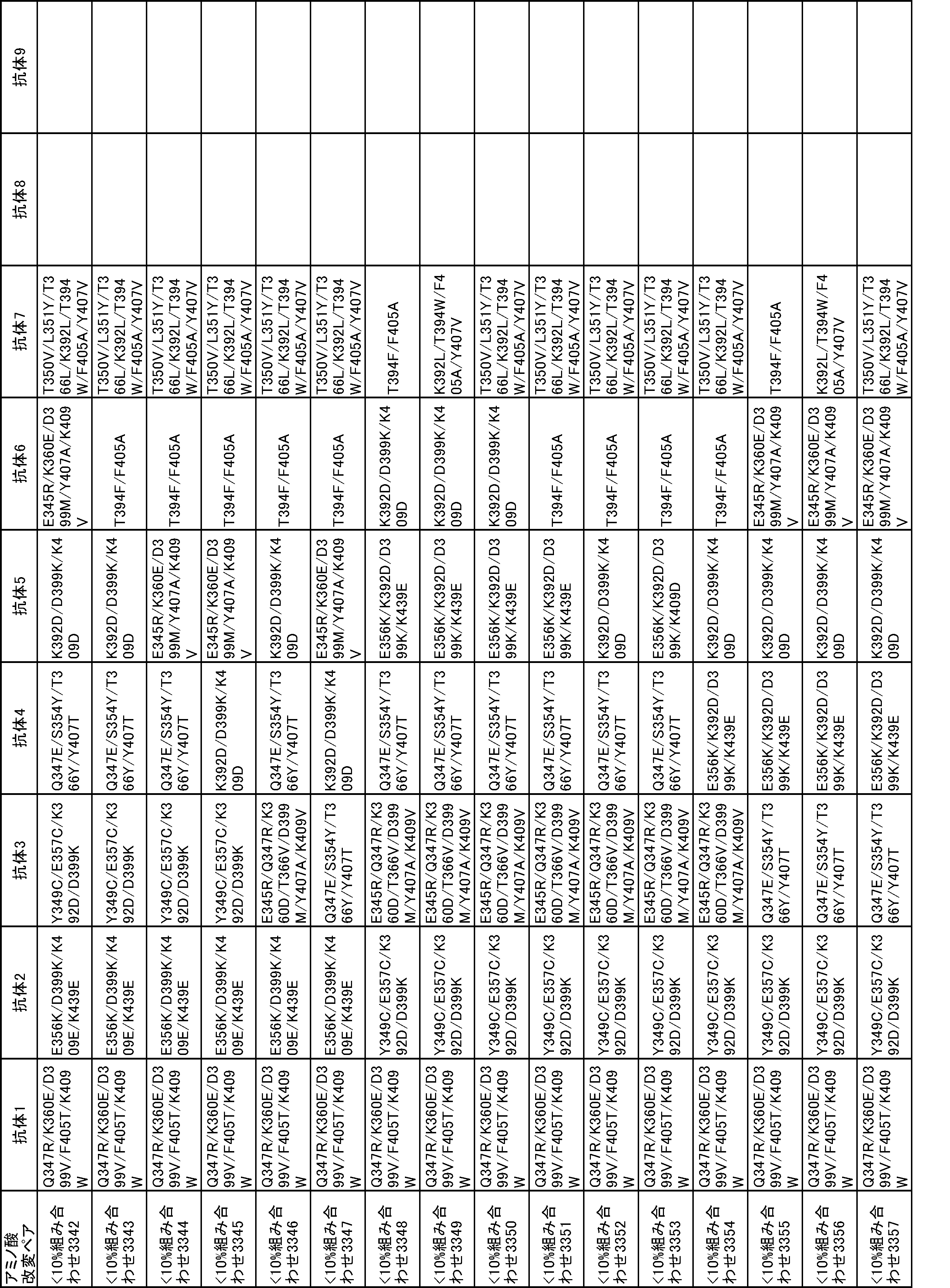
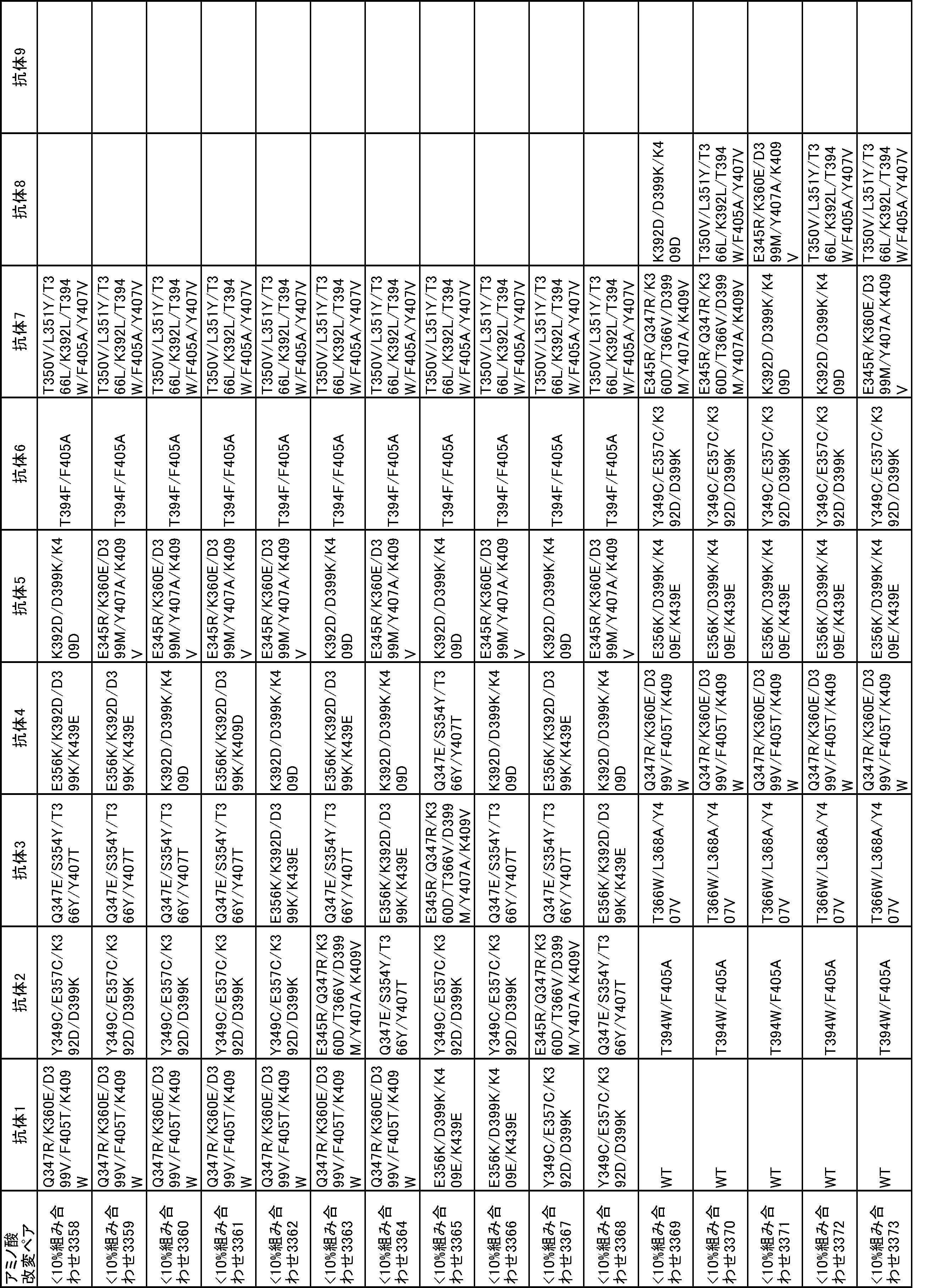
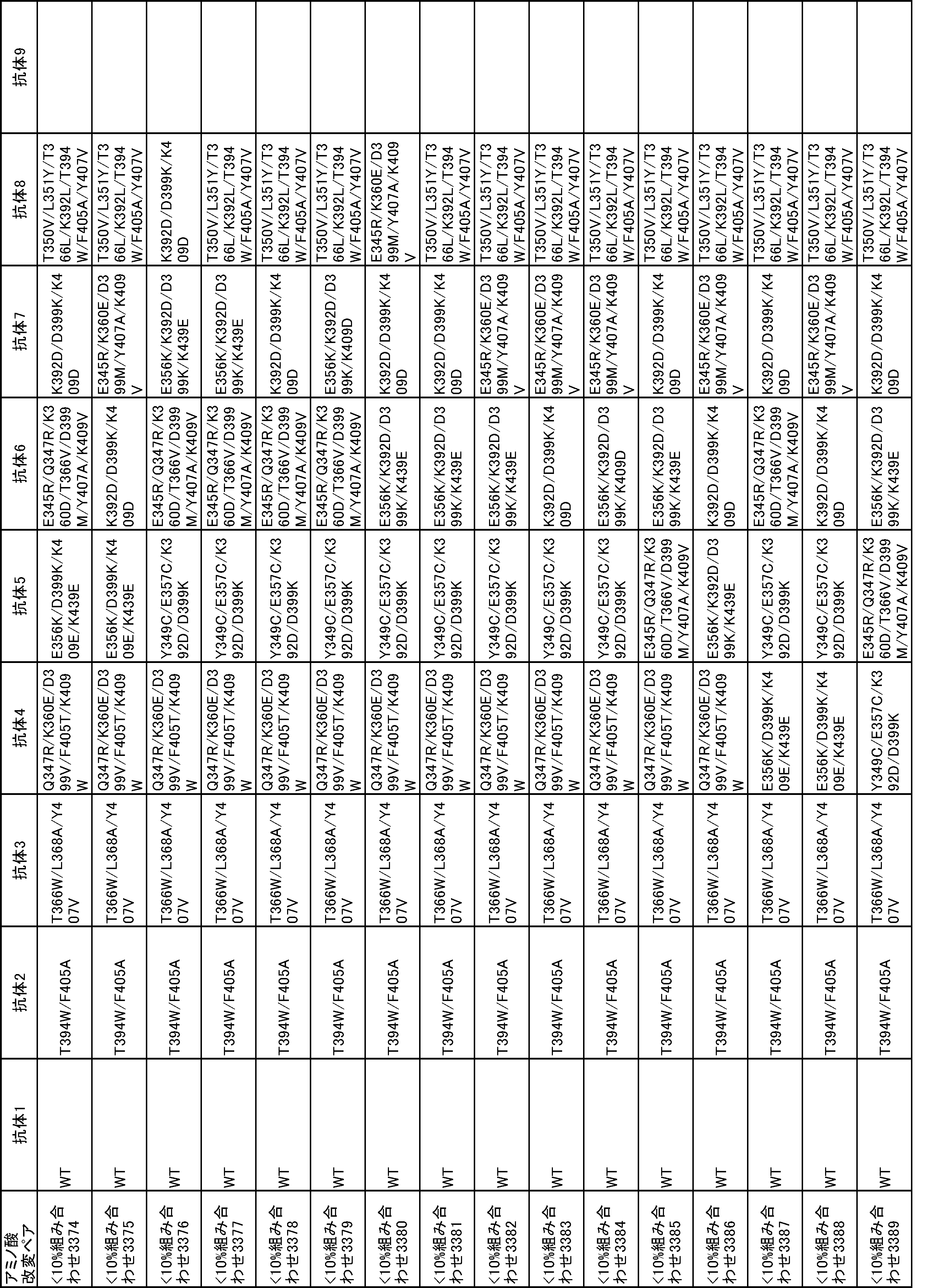

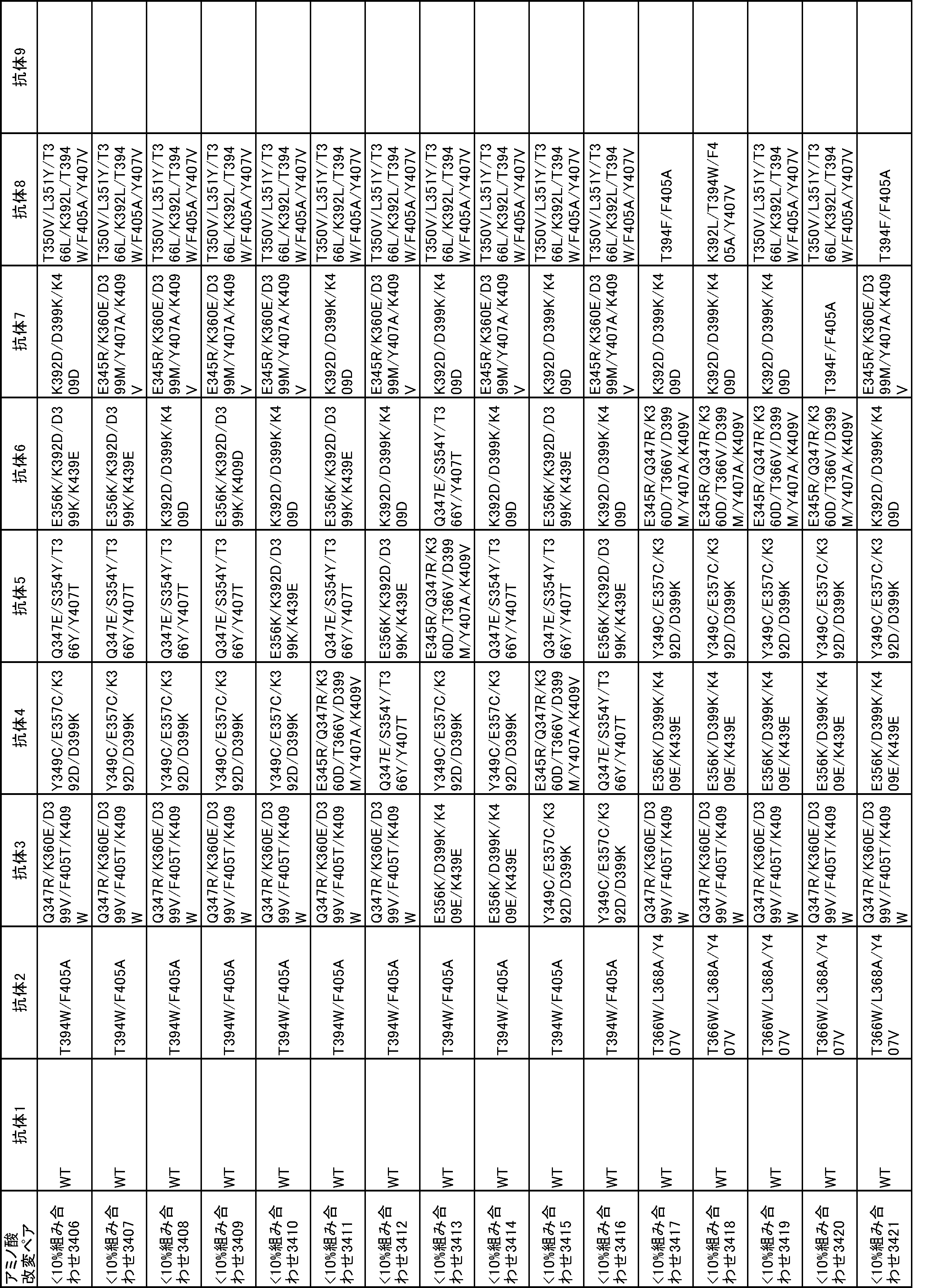

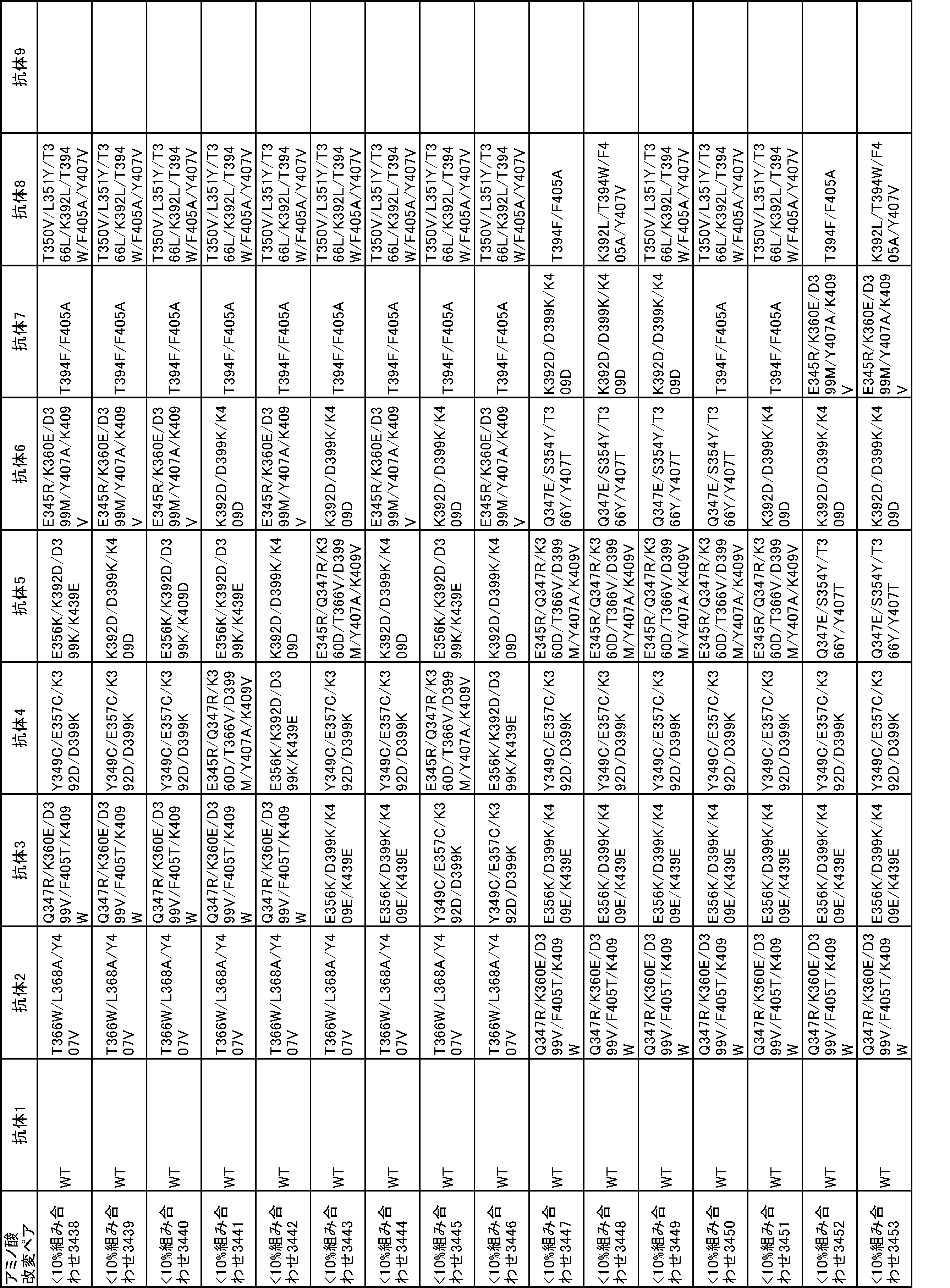
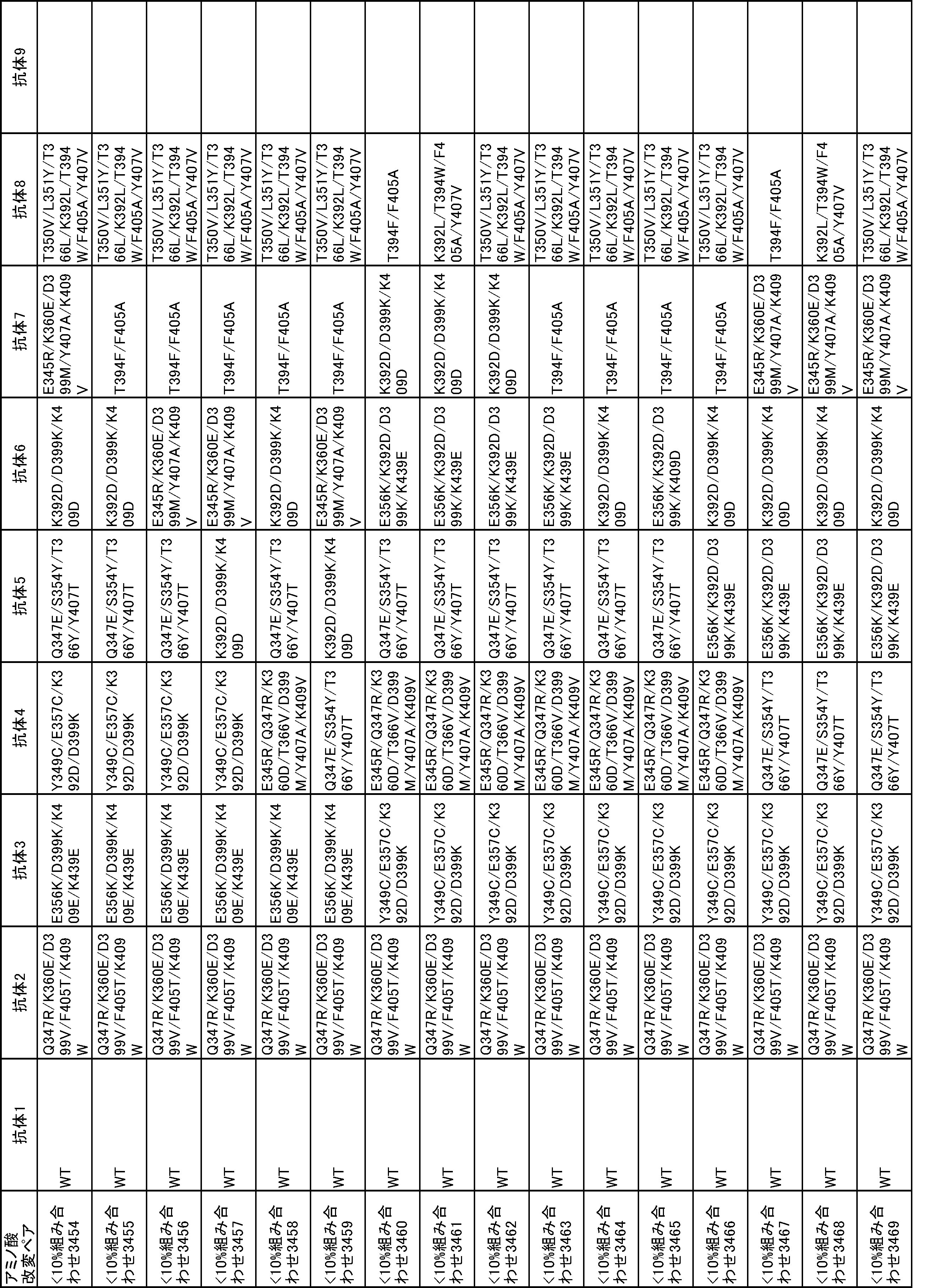

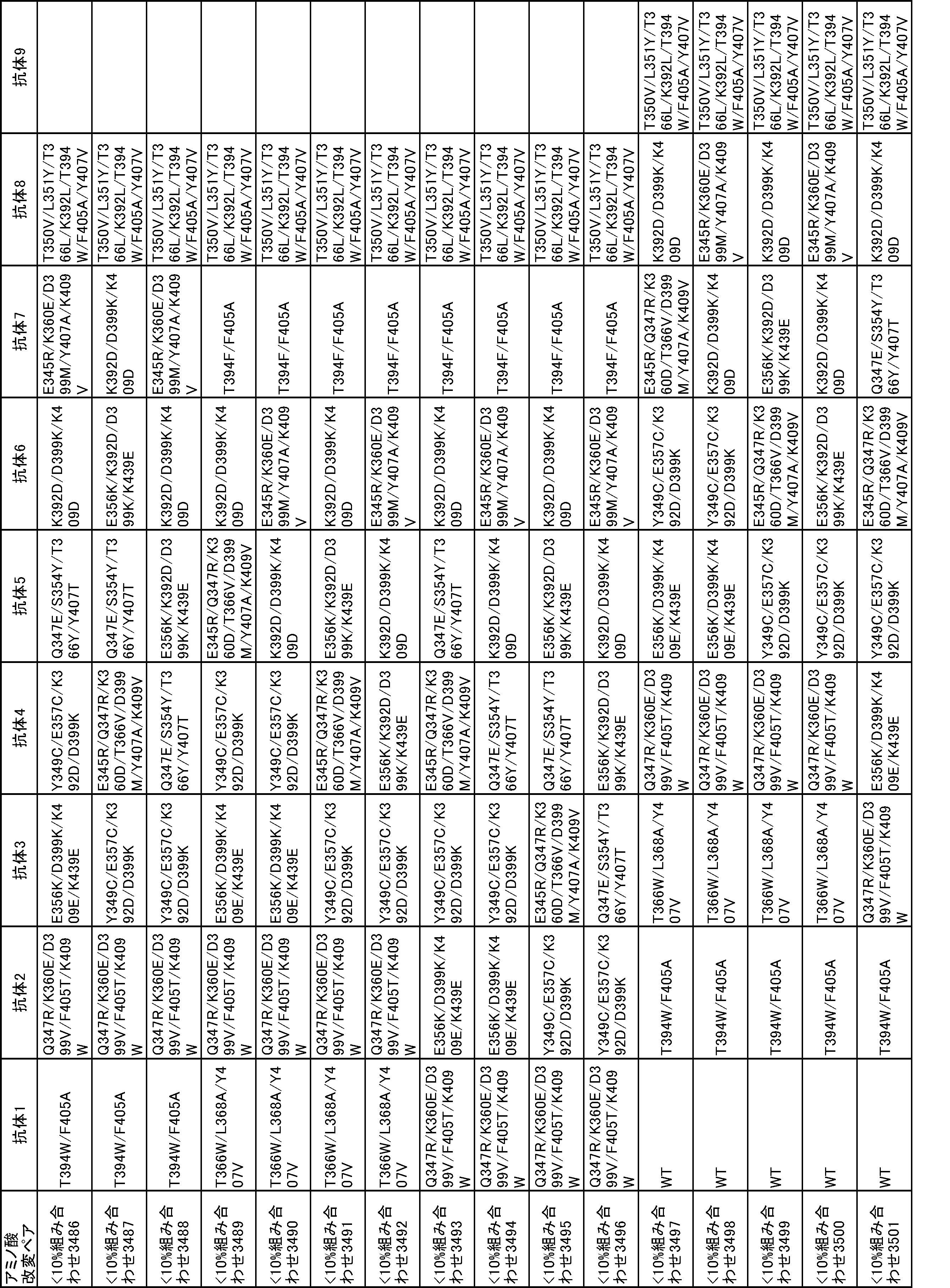
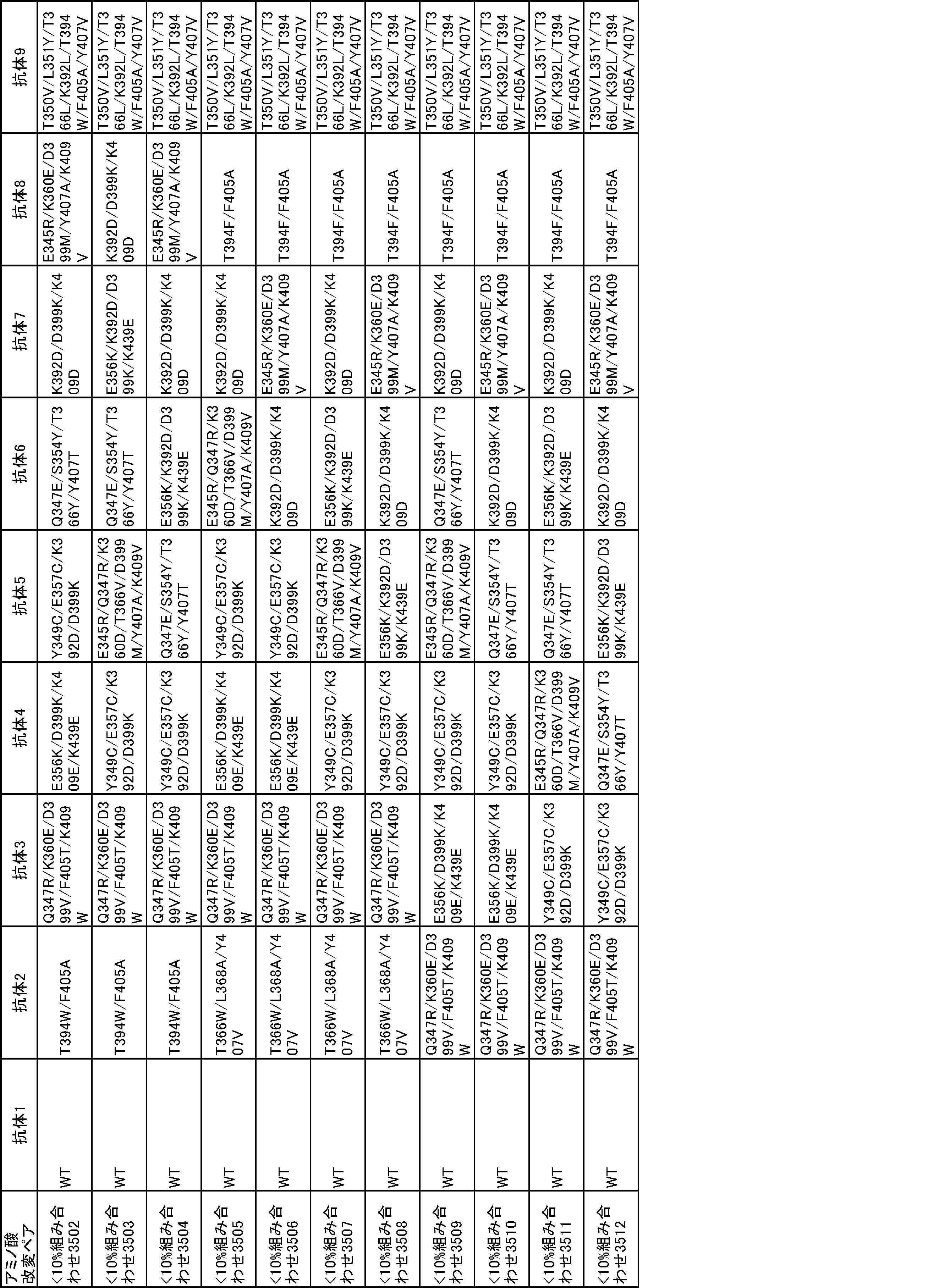
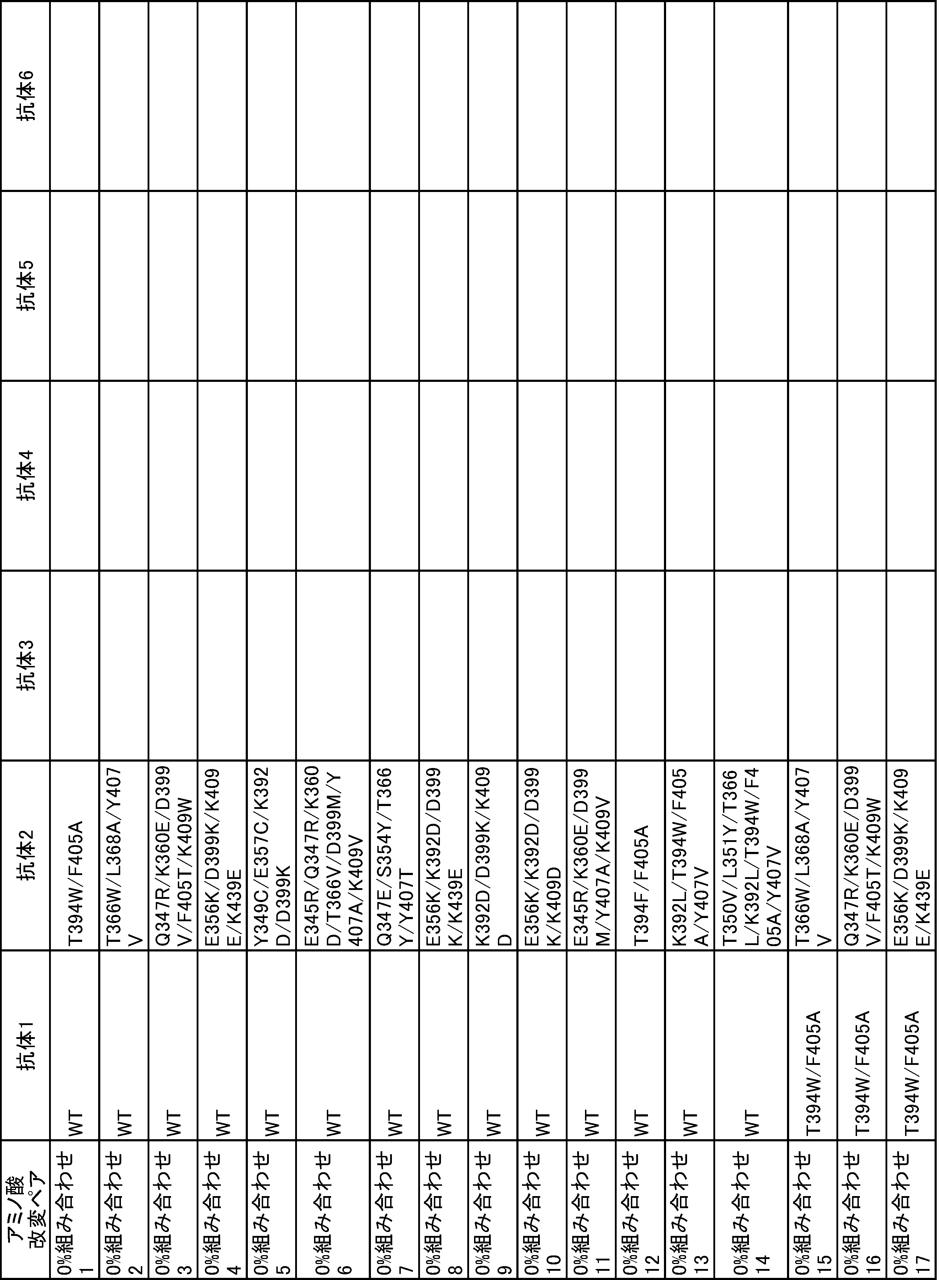
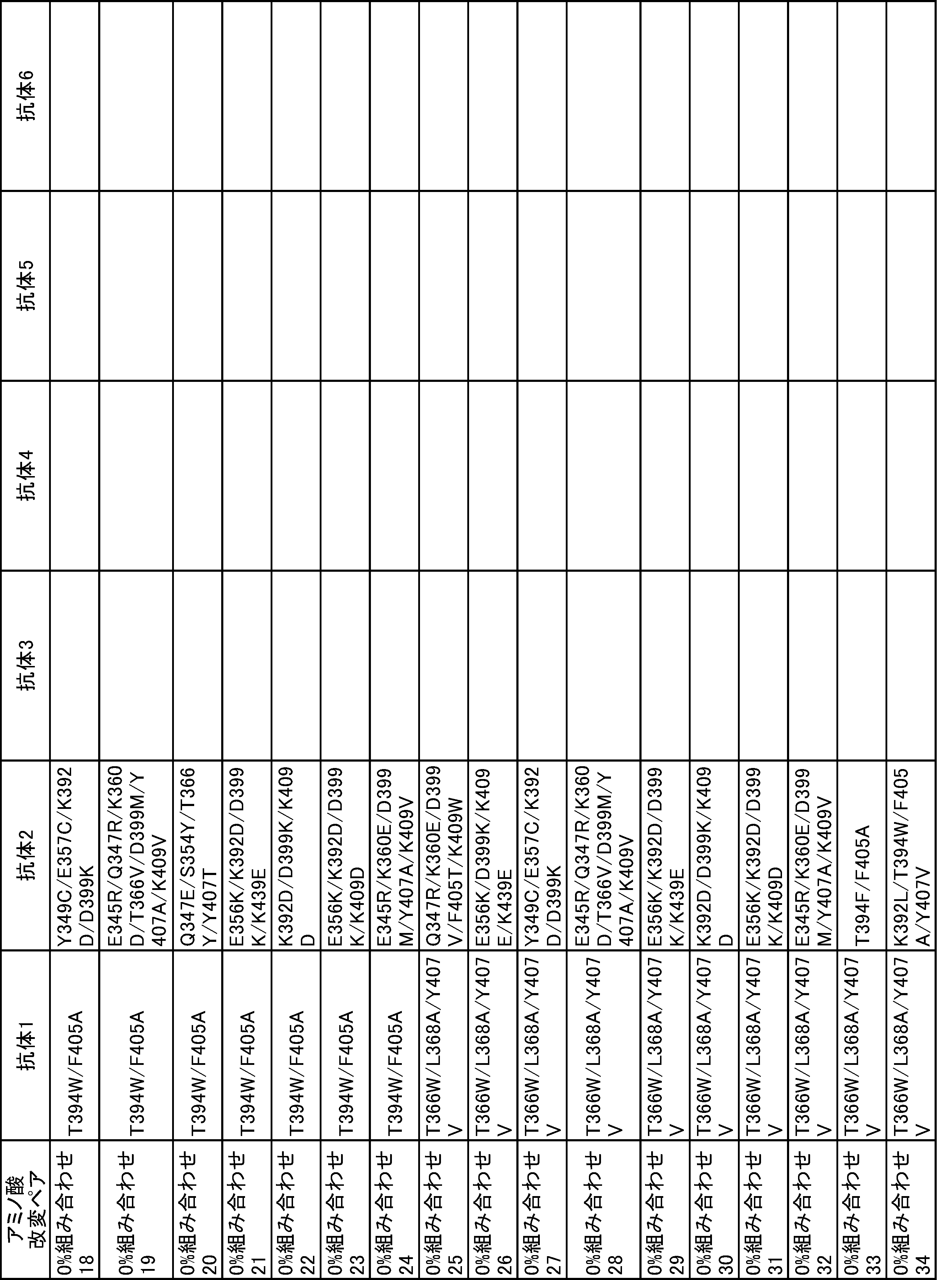
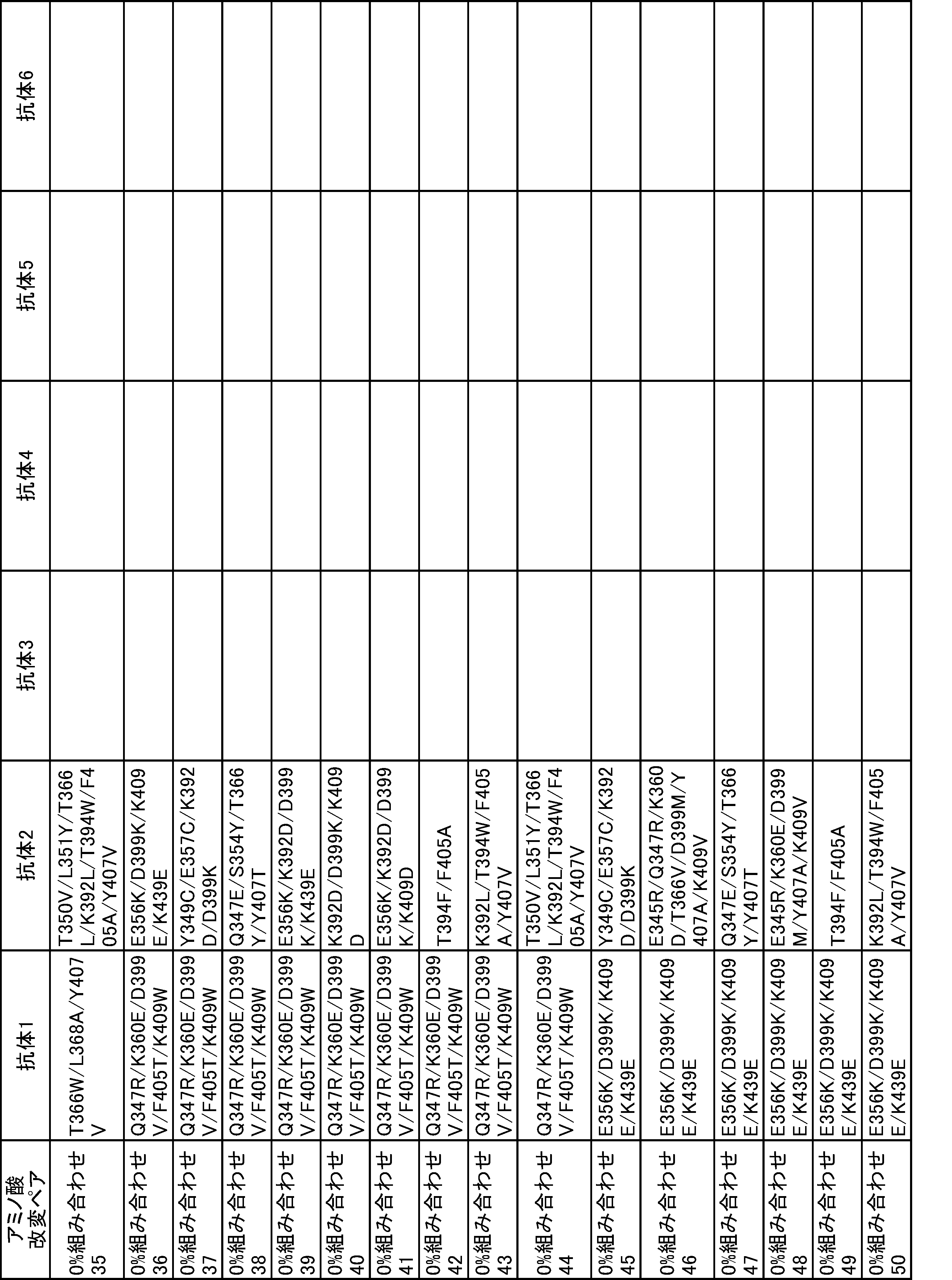
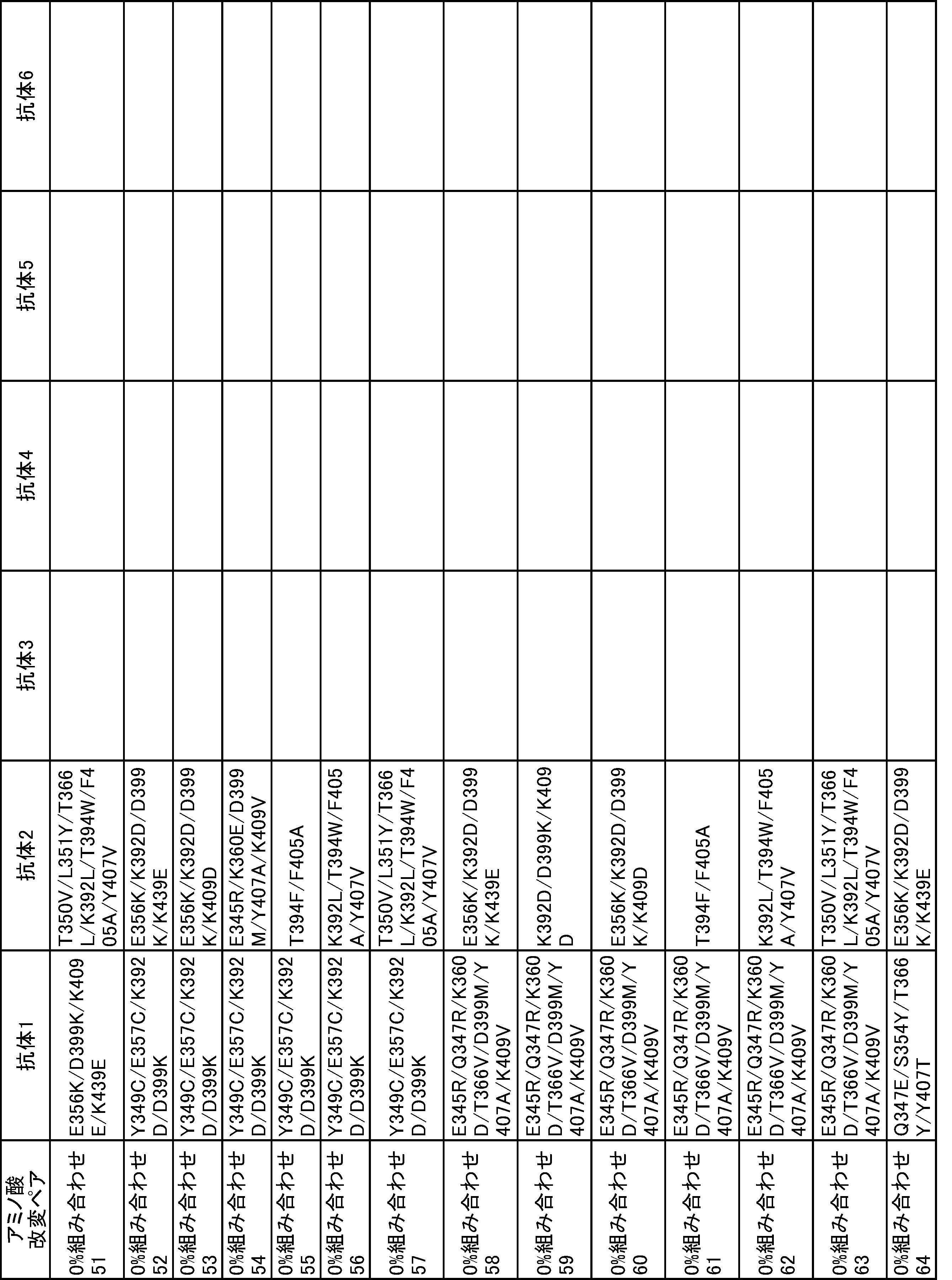

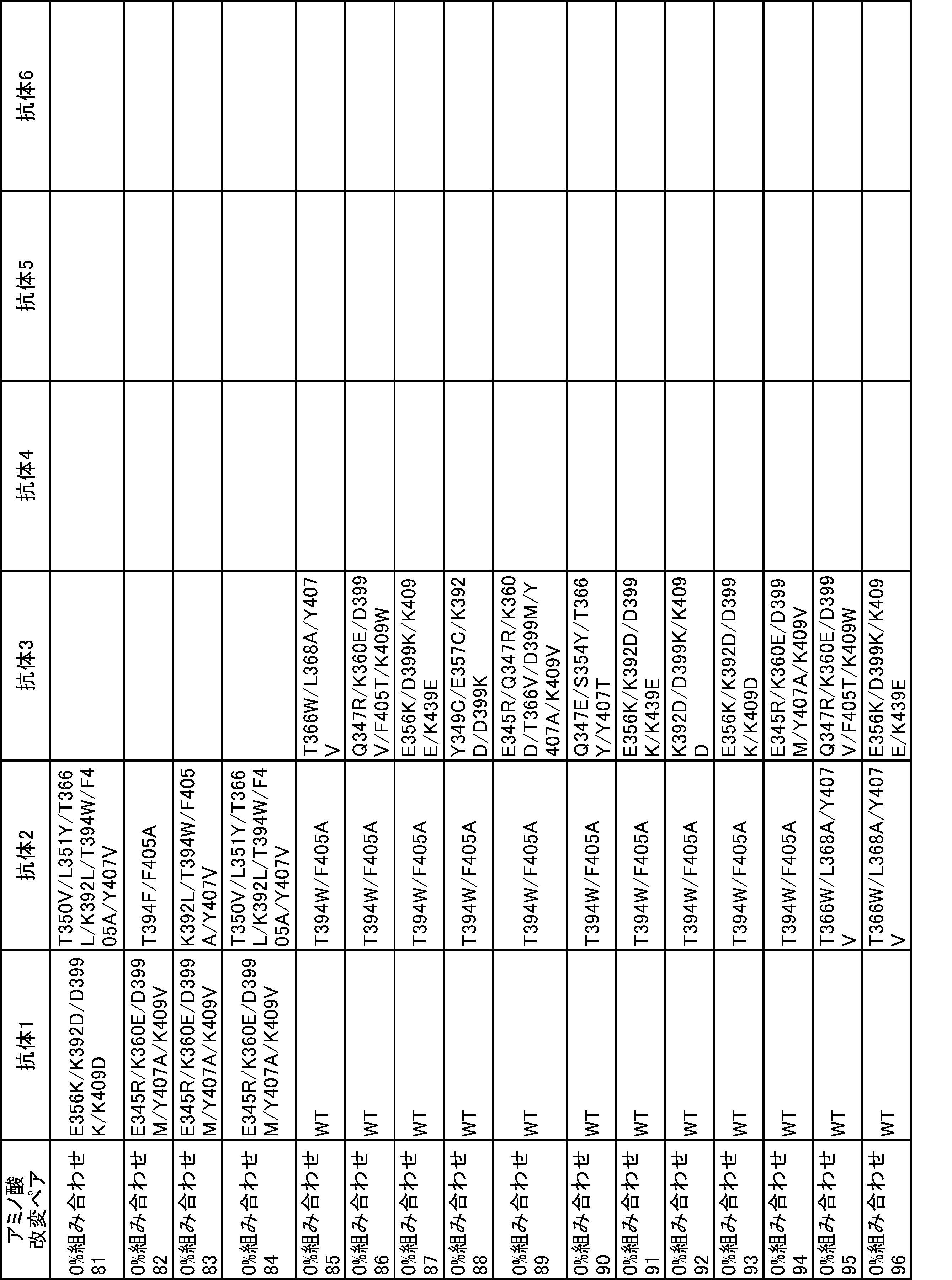

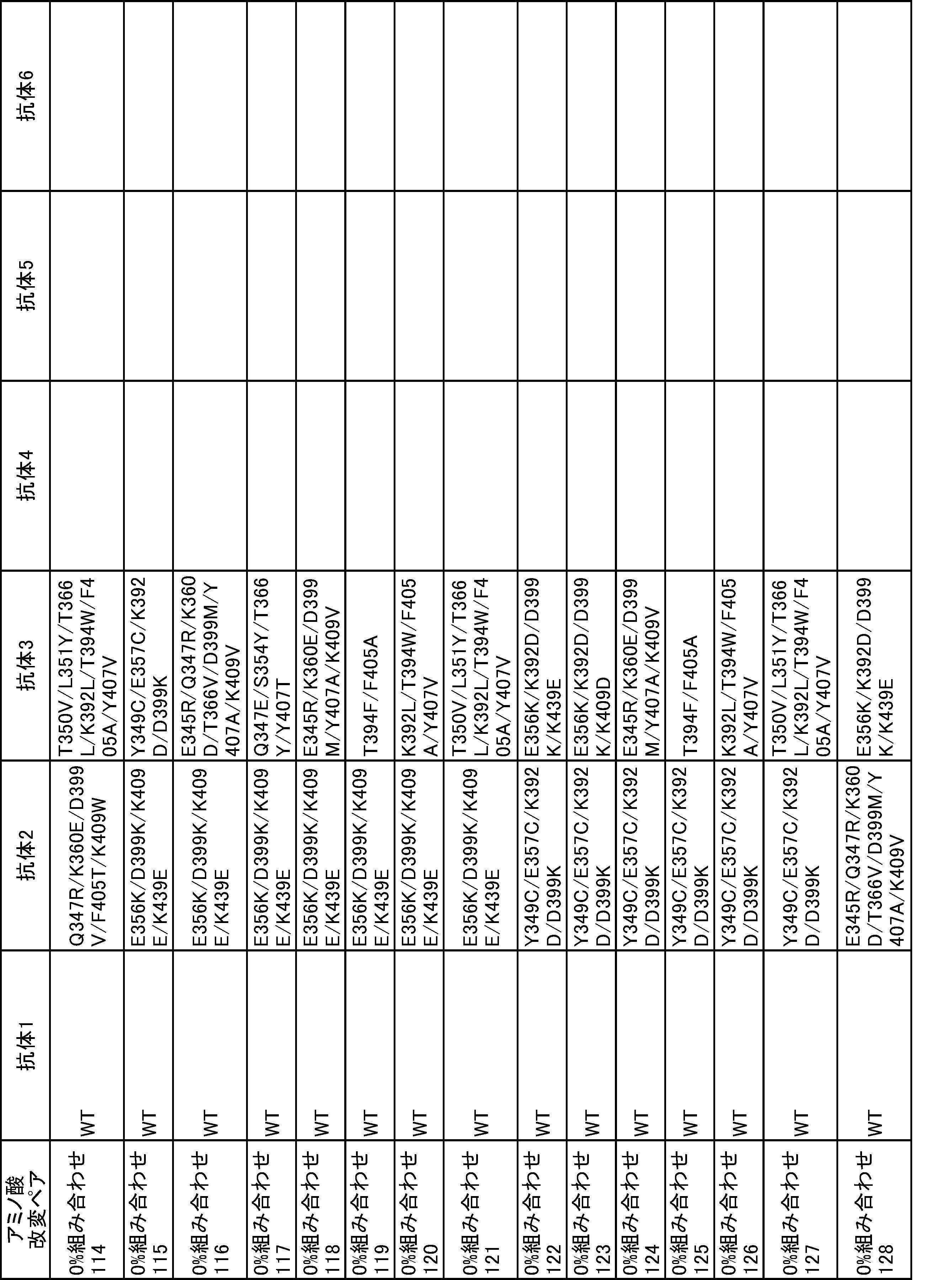
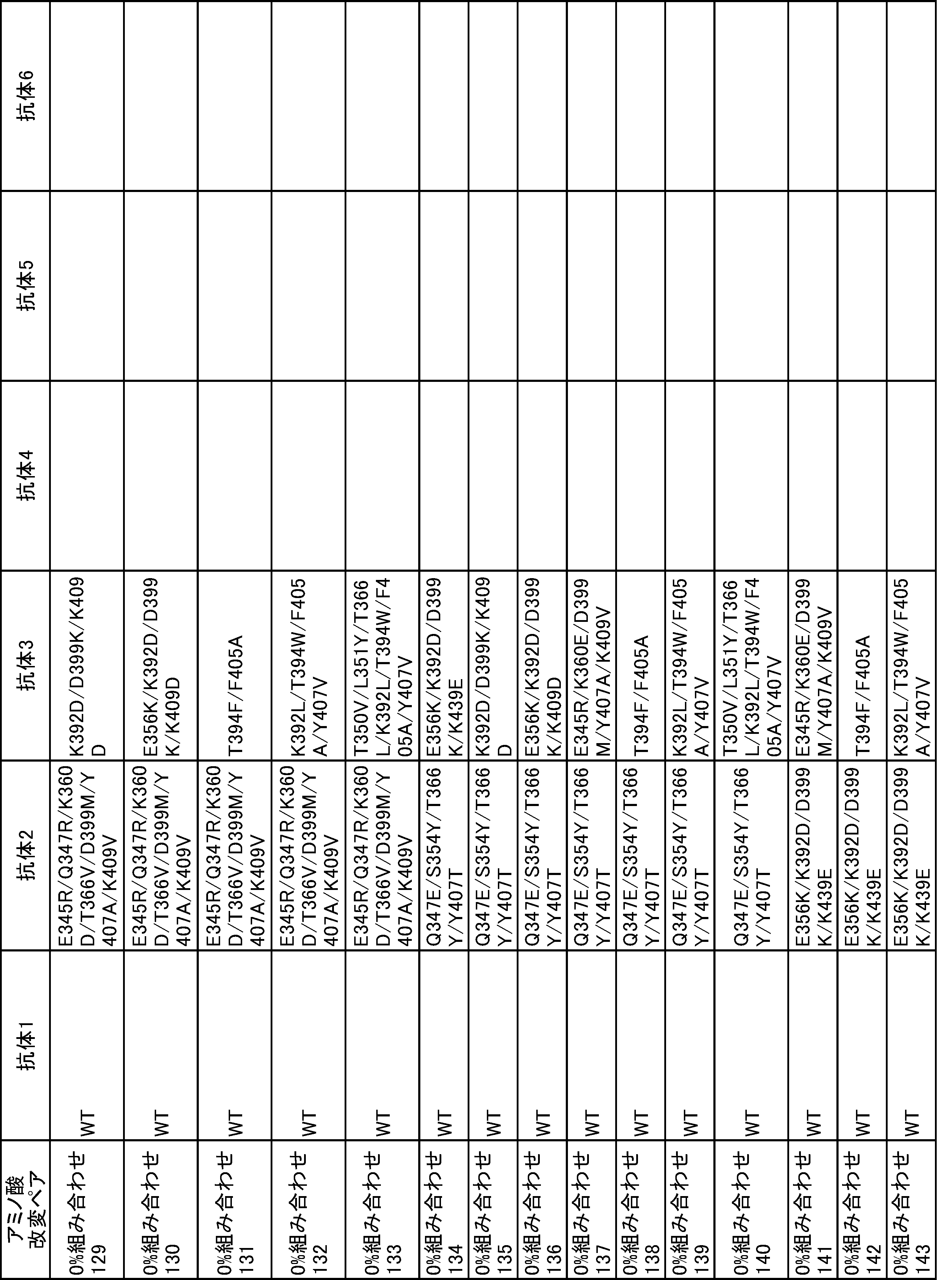

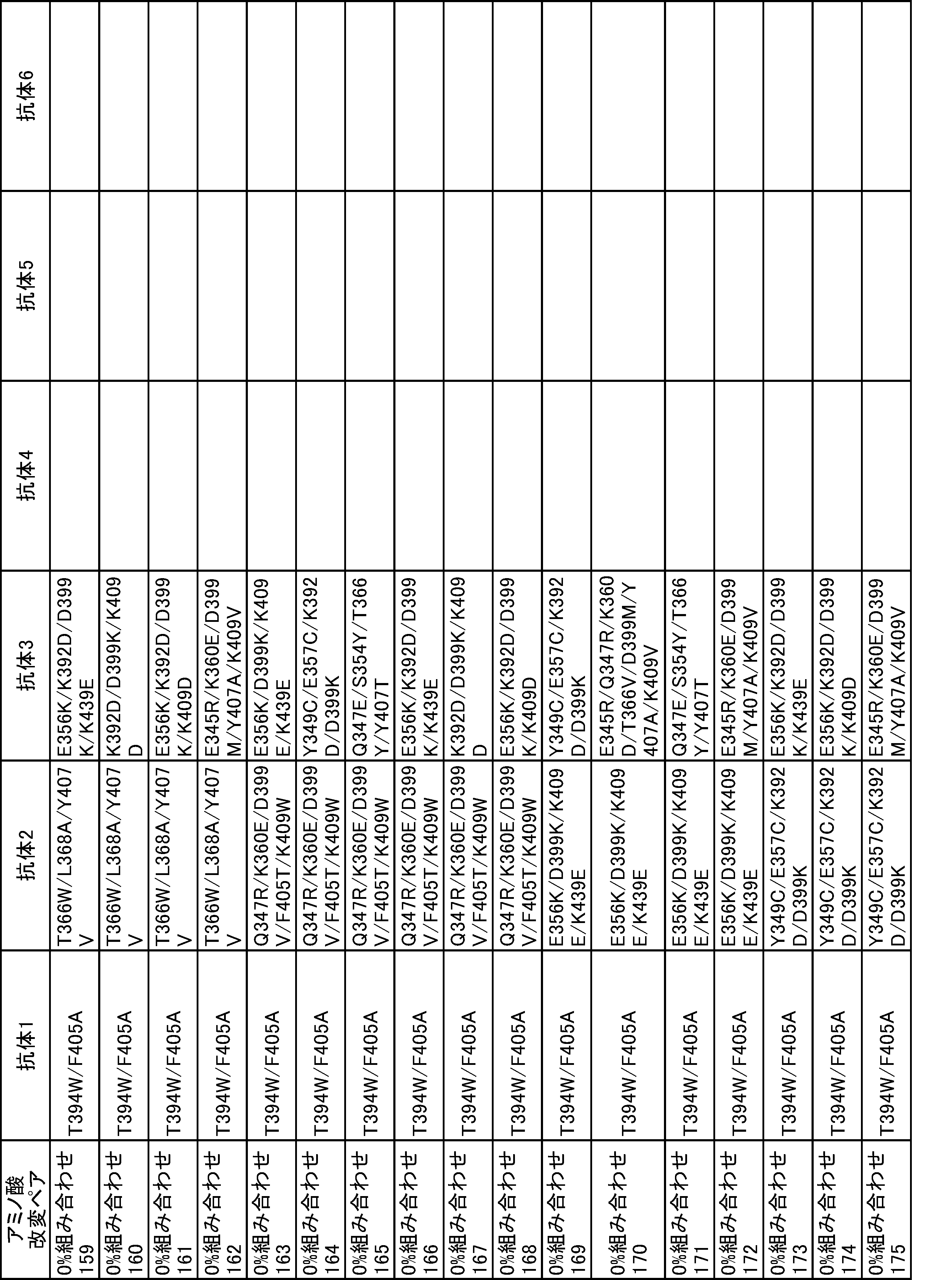
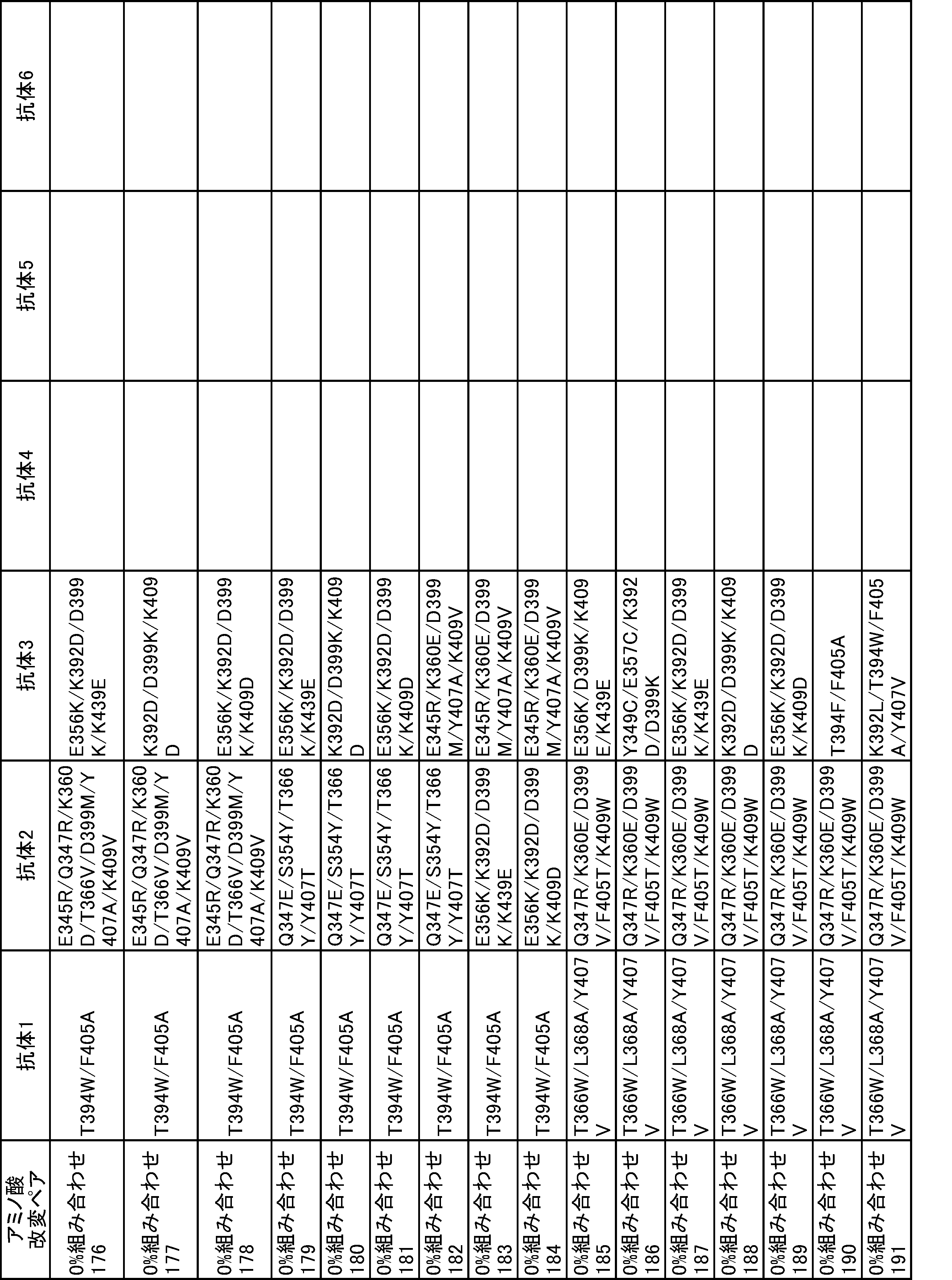

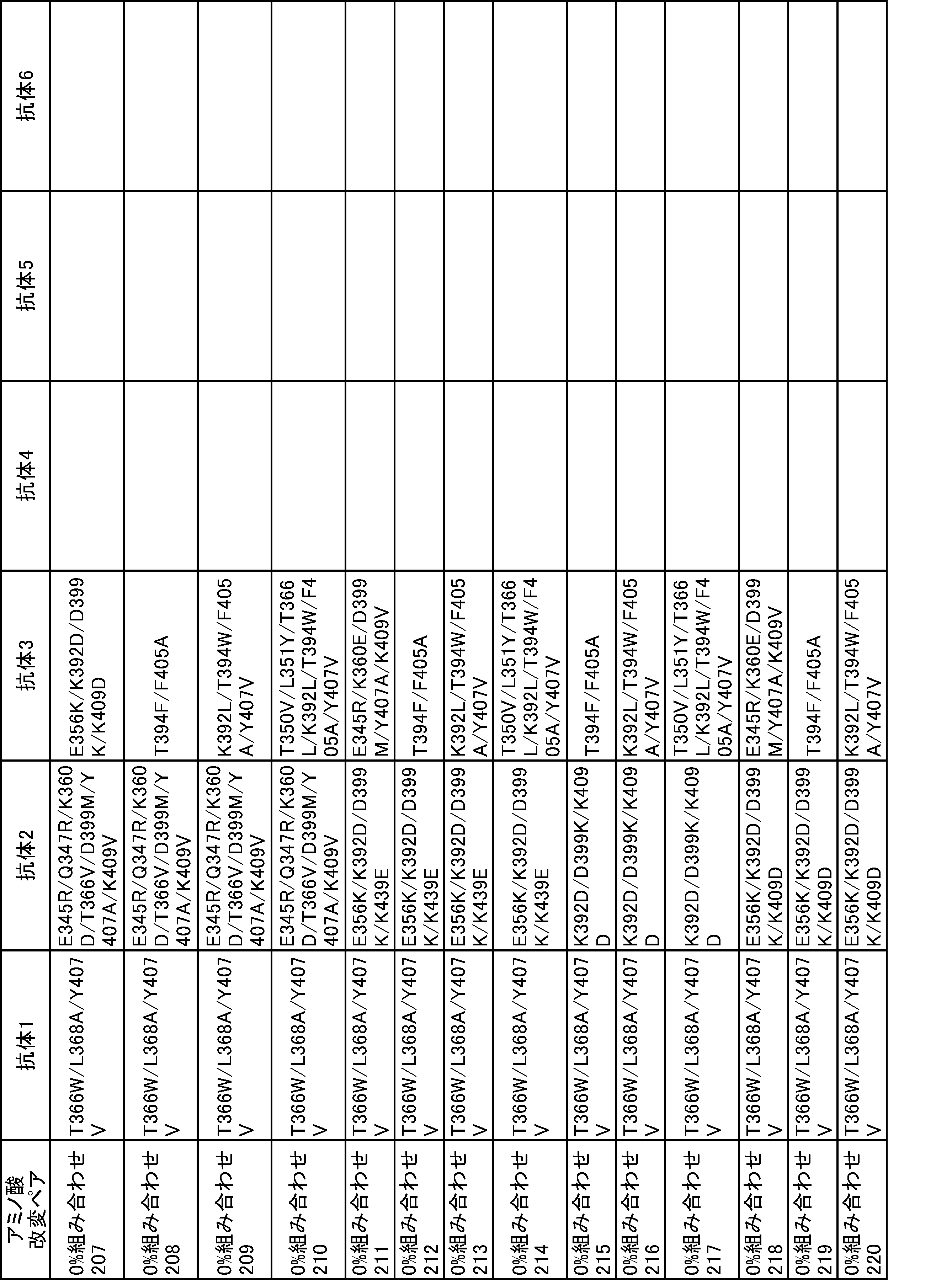
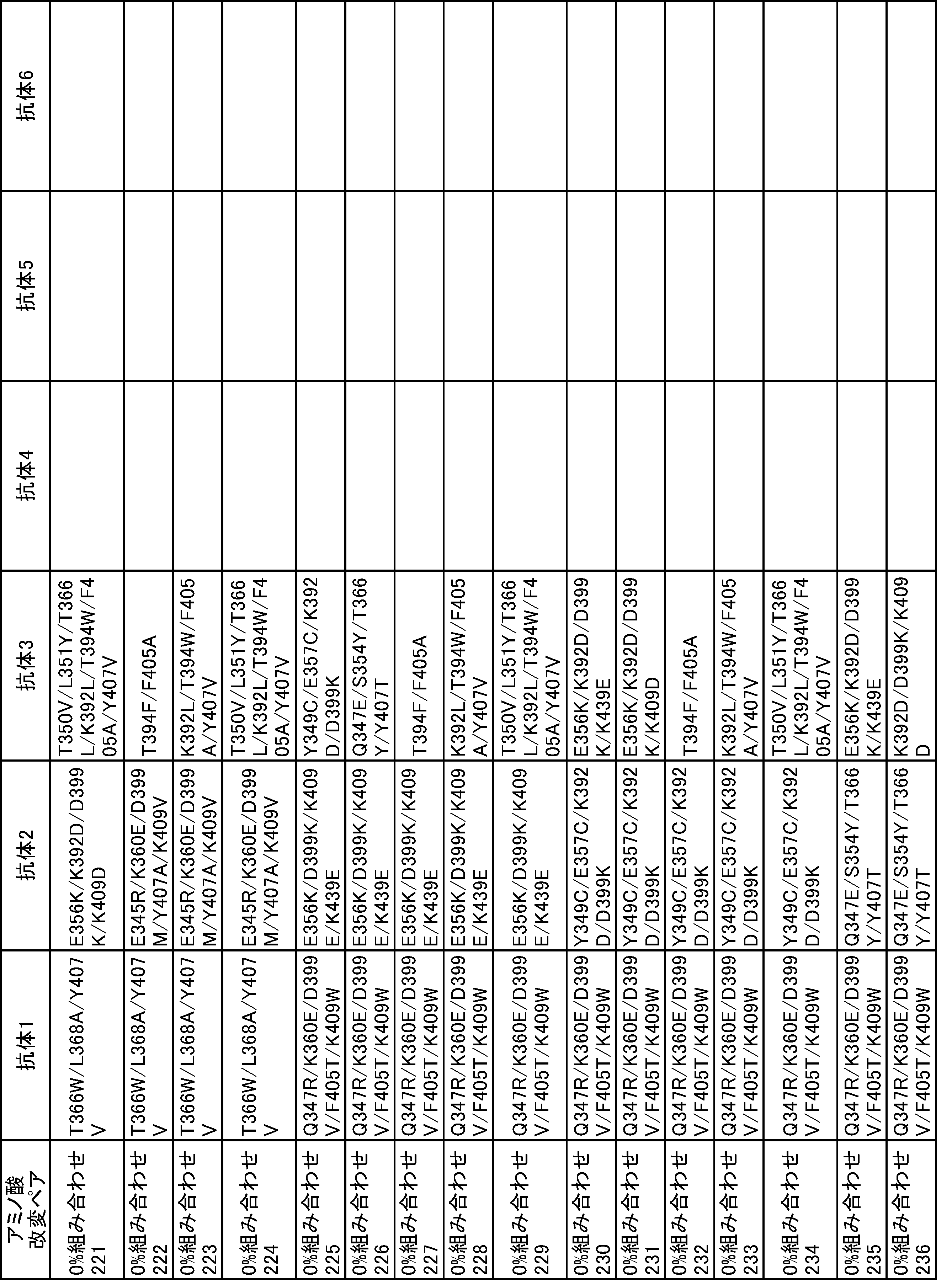
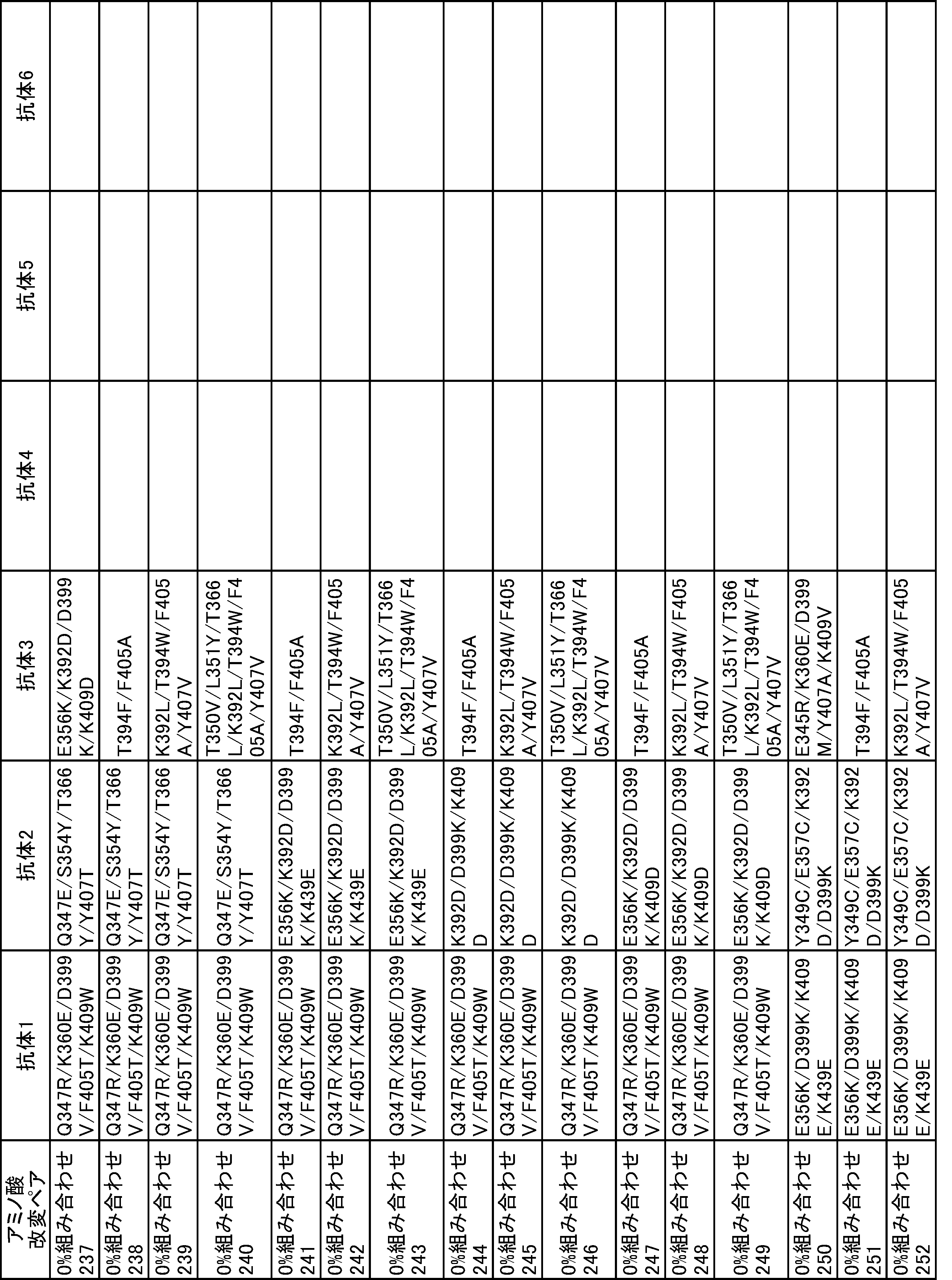
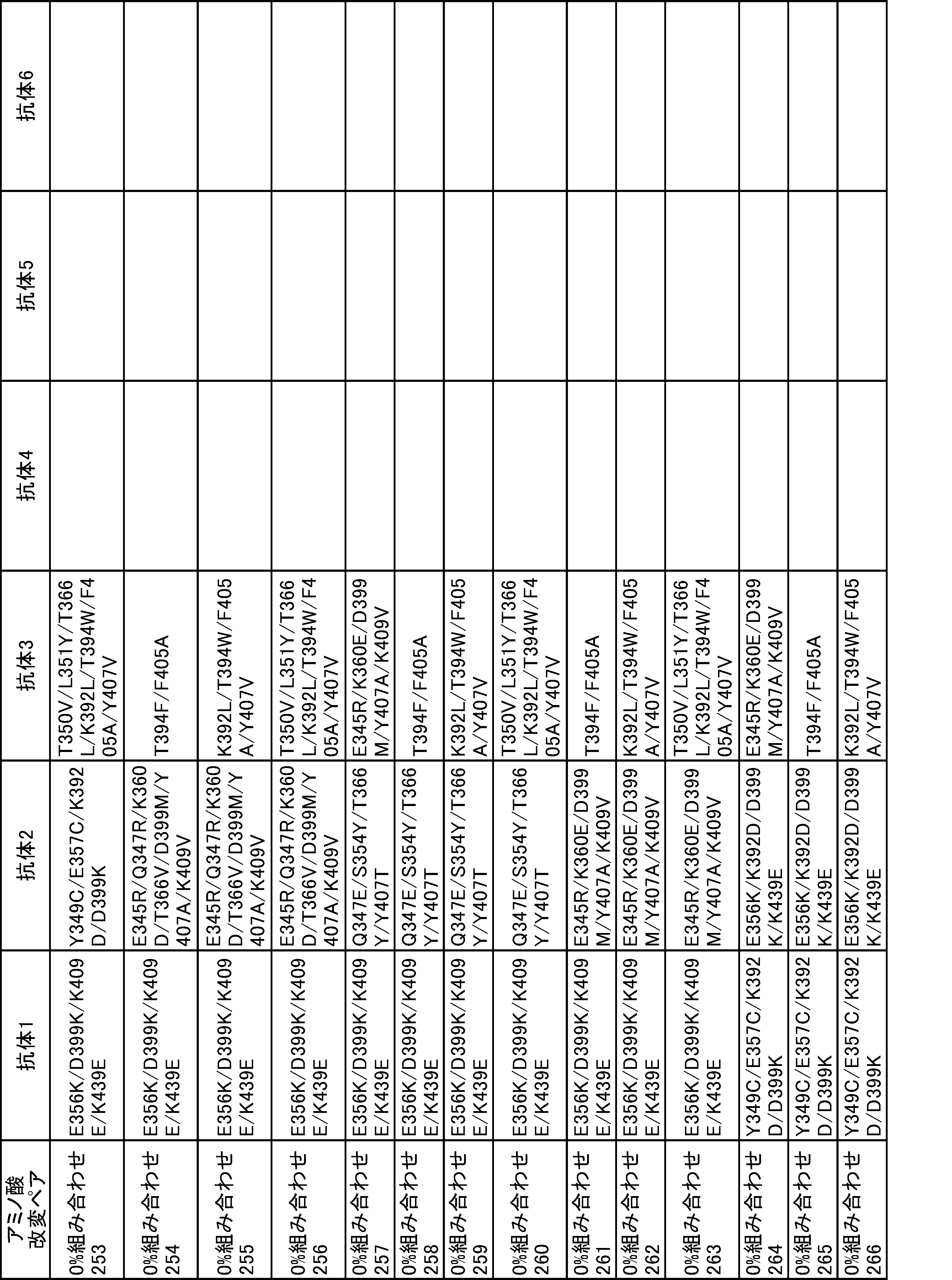
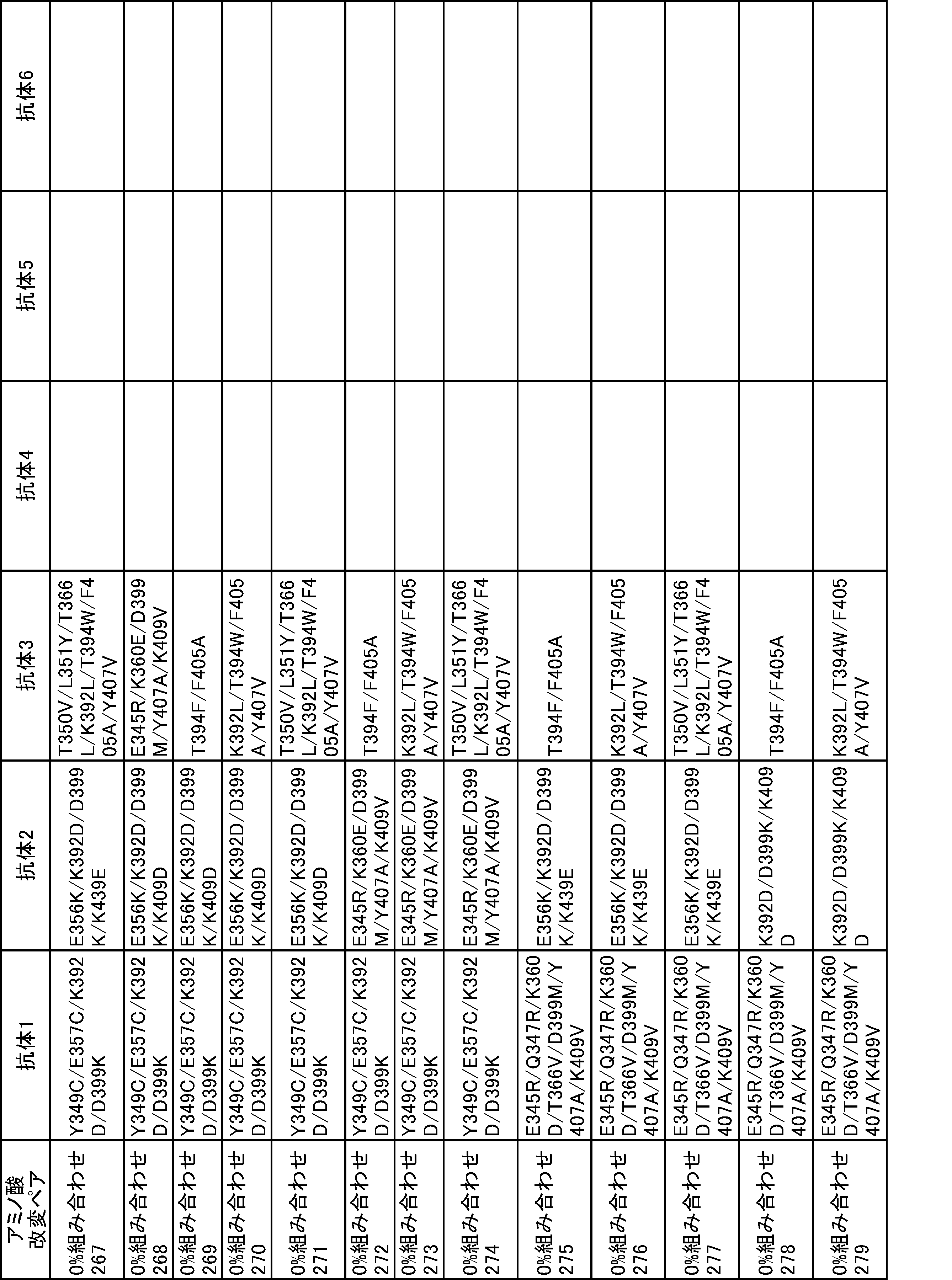
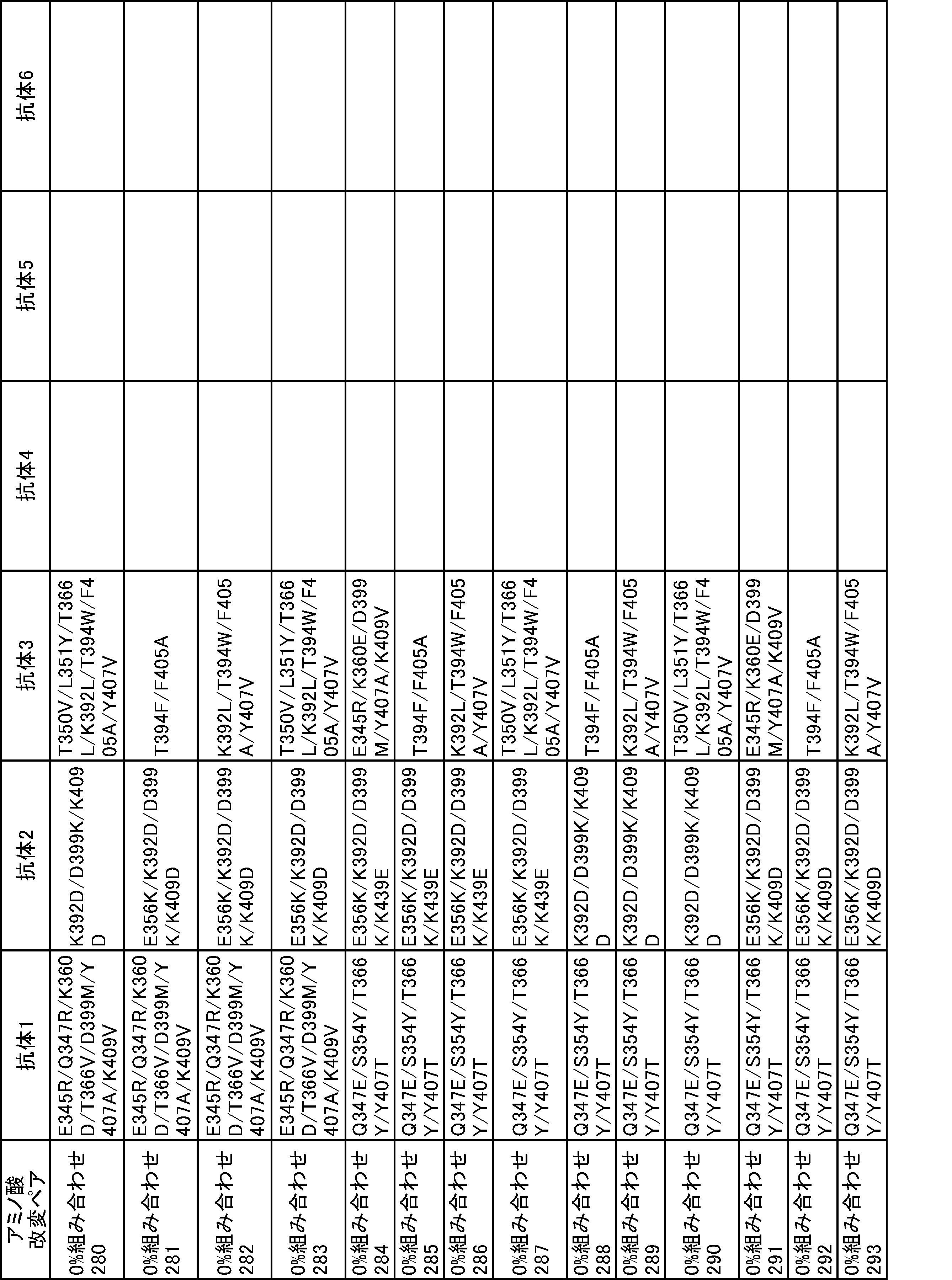
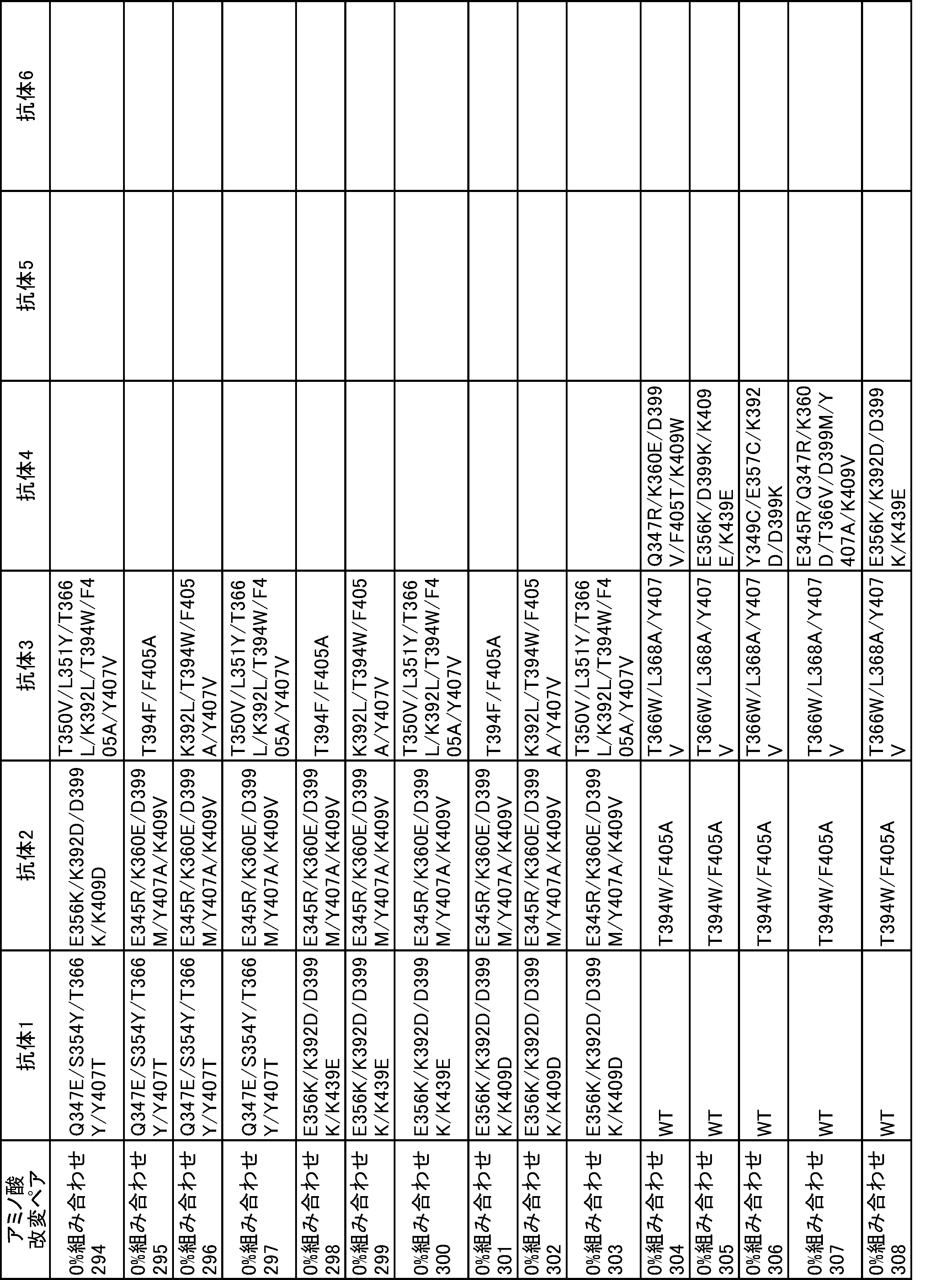

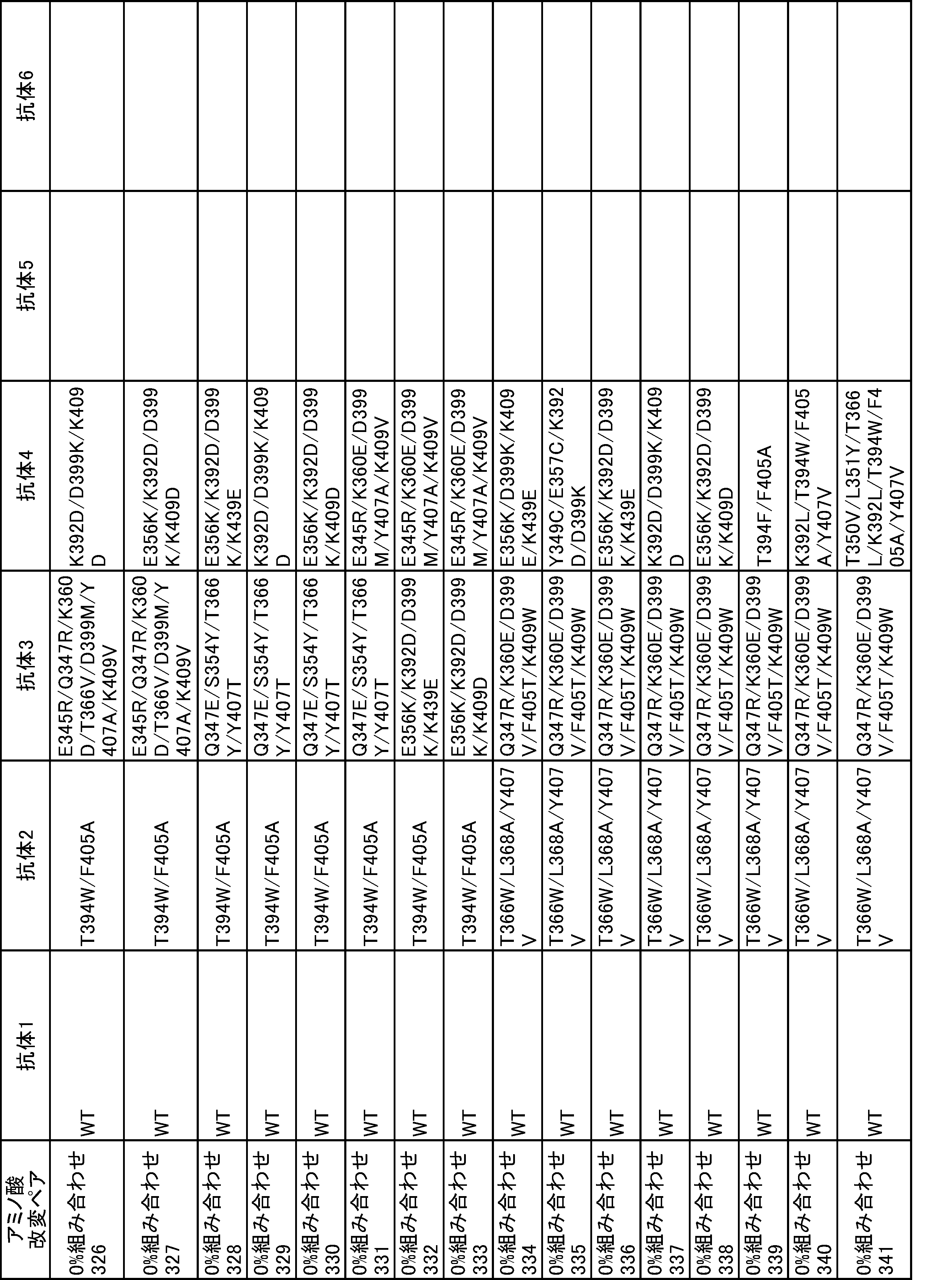
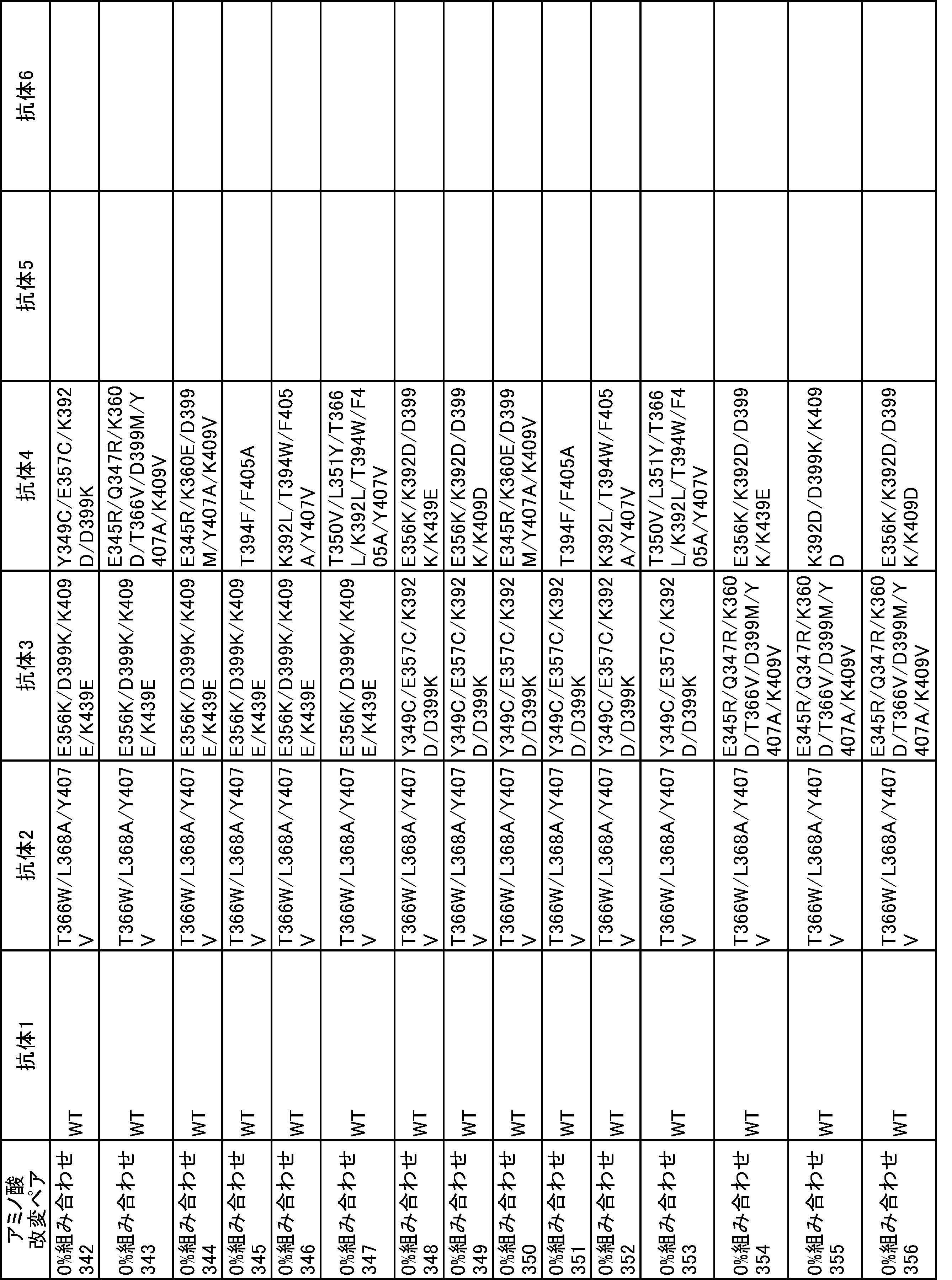

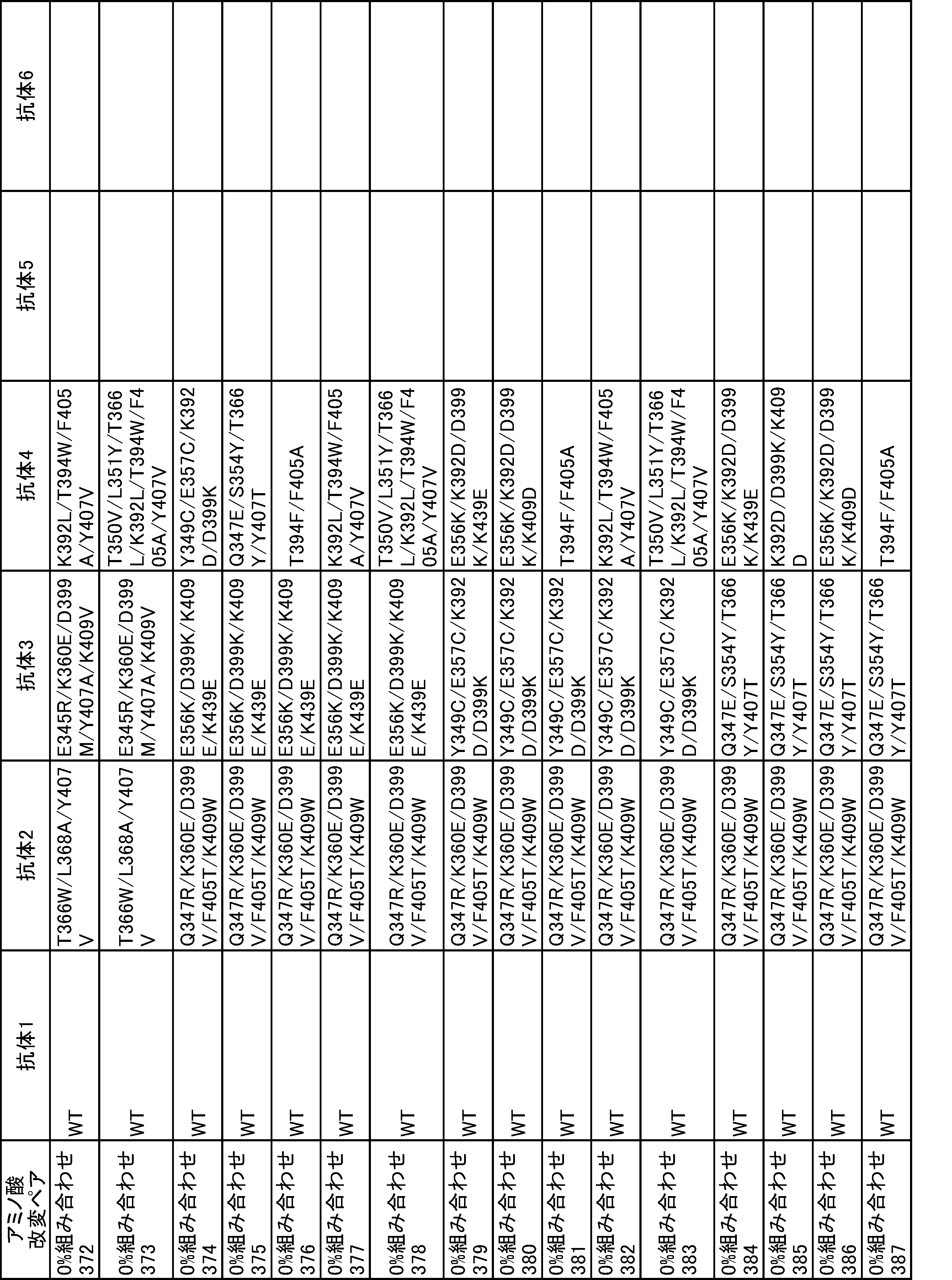
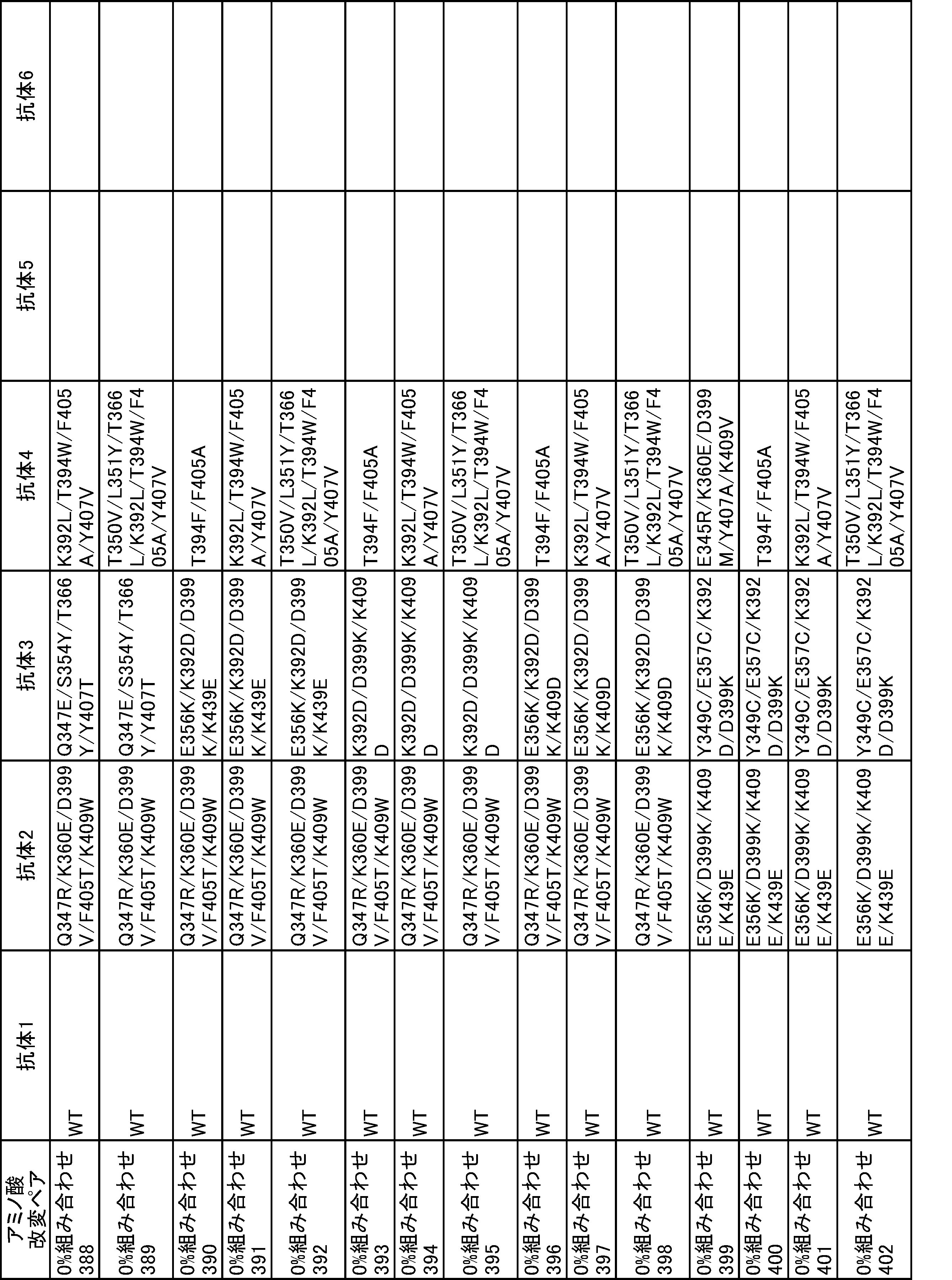
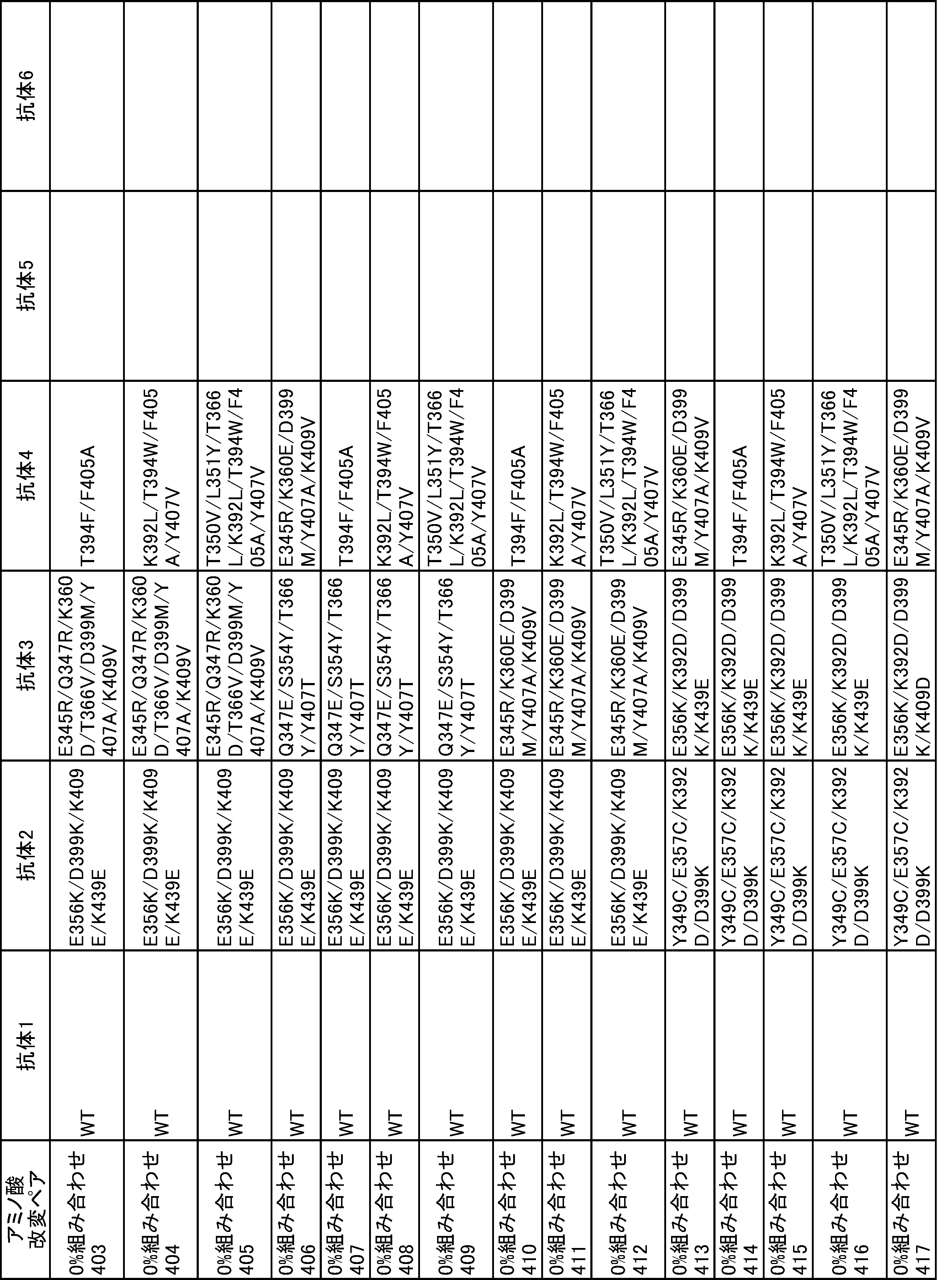
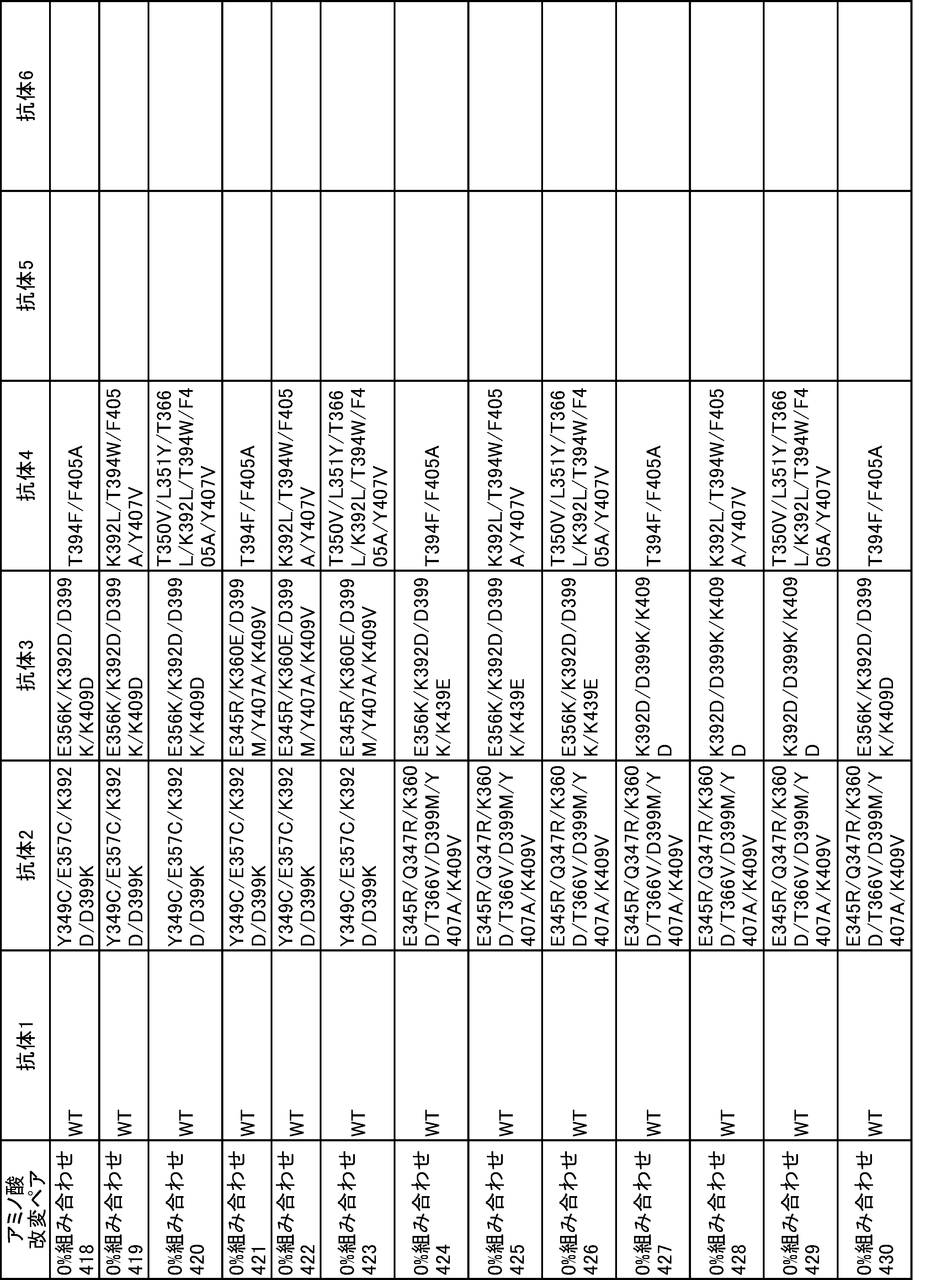
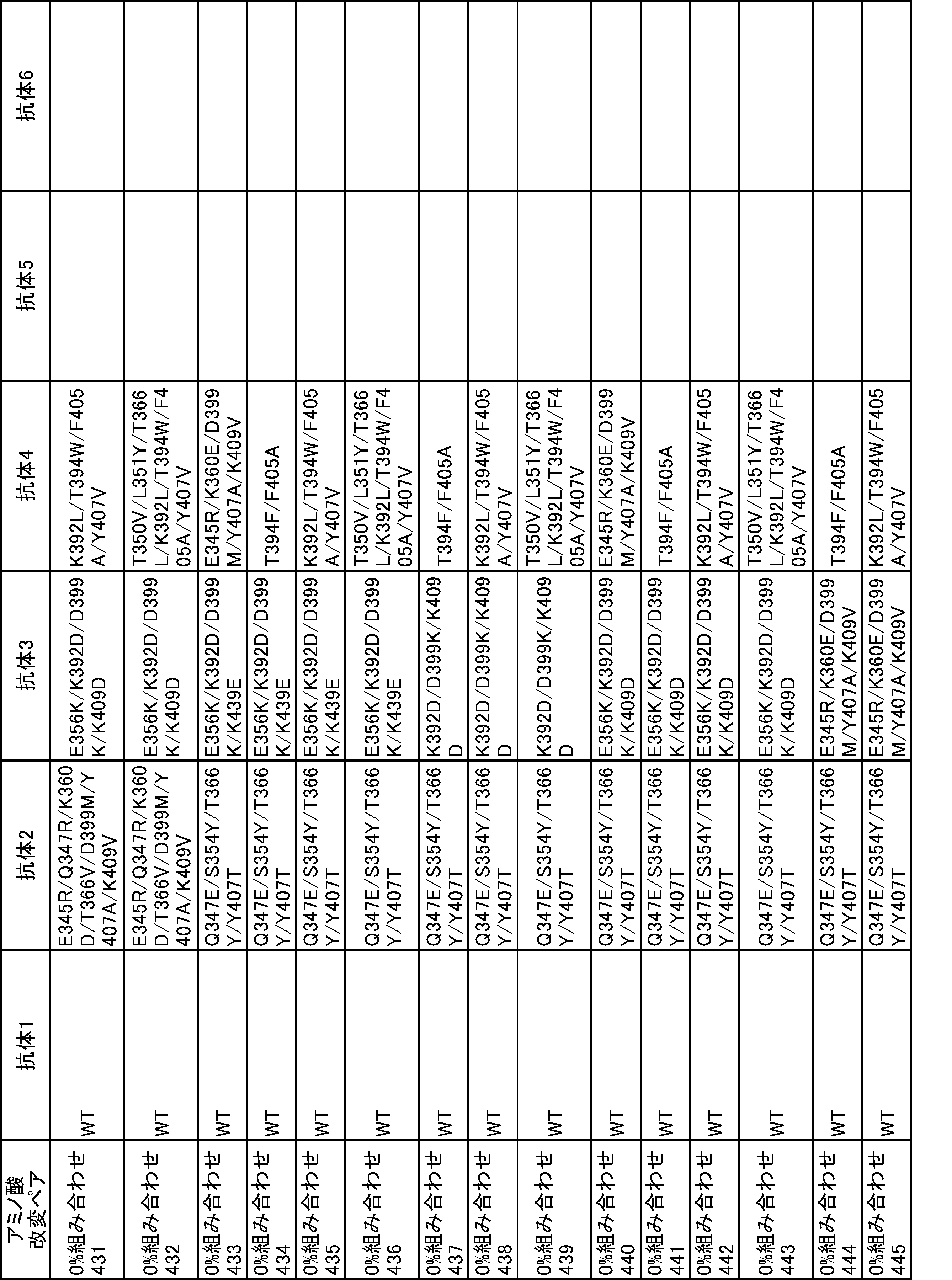


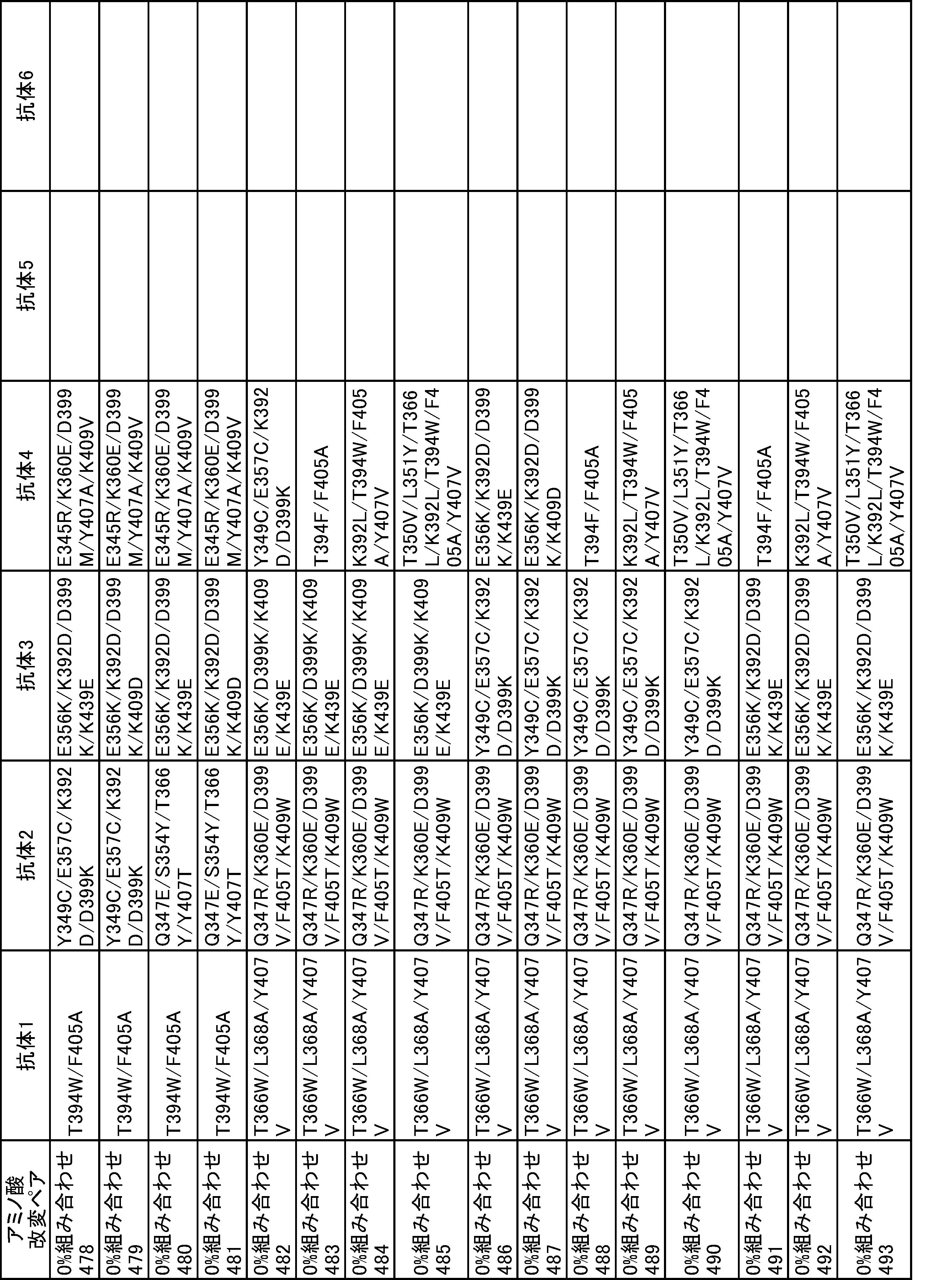
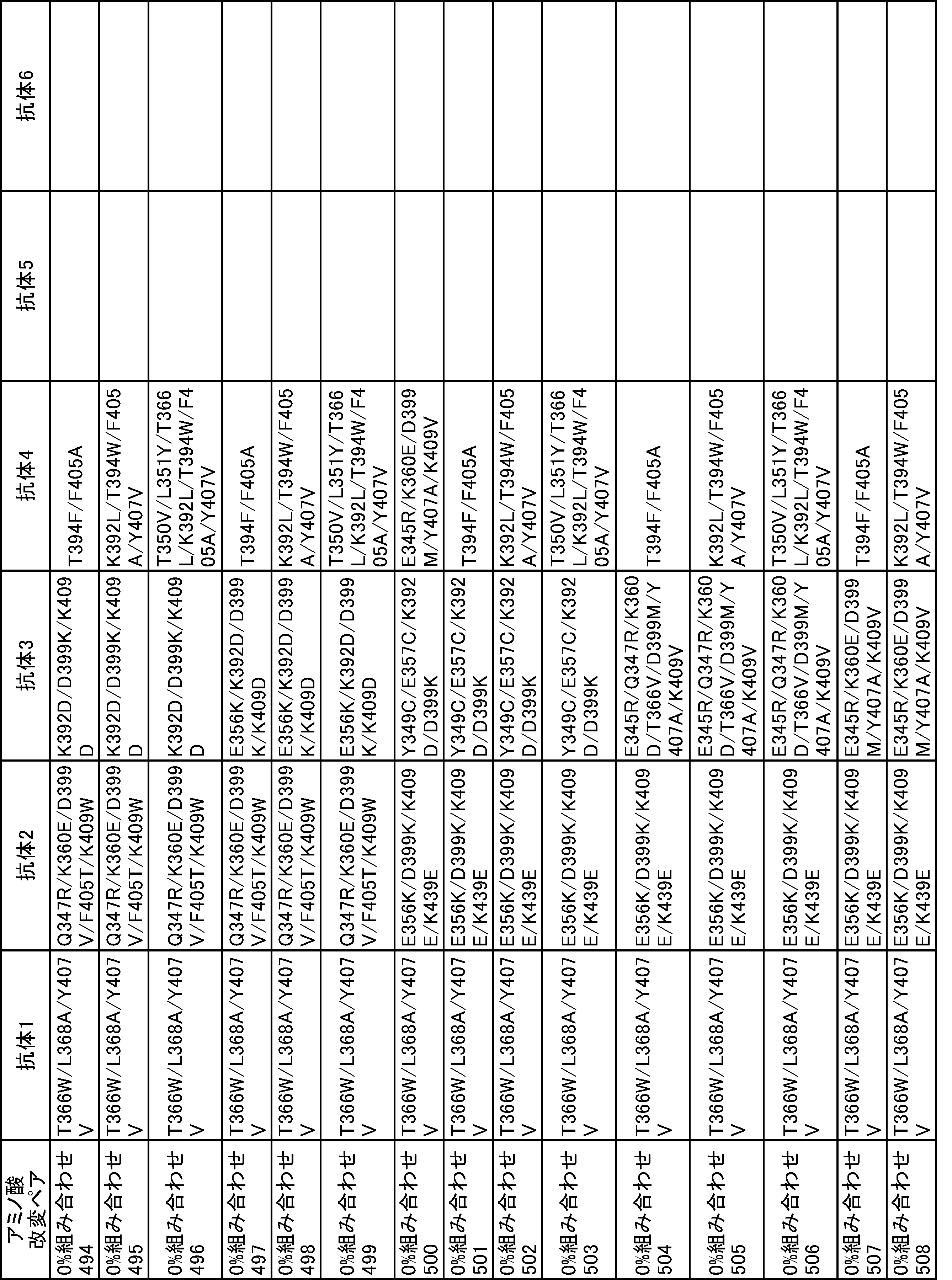
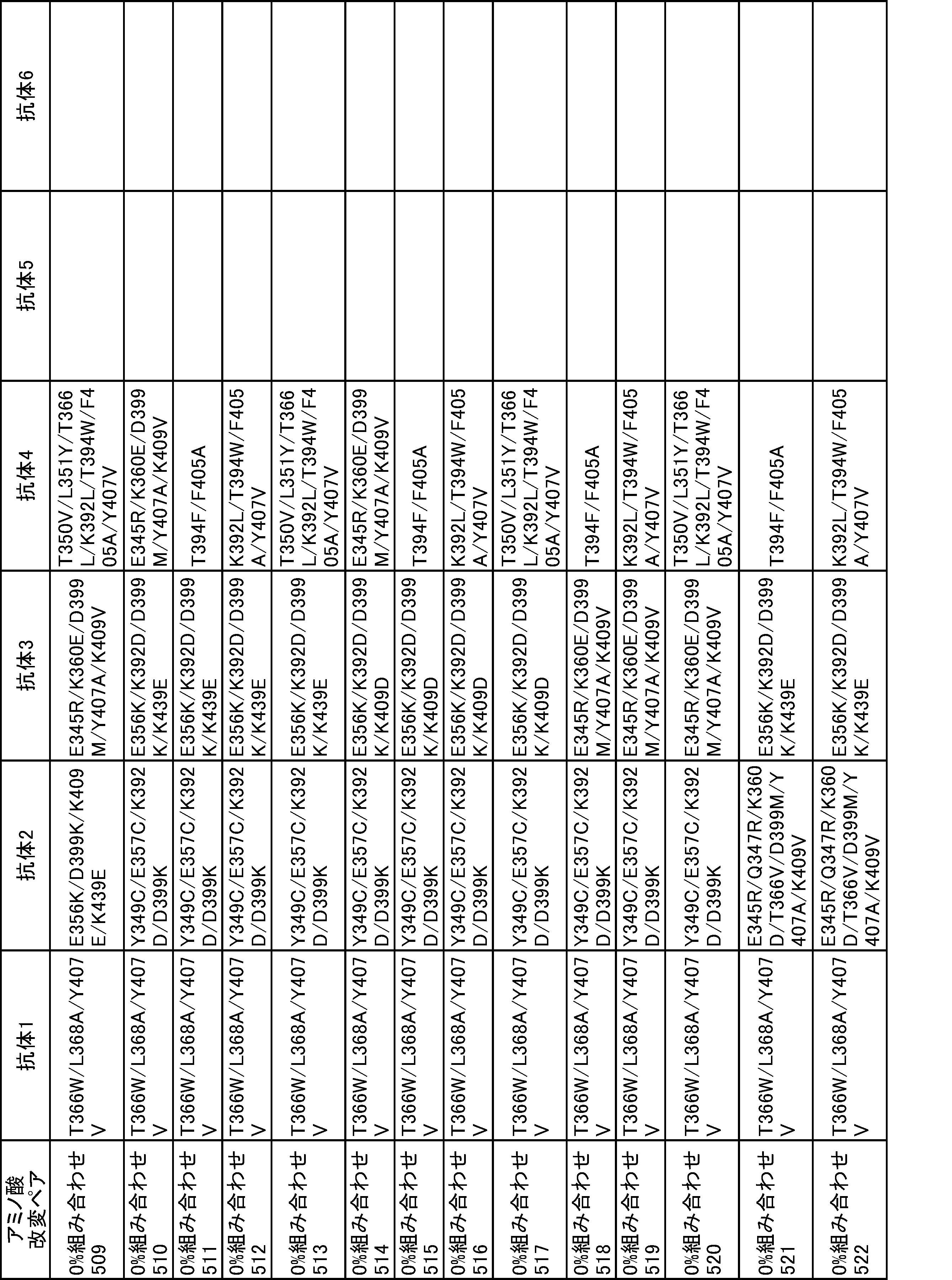
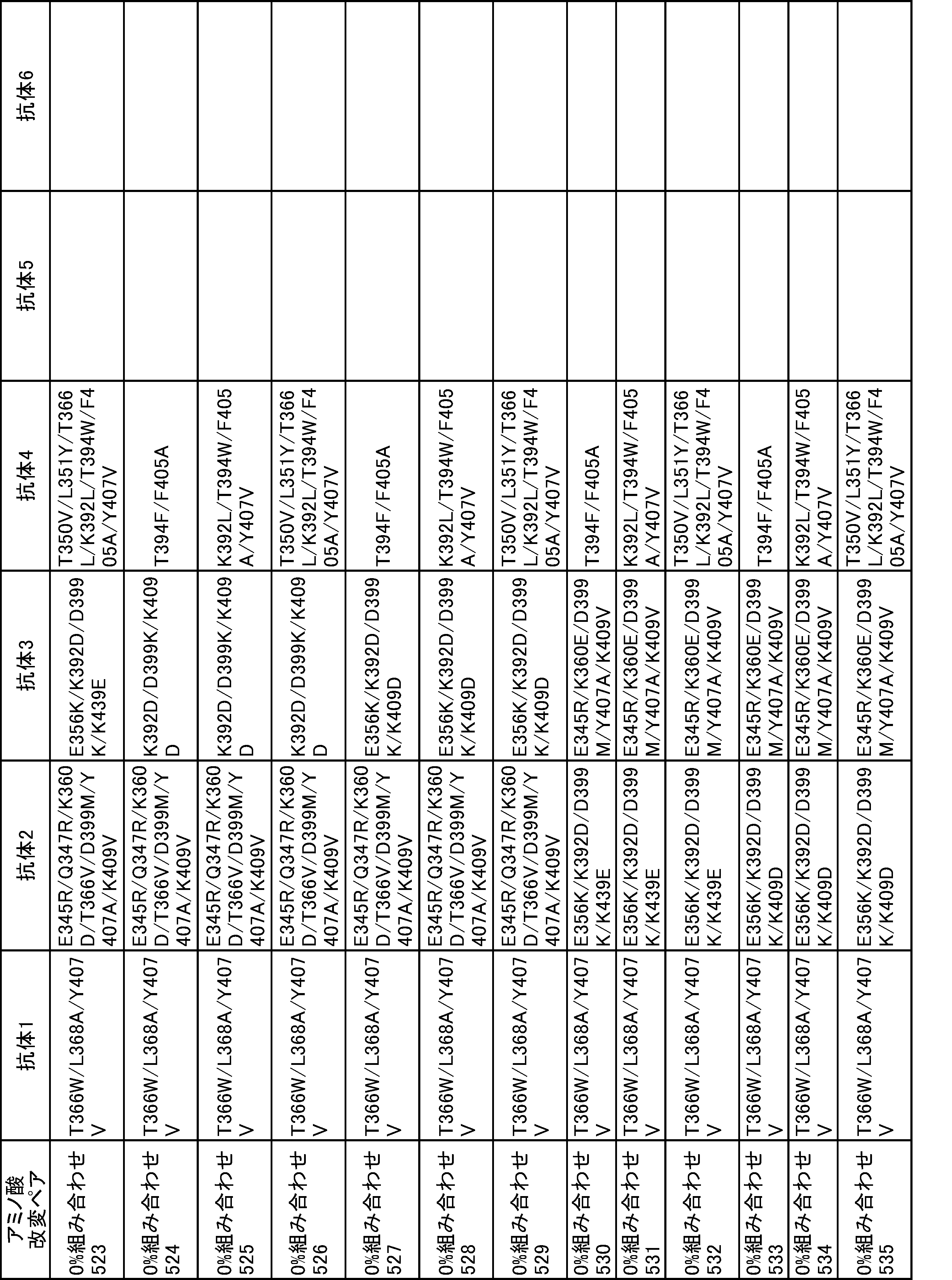


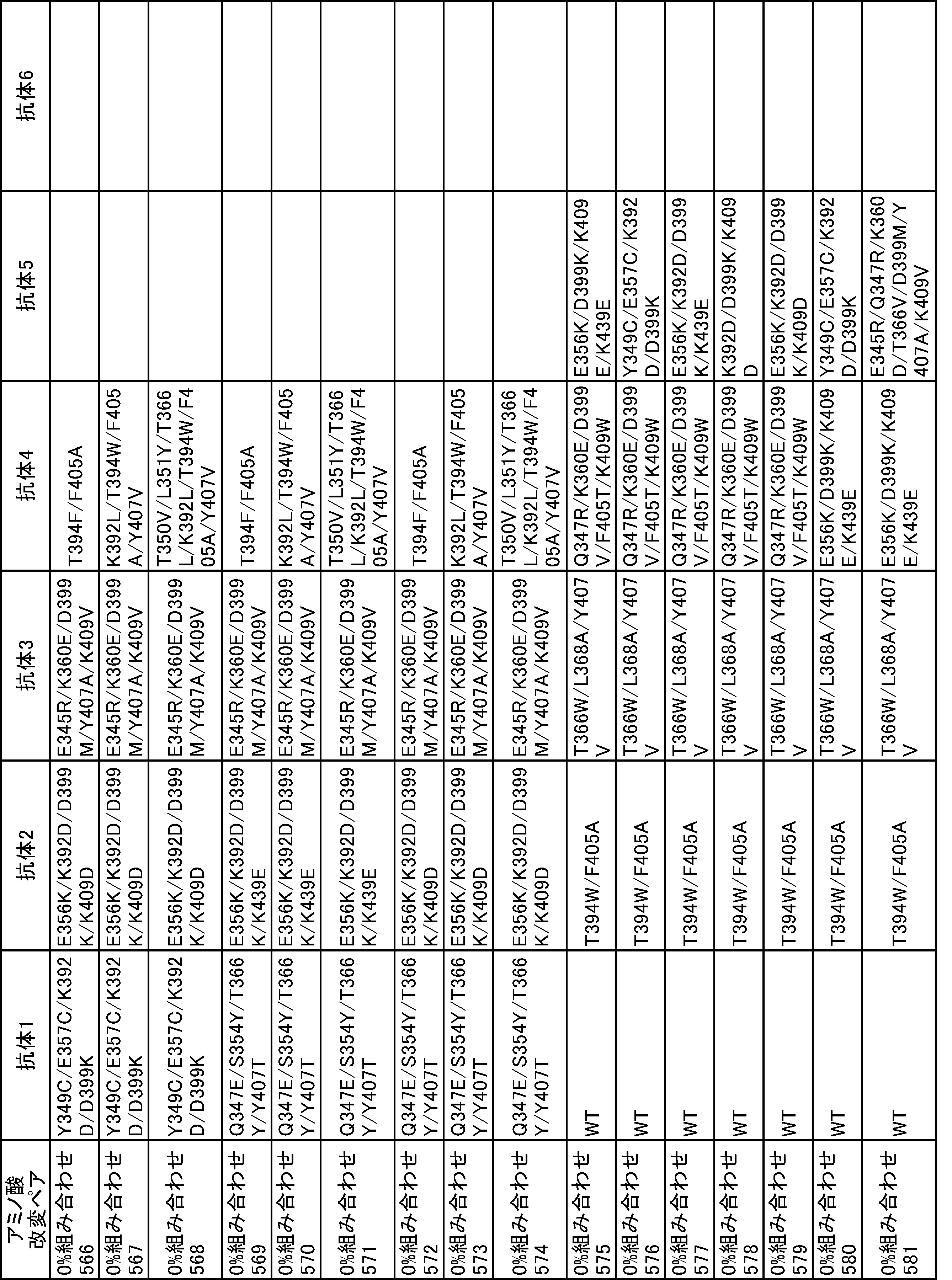
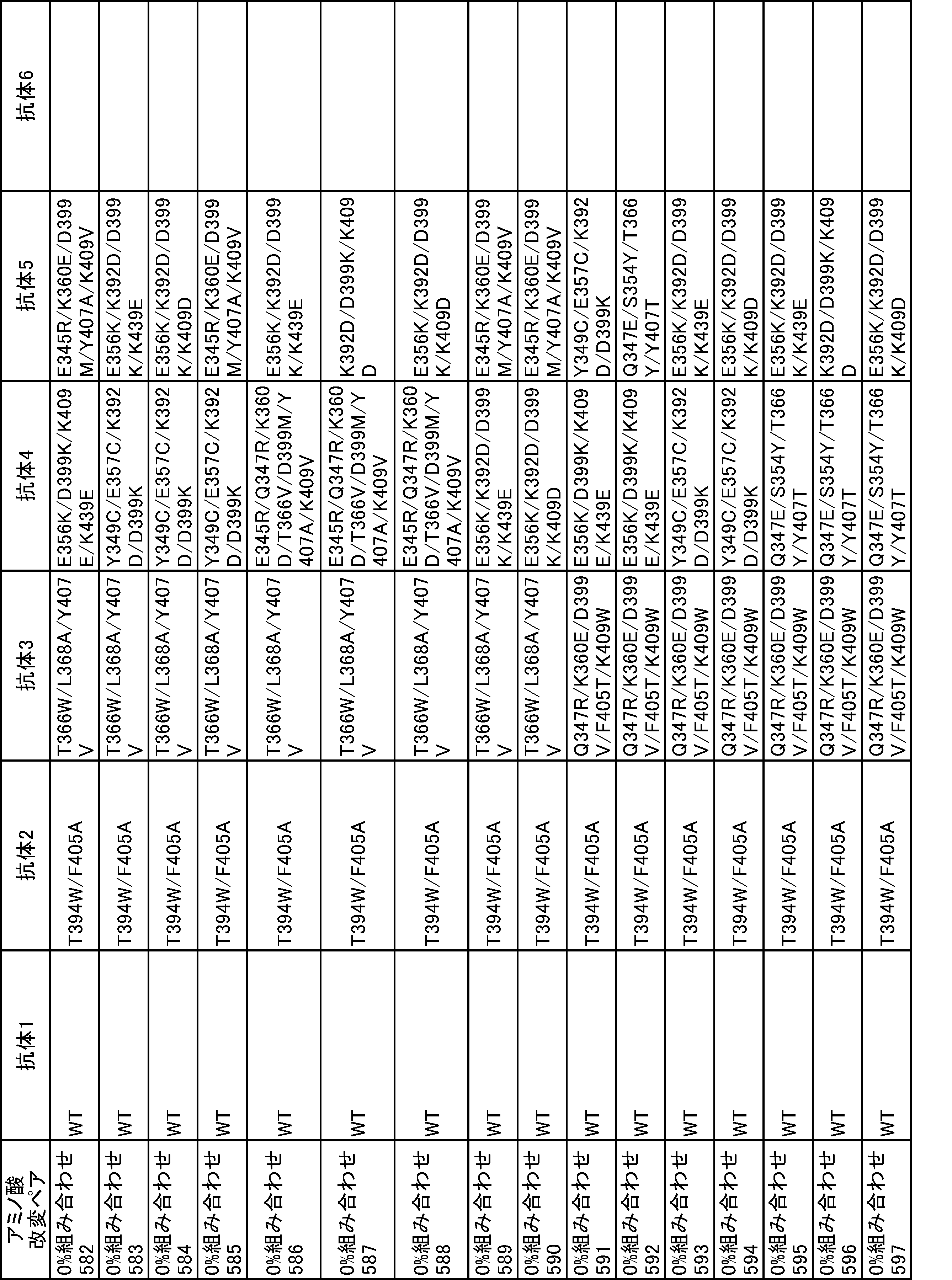
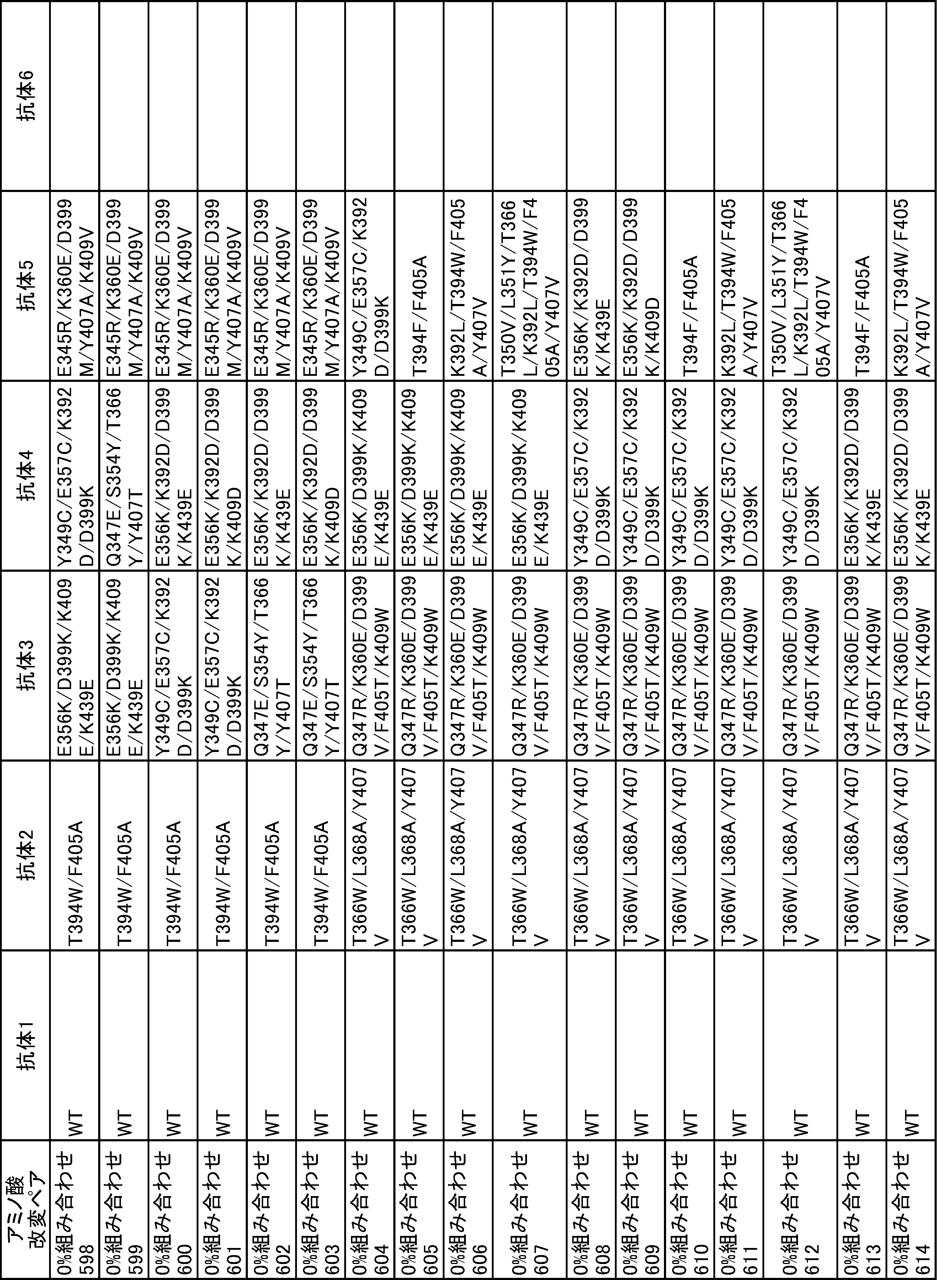

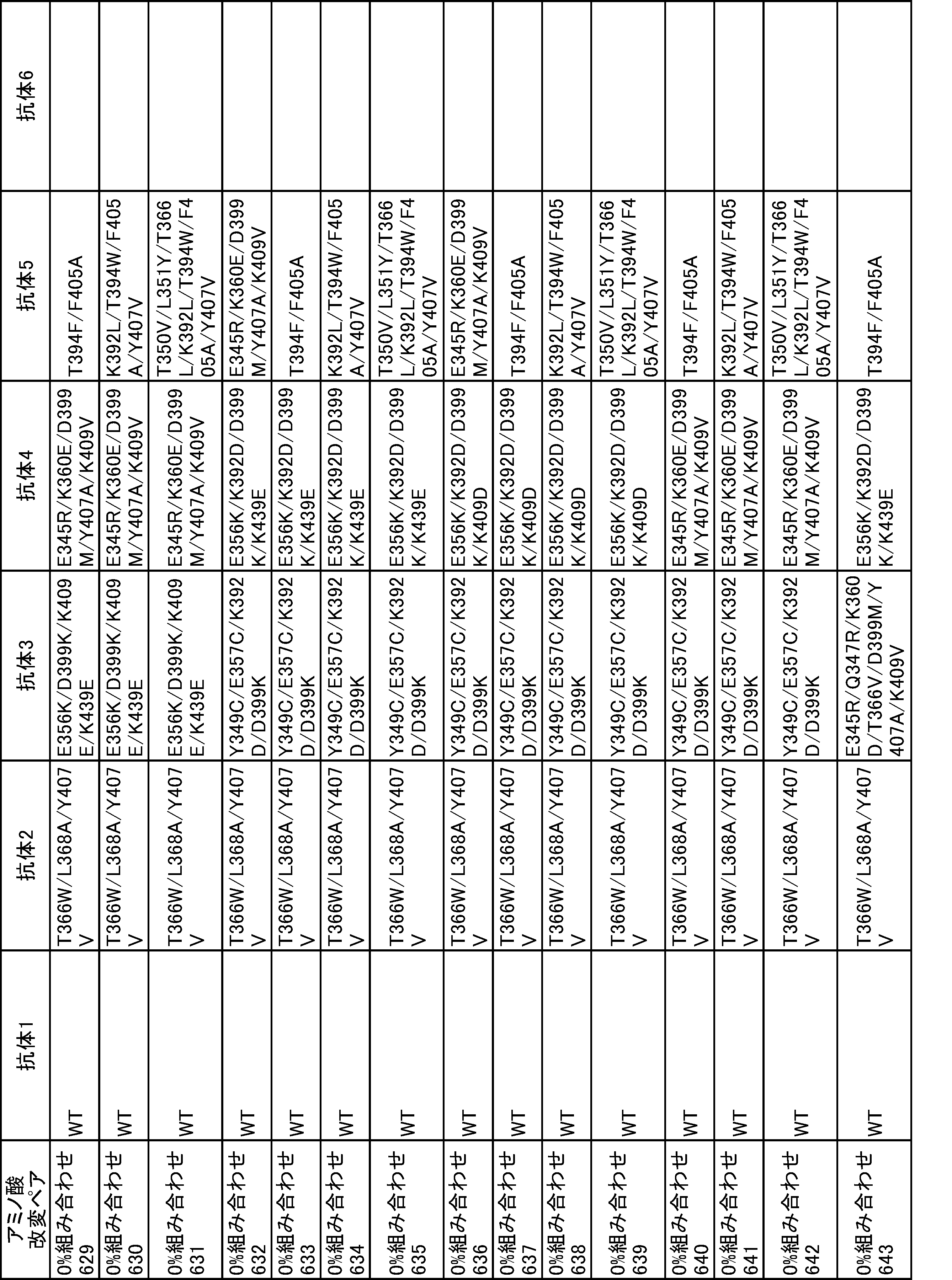
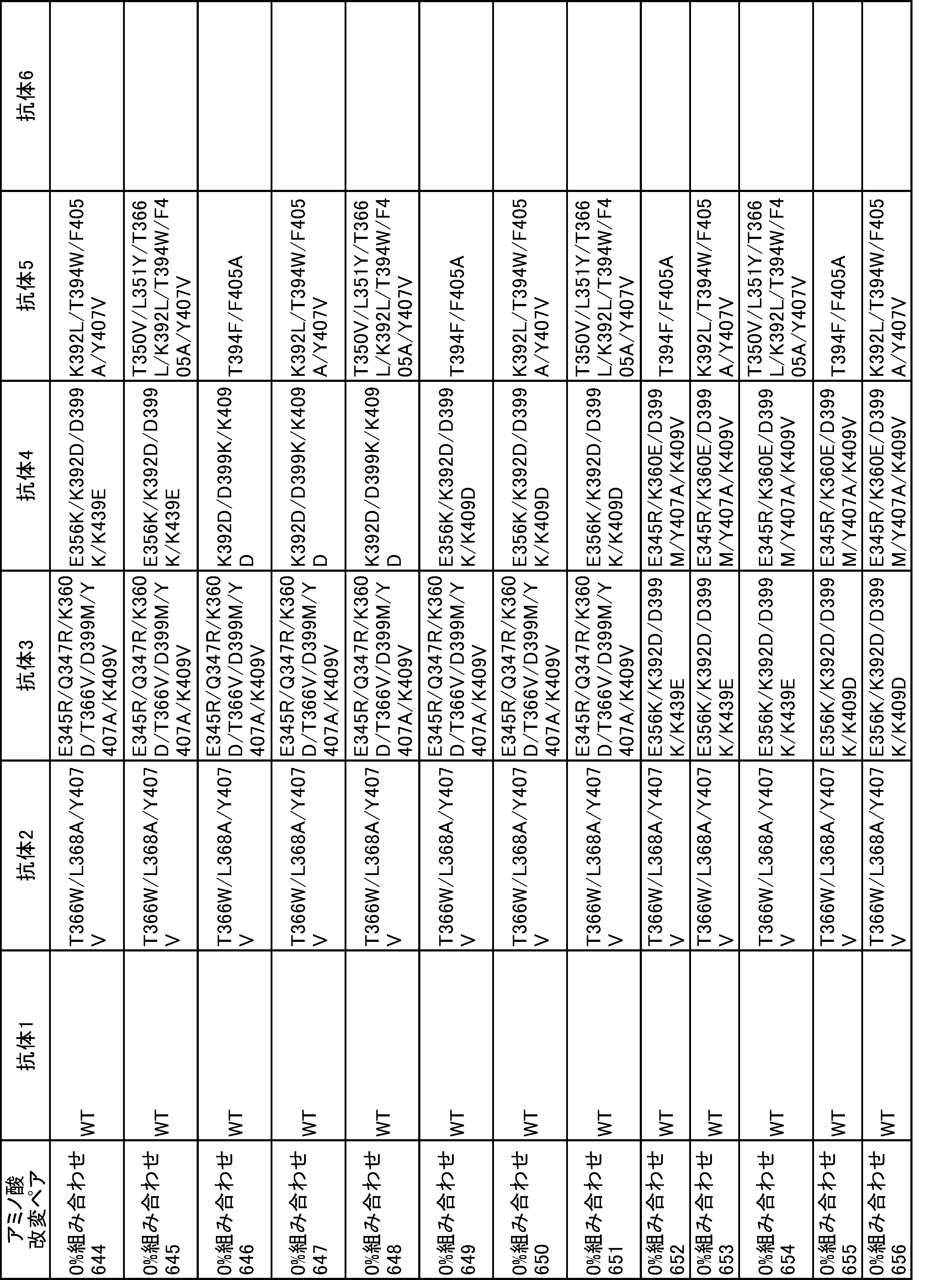
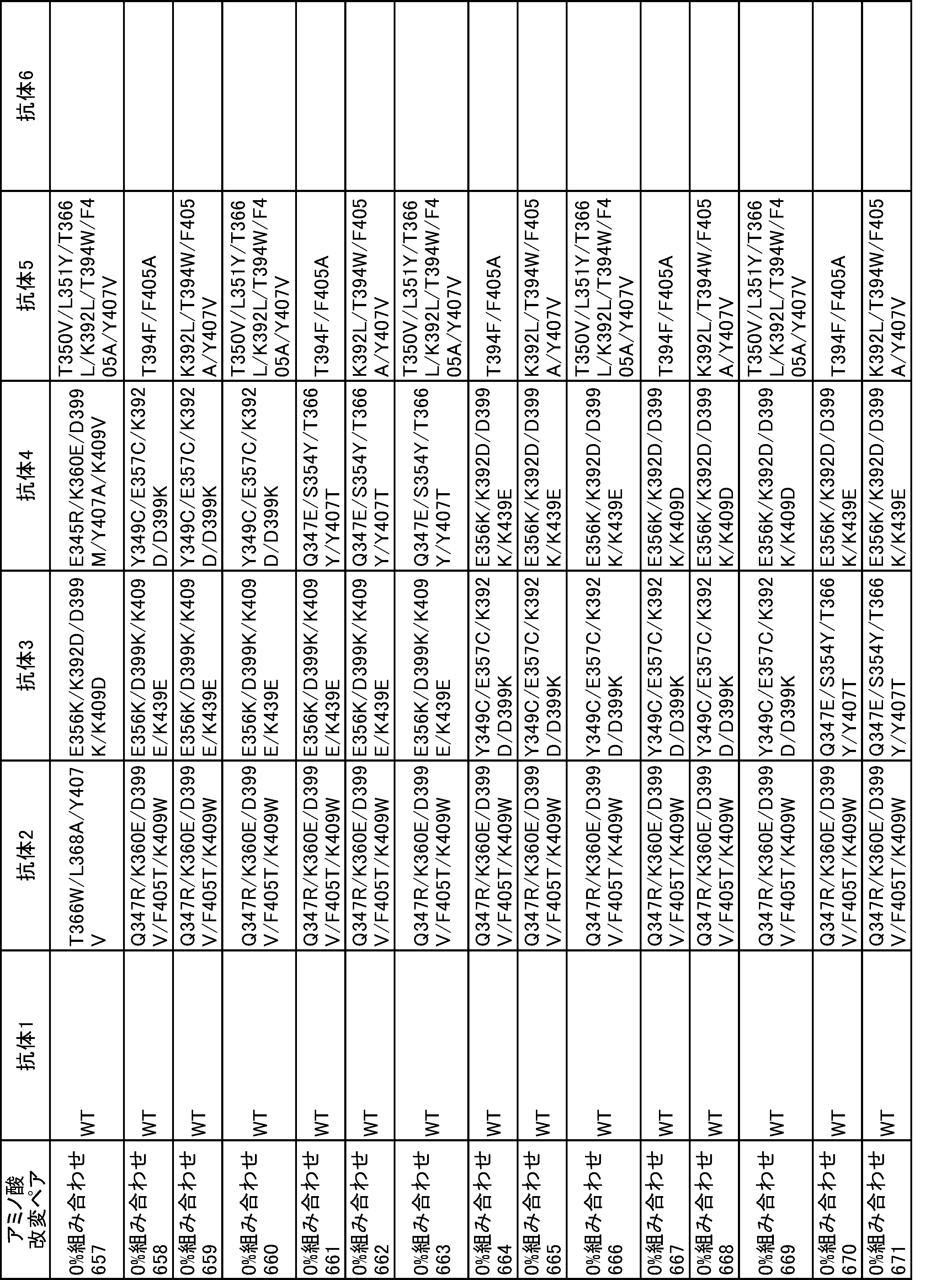
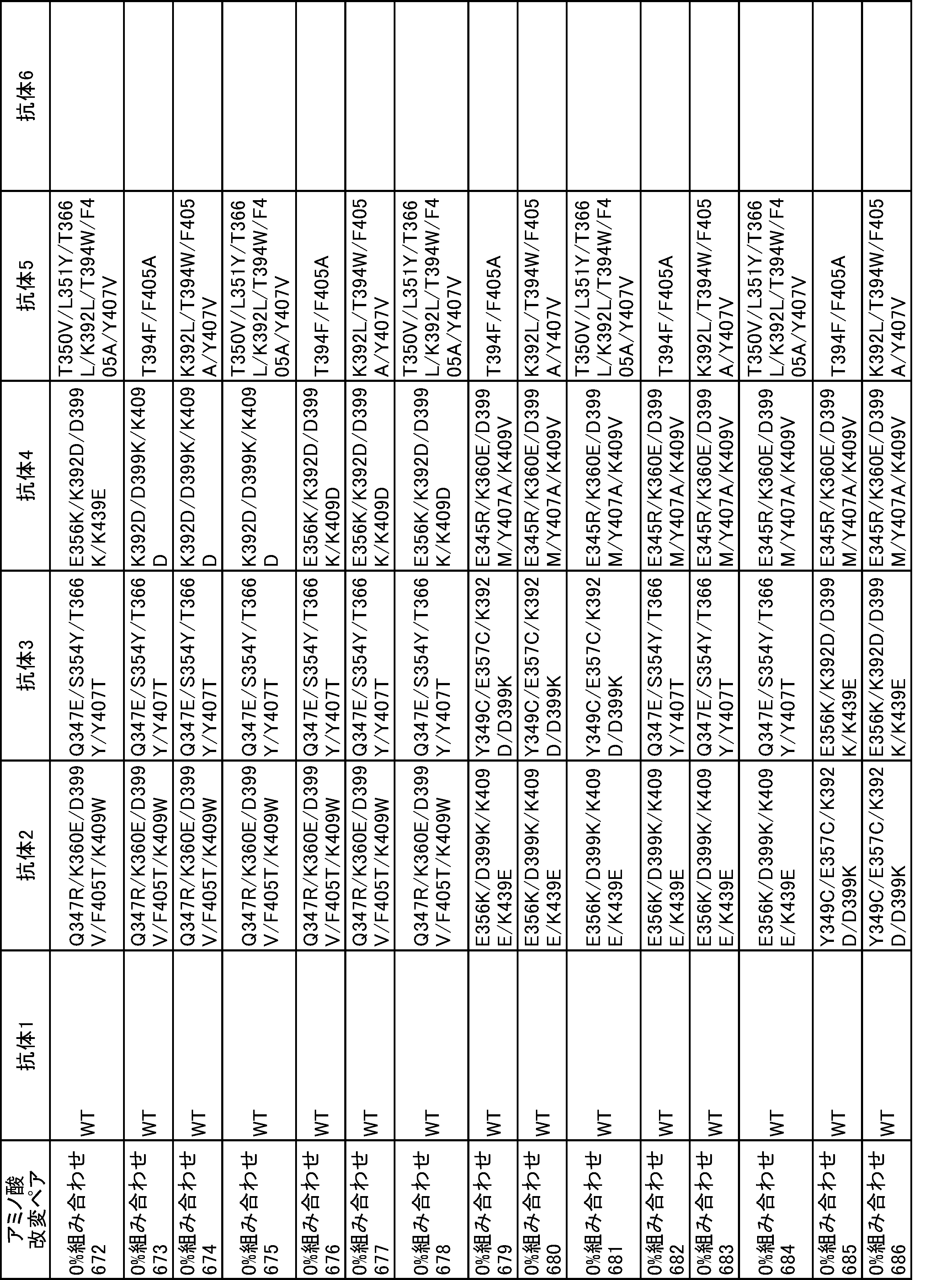

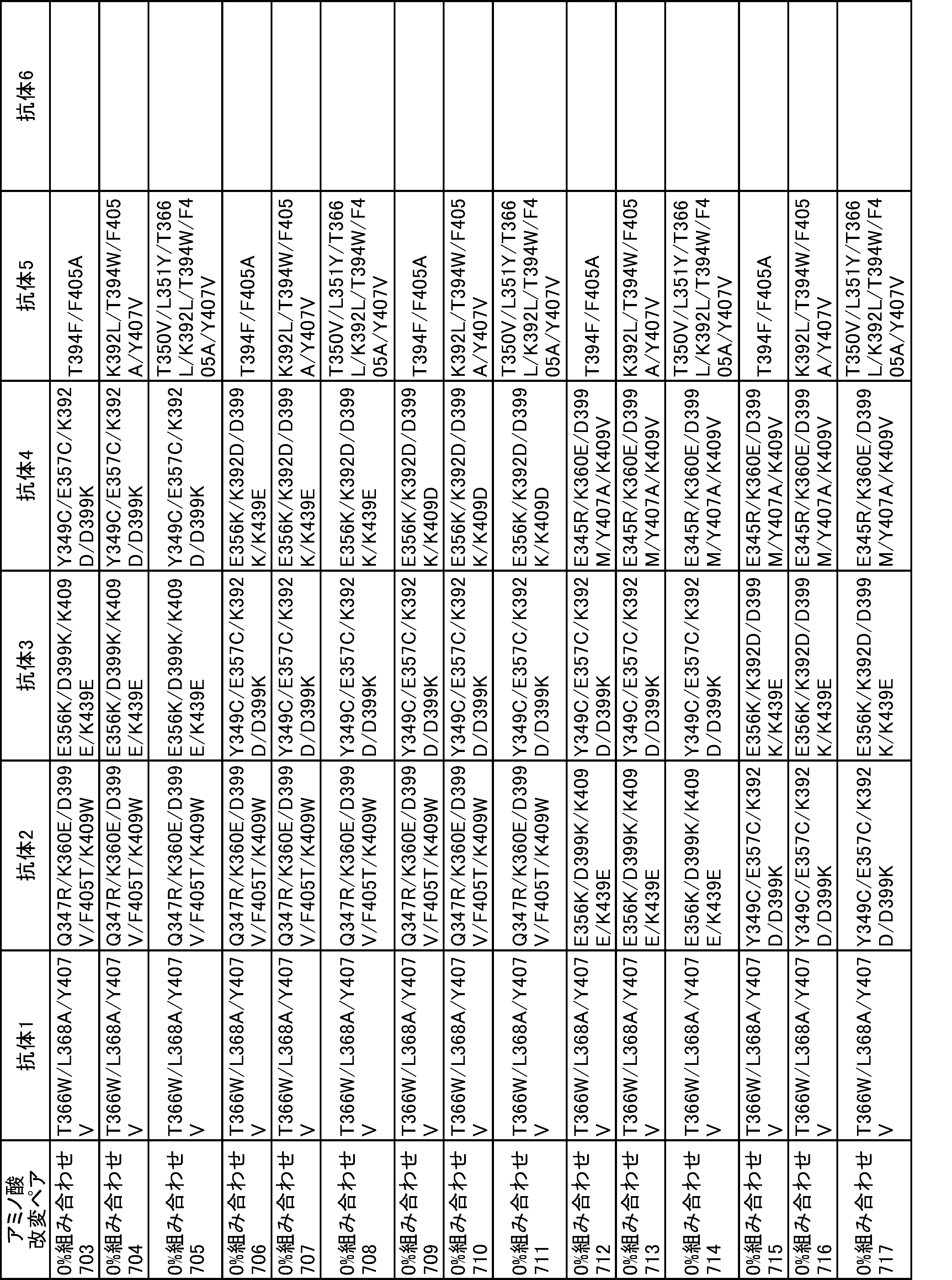


実施例5で2抗体以上の同時発現が可能なペアが同定された。実際に複数のIgG間でホモ二量体形成促進が達成できるかどうかを確認するために、改変を導入した複数のIgG抗体をExpi293Fに同時発現させた。発現の際は重鎖をコードするプラスミドの総質量と軽鎖をコードするプラスミドの質量比が1:1になるようにトランスフェクションに使用した。また複数の重鎖を発現に使用する場合は、各重鎖の質量比が等しくなるように使用した。Protein A精製後の各抗体はイオン交換クロマトグラフィー(IEC)により分析された。具体的には、Alliance system(Waters)を用いた陽イオン交換クロマトグラフィー(CIEX)法により、作製抗体の分析を実施した。分析カラムにYMC-BioPro SP-F 5μm 4.6x100(YMC)を用い、移動相AとしてCX-1 pH Gradient Buffer A, pH 5.6 (Thermo)、移動相BとしてCX-1 pH Gradient Buffer B, pH 10.2 (Thermo)を用いた2液グラジエント法を実施した。サンプルは波長280 nmにおける吸光度で検出された(図中の縦軸にAUと表記された)。Empower3(Waters)を用いてデータ解析を実施し、検出された各ピークの比率を算出した。
抗体発現に用いた改変及び、配列番号の対応は表8に示された(改変が導入されていない場合は「-」と記載された)。発現には等電点(pI) に差がある4種類の抗体の重鎖を使用し、分析を簡便に行うために共通軽鎖(配列番号: 61)が用いられた。改変導入前の抗体及び改変導入後の単体の抗体の分析も行い、複数重鎖発現時の各ピークのアサインを行った。分析結果は図3-1~図3-47に各ピークのアサイン及び面積比率と共に示された。この図では重鎖の会合に注目した略語を用いてピークアサインを示した。各略語及び鋳型重鎖の配列と改変の対応を表9に示された(改変が導入されていない場合は「-」と記載された)。例えば、配列番号1の同一重鎖がホモ二量体化し、共通軽鎖を有する抗体はaaと示された。実施した全ての組み合わせにおいて、強い重鎖ホモ会合促進能力が確認された。同様に表6,表7に記載した組み合わせにおいても重鎖ホモ会合能力が発揮されると考えられる。

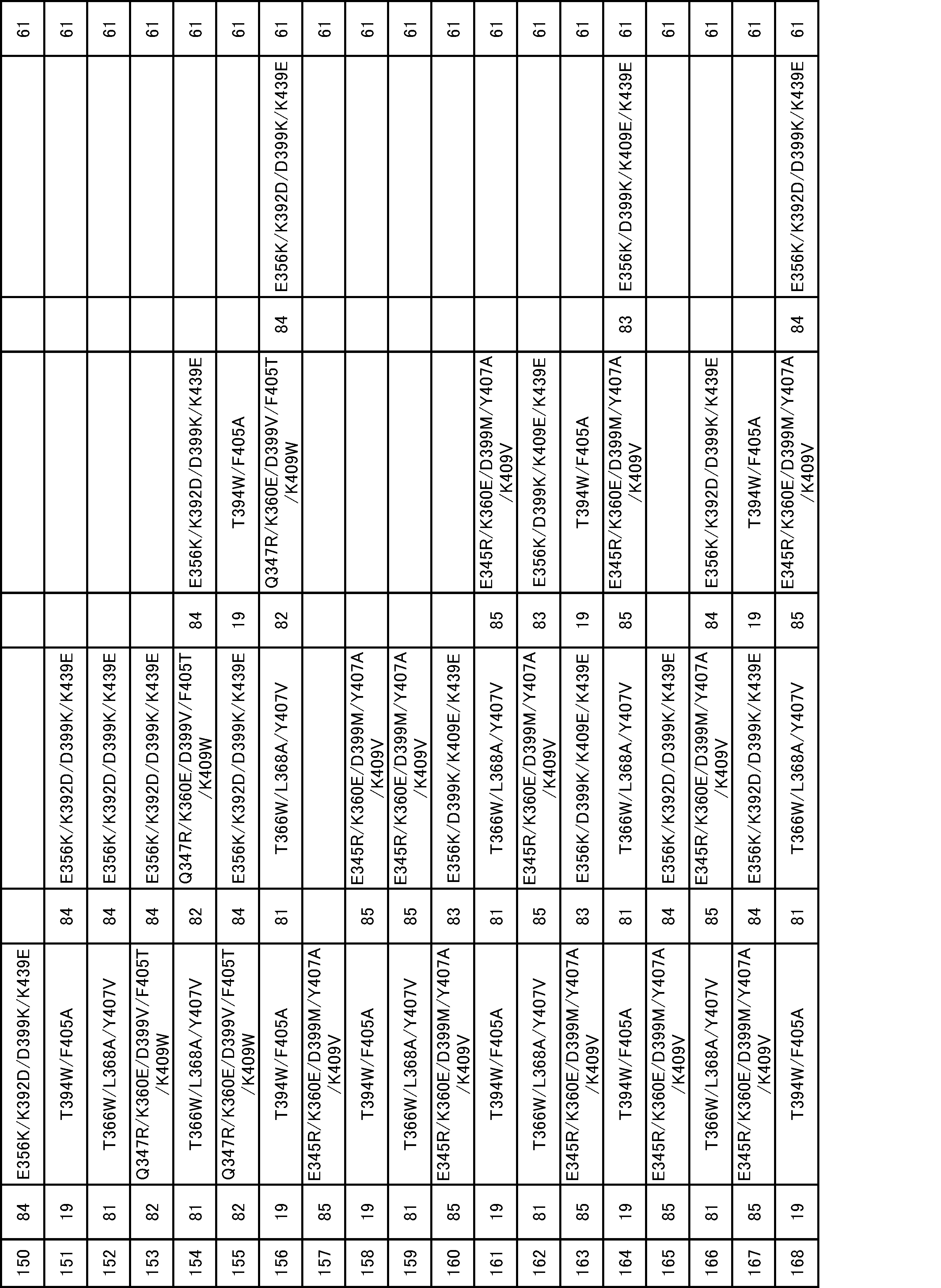

次に、重鎖ホモ会合促進改変がFc機能に及ぼす影響が確認された。
Biacore T200(Cytiva)を用いて、ヒト胎児性Fc受容体(FcRn)に対する結合が評価された。ランニングバッファーとして50 mMリン酸緩衝液、150 mM NaCl、0.05 w/v%-P20, pH6.0が用いられ、25℃で評価が実施された。リガンド捕捉用分子としてrProtein L(BioVision)をSeries S CM4(Cytiva)に固相化した。このCM4センサーチップに対してランニングバッファーで調製した抗体溶液を相互作用させることで抗体を約400RU捕捉させた。本測定に用いたヒトFcRnタンパク質はWO2010107110に記載の手法で調製された。ヒトFcRnはランニングバッファーで0, 250, 500, 1000, 2000, 4000 nMに希釈され、捕捉させた抗体に結合させた。チップは10 mM Glycine-HCl (pH 1.5) を用いて再生され、繰り返し抗体を捕捉して測定が行われた。各抗体のFcRnに対する結合活性は、Biacore T200 Evaluation Software 3.2.1を用いてSteady stateモデルによりKD(M)を算出することにより評価された。CH3界面の改変の有無でKD値は同程度であった。表10にヒトFcRnと各抗体のKD(M)が示された(改変が導入されていない場合は「-」と記載された)。

作製された改変体の各ヒトFcγ受容体(以下FcγRと示す)に対する結合活性が Biacore T200(Cytiva)を用いて評価された。ランニングバッファーとして50 mMリン酸緩衝液、150 mM NaCl、0.05 w/v%-P20、pH7.4が用いられ、25℃で評価が実施された。リガンド捕捉用分子としてrProtein L (BioVision)をSeries S CM4(Cytiva)に固相化した。そしてランニングバッファーで調製した抗体溶液をこのCM4センサーチップに相互作用させることで、抗体をヒトFcγRIaの測定の場合、約500 RU、その他のヒトFcγRの測定の場合2000 RU捕捉させた。本測定に用いたヒトFcγRタンパク質はWO2022220275に記載の手法で調製された。ヒトFcγRはランニングバッファーでFcγRIaは8nMに、それ以外のFcγRは1000nMに希釈し、捕捉させた抗体に結合させた。チップは10 mM Glycine-HCl (pH 1.5) を用いて再生され、繰り返し抗体を捕捉して測定が行われた。各抗体の各FcγRに対する結合活性は、Biacore T200 Evaluation Software version3.2.1を用いて単位抗体量当たりのFcγR結合量(RU)を算出して評価された。
表11に単位抗体量あたりの結合量、及び表12にFcにコントロール抗体(検体番号61)の結合量に対する相対量(%)が示された(改変が導入されていない場合は「-」と記載された)。重鎖ホモ二量体形成を促進するCH3改変が導入された抗体は概ね各種ヒトFcγRに対してコントロールと同等もしくはわずかに高い結合活性を示した。しかし、検体番号117では一部のFcγRに対してコントロールの半分以下の結合量を示した。そのため、コントロール抗体と同等のFc機能を期待した使用目的の場合、検体番号117のCH3改変以外を使用すべきである。
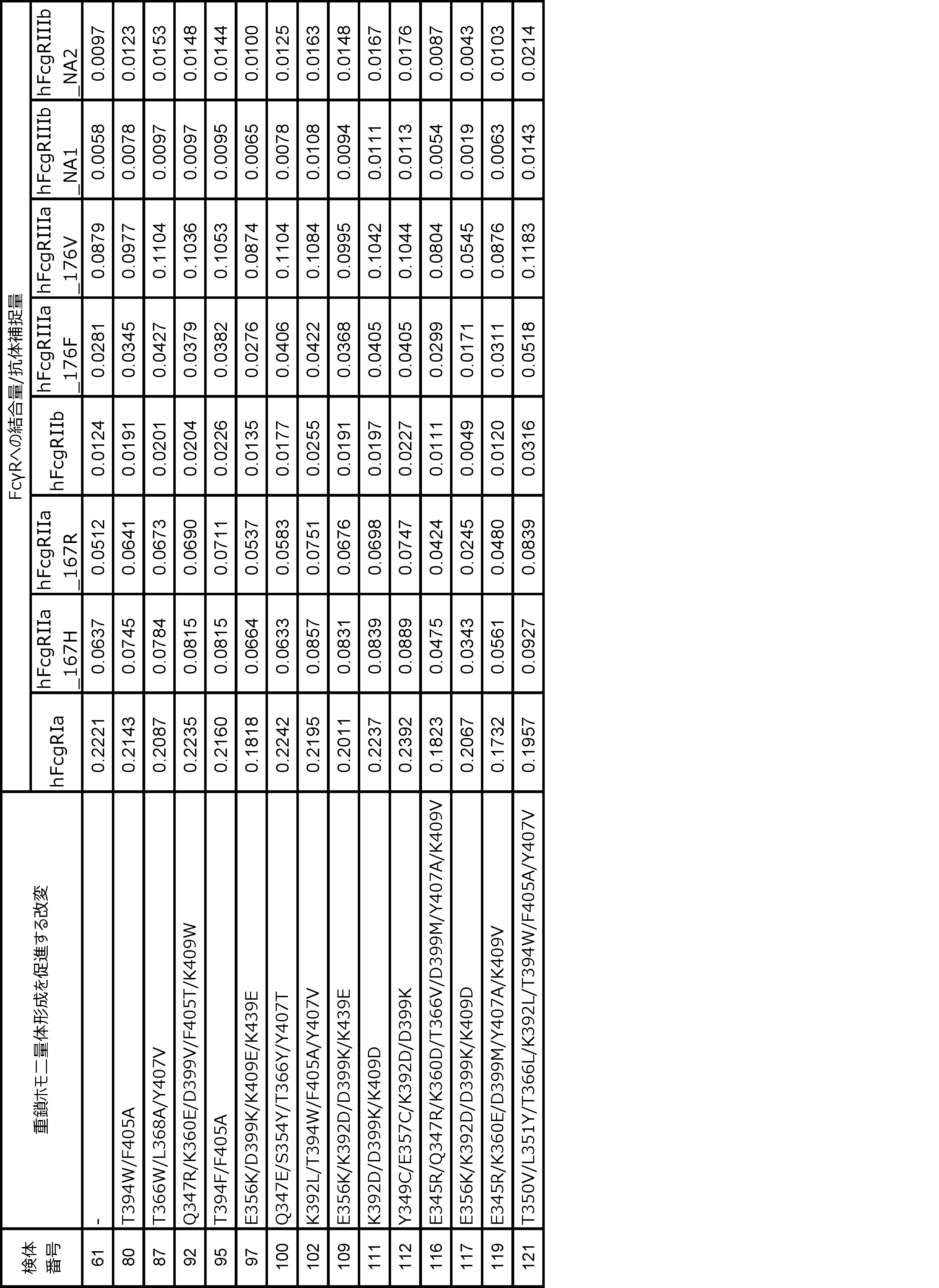
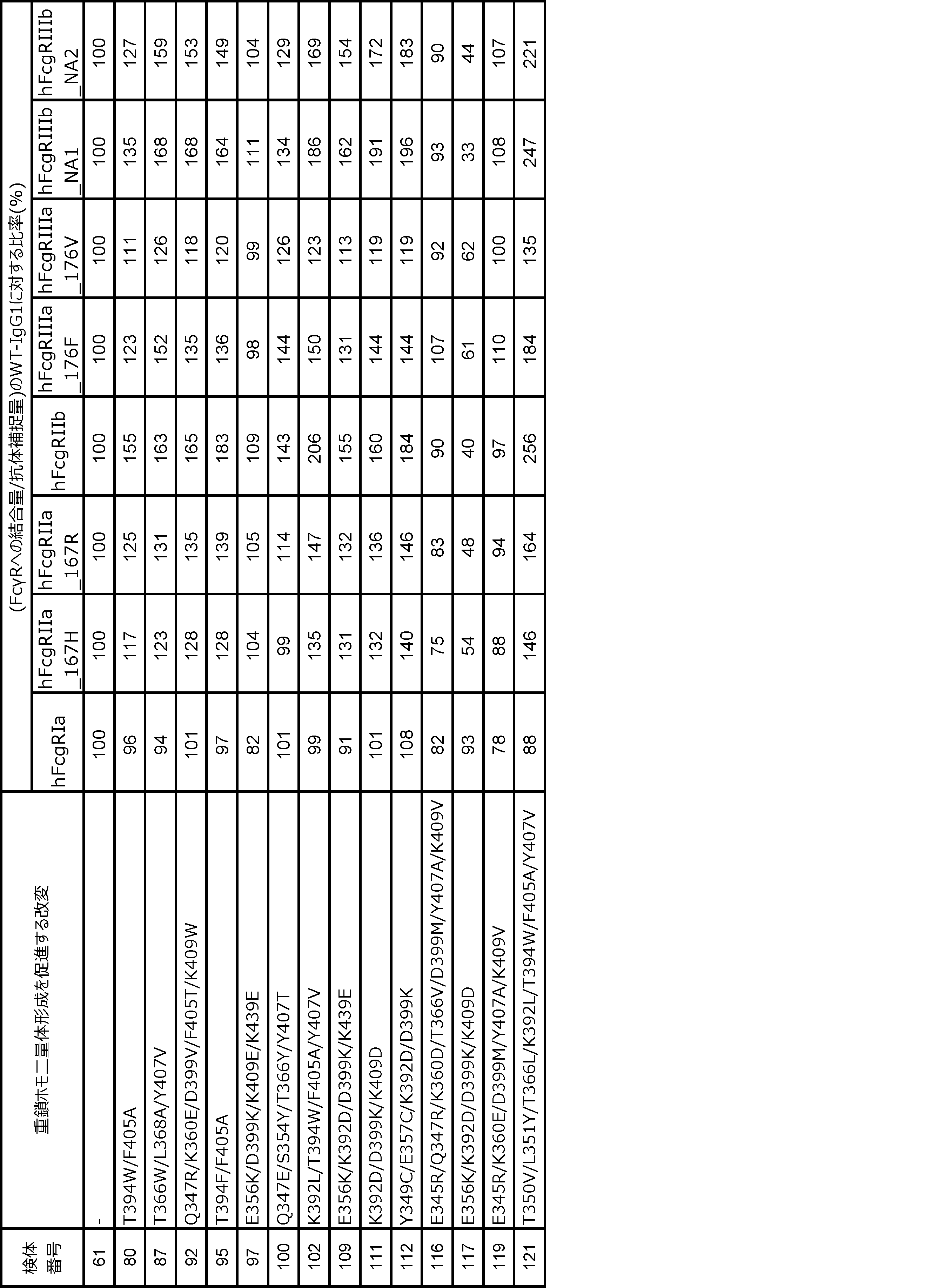
次に、重鎖ホモ会合促進改変体の非特異結合に及ぼす影響が確認された。
非特異結合をin vitroで評価する系としてExtracellular matrix (ECM)への結合性を評価する系が知られており、本アッセイ系において評価を行った(US patent 2014/0080153)。測定の結果は図4に示された。CH3界面の改変の有無でECMへの結合は同程度であった。
実施例1-9ではIgG1サブクラスの抗体を用いて評価が行われた。しかし、治療用抗体としてはその他のIgGサブクラス(IgG2, IgG4)も重要であり、また生体の内在性抗体との会合を防ぐ場合は異なるサブクラス間で重鎖ヘテロが形成されないことが重要である。ここでは、IgG1で強い重鎖ホモ二量体形成能力を示した改変の一部を異なるIgGサブクラスにも適用し、SEC分析により重鎖ホモ二量体形成能力を確認した。抗体発現に用いた鋳型サブクラス、アミノ酸改変、配列番号、及び面積比の対応は表13に示された(改変が導入されていない場合は「-」と記載された)。抗体の発現及び、分析は実施例1に記載された方法に従って実施された。ただし、IgG3を含むペアについてはProtein Aでのアフィニティ精製が困難であるため、MonoSpin ProG (GL science)を用いて精製された。
表13の結果からIgG1, IgG2, IgG4のいずれのサブクラスペアでも重鎖ホモ二量体形成能力を有することが示された。
またWT-IgG1, IgG2, IgG4とWT-IgG3を組み合わせたときの分析から、WT-IgG1, IgG2, IgG4はもともとIgG3とペアを形成しにくいことが分かった。そのため、IgG1, IgG2, IgG4間で重鎖ヘテロ二量体が形成されないこれらのアミノ酸改変体は、WT-IgG3と重鎖ヘテロ会合をより形成しにくいと考えられた。
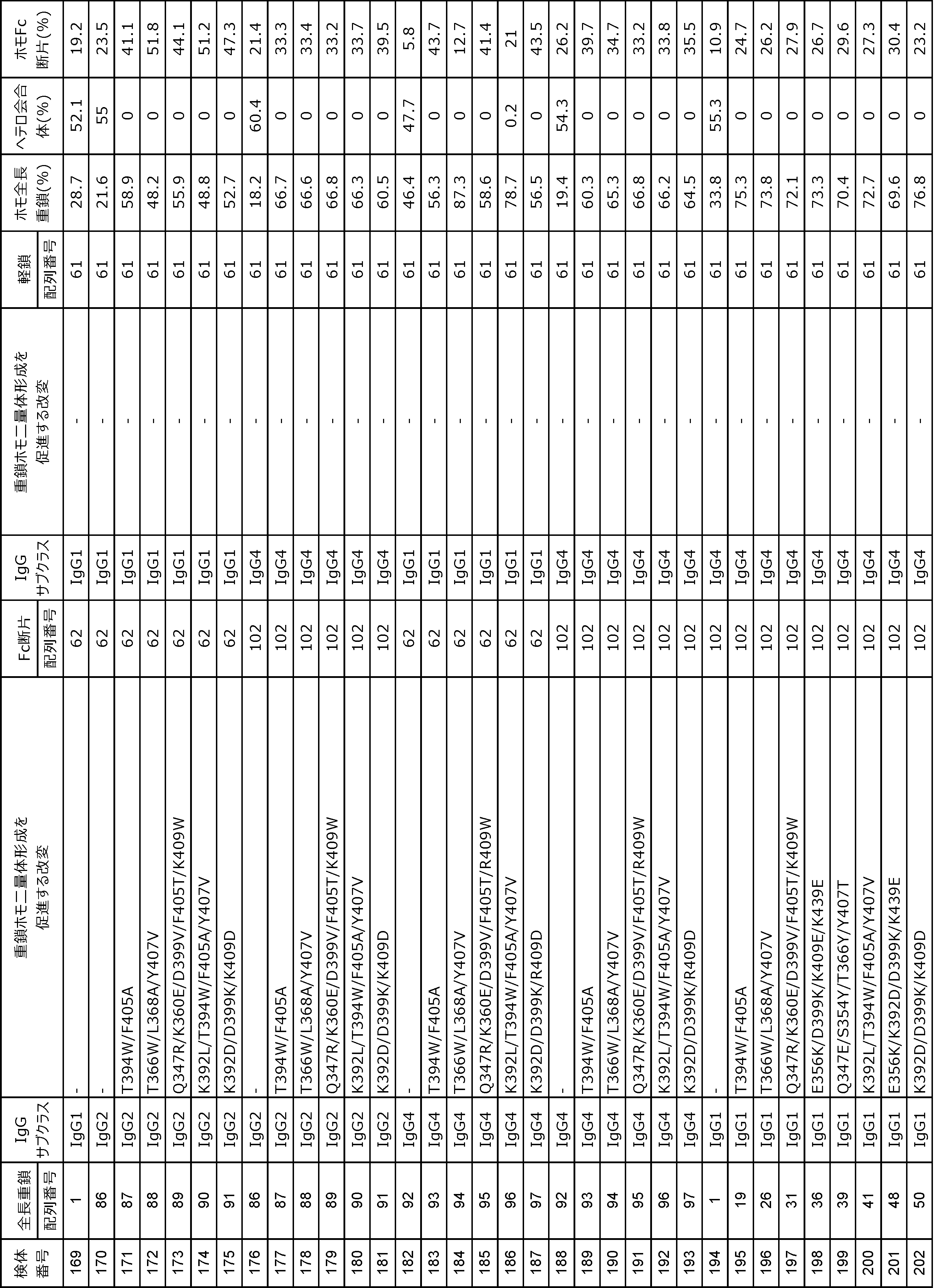

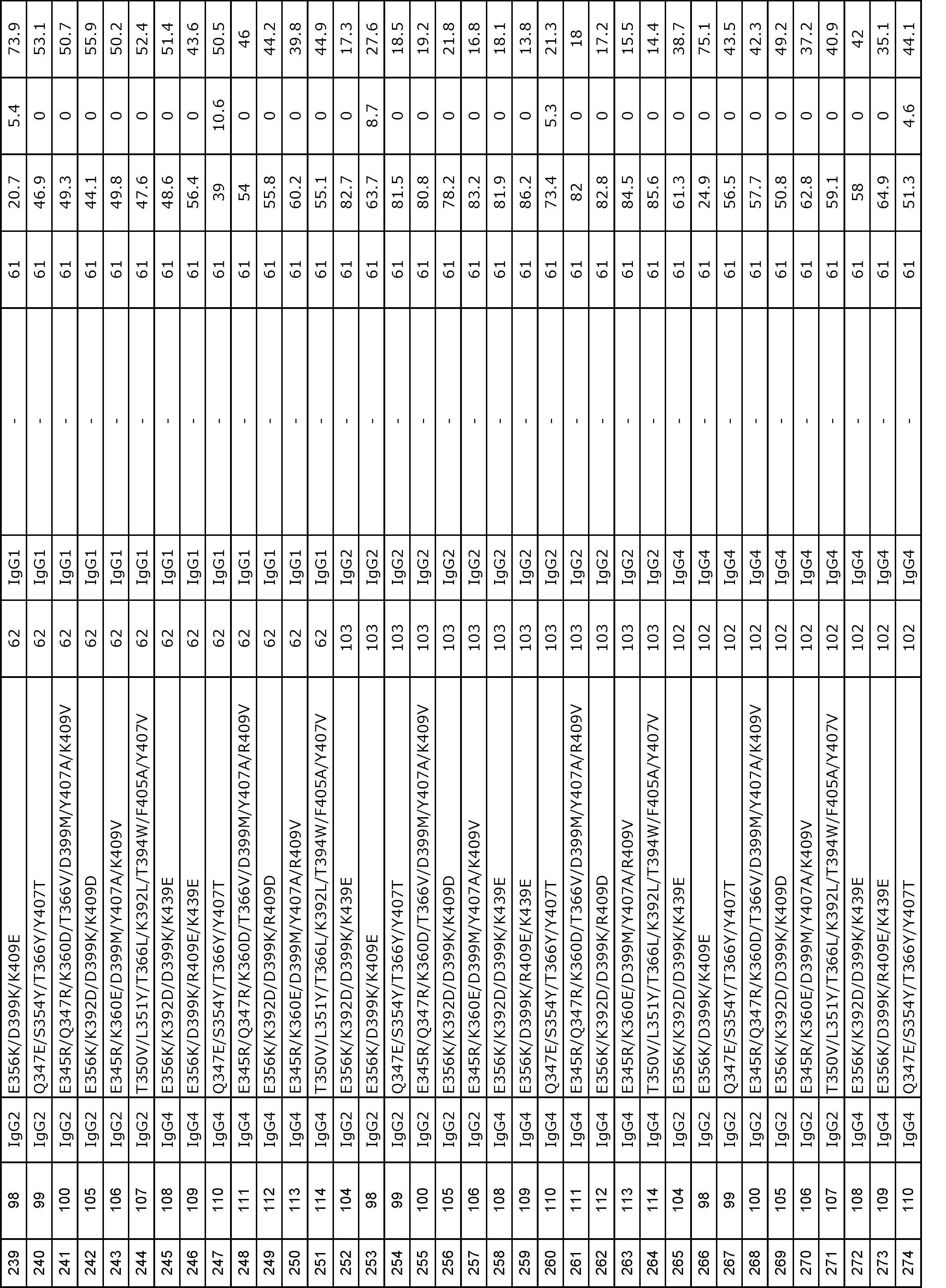
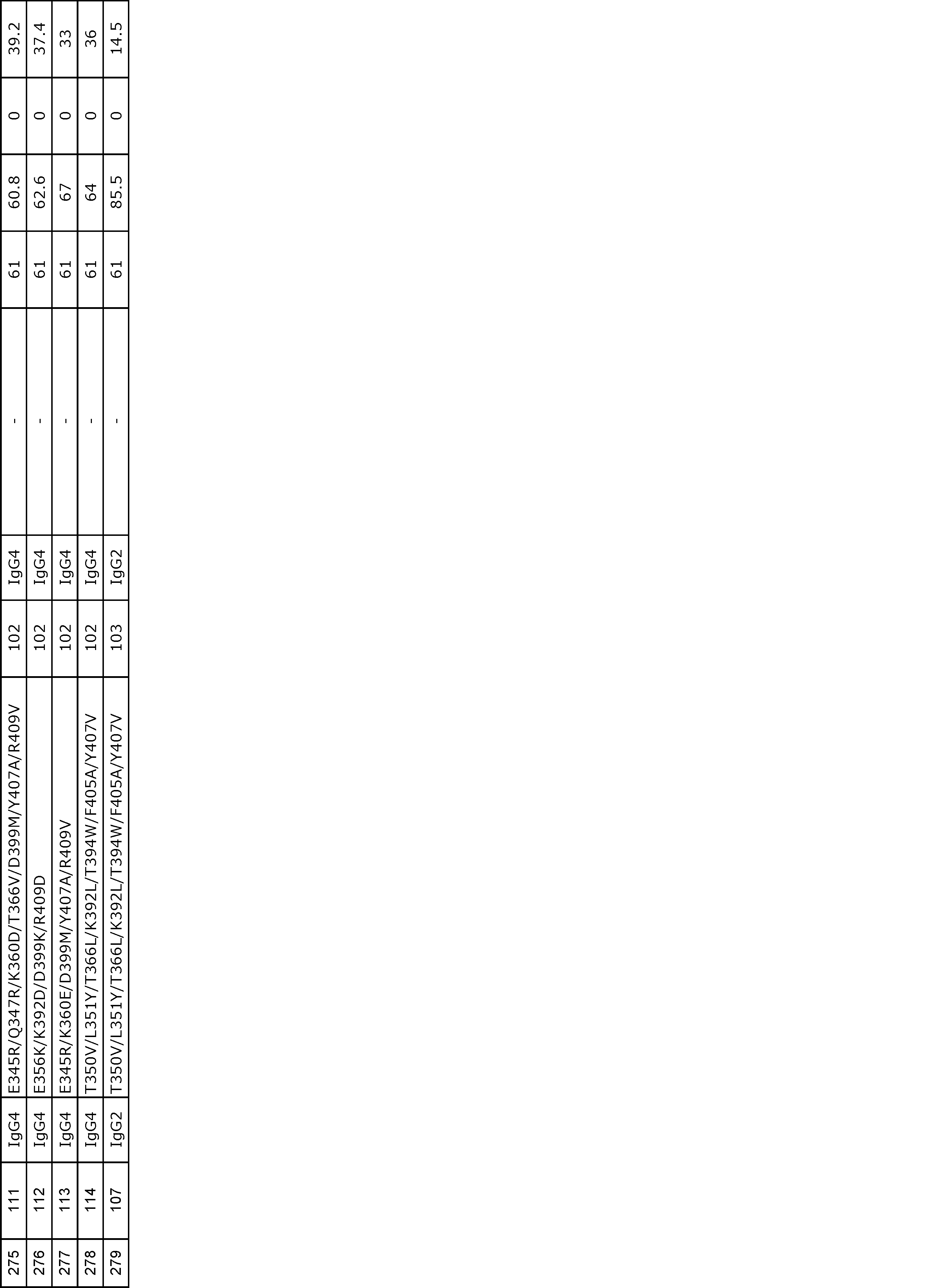
実施例1-10の評価では基本的なIgGフォーマットが使用され、また、FcにはCH3界面制御以外の改変を含まない野生型IgGが使用された。しかし、より有効な治療用抗体を調製・発現するためには、VHHやscFvにFcが連結されたフォーマットなどの様々な抗体フォーマットや、Fc機能を変更するアミノ酸改変が導入された抗体へも適用できることが理想的である。ここでは、IgGで強い重鎖ホモ二量体形成能力を示した改変の一部を様々な抗体フォーマットおよび、Fc改変抗体に適用し、SEC分析により重鎖ホモ二量体形成能力を確認した。抗体発現に用いた鋳型抗体の重鎖バックボーンまたは含まれるアミノ酸改変(およびその機能)、重鎖ホモ二量体形成を促進するアミノ酸改変、配列番号、及び面積比の対応は表14に示された(改変が導入されていない場合は「-」と記載された)。抗体の発現及び、分析は実施例1に記載された方法に従って実施された。ただし、SEC分析においてIgGのHexamer形成を促進するE345R/E430G/S440Y改変を含む抗体については会合体成分が検出された。また、scFv.LH-FcまたはscFv.HL-Fcのフォーマットを含むペアについては各ホモ体およびヘテロ会合体の完全な分離が困難であった。そのため、これらの検体についてはヘテロ会合体成分のピークに着目して、ヘテロ会合体形成の抑制効果を定性的に評価した(図5-1~図5-14)。
表14および図5-1~図5-14の結果に基づいて、重鎖ホモ二量体形成能力(あるいはヘテロ会合体形成の抑制効果)は抗体の結合領域がVHHであってもscFvであっても維持され、またFc領域が脱糖鎖体である場合や、FcRnへの結合増強、FcγRへの結合抑制、Hexamer形成促進の改変が存在しても維持されることが明らかとなった。
さらに、いずれのフォーマットでも重鎖ホモ二量体形成能力(あるいはヘテロ二量体形成の抑制効果)が維持されていることから、Fcに連結されたポリペプチドはFab, VHH, scFv以外のポリペプチドでも同様に維持され、Fc界面に影響を与えないアミノ酸改変存在下でも広く維持されると予想できる。
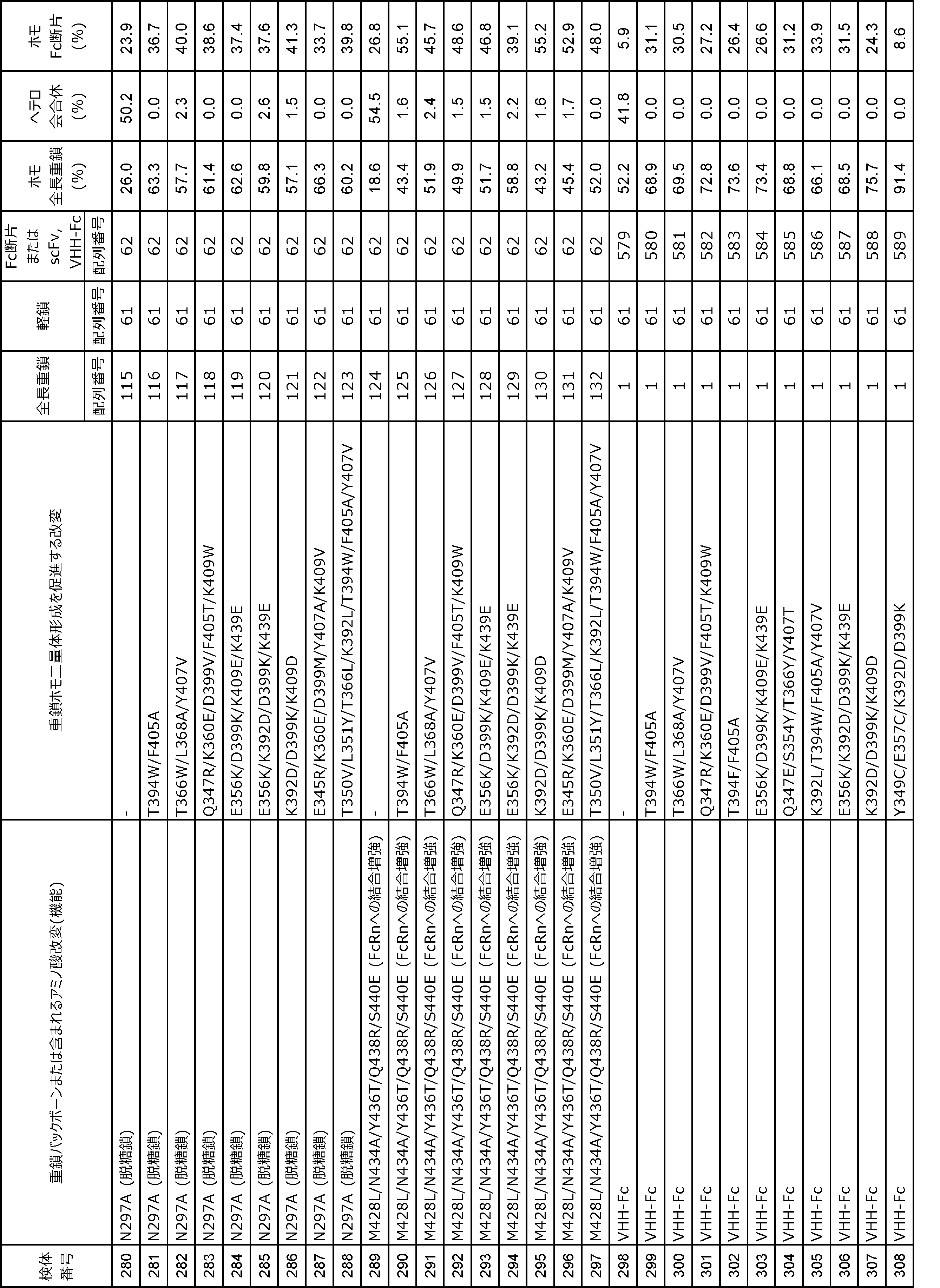
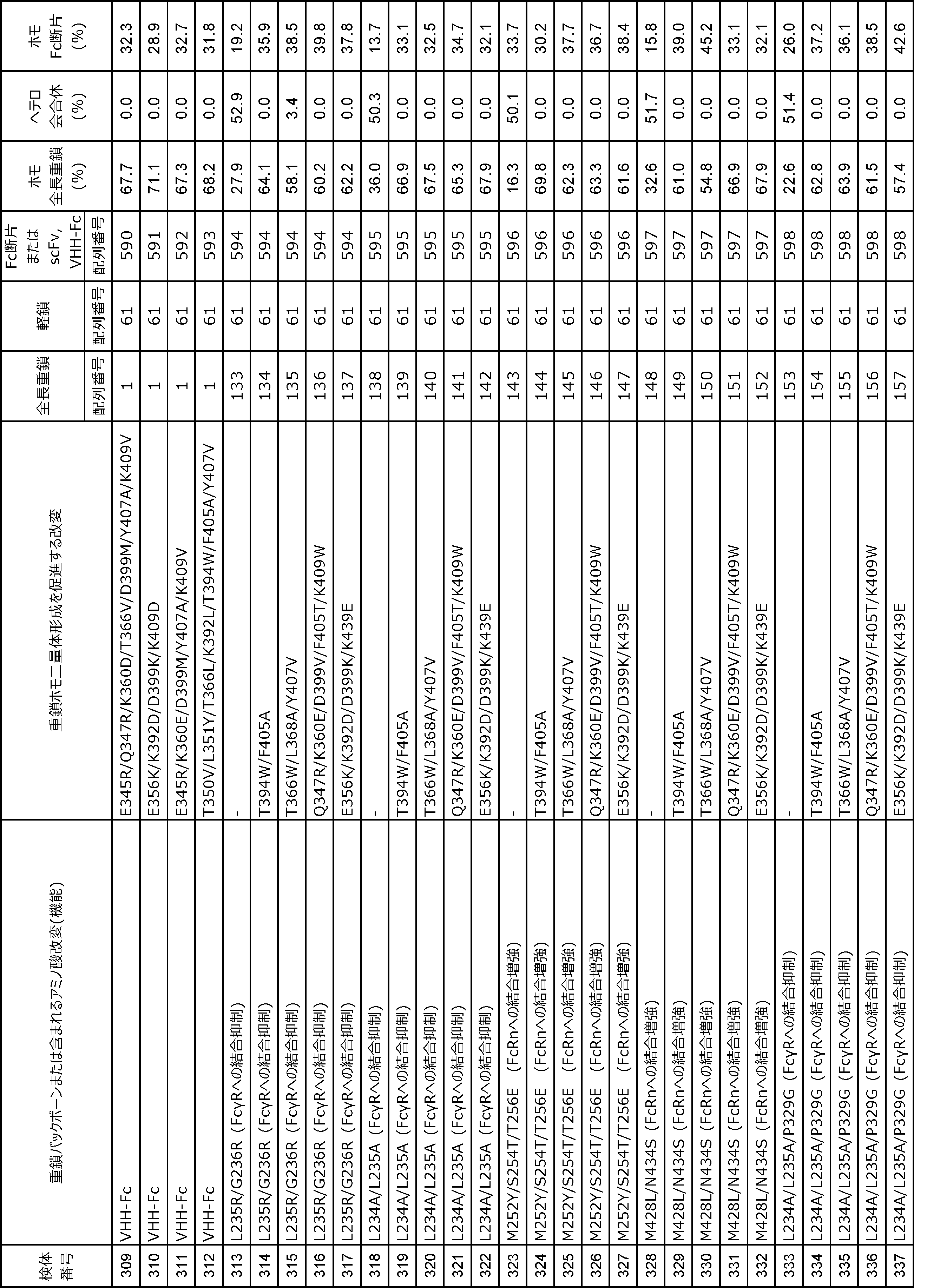
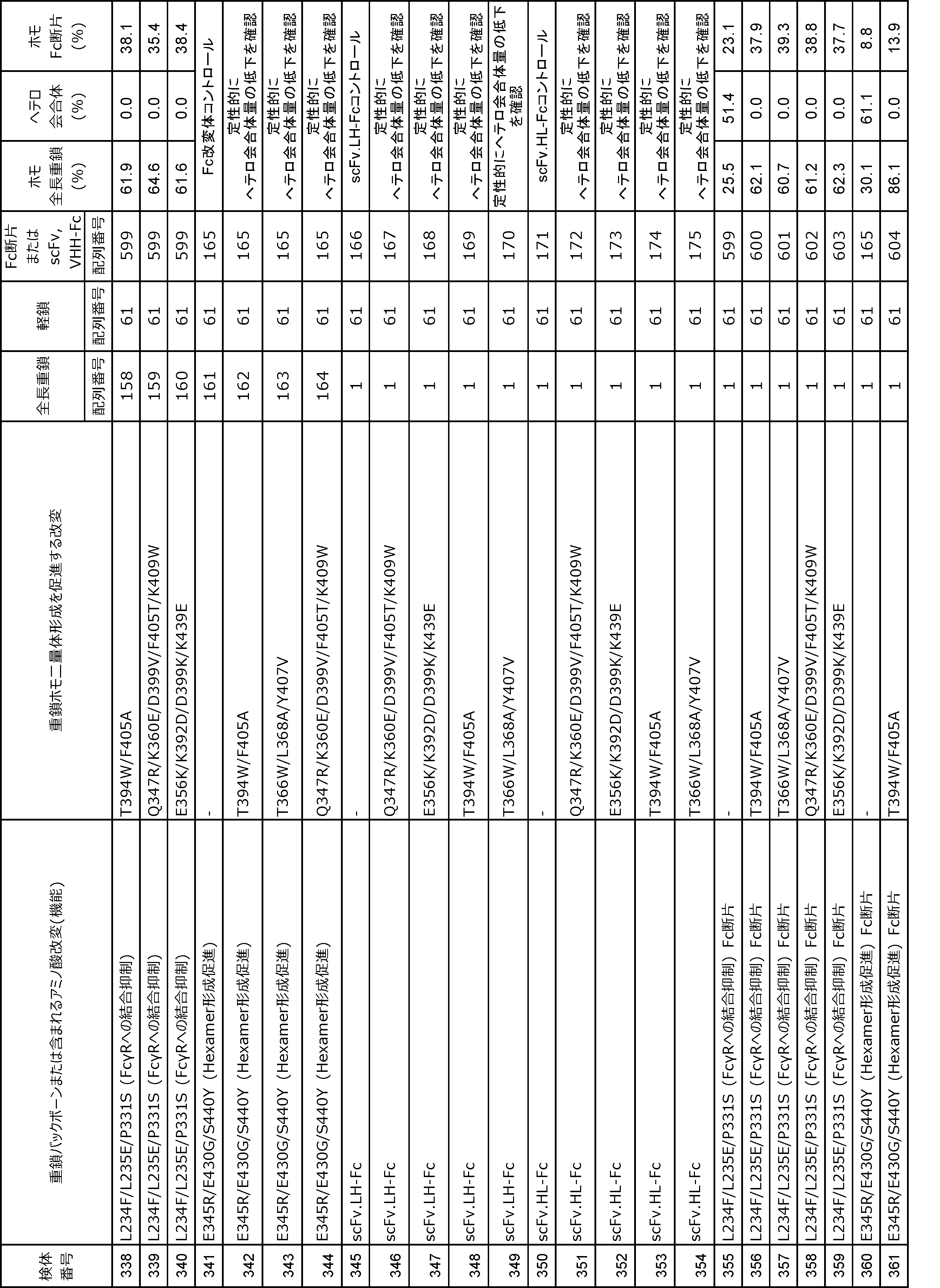
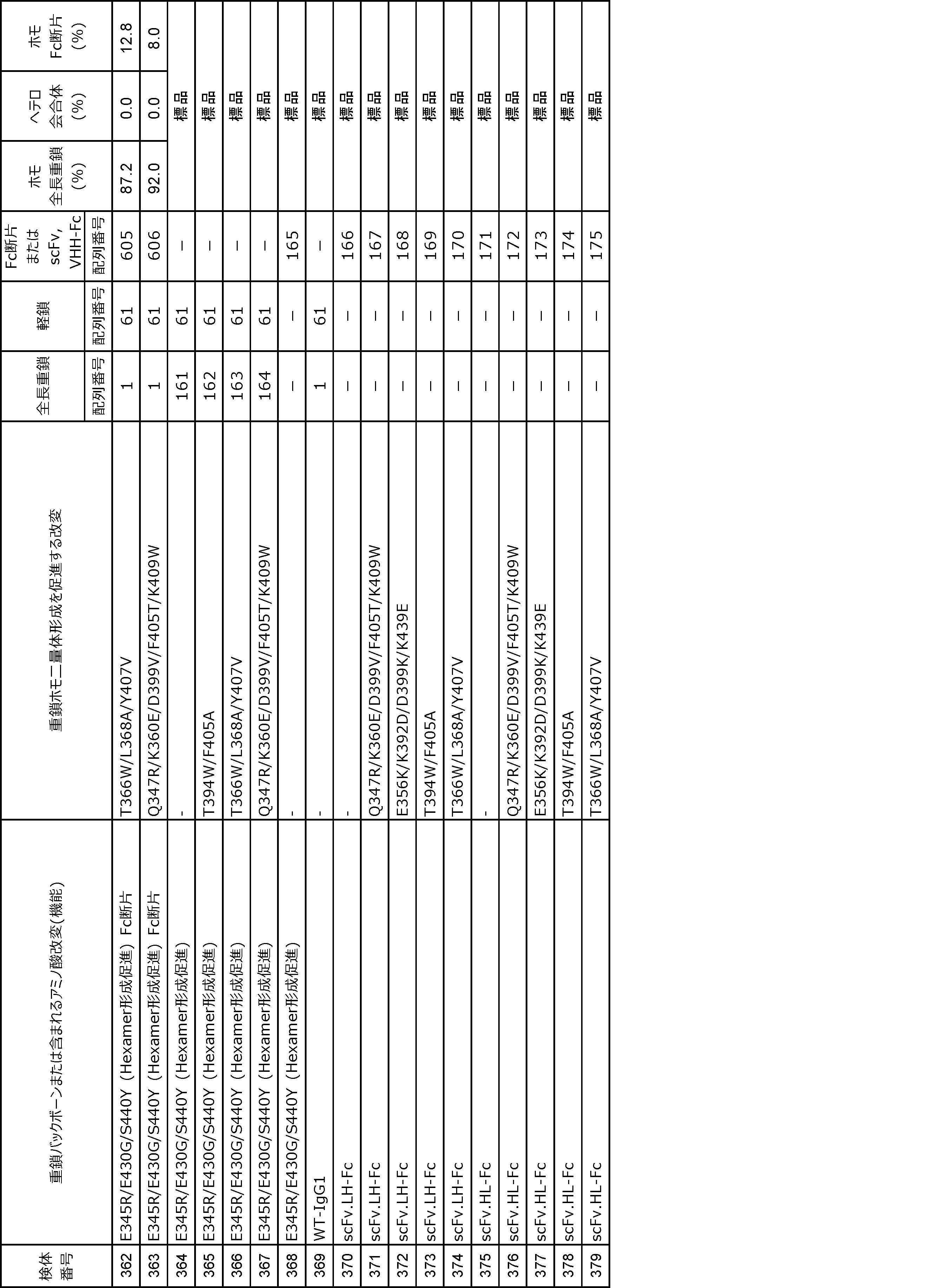
ここまでの実施例により、表4に示されたアミノ酸改変は、特に強い重鎖ホモ二量化促進能力を有し、抗体のサブクラス、フォーマット、鋳型抗体のFc改変に関わらず、幅広く適用が可能な改変であることが明らかとなった。ただし、これらの有効な改変セットの周辺のアミノ酸改変は、まだ十分に探索されていないため、表4の改変セット以外にも有効な改変が存在する可能性がある。そこで、表4中のT394W/F405A(T394F/F405A)、T366W/L368A/Y407V、Q347R/K360E/D399V/F405T/K409W、E345R/Q347R/K360D/T366V/D399M/Y407A/K409V、E356K/D399K/K409E/K439E、E356K/K392D/D399K/K409D、E356K/K392D/D399K/K409D、K392D/D399K/K409D、E356K/K392D/D399K/K439Eの改変について、各改変ポジションの大規模なアミノ酸改変が行われた。さらに、それらの重鎖ホモ二量体形成能力が、SEC分析により評価された。抗体発現に用いた改変の効果の分類、アミノ酸改変、配列番号、及び面積比の対応は表15に示された(改変が導入されていない場合は「-」と記載された)。抗体の発現及び、分析は実施例1に記載された方法に従って実施された。また、それぞれのFc改変を含むホモ二量体は実施例3に記載した方法で調製され、同様の方法でSEC分析における単量体率、Tm、収量(mg)が評価され、合わせて表15に記載された。その結果、表15のヘテロ会合体(%)がコントロールの51.7%よりも低くなった改変は有効な改変であると評価された。各ポジションにおけるこれらの有効な改変は、組み合わせて使用することも可能であると考えられる。
本試験では、ホモ二量体の分析において、単量体率が低い検体については、ホモ二量体由来の半量体(1つの重鎖と1つの軽鎖から構成される単量体)がヘテロ会合体のピーク中に含まれた。そのため、これらの検体は見かけ上、ヘテロ会合体量の割合は真値よりも高くなっていると考えられる。しかし、強いホモ二量体化能力および良好な物性を有するアミノ酸改変の判定には影響を及ぼさないと考えられたため、一律に51.7%以下の基準でヘテロ会合体の形成抑制能力の有無が評価された。
また、表15-表18中で有効であると示された、アミノ酸改変およびその各ポジションにおける組み合わせは、性質が似ていることが想定されるため、表6、表7に示されたT394W/F405A(T394F/F405A)、T366W/L368A/Y407V、Q347R/K360E/D399V/F405T/K409W、E345R/Q347R/K360D/T366V/D399M/Y407A/K409V、E356K/D399K/K409E/K439E、E356K/K392D/D399K/K409D、K392D/D399K/K409D、E356K/K392D/D399K/K439Eの改変セットの代替として使用可能であり、複数のホモ二量体を発現させるFc改変として適用可能であると考えられる。
同様に、表15中でヘテロ会合体の割合を10%以下に抑制したアミノ酸改変が表20に記載された。これらの各々のアミノ酸の組み合わせはより好ましいヘテロ会合体抑制改変となりうる。
さらに、表15中でヘテロ会合体の割合を0%に抑制したアミノ酸改変が表21に記載された。これらの各々のアミノ酸の組み合わせはさらに好ましいヘテロ会合体抑制改変となりうる。
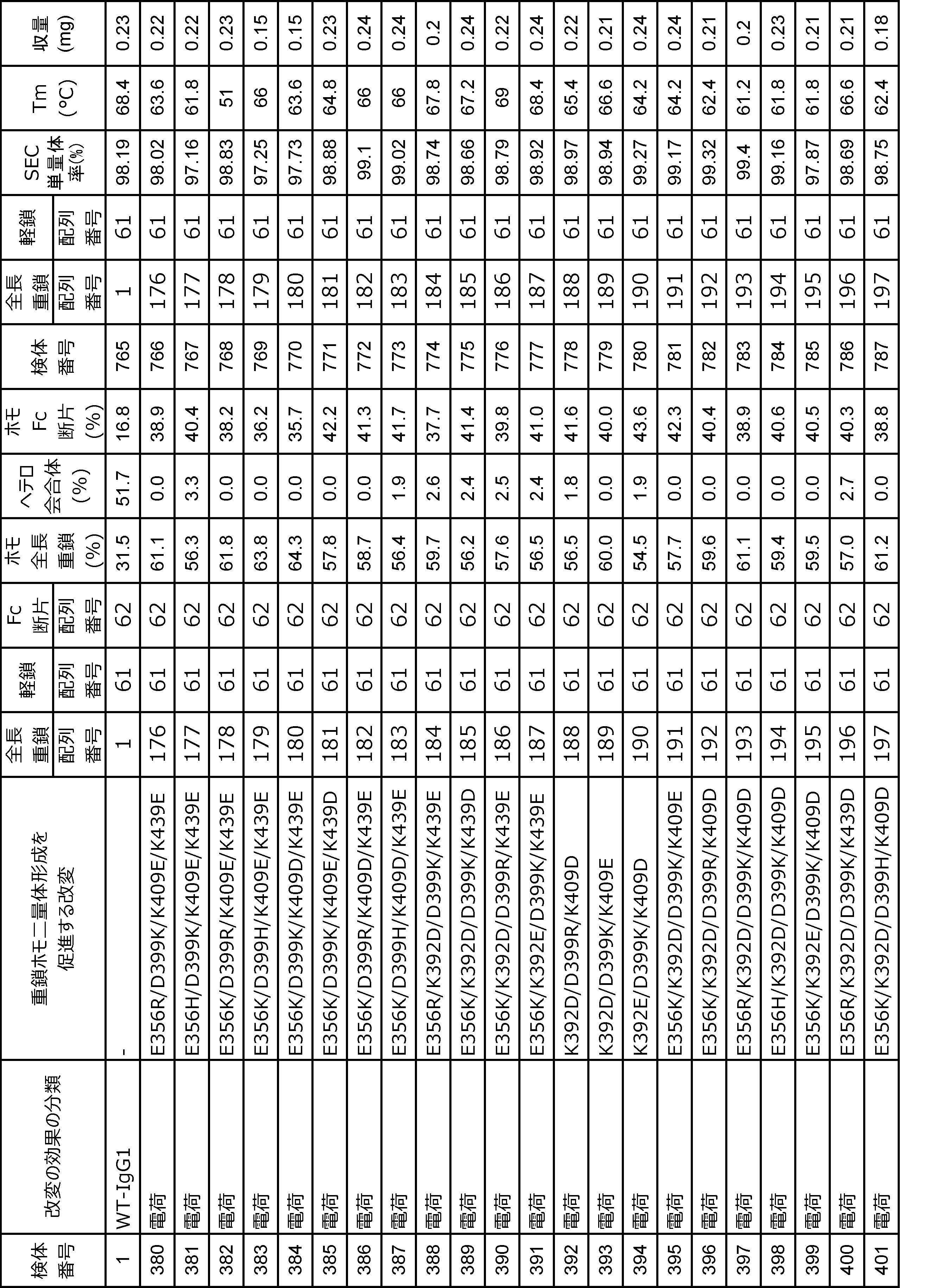
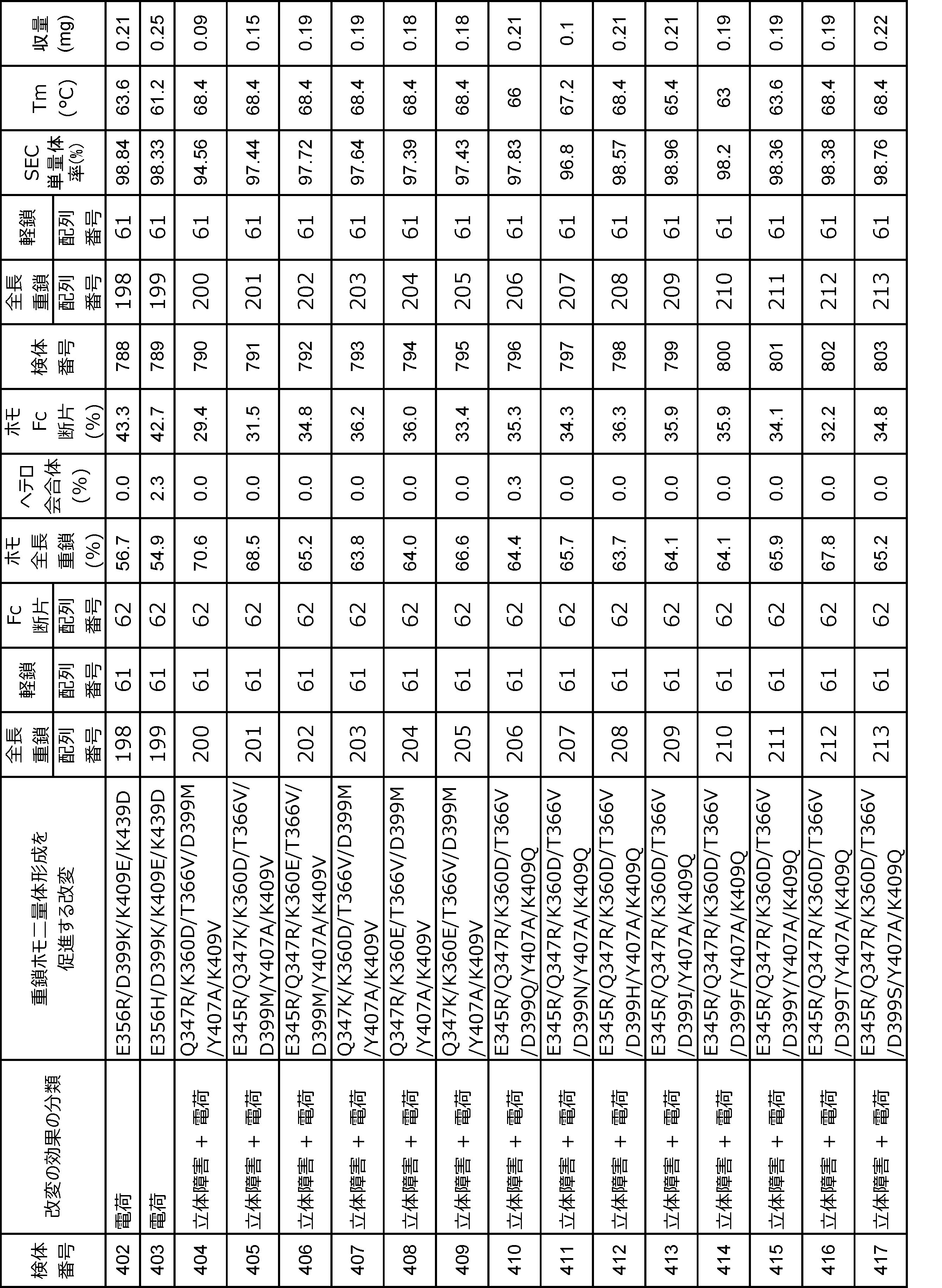
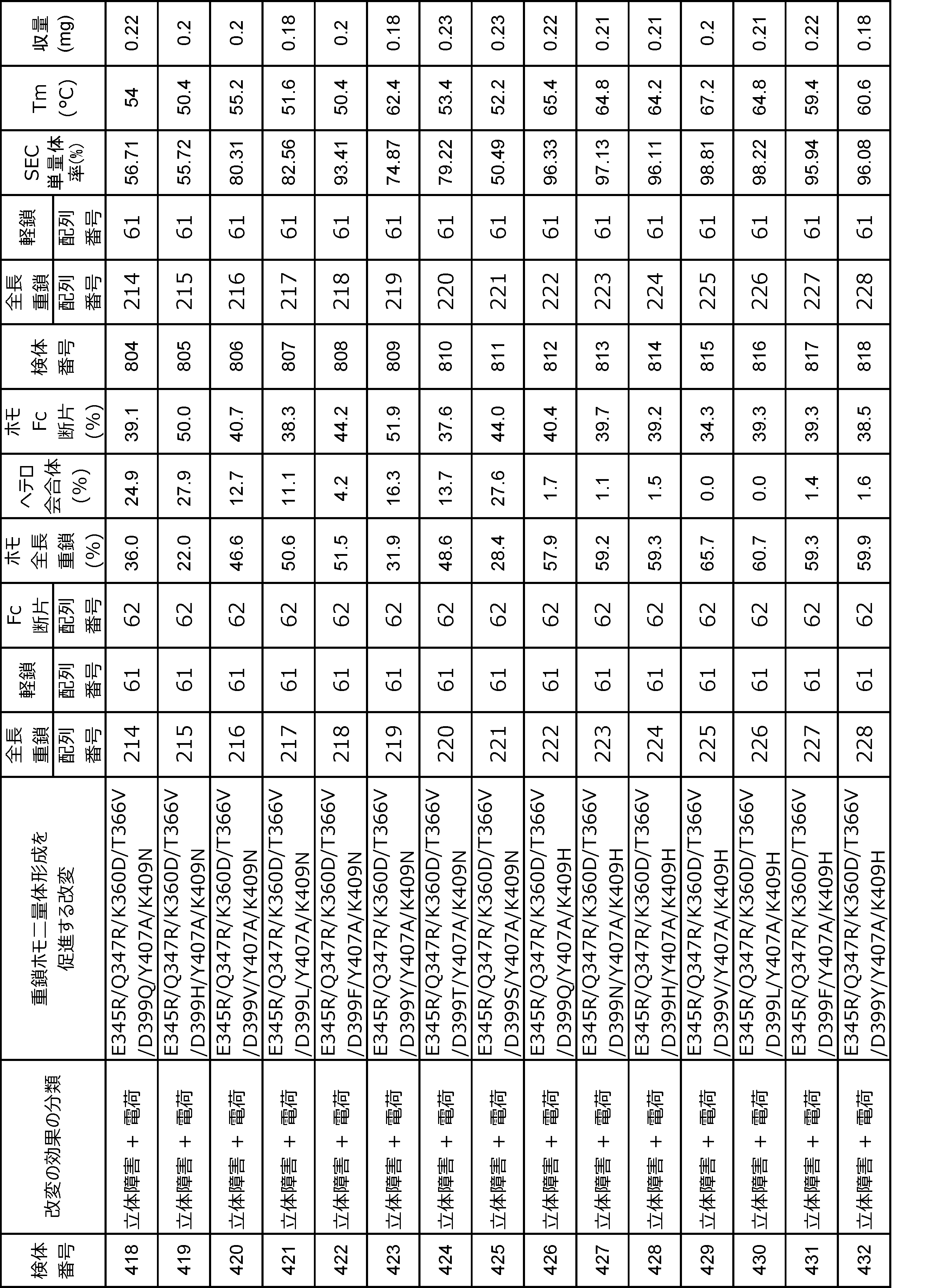
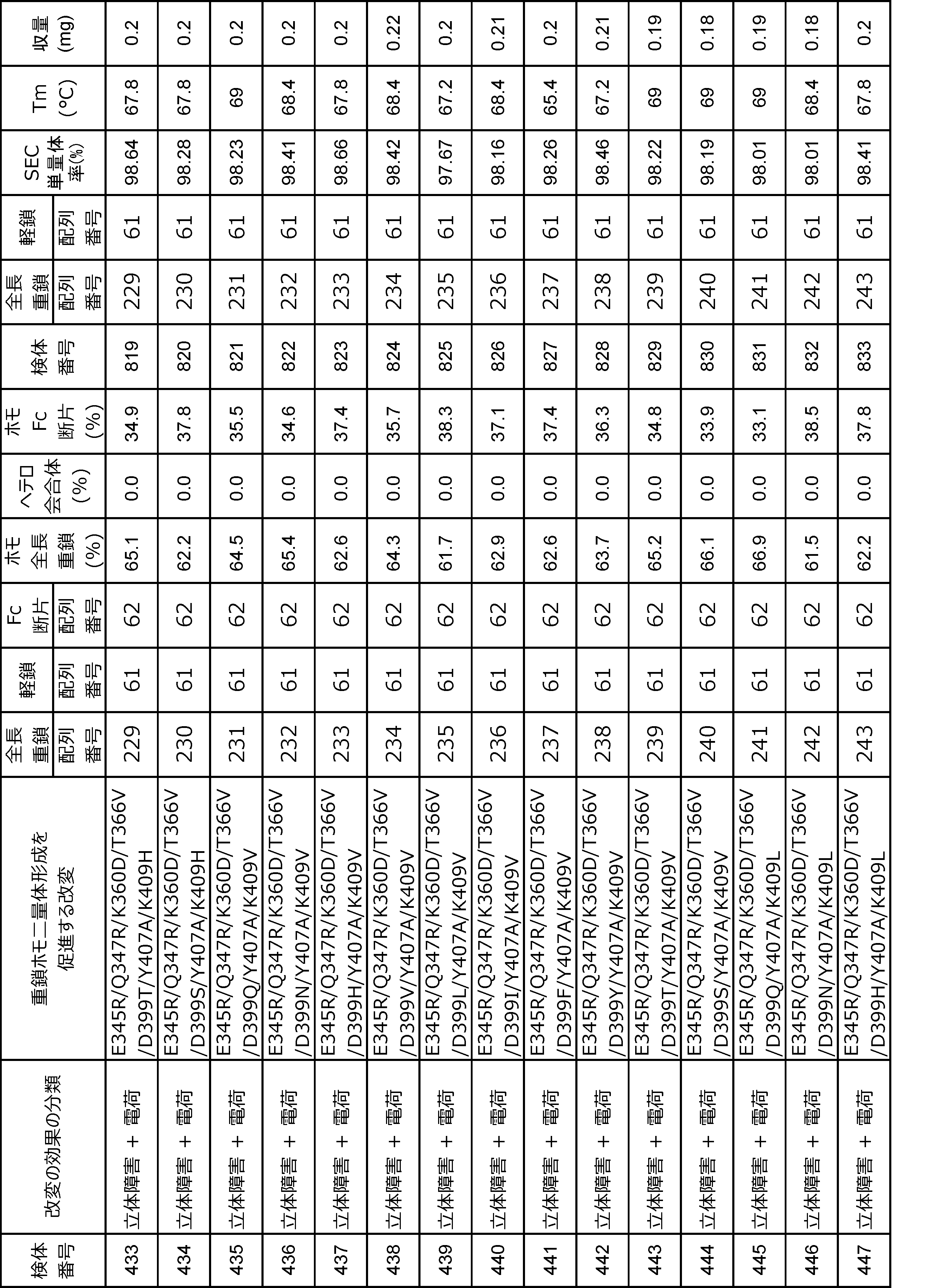
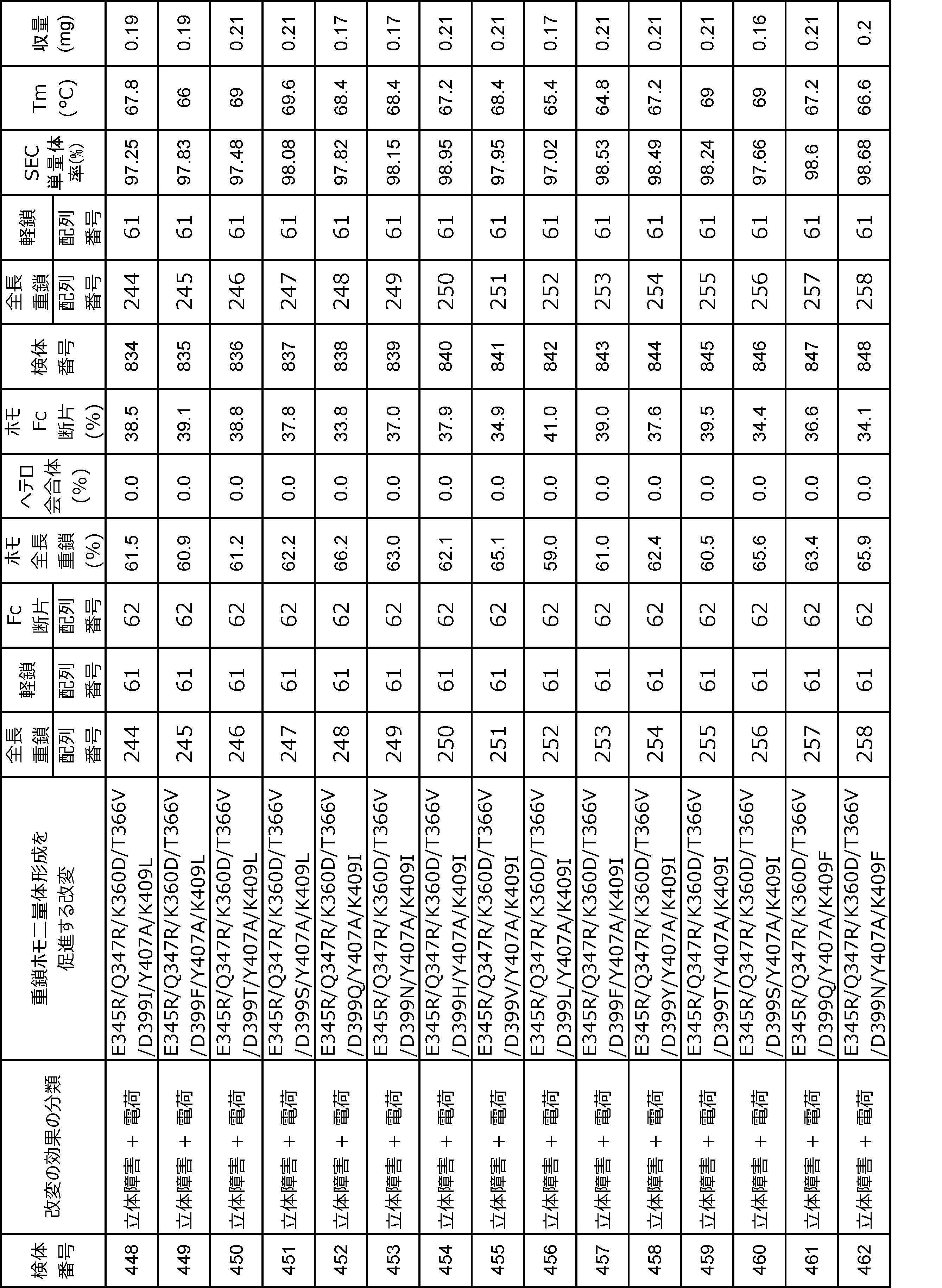
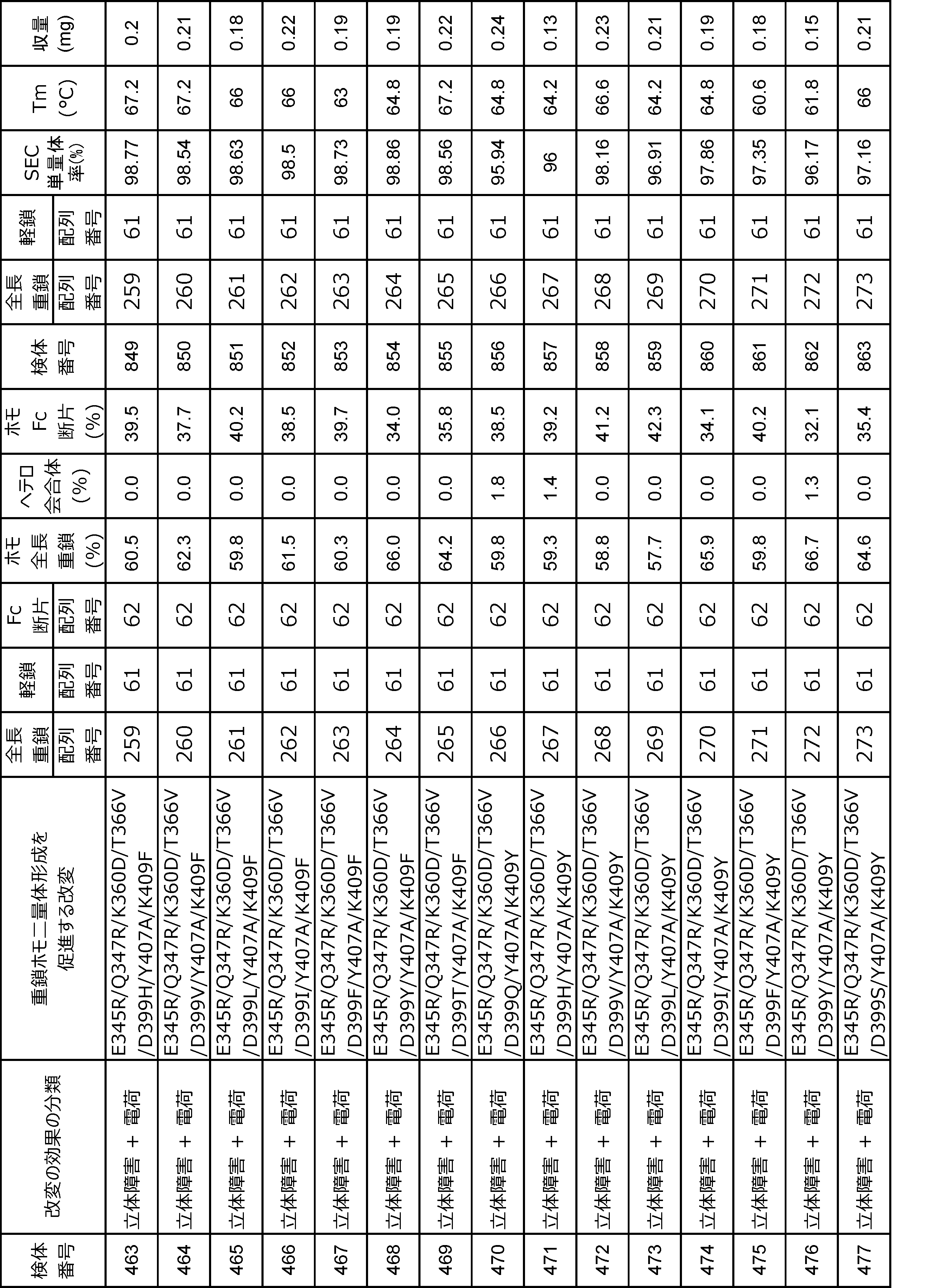
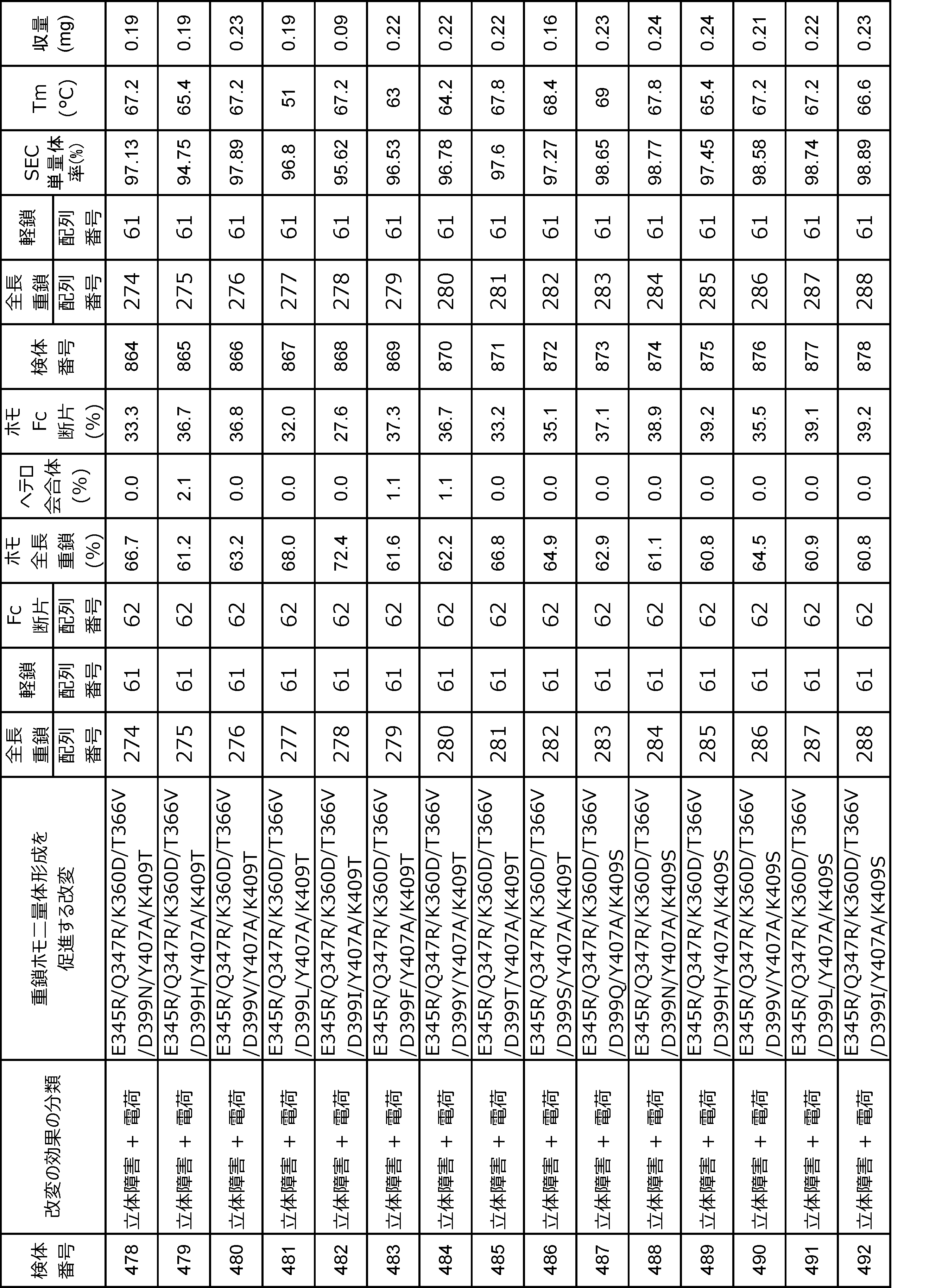


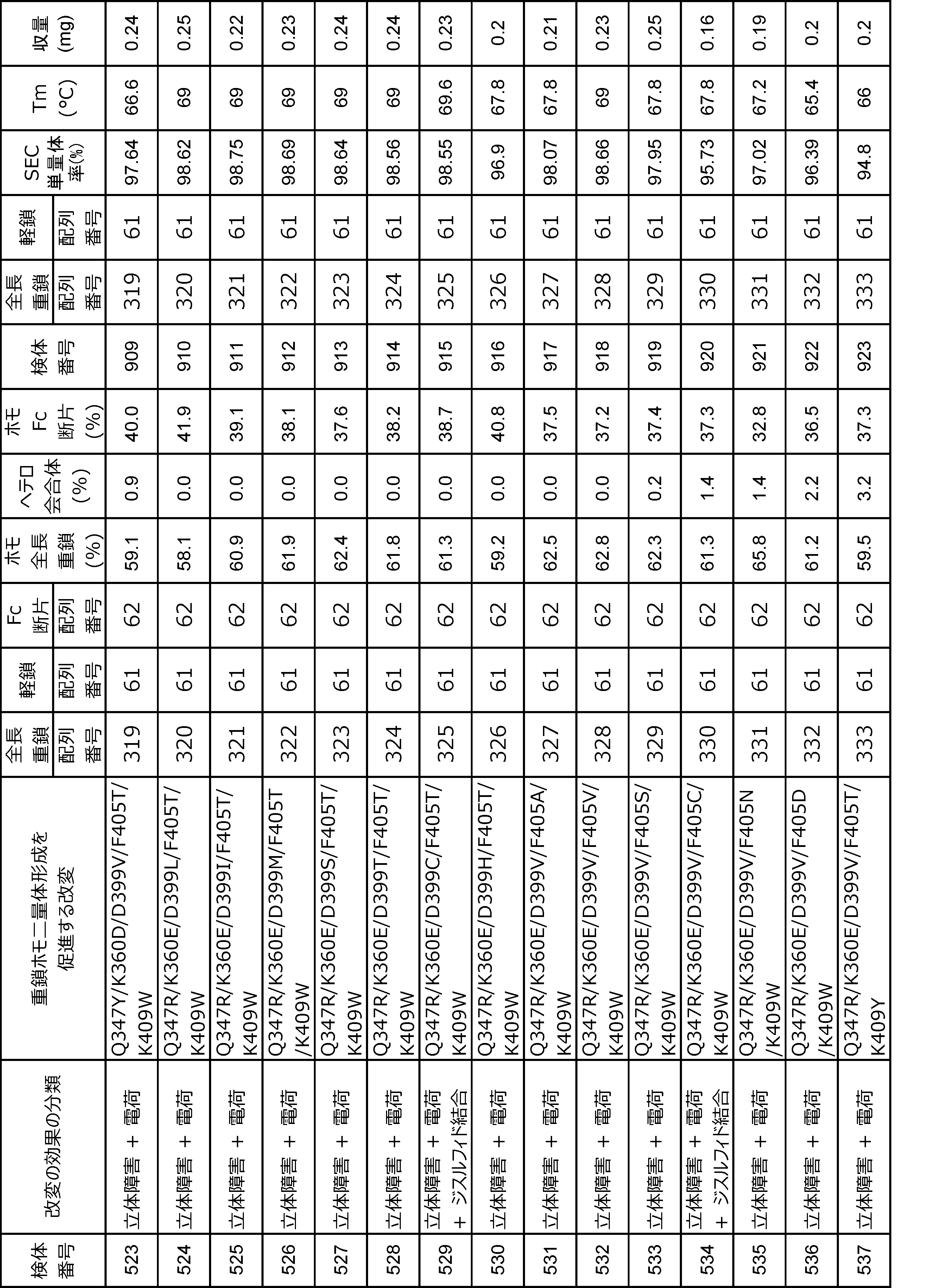
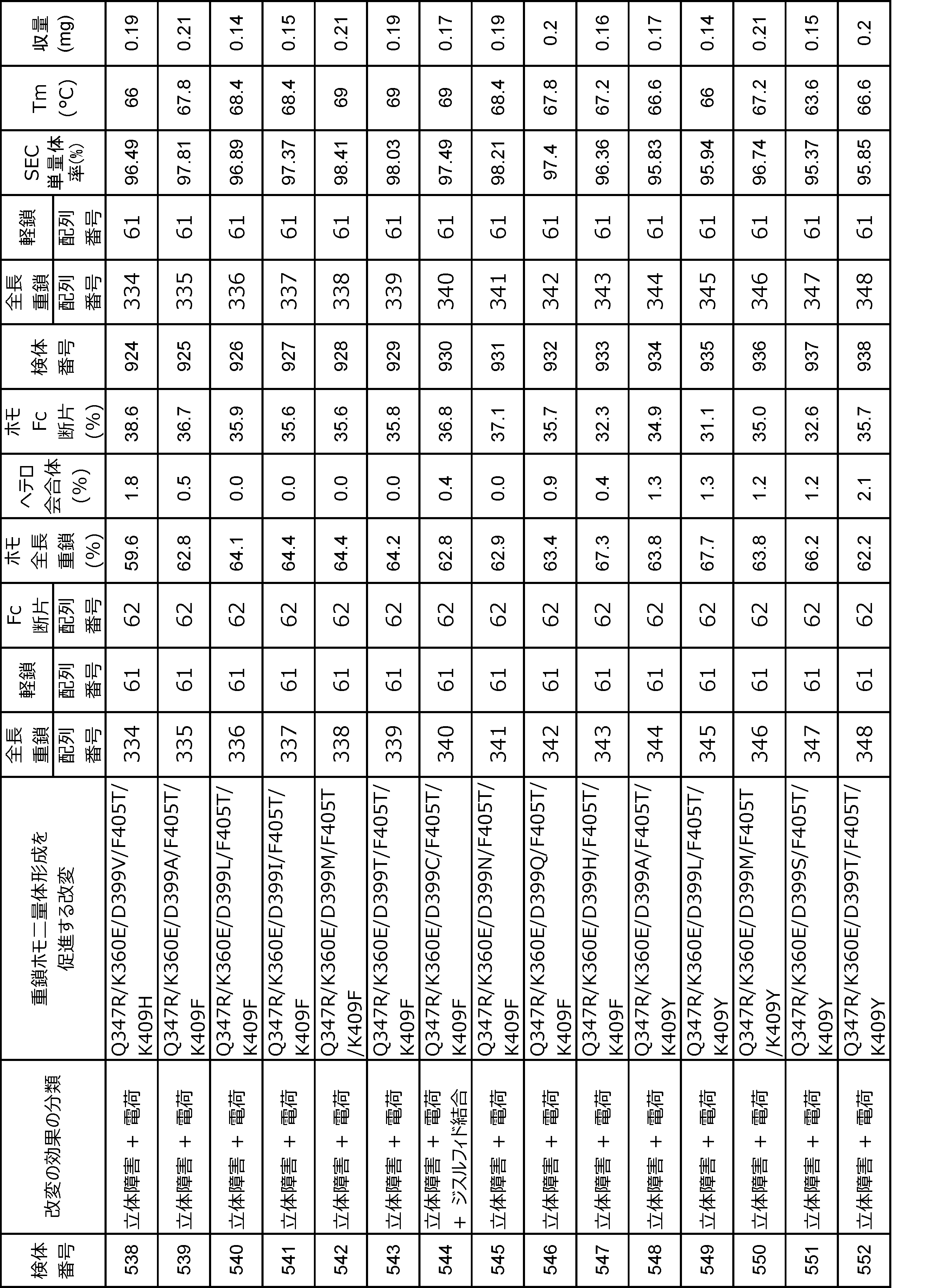

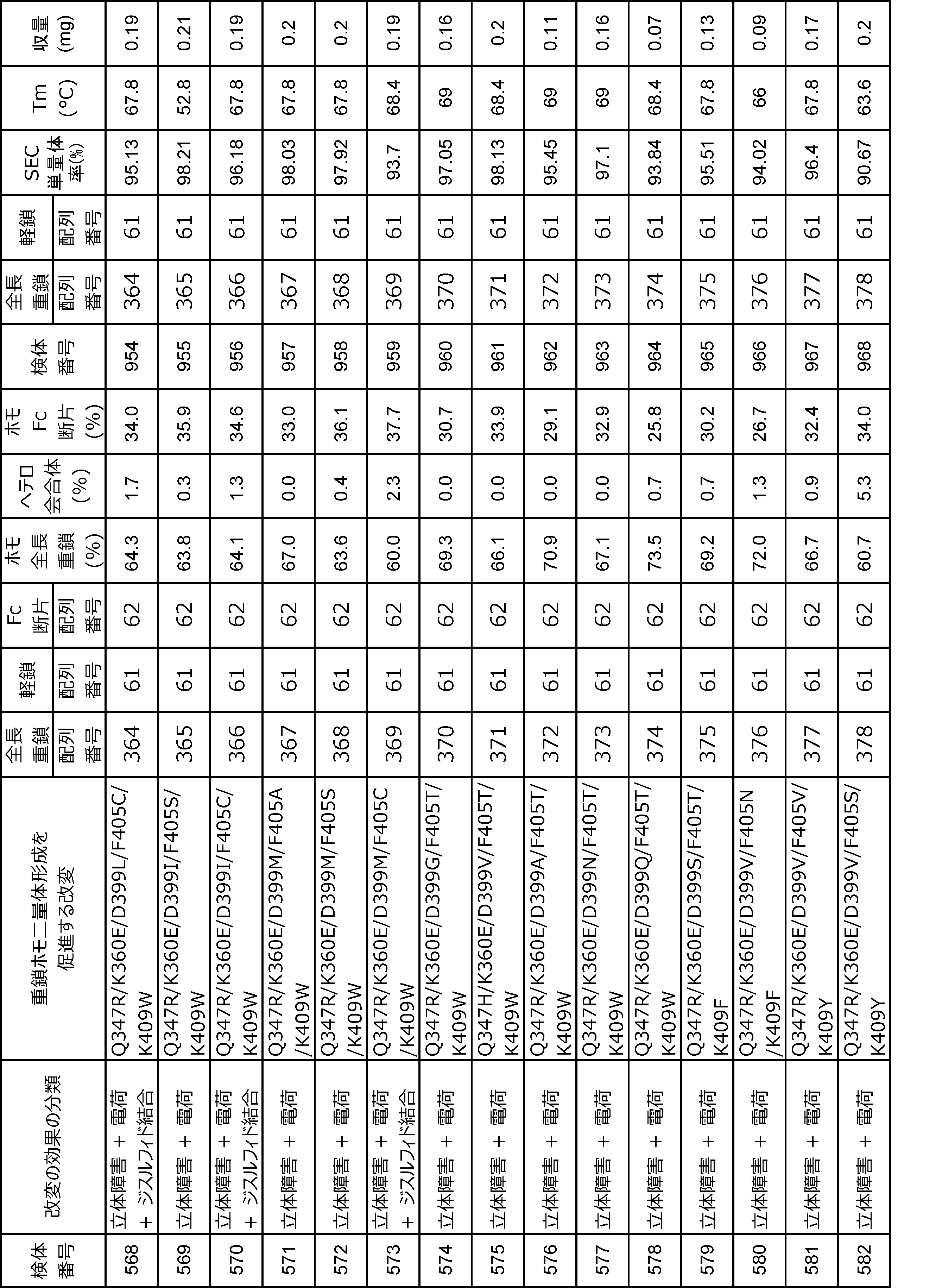
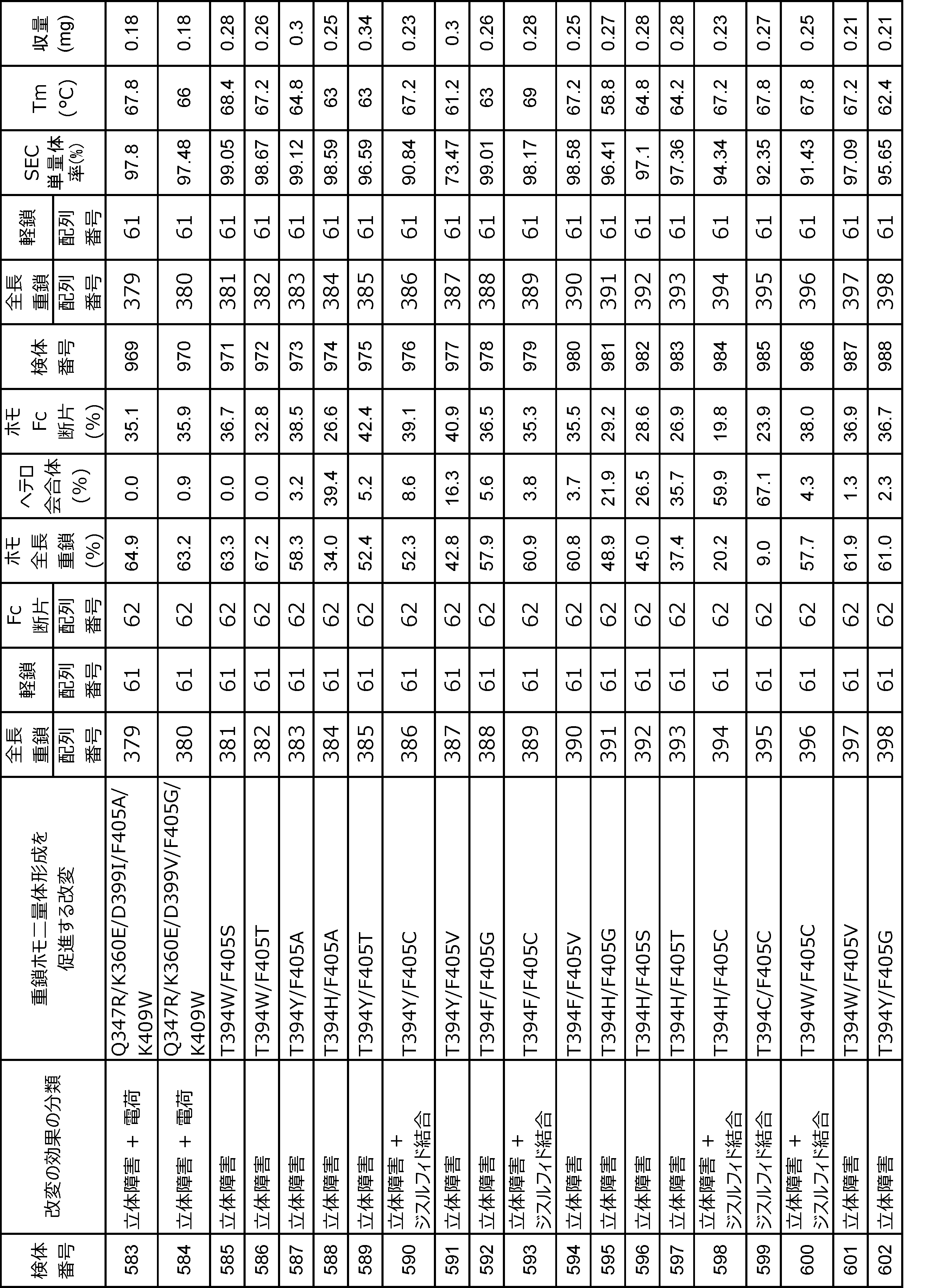
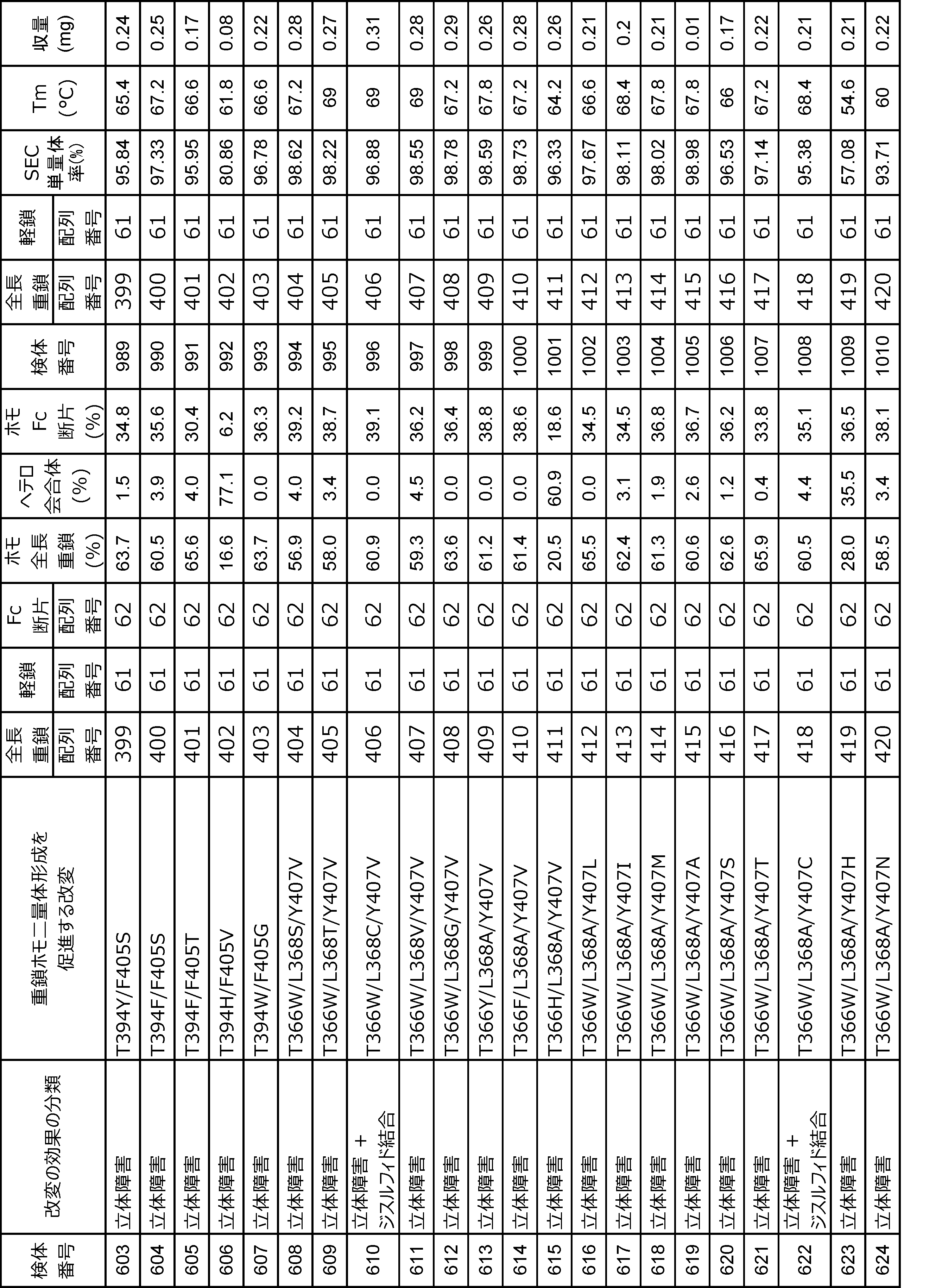

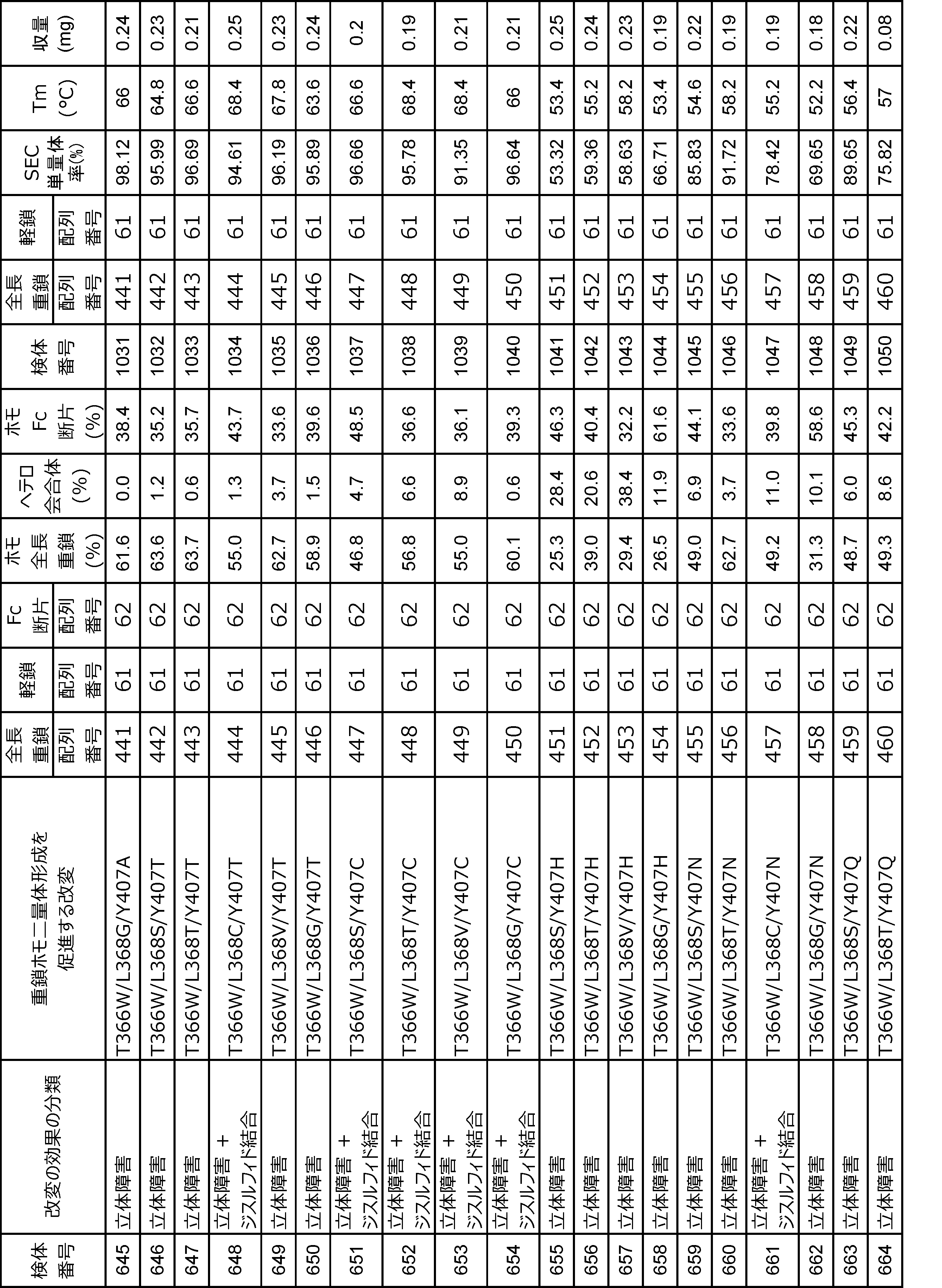
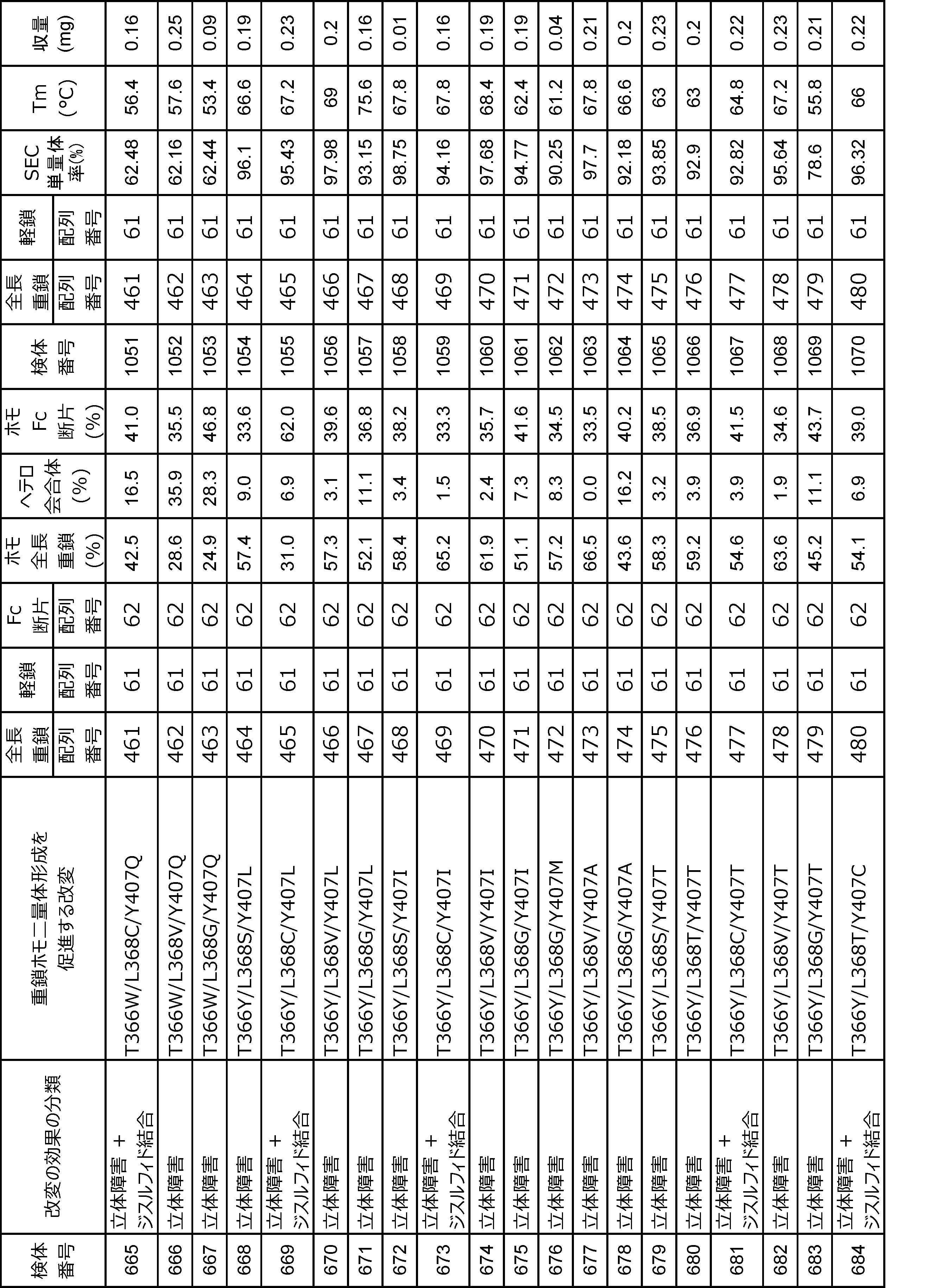
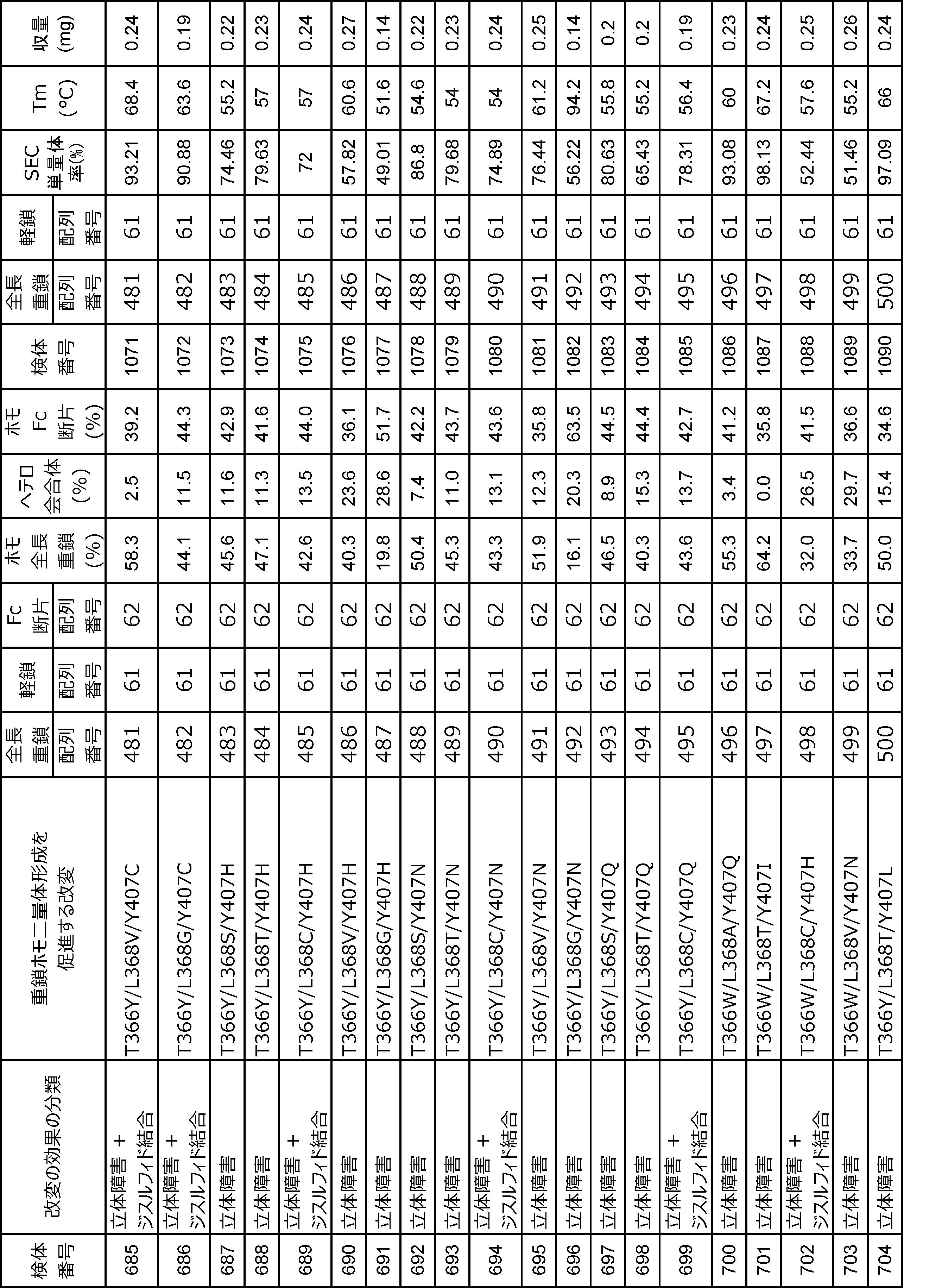
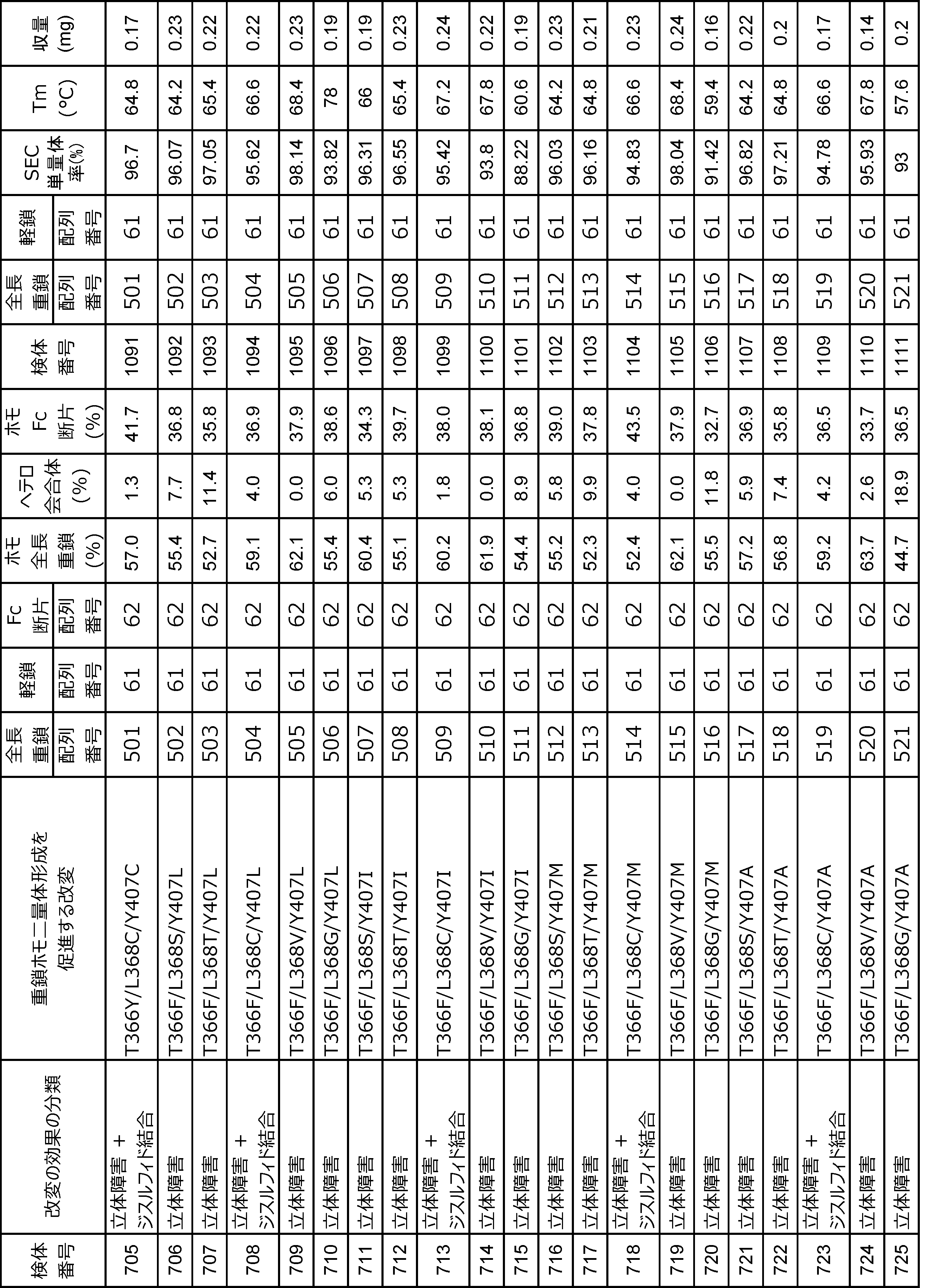
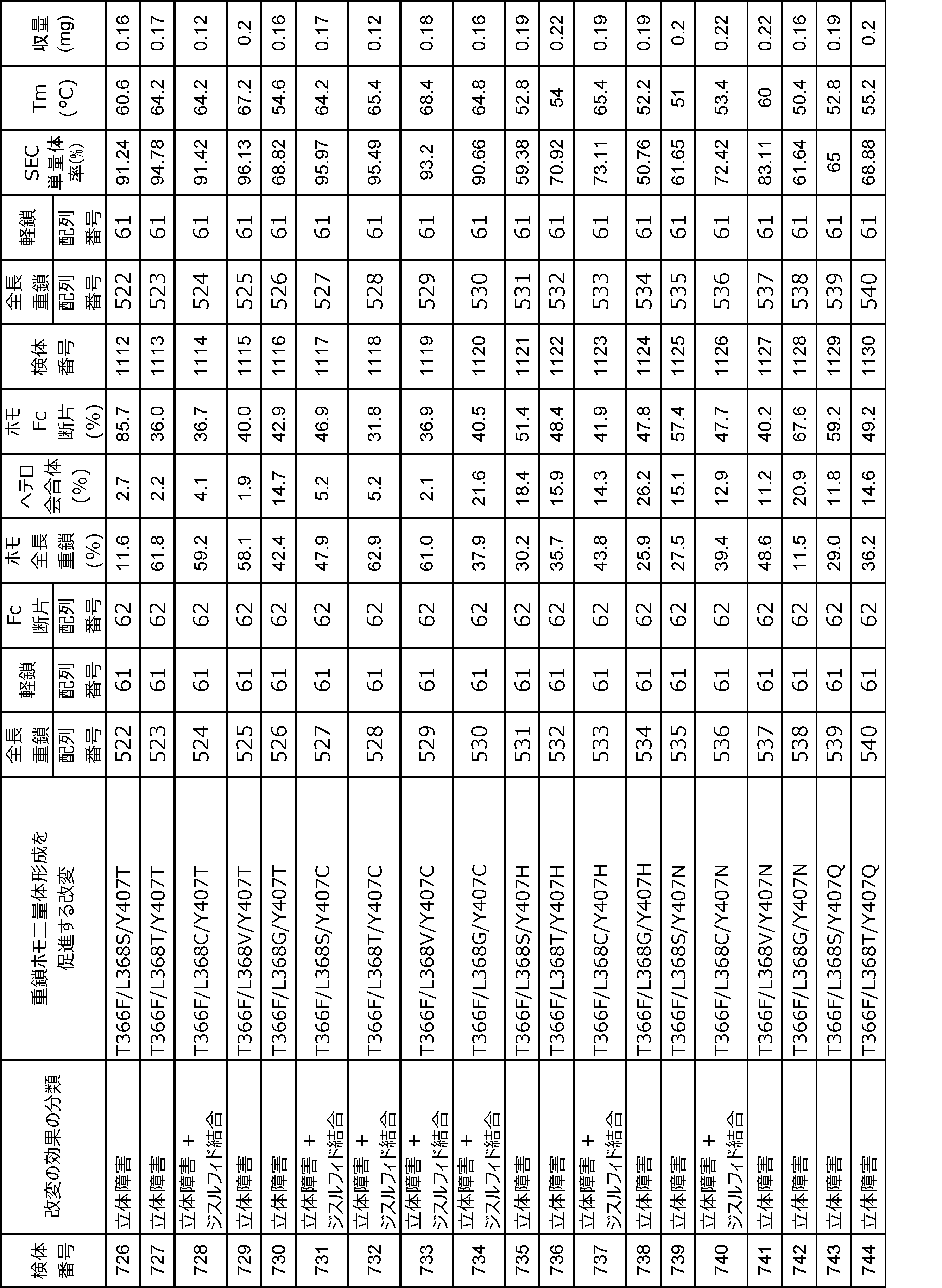


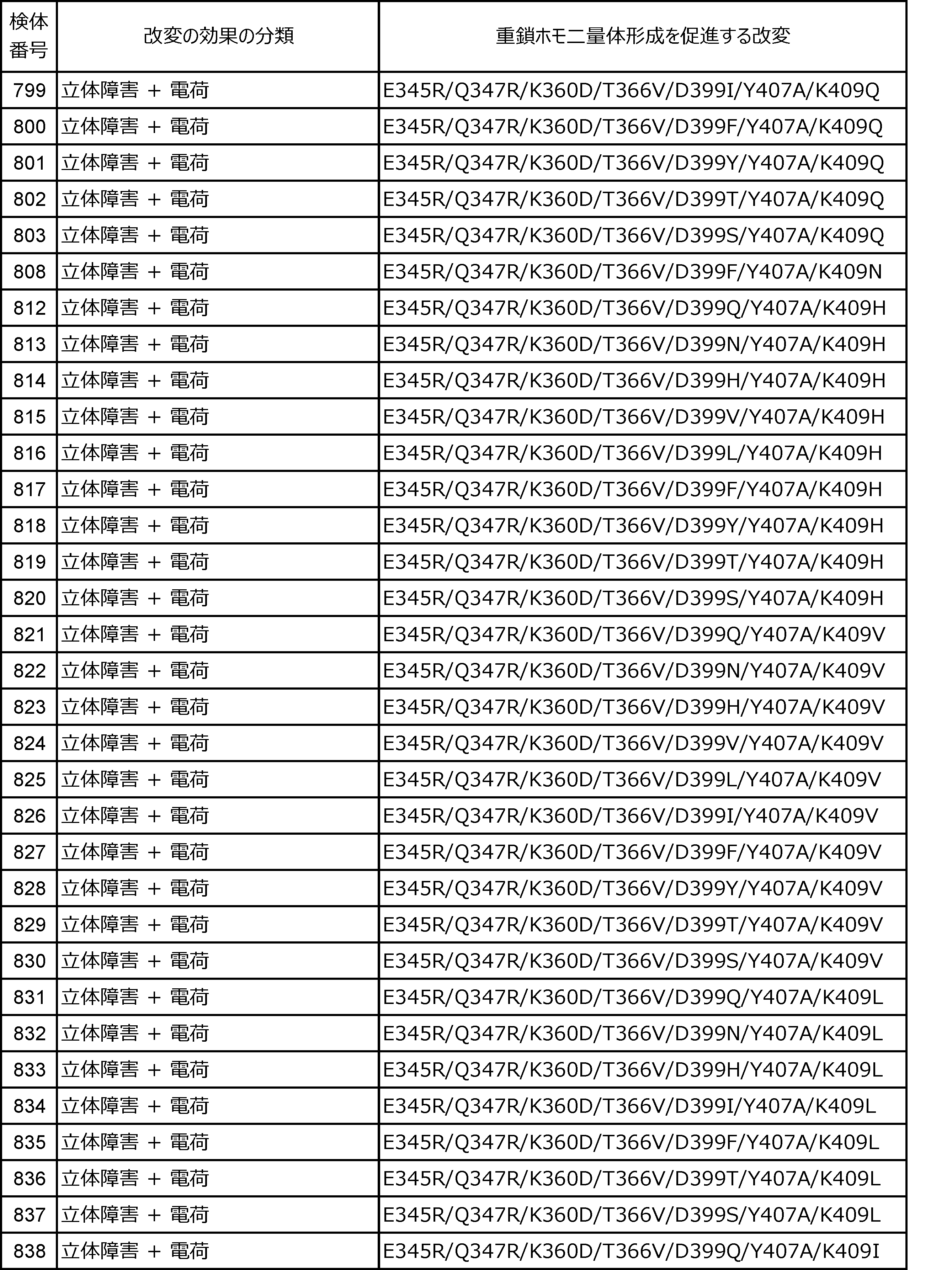
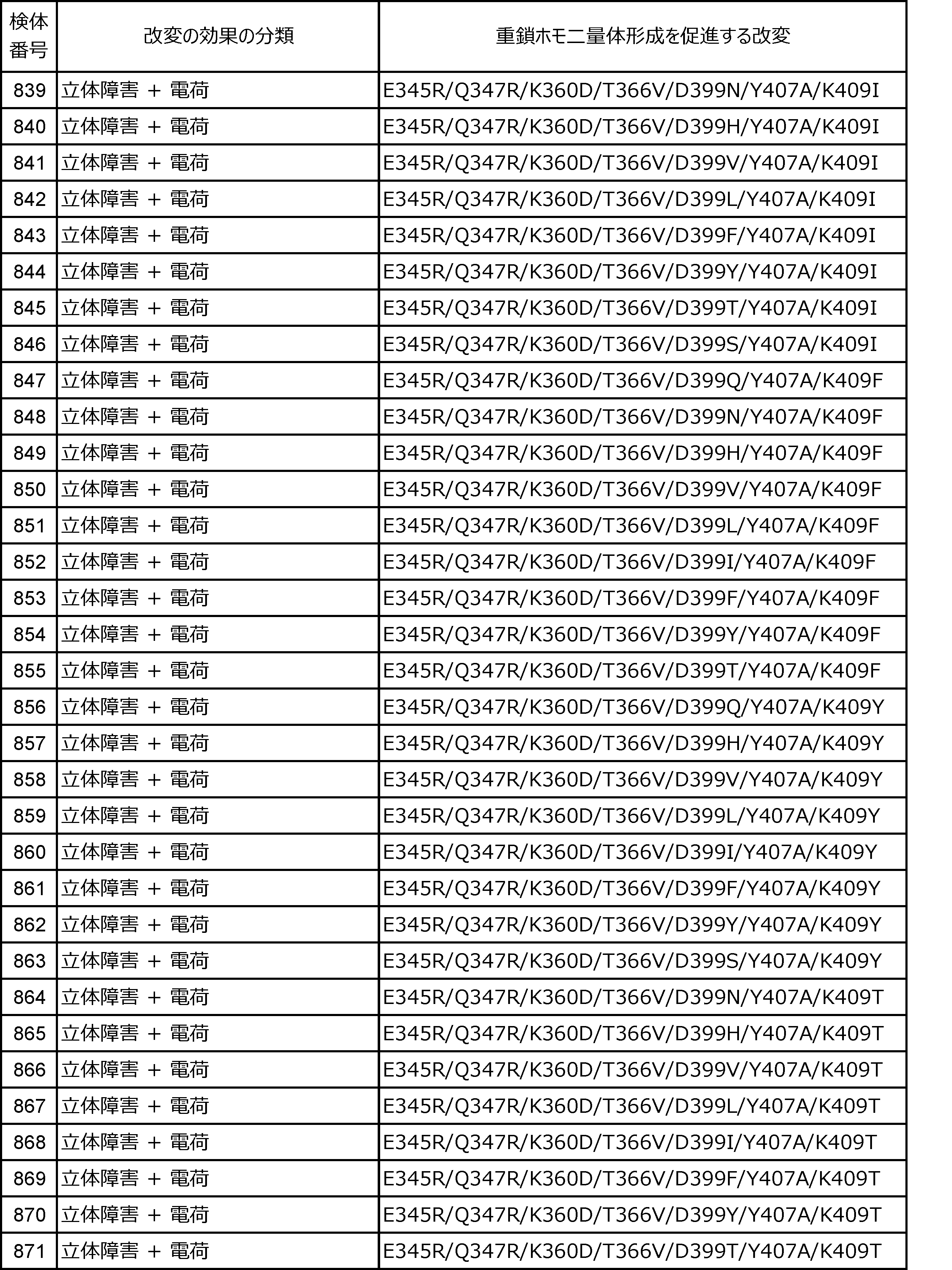
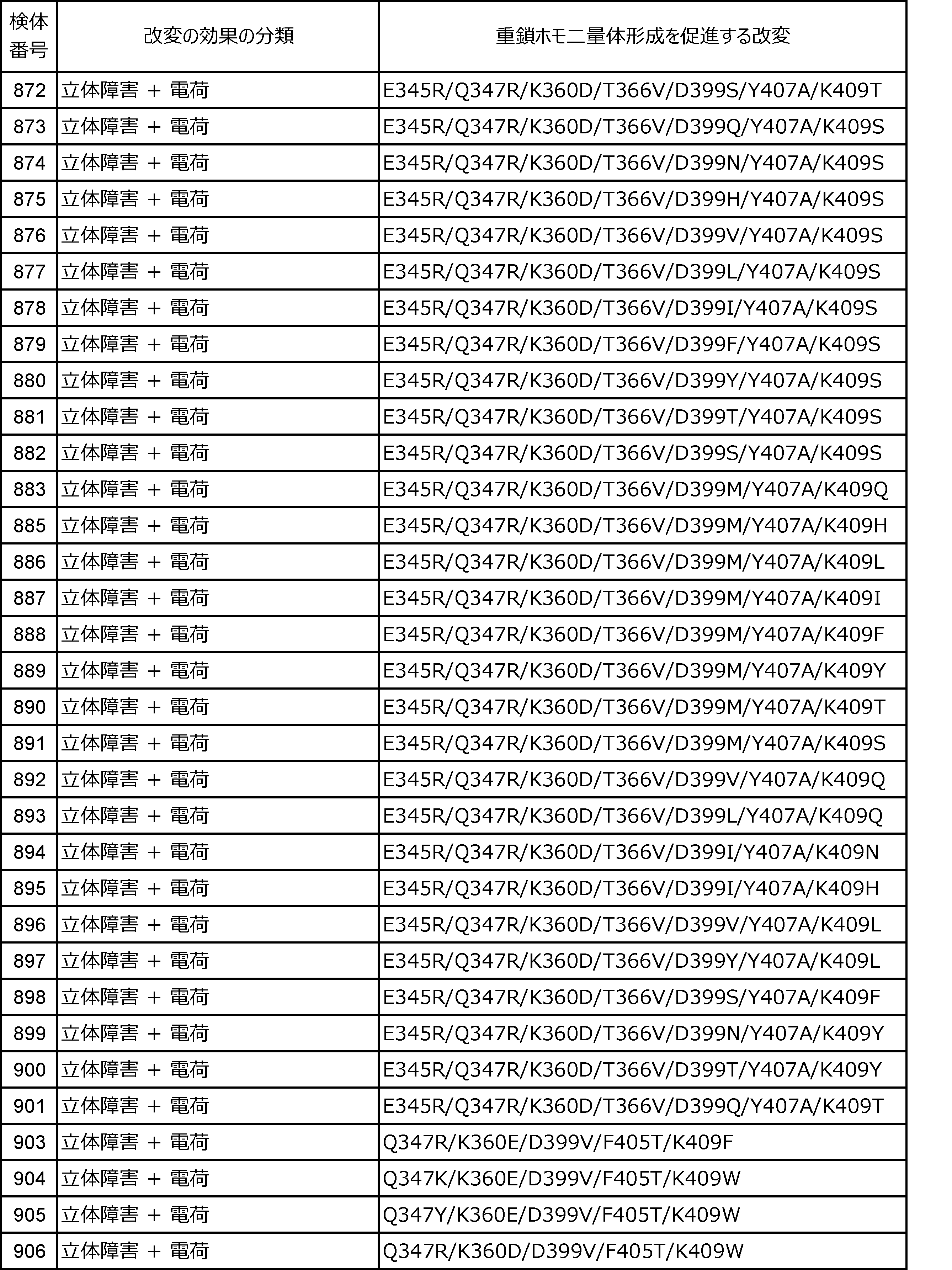

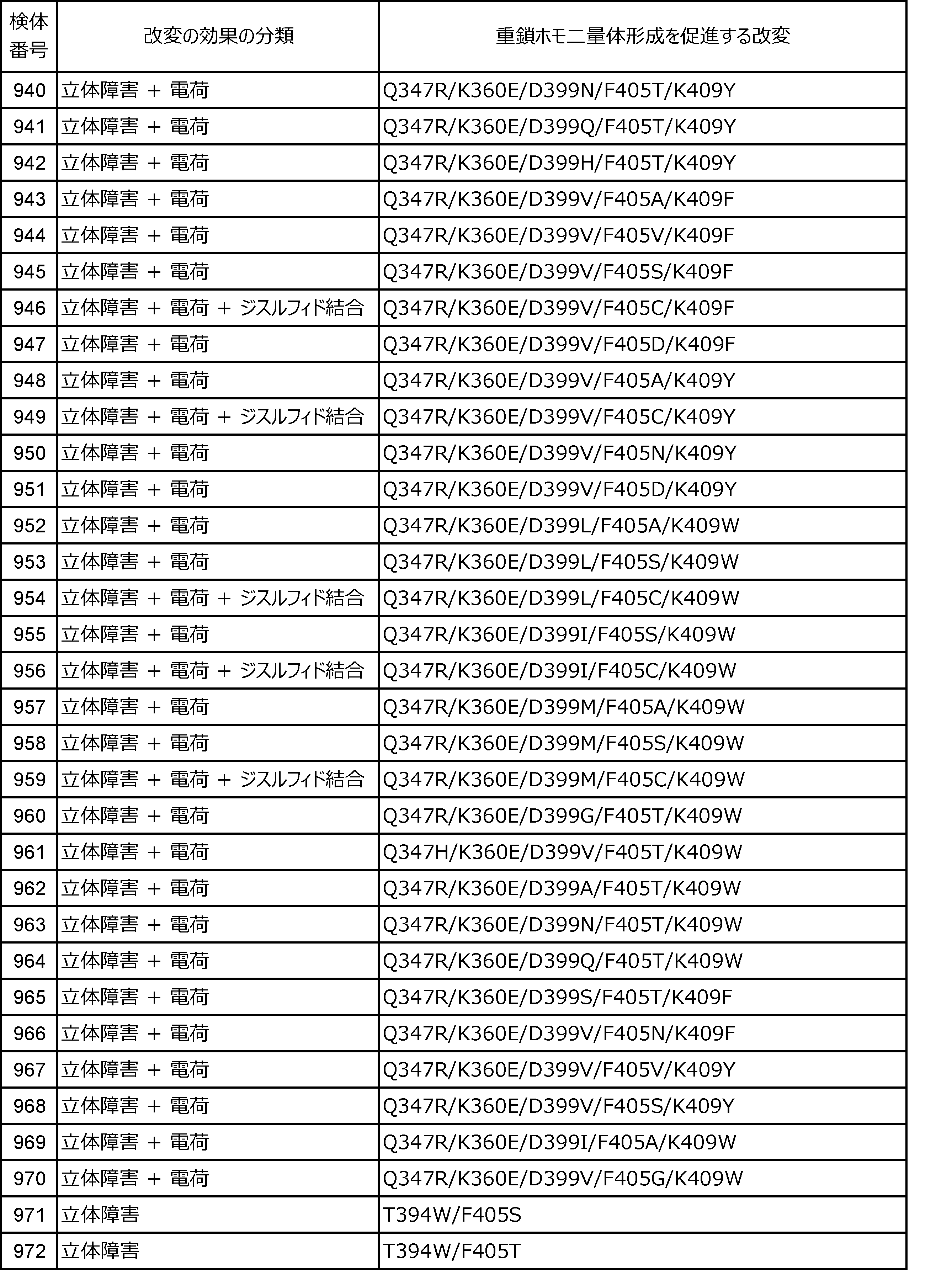
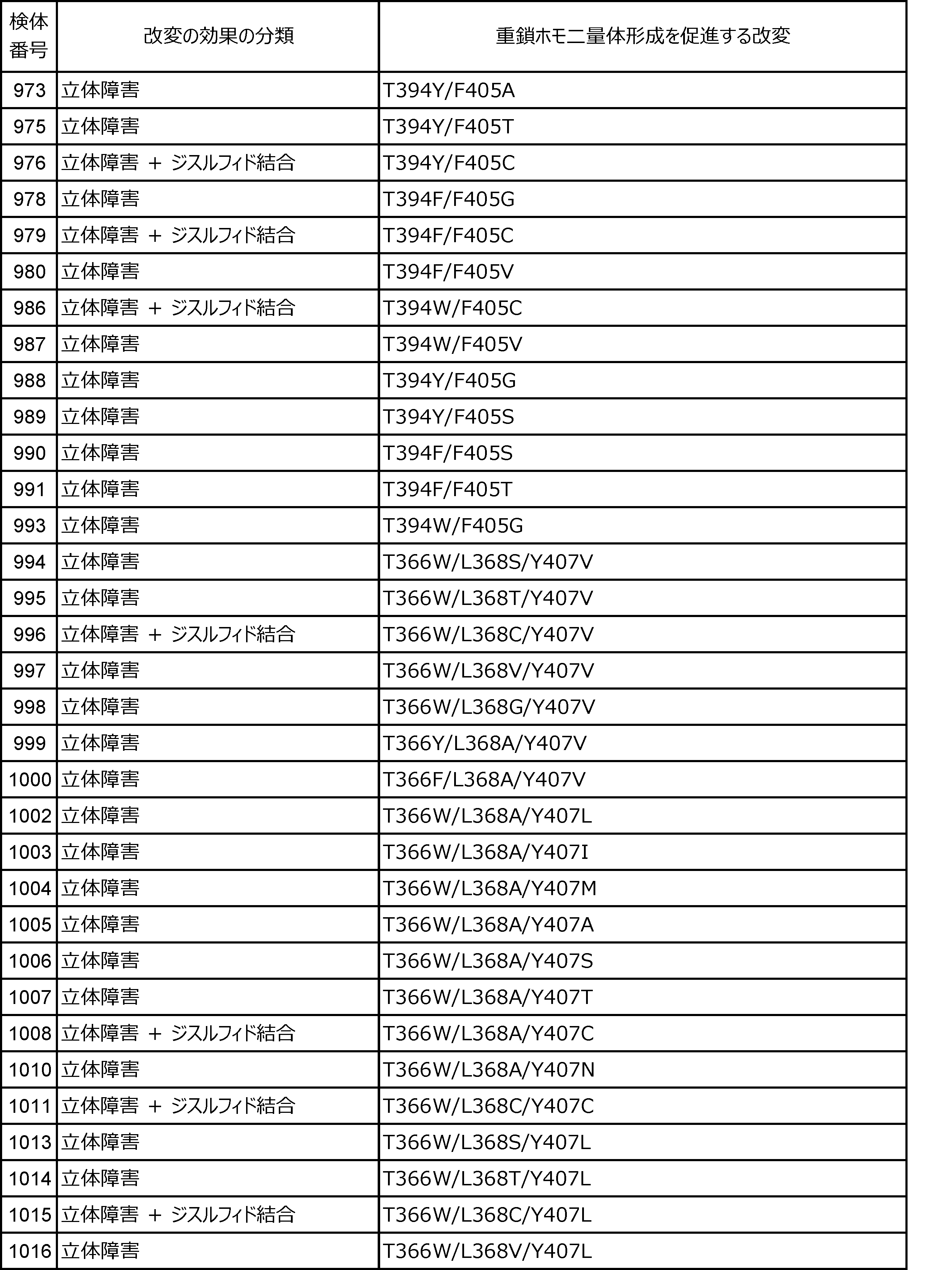
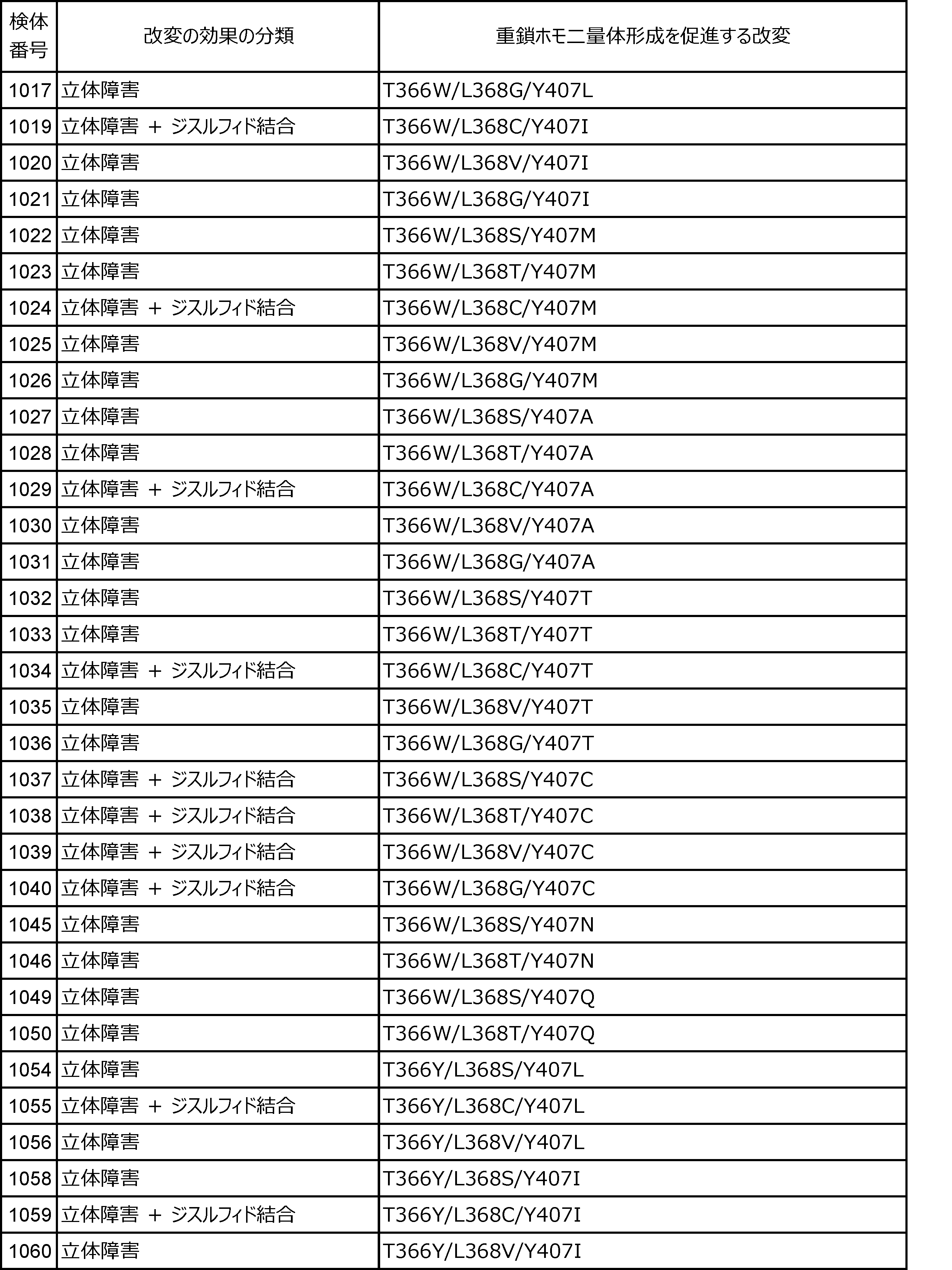

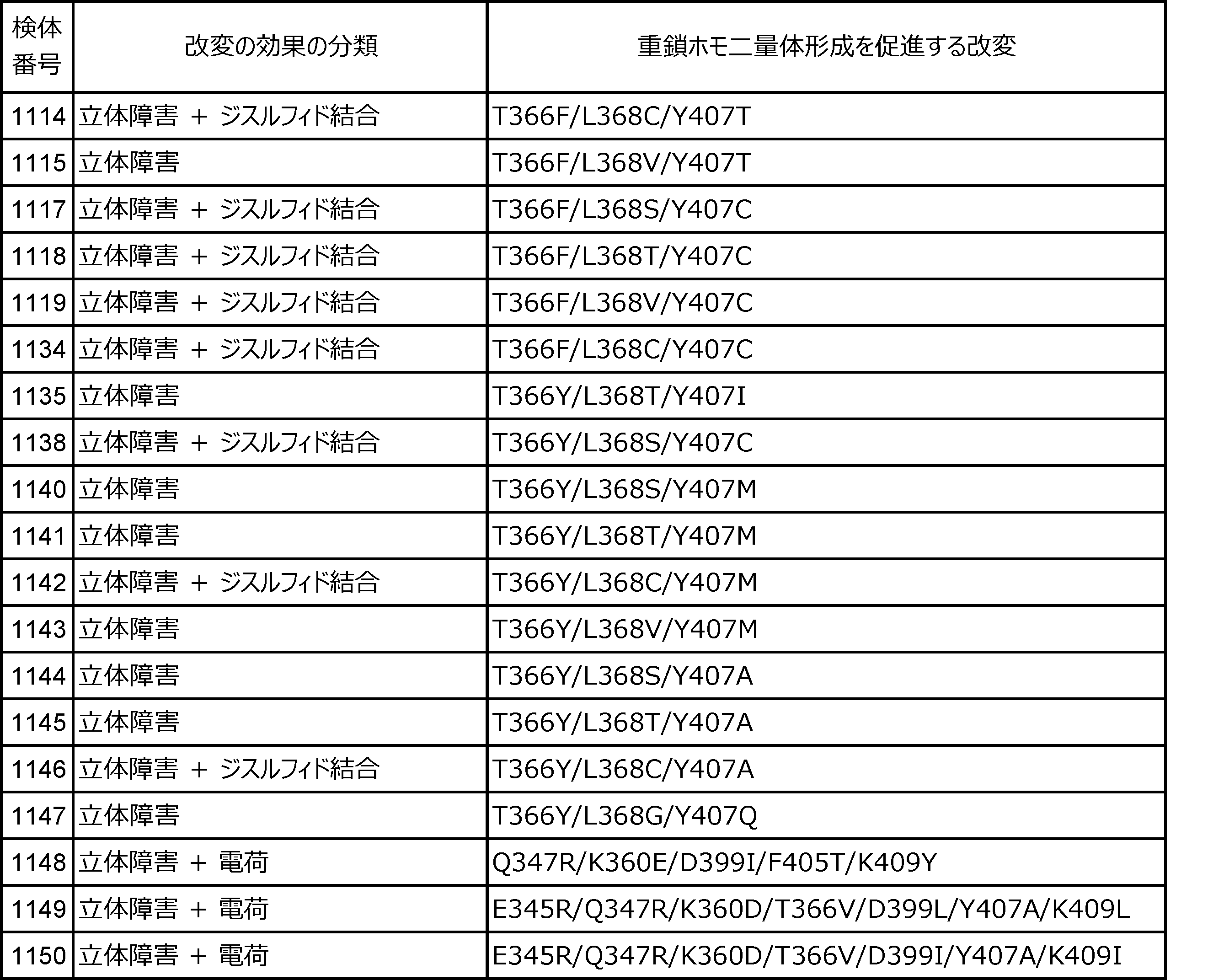
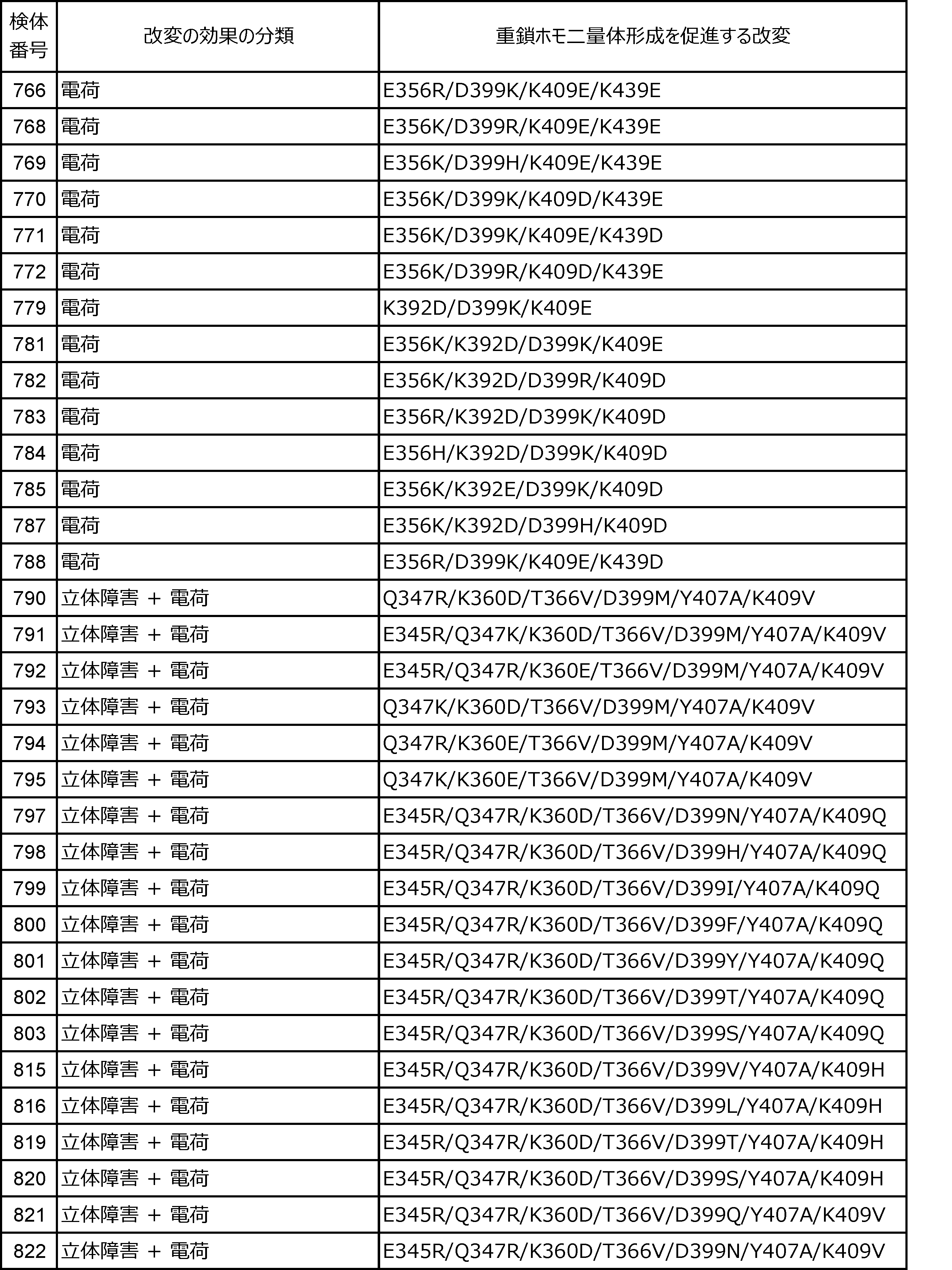


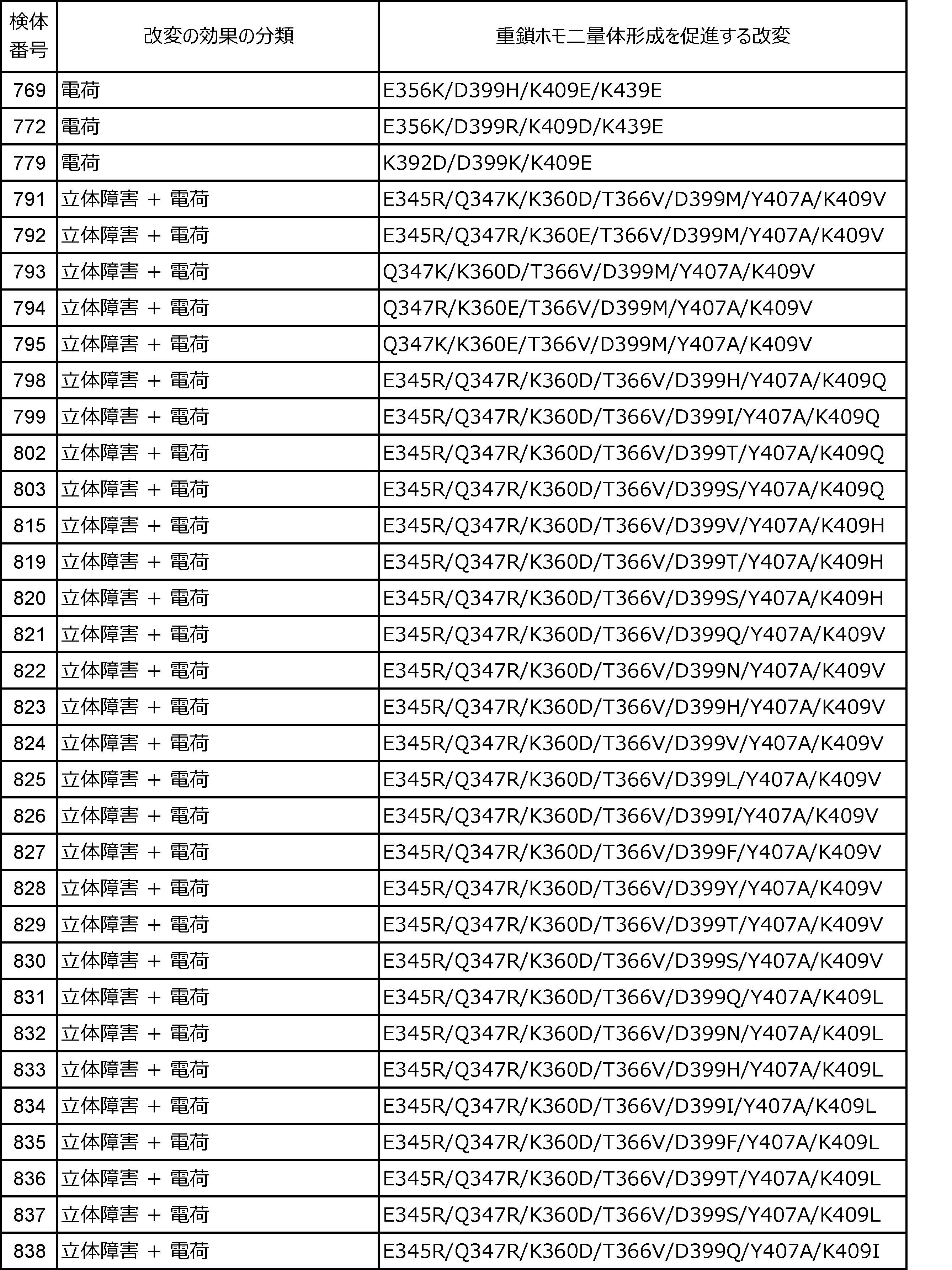
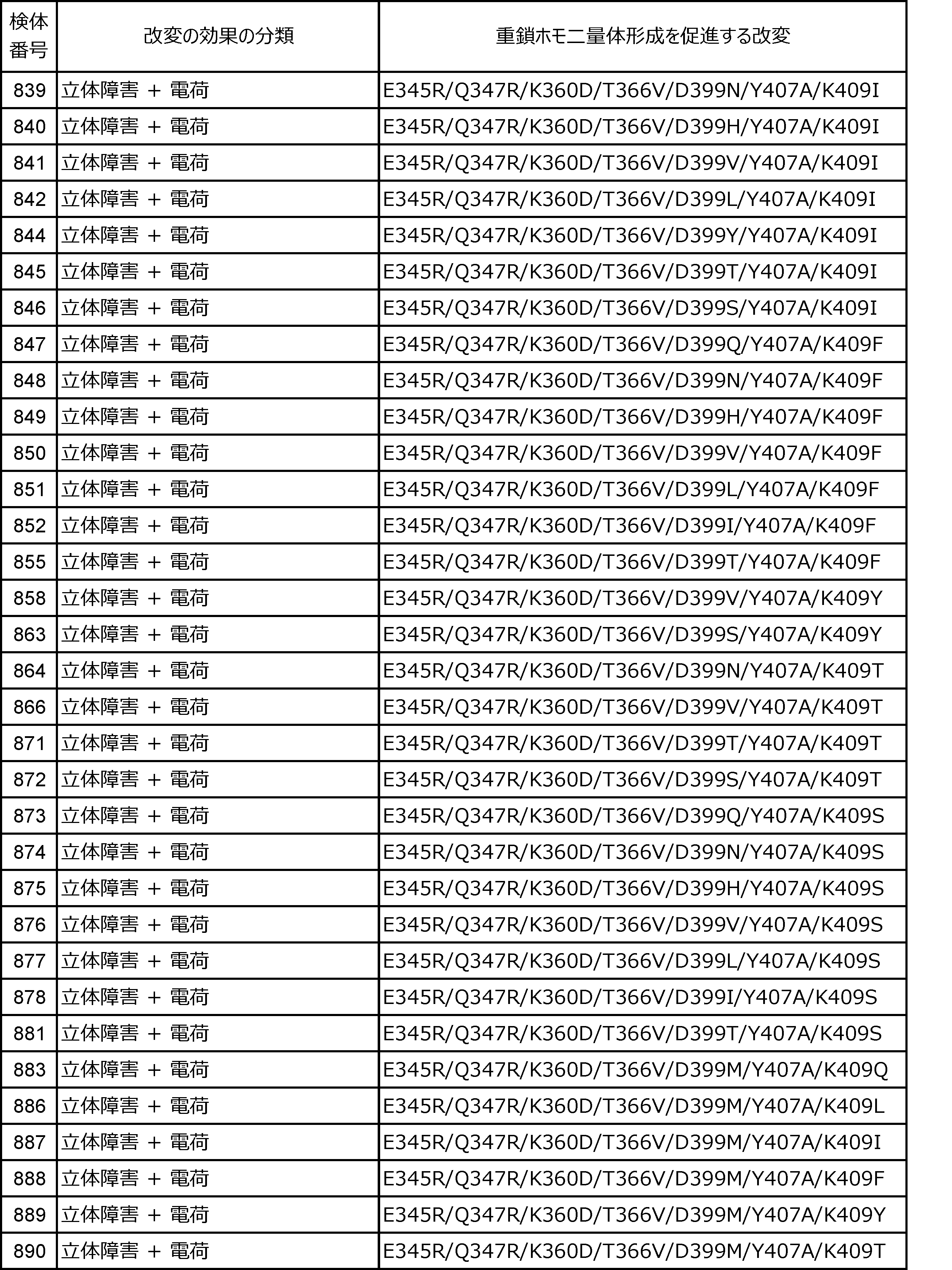
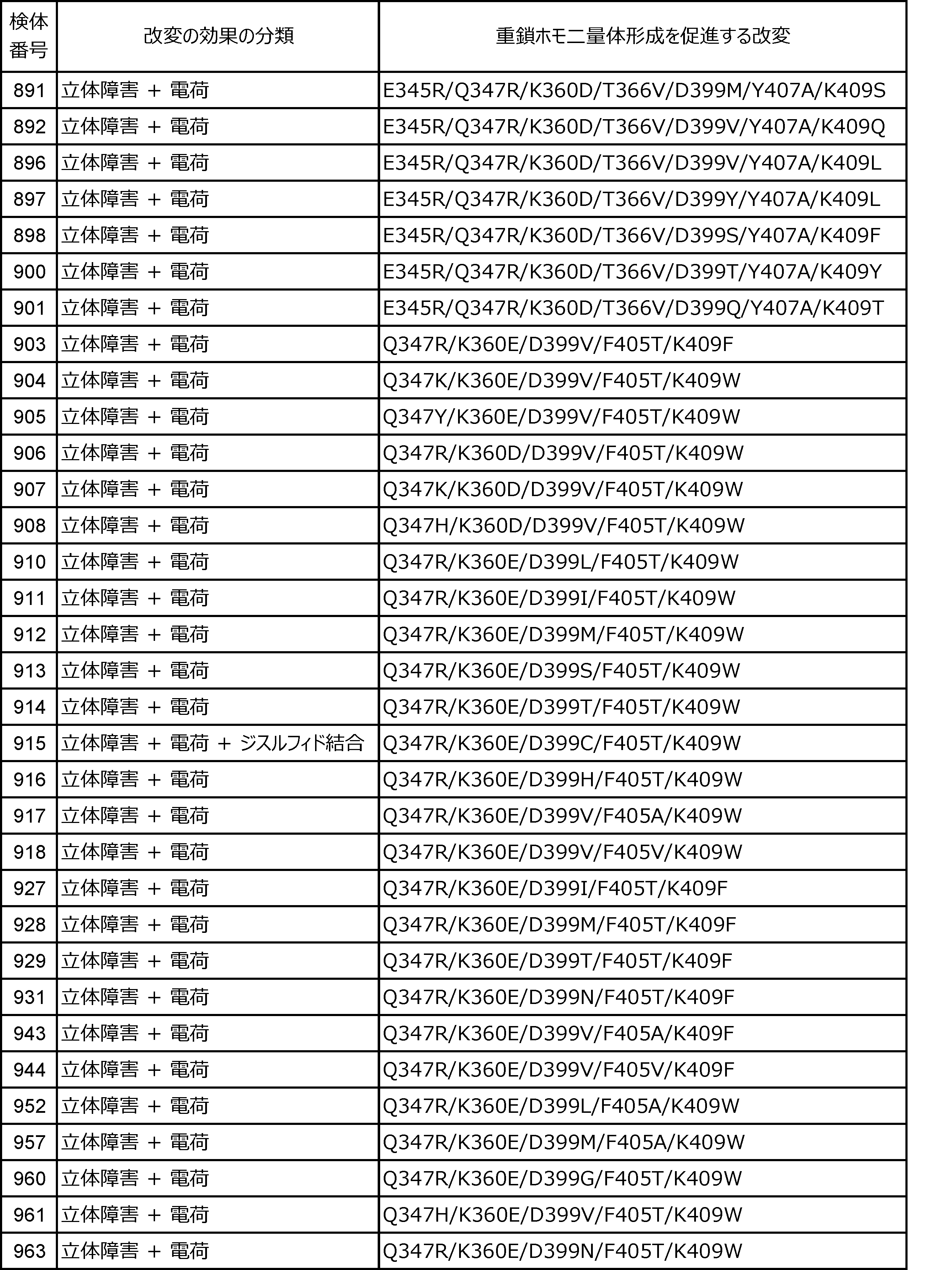
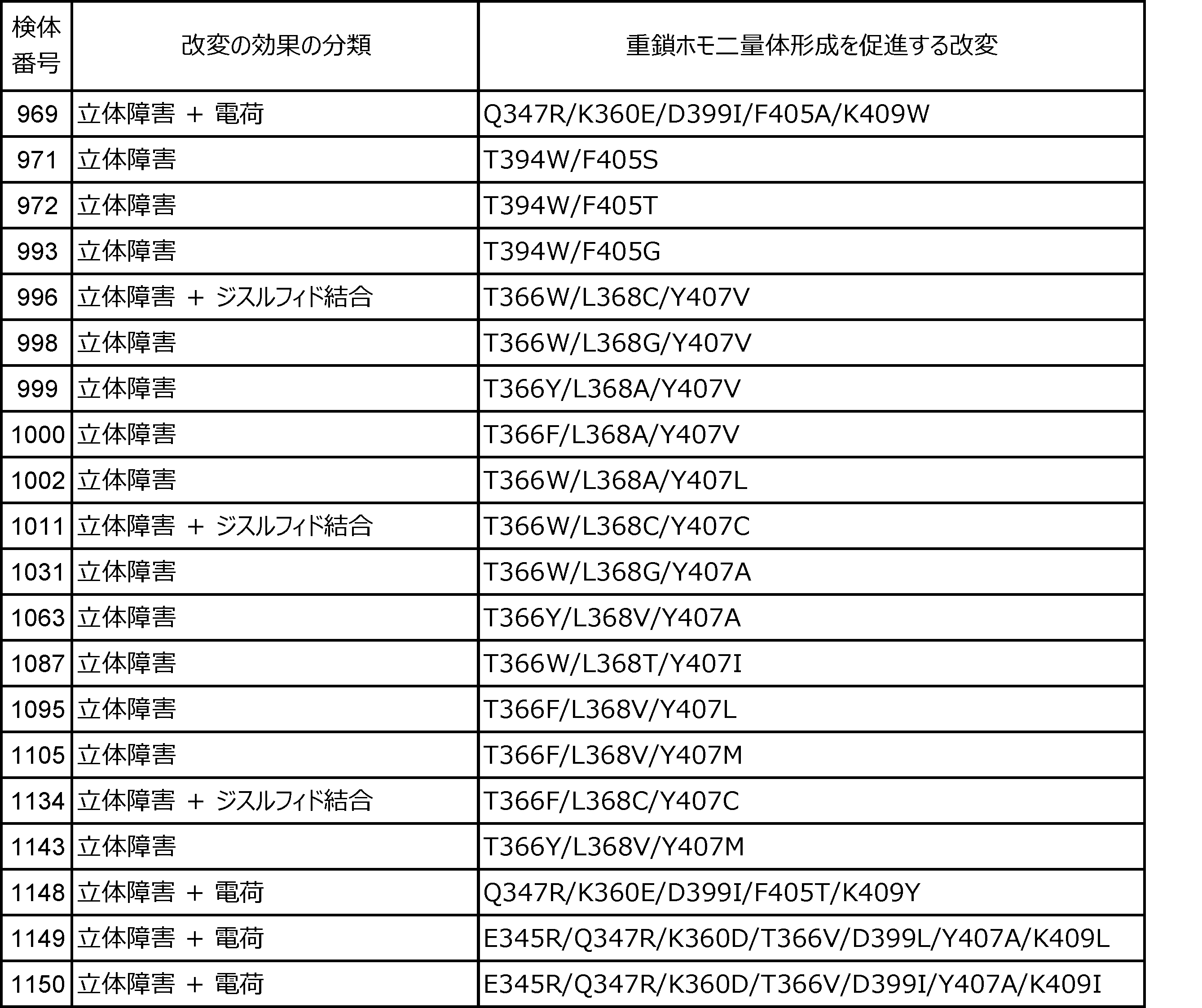
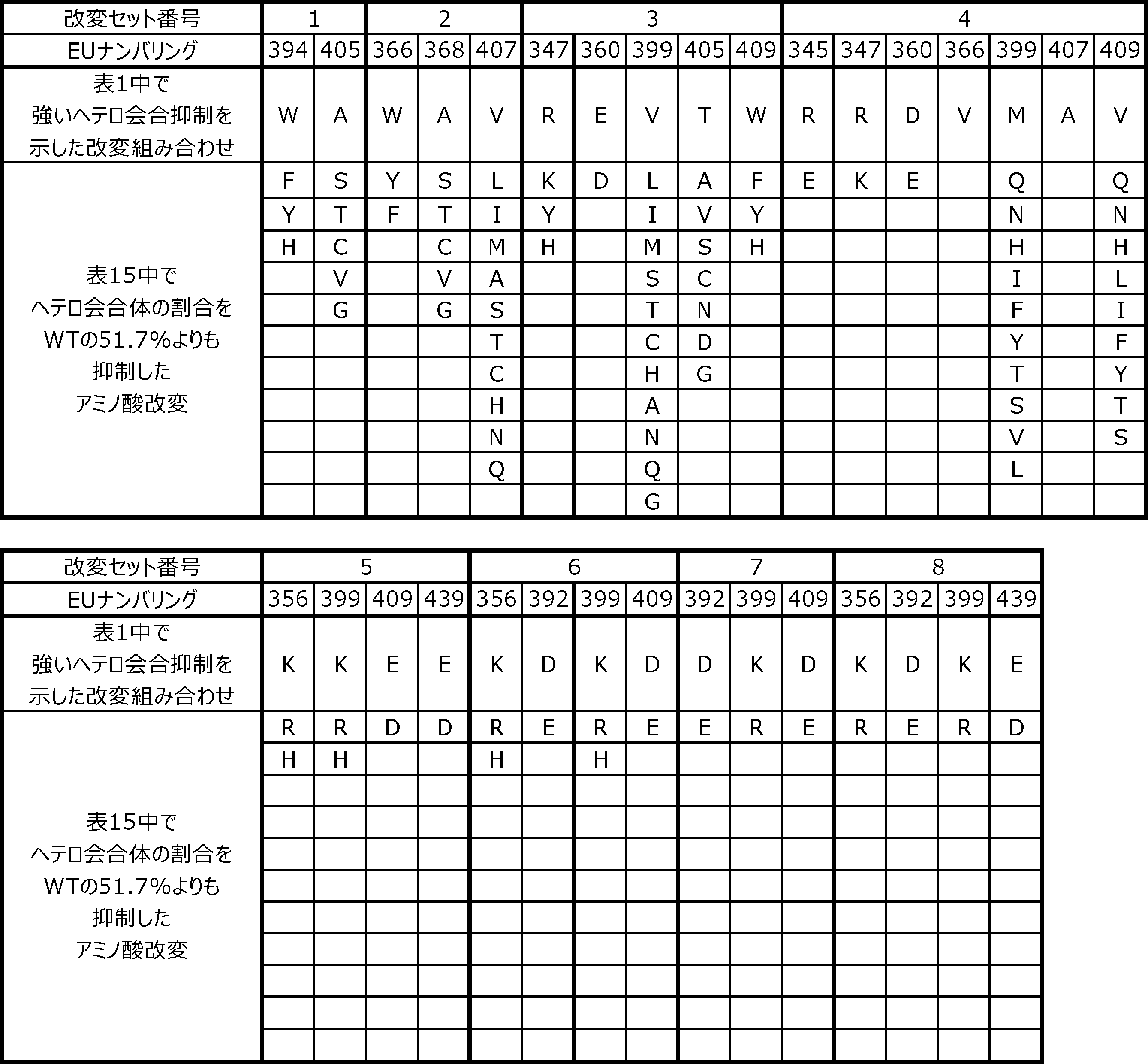

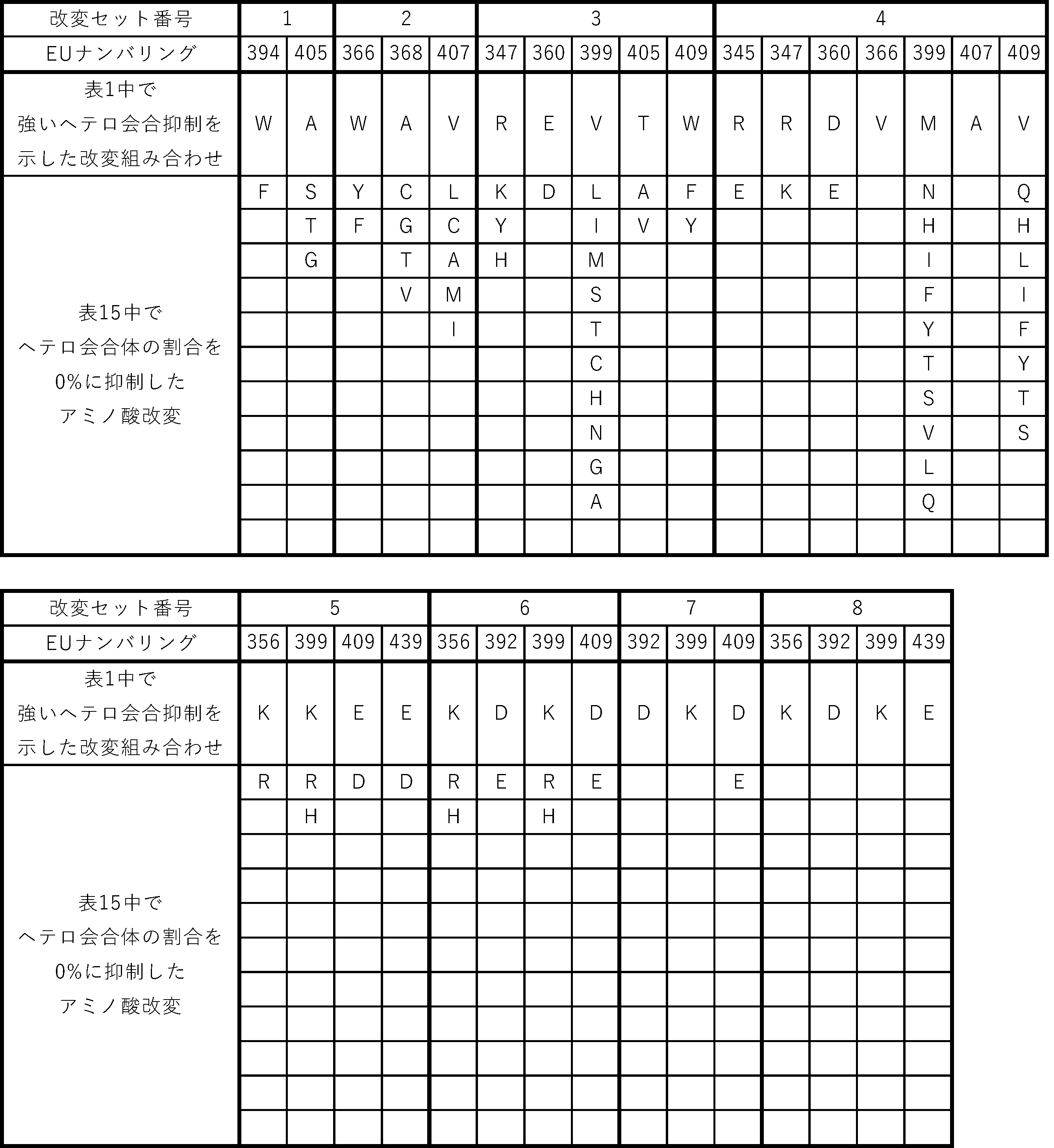
本発明において見出された、ホモ二量体形成を促進するアミノ酸改変は、ヘテロ二量体形成を促進するアミノ酸改変(例えばノブ-イントゥ-ホール改変など)と同時に使用できる可能性がある。この可能性を検証するために、IgGで強い重鎖ホモ二量体形成能力を示した改変の一部とノブ-イントゥ-ホール改変を含む抗体を同時に発現させ、WT-IgG1と同時発現した場合の目的のホモ二量体およびヘテロ二量体形成の効率(%)をIEC分析により比較した。抗体の調製およびIEC分析は実施例6に記載された方法に従って行われた。サンプルは励起波長280 nmにおける蛍光波長330 nmで検出された (図中の縦軸にEUと表記された)。
重鎖ホモ二量体形成およびヘテロ二量体形成を促進するアミノ酸改変、配列番号、及び面積比の対応は表22に示された(改変が導入されていない場合は「-」と記載された)。本試験は2種類のホモ二量体および2種類のヘテロ会合体ペアの鋳型抗体を用いて行われた(表22中の鋳型抗体グループヘテロ1+ホモ1は配列番号561、562を含むヘテロ二量体と配列番号563を含むホモ二量体のペアを指し、鋳型抗体グループヘテロ2+ホモ2は配列番号567、568を含むヘテロ二量体と配列番号78を含むホモ二量体のペアを指す。ホモ二量体に各種ホモ二量体形成促進改変が導入された)。各抗体分析のクロマトグラムは図6-1~図6-10に示された。意図した重鎖ヘテロ二量体および、重鎖ホモ二量体の溶出位置および、意図しない会合体の面積比率は、各種標品サンプルの溶出位置からピークアサインすることによって算出された。
この結果から、本発明において見出された、ホモ二量体形成を促進するアミノ酸改変はヘテロ会合体(例えばヘテロ二量体形成)を促進するアミノ酸改変と同時に使用することが可能であることが示された。さらに、その効果はWT-IgGのホモ二量体を発現させる場合よりも、効率的に目的のホモ二量体およびヘテロ会合体を発現させることが示された。
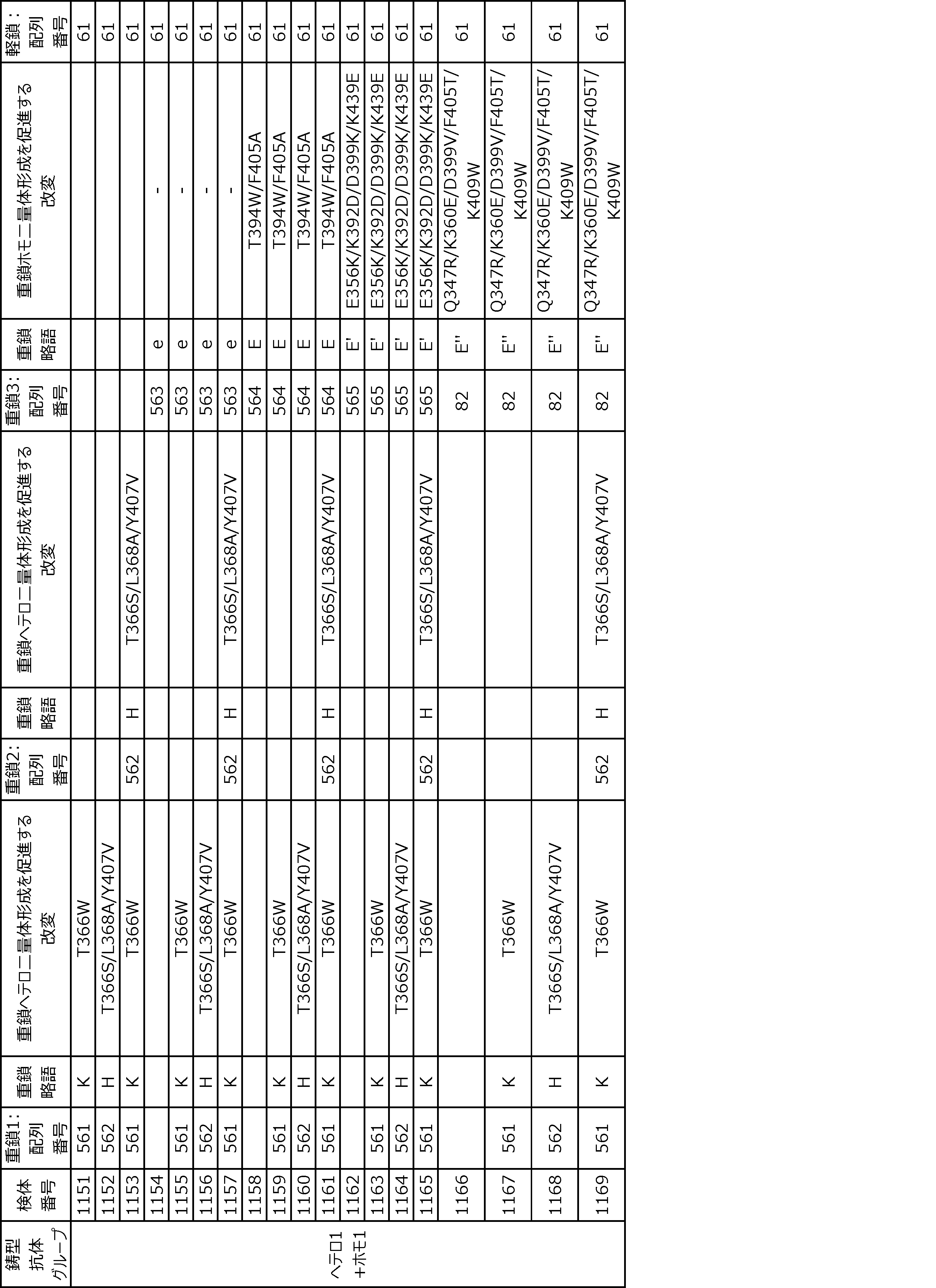

K T366W
H T366S/L368A/Y407V
K’ Y349C/T366W
H’ E356C/T366S/L368A/Y407V
e -
E T394W/F405A
E' E356K/K392D/D399K/K439E
E'' Q347R/K360E/D399V/F405T/K409W
f -
F T394W/F405A
F' E356K/K392D/D399K/K439E
F'' Q347R/K360E/D399V/F405T/K409W
, Y349S/K370Y/T366M/K409V-E356G/E357D/S364Q/Y407A, L351D/L368E-L351K/T366K, L368D/K370S-E357Q/S364K (異なる2つの重鎖間の区切りは-で示されている)などの改変が使用可能である。この時、ホモ二量体形成を促進する改変として、ヘテロ会合を促進するアミノ酸改変と同じ残基番号の改変を有さない改変セットや、アミノ酸の性質(大きさやチャージの有無の観点)が大きく異なる改変セットなどが、互いの改変による意図しない会合促進が生じにくいと想定されるためにより好ましい。
本試験では1つのヘテロ会合体および、1つのホモ会合体を発現させたが、同時に発現させる検体数はこれに限定されない。例えば、複数のヘテロ会合体を発現させる場合は、互いに改変残基番号が異なる改変が優先されて組み合わせられる。さらにそれらの複数のヘテロ会合を促進するアミノ酸残基番号と異なる、あるいは同じ番号の改変を含んでいても性質の異なるアミノ酸から構成される、ホモ会合体を促進するアミノ酸改変体を複数発現させることが可能である。これによって、複数のヘテロ会合体および複数のホモ会合体を同時に高純度で発現させることが可能であると考えられる。
次に、プラスミドではなくメッセンジャーRNA(mRNA)として哺乳類細胞にトランスフェクションされた場合にもホモ二量体形成を促進する効果が得られるかが検証された。表23及び表24に記載された抗体重鎖及び軽鎖をコードする配列を含むmRNAを用いて、当業者公知の方法で表25に記載の各種抗体が哺乳動物細胞にて一過性に発現され、当業者公知の方法により精製された。具体的には、表23及び表24に記載された抗体重鎖及び軽鎖をコードする配列を含むプラスミドDNAを鋳型として、PCRによりT7プロモーター配列及びpolyA配列が付与された。構築されたPCR断片を鋳型として、MEGAscript T7 Transcription Kit (Thermo Fisher Scientific, AM1333)を用いてIn vitro transcription(IVT)法によりmRNAが調製された。転写において、キャップ構造としてARCA(TriLink BioTechnologies, N-7003-1)が、修飾核酸として1-Methylpseudouridine-5’-Triphosphate(Trilink BioTechnologies, N-1081-1)がそれぞれ添加された。調製されたmRNAが表25に記載の質量比で2.5E+6細胞/mLのExpi293細胞、1 mLにトランスフェクションされ抗体が一過的に発現された。トランスフェクションから4日後に培養上清は回収され、抗体が当業者公知の方法で精製された。
調製された抗体は実施例6に記載されたIECの方法に従って分析され、3本鎖トランスフェクション時の各面積比率が表25に記載された。ホモ二量体形成を促進するアミノ酸改変が含まれるコンストラクトではヘテロ会合体の割合が顕著に減少した。
以上の結果より、mRNAを用いて哺乳細胞で抗体を発現させた場合でも、ホモ二量体形成を促進するアミノ酸改変は有効であることが確認された。
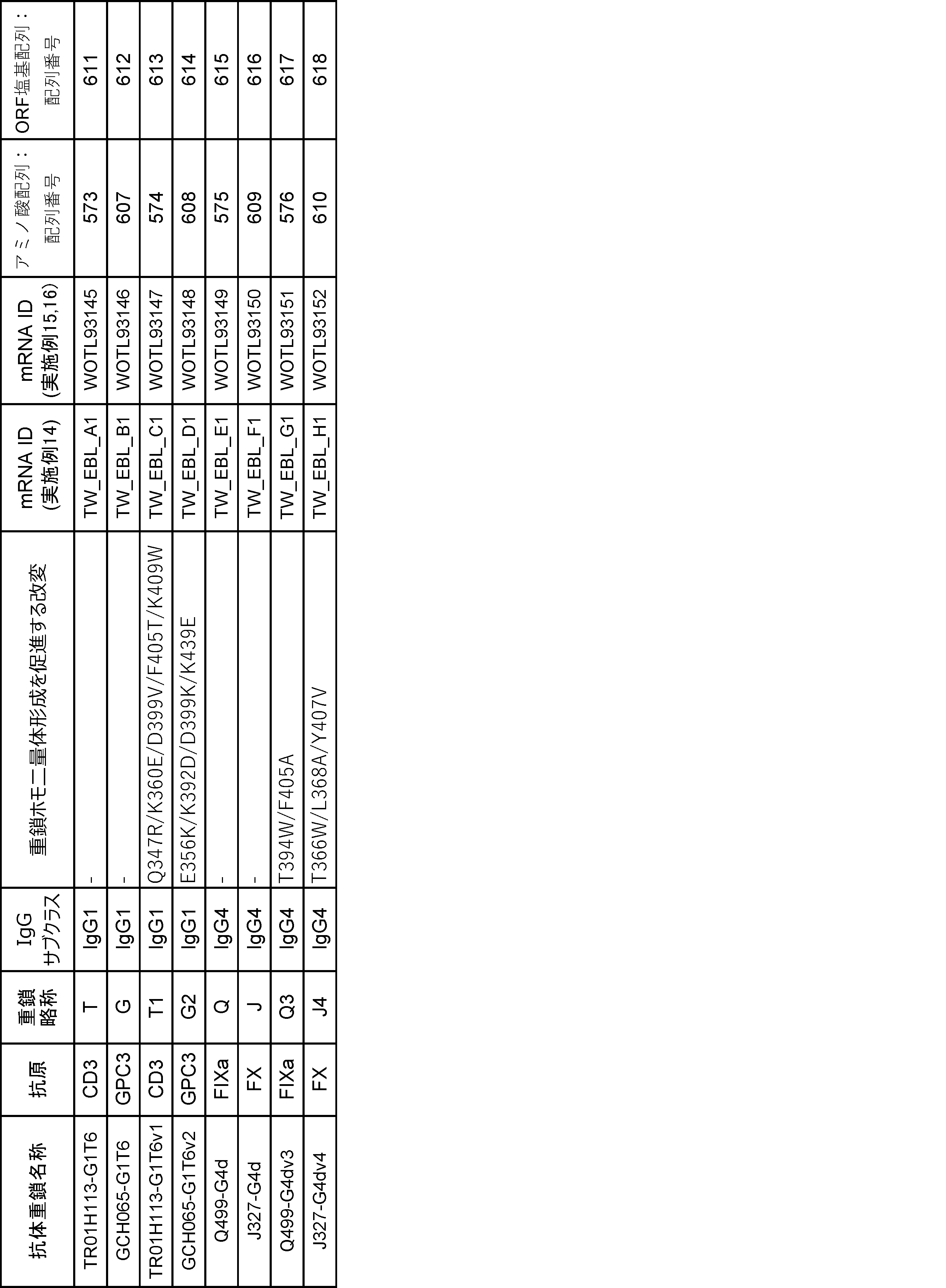

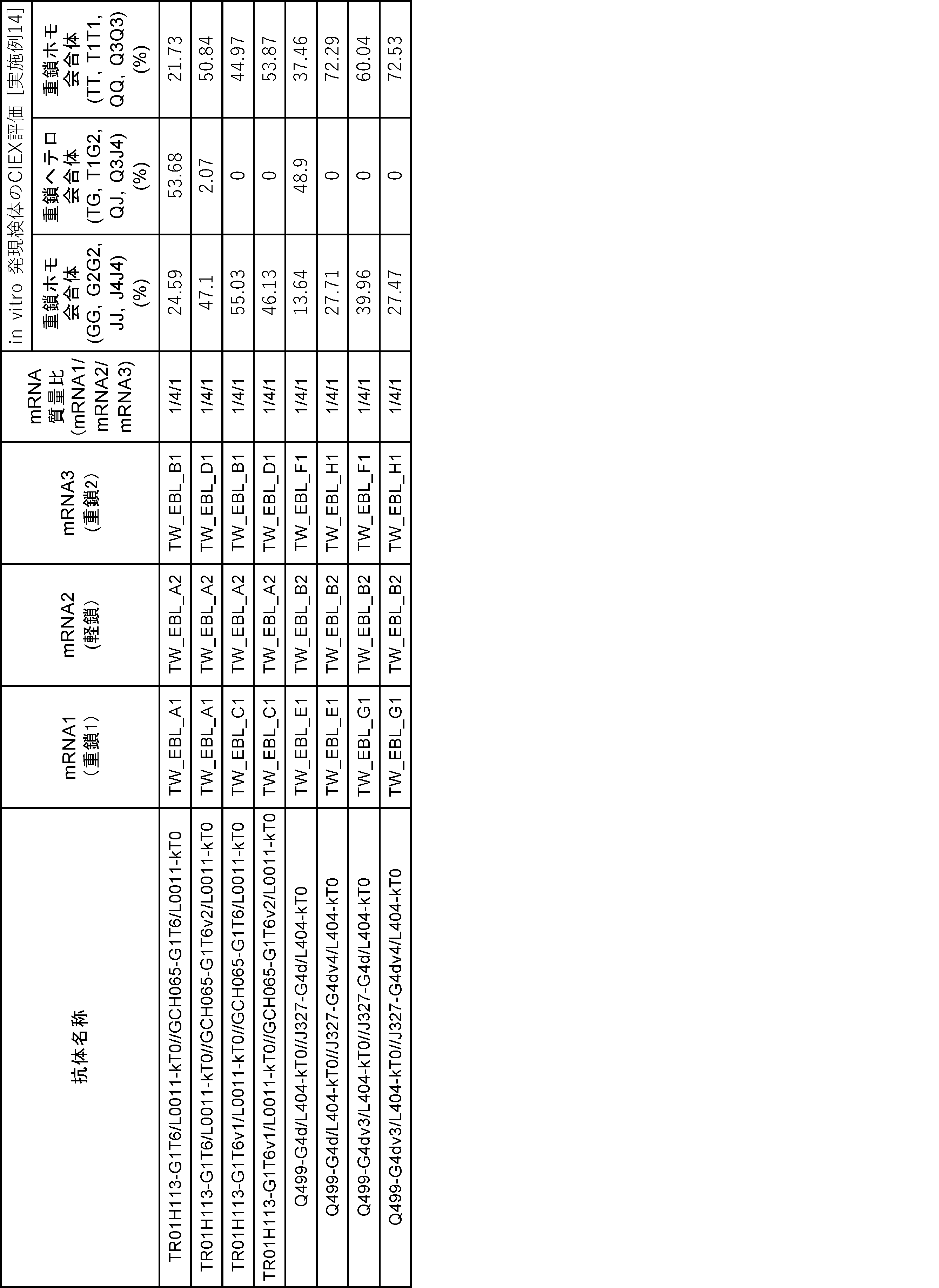
表23及び表24に示されるmRNAを封入する脂質ナノ粒子(mRNA-LNP)は、文献等(Hou X, et al., Nat Rev Mater. 2021;6(12):1078-1094., Weng Y, et al., Biotechnol Adv. 2020 May-Jun;40:107534, Webb C, et al., Mol Pharm. 2022 Apr 4;19(4):1047-1058.)に記載される一般的な脂質組成、調製方法により調製された。具体的には、カチオン性脂質、DOPE、コレステロール、及びPEG脂質が35:16:46.5:1.5のモル比で総脂質濃度が約1.3 mg/mLとなるようにEtOHに溶解された。mRNAの非翻訳領域(UTR)の設計及びmRNA全長の合成はTrilink社により実施され、修飾核酸として5-Methoxyuridineが、キャップ構造としてCleanCap AGが使用された。調製されたmRNAは25 mM酢酸ナトリウム緩衝液(pH4.0)中に、約0.02 mg/mLとなるように希釈された。mRNA-LNPは脂質エタノール溶液とmRNA水溶液を、NanoAssemblr Ignite(Precision NanoSystems社)を用いて、1:3(vol/vol)の比率で混合することで調製された。調製されたmRNA-LNPは約3倍量のPBSにより希釈されたのち、Amicon 100kDa遠心フィルター(Millipore)を用いて外部の緩衝液成分をPBSに置換され、目的の濃度となるように濃縮された。結果として得られたmRNA-LNPは0.22μmの無菌フィルターを使用して濾過された。最終のmRNA-LNPはさらなる使用まで-80℃で貯蔵された。
mRNA-LNPの粒子径、多分散性指数(PdI)並びにゼータ電位は、Zetasizer NanoZS(Malvern Panalytical社)により測定された。粒子径、PdI測定の前にはmRNA-LNP試料はPBS中で20倍に希釈され、またゼータ電位測定の前には10mM Phosphate buffer(pH7.2)中で170倍に希釈された。
mRNA-LNP試料中のトータルRNA濃度および遊離RNAは蛍光ベースのアッセイ(Ribogreen(登録商標) reagent, ThermoFisherScientific社)により決定された。封入効率は、(トータルRNA-遊離RNA)/トータルRNAとして算出される。mRNA-LNP試料は1%のTriton-X100とRibogreen(登録商標) reagentを含有する1xのTBE緩衝液で適切に希釈されトータルRNAが決定され、またはRibogreen(登録商標) reagentのみを含有する1xのTBE緩衝液で希釈され遊離RNAが決定された。標準曲線はmRNA-LNPを作製するために使用され、Ribogreen(登録商標) reagentを含有する1xのTBE緩衝液+/- 1.0%のTriton-X100で希釈された出発RNA溶液を利用することにより作製された。Triton-X100、Ribogreen(登録商標) reagent、緩衝液、mRNA-LNP試料を混合した試料は光の非存在下で、室温で約5分インキュベートされ、SpectraMax M3 Microplate Reader(Molecular Devices社)を用いて、励起、自動カットオフおよび発光波長をそれぞれ488nm、515nm、及び525nmに設定し、測定された。トータルRNA及び遊離RNAは適切な標準曲線から決定された。
典型的にLNPを調製した場合、封入は>90%、粒子サイズは<100nm、PdIは<0.1であった。
表26に示されるmRNA1-3の組み合わせとなるように該当mRNAを封入するLNPは混合され、実施例16のin vivo試験に供された。
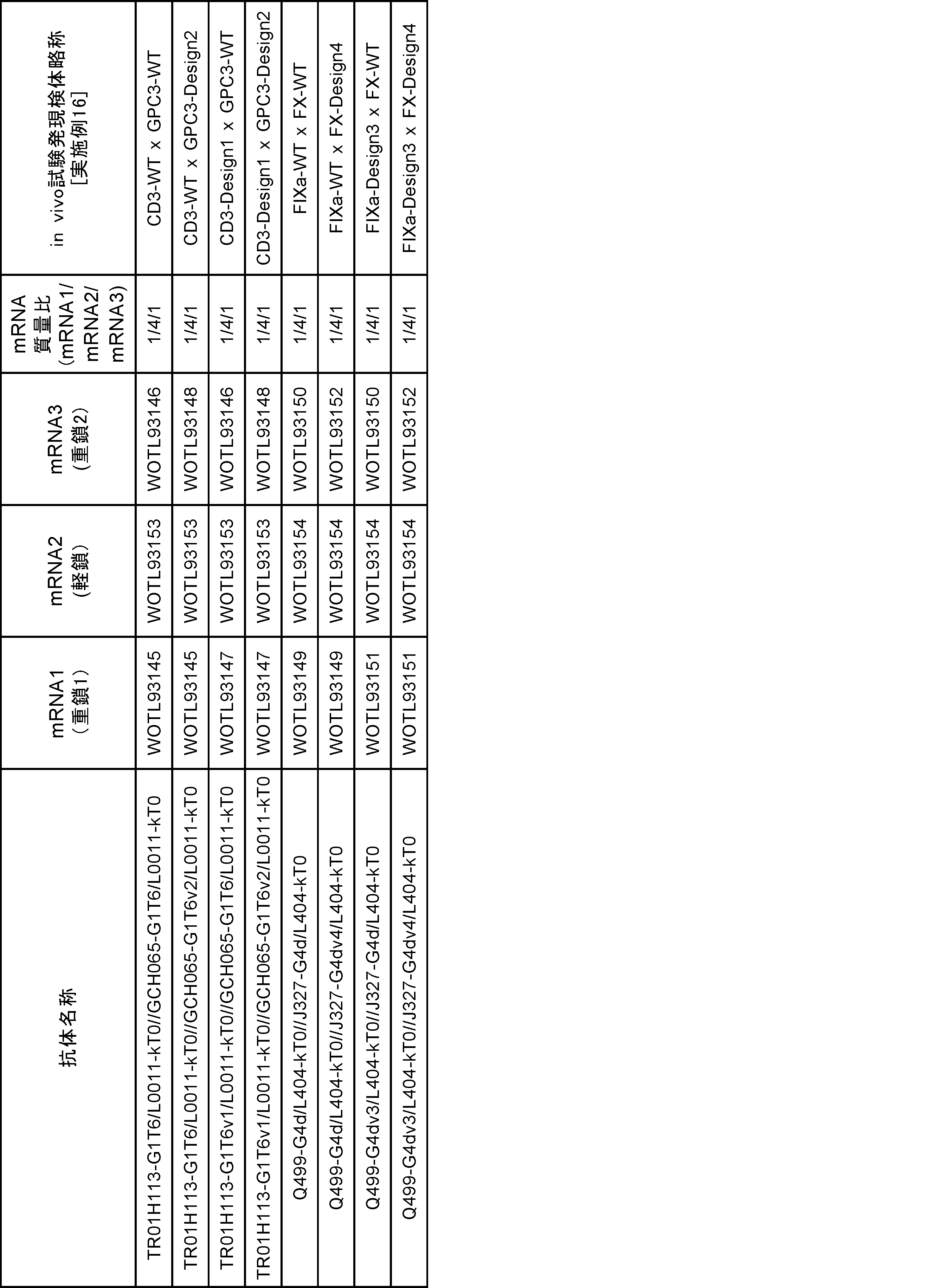
重鎖ホモ二量体形成を促進するアミノ酸改変のin vivoにおける効果を検証するため、実施例15で作製されたmRNA-LNPがC57BL6/Jマウス(雄、6週齢)に1.0 mg RNA/kgで静脈内投与された。In vivo試験に使用されたmRNA-LNP名称、および含まれるmRNAとその質量比率、発現検体の略称の対応は表26に示された。
マウス全血は、投与後3日、7日後に頚静脈採血され、4℃, 12,000 rpm, 5分の遠心後に血漿が採取された。
採取された血漿中におけるホモ二量体およびヘテロ二量体の測定が行われた。当該測定は、Gyrolab xP workstationまたはGyrolab xPand(Gyros Protein Technologies)を用いて行われた。
まず、Human GPC3 Core Protein, TIA0124-rabbitFc (抗CD3抗体(TR01H113-G1T6/L0011-kT0およびTR01H113-G1T6v1/L0011-kT0)への抗イディオタイプ(ID)抗体), WO2016047652に記載されているrAQ8-mIgG2b (抗FIXa抗体(Q499-G4d/L404-kT0, Q499-G4dv3/L404-kT0)への抗ID抗体),およびrAJ540-rbtIgG (抗FX抗体(J327-G4d/L404-kT0, J327-G4dv4/L404-kT0)への抗ID抗体)がメーカープロトコルにしたがって、EZ-Link Sulfo-NHS-Biotin(21217, Thermo Fisher Scientific)およびAlexa Fluor 647 Antibody Labeling Kit(A20186, Life Technologies)を用いてBiotinおよびAlexa Fluor 647標識された。
ホモ二量体測定では、採取された血漿もしくはC57BL/6J(雄、8週齢、ジャクソン・ラボラトリー・ジャパン)プール血漿により2-200倍希釈された血漿は、Rexxip A-max(P0004821, Gyros Protein Technologies)に等量混合された。Rexxip A-maxに等量混合された血漿は、Rexxip A(P0004820, Gyros Protein Technologies)により希釈されたBiotin標識抗体およびAlexa Fluor 647標識抗体と1:1:1となるよう混合され(Biotin標識抗体およびAlexa Fluor 647標識抗体の最終濃度は1 ug/mL)、2時間室温にてインキュベーションされた。
抗GPC3ホモ二量体の測定では、血漿サンプルはbiotin標識Human GPC3 Core Protein、Alexa Fluor 647標識Human GPC3 Core Proteinと1:1:1となるよう混合された。
抗FIXaホモ二量体の測定では、血漿サンプルはbiotin標識rAQ8-mIgG2b、Alexa Fluor 647標識rAQ8-mIgG2bと1:1:1となるよう混合された。
抗FXホモ二量体の測定では、血漿サンプルはbiotin標識rAJ540-rbtIgG、Alexa Fluor 647標識rAJ540-rbtIgGと1:1:1となるよう混合された。
インキュベーションされたサンプルは、Gyrolab xP workstationまたはGyrolab xPandを用いて測定された。当該測定では、Gyrolab Bioaffy 1000(P0004253, Gyros Protein Technologies)が測定ディスクとして用いられた。測定ディスクに対し、上記でインキュベーションされたBiotin標識抗体、Alexa Fluor 647標識抗体、および血漿サンプルの混合物が添加され、Biotin標識抗体-ホモ二量体-Alexa Fluor 647標識抗体複合体がディスク内の反応層に捕捉された。捕捉された複合体量は、Alexa647の蛍光シグナルによって検出された(Detect PMT 1%)。Alexa647の蛍光シグナルは、Gyro Evaluator(version 3.7.2.5976, Gyros Protein Technologies)によって解析された。
ヘテロ二量体測定では、採取された血漿がC57BL/6J(雄、8週齢、ジャクソン・ラボラトリー・ジャパン)プール血漿により3-5倍希釈され、Rexxip A-max(P0004821, Gyros Protein Technologies)に等量混合された。
等量混合された血漿は、Gyrolab xP workstationまたはGyrolab xPandを用いて測定された。当該測定では、Gyrolab Bioaffy 1000(P0004253, Gyros Protein Technologies)が測定ディスクとして用いられた。測定ディスクに対し、PBS 0.05% Tween 20(P3563, SIGMA-ALDRICH)により25 ug/mLに希釈されたBiotin標識抗体が添加され、ディスク内の反応層に固相化された。そこに、上記で調製した血漿サンプルが添加され、Rexxip F(P0004825, Gyros Protein Technologies)により5 ug/mLに希釈されたAlexa Flour 647標識抗体が添加された。捕捉されたヘテロ二量体は、Alexa647の蛍光シグナルによって検出された(Detect PMT 1%)。Alexa647の蛍光シグナルは、Gyro Evaluator(version 3.7.2.5976, Gyros Protein Technologies)によって解析された。
抗CD3/GPC3ヘテロ二量体の測定では、固相化抗原にbiotin標識Human GPC3 Core Protein、検出抗体にAlexa Fluor 647標識TIA0124-rabbitFcが用いられた。
抗FIXa/FXヘテロ二量体測定では、固相化抗体にbiotin標識rAQ8-mIgG2b、検出抗体にAlexa Fluor 647標識rAJ540-rbtIgGが用いられた。
投与後3日目においてホモ会合促進改変を含まないWT体(CD3-WT x GPC3-WT、FIXa-WT x FX-WT)では、2種類のホモ二量体およびヘテロ二量体の発現が検出された。片方または両方の抗体にホモ会合促進改変が含まれるDesign体(CD3-WT x GPC3-Design2、CD3-Design1 x GPC3-WT、CD3-Design1 x GPC3-Design2、FIXa-WT x FX-Design4、FIXa-Design3 x FX-WT、FIXa-Design3 x FX-Design4)では、ホモ二量体の発現がWT体と同程度に検出もしくは微増していた。一方Design体のヘテロ二量体に関しては、全検体で顕著な発現抑制が検出された。WT体でのヘテロ二量体の発現と比較して、抗CD3/GPC3ヘテロ二量体では72倍から878倍以上、抗FIXa/FXヘテロ二量体で241倍から446倍以上の発現抑制が示された。
投与後7日目においてもヘテロ二量体の発現抑制効果は持続し、抗CD3/GPC3ヘテロ二量体では84倍から717倍以上、抗FIXa/FXヘテロ二量体で184倍から375倍以上の発現抑制が示された。
このことからDesign体によりin vivoにおいてヘテロ二量体の発現を抑制できることが明らかとなった。
本試験では、1つまたは2つの重鎖にQ347R/K360E/D399V/F405T/K409WまたはE356K/K392D/D399K/K439E 改変が含まれる2抗体、1つまたは2つの重鎖にT394W/F405AまたはT366W/L368A/Y407V 改変が含まれる2抗体のin vivo発現が実証されたが、プラスミドを用いたin vitro試験でホモ二量体形成促進が確認された他のアミノ酸改変、分子フォーマットおよび機能性Fc、3抗体以上の組み合わせにおいても同様にヘテロ二量体の発現が抑制されることが期待される。
Claims (28)
- 第一のポリペプチドをコードする核酸であって、
該第一のポリペプチドは、改変が導入されたFc領域を有し、
Fc領域に導入された改変により第一のポリペプチドは、該改変が導入されていないFc領域を有する第一のポリペプチドよりも該改変を有している第一のポリペプチドとFc領域で会合しやすい、核酸。 - 前記第一のポリペプチドは、導入された改変による(1)立体相補性、(2)ジスルフィド架橋、(3)静電電荷、の少なくとも一つの作用により、該改変が導入されていないFc領域を有する第一のポリペプチドよりも該改変を有している第一のポリペプチドとFc領域で会合しやすい請求項1記載の核酸。
- 請求項1記載の核酸と、
第二のポリペプチドをコードする核酸を含み、
該第二のポリペプチドは、改変が導入されたFc領域を有し、
Fc領域に導入された改変により第二のポリペプチドは、該改変が導入されていないFc領域を有する第二のポリペプチドよりも該改変を有している第二のポリペプチドとFc領域で会合しやすい、組成物。 - 請求項1記載の核酸と、
第二のポリペプチドをコードする核酸と、
第三のポリペプチドをコードする核酸と、を含み、
該第二のポリペプチドは、該第二のポリペプチドよりも該第三のポリペプチドと会合しやすい、組成物。 - 請求項2記載の核酸と、
第二のポリペプチドをコードする核酸を含む組成物であって、該第二のポリペプチドは、該第一のポリペプチドが有する前記改変を有さない、組成物。 - 前記第一のポリペプチドに導入された改変と、前記第二のポリペプチド導入された改変は、異なる改変である請求項3記載の組成物。
- 前記第二のポリペプチドは、導入された改変による(1)立体相補性、(2)ジスルフィド架橋、(3)静電電荷、の少なくとも一つの作用により、該改変が導入されていないFc領域を有する第二のポリペプチドよりも該改変を有している第二のポリペプチドとFc領域で会合しやすい請求項3記載の組成物。
- Fc領域に導入された改変は、表2記載の改変の少なくとも一つである請求項1記載の核酸。
- Fc領域に導入された改変は、表4記載の改変の少なくとも一つである請求項1記載の核酸。
- 前記第一のポリペプチドに導入された改変と、前記第二のポリペプチド導入された改変は、表6記載の改変の組み合わせの少なくとも一つである請求項6の核酸。
- 前記ポリペプチドが抗体である、請求項1記載の核酸。
- 前記Fc領域が、IgGのFc領域である請求項1記載の核酸。
- 改変が導入されたポリペプチドは、改変前ポリペプチドの機能を保持している請求項1記載の核酸。
- 改変が導入されたFc領域がIgGのFcの機能を保持している、請求項12記載の核酸。
- 前記Fc領域が、IgG1、2、3、4のいずれか由来である請求項1記載の核酸。
- 請求項1、2、8~14のいずれか一項記載の核酸、または、請求項3~7のいずれか一項記載の組成物が導入された宿主細胞。
- 請求項1記載の核酸から発現したポリペプチド。
- ポリペプチドをコードする核酸を含む組成物であって、
該ポリペプチドは、改変が導入されたFc領域を有し、
該改変が表2で示す少なくとも一つの改変である、組成物。 - 改変が導入されたFc領域を有するポリペプチドであって、導入された改変による(1)立体相補性、(2)ジスルフィド架橋、(3)静電電荷、の少なくとも一つの作用により、該改変が導入されていないFc領域を有するポリペプチドよりも該改変を有しているポリペプチドとFc領域で会合しやすい、ポリペプチド。
- 会合が制御されたポリペプチドを得る方法であって
該ポリペプチドをコードする核酸を得るステップ、
該核酸を発現させるステップ、とを有し
該ポリペプチドは、Fc領域を有し、
Fc領域に導入された改変により該ポリペプチドは、該改変が導入されていないFc領域を有するポリペプチドよりも該改変を有しているポリペプチドとFc領域で会合しやすい、方法。 - ポリペプチドのホモ体の会合を制御する方法であって
該ポリペプチドをコードする核酸を得るステップ、
該核酸を発現させるステップ、とを有し
該ポリペプチドは、Fc領域を有し、
Fc領域に導入された改変により該ポリペプチドは、該改変が導入されていないFc領域を有するポリペプチドよりも該改変を有しているポリペプチドとFc領域で会合しやすい、方法。 - ポリペプチドのホモ体の発現を促進する方法であって
該ポリペプチドをコードする核酸を得るステップ、
該核酸を発現させるステップ、とを有し
該ポリペプチドは、Fc領域を有し、
Fc領域に導入された改変により該ポリペプチドは、該改変が導入されていないFc領域を有するポリペプチドよりも該改変を有しているポリペプチドとFc領域で会合しやすい、方法。 - 前記第二のポリペプチドは、改変が導入されたFc領域を有し、
Fc領域に導入された改変により第二のポリペプチドは、該第二のポリペプチドよりも前記第三のポリペプチドとFc領域で会合しやすい、請求項4記載の組成物。 - 前記改変が導入されたFc領域は、以下の(a)~(d)に示すEUナンバリングによる位置の組より選択される1組または2組以上の位置にアミノ酸改変を含む、請求項1記載の組成物:
(a)位置394、および405
(b)位置366、368、および407
(c)位置347、360、399、405、および409
(d)位置356、392、399、および439。 - 前記改変が導入されたFc領域は、EUナンバリングによる
(a)位置394における、W、F、Y
位置405における、A、S、T、C、G、V
(b)位置366における、W、Y、F
位置368における、A、S、T、C、V、G
位置407における、V、L、I、M、A、S、T、C、N、Q
(c)位置347における、R、K、Y、H
位置360における、E、D
位置399における、V、L、I、M、S、T、C、H、A、N、Q、G
位置405における、T、A、V、S、C、N、D、G
位置409におけるW、F、Y、H
(d)位置356における、K、R
位置392における、D、E
位置399における、K、R
位置439における、E、D
からなる群より選択される少なくとも一つのアミノ酸を含む、請求項24記載の組成物。 - 前記改変が導入されたFc領域は、EUナンバリングによる
(a)位置394における、W、F
位置405における、A、S、T、G
(b)位置366における、W、Y、F
位置368における、A、T、C、V、G
位置407における、V、L、I、M、A、C
(c)位置347における、R、K、Y、H
位置360における、E、D
位置399における、V、L、I、M、S、T、C、H、A、N、G
位置405における、T、A、V
位置409におけるW、F、Y
(d)位置356における、K
位置392における、D
位置399における、K
位置439における、E
からなる群より選択される少なくとも一つのアミノ酸を含む、請求項24記載の組成物。 - Fc領域に導入された改変は、表15記載の改変の少なくとも一つである請求項1記載の核酸。
- Fc領域に導入された改変は、表17記載の改変の少なくとも一つである請求項1記載の核酸。
Priority Applications (4)
| Application Number | Priority Date | Filing Date | Title |
|---|---|---|---|
| CN202380085639.1A CN120344665A (zh) | 2022-12-27 | 2023-12-27 | 具有受控缔合的多肽 |
| JP2024567908A JPWO2024143442A1 (ja) | 2022-12-27 | 2023-12-27 | |
| EP23912220.3A EP4644548A1 (en) | 2022-12-27 | 2023-12-27 | Polypeptide with controlled association |
| US19/142,266 US20260217835A1 (en) | 2022-12-27 | 2023-12-27 | Polypeptide with controlled association |
Applications Claiming Priority (2)
| Application Number | Priority Date | Filing Date | Title |
|---|---|---|---|
| JP2022210580 | 2022-12-27 | ||
| JP2022-210580 | 2022-12-27 |
Publications (1)
| Publication Number | Publication Date |
|---|---|
| WO2024143442A1 true WO2024143442A1 (ja) | 2024-07-04 |
Family
ID=91717763
Family Applications (1)
| Application Number | Title | Priority Date | Filing Date |
|---|---|---|---|
| PCT/JP2023/046857 Ceased WO2024143442A1 (ja) | 2022-12-27 | 2023-12-27 | 会合が制御されたポリペプチド |
Country Status (5)
| Country | Link |
|---|---|
| US (1) | US20260217835A1 (ja) |
| EP (1) | EP4644548A1 (ja) |
| JP (1) | JPWO2024143442A1 (ja) |
| CN (1) | CN120344665A (ja) |
| WO (1) | WO2024143442A1 (ja) |
Cited By (1)
| Publication number | Priority date | Publication date | Assignee | Title |
|---|---|---|---|---|
| WO2025228542A1 (en) * | 2024-05-03 | 2025-11-06 | Genmab B.V. | Method for co-expression of a plurality of antibodies |
Citations (27)
| Publication number | Priority date | Publication date | Assignee | Title |
|---|---|---|---|---|
| US4816567A (en) | 1983-04-08 | 1989-03-28 | Genentech, Inc. | Recombinant immunoglobin preparations |
| US4892538A (en) | 1987-11-17 | 1990-01-09 | Brown University Research Foundation | In vivo delivery of neurotransmitters by implanted, encapsulated cells |
| WO1993025673A1 (en) | 1992-06-04 | 1993-12-23 | The Regents Of The University Of California | In vivo gene therapy with intron-free sequence of interest |
| US5283187A (en) | 1987-11-17 | 1994-02-01 | Brown University Research Foundation | Cell culture-containing tubular capsule produced by co-extrusion |
| WO1996007321A1 (en) | 1994-09-06 | 1996-03-14 | The Uab Research Foundation | Methods for modulating protein function in cells using intracellular antibody homologues |
| US5648237A (en) | 1991-09-19 | 1997-07-15 | Genentech, Inc. | Expression of functional antibody fragments |
| US5731168A (en) | 1995-03-01 | 1998-03-24 | Genentech, Inc. | Method for making heteromultimeric polypeptides |
| US5789199A (en) | 1994-11-03 | 1998-08-04 | Genentech, Inc. | Process for bacterial production of polypeptides |
| US5840523A (en) | 1995-03-01 | 1998-11-24 | Genetech, Inc. | Methods and compositions for secretion of heterologous polypeptides |
| US5959177A (en) | 1989-10-27 | 1999-09-28 | The Scripps Research Institute | Transgenic plants expressing assembled secretory antibodies |
| US6004940A (en) | 1992-07-17 | 1999-12-21 | Dana-Farber Cancer Institute, Inc. | Intracellular targeting of endogenous proteins |
| US6040498A (en) | 1998-08-11 | 2000-03-21 | North Caroline State University | Genetically engineered duckweed |
| US6248516B1 (en) | 1988-11-11 | 2001-06-19 | Medical Research Council | Single domain ligands, receptors comprising said ligands methods for their production, and use of said ligands and receptors |
| US6420548B1 (en) | 1999-10-04 | 2002-07-16 | Medicago Inc. | Method for regulating transcription of foreign genes |
| US20030104402A1 (en) | 2001-01-23 | 2003-06-05 | University Of Rochester | Methods of producing or identifying intrabodies in eukaryotic cells |
| WO2003077945A1 (en) | 2002-03-14 | 2003-09-25 | Medical Research Council | Intracellular antibodies |
| WO2004009618A2 (en) | 2002-07-18 | 2004-01-29 | Crucell Holland B.V. | Recombinant production of mixtures of antibodies |
| WO2004092219A2 (en) | 2003-04-10 | 2004-10-28 | Protein Design Labs, Inc | Alteration of fcrn binding affinities or serum half-lives of antibodies by mutagenesis |
| WO2006106905A1 (ja) * | 2005-03-31 | 2006-10-12 | Chugai Seiyaku Kabushiki Kaisha | 会合制御によるポリペプチド製造方法 |
| US7125978B1 (en) | 1999-10-04 | 2006-10-24 | Medicago Inc. | Promoter for regulating expression of foreign genes |
| WO2010107110A1 (ja) | 2009-03-19 | 2010-09-23 | 中外製薬株式会社 | 抗体定常領域改変体 |
| WO2013157953A1 (en) | 2012-04-20 | 2013-10-24 | Merus B.V. | Methods and means for the production of ig-like molecules |
| WO2014015804A1 (zh) | 2012-07-25 | 2014-01-30 | 苏州康宁杰瑞生物科技有限公司 | 利用电荷排斥作用制备同二聚体蛋白混合物的方法 |
| JP2014504265A (ja) * | 2010-11-05 | 2014-02-20 | ザイムワークス,インコーポレイテッド | Fcドメイン中に突然変異を有する、安定したヘテロ二量体抗体の設計 |
| WO2017205014A1 (en) | 2016-05-26 | 2017-11-30 | Qilu Puget Sound Biotherapeutics Corporation | Mixtures of antibodies |
| JP2022513999A (ja) * | 2018-12-18 | 2022-02-09 | ゲンマブ エー/エス | ヘテロダイマー抗体の作製方法 |
| WO2022220275A1 (ja) | 2021-04-15 | 2022-10-20 | 中外製薬株式会社 | 抗C1s抗体 |
-
2023
- 2023-12-27 EP EP23912220.3A patent/EP4644548A1/en active Pending
- 2023-12-27 US US19/142,266 patent/US20260217835A1/en active Pending
- 2023-12-27 JP JP2024567908A patent/JPWO2024143442A1/ja active Pending
- 2023-12-27 CN CN202380085639.1A patent/CN120344665A/zh active Pending
- 2023-12-27 WO PCT/JP2023/046857 patent/WO2024143442A1/ja not_active Ceased
Patent Citations (31)
| Publication number | Priority date | Publication date | Assignee | Title |
|---|---|---|---|---|
| US4816567A (en) | 1983-04-08 | 1989-03-28 | Genentech, Inc. | Recombinant immunoglobin preparations |
| US4892538A (en) | 1987-11-17 | 1990-01-09 | Brown University Research Foundation | In vivo delivery of neurotransmitters by implanted, encapsulated cells |
| US5283187A (en) | 1987-11-17 | 1994-02-01 | Brown University Research Foundation | Cell culture-containing tubular capsule produced by co-extrusion |
| US6248516B1 (en) | 1988-11-11 | 2001-06-19 | Medical Research Council | Single domain ligands, receptors comprising said ligands methods for their production, and use of said ligands and receptors |
| US6417429B1 (en) | 1989-10-27 | 2002-07-09 | The Scripps Research Institute | Transgenic plants expressing assembled secretory antibodies |
| US5959177A (en) | 1989-10-27 | 1999-09-28 | The Scripps Research Institute | Transgenic plants expressing assembled secretory antibodies |
| US5648237A (en) | 1991-09-19 | 1997-07-15 | Genentech, Inc. | Expression of functional antibody fragments |
| WO1993025673A1 (en) | 1992-06-04 | 1993-12-23 | The Regents Of The University Of California | In vivo gene therapy with intron-free sequence of interest |
| US6329173B1 (en) | 1992-07-17 | 2001-12-11 | Dana-Farber Cancer Institute, Inc. | Method of intracellular binding target molecules |
| US6004940A (en) | 1992-07-17 | 1999-12-21 | Dana-Farber Cancer Institute, Inc. | Intracellular targeting of endogenous proteins |
| WO1996007321A1 (en) | 1994-09-06 | 1996-03-14 | The Uab Research Foundation | Methods for modulating protein function in cells using intracellular antibody homologues |
| US5789199A (en) | 1994-11-03 | 1998-08-04 | Genentech, Inc. | Process for bacterial production of polypeptides |
| US7695936B2 (en) | 1995-03-01 | 2010-04-13 | Genentech, Inc. | Knobs and holes heteromeric polypeptides |
| US5840523A (en) | 1995-03-01 | 1998-11-24 | Genetech, Inc. | Methods and compositions for secretion of heterologous polypeptides |
| US5731168A (en) | 1995-03-01 | 1998-03-24 | Genentech, Inc. | Method for making heteromultimeric polypeptides |
| US6040498A (en) | 1998-08-11 | 2000-03-21 | North Caroline State University | Genetically engineered duckweed |
| US6420548B1 (en) | 1999-10-04 | 2002-07-16 | Medicago Inc. | Method for regulating transcription of foreign genes |
| US7125978B1 (en) | 1999-10-04 | 2006-10-24 | Medicago Inc. | Promoter for regulating expression of foreign genes |
| US20030104402A1 (en) | 2001-01-23 | 2003-06-05 | University Of Rochester | Methods of producing or identifying intrabodies in eukaryotic cells |
| WO2003077945A1 (en) | 2002-03-14 | 2003-09-25 | Medical Research Council | Intracellular antibodies |
| WO2004009618A2 (en) | 2002-07-18 | 2004-01-29 | Crucell Holland B.V. | Recombinant production of mixtures of antibodies |
| WO2004092219A2 (en) | 2003-04-10 | 2004-10-28 | Protein Design Labs, Inc | Alteration of fcrn binding affinities or serum half-lives of antibodies by mutagenesis |
| WO2006106905A1 (ja) * | 2005-03-31 | 2006-10-12 | Chugai Seiyaku Kabushiki Kaisha | 会合制御によるポリペプチド製造方法 |
| WO2010107110A1 (ja) | 2009-03-19 | 2010-09-23 | 中外製薬株式会社 | 抗体定常領域改変体 |
| JP2014504265A (ja) * | 2010-11-05 | 2014-02-20 | ザイムワークス,インコーポレイテッド | Fcドメイン中に突然変異を有する、安定したヘテロ二量体抗体の設計 |
| WO2013157953A1 (en) | 2012-04-20 | 2013-10-24 | Merus B.V. | Methods and means for the production of ig-like molecules |
| JP2015514417A (ja) * | 2012-04-20 | 2015-05-21 | メルス・ベー・フェー | Ig様分子の生産方法および生産手段 |
| WO2014015804A1 (zh) | 2012-07-25 | 2014-01-30 | 苏州康宁杰瑞生物科技有限公司 | 利用电荷排斥作用制备同二聚体蛋白混合物的方法 |
| WO2017205014A1 (en) | 2016-05-26 | 2017-11-30 | Qilu Puget Sound Biotherapeutics Corporation | Mixtures of antibodies |
| JP2022513999A (ja) * | 2018-12-18 | 2022-02-09 | ゲンマブ エー/エス | ヘテロダイマー抗体の作製方法 |
| WO2022220275A1 (ja) | 2021-04-15 | 2022-10-20 | 中外製薬株式会社 | 抗C1s抗体 |
Non-Patent Citations (48)
| Title |
|---|
| "Antibodies: A Practical Approach", 1988, IRL PRESS |
| "Methods in Enzymology", ACADEMIC PRESS, INC, article "PCR 2: A Practical Approach" |
| "Monoclonal Antibodies: A Practical Approach", 2000, OXFORD UNIVERSITY PRESS |
| "Oligonucleotide Synthesis", 1984 |
| "Remington's Pharmaceutical Sciences", 1980 |
| "Sequences of proteins of immunological interest", NIH PUBLICATION |
| ANAL BIOCHEM., vol. 360, no. 1, 1 January 2007 (2007-01-01), pages 75 - 83 |
| ANALYTICAL BIOCHEMISTRY, vol. 348, 2006, pages 24 - 39 |
| ANDERSON ET AL., SCIENCE, vol. 256, 1992, pages 808 - 813 |
| ANNU REV. BIOPHYS. BIOMOL. STRUCT, vol. 35, 2006, pages 225 - 249 |
| C.A. JANEWAYP. TRAVERS, IMMUNOBIOLOGY, 1997 |
| CAPEL ET AL., IMMUNOMETHODS, vol. 4, 1994, pages 25 - 34 |
| CARTER, J IMMUNOL METH, vol. 248, 2001, pages 7 - 15 |
| CHEN ET AL., J. MOL. BIOL., vol. 293, 1999, pages 865 - 881 |
| CHOTHIALESK, J. MOL. BIOL., vol. 196, 1987, pages 901 - 917 |
| CLARKSON ET AL., NATURE, vol. 352, 1991, pages 624 - 628 |
| DAERON, ANNU. REV. IMMUNOL, vol. 15, 1997, pages 203 - 234 |
| DE HAAS ET AL., J. LAB. CLIN. MED, vol. 126, 1995, pages 330 - 41 |
| FRONT IMMUNOL., vol. 7, 6 October 2016 (2016-10-06), pages 394 |
| GERNGROSS, NAT. BIOTECH., vol. 22, 2004, pages 1409 - 1414 |
| GHETIE ET AL., NATURE BIOTECHNOLOGY, vol. 15, no. 7, 1997, pages 637 - 640 |
| GHETIEWARD, IMMUNOL. TODAY, vol. 18, no. 12, 1997, pages 592 - 598 |
| GRAHAM ET AL., J. GEN VIROL., vol. 36, 1977, pages 59 |
| GUYER ET AL., J. IMMUNOL., vol. 117, 1976, pages 587 |
| HINTON ET AL., J. BIOL. CHEM., vol. 279, no. 8, 2004, pages 6213 - 6216 |
| J BIOL CHEM., vol. 292, no. 43, 27 October 2017 (2017-10-27), pages 17885 - 17896 |
| J. P. MATHERP.E. ROBERTS: "Introduction to Cell and Tissue Culture", 1998, ACADEMIC PRESS |
| JOURNAL OF PHARMACEUTICAL SCIENCE, vol. 4, 2010, pages 1707 - 1720 |
| KIM ET AL., J. IMMUNOL., vol. 24, 1994, pages 249 |
| KINDT ET AL.: "Kuby Immunology", 2007, W.H. FREEMAN AND CO, pages: 91 |
| KONTERMANN, METHODS, vol. 34, 2004, pages 163 - 170 |
| KUNKEL ET AL., PROC. NATL. ACAD. SCI. USA, vol. 82, 1985, pages 488 - 492 |
| LI, BIOTECH., vol. 24, 2006, pages 210 - 215 |
| MACCALLUM ET AL., J. MOL. BIOL., vol. 262, 1996, pages 732 - 745 |
| MARASCO, GENE THERAPY, vol. 4, 1997, pages 11 - 15 |
| MATHER ET AL., ANNALS N.Y. ACAD. SCI., vol. 383, 1982, pages 44 - 68 |
| MATHER, BIOL. REPROD., vol. 23, 1980, pages 243 - 251 |
| NAT BIOTECHNOL., vol. 16, no. 7, July 1998 (1998-07-01), pages 677 - 81 |
| P. FINCH, ANTIBODIES, 1997 |
| PORTOLANO ET AL., J. IMMUNOL., vol. 150, 1993, pages 880 - 887 |
| PROC NATL ACAD SCI U S A., vol. 110, no. 13, 26 March 2013 (2013-03-26), pages 5145 - 50 |
| PROC. NATL. ACAD. SCI. U.S.A., vol. 100, no. 11, 2003, pages 6353 - 6357 |
| PROC. NATL. ACAD. SCI. USA, vol. 103, no. 11, 2006, pages 4005 - 4010 |
| RAVETCHKINET, ANNU. REV. IMMUNOL, vol. 9, 1991, pages 457 - 92 |
| RIDGWAY ET AL., PROT ENG, vol. 9, 1996, pages 617 - 621 |
| See also references of EP4644548A1 |
| URLAUB ET AL., PROC. NATL. ACAD. SCI. USA, vol. 77, 1980, pages 4216 |
| YAZAKIWU: "Methods in Molecular Biology", vol. 248, 2003, HUMANA PRESS, pages: 255 - 268 |
Cited By (1)
| Publication number | Priority date | Publication date | Assignee | Title |
|---|---|---|---|---|
| WO2025228542A1 (en) * | 2024-05-03 | 2025-11-06 | Genmab B.V. | Method for co-expression of a plurality of antibodies |
Also Published As
| Publication number | Publication date |
|---|---|
| CN120344665A (zh) | 2025-07-18 |
| JPWO2024143442A1 (ja) | 2024-07-04 |
| US20260217835A1 (en) | 2026-07-30 |
| EP4644548A1 (en) | 2025-11-05 |
Similar Documents
| Publication | Publication Date | Title |
|---|---|---|
| TWI818387B (zh) | 結合cd3之抗體 | |
| JP7085666B2 (ja) | Dll3標的多重特異性抗原結合分子およびその使用 | |
| ES2597228T3 (es) | Procedimiento para la selección y la producción de entidades de objetivación, como dianas, altamente selectivas y multiespecíficas, personalizadas, las cuales contienen por lo menos dos entidades de unión diferentes, y utilización de éstas | |
| JP2019088290A (ja) | Asgpr抗体およびその使用 | |
| KR20220161156A (ko) | 면역 활성화 다중 특이성 항원 결합 분자 및 그의 사용 | |
| TW201311893A (zh) | 使用包含第一型mhc之複合體透過循環病毒特異性毒殺t細胞以移除標的細胞之方法 | |
| CN104520319A (zh) | 用于产生免疫球蛋白样分子的方法和手段 | |
| CN116888153A (zh) | 与γ-δT细胞受体结合的抗体 | |
| KR20220161375A (ko) | 다중 특이성 항원 결합 분자를 제조하기 위한 방법 | |
| CN117003872A (zh) | 含有突变轻链可变区骨架的单链抗体片段 | |
| JP2026010057A (ja) | 部位特異的Notch活性化分子およびその使用 | |
| JP2025038001A (ja) | Pdgf-bおよびpdgf-dに結合する抗原結合分子ならびにその使用 | |
| JP2023537553A (ja) | ワンアームド抗原結合分子およびその使用 | |
| CN119698294A (zh) | 结合γ-δT细胞受体的变体抗体 | |
| JP2026513097A (ja) | 新規な抗NaPi2b抗体およびそれをベースとする抗体-薬物コンジュゲート、治療的方法、ならびにそれらの使用 | |
| EP4644548A1 (en) | Polypeptide with controlled association | |
| KR20260064747A (ko) | 폼페병의 치료를 위한 항-TfR:GAA 및 항-CD63:GAA 삽입 | |
| HK40121051A (en) | Polypeptide with controlled association | |
| US20250353881A1 (en) | Immunoreceptor inhibitory proteins and related methods | |
| HK40095327A (en) | Single-chain fragment variable comprising mutant light chain framework region | |
| TW202535927A (zh) | 與ceacam5結合之抗體 | |
| TW202528359A (zh) | 具有條件活性的多特異性抗體 | |
| HK40110726A (en) | Bispecific antibody comprising a heterodimer based on mhc proteins | |
| HK40106996A (en) | Antibodies binding to cd3 | |
| TW202606763A (zh) | 特異性結合經修飾之寡核苷酸的抗體 |
Legal Events
| Date | Code | Title | Description |
|---|---|---|---|
| 121 | Ep: the epo has been informed by wipo that ep was designated in this application |
Ref document number: 23912220 Country of ref document: EP Kind code of ref document: A1 |
|
| WWE | Wipo information: entry into national phase |
Ref document number: 2024567908 Country of ref document: JP |
|
| WWE | Wipo information: entry into national phase |
Ref document number: CN2023800856391 Country of ref document: CN Ref document number: 202380085639.1 Country of ref document: CN |
|
| WWP | Wipo information: published in national office |
Ref document number: 202380085639.1 Country of ref document: CN |
|
| WWE | Wipo information: entry into national phase |
Ref document number: 2023912220 Country of ref document: EP |
|
| NENP | Non-entry into the national phase |
Ref country code: DE |
|
| ENP | Entry into the national phase |
Ref document number: 2023912220 Country of ref document: EP Effective date: 20250728 |
|
| ENP | Entry into the national phase |
Ref document number: 2023912220 Country of ref document: EP Effective date: 20250728 |
|
| WWP | Wipo information: published in national office |
Ref document number: 2023912220 Country of ref document: EP |