WO2024147319A1 - 化粧シート - Google Patents
化粧シート Download PDFInfo
- Publication number
- WO2024147319A1 WO2024147319A1 PCT/JP2023/046696 JP2023046696W WO2024147319A1 WO 2024147319 A1 WO2024147319 A1 WO 2024147319A1 JP 2023046696 W JP2023046696 W JP 2023046696W WO 2024147319 A1 WO2024147319 A1 WO 2024147319A1
- Authority
- WO
- WIPO (PCT)
- Prior art keywords
- decorative sheet
- protective layer
- surface protective
- layer
- mass
- Prior art date
- Legal status (The legal status is an assumption and is not a legal conclusion. Google has not performed a legal analysis and makes no representation as to the accuracy of the status listed.)
- Ceased
Links
Images


Classifications
-
- C—CHEMISTRY; METALLURGY
- C09—DYES; PAINTS; POLISHES; NATURAL RESINS; ADHESIVES; COMPOSITIONS NOT OTHERWISE PROVIDED FOR; APPLICATIONS OF MATERIALS NOT OTHERWISE PROVIDED FOR
- C09D—COATING COMPOSITIONS, e.g. PAINTS, VARNISHES OR LACQUERS; FILLING PASTES; CHEMICAL PAINT OR INK REMOVERS; INKS; CORRECTING FLUIDS; WOODSTAINS; PASTES OR SOLIDS FOR COLOURING OR PRINTING; USE OF MATERIALS THEREFOR
- C09D4/00—Coating compositions, e.g. paints, varnishes or lacquers, based on organic non-macromolecular compounds having at least one polymerisable carbon-to-carbon unsaturated bond ; Coating compositions, based on monomers of macromolecular compounds of groups C09D183/00 - C09D183/16
-
- D—TEXTILES; PAPER
- D21—PAPER-MAKING; PRODUCTION OF CELLULOSE
- D21H—PULP COMPOSITIONS; PREPARATION THEREOF NOT COVERED BY SUBCLASSES D21C OR D21D; IMPREGNATING OR COATING OF PAPER; TREATMENT OF FINISHED PAPER NOT COVERED BY CLASS B31 OR SUBCLASS D21G; PAPER NOT OTHERWISE PROVIDED FOR
- D21H27/00—Special paper not otherwise provided for, e.g. made by multi-step processes
- D21H27/02—Patterned paper
-
- B—PERFORMING OPERATIONS; TRANSPORTING
- B32—LAYERED PRODUCTS
- B32B—LAYERED PRODUCTS, i.e. PRODUCTS BUILT-UP OF STRATA OF FLAT OR NON-FLAT, e.g. CELLULAR OR HONEYCOMB, FORM
- B32B3/00—Layered products comprising a layer with external or internal discontinuities or unevennesses, or a layer of non-planar shape; Layered products comprising a layer having particular features of form
- B32B3/26—Layered products comprising a layer with external or internal discontinuities or unevennesses, or a layer of non-planar shape; Layered products comprising a layer having particular features of form characterised by a particular shape of the outline of the cross-section of a continuous layer; characterised by a layer with cavities or internal voids ; characterised by an apertured layer
- B32B3/30—Layered products comprising a layer with external or internal discontinuities or unevennesses, or a layer of non-planar shape; Layered products comprising a layer having particular features of form characterised by a particular shape of the outline of the cross-section of a continuous layer; characterised by a layer with cavities or internal voids ; characterised by an apertured layer characterised by a layer formed with recesses or projections, e.g. hollows, grooves, protuberances, ribs
-
- B—PERFORMING OPERATIONS; TRANSPORTING
- B31—MAKING ARTICLES OF PAPER, CARDBOARD OR MATERIAL WORKED IN A MANNER ANALOGOUS TO PAPER; WORKING PAPER, CARDBOARD OR MATERIAL WORKED IN A MANNER ANALOGOUS TO PAPER
- B31F—MECHANICAL WORKING OR DEFORMATION OF PAPER, CARDBOARD OR MATERIAL WORKED IN A MANNER ANALOGOUS TO PAPER
- B31F1/00—Mechanical deformation without removing material, e.g. in combination with laminating
- B31F1/07—Embossing, i.e. producing impressions formed by locally deep-drawing, e.g. using rolls provided with complementary profiles
-
- B—PERFORMING OPERATIONS; TRANSPORTING
- B32—LAYERED PRODUCTS
- B32B—LAYERED PRODUCTS, i.e. PRODUCTS BUILT-UP OF STRATA OF FLAT OR NON-FLAT, e.g. CELLULAR OR HONEYCOMB, FORM
- B32B15/00—Layered products comprising a layer of metal
- B32B15/04—Layered products comprising a layer of metal comprising metal as the main or only constituent of a layer, which is next to another layer of the same or of a different material
- B32B15/12—Layered products comprising a layer of metal comprising metal as the main or only constituent of a layer, which is next to another layer of the same or of a different material of paper or cardboard
-
- B—PERFORMING OPERATIONS; TRANSPORTING
- B32—LAYERED PRODUCTS
- B32B—LAYERED PRODUCTS, i.e. PRODUCTS BUILT-UP OF STRATA OF FLAT OR NON-FLAT, e.g. CELLULAR OR HONEYCOMB, FORM
- B32B21/00—Layered products comprising a layer of wood, e.g. wood board, veneer, wood particle board
- B32B21/04—Layered products comprising a layer of wood, e.g. wood board, veneer, wood particle board comprising wood as the main or only constituent of a layer, which is next to another layer of the same or of a different material
- B32B21/06—Layered products comprising a layer of wood, e.g. wood board, veneer, wood particle board comprising wood as the main or only constituent of a layer, which is next to another layer of the same or of a different material of paper or cardboard
-
- B—PERFORMING OPERATIONS; TRANSPORTING
- B32—LAYERED PRODUCTS
- B32B—LAYERED PRODUCTS, i.e. PRODUCTS BUILT-UP OF STRATA OF FLAT OR NON-FLAT, e.g. CELLULAR OR HONEYCOMB, FORM
- B32B27/00—Layered products comprising a layer of synthetic resin
- B32B27/06—Layered products comprising a layer of synthetic resin as the main or only constituent of a layer, which is next to another layer of the same or of a different material
- B32B27/08—Layered products comprising a layer of synthetic resin as the main or only constituent of a layer, which is next to another layer of the same or of a different material of synthetic resin
-
- B—PERFORMING OPERATIONS; TRANSPORTING
- B32—LAYERED PRODUCTS
- B32B—LAYERED PRODUCTS, i.e. PRODUCTS BUILT-UP OF STRATA OF FLAT OR NON-FLAT, e.g. CELLULAR OR HONEYCOMB, FORM
- B32B27/00—Layered products comprising a layer of synthetic resin
- B32B27/28—Layered products comprising a layer of synthetic resin comprising synthetic resins not wholly covered by any one of the sub-groups B32B27/30 - B32B27/42
- B32B27/285—Layered products comprising a layer of synthetic resin comprising synthetic resins not wholly covered by any one of the sub-groups B32B27/30 - B32B27/42 comprising polyethers
-
- B—PERFORMING OPERATIONS; TRANSPORTING
- B32—LAYERED PRODUCTS
- B32B—LAYERED PRODUCTS, i.e. PRODUCTS BUILT-UP OF STRATA OF FLAT OR NON-FLAT, e.g. CELLULAR OR HONEYCOMB, FORM
- B32B27/00—Layered products comprising a layer of synthetic resin
- B32B27/30—Layered products comprising a layer of synthetic resin comprising vinyl (co)polymers; comprising acrylic (co)polymers
- B32B27/308—Layered products comprising a layer of synthetic resin comprising vinyl (co)polymers; comprising acrylic (co)polymers comprising acrylic (co)polymers
-
- B—PERFORMING OPERATIONS; TRANSPORTING
- B32—LAYERED PRODUCTS
- B32B—LAYERED PRODUCTS, i.e. PRODUCTS BUILT-UP OF STRATA OF FLAT OR NON-FLAT, e.g. CELLULAR OR HONEYCOMB, FORM
- B32B9/00—Layered products comprising a layer of a particular substance not covered by groups B32B11/00 - B32B29/00
- B32B9/04—Layered products comprising a layer of a particular substance not covered by groups B32B11/00 - B32B29/00 comprising such particular substance as the main or only constituent of a layer, which is next to another layer of the same or of a different material
- B32B9/041—Layered products comprising a layer of a particular substance not covered by groups B32B11/00 - B32B29/00 comprising such particular substance as the main or only constituent of a layer, which is next to another layer of the same or of a different material of metal
-
- C—CHEMISTRY; METALLURGY
- C09—DYES; PAINTS; POLISHES; NATURAL RESINS; ADHESIVES; COMPOSITIONS NOT OTHERWISE PROVIDED FOR; APPLICATIONS OF MATERIALS NOT OTHERWISE PROVIDED FOR
- C09D—COATING COMPOSITIONS, e.g. PAINTS, VARNISHES OR LACQUERS; FILLING PASTES; CHEMICAL PAINT OR INK REMOVERS; INKS; CORRECTING FLUIDS; WOODSTAINS; PASTES OR SOLIDS FOR COLOURING OR PRINTING; USE OF MATERIALS THEREFOR
- C09D133/00—Coating compositions based on homopolymers or copolymers of compounds having one or more unsaturated aliphatic radicals, each having only one carbon-to-carbon double bond, and at least one being terminated by only one carboxyl radical, or of salts, anhydrides, esters, amides, imides, or nitriles thereof; Coating compositions based on derivatives of such polymers
- C09D133/04—Homopolymers or copolymers of esters
- C09D133/14—Homopolymers or copolymers of esters of esters containing halogen, nitrogen, sulfur or oxygen atoms in addition to the carboxy oxygen
-
- D—TEXTILES; PAPER
- D21—PAPER-MAKING; PRODUCTION OF CELLULOSE
- D21H—PULP COMPOSITIONS; PREPARATION THEREOF NOT COVERED BY SUBCLASSES D21C OR D21D; IMPREGNATING OR COATING OF PAPER; TREATMENT OF FINISHED PAPER NOT COVERED BY CLASS B31 OR SUBCLASS D21G; PAPER NOT OTHERWISE PROVIDED FOR
- D21H17/00—Non-fibrous material added to the pulp, characterised by its constitution; Paper-impregnating material characterised by its constitution
- D21H17/20—Macromolecular organic compounds
- D21H17/33—Synthetic macromolecular compounds
- D21H17/34—Synthetic macromolecular compounds obtained by reactions only involving carbon-to-carbon unsaturated bonds
- D21H17/37—Polymers of unsaturated acids or derivatives thereof, e.g. polyacrylates
-
- D—TEXTILES; PAPER
- D21—PAPER-MAKING; PRODUCTION OF CELLULOSE
- D21H—PULP COMPOSITIONS; PREPARATION THEREOF NOT COVERED BY SUBCLASSES D21C OR D21D; IMPREGNATING OR COATING OF PAPER; TREATMENT OF FINISHED PAPER NOT COVERED BY CLASS B31 OR SUBCLASS D21G; PAPER NOT OTHERWISE PROVIDED FOR
- D21H27/00—Special paper not otherwise provided for, e.g. made by multi-step processes
- D21H27/002—Tissue paper; Absorbent paper
-
- D—TEXTILES; PAPER
- D21—PAPER-MAKING; PRODUCTION OF CELLULOSE
- D21H—PULP COMPOSITIONS; PREPARATION THEREOF NOT COVERED BY SUBCLASSES D21C OR D21D; IMPREGNATING OR COATING OF PAPER; TREATMENT OF FINISHED PAPER NOT COVERED BY CLASS B31 OR SUBCLASS D21G; PAPER NOT OTHERWISE PROVIDED FOR
- D21H27/00—Special paper not otherwise provided for, e.g. made by multi-step processes
- D21H27/18—Paper- or board-based structures for surface covering
- D21H27/20—Flexible structures being applied by the user, e.g. wallpaper
-
- D—TEXTILES; PAPER
- D21—PAPER-MAKING; PRODUCTION OF CELLULOSE
- D21H—PULP COMPOSITIONS; PREPARATION THEREOF NOT COVERED BY SUBCLASSES D21C OR D21D; IMPREGNATING OR COATING OF PAPER; TREATMENT OF FINISHED PAPER NOT COVERED BY CLASS B31 OR SUBCLASS D21G; PAPER NOT OTHERWISE PROVIDED FOR
- D21H27/00—Special paper not otherwise provided for, e.g. made by multi-step processes
- D21H27/30—Multi-ply
-
- B—PERFORMING OPERATIONS; TRANSPORTING
- B32—LAYERED PRODUCTS
- B32B—LAYERED PRODUCTS, i.e. PRODUCTS BUILT-UP OF STRATA OF FLAT OR NON-FLAT, e.g. CELLULAR OR HONEYCOMB, FORM
- B32B2307/00—Properties of the layers or laminate
- B32B2307/40—Properties of the layers or laminate having particular optical properties
- B32B2307/408—Matt, dull surface
-
- B—PERFORMING OPERATIONS; TRANSPORTING
- B32—LAYERED PRODUCTS
- B32B—LAYERED PRODUCTS, i.e. PRODUCTS BUILT-UP OF STRATA OF FLAT OR NON-FLAT, e.g. CELLULAR OR HONEYCOMB, FORM
- B32B2307/00—Properties of the layers or laminate
- B32B2307/50—Properties of the layers or laminate having particular mechanical properties
- B32B2307/584—Scratch resistance
-
- B—PERFORMING OPERATIONS; TRANSPORTING
- B32—LAYERED PRODUCTS
- B32B—LAYERED PRODUCTS, i.e. PRODUCTS BUILT-UP OF STRATA OF FLAT OR NON-FLAT, e.g. CELLULAR OR HONEYCOMB, FORM
- B32B2307/00—Properties of the layers or laminate
- B32B2307/70—Other properties
- B32B2307/732—Dimensional properties
- B32B2307/737—Dimensions, e.g. volume or area
- B32B2307/7375—Linear, e.g. length, distance or width
- B32B2307/7376—Thickness
-
- B—PERFORMING OPERATIONS; TRANSPORTING
- B32—LAYERED PRODUCTS
- B32B—LAYERED PRODUCTS, i.e. PRODUCTS BUILT-UP OF STRATA OF FLAT OR NON-FLAT, e.g. CELLULAR OR HONEYCOMB, FORM
- B32B2451/00—Decorative or ornamental articles
Definitions
- Decorative sheets are used to decorate the surfaces of interior and exterior materials such as building fixtures, furniture, construction materials, and flooring, for the purpose of imparting design and durability to these materials.
- Decorative sheets are generally widely used as decorative panels that are attached to the surfaces of substrates such as wood, wood boards, metal plates, non-flammable boards, paper substrates, and resin substrates via adhesives or the like.
- Designs can be added by forming patterns such as wood grain or stone using various printing methods. Plain, pattern-free decorative sheets are sometimes preferred. The choice of whether or not to have a pattern and the type of pattern vary according to the application and preference.
- the glossiness of the surface is also important in the design of decorative sheets.
- decorative sheets There are a variety of decorative sheets to choose from, ranging from mirror-like high gloss to low gloss with no reflections at all, depending on the application and preference.
- Durability is a comprehensive assessment of scratch resistance, stain resistance, and whether these can be maintained over the long term. Requirements vary depending on the environment and situation in which the decorative sheet is used, but there is always a demand for decorative sheets with high performance.
- a surface protective layer on the outermost surface of the decorative sheet. Also, to adjust the gloss mentioned above, and in particular to achieve a low gloss, it is common to add a gloss adjuster (matte additive) to the surface protective layer.
- the objective of the present invention is to provide a decorative sheet that provides a smooth feel and has excellent uniformity of feel.
- an original fabric layer and a surface protective layer provided on one surface of the original fabric layer, and an uneven structure including a plurality of ridge-like portions each protruding in a ridge shape is provided on the surface of the surface protective layer, and the uneven structure of the surface protective layer has a protruding peak height Rpk of less than 3.5 ⁇ m, and the surface protective layer has a mass concentration C (mass %) of carbon atoms, a mass concentration O (mass %) of oxygen atoms, and a mass concentration Si (mass %) of silicon atoms that satisfy the following relationship formula: 0.5 ⁇ Si/(C+O+Si) ⁇ 100 A decorative sheet that satisfies the above requirements is provided.
- a decorative sheet relating to the above aspect is provided in which the protruding peak height Rpk is 0.5 ⁇ m or more.
- the surface protective layer has a mass concentration C (mass %) of carbon atoms, a mass concentration O (mass %) of oxygen atoms, and a mass concentration Si (mass %) of silicon atoms that satisfy the following relationship: 0.5 ⁇ Si/(C+O+Si) ⁇ 100 ⁇ 5.0
- a decorative sheet according to any of the above aspects which satisfies the above.
- the surface protective layer includes a cured product of an ionizing radiation curable resin.
- the ink used to form the design layer 3 may further contain, in addition to the binder, for example, pigments contained in ordinary inks, colorants such as dyes, extender pigments, solvents, and various additives.
- pigments having high versatility include condensed azo, insoluble azo, quinacridone, isoindoline, anthraquinone, imidazolone, cobalt, phthalocyanine, carbon, titanium oxide, iron oxide, and pearl pigments such as mica.
- the resin material of the adhesive layer 7 is not particularly limited, but may be appropriately selected from acrylic, polyester, polyurethane, epoxy, and other resin materials.
- An ethylene-vinyl acetate copolymer resin adhesive may also be used as the resin material of the adhesive layer 7.
- the coating method may be appropriately selected depending on the viscosity of the adhesive. Generally, gravure coating is used, and the adhesive layer 7 is formed on the upper surface of the pattern layer 3 by gravure coating, and then the transparent resin layer 4 is laminated. Note that the adhesive layer 7 may be omitted if sufficient adhesive strength is obtained between the transparent resin layer 4 and the pattern layer 3.
- ridge-like refers to a convex shape that is linear in plan view.
- the ridge portions 5B may be curved or straight in plan view, but are preferably curved in view of the fingerprint resistance of the decorative sheet 1.
- Each of the ridge portions 5B may or may not be branched in plan view.
- the ridge portions 5B are, for example, the portions from the lowest part to the tip of the uneven shape provided on the surface of the surface protective layer 5, and the core portion 5A refers to the portion of the surface protective layer 5 excluding the ridge portions 5B.
- the uneven structure of the surface protective layer 5 preferably has an average length RSm of the roughness curve element of 800 ⁇ m or less, more preferably 550 ⁇ m or less, even more preferably 350 ⁇ m or less, even more preferably 320 ⁇ m or less, and even more preferably 300 ⁇ m or less.
- the "average length RSm of the roughness curve element” is a surface property parameter defined in JIS B0601:2013.
- This average length RSm is preferably 10 ⁇ m or more, more preferably 50 ⁇ m or more, and even more preferably 80 ⁇ m or more. It is difficult to manufacture a structure in which this average length RSm is small and the protruding peak height Rpk is relatively large.
- the mass concentration C (mass %) of carbon atoms, the mass concentration O (mass %) of oxygen atoms, and the mass concentration Si (mass %) of silicon atoms satisfy the following relational expression (1).
- the surface protective layer 5 contains an ionizing radiation curable resin and silica particles, which will be described later.
- the value of ⁇ Si/(C+O+Si) ⁇ 100 is preferably 0.75 or more, and more preferably 1.0 or more.
- the contents of C (mass %), O (mass %), and Si (mass %) preferably satisfy the following relational expression (2).
- 0.5 ⁇ Si/(C+O+Si) ⁇ 100 ⁇ 5.0 It is preferable that the value of ⁇ Si/(C+O+Si) ⁇ 100 is 5.0 or less from the viewpoints of scratch resistance, contamination resistance, weather resistance, etc. From the same viewpoint, the value of ⁇ Si/(C+O+Si) ⁇ 100 is more preferably 3.5 or less, and further preferably 2.0 or less.
- the main component of the ionizing radiation curable resin is preferably an acrylate.
- the main component of the ionizing radiation curable resin means 60 parts by mass or more when the total solid content of the ionizing radiation curable resin is taken as 100 parts by mass.
- the ionizing radiation curable resin preferably contains 70 parts by mass or more of acrylate, and more preferably contains 80 parts by mass or more.
- the acrylate preferably contains a repeating structure.
- This repeating structure is, for example, any one of an ethylene oxide (EO) structure, a propylene oxide (PO) structure, and an ⁇ -caprolactone (CL) structure.
- the repeating structure is preferably ethylene oxide or propylene oxide.
- the repeating structure may be present between the acryloyl group and the methylol group in an open ring state.
- the number of repetitions of the repeating structure is preferably 3 or more. If an acrylate with a large number of repetitions is used, the cured film is more likely to expand in the in-plane direction in the second irradiation step described below, and therefore wrinkles corresponding to the ridged portions 5B are more likely to appear on the coating film surface. It also makes it possible to uniformly generate wrinkles over a wide area, which contributes to improving the uniformity of the tactile feel. However, if the number of repetitions is increased, the crosslinking density decreases, and the scratch resistance of the surface protective layer decreases.
- the trifunctional acrylate containing a repeating structure is, for example, EO-modified, PO-modified or CL-modified trimethylolpropane triacrylate, glycerin triacrylate, isocyanurate triacrylate or pentaerythritol triacrylate.
- the number of repetitions of the repeating structure is preferably 3 or more and 30 or less, more preferably 3 or more and 20 or less.
- a tetrafunctional acrylate containing a repeating structure is EO-modified, PO-modified, or CL-modified pentaerythritol tetraacrylate.
- the number of repeats of the repeating structure is preferably 12 or more, more preferably 12 or more and 50 or less, and even more preferably 20 or more and 50 or less.
- the number of repetitions of the above repeating structure can be analyzed using MALDI-TOF-MS.
- Ionizing radiation curable resins may have a molecular weight distribution. If there is a molecular weight distribution, the above number of repetitions should be the number of repetitions that corresponds to the molecular weight with the strongest peak in the MALDI-TOF-MS mass spectrum.
- the main component of the ionizing radiation curable resin is preferably an acrylate.
- the acrylate may be composed of the acrylate described above.
- the acrylate may be composed of the acrylate described above (hereinafter referred to as the first acrylate) and a second acrylate different from the first acrylate.
- the compounding ratio of the first acrylate to the second acrylate is not particularly limited, but can be, for example, a mass ratio within the range of 90:10 to 20:80.
- the second acrylate is, for example, a monofunctional to hexafunctional acrylate.
- the acrylate may be composed of a first acrylate containing a repeating structure and a mono- to hexa-functional second acrylate.
- the repeating structure of the first acrylate is any one of ethylene oxide, propylene oxide, and ⁇ -caprolactone, and the number of repetitions of the repeating structure is 3 or more.
- Examples of the second acrylate include trimethylolpropane triacrylate, pentaerythritol tetraacrylate, dipentaerythritol pentaacrylate, and dipentaerythritol hexaacrylate.
- the peak height Rpk tends to be smaller and the average length RSm of the roughness curve element tends to be larger.
- the glossiness of the surface protective layer 5 can be increased to increase the glossiness variation, or the thickness of the surface protective layer 5 can be increased to increase the thickness variation.
- the coating liquid for the surface protective layer contains silica particles.
- silica particles are contained in the coating liquid for the surface protective layer, wrinkles can be more uniformly generated on the coating surface in the second irradiation step described below, which contributes to improving the uniformity of the tactile feel.
- the coating liquid for the surface protective layer may further contain particles other than silica particles.
- the particles other than silica particles that can be used include particles made of organic materials such as polyethylene (PE) wax, polypropylene (PP) wax, and resin beads, and particles made of inorganic materials such as glass, alumina, titania, zirconia, calcium carbonate, and barium sulfate.
- the particles other than silica particles may be contained in the coating liquid for the surface protective layer in an amount of, for example, 20% by mass or less of the total particles.
- the average particle size (D50) of the above particles, including silica particles, is preferably 10 ⁇ m or less.
- the average particle size (D50) of the particles is more preferably 1 ⁇ m or more and 8 ⁇ m or less, and even more preferably 2 ⁇ m or more and 6 ⁇ m or less.
- the particles are likely to fall off from the surface protective layer 5, which may make it difficult to achieve high scratch resistance.
- the particles are small, the effect of generating wrinkles uniformly is small.
- the "average particle size (D50)" is the median size (D50) measured by a laser diffraction/scattering type particle size distribution measuring device. If the coating liquid for the surface protective layer contains particles, the surface protective layer 5 obtained from this coating liquid will also contain particles. The average particle size of the particles contained in the surface protective layer 5 can be determined by observing the cross section of the layer and averaging the particle sizes of multiple particles. The value obtained in this manner is substantially the same as the median size (D50) measured by a laser diffraction/scattering type particle size distribution measuring device. Therefore, the above-mentioned range of average particle sizes can also be interpreted as the range of average particle sizes of the particles contained in the surface protective layer 5.
- the amount of particles containing silica particles added is preferably 1.3 parts by mass or more and 22 parts by mass or less, more preferably 1.3 parts by mass or more and 15 parts by mass or less, and even more preferably 3 parts by mass or more and 10 parts by mass or less, relative to 100 parts by mass of ionizing radiation curable resin.
- the above amount added refers to the amount of silica particles added.
- the amount of particles is within the above range, the effect of generating wrinkles uniformly is particularly large.
- the coating liquid for the surface protective layer may further contain a solvent and additives for improving the functionality of the final product, such as antibacterial agents and antifungal agents.
- the coating liquid for the surface protective layer may further contain other additives such as an ultraviolet absorber and a light stabilizer.
- an ultraviolet absorber for example, a benzotriazole-based, benzoate-based, benzophenone-based, or triazine-based agent may be used.
- a hindered amine-based agent may be used. According to the method described herein, a surface protective layer 5 having a low gloss level can be formed without a gloss adjuster (matte additive).
- the coating liquid for the surface protective layer further contains a photoinitiator.
- the photoinitiator is not particularly limited, but examples include benzophenone-based, acetophenone-based, benzoin ether-based, and thioxanthone-based photoinitiators.
- the amount of photoinitiator added is preferably 0.1 to 10 parts by mass, more preferably 0.25 to 8 parts by mass, and even more preferably 0.5 to 6 parts by mass, relative to 100 parts by mass of ionizing radiation curable resin. If the amount of photoinitiator is less than 0.1 parts by mass, the effect of the first irradiation step described below is less likely to be achieved. If the amount of photoinitiator is more than 10 parts by mass, the coating film will be completely cured, and wrinkles will be less likely to form in the subsequent second irradiation step.
- the coating film is preferably semi-cured by carrying out the first irradiation step.
- the coating film is irradiated with light having a wavelength of about 200 nm or more and 400 nm or less (hereinafter referred to as the first irradiation light).
- the first irradiation light By semi-curing the coating film by carrying out the first irradiation step, it is possible to form wrinkles more uniformly in the second irradiation step described below.
- a high-pressure mercury lamp, a metal halide lamp, or a single-wavelength LED lamp with a wavelength of 200 nm or more and 400 nm or less can be selected and used.
- the integrated light amount of the first irradiation light is preferably 2 mJ/cm2 or more and 100 mJ/cm2 or less, more preferably 10 mJ/cm2 or more and 80 mJ/ cm2 or less, and even more preferably 20 mJ/ cm2 or more and 60 mJ/ cm2 or less. If the integrated light amount is small, the effect of the first irradiation step is difficult to appear. If the integrated light amount is large, the coating film is completely cured, and wrinkles are difficult to form in the subsequent second irradiation step.
- the second irradiation step is carried out.
- the coating film is irradiated with light having a wavelength of 200 nm or less (hereinafter referred to as the second irradiation light).
- the ionizing radiation curable resin contained in the coating liquid for the surface protective layer has a large absorption coefficient for the second irradiation light. Therefore, the second irradiation light incident on the coating film can only reach a position that is several tens to several hundreds of nm away from the outermost surface. Therefore, in the second irradiation step, the crosslinking reaction proceeds in the surface region of the coating film to form an extremely thin cured film, while in other regions, the crosslinking reaction does not proceed and the coating film remains uncured.
- the second irradiation light can only reach a position several tens to several hundreds of nm away from the outermost surface of the coating film.
- the crosslinking reaction of the ionizing radiation curable resin occurs only on the surface of the coating film.
- the monomers present on the surface of the coating film crosslink via the functional groups they possess to form a cured film, but not all of these functional groups are used to crosslink the monomers present on the surface of the coating film. In other words, uncrosslinked functional groups may remain in the cured film.
- the second irradiation light does not reach monomers that are located away from the surface of the coating film, so no crosslinking reaction occurs there. However, some of the monomers that are located away from the surface of the coating film migrate to the cured film, where they undergo a crosslinking reaction. In this way, the number of molecules involved in the crosslinking reaction increases.
- the volume of the cured film increases. Since the crosslinking reaction only occurs on the surface of the coating, the cured film cannot increase in volume in the thickness direction, but expands in the in-plane direction. As a result, wrinkles appear on the surface of the coating.
- the second irradiation light can be extracted from excimer VUV (Vacuum Ultra Violet) light.
- Excimer VUV light can be produced from lamps that use rare gases or rare gas halide compounds. When high-energy electrons are provided from the outside to a lamp that contains rare gases or rare gas halide compounds, a large number of discharge plasmas (dielectric barrier discharges) are generated. This plasma discharge excites the atoms of the discharge gas (rare gas), which momentarily enters an excimer state. When returning from this excimer state to the ground state, light is emitted in a wavelength range specific to that excimer.
- the gas used in the excimer lamp may be any conventional gas that emits light of 200 nm or less.
- the gas may be a rare gas such as Xe, Ar, or Kr, or a mixed gas of a rare gas such as ArBr or ArF with a halogen gas.
- the wavelength (center wavelength) of the excimer lamp varies depending on the gas, and may be, for example, about 172 nm (Xe), about 126 nm (Ar), about 146 nm (Kr), about 165 nm (ArBr), or about 193 nm (ArF).
- a xenon lamp that emits excimer light with a central wavelength of 172 nm as the light source. Also, considering the cost of maintaining the equipment and the availability of materials, it is preferable to use a xenon lamp as the light source.
- oxygen in the atmosphere inhibits radical polymerization. Therefore, the residual oxygen concentration in the reaction atmosphere affects the formation of wrinkles on the coating surface. Therefore, changing the residual oxygen concentration in the reaction atmosphere can also change the surface properties of the surface protective layer 5.
- the third radiation or irradiation light is ionizing radiation such as an electron beam, or ultraviolet light having a longer wavelength than the second irradiation light.
- the integrated light amount of the third irradiation light is preferably 10 mJ/ cm2 or more and 500 mJ/ cm2 or less, more preferably 50 mJ/ cm2 or more and 400 mJ/ cm2 or less, and even more preferably 100 mJ/ cm2 or more and 300 mJ/ cm2 or less.
- the decorative sheet 1 can be manufactured, for example, by the above method.
- the decorative sheet 1 may also be manufactured by other methods.
- a plate may be formed using the method described above for the surface protective layer 5, and the surface protective layer 5 having a concave-convex structure on its surface may be formed by transfer using this plate.
- the decorative sheet 1 described with reference to Figures 1 to 3 has the above-mentioned surface properties in the surface protective layer 5.
- Such a decorative sheet 1 provides the user with a smooth and uniform feel when the user slides the skin over the surface of the surface protective layer 5, for example, when the user slides a finger over the surface of the surface protective layer 5.
- this decorative sheet 1 allows the user to slide a finger or the like with little frictional force over the entire surface of the surface protective layer 5 without the user feeling the presence of significant irregularities.
- the decorative sheet 1 which gives the user a smooth feel, is suitable for use in applications where the user's skin comes into contact with the sheet frequently or where the user's skin is in contact with the sheet for long periods of time, such as furniture.
- An article using the decorative sheet 1 described above does not cause discomfort to the user when it comes into contact with the user's skin.
- the surface protective layer 5 of the decorative sheet 1 has the above-mentioned surface properties, and therefore can achieve a low gloss even without containing a gloss regulator (matt additive).
- Gloss regulators reduce the oil repellency of the layer formed from the resin material, so a surface protective layer containing a gloss regulator is prone to fingerprints.
- a surface protective layer 5 that does not contain a gloss regulator is less likely to absorb oil, and therefore fingerprints are less likely to adhere to it.
- a surface protective layer 5 with excellent oil repellency is less likely to cause oil stains or adsorb contaminants.
- the gloss regulator particles do not fall off, and therefore a decorative sheet 1 containing such a surface protective layer 5 is less likely to cause gloss changes or scratches.
- Oxygen in the gas phase not only absorbs short-wavelength ultraviolet light, but also inhibits radical polymerization.
- the effect of oxygen contained in the gas phase on radical polymerization is greatest in the portion of the coating film made of ionizing radiation curable resin adjacent to the gas phase, and decreases as the distance from the coating film surface increases. Therefore, by changing the oxygen concentration in the gas phase in the second irradiation step, it is possible to change the relationship between the distance from the coating film surface and the progress of the crosslinking reaction.
- the thickness of the cured film formed on the surface of the coating by the second irradiation process and the degree of expansion of the cured film in the in-plane direction according to the progress of the crosslinking reaction change.
- the thickness of the cured film and the degree of expansion of the cured film in the in-plane direction are also affected by the integrated light amount in the second irradiation process.
- the thickness of the cured film and the degree of expansion of the cured film in the in-plane direction also affect the surface properties of the surface protective layer. Furthermore, the thickness of the coating also affects the formation of wrinkles.
- Example 1 The decorative sheet 1 described with reference to Figures 1 to 3 was produced by the following method.
- the transparent resin layer 4, the primer layer 6, the adhesive layer 7 and the concealing layer 8 were omitted.
- an impregnated paper (GFR-506: manufactured by Kohjin Co., Ltd.) with a basis weight of 50 g/ m2 was prepared as the original fabric layer 2.
- a design layer 3 was formed using an oil-based nitrocellulose resin-based gravure printing ink (PCNT (PCRNT) various colors: manufactured by Toyo Ink Co., Ltd.).
- the coating liquid for the surface protective layer was a mixture of the following ionizing radiation curable resin and the following particles.
- - Ionizing radiation curable resin Type Ethylene glycol diacrylate (EO 9 moles added)
- Product name Light Acrylate 9EG-A (Kyoeisha Chemical Co., Ltd.)
- Formulation 100 parts by weight, particles
- Particle size 5 ⁇ m
- Formulation 2 parts by weight
- Formulation 1 part by mass
- a coating film made of the coating liquid for surface protection layer was formed to a thickness of 5 ⁇ m.
- the first irradiation step was carried out. Specifically, in the atmosphere, the surface of the coating film made of the coating liquid for surface protection layer was irradiated with ultraviolet light having a main wavelength of 365 nm using a high-pressure mercury lamp so that the cumulative light amount was 50 mJ/ cm2 . This resulted in semi-curing of the coating film.
- the second irradiation step was carried out. Specifically, under atmospheric pressure and in a nitrogen gas atmosphere with an oxygen concentration of 500 ppm, the surface of the coating film made of the coating liquid for surface protection layer was irradiated with ultraviolet light having a wavelength of 172 nm using a Xe excimer lamp so that the cumulative light amount was 50 mJ/ cm2 . This caused wrinkles to form on the surface of the coating film.
- Decorative sheet 1 was produced in the same manner as in Example 2, except for the following points: In this example, the blending amounts of the following particles were changed.
- Decorative sheet 1 was produced in the same manner as in Example 2, except for the following points: In this example, the blending amounts of the following particles were changed.
- Decorative sheet 1 was produced in the same manner as in Example 1, except for the following points: That is, in this example, the following ionizing radiation curable resin was used.
- - Ionizing radiation curable resin Type Caprolactone modified tris-(2-acryloxyethyl) isocyanurate (3 moles of caprolactone (CL) added)
- the surface of the coating film made of the coating liquid for the surface protective layer was irradiated with ultraviolet light having a wavelength of 172 nm using a Xe excimer lamp in a nitrogen gas atmosphere with an oxygen concentration of 200 ppm under atmospheric pressure, so that the accumulated light amount was 100 mJ/ cm2 .
- Decorative sheet 1 was produced in the same manner as in Example 1, except for the following points. That is, in this example, the following ionizing radiation curable resin was used. The coating film made of the coating liquid for the surface protective layer was formed to a thickness of 1 ⁇ m.
- Decorative sheet 1 was produced in the same manner as in Example 1, except for the following points: That is, in this example, the following ionizing radiation curable resin was used.
- - Ionizing radiation curable resin Type Ethoxylated pentaerythritol tetraacrylate (EO 35 moles added)
- the surface of the coating film made of the coating liquid for the surface protective layer was irradiated with ultraviolet light having a wavelength of 172 nm using a Xe excimer lamp in a nitrogen gas atmosphere with an oxygen concentration of 200 ppm under atmospheric pressure, so that the accumulated light amount was 50 mJ/ cm2 .
- Decorative sheet 1 was produced in the same manner as in Example 1, except for the following points: That is, in this example, the following ionizing radiation curable resin was used.
- - Ionizing radiation curable resin Type Propoxylated pentaerythritol tetraacrylate (PO35 moles added)
- the surface of the coating film made of the coating liquid for the surface protective layer was irradiated with ultraviolet light having a wavelength of 172 nm using a Xe excimer lamp in a nitrogen gas atmosphere with an oxygen concentration of 200 ppm under atmospheric pressure, so that the accumulated light amount was 50 mJ/ cm2 .
- the surface of the coating film made of the coating liquid for the surface protective layer was irradiated with ultraviolet light having a wavelength of 172 nm using a Xe excimer lamp in a nitrogen gas atmosphere with an oxygen concentration of 200 ppm under atmospheric pressure, so that the accumulated light amount was 10 mJ/ cm2 .
- Decorative sheet 1 was produced in the same manner as in Example 1, except for the following points: That is, in this example, the following ionizing radiation curable resin was used.
- ⁇ Ionizing radiation curable resin 1 Trimethylolpropane EO modified triacrylate (EO 6 moles added)
- the surface of the coating film made of the coating liquid for surface protection layer was irradiated with ultraviolet light having a wavelength of 172 nm using a Xe excimer lamp in a nitrogen gas atmosphere with an oxygen concentration of 500 ppm under atmospheric pressure, so that the accumulated light amount was 10 mJ/ cm2 .
- Decorative sheet 1 was produced in the same manner as in Example 1, except for the following points. That is, in this example, the following ionizing radiation curable resin was used. The coating film made of the coating liquid for the surface protective layer was formed to a thickness of 14 ⁇ m.
- the coating liquid for the surface protective layer was a mixture of the following ionizing radiation curable resin and the following particles.
- - Ionizing radiation curable resin Type Trimethylolpropane EO modified triacrylate (EO 6 moles added)
- Particle size 5 ⁇ m Blending ratio: 15 parts by mass
- the first and second irradiation steps were not carried out, and the coating film made of the coating liquid for forming a surface protective layer was cured only by the third irradiation step.
- the evaluation criteria were as follows. AA: 70% or more and less than 250% A: 50% or more and less than 70%, or 250% or more and less than 300% B: Less than 50%, or 300% or more
- Stain resistance To evaluate stain resistance, the stain A test specified in the Japanese Agricultural Standards (JAS) was carried out. That is, on the surface protective layer of each decorative sheet, lines of 10 mm width were drawn with blue ink, black quick-drying ink, and red crayon, and left for 4 hours. After that, the blue ink, black quick-drying ink, and red crayon lines were wiped off with a cloth soaked in ethanol.
- JS Japanese Agricultural Standards
- each decorative sheet was attached to wood substrate B. Then, a steel wool rubbing test was carried out to evaluate scratch resistance. Specifically, the decorative sheet was rubbed back and forth 20 times with steel wool while applying a load of 100 g, and scratches and changes in gloss on the surface of the decorative sheet were visually confirmed.
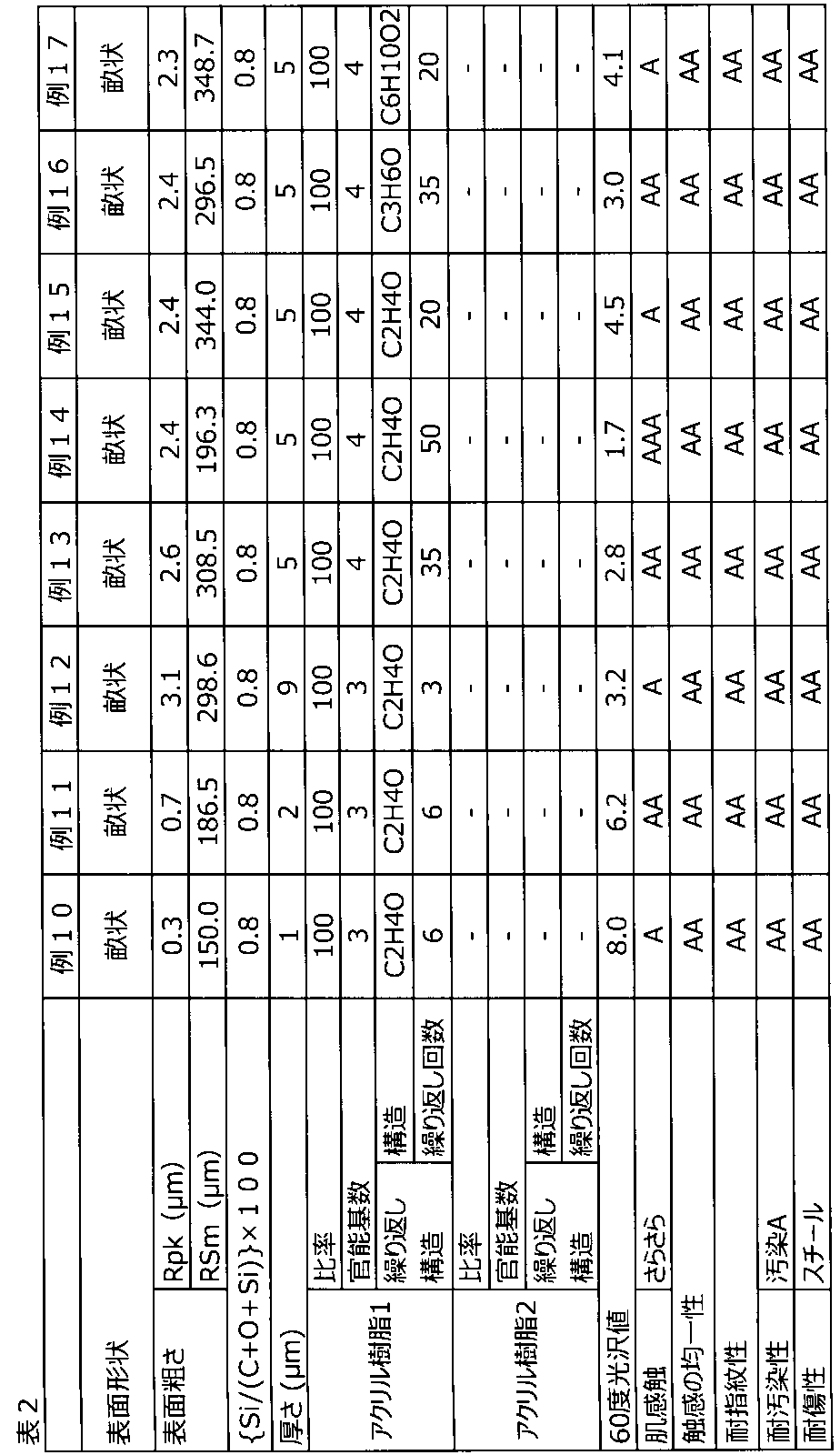
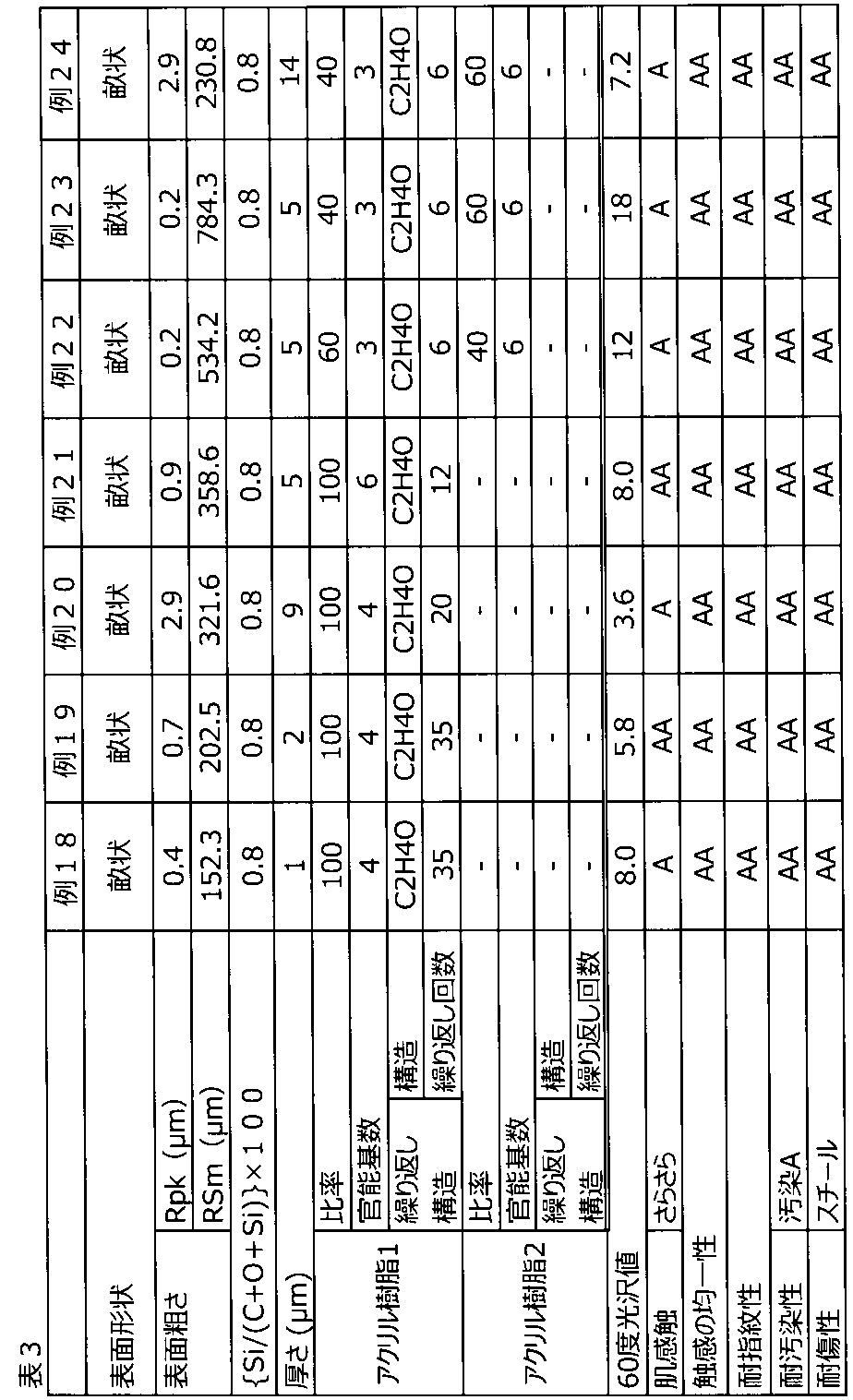
- the decorative sheets according to Examples 1 to 24 provided the evaluators with a smooth feel and uniformity of the feel.
- the decorative sheets according to Examples 1 to 24 also had low gloss and were excellent in fingerprint resistance, stain resistance, and scratch resistance.
- the decorative sheets according to Comparative Examples 1 and 2 did not provide the evaluators with a smooth feel and were poor in fingerprint resistance, stain resistance, and scratch resistance, as shown in Table 4.
- the decorative sheets according to Comparative Examples 3 and 4 also had low gloss and were excellent in fingerprint resistance, stain resistance, and scratch resistance, but did not provide the evaluators with a smooth feel.
- the decorative sheet according to Comparative Example 5 also had low gloss and was excellent in fingerprint resistance, stain resistance, and scratch resistance, and provided the evaluators with a smooth feel, but was poor in uniformity of the feel.
Landscapes
- Engineering & Computer Science (AREA)
- Chemical & Material Sciences (AREA)
- Life Sciences & Earth Sciences (AREA)
- Wood Science & Technology (AREA)
- Materials Engineering (AREA)
- Organic Chemistry (AREA)
- Mechanical Engineering (AREA)
- Chemical Kinetics & Catalysis (AREA)
- Ceramic Engineering (AREA)
- Laminated Bodies (AREA)
- Floor Finish (AREA)
Abstract
Description
0.5≦{Si/(C+O+Si)}×100
を満たす化粧シートが提供される。
0.5≦{Si/(C+O+Si)}×100≦5.0
を満たす上記側面の何れかに係る化粧シートが提供される。
図1は、本発明の一実施形態に係る化粧シートを含んだ化粧材の断面図である。図2は、図1の化粧シートが含んでいる表面保護層の断面図である。図3は、本発明の一例に係る化粧シートが含んでいる表面保護層の顕微鏡写真である。
原反層2又はその材料としては、例えば、紙、合成樹脂、合成樹脂の発泡体、ゴム、不織布、合成紙、金属箔等から任意に選定したものが使用可能である。紙としては、薄葉紙、チタン紙、樹脂含浸紙等が例示できる。合成樹脂としては、ポリエチレン、ポリプロピレン、ポリブチレン、ポリスチレン、ポリカーボネート、ポリエステル、ポリアミド、エチレン-酢酸ビニル共重合体、ポリビニルアルコール、アクリル等が例示できる。ゴムとしては、エチレン-プロピレン共重合ゴム、エチレン-プロピレン-ジエン共重合ゴム、スチレン-ブタジエン共重合ゴム、スチレン-イソプレン-スチレンブロック共重合ゴム、スチレン-ブタジエン-スチレンブロック共重合ゴム、ポリウレタン等が例示できる。不織布としては、有機系や無機系の不織布が使用できる。金属箔の金属としては、アルミニウム、鉄、金、銀等が例示できる。
原反層2の材料としてオレフィン系の樹脂を用いる場合には、原反層2の表面が不活性な状態であることが多い。従って、この場合、原反層2と基材Bとの間に、プライマ層6を設けることが好ましい。原反層2がオレフィン系材料からなる場合、プライマ層6を省略するとともに、原反層2と基材Bとの接着性を向上させるために、原反層2に対して、例えば、コロナ処理、プラズマ処理、オゾン処理、電子線処理、紫外線処理、重クロム酸処理等の表面改質処理を施してもよい。
基材Bに対する隠蔽性を化粧シート1に付与するには、例えば、原反層2として着色シートを用いるか、又は、不透明な隠蔽層8を設ける。隠蔽層8は、例えば、絵柄層3について後述するものと同じ材料から構成することができる。但し、隠蔽層8は、隠蔽性を目的としているので、顔料としては、例えば、不透明な顔料、酸化チタン、酸化鉄等を使用することが好ましい。また、隠蔽性を高めるために、隠蔽層8の材料には、例えば、金、銀、銅、アルミニウム等の金属を添加することも可能である。一般的には、フレーク状のアルミニウム片を添加させることが多い。
絵柄層3は、原反層2に対して、インキを用いて絵柄を印刷してなる層である。インキのバインダとしては、例えば、硝化綿、セルロース、塩化ビニル-酢酸ビニル共重合体、ポリビニルブチラール、ポリウレタン、アクリル、ポリエステル類、又は、それらの変性物を、単独で又は複数を組み合わせて用いることができる。バインダは、水性、溶剤系、エマルジョンタイプの何れでもよく、1液タイプでも硬化剤を使用した2液タイプでもよい。絵柄層3は、硬化性のインキで形成した層を、紫外線や電子線等の照射により硬化させる方法により形成してもよい。中でも最も一般的な方法は、ウレタン系のインキを用いるもので、イソシアネートによって硬化させる方法である。絵柄層3を形成するために使用するインキは、バインダ以外には、例えば、通常のインキに含まれている顔料、染料等の着色剤、体質顔料、溶剤、各種添加剤などを更に含むことができる。汎用性の高い顔料としては、例えば、縮合アゾ、不溶性アゾ、キナクリドン、イソインドリン、アンスラキノン、イミダゾロン、コバルト、フタロシアニン、カーボン、酸化チタン、酸化鉄、雲母等のパール顔料等が挙げられる。
接着層7は、感熱接着層、アンカーコート層、ドライラミ接着剤層とも呼ばれる層である。
透明樹脂層4の樹脂材料としては、オレフィン系樹脂が好適に用いられる。オレフィン系樹脂としては、例えば、ポリプロピレン、ポリエチレン、ポリブテンなどの他に、αオレフィン(例えば、プロピレン、1-ブテン、1-ペンテン、1-ヘキセン、1-ヘプテン、1-オクテン、1-ノネン、1-デセン、1-ウンデセン、1-ドデセン、トリデセン、1-テトラデセン、1-ペンタデセン、1-ヘキサデセン、1-ヘプタデセン、1-オクタデセン、1-ノナデセン、1-エイコセン、3-メチル-1-ブテン、3-メチル-1-ペンテン、3-エチル-1-ペンテン、4-メチル-1-ペンテン、4-メチル-1-ヘキセン、4,4-ジメチル-1-ペンテン、4-エチル-1-ヘキセン、3-エチル-1-ヘキセン、9-メチル-1-デセン、11-メチル-1-ドデセン、12-エチル-1-テトラデセンなど)を単独重合させたもの又はそれらの二種類以上を共重合させたものや、エチレン-酢酸ビニル共重合体、エチレン-ビニルアルコール共重合体、エチレン-メチルメタクリレート共重合体、エチレン-エチルメタクリレート共重合体、エチレン-ブチルメタクリレート共重合体、エチレン-メチルアクリレート共重合体、エチレン-エチルアクリレート共重合体、エチレン-ブチルアクリレート共重合体などのように、エチレン又はαオレフィンとそれ以外のモノマーとを共重合させたものが挙げられる。
表面保護層5は、コア部5Aと、各々がコア部5Aの一方の面から畝状に突出した複数の畝状部5Bとを含んでいる。これら畝状部5Bは、凹凸形構造を形成している。
0.5≦{Si/(C+O+Si)}×100 (1)
ここで表面保護層5は、後述する電離放射線硬化性樹脂とシリカ粒子を含有する。表面保護層5が上記関係式(1)を満たす場合、広い領域にわたって畝状部5Bを均一に生じさせることが可能となり、触感の均一性が向上する。同様の観点から、{Si/(C+O+Si)}×100の値は、0.75以上であることが好ましく、1.0以上であることがより好ましい。
0.5≦{Si/(C+O+Si)}×100≦5.0 (2)
{Si/(C+O+Si)}×100の値が5.0以下であることは、耐傷性、耐汚染性、耐候性等の観点から好ましい。同様の観点から、{Si/(C+O+Si)}×100の値は、3.5以下であることがより好ましく、2.0以下であることが更に好ましい。
表面保護層5に含有されるC(質量%)、O(質量%)及びSi(質量%)の測定は、走査型電子顕微鏡(SEM;Scanning Electron Microscope)観察及びエネルギー分散型X線分析(EDX;Energy Dispersive X-ray Spectroscopy)により行うことができる。EDXは、電子線照射により発生する特性X線を検出し、エネルギーで分光することにより、元素分析を行う手法である。ここでは、SEMとして日立ハイテク製 Regulus8220を使用し、EDX装置としてSEMに付属したOxford製 AZtecLive/Ultim Max170を用い、下記分析条件にて行った。
表面保護層5の表面に導電処理(Ptスパッタ 40mA、20秒)を施し、トップコート面についてSEM-EDX分析を下記条件において行った。
加速電圧 :15kV
エミッション電流 :10μA
プロープ電流 :High
コンデンサレンズ :1
測定時間 :60秒
測定倍率 :500倍
図3は、本発明の一例に係る化粧シートを撮像することによって得られた顕微鏡写真である。この顕微鏡写真は、一辺が数百マイクロメートル程度の矩形状の微小領域を表示している。
化粧シート1は、例えば、以下の方法により製造する。ここでは、簡略化のため、絵柄層3、透明樹脂層4、プライマ層6、接着層7、及び隠蔽層8に関する説明は省略する。
図1乃至図3を参照しながら説明した化粧シート1は、表面保護層5が上述した表面性状を有している。このような化粧シート1は、ユーザが表面保護層5の表面上で肌を滑らせたときに、例えば、表面保護層5の表面上で指を滑らせたときに、ユーザへさらさらした触感と、触感の均一性を与える。即ち、この化粧シート1は、表面保護層5の表面全体にわたって、大きな凹凸の存在をユーザに感じさせることなく、指等を小さな摩擦力で滑らせることを可能とする。
<例1>
図1乃至図3を参照しながら説明した化粧シート1を、以下の方法により製造した。なお、本例では、透明樹脂層4、プライマ層6、接着層7及び隠蔽層8は省略した。
・電離放射線硬化性樹脂
種類:エチレングリコールジアクリレート(EO9モル付加)
品名:ライトアクリレート9EG-A(共栄社化学社製)
配合:100質量部
・粒子
品名:サイリシア(登録商標)250N(富士シリシア化学社製)
粒径:5μm
配合:2質量部
・光開始剤
品名:Irgacure184(BASFジャパン株式会社)
配合:1質量部
表面保護層用塗液からなる塗膜は、厚さが5μmとなるように形成した。
以上のようにして、化粧シート1を得た。
以下の点を除き、例1と同様の方法により化粧シート1を製造した。即ち、本例では、下記の電離放射線硬化性樹脂を使用した。
・電離放射線硬化性樹脂
種類:トリメチロールプロパンEO変性トリアクリレート(EO6モル付加)
品名:Miramer M3160(Miwon社製)
そして、第2照射工程は、大気圧下、酸素濃度が500ppmの窒素ガス雰囲気中で、表面保護層用塗液からなる塗膜の表面に対して、Xeエキシマランプを用いて、波長172nmの紫外線を積算光量が50mJ/cm2となるように照射した。
以下の点を除き、例2と同様の方法により化粧シート1を製造した。即ち、本例では、下記の粒子の配合量を変更した。
・粒子
品名:サイリシア250N(富士シリシア化学社製)
粒径:5μm
配合:1.3質量部
以下の点を除き、例2と同様の方法により化粧シート1を製造した。即ち、本例では、下記の粒子の配合量を変更した。
・粒子
品名:サイリシア250N(富士シリシア化学社製)
粒径:5μm
配合:15質量部
以下の点を除き、例2と同様の方法により化粧シート1を製造した。即ち、本例では、下記の粒子の配合量を変更した。
・粒子
品名:サイリシア250N(富士シリシア化学社製)
粒径:5μm
配合:22質量部
以下の点を除き、例1と同様の方法により化粧シート1を製造した。即ち、本例では、下記の電離放射線硬化性樹脂を使用した。
・電離放射線硬化性樹脂
種類:トリメチロールプロパンEO変性トリアクリレート(EO15モル付加)
品名:SR9035(Sartomer社製)
そして、第2照射工程は、大気圧下、酸素濃度が500ppmの窒素ガス雰囲気中で、表面保護層用塗液からなる塗膜の表面に対して、Xeエキシマランプを用いて、波長172nmの紫外線を積算光量が50mJ/cm2となるように照射した。
以下の点を除き、例1と同様の方法により化粧シート1を製造した。即ち、本例では、下記の電離放射線硬化性樹脂を使用した。
・電離放射線硬化性樹脂
種類:トリメチロールプロパンEO変性トリアクリレート(EO3モル付加)
品名:Miramer M3130(Miwon社製)
そして、第2照射工程は、大気圧下、酸素濃度が200ppmの窒素ガス雰囲気中で、表面保護層用塗液からなる塗膜の表面に対して、Xeエキシマランプを用いて、波長172nmの紫外線を積算光量が100mJ/cm2となるように照射した。
以下の点を除き、例1と同様の方法により化粧シート1を製造した。即ち、本例では、下記の電離放射線硬化性樹脂を使用した。
・電離放射線硬化性樹脂
種類:トリメチロールプロパンPO変性トリアクリレート(PO6モル付加)
品名:NKエステルA-TMPT-6PO(新中村化学社製)
そして、第2照射工程は、大気圧下、酸素濃度が500ppmの窒素ガス雰囲気中で、表面保護層用塗液からなる塗膜の表面に対して、Xeエキシマランプを用いて、波長172nmの紫外線を積算光量が50mJ/cm2となるように照射した。
以下の点を除き、例1と同様の方法により化粧シート1を製造した。即ち、本例では、下記の電離放射線硬化性樹脂を使用した。
・電離放射線硬化性樹脂
種類:カプロラクトン変性トリス-(2-アクリロキシエチル)イソシアヌレート(カプロラクトン(CL)3モル付加)
品名:NKエステルA-9300-3CL(新中村化学社製)
そして、第2照射工程は、大気圧下、酸素濃度が200ppmの窒素ガス雰囲気中で、表面保護層用塗液からなる塗膜の表面に対して、Xeエキシマランプを用いて、波長172nmの紫外線を積算光量が100mJ/cm2となるように照射した。
以下の点を除き、例1と同様の方法により化粧シート1を製造した。即ち、本例では、下記の電離放射線硬化性樹脂を使用した。表面保護層用塗液からなる塗膜は、厚さが1μmとなるように形成した。
・電離放射線硬化性樹脂
種類:トリメチロールプロパンEO変性トリアクリレート(EO6モル付加)
品名:Miramer M3160(Miwon社製)
そして、第2照射工程は、大気圧下、酸素濃度が500ppmの窒素ガス雰囲気中で、表面保護層用塗液からなる塗膜の表面に対して、Xeエキシマランプを用いて、波長172nmの紫外線を積算光量が10mJ/cm2となるように照射した。
以下の点を除き、例1と同様の方法により化粧シート1を製造した。即ち、本例では、下記の電離放射線硬化性樹脂を使用した。表面保護層用塗液からなる塗膜は、厚さが2μmとなるように形成した。
・電離放射線硬化性樹脂
種類:トリメチロールプロパンEO変性トリアクリレート(EO6モル付加)
品名:Miramer M3160(Miwon社製)
そして、第2照射工程は、大気圧下、酸素濃度が500ppmの窒素ガス雰囲気中で、表面保護層用塗液からなる塗膜の表面に対して、Xeエキシマランプを用いて、波長172nmの紫外線を積算光量が10mJ/cm2となるように照射した。
以下の点を除き、例1と同様の方法により化粧シート1を製造した。即ち、本例では、下記の電離放射線硬化性樹脂を使用した。表面保護層用塗液からなる塗膜は、厚さが9μmとなるように形成した。
・電離放射線硬化性樹脂
種類:トリメチロールプロパンEO変性トリアクリレート(EO3モル付加)
品名:Miramer M3130(Miwon社製)
そして、第2照射工程は、大気圧下、酸素濃度が500ppmの窒素ガス雰囲気中で、表面保護層用塗液からなる塗膜の表面に対して、Xeエキシマランプを用いて、波長172nmの紫外線を積算光量が150mJ/cm2となるように照射した。
以下の点を除き、例1と同様の方法により化粧シート1を製造した。即ち、本例では、下記の電離放射線硬化性樹脂を使用した。
・電離放射線硬化性樹脂
種類:エトキシ化ペンタエリスリトールテトラアクリレート(EO35モル付加)
品名:NKエステル ATM-35E(新中村化学工業社製)
そして、第2照射工程は、大気圧下、酸素濃度が200ppmの窒素ガス雰囲気中で、表面保護層用塗液からなる塗膜の表面に対して、Xeエキシマランプを用いて、波長172nmの紫外線を積算光量が50mJ/cm2となるように照射した。
以下の点を除き、例1と同様の方法により化粧シート1を製造した。即ち、本例では、下記の電離放射線硬化性樹脂を使用した。
・電離放射線硬化性樹脂
種類:エトキシ化ペンタエリスリトールテトラアクリレート(EO50モル付加)
そして、第2照射工程は、大気圧下、酸素濃度が200ppmの窒素ガス雰囲気中で、表面保護層用塗液からなる塗膜の表面に対して、Xeエキシマランプを用いて、波長172nmの紫外線を積算光量が50mJ/cm2となるように照射した。
以下の点を除き、例1と同様の方法により化粧シート1を製造した。即ち、本例では、下記の電離放射線硬化性樹脂を使用した。
・電離放射線硬化性樹脂
種類:エトキシ化ペンタエリスリトールテトラアクリレート(EO20モル付加)
そして、第2照射工程は、大気圧下、酸素濃度が100ppmの窒素ガス雰囲気中で、表面保護層用塗液からなる塗膜の表面に対して、Xeエキシマランプを用いて、波長172nmの紫外線を積算光量が100mJ/cm2となるように照射した。
以下の点を除き、例1と同様の方法により化粧シート1を製造した。即ち、本例では、下記の電離放射線硬化性樹脂を使用した。
・電離放射線硬化性樹脂
種類:プロポキシ化ペンタエリスリトールテトラアクリレート(PO35モル付加)
そして、第2照射工程は、大気圧下、酸素濃度が200ppmの窒素ガス雰囲気中で、表面保護層用塗液からなる塗膜の表面に対して、Xeエキシマランプを用いて、波長172nmの紫外線を積算光量が50mJ/cm2となるように照射した。
以下の点を除き、例1と同様の方法により化粧シート1を製造した。即ち、本例では、下記の電離放射線硬化性樹脂を使用した。
・電離放射線硬化性樹脂
種類:カプロラクトン変性ペンタエリスリトールテトラアクリレート(CL20モル付加)
そして、第2照射工程は、大気圧下、酸素濃度が100ppmの窒素ガス雰囲気中で、表面保護層用塗液からなる塗膜の表面に対して、Xeエキシマランプを用いて、波長172nmの紫外線を積算光量が100mJ/cm2となるように照射した。
以下の点を除き、例1と同様の方法により化粧シート1を製造した。即ち、本例では、下記の電離放射線硬化性樹脂を使用した。表面保護層用塗液からなる塗膜は、厚さが1μmとなるように形成した。
・電離放射線硬化性樹脂
種類:エトキシ化ペンタエリスリトールテトラアクリレート(EO35モル付加)
品名:NKエステル ATM-35E(新中村化学工業社製)
そして、第2照射工程は、大気圧下、酸素濃度が200ppmの窒素ガス雰囲気中で、表面保護層用塗液からなる塗膜の表面に対して、Xeエキシマランプを用いて、波長172nmの紫外線を積算光量が10mJ/cm2となるように照射した。
以下の点を除き、例1と同様の方法により化粧シート1を製造した。即ち、本例では、下記の電離放射線硬化性樹脂を使用した。表面保護層用塗液からなる塗膜は、厚さが2μmとなるように形成した。
・電離放射線硬化性樹脂
種類:エトキシ化ペンタエリスリトールテトラアクリレート(EO35モル付加)
品名:NKエステル ATM-35E(新中村化学工業社製)
そして、第2照射工程は、大気圧下、酸素濃度が200ppmの窒素ガス雰囲気中で、表面保護層用塗液からなる塗膜の表面に対して、Xeエキシマランプを用いて、波長172nmの紫外線を積算光量が10mJ/cm2となるように照射した。
以下の点を除き、例1と同様の方法により化粧シート1を製造した。即ち、本例では、下記の電離放射線硬化性樹脂を使用した。表面保護層用塗液からなる塗膜は、厚さが9μmとなるように形成した。
・電離放射線硬化性樹脂
種類:エトキシ化ペンタエリスリトールテトラアクリレート(EO20モル付加)
そして、第2照射工程は、大気圧下、酸素濃度が200ppmの窒素ガス雰囲気中で、表面保護層用塗液からなる塗膜の表面に対して、Xeエキシマランプを用いて、波長172nmの紫外線を積算光量が150mJ/cm2となるように照射した。
以下の点を除き、例1と同様の方法により化粧シート1を製造した。即ち、本例では、下記の電離放射線硬化性樹脂を使用した。
・電離放射線硬化性樹脂
種類::エトキシ化ジペンタエリスリトールヘキサアクリレート(EO12モル付加)
そして、第2照射工程は、大気圧下、酸素濃度が100ppmの窒素ガス雰囲気中で、表面保護層用塗液からなる塗膜の表面に対して、Xeエキシマランプを用いて、波長172nmの紫外線を積算光量が150mJ/cm2となるように照射した。
以下の点を除き、例1と同様の方法により化粧シート1を製造した。即ち、本例では、下記の電離放射線硬化性樹脂を使用した。
・電離放射線硬化性樹脂1
トリメチロールプロパンEO変性トリアクリレート(EO6モル付加)
品名:Miramer M3160(Miwon社製)
配合:60質量部
・電離放射線硬化性樹脂2
種類:ジペンタエリスリトールヘキサアクリレート
品名:Miramer M600(Miwon社製)
配合:40質量部
そして、第2照射工程は、大気圧下、酸素濃度が500ppmの窒素ガス雰囲気中で、表面保護層用塗液からなる塗膜の表面に対して、Xeエキシマランプを用いて、波長172nmの紫外線を積算光量が10mJ/cm2となるように照射した。
以下の点を除き、例1と同様の方法により化粧シート1を製造した。即ち、本例では、下記の電離放射線硬化性樹脂を使用した。
・電離放射線硬化性樹脂1
トリメチロールプロパンEO変性トリアクリレート(EO6モル付加)
品名:Miramer M3160(Miwon社製)
配合:40質量部
・電離放射線硬化性樹脂2
種類:ジペンタエリスリトールヘキサアクリレート
品名:Miramer M600(Miwon社製)
配合:60質量部
そして、第2照射工程は、大気圧下、酸素濃度が500ppmの窒素ガス雰囲気中で、表面保護層用塗液からなる塗膜の表面に対して、Xeエキシマランプを用いて、波長172nmの紫外線を積算光量が10mJ/cm2となるように照射した。
以下の点を除き、例1と同様の方法により化粧シート1を製造した。即ち、本例では、下記の電離放射線硬化性樹脂を使用した。表面保護層用塗液からなる塗膜は、厚さが14μmとなるように形成した。
・電離放射線硬化性樹脂1
トリメチロールプロパンEO変性トリアクリレート(EO6モル付加)
品名:Miramer M3160(Miwon社製)
配合:40質量部
・電離放射線硬化性樹脂2
種類:ジペンタエリスリトールヘキサアクリレート
品名:Miramer M600(Miwon社製)
配合:60質量部
そして、第2照射工程は、大気圧下、酸素濃度が100ppmの窒素ガス雰囲気中で、表面保護層用塗液からなる塗膜の表面に対して、Xeエキシマランプを用いて、波長172nmの紫外線を積算光量が100mJ/cm2となるように照射した。
以下の点を除き、例1と同様の方法により化粧シートを製造した。即ち、本例では、表面保護層用塗液としては、下記の電離放射線硬化性樹脂に、下記の粒子を配合してなるものを使用した。
・電離放射線硬化性樹脂
種類:トリメチロールプロパンEO変性トリアクリレート(EO6モル付加)
品名:Miramer M3160(Miwon社製)
配合:100質量部
・粒子
品名:サイリシア250N(富士シリシア化学社製)
粒径:5μm
配合:15質量部
そして、第1照射工程及び第2照射工程は行わず、表面保護層用塗液からなる塗膜は、第3照射工程のみによって硬化させた。
以下の点を除き、例1と同様の方法により化粧シートを製造した。即ち、本例では、表面保護層用塗液としては、下記の電離放射線硬化性樹脂に、下記の粒子を配合してなるものを使用した。
・電離放射線硬化性樹脂
種類:エトキシ化ペンタエリスリトールテトラアクリレート(EO35モル付加)
品名:NKエステル ATM-35E(新中村化学工業社製)
配合:100質量部
・粒子
品名:サイリシア250N(富士シリシア化学社製)
粒径:5μm
配合:15質量部
そして、第1照射工程及び第2照射工程は行わず、表面保護層用塗液からなる塗膜は、第3照射工程のみによって硬化させた。
以下の点を除き、例1と同様の方法により化粧シートを製造した。即ち、本例では、下記の電離放射線硬化性樹脂を使用した。表面保護層用塗液からなる塗膜は、厚さが10μmとなるように形成した。
・電離放射線硬化性樹脂
種類:トリメチロールプロパンEO変性トリアクリレート(EO6モル付加)
品名:Miramer M3160(Miwon社製)
そして、第2照射工程は、大気圧下、酸素濃度が500ppmの窒素ガス雰囲気中で、表面保護層用塗液からなる塗膜の表面に対して、Xeエキシマランプを用いて、波長172nmの紫外線を積算光量が150mJ/cm2となるように照射した。
以下の点を除き、例1と同様の方法により化粧シートを製造した。即ち、本例では、下記の電離放射線硬化性樹脂を使用した。表面保護層用塗液からなる塗膜は、厚さが10μmとなるように形成した。
・電離放射線硬化性樹脂
種類:エトキシ化ペンタエリスリトールテトラアクリレート(EO35モル付加)
品名:NKエステル ATM-35E(新中村化学工業社製)
そして、第2照射工程は、大気圧下、酸素濃度が200ppmの窒素ガス雰囲気中で、表面保護層用塗液からなる塗膜の表面に対して、Xeエキシマランプを用いて、波長172nmの紫外線を積算光量が150mJ/cm2となるように照射した。
以下の点を除き、例1と同様の方法により化粧シートを製造した。即ち、本例では、粒子(サイリシア250N)を配合しなかった。
上記の化粧シートの各々に対し、以下に記載する評価を行った。
光沢度は、Rhopoint IQ(コニカミノルタ社製)を用いて、60度光沢度を測定した。以下の表1乃至表3における「60度光沢値」は、この60度光沢度を表している。
肌感触は、以下の方法により評価した。
先ず、評価者間で評価基準を一致させるための事前準備を行った。具体的には、表面性状が異なる10個の標準試験片を準備した。次に、20名の評価者の各々に、目隠しした状態で標準試験片の表面上で指を滑らせてもらい、その後、触感を以下の5つの群に分類してもらった。
第1群:凹凸の存在は殆ど感じず、摩擦力が小さいと感じた。
第2群:小さな凹凸の存在を感じたか又は摩擦力がやや大きいと感じた。
第3群:第1群の触感と第2群の触感との中間の触感であった。
第4群:大きな凹凸の存在を感じた。
第5群:凹凸の存在を感じず、摩擦力が大きいと感じた。
各評価者による評価が連続して3回以上一致し、且つ、評価者間で評価結果が連続して3回一致するまで、以上の手順を繰り返した。
AAA(さらさら):第1群
AA(さらさら):第3群
A(さらさら):第2群
B(ざらざら又はつるつる):第4群又は第5群
肌感触の評価を行った上記20名の評価者が、肌感触の評価に次いで、以下の方法により触感の均一性の評価を行った。
各化粧シートから縦10cm×横10cmのサイズの試験片を切り出した。上記20名の評価者の各々に、目隠しした状態で各試験片の表面保護層の表面全体にわたって指を自由に滑らせてもらい、肌触感(さらさら触感)の変化の有無又は程度から、触感の均一性を以下の3つの群に分類してもらった。
第2群:肌触感(さらさら触感)が異なるように感じられる箇所はあったが、変化の程度はわずかであった。
第3群:肌触感(さらさら触感)がはっきり異なるように感じられる箇所があった。
AA:第1群
A :第2群
B :第3群。
耐指紋性評価として、指紋のふき取り性評価を実施した。
具体的には、先ず、各化粧シートの表面の60度光沢度を測定して、この60度光沢度を初期光沢度とした。続いて、表面保護層上に耐指紋評価液を付着させ、化粧シート表面に付着した耐指紋評価液を拭き取った。ここでは、耐指紋評価液として、高級脂肪酸を用いた。その後、耐指紋評価液を拭き取った部分の60度光沢度を測定して、この60度光沢度を拭き取り後光沢度とした。
指紋拭き取り率(%)=(拭き取り後光沢度/初期光沢度)×100
AA:70%以上250%未満
A:50%以上70%未満、又は、250%以上300%未満
B:50%未満、又は、300%以上
耐汚染性評価として、日本農林規格(JAS:Japanese Agricultural Standards)に規定された汚染A試験を行った。即ち、各化粧シートの表面保護層に、青色インキ、黒色速乾性インキ及び赤色クレヨンで各々の幅が10mmの線を引き、4時間放置した。その後、エタノールを含ませた布で、青色インキ、黒色速乾性インキ及び赤色クレヨンの線を拭き取った。
AA:各色の線を容易に拭き取ることができた。
A:各色の線の一部を拭き取ることができたが、一部に汚れが残った。
B:各色の線を拭き取ることができなかった。
ウレタン系の接着剤を用いて、各化粧シートを木質基材Bに貼り付けた。その後、耐傷性評価として、スチールウールラビング試験を実施した。具体的には、100gの荷重をかけながらスチールウールで化粧シートを20往復擦り、化粧シートの表面に生じた傷や光沢の変化を目視にて確認した。
AA:表面に傷や光沢の変化が発生しなかった。
A:表面に軽微な傷や光沢の変化が発生した。
B:表面に著しい傷や光沢の変化が発生した。


Claims (14)
- 原反層と、前記原反層の一方の表面に設けられた表面保護層とを備え、
前記表面保護層の表面に、各々が畝状に突出した複数の畝状部を含んだ凹凸構造が設けられており、
前記表面保護層の前記凹凸構造は、突出山部高さRpkが3.5μm未満であり、
前記表面保護層は、炭素原子の質量濃度C(質量%)と酸素原子の質量濃度O(質量%)とケイ素原子の質量濃度Si(質量%)とが、以下の関係式:
0.5≦{Si/(C+O+Si)}×100
を満たす化粧シート。 - 前記突出山部高さRpkは0.5μm以上である請求項1に記載の化粧シート。
- 前記表面保護層は、炭素原子の質量濃度C(質量%)と酸素原子の質量濃度O(質量%)とケイ素原子の質量濃度Si(質量%)とが、以下の関係式:
0.5≦{Si/(C+O+Si)}×100≦5.0
を満たす請求項1又は2に記載の化粧シート。 - 前記表面保護層の前記凹凸構造は、粗さ曲線要素の平均長さRSmが800μm以下である請求項1乃至3の何れか1項に記載の化粧シート。
- 前記表面保護層の前記凹凸構造は、粗さ曲線要素の平均長さRSmが350μm以下である請求項1乃至3の何れか1項に記載の化粧シート。
- 前記平均長さRSmは10μm以上である請求項4又は5に記載の化粧シート。
- 前記表面保護層の厚さは2μm以上15μm以下である請求項1乃至6の何れか1項に記載の化粧シート。
- 前記表面保護層の厚さは2μm以上10μm未満である請求項1乃至6の何れか1項に記載の化粧シート。
- 前記表面保護層の光沢度は20.0以下である請求項1乃至8の何れか1項に記載の化粧シート。
- 前記表面保護層の光沢度は10.0以下である請求項1乃至8の何れか1項に記載の化粧シート。
- 前記複数の畝状部の少なくとも一部は幅方向へ隣り合い、前記複数の畝状部の前記少なくとも一部が前記幅方向へ隣り合った位置で、前記幅方向及び前記表面保護層の厚さ方向に平行な断面は、前記凹凸構造が設けられた部分が正弦波形状を有している請求項1乃至10の何れか1項に記載の化粧シート。
- 前記表面保護層は、電離放射線硬化性樹脂の硬化物を含み、
前記電離放射線硬化性樹脂は、主成分が繰り返し構造を含むアクリレートであり、
前記繰り返し構造は、エチレンオキサイド、プロピレンオキサイド、及びε-カプロラクトンの何れかであり、
前記繰り返し構造の繰り返し回数は3以上である請求項1乃至11の何れか1項に記載の化粧シート。 - 前記表面保護層は、電離放射線硬化性樹脂の硬化物を含み、
前記電離放射線硬化性樹脂は、主成分がアクリレートであり、前記アクリレートが、繰り返し構造を含む第1アクリレートと、1乃至6官能の第2アクリレートとから構成され、前記繰り返し構造は、エチレンオキサイド、プロピレンオキサイド、及びε-カプロラクトンの何れかであり、前記繰り返し構造の繰り返し回数は3以上である請求項1乃至11の何れか1項に記載の化粧シート。 - 請求項1乃至13の何れか1項に記載の化粧シートと、前記化粧シートが貼り付けられた基材とを備えた化粧材。
Priority Applications (6)
| Application Number | Priority Date | Filing Date | Title |
|---|---|---|---|
| KR1020257021100A KR20250133655A (ko) | 2023-01-04 | 2023-12-26 | 화장 시트 |
| EP23914805.9A EP4647251A4 (en) | 2023-01-04 | 2023-12-26 | DECORATIVE LEAF |
| JP2024522411A JP7582559B1 (ja) | 2023-01-04 | 2023-12-26 | 化粧シート |
| CN202380089577.1A CN120435381A (zh) | 2023-01-04 | 2023-12-26 | 装饰片 |
| JP2024192149A JP2025010357A (ja) | 2023-01-04 | 2024-10-31 | 化粧シート |
| US19/258,539 US20250332810A1 (en) | 2023-01-04 | 2025-07-02 | Decorative sheet |
Applications Claiming Priority (2)
| Application Number | Priority Date | Filing Date | Title |
|---|---|---|---|
| JP2023-000276 | 2023-01-04 | ||
| JP2023000276 | 2023-01-04 |
Related Child Applications (1)
| Application Number | Title | Priority Date | Filing Date |
|---|---|---|---|
| US19/258,539 Continuation US20250332810A1 (en) | 2023-01-04 | 2025-07-02 | Decorative sheet |
Publications (1)
| Publication Number | Publication Date |
|---|---|
| WO2024147319A1 true WO2024147319A1 (ja) | 2024-07-11 |
Family
ID=91803940
Family Applications (1)
| Application Number | Title | Priority Date | Filing Date |
|---|---|---|---|
| PCT/JP2023/046696 Ceased WO2024147319A1 (ja) | 2023-01-04 | 2023-12-26 | 化粧シート |
Country Status (6)
| Country | Link |
|---|---|
| US (1) | US20250332810A1 (ja) |
| EP (1) | EP4647251A4 (ja) |
| JP (2) | JP7582559B1 (ja) |
| KR (1) | KR20250133655A (ja) |
| CN (1) | CN120435381A (ja) |
| WO (1) | WO2024147319A1 (ja) |
Cited By (2)
| Publication number | Priority date | Publication date | Assignee | Title |
|---|---|---|---|---|
| WO2025159124A1 (ja) * | 2024-01-22 | 2025-07-31 | Toppanホールディングス株式会社 | 化粧シート |
| WO2025159123A1 (ja) * | 2024-01-22 | 2025-07-31 | Toppanホールディングス株式会社 | 化粧シート |
Citations (6)
| Publication number | Priority date | Publication date | Assignee | Title |
|---|---|---|---|---|
| JP2007185606A (ja) * | 2006-01-13 | 2007-07-26 | Nippon Paint Co Ltd | 意匠性塗膜の形成方法、建材用ボード及び水性塗料組成物 |
| WO2017033972A1 (ja) * | 2015-08-24 | 2017-03-02 | 凸版印刷株式会社 | 化粧シート |
| JP2018144437A (ja) * | 2017-03-08 | 2018-09-20 | 凸版印刷株式会社 | 化粧シートおよび化粧シートの製造方法 |
| JP2020075420A (ja) * | 2018-11-08 | 2020-05-21 | 凸版印刷株式会社 | 化粧シート及びその製造方法 |
| JP2021137990A (ja) * | 2020-03-03 | 2021-09-16 | 凸版印刷株式会社 | 化粧シート、化粧板及び化粧シートの製造方法 |
| WO2022239270A1 (ja) * | 2021-05-12 | 2022-11-17 | 凸版印刷株式会社 | 化粧シート、及び化粧シートの製造方法 |
Family Cites Families (4)
| Publication number | Priority date | Publication date | Assignee | Title |
|---|---|---|---|---|
| JP7003667B2 (ja) | 2018-01-05 | 2022-02-10 | 凸版印刷株式会社 | 化粧材 |
| JP2022008024A (ja) * | 2020-03-31 | 2022-01-13 | 大日本印刷株式会社 | 艶消物品及び艶消物品の製造方法 |
| JPWO2023249082A1 (ja) * | 2022-06-24 | 2023-12-28 | ||
| CN119343238A (zh) * | 2022-06-24 | 2025-01-21 | 凸版控股株式会社 | 装饰片 |
-
2023
- 2023-12-26 CN CN202380089577.1A patent/CN120435381A/zh active Pending
- 2023-12-26 JP JP2024522411A patent/JP7582559B1/ja active Active
- 2023-12-26 WO PCT/JP2023/046696 patent/WO2024147319A1/ja not_active Ceased
- 2023-12-26 EP EP23914805.9A patent/EP4647251A4/en active Pending
- 2023-12-26 KR KR1020257021100A patent/KR20250133655A/ko active Pending
-
2024
- 2024-10-31 JP JP2024192149A patent/JP2025010357A/ja active Pending
-
2025
- 2025-07-02 US US19/258,539 patent/US20250332810A1/en active Pending
Patent Citations (6)
| Publication number | Priority date | Publication date | Assignee | Title |
|---|---|---|---|---|
| JP2007185606A (ja) * | 2006-01-13 | 2007-07-26 | Nippon Paint Co Ltd | 意匠性塗膜の形成方法、建材用ボード及び水性塗料組成物 |
| WO2017033972A1 (ja) * | 2015-08-24 | 2017-03-02 | 凸版印刷株式会社 | 化粧シート |
| JP2018144437A (ja) * | 2017-03-08 | 2018-09-20 | 凸版印刷株式会社 | 化粧シートおよび化粧シートの製造方法 |
| JP2020075420A (ja) * | 2018-11-08 | 2020-05-21 | 凸版印刷株式会社 | 化粧シート及びその製造方法 |
| JP2021137990A (ja) * | 2020-03-03 | 2021-09-16 | 凸版印刷株式会社 | 化粧シート、化粧板及び化粧シートの製造方法 |
| WO2022239270A1 (ja) * | 2021-05-12 | 2022-11-17 | 凸版印刷株式会社 | 化粧シート、及び化粧シートの製造方法 |
Non-Patent Citations (1)
| Title |
|---|
| See also references of EP4647251A1 * |
Cited By (4)
| Publication number | Priority date | Publication date | Assignee | Title |
|---|---|---|---|---|
| WO2025159124A1 (ja) * | 2024-01-22 | 2025-07-31 | Toppanホールディングス株式会社 | 化粧シート |
| WO2025159123A1 (ja) * | 2024-01-22 | 2025-07-31 | Toppanホールディングス株式会社 | 化粧シート |
| JPWO2025159123A1 (ja) * | 2024-01-22 | 2025-07-31 | ||
| JPWO2025159124A1 (ja) * | 2024-01-22 | 2025-07-31 |
Also Published As
| Publication number | Publication date |
|---|---|
| EP4647251A4 (en) | 2026-04-29 |
| JP2025010357A (ja) | 2025-01-20 |
| EP4647251A1 (en) | 2025-11-12 |
| KR20250133655A (ko) | 2025-09-08 |
| CN120435381A (zh) | 2025-08-05 |
| JPWO2024147319A1 (ja) | 2024-07-11 |
| US20250332810A1 (en) | 2025-10-30 |
| JP7582559B1 (ja) | 2024-11-13 |
Similar Documents
| Publication | Publication Date | Title |
|---|---|---|
| EP4116095A1 (en) | Decorative sheet and production method for decorative sheet | |
| US20250115039A1 (en) | Decorative sheet | |
| JP2025010357A (ja) | 化粧シート | |
| EP4464510A1 (en) | Decorative sheet and method for producing decorative sheet | |
| US20250115782A1 (en) | Decorative sheet | |
| US20260015513A1 (en) | Decorative sheet | |
| JP2025063956A (ja) | 化粧シート | |
| US20250230327A1 (en) | Decorative sheet | |
| JP2025023274A (ja) | 化粧シート | |
| JP7582561B1 (ja) | 化粧シート | |
| US12629719B2 (en) | Decorative sheet and method for producing decorative sheet | |
| WO2025023246A1 (ja) | 化粧シート | |
| WO2025159124A1 (ja) | 化粧シート | |
| US20260138154A1 (en) | Decorative sheet | |
| WO2025159123A1 (ja) | 化粧シート | |
| JP2026043502A (ja) | 化粧シート | |
| WO2026038502A1 (ja) | 化粧シート | |
| WO2025220703A1 (ja) | 化粧シート | |
| WO2023238893A1 (ja) | 化粧シート、及び化粧シートの製造方法 | |
| WO2024204214A1 (ja) | 化粧シート |
Legal Events
| Date | Code | Title | Description |
|---|---|---|---|
| WWE | Wipo information: entry into national phase |
Ref document number: 2024522411 Country of ref document: JP |
|
| 121 | Ep: the epo has been informed by wipo that ep was designated in this application |
Ref document number: 23914805 Country of ref document: EP Kind code of ref document: A1 |
|
| WWE | Wipo information: entry into national phase |
Ref document number: 202380089577.1 Country of ref document: CN |
|
| WWE | Wipo information: entry into national phase |
Ref document number: 2023914805 Country of ref document: EP |
|
| NENP | Non-entry into the national phase |
Ref country code: DE |
|
| WWP | Wipo information: published in national office |
Ref document number: 202380089577.1 Country of ref document: CN |
|
| ENP | Entry into the national phase |
Ref document number: 2023914805 Country of ref document: EP Effective date: 20250804 |
|
| WWP | Wipo information: published in national office |
Ref document number: 2023914805 Country of ref document: EP |