WO2024150511A1 - 信号送信装置、信号復元処理装置及び信号伝送システム - Google Patents
信号送信装置、信号復元処理装置及び信号伝送システム Download PDFInfo
- Publication number
- WO2024150511A1 WO2024150511A1 PCT/JP2023/039793 JP2023039793W WO2024150511A1 WO 2024150511 A1 WO2024150511 A1 WO 2024150511A1 JP 2023039793 W JP2023039793 W JP 2023039793W WO 2024150511 A1 WO2024150511 A1 WO 2024150511A1
- Authority
- WO
- WIPO (PCT)
- Prior art keywords
- signal
- unit
- switching
- dictionary
- matrix
- Prior art date
- Legal status (The legal status is an assumption and is not a legal conclusion. Google has not performed a legal analysis and makes no representation as to the accuracy of the status listed.)
- Ceased
Links
Images


Classifications
-
- H—ELECTRICITY
- H03—ELECTRONIC CIRCUITRY
- H03M—CODING; DECODING; CODE CONVERSION IN GENERAL
- H03M7/00—Conversion of a code where information is represented by a given sequence or number of digits to a code where the same, similar or subset of information is represented by a different sequence or number of digits
- H03M7/30—Compression; Expansion; Suppression of unnecessary data, e.g. redundancy reduction
- H03M7/3059—Digital compression and data reduction techniques where the original information is represented by a subset or similar information, e.g. lossy compression
- H03M7/3062—Compressive sampling or sensing
-
- H—ELECTRICITY
- H03—ELECTRONIC CIRCUITRY
- H03M—CODING; DECODING; CODE CONVERSION IN GENERAL
- H03M7/00—Conversion of a code where information is represented by a given sequence or number of digits to a code where the same, similar or subset of information is represented by a different sequence or number of digits
- H03M7/30—Compression; Expansion; Suppression of unnecessary data, e.g. redundancy reduction
- H03M7/60—General implementation details not specific to a particular type of compression
- H03M7/6017—Methods or arrangements to increase the throughput
- H03M7/6029—Pipelining
-
- H—ELECTRICITY
- H03—ELECTRONIC CIRCUITRY
- H03M—CODING; DECODING; CODE CONVERSION IN GENERAL
- H03M7/00—Conversion of a code where information is represented by a given sequence or number of digits to a code where the same, similar or subset of information is represented by a different sequence or number of digits
- H03M7/30—Compression; Expansion; Suppression of unnecessary data, e.g. redundancy reduction
- H03M7/60—General implementation details not specific to a particular type of compression
- H03M7/6047—Power optimization with respect to the encoder, decoder, storage or transmission
Definitions
- the present invention relates to a signal transmission technology that enables low power consumption.
- Non-Patent Documents 1 to 4 compressed sensing technology has been proposed today that can significantly reduce power consumption by sensing while compressing EEG signals, and its incorporation into many sensing devices is being considered.
- each square determined by the rows and columns conveniently represents the signal level, and in particular, the white square represents the 0 level.
- a compressed signal y having m elements is obtained by multiplying a signal vector x having n elements by an observation matrix ⁇ of m ⁇ n (m ⁇ n) (see FIG. 6 (B)).
- ⁇ m ⁇ n
- x can be expressed as the product of a dictionary matrix ⁇ and a sparse vector s (see FIG.
- a restored signal ⁇ x can be obtained by the product of the inferred inference vector ⁇ s and a dictionary matrix ⁇ .
- restoration algorithms include BSBL (Block Sparse Bayesian Learning) (Non-Patent Document 5) and OMP (Orthogonal Matching Pursuit). Whether or not restoration is possible using compressed sensing depends on whether the sensed signal can be converted into a sparse vector. In other words, the existence of a dictionary matrix ⁇ that can be converted into a vector with high sparsity is important. For example, many natural signals, such as biosignals, have a fixed signal pattern, and it is known that they tend to be converted into sparse vectors by using a specific dictionary matrix.
- Compressed sensing is one of the important technologies for reducing power consumption, but as mentioned above, it is a type of lossy compression, so there is a need to maintain and improve the restoration accuracy.
- restoration accuracy there is a trade-off between restoration accuracy and restoration time, so the challenge in achieving high-precision restoration is to shorten the time required for restoration.
- the OMP restoration algorithm has a very short restoration time, but restoration accuracy cannot be expected
- the BSBL restoration algorithm is a high-precision restoration method that utilizes Bayesian estimation, but there is an issue with the long calculation time.
- Daisuke Kanemoto, Shun Katsumata, Masao Aihara, and Makoto Ohki “Framework of Applying Independent Component Analysis After Compressed Sensing for Electroencephalogram Signals,” in Proc. IEEE Biomed. Circuits Syst. Conf. (BioCAS), Oct. 2018, pp. 145 -148.
- Daisuke Kanemoto, Shun Katsumata, Masao Aihara, and Makoto Ohki “Compressed Sensing Framework Applying Independent Component Analysis after Undersampling for Reconstructing Electroencephal ogram Signals,” IEICE Trans. Fundamentals, vol. E103-A, no. 12, pp. 1647-1654, Dec. 2020.
- the present invention has been made in consideration of the above, and aims to provide a signal transmission device, a signal restoration processing device, and a signal transmission system that enable low power consumption in compressed sensing processing and external transmission.
- the signal transmission device includes a measurement unit that compresses a target signal based on an observation matrix and captures a first signal, a first communication unit that transmits the first signal captured by the measurement unit to the outside, and a switching signal output unit that outputs a switching signal.
- the measurement unit receives the switching signal, it compresses the target signal at a lower compression rate than the first signal and captures a second signal, and the first communication unit transmits the captured second signal to the outside.
- the measurement unit compresses the target signal through the observation matrix, captures it as a first signal, and transmits it to the outside by the first communication unit.
- the measurement unit compresses the target signal at a lower compression rate than the first signal and captures the second signal.
- the measurement unit receives a switching signal from the switching signal output unit, the second signal is transmitted to the outside by the first communication unit. Therefore, the measurement unit and the first communication unit perform compression to the first signal and external transmission of the compressed signal as normal operations, so that operation with low power consumption is possible.
- the signal restoration device also includes a second communication unit that receives a signal from a first communication unit of the signal transmission device, a dictionary memory that records a dictionary matrix, a restoration algorithm unit that uses the observation matrix and the dictionary matrix to find an inferred signal from the first signal among the signals received by the second communication unit, and finds the product of the found inferred signal and the dictionary matrix to derive a restored signal, and a dictionary generation unit that generates a new dictionary matrix from the second signal among the signals received by the second communication unit and stores the new dictionary matrix in the dictionary memory.
- the restoration algorithm unit determines an inferred signal from the first signal using the observation matrix and the dictionary matrix, and the restored signal is derived by multiplying the determined inferred signal with the dictionary matrix.
- the dictionary generation unit generates a new dictionary matrix from the second signal and stores it in the dictionary memory. In this way, high restoration accuracy for the restored signal is maintained by generating and updating the dictionary matrix from the second signal.
- the signal transmission system includes the signal transmitting device and the signal restoration processing device connected by a communication unit, and this configuration enables low power consumption while maintaining high restoration accuracy.
- the present invention provides a signal transmitting device and a signal transmission system that can reduce power consumption. It also provides a signal restoration processing device that can maintain the restoration accuracy of the detected signal regardless of changes in the target over time.
- FIG. 1 is a block diagram illustrating a first embodiment of a compressed sensing system.
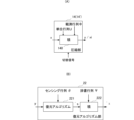
- 2A and 2B are block diagrams functionally illustrating a portion of the configuration of the compressed sensing system of FIG. 1, in which (A) illustrates the sensing unit side, and (B) illustrates the reconstruction processing unit side.
- 10 is a flowchart showing an example of a procedure for a dictionary update process executed by a control unit of the restoration processing unit; 1A and 1B are diagrams for briefly explaining the relationship between the discretized detection signal x and the dictionary matrix ⁇ .
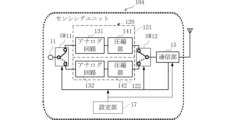
- FIG. 4 is a block diagram showing a second embodiment of the sensing unit
- FIG. 1A is a diagram explaining the basic processing of compressed sensing, in which (A) is a diagram expressing a signal vector x acquired by sensing using a dictionary matrix ⁇ and a sparse vector s that is sparse (i.e., containing many elements that are 0 level or can be regarded as 0 level), (
- FIG. 11 is a diagram for explaining the relationship between the compressed sensing method and the information transmitted from the restoration processing unit to the sensing unit side in association with updating the dictionary matrix, where (A) is a diagram showing a compressed sensing method utilizing random undersampling, (B) is a diagram showing an analog domain compressed sensing method, and (C) is a diagram showing a digital domain compressed sampling method.
- FIG. 1 is a block diagram showing a first embodiment of a compressed sensing system 1 applied as a signal transmission device according to the present invention.
- the compressed sensing system 1 comprises a sensing unit 10 that is attached to a living body, for example, to measure the state of a measurement target in a wearable manner, and a restoration processing unit 20 that implements a processor (CPU, etc.).
- a processor CPU, etc.
- the sensing unit 10 includes a sensor 11, a measurement unit 12 having an analog circuit 13 with an amplifier and filter for pre-processing, a compression unit 14 consisting of, for example, an ADC (Analog Digital Converter), and a communication unit 15 including an antenna capable of short-range wireless communication, such as Bluetooth (registered trademark) or Wi-Fi, between the restoration processing unit 20.
- the sensing unit 10 also includes a switching signal output unit 16 that outputs a switching signal to the measurement unit 12 to switch modes, which will be described later, and a setting unit 17 for mode switching that is used as necessary.
- the sensing unit 10 includes a power source such as a battery such as a secondary battery or a power generation element.
- the sensing unit 10 includes a battery, a power generation element, etc., to enable remote sensing of the restoration processing unit 20. Functionally, the sensor 11 may be included in the measurement unit 12.
- the observation matrix ⁇ is a transformation matrix applied in compressed sensing.
- the restoration processing unit 20 also includes a control unit 24 for executing an update process of the dictionary matrix ⁇ , and an operation unit 25 for instructing mode switching by manual operation from outside, which is used as necessary.
- the control unit 24 includes a processor (CPU, etc.) and a memory unit 24a for storing a control program for selectively switching between the compressed sensing mode and the dictionary generation mode.
- the control unit 24 functions as a dictionary generation unit 241 and a mode switching processing unit 242, which will be described later, by executing the control program.
- the sensor 11 can be adapted to various detection targets, and in this embodiment has electrodes for measuring biosignals, for example, electroencephalogram signals (electrical signals).
- the sensor 11 may be, for example, a pair of electrodes attached to the human body, or a predetermined pair of electrodes pre-distributed on headgear worn on the head and installed so as to come into contact with the scalp.
- the analog circuit 13 and compression unit 14 of the measurement unit 12 are switched between a compressed sensing mode and a dictionary generation mode (described later) when a switching signal from the switching signal output unit 16 is input to the operation switching control terminals 13a, 14a.
- the circuit state of the measurement unit 12 when operating in the compressed sensing mode is conveniently referred to as the first circuit 112 and includes the analog circuit 13 and compression unit 14, while the circuit state when operating in the dictionary generation mode is conveniently referred to as the second circuit 112' and includes the analog circuit 13' and compression unit 14'.
- the switching signal output unit 16 When the switching signal output unit 16 receives a switching instruction signal from the restoration processing unit 20 or the setting unit 17 as described below, it outputs a switching signal to switch the mode to the dictionary generation mode.
- the setting unit 17 includes, for example, a timer, and when it times the elapsed time from the start of operation of the sensing unit 10 or a predetermined repetitive time, it outputs a switching instruction to the switching signal output unit 16 and also outputs it to the mode switching processing unit 242 via the communication unit 15. As a result, even if a switching instruction signal is issued on the sensing unit 10 side, the sensing unit 10 and the restoration processing unit 20 can be linked to execute the dictionary generation mode.
- the compressed sensing mode is the normal operation mode of the sensing unit 10 in a state where power consumption is suppressed.
- the compressed sensing mode reduces the S/N ratio due to circuit noise generated in the analog circuit 13 that is driven with low power consumption, but power consumption is suppressed in the pre-processing, compression processing, and transmission processing by compressing and acquiring data at low sampling rate in the compression unit 14 and reducing the amount of data transmitted to the restoration processing unit 20 side through compression, although the compressed sensing mode reduces the S/N ratio due to circuit noise generated in the analog circuit 13 that is driven with low power consumption in the first embodiment.
- the dictionary matrix ⁇ that gives sparsity to the detection signal x will be described.
- the detection signal x can be expressed by a sparse vector s with high sparsity using the dictionary matrix ⁇ , it is possible that there is a high correlation between each column vector constituting the dictionary matrix ⁇ and the detection signal x.
- a signal with a waveform having relatively similar characteristics, such as a biosignal can be considered as a signal with a certain correlation between the extracted vectors, since the signal characteristics do not change significantly from moment to moment.
- the dictionary generation mode is a mode in which a predetermined number of columns of biosignals are temporarily acquired at an appropriate time with high sampling. More specifically, in the first embodiment, the dictionary generation mode operates the analog circuit 13' with high power consumption to suppress the generation of circuit noise, increase the S/N ratio, and expand the signal band. Also, typically, a high sampling operation is performed without compression, and while power consumption increases due to the transmission of more data to the restoration processing unit 20, data to be used in the dictionary is obtained with high accuracy.
- the amplifier in analog circuit 13 executes the compressed sensing mode with high noise but low power consumption (first power), and the amplifier in analog circuit 13' executes the dictionary generation mode with high power consumption (second power) but low noise.
- the filter in the analog circuit 13 is designed to increase the S/N ratio in the dictionary generation mode depending on the power consumption according to the mode. Furthermore, in the case of the filter, a binary switching signal according to the mode can be used to control the transconductance in the filter circuit with voltage, or to switch the functional parts of the L and C elements that make up the filter. In this way, it is possible to adjust the S/N ratio and adjust the bandpass band of the filter, for example, by setting it to a first passband in the compressed sensing mode, while acquiring signals with a wider frequency component in a second passband wider than the first passband in the dictionary creation mode, thereby making it possible to generate a dictionary with high accuracy. Note that the mode switching for the amplifier and filter of the analog circuit 13 is not limited to both, and may be performed for at least one of them.
- the compression unit 14 then selectively executes a dictionary generation mode in which the target signal output from the analog circuit 13 is highly sampled at a predetermined frequency, for example, 200 Hz, which is equivalent to the Nyquist sampling rate in the case of an EEG signal, with 3 seconds per frame, and a compressed sensing mode in which the target signal is low-sampled while being thinned out to a predetermined ratio, for example, 1/10.
- a dictionary generation mode in which the target signal output from the analog circuit 13 is highly sampled at a predetermined frequency, for example, 200 Hz, which is equivalent to the Nyquist sampling rate in the case of an EEG signal, with 3 seconds per frame
- a compressed sensing mode in which the target signal is low-sampled while being thinned out to a predetermined ratio, for example, 1/10.
- compressed sensing may also include a mode in which an ADC or the like that constitutes the compression unit 14 performs sampling operations while thinning out at a preset timing based on the observation matrix ⁇ .
- the compressor 14' outputs the discretized detection signal x i (see FIG. 2A ) discretized by non-compressed high sampling as a dictionary update signal by applying, for example, a unit matrix U (a square matrix whose diagonal elements are 1 and the rest are zero) instead of the observation matrix ⁇ in response to a switching signal.
- a unit matrix U a square matrix whose diagonal elements are 1 and the rest are zero
- the high sampling in the dictionary generation mode is not limited to the non-compressed sensing described above, but may be compressed sampling with a compression ratio lower than that in the compressed sensing mode.
- the calculation module 140 is not limited to one configured with hardware such as an ADC, but may be one configured using a software compression algorithm.
- information is compressed by using a matrix that realizes random undersampling, a Bernoulli matrix, or a matrix configured with Gaussian random elements as the observation matrix ⁇ .
- the communication unit 15 transmits the compressed signal y to the restoration processing unit 20 side every time the compressed signal y is acquired, for example, every frame (3 seconds).
- the sampling operation for each frame may be continuous, or may be initiated by a specific signal in the EEG signal as a trigger. It is also preferable that the frame length is set to include a time span that includes periodic trends in the EEG signal.
- the communication unit 21 receives a signal from the sensing unit 10, and transmits a switching instruction signal from the restoration processing unit 20 to the switching signal output unit 16.
- the switch SW21 guides the received compressed signal y to the restoration algorithm unit 22, while in the dictionary generation mode, it guides the received discretized detection signal x i to the dictionary generation unit 241 as a dictionary update signal.
- the restoration algorithm unit 22 has a restoration algorithm execution module 221 and an arithmetic module 222 that performs a product calculation.
- the detection signal x can be expressed as a product of a certain dictionary matrix ⁇ and a sparse vector s (i.e., containing many elements that are 0 level or can be regarded as 0 level), there are various algorithms for estimating the sparse vector s from the compressed signal y and the sensing matrix ⁇ .
- Examples of restoration algorithms that are well known include BSBL (Block Sparse Bayesian Learning) and OMP (Orthogonal Matching Pursuit).
- the calculation module 222 the calculated inferred vector ⁇ s and the dictionary matrix ⁇ are input, and a restored signal ⁇ x corresponding to the detected signal x is derived and output externally or to an image display (not shown).
- the derived restored signal ⁇ x is sent to an analysis unit (not shown) as necessary, or stored in the dictionary memory 23 or another memory (not shown).
- the analysis is expected to be applied not only in the healthcare and medical fields but also in a wide range of fields, including diagnosing dementia, epilepsy, sleep disorders, Alzheimer's, and other brain diseases, measuring concentration, and judging comfort and discomfort.
- the dictionary generation unit 241 executes the function of generating a new dictionary matrix ⁇ .
- the mode switching processing unit 242 outputs a switching instruction to switch the mode to the dictionary generation mode, and in this embodiment, the switching instruction is issued when it is determined that a predetermined condition has been met, or may be issued without any condition as necessary.
- the switching instruction signal output from the mode switching processing unit 242 is guided to the switching signal output unit 16 via the communication units 21 and 15. This makes it possible to execute the dictionary generation mode by coordinating the sensing unit 10 and the restoration processing unit 20 when a switching instruction signal is issued from the restoration processing unit 20 side.
- the predetermined condition for generating the switching signal is preferably when the restoration accuracy of the restored signal ⁇ x has decreased and the dictionary matrix ⁇ needs to be updated.
- the accuracy of the restored signal ⁇ x can be determined in various ways. For example, it can be determined from the deterioration of the sparsity of the guess vector ⁇ s, the deterioration (dispersion) of the spectrum histogram of the restored signal ⁇ x, and the decrease in the correlation between the restored signal ⁇ x and the dictionary matrix ⁇ .
- these determinations may include a method of comparing the current value with a threshold value, and a method of comparing the difference between two values over time.
- the mode switching processing unit 242 sequentially takes in the guess vector ⁇ s output from the restoration algorithm execution module 221 for each restoration and calculates a value representing sparsity, and when the difference between the previous and current values, i.e., the deterioration, exceeds a threshold value, a switching instruction is output to the dictionary generation unit 241 and the switching signal output unit 16.
- the output of a switching command may include a case where there is no condition. That is, a timer (not shown) in the control unit 24 is used to measure a predetermined elapsed time from the start of a sensing operation for a predetermined observation target, or when an external operation is received from the operation unit 25, a switching command is output from the mode switching processing unit 242.
- the mode switching processing unit 242 judges in step S5 that the dictionary matrix ⁇ should be updated, it outputs a switching instruction to the dictionary generation mode, switches the sensing unit 10 to a high sampling state and operates it, takes in the discretized detection signal xi (see FIG. 2(A)) for a predetermined number of columns (for multiple frames), and switches the signal path to the restoration processing unit 20 so that the received discretized detection signal xi is input to the dictionary generation unit 241 (step S7).
- the dictionary generation unit 241 generates a dictionary matrix ⁇ with a preset number of columns based on the input discretized detection signals x for multiple frames (step S9), and transfers the generated dictionary matrix ⁇ to the dictionary memory 23 and stores it in an updated manner (step S11).
- the mode switching processing unit 242 executes a switching process to return the mode to the compressed sensing mode (step S13). Note that if it is not necessary to determine whether an update is required, for example, if the timer has counted a predetermined time, the process may proceed immediately to step S7.
- step S7 in the dictionary generation mode, the dictionary generation unit 241 continuously captures the discrete detection signal x i of one frame at a high sampling rate for a predetermined number of columns. Then, in step S9, the dictionary generation unit 241 forms a matrix by arranging one frame as a column vector in the order of capture based on the dictionary generation program, or forms a new matrix by performing a predetermined rearrangement (sorting) in the column direction for the purpose of further increasing correlation, or forms a matrix by selectively thinning out the signals in consideration of the frequency of occurrence, etc.
- the number of columns of the dictionary matrix ⁇ is equal to the number of rows of the sparse vector s.
- the number of frames of the discrete detection signal x i may be a mode in which a predetermined number of columns is acquired by setting a predetermined time, or a mode in which the acquisition time is a predetermined time that can be adjusted as appropriate (i.e., a predetermined number of columns in which the number of frames acquired can be changed).
- the mode switching processing unit 242 may determine the degree of degradation in the sparsity of the estimated vector ⁇ s, the degradation (dispersion) of the histogram of the spectrum of the restored signal ⁇ x, and the degradation of the correlation between the restored signal ⁇ x and the dictionary matrix ⁇ , as described above, in response to the degree of degradation in the restoration accuracy of the restored signal ⁇ x, and adjust the acquisition time, i.e., the number of columns to be acquired, in response to the determined degree of degradation.
- Figure 4 is a diagram that briefly explains the relationship between the discretized detection signal x i and the dictionary matrix ⁇ . More specifically, it shows an example of the configuration of a dictionary matrix ⁇ with a set number of columns formed from the discretized detection signal x i .
- (A) is a diagram of a dictionary consisting of 20 columns (set number of columns) after sorting
- (B) is a diagram of a smaller dictionary consisting of 11 columns (set number of columns) selected from the 20 columns of the discretized detection signal x i in (A) taking into account the frequency of occurrence, etc.
- the dictionary matrix ⁇ p shown in FIG. 4A is generated by arranging the discretized detection signals x i of one frame as column vectors, assuming that signals of similar detection targets are obtained.
- the dictionary matrix ⁇ p is composed of 20 column vectors x1 to x20.
- the 20 column vectors may be arranged in the order obtained in the dictionary generation mode, but here, for example, the average frequency of the column vectors is calculated (for example, MATLAB (registered trademark) function meanfreq), and the average frequencies are sorted and rearranged in the high-low direction.
- the sensing unit 10 shown in FIG. 1 electrically controls the operation of each mode based on a switching signal.
- the switches SW11 and SW12 are switched in response to a switching instruction signal, and the first circuit 121 for the compressed sensing mode and the second circuit 122 for the dictionary generation mode, which are provided in parallel, are selectively operated.
- the analog circuit 131 and the compression unit 141, and the analog circuit 132 and the compression unit 142 are configured with circuit elements corresponding to each mode and are designed with the supply power (the first and second powers) or the bandpass band (the first and second passbands), thereby realizing an operation similar to that of the measurement unit 12 in FIG. 1, and the characteristics of each circuit can be individually designed according to the mode, even if the sampling ratio of both modes changes significantly.
- the present invention can also include the following aspects:
- the signals used to update the dictionary matrix are not limited to signals from the same object, but may be signals from objects with similar characteristics.
- biological signals have been described as an example of the target, but other signals with sparseness such as weather and environmental information (including cases where the signal becomes sparse when converted using a dictionary matrix) and characteristics of current values, voltage values, and other physical quantities acquired by IoT sensors and IoT devices in a factory, particularly a smart factory, for example, for monitoring the operating status of various equipment may also be included.
- the compressed signal obtained in the compressed sensing mode and the signal obtained while compressing at a low compression ratio are selectively transmitted to the restoration processing unit 20.
- both sensing signals may be simultaneously obtained and transmitted to the restoration processing unit 20.
- a known time division or frequency division method may be used as a method of simultaneous transmission. Regardless of whether simultaneous transmission is performed or not, when transmitting signals in both directions from the sensing unit 10 and the restoration processing unit 20, identification information such as a flag indicating the type of signal may be added to the header of the transmitted signal sequence and transmitted.
- the communication units 15 and 21 may each have a configuration for transmitting and receiving both sensing signals.
- the signal acquired by low compression sampling is applied to update the dictionary matrix, but the present invention is not limited to this and can be applied to other applications.
- both the compressed signal acquired in the compressed sensing mode and the low-compressed or non-compressed signal acquired at the same time are transmitted to the restoration side, and the signal restored from the compressed signal acquired in the compressed sensing mode is compared with the low-compressed or non-compressed signal on the restoration side, thereby making it possible to evaluate the quality of the signal obtained in the currently implemented compressed sensing mode.
- an evaluation method for example, a method using the difference in waveform between the restored signal and the signal acquired by non-compressed sensing can be considered.
- the evaluation results can be used to evaluate whether the currently created dictionary can be fully utilized in the compressed sensing mode, the degree of setting of the characteristics of the sensing side circuit, and the degree of setting of the high or low compression ratio.
- the present invention provides a sensing unit used in a wide variety of low-volume production such as IoT with a dictionary generation mode function, making it possible to generate dictionary matrices corresponding to signals from various targets, thereby providing a highly versatile sensing unit or system.
- the compression units 14, 14', 141, and 142 that perform compressed sensing employ a method of reducing and compressing information while thinning out the information in the ADC, but the present invention is not limited to such a compressed sensing method.
- a compressed sensing method that compresses at a low sampling rate before or after AD conversion can be employed (see FIG. 7).
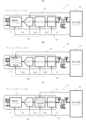
- FIG. 7 is a circuit diagram for explaining the relationship between the compressed sensing method applicable to the present invention and the information transmitted from the restoration processing unit 20 to the sensing unit 10 side in association with the update of the dictionary matrix ⁇ , where (A) shows a compressed sensing method using random undersampling, (B) shows an analog domain compressed sensing method, and (C) shows compressed sensing systems 1A, 1B, and 1C using a digital domain compressed sampling method.
- the information transmitted from the restoration processing unit 20 to the sensing unit 10 includes triggers for mode switching, as well as instructions for improving the S/N ratio and changing the passband of the circuit, and information associated with the update of the dictionary matrix ⁇ .
- the dictionary matrix ⁇ and the observation matrix ⁇ are related to each other, and the sensing matrix ⁇ , which is the product of the two, greatly affects the signal restoration accuracy.
- the restoration processing unit 20 can determine the observation matrix ⁇ that improves the restoration accuracy, so the more suitable observation matrix ⁇ is transmitted to the sensing unit 10 side.
- the amplifier and filter unit 13A included in the measurement unit 12A executes preprocessing similar to that in FIG. 1, and the ADC 14A1 executes compressed sampling.
- the dictionary generation unit 241 updates the dictionary matrix ⁇ , it creates an observation matrix ⁇ corresponding to the update contents, and transmits the created observation matrix ⁇ to the ADC 14A1 as transmission information D1 to update and write it. Therefore, even if some noise is mixed into the sensed signal or the signal band is narrowed, it is possible to restore with high accuracy. In other words, the quality of the restored signal can be guaranteed even if the circuit characteristics are degraded or the power consumption is reduced.
- the restoration processing unit 20 transmits adjustment information on the extent to which the circuit characteristics can be degraded as transmission information D2 to the corresponding circuit unit of the sensing unit 10 and sets it. Also, in the case where the accuracy can be guaranteed even if the amount of information used for processing and transmission is reduced in the Digital 14A2 and the communication unit 15, as described above, an instruction is transmitted from the restoration processing unit 20 to the corresponding circuit unit on the sensing unit 10 side as transmission information D2 so as to reduce the amount of information to be handled. In this way, by reducing the amount of information handled, further reductions in power consumption can be expected.
- the amplifier, filter, and analog compression calculation unit 134B included in the measurement unit 12B performs preprocessing and compression sampling similar to those in FIG. 1. More specifically, the amplifier, filter, and analog compression calculation unit 134B performs compression calculation on the analog signal that has been subjected to preprocessing.
- the observation matrix ⁇ can be realized in the analog domain, and for example, a Gaussian random matrix or Bernoulli matrix can be applied.
- the restoration processing unit 20 updates the dictionary matrix ⁇ , it creates an observation matrix ⁇ that improves the restoration accuracy, transmits it to the amplifier, filter, and analog compression calculation unit 134B as transmission information D1, and has it updated and written.
- the ADC 14B1 performs a converter operation
- the Digital 14B2 and the communication unit 15 perform the same functions as those in FIG. 7A.
- Digital (including digital compression calculation) 14C2 connected downstream of ADC 14C1 included in measurement unit 12C performs compression sampling on the digital signal.
- observation matrix ⁇ realized in the digital domain, such as Gaussian random matrix and Bernoulli.
- the restoration processing unit 20 updates the dictionary matrix ⁇ , it creates an observation matrix ⁇ that improves restoration accuracy and transmits it as transmission information D1 to Digital (including digital compression calculation) 14C2, which writes it as updates.
- D1 Digital (including digital compression calculation) 14C2
- ADC 14C1 performs converter operation.
- a mixed compression method such as those shown in Figures 7(A) to 7(C) may be adopted. Even in such a mixed method, by transmitting information similar to that of each method to the sensing unit 10, it is possible to improve the restoration accuracy and narrow the circuit characteristics (reducing power consumption).
- the signal transmission device includes a measurement unit that compresses a target signal based on an observation matrix and captures a first signal, a first communication unit that transmits the first signal captured by the measurement unit to the outside, and a switching signal output unit that outputs a switching signal, and it is preferable that, upon receiving the switching signal, the measurement unit compresses the target signal at a lower compression rate than the first signal and captures a second signal, and the first communication unit transmits the captured second signal to the outside.
- the measurement unit compresses the target signal through the observation matrix, captures it as a first signal, and transmits it to the outside by the first communication unit.
- the measurement unit compresses the target signal at a lower compression rate than the first signal and captures the second signal.
- the measurement unit receives a switching signal from the switching signal output unit, the second signal is transmitted to the outside by the first communication unit. Therefore, the measurement unit and the first communication unit perform compression to the first signal and external transmission of the compressed signal as normal operations, so that operation with low power consumption is possible.
- the measurement unit upon receiving the switching signal, captures the second signal instead of the first signal.
- the second signal when the second signal is captured, the first signal is not captured or transmitted, resulting in operation with low power consumption.
- the measurement unit includes an analog circuit that performs preprocessing on the target signal, and that the analog circuit operates by being supplied with a first power when the first signal is captured, and operates by being supplied with a second power greater than the first power when the second signal is captured.
- the second signal requires the second power when captured, resulting in high power consumption during this period, but the second signal is captured as a low-noise, high-precision signal, which is suitable for application to, for example, updating a dictionary matrix on the external side.
- the measurement unit includes an analog circuit that performs preprocessing on the target signal, and that the analog circuit is set to a first passband when the first signal is captured, and is set to a second passband wider than the first passband when the second signal is captured.
- a wider second passband is set when the second signal is captured, and although high power consumption occurs during this period, the second signal is detected as a signal containing frequency components within the second passband, which is suitable for applications such as updating a dictionary matrix with high correlation.
- the first communication unit outputs the switching instruction received from the outside to the switching signal output unit, and that the switching signal output unit outputs the switching signal for a predetermined period of time upon receiving the switching instruction.
- a switching instruction can be given from the outside via the first communication unit.
- the device includes a setting unit that outputs a switching instruction to the switching signal output unit under a predetermined condition, and that the switching signal output unit outputs the switching signal for a predetermined period of time upon receiving the switching instruction.
- the setting unit makes it possible to set the switching instruction at an appropriate timing, for example.
- the signal restoration device preferably includes a second communication unit that receives a signal from a first communication unit of the signal transmission device, a dictionary memory that records a dictionary matrix, a restoration algorithm unit that uses the observation matrix and the dictionary matrix to find an inferred signal from the first signal among the signals received by the second communication unit, and finds a product of the found inferred signal and the dictionary matrix to derive a restored signal, and a dictionary generation unit that generates a new dictionary matrix from the second signal among the signals received by the second communication unit and stores the new dictionary matrix in the dictionary memory.
- the restoration algorithm unit determines an inferred signal from the first signal using the observation matrix and the dictionary matrix, and the restored signal is derived by multiplying the determined inferred signal with the dictionary matrix.
- the dictionary generation unit generates a new dictionary matrix from the second signal and stores it in the dictionary memory. In this way, high restoration accuracy for the restored signal is maintained by generating and updating the dictionary matrix from the second signal.
- the present invention is preferably characterized in that it includes a mode switching processing unit that outputs a switching instruction, and the second communication unit transmits the switching instruction to the outside.
- the switching instruction is transmitted to the outside, for example to a signal transmitting device, via the second communication unit, and is applied to the capture process of the first and second signals.
- the mode switching processing unit outputs the switching instruction when the restoration accuracy of the restored signal is reduced.
- a switching instruction is output at an appropriate timing and the dictionary matrix is updated, thereby improving correlation and maintaining restoration accuracy.
- the mode switching processing unit outputs the switching instruction when a predetermined time has elapsed since the previous dictionary generation.
- a switching instruction is output periodically or at predetermined intervals, and the dictionary matrix is updated, thereby improving correlation and maintaining restoration accuracy.
- the mode switching processing unit accepts an external operation and outputs a switching instruction.
- a switching instruction is output from the outside at any timing, for example, by manual operation, and the dictionary matrix is updated, thereby improving correlation and maintaining restoration accuracy.
- the signal transmission system according to the present invention includes the signal transmitting device and the signal restoration processing device connected by a communication unit, and this configuration enables low power consumption and maintains high restoration accuracy.
- Sensing unit (sensing device) 11 Sensor 12, 120, 12A, 12B, 12C Measurement section 112, 121 First circuit 112', 122 Second circuit 13, 13', 131, 132 Analog circuit 14, 14', 141, 142 Compression section 15 Communication section (first communication section) 21 Communication unit (second communication unit) 16 Switching signal output unit 20 Restoration processing unit (restoration processing device) 22 Restoration algorithm unit 23 Dictionary memory 24 Control unit 241 Dictionary generation unit 242 Mode switching processing unit SW21, SW11, SW12 Switch
Landscapes
- Engineering & Computer Science (AREA)
- Theoretical Computer Science (AREA)
- Arrangements For Transmission Of Measured Signals (AREA)
- Compression, Expansion, Code Conversion, And Decoders (AREA)
Abstract
センシングユニット10は、対象信号を観測行列Φに基づき圧縮して第1の信号を取り込む計測部12と、計測部12に取り込まれた第1の信号を外部の復元処理ユニット20に送信する通信部15と、切替信号を出力する切替信号出力部16とを備える。計測部12は、切替信号を受け付けると、対象信号を第1の信号より低圧縮で圧縮して第2の信号を取り込み、第1の通信部は、取り込まれた第2の信号を第1の信号に代えて外部の復元処理ユニット20に送信する。これによって、低消費電力化が可能な信号伝送技術を提供する。
Description
本発明は、低消費電力化が可能な信号伝送技術に関する。
近年、IoT(Internetof Things)の普及に伴い、例えば生体の状態などをセンシングし、センシングした生体信号を無線でコンピュータ(エッジコンピュータ)側へ送信するセンシングデバイスの需要が一段と増している。生体信号をセンシングするデバイスの場合、身体に装着するウェアラブル型が一般的であることから、デバイスの小型化及び長期動作性が求められる。従って、小型バッテリーであっても長期に亘って動作を継続させる必要があることから、センシングデバイスに対する低消費電力化技術の開発に対して高い要請がある。そのため、今日、非特許文献1~4に記載されているように、脳波信号を圧縮しながらセンシングすることで消費電力を大幅に削減することが可能な圧縮センシング技術が提案されており、多くのセンシングデバイスへの搭載が検討されている。
図6は、圧縮センシングの基本的な処理を説明する図で、(A)は、センシングにより取得する信号ベクトルxをある辞書行列Ψと、疎な(すなわち、0レベルあるいは0レベルと見なせる要素が多く含まれる)スパースベクトルsで表現した図、(B)は、信号ベクトルxを、信号の圧縮に用いる観測行列Φを用いて圧縮信号yを得ることを説明する図、(C)は、センシング行列θ=Φ×Ψとするとき、(B)の圧縮信号yとスパースベクトルsとの関係をセンシング行列θを用いて示した図である。なお、図6において、行と列とで決まる各マス目に付された濃淡は便宜的に信号レベルを表しており、特に白色のマス目は0レベルを表す。より詳細には、圧縮センシングでは、n個の要素を持つ信号ベクトルxにm×n(m<n)の観測行列Φを乗じることで、m個の要素を持つ圧縮信号yを得る(図6(B)参照)。一般的に、m<nの条件下で、yとΦから正確にxを復元することは不可能である。しかしながら、xをある辞書行列Ψと、疎なスパースベクトルsとの積で表すことができる場合(図6(A)参照)、圧縮ベクトルyとセンシング行列θとからスパースベクトルsを推測するアルゴリズムは種々存在し、かつ推測された推測ベクトル^sと辞書行列Ψとの積により復元信号^xを求めることができる。復元アルゴリズムとしては、例えば、BSBL(Block Sparse Bayesian Learning)(非特許文献5)や、OMP(Orthogonal Matching Pursuit)などが周知である。圧縮センシングで復元が可能か否かは、センシングした信号がスパースベクトルに変換できるかどうかが重要である。すなわち、高いスパース性を有するベクトルに変換できる辞書行列Ψの存在が重要となる。例えば生体信号などの自然界の信号は、信号パターンが決まっているものが多く、特定の辞書行列を用いることでスパースベクトルに変換できる傾向にあることが分かっている。
圧縮センシングは、低消費電力化のための重要な技術の一つであるが、前記のように不可逆圧縮の一種であることから復元精度の維持、向上が求められている。ただし、復元精度と復元時間とはトレードオフの関係にあるため、高精度の復元を実現するには復元に要する所要時間の短縮化が課題となる。例えばOMP復元アルゴリズムは、復元時間は非常に短いが復元精度は期待できず、一方、BSBL復元アルゴリズムは、ベイズ推定を活用した高精度復元方式ではあるが、計算時間がかかるという課題が存在している。
Daisuke Kanemoto, Shun Katsumata, Masao Aihara, and Makoto Ohki, "Framework of Applying Independent Component Analysis After Compressed Sensing for Electroencephalogram Signals," in Proc. IEEE Biomed. Circuits Syst. Conf. (BioCAS), Oct. 2018, pp. 145-148.
Daisuke Kanemoto, Shun Katsumata, Masao Aihara, and Makoto Ohki, "Compressed Sensing Framework Applying Independent Component Analysis after Undersampling for Reconstructing Electroencephalogram Signals," IEICE Trans. Fundamentals, vol. E103-A, no. 12, pp. 1647-1654, Dec. 2020.
Yuki Okabe, Daisuke Kanemoto, Osamu Maida, and Tetsuya Hirose, "Compressed Sensing EEG Measurement Technique with Normally Distributed Sampling Series," IEICE Trans. Fundamentals, vol.E105-A, no.10,pp. 1429-1433, Oct. 2022.
Shun Katsumata, Daisuke Kanemoto, and Makoto Ohki, "Applying Outlier Detection and Independent Component Analysis for Compressed Sensing EEG Measurement Framework," in Proc. IEEE Biomed. Circuits Syst. Conf. (BioCAS), Oct. 2019, pp. 1-4.
Z. Zhang, T.P. Jung, S. Makeig, and B.D. Rao, "Compressed sensing of EEG for wireless telemonitoring with low energy consumption and inexpensive hardware," IEEE Trans. Biomed. Eng., vol.60, no.1, pp. 221-224, Jan. 2013.
本発明者は、前記した背景をもとに、過去に取得した信号を辞書として活用することで、復元アルゴリズムとしてBSBLを活用しても高精度復元かつ高速復元を実現可能にする手法を提案した(特願2022-28896号、出願日2022年2月28日)。
ところで、この手法をIoTなどの少量多品種や利用者依存性のある生体信号を対象として適用する場合、様々な検出信号に対しても好適に圧縮及び復元処理を行うセンシング装置を実現するためには、各種の検出信号に対応させた最適な辞書を備えることが望まれる。また、測定対象、すなわち検出信号自体が経時的に、例えば変動したり、あるいは少しずつ変化・変移したりするような場合でも、かかる変動、変化・変移(以下、変動という。)に対して、また利用者依存性に対しても、復元精度を落とすことなく好適なセンシングを維持する必要がある。さらに、圧縮センシング処理及び取り込んだ信号の復元側への送信における低消費電力化の技術に関しては、更なる改善の要請がある。
本発明は上記に鑑みてなされたもので、圧縮センシング処理及び外部送信における低消費電力化を可能にする信号送信装置、信号復元処理装置及び信号伝送システムを提供することを目的とする。
本発明に係る信号送信装置は、対象信号を観測行列に基づき圧縮して第1の信号を取り込む計測部と、前記計測部に取り込まれた前記第1の信号を外部に送信する第1の通信部と、切替信号を出力する切替信号出力部とを備え、前記計測部は、前記切替信号を受け付けると、前記対象信号を前記第1の信号より低圧縮で圧縮して第2の信号を取り込み、前記第1の通信部は、取り込まれた前記第2の信号を外部に送信するものである。
本発明によれば、計測部によって対象信号は観測行列を介して圧縮され、第1の信号として取り込まれ、第1の通信部によって外部に送信される。また、計測部は、対象信号に対して第1の信号より低圧縮で圧縮して第2の信号を取り込むようになされており、切替信号出力部からの切替信号を受け付けると、第2の信号は第1の通信部によって外部に送信される。従って、計測部及び第1の通信部は、通常時の動作として、第1の信号への圧縮、圧縮信号の外部送信を行うので低消費電力での動作が可能となる。また、例えば復元用の辞書行列の更新等に関連するタイミングで、利用可能な第2の信号の取り込みを行う場合に低圧縮処理と送信処理とによって消費電力が一時的に増大するものの、それ以外の通常時では低消費電力で動作可能であるので、全体として低消費電力で動作させながら、例えば検出信号の復元精度の維持等が図れる。なお、第1の信号より低圧縮には、非圧縮を含む。
また、本発明に係る信号復元装置は、前記信号送信装置の第1の通信部からの信号を受信する第2の通信部と、辞書行列を記録する辞書メモリと、前記第2の通信部で受信された信号のうち、前記第1の信号から、前記観測行列と前記辞書行列とを用いて推測信号を求め、求めた推測信号と前記辞書行列との積を求めて復元信号を導出する復元アルゴリズム部と、前記第2の通信部で受信された信号のうち、前記第2の信号から、新たな辞書行列を生成して前記辞書メモリに記憶する辞書生成部とを備えたものである。
本発明によれば、復元アルゴリズム部によって、第1の信号から観測行列と辞書行列とを用いて推測信号が求められ、求められた推測信号と前記辞書行列との積が求められて復元信号が導出される。一方、辞書生成部によって、第2の信号から新たな辞書行列が生成されて辞書メモリに記憶される。このように、辞書行列が第2の信号から生成、更新されることによって、復元信号に対する高い復元精度が維持される。
また、本発明に係る信号伝送システムは、通信部で結ばれた前記信号送信装置及び前記信号復元処理装置を備えたもので、この構成により、低消費電力化が可能で、かつ高い復元精度が維持可能となる。
本発明によれば、低消費電力化が可能な信号送信装置及び信号伝送システムを提供できる。また、対象の経時的な変動などに関わらず、検出信号の復元精度が維持可能な信号復元処理装置を提供することができる。
図1は、本発明に係る信号送信装置として適用される圧縮センシングシステム1の第1の実施形態を示すブロック図である。圧縮センシングシステム1は、例えば生体に装着してウェアラブルな態様で測定対象の状態を測定するセンシングユニット10と、プロセッサ(CPU等)を実装する復元処理ユニット20とを備える。まず、センシングユニット10及び復元処理ユニット20の概要を説明する。
センシングユニット10は、センサ11と、前処理用としてのアンプ、フィルタを備えたアナログ回路13及び例えばADC(Analog Digital Convertor)からなる圧縮部14を有する計測部12と、復元処理ユニット20との間で、例えばブルートゥース(登録商標)(Bluetooth)やWi-Fiなどの近距離無線通信が可能なアンテナを含む通信部15とを備える。また、センシングユニット10は、計測部12に対して後述するモードの切替を行わせる切替信号を出力する切替信号出力部16と、必要に応じて用いられるモード切替のための設定部17とを備える。なお、図示していないが、センシングユニット10には二次電池等のバッテリー又は発電素子等の電力源が内装されている。センシングユニット10は、バッテリーや発電素子等を内装することで、復元処理ユニット20に対して遠隔的なセンシングを可能としている。なお、機能的にはセンサ11を計測部12に含めてもよい。
復元処理ユニット20は、通信部15との間で信号の送受信を行うアンテナを含む通信部21と、通信部21を経て受信された圧縮信号から復元信号を生成する復元アルゴリズム部22と、復元処理に適用される各種の情報、例えば辞書行列Ψ、センシング行列θ(=Φ×Ψ)を記憶する辞書メモリ23とを備える。なお、観測行列Φは、圧縮センシングで適用される変換行列である。また、復元処理ユニット20は、辞書行列Ψの更新処理を実行する制御部24と、必要に応じて用いられる、外部からのマニュアル操作でモード切替を指示する操作部25とを備える。制御部24は、プロセッサ(CPU等)を備えると共に、圧縮センシングモードと辞書生成モードとを選択的に切り替えて実行させる制御プログラムを記憶するメモリ部24aを有する。制御部24は、制御プログラムを実行することで、後述する辞書生成部241及びモード切替処理部242として機能する。
センシングユニット10に戻って、センサ11は、種々の検出対象に対応するものが採用可能であり、本実施形態では、生体信号、例えば脳波信号(電気信号)を測定する電極を有する。センサ11は、例えば人体貼付型の一対の電極、あるいは、例えば頭部に被るヘッドギアに予め分散搭載された所定対の電極が頭皮に当接するように設置されたものでよい。
計測部12のアナログ回路13及び圧縮部14は、本実施形態では、切替信号出力部16からの切替信号が動作切替用の制御端13a,14aに入力されることで、圧縮センシングモードと後述する辞書生成モードとに切り替えられて動作する。なお、計測部12は、圧縮センシングモードで動作するときの回路状態を便宜上第1の回路112といい、アナログ回路13及び圧縮部14を備え、一方、辞書生成モードで動作するときの回路状態を便宜上第2の回路112’といい、アナログ回路13’及び圧縮部14’を備えたものとする。
切替信号出力部16は、後述するように復元処理ユニット20側から、あるいは設定部17からの切替指示の信号を受け付けると、モードを辞書生成モードに切り替える切替信号を出力する。なお、設定部17は、例えばタイマを含み、センシングユニット10の動作開始からの経過時間、あるいは所定の繰り返し時間を計時すると、切替指示を切替信号出力部16に出力し、また通信部15を経てモード切替処理部242に出力する。これによって、センシングユニット10側で切替指示の信号が発せられた場合でも、センシングユニット10と復元処理ユニット20とを連携させて辞書生成モードを実行することができる。
ここで、圧縮センシングモードとは、消費電力を抑制した状態でのセンシングユニット10の通常動作のモードである。圧縮センシングモードは、第1の実施形態では、低消費電力で駆動されるアナログ回路13で発生する回路雑音によってS/N比が低下するものの、圧縮部14で低サンプリングでデータを圧縮して取得し、かつ圧縮によって復元処理ユニット20側への送信データ量を減らすことで、前処理、圧縮処理及び送信処理において電力消費が抑制される。なお、アナログ回路13は、用途等によっては、圧縮センシングモードでもS/N比の高い回路を採用してもよい。
次に、検出信号xにスパース性を与える辞書行列Ψについて説明する。辞書行列Ψによって、検出信号xをスパース性の高いスパースベクトルsで表現できる場合は、辞書行列Ψを構成する各列ベクトルと検出信号xとの間に高い相関を有する場合が考えられる。例えば生体信号などの比較的同じような特徴を有する波形が続く信号は、信号特性が時々刻々大幅に変化するものではないことから、切り出したベクトル間に一定の相関を有する信号とみることができる。一方、生体信号が経時的に変動すると、辞書行列Ψとの相関が漸次低下し、スパース性が劣化することになり、その結果、復元信号^xの精度(復元精度)が低下することとなる。そこで、適宜なタイミングで辞書生成モードに切り替えて、直近の生体信号を辞書に用いる品質の高い信号として取得して辞書行列Ψを更新し、復元信号^xの精度維持を図るようにしたものである。辞書生成モードとは、適宜なタイミングで一時的に所定列数分の生体信号を高サンプリングで取得するモードである。より詳細には、辞書生成モードは、第1の実施形態では、高消費電力でアナログ回路13’を動作させることで回路雑音の発生を抑制し、S/N比を増加させたり、信号帯域を拡張させたりする。かつ、典型的には非圧縮での高サンプリング動作を行い、一方で復元処理ユニット20側へのより多くのデータの送信に消費電力が増大するものの、辞書に使用するデータを高精度で取得する。
アナログ回路13のS/N比を変更する方法はいくつかあるが、例えば回路内に流れる電流を調整する方法がある。より具体的には、第1の実施形態に係るセンシングユニット10における圧縮センシングモードと辞書生成モードとの切替は、切替信号出力部16からの切替信号によって行われる。第1の実施形態では、アンプ及びフィルタを有するアナログ回路13の回路構成はほぼ兼用され、制御端13aに入力される切替信号によって動作のモードが切り替えられることで、回路構成の大型化を抑制している。
アナログ回路13内のアンプに流れる電流を調整する方法は種々あり、例えば、図略の制御回路を採用してアンプに流れる電流値を制御する態様や、切替信号出力部16から制御端13aに出力されるモードに応じた2値の切替信号で電流値を大小調整する態様が採用可能である。アナログ回路13内のアンプは、高雑音となるが低消費電力(第1の電力)で圧縮センシングモードを実行し、アナログ回路13’内のアンプは、高消費電力(第2の電力)となるが低雑音で辞書生成モードを実行する。
また、アナログ回路13内のフィルタも、前記アンプと同様に、モードに応じた消費電力の大小によって、辞書生成モードでのS/N比が高くなるようにされている。さらに、フィルタの場合、モードに応じた2値の切替信号を利用して、例えば、フィルタ回路内のトランスコンダクタンス等を電圧で制御する態様、またはフィルタを構成するL,C素子の機能部位を切り替える態様が考えられる。このように、S/N比の調整、及びフィルタのバンドパス帯域を調整、例えば、圧縮センシングモードでは第1の通過域に設定する一方、辞書作成モードでは第1の通過域より広い第2の通過域で、より広い周波数成分の信号を取得することで、精度の高い辞書を生成可能にしている。なお、アナログ回路13のアンプとフィルタに対するモード切替は、両方に限らず、少なくとも一方に対して施されてもよい。
辞書生成モードは、更新頻度が対象によって異なるとしても、圧縮センシングモードの稼働期間全体に対して短時間であるため、辞書生成モードを間欠的に採用しても全体として消費電力の増大は問題とならない。また、辞書生成モードで、低雑音で高精度の信号で辞書行列Ψを生成し、この辞書行列Ψを用いて検出信号xの復元処理を行うため、検出信号にノイズが混在しても復元されにくくなることから、圧縮センシングモードにおけるノイズ低減効果が図れる。
次に、圧縮部14は、アナログ回路13から出力された対象信号を所定周波数、例えば脳波信号の場合ではナイキストサンプリングレート相当の、例えば200Hzで3秒間を1フレームとして高サンプリングする辞書生成モードと、対象信号を所定の比率、例えば1/10に間引きながら低サンプリングする圧縮処理の圧縮センシングモードとを選択的に実行する。
圧縮部14の詳細は、図2(A)に示すように、積の演算を行う演算モジュール140を有し、圧縮センシングモードでは、サンプリングされた検出信号xと圧縮に用いる観測行列Φとの積を取る計算を行って、圧縮信号yを、y=Φxのように実現する。なお、圧縮センシングには、圧縮部14を構成するADC等が観測行列Φに基づいて、予め設定されたタイミングで間引きながらサンプリング動作を行う態様を含めてもよい。
辞書生成モードでは、切替信号によって圧縮部14’は、例えば、観測行列Φに代えて単位行列U(正方行列の対角成分が1で、それ以外が零である行列)を適用することで、非圧縮の高サンプリングで離散化された離散化検出信号xi(図2(A)参照)を辞書更新用信号として出力する。なお、辞書生成モードにおける高サンプリングは、前記の非圧縮センシングに限らず、圧縮センシングモードよりも低い圧縮比における圧縮サンプリングであってもよい。
なお、演算モジュール140は、ADCのようなハードウェアで構成されたものに限らず、ソフトウェアからなる圧縮アルゴリズムを利用して構成されたものでもよい。また、圧縮センシングモードではランダムアンダーサンプリングを実現する行列やベルヌーイ行列、ガウスランダム要素で構成される行列を観測行列Φとして用いることで情報の圧縮を行う。通信部15は、圧縮信号yが取得される毎に、例えば1フレーム(3秒)毎に、圧縮信号yを復元処理ユニット20側に送信する。
なお、各フレームのサンプリング動作は、連続的でもよいし、脳波信号内の特定の信号をトリガとして開始する態様でもよい。また、フレーム長は、脳波信号内の周期的な傾向が含まれる時間幅を含むように設定されていることが好ましい。
次に、復元処理ユニット20について、より具体的に説明する。通信部21は、センシングユニット10からの信号を受信し、また復元処理ユニット20からの切替指示の信号を切替信号出力部16に送信する。スイッチSW21は、圧縮センシングモードでは、受信した圧縮信号yを復元アルゴリズム部22に導き、一方、辞書生成モードでは、受信した離散化検出信号xiを辞書更新用信号として辞書生成部241に導く。
次に、圧縮センシングモードにおける復元処理について説明する。復元アルゴリズム部22は、図2(B)に示すように復元アルゴリズム実行モジュール221及び積の演算を行う演算モジュール222を有する。復元アルゴリズム部22では、処理対象のフレームの圧縮信号yが入力されると、例えばBSBLアルゴリズムが採用されている復元アルゴリズム実行モジュール221に、圧縮信号yとセンシング行列θ(=Φ×Ψ)とが入力されてスパース性を有する推測ベクトル^sが算出される。なお、検出信号xが、ある辞書行列Ψと、疎な(すなわち、0レベル若しくは0レベルと見なせる要素が多く含まれる)スパースベクトルsとの積で表すことができる場合、圧縮信号yとセンシング行列θとからスパースベクトルsを推測するアルゴリズムは種々存在する。復元アルゴリズムとしては、例えば、BSBL(Block Sparse Bayesian Learning)やOMP(Orthogonal Matching Pursuit)などが周知である。
続いて演算モジュール222では、算出された推測ベクトル^sと辞書行列Ψとが入力されて、検出信号xに対応する復元信号^xが導出され、外部にあるいは図略の画像表示器に出力される。なお、導出された復元信号^xは、必要に応じて図外の解析部に送られ、又は辞書メモリ23あるいは他の図略のメモリに保管される。また、例えば検出対象が脳波信号である場合、解析は、認知症、てんかん、睡眠障害、アルツハイマーその他の脳病診断や集中力の測定、快不快の判定等を含むヘルスケア・医療分野のみならず幅広い分野での応用が想定される。
次に、制御部24において、辞書生成部241は、新たな辞書行列Ψを生成する機能を実行する。モード切替処理部242は、モードを辞書生成モードに切り替える切替指示を出力するもので、本実施形態では、切替指示は所定の条件をクリアしたと判定された場合に発せられ、あるいは必要に応じて条件なしで発せられる場合を含めてもよい。モード切替処理部242から出力される切替指示の信号は、通信部21,15を経て切替信号出力部16に導かれる。これによって、復元処理ユニット20側から切替指示の信号が発せられたとき、センシングユニット10と復元処理ユニット20とを連携させて辞書生成モードを実行させることができる。
ここに、切替信号を生成するための所定の条件とは、好ましくは復元信号^xの復元精度が低下し、辞書行列Ψの更新が必要になった場合をいう。復元信号^xの精度が低下したかどうかの判定は、種々の方法で行うことができる。例えば、推測ベクトル^sのスパース性の劣化、復元信号^xのスペクトルのヒストグラムの劣化(分散化)、復元信号^xと辞書行列Ψとの相関性の低下から判定することができる。また、これらの判定には、今回の値と閾値との比較で行う方法、また経時方向の2回分の値の差分の大小で行う方法を含めてもよい。本実施形態では、モード切替処理部242は、復元毎に復元アルゴリズム実行モジュール221から出力される推測ベクトル^sを順次取り込んでスパース性を表す値を算出し、前回と今回の値の差分、すなわち劣化分が閾値を超えると切替指示を辞書生成部241及び切替信号出力部16に出力するようにしている。
なお、以下の場合、切替指示の出力に条件がない場合を含めてもよい。すなわち、制御部24内の図略のタイマを利用して、所定の観測対象に対するセンシング動作の開始からの所定の経過時間を計時したり、操作部25からの外部操作を受け付けたりすると、モード切替処理部242から切替指示の出力を行う。
図3は、制御部24によって実行される辞書更新処理の手順の一例を示すフローチャートである。毎回の復元処理中の所定のタイミングを判定タイミングとしてモニターし、判定タイミングに該当すると(ステップS1でYes)、モード切替処理部242は、例えば前回と今回の推測ベクトル^sのスパース性を表す値の差分と閾値との大小に基づいて辞書行列を更新するかどうかを判定する(ステップS3)。すなわち、劣化を示す差分が閾値を超えた場合、辞書行列Ψを更新すべきと判定し(ステップS5でYes)、一方、劣化を示す差分が閾値を超えなかった場合には、更新不要として本フローを抜ける(ステップS5でNo)。モード切替処理部242は、ステップS5で辞書行列Ψを更新すべきと判定した場合、辞書生成モードへの切替指示を出力して、センシングユニット10を高サンプリング状態に切り替えて動作させ、所定列数分(複数フレーム分)の離散化検出信号xi(図2(A)参照)を取り込み、復元処理ユニット20に対して、受信した離散化検出信号xiを辞書生成部241に入力するように信号経路を切り替える(ステップS7)。
次いで、辞書生成部241は、入力された複数フレーム分の離散化検出信号xiに基づいて予め設定された列数分の辞書行列Ψを生成し(ステップS9)、生成した辞書行列Ψを辞書メモリ23に転送して更新的に記憶させる(ステップS11)。そして、モード切替処理部242は、モードを圧縮センシングモードに戻す切替処理を実行する(ステップS13)。なお、更新の要否の判定が不要な場合、例えばタイマが所定時間を計時した場合には、直ちにステップS7に進むように処理すればよい。
なお、ステップS7では、辞書生成モードにおいて、辞書生成部241は、1フレームの離散化検出信号xiを継続して所定列数分、高サンプリングで取り込む。そして、ステップS9で、辞書生成部241は、辞書生成プログラムに基づいて、取り込んだ順で1フレーム分を列ベクトルとして整列させて行列を形成し、又は相関性をより高める目的で、列方向に対して所定の並び替え(ソート)を行って新たな行列を形成し、あるいは出現頻度などを考慮し選択的な間引きを行って行列を形成する。なお、辞書行列Ψの列数は、スパースベクトルsの行数と等しい。従って、上記のうち出現頻度などを考慮して選択的に間引きを行う態様では、離散化検出信号xiのフレーム数は間引かれる列数分を含めて予め多く取得しておけばよい。この場合、離散化検出信号xiのフレーム数は、予め設定された時間を設けて予め設定された列数を取得する態様でもよいが、取得時間を適宜調整可能な所定時間とする態様(すなわち、取得フレーム数が変動し得る所定列数)としてもよい。例えば、モード切替処理部242は、復元信号^xの復元精度の低下の程度に対応させて、前記したように、推測ベクトル^sのスパース性の劣化、復元信号^xのスペクトルのヒストグラムの劣化(分散化)、復元信号^xと辞書行列Ψとの相関性の低下の程度を判定し、判定した劣化の程度に対応させて、取得時間、すなわち取得する列数が調整される態様としてもよい。
図4は、離散化検出信号xiと辞書行列Ψとの関係を簡単に説明する図であり、より詳細には、離散化検出信号xiから形成された設定列数を有する辞書行列Ψの構成例を示し、(A)はソートを掛けた場合の20列(設定列数)からなる辞書の図、(B)は出現頻度を考慮するなどして、(A)の20列の離散化検出信号xiから選抜された11列(設定列数)からなる、より小サイズの辞書の図である。
これらは、前記辞書生成プログラムに基づいて辞書生成部241で実行される。図4(A)に示す辞書行列Ψpは、検出対象が似たような信号が得られる場合として、1フレームの離散化検出信号xiを列ベクトルとして並べて生成する。例えば、ここでは20個の列ベクトルx1~x20で辞書行列Ψpを構成している。20個の列ベクトルは、辞書生成モードで取得した順番のまま配列したものでもよいが、ここでは例えば列ベクトルの平均周波数を計算し(例えば、MATLAB(登録商標)関数meanfreq)、平均周波数を高低方向にソートして配列し直したものである。このように、平均周波数を高低順に配列し直して、すなわち相関の高い信号を近接する列に配置することで、よりスパース性の高い(疎密がはっきりしている)スパースベクトルspへの変換を可能にする辞書行列Ψpが作成されている。
また、列ベクトルの平均周波数の出現頻度をヒストグラムとして求め、図4(B)に示すように出現頻度が高い平均周波数を有する列ベクトルを選択的に採用し、すなわち相関の高い信号を選択することで、より小さい辞書Ψpsでありながらスパース性の高いスパースベクトルspsへの変換も可能である。その場合、出現頻度の高い平均周波数の信号で配列する態様でもよい。あるいは、より多数のフレーム数の内からソート処理によって出現頻度の高いフレームを選出することで、より高い相関を有する辞書を作成することができる。
続いて、図5を用いてセンシングユニット10の第2実施形態について説明する。図1に示すセンシングユニット10は、切替信号に基づいて各モードの動作を電気的に制御するようにしている。これに対し、図5に示す計測部120では、切替指示の信号に応じてスイッチSW11,SW12が切り替えられ、並列に設けられた圧縮センシングモード用の第1の回路121と辞書生成モード用の第2の回路122とを選択的に動作させる構成としている。この構成によれば、アナログ回路131と圧縮部141とを、またアナログ回路132と圧縮部142とを、各モードに対応した回路素子で構成すると共に供給電力(前記第1、第2の電力)乃至バンドパス帯域(前記第1、第2の通過域)で設計することで、図1の計測部12の動作と同様の動作を実現でき、かつ両モードのサンプリング比が大きく変わる場合であっても各回路の特性をモードに合わせて個別に設計することができる。
なお、本発明は、以下の態様を含むことができる。
(1)辞書行列の更新に使用される信号は、同一の対象からの信号に限らず、同様な特性を備える対象からの信号であってもよい。
(2)前記実施形態では、対象として生体信号を例に説明したが、その他、気象・環境情報のようなスパース性を備えた信号(辞書行列を用いて変換した場合、結果的に、信号がスパース性を有したような場合も含む)、また、各種設備における稼働状況モニタ用等に、例えば工場内、特にスマート工場でIoTセンサ、IoTデバイスが取得する電流値や電圧値、その他の物理量の特性を含めてもよい。
(3)前記実施形態では、アナログ回路13,13’,131,132に設けられるフィルタとしてバンドパス帯域を通過域とするフィルタを用いた例で説明したが、本発明は、かかるバンドパスフィルタに限定されず、ハイパスフィルタや、ローパスフィルタ、ノッチフィルタなどの設計された通過域とする各種のフィルタが採用可能である。
(4)前記実施形態では、圧縮センシングモードで得られた圧縮信号と低圧縮比で圧縮しながら取得した信号とを選択的に復元処理ユニット20に送信したが、両方のセンシング信号を同時に取得し、復元処理ユニット20に送信する態様としてもよい。同時送信の方法としては、公知の時分割又は周波数分割方式が採用可能である。なお、同時送信の有無を問わず、センシングユニット10及び復元処理ユニット20からの双方向の信号送信に際して送信信号列のヘッダーに信号の種類を示すフラグ等の識別情報を付加して送信する態様としてもよい。また、通信部15,21は、両センシング信号を送信受信する構成を個別に備えたものでもよい。
(5)前記実施形態では、低圧縮サンプリングで取得した信号を、辞書行列の更新用に適用する例で説明したが、本発明は、辞書行列の更新用に限定されず、他の用途にも適用され得る。例えば、圧縮センシングモードで得られた圧縮信号と、同時に取得した低圧縮もしくは非圧縮信号の両方を復元側に送信し、復元側で、圧縮センシングモードで得られた圧縮信号から復元した信号と低圧縮もしくは非圧縮信号とを比較することで現在実施している圧縮センシングモードで得られる信号品質の評価を行うことが可能となる。評価方法としては、例えば復元した信号と非圧縮センシングで取得された信号の波形の差分を利用する方法が考えられる。さらに評価結果を、現状の作成した辞書が圧縮センシングモードで充分活用できる辞書かどうか、センシング側の回路の特性の設定程度、圧縮比の高低の設定程度に対する評価に供することが可能となる。
(6)また、本発明は、IoTなどの少量多品種に用いるセンシングユニットに辞書生成モードの機能を持たせたことで、様々な対象からの信号に対応した辞書行列を生成することができ、高い汎用性を持つセンシングユニット乃至システムが提供できる。
(7)前記実施形態では、圧縮センシングを行う圧縮部14,14’,141,142として、ADCで間引きを行いながら情報を減らして圧縮する方法を採用したが、本発明は、かかる圧縮センシング方法に限定されない。例えば、ランダムアンダーサンプリングレートで圧縮する方法の他、AD変換前に、又はAD変換後に低サンプリングレートで圧縮する圧縮センシング方法が採用可能である(図7参照)。
図7は、本発明に適用可能な圧縮センシング方式と、辞書行列Ψの更新に伴って復元処理ユニット20からセンシングユニット10側に送信される情報との関係を説明するための回路構成図で、(A)は、ランダムアンダーサンプリングを活用した圧縮センシング方式、(B)は、アナログドメイン圧縮センシング方式、(C)は、デジタルドメイン圧縮サンプリング方式の圧縮センシングシステム1A,1B,1Cを示す。復元処理ユニット20からセンシングユニット10に送信される情報には、モード切替のためのトリガの他、S/N比の改善や回路の通過域変更指示、及び辞書行列Ψの更新に伴う情報が含まれる。例えば、辞書行列Ψと観測行列Φとは関連性があり、両者の積であるセンシング行列θは、信号復元精度に大きく影響する。すなわち、辞書行列Ψを作成した時点で、復元精度が改善する観測行列Φを復元処理ユニット20側で解明できるため、より適した観測行列Φをセンシングユニット10側に伝えるようにしている。
図7(A)では、計測部12Aに含まれる増幅器・フィルタ部13Aが、図1と同様の前処理を実行し、ADC14A1が圧縮サンプリングを実行する。そして、辞書生成部241は、辞書行列Ψを更新すると、更新内容に対応した観測行列Φを作成し、作成した観測行列Φを送信情報D1としてADC14A1に送信し、更新的に書き込ませる。そのため、センシングした信号に多少の雑音が混入したり、さらに信号帯域を絞ったりしても、高い精度で復元が可能である。すなわち、回路特性を落としたり、消費電力を削減したりしても復元信号品質を担保できる。復元処理ユニット20は、どの程度、回路特性を落とせるかの調整情報を送信情報D2としてセンシングユニット10の対応する回路部に送信し、設定する。また、Digital14A2、通信部15において、上記と同様、処理や送信に使う情報量を削減しても精度が担保できる場合、扱う情報量を低減するように、復元処理ユニット20からセンシングユニット10側の対応する回路部に送信情報D2として指示を送信する。このように、扱う情報量を下げることで、更なる低消費電力化が期待できる。
図7(B)では、計測部12Bに含まれる増幅器・フィルタ・アナログ圧縮演算部134Bが、図1と同様の前処理と圧縮サンプリングを実行する。より具体的には、増幅器・フィルタ・アナログ圧縮演算部134Bは、前処理を施したアナログ信号に対して圧縮演算を実行する。なお、アナログドメインで実現する観測行列Φの形態は様々あり、例えばガウスランダム行列やベルヌーイ等が適用され得る。復元処理ユニット20は、辞書行列Ψを更新した時点で、復元精度を高める観測行列Φを作成し、送信情報D1として増幅器・フィルタ・アナログ圧縮演算部134Bに送信し、更新的に書き込ませる。観測行列Φをセンシングユニット10側の圧縮部に伝えることで、適した圧縮が可能になる。なお、図7(B)において、ADC14B1はコンバータ動作を行い、Digital14B2及び通信部15は図7(A)と同様の作用を行う。
図7(C)では、計測部12Cに含まれるADC14C1の下流に接続されたDigital(デジタル圧縮演算含む)14C2が、デジタル信号に対して圧縮サンプリングを実行する。なお、デジタルドメインで実現する観測行列Φの形態は様々あり、例えばガウスランダム行列やベルヌーイ等が適用され得る。復元処理ユニット20は、辞書行列Ψを更新した時点で、復元精度を高める観測行列Φを作成し、送信情報D1としてDigital(デジタル圧縮演算含む)14C2に送信し、更新的に書き込ませる。観測行列Φをセンシングユニット10側の圧縮部に伝えることで、適した圧縮が可能になる。なお、図7(C)において、増幅器・フィルタ部13Cは前処理を行い、ADC14C1はコンバータ動作を行う。
さらに、図7(A)~図7(C)の混合型の圧縮方法を採用してもよく、かかる混合型でも、基本的には各方式と同様の情報をセンシングユニット10側に送信することで、復元精度の改善及び回路特性の絞り込み(低消費電力化)が実現可能となる。
以上説明したように、本発明に係る信号送信装置は、対象信号を観測行列に基づき圧縮して第1の信号を取り込む計測部と、前記計測部に取り込まれた前記第1の信号を外部に送信する第1の通信部と、切替信号を出力する切替信号出力部とを備え、前記計測部は、前記切替信号を受け付けると、前記対象信号を前記第1の信号より低圧縮で圧縮して第2の信号を取り込み、前記第1の通信部は、取り込まれた前記第2の信号を外部に送信するものが好ましい。
本発明によれば、計測部によって対象信号は観測行列を介して圧縮され、第1の信号として取り込まれ、第1の通信部によって外部に送信される。また、計測部は、対象信号に対して第1の信号より低圧縮で圧縮して第2の信号を取り込むようになされており、切替信号出力部からの切替信号を受け付けると、第2の信号は第1の通信部によって外部に送信される。従って、計測部及び第1の通信部は、通常時の動作として、第1の信号への圧縮、圧縮信号の外部送信を行うので低消費電力での動作が可能となる。また、例えば復元用の辞書行列の更新等に関連するタイミングで、利用可能な第2の信号の取り込みを行う場合に低圧縮処理と送信処理とによって消費電力が一時的に増大するものの、それ以外の通常時では低消費電力で動作可能であるので、全体として低消費電力で動作させながら、例えば検出信号の復元精度の維持等が図れる。なお、第1の信号より低圧縮には、非圧縮を含む。
また、前記計測部は、前記切替信号を受け付けると、前記第1の信号に代えて前記第2の信号を取り込むものが好ましい。この構成によれば、第2の信号が取り込まれるときは、第1の信号の取り込み及び送信は行われないので、その分、低消費電力での動作となる。
また、前記計測部は、前記対象信号に前処理を行うアナログ回路を備え、前記アナログ回路は、前記第1の信号を取り込むときは、第1の電力が供給されて動作し、前記第2の信号を取り込むときは、前記第1の電力より大きい第2の電力が供給されて動作するものが好ましい。この構成によれば、第2の信号を取り込むときは、第2の電力を要し、その間、高消費電力となるものの、第2の信号は低雑音かつ高精度の信号で取り込まれることになり、外部側で、例えば辞書行列の更新等に適用する場合には好適となる。
また、前記計測部は、前記対象信号に前処理を行うアナログ回路を備え、前記アナログ回路は、前記第1の信号を取り込むときは、第1の通過域に設定され、前記第2の信号の取り込むときは、前記第1の通過域より広い第2の通過域に設定されるものが好ましい。この構成によれば、第2の信号を取り込むときは、より広い第2の通過域が設定されるので、その間、高消費電力となるものの、第2の信号は第2の通過域内の周波数成分を含む信号として検出されることになり、例えば辞書行列を高い相関性で更新等する適用例には好適となる。
また、前記第1の通信部は、外部から受信した前記切替指示を前記切替信号出力部に出力し、前記切替信号出力部は、前記切替指示を受け付けると、所定時間だけ前記切替信号を出力するものが好ましい。この構成によれば、外部から第1の通信部を介して切替指示が可能となる。
また、所定の条件で切替指示を前記切替信号出力部に出力する設定部を備え、前記切替信号出力部は、前記切替指示を受け付けると、所定時間だけ前記切替信号を出力するものが好ましい。この構成によれば、設定部によって、例えば適宜のタイミングでの切替指示の設定が可能となる。
また、本発明に係る信号復元装置は、前記信号送信装置の第1の通信部からの信号を受信する第2の通信部と、辞書行列を記録する辞書メモリと、前記第2の通信部で受信された信号のうち、前記第1の信号から、前記観測行列と前記辞書行列とを用いて推測信号を求め、求めた推測信号と前記辞書行列との積を求めて復元信号を導出する復元アルゴリズム部と、前記第2の通信部で受信された信号のうち、前記第2の信号から、新たな辞書行列を生成して前記辞書メモリに記憶する辞書生成部とを備えたものが好ましい。
本発明によれば、復元アルゴリズム部によって、第1の信号から観測行列と辞書行列とを用いて推測信号が求められ、求められた推測信号と前記辞書行列との積が求められて復元信号が導出される。一方、辞書生成部によって、第2の信号から新たな辞書行列が生成されて辞書メモリに記憶される。このように、辞書行列が第2の信号から生成、更新されることによって、復元信号に対する高い復元精度が維持される。
また、本発明は、切替指示を出力するモード切替処理部を備え、前記第2の通信部は、前記切替指示を外部に送信することを特徴とするものが好ましい。この構成によれば、切替指示は第2の通信部を介して外部に、例えば信号送信装置に送信され、第1、第2の信号の取り込み処理に適用される。
また、前記モード切替処理部は、復元信号の復元精度が低下した場合に前記切替指示を出力するものが好ましい。この構成によれば、対象信号の経時的な変動等は復元精度の低下につながることから、適宜のタイミングで切替指示が出力されて辞書行列が更新され、それによって相関性が改善されて復元精度が維持される。
また、前記モード切替処理部は、前回の辞書生成から所定の時間が経過した場合に前記切替指示を出力するものが好ましい。この構成によれば、定期的乃至所定の期間毎に切替指示が出力されて辞書行列が更新され、それによって相関性が改善されて復元精度が維持される。
また、前記モード切替処理部は、外部からの操作を受け付けて切替指示を出力するものが好ましい。この構成によれば、外部から、例えばマニュアル操作による任意のタイミングで切替指示が出力されて辞書行列が更新され、それによって相関性が改善されて復元精度が維持される。
また、本発明に係る信号伝送システムは、通信部で結ばれた前記信号送信装置及び前記信号復元処理装置を備えたものが好ましく、この構成により、低消費電力化が可能で、かつ高い復元精度が維持可能となる。
1,1A,1B,1C 圧縮センシングシステム
10 センシングユニット(センシング装置)
11 センサ
12,120,12A,12B,12C 計測部
112,121 第1の回路
112’,122 第2の回路
13,13’,131,132 アナログ回路
14,14’,141,142 圧縮部
15 通信部(第1の通信部)
21 通信部(第2の通信部)
16 切替信号出力部
20 復元処理ユニット(復元処理装置)
22 復元アルゴリズム部
23 辞書メモリ
24 制御部
241 辞書生成部
242 モード切替処理部
SW21,SW11,SW12 スイッチ
10 センシングユニット(センシング装置)
11 センサ
12,120,12A,12B,12C 計測部
112,121 第1の回路
112’,122 第2の回路
13,13’,131,132 アナログ回路
14,14’,141,142 圧縮部
15 通信部(第1の通信部)
21 通信部(第2の通信部)
16 切替信号出力部
20 復元処理ユニット(復元処理装置)
22 復元アルゴリズム部
23 辞書メモリ
24 制御部
241 辞書生成部
242 モード切替処理部
SW21,SW11,SW12 スイッチ
Claims (12)
- 対象信号を観測行列に基づき圧縮して第1の信号を取り込む計測部と、
前記計測部に取り込まれた前記第1の信号を外部に送信する第1の通信部と、
切替信号を出力する切替信号出力部とを備え、
前記計測部は、前記切替信号を受け付けると、前記対象信号を前記第1の信号より低圧縮で圧縮して第2の信号を取り込み、
前記第1の通信部は、取り込まれた前記第2の信号を外部に送信する信号送信装置。 - 前記計測部は、前記切替信号を受け付けると、前記第1の信号に代えて前記第2の信号を取り込むものである請求項1に記載の信号送信装置。
- 前記計測部は、前記対象信号に前処理を行うアナログ回路を備え、
前記アナログ回路は、前記第1の信号を取り込むときは、第1の電力が供給されて動作し、前記第2の信号を取り込むときは、前記第1の電力より大きい第2の電力が供給されて動作するものである請求項1に記載の信号送信装置。 - 前記計測部は、前記対象信号に前処理を行うアナログ回路を備え、
前記アナログ回路は、前記第1の信号を取り込むときは、第1の通過域に設定され、前記第2の信号の取り込むときは、前記第1の通過域より広い第2の通過域に設定される請求項1に記載の信号送信装置。 - 前記第1の通信部は、外部から受信した前記切替指示を前記切替信号出力部に出力し、
前記切替信号出力部は、前記切替指示を受け付けると、所定時間だけ前記切替信号を出力する請求項1に記載の信号送信装置。 - 所定の条件で切替指示を前記切替信号出力部に出力する設定部を備え、
前記切替信号出力部は、前記切替指示を受け付けると、所定時間だけ前記切替信号を出力する請求項1に記載の信号送信装置。 - 請求項1~6のいずれかに記載の信号送信装置の前記第1の通信部からの信号を受信する第2の通信部と、
辞書行列を記録する辞書メモリと、
前記第2の通信部で受信された信号のうち、前記第1の信号から、前記観測行列と前記辞書行列とを用いて推測信号を求め、求めた推測信号と前記辞書行列との積を求めて復元信号を導出する復元アルゴリズム部と、
前記第2の通信部で受信された信号のうち、前記第2の信号から、新たな辞書行列を生成して前記辞書メモリに記憶する辞書生成部とを備える信号復元処理装置。 - 切替指示を出力するモード切替処理部を備え、
前記第2の通信部は、前記切替指示を外部に送信することを特徴とする請求項7に記載の信号復元処理装置。 - 前記モード切替処理部は、復元信号の復元精度が低下した場合に前記切替指示を出力する請求項8に記載の信号復元処理装置。
- 前記モード切替処理部は、前回の辞書生成から所定の時間が経過した場合に前記切替指示を出力する請求項8に記載の信号復元処理装置。
- 前記モード切替処理部は、外部からの操作を受け付けて切替指示を出力する請求項8に記載の信号復元処理装置。
- 請求項1~6のいずれかに記載の信号送信装置、及び請求項7に記載の信号復元処理装置を備えた信号伝送システム。
Priority Applications (2)
| Application Number | Priority Date | Filing Date | Title |
|---|---|---|---|
| EP23916129.2A EP4651383A4 (en) | 2023-01-10 | 2023-11-06 | SIGNAL SENDING DEVICE, SIGNAL RECONSTRUCTION PROCESSING DEVICE AND SIGNAL TRANSMISSION SYSTEM |
| JP2024570046A JPWO2024150511A1 (ja) | 2023-01-10 | 2023-11-06 |
Applications Claiming Priority (2)
| Application Number | Priority Date | Filing Date | Title |
|---|---|---|---|
| JP2023-001730 | 2023-01-10 | ||
| JP2023001730 | 2023-01-10 |
Publications (1)
| Publication Number | Publication Date |
|---|---|
| WO2024150511A1 true WO2024150511A1 (ja) | 2024-07-18 |
Family
ID=91896724
Family Applications (1)
| Application Number | Title | Priority Date | Filing Date |
|---|---|---|---|
| PCT/JP2023/039793 Ceased WO2024150511A1 (ja) | 2023-01-10 | 2023-11-06 | 信号送信装置、信号復元処理装置及び信号伝送システム |
Country Status (3)
| Country | Link |
|---|---|
| EP (1) | EP4651383A4 (ja) |
| JP (1) | JPWO2024150511A1 (ja) |
| WO (1) | WO2024150511A1 (ja) |
Citations (5)
| Publication number | Priority date | Publication date | Assignee | Title |
|---|---|---|---|---|
| JP2004154176A (ja) * | 2002-11-01 | 2004-06-03 | Olympus Corp | 内視鏡撮像装置 |
| WO2015105010A1 (ja) * | 2014-01-07 | 2015-07-16 | 国立大学法人東京大学 | 送信装置、受信装置、および送受信システム |
| JP2020065225A (ja) * | 2018-10-19 | 2020-04-23 | 株式会社日立製作所 | 計算機、センシングシステム、及びデータ通信方法 |
| JP2021115429A (ja) * | 2020-01-27 | 2021-08-10 | 国立大学法人大阪大学 | 信号計測システム、計測信号処理装置及びプログラム |
| JP2022028896A (ja) | 2013-11-14 | 2022-02-16 | ドルビー ラボラトリーズ ライセンシング コーポレイション | オーディオの対スクリーン・レンダリングおよびそのようなレンダリングのためのオーディオのエンコードおよびデコード |
-
2023
- 2023-11-06 JP JP2024570046A patent/JPWO2024150511A1/ja active Pending
- 2023-11-06 EP EP23916129.2A patent/EP4651383A4/en active Pending
- 2023-11-06 WO PCT/JP2023/039793 patent/WO2024150511A1/ja not_active Ceased
Patent Citations (5)
| Publication number | Priority date | Publication date | Assignee | Title |
|---|---|---|---|---|
| JP2004154176A (ja) * | 2002-11-01 | 2004-06-03 | Olympus Corp | 内視鏡撮像装置 |
| JP2022028896A (ja) | 2013-11-14 | 2022-02-16 | ドルビー ラボラトリーズ ライセンシング コーポレイション | オーディオの対スクリーン・レンダリングおよびそのようなレンダリングのためのオーディオのエンコードおよびデコード |
| WO2015105010A1 (ja) * | 2014-01-07 | 2015-07-16 | 国立大学法人東京大学 | 送信装置、受信装置、および送受信システム |
| JP2020065225A (ja) * | 2018-10-19 | 2020-04-23 | 株式会社日立製作所 | 計算機、センシングシステム、及びデータ通信方法 |
| JP2021115429A (ja) * | 2020-01-27 | 2021-08-10 | 国立大学法人大阪大学 | 信号計測システム、計測信号処理装置及びプログラム |
Non-Patent Citations (7)
| Title |
|---|
| CILIA MARTINA; YAMAMOTO KEISUKE: "Intelligent IoT Sensing System Based on Compressive Sensing with Adaptively Learned Dictionary", 2019 IEEE 38TH INTERNATIONAL PERFORMANCE COMPUTING AND COMMUNICATIONS CONFERENCE (IPCCC), IEEE, 29 October 2019 (2019-10-29), pages 1 - 8, XP033690290, DOI: 10.1109/IPCCC47392.2019.8958723 * |
| DAISUKE KANEMOTOSHUN KATSUMATAMASAO AIHARAMAKOTO OHKI: "Compressed Sensing Framework Applying Independent Component Analysis after Undersampling for Reconstructing Electroencephalogram Signals", IEICE TRANS. FUNDAMENTALS, VOL. E103-A, vol. 12, December 2020 (2020-12-01), pages 1647 - 1654 |
| DAISUKE KANEMOTOSHUN KATSUMATAMASAO AIHARAMAKOTO OHKI: "Framework of Applying Independent Component Analysis After Compressed Sensing for Electroencephalogram Signals", PROC. IEEE BIOMED. CIRCUITS SYST. CONF. (BIOCAS, October 2018 (2018-10-01), pages 145 - 148 |
| See also references of EP4651383A1 |
| SHUN KATSUMATADAISUKE KANEMOTOMAKOTO OHKI: "Applying Outlier Detection and Independent Component Analysis for Compressed Sensing EEG Measurement Framework", PROC. IEEE BIOMED. CIRCUITS SYST. CONF. (BIOCAS, October 2019 (2019-10-01), pages 1 - 4, XP033644653, DOI: 10.1109/BIOCAS.2019.8919117 |
| YUKI OKABEDAISUKE KANEMOTOOSAMU MAIDATETSUYA HIROSE: "Compressed Sensing, EEG Measurement Technique with Normally Distributed Sampling Series", IEICE TRANS. FUNDAMENTALS, VOL. E105-A, vol. 10, October 2022 (2022-10-01), pages 1429 - 1433 |
| Z. ZHANGT.P. JUNGS. MAKEIGB.D. RAO: "Compressed sensing of EEG for wireless telemonitoring with low energy consumption and inexpensive hardware", IEEE TRANS. BIOMED. ENG., vol. 60, no. 1, January 2013 (2013-01-01), pages 221 - 224 |
Also Published As
| Publication number | Publication date |
|---|---|
| EP4651383A4 (en) | 2026-04-22 |
| JPWO2024150511A1 (ja) | 2024-07-18 |
| EP4651383A1 (en) | 2025-11-19 |
Similar Documents
| Publication | Publication Date | Title |
|---|---|---|
| US9667456B2 (en) | Compressive sensing system based on personalized basis and method thereof | |
| US10061891B2 (en) | System and method for the analysis of biopotential signals using motion artifact removal techniques | |
| CN111669409B (zh) | 一种体征数据监控系统 | |
| y Alvarez et al. | Wireless EEG system achieving high throughput and reduced energy consumption through lossless and near-lossless compression | |
| CN106788885B (zh) | 一种心电信号压缩率自适应调节无线传输系统和传输方法 | |
| CN108852349B (zh) | 一种利用皮层脑电信号的运动解码方法 | |
| KR100397374B1 (ko) | 뇌파를 이용한 가전기기 원격제어장치 및 그 방법 | |
| US20250167804A1 (en) | Signal compression apparatus, signal reconstruction apparatus, and signal processing system | |
| Elsayed et al. | FPGA implementation of DWT EEG data compression for wireless body sensor networks | |
| CN117835911A (zh) | 信息处理装置、信息处理方法和程序 | |
| Abualsaud et al. | Classification for imperfect EEG epileptic seizure in IoT applications: A comparative study | |
| JP2021115429A (ja) | 信号計測システム、計測信号処理装置及びプログラム | |
| WO2024150511A1 (ja) | 信号送信装置、信号復元処理装置及び信号伝送システム | |
| TWI610267B (zh) | 基於個人化基底的壓縮感知系統及其方法 | |
| Bertoni et al. | Low-power EEG monitor based on compressed sensing with compressed domain noise rejection | |
| Schiboni et al. | Context-adaptive sub-nyquist sampling for low-power wearable sensing systems | |
| Coviello et al. | Comparison of data compression methods for implanted real-time peripheral nervous system | |
| Li et al. | Effect of epoch length on compressed sensing of EEG | |
| CN117668552A (zh) | 脑电波解码系统及其训练方法、脑机接口设备 | |
| Wu et al. | Towards Task-aware Signal Compression for Efficient Continuous Health Monitoring | |
| Skinner et al. | Distributed classifier migration in XCS for classification of electroencephalographic signals | |
| Wei et al. | Feature extraction and subset selection for classifying single-trial ECoG during motor imagery | |
| EP4539729B1 (en) | Body sensor network | |
| Pagin | Data compression of neural spike signals | |
| He et al. | Adaptive ECG compression scheme with prior knowledge support based on compressive sensing |
Legal Events
| Date | Code | Title | Description |
|---|---|---|---|
| 121 | Ep: the epo has been informed by wipo that ep was designated in this application |
Ref document number: 23916129 Country of ref document: EP Kind code of ref document: A1 |
|
| WWE | Wipo information: entry into national phase |
Ref document number: 2024570046 Country of ref document: JP |
|
| NENP | Non-entry into the national phase |
Ref country code: DE |
|
| WWP | Wipo information: published in national office |
Ref document number: 2023916129 Country of ref document: EP |