WO2024150774A1 - グリース組成物 - Google Patents
グリース組成物 Download PDFInfo
- Publication number
- WO2024150774A1 WO2024150774A1 PCT/JP2024/000335 JP2024000335W WO2024150774A1 WO 2024150774 A1 WO2024150774 A1 WO 2024150774A1 JP 2024000335 W JP2024000335 W JP 2024000335W WO 2024150774 A1 WO2024150774 A1 WO 2024150774A1
- Authority
- WO
- WIPO (PCT)
- Prior art keywords
- grease composition
- mass
- viscosity
- group
- base oil
- Prior art date
- Legal status (The legal status is an assumption and is not a legal conclusion. Google has not performed a legal analysis and makes no representation as to the accuracy of the status listed.)
- Ceased
Links
Images
Classifications
-
- C—CHEMISTRY; METALLURGY
- C10—PETROLEUM, GAS OR COKE INDUSTRIES; TECHNICAL GASES CONTAINING CARBON MONOXIDE; FUELS; LUBRICANTS; PEAT
- C10M—LUBRICATING COMPOSITIONS; USE OF CHEMICAL SUBSTANCES EITHER ALONE OR AS LUBRICATING INGREDIENTS IN A LUBRICATING COMPOSITION
- C10M169/00—Lubricating compositions characterised by containing as components a mixture of at least two types of ingredient selected from base-materials, thickeners or additives, covered by the preceding groups, each of these compounds being essential
- C10M169/06—Mixtures of thickeners and additives
-
- C—CHEMISTRY; METALLURGY
- C10—PETROLEUM, GAS OR COKE INDUSTRIES; TECHNICAL GASES CONTAINING CARBON MONOXIDE; FUELS; LUBRICANTS; PEAT
- C10M—LUBRICATING COMPOSITIONS; USE OF CHEMICAL SUBSTANCES EITHER ALONE OR AS LUBRICATING INGREDIENTS IN A LUBRICATING COMPOSITION
- C10M2205/00—Organic macromolecular hydrocarbon compounds or fractions, whether or not modified by oxidation as ingredients in lubricant compositions
- C10M2205/02—Organic macromolecular hydrocarbon compounds or fractions, whether or not modified by oxidation as ingredients in lubricant compositions containing acyclic monomers
- C10M2205/022—Ethene
-
- C—CHEMISTRY; METALLURGY
- C10—PETROLEUM, GAS OR COKE INDUSTRIES; TECHNICAL GASES CONTAINING CARBON MONOXIDE; FUELS; LUBRICANTS; PEAT
- C10M—LUBRICATING COMPOSITIONS; USE OF CHEMICAL SUBSTANCES EITHER ALONE OR AS LUBRICATING INGREDIENTS IN A LUBRICATING COMPOSITION
- C10M2205/00—Organic macromolecular hydrocarbon compounds or fractions, whether or not modified by oxidation as ingredients in lubricant compositions
- C10M2205/02—Organic macromolecular hydrocarbon compounds or fractions, whether or not modified by oxidation as ingredients in lubricant compositions containing acyclic monomers
- C10M2205/028—Organic macromolecular hydrocarbon compounds or fractions, whether or not modified by oxidation as ingredients in lubricant compositions containing acyclic monomers containing aliphatic monomers having more than four carbon atoms
- C10M2205/0285—Organic macromolecular hydrocarbon compounds or fractions, whether or not modified by oxidation as ingredients in lubricant compositions containing acyclic monomers containing aliphatic monomers having more than four carbon atoms used as base material
-
- C—CHEMISTRY; METALLURGY
- C10—PETROLEUM, GAS OR COKE INDUSTRIES; TECHNICAL GASES CONTAINING CARBON MONOXIDE; FUELS; LUBRICANTS; PEAT
- C10M—LUBRICATING COMPOSITIONS; USE OF CHEMICAL SUBSTANCES EITHER ALONE OR AS LUBRICATING INGREDIENTS IN A LUBRICATING COMPOSITION
- C10M2207/00—Organic non-macromolecular hydrocarbon compounds containing hydrogen, carbon and oxygen as ingredients in lubricant compositions
- C10M2207/28—Esters
- C10M2207/282—Esters of (cyclo)aliphatic oolycarboxylic acids
- C10M2207/2825—Esters of (cyclo)aliphatic oolycarboxylic acids used as base material
-
- C—CHEMISTRY; METALLURGY
- C10—PETROLEUM, GAS OR COKE INDUSTRIES; TECHNICAL GASES CONTAINING CARBON MONOXIDE; FUELS; LUBRICANTS; PEAT
- C10M—LUBRICATING COMPOSITIONS; USE OF CHEMICAL SUBSTANCES EITHER ALONE OR AS LUBRICATING INGREDIENTS IN A LUBRICATING COMPOSITION
- C10M2207/00—Organic non-macromolecular hydrocarbon compounds containing hydrogen, carbon and oxygen as ingredients in lubricant compositions
- C10M2207/28—Esters
- C10M2207/287—Partial esters
- C10M2207/289—Partial esters containing free hydroxy groups
-
- C—CHEMISTRY; METALLURGY
- C10—PETROLEUM, GAS OR COKE INDUSTRIES; TECHNICAL GASES CONTAINING CARBON MONOXIDE; FUELS; LUBRICANTS; PEAT
- C10M—LUBRICATING COMPOSITIONS; USE OF CHEMICAL SUBSTANCES EITHER ALONE OR AS LUBRICATING INGREDIENTS IN A LUBRICATING COMPOSITION
- C10M2215/00—Organic non-macromolecular compounds containing nitrogen as ingredients in lubricant Compositions
- C10M2215/02—Amines, e.g. polyalkylene polyamines; Quaternary amines
- C10M2215/04—Amines, e.g. polyalkylene polyamines; Quaternary amines having amino groups bound to acyclic or cycloaliphatic carbon atoms
-
- C—CHEMISTRY; METALLURGY
- C10—PETROLEUM, GAS OR COKE INDUSTRIES; TECHNICAL GASES CONTAINING CARBON MONOXIDE; FUELS; LUBRICANTS; PEAT
- C10M—LUBRICATING COMPOSITIONS; USE OF CHEMICAL SUBSTANCES EITHER ALONE OR AS LUBRICATING INGREDIENTS IN A LUBRICATING COMPOSITION
- C10M2215/00—Organic non-macromolecular compounds containing nitrogen as ingredients in lubricant Compositions
- C10M2215/08—Amides [having hydrocarbon substituents containing less than thirty carbon atoms]
-
- C—CHEMISTRY; METALLURGY
- C10—PETROLEUM, GAS OR COKE INDUSTRIES; TECHNICAL GASES CONTAINING CARBON MONOXIDE; FUELS; LUBRICANTS; PEAT
- C10M—LUBRICATING COMPOSITIONS; USE OF CHEMICAL SUBSTANCES EITHER ALONE OR AS LUBRICATING INGREDIENTS IN A LUBRICATING COMPOSITION
- C10M2215/00—Organic non-macromolecular compounds containing nitrogen as ingredients in lubricant Compositions
- C10M2215/10—Amides of carbonic or haloformic acids
- C10M2215/102—Ureas; Semicarbazides; Allophanates
- C10M2215/1026—Ureas; Semicarbazides; Allophanates used as thickening material
-
- C—CHEMISTRY; METALLURGY
- C10—PETROLEUM, GAS OR COKE INDUSTRIES; TECHNICAL GASES CONTAINING CARBON MONOXIDE; FUELS; LUBRICANTS; PEAT
- C10M—LUBRICATING COMPOSITIONS; USE OF CHEMICAL SUBSTANCES EITHER ALONE OR AS LUBRICATING INGREDIENTS IN A LUBRICATING COMPOSITION
- C10M2215/00—Organic non-macromolecular compounds containing nitrogen as ingredients in lubricant Compositions
- C10M2215/22—Heterocyclic nitrogen compounds
- C10M2215/221—Six-membered rings containing nitrogen and carbon only
-
- C—CHEMISTRY; METALLURGY
- C10—PETROLEUM, GAS OR COKE INDUSTRIES; TECHNICAL GASES CONTAINING CARBON MONOXIDE; FUELS; LUBRICANTS; PEAT
- C10M—LUBRICATING COMPOSITIONS; USE OF CHEMICAL SUBSTANCES EITHER ALONE OR AS LUBRICATING INGREDIENTS IN A LUBRICATING COMPOSITION
- C10M2215/00—Organic non-macromolecular compounds containing nitrogen as ingredients in lubricant Compositions
- C10M2215/22—Heterocyclic nitrogen compounds
- C10M2215/223—Five-membered rings containing nitrogen and carbon only
-
- C—CHEMISTRY; METALLURGY
- C10—PETROLEUM, GAS OR COKE INDUSTRIES; TECHNICAL GASES CONTAINING CARBON MONOXIDE; FUELS; LUBRICANTS; PEAT
- C10M—LUBRICATING COMPOSITIONS; USE OF CHEMICAL SUBSTANCES EITHER ALONE OR AS LUBRICATING INGREDIENTS IN A LUBRICATING COMPOSITION
- C10M2219/00—Organic non-macromolecular compounds containing sulfur, selenium or tellurium as ingredients in lubricant compositions
- C10M2219/02—Sulfur-containing compounds obtained by sulfurisation with sulfur or sulfur-containing compounds
- C10M2219/022—Sulfur-containing compounds obtained by sulfurisation with sulfur or sulfur-containing compounds of hydrocarbons, e.g. olefines
-
- C—CHEMISTRY; METALLURGY
- C10—PETROLEUM, GAS OR COKE INDUSTRIES; TECHNICAL GASES CONTAINING CARBON MONOXIDE; FUELS; LUBRICANTS; PEAT
- C10M—LUBRICATING COMPOSITIONS; USE OF CHEMICAL SUBSTANCES EITHER ALONE OR AS LUBRICATING INGREDIENTS IN A LUBRICATING COMPOSITION
- C10M2219/00—Organic non-macromolecular compounds containing sulfur, selenium or tellurium as ingredients in lubricant compositions
- C10M2219/10—Heterocyclic compounds containing sulfur, selenium or tellurium compounds in the ring
- C10M2219/104—Heterocyclic compounds containing sulfur, selenium or tellurium compounds in the ring containing sulfur and carbon with nitrogen or oxygen in the ring
- C10M2219/106—Thiadiazoles
-
- C—CHEMISTRY; METALLURGY
- C10—PETROLEUM, GAS OR COKE INDUSTRIES; TECHNICAL GASES CONTAINING CARBON MONOXIDE; FUELS; LUBRICANTS; PEAT
- C10M—LUBRICATING COMPOSITIONS; USE OF CHEMICAL SUBSTANCES EITHER ALONE OR AS LUBRICATING INGREDIENTS IN A LUBRICATING COMPOSITION
- C10M2223/00—Organic non-macromolecular compounds containing phosphorus as ingredients in lubricant compositions
- C10M2223/02—Organic non-macromolecular compounds containing phosphorus as ingredients in lubricant compositions having no phosphorus-to-carbon bonds
- C10M2223/04—Phosphate esters
-
- C—CHEMISTRY; METALLURGY
- C10—PETROLEUM, GAS OR COKE INDUSTRIES; TECHNICAL GASES CONTAINING CARBON MONOXIDE; FUELS; LUBRICANTS; PEAT
- C10M—LUBRICATING COMPOSITIONS; USE OF CHEMICAL SUBSTANCES EITHER ALONE OR AS LUBRICATING INGREDIENTS IN A LUBRICATING COMPOSITION
- C10M2223/00—Organic non-macromolecular compounds containing phosphorus as ingredients in lubricant compositions
- C10M2223/02—Organic non-macromolecular compounds containing phosphorus as ingredients in lubricant compositions having no phosphorus-to-carbon bonds
- C10M2223/04—Phosphate esters
- C10M2223/043—Ammonium or amine salts thereof
-
- C—CHEMISTRY; METALLURGY
- C10—PETROLEUM, GAS OR COKE INDUSTRIES; TECHNICAL GASES CONTAINING CARBON MONOXIDE; FUELS; LUBRICANTS; PEAT
- C10M—LUBRICATING COMPOSITIONS; USE OF CHEMICAL SUBSTANCES EITHER ALONE OR AS LUBRICATING INGREDIENTS IN A LUBRICATING COMPOSITION
- C10M2223/00—Organic non-macromolecular compounds containing phosphorus as ingredients in lubricant compositions
- C10M2223/02—Organic non-macromolecular compounds containing phosphorus as ingredients in lubricant compositions having no phosphorus-to-carbon bonds
- C10M2223/04—Phosphate esters
- C10M2223/045—Metal containing thio derivatives
-
- C—CHEMISTRY; METALLURGY
- C10—PETROLEUM, GAS OR COKE INDUSTRIES; TECHNICAL GASES CONTAINING CARBON MONOXIDE; FUELS; LUBRICANTS; PEAT
- C10N—INDEXING SCHEME ASSOCIATED WITH SUBCLASS C10M RELATING TO LUBRICATING COMPOSITIONS
- C10N2010/00—Metal present as such or in compounds
- C10N2010/04—Groups 2 or 12
-
- C—CHEMISTRY; METALLURGY
- C10—PETROLEUM, GAS OR COKE INDUSTRIES; TECHNICAL GASES CONTAINING CARBON MONOXIDE; FUELS; LUBRICANTS; PEAT
- C10N—INDEXING SCHEME ASSOCIATED WITH SUBCLASS C10M RELATING TO LUBRICATING COMPOSITIONS
- C10N2010/00—Metal present as such or in compounds
- C10N2010/12—Groups 6 or 16
-
- C—CHEMISTRY; METALLURGY
- C10—PETROLEUM, GAS OR COKE INDUSTRIES; TECHNICAL GASES CONTAINING CARBON MONOXIDE; FUELS; LUBRICANTS; PEAT
- C10N—INDEXING SCHEME ASSOCIATED WITH SUBCLASS C10M RELATING TO LUBRICATING COMPOSITIONS
- C10N2020/00—Specified physical or chemical properties or characteristics, i.e. function, of component of lubricating compositions
- C10N2020/01—Physico-chemical properties
- C10N2020/02—Viscosity; Viscosity index
-
- C—CHEMISTRY; METALLURGY
- C10—PETROLEUM, GAS OR COKE INDUSTRIES; TECHNICAL GASES CONTAINING CARBON MONOXIDE; FUELS; LUBRICANTS; PEAT
- C10N—INDEXING SCHEME ASSOCIATED WITH SUBCLASS C10M RELATING TO LUBRICATING COMPOSITIONS
- C10N2020/00—Specified physical or chemical properties or characteristics, i.e. function, of component of lubricating compositions
- C10N2020/01—Physico-chemical properties
- C10N2020/055—Particles related characteristics
- C10N2020/06—Particles of special shape or size
-
- C—CHEMISTRY; METALLURGY
- C10—PETROLEUM, GAS OR COKE INDUSTRIES; TECHNICAL GASES CONTAINING CARBON MONOXIDE; FUELS; LUBRICANTS; PEAT
- C10N—INDEXING SCHEME ASSOCIATED WITH SUBCLASS C10M RELATING TO LUBRICATING COMPOSITIONS
- C10N2030/00—Specified physical or chemical properties which is improved by the additive characterising the lubricating composition, e.g. multifunctional additives
-
- C—CHEMISTRY; METALLURGY
- C10—PETROLEUM, GAS OR COKE INDUSTRIES; TECHNICAL GASES CONTAINING CARBON MONOXIDE; FUELS; LUBRICANTS; PEAT
- C10N—INDEXING SCHEME ASSOCIATED WITH SUBCLASS C10M RELATING TO LUBRICATING COMPOSITIONS
- C10N2030/00—Specified physical or chemical properties which is improved by the additive characterising the lubricating composition, e.g. multifunctional additives
- C10N2030/06—Oiliness; Film-strength; Anti-wear; Resistance to extreme pressure
-
- C—CHEMISTRY; METALLURGY
- C10—PETROLEUM, GAS OR COKE INDUSTRIES; TECHNICAL GASES CONTAINING CARBON MONOXIDE; FUELS; LUBRICANTS; PEAT
- C10N—INDEXING SCHEME ASSOCIATED WITH SUBCLASS C10M RELATING TO LUBRICATING COMPOSITIONS
- C10N2040/00—Specified use or application for which the lubricating composition is intended
- C10N2040/02—Bearings
-
- C—CHEMISTRY; METALLURGY
- C10—PETROLEUM, GAS OR COKE INDUSTRIES; TECHNICAL GASES CONTAINING CARBON MONOXIDE; FUELS; LUBRICANTS; PEAT
- C10N—INDEXING SCHEME ASSOCIATED WITH SUBCLASS C10M RELATING TO LUBRICATING COMPOSITIONS
- C10N2040/00—Specified use or application for which the lubricating composition is intended
- C10N2040/04—Oil-bath; Gear-boxes; Automatic transmissions; Traction drives
-
- C—CHEMISTRY; METALLURGY
- C10—PETROLEUM, GAS OR COKE INDUSTRIES; TECHNICAL GASES CONTAINING CARBON MONOXIDE; FUELS; LUBRICANTS; PEAT
- C10N—INDEXING SCHEME ASSOCIATED WITH SUBCLASS C10M RELATING TO LUBRICATING COMPOSITIONS
- C10N2050/00—Form in which the lubricant is applied to the material being lubricated
- C10N2050/10—Form in which the lubricant is applied to the material being lubricated semi-solid; greasy
Definitions
- the present invention relates to a grease composition.
- Grease compositions are easier to seal than lubricating oils and allow machines to be made smaller and lighter in weight, and therefore have been widely used for the lubrication of various sliding parts of automobiles, electrical equipment, industrial machinery, and other machinery.
- strain wave gear devices as reducers has expanded from the viewpoints of high precision, lightweight and compact design, etc.
- Various grease compositions to be applied to the sliding surfaces of strain wave gear devices have also been proposed.
- Patent Documents 1 and 2 disclose grease compositions that are applied to the sliding surfaces of strain wave gear devices.
- the grease composition applied to the sliding surfaces of the strain wave gearing device is required to have extreme pressure properties, load resistance, seizure resistance, and wear resistance.
- extreme pressure properties, load resistance, seizure resistance, and wear resistance are also required under a wide range of temperature environments.
- the grease compositions disclosed in Patent Documents 1 and 2 have not been fully examined in terms of extreme pressure properties, load resistance, seizure resistance, and wear resistance under a wide range of temperature environments.
- the base oil contained in the grease composition is required to have a low viscosity.
- Patent Document 1 and Patent Document 2 do not consider at all how to suppress leakage of the grease composition by reducing the viscosity of the base oil.
- the present invention aims to provide a grease composition that has excellent extreme pressure properties, load resistance, seizure resistance, and abrasion resistance in a wide range of temperature environments, and also has excellent properties in preventing leakage of the grease composition due to the low viscosity of the base oil.
- a grease composition containing a base oil and a urea-based thickener which contains a phosphate ester amine salt, a sulfur-based extreme pressure agent, zinc dithiophosphate, melamine cyanurate, and molybdenum dithiocarbamate, in which the base oil is a specific base oil and the particles containing the urea-based thickener satisfy specific requirements, can solve the above problems, and thus completed the present invention.
- a grease composition comprising a base oil (A), a urea-based thickener (B), a phosphoric acid ester amine salt (C), a sulfur-based extreme pressure agent (D), a zinc dithiophosphate (E), a melamine cyanurate (F), and an organic molybdenum compound (G),
- the base oil (A) is a mixed base oil containing a high-viscosity poly- ⁇ -olefin (PAO) (A1) having a kinetic viscosity at 40° C.
- PAO high-viscosity poly- ⁇ -olefin
- a grease composition wherein particles containing the urea-based thickener (B) in the grease composition satisfy the following requirement (I): Requirement (I): The particles have an area-based arithmetic mean particle size of 2.0 ⁇ m or less when measured by a laser diffraction/scattering method.
- [2] (1) a step of synthesizing a urea-based thickener (B) in a base oil (A), and (2) A method for producing a grease composition, comprising a step of blending a phosphoric acid ester amine salt (C), a sulfur-based extreme pressure agent (D), a zinc dithiophosphate (E), a melamine cyanurate (F), and an organic molybdenum compound (G) with the compound obtained in the step (1), the base oil (A) is a mixed base oil containing a high-viscosity poly- ⁇ -olefin (PAO) (A1) having a kinetic viscosity at 40° C.
- PAO high-viscosity poly- ⁇ -olefin
- a method for producing a grease composition wherein particles containing the urea-based thickener (B) in the grease composition satisfy the following requirement (I): Requirement (I): The particles have an area-based arithmetic mean particle size of 2.0 ⁇ m or less when measured by a laser diffraction/scattering method.
- the present invention makes it possible to provide a grease composition that is excellent in extreme pressure properties, load resistance, seizure resistance, and abrasion resistance in a wide range of temperature environments, and is also excellent in preventing leakage of the grease composition due to the low viscosity of the base oil.
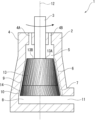
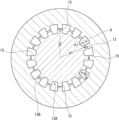
- FIG. 2 is a schematic cross-sectional view of a grease production apparatus used in one embodiment of the present invention. 2 is a schematic diagram of a cross section of a first uneven portion on the container body side of the grease production apparatus of FIG. 1 in a direction perpendicular to the rotation axis. FIG.
- the grease composition of the present invention is a grease composition containing a base oil (A), a urea-based thickener (B), a phosphate amine salt (C), a sulfur-based extreme pressure agent (D), zinc dithiophosphate (E), melamine cyanurate (F), and an organic molybdenum compound (G),
- the base oil (A) is a mixed base oil containing a high-viscosity poly- ⁇ -olefin (PAO) (A1) having a kinetic viscosity at 40° C.
- PAO high-viscosity poly- ⁇ -olefin
- the grease composition is one in which the particles containing the urea-based thickener (B) in the grease composition satisfy the following requirement (I).
- the base oil (A) is a mixed base oil containing a high-viscosity poly- ⁇ -olefin (PAO) (A1) having a kinetic viscosity at 40°C of 288 mm2 /s to 506 mm2 /s, a low-viscosity poly- ⁇ -olefin (PAO) (A2) having a kinetic viscosity at 40°C of 61.2 to 74.8 mm2 /s, and an ester-based synthetic oil, and particles containing a urea-based thickener satisfy certain requirements, a grease composition can be obtained which has excellent extreme pressure properties, load resistance, seizure resistance,
- the present inventors discovered the following.
- blends mainly containing sulfur-based extreme pressure agents and organic molybdenum compounds are often used.
- these additives react with the sliding surface to form a coating, thereby providing high extreme pressure properties and load resistance.
- the lubricated parts are at low temperatures of less than 80°C, there is a problem that the effects of these additives are not fully exerted.
- the present inventors have found that when a phosphoric acid ester amine salt (C), zinc dithiophosphate (E), and melamine cyanurate (F) are used in combination as additives for a grease composition, high extreme pressure properties and load carrying capacity can be exhibited even in a low temperature environment of less than 80° C.
- the present inventors have also found that when these additives are used in combination with a sulfur-based extreme pressure agent (D) or an organic molybdenum compound (G), sufficient extreme pressure properties and load carrying capacity are exhibited in both temperature environments of 80° C. or higher and below 80° C., that is, in a wide range of temperature environments, without being dependent on the temperature of the lubricated parts, without impairing the performance of each additive.
- the term "wide temperature environment” refers to a temperature environment of 25°C to 100°C.
- a grease composition contains a high-viscosity base oil that has high oil film retention, excellent lubricity, and is less likely to leak, the permeability and low-temperature characteristics are insufficient, resulting in a decrease in the transmission efficiency of a wave gear device, etc.
- a grease composition contains a low-viscosity base oil that has excellent permeability and low-temperature characteristics, there is a concern that the grease composition will seep out and leak from the wave gear device, etc.
- the base oil (A) is a mixed base oil containing a high-viscosity poly- ⁇ -olefin (PAO) (A1) having a 40°C kinematic viscosity of 288 mm 2 /s to 506 mm 2 /s, a low-viscosity poly- ⁇ -olefin (PAO) (A2) having a 40°C kinematic viscosity of 61.2 to 74.8 mm 2 /s, and an ester-based synthetic oil, and when particles containing the urea-based thickener (B) in the grease composition satisfy specific requirement (I), leakage of the grease composition due to the low viscosity of the base oil can be suppressed without impairing the transmission efficiency of a wave gear device or the like. Based on this finding, the present inventors conducted further studies and completed the present invention.
- PAO high-viscosity poly- ⁇ -olefin
- PAO low-viscosity poly- ⁇ -olefin
- base oil (A) "urea-based thickener (B)”, “phosphate ester amine salt (C)", "sulfur-based extreme pressure agent (D)”, “zinc dithiophosphate (E)”, “melamine cyanurate (F)”, and “organo molybdenum compound (G)" will also be referred to as “component (A)”, “component (B)”, “component (C)”, “component (D)”, “component (E)”, “component (F)”, and “component (G)”, respectively.
- the total content of components (A), (B), (C), (D), (E), (F), and (G) is preferably 60% by mass or more, more preferably 70% by mass or more, even more preferably 80% by mass or more, and even more preferably 90% by mass or more, based on the total amount (100% by mass) of the grease composition. Also, it is usually 100% by mass or less, preferably less than 100% by mass, more preferably 99% by mass or less, and even more preferably 98% by mass or less.
- the grease composition of one embodiment of the present invention may contain components other than component (A), component (B), component (C), component (D), component (E), component (F), and component (G) as long as the effects of the present invention are not impaired.
- the particles containing the urea-based thickener (B) in the grease composition satisfy the following requirement (I).
- the above requirement (I) can also be said to be a parameter indicating the state of aggregation of the urea-based thickener (B) in the grease composition.
- the "particles containing the urea-based thickener (B)" to be measured by the laser diffraction/scattering method refer to particles formed by aggregation of the urea-based thickener (B) contained in the grease composition.
- the grease composition contains additives other than the urea-based thickener (B)
- the arithmetic mean particle size specified in the above requirement (I) is obtained by measuring a grease composition prepared under the same conditions without blending the additives by a laser diffraction/scattering method.
- the additives are liquid at room temperature (25°C) or when the additives dissolve in the base oil (A)
- the grease composition containing the additives may be used as the measurement subject.
- the urea-based thickener (B) is usually obtained by reacting an isocyanate compound with a monoamine. However, since the reaction rate is very fast, the urea-based thickener (B) tends to aggregate, resulting in the excessive production of large particles (micelle particles, so-called "lumps"). As a result of intensive research by the present inventors, it was found that if the arithmetic mean particle size specified in the above requirement (I) exceeds 2.0 ⁇ m, it is not possible to ensure compatibility between extreme pressure properties, load resistance, seizure resistance, wear resistance, and suppression of leakage of the grease composition due to low viscosity of the base oil in a wide range of temperature environments.
- This effect is presumably achieved by making the arithmetic mean particle diameter specified in the above requirement (I) 2.0 ⁇ m or less, so that the particles containing the urea-based thickener (B) can easily penetrate into the lubricated parts (friction surfaces) of a wave gear device or the like and are also less likely to be removed from the lubricated parts, thereby improving the retention of the grease composition in the lubricated parts. Also, by making the arithmetic mean particle diameter specified in the above requirement (I) 2.0 ⁇ m or less, the retention of the base oil (A) by the particles is improved.
- the base oil (A) is well distributed to the lubricated parts (friction surfaces) of a wave gear device or the like, and the effect of also well distributing the phosphate amine salt (C), the sulfur-based extreme pressure agent (D), the zinc dithiophosphate (E), the melamine cyanurate (F), and the organic molybdenum compound (G) to the lubricated parts is improved, resulting in further improvements in extreme pressure properties, load resistance, seizure resistance, abrasion resistance, and inhibition of leakage of the grease composition due to the low viscosity of the base oil.
- C phosphate amine salt
- D sulfur-based extreme pressure agent
- E zinc dithiophosphate
- F melamine cyanurate
- G organic molybdenum compound
- the arithmetic mean particle size specified in the above requirement (I) is preferably 1.5 ⁇ m or less, more preferably 1.0 ⁇ m or less, even more preferably 0.9 ⁇ m or less, still more preferably 0.8 ⁇ m or less, even more preferably 0.7 ⁇ m or less, still more preferably 0.6 ⁇ m or less, still more preferably 0.5 ⁇ m or less, and even more preferably 0.4 ⁇ m or less. Also, it is usually 0.01 ⁇ m or more.
- the particles containing the urea-based thickener (B) in the grease composition further satisfy the following requirement (II).
- the specific surface area specified in the above requirement (II) is a secondary index showing the state of fine particles containing the urea-based thickener (B) in the grease composition and the presence of large particles (lumps). That is, by satisfying the above requirement (I) and further satisfying the above requirement (II), the state of fine particles containing the urea-based thickener (B) in the grease composition is better, and the presence of large particles (lumps) is more suppressed.
- the specific surface area specified by the above requirement (II) is preferably 0.7 ⁇ 10 5 cm 2 /cm 3 or more, more preferably 0.8 ⁇ 10 5 cm 2 /cm 3 or more, even more preferably 1.2 ⁇ 10 5 cm 2 /cm 3 or more, still more preferably 1.5 ⁇ 10 5 cm 2 /cm 3 or more, even more preferably 1.8 ⁇ 10 5 cm 2 /cm 3 or more, and even more preferably 2.0 ⁇ 10 5 cm 2 /cm 3 or more.
- the specific surface area is usually 1.0 ⁇ 10 6 cm 2 / cm 3 or less.
- the values specified in the above requirement (I) and further the above requirement (II) are values measured by the method described in the examples below.
- the values stipulated in the above requirement (I) and further in the above requirement (II) can be adjusted mainly by the production conditions of the urea-based thickener (B).
- the components contained in the grease composition of the present invention will be described in detail, focusing on the specific means for satisfying the above requirement (I) and further the above requirement (II).
- the grease composition of the present embodiment contains a base oil (A).
- the base oil (A) is a mixed base oil containing a high - viscosity poly- ⁇ -olefin (hereinafter also referred to as "high-viscosity PAO") (A1) having a 40°C kinematic viscosity of 288 mm 2 /s to 506 mm 2 /s, a low-viscosity poly- ⁇ -olefin (hereinafter also referred to as "low-viscosity PAO”) (A2) having a 40°C kinematic viscosity of 61.2 to 74.8 mm 2 /s, and an ester-based synthetic oil.
- high-viscosity PAO high-viscosity PAO
- the oil film becomes thicker and the lubricity is improved.
- the low viscosity PAO (A2) in the base oil (A) the permeability of the base oil can be increased, thereby improving the supply of the base oil to the lubrication points, and the low temperature characteristics can be improved.
- the base oil (A) contains an ester-based synthetic oil, the solubility of the additives is improved, and the additives are more likely to exhibit their effects.
- the high viscosity PAO (A1) is a high viscosity poly- ⁇ -olefin having a kinematic viscosity at 40° C. of 288 mm 2 /s to 506 mm 2 /s.
- Examples of the high viscosity PAO (A1) include polybutene, polyisobutylene, 1-decene oligomer, and ethylene-propylene copolymer, as well as hydrogenated products thereof.
- the high-viscosity PAO (A1) may be used alone or in combination of two or more kinds.
- the high-viscosity PAO (A1) has a 40° C. kinematic viscosity of 288 mm 2 /s or more and 506 mm 2 /s or less.
- the high-viscosity PAO (A1) has a 40°C kinetic viscosity of 288 mm2 /s or more, a sufficient oil film thickness can be ensured.
- the high-viscosity PAO (A1) has a 40°C kinetic viscosity of 506 mm2 /s or less, the transmission efficiency of a strain wave gear device or the like is improved.
- the high-viscosity PAO (A1) has a 40°C kinematic viscosity of preferably 300 mm2/s or more and 500 mm2 /s or less, more preferably 320 mm2 /s or more and 480 mm2 /s or less, and even more preferably 350 mm2 /s or more and 450 mm2 /s or less.
- the high-viscosity PAO (A1) has a 40°C kinematic viscosity of 300 mm2 /s or more and 500 mm2 /s or less, the effects of the present invention are more easily improved.
- the high-viscosity PAO (A1) preferably has a 100°C kinematic viscosity of 10 mm2/s or more and 70 mm2 /s or less, more preferably 20 mm2 /s or more and 60 mm2 /s or less.
- the high-viscosity PAO (A1) has a 40°C kinematic viscosity of 10 mm2/s or more and 70 mm2 /s or less, the effects of the present invention are more easily improved.
- the high-viscosity PAO (A1) preferably has a viscosity index of at least 100, more preferably at least 110, and even more preferably at least 120. When the high-viscosity PAO (A1) has a viscosity index of at least 100, the effects of the present invention are more easily improved.
- the low-viscosity PAO (A2) is a low-viscosity poly- ⁇ -olefin having a kinematic viscosity at 40° C. of 61.2 to 74.8 mm 2 /s.
- Examples of the low viscosity PAO (A2) include polybutene, polyisobutylene, 1-decene oligomer, and ethylene-propylene copolymer, as well as hydrogenated products thereof.
- the low-viscosity PAO (A2) may be used alone or in combination of two or more kinds.
- the low-viscosity PAO (A2) may have the same or different repeating unit structure as the high-viscosity PAO (A1).
- the 40° C. kinematic viscosity of the low-viscosity PAO (A2) is 61.2 mm 2 /s or more and 74.8 mm 2 /s or less.
- the low-viscosity PAO (A2) has a 40° C. kinetic viscosity of 61.2 mm 2 /s or more, the leakage resistance is good.
- the low-viscosity PAO (A2) has a 40° C. kinetic viscosity of 74.8 mm 2 /s or less, the transmission efficiency of a strain wave gear device or the like is good.
- the 40°C kinematic viscosity of the low-viscosity PAO (A2) is preferably 61.2 mm2 /s or more and 74.0 mm2 /s or less, more preferably 62.0 mm2 /s or more and 72.0 mm2 /s or less, and even more preferably 62.5 mm2 /s or more and 70.0 mm2 /s or less.
- the 40°C kinematic viscosity of the low-viscosity PAO (A2) is 61.2 mm2 /s or more and 74.0 mm2 /s or less, the effects of the present invention are more easily improved.
- the 100° C. kinematic viscosity of the low-viscosity PAO (A2) is preferably 7.0 mm 2 /s or more and 13.0 mm 2 /s or less, more preferably 8.0 mm 2 /s or more and 12.0 mm 2 /s or less, and even more preferably 9.0 mm 2 /s or more and 11.0 mm 2 /s or less.
- the 40° C. kinematic viscosity of the low-viscosity PAO (A2) is 7.0 mm 2 /s or more and 13.0 mm 2 /s or less, the effects of the present invention are more easily improved.
- the viscosity index of the low-viscosity PAO (A2) is preferably at least 100, more preferably at least 120, and even more preferably at least 130.
- the low-viscosity PAO (A2) has a viscosity index of 100 or more, the effects of the present invention are more easily improved.
- ester-based synthetic oil examples include diester-based oil, aromatic ester-based oil, polyol ester-based oil, and complex ester-based oil. These may be used alone or in combination of two or more.
- diester oils examples include dibutyl sebacate, di(2-ethylhexyl) sebacate, diisodecyl sebacate, ditri(n-decyl) sebacate, diisotridecyl sebacate, dibutyl adipate, di(2-ethylhexyl) adipate, diisodecyl adipate, ditri(n-decyl) adipate, diisotridecyl adipate, ditridecyl glutarate, and methyl acetyl ricinoleate.
- aromatic ester oils include tris(2-ethylhexyl) trimellitate, Examples thereof include tri(n-decyl) trimellitate and tetra(n-octyl) pyromellitic acid.
- polyol ester oils include trimethylolpropane caprylate, trimethylolpropane bellargonate, pentaerythritol-2-ethylhexanoate, and pentaerythritol bellargonate.
- the complex ester oil include oligoesters of polyhydric alcohols and mixed fatty acids of dibasic and monobasic acids. These may be used alone or in combination of two or more.
- branched chain ester synthetic oils are preferred, and di(2-ethylhexyl) sebacate, diisodecyl sebacate, diisotridecyl sebacate, di(2-ethylhexyl) adipate, diisodecyl adipate, diisotridecyl adipate, and tris(2-ethylhexyl) trimellitate are more preferred.
- the 40° C. kinematic viscosity of the ester-based synthetic oil is preferably 4.0 mm 2 /s or more and 40 mm 2 /s or less, more preferably 7.0 mm 2 /s or more and 30 mm 2 /s or less, and even more preferably 9.0 mm 2 /s or more and 25 mm 2 /s or less.
- the 40° C. kinematic viscosity of the ester-based synthetic oil is 4.0 mm 2 /s or more and 40 mm 2 /s or less, the effects of the present invention are more easily improved.
- the 100° C. kinematic viscosity of the ester-based synthetic oil is preferably 1.5 mm 2 /s or more and 6.0 mm 2 /s or less, more preferably 2.0 mm 2 /s or more and 5.0 mm 2 /s or less, and even more preferably 2.5 mm 2 /s or more and 4.0 mm 2 /s or less.
- the 40° C. kinematic viscosity of the ester-based synthetic oil is 1.5 mm 2 /s or more and 6.0 mm 2 /s or less, the effects of the present invention are more easily improved.
- the viscosity index of the ester-based synthetic oil is preferably at least 100, more preferably at least 120, and even more preferably at least 140.
- the viscosity index of the ester-based synthetic oil is at least 100, the effects of the present invention are more easily improved.
- the ester-based synthetic oil preferably contains a diester-based oil (A3) and an aromatic ester-based oil (A4).
- A3 diester-based oil
- A4 aromatic ester-based oil
- the content of the diester oil (A3) in the ester synthetic oil is, from the viewpoint of improving torque transmission efficiency by lowering the viscosity of the mixed base oil (also simply referred to as "the viewpoint of lowering viscosity" in this specification), preferably 60 mass% or more, more preferably 70 mass% or more, even more preferably 80 mass% or more, based on the total amount of the ester synthetic oil, and is preferably 95 mass% or less, more preferably 92 mass% or less, even more preferably 90 mass% or less.
- the content of the aromatic ester oil (A4) in the ester synthetic oil is, from the viewpoint of reducing viscosity, preferably 5% by mass or more, more preferably 8% by mass or more, even more preferably 10% by mass or more, based on the total amount of the ester synthetic oil, and is preferably 30% by mass or less, more preferably 25% by mass or less, even more preferably 20% by mass or less.
- the ester-based synthetic oil contains a diester-based oil (A3) and an aromatic ester-based oil (A4)
- the content of the diester-based oil (A3) is, from the viewpoint of reducing viscosity, preferably 15% by mass or more, more preferably 18% by mass or more, even more preferably 20% by mass or more, based on the total amount of the base oil (A), and is preferably 30% by mass or less, more preferably 28% by mass or less, even more preferably 26% by mass or less.
- the content of the aromatic ester-based oil (A4) is, from the viewpoint of reducing the viscosity, preferably 2.0 mass% or more, more preferably 3.0 mass% or more, even more preferably 4.0 mass% or more, based on the total amount of the base oil (A), and is preferably 7.0 mass% or less, more preferably 6.0 mass% or less, even more preferably 5.0 mass% or less.
- the ester-based synthetic oil contains a diester-based oil (A3) and an aromatic ester-based oil (A4)
- the content of the diester-based oil (A3) is, from the viewpoint of reducing the viscosity, preferably 5% by mass or more, more preferably 10% by mass or more, even more preferably 13% by mass or more, based on the total amount of the grease composition, and is preferably 30% by mass or less, more preferably 25% by mass or less, even more preferably 22% by mass or less.
- the content of the aromatic ester-based oil (A4) is, from the viewpoint of reducing the viscosity, preferably 1.0 mass% or more, more preferably 2.0 mass% or more, even more preferably 2.5 mass% or more, based on the total amount of the grease composition, and is preferably 5.0 mass% or less, more preferably 4.5 mass% or less, even more preferably 4.0 mass% or less.
- the ester-based synthetic oil contains a diester-based oil (A3) and an aromatic ester-based oil (A4)
- the content ratio of the diester-based oil (A3) to the aromatic ester-based oil (A4) [(A3)/(A4)] is preferably 1 to 12, more preferably 2 to 10, and even more preferably 3 to 8, in terms of mass ratio, from the viewpoint of low viscosity.
- the base oil (A) may contain a base oil other than the high viscosity PAO (A1), the low viscosity PAO (A2), and the ester-based synthetic oil.
- the other base oil may be one or more selected from mineral oils and synthetic oils other than PAO and ester-based synthetic oils.
- mineral oils examples include atmospheric residual oil obtained by atmospheric distillation of crude oils such as paraffin-based crude oil, intermediate-based crude oil, and naphthene-based crude oil; distillate oil obtained by vacuum distillation of the atmospheric residual oil; and mineral oil obtained by subjecting the distillate oil to one or more refining processes such as solvent deasphalting, solvent extraction, hydrofinishing, hydrocracking, advanced hydrocracking, solvent dewaxing, catalytic dewaxing, and hydroisomerization dewaxing.
- crude oils such as paraffin-based crude oil, intermediate-based crude oil, and naphthene-based crude oil
- distillate oil obtained by vacuum distillation of the atmospheric residual oil
- mineral oil obtained by subjecting the distillate oil to one or more refining processes such as solvent deasphalting, solvent extraction, hydrofinishing, hydrocracking, advanced hydrocracking, solvent dewaxing, catalytic dewaxing, and hydroisomerization dewaxing.
- synthetic oils other than the high-viscosity PAO (A1), low-viscosity PAO (A2), and ester-based synthetic oils include normal paraffins, isoparaffins, aromatic oils, ether oils, and GTL base oils obtained by isomerizing wax (GTL wax (Gas To Liquids WAX)) produced by the Fischer-Tropsch process or the like. These may be used alone or in combination of two or more.
- Aromatic oils include, for example, alkylbenzenes such as monoalkylbenzenes and dialkylbenzenes; alkylnaphthalenes such as monoalkylnaphthalenes, dialkylnaphthalenes, and polyalkylnaphthalenes; and the like.
- ether-based oils include polyglycols such as polyethylene glycol, polypropylene glycol, polyethylene glycol monoether, and polypropylene glycol monoether; phenyl ether-based oils such as monoalkyl triphenyl ether, alkyl diphenyl ether, dialkyl diphenyl ether, pentaphenyl ether, tetraphenyl ether, monoalkyl tetraphenyl ether, and dialkyl tetraphenyl ether; and the like.
- polyglycols such as polyethylene glycol, polypropylene glycol, polyethylene glycol monoether, and polypropylene glycol monoether
- phenyl ether-based oils such as monoalkyl triphenyl ether, alkyl diphenyl ether, dialkyl diphenyl ether, pentaphenyl ether, tetraphenyl ether, monoalkyl tetraphenyl ether, and dialkyl
- the base oil (A) used in one embodiment of the present invention has a 40°C kinematic viscosity of preferably 10 mm2/s or more, more preferably 20 mm2/s or more, even more preferably 30 mm2/s or more, and still more preferably 40 mm2 /s or more.
- the base oil (A) of this embodiment has a 40° C.
- the flow rate is preferably 10 to 120 mm 2 /s, more preferably 20 to 100 mm 2 /s, even more preferably 30 to 90 mm 2 /s, and still more preferably 40 to 80 mm 2 /s.
- the 100° C. kinematic viscosity of the base oil (A) used in one embodiment of the present invention is preferably 2.0 mm 2 /s or more, more preferably 3.0 mm 2 /s or more, and even more preferably 4.0 mm 2 /s or more.
- the base oil (A) of this embodiment preferably has a 100° C. kinematic viscosity of 20 mm 2 /s or less, more preferably 18 mm 2 /s or less, and even more preferably 16 mm 2 /s or less.
- the base oil (A) When the base oil (A) has a 40° C. kinematic viscosity of 20 mm 2 /s or less, the effects of the present invention are more easily exhibited.
- the upper and lower limits of these numerical ranges can be arbitrarily combined.
- the flow rate is preferably 2.0 to 20 mm 2 /s, more preferably 3.0 to 18 mm 2 /s, and even more preferably 4.0 to 16 mm 2 /s.
- the base oil (A) used in one embodiment of the present invention may be a mixed base oil prepared by combining a high-viscosity base oil and a low-viscosity base oil to adjust the kinetic viscosity within the above range.
- the viscosity index of the base oil (A) used in one embodiment of the present invention is preferably 90 or more, more preferably 110 or more, and even more preferably 130 or more.
- the kinematic viscosity and viscosity index refer to values measured or calculated in accordance with JIS K2283:2000.
- the content of base oil (A) is, based on the total amount (100 mass%) of the grease composition, preferably 50 mass% or more, more preferably 55 mass% or more, even more preferably 60 mass% or more, even more preferably 65 mass% or more, and is preferably 98.5 mass% or less, more preferably 97 mass% or less, even more preferably 95 mass% or less, even more preferably 93 mass% or less.
- the grease composition of one embodiment of the present invention contains a urea-based thickener (B).
- the urea-based thickener (B) contained in the grease composition of one embodiment of the present invention may be a compound having a urea bond, but a diurea compound having two urea bonds is preferred, and from the viewpoint of heat resistance, a diurea compound represented by the following general formula (b1) is more preferred.
- the urea-based thickener (B) used in one embodiment of the present invention may consist of one type or may be a mixture of two or more types.
- R1 and R2 each independently represent a monovalent hydrocarbon group having 6 to 24 carbon atoms.
- R1 and R2 may be the same or different from each other.
- R3 represents a divalent aromatic hydrocarbon group having 6 to 18 carbon atoms.
- the monovalent hydrocarbon group that can be selected as R 1 and R 2 in the general formula (b1) has 6 to 24 carbon atoms, preferably 6 to 20 carbon atoms, and more preferably 6 to 18 carbon atoms.
- examples of the monovalent hydrocarbon group that can be selected as R1 and R2 include a saturated or unsaturated monovalent chain hydrocarbon group, a saturated or unsaturated monovalent alicyclic hydrocarbon group, and a monovalent aromatic hydrocarbon group.
- the values of the above requirements (a) and (b) mean average values with respect to the total amount of the compound group represented by the above general formula (b1) contained in the grease composition.
- Examples of the monovalent saturated chain hydrocarbon group include linear or branched alkyl groups having 6 to 24 carbon atoms, specifically, hexyl, heptyl, octyl, nonyl, decyl, undecyl, dodecyl, tridecyl, tetradecyl, pentadecyl, hexadecyl, heptadecyl, octadecyl, octadecenyl, nonadecyl, icosyl, etc. Among these, octadecyl is preferred.
- Examples of the monovalent unsaturated chain hydrocarbon group include linear or branched alkenyl groups having 6 to 24 carbon atoms, and specific examples thereof include a hexenyl group, a heptenyl group, an octenyl group, a nonenyl group, a decenyl group, an undecenyl group, a dodecenyl group, a tridecenyl group, a tetradecenyl group, a pentadecenyl group, a hexadecenyl group, a heptadecenyl group, an octadecenyl group, a nonadecenyl group, an icosenyl group, an oleyl group, a geranyl group, a farnesyl group, and a linoleyl group.
- the monovalent saturated chain hydrocarbon group and the monovalent unsaturated chain hydrocarbon group may be linear or
- Examples of monovalent saturated alicyclic hydrocarbon groups include cycloalkyl groups such as cyclohexyl, cycloheptyl, cyclooctyl, and cyclononyl; cycloalkyl groups substituted with an alkyl group having 1 to 6 carbon atoms, such as methylcyclohexyl, dimethylcyclohexyl, ethylcyclohexyl, diethylcyclohexyl, propylcyclohexyl, isopropylcyclohexyl, 1-methyl-propylcyclohexyl, butylcyclohexyl, pentylcyclohexyl, pentyl-methylcyclohexyl, and hexylcyclohexyl (preferably, a cyclohexyl group substituted with an alkyl group having 1 to 6 carbon atoms); and the like.
- the cyclohexyl group is preferred.
- Examples of monovalent unsaturated alicyclic hydrocarbon groups include cycloalkenyl groups such as cyclohexenyl, cycloheptenyl, and cyclooctenyl; cycloalkenyl groups substituted with an alkyl group having 1 to 6 carbon atoms such as methylcyclohexenyl, dimethylcyclohexenyl, ethylcyclohexenyl, diethylcyclohexenyl, and propylcyclohexenyl (preferably, cyclohexenyl groups substituted with an alkyl group having 1 to 6 carbon atoms); and the like.
- cycloalkenyl groups such as cyclohexenyl, cycloheptenyl, and cyclooctenyl
- cycloalkenyl groups substituted with an alkyl group having 1 to 6 carbon atoms such as methylcyclohexenyl, dimethylcyclohexenyl
- monovalent aromatic hydrocarbon groups include phenyl, biphenyl, terphenyl, naphthyl, diphenylmethyl, diphenylethyl, diphenylpropyl, methylphenyl, dimethylphenyl, ethylphenyl, and propylphenyl groups.
- the divalent aromatic hydrocarbon group that can be selected as R 3 in the general formula (b1) has 6 to 18 carbon atoms, preferably 6 to 15 carbon atoms, and more preferably 6 to 13 carbon atoms.
- Examples of the divalent aromatic hydrocarbon group that can be selected as R3 include a phenylene group, a diphenylmethylene group, a diphenylethylene group, a diphenylpropylene group, a methylphenylene group, a dimethylphenylene group, and an ethylphenylene group.
- a phenylene group, a diphenylmethylene group, a diphenylethylene group, or a diphenylpropylene group is preferable, and a diphenylmethylene group is more preferable.
- the content of component (B) is preferably 1.0 to 20.0 mass %, more preferably 1.5 to 15.0 mass %, even more preferably 2.0 to 13.0 mass %, still more preferably 4.0 to 12.0 mass %, and even more preferably 5.0 mass % to 11.0 mass %, based on the total amount (100 mass %) of the grease composition.
- the content of component (B) is 1.0 mass % or more, the worked penetration of the resulting grease composition can be easily adjusted to an appropriate range.
- the content of component (B) is 20.0 mass % or less, the resulting grease composition can be adjusted to be soft, making it easier to improve the transmission efficiency of wave gear devices and the like.
- the urea-based thickener (B) can usually be obtained by reacting an isocyanate compound with a monoamine.
- the reaction is preferably carried out by adding a solution ⁇ obtained by dissolving a monoamine in the base oil (A) to a heated solution ⁇ obtained by dissolving an isocyanate compound in the base oil (A).
- a diisocyanate having a group corresponding to the divalent aromatic hydrocarbon group represented by R3 in the general formula (b1) is used as the isocyanate compound, and an amine having groups corresponding to the monovalent hydrocarbon groups represented by R1 and R2 is used as the monoamine, and a desired urea-based thickener (B) can be synthesized by the above-mentioned method.
- a container body having an introduction part for introducing a grease raw material and a discharge part for discharging the grease to the outside, a rotor having a rotation axis in the axial direction of the inner circumference of the container body and rotatably provided inside the container body;
- the rotor is (i) the rotor has a surface with alternating projections and recesses that are inclined with respect to the axis of rotation; (ii) A grease production apparatus comprising a first uneven portion having a feeding capability from the introduction portion in a direction toward the discharge portion.
- FIG. 1 is a schematic cross-sectional view of the grease production apparatus described in [1] above, which can be used in one embodiment of the present invention.
- the grease manufacturing apparatus 1 shown in FIG. 1 comprises a container body 2 into which grease raw materials are introduced, and a rotor 3 having a rotating shaft 12 on the central axis of the inner circumference of the container body 2 and rotating about the rotating shaft 12 as its central axis.
- the rotor 3 rotates at high speed around the rotating shaft 12 as a central axis, and applies a high shear force to the grease raw material inside the container body 2. In this way, a grease containing the urea-based thickener (B) is produced.
- FIG. 1 is a schematic cross-sectional view of the grease production apparatus described in [1] above, which can be used in one embodiment of the present invention.
- the grease manufacturing apparatus 1 shown in FIG. 1 comprises a container body 2 into which grease raw materials are introduced, and a rotor 3 having a rotating shaft 12 on the central axi
- the container body 2 is preferably partitioned into an inlet portion 4, a retention portion 5, a first inner circumferential surface 6, a second inner circumferential surface 7, and a discharge portion 8 in that order from the upstream side.
- the container body 2 preferably has an inner peripheral surface in the shape of a truncated cone, the inner diameter of which gradually increases from the inlet portion 4 toward the outlet portion 8 .
- An introduction section 4 at one end of the container body 2 is provided with a plurality of solution introduction tubes 4A, 4B for introducing grease raw material from the outside of the container body 2.
- the retention section 5 is disposed downstream of the introduction section 4, and is a space for temporarily retaining the grease raw material introduced from the introduction section 4. If the grease raw material remains in this retention section 5 for a long time, the grease adhering to the inner peripheral surface of the retention section 5 will form large lumps, and therefore it is preferable to transport the grease raw material to the first inner peripheral surface 6 downstream in as short a time as possible. It is even more preferable to transport the grease raw material directly to the first inner peripheral surface 6 without passing through the retention section 5.
- the first inner circumferential surface 6 is disposed in a downstream portion adjacent to the retention portion 5, and the second inner circumferential surface 7 is disposed in a downstream portion adjacent to the first inner circumferential surface 6.
- the discharge part 8 which is the other end of the container body 2, is a part that discharges the grease stirred between the first inner circumferential surface 6 and the second inner circumferential surface 7, and is provided with a discharge port 11 that discharges the grease.
- the discharge port 11 is formed in a direction perpendicular or substantially perpendicular to the rotation shaft 12.
- the discharge port 11 does not necessarily have to be perpendicular to the rotation shaft 12, and may be formed in a direction parallel or substantially parallel to the rotation shaft 12.
- the rotor 3 is rotatably mounted with the central axis of the truncated cone-shaped inner peripheral surface of the container body 2 as the rotation axis 12, and rotates counterclockwise when the container body 2 is viewed from the upstream portion to the downstream portion as shown in Figure 1.
- the rotor 3 has an outer peripheral surface that expands in accordance with the expansion of the inner diameter of the truncated cone of the container body 2, and a constant distance is maintained between the outer peripheral surface of the rotor 3 and the inner peripheral surface of the truncated cone of the container body 2.
- the rotor 3 has a first rotor concave-convex portion 13 on its outer circumferential surface, in which concaves and convexes are alternately provided along the surface of the rotor 3 .
- the first uneven portion 13 of the rotor is inclined with respect to the rotation axis 12 of the rotor 3 in the direction from the inlet 4 to the outlet 8, and has the ability to feed from the inlet 4 to the outlet 8.
- the first uneven portion 13 of the rotor is inclined in a direction that pushes the solution downstream when the rotor 3 rotates in the direction shown in FIG. 1.
- the step between the recess 13A and the protrusion 13B of the first uneven portion 13 of the rotor is preferably 0.3 to 30, more preferably 0.5 to 15, and even more preferably 2 to 7, when the diameter of the recess 13A on the outer peripheral surface of the rotor 3 is 100.
- the number of convex portions 13B of the first uneven portion 13 of the rotor in the circumferential direction is preferably 2 to 1000, more preferably 6 to 500, and further preferably 12 to 200.
- the ratio of the width of the convex portion 13B of the first uneven portion 13 of the rotor to the width of the concave portion 13A in a cross section perpendicular to the rotation axis 12 of the rotor 3 [width of the convex portion/width of the concave portion] is preferably 0.01 to 100, more preferably 0.1 to 10, and even more preferably 0.5 to 2.
- the inclination angle of the first uneven portion 13 of the rotor with respect to the rotating shaft 12 is preferably 2 to 85 degrees, more preferably 3 to 45 degrees, and even more preferably 5 to 20 degrees.
- the first inner circumferential surface 6 of the container body 2 is preferably provided with a first uneven portion 9 in which a plurality of unevennesses are formed along the inner circumferential surface.
- the unevenness of the first uneven portion 9 on the container body 2 side is inclined in the opposite direction to the first uneven portion 13 of the rotor. That is, the multiple projections and recesses of the first uneven portion 9 on the container body 2 side are preferably inclined in a direction to push the solution downstream when the rotating shaft 12 of the rotor 3 rotates in the direction shown in Fig. 1.
- the first uneven portion 9 having multiple projections and recesses provided on the first inner circumferential surface 6 of the container body 2 further enhances the stirring capacity and the discharge capacity.
- the depth of the first uneven portion 9 on the container body 2 side is preferably 0.2 to 30, more preferably 0.5 to 15, and even more preferably 1 to 5, when the inside diameter (diameter) of the container is taken as 100.
- the number of projections and recesses of the first projection and recess portion 9 on the container body 2 side is preferably 2 to 1,000, more preferably 6 to 500, and further preferably 12 to 200.
- the ratio of the width of the concave portion of the first uneven portion 9 on the container body 2 side to the width of the convex portion between the grooves [width of the concave portion/width of the convex portion] is preferably 0.01 to 100, more preferably 0.1 to 10, and even more preferably 0.5 to 2 or less.
- the inclination angle of the first uneven portion 9 on the container body 2 side relative to the rotation axis 12 is preferably 2 to 85 degrees, more preferably 3 to 45 degrees, and even more preferably 5 to 20 degrees.
- the first inner surface 6 can function as a shear portion that applies high shear force to the grease raw material or the grease, but the first uneven portion 9 is not necessarily provided.
- a second rotor uneven portion 14 having alternating unevenness is provided on the outer peripheral surface of the downstream portion of the first rotor uneven portion 13 along the surface of the rotor 3 .
- the second uneven portion 14 of the rotor is inclined with respect to the rotation axis 12 of the rotor 3 and has a feed suppression capability of pushing the solution back upstream from the inlet portion 4 toward the outlet portion 8 .
- the step of the second uneven portion 14 of the rotor is preferably 0.3 to 30, more preferably 0.5 to 15, and even more preferably 2 to 7, assuming that the diameter of the recess on the outer circumferential surface of the rotor 3 is 100.
- the number of protrusions of the second uneven portion 14 of the rotor in the circumferential direction is preferably 2 to 1,000, more preferably 6 to 500, and further preferably 12 to 200.
- the ratio of the width of the convex portion of the second uneven portion 14 of the rotor in a cross section perpendicular to the rotation axis of the rotor 3 to the width of the concave portion [width of the convex portion/width of the concave portion] is preferably 0.01 to 100, more preferably 0.1 to 10, and even more preferably 0.5 to 2.
- the inclination angle of the second uneven portion 14 of the rotor with respect to the rotating shaft 12 is preferably 2 to 85 degrees, more preferably 3 to 45 degrees, and even more preferably 5 to 20 degrees.
- the second inner surface 7 of the container body 2 is provided with a second uneven portion 10 having a plurality of unevennesses formed thereon adjacent to the downstream portion of the unevenness in the first uneven portion 9 on the container body 2 side.
- a plurality of projections and recesses are formed on the inner circumferential surface of the container body 2, and each projection and recess is preferably inclined in a direction opposite to the inclination direction of the second projection and recess portion 14 of the rotor. That is, the multiple projections and recesses of the second uneven portion 10 on the container body 2 side are preferably inclined in a direction that pushes the solution back upstream when the rotating shaft 12 of the rotor 3 rotates in the direction shown in Fig. 1.
- the stirring ability is further enhanced by the projections and recesses of the second uneven portion 10 provided on the second inner peripheral surface 7 of the container body 2.
- the second inner peripheral surface 7 of the container body can function as a shear portion that applies a high shear force to the grease raw material or the grease.
- the depth of the recess of the second uneven portion 10 on the container body 2 side is preferably 0.2 to 30, more preferably 0.5 to 15, and even more preferably 1 to 5, when the inner diameter (diameter) of the container body 2 is 100.
- the number of recesses in the second uneven portion 10 on the container body 2 side is preferably 2 to 1,000, more preferably 6 to 500, and further preferably 12 to 200.
- the ratio of the width of the convex portion of the second uneven portion 10 on the container body 2 side in a cross section perpendicular to the rotation axis 12 of the rotor 3 to the width of the concave portion [width of convex portion/width of concave portion] is preferably 0.01 to 100, more preferably 0.1 to 10, and even more preferably 0.5 to 2 or less.
- the inclination angle of the second concave-convex portion 10 on the container body 2 side with respect to the rotation axis 12 is preferably 2 to 85 degrees, more preferably 3 to 45 degrees, and even more preferably 5 to 20 degrees.
- the ratio of the length of the first uneven portion 9 on the container body 2 side to the length of the second uneven portion 10 on the container body 2 side [length of the first uneven portion/length of the second uneven portion] is preferably 2/1 to 20/1.
- FIG. 2 is a cross-sectional view of the first concave-convex portion 9 on the container body 2 side of the grease production apparatus 1 in a direction perpendicular to the rotation axis 12.
- the first uneven portion 13 of the rotor is provided with a plurality of scrapers 15 whose tips protrude toward the inner circumferential surface of the container body 2 beyond the protruding tip of the convex portion 13B of the first uneven portion 13.
- the second uneven portion 14 is also provided with a plurality of scrapers whose tips of the convex portions protrude toward the inner circumferential surface of the container body 2, similar to the first uneven portion 13.
- the scraper 15 scrapes off grease adhering to the inner circumferential surfaces of the first uneven portion 9 on the container body 2 side and the second uneven portion 10 on the container body 2 side. It is preferable that the ratio [R2/R1] of the radius (R2) of the tip of the scraper 15 to the radius (R1) of the tip of the convex portion 13B of the rotor's first uneven portion 13 is greater than 1.005 and less than 2.0, with respect to the amount of protrusion of the tip of the scraper 15 relative to the amount of protrusion of the convex portion 13B of the first uneven portion 13 of the rotor.
- the number of scrapers 15 is preferably 2 to 500, more preferably 2 to 50, and further preferably 2 to 10. Although the grease production apparatus 1 shown in FIG. 2 is provided with the scraper 15, the apparatus may not include the scraper 15, or may include the scraper 15 intermittently.
- the aforementioned grease raw materials, solutions ⁇ and ⁇ are introduced from the solution inlet tubes 4A and 4B of the inlet part 4 of the container body 2, respectively, and the rotor 3 is rotated at high speed, thereby producing a grease base material containing a urea-based thickener (B).
- the sulfur-phosphorus based extreme pressure agent (C) and other additives (D) are blended into the thus obtained grease base material, the urea based thickener (B) in the grease composition can be made fine so as to satisfy the above requirement (I) and further the above requirement (II).
- the shear rate applied to the grease raw material is preferably 10 2 s -1 or more, more preferably 10 3 s -1 or more, further preferably 10 4 s -1 or more, and is usually 10 7 s -1 or less.
- the ratio (Max/Min) of the maximum shear rate (Max) to the minimum shear rate (Min) during shear when the rotor 3 rotates at high speed is preferably 100 or less, more preferably 50 or less, and further preferably 10 or less.
- the maximum shear rate (Max) is the highest shear rate applied to the mixed liquid
- the minimum shear rate (Min) is the lowest shear rate applied to the mixed liquid
- Maximum shear rate (Max) (linear velocity of the tip of the convex portion 13B of the first uneven portion 13 of the rotor) / (gap A1 between the tip of the convex portion 13B of the first uneven portion 13 of the rotor and the convex portion of the first uneven portion 9 of the first inner circumferential surface 6 of the container body 2)
- Minimum shear rate (Min) (linear velocity of the recess 13A of the first uneven portion 13 of the rotor) / (gap A2 between the recess 13A of the first uneven portion 13 of the rotor and the recess of the first uneven portion 9 of the first inner circumferential surface 6 of the container body 2)
- the gaps A1 and A2 are as shown in FIG.
- the grease manufacturing apparatus 1 is equipped with a scraper 15, it is possible to scrape off the grease adhering to the inner surface of the container body 2, thereby preventing the formation of lumps during kneading, and enabling the continuous production of grease containing finely divided urea-based thickener (B) in a short period of time.
- the scraper 15 can prevent the remaining grease from becoming a resistance to the rotation of the rotor 3, thereby reducing the rotational torque of the rotor 3 and reducing the power consumption of the drive source, thereby enabling efficient continuous production of grease.
- the inner surface of the container body 2 is frustum-shaped with the inner diameter expanding from the inlet 4 toward the outlet 8, so that centrifugal force has the effect of discharging the grease or grease raw material downstream, reducing the rotational torque of the rotor 3 and enabling continuous production of grease.
- a first rotor uneven portion 13 is provided on the outer peripheral surface of the rotor 3, the first rotor uneven portion 13 is inclined with respect to the rotation axis 12 of the rotor 3 and has the ability to feed from the introduction portion 4 to the discharge portion 8, and the second rotor uneven portion 14 is inclined with respect to the rotation axis 12 of the rotor 3 and has the ability to suppress feeding from the introduction portion 4 to the discharge portion 8.
- a first uneven portion 9 is formed on the first inner surface 6 of the container body 2 and is inclined in the opposite direction to the first uneven portion 13 of the rotor. Therefore, in addition to the effect of the first uneven portion 13 of the rotor, the grease raw material can be sufficiently stirred while pushing the grease or grease raw material in the downstream direction, and the urea-based thickener (B) in the grease composition can be finely divided so as to satisfy the above requirement (I) and further the above requirement (II) even after the additives are blended.
- the urea-based thickener (B) can be finely divided so as to satisfy the above requirement (I) and further the above requirement (II) even after the additives are blended.
- the grease composition of the present embodiment contains a phosphoric acid ester amine salt (C).
- the phosphoric acid ester amine salt (C) is a salt of a phosphoric acid ester and an amine.
- the grease composition of the present embodiment can have excellent wear resistance even in a low-temperature environment of less than 80°C.
- Examples of the phosphoric acid ester of the phosphoric acid ester amine salt (C) include neutral phosphoric acid esters such as aryl phosphate, alkyl phosphate, alkenyl phosphate, and alkylaryl phosphate; acidic phosphoric acid esters such as monoaryl acid phosphate, diaryl acid phosphate, monoalkyl acid phosphate, dialkyl acid phosphate, monoalkenyl acid phosphate, and dialkenyl acid phosphate; phosphite esters such as aryl hydrogen phosphite, alkyl hydrogen phosphite, aryl phosphite, alkyl phosphite, alkenyl phosphite, and aryl alkyl phosphite; and acidic phosphoric acid esters such as monoalkyl acid phosphite, dialkyl acid phosphite, monoalkenyl acid phosphite, and dialkeny
- neutral phosphate esters such as aryl phosphate, alkyl phosphate, alkenyl phosphate, and alkylaryl phosphate
- acidic phosphate esters such as monoaryl acid phosphate, diaryl acid phosphate, monoalkyl acid phosphate, dialkyl acid phosphate, monoalkenyl acid phosphate, and dialkenyl acid phosphate are preferred, with monoalkyl acid phosphate and dialkyl acid phosphate being more preferred.
- the number of carbon atoms in the alkyl group contained in the phosphate of the phosphate amine salt (C) is preferably 1 to 18, more preferably 1 to 15.
- the alkyl group is preferably linear or branched, and more preferably branched.
- Examples of the amine of the phosphoric acid ester amine salt (C) include octylamine, dioctylamine, trioctylamine, dimethyldodecylamine, dibutylethanolamine, dodecyldiethanolamine, etc. Among these, trioctylamine is preferred from the viewpoint of wear resistance.
- the number of carbon atoms in the alkyl group contained in the amine of the phosphoric acid ester amine salt (C) is preferably 1 to 15, more preferably 3 to 12.
- the alkyl group is preferably linear or branched, and more preferably linear.
- phosphoric acid ester amine salt monohexyl phosphate amine salt and dihexyl phosphate amine salt are preferred. These may be used alone or in combination of two or more.
- the content of phosphorus atoms derived from the phosphate amine salt (C) is preferably 0.01 mass % to 0.30 mass %, more preferably 0.03 mass % to 0.20 mass %, and even more preferably 0.05 mass % to 0.15 mass %, based on the total amount (100 mass %) of the grease composition.
- the phosphorus atom content means a value measured in accordance with JPI-5S-38-03.
- the content of the phosphate ester amine salt (C) is preferably 0.5% by mass to 5.0% by mass, more preferably 0.7% by mass to 4.0% by mass, and even more preferably 1.0% by mass to 3.0% by mass, based on the total amount (100% by mass) of the grease composition, from the viewpoint of wear resistance.
- the grease composition of the present embodiment contains a sulfur-based extreme pressure agent (D).
- a sulfur-based extreme pressure agent (D) By containing the sulfur-based extreme pressure agent (D) in the grease composition of this embodiment, it is possible to provide a grease composition that is excellent in high extreme pressure properties even at high temperatures of 80° C. or higher.
- sulfur-based extreme pressure agent (D) examples include sulfurized oils and fats, sulfurized fatty acids, sulfurized esters, sulfurized olefins, monosulfides, polysulfides, dihydrocarbyl polysulfides, thiadiazole compounds, alkylthiocarbamoyl compounds, thiocarbamate compounds, dithiocarbamate compounds, thioterpene compounds, and dialkylthiodipropionate compounds. These may be used alone or in combination of two or more. Among these, sulfurized olefins are preferred from the viewpoint of improving extreme pressure properties.
- the sulfurized olefin is preferably a sulfide of an olefin having 2 to 10 carbon atoms, more preferably a sulfide of an olefin having 2 to 10 carbon atoms and having a branched chain.
- the content of sulfur atoms derived from the sulfur-based extreme pressure agent (D) is, from the viewpoint of extreme pressure properties, preferably 0.25 mass % to 0.65 mass %, more preferably 0.30 mass % to 0.60 mass %, and even more preferably 0.35 mass % to 0.55 mass %, based on the total amount (100 mass %) of the grease composition.
- the content of sulfur atoms means a value measured in accordance with JIS K 2541-2:2013.
- the content of the sulfur-based extreme pressure agent (D) is preferably 0.5% by mass to 5.0% by mass, more preferably 0.7% by mass to 4.0% by mass, and even more preferably 0.9% by mass to 3.0% by mass, based on the total amount (100% by mass) of the grease composition, from the viewpoint of extreme pressure properties.
- the grease composition of the present embodiment contains zinc dithiophosphate (E).
- E zinc dithiophosphate
- Preferred examples of the zinc dithiophosphate (E) include compounds represented by the following general formula (b-1).
- R b1 to R b4 each independently represent a monovalent hydrocarbon group.
- the hydrocarbon group is not particularly limited as long as it is a monovalent hydrocarbon group, and from the viewpoint of wear resistance, preferred examples thereof include an alkyl group, an alkenyl group, a cycloalkyl group, and an aryl group. Among these, an alkyl group is preferred. That is, the zinc dithiophosphate (E) used in the present embodiment is preferably a zinc dialkyldithiophosphate.
- the cycloalkyl group and aryl group that can be selected as R b1 to R b4 may be a polycyclic group such as a decalyl group or a naphthyl group.
- the monovalent hydrocarbon group that can be selected as R b1 to R b4 may have a substituent containing an oxygen atom and/or a nitrogen atom, such as a hydroxyl group, a carboxy group, an amino group, an amide group, a nitro group, or a cyano group, or may be partially substituted with a nitrogen atom, an oxygen atom, a halogen atom, or the like.
- a substituent containing an oxygen atom and/or a nitrogen atom such as a hydroxyl group, a carboxy group, an amino group, an amide group, a nitro group, or a cyano group, or may be partially substituted with a nitrogen atom, an oxygen atom, a halogen atom, or the like.
- the monovalent hydrocarbon group is a cycloalkyl group or an aryl group, it may further have a substituent such as an alkyl group, an alkenyl group, or the like.
- the alkyl group and alkenyl group that can be selected as R b1 to R b4 may be either linear or branched. From the viewpoint of abrasion resistance, however, primary and secondary groups are preferred, and among these, primary alkyl groups and secondary alkyl groups are preferred, with secondary alkyl groups being more preferred. That is, the zinc dialkyldithiophosphate used in the present embodiment is preferably a primary alkyl group or a secondary alkyl group, or a combination thereof, more preferably a primary zinc dialkyldithiophosphate or a secondary zinc dialkyldithiophosphate, or a combination thereof, and even more preferably a secondary zinc dialkyldithiophosphate.
- the number of carbon atoms in the hydrocarbon groups of R b1 to R b4 when the monovalent hydrocarbon group is an alkyl group, is preferably 1 or more, more preferably 2 or more, even more preferably 3 or more, with the upper limit being preferably 24 or less, more preferably 18 or less, even more preferably 12 or less, and still more preferably 10 or less.
- the monovalent hydrocarbon group is an alkenyl group
- the number of carbon atoms is preferably 2 or more, more preferably 3 or more, with the upper limit being preferably 24 or less, more preferably 18 or less, even more preferably 12 or less, and still more preferably 10 or less.
- the number of carbon atoms is preferably 5 or more, with the upper limit being preferably 20 or less, and when the monovalent hydrocarbon group is an aryl group, the number of carbon atoms is preferably 6 or more, with the upper limit being preferably 20 or less.
- the zinc dithiophosphate (E) may be used alone or in combination of two or more types.
- the content of zinc atoms derived from the zinc dithiophosphate (E) is, from the viewpoint of wear resistance, preferably 0.05 mass % to 0.35 mass %, more preferably 0.07 mass % to 0.30 mass %, and even more preferably 0.10 mass % to 0.25 mass %, based on the total amount (100 mass %) of the grease composition.
- the zinc atom content refers to a value measured in accordance with JPI-5S-38-03.
- the content of zinc dithiophosphate (E) is preferably 0.5% by mass to 5.0% by mass, more preferably 0.7% by mass to 4.0% by mass, and even more preferably 1.0% by mass to 3.0% by mass, based on the total amount (100% by mass) of the grease composition, from the viewpoint of wear resistance.
- the grease composition of the present embodiment contains melamine cyanurate (F).
- melamine cyanurate (F) By containing melamine cyanurate (F), the grease composition of this embodiment can be made to have excellent wear resistance even in a low-temperature environment of less than 80° C. Furthermore, by containing melamine cyanurate (F), the grease composition of this embodiment can be made to have excellent seizure resistance in a high-temperature environment of 80° C. or higher.
- Melamine cyanurate is an organic salt of melamine and cyanuric acid, and has a graphite structure.
- the average particle size of the melamine cyanurate (F) is preferably 5.0 ⁇ m or less, more preferably 4.0 ⁇ m or less, even more preferably 3.0 ⁇ m or less, still more preferably 2.5 ⁇ m or less, and even more preferably 2.0 ⁇ m or less.
- the average particle size of melamine cyanurate (F) means the average particle size measured by the following method.
- the particle size of the melamine cyanurate (F) alone is maintained at the same particle size even in the grease composition. (That is, the average particle size of the melamine cyanurate (F) contained in the grease composition is approximately the same as the particle size of the melamine cyanurate (F) itself.)
- the average particle size of melamine cyanurate (F) can be determined by measuring at 25° C. by dynamic light scattering (photon correlation spectroscopy) and calculating the 50% particle size (volume median particle size, D 50 ) based on scattering intensity from the dispersed particle size distribution analyzed by the CONTIN method.
- the content of melamine cyanurate (F) is, from the viewpoint of lubricity, preferably 0.2 mass% or more, more preferably 0.3 mass% or more, and even more preferably 0.5 mass% or more, based on the total amount (100 mass%) of the grease composition.
- the content of melamine cyanurate (F) is, from the viewpoint of lubricity, preferably 10.0 mass% or less, more preferably 5.0 mass% or less, even more preferably 3.0 mass% or less, and even more preferably 2.0 mass% or less, based on the total amount (100 mass%) of the grease composition.
- the grease composition of the present embodiment contains an organic molybdenum compound (G). Since the grease composition of the present embodiment contains the organic molybdenum compound (G), at high temperatures of 80° C. or higher, it reacts with the sliding surface to form a coating, and therefore the grease composition can have excellent extreme pressure properties and load resistance.
- organic molybdenum compound (G) examples include molybdenum dithiophosphate (MoDTP) (G1), molybdenum dithiocarbamate (MoDTC) (G2), etc. These may be used alone or in combination of two or more. Among these, from the viewpoint of making it easier to exert the effects of the present invention, it is preferable that the organic molybdenum compound (G) contains molybdenum dithiophosphate (G1).
- Molybdenum dithiophosphate (G1) examples include molybdenum dithiophosphates containing two molybdenum atoms in one molecule, which are represented by the following general formula (g1-1) or (g1-2).
- R 41 to R 44 in the above general formula (g1-1) and R 51 to R 54 in the above general formula (g1-2) each independently represent a hydrocarbon group having 1 to 30 carbon atoms, and these may be the same or different.
- X 41 to X 48 in the above general formula (g1-1), and X 51 to X 54 in the above general formula (g1-2) each independently represent an oxygen atom or a sulfur atom. These may be the same or different, and at least one of X 43 and X 44 , X 45 and X 46 , X 47 and X 48 , and X 53 and X 54 is a sulfur atom.
- Examples of the hydrocarbon group of R 41 to R 44 and R 51 to R 54 include an alkyl group, an alkenyl group, a cycloalkyl group, an aryl group, an alkylaryl group, and an arylalkyl group. From the viewpoint of improving the extreme pressure properties, an alkyl group or an alkenyl group is preferable, and an alkyl group is more preferable.
- the number of carbon atoms in the hydrocarbon groups of R 41 to R 44 and R 51 to R 54 is preferably 2 or more, more preferably 4 or more, and even more preferably 6 or more, and the upper limit is preferably 24 or less, more preferably 22 or less, even more preferably 20 or less, and still more preferably 18 or less.
- X 41 to X 48 in formula (g1-1) are sulfur atoms, and preferably X 41 and X 42 are oxygen atoms, and X 43 to X 48 are sulfur atoms.
- X 51 to X 54 in formula (g1-2) are preferably oxygen atoms.
- the content of molybdenum dithiophosphate (G1) is preferably 50 to 100 mass%, more preferably 60 to 100 mass%, and even more preferably 70 to 100 mass%, based on the total amount of the organic molybdenum compound (G).
- Molybdenum dithiocarbamate (G2) examples include binuclear molybdenum dithiocarbamate containing two molybdenum atoms in one molecule, and trinuclear molybdenum dithiocarbamate containing three molybdenum atoms in one molecule.
- dinuclear molybdenum dithiocarbamate examples include the compounds represented by the following general formula (g2-1) and the compounds represented by the following general formula (g2-2).
- R 11 to R 14 each independently represent a hydrocarbon group, and these may be the same or different.
- X 11 to X 18 each independently represent an oxygen atom or a sulfur atom and may be the same as or different from each other, provided that at least two of X 11 to X 18 in formula (g2-1) are sulfur atoms.
- the hydrocarbon group which can be selected as R 11 to R 14 preferably has 6 to 22 carbon atoms.
- Examples of the hydrocarbon group that may be selected as R 11 to R 14 in the above general formulae (g2-1) and (g2-2) include an alkyl group, an alkenyl group, a cycloalkyl group, an aryl group, an alkylaryl group, and an arylalkyl group.
- alkyl group examples include a hexyl group, a heptyl group, an octyl group, a nonyl group, a decyl group, an undecyl group, a dodecyl group, a tridecyl group, a tetradecyl group, a pentadecyl group, a hexadecyl group, a heptadecyl group, and an octadecyl group.
- alkenyl group examples include a hexenyl group, a heptenyl group, an octenyl group, a nonenyl group, a decenyl group, an undecenyl group, a dodecenyl group, a tridecenyl group, a tetradecenyl group, and a pentadecenyl group.
- Examples of the cycloalkyl group include a cyclohexyl group, a dimethylcyclohexyl group, an ethylcyclohexyl group, a methylcyclohexylmethyl group, a cyclohexylethyl group, a propylcyclohexyl group, a butylcyclohexyl group, and a heptylcyclohexyl group.
- Examples of the aryl group include a phenyl group, a naphthyl group, an anthracenyl group, a biphenyl group, and a terphenyl group.
- alkylaryl group examples include a tolyl group, a dimethylphenyl group, a butylphenyl group, a nonylphenyl group, and a dimethylnaphthyl group.
- arylalkyl group examples include a methylbenzyl group, a phenylmethyl group, a phenylethyl group, and a diphenylmethyl group.
- molybdenum dialkyldithiocarbamate represented by the following structural formula (g2-3) is preferable.
- R 1 , R 2 , R 3 , and R 4 each independently represent an aliphatic hydrocarbon group having 4 to 22 carbon atoms.
- X 1 and X 2 are sulfur atoms, and X 3 and X 4 are oxygen atoms.
- R 1 , R 2 , R 3 , and R 4 each independently contain a short-chain substituent group which is an aliphatic hydrocarbon group having 4 to 12 carbon atoms, or a long-chain substituent group which is an aliphatic hydrocarbon group having 13 to 22 carbon atoms.
- Examples of the aliphatic hydrocarbon group having 4 to 12 carbon atoms that can be selected as the short-chain substituent group include an alkyl group having 4 to 12 carbon atoms and an alkenyl group having 4 to 12 carbon atoms. Specific examples include butyl, pentyl, hexyl, heptyl, octyl, nonyl, decyl, undecyl, dodecyl, butenyl, pentenyl, hexenyl, heptenyl, octenyl, nonenyl, decenyl, undecenyl, and dodecenyl groups. These may be linear or branched.
- the number of carbon atoms in the aliphatic hydrocarbon group that may be selected as the short-chain substituent group is preferably 5 to 11, more preferably 6 to 10, and even more preferably 7 to 9, from the viewpoint of making it easier to exhibit the effects of the present invention.
- Examples of the aliphatic hydrocarbon group having 13 to 22 carbon atoms that can be selected as the long-chain substituent group include an alkyl group having 13 to 22 carbon atoms and an alkenyl group having 13 to 22 carbon atoms.
- Specific examples include tridecyl group, tetradecyl group, pentadecyl group, hexadecyl group, heptadecyl group, octadecyl group, nonadecyl group, icosyl group, henicosyl group, docosyl group, tridecenyl group, tetradecenyl group, pentadecenyl group, hexadecenyl group, heptadecenyl group, octadecenyl group, oleyl group, nonadecenyl group, icosenyl group, henicosyl group, docosenyl group, etc.
- the number of carbon atoms in the aliphatic hydrocarbon group that can be selected as the long-chain substituent group is preferably 13 to 20, more preferably 13 to 16, and even more preferably 13 to 14, from the viewpoint of making it easier to exhibit the effects of the present invention.
- the molar ratio of the short-chain substituent group to the long-chain substituent group (the short-chain substituent group:the long-chain substituent group) in all molecules of molybdenum dialkyldithiocarbamate represented by structural formula (1) is preferably from 10:90 to 90:10, more preferably from 30:70 to 70:30, and even more preferably from 40:60 to 60:40.
- trinuclear molybdenum dithiocarbamate is a compound represented by the following general formula (g2-4). Mo 3 S k E m L n A p Q z (g2-4)
- k is an integer of 1 or more
- m is an integer of 0 or more
- k+m is an integer of 4 to 10, and preferably an integer of 4 to 7.
- n is an integer of 1 to 4
- p is an integer of 0 or more.
- z is an integer of 0 to 5, including non-stoichiometric values.
- Each E is independently an oxygen atom or a selenium atom, which may, for example, substitute for sulfur in the core described below.
- Each L is independently an anionic ligand having an organic group containing a carbon atom, the total number of carbon atoms in the organic group in each ligand is 14 or more, and each ligand may be the same or different.
- Each A is independently an anion other than L.
- Each Q is independently an electron donating neutral compound that is present to fill a vacant coordination site on the trinuclear molybdenum compound.
- the molybdenum atom content in the trinuclear molybdenum dithiocarbamate is preferably 2.0 mass% or more, more preferably 4.0 mass% or more, and even more preferably 5.0 mass% or more, based on the total amount of the trinuclear molybdenum dithiocarbamate, and is preferably 9.0 mass% or less, more preferably 7.0 mass% or less, and even more preferably 6.0 mass% or less.
- the upper and lower limits of these numerical ranges can be arbitrarily combined. Specifically, the range is preferably 2.0% by mass to 9.0% by mass, more preferably 4.0% by mass to 7.0% by mass, and even more preferably 5.0% by mass to 6.0% by mass.
- the content of molybdenum dithiocarbamate (G2) is preferably 50 to 100 mass%, more preferably 60 to 100 mass%, and even more preferably 70 to 100 mass%, based on the total amount of the organic molybdenum compound (G).
- the total content of molybdenum dithiophosphate (G1) and molybdenum dithiocarbamate (G2) is preferably 70 to 100 mass%, more preferably 80 to 100 mass%, and even more preferably 90 to 100 mass%, based on the total amount of the organic molybdenum compound (G).
- the content of molybdenum atoms derived from the organic molybdenum compound (G) is, from the viewpoint of extreme pressure properties, preferably 0.05 mass % to 0.35 mass %, more preferably 0.07 mass % to 0.30 mass %, and even more preferably 0.10 mass % to 0.25 mass %, based on the total amount (100 mass %) of the grease composition.
- the molybdenum atom content refers to a value measured in accordance with JPI-5S-38-03.
- the content of the organic molybdenum compound (G) is preferably 0.5% by mass to 5.0% by mass, more preferably 0.7% by mass to 4.0% by mass, and even more preferably 0.9% by mass to 3.0% by mass, based on the total amount (100% by mass) of the grease composition, from the viewpoint of extreme pressure properties.
- the grease composition of one embodiment of the present invention may contain an additive (H) other than components (B), (C), (D), (E), (F), and (G) that is typically blended into greases, as long as the effects of the present invention are not impaired.
- the additive (H) include antioxidants, viscosity modifiers, rust inhibitors, solid lubricants, detergents and dispersants.
- the additives (H) may be used alone or in combination of two or more kinds. Among these, it is preferable to contain one or more additives selected from the group consisting of antioxidants, viscosity modifiers, and rust inhibitors.
- antioxidants examples include phenol-based antioxidants.
- viscosity modifier examples include non-dispersed poly(meth)acrylate (PMA), dispersed poly(meth)acrylate, olefin copolymer (olefin copolymer (OCP); for example, ethylene-propylene copolymer, etc.), dispersed olefin copolymer, styrene copolymer (for example, hydrogenated styrene-diene copolymer, etc.), etc. These may be used alone or in combination of two or more.
- PMA non-dispersed poly(meth)acrylate
- OCP olefin copolymer
- OCP olefin copolymer
- styrene copolymer for example, hydrogenated styrene-diene copolymer, etc.
- the mass average molecular weight (Mw) of these viscosity modifiers is preferably 5,000 to 50,000, more preferably 7,000 to 30,000, and even more preferably 10,000 to 20,000, from the viewpoint of maintaining the mass average molecular weight and preventing the molecules from being cleaved even when subjected to high shear in a wave gear device or the like.
- the mass average molecular weight (Mw) of each component is a value calculated in terms of standard polystyrene measured by gel permeation chromatography (GPC).
- Examples of the rust inhibitor include carboxylic acid-based rust inhibitors such as alkenylsuccinic acid polyhydric alcohol esters, zinc stearate, thiadiazole and its derivatives, and benzotriazole and its derivatives.
- Examples of solid lubricants include polyimide, PTFE, graphite, metal oxides, boron nitride, and molybdenum disulfide.
- Examples of detergent dispersants include ashless dispersants such as succinimide and boron-based succinimide.
- the content of these additives (H) is appropriately set depending on the type of additive, but each is independently usually 0.01 to 20 mass%, preferably 0.01 to 15 mass%, more preferably 0.01 to 10 mass%, and even more preferably 0.01 to 7 mass% based on the total amount (100 mass%) of the grease composition.
- a preferred combination of the phosphoric acid ester amine salt (C), the sulfur-based extreme pressure agent (D), the zinc dithiophosphate (E), the melamine cyanurate (F), and the organic molybdenum compound (G) is a combination in which the phosphoric acid ester amine salt (C) is an amine salt of a monoalkyl acid phosphate and trioctylamine, the sulfur-based extreme pressure agent (D) is a sulfurized olefin, the zinc dithiophosphate (E) is a zinc dialkyldithiophosphate, the melamine cyanurate (F) is melamine cyanurate having an average particle size of 4.0 ⁇ m or less, and the organic molybdenum compound (G) is molybdenum dithiophosphate.
- a more preferred combination of the phosphate amine salt (C), the sulfur-based extreme pressure agent (D), the zinc dithiophosphate (E), the melamine cyanurate (F), and the organic molybdenum compound (G) is a combination in which the phosphate amine salt (C) is an amine salt of isotridecyl acid phosphate and trioctylamine, the sulfur-based extreme pressure agent (D) is a sulfide of 6-methyl-1-heptene, the zinc dithiophosphate (E) is a secondary zinc dialkyldithiophosphate, the melamine cyanurate (F) is melamine cyanurate having an average particle size of 3.0 ⁇ m or less, and the organic molybdenum compound (G) is molybdenum dithiophosphate (2-ethylhexyl).
- the unmixed penetration at 25° C. of the grease composition of one embodiment of the present invention is preferably 230 to 410, more preferably 260 to 380, even more preferably 270 to 360, and still more preferably 280 to 330, from the viewpoint of handling at room temperature.
- the worked penetration of the grease composition means a value measured at 25°C in accordance with JIS K2220:2013 (Clause 7).
- the worked penetration at 25°C of the grease composition of one embodiment of the present invention is, from the viewpoint of achieving both a low viscosity of the base oil and suppression of leakage of the grease composition, preferably 250 to 430, more preferably 280 to 400, even more preferably 290 to 380, and still more preferably 300 to 350.
- the worked penetration of the grease composition means a value measured at 25°C in accordance with JIS K2220:2013 (Clause 7).
- the difference obtained by subtracting the unmixed penetration value from the worked penetration value at 25°C of the grease composition of one embodiment of the present invention is, from the viewpoint of both lowering the viscosity of the base oil and suppressing leakage of the grease composition, preferably 0 to 45, more preferably 1 to 40, even more preferably 3 to 35, and still more preferably 5 to 30.
- the smaller the difference between the worked penetration value and the unworked penetration value the less likely the grease composition is to soften when sheared by mixing, meaning that the grease composition is less likely to leak.
- the maximum non-seizure load (LNL) is preferably 618 N or more, more preferably 785 N or more, and even more preferably 981 N or more, from the viewpoint of extreme pressure properties.
- the weld load (WL) is preferably 1,961 N or more, more preferably 2,452 N or more, and even more preferably 3,089 N or more, from the viewpoint of extreme pressure properties.
- the load wear index (LWI) is preferably 300 N or more, more preferably 400 N or more, and even more preferably 500 N or more, from the viewpoint of load carrying capacity.
- the seizure load is preferably more than 1,500 N, more preferably more than 1,800 N, and even more preferably more than 2,000 N, from the viewpoint of seizure resistance.
- the wear scar diameter is preferably 0.55 mm or less, more preferably 0.50 mm or less, and even more preferably 0.45 mm or less, from the viewpoint of wear resistance.
- the grease composition of the present invention is a method for producing a grease composition, comprising: (1) a step of synthesizing a urea-based thickener (B) in a base oil (A); and (2) a step of blending a phosphate amine salt (C), a sulfur-based extreme pressure agent (D), zinc dithiophosphate (E), melamine cyanurate (F), and an organic molybdenum compound (G) with the product of the step (1), wherein the base oil (A) is a mixed base oil containing a high-viscosity poly- ⁇ -olefin (PAO) (A1) having a kinetic viscosity at 40°C of 288 mm2 /s to 506 mm2 /s, a low-viscosity poly- ⁇ -olefin (PAO) (A2) having a kinetic viscosity at 40°C of 61.2 to 74.8 mm2/s, and an ester-based
- PAO high-viscosity
- the diurea compound represented by the general formula (b1) can be obtained by reacting a diisocyanate with a monoamine.
- the reaction is preferably carried out by mixing the diisocyanate with the base oil (A) and dissolving it under heating to obtain a diisocyanate-containing base oil, heating and stirring the resulting base oil, and adding a base oil in which a monoamine has been dissolved in the base oil (A).
- a diisocyanate having a group corresponding to the divalent aromatic hydrocarbon group represented by R3 in the above general formula (b1) is used as the diisocyanate, and an amine having groups corresponding to the monovalent hydrocarbon groups represented by R1 and R2 is used as the monoamine, and the desired diurea compound can be synthesized by the above method.
- other additives (H) may be added in the step (2).
- step (1) it is preferable to add an ester-based synthetic oil.
- the ester-based synthetic oil contains a diester-based oil (A3) and an aromatic ester-based oil (A4), and that the diester-based oil (A3) is blended in step (1) and the aromatic ester-based oil (A4) is blended in step (2).
- the grease composition of the present invention is excellent in extreme pressure properties, load resistance, seizure resistance, and wear resistance under a wide range of temperature environments, and is also excellent in suppressing leakage of the grease composition due to the low viscosity of the base oil. Therefore, the grease composition of one embodiment of the present invention can be suitably used for lubricating the sliding parts of various devices.
- Devices in which the grease composition of the present invention can be suitably used include strain wave gear devices in reducers used in the fields of industrial robots and space probes, as well as mechanical elements related to power transmission in the fields of bicycles, automobiles, office equipment, machine tools, windmills, construction, agricultural machinery, and industrial robots.
- Examples of lubricating parts in devices in the field of office equipment for which the grease composition of the present invention can be suitably used include fixing rolls in devices such as printers, and bearings and gear parts in devices such as polygon motors.
- Parts to be lubricated within equipment in the field of machine tools for which the grease composition of the present invention can be suitably used include, for example, bearing parts within reducers of spindles, servo motors, machine tool robots and the like.
- the present invention can be suitably used in reducers installed in industrial robots and speed-up gears installed in wind power generation facilities.
- Examples of the reducer and the speed-up gear include a reducer made of a gear mechanism and a speed-up gear made of a gear mechanism.
- the application of the grease composition of one embodiment of the present invention is not limited to a reducer made of a gear mechanism and a speed-up gear made of a gear mechanism, and can also be applied to, for example, etc.
- examples of the reducer include a traction drive, a harmonic type, an RV type, a cyclo-type, etc., and any of them can be suitably used, but a harmonic type wave gear device is preferred.
- a device preferably a reducer or a speed increaser, having the grease composition of the present invention in a lubrication portion such as a bearing portion, a sliding portion, a gear portion, or a joint portion.
- a method for lubricating a sliding mechanism that can be applied to the grease composition of the present invention is a method of lubricating the sliding mechanism with the above-mentioned grease composition of the present invention.
- a lubrication method for lubricating a lubricated portion e.g., a bearing portion, a sliding portion, a gear portion, a joint portion, etc.
- a device such as a reducer or a speed increaser with the grease composition of the present invention.
- the reducer and the speed-up gear include a reducer made of a gear mechanism and a speed-up gear made of a gear mechanism.
- the application of the grease composition of one embodiment of the present invention is not limited to a reducer made of a gear mechanism and a speed-up gear made of a gear mechanism, and can also be applied to, for example, etc.
- examples of the reducer include a traction drive, a harmonic type, an RV type, a cyclo-type, etc., and any of them can be suitably used, but a harmonic type wave gear device is preferred.
- the method of lubricating a sliding mechanism that can be applied to the grease composition of the present invention, for example when the sliding mechanism is a strain wave gear device, provides excellent extreme pressure resistance, load resistance, seizure resistance, and wear resistance in a wide range of temperature environments, while also suppressing leakage of the grease composition by reducing the viscosity of the base oil.
- a grease composition comprising a base oil (A), a urea-based thickener (B), a phosphoric acid ester amine salt (C), a sulfur-based extreme pressure agent (D), a zinc dithiophosphate (E), a melamine cyanurate (F), and an organic molybdenum compound (G),
- the base oil (A) is a mixed base oil containing a high-viscosity poly- ⁇ -olefin (PAO) (A1) having a kinetic viscosity at 40° C.
- PAO high-viscosity poly- ⁇ -olefin
- a grease composition wherein particles containing the urea-based thickener (B) in the grease composition satisfy the following requirement (I): Requirement (I): The particles have an area-based arithmetic mean particle size of 2.0 ⁇ m or less when measured by a laser diffraction/scattering method.
- a lubrication method comprising lubricating a lubricated portion of a wave gear device with the grease composition according to any one of [1] to [8] above.
- the base oil (A) is a mixed base oil containing a high-viscosity poly- ⁇ -olefin (PAO) (A1) having a kinetic viscosity at 40° C.
- PAO high-viscosity poly- ⁇ -olefin
- a method for producing a grease composition wherein particles containing the urea-based thickener (B) in the grease composition satisfy the following requirement (I): Requirement (I): The particles have an area-based arithmetic mean particle size of 2.0 ⁇ m or less when measured by a laser diffraction/scattering method.
- Zinc dialkyldithiophosphate (ZnDTP) (secondary) (zinc atom content: 9.0% by mass, number of carbon atoms in alkyl group: 3 to 6)
- Phenolic antioxidant (6-methylheptyl-3-(3,5-di-tert-butyl-4-hydroxyphenyl)propionate)
- Viscosity modifier (ethylene propylene oligomer, Mw: 14,400, Mn: 3,800)
- Benzotriazole ⁇ Other ingredients: Amide compounds, alkylamines, alkyl phosphates, alkyldithiothiazoles
- Example 1 (1) Synthesis of Urea Grease Solution ⁇ was prepared by adding 5.8 parts by mass of diphenylmethane-4,4′-diisocyanate (MDI) to a mixed base oil of 10 parts by mass of base oil (A1), 30 parts by mass of base oil (A2), and 10 parts by mass of base oil (A3-1) heated to 70° C. Separately, 5.6 parts by mass of cyclohexylamine and 3.8 parts by mass of octadecylamine (stearylamine) were added to a mixed base oil of 10 parts by mass of base oil (A1), 30 parts by mass of base oil (A2), and 10 parts by mass of base oil (A3-1) heated to 70°C to prepare solution ⁇ .
- MDI diphenylmethane-4,4′-diisocyanate
- the maximum shear rate (Max) was 10,500 s -1 , and the ratio [Max/Min] of the maximum shear rate (Max) to the minimum shear rate (Min) was 3.5.
- the urea-based thickener (B1) contained in the obtained urea grease corresponds to a compound in which R1 and R2 in the general formula (b1) are a cyclohexyl group or an octadecyl group (stearyl group), and R3 is a diphenylmethylene group.
- the molar ratio of cyclohexylamine to octadecylamine used as raw materials was 80/20.
- Comparative Example 1 A grease composition of Comparative Example 1 was obtained in the same manner as in Example 1, except that in the synthesis of the urea grease in Example 1 (1), the contents of each component were changed as follows. 41 parts by mass of base oil (A2) heated to 70°C 4.6 parts by mass of diphenylmethane-4,4'-diisocyanate (MDI) 41 parts by mass of separately prepared base oil (A2) heated to 70°C 1.5 parts by mass of cyclohexylamine 6.0 parts by mass of octadecylamine (stearylamine) 5.0 parts by mass of base oil (A4) 0.5 parts by mass of amide compound
- the urea-based thickener (B2) contained in the obtained urea grease corresponds to a compound in which R 1 and R 2 in the general formula (b1) are cyclohexyl groups or octadecyl groups (stearyl groups), and R 3 is a diphenylmethylene group.
- Comparative Example 2 A grease composition of Comparative Example 2 was prepared in the same manner as the grease composition of Comparative Example 1, except that the contents were changed to those shown in Table 1.
- the measurement sample was vacuum degassed and then loaded into a 1 mL syringe, 0.10 to 0.15 mL of the sample was extruded from the syringe, and the extruded sample was placed on the surface of a plate-shaped cell of a paste cell fixture. Next, another plate-shaped cell was placed on top of the sample to obtain a measurement cell in which the sample was sandwiched between two cells. Next, the arithmetic average particle size based on the area of the particles in the sample in the measurement cell was measured using a laser diffraction particle size measuring instrument (manufactured by Horiba, Ltd., product name: LA-920).
- area-based arithmetic mean particle size refers to the arithmetic mean of the area-based particle size distribution.
- the area-based particle size distribution indicates the frequency distribution of particle sizes in the entire particles to be measured, based on the area calculated from the particle size (specifically, the cross-sectional area of the particles having the particle size).
- the area-based arithmetic mean of the area-based particle size distribution can be calculated by the following formula (1).
- J means a particle size division number
- q(J) means a frequency distribution value (unit: %)
- X(J) is a representative diameter (unit: ⁇ m) of the Jth particle size range.
- the grease compositions of Examples 1 to 3 showed good results in the Shell four-ball load carrying capacity (EP) test at a sample temperature of room temperature (25 ⁇ 5° C.), the vibration friction and wear (SRV) test at a temperature of 80° C., and the Shell four-ball wear test at a test temperature of 75° C.
- EP Shell four-ball load carrying capacity
- SRV vibration friction and wear
- Shell four-ball wear test at a test temperature of 75° C.
- the grease compositions of Examples 1 to 3 had a sufficiently small difference between their worked and unworked penetrations of 8 to 11, and therefore were less likely to soften even when the grease compositions were sheared by mixing, and were also excellent in suppressing leakage of the grease compositions due to the low viscosity of the base oil.
Landscapes
- Chemical & Material Sciences (AREA)
- Chemical Kinetics & Catalysis (AREA)
- General Chemical & Material Sciences (AREA)
- Oil, Petroleum & Natural Gas (AREA)
- Organic Chemistry (AREA)
- Lubricants (AREA)
Abstract
基油(A)、ウレア系増ちょう剤(B)、リン酸エステルアミン塩(C)、硫黄系極圧剤(D)、ジチオリン酸亜鉛(E)、メラミンシアヌレート(F)、及び有機モリブデン化合物(G)を含有するグリース組成物であって、前記基油(A)が、40℃動粘度が288mm2/s~506mm2/sの高粘度ポリ-α-オレフィン(PAO)(A1)、40℃動粘度が61.2~74.8mm2/sの低粘度ポリ-α-オレフィン(PAO)(A2)、及びエステル系合成油を含む混合基油であり、グリース組成物中のウレア系増ちょう剤(B)を含む粒子が要件(I)を満たし、幅広い温度環境下において、極圧性、耐荷重性、耐焼付性、及び耐摩耗性に優れ、基油の低粘度化によるグリース組成物の漏れの抑制にも優れる、グリース組成物を提供する。
Description
本発明は、グリース組成物に関する。
グリース組成物は、潤滑油に比べて封止が容易であり、適用される機械の小型化及び軽量化が可能である。そのため、自動車、電気機器、産業機械、及び工業機械等の種々の摺動部分の潤滑のために以前から広く用いられている。
近年、高精度化や軽量コンパクト化等の観点から、減速機として波動歯車装置の使用分野が拡大している。そして、波動歯車装置の摺動面に適用されるグリース組成物についても各種提案されつつある。
近年、高精度化や軽量コンパクト化等の観点から、減速機として波動歯車装置の使用分野が拡大している。そして、波動歯車装置の摺動面に適用されるグリース組成物についても各種提案されつつある。
例えば、特許文献1、特許文献2には、波動歯車装置の摺動面に適用されるグリース組成物が開示されている。
波動歯車装置は、軸受、特に減速機において、極めて過酷な条件で使用される。したがって、波動歯車装置の摺動面に適用されるグリース組成物は、極圧性、耐荷重性、耐焼付性、及び耐摩耗性が求められる。また、波動歯車装置内部の温度上昇などを考慮し、幅広い温度環境下において極圧性、耐荷重性、耐焼付性、及び耐摩耗性も求められる。しかしながら、特許文献1、特許文献2に開示されるグリース組成物は、幅広い温度環境下における極圧性、耐荷重性、耐焼付性、及び耐摩耗性について、十分に検討されていない。
また、波動歯車装置の伝達効率の観点から、グリース組成物に含まれる基油は、低粘度であることが求められる。しかしながら、グリース組成物が柔らかすぎると、波動歯車装置から漏れを生じてしまうという問題がある。そして、特許文献1、特許文献2では、基油の低粘度化によるグリース組成物の漏れの抑制について、何ら検討されていない。
また、波動歯車装置の伝達効率の観点から、グリース組成物に含まれる基油は、低粘度であることが求められる。しかしながら、グリース組成物が柔らかすぎると、波動歯車装置から漏れを生じてしまうという問題がある。そして、特許文献1、特許文献2では、基油の低粘度化によるグリース組成物の漏れの抑制について、何ら検討されていない。
そこで、本発明は、幅広い温度環境下において、極圧性、耐荷重性、耐焼付性、及び耐摩耗性に優れ、基油の低粘度化によるグリース組成物の漏れの抑制にも優れる、グリース組成物を提供することを目的とする。
本発明者は、基油及びウレア系増ちょう剤を含有するグリース組成物において、リン酸エステルアミン塩、硫黄系極圧剤、ジチオリン酸亜鉛、メラミンシアヌレート、及びジチオカルバミン酸モリブデンを含有し、基油が特定の基油であり、ウレア系増ちょう剤を含む粒子が特定の要件を満たすグリース組成物が、上記課題を解決し得ることを見出し、本発明を完成させた。
即ち、本発明は、下記[1]及び[2]を提供する。
[1] 基油(A)、ウレア系増ちょう剤(B)、リン酸エステルアミン塩(C)、硫黄系極圧剤(D)、ジチオリン酸亜鉛(E)、メラミンシアヌレート(F)、及び有機モリブデン化合物(G)を含有するグリース組成物であって、
前記基油(A)が、40℃動粘度が288mm2/s~506mm2/sの高粘度ポリ-α-オレフィン(PAO)(A1)、40℃動粘度が61.2~74.8mm2/sの低粘度ポリ-α-オレフィン(PAO)(A2)、及びエステル系合成油を含む混合基油であり、
前記グリース組成物中の前記ウレア系増ちょう剤(B)を含む粒子が下記要件(I)を満たす、グリース組成物。
・要件(I):前記粒子をレーザー回折・散乱法により測定した際の面積基準での算術平均粒子径が2.0μm以下である。
[2] (1)基油(A)の中でウレア系増ちょう剤(B)の合成を行う工程、並びに、
(2)(1)の工程の合成物に、リン酸エステルアミン塩(C)、硫黄系極圧剤(D)、ジチオリン酸亜鉛(E)、メラミンシアヌレート(F)、及び有機モリブデン化合物(G)を配合する工程を含む、グリース組成物の製造方法であって、
前記基油(A)が、40℃動粘度が288mm2/s~506mm2/sの高粘度ポリ-α-オレフィン(PAO)(A1)、40℃動粘度が61.2~74.8mm2/sの低粘度ポリ-α-オレフィン(PAO)(A2)、及びエステル系合成油を含む混合基油であり、
前記グリース組成物中の前記ウレア系増ちょう剤(B)を含む粒子が下記要件(I)を満たす、グリース組成物の製造方法。
・要件(I):前記粒子をレーザー回折・散乱法により測定した際の面積基準での算術平均粒子径が2.0μm以下である。
[1] 基油(A)、ウレア系増ちょう剤(B)、リン酸エステルアミン塩(C)、硫黄系極圧剤(D)、ジチオリン酸亜鉛(E)、メラミンシアヌレート(F)、及び有機モリブデン化合物(G)を含有するグリース組成物であって、
前記基油(A)が、40℃動粘度が288mm2/s~506mm2/sの高粘度ポリ-α-オレフィン(PAO)(A1)、40℃動粘度が61.2~74.8mm2/sの低粘度ポリ-α-オレフィン(PAO)(A2)、及びエステル系合成油を含む混合基油であり、
前記グリース組成物中の前記ウレア系増ちょう剤(B)を含む粒子が下記要件(I)を満たす、グリース組成物。
・要件(I):前記粒子をレーザー回折・散乱法により測定した際の面積基準での算術平均粒子径が2.0μm以下である。
[2] (1)基油(A)の中でウレア系増ちょう剤(B)の合成を行う工程、並びに、
(2)(1)の工程の合成物に、リン酸エステルアミン塩(C)、硫黄系極圧剤(D)、ジチオリン酸亜鉛(E)、メラミンシアヌレート(F)、及び有機モリブデン化合物(G)を配合する工程を含む、グリース組成物の製造方法であって、
前記基油(A)が、40℃動粘度が288mm2/s~506mm2/sの高粘度ポリ-α-オレフィン(PAO)(A1)、40℃動粘度が61.2~74.8mm2/sの低粘度ポリ-α-オレフィン(PAO)(A2)、及びエステル系合成油を含む混合基油であり、
前記グリース組成物中の前記ウレア系増ちょう剤(B)を含む粒子が下記要件(I)を満たす、グリース組成物の製造方法。
・要件(I):前記粒子をレーザー回折・散乱法により測定した際の面積基準での算術平均粒子径が2.0μm以下である。
本発明によれば、幅広い温度環境下において、極圧性、耐荷重性、耐焼付性、及び耐摩耗性に優れ、基油の低粘度化によるグリース組成物の漏れの抑制にも優れる、グリース組成物を提供することが可能になる。
本明細書に記載された数値範囲の上限値及び下限値は任意に組み合わせることができる。例えば、数値範囲として「A~B」及び「C~D」が記載されている場合、「A~D」及び「C~B」の数値範囲も、本発明の範囲に含まれる。
また、本明細書に記載された数値範囲「下限値~上限値」は、特に断りのない限り、下限値以上、上限値以下であることを意味する。
また、本明細書において、実施例の数値は、上限値又は下限値として用いられ得る数値である。
なお、本明細書において、例えば、「(メタ)アクリレート」とは、「アクリレート」及び「メタクリレート」の双方を示す語として用いており、他の類似用語や同様の標記についても、同じである。
また、本明細書に記載された数値範囲「下限値~上限値」は、特に断りのない限り、下限値以上、上限値以下であることを意味する。
また、本明細書において、実施例の数値は、上限値又は下限値として用いられ得る数値である。
なお、本明細書において、例えば、「(メタ)アクリレート」とは、「アクリレート」及び「メタクリレート」の双方を示す語として用いており、他の類似用語や同様の標記についても、同じである。
[グリース組成物]
本発明のグリース組成物は、基油(A)、ウレア系増ちょう剤(B)、リン酸エステルアミン塩(C)、硫黄系極圧剤(D)、ジチオリン酸亜鉛(E)、メラミンシアヌレート(F)、及び有機モリブデン化合物(G)を含有するグリース組成物であって、
前記基油(A)が、40℃動粘度が288mm2/s~506mm2/sの高粘度ポリ-α-オレフィン(PAO)(A1)、40℃動粘度が61.2~74.8mm2/sの低粘度ポリ-α-オレフィン(PAO)(A2)、及びエステル系合成油を含む混合基油であり、
前記グリース組成物中の前記ウレア系増ちょう剤(B)を含む粒子が下記要件(I)を満たす、グリース組成物である。
・要件(I):前記粒子をレーザー回折・散乱法により測定した際の面積基準での算術平均粒子径が2.0μm以下である。
本発明のグリース組成物は、基油(A)、ウレア系増ちょう剤(B)、リン酸エステルアミン塩(C)、硫黄系極圧剤(D)、ジチオリン酸亜鉛(E)、メラミンシアヌレート(F)、及び有機モリブデン化合物(G)を含有するグリース組成物であって、
前記基油(A)が、40℃動粘度が288mm2/s~506mm2/sの高粘度ポリ-α-オレフィン(PAO)(A1)、40℃動粘度が61.2~74.8mm2/sの低粘度ポリ-α-オレフィン(PAO)(A2)、及びエステル系合成油を含む混合基油であり、
前記グリース組成物中の前記ウレア系増ちょう剤(B)を含む粒子が下記要件(I)を満たす、グリース組成物である。
・要件(I):前記粒子をレーザー回折・散乱法により測定した際の面積基準での算術平均粒子径が2.0μm以下である。
上記課題を解決すべく、本発明者が鋭意検討した結果、ウレア系のグリース組成物が、リン酸エステルアミン塩(C)、硫黄系極圧剤(D)、ジチオリン酸亜鉛(E)、メラミンシアヌレート(F)、及び有機モリブデン化合物(G)を含有し、基油(A)が、40℃動粘度が288mm2/s~506mm2/sの高粘度ポリ-α-オレフィン(PAO)(A1)、40℃動粘度が61.2~74.8mm2/sの低粘度ポリ-α-オレフィン(PAO)(A2)、及びエステル系合成油を含む混合基油であり、ウレア系増ちょう剤を含む粒子が特定の要件を満たす場合、幅広い温度環境下において、極圧性、耐荷重性、耐焼付性、及び耐摩耗性に優れ、基油の低粘度化によるグリース組成物の漏れの抑制も両立できるグリース組成物が得られることを見出した。
具体的には、本発明者は、以下のことを見出した。
一般的に、極圧性や耐荷重性向上の観点から、硫黄系極圧剤や有機モリブデン化合物を中心とした配合が通常よく用いられる。これらの添加剤は、潤滑箇所が80℃以上の高温の場合、摺動面と反応して被膜を形成するため、高い極圧性や耐荷重性を発揮できる。一方、潤滑箇所が80℃未満の低温であると、これら添加剤の効果が十分に発揮されないという問題がある。
ここで、本発明者は、グリース組成物の添加剤としてリン酸エステルアミン塩(C)、ジチオリン酸亜鉛(E)、及びメラミンシアヌレート(F)を併用した場合、80℃未満の低温環境下でも、高い極圧性や耐荷重性を発揮できることを見出した。そして、本発明者は、これらの添加剤を硫黄系極圧剤(D)や有機モリブデン化合物(G)と併用しても、各々の添加剤の性能を阻害することなく、80℃以上及び80℃未満の両方の温度環境下、即ち、潤滑箇所の温度に依存することなく、幅広い温度環境下において、十分な極圧性、及び耐荷重性が発揮されることを見出した。
なお、本発明において、「幅広い温度環境」とは、25℃~100℃の温度環境下のことを意味する。
一般的に、極圧性や耐荷重性向上の観点から、硫黄系極圧剤や有機モリブデン化合物を中心とした配合が通常よく用いられる。これらの添加剤は、潤滑箇所が80℃以上の高温の場合、摺動面と反応して被膜を形成するため、高い極圧性や耐荷重性を発揮できる。一方、潤滑箇所が80℃未満の低温であると、これら添加剤の効果が十分に発揮されないという問題がある。
ここで、本発明者は、グリース組成物の添加剤としてリン酸エステルアミン塩(C)、ジチオリン酸亜鉛(E)、及びメラミンシアヌレート(F)を併用した場合、80℃未満の低温環境下でも、高い極圧性や耐荷重性を発揮できることを見出した。そして、本発明者は、これらの添加剤を硫黄系極圧剤(D)や有機モリブデン化合物(G)と併用しても、各々の添加剤の性能を阻害することなく、80℃以上及び80℃未満の両方の温度環境下、即ち、潤滑箇所の温度に依存することなく、幅広い温度環境下において、十分な極圧性、及び耐荷重性が発揮されることを見出した。
なお、本発明において、「幅広い温度環境」とは、25℃~100℃の温度環境下のことを意味する。
グリース組成物が、油膜保持性が高く潤滑性に優れ、かつ漏れにくい高粘度の基油を含む場合、浸透性や低温特性が不十分となるため、波動歯車装置等の伝達効率が低下してしまう。一方、グリース組成物が浸透性や低温特性に優れる低粘度の基油を含む場合、グリース組成物が波動歯車装置等から染み出し、漏れてしまうことが懸念される。
そこで、本発明者は、基油(A)が、40℃動粘度が288mm2/s~506mm2/sの高粘度ポリ-α-オレフィン(PAO)(A1)、40℃動粘度が61.2~74.8mm2/sの低粘度ポリ-α-オレフィン(PAO)(A2)、及びエステル系合成油を含む混合基油であり、グリース組成物中の前記ウレア系増ちょう剤(B)を含む粒子が、特定の要件(I)を満たすと、波動歯車装置等の伝達効率を損なうことなく、基油の低粘度化によるグリース組成物の漏れも抑制できると知見するに至った。
かかる知見に基づき、本発明者はさらに種々検討し、本発明を完成するに至った。
そこで、本発明者は、基油(A)が、40℃動粘度が288mm2/s~506mm2/sの高粘度ポリ-α-オレフィン(PAO)(A1)、40℃動粘度が61.2~74.8mm2/sの低粘度ポリ-α-オレフィン(PAO)(A2)、及びエステル系合成油を含む混合基油であり、グリース組成物中の前記ウレア系増ちょう剤(B)を含む粒子が、特定の要件(I)を満たすと、波動歯車装置等の伝達効率を損なうことなく、基油の低粘度化によるグリース組成物の漏れも抑制できると知見するに至った。
かかる知見に基づき、本発明者はさらに種々検討し、本発明を完成するに至った。
なお、以降の説明では、「基油(A)」、「ウレア系増ちょう剤(B)」、「リン酸エステルアミン塩(C)」、「硫黄系極圧剤(D)」、「ジチオリン酸亜鉛(E)」、「メラミンシアヌレート(F)」、及び「有機モリブデン化合物(G)」を、それぞれ「成分(A)」、「成分(B)」、「成分(C)」、「成分(D)」、「成分(E)」、「成分(F)」、及び「成分(G)」ともいう。
本実施形態のグリース組成物において、成分(A)、成分(B)、成分(C)、成分(D)、成分(E)、成分(F)、及び成分(G)の合計含有量は、当該グリース組成物の全量(100質量%)基準で、好ましくは60質量%以上、より好ましくは70質量%以上、更に好ましくは80質量%以上、より更に好ましくは90質量%以上である。また、通常100質量%以下、好ましくは100質量%未満、より好ましくは99質量%以下、更に好ましくは98質量%以下である。
なお、本発明の一態様のグリース組成物は、本発明の効果を損なわない範囲で、成分(A)、成分(B)、成分(C)、成分(D)、成分(E)、成分(F)、及び成分(G)以外の他の成分を含んでいてもよい。
なお、本発明の一態様のグリース組成物は、本発明の効果を損なわない範囲で、成分(A)、成分(B)、成分(C)、成分(D)、成分(E)、成分(F)、及び成分(G)以外の他の成分を含んでいてもよい。
<要件(I)>
本発明の一態様のグリース組成物は、前記グリース組成物中の前記ウレア系増ちょう剤(B)を含む粒子が、下記要件(I)を満たす。
・要件(I):前記粒子をレーザー回折・散乱法により測定した際の面積基準での算術平均粒子径が2.0μm以下である。
上記要件(I)を満たすことで、極圧性、耐荷重性、耐焼付性、耐摩耗性、及び基油の低粘度化によるグリース組成物の漏れの抑制を両立できるグリース組成物となる。
本発明の一態様のグリース組成物は、前記グリース組成物中の前記ウレア系増ちょう剤(B)を含む粒子が、下記要件(I)を満たす。
・要件(I):前記粒子をレーザー回折・散乱法により測定した際の面積基準での算術平均粒子径が2.0μm以下である。
上記要件(I)を満たすことで、極圧性、耐荷重性、耐焼付性、耐摩耗性、及び基油の低粘度化によるグリース組成物の漏れの抑制を両立できるグリース組成物となる。
上記要件(I)は、グリース組成物中のウレア系増ちょう剤(B)の凝集の状態を示したパラメータともいえる。
ここで、レーザー回折・散乱法により測定する対象となる「ウレア系増ちょう剤(B)を含む粒子」とは、グリース組成物に含まれるウレア系増ちょう剤(B)が凝集してなる粒子を指す。
なお、グリース組成物中にウレア系増ちょう剤(B)以外の添加剤が含まれるが、上記要件(I)で規定する算術平均粒子径は、当該添加剤を配合せずに同一条件で調製したグリース組成物をレーザー回折・散乱法により測定することで得られる。但し、当該添加剤が室温(25℃)で液状である場合、又は当該添加剤が基油(A)に溶解する場合には、当該添加剤が配合されたグリース組成物を測定対象としても構わない。
ここで、レーザー回折・散乱法により測定する対象となる「ウレア系増ちょう剤(B)を含む粒子」とは、グリース組成物に含まれるウレア系増ちょう剤(B)が凝集してなる粒子を指す。
なお、グリース組成物中にウレア系増ちょう剤(B)以外の添加剤が含まれるが、上記要件(I)で規定する算術平均粒子径は、当該添加剤を配合せずに同一条件で調製したグリース組成物をレーザー回折・散乱法により測定することで得られる。但し、当該添加剤が室温(25℃)で液状である場合、又は当該添加剤が基油(A)に溶解する場合には、当該添加剤が配合されたグリース組成物を測定対象としても構わない。
ウレア系増ちょう剤(B)は、通常、イソシアネート化合物と、モノアミンとを反応させることによって得られるが、反応速度が非常に速いため、ウレア系増ちょう剤(B)が凝集し、大きな粒子(ミセル粒子、所謂「ダマ」)が過剰に生じ易い。
本発明者が鋭意検討した結果、上記要件(I)で規定する算術平均粒子径が2.0μmを超えると、幅広い温度環境下において、極圧性、耐荷重性、耐焼付性、耐摩耗性、及び基油の低粘度化によるグリース組成物の漏れの抑制の両立を確保できないことがわかった。一方、上記要件(I)で規定する算術平均粒子径を2.0μm以下に微細化することで、極圧性、耐荷重性、耐焼付性、耐摩耗性、及び基油の低粘度化によるグリース組成物の漏れの抑制を両立できるグリース組成物が得られることがわかった。
この効果は、上記要件(I)で規定する算術平均粒子径を2.0μm以下に微細化することで、ウレア系増ちょう剤(B)を含む粒子が、波動歯車装置等の潤滑部位(摩擦面)に入り込みやすくなると共に、当該潤滑部位からも除去されにくくなることにより、当該潤滑部位におけるグリース組成物の保持力が向上することで奏されるものと推察される。また、上記要件(I)で規定する算術平均粒子径を2.0μm以下に微細化することで、当該粒子による基油(A)の保持力が向上する。そのため、波動歯車装置等の潤滑部位(摩擦面)に基油(A)を良好に行き渡らせると共に、これに随伴してリン酸エステルアミン塩(C)、硫黄系極圧剤(D)、ジチオリン酸亜鉛(E)、メラミンシアヌレート(F)、及び有機モリブデン化合物(G)も潤滑部位に良好に行き渡らせる作用が向上し、極圧性、耐荷重性、耐焼付性、耐摩耗性、及び基油の低粘度化によるグリース組成物の漏れの抑制がより向上するものと推察される。
上記観点から、本発明の一態様のグリース組成物において、上記要件(I)で規定する算術平均粒子径は、好ましくは1.5μm以下、より好ましくは1.0μm以下、更に好ましくは0.9μm以下、より更に好ましくは0.8μm以下、更になお好ましくは0.7μm以下、一層好ましくは0.6μm以下、より一層好ましくは0.5μm以下、更に一層好ましくは0.4μm以下である。また、通常0.01μm以上である。
本発明者が鋭意検討した結果、上記要件(I)で規定する算術平均粒子径が2.0μmを超えると、幅広い温度環境下において、極圧性、耐荷重性、耐焼付性、耐摩耗性、及び基油の低粘度化によるグリース組成物の漏れの抑制の両立を確保できないことがわかった。一方、上記要件(I)で規定する算術平均粒子径を2.0μm以下に微細化することで、極圧性、耐荷重性、耐焼付性、耐摩耗性、及び基油の低粘度化によるグリース組成物の漏れの抑制を両立できるグリース組成物が得られることがわかった。
この効果は、上記要件(I)で規定する算術平均粒子径を2.0μm以下に微細化することで、ウレア系増ちょう剤(B)を含む粒子が、波動歯車装置等の潤滑部位(摩擦面)に入り込みやすくなると共に、当該潤滑部位からも除去されにくくなることにより、当該潤滑部位におけるグリース組成物の保持力が向上することで奏されるものと推察される。また、上記要件(I)で規定する算術平均粒子径を2.0μm以下に微細化することで、当該粒子による基油(A)の保持力が向上する。そのため、波動歯車装置等の潤滑部位(摩擦面)に基油(A)を良好に行き渡らせると共に、これに随伴してリン酸エステルアミン塩(C)、硫黄系極圧剤(D)、ジチオリン酸亜鉛(E)、メラミンシアヌレート(F)、及び有機モリブデン化合物(G)も潤滑部位に良好に行き渡らせる作用が向上し、極圧性、耐荷重性、耐焼付性、耐摩耗性、及び基油の低粘度化によるグリース組成物の漏れの抑制がより向上するものと推察される。
上記観点から、本発明の一態様のグリース組成物において、上記要件(I)で規定する算術平均粒子径は、好ましくは1.5μm以下、より好ましくは1.0μm以下、更に好ましくは0.9μm以下、より更に好ましくは0.8μm以下、更になお好ましくは0.7μm以下、一層好ましくは0.6μm以下、より一層好ましくは0.5μm以下、更に一層好ましくは0.4μm以下である。また、通常0.01μm以上である。
<要件(II)>
ここで、本実施形態のグリース組成物は、本発明の効果をさらに向上させやすくする観点から、前記グリース組成物中の前記ウレア系増ちょう剤(B)を含む粒子が、更に下記要件(II)を満たすことが好ましい。
・要件(II):前記粒子をレーザー回折・散乱法により測定した際の比表面積が0.5×105cm2/cm3以上である。
ここで、本実施形態のグリース組成物は、本発明の効果をさらに向上させやすくする観点から、前記グリース組成物中の前記ウレア系増ちょう剤(B)を含む粒子が、更に下記要件(II)を満たすことが好ましい。
・要件(II):前記粒子をレーザー回折・散乱法により測定した際の比表面積が0.5×105cm2/cm3以上である。
上記要件(II)で規定する比表面積は、グリース組成物中のウレア系増ちょう剤(B)を含む粒子の微細化の状態と大きな粒子(ダマ)の存在とを示す副次的な指標である。即ち、上記要件(I)を満たし、更に上記要件(II)を満たすことで、グリース組成物中のウレア系増ちょう剤(B)を含む粒子の微細化の状態がより良好であり、大きな粒子(ダマ)の存在もより抑えられていることを表す。したがって、極圧性、耐荷重性、耐焼付性、耐摩耗性、及び基油の低粘度化によるグリース組成物の漏れの抑制により優れ、リン酸エステルアミン塩(C)、硫黄系極圧剤(D)、ジチオリン酸亜鉛(E)、メラミンシアヌレート(F)、及び有機モリブデン化合物(G)による効果が発揮されやすいグリース組成物とすることができる。
上記観点から、上記要件(II)で規定する比表面積は、好ましくは0.7×105cm2/cm3以上、より好ましくは0.8×105cm2/cm3以上、更に好ましくは1.2×105cm2/cm3以上、より更に好ましくは1.5×105cm2/cm3以上、更になお好ましくは1.8×105cm2/cm3以上、一層好ましくは2.0×105cm2/cm3以上である。なお、比表面積は、通常、1.0×106cm2/cm3以下である。
上記観点から、上記要件(II)で規定する比表面積は、好ましくは0.7×105cm2/cm3以上、より好ましくは0.8×105cm2/cm3以上、更に好ましくは1.2×105cm2/cm3以上、より更に好ましくは1.5×105cm2/cm3以上、更になお好ましくは1.8×105cm2/cm3以上、一層好ましくは2.0×105cm2/cm3以上である。なお、比表面積は、通常、1.0×106cm2/cm3以下である。
本明細書において、上記要件(I)、更には上記要件(II)で規定する値は、後述する実施例に記載の方法により測定される値である。
また、上記要件(I)、更には上記要件(II)で規定する値は、主にウレア系増ちょう剤(B)の製造条件により調整可能である。
以下、上記要件(I)、更には上記要件(II)を満たすようにするための具体的な手段に着目しながら、本発明のグリース組成物に含まれる各成分の詳細について説明する。
また、上記要件(I)、更には上記要件(II)で規定する値は、主にウレア系増ちょう剤(B)の製造条件により調整可能である。
以下、上記要件(I)、更には上記要件(II)を満たすようにするための具体的な手段に着目しながら、本発明のグリース組成物に含まれる各成分の詳細について説明する。
<基油(A)>
本実施形態のグリース組成物は、基油(A)を含有する。
また、基油(A)は、40℃動粘度が288mm2/s~506mm2/sの高粘度ポリ-α-オレフィン(以下、「高粘度PAO」ともいう)(A1)、40℃動粘度が61.2~74.8mm2/sの低粘度ポリ-α-オレフィン(以下、「低粘度PAO」ともいう)(A2)、及びエステル系合成油を含む混合基油である。
前記基油(A)が高粘度PAO(A1)を含むことにより、油膜が厚くなり潤滑性が向上する。
前記基油(A)が低粘度PAO(A2)を含むことにより、基油の浸透性を高めて潤滑箇所への基油供給性を高めると共に、低温特性を良好にできる。
前記基油(A)がエステル系合成油を含むことにより、添加剤の溶解性を向上させ、添加剤の効果が発揮されやすくなる。
本実施形態のグリース組成物は、基油(A)を含有する。
また、基油(A)は、40℃動粘度が288mm2/s~506mm2/sの高粘度ポリ-α-オレフィン(以下、「高粘度PAO」ともいう)(A1)、40℃動粘度が61.2~74.8mm2/sの低粘度ポリ-α-オレフィン(以下、「低粘度PAO」ともいう)(A2)、及びエステル系合成油を含む混合基油である。
前記基油(A)が高粘度PAO(A1)を含むことにより、油膜が厚くなり潤滑性が向上する。
前記基油(A)が低粘度PAO(A2)を含むことにより、基油の浸透性を高めて潤滑箇所への基油供給性を高めると共に、低温特性を良好にできる。
前記基油(A)がエステル系合成油を含むことにより、添加剤の溶解性を向上させ、添加剤の効果が発揮されやすくなる。
高粘度PAO(A1)は、40℃動粘度が288mm2/s~506mm2/sの高粘度ポリ-α-オレフィンである。
高粘度PAO(A1)としては、例えば、ポリブテン、ポリイソブチレン、1-デセンオリゴマー、及びエチレン-プロピレン共重合体等、並びにこれらの水素化物が挙げられる。
高粘度PAO(A1)は、1種を単独で用いてもよく、2種以上を組み合わせて用いてもよい。
高粘度PAO(A1)としては、例えば、ポリブテン、ポリイソブチレン、1-デセンオリゴマー、及びエチレン-プロピレン共重合体等、並びにこれらの水素化物が挙げられる。
高粘度PAO(A1)は、1種を単独で用いてもよく、2種以上を組み合わせて用いてもよい。
本実施形態のグリース組成物において、高粘度PAO(A1)の40℃動粘度は、288mm2/s以上506mm2/s以下である。
高粘度PAO(A1)の40℃動粘度が288mm2/s以上であると、油膜厚さを十分確保することができる。また、高粘度PAO(A1)の40℃動粘度が506mm2/s以下であると、波動歯車装置等の伝達効率が良好となる。
本実施形態のグリース組成物において、高粘度PAO(A1)の40℃動粘度は、好ましくは300mm2/s以上500mm2/s以下、より好ましくは320mm2/s以上480mm2/s以下、更に好ましくは350mm2/s以上450mm2/s以下である。高粘度PAO(A1)の40℃動粘度が300mm2/s以上500mm2/s以下であると、本発明の効果をより向上させやすい。
高粘度PAO(A1)の40℃動粘度が288mm2/s以上であると、油膜厚さを十分確保することができる。また、高粘度PAO(A1)の40℃動粘度が506mm2/s以下であると、波動歯車装置等の伝達効率が良好となる。
本実施形態のグリース組成物において、高粘度PAO(A1)の40℃動粘度は、好ましくは300mm2/s以上500mm2/s以下、より好ましくは320mm2/s以上480mm2/s以下、更に好ましくは350mm2/s以上450mm2/s以下である。高粘度PAO(A1)の40℃動粘度が300mm2/s以上500mm2/s以下であると、本発明の効果をより向上させやすい。
本実施形態のグリース組成物において、高粘度PAO(A1)の100℃動粘度は、好ましくは10mm2/s以上70mm2/s以下、より好ましくは20mm2/s以上60mm2/s以下以下である。高粘度PAO(A1)の40℃動粘度が10mm2/s以上70mm2/s以下であると、本発明の効果をより向上させやすい。
本実施形態のグリース組成物において、高粘度PAO(A1)の粘度指数は、好ましくは100以上、より好ましくは110以上、更に好ましくは120以上である。高粘度PAO(A1)の粘度指数が100以上であると、本発明の効果をより向上させやすい。
本実施形態のグリース組成物において、高粘度PAO(A1)の粘度指数は、好ましくは100以上、より好ましくは110以上、更に好ましくは120以上である。高粘度PAO(A1)の粘度指数が100以上であると、本発明の効果をより向上させやすい。
低粘度PAO(A2)は、40℃動粘度が61.2~74.8mm2/sの低粘度ポリ-α-オレフィンである。
低粘度PAO(A2)としては、例えば、ポリブテン、ポリイソブチレン、1-デセンオリゴマー、及びエチレン-プロピレン共重合体等、並びにこれらの水素化物が挙げられる。
低粘度PAO(A2)は、1種を単独で用いてもよく、2種以上を組み合わせて用いてもよい。
また、低粘度PAO(A2)は、高粘度PAO(A1)とくり返し単位の構造が同一であってもよく、異なっていてもよい。
低粘度PAO(A2)としては、例えば、ポリブテン、ポリイソブチレン、1-デセンオリゴマー、及びエチレン-プロピレン共重合体等、並びにこれらの水素化物が挙げられる。
低粘度PAO(A2)は、1種を単独で用いてもよく、2種以上を組み合わせて用いてもよい。
また、低粘度PAO(A2)は、高粘度PAO(A1)とくり返し単位の構造が同一であってもよく、異なっていてもよい。
本実施形態のグリース組成物において、低粘度PAO(A2)の40℃動粘度は、61.2mm2/s以上74.8mm2/s以下である。
低粘度PAO(A2)の40℃動粘度が61.2mm2/s以上であると、耐漏れ性が良好となる。また、低粘度PAO(A2)の40℃動粘度が74.8mm2/s以下であると、波動歯車装置等の伝達効率が良好となる。
本実施形態のグリース組成物において、低粘度PAO(A2)の40℃動粘度は、好ましくは61.2mm2/s以上74.0mm2/s以下、より好ましくは62.0mm2/s以上72.0mm2/s以下、更に好ましくは62.5mm2/s以上70.0mm2/s以下である。低粘度PAO(A2)の40℃動粘度が61.2mm2/s以上74.0mm2/s以下であると、本発明の効果をより向上させやすい。
低粘度PAO(A2)の40℃動粘度が61.2mm2/s以上であると、耐漏れ性が良好となる。また、低粘度PAO(A2)の40℃動粘度が74.8mm2/s以下であると、波動歯車装置等の伝達効率が良好となる。
本実施形態のグリース組成物において、低粘度PAO(A2)の40℃動粘度は、好ましくは61.2mm2/s以上74.0mm2/s以下、より好ましくは62.0mm2/s以上72.0mm2/s以下、更に好ましくは62.5mm2/s以上70.0mm2/s以下である。低粘度PAO(A2)の40℃動粘度が61.2mm2/s以上74.0mm2/s以下であると、本発明の効果をより向上させやすい。
本実施形態のグリース組成物において、低粘度PAO(A2)の100℃動粘度は、好ましくは7.0mm2/s以上13.0mm2/s以下、より好ましくは8.0mm2/s以上12.0mm2/s以下、更に好ましくは9.0mm2/s以上11.0mm2/s以下である。低粘度PAO(A2)の40℃動粘度が7.0mm2/s以上13.0mm2/s以下であると、本発明の効果をより向上させやすい。
本実施形態のグリース組成物において、低粘度PAO(A2)の粘度指数は、好ましくは100以上、より好ましくは120以上、更に好ましくは130以上である。低粘度PAO(A2)の粘度指数が100以上であると、本発明の効果をより向上させやすい。
本実施形態のグリース組成物において、低粘度PAO(A2)の粘度指数は、好ましくは100以上、より好ましくは120以上、更に好ましくは130以上である。低粘度PAO(A2)の粘度指数が100以上であると、本発明の効果をより向上させやすい。
エステル系合成油としては、例えば、ジエステル系油、芳香族エステル系油、ポリオールエステル系油、コンプレックスエステル系油などが挙げられる。
これらは1種を単独で用いてもよく、2種以上を組み合わせて用いてもよい。
これらは1種を単独で用いてもよく、2種以上を組み合わせて用いてもよい。
ジエステル系油としては、例えば、セバシン酸ジブチル、セバシン酸ジ(2-エチルへキシル)、セバシン酸ジイソデシル、セバシン酸ジトリ(n-デシル)、セバシン酸ジイソトリデシル、アジピン酸ジブチル、アジピン酸ジ(2-エチルヘキシル)、アジピン酸ジイソデシル、アジピン酸ジトリ(n-デシル)、アジピン酸ジイソトリデシル、ジトリデシルグルタレート、メチルアセチルリシノレート等が挙げられる。
芳香族エステル系油としては、例えば、トリメリット酸トリス(2-エチルへキシル)、
トリメリット酸トリ(n-デシル)、ピロメリット酸テトラ(n-オクチル)等が挙げられる。
ポリオールエステル系油としては、例えば、トリメチロールプロパンカプリレート、トリメチロールプロパンベラルゴネート、ペンタエリスリトール-2-エチルヘキサノエート、ペンタエリスリトールベラルゴネート等が挙げられる。
コンプレックスエステル系油としては、例えば、多価アルコールと二塩基酸及び一塩基酸の混合脂肪酸とのオリゴエステル等が挙げられる。
これらは1種を単独で用いてもよく、2種以上を組み合わせて用いてもよい。
これらの中でも、分岐鎖を有するエステル系合成油が好ましく、セバシン酸ジ(2-エチルへキシル)、セバシン酸ジイソデシル、セバシン酸ジイソトリデシル、アジピン酸ジ(2-エチルヘキシル)、アジピン酸ジイソデシル、アジピン酸ジイソトリデシル、トリメリット酸トリス(2-エチルへキシル)がより好ましい。
芳香族エステル系油としては、例えば、トリメリット酸トリス(2-エチルへキシル)、
トリメリット酸トリ(n-デシル)、ピロメリット酸テトラ(n-オクチル)等が挙げられる。
ポリオールエステル系油としては、例えば、トリメチロールプロパンカプリレート、トリメチロールプロパンベラルゴネート、ペンタエリスリトール-2-エチルヘキサノエート、ペンタエリスリトールベラルゴネート等が挙げられる。
コンプレックスエステル系油としては、例えば、多価アルコールと二塩基酸及び一塩基酸の混合脂肪酸とのオリゴエステル等が挙げられる。
これらは1種を単独で用いてもよく、2種以上を組み合わせて用いてもよい。
これらの中でも、分岐鎖を有するエステル系合成油が好ましく、セバシン酸ジ(2-エチルへキシル)、セバシン酸ジイソデシル、セバシン酸ジイソトリデシル、アジピン酸ジ(2-エチルヘキシル)、アジピン酸ジイソデシル、アジピン酸ジイソトリデシル、トリメリット酸トリス(2-エチルへキシル)がより好ましい。
本実施形態のグリース組成物において、エステル系合成油の40℃動粘度は、好ましくは4.0mm2/s以上40mm2/s以下、より好ましくは7.0mm2/s以上30mm2/s以下、更に好ましくは9.0mm2/s以上25mm2/s以下である。エステル系合成油の40℃動粘度が4.0mm2/s以上40mm2/s以下であると、本発明の効果をより向上させやすい。
本実施形態のグリース組成物において、エステル系合成油の100℃動粘度は、好ましくは1.5mm2/s以上6.0mm2/s以下、より好ましくは2.0mm2/s以上5.0mm2/s以下、更に好ましくは2.5mm2/s以上4.0mm2/s以下である。エステル系合成油の40℃動粘度が1.5mm2/s以上6.0mm2/s以下であると、本発明の効果をより向上させやすい。
本実施形態のグリース組成物において、エステル系合成油の粘度指数は、好ましくは100以上、より好ましくは120以上、更に好ましくは140以上である。エステル系合成油の粘度指数が100以上であると、本発明の効果をより向上させやすい。
本実施形態のグリース組成物において、エステル系合成油の粘度指数は、好ましくは100以上、より好ましくは120以上、更に好ましくは140以上である。エステル系合成油の粘度指数が100以上であると、本発明の効果をより向上させやすい。
前記エステル系合成油は、ジエステル系油(A3)及び芳香族エステル系油(A4)を含むことが好ましい。前記エステル系合成油が、ジエステル系油(A3)及び芳香族エステル系油(A4)を含むと、潤滑性を向上させやすくすることができる。
前記エステル系合成油がジエステル系油(A3)及び芳香族エステル系油(A4)を含む場合、エステル系合成油中のジエステル系油(A3)の含有量は、混合基油の低粘度化によるトルク伝達効率の向上の観点(本明細書において、単に「低粘度化の観点」ともいう。)から、エステル系合成油の全量基準で、好ましくは60質量%以上、より好ましくは70質量%以上、更に好ましくは80質量%以上であり、また、好ましくは95質量%以下、より好ましくは92質量%以下、更に好ましくは90質量%以下である。
前記エステル系合成油がジエステル系油(A3)及び芳香族エステル系油(A4)を含む場合、エステル系合成油中の芳香族エステル系油(A4)の含有量は、低粘度化の観点から、エステル系合成油の全量基準で、好ましくは5質量%以上、より好ましくは8質量%以上、更に好ましくは10質量%以上であり、また、好ましくは30質量%以下、より好ましくは25質量%以下、更に好ましくは20質量%以下である。
前記エステル系合成油がジエステル系油(A3)及び芳香族エステル系油(A4)を含む場合、ジエステル系油(A3)の含有量は、低粘度化の観点から、基油(A)の全量基準で、好ましくは15質量%以上、より好ましくは18質量%以上、更に好ましくは20質量%以上であり、また、好ましくは30質量%以下、より好ましくは28質量%以下、更に好ましくは26質量%以下である。
前記エステル系合成油がジエステル系油(A3)及び芳香族エステル系油(A4)を含む場合、芳香族エステル系油(A4)の含有量は、低粘度化の観点から、基油(A)の全量基準で、好ましくは2.0質量%以上、より好ましくは3.0質量%以上、更に好ましくは4.0質量%以上であり、また、好ましくは7.0質量%以下、より好ましくは6.0質量%以下、更に好ましくは5.0質量%以下である。
前記エステル系合成油がジエステル系油(A3)及び芳香族エステル系油(A4)を含む場合、ジエステル系油(A3)の含有量は、低粘度化の観点から、グリース組成物の全量基準で、好ましくは5質量%以上、より好ましくは10質量%以上、更に好ましくは13質量%以上であり、また、好ましくは30質量%以下、より好ましくは25質量%以下、更に好ましくは22質量%以下である。
前記エステル系合成油がジエステル系油(A3)及び芳香族エステル系油(A4)を含む場合、芳香族エステル系油(A4)の含有量は、低粘度化の観点から、グリース組成物の全量基準で、好ましくは1.0質量%以上、より好ましくは2.0質量%以上、更に好ましくは2.5質量%以上であり、また、好ましくは5.0質量%以下、より好ましくは4.5質量%以下、更に好ましくは4.0質量%以下である。
前記エステル系合成油がジエステル系油(A3)及び芳香族エステル系油(A4)を含む場合、前記ジエステル系油(A3)と前記芳香族エステル系油(A4)との含有比率[(A3)/(A4)]としては、低粘度化の観点から、質量比で、好ましくは1~12、より好ましくは2~10、更に好ましくは3~8である。
本実施形態のグリース組成物において、基油(A)は、高粘度PAO(A1)、低粘度PAO(A2)、及びエステル系合成油以外の他の基油を含有していてもよい。
当該他の基油としては、鉱油、並びに、PAO及びエステル系合成油以外の合成油から選ばれる1種以上が挙げられる。
当該他の基油としては、鉱油、並びに、PAO及びエステル系合成油以外の合成油から選ばれる1種以上が挙げられる。
鉱油としては、例えば、パラフィン基原油、中間基原油、ナフテン基原油等の原油を常圧蒸留して得られる常圧残油;前記常圧残油を減圧蒸留して得られる留出油;前記留出油を、溶剤脱れき、溶剤抽出、水素化仕上げ、水素化分解、高度水素化分解、溶剤脱ろう、接触脱ろう、水素化異性化脱ろう等の精製処理を1つ以上施して得られる鉱油等が挙げられる。
高粘度PAO(A1)、低粘度PAO(A2)及びエステル系合成油以外の合成油としては、例えば、ノルマルパラフィン、イソパラフィン、芳香族系油、エーテル系油、フィッシャー・トロプシュ法等により製造されるワックス(GTLワックス(Gas To Liquids WAX))を異性化することで得られるGTL基油等が挙げられる。
これらは1種であってもよく、2種以上を併用してもよい。
これらは1種であってもよく、2種以上を併用してもよい。
芳香族系油としては、例えば、モノアルキルベンゼン、ジアルキルベンゼン等のアルキルベンゼン;モノアルキルナフタレン、ジアルキルナフタレン、ポリアルキルナフタレン等のアルキルナフタレン;等が挙げられる。
エーテル系油としては、例えば、ポリエチレングリコール、ポリプロピレングリコール、ポリエチレングリコールモノエーテル、ポリプロピレングリコールモノエーテル等のポリグリコール;モノアルキルトリフェニルエーテル、アルキルジフェニルエーテル、ジアルキルジフェニルエーテル、ペンタフェニルエーテル、テトラフェニルエーテル、モノアルキルテトラフェニルエーテル、ジアルキルテトラフェニルエーテル等のフェニルエーテル系油;等が挙げられる。
本発明の一態様で用いる基油(A)の40℃動粘度としては、好ましくは10mm2/s以上、より好ましくは20mm2/s以上、更に好ましくは30mm2/s以上、より更に好ましくは40mm2/s以上である。基油(A)の40℃動粘度が10mm2/s以上であると、本発明の効果を発揮させやすい。
また、本実施形態の基油(A)は、40℃動粘度が、好ましくは120mm2/s以下、より好ましくは100mm2/s以下、更に好ましくは90mm2/s以下、より更に好ましくは80mm2/s以下である。基油(A)の40℃動粘度が120mm2/s以下であると、本発明の効果をより発揮させやすい。
これらの数値範囲の上限値及び下限値は任意に組み合わせることができる。具体的には、好ましくは10~120mm2/s、より好ましくは20~100mm2/s、更に好ましくは30~90mm2/s、より更に好ましくは40~80mm2/sである。
また、本実施形態の基油(A)は、40℃動粘度が、好ましくは120mm2/s以下、より好ましくは100mm2/s以下、更に好ましくは90mm2/s以下、より更に好ましくは80mm2/s以下である。基油(A)の40℃動粘度が120mm2/s以下であると、本発明の効果をより発揮させやすい。
これらの数値範囲の上限値及び下限値は任意に組み合わせることができる。具体的には、好ましくは10~120mm2/s、より好ましくは20~100mm2/s、更に好ましくは30~90mm2/s、より更に好ましくは40~80mm2/sである。
本発明の一態様で用いる基油(A)の100℃動粘度としては、好ましくは2.0mm2/s以上、より好ましくは3.0mm2/s以上、更に好ましくは4.0mm2/s以上である。基油(A)の100℃動粘度が2.0mm2/s以上であると、本発明の効果をより発揮させやすい。
また、本実施形態の基油(A)は、100℃動粘度が、好ましくは20mm2/s以下、より好ましくは18mm2/s以下、更に好ましくは16mm2/s以下である。基油(A)の40℃動粘度が20mm2/s以下であると、本発明の効果をより発揮させやすい。
これらの数値範囲の上限値及び下限値は任意に組み合わせることができる。具体的には、好ましくは2.0~20mm2/s、より好ましくは3.0~18mm2/s、更に好ましくは4.0~16mm2/sである。
なお、本発明の一態様で用いる基油(A)は、高粘度の基油と、低粘度の基油とを組み合わせて、動粘度を上記範囲に調製した混合基油を用いてもよい。
また、本実施形態の基油(A)は、100℃動粘度が、好ましくは20mm2/s以下、より好ましくは18mm2/s以下、更に好ましくは16mm2/s以下である。基油(A)の40℃動粘度が20mm2/s以下であると、本発明の効果をより発揮させやすい。
これらの数値範囲の上限値及び下限値は任意に組み合わせることができる。具体的には、好ましくは2.0~20mm2/s、より好ましくは3.0~18mm2/s、更に好ましくは4.0~16mm2/sである。
なお、本発明の一態様で用いる基油(A)は、高粘度の基油と、低粘度の基油とを組み合わせて、動粘度を上記範囲に調製した混合基油を用いてもよい。
本発明の一態様で用いる基油(A)の粘度指数としては、好ましくは90以上、より好ましくは110以上、更に好ましくは130以上である。
なお、本明細書において、動粘度及び粘度指数は、JIS K2283:2000に準拠して測定又は算出した値を意味する。
なお、本明細書において、動粘度及び粘度指数は、JIS K2283:2000に準拠して測定又は算出した値を意味する。
本発明の一態様のグリース組成物において、基油(A)の含有量は、当該グリース組成物の全量(100質量%)基準で、好ましくは50質量%以上、より好ましくは55質量%以上、更に好ましくは60質量%以上、より更に好ましくは65質量%以上であり、また、好ましくは98.5質量%以下、より好ましくは97質量%以下、更に好ましくは95質量%以下、より更に好ましくは93質量%以下である。
<ウレア系増ちょう剤(B)>
本発明の一態様のグリース組成物は、ウレア系増ちょう剤(B)を含有する。
本発明の一態様のグリース組成物に含まれるウレア系増ちょう剤(B)としては、ウレア結合を有する化合物であればよいが、2つのウレア結合を有するジウレア化合物が好ましく、耐熱性の観点から、下記一般式(b1)で表されるジウレア化合物がより好ましい。
R1-NHCONH-R3-NHCONH-R2 (b1)
なお、本発明の一態様で用いるウレア系増ちょう剤(B)は、1種からなるものであってもよく、2種以上の混合物であってもよい。
本発明の一態様のグリース組成物は、ウレア系増ちょう剤(B)を含有する。
本発明の一態様のグリース組成物に含まれるウレア系増ちょう剤(B)としては、ウレア結合を有する化合物であればよいが、2つのウレア結合を有するジウレア化合物が好ましく、耐熱性の観点から、下記一般式(b1)で表されるジウレア化合物がより好ましい。
R1-NHCONH-R3-NHCONH-R2 (b1)
なお、本発明の一態様で用いるウレア系増ちょう剤(B)は、1種からなるものであってもよく、2種以上の混合物であってもよい。
上記一般式(b1)中、R1及びR2は、それぞれ独立に、炭素数6~24の1価の炭化水素基を示す。R1及びR2は、同一であってもよく、互いに異なっていてもよい。R3は、炭素数6~18の2価の芳香族炭化水素基を示す。
前記一般式(b1)中のR1及びR2として選択し得る1価の炭化水素基の炭素数としては、6~24であるが、好ましくは6~20、より好ましくは6~18である。
また、R1及びR2として選択し得る1価の炭化水素基としては、飽和又は不飽和の1価の鎖式炭化水素基、飽和又は不飽和の1価の脂環式炭化水素基、1価の芳香族炭化水素基が挙げられる。
また、R1及びR2として選択し得る1価の炭化水素基としては、飽和又は不飽和の1価の鎖式炭化水素基、飽和又は不飽和の1価の脂環式炭化水素基、1価の芳香族炭化水素基が挙げられる。
ここで、前記一般式(b1)中のR1及びR2における、鎖式炭化水素基の含有率をXモル当量、脂環式炭化水素基の含有率をYモル当量、及び芳香族炭化水素基の含有率をZモル当量とした際、下記要件(a)及び(b)を満たすことが好ましい。
・要件(a):[(X+Y)/(X+Y+Z)]×100の値が90以上(好ましくは95以上、より好ましくは98以上、更に好ましくは100)である。
・要件(b):X/Y比が、0/100(X=0、Y=100)~100/0(X=100、Y=0)(好ましくは10/90~90/10、より好ましくは20/80~80/20)である。
なお、前記脂環式炭化水素基、前記鎖式炭化水素基、及び前記芳香族炭化水素基は、上記一般式(b1)中のR1及びR2として選択される基であることから、X、Y、及びZの値の総和は、上記一般式(b1)で示される化合物1モルに対して、2モル当量である。また、上記要件(a)及び(b)の値は、グリース組成物中に含まれる、上記一般式(b1)で示される化合物群全量に対する平均値を意味する。
上記要件(a)及び(b)を満たす、上記一般式(b1)で表される化合物を用いることで、耐熱性に優れるグリース組成物としやすい。
なお、X、Y、及びZの値は、原料として使用する各アミンのモル当量から算出することができる。
・要件(a):[(X+Y)/(X+Y+Z)]×100の値が90以上(好ましくは95以上、より好ましくは98以上、更に好ましくは100)である。
・要件(b):X/Y比が、0/100(X=0、Y=100)~100/0(X=100、Y=0)(好ましくは10/90~90/10、より好ましくは20/80~80/20)である。
なお、前記脂環式炭化水素基、前記鎖式炭化水素基、及び前記芳香族炭化水素基は、上記一般式(b1)中のR1及びR2として選択される基であることから、X、Y、及びZの値の総和は、上記一般式(b1)で示される化合物1モルに対して、2モル当量である。また、上記要件(a)及び(b)の値は、グリース組成物中に含まれる、上記一般式(b1)で示される化合物群全量に対する平均値を意味する。
上記要件(a)及び(b)を満たす、上記一般式(b1)で表される化合物を用いることで、耐熱性に優れるグリース組成物としやすい。
なお、X、Y、及びZの値は、原料として使用する各アミンのモル当量から算出することができる。
1価の飽和鎖式炭化水素基としては、炭素数6~24の直鎖又は分岐鎖のアルキル基が挙げられ、具体的には、ヘキシル基、ヘプチル基、オクチル基、ノニル基、デシル基、ウンデシル基、ドデシル基、トリデシル基、テトラデシル基、ペンタデシル基、ヘキサデシル基、ヘプタデシル基、オクタデシル基、オクタデセニル基、ノナデシル基、イコシル基等が挙げられる。これらの中でも、オクタデシル基が好ましい。
1価の不飽和鎖式炭化水素基としては、炭素数6~24の直鎖又は分岐鎖のアルケニル基が挙げられ、具体的には、ヘキセニル基、ヘプテニル基、オクテニル基、ノネニル基、デセニル基、ウンデセニル基、ドデセニル基、トリデセニル基、テトラデセニル基、ペンタデセニル基、ヘキサデセニル基、ヘプタデセニル基、オクタデセニル基、ノナデセニル基、イコセニル基、オレイル基、ゲラニル基、ファルネシル基、リノレイル基等が挙げられる。
なお、1価の飽和鎖式炭化水素基及び1価の不飽和鎖式炭化水素基は、直鎖状であってもよく、分岐鎖状であってもよい。
1価の不飽和鎖式炭化水素基としては、炭素数6~24の直鎖又は分岐鎖のアルケニル基が挙げられ、具体的には、ヘキセニル基、ヘプテニル基、オクテニル基、ノネニル基、デセニル基、ウンデセニル基、ドデセニル基、トリデセニル基、テトラデセニル基、ペンタデセニル基、ヘキサデセニル基、ヘプタデセニル基、オクタデセニル基、ノナデセニル基、イコセニル基、オレイル基、ゲラニル基、ファルネシル基、リノレイル基等が挙げられる。
なお、1価の飽和鎖式炭化水素基及び1価の不飽和鎖式炭化水素基は、直鎖状であってもよく、分岐鎖状であってもよい。
1価の飽和脂環式炭化水素基としては、例えば、シクロヘキシル基、シクロヘプチル基、シクロオクチル基、シクロノニル基等のシクロアルキル基;メチルシクロヘキシル基、ジメチルシクロヘキシル基、エチルシクロヘキシル基、ジエチルシクロヘキシル基、プロピルシクロヘキシル基、イソプロピルシクロヘキシル基、1-メチル-プロピルシクロヘキシル基、ブチルシクロヘキシル基、ペンチルシクロヘキシル基、ペンチル-メチルシクロヘキシル基、ヘキシルシクロヘキシル基等の炭素数1~6のアルキル基で置換されたシクロアルキル基(好ましくは、炭素数1~6のアルキル基で置換されたシクロヘキシル基);等が挙げられる。これらの中でも、シクロヘキシル基が好ましい。
1価の不飽和脂環式炭化水素基としては、例えば、シクロヘキセニル基、シクロヘプテニル基、シクロオクテニル基等のシクロアルケニル基;メチルシクロヘキセニル基、ジメチルシクロヘキセニル基、エチルシクロヘキセニル基、ジエチルシクロヘキセニル基、プロピルシクロヘキセニル基等の炭素数1~6のアルキル基で置換されたシクロアルケニル基(好ましくは、炭素数1~6のアルキル基で置換されたシクロヘキセニル基);等が挙げられる。
1価の芳香族炭化水素基としては、例えば、フェニル基、ビフェニル基、ターフェニル基、ナフチル基、ジフェニルメチル基、ジフェニルエチル基、ジフェニルプロピル基、メチルフェニル基、ジメチルフェニル基、エチルフェニル基、プロピルフェニル基等が挙げられる。
前記一般式(b1)中のR3として選択し得る2価の芳香族炭化水素基の炭素数としては、6~18であるが、好ましくは6~15、より好ましくは6~13である。
R3として選択し得る2価の芳香族炭化水素基としては、例えば、フェニレン基、ジフェニルメチレン基、ジフェニルエチレン基、ジフェニルプロピレン基、メチルフェニレン基、ジメチルフェニレン基、エチルフェニレン基等が挙げられる。
これらの中でも、フェニレン基、ジフェニルメチレン基、ジフェニルエチレン基、又はジフェニルプロピレン基が好ましく、ジフェニルメチレン基がより好ましい。
R3として選択し得る2価の芳香族炭化水素基としては、例えば、フェニレン基、ジフェニルメチレン基、ジフェニルエチレン基、ジフェニルプロピレン基、メチルフェニレン基、ジメチルフェニレン基、エチルフェニレン基等が挙げられる。
これらの中でも、フェニレン基、ジフェニルメチレン基、ジフェニルエチレン基、又はジフェニルプロピレン基が好ましく、ジフェニルメチレン基がより好ましい。
本発明の一態様のグリース組成物において、成分(B)の含有量は、当該グリース組成物の全量(100質量%)基準で、好ましくは1.0~20.0質量%、より好ましくは1.5~15.0質量%、更に好ましくは2.0~13.0質量%、より更に好ましくは4.0~12.0質量%、更になお好ましくは5.0質量%~11.0質量%である。
成分(B)の含有量が1.0質量%以上であれば、得られるグリース組成物の混和ちょう度を適度な範囲に調製し易い。
一方、成分(B)の含有量が20.0質量%以下であれば、得られるグリース組成物を軟らかく調整できるため、波動歯車装置等の伝達効率を向上させやすい。
成分(B)の含有量が1.0質量%以上であれば、得られるグリース組成物の混和ちょう度を適度な範囲に調製し易い。
一方、成分(B)の含有量が20.0質量%以下であれば、得られるグリース組成物を軟らかく調整できるため、波動歯車装置等の伝達効率を向上させやすい。
[ウレア系増ちょう剤(B)の製造方法]
ウレア系増ちょう剤(B)は、通常、イソシアネート化合物と、モノアミンとを反応させることによって得ることができる。当該反応は、上述の基油(A)にイソシアネート化合物を溶解させて得られる加熱した溶液αに、基油(A)にモノアミンを溶解させた溶液βを添加する方法が好ましい。
例えば、前記一般式(b1)で表される化合物を合成する場合に、イソシアネート化合物としては、前記一般式(b1)中のR3で示される2価の芳香族炭化水素基に対応する基を有するジイソシアネートを用い、モノアミンとしては、R1及びR2で示される1価の炭化水素基に対応する基を有するアミンを用いて、上記の方法により、所望のウレア系増ちょう剤(B)を合成することができる。
ウレア系増ちょう剤(B)は、通常、イソシアネート化合物と、モノアミンとを反応させることによって得ることができる。当該反応は、上述の基油(A)にイソシアネート化合物を溶解させて得られる加熱した溶液αに、基油(A)にモノアミンを溶解させた溶液βを添加する方法が好ましい。
例えば、前記一般式(b1)で表される化合物を合成する場合に、イソシアネート化合物としては、前記一般式(b1)中のR3で示される2価の芳香族炭化水素基に対応する基を有するジイソシアネートを用い、モノアミンとしては、R1及びR2で示される1価の炭化水素基に対応する基を有するアミンを用いて、上記の方法により、所望のウレア系増ちょう剤(B)を合成することができる。
なお、上記要件(I)、更には上記要件(II)を満たすように、グリース組成物中のウレア系増ちょう剤(B)を微細化する観点から、下記[1]に示すようなグリース製造装置を用いて、成分(A)及び成分(B)を含むグリース組成物を製造することが好ましい。
[1]グリース原料が導入される導入部、及び外部にグリースを吐出させる吐出部を有する容器本体と、
前記容器本体の内周の軸方向に回転軸を有し、前記容器本体の内部に回転可能に設けられた回転子とを備え、
前記回転子は、
(i)前記回転子の表面に沿って、凹凸が交互に設けられ、当該凹凸が前記回転軸に対して傾斜し、
(ii)前記導入部から前記吐出部方向への送り能力を有する
第一凹凸部を備えている、グリース製造装置。
[1]グリース原料が導入される導入部、及び外部にグリースを吐出させる吐出部を有する容器本体と、
前記容器本体の内周の軸方向に回転軸を有し、前記容器本体の内部に回転可能に設けられた回転子とを備え、
前記回転子は、
(i)前記回転子の表面に沿って、凹凸が交互に設けられ、当該凹凸が前記回転軸に対して傾斜し、
(ii)前記導入部から前記吐出部方向への送り能力を有する
第一凹凸部を備えている、グリース製造装置。
以下、上記[1]に記載のグリース製造装置について説明するが、以下の記載の「好ましい」とされる規定は、特に断りが無い限り、上記要件(I)、更には上記要件(II)を満たすように、グリース組成物中のウレア系増ちょう剤(B)を微細化する観点からの態様である。
図1は、本発明の一態様で使用し得る、上記[1]のグリース製造装置の断面の模式図である。
図1に示すグリース製造装置1は、グリース原料を内部に導入する容器本体2と、容器本体2の内周の中心軸線上に回転軸12を有し、回転軸12を中心軸として回転する回転子3とを備える。
回転子3は、回転軸12を中心軸として高速回転し、容器本体2の内部でグリース原料に高いせん断力を与える。これにより、ウレア系増ちょう剤(B)を含むグリースが製造される。
容器本体2は、図1に示すように、上流側から順に、導入部4、滞留部5、第一内周面6、第二内周面7、及び吐出部8に区画されていることが好ましい。
容器本体2は、図1に示すように、導入部4から吐出部8に向かうにしたがって、次第に内径が拡径する円錐台状の内周面を有していることが好ましい。
容器本体2の一端となる導入部4は、容器本体2の外部からグリース原料を導入する複数の溶液導入管4A、4Bを備える。
図1に示すグリース製造装置1は、グリース原料を内部に導入する容器本体2と、容器本体2の内周の中心軸線上に回転軸12を有し、回転軸12を中心軸として回転する回転子3とを備える。
回転子3は、回転軸12を中心軸として高速回転し、容器本体2の内部でグリース原料に高いせん断力を与える。これにより、ウレア系増ちょう剤(B)を含むグリースが製造される。
容器本体2は、図1に示すように、上流側から順に、導入部4、滞留部5、第一内周面6、第二内周面7、及び吐出部8に区画されていることが好ましい。
容器本体2は、図1に示すように、導入部4から吐出部8に向かうにしたがって、次第に内径が拡径する円錐台状の内周面を有していることが好ましい。
容器本体2の一端となる導入部4は、容器本体2の外部からグリース原料を導入する複数の溶液導入管4A、4Bを備える。
滞留部5は、導入部4の下流部に配置され、導入部4から導入されたグリース原料を一時的に滞留させる空間である。この滞留部5にグリース原料が長時間滞留すると、滞留部5の内周面に付着したグリースが、大きなダマを形成してしまうので、なるべく短時間で下流側の第一内周面6に搬送するのが好ましい。更に好ましくは、滞留部5を経ず、直接第一内周面6に搬送することが好ましい。
第一内周面6は、滞留部5に隣接した下流部に配置され、第二内周面7は、第一内周面6に隣接した下流部に配置される。詳しくは後述するが、第一内周面6に第一凹凸部9を設けること、及び第二内周面7に第二凹凸部10を設けることが、第一内周面6及び第二内周面7をグリース原料又はグリースに高いせん断力を付与する高せん断部として機能させる上で好ましい。
容器本体2の他端となる吐出部8は、第一内周面6と第二内周面7で撹拌されたグリースを吐出する部分であり、グリースを吐出する吐出口11を備える。吐出口11は、回転軸12に直交する方向又は略直交する方向に形成されている。これにより、グリースが吐出口11から回転軸12に直交する方向又は略直交する方向に吐出される。但し、吐出口11は、必ずしも回転軸12に直交せずともよく、回転軸12と平行方向又は略平行方向に形成されていてもよい。
第一内周面6は、滞留部5に隣接した下流部に配置され、第二内周面7は、第一内周面6に隣接した下流部に配置される。詳しくは後述するが、第一内周面6に第一凹凸部9を設けること、及び第二内周面7に第二凹凸部10を設けることが、第一内周面6及び第二内周面7をグリース原料又はグリースに高いせん断力を付与する高せん断部として機能させる上で好ましい。
容器本体2の他端となる吐出部8は、第一内周面6と第二内周面7で撹拌されたグリースを吐出する部分であり、グリースを吐出する吐出口11を備える。吐出口11は、回転軸12に直交する方向又は略直交する方向に形成されている。これにより、グリースが吐出口11から回転軸12に直交する方向又は略直交する方向に吐出される。但し、吐出口11は、必ずしも回転軸12に直交せずともよく、回転軸12と平行方向又は略平行方向に形成されていてもよい。
回転子3は、容器本体2の円錐台状の内周面の中心軸線を回転軸12として回転可能に設けられ、図1に示すように容器本体2を上流部から下流部に向けてみたときに、反時計回りに回転する。
回転子3は、容器本体2の円錐台の内径の拡大に応じて拡大する外周面を有し、回転子3の外周面と、容器本体2の円錐台の内周面とは、一定の間隔が維持されている。
回転子3の外周面には、回転子3の表面に沿って凹凸が交互に設けられた回転子の第一凹凸部13が設けられている。
回転子3は、容器本体2の円錐台の内径の拡大に応じて拡大する外周面を有し、回転子3の外周面と、容器本体2の円錐台の内周面とは、一定の間隔が維持されている。
回転子3の外周面には、回転子3の表面に沿って凹凸が交互に設けられた回転子の第一凹凸部13が設けられている。
回転子の第一凹凸部13は、導入部4から吐出部8方向に、回転子3の回転軸12に対して傾斜し、導入部4から吐出部8方向への送り能力を有する。即ち、回転子の第一凹凸部13は、回転子3が図1に示された方向に回転する時に、溶液を下流側に押し出す方向に傾斜している。
回転子の第一凹凸部13の凹部13Aと凸部13Bの段差は、回転子3の外周面の凹部13Aの直径を100とした際、好ましくは0.3~30、より好ましくは0.5~15、更に好ましくは2~7である。
円周方向における回転子の第一凹凸部13の凸部13Bの数は、好ましくは2~1000個、より好ましくは6~500個、更に好ましくは12~200個である。
円周方向における回転子の第一凹凸部13の凸部13Bの数は、好ましくは2~1000個、より好ましくは6~500個、更に好ましくは12~200個である。
回転子3の回転軸12に直交する断面における回転子の第一凹凸部13の凸部13Bの幅と、凹部13Aの幅との比〔凸部の幅/凹部の幅〕は、好ましくは0.01~100、より好ましくは0.1~10、更に好ましくは0.5~2である。
回転軸12に対する、回転子の第一凹凸部13の傾斜角度は、好ましくは2~85度、より好ましくは3~45度、更に好ましくは5~20度である。
回転軸12に対する、回転子の第一凹凸部13の傾斜角度は、好ましくは2~85度、より好ましくは3~45度、更に好ましくは5~20度である。
容器本体2の第一内周面6には、内周面に沿って凹凸が複数形成された第一凹凸部9が備えられていることが好ましい。
また、容器本体2側の第一凹凸部9の凹凸は、回転子の第一凹凸部13とは逆向きに傾斜していることが好ましい。
即ち、容器本体2側の第一凹凸部9の複数の凹凸は、回転子3の回転軸12が図1に示される方向に回転する時に、溶液を下流側に押し出す方向に傾斜していることが好ましい。容器本体2の第一内周面6に備えられた複数の凹凸を有する第一凹凸部9によって、撹拌能力と吐出能力が更に増強される。
また、容器本体2側の第一凹凸部9の凹凸は、回転子の第一凹凸部13とは逆向きに傾斜していることが好ましい。
即ち、容器本体2側の第一凹凸部9の複数の凹凸は、回転子3の回転軸12が図1に示される方向に回転する時に、溶液を下流側に押し出す方向に傾斜していることが好ましい。容器本体2の第一内周面6に備えられた複数の凹凸を有する第一凹凸部9によって、撹拌能力と吐出能力が更に増強される。
容器本体2側の第一凹凸部9の凹凸の深さは、容器内径(直径)を100とした際、好ましくは0.2~30、より好ましくは0.5~15、更に好ましくは1~5である。
容器本体2側の第一凹凸部9の凹凸の本数は、好ましくは2~1000本、より好ましくは6~500本、更に好ましくは12~200本である。
容器本体2側の第一凹凸部9の凹凸の本数は、好ましくは2~1000本、より好ましくは6~500本、更に好ましくは12~200本である。
容器本体2側の第一凹凸部9の凹凸の凹部の幅と、溝間の凸部の幅との比〔凹部の幅/凸部の幅〕は、好ましくは0.01~100、より好ましくは0.1~10、更に好ましくは0.5~2以下である。
回転軸12に対する、容器本体2側の第一凹凸部9の凹凸の傾斜角度は、好ましくは2~85度、より好ましくは3~45度、更に好ましくは5~20度である。
なお、容器本体2の第一内周面6に第一凹凸部9を備えることによって、第一内周面6をグリース原料又はグリースに高いせん断力を付与するせん断部として機能させることができるが、第一凹凸部9は必ずしも設けずともよい。
回転軸12に対する、容器本体2側の第一凹凸部9の凹凸の傾斜角度は、好ましくは2~85度、より好ましくは3~45度、更に好ましくは5~20度である。
なお、容器本体2の第一内周面6に第一凹凸部9を備えることによって、第一内周面6をグリース原料又はグリースに高いせん断力を付与するせん断部として機能させることができるが、第一凹凸部9は必ずしも設けずともよい。
回転子の第一凹凸部13の下流部の外周面には、回転子3の表面に沿って、凹凸が交互に設けられた回転子の第二凹凸部14が設けられていることが好ましい。
回転子の第二凹凸部14は、回転子3の回転軸12に対して傾斜し、導入部4から吐出部8に向けて、溶液を上流側に押し戻す送り抑制能力を有する。
回転子の第二凹凸部14は、回転子3の回転軸12に対して傾斜し、導入部4から吐出部8に向けて、溶液を上流側に押し戻す送り抑制能力を有する。
回転子の第二凹凸部14の段差は、回転子3の外周面の凹部の直径を100として際、好ましくは0.3~30、より好ましくは0.5~15、更に好ましくは2~7である。
円周方向における回転子の第二凹凸部14の凸部の数は、好ましくは2~1000個、より好ましくは6~500個、更に好ましくは12~200個である。
円周方向における回転子の第二凹凸部14の凸部の数は、好ましくは2~1000個、より好ましくは6~500個、更に好ましくは12~200個である。
回転子3の回転軸に直交する断面における回転子の第二凹凸部14の凸部の幅と、凹部の幅との比〔凸部の幅/凹部の幅〕は、好ましくは0.01~100、より好ましくは0.1~10、更に好ましくは0.5~2である。
回転軸12に対する、回転子の第二凹凸部14の傾斜角度は、好ましくは2~85度、より好ましくは3~45度、更に好ましくは5~20度である。
回転軸12に対する、回転子の第二凹凸部14の傾斜角度は、好ましくは2~85度、より好ましくは3~45度、更に好ましくは5~20度である。
容器本体2の第二内周面7には、容器本体2側の第一凹凸部9における凹凸の下流部に隣接して、複数の凹凸が形成された第二凹凸部10が備えられていることが好ましい。
凹凸は、容器本体2の内周面に複数形成され、それぞれの凹凸は、回転子の第二凹凸部14の傾斜方向とは逆向きに傾斜していることが好ましい。
即ち、容器本体2側の第二凹凸部10の複数の凹凸は、回転子3の回転軸12が図1に示される方向に回転する時に、溶液を上流側に押し戻す方向に傾斜していることが好ましい。容器本体2の第二内周面7に備えられた第二凹凸部10の凹凸によって、撹拌能力が更に増強される。また、容器本体の第二内周面7をグリース原料又はグリースに高いせん断力を付与するせん断部として機能させ得る。
凹凸は、容器本体2の内周面に複数形成され、それぞれの凹凸は、回転子の第二凹凸部14の傾斜方向とは逆向きに傾斜していることが好ましい。
即ち、容器本体2側の第二凹凸部10の複数の凹凸は、回転子3の回転軸12が図1に示される方向に回転する時に、溶液を上流側に押し戻す方向に傾斜していることが好ましい。容器本体2の第二内周面7に備えられた第二凹凸部10の凹凸によって、撹拌能力が更に増強される。また、容器本体の第二内周面7をグリース原料又はグリースに高いせん断力を付与するせん断部として機能させ得る。
容器本体2側の第二凹凸部10の凹部の深さは、容器本体2の内径(直径)を100とした際、好ましくは0.2~30、より好ましくは0.5~15、更に好ましくは1~5である。
容器本体2側の第二凹凸部10の凹部の本数は、好ましくは2~1000本、より好ましくは6~500本、更に好ましくは12~200本である。
容器本体2側の第二凹凸部10の凹部の本数は、好ましくは2~1000本、より好ましくは6~500本、更に好ましくは12~200本である。
回転子3の回転軸12に直交する断面における容器本体2側の第二凹凸部10の凹凸の凸部の幅と、凹部の幅との比〔凸部の幅/凹部の幅〕は、好ましくは0.01~100、より好ましくは0.1~10、更に好ましくは0.5~2以下である。
回転軸12に対する、容器本体2側の第二凹凸部10の傾斜角度は、好ましくは2~85度、より好ましくは3~45度、更に好ましくは5~20度である。
容器本体2側の第一凹凸部9の長さと、容器本体2側の第二凹凸部10の長さとの比〔第一凹凸部の長さ/第二凹凸部の長さ〕は、好ましくは2/1~20/1である。
回転軸12に対する、容器本体2側の第二凹凸部10の傾斜角度は、好ましくは2~85度、より好ましくは3~45度、更に好ましくは5~20度である。
容器本体2側の第一凹凸部9の長さと、容器本体2側の第二凹凸部10の長さとの比〔第一凹凸部の長さ/第二凹凸部の長さ〕は、好ましくは2/1~20/1である。
図2は、グリース製造装置1の容器本体2側の第一凹凸部9における、回転軸12に直交する方向の断面の図である。
図2に示す、回転子の第一凹凸部13には、第一凹凸部13の凸部13Bの突出方向先端よりも、先端が容器本体2の内周面側に突出したスクレーパー15が複数設けられている。また、図示を省略するが、第二凹凸部14にも、第一凹凸部13と同様、凸部の先端が容器本体2の内周面側に突出したスクレーパーが複数設けられている。
スクレーパー15は、容器本体2側の第一凹凸部9、及び、容器本体2側の第二凹凸部10の内周面に付着したグリースを掻き取るものである。
回転子の第一凹凸部13の凸部13Bの突出量に対する、スクレーパー15の先端の突出量は、スクレーパー15の先端の半径(R2)と、凸部13Bの先端の半径(R1)との比〔R2/R1〕が、1.005を超え、2.0未満となることが好ましい。
図2に示す、回転子の第一凹凸部13には、第一凹凸部13の凸部13Bの突出方向先端よりも、先端が容器本体2の内周面側に突出したスクレーパー15が複数設けられている。また、図示を省略するが、第二凹凸部14にも、第一凹凸部13と同様、凸部の先端が容器本体2の内周面側に突出したスクレーパーが複数設けられている。
スクレーパー15は、容器本体2側の第一凹凸部9、及び、容器本体2側の第二凹凸部10の内周面に付着したグリースを掻き取るものである。
回転子の第一凹凸部13の凸部13Bの突出量に対する、スクレーパー15の先端の突出量は、スクレーパー15の先端の半径(R2)と、凸部13Bの先端の半径(R1)との比〔R2/R1〕が、1.005を超え、2.0未満となることが好ましい。
スクレーパー15の数は、好ましくは2~500箇所、より好ましくは2~50箇所、更に好ましくは2~10箇所である。
なお、図2に示すグリース製造装置1では、スクレーパー15を設けているが、スクレーパー15を設けないものであってもよく、間欠的にスクレーパー15を設けたものであってもよい。
なお、図2に示すグリース製造装置1では、スクレーパー15を設けているが、スクレーパー15を設けないものであってもよく、間欠的にスクレーパー15を設けたものであってもよい。
グリース製造装置1により、ウレア系増ちょう剤(B)を含むグリースを製造するには、前述したグリース原料である、溶液αと溶液βとを、容器本体2の導入部4の溶液導入管4A、4Bからそれぞれ導入し、回転子3を高速回転させることにより、ウレア系増ちょう剤(B)を含むグリース基材を製造することができる。
そして、このようにして得られたグリース基材に、硫黄-リン系極圧剤(C)、及び他の添加剤(D)を配合しても、上記要件(I)、更には上記要件(II)を満たすように、グリース組成物中のウレア系増ちょう剤(B)を微細化することができる。
そして、このようにして得られたグリース基材に、硫黄-リン系極圧剤(C)、及び他の添加剤(D)を配合しても、上記要件(I)、更には上記要件(II)を満たすように、グリース組成物中のウレア系増ちょう剤(B)を微細化することができる。
回転子3の高速回転条件として、グリース原料に与えるせん断速度としては、好ましくは102s-1以上、より好ましくは103s-1以上、更に好ましくは104s-1以上であり、また、通常107s-1以下である。
また、回転子3の高速回転する際のせん断における、最高せん断速度(Max)と最低せん断速度(Min)の比(Max/Min)は、好ましくは100以下、より好ましくは50以下、更に好ましくは10以下である。
混合液に対するせん断速度ができるだけ均一であることにより、グリース組成物中のウレア系増ちょう剤(B)やその前駆体を微細化しやすくなり、より均一なグリース構造となる。
混合液に対するせん断速度ができるだけ均一であることにより、グリース組成物中のウレア系増ちょう剤(B)やその前駆体を微細化しやすくなり、より均一なグリース構造となる。
ここで、最高せん断速度(Max)とは、混合液に対して付与される最高のせん断速度であり、最低せん断速度(Min)とは、混合液に対して付与される最低のせん断速度であって、下記のように定義されるものである。
・最高せん断速度(Max)=(回転子の第一凹凸部13の凸部13B先端の線速度)/(回転子の第一凹凸部13の凸部13B先端と容器本体2の第一内周面6の第一凹凸部9の凸部のギャップA1)
・最低せん断速度(Min)=(回転子の第一凹凸部13の凹部13Aの線速度)/(回転子の第一凹凸部13の凹部13Aと容器本体2の第一内周面6の第一凹凸部9の凹部のギャップA2)
なお、ギャップA1とギャップA2は、図2に示されるとおりである。
・最高せん断速度(Max)=(回転子の第一凹凸部13の凸部13B先端の線速度)/(回転子の第一凹凸部13の凸部13B先端と容器本体2の第一内周面6の第一凹凸部9の凸部のギャップA1)
・最低せん断速度(Min)=(回転子の第一凹凸部13の凹部13Aの線速度)/(回転子の第一凹凸部13の凹部13Aと容器本体2の第一内周面6の第一凹凸部9の凹部のギャップA2)
なお、ギャップA1とギャップA2は、図2に示されるとおりである。
グリース製造装置1がスクレーパー15を備えていることにより、容器本体2の内周面に付着したグリースを掻き取ることができるため、混練中にダマが発生することを防止することができ、ウレア系増ちょう剤(B)を微細化したグリースを連続して短時間で製造することができる。
また、スクレーパー15が、付着したグリースを掻き取ることにより、滞留グリースが回転子3の回転の抵抗となるのを防止することができるため、回転子3の回転トルクを低減することができ、駆動源の消費電力を低減して、効率的にグリースの連続製造を行うことができる。
また、スクレーパー15が、付着したグリースを掻き取ることにより、滞留グリースが回転子3の回転の抵抗となるのを防止することができるため、回転子3の回転トルクを低減することができ、駆動源の消費電力を低減して、効率的にグリースの連続製造を行うことができる。
容器本体2の内周面が、導入部4から吐出部8に向かうにしたがって、内径が拡大する円錐台状であるので、遠心力がグリース又はグリース原料を下流方向に排出する効果を持ち、回転子3の回転トルクを低減して、グリースの連続製造を行うことができる。
回転子3の外周面に、回転子の第一凹凸部13が設けられ、回転子の第一凹凸部13が回転子3の回転軸12に対して傾斜し、導入部4から吐出部8への送り能力を有し、回転子の第二凹凸部14が回転子3の回転軸12に対して傾斜し、導入部4から吐出部8への送り抑制能力を有しているため、溶液に高いせん断力を付与することができ、添加剤を配合後も、上記要件(I)、更には上記要件(II)を満たすように、グリース組成物中のウレア系増ちょう剤(B)を微細化することができる。
回転子3の外周面に、回転子の第一凹凸部13が設けられ、回転子の第一凹凸部13が回転子3の回転軸12に対して傾斜し、導入部4から吐出部8への送り能力を有し、回転子の第二凹凸部14が回転子3の回転軸12に対して傾斜し、導入部4から吐出部8への送り抑制能力を有しているため、溶液に高いせん断力を付与することができ、添加剤を配合後も、上記要件(I)、更には上記要件(II)を満たすように、グリース組成物中のウレア系増ちょう剤(B)を微細化することができる。
容器本体2の第一内周面6に第一凹凸部9が形成され、回転子の第一凹凸部13とは逆向きに傾斜しているため、回転子の第一凹凸部13の効果に加え、更に、グリース又はグリース原料を下流方向に押し出しながら、十分なグリース原料の撹拌を行うことができ、添加剤を配合後も、上記要件(I)、更には上記要件(II)を満たすように、グリース組成物中のウレア系増ちょう剤(B)を微細化することができる。
また、容器本体2の第二内周面7に第二凹凸部10が設けられると共に、回転子3の外周面に回転子の第二凹凸部14が設けられることにより、グリース原料が必要以上に容器本体の第一内周面6から流出することを防止できるので、溶液に高いせん断力を与えてグリース原料を高分散化して、添加剤を配合後も、上記要件(I)、更には上記要件(II)を満たすように、ウレア系増ちょう剤(B)を微細化することができる。
また、容器本体2の第二内周面7に第二凹凸部10が設けられると共に、回転子3の外周面に回転子の第二凹凸部14が設けられることにより、グリース原料が必要以上に容器本体の第一内周面6から流出することを防止できるので、溶液に高いせん断力を与えてグリース原料を高分散化して、添加剤を配合後も、上記要件(I)、更には上記要件(II)を満たすように、ウレア系増ちょう剤(B)を微細化することができる。
<リン酸エステルアミン塩(C)>
本実施形態のグリース組成物は、リン酸エステルアミン塩(C)を含有する。
リン酸エステルアミン塩(C)は、リン酸エステルとアミンとの塩である。
本実施形態のグリース組成物がリン酸エステルアミン塩(C)を含有することにより、80℃未満の低温環境下でも、耐摩耗性に優れたグリース組成物とすることができる。
本実施形態のグリース組成物は、リン酸エステルアミン塩(C)を含有する。
リン酸エステルアミン塩(C)は、リン酸エステルとアミンとの塩である。
本実施形態のグリース組成物がリン酸エステルアミン塩(C)を含有することにより、80℃未満の低温環境下でも、耐摩耗性に優れたグリース組成物とすることができる。
リン酸エステルアミン塩(C)の当該リン酸エステルとしては、例えば、アリールホスフェート、アルキルホスフェート、アルケニルホスフェート、アルキルアリールホスフェート等の中性リン酸エステル;モノアリールアシッドホスフェート、ジアリールアシッドホスフェート、モノアルキルアシッドホスフェート、ジアルキルアシッドホスフェート、モノアルケニルアシッドホスフェート、ジアルケニルアシッドホスフェート等の酸性リン酸エステル;アリールハイドロゲンホスファイト、アルキルハイドロゲンホスファイト、アリールホスファイト、アルキルホスファイト、アルケニルホスファイト、アリールアルキルホスファイト等の亜リン酸エステル;モノアルキルアシッドホスファイト、ジアルキルアシッドホスファイト、モノアルケニルアシッドホスファイト、ジアルケニルアシッドホスファイト等の酸性亜リン酸エステル;等が挙げられる。これらの中でも、耐摩耗性の観点から、アリールホスフェート、アルキルホスフェート、アルケニルホスフェート、アルキルアリールホスフェート等の中性リン酸エステル;モノアリールアシッドホスフェート、ジアリールアシッドホスフェート、モノアルキルアシッドホスフェート、ジアルキルアシッドホスフェート、モノアルケニルアシッドホスフェート、ジアルケニルアシッドホスフェート等の酸性リン酸エステルが好ましく、モノアルキルアシッドホスフェート、ジアルキルアシッドホスフェートがより好ましい。
リン酸エステルアミン塩(C)の前記リン酸エステルに含まれるアルキル基の炭素数は、好ましくは1~18、より好ましくは1~15である。当該アルキル基は、直鎖状又は分岐鎖状であることが好ましく、分岐鎖状であることがより好ましい。
リン酸エステルアミン塩(C)の前記リン酸エステルに含まれるアルキル基の炭素数は、好ましくは1~18、より好ましくは1~15である。当該アルキル基は、直鎖状又は分岐鎖状であることが好ましく、分岐鎖状であることがより好ましい。
リン酸エステルアミン塩(C)の前記アミンとしては、例えば、オクチルアミン、ジオクチルアミン、トリオクチルアミン、ジメチルドデシルアミン、ジブチルエタノールアミン、ドデシルジエタノールアミン等が挙げられる。これらの中でも、耐摩耗性の観点から、トリオクチルアミンが好ましい。
リン酸エステルアミン塩(C)の前記アミンに含まれるアルキル基の炭素数は、好ましくは1~15、より好ましくは3~12である。当該アルキル基は、直鎖状又は分岐鎖状であることが好ましく、直鎖状であることがより好ましい。
リン酸エステルアミン塩(C)の前記アミンに含まれるアルキル基の炭素数は、好ましくは1~15、より好ましくは3~12である。当該アルキル基は、直鎖状又は分岐鎖状であることが好ましく、直鎖状であることがより好ましい。
リン酸エステルアミン塩としては、モノヘキシルホスフェートアミン塩、ジヘキシルホスフェートアミン塩が好ましい。
これらは1種を単独で用いてもよく、2種以上を組み合わせて用いてもよい。
これらは1種を単独で用いてもよく、2種以上を組み合わせて用いてもよい。
本実施形態のグリース組成物において、耐摩耗性の観点から、リン酸エステルアミン塩(C)に由来するリン原子の含有量は、グリース組成物の全量(100質量%)基準で、好ましくは0.01質量%~0.30質量%、より好ましくは0.03質量%~0.20質量%、更に好ましくは0.05質量%~0.15質量%である。
なお、本明細書において、リン原子の含有量は、JPI-5S-38-03に準拠して測定された値を意味する。
なお、本明細書において、リン原子の含有量は、JPI-5S-38-03に準拠して測定された値を意味する。
本実施形態のグリース組成物において、リン酸エステルアミン塩(C)の含有量としては、耐摩耗性の観点から、グリース組成物の全量(100質量%)基準で、好ましくは0.5質量%~5.0質量%、より好ましくは0.7質量%~4.0質量%、更に好ましくは1.0質量%~3.0質量%である。
<硫黄系極圧剤(D)>
本実施形態のグリース組成物は、硫黄系極圧剤(D)を含有する。
本実施形態のグリース組成物が硫黄系極圧剤(D)を含有することにより、80℃以上の高温の場合でも、高い極圧性に優れたグリース組成物とすることができる。
本実施形態のグリース組成物は、硫黄系極圧剤(D)を含有する。
本実施形態のグリース組成物が硫黄系極圧剤(D)を含有することにより、80℃以上の高温の場合でも、高い極圧性に優れたグリース組成物とすることができる。
硫黄系極圧剤(D)としては、例えば、硫化油脂、硫化脂肪酸、硫化エステル、硫化オレフィン、モノサルファイド、ポリサルファイド、ジヒドロカルビルポリサルファイド、チアジアゾール化合物、アルキルチオカルバモイル化合物、チオカーバメート化合物、ジチオカーバメート化合物、チオテルペン化合物、及びジアルキルチオジプロピオネート化合物などが挙げられる。これらは、1種を単独で用いてもよく、2種以上を組み合わせて用いてもよい。
これらの中でも、極圧性を向上させる観点から、硫化オレフィンが好ましい。
前記硫化オレフィンとしては、好ましくは炭素数2~10のオレフィンの硫化物、より好ましくは分岐鎖を有する炭素数2~10のオレフィンの硫化物である。
これらの中でも、極圧性を向上させる観点から、硫化オレフィンが好ましい。
前記硫化オレフィンとしては、好ましくは炭素数2~10のオレフィンの硫化物、より好ましくは分岐鎖を有する炭素数2~10のオレフィンの硫化物である。
本実施形態のグリース組成物において、硫黄系極圧剤(D)に由来する硫黄原子の含有量としては、極圧性の観点から、グリース組成物の全量(100質量%)基準で、好ましくは0.25質量%~0.65質量%、より好ましくは0.30質量%~0.60質量%、更に好ましくは0.35質量%~0.55質量%である。
なお、本明細書において、硫黄原子の含有量は、JIS K 2541-2:2013に準拠して測定された値を意味する。
なお、本明細書において、硫黄原子の含有量は、JIS K 2541-2:2013に準拠して測定された値を意味する。
本実施形態のグリース組成物において、硫黄系極圧剤(D)の含有量としては、極圧性の観点から、グリース組成物の全量(100質量%)基準で、好ましくは0.5質量%~5.0質量%、より好ましくは0.7質量%~4.0質量%、更に好ましくは0.9質量%~3.0質量%である。
<ジチオリン酸亜鉛(E)>
本実施形態のグリース組成物は、ジチオリン酸亜鉛(E)を含有する。
本実施形態のグリース組成物がジチオリン酸亜鉛(E)を含有することにより、80℃未満の低温環境下でも、耐摩耗性に優れたグリース組成物とすることができる。
本実施形態のグリース組成物は、ジチオリン酸亜鉛(E)を含有する。
本実施形態のグリース組成物がジチオリン酸亜鉛(E)を含有することにより、80℃未満の低温環境下でも、耐摩耗性に優れたグリース組成物とすることができる。
ジチオリン酸亜鉛(E)としては、下記一般式(b-1)で表される化合物が好ましく挙げられる。

一般式(b-1)中、Rb1~Rb4は、各々独立に、1価の炭化水素基を示す。当該炭化水素基としては、1価の炭化水素基であれば特に制限はなく、例えば、耐摩耗性の観点から、アルキル基、アルケニル基、シクロアルキル基、アリール基等が好ましく挙げられる。これらの中でも、アルキル基が好ましい。
すなわち、本実施形態で用いられるジチオリン酸亜鉛(E)としては、ジアルキルジチオリン酸亜鉛が好ましい。
なお、Rb1~Rb4として選択され得るシクロアルキル基、アリール基は、例えばデカリル基、ナフチル基等の多環式の基であってもよい。
また、Rb1~Rb4として選択され得る1価の炭化水素基は、水酸基、カルボキシ基、アミノ基、アミド基、ニトロ基、シアノ基等の酸素原子及び/又は窒素原子を含む置換基を有するもの、また窒素原子、酸素原子、ハロゲン原子等により一部が置換されたものであってもよく、1価の炭化水素基がシクロアルキル基、アリール基の場合は更にアルキル基、アルケニル基等の置換基を有していてもよい。
すなわち、本実施形態で用いられるジチオリン酸亜鉛(E)としては、ジアルキルジチオリン酸亜鉛が好ましい。
なお、Rb1~Rb4として選択され得るシクロアルキル基、アリール基は、例えばデカリル基、ナフチル基等の多環式の基であってもよい。
また、Rb1~Rb4として選択され得る1価の炭化水素基は、水酸基、カルボキシ基、アミノ基、アミド基、ニトロ基、シアノ基等の酸素原子及び/又は窒素原子を含む置換基を有するもの、また窒素原子、酸素原子、ハロゲン原子等により一部が置換されたものであってもよく、1価の炭化水素基がシクロアルキル基、アリール基の場合は更にアルキル基、アルケニル基等の置換基を有していてもよい。
Rb1~Rb4として選択され得るアルキル基、アルケニル基は直鎖状、分岐鎖状のいずれであってもよいが、耐摩耗性の観点から、第1級、第2級のものが好ましく、中でも第1級アルキル基、第2級アルキル基が好ましく、第2級アルキル基がより好ましい。
すなわち、本実施形態で用いられるジアルキルジチオリン酸亜鉛としては、第1級アルキル基もしくは第2級アルキル基またはそれらの組み合わせが好ましく、第1級ジアルキルジチオリン酸亜鉛もしくは第2級ジアルキルジチオリン酸亜鉛又はそれらの組み合わせがより好ましく、第2級ジアルキルジチオリン酸亜鉛が更に好ましい。
すなわち、本実施形態で用いられるジアルキルジチオリン酸亜鉛としては、第1級アルキル基もしくは第2級アルキル基またはそれらの組み合わせが好ましく、第1級ジアルキルジチオリン酸亜鉛もしくは第2級ジアルキルジチオリン酸亜鉛又はそれらの組み合わせがより好ましく、第2級ジアルキルジチオリン酸亜鉛が更に好ましい。
耐摩耗性の観点から、Rb1~Rb4の炭化水素基の炭素数としては、1価の炭化水素基がアルキル基の場合、好ましくは1以上、より好ましくは2以上、更に好ましくは3以上であり、上限として好ましくは24以下、より好ましくは18以下、更に好ましくは12以下、より更に好ましくは10以下である。1価の炭化水素がアルケニル基の場合、好ましくは2以上、より好ましくは3以上であり、上限として好ましくは24以下、より好ましくは18以下、更に好ましくは12以下、より更に好ましくは10以下である。また、1価の炭化水素がシクロアルキル基の場合、炭素数は好ましくは5以上、上限として好ましくは20以下であり、1価の炭化水素がアリール基の場合、炭素数は好ましくは6以上、上限として好ましくは20以下である。
ジチオリン酸亜鉛(E)は、1種を単独で用いてもよく、2種以上を組み合わせて用いてもよい。
本実施形態のグリース組成物において、ジチオリン酸亜鉛(E)に由来する亜鉛原子の含有量としては、耐摩耗性の観点から、グリース組成物の全量(100質量%)基準で、好ましくは0.05質量%~0.35質量%、より好ましくは0.07質量%~0.30質量%、更に好ましくは0.10質量%~0.25質量%である。
なお、本明細書において、亜鉛原子の含有量は、JPI-5S-38-03に準拠して測定された値を意味する。
なお、本明細書において、亜鉛原子の含有量は、JPI-5S-38-03に準拠して測定された値を意味する。
本実施形態のグリース組成物において、ジチオリン酸亜鉛(E)の含有量としては、耐摩耗性の観点から、グリース組成物の全量(100質量%)基準で、好ましくは0.5質量%~5.0質量%、より好ましくは0.7質量%~4.0質量%、更に好ましくは1.0質量%~3.0質量%である。
<メラミンシアヌレート(F)>
本実施形態のグリース組成物は、メラミンシアヌレート(F)を含有する。
本実施形態のグリース組成物がメラミンシアヌレート(F)を含有することにより、80℃未満の低温環境下でも、耐摩耗性に優れたグリース組成物とすることができる。また、本実施形態のグリース組成物がメラミンシアヌレート(F)を含有することにより、80℃以上の高温環境下における耐焼付性に優れたグリース組成物とすることができる。
メラミンシアヌレートとは、メラミンとシアヌル酸からなる有機塩であり、グラファイト構造を有するものである。
本実施形態のグリース組成物は、メラミンシアヌレート(F)を含有する。
本実施形態のグリース組成物がメラミンシアヌレート(F)を含有することにより、80℃未満の低温環境下でも、耐摩耗性に優れたグリース組成物とすることができる。また、本実施形態のグリース組成物がメラミンシアヌレート(F)を含有することにより、80℃以上の高温環境下における耐焼付性に優れたグリース組成物とすることができる。
メラミンシアヌレートとは、メラミンとシアヌル酸からなる有機塩であり、グラファイト構造を有するものである。
メラミンシアヌレート(F)の平均粒子径としては、好ましくは5.0μm以下、より好ましくは4.0μm以下、更に好ましくは3.0μm以下、より更に好ましくは2.5μm以下、更になお好ましくは2.0μm以下である。また、メラミンシアヌレート(F)の粒子径としては、下限値の制限は特に無いが、通常0.005μm以上である。
メラミンシアヌレート(F)の平均粒子径が小さい程、グリース組成物が波動歯車装置等に入り込みやすいため、波動歯車装置等の摩耗量を減少することができる。したがって、メラミンシアヌレート(F)の平均粒子径が小さい程好ましい。
なお、本明細書において、メラミンシアヌレート(F)の平均粒子径とは、以下の方法により測定される平均粒径を意味する。また、メラミンシアヌレート(F)単体の粒子径は、グリース組成物中でも同等の粒子径が維持される。(即ち、グリース組成物中に含有されるメラミンシアヌレート(F)の平均粒子径は、メラミンシアヌレート(F)そのものの粒子径と同程度である。)
メラミンシアヌレート(F)の平均粒子径が小さい程、グリース組成物が波動歯車装置等に入り込みやすいため、波動歯車装置等の摩耗量を減少することができる。したがって、メラミンシアヌレート(F)の平均粒子径が小さい程好ましい。
なお、本明細書において、メラミンシアヌレート(F)の平均粒子径とは、以下の方法により測定される平均粒径を意味する。また、メラミンシアヌレート(F)単体の粒子径は、グリース組成物中でも同等の粒子径が維持される。(即ち、グリース組成物中に含有されるメラミンシアヌレート(F)の平均粒子径は、メラミンシアヌレート(F)そのものの粒子径と同程度である。)
[メラミンシアヌレート(F)の平均粒子径]
メラミンシアヌレート(F)の平均粒子径としては、動的光散乱法(光子相関法)により25℃で測定し、CONTIN法で解析した分散粒径分布から算出した、散乱強度基準の50%粒径(体積中位粒径、D50)を用いることができる。
メラミンシアヌレート(F)の平均粒子径としては、動的光散乱法(光子相関法)により25℃で測定し、CONTIN法で解析した分散粒径分布から算出した、散乱強度基準の50%粒径(体積中位粒径、D50)を用いることができる。
本実施形態のグリース組成物において、メラミンシアヌレート(F)の含有量としては、潤滑性の観点から、グリース組成物の全量(100質量%)基準で、好ましくは0.2質量%以上、より好ましくは0.3質量%以上、更に好ましくは0.5質量%以上である。また、本発明のグリース組成物において、メラミンシアヌレート(F)の含有量としては、潤滑性の観点から、グリース組成物の全量(100質量%)基準で、好ましくは10.0質量%以下、より好ましくは5.0質量%以下、更に好ましくは3.0質量%以下、より更に好ましくは2.0質量%以下である。
<有機モリブデン化合物(G)>
本実施形態のグリース組成物は、有機モリブデン化合物(G)を含有する。
本実施形態のグリース組成物が有機モリブデン化合物(G)を含有することにより、80℃以上の高温の場合、摺動面と反応して被膜を形成するため、高い極圧性や耐荷重性に優れたグリース組成物とすることができる。
本実施形態のグリース組成物は、有機モリブデン化合物(G)を含有する。
本実施形態のグリース組成物が有機モリブデン化合物(G)を含有することにより、80℃以上の高温の場合、摺動面と反応して被膜を形成するため、高い極圧性や耐荷重性に優れたグリース組成物とすることができる。
有機モリブデン化合物(G)としては、例えば、ジチオリン酸モリブデン(MoDTP)(G1)、ジチオカルバミン酸モリブデン(MoDTC)(G2)等が挙げられる。これらは、1種を単独で用いてもよく、2種以上を組み合わせて用いてもよい。
これらの中でも、本発明の効果をより発揮させやすくする観点から、有機モリブデン化合物(G)は、ジチオリン酸モリブデン(G1)を含むことが好ましい。
これらの中でも、本発明の効果をより発揮させやすくする観点から、有機モリブデン化合物(G)は、ジチオリン酸モリブデン(G1)を含むことが好ましい。
<<ジチオリン酸モリブデン(G1)>>
ジチオリン酸モリブデン(G1)としては、例えば、下記一般式(g1-1)又は一般式(g1-2)で表される、一分子中に2つのモリブデン原子を含むジチオリン酸モリブデンが挙げられる。
ジチオリン酸モリブデン(G1)としては、例えば、下記一般式(g1-1)又は一般式(g1-2)で表される、一分子中に2つのモリブデン原子を含むジチオリン酸モリブデンが挙げられる。

上記一般式(g1-1)中のR41~R44、上記一般式(g1-2)中のR51~R54は、それぞれ独立に炭素数1~30の炭化水素基を示し、これらは互いに同一でも異なっていてもよい。
上記一般式(g1-1)中のX41~X48、上記一般式(g1-2)中のX51~X54は、それぞれ独立に酸素原子又は硫黄原子を示す。これらは互いに同一でも異なっていてもよく、X43及びX44、X45及びX46、X47及びX48、X53及びX54の少なくとも一方が硫黄原子である。
上記一般式(g1-1)中のX41~X48、上記一般式(g1-2)中のX51~X54は、それぞれ独立に酸素原子又は硫黄原子を示す。これらは互いに同一でも異なっていてもよく、X43及びX44、X45及びX46、X47及びX48、X53及びX54の少なくとも一方が硫黄原子である。
R41~R44、R51~R54の炭化水素基としては、例えば、アルキル基、アルケニル基、シクロアルキル基、アリール基、アルキルアリール基、アリールアルキル基等が挙げられ、極圧性を向上させる観点から、アルキル基、アルケニル基が好ましく、アルキル基がより好ましい。
これと同様の観点から、R41~R44、R51~R54の炭化水素基の炭素数は、好ましくは2以上、より好ましくは4以上、更に好ましくは6以上であり、上限として好ましくは24以下、より好ましくは22以下、更に好ましくは20以下、より更に好ましくは18以下である。
式(g1-1)中のX41~X48について、既述のようにその少なくとも二つは硫黄原子であり、好ましくはX41、X42が酸素原子であり、X43~X48が硫黄原子であることが好ましい。
また、式(g1-2)中のX51~X54は酸素原子であることが好ましい。
また、式(g1-2)中のX51~X54は酸素原子であることが好ましい。
有機モリブデン化合物(G)が、ジチオリン酸モリブデン(G1)を含む場合、ジチオリン酸モリブデン(G1)の含有量は、有機モリブデン化合物(G)の全量基準で、好ましくは50~100質量%、より好ましくは60~100質量%、更に好ましくは70~100質量%である。
<<ジチオカルバミン酸モリブデン(G2)>>
ジチオカルバミン酸モリブデン(G2)としては、例えば、一分子中に2つのモリブデン原子を含む二核のジチオカルバミン酸モリブデン、一分子中に3つのモリブデン原子を含む三核のジチオカルバミン酸モリブデン等が挙げられる。
ジチオカルバミン酸モリブデン(G2)としては、例えば、一分子中に2つのモリブデン原子を含む二核のジチオカルバミン酸モリブデン、一分子中に3つのモリブデン原子を含む三核のジチオカルバミン酸モリブデン等が挙げられる。
二核のジチオカルバミン酸モリブデンとしては、例えば、下記一般式(g2-1)で表される化合物、下記一般式(g2-2)で表される化合物が挙げられる。

上記一般式(g2-1)及び(g2-2)中、R11~R14は、それぞれ独立に、炭化水素基を示し、これらは互いに同一であってもよく、異なっていてもよい。
X11~X18は、それぞれ独立に、酸素原子又は硫黄原子を示し、互いに同一であってもよく、異なっていてもよい。ただし、式(g2-1)中のX11~X18の少なくとも二つは硫黄原子である。
R11~R14として選択し得る炭化水素基の炭素数は、6~22が好ましい。
X11~X18は、それぞれ独立に、酸素原子又は硫黄原子を示し、互いに同一であってもよく、異なっていてもよい。ただし、式(g2-1)中のX11~X18の少なくとも二つは硫黄原子である。
R11~R14として選択し得る炭化水素基の炭素数は、6~22が好ましい。
上記一般式(g2-1)及び(g2-2)中のR11~R14として選択し得る、当該炭化水素基としては、例えば、アルキル基、アルケニル基、シクロアルキル基、アリール基、アルキルアリール基、アリールアルキル基等が挙げられる。
当該アルキル基としては、例えば、ヘキシル基、ヘプチル基、オクチル基、ノニル基、デシル基、ウンデシル基、ドデシル基、トリデシル基、テトラデシル基、ペンタデシル基、ヘキサデシル基、ヘプタデシル基、オクタデシル基等が挙げられる。
当該アルケニル基としては、例えば、ヘキセニル基、ヘプテニル基、オクテニル基、ノネニル基、デセニル基、ウンデセニル基、ドデセニル基、トリデセニル基、テトラデセニル基、ペンタデセニル基等が挙げられる。
当該シクロアルキル基としては、例えば、シクロヘキシル基、ジメチルシクロヘキシル基、エチルシクロヘキシル基、メチルシクロヘキシルメチル基、シクロヘキシルエチル基、プロピルシクロヘキシル基、ブチルシクロヘキシル基、ヘプチルシクロヘキシル基等が挙げられる。
当該アリール基としては、例えば、フェニル基、ナフチル基、アントラセニル基、ビフェニル基、ターフェニル基等が挙げられる。
当該アルキルアリール基としては、例えば、トリル基、ジメチルフェニル基、ブチルフェニル基、ノニルフェニル基、ジメチルナフチル基等が挙げられる。
当該アリールアルキル基としては、例えば、メチルベンジル基、フェニルメチル基、フェニルエチル基、ジフェニルメチル基等が挙げられる。
当該アルキル基としては、例えば、ヘキシル基、ヘプチル基、オクチル基、ノニル基、デシル基、ウンデシル基、ドデシル基、トリデシル基、テトラデシル基、ペンタデシル基、ヘキサデシル基、ヘプタデシル基、オクタデシル基等が挙げられる。
当該アルケニル基としては、例えば、ヘキセニル基、ヘプテニル基、オクテニル基、ノネニル基、デセニル基、ウンデセニル基、ドデセニル基、トリデセニル基、テトラデセニル基、ペンタデセニル基等が挙げられる。
当該シクロアルキル基としては、例えば、シクロヘキシル基、ジメチルシクロヘキシル基、エチルシクロヘキシル基、メチルシクロヘキシルメチル基、シクロヘキシルエチル基、プロピルシクロヘキシル基、ブチルシクロヘキシル基、ヘプチルシクロヘキシル基等が挙げられる。
当該アリール基としては、例えば、フェニル基、ナフチル基、アントラセニル基、ビフェニル基、ターフェニル基等が挙げられる。
当該アルキルアリール基としては、例えば、トリル基、ジメチルフェニル基、ブチルフェニル基、ノニルフェニル基、ジメチルナフチル基等が挙げられる。
当該アリールアルキル基としては、例えば、メチルベンジル基、フェニルメチル基、フェニルエチル基、ジフェニルメチル基等が挙げられる。
これらの中でも、下記構造式(g2-3)で表されるジアルキルジチオカルバミン酸モリブデンが好ましい。

[上記構造式(g2-3)中、R1、R2、R3、及びR4は、各々独立に、炭素数4~22の脂肪族炭化水素基を示す。X1及びX2は硫黄原子であり、X3及びX4は酸素原子である。]
上記R1、R2、R3、及びR4は、各々独立に、炭素数4~12の脂肪族炭化水素基である短鎖置換基群又は炭素数13~22の脂肪族炭化水素基である長鎖置換基群を含むことが好ましい。
短鎖置換基群として選択し得る、炭素数4~12の脂肪族炭化水素基としては、例えば、炭素数4~12のアルキル基、炭素数4~12のアルケニル基などが挙げられる。
具体的には、例えば、ブチル基、ペンチル基、ヘキシル基、ヘプチル基、オクチル基、ノニル基、デシル基、ウンデシル基、ドデシル基、ブテニル基、ペンテニル基、ヘキセニル基、ヘプテニル基、オクテニル基、ノネニル基、デセニル基、ウンデセニル基、ドデセニル基などが挙げられる。これらは、直鎖状であってもよく、分岐鎖状であってもよい。なお、短鎖置換基群として選択し得る、脂肪族炭化水素基の炭素数は、本発明の効果をより発揮させやすくする観点から、好ましくは5~11、より好ましくは6~10、更に好ましくは7~9である。
長鎖置換基群として選択し得る、炭素数13~22の脂肪族炭化水素基としては、例えば、炭素数13~22のアルキル基、炭素数13~22のアルケニル基などが挙げられる。
具体的には、例えば、トリデシル基、テトラデシル基、ペンタデシル基、ヘキサデシル基、ヘプタデシル基、オクタデシル基、ノナデシル基、イコシル基、ヘンイコシル基、ドコシル基、トリデセニル基、テトラデセニル基、ペンタデセニル基、ヘキサデセニル基、ヘプタデセニル基、オクタデセニル基、オレイル基、ノナデセニル基、イコセニル基、ヘンイコセニル基、ドコセニル基などが挙げられる。これらは、直鎖状であってもよく、分岐鎖状であってもよい。
なお、長鎖置換基群として選択し得る、脂肪族炭化水素基の炭素数は、本発明の効果をより発揮させやすくする観点から、好ましくは13~20、より好ましくは13~16、更に好ましくは13~14である。
前記構造式(1)で表されるジアルキルジチオカルバミン酸モリブデンの全分子中における前記短鎖置換基群と前記長鎖置換基群とのモル比(前記短鎖置換基群:前記長鎖置換基群)は、10:90~90:10が好ましく、30:70~70:30がより好ましく、40:60~60:40が更に好ましい。
[上記構造式(g2-3)中、R1、R2、R3、及びR4は、各々独立に、炭素数4~22の脂肪族炭化水素基を示す。X1及びX2は硫黄原子であり、X3及びX4は酸素原子である。]
上記R1、R2、R3、及びR4は、各々独立に、炭素数4~12の脂肪族炭化水素基である短鎖置換基群又は炭素数13~22の脂肪族炭化水素基である長鎖置換基群を含むことが好ましい。
短鎖置換基群として選択し得る、炭素数4~12の脂肪族炭化水素基としては、例えば、炭素数4~12のアルキル基、炭素数4~12のアルケニル基などが挙げられる。
具体的には、例えば、ブチル基、ペンチル基、ヘキシル基、ヘプチル基、オクチル基、ノニル基、デシル基、ウンデシル基、ドデシル基、ブテニル基、ペンテニル基、ヘキセニル基、ヘプテニル基、オクテニル基、ノネニル基、デセニル基、ウンデセニル基、ドデセニル基などが挙げられる。これらは、直鎖状であってもよく、分岐鎖状であってもよい。なお、短鎖置換基群として選択し得る、脂肪族炭化水素基の炭素数は、本発明の効果をより発揮させやすくする観点から、好ましくは5~11、より好ましくは6~10、更に好ましくは7~9である。
長鎖置換基群として選択し得る、炭素数13~22の脂肪族炭化水素基としては、例えば、炭素数13~22のアルキル基、炭素数13~22のアルケニル基などが挙げられる。
具体的には、例えば、トリデシル基、テトラデシル基、ペンタデシル基、ヘキサデシル基、ヘプタデシル基、オクタデシル基、ノナデシル基、イコシル基、ヘンイコシル基、ドコシル基、トリデセニル基、テトラデセニル基、ペンタデセニル基、ヘキサデセニル基、ヘプタデセニル基、オクタデセニル基、オレイル基、ノナデセニル基、イコセニル基、ヘンイコセニル基、ドコセニル基などが挙げられる。これらは、直鎖状であってもよく、分岐鎖状であってもよい。
なお、長鎖置換基群として選択し得る、脂肪族炭化水素基の炭素数は、本発明の効果をより発揮させやすくする観点から、好ましくは13~20、より好ましくは13~16、更に好ましくは13~14である。
前記構造式(1)で表されるジアルキルジチオカルバミン酸モリブデンの全分子中における前記短鎖置換基群と前記長鎖置換基群とのモル比(前記短鎖置換基群:前記長鎖置換基群)は、10:90~90:10が好ましく、30:70~70:30がより好ましく、40:60~60:40が更に好ましい。
三核のジチオカルバミン酸モリブデンとしては、例えば、下記一般式(g2-4)で表される化合物が挙げられる。
Mo3SkEmLnApQz (g2-4)
Mo3SkEmLnApQz (g2-4)
前記一般式(g2-4)中、kは1以上の整数、mは0以上の整数であり、k+mは4~10の整数であり、4~7の整数であることが好ましい。nは1~4の整数、pは0以上の整数である。zは0~5の整数であって、非化学量論の値を含む。
Eは、それぞれ独立に、酸素原子又はセレン原子であり、例えば、後述するコアにおいて硫黄を置換し得るものである。
Lは、それぞれ独立に、炭素原子を含有する有機基を有するアニオン性リガンドであり、各リガンドにおける該有機基の炭素原子の合計が14個以上であり、各リガンドは同一であってもよいし、異なっていてもよい。
Aは、それぞれ独立に、L以外のアニオンである。
Qは、それぞれ独立に、電子を供与する中性化合物であり、三核モリブデン化合物上における空の配位を満たすために存在する。
Eは、それぞれ独立に、酸素原子又はセレン原子であり、例えば、後述するコアにおいて硫黄を置換し得るものである。
Lは、それぞれ独立に、炭素原子を含有する有機基を有するアニオン性リガンドであり、各リガンドにおける該有機基の炭素原子の合計が14個以上であり、各リガンドは同一であってもよいし、異なっていてもよい。
Aは、それぞれ独立に、L以外のアニオンである。
Qは、それぞれ独立に、電子を供与する中性化合物であり、三核モリブデン化合物上における空の配位を満たすために存在する。
三核のジチオカルバミン酸モリブデン中のモリブデン原子含有量は、三核のジチオカルバミン酸モリブデンの全量基準で、好ましくは2.0質量%以上、より好ましくは4.0質量%以上、更に好ましくは5.0質量%以上である。また、好ましくは9.0質量%以下、より好ましくは7.0質量%以下、更に好ましくは6.0質量%以下である。
これらの数値範囲の上限値及び下限値は任意に組み合わせることができる。具体的には、好ましくは2.0質量%~9.0質量%、より好ましくは4.0質量%~7.0質量%、更に好ましくは5.0質量%~6.0質量%である。
これらの数値範囲の上限値及び下限値は任意に組み合わせることができる。具体的には、好ましくは2.0質量%~9.0質量%、より好ましくは4.0質量%~7.0質量%、更に好ましくは5.0質量%~6.0質量%である。
有機モリブデン化合物(G)が、ジチオカルバミン酸モリブデン(G2)を含む場合、ジチオカルバミン酸モリブデン(G2)の含有量は、有機モリブデン化合物(G)の全量基準で、好ましくは50~100質量%、より好ましくは60~100質量%、更に好ましくは70~100質量%である。
有機モリブデン化合物(G)が、ジチオリン酸モリブデン(G1)及びジチオカルバミン酸モリブデン(G2)を含む場合、ジチオリン酸モリブデン(G1)及びジチオカルバミン酸モリブデン(G2)の合計含有量は、有機モリブデン化合物(G)の全量基準で、好ましくは70~100質量%、より好ましくは80~100質量%、更に好ましくは90~100質量%である。
本実施形態のグリース組成物において、有機モリブデン化合物(G)に由来するモリブデン原子の含有量としては、極圧性の観点から、グリース組成物の全量(100質量%)基準で、好ましくは0.05質量%~0.35質量%、より好ましくは0.07質量%~0.30質量%、更に好ましくは0.10質量%~0.25質量%である。
なお、本明細書において、モリブデン原子の含有量は、JPI-5S-38-03に準拠して測定された値を意味する。
なお、本明細書において、モリブデン原子の含有量は、JPI-5S-38-03に準拠して測定された値を意味する。
本実施形態のグリース組成物において、有機モリブデン化合物(G)の含有量としては、極圧性の観点から、グリース組成物の全量(100質量%)基準で、好ましくは0.5質量%~5.0質量%、より好ましくは0.7質量%~4.0質量%、更に好ましくは0.9質量%~3.0質量%である。
<その他添加剤(H)>
本発明の一態様のグリース組成物は、本発明の効果を損なわない範囲で、一般的なグリースに配合される、成分(B)、成分(C)、成分(D)、成分(E)、成分(F)、及び(G)以外の添加剤(H)を含有してもよい。
添加剤(H)としては、例えば、酸化防止剤、粘度調整剤、防錆剤、固体潤滑剤、清浄分散剤等が挙げられる。
添加剤(H)は、それぞれ、1種を単独で用いてもよく、2種以上を併用してもよい。
これらの中でも、酸化防止剤、粘度調整剤、及び防錆剤からなる群から選択される1種以上の添加剤を含有することが好ましい。
本発明の一態様のグリース組成物は、本発明の効果を損なわない範囲で、一般的なグリースに配合される、成分(B)、成分(C)、成分(D)、成分(E)、成分(F)、及び(G)以外の添加剤(H)を含有してもよい。
添加剤(H)としては、例えば、酸化防止剤、粘度調整剤、防錆剤、固体潤滑剤、清浄分散剤等が挙げられる。
添加剤(H)は、それぞれ、1種を単独で用いてもよく、2種以上を併用してもよい。
これらの中でも、酸化防止剤、粘度調整剤、及び防錆剤からなる群から選択される1種以上の添加剤を含有することが好ましい。
酸化防止剤としては、例えば、フェノール系酸化防止剤等が挙げられる。
粘度調整剤としては、例えば、非分散型ポリ(メタ)アクリレート(PMA)、分散型ポリ(メタ)アクリレート、オレフィン系共重合体(オレフィンコポリマー(OCP);例えば、エチレン-プロピレン共重合体等)、分散型オレフィン系共重合体、スチレン系共重合体(例えば、スチレン-ジエン水素化共重合体等)等が挙げられる。これらは、1種を単独で用いてもよく、二種以上を組み合わせて用いてもよい。
これらの粘度調整剤の質量平均分子量(Mw)としては、波動歯車装置等での高いせん断がかけられても、分子が切断されにくく、質量平均分子量を維持する観点から、好ましくは5,000~50,000、より好ましくは7,000~30,000、更に好ましくは10,000~20,000である。
本明細書において、各成分の質量平均分子量(Mw)は、ゲルパーミエーションクロマトグラフィー(GPC)法で測定される標準ポリスチレン換算の値である。
これらの粘度調整剤の質量平均分子量(Mw)としては、波動歯車装置等での高いせん断がかけられても、分子が切断されにくく、質量平均分子量を維持する観点から、好ましくは5,000~50,000、より好ましくは7,000~30,000、更に好ましくは10,000~20,000である。
本明細書において、各成分の質量平均分子量(Mw)は、ゲルパーミエーションクロマトグラフィー(GPC)法で測定される標準ポリスチレン換算の値である。
防錆剤としては、例えば、アルケニルコハク酸多価アルコールエステル等のカルボン酸系防錆剤、ステアリン酸亜鉛、チアジアゾール及びその誘導体、ベンゾトリアゾール及びその誘導体等が挙げられる。
固体潤滑剤としては、例えば、ポリイミド、PTFE、黒鉛、金属酸化物、窒化硼素、及び二硫化モリブデン等が挙げられる。
清浄分散剤としては、例えば、コハク酸イミド、ボロン系コハク酸イミド等の無灰分散剤が挙げられる。
固体潤滑剤としては、例えば、ポリイミド、PTFE、黒鉛、金属酸化物、窒化硼素、及び二硫化モリブデン等が挙げられる。
清浄分散剤としては、例えば、コハク酸イミド、ボロン系コハク酸イミド等の無灰分散剤が挙げられる。
本発明の一態様のグリース組成物において、これらの添加剤(H)の含有量は、添加剤の種類に応じて適宜設定されるが、それぞれ独立に、当該グリース組成物の全量(100質量%)基準で、通常0.01~20質量%、好ましくは0.01~15質量%、より好ましくは0.01~10質量%、更に好ましくは0.01~7質量%である。
<添加剤の好ましい組み合わせ>
リン酸エステルアミン塩(C)、硫黄系極圧剤(D)、ジチオリン酸亜鉛(E)、メラミンシアヌレート(F)、及び有機モリブデン化合物(G)の好ましい組み合わせとしては、リン酸エステルアミン塩(C)がモノアルキルアシッドホスフェートとトリオクチルアミンとのアミン塩であり、硫黄系極圧剤(D)が硫化オレフィンであり、ジチオリン酸亜鉛(E)がジアルキルジチオリン酸亜鉛であり、メラミンシアヌレート(F)が平均粒子径4.0μm以下のメラミンシアヌレートであり、及び有機モリブデン化合物(G)がジチオリン酸モリブデンである組み合わせが、好ましい。
また、リン酸エステルアミン塩(C)、硫黄系極圧剤(D)、ジチオリン酸亜鉛(E)、メラミンシアヌレート(F)、及び有機モリブデン化合物(G)のより好ましい組み合わせとしては、リン酸エステルアミン塩(C)がイソトリデシルアシッドホスフェートとトリオクチルアミンとのアミン塩であり、硫黄系極圧剤(D)が6-メチル-1-ヘプテンの硫化物であり、ジチオリン酸亜鉛(E)が第2級ジアルキルジチオリン酸亜鉛であり、メラミンシアヌレート(F)が平均粒子径3.0μm以下のメラミンシアヌレートであり、及び有機モリブデン化合物(G)がジチオリン酸モリブデン(2-エチルヘキシル)である組み合わせが、より好ましい。
リン酸エステルアミン塩(C)、硫黄系極圧剤(D)、ジチオリン酸亜鉛(E)、メラミンシアヌレート(F)、及び有機モリブデン化合物(G)の好ましい組み合わせとしては、リン酸エステルアミン塩(C)がモノアルキルアシッドホスフェートとトリオクチルアミンとのアミン塩であり、硫黄系極圧剤(D)が硫化オレフィンであり、ジチオリン酸亜鉛(E)がジアルキルジチオリン酸亜鉛であり、メラミンシアヌレート(F)が平均粒子径4.0μm以下のメラミンシアヌレートであり、及び有機モリブデン化合物(G)がジチオリン酸モリブデンである組み合わせが、好ましい。
また、リン酸エステルアミン塩(C)、硫黄系極圧剤(D)、ジチオリン酸亜鉛(E)、メラミンシアヌレート(F)、及び有機モリブデン化合物(G)のより好ましい組み合わせとしては、リン酸エステルアミン塩(C)がイソトリデシルアシッドホスフェートとトリオクチルアミンとのアミン塩であり、硫黄系極圧剤(D)が6-メチル-1-ヘプテンの硫化物であり、ジチオリン酸亜鉛(E)が第2級ジアルキルジチオリン酸亜鉛であり、メラミンシアヌレート(F)が平均粒子径3.0μm以下のメラミンシアヌレートであり、及び有機モリブデン化合物(G)がジチオリン酸モリブデン(2-エチルヘキシル)である組み合わせが、より好ましい。
<グリース組成物の物性>
(不混和ちょう度)
本発明の一態様のグリース組成物の25℃における不混和ちょう度としては、常温での取り扱いの観点から、好ましくは230~410、より好ましくは260~380、更に好ましくは270~360、より更に好ましくは280~330である。
なお、本明細書において、グリース組成物の不混和ちょう度は、JIS K2220:2013(箇条7)に準拠して、25℃にて測定された値を意味する。
(不混和ちょう度)
本発明の一態様のグリース組成物の25℃における不混和ちょう度としては、常温での取り扱いの観点から、好ましくは230~410、より好ましくは260~380、更に好ましくは270~360、より更に好ましくは280~330である。
なお、本明細書において、グリース組成物の不混和ちょう度は、JIS K2220:2013(箇条7)に準拠して、25℃にて測定された値を意味する。
(混和ちょう度)
本発明の一態様のグリース組成物の25℃における混和ちょう度としては、基油の低粘度化及びグリース組成物の漏れの抑制の両立の観点から、好ましくは250~430、より好ましくは280~400、更に好ましくは290~380、より更に好ましくは300~350である。
なお、本明細書において、グリース組成物の混和ちょう度は、JIS K2220:2013(箇条7)に準拠して、25℃にて測定された値を意味する。
本発明の一態様のグリース組成物の25℃における混和ちょう度としては、基油の低粘度化及びグリース組成物の漏れの抑制の両立の観点から、好ましくは250~430、より好ましくは280~400、更に好ましくは290~380、より更に好ましくは300~350である。
なお、本明細書において、グリース組成物の混和ちょう度は、JIS K2220:2013(箇条7)に準拠して、25℃にて測定された値を意味する。
(混和ちょう度と不混和ちょう度の差)
本発明の一態様のグリース組成物の25℃における、前記混和ちょう度の数値から前記不混和ちょう度の数値を減じた差としては、基油の低粘度化及びグリース組成物の漏れの抑制の両立の観点から、好ましくは0~45、より好ましくは1~40、更に好ましくは3~35、より更に好ましくは5~30である。
前記混和ちょう度の数値から前記不混和ちょう度の数値を減じた差が小さい程、混和によりグリース組成物がせん断されても軟化しにくいため、グリース組成物が漏れにくいことを意味する。
本発明の一態様のグリース組成物の25℃における、前記混和ちょう度の数値から前記不混和ちょう度の数値を減じた差としては、基油の低粘度化及びグリース組成物の漏れの抑制の両立の観点から、好ましくは0~45、より好ましくは1~40、更に好ましくは3~35、より更に好ましくは5~30である。
前記混和ちょう度の数値から前記不混和ちょう度の数値を減じた差が小さい程、混和によりグリース組成物がせん断されても軟化しにくいため、グリース組成物が漏れにくいことを意味する。
[シェル四球耐荷重性(EP)試験]
本発明の一態様のグリース組成物について、後述する実施例に記載の方法によりシェル四球耐荷重性(EP)試験を行う場合、最大非焼付荷重(LNL)は、極圧性の観点から、好ましくは618N以上、より好ましくは785N以上、更に好ましくは981N以上である。
本発明の一態様のグリース組成物について、後述する実施例に記載の方法によりシェル四球耐荷重性(EP)試験を行う場合、融着荷重(WL)は、極圧性の観点から、好ましくは1,961N以上、より好ましくは2,452N以上、更に好ましくは3,089N以上である。
本発明の一態様のグリース組成物について、後述する実施例に記載の方法によりシェル四球耐荷重性(EP)試験を行う場合、荷重摩耗指数(LWI)は、耐荷重性の観点から、好ましくは300N以上、より好ましくは400N以上、更に好ましくは500N以上である。
本発明の一態様のグリース組成物について、後述する実施例に記載の方法によりシェル四球耐荷重性(EP)試験を行う場合、最大非焼付荷重(LNL)は、極圧性の観点から、好ましくは618N以上、より好ましくは785N以上、更に好ましくは981N以上である。
本発明の一態様のグリース組成物について、後述する実施例に記載の方法によりシェル四球耐荷重性(EP)試験を行う場合、融着荷重(WL)は、極圧性の観点から、好ましくは1,961N以上、より好ましくは2,452N以上、更に好ましくは3,089N以上である。
本発明の一態様のグリース組成物について、後述する実施例に記載の方法によりシェル四球耐荷重性(EP)試験を行う場合、荷重摩耗指数(LWI)は、耐荷重性の観点から、好ましくは300N以上、より好ましくは400N以上、更に好ましくは500N以上である。
[振動摩擦摩耗(SRV)試験]
本発明の一態様のグリース組成物について、後述する実施例に記載の方法により振動摩擦摩耗(SRV)試験を行う場合、焼付荷重は、耐焼付性の観点から、好ましくは1,500N超、より好ましくは1,800N超、更に好ましくは2,000N超である。
本発明の一態様のグリース組成物について、後述する実施例に記載の方法により振動摩擦摩耗(SRV)試験を行う場合、焼付荷重は、耐焼付性の観点から、好ましくは1,500N超、より好ましくは1,800N超、更に好ましくは2,000N超である。
[シェル四球摩耗試験]
本発明の一態様のグリース組成物について、後述する実施例に記載の方法によりシェル四球摩耗試験を行う場合、摩耗痕径は、耐摩耗性の観点から、好ましくは0.55mm以下、より好ましくは0.50mm以下、更に好ましくは0.45mm以下である。
本発明の一態様のグリース組成物について、後述する実施例に記載の方法によりシェル四球摩耗試験を行う場合、摩耗痕径は、耐摩耗性の観点から、好ましくは0.55mm以下、より好ましくは0.50mm以下、更に好ましくは0.45mm以下である。
<グリース組成物の製造方法>
本発明のグリース組成物は、(1)基油(A)の中でウレア系増ちょう剤(B)の合成を行う工程、並びに、(2)(1)の工程の合成物に、リン酸エステルアミン塩(C)、硫黄系極圧剤(D)、ジチオリン酸亜鉛(E)、メラミンシアヌレート(F)、及び有機モリブデン化合物(G)を配合する工程を含む、グリース組成物の製造方法であって、前記基油(A)が、40℃動粘度が288mm2/s~506mm2/sの高粘度ポリ-α-オレフィン(PAO)(A1)、40℃動粘度が61.2~74.8mm2/sの低粘度ポリ-α-オレフィン(PAO)(A2)、及びエステル系合成油を含む混合基油であり、前記グリース組成物中の前記ウレア系増ちょう剤(B)を含む粒子が下記要件(I)を満たす、グリース組成物の製造方法である。
・要件(I):前記粒子をレーザー回折・散乱法により測定した際の面積基準での算術平均粒子径が2.0μm以下である。
本発明のグリース組成物は、(1)基油(A)の中でウレア系増ちょう剤(B)の合成を行う工程、並びに、(2)(1)の工程の合成物に、リン酸エステルアミン塩(C)、硫黄系極圧剤(D)、ジチオリン酸亜鉛(E)、メラミンシアヌレート(F)、及び有機モリブデン化合物(G)を配合する工程を含む、グリース組成物の製造方法であって、前記基油(A)が、40℃動粘度が288mm2/s~506mm2/sの高粘度ポリ-α-オレフィン(PAO)(A1)、40℃動粘度が61.2~74.8mm2/sの低粘度ポリ-α-オレフィン(PAO)(A2)、及びエステル系合成油を含む混合基油であり、前記グリース組成物中の前記ウレア系増ちょう剤(B)を含む粒子が下記要件(I)を満たす、グリース組成物の製造方法である。
・要件(I):前記粒子をレーザー回折・散乱法により測定した際の面積基準での算術平均粒子径が2.0μm以下である。
上記合成方法の一例としては、上記一般式(b1)で表されるジウレア化合物は、通常ジイソシアネートとモノアミンとを反応させることによって得ることができる。当該反応は、上述の基油(A)に、ジイソシアネートを配合し、加熱溶解して得た、ジイソシアネートを含む基油を加熱し撹拌しながら、そこに基油(A)にモノアミンを溶解させた基油を添加する方法が好ましい。
例えば、上記一般式(b1)で表されるジウレア化合物を合成する場合に、ジイソシアネートとしては、上記一般式(b1)中のR3で示される2価の芳香族炭化水素基に対応する基を有するジイソシアネートを用い、モノアミンとしては、R1及びR2で示される1価の炭化水素基に対応する基を有するアミンを用いて、上記の方法により、所望のジウレア化合物を合成することができる。
必要に応じて、前記(2)の工程において、その他添加剤(H)を配合してもよい。
例えば、上記一般式(b1)で表されるジウレア化合物を合成する場合に、ジイソシアネートとしては、上記一般式(b1)中のR3で示される2価の芳香族炭化水素基に対応する基を有するジイソシアネートを用い、モノアミンとしては、R1及びR2で示される1価の炭化水素基に対応する基を有するアミンを用いて、上記の方法により、所望のジウレア化合物を合成することができる。
必要に応じて、前記(2)の工程において、その他添加剤(H)を配合してもよい。
前記(1)の工程、及び前記(2)の工程のそれぞれにおいて、エステル系合成油を配合することが好ましい。
前記エステル系合成油が、ジエステル系油(A3)及び芳香族エステル系油(A4)を含み、前記(1)の工程において、前記ジエステル系油(A3)を配合し、前記(2)の工程において、前記芳香族エステル系油(A4)を配合することが好ましい。
<グリース組成物の用途>
本発明のグリース組成物は、幅広い温度環境下において、極圧性、耐荷重性、耐焼付性、及び耐摩耗性に優れ、基油の低粘度化によるグリース組成物の漏れの抑制にも優れる。そのため、本発明の一態様のグリース組成物は、各種装置の摺動部分の潤滑用途に好適に用いることができる。
本発明のグリース組成物は、幅広い温度環境下において、極圧性、耐荷重性、耐焼付性、及び耐摩耗性に優れ、基油の低粘度化によるグリース組成物の漏れの抑制にも優れる。そのため、本発明の一態様のグリース組成物は、各種装置の摺動部分の潤滑用途に好適に用いることができる。
本発明のグリース組成物を好適に使用し得る装置としては、産業用ロボット分野、宇宙探査機分野で使用される減速機の中の波動歯車装置のほか、自転車分野、自動車分野、事務機器分野、工作機械分野、風車分野、建設用分野、農業機械用分野、又は産業ロボット分野の動力伝達に係る機械要素等が挙げられる。
本発明のグリース組成物を好適に使用し得る、事務機器分野の装置内での潤滑部分としては、例えば、プリンタ等の装置内の定着ロール、ポリゴンモーター等の装置内の軸受及びギヤ部分等が挙げられる。
本発明のグリース組成物を好適に使用し得る、工作機械分野の装置内での潤滑部分としては、例えば、スピンドル、サーボモータ、工作用ロボット等の減速機内の軸受部分等が挙げられる。
また、産業用ロボット等が備える減速機や、風力発電設備が備える増速機等に好適に使用することができる。また、
当該減速機及び増速機としては、例えば、歯車機構からなる減速機及び歯車機構からなる増速機等が挙げられる。但し、本発明の一態様のグリース組成物の適用対象は、歯車機構からなる減速機及び歯車機構からなる増速機には限定されず、例えば、等にも適用することができる。また、減速機は、例えば、トラクションドライブ、ハーモニックタイプ、RVタイプ、サイクロタイプ等が挙げられ、いずれにも好適に使用することができるが、ハーモニックタイプである波動歯車装置が好ましい。
また、本発明の一態様では、本発明のグリース組成物を、軸受部分、摺動部分、ギヤ部分、接合部分等の潤滑部位に有する装置、好ましくは減速機又は増速機が提供される。
本発明のグリース組成物を好適に使用し得る、工作機械分野の装置内での潤滑部分としては、例えば、スピンドル、サーボモータ、工作用ロボット等の減速機内の軸受部分等が挙げられる。
また、産業用ロボット等が備える減速機や、風力発電設備が備える増速機等に好適に使用することができる。また、
当該減速機及び増速機としては、例えば、歯車機構からなる減速機及び歯車機構からなる増速機等が挙げられる。但し、本発明の一態様のグリース組成物の適用対象は、歯車機構からなる減速機及び歯車機構からなる増速機には限定されず、例えば、等にも適用することができる。また、減速機は、例えば、トラクションドライブ、ハーモニックタイプ、RVタイプ、サイクロタイプ等が挙げられ、いずれにも好適に使用することができるが、ハーモニックタイプである波動歯車装置が好ましい。
また、本発明の一態様では、本発明のグリース組成物を、軸受部分、摺動部分、ギヤ部分、接合部分等の潤滑部位に有する装置、好ましくは減速機又は増速機が提供される。
[摺動機構の潤滑方法]
本発明のグリース組成物に適用可能な摺動機構の潤滑方法は、上述した本発明のグリース組成物により潤滑する方法である。
本発明の一態様では、本発明のグリース組成物により、減速機又は増速機等の装置の潤滑部位(例えば、軸受部分、摺動部分、ギヤ部分、接合部分等)を潤滑する、潤滑方法が提供される。
当該減速機及び増速機としては、例えば、歯車機構からなる減速機及び歯車機構からなる増速機等が挙げられる。但し、本発明の一態様のグリース組成物の適用対象は、歯車機構からなる減速機及び歯車機構からなる増速機には限定されず、例えば、等にも適用することができる。また、減速機は、例えば、トラクションドライブ、ハーモニックタイプ、RVタイプ、サイクロタイプ等が挙げられ、いずれにも好適に使用することができるが、ハーモニックタイプである波動歯車装置が好ましい。
本発明のグリース組成物に適用可能な摺動機構の潤滑方法は、上述した本発明のグリース組成物により潤滑する方法である。
本発明の一態様では、本発明のグリース組成物により、減速機又は増速機等の装置の潤滑部位(例えば、軸受部分、摺動部分、ギヤ部分、接合部分等)を潤滑する、潤滑方法が提供される。
当該減速機及び増速機としては、例えば、歯車機構からなる減速機及び歯車機構からなる増速機等が挙げられる。但し、本発明の一態様のグリース組成物の適用対象は、歯車機構からなる減速機及び歯車機構からなる増速機には限定されず、例えば、等にも適用することができる。また、減速機は、例えば、トラクションドライブ、ハーモニックタイプ、RVタイプ、サイクロタイプ等が挙げられ、いずれにも好適に使用することができるが、ハーモニックタイプである波動歯車装置が好ましい。
本発明のグリース組成物に適用可能な摺動機構の潤滑方法によれば、例えば、摺動機構が波動歯車装置等の場合、幅広い温度環境下において、極圧性、耐荷重性、耐焼付性、及び耐摩耗性に優れ、基油の低粘度化によるグリース組成物の漏れの抑制も両立できる。
本発明の一態様によれば、下記[1]~[12]が提供される。
[1] 基油(A)、ウレア系増ちょう剤(B)、リン酸エステルアミン塩(C)、硫黄系極圧剤(D)、ジチオリン酸亜鉛(E)、メラミンシアヌレート(F)、及び有機モリブデン化合物(G)を含有するグリース組成物であって、
前記基油(A)が、40℃動粘度が288mm2/s~506mm2/sの高粘度ポリ-α-オレフィン(PAO)(A1)、40℃動粘度が61.2~74.8mm2/sの低粘度ポリ-α-オレフィン(PAO)(A2)、及びエステル系合成油を含む混合基油であり、
前記グリース組成物中の前記ウレア系増ちょう剤(B)を含む粒子が下記要件(I)を満たす、グリース組成物。
・要件(I):前記粒子をレーザー回折・散乱法により測定した際の面積基準での算術平均粒子径が2.0μm以下である。
[2] 前記グリース組成物中の前記ウレア系増ちょう剤(B)を含む粒子が、さらに下記要件(II)を満たす、前記[1]に記載のグリース組成物。
・要件(II):前記粒子をレーザー回折・散乱法により測定した際の比表面積が、0.5×105cm2/cm3以上である。
[3] 前記エステル系合成油が、ジエステル系油(A3)及び芳香族エステル系油(A4)を含む、前記[1]又は[2]に記載のグリース組成物。
[4] 前記ジエステル系油(A3)と前記芳香族エステル系油(A4)との含有比率[(A3)/(A4)]が、質量比で、1~12である、前記[3]に記載のグリース組成物。
[5] 更に、酸化防止剤、粘度調整剤、及び防錆剤からなる群から選択される1種以上の添加剤を含有する、前記[1]~[4]のいずれか1つに記載のグリース組成物。
[6] 前記リン酸エステルアミン塩(C)と前記ジチオリン酸亜鉛塩(E)との含有比率[(C)/(E)]が、質量比で、0.5~1.5である、前記[1]~[5]のいずれか1つに記載のグリース組成物。
[7] 前記メラミンシアヌレート(F)と前記有機モリブデン化合物(G)との含有比率[(F)/(G)]が、質量比で、0.1~1.0である、前記[1]~[6]のいずれか1つに記載のグリース組成物。
[8] 25℃における混和ちょう度が、250~430である、前記[1]~[7]のいずれか1つに記載のグリース組成物。
[9] 減速機又は増速機の潤滑部位の潤滑に用いられる、前記[1]~[8]のいずれか1つに記載のグリース組成物。
[10] 前記減速機が、波動歯車装置である、前記[9]に記載のグリース組成物。
[11] 前記[1]~[8]のいずれか1つに記載のグリース組成物により、波動歯車装置の潤滑部位を潤滑する、潤滑方法。
[12] (1)基油(A)の中でウレア系増ちょう剤(B)の合成を行う工程、並びに、
(2)(1)の工程の合成物に、リン酸エステルアミン塩(C)、硫黄系極圧剤(D)、ジチオリン酸亜鉛(E)、メラミンシアヌレート(F)、及び有機モリブデン化合物(G)を配合する工程を含む、グリース組成物の製造方法であって、
前記基油(A)が、40℃動粘度が288mm2/s~506mm2/sの高粘度ポリ-α-オレフィン(PAO)(A1)、40℃動粘度が61.2~74.8mm2/sの低粘度ポリ-α-オレフィン(PAO)(A2)、及びエステル系合成油を含む混合基油であり、
前記グリース組成物中の前記ウレア系増ちょう剤(B)を含む粒子が下記要件(I)を満たす、グリース組成物の製造方法。
・要件(I):前記粒子をレーザー回折・散乱法により測定した際の面積基準での算術平均粒子径が2.0μm以下である。
[1] 基油(A)、ウレア系増ちょう剤(B)、リン酸エステルアミン塩(C)、硫黄系極圧剤(D)、ジチオリン酸亜鉛(E)、メラミンシアヌレート(F)、及び有機モリブデン化合物(G)を含有するグリース組成物であって、
前記基油(A)が、40℃動粘度が288mm2/s~506mm2/sの高粘度ポリ-α-オレフィン(PAO)(A1)、40℃動粘度が61.2~74.8mm2/sの低粘度ポリ-α-オレフィン(PAO)(A2)、及びエステル系合成油を含む混合基油であり、
前記グリース組成物中の前記ウレア系増ちょう剤(B)を含む粒子が下記要件(I)を満たす、グリース組成物。
・要件(I):前記粒子をレーザー回折・散乱法により測定した際の面積基準での算術平均粒子径が2.0μm以下である。
[2] 前記グリース組成物中の前記ウレア系増ちょう剤(B)を含む粒子が、さらに下記要件(II)を満たす、前記[1]に記載のグリース組成物。
・要件(II):前記粒子をレーザー回折・散乱法により測定した際の比表面積が、0.5×105cm2/cm3以上である。
[3] 前記エステル系合成油が、ジエステル系油(A3)及び芳香族エステル系油(A4)を含む、前記[1]又は[2]に記載のグリース組成物。
[4] 前記ジエステル系油(A3)と前記芳香族エステル系油(A4)との含有比率[(A3)/(A4)]が、質量比で、1~12である、前記[3]に記載のグリース組成物。
[5] 更に、酸化防止剤、粘度調整剤、及び防錆剤からなる群から選択される1種以上の添加剤を含有する、前記[1]~[4]のいずれか1つに記載のグリース組成物。
[6] 前記リン酸エステルアミン塩(C)と前記ジチオリン酸亜鉛塩(E)との含有比率[(C)/(E)]が、質量比で、0.5~1.5である、前記[1]~[5]のいずれか1つに記載のグリース組成物。
[7] 前記メラミンシアヌレート(F)と前記有機モリブデン化合物(G)との含有比率[(F)/(G)]が、質量比で、0.1~1.0である、前記[1]~[6]のいずれか1つに記載のグリース組成物。
[8] 25℃における混和ちょう度が、250~430である、前記[1]~[7]のいずれか1つに記載のグリース組成物。
[9] 減速機又は増速機の潤滑部位の潤滑に用いられる、前記[1]~[8]のいずれか1つに記載のグリース組成物。
[10] 前記減速機が、波動歯車装置である、前記[9]に記載のグリース組成物。
[11] 前記[1]~[8]のいずれか1つに記載のグリース組成物により、波動歯車装置の潤滑部位を潤滑する、潤滑方法。
[12] (1)基油(A)の中でウレア系増ちょう剤(B)の合成を行う工程、並びに、
(2)(1)の工程の合成物に、リン酸エステルアミン塩(C)、硫黄系極圧剤(D)、ジチオリン酸亜鉛(E)、メラミンシアヌレート(F)、及び有機モリブデン化合物(G)を配合する工程を含む、グリース組成物の製造方法であって、
前記基油(A)が、40℃動粘度が288mm2/s~506mm2/sの高粘度ポリ-α-オレフィン(PAO)(A1)、40℃動粘度が61.2~74.8mm2/sの低粘度ポリ-α-オレフィン(PAO)(A2)、及びエステル系合成油を含む混合基油であり、
前記グリース組成物中の前記ウレア系増ちょう剤(B)を含む粒子が下記要件(I)を満たす、グリース組成物の製造方法。
・要件(I):前記粒子をレーザー回折・散乱法により測定した際の面積基準での算術平均粒子径が2.0μm以下である。
本発明について、以下の実施例により具体的に説明するが、本発明は以下の実施例に限定されるものではない。
[各種物性値]
各種物性値の測定法は、以下のとおりとした。
(1)メラミンシアヌレート(C)の平均粒子径
動的光散乱法(光子相関法)により25℃で測定し、CONTIN法で解析した分散粒径分布から算出した、散乱強度基準の50%粒径(体積中位粒径、D50)を用いた。
(2)グリース組成物の不混和ちょう度
JIS K2220:2013(箇条7)に準拠して、25℃にて測定した。
(3)グリース組成物の混和ちょう度
JIS K2220:2013(箇条7)に準拠して、25℃にて測定した。
(4)グリース組成物の混和ちょう度と不混和ちょう度の差
前記(3)の混和ちょう度の数値から前記(2)の不混和ちょう度の数値を減ずることで、差を算出した。
(5)リン原子、亜鉛原子、及びモリブデン原子の含有量
リン原子、亜鉛原子、及びモリブデン原子の含有量を、JPI-5S-38-03に準拠して測定した。
(6)硫黄原子の含有量
硫黄原子の含有量を、JIS K 2541-2:2013に準拠して測定した。
各種物性値の測定法は、以下のとおりとした。
(1)メラミンシアヌレート(C)の平均粒子径
動的光散乱法(光子相関法)により25℃で測定し、CONTIN法で解析した分散粒径分布から算出した、散乱強度基準の50%粒径(体積中位粒径、D50)を用いた。
(2)グリース組成物の不混和ちょう度
JIS K2220:2013(箇条7)に準拠して、25℃にて測定した。
(3)グリース組成物の混和ちょう度
JIS K2220:2013(箇条7)に準拠して、25℃にて測定した。
(4)グリース組成物の混和ちょう度と不混和ちょう度の差
前記(3)の混和ちょう度の数値から前記(2)の不混和ちょう度の数値を減ずることで、差を算出した。
(5)リン原子、亜鉛原子、及びモリブデン原子の含有量
リン原子、亜鉛原子、及びモリブデン原子の含有量を、JPI-5S-38-03に準拠して測定した。
(6)硫黄原子の含有量
硫黄原子の含有量を、JIS K 2541-2:2013に準拠して測定した。
[原料]
実施例1~3及び比較例1~2において、グリース組成物を調製するための原料として使用した基油(A)、リン酸エステルアミン塩(C)、硫黄系極圧剤(D)、ジチオリン酸亜鉛(E)、メラミンシアヌレート(F)、有機モリブデン化合物(G)、及びその他添加剤は、以下のとおりとした。
実施例1~3及び比較例1~2において、グリース組成物を調製するための原料として使用した基油(A)、リン酸エステルアミン塩(C)、硫黄系極圧剤(D)、ジチオリン酸亜鉛(E)、メラミンシアヌレート(F)、有機モリブデン化合物(G)、及びその他添加剤は、以下のとおりとした。
<基油(A)>
・基油(A1):ポリ-α-オレフィン(PAO)(40℃動粘度:400mm2/s、粘度指数:149)
・基油(A2):ポリ-α-オレフィン(PAO)(40℃動粘度:63mm2/s、粘度指数:139)
・基油(A3-1):エステル系合成油(セバシン酸ジ(2-エチルへキシル)、40℃動粘度:11mm2/s、粘度指数:156)
・基油(A3-2):エステル系合成油(セバシン酸ジイソデシル、40℃動粘度:20mm2/s、粘度指数:164)
・基油(A4):エステル系合成油(トリメリット酸トリス(2-エチルへキシル)、40℃動粘度:90mm2/s、粘度指数:78)
・基油(A1):ポリ-α-オレフィン(PAO)(40℃動粘度:400mm2/s、粘度指数:149)
・基油(A2):ポリ-α-オレフィン(PAO)(40℃動粘度:63mm2/s、粘度指数:139)
・基油(A3-1):エステル系合成油(セバシン酸ジ(2-エチルへキシル)、40℃動粘度:11mm2/s、粘度指数:156)
・基油(A3-2):エステル系合成油(セバシン酸ジイソデシル、40℃動粘度:20mm2/s、粘度指数:164)
・基油(A4):エステル系合成油(トリメリット酸トリス(2-エチルへキシル)、40℃動粘度:90mm2/s、粘度指数:78)
<リン酸エステルアミン塩(C)>
・リン酸エステル:イソトリデシルアシッドホスフェート(リン原子の含有量:8.2質量%)
・アミン:トリオクチルアミン
・リン酸エステル:イソトリデシルアシッドホスフェート(リン原子の含有量:8.2質量%)
・アミン:トリオクチルアミン
<硫黄系極圧剤(D)>
・6-メチル-1-ヘプテンの硫化物(硫黄原子の含有量:36質量%)
・6-メチル-1-ヘプテンの硫化物(硫黄原子の含有量:36質量%)
<ジチオリン酸亜鉛(E)>
・ジアルキルジチオリン酸亜鉛(ZnDTP)(2級)(亜鉛原子の含有量:9.0質量%、アルキル基の炭素数:3~6)
・ジアルキルジチオリン酸亜鉛(ZnDTP)(2級)(亜鉛原子の含有量:9.0質量%、アルキル基の炭素数:3~6)
<メラミンシアヌレート(F)>
・メラミンシアヌレート(平均粒子径:約3.0μm)
・メラミンシアヌレート(平均粒子径:約3.0μm)
<有機モリブデン化合物(G)>
・ジチオリン酸モリブデン(2-エチルヘキシル)(MoDTP)(40℃動粘度:60mm2/sの鉱油で希釈、希釈率:50質量%、モリブデン原子の含有量:9.0質量%)
・ジチオリン酸モリブデン(2-エチルヘキシル)(MoDTP)(40℃動粘度:60mm2/sの鉱油で希釈、希釈率:50質量%、モリブデン原子の含有量:9.0質量%)
<その他添加剤(H)>
・フェノール系酸化防止剤(6-メチルへプチル-3-(3,5-ジ-tert-ブチル-4-ヒドロキシフェニル)プロピオネート)
・粘度調整剤(エチレンプロピレンオリゴマー、Mw:14,400、Mn:3,800)
・防錆剤:ベンゾトリアゾール
・その他成分:アミド化合物、アルキルアミン、アルキルホスフェート、アルキルジチオチアゾール
・フェノール系酸化防止剤(6-メチルへプチル-3-(3,5-ジ-tert-ブチル-4-ヒドロキシフェニル)プロピオネート)
・粘度調整剤(エチレンプロピレンオリゴマー、Mw:14,400、Mn:3,800)
・防錆剤:ベンゾトリアゾール
・その他成分:アミド化合物、アルキルアミン、アルキルホスフェート、アルキルジチオチアゾール
(実施例1)
(1)ウレアグリースの合成
70℃に加熱した、基油(A1)10質量部、基油(A2)30質量部、及び基油(A3-1)10質量部の混合基油に、ジフェニルメタン-4,4’-ジイソシアネート(MDI)5.8質量部を加えて、溶液αを調製した。
また、別に用意した、70℃に加熱した、基油(A1)10質量部、基油(A2)30質量部、及び基油(A3-1)10質量部の混合基油に、シクロヘキシルアミン5.6質量部と、オクタデシルアミン(ステアリルアミン)3.8質量部とを加えて、溶液βを調製した。
そして、図1に示すグリース製造装置1を用いて、溶液導入管4Aから70℃に加熱した溶液αを、溶液導入管4Bから70℃に加熱した溶液βを、それぞれ等量を同時に容器本体2内へ導入し、回転子3を回転させた状態で溶液αと溶液βとを容器本体2内へ連続的に導入し続けた。その後、この混合物を撹拌装置で160℃に昇温し、1時間撹拌後、100℃まで自然放冷した。その後、基油(A4)5.0質量部、及びアミド化合物0.5質量部を加え、ロールミル処理して均一化して、ウレアグリース(b1)を合成した。
なお、使用したグリース製造装置1の回転子3の回転数は8,000rpmとした。また、この際の最高せん断速度(Max)は10,500s-1であり、最高せん断速度(Max)と最低せん断速度(Min)との比〔Max/Min〕は3.5として、撹拌を行った。
なお、得られたウレアグリースに含まれるウレア系増ちょう剤(B1)は、前記一般式(b1)中のR1及びR2が、シクロヘキシル基又はオクタデシル基(ステアリル基)であり、R3がジフェニルメチレン基である化合物に相当する。
また、原料として用いたシクロヘキシルアミンとオクタデシルアミンとのモル比(シクロヘキシルアミン/オクタデシルアミン)は、80/20である。
(2)グリース組成物の調製
次に、ウレアグリース(b1)に、表1に示す、リン酸エステル~防錆剤までの各成分、及びその他成分を、表1に示す配合量で添加して混合した。その後、3本ロールで均質化し、実施例1のグリース組成物を得た。
(1)ウレアグリースの合成
70℃に加熱した、基油(A1)10質量部、基油(A2)30質量部、及び基油(A3-1)10質量部の混合基油に、ジフェニルメタン-4,4’-ジイソシアネート(MDI)5.8質量部を加えて、溶液αを調製した。
また、別に用意した、70℃に加熱した、基油(A1)10質量部、基油(A2)30質量部、及び基油(A3-1)10質量部の混合基油に、シクロヘキシルアミン5.6質量部と、オクタデシルアミン(ステアリルアミン)3.8質量部とを加えて、溶液βを調製した。
そして、図1に示すグリース製造装置1を用いて、溶液導入管4Aから70℃に加熱した溶液αを、溶液導入管4Bから70℃に加熱した溶液βを、それぞれ等量を同時に容器本体2内へ導入し、回転子3を回転させた状態で溶液αと溶液βとを容器本体2内へ連続的に導入し続けた。その後、この混合物を撹拌装置で160℃に昇温し、1時間撹拌後、100℃まで自然放冷した。その後、基油(A4)5.0質量部、及びアミド化合物0.5質量部を加え、ロールミル処理して均一化して、ウレアグリース(b1)を合成した。
なお、使用したグリース製造装置1の回転子3の回転数は8,000rpmとした。また、この際の最高せん断速度(Max)は10,500s-1であり、最高せん断速度(Max)と最低せん断速度(Min)との比〔Max/Min〕は3.5として、撹拌を行った。
なお、得られたウレアグリースに含まれるウレア系増ちょう剤(B1)は、前記一般式(b1)中のR1及びR2が、シクロヘキシル基又はオクタデシル基(ステアリル基)であり、R3がジフェニルメチレン基である化合物に相当する。
また、原料として用いたシクロヘキシルアミンとオクタデシルアミンとのモル比(シクロヘキシルアミン/オクタデシルアミン)は、80/20である。
(2)グリース組成物の調製
次に、ウレアグリース(b1)に、表1に示す、リン酸エステル~防錆剤までの各成分、及びその他成分を、表1に示す配合量で添加して混合した。その後、3本ロールで均質化し、実施例1のグリース組成物を得た。
(実施例2~3)
表1に示す含有量に変更した以外は、実施例1のグリース組成物と同様にして、各グリース組成物を調製した。
表1に示す含有量に変更した以外は、実施例1のグリース組成物と同様にして、各グリース組成物を調製した。
(比較例1)
実施例1の(1)ウレアグリースの合成において、各成分の含有量を以下のように変更した以外は、実施例1と同様にして、比較例1のグリース組成物を得た。
・70℃に加熱した、基油(A2)41質量部
・ジフェニルメタン-4,4’-ジイソシアネート(MDI)4.6質量部
・別に用意した、70℃に加熱した基油(A2)41質量部
・シクロヘキシルアミン1.5質量部
・オクタデシルアミン(ステアリルアミン)6.0質量部
・基油(A4)5.0質量部
・アミド化合物0.5質量部
なお、得られたウレアグリースに含まれるウレア系増ちょう剤(B2)は、前記一般式(b1)中のR1及びR2が、シクロヘキシル基又はオクタデシル基(ステアリル基)であり、R3がジフェニルメチレン基である化合物に相当する。
また、原料として用いたシクロヘキシルアミンとオクタデシルアミンとのモル比(シクロヘキシルアミン/オクタデシルアミン)は、40/60である。
実施例1の(1)ウレアグリースの合成において、各成分の含有量を以下のように変更した以外は、実施例1と同様にして、比較例1のグリース組成物を得た。
・70℃に加熱した、基油(A2)41質量部
・ジフェニルメタン-4,4’-ジイソシアネート(MDI)4.6質量部
・別に用意した、70℃に加熱した基油(A2)41質量部
・シクロヘキシルアミン1.5質量部
・オクタデシルアミン(ステアリルアミン)6.0質量部
・基油(A4)5.0質量部
・アミド化合物0.5質量部
なお、得られたウレアグリースに含まれるウレア系増ちょう剤(B2)は、前記一般式(b1)中のR1及びR2が、シクロヘキシル基又はオクタデシル基(ステアリル基)であり、R3がジフェニルメチレン基である化合物に相当する。
また、原料として用いたシクロヘキシルアミンとオクタデシルアミンとのモル比(シクロヘキシルアミン/オクタデシルアミン)は、40/60である。
(比較例2)
表1に示す含有量に変更した以外は、比較例1のグリース組成物と同様にして、比較例2のグリース組成物を調製した。
表1に示す含有量に変更した以外は、比較例1のグリース組成物と同様にして、比較例2のグリース組成物を調製した。
[要件]
実施例1~3及び比較例1~2において合成したウレアグリースについて、下記の算出を行った。
実施例1~3及び比較例1~2において合成したウレアグリースについて、下記の算出を行った。
(1)ウレア系増ちょう剤を含む粒子の算術平均粒子径の算出:要件(I)
グリース組成物中のウレア系増ちょう剤を含む粒子の算術平均粒子径を評価した。具体的には、実施例1~3及び比較例1~2において合成したウレアグリースを測定試料とし、以下の手順によりウレア系増ちょう剤(B)を含む粒子の算術平均粒子径を求めた。
まず、測定試料を真空脱泡した後1mLシリンジに充填し、シリンジから0.10~0.15mLの試料を押し出し、ペーストセル用固定治具の板状のセルの表面に押し出した試料を載せた。次に、試料の上に、更に別の板状のセルを重ねて、2枚のセルで試料を挟持した測定用セルを得た。次に、レーザー回折型粒径測定機(株式会社堀場製作所製、商品名:LA-920)を用いて、測定用セルの試料中の粒子の面積基準での算術平均粒子径を測定した。
ここで、「面積基準での算術平均粒子径」とは、面積基準での粒子径分布を算術平均した値を意味する。面積基準での粒子径分布は、測定対象である粒子全体における粒子径の頻度分布を、当該粒子径から算出される面積(詳細には、当該粒子径を有する粒子の断面積)を基準として示したものである。また、面積基準での粒子径分布を算術平均した値は、下記式(1)により計算することができる。
グリース組成物中のウレア系増ちょう剤を含む粒子の算術平均粒子径を評価した。具体的には、実施例1~3及び比較例1~2において合成したウレアグリースを測定試料とし、以下の手順によりウレア系増ちょう剤(B)を含む粒子の算術平均粒子径を求めた。
まず、測定試料を真空脱泡した後1mLシリンジに充填し、シリンジから0.10~0.15mLの試料を押し出し、ペーストセル用固定治具の板状のセルの表面に押し出した試料を載せた。次に、試料の上に、更に別の板状のセルを重ねて、2枚のセルで試料を挟持した測定用セルを得た。次に、レーザー回折型粒径測定機(株式会社堀場製作所製、商品名:LA-920)を用いて、測定用セルの試料中の粒子の面積基準での算術平均粒子径を測定した。
ここで、「面積基準での算術平均粒子径」とは、面積基準での粒子径分布を算術平均した値を意味する。面積基準での粒子径分布は、測定対象である粒子全体における粒子径の頻度分布を、当該粒子径から算出される面積(詳細には、当該粒子径を有する粒子の断面積)を基準として示したものである。また、面積基準での粒子径分布を算術平均した値は、下記式(1)により計算することができる。

上記式(1)中、Jは、粒子径の分割番号を意味する。q(J)は、頻度分布値(単位:%)を意味する。X(J)は、J番目の粒子径範囲の代表径(単位:μm)である。
(2)ウレア系増ちょう剤を含む粒子の比表面積の算出:要件(II)
上記の要件(I)の欄において測定した、グリース組成物中の増ちょう剤を含む粒子の粒子径分布を用い、比表面積を算出した。具体的には、当該粒子径分布を用い、単位体積(1cm3)当たりの粒子の表面積(単位:cm2)の総計を算出し、これを比表面積(単位:cm2/cm3)とした。
上記の要件(I)の欄において測定した、グリース組成物中の増ちょう剤を含む粒子の粒子径分布を用い、比表面積を算出した。具体的には、当該粒子径分布を用い、単位体積(1cm3)当たりの粒子の表面積(単位:cm2)の総計を算出し、これを比表面積(単位:cm2/cm3)とした。
次に、上記の実施例1~3及び比較例1~2について、極圧性、耐荷重性、及び耐摩耗性を評価する。
[シェル四球耐荷重性(EP)試験]
ASTM D 2596に準拠し、下記試験条件でシェル四球耐荷重性(EP)試験を行い、最大非焼付荷重(LNL)と、融着荷重(WL)とを測定し、荷重摩耗指数(LWI)を算出した。最大非焼付荷重(LNL)及び融着荷重(WL)の値が大きいほど、極圧性が良好である。なお、最大非焼付荷重(LNL)が618N以上であり、かつ融着荷重(WL)が1,961N以上であれば、極圧性が良好であると判断した。また、荷重摩耗指数(LWI)の値が大きいほど、耐荷重性が良好である。荷重摩耗指数(LWI)が300N以上であれば、耐荷重性が良好であると判断した。
-試験条件-
・回転速度:1,800回転/分間
・試料温度:室温(25±5℃)
ASTM D 2596に準拠し、下記試験条件でシェル四球耐荷重性(EP)試験を行い、最大非焼付荷重(LNL)と、融着荷重(WL)とを測定し、荷重摩耗指数(LWI)を算出した。最大非焼付荷重(LNL)及び融着荷重(WL)の値が大きいほど、極圧性が良好である。なお、最大非焼付荷重(LNL)が618N以上であり、かつ融着荷重(WL)が1,961N以上であれば、極圧性が良好であると判断した。また、荷重摩耗指数(LWI)の値が大きいほど、耐荷重性が良好である。荷重摩耗指数(LWI)が300N以上であれば、耐荷重性が良好であると判断した。
-試験条件-
・回転速度:1,800回転/分間
・試料温度:室温(25±5℃)
[振動摩擦摩耗(SRV)試験]
ASTM D5706に準拠し、下記試験条件で振動摩擦摩耗(SRV)試験を行った。具体的には、荷重を100Nずつ増加させた後各2分間摺動させ、焼き付きが生じて摩擦係数が大きく増大した時点における荷重(焼付荷重)を測定した。焼付荷重の値が大きいほど、耐焼付性が良好である。なお、焼付荷重が1,500N超であれば、耐焼付性が良好であると判断した。
-試験条件-
・ボール:SUJ2(直径:10mm)
・ディスク:SUJ2
・周波数:50Hz
・振幅:1.5mm
・温度:80℃
ASTM D5706に準拠し、下記試験条件で振動摩擦摩耗(SRV)試験を行った。具体的には、荷重を100Nずつ増加させた後各2分間摺動させ、焼き付きが生じて摩擦係数が大きく増大した時点における荷重(焼付荷重)を測定した。焼付荷重の値が大きいほど、耐焼付性が良好である。なお、焼付荷重が1,500N超であれば、耐焼付性が良好であると判断した。
-試験条件-
・ボール:SUJ2(直径:10mm)
・ディスク:SUJ2
・周波数:50Hz
・振幅:1.5mm
・温度:80℃
[シェル四球摩耗試験]
ASTM D2266-2001に準拠し、下記試験条件でシェル四球摩耗試験を行い、金属球接触点の摩耗痕径を測定した。なお、摩耗痕径が0.55mm以下であれば、耐摩耗性が良好であると判断した。
-試験条件-
・試験球:グリース組成物を塗布した鋼球(直径1/2インチ)
・回転速度:1,200rpm
・荷重:392N
・試験時間:60分間
・試験温度:75℃
ASTM D2266-2001に準拠し、下記試験条件でシェル四球摩耗試験を行い、金属球接触点の摩耗痕径を測定した。なお、摩耗痕径が0.55mm以下であれば、耐摩耗性が良好であると判断した。
-試験条件-
・試験球:グリース組成物を塗布した鋼球(直径1/2インチ)
・回転速度:1,200rpm
・荷重:392N
・試験時間:60分間
・試験温度:75℃
実施例1~3、比較例1~2のグリース組成物の組成、物性値、及び評価結果を表1に示す。

表1に示すように、実施例1~3のグリース組成物は、試料温度:室温(25±5℃)でのシェル四球耐荷重性(EP)試験、温度:80℃での振動摩擦摩耗(SRV)試験、及び試験温度:75℃でのシェル四球摩耗試験のいずれにおいても良好な結果となった。このことから、実施例1~3のグリース組成物は、潤滑箇所の温度に依存せず、幅広い温度環境下において十分な極圧性、及び耐荷重性を実現できることがわかった。
また、実施例1~3のグリース組成物は、混和ちょう度と不混和ちょう度の差が8~11と十分小さいことから、混和によりグリース組成物がせん断されても軟化しにくく、基油の低粘度化によるグリース組成物の漏れの抑制にも優れることがわかった。
また、実施例1~3のグリース組成物は、混和ちょう度と不混和ちょう度の差が8~11と十分小さいことから、混和によりグリース組成物がせん断されても軟化しにくく、基油の低粘度化によるグリース組成物の漏れの抑制にも優れることがわかった。
1 グリース製造装置
2 容器本体
3 回転子
4 導入部
4A、4B 溶液導入管
5 滞留部
6 第一凹凸部
7 第二凹凸部
8 吐出部
9 容器本体側の第一凹凸部
10 容器本体側の第二凹凸部
11 吐出口
12 回転軸
13 回転子の第一凹凸部
13A 凹部
13B 凸部
14 回転子の第二凹凸部
15 スクレーパー
A1、A2 ギャップ
2 容器本体
3 回転子
4 導入部
4A、4B 溶液導入管
5 滞留部
6 第一凹凸部
7 第二凹凸部
8 吐出部
9 容器本体側の第一凹凸部
10 容器本体側の第二凹凸部
11 吐出口
12 回転軸
13 回転子の第一凹凸部
13A 凹部
13B 凸部
14 回転子の第二凹凸部
15 スクレーパー
A1、A2 ギャップ
Claims (12)
- 基油(A)、ウレア系増ちょう剤(B)、リン酸エステルアミン塩(C)、硫黄系極圧剤(D)、ジチオリン酸亜鉛(E)、メラミンシアヌレート(F)、及び有機モリブデン化合物(G)を含有するグリース組成物であって、
前記基油(A)が、40℃動粘度が288mm2/s~506mm2/sの高粘度ポリ-α-オレフィン(PAO)(A1)、40℃動粘度が61.2~74.8mm2/sの低粘度ポリ-α-オレフィン(PAO)(A2)、及びエステル系合成油を含む混合基油であり、
前記グリース組成物中の前記ウレア系増ちょう剤(B)を含む粒子が下記要件(I)を満たす、グリース組成物。
・要件(I):前記粒子をレーザー回折・散乱法により測定した際の面積基準での算術平均粒子径が2.0μm以下である。 - 前記グリース組成物中の前記ウレア系増ちょう剤(B)を含む粒子が、さらに下記要件(II)を満たす、請求項1に記載のグリース組成物。
・要件(II):前記粒子をレーザー回折・散乱法により測定した際の比表面積が、0.5×105cm2/cm3以上である。 - 前記エステル系合成油が、ジエステル系油(A3)及び芳香族エステル系油(A4)を含む、請求項1又は2に記載のグリース組成物。
- 前記ジエステル系油(A3)と前記芳香族エステル系油(A4)との含有比率[(A3)/(A4)]が、質量比で、1~12である、請求項3に記載のグリース組成物。
- 更に、酸化防止剤、粘度調整剤、及び防錆剤からなる群から選択される1種以上の添加剤を含有する、請求項1~4のいずれか1項に記載のグリース組成物。
- 前記リン酸エステルアミン塩(C)と前記ジチオリン酸亜鉛塩(E)との含有比率[(C)/(E)]が、質量比で、0.5~1.5である、請求項1~5のいずれか1項に記載のグリース組成物。
- 前記メラミンシアヌレート(F)と前記有機モリブデン化合物(G)との含有比率[(F)/(G)]が、質量比で、0.1~1.0である、請求項1~6のいずれか1項に記載のグリース組成物。
- 25℃における混和ちょう度が、250~430である、請求項1~7のいずれか1項に記載のグリース組成物。
- 減速機又は増速機の潤滑部位の潤滑に用いられる、請求項1~8のいずれか1項に記載のグリース組成物。
- 前記減速機が、波動歯車装置である、請求項9に記載のグリース組成物。
- 請求項1~8のいずれか1項に記載のグリース組成物により、波動歯車装置の潤滑部位を潤滑する、潤滑方法。
- (1)基油(A)の中でウレア系増ちょう剤(B)の合成を行う工程、並びに、
(2)(1)の工程の合成物に、リン酸エステルアミン塩(C)、硫黄系極圧剤(D)、ジチオリン酸亜鉛(E)、メラミンシアヌレート(F)、及び有機モリブデン化合物(G)を配合する工程を含む、グリース組成物の製造方法であって、
前記基油(A)が、40℃動粘度が288mm2/s~506mm2/sの高粘度ポリ-α-オレフィン(PAO)(A1)、40℃動粘度が61.2~74.8mm2/sの低粘度ポリ-α-オレフィン(PAO)(A2)、及びエステル系合成油を含む混合基油であり、
前記グリース組成物中の前記ウレア系増ちょう剤(B)を含む粒子が下記要件(I)を満たす、グリース組成物の製造方法。
・要件(I):前記粒子をレーザー回折・散乱法により測定した際の面積基準での算術平均粒子径が2.0μm以下である。
Priority Applications (2)
| Application Number | Priority Date | Filing Date | Title |
|---|---|---|---|
| EP24741546.6A EP4650419A1 (en) | 2023-01-12 | 2024-01-11 | Grease composition |
| JP2024570203A JPWO2024150774A1 (ja) | 2023-01-12 | 2024-01-11 |
Applications Claiming Priority (2)
| Application Number | Priority Date | Filing Date | Title |
|---|---|---|---|
| JP2023-003381 | 2023-01-12 | ||
| JP2023003381 | 2023-01-12 |
Publications (1)
| Publication Number | Publication Date |
|---|---|
| WO2024150774A1 true WO2024150774A1 (ja) | 2024-07-18 |
Family
ID=91897009
Family Applications (1)
| Application Number | Title | Priority Date | Filing Date |
|---|---|---|---|
| PCT/JP2024/000335 Ceased WO2024150774A1 (ja) | 2023-01-12 | 2024-01-11 | グリース組成物 |
Country Status (3)
| Country | Link |
|---|---|
| EP (1) | EP4650419A1 (ja) |
| JP (1) | JPWO2024150774A1 (ja) |
| WO (1) | WO2024150774A1 (ja) |
Citations (7)
| Publication number | Priority date | Publication date | Assignee | Title |
|---|---|---|---|---|
| WO2009125775A1 (ja) * | 2008-04-11 | 2009-10-15 | 出光興産株式会社 | グリース組成物およびそのグリース組成物を用いた直動装置 |
| WO2020179603A1 (ja) * | 2019-03-06 | 2020-09-10 | 出光興産株式会社 | グリース組成物 |
| WO2020179589A1 (ja) * | 2019-03-05 | 2020-09-10 | 出光興産株式会社 | グリース組成物、該グリース組成物を用いた摺動機構の潤滑方法及び装置 |
| WO2020179595A1 (ja) * | 2019-03-06 | 2020-09-10 | 出光興産株式会社 | グリース組成物 |
| WO2021200120A1 (ja) * | 2020-03-31 | 2021-10-07 | 出光興産株式会社 | グリース組成物 |
| WO2021200125A1 (ja) * | 2020-03-31 | 2021-10-07 | 出光興産株式会社 | グリース組成物 |
| WO2022211119A1 (ja) * | 2021-03-31 | 2022-10-06 | 出光興産株式会社 | グリース組成物 |
Family Cites Families (2)
| Publication number | Priority date | Publication date | Assignee | Title |
|---|---|---|---|---|
| JP2863812B2 (ja) | 1989-08-08 | 1999-03-03 | 協同油脂株式会社 | 減速機用潤滑剤組成物 |
| JPH08157846A (ja) | 1994-12-07 | 1996-06-18 | Cosmo Petorotetsuku:Kk | グリース組成物 |
-
2024
- 2024-01-11 JP JP2024570203A patent/JPWO2024150774A1/ja active Pending
- 2024-01-11 WO PCT/JP2024/000335 patent/WO2024150774A1/ja not_active Ceased
- 2024-01-11 EP EP24741546.6A patent/EP4650419A1/en active Pending
Patent Citations (7)
| Publication number | Priority date | Publication date | Assignee | Title |
|---|---|---|---|---|
| WO2009125775A1 (ja) * | 2008-04-11 | 2009-10-15 | 出光興産株式会社 | グリース組成物およびそのグリース組成物を用いた直動装置 |
| WO2020179589A1 (ja) * | 2019-03-05 | 2020-09-10 | 出光興産株式会社 | グリース組成物、該グリース組成物を用いた摺動機構の潤滑方法及び装置 |
| WO2020179603A1 (ja) * | 2019-03-06 | 2020-09-10 | 出光興産株式会社 | グリース組成物 |
| WO2020179595A1 (ja) * | 2019-03-06 | 2020-09-10 | 出光興産株式会社 | グリース組成物 |
| WO2021200120A1 (ja) * | 2020-03-31 | 2021-10-07 | 出光興産株式会社 | グリース組成物 |
| WO2021200125A1 (ja) * | 2020-03-31 | 2021-10-07 | 出光興産株式会社 | グリース組成物 |
| WO2022211119A1 (ja) * | 2021-03-31 | 2022-10-06 | 出光興産株式会社 | グリース組成物 |
Non-Patent Citations (3)
| Title |
|---|
| JIS K 2541-2:2013 |
| JIS K2220:2013 |
| See also references of EP4650419A1 |
Also Published As
| Publication number | Publication date |
|---|---|
| EP4650419A1 (en) | 2025-11-19 |
| JPWO2024150774A1 (ja) | 2024-07-18 |
Similar Documents
| Publication | Publication Date | Title |
|---|---|---|
| JP7467410B2 (ja) | グリース組成物 | |
| JP7518813B2 (ja) | グリース組成物 | |
| CN115279875B (zh) | 润滑脂组合物 | |
| JP7442453B2 (ja) | 等速ジョイント用グリース組成物 | |
| US11746303B2 (en) | Grease composition | |
| WO2019044624A1 (ja) | グリース組成物 | |
| JP7821781B2 (ja) | グリース組成物 | |
| WO2024150774A1 (ja) | グリース組成物 | |
| JP7846690B2 (ja) | グリース組成物 | |
| JP2025123101A (ja) | グリース組成物、グリース組成物の製造方法、及び車軸の潤滑方法 | |
| JP2023151693A (ja) | グリース組成物 |
Legal Events
| Date | Code | Title | Description |
|---|---|---|---|
| 121 | Ep: the epo has been informed by wipo that ep was designated in this application |
Ref document number: 24741546 Country of ref document: EP Kind code of ref document: A1 |
|
| WWE | Wipo information: entry into national phase |
Ref document number: 2024570203 Country of ref document: JP |
|
| NENP | Non-entry into the national phase |
Ref country code: DE |
|
| WWP | Wipo information: published in national office |
Ref document number: 2024741546 Country of ref document: EP |