WO2024157980A1 - 精製されたトランス-1,2-ジフルオロエチレン(hfo-1132(e))の製造方法、及びhfo-1132(e)を含有する組成物 - Google Patents
精製されたトランス-1,2-ジフルオロエチレン(hfo-1132(e))の製造方法、及びhfo-1132(e)を含有する組成物 Download PDFInfo
- Publication number
- WO2024157980A1 WO2024157980A1 PCT/JP2024/001869 JP2024001869W WO2024157980A1 WO 2024157980 A1 WO2024157980 A1 WO 2024157980A1 JP 2024001869 W JP2024001869 W JP 2024001869W WO 2024157980 A1 WO2024157980 A1 WO 2024157980A1
- Authority
- WO
- WIPO (PCT)
- Prior art keywords
- composition
- amine
- hfo
- extractive distillation
- distillation step
- Prior art date
- Legal status (The legal status is an assumption and is not a legal conclusion. Google has not performed a legal analysis and makes no representation as to the accuracy of the status listed.)
- Ceased
Links
Images
Classifications
-
- C—CHEMISTRY; METALLURGY
- C07—ORGANIC CHEMISTRY
- C07C—ACYCLIC OR CARBOCYCLIC COMPOUNDS
- C07C17/00—Preparation of halogenated hydrocarbons
- C07C17/38—Separation; Purification; Stabilisation; Use of additives
- C07C17/383—Separation; Purification; Stabilisation; Use of additives by distillation
- C07C17/386—Separation; Purification; Stabilisation; Use of additives by distillation with auxiliary compounds
-
- C—CHEMISTRY; METALLURGY
- C07—ORGANIC CHEMISTRY
- C07C—ACYCLIC OR CARBOCYCLIC COMPOUNDS
- C07C21/00—Acyclic unsaturated compounds containing halogen atoms
- C07C21/02—Acyclic unsaturated compounds containing halogen atoms containing carbon-to-carbon double bonds
- C07C21/18—Acyclic unsaturated compounds containing halogen atoms containing carbon-to-carbon double bonds containing fluorine
Definitions
- This disclosure relates to a method for producing purified trans-1,2-difluoroethylene (HFO-1132(E)) and a composition containing HFO-1132(E).
- HFO-1132(E) has a low global warming potential (GWP) and is therefore attracting attention as an alternative refrigerant to the greenhouse gases difluoromethane (HFC-32) and 1,1,1,2,2-pentafluoroethane (HFC-125).
- GWP global warming potential
- Patent Document 1 discloses "a method for producing purified HFO-1132(E) and/or HFO-1123, comprising an extractive distillation step of contacting an azeotropic composition or azeotrope-like composition containing difluoromethane (HFC-32) and trans-1,2-difluoroethylene (HFO-1132(E)) and/or 1,1,2-trifluoroethylene (HFO-1123) with an extraction solvent to obtain a composition with reduced HFC-32 from the azeotropic composition or azeotrope-like composition.”
- HFC-32 difluoromethane
- HFO-1132(E) trans-1,2-difluoroethylene
- HFO-1123 1,1,2-trifluoroethylene
- the present disclosure aims to provide a method for efficiently purifying HFO-1132(E) and a composition containing HFO-1132(E).
- Item 1 A method for producing purified HFO-1132(E), comprising an extractive distillation step of contacting a composition containing 1,1,1-trifluoroethane (HFC-143a) and trans-1,2-difluoroethylene (HFO-1132(E)) with a solvent containing an amine to obtain a composition in which the HFC-143a content is reduced from the composition.
- Item 2 The method according to item 1, further comprising a distillation step of distilling the composition obtained in the extractive distillation step into a composition containing HFO-1132(E) as a main component and a composition containing the amine-containing solvent as a main component.
- the amine is represented by the general formula: NR 1 R 2 R 3
- R 1 , R 2 and R 3 are the same or different and each represents hydrogen or a hydrocarbon group having 1 to 3 carbon atoms which may have a substituent, except for the case where R 1 , R 2 and R 3 are all hydrogen.
- the amine is at least one selected from the group consisting of monomethylamine, dimethylamine, trimethylamine, monoethylamine, diethylamine, triethylamine, mono-n-propylamine, di-n-propylamine, tri-n-propylamine, mono-isopropylamine, and di-isopropylamine.
- the amine is at least one selected from the group consisting of monomethylamine, dimethylamine, trimethylamine, monoethylamine, diethylamine, triethylamine, mono-n-propylamine, di-n-propylamine, tri-n-propylamine, mono-isopropylamine, and di-isopropylamine.
- the method further comprises a distillation step of distilling the composition obtained in the extractive distillation step to separate the composition containing HFO-1132(E) as a main component and the composition containing the amine-containing solvent as a main component;
- the extractive distillation step using a first distillation column for performing the extractive distillation step is carried out under a pressure of 0.05 to 5 MPaG (gauge pressure);
- the distillation step using the second distillation column for performing the distillation step is performed under a pressure of 0.05 to 3 MPaG (gauge pressure);
- the method further comprises a solvent recovery step of recovering the amine-containing solvent used in the extractive distillation step and recycling the recovered amine-containing solvent to the extractive distillation step; 2.
- the amine is at least one selected from the group consisting of monomethylamine, dimethylamine, trimethylamine, monoethylamine, diethylamine, triethylamine, mono-n-propylamine, di-n-propylamine, tri-n-propylamine, mono-isopropylamine, and di-isopropylamine.
- Item 10 the group consisting of monomethylamine, dimethylamine, trimethylamine, monoethylamine, diethylamine, triethylamine, mono-n-propylamine, di-n-propylamine, tri-n-propylamine, mono-isopropylamine, and di-isopropylamine.
- This disclosure makes it possible to efficiently purify HFO-1132(E).
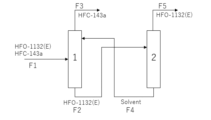
- FIG. 1 is a diagram showing an overview of a process in Example 1.
- HFO-1132(E) can be efficiently purified by a production method including an extractive distillation process in which a composition containing HFC-143a and HFO-1132(E) is contacted with a solvent containing an amine to obtain a composition in which the HFC-143a content has been reduced from the composition.
- a numerical range expressed using “ ⁇ ” means a range that includes the numerical values written before and after " ⁇ " as the lower and upper limits (i.e., "greater than or equal to”/"less than or equal to”).
- an azeotropic composition means a composition in which there is no difference in composition between the liquid phase and the gas phase at a constant pressure and which behaves as if it were a single substance.
- an azeotrope-like composition means a composition that can form an azeotropic composition, has a composition that is close to the azeotropic composition, and behaves similarly to an azeotropic composition.
- An azeotrope-like composition can be distilled and/or refluxed with almost no change in composition. Therefore, an azeotrope-like composition can be handled almost the same as an azeotropic composition.
- One characteristic of an azeotrope-like composition is that the difference in pressure between the boiling point curve and the dew point curve in a pressure-composition diagram is within 5%.
- the standard boiling point means the boiling point at a standard atmospheric pressure of 1013.25 hPa.
- gauge pressure refers to relative pressure based on atmospheric pressure, and means the pressure difference obtained by subtracting atmospheric pressure from absolute pressure.
- gauge pressure is expressed with the letter "G", for example, MPaG.
- G for example, MPaG.
- G when “G” is not added, it means atmospheric pressure.
- the "purity" of a refrigerant refers to the component ratio (mol % or mass %) determined by quantitative analysis using gas chromatography.
- main component refers to a component that is preferably contained in an amount of 85 mol% to 99.9 mol%, more preferably 90 mol% to 99.9 mol%, even more preferably 95 mol% to 99.9 mol%, and particularly preferably 99 mol% to 99.9 mol%.
- extractive distillation refers to a distillation operation in which an extracting solvent is added to a mixture of two or three components with very close standard boiling points and a relative volatility (relative volatility) close to 1, or a mixture of a combination with an azeotropic composition, to prepare an extraction mixture, and by making the relative volatility of the original two or three components farther away from 1, separation by distillation becomes easier. Note that if the relative volatility is 1, separation by distillation becomes impossible.
- the relative volatility ( ⁇ ) refers to a composition containing at least a component A and a component B of interest that is in a gas-liquid equilibrium state.
- component A is HFC-143a and component B is HFO-1132(E)
- the relative volatility of component A to component B that is, the "relative volatility of HFC-143a to HFO-1132(E)" is expressed as ⁇ 143a ⁇ 1132(E) .
- the process of the present disclosure is a process for producing purified HFO-1132(E), comprising the steps of:
- the method includes an extractive distillation step of contacting a composition containing HFC-143a and HFO-1132(E) with a solvent containing an amine to obtain a composition having reduced HFC-143a from the composition.
- the composition containing HFC-143a and HFO-1132(E) also referred to as "composition for extractive distillation”
- composition for extractive distillation is an azeotropic composition or an azeotrope-like composition.
- the extractive distillation step in the production method of the present disclosure is a step of contacting a composition (composition for extractive distillation) containing HFC-143a and HFO-1132(E) with a solvent containing an amine to obtain a composition in which the HFC-143a content has been reduced from the composition.
- the extractive distillation step is a step of extractively distilling a composition (composition for extractive distillation) containing HFC-143a and HFO-1132(E) in the presence of a solvent containing an amine to obtain a composition in which the HFC-143a content has been reduced from the composition.
- "reduction" in the extractive distillation step means reducing the content ratio of a specific compound (HFC-143a) in the composition for extractive distillation.
- composition for extractive distillation contains HFC-143a and HFO-1132(E) in a total concentration of preferably 99.5% by mass or more, more preferably 99.7% by mass or more, even more preferably 99.8% by mass or more, and even more preferably 99.9% by mass or more.
- composition for extractive distillation for example, in the production process of HFO-1132(E), after removing easily separable by-products through a prior separation step (any distillation step, etc.) as necessary, a composition containing HFC-143a and HFO-1132(E) preferably in the total concentration described above (particularly an azeotropic composition or azeotrope-like composition) can be applied.
- the extractive distillation composition preferably consists of only HFO-1132(E) and HFC-143a, but it is acceptable for the extractive distillation composition to contain unavoidable impurities due to the conditions of the preparation process.
- HFC-143a standard boiling point: -47.2°C
- HFO-1132(E) standard boiling point: -53.0°C
- the composition of the extractive distillation composition supplied to the extractive distillation step is preferably 80% or more and 99.999% or less, more preferably 90% or more and 99.999% or less, in terms of the molar ratio of HFO-1132(E).
- the extractive distillation step is preferably a step of obtaining a composition containing HFO-1132(E) and substantially not containing HFC-143a by contacting the extractive distillation composition with an amine-containing solvent and subjecting it to extractive distillation.
- substantially free of HFC-143a means that the content of HFC-143a in the composition obtained in the above extractive distillation process is preferably less than 1% by mass, more preferably less than 0.5% by mass, and particularly preferably less than 0.1% by mass.
- an amine-containing solvent is used as the extraction solvent.
- the amine may be any liquid amine that can be used as an extractant, and may be any amine represented by the general formula: NR 1 R 2 R 3 [In the formula, R 1 , R 2 and R 3 are the same or different and each represents hydrogen or a hydrocarbon group having 1 to 3 carbon atoms which may have a substituent, except for the case where R 1 , R 2 and R 3 are all hydrogen.] It is preferable that the amine-containing solvent in the present disclosure is composed of only an amine (single amine or an amine mixture), but it is acceptable for it to contain unavoidable impurities to the extent that they do not affect the extractive distillation process.
- the term "amine-containing solvent” essentially means an amine, and is also simply referred to as "extraction solvent.”
- the amine preferably has a normal boiling point of -10 to 160°C.
- the amine is preferably at least one selected from the group consisting of monomethylamine, dimethylamine, trimethylamine, monoethylamine, diethylamine, triethylamine, mono-n-propylamine, di-n-propylamine, tri-n-propylamine, mono-isopropylamine, and di-isopropylamine.
- the Cas No. and normal boiling points of these amines are shown in Table 1 below.
- amines can be used alone or in combination of two or more.
- the temperature difference between the extractive solvent and the compounds to be separated in the extractive distillation process should be sufficient to allow separation by simple distillation, stripping, etc., usually a temperature difference of 20°C or more.
- the standard boiling point of the extractive solvent is preferably 30 to 135°C, more preferably 35 to 120°C, even more preferably 40 to 100°C, and particularly preferably 50 to 90°C.
- the amount of the extraction solvent used in the above extractive distillation step is preferably 1 to 30 molar equivalents relative to the extractive distillation composition supplied to the extractive distillation column, and more preferably 5 to 25 molar equivalents.
- the concentration of HFC-143a in the composition for extractive distillation in the above extractive distillation process is preferably 15 mol% or less, more preferably 10 mol% or less.
- the lower limit of the concentration of HFC-143a in the composition for extractive distillation in the above extractive distillation process is preferably 0.001 mol% or more, more preferably 0.01 mol% or more, and even more preferably 0.1 mol% or more.
- the number of theoretical plates of the extractive distillation tower used in the above extractive distillation step is preferably 10 or more, more preferably 20 or more. From an economical point of view, the number of theoretical plates of the extractive distillation tower used in the above extractive distillation step is preferably 60 or less, more preferably 50 or less.
- the extractive solvent used in the above extractive distillation step is the extractive solvent recovered and recycled in the extractive solvent recovery step described below.
- the pressure at which the extractive distillation is carried out is preferably 0.05 to 5 MPaG (gauge pressure).
- the lower limit of the pressure is preferably 0.05 MPaG, more preferably 0.1 MPaG, even more preferably 0.25 MPaG, and particularly preferably 0.5 MPaG.
- the upper limit of the pressure is preferably 5 MPaG, more preferably 4 MPaG, even more preferably 3 MPaG, and particularly preferably 2 MPaG.
- the above extractive distillation process can be carried out as a discontinuous operation or a continuous operation, and from an industrial point of view, it is preferable to carry out the process as a continuous operation. Furthermore, by repeating the extractive distillation, the distillate components can be highly purified.
- an extractive solvent that, when added, results in a relative volatility (specific volatility) of HFC-143a to HFO-1132(E) of 1.1 or more, preferably 1.2 or more. This increases the vapor phase molar fraction of HFC-143a, increasing the amount of HFC-143a in the vapor phase, making it possible to separate HFC-143a from the top of the extractive distillation column, and the extractive solvent and HFO-1132(E) are obtained from the bottom of the extractive distillation column.
- the production method of the present disclosure preferably includes an extractive solvent recovery step of recovering the extractive solvent used in the extractive distillation step and recycling the recovered extractive solvent to the extractive distillation step.
- the extraction solvent recovery process includes a distillation process (hereinafter also referred to as the "distillation process") in which the composition obtained in the extractive distillation process is distilled to separate the composition containing HFO-1132(E) as a main component and a composition containing the extraction solvent as a main component, and can be carried out by recovering the extraction solvent from the composition containing the extraction solvent as a main component and recycling it to the extractive distillation process.
- a distillation process hereinafter also referred to as the "distillation process” in which the composition obtained in the extractive distillation process is distilled to separate the composition containing HFO-1132(E) as a main component and a composition containing the extraction solvent as a main component, and can be carried out by recovering the extraction solvent from the composition containing the extraction solvent as a main component and recycling it to the extractive distillation process.
- the number of theoretical plates of the solvent recovery tower (second distillation tower) used in the above distillation process is preferably 5 or more, more preferably 10 or more. From an economical point of view, the number of theoretical plates of the solvent recovery tower is preferably 40 or less, more preferably 30 or less.
- the pressure at which the distillation is carried out is preferably 0.05 to 3 MPaG (gauge pressure).
- the lower limit of the pressure is preferably 0.05 MPaG, more preferably 0.1 MPaG.
- the upper limit of the pressure is preferably 3 MPaG, more preferably 2.5 MPaG.
- the above distillation process makes it possible to separate a composition containing HFO-1132(E) as a main component from the top of the solvent recovery tower, and a composition containing the extraction solvent as a main component is obtained from the bottom of the solvent recovery tower.
- the above-mentioned extraction solvent recovery step can be carried out by recovering the extraction solvent from a composition containing the extraction solvent as a main component obtained from the bottom of the tower in the above-mentioned distillation step, and recycling it to the extractive distillation step.
- the extraction solvent recovered from the bottom of the tower can also be subjected to an optional separation step such as rectification to remove impurities, if necessary, before being recycled to the extractive distillation step.
- the above distillation process can be carried out as a discontinuous or continuous operation, and from an industrial point of view, it is preferable to carry out the distillation process as a continuous operation.
- the manufacturing method disclosed herein preferably includes an extractive distillation step and an extractive solvent recovery step, and more preferably includes an optional preliminary distillation step for increasing the purity of the extractive distillation composition, an extractive distillation step, and an extractive solvent recovery step.
- compositions containing HFO-1132(E), HFC-143a, and an amine The present disclosure encompasses a composition (hereinafter also referred to as "Refrigerant 1") that contains trans-1,2-difluoroethylene (HFO-1132(E)), 1,1,1-trifluoroethane (HFC-143a), and an amine.
- Refrigerant 1 a composition that contains trans-1,2-difluoroethylene (HFO-1132(E)), 1,1,1-trifluoroethane (HFC-143a), and an amine.
- the type of amine is the same as that described above in the section on the extraction solvent.
- Refrigerant 1 is a composition containing HFO-1132(E), HFC-143a, and an amine, the total concentration of the three components being 99.5% by mass or more relative to the entire composition, the content of the HFC-143a being more than 0% by mass and not more than 0.4% by mass relative to the entire composition, and the content of the amine being more than 0% by mass and not more than 0.1% by mass relative to the entire composition.
- the expression "more than 0% by mass” can also be expressed as 0.01% by mass or more.
- the total concentration of the three components in refrigerant 1 is preferably 99.7% by mass or more, more preferably 99.8% by mass or more, and even more preferably 99.9% by mass or more, based on the total composition.
- Refrigerant 1 consists only of HFO-1132(E), HFC-143a, and amines, but it is acceptable for unavoidable impurities to be present.
- refrigerant 1 is not limited, but it can be used, for example, as an air conditioning refrigerant, a heat transfer medium, a refrigerant for car air conditioners, etc.
- compositions containing purified HFO-1132(E) The present disclosure encompasses, as a composition containing purified HFO-1132(E), a composition containing HFO-1132(E) and an amine (hereinafter also referred to as "Composition 1").
- the type of amine is the same as that described in the section on the extraction solvent.
- Composition 1 is a composition containing HFO-1132(E) and an amine, in which the total concentration of the two components is 99.5 mass% or more relative to the entire composition, and the content of the amine is greater than 0 mass% and less than 0.1 mass% relative to the entire composition.
- composition 1 is a composition containing purified HFO-1132(E) finally obtained in the manufacturing method disclosed herein, in which a trace amount of the extraction solvent (amine) remains. Note that the expression “greater than 0 mass%” can also be expressed as "0.01 mass% or more.”
- the total concentration of the two components in composition 1 is preferably 99.7% by mass or more, more preferably 99.8% by mass or more, and even more preferably 99.9% by mass or more, based on composition 1.
- Composition 1 consists only of HFO-1132(E) and amines, but the inclusion of unavoidable impurities is acceptable.
- Composition 1 is not limited, but it can be used, for example, as a leak detector, stabilizer, tracer, etc. when using refrigerants.
- the concentrations of each component such as HFO-1132(E) were measured using the following measuring device and under the following conditions.
- Example 1 monomethylamine was used as the solvent, and the relative volatility ⁇ 143a ⁇ 1132(E) was 1.7.
- Example 2 monoethylamine was used as the solvent, and the relative volatility ⁇ 143a ⁇ 1132(E) was 1.8.
- Example 3 mono-n-propylamine was used as the solvent, and the relative volatility ⁇ 143a ⁇ 1132(E) was 1.6.
- Example 4 mono-isopropylamine was used as the solvent, and the relative volatility ⁇ 143a ⁇ 1132(E) was 1.7.
- Comparative Example 1 methanol was used as the solvent, and the relative volatility ⁇ 143a ⁇ 1132(E) was 1.1.
- Comparative Example 2 diethyl ether was used as the solvent, and the relative volatility ⁇ 143a ⁇ 1132(E) was 1.2.
- Comparative Example 3 n-hexane was used as the solvent, and the relative volatility ⁇ 143a ⁇ 1132(E) was 1.1.
- Comparative Example 4 methyl isobutyl ketone (MIBK) was used as the solvent, and the relative volatility ⁇ 143a ⁇ 1132(E) was 1.2.
- MIBK methyl isobutyl ketone
- acetonitrile was used as the solvent, and the relative volatility ⁇ 143a ⁇ 1132(E) was 1.1.
- Comparative Example 6 ethyl acetate was used as the solvent, and the relative volatility ⁇ 143a ⁇ 1132(E) was 1.2.
- Example 5 According to the flow diagram shown in FIG. 1, a purified HFO-1132(E) was produced by a process consisting of an extractive distillation step and an extractive solvent recovery step, using a composition for extractive distillation containing HFO-1132(E) and HFC-143a as a raw material and mono-isopropylamine as an extractive solvent.
- the extractive distillation composition was fed to an extractive distillation column having a theoretical number of 50 plates at a flow rate of 9.8 mol/hr from the 15th plate from the top of the column.
- the extractive solvent (mono-isopropylamine) was fed to the extractive distillation column at a flow rate of 206 mol/hr from the 4th plate.
- the operating pressure of the extractive distillation column was 0.45 MPaG, and the top temperature was -12°C.
- Extractive solvent recovery process The bottoms withdrawn from the column bottom in the extractive distillation step were fed to an extractive solvent recovery column (hereinafter referred to as the "solvent recovery column") having 30 theoretical plates at the 15th plate from the top, and HFO-1132(E) product was recovered from the top with a purity of 99.99%.
- the operating pressure of the solvent recovery column was 0.6 MPaG, and the column top temperature was -5°C.
- Example 5 The mass balance for Example 5 according to the process of Figure 1 was: F1 - 9.4 mol/hr HFO-1132(E), 0.4 mol/hr HFC-143a, 0 mol/hr mono-isopropylamine; F2 - 9.5 mol/hr HFO-1132(E), 6x10⁻⁵ mol/hr HFC-143a, 206.0 mol/hr mono-isopropylamine; F3 - 2x10⁻⁵ mol/hr HFO-1132(E), 0.4 mol/hr HFC-143a, 2x10⁻⁶ mol/hr mono-isopropylamine.
- the amine-containing solvents shown in Examples 1 to 4 all have a relative volatility ⁇ 143a ⁇ 1132(E) of HFC-143a to HFO-1132(E) of 1.6 to 1.8, which is sufficiently larger than that of each of the comparative examples (1.2 or less), and the HFC-143a concentration in the gas phase is 50% or higher, indicating a significant improvement in separation efficiency. Therefore, in the separation of HFC-143a and HFO-1132(E), the process of the present invention using an amine-containing solvent for extractive distillation is very effective.
Landscapes
- Chemical & Material Sciences (AREA)
- Organic Chemistry (AREA)
- Organic Low-Molecular-Weight Compounds And Preparation Thereof (AREA)
Abstract
Description
項1.1,1,1-トリフルオロエタン(HFC-143a)と、トランス-1,2-ジフルオロエチレン(HFO-1132(E))とを含む組成物をアミンを含む溶媒と接触させ、前記組成物から前記HFC-143aが低減された組成物を得る抽出蒸留工程を含む、精製されたHFO-1132(E)の製造方法。
項2.前記抽出蒸留工程で得られた組成物を蒸留して、前記HFO-1132(E)を主成分として含む組成物と、前記アミンを含む溶媒を主成分として含む組成物とに分離する蒸留工程を更に含む、上記項1に記載の製造方法。
項3.前記抽出蒸留工程を行う第1の蒸留塔を使用した前記抽出蒸留工程を0.05~5MPaG(ゲージ圧)の圧力下で行う、上記項1又は2に記載の製造方法。
項4.前記蒸留工程を行う第2の蒸留塔を使用した前記蒸留工程を0.05~3MPaG(ゲージ圧)の圧力下で行う、上記項2又は3に記載の製造方法。
項5.前記抽出蒸留工程で使用した前記アミンを含む溶媒を回収し、回収した前記アミンを含む溶媒を前記抽出蒸留工程に再循環させる溶媒回収工程を更に含む、上記項1~4のいずれかに記載の製造方法。
項6.前記アミンは、一般式:NR1R2R3
〔式中、R1、R2及びR3は、同一又は異なって水素又は置換基を有していてもよい炭素数1~3の炭化水素基を示す。但し、R1、R2及びR3が全て水素である場合を除く。〕
で表される、上記項1~5のいずれかに記載の製造方法。
項7.前記アミンが、-10~160℃の標準沸点を有する、上記項1~6のいずれかに記載の製造方法。
項8.前記アミンが、モノメチルアミン、ジメチルアミン、トリメチルアミン、モノエチルアミン、ジエチルアミン、トリエチルアミン、モノ-n-プロピルアミン、ジ-n-プロピルアミン、トリ-n-プロピルアミン、モノ-イソプロピルアミン、及びジ-イソプロピルアミンからなる群より選択される少なくとも1種である、上記項1~7のいずれかに記載の製造方法。
項9.前記抽出蒸留工程で得られた組成物を蒸留して、前記HFO-1132(E)を主成分として含む組成物と、前記アミンを含む溶媒を主成分として含む組成物とに分離する蒸留工程を更に含み、
前記抽出蒸留工程を行う第1の蒸留塔を使用した前記抽出蒸留工程を0.05~5MPaG(ゲージ圧)の圧力下で行い、
前記蒸留工程を行う第2の蒸留塔を使用した前記蒸留工程を0.05~3MPaG(ゲージ圧)の圧力下で行い、
前記抽出蒸留工程で使用した前記アミンを含む溶媒を回収し、回収した前記アミンを含む溶媒を前記抽出蒸留工程に再循環させる溶媒回収工程を更に含み、
前記アミンが、モノメチルアミン、ジメチルアミン、トリメチルアミン、モノエチルアミン、ジエチルアミン、トリエチルアミン、モノ-n-プロピルアミン、ジ-n-プロピルアミン、トリ-n-プロピルアミン、モノ-イソプロピルアミン、及びジ-イソプロピルアミンからなる群より選択される少なくとも1種である、上記項1に記載の製造方法。
項10.トランス-1,2-ジフルオロエチレン(HFO-1132(E))と、1,1,1-トリフルオロエタン(HFC-143a)と、アミンとを含有する組成物であって、該三成分の総濃度が前記組成物全体に対して99.5質量%以上であり、且つ前記HFC143aの含有量が前記組成物全体に対して0質量%超過0.4質量%以下であり、前記アミンの含有量が前記組成物全体に対して0質量%超過0.1質量%以下である組成物。
項11.トランス-1,2-ジフルオロエチレン(HFO-1132(E))と、アミンとを含有する組成物であって、該二成分の総濃度が前記組成物全体に対して99.5質量%以上であり、且つ前記アミンの含有量が前記組成物全体に対して0質量%超過0.1質量%以下である組成物。
αA→B=(yA /xA )/(yB /xB )
と定義される。
HFC-143aと、HFO-1132(E)とを含む組成物をアミンを含む溶媒と接触させ、前記組成物から前記HFC-143aが低減された組成物を得る抽出蒸留工程を有する。この中でも特に、HFC-143aと、HFO-1132(E)とを含む組成物(「抽出蒸留用組成物」ともいう)が共沸組成物又は共沸様組成物である場合に本開示の製造方法を適用することが好ましい。
本開示の製造方法における抽出蒸留工程は、HFC-143aと、HFO-1132(E)とを含む組成物(抽出蒸留用組成物)をアミンを含む溶媒と接触させ、前記組成物から前記HFC-143aが低減された組成物を得る工程である。言い換えれば、上記抽出蒸留工程は、アミンを含む溶媒の存在下、HFC-143aと、HFO-1132(E)とを含む組成物(抽出蒸留用組成物)を抽出蒸留して、前記組成物からHFC-143aが低減された組成物を得る工程である。なお、本開示において、抽出蒸留工程における「低減」とは、抽出蒸留用組成物中の特定化合物(HFC-143a)の含有割合を減少させることを意味する。
〔式中、R1、R2及びR3は、同一又は異なって水素又は置換基を有していてもよい炭素数1~3の炭化水素基を示す。但し、R1、R2及びR3が全て水素である場合を除く。〕
で表されるであることが好ましい。本開示におけるアミンを含む溶媒は、アミン(単独又はアミン混合物)のみからなることが好ましいが、抽出蒸留工程に影響しない範囲で不可避的不純物が含有されていることは許容される。以下、「アミンを含む溶媒」は実質的にアミンを意味し、単に「抽出溶媒」ともいう。

本開示の製造方法は、上記抽出蒸留工程で使用した抽出溶媒を回収し、回収した抽出溶媒を上記抽出蒸留工程に再循環させる抽出溶媒回収工程を有することが好ましい。
本開示は、トランス-1,2-ジフルオロエチレン(HFO-1132(E))と、1,1,1-トリフルオロエタン(HFC-143a)と、アミンとを含む組成物(以下「冷媒1」ともいう)を包含する。なお、アミンの種類は、前記抽出溶媒の項目で説明した内容と同じである。
本開示は、精製されたHFO-1132(E)を含有する組成物として、HFO-1132(E)と、アミンとを含有する組成物(以下、「組成物1」ともいう)を包含する。なお、アミンの種類は、前記抽出溶媒の項目で説明した内容と同じである。
各成分の濃度の計算方法:
・HFO-1132(E)の濃度=HFO-1132(E)のモル数/(HFO-1132(E)のモル数+HFC-143aのモル数)
・HFC-143aの濃度=HFC-143aのモル数/(HFO-1132(E)のモル数+HFC-143aのモル数)
HFO-1132(E)を80mol%と、HFC-143aを20mol%とを含む組成物に対して、各溶媒を前記組成物に対して5倍mol追加し、15℃におけるHFC-143aのHFO-1132(E)に対する比揮発度α143a→1132(E)を測定した。
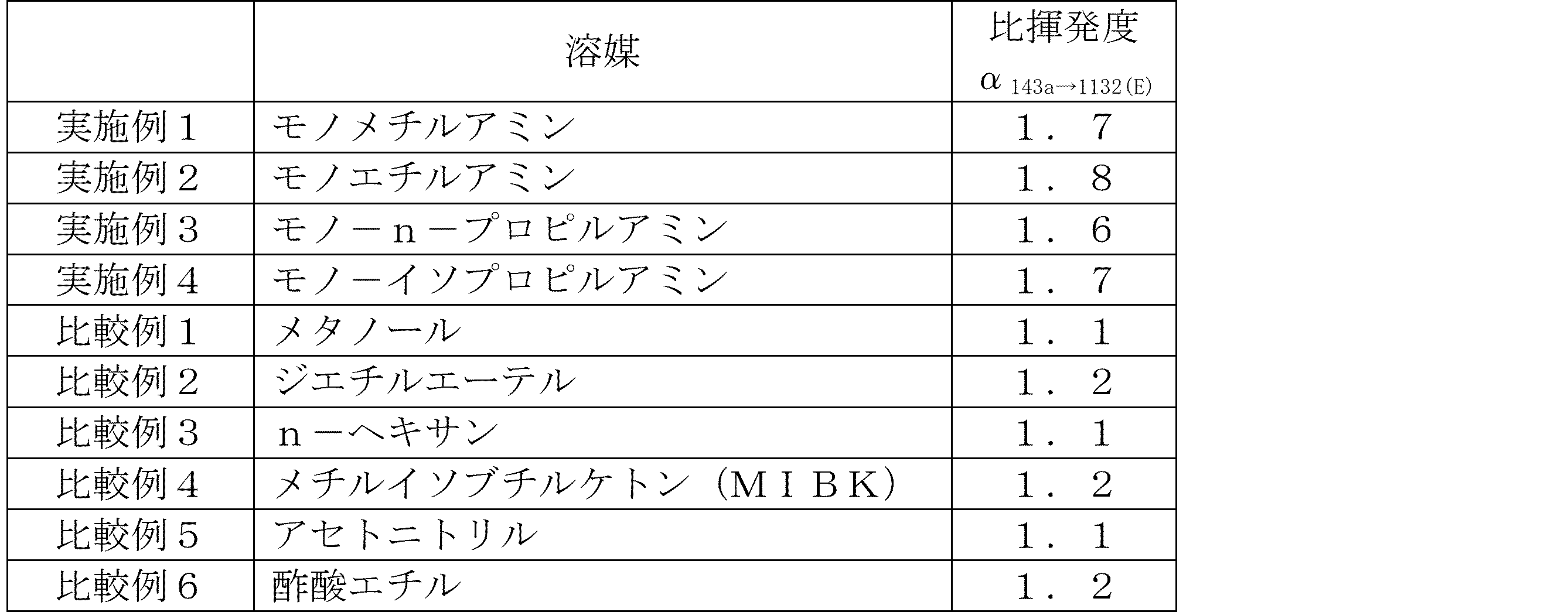
図1に示すフロー図に従い、HFO-1132(E)とHFC-143aとを含む抽出蒸留用組成物を原料とし、抽出溶媒としてモノ-イソプロピルアミンを使用し、抽出蒸留工程と抽出溶媒回収工程とからなるプロセスにより、精製されたHFO-1132(E)を製造した。
抽出蒸留用組成物を、50段の理論段数を持つ抽出蒸留塔の塔頂から15段目より、9.8mol/hrの流量で抽出蒸留塔に供給した。抽出溶媒(モノ-イソプロピルアミン)は抽出蒸留塔の4段目から206mol/hrの流量で供給した。抽出蒸留塔の運転圧力は0.45MPaG、塔頂温度は-12℃であった。
抽出蒸留工程において塔底より抜き出した缶出液を、30段の理論段数を持つ抽出溶媒回収塔(以下、「溶媒回収塔」と称する)の塔頂から15段目よりフィードし、塔頂よりHFO-1132(E)の製品を99.99%の純度で回収した。溶媒回収塔の運転圧力は0.6MPaG、塔頂温度は-5℃であった。

2.溶媒回収塔
Claims (11)
- 1,1,1-トリフルオロエタン(HFC-143a)と、トランス-1,2-ジフルオロエチレン(HFO-1132(E))とを含む組成物をアミンを含む溶媒と接触させ、前記組成物から前記HFC-143aが低減された組成物を得る抽出蒸留工程を含む、精製されたHFO-1132(E)の製造方法。
- 前記抽出蒸留工程で得られた組成物を蒸留して、前記HFO-1132(E)を主成分として含む組成物と、前記アミンを含む溶媒を主成分として含む組成物とに分離する蒸留工程を更に含む、請求項1に記載の製造方法。
- 前記抽出蒸留工程を行う第1の蒸留塔を使用した前記抽出蒸留工程を0.05~5MPaG(ゲージ圧)の圧力下で行う、請求項1に記載の製造方法。
- 前記蒸留工程を行う第2の蒸留塔を使用した前記蒸留工程を0.05~3MPaG(ゲージ圧)の圧力下で行う、請求項2に記載の製造方法。
- 前記抽出蒸留工程で使用した前記アミンを含む溶媒を回収し、回収した前記アミンを含む溶媒を前記抽出蒸留工程に再循環させる溶媒回収工程を更に含む、請求項1に記載の製造方法。
- 前記アミンは、一般式:NR1R2R3
〔式中、R1、R2及びR3は、同一又は異なって水素又は置換基を有していてもよい炭素数1~3の炭化水素基を示す。但し、R1、R2及びR3が全て水素である場合を除く。〕
で表される、請求項1に記載の製造方法。 - 前記アミンが、-10~160℃の標準沸点を有する、請求項1に記載の製造方法。
- 前記アミンが、モノメチルアミン、ジメチルアミン、トリメチルアミン、モノエチルアミン、ジエチルアミン、トリエチルアミン、モノ-n-プロピルアミン、ジ-n-プロピルアミン、トリ-n-プロピルアミン、モノ-イソプロピルアミン、及びジ-イソプロピルアミンからなる群より選択される少なくとも1種である、請求項1に記載の製造方法。
- 前記抽出蒸留工程で得られた組成物を蒸留して、前記HFO-1132(E)を主成分として含む組成物と、前記アミンを含む溶媒を主成分として含む組成物とに分離する蒸留工程を更に含み、
前記抽出蒸留工程を行う第1の蒸留塔を使用した前記抽出蒸留工程を0.05~5MPaG(ゲージ圧)の圧力下で行い、
前記蒸留工程を行う第2の蒸留塔を使用した前記蒸留工程を0.05~3MPaG(ゲージ圧)の圧力下で行い、
前記抽出蒸留工程で使用した前記アミンを含む溶媒を回収し、回収した前記アミンを含む溶媒を前記抽出蒸留工程に再循環させる溶媒回収工程を更に含み、
前記アミンが、モノメチルアミン、ジメチルアミン、トリメチルアミン、モノエチルアミン、ジエチルアミン、トリエチルアミン、モノ-n-プロピルアミン、ジ-n-プロピルアミン、トリ-n-プロピルアミン、モノ-イソプロピルアミン、及びジ-イソプロピルアミンからなる群より選択される少なくとも1種である、請求項1に記載の製造方法。 - トランス-1,2-ジフルオロエチレン(HFO-1132(E))と、1,1,1-トリフルオロエタン(HFC-143a)と、アミンとを含有する組成物であって、該三成分の総濃度が前記組成物全体に対して99.5質量%以上であり、且つ前記HFC143aの含有量が前記組成物全体に対して0質量%超過0.4質量%以下であり、前記アミンの含有量が前記組成物全体に対して0質量%超過0.1質量%以下である組成物。
- トランス-1,2-ジフルオロエチレン(HFO-1132(E))と、アミンとを含有する組成物であって、該二成分の総濃度が前記組成物全体に対して99.5質量%以上であり、且つ前記アミンの含有量が前記組成物全体に対して0質量%超過0.1質量%以下である組成物。
Priority Applications (3)
| Application Number | Priority Date | Filing Date | Title |
|---|---|---|---|
| CN202480007960.2A CN120569360A (zh) | 2023-01-23 | 2024-01-23 | 经精制的反式-1,2-二氟乙烯(hfo-1132(e))的制造方法和含有hfo-1132(e)的组合物 |
| EP24747307.7A EP4570781A4 (en) | 2023-01-23 | 2024-01-23 | PROCESS FOR THE PRODUCTION OF PURIFIED TRANS-1,2-DIFLOOROETHYLENE (HFO-1132(E)) AND COMPOSITION CONTAINING HFO-1132(E) |
| US19/266,451 US20250340499A1 (en) | 2023-01-23 | 2025-07-11 | Method for producing purified trans-1,2-difluoroethylene (hfo-1132(e)) and composition containing hfo-1132(e) |
Applications Claiming Priority (2)
| Application Number | Priority Date | Filing Date | Title |
|---|---|---|---|
| JP2023-008172 | 2023-01-23 | ||
| JP2023008172A JP7598043B2 (ja) | 2023-01-23 | 2023-01-23 | 精製されたトランス-1,2-ジフルオロエチレン(hfo-1132(e))の製造方法、及びhfo-1132(e)を含有する組成物 |
Related Child Applications (1)
| Application Number | Title | Priority Date | Filing Date |
|---|---|---|---|
| US19/266,451 Continuation US20250340499A1 (en) | 2023-01-23 | 2025-07-11 | Method for producing purified trans-1,2-difluoroethylene (hfo-1132(e)) and composition containing hfo-1132(e) |
Publications (1)
| Publication Number | Publication Date |
|---|---|
| WO2024157980A1 true WO2024157980A1 (ja) | 2024-08-02 |
Family
ID=91970606
Family Applications (1)
| Application Number | Title | Priority Date | Filing Date |
|---|---|---|---|
| PCT/JP2024/001869 Ceased WO2024157980A1 (ja) | 2023-01-23 | 2024-01-23 | 精製されたトランス-1,2-ジフルオロエチレン(hfo-1132(e))の製造方法、及びhfo-1132(e)を含有する組成物 |
Country Status (5)
| Country | Link |
|---|---|
| US (1) | US20250340499A1 (ja) |
| EP (1) | EP4570781A4 (ja) |
| JP (1) | JP7598043B2 (ja) |
| CN (1) | CN120569360A (ja) |
| WO (1) | WO2024157980A1 (ja) |
Cited By (1)
| Publication number | Priority date | Publication date | Assignee | Title |
|---|---|---|---|---|
| WO2026072526A3 (en) * | 2024-09-24 | 2026-05-07 | The Chemours Company Fc, Llc | Preparation of high purity e-1,2-difluoroethylene |
Citations (6)
| Publication number | Priority date | Publication date | Assignee | Title |
|---|---|---|---|---|
| WO2015072305A1 (ja) * | 2013-11-14 | 2015-05-21 | 旭硝子株式会社 | フッ化ビニリデンとトリフルオロメタンの分離方法、およびフッ化ビニリデンの製造方法 |
| WO2016080283A1 (ja) * | 2014-11-17 | 2016-05-26 | ダイキン工業株式会社 | HFC-245cbと(E)-HFO-1234zeとを含有する組成物から両化合物を分離する方法 |
| JP2016130236A (ja) * | 2015-01-07 | 2016-07-21 | 旭硝子株式会社 | 共沸様組成物および精製された含フッ素化合物の製造方法 |
| JP2020111742A (ja) * | 2019-01-11 | 2020-07-27 | ダイキン工業株式会社 | トランス−1,2−ジフルオロエチレンを含む組成物 |
| JP2020128531A (ja) * | 2019-02-07 | 2020-08-27 | ダイキン工業株式会社 | トランス−1,2−ジフルオロエチレン(HFO−1132(E))と1,1,1−トリフルオロエタン(HFC−143a)とを含む組成物、並びにHFO−1132(E)とHFC−143aとを含む組成物から、HFO−1132(E)及びHFC−143aを分離する方法 |
| WO2021261189A1 (ja) * | 2020-06-22 | 2021-12-30 | ダイキン工業株式会社 | 精製されたトランス-1,2-ジフルオロエチレン(hfo-1132(e))及び/又は1,1,2-トリフルオロエチレン(hfo-1123)の製造方法 |
Family Cites Families (3)
| Publication number | Priority date | Publication date | Assignee | Title |
|---|---|---|---|---|
| FR3046159B1 (fr) * | 2015-12-23 | 2019-12-13 | Arkema France | Procede de preparation du 2,3,3,3-tetrafluoropropene et recyclage du 1,1,1,2,2-pentafluoropropane exempt d'impuretes. |
| WO2020158668A1 (ja) * | 2019-01-28 | 2020-08-06 | ダイキン工業株式会社 | 1,2-ジフルオロエチレン又は1,1,2-トリフルオロエチレンと、フッ化水素とを含む共沸様組成物 |
| JP7444719B2 (ja) * | 2020-07-10 | 2024-03-06 | ダイキン工業株式会社 | 2-クロロ-1,1-ジフルオロエタン(hcfc-142)、1,1,2-トリフルオロエタン(hfc-143)、及び(e)-1,2-ジフルオロエチレン(hfo-1132(e))及び/又は(z)-1,2-ジフルオロエチレン(hfo-1132(z))の製造方法 |
-
2023
- 2023-01-23 JP JP2023008172A patent/JP7598043B2/ja active Active
-
2024
- 2024-01-23 CN CN202480007960.2A patent/CN120569360A/zh active Pending
- 2024-01-23 EP EP24747307.7A patent/EP4570781A4/en active Pending
- 2024-01-23 WO PCT/JP2024/001869 patent/WO2024157980A1/ja not_active Ceased
-
2025
- 2025-07-11 US US19/266,451 patent/US20250340499A1/en active Pending
Patent Citations (6)
| Publication number | Priority date | Publication date | Assignee | Title |
|---|---|---|---|---|
| WO2015072305A1 (ja) * | 2013-11-14 | 2015-05-21 | 旭硝子株式会社 | フッ化ビニリデンとトリフルオロメタンの分離方法、およびフッ化ビニリデンの製造方法 |
| WO2016080283A1 (ja) * | 2014-11-17 | 2016-05-26 | ダイキン工業株式会社 | HFC-245cbと(E)-HFO-1234zeとを含有する組成物から両化合物を分離する方法 |
| JP2016130236A (ja) * | 2015-01-07 | 2016-07-21 | 旭硝子株式会社 | 共沸様組成物および精製された含フッ素化合物の製造方法 |
| JP2020111742A (ja) * | 2019-01-11 | 2020-07-27 | ダイキン工業株式会社 | トランス−1,2−ジフルオロエチレンを含む組成物 |
| JP2020128531A (ja) * | 2019-02-07 | 2020-08-27 | ダイキン工業株式会社 | トランス−1,2−ジフルオロエチレン(HFO−1132(E))と1,1,1−トリフルオロエタン(HFC−143a)とを含む組成物、並びにHFO−1132(E)とHFC−143aとを含む組成物から、HFO−1132(E)及びHFC−143aを分離する方法 |
| WO2021261189A1 (ja) * | 2020-06-22 | 2021-12-30 | ダイキン工業株式会社 | 精製されたトランス-1,2-ジフルオロエチレン(hfo-1132(e))及び/又は1,1,2-トリフルオロエチレン(hfo-1123)の製造方法 |
Non-Patent Citations (1)
| Title |
|---|
| See also references of EP4570781A4 * |
Cited By (1)
| Publication number | Priority date | Publication date | Assignee | Title |
|---|---|---|---|---|
| WO2026072526A3 (en) * | 2024-09-24 | 2026-05-07 | The Chemours Company Fc, Llc | Preparation of high purity e-1,2-difluoroethylene |
Also Published As
| Publication number | Publication date |
|---|---|
| EP4570781A1 (en) | 2025-06-18 |
| US20250340499A1 (en) | 2025-11-06 |
| EP4570781A4 (en) | 2026-04-08 |
| JP7598043B2 (ja) | 2024-12-11 |
| CN120569360A (zh) | 2025-08-29 |
| JP2024104109A (ja) | 2024-08-02 |
Similar Documents
| Publication | Publication Date | Title |
|---|---|---|
| EP0626362B1 (en) | Purification process of pentafluoroethane | |
| US7371309B2 (en) | Purification of difluoromethane by extractive distillation | |
| US12036491B2 (en) | Azeotrope-like composition containing 1,2-difluoroethylene or 1,1,2-trifluoroethylene and hydrogen fluoride | |
| US20250340499A1 (en) | Method for producing purified trans-1,2-difluoroethylene (hfo-1132(e)) and composition containing hfo-1132(e) | |
| JP3262454B2 (ja) | ペンタフルオロエタンの精製方法 | |
| JP2022118110A (ja) | 精製されたトランス-1,2-ジフルオロエチレン(hfo-1132(e))及び/又は1,1,2-トリフルオロエチレン(hfo-1123)の製造方法 | |
| US4897161A (en) | Separation of vinyl acetate from ethyl acetate by extractive distillation | |
| JP5104075B2 (ja) | ペンタフルオロエタンの精製方法 | |
| JP7730055B2 (ja) | 精製された1,1,2-トリフルオロエタン(hfc-143)の製造方法、及びhfc-143を含有する組成物 | |
| JP7755176B2 (ja) | 精製されたジフルオロメタン(hfc-32)の製造方法、及びhfc-32を含有する組成物 | |
| JP3726313B2 (ja) | ペンタフルオロエタンと1,1,1−トリフルオロエタンの分離方法 | |
| EP2522652B1 (en) | Method for producing difluoroacetic acid ester | |
| EP0985650B1 (en) | Process for the preparation of pentafluoroethane | |
| JP5373259B2 (ja) | N−アルキルボラジンの製造方法 | |
| CN121605096A (zh) | 降低乙二醇中1,2-戊二醇含量的方法 | |
| MX2014011878A (es) | Proceso para separar acido monocloroacetico y acido dicloroacetico a traves de destilacion extractiva utilizando un solvente organico. | |
| WO2007117390A1 (en) | Purification of 1,2,3,3,3-pentafluoropropene by extractive distillation | |
| JP3858431B2 (ja) | ペンタフルオロエタンと1,1,1−トリフルオロエタンの分離方法 | |
| JPH09255597A (ja) | ペンタフルオロエタンの精製方法 | |
| JP2009013099A (ja) | N−アルキルボラジンの製造方法 |
Legal Events
| Date | Code | Title | Description |
|---|---|---|---|
| 121 | Ep: the epo has been informed by wipo that ep was designated in this application |
Ref document number: 24747307 Country of ref document: EP Kind code of ref document: A1 |
|
| WWE | Wipo information: entry into national phase |
Ref document number: 2024747307 Country of ref document: EP |
|
| ENP | Entry into the national phase |
Ref document number: 2024747307 Country of ref document: EP Effective date: 20250313 |
|
| WWP | Wipo information: published in national office |
Ref document number: 2024747307 Country of ref document: EP |
|
| WWE | Wipo information: entry into national phase |
Ref document number: 202480007960.2 Country of ref document: CN |
|
| WWE | Wipo information: entry into national phase |
Ref document number: 202547075160 Country of ref document: IN |
|
| NENP | Non-entry into the national phase |
Ref country code: DE |
|
| WWP | Wipo information: published in national office |
Ref document number: 202480007960.2 Country of ref document: CN |
|
| WWP | Wipo information: published in national office |
Ref document number: 202547075160 Country of ref document: IN |