WO2024162176A1 - 鋼板、部材およびそれらの製造方法 - Google Patents
鋼板、部材およびそれらの製造方法 Download PDFInfo
- Publication number
- WO2024162176A1 WO2024162176A1 PCT/JP2024/002241 JP2024002241W WO2024162176A1 WO 2024162176 A1 WO2024162176 A1 WO 2024162176A1 JP 2024002241 W JP2024002241 W JP 2024002241W WO 2024162176 A1 WO2024162176 A1 WO 2024162176A1
- Authority
- WO
- WIPO (PCT)
- Prior art keywords
- less
- temperature
- steel sheet
- content
- delayed fracture
- Prior art date
- Legal status (The legal status is an assumption and is not a legal conclusion. Google has not performed a legal analysis and makes no representation as to the accuracy of the status listed.)
- Ceased
Links
Classifications
-
- C—CHEMISTRY; METALLURGY
- C21—METALLURGY OF IRON
- C21D—MODIFYING THE PHYSICAL STRUCTURE OF FERROUS METALS; GENERAL DEVICES FOR HEAT TREATMENT OF FERROUS OR NON-FERROUS METALS OR ALLOYS; MAKING METAL MALLEABLE, e.g. BY DECARBURISATION OR TEMPERING
- C21D9/00—Heat treatment, e.g. annealing, hardening, quenching or tempering, adapted for particular articles; Furnaces therefor
- C21D9/46—Heat treatment, e.g. annealing, hardening, quenching or tempering, adapted for particular articles; Furnaces therefor for sheet metals
-
- C—CHEMISTRY; METALLURGY
- C22—METALLURGY; FERROUS OR NON-FERROUS ALLOYS; TREATMENT OF ALLOYS OR NON-FERROUS METALS
- C22C—ALLOYS
- C22C38/00—Ferrous alloys, e.g. steel alloys
-
- B—PERFORMING OPERATIONS; TRANSPORTING
- B32—LAYERED PRODUCTS
- B32B—LAYERED PRODUCTS, i.e. PRODUCTS BUILT-UP OF STRATA OF FLAT OR NON-FLAT, e.g. CELLULAR OR HONEYCOMB, FORM
- B32B15/00—Layered products comprising a layer of metal
- B32B15/01—Layered products comprising a layer of metal all layers being exclusively metallic
- B32B15/013—Layered products comprising a layer of metal all layers being exclusively metallic one layer being formed of an iron alloy or steel, another layer being formed of a metal other than iron or aluminium
-
- C—CHEMISTRY; METALLURGY
- C21—METALLURGY OF IRON
- C21D—MODIFYING THE PHYSICAL STRUCTURE OF FERROUS METALS; GENERAL DEVICES FOR HEAT TREATMENT OF FERROUS OR NON-FERROUS METALS OR ALLOYS; MAKING METAL MALLEABLE, e.g. BY DECARBURISATION OR TEMPERING
- C21D1/00—General methods or devices for heat treatment, e.g. annealing, hardening, quenching or tempering
- C21D1/18—Hardening; Quenching with or without subsequent tempering
- C21D1/25—Hardening, combined with annealing between 300 degrees Celsius and 600 degrees Celsius, i.e. heat refining ("Vergüten")
-
- C—CHEMISTRY; METALLURGY
- C21—METALLURGY OF IRON
- C21D—MODIFYING THE PHYSICAL STRUCTURE OF FERROUS METALS; GENERAL DEVICES FOR HEAT TREATMENT OF FERROUS OR NON-FERROUS METALS OR ALLOYS; MAKING METAL MALLEABLE, e.g. BY DECARBURISATION OR TEMPERING
- C21D8/00—Modifying the physical properties of ferrous metals or ferrous alloys by deformation combined with, or followed by, heat treatment
- C21D8/02—Modifying the physical properties of ferrous metals or ferrous alloys by deformation combined with, or followed by, heat treatment during manufacturing of plates or strips
- C21D8/0221—Modifying the physical properties of ferrous metals or ferrous alloys by deformation combined with, or followed by, heat treatment during manufacturing of plates or strips characterised by the working steps
- C21D8/0226—Hot rolling
-
- C—CHEMISTRY; METALLURGY
- C21—METALLURGY OF IRON
- C21D—MODIFYING THE PHYSICAL STRUCTURE OF FERROUS METALS; GENERAL DEVICES FOR HEAT TREATMENT OF FERROUS OR NON-FERROUS METALS OR ALLOYS; MAKING METAL MALLEABLE, e.g. BY DECARBURISATION OR TEMPERING
- C21D8/00—Modifying the physical properties of ferrous metals or ferrous alloys by deformation combined with, or followed by, heat treatment
- C21D8/02—Modifying the physical properties of ferrous metals or ferrous alloys by deformation combined with, or followed by, heat treatment during manufacturing of plates or strips
- C21D8/0221—Modifying the physical properties of ferrous metals or ferrous alloys by deformation combined with, or followed by, heat treatment during manufacturing of plates or strips characterised by the working steps
- C21D8/0236—Cold rolling
-
- C—CHEMISTRY; METALLURGY
- C21—METALLURGY OF IRON
- C21D—MODIFYING THE PHYSICAL STRUCTURE OF FERROUS METALS; GENERAL DEVICES FOR HEAT TREATMENT OF FERROUS OR NON-FERROUS METALS OR ALLOYS; MAKING METAL MALLEABLE, e.g. BY DECARBURISATION OR TEMPERING
- C21D8/00—Modifying the physical properties of ferrous metals or ferrous alloys by deformation combined with, or followed by, heat treatment
- C21D8/02—Modifying the physical properties of ferrous metals or ferrous alloys by deformation combined with, or followed by, heat treatment during manufacturing of plates or strips
- C21D8/0247—Modifying the physical properties of ferrous metals or ferrous alloys by deformation combined with, or followed by, heat treatment during manufacturing of plates or strips characterised by the heat treatment
- C21D8/0263—Modifying the physical properties of ferrous metals or ferrous alloys by deformation combined with, or followed by, heat treatment during manufacturing of plates or strips characterised by the heat treatment following hot rolling
-
- C—CHEMISTRY; METALLURGY
- C21—METALLURGY OF IRON
- C21D—MODIFYING THE PHYSICAL STRUCTURE OF FERROUS METALS; GENERAL DEVICES FOR HEAT TREATMENT OF FERROUS OR NON-FERROUS METALS OR ALLOYS; MAKING METAL MALLEABLE, e.g. BY DECARBURISATION OR TEMPERING
- C21D8/00—Modifying the physical properties of ferrous metals or ferrous alloys by deformation combined with, or followed by, heat treatment
- C21D8/02—Modifying the physical properties of ferrous metals or ferrous alloys by deformation combined with, or followed by, heat treatment during manufacturing of plates or strips
- C21D8/0247—Modifying the physical properties of ferrous metals or ferrous alloys by deformation combined with, or followed by, heat treatment during manufacturing of plates or strips characterised by the heat treatment
- C21D8/0273—Final recrystallisation annealing
-
- C—CHEMISTRY; METALLURGY
- C22—METALLURGY; FERROUS OR NON-FERROUS ALLOYS; TREATMENT OF ALLOYS OR NON-FERROUS METALS
- C22C—ALLOYS
- C22C38/00—Ferrous alloys, e.g. steel alloys
- C22C38/001—Ferrous alloys, e.g. steel alloys containing N
-
- C—CHEMISTRY; METALLURGY
- C22—METALLURGY; FERROUS OR NON-FERROUS ALLOYS; TREATMENT OF ALLOYS OR NON-FERROUS METALS
- C22C—ALLOYS
- C22C38/00—Ferrous alloys, e.g. steel alloys
- C22C38/002—Ferrous alloys, e.g. steel alloys containing In, Mg, or other elements not provided for in one single group C22C38/001 - C22C38/60
-
- C—CHEMISTRY; METALLURGY
- C22—METALLURGY; FERROUS OR NON-FERROUS ALLOYS; TREATMENT OF ALLOYS OR NON-FERROUS METALS
- C22C—ALLOYS
- C22C38/00—Ferrous alloys, e.g. steel alloys
- C22C38/008—Ferrous alloys, e.g. steel alloys containing tin
-
- C—CHEMISTRY; METALLURGY
- C22—METALLURGY; FERROUS OR NON-FERROUS ALLOYS; TREATMENT OF ALLOYS OR NON-FERROUS METALS
- C22C—ALLOYS
- C22C38/00—Ferrous alloys, e.g. steel alloys
- C22C38/02—Ferrous alloys, e.g. steel alloys containing silicon
-
- C—CHEMISTRY; METALLURGY
- C22—METALLURGY; FERROUS OR NON-FERROUS ALLOYS; TREATMENT OF ALLOYS OR NON-FERROUS METALS
- C22C—ALLOYS
- C22C38/00—Ferrous alloys, e.g. steel alloys
- C22C38/04—Ferrous alloys, e.g. steel alloys containing manganese
-
- C—CHEMISTRY; METALLURGY
- C22—METALLURGY; FERROUS OR NON-FERROUS ALLOYS; TREATMENT OF ALLOYS OR NON-FERROUS METALS
- C22C—ALLOYS
- C22C38/00—Ferrous alloys, e.g. steel alloys
- C22C38/06—Ferrous alloys, e.g. steel alloys containing aluminium
-
- C—CHEMISTRY; METALLURGY
- C22—METALLURGY; FERROUS OR NON-FERROUS ALLOYS; TREATMENT OF ALLOYS OR NON-FERROUS METALS
- C22C—ALLOYS
- C22C38/00—Ferrous alloys, e.g. steel alloys
- C22C38/08—Ferrous alloys, e.g. steel alloys containing nickel
-
- C—CHEMISTRY; METALLURGY
- C22—METALLURGY; FERROUS OR NON-FERROUS ALLOYS; TREATMENT OF ALLOYS OR NON-FERROUS METALS
- C22C—ALLOYS
- C22C38/00—Ferrous alloys, e.g. steel alloys
- C22C38/10—Ferrous alloys, e.g. steel alloys containing cobalt
-
- C—CHEMISTRY; METALLURGY
- C22—METALLURGY; FERROUS OR NON-FERROUS ALLOYS; TREATMENT OF ALLOYS OR NON-FERROUS METALS
- C22C—ALLOYS
- C22C38/00—Ferrous alloys, e.g. steel alloys
- C22C38/12—Ferrous alloys, e.g. steel alloys containing tungsten, tantalum, molybdenum, vanadium, or niobium
-
- C—CHEMISTRY; METALLURGY
- C22—METALLURGY; FERROUS OR NON-FERROUS ALLOYS; TREATMENT OF ALLOYS OR NON-FERROUS METALS
- C22C—ALLOYS
- C22C38/00—Ferrous alloys, e.g. steel alloys
- C22C38/14—Ferrous alloys, e.g. steel alloys containing titanium or zirconium
-
- C—CHEMISTRY; METALLURGY
- C22—METALLURGY; FERROUS OR NON-FERROUS ALLOYS; TREATMENT OF ALLOYS OR NON-FERROUS METALS
- C22C—ALLOYS
- C22C38/00—Ferrous alloys, e.g. steel alloys
- C22C38/16—Ferrous alloys, e.g. steel alloys containing copper
-
- C—CHEMISTRY; METALLURGY
- C22—METALLURGY; FERROUS OR NON-FERROUS ALLOYS; TREATMENT OF ALLOYS OR NON-FERROUS METALS
- C22C—ALLOYS
- C22C38/00—Ferrous alloys, e.g. steel alloys
- C22C38/18—Ferrous alloys, e.g. steel alloys containing chromium
- C22C38/32—Ferrous alloys, e.g. steel alloys containing chromium with boron
-
- C—CHEMISTRY; METALLURGY
- C22—METALLURGY; FERROUS OR NON-FERROUS ALLOYS; TREATMENT OF ALLOYS OR NON-FERROUS METALS
- C22C—ALLOYS
- C22C38/00—Ferrous alloys, e.g. steel alloys
- C22C38/18—Ferrous alloys, e.g. steel alloys containing chromium
- C22C38/40—Ferrous alloys, e.g. steel alloys containing chromium with nickel
- C22C38/44—Ferrous alloys, e.g. steel alloys containing chromium with nickel with molybdenum or tungsten
-
- C—CHEMISTRY; METALLURGY
- C22—METALLURGY; FERROUS OR NON-FERROUS ALLOYS; TREATMENT OF ALLOYS OR NON-FERROUS METALS
- C22C—ALLOYS
- C22C38/00—Ferrous alloys, e.g. steel alloys
- C22C38/18—Ferrous alloys, e.g. steel alloys containing chromium
- C22C38/40—Ferrous alloys, e.g. steel alloys containing chromium with nickel
- C22C38/54—Ferrous alloys, e.g. steel alloys containing chromium with nickel with boron
-
- C—CHEMISTRY; METALLURGY
- C22—METALLURGY; FERROUS OR NON-FERROUS ALLOYS; TREATMENT OF ALLOYS OR NON-FERROUS METALS
- C22C—ALLOYS
- C22C38/00—Ferrous alloys, e.g. steel alloys
- C22C38/60—Ferrous alloys, e.g. steel alloys containing lead, selenium, tellurium, or antimony, or more than 0.04% by weight of sulfur
-
- C—CHEMISTRY; METALLURGY
- C21—METALLURGY OF IRON
- C21D—MODIFYING THE PHYSICAL STRUCTURE OF FERROUS METALS; GENERAL DEVICES FOR HEAT TREATMENT OF FERROUS OR NON-FERROUS METALS OR ALLOYS; MAKING METAL MALLEABLE, e.g. BY DECARBURISATION OR TEMPERING
- C21D2211/00—Microstructure comprising significant phases
- C21D2211/001—Austenite
-
- C—CHEMISTRY; METALLURGY
- C21—METALLURGY OF IRON
- C21D—MODIFYING THE PHYSICAL STRUCTURE OF FERROUS METALS; GENERAL DEVICES FOR HEAT TREATMENT OF FERROUS OR NON-FERROUS METALS OR ALLOYS; MAKING METAL MALLEABLE, e.g. BY DECARBURISATION OR TEMPERING
- C21D2211/00—Microstructure comprising significant phases
- C21D2211/004—Dispersions; Precipitations
-
- C—CHEMISTRY; METALLURGY
- C21—METALLURGY OF IRON
- C21D—MODIFYING THE PHYSICAL STRUCTURE OF FERROUS METALS; GENERAL DEVICES FOR HEAT TREATMENT OF FERROUS OR NON-FERROUS METALS OR ALLOYS; MAKING METAL MALLEABLE, e.g. BY DECARBURISATION OR TEMPERING
- C21D2211/00—Microstructure comprising significant phases
- C21D2211/005—Ferrite
-
- C—CHEMISTRY; METALLURGY
- C21—METALLURGY OF IRON
- C21D—MODIFYING THE PHYSICAL STRUCTURE OF FERROUS METALS; GENERAL DEVICES FOR HEAT TREATMENT OF FERROUS OR NON-FERROUS METALS OR ALLOYS; MAKING METAL MALLEABLE, e.g. BY DECARBURISATION OR TEMPERING
- C21D2211/00—Microstructure comprising significant phases
- C21D2211/008—Martensite
Definitions
- the present invention relates to steel plates, such as high-strength steel plates for cold press forming, which are used in automobiles and the like after undergoing cold press forming, components using such steel plates, and methods for manufacturing them.
- Steel sheets used in these automotive frame parts are required to have excellent formability. As the strength of steel sheets increases, press forming becomes more difficult, so they are particularly required to have excellent bending formability.
- delayed fracture may occur due to increased residual stress within the parts or deterioration of the delayed fracture resistance properties of the steel plate itself.
- delayed fracture refers to a phenomenon in which, when a part is placed in a hydrogen intrusion environment while high stress is applied to the part, hydrogen penetrates into the steel plate that constitutes the part, reducing the interatomic bonding strength and causing localized deformation, resulting in microcracks, which then propagate and lead to fracture.
- Patent Document 1 describes a steel containing, in mass %, C: 0.13% to 0.40%, Si: 0.02% to 1.5%, Mn: 0.4% to 1.7%, P: 0.030%, S: 0.0002% to less than 0.0010%, sol.
- a high-strength steel plate having excellent resistance to delayed fracture, characterized in that it has a component composition containing Al: 0.01% or more and 0.20% or less, N: 0.0055% or less, O: 0.0025% or less, Nb: 0.002% or more and 0.035% or less, and Ti: 0.002% or more and 0.040% or less so as to satisfy formulas (1) and (2), with the balance being Fe and unavoidable impurities, and a steel structure in which the area ratio of martensite and bainite to the entire structure is 95% or more and 100% or less in total, the balance being composed of one or both of ferrite and retained austenite, the average grain size of prior austenite grains exceeding 5 ⁇ m, the following conditions are satisfied, and inclusion groups having a major axis length of 20 to 80 ⁇ m are present at 5 pieces/mm2 or less , and the tensile strength is 1320 MPa or more. [%Ti]+[%Nb]>0.007 (1) [%Ti]+
- Patent Document 2 also describes a steel containing, by mass%, C: 0.05 to 0.30%, Si: 2.0% or less (including 0%), Mn: more than 0.1% and 2.8% or less, P: 0.1% or less, S: 0.005% or less, N: 0.01% or less, Al: 0.01 to 0.50% or less, and one or more of Nb, Ti, and Zr, each of which is 0.01% or more in total, and [%C] - [%Nb] / 92.9 ⁇ 12 - [%
- the present invention discloses a high-strength cold-rolled steel sheet having excellent hydrogen embrittlement resistance and workability, characterized in that the steel sheet contains 50% or more (including 100%) of tempered martensite by area ratio, with the remainder being made of iron and unavoidable impurities, and has a structure with the remainder being made of ferrite, and the distribution state of precipitates in the tempered martensite is such that there are 20 or more precipitates with a circle equivalent diameter of 1 to 10 n
- the present invention has been made to solve these problems, and aims to provide steel plates, components, and methods for manufacturing the same that have a tensile strength of 1470 MPa or more (TS ⁇ 1470 MPa) and that combine excellent bending formability with excellent delayed fracture resistance.
- excellent bend formability refers to a state in which the bend formability is judged to be excellent based on the following evaluation.
- a JIS No. 3 test piece with the longitudinal direction perpendicular to the rolling direction (coil width direction) is taken from each steel plate, and a 90° V-bend test is performed by the V-block method in accordance with the provisions of JIS Z 2248 (2022) while changing the bending radius.
- the bendability is evaluated based on the value (R/t) obtained by dividing the minimum bending radius R at which a crack of 0.3 mm or more does not occur on the surface of the test piece by the plate thickness t.
- the direction of the bend ridge is parallel to the rolling direction.
- Steel plates having an R/t ratio of 3.0 or less are judged to have excellent bendability.
- excellent delayed fracture resistance means that the material is judged to have excellent delayed fracture resistance based on the following evaluation.
- a rectangular test piece is taken from the obtained steel sheet (coil) at a position 1/4 of the coil width from the widthwise end, with a dimension of 100 mm in the direction perpendicular to the rolling and 30 mm in the rolling direction.
- the end surface on the long side having a length of 100 mm is cut out by shearing, and then while in the sheared state (without performing machining to remove burrs), it is bent so that the burrs are on the outer periphery of the bend.
- the test piece is fixed with bolts while maintaining the shape of the test piece at the time of bending.
- the clearance of the shear processing is 13%, and the rake angle is 1°.
- the bending processing is performed so that the tip bending radius is 10 mm and the angle of the inner apex of the bending is 90 degrees (V-bend).
- the punch used has a tip radius equal to the tip bending radius R and is U-shaped (the tip R portion is semicircular and the punch body has a thickness of 2R), and the die used has a corner R of 30 mm.
- the depth to which the punch pushes the steel plate is adjusted to form the tip bending angle (the angle at the inner side of the bending apex) to 90 degrees (V-shape).
- the test piece is clamped and tightened with a hydraulic jack so that the distance between the flange ends of the straight pieces during bending is the same as when they were bent (so as to cancel out the opening of the straight pieces due to springback), and the bolts are fastened in this state.
- the bolts are fixed through elliptical holes (minor axis 10 mm, major axis 15 mm) that have been provided in advance 10 mm inside from the short edge of the rectangular test piece.
- the temperature of the solution is 20°C, and the amount of liquid per cm3 of the surface area of the test specimen is 20 ml. (4) After 24 hours, the presence or absence of visually observable cracks (length 1 mm or more) is confirmed. If no cracks are observed, it is determined that the delayed fracture resistance is excellent.
- the present inventors have conducted extensive research to solve the above problems and have found that delayed fracture resistance can be significantly improved by satisfying all of the following conditions: i) The area ratio of martensite is 85% or more and less than 95%. ii) The area ratio of the retained austenite to the entire structure is 5% to 15%. iii) The number density A of precipitates having an equivalent circle diameter of 500 nm or more satisfies the following condition: A (pcs/ mm2 ) ⁇ 8.5 ⁇ 105 ⁇ [B] Here, [B] represents the B content (mass %).
- the present invention has been completed through further investigation based on the above findings, and the gist of the present invention is as follows.
- C 0.15% or more and 0.45% or less
- Si 0.3% or more and 2.0% or less
- Mn 1.7% or more and 4.0% or less
- P 0.10% or less
- S 0.01% or less
- Al 0.50% or less
- N 0.010% or less
- B Contains 0.0008% or more and 0.0100% or less
- the balance is Fe and unavoidable impurities.
- the area ratio of martensite to the entire structure is 85% or more and less than 95%
- the steel has a steel structure in which the area ratio of retained austenite to the entire structure is 5% to 15%.
- [B] represents the B content (mass %).
- the component composition further includes, in mass%, Cu: 1.00% or less, Cr: 1.00% or less, Nb: 0.10% or less, Ti: 0.10% or less, V: 0.50% or less, Mo: 0.50% or less, Ni: 1.00% or less, Sb: 0.10% or less, Sn: 0.10% or less, As: 0.10% or less, Ta: 0.10% or less, Ca: 0.020% or less, Mg: 0.020% or less, Zn: 0.020% or less, Co: 0.020% or less, Zr: 0.020% or less, W: 0.020% or less, REM: 0.020% or less.
- Hot finish rolling is performed under the conditions of a residence time at 900 to 1000 ° C of 20 seconds or more and 150 seconds or less and a finish rolling temperature of 850 ° C or more, Cooling is performed at an average cooling rate of 40° C./sec or more in the range from the finish rolling temperature to 650° C., Thereafter, the hot-rolled steel sheet is obtained by coiling the steel sheet at a coiling temperature of 650°C or less.
- the hot-rolled steel sheet is cold-rolled at a rolling reduction of 40% or more to obtain a cold-rolled steel sheet;
- the annealing temperature is set to 830 to 950 ° C., and the cold-rolled steel sheet is heated from 400 ° C.
- a method for manufacturing a component comprising a step of subjecting the steel plate according to any one of [1] to [3] to at least one of forming and joining to form a component.
- the present invention provides high-strength steel plates, components, and methods for manufacturing the same that are excellent in bending formability and delayed fracture resistance.
- the steel sheet of the present invention has a composition containing, by mass%, C: 0.15% to 0.45%, Si: 0.3% to 2.0%, Mn: 1.7% to 4.0%, P: 0.10% or less, S: 0.01% or less, sol.Al: 0.50% or less, N: 0.010% or less, B: 0.0008% to 0.0100% or less, with the balance being Fe and unavoidable impurities, has a steel structure in which the area ratio of martensite to the entire structure is 85% to less than 95%, and the area ratio of retained austenite to the entire structure is 5% to 15%, and the number density A of precipitates having a circle equivalent diameter of 500 nm or more satisfies the following formula (1).
- [B] represents the B content (mass %).
- C 0.15% or more and 0.45% or less C is contained to increase the strength of martensite and obtain a tensile strength of 1470 MPa or more (hereinafter also referred to as TS ⁇ 1470 MPa). Therefore, in order to obtain a desired TS, the C content is set to 0.15% or more. From the viewpoint of reducing the weight of automotive frame parts by increasing the strength, the C content is preferably 0.20% or more, more preferably 0.25% or more. On the other hand, if C is added excessively, C is concentrated and stabilized in austenite, and residual austenite is excessively generated, deteriorating the delayed fracture resistance. Therefore, the C content is set to 0.45% or less. The C content is preferably 0.40% or less, and more preferably 0.35% or less.
- Si 0.3% or more and 2.0% or less Si suppresses the formation of cementite, and suppresses the decrease in strength and the deterioration of delayed fracture resistance. In addition, Si suppresses the formation of cementite and promotes the formation of retained austenite, thereby improving bendability. Therefore, the Si content is set to 0.3% or more. The Si content is preferably 0.5% or more. On the other hand, excessive addition of Si leads to deterioration of delayed fracture resistance due to segregation of Si. Therefore, the Si content is set to 2.0% or less. The Si content is preferably 1.8% or less, and more preferably 1.5% or less.
- Mn 1.7% or more and 4.0% or less Mn is an element effective for improving the hardenability of steel.
- the Mn content is set to 1.7% or more.
- the Mn content is preferably 2.3% or more.
- the Mn content is set to 4.0% or less, and preferably, the Mn content is set to 3.2% or less.
- P 0.10% or less P segregates at grain boundaries and reduces grain boundary strength, which leads to deterioration of delayed fracture resistance. Therefore, the P content is set to 0.10% or less.
- the P content is preferably 0.05% or less, more preferably 0.02% or less, and further preferably 0.01% or less. There is no lower limit for the P content, but the lower limit that is currently industrially feasible is 0.002%. Therefore, the P content is preferably set to 0.002% or more.
- S 0.01% or less S forms coarse inclusions with Mn, which become the starting point of delayed fracture, leading to deterioration of delayed fracture resistance. Therefore, the S content is set to 0.01% or less.
- the S content is preferably 0.003% or less, more preferably 0.0015% or less, and further preferably 0.0008% or less. There is no lower limit, but the lower limit currently industrially feasible is 0.0002%. Therefore, the S content is preferably set to 0.0002% or more.
- Sol. Al 0.50% or less Al is contained to perform sufficient deoxidation and reduce inclusions in steel. Although there is no particular lower limit for sol. Al, in order to perform stable deoxidation, it is desirable to set the sol. Al content to 0.005% or more. The sol. Al content is more preferably 0.01% or more, and further preferably 0.02% or more. On the other hand, if the sol. Al content exceeds 0.50%, the cementite generated during coiling is difficult to dissolve in the annealing process, the number density A of the precipitates cannot be set within a desired range, and the delayed fracture resistance is significantly deteriorated. Therefore, the sol. Al content is set to 0.50% or less. The sol. Al content is preferably 0.20% or less, and more preferably 0.05% or less.
- N 0.010% or less N forms precipitates such as AlN, which become the starting point of delayed fracture, leading to deterioration of delayed fracture resistance.
- N when N exceeds 0.010%, the number density A of the precipitates cannot be set within the desired range, and delayed fracture resistance is significantly deteriorated. Therefore, the N content is set to 0.010% or less.
- the N content is preferably 0.005% or less.
- the lower limit is not specified, the lower limit that is currently industrially feasible is 0.0006%. Therefore, the N content is preferably set to 0.0006% or more.
- B 0.0008% or more and 0.0100% or less B is an element that improves the hardenability of steel, and has the effect of generating a predetermined area ratio of martensite even with a small Mn content.
- B segregates at grain boundaries to increase the bonding strength of the grain boundaries and suppresses the segregation of P that reduces grain boundary strength.
- the B content is set to 0.0008% or more.
- the B content is preferably 0.0015% or more, and more preferably 0.0020% or more.
- it has been found that excessive addition of B leads to the formation of Fe 23 (C, B) 6 and BN, which become the starting point of delayed fracture, and thus rather reduces the delayed fracture resistance.
- the B content is set to 0.0100% or less.
- the B content is preferably 0.0080% or less, and more preferably 0.0060% or less.
- the composition of the steel plate in the present invention contains the above-mentioned elemental elements as the basic components, with the balance being iron (Fe) and unavoidable impurities.
- the steel plate of the present invention has a composition containing the above-mentioned basic components, with the balance being iron (Fe) and unavoidable impurities.
- Cu 1.00% or less
- Cu has the effect of improving the corrosion resistance of the steel sheet, reducing hydrogen penetration into the steel sheet, and improving delayed fracture resistance.
- the Cu content is desirably 0.01% or more.
- the Cu content is preferably 0.05% or more, and more preferably 0.10% or more.
- the Cu content is set to 1.00% or less.
- the Cu content is preferably 0.50% or less, and more preferably 0.30% or less.
- Cr 1.00% or less
- Cr is an element effective in improving the hardenability of steel. Cr can be added to stably obtain a desired structure. Although the lower limit of the Cr content is not particularly specified, in order to obtain such an effect, the Cr content is desirably 0.01% or more. The Cr content is more preferably 0.05% or more, and further preferably 0.10% or more. On the other hand, if Cr is added in excess, the dissolution of cementite during annealing is delayed, and a large amount of undissolved cementite remains, making it impossible to set the number density A of precipitates within a desired range, and the delayed fracture resistance is deteriorated. Therefore, when Cr is contained, the Cr content is set to 1.00% or less. The Cr content is preferably 0.50% or less, and more preferably 0.30% or less.
- Nb 0.10% or less Nb forms fine precipitates such as NbC in steel, and has the effect of refining the prior austenite grain size through a pinning effect, thereby improving delayed fracture resistance.
- the Nb content is desirably 0.005% or more.
- the Nb content is preferably 0.01% or more.
- the Nb content is set to 0.10% or less.
- the Nb content is preferably 0.08% or less, and more preferably 0.06% or less.
- V 0.50% or less
- V has the effect of generating fine carbides containing V that become hydrogen trapping sites, thereby improving delayed fracture resistance.
- the prior austenite grain size is refined by the pinning effect, thereby improving delayed fracture resistance.
- the V content is desirably 0.003% or more.
- the V content is preferably 0.01% or more, and more preferably 0.03% or more.
- V content is set to 0.50% or less.
- the V content is preferably 0.20% or less, more preferably 0.10% or less, and further preferably 0.06% or less.
- Mo 0.50% or less Mo has the effect of generating fine carbides containing Mo that become hydrogen trapping sites, thereby improving delayed fracture resistance.
- the prior austenite grain size is refined by the pinning effect, thereby improving delayed fracture resistance.
- the Mo content is desirably 0.003% or more.
- the Mo content is preferably 0.01% or more, and more preferably 0.03% or more.
- Mo content is set to 0.50% or less.
- the Mo content is preferably 0.20% or less, and more preferably 0.10% or less.
- Ni 1.00% or less
- Ni has the effect of improving the corrosion resistance of the steel sheet, suppressing hydrogen penetration into the steel sheet, and improving delayed fracture resistance.
- Ni is also an element effective in improving the hardenability of the steel, and can be added to stably obtain a desired structure.
- the Ni content is desirably 0.01% or more.
- the Ni content is preferably 0.05% or more, and more preferably 0.10% or more.
- the Ni content is set to 1.00% or less.
- the Ni content is preferably 0.50% or less, and more preferably 0.30% or less.
- Sb 0.10% or less Sb suppresses oxidation and nitridation of the surface layer of the steel sheet, and contributes to increasing strength and improving delayed fracture resistance.
- the Sb content is desirably 0.002% or more.
- the Sb content is preferably 0.004% or more, and more preferably 0.006% or more.
- the Sb content is set to 0.10% or less.
- the Sb content is preferably 0.05% or less, and more preferably 0.02% or less.
- Sn 0.10% or less Sn suppresses oxidation and nitridation of the surface layer of the steel sheet, and contributes to increasing strength and improving delayed fracture resistance.
- the Sn content is desirably 0.002% or more.
- the Sn content is preferably 0.004% or more, and more preferably 0.006% or more.
- the Sn content is set to 0.10% or less.
- the Sn content is preferably 0.05% or less, and more preferably 0.02% or less.
- the As content is desirably 0.002% or more.
- the As content is preferably 0.004% or more, and more preferably 0.006% or more.
- the As content is set to 0.10% or less.
- the As content is preferably 0.05% or less, and more preferably 0.02% or less.
- Ta 0.10% or less Ta has the effect of increasing the strength of steel.
- the Ta content is desirably 0.002% or more.
- the Ta content is preferably 0.004% or more, and more preferably 0.006% or more.
- the Ta content is set to 0.10% or less.
- the Ta content is preferably 0.05% or less, and more preferably 0.02% or less.
- Mg 0.020% or less Mg reduces the starting points of delayed fracture by making the shape of sulfides spheroidal, thereby improving delayed fracture resistance.
- the Mg content is desirably 0.0002% or more.
- the Mg content is preferably 0.001% or more, and more preferably 0.003% or more.
- the Mg content is set to 0.020% or less.
- the Mg content is preferably 0.015% or less, and more preferably 0.010% or less.
- Zn 0.020% or less Zn improves delayed fracture resistance by refining the prior austenite grain size and spheroidizing the inclusion shape.
- the Zn content is desirably 0.001% or more.
- the Zn content is preferably 0.003% or more.
- the Zn content is set to 0.020% or less.
- the Zn content is preferably 0.015% or less, and more preferably 0.010% or less.
- Co 0.020% or less Co improves delayed fracture resistance by refining the prior austenite grain size and spheroidizing the inclusion shape.
- the Co content is desirably 0.001% or more.
- the Co content is preferably 0.003% or more.
- the Co content is set to 0.020% or less.
- the Co content is preferably 0.015% or less, and more preferably 0.010% or less.
- Zr 0.020% or less Zr improves delayed fracture resistance by refining the prior austenite grain size and spheroidizing the inclusion shape.
- the Zr content is desirably 0.001% or more.
- the Zr content is preferably 0.003% or more.
- the Zr content is set to 0.020% or less.
- the Zr content is preferably 0.015% or less, and more preferably 0.010% or less.
- W 0.020% or less W improves delayed fracture resistance by refining the prior austenite grain size through the formation of precipitates.
- the W content is desirably 0.001% or more.
- the W content is preferably 0.003% or more.
- the W content is set to 0.020% or less.
- the W content is preferably 0.015% or less, and more preferably 0.010% or less.
- the REM content is desirably 0.0002% or more.
- the REM content is preferably 0.001% or more, and more preferably 0.003% or more.
- the REM content is set to 0.020% or less.
- the REM content is preferably 0.015% or less, and more preferably 0.010% or less.
- REM refers to scandium (Sc) with atomic number 21, yttrium (Y) with atomic number 39, and lanthanoids from lanthanum (La) with atomic number 57 to lutetium (Lu) with atomic number 71.
- the REM concentration in the present invention refers to the total content of one or more elements selected from the above-mentioned REM.
- the REM is not particularly limited, but is preferably La and/or Ce.
- the steel structure of the steel plate of the present invention has the following configuration.
- (Configuration 1) The area ratio of martensite to the entire structure is 85% or more and less than 95%, and the area ratio of retained austenite to the entire structure is 5% or more and 15% or less.
- (Configuration 2) The number density A of precipitates having an equivalent circle diameter of 500 nm or more satisfies the following formula (1).
- [B] represents the B content (mass %).
- (Configuration 1) Area ratio of martensite to the entire structure is 85% or more and less than 95%, and area ratio of retained austenite to the entire structure is 5% or more and 15% or less.
- the area ratio of martensite needs to be 85% or more.
- the area ratio of martensite is preferably 88% or more. It has also been found that by forming martensite as the main phase and retaining austenite at an area ratio of 5% to 15%, excellent delayed fracture resistance and excellent bending formability can be obtained.
- the area ratio of martensite is less than 95%, and the area ratio of retained austenite is 5% or more.
- the area ratio of martensite is preferably less than 93%, and the area ratio of retained austenite is preferably 7% or more.
- the area ratio of the retained austenite is set to 15% or less.
- the area ratio of the retained austenite is preferably 12% or less.
- the balance is preferably composed of ferrite, pearlite, and bainite. Other than these structures, trace amounts of carbides, sulfides, nitrides, and oxides may be used.
- the area ratio of the balance structure is 10% or less, preferably 5% or less, and more preferably 3% or less.
- the balance structure may be 0%, i.e., the steel structure may consist of martensite and retained austenite. Martensite also includes martensite that has undergone self-tempering during continuous cooling, and also includes martensite that has not undergone tempering by residence at approximately 150° C. or higher for a certain period of time.
- the number density A of the precipitates is preferably A (particles/mm 2 ) ⁇ 6.5 ⁇ 10 5 ⁇ [B], and more preferably A (particles/mm 2 ) ⁇ 5.0 ⁇ 10 5 ⁇ [B].
- the lower limit of A is not particularly limited, and A may be 0, or A (pieces/mm 2 ) ⁇ 0.5 ⁇ 10 5 ⁇ [B].
- the method for measuring each component in the above steel structure will be described below.
- the area ratios of martensite, bainite and ferrite are measured by polishing an L-section of a steel plate (a section parallel to the rolling direction and perpendicular to the steel plate surface (hereinafter also referred to as a perpendicular section parallel to the rolling direction)) and corroding it with nital, observing four fields of view in a range of 50 ⁇ m ⁇ 65 ⁇ m at a magnification of 2000 times with an SEM at a position 1 ⁇ 4 thickness from the steel plate surface, and performing image analysis on the photographed structure.
- martensite and bainite refer to structures that appear gray or white in SEM.
- ferrite is a region that appears in black contrast in SEM. Note that martensite and bainite contain trace amounts of carbides, nitrides, sulfides and oxides inside, but since it is difficult to exclude these, the area ratio of the region including these is taken as the area ratio.
- bainite has the following characteristics. That is, it has an aspect ratio of 2.5 or more, has a plate-like form, and is a slightly black structure compared to martensite.
- the width of the above plates is 0.3 to 1.7 ⁇ m.
- the distribution density of carbides with diameters of 10 to 200 nm inside bainite is 0 to 3 pieces/ ⁇ m2 .
- the surface 200 ⁇ m of the steel plate is chemically polished with oxalic acid, and the plate surface is measured using the X-ray diffraction intensity method. Calculations are made from the integrated intensities of the (200) ⁇ , (211) ⁇ , (220) ⁇ , (200) ⁇ , (220) ⁇ , and (311) ⁇ diffraction peaks measured using Mo-K ⁇ radiation.
- the number density A of precipitates having a circle equivalent diameter of 500 nm or more is obtained by polishing the L cross section (vertical cross section parallel to the rolling direction) of the steel sheet, and then continuously photographing a 2 mm 2 region with an SEM in the region from the 1/5 position to the 4/5 position of the sheet thickness of the steel sheet, that is, the region from the 1/5 position of the sheet thickness from the surface of the steel sheet to the 4/5 position, sandwiching the center of the sheet thickness, and counting the number of such precipitates from the photographed SEM photographs.
- the magnification of the photograph is 2000 times. When performing a component analysis of each inclusion particle, each inclusion particle is magnified 10000 times to analyze the above precipitates.
- the precipitates having a circle equivalent diameter of 500 nm or more are precipitates containing B such as Fe 23 (C, B) 6 , and the presence or absence of a peak of B is examined by elemental analysis by energy dispersive X-ray spectroscopy (EDS) with an acceleration voltage of 3 kV, and when a peak of B is present, it is evaluated that the above precipitates are present.
- the circle equivalent diameter refers to the diameter of a perfect circle having the area of each precipitate calculated from an SEM photograph.
- the tensile strength can be measured by cutting a JIS No. 5 tensile test piece at the 1/4 position of the coil width so that the longitudinal direction is perpendicular to the rolling direction, and conducting a tensile test in accordance with JIS Z2241 (2022).
- the steel sheet of the present invention may be a steel sheet having a plating layer on the surface.
- the plating layer may be Zn plating or plating of another metal. It may also be either a hot-dip plating layer or an electroplating layer.
- the method for producing a steel sheet of the present invention comprises holding a steel slab having the above-mentioned composition at a heating holding temperature of 1100°C or higher for 30 minutes or more at a slab surface temperature, then hot finish rolling the slab under conditions of a residence time at 900-1000°C of 20 to 150 seconds and a finish rolling temperature of 850°C or higher, cooling the slab at an average cooling rate of 40°C/sec or higher in the range from the finish rolling temperature to 650°C, and then coiling the slab at a coiling temperature of 650°C or lower to produce a hot-rolled steel sheet, and reducing the heat loss of the hot-rolled steel sheet by 40% or more.
- This method for producing a steel sheet includes cold rolling at a rolling reduction ratio to produce a cold-rolled steel sheet, annealing at an annealing temperature of 830 to 950°C, heating the cold-rolled steel sheet from 400°C to the annealing temperature at an average heating rate of 1.0°C/second or more and holding the annealing temperature for 600 seconds or less, and then cooling the cold-rolled steel sheet from the annealing temperature to a cooling stop temperature of 150 to 250°C at an average cooling rate of 10°C/second or more, heating from the cooling stop temperature to a reheating holding temperature of 250 to 450°C, and holding the reheating holding temperature for 20 to 1500 seconds.
- the temperature specified in each step refers to the surface temperature of the slab (steel slab) or steel plate.
- Hot rolling Heating holding temperature slab surface temperature of 1100°C or more Heating holding time: 30 minutes or more
- the steel slab is held at a heating holding temperature (slab heating holding temperature) of 1100°C or more at the slab surface temperature for 30 minutes or more to promote solid solution of precipitates such as B-based precipitates, and reduce the size and number of precipitates.
- the heating holding temperature is preferably 1200°C or more.
- the heating holding temperature is preferably 1250°C or less.
- the time for which the slab is held at the heating temperature (holding time (slab heating holding time)) is preferably 40 minutes or more.
- the holding time is preferably 50 minutes or less.
- Residence time at 900 to 1000°C 20 seconds or more and 150 seconds or less
- the slab is retained at 900 to 1000°C for 20 seconds or more and 150 seconds or less.
- Increasing the residence time in the temperature range of 900 to 1000°C generates precipitates mainly composed of BN, which coarsen the precipitates.
- the precipitates generated in these temperature ranges are difficult to dissolve by annealing heating, and the amount of dissolved B after annealing is reduced.
- the residence time exceeds 150 seconds, it is not possible to obtain an amount of dissolved B effective in suppressing delayed fracture. Therefore, the residence time is 150 seconds or less, preferably 120 seconds or less, and more preferably 100 seconds or less.
- the retention time is less than 20 seconds, the texture may become non-uniform. Therefore, the retention time is 20 seconds or more.
- the retention time is preferably 30 seconds or more.
- Finish rolling temperature 850° C. or higher
- the finish rolling temperature (FT) is set to 850° C. or higher in order to suppress non-uniformity of the hot rolled texture.
- the finish rolling temperature is preferably 870° C. or higher.
- the finish rolling temperature is preferably 930° C. or lower.
- Average cooling rate (first average cooling rate) in the range from the finish rolling temperature to 650°C: 40°C/sec or more In cooling after hot finish rolling, cooling is performed with an average cooling rate of 40°C/sec or more in the range from the finish rolling temperature to 650°C. In the temperature range from the finish rolling temperature to 650°C, B segregates to grain boundaries and Fe23 (C,B) 6 precipitates as austenite recrystallizes. In order to suppress the precipitation of Fe23 (C,B) 6 as much as possible, the average cooling rate (first average cooling rate) is set to 40°C/sec or more. The average cooling rate is preferably 60°C/sec or more.
- the average cooling rate is preferably 500° C./sec or less, and more preferably 300° C./sec or less.
- the average cooling rate in the hot rolling process is "(temperature at the start of cooling (finish rolling temperature) (°C) - temperature at the end of cooling (°C) (650°C)) / cooling time from the start of cooling to the end of cooling (seconds)".
- Winding temperature 650°C or less After cooling to 650°C as described above, further cooling is performed as necessary before winding. At this time, if the winding temperature exceeds 650°C, the precipitation of Fe23 (C,B) 6 is promoted, and the delayed fracture resistance property is deteriorated. Therefore, the winding temperature is set to 650°C or less. Preferably, the winding temperature is 600°C or less. Also, the winding temperature is preferably 500°C or more.
- Cold rolling Reduction 40% or more If the reduction (cumulative reduction (cold rolling)) in cold rolling is 40% or more, the recrystallization behavior and texture orientation in the subsequent continuous annealing can be stabilized. If the reduction is less than 40%, some of the austenite grains during annealing may become coarse, resulting in a decrease in strength. In addition, the reduction is preferably 80% or less.
- Continuous annealing Average heating rate from 400° C. to the annealing temperature 1.0° C./sec or more
- the steel sheet is annealed and tempered in a continuous annealing line (CAL), and further subjected to temper rolling as necessary.
- CAL continuous annealing line
- Fe 23 (C, B) 6 is generated in the ferrite region during annealing and coarsens, it is necessary to increase the average heating rate at 400° C. or higher in order to reduce Fe 23 (C, B) 6 and fully obtain the effect of grain boundary strengthening by B.
- the average heating rate from 400° C. to the annealing temperature is 1.0° C./sec or higher.
- the annealing temperature is preferably 1.5° C./sec or higher, more preferably 3.0° C./sec or higher.
- the above average heating rate is preferably 10° C./sec or lower.
- the average heating rate here is "annealing temperature (° C.) - 400 (° C.) (described below) / heating time (minutes) from 400° C. to the annealing temperature".
- Annealing temperature 830 to 950°C Soaking time (holding time at annealing temperature): 600 seconds or less
- annealing is performed at a high temperature for a long time.
- the annealing temperature must be 830°C or higher.
- the annealing temperature is preferably 840°C or higher, and more preferably 850°C or higher.
- annealing at a temperature above 950°C causes the prior austenite grain size to become coarse, and although the cause is not clear, the final amount of retained austenite is reduced.
- the annealing temperature is set to 950°C or less.
- the annealing temperature is preferably 900°C or less.
- an excessively long soaking time (holding time) also leads to coarsening of the prior austenite grain size and reduces the amount of retained austenite. Therefore, the soaking time is set to 600 seconds or less.
- the soaking time is preferably 540 seconds or less, and more preferably 480 seconds or less.
- the soaking time is preferably 10 seconds or more.
- the soaking time is preferably 30 seconds or more, and more preferably 60 seconds or more.
- the average cooling rate (second average cooling rate) is "(annealing temperature (°C) - cooling stop temperature (°C)) / cooling time (seconds) from the annealing temperature to the cooling stop temperature.”
- the average cooling rate from the annealing temperature to the cooling stop temperature is set to 10° C./sec or more.
- the average cooling rate from the annealing temperature to the cooling stop temperature is preferably 20° C./sec or more.
- the second average cooling rate is preferably 300° C./sec or less, and more preferably 100° C./sec or less. If the cooling stop temperature is less than 150° C., the area ratio of martensite will be 95% or more, and bending formability will deteriorate.
- Reheating holding temperature 250-450°C If the reheating temperature is less than 250°C, the concentration of elements from martensite to austenite does not occur sufficiently, the amount of retained austenite decreases, and the bending formability deteriorates.
- the reheating temperature is preferably 300° C. or higher. On the other hand, if the reheating temperature exceeds 450°C, the transformation of austenite during reheating is promoted, the amount of retained austenite is reduced, and the bending formability is deteriorated. Therefore, the reheating temperature is set to 450°C or less.
- the reheating temperature is preferably 400° C. or lower, and more preferably 340° C. or lower.
- Holding time at reheating temperature 20 to 1500 seconds If the holding time at the reheating temperature (reheating holding time) is less than 20 seconds, the concentration of elements from martensite to austenite does not occur sufficiently, the amount of retained austenite decreases, and the bending formability deteriorates. Therefore, the reheating holding time is set to 20 seconds or more. The reheating holding time is preferably 100 seconds or more. On the other hand, if the reheating holding time exceeds 1500 seconds, the transformation of austenite during the reheating holding is promoted, the amount of retained austenite is reduced, and the bending formability is deteriorated. In addition, the tempering of martensite proceeds excessively, and the strength is reduced. Therefore, the reheating holding time is set to 1500 seconds or less. The reheating holding time is preferably 1200 seconds or less.
- the steel sheet obtained in this manner can be subjected to skin pass rolling in order to stabilize press formability, such as by adjusting the surface roughness and flattening the sheet shape.
- the skin pass elongation is preferably 0.1% or more.
- the skin pass elongation is preferably 1.0% or less.
- the obtained steel sheet may also be subjected to a plating treatment. That is, after continuous annealing, a plating treatment may be performed on the surface of the steel sheet. By performing the plating treatment, a steel sheet having a plating layer on the surface is obtained.
- the delayed fracture resistance of high-strength cold-rolled steel sheets is significantly improved, and the use of high-strength steel sheets contributes to improving component strength and reducing weight.
- the thickness of the steel sheets of the present invention is preferably 0.5 mm or more. In addition, the thickness is preferably 2.0 mm or less.
- the member of the present invention is obtained by subjecting the steel plate of the present invention to at least one of forming and joining processes.
- the manufacturing method of the member of the present invention also includes a step of subjecting the steel plate of the present invention to at least one of forming and joining processes to form the member.
- the steel plate of the present invention has a tensile strength of 1470 MPa or more, excellent bending workability, and excellent delayed fracture resistance. Therefore, members obtained using the steel plate of the present invention also have high strength and are superior in delayed fracture resistance compared to conventional high-strength members. Furthermore, the use of the members of the present invention makes it possible to reduce weight. Therefore, the members of the present invention can be suitably used, for example, for vehicle body frame parts.
- general processing methods such as pressing can be used without restrictions.
- general welding methods such as spot welding and arc welding, riveting, crimping, etc. can be used without restrictions.
- a slab having each component composition was held at a heating holding temperature shown in Table 2 for a heating holding time shown in Table 2, then subjected to a residence time at 900 to 1000°C shown in Table 2, hot finish rolling at a finish rolling temperature shown in Table 2, cooling at a first average cooling rate shown in Table 2, and coiling at a coiling temperature shown in Table 2 to obtain a hot rolled steel sheet. Thereafter, the hot-rolled steel sheets were cold-rolled at the reduction ratios (cold rolling reduction ratios) shown in Table 2 to obtain cold-rolled steel sheets.
- the cold-rolled steel sheet was heated to the annealing temperature shown in Table 2 at the average heating rate shown in Table 2, held for the soaking time shown in Table 2, cooled to the cooling stop temperature at the second average cooling rate shown in Table 2, reheated to the reheating holding temperature shown in Table 2, held for the holding time shown in Table 2, and subjected to continuous annealing.
- the obtained steel sheet was electroplated to obtain a steel sheet with a Zn plating layer formed.
- the metal structure of the obtained steel sheets was quantified by the method described above, and further, a tensile test, a bending formability evaluation test, and a delayed fracture resistance evaluation test were performed. Specifically, the tissue measurements were performed as follows. The area ratios of martensite, bainite, and ferrite were measured by polishing the L-section (vertical section parallel to the rolling direction) of the steel sheet, corroding it with nital, observing four fields of view in a range of 50 ⁇ m ⁇ 65 ⁇ m at a magnification of 2000 times with an SEM at a position of 1/4 thickness from the steel sheet surface, and performing image analysis on the photographed structure.
- martensite and bainite refer to structures that are gray or white in SEM.
- bainite has the following characteristics. That is, it has an aspect ratio of 2.5 or more and a plate-like form, and is a slightly black structure compared to martensite.
- the width of the above plates is 0.3 to 1.7 ⁇ m.
- the distribution density of carbides with a diameter of 10 to 200 nm inside bainite is 0 to 3 pieces/ ⁇ m2 .
- ferrite is a region that exhibits black contrast in SEM. Martensite and bainite contain small amounts of carbides, nitrides, sulfides, and oxides inside, but since it is difficult to exclude these, the area ratio of the region including these was used as the area ratio.
- the surface 200 ⁇ m of the steel plate was chemically polished with oxalic acid, and the plate surface was subjected to X-ray diffraction intensity measurement. Calculations were made from the integrated intensity of the (200) ⁇ , (211) ⁇ , (220) ⁇ , (200) ⁇ , (220) ⁇ , and (311) ⁇ diffraction peaks measured using Mo-K ⁇ radiation.
- the number density A of precipitates having a circle equivalent diameter of 500 nm or more was obtained by polishing the L cross section (vertical cross section parallel to the rolling direction) of the steel sheet, and then continuously photographing a 2 mm 2 region with an SEM in the region from the 1/5 position to the 4/5 position of the sheet thickness of the steel sheet, that is, the region from the 1/5 position of the sheet thickness from the surface of the steel sheet to the 4/5 position, sandwiching the center of the sheet thickness, and counting the number of such precipitates from the photographed SEM photograph.
- the magnification of the photograph was 2000 times.
- each inclusion particle was magnified 10000 times to analyze the above precipitates.
- the precipitates having a circle equivalent diameter of 500 nm or more are precipitates containing B such as Fe 23 (C, B) 6 , and the presence or absence of a peak of B was examined by elemental analysis by energy dispersive X-ray spectroscopy (EDS) with an acceleration voltage of 3 kV, and when a peak of B was present, it was evaluated that the above precipitates were present.
- B such as Fe 23 (C, B) 6
- EDS energy dispersive X-ray spectroscopy
- tensile test For the tensile test, a JIS No. 5 tensile test piece was cut out at 1/4 of the coil width so that the direction perpendicular to the rolling was the longitudinal direction, and a tensile test (in accordance with JIS Z2241 (2022)) was carried out to evaluate the tensile strength TS. A tensile strength TS of 1470 MPa or more was deemed to have passed.
- the bending formability was evaluated as follows. A JIS No. 3 test piece with the longitudinal direction perpendicular to the rolling direction (coil width direction) was taken from each steel plate, and a 90° V-bend test was performed by the V-block method in accordance with the provisions of JIS Z 2248 (2022) with different bending radii. The bendability was evaluated by the value (R/t) obtained by dividing the minimum bending radius R at which a crack of 0.3 mm or more does not occur on the surface of the test piece by the plate thickness t. The bending ridge direction was made parallel to the rolling direction. In the present invention, steel plates with R/t of 3.0 or less were evaluated as having excellent bendability, and are shown in Table 3 as " ⁇ (pass)". Steel plates with R/t of more than 3.0 were evaluated as having poor bendability, and are shown in Table 3 as " ⁇ (fail)".
- the delayed fracture resistance was evaluated as follows. A strip test piece was taken from the width direction of the obtained steel plate (coil) at a 1/4 position of the coil width, with a rolling transverse direction of 100 mm and a rolling direction of 30 mm. The cut-out of the end face on the long side with a length of 100 mm was sheared, and the sheared state (without machining to remove burrs) was bent so that the burrs were on the bending outer periphery side, and the test piece shape at the time of bending was maintained and fixed with a bolt. The shearing clearance was 13%, and the rake angle was 1°.
- the bending was performed with a tip bending radius of 10 mm and an angle of 90 degrees (V bending) on the inside of the bending apex.
- the punch had a tip radius of 10 mm and a U-shape (the tip R part was semicircular and the punch body had a thickness of 2R) that was the same as the tip bending radius R, and the die had a corner R of 30 mm.
- the depth to which the punch pushed the steel plate was adjusted, and the bending angle of the tip (angle at the inner side of the bending apex) was 90 degrees (V-shaped).
- the test piece was clamped and tightened with a hydraulic jack so that the distance between the flange ends of the straight piece part during bending was the same as when the straight piece part was bent (so as to cancel the opening of the straight piece part due to springback), and the bolt was tightened in that state.
- the bolt was fixed by passing it through an elliptical hole (minor axis 10 mm, major axis 15 mm) that was previously provided 10 mm inside from the short side edge of the strip test piece.
- the obtained test piece after bolt tightening was immersed in a solution in which 0.1 mass% ammonium thiocyanate aqueous solution and McIlvaine buffer solution were mixed in a mass ratio of 1:1 and the pH was adjusted to 8.0, and a delayed fracture resistance evaluation test was performed.
- the temperature of the solution was 20 ° C.
- the amount of liquid per 1 cm 3 of the surface area of the test piece was 20 ml.
- the presence or absence of visually noticeable cracks (length 1 mm or more) was confirmed, and those in which no cracks were observed were judged to have excellent delayed fracture resistance.
- "no cracks" indicates passing, and "cracks" indicates failing.
- the steel plates within the scope of the present invention had high strength and were excellent in bending formability and delayed fracture resistance. On the other hand, in the comparative examples, at least one of the tensile strength, bending formability and delayed fracture resistance was insufficient.
- the components obtained by forming and joining the steel plate of the present invention have high strength, excellent bending formability, and excellent delayed fracture resistance, just like the steel plate of the present invention, because the steel plate of the present invention has high strength, excellent bending formability, and excellent delayed fracture resistance.
Landscapes
- Chemical & Material Sciences (AREA)
- Engineering & Computer Science (AREA)
- Materials Engineering (AREA)
- Mechanical Engineering (AREA)
- Metallurgy (AREA)
- Organic Chemistry (AREA)
- Physics & Mathematics (AREA)
- Thermal Sciences (AREA)
- Crystallography & Structural Chemistry (AREA)
- Heat Treatment Of Sheet Steel (AREA)
Abstract
Description
[%Ti]+[%Nb]>0.007 (1)
[%Ti]×[%Nb]2≦7.5×10⁻⁶ (2)
ここで、[%Nb]、[%Ti]はNb、Tiの含有量(%)を表す。
(1)各鋼板から圧延方向と直角方向(コイル幅方向)を長手方向とするJIS3号試験片を採取し、JIS Z 2248(2022)の規定に準拠したVブロック法による90°V曲げ試験を曲げ半径を変えて行う。
(2)次に、試験片表面に0.3mm以上の亀裂を生じない最小の曲げ半径Rを板厚tで除した値(R/t)により曲げ性を評価する。なお、曲げ稜線方向を圧延方向と平行になるようにする。
(3)R/tが3.0以下の鋼板を曲げ性に優れると判断する。
(1)まず、得られた鋼板(コイル)の幅方向端部からコイル幅の1/4位置より圧延直角方向:100mm、圧延方向:30mmとなる短冊試験片を採取する。
(2)長さが100mmとなる長辺側の端面の切り出しはせん断加工とし、せん断加工ままの状態で(バリを除去する機械加工を施さずに)、バリが曲げ外周側となるように曲げ加工を施し、その曲げ成形時の試験片形状を維持して、ボルトで試験片を固定する。
せん断加工のクリアランスは13%とし、レーキ角は1°とする。曲げ加工は、先端曲げ半径10mmで、曲げ頂点内側の角度が90度(V曲げ)となるように行う。
ポンチは、先端半径が上記の先端曲げ半径Rと同じであり、U字形状(先端R部分が半円形状でポンチ胴部の厚さが2R)のものを用い、ダイは、コーナーRが30mmのものを用いる。そして、ポンチが鋼板を押し込む深さを調整し、先端の曲げ角度(曲げ頂点内側の角度)が90度(V字形状)となるように成形する。
曲げ成形時の直片部のフランジ端部同士の距離が曲げ成形した時と同じ距離になるように(スプリングバックによる直片部の開口をキャンセルアウトするように)、油圧ジャッキで試験片を挟んで締め込み、その状態でボルト締結する。ボルトはあらかじめ短冊試験片の短辺エッジから10mm内側に設けた楕円形状(短軸10mm、長軸15mm)の穴に通して固定する。
(3)得られたボルト締め後の試験片を、0.1質量%のチオシアン酸アンモニウム水溶液と、McIlvaine緩衝液を、質量比として1:1で混合し、pHを8.0に調整した溶液に浸漬して耐遅れ破壊特性評価試験を実施する。このとき、溶液の温度は20℃とし、試験片の表面積1cm3あたりの液量は20mlとする。
(4)24時間経過後に目視で確認できるレベル(長さ1mm以上)の亀裂の有無を確認し、亀裂が観察されなかったものは、耐遅れ破壊特性が優れると判断する。
i)マルテンサイトの面積率が85%以上95%未満であること。
ii)残留オーステナイトの組織全体に対する面積率が5%以上15%以下であること。
iii)円相当径500nm以上の析出物の数密度Aが下記の条件を満たすこと。
A(個/mm2)≦ 8.5×10⁵×[B]
ここで、[B]はBの含有量(質量%)を表す。
[1]質量%で、
C:0.15%以上0.45%以下、
Si:0.3%以上2.0%以下、
Mn:1.7%以上4.0%以下、
P:0.10%以下、
S:0.01%以下、
sol.Al:0.50%以下、
N:0.010%以下、
B:0.0008%以上0.0100%以下を含有し、
残部がFeおよび不可避的不純物からなる成分組成を有し、
マルテンサイトの組織全体に対する面積率が85%以上95%未満であり、
残留オーステナイトの組織全体に対する面積率が5%以上15%以下である鋼組織を有し、
円相当径500nm以上である析出物の数密度Aが下記の式(1)を満たす鋼板。
A(個/mm2)≦ 8.5×10⁵×[B] ・・・式(1)
ここで、[B]はBの含有量(質量%)を表す。
[2]前記成分組成として、さらに質量%で、
Cu:1.00%以下、
Cr:1.00%以下、
Nb:0.10%以下、
Ti:0.10%以下、
V:0.50%以下、
Mo:0.50%以下、
Ni:1.00%以下、
Sb:0.10%以下、
Sn:0.10%以下、
As:0.10%以下、
Ta:0.10%以下、
Ca:0.020%以下、
Mg:0.020%以下、
Zn:0.020%以下、
Co:0.020%以下、
Zr:0.020%以下、
W:0.020%以下、
REM:0.020%以下のうちから選んだ1種または2種以上を含有する、[1]に記載の鋼板。
[3]鋼板表面にめっき層を有する、[1]または[2]に記載の鋼板。
[4][1]~[3]のいずれかに記載の鋼板を用いてなる部材。
[5][1]または[2]に記載の成分組成を有する鋼スラブを、スラブ表面温度で1100℃以上の加熱保持温度で30分以上保持した後、
900~1000℃での滞留時間を20秒以上150秒以下で、仕上げ圧延温度を850℃以上とした条件で熱間仕上げ圧延を行い、
前記仕上げ圧延温度から650℃までの範囲における平均冷却速度を40℃/秒以上とする冷却を行い、
その後、650℃以下の巻取り温度で巻取ることで熱延鋼板とし、
該熱延鋼板を40%以上の圧下率で冷間圧延することで冷延鋼板とし、
焼鈍温度を830~950℃とし、前記冷延鋼板を、400℃から前記焼鈍温度まで1.0℃/秒以上の平均加熱速度で加熱し、
前記焼鈍温度で600秒以下保持した後、
前記焼鈍温度から150~250℃の冷却停止温度まで10℃/秒以上の平均冷却速度で冷却し、
前記冷却停止温度から250~450℃の再加熱保持温度まで加熱し、
その後、前記再加熱保持温度で20~1500秒保持する連続焼鈍を行う、鋼板の製造方法。
[6]前記連続焼鈍の後、鋼板表面にめっき処理を行う、[5]に記載の鋼板の製造方法。
[7][1]~[3]のいずれかに記載の鋼板に、成形加工、接合加工の少なくとも一方を施して部材とする工程を含む、部材の製造方法。
A(個/mm2)≦ 8.5×10⁵×[B] ・・・式(1)
ここで、[B]はBの含有量(質量%)を表す。
以下に本発明の鋼板が有する成分組成の範囲の限定理由を説明する。なお、成分含有量に関する%は「質量%」である。
Cは、マルテンサイトの強度を上昇させ、1470MPa以上である引張強度(以下、TS≧1470MPaとも記す。)を得るために含有される。したがって、所望のTSを得るために、C含有量は0.15%以上とする。高強度化による自動車用骨格部品の軽量化の観点から、C含有量は好ましくは0.20%以上であり、より好ましくは0.25%以上である。
一方、Cを過剰に添加すると、オーステナイトにCが濃化し安定化することで、残留オーステナイトが過度に生成することで耐遅れ破壊特性が劣化する。したがって、C含有量は0.45%以下とする。C含有量は、好ましくは0.40%以下であり、より好ましくは0.35%以下である。
Siは、セメンタイトの生成を抑制し、強度の低下と耐遅れ破壊特性の劣化を抑制する。また、Siはセメンタイトの生成を抑制し、残留オーステナイトの生成を促進することで曲げ性を改善させる。したがって、Si含有量は0.3%以上とする。Si含有量は、好ましくは0.5%以上である。
一方、Siを過剰に添加すると、Siの偏析により耐遅れ破壊特性の劣化を招く。したがって、Si含有量は2.0%以下とする。Si含有量は、好ましくは1.8%以下であり、より好ましくは1.5%以下である。
Mnは、鋼の焼入れ性を向上させるのに有効な元素である。フェライトの生成を抑制し、所望のマルテンサイトの面積率を安定的に得るために、Mn含有量は1.7%以上とする。Mn含有量は、好ましくは2.3%以上である。
一方、Mnを過剰に添加すると、マルテンサイト変態が過度に抑制され、所望のマルテンサイトと残留オーステナイトが得られない。したがって、Mn含有量は4.0%以下とする。Mn含有量は、好ましくは、3.2%以下である。
Pは、粒界に偏析し粒界強度を低下させることで耐遅れ破壊特性の劣化を招く。したがって、P含有量は0.10%以下とする。P含有量は好ましくは0.05%以下であり、より好ましくは0.02%以下であり、さらに好ましくは0.01%以下である。P含有量の下限値は規定しないが、現在、工業的に実施可能な下限は0.002%である。よって、P含有量は0.002%以上とすることが好ましい。
Sは、Mnと粗大な介在物を形成し、遅れ破壊の起点となることで耐遅れ破壊特性の劣化を招く。したがって、S含有量は0.01%以下とする。S含有量は、好ましくは0.003%以下であり、より好ましくは0.0015%以下であり、さらに好ましくは0.0008%以下である。下限は規定しないが、現在工業的に実施可能な下限は0.0002%である。よって、S含有量は0.0002%以上とすることが好ましい。
Alは、十分な脱酸を行い、鋼中介在物を低減するために含有する。sol.Alの下限は特に規定しないが、安定して脱酸を行うためには、sol.Al含有量を0.005%以上とすることが望ましい。sol.Al含有量は、より好ましくは0.01%以上であり、さらに好ましくは0.02%以上である。
一方、sol.Al含有量が0.50%を超えると、巻取り時に生成したセメンタイトが焼鈍過程で固溶しにくくなり、析出物の数密度Aを所望の範囲にすることができず、耐遅れ破壊特性が顕著に劣化する。したがって、sol.Al含有量は0.50%以下とする。sol.Al含有量は、好ましくは0.20%以下であり、より好ましくは0.05%以下である。
Nは、AlN等の析出物を形成し、遅れ破壊の起点となることで耐遅れ破壊特性の劣化を招く。特にNが0.010%を超えると、析出物の数密度Aを所望の範囲にすることができず、耐遅れ破壊特性が顕著に劣化する。したがって、N含有量は0.010%以下とする。N含有量は、好ましくは0.005%以下である。下限は規定しないが、現在工業的に実施可能な下限値0.0006%である。よって、N含有量は0.0006%以上とすることが好ましい。
Bは、鋼の焼入れ性を向上させる元素であり、少ないMn含有量でも所定の面積率のマルテンサイトを生成させる効果を有する。また、Bは、粒界に偏析することで粒界の結合力を増加させることや、粒界強度を低下させるPの偏析を抑制する。これらの作用により、所望の耐遅れ破壊特性を得るために、B含有量は0.0008%以上とする。B含有量は、好ましくは0.0015%以上であり、より好ましくは0.0020%以上である。
一方、Bを過剰に添加すると、Fe23(C,B)6やBNを形成し、遅れ破壊の起点となることで耐遅れ破壊特性をむしろ低下させることが判明した。したがって、Bの添加による耐遅れ破壊特性の向上の効果を得るためには、Bを添加しつつ、析出物の数密度Aを所望の範囲とすることが必要である。B含有量が0.0100%を超えると、熱延条件および焼鈍条件の制御によってもB系析出物の低減が困難であり、析出物の数密度Aを所望の範囲とすることができない。したがって、B含有量は0.0100%以下とする。B含有量は、好ましくは0.0080%以下であり、より好ましくは0.0060%以下である。
質量%で、Cu:1.00%以下、Cr:1.00%以下、Nb:0.10%以下、Ti:0.10%以下、V:0.50%以下、Mo:0.50%以下、Ni:1.00%以下、Sb:0.10%以下、Sn:0.10%以下、As:0.10%以下、Ta:0.10%以下、Ca:0.020%以下、Mg:0.020%以下、Zn:0.020%以下、Co:0.020%以下、Zr:0.020%以下、W:0.020%以下、REM:0.020%以下のうちから選んだ1種または2種以上
Cuは、鋼板の耐食性を向上させ、鋼板への水素侵入を低減させ、耐遅れ破壊特性を向上させる効果がある。Cu含有量の下限値は規定しないが、こうした効果を得るために、Cu含有量は、0.01%以上であることが望ましい。Cu含有量は、好ましくは0.05%以上であり、より好ましくは0.10%以上である。
一方、Cuを過剰に添加すると、粗大な析出物が増加し、析出物の数密度Aを所望の範囲にすることができず、耐遅れ破壊特性が劣化する。したがって、Cuを含有する場合、Cu含有量は1.00%以下とする。Cu含有量は、好ましくは0.50%以下であり、より好ましくは0.30%以下である。
Crは、鋼の焼入れ性の向上に有効な元素である。Crは所望の組織を安定的に得るために添加することができる。Cr含有量の下限値は特に規定しないが、こうした効果を得るために、Cr含有量は0.01%以上であることが望ましい。Cr含有量は、より好ましくは0.05%以上であり、さらに好ましくは0.10%以上である。
一方、Crを過剰に添加すると、焼鈍時のセメンタイトの固溶が遅延し、未固溶のセメンタイトが多く残存することで、析出物の数密度Aを所望の範囲にすることができず、耐遅れ破壊特性が劣化する。したがって、Crを含有する場合、Cr含有量は1.00%以下とする。Cr含有量は、好ましくは0.50%以下であり、より好ましくは0.30%以下である。
Nbは、鋼中でNbC等の微細な析出物を形成することで、ピン止め効果により旧オーステナイト粒径を微細化させ、耐遅れ破壊特性を向上させる効果がある。Nb含有量の下限値は規定しないが、こうした耐遅れ破壊特性を向上させるという効果を得るために、Nb含有量は、0.005%以上であることが望ましい。Nb含有量は、好ましくは0.01%以上である。
一方、Nbを過剰に添加すると、粗大な析出物が増加し、析出物の数密度Aを所望の範囲にすることができず、耐遅れ破壊特性が劣化する。したがって、Nbを含有する場合、Nb含有量は0.10%以下とする。Nb含有量は、好ましくは0.08%以下であり、より好ましくは0.06%以下である。
Tiは、鋼中でTiC等の微細な析出物を形成することで、ピン止め効果により旧オーステナイト粒径を微細化させ、耐遅れ破壊特性を向上させる効果がある。Ti含有量の下限値は規定しないが、こうした効果を得るために、Ti含有量は0.005%以上であることが望ましい。Ti含有量は、好ましくは0.01%以上である。
一方、Tiを過剰に添加すると、粗大な析出物が増加し、析出物の数密度Aを所望の範囲にすることができず、耐遅れ破壊特性が劣化する。したがって、Tiを含有する場合、Ti含有量は0.10%以下とする。Ti含有量は、好ましくは0.08%以下であり、より好ましくは0.06%以下である。
Vは、水素トラップサイトとなるVを含む微細な炭化物を生成させ、耐遅れ破壊特性を向上させる効果がある。また、微細な析出物を形成することで、ピン止め効果により旧オーステナイト粒径を微細化させ、耐遅れ破壊特性を向上させる効果がある。V含有量の下限値は規定しないが、こうした効果を得るために、V含有量は0.003%以上であることが望ましい。V含有量は、好ましくは0.01%以上であり、より好ましくは0.03%以上である。
一方、Vを過剰に添加すると、粗大な析出物が増加し、析出物の数密度Aを所望の範囲にすることができず、耐遅れ破壊特性が劣化する。したがって、Vを含有する場合、V含有量は0.50%以下とする。V含有量は、好ましくは0.20%以下であり、より好ましくは0.10%以下であり、さらに好ましくは0.06%以下である。
Moは、水素トラップサイトとなるMoを含む微細な炭化物を生成させ耐遅れ破壊特性を向上させる効果がある。また、微細な析出物を形成することで、ピン止め効果により旧オーステナイト粒径を微細化させ、耐遅れ破壊特性を向上させる効果がある。Mo含有量の下限値は規定しないが、こうした耐遅れ破壊特性を向上させるという効果を得るために、Mo含有量は0.003%以上であることが望ましい。Mo含有量は、好ましくは0.01%以上であり、より好ましくは0.03%以上である。
一方、Moを過剰に添加すると、粗大な析出物が増加し、析出物の数密度Aを所望の範囲にすることができず、耐遅れ破壊特性が劣化する。したがって、Moを含有する場合、Mo含有量は0.50%以下とする。Mo含有量は、好ましくは0.20%以下であり、より好ましくは0.10%以下である。
Niは、鋼板の耐食性を向上させ、鋼板への水素侵入を抑制し、耐遅れ破壊特性を向上させる効果がある。また、Niは鋼の焼入れ性の向上に有効な元素であり、所望の組織を安定的に得るために添加することができる。Ni含有量の下限値は規定しないが、こうした効果を得るために、Ni含有量は、0.01%以上であることが望ましい。Ni含有量は、好ましくは0.05%以上であり、より好ましくは0.10%以上である。
一方、Niを過剰に添加すると、粗大な析出物が増加し、析出物の数密度Aを所望の範囲にすることができず、耐遅れ破壊特性が劣化する。したがって、Niを含有する場合、Ni含有量は1.00%以下とする。Ni含有量は、好ましくは0.50%以下であり、より好ましくは0.30%以下である。
Sbは、鋼板の表層の酸化や窒化を抑制し、強度の上昇や耐遅れ破壊特性の向上に寄与する。Sb含有量の下限値は規定しないが、このような強度の上昇や耐遅れ破壊特性の向上といった効果を得るために、Sb含有量は0.002%以上であることが望ましい。Sb含有量は、好ましくは0.004%以上であり、より好ましくは0.006%以上である。
一方、Sbを過剰に添加すると、粗大な析出物が増加し、析出物の数密度Aを所望の範囲にすることができず、耐遅れ破壊特性が劣化する。したがって、Sbを含有する場合、Sb含有量は0.10%以下とする。Sb含有量は、好ましくは0.05%以下であり、より好ましくは0.02%以下である。
Snは、鋼板の表層の酸化や窒化を抑制し、強度の上昇や耐遅れ破壊特性の向上に寄与する。Sn含有量の下限値は規定しないが、このような強度の上昇や耐遅れ破壊特性の向上といった効果を得るために、Sn含有量は0.002%以上であることが望ましい。Sn含有量は、好ましくは0.004%以上であり、より好ましくは0.006%以上である。
一方、Snを過剰に添加すると、粗大な析出物が増加し、析出物の数密度Aを所望の範囲にすることができず、耐遅れ破壊特性が劣化する。したがって、Snを含有する場合、Sn含有量は、0.10%以下とする。Sn含有量は、好ましくは0.05%以下であり、より好ましくは0.02%以下である。
Asは鋼の強度を上昇させる効果がある。As含有量の下限値は規定しないが、こうした鋼の強度を上昇させるという効果を得るために、As含有量は0.002%以上であることが望ましい。As含有量は、好ましくは0.004%以上であり、より好ましくは0.006%以上である。
一方、Asを過剰に添加すると、粗大な析出物が増加し、析出物の数密度Aを所望の範囲にすることができず、耐遅れ破壊特性が劣化する。したがって、Asを含有する場合、As含有量は0.10%以下とする。As含有量は、好ましくは0.05%以下であり、より好ましくは0.02%以下である。
Taは鋼の強度を上昇させる効果がある。Ta含有量の下限値は規定しないが、こうした鋼の強度を上昇させるという効果を得るために、Ta含有量は0.002%以上であることが望ましい。Ta含有量は、好ましくは0.004%以上であり、より好ましくは0.006%以上である。
一方、Taを過剰に添加すると、粗大な析出物が増加し、析出物の数密度Aを所望の範囲にすることができず、耐遅れ破壊特性が劣化する。したがって、Taを含有する場合、Ta含有量は0.10%以下とする。Ta含有量は、好ましくは0.05%以下であり、より好ましくは0.02%以下である。
Caは、硫化物の形状を球状化することで遅れ破壊の起点を低減し、耐遅れ破壊特性を改善する。こうした耐遅れ破壊特性を改善させるという効果を得るために、Ca含有量は0.0002%以上であることが望ましい。Ca含有量は、好ましくは0.0005%以上であり、より好ましくは0.0010%以上である。
一方、Caを過剰に添加すると、粗大な析出物が増加し、析出物の数密度Aを所望の範囲にすることができず、耐遅れ破壊特性が劣化する。したがって、Caを含有する場合、Ca含有量は0.020%以下とする。Ca含有量は、好ましくは0.010%以下であり、より好ましくは0.008%以下である。
Mgは、硫化物の形状を球状化することで遅れ破壊の起点を低減し、耐遅れ破壊特性を改善する。こうした耐遅れ破壊特性を改善させるという効果を得るために、Mg含有量は0.0002%以上であることが望ましい。Mg含有量は、好ましくは0.001%以上であり、より好ましくは0.003%以上である。
一方、Mgを過剰に添加すると、粗大な析出物が増加し、析出物の数密度Aを所望の範囲にすることができず、耐遅れ破壊特性が劣化する。したがって、Mgを含有する場合、Mg含有量は0.020%以下とする。Mg含有量は、好ましくは0.015%以下であり、より好ましくは0.010%以下である。
Znは、旧オーステナイト粒径の微細化や、介在物形状の球状化によって、耐遅れ破壊特性を改善させる。こうした耐遅れ破壊特性を改善させるという効果を得るために、Zn含有量は0.001%以上であることが望ましい。Zn含有量は、好ましくは0.003%以上である。
一方、Znを過剰に添加すると、粗大な析出物が増加し、析出物の数密度Aを所望の範囲にすることができず、耐遅れ破壊特性が劣化する。したがって、Znを含有する場合、Zn含有量は0.020%以下とする。Zn含有量は、好ましくは0.015%以下であり、より好ましくは0.010%以下である。
Coは、旧オーステナイト粒径の微細化や、介在物形状の球状化によって、耐遅れ破壊特性を改善させる。こうした耐遅れ破壊特性を改善させるという効果を得るために、Co含有量は0.001%以上であることが望ましい。Co含有量は、好ましくは0.003%以上である。
一方、Coを過剰に添加すると、粗大な析出物が増加し、析出物の数密度Aを所望の範囲にすることができず、耐遅れ破壊特性が劣化する。したがって、Coを含有する場合、Co含有量は0.020%以下とする。Co含有量は、好ましくは0.015%以下であり、より好ましくは0.010%以下である。
Zrは、旧オーステナイト粒径の微細化や、介在物形状の球状化によって、耐遅れ破壊特性を改善させる。こうした耐遅れ破壊特性を改善させるという効果を得るために、Zr含有量は0.001%以上であることが望ましい。Zr含有量は、好ましくは0.003%以上である。
一方、Zrを過剰に添加すると、粗大な析出物が増加し、析出物の数密度Aを所望の範囲にすることができず、耐遅れ破壊特性が劣化する。したがって、Zrを含有する場合、Zr含有量は0.020%以下とする。Zr含有量は、好ましくは0.015%以下であり、より好ましくは0.010%以下である。
Wは、析出物の形成を通じた旧オーステナイト粒径の微細化によって、耐遅れ破壊特性を改善させる。こうした耐遅れ破壊特性を向上させるという効果を得るために、W含有量は0.001%以上であることが望ましい。W含有量は、好ましくは0.003%以上である。
一方、Wを過剰に添加すると、粗大な析出物が増加し、析出物の数密度Aを所望の範囲にすることができず、耐遅れ破壊特性が劣化する。したがって、Wを含有する場合、W含有量は0.020%以下とする。W含有量は、好ましくは0.015%以下であり、より好ましくは0.010%以下である。
REMも介在物の球状化により、耐遅れ破壊特性の改善に寄与する。こうした耐遅れ破壊特性を向上させるという効果を得るために、REM含有量は0.0002%以上であることが望ましい。REM含有量は、好ましくは0.001%以上であり、より好ましくは0.003%以上である。
一方、REMを過剰に添加すると、粗大な析出物が増加し、析出物の数密度Aを所望の範囲にすることができず、耐遅れ破壊特性が劣化する。したがって、REMを含有する場合、REM含有量は、0.020%以下とする。REM含有量は、好ましくは0.015%以下であり、より好ましくは0.010%以下である。
なお、本発明でいうREMとは、原子番号21番のスカンジウム(Sc)と原子番号39番のイットリウム(Y)及び、原子番号57番のランタン(La)から71番のルテチウム(Lu)までのランタノイドを指す。本発明におけるREM濃度とは、上述のREMから選択された1種または2種以上の元素の総含有量である。REMとしては、特に限定されないが、Laおよび/またはCeであることが好ましい。
本発明の鋼板の鋼組織は、以下の構成を備える。
(構成1)マルテンサイトの組織全体に対する面積率が85%以上95%未満であり、残留オーステナイトの組織全体に対する面積率が5%以上15%以下である。
(構成2)円相当径500nm以上である析出物の数密度Aが下記の式(1)を満たす。
A(個/mm2)≦ 8.5×10⁵×[B] ・・・式(1)
ここで、[B]はBの含有量(質量%)を表す。
本発明において、マルテンサイトを主相とすることで、TS≧1470MPaの高い強度を実現することが可能となる。こうした高い強度を実現するといった効果を得るために、マルテンサイトの面積率で85%以上とする必要がある。マルテンサイトの面積率は、好ましくは88%以上である。
また、マルテンサイトを主相とし、面積率で5%以上15%以下の残留オーステナイトを生成させることで優れた耐遅れ破壊特性に加えて、優れた曲げ成形性を得ることができることが判明した。このような優れた耐遅れ破壊特性および優れた曲げ成形性の双方を実現するために、マルテンサイトの面積率は95%未満とし、残留オーステナイトの面積率は5%以上とする。マルテンサイトの面積率は、好ましくは93%未満であり、残留オーステナイトの面積率は、好ましくは7%以上である。
一方、過剰な残留オーステナイトの生成は強度を低下させるとともに、耐遅れ破壊特性を劣化させる。したがって、優れた耐遅れ破壊特性および優れた曲げ成形性を安定的に得るために、残留オーステナイトの面積率は15%以下とする。残留オーステナイトの面積率は、好ましくは12%以下である。
残部組織は、0%であってもよい。すなわち、鋼組織はマルテンサイトおよび残留オーステナイトからなっていてもよい。
また、マルテンサイトには連続冷却中の自己焼き戻しが生じたマルテンサイトも含め、およそ150℃以上で一定時間滞留することによる焼き戻しが生じていないマルテンサイトも含む。
A(個/mm2)≦ 8.5×10⁵×[B] ・・・式(1)
ここで、[B]はBの含有量(質量%)を表す。
TS≧1470MPaの高い強度を有する鋼において遅れ破壊を抑制するためには、マルテンサイトの面積率と残留オーステナイトの面積率の制御に加えて、Bにより粒界を強化し、粒界破壊を抑制することが必要である。ただし、単なるB含有量の増加は、粒界偏析Bだけでなく遅れ破壊の起点となるFe23(C,B)6を主体としたB系析出物も増加させるため、耐遅れ破壊特性をむしろ低下させることが判明した。本発明者らは、熱間圧延条件等の制御により円相当径500nm以上の析出物の数密度Aを低減し、下記の条件を満たすことでBの粒界強化による耐遅れ破壊特性の向上と析出物起点の破壊の抑制を両立することが可能であることを見出した。
A(個/mm2)≦ 8.5×10⁵×[B]
析出物の数密度Aは、好ましくは、A(個/mm2)≦ 6.5×10⁵×[B]であり、より好ましくは、A(個/mm2)≦ 5.0×10⁵×[B]である。
本発明では、Aの下限は特に限定されず、Aは0であってもよく、A(個/mm2)≧0.5×105×[B]であってもよい。
マルテンサイト、ベイナイト、フェライトの面積率は、鋼板のL断面(圧延方向に平行であり、鋼板表面に垂直である断面(以下、圧延方向に平行な垂直断面とも記す。))を研磨後ナイタールで腐食し、鋼板表面から1/4厚み位置においてSEMで2000倍の倍率にて、50μm×65μmの範囲で4視野観察し、撮影した組織写真を画像解析して測定する。ここで、マルテンサイト、ベイナイトはSEMでは灰色もしくは白色を呈した組織を指す。一方、フェライトはSEMで黒色のコントラストを呈する領域である。なお、マルテンサイトやベイナイトの内部には微量の炭化物、窒化物、硫化物、酸化物を含むが、これらを除外することは困難なので、これらを含めた領域の面積率をその面積率とする。
なお、円相当径とは、SEM写真から算出される各析出物の面積を有する真円の直径のことを指す。
鋼板の引張強度が1470MPa以上では、耐遅れ破壊特性は著しく劣化する。この点、本発明では、引張強度が1470MPa以上であっても、耐遅れ破壊特性が良好である点を特徴の一つとする。自動車用骨格部品の軽量化の観点から、引張強度は1700MPa以上であることが好ましい。なお、本発明の鋼板の引張強度は2100MPa以下としてよい。
本発明の鋼板の製造方法は、上記成分組成を有する鋼スラブを、スラブ表面温度で1100℃以上の加熱保持温度で30分以上保持した後、900~1000℃での滞留時間を20秒以上150秒以下とし、仕上げ圧延温度を850℃以上とした条件で熱間仕上げ圧延を行い、上記仕上げ圧延温度から650℃までの範囲における平均冷却速度を40℃/秒以上とする冷却を行い、その後、650℃以下の巻取り温度で巻取ることで熱延鋼板とし、該熱延鋼板を40%以上の圧下率で冷間圧延することで冷延鋼板とし、焼鈍温度を830~950℃とし、上記冷延鋼板を、400℃から上記焼鈍温度まで1.0℃/秒以上の平均加熱速度で加熱し、上記焼鈍温度で600秒以下保持した後、上記焼鈍温度から150~250℃の冷却停止温度まで10℃/秒以上の平均冷却速度で冷却し、上記冷却停止温度から250~450℃の再加熱保持温度まで加熱し、上記再加熱保持温度で20~1500秒保持する連続焼鈍を行う、鋼板の製造方法である。
なお、本発明で各工程において特定する温度は、スラブ(鋼スラブ)または鋼板の表面温度のことを指す。
加熱保持温度:スラブ表面温度で1100℃以上
加熱保持時間:30分以上
熱間圧延前のスラブ加熱では、鋼スラブをスラブ表面温度で1100℃以上の加熱保持温度(スラブ加熱保持温度)で30分以上保持することでB系析出物等の析出物の固溶が促進され、析出物の大きさや個数の低減が図られる。加熱保持温度は、好ましくは1200℃以上である。加熱保持温度は、好ましくは1250℃以下である。
また、加熱保持温度で保持する時間(保持時間(スラブ加熱保持時間))は好ましくは40分以上である。保持時間は、好ましくは50分以下である。
熱間圧延では、スラブを900~1000℃で20秒以上150秒以下滞留させる。900~1000℃の温度域における滞留時間の増加は、BNを主体とした析出物を生成させ、この析出物を粗大化させる。これらの温度域で生成する析出物は焼鈍加熱によって固溶しにくく、焼鈍後の固溶B量を低下させる。滞留時間が150秒超えでは、遅れ破壊の抑制に有効な固溶B量を得ることができない。そのため、上記滞留時間は150秒以下であり、好ましくは120秒以下であり、より好ましくは100秒以下である。
一方、上記滞留時間が20秒未満では、組織が不均一となる可能性がある。そのため、上記滞留時間は20秒以上である。上記滞留時間は、好ましくは30秒以上である。
熱間仕上げ圧延において、仕上げ圧延温度(FT)は熱延組織の不均一を抑制するため、850℃以上とする。仕上げ圧延温度は、好ましくは、870℃以上である。
また、仕上げ圧延温度は、好ましくは、930℃以下である。
熱間仕上げ圧延後の冷却において、仕上げ圧延温度から650℃までの範囲における平均冷却速度を40℃/秒以上とする冷却を行う。仕上げ圧延温度から650℃までの温度域ではオーステナイトの再結晶に伴って、Bが粒界に偏析するとともに、Fe23(C,B)6が析出する。Fe23(C,B)6の析出を極力抑制するために、平均冷却速度(第1平均冷却速度)は40℃/秒以上とする。平均冷却速度は、好ましくは60℃/秒以上である。
平均冷却速度は、好ましくは500℃/秒以下であり、より好ましくは300℃/秒以下である。
なお、熱間圧延工程での平均冷却速度(第1平均冷却速度)とは、「(冷却開始時の温度(仕上げ圧延温度)(℃)-冷却完了時の温度(℃)(650℃))/冷却開始から冷却完了までの冷却時間(秒)」である。
上記の650℃までの冷却後、必要に応じてさらに冷却してから巻取りを行う。このとき、巻取り温度が650℃超えではFe23(C,B)6の析出が促進されるため、耐遅れ破壊特性は悪化する。したがって、巻取り温度は650℃以下とする。好ましくは、巻取り温度は600℃以下である。また、巻取り温度は、好ましくは500℃以上である。
圧下率:40%以上
冷間圧延で、圧下率(累積圧下率(冷間圧延率))を40%以上とすれば、その後の連続焼鈍における再結晶挙動、集合組織配向を安定化させることができる。圧下率が40%に満たない場合、焼鈍時のオーステナイト粒が一部粗大となり、強度が低下するおそれがある。また、圧下率は、80%以下であることが好ましい。
400℃から焼鈍温度までの平均加熱速度:1.0℃/秒以上
冷間圧延後の鋼板には、連続焼鈍ライン(CAL)で焼鈍と焼き戻し処理を施し、さらに必要に応じて、調質圧延が施される。
Fe23(C,B)6は焼鈍加熱中のフェライト域で生成し、粗大化するため、Fe23(C,B)6を低減させ、Bによる粒界強化の効果を十分に得るために、400℃以上での平均加熱速度を増加させる必要がある。このような観点から、400℃から焼鈍温度までの平均加熱速度は1.0℃/秒以上である。400℃から焼鈍温度までの平均加熱速度は、好ましくは、1.5℃/秒以上であり、より好ましくは、3.0℃/秒以上である。また、上記平均加熱速度は、好ましくは10℃/秒以下である。
なお、ここでの平均加熱速度とは、「後述の焼鈍温度(℃)-400(℃))/400℃から焼鈍温度までの加熱時間(分)」である。
均熱時間(焼鈍温度での保持時間):600秒以下
焼鈍後に未固溶で残存するFe23(C,B)6などの析出物を十分に低減するため、焼鈍は高温で長時間行う。具体的には、焼鈍温度を830℃以上とする必要がある。焼鈍温度は、好ましくは840℃以上であり、より好ましくは850℃以上である。
一方、950℃超えの焼鈍では旧オーステナイト粒径が粗大化し、原因は明らかではないが、最終的な残留オーステナイトが低減する。焼鈍温度が950℃を超えると、所望の残留オーステナイト量が得られないため、焼鈍温度は950℃以下とする。焼鈍温度は、好ましくは900℃以下である。
また、均熱時間(保持時間)の過度な長時間化も、旧オーステナイト粒径の粗大化を招き、残留オーステナイトを低減させる。したがって、均熱時間は、600秒以下の均熱とする。均熱時間は、好ましくは540秒以下であり、より好ましくは480秒以下である。
一方、未固溶で残存するFe23(C,B)6などの析出物を十分に低減させるために、均熱時間は10秒以上とすることが好ましい。均熱時間は、好ましくは30秒以上であり、より好ましくは60秒以上である。
マルテンサイトの面積率が85%以上、95%未満であり、残留オーステナイトの面積率が5%以上、15%以下である組織を得るために、焼鈍温度から150℃~250℃の冷却停止温度まで10℃/秒以上の平均冷却速度で冷却し、冷却停止温度から250℃~450℃の再加熱保持温度まで加熱し、その後、再加熱保持温度で20~1500秒保持する。
第2平均冷却速度は、好ましくは300℃/秒以下であり、より好ましくは100℃/秒以下である。
冷却停止温度が150℃未満では、マルテンサイトの面積率が95%以上となり、曲げ成形性が劣化する。したがって、冷却停止温度は150℃以上とする。冷却停止温度は、好ましくは200℃以上である。
一方、冷却停止温度が250℃超では、マルテンサイトの面積率が85%未満となり、強度が低下する。したがって、冷却停止温度は250℃以下とする。冷却停止温度は、好ましくは240℃以下であり、より好ましくは230℃以下である。
再加熱保持温度が250℃未満であると、マルテンサイトからオーステナイトへの元素の濃化が十分に生じず、残留オーステナイトが低減し、曲げ成形性が劣化する。したがって、再加熱保持温度は250℃以上とする。再加熱保持温度は、好ましくは300℃以上である。
一方、再加熱保持温度が450℃超では、再加熱保持中のオーステナイトの変態が促進され、残留オーステナイトが低減し、曲げ成形性が劣化する。したがって、再加熱保持温度は450℃以下とする。再加熱保持温度は、好ましくは400℃以下であり、より好ましくは340℃以下である。
再加熱保持温度での保持時間(再加熱保持時間)が20秒未満であると、マルテンサイトからオーステナイトへの元素の濃化が十分に生じず、残留オーステナイトが低減し、曲げ成形性が劣化する。したがって、再加熱保持時間は20秒以上とする。再加熱保持時間は、好ましくは100秒以上である。
一方、再加熱保持時間が1500秒超では、再加熱保持中のオーステナイトの変態が促進され、残留オーステナイトが低減し、曲げ成形性が劣化する。また、マルテンサイトの焼戻しが過度に進行し、強度が低下する。したがって、再加熱保持時間は1500秒以下とする。再加熱保持時間は、好ましくは1200秒以下である。
表1に示す成分組成の鋼を溶製後、スラブに鋳造した。
このスラブに、表2に示す熱処理および圧延を施し板厚1.4mmの鋼板を得た。
その後、該熱延鋼板を表2に示す圧下率(冷間圧延圧下率)で冷間圧延することで冷延鋼板とした。
その後、該冷延鋼板を、表2に示す平均加熱速度で表2に示す焼鈍温度まで加熱し、表2に示す均熱時間で保持した後、表2に示す第2平均冷却速度で冷却停止温度まで冷却し、表2に示す再加熱保持温度まで再加熱し、表2に示す保持時間保持し、連続焼鈍を行った。
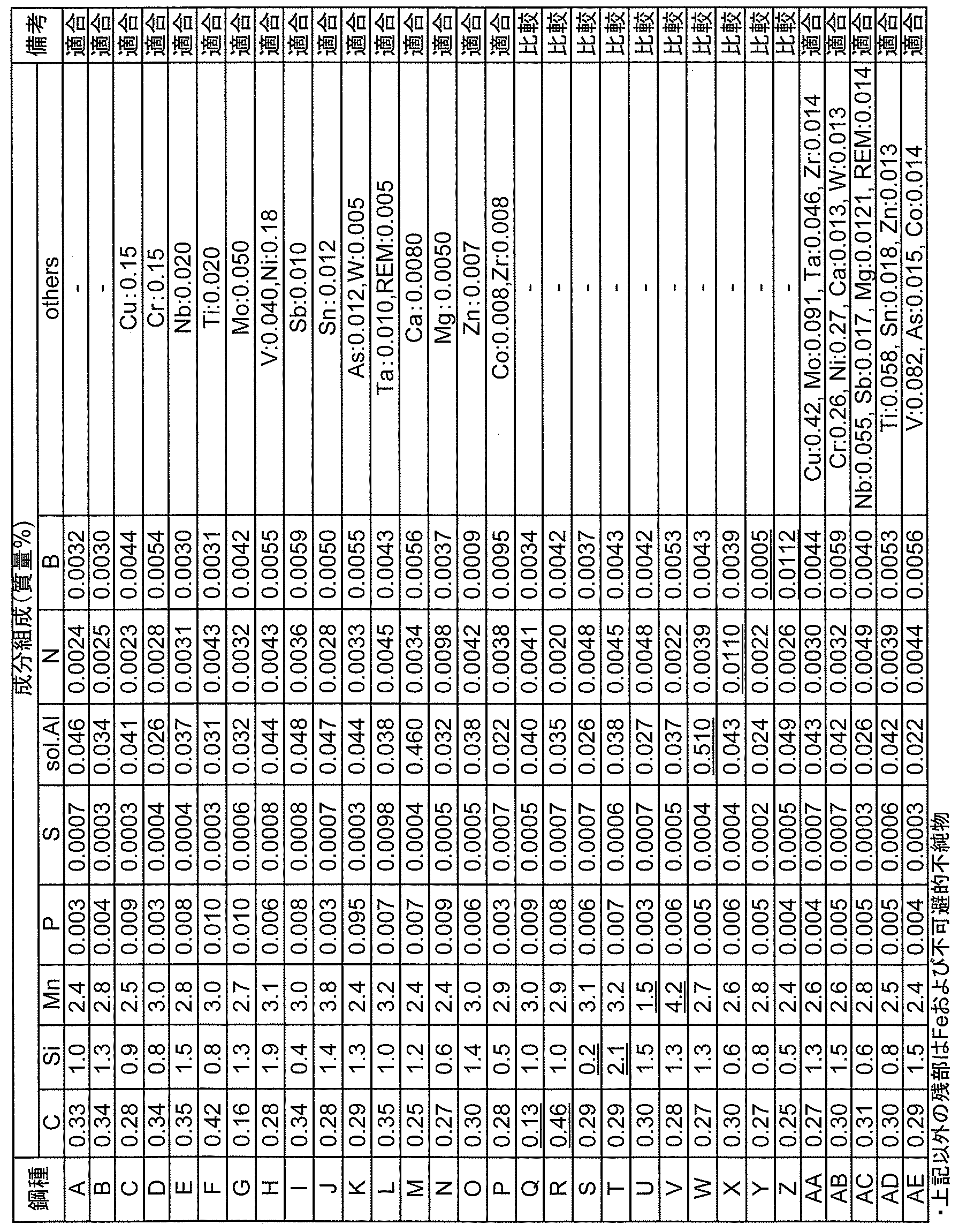

具体的には、組織の測定方法は以下の通りに行った。
マルテンサイト、ベイナイト、フェライトの面積率は、鋼板のL断面(圧延方向に平行な垂直断面)を研磨後ナイタールで腐食し、鋼板表面から1/4厚み位置においてSEMで2000倍の倍率にて、50μm×65μmの範囲で4視野観察し、撮影した組織写真を画像解析して測定した。ここで、マルテンサイト、ベイナイトはSEMでは灰色もしくは白色を呈した組織を指す。ここで、ベイナイトは以下の特徴を有する。すなわち、アスペクト比が2.5以上でプレート状の形態を呈しており、マルテンサイトとくらべるとやや黒色の組織である。上記のプレートの幅は0.3~1.7μmである。ベイナイトの内部の直径10~200nmの炭化物の分布密度は0~3個/μm2である。一方、フェライトはSEMで黒色のコントラストを呈する領域である。なお、マルテンサイトやベイナイトの内部には微量の炭化物、窒化物、硫化物、酸化物を含むが、これらを除外することは困難なので、これらを含めた領域の面積率をその面積率とした。
各鋼板から圧延方向と直角方向(コイル幅方向)を長手方向とするJIS3号試験片を採取し、JIS Z 2248(2022)の規定に準拠したVブロック法による90°V曲げ試験を曲げ半径を変えて行った。そして、試験片表面に0.3mm以上の亀裂を生じない最小の曲げ半径Rを板厚tで除した値(R/t)により曲げ性を評価した。なお、曲げ稜線方向を圧延方向と平行になるようにした。本発明では、R/tが3.0以下の鋼板を曲げ性に優れると評価し、表3に「〇(合格)」で示す。R/tが3.0超の鋼板を曲げ性が劣位と評価し、表3に「×(不合格)」で示す。
得られた鋼板(コイル)の幅方向にコイル幅の1/4位置より圧延直角方向:100mm、圧延方向:30mmとなる短冊試験片を採取して実施した。長さが100mmとなる長辺側の端面の切り出しはせん断加工とし、せん断加工ままの状態で(バリを除去する機械加工を施さずに)、バリが曲げ外周側となるように曲げ加工を施し、その曲げ成形時の試験片形状を維持して、ボルトで試験片を固定した。せん断加工のクリアランスは13%とし、レーキ角は1°とした。曲げ加工は、先端曲げ半径10mmで、曲げ頂点内側の角度が90度(V曲げ)とした。ポンチは、先端半径が上記の先端曲げ半径Rと同じであり、U字形状(先端R部分が半円形状でポンチ胴部の厚さが2R)のものを用い、ダイは、コーナーRが30mmのものを用いた。ポンチが鋼板を押し込む深さを調整し、先端の曲げ角度(曲げ頂点内側の角度)が90度(V字形状)となるように成形した。曲げ成形時の直片部のフランジ端部同士の距離が曲げ成形した時と同じ距離になるように(スプリングバックによる直片部の開口をキャンセルアウトするように)、油圧ジャッキで試験片を挟んで締め込み、その状態でボルト締結した。ボルトはあらかじめ短冊試験片の短辺エッジから10mm内側に設けた楕円形状(短軸10mm、長軸15mm)の穴に通して固定した。得られたボルト締め後の試験片を、0.1質量%のチオシアン酸アンモニウム水溶液と、McIlvaine緩衝液を、質量比として1:1で混合し、pHを8.0に調整した溶液に浸漬して耐遅れ破壊特性評価試験を実施した。このとき、溶液の温度は20℃とし、試験片の表面積1cm3あたりの液量は20mlとした。24時間経過後に目視で確認できるレベル(長さ1mm以上)の亀裂の有無を確認し、亀裂が観察されなかったものは、耐遅れ破壊特性が優れると判断した。表3で「割れ無」と示すものが合格であり、「割れ有」と示すものが不合格である。
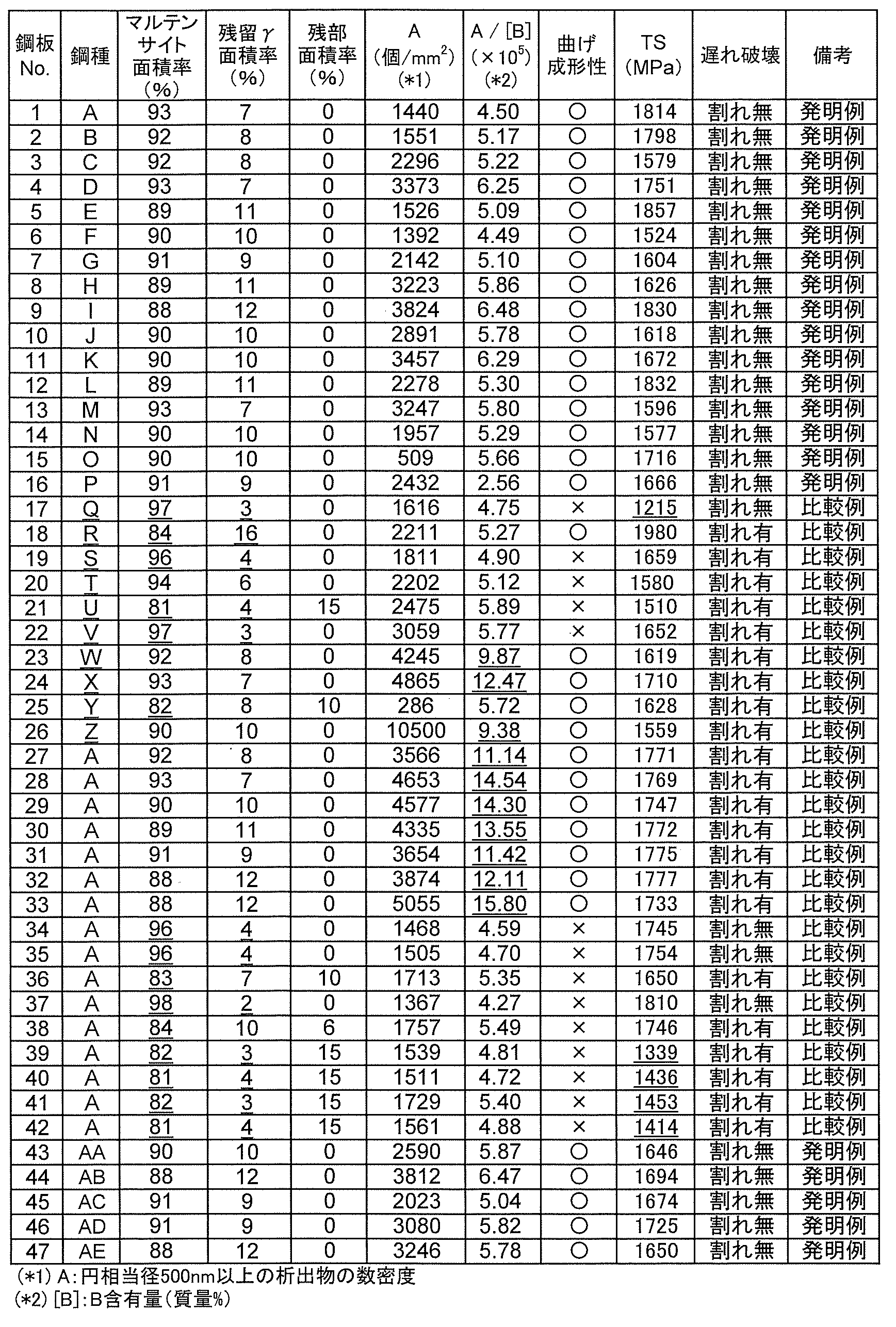
一方、比較例では、引張強度、曲げ成形性および耐遅れ破壊特性の少なくとも1つが十分ではなかった。
Claims (7)
- 質量%で、
C:0.15%以上0.45%以下、
Si:0.3%以上2.0%以下、
Mn:1.7%以上4.0%以下、
P:0.10%以下、
S:0.01%以下、
sol.Al:0.50%以下、
N:0.010%以下、
B:0.0008%以上0.0100%以下を含有し、
残部がFeおよび不可避的不純物からなる成分組成を有し、
マルテンサイトの組織全体に対する面積率が85%以上95%未満であり、
残留オーステナイトの組織全体に対する面積率が5%以上15%以下である鋼組織を有し、
円相当径500nm以上である析出物の数密度Aが下記の式(1)を満たす鋼板。
A(個/mm2)≦ 8.5×10⁵×[B] ・・・式(1)
ここで、[B]はBの含有量(質量%)を表す。 - 前記成分組成として、さらに質量%で、
Cu:1.00%以下、
Cr:1.00%以下、
Nb:0.10%以下、
Ti:0.10%以下、
V:0.50%以下、
Mo:0.50%以下、
Ni:1.00%以下、
Sb:0.10%以下、
Sn:0.10%以下、
As:0.10%以下、
Ta:0.10%以下、
Ca:0.020%以下、
Mg:0.020%以下、
Zn:0.020%以下、
Co:0.020%以下、
Zr:0.020%以下、
W:0.020%以下、
REM:0.020%以下のうちから選んだ1種または2種以上を含有する、請求項1に記載の鋼板。 - 鋼板表面にめっき層を有する、請求項1または2に記載の鋼板。
- 請求項1~3のいずれかに記載の鋼板を用いてなる部材。
- 請求項1または2に記載の成分組成を有する鋼スラブを、スラブ表面温度で1100℃以上の加熱保持温度で30分以上保持した後、
900~1000℃での滞留時間を20秒以上150秒以下とし、仕上げ圧延温度を850℃以上とした条件で熱間仕上げ圧延を行い、
前記仕上げ圧延温度から650℃までの範囲における平均冷却速度を40℃/秒以上とする冷却を行い、
その後、650℃以下の巻取り温度で巻取ることで熱延鋼板とし、
該熱延鋼板を40%以上の圧下率で冷間圧延することで冷延鋼板とし、
焼鈍温度を830~950℃とし、前記冷延鋼板を、400℃から前記焼鈍温度まで1.0℃/秒以上の平均加熱速度で加熱し、
前記焼鈍温度で600秒以下保持した後、
前記焼鈍温度から150~250℃の冷却停止温度まで10℃/秒以上の平均冷却速度で冷却し、
前記冷却停止温度から250~450℃の再加熱保持温度まで加熱し、
その後、前記再加熱保持温度で20~1500秒保持する連続焼鈍を行う、鋼板の製造方法。 - 前記連続焼鈍の後、鋼板表面にめっき処理を行う、請求項5に記載の鋼板の製造方法。
- 請求項1~3のいずれかに記載の鋼板に、成形加工、接合加工の少なくとも一方を施して部材とする工程を含む、部材の製造方法。
Priority Applications (5)
| Application Number | Priority Date | Filing Date | Title |
|---|---|---|---|
| CN202480009089.XA CN120530220A (zh) | 2023-01-30 | 2024-01-25 | 钢板、构件和它们的制造方法 |
| KR1020257024407A KR20250126111A (ko) | 2023-01-30 | 2024-01-25 | 강판, 부재 및 그들의 제조 방법 |
| EP24750125.7A EP4632099A4 (en) | 2023-01-30 | 2024-01-25 | STEEL SHEET, COMPONENT, AND ASSOCIATED MANUFACTURING PROCESSES |
| JP2024531141A JP7632759B2 (ja) | 2023-01-30 | 2024-01-25 | 鋼板、部材およびそれらの製造方法 |
| MX2025008613A MX2025008613A (es) | 2023-01-30 | 2025-07-23 | Chapa de acero, miembro y metodo para producirlos |
Applications Claiming Priority (2)
| Application Number | Priority Date | Filing Date | Title |
|---|---|---|---|
| JP2023-011604 | 2023-01-30 | ||
| JP2023011604 | 2023-01-30 |
Publications (1)
| Publication Number | Publication Date |
|---|---|
| WO2024162176A1 true WO2024162176A1 (ja) | 2024-08-08 |
Family
ID=92146690
Family Applications (1)
| Application Number | Title | Priority Date | Filing Date |
|---|---|---|---|
| PCT/JP2024/002241 Ceased WO2024162176A1 (ja) | 2023-01-30 | 2024-01-25 | 鋼板、部材およびそれらの製造方法 |
Country Status (6)
| Country | Link |
|---|---|
| EP (1) | EP4632099A4 (ja) |
| JP (1) | JP7632759B2 (ja) |
| KR (1) | KR20250126111A (ja) |
| CN (1) | CN120530220A (ja) |
| MX (1) | MX2025008613A (ja) |
| WO (1) | WO2024162176A1 (ja) |
Cited By (3)
| Publication number | Priority date | Publication date | Assignee | Title |
|---|---|---|---|---|
| JPWO2025095122A1 (ja) * | 2023-11-02 | 2025-05-08 | ||
| WO2026071091A1 (ja) * | 2024-09-30 | 2026-04-02 | Jfeスチール株式会社 | 鋼板、部材およびそれらの製造方法 |
| WO2026071093A1 (ja) * | 2024-09-30 | 2026-04-02 | Jfeスチール株式会社 | 鋼板、部材およびそれらの製造方法 |
Citations (5)
| Publication number | Priority date | Publication date | Assignee | Title |
|---|---|---|---|---|
| JP4712882B2 (ja) | 2008-07-11 | 2011-06-29 | 株式会社神戸製鋼所 | 耐水素脆化特性および加工性に優れた高強度冷延鋼板 |
| JP2017527691A (ja) * | 2014-07-03 | 2017-09-21 | アルセロールミタル | 超高強度被覆または非被覆鋼板を製造する方法および得られる鋼板 |
| WO2018055695A1 (ja) * | 2016-09-21 | 2018-03-29 | 新日鐵住金株式会社 | 鋼板 |
| JP6388085B2 (ja) | 2016-09-28 | 2018-09-12 | Jfeスチール株式会社 | 鋼板およびその製造方法 |
| WO2023008003A1 (ja) * | 2021-07-28 | 2023-02-02 | Jfeスチール株式会社 | 鋼板、部材およびそれらの製造方法 |
Family Cites Families (4)
| Publication number | Priority date | Publication date | Assignee | Title |
|---|---|---|---|---|
| JP5630125B2 (ja) * | 2009-08-06 | 2014-11-26 | Jfeスチール株式会社 | 低温靭性に優れた高強度熱延鋼板およびその製造方法 |
| WO2018030501A1 (ja) * | 2016-08-10 | 2018-02-15 | Jfeスチール株式会社 | 薄鋼板およびその製造方法 |
| JP6540764B2 (ja) * | 2016-09-16 | 2019-07-10 | Jfeスチール株式会社 | 耐摩耗鋼板およびその製造方法 |
| CN117529570B (zh) * | 2021-07-09 | 2026-05-26 | 杰富意钢铁株式会社 | 高强度钢板、高强度镀覆钢板及其制造方法以及构件 |
-
2024
- 2024-01-25 EP EP24750125.7A patent/EP4632099A4/en active Pending
- 2024-01-25 WO PCT/JP2024/002241 patent/WO2024162176A1/ja not_active Ceased
- 2024-01-25 CN CN202480009089.XA patent/CN120530220A/zh active Pending
- 2024-01-25 JP JP2024531141A patent/JP7632759B2/ja active Active
- 2024-01-25 KR KR1020257024407A patent/KR20250126111A/ko active Pending
-
2025
- 2025-07-23 MX MX2025008613A patent/MX2025008613A/es unknown
Patent Citations (5)
| Publication number | Priority date | Publication date | Assignee | Title |
|---|---|---|---|---|
| JP4712882B2 (ja) | 2008-07-11 | 2011-06-29 | 株式会社神戸製鋼所 | 耐水素脆化特性および加工性に優れた高強度冷延鋼板 |
| JP2017527691A (ja) * | 2014-07-03 | 2017-09-21 | アルセロールミタル | 超高強度被覆または非被覆鋼板を製造する方法および得られる鋼板 |
| WO2018055695A1 (ja) * | 2016-09-21 | 2018-03-29 | 新日鐵住金株式会社 | 鋼板 |
| JP6388085B2 (ja) | 2016-09-28 | 2018-09-12 | Jfeスチール株式会社 | 鋼板およびその製造方法 |
| WO2023008003A1 (ja) * | 2021-07-28 | 2023-02-02 | Jfeスチール株式会社 | 鋼板、部材およびそれらの製造方法 |
Non-Patent Citations (1)
| Title |
|---|
| See also references of EP4632099A1 |
Cited By (5)
| Publication number | Priority date | Publication date | Assignee | Title |
|---|---|---|---|---|
| JPWO2025095122A1 (ja) * | 2023-11-02 | 2025-05-08 | ||
| WO2025095122A1 (ja) * | 2023-11-02 | 2025-05-08 | 日本製鉄株式会社 | 鋼板及び部材 |
| JP7795154B2 (ja) | 2023-11-02 | 2026-01-07 | 日本製鉄株式会社 | 鋼板及び部材 |
| WO2026071091A1 (ja) * | 2024-09-30 | 2026-04-02 | Jfeスチール株式会社 | 鋼板、部材およびそれらの製造方法 |
| WO2026071093A1 (ja) * | 2024-09-30 | 2026-04-02 | Jfeスチール株式会社 | 鋼板、部材およびそれらの製造方法 |
Also Published As
| Publication number | Publication date |
|---|---|
| MX2025008613A (es) | 2025-08-01 |
| JPWO2024162176A1 (ja) | 2024-08-08 |
| EP4632099A1 (en) | 2025-10-15 |
| EP4632099A4 (en) | 2026-03-18 |
| KR20250126111A (ko) | 2025-08-22 |
| CN120530220A (zh) | 2025-08-22 |
| JP7632759B2 (ja) | 2025-02-19 |
Similar Documents
| Publication | Publication Date | Title |
|---|---|---|
| JP7226672B1 (ja) | 鋼板、部材およびそれらの製造方法 | |
| JP6388085B2 (ja) | 鋼板およびその製造方法 | |
| KR102226643B1 (ko) | 강판 및 그 제조 방법 | |
| JP7111280B1 (ja) | 鋼板、部材およびそれらの製造方法 | |
| KR102566083B1 (ko) | 고강도 강판 및 그 제조 방법 | |
| JP7632759B2 (ja) | 鋼板、部材およびそれらの製造方法 | |
| JP7632758B2 (ja) | 鋼板、部材およびそれらの製造方法 | |
| EP3875615A1 (en) | Steel sheet, member, and method for manufacturing same | |
| JP7140302B1 (ja) | 鋼板、部材およびそれらの製造方法 | |
| JP7140301B1 (ja) | 鋼板、部材およびそれらの製造方法 | |
| CN116897217B (zh) | 钢板、构件和它们的制造方法 | |
| JP7226673B1 (ja) | 鋼板、部材およびそれらの製造方法 | |
| WO2026071091A1 (ja) | 鋼板、部材およびそれらの製造方法 | |
| WO2026071093A1 (ja) | 鋼板、部材およびそれらの製造方法 | |
| WO2026071092A1 (ja) | 鋼板、部材およびそれらの製造方法 |
Legal Events
| Date | Code | Title | Description |
|---|---|---|---|
| WWE | Wipo information: entry into national phase |
Ref document number: 2024531141 Country of ref document: JP |
|
| 121 | Ep: the epo has been informed by wipo that ep was designated in this application |
Ref document number: 24750125 Country of ref document: EP Kind code of ref document: A1 |
|
| WWE | Wipo information: entry into national phase |
Ref document number: 202517058047 Country of ref document: IN |
|
| WWE | Wipo information: entry into national phase |
Ref document number: 2024750125 Country of ref document: EP |
|
| ENP | Entry into the national phase |
Ref document number: 2024750125 Country of ref document: EP Effective date: 20250708 |
|
| ENP | Entry into the national phase |
Ref document number: 1020257024407 Country of ref document: KR Free format text: ST27 STATUS EVENT CODE: A-0-1-A10-A15-NAP-PA0105 (AS PROVIDED BY THE NATIONAL OFFICE) |
|
| WWE | Wipo information: entry into national phase |
Ref document number: 1020257024407 Country of ref document: KR |
|
| WWE | Wipo information: entry into national phase |
Ref document number: 202480009089.X Country of ref document: CN Ref document number: 2501004900 Country of ref document: TH |
|
| WWP | Wipo information: published in national office |
Ref document number: 202517058047 Country of ref document: IN |
|
| WWP | Wipo information: published in national office |
Ref document number: 1020257024407 Country of ref document: KR Ref document number: 202480009089.X Country of ref document: CN |
|
| NENP | Non-entry into the national phase |
Ref country code: DE |
|
| WWP | Wipo information: published in national office |
Ref document number: 2024750125 Country of ref document: EP |