WO2024162178A1 - 水性多液型塗料組成物および塗装物品の製造方法 - Google Patents
水性多液型塗料組成物および塗装物品の製造方法 Download PDFInfo
- Publication number
- WO2024162178A1 WO2024162178A1 PCT/JP2024/002250 JP2024002250W WO2024162178A1 WO 2024162178 A1 WO2024162178 A1 WO 2024162178A1 JP 2024002250 W JP2024002250 W JP 2024002250W WO 2024162178 A1 WO2024162178 A1 WO 2024162178A1
- Authority
- WO
- WIPO (PCT)
- Prior art keywords
- resin
- hydroxyl
- coating film
- coating composition
- polyisocyanate compound
- Prior art date
- Legal status (The legal status is an assumption and is not a legal conclusion. Google has not performed a legal analysis and makes no representation as to the accuracy of the status listed.)
- Ceased
Links
Classifications
-
- C—CHEMISTRY; METALLURGY
- C09—DYES; PAINTS; POLISHES; NATURAL RESINS; ADHESIVES; COMPOSITIONS NOT OTHERWISE PROVIDED FOR; APPLICATIONS OF MATERIALS NOT OTHERWISE PROVIDED FOR
- C09D—COATING COMPOSITIONS, e.g. PAINTS, VARNISHES OR LACQUERS; FILLING PASTES; CHEMICAL PAINT OR INK REMOVERS; INKS; CORRECTING FLUIDS; WOODSTAINS; PASTES OR SOLIDS FOR COLOURING OR PRINTING; USE OF MATERIALS THEREFOR
- C09D5/00—Coating compositions, e.g. paints, varnishes or lacquers, characterised by their physical nature or the effects produced; Filling pastes
-
- C—CHEMISTRY; METALLURGY
- C08—ORGANIC MACROMOLECULAR COMPOUNDS; THEIR PREPARATION OR CHEMICAL WORKING-UP; COMPOSITIONS BASED THEREON
- C08F—MACROMOLECULAR COMPOUNDS OBTAINED BY REACTIONS ONLY INVOLVING CARBON-TO-CARBON UNSATURATED BONDS
- C08F220/00—Copolymers of compounds having one or more unsaturated aliphatic radicals, each having only one carbon-to-carbon double bond, and only one being terminated by only one carboxyl radical or a salt, anhydride ester, amide, imide or nitrile thereof
- C08F220/02—Monocarboxylic acids having less than ten carbon atoms; Derivatives thereof
- C08F220/10—Esters
- C08F220/12—Esters of monohydric alcohols or phenols
- C08F220/16—Esters of monohydric alcohols or phenols of phenols or of alcohols containing two or more carbon atoms
- C08F220/18—Esters of monohydric alcohols or phenols of phenols or of alcohols containing two or more carbon atoms with acrylic or methacrylic acids
- C08F220/1802—C2-(meth)acrylate, e.g. ethyl (meth)acrylate
-
- C—CHEMISTRY; METALLURGY
- C08—ORGANIC MACROMOLECULAR COMPOUNDS; THEIR PREPARATION OR CHEMICAL WORKING-UP; COMPOSITIONS BASED THEREON
- C08F—MACROMOLECULAR COMPOUNDS OBTAINED BY REACTIONS ONLY INVOLVING CARBON-TO-CARBON UNSATURATED BONDS
- C08F265/00—Macromolecular compounds obtained by polymerising monomers on to polymers of unsaturated monocarboxylic acids or derivatives thereof as defined in group C08F20/00
- C08F265/04—Macromolecular compounds obtained by polymerising monomers on to polymers of unsaturated monocarboxylic acids or derivatives thereof as defined in group C08F20/00 on to polymers of esters
- C08F265/06—Polymerisation of acrylate or methacrylate esters on to polymers thereof
-
- C—CHEMISTRY; METALLURGY
- C08—ORGANIC MACROMOLECULAR COMPOUNDS; THEIR PREPARATION OR CHEMICAL WORKING-UP; COMPOSITIONS BASED THEREON
- C08G—MACROMOLECULAR COMPOUNDS OBTAINED OTHERWISE THAN BY REACTIONS ONLY INVOLVING UNSATURATED CARBON-TO-CARBON BONDS
- C08G18/00—Polymeric products of isocyanates or isothiocyanates
- C08G18/06—Polymeric products of isocyanates or isothiocyanates with compounds having active hydrogen
- C08G18/08—Processes
- C08G18/0804—Manufacture of polymers containing ionic or ionogenic groups
- C08G18/0819—Manufacture of polymers containing ionic or ionogenic groups containing anionic or anionogenic groups
- C08G18/0828—Manufacture of polymers containing ionic or ionogenic groups containing anionic or anionogenic groups containing sulfonate groups or groups forming them
-
- C—CHEMISTRY; METALLURGY
- C08—ORGANIC MACROMOLECULAR COMPOUNDS; THEIR PREPARATION OR CHEMICAL WORKING-UP; COMPOSITIONS BASED THEREON
- C08G—MACROMOLECULAR COMPOUNDS OBTAINED OTHERWISE THAN BY REACTIONS ONLY INVOLVING UNSATURATED CARBON-TO-CARBON BONDS
- C08G18/00—Polymeric products of isocyanates or isothiocyanates
- C08G18/06—Polymeric products of isocyanates or isothiocyanates with compounds having active hydrogen
- C08G18/08—Processes
- C08G18/0838—Manufacture of polymers in the presence of non-reactive compounds
- C08G18/0842—Manufacture of polymers in the presence of non-reactive compounds in the presence of liquid diluents
- C08G18/0861—Manufacture of polymers in the presence of non-reactive compounds in the presence of liquid diluents in the presence of a dispersing phase for the polymers or a phase dispersed in the polymers
- C08G18/0866—Manufacture of polymers in the presence of non-reactive compounds in the presence of liquid diluents in the presence of a dispersing phase for the polymers or a phase dispersed in the polymers the dispersing or dispersed phase being an aqueous medium
-
- C—CHEMISTRY; METALLURGY
- C08—ORGANIC MACROMOLECULAR COMPOUNDS; THEIR PREPARATION OR CHEMICAL WORKING-UP; COMPOSITIONS BASED THEREON
- C08G—MACROMOLECULAR COMPOUNDS OBTAINED OTHERWISE THAN BY REACTIONS ONLY INVOLVING UNSATURATED CARBON-TO-CARBON BONDS
- C08G18/00—Polymeric products of isocyanates or isothiocyanates
- C08G18/06—Polymeric products of isocyanates or isothiocyanates with compounds having active hydrogen
- C08G18/28—Polymeric products of isocyanates or isothiocyanates with compounds having active hydrogen characterised by the compounds used containing active hydrogen
- C08G18/30—Low-molecular-weight compounds
- C08G18/32—Polyhydroxy compounds; Polyamines; Hydroxyamines
- C08G18/3225—Polyamines
- C08G18/3237—Polyamines aromatic
- C08G18/324—Polyamines aromatic containing only one aromatic ring
-
- C—CHEMISTRY; METALLURGY
- C08—ORGANIC MACROMOLECULAR COMPOUNDS; THEIR PREPARATION OR CHEMICAL WORKING-UP; COMPOSITIONS BASED THEREON
- C08G—MACROMOLECULAR COMPOUNDS OBTAINED OTHERWISE THAN BY REACTIONS ONLY INVOLVING UNSATURATED CARBON-TO-CARBON BONDS
- C08G18/00—Polymeric products of isocyanates or isothiocyanates
- C08G18/06—Polymeric products of isocyanates or isothiocyanates with compounds having active hydrogen
- C08G18/28—Polymeric products of isocyanates or isothiocyanates with compounds having active hydrogen characterised by the compounds used containing active hydrogen
- C08G18/30—Low-molecular-weight compounds
- C08G18/32—Polyhydroxy compounds; Polyamines; Hydroxyamines
- C08G18/3271—Hydroxyamines
- C08G18/3293—Hydroxyamines containing heterocyclic groups
-
- C—CHEMISTRY; METALLURGY
- C08—ORGANIC MACROMOLECULAR COMPOUNDS; THEIR PREPARATION OR CHEMICAL WORKING-UP; COMPOSITIONS BASED THEREON
- C08G—MACROMOLECULAR COMPOUNDS OBTAINED OTHERWISE THAN BY REACTIONS ONLY INVOLVING UNSATURATED CARBON-TO-CARBON BONDS
- C08G18/00—Polymeric products of isocyanates or isothiocyanates
- C08G18/06—Polymeric products of isocyanates or isothiocyanates with compounds having active hydrogen
- C08G18/28—Polymeric products of isocyanates or isothiocyanates with compounds having active hydrogen characterised by the compounds used containing active hydrogen
- C08G18/40—High-molecular-weight compounds
- C08G18/4009—Two or more macromolecular compounds not provided for in one single group of groups C08G18/42 - C08G18/64
- C08G18/4063—Mixtures of compounds of group C08G18/62 with other macromolecular compounds
-
- C—CHEMISTRY; METALLURGY
- C08—ORGANIC MACROMOLECULAR COMPOUNDS; THEIR PREPARATION OR CHEMICAL WORKING-UP; COMPOSITIONS BASED THEREON
- C08G—MACROMOLECULAR COMPOUNDS OBTAINED OTHERWISE THAN BY REACTIONS ONLY INVOLVING UNSATURATED CARBON-TO-CARBON BONDS
- C08G18/00—Polymeric products of isocyanates or isothiocyanates
- C08G18/06—Polymeric products of isocyanates or isothiocyanates with compounds having active hydrogen
- C08G18/28—Polymeric products of isocyanates or isothiocyanates with compounds having active hydrogen characterised by the compounds used containing active hydrogen
- C08G18/40—High-molecular-weight compounds
- C08G18/42—Polycondensates having carboxylic or carbonic ester groups in the main chain
- C08G18/4236—Polycondensates having carboxylic or carbonic ester groups in the main chain containing only aliphatic groups
- C08G18/4238—Polycondensates having carboxylic or carbonic ester groups in the main chain containing only aliphatic groups derived from dicarboxylic acids and dialcohols
- C08G18/4241—Polycondensates having carboxylic or carbonic ester groups in the main chain containing only aliphatic groups derived from dicarboxylic acids and dialcohols from dicarboxylic acids and dialcohols in combination with polycarboxylic acids and/or polyhydroxy compounds which are at least trifunctional
-
- C—CHEMISTRY; METALLURGY
- C08—ORGANIC MACROMOLECULAR COMPOUNDS; THEIR PREPARATION OR CHEMICAL WORKING-UP; COMPOSITIONS BASED THEREON
- C08G—MACROMOLECULAR COMPOUNDS OBTAINED OTHERWISE THAN BY REACTIONS ONLY INVOLVING UNSATURATED CARBON-TO-CARBON BONDS
- C08G18/00—Polymeric products of isocyanates or isothiocyanates
- C08G18/06—Polymeric products of isocyanates or isothiocyanates with compounds having active hydrogen
- C08G18/28—Polymeric products of isocyanates or isothiocyanates with compounds having active hydrogen characterised by the compounds used containing active hydrogen
- C08G18/40—High-molecular-weight compounds
- C08G18/62—Polymers of compounds having carbon-to-carbon double bonds
- C08G18/6216—Polymers of alpha-beta ethylenically unsaturated carboxylic acids or of derivatives thereof
- C08G18/622—Polymers of esters of alpha-beta ethylenically unsaturated carboxylic acids
- C08G18/6225—Polymers of esters of acrylic or methacrylic acid
- C08G18/6229—Polymers of hydroxy groups containing esters of acrylic or methacrylic acid with aliphatic polyalcohols
-
- C—CHEMISTRY; METALLURGY
- C08—ORGANIC MACROMOLECULAR COMPOUNDS; THEIR PREPARATION OR CHEMICAL WORKING-UP; COMPOSITIONS BASED THEREON
- C08G—MACROMOLECULAR COMPOUNDS OBTAINED OTHERWISE THAN BY REACTIONS ONLY INVOLVING UNSATURATED CARBON-TO-CARBON BONDS
- C08G18/00—Polymeric products of isocyanates or isothiocyanates
- C08G18/06—Polymeric products of isocyanates or isothiocyanates with compounds having active hydrogen
- C08G18/28—Polymeric products of isocyanates or isothiocyanates with compounds having active hydrogen characterised by the compounds used containing active hydrogen
- C08G18/65—Low-molecular-weight compounds having active hydrogen with high-molecular-weight compounds having active hydrogen
- C08G18/66—Compounds of groups C08G18/42, C08G18/48, or C08G18/52
- C08G18/6633—Compounds of group C08G18/42
- C08G18/6637—Compounds of group C08G18/42 with compounds of group C08G18/32 or polyamines of C08G18/38
- C08G18/6648—Compounds of group C08G18/42 with compounds of group C08G18/32 or polyamines of C08G18/38 with compounds of group C08G18/3225 or C08G18/3271 and/or polyamines of C08G18/38
- C08G18/6651—Compounds of group C08G18/42 with compounds of group C08G18/32 or polyamines of C08G18/38 with compounds of group C08G18/3225 or C08G18/3271 and/or polyamines of C08G18/38 with compounds of group C08G18/3225 or polyamines of C08G18/38
-
- C—CHEMISTRY; METALLURGY
- C08—ORGANIC MACROMOLECULAR COMPOUNDS; THEIR PREPARATION OR CHEMICAL WORKING-UP; COMPOSITIONS BASED THEREON
- C08G—MACROMOLECULAR COMPOUNDS OBTAINED OTHERWISE THAN BY REACTIONS ONLY INVOLVING UNSATURATED CARBON-TO-CARBON BONDS
- C08G18/00—Polymeric products of isocyanates or isothiocyanates
- C08G18/06—Polymeric products of isocyanates or isothiocyanates with compounds having active hydrogen
- C08G18/28—Polymeric products of isocyanates or isothiocyanates with compounds having active hydrogen characterised by the compounds used containing active hydrogen
- C08G18/65—Low-molecular-weight compounds having active hydrogen with high-molecular-weight compounds having active hydrogen
- C08G18/66—Compounds of groups C08G18/42, C08G18/48, or C08G18/52
- C08G18/6633—Compounds of group C08G18/42
- C08G18/6637—Compounds of group C08G18/42 with compounds of group C08G18/32 or polyamines of C08G18/38
- C08G18/6648—Compounds of group C08G18/42 with compounds of group C08G18/32 or polyamines of C08G18/38 with compounds of group C08G18/3225 or C08G18/3271 and/or polyamines of C08G18/38
- C08G18/6655—Compounds of group C08G18/42 with compounds of group C08G18/32 or polyamines of C08G18/38 with compounds of group C08G18/3225 or C08G18/3271 and/or polyamines of C08G18/38 with compounds of group C08G18/3271
-
- C—CHEMISTRY; METALLURGY
- C08—ORGANIC MACROMOLECULAR COMPOUNDS; THEIR PREPARATION OR CHEMICAL WORKING-UP; COMPOSITIONS BASED THEREON
- C08G—MACROMOLECULAR COMPOUNDS OBTAINED OTHERWISE THAN BY REACTIONS ONLY INVOLVING UNSATURATED CARBON-TO-CARBON BONDS
- C08G18/00—Polymeric products of isocyanates or isothiocyanates
- C08G18/06—Polymeric products of isocyanates or isothiocyanates with compounds having active hydrogen
- C08G18/70—Polymeric products of isocyanates or isothiocyanates with compounds having active hydrogen characterised by the isocyanates or isothiocyanates used
- C08G18/72—Polyisocyanates or polyisothiocyanates
- C08G18/80—Masked polyisocyanates
- C08G18/8003—Masked polyisocyanates masked with compounds having at least two groups containing active hydrogen
- C08G18/8054—Masked polyisocyanates masked with compounds having at least two groups containing active hydrogen with compounds of C08G18/38
- C08G18/8058—Masked polyisocyanates masked with compounds having at least two groups containing active hydrogen with compounds of C08G18/38 with compounds of C08G18/3819
-
- C—CHEMISTRY; METALLURGY
- C09—DYES; PAINTS; POLISHES; NATURAL RESINS; ADHESIVES; COMPOSITIONS NOT OTHERWISE PROVIDED FOR; APPLICATIONS OF MATERIALS NOT OTHERWISE PROVIDED FOR
- C09D—COATING COMPOSITIONS, e.g. PAINTS, VARNISHES OR LACQUERS; FILLING PASTES; CHEMICAL PAINT OR INK REMOVERS; INKS; CORRECTING FLUIDS; WOODSTAINS; PASTES OR SOLIDS FOR COLOURING OR PRINTING; USE OF MATERIALS THEREFOR
- C09D133/00—Coating compositions based on homopolymers or copolymers of compounds having one or more unsaturated aliphatic radicals, each having only one carbon-to-carbon double bond, and at least one being terminated by only one carboxyl radical, or of salts, anhydrides, esters, amides, imides, or nitriles thereof; Coating compositions based on derivatives of such polymers
- C09D133/04—Homopolymers or copolymers of esters
- C09D133/06—Homopolymers or copolymers of esters of esters containing only carbon, hydrogen and oxygen, the oxygen atom being present only as part of the carboxyl radical
- C09D133/062—Copolymers with monomers not covered by C09D133/06
- C09D133/066—Copolymers with monomers not covered by C09D133/06 containing -OH groups
-
- C—CHEMISTRY; METALLURGY
- C09—DYES; PAINTS; POLISHES; NATURAL RESINS; ADHESIVES; COMPOSITIONS NOT OTHERWISE PROVIDED FOR; APPLICATIONS OF MATERIALS NOT OTHERWISE PROVIDED FOR
- C09D—COATING COMPOSITIONS, e.g. PAINTS, VARNISHES OR LACQUERS; FILLING PASTES; CHEMICAL PAINT OR INK REMOVERS; INKS; CORRECTING FLUIDS; WOODSTAINS; PASTES OR SOLIDS FOR COLOURING OR PRINTING; USE OF MATERIALS THEREFOR
- C09D151/00—Coating compositions based on graft polymers in which the grafted component is obtained by reactions only involving carbon-to-carbon unsaturated bonds; Coating compositions based on derivatives of such polymers
- C09D151/003—Coating compositions based on graft polymers in which the grafted component is obtained by reactions only involving carbon-to-carbon unsaturated bonds; Coating compositions based on derivatives of such polymers grafted on to macromolecular compounds obtained by reactions only involving unsaturated carbon-to-carbon bonds
-
- C—CHEMISTRY; METALLURGY
- C09—DYES; PAINTS; POLISHES; NATURAL RESINS; ADHESIVES; COMPOSITIONS NOT OTHERWISE PROVIDED FOR; APPLICATIONS OF MATERIALS NOT OTHERWISE PROVIDED FOR
- C09D—COATING COMPOSITIONS, e.g. PAINTS, VARNISHES OR LACQUERS; FILLING PASTES; CHEMICAL PAINT OR INK REMOVERS; INKS; CORRECTING FLUIDS; WOODSTAINS; PASTES OR SOLIDS FOR COLOURING OR PRINTING; USE OF MATERIALS THEREFOR
- C09D175/00—Coating compositions based on polyureas or polyurethanes; Coating compositions based on derivatives of such polymers
- C09D175/04—Polyurethanes
-
- C—CHEMISTRY; METALLURGY
- C09—DYES; PAINTS; POLISHES; NATURAL RESINS; ADHESIVES; COMPOSITIONS NOT OTHERWISE PROVIDED FOR; APPLICATIONS OF MATERIALS NOT OTHERWISE PROVIDED FOR
- C09D—COATING COMPOSITIONS, e.g. PAINTS, VARNISHES OR LACQUERS; FILLING PASTES; CHEMICAL PAINT OR INK REMOVERS; INKS; CORRECTING FLUIDS; WOODSTAINS; PASTES OR SOLIDS FOR COLOURING OR PRINTING; USE OF MATERIALS THEREFOR
- C09D175/00—Coating compositions based on polyureas or polyurethanes; Coating compositions based on derivatives of such polymers
- C09D175/04—Polyurethanes
- C09D175/06—Polyurethanes from polyesters
-
- B—PERFORMING OPERATIONS; TRANSPORTING
- B05—SPRAYING OR ATOMISING IN GENERAL; APPLYING FLUENT MATERIALS TO SURFACES, IN GENERAL
- B05D—PROCESSES FOR APPLYING FLUENT MATERIALS TO SURFACES, IN GENERAL
- B05D2201/00—Polymeric substrate or laminate
-
- B—PERFORMING OPERATIONS; TRANSPORTING
- B05—SPRAYING OR ATOMISING IN GENERAL; APPLYING FLUENT MATERIALS TO SURFACES, IN GENERAL
- B05D—PROCESSES FOR APPLYING FLUENT MATERIALS TO SURFACES, IN GENERAL
- B05D2202/00—Metallic substrate
-
- B—PERFORMING OPERATIONS; TRANSPORTING
- B05—SPRAYING OR ATOMISING IN GENERAL; APPLYING FLUENT MATERIALS TO SURFACES, IN GENERAL
- B05D—PROCESSES FOR APPLYING FLUENT MATERIALS TO SURFACES, IN GENERAL
- B05D2451/00—Type of carrier, type of coating (Multilayers)
-
- B—PERFORMING OPERATIONS; TRANSPORTING
- B05—SPRAYING OR ATOMISING IN GENERAL; APPLYING FLUENT MATERIALS TO SURFACES, IN GENERAL
- B05D—PROCESSES FOR APPLYING FLUENT MATERIALS TO SURFACES, IN GENERAL
- B05D7/00—Processes, other than flocking, specially adapted for applying liquids or other fluent materials to particular surfaces or for applying particular liquids or other fluent materials
- B05D7/50—Multilayers
- B05D7/56—Three layers or more
- B05D7/57—Three layers or more the last layer being a clear coat
- B05D7/572—Three layers or more the last layer being a clear coat all layers being cured or baked together
Definitions
- the present invention relates to a water-based multi-component paint composition and a method for producing a coated article.
- Patent Document 1 proposes an aqueous multi-liquid paint composition that contains a base agent (I) containing a hydroxyl-containing acrylic resin and a curing agent (II) containing an anionic hydrophilic group-containing polyisocyanate compound and/or a nonionic hydrophilic group-containing polyisocyanate compound.
- the coating is cured at a low temperature of 60°C.
- the above-mentioned aqueous multi-component paint composition is excellent in drying properties, paint handling properties, storage properties, and weather resistance.
- the coating film obtained from the above-mentioned aqueous multi-component paint composition has low hardness, poor gloss, and may generate spray dust.
- the present invention has been made in consideration of the above, and aims to provide an aqueous multi-component paint composition that can be cured at low temperatures, yet can produce a coating film that has high hardness, excellent gloss, and reduced spray dust.
- the hydroxyl-containing resin (A) is at least one of a hydroxyl-containing acrylic resin (A1) and a hydroxyl-containing polyester resin (A2), the melamine resin (B) is dissolved in the first liquid or has an average particle size of less than 1 ⁇ m, and the average total number of imino groups and methylol groups per triazine ring exceeds 1;
- the hydrophilic polyisocyanate compound (D) is at least one of an ion-modified polyisocyanate compound (D1) and a nonion-modified polyisocyanate compound (D2).
- the hydroxyl-containing resin (A) is at least one of a hydroxyl-containing acrylic resin (A1) and a hydroxyl-containing polyester resin (A2), the melamine resin (B) is dissolved in the first liquid or has an average particle size of less than 1 ⁇ m, and the average total number of imino groups and methylol groups per triazine ring exceeds 1;
- the hydrophilic polyisocyanate compound (D) is at least one of an ion-modified polyisocyanate compound (D1) and a nonion-modified polyisocyanate compound (D2).
- the aqueous multi-component coating composition according to any one of [1] to [5] above, wherein the melamine resin (B) has a solubility parameter of 9 or more and 15 or less.
- the solid content mass of the melamine resin (B) is 7 parts by mass or more and 40 parts by mass or less per 100 parts by mass of the solid content mass of the hydroxyl group-containing resin (A).
- the solid content mass of the melamine resin (B) is 7 parts by mass or more and 40 parts by mass or less per 100 parts by mass of the total solid content mass of the hydroxyl group-containing resin (A) and the polyurethane resin (C).
- the present invention provides an aqueous coating composition that can be cured at low temperatures while still forming a coating film that has high hardness, excellent gloss, and reduced spray dust, as well as a method for producing a coated article using this aqueous coating composition.
- the aqueous multi-liquid coating composition according to the first embodiment includes a first liquid containing a hydroxyl-containing resin (A) and a melamine resin (B), and a second liquid containing a hydrophilic polyisocyanate compound (D).
- the hydroxyl-containing resin (A) is at least one of a hydroxyl-containing acrylic resin (A1) and a hydroxyl-containing polyester resin (A2).
- the melamine resin (B) has an average total number of imino groups and methylol groups per triazine ring that is greater than 1.
- the hydrophilic polyisocyanate compound (D) is at least one of an ion-modified polyisocyanate compound and a nonion-modified polyisocyanate compound.
- Melamine resin is generally used as a curing agent for hydroxyl-containing resins.
- melamine resin is not suitable as a curing agent for paint compositions that are cured at low temperatures.
- highly reactive polyisocyanate compounds are usually used as curing agents for low-temperature curing paint compositions.
- the hardness of the coating film formed using such a paint composition tends to be low.
- the melamine resin is used as part of the main agent (corresponding to the first liquid of the present disclosure) rather than as a curing agent (corresponding to the second liquid of the present disclosure) for directly forming a crosslinked structure with the hydroxyl-containing resin. That is, the melamine resin is used as a substance that reacts with the polyisocyanate compound together with the hydroxyl-containing resin.
- the melamine resin and the polyisocyanate compound can react even at low temperatures. Therefore, when the aqueous coating composition according to the present disclosure is heated at low temperatures, the reaction between the hydroxyl-containing resin and the polyisocyanate compound and the reaction between the melamine resin and the polyisocyanate compound occur.
- the melamine resin has, on average, more than one imino group and/or methylol group per triazine ring that reacts with the isocyanate group of the polyisocyanate compound. Therefore, the reaction between the melamine resin and multiple polyisocyanate compounds bonded to the hydroxyl-containing resin may also occur.
- the melamine resin is incorporated into the crosslinked structure between the hydroxyl-containing resin and the polyisocyanate compound, for example, a crosslinked structure of hydroxyl-containing resin-polyisocyanate compound-melamine resin-polyisocyanate compound-hydroxyl-containing resin is formed. In this way, the planar and rigid triazine rings of the melamine resin are incorporated into the crosslinked structure, which increases the hardness of the resulting coating film.
- Spray dust is suppressed by including melamine resin as part of the base resin.
- Spray dust is a convex part on the coating surface that is formed when paint composition that is not applied to the substrate during spray painting is scattered into the air and turns into droplets, which then adhere to the substrate.
- Spray dust is typically formed during the process of evaporation of the solvent contained in the droplets, and occurs when the coating film and the droplets do not mix well. Therefore, the higher the viscosity of the paint composition (droplets), the more likely spray dust is to be formed.
- Melamine resin generally has a low molecular weight. Therefore, the viscosity of paint compositions containing melamine resin is kept low, which is thought to result in the suppression of the formation of spray dust.
- the hydrophilic polyisocyanate compound (D) is used as the curing agent.
- the hydrophilic polyisocyanate compound (D) has a hydrophilic group and two or more isocyanate groups in the molecule.
- a coating film is formed by the reaction of a curing agent with a base agent, the dispersion state of the curing agent in the coating composition is reflected in the smoothness of the coating film.
- the hydrophilic polyisocyanate compound (D) used in this disclosure exists in the aqueous coating composition in a micelle-like form in which hydrophilic groups surround hydrophobic portions, and is highly dispersed. Therefore, the resulting coating film has excellent smoothness.
- a smooth coating film has excellent gloss.
- isocyanate group means an unblocked free isocyanate group.
- the unblocked isocyanate group enables low-temperature curing.
- the hydrophilic polyisocyanate compound (D) is a water-dispersible polyisocyanate compound.
- the aqueous coating composition is a multi-liquid type containing a first liquid and a second liquid.
- the aqueous coating composition may further contain a third liquid containing other components.
- the aqueous coating composition is prepared using a method commonly used by those skilled in the art.
- the aqueous coating composition can be prepared by mixing the first liquid and the second liquid.
- the aqueous coating composition can be prepared by mixing the first liquid and the second liquid, and further the third liquid. Examples of mixing methods include a kneading and mixing method using a kneader or roll, and a dispersion and mixing method using a sand grind mill or disperser.
- An aqueous paint composition contains water as a solvent.
- the proportion of water in the solvent may be 50% by mass or more, 70% by mass or more, or 100% by mass.
- the aqueous coating composition according to the present disclosure can be cured at low temperatures.
- the aqueous coating composition according to the present disclosure can be cured at a temperature of, for example, 70°C or higher and 110°C or lower.
- the curing temperature may be 75°C or higher, or 80°C or higher.
- the curing temperature may be 105°C or lower, 100°C or lower, 95°C or lower, or 90°C or lower.
- the solid content is also referred to as the non-volatile content.
- the solid content of an aqueous paint composition is all the components of the aqueous paint composition excluding the solvent.
- the first liquid contains a hydroxyl group-containing resin (A) and a melamine resin (B).
- the hydroxyl-containing resin (A) is a resin (film-forming component) that is the base of the coating film.
- the film-forming component chemically reacts with other components contained in the aqueous paint composition to form a coating film, i.e., a resin film.
- the hydroxyl-containing resin (A) reacts with the hydrophilic polyisocyanate compound (D) to form a crosslinked structure.
- the hydroxyl-containing resin (A) provides a coating film with sufficient hardness.
- the hydroxyl-containing resin (A) has one or more (typically, two or more) hydroxyl groups in one molecule.
- the hydroxyl-containing resin (A) is at least one of a hydroxyl-containing acrylic resin (A1) and a hydroxyl-containing polyester resin (A2).
- the hydroxyl value (OHV) of the hydroxyl-containing resin (A) is, for example, 20 mgKOH/g or more and 180 mgKOH/g or less.
- the hydroxyl value of the hydroxyl-containing resin (A) is 20 mgKOH/g or more, the breaking strength of the coating film is likely to be high.
- the hydroxyl value of the hydroxyl-containing resin (A) is 180 mgKOH/g or less, the hydrophilization of the coating film is suppressed, and the water resistance is likely to be improved.
- the hydroxyl value of the hydroxyl-containing resin (A) may be 30 mgKOH/g or more, or 40 mgKOH/g or more.
- the hydroxyl value of the hydroxyl-containing resin (A) may be 150 mgKOH/g or less, 140 mgKOH/g or less, 100 mgKOH/g or less, or 80 mgKOH/g or less.
- the glass transition temperature (Tg) of the hydroxyl-containing resin (A) is, for example, -20°C or higher and 100°C or lower. If the Tg of the hydroxyl-containing resin (A) is -20°C or higher, the breaking strength and hardness of the resulting coating film are likely to be improved. If the Tg of the hydroxyl-containing resin (A) is 100°C or lower, the quick-drying property of the aqueous paint composition is likely to be improved. The Tg of the hydroxyl-containing resin (A) may be -15°C or higher. The Tg of the hydroxyl-containing resin (A) may be 90°C or lower, 80°C or lower, 70°C or lower, or 50°C or lower.
- Tg may be calculated from the type and amount of the raw material monomers of the resin. Tg may also be measured by a differential scanning calorimeter (DSC).
- DSC differential scanning calorimeter
- the hydroxyl-containing resin (A) may have an acid value (AV) of 5 mgKOH/g or more and 70 mgKOH/g or less.
- AV acid value
- the acid value of the hydroxyl-containing resin (A) is 5 mgKOH/g or more, the hardness of the resulting coating film is likely to be improved.
- the acid value of the hydroxyl-containing resin (A) is 70 mgKOH/g or less, the water resistance of the resulting coating film can be improved.
- the acid value of the hydroxyl-containing resin (A) may be 7 mgKOH/g or more, or 10 mgKOH/g or more.
- the acid value of the hydroxyl-containing resin (A) may be 60 mgKOH/g or less, 50 mgKOH/g or less, or 40 mgKOH/g or less.
- the hydroxyl value and acid value are determined based on the mass of solids.
- the hydroxyl value and acid value can be measured by the known method described in JIS K 0070:1992.
- the hydroxyl value and acid value may be calculated from the amount of unsaturated monomer in the raw material monomer of the target resin.
- the hydroxyl-containing resin (A) may have a hydroxyl value of 20 mgKOH/g or more and 180 mgKOH/g or less, a Tg of -20°C or more and 100°C or less, and an acid value of 5 mgKOH/g or more and 70 mgKOH/g or less.
- the weight average molecular weight (Mw) of the hydroxyl-containing resin (A) may be, for example, 2,000 or more and 50,000 or less. Mw is determined by the GPC method using polystyrene as the standard.
- the hydroxyl-containing resin (A) When the hydroxyl-containing resin (A) is dispersed in the first liquid, its average particle diameter may be, for example, 50 nm or more and 500 nm or less. When the average particle diameter of the hydroxyl-containing resin (A) is within the above range, the paint stability is improved and the smoothness of the resulting coating film is also improved.
- the average particle diameter of the hydroxyl-containing resin (A) may be 80 nm or more.
- the average particle diameter of the hydroxyl-containing resin (A) may be 300 nm or less.
- the average particle size of the hydroxyl-containing resin (A) is measured by a laser diffraction/scattering method in accordance with JIS Z 8825.
- a laser Doppler particle size analyzer can be used.
- a specific example is the Microtrack UPA150 (manufactured by Nikkiso Co., Ltd.).
- the average particle size of the hydroxyl-containing resin (A) is measured using a sample diluted with ion-exchanged water to a resin solids concentration of 0.01% by mass.
- the hydroxyl-containing acrylic resin (A1) can be produced, for example, by polymerizing a hydroxyl-containing ⁇ , ⁇ -ethylenically unsaturated monomer and another ⁇ , ⁇ -ethylenically unsaturated monomer by a known method. Commercially available hydroxyl-containing acrylic resins may also be used.
- the hydroxyl-containing acrylic resin (A1) may be an emulsion.
- the hydroxyl-containing acrylic resin in emulsion form (hydroxyl-containing acrylic resin emulsion) may have a multilayer structure including a core portion and a shell portion covering at least a portion of the surface of the core portion, or may have a single layer structure.
- the hydroxyl-containing acrylic resin emulsion is prepared by emulsion polymerization of the above-mentioned monomer mixture.
- Emulsion polymerization can be carried out by a polymerization method commonly used by those skilled in the art. Specifically, emulsion polymerization is carried out by mixing an emulsifier in an aqueous medium containing water and, if necessary, an organic solvent such as alcohol, and then dropping the above-mentioned monomer mixture and polymerization initiator under heating and stirring. Emulsion polymerization can also be carried out by mixing the monomer mixture, emulsifier, and aqueous medium in advance, emulsifying, and dropping the resulting emulsion mixture.
- the polymerization initiator, emulsifier, etc. can be any of those known to those skilled in the art without any particular limitations.
- Hydroxyl group-containing ⁇ , ⁇ -ethylenically unsaturated monomers include, for example, hydroxyethyl (meth)acrylate, hydroxypropyl (meth)acrylate, hydroxybutyl (meth)acrylate, allyl alcohol, methallyl alcohol, and adducts of these with ⁇ -caprolactone.
- (Meth)acrylic acid includes both methacrylic acid and acrylic acid.
- ⁇ , ⁇ -ethylenically unsaturated monomers include, for example, carboxylic acids such as acrylic acid, methacrylic acid, ethacrylic acid, crotonic acid, maleic acid, fumaric acid, itaconic acid, and the like, or their dicarboxylic acid monoesters; styrenes such as styrene and ⁇ -methylstyrene; acrylic acid esters such as methyl acrylate, ethyl acrylate, propyl acrylate, n-, i-, and t-butyl acrylate, 2-ethylhexyl acrylate, allyl acrylate, lauryl acrylate, and the like; methyl methacrylate, methacrylic acid, Methacrylic acid esters such as ethyl methacrylate, propyl methacrylate, n-, i- and t-butyl methacrylate, 2-ethylhexyl methacryl
- the average particle diameter of the hydroxyl-containing acrylic resin emulsion may be, for example, 50 nm or more and 500 nm or less. When the average particle diameter of the hydroxyl-containing acrylic resin emulsion is within the above range, the paint stability is improved and the smoothness of the resulting coating film is also improved.
- the average particle diameter of the hydroxyl-containing acrylic resin emulsion may be 80 nm or more.
- the average particle diameter of the hydroxyl-containing acrylic resin emulsion may be 300 nm or less.
- the hydroxyl group-containing acrylic resin (A1) may be water-soluble.
- the water-soluble hydroxyl group-containing acrylic resin (hydroxyl group-containing water-soluble acrylic resin) can be prepared, for example, by solution polymerization of a monomer mixture containing the above monomers.
- the weight average molecular weight (Mw) of the hydroxyl-containing water-soluble acrylic resin is, for example, 4,000 or more and 50,000 or less.
- Mw of the hydroxyl-containing water-soluble acrylic resin is 4,000 or more, the hardness and weather resistance of the resulting coating film are likely to be improved.
- Mw of the hydroxyl-containing water-soluble acrylic resin is 50,000 or less, excessive viscosity increase of the aqueous paint composition is likely to be suppressed.
- the Mw of the hydroxyl-containing water-soluble acrylic resin may be 5,000 or more, or may be 8,000 or more.
- the Mw of the hydroxyl-containing water-soluble acrylic resin may be 40,000 or less, or may be 30,000 or less.
- the hydroxyl-containing resin (A) may contain a hydroxyl-containing acrylic resin emulsion and a hydroxyl-containing water-soluble acrylic resin.
- the hydroxyl-containing polyester resin can be obtained, for example, by polycondensation (esterification) of a polyhydric alcohol with a polybasic acid or an anhydride thereof. Commercially available hydroxyl-containing polyester resins may also be used.
- the polyhydric alcohol is not particularly limited, and examples thereof include ethylene glycol, diethylene glycol, polyethylene glycol, propylene glycol, dipropylene glycol, polypropylene glycol, neopentyl glycol, 1,2-butanediol, 1,3-butanediol, 2,3-butanediol, 1,4-butanediol, 1,5-pentanediol, 1,6-hexanediol, hydrogenated bisphenol A, hydroxyalkylated bisphenol A, 1,4-cyclohexanedimethanol, and 2,2-dimethyl.
- the polybasic acid or anhydride is not particularly limited, and examples thereof include phthalic acid, phthalic anhydride, tetrahydrophthalic acid, tetrahydrophthalic anhydride, hexahydrophthalic acid, hexahydrophthalic anhydride, methyltetrahydrophthalic acid, methyltetrahydrophthalic anhydride, himic anhydride, trimellitic acid, trimellitic anhydride, pyromellitic acid, pyromellitic anhydride, isophthalic acid, terephthalic acid, maleic acid, maleic anhydride, fumaric acid, itaconic acid, adipic acid, azelaic acid, sebacic acid, succinic acid, succinic anhydride, lactic acid, dodecenylsuccinic acid, dodecenylsuccinic anhydride, cyclohexane-1,4-dicarboxylic acid, and endo acid anhydride.
- the hydroxyl group-containing polyester resin may be modified with lactone, fats and oils or fatty acids, melamine resin, urethane resin, etc.
- the fats and oils or fatty acids are not particularly limited, and examples include fats and oils such as castor oil, dehydrated castor oil, coconut oil, corn oil, cottonseed oil, linseed oil, perilla oil, poppy seed oil, safflower oil, soybean oil, and tung oil, or fatty acids extracted from these fats and oils.
- the weight average molecular weight (Mw) of the hydroxyl-containing polyester resin (A2) is, for example, 2,000 or more and 20,000 or less.
- Mw of the hydroxyl-containing polyester resin (A2) is 2,000 or more, the hardness and weather resistance of the resulting coating film are likely to be improved.
- Mw of the hydroxyl-containing polyester resin (A2) is 20,000 or less, excessive viscosity increase of the aqueous coating composition is likely to be suppressed.
- the Mw of the hydroxyl-containing polyester resin (A2) may be 2,300 or more, or 2,500 or more.
- the Mw of the hydroxyl-containing polyester resin (A2) may be 10,000 or less, 9,000 or less, or 8,000 or less.
- the first liquid may contain, as other hydroxyl group-containing components, for example, a polycarbonate polyol resin, a polyether polyol resin, or a polycaprolactone polyol resin.
- the solid content ratio of the hydroxyl-containing components other than the hydroxyl-containing resin (A) relative to the total solid content of the hydroxyl-containing components (100% by mass) is, for example, 20% by mass or less, may be 15% by mass or less, or may be 10% by mass or less.
- the melamine resin (B) is a coating film-forming component. As described above, the melamine resin (B) reacts with the hydrophilic polyisocyanate compound (D) and is incorporated into the crosslinked structure of the hydroxyl group-containing resin (A) and the hydrophilic polyisocyanate compound (D), thereby providing a coating film with high hardness.
- the melamine resin (B) may be water-soluble or water-insoluble.
- the water-soluble melamine resin (B) is dissolved in the first liquid. Therefore, the melamine resin (B) can react efficiently with the hydrophilic polyisocyanate compound (D). In addition, the smoothness of the resulting coating film is not easily impaired, and an excellent glossy feel is obtained.
- the dispersion diameter of the melamine resin (B) in the first liquid and the aqueous coating composition can be regarded as the average particle diameter in a liquid with a concentration of 70% melamine resin (B) (liquid component is n-butanol or isobutanol). In the liquid, the melamine resin (B) is dissolved or finely dispersed.
- the average particle size of the melamine resin (B) may be 0.1 ⁇ m or less, may be 0.05 ⁇ m or less, or may be 0.01 ⁇ m or less.
- the average particle size of the melamine resin (B) may be less than the effective measurement range of the measuring device.
- the average particle size of the melamine resin (B) is the 50% average particle size (D50) in the volume-based particle size distribution of the liquid material measured using a laser diffraction/scattering particle size distribution measuring device.
- An example of a particle size distribution measuring device is the Microtrac UPA150 (manufactured by Nikkiso Co., Ltd.).
- the effective measurement range of the measuring device is 0.003 ⁇ m to 6.5 ⁇ m.
- the first liquid and the aqueous coating composition may contain the melamine resin having an average particle size of 1 ⁇ m or more to the extent that the effect of this embodiment is not impaired.
- the content of the large particle size melamine resin is, for example, 1 part by mass or less, 0.5 parts by mass or less, or 0 part by mass per 100 parts by mass of the solid content of the hydroxyl group-containing resin (A).
- melamine resin (B) dissolves or finely disperses, its solubility parameter (SP value) can be measured by the turbidity point method.
- Acetone HSP value ⁇ g measured by Hansen is 9.77
- hexane SP value ⁇ pl is 7.24
- deionized water SP value ⁇ ph is 23.50
- the SP value of melamine resin (B) measured by the turbidity point method using these good solvents and poor solvents may be 9 or more and 15 or less.
- the above SP value of melamine resin (B) may be 9.5 or more and may be 10.0 or more.
- the above SP value of melamine resin (B) may be 14.8 or less and may be 14.5 or less.
- the SP value of melamine resin (B) can be determined by dissolving melamine resin (B) in a good solvent with a known SP value, and then performing turbidity titration with a poor solvent with a higher SP value than the good solvent and a poor solvent with a lower SP value than the good solvent.
- turbidity titration with a poor solvent with a higher SP value than the good solvent and a poor solvent with a lower SP value than the good solvent.
- deionized water is dropped onto a sample prepared in the same manner, and the volume fraction of deionized water at the point where turbidity occurs ( ⁇ ph) is calculated.
- the SP value ⁇ mh of the melamine resin (B) when deionized water is used as a poor solvent is calculated by the following formula.
- the SP value ( ⁇ poly ) of the melamine resin (B) is an intermediate value between ⁇ ml and ⁇ mh , and is calculated by the following formula:
- Melamine resin (B) is dissolved or finely dispersed, so it has almost no light diffusion or refraction.
- the above liquid of melamine resin (B) (having a concentration of 70% and containing n-butanol or isobutanol as a solvent) may have a Gardner color number of 2 or less, and may be 1, obtained by comparison with standard color glass.
- the Gardner color scale is an objective method for evaluating the hue and transparency of chemical products.
- the Gardner color scale is evaluated in accordance with JIS K 0071-2:1998 (Color test methods for chemical products - Part 2: Gardner color scale). The higher the Gardner color scale, the darker the color and the more opaque the product.
- the above liquid product of melamine resin (B) can be evaluated as colorless and transparent.
- Table 1 shows the "Gardner standard color glass chromaticity coordinates" described in JIS K 0071-2:1998.
- the standard color glass number when the sample colors match is the Gardner color number of that sample.
- the Gardner color number is 2 or less
- the color coordinate x of the sample is 0.3177 or less
- the color coordinate y is 0.3303 or less
- the luminous transmittance Y is 80% or more.
- Melamine resin (B) has a low melting point.
- the melting point of melamine resin (B) can be -20°C or lower.
- the low melting point of melamine resin (B) keeps the viscosity of the aqueous paint composition low, further suppressing spray dust and improving gloss.
- Melamine resin (B) can be liquid at temperatures of -20°C or higher and 70°C or lower.
- the melting point of melamine resin (B) can be conveniently evaluated, for example, by the following method. First, a mixture of solvent and melamine resin (B) is thinly spread on a plastic container. After heating at 70°C for 1 hour to remove the solvent, the fluidity is visually confirmed in an environment of 20°C to -20°C. For convenience, the temperature at which fluidity disappears is regarded as the melting point of melamine resin (B).
- the melamine resin (B) contains a structure in which six substituents R 1 to R 6 are bonded to the periphery of a triazine ring (triazine nucleus) via three nitrogen atoms N 1 to N 3 (-N 1 (R 1 ) (R 2 ), -N 2 (R 3 ) (R 4 ), -N 3 (R 5 ) (R 6 )).
- the melamine resin (B) is, for example, represented by the following general formula (1):
- the substituents R 1 to R 6 each independently represent a hydrogen atom, an alkyl ether group, a methylol group, or a bonding portion to another triazine ring.
- the number of carbon atoms in the alkyl group (R 7 ) constituting the alkyl ether (—CH 2 —OR 7 ) may be 1 to 8, or may be 1 to 4.
- R 7 may be linear or branched.
- R 7 may be a methyl group, an ethyl group, a propyl group, or a butyl group.
- Melamine resin (B) is generally composed of a polynuclear compound in which multiple triazine rings are bonded. Melamine resin (B) may also be a mononuclear compound consisting of one triazine ring.
- Examples of the melamine resin (B) include a methylol group type having —N(—CH 2 —OR 7 )(—CH 2 OH); an imino group type having —N(—CH 2 —OR 7 )(H); and a methylol/imino group type having —N(—CH 2 —OR 7 )(—CH 2 OH) and —N(—CH 2 —OR 7 )(H).
- the average total number of imino groups and methylol groups per triazine ring (hereinafter sometimes simply referred to as the average functionality) is greater than 1. This makes it easier for the melamine resin (B) to be incorporated into the crosslinked structure, increasing the hardness of the coating film.
- the average functionality may be 1.2 or more, 1.5 or more, or 2.0 or more.
- the average functionality may be 4 or less, or 3.5 or less. This makes it easier for physical properties such as hardness and flexibility against metal thermal expansion to fall within the desired range.
- the amount of the full alkyl type melamine resin used relative to 100% by mass of the total solid content of the melamine resin contained in the first liquid may be 10% by mass or less, 5% by mass or less, or 0% by mass.
- the number average molecular weight (Mn) of the melamine resin (B) may be 300 or more and 3000 or less. This keeps the viscosity of the aqueous coating composition low, further suppresses spray dust, and improves the gloss.
- the number average molecular weight of the melamine resin (B) may be 2500 or less, 2000 or less, 1500 or less, or 1300 or less.
- the number average molecular weight of the melamine resin (B) may be 350 or more, or 400 or more.
- the solid content mass of the melamine resin (B) may be, for example, 7 parts by mass or more and 50 parts by mass or less per 100 parts by mass of the solid content mass of the hydroxyl group-containing resin (A). This facilitates the curing reaction, making it easier to obtain a coating film with high hardness.
- the solid content mass of the melamine resin (B) may be 15 parts by mass or more, 17 parts by mass or more, or 20 parts by mass or more.
- the solid content mass of the melamine resin (B) may be 45 parts by mass or less, 40 parts by mass or less, or 35 parts by mass or less.
- the solid content mass of the melamine resin (B) is 7 parts by mass or more and 40 parts by mass or less per 100 parts by mass of the solid content mass of the hydroxyl group-containing resin (A).
- the equivalent ratio (imino group etc./isocyanate group) between the imino group and methylol group (hereinafter sometimes referred to as imino group etc.) of the melamine resin (B) and the isocyanate group of the hydrophilic polyisocyanate compound (D) may be 0.2 or more and 1.1 or less. This makes it easier for the melamine resin (B) to react with the hydrophilic polyisocyanate compound (D).
- the equivalent ratio (imino groups etc./isocyanate groups) is 1.0, the imino and methylol groups react with the isocyanate groups without excess or deficiency.
- the equivalent ratio (imino groups etc./isocyanate groups) is 0.2 or more, the reaction between the melamine resin (B) and the hydrophilic polyisocyanate compound (D) occurs easily.
- the equivalent ratio (imino groups etc./isocyanate groups) is 1.1 or less, the number of imino groups and methylol groups is not excessively greater than the number that reacts with the isocyanate groups without excess or deficiency, so the reaction between the hydrophilic polyisocyanate compound (D) and the hydroxyl group-containing resin (A) also occurs easily.
- the equivalent ratio (imino groups etc./isocyanate groups) may be 0.3 or more, and may be 0.38 or more.
- the equivalent ratio (imino groups etc./isocyanate groups) may be 1.0 or less, and may be 0.9 or less.
- the equivalent ratio (imino groups etc./isocyanate groups) can be obtained as the numerical ratio (Tm/Ti) of the total number Tm of imino groups and methylol groups in the melamine resin (B) contained in the coating composition to the total number Ti of isocyanate groups in the hydrophilic polyisocyanate compound (D) contained in the coating composition.
- the first liquid contains water as a solvent and may further contain a water-soluble or water-miscible organic solvent, if necessary.
- the first liquid can be prepared by mixing the above-mentioned components by a method known to those skilled in the art.
- Examples of the mixing method include the same methods as those used for preparing the aqueous coating composition.
- the second liquid contains a hydrophilic polyisocyanate compound (D).
- the hydrophilic polyisocyanate compound (D) is a curing agent that reacts with a hydroxyl group-containing component (typically, a hydroxyl group-containing resin (A)) to form a crosslinked structure and cure the aqueous coating composition.
- the hydrophilic polyisocyanate compound (D) further reacts with a melamine resin (B).
- a melamine resin (B) As a result, the rigid triazine ring of the melamine resin (B) is incorporated into the crosslinked structure between the hydroxyl group-containing resin (A) and the hydrophilic polyisocyanate compound (D), increasing the hardness of the resulting coating film.
- the equivalent ratio (NCO/OH) between the isocyanate groups contained in the hydrophilic polyisocyanate compound (D) and the hydroxyl groups contained in the hydroxyl group-containing component is, for example, 0.7 or more and 2.0 or less.
- the above equivalent ratio (NCO/OH) may be 0.7 or more, or 0.8 or more.
- the above equivalent ratio (NCO/OH) may be 2.0 or less, 1.8 or less, or 1.5 or less.
- hydrophilic polyisocyanate compound (D) at least one of an ion-modified polyisocyanate compound (D1) and a nonion-modified polyisocyanate compound (D2) having an unblocked free isocyanate group is used. These are water-dispersible. At least an ion-modified polyisocyanate compound (D1) may be used.
- the ion-modified polyisocyanate compound (D1) has two or more isocyanate groups in the molecule.
- the ion-modified polyisocyanate compound (D1) has an unblocked free isocyanate group, so that low-temperature curing is possible.
- the ion-modified polyisocyanate compound (D1) also has an ionic group, which is a hydrophilic group. Therefore, the ion-modified polyisocyanate compound (D1) disperses well when mixed with the first liquid, which is aqueous, and improves the smoothness of the coating film.
- the ion-modified polyisocyanate compound (D1) may include an anion-modified polyisocyanate compound.
- the anion-modified polyisocyanate compound can be obtained, for example, by modifying a polyisocyanate compound exemplified as the organic polyisocyanate compound (b1) with an anionic hydrophilic group. The modification with the anionic hydrophilic group is carried out so that two or more isocyanate groups remain in one molecule.
- the anionic hydrophilic group is derived from, for example, carboxylic acid, sulfonic acid, phosphoric acid, silicic acid, sulfate ester, phosphate ester, or a metal or organic salt thereof.
- the anionic hydrophilic group may be derived from sulfonic acid.
- the nonionic modified polyisocyanate compound (D2) has two or more isocyanate groups in the molecule.
- the nonionic modified polyisocyanate compound (D2) also has an unblocked free isocyanate group, so that low temperature curing is possible.
- the nonionic modified polyisocyanate compound (D2) has a nonionic hydrophilic group. As a result, the nonionic modified polyisocyanate compound (D2) disperses well when mixed with the aqueous first liquid, improving the smoothness of the coating film.
- the nonionic hydrophilic group is derived from a hydrophilic compound.
- the nonionic modified polyisocyanate compound (D2) can be obtained, for example, by modifying the polyisocyanate compound exemplified as the organic polyisocyanate compound (b1) with a hydrophilic compound.
- hydrophilic compounds include hydrophilic polyols and hydrophilic polyethers.
- hydrophilic polyols include ethylene glycol, glycerol, trimethylolpropane, pentaerythritol, and sorbitol.
- polyisocyanate compounds The use of a non-hydrophilic polyisocyanate compound is not excluded. However, from the viewpoint of viscosity, it is desirable to use a small amount of the non-hydrophilic polyisocyanate compound.
- the amount of the non-hydrophilic polyisocyanate compound in the total solid content of the polyisocyanate compounds contained in the second liquid which is 100% by mass, may be 50% by mass or less, 30% by mass or less, or 0% by mass.
- blocked polyisocyanate compounds in which the isocyanate groups are blocked with a blocking agent.
- the amount of blocked polyisocyanate compounds used may be 1% by mass or less, or may be 0% by mass.
- the aqueous coating composition may contain other curing agents other than the hydrophilic polyisocyanate compound (D).
- examples of other curing agents include epoxy compounds, aziridine compounds, carbodiimide compounds and oxazoline compounds. These are used alone or in combination of two or more. The content of other curing agents is appropriately set according to the hydroxyl group-containing resin.
- the second liquid may contain a solvent that does not have a hydroxyl group.
- a solvent examples include glycol ether-based organic solvents, acetate-based organic solvents, ketone-based organic solvents, and ester-based organic solvents. These may be used alone or in combination of two or more.
- the second liquid can be prepared by mixing the above-mentioned components by a method known to those skilled in the art. Examples of the mixing method include the same method as that for preparing the first liquid.
- the aqueous coating composition may contain pigments and additives commonly used in the coating field.
- the additives may be added to any of the first, second and third liquids.
- the pigments include color pigments, extender pigments and rust-preventive pigments.
- the additives include ultraviolet absorbers, hindered amine light stabilizers, antioxidants, crosslinked resin particles, leveling agents, defoamers, curing accelerators and viscosity adjusters.
- the aqueous coating composition according to the present disclosure can be used to obtain a coated article, which has a coating film with high hardness, excellent gloss, and reduced spray dust.
- the coated article comprises a substrate and a multilayer coating film in which a first coating film and a clear coating film are laminated in this order.
- the first coating film is formed from the aqueous coating composition according to the present disclosure.
- the coated article comprises a substrate and a multilayer coating film in which a first coating film, a second coating film, and a clear coating film are laminated in this order.
- the first coating film is formed from the aqueous coating composition according to the present disclosure.
- substrate examples of the material of the substrate include metal, resin, and glass. Specific examples of the substrate include automobile bodies such as passenger cars, trucks, motorcycles, and buses, and automobile body parts, and automobile parts such as spoilers, bumpers, mirror covers, grilles, and doorknobs.
- metals include iron, copper, aluminum, tin, zinc, and alloys thereof (e.g., steel).
- metallic substrates include cold-rolled steel sheets, hot-rolled steel sheets, stainless steel, electrolytic galvanized steel sheets, hot-dip galvanized steel sheets, zinc-aluminum alloy-plated steel sheets, zinc-iron alloy-plated steel sheets, zinc-magnesium alloy-plated steel sheets, zinc-aluminum-magnesium alloy-plated steel sheets, aluminum-plated steel sheets, aluminum-silicon alloy-plated steel sheets, and tin-plated steel sheets.
- the metallic substrate may be surface-treated. Examples of surface treatments include phosphate treatment, chromate treatment, zirconium conversion treatment, and composite oxide treatment. After surface treatment, the metallic substrate may be further coated with an electrocoating paint.
- the electrocoating paint may be of the cationic type or the anionic type.
- resins examples include polyethylene resin, EVA resin, polyolefin resin (polyethylene resin, polypropylene resin, etc.), polyvinyl chloride resin, styrene resin, polyester resin (including PET resin, PBT resin, etc.), polycarbonate resin, acrylic resin, acrylonitrile butadiene styrene (ABS) resin, acrylonitrile styrene (AS) resin, polyamide resin, acetal resin, phenolic resin, fluororesin, melamine resin, urethane resin, epoxy resin, and polyphenylene oxide (PPO). Resin substrates may be degreased.
- the aqueous coating composition according to the present disclosure can be cured at low temperatures, making it suitable for application to resins.
- the coating film obtained by the aqueous coating composition according to the present disclosure has excellent chipping resistance, making it suitable for application to metals.
- the substrate may include both a metal portion (a portion formed from metal) and a resin portion (a portion formed from resin).
- the metal portion may be a steel plate.
- the first coating film is formed by the aqueous coating composition according to the present disclosure.
- the film thickness (dry film thickness) of the first coating film after curing is, for example, 5 ⁇ m or more and 80 ⁇ m or less.
- the dry film thickness of the first coating film may be 7 ⁇ m or more.
- the dry film thickness of the first coating film may be 50 ⁇ m or less.
- the thickness of the coating can be measured using an electromagnetic coating thickness gauge (e.g., SDM-miniR manufactured by SANKO).
- the thickness of the coating is the average value of the thickness of the coating at any five points.
- the second coating film is formed by the second coating composition.
- the second coating composition will be described later.
- the second coating film may be a single layer, or may be a laminated coating film of two or more layers.
- the dry film thickness of each layer of the second coating film is, for example, 5 ⁇ m or more and 35 ⁇ m or less.
- the dry film thickness of each layer of the second coating film may be 7 ⁇ m or more.
- the dry film thickness of each layer of the second coating film may be 30 ⁇ m or less.
- the clear coating film is formed by a clear coating composition.
- the clear coating composition will be described later.
- the dry film thickness of the clear coating film is, for example, 10 ⁇ m or more and 80 ⁇ m or less.
- the dry film thickness of the clear coating film may be 20 ⁇ m or more.
- the dry film thickness of the clear coating film may be 60 ⁇ m or less.
- the coated article is produced by a method comprising the steps of: applying the above-mentioned aqueous multi-component coating composition onto a substrate to form an uncured first coating film; applying a clear coating composition onto the uncured first coating film to form an uncured clear coating film; and heating the uncured first coating film and the uncured clear coating film at a temperature of 70°C or higher and 110°C or lower to cure them.
- the coated article is produced by a method comprising the steps of: applying the above-mentioned aqueous coating composition onto a substrate to form an uncured first coating film; applying a second aqueous coating composition onto the uncured first coating film to form an uncured second coating film; applying a clear coating composition onto the uncured second coating film to form an uncured clear coating film; and heating the uncured first coating film, the uncured second coating film, and the uncured clear coating film at a temperature of 70°C or higher and 110°C or lower to cure them.
- Step of forming an uncured first coating film The aqueous coating composition according to the present disclosure is applied onto a substrate to form an uncured first coating film.
- the first coating film improves adhesion between the second coating film and the substrate.
- the first coating film also makes the coating surface uniform, making it easier to suppress unevenness in the second coating film.
- the substrate may include both a metal part and a resin part.
- Examples of coating methods include roll coater method, air spray coating, airless spray coating, and rotary atomization coating. These methods may be combined with electrostatic coating. Among them, rotary atomization electrostatic coating is preferred from the viewpoint of coating efficiency.
- rotary atomization electrostatic coating for example, rotary atomization electrostatic coating machines commonly known as "micro-microbell ( ⁇ bell)”, “microbell ( ⁇ bell)”, “metallicbell (metabell)”, etc. may be used.
- pre-drying also called pre-heating
- pre-heating may be performed before applying the second paint composition. This prevents the solvent contained in the aqueous paint composition from bumping during the curing process, making it easier to prevent popping. Furthermore, pre-drying prevents the uncured first coating film and the second paint composition from mixing, making it difficult for a mixed layer to form. This can further improve the smoothness of the resulting coated article.
- pre-drying examples include leaving the material at a temperature of 20°C to 25°C for 5 to 15 minutes, or heating the material at a temperature of 50°C to 80°C for 30 seconds to 10 minutes.
- Step of forming an uncured second coating film A second coating composition is applied on the uncured first coating film to form an uncured second coating film. Two or more layers of uncured second coating films can be formed by applying the same or different second coating compositions two or more times. An interval of several minutes may be provided between the application of the nth second coating composition and the application of the n+1th second coating composition.
- the coating method may be, for example, the same method as the coating method for the aqueous coating composition. After coating the second coating composition, preliminary drying may be performed in the same manner as described above.
- the second coating composition may be water-based or solvent-based.
- the second coating composition may be water-based.
- the water-based second coating composition contains, for example, an acrylic resin emulsion, a water-soluble acrylic resin, a curing agent (typically, a melamine resin), and a polyether polyol resin.
- the second coating composition may further contain the above-mentioned various pigments, luster pigments, and various additives.
- Step of forming an uncured clear coating film The clear coating composition is applied onto the uncured second coating film to form an uncured clear coating film.
- the coating method is not particularly limited. Examples of coating methods include methods similar to those used for coating water-based coating compositions. Among these, rotary atomization electrostatic coating is preferred from the viewpoint of coating efficiency. After coating the clear coating composition, preliminary drying may be performed in the same manner as described above.
- the clear coating composition may be solvent-based, water-based, or powder-type.
- the solvent-based clear coating composition may contain an acrylic resin and/or a polyester resin as a coating film-forming resin, and an amino resin and/or an isocyanate as a curing agent, from the viewpoints of transparency or acid etching resistance.
- the solvent-based clear coating composition may also contain an acrylic resin and/or a polyester resin having a carboxylic acid and/or an epoxy group.
- the clear coating composition may contain the above-mentioned various pigments and additives to the extent that the transparency is not impaired.
- each uncured coating film is cured.
- Each coating film can be cured by heating.
- the first coating film, the second coating film, and the clear coating film are cured at the same time.
- the heating temperature is, for example, 70°C or higher and 110°C or lower.
- the heating temperature may be 75°C or higher, or 80°C or higher.
- the heating temperature may be 105°C or lower, 100°C or lower, 95°C or lower, or 90°C or lower.
- the heating time refers to the time during which the inside of the heating device reaches the target temperature and the coated object is maintained at the target temperature, and does not take into account the time until the target temperature is reached.
- Examples of heating devices include drying furnaces that use heat sources such as hot air, electricity, gas, and infrared rays.
- the heating time may be set appropriately depending on the heating temperature.
- the heating time may be, for example, 10 minutes or longer and 60 minutes or shorter, and may be 15 minutes or longer and 45 minutes or shorter.
- Second embodiment differs from the first embodiment in that the first liquid contains a polyurethane resin (C) in addition to a hydroxyl group-containing resin (A) and a melamine resin (B).
- This different configuration will be described below.
- the other configurations of the second embodiment are the same as those of the first embodiment, so their description will be omitted.
- the configuration of the coated article and the manufacturing method of the coated article are the same as those of the first embodiment, so their description will be omitted.
- the polyurethane resin (C) is also a coating film-forming component.
- the polyurethane resin (C) increases the elasticity of the coating film and improves chipping resistance.
- the polyurethane resin (C) may have a hydroxyl value of 30 mgKOH/g or less. This allows the viscosity of the aqueous coating composition to be kept low. This further suppresses spray dust and improves gloss. Furthermore, the reaction between the polyurethane resin (C) and the hydrophilic polyisocyanate compound (D) is suppressed, making it easier to control the progress of the reaction between the hydroxyl-containing resin (A) and the hydrophilic polyisocyanate compound (D).
- the hydroxyl value of the polyurethane resin (C) may be 20 mgKOH/g or less, 10 mgKOH/g or less, or 0 mgKOH/g.
- the solid content mass of the polyurethane resin (C) may be 10 parts by mass or more and 110 parts by mass or less per 100 parts by mass of the solid content of the hydroxyl group-containing resin (A). This provides a good balance between hardness and elasticity in the resulting coating film, making it easier to obtain a coating film that has chipping resistance and good coating strength.
- the solid content mass of the polyurethane resin (C) may be 15 parts by mass or more, or may be 20 parts by mass or more.
- the solid content mass of the polyurethane resin (C) may be 105 parts by mass or less, or may be 50 parts by mass or less.
- the polyurethane resin (C) may be dissolved. That is, the polyurethane resin (C) may be a water-soluble polyurethane resin. In the first liquid, the polyurethane resin (C) may be in the form of a dispersion.
- Water-soluble polyurethane resins and polyurethane resin dispersions can be obtained, for example, by forcibly emulsifying polyurethane resins using a surfactant, or by neutralizing polyurethane resins with a base or acid.
- the polyurethane resin is obtained, for example, by reacting a polyol compound, a compound having an active hydrogen group and a hydrophilic group in the molecule, an organic polyisocyanate compound (b1), and, if necessary, a chain extender and a polymerization terminator. If necessary, a chain extender and a polymerization terminator may be used.
- Polyol compounds contain two or more hydroxyl groups in the molecule.
- polyol compounds include polyhydric alcohols such as ethylene glycol, propylene glycol, 1,4-butanediol, 1,6-hexanediol, trimethylolpropane, and glycerin; polyether polyols such as polyethylene glycol, polypropylene glycol, and polytetramethylene ether glycol; polyester polyols obtained from dicarboxylic acids such as adipic acid, sebacic acid, itaconic acid, maleic anhydride, phthalic acid, and isophthalic acid and glycols such as ethylene glycol, triethylene glycol, propylene glycol, butylene glycol, tripropylene glycol, and neopentyl glycol; polycaprolactone polyols; polybutadiene polyols; polycarbonate polyols; and polythioether polyols. These may be used alone or in combination of
- Examples of compounds having an active hydrogen group and a hydrophilic group in the molecule include compounds containing active hydrogen and an anionic group, a cationic group, or a nonionic hydrophilic group.
- Anionic groups include anionic groups and anion-forming groups.
- Anion-forming groups are groups that can form an anionic group by reacting with a base, and specifically, anionic groups are formed by neutralizing with a base before, during, or after the urethane reaction.
- Examples of compounds containing active hydrogen and an anionic group are described in JP-B-42-24192 and JP-B-55-41607, and specific examples include ⁇ , ⁇ -dimethylolpropionic acid and ⁇ , ⁇ -dimethylolbutyric acid.
- Examples of compounds having active hydrogen and a cationic group are described in JP-B-43-9076.
- Examples of compounds having active hydrogen and a nonionic hydrophilic group are described in JP-B-48-41718, and specific examples include polyethylene glycol and alkyl alcohol alkylene oxide adducts.
- organic polyisocyanate compound (b1) examples include aromatic polyisocyanates, aliphatic polyisocyanates, alicyclic polyisocyanates, and araliphatic polyisocyanates.
- Aromatic polyisocyanates have two or more isocyanate groups bonded to carbon atoms that make up an aromatic ring.
- aromatic polyisocyanates include aromatic diisocyanates such as m-phenylene diisocyanate, p-phenylene diisocyanate, 4,4'-diphenyl diisocyanate, 1,5-naphthalene diisocyanate, 2,4'- or 4,4'-diphenylmethane diisocyanate, or mixtures thereof, 2,4- or 2,6-tolylene diisocyanate, or mixtures thereof, 4,4'-toluidine diisocyanate, and 4,4'-diphenylether diisocyanate; aromatic triisocyanates such as triphenylmethane-4,4',4''-triisocyanate, 1,3,5-triisocyanatobenzene, and 2,4,6-triisocyanatotoluene; and aromatic tetraisocyanates such as 4,4'-
- Aliphatic polyisocyanates do not have aromatic rings and have two or more isocyanate groups bonded to carbon atoms constituting a linear or branched aliphatic hydrocarbon group.
- aliphatic polyisocyanates include ethylene diisocyanate, trimethylene diisocyanate, 1,2-propylene diisocyanate, butylene diisocyanate (tetramethylene diisocyanate, 1,2-butylene diisocyanate, 2,3-butylene diisocyanate, 1,3-butylene diisocyanate), 1,5-pentamethylene diisocyanate (PDI), 1,6-hexamethylene diisocyanate (HDI), 2,4,4- or 2,2,4-trimethylhexamethylene diisocyanate, 1,2-dimethylphenyl diisocyanate, 1,3-dimethylphenyl diisocyanate, 1,5-dimethylphenyl diisocyanate, 1,6 ...
- aliphatic diisocyanates such as ethyl ester triisocyanate, heptamethylene diisocyanate, octamethylene diisocyanate, and dodecamethylene diisocyanate; and aliphatic triisocyanates such as lysine ester triisocyanate, 1,4,8-triisocyanatooctane, 1,6,11-triisocyanatoundecane, 1,8-diisocyanato-4-isocyanatomethyloctane, 1,3,6-triisocyanatohexane, and 2,5,7-trimethyl-1,8-diisocyanato-5-isocyanatomethyloctane. These may be used alone or in combination of two or more.
- Alicyclic polyisocyanates do not have aromatic rings and have two or more isocyanate groups bonded to carbon atoms that constitute a cyclic aliphatic hydrocarbon group.
- the alicyclic polyisocyanate include alicyclic diisocyanates such as 1,3-cyclopentene diisocyanate, 1,4-cyclohexane diisocyanate, 1,3-cyclohexane diisocyanate, 3-isocyanatomethyl-3,5,5-trimethylcyclohexyl isocyanate (common name: isophorone diisocyanate), methyl-2,4-cyclohexane diisocyanate, methyl-2,6-cyclohexane diisocyanate, 1,3- or 1,4-bis(isocyanatomethyl)cyclohexane (common name: hydrogenated xylylene diisocyanate), or mixtures thereof, and norbornane diisocyanate; 1,3,5-triisocyanatocycl
- Aromatic aliphatic polyisocyanates have an aromatic ring and two or more isocyanate groups bonded to carbon atoms constituting an aliphatic hydrocarbon group.
- aromatic aliphatic polyisocyanates include aromatic aliphatic diisocyanates such as 1,3- or 1,4-xylylene diisocyanate, or mixtures thereof, ⁇ , ⁇ '-diisocyanato-1,4-diethylbenzene, 1,3- or 1,4-bis(1-isocyanato-1-methylethyl)benzene (common name: tetramethylxylylene diisocyanate), or mixtures thereof; and aromatic aliphatic triisocyanates such as 1,3,5-triisocyanatomethylbenzene. These may be used alone or in combination of two or more.
- the organic polyisocyanate compound (b1) may be a derivative of each of the above polyisocyanates.
- polyisocyanate derivatives include dimers, trimers, biurets, allophanates, uretdione, uretoimine, isocyanurates, oxadiazinetriones, polymethylene polyphenyl polyisocyanates (crude MDI, polymeric MDI), and crude TDI.
- the chain extender contains two or more active hydrogen groups in the molecule.
- chain extenders include low molecular weight polyols such as ethylene glycol, propylene glycol, 1,4-butanediol, 3-methylpentanediol, 2-ethyl-1,3-hexanediol, and trimethylolpropane; polyamines such as ethylenediamine, hexamethylenediamine, diethylenetriamine, hydrazine, xylylenediamine, and isophoronediamine; and water. These may be used alone or in combination of two or more.
- Polymerization terminators include compounds that have one active hydrogen in the molecule (such as monoalcohols and monoamines) and monoisocyanate compounds.
- the polyurethane resin may be synthesized by a one-shot method in which each component is reacted at once, or by a multi-stage method in which the components are reacted in stages.
- a part of the active hydrogen-containing compound e.g., a polymer polyol
- an organic polyisocyanate compound (b1) to form an NCO-terminated prepolymer, and then this prepolymer is reacted with the remainder of the active hydrogen-containing compound.
- the solid content mass of the melamine resin (B) may be 7 parts by mass or more and 50 parts by mass or less relative to 100 parts by mass of the total solid content mass of the hydroxyl group-containing resin (A) and the polyurethane resin (C). This makes it easier for the curing reaction to proceed, and the coating film properties such as hardness and flexibility against metal thermal expansion tend to be good.
- the solid content mass of the melamine resin (B) in this embodiment may be 15 parts by mass or more, 17 parts by mass or more, or 20 parts by mass or more.
- the solid content mass of the melamine resin (B) in this embodiment may be 45 parts by mass or less, 40 parts by mass or less, or 35 parts by mass or less.
- the solid content mass of the melamine resin (B) relative to 100 parts by mass of the total solid content mass of the hydroxyl group-containing resin (A) and the polyurethane resin (C) may be 7 parts by mass or more and 40 parts by mass or less.
- the acid value and hydroxyl value were calculated based on the solid acid value and solid hydroxyl value of the monomer mixture used.
- a monomer mixture containing 13.1 parts of methyl methacrylate, 68.4 parts of ethyl acrylate, 11.6 parts of 2-hydroxyethyl methacrylate, and 6.9 parts of methacrylic acid was prepared, and 100 parts of the monomer mixture and an initiator solution consisting of 10.0 parts of tripropylene glycol methyl ether and 1 part of t-butylperoxy 2-ethylhexanoate were dropped into the reaction vessel in parallel over 3 hours. After the dropwise addition, the mixture was aged at the same temperature for 0.5 hours.
- an initiator solution consisting of 5.0 parts of tripropylene glycol methyl ether and 0.3 parts of t-butylperoxy 2-ethylhexanoate was added dropwise to the reaction vessel over 0.5 hours. After the addition was completed, the mixture was aged at the same temperature for 2 hours.
- polyester water dispersion having a solid content of 45% by mass.
- the hydroxyl-containing polyester resin (A2) contained in this polyester water dispersion had a hydroxyl value of 110 mgKOH/g, an acid value of 15 mgKOH/g, a Tg of -14°C and an Mw of 7,000.
- melamine resin (B), polyurethane resin (C) and hydrophilic polyisocyanate compound (D) used are as follows:
- the average particle size of melamine resin (B) was measured using a liquid with a concentration of 70% melamine resin (B) using n-butanol or isobutanol.
- a laser diffraction/scattering particle size distribution measuring device (Microtrac UPA150, manufactured by Nikkiso Co., Ltd.) was used to measure the volumetric particle size distribution of the liquid, and the 50% average particle size (D50) in the particle size distribution was taken as the average particle size of melamine resin (B).
- the effective measurement range of the Microtrac UPA150 is 0.003 ⁇ m to 6.5 ⁇ m. In Table 2, when D50 is stated as less than 0.003 ⁇ m, this indicates that D50 was below the practical measurement range of the measuring device.
- Examples 1 to 12 corresponding to the first embodiment were carried out.
- Example 1 (1) Preparation of the first liquid In a container having a stirrer, 35 parts of hydroxyl-containing acrylic resin (A1-1), 10 parts of hydroxyl-containing polyester resin (A2), 10 parts of melamine resin (B-1), 122.87 parts of color pigment paste, and 25 parts of ion-exchanged water were added, and the pH was adjusted to 8.0 with 0.01 parts of dimethylethanolamine (manufactured by Kishida Chemical Co., Ltd.).
- Adekanol UH-814N urethane association type viscosity agent, active ingredient 30%, manufactured by Asahi Denka Kogyo Co., Ltd., trade name
- Adekanol UH-814N urethane association type viscosity agent, active ingredient 30%, manufactured by Asahi Denka Kogyo Co., Ltd., trade name
- Typec CR-97 manufactured by Ishihara Sangyo Co., Ltd., titanium dioxide, primary average particle size 200 nm
- Second Liquid 45 parts of the anion-modified polyisocyanate compound (D1) and an appropriate amount of a solvent (dipropylene glycol dimethyl ether and/or ethylene glycol monobutyl acetate) were mixed and thoroughly stirred with a disper to obtain a second liquid.
- a solvent dipropylene glycol dimethyl ether and/or ethylene glycol monobutyl acetate
- a matte steel plate 400 mm x 600 mm was used as the substrate, and was washed and zinc phosphate-treated according to a conventional method. Then, electrodeposition coating was performed using a cationic electrodeposition paint (Power Top U-100, manufactured by Nippon Paint Co., Ltd.). This was followed by drying at 170°C for 20 minutes to obtain a metal substrate having an electrodeposition coating film of 15 ⁇ m in thickness.
- a cationic electrodeposition paint Power Top U-100, manufactured by Nippon Paint Co., Ltd.
- aqueous multi-component coating composition was electrostatically coated onto a metal substrate and a resin substrate using a rotary atomizer electrostatic coater so that the dry film thickness was 15 ⁇ m, and the substrate was left to stand for 5 minutes.
- an aqueous base coating composition (Nippon Paint Automotive Coatings, aqueous base AR-3020-1 (gray metallic)) was applied using a rotary atomizer type electrostatic coater so that the dry film thickness was 15 ⁇ m, and the coating was preheated at 80° C. for 3 minutes.
- a clear paint (PolyureExcel O-1200 (product name), a two-component acrylic urethane organic solvent-based clear paint containing a polyisocyanate compound, manufactured by Nippon Paint Automotive Coatings Co., Ltd.) was applied using a rotary atomizing electrostatic coater so that the dry film thickness was 35 ⁇ m. Thereafter, the coated article was heated at 80° C. for 20 minutes to obtain a coated article having a multi-layer coating film.
- a clear paint PolyureExcel O-1200 (product name), a two-component acrylic urethane organic solvent-based clear paint containing a polyisocyanate compound, manufactured by Nippon Paint Automotive Coatings Co., Ltd.
- Examples 2 to 12 and Comparative Examples 1 to 4 and 6 Aqueous coating compositions were prepared and coated articles were obtained in the same manner as in Example 1, except that the types and amounts of the components and the solid content mass at the time of coating were changed as shown in Tables 3 and 4.
- Example 5 An aqueous coating composition was prepared in the same manner as in Example 1, except that the melamine resin (B-1) was added to the second liquid instead of the first liquid. When this aqueous coating composition was allowed to stand at 23° C. for 24 hours, the viscosity of the coating composition increased significantly, making it impossible to spray coat the composition. As a result, the following evaluations could not be carried out.
- Example 7 In the preparation of the first liquid, an aqueous coating composition was prepared in the same manner as in Example 1, except that 10 parts of melamine resin particles having an average particle size of 2 ⁇ m (product name: Eposter MS, manufactured by Nippon Shokubai Co., Ltd.) were added instead of 10 parts of the melamine resin (B-1).
- Hardness of single-layer coating film A water-based multi-liquid coating composition was electrostatically coated on a glass plate using a rotary atomizing electrostatic coater so that the dry film thickness was 15 ⁇ m, and the plate was left for 5 minutes. The plate was then heated at 85° C. for 20 minutes (keep time) to obtain a test plate A for evaluation having a single-layer coating film.
- the test plate A for evaluation was set on a pendulum hardness tester (manufactured by BYK Co., Ltd.) to measure the number of vibrations required for the swing angle of the Konig pendulum at 23° C. to decrease from 6 degrees to 3 degrees, and evaluated according to the following evaluation criteria.
- the gloss value of evaluation test plate B was measured using a "MULTIGLOSS268plus” (manufactured by Konica Minolta, Inc.) in accordance with JIS K5600-4-7. In detail, the gloss value of evaluation test plate B was measured three times under the geometric condition of an incident optical axis of 60° (60° gloss). The average of the obtained measured values was calculated and evaluated according to the following criteria.
- a 60° gloss value is 70 or more.
- B 60° gloss value is 60 or more and less than 70.
- C 60° gloss value is 50 or more and less than 60.
- D 60° gloss value is 40 or more and less than 50.
- E 60° gloss value is less than 40.
- Spray Dust A water-based coating composition was applied to a metal substrate prepared in the same manner as above by air spray coating under the following conditions to obtain a test panel C for evaluation.
- Step 1 Apply the water-based multi-component coating composition to the substrate (gun distance 30 cm) so that the dry film thickness is 15 ⁇ m.
- Step 2. Allow to dry at room temperature for 10 minutes.
- Step 3. Stand at a 45° angle from the substrate, 150 cm away from the gun, and spray with dust for 10 seconds.
- Step 4 Dry at room temperature for 10 seconds.
- Step 5 Repeat steps 3 and 4 a total of five times.
- Step 9. Dry in a jet oven at 60°C for 1 hour
- the coating film of the obtained evaluation test plate C was visually observed from above, and the number of spray dust particles adhering to the test plate (30 cm x 40 cm) was evaluated according to the following criteria: A mound having a diameter of 100 ⁇ m or more was regarded as spray dust. 5 Less than 10 4 10 or more but less than 30 3 30 or more but less than 100 2 100 or more but less than 200 1 200 or more
- Examples 13 to 31 corresponding to the second embodiment were carried out.
- Example 13 (1) Preparation of the first liquid In a container having a stirrer, 40 parts of hydroxyl-containing acrylic resin (A1-1), 10 parts of hydroxyl-containing polyester resin (A2), 15 parts of melamine resin (B-1), 10 parts of polyurethane resin (C-1), 122.11 parts of color pigment paste, and 68 parts of ion-exchanged water were added, and the pH was adjusted to 8.0 with 0.01 parts of dimethylethanolamine (manufactured by Kishida Chemical Co., Ltd.).
- Adekanol UH-814N urethane association type viscosity agent, active ingredient 30%, manufactured by Asahi Denka Kogyo Co., Ltd., trade name
- Adekanol UH-814N urethane association type viscosity agent, active ingredient 30%, manufactured by Asahi Denka Kogyo Co., Ltd., trade name
- Typec CR-97 manufactured by Ishihara Sangyo Co., Ltd., titanium dioxide, primary average particle size 200 nm
- Second Liquid 25 parts of anion-modified polyisocyanate compound (D1) and an appropriate amount of a solvent (dipropylene glycol dimethyl ether and/or ethylene glycol monobutyl acetate) were mixed and thoroughly stirred with a disper to obtain a second liquid.
- a solvent dipropylene glycol dimethyl ether and/or ethylene glycol monobutyl acetate
- a water-based paint composition and a coated article were obtained in the same manner as in Example 1, except that the above first and second liquids were used.
- Examples 14 to 31 and Comparative Examples 8 to 11 and 13 Except for changing the types and amounts of the components and the solid content mass at the time of coating as shown in Tables 5 to 7, aqueous coating compositions were prepared and coated articles were obtained in the same manner as in Example 13.
- Example 12 An aqueous coating composition was prepared in the same manner as in Example 13, except that the melamine resin (B-1) was added to the second liquid instead of the first liquid. When this aqueous coating composition was allowed to stand at 23° C. for 24 hours, the viscosity of the coating composition increased significantly, making it impossible to spray coat the composition. As a result, the following evaluations could not be carried out.
- aqueous coating compositions in the examples were able to form coatings that were curable at low temperatures, had high hardness, excellent gloss, and suppressed spray dust.
- a melamine resin having a small average number of functional groups was used in Comparative Examples 1, 2, 8 and 9. It was confirmed that the coating films obtained by low-temperature curing of these aqueous coating compositions were inferior in hardness.
- a blocked isocyanate compound was used in Comparative Examples 3 and 10. It was confirmed that the coating film obtained by low temperature curing of this aqueous coating composition had significantly inferior hardness.
- a non-hydrophilic isocyanate compound was used in Comparative Examples 4 and 11. It was confirmed that the coating film obtained by low-temperature curing of this aqueous coating composition was significantly inferior in gloss and generated a large amount of spray dust.
- the aqueous coating compositions were prepared by adding a melamine resin to the second liquid.
- the hydroxyl-containing resin (A) is at least one of a hydroxyl-containing acrylic resin (A1) and a hydroxyl-containing polyester resin (A2), the melamine resin (B) is dissolved in the first liquid or has an average particle size of less than 1 ⁇ m, and the average total number of imino groups and methylol groups per triazine ring exceeds 1;
- the hydrophilic polyisocyanate compound (D) is at least one of an ion-modified polyisocyanate compound (D1) and a nonion-modified polyisocyanate compound (D2).
- the hydroxyl-containing resin (A) is at least one of a hydroxyl-containing acrylic resin (A1) and a hydroxyl-containing polyester resin (A2), the melamine resin (B) is dissolved in the first liquid or has an average particle size of less than 1 ⁇ m, and the average total number of imino groups and methylol groups per triazine ring exceeds 1;
- the hydrophilic polyisocyanate compound (D) is at least one of an ion-modified polyisocyanate compound (D1) and a nonion-modified polyisocyanate compound (D2).
- the aqueous multi-component coating composition according to any one of [1] to [5] above, wherein the melamine resin (B) has a solubility parameter of 9 or more and 15 or less.
- the solid content mass of the melamine resin (B) is 7 parts by mass or more and 40 parts by mass or less per 100 parts by mass of the solid content mass of the hydroxyl group-containing resin (A).
- the solid content mass of the melamine resin (B) is 7 parts by mass or more and 40 parts by mass or less per 100 parts by mass of the total solid content mass of the hydroxyl group-containing resin (A) and the polyurethane resin (C).
- the aqueous coating composition of the present invention can form a coating film that is curable at low temperatures, has high hardness, has excellent gloss, and suppresses spray dust. Therefore, it can be particularly suitably used for coating objects that include both metal and resin parts.
Landscapes
- Chemical & Material Sciences (AREA)
- Organic Chemistry (AREA)
- Chemical Kinetics & Catalysis (AREA)
- Health & Medical Sciences (AREA)
- Medicinal Chemistry (AREA)
- Polymers & Plastics (AREA)
- Engineering & Computer Science (AREA)
- Life Sciences & Earth Sciences (AREA)
- Materials Engineering (AREA)
- Wood Science & Technology (AREA)
- Manufacturing & Machinery (AREA)
- Dispersion Chemistry (AREA)
- Paints Or Removers (AREA)
Abstract
Description
[1]
水酸基含有樹脂(A)およびメラミン樹脂(B)を含む第1液と、
親水性ポリイソシアネート化合物(D)を含む第2液と、を含み、
前記水酸基含有樹脂(A)は、水酸基含有アクリル樹脂(A1)および水酸基含有ポリエステル樹脂(A2)の少なくとも一方であり、
前記メラミン樹脂(B)は、前記第1液中で溶解しているかあるいは平均粒子径が1μm未満であり、かつ、トリアジン環1個当たりのイミノ基数およびメチロール基数の合計の平均値が1超であり、
前記親水性ポリイソシアネート化合物(D)は、イオン変性ポリイソシアネート化合物(D1)およびノニオン変性ポリイソシアネート化合物(D2)の少なくとも一方である、水性多液型塗料組成物。
[2]
水酸基含有樹脂(A)、メラミン樹脂(B)およびポリウレタン樹脂(C)を含む第1液と、
親水性ポリイソシアネート化合物(D)を含む第2液と、を含み、
前記水酸基含有樹脂(A)は、水酸基含有アクリル樹脂(A1)および水酸基含有ポリエステル樹脂(A2)の少なくとも一方であり、
前記メラミン樹脂(B)は、前記第1液中で溶解しているかあるいは平均粒子径が1μm未満であり、トリアジン環1個当たりのイミノ基数およびメチロール基数の合計の平均値が1超であり、
前記親水性ポリイソシアネート化合物(D)は、イオン変性ポリイソシアネート化合物(D1)およびノニオン変性ポリイソシアネート化合物(D2)の少なくとも一方である、水性多液型塗料組成物。
[3]
前記イオン変性ポリイソシアネート化合物(D1)は、少なくともアニオン変性ポリイソシアネート化合物を含む、上記[1]または[2]の水性多液型塗料組成物。
[4]
前記ポリウレタン樹脂(C)は、水酸基価が30mgKOH/g以下である、上記[2]の水性多液型塗料組成物。
[5]
前記水酸基含有樹脂(A)は、酸価が5mgKOH/g以上70mgKOH/g以下である、上記[1]~[4]いずれかの水性多液型塗料組成物。
[6]
前記メラミン樹脂(B)は、溶解パラメータが9以上15以下である、上記[1]~[5]いずれかの水性多液型塗料組成物。
[7]
前記メラミン樹脂(B)の固形分質量は、前記水酸基含有樹脂(A)の固形分質量100質量部に対して7質量部以上40質量部以下である、上記[1]~[6]いずれかの水性多液型塗料組成物。
[8]
前記メラミン樹脂(B)の固形分質量は、前記水酸基含有樹脂(A)および前記ポリウレタン樹脂(C)の合計固形分質量100質量部に対して7質量部以上40質量部以下である、上記[2]に記載の水性多液型塗料組成物。
[9]
前記メラミン樹脂(B)が有するイミノ基およびメチロール基と、前記親水性ポリイソシアネート化合物(D)が有するイソシアネート基との当量比(イミノ基およびメチロール基/イソシアネート基)が、0.2以上1.1以下である上記[1]~[8]いずれかの水性多液型塗料組成物。
[10]
前記メラミン樹脂(B)の数平均分子量は、300以上3000以下である上記[1]~[9]いずれかの水性多液型塗料組成物。
[11]
被塗物上に、上記[1]~[10]いずれかの水性多液型塗料組成物を塗装して、未硬化の第1塗膜を形成する工程と、
前記未硬化の第1塗膜上に、クリヤー塗料組成物を塗装して、未硬化のクリヤー塗膜を形成する工程と、
前記未硬化の第1塗膜および前記未硬化のクリヤー塗膜を、70℃以上110℃以下で加熱して硬化させる工程と、を備える、塗装物品の製造方法。
[12]
被塗物上に、上記[1]~[10]いずれかの水性多液型塗料組成物を塗装して、未硬化の第1塗膜を形成する工程と、
前記未硬化の第1塗膜上に、第2水性塗料組成物を塗装して、未硬化の第2塗膜を形成する工程と、
前記未硬化の第2塗膜上にクリヤー塗料組成物を塗装して、未硬化のクリヤー塗膜を形成する工程と、
前記未硬化の第1塗膜、前記未硬化の第2塗膜および前記未硬化のクリヤー塗膜を、70℃以上110℃以下で加熱して硬化させる工程と、を備える、塗装物品の製造方法。
[13]
前記被塗物は、金属部および樹脂部を含む、上記[11]または上記[12]の塗装物品の製造方法。
[水性多液型塗料組成物]
第1実施形態に係る水性多液型塗料組成物(以下、単に水性塗料組成物と称する場合がある。)は、水酸基含有樹脂(A)およびメラミン樹脂(B)を含む第1液と、親水性ポリイソシアネート化合物(D)を含む第2液と、を含む。水酸基含有樹脂(A)は、水酸基含有アクリル樹脂(A1)および水酸基含有ポリエステル樹脂(A2)の少なくとも一方である。メラミン樹脂(B)は、トリアジン環1個当たりのイミノ基数およびメチロール基数の合計の平均値が1超である。親水性ポリイソシアネート化合物(D)は、イオン変性ポリイソシアネート化合物およびノニオン変性ポリイソシアネート化合物の少なくとも一方である。
第1液は、水酸基含有樹脂(A)およびメラミン樹脂(B)を含む。
水酸基含有樹脂(A)は、塗膜のベースとなる樹脂(塗膜形成成分)である。塗膜形成成分は、水性塗料組成物に含まれている他の成分と化学的に反応して、塗膜、すなわち樹脂被膜を構成する。水酸基含有樹脂(A)は、親水性ポリイソシアネート化合物(D)と反応して、架橋構造を形成する。水酸基含有樹脂(A)によって、十分な硬度を有する塗膜が得られる。
水酸基含有アクリル樹脂(A1)は、例えば、水酸基含有α,β-エチレン性不飽和モノマーと、これ以外のα,β-エチレン性不飽和モノマーとを、公知の方法で重合させることによって製造できる。市販の水酸基含有アクリル樹脂を用いてもよい。
水酸基含有ポリエステル樹脂は、例えば、多価アルコールと多塩基酸またはその無水物とを重縮合(エステル反応)することにより得られる。市販の水酸基含有ポリエステル樹脂を用いてもよい。
第1液は、その他の水酸基含有成分として、例えば、ポリカーボネートポリオール樹脂、ポリエーテルポリオール樹脂、ポリカプロラクトンポリオール樹脂を含んでよい。
メラミン樹脂(B)は、塗膜形成成分である。メラミン樹脂(B)は、上記の通り、親水性ポリイソシアネート化合物(D)と反応して、水酸基含有樹脂(A)と親水性ポリイソシアネート化合物(D)との架橋構造の中に取り込まれる、これにより、高い硬度を有する塗膜が得られる。
測定温度:20℃
良溶媒:アセトン(HSP値δg=9.77)
貧溶媒:ヘキサン(SP値δpl=7.24)、脱イオン水(SP値δph=23.50)
サンプル:メラミン樹脂(B)0.5gを100mlビーカーに秤量し、良溶媒10mlをホールピペットを用いて加え、マグネチックスターラーにより溶解する。
サンプルにヘキサンを滴下して、濁りが生じた点のヘキサンの体積分率φplを算出する。次いで、下記式により、ヘキサンを貧溶媒として用いたときのメラミン樹脂(B)のSP値δmlを求める。



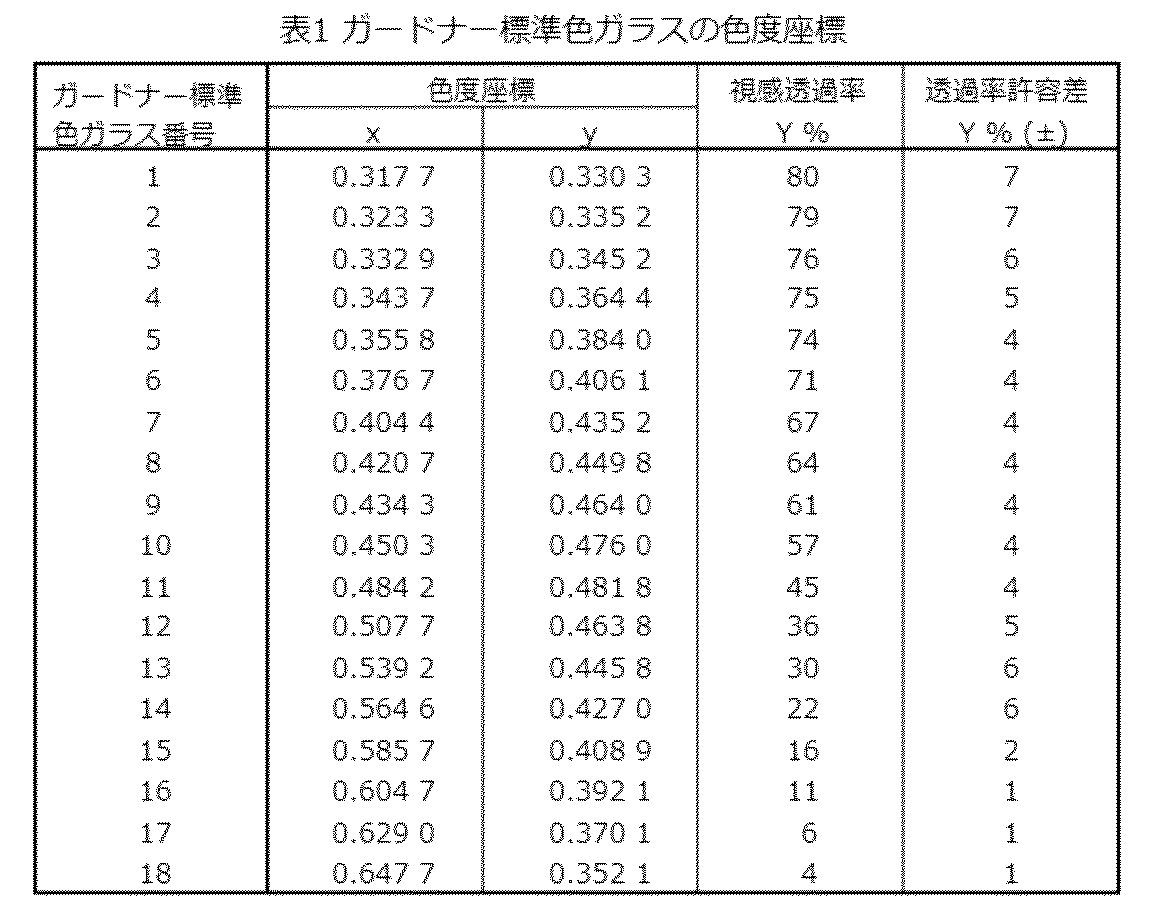

総数Tm(/100g)=イミノ基等の合計数Nm×(配合量Wm/分子量Mm)
総数Ti(/100g)=イソシアネート基の数Ni×(配合量Wi/分子量Mi)
または、
総数Ti(/100g)=配合量Wi×NCO含有率Ri/(NCO分子量=42)
第1液は、溶媒として水を含む。第1液は、さらに必要に応じて水溶性または水混和性の有機溶媒を含み得る。
第1液は、上記成分を当業者に知られた方法で混合することによって、調製することができる。混合方法としては、水性塗料組成物の調製と同様の方法が挙げられる。
第2液は、親水性ポリイソシアネート化合物(D)を含む。親水性ポリイソシアネート化合物(D)は硬化剤であり、水酸基含有成分(代表的には、水酸基含有樹脂(A))と反応して架橋構造を形成し、水性塗料組成物を硬化させる。親水性ポリイソシアネート化合物(D)は、さらに、メラミン樹脂(B)と反応する。これにより、水酸基含有樹脂(A)と親水性ポリイソシアネート化合物(D)との架橋構造の中にメラミン樹脂(B)の剛直なトリアジン環が取り込まれて、得られる塗膜の硬度が高くなる。
イオン変性ポリイソシアネート化合物(D1)は分子中にイソシアネート基を2個以上有する。イオン変性ポリイソシアネート化合物(D1)は、ブロックされていない遊離イソシアネート基を有しているため、低温硬化が可能となる。イオン変性ポリイソシアネート化合物(D1)はまた、親水基であるイオン性基を有する。そのため、イオン変性ポリイソシアネート化合物(D1)は、水性である第1液と混合したときによく分散し、塗膜の平滑性を向上させる。
ノニオン変性ポリイソシアネート化合物(D2)は、分子中にイソシアネート基を2個以上有する。ノニオン変性ポリイソシアネート化合物(D2)もまた、ブロックされていない遊離イソシアネート基を有しているため、低温硬化が可能となる。加えて、ノニオン変性ポリイソシアネート化合物(D2)は、ノニオン性の親水基を有する。これにより、ノニオン変性ポリイソシアネート化合物(D2)は、水性である第1液と混合したときによく分散し、塗膜の平滑性を向上させる。
親水性ではないポリイソシアネート化合物の使用を排除するものではない。ただし、粘度の観点から、その使用量は少ないことが望ましい。例えば、第2液に含まれるポリイソシアネート化合物の合計の固形分100質量%に占める、非親水性ポリイソシアネート化合物の使用量は、50質量%以下であってよく、30質量%以下であってよく、0質量%であってよい。
水性塗料組成物は、親水性ポリイソシアネート化合物(D)以外のその他の硬化剤を含んでよい。その他の硬化剤としては、例えば、エポキシ化合物、アジリジン化合物、カルボジイミド化合物およびオキサゾリン化合物が挙げられる。これらは、1種を単独で、あるいは2種以上を組み合わせて用いられる。その他の硬化剤の含有量は、水酸基含有樹脂に応じて適宜設定される。
第2液は、水酸基を有さない溶媒を含み得る。このような溶媒としては、例えば、グリコールエーテル系有機溶媒;アセテート系有機溶媒;ケトン系有機溶媒;エステル系有機溶媒が挙げられる。これらは、1種を単独で、あるいは2種以上を組み合わせて用いられる。
第2液は、上記成分を当業者に知られた方法で混合することによって、調製することができる。混合方法としては、第1液の調製と同様の方法が挙げられる。
水性塗料組成物は、顔料および塗料分野において一般的に使用される添加剤を含み得る。添加剤は、第1液、第2液および第3液のいずれに添加されてもよい。顔料としては、例えば、着色顔料、体質顔料、防錆顔料が挙げられる。添加剤としては、例えば、紫外線吸収剤、ヒンダードアミン光安定剤、酸化防止剤、架橋樹脂粒子、レベリング剤、消泡剤、硬化促進剤、粘性調整剤が挙げられる。
本開示に係る水性塗料組成物により、塗装物品が得られる。塗装物品は、高い硬度を有し、艶感に優れ、スプレーダストが抑制された塗膜を有する。
被塗物の材質としては、例えば、金属、樹脂、ガラスが挙げられる。被塗物として、具体的には、乗用車、トラック、オートバイ、バス等の自動車車体および自動車車体用の部品、スポイラー、バンパー、ミラーカバー、グリル、ドアノブ等の自動車部品が挙げられる。
第1塗膜は、本開示に係る水性塗料組成物により形成される。第1塗膜の硬化後の膜厚(乾燥膜厚)は、例えば、5μm以上80μm以下である。第1塗膜の乾燥膜厚は、7μm以上であってよい。第1塗膜の乾燥膜厚は、50μm以下であってよい。
第2塗膜は、第2塗料組成物により形成される。第2塗料組成物については後述する。第2塗膜は、1層であってよく、2層以上の積層塗膜であってよい。第2塗膜の1層あたりの乾燥膜厚は、例えば、5μm以上35μm以下である。第2塗膜の1層あたりの乾燥膜厚は、7μm以上であってよい。第2塗膜の1層あたりの乾燥膜厚は、30μm以下であってよい。
クリヤー塗膜は、クリヤー塗料組成物により形成される。クリヤー塗料組成物については後述する。クリヤー塗膜の乾燥膜厚は、例えば、10μm以上80μm以下である。クリヤー塗膜の乾燥膜厚は、20μm以上であってよい。クリヤー塗膜の乾燥膜厚は、60μm以下であってよい。
一態様において、塗装物品は、被塗物上に、上記の水性多液型塗料組成物を塗装して、未硬化の第1塗膜を形成する工程と、未硬化の第1塗膜上に、クリヤー塗料組成物を塗装して、未硬化のクリヤー塗膜を形成する工程と、未硬化の第1塗膜および未硬化のクリヤー塗膜を、70℃以上110℃以下で加熱して硬化させる工程と、を備える方法により製造される。
本開示に係る水性塗料組成物を被塗物上に塗装して、未硬化の第1塗膜を形成する。第1塗膜によって、第2塗膜と被塗物との付着性が向上する。また、第1塗膜により塗装面が均一になって、第2塗膜のムラが抑制され易くなる。被塗物は、上記の通り、金属部および樹脂部の両方を含んでよい。
未硬化の第1塗膜上に第2塗料組成物を塗装して、未硬化の第2塗膜を形成する。2層以上の未硬化の第2塗膜は、同じまたは異なる第2塗料組成物を2回以上塗装することにより形成することができる。n回目の第2塗料組成物の塗装とn+1回目の第2塗料組成物の塗装との間には、数分間のインターバルを設けてよい。
第2塗料組成物は、水性であってよく、溶剤系であってよい。第2塗料組成物は、水性であってよい。水性の第2塗料組成物は、例えば、アクリル樹脂エマルション、水溶性アクリル樹脂、硬化剤(代表的には、メラミン樹脂)、ポリエーテルポリオール樹脂を含む。第2塗料組成物は、さらに、上記の各種顔料、光輝性顔料および各種添加剤を含んでよい。
クリヤー塗料組成物を未硬化の第2塗膜上に塗装して、未硬化のクリヤー塗膜を形成する。
クリヤー塗料組成物は、溶剤系であってよく、水性であってよく、粉体型であってよい。溶剤系クリヤー塗料組成物は、透明性あるいは耐酸エッチング性などの点から、塗膜形成性樹脂としてアクリル樹脂および/またはポリエステル樹脂と、硬化剤としてアミノ樹脂および/またはイソシアネートと、を含んでよい。溶剤系クリヤー塗料組成物は、また、カルボン酸および/またはエポキシ基を有する、アクリル樹脂および/またはポリエステル樹脂を含んでよい。クリヤー塗料組成物は、透明性を損なわない範囲で、上記の各種顔料および添加剤を含んでよい。
未硬化の各塗膜を硬化させる。各塗膜は加熱により硬化し得る。本態様では、第1塗膜、第2塗膜およびクリヤー塗膜が一度に硬化される。
第2実施形態は、第1実施形態とは、第1液が水酸基含有樹脂(A)およびメラミン樹脂(B)とともに、ポリウレタン樹脂(C)を含む点で相違する。この相違する構成を以下に説明する。第2実施形態のその他の構成は、第1実施形態と同じであるため、その説明を省略する。第2実施形態において、塗装物品の構成、塗装物品の製造方法は第1実施形態と同じであるため、その説明を省略する。
ポリウレタン樹脂(C)もまた、塗膜形成成分である。ポリウレタン樹脂(C)によって、塗膜の弾性が高まり、耐チッピング性が向上する。
反応容器に脱イオン水126.5部を加え、窒素気流中で混合攪拌しながら80℃に昇温した。次いで、モノマー混合物30部(アクリル酸エチル6.98部、アクリル酸ブチル12.42部、スチレン4.75部、メタクリル酸2-ヒドロキシエチル2.78部、およびメタクリル酸3.07部を含む)、アデカリアソープSR-10(ポリオキシエチレン-1-アルコキシメチル-2-(2-プロペニルオキシ)エチルエーテル硫酸エステルアンモニウム塩、ADEKA社製)0.33部および脱イオン水24部からなるモノマー乳化物と、過硫酸アンモニウム0.09部および脱イオン水3部からなる開始剤溶液と、を1.5時間かけて、並行して反応容器に滴下した。滴下終了後、1時間、同じ温度で熟成を行った。
反応容器に脱イオン水126.5部を加え、窒素気流中で混合攪拌しながら80℃に昇温した。次いで、モノマー混合物100部(アクリル酸メチル27.61部、アクリル酸エチル53.04部、スチレン4.00部、メタクリル酸2-ヒドロキシエチル9.28部、メタクリル酸3.07部およびメタクリル酸アリル3.00部を含む)、アデカリアソープSR-10を1.1部および脱イオン水80部からなるモノマー乳化物と、過硫酸アンモニウム0.3部および脱イオン水10部からなる開始剤溶液と、を2時間かけて、並行して反応容器に滴下した。滴下終了後、2時間、同じ温度で熟成を行った。
反応容器にトリプロピレングリコールメチルエーテル23.89部およびプロピレングリコールメチルエーテル16.11部を加え、窒素気流中で混合攪拌しながら105℃に昇温した。次いで、メタクリル酸メチル13.1部、アクリル酸エチル68.4部、メタクリル酸2-ヒドロキシエチル11.6部およびメタクリル酸6.9部を含むモノマー混合物を作成し、そのモノマー混合物100部と、トリプロピレングリコールメチルエーテル10.0部およびt-ブチルパーオキシ2-エチルヘキサノエート1部からなる開始剤溶液とを、3時間かけて、並行して反応容器に滴下した。滴下終了後、0.5時間、同じ温度で熟成を行った。
攪拌機、窒素導入管、温度制御装置、コンデンサー、デカンターを備えた反応容器に、トリメチロールプロパン250部、アジピン酸824部、シクロヘキサンジカルボン酸635部を加え、180℃に昇温して、水が留出しなくなるまで縮合反応を行った。60℃まで冷却した後、無水フタル酸120部を加えた。次いで、140℃まで昇温して、これを60分間保ち、GPC測定による数平均分子量2,000のポリエステル樹脂を得た。ジメチルアミノエタノール59部(樹脂が有する酸価の80%相当(中和率80%))を80℃で加え、さらに脱イオン水1920部を投入および攪拌して、固形分45質量%のポリエステル水分散体を得た。このポリエステル水分散体に含まれる水酸基含有ポリエステル樹脂(A2)の水酸基価110mgKOH/g、酸価は15mgKOH/g、Tgは-14℃、Mwは7,000であった。
分散剤「Disperbyk 190」(ビックケミー社製)9.2部、イオン交換水17.8部、および、ルチル型二酸化チタン73.0部を予備混合した。その後、ペイントコンディショナー中でビーズ媒体を用いて、室温で粒度5μm以下となるまで混合分散した。最後に、ビーズ媒体を濾過にて取り除いて、着色顔料ペーストを得た。
以下の平均官能基数、平均粒子径および数平均分子量を有するメラミン樹脂(B-1)~(B-7)、(b-1)~(b-3)を用いた。詳細を表2に示す。

(C-1):N800T、三洋化成社製、水酸基価0mgKOH/g
(C-2):Bayhydrol UH2648/1、コベストロ社製、水性ポリウレタン樹脂、水酸基価0mgKOH/g
(C-3):Bayhydrol U2787、コベストロ社製、水性ポリウレタン樹脂、水酸基価56mgKOH/g
(D1):バイヒジュール2655、住化コベストロウレタン社製、スルホン酸基含有
[ノニオン変性ポリイソシアネート化合物(D2)]
(D2):バイヒジュール304、住化コベストロウレタン社製、親水性ポリエーテル変性HDIトリマー
(d1):デュラネートWM44-L70G、旭化成社製、HDI系ブロックイソシアネート
[非親水性ポリイソシアネート化合物]
(d2):スミジュールN3300、住化コベストロウレタン社製、ヘキサメチレンジイソシアネートのウレトジオン体
[実施例1]
(1)第1液の調製
攪拌機を有する容器に、水酸基含有アクリル樹脂(A1-1)35部、水酸基含有ポリエステル樹脂(A2)10部、メラミン樹脂(B-1)10部、着色顔料ペースト122.87部、イオン交換水25部を投入し、ジメチルエタノールアミン(キシダ化学社製)0.01部でPHを8.0に調整した。さらに、アデカノールUH-814N(ウレタン会合型粘性剤、有効成分30%、旭電化工業社製、商品名)1.0部を混合攪拌した。その後、タイペークCR-97(石原産業社製、二酸化チタン、一次平均粒子径200nm)をPWC53.5%となるように加えて、分散させた。これにより、第1液を得た。
アニオン変性ポリイソシアネート化合物(D1)45部および溶媒(ジプロピレングリコールジメチルエーテルおよび/またはエチレングリコールモノブチルアセテート)適量を混合し、ディスパーにて十分攪拌して、第2液を得た。
第1液および第2液を混合して、水性塗料組成物を得た。
(金属製被塗物)
梨地鋼板(400mm×600mm)を被塗素材とし、常法に従って洗浄リン酸亜鉛処理を行った。次いで、カチオン型電着塗料(日本ペイント(株)製パワートップU-100)を使用して電着塗装した。続いて、170℃×20分の条件で乾燥処理し、厚さ15μmの電着塗膜を有する金属製被塗物を得た。
ポリプロピレン板を脱脂処理して、樹脂製被塗物を得た。
金属製被塗物および樹脂製被塗物にそれぞれ、水性多液型塗料組成物を回転霧化式の静電塗装機を用いて、乾燥膜厚で15μmとなるように静電塗装し、5分間放置した。
次いで、水性ベース塗料組成物(日本ペイント・オートモーティブコーティングス社製、水性ベースAR-3020-1(グレーメタリック))を回転霧化式の静電塗装機を用いて、乾燥膜厚が15μmとなるように塗装し、80℃で3分間プレヒートを行った。
続いて、クリヤー塗料(日本ペイント・オートモーティブコーティングス株式会社製、ポリウレエクセル O-1200 (商品名)、ポリイソシアネート化合物含有2液アクリルウレタン系有機溶剤型クリヤー塗料)を回転霧化式の静電塗装機を用いて、乾燥膜厚が35μmとなるように塗装した。
その後、80℃で20分間加熱して、複層塗膜を有する塗装物品を得た。
配合成分の種類および配合量、塗装時の固形分質量などを、表3および表4に示す通りに変更したこと以外は、実施例1と同様の手順により、水性塗料組成物を調製し、塗装物品を得た。
メラミン樹脂(B-1)を、第1液ではなく、第2液に添加したこと以外は、実施例1と同様の手順により、水性塗料組成物を調製した。
この水性塗料組成物を23℃下に静置したところ、24時間経過後、塗料組成物の粘度が著しく高くなり、スプレー塗装することができなかった。そのため、以下の評価を行うことができなかった。
第1液の調製において、メラミン樹脂(B-1)10部に替えて、平均粒子径2μmのメラミン樹脂粒子(商品名:エポスターMS、日本触媒社製)10部を加えたこと以外、実施例1と同様の手順により、水性塗料組成物を調製した。
上記実施例および比較例で調製した水性塗料組成物を用いて、下記評価を実施した。比較例7は、硬度および艶感を評価した。
ガラス板に、水性多液型塗料組成物を回転霧化式の静電塗装機を用いて、乾燥膜厚で15μmとなるように静電塗装し、5分間放置した。次いで、85℃で20分間(キープ時間)加熱して、単層塗膜を有する評価用試験板Aを得た。ペンデュラム硬度試験器(BYK社製)に評価用試験板Aをセットして、23℃におけるケーニッヒ振り子の振れ角度が6度から3度に減少するのに要する振動回数を測定し、以下の評価基準に従い評価した。
A 振動回数が80回以上
B 振動回数が65回以上80回未満
C 振動回数が50回以上65回未満
D 振動回数が35回以上50回未満
E 振動回数が35回未満
上記と同様にして準備した金属製被塗物に、水性多液型塗料組成物を回転霧化式の静電塗装機を用いて、乾燥膜厚で15μmとなるように静電塗装し、5分間放置した。次いで、85℃で20分間(キープ時間)加熱して、単層塗膜を有する評価用試験板Bを得た。
B 60°グロス値が60以上70未満
C 60°グロス値が50以上60未満
D 60°グロス値が40以上50未満
E 60°グロス値が40未満
上記と同様にして準備した金属製被塗物に、エアスプレー塗装により、下記条件にて水性塗料組成物を塗装して、評価用試験板Cを得た。
吐出:全閉から2回転戻し
エア圧:0.25MPa
略垂直に保持した状態の金属製被塗物に対して、以下の手順で塗装を行った。
手順1.被塗物に、水性多液型塗料組成物を、乾燥膜厚が15μmとなるように塗装(ガン距離30cm)を行う
手順2.室温で10分乾燥させる
手順3.被塗物から斜め45°ガン距離150cmの位置に立ち、10秒間ダスト吹きを行う。
手順4.室温で10秒間乾燥させる
手順5.手順3及び手順4を計5回行う。
手順9.ジェットオーブン中で60℃×1時間乾燥させる
5 10個未満
4 10個以上30個未満
3 30個以上100個未満
2 100個以上200個未満
1 200個以上
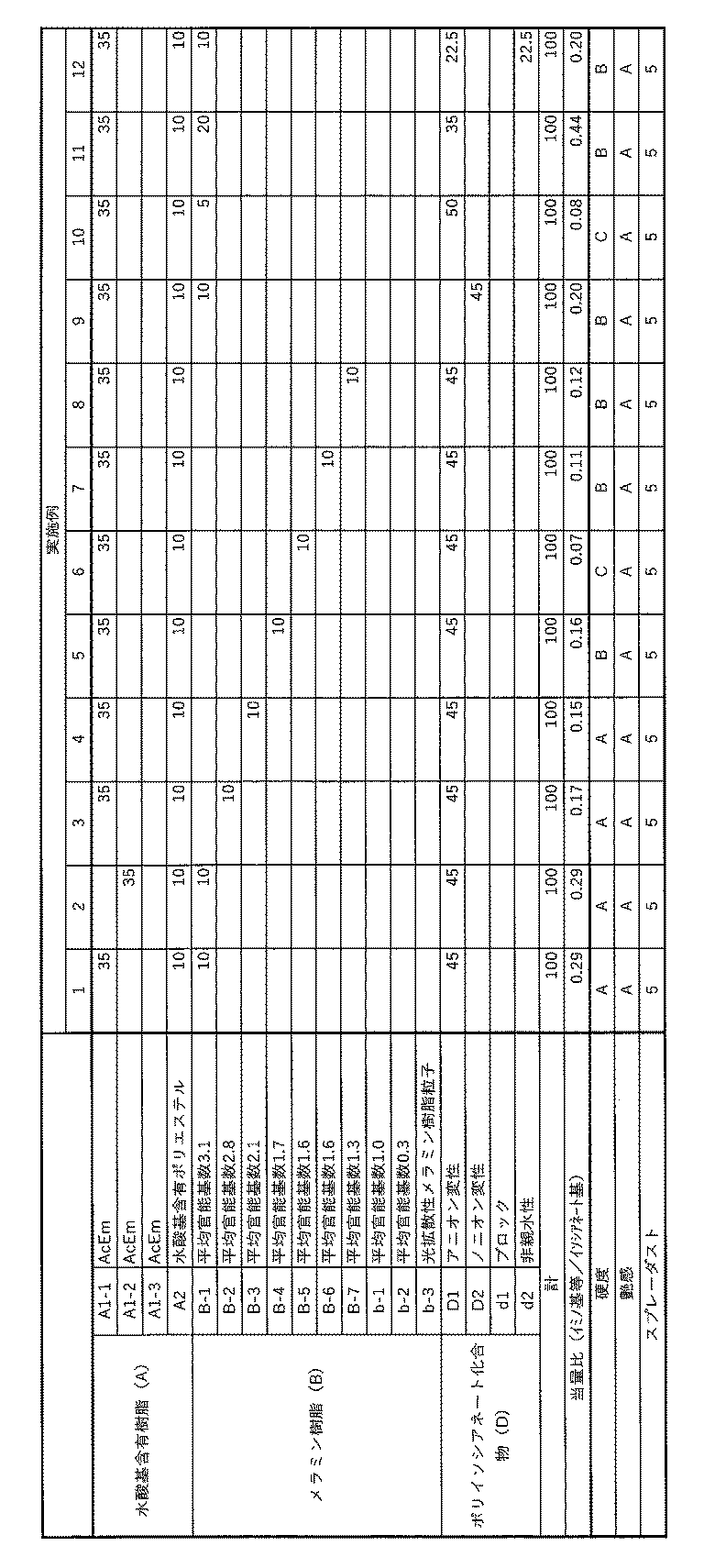
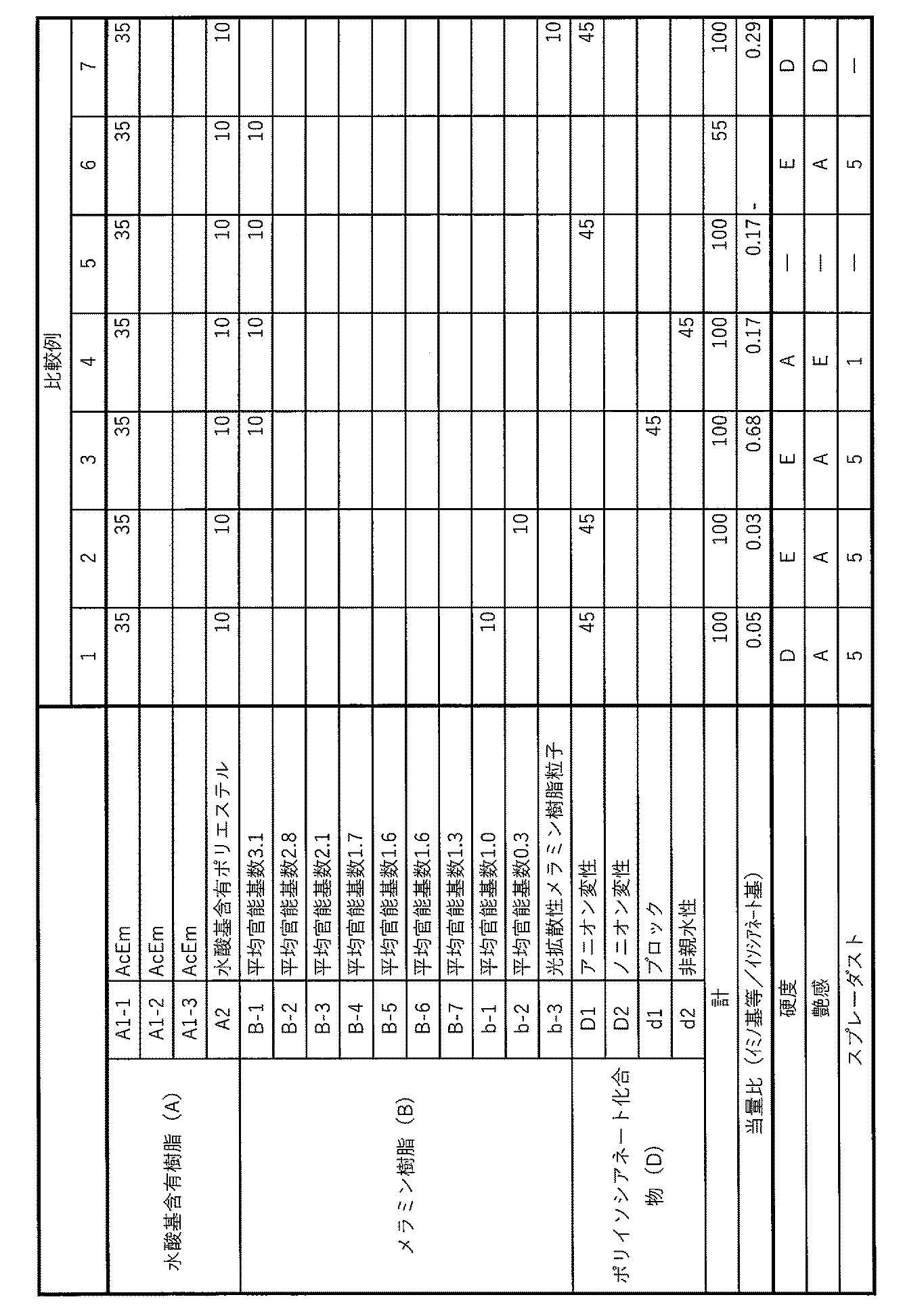
[実施例13]
(1)第1液の調製
攪拌機を有する容器に、水酸基含有アクリル樹脂(A1-1)40部、水酸基含有ポリエステル樹脂(A2)10部、メラミン樹脂(B-1)15部、ポリウレタン樹脂(C-1)10部、着色顔料ペースト122.11部、イオン交換水68部を投入し、ジメチルエタノールアミン(キシダ化学社製)0.01部でPHを8.0に調整した。さらに、アデカノールUH-814N(ウレタン会合型粘性剤、有効成分30%、旭電化工業社製、商品名)1.0部を混合攪拌した。その後、タイペークCR-97(石原産業社製、二酸化チタン、一次平均粒子径200nm)をPWC53.5%となるように加えて、分散させた。これにより、第1液を得た。
アニオン変性ポリイソシアネート化合物(D1)25部および溶媒(ジプロピレングリコールジメチルエーテルおよび/またはエチレングリコールモノブチルアセテート)適量を混合し、ディスパーにて十分攪拌して、第2液を得た。
配合成分の種類および配合量、塗装時の固形分質量などを、表5~7に示す通りに変更したこと以外は、実施例13と同様の手順により、水性塗料組成物を調製し、塗装物品を得た。
メラミン樹脂(B-1)を、第1液ではなく、第2液に添加したこと以外は、実施例13と同様の手順により、水性塗料組成物を調製した。
この水性塗料組成物を23℃下に静置したところ、24時間経過後、塗料組成物の粘度が著しく高くなり、スプレー塗装することができなかった。そのため、以下の評価を行うことができなかった。


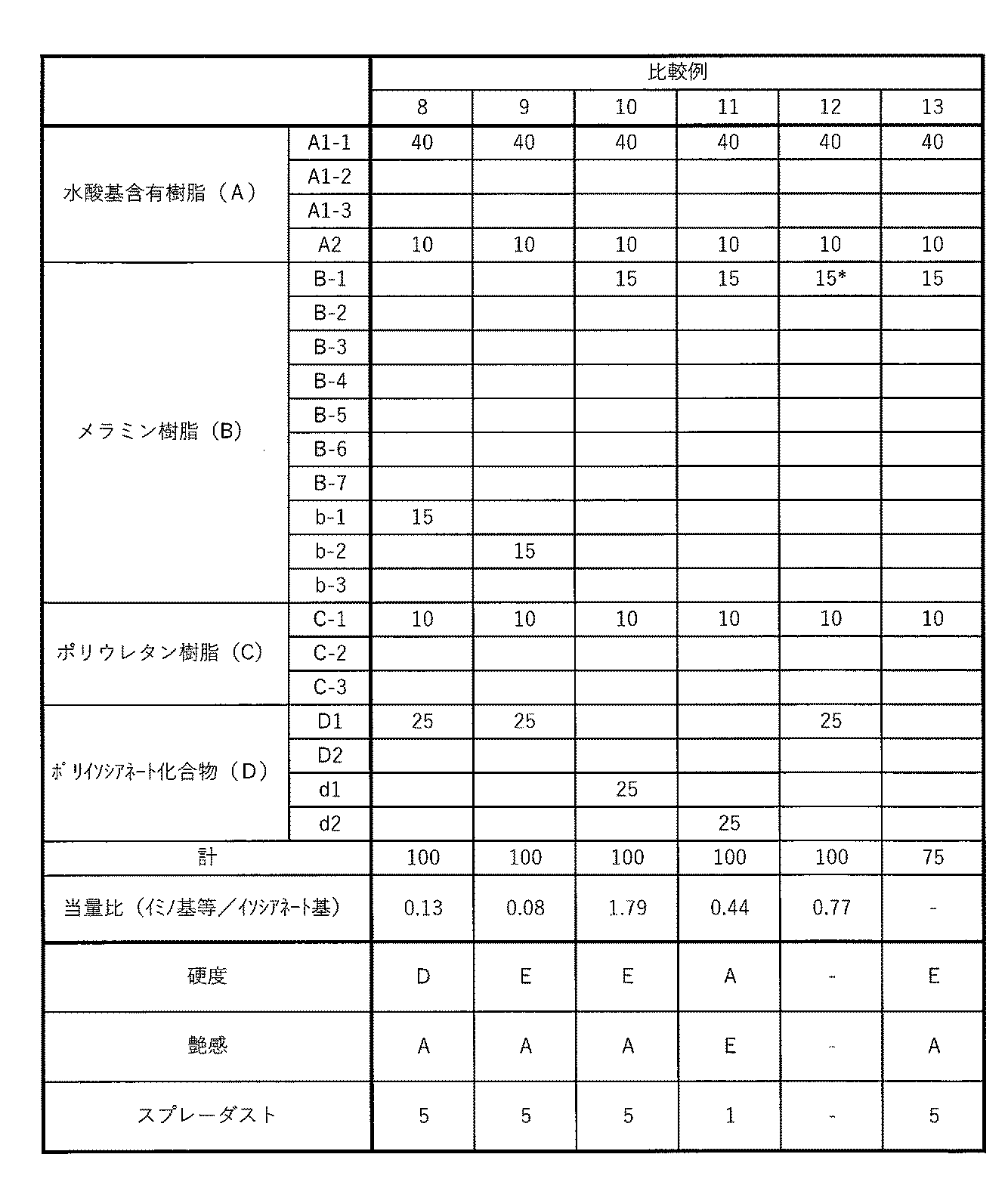
比較例3および10では、ブロックイソシアネート化合物を用いた。この水性塗料組成物から低温硬化により得られた塗膜は、硬度が大きく劣ることが確認された。
比較例4および11では、非親水性のイソシアネート化合物を用いた。この水性塗料組成物から低温硬化により得られた塗膜は、艶感に大きく劣り、また、非常に多くのスプレーダストが発生することが確認された。
比較例5および12では、メラミン樹脂を第2液に入れて、水性塗料組成物を調製した。この水性塗料組成物は、粘度が大きく増加し、スプレー塗装が困難であった。
比較例6および13では、ポリイソシアネート化合物を使用しなかった。この水性塗料組成物から低温硬化により得られた塗膜は、硬度が大きく劣ることが確認された。
比較例7では、平均粒子径の大きなメラミン樹脂を用いた。この水性塗料組成物から低温硬化により得られた塗膜は、艶感に劣っていた。これは、メラミン樹脂が光拡散性を伴っているためと考えられる。
[1]
水酸基含有樹脂(A)およびメラミン樹脂(B)を含む第1液と、
親水性ポリイソシアネート化合物(D)を含む第2液と、を含み、
前記水酸基含有樹脂(A)は、水酸基含有アクリル樹脂(A1)および水酸基含有ポリエステル樹脂(A2)の少なくとも一方であり、
前記メラミン樹脂(B)は、前記第1液中で溶解しているかあるいは平均粒子径が1μm未満であり、かつ、トリアジン環1個当たりのイミノ基数およびメチロール基数の合計の平均値が1超であり、
前記親水性ポリイソシアネート化合物(D)は、イオン変性ポリイソシアネート化合物(D1)およびノニオン変性ポリイソシアネート化合物(D2)の少なくとも一方である、水性多液型塗料組成物。
[2]
水酸基含有樹脂(A)、メラミン樹脂(B)およびポリウレタン樹脂(C)を含む第1液と、
親水性ポリイソシアネート化合物(D)を含む第2液と、を含み、
前記水酸基含有樹脂(A)は、水酸基含有アクリル樹脂(A1)および水酸基含有ポリエステル樹脂(A2)の少なくとも一方であり、
前記メラミン樹脂(B)は、前記第1液中で溶解しているかあるいは平均粒子径が1μm未満であり、トリアジン環1個当たりのイミノ基数およびメチロール基数の合計の平均値が1超であり、
前記親水性ポリイソシアネート化合物(D)は、イオン変性ポリイソシアネート化合物(D1)およびノニオン変性ポリイソシアネート化合物(D2)の少なくとも一方である、水性多液型塗料組成物。
[3]
前記イオン変性ポリイソシアネート化合物(D1)は、少なくともアニオン変性ポリイソシアネート化合物を含む、上記[1]または[2]の水性多液型塗料組成物。
[4]
前記ポリウレタン樹脂(C)は、水酸基価が30mgKOH/g以下である、上記[2]の水性多液型塗料組成物。
[5]
前記水酸基含有樹脂(A)は、酸価が5mgKOH/g以上70mgKOH/g以下である、上記[1]~[4]いずれかの水性多液型塗料組成物。
[6]
前記メラミン樹脂(B)は、溶解パラメータが9以上15以下である、上記[1]~[5]いずれかの水性多液型塗料組成物。
[7]
前記メラミン樹脂(B)の固形分質量は、前記水酸基含有樹脂(A)の固形分質量100質量部に対して7質量部以上40質量部以下である、上記[1]~[6]いずれかの水性多液型塗料組成物。
[8]
前記メラミン樹脂(B)の固形分質量は、前記水酸基含有樹脂(A)および前記ポリウレタン樹脂(C)の合計固形分質量100質量部に対して7質量部以上40質量部以下である、上記[2]に記載の水性多液型塗料組成物。
[9]
前記メラミン樹脂(B)が有するイミノ基およびメチロール基と、前記親水性ポリイソシアネート化合物(D)が有するイソシアネート基との当量比(イミノ基およびメチロール基/イソシアネート基)が、0.2以上1.1以下である上記[1]~[8]いずれかの水性多液型塗料組成物。
[10]
前記メラミン樹脂(B)の数平均分子量は、300以上3000以下である上記[1]~[9]いずれかの水性多液型塗料組成物。
[11]
被塗物上に、上記[1]~[10]いずれかの水性多液型塗料組成物を塗装して、未硬化の第1塗膜を形成する工程と、
前記未硬化の第1塗膜上に、クリヤー塗料組成物を塗装して、未硬化のクリヤー塗膜を形成する工程と、
前記未硬化の第1塗膜および前記未硬化のクリヤー塗膜を、70℃以上110℃以下で加熱して硬化させる工程と、を備える、塗装物品の製造方法。
[12]
被塗物上に、上記[1]~[10]いずれかの水性多液型塗料組成物を塗装して、未硬化の第1塗膜を形成する工程と、
前記未硬化の第1塗膜上に、第2水性塗料組成物を塗装して、未硬化の第2塗膜を形成する工程と、
前記未硬化の第2塗膜上にクリヤー塗料組成物を塗装して、未硬化のクリヤー塗膜を形成する工程と、
前記未硬化の第1塗膜、前記未硬化の第2塗膜および前記未硬化のクリヤー塗膜を、70℃以上110℃以下で加熱して硬化させる工程と、を備える、塗装物品の製造方法。
[13]
前記被塗物は、金属部および樹脂部を含む、上記[11]または上記[12]の塗装物品の製造方法。
Claims (13)
- 水酸基含有樹脂(A)およびメラミン樹脂(B)を含む第1液と、
親水性ポリイソシアネート化合物(D)を含む第2液と、を含み、
前記水酸基含有樹脂(A)は、水酸基含有アクリル樹脂(A1)および水酸基含有ポリエステル樹脂(A2)の少なくとも一方であり、
前記メラミン樹脂(B)は、前記第1液中で溶解しているかあるいは平均粒子径が1μm未満であり、かつ、トリアジン環1個当たりのイミノ基数およびメチロール基数の合計の平均値が1超であり、
前記親水性ポリイソシアネート化合物(D)は、イオン変性ポリイソシアネート化合物(D1)およびノニオン変性ポリイソシアネート化合物(D2)の少なくとも一方である、水性多液型塗料組成物。 - 水酸基含有樹脂(A)、メラミン樹脂(B)およびポリウレタン樹脂(C)を含む第1液と、
親水性ポリイソシアネート化合物(D)を含む第2液と、を含み、
前記水酸基含有樹脂(A)は、水酸基含有アクリル樹脂(A1)および水酸基含有ポリエステル樹脂(A2)の少なくとも一方であり、
前記メラミン樹脂(B)は、前記第1液中で溶解しているかあるいは平均粒子径が1μm未満であり、トリアジン環1個当たりのイミノ基数およびメチロール基数の合計の平均値が1超であり、
前記親水性ポリイソシアネート化合物(D)は、イオン変性ポリイソシアネート化合物(D1)およびノニオン変性ポリイソシアネート化合物(D2)の少なくとも一方である、水性多液型塗料組成物。 - 前記イオン変性ポリイソシアネート化合物(D1)は、少なくともアニオン変性ポリイソシアネート化合物を含む、請求項1または2記載の水性多液型塗料組成物。
- 前記ポリウレタン樹脂(C)は、水酸基価が30mgKOH/g以下である、請求項2記載の水性多液型塗料組成物。
- 前記水酸基含有樹脂(A)は、酸価が5mgKOH/g以上70mgKOH/g以下である、請求項1~4いずれか一項に記載の水性多液型塗料組成物。
- 前記メラミン樹脂(B)は、溶解パラメータが9以上15以下である、請求項1~5のいずれか一項に記載の水性多液型塗料組成物。
- 前記メラミン樹脂(B)の固形分質量は、前記水酸基含有樹脂(A)の固形分質量100質量部に対して7質量部以上40質量部以下である、請求項1~6のいずれか一項に記載の水性多液型塗料組成物。
- 前記メラミン樹脂(B)の固形分質量は、前記水酸基含有樹脂(A)および前記ポリウレタン樹脂(C)の合計固形分質量100質量部に対して7質量部以上40質量部以下である、請求項2に記載の水性多液型塗料組成物。
- 前記メラミン樹脂(B)が有するイミノ基およびメチロール基と、前記親水性ポリイソシアネート化合物(D)が有するイソシアネート基との当量比(イミノ基およびメチロール基/イソシアネート基)が、0.2以上1.1以下である、請求項1~8のいずれか一項に記載の水性多液型塗料組成物。
- 前記メラミン樹脂(B)の数平均分子量は、300以上3000以下である、請求項1~9のいずれか一項に記載の水性多液型塗料組成物。
- 被塗物上に、請求項1~10のいずれか一項に記載の水性多液型塗料組成物を塗装して、未硬化の第1塗膜を形成する工程と、
前記未硬化の第1塗膜上に、クリヤー塗料組成物を塗装して、未硬化のクリヤー塗膜を形成する工程と、
前記未硬化の第1塗膜および前記未硬化のクリヤー塗膜を、70℃以上110℃以下で加熱して硬化させる工程と、を備える、塗装物品の製造方法。 - 被塗物上に、請求項1~10のいずれか一項に記載の水性多液型塗料組成物を塗装して、未硬化の第1塗膜を形成する工程と、
前記未硬化の第1塗膜上に、第2水性塗料組成物を塗装して、未硬化の第2塗膜を形成する工程と、
前記未硬化の第2塗膜上にクリヤー塗料組成物を塗装して、未硬化のクリヤー塗膜を形成する工程と、
前記未硬化の第1塗膜、前記未硬化の第2塗膜および前記未硬化のクリヤー塗膜を、70℃以上110℃以下で加熱して硬化させる工程と、を備える、塗装物品の製造方法。 - 前記被塗物は、金属部および樹脂部を含む、請求項11または12記載の塗装物品の製造方法。
Priority Applications (3)
| Application Number | Priority Date | Filing Date | Title |
|---|---|---|---|
| CN202480009964.4A CN120677210A (zh) | 2023-01-31 | 2024-01-25 | 水性多液型涂料组合物及涂装物品的制造方法 |
| EP24750127.3A EP4660263A1 (en) | 2023-01-31 | 2024-01-25 | Aqueous multi-component coating composition and method for producing coated article |
| JP2024528571A JP7595812B1 (ja) | 2023-01-31 | 2024-01-25 | 水性多液型塗料組成物および塗装物品の製造方法 |
Applications Claiming Priority (4)
| Application Number | Priority Date | Filing Date | Title |
|---|---|---|---|
| JP2023013411 | 2023-01-31 | ||
| JP2023-013411 | 2023-01-31 | ||
| JPPCT/JP2023/035702 | 2023-09-29 | ||
| PCT/JP2023/035702 WO2024161702A1 (ja) | 2023-01-31 | 2023-09-29 | 水性多液型塗料組成物および塗装物品の製造方法 |
Publications (1)
| Publication Number | Publication Date |
|---|---|
| WO2024162178A1 true WO2024162178A1 (ja) | 2024-08-08 |
Family
ID=92146044
Family Applications (2)
| Application Number | Title | Priority Date | Filing Date |
|---|---|---|---|
| PCT/JP2023/035702 Ceased WO2024161702A1 (ja) | 2023-01-31 | 2023-09-29 | 水性多液型塗料組成物および塗装物品の製造方法 |
| PCT/JP2024/002250 Ceased WO2024162178A1 (ja) | 2023-01-31 | 2024-01-25 | 水性多液型塗料組成物および塗装物品の製造方法 |
Family Applications Before (1)
| Application Number | Title | Priority Date | Filing Date |
|---|---|---|---|
| PCT/JP2023/035702 Ceased WO2024161702A1 (ja) | 2023-01-31 | 2023-09-29 | 水性多液型塗料組成物および塗装物品の製造方法 |
Country Status (4)
| Country | Link |
|---|---|
| EP (1) | EP4660263A1 (ja) |
| JP (1) | JP7595812B1 (ja) |
| CN (1) | CN120677210A (ja) |
| WO (2) | WO2024161702A1 (ja) |
Cited By (2)
| Publication number | Priority date | Publication date | Assignee | Title |
|---|---|---|---|---|
| JP2025116842A (ja) * | 2024-01-24 | 2025-08-08 | アクサルタ コーティング システムズ ゲゼルシャフト ミット ベシュレンクテル ハフツング | 二液型(2k)水性コーティング組成物 |
| JP2025124590A (ja) * | 2024-01-24 | 2025-08-26 | アクサルタ コーティング システムズ ゲゼルシャフト ミット ベシュレンクテル ハフツング | 二液型(2k)水性コーティング組成物 |
Citations (9)
| Publication number | Priority date | Publication date | Assignee | Title |
|---|---|---|---|---|
| JPS4841718B1 (ja) | 1969-11-10 | 1973-12-07 | ||
| JPS5541607B2 (ja) | 1974-12-07 | 1980-10-25 | ||
| JP2003525967A (ja) * | 1999-03-17 | 2003-09-02 | イー・アイ・デュポン・ドウ・ヌムール・アンド・カンパニー | 高固形分の腐蝕抵抗性かつ表面摩耗抵抗性の透明塗料組成物 |
| JP2013053304A (ja) * | 2011-08-06 | 2013-03-21 | Kansai Paint Co Ltd | 熱硬化性2液型塗料組成物及び塗装物品 |
| WO2019064958A1 (ja) * | 2017-09-26 | 2019-04-04 | 関西ペイント株式会社 | 複層塗膜形成方法 |
| JP2019056019A (ja) * | 2016-01-27 | 2019-04-11 | 日本ペイント・オートモーティブコーティングス株式会社 | 水性塗料組成物 |
| JP2021130812A (ja) | 2020-02-18 | 2021-09-09 | 関西ペイント株式会社 | 水性多液型塗料組成物、塗膜形成方法、多色仕上げ塗装方法及び塗装体の補修塗装方法 |
| JP2022185278A (ja) * | 2021-06-02 | 2022-12-14 | 大日精化工業株式会社 | 塗料主剤組成物、塗料組成物及び積層体 |
| JP2023013411A (ja) | 2021-07-16 | 2023-01-26 | 日東電工株式会社 | 透明導電性積層体および透明導電性フィルム |
Family Cites Families (1)
| Publication number | Priority date | Publication date | Assignee | Title |
|---|---|---|---|---|
| JPH0525431A (ja) * | 1990-09-20 | 1993-02-02 | Nippon Paint Co Ltd | 熱硬化性塗料組成物及び塗膜形成方法 |
-
2023
- 2023-09-29 WO PCT/JP2023/035702 patent/WO2024161702A1/ja not_active Ceased
-
2024
- 2024-01-25 EP EP24750127.3A patent/EP4660263A1/en active Pending
- 2024-01-25 CN CN202480009964.4A patent/CN120677210A/zh active Pending
- 2024-01-25 WO PCT/JP2024/002250 patent/WO2024162178A1/ja not_active Ceased
- 2024-01-25 JP JP2024528571A patent/JP7595812B1/ja active Active
Patent Citations (9)
| Publication number | Priority date | Publication date | Assignee | Title |
|---|---|---|---|---|
| JPS4841718B1 (ja) | 1969-11-10 | 1973-12-07 | ||
| JPS5541607B2 (ja) | 1974-12-07 | 1980-10-25 | ||
| JP2003525967A (ja) * | 1999-03-17 | 2003-09-02 | イー・アイ・デュポン・ドウ・ヌムール・アンド・カンパニー | 高固形分の腐蝕抵抗性かつ表面摩耗抵抗性の透明塗料組成物 |
| JP2013053304A (ja) * | 2011-08-06 | 2013-03-21 | Kansai Paint Co Ltd | 熱硬化性2液型塗料組成物及び塗装物品 |
| JP2019056019A (ja) * | 2016-01-27 | 2019-04-11 | 日本ペイント・オートモーティブコーティングス株式会社 | 水性塗料組成物 |
| WO2019064958A1 (ja) * | 2017-09-26 | 2019-04-04 | 関西ペイント株式会社 | 複層塗膜形成方法 |
| JP2021130812A (ja) | 2020-02-18 | 2021-09-09 | 関西ペイント株式会社 | 水性多液型塗料組成物、塗膜形成方法、多色仕上げ塗装方法及び塗装体の補修塗装方法 |
| JP2022185278A (ja) * | 2021-06-02 | 2022-12-14 | 大日精化工業株式会社 | 塗料主剤組成物、塗料組成物及び積層体 |
| JP2023013411A (ja) | 2021-07-16 | 2023-01-26 | 日東電工株式会社 | 透明導電性積層体および透明導電性フィルム |
Non-Patent Citations (4)
| Title |
|---|
| "Testing methods for color of chemical products - Part 2: Gardner color scale", JIS K 0071-2:1998 |
| C. M. HANSEN, J. PAINT TECH., vol. 39, no. 505, 1967, pages 104 |
| See also references of EP4660263A1 |
| TOSHIKATSU KOBAYASHI, JOURNAL OF THE JAPAN SOCIETY OF COLOR MATERIAL, vol. 77, no. 4, 2004, pages 188 - 192 |
Cited By (2)
| Publication number | Priority date | Publication date | Assignee | Title |
|---|---|---|---|---|
| JP2025116842A (ja) * | 2024-01-24 | 2025-08-08 | アクサルタ コーティング システムズ ゲゼルシャフト ミット ベシュレンクテル ハフツング | 二液型(2k)水性コーティング組成物 |
| JP2025124590A (ja) * | 2024-01-24 | 2025-08-26 | アクサルタ コーティング システムズ ゲゼルシャフト ミット ベシュレンクテル ハフツング | 二液型(2k)水性コーティング組成物 |
Also Published As
| Publication number | Publication date |
|---|---|
| WO2024161702A1 (ja) | 2024-08-08 |
| JP7595812B1 (ja) | 2024-12-06 |
| JPWO2024162178A1 (ja) | 2024-08-08 |
| EP4660263A1 (en) | 2025-12-10 |
| CN120677210A (zh) | 2025-09-19 |
Similar Documents
| Publication | Publication Date | Title |
|---|---|---|
| CN101432082B (zh) | 形成多层涂膜的方法 | |
| JP5995948B2 (ja) | 水性ベース塗料組成物及びそれを用いた複層塗膜形成方法 | |
| CN104136134B (zh) | 多层涂膜形成方法及涂装物品 | |
| JP5583031B2 (ja) | 複層塗膜形成方法 | |
| CN105121037B (zh) | 形成多层涂膜的方法 | |
| JP7615045B2 (ja) | 水性塗料組成物、塗装物品及び複層塗膜形成方法 | |
| JP5451207B2 (ja) | 水性塗料組成物及び複層塗膜形成方法 | |
| JP5506672B2 (ja) | 水性塗料組成物 | |
| JP7595812B1 (ja) | 水性多液型塗料組成物および塗装物品の製造方法 | |
| JP7213085B2 (ja) | 複層塗膜形成方法 | |
| JP2019198861A (ja) | 複層塗膜形成方法 | |
| WO2013047209A1 (ja) | 塗膜形成方法及び塗装物品 | |
| WO2010119969A1 (ja) | ベースコート塗料組成物 | |
| JP5408888B2 (ja) | 水分散型樹脂、二液型熱硬化性樹脂組成物及びこれらの製造方法 | |
| CN108373767A (zh) | 多层涂膜形成方法 | |
| JP6826095B2 (ja) | 複層塗膜形成方法 | |
| JP5015884B2 (ja) | 複層塗膜形成方法 | |
| JP7402712B2 (ja) | 複層塗膜の製造方法 | |
| WO2025142010A1 (ja) | 水性多液型塗料組成物および塗装物品の製造方法 | |
| JP2025101603A (ja) | 水性多液型塗料組成物および塗装物品の製造方法 | |
| WO2024135491A1 (ja) | プラスチック用プライマー | |
| JP2024079351A (ja) | 塗装物品およびその製造方法 | |
| WO2026094509A1 (ja) | 複層塗膜形成方法 | |
| WO2026094505A1 (ja) | 複層塗膜形成方法 | |
| WO2024135492A1 (ja) | プラスチック用プライマー |
Legal Events
| Date | Code | Title | Description |
|---|---|---|---|
| WWE | Wipo information: entry into national phase |
Ref document number: 2024528571 Country of ref document: JP |
|
| 121 | Ep: the epo has been informed by wipo that ep was designated in this application |
Ref document number: 24750127 Country of ref document: EP Kind code of ref document: A1 |
|
| WWE | Wipo information: entry into national phase |
Ref document number: 202480009964.4 Country of ref document: CN |
|
| NENP | Non-entry into the national phase |
Ref country code: DE |
|
| WWP | Wipo information: published in national office |
Ref document number: 202480009964.4 Country of ref document: CN |
|
| WWP | Wipo information: published in national office |
Ref document number: 2024750127 Country of ref document: EP |