WO2024185688A1 - 含フッ素重合体 - Google Patents
含フッ素重合体 Download PDFInfo
- Publication number
- WO2024185688A1 WO2024185688A1 PCT/JP2024/007770 JP2024007770W WO2024185688A1 WO 2024185688 A1 WO2024185688 A1 WO 2024185688A1 JP 2024007770 W JP2024007770 W JP 2024007770W WO 2024185688 A1 WO2024185688 A1 WO 2024185688A1
- Authority
- WO
- WIPO (PCT)
- Prior art keywords
- group
- weight
- less
- parts
- monomer
- Prior art date
- Legal status (The legal status is an assumption and is not a legal conclusion. Google has not performed a legal analysis and makes no representation as to the accuracy of the status listed.)
- Ceased
Links
Classifications
-
- D—TEXTILES; PAPER
- D06—TREATMENT OF TEXTILES OR THE LIKE; LAUNDERING; FLEXIBLE MATERIALS NOT OTHERWISE PROVIDED FOR
- D06M—TREATMENT, NOT PROVIDED FOR ELSEWHERE IN CLASS D06, OF FIBRES, THREADS, YARNS, FABRICS, FEATHERS OR FIBROUS GOODS MADE FROM SUCH MATERIALS
- D06M15/00—Treating fibres, threads, yarns, fabrics, or fibrous goods made from such materials, with macromolecular compounds; Such treatment combined with mechanical treatment
- D06M15/19—Treating fibres, threads, yarns, fabrics, or fibrous goods made from such materials, with macromolecular compounds; Such treatment combined with mechanical treatment with synthetic macromolecular compounds
- D06M15/21—Macromolecular compounds obtained by reactions only involving carbon-to-carbon unsaturated bonds
- D06M15/263—Macromolecular compounds obtained by reactions only involving carbon-to-carbon unsaturated bonds of unsaturated carboxylic acids; Salts or esters thereof
- D06M15/277—Macromolecular compounds obtained by reactions only involving carbon-to-carbon unsaturated bonds of unsaturated carboxylic acids; Salts or esters thereof containing fluorine
-
- C—CHEMISTRY; METALLURGY
- C09—DYES; PAINTS; POLISHES; NATURAL RESINS; ADHESIVES; COMPOSITIONS NOT OTHERWISE PROVIDED FOR; APPLICATIONS OF MATERIALS NOT OTHERWISE PROVIDED FOR
- C09D—COATING COMPOSITIONS, e.g. PAINTS, VARNISHES OR LACQUERS; FILLING PASTES; CHEMICAL PAINT OR INK REMOVERS; INKS; CORRECTING FLUIDS; WOODSTAINS; PASTES OR SOLIDS FOR COLOURING OR PRINTING; USE OF MATERIALS THEREFOR
- C09D133/00—Coating compositions based on homopolymers or copolymers of compounds having one or more unsaturated aliphatic radicals, each having only one carbon-to-carbon double bond, and at least one being terminated by only one carboxyl radical, or of salts, anhydrides, esters, amides, imides, or nitriles thereof; Coating compositions based on derivatives of such polymers
- C09D133/04—Homopolymers or copolymers of esters
- C09D133/14—Homopolymers or copolymers of esters of esters containing halogen, nitrogen, sulfur or oxygen atoms in addition to the carboxy oxygen
- C09D133/16—Homopolymers or copolymers of esters containing halogen atoms
-
- C—CHEMISTRY; METALLURGY
- C08—ORGANIC MACROMOLECULAR COMPOUNDS; THEIR PREPARATION OR CHEMICAL WORKING-UP; COMPOSITIONS BASED THEREON
- C08F—MACROMOLECULAR COMPOUNDS OBTAINED BY REACTIONS ONLY INVOLVING CARBON-TO-CARBON UNSATURATED BONDS
- C08F220/00—Copolymers of compounds having one or more unsaturated aliphatic radicals, each having only one carbon-to-carbon double bond, and only one being terminated by only one carboxyl radical or a salt, anhydride ester, amide, imide or nitrile thereof
- C08F220/02—Monocarboxylic acids having less than ten carbon atoms; Derivatives thereof
- C08F220/10—Esters
- C08F220/12—Esters of monohydric alcohols or phenols
- C08F220/16—Esters of monohydric alcohols or phenols of phenols or of alcohols containing two or more carbon atoms
- C08F220/18—Esters of monohydric alcohols or phenols of phenols or of alcohols containing two or more carbon atoms with acrylic or methacrylic acids
- C08F220/1818—C13or longer chain (meth)acrylate, e.g. stearyl (meth)acrylate
-
- C—CHEMISTRY; METALLURGY
- C08—ORGANIC MACROMOLECULAR COMPOUNDS; THEIR PREPARATION OR CHEMICAL WORKING-UP; COMPOSITIONS BASED THEREON
- C08F—MACROMOLECULAR COMPOUNDS OBTAINED BY REACTIONS ONLY INVOLVING CARBON-TO-CARBON UNSATURATED BONDS
- C08F220/00—Copolymers of compounds having one or more unsaturated aliphatic radicals, each having only one carbon-to-carbon double bond, and only one being terminated by only one carboxyl radical or a salt, anhydride ester, amide, imide or nitrile thereof
- C08F220/02—Monocarboxylic acids having less than ten carbon atoms; Derivatives thereof
- C08F220/10—Esters
- C08F220/22—Esters containing halogen
- C08F220/24—Esters containing halogen containing perhaloalkyl radicals
-
- C—CHEMISTRY; METALLURGY
- C09—DYES; PAINTS; POLISHES; NATURAL RESINS; ADHESIVES; COMPOSITIONS NOT OTHERWISE PROVIDED FOR; APPLICATIONS OF MATERIALS NOT OTHERWISE PROVIDED FOR
- C09K—MATERIALS FOR MISCELLANEOUS APPLICATIONS, NOT PROVIDED FOR ELSEWHERE
- C09K3/00—Materials not provided for elsewhere
- C09K3/18—Materials not provided for elsewhere for application to surfaces to minimize adherence of ice, mist or water thereto; Thawing or antifreeze materials for application to surfaces
-
- D—TEXTILES; PAPER
- D06—TREATMENT OF TEXTILES OR THE LIKE; LAUNDERING; FLEXIBLE MATERIALS NOT OTHERWISE PROVIDED FOR
- D06M—TREATMENT, NOT PROVIDED FOR ELSEWHERE IN CLASS D06, OF FIBRES, THREADS, YARNS, FABRICS, FEATHERS OR FIBROUS GOODS MADE FROM SUCH MATERIALS
- D06M13/00—Treating fibres, threads, yarns, fabrics or fibrous goods made from such materials, with non-macromolecular organic compounds; Such treatment combined with mechanical treatment
- D06M13/244—Treating fibres, threads, yarns, fabrics or fibrous goods made from such materials, with non-macromolecular organic compounds; Such treatment combined with mechanical treatment with compounds containing sulfur or phosphorus
- D06M13/282—Treating fibres, threads, yarns, fabrics or fibrous goods made from such materials, with non-macromolecular organic compounds; Such treatment combined with mechanical treatment with compounds containing sulfur or phosphorus with compounds containing phosphorus
- D06M13/292—Mono-, di- or triesters of phosphoric or phosphorous acids; Salts thereof
-
- D—TEXTILES; PAPER
- D06—TREATMENT OF TEXTILES OR THE LIKE; LAUNDERING; FLEXIBLE MATERIALS NOT OTHERWISE PROVIDED FOR
- D06M—TREATMENT, NOT PROVIDED FOR ELSEWHERE IN CLASS D06, OF FIBRES, THREADS, YARNS, FABRICS, FEATHERS OR FIBROUS GOODS MADE FROM SUCH MATERIALS
- D06M15/00—Treating fibres, threads, yarns, fabrics, or fibrous goods made from such materials, with macromolecular compounds; Such treatment combined with mechanical treatment
- D06M15/19—Treating fibres, threads, yarns, fabrics, or fibrous goods made from such materials, with macromolecular compounds; Such treatment combined with mechanical treatment with synthetic macromolecular compounds
- D06M15/21—Macromolecular compounds obtained by reactions only involving carbon-to-carbon unsaturated bonds
- D06M15/263—Macromolecular compounds obtained by reactions only involving carbon-to-carbon unsaturated bonds of unsaturated carboxylic acids; Salts or esters thereof
-
- D—TEXTILES; PAPER
- D06—TREATMENT OF TEXTILES OR THE LIKE; LAUNDERING; FLEXIBLE MATERIALS NOT OTHERWISE PROVIDED FOR
- D06M—TREATMENT, NOT PROVIDED FOR ELSEWHERE IN CLASS D06, OF FIBRES, THREADS, YARNS, FABRICS, FEATHERS OR FIBROUS GOODS MADE FROM SUCH MATERIALS
- D06M15/00—Treating fibres, threads, yarns, fabrics, or fibrous goods made from such materials, with macromolecular compounds; Such treatment combined with mechanical treatment
- D06M15/19—Treating fibres, threads, yarns, fabrics, or fibrous goods made from such materials, with macromolecular compounds; Such treatment combined with mechanical treatment with synthetic macromolecular compounds
- D06M15/21—Macromolecular compounds obtained by reactions only involving carbon-to-carbon unsaturated bonds
- D06M15/285—Macromolecular compounds obtained by reactions only involving carbon-to-carbon unsaturated bonds of unsaturated carboxylic acid amides or imides
- D06M15/295—Macromolecular compounds obtained by reactions only involving carbon-to-carbon unsaturated bonds of unsaturated carboxylic acid amides or imides containing fluorine
-
- D—TEXTILES; PAPER
- D06—TREATMENT OF TEXTILES OR THE LIKE; LAUNDERING; FLEXIBLE MATERIALS NOT OTHERWISE PROVIDED FOR
- D06M—TREATMENT, NOT PROVIDED FOR ELSEWHERE IN CLASS D06, OF FIBRES, THREADS, YARNS, FABRICS, FEATHERS OR FIBROUS GOODS MADE FROM SUCH MATERIALS
- D06M15/00—Treating fibres, threads, yarns, fabrics, or fibrous goods made from such materials, with macromolecular compounds; Such treatment combined with mechanical treatment
- D06M15/19—Treating fibres, threads, yarns, fabrics, or fibrous goods made from such materials, with macromolecular compounds; Such treatment combined with mechanical treatment with synthetic macromolecular compounds
- D06M15/37—Macromolecular compounds obtained otherwise than by reactions only involving carbon-to-carbon unsaturated bonds
- D06M15/39—Aldehyde resins; Ketone resins; Polyacetals
- D06M15/41—Phenol-aldehyde or phenol-ketone resins
- D06M15/412—Phenol-aldehyde or phenol-ketone resins sulfonated
-
- D—TEXTILES; PAPER
- D21—PAPER-MAKING; PRODUCTION OF CELLULOSE
- D21H—PULP COMPOSITIONS; PREPARATION THEREOF NOT COVERED BY SUBCLASSES D21C OR D21D; IMPREGNATING OR COATING OF PAPER; TREATMENT OF FINISHED PAPER NOT COVERED BY CLASS B31 OR SUBCLASS D21G; PAPER NOT OTHERWISE PROVIDED FOR
- D21H17/00—Non-fibrous material added to the pulp, characterised by its constitution; Paper-impregnating material characterised by its constitution
- D21H17/20—Macromolecular organic compounds
- D21H17/33—Synthetic macromolecular compounds
- D21H17/34—Synthetic macromolecular compounds obtained by reactions only involving carbon-to-carbon unsaturated bonds
-
- D—TEXTILES; PAPER
- D21—PAPER-MAKING; PRODUCTION OF CELLULOSE
- D21H—PULP COMPOSITIONS; PREPARATION THEREOF NOT COVERED BY SUBCLASSES D21C OR D21D; IMPREGNATING OR COATING OF PAPER; TREATMENT OF FINISHED PAPER NOT COVERED BY CLASS B31 OR SUBCLASS D21G; PAPER NOT OTHERWISE PROVIDED FOR
- D21H17/00—Non-fibrous material added to the pulp, characterised by its constitution; Paper-impregnating material characterised by its constitution
- D21H17/20—Macromolecular organic compounds
- D21H17/33—Synthetic macromolecular compounds
- D21H17/34—Synthetic macromolecular compounds obtained by reactions only involving carbon-to-carbon unsaturated bonds
- D21H17/37—Polymers of unsaturated acids or derivatives thereof, e.g. polyacrylates
-
- D—TEXTILES; PAPER
- D21—PAPER-MAKING; PRODUCTION OF CELLULOSE
- D21H—PULP COMPOSITIONS; PREPARATION THEREOF NOT COVERED BY SUBCLASSES D21C OR D21D; IMPREGNATING OR COATING OF PAPER; TREATMENT OF FINISHED PAPER NOT COVERED BY CLASS B31 OR SUBCLASS D21G; PAPER NOT OTHERWISE PROVIDED FOR
- D21H19/00—Coated paper; Coating material
- D21H19/10—Coatings without pigments
- D21H19/14—Coatings without pigments applied in a form other than the aqueous solution defined in group D21H19/12
- D21H19/20—Coatings without pigments applied in a form other than the aqueous solution defined in group D21H19/12 comprising macromolecular compounds obtained by reactions only involving carbon-to-carbon unsaturated bonds
-
- D—TEXTILES; PAPER
- D21—PAPER-MAKING; PRODUCTION OF CELLULOSE
- D21H—PULP COMPOSITIONS; PREPARATION THEREOF NOT COVERED BY SUBCLASSES D21C OR D21D; IMPREGNATING OR COATING OF PAPER; TREATMENT OF FINISHED PAPER NOT COVERED BY CLASS B31 OR SUBCLASS D21G; PAPER NOT OTHERWISE PROVIDED FOR
- D21H21/00—Non-fibrous material added to the pulp, characterised by its function, form or properties; Paper-impregnating or coating material, characterised by its function, form or properties
- D21H21/14—Non-fibrous material added to the pulp, characterised by its function, form or properties; Paper-impregnating or coating material, characterised by its function, form or properties characterised by function or properties in or on the paper
- D21H21/16—Sizing or water-repelling agents
-
- D—TEXTILES; PAPER
- D06—TREATMENT OF TEXTILES OR THE LIKE; LAUNDERING; FLEXIBLE MATERIALS NOT OTHERWISE PROVIDED FOR
- D06M—TREATMENT, NOT PROVIDED FOR ELSEWHERE IN CLASS D06, OF FIBRES, THREADS, YARNS, FABRICS, FEATHERS OR FIBROUS GOODS MADE FROM SUCH MATERIALS
- D06M2200/00—Functionality of the treatment composition and/or properties imparted to the textile material
- D06M2200/10—Repellency against liquids
- D06M2200/11—Oleophobic properties
-
- D—TEXTILES; PAPER
- D06—TREATMENT OF TEXTILES OR THE LIKE; LAUNDERING; FLEXIBLE MATERIALS NOT OTHERWISE PROVIDED FOR
- D06M—TREATMENT, NOT PROVIDED FOR ELSEWHERE IN CLASS D06, OF FIBRES, THREADS, YARNS, FABRICS, FEATHERS OR FIBROUS GOODS MADE FROM SUCH MATERIALS
- D06M2200/00—Functionality of the treatment composition and/or properties imparted to the textile material
- D06M2200/10—Repellency against liquids
- D06M2200/12—Hydrophobic properties
Definitions
- This disclosure relates to fluorine-containing polymers.
- Patent Document 1 It is known that certain non-fluorinated polymers can impart oil resistance when used for surface treatment of substrates.
- the purpose of this disclosure is to provide a new fluorine-containing polymer.
- the adjacent position of R f1 is an oxygen atom or a nitrogen atom, Item 2.
- the R f1 is CF 3 —;
- the R f2 is —CF 2 —;
- Item 3 The fluorine-containing polymer according to item 1 or 2.
- Item 4 Item 4.
- the fluorine-containing monomer (f) is an acrylic monomer or an allyl monomer.
- the fluorine-containing monomer (f) contains R f1 , or a hydrocarbon group containing R f1 or R f2 and having from 2 to 40 carbon atoms.
- Item 6 Item 6.
- Item 7 The fluorine-containing polymer according to any one of items 1 to 6, which is a compound represented by the formula: [Item 8] Item 9. The fluorine-containing polymer according to item 7, wherein Z f is R f1 .
- Z f is R f1 , or a hydrocarbon group containing R f1 or R f2 and having 2 to 40 carbon atoms.
- Item 9 The fluorine-containing polymer according to any one of items 1 to 8, which is a compound represented by the formula: [Item 10]
- Y f22 is represented by the formula -Y f221 -Y f222 - [Wherein, Y f221 is a direct bond or a hydrocarbon group having 2 to 40 carbon atoms, Y f222 is a direct bond or a phenylene group.
- Item 10 is a group represented by Y f13 is -O- or -NR'- (R' is a hydrogen atom or a monovalent organic group); ⁇ is 0 or 1;
- Item 10 The fluorine-containing polymer according to item 9, wherein Zf is Rf1 .
- [Item 11] A repeating unit derived from a monomer (a) having a hydrocarbon group having 6 to 40 carbon atoms, A repeating unit derived from a hydrophilic group-containing monomer (b), A repeating unit derived from an ionic group-containing monomer (c), A repeating unit derived from a halogenated olefin monomer (d), and a crosslinking monomer (e).
- Item 10 A repeating unit derived from a monomer (a) having a hydrocarbon group having 6 to 40 carbon atoms, A repeating unit derived from a hydrophilic group-containing monomer (b), A repeating unit derived from an ionic group-containing
- the fluorine-containing polymer according to any one of items 1 to 9, having one or more of the following: [Item 12]
- Xf is a hydrogen atom, a monovalent organic group or a halogen atom;
- Y f11 is —O— or —NH—;
- Y f21 is a group consisting of one or more groups selected from the group consisting of aliphatic groups and aromatic groups,
- Zf is -CF3 .
- a method for producing a treated substrate comprising treating the substrate with the water/oil repellent according to item 14 or 15.
- Item 17 Item 17.
- the method according to item 16 wherein the substrate is a textile product or a paper product.
- Item 18] Item 13.
- This disclosure makes it possible to provide a new fluorine-containing polymer.
- n-valent group refers to a group having n bonds, i.e., a group that forms n bonds.
- n-valent organic group refers to an n-valent group containing carbon.
- Such an organic group is not particularly limited, but may be a hydrocarbon group or a derivative thereof.
- the derivative of a hydrocarbon group refers to a group having one or more N, O, S, Si, amide, sulfonyl, siloxane, carbonyl, carbonyloxy, halogen, etc. at the end or molecular chain of the hydrocarbon group.
- hydrocarbon group refers to a group containing carbon and hydrogen, which is obtained by removing a hydrogen atom from a hydrocarbon.
- hydrocarbon groups are not particularly limited, but include C 1-40 hydrocarbon groups, for example, aliphatic hydrocarbon groups, aromatic hydrocarbon groups, and the like.
- the above-mentioned "aliphatic hydrocarbon group” may be linear, branched, or cyclic, and may be saturated or unsaturated.
- the hydrocarbon group may contain one or more ring structures.
- the hydrocarbon group may be substituted with one or more substituents, if explicitly stated.
- the fluorine-containing polymer in the present disclosure is a fluorine-containing polymer having a repeating unit derived from a fluorine-containing monomer (f) having R f1 or R f2 .
- the fluoropolymer of the present disclosure is capable of adhering to a substrate and imparting liquid repellency (for example, oil repellency, water repellency, oil resistance, water resistance) to the substrate.
- liquid repellency for example, oil repellency, water repellency, oil resistance, water resistance
- the HD (n-hexadecane) contact angle of the fluoropolymer may be 10° or more, 15° or more, 25° or more, 35° or more, 40° or more, 45° or more, 55° or more, or 65° or more, and is preferably 30° or more, and may be 100° or less, 90° or less, or 75° or less.
- the HD contact angle is the static contact angle of the fluoropolymer with respect to a spin-coated film, and is obtained by dropping 2 ⁇ L of HD onto the spin-coated film and measuring the contact angle 1 second after the drop lands.
- the water contact angle of the fluoropolymer may be 35° or more, 40° or more, 45° or more, 50° or more, 55° or more, 65° or more, 75° or more, 85° or more, 90° or more, or 100° or more, and may be 160° or less, 140° or less, 130° or less, 120° or less, 110° or less, 100° or less, or 90° or less.
- the fluoropolymer has a water contact angle equal to or greater than the above lower limit, it can impart good liquid repellency (particularly water repellency) to the substrate.
- the water contact angle is the static contact angle of the fluoropolymer with respect to a spin-coated film, and is obtained by dropping 2 ⁇ L of water onto the spin-coated film and measuring the contact angle 1 second after the drop lands.
- the weight average molecular weight of the fluorine-containing polymer may be 3000 or more, 5000 or more, 10000 or more, 30000 or more, 100,000 or more, 300,000 or more, or 500,000 or more, and may be 5,000,000 or less, 3,000,000 or less, 1,000,000 or less, 750,000 or less, 500,000 or less, 300,000 or less, 100,000 or less, 75,000 or less, 50,000 or less, 30,000 or less, 10,000 or less, or 5,000 or less.
- the melting point or glass transition point (e.g., melting point) of the fluorine-containing polymer may be 0°C or higher, 20°C or higher, 30°C or higher, 35°C or higher, 40°C or higher, 45°C or higher, 50°C or higher, or 55°C or higher, and may be 200°C or lower, 150°C or lower, 100°C or lower, 80°C or lower, or 70°C or lower.
- the melting point is usually 30°C or higher, preferably 40°C or higher, for example 75°C or higher.
- the fluoropolymer is preferably a compound having carbon of biobased origin.
- the biobased degree is measured in accordance with ASTM D6866.
- the biobased degree of the fluoropolymer may be 20% or more, preferably 30% or more, more preferably 50% or more, even more preferably 60% or more, even more preferably 70% or more, and most preferably 80% or more or 90% or more, for example 100%.
- a high biobased degree means that less fossil resource-based materials such as petroleum are used, and from this perspective, the higher the biobased degree of the fluoropolymer, the more preferable it is.
- the fluorine-containing polymer in the present disclosure has the above-mentioned Rf 1 or Rf 2.
- the fluorine-containing polymer in the present disclosure may not have any one selected from the group consisting of a fluoroalkyl group having 8 or more carbon atoms, a perfluoroalkyl group having 8 or more carbon atoms, a fluoroalkyl group having 4 or more carbon atoms, a perfluoroalkyl group having 4 or more carbon atoms, a fluoroalkyl group having 2 or more carbon atoms, and a perfluoroalkyl group having 2 or more carbon atoms.
- the fluorine-containing polymer in the present disclosure can impart liquid repellency to a substrate even if it does not contain these fluorine-containing groups.
- the fluoroalkyl group may mean a group in which one or more hydrogen atoms in each carbon atom of an alkyl group are substituted with a fluorine atom.
- the fluorine-containing polymer has R f1 or R f2 , for example, R f1 .
- R f1 and R f2 are not part of a fluoroalkyl group having 2 or more carbon atoms.
- R f2 does not have to be part of -CH 2 -CF 2 -CH 2 -.
- R f1 is -CF 3 , -CF 2 H, or -CFH 2 , and is preferably -CF 3.
- the adjacent position of R f1 may be an oxygen atom or a nitrogen atom.
- R f2 is —CF 2 — or —CFH—, preferably —CF 2 —. At least one of the adjacent positions of R f2 may be an oxygen atom or a nitrogen atom.
- the fluorine-containing polymer has repeating units derived from a fluorine-containing monomer (f).
- the fluorine-containing monomer (f) has R f1 or R f2 .
- R f1 and R f2 are as explained above.
- R f1 may be, for example, contained in Z f .
- R f2 may be, for example, contained in an organic group, Y f2 , Z f , or R f2 .
- the fluorine-containing monomer (f) has an ethylenically unsaturated polymerizable group and may be an acrylic monomer or an allyl monomer.
- Xf is a hydrogen atom, a monovalent organic group, or a halogen atom.
- the monovalent organic group may be an aliphatic group or aromatic group having 1 to 30 carbon atoms (e.g., 1 to 20, 1 to 10, or 1 to 4 carbon atoms) (e.g., a substituted or unsubstituted alkyl group (e.g., a methyl group), a substituted or unsubstituted benzyl group, or a substituted or unsubstituted phenyl group).
- the halogen atom may be a halogen other than a fluorine atom.
- Xf may be a hydrogen atom, a methyl group, or a chlorine atom.
- Yf is a 1+ ⁇ -valent group composed of one or more selected from the group consisting of Y f1 and Y f2 ;
- Y f2 is a group composed of at least one selected from the group consisting of an aliphatic group and an aromatic group.
- the molecular weight of Yf may be 10 or more, 50 or more, 100 or more, 200 or more, 300 or more, 500 or more, or 750 or more; and may be 3000 or less, 2500 or less, 2000 or less, 1500 or less, 1000 or less, 750 or less, 500 or less, 300 or less, 200 or less, 100 or less, or 50 or less.
- ⁇ Y f1 Y f1 is a non-hydrocarbon linker.
- Y f1 is a direct bond or a divalent or higher valent group.
- the valence of Y f1 may be 2 to 4, 2 to 3, or 2. It is preferable that Y f1 is not only a direct bond.
- the molecular weight of Y f1 may be 10 or more, 50 or more, 100 or more, 200 or more, 300 or more, or 500 or more; and may be 1000 or less, 750 or less, 500 or less, 300 or less, 200 or less, 100 or less, or 50 or less.
- R' is a hydrogen atom or a monovalent organic group.
- the organic group may be, for example, an aliphatic group having 1 to 30 carbon atoms (e.g., 1 to 20, 1 to 10, or 1 to 4 carbon atoms) or an aromatic group (e.g., a substituted or unsubstituted alkyl group, a substituted or unsubstituted benzyl group, a substituted or unsubstituted phenyl group).
- an aromatic group e.g., a substituted or unsubstituted alkyl group, a substituted or unsubstituted benzyl group, a substituted or unsubstituted phenyl group.
- ⁇ Y f2 Y f2 may be a group composed of one or more groups selected from the group consisting of an aliphatic group and an aromatic group.
- Y f2 is a divalent or higher valent group.
- the valence of Y f2 may be, for example, 2 to 4, 2 to 3, or 2.
- the number of carbon atoms in Y f2 may be 1 or more, 2 or more, 3 or more, 4 or more, 6 or more, 8 or more, 10 or more, 12 or more, 14 or more, 16 or more, or 18 or more; and may be 40 or less, 35 or less, 30 or less, 25 or less, 20 or less, 15 or less, 10 or less, or 5 or less.
- the molecular weight of Y f2 may be 10 or more, 50 or more, 100 or more, 200 or more, 300 or more, or 500 or more; and may be 2000 or less, 1500 or less, 1000 or less, 750 or less, 500 or less, 300 or less, 200 or less, 100 or less, or 50 or less.
- Y f2 is a group consisting of one or more selected from the group consisting of an aliphatic group and an aromatic group, and Y f2 may consist of only an aliphatic group, may consist of only an aromatic group, or may be a combination of an aliphatic group and an aromatic group. That is, Y f2 itself may be an aliphatic group or an aromatic group. Y f2 may be a hydrocarbon group or a non-hydrocarbon group (including a heteroatom). Y f2 may be linear, branched, or cyclic.
- Y f2 may be a linker of a hydrocarbon which may have a substituent, a hydrocarbon aromatic ring which may have a substituent, or a heterocyclic ring which may have a substituent, or a combination thereof.
- Y f2 may be composed of one or more selected from the group consisting of a di- to tetravalent aliphatic hydrocarbon group having 1 to 20 carbon atoms which may have a substituent, a di- to tetravalent hydrocarbon aromatic ring which may have a substituent, and a di- to tetravalent heterocyclic ring which may have a substituent.
- the di- to tetravalent aliphatic hydrocarbon group having 1 to 20 carbon atoms may be a cyclic, branched, or straight chain hydrocarbon group.
- the di- to tetravalent aliphatic hydrocarbon group having 1 to 20 carbon atoms may be a saturated or unsaturated (e.g., saturated) aliphatic hydrocarbon group.
- the number of carbon atoms in the aliphatic hydrocarbon group having 1 to 20 carbon atoms may be 1 or more, 2 or more, 3 or more, 4 or more, 6 or more, 8 or more, or 10 or more, and may be 15 or less, 10 or less, or 5 or less.
- the valence of the aliphatic hydrocarbon group may be 2 or more, 3 or more, or 4, or 4 or less, 3 or less, or 2.
- the aliphatic hydrocarbon group may have a substituent.
- substituents include -OR', -N(R') 2 , -COOR', and halogen atoms (wherein R' is independently a monovalent organic group at each occurrence).
- the substituent may or may not have active hydrogen.
- the number of the substituents may be 6 or less, 5 or less, 4 or less, 3 or less, 2 or less, 1 or less, or 0.
- the amount of carbon atoms relative to the amount of carbon atoms and heteroatoms may be 70 mol% or more, 80 mol% or more, 90 mol% or more, 95 mol% or more, or 99 mol% or more, preferably 75 mol% or more, and may be 95 mol% or less, 90 mol% or less, 85 mol% or less, or 80 mol% or less.
- Examples of divalent to tetravalent hydrocarbon aromatic rings include groups in which 2 to 4 hydrogen atoms have been removed from hydrocarbon aromatic rings such as benzene, naphthalene, anthracene, phenanthrene, tetracene (naphthacene), pentacene, pyrene, and coronene.
- the number of ring-constituting atoms in the hydrocarbon aromatic ring is 3 to 20, 4 to 16, or 5 to 12, and preferably 5 to 12.
- the valence of the hydrocarbon aromatic ring may be 2 or more, 3 or more, or 4, or 4 or less, 3 or less, or 2.
- the aromatic hydrocarbon ring may have a substituent.
- substituents include -R', -OR', -N(R') 2 , -COOR', and halogen atoms (wherein R' is, independently at each occurrence, a hydrogen atom or a monovalent organic group).
- R' is, independently at each occurrence, a hydrogen atom or a monovalent organic group.
- the substituent may or may not have active hydrogen.
- the number of the substituents may be 6 or less, 5 or less, 4 or less, 3 or less, 2 or less, 1 or less, or 0.
- the amount of carbon atoms relative to the amount of carbon atoms and heteroatoms may be 70 mol% or more, 80 mol% or more, 90 mol% or more, 95 mol% or more, or 99 mol% or more, preferably 75 mol% or more, and the amount of carbon atoms relative to the amount of carbon atoms and heteroatoms may be 95 mol% or less, 90 mol% or less, 85 mol% or less, or 80 mol% or less.
- the divalent to tetravalent heterocycle may be an aliphatic group or an aromatic group.
- divalent to tetravalent heterocycles include groups obtained by removing 2 to 4 hydrogen atoms from pyridine, pyrazine, pyrimidine, pyridazine, triazine, quinoline, isoquinoline, quinazoline, cinnoline, phthalazine, quinoxaline, pyrrole, indole, furan, benzofuran, thiophene, benzothiophene, pyrazole, imidazole, benzimidazole, triazole, oxazole, benzoxazole, thiazole, benzothiazole, isothiazole, benzisothiazole, pyrrolidine, piperidine, piperazine, imidazolidine, thiazoline, etc.
- the number of ring-constituting atoms of the heterocycle is 3 to 20, 4 to 16, or 5 to 12, and preferably 5 to 12.
- the valence of the heterocycle may be 2 or more, 3 or more, or 4, and may be 4 or less, 3 or less, or 2.
- the heterocycle may have a substituent.
- substituents include -R', -OR', -N(R') 2 , -COOR', and halogen atoms (wherein R' is, independently at each occurrence, a hydrogen atom or a monovalent organic group).
- R' is, independently at each occurrence, a hydrogen atom or a monovalent organic group.
- the substituent may or may not have active hydrogen.
- the number of the substituents may be 6 or less, 5 or less, 4 or less, 3 or less, 2 or less, 1 or less, or 0.
- the amount of carbon atoms relative to the amount of carbon atoms and heteroatoms may be 60 mol% or more, 70 mol% or more, 80 mol% or more, 90 mol% or more, 95 mol% or more, or 99 mol% or more, for example, 65 mol% or more, and may be 95 mol% or less, 90 mol% or less, 85 mol% or less, 80 mol% or less, or 70 mol% or less.
- Y f2 examples include: -Ali- -Cy- -Ali(-) 2 -Cy(-) 2 (-) 2 Ali- (-) 2 Cy- (-) 2 Ali(-) 2 (-) 2 Cy(-) 2 -Ali-Cy- -Cy-Ali- -Cy-Ali-Cy- -Ali-Cy- -Ali-Cy-Ali- [In the formula, Ali is an aliphatic hydrocarbon group having 1 to 20 carbon atoms, and Cy is a hydrocarbon aromatic ring or heterocycle.] etc.
- Y f2 include: -( CH2 ) p- (p is 1 to 20, for example 1 to 10), A linear hydrocarbon group having 1 to 40 carbon atoms, for example 1 to 10 unsaturated bonds, a hydrocarbon group having a branched structure and having 1 to 40 carbon atoms, for example 1 to 10 carbon atoms; -( CH2 ) q -Cy-( CH2 ) r- (q and r each independently represent an integer of 0 to 20, for example, 1 to 10, and Cy represents a hydrocarbon aromatic ring or a heterocycle). etc.
- Yf examples of Yf are described below.
- R' is independently a hydrogen atom or a monovalent organic group at each occurrence.
- the group adjacent to Zf ⁇ may be Yf1 .
- Examples of Yf when Yf is divalent include -Yf1- , -Yf1- Yf2- , -Yf1-Yf2-Yf1-, -Yf1- Yf2 - Yf1 -Yf2-, -Yf2-, -Yf2-Yf1-, -Yf2-Yf1-, -Yf2-Yf1- , -Yf2-Yf1-Yf2-, -Yf2-Yf1-Yf2-, -Yf2-Yf1-Yf2- , -Yf2 - Yf1 - Yf2 - Yf1- , and the like .
- Y f examples include -Y f1 (-) 2 , -Y f1 -Y f2 (-) 2 , -Y f1 -(Y f2 -) 2 , -Y f1 -Y when Y f is trivalent.
- Examples of Y f include, when Y f is tetravalent, -Y f1 (-) 3 , -Y f1 -Y f2 (-) 3 , -Y f1 -(Y f2 -) 3 , -Y f1 -Y f2 -Y f1 (-) 3 , -Y f1 -Y f2 (-Y f1 -) 3 , -Y f1 -(Y f2 -Y f1 -) 3 , -Y f1 -Y f2 -Y f1 -Y f2 ( -) 3 , -Y f1 -Y f2 -Y f1 -(Y f2 -) 3, -Y f1 -Y f2 -(Y f1 -Y f2 -) 3, -Y f1 -(Y f2 -Y f1 -Y
- Y f examples include -Y f1 -, -Y f1 -Y f2 -, -Y f1 -Y f2 -Y f1 -, -Y f1 -Y f2 (-) 2 , -(Y f1 ) 2 -Y f2 - (wherein Y f2 is trivalent), -(Y f1 ) 2 Y f2 (-) 2 (wherein Y f2 is tetravalent), -Yf2- , -Yf2 - Yf1- , -Yf2 - Yf1 - Yf2-, -Yf2 - Yf1 (-) 2 , -( Yf2 ) 2 - Yf1- (wherein Yf1 is trivalent), -( Yf2 ) 2Yf1 ( -) 2 (wherein Yf1 is tetravalent). etc.
- Zf Z f is R f1 or a hydrocarbon group containing R f1 or R f2 and having 2 to 40 carbon atoms, for example, R f1 .
- the hydrocarbon group containing R f1 or R f2 may be an aromatic hydrocarbon group or an aliphatic hydrocarbon group, and is preferably an aliphatic hydrocarbon group, particularly a saturated aliphatic hydrocarbon group (alkyl group).
- the hydrocarbon group containing R f1 or R f2 is branched or linear, and more preferably linear.
- the hydrocarbon group containing R f1 or R f2 may be saturated or unsaturated.
- the hydrocarbon group containing R f1 or R f2 is preferably a saturated aliphatic hydrocarbon group (alkyl group).
- the number of carbon atoms in the hydrocarbon group containing R f1 or R f2 may be 2 or more, 4 or more, 6 or more, 8 or more, 10 or more, 12 or more, 14 or more, 16 or more, 18 or more, 20 or more, or 22 or more, and is preferably 10 or more, 12 or more, 14 or more, or 16 or more, and may be 40 or less, 35 or less, 30 or less, 25 or less, 20 or less, 15 or less, or 10 or less, and is preferably 30 or less, 25 or less, or 20 or less.
- ( ⁇ ) ⁇ is 1 to 3 (1, 2, or 3), for example 1 or 2, for example 1.
- Xf may be a hydrogen atom, a monovalent organic group or a halogen atom, as described above.
- Y f11 may be —O— or —NH—.
- Y f21 may be a group composed of one or more groups selected from the group consisting of an aliphatic group and an aromatic group, and the same explanation as for Y f2 above can be applied. However, Y f21 is a divalent group.
- Y f12 is a divalent group.
- ⁇ may be 0 to 3 (0, 1, 2, or 3), for example 0 to 2, especially 0 to 1.
- Y f22 may be a group composed of one or more selected from the group consisting of an aliphatic group and an aromatic group, and the same explanation as for Y 2 above can be applied.
- Y f22 is a divalent group.
- Y f22 is represented by the formula -Y f221 -Y f222 - [Wherein, Y f221 is a direct bond or a hydrocarbon group having 2 to 40 carbon atoms, Y f222 is a direct bond or a phenylene group.
- the hydrocarbon group may be an aromatic hydrocarbon group or an aliphatic hydrocarbon group, and may be an aliphatic hydrocarbon group, particularly a saturated aliphatic hydrocarbon group (alkyl group).
- the hydrocarbon group may be branched or linear, for example linear.
- the hydrocarbon group may be saturated or unsaturated.
- the hydrocarbon group may be a saturated aliphatic hydrocarbon group (alkyl group).
- the number of carbon atoms in the hydrocarbon group may be 2 or more, 4 or more, 6 or more, 8 or more, 10 or more, 12 or more, 14 or more, 16 or more, 18 or more, 20 or more, or 22 or more.
- Y f13 is, for example, -O- or -NR'-.
- Z f is R f1 or a hydrocarbon group containing R f1 or R f2 and having 2 to 40 carbon atoms, as described above, and is particularly R f1 .
- Y f22 is represented by the formula -Y f221 -Y f222 - [Wherein, Y f221 is a direct bond or a hydrocarbon group having 2 to 40 carbon atoms, Y f222 is a direct bond or a phenylene group. It may be a group represented by the following formula: Here, Y f13 is -O- or -NR'- (R' is a hydrogen atom or a monovalent organic group), and ⁇ can be 0 or 1. Z f can be R f1 .
- Specific examples of the monomer (f) include compounds obtained by reacting a compound having an ethylenically unsaturated polymerizable group (e.g., (meth)acrylic chloride, 2-((meth)acryloyloxy)ethyl isocyanate, (meth)acrylic acid glycidyl, allyl glycidyl ether, ⁇ -ethyl glycidyl acrylate, crotonyl glycidyl ether, (iso)crotonic acid glycidyl ether, (3,4-epoxycyclohexyl)methyl (meth)acrylate, (meth)acrylic acid chloride, (meth)acrylic chloride, (meth)acrylamide, (meth)acrylic acid, N,N-dimethylaminoethyl (meth)acrylate, 2-hydroxyethyl (meth)acrylate, allylamine, allyl
- Examples of the reactive compound include: Trifluoromethoxyalkyl carboxylic acids, trifluoromethoxyalkyl carboxylic acid halides, Trifluoromethoxybenzoic acid, trifluoromethoxybenzoic acid halide, Trifluoromethoxyphenylacetic acid, Trifluoromethoxyphenylacetic acid halide, trifluoromethoxyalkylamines, trifluoromethoxyaniline, trifluoromethoxyalkyl alcohols, Trifluoromethoxyphenol, Trifluoromethoxyalkyl isocyanate CF 3 -O-CF 2 -R 2 -OH CF 3 -O-R 1 -O-CF 2 -R 2 -OH CF 3 -O-R 1 -CF 2 -O-R 2 -OH CF 3 -O-Ph-O-CF 2 -R 2 -OH CF 3 -O-Ph-CF 2 -O-R 2 -OH R 3 -O-CF 2
- -Y f -Z f ⁇ is -Ali-O-R f1 , -Ali-Cy-O-R f1 , -Ali-Cy-Ali-O-R f1 , -Cy-O-R f1 , -Cy-Ali-O-R f1 , -Cy-Ali-Cy-O-R f1 , -Ali-N(R')-R f1 , -Ali-Cy-N(R')-R f1 , -Ali-Cy-Ali-N(R')-R f1 , -Cy-N(R')-R f1 , -Cy-Ali-N(R')-R f1 , -Cy-N(R')-R f1 , -Cy-Ali-N(R')-R f1
- the monomer (f) include those in which -Y f -Z f ⁇ is -(CH 2 ) n -O-R f1 (for example, in the formula given in the above specific example); -(CH 2 ) n -Cy-O-R f1 , -(CH 2 ) n -Cy-(CH 2 ) n -O-R f1 , -Cy-O-R f1 , -Cy-(CH 2 ) n -O-R f1 , -Cy-(CH 2 ) n -Cy-O-R f1 , -(CH 2 ) n -N(R')-R f1 , -(CH 2 ) n -Cy-N(R')-R f1 , -( CH2 ) n -Cy-( CH2 )n-N(R')- Rf1 , -C( CH2
- Example of a method for producing monomer (f) The method for producing the monomer (f) is not limited, and any known method can be used.
- olefin group-containing compounds include 3-hydroxypropene, 4-hydroxy-1-butene, 5-hydroxy-1-pentene, 6-hydroxy-1-hexene, 7-hydroxy-1-heptene, 8-hydroxy-1-octene, 9-hydroxy-1-nonene, 10-hydroxy-1-decene, 11-hydroxy-1-undecene, 12-hydroxy-1-dodecene, 13-hydroxy-1-tridecene, 14-hydroxy-1-tetradecene, 15-hydroxy-1-pentadecene, 16-hydroxy-1-hexadecene, 17-hydroxy-1-heptadecene, 18-hydroxy-1-octadecene, 19-hydroxy-1-nonadecene, 20-hydroxy-1-icosene, 21-hydroxy-1-henicosene, 24-hydroxy-1-tetracosene, and 30-hydroxy-1-triacontene.
- R j32 is a lower alkyl group, such as a methyl group, an ethyl group, a propyl group, a butyl group, or a tert-butyl group, specifically a methyl group or a tert-butyl group.
- the xanthogenate (102) is reacted with hydrogen fluoride pyridine and 1,3-dibromo-5,5-dimethylhydantoin to obtain the desired trifluoromethoxy group-containing compound (113): F 3 CO-R j33 -CH ⁇ CH2.
- the hydroxyl group of compound (111) can be reacted with arylsulfonic acid trifluoromethyl ester in the presence of cesium fluoride, tetrabutylammonium bromide, or the like in an aprotic polar solvent such as NMP, DMF, or HMPA (hexamethylphosphoric triamide) to obtain the desired trifluoromethoxy group-containing compound (113): F 3 CO—R j33 -CH ⁇ CH 2 .
- an aprotic polar solvent such as NMP, DMF, or HMPA (hexamethylphosphoric triamide
- the obtained F 3 CO—R j33 —CH ⁇ CH 2 can be used as the monomer (f).
- the obtained F 3 CO-R j33 -CH ⁇ CH 2 may be converted to F 3 CO-R j33 CH 2 CH 2 -OH by a standard method and reacted with a compound having an ethylenically unsaturated polymerizable group.
- a (meth)acrylate monomer can be synthesized by reaction with (meth)acrylic acid.
- a (meth)acrylate monomer containing a urethane group can be synthesized by reaction with a (meth)acrylate containing an isocyanate group.
- a fluorine-containing acrylate may be obtained by reacting an alcohol with methyl acrylate in the presence of a basic catalyst (e.g., calcium hydroxide).
- F 3 CO-R j33 CH 2 CH 2 -OH can further be reacted with (meth)acrylic acid to synthesize a (meth)acrylate monomer.
- a (meth)acrylate monomer containing a urethane group By reacting with a (meth)acrylate containing an isocyanate group, a (meth)acrylate monomer containing a urethane group can be synthesized.
- a fluorine-containing acrylate may be obtained by reacting an alcohol with methyl acrylate in the presence of a basic catalyst (eg, calcium hydroxide).
- the obtained F 3 CO-R j33 -CH ⁇ CH 2 can be converted to F 3 CO-R j33 CH 2 C( ⁇ O)-OH by a standard method, amidated with aminoethanol, and then reacted with (meth)acrylic acid to synthesize a (meth)acrylate monomer containing an amide group.
- the fluorine-containing polymer may have a repeating unit derived from a monomer (a) having a hydrocarbon group having from 6 to 40 carbon atoms.
- the hydrocarbon group of the monomer (a) may be an aromatic hydrocarbon group or an aliphatic hydrocarbon group, and is preferably an aliphatic hydrocarbon group, particularly a saturated aliphatic hydrocarbon group (alkyl group).
- the hydrocarbon group is branched or linear, and more preferably linear.
- the hydrocarbon group may be saturated or unsaturated.
- the hydrocarbon group is preferably a saturated aliphatic hydrocarbon group (alkyl group).
- the number of carbon atoms in the hydrocarbon group may be 6 or more, 8 or more, 10 or more, 12 or more, 14 or more, 16 or more, 18 or more, 20 or more, or 22 or more, and is preferably 10 or more, 12 or more, 14 or more, or 16 or more, and may be 40 or less, 35 or less, 30 or less, 25 or less, 20 or less, 15 or less, or 10 or less, and is preferably 30 or less, 25 or less, or 20 or less.
- Monomer (a) may contain an amide group, a urea group, or a urethane group.
- the hydrocarbon monomer may be a combination of a hydrocarbon monomer having an amide group, a urea group, or a urethane group and a hydrocarbon monomer not having an amide group, a urea group, or a urethane group.
- Xa may be a hydrogen atom, a methyl group, a halogen atom other than a fluorine atom, a substituted or unsubstituted benzyl group, or a substituted or unsubstituted phenyl group.
- Examples of Xa are a hydrogen atom, a methyl group, a chlorine atom, a bromine atom, an iodine atom, and a cyano group.
- Xa is preferably a hydrogen atom, a methyl group, or a chlorine atom.
- Xa is particularly preferably a hydrogen atom.
- Y a is a divalent to tetravalent group.
- Y a is preferably a divalent group.
- Y a is preferably a group (excluding hydrocarbon groups) composed of at least one selected from a hydrocarbon group having one carbon atom, -C 6 H 4 -, -O-, -C( ⁇ O)-, -S( ⁇ O) 2 - and -NH-.
- R a is preferably a linear or branched hydrocarbon group.
- the hydrocarbon group may in particular be a linear hydrocarbon group.
- the hydrocarbon group is preferably an aliphatic hydrocarbon group, in particular a saturated aliphatic hydrocarbon group, especially an alkyl group.
- the number of carbon atoms in the hydrocarbon group is preferably 12 to 30, for example 16 to 26 or 15 to 26, in particular 18 to 22 or 17 to 22.
- R a1 is a hydrocarbon group having 6 to 40 carbon atoms
- X a1 is a hydrogen atom, a monovalent organic group or a halogen atom
- Y a1 is -O- or -NH-.
- Monomer (a1) is a long chain acrylate ester monomer where Y a1 is --O--, or a long chain acrylamide monomer where Y a1 is --NH--.
- R a1 is preferably an aliphatic hydrocarbon group, particularly a saturated aliphatic hydrocarbon group, especially an alkyl group.
- the hydrocarbon group in R a1 preferably has 12 to 30 carbon atoms, for example 16 to 26 carbon atoms, particularly 18 to 22 carbon atoms.
- X a1 may be a hydrogen atom, a methyl group, a halogen atom other than a fluorine atom, a substituted or unsubstituted benzyl group, or a substituted or unsubstituted phenyl group, and is preferably a hydrogen atom, a methyl group, or a chlorine atom.
- Preferred specific examples of long chain acrylate ester monomers are lauryl (meth)acrylate, stearyl (meth)acrylate, icosyl (meth)acrylate, behenyl (meth)acrylate, stearyl alpha chloroacrylate, icosyl alpha chloroacrylate, and behenyl alpha chloroacrylate.
- Specific preferred examples of the long-chain acrylamide monomer are stearyl (meth)acrylamide, icosyl (meth)acrylamide, and behenyl (meth)acrylamide.
- Monomer (a2) is a monomer different from monomer (a1).
- each R a2 is independently a hydrocarbon group having 6 to 40 carbon atoms
- X a2 is a hydrogen atom, a monovalent organic group or a halogen atom
- Y a21 is —O— or —NH—
- Z is a direct bond or a divalent or trivalent hydrocarbon group having 1 to 5 carbon atoms
- n is 1 or 2.
- Y a22 and/or Z may not be a direct bond.
- Y a22 and Z may not be a direct bond at the same
- R a2 is preferably an aliphatic hydrocarbon group, particularly a saturated aliphatic hydrocarbon group, especially an alkyl group.
- the carbon number of the hydrocarbon group in R a2 is preferably 12 to 30, for example 16 to 26 or 15 to 26, particularly 18 to 22 or 17 to 22.
- Xa2 may be a hydrogen atom, a methyl group, a halogen atom other than a fluorine atom, a substituted or unsubstituted benzyl group, or a substituted or unsubstituted phenyl group, and is preferably a hydrogen atom, a methyl group, or a chlorine atom.
- Z is a direct bond or a divalent or trivalent hydrocarbon group having 1 to 5 carbon atoms, and may have a straight-chain structure or a branched structure. Z preferably has 2 to 4 carbon atoms, and more preferably has 2 carbon atoms.
- Z does not have to be a direct bond.
- the monomer (a2) is preferably CH 2 ⁇ C(-X a2 )-C( ⁇ O)-O-(CH 2 ) m -NH-C( ⁇ O)-R a2 , CH 2 ⁇ C(-X a2 )-C( ⁇ O)-O-(CH 2 ) m -O-C( ⁇ O)-NH-R a2 , CH 2 ⁇ C(-X a2 )-C( ⁇ O)-O-(CH 2 ) m -NH-C( ⁇ O)-O-R a2 , or CH 2 ⁇ C(-X a2 )-C( ⁇ O)-O-(CH 2 ) m -NH-C( ⁇ O)-NH-R a2 [wherein R a2 and X a2 are as defined above]. It is particularly preferred that the monomer (a2) is CH 2 ⁇ C(—X a2 )—C( ⁇ O)—O—(CH 2 ) m
- Monomer (a2) can be produced by reacting a hydroxyalkyl (meth)acrylate or a hydroxyalkyl (meth)acrylamide with a long-chain alkyl isocyanate, such as lauryl isocyanate, myristyl isocyanate, cetyl isocyanate, stearyl isocyanate, oleyl isocyanate, or behenyl isocyanate.
- the monomer (a2) can be produced by reacting a (meth)acrylate having an isocyanate group in the side chain, such as 2-methacryloyloxyethyl methacrylate, with a long-chain alkylamine or a long-chain alkyl alcohol.
- long-chain alkylamines examples include laurylamine, myristylamine, cetylamine, stearylamine, oleylamine, and behenylamine.
- long-chain alkyl alcohols examples include lauryl alcohol, myristyl alcohol, cetyl alcohol, stearyl alcohol, oleyl alcohol, and behenyl alcohol.
- Preferred examples of the monomer (a) are as follows: Stearyl (meth)acrylate, behenyl (meth)acrylate, stearyl alpha chloroacrylate, behenyl alpha chloroacrylate; Stearyl (meth)acrylamide, behenyl (meth)acrylamide;
- n is a number from 6 to 40
- m is a number from 1 to 5.
- the compound of the above formula is an acryl compound in which the ⁇ -position is a hydrogen atom, but specific examples may be methacrylic compounds in which the ⁇ -position is a methyl group and ⁇ -chloroacrylic compounds in which the ⁇ -position is a chlorine atom.
- R a21 may have various organic groups other than the ethylenically unsaturated polymerizable group, such as organic groups such as chain hydrocarbons, cyclic hydrocarbons, polyoxyalkylene groups, and polysiloxane groups, and these organic groups may be substituted with various substituents.
- R a22 is a hydrocarbon group having 6 to 40 carbon atoms, preferably an alkyl group, and examples thereof include chain hydrocarbon groups and cyclic hydrocarbon groups. Among these, a chain hydrocarbon group is preferable, and a linear saturated hydrocarbon group is particularly preferable.
- the carbon number of R a22 is 6 to 40, preferably 11 to 27, and particularly preferably 15 to 23.
- R a23 is a hydrocarbon group having 1 to 5 carbon atoms, preferably an alkyl group.
- the hydrocarbon group having 1 to 5 carbon atoms may be either linear or branched and may have an unsaturated bond, but is preferably linear.
- the number of carbon atoms in R a23 is preferably 2 to 4, and particularly preferably 2.
- R a23 is preferably an alkylene group.
- the amide group-containing monomer may be one in which R a22 is of one type (for example, only a compound in which R a22 has 17 carbon atoms) or one in which R a22 is of a combination of two or more types (for example, a mixture of a compound in which R a22 has 17 carbon atoms and a compound in which R a22 has 15 carbon atoms).
- an amide group-containing monomer is a carboxylic acid amide alkyl (meth)acrylate.
- Specific examples of the amide group-containing monomer include palmitic acid amidoethyl (meth)acrylate, stearic acid amidoethyl (meth)acrylate, behenic acid amidoethyl (meth)acrylate, myristic acid amidoethyl (meth)acrylate, lauric acid amidoethyl (meth)acrylate, isostearic acid ethyl amido (meth)acrylate, oleic acid ethyl amido (meth)acrylate, tertiary butyl cyclohexyl caproic acid amidoethyl (meth)acrylate, adamantane carboxylic acid ethyl amido (meth)acrylate, naphthalene carboxylic acid amidoethyl (meth)acrylate, anthracene carboxylic acid
- the amide group-containing monomer is preferably stearamidoethyl (meth)acrylate.
- the amide group-containing monomer may be a mixture containing stearamidoethyl (meth)acrylate.
- the amount of stearamidoethyl (meth)acrylate may be, for example, 40% by weight or more, 50% by weight or more, 60% by weight or more, or 70% by weight or more, and may be 90% by weight or less, 80% by weight or less, or 70% by weight or less, based on the total weight of the amide group-containing monomer.
- the remaining monomer may be, for example, palmitamidoethyl (meth)acrylate.
- the amount of monomer (a2) in monomer (a) may be 10% by weight or more, 20% by weight or more, 30% by weight or more, 40% by weight or more, 50% by weight or more, 60% by weight or more, 70% by weight or more, or 80% by weight or more, and is preferably 30% by weight or more.
- the fluorine-containing polymer may contain a hydrophilic group-containing monomer (b).
- the monomer (b) is a monomer other than the monomer (a) and has a hydrophilic group.
- the hydrophilic group is preferably an oxyalkylene group (the alkylene group has 2 to 6 carbon atoms), particularly an oxyethylene group.
- the monomer (b) is preferably an oxyalkylene (meth)acrylate, for example, a polyalkylene (or monoalkylene) glycol mono(meth)acrylate and/or a polyalkylene (or monoalkylene) glycol di(meth)acrylate, or a polyalkylene (or monoalkylene) glycol mono(meth)acrylamide.
- oxyalkylene (meth)acrylate for example, a polyalkylene (or monoalkylene) glycol mono(meth)acrylate and/or a polyalkylene (or monoalkylene) glycol di(meth)acrylate, or a polyalkylene (or monoalkylene) glycol mono(meth)acrylamide.
- n may be, for example, 1 to 50, particularly 1 to 30, and especially 1 to 15 or 2 to 15.
- R b may be a linear or branched alkylene group, for example, a group represented by the formula -(CH 2 ) x - or -(CH 2 ) x1 -(CH(CH 3 )) x2 - [wherein x1 and x2 are 0 to 6, for example, 2 to 5, and the sum of x1 and x2 is 1 to 6.
- R may be of two or more types (for example, 2 to 4 types, particularly 2 types), and -(R b O) n - may be, for example, a combination of -(R 1 O) n1 - and -(R 2 O) n2 - [wherein R 1 and R 2 are different from each other and are alkylene groups having 2 to 6 carbon atoms, n1 and n2 are numbers of 1 or more, and the sum of n1 and n2 is 2 to 90.]
- R b is preferably an ethylene group, a propylene group or a butylene group, particularly a butylene group.
- R b may be a combination of two or more alkylene groups. In that case, at least one of R is preferably an ethylene group, a propylene group or a butylene group.
- Examples of the combination of R b include a combination of an ethylene group/propylene group, a combination of an ethylene group/butylene group, and a combination of a propylene group/butylene group.
- the monomer (b) may be a mixture of two or more types.
- the monomers (b) is an ethylene group, a propylene group or a butylene group in formula (b1), (b2) or (b3).
- a polyalkylene glycol di(meth)acrylate represented by formula (b2) it is not preferable to use it alone as the monomer (b), but it is preferable to use it in combination with the monomer (b1). Even in this case, it is preferred that the amount of the compound represented by formula (b2) is kept below 30% by weight in the monomer (b) used.
- the monomer (b) is preferably an acrylate or an acrylamide in which X2 is a hydrogen atom.
- the monomer (b) is particularly preferably hydroxyethyl acrylate, hydroxypropyl acrylate, hydroxybutyl acrylate, or hydroxyethyl acrylamide.
- the fluorine-containing polymer may contain an ionic group-containing monomer (c).
- the monomer (c) is a monomer other than the monomer (a) and the monomer (b).
- the monomer (c) is preferably a monomer containing an olefinic carbon-carbon double bond and an ionic group (particularly, an acrylic monomer).
- the ionic group is an anionic group and/or a cationic group.
- Monomers having an anionic group include monomers having a carboxyl group, a sulfonic acid group, or a phosphoric acid group.
- Specific examples of monomers having an anionic group include (meth)acrylic acid, crotonic acid, maleic acid, fumaric acid, itaconic acid, citraconic acid, vinylsulfonic acid, (meth)allylsulfonic acid, styrenesulfonic acid, (meth)acrylate phosphate, vinylbenzenesulfonic acid, acrylamido-tertiarybutylsulfonic acid, etc., or salts thereof.
- Salts of anionic groups include alkali metal salts, alkaline earth metal salts, and ammonium salts, such as methylammonium salts, ethanolammonium salts, and triethanolammonium salts.
- examples of the cationic group are amino groups, preferably tertiary amino groups and quaternary amino groups.
- the two groups bonded to the nitrogen atom are preferably the same or different and are an aliphatic group having 1 to 5 carbon atoms (particularly an alkyl group), an aromatic group having 6 to 20 carbon atoms (aryl group), or an araliphatic group having 7 to 25 carbon atoms (particularly an aralkyl group, for example, a benzyl group (C 6 H 5 -CH 2 -)).
- the three groups bonded to the nitrogen atom are preferably the same or different and are an aliphatic group having 1 to 5 carbon atoms (particularly an alkyl group), an aromatic group having 6 to 20 carbon atoms (aryl group), or an araliphatic group having 7 to 25 carbon atoms (particularly an aralkyl group, for example, a benzyl group (C 6 H 5 -CH 2 -)).
- the remaining group bonded to the nitrogen atom may have a carbon-carbon double bond.
- the cationic group may be in the form of a salt.
- the cationic group that is a salt is a salt with an acid (organic acid or inorganic acid).
- Organic acids such as carboxylic acids having 1 to 20 carbon atoms (particularly monocarboxylic acids such as acetic acid, propionic acid, butyric acid, and stearic acid) are preferred.
- Dimethylaminoethyl (meth)acrylate and diethylaminoethyl (meth)acrylate and salts thereof are preferred.
- CH2 CHCOO- CH2CH2 - N( CH3 ) 2 and its salts (e.g. acetate)
- CH2 CHCOO- CH2CH2 - N ( CH2CH3 ) 2 and its salts (e.g. acetate )
- CH2 C( CH3 )COO- CH2CH2 - N( CH3 ) 2 and its salts (e.g. acetate)
- CH2 C( CH3 )COO- CH2CH2 - N( CH2CH3 ) 2 and its salts (e.g. acetate)
- CH2 C( CH3 )COO- CH2CH2 - N( CH2CH3 ) 2 and its salts (e.g.
- methacrylic acid acrylic acid, or dimethylaminoethyl methacrylate is preferred, and methacrylic acid or dimethylaminoethyl methacrylate is more preferred.
- the fluorine-containing polymer may have a repeating unit derived from a halogenated olefin monomer (d).
- the halogenated olefin monomer may not have a fluorine atom.
- the halogenated olefin monomer is preferably an olefin having 2 to 20 carbon atoms substituted with 1 to 10 chlorine, bromine or iodine atoms.
- the halogenated olefin monomer is preferably a chlorinated olefin having 2 to 20 carbon atoms, particularly an olefin having 2 to 5 carbon atoms and having 1 to 5 chlorine atoms.
- halogenated olefin monomer Preferred specific examples of the halogenated olefin monomer are vinyl halides, such as vinyl chloride, vinyl bromide, vinyl iodide, and vinylidene halides, such as vinylidene chloride, vinylidene bromide, and vinylidene iodide.
- Vinyl chloride or vinylidene chloride is preferred because it enhances water repellency (particularly durability of water repellency).
- the presence of a repeating unit derived from a halogenated olefin monomer enhances the washing durability provided by the fluorine-containing polymer.
- the crosslinkable monomer has at least two reactive groups and/or ethylenically unsaturated double bonds (preferably (meth)acrylate groups), and the crosslinkable monomer (e) may be a monomer that does not contain fluorine atoms. It may be a compound that does not contain fluorine atoms.
- the crosslinkable monomer (e) may be a compound that has at least two ethylenically unsaturated double bonds (preferably (meth)acrylate groups), or a compound that has at least one ethylenically unsaturated double bond and at least one reactive group.
- the reactive group include a hydroxyl group, an epoxy group, a chloromethyl group, a blocked isocyanate group, an amino group, a carboxyl group, and the like.
- the crosslinkable monomer may be a mono(meth)acrylate, di(meth)acrylate or di(meth)acrylamide having a reactive group.
- a crosslinkable monomer is a vinyl monomer having a reactive group.
- crosslinkable monomers include, but are not limited to, diacetone (meth)acrylamide, 3-chloro-2-hydroxypropyl (meth)acrylate, 2-acetoacetoxyethyl (meth)acrylate, butadiene, isoprene, chloroprene, vinyl monochloroacetate, vinyl methacrylate, glycidyl (meth)acrylate, 1,4-butanediol di(meth)acrylate, 1,6-hexanediol di(meth)acrylate, 1,9-nonanediol di(meth)acrylate, and neopentyl glycol di(meth)acrylate.
- the fluorine-containing polymer may have a cyclic hydrocarbon group-containing monomer.
- the cyclic hydrocarbon group-containing monomer is a monomer having a cyclic hydrocarbon group, and may be a monomer having one ethylenically unsaturated double bond and a cyclic hydrocarbon group.
- the cyclic hydrocarbon group-containing monomer preferably has a (meth)acrylic group as the ethylenically unsaturated double bond, and may, for example, have a (meth)acrylate group or a (meth)acrylamide group as the ethylenically unsaturated double bond.
- the cyclic hydrocarbon group may be alicyclic or aromatic, and is preferably alicyclic.
- the cyclic hydrocarbon group may be saturated or unsaturated, and is preferably saturated.
- the cyclic hydrocarbon group may be a monocyclic group, a polycyclic group, or a bridged ring group, and is preferably a bridged ring group.
- the cyclic hydrocarbon group may have a chain group (e.g., a straight-chain or branched-chain hydrocarbon group).
- the number of carbon atoms in the cyclic hydrocarbon group may be 4 or more, 6 or more, or 8 or more, and may be 30 or less, 26 or less, 22 or less, 18 or less, or 14 or less.
- cyclic hydrocarbon groups include cyclohexyl, t-butylcyclohexyl, adamantyl, 2-methyl-2-adamantyl, 2-ethyl-2-adamantyl, bornyl, isobornyl, norbornyl, dicyclopentanyl, dicyclopentenyl, benzyl, phenyl, naphthyl, 2-t-butylphenyl, residues obtained by removing one or more hydrogen atoms from these groups (e.g., cyclohexylene, adamantylene, phenylene, naphthylene, etc.), and groups that are substitution products of these groups.
- cyclic hydrocarbon group-containing monomers include cyclohexyl (meth)acrylate, t-butylcyclohexyl (meth)acrylate, benzyl (meth)acrylate, styrene, ⁇ -methylstyrene, p-methylstyrene, isobornyl (meth)acrylate, dicyclopentanyl (meth)acrylate, dicyclopentenyl (meth)acrylate, dicyclopentanyloxyethyl (meth)acrylate, tricyclopentanyl (meth)acrylate, adamantyl (meth)acrylate, 2-methyl-2-adamantyl (meth)acrylate, 2-ethyl-2-adamantyl (meth)acrylate, and compounds in which these acrylates are substituted with acrylamide. These may be used alone or in combination of two or more.
- the other monomers are not limited to these examples and include acrylonitrile, organosiloxane-containing (meth)acrylates, short-chain alkyl (meth)acrylates, vinyl acetate, vinyl alkyl ethers, etc.
- the other monomers (d) may be used alone or in combination of two or more.
- the combination of the monomers (a) to (h) constituting the repeating unit of the fluorine-containing polymer is not particularly limited, and examples are as follows (parentheses are omitted): f f+a f+b f + c f+a+b f+a+b+c f+a+c f+a+d f+a+b+c+d f+a+b+c+d+e f+a+b+c+d+e+g Further, other monomer (h) may be used in combination with the above combination.
- the fluorine-containing polymer preferably contains a repeating unit derived from monomer (f) and a repeating unit derived from monomer (a).
- the monomers preferably include a combination of monomer (a), monomer (d), monomer (e), and monomer (g).
- the monomers preferably include a combination of monomer (a), monomer (b), and monomer (c).
- the amount of repeating units derived from monomer (f) may be 1% by weight or more, 5% by weight or more, 10% by weight or more, 20% by weight or more, 30% by weight or more, 40% by weight or more, 50% by weight or more, 60% by weight or more, 70% by weight or more, 80% by weight or more, or 90% by weight or more, and may be 95% by weight or less, 85% by weight or less, 75% by weight or less, 65% by weight or less, 55% by weight or less, 45% by weight or less, 35% by weight or less, 25% by weight or less, 15% by weight or less, or 5% by weight or less, based on the fluorine-containing polymer.
- the amount of the repeating units derived from the monomer (a) may be 1% by weight or more, 5% by weight or more, 10% by weight or more, 20% by weight or more, 30% by weight or more, 40% by weight or more, 50% by weight or more, 60% by weight or more, 70% by weight or more, 80% by weight or more, or 90% by weight or more, and may be 95% by weight or less, 85% by weight or less, 75% by weight or less, 65% by weight or less, 55% by weight or less, 45% by weight or less, 35% by weight or less, 25% by weight or less, 15% by weight or less, or 5% by weight or less, based on the fluorine-containing polymer.
- the amount of the repeating units derived from monomer (a) may be, relative to 100 parts by weight of the amount of the repeating units derived from monomer (f), 0.01 parts by weight or more, 0.1 parts by weight or more, 1 part by weight or more, 3 parts by weight or more, 5 parts by weight or more, 10 parts by weight or more, 15 parts by weight or more, 20 parts by weight or more, 50 parts by weight or more, 75 parts by weight or more, 100 parts by weight or more, 300 parts by weight or more, 500 parts by weight or more, 1000 parts by weight or more, or 3000 parts by weight or less, 2000 parts by weight or less, 1000 parts by weight or less, 750 parts by weight or less, 500 parts by weight or less, 300 parts by weight or less, 200 parts by weight or less, 100 parts by weight or less, 50 parts by weight or less, 30 parts by weight or less, 10 parts by weight or less, or 1 part by weight or less.
- the amount of the repeating units derived from the monomer (b) may be 1% by weight or more, 5% by weight or more, 10% by weight or more, 20% by weight or more, 30% by weight or more, 40% by weight or more, 50% by weight or more, 60% by weight or more, 70% by weight or more, 80% by weight or more, or 90% by weight or more, and may be 95% by weight or less, 85% by weight or less, 75% by weight or less, 65% by weight or less, 55% by weight or less, 45% by weight or less, 35% by weight or less, 25% by weight or less, 15% by weight or less, or 5% by weight or less, based on the fluorine-containing polymer.
- the amount of the repeating units derived from monomer (b) may be, relative to 100 parts by weight of the amount of the repeating units derived from monomer (f), 0.01 parts by weight or more, 0.1 parts by weight or more, 1 part by weight or more, 3 parts by weight or more, 5 parts by weight or more, 10 parts by weight or more, 15 parts by weight or more, 20 parts by weight or more, 50 parts by weight or more, 75 parts by weight or more, 100 parts by weight or more, 300 parts by weight or more, 500 parts by weight or more, 1000 parts by weight or more, or 3000 parts by weight or less, 2000 parts by weight or less, 1000 parts by weight or less, 750 parts by weight or less, 500 parts by weight or less, 300 parts by weight or less, 200 parts by weight or less, 100 parts by weight or less, 50 parts by weight or less, 30 parts by weight or less, 10 parts by weight or less, or 1 part by weight or less.
- the amount of the repeating units derived from the monomer (c) may be 1% by weight or more, 5% by weight or more, 10% by weight or more, 20% by weight or more, 30% by weight or more, 40% by weight or more, 50% by weight or more, 60% by weight or more, 70% by weight or more, 80% by weight or more, or 90% by weight or more, and may be 95% by weight or less, 85% by weight or less, 75% by weight or less, 65% by weight or less, 55% by weight or less, 45% by weight or less, 35% by weight or less, 25% by weight or less, 15% by weight or less, or 5% by weight or less, based on the fluorine-containing polymer.
- the amount of the repeating units derived from monomer (c) may be, relative to 100 parts by weight of the amount of the repeating units derived from monomer (f), 0.01 parts by weight or more, 0.1 parts by weight or more, 1 part by weight or more, 3 parts by weight or more, 5 parts by weight or more, 10 parts by weight or more, 15 parts by weight or more, 20 parts by weight or more, 50 parts by weight or more, 75 parts by weight or more, 100 parts by weight or more, 300 parts by weight or more, 500 parts by weight or more, 1000 parts by weight or more, or 3000 parts by weight or less, 2000 parts by weight or less, 1000 parts by weight or less, 750 parts by weight or less, 500 parts by weight or less, 300 parts by weight or less, 200 parts by weight or less, 100 parts by weight or less, 50 parts by weight or less, 30 parts by weight or less, 10 parts by weight or less, or 1 part by weight or less.
- the amount of the repeating units derived from the monomer (d) may be 1% by weight or more, 5% by weight or more, 10% by weight or more, 20% by weight or more, 30% by weight or more, 40% by weight or more, 50% by weight or more, 60% by weight or more, 70% by weight or more, 80% by weight or more, or 90% by weight or more, and may be 95% by weight or less, 85% by weight or less, 75% by weight or less, 65% by weight or less, 55% by weight or less, 45% by weight or less, 35% by weight or less, 25% by weight or less, 15% by weight or less, or 5% by weight or less, based on the fluorine-containing polymer.
- the amount of the repeating units derived from monomer (d) may be, relative to 100 parts by weight of the amount of the repeating units derived from monomer (f), 0.01 parts by weight or more, 0.1 parts by weight or more, 1 part by weight or more, 3 parts by weight or more, 5 parts by weight or more, 10 parts by weight or more, 15 parts by weight or more, 20 parts by weight or more, 50 parts by weight or more, 75 parts by weight or more, 100 parts by weight or more, 300 parts by weight or more, 500 parts by weight or more, 1000 parts by weight or more, or 3000 parts by weight or less, 2000 parts by weight or less, 1000 parts by weight or less, 750 parts by weight or less, 500 parts by weight or less, 300 parts by weight or less, 200 parts by weight or less, 100 parts by weight or less, 50 parts by weight or less, 30 parts by weight or less, 10 parts by weight or less, or 1 part by weight or less.
- the amount of the repeating units derived from the monomer (e) may be 1% by weight or more, 5% by weight or more, 10% by weight or more, 20% by weight or more, 30% by weight or more, 40% by weight or more, 50% by weight or more, 60% by weight or more, 70% by weight or more, 80% by weight or more, or 90% by weight or more, and may be 95% by weight or less, 85% by weight or less, 75% by weight or less, 65% by weight or less, 55% by weight or less, 45% by weight or less, 35% by weight or less, 25% by weight or less, 15% by weight or less, or 5% by weight or less, based on the fluorine-containing polymer.
- the amount of the repeating units derived from monomer (e) may be, relative to 100 parts by weight of the amount of the repeating units derived from monomer (f), 0.01 parts by weight or more, 0.1 parts by weight or more, 1 part by weight or more, 3 parts by weight or more, 5 parts by weight or more, 10 parts by weight or more, 15 parts by weight or more, 20 parts by weight or more, 50 parts by weight or more, 75 parts by weight or more, 100 parts by weight or more, 300 parts by weight or more, 500 parts by weight or more, 1000 parts by weight or more, or 3000 parts by weight or less, 2000 parts by weight or less, 1000 parts by weight or less, 750 parts by weight or less, 500 parts by weight or less, 300 parts by weight or less, 200 parts by weight or less, 100 parts by weight or less, 50 parts by weight or less, 30 parts by weight or less, 10 parts by weight or less, or 1 part by weight or less.
- the amount of the repeating units derived from the monomer (g) may be 1% by weight or more, 5% by weight or more, 10% by weight or more, 20% by weight or more, 30% by weight or more, 40% by weight or more, 50% by weight or more, 60% by weight or more, 70% by weight or more, 80% by weight or more, or 90% by weight or more, and may be 95% by weight or less, 85% by weight or less, 75% by weight or less, 65% by weight or less, 55% by weight or less, 45% by weight or less, 35% by weight or less, 25% by weight or less, 15% by weight or less, or 5% by weight or less, based on the fluorine-containing polymer.
- the amount of the repeating units derived from monomer (g) may be, relative to 100 parts by weight of the amount of the repeating units derived from monomer (f), 0.01 parts by weight or more, 0.1 parts by weight or more, 1 part by weight or more, 3 parts by weight or more, 5 parts by weight or more, 10 parts by weight or more, 15 parts by weight or more, 20 parts by weight or more, 50 parts by weight or more, 75 parts by weight or more, 100 parts by weight or more, 300 parts by weight or more, 500 parts by weight or more, 1000 parts by weight or more, or 3000 parts by weight or less, 2000 parts by weight or less, 1000 parts by weight or less, 750 parts by weight or less, 500 parts by weight or less, 300 parts by weight or less, 200 parts by weight or less, 100 parts by weight or less, 50 parts by weight or less, 30 parts by weight or less, 10 parts by weight or less, or 1 part by weight or less.
- the amount of the repeating units derived from the monomer (h) may be 1% by weight or more, 5% by weight or more, 10% by weight or more, 20% by weight or more, 30% by weight or more, 40% by weight or more, 50% by weight or more, 60% by weight or more, 70% by weight or more, 80% by weight or more, or 90% by weight or more, and may be 95% by weight or less, 85% by weight or less, 75% by weight or less, 65% by weight or less, 55% by weight or less, 45% by weight or less, 35% by weight or less, 25% by weight or less, 15% by weight or less, or 5% by weight or less, based on the fluorine-containing polymer.
- the amount of the repeating units derived from monomer (h) may be, relative to 100 parts by weight of the amount of the repeating units derived from monomer (f), 0.01 parts by weight or more, 0.1 parts by weight or more, 1 part by weight or more, 3 parts by weight or more, 5 parts by weight or more, 10 parts by weight or more, 15 parts by weight or more, 20 parts by weight or more, 50 parts by weight or more, 75 parts by weight or more, 100 parts by weight or more, 300 parts by weight or more, 500 parts by weight or more, 1000 parts by weight or more, or 3000 parts by weight or less, 2000 parts by weight or less, 1000 parts by weight or less, 750 parts by weight or less, 500 parts by weight or less, 300 parts by weight or less, 200 parts by weight or less, 100 parts by weight or less, 50 parts by weight or less, 30 parts by weight or less, 10 parts by weight or less, or 1 part by weight or less.
- the fluorine-containing polymer can be produced by a known polymerization method, and the polymerization reaction conditions can be selected arbitrarily.
- Examples of such polymerization methods include solution polymerization, suspension polymerization, emulsion polymerization, and condensation polymerization.
- solution polymerization a method is adopted in which the monomer is dissolved in an organic solvent in the presence of a polymerization initiator, and after replacing with nitrogen, the mixture is heated and stirred at a temperature in the range of 30 to 120°C for 1 to 10 hours.
- polymerization initiators include azobisisobutyronitrile, benzoyl peroxide, di-t-butyl peroxide, lauryl peroxide, cumene hydroperoxide, t-butyl peroxypivalate, and diisopropyl peroxydicarbonate.
- the polymerization initiator is used in an amount of 0.01 to 20 parts by weight, for example 0.01 to 10 parts by weight, per 100 parts by weight of the monomer.
- the organic solvent is inert to the monomers and dissolves them, and may be, for example, an ester (e.g., an ester having 2 to 40 carbon atoms, specifically, ethyl acetate, butyl acetate), a ketone (e.g., a ketone having 2 to 40 carbon atoms, specifically, methyl ethyl ketone, diisobutyl ketone, methyl isobutyl ketone), or an alcohol (e.g., an alcohol having 1 to 40 carbon atoms, specifically, ethanol, butanol, isopropyl alcohol).
- an ester e.g., an ester having 2 to 40 carbon atoms, specifically, ethyl acetate, butyl acetate
- a ketone e.g., a ketone having 2 to 40 carbon atoms, specifically, methyl ethyl ketone, diisobutyl ketone, methyl isobuty
- organic solvents include acetone, chloroform, HCHC225, isopropyl alcohol, cyclohexane, benzene, toluene, xylene, petroleum ether, tetrahydrofuran, 1,4-dioxane, methyl ethyl ketone, methyl isobutyl ketone, diisobutyl ketone, ethyl acetate, butyl acetate, 1,1,2,2-tetrachloroethane, 1,1,1-trichloroethane, trichloroethylene, perchloroethylene, tetrachlorodifluoroethane, trichlorotrifluoroethane, etc.
- the organic solvent is used in the range of 10 to 3,000 parts by weight, for example 50 to 2,000 parts by weight, per 100 parts by weight of the total monomers.
- the monomer is emulsified in water in the presence of a polymerization initiator and an emulsifier, and after nitrogen replacement, the mixture is stirred at 50 to 80°C for 1 to 20 hours to polymerize.
- Polymerization initiators that can be used include water-soluble ones such as benzoyl peroxide, lauroyl peroxide, t-butyl perbenzoate, 1-hydroxycyclohexyl hydroperoxide, 3-carboxypropionyl peroxide, acetyl peroxide, azobisisobutylamidine dihydrochloride, sodium peroxide, potassium persulfate, and ammonium persulfate, and oil-soluble ones such as azobisisobutyronitrile, benzoyl peroxide, di-t-butyl peroxide, lauryl peroxide, cumene hydroperoxide, t-butyl peroxypivalate, and diisopropyl peroxydicarbonate.
- the polymerization initiator is used in the range of 0.01 to 10 parts by weight per 100 parts by weight of monomer.
- an emulsifier capable of applying strong crushing energy, such as a high-pressure homogenizer or ultrasonic homogenizer, to microparticulate the monomer in water and polymerize it.
- a high-pressure homogenizer or ultrasonic homogenizer such as a high-pressure homogenizer or ultrasonic homogenizer
- various anionic, cationic or nonionic emulsifiers can be used, and are used in the range of 0.5 to 20 parts by weight per 100 parts by weight of the monomer. It is preferable to use an anionic and/or nonionic and/or cationic emulsifier.
- a compatibilizer that makes these monomers sufficiently compatible, such as a water-soluble organic solvent or a low molecular weight monomer.
- a compatibilizer can improve emulsifiability and copolymerizability.
- the above-mentioned organic solvents may be used as the water-soluble organic solvent.
- examples include acetone, methyl ethyl ketone, ethyl acetate, propylene glycol, dipropylene glycol monomethyl ether, dipropylene glycol, tripropylene glycol, and ethanol. These may be used in an amount of 1 to 50 parts by weight, for example 10 to 40 parts by weight, per 100 parts by weight of water.
- Examples of low molecular weight monomers include methyl methacrylate, glycidyl methacrylate, and 2,2,2-trifluoroethyl methacrylate. These may be used in an amount of 1 to 50 parts by weight, for example 10 to 40 parts by weight, per 100 parts by weight of the total amount of monomers.
- a chain transfer agent may be used.
- the molecular weight of the polymer can be changed depending on the amount of chain transfer agent used.
- chain transfer agents include mercaptan group-containing compounds such as lauryl mercaptan, thioglycol, and thioglycerol (particularly alkyl mercaptans (e.g., having 1 to 40 carbon atoms)), and inorganic salts such as sodium hypophosphite and sodium hydrogen sulfite.
- the amount of chain transfer agent used may be in the range of 0.01 to 10 parts by weight, for example 0.1 to 5 parts by weight, per 100 parts by weight of the total amount of monomers.
- the water/oil repellent in the present disclosure imparts liquid repellency (water repellency, oil repellency, oil resistance, and/or water resistance) to a substrate (e.g., a fiber substrate, a paper substrate), and can function as at least one selected from the group consisting of a water repellent, an oil repellent, an oil resistance agent, and a water resistance agent.
- the water/oil repellent in the present disclosure can effectively impart oil resistance (oil repellency) and/or water resistance (water repellency) to the substrate, and can, for example, effectively impart both oil resistance and water resistance.
- the water/oil repellent of the present disclosure includes the above-mentioned fluoropolymer.
- the fluoropolymer itself may be used as the water/oil repellent, or may be used in combination with other components as described below.
- the amount of the fluorine-containing polymer in the water/oil repellent may be 0.01% by weight or more, 0.03% by weight or more, 0.5% by weight or more, 1% by weight or more, 3% by weight or more, 5% by weight or more, 10% by weight or more, 20% by weight or more, 30% by weight or more, and may be 60% by weight or less, 50% by weight or less, 40% by weight or less, 30% by weight or less, 20% by weight or less, 10% by weight or less, 5% by weight or less, or 3% by weight or less.
- the fluorine-containing polymer itself may be used as the water/oil repellent.
- the water- and oil-repellent agent of the present disclosure may contain other water- and oil-repellent components.
- a known water- and oil-repellent agent can be used, for example, a non-fluorine water- and oil-repellent component.
- non-fluorine water- and oil-repellent components include, for example, acrylic polymers described in WO/2020/054856, WO/2017/159754, WO/2020/162547, etc., polyurethanes such as those described in JP-T-2016-524628, JP-T-2017-533976, JP-T-2017-504730, WO/2021/132170, WO/2021/132172, etc., natural product modifications such as those described in WO/2022/065382, and WO/2022/065385, etc., but are not limited thereto.
- the amount of the other water/oil repellent components may be, relative to 100 parts by weight of the fluoropolymer, 0.01 part by weight or more, 0.1 part by weight or more, 1 part by weight or more, 3 parts by weight or more, 5 parts by weight or more, 10 parts by weight or more, 15 parts by weight or more, 20 parts by weight or more, 50 parts by weight or more, 75 parts by weight or more, or 100 parts by weight or more, and may be 500 parts by weight or less, 300 parts by weight or less, 200 parts by weight or less, 100 parts by weight or less, 30 parts by weight or less, 20 parts by weight or less, 10 parts by weight or less, 5 parts by weight or less, 3 parts by weight or less, or 1 part by weight or less.
- the water/oil repellent of the present disclosure may contain a dispersant.
- the dispersant is selected from organic dispersants and inorganic dispersants. There may be at least one type.
- the dispersant may be non-anionic, and may be at least one type selected from nonionic dispersants, cationic dispersants, amphoteric dispersants, and inorganic dispersants.
- the water/oil repellent does not have to contain an anionic dispersant.
- the dispersant may be either an organic dispersant or an inorganic dispersant, or a combination of an organic dispersant and an inorganic dispersant.
- An organic dispersant may be used as the dispersant.
- the organic dispersant can be classified into a nonionic dispersant, anionic dispersant, cationic dispersant, and amphoteric dispersant, and the organic dispersant may mean a surfactant.
- the dispersant may include a nonionic dispersant.
- the nonionic dispersant may be a nonionic surfactant.
- the nonionic dispersant may be of low molecular weight or high molecular weight.
- the molecular weight may be 100 or more, 500 or more, 1000 or more, 2000 or more, 4000 or more, or 6000 or more, and may be 100,000 or less, 50,000 or less, 25,000 or less, 10,000 or less, 7500 or less, 5000 or less, 2500 or less, 1000 or less, 750 or less, or 250 or less.
- nonionic dispersants include ethers, esters, ester ethers, alkanolamides, polyols and amine oxides.
- An example of an ether is a compound having an oxyalkylene group (preferably a polyoxyethylene group).
- an alkanolamide is formed from a fatty acid and an alkanolamine.
- the alkanolamide may be a monoalkanolamide or a dialkanolamine.
- An example of a fatty acid is a saturated or unsaturated fatty acid having 2 to 50 carbon atoms, particularly 5 to 30 carbon atoms.
- the alkanolamine may be an alkanol having 2 to 50 carbon atoms, particularly 5 to 30 carbon atoms, with 1 to 3 amino groups and 1 to 5 hydroxyl groups.
- the polyol may be a dihydric to pentahydric alcohol having 10 to 30 carbon atoms.
- the amine oxide may be an oxide (eg, having 5 to 50 carbon atoms) of an amine (secondary or preferably tertiary amine).
- the nonionic dispersant is preferably a nonionic dispersant having an oxyalkylene group (preferably a polyoxyethylene group).
- the number of carbon atoms in the alkylene group in the oxyalkylene group is preferably 2 to 10.
- the number of oxyalkylene groups in the molecule of the nonionic dispersant is generally preferably 2 to 100.
- the nonionic dispersant may be an alkylene oxide adduct of a linear and/or branched aliphatic (saturated and/or unsaturated) group, a polyalkylene glycol ester of a linear and/or branched fatty acid (saturated and/or unsaturated), a sorbitan ester of a linear and/or branched fatty acid (saturated and/or unsaturated), a glycerin ester of a linear and/or branched fatty acid (saturated and/or unsaturated), a polyglycerin ester of a linear and/or branched fatty acid (saturated and/or unsaturated), a sucrose ester of a linear and/or branched fatty acid (saturated and/or unsaturated), a polyoxyethylene (POE)/polyoxypropylene (POP) copolymer (random copolymer or block copolymer), an alkylene oxide adduct
- the structure of the alkylene oxide adduct portion and the polyalkylene glycol portion is polyoxyethylene (POE) or polyoxypropylene (POP) or a POE/POP copolymer (which may be a random copolymer or a block copolymer) are preferred.
- the nonionic dispersant need not contain aromatic groups.
- the nonionic dispersant has the formula: R 1 O-(CH 2 CH 2 O) p -(R 2 O) q - R 3
- R 1 represents an alkyl group having 1 to 22 carbon atoms or an alkenyl group or acyl group having 2 to 22 carbon atoms
- Each R 2 is independently the same or different and is an alkylene group having 3 or more carbon atoms (e.g., 3 to 10);
- R3 is a hydrogen atom, an alkyl group having 1 to 22 carbon atoms, or an alkenyl group having 2 to 22 carbon atoms;
- p is a number equal to or greater than 2;
- q is 0 or a number equal to or greater than 1.
- the compound may be represented by the formula:
- R 1 preferably has a carbon number of 8 to 20, particularly 10 to 18. Specific preferred examples of R 1 include a lauryl group, a tridecyl group, and an oleyl group. Examples of R2 include a propylene group and a butylene group. In the nonionic dispersant, p may be a number of 3 or more (for example, 5 to 200), and q may be a number of 2 or more (for example, 5 to 200). That is, --(R 2 O) q -- may form a polyoxyalkylene chain.
- the nonionic dispersant may be a polyoxyethylene alkylene alkyl ether containing a hydrophilic polyoxyethylene chain and a hydrophobic oxyalkylene chain (particularly a polyoxyalkylene chain) in the center.
- a hydrophilic polyoxyethylene chain and a hydrophobic oxyalkylene chain (particularly a polyoxyalkylene chain) in the center.
- the hydrophobic oxyalkylene chain include an oxypropylene chain, an oxybutylene chain, and a styrene chain, and among these, an oxypropylene chain is preferred.
- nonionic dispersants include condensation products of ethylene oxide with hexylphenol, isooctatylphenol, hexadecanol, oleic acid, alkane (C 12 -C 16 ) thiols, sorbitan mono fatty acids (C 7 -C 19 ) or alkyl (C 12 -C 18 ) amines, and the like, sorbitan fatty acid esters, glycerin fatty acid esters, polyglycerin fatty acid esters, sucrose fatty acid esters, propylene glycol fatty acid esters, polyoxyethylene alkyl ethers, polyoxyethylene polyoxypropylene alkyl ethers, polyoxyethylene glycerin fatty acid esters, polyoxyethylene sorbitan fatty acid esters, lecithin derivatives, and the like.
- the proportion of polyoxyethylene blocks may be from 5 to 80% by weight, for example from 30 to 75% by weight, in particular from 40 to 70% by weight, based on the molecular weight of the nonionic dispersant (copolymer).
- the average molecular weight of the nonionic dispersant is generally from 300 to 5,000, for example, from 500 to 3,000.
- the nonionic dispersant may be a single type or a mixture of two or more types.
- the nonionic dispersant may be a mixture of a compound having an HLB (hydrophilic-hydrophobic balance) of less than 15 (particularly 5 or less) and a compound having an HLB of 15 or more.
- the dispersant may contain a cationic dispersant.
- the cationic dispersant may be a cationic surfactant.
- the cationic dispersant may be a low molecular weight type (e.g., molecular weight of 2000 or less, particularly 10000 or less) or a high molecular weight type (e.g., molecular weight of 2000 or more).
- the cationic dispersant may be a compound that does not have an amide group.
- the cationic dispersant may be of low molecular weight or high molecular weight.
- the molecular weight may be 100 or more, 500 or more, 1000 or more, 2000 or more, 4000 or more, or 6000 or more, and may be 100,000 or less, 50,000 or less, 25,000 or less, 10,000 or less, 7500 or less, 5000 or less, 2500 or less, 1000 or less, 750 or less, or 250 or less.
- the cationic dispersant may be an amine salt, a quaternary ammonium salt, or an oxyethylene adduct type ammonium salt.
- cationic dispersants include, but are not limited to, amine salt type dispersants such as alkylamine salts, amino alcohol fatty acid derivatives, polyamine fatty acid derivatives, and imidazolines, and quaternary ammonium salt type dispersants such as alkyltrimethylammonium salts, dialkyldimethylammonium salts, alkyldimethylbenzylammonium salts, pyridinium salts, alkylisoquinolinium salts, benzalkonium chloride, and benzethonium chloride.
- Preferred examples of the cationic dispersant are R 21 -N + (-R 22 )(-R 23 )(-R 24 )X - [In the formula, R 21 , R 22 , R 23 and R 24 each represent a hydrocarbon group having 1 to 40 carbon atoms; X is an anionic group. It is a compound represented by the formula: Specific examples of R 21 , R 22 , R 23 and -R 24 are alkyl groups (e.g., methyl, butyl, stearyl, palmityl groups). Specific examples of X are halogens (e.g., chlorine) and acids (e.g., hydrochloric acid, acetic acid).
- the cationic dispersant is particularly preferably a monoalkyltrimethylammonium salt (alkyl having 4 to 40 carbon atoms).
- the cationic dispersant is preferably an ammonium salt.
- the cationic dispersant has the formula: R 1 p ⁇ N + R 2 q X ⁇ [wherein R 1 is a C12 or higher (e.g., C 12 to C 50 ) linear and/or branched aliphatic (saturated and/or unsaturated) group; R2 is H or a C1-4 alkyl group, a benzyl group, or a polyoxyethylene group (the number of oxyethylene groups is, for example, 1 (particularly 2, particularly 3) to 50).
- the carbon number of R 1 may be 12 to 50, for example 12 to 30.
- cationic dispersants include dodecyltrimethylammonium acetate, trimethyltetradecylammonium chloride, hexadecyltrimethylammonium bromide, trimethyloctadecylammonium chloride, (dodecylmethylbenzyl)trimethylammonium chloride, benzyldodecyldimethylammonium chloride, methyldodecyldi(hydropolyoxyethylene)ammonium chloride, benzyldodecyldi(hydropolyoxyethylene)ammonium chloride, and N-[2-(diethylamino)ethyl]oleamide hydrochloride.
- the anionic dispersant may be of low molecular weight or high molecular weight.
- the molecular weight may be 100 or more, 500 or more, 1000 or more, 2000 or more, 4000 or more, or 6000 or more, and may be 100,000 or less, 50,000 or less, 25,000 or less, 10,000 or less, 7500 or less, 5000 or less, 2500 or less, 1000 or less, 750 or less, or 250 or less.
- anionic dispersants include alkyl ether sulfates, alkyl sulfates, alkenyl ether sulfates, alkenyl sulfates, olefin sulfonates, alkanesulfonates, saturated or unsaturated fatty acid salts, alkyl or alkenyl ether carboxylates, ⁇ -sulfonic acid salts, N-acyl amino acid type dispersants, phosphate mono- or diester type dispersants, and sulfosuccinate esters.
- the dispersant may comprise an amphoteric dispersant, which may be an amphoteric surfactant.
- the amphoteric dispersant may be of low molecular weight or high molecular weight.
- the molecular weight may be 100 or more, 500 or more, 1000 or more, 2000 or more, 4000 or more, or 6000 or more, and may be 100,000 or less, 50,000 or less, 25,000 or less, 10,000 or less, 7500 or less, 5000 or less, 2500 or less, 1000 or less, 750 or less, or 250 or less.
- amphoteric dispersants include alanines, imidazolinium betaines, amido betaines, and betaine acetate, and more specifically, lauryl betaine, stearyl betaine, lauryl carboxymethyl hydroxyethyl imidazolinium betaine, lauryl dimethylamino acetate betaine, and fatty acid amidopropyl dimethylamino acetate betaine.
- the dispersant may comprise an inorganic dispersant.
- the average primary particle size of the inorganic dispersant may be 5 nm or more, 30 nm or more, 100 nm or more, 1 ⁇ m or more, 10 ⁇ m or more, or 25 ⁇ m or more, and may be 100 ⁇ m or less, 50 ⁇ m or less, 10 ⁇ m or less, 1 ⁇ m or less, 500 nm or less, or 300 nm or less.
- the average primary particle size can be measured, for example, by observation with a microscope (scanning electron microscope or transmission electron microscope).
- the inorganic dispersant may be a hydrophilic particle.
- inorganic dispersants include polyvalent metal phosphates such as tricalcium phosphate, magnesium phosphate, aluminum phosphate, zinc phosphate, and hydroxyapatite; carbonates such as calcium carbonate and magnesium carbonate; silicates such as calcium metasilicate; sulfates such as calcium sulfate and barium sulfate; hydroxides such as calcium hydroxide, magnesium hydroxide, and aluminum hydroxide.
- polyvalent metal phosphates such as tricalcium phosphate, magnesium phosphate, aluminum phosphate, zinc phosphate, and hydroxyapatite
- carbonates such as calcium carbonate and magnesium carbonate
- silicates such as calcium metasilicate
- sulfates such as calcium sulfate and barium sulfate
- hydroxides such as calcium hydroxide, magnesium hydroxide, and aluminum hydroxide.
- the amount of the dispersant may be, relative to 100 parts by weight of the fluoropolymer, 0.01 part by weight or more, 0.1 part by weight or more, 1 part by weight or more, 3 parts by weight or more, 5 parts by weight or more, 10 parts by weight or more, 15 parts by weight or more, 20 parts by weight or more, 50 parts by weight or more, 75 parts by weight or more, or 100 parts by weight or more, and may be 500 parts by weight or less, 300 parts by weight or less, 200 parts by weight or less, 100 parts by weight or less, 30 parts by weight or less, 20 parts by weight or less, 10 parts by weight or less, 5 parts by weight or less, 3 parts by weight or less, or 1 part by weight or less.
- the water- and oil-repellent agent in the present disclosure may include a liquid medium.
- the liquid medium may be water, an organic solvent, or a mixture of water and an organic solvent.
- the water- and oil-repellent agent may be a dispersion or a solution.
- the water- and oil-repellent agent in the present disclosure may be a water-dispersed type and may include at least water.
- organic solvents examples include esters (e.g., esters having 2 to 40 carbon atoms, specifically, ethyl acetate, butyl acetate), ketones (e.g., ketones having 2 to 40 carbon atoms, specifically, methyl ethyl ketone, diisobutyl ketone), alcohols (e.g., alcohols having 1 to 40 carbon atoms, specifically, isopropyl alcohol), aromatic solvents (e.g., toluene and xylene), and petroleum solvents (e.g., alkanes having 5 to 10 carbon atoms, specifically, naphtha, kerosene).
- the organic solvent is preferably a water-soluble organic solvent.
- the water-soluble organic solvent may contain a compound having at least one hydroxyl group (e.g., alcohol, polyols such as glycol-based solvents, ethers of polyols (e.g., monoethers), etc.). These may be used alone or in combination of two or more.
- a compound having at least one hydroxyl group e.g., alcohol, polyols such as glycol-based solvents, ethers of polyols (e.g., monoethers), etc.
- the amount of the liquid medium may be, relative to 1 part by weight of the fluoropolymer, 1 part by weight or more, 3 parts by weight or more, 5 parts by weight or more, 10 parts by weight or more, 20 parts by weight or more, 30 parts by weight or more, 40 parts by weight or more, or 50 parts by weight or more, 100 parts by weight or more, 200 parts by weight or more, 300 parts by weight or more, 500 parts by weight or more, or 1000 parts by weight or more, and may be 3000 parts by weight or less, 2000 parts by weight or less, 1000 parts by weight or less, 500 parts by weight or less, 200 parts by weight or less, 175 parts by weight or less, 150 parts by weight or less, 125 parts by weight or less, 100 parts by weight or less, 80 parts by weight or less, 60 parts by weight or less, 40 parts by weight or less, 20 parts by weight or less, or 10 parts by weight or less.
- the amount of water may be 1 part by weight or more, 3 parts by weight or more, 5 parts by weight or more, 10 parts by weight or more, 20 parts by weight or more, 30 parts by weight or more, 40 parts by weight or more, 50 parts by weight or more, 100 parts by weight or more, 200 parts by weight or more, 300 parts by weight or more, 500 parts by weight or more, or 1000 parts by weight or more, and may be 3000 parts by weight or less, 2000 parts by weight or less, 1000 parts by weight or less, 500 parts by weight or less, 200 parts by weight or less, 175 parts by weight or less, 150 parts by weight or less, 125 parts by weight or less, 100 parts by weight or less, 80 parts by weight or less, 60 parts by weight or less, 40 parts by weight or less, 20 parts by weight or less, or 10 parts by weight or less, based on 1 part by weight of the fluoropolymer.
- the amount of the organic solvent may be 1 part by weight or more, 3 parts by weight or more, 5 parts by weight or more, 10 parts by weight or more, 20 parts by weight or more, 30 parts by weight or more, 40 parts by weight or more, 50 parts by weight or more, 100 parts by weight or more, 200 parts by weight or more, 300 parts by weight or more, 500 parts by weight or more, or 1000 parts by weight or more, or may be 3000 parts by weight or less, 2000 parts by weight or less, 1000 parts by weight or less, 500 parts by weight or less, 200 parts by weight or less, 175 parts by weight or less, 150 parts by weight or less, 125 parts by weight or less, 100 parts by weight or less, 80 parts by weight or less, 60 parts by weight or less, 40 parts by weight or less, 20 parts by weight or less, or 10 parts by weight or less, based on 1 part by weight of the fluoropolymer.
- the water/oil repellent in the present disclosure may contain silicone (polyorganosiloxane). By containing silicone, it is possible to obtain good texture and durability in addition to good liquid repellency.
- silicone known silicones can be used, and examples of silicones include polydimethylsiloxane and modified silicones (amino-modified, epoxy-modified silicone, carboxy-modified silicone, methylhydrogen silicone, etc.).
- the silicone may be a silicone wax having wax-like properties. These may be used alone or in combination of two or more.
- the weight average molecular weight of the silicone may be 1,000 or more, 10,000 or more, or 50,000 or more, and may be 500,000 or less, 250,000 or less, 100,000 or less, or 50,000 or less.
- the amount of silicone may be, relative to 100 parts by weight of the fluoropolymer, 0.1 part by weight or more, 1 part by weight or more, 3 parts by weight or more, 5 parts by weight or more, 10 parts by weight or more, 15 parts by weight or more, 20 parts by weight or more, 50 parts by weight or more, 75 parts by weight or more, or 100 parts by weight or more, and may be 500 parts by weight or less, 300 parts by weight or less, 200 parts by weight or less, 100 parts by weight or less, 50 parts by weight or less, 40 parts by weight or less, 30 parts by weight or less, 20 parts by weight or less, 10 parts by weight or less, or 5 parts by weight or less.
- the water/oil repellent in the present disclosure may contain a wax. By containing a wax, it is possible to impart good liquid repellency to the substrate.
- waxes examples include paraffin wax, microcrystalline wax, Fischer-Tropsch wax, polyolefin wax (polyethylene wax, polypropylene wax, etc.), oxidized polyolefin wax, silicone wax, animal and vegetable wax, and mineral wax. Paraffin wax is preferred.
- compounds constituting the wax include normal alkanes (e.g., tricosane, tetracosane, pentacosane, hexacosane, heptacosane, octacosane, nonacosane, triacontane, hentriacontane, dotriacontane, tritriacontane, tetratriacontane, pentatriacontane, hexatriacontane), and normal alkenes (e.g., 1-eicosene, 1-docosene, 1-tricosene, 1-tetracosene, 1-pentacosene, 1-hexacosene, 1-heptacosene, 1-octacosene, 1-nonacosene, 1-triacontene, 1-hentriacontene, 1-dotriacontene,
- the number of carbon atoms in the compounds constituting the wax is preferably 20 to 60, for example, 25 to 45.
- the molecular weight of the wax may be 200 to 2000, for example 250 to 1500, or 300 to 1000. These may be used alone or in combination of two or more.
- the melting point of the wax may be 40°C or more, 50°C or more, 55°C or more, 60°C or more, 65°C or more, or 70°C or more, preferably 55°C or more, more preferably 60°C or more, and may be 200°C or less, 150°C or less, 130°C or less, 120°C or less, 110°C or less, 100°C or less, 80°C or less, or 50°C or less, preferably 120°C or less.
- the melting point of the wax is measured in accordance with JIS K 2235-1991.
- the amount of the wax may be, relative to 100 parts by weight of the fluoropolymer, 0.1 part by weight or more, 1 part by weight or more, 3 parts by weight or more, 5 parts by weight or more, 10 parts by weight or more, 15 parts by weight or more, 20 parts by weight or more, 50 parts by weight or more, 75 parts by weight or more, or 100 parts by weight or more, and may be 500 parts by weight or less, 300 parts by weight or less, 200 parts by weight or less, 100 parts by weight or less, 50 parts by weight or less, 40 parts by weight or less, 30 parts by weight or less, 20 parts by weight or less, 10 parts by weight or less, or 5 parts by weight or less.
- the water- and oil-repellent agent of the present disclosure may contain an organic acid.
- the organic acid a known one may be used.
- carboxylic acid, sulfonic acid, sulfinic acid, etc. are preferably mentioned, and carboxylic acid is particularly preferable.
- carboxylic acid formic acid, acetic acid, propionic acid, butyric acid, oxalic acid, succinic acid, glutaric acid, adipic acid, malic acid, citric acid, etc. are mentioned, and formic acid or acetic acid is particularly preferable.
- the organic acid may be used alone or in combination of two or more kinds.
- formic acid and acetic acid may be used in combination.
- the amount of the organic acid may be 0.1 parts by weight or more, 1 part by weight or more, 3 parts by weight or more, 5 parts by weight or more, 10 parts by weight or more, 15 parts by weight or more, 20 parts by weight or more, 50 parts by weight or more, 75 parts by weight or more, or 100 parts by weight or more, and may be 500 parts by weight or less, 300 parts by weight or less, 200 parts by weight or less, 100 parts by weight or less, 50 parts by weight or less, 40 parts by weight or less, 30 parts by weight or less, 20 parts by weight or less, 10 parts by weight or less, or 5 parts by weight or less, relative to 100 parts by weight of the fluoropolymer.
- the amount of the organic acid may be adjusted so that the pH of the water/oil repellent agent is 3 to 10, for example, 5 to 9, particularly 6 to 8.
- the water/oil repellent agent may be acidic (pH 7 or less, for example 6 or less).
- the water/oil repellent of the present disclosure may contain a curing agent (an active hydrogen-reactive compound or an active hydrogen-containing compound).
- the curing agent (crosslinking agent) in the water/oil repellent can effectively cure the fluorine-containing polymer.
- the curing agent may be an active hydrogen-reactive compound or an active hydrogen-containing compound that reacts with the active hydrogen or active hydrogen-reactive group of the fluorine-containing polymer.
- active hydrogen-reactive compounds are isocyanate compounds, epoxy compounds, chloromethyl group-containing compounds, carboxyl group-containing compounds, and hydrazide compounds.
- Examples of active hydrogen-containing compounds are hydroxyl group-containing compounds, amino group-containing compounds, carboxyl group-containing compounds, ketone group-containing compounds, hydrazide compounds, and melamine compounds.
- the curing agent may contain an isocyanate compound.
- the isocyanate compound may be a polyisocyanate compound.
- a polyisocyanate compound is a compound having two or more isocyanate groups in one molecule.
- the polyisocyanate compound acts as a crosslinking agent. Examples of polyisocyanate compounds include aliphatic polyisocyanates, alicyclic polyisocyanates, araliphatic polyisocyanates, aromatic polyisocyanates, and derivatives of these polyisocyanates.
- the isocyanate compound may be a blocked isocyanate compound (for example, a blocked polyisocyanate compound).
- a blocked isocyanate compound is a compound in which the isocyanate group of an isocyanate compound is masked with a blocking agent to suppress the reaction.
- aliphatic polyisocyanates are trimethylene diisocyanate, tetramethylene diisocyanate, hexamethylene diisocyanate, pentamethylene diisocyanate, 1,2-propylene diisocyanate, 1,2-butylene diisocyanate, 2,3-butylene diisocyanate, 1,3-butylene diisocyanate, 2,4,4- or 2,2,4-trimethylhexamethylene diisocyanate, 2,6-diisocyanate, Aliphatic diisocyanates such as isocyanatomethyl caproate, and aliphatic triisocyanates such as lysine ester triisocyanate, 1,4,8-triisocyanatooctane, 1,6,11-triisocyanatoundecane, 1,8-diisocyanato-4-isocyanatomethyloctane, 1,3,6-triisocyanatohexane, and 2,5,7-trimethyl-1,8-
- alicyclic polyisocyanates examples include alicyclic diisocyanates and alicyclic triisocyanates. Specific examples of alicyclic polyisocyanates are 1,3-cyclopentene diisocyanate, 3-isocyanatomethyl-3,5,5-trimethylcyclohexyl isocyanate (isophorone diisocyanate), and 1,3,5-triisocyanatocyclohexane. These may be used alone or in combination of two or more.
- araliphatic polyisocyanates examples include araliphatic diisocyanates and araliphatic triisocyanates.
- Specific examples of araliphatic polyisocyanates are 1,3- or 1,4-xylylene diisocyanate or mixtures thereof, 1,3- or 1,4-bis(1-isocyanato-1-methylethyl)benzene (tetramethylxylylene diisocyanate) or mixtures thereof, and 1,3,5-triisocyanatomethylbenzene. These may be used alone or in combination of two or more.
- aromatic polyisocyanates are aromatic diisocyanates, aromatic triisocyanates, and aromatic tetraisocyanates.
- aromatic polyisocyanates are m-phenylene diisocyanate, p-phenylene diisocyanate, 4,4'-diphenyl diisocyanate, 1,5-naphthalene diisocyanate, 2,4'- or 4,4'-diphenylmethane diisocyanate or mixtures thereof, 2,4- or 2,6-tolylene diisocyanate or mixtures thereof, triphenylmethane-4,4',4''-triisocyanate, and 4,4'-diphenylmethane-2,2',5,5'-tetraisocyanate. These may be used alone or in combination of two or more.
- polyisocyanate derivatives include various derivatives of the above-mentioned polyisocyanate compounds, such as dimers, trimers, biurets, allophanates, carbodiimides, uretdione, uretoimine, isocyanurates, and iminooxadiazinedione. These may be used alone or in combination of two or more.
- polyisocyanates can be used alone or in combination of two or more.
- a blocked polyisocyanate compound blocked isocyanate
- blocked isocyanate is a compound in which the isocyanate group of the polyisocyanate compound is blocked with a blocking agent. It is preferable to use a blocked polyisocyanate compound because it is relatively stable even in a solution and can be used in the same solution as the water- and oil-repellent agent.
- Blocking agents block free isocyanate groups.
- a blocked polyisocyanate compound is heated to, for example, 100°C or higher, such as 130°C or higher, the isocyanate groups are regenerated and can easily react with hydroxyl groups.
- blocking agents include phenolic compounds, lactam compounds, aliphatic alcohol compounds, and oxime compounds.
- the polyisocyanate compounds can be used alone or in combination of two or more.
- An epoxy compound is a compound having an epoxy group.
- the epoxy compound include epoxy compounds having a polyoxyalkylene group, such as polyglycerol polyglycidyl ether and polypropylene glycol diglycidyl ether; and sorbitol polyglycidyl ether.
- the chloromethyl group-containing compound is a compound having a chloromethyl group.
- An example of the chloromethyl group-containing compound is chloromethyl polystyrene.
- the carboxyl group-containing compound is a compound having a carboxyl group. Examples of the carboxyl group-containing compound include (poly)acrylic acid and (poly)methacrylic acid.
- ketone group-containing compound examples include (poly)diacetone acrylamide and diacetone alcohol.
- hydrazide compound examples include hydrazine, carbohydrazide, and adipic acid hydrazide.
- melamine compound examples include melamine resins and methyl etherified melamine resins.
- the amount of the curing agent may be, relative to 100 parts by weight of the fluoropolymer, 0.1 part by weight or more, 1 part by weight or more, 3 parts by weight or more, 5 parts by weight or more, 10 parts by weight or more, 15 parts by weight or more, 20 parts by weight or more, 50 parts by weight or more, 75 parts by weight or more, or 100 parts by weight or more, and may be 500 parts by weight or less, 300 parts by weight or less, 200 parts by weight or less, 100 parts by weight or less, 50 parts by weight or less, 40 parts by weight or less, 30 parts by weight or less, 20 parts by weight or less, 10 parts by weight or less, or 5 parts by weight or less.
- the water and oil repellent may contain other components in addition to the above components.
- the other components include polysaccharides, paper strength agents, flocculants, retention improvers, coagulants, binder resins, slip prevention agents, sizing agents, paper strength agents, PVA, penetrating agents, organic acids, pigments, fillers, antistatic agents, preservatives, ultraviolet absorbers, antibacterial agents, deodorants, fragrances, etc. These may be used alone or in combination of two or more.
- other components include other water and/or oil repellents, dispersants, texture adjusters, softeners, flame retardants, paint fixing agents, anti-wrinkle agents, drying speed adjusters, crosslinking agents, film-forming assistants, compatibilizers, antifreeze agents, viscosity adjusters, UV absorbers, antioxidants, pH adjusters, insect repellents, defoamers, shrink prevention agents, laundry wrinkle prevention agents, shape retention agents, drape retention agents, ironing improvers, whitening agents, whitening agents, fabric softening clay, dye transfer inhibitors such as polyvinylpyrrolidone, polymer dispersants, dirt release agents, scum dispersants, fluorescent whitening agents such as 4,4-bis(2-sulfostyryl)biphenyl disodium (Ciba Specialty Chemicals' Tinopal CBS-X), dye fixatives, and discoloration inhibitors such as 1,4-bis(3-aminopropyl)piperazine.
- water and/or oil repellents such as polyvin
- stain removers enzymes such as cellulase, amylase, protease, lipase, keratinase, etc. as fiber surface modifiers, foam inhibitors, silk protein powders, surface modified products or emulsified dispersions thereof (e.g., K-50, K-30, K-10, A-705, S-702, L-710, FP series (Idemitsu Petrochemicals), hydrolyzed silk liquid (Jomo), Silkgen G Soluble S (Ichimaru Falcos)), stain inhibitors (e.g., nonionic polymer compounds consisting of alkylene terephthalate and/or alkylene isophthalate units and polyoxyalkylene units (e.g., FR627 manufactured by GOO Chemical Industry Co., Ltd.), SRC-1 manufactured by Clariant Japan, etc.) that can impart silk texture and functions such as moisture absorption and release properties, etc. can be blended. These may be used alone or in combination of two or more.
- enzymes
- polysaccharides examples include starch, xanthan gum, karaya gum, welan gum, guar gum, pectin, tamarind gum, carrageenan, chitosan, gum arabic, locust bean gum, cellulose, alginic acid, agar, dextran, cellulose, carboxymethylcellulose, hydroxyethylcellulose, hydroxypropylcellulose, chitin nanofiber, cellulose nanofiber, pullulan, etc.
- the polysaccharide may be a substituted modified polysaccharide, in particular a modified polysaccharide into which a hydroxyl group or a cationic group has been introduced.
- Paper strength agents, flocculants, retention aids or coagulants examples include styrene polymers (styrene/maleic acid polymers, styrene/acrylic acid polymers), urea-formaldehyde polymers, polyethyleneimine, melamine-formaldehyde polymers, polyamidoamine-epichlorohydrin polymers, polyacrylamide polymers, polyamine polymers, polydiallyldimethylammonium chloride, alkylamine-epichlorohydrin condensates, condensates of alkylene dichlorides and polyalkylene polyamines, dicyandiamide-formaldehyde condensates, dimethyldiallylammonium chloride polymers, and olefin/maleic anhydride polymers.
- styrene polymers styrene/maleic acid polymers, styrene/acrylic acid polymers
- sizing agents include cellulose-reactive sizing agents, e.g., rosin-based sizing agents such as rosin-based soaps, rosin-based emulsions/dispersions, cellulose-reactive sizing agents, e.g., emulsions/dispersions of anhydrides such as alkyl and alkenyl succinic anhydrides (ASA), alkenyl and alkyl ketene dimers (AKD) and polymers, and anionic, cationic and amphoteric polymers of ethylenically unsaturated monomers, e.g., copolymers of styrene and acrylates.
- ASA alkyl and alkenyl succinic anhydrides
- ALD alkenyl and alkyl ketene dimers
- anionic, cationic and amphoteric polymers of ethylenically unsaturated monomers e.g., copolymers of sty
- antistatic agent examples include cationic antistatic agents having cationic functional groups such as quaternary ammonium salts, pyridinium salts, and primary, secondary, and tertiary amino groups; anionic antistatic agents having anionic functional groups such as sulfonates, sulfates, phosphonates, and phosphates; amphoteric antistatic agents such as alkylbetaine and its derivatives, imidazoline and its derivatives, alanine and its derivatives, nonionic antistatic agents such as aminoalcohols and its derivatives, glycerin and its derivatives, and polyethylene glycol and its derivatives.
- cationic antistatic agents having cationic functional groups such as quaternary ammonium salts, pyridinium salts, and primary, secondary, and tertiary amino groups
- anionic antistatic agents having anionic functional groups such as sulfonates, sulfates, phosphonates, and phosphates
- the antistatic agent may be an ion-conductive polymer obtained by polymerizing or copolymerizing a monomer having an ion-conductive group of these cationic, anionic, or amphoteric ion types. These may be used alone or in combination of two or more.
- the preservatives are mainly used to enhance the preservative and bactericidal power and to maintain the preservative properties during long-term storage.
- Examples of the preservatives include isothiazolone organic sulfur compounds, benzisothiazolone organic sulfur compounds, benzoic acids, 2-bromo-2-nitro-1,3-propanediol, etc.
- An ultraviolet absorber is a drug that has an ultraviolet protection effect, and is a component that absorbs ultraviolet light and converts it into infrared light, visible light, etc.
- Examples of ultraviolet absorbers include aminobenzoic acid derivatives, salicylic acid derivatives, cinnamic acid derivatives, benzophenone derivatives, azole compounds, 4-t-butyl-4'-methoxybenzoylmethane, etc.
- the antibacterial agent is a component that has the effect of suppressing the growth of bacteria on fibers and further suppressing the generation of unpleasant odors resulting from the decomposition products of microorganisms.
- the antibacterial agent include cationic bactericides such as quaternary ammonium salts, bis-(2-pyridylthio-1-oxide) zinc, polyhexamethylene biguanidine hydrochloride, 8-oxyquinoline, polylysine, etc.
- deodorant examples include cluster dextrin, methyl- ⁇ -cyclodextrin, 2-hydroxypropyl- ⁇ -cyclodextrin, monoacetyl- ⁇ -cyclodextrin, acylamidopropyldimethylamine oxide, and aminocarboxylic acid metal complexes (zinc complex of trisodium methylglycine diacetate described in WO 2012/090580).
- the amount or total amount of the other components may be 0.1 part by weight or more, 1 part by weight or more, 3 parts by weight or more, 5 parts by weight or more, 10 parts by weight or more, 15 parts by weight or more, 20 parts by weight or more, 50 parts by weight or more, 75 parts by weight or more, or 100 parts by weight or more, and may be 500 parts by weight or less, 300 parts by weight or less, 200 parts by weight or less, 100 parts by weight or less, 50 parts by weight or less, 40 parts by weight or less, 30 parts by weight or less, 20 parts by weight or less, 10 parts by weight or less, or 5 parts by weight or less, relative to 100 parts by weight of the fluoropolymer.
- the method of producing a product treated with a water/oil repellent in the present disclosure includes a treatment step of treating a substrate with the water/oil repellent described above.
- Treatment means that the water/oil repellent is applied to the substrate by immersion, spraying, coating, etc.
- the treatment causes the fluorine-containing polymer, which is the active ingredient of the water/oil repellent, to adhere to the inside and/or surface of the substrate.
- adhesion may be physical or chemical, and for example, the fluorine-containing polymer may be physically or chemically (by reacting with) modified with hydroxyl groups of the substrate (fiber, paper, glass, etc.).
- the substrate to be treated with the water/oil repellent agent of the present disclosure is not limited, but is preferably a textile product or a paper product, in particular a paper product.
- the water/oil repellent agent of the present disclosure provides liquid repellency to a substrate (e.g., a fiber substrate, a paper substrate) and can function as at least one selected from the group consisting of a water repellent, an oil repellent, an oil resistance agent, and a water resistance agent.
- a substrate e.g., a fiber substrate, a paper substrate
- the substrate treated with the water/oil repellent agent of the present disclosure is, for example, oil-resistant paper or water-resistant paper.
- the substrate for textile products include natural fibers of animal or plant origin, such as cotton, hemp, wool, and silk; synthetic fibers, such as polyamide, polyester, polyvinyl alcohol, polyacrylonitrile, polyvinyl chloride, and polypropylene; semi-synthetic fibers, such as rayon and acetate; inorganic fibers, such as glass fiber, carbon fiber, and asbestos fiber, or mixtures of these fibers.
- Textile products include woven fabrics, knitted fabrics, and nonwoven fabrics, as well as clothing (e.g., water-repellent clothing, such as raincoats) and carpets, but the treatment may also be applied to fibers, yarns, and intermediate textile products (e.g., slivers or rovings) before they are made into cloth.
- base materials for paper products include paper made from bleached or unbleached chemical pulp such as kraft pulp or sulfite pulp, bleached or unbleached high-yield pulp such as groundwood pulp, mechanical pulp or thermomechanical pulp, waste paper pulp such as recycled newsprint, magazine paper, recycled corrugated cardboard or deinked recycled paper, paper containers, and paper molded articles.
- bleached or unbleached chemical pulp such as kraft pulp or sulfite pulp
- bleached or unbleached high-yield pulp such as groundwood pulp, mechanical pulp or thermomechanical pulp
- waste paper pulp such as recycled newsprint, magazine paper, recycled corrugated cardboard or deinked recycled paper, paper containers, and paper molded articles.
- paper products include food packaging materials, food containers, gypsum board base paper, coated base paper, medium-weight paper, general liners and cores, neutral pure white roll paper, neutral liners, rust-proof liners and metal interleaving paper, kraft paper, neutral printing and writing paper, neutral coated base paper, neutral PPC paper, neutral thermal paper, neutral pressure-sensitive base paper, neutral inkjet paper and neutral information paper, and molded paper (molded containers).
- Suitable examples include food packaging materials and food containers.
- Substrates that can be treated with the water and oil repellent of the present disclosure are not limited to textile products or paper products, but also include stone, filters (e.g., electrostatic filters), dust masks, fuel cell components (e.g., gas diffusion electrodes and gas diffusion supports), glass, wood, leather, fur, asbestos, bricks, cement, metals and oxides, ceramic products, plastics, painted surfaces, and plaster.
- filters e.g., electrostatic filters
- dust masks e.g., electrostatic filters
- fuel cell components e.g., gas diffusion electrodes and gas diffusion supports
- glass wood, leather, fur, asbestos, bricks, cement, metals and oxides
- ceramic products plastics, painted surfaces, and plaster.
- the glass product produced may be an optical member.
- the surface (outermost layer) of the glass substrate may have some layer (or film), such as a hard coat layer or an anti-reflection layer.
- the anti-reflection layer may be either a single-layer anti-reflection layer or a multi-layer anti-reflection layer.
- examples of inorganic substances that can be used for the anti-reflection layer include SiO 2 , SiO, ZrO 2 , TiO 2 , TiO, Ti 2 O 3 , Ti 2 O 5 , Al 2 O 3 , Ta 2 O 5 , CeO 2 , MgO, Y 2 O 3 , SnO 2 , MgF 2 , and WO 3.
- inorganic substances may be used alone or in combination of two or more of them (for example, as a mixture).
- a multi-layer anti-reflection layer it is preferable to use SiO 2 and/or SiO for the outermost layer.
- a transparent electrode for example, a thin film using indium tin oxide (ITO) or indium zinc oxide, may be provided on a part of the surface of the substrate (glass).
- the substrate may have an insulating layer, an adhesive layer, a protective layer, a decorative frame layer (I-CON), an atomizing film layer, a hard coating film layer, a polarizing film, a phase difference film, a liquid crystal display module, etc., depending on the specific specifications.
- the water- and oil-repellent agent of the present disclosure can be applied to a substrate as a treatment agent (particularly a surface treatment agent) by a conventionally known method.
- the treatment method may be a method in which the water- and oil-repellent agent of the present disclosure is dispersed and diluted in an organic solvent or water as necessary, and attached to the inside and/or surface of the substrate by a known method such as dip coating, spray coating, foam coating, etc., and then dried. After drying, a product is obtained to which the solid components of the water- and oil-repellent agent are attached. If necessary, it may be applied together with a suitable crosslinking agent and cured.
- the water- and oil-repellent agent of the present disclosure may be used in combination with various additives such as water- and/or oil-repellent agents, slip prevention agents, antistatic agents, texture adjusters, softeners, antibacterial agents, flame retardants, paint fixing agents, anti-wrinkle agents, drying speed adjusters, crosslinking agents, film-forming assistants, compatibilizers, antifreeze agents, viscosity adjusters, ultraviolet absorbers, antioxidants, pH adjusters, insect repellents, and defoamers, if necessary.
- additives such as water- and/or oil-repellent agents, slip prevention agents, antistatic agents, texture adjusters, softeners, antibacterial agents, flame retardants, paint fixing agents, anti-wrinkle agents, drying speed adjusters, crosslinking agents, film-forming assistants, compatibilizers, antifreeze agents, viscosity adjusters, ultraviolet absorbers, antioxidants, pH adjusters, insect repellents, and defoamers, if necessary.
- concentration of the water/oil repellent in the treatment agent to be brought into contact with the substrate may be appropriately changed depending on the application, but may be 0.01 to 10% by weight, for example, 0.05 to 5% by weight.
- the water- and oil-repellent agent can be applied to the substrate by any of the methods known for treating substrates with liquids.
- the substrate may be immersed in the water- and oil-repellent agent, or the solution may be applied or sprayed onto the substrate.
- the treated substrate is preferably dried and cured by heating to develop liquid repellency.
- the heating temperature may be, for example, 100°C to 200°C, 100°C to 170°C, or 100°C to 120°C. In the present disclosure, good performance is obtained even with low-temperature heating (e.g., 100°C to 140°C).
- the heating time may be 5 seconds to 60 minutes, for example, 30 seconds to 3 minutes.
- the paper When the substrate is paper, the paper may be coated with the agent, or the solution may be applied or sprayed onto the paper, or the agent may be mixed with the pulp slurry before papermaking and treated.
- the treatment may be an external addition treatment or an internal addition treatment.
- the water- and oil-repellent agent may be applied to the textile product by a cleaning method, for example, in a washing application or a dry cleaning method.
- Examples of the paper substrate include paper, paper containers, paper molded articles (e.g., pulp molds), etc.
- the fluorine-containing polymer of the present disclosure adheres well to the paper substrate.
- Paper can be manufactured by a conventional papermaking method.
- An internal treatment method can be used in which a water- and oil-repellent agent is added to the pulp slurry before papermaking, or an external treatment method can be used in which a water- and oil-repellent agent is applied to the paper after papermaking.
- the size press for external additive treatment can be divided into the following types according to the coating method:
- One application method is a so-called pond-type two-roll size press, in which a coating liquid (size liquid) is supplied to a nip formed by passing paper between two rubber rolls, a coating liquid pool called a pond is created, and the paper is passed through this coating liquid pool to apply the size liquid to both sides of the paper.
- Other application methods are a gate roll type in which the size liquid is applied by a surface transfer type, and a rod metering size press.
- the size liquid is likely to penetrate into the inside of the paper, and in a surface transfer type, the size liquid component is likely to remain on the surface of the paper.
- the coating layer is more likely to remain on the surface of the paper than in a pond-type two-roll size press, and the coating layer formed on the surface is greater than in a pond-type two-roll size press.
- performance can be imparted to the paper even when the former pond-type two-roll size press is used.
- the paper thus treated can exhibit excellent oil resistance, water resistance, etc., by optionally accompanying a heat treatment that can take a temperature range of up to 300°C, for example up to 200°C, particularly 80°C to 180°C, depending on the properties of the paper, after simple drying at room temperature or high temperature.
- the temperature of the heat treatment may be 150°C or higher, 180°C or higher, or 210°C or higher, and may be 300°C or lower, 250°C or lower, or 200°C or lower, and may be particularly 80°C to 180°C.
- the present disclosure can be used in gypsum board base paper, coated base paper, medium-quality paper, general liners and cores, neutral pure white roll paper, neutral liners, rust-proof liners and metal interleaving paper, kraft paper, etc. It can also be used in neutral printing and writing paper, neutral coated base paper, neutral PPC paper, neutral thermal paper, neutral pressure-sensitive base paper, neutral inkjet paper, and neutral information paper.
- the pulp raw material may be any of bleached or unbleached chemical pulps such as kraft pulp or sulfite pulp, bleached or unbleached high-yield pulps such as groundwood pulp, mechanical pulp or thermomechanical pulp, and waste paper pulp such as recycled newspapers, magazines, cardboard, deinked paper, etc. Also usable are mixtures of the above pulp raw materials with synthetic fibers such as asbestos, polyamide, polyimide, polyester, polyolefin, polyvinyl alcohol, etc.
- Sizing agents can be added to improve the water resistance of the paper.
- sizing agents are cationic sizing agents, anionic sizing agents, and rosin-based sizing agents (e.g., acidic rosin-based sizing agents, neutral rosin-based sizing agents).
- the amount of sizing agent may be 0.01 to 5% by weight of the pulp.
- the paper can contain additives used in paper manufacturing, such as paper strength enhancers such as starch, modified starch, carboxymethyl cellulose, and polyamide polyamine-epichlorohydrin resin, as well as flocculants, fixing agents, retention improvers, dyes, fluorescent dyes, slime control agents, and defoamers, to the extent that they are commonly used. It is preferable to use starch and modified starch. If necessary, water and oil repellents can be applied to the paper using starch, polyvinyl alcohol, dyes, coating colors, anti-slip agents, etc., using a size press, gate roll coater, building blade coater, calendar, etc.
- paper strength enhancers such as starch, modified starch, carboxymethyl cellulose, and polyamide polyamine-epichlorohydrin resin
- flocculants such as starch, modified starch, carboxymethyl cellulose, and polyamide polyamine-epichlorohydrin resin
- flocculants such as starch, modified starch, carboxymethyl
- the amount of the fluorine-containing polymer contained in the coating layer is preferably 0.01 to 2.0 g/ m2 , particularly preferably 0.1 to 1.0 g/ m2 .
- the coating layer is preferably formed from the water/oil repellent and starch and/or modified starch.
- the solid content of the water/oil repellent for paper in the coating layer is preferably 2 g/ m2 or less.
- the water/oil repellent is preferably mixed with the pulp so that the amount of the water/oil repellent is 0.01 to 50 parts by weight or 0.01 to 30 parts by weight, for example 0.01 to 10 parts by weight, and particularly 0.2 to 5.0 parts by weight, per 100 parts by weight of the pulp forming the paper.
- oil resistance can also be imparted to paper by using a so-called pond-type two-roll size press process, in which the treatment liquid is stored between rolls and the base paper is passed through the treatment liquid between the rolls at any roll speed and nip pressure.
- the paper substrate may contain additives such as sizing agents, strength agents, flocculants, retention agents or coagulants.
- the additives may be nonionic, cationic, anionic or amphoteric.
- the ionic charge density of the additives may be -10000 to 10000 ⁇ eq/g, preferably -4000 to 8000 ⁇ eq/g, more preferably -1000 to 7000 ⁇ eq/g.
- the additives e.g. sizing agents, strength agents, flocculants, retention agents or coagulants, etc., e.g. solids or active ingredients
- the water/oil repellent may be anionic, and in the case of a paper substrate containing an anionic additive, the water/oil repellent may be cationic, but is not limited to these.
- a cationic additive e.g., a sizing agent, a paper strength agent, a flocculant, a retention agent, or a coagulant
- the water/oil repellent may be anionic, and in the case of a paper substrate containing an anionic additive, the water/oil repellent may be cationic, but is not limited to these.
- a pulp slurry having a pulp concentration of 0.5 to 5.0% by weight (e.g., 2.5 to 4.0% by weight).
- Additives e.g., sizing agents, paper strength agents, flocculants, retention agents, or coagulants
- fluorine-containing compounds can be added to the pulp slurry.
- additives include alkylketene dimers, alkenyl succinic anhydrides, styrene polymers (styrene/maleic acid polymers, styrene/acrylic acid polymers), urea-formaldehyde polymers, polyethyleneimine, melamine-formaldehyde polymers, polyamidoamine-epichlorohydrin polymers, polyacrylamide polymers, polyamine polymers, polydiallyldimethylammonium chloride, alkylamine-epichlorohydrin condensates, condensates of alkylene dichlorides and polyalkylene polyamines, dicyandiamide-formaldehyde condensates, dimethyldiallylammonium chloride polymers, and olefin/maleic anhydride polymers.
- alkylketene dimers alkenyl succinic anhydrides
- styrene polymers styrene/maleic acid polymers,
- the paper substrate may contain additives such as sizing agents, strength agents, flocculants, retention agents or coagulants.
- the additives may be nonionic, cationic, anionic or amphoteric.
- the ionic charge density of the additives may be -10000 to 10000 ⁇ eq/g, preferably -4000 to 8000 ⁇ eq/g, more preferably -1000 to 7000 ⁇ eq/g.
- the additives e.g. sizing agents, strength agents, flocculants, retention agents or coagulants, etc., e.g. solids or active ingredients
- the water/oil repellent may be anionic, and in the case of a paper substrate containing an anionic additive, the water/oil repellent may be cationic, but is not limited to these.
- a cationic additive e.g., a sizing agent, a paper strength agent, a flocculant, a retention agent, or a coagulant
- the water/oil repellent may be anionic, and in the case of a paper substrate containing an anionic additive, the water/oil repellent may be cationic, but is not limited to these.
- the oil resistance (KIT method) of treated paper products can be measured according to TAPPI T-559cm-02.
- the paper products may be products that have been treated with external additives.
- the KIT test liquid is a test liquid made by mixing castor oil, toluene, and heptane in the ratios shown in the table below. A drop of the test liquid shown in the table is placed on the paper, and the state of oil penetration is observed after 15 seconds. The highest oil resistance score given by the KIT test liquid that shows no penetration was determined as the oil resistance. The higher the number of the KIT test liquid, the higher the oil resistance.
- the high-temperature oil resistance of the treated paper product can be measured as follows.
- the paper product may be an internally treated product.
- 100 ml of corn oil at 65°C is poured into a pulp molded product formed on a container, and after leaving it for 30 minutes, the corn oil is removed and the degree of oil penetration into the pulp mold is evaluated according to the following criteria. 4: Almost no oil stains are found on the inside of the bottom of the container. 3: No oil stains are found on the outside of the bottom of the container. 2: Oil stains are found on less than 5% of the outside area of the bottom of the container. 1: Oil stains are found on 5% to less than 50% of the outside area of the bottom of the container. 0: Oil stains are found on more than 5% of the outside area of the bottom of the container.
- the high-temperature water resistance of the treated paper product can be measured as follows.
- the paper product may be an internally treated product.
- 100 ml of 80°C hot water is poured into a pulp molded product formed on a container, and after leaving it for 30 minutes, the hot water is removed and the degree of oil penetration into the pulp mold is evaluated according to the following criteria.
- 3 No oil stains are found on the outside of the bottom of the container.
- 2 Oil stains are found on less than 5% of the outside area of the bottom of the container.
- 1 Oil stains are found on 5% to less than 50% of the outside area of the bottom of the container.
- 0 Oil stains are found on more than 5% of the outside area of the bottom of the container.
- the textile product may be pretreated before being treated with the water/oil repellent of the present disclosure.
- the textile product By pretreating the textile product, excellent fastness can be imparted to the textile product after treatment with the water/oil repellent.
- pretreatments for textile products include cationization treatments such as reactions with reactive quaternary ammonium salts, anionization treatments such as sulfonation, carboxylation, and phosphation, and acetylation, benzoylation, carboxymethylation, grafting, tannic acid treatment, and polymer coating treatments after anionization treatments.
- the method for pretreating a textile product is not limited, but the textile product can be pretreated by a conventionally known method.
- the pretreatment liquid may be dispersed and diluted in an organic solvent or water as necessary, and applied to the interior and/or surface of the textile product by a known method such as dip coating, spray coating, foam coating, etc., and then dried.
- the pH and temperature of the pretreatment liquid may be adjusted depending on the desired degree of treatment.
- a method for pretreating a textile product a method for pretreating a textile product with the above-mentioned treatment agent will be described in detail.
- the method for pretreating a textile product may include a step of imparting to a fiber one or more functional groups (hereinafter sometimes referred to as "specific functional groups") selected from the group consisting of a monovalent group represented by -SO 3 M 1 (wherein M 1 represents a monovalent cation), a monovalent group represented by -COOM 2 (wherein M 2 represents a monovalent cation) , and a monovalent group represented by -O-P(O)(OX 1 ) (OX 2 ) (wherein X 1 and X 2 each independently represent a hydrogen atom or an alkyl group having 1 to 22 carbon atoms).
- Examples of M 1 include H, K, Na, or an ammonium ion which may have a substituent.
- M 2 include H, K, Na, or an ammonium ion which may have a substituent.
- X 1 or X 2 is an alkyl group, it is preferably an alkyl group having 1 to 22 carbon atoms, and more preferably an alkyl group having 4 to 12 carbon atoms.
- the fibers containing the specific functional groups can be prepared, for example, by the following method.
- a compound having the specific functional group is attached to a fiber material.
- the attachment of the compound may be in a state where a part of the compound is chemically bonded to a part of the fiber to the extent that a sufficient amount of the specific functional group remains.
- a fiber is prepared in which the specific functional group is directly introduced into the material constituting the fiber.
- a functional group-containing fiber can be obtained by a functional group introduction process in which a fiber material is treated with a pretreatment liquid containing one or more compounds having the specific functional group.
- the fiber material is not particularly limited, and examples include natural fibers such as cotton, linen, silk, and wool; semi-synthetic fibers such as rayon and acetate; synthetic fibers such as polyamide (nylon, etc.), polyester, polyurethane, and polypropylene; and composite fibers and blended fibers thereof.
- the form of the fiber material may be any of fibers (tow, sliver, etc.), yarn, knitted fabric (including interwoven fabric), woven fabric (including interwoven fabric), nonwoven fabric, etc.
- nylons such as nylon 6 and nylon 6,6, polyesters such as polyethylene terephthalate (PET), polytrimethyl terephthalate, and polylactic acid, and mixed fibers containing these.
- a phenol-based polymer can be used as the compound having the above-mentioned —SO 3 M 1.
- Such a phenol-based polymer can be, for example, one containing at least one compound represented by the following general formula.
- X2 represents -SO3M3 (wherein M3 represents a monovalent cation) or a group represented by the following general formula, and n is an integer of 20 to 3000.
- M4 represents a monovalent cation.
- the above M3 includes H, K, Na, and an ammonium ion which may have a substituent.
- the above M4 includes H, K, Na, or an ammonium ion which may have a substituent.
- the compound represented by the above general formula may be, for example, a formalin condensate of phenolsulfonic acid or a formalin condensate of sulfonated bisphenol S.
- the compound having the above-mentioned -COOM2 includes a polycarboxylic acid polymer.
- polycarboxylic acid polymers for example, polymers synthesized by conventionally known radical polymerization methods using acrylic acid, methacrylic acid, maleic acid, etc. as monomers, or commercially available products can be used.
- a method for producing a polycarboxylic acid polymer includes, for example, adding a radical polymerization initiator to an aqueous solution of the above-mentioned monomer and/or its salt, and reacting the mixture at 30 to 150°C for 2 to 5 hours.
- a radical polymerization initiator such as methanol, ethanol, isopropyl alcohol, or an aqueous solvent such as acetone may be added to the aqueous solution of the above-mentioned monomer and/or its salt.
- radical polymerization initiator examples include persulfates such as potassium persulfate, sodium persulfate, and ammonium persulfate, redox-based polymerization initiators such as combinations of persulfates and sodium bisulfite, hydrogen peroxide, and water-soluble azo-based polymerization initiators. These radical polymerization initiators may be used alone or in combination of two or more. Furthermore, during radical polymerization, a chain transfer agent (e.g., octyl thioglycolate) may be added to adjust the degree of polymerization.
- a chain transfer agent e.g., octyl thioglycolate
- copolymerizable monomers can be used in radical polymerization.
- copolymerizable monomers include vinyl monomers such as ethylene, vinyl chloride, and vinyl acetate, acrylamide, acrylates, and methacrylates.
- the acrylates and methacrylates preferably have a hydrocarbon group having 1 to 3 carbon atoms which may have a substituent such as a hydroxyl group.
- examples of such acrylates or methacrylates include methyl acrylate, methyl methacrylate, ethyl acrylate, ethyl methacrylate, 2-hydroxyethyl acrylate, 2-hydroxyethyl methacrylate, propyl acrylate, and propyl methacrylate.
- These copolymerizable monomers may be used alone or in combination of two or more.
- the carboxyl groups in the polycarboxylic acid polymer may be free or neutralized with an alkali metal or an amine compound.
- alkali metals include sodium, potassium, and lithium
- amine compounds include ammonia, monoethanolamine, diethanolamine, and triethanolamine.
- the weight average molecular weight of the polycarboxylic acid polymer is preferably 1,000 to 20,000, and more preferably 3,000 to 15,000, from the viewpoint of improving the water repellency of the resulting textile product.
- Polycarboxylic acid-based polymers that can be used include commercially available products such as "Neo Crystal 770" (product name, manufactured by Nicca Chemical Co., Ltd.) and “Ceropol PC-300” (product name, manufactured by Sanyo Chemical Industries, Ltd.).
- An example of the compound having the above-mentioned --O--P(O)(OX 1 )(OX 2 ) is a phosphate compound represented by the following general formula: [In the formula, X1 and X2 are as defined above, and X3 represents an alkyl group having 1 to 22 carbon atoms.]
- the above phosphate ester compounds can be phosphate monoesters, diesters, and triesters, in which the alkyl ester portion is an alkyl group having 1 to 22 carbon atoms, as well as mixtures of these.
- lauryl phosphate ester or decyl phosphate ester In order to improve the water repellency of the resulting textile product, it is preferable to use lauryl phosphate ester or decyl phosphate ester.
- phosphate ester compound for example, commercially available products such as "Phosphanol ML-200" (product name, manufactured by Toho Chemical Industry Co., Ltd.) can be used.
- the pretreatment liquid containing one or more compounds having the specific functional groups can be, for example, an aqueous solution of the compounds described above.
- the pretreatment liquid may also contain an acid, an alkali, a surfactant, a chelating agent, etc.
- Methods for treating textile materials with the above pretreatment liquid include, for example, padding, immersion, spraying, and coating.
- padding include the padding device described on pages 396-397 of Textile Dyeing and Processing Dictionary (published by Nikkan Kogyo Shimbun, 1963) and pages 256-260 of Color Dyeing Chemistry III (published by Jikkyo Publishing Co., Ltd., 1975).
- coating include the coating machine described on pages 473-477 of Dyeing and Finishing Equipment Directory (published by Sen-i-sha, 1981).
- Examples of immersion include the batch dyeing machine described on pages 196-247 of Dyeing and Finishing Equipment Directory (published by Sen-i-sha, 1981), and a liquid flow dyeing machine, air flow dyeing machine, drum dyeing machine, winch dyeing machine, washer dyeing machine, cheese dyeing machine, etc. can be used.
- Examples of spray treatment include air spraying, which uses compressed air to spray the treatment liquid in the form of a mist, and air spraying using a liquid pressure atomization method.
- the treatment conditions such as the concentration of the treatment liquid and the heat treatment after application, can be appropriately adjusted taking into account various conditions such as the purpose and performance.
- the pretreatment liquid contains water, it is preferable to dry the pretreatment liquid after it is applied to the fiber material in order to remove the water.
- drying method there is no particular limit to the drying method, and either a dry heat method or a wet heat method may be used. There is also no particular limit to the drying temperature, but for example, drying at room temperature to 200°C for 10 seconds to several days may be sufficient. If necessary, heat treatment at a temperature of 100 to 180°C for about 10 seconds to 5 minutes may be performed after drying.
- the treatment with the pretreatment liquid may be carried out before dyeing or in the same bath as the dyeing.
- reduction soaping there is a risk that the compounds having the above-mentioned specific functional groups (e.g., phenolic polymer compounds, etc.) that are adsorbed during the process may fall off, so it is preferable to carry out the treatment after reduction soaping after dyeing.
- the processing temperature for the immersion process can be 60 to 130°C.
- the processing time can be 5 to 60 minutes.
- the functional group introduction process using a pretreatment liquid is preferably carried out in such an amount that the amount of the compound having the specific functional group adhered is 1.0 to 7.0 parts by weight per 100 parts by weight of the textile material. Within this range, it is possible to achieve a high level of both durable water repellency and texture.
- the pH of the pretreatment liquid may be adjusted to less than 7, for example to 3 to 5.
- the pH can be adjusted using a pH adjuster such as acetic acid or malic acid.
- the pretreatment liquid may contain a salt in order to effectively adsorb the compound having the specific functional group onto the fiber material by the salting-out effect.
- a salt examples include sodium chloride, sodium carbonate, ammonium sulfate, and sodium sulfate.
- the functional group introduction step using a pretreatment liquid it is preferable to remove the compound having the specific functional group that has been treated in excess.
- An example of a removal method is washing with water. By removing the compound sufficiently, it is possible to prevent the expression of water repellency from being hindered in the subsequent water repellency treatment, and in addition, the feel of the resulting textile product is improved. It is also preferable to thoroughly dry the resulting functional group-containing fiber before contacting it with the above-mentioned treatment agent.
- CD-PET cationic dyeable polyester
- the functional group-containing fiber preferably has a surface zeta potential of -100 to -0.1 mV, and more preferably -50 to -1 mV.
- the zeta potential of the fiber surface can be measured, for example, using a zeta potential/particle size measuring system ELSZ-1000ZS (manufactured by Otsuka Electronics Co., Ltd.).
- the emulsified dispersion was transferred to a 500 ml four-neck flask equipped with a nitrogen inlet tube, a thermometer, a stirring rod, and a reflux tube, and after replacing with nitrogen, 9 g of an aqueous solution containing 0.05 g of lauryl mercaptan and 1.25 g of 2,2-azobis(2-amidinopropane) dihydrochloride was added, and the mixture was reacted at 60°C for 5 hours to obtain an aqueous dispersion of a polymer.
- ⁇ 70 or less: More than half of the surface is wetted, and partial penetration is observed [oil repellency test] A drop of a 10/90 IPA/water solution was placed on the treated fabric, and the condition after 30 seconds was visually evaluated according to the following criteria. The results are shown in Table 3. ⁇ : The droplet does not soak in and maintains its round shape. ⁇ : The droplet barely soaks in and maintains its shape. ⁇ : Some soaking is observed, but the droplet remains. ⁇ : The droplet has soaked in completely and the stain has spread.
- Treatment solutions 1 to 8 were applied three times to a thin paper with water resistance (Cobb value) of 52 g/ m2 , basis weight of 45 g/ m2 , and density of 0.60 g/ m3 using a Baker-type applicator with a gap set to 0 mil, and then annealed at 140°C for 1 minute to produce treated paper.
- Water resistance Cobb value
- Basis weight 45 g/ m2
- density 0.60 g/ m3
- KIT test oil resistance
- Measurements were made using the 3M Kit Test (TAPPI T-559cm-02).
- test oil containing a mixture of castor oil, toluene, and heptane is placed on the surface of treated paper, and after 15 seconds the test oil is wiped off, and the evaluation is based on the presence or absence of oil stains on the treated paper. Tests were carried out using test oils with kit numbers 1 to 6, and the highest kit number that showed no stains was used as the evaluation result for oil resistance. The evaluation results are shown in Table 4.
Landscapes
- Chemical & Material Sciences (AREA)
- Engineering & Computer Science (AREA)
- Chemical Kinetics & Catalysis (AREA)
- Organic Chemistry (AREA)
- Textile Engineering (AREA)
- Materials Engineering (AREA)
- Wood Science & Technology (AREA)
- Life Sciences & Earth Sciences (AREA)
- Health & Medical Sciences (AREA)
- Medicinal Chemistry (AREA)
- Polymers & Plastics (AREA)
- Combustion & Propulsion (AREA)
- Addition Polymer Or Copolymer, Post-Treatments, Or Chemical Modifications (AREA)
- Materials Applied To Surfaces To Minimize Adherence Of Mist Or Water (AREA)
- Treatments For Attaching Organic Compounds To Fibrous Goods (AREA)
- Paper (AREA)
- Organic Low-Molecular-Weight Compounds And Preparation Thereof (AREA)
Abstract
Description
[項1]
Rf1又はRf2を有する含フッ素単量体(f)から誘導された繰り返し単位を有する、含フッ素重合体であって、
Rf1は-CF3、-CF2H、又は-CFH2であり、
Rf2は-CF2-又は-CFH-であり、
Rf1及びRf2は炭素数2以上のフルオロアルキル基及び-CH2-CF2-CH2-の一部ではない、含フッ素重合体。
[項2]
前記Rf1の隣接位は酸素原子又は窒素原子であり、
前記Rf2の隣接位の少なくとも片方は酸素原子又は窒素原子である、項1に記載の含フッ素重合体。
[項3]
前記Rf1はCF3-であり、
前記Rf2は-CF2-である、
項1又は2に記載の含フッ素重合体。
[項4]
含フッ素単量体(f)がアクリル単量体又はアリル単量体である、項1~3のいずれか一項に記載の含フッ素重合体。
[項5]
含フッ素単量体(f)がRf1、又は、Rf1又はRf2を含む炭素数2以上40以下の炭化水素基を含む、項1~4のいずれか一項に記載の含フッ素重合体。
[項6]
炭素数2以上のフルオロアルキル基を有しない、項1~5のいずれか一項に記載の含フッ素重合体。
[項7]
前記含フッ素単量体(f)は、
式:
CH2=C(-Xf)-Yf-Zf α
[式中、各記号は各出現において独立して、
Xfは、水素原子、一価の有機基又はハロゲン原子であり、
Yfは、Yf1及びYf2からなる群から選択される一以上から構成される1+α価の基であり、
Yf1は、直接結合、-O-、-C(=O)-、-C(=NR’)-、-S-、-S(=O)2-、-NR’-、-C(OR’)R’-、及び-C(OR’)(-)2、-N(-)2(R’は水素原子又は一価の有機基である。)からなる群から選択される一以上から構成される基であり、
Yf2は、脂肪族基及び芳香族基からなる群から選択される一以上から構成される基であり、
Zfは、Rf1、又は、Rf1又はRf2を含む炭素数2以上40以下の炭化水素基であり、
αは1~3である。]
で表される化合物である、項1~6のいずれか一項に記載の含フッ素重合体。
[項8]
ZfがRf1である、項7に記載の含フッ素重合体
[項9]
前記含フッ素単量体(f)は、式:
CH2=C(-Xf)-C(=O)-Yf11-(Yf21-Yf12)β-Yf22-Yf13-Zf、又は
CH2=C(-Xf)-CH2-Yf11-(Yf21-Yf12)β-Yf22-Yf13-Zf
[式中、各記号は各出現において独立して、
Xfは、水素原子、一価の有機基又はハロゲン原子であり、
Yf11は、-O-又は-NH-であり、
Yf21は、脂肪族基及び芳香族基からなる群から選択される一以上から構成される基であり、
Yf12は、-O-、-C(=O)-、-C(=NR’)-、-S-、-S(=O)2-、-NR’-、及び-C(OR’)R’-からなる群から選択される一以上から構成される基であり(R’は水素原子又は一価の有機基である。)、
βは、0~3であり、
Yf22は、脂肪族基及び芳香族基からなる群から選択される一以上から構成される基であり、
Yf13は、-O-、-O-C(=O)-O-、-O-C(=O)-NR’-、-NR’-、-NR’-C(=O)-O-、-NR’-C(=O)-NR’-、-C(=O)-O-、-C(=O)-NR’-、又は-SO2NR’-であり(R’は水素原子又は一価の有機基である。)
Zfは、Rf1、又は、Rf1又はRf2を含む炭素数2以上40以下の炭化水素基である。]
で表される化合物である、項1~8のいずれか一項に記載の含フッ素重合体。
[項10]
Yf22は、式
-Yf221-Yf222-
[式中、
Yf221は、直接結合又は炭素数2~40の炭化水素基であり、
Yf222は、直接結合又はフェニレン基である。]
で表される基であり、
Yf13は、-O-又は-NR’-(R’は水素原子又は一価の有機基である。)であり、
βは、0又は1であり、
ZfはRf1である、項9に記載の含フッ素重合体。
[項11]
炭素数6以上40以下の炭化水素基を有する単量体(a)から誘導された繰り返し単位、
親水性基含有単量体(b)から誘導された繰り返し単位、
イオン性基含有単量体(c)から誘導された繰り返し単位、
ハロゲン化オレフィン単量体(d)から誘導された繰り返し単位、及び
架橋性単量体(e)
の一以上を有する、項1~9のいずれか一項に記載の含フッ素重合体。
[項12]
前記含フッ素単量体(f)は、式:
CH2=C(-Xf)-C(=O)-Yf11-(Yf21-Yf12)β-Yf22-Yf13-Zf
[式中、各記号は各出現において独立して、
Xfは、水素原子、一価の有機基又はハロゲン原子であり、
Yf11は、-O-又は-NH-であり、
Yf21は、脂肪族基及び芳香族基からなる群から選択される一以上から構成される基であり、
Yf12は、-O-、-C(=O)-、-C(=NR’)-、-S-、-S(=O)2-、-NR’-、及び-C(OR’)R’-からなる群から選択される一以上から構成される基であり(R’は水素原子又は一価の有機基である。)、
βは、0~3であり、
Yf22は、脂肪族基及び芳香族基からなる群から選択される一以上から構成される基であり、
Yf13は、-O-、-O-C(=O)-O-、-O-C(=O)-NR’-、-NR’-、-NR’-C(=O)-O-、-NR’-C(=O)-NR’-、-C(=O)-O-、-C(=O)-NR’-、又は-SO2NR’-であり(R’は水素原子又は一価の有機基である。)
Zfは、-CF3である。]
で表される化合物であり、
前記含フッ素重合体が、炭素数6以上40以下の炭化水素基を有する単量体(a)から誘導された繰り返し単位を有する、項1~11のいずれか一項に記載の含フッ素重合体。
[項13]
項1~12のいずれか一項に記載の含フッ素重合体及び液状媒体を含む、分散液。
[項14]
項1~12のいずれか一項に記載の含フッ素重合体を含む、撥水撥油剤。
[項15]
繊維製品又は紙製品用である、項14に記載の撥水撥油剤。
[項16]
項14又は15に記載の撥水撥油剤で基材を処理する、処理された基材の製造方法。
[項17]
前記基材が繊維製品又は紙製品である、項16に記載の製造方法。
[項18]
項1~12のいずれか一項に記載の含フッ素重合体が付着した製品。
本明細書において用いられる場合、「n価の基」とは、n個の結合手を有する基、すなわちn個の結合を形成する基を意味する。また、「n価の有機基」とは、炭素を含有するn価の基を意味する。かかる有機基としては、特に限定されないが、炭化水素基又はその誘導体であり得る。炭化水素基の誘導体とは、炭化水素基の末端又は分子鎖において、1つ又はそれ以上のN、O、S、Si、アミド、スルホニル、シロキサン、カルボニル、カルボニルオキシ、ハロゲン等を有している基を意味する。
本開示における含フッ素重合体はRf1又はRf2を有する含フッ素単量体(f)から誘導された繰り返し単位を有する、含フッ素重合体である。
本開示における含フッ素重合体は、基材に付着して、基材に撥液性(例えば、撥油性、撥水性、耐油性、耐水性)を付与し得るものである。
含フッ素重合体は、Rf1又はRf2を有し、例えばRf1を有する。ここで、Rf1及びRf2は炭素数2以上のフルオロアルキル基の一部ではない。Rf2は-CH2-CF2-CH2-の一部でなくてもよい。
含フッ素重合体は、含フッ素単量体(f)から誘導された繰り返し単位を有する。
前記含フッ素単量体(f)は、
式:
CH2=C(-Xf)-Yf-Zf α
[式中、各記号は各出現において独立して、
Xfは、水素原子、一価の有機基又はハロゲン原子であり、
Yfは、Yf1及びYf2からなる群から選択される一以上から構成される1+α価の基であり、
Yf1は、直接結合、-O-、-C(=O)-、-C(=NR’)-、-S-、-S(=O)2-、-NR’-、-C(OR’)R’-、及び-C(OR’)(-)2、-N(-)2(R’は水素原子又は一価の有機基である。)からなる群から選択される一以上から構成される基であり、
Yf2は、脂肪族基及び芳香族基からなる群から選択される一以上から構成される基であり、
Zfは、Rf1、又は、Rf1又はRf2を含む炭素数2以上40以下の炭化水素基であり、
αは1~3である。]
で表される化合物であってよい。
Xfは、水素原子、一価の有機基又はハロゲン原子である。ここで、一価の有機基は、炭素数1~30(例えば炭素数1~20、1~10、又は1~4)の脂肪族基又は芳香族基(例えば、置換又は非置換のアルキル基(例えばメチル基)、置換又は非置換のベンジル基、置換又は非置換のフェニル基)であってよい。ハロゲン原子はフッ素原子を除くハロゲンであってよい。Xfは水素原子、メチル基又は塩素原子であってよい。
Yfは、Yf1及びYf2からなる群から選択される一以上から構成される1+α価の基であり、
Yf1は、直接結合、-O-、-C(=O)-、-C(=NR’)-、-S-、-S(=O)2-、-NR’-、-C(OR’)R’-、及び-C(OR’)(-)2、-N(-)2(R’は水素原子又は一価の有機基である。)からなる群から選択される一以上から構成される基であり、
Yf2は、脂肪族基及び芳香族基からなる群から選択される一以上から構成される基である。
Yf1は、非炭化水素のリンカーである。
直接結合、
-O-、
-O-C(=O)-、
-O-C(=O)-O-、
-O-C(=O)-NR’-、
-NR’-、
-NR’-C(=O)-、
-NR’-C(=O)-O-、
-NR’-C(=O)-NR’-、
-C(=O)-、
-C(=O)-O-、
-C(=O)-NR’-、
-SO2-、
-SO2NR’-、
-C(OR’)R’-、
-C(OR’)(-)2等
(式中、R’は、各出現において独立して、水素原子又は一価の有機基である。)
が挙げられる。
Yf2は、脂肪族基及び芳香族基からなる群から選択される一以上から構成される基であってよい。
-Ali-
-Cy-
-Ali(-)2
-Cy(-)2
(-)2Ali-
(-)2Cy-
(-)2Ali(-)2
(-)2Cy(-)2
-Ali-Cy-
-Cy-Ali-
-Cy-Ali-Cy-
-Ali-Cy-Ali-
[式中、Aliは炭素数1~20の脂肪族炭化水素基であり、Cyは炭化水素芳香環またはヘテロ環である。]
等が挙げられる。
-(CH2)p-(pは1~20、例えば1~10である)、
炭素数1~40、例えば1~10の不飽和結合を有する直鎖状の炭化水素基、
炭素数1~40、例えば1~10の枝分かれ構造を有する炭化水素基、
-(CH2)q-Cy-(CH2)r-(q及びrはそれぞれ独立して0~20、例えば1~10であり、Cyは炭化水素芳香環またはヘテロ環である)
等が挙げられる。
Yfの例を説明する。なお、下記において、R’は、各出現において独立して、水素原子又は一価の有機基である。Zf αに隣接する基はYf1であってよい。
(-)2Yf1-、(-)2Yf1-Yf2-、(-Yf1)2Yf2-、(-)2Yf1-Yf2-Yf1-、(-Yf1)2-Yf2-Yf1-、(-Yf1-Yf2)2-Yf1-、(-)2Yf1-Yf2-Yf1-Yf2-、(-Yf1)2-Yf2-Yf1-Yf2-、(-Yf1-Yf2)2-Yf1-Yf2-、(-Yf1-Yf2-Yf1)2-Yf2-;
-Yf2(-)2、-Yf2-Yf1(-)2、-Yf2-(Yf1-)2、-Yf2-Yf1-Yf2(-)2、-Yf2-Yf1(-Yf2-)2、-Yf2-(Yf1-Yf2-)2、-Yf2-Yf1-Yf2-Yf1(-)2、-Yf2-Yf1-Yf2-(Yf1-)2、-Yf2-Yf1-(Yf2-Yf1-)2、-Yf2-(Yf1-Yf2-Yf1-)2;
(-)2Yf2-、(-)2Yf2-Yf1-、(-Yf2)2Yf1-、(-)2Yf2-Yf1-Yf2-、(-Yf2)2-Yf1-Yf2-、(-Yf2-Yf1)2-Yf2-、(-)2Yf2-Yf1-Yf2-Yf1-、(-Yf2)2-Yf1-Yf2-Yf1-、(-Yf2-Yf1)2-Yf2-Yf1-、(-Yf2-Yf1-Yf2)2-Yf1-等が挙げられる。
(-)2Yf1(-)2、(-)2Yf1-Yf2(-)2、(-Yf1)2Yf2(-)2、(-)2Yf1-Yf2-Yf1(-)2、(-Yf1)2-Yf2-Yf1(-)2、(-Yf1-Yf2)2-Yf1(-)2、(-)2Yf1-Yf2-Yf1-Yf2(-)2、(-Yf1)2-Yf2-Yf1-Yf2(-)2、(-Yf1-Yf2)2-Yf1-Yf2(-)2、(-Yf1-Yf2-Yf1)2-Yf2(-)2;
(-)3Yf1-、(-)3Yf1-Yf2-、(-Yf1)3Yf2-、(-)3Yf1-Yf2-Yf1-、(-Yf1)3-Yf2-Yf1-、(-Yf1-Yf2)3-Yf1-、(-)3Yf1-Yf2-Yf1-Yf2-、(-Yf1)3-Yf2-Yf1-Yf2-、(-Yf1-Yf2)3-Yf1-Yf2-、(-Yf1-Yf2-Yf1)3-Yf2-;
-Yf2(-)3、-Yf2-Yf1(-)3、-Yf2-(Yf1-)3、-Yf2-Yf1-Yf2(-)3、-Yf2-Yf1(-Yf2-)3、-Yf2-(Yf1-Yf2-)3、-Yf2-Yf1-Yf2-Yf1(-)3、-Yf2-Yf1-Yf2-(Yf1-)3、-Yf2-Yf1-(Yf2-Yf1-)3、-Yf2-(Yf1-Yf2-Yf1-)3;
(-)2Yf2(-)2、(-)2Yf2-Yf1(-)2、(-Yf2)2Yf1(-)2、(-)2Yf2-Yf1-Yf2(-)2、(-Yf2)2-Yf1-Yf2(-)2、(-Yf2-Yf1)2-Yf2(-)2、(-)2Yf2-Yf1-Yf2-Yf1(-)2、(-Yf2)2-Yf1-Yf2-Yf1(-)2、(-Yf2-Yf1)2-Yf2-Yf1(-)2、(-Yf2-Yf1-Yf2)2-Yf1(-)2;
(-)3Yf2-、(-)3Yf2-Yf1-、(-Yf2)3Yf1-、(-)3Yf2-Yf1-Yf2-、(-Yf2)3-Yf1-Yf2-、(-Yf2-Yf1)3-Yf2-、(-)3Yf2-Yf1-Yf2-Yf1-、(-Yf2)3-Yf1-Yf2-Yf1-、(-Yf2-Yf1)3-Yf2-Yf1-、(-Yf2-Yf1-Yf2)3-Yf1-等が挙げられる。
-Yf1-、-Yf1-Yf2-、-Yf1-Yf2-Yf1-、-Yf1-Yf2(-)2、-(Yf1)2-Yf2-(ここで、Yf2は3価である)、-(Yf1)2Yf2(-)2(ここで、Yf2は4価である)、
-Yf2-、-Yf2-Yf1-、-Yf2-Yf1-Yf2-、-Yf2-Yf1(-)2、-(Yf2)2-Yf1-(ここで、Yf1は3価である)、-(Yf2)2Yf1(-)2(ここで、Yf1は4価である)
等が挙げられる。
Zfは、Rf1、又は、Rf1又はRf2を含む炭素数2以上40以下の炭化水素基であり、例えばRf1である。Rf1又はRf2を含む炭化水素基は、芳香族炭化水素基又は脂肪族炭化水素基であってよく、脂肪族炭化水素基、特に飽和の脂肪族炭化水素基(アルキル基)であることが好ましい。Rf1又はRf2を含む炭化水素基は、分岐鎖状又は直鎖状であり、より好ましくは直鎖状である。Rf1又はRf2を含む炭化水素基は、飽和又は不飽和であってよい。Rf1又はRf2を含む炭化水素基は、飽和の脂肪族炭化水素基(アルキル基)であることが好ましい。Rf1又はRf2を含む炭化水素基の炭素数は、2以上、4以上、6以上、8以上、10以上、12以上、14以上、16以上、18以上、20以上、又は22以上であってよく、好ましくは10以上、12以上、14以上、又は16以上であり、また、40以下、35以下、30以下、25以下、20以下、15以下、又は10以下であってよく、好ましくは30以下、25以下、又は20以下である。
αは1~3(1、2、又は3)であり、例えば1又は2、例えば1である。
含フッ素単量体(f)は、式:
CH2=C(-Xf)-C(=O)-Yf11-(Yf21-Yf12)β-Yf22-Yf13-Zf、又は
CH2=C(-Xf)-CH2-Yf11-(Yf21-Yf12)β-Yf22-Yf13-Zf
[式中、各記号は各出現において独立して、
Xfは、水素原子、一価の有機基又はハロゲン原子であり、
Yf11は、-O-又は-NH-であり、
Yf21は、脂肪族基及び芳香族基からなる群から選択される一以上から構成される基であり、
Yf12は、-O-、-C(=O)-、-C(=NR’)-、-S-、-S(=O)2-、-NR’-、及び-C(OR’)R’-からなる群から選択される一以上から構成される基であり(R’は水素原子又は一価の有機基である。)、
βは、0~3であり、
Yf22は、脂肪族基及び芳香族基からなる群から選択される一以上から構成される基であり、
Yf13は、-O-、-O-C(=O)-O-、-O-C(=O)-NR’-、-NR’-、-NR’-C(=O)-O-、-NR’-C(=O)-NR’-、-C(=O)-O-、-C(=O)-NR’-、又は-SO2NR’-であり(R’は水素原子又は一価の有機基である。)
Zfは、Rf1、又は、Rf1又はRf2を含む炭素数2以上40以下の炭化水素基である。]
で表される化合物であってよい。
-Yf221-Yf222-
[式中、
Yf221は、直接結合又は炭素数2~40の炭化水素基であり、
Yf222は、直接結合又はフェニレン基である。]
で表される基であってよい。ここで、炭化水素基は、芳香族炭化水素基又は脂肪族炭化水素基であってよく、脂肪族炭化水素基、特に飽和の脂肪族炭化水素基(アルキル基)であってよい。炭化水素基は、分岐鎖状又は直鎖状であり、例えば直鎖状である。炭化水素基は、飽和又は不飽和であってよい。炭化水素基は、飽和の脂肪族炭化水素基(アルキル基)であってよい。炭化水素基の炭素数は、2以上、4以上、6以上、8以上、10以上、12以上、14以上、16以上、18以上、20以上、又は22以上であってよい。
Yf22は、式
-Yf221-Yf222-
[式中、
Yf221は、直接結合又は炭素数2~40の炭化水素基であり、
Yf222は、直接結合又はフェニレン基である。]
で表される基であってよい。
ここで、Yf13は、-O-又は-NR’-(R’は水素原子又は一価の有機基である。)であり、かつ、
βは、0又は1であってよい。ZfはRf1であってよい。
単量体(f)の具体例はエチレン性不飽和重合性基を有する化合物(例えば、(メタ)アクリルクロライド、2-((メタ)アクリロイルオキシ)エチルイソシアナート、(メタ)アクリル酸グリシジル、アリルグリシジルエーテル、α-エチルアクリル酸グリシジル、クロトニルグリシジルエーテル、(イソ)クロトン酸グリシジルエーテル、(3,4-エポキシシクロヘキシル)メチル(メタ)アクリレート、(メタ)アクリル酸クロライド、(メタ)アクリルクロライド、(メタ)アクリルアミド、(メタ)アクリル酸、N,N-ジメチルアミノエチル(メタ)アクリレート、2-ヒドロキシエチル(メタ)アクリレート、アリルアミン、アリルアルコール等)と、下記反応性化合物とを反応させることにより得られた化合物
酸ハロゲン化物 G(O=)C-Yf-Zf α
酸無水物 O(C(=O)-Yf-Zf α)2
カルボン酸 HO(O=)C-Yf-Zf α
イソシアネート O=C=N-Yf-Zf α
チオイソシアネート S=C=N-Yf-Zf α
エポキシ (CH2OCH)CH2O-Yf-Zf α
ハロゲン化物 G-Yf-Zf α
アミン H2N-Yf-Zf α
ヒドロキシ HO-Yf-Zf α
[式中、Yf、Zf、αは上述のとおりであり、Gはハロゲン原子(例えばF、Cl、Br、又はI)である。]
なお、上記式は、Yf-Zf αに隣接する末端の官能基(G(O=)C等)は、-Yf-に含まれないものとして表現しているが、当該末端の官能基の構造の一部(例えば(O=)C)をYfに組み込んだ記載として表現し直すことも可能である。
トリフルオロメトキシアルキルカルボン酸、トリフルオロメトキシアルキルカルボン酸ハロゲン化物、
トリフルオロメトキシ安息香酸、トリフルオロメトキシ安息香酸ハロゲン化物、
トリフルオロメトキシフェニル酢酸、トリフルオロメトキシフェニル酢酸ハロゲン化物、
トリフルオロメトキシアルキルアミン、
トリフルオロメトキシアニリン、
トリフルオロメトキシアルキルアルコール、
トリフルオロメトキシフェノール、
トリフルオロメトキシアルキルイソシアネート
CF3-O-CF2-R2-OH
CF3-O-R1-O-CF2-R2-OH
CF3-O-R1-CF2-O-R2-OH
CF3-O-Ph-O-CF2-R2-OH
CF3-O-Ph-CF2-O-R2-OH
R3-O-CF2-R2-OH
R3-CF2-O-R2-OH
(ここで、R1~R3は独立して炭素数1~40の炭化水素基である。)
が挙げられる。
-Ali-O-Rf1、
-Ali-Cy-O-Rf1、
-Ali-Cy-Ali-O-Rf1、
-Cy-O-Rf1、
-Cy-Ali-O-Rf1、
-Cy-Ali-Cy-O-Rf1、
-Ali-N(R’)-Rf1、
-Ali-Cy-N(R’)-Rf1、
-Ali-Cy-Ali-N(R’)-Rf1、
-Cy-N(R’)-Rf1、
-Cy-Ali-N(R’)-Rf1、
-Cy-Ali-Cy-N(R’)-Rf1、
[式中、Aliは炭素数1~20の脂肪族炭化水素基であり、Cyは炭化水素芳香環またはヘテロ環である。R’は水素原子又は有機基である。Rf1は-CF3、-CF2H、又は-CFH2である。]
である化合物である。
-(CH2)n-O-Rf1、
-(CH2)n-Cy-O-Rf1、
-(CH2)n-Cy-(CH2)n-O-Rf1、
-Cy-O-Rf1、
-Cy-(CH2)n-O-Rf1、
-Cy-(CH2)n-Cy-O-Rf1、
-(CH2)n-N(R’)-Rf1、
-(CH2)n-Cy-N(R’)-Rf1、
-(CH2)n-Cy-(CH2)n-N(R’)-Rf1、
-Cy-N(R’)-Rf1、
-Cy-(CH2)n-N(R’)-Rf1、
-Cy-(CH2)n-Cy-N(R’)-Rf1、
[式中、nは1~40の整数であり、Cyは炭化水素芳香環またはヘテロ環であり、R’は水素原子又は有機基であり、Rf1は-CF3、-CF2H、又は-CFH2である。]
ある化合物等が挙げられる。
単量体(f)の製造方法は限定されず、公知の方法を使用することができる。
含フッ素重合体は炭素数6以上40以下の炭化水素基を有する単量体(a)から誘導された繰り返し単位を有してよい。
式:
CH2=C(-Xa)-C(=O)-Ya(Ra)k
[式中、Raは、それぞれ独立して、炭素数6~40の炭化水素基であり、
Xaは、水素原子、一価の有機基又はハロゲン原子であり、
Yaは、2価~4価の炭素数1の炭化水素基(特に、-CH2-、-CH=)、-C6H4-、-O-、-C(=O)-、-S(=O)2-又は-NH-から選ばれる少なくとも1つ以上で構成される基(但し、炭化水素基を除く)であり、
kは1~3である。]
で表される単量体であることが好ましい。
Yaは、炭素数1の炭化水素基、-C6H4-、-O-、-C(=O)-、-S(=O)2-又は-NH-から選ばれる少なくとも1つ以上によって構成される基(但し、炭化水素基を除く)であることが好ましい。炭素数1の炭化水素基の例として、-CH2-、枝分かれ構造を有する-CH=又は枝分かれ構造を有する-C≡が挙げられる。
[式中、Y’は、直接結合、-O-、-NH-又は-S(=O)2-であり、
R’は-(CH2)m-(mは1~5の整数である)又は-C6H4-(フェニレン基)である。]
であってよい。
[式中、mは1~5の整数、特に2又は4である。]
であることが好ましい。Yaは、-O-又は-O-(CH2)m-NH-C(=O)-、特に-O-(CH2)m-NH-C(=O)-であることがより好ましい。
(a1)式:
CH2=C(-Xa1)-C(=O)-Ya1-Ra1
[式中、Ra1は、炭素数6~40の炭化水素基であり、
Xa1は、水素原子、一価の有機基又はハロゲン原子であり、
Ya1は、-O-又は-NH-である。]
で表される単量体、及び
(a2)式:
CH2=C(-Xa2)-C(=O)-Ya21-Z(-Ya22-Ra2)n
[式中、Ra2は、それぞれ独立して、炭素数6~40の炭化水素基であり、
Xa2は、水素原子、一価の有機基又はハロゲン原子であり、
Ya21は、-O-又は-NH-であり、
Ya22は、それぞれ独立して、直接結合、あるいは-O-、-C(=O)-、-S(=O)2-、-NH-又は-CH2-から選ばれる少なくとも1つ以上で構成される基であり、
Zは、直接結合、あるいは2価又は3価の炭素数1~5の炭化水素基であり、
nは、1又は2である。]
で表される単量体である。
単量体(a1)は、式:
CH2=C(-Xa1)-C(=O)-Ya1-Ra1
[式中、Ra1は、炭素数6~40の炭化水素基であり、
Xa1は、水素原子、一価の有機基又はハロゲン原子であり、
Ya1は、-O-又は-NH-である。]
で表される化合物である。
Ra1は、脂肪族炭化水素基、特に飽和の脂肪族炭化水素基、特別にアルキル基であることが好ましい。Ra1において、炭化水素基の炭素数は、12~30、例えば16~26、特に18~22であることが好ましい。
Xa1は、水素原子、メチル基、フッ素原子を除くハロゲン、置換又は非置換のベンジル基、置換又は非置換のフェニル基であってよい。水素原子、メチル基又は塩素原子であることが好ましい。
長鎖アクリルアミド単量体の好ましい具体例は、ステアリル(メタ)アクリルアミド、イコシル(メタ)アクリルアミド、ベヘニル(メタ)アクリルアミドである。
単量体(a2)は、単量体(a1)とは異なる単量体である。単量体(a2)は、-O-、-C(=O)-、-S(=O)2-、-NH-又は-CH2-から選ばれる少なくとも1つ以上で構成される基を有する(メタ)アクリレート又は(メタ)アクリルアミドである。
単量体(a2)は、式:
CH2=C(-Xa2)-C(=O)-Ya21-Z(-Ya22-Ra2)n
[式中、Ra2は、それぞれ独立して、炭素数6~40の炭化水素基であり、
Xa2は、水素原子、一価の有機基又はハロゲン原子であり、
Ya21は、-O-又は-NH-であり、
Ya22は、それぞれ独立して、直接結合、あるいは-O-、-C(=O)-、-S(=O)2-、-NH-又は-CH2-から選ばれる少なくとも1つ以上で構成される基であり、
Zは、直接結合、あるいは2価又は3価の炭素数1~5の炭化水素基であり、
nは、1又は2である。]
で表される化合物であってよい。Ya22及び/又はZは直接結合ではなくてよい。Ya22及びZは同時に直接結合でなくてもよい。
[式中、Y’はそれぞれ独立して、直接結合、-O-、-NH-又は-S(=O)2-であり、
R’は-(CH2)m-(mは1~5の整数である)、炭素数1~5の不飽和結合を有する直鎖状の炭化水素基、炭素数1~5の枝分かれ構造を有する炭化水素基、又は-(CH2)l-C6H4-(CH2)l-(lはそれぞれ独立して0~5の整数であり-C6H4-はフェニレン基である)である。]
であってよい。
[式中、mは1~5の整数である。]
である。
単量体(a2)は、CH2=C(-Xa2)-C(=O)-O-(CH2)m-NH-C(=O)-Ra2であることが特に好ましい。
あるいは、単量体(a2)は、側鎖にイソシアネート基を有する(メタ)アクリレート、例えば、2-メタクリロイルオキシエチルメタクリレートと長鎖アルキルアミン又は長鎖アルキルアルコールを反応させることでも製造できる。長鎖アルキルアミンとしては例えば、ラウリルアミン、ミリスチルアミン、セチルアミン、ステアリルアミン、オレイルアミン、ベヘニルアミンなどがある。長鎖アルキルアルコールとしては例えば、ラウリルアルコール、ミリスチルアルコール、セチルアルコール、ステアリルアルコール、オレイルアルコール、ベヘニルアルコールなどがある。
ステアリル(メタ)アクリレート、ベヘニル(メタ)アクリレート、ステアリルαクロロアクリレート、ベヘニルαクロロアクリレート;
ステアリル(メタ)アクリルアミド、ベヘニル(メタ)アクリルアミド;

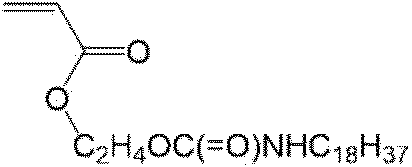
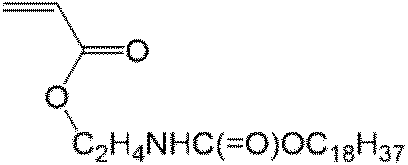
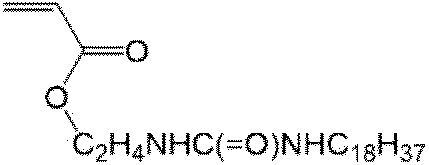
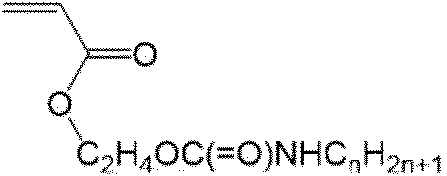

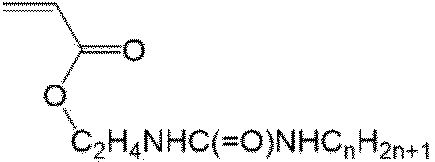


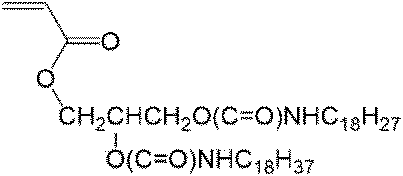
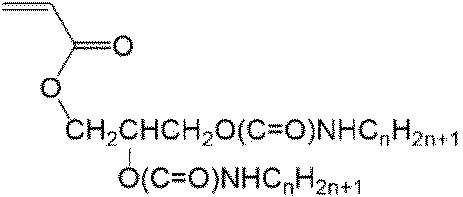

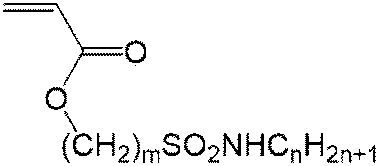
[上記式中、nは6~40の数であり、mは1~5の数である。]
上記の化学式の化合物は、α位が水素原子であるアクリル化合物であるが、具体例は、α位がメチル基であるメタクル化合物及びα位が塩素原子であるαクロロアクリル化合物であってよい。
Ra22-C(=O)-NH-Ra23-O-Ra21
[式中、Ra21は、エチレン性不飽和重合性基を有する有機残基、
Ra22は、炭素数6~40の炭化水素基、
Ra23は、炭素数1~5の炭化水素基である。]
で表されるアミド基含有単量体であることが好ましい。
アミド基含有単量体の具体例としては、パルミチン酸アミドエチル(メタ)アクリレート、ステアリン酸アミドエチル(メタ)アクリレート、ベヘニン酸アミドエチル(メタ)アクリレート、ミリスチン酸アミドエチル(メタ)アクリレート、ラウリン酸アミドエチル(メタ)アクリレート、イソステアリン酸エチルアミド(メタ)アクリレート、オレイン酸エチルアミド(メタ)アクリレート、ターシャリーブチルシクロヘキシルカプロン酸アミドエチル(メタ)アクリレート、アダマンタンカルボン酸エチルアミド(メタ)アクリレート、ナフタレンカルボン酸アミドエチル(メタ)アクリレート、アントラセンカルボン酸アミドエチル(メタ)アクリレート、パルミチン酸アミドプロピル(メタ)アクリレート、ステアリン酸アミドプロピル(メタ)アクリレート、パルミチン酸アミドエチルビニルエーテル、ステアリン酸アミドエチルビニルエーテル、パルミチン酸アミドエチルアリルエーテル、ステアリン酸アミドエチルアリルエーテル、又はこれらの混合物が挙げられる。
含フッ素重合体は、親水性基含有単量体(b)を含んでもよい。単量体(b)は、単量体(a)以外の単量体であって、親水性基を有する単量体である。親水性基は、オキシアルキレン基(アルキレン基の炭素数は2~6である。)、特に、オキシエチレン基であることが好ましい。特に、単量体(b)は、オキシアルキレン(メタ)アクリレート、例えば、ポリアルキレン(又はモノアルキレン)グリコールモノ(メタ)アクリレート及び/又はポリアルキレン(又はモノアルキレン)グリコールジ(メタ)アクリレート、ポリアルキレン(又はモノアルキレン)グリコールモノ(メタ)アクリルアミドであることが好ましい。
式:
CH2=CXbC(=O)-Yb-(RbO)n-Ab
[式中、
Xbは、水素原子又はメチル基であり、
Ybは、-O-又は-NH-であり、
Rbは、それぞれ独立して炭素数2~6のアルキレン基であり、
Abは、水素原子、炭素数1~22の不飽和又は飽和の炭化水素基、又はCH2=CXbC(=O)-あり、
nは、1~90の整数である。]
で表されるオキシアルキレン(メタ)アクリレートであることが好ましい。
CH2=CXbC(=O)-O-(RbO)n-Abi (b1)
及び
CH2=CXbC(=O)-O-(RbO)n-C(=O)CXb=CH2 (b2)、
CH2=CXbC(=O)-NH-(RbO)n-Abi (b3)
[式中、
Xbは、それぞれ独立して水素原子又はメチル基であり、
Abiは、それぞれ独立して水素原子又は炭素数1~22の不飽和又は飽和の炭化水素基であり、
Rbは、それぞれ独立して炭素数2~6のアルキレン基であり、
nは、1~90の整数
である。]
で表されるものであることが好ましい。
Rbは、直鎖又は分岐のアルキレン基であってよく、例えば、式-(CH2)x-又は-(CH2)x1-(CH(CH3))x2-[式中、x1及びx2は0~6、例えば2~5であり、x1及びx2の合計は1~6である。-(CH2)x1-と-(CH(CH3))x2-の順序は、記載の式に限定されず、ランダムであってもよい。]で表される基であってよい。
-(RbO)n-において、Rは2種類以上(例えば、2~4種類、特に2種類)であってよく、-(RbO)n-は、例えば、-(R1O)n1-と-(R2O)n2-[式中、R1とR2は、相互に異なって、炭素数2~6のアルキレン基であり、n1及びn2は、1以上の数であり、n1とn2の合計は2~90である。]の組み合わせであってよい。
CH2=CHCOO-CH2CH2O-H
CH2=CHCOO-CH2CH2CH2O-H
CH2=CHCOO-CH2CH(CH3)O-H
CH2=CHCOO-CH(CH3)CH2O-H
CH2=CHCOO-CH2CH2CH2CH2O-H
CH2=CHCOO-CH2CH2CH(CH3)O-H
CH2=CHCOO-CH2CH(CH3)CH2O-H
CH2=CHCOO-CH(CH3)CH2CH2O-H
CH2=CHCOO-CH2CH(CH2CH3)O-H
CH2=CHCOO-CH2C(CH3)2O-H
CH2=CHCOO-CH(CH2CH3)CH2O-H
CH2=CHCOO-C(CH3)2CH2O-H
CH2=CHCOO-CH(CH3)CH(CH3)O-H
CH2=CHCOO-C(CH3)(CH2CH3)O-H
CH2=CHCOO-(CH2CH2O)2-H
CH2=CHCOO-(CH2CH2O)4-H
CH2=CHCOO-(CH2CH2O)5-H
CH2=CHCOO-(CH2CH2O)6-H
CH2=CHCOO-(CH2CH2O)5-CH3
CH2=CHCOO-(CH2CH2O)9-CH3
CH2=CHCOO-(CH2CH2O)23-CH3
CH2=CHCOO-(CH2CH2O)90-CH3
CH2=CHCOO-(CH2CH(CH3)O)9-CH3
CH2=CHCOO-(CH2CH(CH3)O)12-CH3
CH2=CHCOO-(CH2CH2O)5-(CH2CH(CH3)O)2-H
CH2=CHCOO-(CH2CH2O)5-(CH2CH(CH3)O)3-CH3
CH2=CHCOO-(CH2CH2O)8-(CH2CH(CH3)O)6-CH2CH(C2H5)C4H9
CH2=CHCOO-(CH2CH2O)23-OOC(CH3)C=CH2
CH2=CHCOO-(CH2CH2O)20-(CH2CH(CH3)O)5-CH2-CH=CH2
CH2=C(CH3)COO-CH2CH2O-H
CH2=C(CH3)COO-CH2CH2CH2O-H
CH2=C(CH3)COO-CH2CH(CH3)O-H
CH2=C(CH3)COO-CH(CH3)CH2O-H
CH2=C(CH3)COO-CH2CH2CH2CH2O-H
CH2=C(CH3)COO-CH2CH2CH(CH3)O-H
CH2=C(CH3)COO-CH2CH(CH3)CH2O-H
CH2=C(CH3)COO-CH(CH3)CH2CH2O-H
CH2=C(CH3)COO-CH2CH(CH2CH3)O-H
CH2=C(CH3)COO-CH2C(CH3)2O-H
CH2=C(CH3)COO-CH(CH2CH3)CH2O-H
CH2=C(CH3)COO-C(CH3)2CH2O-H
CH2=C(CH3)COO-CH(CH3)CH(CH3)O-H
CH2=C(CH3)COO-C(CH3)(CH2CH3)O-H
CH2=C(CH3)COO-(CH2CH2O)2-H
CH2=C(CH3)COO-(CH2CH2O)4-H
CH2=C(CH3)COO-(CH2CH2O)5-H
CH2=C(CH3)COO-(CH2CH2O)6-H
CH2=C(CH3)COO-(CH2CH2O)9-H
CH2=C(CH3)COO-(CH2CH2O)5-CH3
CH2=C(CH3)COO-(CH2CH2O)9-CH3
CH2=C(CH3)COO-(CH2CH2O)23-CH3
CH2=C(CH3)COO-(CH2CH2O)90-CH3
CH2=C(CH3)COO-(CH2CH(CH3)O)9-H
CH2=C(CH3)COO-(CH2CH(CH3)O)12-CH3
CH2=C(CH3)COO-(CH2CH2O)5-(CH2CH(CH3)O)2-H
CH2=C(CH3)COO-(CH2CH2O)5-(CH2CH(CH3)O)3-CH3
CH2=C(CH3)COO-(CH2CH2O)8-(CH2CH(CH3)O)6-CH2CH(C2H5)C4H9
CH2=C(CH3)COO-(CH2CH2O)23-OOC(CH3)C=CH2
CH2=C(CH3)COO-(CH2CH2O)20-(CH2CH(CH3)O)5-CH2-CH=CH2
CH2=CH-C(=O)-NH-CH2CH2CH2O-H
CH2=CH-C(=O)-NH-CH2CH(CH3)O-H
CH2=CH-C(=O)-NH-CH(CH3)CH2O-H
CH2=CH-C(=O)-NH-CH2CH2CH2CH2O-H
CH2=CH-C(=O)-NH-CH2CH2CH(CH3)O-H
CH2=CH-C(=O)-NH-CH2CH(CH3)CH2O-H
CH2=CH-C(=O)-NH-CH(CH3)CH2CH2O-H
CH2=CH-C(=O)-NH-CH2CH(CH2CH3)O-H
CH2=CH-C(=O)-NH-CH2C(CH3)2O-H
CH2=CH-C(=O)-NH-CH(CH2CH3)CH2O-H
CH2=CH-C(=O)-NH-C(CH3)2CH2O-H
CH2=CH-C(=O)-NH-CH(CH3)CH(CH3)O-H
CH2=CH-C(=O)-NH-C(CH3)(CH2CH3)O-H
CH2=CH-C(=O)-NH-(CH2CH2O)2-H
CH2=CH-C(=O)-NH-(CH2CH2O)4-H
CH2=CH-C(=O)-NH-(CH2CH2O)5-H
CH2=CH-C(=O)-NH-(CH2CH2O)6-H
CH2=CH-C(=O)-NH-(CH2CH2O)9-H
CH2=CH-C(=O)-NH-(CH2CH2O)5-CH3
CH2=CH-C(=O)-NH-(CH2CH2O)9-CH3
CH2=CH-C(=O)-NH-(CH2CH2O)23-CH3
CH2=CH-C(=O)-NH-(CH2CH2O)90-CH3
CH2=CH-C(=O)-NH-(CH2CH(CH3)O)9-CH3
CH2=CH-C(=O)-NH-(CH2CH(CH3)O)12-CH3
CH2=CH-C(=O)-NH-(CH2CH2O)5-(CH2CH(CH3)O)2-H
CH2=CH-C(=O)-NH-(CH2CH2O)5-(CH2CH(CH3)O)3-CH3
CH2=CH-C(=O)-NH-(CH2CH2O)8-(CH2CH(CH3)O)6-CH2CH(C2H5)C4H9
CH2=C(CH3)-C(=O)-NH-CH2CH2CH2O-H
CH2=C(CH3)-C(=O)-NH-CH2CH(CH3)O-H
CH2=C(CH3)-C(=O)-NH-CH(CH3)CH2O-H
CH2=C(CH3)-C(=O)-NH-CH2CH2CH2CH2O-H
CH2=C(CH3)-C(=O)-NH-CH2CH2CH(CH3)O-H
CH2=C(CH3)-C(=O)-NH-CH2CH(CH3)CH2O-H
CH2=C(CH3)-C(=O)-NH-CH(CH3)CH2CH2O-H
CH2=C(CH3)-C(=O)-NH-CH2CH(CH2CH3)O-H
CH2=C(CH3)-C(=O)-NH-CH2C(CH3)2O-H
CH2=C(CH3)-C(=O)-NH-CH(CH2CH3)CH2O-H
CH2=C(CH3)-C(=O)-NH-C(CH3)2CH2O-H
CH2=C(CH3)-C(=O)-NH-CH(CH3)CH(CH3)O-H
CH2=C(CH3)-C(=O)-NH-C(CH3)(CH2CH3)O-H
CH2=C(CH3)-C(=O)-NH-(CH2CH2O)2-H
CH2=C(CH3)-C(=O)-NH-(CH2CH2O)4-H
CH2=C(CH3)-C(=O)-NH-(CH2CH2O)5-H
CH2=C(CH3)-C(=O)-NH-(CH2CH2O)6-H
CH2=C(CH3)-C(=O)-NH-(CH2CH2O)9-H
CH2=C(CH3)-C(=O)-NH-(CH2CH2O)5-CH3
CH2=C(CH3)-C(=O)-NH-(CH2CH2O)9-CH3
CH2=C(CH3)-C(=O)-NH-(CH2CH2O)23-CH3
CH2=C(CH3)-C(=O)-NH-(CH2CH2O)90-CH3
CH2=C(CH3)-C(=O)-NH-(CH2CH(CH3)O)9-CH3
CH2=C(CH3)-C(=O)-NH-(CH2CH(CH3)O)12-CH3
CH2=C(CH3)-C(=O)-NH-(CH2CH2O)5-(CH2CH(CH3)O)2-H
CH2=C(CH3)-C(=O)-NH-(CH2CH2O)5-(CH2CH(CH3)O)3-CH3
CH2=C(CH3)-C(=O)-NH-(CH2CH2O)8-(CH2CH(CH3)O)6-CH2CH(C2H5)C4H9
含フッ素重合体は、イオン性基含有単量体(c)を含んでもよい。単量体(c)は、単量体(a)及び単量体(b)以外の単量体である。単量体(c)は、オレフィン性炭素―炭素二重結合及びイオン性基を含有する単量体(特に、アクリル単量体)であることが好ましい。イオン性基は、アニオン性基及び/又はカチオン性基である。
CH2=CHCOO-CH2CH2-N(CH3)2 及びその塩(例えば酢酸塩)
CH2=CHCOO-CH2CH2-N(CH2CH3)2 及びその塩(例えば酢酸塩)
CH2=C(CH3)COO-CH2CH2-N(CH3)2 及びその塩(例えば酢酸塩)
CH2=C(CH3)COO-CH2CH2-N(CH2CH3)2 及びその塩(例えば酢酸塩)
CH2=CHC(O)N(H)-CH2CH2CH2-N(CH3)2 及びその塩(例えば酢酸塩)
CH2=CHCOO-CH2CH2-N(-CH3)(-CH2-C6H5) 及びその塩(例えば酢酸塩)
CH2=C(CH3)COO-CH2CH2-N(-CH2CH3)(-CH2-C6H5)及びその塩(例えば酢酸塩)
CH2=CHCOO-CH2CH2-N+(CH3)3Cl-
CH2=CHCOO-CH2CH2-N+(-CH3)2(-CH2-C6H5)Cl-
CH2=C(CH3)COO-CH2CH2-N+(CH3)3Cl-
CH2=CHCOO-CH2CH(OH)CH2-N+(CH3)3Cl-
CH2=C(CH3)COO-CH2CH(OH)CH2-N+(CH3)3Cl-
CH2=C(CH3)COO-CH2CH(OH)CH2-N+(-CH2CH3)2(-CH2-C6H5)Cl-
CH2=C(CH3)COO-CH2CH2-N+(CH3)3Br-
CH2=C(CH3)COO-CH2CH2-N+(CH3)3I-
CH2=C(CH3)COO-CH2CH2-N+(CH3)3O-SO3CH3
CH2=C(CH3)COO-CH2CH2-N+(CH3)(-CH2-C6H5)2Br-
含フッ素重合体は、ハロゲン化オレフィン単量体(d)から誘導された繰り返し単位を有してよい。ハロゲン化オレフィン単量体は、フッ素原子を有しなくてもよい。ハロゲン化オレフィン単量体は、1~10の塩素原子、臭素原子又はヨウ素原子で置換されている炭素数2~20のオレフィンであることが好ましい。ハロゲン化オレフィン単量体は、炭素数2~20の塩素化オレフィン、特に1~5の塩素原子を有する炭素数2~5のオレフィンであることが好ましい。ハロゲン化オレフィン単量体の好ましい具体例は、ハロゲン化ビニル、例えば塩化ビニル、臭化ビニル、ヨウ化ビニル、ハロゲン化ビニリデン、例えば塩化ビニリデン、臭化ビニリデン、ヨウ化ビニリデンである。撥水性(特に撥水性の耐久性)が高くなるので、塩化ビニル又は塩化ビニリデンが好ましい。ハロゲン化オレフィン単量体から誘導された繰り返し単位が存在することにより、含フッ素重合体が与える洗濯耐久性が高くなる。
含フッ素重合体は、架橋性単量体は、少なくとも2つの反応性基及び/又はエチレン性不飽和二重結合(好ましくは、(メタ)アクリレート基)を有し、架橋性単量体(e)は、フッ素原子を含まない単量体であってよい。フッ素原子を含有しない化合物であってよい。架橋性単量体(e)は、少なくとも2つのエチレン性不飽和二重結合(好ましくは、(メタ)アクリレート基)を有する化合物、あるいは少なくとも1つのエチレン性不飽和二重結合及び少なくとも1つの反応性基を有する化合物であってよい。反応性基の例は、ヒドロキシル基、エポキシ基、クロロメチル基、ブロックイソシアネート基、アミノ基、カルボキシル基、などである。
含フッ素重合体は環状炭化水素基含有単量体を有してもよい。環状炭化水素基含有単量体は、環状炭化水素基を有する単量体であり、一のエチレン性不飽和二重結合と、環状炭化水素基とを有する単量体であってよい。
その他の単量体はこれらの例に限定されず、アクリロニトリル、オルガノシロキサン含有(メタ)アクリレート、短鎖アルキル(メタ)アクリレート、酢酸ビニル、ビニルアルキルエーテル等が含まれる。その他の単量体(d)は単独で用いてもよいし、又は二以上を併用して用いてもよい。
含フッ素重合体の繰り返し単位を構成する単量体(a)~(h)の組み合わせは特に限定されないが、例えば、次のとおりである(括弧は省略)。
f
f+a
f+b
f+c
f+a+b
f+a+b+c
f+a+c
f+a+d
f+a+b+c+d
f+a+b+c+d+e
f+a+b+c+d+e+g
さらに上記組みわせに他の単量体(h)を併用してもよい。含フッ素重合体は、単量体(f)から誘導される繰り返し単位と単量体(a)から誘導される繰り返し単位とを含むことが好ましい。繊維製品用の場合、単量体は、単量体(a)、単量体(d)、単量体(e)、及び単量体(g)を併用することが好ましい。紙製品用の場合、単量体(a)、単量体(b)、及び単量体(c)を併用することが好ましい。
単量体(a)から誘導される繰り返し単位の量は、単量体(f)から誘導される繰り返し単位の量100重量部に対して、0.01重量部以上、0.1重量部以上、1重量部以上、3重量部以上、5重量部以上、10重量部以上、15重量部以上、20重量部以上、50重量部以上、75重量部以上、100重量部以上、300重量部以上、500重量部以上、1000重量部以上であってよく、また、3000重量部以下、2000重量部以下、1000重量部以下、750重量部以下、500重量部以下、300重量部以下、200重量部以下、100重量部以下、50重量部以下、30重量部以下、10重量部以下、又は1重量部以下であってよい。
単量体(b)から誘導される繰り返し単位の量は、単量体(f)から誘導される繰り返し単位の量100重量部に対して、0.01重量部以上、0.1重量部以上、1重量部以上、3重量部以上、5重量部以上、10重量部以上、15重量部以上、20重量部以上、50重量部以上、75重量部以上、100重量部以上、300重量部以上、500重量部以上、1000重量部以上であってよく、また、3000重量部以下、2000重量部以下、1000重量部以下、750重量部以下、500重量部以下、300重量部以下、200重量部以下、100重量部以下、50重量部以下、30重量部以下、10重量部以下、又は1重量部以下であってよい。
単量体(c)から誘導される繰り返し単位の量は、単量体(f)から誘導される繰り返し単位の量100重量部に対して、0.01重量部以上、0.1重量部以上、1重量部以上、3重量部以上、5重量部以上、10重量部以上、15重量部以上、20重量部以上、50重量部以上、75重量部以上、100重量部以上、300重量部以上、500重量部以上、1000重量部以上であってよく、また、3000重量部以下、2000重量部以下、1000重量部以下、750重量部以下、500重量部以下、300重量部以下、200重量部以下、100重量部以下、50重量部以下、30重量部以下、10重量部以下、又は1重量部以下であってよい。
単量体(d)から誘導される繰り返し単位の量は、単量体(f)から誘導される繰り返し単位の量100重量部に対して、0.01重量部以上、0.1重量部以上、1重量部以上、3重量部以上、5重量部以上、10重量部以上、15重量部以上、20重量部以上、50重量部以上、75重量部以上、100重量部以上、300重量部以上、500重量部以上、1000重量部以上であってよく、また、3000重量部以下、2000重量部以下、1000重量部以下、750重量部以下、500重量部以下、300重量部以下、200重量部以下、100重量部以下、50重量部以下、30重量部以下、10重量部以下、又は1重量部以下であってよい。
単量体(e)から誘導される繰り返し単位の量は、単量体(f)から誘導される繰り返し単位の量100重量部に対して、0.01重量部以上、0.1重量部以上、1重量部以上、3重量部以上、5重量部以上、10重量部以上、15重量部以上、20重量部以上、50重量部以上、75重量部以上、100重量部以上、300重量部以上、500重量部以上、1000重量部以上であってよく、また、3000重量部以下、2000重量部以下、1000重量部以下、750重量部以下、500重量部以下、300重量部以下、200重量部以下、100重量部以下、50重量部以下、30重量部以下、10重量部以下、又は1重量部以下であってよい。
単量体(g)から誘導される繰り返し単位の量は、単量体(f)から誘導される繰り返し単位の量100重量部に対して、0.01重量部以上、0.1重量部以上、1重量部以上、3重量部以上、5重量部以上、10重量部以上、15重量部以上、20重量部以上、50重量部以上、75重量部以上、100重量部以上、300重量部以上、500重量部以上、1000重量部以上であってよく、また、3000重量部以下、2000重量部以下、1000重量部以下、750重量部以下、500重量部以下、300重量部以下、200重量部以下、100重量部以下、50重量部以下、30重量部以下、10重量部以下、又は1重量部以下であってよい。
単量体(h)から誘導される繰り返し単位の量は、単量体(f)から誘導される繰り返し単位の量100重量部に対して、0.01重量部以上、0.1重量部以上、1重量部以上、3重量部以上、5重量部以上、10重量部以上、15重量部以上、20重量部以上、50重量部以上、75重量部以上、100重量部以上、300重量部以上、500重量部以上、1000重量部以上であってよく、また、3000重量部以下、2000重量部以下、1000重量部以下、750重量部以下、500重量部以下、300重量部以下、200重量部以下、100重量部以下、50重量部以下、30重量部以下、10重量部以下、又は1重量部以下であってよい。
含フッ素重合体は公知の重合方法で製造でき、また重合反応の条件も任意に選択できる。このような重合方法の例として、溶液重合、懸濁重合、乳化重合、縮合重合が挙げられる。
本開示における撥水撥油剤は基材(例えば、繊維基材、紙基材)に撥液性(撥水性、撥油性、耐油性、及び/又は耐水性)を付与するものであり、撥水剤、撥油剤、耐油剤、及び耐水剤からなる群から選択される少なくとも一として機能し得る。本開示における撥水撥油剤は、基材に耐油性(撥油性)及び/又は耐水性(撥水性)を良好に付与し得、例えば耐油性と耐水性の両方を良好に付与し得る。
本開示の撥水撥油剤は、上述した含フッ素重合体を含む。含フッ素重合体自体を撥水撥油剤として使用してもよいし、下記に説明するようなその他の成分と組み合わせて撥水撥油剤として使用してもよい。
含フッ素重合体の量は、撥水撥油剤中、0.01重量%以上、0.03重量%以上、0.5重量%以上、1重量%以上、3重量%以上、5重量%以上、10重量%以上、20重量%以上、30重量%以上であってよく、また、60重量%以下、50重量%以下、40重量%以下、30重量%以下、20重量%以下、10重量%以下、5重量%以下、又は3重量%以下であってよい。含フッ素重合体自体を撥水撥油剤として用いてもよい。
本開示の撥水撥油剤は、その他の撥水撥油剤成分を含有してもよい。その他の撥水撥油剤としては公知の撥水撥油剤を使用することができ、例えば非フッ素の撥水撥油剤成分であってよい。非フッ素の撥水撥油剤成分の例としては、例えばWO/2020/054856、WO/2017/159754、WO/2020/162547等に記載されるアクリル重合体、特表2016-524628、特表2017-533976、特表2017-504730、WO/2021/132170、WO/2021/132172等に記載されるようなポリウレタン、WO/2022/065382、及びWO/2022/065385等に記載されるような天然物修飾体等が挙げられるがこれらに限定されない。
その他撥水撥油剤成分の量は、含フッ素重合体100重量部に対して、0.01重量部以上、0.1重量部以上、1重量部以上、3重量部以上、5重量部以上、10重量部以上、15重量部以上、20重量部以上、50重量部以上、75重量部以上、又は100重量部以上であってよく、また、500重量部以下、300重量部以下、200重量部以下、100重量部以下、30重量部以下、20重量部以下、10重量部以下、5重量部以下、3重量部以下、又は1重量部以下であってよい。
本開示の撥水撥油剤は、分散剤を含んでもよい。
分散剤はノニオン性分散剤を含んでいてもよい。ノニオン性分散剤はノニオン性界面活性剤であってよい。
アミンオキシドは、アミン(二級アミン又は好ましくは三級アミン)の酸化物(例えば炭素数5~50)であってよい。
また、ノニオン性分散剤は、芳香族基を含まなくてもよい。
R1O-(CH2CH2O)p-(R2O)q-R3
[式中、R1は炭素数1~22のアルキル基又は炭素数2~22のアルケニル基又はアシル基であり、
R2のそれぞれは、独立的に同一又は異なって、炭素数3以上(例えば、3~10)のアルキレン基であり、
R3は水素原子、炭素数1~22のアルキル基又は炭素数2~22のアルケニル基であり、
pは2以上の数であり、
qは0又は1以上の数である。]
で示される化合物であってよい。
R2の例は、プロピレン基、ブチレン基である。
ノニオン性分散剤において、pは3以上の数(例えば、5~200)であってよい。qは、2以上の数(例えば5~200)であってよい。すなわち、-(R2O)q-がポリオキシアルキレン鎖を形成してもよい。
ノニオン性分散剤は、中央に親水性のポリオキシエチレン鎖と疎水性のオキシアルキレン鎖(特に、ポリオキシアルキレン鎖)を含有したポリオキシエチレンアルキレンアルキルエーテルであってよい。疎水性のオキシアルキレン鎖としては、オキシプロピレン鎖、オキシブチレン鎖、スチレン鎖等が挙げられるが、中でも、オキシプロピレン鎖が好ましい。
ノニオン性分散剤の平均分子量は、一般に300~5,000、例えば、500~3,000である。
ノニオン性分散剤は、一種単独であってよく、あるいは二種以上の混合物であってもよい。ノニオン分散剤は、HLB(親水性疎水性バランス)が15未満(特に5以下)である化合物とHLBが15以上である化合物の混合物であってよい。
分散剤はカチオン性分散剤を含んでいてもよい。カチオン性分散剤は、カチオン性界面活性剤であってよい。カチオン性分散剤は低分子型(例えば、分子量2000以下、特に10000以下)であってもよいし、高分子型(例えば、分子量2000以上)であってもよい。カチオン性分散剤は、アミド基を有しない化合物であってもよい。
R21-N+(-R22)(-R23)(-R24)X-
[式中、R21、R22、R23及びR24は炭素数1~40の炭化水素基、
Xはアニオン性基である。]
で表される化合物である。
R21、R22、R23及び-R24の具体例は、アルキル基(例えば、メチル基、ブチル基、ステアリル基、パルミチル基)である。Xの具体例は、ハロゲン(例えば、塩素)、酸(例えば、塩酸、酢酸)である。
カチオン性分散剤は、モノアルキルトリメチルアンモニウム塩(アルキルの炭素数4~40)であることが特に好ましい。
R1 p-N+R2 qX-
[式中、R1はC12以上(例えばC12~C50)の直鎖状及び/又は分岐状の脂肪族(飽和及び/又は不飽和)基、
R2はH又はC1~4のアルキル基、ベンジル基、ポリオキシエチレン基(オキシエチレン基の数例えば1(特に2、特別には3)~50)
(CH3、C2H5が特に好ましい)、
Xはハロゲン原子(例えば、)、C1~C4の脂肪酸塩基、
pは1又は2、qは2又は3で、p+q=4である。]
で示されるアンモニウム塩であってよい。R1の炭素数は、12~50、例えば12~30であってよい。
分散剤はアニオン性分散剤を含んでいてもよい。アニオン性分散剤はアニオン性界面活性剤であってよい。分散剤はアニオン性分散剤を含まなくてもよい。
分散剤は両性分散剤を含んでいてもよい。両性分散剤は、両性界面活性剤であってよい。
分散剤は無機分散剤を含んでいてもよい。
分散剤の量は、含フッ素重合体100重量部に対して、0.01重量部以上、0.1重量部以上、1重量部以上、3重量部以上、5重量部以上、10重量部以上、15重量部以上、20重量部以上、50重量部以上、75重量部以上、又は100重量部以上であってよく、また、500重量部以下、300重量部以下、200重量部以下、100重量部以下、30重量部以下、20重量部以下、10重量部以下、5重量部以下、3重量部以下、又は1重量部以下であってよい。
本開示における撥水撥油剤は、液状媒体を含んでもよい。液状媒体は水、有機溶媒、又は水と有機溶媒との混合物であってよい。撥水撥油剤は分散液又は溶液であってよい。本開示における撥水撥油剤は、水分散型であってよく、少なくとも水を含んでよい。
液状媒体の量は、含フッ素重合体1重量部に対して、1重量部以上、3重量部以上、5重量部以上、10重量部以上、20重量部以上、30重量部以上、40重量部以上、又は50重量部以上、100重量部以上、200重量部以上、300重量部以上、500重量部以上、又は1000重量部以上であってよく、また、3000重量部以下、2000重量部以下、1000重量部以下、500重量部以下、200重量部以下、175重量部以下、150重量部以下、125重量部以下、100重量部以下、80重量部以下、60重量部以下、40重量部以下、20重量部以下、又は10重量部以下であってよい。
本開示における撥水撥油剤は、シリコーン(ポリオルガノシロキサン)を含んでもよい。シリコーンを含むことで、良好な撥液性に加え、風合いや耐久性を良好に兼ね備え得る。
シリコーンの量は、含フッ素重合体100重量部に対して、0.1重量部以上、1重量部以上、3重量部以上、5重量部以上、10重量部以上、15重量部以上、20重量部以上、50重量部以上、75重量部以上、又は100重量部以上であってよく、また、500重量部以下、300重量部以下、200重量部以下、100重量部以下、50重量部以下、40重量部以下、30重量部以下、20重量部以下、10重量部以下、又は5重量部以下であってよい。
本開示における撥水撥油剤は、ワックスを含んでもよい。ワックスを含むことで、撥液性を良好に基材に付与し得る。
ワックスの量は、含フッ素重合体100重量部に対して、0.1重量部以上、1重量部以上、3重量部以上、5重量部以上、10重量部以上、15重量部以上、20重量部以上、50重量部以上、75重量部以上、又は100重量部以上であってよく、また、500重量部以下、300重量部以下、200重量部以下、100重量部以下、50重量部以下、40重量部以下、30重量部以下、20重量部以下、10重量部以下、5重量部以下であってよい。
本開示の撥水撥油剤は有機酸を含んでもよい。有機酸としては、公知のものを用いることができる。有機酸としては、カルボン酸、スルホン酸、スルフィン酸等が好ましく挙げられ、特にカルボン酸が好ましい。該カルボン酸としては、ギ酸、酢酸、プロピオン酸、酪酸、シュウ酸、コハク酸、グルタル酸、アジピン酸、リンゴ酸、クエン酸等が挙げられ、特にギ酸又は酢酸が好ましい。本開示においては、有機酸は、一種を用いてもよく、二種以上を組み合わせて用いてもよい。たとえば、ギ酸と酢酸とを組み合わせて用いてもよい。
有機酸の量は、含フッ素重合体100重量部に対して、0.1重量部以上、1重量部以上、3重量部以上、5重量部以上、10重量部以上、15重量部以上、20重量部以上、50重量部以上、75重量部以上、又は100重量部以上であってよく、また、500重量部以下、300重量部以下、200重量部以下、100重量部以下、50重量部以下、40重量部以下、30重量部以下、20重量部以下、10重量部以下、又は5重量部以下であってよい。撥水撥油剤のpHが、3~10、例えば5~9、特に6~8となるように有機酸の量は調整されてもよい。撥水撥油剤は酸性(pH7以下、例えば6以下)であってもよい。
本開示の撥水撥油剤は、硬化剤(活性水素反応性化合物又は活性水素含有化合物)を含んでよい。
ポリイソシアネート化合物として、ポリイソシアネート化合物のイソシアネート基をブロック剤でブロックした化合物であるブロック化ポリイソシアネート化合物(ブロックイソシアネート)を使用することが好ましい。溶液中でも比較的安定であり、撥水撥油剤と同じ溶液中でも使用可能である等の理由からブロック化ポリイソシアネート化合物を使用することが好ましい。
クロロメチル基含有化合物はクロロメチル基を有する化合物である。クロロメチル基含有化合物の例は、クロロメチルポリスチレン等である。
カルボキシル基含有化合物はカルボキシル基を有する化合物である。カルボキシル基含有化合物の例は、(ポリ)アクリル酸、(ポリ)メタクリル酸等である。
ヒドラジド化合物の具体例としては、ヒドラジン、カルボヒドラジド、アジピン酸ヒドラジド等が挙げられる。
メラミン化合物の具体例としては、メラミン樹脂、メチルエーテル化メラミン樹脂等が挙げられる。
硬化剤の量は、含フッ素重合体100重量部に対して、0.1重量部以上、1重量部以上、3重量部以上、5重量部以上、10重量部以上、15重量部以上、又は20重量部以上、50重量部以上、75重量部以上、又は100重量部以上であってよく、また、500重量部以下、300重量部以下、200重量部以下、100重量部以下、50重量部以下、40重量部以下、30重量部以下、20重量部以下、10重量部以下、5重量部以下であってよい。
撥水撥油剤は、上記成分以外の他の成分を含んでよい。他の成分の例としては、多糖類、紙力増強剤、凝集剤、歩留まり向上剤、凝結剤、バインダー樹脂、スリップ防止剤、サイズ剤、紙力増強剤、PVA、浸透剤、有機酸、顔料、充填剤、帯電防止剤、防腐剤、紫外線吸収剤、抗菌剤、消臭剤、香料等が挙げられる。これらは単独で用いてもよいし、又は二以上を併用して用いてもよい。
前記の成分以外に、その他成分として、その他の撥水及び/又は撥油剤、分散剤、風合い調整剤、柔軟剤、難燃剤、塗料定着剤、防シワ剤、乾燥速度調整剤、架橋剤、造膜助剤、相溶化剤、凍結防止剤、粘度調整剤、紫外線吸収剤、酸化防止剤、pH調整剤、防虫剤、消泡剤、縮み防止剤、洗濯じわ防止剤、形状保持剤、ドレープ性保持剤、アイロン性向上剤、増白剤、白化剤、布地柔軟化クレイ、ポリビニルピロリドン等の移染防止剤、高分子分散剤、汚れ剥離剤、スカム分散剤、4,4-ビス(2-スルホスチリル)ビフェニルジナトリウム(チバスペシャルティケミカルズ製チノパールCBS-X)等の蛍光増白剤、染料固定剤、1,4-ビス(3-アミノプロピル)ピペラジン等の退色防止剤、染み抜き剤、繊維表面改質剤としてセルラーゼ、アミラーゼ、プロテアーゼ、リパーゼ、ケラチナーゼ等の酵素、抑泡剤、水分吸放出性等絹の風合い・機能を付与できるものとしてシルクプロテインパウダー、それらの表面改質物又は乳化分散液(例えばK-50、K-30、K-10、A-705、S-702、L-710、FPシリーズ(出光石油化学)、加水分解シルク液(上毛)、シルクゲンGソルブルS(一丸ファルコス))、汚染防止剤(例えばアルキレンテレフタレート及び/又はアルキレンイソフタレート単位とポリオキシアルキレン単位からなる非イオン性高分子化合物(例えば互応化学工業製FR627)、クラリアントジャパン製SRC-1等)等を配合することができる。これらは単独で使用してもよく、また二以上を併用して使用してもよい。
多糖類の例としては、澱粉、キサンタンガム、カラヤガム、ウェランガム、グアーガム、ペクチン、タマリンドガム、カラギーナン、キトサン、アラビアガム、ローカストビーンガム、セルロース、アルギン酸、寒天、デキストラン、セルロース、カルボキシメチルセルロース、ヒドロキシエチルセルロース、ヒドロキシプロピルセルロース、キチンナノファイバー、セルロースナノファイバー及びプルラン等が挙げられる。多糖類は、置換されている変性多糖類であってよく、特に、水酸基やカチオン性基を導入した変性多糖類であってよい。
紙力増強剤、凝集剤、歩留まり向上剤又は凝結剤の例としては、スチレン系重合体(スチレン/マレイン酸系重合体、スチレン/アクリル酸系重合体)、尿素‐ホルムアルデヒド重合体、ポリエチレンイミン、メラミン‐ホルムアルデヒド重合体、ポリアミドアミン‐エピクロルヒドリン重合体、ポリアクリルアミド系重合体、ポリアミン系重合体、ポリジアリルジメチルアンモニウムクロライド、アルキルアミン・エピクロルヒドリン縮合物、アルキレンジクロライドとポリアルキレンポリアミンの縮合物、ジシアンジアミド・ホルマリン縮合物、ジメチルジアリルアンモニウムクロライド重合体、及びオレフィン/無水マレイン酸重合体等が挙げられる
サイズ剤の例としては、セルロース反応性サイズ剤、例えばロジン系石鹸などのロジン系サイズ剤、ロジン系乳濁液/分散液、セルロース反応性サイズ剤、例えばアルキルおよびアルケニルコハク酸無水物(ASA)などの酸無水物の乳濁液/分散液、アルケニルおよびアルキルケテン二量体(AKD)および多量体、ならびにエチレン性不飽和モノマーのアニオン性、カチオン性および両性のポリマー、例えばスチレンとアクリレートとの共重合体が挙げられる。
帯電防止剤の例としては、第4級アンモニウム塩、ピリジニウム塩、第1、第2、第3アミノ基等のカチオン性官能基を有すカチオン型帯電防止剤;スルホン酸塩や硫酸エステル塩、ホスホン酸塩、リン酸エステル塩等のアニオン性官能基を有するアニオン型帯電防止剤;アルキルベタイン及びその誘導体、イミダゾリン及びその誘導体、アラニン及びその誘導体等の両性型帯電防止剤、アミノアルコール及びその誘導体、グリセリン及びその誘導体、ポリエチレングリコール及びその誘導体等のノニオン型帯電防止剤等が挙げられる。これらのカチオン型、アニオン型、両性イオン型のイオン導電性基を有する単量体を重合若しくは共重合して得られたイオン導電性重合体であってもよい。これらは単独で使用してもよく、また二以上を併用してもよい。
防腐剤は、主に、防腐力、殺菌力を強化し、長期保存中の防腐性を保つために用いられ得る。防腐剤としては、例えば、イソチアゾロン系有機硫黄化合物、ベンズイソチアゾロン系有機硫黄化合物、安息香酸類、2-ブロモ-2-ニトロ-1,3-プロパンジオール等が挙げられる。
紫外線吸収剤は、紫外線を防御する効果のある薬剤であり、紫外線を吸収し、赤外線や可視光線等に変換して放出する成分である。紫外線吸収剤としては、例えば、アミノ安息香酸誘導体、サリチル酸誘導体、ケイ皮酸誘導体、ベンゾフェノン誘導体、アゾール系化合物、4-t-ブチル-4'-メトキシベンゾイルメタン等が挙げられる。
抗菌剤は、繊維上での菌の増殖を抑え、さらには微生物の分解物由来の嫌なにおいの発生を抑える効果を有する成分である。抗菌剤としては、例えば、四級アンモニウム塩等のカチオン性殺菌剤、ビス-(2-ピリジルチオ-1-オキシド)亜鉛、ポリヘキサメチレンビグアニジン塩酸塩、8-オキシキノリン、ポリリジン等が挙げられる。
消臭剤としては、クラスターデキストリン、メチル-β-シクロデキストリン、2-ヒドロキシプロピル-β-シクロデキストリン、モノアセチル-β-シクロデキストリン、アシルアミドプロピルジメチルアミンオキシド、アミノカルボン酸系金属錯体(国際公開第2012/090580号記載のメチルグリシンジ酢酸3ナトリウムの亜鉛錯体)等が挙げられる。
他の成分の各量又は総量は、含フッ素重合体100重量部に対して、0.1重量部以上、1重量部以上、3重量部以上、5重量部以上、10重量部以上、15重量部以上、20重量部以上、50重量部以上、75重量部以上、又は100重量部以上であってよく、また、500重量部以下、300重量部以下、200重量部以下、100重量部以下、50重量部以下、40重量部以下、30重量部以下、20重量部以下、10重量部以下、又は5重量部以下であってよい。
本開示における撥水撥油剤で処理された製品の製造方法は、上述した撥水撥油剤で基材を処理する処理工程を含む。
本開示における撥水撥油剤で処理される基材は限定されないが、好適には繊維製品又は紙製品、特に紙製品である。
本開示の撥水撥油剤は、処理剤(特に表面処理剤)として、従来既知の方法により基材に適用することができる。処理の方法としては、本開示における撥水撥油剤を、必要により有機溶媒又は水に分散して希釈して、浸漬塗布、スプレー塗布、泡塗布等のような既知の方法により、基材の内部及び/又は表面に付着させ、乾燥する方法であってよい。乾燥後、撥水撥油剤における固形成分が付着した製品が得られる。また、必要ならば、適当な架橋剤と共に適用し、キュアリングを行ってもよい。本開示の撥水撥油剤に、必要により、さらに、撥水及び/又は撥油剤、スリップ防止剤、帯電防止剤、風合い調整剤、柔軟剤、抗菌剤、難燃剤、塗料定着剤、防シワ剤、乾燥速度調整剤、架橋剤、造膜助剤、相溶化剤、凍結防止剤、粘度調整剤、紫外線吸収剤、酸化防止剤、pH調整剤、防虫剤、消泡剤等の各種添加剤とを併用することも可能である。各種添加剤の例としては、上述の説明における「他の成分」で説明したものと同様であってよい。基材と接触させる処理剤における撥水撥油剤の濃度は、用途によって適宜変更されてよいが、0.01~10重量%、例えば0.05~5重量%であってよい。
紙基材としては、紙、紙でできた容器、紙でできた成形体(例えばパルプモールド)などが挙げられる。 本開示の含フッ素重合体は、紙基材に良好に付着する。
1つの塗布方式は、2本のゴムロールの間に紙を通して形成されるニップ部に塗布液(サイズ液)を供給し、ポンドと呼ばれる塗液溜りを作り、この塗液溜りに紙を通して紙の両面にサイズ液を塗布する、いわゆるポンド式ツーロールサイズプレスである。他の塗布方式は、サイズ液を表面転写型により塗布するゲートロール型、及び、ロッドメタリングサイズプレスである。ポンド式ツーロールサイズプレスにおいてサイズ液は紙の内部まで浸透しやすく、表面転写型においてサイズ液成分は紙の表面に留まりやすい。表面転写型は、ポンド式ツーロールサイズプレスと比べて、塗布層が紙の表面に留まりやすく、表面に形成される塗布層がポンド式ツーロールサイズプレスより多い。本開示では、前者のポンド式2ロールサイズプレスを用いた場合でも紙に性能を付与できる。このように処理された紙は、室温又は高温での簡単な乾燥後に、任意に、紙の性質に依存して300℃まで、例えば200℃まで、特に80℃~180℃の温度範囲をとり得る熱処理を伴うことで、優れた耐油性及び耐水性等を示し得る。
晒あるいは未晒高収率パルプ、新聞古紙、雑誌古紙、段ボール古紙あるいは脱墨古紙等の古紙パルプのいずれも使用することができる。また、上記パルプ原料と石綿、ポリアミド、ポリイミド、ポリエステル、ポリオレフィン、ポリビニルアルコール等の合成繊維との混合物も使用することができる。
内添においては、紙を形成するパルプ100重量部に対して、撥水撥油剤の量が0.01~50重量部又は0.01~30重量部、例えば0.01~10重量部、特に0.2~5.0重量部となるように、撥水撥油剤をパルプと混合することが好ましい。

4:容器底の内側に油染みがほぼ見られない
3:容器底の外側に油染みが見られない
2:容器底の外側の面積の5%未満に油染みが見られる
1:容器底の外側の面積の5%以上50%未満に油染みが見られる
0:容器底の外側の面積の5%以上に油染みが見られる
4:容器底の内側に油染みがほぼ見られない
3:容器底の外側に油染みが見られない
2:容器底の外側の面積の5%未満に油染みが見られる
1:容器底の外側の面積の5%以上50%未満に油染みが見られる
0:容器底の外側の面積の5%以上に油染みが見られる
繊維製品は、本開示の撥水撥油剤で処理する前に前処理されていてもよい。繊維製品の前処理を行うことで、撥水撥油剤で処理後の繊維製品に優れた堅牢性を付与し得る。
(i)繊維材料に、上記特定官能基を有する化合物を付着させる。なお、化合物の付着は、上記特定官能基が十分な量で残される範囲で化合物の一部と繊維の一部とが化学的に結合している状態であってもよい。
(ii)繊維を構成する材料に上記特定官能基が直接導入されている繊維を用意する。
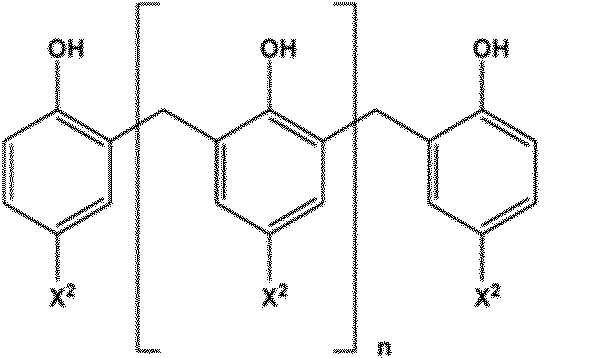
[式中、X2は-SO3M3(式中、M3は1価のカチオンを示す)又は下記一般式で表される基を表し、nは20~3000の整数である。]
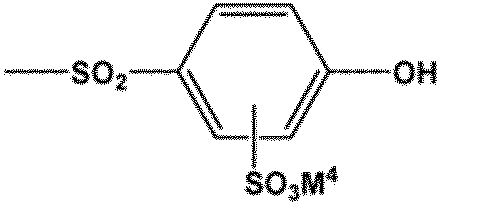
[式中、M4は1価のカチオンを表す。]

ム、炭酸ナトリウム、硫酸アンモニウム、硫酸ナトリウムが挙げられる。
[合成例1]
攪拌装置、不活性ガス導入口、還流冷却器および温度計を取りつけた100ml3口フラスコ4-トリフルオロメトキシアニリン 7.0g、トリエチルアミン 4.0g、THF 35mlをに投入し、氷浴設置して攪拌する。その後、アクリル酸クロリド 4.2g、THF 15mlを投入した50ml 滴下ロートをフラスコに挿入、5秒に1滴の速度で滴下ロート中の溶液を滴下して、反応を開始する。滴下終了後に氷浴を外し、ウォーターバスを設置して40℃ 3時間反応させる。
反応終了後、水 40mL、酢酸エチル20mLを加え、分液ロートで有機層を抽出した。抽出した有機層を硫酸マグネシウムで乾燥、その後溶剤を留去して白色固体 7.5g(収率82%)のモノマー1を得た。
4-トリフルオロメトキシアニリン 7.0gを4-メトキシアニリン 7.0gに変更した以外はモノマー1の合成方法と同様の方法で実施し、淡黄色固体 7.2g(収率72%)のモノマー2を得た。
攪拌装置、不活性ガス導入口、還流冷却器および温度計を取りつけた200ml 4ツ口フラスコに合成例1で得た
モノマー1 10g、
ステアリン酸アミドエチルアクリレート 5g、
ステアリルアクリレート 4.5g、
2,3-ジヒドロキシプロピルメタクリレート 0.5g、
トルエン 21g、
ラウリルメルカプタン 0.02g、
トルエン 2g
に溶解させたアゾビスイソブチロニトリル 0.2gをいれ窒素置換後、70℃で12時間以上攪拌しながら重合反応を実施し、重合体のトルエン溶液を得た。
モノマー1 10gをモノマー 2 7.7gに変更した以外は製造例1と同様の方法で実施した。
500mlのポリ容器に
合成例1で得たモノマー1 10g、
ステアリルアクリレート 14.5g
イソボルニルメタクリレート 5.0g
ダイアセトンアクリルアミド 0.5g、
トリプロピレングリコール 8.5g、
ステアリルトリメチルアンモニウムクロライド 1g、
ソルビタンモノステアレート 0.5g、
ポリオキシエチレンラウリルエーテル(EO:21。EOはエチレンオキシドユニット数を表す) 1.25g、
純水 114g、
を仕込み、80℃に加熱し、ホモミキサーで1分、2000rpmで攪拌した後、超音波で15分間、乳化分散させる。乳化分散物を窒素導入管、温度計、攪拌棒、還流管を備えた500ml 四つ口フラスコに移し、窒素置換後、ラウリルメルカプタン 0.05g、2,2-アゾビス(2-アミジノプロパン)2塩酸塩1.25gを含む9gの水溶液を添加し、60℃で5時間反応させ、重合体の水性分散液を得た。
モノマー1 10gをモノマー 2 7.7gに変更した以外は製造例2と同様の方法で実施した。
〔溶剤系〕
製造例1で作製した溶液をトルエンで希釈して固形分濃度1.0、2.0%になるように処理液1及び2各200gを調製した。
また、比較製造例1で作製した溶液をトルエンで希釈して固形分濃度1.0、2.0%になるように処理液3及び4各200gを調製した。
〔水系〕
製造例2で作製した溶液を水で希釈して固形分濃度1.0、2.0%になるように処理液5及び6各200gを調製した。
また、比較製造例2で作製した溶液を水で希釈して固形分濃度1.0、2.0%になるように処理液7及び8の各200gを調製した。
処理液の一覧は表1に示す。
〔布への処理方法〕
使用する布としてはナイロン生地およびPET生地の2種類を用いた。
[溶剤系]
2種類の布を調製した処理液 200gが入った500mlポリビンに投入して、ポリビンを10秒間振とうさせることで処理液を付着させた。布を処理液から取り出した後に遠心装置に布を投入して1000rpm 30秒かけた。その後、布を室温で24時間乾燥させた後に160℃で2分間加熱した。
[水系]
2種類の布をこの処理液に浸してからマングルに通し、160℃で2分間、熱処理して水系の試験布を得た。
〔撥水性試験〕
(JIS-L-1092(AATCC-22)のスプレー法に準じて湿潤状態を下記の基準で目視評価して処理布の撥水性評価を実施した。評価結果は下記に記載する表に示されるように撥水性No.によって表す。点数が大きいほど撥水性が良好なことを示す。結果を表2に示す。
◎(100):表面に湿潤や水滴の付着がない
○( 90):表面に湿潤しないが、小さな水滴の付着を示す
△( 80):表面に小さな個々の水滴上の湿潤を示す
×(70以下):表面の半分以上に湿潤を示し、部分的に浸透が見られる
〔撥油性試験〕
処理布に、IPA/水=10/90溶液を用いて液滴を乗せて30秒後の状態を下記の基準で目視評価する。
結果を表3に示す。
◎:液滴のしみこみがなく、丸い液滴の形状を維持している
○:液滴のしみこみがほとんどなく、液滴を維持している
△:液滴の少ししみこみは見られるが、液滴が残っている
×:液滴が完全にしみこみ、液シミが広がっている
〔処理紙の作製〕
耐水性(Cobb値)52g/m2、坪量45g/m2、密度0.60g/m3の薄紙に対して、処理液1~8を、ギャップを0milに設定したベーカー式アプリケーターで3回塗工後、140℃で1分アニールすることで、処理紙を作成した。
〔KIT試験(耐油性)〕
3Mキットテスト(TAPPI T-559cm-02)により測定した。3Mキットテスト法は、ヒマシ油、トルエン、ヘプタンが配合された試験油を処理紙の表面におき、15 秒後に試験油を拭った際、処理紙への油染みの有無により評価する。キット番号1~6の試験油にて試験を実施し、染みが見られなかった最大のキット番号を耐油性の評価結果とした。評価結果を表4に示す。


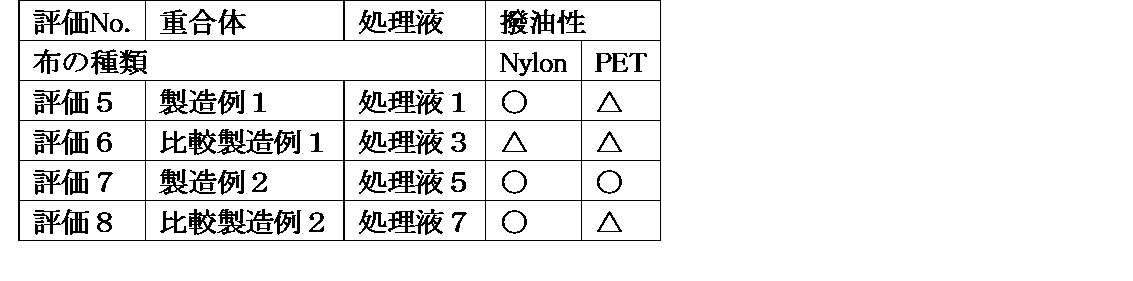
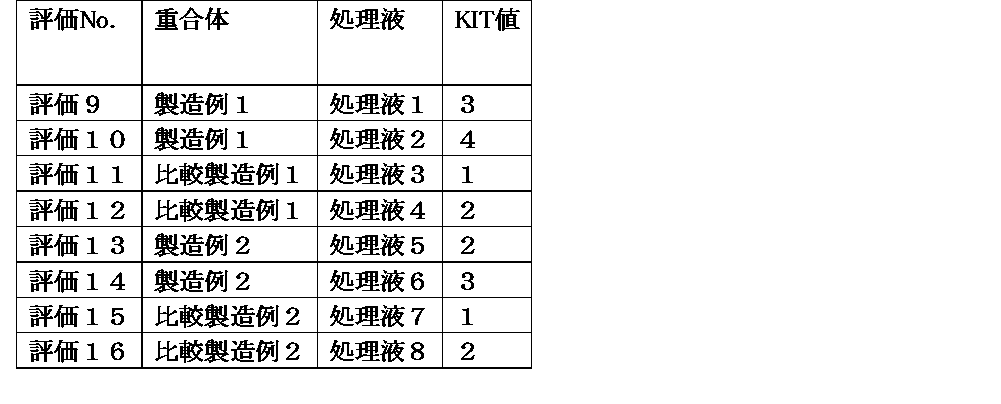
Claims (18)
- Rf1又はRf2を有する含フッ素単量体(f)から誘導された繰り返し単位を有する、含フッ素重合体であって、
Rf1は-CF3、-CF2H、又は-CFH2であり、
Rf2は-CF2-又は-CFH-であり、
Rf1及びRf2は炭素数2以上のフルオロアルキル基及び-CH2-CF2-CH2-の一部ではない、含フッ素重合体。 - 前記Rf1の隣接位は酸素原子又は窒素原子であり、
前記Rf2の隣接位の少なくとも片方は酸素原子又は窒素原子である、請求項1に記載の含フッ素重合体。 - 前記Rf1はCF3-であり、
前記Rf2は-CF2-である、
請求項1又は2に記載の含フッ素重合体。 - 含フッ素単量体(f)がアクリル単量体又はアリル単量体である、請求項1~3のいずれか一項記載の含フッ素重合体。
- 含フッ素単量体(f)がRf1、又は、Rf1又はRf2を含む炭素数2以上40以下の炭化水素基を含む、請求項1~4のいずれか一項に記載の含フッ素重合体。
- 炭素数2以上のフルオロアルキル基を有しない、請求項1~5のいずれか一項に記載の含フッ素重合体。
- 前記含フッ素単量体(f)は、
式:
CH2=C(-Xf)-Yf-Zf α
[式中、各記号は各出現において独立して、
Xfは、水素原子、一価の有機基又はハロゲン原子であり、
Yfは、Yf1及びYf2からなる群から選択される一以上から構成される1+α価の基であり、
Yf1は、直接結合、-O-、-C(=O)-、-C(=NR’)-、-S-、-S(=O)2-、-NR’-、-C(OR’)R’-、及び-C(OR’)(-)2、-N(-)2(R’は水素原子又は一価の有機基である。)からなる群から選択される一以上から構成される基であり、
Yf2は、脂肪族基及び芳香族基からなる群から選択される一以上から構成される基であり、
Zfは、Rf1、又は、Rf1又はRf2を含む炭素数2以上40以下の炭化水素基であり、
αは1~3である。]
で表される化合物である、請求項1~6のいずれか一項に記載の含フッ素重合体。 - ZfがRf1である、請求項7に記載の含フッ素重合体。
- 前記含フッ素単量体(f)は、式:
CH2=C(-Xf)-C(=O)-Yf11-(Yf21-Yf12)β-Yf22-Yf13-Zf、又は
CH2=C(-Xf)-CH2-Yf11-(Yf21-Yf12)β-Yf22-Yf13-Zf
[式中、各記号は各出現において独立して、
Xfは、水素原子、一価の有機基又はハロゲン原子であり、
Yf11は、-O-又は-NH-であり、
Yf21は、脂肪族基及び芳香族基からなる群から選択される一以上から構成される基であり、
Yf12は、-O-、-C(=O)-、-C(=NR’)-、-S-、-S(=O)2-、-NR’-、及び-C(OR’)R’-からなる群から選択される一以上から構成される基であり(R’は水素原子又は一価の有機基である。)、
βは、0~3であり、
Yf22は、脂肪族基及び芳香族基からなる群から選択される一以上から構成される基であり、
Yf13は、-O-、-O-C(=O)-O-、-O-C(=O)-NR’-、-NR’-、-NR’-C(=O)-O-、-NR’-C(=O)-NR’-、-C(=O)-O-、-C(=O)-NR’-、又は-SO2NR’-であり(R’は水素原子又は一価の有機基である。)
Zfは、Rf1、又は、Rf1又はRf2を含む炭素数2以上40以下の炭化水素基である。]
で表される化合物である、請求項1~8のいずれか一項に記載の含フッ素重合体。 - Yf22は、式
-Yf221-Yf222-
[式中、
Yf221は、直接結合又は炭素数2~40の炭化水素基であり、
Yf222は、直接結合又はフェニル基である。]
で表される基であり、
Yf13は、-O-又は-NR’-(R’は水素原子又は一価の有機基である。)であり、
βは、0又は1であり、
ZfはRf1である、請求項9に記載の含フッ素重合体。 - 炭素数6以上40以下の炭化水素基を有する単量体(a)から誘導された繰り返し単位、
親水性基含有単量体(b)から誘導された繰り返し単位、
イオン性基含有単量体(c)から誘導された繰り返し単位、
ハロゲン化オレフィン単量体(d)から誘導された繰り返し単位、及び
架橋性単量体(e)
の一以上を有する、請求項1~10のいずれか一項に記載の含フッ素重合体。 - 前記含フッ素単量体(f)は、式:
CH2=C(-Xf)-C(=O)-Yf11-(Yf21-Yf12)β-Yf22-Yf13-Zf
[式中、各記号は各出現において独立して、
Xfは、水素原子、一価の有機基又はハロゲン原子であり、
Yf11は、-O-又は-NH-であり、
Yf21は、脂肪族基及び芳香族基からなる群から選択される一以上から構成される基であり、
Yf12は、-O-、-C(=O)-、-C(=NR’)-、-S-、-S(=O)2-、-NR’-、及び-C(OR’)R’-からなる群から選択される一以上から構成される基であり(R’は水素原子又は一価の有機基である。)、
βは、0~3であり、
Yf22は、脂肪族基及び芳香族基からなる群から選択される一以上から構成される基であり、
Yf13は、-O-、-O-C(=O)-O-、-O-C(=O)-NR’-、-NR’-、-NR’-C(=O)-O-、-NR’-C(=O)-NR’-、-C(=O)-O-、-C(=O)-NR’-、又は-SO2NR’-であり(R’は水素原子又は一価の有機基である。)
Zfは、-CF3である。]
で表される化合物であり、
前記含フッ素重合体が、炭素数6以上40以下の炭化水素基を有する単量体(a)から誘導された繰り返し単位を有する、請求項1~11のいずれか一項に記載の含フッ素重合体。 - 請求項1~12のいずれか一項に記載の含フッ素重合体及び液状媒体を含む、分散液。
- 請求項1~12のいずれか一項に記載の含フッ素重合体を含む、撥水撥油剤。
- 繊維製品又は紙製品用である、請求項14に記載の撥水撥油剤。
- 請求項14又は15に記載の撥水撥油剤で基材を処理する、処理された基材の製造方法。
- 前記基材が繊維製品又は紙製品である、請求項16に記載の製造方法。
- 請求項1~12のいずれか一項に記載の含フッ素重合体が付着した製品。
Priority Applications (3)
| Application Number | Priority Date | Filing Date | Title |
|---|---|---|---|
| CN202480016138.2A CN120712297A (zh) | 2023-03-03 | 2024-03-01 | 含氟聚合物 |
| EP24767056.5A EP4538304A4 (en) | 2023-03-03 | 2024-03-01 | FLUORIDE POLYMER |
| US19/270,730 US20250340752A1 (en) | 2023-03-03 | 2025-07-16 | Fluorinated polymer |
Applications Claiming Priority (2)
| Application Number | Priority Date | Filing Date | Title |
|---|---|---|---|
| JP2023-033217 | 2023-03-03 | ||
| JP2023033217 | 2023-03-03 |
Related Child Applications (1)
| Application Number | Title | Priority Date | Filing Date |
|---|---|---|---|
| US19/270,730 Continuation US20250340752A1 (en) | 2023-03-03 | 2025-07-16 | Fluorinated polymer |
Publications (1)
| Publication Number | Publication Date |
|---|---|
| WO2024185688A1 true WO2024185688A1 (ja) | 2024-09-12 |
Family
ID=92674971
Family Applications (1)
| Application Number | Title | Priority Date | Filing Date |
|---|---|---|---|
| PCT/JP2024/007770 Ceased WO2024185688A1 (ja) | 2023-03-03 | 2024-03-01 | 含フッ素重合体 |
Country Status (6)
| Country | Link |
|---|---|
| US (1) | US20250340752A1 (ja) |
| EP (1) | EP4538304A4 (ja) |
| JP (1) | JP7633577B2 (ja) |
| CN (1) | CN120712297A (ja) |
| TW (1) | TWI902156B (ja) |
| WO (1) | WO2024185688A1 (ja) |
Families Citing this family (1)
| Publication number | Priority date | Publication date | Assignee | Title |
|---|---|---|---|---|
| JP2025050338A (ja) * | 2023-09-22 | 2025-04-04 | Agcセイミケミカル株式会社 | 含フッ素化合物、含フッ素重合体及びこれを用いた表面処理剤 |
Citations (19)
| Publication number | Priority date | Publication date | Assignee | Title |
|---|---|---|---|---|
| FR627E (fr) | 1901-10-29 | 1903-02-18 | Mauguin Pierre | Dispositif d'allumage pour moteurs à explosions |
| JPS62109884A (ja) * | 1985-07-03 | 1987-05-21 | Sagami Chem Res Center | 撥水撥油剤 |
| WO2006117973A1 (ja) * | 2005-04-27 | 2006-11-09 | Daikin Industries, Ltd. | S-Sulfate基を持つ含フッ素重合体およびこの重合体を含む撥水撥油剤組成物 |
| JP2009244780A (ja) * | 2008-03-31 | 2009-10-22 | Fujifilm Corp | ネガ型レジスト組成物およびレジストパターン形成方法 |
| JP2010054631A (ja) * | 2008-08-26 | 2010-03-11 | Fujifilm Corp | ネガ型レジスト組成物及びパターン形成方法 |
| JP2010529260A (ja) * | 2007-06-06 | 2010-08-26 | スリーエム イノベイティブ プロパティズ カンパニー | フッ素化エーテル組成物及びフッ素化エーテル組成物の使用方法 |
| WO2011001846A1 (ja) * | 2009-06-30 | 2011-01-06 | 旭硝子株式会社 | 表面処理剤、物品および含フッ素エーテル化合物 |
| WO2012090580A1 (ja) | 2010-12-27 | 2012-07-05 | ライオン株式会社 | 繊維製品用液体消臭剤組成物 |
| JP2014240982A (ja) * | 2014-09-03 | 2014-12-25 | セントラル硝子株式会社 | 含フッ素化合物、含フッ素高分子化合物、レジスト組成物、トップコート組成物及びパターン形成方法 |
| WO2017159754A1 (ja) | 2016-03-16 | 2017-09-21 | ダイキン工業株式会社 | 表面処理剤 |
| JP2019214554A (ja) * | 2018-06-08 | 2019-12-19 | 住友化学株式会社 | 化合物、樹脂、レジスト組成物及びレジストパターンの製造方法 |
| WO2020054856A1 (ja) | 2018-09-14 | 2020-03-19 | ダイキン工業株式会社 | 紙用耐油剤 |
| WO2020162547A1 (ja) | 2019-02-08 | 2020-08-13 | ダイキン工業株式会社 | 撥水剤組成物 |
| WO2020168011A1 (en) | 2019-02-13 | 2020-08-20 | Denali Therapeutics Inc. | Compounds, compositions and methods |
| KR20210048250A (ko) * | 2019-10-23 | 2021-05-03 | 한남대학교 산학협력단 | 초소수성 표면 코팅방법 |
| WO2021132172A1 (ja) | 2019-12-24 | 2021-07-01 | 三井化学株式会社 | 撥水剤組成物、撥水剤組成物の製造方法、および、繊維製品 |
| WO2021132170A1 (ja) | 2019-12-24 | 2021-07-01 | 三井化学株式会社 | ポリウレタン樹脂組成物、撥剤、繊維撥水剤および防汚コート剤 |
| WO2022065382A1 (ja) | 2020-09-24 | 2022-03-31 | ダイキン工業株式会社 | 修飾天然物およびその用途 |
| WO2022065385A1 (ja) | 2020-09-24 | 2022-03-31 | ダイキン工業株式会社 | グラフト重合体 |
Family Cites Families (4)
| Publication number | Priority date | Publication date | Assignee | Title |
|---|---|---|---|---|
| WO2018191872A1 (zh) * | 2017-04-18 | 2018-10-25 | 南通纺织丝绸产业技术研究院 | 智能型表面亲疏性可转换的织物整理液及其制备方法 |
| CN109824817A (zh) * | 2019-01-30 | 2019-05-31 | 广西经正科技开发有限责任公司 | 一种疏水性丙烯酸水分散体及其制备方法 |
| CN111393942B (zh) * | 2020-04-29 | 2022-05-10 | 美盈森集团股份有限公司 | 一种超疏水涂层剂、透明超疏水涂层及其制备方法和应用 |
| CN111560777A (zh) * | 2020-05-25 | 2020-08-21 | 浙江华生科技股份有限公司 | 一种抗顶破疏水涂层织物 |
-
2024
- 2024-03-01 WO PCT/JP2024/007770 patent/WO2024185688A1/ja not_active Ceased
- 2024-03-01 TW TW113107594A patent/TWI902156B/zh active
- 2024-03-01 JP JP2024030918A patent/JP7633577B2/ja active Active
- 2024-03-01 EP EP24767056.5A patent/EP4538304A4/en active Pending
- 2024-03-01 CN CN202480016138.2A patent/CN120712297A/zh active Pending
-
2025
- 2025-07-16 US US19/270,730 patent/US20250340752A1/en active Pending
Patent Citations (19)
| Publication number | Priority date | Publication date | Assignee | Title |
|---|---|---|---|---|
| FR627E (fr) | 1901-10-29 | 1903-02-18 | Mauguin Pierre | Dispositif d'allumage pour moteurs à explosions |
| JPS62109884A (ja) * | 1985-07-03 | 1987-05-21 | Sagami Chem Res Center | 撥水撥油剤 |
| WO2006117973A1 (ja) * | 2005-04-27 | 2006-11-09 | Daikin Industries, Ltd. | S-Sulfate基を持つ含フッ素重合体およびこの重合体を含む撥水撥油剤組成物 |
| JP2010529260A (ja) * | 2007-06-06 | 2010-08-26 | スリーエム イノベイティブ プロパティズ カンパニー | フッ素化エーテル組成物及びフッ素化エーテル組成物の使用方法 |
| JP2009244780A (ja) * | 2008-03-31 | 2009-10-22 | Fujifilm Corp | ネガ型レジスト組成物およびレジストパターン形成方法 |
| JP2010054631A (ja) * | 2008-08-26 | 2010-03-11 | Fujifilm Corp | ネガ型レジスト組成物及びパターン形成方法 |
| WO2011001846A1 (ja) * | 2009-06-30 | 2011-01-06 | 旭硝子株式会社 | 表面処理剤、物品および含フッ素エーテル化合物 |
| WO2012090580A1 (ja) | 2010-12-27 | 2012-07-05 | ライオン株式会社 | 繊維製品用液体消臭剤組成物 |
| JP2014240982A (ja) * | 2014-09-03 | 2014-12-25 | セントラル硝子株式会社 | 含フッ素化合物、含フッ素高分子化合物、レジスト組成物、トップコート組成物及びパターン形成方法 |
| WO2017159754A1 (ja) | 2016-03-16 | 2017-09-21 | ダイキン工業株式会社 | 表面処理剤 |
| JP2019214554A (ja) * | 2018-06-08 | 2019-12-19 | 住友化学株式会社 | 化合物、樹脂、レジスト組成物及びレジストパターンの製造方法 |
| WO2020054856A1 (ja) | 2018-09-14 | 2020-03-19 | ダイキン工業株式会社 | 紙用耐油剤 |
| WO2020162547A1 (ja) | 2019-02-08 | 2020-08-13 | ダイキン工業株式会社 | 撥水剤組成物 |
| WO2020168011A1 (en) | 2019-02-13 | 2020-08-20 | Denali Therapeutics Inc. | Compounds, compositions and methods |
| KR20210048250A (ko) * | 2019-10-23 | 2021-05-03 | 한남대학교 산학협력단 | 초소수성 표면 코팅방법 |
| WO2021132172A1 (ja) | 2019-12-24 | 2021-07-01 | 三井化学株式会社 | 撥水剤組成物、撥水剤組成物の製造方法、および、繊維製品 |
| WO2021132170A1 (ja) | 2019-12-24 | 2021-07-01 | 三井化学株式会社 | ポリウレタン樹脂組成物、撥剤、繊維撥水剤および防汚コート剤 |
| WO2022065382A1 (ja) | 2020-09-24 | 2022-03-31 | ダイキン工業株式会社 | 修飾天然物およびその用途 |
| WO2022065385A1 (ja) | 2020-09-24 | 2022-03-31 | ダイキン工業株式会社 | グラフト重合体 |
Non-Patent Citations (1)
| Title |
|---|
| See also references of EP4538304A4 |
Also Published As
| Publication number | Publication date |
|---|---|
| JP2024125205A (ja) | 2024-09-13 |
| JP7633577B2 (ja) | 2025-02-20 |
| TW202448990A (zh) | 2024-12-16 |
| EP4538304A4 (en) | 2025-11-05 |
| US20250340752A1 (en) | 2025-11-06 |
| EP4538304A1 (en) | 2025-04-16 |
| CN120712297A (zh) | 2025-09-26 |
| TWI902156B (zh) | 2025-10-21 |
Similar Documents
| Publication | Publication Date | Title |
|---|---|---|
| JP7633577B2 (ja) | 含フッ素重合体 | |
| JP7671014B2 (ja) | 含フッ素化合物 | |
| WO2024058205A1 (ja) | 撥剤 | |
| JP7684614B2 (ja) | 耐油剤 | |
| JP7716723B2 (ja) | 撥剤 | |
| JP2025168981A (ja) | 共重合体 | |
| JP7719420B1 (ja) | パルプ用耐油剤 | |
| JP7832525B2 (ja) | 耐油剤 | |
| WO2024185707A1 (ja) | 含フッ素化合物 | |
| JP2025081480A (ja) | 撥剤 | |
| JP2025066772A (ja) | 撥剤 | |
| WO2024203477A1 (ja) | 撥剤 | |
| JP2025081479A (ja) | 撥剤 | |
| WO2024203467A1 (ja) | 撥剤 | |
| JP2024137715A (ja) | 撥剤 | |
| JP5040583B2 (ja) | 含フッ素グラフト重合体および防汚剤 |
Legal Events
| Date | Code | Title | Description |
|---|---|---|---|
| 121 | Ep: the epo has been informed by wipo that ep was designated in this application |
Ref document number: 24767056 Country of ref document: EP Kind code of ref document: A1 |
|
| WWE | Wipo information: entry into national phase |
Ref document number: 2024767056 Country of ref document: EP |
|
| ENP | Entry into the national phase |
Ref document number: 2024767056 Country of ref document: EP Effective date: 20250113 |
|
| WWP | Wipo information: published in national office |
Ref document number: 2024767056 Country of ref document: EP |
|
| NENP | Non-entry into the national phase |
Ref country code: DE |