WO2024201469A1 - Process for the preparation of amine intermediates - Google Patents
Process for the preparation of amine intermediates Download PDFInfo
- Publication number
- WO2024201469A1 WO2024201469A1 PCT/IL2024/050324 IL2024050324W WO2024201469A1 WO 2024201469 A1 WO2024201469 A1 WO 2024201469A1 IL 2024050324 W IL2024050324 W IL 2024050324W WO 2024201469 A1 WO2024201469 A1 WO 2024201469A1
- Authority
- WO
- WIPO (PCT)
- Prior art keywords
- process according
- group
- formula
- optionally substituted
- compound
- Prior art date
- Legal status (The legal status is an assumption and is not a legal conclusion. Google has not performed a legal analysis and makes no representation as to the accuracy of the status listed.)
- Ceased
Links
Classifications
-
- C—CHEMISTRY; METALLURGY
- C07—ORGANIC CHEMISTRY
- C07C—ACYCLIC OR CARBOCYCLIC COMPOUNDS
- C07C249/00—Preparation of compounds containing nitrogen atoms doubly-bound to a carbon skeleton
- C07C249/02—Preparation of compounds containing nitrogen atoms doubly-bound to a carbon skeleton of compounds containing imino groups
-
- C—CHEMISTRY; METALLURGY
- C07—ORGANIC CHEMISTRY
- C07C—ACYCLIC OR CARBOCYCLIC COMPOUNDS
- C07C209/00—Preparation of compounds containing amino groups bound to a carbon skeleton
- C07C209/60—Preparation of compounds containing amino groups bound to a carbon skeleton by condensation or addition reactions, e.g. Mannich reaction, addition of ammonia or amines to alkenes or to alkynes or addition of compounds containing an active hydrogen atom to Schiff's bases, quinone imines, or aziranes
-
- C—CHEMISTRY; METALLURGY
- C07—ORGANIC CHEMISTRY
- C07C—ACYCLIC OR CARBOCYCLIC COMPOUNDS
- C07C209/00—Preparation of compounds containing amino groups bound to a carbon skeleton
- C07C209/62—Preparation of compounds containing amino groups bound to a carbon skeleton by cleaving carbon-to-nitrogen, sulfur-to-nitrogen, or phosphorus-to-nitrogen bonds, e.g. hydrolysis of amides, N-dealkylation of amines or quaternary ammonium compounds
-
- C—CHEMISTRY; METALLURGY
- C07—ORGANIC CHEMISTRY
- C07B—GENERAL METHODS OF ORGANIC CHEMISTRY; APPARATUS THEREFOR
- C07B2200/00—Indexing scheme relating to specific properties of organic compounds
- C07B2200/07—Optical isomers
-
- C—CHEMISTRY; METALLURGY
- C07—ORGANIC CHEMISTRY
- C07C—ACYCLIC OR CARBOCYCLIC COMPOUNDS
- C07C2602/00—Systems containing two condensed rings
- C07C2602/02—Systems containing two condensed rings the rings having only two atoms in common
- C07C2602/04—One of the condensed rings being a six-membered aromatic ring
- C07C2602/08—One of the condensed rings being a six-membered aromatic ring the other ring being five-membered, e.g. indane
Definitions
- the present disclosure relates to the field of agrochemistry. More specifically, it is directed to a process for preparation of amines as intermediates for the synthesis of triazines, which are suitable as herbicides for controlling weeds.
- Triazine compounds are a class of compounds suitable for being used as herbicides. Triazine compounds such as Atrazine, Ametryne, Indaziflam or Triaziflam are among the compounds that are used as herbicides.
- R 6 is (C 1 -C 6 )alkyl
- R 7 , R 8 , R 9 and R 10 are each independently H, (C 1 -C4)alkyl, (C 1 -C3)haloalkyl, halogen, (C 1 - C3)alkoxy, (C 1 -C3)haloalkoxy or CN;
- A is CH2, O or a direct bond, according to document WO 04/069814 Al.
- Step 1 a homogeneous mixture of (1R,2S)-1- amino-2-methylindane hydrochloride and 1 -cyanoguanidine in 1,3 -di chlorobenzene was heated at 140-150° C. The cooled mixture was diluted with toluene and the solid filtered off to give solid (1R,2S)-1-(bisguanidino)-2-methylindane monohydrochloride.
- Step 2 a 30% solution of sodium methoxide in methanol was added to a stirred suspension of (1R,2S)-1-(bisguanidino)-2-methylindane monohydrochloride in methanol. Then methy1-(2R)-2-fluoropropanoate was added at room temperature, followed by an additional quantity of 30% solution of sodium methoxide.
- Some embodiments of the present disclosure provide an alternative to the existing methods for the preparation of Indaziflam intermediates. It is further an object of the present disclosure, to provide a process which solves at least some of the drawbacks of prior art methods such as non-enantioselective synthesis and/or low yield.
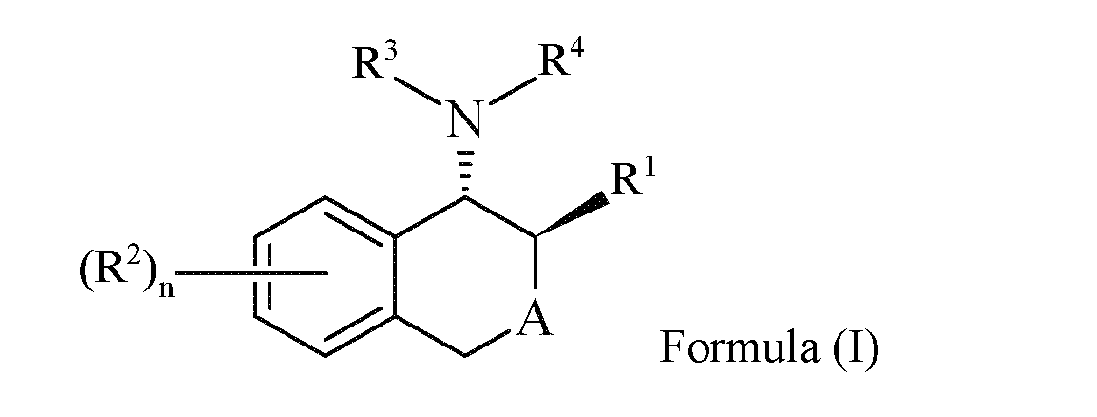
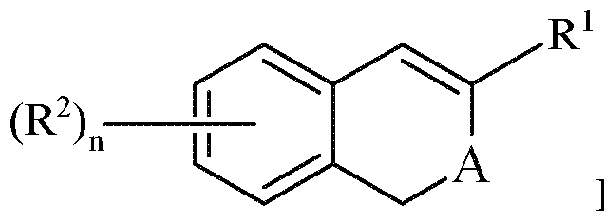
- Some embodiments relate to a process for the preparation of an amine compound of Formula (I): wherein:
- R 1 and R 2 may each independently be hydrogen or an optionally substituted C1-C4 alkyl group, and wherein R 1 and R 2 are not both hydrogen;
- R 3 and R 4 may each independently be hydrogen, an optionally substituted C1-C3 alkyl group, an optionally substituted C1-C3 alkenyl group, an optionally substituted aryl group, a phenyl or an aralkyl group with a C1-C4 alkyl chain; wherein the optional substituent may be selected from the group comprising halogen, aliphatic, halo aliphatic, alicyclic, alkoxy, thioalkyl, hydroxy, cyano, aryl and nitro group;
- A may be -CH2-, -O- or a direct bond; and n may be 0, 1, 2 or 3; which may comprise amination of an indene compound of Formula (II) with an amination agent selected from a compound of Formula (IV) or Formula (VI), wherein:
- R 6 , R 7 and R 8 are each independently hydrogen, an optionally substituted C1-C4 alkyl chain, or an optionally substituted aryl group, wherein the optional substituent is selected from one or more substituents of the group comprising halogen, C1-C4 alkyl chain, halo aliphatic, alicyclic, alkoxy, thioalkyl, hydroxy, cyano, aryl and nitro group;
- R 9 and R 10 are each independently an optionally substituted C1-C4 alkyl chain, or an optionally substituted aryl group, wherein the optional substituent is selected from one or more substituents of the group comprising halogen, C1-C4 alkyl chain, halo aliphatic, alicyclic, alkoxy, thioalkyl, hydroxy, cyano, aryl and nitro group;
- A' may be -CH2-, or a direct bond; and A" may be an optional fused benzene ring optionally substituted with (R 2 ) n , wherein n and R 2 may be as defined in Formula (I); wherein the amination may be in the presence of a hydrosilane reducing agent and a catalyst, wherein the catalyst may be a complex of a transition metal with a monodentate, bidentate or polydentate chiral ligand.
- R 1 and R 2 may each independently be a C1-C4 alkyl group and n may be 1.
- R 3 and R 4 may each independently be hydrogen.
- the amination may be carried out in a solvent.
- the solvent may be selected from a group including tetrahydrofuran, 2-methyl tetrahydrofuran, cyclohexane, methyl cyclohexane, toluene, n- heptane, methyl tert-butyl ether, cyclopentyl methyl ether, chlorobenzene, diethyl ether, di chloromethane, 1,2-di chloroethane, 1,4-di oxane, acetonitrile, dimethylacetamide, dimethoxymethane, 2-methyl tetrahydrofuran, and xylene.
- the solvent may be selected from a group including tetrahydrofuran, 2-methyl tetrahydrofuran, cyclohexane, methyl cyclohexane, toluene and n- heptane.
- the solvent may preferentially be selected from a group including tetrahydrofuran, 1,2-di chloroethane, 1,4-di oxane, acetonitrile, dimethylacetamide, di chloromethane, cyclopentyl methyl ether, and dimethoxymethane.
- the hydrosilane reducing agent may be selected from the group including alkoxy hydrosilanes or hydrosiloxanes. According to some embodiments, the hydrosilane reducing agent may be selected from the group including methyldimethoxysilane, trimethoxysilane or poly(methylhydrosiloxane).
- the transition metal may be a cationic transition metal.
- the transition metal may have an oxidation state of 0, +1, +2, +3, or +4.
- the transition metal may preferably have a transition state of +2.
- the transition metal may be selected from the group including Cu 2+ , Ni 2+ , Pd 2+ , Pt 2+ , Fe 2+ , Ru 2+ , Cr 2+ , Mo 2+ , W 2+ , Co 2+ or Mn 2+ .
- the transition metal may preferably be Cu 2+ or Ni 2+ .
- the Cu 2+ may be selected from the group including copper (II) acetate, copper (II) nitrate, copper (II) carbonate, copper (II) sulfate, copper (II) trifluoroacetate, copper (II) tritiate, copper (II) bis(trifluoromethylsulfonyl)imide, copper (II) perchlorate, copper (II) tetrafluoroborate hexahydrate.
- the Ni 2+ may be selected from the group including Nickel diiodide, Nickel (II) tetrafluoroborate hexahydrate, Nickel (II) bis(acetylacetonate), Nickel dichloride, Nickel difluoride tetrahydrate and Nickel (II) trifluoroacetate.
- the catalyst is a complex of a transition metal with a chiral ligand may be prepared in situ or ex situ.
- the chiral ligand may be a monodentate, bidentate or polydentate chiral ligand. According to some embodiments, the chiral ligand may be a bidentate chiral ligand. According to some embodiments, the chiral ligand may be a phosphorous-containing bidentate chiral ligand. According to some embodiments, the chiral ligand may be a nitrogen-containing bidentate chiral ligand.
- the phosphorous-containing bidentate chiral ligand selected from the group including (+)-1,2-bis((2S,5S)-2,5-diphenylphospholano)ethane, (+)- 1,2-bis((2S,5S)-2,5-dipropylphospholano)ethane, (-)-1,2-bis[(2A,5A)-2,5-diethylphospho- lano]benzene, (-)-1,2-bis[(2R,5A)-2,5-dimethylphospholano]benzene, 1,2-bis(dipheny1- phosphino) ethane (DPPE), (+)-2,2-dimethy1-4,5-((dipheny1-phosphino)dimethyl)dioxolane, (2S,45)-(-)-4-dipheny1-phosphino-2-(diphenylphosphino-methyl)pyrrolidine, 2,2'- bis(diphen
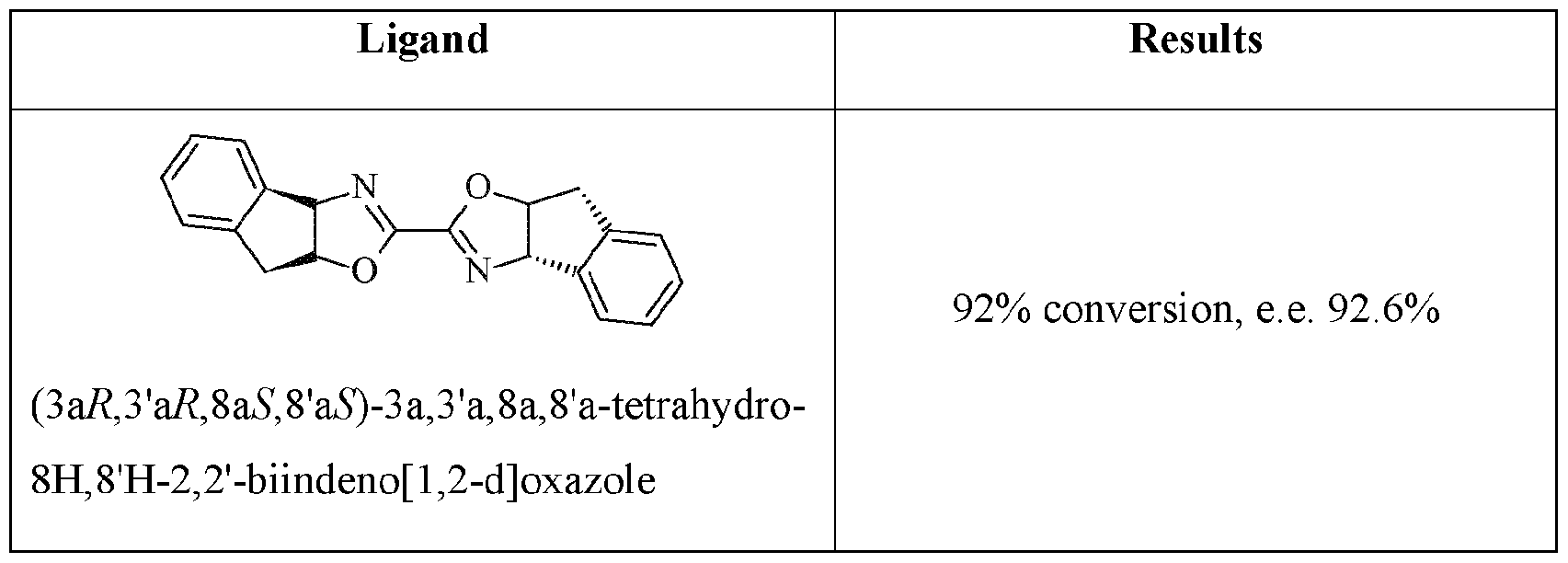
- the nitrogen-containing bidentate chiral ligand may be selected from the group including: (3aR,3'aR,8aS,8'ari)-3a,3'a,8a,8'a-tetrahydro-8H,8'H-2,2'- biindeno[1,2-d]oxazole, (5R,5R )-5,5'-diisobuty1-4,4',5,5'-tetrahydro-2,2'-bioxazole, (5R, 5R)- 5,5'-dipheny1-4,4',5,5'-tetrahydro-2,2'-bioxazole, (5R,5R)-5,5'-dibenzy1-4,4',5,5'-tetrahydro- 2,2'-bioxazole, (5R,5R )-5,5'-di-tert-buty1-4,4',5,5'-tetrahydro-2,2'-bioxazole, (5R,5R )-5,
- the nitrogen-containing bidentate chiral ligand may preferentially be selected from the group including: (3aR,3'aR,8aS,8'aS)-3a,3'a,8a,8'a-tetrahydro-8H,8'H-2,2'-biindeno[1,2-d]oxazole, (5R,5R )-5,5'-di-tert-buty1-4,4',5,5'-tetrahydro-2,2'-bioxazole and (5R,5R )-5,5'-dipheny1- 4,4',5,5'-tetrahydro-2,2'-bioxazole.
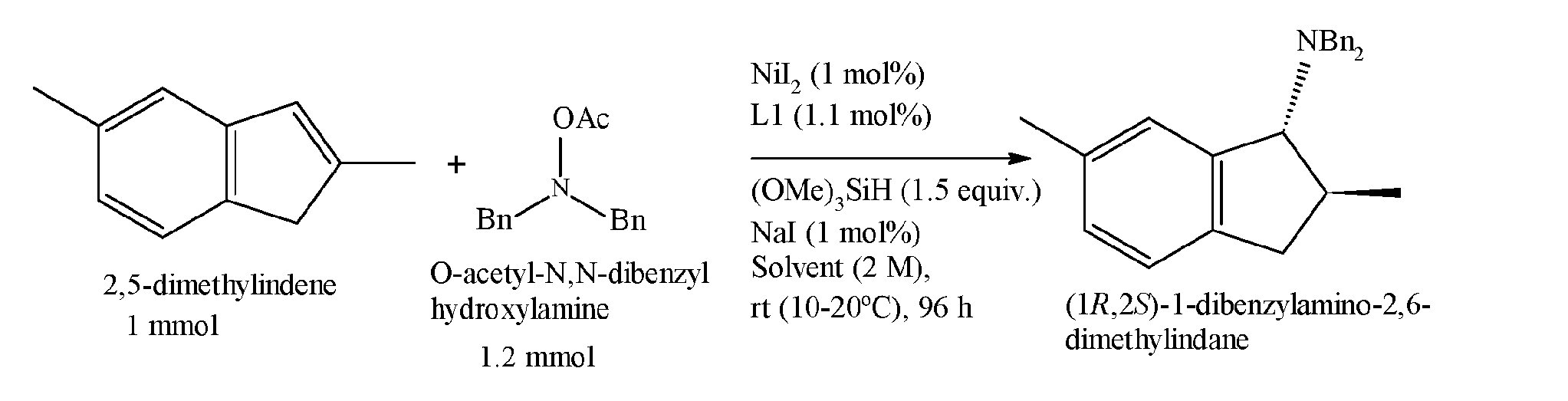
- the nitrogen-containing bidentate chiral ligand may most preferentially be (3aR,3'aR,8aS,8'a5)-3a,3'a,8a,8'a-tetrahydro- 8H,8'H-2,2'-biindeno[l,2-d]oxazole or (5A,5'R)-5,5'-di-tert-buty1-4,4',5,5'-tetrahydro-2,2'- bioxazole.
- the amination agent may be a compound of Formula (IV) wherein:
- R 6 , R 7 and R 8 are each independently hydrogen, an optionally substituted C1-C4 alkyl chain, or an optionally substituted aryl group, wherein the optional substituent is selected from one or more substituents of the group comprising halogen, C1-C4 alkyl chain, halo aliphatic, alicyclic, alkoxy, thioalkyl, hydroxy, cyano, aryl and nitro group;
- R 9 and R 10 are each independently an optionally substituted C1-C4 alkyl chain, or an optionally substituted aryl group, wherein the optional substituent is selected from one or more substituents of the group comprising halogen, C1-C4 alkyl chain, halo aliphatic, alicyclic, alkoxy, thioalkyl, hydroxy, cyano, aryl and nitro group; or a compound of Formula (VI) wherein
- A’ may be -CH2-
- A" may be an optional fused benzene ring optionally substituted with (R 2 ) n , wherein n and R 2 may be as defined in Formula (I); and n may be 0.
- the amination agent may be selected from the group including 1,2-benzisoxazole, (Bn)2NOBz (O-benzoy1-N,N-dibenzylhydroxylamine), (Bn)2NOAc (O-acety1-N,N-dibenzylhydroxylamine) and (Bn ⁇ NCChEt.
- the amination agent may preferably be 1,2-benzisoxazole (Bn)2NOBz or (Bn) 2 NOAc.
- the amination may take place at a temperature in the range between about 0-100°C. According to some embodiments, the amination may take place at a temperature in the range between about 0-40°C when the transition metal is Ni.
- the amination may take place at a temperature in the range between about 0-40°C when the transition metal is Ni 2+ .
- the amination may take place at a temperature in the range between about 30-80°C when the transition metal is Cu.
- the amination may take place at a temperature in the range between about 30-80°C when the transition metal is Cu 2+ .
- the amination may take place under atmospheric pressure.
- the process may include addition of a hydrolyzing agent for hydrolyzing an initially formed imine derivative to obtain a free amine or a salt thereof.
- the hydrolyzing agent may be selected from: NH2OH-HCl, NH3 (ammonia), N2H4 (hydrazine), and NH2OH 50 wt% in H2O
- the amination agent may be a compound of Formula (IV) wherein:
- R 6 , R 7 and R 8 are each independently hydrogen, an optionally substituted C1-C4 alkyl chain, or an optionally substituted aryl group, wherein the optional substituent is selected from one or more substituents of the group comprising halogen, C1-C4 alkyl chain, halo aliphatic, alicyclic, alkoxy, thioalkyl, hydroxy, cyano, aryl and nitro group;
- R 9 and R 10 are each independently an optionally substituted C1-C4 alkyl chain, or an optionally substituted aryl group, wherein the optional substituent is selected from one or more substituents of the group comprising halogen, C1-C4 alkyl chain, halo aliphatic, alicyclic, alkoxy, thioalkyl, hydroxy, cyano, aryl and nitro group.
- the process may include addition of an additive selected from the group including sodium iodide (Nal), potassium iodide (KI), lithium iodide (Lil) and cesium iodide (CsI).
- the compound of Formula (I) may be (1A,2S)-1- amino-2,6-dimethylindane (Formula VII) or (1R,2S)-1-dibenzylamino-2,6-dimethylindane.
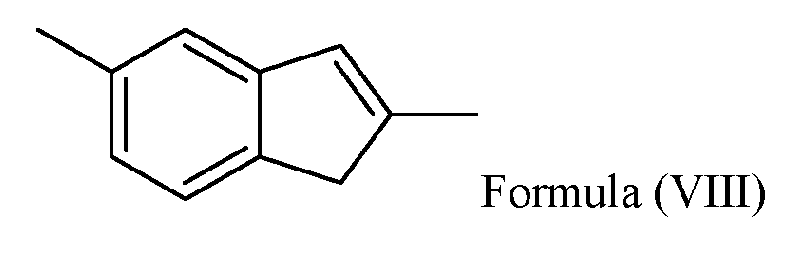
- (vn)) may be produced by reacting 2, 5 -dimethylindene having a Formula (VIII) with 1,2-benzisoxazole in the presence of copper (II) acetate (Cu(OAc)2), (+)-1,2- bis(2S,55)-2,5-diphenylphospholano)ethane (fS',,S')-Ph-BPE) and poly(methy1- hydrosiloxane) (PMHS).
- Cu(OAc)2 copper
- fS',,S')-Ph-BPE (+)-1,2- bis(2S,55)-2,5-diphenylphospholano)ethane
- PMHS poly(methy1- hydrosiloxane)
- the process to produce (lA,2S)-1-amino-2,6- dimethylindane may further include adding NH2OH-HCl.
- the process may take place under a nitrogen atmosphere.
- Some embodiments relate to a process for the preparation of an indene compound of Formula (II): ( ) by dehydration of an indanol compound of Formula (III): wherein: R 1 and R 2 may each independently be hydrogen and wherein R 1 and R 2 are not both hydrogen or an optionally substituted C1-C4 alkyl group, wherein the optional substituents may be selected from the group including halogen, aliphatic, halo aliphatic, alicyclic, alkoxy, thioalkyl, cyano or nitro groups;
- A may be -CH2-, -O- or a direct bond; and n may be 0, 1, 2 or 3.
- dehydration may be carried out in a solvent.
- the dehydration solvent may be selected from the group including toluene, chlorobenzene, di chloroethane and xylene.
- the dehydration solvent may preferably be toluene.
- dehydration may be carried out in the presence of a catalyst.
- the catalyst may be selected from the group including p-toluene sulfonic acid, pyridinium p-toluene sulfonic acid, sulfosalicylic acid, ethane sulphonic acid, methanesulfonic acid, benzene sulfonic acid, camphorsulfonic acid, p- brominesulphonic acid, sulfuric acid, trifluoromethanesulfonic acid and hydrochloric acid.
- Some embodiments relate to a 2, 5 -dimethylindene compound of Formula (VIII): Formula (VIII).
- Some embodiments relate to a compound of Formula (X): wherein:
- R 1 and R 2 may each independently be hydrogen and wherein R 1 and R 2 are not both hydrogen or an optionally substituted C1-C4 alkyl group, and wherein R 1 and R 2 may not both be hydrogen;
- R 12 may be hydrogen, an optionally substituted C1-C4 alkyl chain, or an optionally substituted aryl group, wherein the optional substituent may be selected from one or more substituents of the group including halogen, C1-C4 alkyl chain, halo aliphatic, alicyclic, alkoxy, thioalkyl, hydroxy, cyano, aryl and nitro group; and
- A may be -CH2-, -O- or a direct bond.
- Some embodiments relate to a compound of Formula (IX): Formula (IX).
- a compound of Formula (IX) or Formula (X) may be an intermediate in the preparation of a compound of Formula (I).
- Some embodiments relate to a process for the preparation of Indaziflam, the process comprising preparing a compound of Formula (I) according to a process as disclosed herein.
- Some embodiments relate to Indaziflam produced according to a process as disclosed herein.
- the compound of Formula (I) is an important intermediate and is used in the preparation of Indaziflam, as described in WO 2009/077059 and US 2004/0157739 incorporated herein by reference in its entirety.
- a further aspect of the subject matter there is provided a process for preparation of Indaziflam including: a) preparing compound of Formula (I) as described herein; b) providing reaction conditions for preparation of Indaziflam.
- reaction conditions in step (b) include but are not limited to nucleophilic addition reaction and cyclization to obtain Indaziflam.
- Some embodiments relate to a process for the preparation of Indaziflam, the process including: a. reacting (lA,2S)-1-amino-2,6-dimethylindane prepared according to any one of the disclosed embodiments with 1 -cyanoguanidine in the presence of a solvent to obtain (lA,2S)-1-(bisguanidino)-2,6-dimethylindane; and b. reacting said (1R,2S)-1-(bisguanidino)-2,6-dimethylindane with methyl -(2R)-2- fluoropropanoate in the presence of a base and in the presence of a solvent.
- Some embodiments relate to a process for the preparation of Indaziflam, the process including: a. reacting (lA,2S)-1-amino-2,6-dimethylindane prepared according to any one of the disclosed embodiments with 1 -cyanoguanidine and metal isopropoxide in the presence of a solvent to obtain (1R,2S)-1-(bisguanidino)-2,6-dimethylindane; and b. reacting said (1R,2S)-1-(bisguanidino)-2,6-dimethylindane with methyl -(2R)-2- fluoropropanoate .
- Some embodiments relate to a process for the preparation of Indaziflam, the process including: a. reacting (1R,2S)-1-amino-2,6-dimethylindane prepared according to any one of the disclosed embodiments with cyanoguanidine and aluminum isopropoxide in the presence of a solvent to obtain (1R,2S)-1-(bisguanidino)-2,6-dimethylindane; and b. reacting said (1R,2S)-1-(bisguanidino)-2,6-dimethylindane with methyl -(2R)-2- fluoropropanoate .
- an alternative to the existing methods for the preparation of Indaziflam intermediates is provided.
- a chiral synthesis may be used to prepare Indaziflam intermediates.
- the enantiomeric excess and/or yield may be controlled.
- the transitional term “comprising” or “that comprises”, which is synonymous with “including,” or “containing,” is inclusive or open-ended and does not exclude additional, un-recited elements or method steps.
- the term also encompass, as alternative embodiments, the phrases “consisting essentially of and “consisting of, where “consisting of excludes any element or step not specified and “consisting essentially of permits the inclusion of additional un-recited elements or steps that do not materially affect the essential or basic and novel characteristics of the composition or method under consideration.
- the term “compound” may include all forms thereof including, but not limited to, salts, solid forms such as amorphous, crystalline, solvate or hydrate.
- the term “aryl group” as used herein in accordance with some embodiments may refer to an optionally substituted aromatic carbocyclic or heterocyclic group which has between 4 and 10, between 5 and 10, between 5 and 8 carbon atoms, which comprises 1 aromatic ring or 2 fused aromatic rings, wherein the optional substituents are selected from the group including halogen, aliphatic, halo aliphatic, alkoxy, thioalkyl, cyano or nitro groups.
- heteroaryl group 1, 2 or 3 of the atoms in the ring or rings of the aryl group, is an element other than carbon, such as nitrogen, oxygen or sulfur.
- aralkyl group as used herein in accordance with some embodiments, may refer to an ary1-substituted alkyl group.
- alkoxy group as used herein in accordance with some embodiments, may refer to an alkyl group bound to oxygen.
- aryloxy group as used herein in accordance with some embodiments may refer to an aryl group bound to oxygen.
- aralkoxy group as used herein in accordance with some embodiments, may refer to an aralkyl group bound to oxygen.
- aralkoxyamine group as used herein in accordance with some embodiments, may refer to an aralkyl group bound to oxygen which is in turn bound to nitrogen by a single bond.
- alkoxyamine as used herein in accordance with some embodiments, may refer to an alkyl group bound to oxygen which is in turn bound to nitrogen by a single bond.
- isoxazole as used herein in accordance with some embodiments, may refer to aromatic heterocycle containing an N-0 bond.
- benzisoxazole as used herein in accordance with some embodiments, may refer to a bicyclic heterocycle including a benzene ring fused to an aromatic heterocycle containing an N-0 bond.
- thioalkyl group as used herein in accordance with some embodiments, may refer to an alkyl group bound to sulfur.
- halo aliphatic group as used herein in accordance with some embodiments, may refer to an aliphatic group substituted with at least one halogen atom.
- aliphatic group as used herein in accordance with some embodiments may cover, for example and not restricted to, the linear or branched alkyl, alkenyl and alkynyl groups.
- alkyl group may refer to a saturated, linear or branched group, which has between 1 and 24, between 1 and 16, between 1 and 14, between 1 and 12, or 1, 2, 3, 4, 5 or 6 carbon atoms and is bound to the rest of the molecule by a single bond, including, for example and not restricted to, methyl, ethyl, isopropyl, isobutyl, tert-butyl, heptyl, octyl, decyl, dodecyl, hexadecyl, octadecyl, amyl, 2- ethylhexyl, 2-methylbutyl, 5-methylhexyl and similar.
- alkenyl group as used herein in accordance with some embodiments, may refer to a linear or branched group, which has between 2 and 24, between 2 and 16, between 2 and 14, between 2 and 12, or 2, 3, 4, 5 or 6 carbon atoms, with 1, 2 or 3 carbon-carbon double bonds, conjugated or unconjugated, which is bound to the rest of the molecule by a single bond, including, for example and not restricted to, ethenyl, 1 -propenyl, 2-propenyl, 1-butenyl, 2- butenyl, pentenyl, and similar groups.
- alkynyl group may refer to a linear or branched group, which has between 2 and 24, between 2 and 16, between 2 and 14, between 2 and 12, or 2, 3, 4, 5 or 6 carbon atoms, with 1, 2 or 3 carbon-carbon triple bonds, conjugated or unconjugated, which is bound to the rest of the molecule by a single bond, including, for example and not restricted to, an ethynyl, 1-propynyl, 2-propynyl, 1-butynyl, 2- butynyl, pentynyl, such as 1 -pentynyl, and similar.
- alkylidene group may refer to a saturated, linear or branched group, which has between 1 and 24, between 1 and 16, between 1 and 14, between 1 and 12, or 1, 2, 3, 4, 5 or 6 carbon atoms and is bound to the rest of the molecule by a double bond, including, for example and not restricted to, methylidene, ethylidene, isopropylidene, isobutylidene, tert-butylidene, heptylidene, octylidene, decylidene, dodecylidene, hexadecylidene and similar.
- alicyclic group as used in accordance with some embodiments, may cover, for example and not restricted to, cycloalkyl, cycloalkenyl and/or cycloalkynyl groups.
- cycloalkyl as used herein in accordance with some embodiments, may refer to a saturated mono- or polycyclic aliphatic group which has between 3 and 24, between 3 and 16, between 3 and 14, between 3 and 12, or 3, 4, 5 or 6 carbon atoms and which is bound to the rest of the molecule by a single bond, including, for example and not restricted to, cyclopropyl, cyclobutyl, cyclopentyl, cyclohexyl, cycloheptyl, methyl cyclohexyl, dimethyl cyclohexyl, octahydroindene, decahydronaphthalene, dodecahydrophenal ene and/or similar.
- cycloalkenyl as used herein in accordance with some embodiments, may refer to a non-aromatic mono- or polycyclic aliphatic group which has between 5 and 24, between 5 and 16, between 5 and 14, between 5 and 12, or 5 or 6 carbon atoms, with 1, 2 or 3 carbon-carbon double bonds, conjugated or unconjugated, and which is bound to the rest of the molecule by a single bond, including, for example and not restricted to, the cyclopent-1-en-1- yl group and/or similar.
- cycloalkynyl as used herein in accordance with some embodiments, may refer to a non-aromatic mono- or polycyclic aliphatic group which has between 8 and 24, between 8 and 16, between 8 and 14, between 8 and 12, or 8 or 9 carbon atoms, with 1, 2 or 3 carbon-carbon triple bonds, conjugated or unconjugated, and which is bound to the rest of the molecule by a single bond, including, for example and not restricted to, the cyclooct-2-in-1-yl group and/or similar.
- hydrosilane as used herein in accordance with some embodiments, may refer to any organic tetraval ent silicon compound containing one or more Si-H bonds.
- alkoxy hydrosilane refers to any organic tetravalent silicon compound containing one or more Si-H bonds and one or more alkoxy groups bound to silicon. For example, and not restricted to, methyldimethoxysilane, trimethoxysilane, dimethoxysilane, diethyoxysilane, triethoxysilane, poly(methylhydrosilane), oligosilanes and/or similar.
- hydrosiloxane as used herein in accordance with some embodiments, may refer to any organosilicon compound containing at least one Si-O-Si group where each Si atom carries two aliphatic or aralkyl groups.
- alkoxy hydrosiloxanes refers to any organosilicon compound containing at least one Si-O-Si group where each Si atom carries two aliphatic or aralkyl groups, at least one of which is an alkoxy group.
- polymethylhydrosiloxane phenylsiloxane, oligosiloxane, methyldimethoxysiloxane, trimethoxysiloxane, dimethoxysiloxane, diethyoxysiloxane, and/or similar.
- PMHS polymethylhydrosiloxane
- phenylsiloxane phenylsiloxane
- oligosiloxane methyldimethoxysiloxane
- trimethoxysiloxane dimethoxysiloxane
- diethyoxysiloxane diethyoxysiloxane
- the terms “monodentate chiral ligand”, “bidentate chiral ligand” and “polydentate chiral ligand” as used herein in accordance with some embodiments, may refer to a chiral ligand bound to the rest of the molecule by a single bond or a double bond, and the rest of the molecule may be an organic or organometallic molecule, wherein the chiral ligand include a single donor atom, two donor atoms or multiple donor atoms.
- Non-limiting examples of monodentate ligands are: [(1R)-2'-methoxy[1,1'- binaphthalen]-2-yl]diphenylphosphine, (1R)-[1,1'-binaphthalen]-2-yldipheny1- phosphine, [(2S)-2-(1-naphthalenyl)[1,1'-biphenyl]-3-yl]dipheny1-phosphine, [(1S,2S,5R)-5- methy1-2-(1-methylethyl)cyclohexyl]diphenylphosphine, 3-(diphenylphosphino)-2-[(R)- methoxyphenylmethyl]-(3S)-ferrocene. derivatives or enantiomers thereof and/or similar.
- phosphorous-containing bidentate chiral ligand may refer to a bidentate chiral ligand containing one or more phosphorous atoms, which is bound to the rest of the molecule by a single bond or a double bond, and the rest of the molecule may be an organic or organometallic molecule.
- DPPE 1,2-bis(dicyclohexylphosphino)ethane
- DCPE 1,3-bis(diphenyl phosphino)propane
- DPPB 1,4-bis(diphenylphosphino)butane
- DPPF 1,1'-bis(diphenylphosphino)ferrocene
- nitrogen containing bi-dentate chiral ligand may refer to a bidentate chiral ligand containing one or more nitrogen atoms, which is bound to the rest of the molecule by a single bond or a double bond, and the rest of the molecule may be an organic or organometallic molecule.
- transition metal as used herein in accordance with some embodiments may refer to a metal selected from the group of transition metals on the Periodic table with an oxidation state of -4, -3, -2, -1, 0, +1, +2, +3, +4, +5, +6 or +7.
- cationic transition metal as used herein in accordance with some embodiments may refer to a positively charged metal selected from the group of transition metals on the Periodic table with an oxidation state of +1, +2, +3, +4, +5, +6 or +7.
- Nonlimiting examples of cationic transition metals are: Cu + , Ni + , Fe + , Ru + , Cr + , Mo + , W + , Co + , Mn + , Cu 2+ , Ni 2+ , Pd 2+ , Pt 2+ , Fe 2+ , Ru 2+ , Cr 2+ , Mo 2+ , W 2+ , Co 2+ , Mn 2+ , Cu 3+ , Ni 3+ , Pd 3+ , Fe 3+ , RU 3+ , Cr 3+ , MO 3+ , W 3+ , CO 3+ , Mn 3+ , Ni 4+ , Pt 4+ , Fe 4+ , Ru 4+ , Cr 4+ , Mo 4+ , W 4+ , Mn 4+ and/or similar.
- the process may make use of a catalyst.
- the catalyst may be a complex of a transition metal with a monodentate, bidentate or polydentate chiral ligand.
- the transition metal may be a cationic transition metal.
- the complex may be prepared in situ or ex situ.
- pTSA p-toluene sulfonic acid
- Example 7 Nickel catalyzed asymmetric hydroalkylamination
- NiOAcz (4.4 mg, 0.025 mmol, 5.0 mol%), Ligand L5 ((5R,5'R)-5,5'-di-tert-buty1-4,4',5,5'-tetrahydro-2,2'-bioxazole (9.5 mg, 0.030 mmol, 6.0 mol%), sodium iodide (Nal) (11.2 mg, 0.075 mmol, 15 mol%), anhydrous tetrahydrofuran (THF) (1.0 mL, 0.5M) were added to 10 mL screwcap vial equipped with a magnetic stir bar, and the mixture was stirred for 30 min, then trimethoxy-silane ((MeO) 3 SiH) (160 pL, 1.25 mmol, 2.5 equivalents), 2,5-dimethylindene (72 mg, 0.50 mmol) and O-benzoy1-N,N- dibenzylhydroxylamine (BmNO)
- the iodide ion (of the Nal) may generate Nickel diiodide in-situ. which may be more reactive than Ni(OAc)2. This may assist in the formation of the Nickel -bi dentate ligand complex, which was obtained with 60% conversion, and 91.5% enantiomeric excess (e.e ).
- Example 8 Nickel catalyzed asymmetric hydroalkylamination
- NiOAc2 (4.4 mg, 0.025 mmol, 5.0 mol%), Ligand LI (3'aR,3aR,8'aS,8a5)-3'a,3a,8'a,8a-tetrahydro-2,2'-bi-8H-indeno[1,2-d]oxazole (9.5 mg, 0.030 mmol, 6.0 mol%), sodium iodide (Nal) (11.2 mg, 0.075 mmol, 15 mol%), anhydrous tetrahydrofuran (THF) (1.0 mL, 0.5M) were added to 10 mL screwcap vial equipped with a magnetic stir bar, and the mixture was stirred for 30 min, then trimethoxy-silane ((MeO) 3 SiH) (160 pL, 1.25 mmol, 2.5 equivalents), 2,5-dimethylindene (72 mg, 0.50 mmol) and O-benzoy1- N,N
- the iodide ion (of the Nal) may generate Nickel diiodide in-situ. which may be more reactive than Ni(OAc)2. This may assist in the formation of the Nickel -bi dentate ligand complex, which was obtained with 40% yield and 95% enantiomeric excess (e.e).
- NiI 2 (1.0 mol%), Ligand L1, as defined in Example 8 (1.1 mol%), sodium iodide (1 mol%), anhydrous tetrahydrofuran (2 M) were added to 10 mL screwcap vial equipped with a magnetic stir bar, and the mixture was stirred for 30 min, then trimethoxy-silane (1.5 equivalents), 2,5 -dimethylindene (1 mmol) and O-acety1-N,N- dibenzylhydroxylamine (BmNOAc) (1.2 mmol) were added in sequence. The reaction was stirred at room temperature for 96 h.
- Example 10 Reduction of (1R,2S)-N,/V-dibenzy1-2,6-dimethy1-2,3-dihydro-lH- inden-1-amine to (lR,2S)-2,6-dimethy1-2,3-dihydro-lH-inden-1-amine
- (1R,2S)-N,N-dibenzy1-2,6-dimethy1-2,3-dihydro-1H-inden-1-amine 341 mg, 1 mmol
- Pd/C 10wt% of Pd, 100 mg
- methanol 100 ml
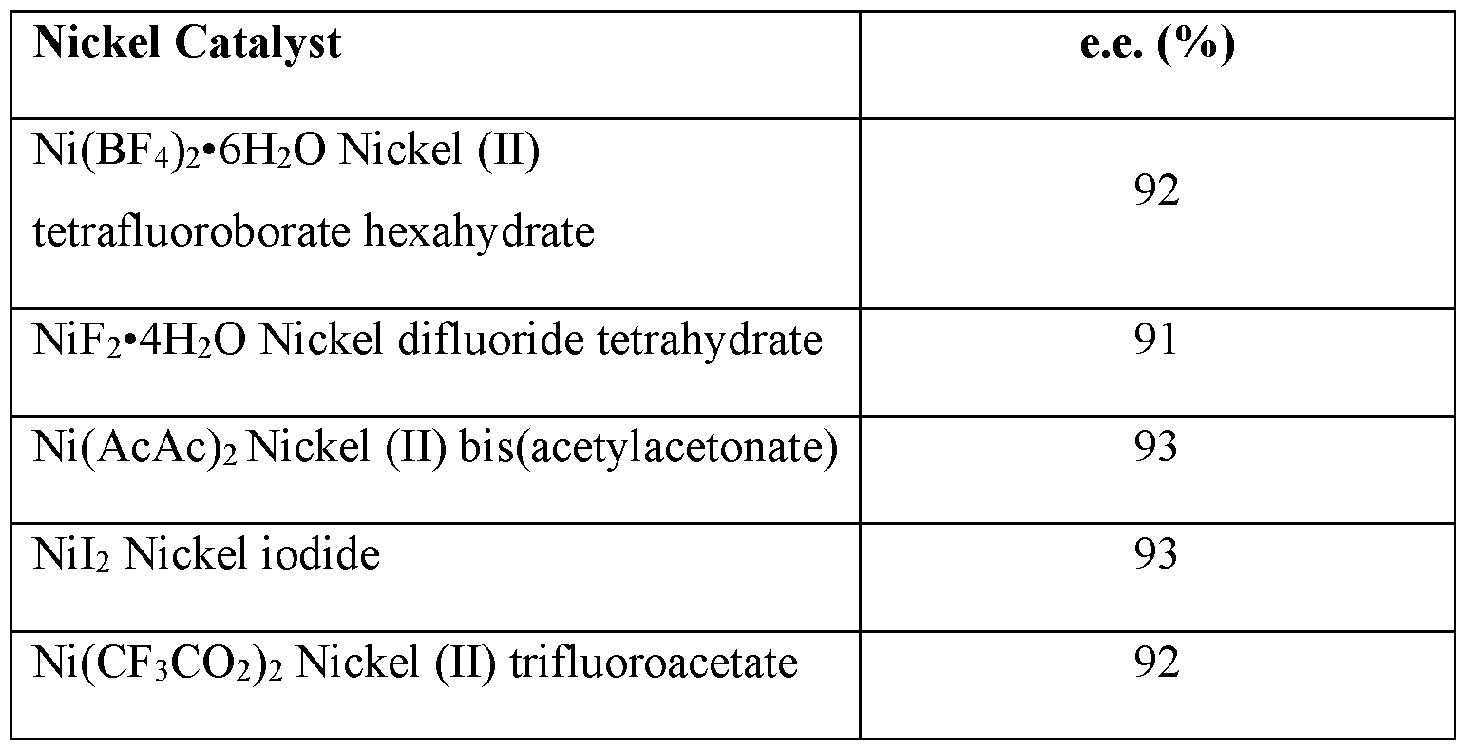
- Example 11 Nickel catalyst screening for benzoyl amination reagent
- Nickel containing catalysts were screened for use in the synthesis of (1R, 2S)- 1-dibenzylamino-2,6-dimethylindane, wherein the ligand is LI is as defined in Example 8.
- Table 4 is a list of exemplary Nickel containing catalysts tested under various reaction conditions. y y dinictliylindanc
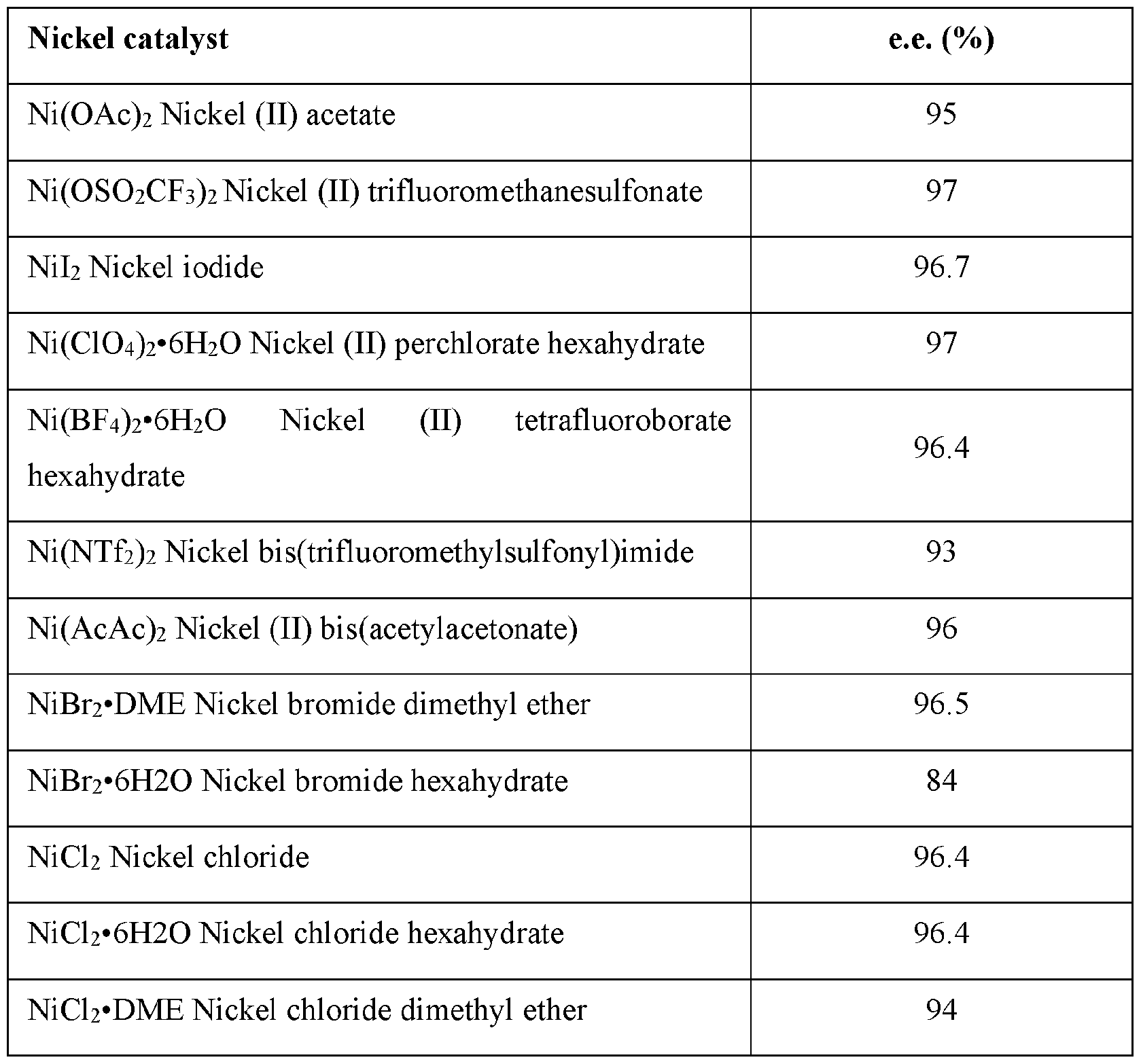
- Example 12 Nickel catalyst screening for acetoxy amination reagent
- Nickel containing catalysts were screened for use in the synthesis of (1R, 2S)- 1-dibenzylamino-2,6-dimethylindane, wherein Ligand LI, is as defined in Example 8.
- Table 5 is a list of exemplary Nickel containing catalysts tested under various reaction conditions.
- Example 13 Solvent screening for use with a nickel catalyst benzoyl amination reagent
- Example 14 Solvent screening for use with a nickel catalyst with acetoxy amination reagent
- Example 15 Chiral nitrogen ligand screening
- Example 16 Synthesis of (lR,2S)-1-dibenzylamino-2,6-dimethylindane using a Nickel catalyst with and without a sodium additive
- Example 18 Nickel catalyst amination reagent screening
Landscapes
- Chemical & Material Sciences (AREA)
- Organic Chemistry (AREA)
- Chemical Kinetics & Catalysis (AREA)
- Organic Low-Molecular-Weight Compounds And Preparation Thereof (AREA)
- Low-Molecular Organic Synthesis Reactions Using Catalysts (AREA)
- Agricultural Chemicals And Associated Chemicals (AREA)
Abstract
Description













Claims



Priority Applications (3)
| Application Number | Priority Date | Filing Date | Title |
|---|---|---|---|
| AU2024245835A AU2024245835A1 (en) | 2023-03-29 | 2024-03-28 | Process for the preparation of amine intermediates |
| EP24719665.2A EP4688726A1 (en) | 2023-03-29 | 2024-03-28 | Process for the preparation of amine intermediates |
| CN202480031359.7A CN121175287A (en) | 2023-03-29 | 2024-03-28 | Process for preparing amine intermediates |
Applications Claiming Priority (2)
| Application Number | Priority Date | Filing Date | Title |
|---|---|---|---|
| CNPCT/CN2023/084632 | 2023-03-29 | ||
| CN2023084632 | 2023-03-29 |
Publications (1)
| Publication Number | Publication Date |
|---|---|
| WO2024201469A1 true WO2024201469A1 (en) | 2024-10-03 |
Family
ID=90735397
Family Applications (1)
| Application Number | Title | Priority Date | Filing Date |
|---|---|---|---|
| PCT/IL2024/050324 Ceased WO2024201469A1 (en) | 2023-03-29 | 2024-03-28 | Process for the preparation of amine intermediates |
Country Status (4)
| Country | Link |
|---|---|
| EP (1) | EP4688726A1 (en) |
| CN (1) | CN121175287A (en) |
| AU (1) | AU2024245835A1 (en) |
| WO (1) | WO2024201469A1 (en) |
Cited By (2)
| Publication number | Priority date | Publication date | Assignee | Title |
|---|---|---|---|---|
| EP4800002A1 (en) | 2025-02-27 | 2026-09-02 | Bayer Aktiengesellschaft | Substituted indanylcarboxamides, salts thereof and use thereof as herbicidal agents |
| EP4800010A1 (en) | 2025-02-27 | 2026-09-02 | Bayer Aktiengesellschaft | Substituted indanylaminotriazines, their salts and use of said compounds as herbicidal agents |
Citations (6)
| Publication number | Priority date | Publication date | Assignee | Title |
|---|---|---|---|---|
| US20040157739A1 (en) | 2003-02-05 | 2004-08-12 | Hartmut Ahrens | Amino-1,3,5-triazines N-substituted with chiral bicyclic radicals, process for their preparation, compositions thereof, and their use as herbicides and plant growth regulators |
| WO2009077059A1 (en) | 2007-12-14 | 2009-06-25 | Bayer Cropscience Ag | Synthesis of biguanidines and triazines, and biguanidino-aluminium complexes as intermediates |
| WO2010099938A1 (en) * | 2009-03-04 | 2010-09-10 | Grünenthal GmbH | Sulfonylated tetrahydroazolopyrazines and their use as medicinal products |
| CN103641864A (en) * | 2013-11-14 | 2014-03-19 | 浙江大学 | Bridged metallocene complex and its application |
| WO2015113903A1 (en) | 2014-01-28 | 2015-08-06 | Bayer Cropscience Ag | Method for producing 1-indanoles and 1-indanamines |
| CN108794339A (en) | 2017-05-03 | 2018-11-13 | 上海朴颐化学科技有限公司 | The preparation method of one kind (1R, 2S) -2,6- dimethyl -1- amido indanes |
-
2024
- 2024-03-28 AU AU2024245835A patent/AU2024245835A1/en active Pending
- 2024-03-28 EP EP24719665.2A patent/EP4688726A1/en active Pending
- 2024-03-28 CN CN202480031359.7A patent/CN121175287A/en active Pending
- 2024-03-28 WO PCT/IL2024/050324 patent/WO2024201469A1/en not_active Ceased
Patent Citations (7)
| Publication number | Priority date | Publication date | Assignee | Title |
|---|---|---|---|---|
| US20040157739A1 (en) | 2003-02-05 | 2004-08-12 | Hartmut Ahrens | Amino-1,3,5-triazines N-substituted with chiral bicyclic radicals, process for their preparation, compositions thereof, and their use as herbicides and plant growth regulators |
| WO2004069814A1 (en) | 2003-02-05 | 2004-08-19 | Bayer Cropscience Gmbh | Amino 1, 3, 5-triazines n-substituted with chiral bicyclic radicals, process for their preparation, compositions thereof and their use as herbicides and plant growth regulators |
| WO2009077059A1 (en) | 2007-12-14 | 2009-06-25 | Bayer Cropscience Ag | Synthesis of biguanidines and triazines, and biguanidino-aluminium complexes as intermediates |
| WO2010099938A1 (en) * | 2009-03-04 | 2010-09-10 | Grünenthal GmbH | Sulfonylated tetrahydroazolopyrazines and their use as medicinal products |
| CN103641864A (en) * | 2013-11-14 | 2014-03-19 | 浙江大学 | Bridged metallocene complex and its application |
| WO2015113903A1 (en) | 2014-01-28 | 2015-08-06 | Bayer Cropscience Ag | Method for producing 1-indanoles and 1-indanamines |
| CN108794339A (en) | 2017-05-03 | 2018-11-13 | 上海朴颐化学科技有限公司 | The preparation method of one kind (1R, 2S) -2,6- dimethyl -1- amido indanes |
Non-Patent Citations (6)
| Title |
|---|
| "Chemistry, Process Design, and Safety for the Nitration Industry /ACS /Symposium Series", vol. 1204, 1 January 2015, AMERICAN CHEMICAL SOCIETY/OXFORD UNIVERSITY PRESS, US, ISSN: 0097-6156, article HARTMUT AHRENS: "Indaziflam: An Innovative Broad Spectrum Herbicide", pages: 233 - 245, XP055458937, DOI: 10.1021/bk-2015-1204.ch017 * |
| NADIA G. LÉONARD: "Remote, Diastereoselective Cobalt-Catalyzed Alkene Isomerization-Hydroboration: Access to Stereodefined 1,3-Difunctionalized Indanes", ACS CATALYSIS, vol. 9, no. 10, 4 October 2019 (2019-10-04), US, pages 9034 - 9044, XP093169783, ISSN: 2155-5435, Retrieved from the Internet <URL:https://pubs.acs.org/doi/suppl/10.1021/acscatal.9b03444/suppl_file/cs9b03444_si_002.pdf> DOI: 10.1021/acscatal.9b03444 * |
| PALKÓ MÄRTA ET AL: "Synthesis and stereochemistry of indano[1,2- d ][1,3]oxazines and thiazines, new ring systems", JOURNAL OF HETEROCYCLIC CHEMISTRY, vol. 41, no. 1, 1 January 2004 (2004-01-01), US, pages 69 - 75, XP093169998, ISSN: 0022-152X, DOI: 10.1002/jhet.5570410111 * |
| PAOLO ZARDI: "Co(porphyrin)-catalysed amination of 1,2-dihydronaphthalene derivatives by aryl azides", JOURNAL OF ORGANOMETALLIC CHEMISTRY, vol. 716, 1 October 2012 (2012-10-01), AMSTERDAM, NL, pages 269 - 274, XP093169658, ISSN: 0022-328X, Retrieved from the Internet <URL:https://www.sciencedirect.com/science/article/pii/S0022328X12004433?via%3Dihub> DOI: 10.1016/j.jorganchem.2012.07.013 * |
| XIAODONG GU: "Highly enantioselective access to chiral chromanes and thiochromanes via Cu-catalyzed hydroamination with anthranils", ORGANIC CHEMISTRY FRONTIERS, vol. 8, no. 7, 6 April 2021 (2021-04-06), pages 1563 - 1568, XP093169721, ISSN: 2052-4129, Retrieved from the Internet <URL:https://pubs.rsc.org/en/content/articlepdf/2021/qo/d1qo00030f> DOI: 10.1039/D1QO00030F * |
| YAMAMOTO YUTA ET AL: "Facile Hydrogenative Deprotection of N -Benzyl Groups Using a Mixed Catalyst of Palladium and Niobic Acid-on-Carbon", ACS OMEGA, vol. 5, no. 6, 5 February 2020 (2020-02-05), US, pages 2699 - 2709, XP093170277, ISSN: 2470-1343, Retrieved from the Internet <URL:http://pubs.acs.org/doi/pdf/10.1021/acsomega.9b03226> DOI: 10.1021/acsomega.9b03226 * |
Cited By (4)
| Publication number | Priority date | Publication date | Assignee | Title |
|---|---|---|---|---|
| EP4800002A1 (en) | 2025-02-27 | 2026-09-02 | Bayer Aktiengesellschaft | Substituted indanylcarboxamides, salts thereof and use thereof as herbicidal agents |
| EP4800010A1 (en) | 2025-02-27 | 2026-09-02 | Bayer Aktiengesellschaft | Substituted indanylaminotriazines, their salts and use of said compounds as herbicidal agents |
| WO2026180652A1 (en) | 2025-02-27 | 2026-09-03 | Bayer Aktiengesellschaft | Substituted indanylaminotriazines and salts thereof, and use thereof as herbicidal substances |
| WO2026180653A1 (en) | 2025-02-27 | 2026-09-03 | Bayer Aktiengesellschaft | Substituted indanylcarboxamides and salts thereof and use thereof as herbicidal substances |
Also Published As
| Publication number | Publication date |
|---|---|
| EP4688726A1 (en) | 2026-02-11 |
| AU2024245835A1 (en) | 2025-10-16 |
| CN121175287A (en) | 2025-12-19 |
Similar Documents
| Publication | Publication Date | Title |
|---|---|---|
| AU2024245835A1 (en) | Process for the preparation of amine intermediates | |
| CN114080379B (en) | Hydrogenation of esters to alcohols in the presence of Ru-PNN complexes | |
| EP2044095B1 (en) | New ruthenium complexes as catalysts for metathesis reactions | |
| CN102336698A (en) | Method for synthesizing chiral indoline through palladium-catalyzed asymmetric hydrogenation | |
| CN103570484A (en) | Asymmetric hydrogenation synthetic method of chiral aromatic amine compound with high steric hindrance | |
| JP2005516036A (en) | Process for producing non-racemic SYN-1- (4-hydroxy-phenyl) -2- (4-hydroxy-4-phenyl-piperidin-1-yl) -1-propanol compound | |
| JP2005516036A6 (en) | Process for producing non-racemic SYN-1- (4-hydroxy-phenyl) -2- (4-hydroxy-4-phenyl-piperidin-1-yl) -1-propanol compound | |
| CN103443111B (en) | The preparation method of ruthenium complexe and the optical activity alkylol cpd using this title complex as catalyzer | |
| JP5372771B2 (en) | process | |
| CN102076634A (en) | Synthesis of chiral amines | |
| EP2264000A1 (en) | Ruthenium compound and method for producing optically active aminoalcohol compound | |
| EP3856738A1 (en) | Process for the preparation of sphingosine-1-phosphate receptor agonist | |
| JP6476497B2 (en) | Process for producing optically active compound, and novel metal-diamine complex | |
| EP4380943A1 (en) | Method for the silylation of a c-h bond with a silylated diazene | |
| JP5569938B2 (en) | Pyrrolidine derivative and method for producing the same | |
| CN108440307B (en) | Preparation method of chiral amine compound | |
| EP2706063A1 (en) | Ruthenium-diamine complex and method for producing optically active compound | |
| Philipova et al. | Synthesis of ferrocene-based amido-phosphine ligands via highly diastereoselective ortho-lithiation and their application in Pd-catalyzed asymmetric allylic alkylations | |
| EP4722192A1 (en) | Process for the preparation of amide intermediates | |
| JP6308547B2 (en) | Method for producing organosilicon compound | |
| CN110776470B (en) | A kind of iridium-catalyzed method for asymmetric hydrogenation of quinazolinone compound to synthesize chiral 3,4-dihydroquinazolinone | |
| US8394979B2 (en) | Process for preparing cycloplatinated platinum complexes, platinum complexes prepared by this process and the use thereof | |
| WO2015077286A1 (en) | Hexahydroindenopyridine derivatives | |
| KR20190134637A (en) | Chiral metal complexes | |
| CN119948008A (en) | A method for preparing condensed ring aromatic amines using isonitrile and cyclopropene as raw materials |
Legal Events
| Date | Code | Title | Description |
|---|---|---|---|
| 121 | Ep: the epo has been informed by wipo that ep was designated in this application |
Ref document number: 24719665 Country of ref document: EP Kind code of ref document: A1 |
|
| WWE | Wipo information: entry into national phase |
Ref document number: AU2024245835 Country of ref document: AU |
|
| REG | Reference to national code |
Ref country code: BR Ref legal event code: B01A Ref document number: 112025020913 Country of ref document: BR |
|
| WWE | Wipo information: entry into national phase |
Ref document number: 202517099219 Country of ref document: IN |
|
| ENP | Entry into the national phase |
Ref document number: 2024245835 Country of ref document: AU Date of ref document: 20240328 Kind code of ref document: A |
|
| WWE | Wipo information: entry into national phase |
Ref document number: 2024719665 Country of ref document: EP |
|
| NENP | Non-entry into the national phase |
Ref country code: DE |
|
| ENP | Entry into the national phase |
Ref document number: 2024719665 Country of ref document: EP Effective date: 20251029 |
|
| WWP | Wipo information: published in national office |
Ref document number: 202517099219 Country of ref document: IN |
|
| ENP | Entry into the national phase |
Ref document number: 2024719665 Country of ref document: EP Effective date: 20251029 |
|
| ENP | Entry into the national phase |
Ref document number: 2024719665 Country of ref document: EP Effective date: 20251029 |
|
| ENP | Entry into the national phase |
Ref document number: 2024719665 Country of ref document: EP Effective date: 20251029 |
|
| ENP | Entry into the national phase |
Ref document number: 2024719665 Country of ref document: EP Effective date: 20251029 |
|
| ENP | Entry into the national phase |
Ref document number: 2024719665 Country of ref document: EP Effective date: 20251029 |
|
| ENP | Entry into the national phase |
Ref document number: 2024719665 Country of ref document: EP Effective date: 20251029 |
|
| ENP | Entry into the national phase |
Ref document number: 2024719665 Country of ref document: EP Effective date: 20251029 |
|
| WWP | Wipo information: published in national office |
Ref document number: 2024719665 Country of ref document: EP |
|
| REG | Reference to national code |
Ref country code: BR Ref legal event code: B01E Ref document number: 112025020913 Country of ref document: BR Free format text: - APRESENTAR NOVAS FOLHAS DAS REIVINDICACOES CONTENDO A EXPRESSAO ?CARACTERIZADO POR?, CONFORME ART. 28 DA PORTARIA/INPI/NO14/2024, UMA VEZ QUE AS APRESENTADAS TEM INCORRECAO NOS ITENS 17 (EXPRESSAO DUPLICADA), 24 E 39; - CENTRALIZAR O TERMO ?REIVINDICACOES? NA PARTE SUPERIOR DA PRIMEIRA PAGINA DO QUADRO REIVINDICATORIO. A EXIGENCIA DEVE SER RESPONDIDA EM ATE 60 (SESSENTA) DIAS DE SUA PUBLICACAO E DEVE SER REALIZADA POR MEIO DA PETICAO GRU CODIGO DE SERVICO 207. |