WO2024203624A1 - 咳を止め、痰を減らし、免疫力を向上させるイナゴマメ多糖類およびその調製方法と使用 - Google Patents
咳を止め、痰を減らし、免疫力を向上させるイナゴマメ多糖類およびその調製方法と使用 Download PDFInfo
- Publication number
- WO2024203624A1 WO2024203624A1 PCT/JP2024/010763 JP2024010763W WO2024203624A1 WO 2024203624 A1 WO2024203624 A1 WO 2024203624A1 JP 2024010763 W JP2024010763 W JP 2024010763W WO 2024203624 A1 WO2024203624 A1 WO 2024203624A1
- Authority
- WO
- WIPO (PCT)
- Prior art keywords
- carob
- polysaccharide
- polysaccharides
- hocacy
- gal
- Prior art date
- Legal status (The legal status is an assumption and is not a legal conclusion. Google has not performed a legal analysis and makes no representation as to the accuracy of the status listed.)
- Ceased
Links
Images





Classifications
-
- C—CHEMISTRY; METALLURGY
- C08—ORGANIC MACROMOLECULAR COMPOUNDS; THEIR PREPARATION OR CHEMICAL WORKING-UP; COMPOSITIONS BASED THEREON
- C08B—POLYSACCHARIDES; DERIVATIVES THEREOF
- C08B37/00—Preparation of polysaccharides not provided for in groups C08B1/00 - C08B35/00; Derivatives thereof
- C08B37/0006—Homoglycans, i.e. polysaccharides having a main chain consisting of one single sugar, e.g. colominic acid
- C08B37/0024—Homoglycans, i.e. polysaccharides having a main chain consisting of one single sugar, e.g. colominic acid beta-D-Glucans; (beta-1,3)-D-Glucans, e.g. paramylon, coriolan, sclerotan, pachyman, callose, scleroglucan, schizophyllan, laminaran, lentinan or curdlan; (beta-1,6)-D-Glucans, e.g. pustulan; (beta-1,4)-D-Glucans; (beta-1,3)(beta-1,4)-D-Glucans, e.g. lichenan; Derivatives thereof
- C08B37/0027—2-Acetamido-2-deoxy-beta-glucans; Derivatives thereof
- C08B37/003—Chitin, i.e. 2-acetamido-2-deoxy-(beta-1,4)-D-glucan or N-acetyl-beta-1,4-D-glucosamine; Chitosan, i.e. deacetylated product of chitin or (beta-1,4)-D-glucosamine; Derivatives thereof
-
- A—HUMAN NECESSITIES
- A23—FOODS OR FOODSTUFFS; TREATMENT THEREOF, NOT COVERED BY OTHER CLASSES
- A23L—FOODS, FOODSTUFFS OR NON-ALCOHOLIC BEVERAGES, NOT OTHERWISE PROVIDED FOR; PREPARATION OR TREATMENT THEREOF
- A23L29/00—Foods or foodstuffs containing additives; Preparation or treatment thereof
-
- A—HUMAN NECESSITIES
- A23—FOODS OR FOODSTUFFS; TREATMENT THEREOF, NOT COVERED BY OTHER CLASSES
- A23L—FOODS, FOODSTUFFS OR NON-ALCOHOLIC BEVERAGES, NOT OTHERWISE PROVIDED FOR; PREPARATION OR TREATMENT THEREOF
- A23L29/00—Foods or foodstuffs containing additives; Preparation or treatment thereof
- A23L29/20—Foods or foodstuffs containing additives; Preparation or treatment thereof containing gelling or thickening agents
- A23L29/206—Foods or foodstuffs containing additives; Preparation or treatment thereof containing gelling or thickening agents of vegetable origin
- A23L29/238—Foods or foodstuffs containing additives; Preparation or treatment thereof containing gelling or thickening agents of vegetable origin from seeds, e.g. locust bean gum or guar gum
-
- A—HUMAN NECESSITIES
- A23—FOODS OR FOODSTUFFS; TREATMENT THEREOF, NOT COVERED BY OTHER CLASSES
- A23L—FOODS, FOODSTUFFS OR NON-ALCOHOLIC BEVERAGES, NOT OTHERWISE PROVIDED FOR; PREPARATION OR TREATMENT THEREOF
- A23L33/00—Modifying nutritive qualities of foods; Dietetic products; Preparation or treatment thereof
- A23L33/10—Modifying nutritive qualities of foods; Dietetic products; Preparation or treatment thereof using additives
- A23L33/105—Plant extracts, their artificial duplicates or their derivatives
-
- A—HUMAN NECESSITIES
- A23—FOODS OR FOODSTUFFS; TREATMENT THEREOF, NOT COVERED BY OTHER CLASSES
- A23L—FOODS, FOODSTUFFS OR NON-ALCOHOLIC BEVERAGES, NOT OTHERWISE PROVIDED FOR; PREPARATION OR TREATMENT THEREOF
- A23L33/00—Modifying nutritive qualities of foods; Dietetic products; Preparation or treatment thereof
- A23L33/10—Modifying nutritive qualities of foods; Dietetic products; Preparation or treatment thereof using additives
- A23L33/125—Modifying nutritive qualities of foods; Dietetic products; Preparation or treatment thereof using additives containing carbohydrate syrups; containing sugars; containing sugar alcohols; containing starch hydrolysates
-
- A—HUMAN NECESSITIES
- A23—FOODS OR FOODSTUFFS; TREATMENT THEREOF, NOT COVERED BY OTHER CLASSES
- A23L—FOODS, FOODSTUFFS OR NON-ALCOHOLIC BEVERAGES, NOT OTHERWISE PROVIDED FOR; PREPARATION OR TREATMENT THEREOF
- A23L5/00—Preparation or treatment of foods or foodstuffs, in general; Food or foodstuffs obtained thereby; Materials therefor
-
- A—HUMAN NECESSITIES
- A61—MEDICAL OR VETERINARY SCIENCE; HYGIENE
- A61K—PREPARATIONS FOR MEDICAL, DENTAL OR TOILETRY PURPOSES
- A61K31/00—Medicinal preparations containing organic active ingredients
- A61K31/70—Carbohydrates; Sugars; Derivatives thereof
- A61K31/715—Polysaccharides, i.e. having more than five saccharide radicals attached to each other by glycosidic linkages; Derivatives thereof, e.g. ethers, esters
-
- A—HUMAN NECESSITIES
- A61—MEDICAL OR VETERINARY SCIENCE; HYGIENE
- A61K—PREPARATIONS FOR MEDICAL, DENTAL OR TOILETRY PURPOSES
- A61K36/00—Medicinal preparations of undetermined constitution containing material from algae, lichens, fungi or plants, or derivatives thereof, e.g. traditional herbal medicines
- A61K36/18—Magnoliophyta (angiosperms)
- A61K36/185—Magnoliopsida (dicotyledons)
- A61K36/48—Fabaceae or Leguminosae (Pea or Legume family); Caesalpiniaceae; Mimosaceae; Papilionaceae
-
- A—HUMAN NECESSITIES
- A61—MEDICAL OR VETERINARY SCIENCE; HYGIENE
- A61P—SPECIFIC THERAPEUTIC ACTIVITY OF CHEMICAL COMPOUNDS OR MEDICINAL PREPARATIONS
- A61P1/00—Drugs for disorders of the alimentary tract or the digestive system
-
- A—HUMAN NECESSITIES
- A61—MEDICAL OR VETERINARY SCIENCE; HYGIENE
- A61P—SPECIFIC THERAPEUTIC ACTIVITY OF CHEMICAL COMPOUNDS OR MEDICINAL PREPARATIONS
- A61P11/00—Drugs for disorders of the respiratory system
- A61P11/10—Expectorants
-
- A—HUMAN NECESSITIES
- A61—MEDICAL OR VETERINARY SCIENCE; HYGIENE
- A61P—SPECIFIC THERAPEUTIC ACTIVITY OF CHEMICAL COMPOUNDS OR MEDICINAL PREPARATIONS
- A61P11/00—Drugs for disorders of the respiratory system
- A61P11/14—Antitussive agents
-
- A—HUMAN NECESSITIES
- A61—MEDICAL OR VETERINARY SCIENCE; HYGIENE
- A61P—SPECIFIC THERAPEUTIC ACTIVITY OF CHEMICAL COMPOUNDS OR MEDICINAL PREPARATIONS
- A61P37/00—Drugs for immunological or allergic disorders
- A61P37/02—Immunomodulators
-
- A—HUMAN NECESSITIES
- A61—MEDICAL OR VETERINARY SCIENCE; HYGIENE
- A61P—SPECIFIC THERAPEUTIC ACTIVITY OF CHEMICAL COMPOUNDS OR MEDICINAL PREPARATIONS
- A61P37/00—Drugs for immunological or allergic disorders
- A61P37/02—Immunomodulators
- A61P37/04—Immunostimulants
-
- C—CHEMISTRY; METALLURGY
- C08—ORGANIC MACROMOLECULAR COMPOUNDS; THEIR PREPARATION OR CHEMICAL WORKING-UP; COMPOSITIONS BASED THEREON
- C08B—POLYSACCHARIDES; DERIVATIVES THEREOF
- C08B37/00—Preparation of polysaccharides not provided for in groups C08B1/00 - C08B35/00; Derivatives thereof
- C08B37/0003—General processes for their isolation or fractionation, e.g. purification or extraction from biomass
-
- C—CHEMISTRY; METALLURGY
- C08—ORGANIC MACROMOLECULAR COMPOUNDS; THEIR PREPARATION OR CHEMICAL WORKING-UP; COMPOSITIONS BASED THEREON
- C08B—POLYSACCHARIDES; DERIVATIVES THEREOF
- C08B37/00—Preparation of polysaccharides not provided for in groups C08B1/00 - C08B35/00; Derivatives thereof
- C08B37/006—Heteroglycans, i.e. polysaccharides having more than one sugar residue in the main chain in either alternating or less regular sequence; Gellans; Succinoglycans; Arabinogalactans; Tragacanth or gum tragacanth or traganth from Astragalus; Gum Karaya from Sterculia urens; Gum Ghatti from Anogeissus latifolia; Derivatives thereof
-
- A—HUMAN NECESSITIES
- A23—FOODS OR FOODSTUFFS; TREATMENT THEREOF, NOT COVERED BY OTHER CLASSES
- A23V—INDEXING SCHEME RELATING TO FOODS, FOODSTUFFS OR NON-ALCOHOLIC BEVERAGES AND LACTIC OR PROPIONIC ACID BACTERIA USED IN FOODSTUFFS OR FOOD PREPARATION
- A23V2002/00—Food compositions, function of food ingredients or processes for food or foodstuffs
Definitions
- the present invention relates to the field of medicine and health food, specifically to carob polysaccharides that can relieve coughs, reduce phlegm, and improve immunity, and their preparation method and use.
- Carob is distributed in various places such as the Mediterranean coast, California in the United States and Australia, and is mainly planted in various places in China such as Guangxi, Sichuan, Yunnan and Guangdong. Carob is low in calories and fat, and is rich in natural polysaccharides, multiple vitamins, proteins and trace elements. At present, carob extract is mainly used in the fields of food flavoring, natural food thickeners and stabilizers. Carob is not only very nutritious, but also has extremely high medicinal properties. Syrup made from carob pods can play a good relieving effect on colds, coughs and sore throats. The main component of carob pods is sugar.
- Respiratory diseases are common diseases, and generally have symptoms such as coughing, expectoration, and even hemoptysis, which often lead to a weakening of the body's immune system.
- cough suppressants and expectorants on the market today.
- Treatment with Western medicines cannot fundamentally cure the disease, and is prone to drug resistance and has significant side effects.
- Traditional Chinese medicine products have a slow therapeutic effect and a strong odor.
- products with good taste and aroma are difficult to combine with therapeutic effects. Therefore, it is very important to develop products that are effective quickly, have a strong healing effect, and can improve immunity at the same time.
- the embodiment of the present invention provides carob polysaccharides that can improve airways, stop coughs, reduce phlegm, and even improve immunity.
- the carob polysaccharides of the embodiment of the present invention have a wide range of applications, a short treatment course, fast efficacy, and no toxicity or side effects.
- a carob polysaccharide that is composed of two types of monosaccharides, galactose and glucose, with a molar ratio of galactose to glucose of (88-92):(0.8-1.2), and is combined and bound by glycosidic bonds (1 ⁇ 4)-Glu, (1 ⁇ 3,4,6), (1 ⁇ 3)-Gal, (3 ⁇ 6)-Gal, (2 ⁇ 4,6)-Gal, (2 ⁇ 6)-Gal, and (1 ⁇ )-Gal.
- the molar ratio of galactose to glucose in the carob polysaccharide is 89.666:1.068.
- Glu refers to glucose and Gal refers to galactose.
- the molecular weight of the carob polysaccharide is (1-6) x 10 6 , and may be (4.8-5) x 10 6 .
- the molecular weight of the carob polysaccharide is (1-2) ⁇ 10 6 .
- the molecular weight of the carob polysaccharide is (2-3) ⁇ 10 6 .
- the molecular weight of the carob polysaccharide is (3-4) x 106 .
- the average molecular weight of the carob polysaccharide is (4.8-5) x 106 .
- the molecular weight distribution width (Mw/Mn) of the carob polysaccharide is 1.5 to 1.6, and may be 1.574.
- the carob polysaccharides are isolated from carob pods.
- the carob polysaccharide has at least the effects of relieving cough, reducing phlegm, and improving immunity.
- the carob polysaccharides according to the present invention in the preparation of a medicament for relieving cough and reducing phlegm.
- the diseases include cough, phlegm, and weakened immunity.
- a pharmaceutical composition comprising the carob polysaccharides according to the present invention and further comprising a pharma- ceutically acceptable carrier.
- a food product comprising the carob polysaccharides described in the present invention and further comprising a main food ingredient and a secondary food ingredient.
- the food product includes a functional food product or a dietary supplement.
- the food product may be one or more of the following: a beverage, a candy, a syrup, a sweetener, a flavoring, etc.
- a method for treating a disease comprising administering an effective amount of the carob polysaccharide, the pharmaceutical composition or the food product to a subject or patient in need thereof by oral or parenteral route, wherein the disease comprises cough, expectoration and immunosuppression.
- carob polysaccharides by which the carob polysaccharides described in the present invention can be prepared, and the purity thereof can reach 93% or more.
- a method for preparing carob polysaccharides comprising the steps of: removing the pods of crushed deseeded carob; degreasing them with 90-95% ethanol (1-5 times by weight); drying the fine powder obtained after degreasing; adding water to perform extraction; centrifuging the extract; concentrating the supernatant; adding ethanol so that the mass fraction of ethanol is 55-60%; centrifuging to collect the precipitate; dispersing the precipitate obtained in water; removing proteins by the Sevage method; and adsorbing the precipitate using macroporous adsorption resin D101.
- a method for preparing carob polysaccharides comprising: performing DEAE-52 cellulose column chromatography; eluting with distilled water to collect mobile phase components; performing DEAE-52 cellulose column chromatography; performing elution with distilled water; performing Sephadex G-100 gel filtration column chromatography; collecting the eluate using deionized water as the mobile phase; performing Sephadex G-150 gel filtration column chromatography; collecting the eluate using deionized water as the mobile phase; combining peaks with the same elution peak; concentrating under reduced pressure; and freeze-drying to obtain carob polysaccharides.
- carob pods are ground into a fine powder of 80-300 mesh to break down the cellular structure of the pods, which is favorable for the release of intracellular material while increasing the contact area between the pod powder and the extract, thus increasing the extraction rate.
- the grinding can be performed using ultrafine grinding technology.
- the weight of ethanol used for degreasing is 2 to 5 times the weight of the deseeded carob pods.
- the extraction temperature is 40-50°C, for example 45°C. This temperature range is advantageous for sufficient elution of carob polysaccharides.
- extractions are performed 2-4 times, with each extraction lasting 1-5 hours.
- the filtrate is centrifuged at 5000 rpm for 10 minutes by ultracentrifugation, and the supernatant is combined.
- the supernatant is concentrated under reduced pressure at 60°C and 100 Pa until it becomes a viscous concentrated liquid.
- the carob pods are dried pods of the carob plant (Latin name: Ceratonia siliqua Linn.), which is a plant of the genus Carob in the family Fabaceae.
- mice were placed in a large beaker containing concentrated ammonia water to induce coughing, and the number of coughs was measured in groups given different concentrations of carob polysaccharide Hocacy by force, as well as in the positive and blank control groups. Furthermore, the amount of phenol red secreted in the mouse trachea was analyzed, demonstrating that the carob polysaccharide Hocacy of the embodiment of the present invention has a good antitussive and expectorant effect. In an experiment examining the ameliorative effect on the reduction of T cells in genetically modified zebrafish that emit red fluorescence, it was shown that the carob polysaccharide Hocacy of the embodiment of the present invention has an immune-boosting effect.
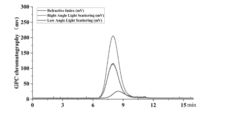
- 1 is a chromatogram of the molecular weight of the carob polysaccharide Hocacy according to an embodiment of the present invention.
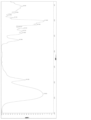
- 1 is an infrared absorption spectrum of the carob polysaccharide Hocacy according to an embodiment of the present invention.
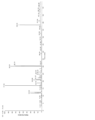
- 1 is a total ion chromatogram by GC-MS of the carob polysaccharide Hocacy according to an embodiment of the present invention.
- 1 is an HPLC chromatogram of carob polysaccharide Hocacy.
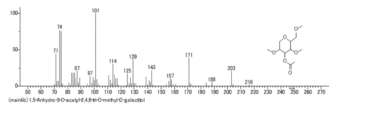
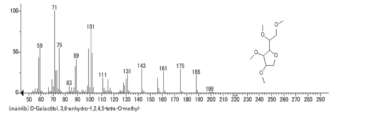
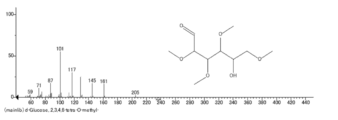
- 1 is an identification spectrum of fragment ions of galactose as a monosaccharide component of the carob polysaccharide Hocacy.
- 1 is an identification spectrum of fragment ions of galactose as a monosaccharide component of the carob polysaccharide Hocacy.
- 1 is an identification spectrum of fragment ions of galactose as a monosaccharide component of the carob polysaccharide Hocacy.
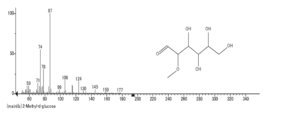
- 1 is an identification spectrum of the fragment ions of glucose as a monosaccharide component of the carob polysaccharide Hocacy.
- 1 is an identification spectrum of fragment ions of galactose as a monosaccharide component of the carob polysaccharide Hocacy.
- 1 is an identification spectrum of the fragment ions of glucose as a monosaccharide component of the carob polysaccharide Hocacy.
- FIG. 1 is an identification spectrum of the fragment ions of glucose as a monosaccharide component of the carob polysaccharide Hocacy. 1 is an infrared absorption spectrum of the carob polysaccharide Hocacy of an embodiment of the present invention after methylation.
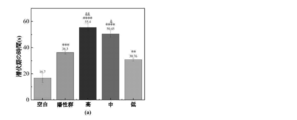
- FIG. 1 is a schematic diagram showing the effect of carob polysaccharide Hocacy on the latency period of cough in mice.
- FIG. 1 is a schematic diagram showing the effect of carob polysaccharide Hocacy on the number of coughs within 2 minutes in mice.
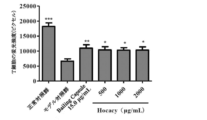
- FIG. 1 is a schematic diagram showing the effect of carob polysaccharide Hocacy on the amount of phenol red secreted in mice.
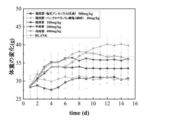
- FIG. 1 is a schematic diagram showing the effect of carob polysaccharide Hocacy on daily body weight changes in mice.
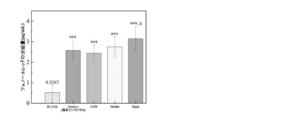
- FIG. 13 is a comparison diagram of the fluorescence intensity of T cells in zebrafish from carob polysaccharide Hocacy and a model control group.
- the carob pods described below are dried pods of the carob plant (Latin name: Ceratonia siliqua Linn.), which is a plant of the genus Carob in the family Fabaceae, and were provided by SHE NZHEN AIMIN MEDICINE TECHNOLOGY CO., LTD.
- the macroporous adsorption resin D101, Sephadex G-150, Sephadex G-100, and DEAE-52 cellulose used below were all purchased commercially.
- Example 1 Extraction and separation of carob polysaccharide Hocacy
- 8 kg of seedless carob pods were taken and crushed, defatted with 3 times the weight of 95% ethanol, and dried.
- Deionized water was added at a solid-liquid ratio of 1:2.3 (g/mL), and extracted 4 times, each time for 2 hours, at an extraction temperature of 45°C, and the extracts were combined.
- the extract was centrifuged (5000 rpm, 10 min), and the supernatant was concentrated under reduced pressure at 60°C and 100 Pa until it became viscous. Ethanol was slowly added to the obtained concentrate so that the mass fraction of ethanol was 60%, centrifuged, and the precipitate was collected to obtain crude polysaccharides.
- the crude polysaccharides were dispersed in 20 times the weight of purified water, and proteins were removed by the Sevage method, which was repeated 6 times.
- the polysaccharide from which the proteins had been removed was dispersed in 10 times its weight of water, and adsorbed using macroporous adsorption resin D101.
- Elution was performed using two column volumes of distilled water.
- the mobile phase components were collected and subjected to DEAE-52 cellulose column chromatography. Elution was performed using distilled water in an amount twice the column volume.
- Sephadex G-100 gel filtration column chromatography and Sephadex G-150 gel filtration column chromatography were performed in this order.
- the eluates were collected using deionized water as the mobile phase.
- the eluates with the same elution peaks were combined, concentrated under reduced pressure, and freeze-dried to obtain carob polysaccharide Hocacy (polysaccharide content: 93%).
- the method for measuring the content of carob polysaccharide Hocacy in this example is as follows.
- x is the polysaccharide concentration (mg/mL) and y is the absorbance.
- Polysaccharide content (%) (mass concentration ( ⁇ g/mL) x dilution factor x volume (mL)) / (dry weight of polysaccharide (g) x 1000)
- Example 1 Structural analysis of carob polysaccharide Hocacy (prepared in Example 1) (1) Molecular weight measurement of carob polysaccharide Hocacy 10.0 mg of carob polysaccharide Hocacy was accurately weighed to prepare a solution with a concentration of 2 mg/mL. Detection was performed using gel permeation chromatography (GPC), a differential refractive index detector, and a light scattering detector, with a mobile phase of 0.1 mol/L NaNO3 solution and a flow rate of 0.7 mL/min.
- GPC gel permeation chromatography
- FIG. 1 The results of measuring the molecular weight of the carob polysaccharide Hocacy are shown in Figure 1 (GPC). Analysis and calculation revealed that the average molecular weight was 4.895 x 10⁶, and the width of the molecular weight distribution (Mw/Mn) was 1.574, proving that the distribution was narrow and that the purity of the carob polysaccharide Hocacy was high.
- the horizontal axis shows the retention time
- the vertical axis shows the refractive index
- GPC chromatography means GPC chromatography
- Refractive Index (mV) means the refractive index
- Right Angle Light Scattering (mV) means right angle light scattering
- Low Angle Light Scattering (mV) means low angle light scattering.
- the infrared absorption spectrum of the carob polysaccharide Hocacy is shown in Figure 2.
- an absorption peak due to the stretching vibration of -OH is shown at 3385 cm -1
- an absorption peak due to the stretching vibration of -CH2 is shown at 2927 cm -1
- there is a strong absorption peak at 1020 cm -1 which indicates an absorption peak due to the stretching vibration of C-O.
- the vertical axis of Figure 2 is the transmittance (%).
- the carob polysaccharide Hocacy was hydrolyzed and acetylated, and then identified by GC-MS.
- the total ion chromatogram is shown in Figure 3.
- the horizontal axis indicates the time at which the peak was detected, and the vertical axis indicates the relative abundance, which is the relative intensity.
- the HPLC chromatogram is shown in Figure 4. The horizontal axis of Figure 4 is time, the vertical axis Absorbance (mAU) is absorbance, solvent is the solvent peak, PMP is the derivatization reagent (1-phenyl-3-methyl-5-pyrazolone), Gal is galactose, and Glu is glucose.
- Example 2 Experiment on the effect of carob polysaccharide Hocacy (prepared in Example 1) on airway function in mice induced and stimulated to cough with aqueous ammonia. Mice were placed in a large beaker containing concentrated aqueous ammonia to induce coughing.
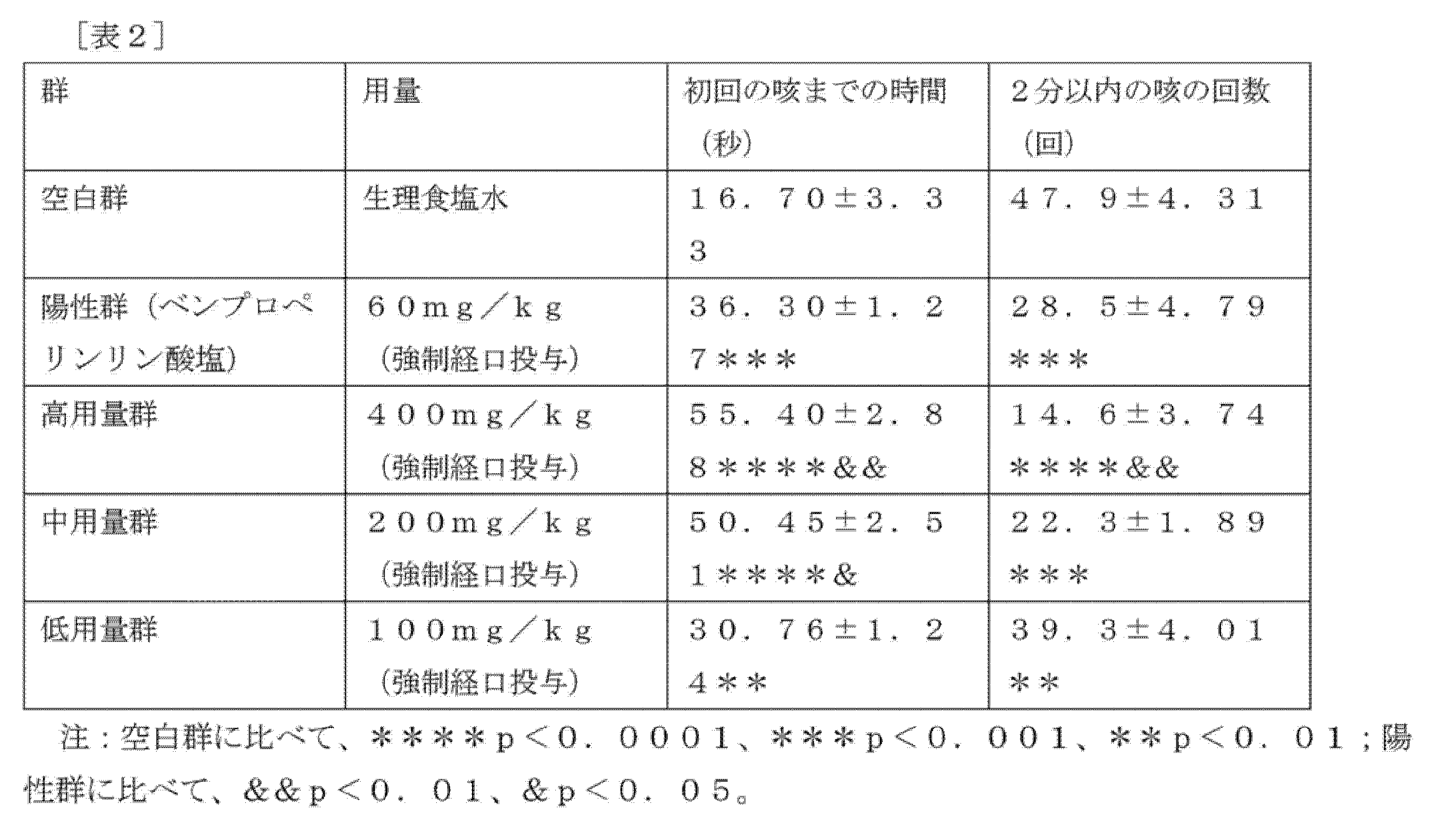
- mice The effect of drug administration on the number of coughs in mice The experiment was divided into 5 groups, each group being as follows: Group 1 was a blank group administered with saline; Group 2 was a positive group (60 mg/kg) administered with benproperine phosphate (Tonghua Changcheng Pharmaceutical Co., Ltd., Approval No.: H22020149); Groups 3 to 5 were administered with low (100 mg/kg), medium (200 mg/kg) and high (400 mg/kg) doses of carob polysaccharide Hocacy; and were administered orally for 14 days.
- Group 1 was a blank group administered with saline
- Group 2 was a positive group (60 mg/kg) administered with benproperine phosphate (Tonghua Changcheng Pharmaceutical Co., Ltd., Approval No.: H22020149)
- Groups 3 to 5 were administered with low (100 mg/kg), medium (200 mg/kg) and high (400 mg/kg) doses of carob polysaccharide
- FIG. 13 shows a schematic diagram of the effect of carob polysaccharide Hocacy on the latency period of mouse cough
- Figure 14 shows a schematic diagram of the number of coughs within 2 minutes.
- mice were administered for two consecutive days, and on the 16th day, 30 minutes after the last administration, 0.5 mL/mouse was intraperitoneally injected with 5% phenol red saline, and 30 minutes after the injection, the mice were euthanized by cervical dislocation.
- the trachea from the thyroid cartilage to the bronchus was cut, and ultrasonically washed for 10 minutes with 3 mL of saline and 0.1 mL of 1 moL/L sodium hydroxide solution, so that the phenol red in the mouse trachea was completely released.
- mice administered the carob polysaccharide Hocacy lost less weight than the positive groups (ammonium chloride, benproperine phosphate), and showed a steady tendency to gain weight, second only to the blank group.
- the weight of the mice in the two positive groups hardly changed, and the difference was significant compared to the polysaccharide group, showing that they were lighter in weight. This proves that the carob pod polysaccharide has no toxicity or side effects and is well suited for use.
- the weight changes are shown in Figure 16.
- carob polysaccharide Hocacy has a significant antitussive and expectorant effect without any significant toxicity or side effects, and has laid a certain foundation for the development of new drugs using carob pod polysaccharides.
- Example 3 Effect of carob polysaccharide Hocacy (prepared in Example 1) on the reduction of T cells in zebrafish Zebrafish genetically modified to emit red fluorescence in T cells were bred by natural mating. All 3-day-old (dpf) zebrafish were reared in fish culture water at 28°C (water quality: reverse osmosis water with 200 mg of fast-dissolving sea salt added per liter, conductivity 450-550 ⁇ S/cm, pH 6.5-8.5, hardness 50-100 mg/L CaCO3). The zebrafish were bred and provided by the fish culture center of Beijing Huante Chi Fish Youken Biotechnology Co., Ltd.
- 3dpf zebrafish genetically modified to emit red fluorescence in T cells were randomly selected into 6-well plates, and 30 zebrafish were treated in each well (experimental group).
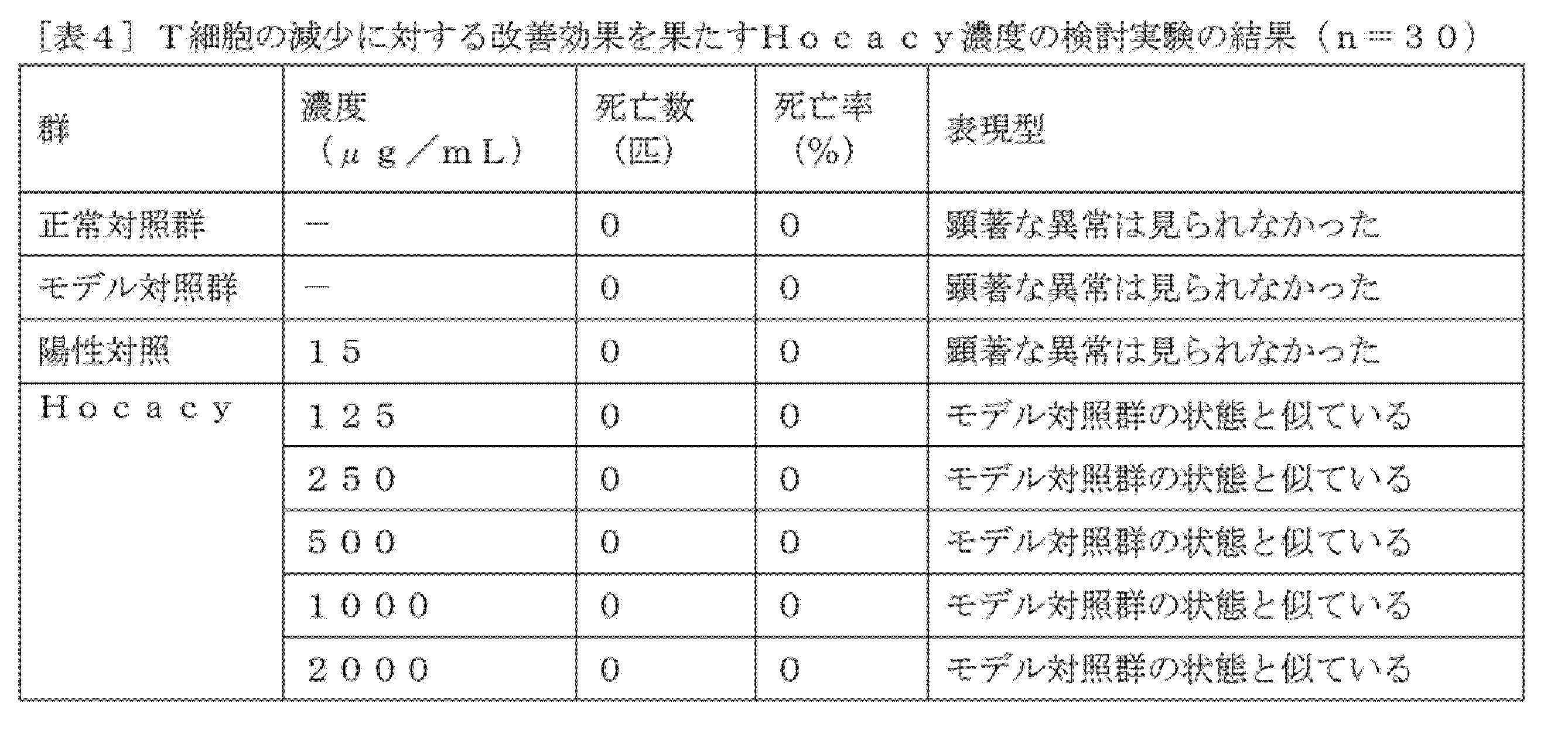
- 20.0 mg/mL Hocacy was prepared in standard dilution water (concentration shown in Table 4), and the positive control was Bailing Capsule (Hangzhou Zhongmei Huadong Pharmaceutical Co., Ltd., Approval No.: 2111064) with a concentration of 15.0 ⁇ g/mL.
- a normal control group and a model control group were simultaneously placed, and the volume of each well was 3 mL.
- zebrafish immunodeficiency model To construct a zebrafish immunodeficiency model, vinorelbine tartrate injection was intravenously injected into each experimental group except for the normal control group. The zebrafish were treated at 28°C until 5 dpf. 10 zebrafish were randomly selected from each experimental group, and were placed under a fluorescent microscope to take pictures. The data was analyzed and collected using NIS-Elements D3.20 high-end image processing software to analyze the fluorescence intensity of zebrafish T cells, and the statistical analysis results of the indicators were used to evaluate the ameliorative effect of Hocacy on T cell depletion. The statistical processing results are expressed as mean ⁇ SE. Statistical analysis was performed using SPSS 26.0 software, and p ⁇ 0.05 means that there is a statistically significant difference.
Landscapes
- Health & Medical Sciences (AREA)
- Life Sciences & Earth Sciences (AREA)
- Chemical & Material Sciences (AREA)
- Engineering & Computer Science (AREA)
- General Health & Medical Sciences (AREA)
- Medicinal Chemistry (AREA)
- Chemical Kinetics & Catalysis (AREA)
- Organic Chemistry (AREA)
- Public Health (AREA)
- Veterinary Medicine (AREA)
- Pharmacology & Pharmacy (AREA)
- Animal Behavior & Ethology (AREA)
- Polymers & Plastics (AREA)
- Molecular Biology (AREA)
- Bioinformatics & Cheminformatics (AREA)
- General Chemical & Material Sciences (AREA)
- Nuclear Medicine, Radiotherapy & Molecular Imaging (AREA)
- Immunology (AREA)
- Food Science & Technology (AREA)
- Nutrition Science (AREA)
- Biochemistry (AREA)
- Pulmonology (AREA)
- Mycology (AREA)
- Materials Engineering (AREA)
- Natural Medicines & Medicinal Plants (AREA)
- Epidemiology (AREA)
- Botany (AREA)
- Alternative & Traditional Medicine (AREA)
- Biotechnology (AREA)
- Sustainable Development (AREA)
- Medical Informatics (AREA)
- Microbiology (AREA)
- Dispersion Chemistry (AREA)
- Pharmaceuticals Containing Other Organic And Inorganic Compounds (AREA)
- Medicines Containing Plant Substances (AREA)
- Polysaccharides And Polysaccharide Derivatives (AREA)
- General Preparation And Processing Of Foods (AREA)
- Coloring Foods And Improving Nutritive Qualities (AREA)
Abstract
Description
種子抜きのイナゴマメの莢8kgを取って粉砕し、重量が3倍である95%のエタノールを用いて脱脂を行い、乾燥させた。固液比1:2.3(g/mL)で脱イオン水を加え、4回抽出し、1回当たり2時間抽出して、抽出温度を45℃とし、抽出液を合併した。抽出液を遠心分離(5000rpm、10min)し、上清液を60℃、100Paの条件下において粘稠になるまで減圧濃縮し、エタノールの質量分率が60%になるように、得られた濃縮液にエタノールをゆっくり加え、遠心分離し、沈殿物を収集して、粗多糖類を得た。粗多糖類を20倍の重量の精製水で分散させ、Sevage法によりタンパク質を除去し、これを6回繰り返した。タンパク質が除去された多糖類を10倍の重量の水で分散させ、マクロポーラス吸着樹脂D101を用いて吸着を行い、蒸留水により2個のカラムの体積で溶出を行い、移動相成分を収集し、DEAE-52セルロースカラムクロマトグラフィーを行い、カラム体積の2倍の蒸留水を用いて溶出を行い、Sephadex G-100ゲル濾過カラムクロマトグラフィーおよびSephadex G-150ゲル濾過カラムクロマトグラフィーを順に行い、移動相を脱イオン水として溶出液を収集し、同じ溶出ピークのものを合併して、減圧濃縮を行い、凍結乾燥させ、イナゴマメ多糖類Hocacy(多糖類の含有量:93%)を得た。
イナゴマメ多糖類Hocacy(実施例1で調製したもの)の構造解析
(1)イナゴマメ多糖類Hocacyの分子量測定
イナゴマメ多糖類Hocacy 10.0mgを精確に計量し、濃度2mg/mLの溶液を調製した。ゲル浸透クロマトグラフィー(GPC)、示差屈折率検出器および光散乱検出器で検出を行い、移動相を0.1mol/LのNaNO3溶液とし、流速を0.7mL/minとした。
イナゴマメ多糖類Hocacyサンプル5mgを計量し、乾燥KBrを適量加えて研磨し、均一かつ透明な錠剤を作製して、4000cm-1~400cm-1の範囲において、フーリエ変換赤外分光光度計を用いて分析を行った。
イナゴマメ多糖類Hocacyサンプル5.5mgを計量し、2mol/Lのトリフルオロ酢酸(TFA)を1mL加え、窒素ガスを充填して密閉し、110℃で120分間加熱して、加水分解させた。分解されたサンプルを溶解した後、NaBH490mgを加えて、還元反応を4時間行った。還元されたサンプルをオーブンに入れて乾燥させ、無水酢酸5mLを加え、110℃でアセチル化を行った。最終のアセチル化単糖類を酢酸エチルで溶解し、メンブレンを通過させ、GC-MSによって構造を同定した。
イナゴマメ多糖類Hocacyサンプル20mgを計量し、ジメチルスルホキシド(DMSO)6mLに溶解して、多糖類サンプルが完全に溶解するまで、40℃で15時間磁気攪拌した。イナゴマメ多糖類Hocacyに対してメチル化、加水分解およびアセチル化処理を行った後、GC-MSによりトータルイオンクロマトグラムを得、それは図3が示すとおりである。図3において、横軸のTimeはピーク検出時間、縦軸のRelat ive abundanceは相対強度を示す。イナゴマメ多糖類Hocacyのメチル化後の赤外吸収スペクトルは図12が示すとおりである。

イナゴマメ多糖類Hocacy(実施例1で調製したもの)の、アンモニア水によって咳をするように誘発・刺激されたマウスの気道機能に対する影響に関する実験
マウスを濃アンモニア水が入った大型ビーカーに入れ、マウスの咳を誘発した。
実験を5群に分け、各群を以下のとおりにした。即ち、第1群を生理食塩水を投与する空白群とし;第2群をベンプロペリンリン酸塩(Tonghua Changcheng Pharmaceutical Co.,Ltd.、承認番号:H22020149)を投与する陽性群(60mg/kg)とし;第3~5群を、イナゴマメ多糖類Hocacyを低用量(100mg/kg)、中用量(200mg/kg)および高用量(400mg/kg)で投与する投与群とし;14日間強制経口投与した。最後の強制経口投与が完了した1時間後に、1000mLの大型ビーカーを逆さに実験台に置き、噴霧器で25%の濃アンモニア水を10秒間噴霧し続けた後、マウスを大型ビーカーに入れ、時間の計測を始め、腹筋の収縮、口を大きくした呼吸、および咳の音を指標とし、マウスがビーカーにおいて初めて咳をした時までの時間(潜伏期)および2分以内の咳の回数を記録し、その結果は表2が示すとおりである。結果によって、アンモニア水で刺激し、咳を誘発した後、各群のマウスの咳の度合いが異なり、高・中・低用量のイナゴマメ多糖類Hocacyがいずれもアンモニア水によるマウスの咳の回数を顕著に低減し、潜伏期を延長でき、空白群に比べて、顕著もしくは非常に顕著な効果を示すこと(****p<0.0001、***p<0.001、**p<0.05)が示され、イナゴマメ多糖類Hocacyが、アンモニア水によるマウスの咳に対して、ある程度の咳止めの作用を有し、用量依存性を呈することが示されている。高用量群(400mg/kg)の咳止め効果は最も顕著であり、高・中用量群の初回の咳までの時間はいずれも陽性群より顕著に延長されている(p<0.01、p<0.05)。
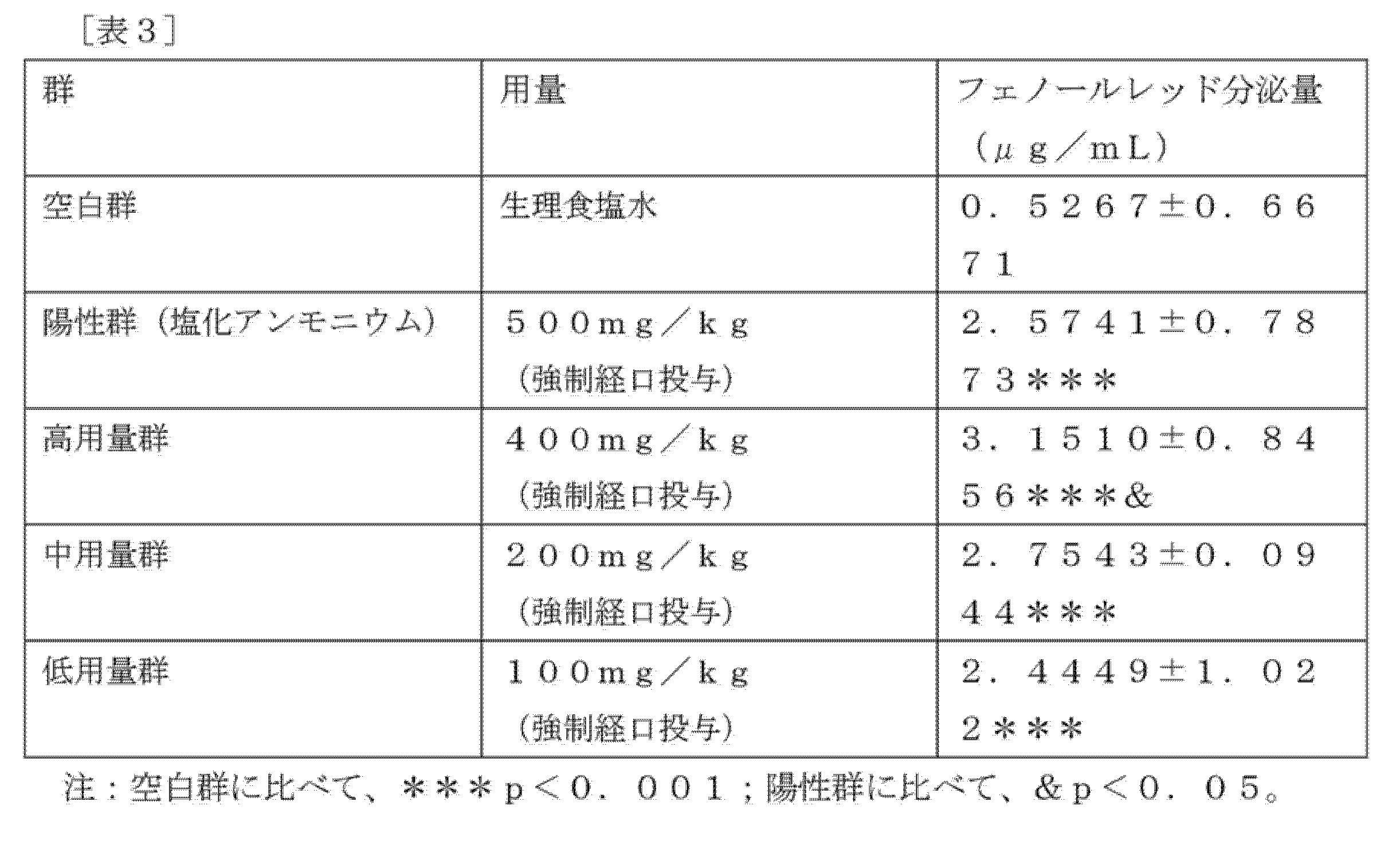
各群のマウスに引き続き2日間投与を行い、16日目に、最後の投与の30分後に、0.5mL/匹で5%のフェノールレッド生理食塩水を腹腔内注射し、注射の30分後に頸椎脱臼法により安楽死させた。甲状軟骨から気管支にかけての気管を切り取り、マウス気管内のフェノールレッドが完全に放出されるように、生理食塩水3mLと1moL/Lの水酸化ナトリウム溶液0.1mLで10分間超音波洗浄した。溶液の吸光度を546nmで測定し、標準曲線の回帰式に従ってフェノールレッドの含有量を計算し、結果は表3が示すとおりである。結果は、イナゴマメ多糖類Hocacyがいずれもマウスの気管のフェノールレッド分泌量を顕著に向上させることができ、生理食塩水に比べていずれも有意差があること(***p<0.001)を示し、イナゴマメ多糖類Hocacyがある程度の痰を減らす作用を有することを示している。高用量の場合、陽性群に比べて有意差があり(p<0.005)、用量依存性を呈する。イナゴマメ多糖類Hocacyのマウスのフェノールレッド分泌量に対する影響を示す模式図は図15が示すとおりである。
イナゴマメ多糖類Hocacy(実施例1で調製したもの)のゼブラフィッシュのT細胞の減少に対する改善効果
T細胞が赤色蛍光を発するように遺伝子組み換えを行ったゼブラフィッシュは、自然交配により繁殖したものである。受精後3日齢(3dpf)のゼブラフィッシュをすべて、28℃の魚養殖水(水質:1L当たりの逆浸透水に、200mgの速溶性海塩を加えたものであり、伝導率が450~550μS/cmであり、pHが6.5~8.5であり、硬度が50~100mg/L CaCO3である)で飼育し、ゼブラフィッシュは北京環特智魚優検生物科技有限公司の養魚センターが繁殖し、提供したものである。

Claims (10)
- ガラクトースおよびグルコースの2種類の単糖類からなり、ガラクトースとグルコースとのモル比が(88~92):(0.8~1.2)であり、グリコシド結合(1→4)-Glu、(1→3,4,6)、(1→3)-Gal、(3→6)-Gal、(2→4,6)-Gal、(2→6)-Gal、(1→)-Galにより結合して組み合わせてなるものであることを特徴とする、イナゴマメ多糖類。
- 前記イナゴマメ多糖類において、ガラクトースとグルコースとのモル比が、89.666:1.068であることを特徴とする、請求項1に記載のイナゴマメ多糖類。
- 前記イナゴマメ多糖類の分子量が(1~6)×106であり、(4.8~5)×106であってもよく、さらに4.895×10⁶であってもよく;および/または
前記イナゴマメ多糖類の分子量分布の幅(Mw/Mn)が1.5~1.6であり、1.574であってもよいことを特徴とする、請求項1または2に記載のイナゴマメ多糖類。 - (i)粉砕された種子抜きのイナゴマメの莢を取り、90~95%のエタノールを用いて脱脂を行い、脱脂後の微粉末を乾燥させること、
(ii)水を加えて、抽出を行うこと、
抽出液を遠心分離し、上清液を濃縮して、エタノールの質量分率が55~60%となるようにエタノールを加え、遠心分離して沈殿物を収集すること、
(iii)得られた沈殿物を水で分散させ、Sevage法によりタンパク質を除去した後、マクロポーラス吸着樹脂D101を用いて吸着を行い、蒸留水で溶出して移動相成分を収集し、DEAE-52セルロースカラムクロマトグラフィーを行い、蒸留水で溶出を行い、Sephadex G-100ゲル濾過カラムクロマトグラフィーを行い、移動相を脱イオン水として溶出液を収集し、さらにSephadex G-150ゲル濾過カラムクロマトグラフィーを行い、移動相を脱イオン水として溶出液を収集し、同じ溶出ピークのものを合併して、減圧濃縮を行い、凍結乾燥させ、イナゴマメ多糖類を得ること、
を含むことを特徴とする、イナゴマメ多糖類の調製方法。 - 前記イナゴマメの莢を80~300メッシュまで粉砕し、および/または
抽出時の固液比がg/mLで1:(2~5)であり、および/または
抽出温度が40~50℃であることを特徴とする、
請求項4に記載のイナゴマメ多糖類の調製方法。 - 請求項4または5に記載の方法により調製されることを特徴とする、イナゴマメ多糖類。
- 請求項1~3、6のいずれか一項に記載のイナゴマメ多糖類の医薬としての使用であって、
咳を止め、痰を減らすための医薬および/または免疫力を向上させるための医薬の調製における前記イナゴマメ多糖類の使用であってもよい、前記使用。 - 請求項1~3、6のいずれか一項に記載のイナゴマメ多糖類を含み、さらに薬学的に許容される担体を含むことを特徴とする、医薬組成物。
- 請求項1~3、6のいずれか一項に記載のイナゴマメ多糖類を含み、さらに食品主原料および食品副原料を含むことを特徴とする、食品。
- 経口経路または非経口経路により、需要のある被験者または患者に有効量の請求項1~3、6のいずれか一項に記載のイナゴマメ多糖類、請求項8に記載の医薬組成物、もしくは請求項9に記載の食品を投与し、前記疾患が咳嗽、喀痰、免疫力低下を含んでもよいことを特徴とする、疾患の治療方法。
Priority Applications (2)
| Application Number | Priority Date | Filing Date | Title |
|---|---|---|---|
| EP24779749.1A EP4692129A4 (en) | 2023-03-31 | 2024-03-19 | Carob polysaccharide capable of suppressing coughs, reducing mucus, and boosting immunity; its preparation method and use |
| CN202480005324.6A CN120344570A (zh) | 2023-03-31 | 2024-03-19 | 止咳化痰和提高免疫力的角豆多糖及其制备方法与用途 |
Applications Claiming Priority (2)
| Application Number | Priority Date | Filing Date | Title |
|---|---|---|---|
| JP2023058589A JP7479537B1 (ja) | 2023-03-31 | 2023-03-31 | 咳を止め、痰を減らし、免疫力を向上させるイナゴマメ多糖類およびその調製方法と使用 |
| JP2023-058589 | 2023-03-31 |
Publications (1)
| Publication Number | Publication Date |
|---|---|
| WO2024203624A1 true WO2024203624A1 (ja) | 2024-10-03 |
Family
ID=90926158
Family Applications (1)
| Application Number | Title | Priority Date | Filing Date |
|---|---|---|---|
| PCT/JP2024/010763 Ceased WO2024203624A1 (ja) | 2023-03-31 | 2024-03-19 | 咳を止め、痰を減らし、免疫力を向上させるイナゴマメ多糖類およびその調製方法と使用 |
Country Status (5)
| Country | Link |
|---|---|
| EP (1) | EP4692129A4 (ja) |
| JP (1) | JP7479537B1 (ja) |
| CN (3) | CN120344570A (ja) |
| TW (1) | TW202444392A (ja) |
| WO (1) | WO2024203624A1 (ja) |
Citations (3)
| Publication number | Priority date | Publication date | Assignee | Title |
|---|---|---|---|---|
| JPH10279486A (ja) * | 1997-04-02 | 1998-10-20 | Taiyo Kagaku Co Ltd | 免疫賦活組成物 |
| CN103356691A (zh) * | 2013-07-22 | 2013-10-23 | 兰州理工大学 | 以蕨麻为原料制备蕨麻粗多糖的方法及用途 |
| US20180271896A1 (en) * | 2014-03-25 | 2018-09-27 | The First Affiliatted Hospital Of Guangzhou Medical University | Application of asarum total polysaccharides in preparation of medicine for treating cough |
Family Cites Families (6)
| Publication number | Priority date | Publication date | Assignee | Title |
|---|---|---|---|---|
| EP0007619B1 (en) * | 1978-07-25 | 1983-06-22 | The Wellcome Foundation Limited | Galactomannan polysaccharide gum formulation containing gellation inhibitor |
| CN101525391B (zh) * | 2009-03-31 | 2011-05-11 | 武汉大学 | 一种从甘草中提取多糖的方法及应用 |
| AR110755A1 (es) * | 2017-01-20 | 2019-05-02 | Genzyme Corp | Anticuerpos dirigidos a hueso |
| CN108164571B (zh) * | 2018-02-23 | 2018-11-20 | 上海悦目化妆品有限公司 | 一种绿豆α-低聚半乳糖提取物及其提取方法和护肤应用 |
| CN115721671A (zh) * | 2022-08-12 | 2023-03-03 | 李玉山 | 一种甘草有效成分全产业链协同提取分离方法 |
| CN118021862A (zh) * | 2023-12-27 | 2024-05-14 | 山东第一医科大学第一附属医院(山东省千佛山医院) | 一种豆科植物果荚提取物及其制备方法与应用 |
-
2023
- 2023-03-31 JP JP2023058589A patent/JP7479537B1/ja active Active
-
2024
- 2024-03-19 EP EP24779749.1A patent/EP4692129A4/en active Pending
- 2024-03-19 WO PCT/JP2024/010763 patent/WO2024203624A1/ja not_active Ceased
- 2024-03-19 CN CN202480005324.6A patent/CN120344570A/zh active Pending
- 2024-03-20 TW TW113110305A patent/TW202444392A/zh unknown
- 2024-03-21 CN CN202410329497.5A patent/CN118324940A/zh active Pending
- 2024-03-21 CN CN202410329496.0A patent/CN118324939A/zh active Pending
Patent Citations (3)
| Publication number | Priority date | Publication date | Assignee | Title |
|---|---|---|---|---|
| JPH10279486A (ja) * | 1997-04-02 | 1998-10-20 | Taiyo Kagaku Co Ltd | 免疫賦活組成物 |
| CN103356691A (zh) * | 2013-07-22 | 2013-10-23 | 兰州理工大学 | 以蕨麻为原料制备蕨麻粗多糖的方法及用途 |
| US20180271896A1 (en) * | 2014-03-25 | 2018-09-27 | The First Affiliatted Hospital Of Guangzhou Medical University | Application of asarum total polysaccharides in preparation of medicine for treating cough |
Non-Patent Citations (3)
| Title |
|---|
| GOULAS VLASIOS, STYLOS EVGENIOS, CHATZIATHANASIADOU MARIA, MAVROMOUSTAKOS THOMAS, TZAKOS ANDREAS: "Functional Components of Carob Fruit: Linking the Chemical and Biological Space", INTERNATIONAL JOURNAL OF MOLECULAR SCIENCES, MOLECULAR DIVERSITY PRESERVATION INTERNATIONAL (MDPI), BASEL, CH, vol. 17, no. 11, Basel, CH , pages 1875, XP093216838, ISSN: 1422-0067, DOI: 10.3390/ijms17111875 * |
| RICO D., MARTÍN-DIANA A.B., MARTÍNEZ-VILLALUENGA C., AGUIRRE L., SILVÁN J.M., DUEÑAS M., DE LUIS D.A., LASA A.: "In vitro approach for evaluation of carob by-products as source bioactive ingredients with potential to attenuate metabolic syndrome (MetS)", HELIYON, ELSEVIER LTD, GB, vol. 5, no. 1, 1 January 2019 (2019-01-01), GB , pages e01175, XP093216836, ISSN: 2405-8440, DOI: 10.1016/j.heliyon.2019.e01175 * |
| See also references of EP4692129A4 * |
Also Published As
| Publication number | Publication date |
|---|---|
| JP2024145958A (ja) | 2024-10-15 |
| JP7479537B1 (ja) | 2024-05-08 |
| EP4692129A1 (en) | 2026-02-11 |
| CN118324940A (zh) | 2024-07-12 |
| CN118324939A (zh) | 2024-07-12 |
| EP4692129A4 (en) | 2026-02-11 |
| CN120344570A (zh) | 2025-07-18 |
| TW202444392A (zh) | 2024-11-16 |
Similar Documents
| Publication | Publication Date | Title |
|---|---|---|
| CN102417544B (zh) | 一种紫阳富硒绿茶含硒多糖及其制备方法和用途 | |
| CN103340390B (zh) | 去火消炎辣椒酱 | |
| CN109589400B (zh) | 一种具有神经保护功效的组合物 | |
| CN110343185A (zh) | 一种酒制黄精多糖及其在脾虚免疫功能调节方面的用途 | |
| CN113956375A (zh) | 一种熟地黄均一多糖及其制备方法和抗抑郁作用 | |
| CN105663444A (zh) | 一种复方免疫增强及抗衰老剂及其制备方法 | |
| CN102827256A (zh) | 人参糖蛋白的制备及其用途 | |
| CN106963777B (zh) | 一种“黄芩苷-小檗碱”复合物的制备方法及其应用 | |
| WO2017148414A1 (zh) | 褐藻多糖及其制备方法和用途 | |
| Chen et al. | Research progress on structure and bioactivity of polysaccharides from Platycodon grandiflorum | |
| JP7479537B1 (ja) | 咳を止め、痰を減らし、免疫力を向上させるイナゴマメ多糖類およびその調製方法と使用 | |
| US9005676B2 (en) | Pharmaceutical composition and methods for modulating immune system, preventing, pretreating and/or treating cancers | |
| HK40121053A (en) | Carob polysaccharide capable of suppressing cough, reducing phlegm and enhancing immunity, preparation method therefor, and use thereof | |
| CN102973657B (zh) | 芩暴红止咳合剂及其制备方法 | |
| JP7479538B1 (ja) | 降圧効果のあるイナゴマメ多糖類及びその製造方法並び使用 | |
| CN107266599A (zh) | 金针菇多糖、提取方法及其在制备治疗功能性便秘药物方面的应用 | |
| CN101502536B (zh) | 香柏总黄酮及其制备方法与医药用途 | |
| CN113476497A (zh) | 一种具有抗hsv活性的夏枯草提取物及其制备方法和医药用途 | |
| CN119161499B (zh) | 一种海带多糖及其制备方法与应用 | |
| CN116693716B (zh) | 一种金果榄多糖及其制备方法和应用 | |
| CN103623203B (zh) | 一种咳舒口服制剂的制备方法 | |
| CN101011412A (zh) | 低分子量褐藻多糖硫酸酯在制备治疗肝脏疾病的药物中的用途 | |
| CN102631486B (zh) | 一种保健组合物 | |
| CN102631506B (zh) | 提高免疫力、抗疲劳的中药组合物 | |
| CN107638522B (zh) | 主治风寒感冒的解表清热中药组合物及其制备工艺与应用 |
Legal Events
| Date | Code | Title | Description |
|---|---|---|---|
| 121 | Ep: the epo has been informed by wipo that ep was designated in this application |
Ref document number: 24779749 Country of ref document: EP Kind code of ref document: A1 |
|
| WWE | Wipo information: entry into national phase |
Ref document number: 202480005324.6 Country of ref document: CN |
|
| WWP | Wipo information: published in national office |
Ref document number: 202480005324.6 Country of ref document: CN |
|
| WWE | Wipo information: entry into national phase |
Ref document number: 11202504322R Country of ref document: SG |
|
| WWP | Wipo information: published in national office |
Ref document number: 11202504322R Country of ref document: SG |
|
| WWE | Wipo information: entry into national phase |
Ref document number: 2024779749 Country of ref document: EP |
|
| NENP | Non-entry into the national phase |
Ref country code: DE |
|
| ENP | Entry into the national phase |
Ref document number: 2024779749 Country of ref document: EP Effective date: 20251031 |
|
| ENP | Entry into the national phase |
Ref document number: 2024779749 Country of ref document: EP Effective date: 20251031 |
|
| ENP | Entry into the national phase |
Ref document number: 2024779749 Country of ref document: EP Effective date: 20251031 |
|
| ENP | Entry into the national phase |
Ref document number: 2024779749 Country of ref document: EP Effective date: 20251031 |
|
| ENP | Entry into the national phase |
Ref document number: 2024779749 Country of ref document: EP Effective date: 20251031 |
|
| ENP | Entry into the national phase |
Ref document number: 2024779749 Country of ref document: EP Effective date: 20251031 |
|
| ENP | Entry into the national phase |
Ref document number: 2024779749 Country of ref document: EP Effective date: 20251031 |
|
| ENP | Entry into the national phase |
Ref document number: 2024779749 Country of ref document: EP Effective date: 20251031 |
|
| WWP | Wipo information: published in national office |
Ref document number: 2024779749 Country of ref document: EP |