WO2024208921A1 - Walzprodukt aus aluminium für ein batteriezellgehäuse - Google Patents
Walzprodukt aus aluminium für ein batteriezellgehäuse Download PDFInfo
- Publication number
- WO2024208921A1 WO2024208921A1 PCT/EP2024/059095 EP2024059095W WO2024208921A1 WO 2024208921 A1 WO2024208921 A1 WO 2024208921A1 EP 2024059095 W EP2024059095 W EP 2024059095W WO 2024208921 A1 WO2024208921 A1 WO 2024208921A1
- Authority
- WO
- WIPO (PCT)
- Prior art keywords
- rolled product
- battery cell
- aluminum alloy
- cell housing
- rolling
- Prior art date
- Legal status (The legal status is an assumption and is not a legal conclusion. Google has not performed a legal analysis and makes no representation as to the accuracy of the status listed.)
- Ceased
Links
Classifications
-
- H—ELECTRICITY
- H01—ELECTRIC ELEMENTS
- H01M—PROCESSES OR MEANS, e.g. BATTERIES, FOR THE DIRECT CONVERSION OF CHEMICAL ENERGY INTO ELECTRICAL ENERGY
- H01M50/00—Constructional details or processes of manufacture of the non-active parts of electrochemical cells other than fuel cells, e.g. hybrid cells
- H01M50/10—Primary casings; Jackets or wrappings
- H01M50/116—Primary casings; Jackets or wrappings characterised by the material
- H01M50/117—Inorganic material
- H01M50/119—Metals
-
- C—CHEMISTRY; METALLURGY
- C22—METALLURGY; FERROUS OR NON-FERROUS ALLOYS; TREATMENT OF ALLOYS OR NON-FERROUS METALS
- C22C—ALLOYS
- C22C21/00—Alloys based on aluminium
-
- C—CHEMISTRY; METALLURGY
- C22—METALLURGY; FERROUS OR NON-FERROUS ALLOYS; TREATMENT OF ALLOYS OR NON-FERROUS METALS
- C22C—ALLOYS
- C22C21/00—Alloys based on aluminium
- C22C21/02—Alloys based on aluminium with silicon as the next major constituent
-
- C—CHEMISTRY; METALLURGY
- C22—METALLURGY; FERROUS OR NON-FERROUS ALLOYS; TREATMENT OF ALLOYS OR NON-FERROUS METALS
- C22F—CHANGING THE PHYSICAL STRUCTURE OF NON-FERROUS METALS AND NON-FERROUS ALLOYS
- C22F1/00—Changing the physical structure of non-ferrous metals or alloys by heat treatment or by hot or cold working
- C22F1/04—Changing the physical structure of non-ferrous metals or alloys by heat treatment or by hot or cold working of aluminium or alloys based thereon
-
- C—CHEMISTRY; METALLURGY
- C22—METALLURGY; FERROUS OR NON-FERROUS ALLOYS; TREATMENT OF ALLOYS OR NON-FERROUS METALS
- C22F—CHANGING THE PHYSICAL STRUCTURE OF NON-FERROUS METALS AND NON-FERROUS ALLOYS
- C22F1/00—Changing the physical structure of non-ferrous metals or alloys by heat treatment or by hot or cold working
- C22F1/04—Changing the physical structure of non-ferrous metals or alloys by heat treatment or by hot or cold working of aluminium or alloys based thereon
- C22F1/043—Changing the physical structure of non-ferrous metals or alloys by heat treatment or by hot or cold working of aluminium or alloys based thereon of alloys with silicon as the next major constituent
-
- H—ELECTRICITY
- H01—ELECTRIC ELEMENTS
- H01M—PROCESSES OR MEANS, e.g. BATTERIES, FOR THE DIRECT CONVERSION OF CHEMICAL ENERGY INTO ELECTRICAL ENERGY
- H01M50/00—Constructional details or processes of manufacture of the non-active parts of electrochemical cells other than fuel cells, e.g. hybrid cells
- H01M50/10—Primary casings; Jackets or wrappings
- H01M50/102—Primary casings; Jackets or wrappings characterised by their shape or physical structure
- H01M50/103—Primary casings; Jackets or wrappings characterised by their shape or physical structure prismatic or rectangular
-
- H—ELECTRICITY
- H01—ELECTRIC ELEMENTS
- H01M—PROCESSES OR MEANS, e.g. BATTERIES, FOR THE DIRECT CONVERSION OF CHEMICAL ENERGY INTO ELECTRICAL ENERGY
- H01M50/00—Constructional details or processes of manufacture of the non-active parts of electrochemical cells other than fuel cells, e.g. hybrid cells
- H01M50/10—Primary casings; Jackets or wrappings
- H01M50/102—Primary casings; Jackets or wrappings characterised by their shape or physical structure
- H01M50/105—Pouches or flexible bags
-
- H—ELECTRICITY
- H01—ELECTRIC ELEMENTS
- H01M—PROCESSES OR MEANS, e.g. BATTERIES, FOR THE DIRECT CONVERSION OF CHEMICAL ENERGY INTO ELECTRICAL ENERGY
- H01M50/00—Constructional details or processes of manufacture of the non-active parts of electrochemical cells other than fuel cells, e.g. hybrid cells
- H01M50/10—Primary casings; Jackets or wrappings
- H01M50/102—Primary casings; Jackets or wrappings characterised by their shape or physical structure
- H01M50/107—Primary casings; Jackets or wrappings characterised by their shape or physical structure having curved cross-section, e.g. round or elliptic
-
- H—ELECTRICITY
- H01—ELECTRIC ELEMENTS
- H01M—PROCESSES OR MEANS, e.g. BATTERIES, FOR THE DIRECT CONVERSION OF CHEMICAL ENERGY INTO ELECTRICAL ENERGY
- H01M50/00—Constructional details or processes of manufacture of the non-active parts of electrochemical cells other than fuel cells, e.g. hybrid cells
- H01M50/10—Primary casings; Jackets or wrappings
- H01M50/131—Primary casings; Jackets or wrappings characterised by physical properties, e.g. gas permeability, size or heat resistance
-
- H—ELECTRICITY
- H01—ELECTRIC ELEMENTS
- H01M—PROCESSES OR MEANS, e.g. BATTERIES, FOR THE DIRECT CONVERSION OF CHEMICAL ENERGY INTO ELECTRICAL ENERGY
- H01M50/00—Constructional details or processes of manufacture of the non-active parts of electrochemical cells other than fuel cells, e.g. hybrid cells
- H01M50/10—Primary casings; Jackets or wrappings
- H01M50/147—Lids or covers
- H01M50/155—Lids or covers characterised by the material
- H01M50/157—Inorganic material
- H01M50/159—Metals
-
- H—ELECTRICITY
- H01—ELECTRIC ELEMENTS
- H01M—PROCESSES OR MEANS, e.g. BATTERIES, FOR THE DIRECT CONVERSION OF CHEMICAL ENERGY INTO ELECTRICAL ENERGY
- H01M50/00—Constructional details or processes of manufacture of the non-active parts of electrochemical cells other than fuel cells, e.g. hybrid cells
- H01M50/10—Primary casings; Jackets or wrappings
- H01M50/147—Lids or covers
- H01M50/166—Lids or covers characterised by the methods of assembling casings with lids
- H01M50/169—Lids or covers characterised by the methods of assembling casings with lids by welding, brazing or soldering
-
- Y—GENERAL TAGGING OF NEW TECHNOLOGICAL DEVELOPMENTS; GENERAL TAGGING OF CROSS-SECTIONAL TECHNOLOGIES SPANNING OVER SEVERAL SECTIONS OF THE IPC; TECHNICAL SUBJECTS COVERED BY FORMER USPC CROSS-REFERENCE ART COLLECTIONS [XRACs] AND DIGESTS
- Y02—TECHNOLOGIES OR APPLICATIONS FOR MITIGATION OR ADAPTATION AGAINST CLIMATE CHANGE
- Y02E—REDUCTION OF GREENHOUSE GAS [GHG] EMISSIONS, RELATED TO ENERGY GENERATION, TRANSMISSION OR DISTRIBUTION
- Y02E60/00—Enabling technologies; Technologies with a potential or indirect contribution to GHG emissions mitigation
- Y02E60/10—Energy storage using batteries
Definitions
- the invention relates to a rolled product made of an aluminum alloy for producing a battery cell housing, a method for producing the rolled product made of an aluminum alloy, the use of the rolled product made of an aluminum alloy for producing a battery cell housing and a battery cell housing.
- a rolled product is understood to mean rolled strips or sheets.
- Battery cell housings are manufactured in a wide variety of shapes from rolled products. In addition to the pouch design and the cylindrical battery cell housing, a prismatic battery cell housing is also frequently used.
- Prismatic battery cell housings consist of a battery cell housing shell, which has an essentially rectangular cross-section and thus enables a simple and space-saving arrangement of battery cells.
- prismatic battery cell housings in the form of prismatic cups are predominantly manufactured from a rolled product made of an aluminum alloy, for example a rolled product made of an aluminum alloy, using combined deep-drawing and ironing processes with a large number of drawing stages.
- the aluminum alloy AA3003 has been used to date as an aluminum alloy that is easy to deep-draw to manufacture the housing.
- a large number of drawing stages are often required in the manufacturing processes.
- Battery cell housings with a cylindrical design are essentially in the shape of a cylinder. If the height of the cylinder is greater than the diameter, they are called round battery cells, otherwise they are called button cells. Cylindrical battery cell housings are also mainly produced by deep-drawing and/or ironing. Drawing processes in cup form. Here too, only the aluminum alloy AA3003 is used so far.
- Alternative manufacturing processes for prismatic and cylindrical battery cell housings include extrusion, roll forming and sequential bending or folding.
- Extrusion uses slugs made from a rolled product, while roll forming creates a tube geometry using successive work rolls or rollers.
- sequential bending a sheet metal blank is formed into a tube geometry in several bending operations (e.g. on presses).
- material-bonded joining processes in particular laser welding, must be used to close the battery cell housings, which can include both sealing welding with one or more covers and longitudinal welding of a tube geometry.
- the pouch design in which the battery cell housing essentially has the shape of a bag or pouch. Due to high demands on strength and mechanical stability as well as high demands on electrochemical resistance to the corrosive electrolyte that also affects the battery cell housing, cylindrical battery cell housings in particular have generally been made of nickel-plated steel.
- the aluminum alloy AA3003 is usually used for prismatic battery cell casings.
- a high-strength battery casing is known from the US patent application US 2006/093908 Al, which consists of a composite material with an outer plastic layer and an aluminum foil made of an aluminum alloy of the type AA8079, 1N30, AA8021, AA3003, AA3004, AA3104 or AA3105.
- the above-mentioned aluminium alloys are also known from the Korean patent application KR 2016 0056731 A for deep-drawn battery cell casings from Mobile phones, computers and other mobile devices, with the Korean patent application also preferring the use of the AA3003 aluminum alloy.
- the Japanese patent application JP 2015 125886 A focuses on the strength and weldability of battery cell casings for battery cell casings containing non-water-based electrolytes and proposes the use of aluminum alloys of type AA3003, AA3203, AA3004, AA3104, AA3005 or AA3105.
- the aluminum alloy AA3003 can only be recycled very well via a closed material cycle.
- closed material cycles are very complex and costly to implement, so that the aluminum alloy AA3003 has a high proportion of primary aluminum.
- battery cells have a long service life of more than 10 years, so that the recycling of the cell housing material can only be realized after long periods of time.
- the Sustainability requirements which have increased significantly in recent years, therefore require battery cell housings to be manufactured with the lowest possible use of resources and Ct footprint.
- Aluminum scrap is divided into pre-consumer scrap and post-consumer scrap.
- Pre-consumer scrap is waste that is generated in a variety of possible processes during the manufacture of semi-finished or finished products made of aluminum or aluminum alloys.
- Pre-consumer scrap can be further divided into internal process scrap on the one hand, which is unavoidably generated during the manufacturing process of the aluminum strips or sheets, such as sprues, offcuts, chips, production residues or production rejects, and external process scrap on the other hand, which is unavoidably generated during further processing to the end product, such as punched grids, chips or production rejects.
- Post-consumer scrap is end products whose life cycle has been completed and which are generated as waste after use.
- post-consumer scrap examples include food packaging, especially beverage cans, window frames, lithographic printing plate carriers, cable wires and automotive components.
- the present invention therefore has the object of proposing a rolled product made of an aluminum alloy that ensures cost-effective use of secondary aluminum and at the same time ensures processability on existing production facilities and tools to produce battery cell housings.
- the above object is achieved with a rolled product of an aluminium alloy for producing a
- Battery cell housing is solved by the rolled product comprising an aluminum alloy with the following alloy components in wt.%:
- the remainder is Al and unavoidable impurities, individually a maximum of 0.05%, in total a maximum of 0.15%, whereby the rolled product has a tensile strength R m of at least 135 MPa up to a maximum of 210 MPa, preferably a maximum of 185 MPa, a yield strength R P o,2 of more than 125 MPa up to a maximum of 180 MPa, preferably a maximum of 165 MPa, and an elongation Aso of more than 5%, preferably more than 7%.
- the rolled product according to the invention has the mechanical properties of a rolled product of an aluminum alloy of type AA3003 in the H14 state, which means that the production facilities and tools previously used for rolled products made of an AA3003 alloy can be used for the new material.
- the rolled product is suitable for the production of battery cell housings using high recycling proportions in the rolled product.
- UBC used beverage can
- the alloy composition of the rolled product in combination with the specified mechanical properties for the yield strength R P o.2, the tensile strength R m and the elongation Aso. Since the aluminum alloy also only contains standard alloying elements, it is also easily recyclable, so that the battery cell housing according to the invention can be fed into existing scrap cycles without any problems.
- the alloy composition means that the electrolyte resistance is not, or not significantly, worsened compared to the already known alloy AA3003, so that battery cell housings can be produced economically and sustainably.
- the silicon content of the aluminum alloy is in the range 0.1 wt.% ⁇ Si ⁇ 0.7 wt.% and thus allows particularly high recycling rates.
- the silicon content of the aluminum alloy is in the range 0.2 wt.% ⁇ Si ⁇ 0.60 wt.%, preferably 0.35 wt.% ⁇ Si ⁇ 0.55 wt.% or more preferably 0.40 wt.% ⁇ Si ⁇ 0.50 wt.%.
- the silicon content of 0.1 wt.% ⁇ Si ⁇ 0.7 wt.% in combination with the iron and manganese contents according to the invention in the amounts specified leads in particular to relatively uniformly distributed, compact particles of the quaternary a-Al(e,Mn)Si phase.
- These precipitated particles increase both the strength of the aluminum alloy and its electrical and thermal conductivity, as they remove iron and manganese from the solid solution, without, however, negatively affecting other properties such as corrosion behavior, i.e. electrolyte resistance, or formability.
- Silicon contents of less than 0.1 wt.% lead to reduced precipitation of a-Al(Fe,Mn]Si phases, which can lead to impairment of the electrical and thermal conductivity due to dissolved manganese.
- the absence of a-Al(Fe,Mn]Si phases has a negative effect on tool wear.
- Silicon contents of more than 0.7 wt.% in combination with magnesium can lead to increased formation of Mg2Si phases, which negatively affects the solid solution strengthening of the magnesium.
- the silicon content of the preferred embodiment of 0.2 wt.% ⁇ Si ⁇ 0.60 wt.%, preferably 0.35 wt.% ⁇ Si ⁇ 0.55 wt.% and 0.40 wt.% ⁇ Si ⁇ 0.50 wt.% represents an ideal compromise between high strength, high electrical and thermal conductivity while providing wide process windows for welding.
- the iron content of the aluminum alloy is in the range 0.2 wt.% ⁇ Fe ⁇ 0.8 wt.%.
- the iron content of the aluminum alloy is in the range 0.2 wt.% ⁇ Fe ⁇ 0.65 wt.%, preferably 0.25 wt.% ⁇ Fe ⁇ 0.55 wt.%.
- the iron content of 0.2 wt.% ⁇ Fe ⁇ 0.8 wt.% in combination with the manganese content according to the invention in the specified amount leads to the formation of A16(Mn,Fe] phases.
- Iron contributes to reducing the solubility of manganese in aluminum, whereby more manganese is bound in intermetallic phases, which has a positive effect on the electrical and thermal conductivity.
- the intermetallic phases influence recovery and recrystallization processes and improve the thermal stability of the mechanical properties.
- Iron contents of more than 0.8 wt.% promote the formation of coarse intermetallic phases, which can impair formability in the deep-drawing process.
- iron contents that are too low, of less than 0.2 wt.% restrict the tolerance of the aluminum alloy for iron-containing scrap too much, since common scrap grades generally have a significant iron content. Therefore, limiting the iron content too much can hinder the realization of high recycling rates.
- the copper content of the aluminum alloy is in the range Cu ⁇ 0.6 wt.%.
- the copper content of the aluminum alloy is in the range Cu ⁇ 0.3 wt.%, preferably 0.1 wt.% ⁇ Cu ⁇ 0.2 wt.%, particularly preferably 0.10 wt.% ⁇ Cu ⁇ 0.20 wt.%.
- the copper content is limited to a maximum of 0.6 wt.% in order to achieve sufficiently high electrolyte resistance.
- the copper content in the embodiment mentioned is limited to 0.3 wt.%.
- the presence of copper also increases the strength of the aluminum alloy through solid solution strengthening, which only becomes apparent at a content of 0.1 wt.%.
- a preferred range of 0.1 wt.% ⁇ Cu ⁇ 0.2 wt.% or 0.10 wt.% ⁇ Cu ⁇ 0.20 wt.% therefore represents a compromise between high strength, sufficiently high electrical and thermal conductivity and further improved electrolyte resistance while at the same time providing sufficient recycling tolerance.
- the manganese content of the aluminum alloy is in the range 0.3 wt.% ⁇ Mn ⁇ 1.5 wt.%. In one embodiment of the rolled product according to the invention, the manganese content of the aluminum alloy is in the range 0.3 wt.% ⁇ Mn ⁇ 1.4 wt.%.
- the intermetallic phases hinder recovery and recrystallization processes and thus improve the thermal stability of the mechanical properties.
- Manganese contents of less than 0.3 wt.% result in only a very slight increase in strength through dispersoid and solid solution hardening, so that at least 0.3 wt.% manganese is required.
- manganese contents of at least 0.4 wt.% significant increases in strength are achieved through dispersoid and solid solution hardening, which are even greater from at least 0.6 wt.% manganese.
- manganese contents of more than 1.5 wt.% With manganese contents of more than 1.5 wt.%, the The formation of coarse intermetallic phases is promoted, which have an adverse effect on the forming properties in the deep drawing process.
- manganese contents of more than 1.5 wt.% reduce the electrical and thermal conductivity of the rolled product to such an extent that the thermal management of battery cell housings made from it becomes inefficient.
- the Mn content is therefore preferably a maximum of 1.5 wt.%, preferably maximum 1.3 wt.%, particularly preferably maximum 1.1 wt.%.
- the Mn/Si ratio is preferably more than 0.8, since from this ratio onwards the formation of a-Al(e,Mn)Si phase is favored.
- the magnesium content of the aluminum alloy is in the range 0.0025 wt.% ⁇ Mg ⁇ 0.60 wt.%, preferably in the range 0.01 wt.% ⁇ Mg ⁇ 0.60 wt.%. In one embodiment of the rolled product according to the invention, the magnesium content of the aluminum alloy is in the range 0.05 wt.% ⁇ Mg ⁇ 0.55 wt.%, preferably 0.10 wt.% ⁇ Mg ⁇ 0.45 wt.%.
- a magnesium content of up to 0.60 wt.% By allowing a magnesium content of up to 0.60 wt.%, a tolerance of the aluminum alloy for magnesium-containing aluminum alloy scrap such as packaging and UBC scrap is achieved, which favors the realization of high recycling rates when producing the battery cell housings with the rolled product according to the invention.
- limiting the Mg content to 0.60 wt.% allows higher Si contents to be permitted without the aluminum alloy tending to hot cracking and weld pore formation when welding the rolled product.
- magnesium at a content of at least 0.0025 wt.%, preferably at least 0.05 wt.%, particularly preferably more than 0.05 wt.% or more preferably at least 0.10 wt.% leads to solid solution strengthening, which contributes to increased work hardening and thus higher strength can be provided.
- the magnesium content is limited to preferred ranges of 0.05 wt.% ⁇ Mg ⁇ 0.55 wt.%, preferably 0.05 wt.% ⁇ Mg ⁇ 0.50 wt.% or particularly preferably 0.10 wt.% ⁇ Mg ⁇ 0.45 wt.% and a compromise is achieved between high strength, good forming behavior and high electrical and thermal conductivity while at the same time having good recycling tolerance and weldability.
- the chromium content of the aluminium alloy is in the range Cr ⁇ 0.25 wt.%.
- the chromium content of the aluminum alloy in the range Cr ⁇ 0.1 wt.%, preferably Cr ⁇ 0.05 wt.%.
- the chromium content is limited according to the invention to a maximum of 0.25 wt.%.
- the chromium content in the embodiment mentioned is limited to 0.1 wt.%, preferably 0.05 wt.%.
- the zinc content of the aluminum alloy is in the range Zn ⁇ 0.5 wt.%.
- the zinc content of the aluminum alloy is in the range 0.0050 wt.% ⁇ Zn ⁇ 0.30 wt.%, preferably 0.02 wt.% ⁇ Zn ⁇ 0.30 wt.% and more preferably 0.04 wt.% ⁇ Zn ⁇ 0.25 wt.%.
- the zinc content is limited according to the invention to a maximum of 0.5 wt.%.
- the zinc content is set within the corridor 0.0050 wt.% ⁇ Zn ⁇ 0.30 wt.%, preferably 0.02 wt.% ⁇ Zn ⁇ 0.30 wt.%, more preferably 0.04 wt.% ⁇ Zn ⁇ 0.25 wt.%, whereby an optimal compromise between high strength, good weldability and good electrolyte resistance while still maintaining good recycling tolerance is achieved.
- the titanium content of the aluminum alloy is in the range Ti ⁇ 0.2 wt.%.
- the titanium content of the aluminum alloy is in the range 0.005 wt.% ⁇ Ti ⁇ 0.1 wt.%, preferably 0.005 wt.% ⁇ Ti ⁇ 0.05 wt.%.
- titanium at a content of 0.005 wt.% or more improves grain refinement when casting the aluminum alloy.
- the titanium content in the embodiment mentioned is therefore set within the corridor 0.005 wt.% ⁇ Ti ⁇ 0.1 wt.%, preferably 0.005 wt.% ⁇ Ti ⁇ 0.05 wt.%.
- the aluminum alloy of the rolled product according to the invention contains aluminum and unavoidable impurities as the remainder.
- Unavoidable impurities are alloy components that are not intentionally added to the alloy, but are inevitably contained in the aluminum alloy due to the manufacturing process.
- the content of a single unavoidable impurity is limited to 0.05% by weight, and the content of all unavoidable impurities in total is limited to 0.15% by weight. This ensures that the unavoidable impurities have no or no significant negative effects on the properties of the aluminum alloy, for example due to undesirable phase formation.
- the proportion of recycled metal in the rolled product made of an aluminum alloy is at least 30% by weight, preferably at least 50% by weight, particularly preferably at least 70% by weight or particularly preferably at least 75% recycled material. Due to the high recycling tolerance of the aluminum alloy of the rolled product described above, the realization of these high recycling proportions for the rolled product according to the invention is made possible without negatively affecting the process parameters for preferred manufacturing processes, such as the welding process.
- the recycled material of the rolled product contains at least 30% by weight, preferably at least 50% by weight, particularly preferably at least 70% by weight of post-consumer scrap. Since post-consumer scrap only occurs at the end of the product life cycle, it is considered to be particularly sustainable and contributes more to reducing the carbon footprint. Cumulatively or alternatively, the recycled material contains at least 30% by weight, preferably at least 50% by weight, particularly preferably at least 70% by weight or at least 75% pre-consumer scrap, or internal and/or external process scrap. In the case of internal process scrap, the
- compositions and amounts of the individual alloys are generally very good known, so that the alloy composition resulting from melting down internal process scrap can be easily determined.
- External process scrap is less well defined in its composition than internal process scrap and may require further processing steps, but is generated on a large scale, for example in the production of stamped parts, so that recycling is highly relevant in terms of economy and sustainability.
- By recycling external process scrap the need for primary metal can be reduced, which reduces the overall carbon footprint. Even if the embodiments described later have a recycling content of a maximum of 85%, recycling contents of at least 90% can also be achieved with the aluminum alloy composition according to the invention.
- the rolled product has the tempering state H12, H22, H24, H34 or H32. It has been found that even rolled-hard rolled products in the H12 state enable the mechanical specifications in terms of processability to be met analogously to a rolled product made of an aluminum alloy of type AA3003.
- the reannealed states H22, H24, H32, H34 also have the advantage of improved formability.
- the rolled product made of an aluminum alloy according to a further embodiment of the battery cell housing has a thickness between 0.1 mm and 2.0 mm, the wall thicknesses typical for a battery cell housing can be completely covered. Reducing the thickness to less than 0.1 mm reduces the mechanical stability of the battery cell housing too much. In contrast, with a thickness of more than 2.0 mm, efficient use of material is no longer possible. In addition, the gravimetric and volumetric energy density of the battery cell or battery module or battery system would be reduced too much if the rolled product of the battery cell housing had a thickness of more than 2.0 mm.
- the thickness of the rolled product or sheet is preferably between 0.25 mm and 1.5 mm, in particular between 0.35 mm and 1.2 mm.
- the rolled product preferably has a degreased surface with surface tensions of more than 30 mN/m, preferably more than 32 mN/m, particularly preferably 34 mN/m, so that the weldability of the rolled product for producing a battery cell housing is thereby improved.
- the surface tension of the surface of the rolled product can be achieved, for example, by alkaline or acidic degreasing or pickling and can be measured with good accuracy using test inks.
- the above-mentioned object is also achieved by a method for producing a rolled product from an aluminum alloy with the following method steps:
- Remainder Al and unavoidable impurities individually maximum 0.05%, in total maximum 0.15%
- the process steps mentioned are preferably carried out in the order given, whereby the homogenization of the rolling ingot can be carried out separately or integrated into the preheating of the rolling ingot for hot rolling. It has been found that the process just described can be used to produce a rolled product from an aluminum alloy which, when used according to the invention, meets the requirements for a battery cell housing, in particular with regard to strength, electrolyte resistance and electrical and thermal conductivity with very good weldability, and at the same time allows high recycling rates to be achieved. Furthermore, this process allows the rolled product to be produced economically.
- the rolling ingot from an aluminum alloy is preferably cast using direct cooling continuous casting, also called direct chill continuous casting or DC continuous casting, which further increases the economic efficiency of the manufacturing process.
- the microstructure of the rolled product is improved, which has a positive effect on strength and formability.
- the grain structure is refined by homogenization while the manufacturing process is otherwise identical. As a result, a reduced average grain size is obtained on the end product after cold rolling, so that formability is improved.
- Homogenization preferably takes place at a temperature of 480 °C to 625 °C, preferably at 550 °C to 620 °C for at least 0.1 hours, preferably for at least 0.25 hours or preferably for at least 0.5 hours, more preferably for at least 1 hour or 2 hours.
- the preheating temperature at the beginning of hot rolling is between 390 and 550 °C.
- Hot rolling of the rolling ingot to a hot-rolled strip is carried out in such a way that the hot strip final temperature is between 250 °C and 450 °C, whereby the hot strip final temperature after the last hot rolling pass is preferably between 280 °C and 380 °C, preferably between 310 °C and 360 °C.
- the hot rolling of the rolling ingot can be carried out either reversibly on a rolling stand or sequentially in a tandem stand. In particular, hot rolling can be carried out reversibly up to a blank thickness of between 20 mm and 50 mm and the blank can then be rolled to hot strip thickness in a tandem stand.
- the hot strip final thickness i.e. the thickness of the finished hot-rolled strip, is 2 mm to 10 mm. This ensures that a sufficiently high degree of rolling can be set during the subsequent cold rolling, which primarily determines the strength and formability of the rolled product.
- the cold rolling of the rolled product can take place in one or more passes.
- at least one intermediate annealing is optionally carried out during the cold rolling.
- the intermediate annealing takes place in the temperature range between 250 °C and 450 °C, preferably between 280 °C and 400 °C, in particular between 300 °C and 400 °C.
- the intermediate annealing is preferably carried out as a recrystallization annealing, which provides a recrystallized structure for the subsequent cold rolling pass.
- This cold rolling pass can then be carried out with a higher degree of rolling, which has a strength-increasing effect on the finished rolled rolled product made of an aluminum alloy. All temperature specifications mentioned that characterize annealing processes always refer to peak metal temperatures (PMT), i.e. the highest temperatures of the metal in the annealing furnace.
- PMT peak metal temperatures
- the degree of rolling during cold rolling after hot rolling or after the last intermediate annealing of the final thickness is less than 25%, preferably less than 22% or particularly preferably less than 18%.
- the low degree of rolling in conjunction with the preceding process steps and the composition of the aluminum alloy of the rolled product ensures that the rolled product has the desired strengths with a yield strength of R P o,2 of more than 125 MPa up to a maximum of 180 MPa, a tensile strength R m of at least 135 MPa up to a maximum of 185 MPa for processing into a battery cell.
- the method can be designed according to a further embodiment in that after hot rolling, only cold rolling to final thickness is carried out with at least one optional intermediate annealing in the form of soft annealing at 250 °C and 450 °C, with a final annealing in a temperature range of 150 °C to 280 °C to set reannealed microstructures in the rolled product at final thickness.
- rolling degrees of at least 50% and more are preferably used after the last intermediate annealing in order to enable a homogeneous and fine-grained microstructure through the final annealing.
- the intermediate annealing takes place at the specified temperature for at least as long as is necessary to achieve a soft-annealed state of the cold-rolled strip after the intermediate annealing. This also depends on the furnace technology selected, i.e. whether a continuous furnace or a chamber furnace is used.
- the rolled product according to the invention is preferably used for producing a battery cell housing, wherein the rolled product is preferably produced using a method according to the invention.
- the use of the rolled product according to the invention for producing battery cell housings allows a high proportion of recycled material to be taken into account in the rolled product without the properties of the battery cell housing or the production resources required for processing having to be changed or renewed.
- the use according to the invention leads to highly sustainable battery cell housings with a low carbon footprint. This result is achieved by using the rolled product according to the invention for battery cell housings of a secondary cell, preferably a lithium-ion secondary cell, a sodium-ion secondary cell or a solid-state secondary cell.
- the battery cell housing has a prismatic design, a cylindrical design or a pouch design. All three uses benefit from the composition of the aluminum alloy of the rolled product in combination with the mechanical properties of the possibility of using high recycling proportions in the aluminum alloy while maintaining the same processing properties, unlike before.
- the rolled product is subjected to a plurality of forming steps, preferably deep drawing and/or ironing being carried out
- existing production means for producing the battery cell housing from a production based on an aluminum alloy AA3003 can also be used for the rolled product according to the invention. This saves high investment costs.
- the invention relates to a battery cell housing made from a rolled product according to the invention, wherein the battery cell housing has a prismatic design, a cylindrical design or a pouch design, which can now also be manufactured with a low carbon footprint without a complex material cycle.
- the battery cell housing has formed areas which are obtained by forming, preferably by deep drawing and/or ironing of a rolled product.
- the corresponding forming can be carried out despite the different material compositions compared to the Aluminium alloy AA3003 can be carried out on existing production equipment.
- Fig. 1 is a schematic representation of a battery cell of cylindrical design with a battery cell housing according to the invention
- Fig. 2 is a schematic representation of a battery cell of prismatic design with a battery cell housing according to the invention
- Fig. 3 is a schematic representation of a battery cell in pouch design with a battery cell housing according to the invention
- Fig. 4 is a flow chart of a process for producing a rolled product from an aluminum alloy for battery cell housings
- Fig. 5 is a flow chart of a process for producing battery cell housings from rolled products made of an aluminum alloy comprising deep drawing and/or ironing process steps.
- Fig. 1 shows a schematic representation of an embodiment of a battery cell 10 of cylindrical design.
- the battery cell 10 has a battery cell housing 11 according to the invention and, in addition, an anode connection 12 and a cathode connection 13.
- the battery cell housing 11 can consist, for example, of a cylindrical cup with a cathode connection 13 and a battery cell housing cover with anode connection 12.
- Fig. 2 shows a schematic representation of an embodiment of a battery cell 20 with a prismatic design.
- the battery cell 20 has a battery cell housing 21 according to the invention and, in addition, an anode connection 22 and a cathode connection 23.
- the prismatic battery cell housing 21 can also consist, for example, of a prismatic cup and a battery cell housing cover with the anode and cathode connections 22 and 23.
- Fig. 3 shows a schematic representation of an embodiment of a battery cell 30 in pouch design.
- the battery cell 30 has a battery cell housing 31 according to the invention and, in addition, an anode connection 32 and a cathode connection 33.
- Fig. 4 now shows a flow chart of an embodiment of a method according to the invention for producing a rolled product according to the present invention.
- the method comprises in step A the provision of a rolling ingot made of an aluminum alloy. This is usually done using the DC casting process.
- the aluminum alloy has the following composition in wt.%: 0.1% ⁇ Si ⁇ 0.7%, 0.2% ⁇ Fe ⁇ 0.8%, Cu ⁇ 0.6%, 0.3% ⁇ Mn ⁇ 1.5%, 0.025% ⁇ Mg ⁇ 0.60%, preferably 0.01% ⁇ Mg ⁇ 0.60%, Cr ⁇ 0.25%, Zn ⁇ 0.5%, Ti ⁇ 0.2%.
- the aluminium alloy can also have the following composition:
- ⁇ Mn ⁇ 1.3% preferably 0.4% ⁇ Mn ⁇ 1.1%, 0.05% ⁇ Mg ⁇ 0.50%, preferably 0.1% ⁇ Mg ⁇ 0.45% Cr ⁇ 0.1%, preferably Cr ⁇ 0.05%,
- Remainder Al and unavoidable impurities individually maximum 0.05%, in total maximum 0.15%.
- step B the rolling ingot thus produced is optionally homogenized for at least 0.1 hours, preferably at least 0.25 hours or preferably at least 0.5 hours at a temperature of 480 °C to 625 °C, preferably at 550 °C to 620 °C.
- the homogenization can be integrated into the preheating process of the rolling ingot before hot rolling or can be carried out separately.
- step C the rolling ingot is hot rolled to a final hot strip thickness of 2 mm to 10 mm with a final hot strip temperature between 250 °C and 450 °C.
- the method according to the invention can also comprise recrystallization annealing after hot rolling, which is not shown in Fig. 4.
- the cold rolling of the hot strip is carried out in Fig. 4 according to step D following the hot rolling.
- at least one optional intermediate annealing in the form of soft annealing at temperatures of 250 °C to 450 °C can be carried out according to step E.
- the cold rolling to the final thickness is carried out according to step F. If no If intermediate annealing is performed, step F replaces steps D and E and cold rolling to final thickness is carried out without intermediate annealing.
- step F the degree of rolling during cold rolling after hot rolling or after the last intermediate annealing of the final thickness is limited to less than 25%, preferably less than 22% or particularly preferably less than 18% in order to obtain the necessary rolled product properties.
- cold rolling to final thickness can be carried out with at least one optional intermediate annealing in the form of soft annealing at 250 °C and 450 °C according to steps D, E and F'.
- cold rolling to final thickness according to step F' is not restricted to a maximum rolling degree. Rather, rolling degrees of at least 25% or preferably at least 28% are used.
- a final annealing in a temperature range of 150 °C to 280 °C according to step G is used to achieve re-annealed microstructures in the rolled product at final thickness, so that the desired properties are achieved in this way.
- the target metal temperature is maintained for at least 0.5 hours, preferably at least 1 hour.
- a rolled product made of an aluminum alloy goes through several forming steps.
- Fig. 5 shows a schematic flow chart of the production of a cup-shaped battery cell housing, for example cylindrical or prismatic battery cell housings, starting from a rolled product in the form of a strip or sheet.
- the rolled product is provided in step 1 and formed in a first forming step, for example by a first deep-drawing stage according to step 2. Further optional deep-drawing or ironing stages 3, 4 can follow until a cup-shaped battery cell housing can be provided in step 5. This can then be subjected to further work steps until the battery cell is finished.
- the forming steps are carried out on production equipment specifically tailored to the selected aluminum alloy.
- the production equipment currently used is tailored to rolled products consisting of an aluminum alloy of type AA3003.
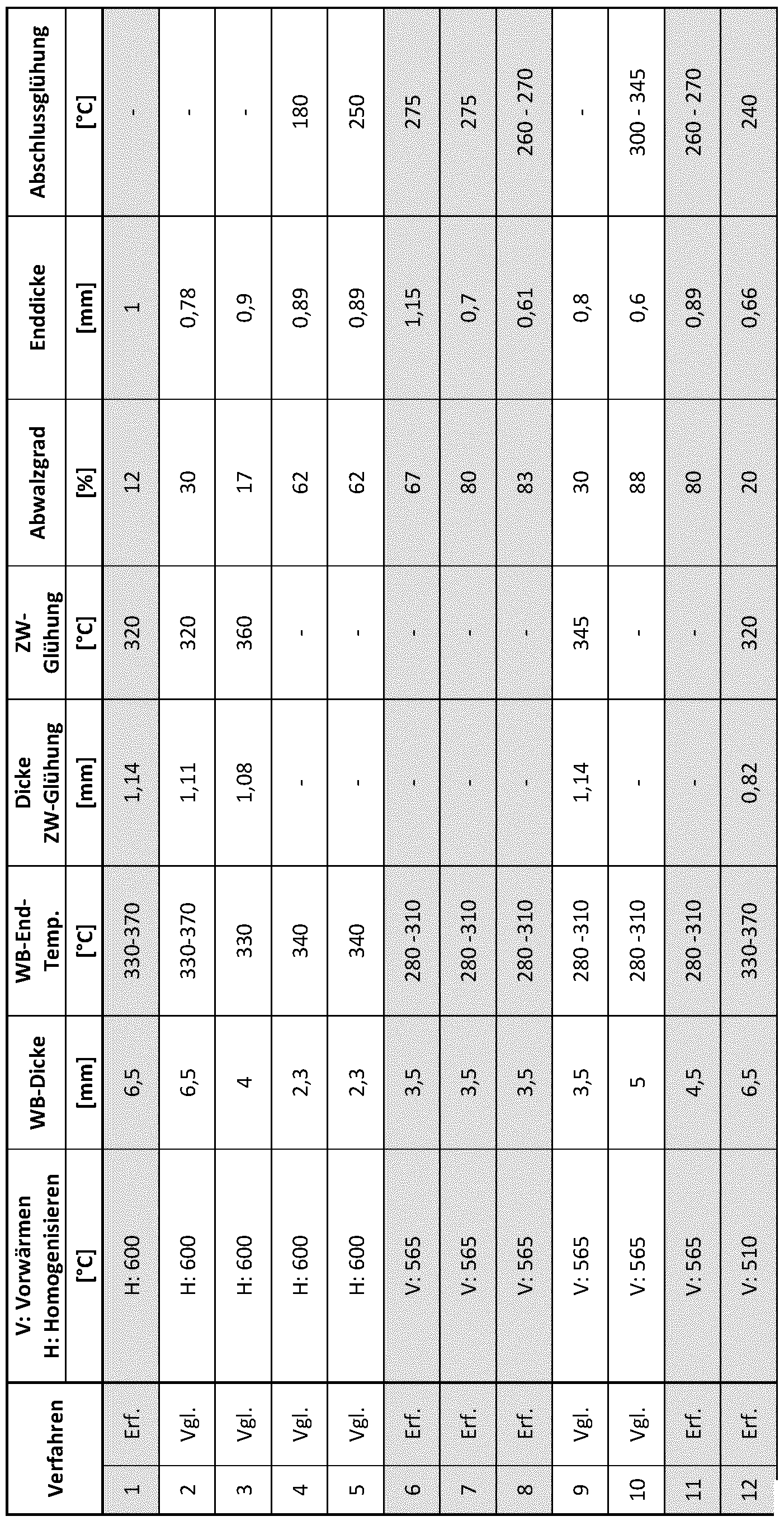
- Table 1 shows the alloy compositions of the exemplary embodiments (Example) and the comparative examples (Comp.J.). Each individual example was manufactured using the specific process parameters specified in Table 2. All temperature specifications are to be understood as "peak metal temperature” (PMT), i.e. the maximum temperature of the metal.
- PMT peak metal temperature
- the residence time at the homogenization temperature was at least 1 h. Homogenization can take place in a separate annealing process or be integrated into the preheating.
- the homogenization temperature is first set and maintained for at least 1 h. The rolling ingot is then brought to the preheating temperature. When preheating the rolling ingot, the rolling ingot is fed into the rolling process when the preheating temperature is reached.
- the preheating temperature at the start of hot rolling was between 390 and 550 °C.
- WB thickness is understood to mean the final hot strip thickness.
- WB temperature refers to the final hot strip temperature, i.e. the temperature of the hot strip after the last hot rolling pass.
- the mechanical properties achieved are shown in Table 3. All mechanical properties such as yield strength R P o.2, tensile strength R m and elongation Aso were obtained according to EN ISO 6892-1:2019.
- Comparative example No. 3 corresponds to a reference rolled product made of an aluminum alloy of type AA3003.
- Examples No. 1, 6 to 8 and 11 to 12 are rolled products according to the teaching of the invention. These have an aluminum alloy which, in contrast to the primary aluminum-based reference rolled product No. 3, allows high recycling contents.
- the embodiment No. 1 was produced in the H12 state, i.e. without re-annealing.
- the rolling ingot was subjected to homogenization in accordance with the specifications given above.
- the rolling degree of final thickness after the intermediate annealing was 12%.
- the embodiment No. 1 achieves the mechanical values according to the invention and, due to its composition, can be produced with high recycling contents as well as used on the production equipment of existing battery cell housing production.
- Example No. 2 which is made from an identically homogenized rolling ingot, does indeed have an aluminum alloy with the features of patent claim 1, but the rolled product was cold rolled with too high a degree of final thickness of 30% after intermediate annealing. As a result, the comparison rolled product produced in this way does not achieve the desired mechanical properties. It is clearly too strong and has too low an elongation Aso.
- reference material No. 3 achieves all mechanical characteristics, as already mentioned, it can only be produced through closed material cycles with a high proportion of recycled material of at least 30%.
- the rolled products according to comparative examples No. 4 and 5 have significantly too high magnesium contents and therefore tend to show a pronounced Work hardening.
- the work hardening was so great that it could not be sufficiently reduced even during the reannealing at 180 °C for 16 hours and at 250 °C for 1 hour.
- the comparative examples No. 4 and 5 cannot therefore be used on the current production equipment for the manufacture of battery cell housings.
- the embodiments No. 6 to 8 have two different alloy compositions, with the embodiments No. 6 and 7 having identical compositions. All three embodiments were produced using different production processes according to the present invention and achieve the claimed mechanical properties in the states H22 (No. 6 and 7) and H24 (No. 8).
- the rolled product of comparative example no. 9 has an aluminum alloy with a composition that corresponds to the required contents. During cold rolling after intermediate annealing, the rolling degree of final thickness was 30%, so that the mechanical characteristics of the invention were not achieved. The rolled product showed too low an elongation Aso and too high a tensile strength R m . Further processing on existing production equipment for the manufacture of battery cell housings is therefore not possible.
- Comparative Example No. 10 also comprises an aluminum alloy according to the present invention, but was converted to the soft state O in the final annealing, so that Comparative Example No. 10 also does not meet the requirement for battery cell housing production.
- the embodiments No. 11 and 12 have an aluminum alloy composition according to the invention and were manufactured using the manufacturing process according to the invention.
- the corresponding rolled products in the reannealed states H24 and H22 had all the required mechanical characteristics and can be used on existing production equipment for the manufacture of battery cell housings.
Landscapes
- Chemical & Material Sciences (AREA)
- Chemical Kinetics & Catalysis (AREA)
- General Chemical & Material Sciences (AREA)
- Electrochemistry (AREA)
- Mechanical Engineering (AREA)
- Materials Engineering (AREA)
- Metallurgy (AREA)
- Organic Chemistry (AREA)
- Engineering & Computer Science (AREA)
- Physics & Mathematics (AREA)
- Crystallography & Structural Chemistry (AREA)
- Thermal Sciences (AREA)
- Inorganic Chemistry (AREA)
- Sealing Battery Cases Or Jackets (AREA)
Abstract
Description


Claims
Priority Applications (4)
| Application Number | Priority Date | Filing Date | Title |
|---|---|---|---|
| EP24718104.3A EP4690355A1 (de) | 2023-04-04 | 2024-04-03 | Walzprodukt aus aluminium für ein batteriezellgehäuse |
| KR1020257034142A KR20250160359A (ko) | 2023-04-04 | 2024-04-03 | 배터리 전지 하우징용 알루미늄 압연 제품 |
| US19/343,624 US20260031440A1 (en) | 2023-04-04 | 2025-09-29 | Rolled Aluminium Product for a Battery Cell Housing |
| MX2025011922A MX2025011922A (es) | 2023-04-04 | 2025-10-03 | Producto de aluminio laminado para la carcasa de una celda de bateria |
Applications Claiming Priority (6)
| Application Number | Priority Date | Filing Date | Title |
|---|---|---|---|
| EP23166597 | 2023-04-04 | ||
| EP23166597.7 | 2023-04-04 | ||
| EP23207709 | 2023-11-03 | ||
| EP23207709.9 | 2023-11-03 | ||
| EP23218175.0 | 2023-12-19 | ||
| EP23218175 | 2023-12-19 |
Related Child Applications (1)
| Application Number | Title | Priority Date | Filing Date |
|---|---|---|---|
| US19/343,624 Continuation US20260031440A1 (en) | 2023-04-04 | 2025-09-29 | Rolled Aluminium Product for a Battery Cell Housing |
Publications (1)
| Publication Number | Publication Date |
|---|---|
| WO2024208921A1 true WO2024208921A1 (de) | 2024-10-10 |
Family
ID=90720405
Family Applications (1)
| Application Number | Title | Priority Date | Filing Date |
|---|---|---|---|
| PCT/EP2024/059095 Ceased WO2024208921A1 (de) | 2023-04-04 | 2024-04-03 | Walzprodukt aus aluminium für ein batteriezellgehäuse |
Country Status (5)
| Country | Link |
|---|---|
| US (1) | US20260031440A1 (de) |
| EP (1) | EP4690355A1 (de) |
| KR (1) | KR20250160359A (de) |
| MX (1) | MX2025011922A (de) |
| WO (1) | WO2024208921A1 (de) |
Citations (4)
| Publication number | Priority date | Publication date | Assignee | Title |
|---|---|---|---|---|
| US20060093908A1 (en) | 2004-10-18 | 2006-05-04 | Sung-Min Hwang | Secondary battery employing battery case of high strength |
| EP2527479A1 (de) * | 2011-05-27 | 2012-11-28 | Hydro Aluminium Rolled Products GmbH | Hochleitfähige Aluminiumlegierung für elektrisch leitfähige Produkte |
| JP2015125886A (ja) | 2013-12-26 | 2015-07-06 | トヨタ自動車株式会社 | 非水電解質二次電池およびその製造方法 |
| KR20160056731A (ko) | 2014-11-12 | 2016-05-20 | 금오공과대학교 산학협력단 | 알루미늄-딥드로잉 공정 후처리를 위한 화학적 연마용 조성물 및 이를 이용한 알루미늄의 화학적 연마 방법 |
Family Cites Families (6)
| Publication number | Priority date | Publication date | Assignee | Title |
|---|---|---|---|---|
| JP5950497B2 (ja) | 2010-09-14 | 2016-07-13 | 株式会社神戸製鋼所 | 電池ケース用アルミニウム合金板及び電池ケース |
| CN114752821A (zh) | 2019-09-03 | 2022-07-15 | 南通恒金复合材料有限公司 | 一种动力电池壳体用铝合金带材及其制备方法 |
| CN110616343A (zh) | 2019-09-20 | 2019-12-27 | 北京科技大学 | 提高再生铝合金开路电位的方法及具有高开路电位的再生铝合金 |
| CN110983115B (zh) | 2019-12-26 | 2021-07-20 | 中铝西南铝板带有限公司 | 一种改进3003铝合金带材及其制备方法和应用 |
| CN111647775A (zh) | 2020-05-08 | 2020-09-11 | 银邦金属复合材料股份有限公司 | 新能源动力电池壳、铝合金及其制造方法 |
| FR3123922B1 (fr) | 2021-06-11 | 2023-12-22 | Constellium Rolled Products Singen | Tôle forte en alliage d’aluminium pour boîtier de batterie parallélépipédique |
-
2024
- 2024-04-03 KR KR1020257034142A patent/KR20250160359A/ko active Pending
- 2024-04-03 EP EP24718104.3A patent/EP4690355A1/de active Pending
- 2024-04-03 WO PCT/EP2024/059095 patent/WO2024208921A1/de not_active Ceased
-
2025
- 2025-09-29 US US19/343,624 patent/US20260031440A1/en active Pending
- 2025-10-03 MX MX2025011922A patent/MX2025011922A/es unknown
Patent Citations (4)
| Publication number | Priority date | Publication date | Assignee | Title |
|---|---|---|---|---|
| US20060093908A1 (en) | 2004-10-18 | 2006-05-04 | Sung-Min Hwang | Secondary battery employing battery case of high strength |
| EP2527479A1 (de) * | 2011-05-27 | 2012-11-28 | Hydro Aluminium Rolled Products GmbH | Hochleitfähige Aluminiumlegierung für elektrisch leitfähige Produkte |
| JP2015125886A (ja) | 2013-12-26 | 2015-07-06 | トヨタ自動車株式会社 | 非水電解質二次電池およびその製造方法 |
| KR20160056731A (ko) | 2014-11-12 | 2016-05-20 | 금오공과대학교 산학협력단 | 알루미늄-딥드로잉 공정 후처리를 위한 화학적 연마용 조성물 및 이를 이용한 알루미늄의 화학적 연마 방법 |
Non-Patent Citations (1)
| Title |
|---|
| See also references of EP4690355A1 |
Also Published As
| Publication number | Publication date |
|---|---|
| MX2025011922A (es) | 2025-12-01 |
| KR20250160359A (ko) | 2025-11-12 |
| US20260031440A1 (en) | 2026-01-29 |
| EP4690355A1 (de) | 2026-02-11 |
Similar Documents
| Publication | Publication Date | Title |
|---|---|---|
| EP3314031B1 (de) | Hochfestes und gut umformbares almg-band sowie verfahren zu seiner herstellung | |
| EP4548422B1 (de) | Batteriezellgehäuse und verfahren zur herstellung | |
| WO2023111129A1 (de) | HOCHFESTES BATTERIEZELLGEHÄUSE FÜR GROßFORMATIGE BATTERIERUNDZELLEN AUS EINER ALUMINIUMLEGIERUNG | |
| EP4413628A1 (de) | Batteriezellgehäuse aus aluminiumlegierungsband mit hohem recycling-anteil | |
| EP2914391A1 (de) | Aluminiumverbundwerkstoff und verfahren zur umformung | |
| WO2002083967A1 (de) | VERFAHREN ZUR HERSTELLUNG VON AlMn-BÄNDERN ODER -BLECHEN | |
| EP4132743B1 (de) | Hochfester lotplattierter al-mg-si-aluminiumwerkstoff | |
| EP2888383B1 (de) | Hochumformbares und ik-beständiges almg-band | |
| WO2024208891A1 (de) | BATTERIEZELLGEHÄUSE AUS EINEM ALUMINIUMLEGIERUNGSBAND MIT VERBESSERTER SCHWEIßBARKEIT UND HOHEM RECYCLING-ANTEIL | |
| EP2039790A1 (de) | Korrosionsschutzschicht | |
| EP4690355A1 (de) | Walzprodukt aus aluminium für ein batteriezellgehäuse | |
| EP2924135B1 (de) | Verfahren zur Herstellung eines Bandes aus einer hochumformbaren, mittelfesten Aluminiumlegierung für Halbzeuge oder Bauteile von Kraftfahrzeugen | |
| EP4396387B1 (de) | Umformoptimiertes aluminiumlegierungsband und verfahren zur herstellung | |
| EP4419273A1 (de) | Aluminiumlegierung und aluminiumband für die herstellung von dosendeckeln sowie verfahren zu dessen herstellung | |
| JP7235634B2 (ja) | 缶胴用アルミニウム合金板 | |
| DE10051525A1 (de) | Verfahren zur Herstellung von Blechen, insbesondere Karosserieblechen | |
| JP7222047B1 (ja) | 配管コネクタ用アルミニウム合金押出材、その製造方法及び配管コネクタ | |
| WO2025149500A1 (de) | Aluminiumlegierung mit erhöhter schrottaufnahmefähigkeit und festigkeit | |
| CA3288036A1 (en) | Rolled aluminium product for a battery cell housing | |
| EP4721177A1 (de) | Zylindrisches batterizellgehäuse mit intrinsischem druckentlastungsmittel | |
| WO2024208734A9 (de) | ZYLINDRISCHES BATTERIEZELLGEHÄUSE MIT NIEDRIGEM CO2-FUßABDRUCK | |
| EP4690322A1 (de) | <sup2/>? <sub2/>?2?prismatisches batteriezellgehäuse mit niedrigem co-fussabdruck | |
| JP2002241881A (ja) | 自動車のフレーム構造におけるエネルギー吸収部材 | |
| DE102010020268A1 (de) | Aluminium-Magnesium-Legierungsprodukt für geformte Autmobilteile |
Legal Events
| Date | Code | Title | Description |
|---|---|---|---|
| 121 | Ep: the epo has been informed by wipo that ep was designated in this application |
Ref document number: 24718104 Country of ref document: EP Kind code of ref document: A1 |
|
| DPE1 | Request for preliminary examination filed after expiration of 19th month from priority date (pct application filed from 20040101) | ||
| WWE | Wipo information: entry into national phase |
Ref document number: MX/A/2025/011922 Country of ref document: MX |
|
| ENP | Entry into the national phase |
Ref document number: 1020257034142 Country of ref document: KR Free format text: ST27 STATUS EVENT CODE: A-0-1-A10-A15-NAP-PA0105 (AS PROVIDED BY THE NATIONAL OFFICE) |
|
| WWE | Wipo information: entry into national phase |
Ref document number: KR1020257034142 Country of ref document: KR Ref document number: 1020257034142 Country of ref document: KR |
|
| WWE | Wipo information: entry into national phase |
Ref document number: 2024718104 Country of ref document: EP |
|
| NENP | Non-entry into the national phase |
Ref country code: DE |
|
| ENP | Entry into the national phase |
Ref document number: 2024718104 Country of ref document: EP Effective date: 20251104 |
|
| ENP | Entry into the national phase |
Ref document number: 2024718104 Country of ref document: EP Effective date: 20251104 |
|
| ENP | Entry into the national phase |
Ref document number: 2024718104 Country of ref document: EP Effective date: 20251104 |
|
| WWP | Wipo information: published in national office |
Ref document number: MX/A/2025/011922 Country of ref document: MX |
|
| ENP | Entry into the national phase |
Ref document number: 2024718104 Country of ref document: EP Effective date: 20251104 |
|
| ENP | Entry into the national phase |
Ref document number: 2024718104 Country of ref document: EP Effective date: 20251104 |
|
| ENP | Entry into the national phase |
Ref document number: 2024718104 Country of ref document: EP Effective date: 20251104 |
|
| ENP | Entry into the national phase |
Ref document number: 2024718104 Country of ref document: EP Effective date: 20251104 |
|
| ENP | Entry into the national phase |
Ref document number: 2024718104 Country of ref document: EP Effective date: 20251104 |
|
| WWP | Wipo information: published in national office |
Ref document number: 2024718104 Country of ref document: EP |