WO2024219022A1 - インクジェット印刷用インク組成物 - Google Patents
インクジェット印刷用インク組成物 Download PDFInfo
- Publication number
- WO2024219022A1 WO2024219022A1 PCT/JP2023/046904 JP2023046904W WO2024219022A1 WO 2024219022 A1 WO2024219022 A1 WO 2024219022A1 JP 2023046904 W JP2023046904 W JP 2023046904W WO 2024219022 A1 WO2024219022 A1 WO 2024219022A1
- Authority
- WO
- WIPO (PCT)
- Prior art keywords
- surfactant
- ink composition
- mass
- ink
- water
- Prior art date
- Legal status (The legal status is an assumption and is not a legal conclusion. Google has not performed a legal analysis and makes no representation as to the accuracy of the status listed.)
- Ceased
Links
Classifications
-
- C—CHEMISTRY; METALLURGY
- C09—DYES; PAINTS; POLISHES; NATURAL RESINS; ADHESIVES; COMPOSITIONS NOT OTHERWISE PROVIDED FOR; APPLICATIONS OF MATERIALS NOT OTHERWISE PROVIDED FOR
- C09D—COATING COMPOSITIONS, e.g. PAINTS, VARNISHES OR LACQUERS; FILLING PASTES; CHEMICAL PAINT OR INK REMOVERS; INKS; CORRECTING FLUIDS; WOODSTAINS; PASTES OR SOLIDS FOR COLOURING OR PRINTING; USE OF MATERIALS THEREFOR
- C09D11/00—Inks
- C09D11/30—Inkjet printing inks
- C09D11/32—Inkjet printing inks characterised by colouring agents
- C09D11/322—Pigment inks
-
- C—CHEMISTRY; METALLURGY
- C09—DYES; PAINTS; POLISHES; NATURAL RESINS; ADHESIVES; COMPOSITIONS NOT OTHERWISE PROVIDED FOR; APPLICATIONS OF MATERIALS NOT OTHERWISE PROVIDED FOR
- C09D—COATING COMPOSITIONS, e.g. PAINTS, VARNISHES OR LACQUERS; FILLING PASTES; CHEMICAL PAINT OR INK REMOVERS; INKS; CORRECTING FLUIDS; WOODSTAINS; PASTES OR SOLIDS FOR COLOURING OR PRINTING; USE OF MATERIALS THEREFOR
- C09D11/00—Inks
- C09D11/30—Inkjet printing inks
- C09D11/38—Inkjet printing inks characterised by non-macromolecular additives other than solvents, pigments or dyes
Definitions
- the present invention relates to an ink composition for inkjet printing.
- adding resin microparticles to the ink composition for inkjet printing can improve the film-forming properties of the ink coating, increase the drying speed, and suppress peeling of the printed layer.
- adding resin microparticles to the ink composition for inkjet printing can also improve the image quality of the printed layer.
- Patent Documents 1 and 2 propose ink compositions for inkjet printing that have a specific monomer composition for the binder resin that constitutes the resin microparticles, and that use a water-soluble organic solvent with a specific SP value as the solvent.
- Patent Documents 3 to 6 disclose an aqueous ink composition that combines a silicone surfactant with an acetylene glycol surfactant
- Patent Document 4 discloses an ink that combines a silicone surfactant with a nonionic surfactant
- Patent Document 5 discloses an ink composition that combines a specific defoamer with a surfactant, each of which is said to be an ink for inkjet printing that provides high-quality images
- Patent Document 6 discloses an ink composition that combines an acetylene surfactant with a nonionic surfactant.
- JP 2020-180178 A International Publication No. 2020/218287 JP 2019-119786 A JP 2020-50705 A JP 2012-193268 A Patent No. 7210802
- the present invention aims to provide an aqueous ink composition for inkjet printing that contains a resin emulsion, and that stabilizes the ejection stability (particularly the ejection stability during continuous printing) to improve image quality, while preferably suppressing the occurrence of blocking in the printed matter, and more preferably suppressing a decrease in the lamination properties of the printed coating.
- an ink composition for ink-jet printing comprising a pigment (A), a water-soluble organic solvent (B), a resin emulsion (C), a surfactant (D), and water (E):
- the water-soluble organic solvent (B) has two or more hydroxyl groups in its molecule, and has an SP value at 25 ° C.
- the content of the water-soluble organic solvent (B) in the ink composition is 15.0 to 50.0% by mass;
- the solid content of the resin emulsion (C) in the ink composition is 0.1 to 10 mass %;
- the surfactant (D) includes an acetylene glycol-based surfactant (D-1), a silicone-based surfactant (D-2), and an alcohol ethoxylate-based surfactant (D-3); the total content of the surfactant (D) in the ink composition is 0.1% by mass or more and 3.0% by mass or less; a mass content ratio [(D-
- the present invention relates to an ink composition for ink-jet printing as described below.
- [2] The ink composition for ink-jet printing according to [1] above, wherein a content mass ratio of the silicone-based surfactant (D-2) to the alcohol ethoxylate-based surfactant (D-3), [(D-2)/(D-3)], is 0.1 to 2.0.
- a content mass ratio of the silicone-based surfactant (D-2) to the alcohol ethoxylate-based surfactant (D-3), [(D-2)/(D-3)] is 0.1 to 2.0.
- [4] The ink composition for ink-jet printing according to any one of [1] to [3] above, wherein the water-soluble organic solvent (B) has an SP value of 16.0 (cal/cm 3 ) 1/2 or less.
- the ink composition for inkjet printing of the present invention contains a resin emulsion, which is a solid component, and yet has high ejection stability, particularly when performing high-speed inkjet printing (increasing the ink ejection frequency) or continuous printing by inkjet printing, and can provide printed matter with high image quality.
- the ink composition for ink-jet printing of the present invention contains a pigment (A), a water-soluble organic solvent (B), a resin emulsion (C), a surfactant (D), and water (E), and may contain other optional components.
- the pigment (A) contained in the ink composition for ink-jet printing of the present invention is a component added to impart coloring power, hiding power, etc. to the ink composition, and examples of such pigments include color pigments, white pigments, metal powders, etc. Examples of such pigments include, without particular limitation, the following organic and/or inorganic pigments that have been conventionally used in ink compositions.
- pigments include dye lake pigments, azo-based, benzimidazolone-based, phthalocyanine-based, quinacridone-based, anthraquinone-based, dioxazine-based, indigo-based, thioindigo-based, perylene-based, perinone-based, diketopyrrolopyrrole-based, isoindolinone-based, nitro-based, nitroso-based, flavanthrone-based, quinophthalone-based, pyranthrone-based, and indanthrone-based organic pigments, as well as various inorganic pigments.
- yellow pigments examples include C.I. Pigment Yellow 1, 2, 3, 12, 13, 14, 16, 17, 42, 73, 74, 75, 81, 83, 87, 93, 95, 97, 98, 108, 109, 114, 120, 128, 129, 138, 139, 150, 151, 155, 166, 180, 184, 185, and 213.
- magenta pigments examples include C.I. Pigment Red 5, 7, 12, 22, 38, 48:1, 48:2, 48:4, 49:1, 53:1, 57, 57:1, 63:1, 101, 102, 112, 122, 123, 144, 146, 149, 168, 177, 178, 179, 180, 184, 185, 190, 202, 209, 224, 242, 254, 255, 270, and C.I. Pigment Violet 19.
- Cyan pigments include, for example, C.I. Pigment Blue 1, 2, 3, 15, 15:1, 15:2, 15:3, 15:4, 15:6, 16, 18, 22, 27, 29, and 60.
- An example of a black pigment is carbon black (C.I. Pigment Black 7).
- white pigments include titanium oxide and aluminum oxide, which may be surface-treated with various materials such as alumina and silica.
- the amount of pigment contained in the ink composition varies depending on the type of pigment and the desired degree of coloring or concealment, and is not particularly limited, but may be, for example, about 1.0 to 20.0% by mass, and preferably about 3.0 to 15.0% by mass, relative to the total amount of the ink composition.
- a pigment or dye of a different color it is also possible to use a pigment or dye of a different color as a complementary color, or to add an ink composition of a different color.
- the water-soluble organic solvent (B) contained in the ink composition for ink-jet printing of the present invention has two or more hydroxyl groups in its molecule and has a predetermined SP value.
- the SP value means a solubility parameter, and the SP value of the water-soluble organic solvent (B) can be calculated by the following formula 1.
- ⁇ H represents the latent heat of vaporization (cal/mol) of the water-soluble organic solvent (B); R represents the gas constant, which is 1.99 (cal/K ⁇ mol); T represents the temperature (here, 25° C. or 298 K); M represents the molecular weight (g/mol) of the water-soluble organic solvent (B); and D represents the density (g/cm 3 ) of the water-soluble organic solvent (B).
- the water-soluble organic solvent (B) has an SP value (25°C) of 12.0 (cal/ cm3 ) 1/2 or more at 25°C.
- the SP value (25°C) of the water-soluble organic solvent (B) is preferably 16.0 (cal/ cm3 ) 1/2 or less, more preferably 14.5 (cal/ cm3 ) 1/2 or less.
- water-soluble organic solvent (B) examples include diethylene glycol, which has an SP value (25°C) of 12.2 (cal/ cm3 ) 1/2 ; 1,2-propanediol (also called propylene glycol), which has an SP value (25°C) of 12.6 (cal/ cm3 ) 1/2 ; 1,3-propanediol, which has an SP value of 13.3 (cal/ cm3 ) 1/2 ; and glycerin, which has an SP value of 14.9 (cal/ cm3 ) 1/2 .
- diethylene glycol which has an SP value (25°C) of 12.2 (cal/ cm3 ) 1/2
- 1,2-propanediol also called propylene glycol
- 1,3-propanediol which has an SP value of 13.3 (cal/ cm3 ) 1/2
- glycerin which has an SP value of 14.9 (cal/ cm3 ) 1/2 .
- the content of the water-soluble organic solvent (B) contained in the ink composition for inkjet printing is 15.0% by mass or more, preferably 20.0% by mass or more, and more preferably 25.0% by mass or more, based on the total ink composition; and 50.0% by mass or less, preferably 45.0% by mass or less, and more preferably 40.0% by mass or less.
- the content of the water-soluble organic solvent (B) contained in the ink composition for inkjet printing is preferably 30% by mass or more, more preferably 40% by mass or more, and even more preferably 50% by mass or more, based on water (E); and preferably 400% by mass or less, more preferably 200% by mass or less, and even more preferably 150% by mass or less.
- the ink composition for inkjet printing may contain a water-soluble organic solvent other than the water-soluble organic solvent (B), but the content should be set so as not to impair the effects of the present invention, and is usually 3% by mass or less relative to the ink composition for inkjet printing.
- the resin emulsion contained in the ink composition for inkjet printing of the present invention is resin particles dispersed as fine particles in the ink composition.
- the resin emulsion may be a known resin emulsion used in an aqueous inkjet printing ink composition, such as an acrylic resin emulsion, a styrene-acrylic resin emulsion, a polyester resin emulsion, a polyurethane resin emulsion, a polyvinyl acetate resin emulsion, a polyvinyl chloride resin emulsion, a polybutadiene resin emulsion, or a polyolefin resin emulsion.
- the ink composition may contain one type of resin emulsion alone, or two or more types in combination.
- the resin emulsion can improve the abrasion resistance, coating drying properties, and repelling resistance of the ink composition. Furthermore, from the viewpoint of improving the drying properties of the coating film of the ink composition printed matter and adhesion to the substrate, it is preferable that the resin of the resin emulsion has a glass transition temperature of 20°C or less.
- the glass transition temperature can be determined from the manufacturer's catalog value as a reference, but if this is not available, it can be determined by differential scanning calorimetry (DSC), and is usually calculated from the midpoint of the temperature range in which the glass transition occurs.
- the volume average particle size of the resin particles in the resin emulsion is not particularly limited and can be appropriately selected depending on the purpose, but from the viewpoints of increasing the scratch resistance of the printed matter, improving the image quality, and increasing the inkjet ejection stability, it is preferably 10 nm or more, and more preferably 20 nm or more; on the other hand, it is preferably 600 nm or less, and more preferably 400 nm or less.
- Resin emulsions can also be obtained from the market, for example, AQUACER 531 (BYK-Chemie, polyethylene-based resin emulsion); Yodozole AD173 (Henkel, acrylic resin emulsion); NeoRez R-966 (Covestro, polyether-based polyurethane resin emulsion); Sepolsion ES (Sumitomo Seika Chemicals, polyester-based resin emulsion); Acrito WEM-031U, WEM-200U, WEM-321, WEM-3000, WEM-202U, WEM-3008 (Taisei Fine Chemicals, acrylic-urethane resin emulsion); Acrito UW-550CS, UW- 223SX, AKW107, RKW-500 (Taisei Fine Chemical Co., Ltd., acrylic resin emulsion); LUBRIJET N240 (Lubrizol Corporation, acrylic resin emulsion); Superflex 150, 210, 420NS, 470, 500M, 620,
- the content of resin emulsion (C) in the ink composition is 0.1% by mass or more, preferably 0.3% by mass or more, and more preferably 0.5% by mass or more, in terms of solid content; and 10.0% by mass or less, preferably 8.0% by mass or less, and more preferably 5.0% by mass or less.
- the content of resin emulsion (C) is a certain amount or more (0.1% by mass or more)
- the image quality of the printed matter of the ink composition is improved, and the abrasion resistance is also improved.
- the content of resin emulsion (C) is a certain amount or less (10.0% by mass or less)
- the ejection stability of the ink composition is improved, and the storage stability is also improved.
- the surfactants contained in the ink composition for ink-jet printing of the present invention include three types of surfactants: an acetylene glycol-based surfactant (D-1), a silicone-based surfactant (D-2), and an alcohol ethoxylate-based surfactant (D-3).
- Acetylene glycol surfactant (D-1) is a compound having both an acetylene alcohol or an acetylene bond and a glycol unit, and can be represented by the following structural formula 1.
- the acetylene bond site becomes a hydrophobic site, and the alcohol site or glycol site becomes a hydrophilic site, and can exhibit a surface active function.
- R1 and R2 each independently represent a hydrogen atom or an alkyl group having 1 to 16 carbon atoms;
- R3 represents a hydrogen atom, an alkyl group having 1 to 6 carbon atoms, or a phenyl group;
- R represents an alkylene group having 2 to 6 carbon atoms;
- m represents 0 to 40; and
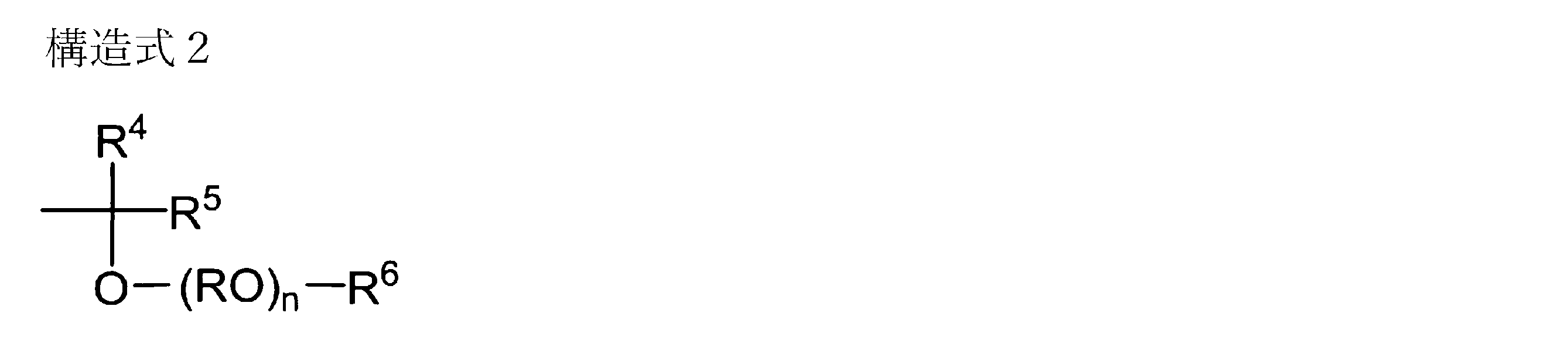
- X represents a hydrogen atom or a group represented by the following structural formula 2.
- R4 and R5 each independently represent a hydrogen atom or an alkyl group having 1 to 16 carbon atoms;
- R6 represents a hydrogen atom, an alkyl group having 1 to 6 carbon atoms, or a phenyl group;
- R represents an alkylene group having 2 to 6 carbon atoms; and
- n represents 0 to 40.
- the acetylene glycol surfactant (D-1) is preferably a surfactant having an acetylene bond in the center of the molecular structure and a symmetrical molecular structure, and can be represented by either of the following structural formulas 3 and 4.
- R 1 to R 5 and R as well as m and n are the same as those in the above structural formulas 1 and 2, respectively; however, the sum of m and n is preferably 1 or more or more than 1; and is preferably 45 or less, more preferably 40 or less, even more preferably 30 or less, still more preferably 20 or less, and even more preferably 15 or less.
- acetylene glycol surfactants (D-1) include acetylene diols such as 2,4,7,9-tetramethyl-5-decyne-4,7-diol, 3,6-dimethyl-4-octyne-3,6-diol, 3,5-dimethyl-1-hexyne-3-ol, 2,4-dimethyl-5-hexyne-3-ol, 2,5-dimethyl-3-hexyne-2,5-diol, and 2,5,8,11-tetramethyl-6-dodecyne-5,8-diol, as well as ethylene oxide adducts thereof.
- acetylene diols such as 2,4,7,9-tetramethyl-5-decyne-4,7-diol, 3,6-dimethyl-4-octyne-3,6-diol, 3,5-dimethyl-1-hexyne-3-ol, 2,4
- Acetylene glycol surfactants (D-1) are available on the market under the trade names SURFYNOL 104E, SURFYNOL 104H, SURFYNOL 104A, SURFYNOL 104BC, SURFYNOL 104DPM, SURFYNOL 104PA, SURFYNOL 104PG-50, SURFYNOL 420, SURFYNOL 440, SURFYNOL 465, SURFYNOL 485, Olfin 1004, Olfin E1004, Olfin E1010, Olfin E1020 (Nissin Chemical Industry Co., Ltd.), etc.
- Surfynol 465 is an ethylene oxide adduct of 2,4,7,9-tetramethyl-5-decyne-4,7-diol.
- the silicone surfactant (D-2) is a polysiloxane such as dimethylpolysiloxane (chemical formula: (C2H6OSi ) n ) or a modified product thereof, but a surfactant in which a polysiloxane is modified with a polyether (a polyether-modified silicone surfactant) is preferred.
- the polyether-modified silicone surfactant can suppress an increase in ink viscosity, and is therefore considered to contribute to obtaining good recorded material without unevenness in high-speed printing.
- Polyether-modified silicone surfactants have a structure in which the side chains and/or terminal hydrocarbon groups of silicone oil are replaced with polyether groups.
- Suitable polyether groups are polyethyleneoxy groups, polypropyleneoxy groups, and polyalkyleneoxy groups in which ethyleneoxy groups (EO) and propyleneoxy groups (PO) are added in a block or random manner.
- EO ethyleneoxy groups
- PO propyleneoxy groups
- Compounds in which polyether groups are graft-bonded to a silicone main chain, compounds in which silicone and polyether groups are bonded in a block form, etc. can be used.
- the silicone surfactant (D-2) preferably has an HLB (hydrophilic lipophilic balance) value of 2.0 or more, more preferably 3.0 or more, even more preferably 4.0 or more, and even more preferably 4.5 or more. This is to ensure the solubility of the silicone surfactant (D-2) in the water-based ink composition.
- HLB hydrophilic lipophilic balance
- Silicone surfactants (D-2) can also be obtained from the market. Specific examples include: KF-351A, KF-352A, KF-353, KF-354L, KF-355A, KF-615A, KF-945, KF640, KF-642, KF643, KF-644, KF6020, KF6011, etc. (Shin-Etsu Chemical Co., Ltd. KF series); Silface SAG (Nissin Chemical Co., Ltd.); BYK-345, 347, 348, 349, etc. (BYK Chemie Co., Ltd. BYK series); TEGO GLIDE 410, 450, etc., TEGO Twin 400, etc. (Evonik).
- Alcohol ethoxylate surfactant (D-3) is a compound in which a polyoxyethylene chain and an alkyl group are bonded by an ether bond, and can be represented by the molecular formula "R A -O-(CH 2 CH 2 O) d -H", and is also called poly(oxyethylene) alkyl ether.
- the alcohol ethoxylate surfactant (D-3) preferably has an HLB value of 7 or more, and more preferably has an HLB value of 9 or more.
- the HLB value is an index that expresses the degree of hydrophilicity and lipophilicity of a surfactant calculated by the Griffin method; the smaller the HLB value, the higher the lipophilicity, and the higher the HLB value, the higher the hydrophilicity. If the HLB value is above a certain level (7 or more), the compatibility of the alcohol ethoxylate surfactant (D-3) in the ink composition increases.
- Alcohol ethoxylate surfactants examples include Emulgen 705, Emulgen 104, Emulgen 106, Emulgen 707, Emulgen 1108, Emulgen 1118S-70, Emulgen 1135S-70, Emulgen 1150S-60 (Kao Corporation); Adeka Toll LA-675B, Adeka Toll LA-775 (ADEKA Corporation); TRITON (registered trademark) HW1000 (Dow Corporation); and Sanonick SS70 (Sanyo Chemical Industries, Ltd.).
- the ink composition for ink-jet printing of the present invention may contain a surfactant (other surfactant) other than the surfactants (D-1), (D-2) and (D-3).
- a surfactant other surfactant
- examples of the other surfactant include alcohol alkoxylate surfactants, anionic surfactants and the like.
- the content of the surfactant (D) contained in the ink composition of the present invention (the total content of the surfactants (D-1), (D-2) and (D-3) and other surfactants) is 0.1% by mass or more, preferably 0.5% by mass or more; and 3.0% by mass or less, preferably 2.5% by mass or less, and more preferably 2.0% by mass or less.
- the total content of the surfactants (D-1), (D-2) and (D-3) is 0.1% by mass or more, preferably 0.5% by mass or more, relative to the ink composition; and 3.0% by mass or less, preferably 2.5% by mass or less, and more preferably 2.0% by mass or less.
- the surface tension of the ink composition increases, so that the ink composition is less likely to wet and spread on the printing substrate (especially a printing substrate with low wettability), and the image quality of the printed matter tends to deteriorate.
- the ejection stability in printing of the ink composition also tends to deteriorate.
- the amount of the surfactant is too large, the blocking resistance of the printed matter tends to deteriorate.
- each of the surfactants (D-1), (D-2), and (D-3) is preferably 0.1% to 1.0% by mass; the content of the acetylene glycol surfactant (D-1) is preferably 0.1% to 1.0% by mass; the content of the silicone surfactant (D-2) is preferably 0.1% to 1.0% by mass; and the content of the alcohol ethoxylate surfactant (D-3) is preferably 0.3% to 0.7% by mass.
- the mass ratio of the acetylene glycol surfactant (D-1) to the silicone surfactant (D-2) [(D-1)/(D-2)] is 1.0 or more, preferably 3.0 or more; and 10.0 or less, preferably 8.0 or less. Both the acetylene glycol surfactant (D-1) and the silicone surfactant (D-2) tend to improve the ejection stability of the ink composition; although the mechanism is unclear, more precise adjustment of the ratio of the surfactants (D-1) to (D-2) can improve the ejection stability during continuous printing.
- a high content of the silicone surfactant (D-2) may adversely affect storage stability and ejection stability, and there is a concern that the lamination properties of the printed matter may deteriorate; therefore, it is preferable to prevent the deterioration of the lamination properties by adjusting the mass ratio [(D-1)/(D-2)].
- the mass ratio of the acetylene glycol surfactant (D-1) to the alcohol ethoxylate surfactant (D-3) [(D-1)/(D-3)] is 0.1 or more, preferably 0.2 or more; and 10.0 or less, preferably 5.0 or less.
- the acetylene glycol surfactant (D-1) tends to improve the ejection stability of the ink composition, but by adjusting the ratio of the surfactants (D-1) to (D-3) more precisely, the ejection stability during continuous printing can be improved.
- a high content of the acetylene glycol surfactant (D-1) can easily cause blocking in the printed matter; it is preferable to prevent blocking by adjusting the mass ratio [(D-1)/(D-3)].
- the mass ratio of the silicone surfactant (D-2) to the alcohol ethoxylate surfactant (D-3) [(D-2)/(D-3)] is preferably 0.1 or more, more preferably 0.2 or more; on the other hand, it is preferably 2.0 or less.
- the ink composition for ink-jet printing of the present invention contains water.
- the content of water in the ink composition is preferably 40% by mass or more, more preferably 50% by mass or more, and is preferably 70% by mass or less, more preferably 60% by mass or less.
- the ink composition for ink-jet printing of the present invention may contain any other components; examples of the other components include additives such as a pigment dispersant, an antifungal agent, an antirust agent, a thickener, an antioxidant, an ultraviolet absorber, a storage stability improver, an antifoaming agent, and a pH adjuster.
- additives such as a pigment dispersant, an antifungal agent, an antirust agent, a thickener, an antioxidant, an ultraviolet absorber, a storage stability improver, an antifoaming agent, and a pH adjuster.
- the ink composition for inkjet printing preferably contains a pigment dispersant.
- the pigment dispersant is preferably a polymeric pigment dispersant and is an alkali-soluble resin.
- the alkali-soluble resin is preferably dissolved in the ink composition.
- the ink composition may contain a basic compound.
- the alkali-soluble resin is an alkali-soluble resin that can be used as a pigment dispersion or binder for ordinary inks and paints, and can be dissolved in an aqueous medium in the presence of a basic compound.
- the alkali-soluble resin preferably has an acid value of 100 mgKOH/g or more and 250 mgKOH/g or less. If the acid value is less than 100 mgKOH/g, the solubility of the resin decreases, and storage stability and continuous ejection stability may decrease. If the acid value is more than 250 mgKOH/g, the hydrophilicity becomes too high, and storage stability and abrasion resistance may decrease.
- the above acid value is a theoretical acid value calculated arithmetically from the number of mg of potassium hydroxide theoretically required to neutralize 1 g of alkali-soluble resin based on the composition of the monomers used to synthesize the alkali-soluble resin.
- the alkali-soluble resin preferably further has a hydrophobic portion in the molecule, mainly for improving the adsorption to the pigment.
- a hydrophobic portion to be introduced into the molecule include hydrophobic groups such as long-chain alkyl groups, alicyclic groups, and aromatic cyclic hydrocarbon groups.
- the glass transition temperature of the alkali-soluble resin is preferably 0°C or higher, and more preferably 10°C or higher, from the viewpoint of improving the blocking resistance of the printed matter.
- the glass transition temperature of the alkali-soluble resin is preferably 100°C or lower, and more preferably 80°C or lower, from the viewpoint of improving the folding resistance of the printed matter.
- the glass transition temperature (Tg) of the alkali-soluble resin is a theoretical glass transition temperature calculated by the following Wood's formula.
- Tg1 to Tgx are the glass transition temperatures of the homopolymers of monomers 1, 2, 3...x constituting the alkali-soluble resin
- W1 to Wx are the polymerization fractions of monomers 1, 2, 3...x, respectively
- Tg is the theoretical glass transition temperature.
- the glass transition temperature in Wood's formula is an absolute temperature.
- the glass transition temperature of the alkali-soluble resin is the actual glass transition temperature determined by thermal analysis when the alkali-soluble resin is other than an acrylic copolymer resin.
- the thermal analysis method conforms to JIS K7121 (Method for measuring glass transition temperature of plastics), and as an example, the glass transition temperature can be measured using a PerkinElmer Pyris1 DSC under conditions of a heating rate of 20°C/min and a nitrogen gas flow rate of 20 milliliters/min.
- the weight average molecular weight (Mw) of the alkali-soluble resin is preferably 5,000 or more, and more preferably 10,000 or more, from the viewpoint of improving the water resistance of the printed matter.
- the weight average molecular weight of the alkali-soluble resin is preferably 100,000 or less, and more preferably 50,000 or less, from the viewpoint of increasing the solubility in an aqueous medium.
- the weight average molecular weight can be measured by gel permeation chromatography (GPC).
- GPC gel permeation chromatography
- chromatography can be performed using a Water 2690 (manufactured by Waters) as a GPC device and a PLgel, 5 ⁇ , MIXED-D (Polymer Laboratories) as a column under the following conditions: tetrahydrofuran as a developing solvent, column temperature 25°C, flow rate 1 milliliter/minute, RI detector, sample injection concentration 10 milligrams/milliliter, injection volume 100 microliters, and the weight average molecular weight can be calculated as polystyrene equivalent.
- the alkali-soluble resins include, for example, acrylic copolymer resins, maleic acid copolymer resins, polyester resins obtained by condensation polymerization reactions, and polyurethane resins.
- Materials for synthesizing such alkali-soluble resins are disclosed, for example, in JP-A-2000-94825, and acrylic copolymer resins, maleic acid copolymer resins, polyester resins, polyurethane resins, and the like obtained using materials described in said publication can be used. Furthermore, resins obtained using materials other than these can also be used.
- the alkali-soluble resins can be used alone or in combination of two or more kinds.
- the ink composition for inkjet printing contains an alkali-soluble resin
- a basic compound that dissolves the alkali-soluble resin
- the basic compound include inorganic basic compounds such as sodium hydroxide and potassium hydroxide; and organic basic compounds such as ammonia, methylamine, ethylamine, monoethanolamine, N,N-dimethylethanolamine, N,N-diethylethanolamine, N,N-dibutylethanolamine, diethanolamine, N-methyldiethanolamine, triethanolamine, morpholine, N-methylmorpholine, and N-ethylmorpholine.
- the basic compounds can be used alone or in combination of two or more.
- the proportion of the basic compound in the aqueous inkjet printing ink composition of the present invention may be an amount that dissolves the alkali-soluble resin in the medium, but from the viewpoint of increasing the dispersion stability of the alkali-soluble resin, it is usually preferably 0.05% by mass or more, and more preferably 0.1% by mass or more; on the other hand, from the viewpoint of increasing the water resistance of the printed matter, it is preferably 1% by mass or less, and more preferably 0.5% by mass or less.
- the ink composition for inkjet printing has a static surface tension measured at 23°C of 27 mN/m or more and 33 mN/m or less, and a dynamic surface tension measured at 23°C by a maximum bubble pressure method of 33 mN/m or more and 39 mN/m or less at a life time of 10 ms. If the static surface tension is less than 27 mN/m and more than 33 mN/m, the meniscus may become unstable or the ink may be insufficiently supplied to the nozzle surface, resulting in poor ejection stability and continuous ejection stability.
- the dynamic surface tension is less than 33 mN/m and more than 39 mN/m, the meniscus may become unstable or the ink may be insufficiently supplied to the nozzle surface, resulting in poor ejection stability and continuous ejection stability.
- the viscosity of the ink composition for inkjet printing is in the range of 2.0 to 15.0 mPa ⁇ s, preferably 3.0 to 12.0 mPa ⁇ s.
- the viscosity can be measured, for example, with an E-type viscometer (product name "RE100L type viscometer", Toki Sangyo Co., Ltd.).
- the method for preparing (manufacturing) the ink composition for inkjet printing is not particularly limited, and the above components may be added sequentially or simultaneously and mixed.
- the ink composition for ink-jet printing of the present invention can be used for printing on a substrate by an ink-jet method.
- the aqueous ink composition for ink-jet printing can be printed (coated) on a substrate by using an ink-jet printer.
- substrates on which the ink composition for inkjet printing is printed include coated paper such as art paper, inkjet paper, and inkjet glossy paper; non-absorbent print media such as plastic substrates such as polypropylene film and polyvinyl chloride sheet; uncoated paper such as plain paper and offset paper; and fabrics such as cotton.
- coated paper such as art paper, inkjet paper, and inkjet glossy paper
- non-absorbent print media such as plastic substrates such as polypropylene film and polyvinyl chloride sheet
- uncoated paper such as plain paper and offset paper
- fabrics such as cotton.
- the ink composition for inkjet printing of the present invention is particularly suitable for non-absorbent print media.
- Inkjet printing methods using ink compositions for inkjet printing can be performed under conventionally known conditions as appropriate, but examples include a method in which the ink composition for inkjet printing is stored in an ink cartridge, the ink cartridge is mounted on an inkjet recording device such as a single-pass type, and ink is sprayed from the nozzles onto the substrate to perform inkjet printing.
- the ink composition applied to the substrate is dried and fixed to the substrate as a printed layer.
- drying method There are no particular limitations on the drying method, but known methods include heat drying, hot air drying, infrared drying, microwave drying, and drum drying. It is also preferable to apply the ink composition for inkjet printing so that the film thickness after drying (film thickness of the printed layer) is, for example, 1 to 10 ⁇ m.
- High-speed printing is, for example, a printing speed at which 30 or more sheets (A4 portrait) of printed material are printed per minute; continuous printing is, for example, continuous printing of 50 or more sheets (A4 portrait) of printed material.
- ink bases of white, yellow, magenta, cyan, and black pigments were prepared by the following procedure.
- the alkali-soluble resin was a copolymer of acrylic acid, stearyl acrylate, and styrene, but was neutralized with potassium hydroxide. It had an acid value of 180 mgKOH/g, a glass transition temperature of 50°C, and a weight average molecular weight Mw of 30,000.
- a yellow pigment Pigment Yellow 155, product name Novapalm Yellow 4G01, manufactured by Clariant
- Viscosity change rate is less than 5%
- Viscosity change rate is 5% or more and less than 10%
- Viscosity change rate is 10% or more and less than 30%
- Blocking resistance The printed and non-printed surfaces of each of the printed matter obtained in ⁇ C-c> above were placed together, clamped in a vice, and left at 40°C for one day, after which they were peeled off by hand.
- the blocking resistance of the printed matter was evaluated based on the degree of ink peeling and the strength of the peeling resistance, using the following evaluation criteria. Evaluation criteria: ⁇ : No peeling of the printed film at all; ⁇ : A small amount of the printed film peeled off, and strong resistance to peeling was felt; ⁇ : Most of the printed film peeled off, and strong resistance to peeling was felt.
- ⁇ C-g. Image quality (low-absorption media)> The aqueous ink jet printing ink compositions of Examples 1 to 35 and Comparative Examples 1 to 14 were filled into the cartridges of an Epson printer PX105, and a 15 cm x 20 cm solid image was printed on an OK Topcoat+ (Oji Paper Co., Ltd.), and the degree of filling in the solid areas of the printed matter was visually evaluated. Evaluation criteria: ⁇ : Solid areas are filled in neatly, with almost no streaking. ⁇ : Streaks are noticeable overall.
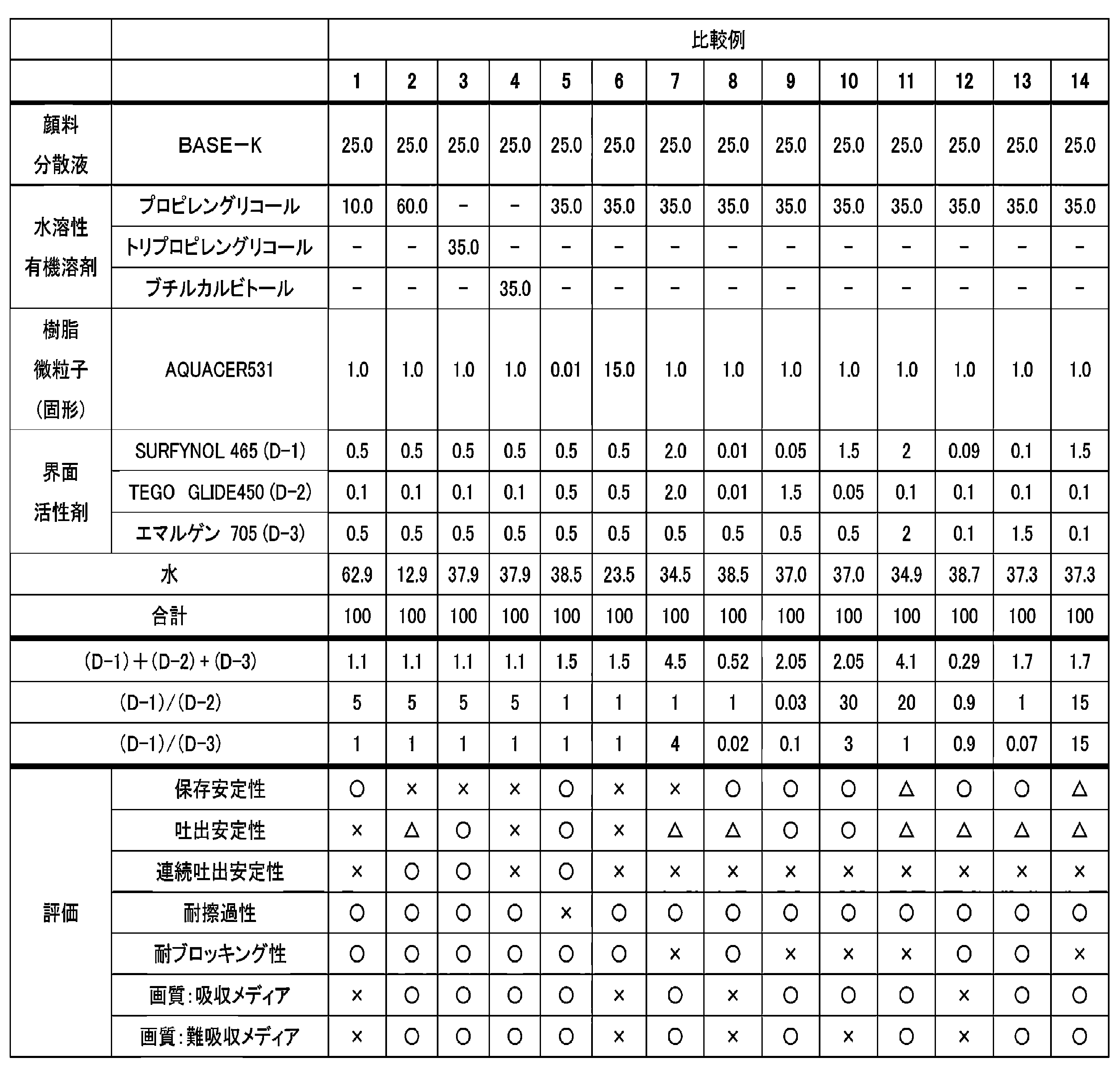
- the ink composition containing 10.0% water-soluble organic solvent (propylene glycol) had insufficient ejection stability and the image quality of the printed matter was also reduced.
- the ink composition containing 60.0% water-soluble organic solvent (propylene glycol) had insufficient storage stability.
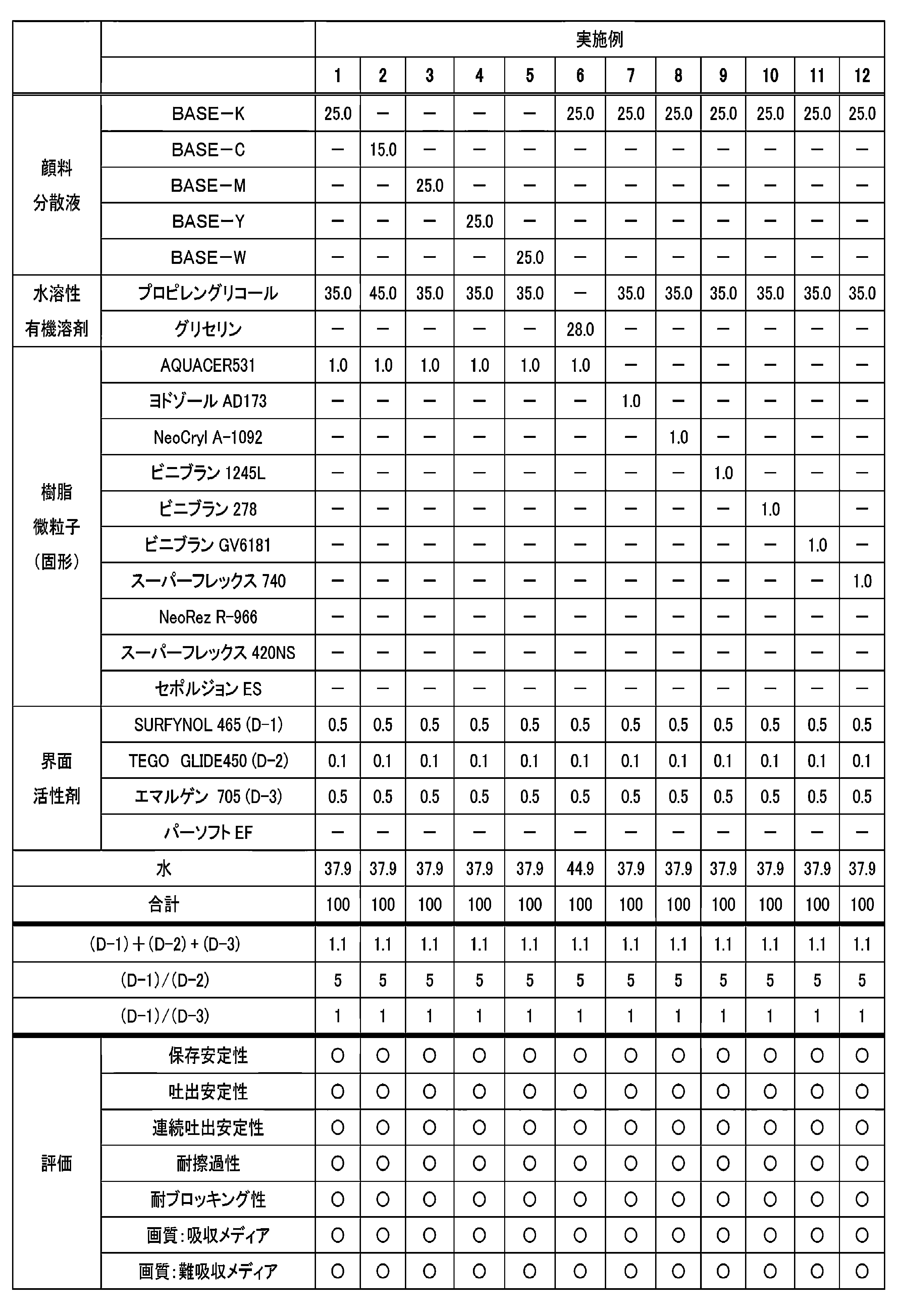
- the ink compositions of each Example containing 28.0 to 45.0% water-soluble organic solvent (propylene glycol or glycol) had good storage stability, sufficient ejection stability, and good image quality.
- the ink composition containing 0.01% by mass of resin microparticles did not provide sufficient abrasion resistance for printed matter.
- the ink composition containing 15.0% by mass of resin microparticles (AQUACER531) did not provide sufficient storage stability, and the ejection stability and image quality of printed matter were also deteriorated.
- Example 27 in Table 3 which contains 0.2% by mass of solid content of resin microparticles
- Example 28 in Table 3 which contains 9.0% by mass of solid content of resin microparticles
- Example 27 had slightly inferior abrasion resistance
- Example 28 had slightly inferior ejection stability and continuous ejection stability
- the ink compositions containing 1.0% by mass of resin microparticles provided high abrasion resistance for printed matter, good storage stability, and good ejection stability for printed matter.
- the ink composition having a total surfactant content did not have sufficient storage stability, and the ejection stability during continuous printing also deteriorated, and the blocking resistance also decreased.
- the ink composition having a total surfactant content of 0.1 to 3.0% by mass had good storage stability, good ejection stability, and high blocking resistance.
- Comparative Example 8 As shown in Comparative Example 8 and Comparative Example 13 in Table 4, when the mass content ratio [(D-1)/(D-3)] of the surfactants (D-1) and (D-3) falls below 0.1, the ejection stability, particularly the continuous ejection stability, deteriorates. In particular, in Comparative Example 8, where the ratio [(D-1)/(D-3)] is 0.02 and the total surfactant content is relatively low (0.52 mass%), the image quality of the printed matter also deteriorated.
- the ink composition with a ratio [(D-1)/(D-3)] of 15 exhibited poor storage stability, poor ejection stability, particularly continuous ejection stability, and poor blocking resistance.
- Comparative Examples 9 and 12 in Table 4 when the mass content ratio [(D-1)/(D-2)] of surfactants (D-1) and (D-2) was below 1.0, the continuous discharge stability deteriorated.
- the mass content ratio [(D-1)/(D-2)] was particularly low at 0.03, meaning that the relative ratio of surfactant (D-2) was high and blocking resistance was also reduced.
- the total surfactant content was relatively low, and the image quality of the printed matter was reduced.
- Comparative Examples 10 and 11 in Table 4 when the ratio [(D-1)/(D-2)] exceeded 10 (30 and 20), the continuous discharge stability deteriorated and blocking resistance decreased. Thus, it can be seen that when the mass content ratio [(D-1)/(D-2)] of the surfactants (D-1) and (D-2) exceeds 10, blocking is more likely to occur. Furthermore, the ink composition of Comparative Example 10 had a small relative amount of surfactant (D-2), which reduced the leveling performance of the ink composition and reduced the image quality of the printout on poorly absorbent media.
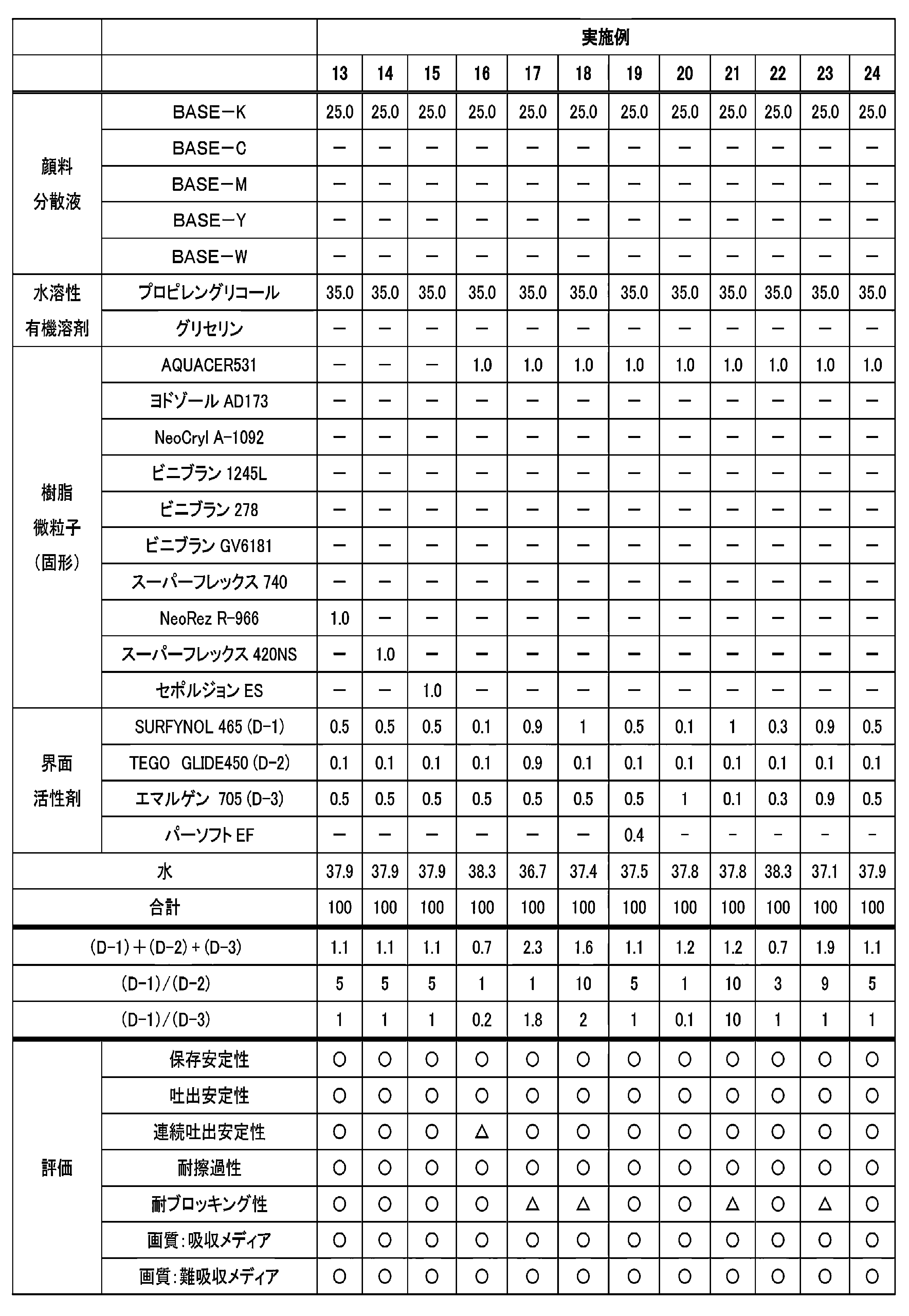
- Example 16 As shown in Tables 1 to 4, the ink compositions of Examples 1 to 35 were evaluated as being sufficient in terms of storage stability, ejection stability, etc. However, as shown in Example 16, when the mass content ratio [(D-1)/(D-3)] was low (0.2), there was a tendency for the ejection stability to decrease during continuous printing.
- the ink composition of the present invention can be printed by inkjet printing, and prints with high abrasion resistance and good image quality can be obtained. Moreover, since the ink composition has good ejection stability in inkjet printing, particularly when printing continuously, it can be used in a wide range of applications as an inkjet printing ink composition.
Landscapes
- Chemical & Material Sciences (AREA)
- Life Sciences & Earth Sciences (AREA)
- Engineering & Computer Science (AREA)
- Materials Engineering (AREA)
- Wood Science & Technology (AREA)
- Organic Chemistry (AREA)
- Inks, Pencil-Leads, Or Crayons (AREA)
- Ink Jet Recording Methods And Recording Media Thereof (AREA)
Abstract
Description
[1]顔料(A)、水溶性有機溶媒(B)、樹脂エマルション(C)、界面活性剤(D)、および水(E)を含有する、インクジェット印刷用インク組成物であって:
前記水溶性有機溶媒(B)は、その分子内に2以上の水酸基を有し、かつ12.0(cal/cm3)1/2以上の、式:「{(ΔH-RT)÷(M÷D)}1/2」(式において、ΔHは蒸発潜熱(cal/mol)、Rは気体定数(1.99 (cal/K・mol))、Tは温度(K)、Mは分子量(g/mol)、Dは密度(g/cm3)を示す)で算出される25℃(298K)でのSP値を有し;
前記水溶性有機溶媒(B)のインク組成物に対する含有量は15.0~50.0質量%であり;
前記樹脂エマルション(C)のインク組成物に対する固形分含有量は0.1~10質量%であり;
前記界面活性剤(D)が、アセチレングリコール系界面活性剤(D-1)と、シリコーン系界面活性剤(D-2)と、アルコールエトキシレート系界面活性剤(D-3)と、を含み;
前記界面活性剤(D)のインク組成物に対する合計含有量は0.1質量%以上かつ3.0質量%以下であり;
前記アセチレングリコール系界面活性剤(D-1)と前記シリコーン系界面活性剤(D-2)との質量含有比率[(D-1)/(D-2)]が、1.0~10.0であり;かつ
前記アセチレングリコール系界面活性剤(D-1)と前記アルコールエトキシレート系界面活性剤(D-3)との質量含有比率[(D-1)/(D-3)]が、0.1~10.0である
インクジェット印刷用インク組成物。
[2]前記シリコーン系界面活性剤(D-2)と前記アルコールエトキシレート系界面活性剤(D-3)との含有質量比率[(D-2)/(D-3)]が、0.1~2.0である、前記[1]に記載のインクジェット印刷用インク組成物。
[3]前記インクジェット印刷用インク組成物に溶解しているアルカリ可溶性樹脂をさらに含む、前記[1]又は[2]に記載のインクジェット印刷用インク組成物。
[4]前記水溶性有機溶媒(B)は、16.0(cal/cm3)1/2以下の前記SP値を有する、前記[1]~[3]のいずれかに記載のインクジェット印刷用インク組成物。
本発明のインクジェット印刷用インク組成物(以下、単に「インク組成物」ともいう)は、顔料(A)、水溶性有機溶媒(B)、樹脂エマルション(C)、界面活性剤(D)、および水(E)を含有し、その他の任意の成分を含んでいてもよい。
本発明のインクジェット印刷用インク組成物に含まれる顔料(A)は、インク組成物に着色力や隠蔽力等を付与するために添加される成分であり、例えば着色顔料、白色顔料、金属パウダー等が挙げられる。このような顔料としては、従来からインク組成物に使用されている、例えば下記の有機及び/又は無機顔料を特に制限なく挙げることができる。
本発明のインクジェット印刷用インク組成物に含まれる水溶性有機溶媒(B)は、その分子内に2以上の水酸基を有するとともに、所定のSP値を有する。SP値とは、溶解性パラメータ(Solubility Parameter)を意味し、水溶性有機溶媒(B)のSP値は以下の式1で求めることができる。
本発明のインクジェット印刷用インク組成物に含まれる樹脂エマルションは、インク組成物において微粒子として分散している樹脂粒子である。前記樹脂エマルションは、水性インクジェット印刷用インク組成物に使用される公知の樹脂エマルションが使用でき、アクリル系樹脂エマルション、スチレン- アクリル系樹脂エマルション、ポリエステル系樹脂エマルション、ポリウレタン系樹脂エマルション、ポリ酢酸ビニル系樹脂エマルション、ポリ塩化ビニル系樹脂エマルション、ポリブタジエン系樹脂エマルション、ポリオレフィン系樹脂エマルション等が挙げられる。インク組成物は、樹脂エマルションを1種単独で、又は2種以上を組み合わせて含有することができる。
本発明のインクジェット印刷用インク組成物に含まれる界面活性剤は、3種の界面活性剤であるアセチレングリコール系界面活性剤(D-1)と、シリコーン系界面活性剤(D-2)と、アルコールエトキシレート系界面活性剤(D-3)と、を含む。
アセチレングリコール系界面活性剤(D-1)とは、アセチレンアルコール、又はアセチレン結合とグリコールユニットとを併せ持つ化合物であり、以下の構造式1で示されうる。アセチレン結合部位が疎水性部位となり、アルコール部位又はグリコール部位が親水性部位となり、界面活性機能を発現しうる。


シリコーン系界面活性剤(D-2)は、ジメチルポリシロキサン(化学式: (C2H6OSi)n)等のポリシロキサン又はその変性体であるが、ポリシロキサンをポリエーテル変性した界面活性剤(ポリエーテル変性シリコーン系界面活性剤)が好ましい。ポリエーテル変性シリコーン系界面活性剤は、インク粘度の上昇を抑制することができるため、高速印刷においてムラのない良好な記録物を得ることに寄与すると考えられる。
HLB=20×[(界面活性剤中に含まれる親水基の分子量)/(界面活性剤の分子量)]
アルコールエトキシレート系界面活性剤(D-3)とは、ポリオキシエチレン鎖とアルキル基とがエーテル結合で結合した化合物であり、「RA-O-(CH2CH2O)d-H」の分子式で示されることができ、ポリ(オキシエチレン)アルキルエーテルと称されることもある。アルコールエトキシレート系界面活性剤(D-3)における、アルキル基(RA)の炭素数、及びエチレンオキシ鎖の平均付加モル数(d)に制限はないが:例えば、アルキル基(RA)の炭素数は11~15程度であることが好ましく、炭素数が12~13程度であることがより好ましく;また、エチレンオキシ鎖の平均付加モル数(d)が3~15程度であることが好ましく、エチレンオキシ基の平均付加モル数が5~10程度であることがより好ましい。
本発明のインクジェット印刷用インク組成物は、界面活性剤(D-1)、(D-2)及び(D-3)以外の界面活性剤(他の界面活性剤)を含有してもよい。他の界面活性剤の例には、アルコールアルコキシレート系界面活性剤、アニオン性界面活性剤等が含まれる。
本発明のインク組成物に含まれる界面活性剤(D)の含有量(界面活性剤(D-1)、(D-2)及び(D-3)、並びに他の界面活性剤の合計含有量)は、0.1質量%以上であり、0.5質量%以上であることが好ましく;また、3.0質量%以下であり、2.5質量%以下であることが好ましく、2.0質量%以下であることがより好ましい。また、界面活性剤(D-1)、(D-2)及び(D-3)の合計含有量は、インク組成物に対して、0.1質量%以上であり、0.5質量%以上であることが好ましく;また、3.0質量%以下であり、2.5質量%以下であることが好ましく、2.0質量%以下であることがより好ましい。界面活性剤(D)の合計含有量が少ないと、インク組成物の表面張力が高くなるため、印刷基材(特に、濡れ性の低い印刷基材)にインク組成物が濡れ広がりにくくなり印刷物の画質が低下しやすくなる。また、インク組成物の印刷における吐出安定性も低下しやすい。一方、界面活性剤の量が多すぎると、印刷物の耐ブロッキング性が低下しやすい。
本発明のインクジェット印刷用インク組成物は水を含む。インク組成物に対する水の含有量は、40質量%以上であることが好ましく、50質量%以上であることがより好ましく;また、70質量%以下であることが好ましく、60質量%以下であることがより好ましい。
本発明のインクジェット印刷用インク組成物は、任意の他の成分を含むことができ;他の成分の例には、顔料分散剤、防黴剤、防錆剤、増粘剤、酸化防止剤、紫外線吸収剤、保存性向上剤、消泡剤、pH調整剤等の添加剤が含まれる。
式: 1/Tg=W1/Tg1+W2/Tg2+W3/Tg3+・・・・・+ Wx/Tgx[式中、Tg1~Tgxはアルカリ可溶性樹脂を構成する単量体1 、2 、3 ・・・x のそれぞれの単独重合体のガラス転移温度、W1~Wxは単量体1 、2 、3 ・・・x のそれぞれの重合分率、Tgは理論ガラス転移温度を表す。ただし、Woodの式におけるガラス転移温度は絶対温度である。]
インクジェット印刷用インク組成物は、23℃において測定される静的表面張力が27mN/m以上33mN/m以下であり、最大泡圧法により23℃において測定される動的表面張力が、寿命時間10m秒において33mN/m以上39mN/m以下である。上記の静的表面張力が27mN/m未満33mN/m超の場合、メニスカスが不安定となる、あるいはノズル面でインクが供給不足となるため、吐出安定性及び連続吐出安定性が不良となる可能性がある。また、上記の動的表面張力が33mN/m未満39mN/m超の場合も同様に、メニスカスが不安定となる、あるいはノズル面でインクが供給不足となるため、吐出安定性及び連続吐出安定性が不良となる可能性がある。
本発明のインクジェット印刷用インク組成物は、インクジェット法によって被印刷物に印刷をするために用いることができる。具体的には、前記水性インクジェット印刷用インク組成物を、被印刷物にインクジェット印刷機を用いて印刷(塗工)して得られる。
まず、以下に示す手順にて、ホワイト顔料、イエロー顔料、マゼンタ顔料、シアン顔料、ブラック顔料のインクベース(顔料分散物)を調製した。アルカリ可溶性樹脂は、アクリル酸とステアリルアクリレートとスチレンとの共重合体であるが、水酸化カリウムによって中和されており、酸価180mgKOH/g、ガラス転移温度50℃、重量平均分子量Mw30000であった。
上記アルカリ可溶性樹脂の32質量部に水48質量部を加え混合し、顔料分散用樹脂ワニスを調製した。このワニスに、更にカーボンブラック(ピグメントブラック7,商品名プリンテックス90、オリオン・エンジニアドカーボンズ社)の20質量部を加え、攪拌混合後、湿式サーキュレーションミルで練肉を行い、水性ブラック顔料インクベース(顔料含有率=20質量%)を調製した。
上記アルカリ可溶性樹脂の32質量部に水48質量部を加え混合し、顔料分散用樹脂ワニスを調製した。このワニスに、更にシアン顔料(ピグメントブルー15:4,商品名ヘリオゲンブルーL7101F、BASF社製)の20質量部を加え、攪拌混合後、湿式サーキュレーションミルで練肉を行い、水性シアン顔料インクベース(顔料含有率=20質量%)を調製した。
上記アルカリ可溶性樹脂の32質量部に水48質量部を加え混合し、顔料分散用樹脂ワニスを調製した。このワニスに、更にマゼンタ顔料(ピグメントバイオレット19,商品名インクジェットマゼンタE5B02、クラリアント社製)の20質量部を加え、攪拌混合後、湿式サーキュレーションミルで練肉を行い、水性マゼンタ顔料インクベース(顔料含有率=20質量%)を調製した。
上記アルカリ可溶性樹脂の32質量部に水48質量部を加え混合し、顔料分散用樹脂ワニスを調製した。このワニスに、更にイエロー顔料(ピグメントイエロー155,商品名ノバパームイエロー4G01、クラリアント社製)の20質量部を加え、攪拌混合後、湿式サーキュレーションミルで練肉を行い、水性イエロー顔料インクベース(顔料含有率=20質量%)を調製した。
上記アルカリ可溶性樹脂の32質量部に水28質量部を加え混合し、顔料分散用樹脂ワニスを調製した。このワニスに、酸化チタン顔料(商品名CR-90、石原産業社製)の40.0質量部を加え、攪拌混合後、湿式サーキュレーションミルで練肉を行い、水性ホワイト顔料インクベース (顔料含有率=40質量%)を得た。
上記A. で調製した各顔料インクベースと、以下に示す成分を用いて、インクジェット印刷用インク組成物を調製した。
・プロピレングリコール:SP値12.6 (cal/cm3)1/2
・グリセリン:SP値14.9 (cal/cm3)1/2
・トリプロピレングリコール:SP値9.0 (cal/cm3)1/2
・ブチルカルビトール:SP値8.9 (cal/cm3)1/2
・AQUACER531(BYK社):ポリエチレン系樹脂
・ヨドゾールAD173(ヘンケル社):アクリル樹脂
・NeoCryl A-1092(コベストロ社):スチレン-アクリル樹脂
・ビニブラン1245L(日信化学工業社):酢酸ビニル-アクリル樹脂
・ビニブラン278(日信化学工業社):塩化ビニル-アクリル樹脂
・ビニブランGV6181(日信化学工業社):酢酸ビニル樹脂
・スーパーフレックス740(第一工業製薬社):ポリエステル系ポリウレタン樹脂
・NeoRez R-966(コベストロ社):ポリエーテル系ポリウレタン樹脂
・スーパーフレックス420NS(第一工業製薬社):ポリカーボネート系ポリウレタン樹脂
・セポルジョンES(住友精化社):ポリエステル系樹脂
・SURFYNOL 465(日信化学工業社):アセチレングリコール系界面活性剤
・オルフィン1004(日信化学工業社):アセチレングリコール系界面活性剤
・TEGO GLIDE 450 (エボニック社) :シリコーン系界面活性剤
・シルフェイスSAG(日信化学工業社):シリコーン系界面活性剤
・エマルゲン705(花王社):アルコールエトキシレート系界面活性剤
・エマルゲン 104(花王社):アルコールエトキシレート系界面活性剤
・パーソフトEF(ADEKA社):アニオン性界面活性剤
表1~4に示す処方組成に沿って、各実施例及び比較例のインク組成物を調製した。具体的には、A. で調製した顔料インクベースに、水溶性有機溶剤と、樹脂微粒子と、界面活性剤と、水と、を加えて攪拌混合した。表1~4に示される樹脂微粒子の含有量は、固形分含量を示す。
各実施例及び比較例で得られた実施例1~35、比較例1~14の水性インクジェット印刷用インク組成物を、以下の項目について評価した。
<C-a. 保存安定性>
実施例1~35、比較例1~14の水性インクジェット印刷用インク組成物をガラス瓶にとり、25℃の粘度を粘度計(東機産業社製 RE100L型)で測定した。その後、密栓し60℃、1ヵ月間保存し、保存後の粘度(25℃)を粘度計により同様に測定した。経時安定性を、粘度変化率[(保存後の粘度-保存前の粘度)/保存前の粘度]で評価した。
評価基準
○:粘度変化率が5%未満のもの
△:粘度変化率が5%以上、10%未満のもの
×:粘度変化率が10%以上、30%未満のもの
実施例1~35、比較例1~14の水性インクジェット印刷用インク組成物を、エプソン社製プリンターPX105のカートリッジに詰めて、写真用紙GL-101A450(キヤノン社製)または遮蔽紙(Wインクのみ)に印字を行い、吐出安定性を評価した。
評価基準
○:印字の乱れがなく、安定して吐出できるもの
△:多少印字の乱れがあるものの、吐出できるもの
×:印字の乱れがあり、安定して吐出できないもの
実施例1~35、比較例1~14の水性インクジェット印刷用インク組成物を、エプソン社製プリンターPX105のカートリッジに詰めて、写真用紙GL-101A450(キヤノン社製)または遮蔽紙(Wインクのみ)に15cmx20cmのベタ画像を50枚連続で印刷し、連続吐出安定性を評価した。
評価基準
○:画質が良好で、安定して吐出できるもの
△:多少スジ等画質の劣化が見られるものの、吐出できるもの
×:スジ等画質の劣化が見られ、安定して吐出できないもの
上記<C-c>で得た各印刷物を80℃のオーブンで3分間乾燥させたあと、綿棒で印刷面をこすって耐擦過性を評価した。
評価基準
○:塗膜面を綿棒で10回摩擦した後でも全くかすれなかった
△:塗膜面を綿棒で10回摩擦した後、綿棒に色が移り、摩擦部分がわずかにかすれた
×:塗膜面を綿棒で10回摩擦した後、摩擦部分が全て剥がれた
上記<C-c>で得た各印刷物の印刷面と非印刷面とを合わせて、バイスでしめこみ、40℃で1日経過後に手で剥がし、インキの剥離の程度と剥離抵抗の強度から、以下の評価基準で印刷物の耐ブロッキング性を評価した。
評価基準
○:印刷皮膜の剥離が全くなかった
△:印刷皮膜が少し剥離し、剥離抵抗が強く感じられた
×:印刷皮膜がほとんど剥離し、剥離抵抗が強く感じられた
実施例1~35、比較例1~14の水性インクジェット印刷用インク組成物を、エプソン社製プリンターPX105のカートリッジに詰めて、写真用紙GL-101A450(キヤノン社製)または遮蔽紙(Wインクのみ)に15cm×20cmのベタ画像を印刷し、印刷物のベタ部の埋まり具合を目視で評価した。
評価基準
〇:ベタ部がきれいに埋まり、スジ感がほとんどない
×:全体的にスジが目立つ
実施例1~35、比較例1~14の水性インクジェット印刷用インク組成物を、エプソン社製プリンターPX105のカートリッジに詰めて、OKトップコート+(王子製紙製)に15cm×20cmのベタ画像を印刷し、印刷物のベタ部の埋まり具合を目視で評価した。
評価基準
〇:ベタ部がきれいに埋まり、スジ感がほとんどない
×:全体的にスジが目立つ

Claims (4)
- 顔料(A)、水溶性有機溶媒(B)、樹脂エマルション(C)、界面活性剤(D)、および水(E)を含有する、インクジェット印刷用インク組成物であって:
前記水溶性有機溶媒(B)は、その分子内に2以上の水酸基を有し、かつ12.0(cal/cm3)1/2以上の、式:「{(ΔH-RT)÷(M÷D)}1/2」(式において、ΔHは蒸発潜熱(cal/mol)、Rは気体定数(1.99 (cal/K・mol))、Tは温度(K)、Mは分子量(g/mol)、Dは密度(g/cm3)を示す)で算出される25℃(298K)でのSP値を有し;
前記水溶性有機溶媒(B)のインク組成物に対する含有量は15.0~50.0質量%であり;
前記樹脂エマルション(C)のインク組成物に対する固形分含有量は0.1~10質量%であり;
前記界面活性剤(D)が、アセチレングリコール系界面活性剤(D-1)と、シリコーン系界面活性剤(D-2)と、アルコールエトキシレート系界面活性剤(D-3)と、を含み;
前記界面活性剤(D)のインク組成物に対する合計含有量は0.1質量%以上かつ3.0質量%以下であり;
前記アセチレングリコール系界面活性剤(D-1)と前記シリコーン系界面活性剤(D-2)との質量含有比率[(D-1)/(D-2)]が、1.0~10.0であり;かつ
前記アセチレングリコール系界面活性剤(D-1)と前記アルコールエトキシレート系界面活性剤(D-3)との質量含有比率[(D-1)/(D-3)]が、0.1~10.0である
インクジェット印刷用インク組成物。 - 前記シリコーン系界面活性剤(D-2)と前記アルコールエトキシレート系界面活性剤
(D-3)との含有質量比率[(D-2)/(D-3)]が、0.1~2.0である、請求項1に記載のインクジェット印刷用インク組成物。 - 前記インクジェット印刷用インク組成物に溶解しているアルカリ可溶性樹脂をさらに含む、請求項1又は2に記載のインクジェット印刷用インク組成物。
- 前記水溶性有機溶媒(B)は、16.0(cal/cm3)1/2以下の前記SP値を有する、請求項1又は2に記載のインクジェット印刷用インク組成物。
Priority Applications (1)
| Application Number | Priority Date | Filing Date | Title |
|---|---|---|---|
| EP23934162.1A EP4700096A1 (en) | 2023-04-17 | 2023-12-27 | Ink composition for ink-jet printing |
Applications Claiming Priority (2)
| Application Number | Priority Date | Filing Date | Title |
|---|---|---|---|
| JP2023067340A JP7334397B1 (ja) | 2023-04-17 | 2023-04-17 | インクジェット印刷用インク組成物 |
| JP2023-067340 | 2023-04-17 |
Publications (1)
| Publication Number | Publication Date |
|---|---|
| WO2024219022A1 true WO2024219022A1 (ja) | 2024-10-24 |
Family
ID=87764128
Family Applications (1)
| Application Number | Title | Priority Date | Filing Date |
|---|---|---|---|
| PCT/JP2023/046904 Ceased WO2024219022A1 (ja) | 2023-04-17 | 2023-12-27 | インクジェット印刷用インク組成物 |
Country Status (3)
| Country | Link |
|---|---|
| EP (1) | EP4700096A1 (ja) |
| JP (1) | JP7334397B1 (ja) |
| WO (1) | WO2024219022A1 (ja) |
Cited By (1)
| Publication number | Priority date | Publication date | Assignee | Title |
|---|---|---|---|---|
| EP4596640A4 (en) * | 2022-09-26 | 2026-01-21 | Sakata Inx Corp | AQUEOUS INK COMPOSITION FOR INKJET AND PRINTED OBJECTS |
Citations (8)
| Publication number | Priority date | Publication date | Assignee | Title |
|---|---|---|---|---|
| JP2000094825A (ja) | 1998-09-22 | 2000-04-04 | Sakata Corp | インクジェット記録方法 |
| WO2005116147A1 (ja) | 2004-05-26 | 2005-12-08 | Sakata Inx Corp. | 樹脂被覆顔料の製造方法、樹脂被覆顔料、水性顔料分散液およびそれを含有する水性着色剤組成物 |
| JP2012193268A (ja) | 2011-03-16 | 2012-10-11 | Fujifilm Corp | インク組成物 |
| JP2017008319A (ja) * | 2015-06-25 | 2017-01-12 | 花王株式会社 | 水性インク |
| JP2019119786A (ja) | 2017-12-28 | 2019-07-22 | 花王株式会社 | 水系インク |
| JP2020050705A (ja) | 2018-09-25 | 2020-04-02 | 株式会社リコー | インク、インクジェット印刷方法および印刷物 |
| WO2020218287A1 (ja) | 2019-04-23 | 2020-10-29 | 東洋インキScホールディングス株式会社 | 水性インクジェットインキ、水性インクジェットインキセット、水性インクジェットインキ印刷物の製造方法、及び印刷物 |
| JP7210802B1 (ja) | 2022-09-26 | 2023-01-23 | サカタインクス株式会社 | 水性インクジェット用インク組成物、及び印刷物 |
-
2023
- 2023-04-17 JP JP2023067340A patent/JP7334397B1/ja active Active
- 2023-12-27 WO PCT/JP2023/046904 patent/WO2024219022A1/ja not_active Ceased
- 2023-12-27 EP EP23934162.1A patent/EP4700096A1/en active Pending
Patent Citations (9)
| Publication number | Priority date | Publication date | Assignee | Title |
|---|---|---|---|---|
| JP2000094825A (ja) | 1998-09-22 | 2000-04-04 | Sakata Corp | インクジェット記録方法 |
| WO2005116147A1 (ja) | 2004-05-26 | 2005-12-08 | Sakata Inx Corp. | 樹脂被覆顔料の製造方法、樹脂被覆顔料、水性顔料分散液およびそれを含有する水性着色剤組成物 |
| JP2012193268A (ja) | 2011-03-16 | 2012-10-11 | Fujifilm Corp | インク組成物 |
| JP2017008319A (ja) * | 2015-06-25 | 2017-01-12 | 花王株式会社 | 水性インク |
| JP2019119786A (ja) | 2017-12-28 | 2019-07-22 | 花王株式会社 | 水系インク |
| JP2020050705A (ja) | 2018-09-25 | 2020-04-02 | 株式会社リコー | インク、インクジェット印刷方法および印刷物 |
| WO2020218287A1 (ja) | 2019-04-23 | 2020-10-29 | 東洋インキScホールディングス株式会社 | 水性インクジェットインキ、水性インクジェットインキセット、水性インクジェットインキ印刷物の製造方法、及び印刷物 |
| JP2020180178A (ja) | 2019-04-23 | 2020-11-05 | 東洋インキScホールディングス株式会社 | 水性インクジェットインキ、水性インクジェットインキセット、印刷物の製造方法、および印刷物 |
| JP7210802B1 (ja) | 2022-09-26 | 2023-01-23 | サカタインクス株式会社 | 水性インクジェット用インク組成物、及び印刷物 |
Non-Patent Citations (2)
| Title |
|---|
| J.A. BRYDSON: "Plastics Materials", 1995 |
| See also references of EP4700096A1 |
Cited By (1)
| Publication number | Priority date | Publication date | Assignee | Title |
|---|---|---|---|---|
| EP4596640A4 (en) * | 2022-09-26 | 2026-01-21 | Sakata Inx Corp | AQUEOUS INK COMPOSITION FOR INKJET AND PRINTED OBJECTS |
Also Published As
| Publication number | Publication date |
|---|---|
| JP2024153441A (ja) | 2024-10-29 |
| JP7334397B1 (ja) | 2023-08-29 |
| EP4700096A1 (en) | 2026-02-25 |
Similar Documents
| Publication | Publication Date | Title |
|---|---|---|
| JP6532296B2 (ja) | 水性インクジェット用インク組成物 | |
| US9309425B2 (en) | Ink and printing process | |
| WO2019131131A1 (ja) | 水系インク | |
| WO2022176228A1 (ja) | 水性インクジェット用インク組成物、印刷物、及びインクジェット印刷方法 | |
| JP7210802B1 (ja) | 水性インクジェット用インク組成物、及び印刷物 | |
| WO2024219022A1 (ja) | インクジェット印刷用インク組成物 | |
| JP7358691B1 (ja) | インクジェット印刷用インク組成物 | |
| WO2023218734A1 (ja) | 水性インクジェット用インク組成物、及び印刷物 | |
| JP7619514B2 (ja) | 水性インクジェットインキ及び印刷物 | |
| JP7536986B1 (ja) | 水性インクジェットインキ及び印刷物 | |
| CA3288961A1 (en) | Ink composition for inkjet printing | |
| JP7800129B2 (ja) | 処理液とインクのセット、画像形成方法、及び画像形成装置 | |
| JP7304784B2 (ja) | 印刷方法 | |
| CA3288962A1 (en) | Ink composition for inkjet printing | |
| US7427320B2 (en) | Ink compositions containing ethylene glycol monobutyl ether | |
| JP7121246B2 (ja) | 記録液セット | |
| JP2013176948A (ja) | 油性インクジェット印刷方法及びインクセット | |
| JP2004210906A (ja) | インクジェット用インク、インクジェット記録方法およびカール低減方法 | |
| JP2025041130A (ja) | インクジェットインク組成物及び記録方法 | |
| JP2025185361A (ja) | 印刷物の製造方法 | |
| WO2012153120A1 (en) | Process for printing and substrates | |
| WO2025205000A1 (ja) | 水性インクジェットインキ及び印刷物 | |
| JP2025076978A (ja) | インクジェット用水性顔料分散体、及び、水性インクジェットインキ | |
| WO2023145181A1 (ja) | インクセット、及び印刷物 | |
| EP3828241A1 (en) | Aqueous pigment concentrate, aqueous inkjet ink and use thereof |
Legal Events
| Date | Code | Title | Description |
|---|---|---|---|
| 121 | Ep: the epo has been informed by wipo that ep was designated in this application |
Ref document number: 23934162 Country of ref document: EP Kind code of ref document: A1 |
|
| WWE | Wipo information: entry into national phase |
Ref document number: 2023934162 Country of ref document: EP |
|
| NENP | Non-entry into the national phase |
Ref country code: DE |
|
| ENP | Entry into the national phase |
Ref document number: 2023934162 Country of ref document: EP Effective date: 20251117 |
|
| ENP | Entry into the national phase |
Ref document number: 2023934162 Country of ref document: EP Effective date: 20251117 |
|
| ENP | Entry into the national phase |
Ref document number: 2023934162 Country of ref document: EP Effective date: 20251117 |
|
| ENP | Entry into the national phase |
Ref document number: 2023934162 Country of ref document: EP Effective date: 20251117 |
|
| ENP | Entry into the national phase |
Ref document number: 2023934162 Country of ref document: EP Effective date: 20251117 |
|
| ENP | Entry into the national phase |
Ref document number: 2023934162 Country of ref document: EP Effective date: 20251117 |
|
| ENP | Entry into the national phase |
Ref document number: 2023934162 Country of ref document: EP Effective date: 20251117 |
|
| ENP | Entry into the national phase |
Ref document number: 2023934162 Country of ref document: EP Effective date: 20251117 |
|
| ENP | Entry into the national phase |
Ref document number: 2023934162 Country of ref document: EP Effective date: 20251117 |
|
| WWP | Wipo information: published in national office |
Ref document number: 2023934162 Country of ref document: EP |