WO2024228295A1 - 分析装置、分析方法及び分析プログラム - Google Patents
分析装置、分析方法及び分析プログラム Download PDFInfo
- Publication number
- WO2024228295A1 WO2024228295A1 PCT/JP2024/008140 JP2024008140W WO2024228295A1 WO 2024228295 A1 WO2024228295 A1 WO 2024228295A1 JP 2024008140 W JP2024008140 W JP 2024008140W WO 2024228295 A1 WO2024228295 A1 WO 2024228295A1
- Authority
- WO
- WIPO (PCT)
- Prior art keywords
- analysis
- unit
- cox proportional
- test
- proportional hazards
- Prior art date
- Legal status (The legal status is an assumption and is not a legal conclusion. Google has not performed a legal analysis and makes no representation as to the accuracy of the status listed.)
- Ceased
Links
Images



Classifications
-
- H—ELECTRICITY
- H04—ELECTRIC COMMUNICATION TECHNIQUE
- H04L—TRANSMISSION OF DIGITAL INFORMATION, e.g. TELEGRAPHIC COMMUNICATION
- H04L9/00—Cryptographic mechanisms or cryptographic arrangements for secret or secure communications; Network security protocols
- H04L9/08—Key distribution or management, e.g. generation, sharing or updating, of cryptographic keys or passwords
- H04L9/0816—Key establishment, i.e. cryptographic processes or cryptographic protocols whereby a shared secret becomes available to two or more parties, for subsequent use
- H04L9/085—Secret sharing or secret splitting, e.g. threshold schemes
-
- G—PHYSICS
- G06—COMPUTING OR CALCULATING; COUNTING
- G06F—ELECTRIC DIGITAL DATA PROCESSING
- G06F21/00—Security arrangements for protecting computers, components thereof, programs or data against unauthorised activity
- G06F21/60—Protecting data
- G06F21/62—Protecting access to data via a platform, e.g. using keys or access control rules
- G06F21/6218—Protecting access to data via a platform, e.g. using keys or access control rules to a system of files or objects, e.g. local or distributed file system or database
- G06F21/6245—Protecting personal data, e.g. for financial or medical purposes
-
- G—PHYSICS
- G06—COMPUTING OR CALCULATING; COUNTING
- G06F—ELECTRIC DIGITAL DATA PROCESSING
- G06F21/00—Security arrangements for protecting computers, components thereof, programs or data against unauthorised activity
- G06F21/70—Protecting specific internal or peripheral components, in which the protection of a component leads to protection of the entire computer
- G06F21/71—Protecting specific internal or peripheral components, in which the protection of a component leads to protection of the entire computer to assure secure computing or processing of information
-
- H—ELECTRICITY
- H04—ELECTRIC COMMUNICATION TECHNIQUE
- H04L—TRANSMISSION OF DIGITAL INFORMATION, e.g. TELEGRAPHIC COMMUNICATION
- H04L2209/00—Additional information or applications relating to cryptographic mechanisms or cryptographic arrangements for secret or secure communication H04L9/00
- H04L2209/46—Secure multiparty computation, e.g. millionaire problem
Definitions
- the present invention relates to an analysis device, an analysis method, and an analysis program.
- Secure computation systems are known that perform statistical calculations while keeping data secret, and provide users with the statistics obtained as a result of the calculations.
- secure computation systems are sometimes used to analyze data in fields such as the medical field, which handles important personal information.
- Secure computation systems that perform statistical processing on encrypted data are also known.
- a technique is known that uses encrypted data to find parameters for logistic regression analysis (see, for example, Patent Document 2).
- Cox proportional hazards regression analysis is a method similar to logistic regression analysis that is used for survival time analysis (see, for example, Patent Document 3).
- the analysis device of the present invention is characterized by having a testing unit that performs testing of the Cox proportional hazards regression analysis by secret calculation using at least one of the partial regression coefficients, Hessian matrix, and score vector obtained by the Cox proportional hazards regression analysis by secret calculation, and an output control unit that outputs the results of the testing by the testing unit.
- the present invention makes it possible to test Cox proportional hazards regression analysis performed using secret computation.
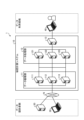
- FIG. 1 is a diagram illustrating an example of the configuration of an analysis system according to an embodiment.
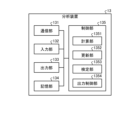
- FIG. 2 is a diagram illustrating an example of the configuration of the analysis device according to the embodiment.
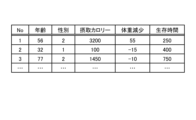
- FIG. 3 is a diagram illustrating an example of learning data.
- FIG. 4 is a diagram showing the definitions of symbols.
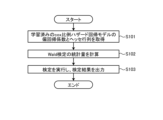
- FIG. 5 is a flow chart showing the flow of the Wald test.
- FIG. 6 is a flow chart showing the flow of the Score test.
- FIG. 7 is a flowchart showing the flow of the likelihood ratio test.
- FIG. 8 is a flowchart showing the flow of the process of calculating the log partial likelihood.
- FIG. 9 illustrates an example of a computer that executes an analysis program.
- the analysis system is a system for analyzing data using secure computation.
- the analysis system 1 includes a secure computation system 10.
- the secure computation system 10 is also connected to a providing device 20 and a providing device 30 via a network N.
- the network N is the Internet.
- the secure computation system 10 is also connected to a terminal device 40.
- the providing device 20 and the providing device 30 are devices on the data provider side.
- the providing device 20 and the providing device 30 provide (register) data to the secure computing system 10.
- the data provided by the providing device 20 and the providing device 30 includes information that is desirably kept confidential (e.g., personal information such as an individual's name and address).
- the providing device 20 and the providing device 30 provide medical treatment data or health checkup data used in medical institutions.
- the data provided by the providing device 20 and the providing device 30 is not limited to data used in medical institutions.
- the secure computation system 10 has a data storage unit 11 and a data processing unit 12.
- the data storage unit 11 includes a plurality of storage devices (storage device 111, storage device 112, storage device 113) that store data by secret sharing.
- the data processing unit 12 includes a plurality of computation devices (computation device 121, computation device 122, computation device 123) that process data by secure computation. Note that the number of storage devices and the number of computation devices are not limited to the example shown in FIG. 1.
- the secure computation system 10 can perform secret sharing and secure computation according to the method described in Non-Patent Document 1 (URL: https://www.rd.ntt/sil/project/sc/secure_computation.html).
- the data provided to the secure computing system 10 is divided (fragmented) into multiple shares. Then, each of the multiple shares is distributed and stored in multiple storage devices included in the data storage unit 11. In the example of FIG. 1, the provided data is divided into three shares. Then, storage device 111, storage device 112, and storage device 113 each store one share.
- the data processing unit 12 performs secure computation on the shares accumulated in the data accumulation unit 11.
- the data processing unit 12 performs secure computation by multi-party computation using multiple computing devices.
- the data processing unit 12 performs secure computation by computing device 121, computing device 122, and computing device 123.
- the data processing unit 12 can perform various statistical calculations without restoring the shares.
- the data processing unit 12 can perform table operations such as sorting and joining, tallying the number of records, calculating statistics such as sums, averages, maximum values, minimum values, and sample variances, and performing statistical tests such as t-tests.
- the data processing unit 12 can perform statistical analyses such as regression analysis and principal component analysis.
- the analysis device 13 uses the data processing unit 12 to analyze the data.
- the analysis device 13 provides the analysis result to the terminal device 40 on the data user side based on the result of the secret calculation executed by the data processing unit 12. The user can obtain the data analysis result via the terminal device 40.
- the secure computing system 10 may be provided with data on the attributes and physical condition of each individual.
- the data on the attributes and physical condition is personal information that is preferably kept confidential.
- the data on the attributes and physical condition includes, for example, age, sex, height, weight, etc.
- the data storage unit 11 stores fragmented shares of the provided data in each storage device.
- each divided share is meaningless data on its own. Therefore, it is not possible to restore the original data from a single share. However, by collecting multiple shares, it is possible to restore the original data.
- the user of the data cannot view the registered data itself, but can view the results of the analysis of the data via the analysis device 13 and the terminal device 40.
- the data includes the gender and weight of individuals, the user cannot view the gender and weight of each individual, but can view the "average weight of men," which is the result of the analysis of the data.
- the data storage unit 11 can perform secret sharing using a technique known as Shamir's threshold secret sharing method.
- the data storage unit 11 stores three coordinates that pass through a polynomial with the original data as an intercept in each server as shares. Furthermore, since the slope of the polynomial is determined randomly, the shares are not necessarily the same each time even if the original data is the same.
- the original data may be a numeric value, or may be data that has already been converted into a numeric value.
- the secure computing system 10 can restore the original data from multiple shares. If the polynomial is a linear expression, the secure computing system 10 can find the intercept (corresponding to the original data) from the intersection of the axis and a straight line connecting two coordinates (corresponding to shares). On the other hand, since a straight line cannot be determined from a single coordinate, the original data cannot be restored.
- the data processing unit 12 can perform secure computation on the original data without restoring the shares.
- the result of adding the shares represented by coordinates corresponds to the share resulting from adding the original data of each share.
- the analysis device 13 In response to a request from the terminal device 40, the analysis device 13 causes the data processing unit 12 to execute processing using secret calculations.
- the data processing unit 12 or the terminal device 40 may realize functions equivalent to those of the analysis device 13.
- the analysis system 1 may be configured without the analysis device 13.
- the terminal device 40 is connected to the data processing unit 12 and executes processing equivalent to that of the analysis device 13.
- statistical calculations based on shares may be executed by the terminal device 40 rather than the data processing unit 12.
- the analysis device 13 performs Cox proportional hazards regression analysis and testing of the Cox proportional hazards regression analysis using secret calculations.
- FIG. 2 is a diagram showing an example of the configuration of the analysis device according to an embodiment.
- the analysis device 13 has a communication unit 131, an input unit 132, an output unit 133, a memory unit 134, and a control unit 135.
- the communication unit 131 communicates data with other devices.
- the communication unit 131 is a NIC (Network Interface Card).
- the communication unit 131 can send and receive data with other devices.
- the input unit 132 is an interface for accepting data input.
- the input unit 132 is connected to input devices such as a mouse and a keyboard.
- the output unit 133 is an interface for outputting data.
- the output unit 133 is connected to input devices such as a display and a speaker.
- the memory unit 134 is a storage device such as a hard disk drive (HDD), a solid state drive (SSD), or an optical disk.
- the memory unit 134 may be a semiconductor memory in which data can be rewritten, such as a random access memory (RAM), a flash memory, or a non-volatile static random access memory (NVSRAM).
- the memory unit 134 stores the operating system (OS) and various programs executed by the analysis device 13.
- OS operating system
- the control unit 135 controls the entire analysis device 13.
- the control unit 135 is, for example, an electronic circuit such as a CPU (Central Processing Unit), MPU (Micro Processing Unit), or GPU (Graphics Processing Unit), or an integrated circuit such as an ASIC (Application Specific Integrated Circuit) or FPGA (Field Programmable Gate Array).
- the control unit 135 also has an internal memory for storing programs that define various processing procedures and control data, and executes each process using the internal memory.
- the control unit 135 functions as various processing units by running various programs.
- the control unit 135 has a calculation unit 1351, an update unit 1352, a test unit 1353, and an output control unit 1354.
- the calculation unit 1351 performs Cox proportional hazards regression calculations using secret calculations.
- the calculation unit 1351 inputs explanatory variables to the Cox proportional hazards regression model and outputs a target variable.
- Figure 4 shows the definitions of the symbols used in the following explanation.
- Figure 4 shows the definitions of the symbols.
- N is the number of records.
- k is the number of attributes (explanatory variables).
- the data set X includes attribute information for each record in an N x k matrix.
- the i-th record is ( x1 ,..., xk ).
- the result is information indicating whether a record is alive or dead.
- t is the observation time.
- y is a binary value: 0 (alive) or 1 (dead).
- the partial regression coefficients and score vector are expressed as column vectors.
- the score vector is the first derivative of the log partial likelihood.
- the Hessian matrix is the second derivative of the log partial likelihood.
- partial regression coefficients score vectors, Hessian matrices, and log partial likelihoods are given a subscript 0. The method for calculating log partial likelihoods will be described later.
- the update unit 1352 updates the parameters of the Cox proportional hazards regression model using secret calculations so that the objective variable calculated by the calculation unit 1351 approaches the correct value.
- the Cox proportional hazards regression model is learned by performing the processes of the calculation unit 1351 and the update unit 1352 once or multiple times.
- Figure 3 shows an example of training data.
- the values in the "Age”, “Gender”, “Calorie Intake”, and “Weight Loss” columns in Figure 3 are explanatory variables of the Cox proportional hazards regression model.
- the predicted survival rate based on the values in the "Survival Time” column is the objective variable of the Cox proportional hazards regression model, and corresponds to the hazard function h(t
- Calculation unit 1351 inputs the values of the "age”, “gender”, “calorie intake”, and “weight loss” columns into the Cox proportional hazards regression model to obtain an output.
- Update unit 1352 updates the parameters of the Cox proportional hazards regression model so that the output obtained by calculation unit 1351 approaches the predicted survival rate based on the value of the "survival time" column.
- the testing unit 1353 tests the Cox proportional hazards regression model. In secure computation, it is difficult to obtain the learning data itself from outside. Therefore, the testing unit 1353 calculates statistics for testing based on the limited information that can be obtained.
- the testing unit 1353 performs testing of the Cox proportional hazards regression analysis by secure computation using at least one of the partial regression coefficients, Hessian matrix, and score vector obtained by the Cox proportional hazards regression analysis by secure computation.
- the testing unit 1353 obtains information related to the Cox proportional hazards regression analysis, such as the partial regression coefficients, Hessian matrix, and score vector, from the secure computation system 10.
- the following describes the processing performed by the testing unit 1353 when performing the Wald test, score test, and likelihood ratio test.
- (Wald test) 5 is a flowchart showing the flow of the Wald test. As shown in Fig. 5, the test unit 1353 acquires the partial regression coefficients and the Hessian matrix of the trained Cox proportional hazards regression model from the secure computation system 10 (step S101).
- the testing unit 1353 calculates the statistics of the Wald test as shown in formula (1) (step S102). Then, the testing unit 1353 executes the test and outputs the test result via the output control unit 1354 (step S103). However, if the initial partial regression coefficient is set to 0, the testing unit 1353 calculates the statistics using formula (2).
- the testing unit 1353 calculates the statistics of the Wald test based on the partial regression coefficients and the Hessian matrix, and performs a chi-square test based on the statistics.
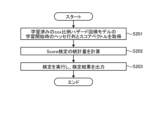
- Fig. 6 is a flowchart showing the flow of the score test.
- the test unit 1353 acquires the Hessian matrix (initial Hessian matrix in Fig. 4) and the score vector (initial score vector in Fig. 4) at the start of learning of the trained Cox proportional hazards regression model from the secure computation system 10 (step S201).
- the testing unit 1353 calculates the statistics of the score test as shown in formula (3) (step S202). Then, the testing unit 1353 executes the test and outputs the test result via the output control unit 1354 (step S203).
- the testing unit 1353 calculates the statistics for the score test based on the Hessian matrix and score vector at the start of learning the regression model of the Cox proportional hazards regression analysis, and performs a chi-square test based on the statistics.
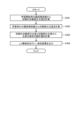
- (Likelihood ratio test) 7 is a flowchart showing the flow of the likelihood ratio test.
- the test unit 1353 acquires the partial regression coefficients and the Hessian matrix of the trained Cox proportional hazards regression model from the secure computation system 10.
- each record in the training data in Figure 3 corresponds to an individual patient, and the hazard function of the Cox proportional hazards regression model represents the patient's survival probability at a certain time. Whether or not a patient has died at a certain time can be derived from the survival time of the training data.
- records that correspond to patients who are deceased at the specified time are called death records. Also, among the records in the training data, records that correspond to patients who are not deceased at the specified time are called remaining records.
- the testing unit 1353 calculates the initial log partial likelihood from the partial regression coefficients at the start of learning (step S301). The testing unit 1353 also calculates the log partial likelihood from the learned partial regression coefficients (step S302).
- the test unit 1353 calculates the log partial likelihood by equation (4).
- the test unit 1353 also calculates the initial log partial likelihood by an equation in which ⁇ in equation (4) is replaced with ⁇ 0. The calculation of the log partial likelihood will be described later in detail.
- the testing unit 1353 calculates the statistics of the likelihood ratio test from the initial logarithmic partial likelihood and the logarithmic partial likelihood as shown in equation (5) (step S303). Then, the testing unit 1353 performs a chi-square test and outputs the test result (step S304).
- FIG. 8 is a flowchart showing the process flow for calculating the log partial likelihood. As shown in FIG. 8, first, the testing unit 1353 uses secure computation sorting to sort the records of the dataset in ascending order by time (step S311).
- the testing unit 1353 calculates the partial regression coefficient and the product-sum value of the record using a secure computational product-sum (step S312).
- the testing unit 1353 also calculates the mortality risk (exp on the right-hand side of equation (4)), which is the exponential value of the product-sum value, using a secure computation mapping (step S313).
- the testing unit 1353 calculates the logarithm of the sum of the mortality risks (the log of the right-hand side of equation (4)) using the secure computation mapping (step S315).
- the testing unit 1353 calculates the difference between the sum-of-products value and the logarithm value by secure subtraction (the subtraction on the right side of equation (4)) (step S316). Furthermore, the testing unit 1353 uses the sum-of-products-of-products secure calculation to calculate the logarithm partial likelihood from the survival/death information (y i in equation (4)) and the result of the subtraction (step S317).
- the testing unit 1353 uses secret calculation to calculate the sum of the products of the death records and partial regression coefficients used in training the regression model of the Cox proportional hazards regression analysis as the first mortality risk, and uses secret calculation to calculate the sum of the products of the remaining records and partial regression coefficients used in training the regression model as the second mortality risk, calculates the log-likelihood based on the first mortality risk and the second mortality risk, and performs testing based on the log-likelihood.
- the analysis device 13 includes the testing unit 1353 and the output control unit 1354.
- the testing unit 1353 performs testing of the Cox proportional hazards regression analysis by secure computation using at least one of the partial regression coefficient, the Hessian matrix, and the score vector obtained by the Cox proportional hazards regression analysis by secure computation.
- the output control unit 1354 outputs the result of the testing by the testing unit 1353.
- the testing unit 1353 calculates statistics for the Wald test based on the partial regression coefficients and the Hessian matrix, and performs the test based on the statistics.
- the testing unit 1353 calculates statistics for the score test based on the Hessian matrix and score vector at the start of learning of the regression model of Cox proportional hazards regression analysis, and performs the test based on the statistics.
- the testing unit 1353 uses secret calculation to calculate the sum of the products of the death records and partial regression coefficients used in training the regression model of the Cox proportional hazards regression analysis as a first mortality risk, and uses secret calculation to calculate the sum of the products of the remaining records and partial regression coefficients used in training the regression model as a second mortality risk, calculates a log-likelihood based on the first mortality risk and the second mortality risk, and performs testing based on the log-likelihood.
- the analysis device 13 can perform Wald tests, score tests, and likelihood ratio tests.
- each component of each device shown in the figure is functionally conceptual, and does not necessarily have to be physically configured as shown in the figure.
- the specific form of distribution and integration of each device is not limited to that shown in the figure, and all or a part of it can be functionally or physically distributed or integrated in any unit depending on various loads, usage conditions, etc.
- each processing function performed by each device can be realized in whole or in part by a CPU (Central Processing Unit) and a program analyzed and executed by the CPU, or can be realized as hardware by wired logic. Note that the program may be executed not only by the CPU but also by other processors such as a GPU.
- the analysis device 13 can be implemented by installing an analysis program that executes the above-mentioned analysis processing as package software or online software on a desired computer.
- the above-mentioned analysis program can be executed by an information processing device, thereby making the information processing device function as the analysis device 13.
- the information processing device referred to here includes desktop or notebook personal computers.
- the information processing device also includes mobile communication terminals such as smartphones, mobile phones, and PHS (Personal Handyphone Systems), as well as slate terminals such as PDAs (Personal Digital Assistants).
- the analysis device 13 can also be implemented as an analysis server device that provides services related to the above-mentioned analysis processing to a client, the client being a terminal device used by a user.
- the analysis server device is implemented as a server device that provides an analysis service that receives as input the partial regression coefficients, Hessian matrix, and score vector obtained by Cox proportional hazards regression analysis using secret computation, and outputs the test results of the Cox proportional hazards regression analysis.
- FIG. 9 is a diagram showing an example of a computer that executes an analysis program.
- the computer 1000 has, for example, a memory 1010 and a CPU 1020.
- the computer 1000 also has a hard disk drive interface 1030, a disk drive interface 1040, a serial port interface 1050, a video adapter 1060, and a network interface 1070. Each of these components is connected by a bus 1080.
- the memory 1010 includes a ROM (Read Only Memory) 1011 and a RAM (Random Access Memory) 1012.
- the ROM 1011 stores a boot program such as a BIOS (Basic Input Output System).
- BIOS Basic Input Output System
- the hard disk drive interface 1030 is connected to a hard disk drive 1090.
- the disk drive interface 1040 is connected to a disk drive 1100.
- a removable storage medium such as a magnetic disk or optical disk is inserted into the disk drive 1100.
- the serial port interface 1050 is connected to a mouse 1110 and a keyboard 1120, for example.
- the video adapter 1060 is connected to a display 1130, for example.
- the hard disk drive 1090 stores, for example, an OS 1091, an application program 1092, a program module 1093, and program data 1094. That is, the programs that define each process of the analysis device 13 are implemented as program modules 1093 in which computer-executable code is written.
- the program modules 1093 are stored, for example, in the hard disk drive 1090.
- a program module 1093 for executing processes similar to the functional configuration of the analysis device 13 is stored in the hard disk drive 1090.
- the hard disk drive 1090 may be replaced by an SSD (Solid State Drive).
- the setting data used in the processing of the above-mentioned embodiment is stored as program data 1094, for example, in memory 1010 or hard disk drive 1090.
- the CPU 1020 reads out the program module 1093 or program data 1094 stored in memory 1010 or hard disk drive 1090 into RAM 1012 as necessary, and executes the processing of the above-mentioned embodiment.
- the program module 1093 and program data 1094 may not necessarily be stored in the hard disk drive 1090, but may be stored in a removable storage medium, for example, and read by the CPU 1020 via the disk drive 1100 or the like.
- the program module 1093 and program data 1094 may be stored in another computer connected via a network (such as a LAN (Local Area Network), WAN (Wide Area Network)).
- the program module 1093 and program data 1094 may then be read by the CPU 1020 from the other computer via the network interface 1070.
Landscapes
- Engineering & Computer Science (AREA)
- Theoretical Computer Science (AREA)
- Computer Hardware Design (AREA)
- Physics & Mathematics (AREA)
- Computer Security & Cryptography (AREA)
- Software Systems (AREA)
- Health & Medical Sciences (AREA)
- General Health & Medical Sciences (AREA)
- General Engineering & Computer Science (AREA)
- General Physics & Mathematics (AREA)
- Bioethics (AREA)
- Databases & Information Systems (AREA)
- Medical Informatics (AREA)
- Mathematical Physics (AREA)
- Computer Networks & Wireless Communication (AREA)
- Signal Processing (AREA)
- Management, Administration, Business Operations System, And Electronic Commerce (AREA)
- Complex Calculations (AREA)
Abstract
Description
図5は、Wald検定の流れを示すフローチャートである。図5に示すように、検定部1353は、秘密計算システム10から、学習済みのCox比例ハザード回帰モデルの偏回帰係数とヘッセ行列を取得する(ステップS101)。


図6は、Score検定の流れを示すフローチャートである。図6に示すように、検定部1353は、秘密計算システム10から、学習済みのCox比例ハザード回帰モデルの学習開始時のヘッセ行列(図4の初期ヘッセ行列)とスコアベクトル(図4の初期スコアベクトル)を取得する(ステップS201)。

図7は、尤度比検定の流れを示すフローチャートである。検定部1353は、秘密計算システム10から、学習済みのCox比例ハザード回帰モデルの偏回帰係数とヘッセ行列を取得する。


これまで説明してきたように、分析装置13は、検定部1353及び出力制御部1354を有する。検定部1353は、秘密計算によるCox比例ハザード回帰分析によって得られた偏回帰係数、ヘッセ行列、及びスコアベクトルの少なくともいずれかを用いて、Cox比例ハザード回帰分析の検定を秘密計算により行う。出力制御部1354は、検定部1353による検定の結果を出力する。
また、図示した各装置の各構成要素は機能概念的なものであり、必ずしも物理的に図示のように構成されていることを要しない。すなわち、各装置の分散及び統合の具体的形態は図示のものに限られず、その全部又は一部を、各種の負荷や使用状況等に応じて、任意の単位で機能的又は物理的に分散又は統合して構成することができる。さらに、各装置にて行われる各処理機能は、その全部又は任意の一部が、CPU(Central Processing Unit)及び当該CPUにて解析実行されるプログラムにて実現され、あるいは、ワイヤードロジックによるハードウェアとして実現され得る。なお、プログラムは、CPUだけでなく、GPU等の他のプロセッサによって実行されてもよい。
一実施形態として、分析装置13は、パッケージソフトウェアやオンラインソフトウェアとして上記の分析処理を実行する分析プログラムを所望のコンピュータにインストールさせることによって実装できる。例えば、上記の分析プログラムを情報処理装置に実行させることにより、情報処理装置を分析装置13として機能させることができる。ここで言う情報処理装置には、デスクトップ型又はノート型のパーソナルコンピュータが含まれる。また、その他にも、情報処理装置にはスマートフォン、携帯電話機やPHS(Personal Handyphone System)等の移動体通信端末、さらには、PDA(Personal Digital Assistant)等のスレート端末等がその範疇に含まれる。
10 秘密計算システム
11 データ蓄積部
12 データ処理部
13 分析装置
131 通信部
132 入力部
133 出力部
134 記憶部
135 制御部
1351 計算部
1352 更新部
1353 検定部
1354 出力制御部
Claims (6)
- 秘密計算によるCox比例ハザード回帰分析によって得られた偏回帰係数、ヘッセ行列、及びスコアベクトルの少なくともいずれかを用いて、前記Cox比例ハザード回帰分析の検定を秘密計算により行う検定部と、
前記検定部による検定の結果を出力する出力制御部と、
を有することを特徴とする分析装置。 - 前記検定部は、前記偏回帰係数及び前記ヘッセ行列を基に、Wald検定の統計量を計算し、前記統計量を基に検定を行うことを特徴とする請求項1に記載の分析装置。
- 前記検定部は、前記Cox比例ハザード回帰分析の回帰モデルの学習開始時における前記ヘッセ行列及び前記スコアベクトルを基に、Score検定の統計量を計算し、前記統計量を基に検定を行うことを特徴とする請求項1に記載の分析装置。
- 前記検定部は、前記Cox比例ハザード回帰分析の回帰モデルの学習に用いられた死亡レコードと前記偏回帰係数の積和を、第1の死亡リスクとして秘密計算により計算し、前記回帰モデルの学習に用いられた残存レコードと前記偏回帰係数の積和を、第2の死亡リスクとして秘密計算により計算し、前記第1の死亡リスクと前記第2の死亡リスクを基に対数尤度を計算し、前記対数尤度を基に検定を行うことを特徴とする請求項1に記載の分析装置。
- 分析装置によって実行される分析方法であって、
秘密計算によるCox比例ハザード回帰分析によって得られた偏回帰係数、ヘッセ行列、及びスコアベクトルの少なくともいずれかを用いて、前記Cox比例ハザード回帰分析の検定を秘密計算により行う検定工程と、
前記検定工程による検定の結果を出力する出力制御工程と、
を含むことを特徴とする分析方法。 - 秘密計算によるCox比例ハザード回帰分析によって得られた偏回帰係数、ヘッセ行列、及びスコアベクトルの少なくともいずれかを用いて、前記Cox比例ハザード回帰分析の検定を秘密計算により行う検定ステップと、
前記検定ステップによる検定の結果を出力する出力制御ステップと、
をコンピュータに実行させることを特徴とする分析プログラム。
Priority Applications (2)
| Application Number | Priority Date | Filing Date | Title |
|---|---|---|---|
| EP24800026.7A EP4708261A1 (en) | 2023-05-01 | 2024-03-04 | Analysis device, analysis method, and analysis program |
| AU2024265870A AU2024265870A1 (en) | 2023-05-01 | 2024-03-04 | Analysis device, analysis method, and analysis program |
Applications Claiming Priority (2)
| Application Number | Priority Date | Filing Date | Title |
|---|---|---|---|
| JP2023-075875 | 2023-05-01 | ||
| JP2023075875A JP2024160648A (ja) | 2023-05-01 | 2023-05-01 | 分析装置、分析方法及び分析プログラム |
Publications (1)
| Publication Number | Publication Date |
|---|---|
| WO2024228295A1 true WO2024228295A1 (ja) | 2024-11-07 |
Family
ID=93332927
Family Applications (1)
| Application Number | Title | Priority Date | Filing Date |
|---|---|---|---|
| PCT/JP2024/008140 Ceased WO2024228295A1 (ja) | 2023-05-01 | 2024-03-04 | 分析装置、分析方法及び分析プログラム |
Country Status (4)
| Country | Link |
|---|---|
| EP (1) | EP4708261A1 (ja) |
| JP (1) | JP2024160648A (ja) |
| AU (1) | AU2024265870A1 (ja) |
| WO (1) | WO2024228295A1 (ja) |
Citations (5)
| Publication number | Priority date | Publication date | Assignee | Title |
|---|---|---|---|---|
| JP2008299370A (ja) | 2007-05-29 | 2008-12-11 | Nippon Telegr & Teleph Corp <Ntt> | リコメンド装置、リコメンド方法、リコメンドプログラムおよびそのプログラムを記録した記録媒体 |
| WO2019124260A1 (ja) | 2017-12-18 | 2019-06-27 | 日本電信電話株式会社 | 秘密計算システム及び方法 |
| JP2020042128A (ja) | 2018-09-10 | 2020-03-19 | 日本電信電話株式会社 | 秘密統計処理システム、方法、統計処理装置及びプログラム |
| CN111506922A (zh) * | 2020-04-17 | 2020-08-07 | 支付宝(杭州)信息技术有限公司 | 多方联合对隐私数据进行显著性检验的方法和装置 |
| WO2022079904A1 (ja) * | 2020-10-16 | 2022-04-21 | 日本電信電話株式会社 | パラメータ推定装置、パラメータ推定システム、パラメータ推定方法、及びプログラム |
-
2023
- 2023-05-01 JP JP2023075875A patent/JP2024160648A/ja active Pending
-
2024
- 2024-03-04 EP EP24800026.7A patent/EP4708261A1/en active Pending
- 2024-03-04 WO PCT/JP2024/008140 patent/WO2024228295A1/ja not_active Ceased
- 2024-03-04 AU AU2024265870A patent/AU2024265870A1/en active Pending
Patent Citations (5)
| Publication number | Priority date | Publication date | Assignee | Title |
|---|---|---|---|---|
| JP2008299370A (ja) | 2007-05-29 | 2008-12-11 | Nippon Telegr & Teleph Corp <Ntt> | リコメンド装置、リコメンド方法、リコメンドプログラムおよびそのプログラムを記録した記録媒体 |
| WO2019124260A1 (ja) | 2017-12-18 | 2019-06-27 | 日本電信電話株式会社 | 秘密計算システム及び方法 |
| JP2020042128A (ja) | 2018-09-10 | 2020-03-19 | 日本電信電話株式会社 | 秘密統計処理システム、方法、統計処理装置及びプログラム |
| CN111506922A (zh) * | 2020-04-17 | 2020-08-07 | 支付宝(杭州)信息技术有限公司 | 多方联合对隐私数据进行显著性检验的方法和装置 |
| WO2022079904A1 (ja) * | 2020-10-16 | 2022-04-21 | 日本電信電話株式会社 | パラメータ推定装置、パラメータ推定システム、パラメータ推定方法、及びプログラム |
Non-Patent Citations (3)
| Title |
|---|
| "System of Secure Computation and Principles thereof", 6 January 2023, NTT CORP. |
| KAWASAKI, SHOHEI ET AL.: "Privacy-preserving likelihood-ratio test.", PROCEEDINGS OF 28TH ANNUAL CONFERENCE OF THE JAPANESE SOCIETY FOR ARTIFICIAL INTELLIGENCE (2014, 28 May 2014 (2014-05-28), pages 1 - 4, XP009526815, DOI: 10.11517/pjsai.JSAI2014.0_2B5OS15b3 * |
| See also references of EP4708261A1 |
Also Published As
| Publication number | Publication date |
|---|---|
| EP4708261A1 (en) | 2026-03-11 |
| AU2024265870A1 (en) | 2025-11-20 |
| JP2024160648A (ja) | 2024-11-14 |
Similar Documents
| Publication | Publication Date | Title |
|---|---|---|
| Benkeser et al. | Improving precision and power in randomized trials for COVID-19 treatments using covariate adjustment, for binary, ordinal, and time-to-event outcomes | |
| Feng et al. | Collinearity in ecological niche modeling: Confusions and challenges | |
| Austin et al. | Why summary comorbidity measures such as the Charlson comorbidity index and Elixhauser score work | |
| Hemerik et al. | Permutation-based simultaneous confidence bounds for the false discovery proportion | |
| Rose | Mortality risk score prediction in an elderly population using machine learning | |
| EP2866421B1 (en) | Method and apparatus for identifying a same user in multiple social networks | |
| CN112037912A (zh) | 基于医疗知识图谱的分诊模型训练方法、装置及设备 | |
| Zhu et al. | A variable selection approach for highly correlated predictors in high-dimensional genomic data | |
| Chu et al. | Iterative hard thresholding in genome-wide association studies: Generalized linear models, prior weights, and double sparsity | |
| WO2021174881A1 (zh) | 多维度信息的组合预测方法、装置、计算机设备及介质 | |
| Tran et al. | Evaluating the impact of a HIV low-risk express care task-shifting program: a case study of the targeted learning roadmap | |
| Ristl et al. | Simultaneous inference for multiple marginal generalized estimating equation models | |
| Yu et al. | Asymptotic properties and information criteria for misspecified generalized linear mixed models | |
| CN113641767B (zh) | 实体关系抽取方法、装置、设备及存储介质 | |
| WO2019001463A1 (zh) | 数据处理方法及装置 | |
| Jochmann | What belongs where? Variable selection for zero-inflated count models with an application to the demand for health care | |
| Wheeler | Bayesian additive adaptive basis tensor product models for modeling high dimensional surfaces: An application to high-throughput toxicity testing | |
| Wiegert et al. | Predicting phylogenetic bootstrap values via machine learning | |
| CN116088717A (zh) | 一种模型的训练方法、数据处理方法以及相关设备 | |
| WO2024228295A1 (ja) | 分析装置、分析方法及び分析プログラム | |
| Hugo Bonat | Modelling mixed types of outcomes in additive genetic models | |
| WO2024228297A1 (ja) | 分析装置、分析方法及び分析プログラム | |
| Wu et al. | Competing risk modeling with bivariate varying coefficients to understand the dynamic impact of COVID-19 | |
| WO2022216590A1 (en) | Cell nuclei classification with artifact area avoidance | |
| WO2024228296A1 (ja) | 分析装置、分析方法及び分析プログラム |
Legal Events
| Date | Code | Title | Description |
|---|---|---|---|
| 121 | Ep: the epo has been informed by wipo that ep was designated in this application |
Ref document number: 24800026 Country of ref document: EP Kind code of ref document: A1 |
|
| WWE | Wipo information: entry into national phase |
Ref document number: AU2024265870 Country of ref document: AU |
|
| ENP | Entry into the national phase |
Ref document number: 2024265870 Country of ref document: AU Date of ref document: 20240304 Kind code of ref document: A |
|
| ENP | Entry into the national phase |
Ref document number: 2024800026 Country of ref document: EP Effective date: 20251201 |
|
| WWE | Wipo information: entry into national phase |
Ref document number: 2024800026 Country of ref document: EP |
|
| NENP | Non-entry into the national phase |
Ref country code: DE |
|
| ENP | Entry into the national phase |
Ref document number: 2024800026 Country of ref document: EP Effective date: 20251201 |
|
| ENP | Entry into the national phase |
Ref document number: 2024800026 Country of ref document: EP Effective date: 20251201 |
|
| ENP | Entry into the national phase |
Ref document number: 2024800026 Country of ref document: EP Effective date: 20251201 |
|
| ENP | Entry into the national phase |
Ref document number: 2024800026 Country of ref document: EP Effective date: 20251201 |
|
| ENP | Entry into the national phase |
Ref document number: 2024800026 Country of ref document: EP Effective date: 20251201 |
|
| ENP | Entry into the national phase |
Ref document number: 2024800026 Country of ref document: EP Effective date: 20251201 |
|
| ENP | Entry into the national phase |
Ref document number: 2024800026 Country of ref document: EP Effective date: 20251201 |
|
| ENP | Entry into the national phase |
Ref document number: 2024800026 Country of ref document: EP Effective date: 20251201 |
|
| ENP | Entry into the national phase |
Ref document number: 2024800026 Country of ref document: EP Effective date: 20251201 |
|
| WWP | Wipo information: published in national office |
Ref document number: 2024800026 Country of ref document: EP |