WO2024242009A1 - アルミノシリケート含有組成物 - Google Patents
アルミノシリケート含有組成物 Download PDFInfo
- Publication number
- WO2024242009A1 WO2024242009A1 PCT/JP2024/018084 JP2024018084W WO2024242009A1 WO 2024242009 A1 WO2024242009 A1 WO 2024242009A1 JP 2024018084 W JP2024018084 W JP 2024018084W WO 2024242009 A1 WO2024242009 A1 WO 2024242009A1
- Authority
- WO
- WIPO (PCT)
- Prior art keywords
- group
- aluminosilicate
- containing composition
- mass
- water
- Prior art date
- Legal status (The legal status is an assumption and is not a legal conclusion. Google has not performed a legal analysis and makes no representation as to the accuracy of the status listed.)
- Ceased
Links
Classifications
-
- C—CHEMISTRY; METALLURGY
- C04—CEMENTS; CONCRETE; ARTIFICIAL STONE; CERAMICS; REFRACTORIES
- C04B—LIME, MAGNESIA; SLAG; CEMENTS; COMPOSITIONS THEREOF, e.g. MORTARS, CONCRETE OR LIKE BUILDING MATERIALS; ARTIFICIAL STONE; CERAMICS; REFRACTORIES; TREATMENT OF NATURAL STONE
- C04B40/00—Processes, in general, for influencing or modifying the properties of mortars, concrete or artificial stone compositions, e.g. their setting or hardening ability
- C04B40/0028—Aspects relating to the mixing step of the mortar preparation
- C04B40/0039—Premixtures of ingredients
-
- C—CHEMISTRY; METALLURGY
- C04—CEMENTS; CONCRETE; ARTIFICIAL STONE; CERAMICS; REFRACTORIES
- C04B—LIME, MAGNESIA; SLAG; CEMENTS; COMPOSITIONS THEREOF, e.g. MORTARS, CONCRETE OR LIKE BUILDING MATERIALS; ARTIFICIAL STONE; CERAMICS; REFRACTORIES; TREATMENT OF NATURAL STONE
- C04B22/00—Use of inorganic materials as active ingredients for mortars, concrete or artificial stone, e.g. accelerators or shrinkage compensating agents
- C04B22/06—Oxides, Hydroxides
-
- C—CHEMISTRY; METALLURGY
- C04—CEMENTS; CONCRETE; ARTIFICIAL STONE; CERAMICS; REFRACTORIES
- C04B—LIME, MAGNESIA; SLAG; CEMENTS; COMPOSITIONS THEREOF, e.g. MORTARS, CONCRETE OR LIKE BUILDING MATERIALS; ARTIFICIAL STONE; CERAMICS; REFRACTORIES; TREATMENT OF NATURAL STONE
- C04B24/00—Use of organic materials as active ingredients for mortars, concrete or artificial stone, e.g. plasticisers
- C04B24/12—Nitrogen containing compounds organic derivatives of hydrazine
- C04B24/121—Amines, polyamines
-
- C—CHEMISTRY; METALLURGY
- C04—CEMENTS; CONCRETE; ARTIFICIAL STONE; CERAMICS; REFRACTORIES
- C04B—LIME, MAGNESIA; SLAG; CEMENTS; COMPOSITIONS THEREOF, e.g. MORTARS, CONCRETE OR LIKE BUILDING MATERIALS; ARTIFICIAL STONE; CERAMICS; REFRACTORIES; TREATMENT OF NATURAL STONE
- C04B24/00—Use of organic materials as active ingredients for mortars, concrete or artificial stone, e.g. plasticisers
- C04B24/24—Macromolecular compounds
- C04B24/28—Macromolecular compounds obtained otherwise than by reactions only involving carbon-to-carbon unsaturated bonds
- C04B24/32—Polyethers, e.g. alkylphenol polyglycolether
-
- C—CHEMISTRY; METALLURGY
- C04—CEMENTS; CONCRETE; ARTIFICIAL STONE; CERAMICS; REFRACTORIES
- C04B—LIME, MAGNESIA; SLAG; CEMENTS; COMPOSITIONS THEREOF, e.g. MORTARS, CONCRETE OR LIKE BUILDING MATERIALS; ARTIFICIAL STONE; CERAMICS; REFRACTORIES; TREATMENT OF NATURAL STONE
- C04B28/00—Compositions of mortars, concrete or artificial stone, containing inorganic binders or the reaction product of an inorganic and an organic binder, e.g. polycarboxylate cements
- C04B28/02—Compositions of mortars, concrete or artificial stone, containing inorganic binders or the reaction product of an inorganic and an organic binder, e.g. polycarboxylate cements containing hydraulic cements other than calcium sulfates
- C04B28/04—Portland cements
-
- C—CHEMISTRY; METALLURGY
- C04—CEMENTS; CONCRETE; ARTIFICIAL STONE; CERAMICS; REFRACTORIES
- C04B—LIME, MAGNESIA; SLAG; CEMENTS; COMPOSITIONS THEREOF, e.g. MORTARS, CONCRETE OR LIKE BUILDING MATERIALS; ARTIFICIAL STONE; CERAMICS; REFRACTORIES; TREATMENT OF NATURAL STONE
- C04B2201/00—Mortars, concrete or artificial stone characterised by specific physical values
- C04B2201/05—Materials having an early high strength, e.g. allowing fast demoulding or formless casting
Definitions
- the present invention relates to an aluminosilicate-containing composition. More specifically, the present invention relates to an aluminosilicate-containing composition that is useful for accelerating the hardening of hydraulic material compositions.
- Patent Document 1 discloses an aluminosilicate-containing composition that contains an aluminosilicate and a water-soluble polymer, and is characterized in that the aluminosilicate has an average particle size of 10 to 2500 nm as measured by a specified measurement method.
- the present invention was made in consideration of the above-mentioned current situation, and aims to provide a composition that has superior early strength development compared to conventional compositions.
- the inventors have investigated various techniques for improving the early strength development of hydraulic material compositions, and have found that by including an amine and/or a metal compound with a molecular weight of 1000 or less in a composition containing an aluminosilicate and a water-soluble polymer, the hydraulic material composition has excellent early strength development.
- the inventors have also found that by using a composition containing an aluminosilicate and a water-soluble polymer in a hydraulic material composition containing at least one selected from the group consisting of substances having latent hydraulicity and/or pozzolanic activity and fillers, the hydraulic material composition has excellent early strength development compared to ordinary cement compositions.
- the inventors have come up with the idea of brilliantly solving the above problems, and have arrived at the present invention.
- the present invention includes the following aluminosilicate-containing compositions, etc.
- An aluminosilicate-containing composition comprising an aluminosilicate and a water-soluble polymer, the aluminosilicate-containing composition further comprising an amine and/or a metal compound having a molecular weight of 1,000 or less.
- An aluminosilicate-containing composition comprising an aluminosilicate and a water-soluble polymer, the aluminosilicate-containing composition being used in a hydraulic material composition comprising at least one selected from the group consisting of substances having latent hydraulic activity and/or pozzolanic activity and fillers.
- a particle size measuring device Using a particle size measuring device, the scattering intensity of an aqueous dispersion of the aluminosilicate-containing composition having a solid content of 0.1 mass % is measured by dynamic light scattering, and the average particle size is calculated.
- the aluminosilicate-containing composition according to any one of [1] to [9] above, wherein the water-soluble polymer has at least one functional group selected from a carboxyl group, a phosphoric acid group, a sulfonic acid group, and salts thereof, a phosphoric acid ester group, and a hydroxyl group.
- aluminosilicate-containing composition according to any one of [1] to [10] above, wherein the water-soluble polymer further has a (poly)oxyalkylene group.
- a hydraulic material composition comprising an aluminosilicate, a water-soluble polymer, and at least one selected from the group consisting of substances having latent hydraulic activity and/or pozzolanic activity, and fillers.
- a method for quickly improving the strength of a hydraulically set product comprising the steps of adding the aluminosilicate-containing composition according to any one of [1] to [11] above to a hydraulic material, and hardening the composition obtained in the adding step.
- the aluminosilicate-containing composition of the present invention has the above-mentioned composition and has excellent early strength development, so it can be suitably used as a hardening accelerator for hydraulic material compositions.
- the aluminosilicate-containing composition of the first aspect of the present invention is characterized in that it contains an aluminosilicate and a water-soluble polymer, and further contains an amine and/or a metal compound having a molecular weight of 1,000 or less.
- the aluminosilicate-containing composition contains a metal compound, it is considered that the amount of heat generated by hydration is increased by involving a cationic metal in the hydration reaction of cement to promote the growth of C-S-H crystals from the silicate layer or by deforming the shape of the crystals, thereby enabling the composition to exhibit excellent early strength development.
- the aluminosilicate-containing composition contains an amine having a molecular weight of 1000 or less, it is believed that the hydration heat is increased by promoting the reaction of the aluminate layer or ferrite layer while promoting the growth of C-S-H crystals from the silicate layer or by deforming the shape of the crystals during the hydration reaction of cement, thereby enabling excellent early strength development to be exhibited.
- the content ratio of the amine and/or metal compound having a molecular weight of 1000 or less is not particularly limited, but the total content ratio of the amine and metal compound is preferably 0.01 to 500 mass% relative to 100 mass% of the aluminosilicate. It is more preferably 1 to 100 mass%, even more preferably 5 to 70 mass%, and particularly preferably 10 to 50 mass%.
- the aluminosilicate-containing composition of the first invention contains an amine having a molecular weight of 1000 or less, the content is preferably 0.01 to 500 mass% relative to 100 mass% of the aluminosilicate. More preferably, it is 1 to 100 mass%, even more preferably 5 to 70 mass%, and particularly preferably 10 to 50 mass%.
- the content is preferably 0.001 to 50 mol% relative to 100 mol% of the total of the aluminum element, silicon element, and metal compound in the aluminosilicate. It is more preferably 0.01 to 50 mol%, even more preferably 0.1 to 50 mol%, and particularly preferably 1 to 50 mol%.
- the amine is not particularly limited as long as it has a molecular weight of 1000 or less, and may be a monovalent amine having one amino group or a polyvalent amine having two or more amino groups, with a monovalent amine or a divalent amine being preferred.
- the amine may be a primary amine, a secondary amine or a tertiary amine, but is preferably a tertiary amine.
- the amine may have a functional group such as a hydroxyl group or a carboxyl group, with a hydroxyl group being preferred as the functional group.
- the amine has the following formula (1);
- R 1 , R 2 and R 3 may be the same or different and represent a hydrogen atom or a hydrocarbon group having 1 to 30 carbon atoms which may have a functional group, provided that at least one of R 1 , R 2 and R 3 is a hydrocarbon group having 1 to 30 carbon atoms which may have a functional group).
- the functional group that the hydrocarbon group may have includes the above-mentioned functional groups and an amino group. When the hydrocarbon group has an amino group, the amine becomes a polyamine.
- the hydrocarbon group in R 1 , R 2 , and R 3 in the above formula (1) is not particularly limited, but examples thereof include an aliphatic alkyl group having 1 to 30 carbon atoms, an alicyclic alkyl group having 3 to 30 carbon atoms, an alkenyl group having 2 to 30 carbon atoms, an alkynyl group having 2 to 30 carbon atoms, and an aromatic hydrocarbon group having 6 to 30 carbon atoms.
- alkyl group examples include a methyl group, an ethyl group, an n-propyl group, an n-butyl group, an n-pentyl group (amyl group), an n-hexyl group, an n-heptyl group, an n-octyl group, an n-nonyl group, an n-decyl group, an n-undecyl group, an n-dodecyl group, an n-tridecyl group, an n-tetradecyl group, an n-pentadecyl group, an n-hexadecyl group, an n-heptadecyl group, an n-octadecyl group, an n-nonadecyl group, an n-icosyl group, an i-propyl group, a sec-butyl group, an i-butyl group, i
- aliphatic alkyl groups such as a 2-ethylbutyl group, a 2-ethyl-2-methylpropyl group, a 1-methylheptyl group, a 2-ethylhexyl group, a 1,5-dimethylhexyl group, a t-octyl group, a branched nonyl group, a decyl group, an undecyl group, a dodecyl group, a tridecyl group, a tetradecyl group, a pentadecyl group, a hexadecyl group, a heptadecyl group, a stearyl group, or an icosyl group; and alicyclic alkyl groups such as a cyclopropyl group, a cyclopropylmethyl group, a cyclobutyl group, a cyclobutylmethyl group, a cyclopentyl group,
- alkenyl group examples include vinyl, allyl, 1-butenyl, 2-butenyl, pentenyl, hexenyl, heptenyl, octenyl, nonenyl, decenyl, dodecenyl, octadecenyl, and icosenyl groups.
- alkynyl group examples include ethynyl, 1-propynyl, 2-propynyl, butynyl, pentynyl, hexynyl, heptynyl, octynyl, nonynyl, decynyl, dodecynyl, octadecynyl, and icosynyl groups.
- the number of carbon atoms in the alkenyl group and alkynyl group having 2 to 30 carbon atoms is preferably 2 to 22, more preferably 2 to 18, still more preferably 2 to 12, still more preferably 2 to 8, and particularly preferably 2 to 4.
- aryl groups such as phenyl, naphthyl, methylphenyl, 1-methoxy-4-methylphenyl, ethylphen
- primary amines include monoalkylamines such as methylamine, ethylamine, propylamine, isopropylamine, butylamine, amylamine, hexylamine, heptylamine, octylamine, nonylamine, decylamine, undecylamine, dodecylamine (laurylamine), tridodecylamine, tetradecylamine (myristylamine), pentadecylamine, cetylamine, stearylamine, oleylamine, and cocoalkylamine, as well as compounds in which the alkyl group has a functional group such as a hydroxyl group or an amino group.
- monoalkylamines such as methylamine, ethylamine, propylamine, isopropylamine, butylamine, amylamine, hexylamine, heptylamine, octylamine, nonylamine,
- secondary amines include dialkylamines such as dimethylamine, ethylmethylamine, diethylamine, dipropylamine, diisopropylamine, and dibutylamine, as well as compounds in which the alkyl group has a functional group such as a hydroxyl group or an amino group.
- tertiary amines include trialkylamines such as trimethylamine, triethylamine, tripropylamine, tributylamine, and triamylamine; dialkylarylamines such as dimethylaniline and diethylaniline; triarylamines such as triphenylamine; triarylalkylamines such as tribenzylamine; and compounds having functional groups such as hydroxyl groups and amino groups on the alkyl and/or aromatic groups of these compounds.
- trialkylamines such as trimethylamine, triethylamine, tripropylamine, tributylamine, and triamylamine
- dialkylarylamines such as dimethylaniline and diethylaniline
- triarylamines such as triphenylamine
- triarylalkylamines such as tribenzylamine
- compounds having functional groups such as hydroxyl groups and amino groups on the alkyl and/or aromatic groups of these compounds.
- the embodiment in which the amine has a hydroxyl group is one of the preferred embodiments of the present invention.
- Specific examples of amines having a hydroxyl group include mono-, di-, and tri-alkanolamines such as monoethanolamine, diethanolamine, triethanolamine, monopropanolamine, monoisopropanolamine, diisopropanolamine, triisopropanolamine, dimethylaminoethanol, ethyldiethanolamine, dimethylaminopropanol, 2-amino-2-methyl-1,3-propanediol, 2-amino-2-ethyl-1,3-propanediol, 2-amino-2-methyl-1-propanol, and trishydroxymethylaminomethane.
- triisopropanolamine, triethanolamine, diisopropanolamine, ethyldiethanolamine, and dimethylaminoethanol are preferred, and triisopropanolamine
- the embodiment in which the amine is a polyamine is also one of the preferred embodiments of the present invention.
- polyvalent amines include ethylenediamine, propanediamine, butanediamine, tetramethylethylenediamine, trimethyldiethylenediamine, ethylethylenediamine, diethylethylenediamine, diethylenetriamine, pentamethyldiethylenetriamine, pentamethyldipropylenetriamine, triethylenetetramine, tetraethylenepentamine, pentaethylenehexamine, polyallylamine, polyethyleneimine, etc.
- tetramethylethylenediamine and pentamethyldiethylenetriamine are preferred, and tetramethylethylenediamine is more preferred.
- the molecular weight of the amine may be 1000 or less, but is preferably 70 to 600, more preferably 70 to 500, and even more preferably 70 to 300.
- the metal compound is not particularly limited as long as it is a compound containing a metal and is a compound other than the components contained in the aluminosilicate and cement, and examples of the metal compound include inorganic compounds, organic acid salts, and complexes (coordination compounds).
- the metal element contained in the metal compound is not particularly limited, and examples thereof include monovalent metals such as lithium, sodium, potassium, rubidium, cesium, silver, and copper (I); divalent metals such as magnesium, calcium, barium, iron (II), zinc, copper (II), manganese (II), chromium (II), nickel (II), and cobalt (II); trivalent metals such as iron (III), nickel (III), cobalt (III), aluminum, gallium, chromium (III), zirconium (III), manganese (III), yttrium, lanthanum, cerium (III), and gadolinium; and tetravalent metals such as nickel (IV), cobalt (IV), titanium, zirconium (IV), and manganese (IV).
- alkali metals such as lithium and sodium
- alkaline earth metals such as magnesium and calcium, zinc, iron, and the like.
- the inorganic compounds include, for example, sulfates, carbonates, halides, nitrates, phosphates, silicates, hydroxides, oxides, sulfides, tellurides, and intermetallic compounds.
- sulfates, nitrates, and carbonates are preferred. More preferred are lithium sulfate, sodium sulfate, magnesium sulfate, zinc sulfate, iron sulfate, sodium nitrate, lithium nitrate, magnesium nitrate, zinc nitrate, iron nitrate, sodium carbonate, lithium carbonate, magnesium carbonate, zinc carbonate, and iron carbonate, and even more preferred is sodium sulfate.
- the organic acid salt is not particularly limited as long as it is an organic acid salt containing a metal element, and examples thereof include carboxylates and sulfonates.
- carboxylates and sulfonates include acetate, oxalate, etc. Preferred are acetate, more preferred are sodium acetate, lithium acetate, magnesium acetate, zinc acetate, and iron acetate, and further preferred is sodium acetate.
- the complex is not particularly limited as long as it is a complex containing a metal element, and examples thereof include an ammine complex, a cyano complex, a halogeno complex, a hydroxyl complex, a phthalocyanine complex, a porphyrin complex, a carbonyl complex, a salen complex, an ethylenediamine complex, a ⁇ -diketone complex, and a ⁇ -diketoester complex.
- the aluminosilicate-containing composition of the second invention is characterized in that it contains an aluminosilicate and a water-soluble polymer, and is used in a hydraulic material composition containing at least one selected from the group consisting of substances having latent hydraulic activity and/or pozzolanic activity, and fillers.
- substances having latent hydraulic properties do not harden when simply mixed with water, but harden in the presence of stimulants such as alkalis or sulfates, and change into sparingly soluble hydrates.
- a substance having pozzolanic activity is a substance that does not have the property of hardening by itself, but easily combines with calcium hydroxide to produce an insoluble, hardening compound.
- Substances having latent hydraulic and/or pozzolanic activity are substances other than the above-mentioned aluminosilicates.
- the present inventors have discovered that by combining an aluminosilicate and a water-soluble polymer with at least one selected from the group consisting of substances having latent hydraulic properties and/or pozzolanic activity and fillers, the hydraulic material composition exhibits superior early strength development compared to the case where a conventional hardening accelerator is used.
- substances having latent hydraulic properties include slag, oil shale, calcium fly ash, and the like.
- substances having pozzolanic activity include clay, silicic fly ash, metakaolin, silica fume, silica powder, cinder ash, clinker ash, husk ash, bentonite, calcite clay, pumice, tuff, diatomaceous earth, opal rock, morel, ghais and other sedimentary rocks, agroforestry waste, masonry waste, decorative stone waste, paper sludge, and glass powder.
- Preferred materials having latent hydraulic and/or pozzolanic activity are slag, fly ash, clay, metakaolin, silica fume, silica powder, cinder ash, clinker ash, husk ash, bentonite and calcite clay.
- the above filler examples include calcium carbonate, eco calcium carbonate, concrete fine powder, concrete fine powder with carbon dioxide fixed therein, waste concrete, marble powder, gypsum, etc.
- calcium carbonate, eco calcium carbonate, concrete fine powder, concrete fine powder with carbon dioxide fixed therein, waste concrete, and gypsum are preferred.
- the above-mentioned aluminosilicate-containing composition is used in a hydraulic material composition containing at least one selected from the group consisting of calcium carbonate, slag, fly ash, eco calcium carbonate, calcite clay, and gypsum, which is one of the preferred embodiments of the second invention.
- the hydraulic material composition is more preferably in a form containing at least one selected from the group consisting of calcium carbonate, eco calcium carbonate, calcite clay, slag, and gypsum.
- the total content of the substance having latent hydraulic and/or pozzolanic activity and the filler in the hydraulic material composition in which the second aluminosilicate-containing composition of the present invention is used is not particularly limited, but is preferably 0.1 to 1000 mass% relative to 100 mass% of cement. More preferably, it is 0.1 to 100 mass%, even more preferably 5 to 80 mass%, even more preferably 8 to 50 mass%, even more preferably 10 to 45 mass%, and particularly preferably 10 to 35 mass%.
- the content ratio of the substance having latent hydraulic and/or pozzolanic activity in the hydraulic material composition is not particularly limited, but is preferably 0 to 1000% by mass relative to 100% by mass of cement. More preferably, it is 0.1 to 100% by mass, even more preferably, it is 5 to 80% by mass, even more preferably, it is 8 to 50% by mass, even more preferably, it is 10 to 45% by mass, and particularly preferably, it is 10 to 35% by mass.
- the content of the filler in the hydraulic material composition is not particularly limited, but is preferably 0 to 1000% by mass relative to 100% by mass of cement. More preferably, it is 0.1 to 100% by mass, even more preferably, it is 1 to 50% by mass, even more preferably, it is 5 to 40% by mass, even more preferably, it is 5 to 30% by mass, and particularly preferably, it is 10 to 20% by mass.
- the aluminosilicate contained in the aluminosilicate-containing composition of the present invention is not particularly limited as long as it is a compound having a structure in which some of the silicon atoms in a silicate are replaced with aluminum atoms.
- the aluminosilicate may be represented by the following formula (2): pM 1 2 O ⁇ qAl 2 O 3 ⁇ rSiO 2 ⁇ mH 2 O (2) (wherein p, q, r, and m represent integers; M1 represents an alkali metal atom).
- the aluminosilicate-containing composition preferably has an average particle size of 10 to 2500 nm as measured by the following measurement method.
- the average particle size of the aluminosilicate in the above range it is believed that the rate at which calcium hydroxide contained in the hydraulic material composition changes to calcium silicate hydrate, calcium aluminate hydrate, or aluminum calcium silicate hydrate is improved, thereby accelerating the pozzolanic reaction and enabling early strength to be more fully expressed.
- the average particle size of the aluminosilicate-containing composition is more preferably 10 to 2000 nm, even more preferably 10 to 1000 nm, even more preferably 10 to 800 nm, even more preferably 10 to 500 nm, even more preferably 10 to 400 nm, and particularly preferably 10 to 350 nm.
- the content of silicon atoms in the aluminosilicate-containing composition is preferably 1 to 1000 mol % relative to 100 mol % of aluminum atoms.
- the aluminosilicate-containing composition may contain an aluminum-containing compound and/or a silicon-containing compound in addition to the aluminosilicate and the water-soluble polymer, and the silicon atom content is based on the total amount of silicon atoms in the aluminosilicate and the silicon-containing compound, and the amount of aluminum atoms is based on the total amount of aluminum atoms in the aluminosilicate.
- the silicon atom content is more preferably 1 to 800 mol %, further preferably 10 to 250 mol %, and particularly preferably 50 to 150 mol %.
- the aluminum-containing compound and silicon-containing compound are not particularly limited, but examples thereof include unreacted raw materials in the production of an aluminosilicate-containing composition.
- the aluminum-containing compound include aluminum sulfate, aluminum nitrate, aluminum chloride, basic aluminum acetate, aluminum formoacetate, and aluminum acetylacetonate, with aluminum sulfate being preferred.
- the silicon-containing compound include alkali metal salts of metasilicic acid such as sodium metasilicate, and alkali metal salts of silicic acid, with sodium metasilicate being preferred.
- the content of the aluminosilicate is preferably 0.5 to 50 mass% relative to 100 mass% of the aluminosilicate-containing composition. More preferably, it is 1 to 50 mass%, even more preferably, it is 5 to 40 mass%, and particularly preferably, it is 5 to 30 mass%.
- the aluminosilicate-containing composition preferably contains water, and the aluminosilicate is dispersed in an amount of 0.5 to 50 g per 100 g of water. More preferably, the amount is 1 to 50 g, even more preferably 5 to 40 g, and particularly preferably 5 to 30 g.
- the above-mentioned aluminosilicate-containing composition contains a water-soluble polymer, and the content ratio thereof is preferably 0.025 to 90.9 mass% relative to 100 mass% of the aluminosilicate-containing composition. If the content ratio of the water-soluble polymer is within the above range, inhibition of the formation of cement nuclei is more sufficiently suppressed, resulting in superior early strength development.
- the content ratio of the water-soluble polymer is more preferably 0.1 to 50 mass%, even more preferably 0.5 to 30 mass%, and particularly preferably 1 to 20 mass%.
- the content of the water-soluble polymer is preferably 5 to 1000% by mass relative to the total content of the aluminosilicate, aluminum-containing compound, and silicon-containing compound (100% by mass). It is more preferably 5 to 100% by mass, even more preferably 10 to 75% by mass, and particularly preferably 20 to 50% by mass.
- the water-soluble polymer is not particularly limited as long as it has an insoluble content of 50 g or less when 100 g of the polymer is dissolved in 100 g of water. It is preferable that the water-soluble polymer has at least one functional group selected from a carboxyl group, a phosphoric acid group, a sulfonic acid group, and salts thereof, a phosphoric ester group, and a hydroxyl group. Among these, a carboxyl group, a phosphoric acid group, a sulfonic acid group, and salts thereof are preferred, and a carboxyl group or a salt thereof is more preferred.
- the weight average molecular weight of the water-soluble polymer is not particularly limited, but is preferably 1,000 to 100,000. More preferably, it is 2,000 to 80,000, even more preferably, it is 3,000 to 50,000, even more preferably, it is 5,000 to 40,000, even more preferably, it is 6,000 to 30,000, and particularly preferably, it is 8,000 to 20,000.
- the weight average molecular weight of the water-soluble polymer can be measured by GPC under the measurement conditions described in the Examples.
- the functional group is adsorbed to the aluminosilicate, and the aluminosilicate is more thoroughly dispersed due to the steric repulsion of the water-soluble polymer, and the aggregation of the aluminosilicate can be more thoroughly suppressed. This further increases the rate at which the calcium content contained in the hydraulic material composition changes to calcium silicate hydrate, calcium aluminate hydrate or aluminum calcium silicate hydrate, further promoting the pozzolanic reaction and further improving early strength development.
- the proportion of structural units derived from a monomer having at least one selected from a carboxyl group, a phosphoric acid group, a sulfonic acid group, and a salt thereof is preferably 50 to 95 mol % relative to 100 mol % of all structural units. This further improves the adsorption to aluminosilicate.
- the proportion of structural units derived from a monomer having an acid group is more preferably 65 to 95 mol %, even more preferably 70 to 95 mol %, and particularly preferably 80 to 90 mol %.
- the water-soluble polymer having a carboxyl group or a salt thereof (hereinafter also referred to as a carboxylic acid-based water-soluble polymer) is not particularly limited, but examples thereof include a polymer having a structural unit derived from an unsaturated carboxylic acid-based monomer and a polymer having a structural unit derived from a monomer having a carboxyl group and an aromatic group.
- the unsaturated carboxylic acid monomer is preferably an unsaturated monocarboxylic acid monomer, an unsaturated dicarboxylic acid monomer, etc.
- the unsaturated monocarboxylic acid monomer may be a monomer having one unsaturated group and one group capable of forming a carbanion in the molecule, and examples thereof include (meth)acrylic acid, crotonic acid, tiglic acid, 3-methylcrotonic acid, 2-methyl-2-pentenoic acid, itaconic acid, etc.; monovalent metal salts, divalent metal salts, ammonium salts, and organic amine salts thereof are preferred.
- the unsaturated dicarboxylic acid monomer may be any monomer having one unsaturated group and two groups capable of forming a carbanion in the molecule, and preferred are maleic acid, itaconic acid, mesaconic acid, citraconic acid, fumaric acid, etc., their monovalent metal salts, divalent metal salts, ammonium salts and organic amine salts, their anhydrides, or half esters.
- the monomer having a carboxyl group and an aromatic group may be one or more monomers selected from a benzene compound having a carboxyl group and optionally having a substituent other than the carboxyl group, and a naphthalene compound having a carboxyl group and optionally having a substituent other than the carboxyl group, with a benzene compound having a carboxyl group and optionally having a substituent other than the carboxyl group being preferred.
- Specific examples include one or more monomers selected from hydroxybenzoic acid, benzoic acid, isophthalic acid, oxynaphthoic acid, and isomers thereof, with one or more monomers selected from hydroxybenzoic acid and benzoic acid being preferred, and hydroxybenzoic acid being more preferred.
- the water-soluble polymer having a phosphoric acid group or a salt thereof, or a phosphoric acid ester group is not particularly limited, but may be a water-soluble polymer represented by the following formula (3): -OPO 3 M 2 2 (3) (wherein M2 may be the same or different and represents a hydrogen atom, a monovalent metal atom, a divalent metal atom, a trivalent metal atom, an organic amine group, or a hydrocarbon group which may have a substituent).
- the optionally substituted hydrocarbon group is not particularly limited, and examples thereof include groups derived from aromatic alcohols and quinones.
- the water-soluble polymer having a phosphate group or a salt thereof, or a phosphate ester group preferably has a structural unit derived from a monomer having a phosphate (salt) group and/or a phosphate ester group and an aromatic group (hereinafter also referred to as a phosphate group-containing monomer).
- a phosphate group-containing monomer a monomer having a phosphate (salt) group and/or a phosphate ester group and an aromatic group.
- M2 is the same or different and represents a hydrogen atom, a monovalent metal atom, a divalent metal atom, a trivalent metal atom, an organic amine group, or a hydrocarbon group which may have a substituent;
- Q1 represents a direct bond or a divalent linking group; and
- R4 represents a hydrogen atom or a substituent other than a phosphate group and a phosphate ester group).
- the bonding positions and number of bonds of Q 1 -OPO 3 M 2 2 and R 4 are not particularly limited, and a plurality of these may be present.
- the above Q1 is not particularly limited as long as it is a divalent linking group, but is preferably a divalent hydrocarbon group which may have a heteroatom. More preferably, it is a (poly)oxyalkylene group. Specific and preferred examples of the oxyalkylene group include the same as the oxyalkylene group described below, and most preferably, it is an oxyethylene group. The average number of moles added of the (poly)oxyalkylene group is preferably 1 to 10, more preferably 1 to 5, even more preferably 1 to 2, and most preferably 1.
- Examples of the substituent for R4 include an alkyl group having 1 to 10 carbon atoms, an aliphatic hydrocarbon group such as an alkenyl group, an alkoxy group, a hydroxyl group, an acyl group, an ether group, an amide group, an ester group, a ketone group, a carboxyl group, a salt of a carboxyl group, a sulfonic acid group, a salt of a sulfonic acid group, and a (poly)alkylene glycol chain-containing group.
- an alkyl group having 1 to 10 carbon atoms an aliphatic hydrocarbon group such as an alkenyl group, an alkoxy group, a hydroxyl group, an acyl group, an ether group, an amide group, an ester group, a ketone group, a carboxyl group, a salt of a carboxyl group, a sulfonic acid group, a salt of a sulfonic acid group
- phosphate group-containing monomer examples include phosphoric acids of aromatic alcohols and quinones, such as phenoxyethanol, phenoxydiglycol, (methoxyphenoxy)ethanol, methylphenoxyethanol, bis( ⁇ -hydroxyethyl)hydroquinone ether, nonylphenol, phenol, cresol, resorcinol, catechol, hydroquinone, naphthol, and furfuryl alcohol.
- aromatic alcohols and quinones such as phenoxyethanol, phenoxydiglycol, (methoxyphenoxy)ethanol, methylphenoxyethanol, bis( ⁇ -hydroxyethyl)hydroquinone ether, nonylphenol, phenol, cresol, resorcinol, catechol, hydroquinone, naphthol, and furfuryl alcohol.
- the phosphorus oxide examples include phenoxyethanol phosphate, phenoxydiglycol phosphate, (methoxyphenoxy)ethanol phosphate, methylphenoxyethanol phosphate, bis( ⁇ -hydroxyethyl)hydroquinone ether phosphate, bis( ⁇ -hydroxyethyl)hydroquinone ether diphosphate, and nonylphenol phosphate.
- phenoxyethanol phosphate, phenoxydiglycol phosphate, and bis( ⁇ -hydroxyethyl)hydroquinone ether diphosphate are preferred, and phenoxyethanol phosphate is more preferred.
- a phosphoric acid compound such as phosphoric acid (salt) or polyphosphoric acid (salt).
- the above-mentioned water-soluble polymer having a sulfonic acid group or a salt thereof (hereinafter also referred to as a sulfonic acid-based water-soluble polymer) is not particularly limited, but examples thereof include polymers having structural units derived from unsaturated sulfonic acid-based monomers, polymers having structural units derived from monomers having a sulfonic acid group and an aromatic group, etc.
- polymers having structural units derived from monomers having a sulfonic acid group and an aromatic group include naphthalenesulfonic acid formaldehyde condensates, melaminesulfonic acid formaldehyde condensates, ligninsulfonic acid, polystyrenesulfonates, etc.
- the unsaturated sulfonic acid monomer is not particularly limited as long as it has a sulfonic acid (salt) group and an ethylenically unsaturated hydrocarbon group, but examples thereof include 3-(meth)allyloxy-2-hydroxypropanesulfonic acid, 2-(meth)allyloxyethylenesulfonic acid, 2-acrylamido-2-methylpropanesulfonic acid, p-styrenesulfonic acid, ⁇ -methyl-p-styrenesulfonic acid, vinylsulfonic acid, vinylsulfamic acid, (meth)allyl sulfonic acid, isoprene sulfonic acid, 4-(allyloxy)benzyl sulfonic acid, and the like.
- Examples include benzenesulfonic acid, 1-methyl-2-propene-1-sulfonic acid, 1,1-dimethyl-2-propene-1-sulfonic acid, 3-butene-1-sulfonic acid, 1-butene-3-sulfonic acid, 2-acrylamido-1-methylpropanesulfonic acid, 2-acrylamidopropanesulfonic acid, 2-acrylamido-n-butanesulfonic acid, 2-acrylamido-2-phenylpropanesulfonic acid, 2-((meth)acryloyloxy)ethanesulfonic acid, and 2-(meth)allyloxyethylenesulfonic acid.
- the monomer having a sulfonic acid group and an aromatic group may be one or more monomers selected from a benzene compound having a sulfonic acid group and optionally having a substituent other than the sulfonic acid group, and a naphthalene compound having a sulfonic acid group and optionally having a substituent other than the sulfonic acid group, and is preferably a benzene compound having a sulfonic acid group and optionally having a substituent other than the sulfonic acid group.
- it may be one or more monomers selected from benzenesulfonic acid, phenolsulfonic acid, naphthalenesulfonic acid, alkylnaphthalenesulfonic acid, naphtholsulfonic acid, and isomers thereof, and is preferably one or more monomers selected from benzenesulfonic acid and phenolsulfonic acid, and more preferably phenolsulfonic acid.
- water-soluble polymer having a hydroxyl group examples include polyvinyl alcohol and its modified products; hydroxyethyl (meth)acrylic water-soluble polymers; hydroxypropyl (meth)acrylic water-soluble polymers, etc.
- the water-soluble polymer preferably has at least one functional group selected from a carboxyl group, a phosphoric acid group, a sulfonic acid group and salts thereof, a phosphoric ester group and a hydroxyl group, and further has a (poly)oxyalkylene group.
- a functional group selected from a carboxyl group, a phosphoric acid group, a sulfonic acid group and salts thereof, a phosphoric ester group and a hydroxyl group, and further has a (poly)oxyalkylene group.
- the (poly)oxyalkylene group is an alkylene oxide adduct, and examples of such alkylene oxides include alkylene oxides having 2 to 8 carbon atoms, such as ethylene oxide, propylene oxide, butylene oxide, isobutylene oxide, 1-butene oxide, 2-butene oxide, styrene oxide, etc. More preferred are alkylene oxides having 2 to 4 carbon atoms, such as ethylene oxide, propylene oxide, butylene oxide, and even more preferred are ethylene oxide and propylene oxide.
- the (poly)oxyalkylene group is an adduct of any two or more kinds of alkylene oxides selected from ethylene oxide, propylene oxide, butylene oxide, styrene oxide, etc., it may be in any form of random addition, block addition, alternating addition, etc.
- the oxyalkylene group in the (poly)alkylene glycol has an oxyethylene group as an essential component, more preferably 50 mol % or more of the oxyethylene group, and even more preferably 90 mol % or more of the oxyethylene group.
- the average number of moles added, n, of the oxyalkylene groups is preferably 1 to 500.
- the larger this average number of moles added the more the hydrophilicity of the resulting polymer improves and the more the dispersion performance tends to improve, and if it is 500 or less, it is possible to prevent a decrease in copolymerization reactivity.
- the average number of moles added, n is preferably 2 to 400, more preferably 5 to 300, even more preferably 10 to 200, even more preferably 15 to 150, particularly preferably 20 to 100, and most preferably 30 to 80.
- the water-soluble polymer has a (poly)oxyalkylene group
- it is preferably a polymer having a structural unit derived from a (poly)oxyalkylene group-containing monomer.
- the (poly)oxyalkylene group-containing monomer is not particularly limited, but may be a monomer represented by the following formula (5):
- R 5 , R 6 and R 7 are the same or different and represent a hydrogen atom or a methyl group.
- R 8 represents a hydrogen atom or a hydrocarbon group having 1 to 30 carbon atoms.
- R 9 O are the same or different and represent an oxyalkylene group.
- n1 represents the average number of moles of oxyalkylene groups added and is a number from 1 to 500.
- x represents a number from 0 to 2.
- y represents 0 or 1), and monomers having a (poly)alkylene glycol chain and an aromatic group and/or a heterocyclic aromatic group (hereinafter also referred to as aromatic group-containing (poly)alkylene glycol monomer).
- R 5 , R 6 and R 7 are the same or different and each is a hydrogen atom or a methyl group.
- R 5 and R 6 are a hydrogen atom and R 7 is a hydrogen atom or a methyl group.
- R 8 may be a hydrogen atom or a hydrocarbon group having 1 to 30 carbon atoms, and the hydrocarbon group having 1 to 30 carbon atoms is preferably one that does not have a radically polymerizable unsaturated bond, and is preferably an alkyl group having 1 to 30 carbon atoms (aliphatic alkyl group or alicyclic alkyl group), a phenyl group having 6 to 30 carbon atoms, an alkylphenyl group, a phenylalkyl group, a phenyl group substituted with an (alkyl)phenyl group, or an aromatic group having a benzene ring such as a naphthyl group, but since the hydrophobicity increases and dispersibility decreases as the number of carbon atoms of the hydrocarbon group increases, the number of carbon atoms when R 5 is a hydrocarbon group is preferably 1 to 22, more preferably 1 to 18, even more preferably 1 to 12, and particularly preferably 1 to 4. Moreover,
- x represents a number from 0 to 2, and y represents 0 or 1, but when y is 0, the compound represented by formula (5) becomes an ether monomer, and in this case, x is preferably 2.
- R7 is more preferably a methyl group.
- y 1, the compound represented by formula (5) is an ester monomer, and in this case, x is preferably 0.
- R7 is more preferably a hydrogen atom or a methyl group, and further preferably R7 is a methyl group.
- examples of the compound in which y is 0 and R 8 is a hydrogen atom include (poly)ethylene glycol allyl ether, (poly)ethylene glycol methallyl ether, (poly)ethylene glycol 3-methyl-3-butenyl ether, (poly)ethylene (poly)propylene glycol allyl ether, (poly)ethylene (poly)propylene glycol methallyl ether, (poly)ethylene (poly)propylene glycol 3-methyl-3-butenyl ether, (poly)ethylene (poly)butylene glycol allyl ether, (poly)ethylene (poly)butylene glycol methallyl ether, and (poly)ethylene (poly)butylene glycol 3-methyl-3-butenyl ether.
- examples of the compound in which y is 0 and R 8 is a hydrocarbon group having 1 to 30 carbon atoms include methoxy(poly)ethylene glycol allyl ether, methoxy(poly)ethylene glycol methallyl ether, methoxy(poly)ethylene glycol 3-methyl-3-butenyl ether, methoxy(poly)ethylene (poly)propylene glycol allyl ether, methoxy(poly)ethylene (poly)propylene glycol methallyl ether, methoxy(poly)ethylene (poly)propylene glycol 3-methyl-3-butenyl ether, methoxy(poly)ethylene (poly)butylene glycol allyl ether, methoxy(poly)ethylene (poly)butylene glycol methallyl ether, and methoxy(poly)ethylene (poly)butylene glycol 3-methyl-3-butenyl ether.
- examples of the compound in which y is 1 and R8 is a hydrogen atom include (poly)alkylene glycol (meth)acrylates such as hydroxyethyl (meth)acrylate, hydroxypropyl (meth)acrylate, polyethylene glycol mono(meth)acrylate, polypropylene glycol mono(meth)acrylate, polybutylene glycol mono(meth)acrylate, polyethylene glycol polypropylene glycol mono(meth)acrylate, polyethylene glycol polybutylene glycol mono(meth)acrylate, polypropylene glycol polybutylene glycol mono(meth)acrylate, and polyethylene glycol polypropylene glycol polybutylene glycol mono(meth)acrylate.
- (poly)alkylene glycol (meth)acrylates such as hydroxyethyl (meth)acrylate, hydroxypropyl (meth)acrylate, polyethylene glycol mono(meth)acrylate, polypropylene glycol mono(meth)acrylate, poly
- examples of the compound in which y is 1 and R 8 is a hydrocarbon group having 1 to 30 carbon atoms include methoxypolyethylene glycol mono(meth)acrylate, methoxypolypropylene glycol mono(meth)acrylate, methoxypolybutylene glycol mono(meth)acrylate, methoxypolyethylene glycol polybutylene glycol mono(meth)acrylate, methoxypolyethylene glycol polybutylene glycol mono(meth)acrylate, methoxypolypropylene glycol polybutylene glycol mono(meth)acrylate, methoxypolyethylene glycol polypropylene glycol polybutylene glycol mono(meth)acrylate, ethoxypolyethylene glycol
- alkoxy polyalkylene glycol (meth)acrylate include alkoxy polyalkylene glycol (meth)acrylates having an alkoxy group with 1 to 30 carbon atoms, such as ethanol mono(meth)acrylate, e
- Preferred compounds represented by the above formula (5) are (poly)ethylene glycol methallyl ether, (poly)ethylene glycol 3-methyl-3-butenyl ether, and methoxypolyethylene glycol mono(meth)acrylate.
- the aromatic group-containing (poly)alkylene glycol monomer may be a compound obtained by adding an alkylene oxide to the aromatic alcohol or an aromatic amine such as aniline, etc., as described above.
- Preferred are compounds obtained by adding an alkylene oxide to aromatic alcohols such as phenol, cresol, resorcinol, catechol, hydroquinone, naphthol, and furfuryl alcohol.
- aromatic alcohols such as phenol, cresol, resorcinol, catechol, hydroquinone, naphthol, and furfuryl alcohol.
- Q2 represents a direct bond or a divalent linking group
- R10 represents a hydrogen atom or a substituent other than a phosphate group and a phosphate ester group
- R9O are the same or different and represent an oxyalkylene group having 2 to 18 carbon atoms
- R11 represents a hydrogen atom or a hydrocarbon group having 1 to 30 carbon atoms
- n2 represents the average number of moles of oxyalkylene groups added and is a number from 1 to 500.
- the divalent linking group in Q2 above includes an oxygen atom, a sulfur atom, a halogen atom, -NH-, a divalent hydrocarbon group which may have a heteroatom, etc.
- the divalent hydrocarbon group which may have a heteroatom is the same as the divalent hydrocarbon group which may have a heteroatom in Q1 of the above formula (4).
- Q2 is preferably an oxygen atom or -NH-, more preferably an oxygen atom.
- the hydrocarbon group having 1 to 30 carbon atoms in R 11 is the same as the hydrocarbon group having 1 to 30 carbon atoms in R 8 in the above formula (5).
- R 11 is preferably a hydrogen atom.
- n2 is preferably 5 to 200, more preferably 10 to 150, and further preferably 12 to 120.
- Preferred examples of the aromatic group-containing (poly)alkylene glycol monomer include 2-phenoxyethanol and phenoxypolyethylene glycol.
- the polymer has a structural unit (a) derived from an unsaturated carboxylic acid-based monomer and a structural unit (b) derived from a compound represented by the above formula (5), or a polymer having a structural unit derived from a monomer having a carboxyl group and an aromatic group and a structural unit derived from an aromatic group-containing (poly)alkylene glycol monomer.
- the water-soluble carboxylic acid polymer is a polymer having a structural unit (a) derived from an unsaturated carboxylic acid monomer and a structural unit (b) derived from a compound represented by the above formula (4), it may have a structural unit (c) derived from another monomer.
- the other monomers are not particularly limited as long as they are copolymerizable with the unsaturated carboxylic acid monomer and the compound represented by the above formula (5).
- diesters of unsaturated dicarboxylic acids such as maleic acid, maleic anhydride, fumaric acid, itaconic acid, citraconic acid, etc., and alcohols having 1 to 30 carbon atoms; diamides of the above unsaturated dicarboxylic acids and amines having 1 to 30 carbon atoms; diesters of the above unsaturated dicarboxylic acids and alkyl (poly)alkylene glycols in which 1 to 300 moles of alkylene oxide having 2 to 18 carbon atoms are added to the above alcohols or amines; diesters of carboxylic acids and glycols having 2 to 18 carbon atoms or polyalkylene glycols having 2 to 300 moles of these glycols; esters of unsaturated monocarboxylic acids such as methyl (meth)acrylate, eth
- (Poly)alkylene glycol di(meth)acrylates such as triethylene glycol di(meth)acrylate, (poly)ethylene glycol di(meth)acrylate, polypropylene glycol di(meth)acrylate, (poly)ethylene glycol (poly)propylene glycol di(meth)acrylate; multifunctional (meth)acrylates such as hexanediol di(meth)acrylate, trimethylolpropane tri(meth)acrylate, trimethylolpropane di(meth)acrylate; (poly)alkylene glycol dimaleates such as triethylene glycol dimaleate, polyethylene glycol dimaleate; vinyl sulfonate, (meth)allyl sulfonate, 2-(meth)acryloxyethyl sulfonate, 3-(meth)acryloxypropyl sulfonate, 3-(meth)acryloxy-2-hydroxypropyl sulfonate, 3-(meth)acryloxy-2
- Unsaturated amides such as (meth)acrylamide, (meth)acrylalkylamide, N-methylol (meth)acrylamide, and N,N-dimethyl (meth)acrylamide; unsaturated cyanides such as (meth)acrylonitrile and ⁇ -chloroacrylonitrile; unsaturated esters such as vinyl acetate and vinyl propionate; unsaturated amines such as aminoethyl (meth)acrylate, methylaminoethyl (meth)acrylate, dimethylaminoethyl (meth)acrylate, dimethylaminopropyl (meth)acrylate, dibutylaminoethyl (meth)acrylate, and vinylpyridine; divinyl aromatics such as divinylbenzene; cyanurates such as triallyl cyanurate; (meth)allyl a Allyls such as alcohols and glycidyl (meth)allyl ether; siloxane derivatives such
- the content of the structural unit (a) is preferably 7 to 50% by mass, more preferably 10 to 45% by mass, and further preferably 12 to 30% by mass, based on 100% by mass of all structural units.
- the content of the structural unit (b) is preferably 50 to 93% by mass, more preferably 55 to 90% by mass, and further preferably 70 to 88% by mass, based on 100% by mass of all structural units.
- the proportion of the structural unit (c) is preferably 0 to 40% by mass, more preferably 0 to 30% by mass, even more preferably 0 to 20% by mass, particularly preferably 0 to 10% by mass, and most preferably 0% by mass, based on 100% by mass of all structural units.
- polymers having structural units derived from the unsaturated carboxylic acid monomer and structural units derived from the compound represented by the formula (5) include a copolymer consisting of an (alkoxy)polyalkylene glycol mono(meth)acrylic acid ester monomer (a), 95 to 2% by weight of a (meth)acrylic acid monomer (b), and another monomer (c) copolymerizable with these monomers, as described in JP-A-9-86990; a copolymer containing, as essential structural units, a structural unit (I) derived from an unsaturated polyalkylene glycol ether monomer (a) having an alkenyl group with a carbon number of 5 as described in JP-A-2002-121055 and a structural unit (II) derived from an unsaturated monocarboxylic acid monomer (b); copolymers containing a structural unit (I) derived from an unsaturated polyalkylene glycol ether monomer (a) having an alken
- the above-mentioned carboxylic acid-based water-soluble polymer is a polymer having a structural unit derived from a monomer having a carboxyl group and an aromatic group and a structural unit derived from an aromatic group-containing (poly)alkylene glycol monomer, it preferably has the above-mentioned structural unit derived from the monomer having a carboxyl group and an aromatic group and a structural unit represented by the above formula (6).
- the molar ratio (former/latter) of the structural unit derived from the monomer having a carboxyl group and an aromatic group to the structural unit represented by formula (6) is preferably 0.1 to 9, more preferably 0.25 to 4.
- the carboxylic acid-based water-soluble polymer is a polymer having a structural unit derived from a monomer having a carboxyl group and an aromatic group and a structural unit derived from an aromatic group-containing (poly)alkylene glycol monomer, it may have other structural units other than the structural unit derived from the monomer having a carboxyl group and an aromatic group and the structural unit derived from the aromatic group-containing (poly)alkylene glycol monomer.
- the other structural units include the structural units derived from the monomer having a sulfonic acid group and an aromatic group, the structural units derived from the monomer having a phosphoric acid (salt) group and/or a phosphoric acid ester group and an aromatic ring group, and the structural units derived from other monomers having aromatic groups described below.
- the ratio of the structural units derived from the monomer having a carboxyl group and an aromatic group and the other structural units other than the structural units represented by the formula (6) is not particularly limited, but is preferably 0 to 50 mol% relative to the total of 100 mol% of the structural units derived from the monomer having a carboxyl group and an aromatic group and the structural units represented by the formula (6). More preferably, it is 0 to 40 mol%, even more preferably, it is 0 to 30 mol%, and most preferably, it is 0 mol%.
- the above phosphoric acid-based water-soluble polymer has a (poly)oxyalkylene group
- it preferably has a structural unit represented by the above formula (4) and a structural unit represented by the above formula (6).
- the molar ratio of the structural unit represented by formula (4) to the structural unit represented by formula (6) (formula (4)/formula (6)) is preferably 0.3 to 4, more preferably 0.4 to 3.5, and even more preferably 0.45 to 3.
- the phosphoric acid-based water-soluble polymer may have other structural units than the structural unit having a phosphoric acid (salt) group and/or a phosphoric acid ester group and the structural unit having a (poly)alkylene glycol chain.
- the other structural units include the structural units derived from the monomer having the sulfonic acid group and an aromatic group, and the structural units derived from the monomer having the other aromatic group described below.
- monomers having an aromatic group include phenoxy alcohol, phenol, naphthol, aniline, benzene-1,2-diol, benzene-1,2,3-triol, 1,2-dihydroxynaphthalene, and 2,3-dihydroxynaphthalene, which are capable of reacting with the aldehyde compounds described below.
- the proportion of structural units other than the structural units having a phosphoric acid (salt) group and/or a phosphoric acid ester group and the structural units having a (poly)alkylene glycol chain is not particularly limited, but is preferably 0 to 50 mol %, more preferably 0 to 40 mol %, even more preferably 0 to 30 mol %, and most preferably 0 mol %, relative to 100 mol % in total of the structural units having a phosphoric acid (salt) group and/or a phosphoric acid ester group and the structural units having a (poly)alkylene glycol chain.
- the structural units are preferably linked via a divalent linking group derived from an aldehyde compound.
- aldehyde compound include formaldehyde; compounds having an alkyl group having 1 to 5 carbon atoms and an aldehyde group, such as acetaldehyde, propionaldehyde, butanal, etc.; glyoxylic acid, benzaldehyde, paraformaldehyde, etc.
- formaldehyde, benzaldehyde, and paraformaldehyde and most preferred is formaldehyde.
- the structural unit represented by the above formula (4) and the structural unit represented by the above formula (6) are bonded via a divalent linking group derived from an aldehyde compound to the following formula (7);
- M 2 is the same or different and represents a hydrogen atom, a monovalent metal atom, a divalent metal atom, a trivalent metal atom, an organic amine group, or a hydrocarbon group which may have a substituent;
- Q 1 and Q 2 are the same or different and represent a direct bond or a divalent linking group;
- R 4 and R 10 are the same or different and represent a hydrogen atom or a substituent other than a phosphate group and a phosphate ester group;
- R 9 O is the same or different and represents an oxyalkylene group having 2 to 18 carbon atoms;
- R 11 represents a hydrogen atom or a hydrocarbon group having 1 to 30 carbon atoms; and
- n2 represents the average number of moles of oxyalkylene groups added and is a number from 1 to 500.
- phosphoric acid-based water-soluble polymer having a structural unit derived from a monomer having an aromatic group include polycondensation products comprising the following components C1, C3, and optionally C2, as described in JP-A-2008-517080:
- Component C1 An aromatic or heteroaromatic compound having 5 to 10 carbon or heteroatoms, which contains, on average, 1 to 300 oxyethylene and/or oxypropylene groups per molecule bonded to the aromatic or heteroaromatic compound via an O atom or N atom
- aldehyde selected from the group consisting of formaldehyde, glyoxylic acid, and benzaldehyde, or mixtures thereof, where the benzaldehyde may further have acidic groups represented by the formulas COOMa, SO3Ma, and PO3Ma , where M is H, an alkali metal or alkaline earth metal, ammonium, or an organic amine group, and a may be 1/2, 1, or 2;
- the above-mentioned phosphoric acid-based water-soluble polymer may not have an aromatic group in the structure, and such a form may be, for example, the following formula (8) and/or (9) as a phosphoric acid group-containing monomer;
- R 12 , R 14 , and R 17 are the same or different and represent a hydrogen atom or a methyl group
- OR 13 , OR 15 , and OR 16 are the same or different and represent an oxyalkylene group having 2 to 18 carbon atoms
- n 3 , n 4 , and n 5 are the same or different and represent a number from 1 to 30
- M 2 is the same as M 2 in formula (7)).
- Examples of phosphoric acid-based water-soluble polymers that do not have aromatic groups in their structure include polymers having structural units derived from monomers represented by the above formulas (8) and/or (9) and structural units derived from compounds represented by the above formula (5). Specific examples include copolymers consisting of (alkoxy)polyalkylene glycol mono(meth)acrylic acid ester monomers and phosphoric acid ester monomers, as described in JP-A-2006-052381.
- the water-soluble polymer a water-soluble polymer of a carboxylic acid type, a water-soluble polymer of a phosphoric acid type, or a water-soluble polymer of a sulfonic acid type is preferable.
- the carboxylic acid-based water-soluble polymer include a (poly)ethylene glycol methallyl ether/acrylic acid copolymer, a (poly)ethylene glycol 3-methyl-3-butenyl ether/acrylic acid copolymer, and a methoxypolyethylene glycol mono(meth)acrylate/(meth)acrylic acid copolymer.
- phosphoric acid-based water-soluble polymer a polymer having a structure represented by the above formula (7) is more preferable.
- sulfonic acid-based water-soluble polymer a naphthalenesulfonic acid formaldehyde condensate, a melaminesulfonic acid formaldehyde condensate, a ligninsulfonic acid, a polystyrene sulfonate, or the like is more preferable.
- the method for producing the water-soluble polymer is not particularly limited, but it can be produced by polymerizing the monomer components using a commonly used method.
- the aluminosilicate-containing composition of the present invention may contain other components in addition to the aluminosilicate, the water-soluble polymer, the aluminum-containing compound, and the silicon-containing compound.
- the other components are not particularly limited, but examples thereof include antifoaming agents, air entraining agents, surfactants, and the like.
- the content ratio of the other components is not particularly limited, but is preferably 0 to 20 mass%, more preferably 0 to 10 mass%, further preferably 0 to 5 mass%, and particularly preferably 0 to 1 mass%, relative to 100 mass% of the aluminosilicate-containing composition.
- the anionic surfactant is not particularly limited, and examples thereof include polyoxyalkylene alkyl ether sulfate salts, polyoxyalkylene oleyl ether sodium sulfate salts, polyoxyalkylene alkyl phenyl ether sulfate salts, alkyl diphenyl ether disulfonate salts, polyoxyalkylene (mono-, di-, tri-)styryl phenyl ether sulfate salts, polyoxyalkylene (mono-, di-, tri-)benzyl phenyl ether sulfate salts, alkenyl succinic acid disalts; alkyl sulfate salts such as sodium dodecyl sulfate, potassium dodecyl sulfate, and ammonium alkyl s
- anionic surfactant examples include Latemul WX, Latemul 118B, Pelex SS-H, Emulgen A-60, B-66, and Levenol WZ (manufactured by Kao Corporation), Newcol 707SF, Newcol 707SN, Newcol 714SF, Newcol 714SN, AB-26S, ABEX-2010, 2020, 2030, and DSB (manufactured by Rhodia Nikka). Surfactants corresponding to these nonionic types can also be used.
- anionic surfactant and as the reactive surfactant, one or more of reactive anionic surfactants, sulfosuccinate-type reactive anionic surfactants, alkenylsuccinate-type reactive anionic surfactants, etc. can be used.
- reactive anionic surfactants include LATEMULL S-120, S-120A, S-180 and S-180A (all trade names, manufactured by Kao Corporation), ELEMINOL JS-2 (trade name, manufactured by Sanyo Chemical Industries, Ltd.), ADEKA REASOAP SR-10, SR-20 and SR-30 (manufactured by ADEKA Corporation), and the like.
- alkenyl succinate type reactive anionic surfactants include LATEMULU ASK (trade name, manufactured by Kao Corporation). Further, sulfate esters (salts) having an allyl group, such as (meth)acrylic acid polyoxyethylene sulfonate salts (e.g., "ELEMINOL RS-30” manufactured by Sanyo Chemical Industries, Ltd., and “ANTOX MS-60” manufactured by Nippon Nyukazai Co., Ltd.), sulfonate salts of allyloxymethylalkyloxypolyoxyethylene (e.g., "AQUALON KH-10" manufactured by Dai-ichi Kogyo Seiyaku Co., Ltd.), polyoxyalkylene alkenyl ether ammonium sulfate (e.g., "LATEMUL PD-104" manufactured by Kao Corporation), and aromatic hydrocarbon compounds having a 1-propenyl group, a polyoxyethylene group, and an ammonium sulfate base (e.g.,
- Sulfoalkyl (having 1 to 4 carbon atoms) ester salt type surfactants of aliphatic unsaturated carboxylic acids having 3 to 5 carbon atoms for example, (meth)acrylic acid sulfoalkyl ester salt type surfactants such as 2-sulfoethyl (meth)acrylate sodium salt and 3-sulfopropyl (meth)acrylate ammonium salt; aliphatic unsaturated dicarboxylic acid alkyl sulfoalkyl diester salt type surfactants such as sulfopropyl maleic acid alkyl ester sodium salt, sulfopropyl maleic acid polyoxyethylene alkyl ester ammonium salt, and sulfoethyl fumaric acid polyoxyethylene alkyl ester ammonium salt.
- (meth)acrylic acid sulfoalkyl ester salt type surfactants such as 2-sulfoethyl (meth)acrylate sodium
- the nonionic surfactant is not particularly limited, and examples thereof include polyoxyethylene alkyl ethers; polyoxyethylene alkylaryl ethers; sorbitan aliphatic esters; polyoxyethylene sorbitan aliphatic esters; aliphatic monoglycerides such as glycerol monolaurate; polyoxyethylene oxypropylene copolymers; condensation products of ethylene oxide with aliphatic amines, amides, or acids, triisopropanolamine, Jeffamines, and the like.
- reactive nonionic surfactants such as allyloxymethylalkoxyethylhydroxypolyoxyethylene (e.g., "ADEKA REASOAP ER-20” manufactured by ADEKA Corporation), polyoxyalkylene alkenyl ethers (e.g., “LATEMUL PD-420” and “LATEMUL PD-430” manufactured by Kao Corporation), and aromatic compounds having 1-propenyl and polyoxyethylene groups (e.g., "Aqualon RN-20” manufactured by Daiichi Seiyaku Co., Ltd.) can also be used. One or more of these can be used.
- allyloxymethylalkoxyethylhydroxypolyoxyethylene e.g., "ADEKA REASOAP ER-20” manufactured by ADEKA Corporation
- polyoxyalkylene alkenyl ethers e.g., “LATEMUL PD-420” and “LATEMUL PD-430” manufactured by Kao Corporation
- aromatic compounds having 1-propenyl and polyoxyethylene groups e
- the cationic surfactant is not particularly limited, and examples thereof include dialkyldimethylammonium salts, ester-type dialkylammonium salts, amide-type dialkylammonium salts, dialkylimidazolinium salts, etc., and one or more of these can be used.
- amphoteric surfactant is not particularly limited, and examples thereof include alkyl dimethylamino acetic acid betaine, alkyl dimethylamine oxide, alkyl carboxymethyl hydroxyethyl imidazolinium betaine, alkyl amidopropyl betaine, alkyl hydroxysulfobetaine, etc., and one or more of these can be used.
- the polymer surfactant is not particularly limited, and examples of the nonionic polymer surfactant include polyvinylpyrrolidone and poly-N-vinylacetamide, and one or more of these can be used. Among the above surfactants, from an environmental standpoint, it is preferable to use non-nonylphenyl type surfactants.
- the method for producing the aluminosilicate-containing composition of the present invention is not particularly limited, but it is preferable to produce it by reacting an aluminum-containing compound with a silicon-containing compound in the presence of a water-soluble polymer.
- the present invention also relates to a method for producing an aluminosilicate-containing composition, the method including a step ( ⁇ ) of reacting an aluminum-containing compound with a silicon-containing compound in the presence of a water-soluble polymer. Specific examples and preferred forms of the water-soluble polymer, aluminum-containing compound and silicon-containing compound are as described above.
- the above step ( ⁇ ) is not particularly limited as long as it involves reacting an aluminum-containing compound with a silicon-containing compound in the presence of a water-soluble polymer, but is preferably carried out in water with stirring. This allows the average particle size of the resulting aluminosilicate to fall within a more suitable range.
- the method of adding the raw materials in the above step ( ⁇ ) is not particularly limited, but it is preferable to mix the water-soluble polymer, aluminum-containing compound, and silicon-containing compound as aqueous solutions.
- the compounds may be added all at once or successively.
- the remaining components are added dropwise to an aqueous solution containing one or two of the water-soluble polymer, the aluminum-containing compound, and the silicon-containing compound. More preferred is a method in which an aqueous solution containing an aluminum-containing compound and an aqueous solution containing a silicon-containing compound are added dropwise to an aqueous solution containing a water-soluble polymer.
- the aluminosilicate-containing composition contains an amine and/or a metal compound having a molecular weight of 1000 or less
- the method for adding the amine and/or metal compound is not particularly limited.
- the amine is added, a method in which an aqueous solution containing an aluminum-containing compound and an aqueous solution of a silicon-containing compound are dropped into an aqueous solution containing a water-soluble polymer and an amine is preferred.
- step ( ⁇ ) when the metal compound is added, a method in which an aqueous solution containing an aluminum-containing compound, an aqueous solution containing a silicon-containing compound, and an aqueous solution containing the metal compound are dropped into an aqueous solution containing a water-soluble polymer is preferred.
- the amount of the water-soluble polymer used in the above step ( ⁇ ) is preferably 5 to 1000% by mass relative to 100% by mass of the total amount of the aluminum-containing compound and the silicon-containing compound used. It is more preferably 10 to 500% by mass, even more preferably 10 to 75% by mass, and particularly preferably 20 to 50% by mass.
- the silicon atom content in the raw material used in the above step ( ⁇ ) is preferably 1 to 1000 mol% relative to 100 mol% of aluminum atoms. More preferably, it is 10 to 800 mol%, even more preferably 50 to 500 mol%, and particularly preferably 50 to 300 mol%.
- the amount used is preferably 0.01 to 500 mass% relative to 100 mass% of the aluminosilicate produced. More preferably, it is 1 to 100 mass%, even more preferably 5 to 70 mass%, and particularly preferably 10 to 50 mass%.
- the amount used is preferably 0.001 to 50 mol % relative to 100 mol % of the total of the aluminum element and the silicon element in the aluminum-containing compound and the silicon-containing compound used in step ( ⁇ ). It is more preferably 0.01 to 50 mol %, even more preferably 0.1 to 50 mol %, and particularly preferably 1 to 50 mol %.
- the reaction temperature in step ( ⁇ ) is not particularly limited, but is preferably 10 to 90°C. More preferably, it is 20 to 80°C.
- the aluminosilicate-containing composition of the present invention can be added as a hardening accelerator to hydraulic material compositions including cement paste, mortar, concrete, etc. It can also be used in ultra-high strength concrete.
- the present invention also relates to a curing accelerator composition comprising an aluminosilicate, a water-soluble polymer, and an amine and/or a metal compound having a molecular weight of 1000 or less.
- the present invention also relates to a hardening accelerator composition for use in a hydraulic material composition comprising an aluminosilicate and a water-soluble polymer, and comprising at least one selected from the group consisting of a substance having latent hydraulic activity and/or pozzolanic activity and a filler.
- the preferred forms of the aluminosilicate, the water-soluble polymer, the amine having a molecular weight of 1000 or less, and the metal compound in the hardening accelerator composition are as described above.
- the present invention also provides a method for accelerating the hardening of a hydraulic material, comprising the steps of adding the above-mentioned aluminosilicate-containing composition to a hydraulic material and hardening the composition obtained in the adding step.
- the preferred forms of the adding step and the hardening step in the above-mentioned hardening acceleration method are the same as the adding step ( ⁇ ) in the method for producing a hydraulic material composition and the hardening step ( ⁇ ) in the method for producing a hydraulic hardened product, respectively, which will be described later.
- the above-mentioned curing accelerator composition may contain an aluminum-containing compound and/or a silicon-containing compound, and other components as described above, and specific examples and preferred forms thereof are as described above.
- the preferred ranges of the content ratios of the aluminosilicate, water-soluble polymer, amine with a molecular weight of 1000 or less, metal compound, and other components in the above-mentioned hardening accelerator composition are the same as the preferred ranges of the content ratios of these components in the above-mentioned aluminosilicate-containing composition.
- the present invention also relates to a hydraulic material composition comprising the aluminosilicate-containing composition and/or the hardening accelerator composition of the present invention and a hydraulic material.
- the hydraulic material composition is preferably a commonly used composition containing cement, water, fine aggregate, coarse aggregate, etc. Also, it is possible to add fine powder such as fly ash, blast furnace slag, silica fume, limestone, etc. It may also be a product of The term "ultra-high strength concrete" is generally used in the field of cement compositions, that is, the hardened product has the same or higher strength as conventional concrete even if the water-cement ratio is reduced compared to conventional concrete.
- the concrete has workability that does not interfere with normal use, and the hardened concrete has a strength of 60 N/mm2 or more , further 80 N/mm2 or more , even more preferably 100 N/mm2 or more , particularly preferably 120 N/mm2 or more, and particularly preferably 140 N/ mm2 or more. It will exhibit a compressive strength of 160 N/mm2 or more , particularly 200 N/mm2 or more .
- the hydraulic material composition may further contain other commonly used cement dispersants and water reducing agents, and a combination of a plurality of them is also possible.
- the other cement dispersants water reducing agents are not particularly limited, but include the above-mentioned water-soluble polymer compounds, and among them, carboxylic acid-based water-soluble polymers, phosphoric acid-based water-soluble polymers, and sulfonic acid-based water-soluble polymers are preferable. These cement dispersants may be used alone or in combination of two or more kinds.
- the hydraulic material composition of the present invention may contain other additives as necessary.
- other additives include water-soluble polymeric substances, polymer emulsions, retarders, early strength agents/accelerators, defoamers, AE agents, other surfactants, waterproofing agents, rust inhibitors, expanding agents, cement wetting agents, thickeners, separation reducing agents, flocculants, drying shrinkage reducing agents, strength enhancing agents, self-leveling agents, colorants, and mold inhibitors.
- water-soluble polymeric substances include polymer emulsions, retarders, early strength agents/accelerators, defoamers, AE agents, other surfactants, waterproofing agents, rust inhibitors, expanding agents, cement wetting agents, thickeners, separation reducing agents, flocculants, drying shrinkage reducing agents, strength enhancing agents, self-leveling agents, colorants, and mold inhibitors.
- water-soluble polymeric substances include water-soluble polymeric substances, polymer emulsions, retarders, early strength agents/acc
- the ratio cannot be determined unequivocally due to differences in the type of cement dispersant used, the blending ratio, and test conditions, but the blending ratio of the other additives and the above cement dispersant by mass is preferably 5-95:95-5. More preferably, it is 10-90:90-10.
- the hydraulic material composition can be used for various hydraulic materials, i.e., cement compositions such as cement and gypsum, and other hydraulic materials.
- hydraulic compositions that contain such hydraulic materials and water, and further contain fine aggregates (sand, etc.) and coarse aggregates (crushed stone, etc.) as necessary, include cement paste, mortar, concrete, plaster, etc.
- a cement composition that uses cement as the hydraulic material is preferred, and a cement composition that contains the above-mentioned aluminosilicate-containing composition and/or the above-mentioned hardening accelerator composition, and cement, is also one aspect of the present invention.
- examples of cement include Portland cement (normal, early strength, super early strength, moderate heat, sulfate resistant, and low alkali form of each); various blended cements (blast furnace cement, silica cement, fly ash cement); white Portland cement; alumina cement; super fast hardening cement (1 clinker fast hardening cement, 2 clinker fast hardening cement, magnesium phosphate cement); cement for grout; oil well cement; low heat cement (low heat type blast furnace cement, low heat type blast furnace cement mixed with fly ash, high belite content cement); super high strength cement; cement-based solidification material; ecocement (cement manufactured using one or more of urban waste incineration ash and sewage sludge incineration ash as raw materials).
- the hydraulic material composition of the present invention may contain only one type of cement, or two or more types of cement.
- the hydraulic material composition preferably contains at least one selected from the group consisting of substances having latent hydraulic activity and/or pozzolanic activity and fillers in addition to cement.
- SCM concrete has a longer hardening time than ordinary Portland cement and has a problem with early strength development, but the aluminosilicate-containing composition of the present invention has excellent early strength development even compared to SCM concrete, so the technical significance of the present invention is more clearly demonstrated when the hydraulic material composition contains at least one selected from the group consisting of substances having latent hydraulic activity and/or pozzolanic activity and fillers.
- the total content of the substance having latent hydraulic and/or pozzolanic activity and the filler in the hydraulic material composition is not particularly limited, but is preferably 0.1 to 10,000 mass% relative to 100 mass% of cement. More preferably, it is 0.1 to 900 mass%, even more preferably, it is 5 to 800 mass%, even more preferably, it is 10 to 500 mass%, even more preferably, it is 20 to 300 mass%, and particularly preferably, it is 30 to 200 mass%.
- the above aggregates include gravel, crushed stone, granulated slag, recycled aggregates, etc., as well as refractory aggregates such as silica, clay, zircon, high alumina, silicon carbide, graphite, chrome, chromium-magnesium, and magnesia.
- the unit water amount per 1 m3 , the amount of cement used, and the water/cement ratio are not particularly limited, and for example, the unit water amount is 100 to 185 kg/ m3 , the amount of cement used is 250 to 800 kg/ m3 , and the water/cement ratio (weight ratio) is 0.12 to 0.74. More preferably, the unit water amount is 120 to 175 kg/ m3 , the amount of cement used is 270 to 800 kg/ m3 , and the water/cement ratio (weight ratio) is 0.15 to 0.65.
- the hydraulic material composition of the present invention can be used widely from lean to rich mixes, and is effective for both high-strength concrete with a large unit cement amount and lean concrete with a unit cement amount of 300 kg/m3 or less .
- the hydraulic material composition of the present invention can be used well in a region with a relatively high water reduction rate, i.e., a region with a low water/cement ratio such as a water/cement ratio (weight ratio) of 0.15 to 0.5 (preferably 0.15 to 0.4).
- the content of the aluminosilicate-containing composition and/or hardening accelerator composition of the present invention in the hydraulic material composition is not particularly limited, but is preferably 0.1 to 10 mass% relative to 100 mass% of the total of the cement, the substance having latent hydraulic and/or pozzolanic activity, and the filler. It is more preferably 0.2 to 5 mass%, and even more preferably 0.2 to 3 mass%.
- the mixing ratio of the aluminosilicate is preferably set to, for example, 0.01 to 1 mass% in terms of solid content relative to 100 mass% of the total cement mass. If it is less than 0.01 mass%, the performance may not be sufficient, and conversely, if it exceeds 1 mass%, the effect may substantially plateau and may be disadvantageous from the economic standpoint. It is more preferably 0.05 to 0.5 mass%, and even more preferably 0.1 to 0.4 mass%.
- the solid content can be measured as follows. In this specification, the solid content can be measured as follows. ⁇ Solid content measurement method> 1. Accurately weigh the aluminum dish. 2. Accurately weigh the solids content measurement material into the aluminum dish used in step 1. 3.
- the solid content measured in step 2 is placed in a dryer adjusted to 130° C. under a nitrogen atmosphere for 1 hour. 4. After 1 hour, remove from the dryer and allow to cool in a desiccator at room temperature for 15 minutes. 5. After 15 minutes, remove from the desiccator and accurately weigh the aluminum dish plus the sample to be measured. 6. The mass of the aluminum dish obtained in 1 is subtracted from the mass obtained in 5, and the result is divided by the mass of the solids measurement sample obtained in 2 to measure the solids content.
- the hydraulic material composition obtained has excellent early strength development, and can be effectively applied to precast cement (precast concrete).
- precast cement precast concrete
- the embodiment in which the hydraulic material composition of the present invention is used for precast cement is one of the preferred embodiments of the present invention.
- the aluminosilicate-containing composition and/or hardening accelerator composition of the present invention also exhibits excellent early strength development even when SCM such as fly ash or slag is used, and can therefore be effectively applied to SCM concrete.
- the method for producing the hydraulic material composition of the present invention is not particularly limited, but it is preferable to produce the hydraulic material composition by adding the aluminosilicate-containing composition of the present invention or the aluminosilicate-containing composition obtained by the above-mentioned production method to a hydraulic material.
- the present invention further relates to a method for producing a hydraulic material composition, the method including a step ( ⁇ ) of adding the aluminosilicate-containing composition of the present invention or the aluminosilicate-containing composition obtained by the method to a hydraulic material.
- the method for adding the aluminosilicate-containing composition in the above step ( ⁇ ) is not particularly limited, but it is preferable to add the aluminosilicate-containing composition after dispersing it in a solvent such as water.
- the present invention further relates to a method for producing a hydraulically set product, the method including a step ( ⁇ ) of hardening the hydraulic material composition of the present invention or the hydraulic material composition obtained by the method.
- the curing method in the curing step ( ⁇ ) is not particularly limited, and room temperature curing or steam curing may be used.
- the hardening step ( ⁇ ) is preferably a step of hardening the hydraulic material composition at ⁇ 20 to 90° C.
- the hardening temperature is preferably 5 to 85° C., more preferably 5 to 80° C., even more preferably 5 to 75° C., and particularly preferably 5 to 40° C.
- the hardening step ( ⁇ ) is preferably carried out under conditions of a humidity of 40 to 100%. More preferably, the humidity is 50 to 100%, and even more preferably, the humidity is 60 to 100%.
- the curing step ( ⁇ ) may be performed in one stage or in two or more stages, but is preferably performed in two stages. It is preferable to perform the first stage under conditions of a temperature of 15 to 30°C and a humidity of 40 to 60%, and the second stage under conditions of a temperature of 40 to 90°C and a humidity of 60 to 100%.
- the method for producing the hydraulically set product preferably includes a step of pouring the hydraulic material composition into a formwork, and the hardening step ( ⁇ ) is preferably carried out after the step of pouring into the formwork.
- the hardening step ( ⁇ ) is preferably carried out by steam curing.
- the hardening step ( ⁇ ) is preferably carried out for 1 to 10 hours. More preferably, it is carried out for 1.5 to 8 hours, and even more preferably, it is carried out for 2 to 6 hours.
- the present invention also relates to a method for curing a hydraulic material composition containing the above-mentioned aluminosilicate-containing composition and/or the above-mentioned hardening accelerator composition and a hydraulic material at 15 to 90°C.
- the curing temperature is preferably 20 to 85°C, more preferably 30 to 85°C, even more preferably 35 to 80°C, and particularly preferably 40 to 60°C.
- the present invention further provides a method for quickly improving the strength of a hydraulically set product, the method comprising the steps of adding the aluminosilicate-containing composition to a hydraulic material and hardening the composition obtained in the adding step.
- the preferred forms of the adding step and the hardening step in the above-mentioned method for improving early strength are the same as the adding step ( ⁇ ) in the method for producing a hydraulic material composition and the hardening step ( ⁇ ) in the method for producing a hydraulic hardened product, respectively.
- ⁇ Measurement of average particle size of aluminosilicate-containing composition> First, the obtained aqueous dispersion was filtered using filter paper No. 2 manufactured by Advantec Co., Ltd. to remove impurities, and the following operations were carried out using the obtained filtrate. Using a particle size measuring device, the scattering intensity of an aqueous dispersion of the aluminosilicate-containing composition having a solid content of 0.1% by mass was measured by dynamic light scattering method, and the Z-average particle size was calculated.
- GPC Gel permeation Chromatography
- Mw weight average molecular weight
- Equipment Waters Alliance (2695)
- Analysis software Empower2 Professional + GPC option manufactured by Waters Columns used: TSKguard columns SWXL + TSKgel G4000SWXL + G3000SWXL + G2000SWXL manufactured by Tosoh Corporation
- Detector differential refractometer (RI) detector (Waters 2414), multi-wavelength visible ultraviolet (PDA) detector (Waters 2996)
- RI differential refractometer
- PDA multi-wavelength visible ultraviolet
- Eluent 115.6 g of sodium acetate trihydrate was dissolved in a mixed solvent of 10,999 g of water and 6,001 g of acetonitrile, and the pH was adjusted to 6.0 with acetic acid.
- Standard material for preparing calibration curve polyethylene glycol (peak top molecular weight (Mp) 272500, 219300, 107000, 50000, 24000, 12600, 7100, 4250, 1470)
- Calibration curve A third-order equation was prepared based on the Mp values and elution times of the above standard substances. Flow rate: 1 mL/min Column temperature: 40° C. Measurement time: 45 minutes.
- Standard substance sample solution injection amount 100 ⁇ L (eluent solution with polymer concentration of 0.1% by mass).
- Amount of polymer sample solution injected 100 ⁇ L (eluent solution with polymer concentration of 0.5% by mass)
- a solution (1a) was prepared by dissolving 0.3 parts of L-ascorbic acid in 191.2 parts of water.
- a solution (1b) was prepared by dissolving 2.2 parts of 3-mercaptopropionic acid in 13.5 parts of water.
- a solution (1c) was prepared by dissolving 32.2 parts of acrylic acid (AA) in 8.0 parts of water.
- a reaction vessel equipped with a thermometer, a stirrer, a dropping device, a nitrogen inlet tube, and a reflux condenser was charged with 30.0 parts of water and 209.8 parts of an 80% aqueous solution of an unsaturated polyalkylene glycol ether monomer (IPN-50) in which an average of 50 moles of ethylene oxide was added to 3-methyl-3-buten-1-ol, and the temperature was raised to 60°C under a nitrogen atmosphere, and then 12.8 parts of a 2% aqueous solution of hydrogen peroxide was added.
- IPN-50 unsaturated polyalkylene glycol ether monomer
- Synthesis Examples 2 to 3 In each of Synthesis Examples 2 to 3, aluminum sulfate 14-18 hydrate, copolymer (1), and sodium metasilicate 9 hydrate were charged in amounts such that the Si/Al ratio was as shown in Table 1, and a synthesis reaction was carried out in the same manner as in Synthesis Example 1 to obtain aluminosilicate-containing compositions (2) to (3), respectively.
- the average particle diameter of each of the obtained aluminosilicate-containing compositions is as shown in Table 1.
- TEA triethanolamine
- TIPA triisopropanolamine
- DIPA diisopropanolamine
- TMEDA tetramethylethylenediamine
- EDEA ethyldiethanolamine
- DMAE dimethylaminoethanol 1DMA2P: 1-dimethylamino-2-propanol
- wt %/particle in Table 1 represents the ratio with respect to 100% by mass of the aluminosilicate particles.
- C Cement (ordinary Portland cement, manufactured by Taiheiyo Cement Corporation)
- LS Heavy calcium carbonate (Softon 3200, Marutosha)
- CC Calcined Clay (Hyogo Clay Co., Ltd.)
- BFS Blast furnace slag powder (Spirits 4000, manufactured by Nippon Steel Cement Co., Ltd.)
- g Gypsum (Merck, calcium sulfate dihydrate)
- S Fine aggregate (standard sand for cement strength testing, manufactured by the Cement Association)
- W Ion-exchanged aqueous solution of sample and defoamer
- B Powder (materials other than S and W) W contained the additive for hydraulic materials and the antifoaming agent obtained in the following Examples and Comparative Examples, and was sufficiently and uniformly dissolved in ion-exchanged water.
- Test specimen 50mm x 100mm
- Test specimen curing room temperature curing
- Test specimen curing underwater curing
- Test specimens were cured in constant temperature and humidity air at a temperature of 20° C. and a humidity of 50% for 24 hours, and then further cured in water at a temperature of 20° C. for 27 days.
- Specimen polishing Specimen surface polishing (using a specimen polishing finishing machine)
- Compressive strength measurement Automatic compressive strength measuring device (Maekawa Manufacturing Co., Ltd.)
Landscapes
- Chemical & Material Sciences (AREA)
- Engineering & Computer Science (AREA)
- Ceramic Engineering (AREA)
- Materials Engineering (AREA)
- Structural Engineering (AREA)
- Organic Chemistry (AREA)
- Chemical Kinetics & Catalysis (AREA)
- Inorganic Chemistry (AREA)
- Curing Cements, Concrete, And Artificial Stone (AREA)
- Silicates, Zeolites, And Molecular Sieves (AREA)
Abstract
Description
このようなSCMコンクリートは、普通のポルトランドセメント(OPC)と比較して、硬化時間が長く、早期強度発現性に課題があった。
〔1〕アルミノシリケート及び水溶性高分子を含むアルミノシリケート含有組成物であって、該アルミノシリケート含有組成物は、更に、分子量が1000以下のアミン及び/又は金属化合物を含む、アルミノシリケート含有組成物。
〔2〕アルミノシリケート及び水溶性高分子を含むアルミノシリケート含有組成物であって、該アルミノシリケート含有組成物は、潜在水硬性及び/又はポゾラン活性を有する物質並びにフィラーからなる群より選択される少なくとも1種を含む水硬性材料組成物に用いられる、アルミノシリケート含有組成物。
〔3〕上記水溶性高分子の含有割合が、アルミノシリケート100質量%に対して5~100質量%である、上記〔1〕又は〔2〕に記載のアルミノシリケート含有組成物。
〔4〕上記アルミノシリケートの含有割合が、アルミノシリケート含有組成物100質量%に対して、0.01~50質量%である、上記〔1〕~〔3〕のいずれかに記載のアルミノシリケート含有組成物。
〔5〕上記アミンは、第1級アミン、第2級アミン及び第3級アミンからなる群より選択される少なくとも1種である、上記〔1〕~〔4〕のいずれかに記載のアルミノシリケート含有組成物。
〔6〕上記アミン及び金属化合物の合計の含有割合が、アルミノシリケート100質量%に対して0.01~500質量%である、上記〔1〕~〔5〕のいずれかに記載のアルミノシリケート含有組成物。
〔7〕上記潜在水硬性及び/又はポゾラン活性を有する物質が、スラグ、フライアッシュ、粘土、メタカオリン、シリカフューム、シリカ粉末、シンダーアッシュ、クリンカーアッシュ、ハスクアッシュ、ベントナイト及びカルサインドクレイからなる群より選択される少なくとも1種である、上記〔1〕~〔6〕のいずれかに記載のアルミノシリケート含有組成物。
〔8〕上記フィラーが、炭酸カルシウム、エコ炭酸カルシウム、コンクリート微粉、二酸化炭素を固定化したコンクリート微粉、廃コンクリート及び石膏からなる群より選択される少なくとも1種である、上記〔1〕~〔7〕のいずれかに記載のアルミノシリケート含有組成物。
〔9〕上記アルミノシリケート含有組成物は、下記の測定方法により測定される平均粒子径が、10~2500nmである、上記〔1〕~〔8〕のいずれかに記載のアルミノシリケート含有組成物。
<平均粒子径の測定方法>
粒子径測定装置を用い、アルミノシリケート含有組成物の固形分0.1質量%の水分散液について動的光散乱法による散乱強度を測定し、平均粒子径を算出する。
〔10〕上記水溶性高分子は、カルボキシル基、リン酸基、スルホン酸基及びこれらの塩並びにリン酸エステル基、水酸基から選ばれる少なくとも一種の官能基を有する、上記〔1〕~〔9〕のいずれかに記載のアルミノシリケート含有組成物。
〔11〕上記水溶性高分子は、更に(ポリ)オキシアルキレン基を有する、上記〔1〕~〔10〕のいずれかに記載のアルミノシリケート含有組成物。
〔12〕アルミノシリケートと、水溶性高分子と、潜在水硬性及び/又はポゾラン活性を有する物質並びにフィラーからなる群より選択される少なくとも1種とを含む、水硬性材料組成物。
〔13〕水硬性硬化物の強度を早期に向上させる方法であって、該方法は、上記〔1〕~〔11〕のいずれかに記載のアルミノシリケート含有組成物を水硬性材料に添加する工程及び該添加工程で得られた組成物を硬化する工程を含む、水硬性硬化物の早期強度向上方法。
第1の本発明のアルミノシリケート含有組成物は、アルミノシリケート及び水溶性高分子を含み、更に、分子量が1000以下のアミン及び/又は金属化合物を含むことを特徴とする。
上記アルミノシリケート含有組成物が金属化合物を含む場合、セメントの水和反応において、カチオン金属を巻き込んでシリケート層からのC-S-H結晶成長を促進する又は結晶の形状を変形させることにより、水和発熱量が増加し、優れた早期強度発現性を発揮することができると考えられる。
上記アルミノシリケート含有組成物が分子量が1000以下のアミンを含む場合、セメントの水和反応において、アルミネート層やフェライト層の反応を促進しつつ、シリケート層からのC-S-H結晶成長を促進する又は結晶の形状を変形させることにより、水和発熱量が増加し、優れた早期強度発現性を発揮することができると考えられる。
また、上記アミンは、第1級アミン、第2級アミン又は第3級アミンのいずれであってもよいが、好ましくは第3級アミンである。
また、上記アミンは、水酸基、カルボキシル基等の官能基を有していてもよい。官能基として好ましくは水酸基である。

上記炭化水素基が有していてもよい官能基としては、上述の官能基やアミノ基が挙げられる。上記炭化水素基がアミノ基を有する場合、上記アミンは多価アミンとなる。
上記炭素数1~30のアルキル基の炭素数として、好ましくは1~22であり、より好ましくは1~18であり、更に好ましくは1~12であり、一層好ましくは1~8であり、特に好ましくは1~4である。
上記アルキニル基としては、例えば、エチニル基、1-プロピニル基、2-プロピニル基、ブチニル基、ペンチニル基、ヘキシニル基、ヘプチニル基、オクチニル基、ノニニル基、デシニル基、ドデシニル基、オクタデシニル基、イコシニル基等が挙げられる。
上記炭素数2~30のアルケニル基及びアルキニル基の炭素数として、好ましくは2~22であり、より好ましくは2~18であり、更に好ましくは2~12であり、一層好ましくは2~8であり、特に好ましくは2~4である。
多価アミンとして具体的には、エチレンジアミン、プロパンジアミン、ブタンジアミン、テトラメチルエチレンジアミン、トリメチルジエチレンジアミン、エチルエチレンジアミン、ジエチルエチレンジアミン、ジエチレントリアミン、ペンタメチルジエチレントリアミン、ペンタメチルジプロピレントリアミン、トリエチレンテトラミン、テトラエチレンペンタミン、ペンタエチレンヘキサミン、ポリアリルアミン、ポリエチレンイミン等が挙げられる。中でも好ましくはテトラメチルエチレンジアミン、ペンタメチルジエチレントリアミンであり、より好ましくはテトラメチルエチレンジアミンである。
上記金属化合物に含まれる金属元素としては特に制限されず、例えば、リチウム、ナトリウム、カリウム、ルビジウム、セシウム、銀、銅(I)等の1価の金属;マグネシウム、カルシウム、バリウム、鉄(II)、亜鉛、銅(II)、マンガン(II)、クロム(II)、ニッケル(II)、コバルト(II)等の2価の金属;鉄(III)ニッケル(III)、コバルト(III)、アルミニウム、ガリウム、クロム(III)、ジルコニウム(III)、マンガン(III)、イットリウム、ランタン、セリウム(III)、ガドリニウム等の3価の金属;ニッケル(IV)、コバルト(IV)、チタニウム、ジルコニウム(IV)、マンガン(IV)等の4価の金属等が挙げられる。
中でも好ましくはリチウム、ナトリウム等のアルカリ金属、マグネシウム、カルシウム等のアルカリ土類金属、亜鉛、鉄等である。
上記カルボン酸塩としては、例えば、酢酸塩、シュウ酸塩等が挙げられる。好ましくは酢酸塩であり、より好ましくは酢酸ナトリウム、酢酸リチウム、酢酸マグネシウム、酢酸亜鉛、酢酸鉄であり、更に好ましくは酢酸ナトリウムである。
上記錯体としては、金属元素を含む錯体であれば、特に制限されないが、たとえば、アンミン錯体、シアノ錯体、ハロゲノ錯体、ヒドロキシ錯体、フタロシアニン錯体、ポルフィリン錯体、カルボニル錯体、サレン錯体、エチレンジアミン錯体、β-ジケトン錯体、β-ジケトエステル錯体等が挙げられる。
潜在水硬性を有する物質は、単に水を混ぜただけでは硬化は起さないが、アルカリや硫酸塩等の刺激剤が存在するときに硬化し、難溶性の水和物に変化する物質である。
ポゾラン活性を有する物質は、自身には硬化する性質はないが、水酸化カルシウムと容易に化合して、不溶性かつ硬化性を有する化合物を生成する物質である。
潜在水硬性及び/又はポゾラン活性を有する物質は、上記アルミノシリケート以外の物質である。
本発明者らは、アルミノシリケート及び水溶性高分子と、潜在水硬性及び/又はポゾラン活性を有する物質並びにフィラーからなる群より選択される少なくとも1種とを組み合わせることにより、従来の硬化促進剤を用いた場合よりも水硬性材料組成物における早期強度発現性に優れることを見出した。
ポゾラン活性を有する物質として具体的には、粘度、ケイ酸フライアッシュ、メタカオリン、シリカフューム、シリカ粉末、シンダーアッシュ、クリンカーアッシュ、ハスクアッシュ、ベントナイト、カルサインドクレイ、軽石、凝灰岩、珪藻土、オパールロック、モレール、ガイズ等の堆積岩、アグロフォレストリー廃棄物、石積み廃棄物、装飾石の廃棄物、製紙スラッジ、ガラス粉等が挙げられる。
潜在水硬性及び/又はポゾラン活性を有する物質として好ましくは、スラグ、フライアッシュ、粘土、メタカオリン、シリカフューム、シリカ粉末、シンダーアッシュ、クリンカーアッシュ、ハスクアッシュ、ベントナイト及びカルサインドクレイである。
pM1 2O・qAl2O3・rSiO2・mH2O (2)
(式中、p、q、r、mは、整数を表す。M1は、アルカリ金属原子を表す。)で表すことができる。
上記アルミノシリケート含有組成物は、アルミノシリケート、水溶性高分子以外にアルミニウム含有化合物及び/又はケイ素含有化合物を含んでいてもよく、上記ケイ素原子の含有割合は、アルミノシリケート及びケイ素含有化合物におけるケイ素原子の合計量に基づくものであり、上記アルミニウム原子の量はアルミノシリケートにおけるアルミニウム原子の合計量に基づく。
上記ケイ素原子の含有割合としてより好ましくは1~800モル%であり、更に好ましくは10~250モル%であり、特に好ましくは50~150モル%である。
上記アルミニウム含有化合物としては、硫酸アルミニウム、硝酸アルミニウム、塩化アルミニウム、塩基性酢酸アルミニウム、アルミニウムホルモアセテート、アルミニウムアセチルアセトネート等が挙げられ、好ましくは硫酸アルミニウムである。
上記ケイ素含有化合物としては、メタケイ酸ナトリウム等のメタケイ酸のアルカリ金属塩、ケイ酸のアルカリ金属塩等が挙げられ、好ましくはメタケイ酸ナトリウムである。
中でも好ましくはカルボキシル基、リン酸基、スルホン酸基及びこれらの塩であり、より好ましくはカルボキシル基又はその塩である。
上記不飽和カルボン酸系単量体としては、不飽和モノカルボン酸系単量体や不飽和ジカルボン酸系単量体等が好適である。不飽和モノカルボン酸系単量体としては、分子内に不飽和基とカルボアニオンを形成しうる基とを1つずつ有する単量体であればよく、例えば、(メタ)アクリル酸、クロトン酸、チグリン酸、3-メチルクロトン酸、2-メチル-2-ペンテン酸、イタコン酸等;これらの1価金属塩、2価金属塩、アンモニウム塩、有機アミン塩が好ましい。
上記不飽和ジカルボン酸系単量体としては、分子内に不飽和基を1つとカルボアニオンを形成しうる基を2つとを有する単量体であればよく、マレイン酸、イタコン酸、メサコン酸、シトラコン酸、フマル酸等や、それらの1価金属塩、2価金属塩、アンモニウム塩及び有機アミン塩等、それらの無水物、又は、ハーフエステルが好ましい。
-OPO3M2 2 (3)
(式中、M2は、同一又は異なって、水素原子、一価金属原子、二価金属原子、三価金属原子、有機アミン基、又は、置換基を有していてもよい炭化水素基を表す。)で表される基を有することが好ましい。
置換基を有していてもよい炭化水素基としては特に制限されないが、例えば芳香族アルコール類及びキノン類由来の基が挙げられる。
中でも下記式(4);

上記Q1-OPO3M2 2、R4の結合位置及び結合数は特に制限されず、これらを複数有していてもよい。
上記リン酸化物として具体的にはフェノキシエタノールホスフェート、フェノキシジグリコールホスフェート、(メトキシフェノキシ)エタノールホスフェート、メチルフェノキシエタノールホスフェート、ビス(β-ヒドロキシエチル)ヒドロキノンエーテルホスフェート、ビス(β-ヒドロキシエチル)ヒドロキノンエーテルジホスフェート、及び、ノニルフェノールホスフェート等が挙げられる。
中でも好ましくは、フェノキシエタノールホスフェート、フェノキシジグリコールホスフェート、ビス(β-ヒドロキシエチル)ヒドロキノンエーテルジホスフェートであり、より好ましくは、フェノキシエタノールホスフェートである。
上記芳香族アルコール類及びキノン類のリン酸化には、リン酸(塩)やポリリン酸(塩)等のリン酸化合物を用いることが好ましい。
水溶性高分子がこれらの基を有するものであることにより、アルミノシリケートの分散性をより向上させ、ポゾラン反応がより促進され、早期強度発現性がより向上する。
また、上記(ポリ)オキシアルキレン基が、エチレンオキシド、プロピレンオキシド、ブチレンオキシド、スチレンオキシド等の中から選ばれる任意の2種類以上のアルキレンオキシド付加物である場合、ランダム付加、ブロック付加、交互付加等のいずれの形態であってもよい。なお、親水性と疎水性とのバランス確保のため、(ポリ)アルキレングリコール中のオキシアルキレン基として、オキシエチレン基を必須成分として有することが好ましく、50モル%以上がオキシエチレン基であることがより好ましく、90モル%以上がオキシエチレン基であることが更に好ましい。
(ポリ)オキシアルキレン基含有単量体としては特に制限されないが、下記式(5);

上記式(5)において、R5、R6及びR7は、同一又は異なって、水素原子、又は、メチル基である。好ましくはR5、R6が水素原子であって、R7が水素原子、又は、メチル基である。
上記yが1の場合には、式(5)で表される化合物はエステル系の単量体となり、この場合xは0であることが好ましい。また、この場合、R7は水素原子、又は、メチル基であることがより好ましく、更に好ましくは、R7がメチル基である。
上記式(5)において、yが0であり、R8が水素原子である化合物としては、(ポリ)エチレングリコールアリルエーテル、(ポリ)エチレングリコールメタリルエーテル、(ポリ)エチレングリコール3-メチル-3-ブテニルエーテル、(ポリ)エチレン(ポリ)プロピレングリコールアリルエーテル、(ポリ)エチレン(ポリ)プロピレングリコールメタリルエーテル、(ポリ)エチレン(ポリ)プロピレングリコール3-メチル-3-ブテニルエーテル、(ポリ)エチレン(ポリ)ブチレングリコールアリルエーテル、(ポリ)エチレン(ポリ)ブチレングリコールメタリルエーテル、(ポリ)エチレン(ポリ)ブチレングリコール3-メチル-3-ブテニルエーテル等が挙げられる。
上記芳香族基含有(ポリ)アルキレングリコール単量体由来の構造単位の中でも、下記式(6);

R11における炭素数1~30の炭化水素基は、上記式(5)のR8における炭素数1~30の炭化水素基と同様である。
R11としては水素原子が好ましい。
n2として好ましくは5~200であり、より好ましくは10~150であり、更に好ましくは12~120である。
カルボン酸系水溶性高分子が、不飽和カルボン酸系単量体由来の構造単位(a)と上記式(4)で表される化合物由来の構造単位(b)とを有する重合体である場合、その他の単量体由来の構造単位(c)を有していてもよい。
上記カルボン酸系水溶性高分子において構造単位(b)の含有割合は、全構造単位100質量%に対して50~93質量%であることが好ましい。より好ましくは55~90質量%であり、更に好ましくは70~88質量%である。
上記カルボン酸系水溶性高分子において構造単位(c)の割合は、全構造単位100質量%に対して0~40質量%であることが好ましい。より好ましくは0~30質量%であり、更に好ましくは0~20質量%であり、特に好ましくは0~10質量%であり、最も好ましくは0質量%である。
この場合、上記カルボキシル基と芳香族基とを有する単量体由来の構造単位と式(6)で表される構造単位とのモル比(前者/後者)は、0.1~9であることが好ましい。より好ましくは0.25~4である。
この場合、式(4)で表される構造単位と式(6)で表される構造単位とのモル比(式(4)/式(6))は、0.3~4であることが好ましい。より好ましくは0.4~3.5であり、更に好ましくは0.45~3である。
その他の芳香族基を有する単量体としては、後述するアルデヒド化合物と反応可能な、フェノキシアルコール、フェノール、ナフトール、アニリン、ベンゼン-1,2-ジオール、ベンゼン-1,2,3-トリオール、1,2-ジヒドロキシナフタレン、及び2,3-ジヒドロキシナフタレン等が挙げられる。
リン酸(塩)基及び/又はリン酸エステル基を有する構造単位及び(ポリ)アルキレングリコール鎖を有する構造単位以外のその他の構造単位の割合としては特に制限されないが、リン酸(塩)基及び/又はリン酸エステル基を有する構造単位及び(ポリ)アルキレングリコール鎖を有する構造単位の合計100モル%に対して0~50モル%であることが好ましい。より好ましくは0~40モル%であり、更に好ましくは0~30モル%であり、最も好ましくは0モル%である。
上記アルデヒド化合物としては、ホルムアルデヒド;アセトアルデヒド、プロピオンアルデヒド、ブタナール等の炭素数1~5のアルキル基とアルデヒド基とを有する化合物:グリオキシル酸、ベンズアルデヒド、パラホルムアルデヒド等が挙げられる。好ましくはホルムアルデヒド、ベンズアルデヒド、パラホルムアルデヒドであり、最も好ましくはホルムアルデヒドである。
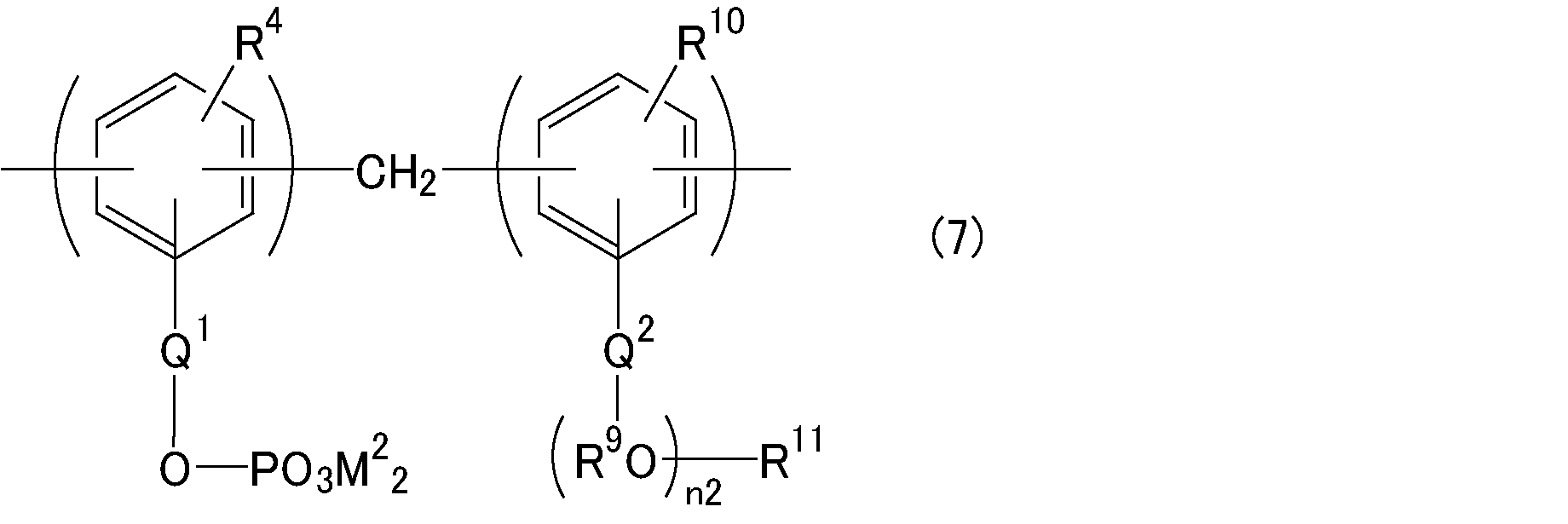
上記リン酸系水溶性高分子等の芳香族基を有する単量体由来の構造単位を有する重合体において各単量体由来の構造単位がメチレン基により結合していることが好ましい。
〔成分C1〕
5~10の炭素原子又はヘテロ原子を有する芳香族化合物又は複素芳香族化合物であって、該芳香族化合物又は複素芳香族化合物にO原子又はN原子を介して結合される、1分子当たり平均して1~300の、オキシエチレン及び/又はオキシプロピレン基を含む、芳香族化合物又は複素芳香族化合物
〔成分C2〕
(C2-1)フェノール、(C2-2)フェノールエーテル、(C2-3)ナフトール、(C2-4)ナフトールエーテル、(C2-5)アニリン、(C2-6)フルフリルアルコール、並びに(C2-7)メラミン又はその誘導体、尿素又はその誘導体、及びカルボキサミドからなる群より選択されるアミノプラスト形成剤、からなる群より選択される、任意成分としての少なくとも1つの芳香族化合物
〔成分C3〕
ホルムアルデヒド、グリオキシル酸、及びベンズアルデヒド、又はその混合物からなる群より選択されるアルデヒド(ここでベンズアルデヒドはさらに、COOMa、SO3Ma、及びPO3Maの式で表される酸性基(MはH、アルカリ金属若しくはアルカリ土類金属、アンモニウム、又は有機アミン基であり、aは1/2、1、又は2であってもよい)を有してもよい。)

カルボン酸系水溶性高分子としては、(ポリ)エチレングリコールメタリルエーテル/アクリル酸共重合体、(ポリ)エチレングリコール3-メチル-3-ブテニルエーテル/アクリル酸共重合体、メトキシポリエチレングリコールモノ(メタ)アクリレート/(メタ)アクリル酸共重合体がより好ましい。
リン酸系水溶性高分子としては、上記式(7)で表される構造を有する重合体がより好ましい。
スルホン酸系水溶性高分子としては、ナフタレンスルホン酸ホルムアルデヒド縮合物、メラミンスルホン酸ホルムアルデヒド縮合物、リグニンスルホン酸、ポリスチレンスルホン酸塩等がより好ましい。
その他の成分としては特に制限されないが、例えば消泡剤、AE剤他、界面活性剤等が挙げられる。
その他の成分の含有割合としては特に制限されないが、アルミノシリケート含有組成物100質量%に対して、0~20質量%であることが好ましい。より好ましくは0~10質量%であり、更に好ましくは0~5質量%であり、特に好ましくは0~1質量%である。
上記アニオン系界面活性剤としては特に限定されず、例えば、ポリオキシアルキレンアルキルエーテル硫酸エステル塩、ポリオキシアルキレンオレイルエーテル硫酸ナトリウム塩、ポリオキシアルキレンアルキルフェニルエーテル硫酸エステル塩、アルキルジフェニルエーテルジスルホン酸塩、ポリオキシアルキレン(モノ、ジ、トリ)スチリルフェニルエーテル硫酸エステル塩、ポリオキシアルキレン(モノ、ジ、トリ)ベンジルフェニルエーテル硫酸エステル塩、アルケニルコハク酸ジ塩;ナトリウムドデシルサルフェート、カリウムドデシルサルフェート、アンモニウムアルキルサルフェート等のアルキルサルフェート塩;ナトリウムドデシルポリグリコールエーテルサルフェート;ナトリウムスルホリシノエート;スルホン化パラフィン塩等のアルキルスルホネート;ナトリウムドデシルベンゼンスルホネート、アルカリフェノールヒドロキシエチレンのアルカリ金属サルフェート等のアルキルスルホネート;高アルキルナフタレンスルホン酸塩;ナフタレンスルホン酸ホルマリン縮合物;ナトリウムラウレート、トリエタノールアミンオレエート、トリエタノールアミンアビエテート等の脂肪酸塩;ポリオキシアルキルエーテル硫酸エステル塩;ポリオキシエチレンカルボン酸エステル硫酸エステル塩;ポリオキシエチレンフェニルエーテル硫酸エステル塩;コハク酸ジアルキルエステルスルホン酸塩;ポリオキシエチレンアルキルアリールサルフェート塩等が挙げられる。これらの1種又は2種以上を用いることができる。
また、これらのノニオンタイプに相当する界面活性剤も使用することができる。
スルホコハク酸塩型反応性アニオン系界面活性剤の市販品としては、ラテムルS-120、S-120A、S-180及びS-180A(いずれも商品名、花王社製)、エレミノールJS-2(商品名、三洋化成工業社製)、アデカリアソープSR-10、SR-20、SR-30(ADEKA社製)等が挙げられる。
アルケニルコハク酸塩型反応性アニオン系界面活性剤の市販品としては、ラテムルASK(商品名、花王社製)等が挙げられる。
更に、(メタ)アクリル酸ポリオキシエチレンスルフォネート塩(例えば、三洋化成工業社製「エレミノールRS-30」、日本乳化剤社製「アントックスMS-60」等)、アリルオキシメチルアルキルオキシポリオキシエチレンのスルフォネー卜塩(例えば、第一工業製薬社製「アクアロンKH-10」等)等のアリル基を有する硫酸エステル(塩)、ポリオキシアルキレンアルケニルエーテル硫酸アンモニウム(例えば、花王社製「ラテムルPD-104」等)、1-プロペニル基とポリオキシエチレン基と硫酸アンモニウム塩基とを有する芳香族炭化水素化合物(例えば、第一工業製薬社製「アクアロンBC-10」等)等も用いることができる。
炭素数3~5の脂肪族不飽和カルボン酸のスルホアルキル(炭素数1~4)エステル塩型界面活性剤、例えば、2-スルホエチル(メタ)アクリレートナトリウム塩、3-スルホプロピル(メタ)アクリレートアンモニウム塩等の(メタ)アクリル酸スルホアルキルエステル塩型界面活性剤;スルホプロピルマレイン酸アルキルエステルナトリウム塩、スルホプロピルマレイン酸ポリオキシエチレンアルキルエステルアンモニウム塩、スルホエチルフマル酸ポリオキシエチレンアルキルエステルアンモニウム塩等の脂肪族不飽和ジカルボン酸アルキルスルホアルキルジエステル塩型界面活性剤。
上記界面活性剤の中でも、環境面からは、非ノニルフェニル型の界面活性剤を用いることが好適である。
本発明のアルミノシリケート含有組成物の製造方法は特に制限されないが、水溶性高分子の存在下でアルミニウム含有化合物とケイ素含有化合物とを反応させて製造することが好ましい。
本発明はまた、アルミノシリケート含有組成物を製造する方法であって、上記製造方法は、水溶性高分子の存在下でアルミニウム含有化合物とケイ素含有化合物とを反応させる工程(α)を含むアルミノシリケート含有組成物の製造方法でもある。
水溶性高分子、アルミニウム含有化合物、ケイ素含有化合物の具体例、好ましい形態は上述のとおりである。
これにより、得られるアルミノシリケートの平均粒子径をより好適な範囲とすることができる。
上記工程(α)における原料の添加方法は特に制限されないが、水溶性高分子、アルミニウム含有化合物、ケイ素含有化合物を水溶液として混合することが好ましい。
また、上記工程(α)において上記化合物を一括投入する方法であっても、逐次添加する方法であってもよいが、好ましくは、水溶性高分子、アルミニウム含有化合物、ケイ素含有化合物の1又は2成分を含む水溶液に、残りの成分を滴下することが好ましい。
より好ましくは水溶性高分子を含む水溶液に対して、アルミニウム含有化合物を含む水溶液及びケイ素含有化合物の水溶液を滴下する方法である。
上記工程(α)において、上記アミン及び/又は金属化合物を添加する方法は特に制限されないが、上記アミンを添加する場合、水溶性高分子及びアミンを含む水溶液に対して、アルミニウム含有化合物を含む水溶液及びケイ素含有化合物の水溶液を滴下する方法が好ましい。
上記工程(α)において、上記金属化合物を添加する場合、水溶性高分子を含む水溶液に対して、アルミニウム含有化合物を含む水溶液、ケイ素含有化合物の水溶液及び上記金属化合物を含む水溶液を滴下する方法が好ましい。
本発明のアルミノシリケート含有組成物は、硬化促進剤として、セメントペースト、モルタル、コンクリート等を含む水硬性材料組成物に加えて用いることができる。また、超高強度コンクリートにも用いることができる。
本発明は更に、アルミノシリケートと、水溶性高分子とを含み、潜在水硬性及び/又はポゾラン活性を有する物質並びにフィラーからなる群より選択される少なくとも1種を含む水硬性材料組成物に用いられる、硬化促進剤組成物でもある。
上記硬化促進剤組成物におけるアルミノシリケート、水溶性高分子、分子量が1000以下のアミン及び金属化合物の好ましい形態は上述のとおりである。
本発明はまた、上記アルミノシリケート含有組成物を水硬性材料に添加する工程及び該添加工程で得られた組成物を硬化する工程を含む、水硬性材料の硬化促進方法でもある。
上記硬化促進方法における添加工程及び硬化工程の好ましい形態は、それぞれ、後述する水硬性材料組成物の製造方法における添加工程(β)及び水硬性硬化物の製造方法における硬化工程(γ)と同様である。
本発明はまた、本発明のアルミノシリケート含有組成物及び/又は硬化促進剤組成物と水硬性材料とを含む水硬性材料組成物でもある。
上記水硬性材料組成物としては、セメント、水、細骨材、粗骨材等を含む通常用いられるものが好適である。また、フライアッシュ、高炉スラグ、シリカヒューム、石灰石等の微粉体を添加したものであってもよい。
なお、超高強度コンクリートとは、セメント組成物の分野で一般的にそのように称されているもの、すなわち従来のコンクリートに比べて水セメント比を小さくしてもその硬化物が従来と同等又はより高い強度となるようなコンクリートを意味し、例えば、水セメント比が25質量%以下、更に20質量%以下、特に18質量%以下、特に14質量%以下、特に12質量%程度であっても通常の使用に支障をきたすことのない作業性を有するコンクリートとなり、その硬化物が60N/mm2以上、更に80N/mm2以上、より更に100N/mm2以上、特に120N/mm2以上、特に160N/mm2以上、特に200N/mm2以上の圧縮強度を示すことになるものである。
これらセメント分散剤は単独で用いてもよく、2種以上を併用してもよい。
通常、SCMコンクリートは、普通のポルトランドセメントよりも硬化時間が長く、早期強度発現性に課題があるが、本発明のアルミノシリケート含有組成物は、SCMコンクリートに対しても早期強度発現性に優れるため、上記水硬性材料組成物が潜在水硬性及び/又はポゾラン活性を有する物質並びにフィラーからなる群より選択される少なくとも1種を含む場合に、本発明の技術的意義がより発揮される。
なお、本明細書中、固形分含量は、以下のようにして測定することができる。
<固形分測定方法>
1.アルミ皿を精秤する。
2.1で精秤したアルミ皿に固形分測定物を精秤する。
3.窒素雰囲気下130℃に調温した乾燥機に2で精秤した固形分測定物を1時間入れる。
4.1時間後、乾燥機から取り出し、室温のデシケーター内で15分間放冷する。
5.15分後、デシケーターから取り出し、アルミ皿+測定物を精秤する。
6.5で得られた質量から1で得られたアルミ皿の質量を差し引き、2で得られた固形分測定物の質量で除することで固形分を測定する。
本発明のアルミノシリケート含有組成物及び/又は硬化促進剤組成物はまた、フライアッシュ、スラグ等のSCMを用いた場合にも早期強度発現性に優れるため、SCMコンクリートにも有効に適用することができる。
本発明は更に、水硬性材料組成物を製造する方法であって、上記製造方法は、本発明のアルミノシリケート含有組成物又は上記製造方法で得られたアルミノシリケート含有組成物を水硬性材料に添加する工程(β)を含む水硬性材料組成物の製造方法でもある。
上記工程(β)におけるアルミノシリケート含有組成物の添加方法は特に制限されないが、アルミノシリケート含有組成物を水等の溶媒に分散させて添加することが好ましい。
上記硬化工程(γ)における硬化方法は特に制限されず、室温養生をしても、蒸気養生をしてもよい。
上記硬化工程(γ)は、水硬性材料組成物を-20~90℃で硬化する工程であることが好ましい。硬化温度として好ましくは5~85℃であり、より好ましくは5~80℃であり、更に好ましくは5~75℃であり、特に好ましくは5~40℃である。
上記早期強度向上方法における添加工程及び硬化工程の好ましい形態は、それぞれ、水硬性材料組成物の製造方法における添加工程(β)及び水硬性硬化物の製造方法における硬化工程(γ)と同様である。
初めに得られた水分散体をアドバンテック社製の濾紙No.2を用いて濾過し、不純物等を取り除き、得られた濾液を用いて以下の操作を行った。
粒子径測定装置を用い、アルミノシリケート含有組成物の固形分0.1質量%の水分散液について動的光散乱法による散乱強度を測定し、Z-平均粒子径を算出した。
装置:Malvern社製Zetasizer Nano
測定温度:20.0℃
測定溶媒:イオン交換水
水溶性高分子の重量平均分子量(Mw)は、GPC(ゲルパーミエーションクロマトグラフィー)に以下の測定条件により測定した。
(GPC分析法)
装置:Waters Alliance(2695)
解析ソフト:Waters社製、Empower2プロフェッショナル+GPCオプション
使用カラム:東ソー(株)製、TSKguardcolumnsSWXL+TSKgel G4000SWXL+G3000SWXL+G2000SWXL
検出器:示差屈折率計(RI)検出器(Waters社製 2414)、多波長可視紫外(PDA)検出器(Waters社製 2996)
溶離液:水10999g、アセトニトリル6001gの混合溶媒に酢酸ナトリウム三水和物115.6gを溶解し、さらに酢酸でpH6.0に調整したもの。
較正曲線作成用標準物質:ポリエチレングリコール(ピークトップ分子量(Mp)272500、219300、107000、50000、24000、12600、7100、4250、1470)
較正曲線:上記標準物質のMp値と溶出時間とを基礎にして3次式で作成した。
流量:1mL/分
カラム温度:40℃
測定時間:45分
標準物質試料液注入量:100μL(重合体濃度0.1質量%の溶離液溶液)
重合体試料液注入量:100μL(重合体濃度0.5質量%の溶離液溶液)
得られたRIクロマトグラムにおいて、重合体溶出直前・溶出直後のベースラインにおいて平らに安定している部分を直線で結び、重合体を検出・解析した。ただし、単量体や単量体由来の不純物のピークが重合体ピークに一部重なって測定された場合、それらと重合体の重なり部分の最凹部において垂直分割して重合体部と単量体部や不純物部とを分離し、重合体部のみの分子量・分子量分布を計算した。凹部が無い場合はまとめて計算した。
重合体純分は、RI検出器によるピーク面積の比より、下記のようにして計算した。
重合体純分=(重合体ピーク面積)/(重合体ピーク面積+単量体や不純物のピーク面積)
L-アスコルビン酸0.3部を水191.2部に溶解させた溶液(1a)を調製した。3-メルカプトプロピオン酸2.2部を水13.5部に溶解させた溶液(1b)を調製した。アクリル酸(AA)32.2部を水8.0部に溶解させた溶液(1c)を調製した。
温度計、撹拌機、滴下装置、窒素導入管、還流冷却器を備えた反応容器に水30.0部、3-メチル-3-ブテン-1-オールにエチレンオキシドが平均50モル付加した不飽和ポリアルキレングリコールエーテル系単量体(IPN-50)の80%水溶液209.8部を仕込み、窒素雰囲気下で60℃に昇温後、過酸化水素2%水溶液を12.8部投入した。次に上述の混合溶液(1a)、(1b)、(1c)を混合し、重合反応温度以下の温度において水酸化ナトリウム水溶液を用いて反応溶液のpHをpH=7.0まで中和した。このようにして、共重合体(1)を含む重合体溶液を得た。重量平均分子量は15000であった。
硫酸アルミニウム・14~18水和物101.0gをイオン交換水172.0gに溶解させた溶液を溶液(A1)とし、共重合体(1)(固形分40%)46.8gをイオン交換水69.1gに溶解させた溶液を溶液(B1)とした。次にメタケイ酸ナトリウム・9水和物90.9gをイオン交換水397.0gに溶解させ、これを溶液(C1)とした。室温下で水111.5gに共重合体(1)(固形分40%)を11.7g仕込んで撹拌し、溶液(A1)、(B1)、(C1)を混合することでアルミノシリケート組成物(1)を得た。アルミノシリケート含有組成物の平均粒子径は90nmであった。
各合成例2~3につき、硫酸アルミニウム・14~18水和物及び共重合体(1)及びメタケイ酸ナトリウム・9水和物を、Si/Al比が表1に記載の比となる量で仕込み、合成例1に準じた方法で合成反応を行い、アルミノシリケート含有組成物(2)~(3)を其々得た。得られた各アルミノシリケート含有組成物の平均粒子径は表1に示す通りである。
硫酸アルミニウム・14~18水和物24.7gをイオン交換水41.8gに溶解させた溶液を溶液(A2)とし、共重合体(1)(固形分40%)1.4gとトリエタノールアミン(固形分40%)を1.4gと添加し混合しこれを溶液(B2)とした。次にメタケイ酸ナトリウム・9水和物22.1gをイオン交換水50.9gに溶解させ、これを溶液(C2)とした。室温下で水62.5gに共重合体(1)(固形分40%)を5.7g、トリエタノールアミン(固形分40%)を5.7g仕込んで撹拌し、溶液(A2)、(B2)、(C2)を混合することでアルミノシリケート含有組成物(4)を得た。アルミノシリケート含有組成物の平均粒子径は310nmであった。
各合成例5~17につき、硫酸アルミニウム・14~18水和物及び共重合体(1)及び下記表1に示すアミン化合物及びメタケイ酸ナトリウム・9水和物を、Si/Al比が表1に記載の比となる量で仕込み、合成例4に準じた方法で合成反応を行い、アルミノシリケート組成物(5)~(17)を其々得た。得られた各アルミノシリケート含有組成物の平均粒子径は表1に示す通りである。
硫酸アルミニウム・14~18水和物23.5gをイオン交換水40.0gに溶解させた溶液を溶液(A3)とし、共重合体(1)(固形分40%)11.4gをイオン交換水48.0gに溶解させた溶液を溶液(B3)とした。次にメタケイ酸ナトリウム・9水和物21.1gをイオン交換水48.5gに溶解させ、これを溶液(C3)とした。次に硫酸亜鉛(固形分56.0%)4.0gをイオン交換水20.0gに溶かした溶液を溶液(D3)とした。室温下で水27.2gに共重合体(1)(固形分40%)を2.85g仕込んで撹拌し、溶液(A3)、(B3)、(C3)、(D3)を混合することでアルミノシリケート含有組成物(18)を得た。アルミノシリケート含有組成物の平均粒子径は65nmであった。
各合成例19~26につき、硫酸アルミニウム・14~18水和物及び共重合体(1)及び下記表1に示す金属化合物及びメタケイ酸ナトリウム・9水和物を、Si/Al比が表1に記載の比となる量で仕込み、合成例18に準じた方法で合成反応を行い、アルミノシリケート含有組成物(19)~(26)を其々得た。得られた各アルミノシリケート含有組成物の平均粒子径は表1に示す通りである。ただし、金属化合物は硫酸アルミニウム・14~18水和物及びメタケイ酸ナトリウム・9水和物及び金属化合物を含む無機塩を100mol%とした場合のmol比で表記している。
共重合体(1)(固形分40%)104.8gを30wt%水酸化ナトリウム溶液でpH=8に調整し、これを溶液(E1)とした。次に硝酸カルシウム・4水和物105.0gをイオン交換水66.4gに溶解させた溶液とし、これを溶液(E2)とした。またメタケイ酸ナトリウム・9水和物95.9gをイオン交換水179.8gに溶解させ、これを溶液(3)とした。溶液(E1)を75℃に加温し、窒素雰囲気下で、18分かけて(E1)と(E2)を滴下し、カルシウムシリケート組成物(27)を得た。カルシウムシリケート組成物の平均粒子径は280nmであった。

TEA:トリエタノールアミン
TIPA:トリイソプロパノールアミン
DIPA:ジイソプロパノールアミン
TMEDA:テトラメチルエチレンジアミン
EDEA:エチルジエタノールアミン
DMAE:ジメチルアミノエタノール
1DMA2P:1-ジメチルアミノ-2-プロパノール
また、表1中のwt%/粒子は、アルミノシリケート粒子100質量%に対する割合を表す。
<早期強度評価>
(モルタル試験)
モルタル試料の調製:
モルタル試験は、温度が20℃±1℃、相対湿度が60%±15%の環境下で行った。モルタル配合は、表2に示す。
ただし、
C:セメント(普通ポルトランドセメント、太平洋セメント社製)
LS:重質炭酸カルシウム(ソフトン3200、丸東社製)
CC:カルサインドクレイ(兵庫クレー株式会社製)
BFS:高炉スラグ微粉末(スピリッツ4000、日鉄セメント社製)
g:ジプサム(メルク社製、硫酸カルシウム・2水和物)
S:細骨材(セメント強さ試験用標準砂、セメント協会製)
W:試料と消泡剤のイオン交換水溶液
B:粉体(S,W以外の材料)
とし、Wについては下記実施例、比較例で得られた水硬性材料用添加剤及び消泡剤を含み、イオン交換水中充分に均一溶解させた。
モルタルミキサー(ホバート社製ミキサー、型番:N-50)を用い、混練容器へS及びWを投入し、1速で30秒間混練した。さらに1速で混練しながら、Cを15秒かけて投入した。混練を始めてから60秒後に2速に変更し、さらに30秒間混練した。その後ミキサーを停止し、30秒間モルタルの掻き落としを行い、60秒間静置した。その後、さらに2速で60秒間混練を行い、モルタルを調製した。なお、空気量は消泡剤であるオキシアルキレン系消泡剤を添加して3.0%未満となるように調整した。

混練後、圧縮強度試験用試料を作成し、以下の条件にて、圧縮強度を測定した。結果は表3~6に示す。
供試体作成:50mm×100mm
供試体養生(室温養生):温度20℃、湿度50%、恒温恒湿空気養生を24時間行った。
供試体養生(水中養生):温度20℃、湿度50%、恒温恒湿空気養生を24時間行った後、温度20℃下の水中でさらに27日間養生を行った。
供試体研磨:供試体表面研磨(供試体研磨仕上げ機使用)
圧縮強度測定:自動圧縮強度測定器(前川製作所社製)
(ペースト試料の調整)
ペースト試料の配合は以下の表3~6に示す。ただし、
W:試料及びイオン交換水溶液
C:セメント(普通ポルトランドセメント、太平洋セメント社製)
W/C=0.4
アルミノシリケート含有組成物(1)~(26)
カルシウムシリケート組成物(27)
とする。表3~6における添加剤の添加量は、粉体(モルタル中の細骨材以外の成分)100質量%に対する割合である。
セメントをアンプルに入れ装置内に投入し、20℃まで調温する。続いて、調整した試料及びイオン交換水溶液の混合物をシリンジに測り取り、20℃調温したアンプル内に注入し、5分間混練させ、ペースト試料を作成した。
以下の条件で、調整したペースト試料の水和発熱量を測定した。
水和発熱量測定装置:マイクロカロリーメーター測定装置(TAinstruments社製)
温度:20℃
結果を表3~6に示す。


Claims (13)
- アルミノシリケート及び水溶性高分子を含むアルミノシリケート含有組成物であって、
該アルミノシリケート含有組成物は、更に、分子量が1000以下のアミン及び/又は金属化合物を含む、アルミノシリケート含有組成物。 - アルミノシリケート及び水溶性高分子を含むアルミノシリケート含有組成物であって、
該アルミノシリケート含有組成物は、潜在水硬性及び/又はポゾラン活性を有する物質並びにフィラーからなる群より選択される少なくとも1種を含む水硬性材料組成物に用いられる、アルミノシリケート含有組成物。 - 前記水溶性高分子の含有割合が、アルミノシリケート100質量%に対して5~100質量%である、請求項1又は2に記載のアルミノシリケート含有組成物。
- 前記アルミノシリケートの含有割合が、アルミノシリケート含有組成物100質量%に対して、0.01~50質量%である、請求項1~3のいずれかに記載のアルミノシリケート含有組成物。
- 前記アミンは、第1級アミン、第2級アミン及び第3級アミンからなる群より選択される少なくとも1種である、請求項1、3、4のいずれかに記載のアルミノシリケート含有組成物。
- 前記アミン及び金属化合物の合計の含有割合が、アルミノシリケート100質量%に対して0.01~500質量%である、請求項1、3~5のいずれかに記載のアルミノシリケート含有組成物。
- 前記潜在水硬性及び/又はポゾラン活性を有する物質が、スラグ、フライアッシュ、粘土、メタカオリン、シリカフューム、シリカ粉末、シンダーアッシュ、クリンカーアッシュ、ハスクアッシュ、ベントナイト及びカルサインドクレイからなる群より選択される少なくとも1種である、請求項2~4のいずれかに記載のアルミノシリケート含有組成物。
- 前記フィラーが、炭酸カルシウム、エコ炭酸カルシウム、コンクリート微粉、二酸化炭素を固定化したコンクリート微粉、廃コンクリート及び石膏からなる群より選択される少なくとも1種である、請求項2~4、7のいずれかに記載のアルミノシリケート含有組成物。
- 前記アルミノシリケート含有組成物は、下記の測定方法により測定される平均粒子径が、10~2500nmである、請求項1~8のいずれかに記載のアルミノシリケート含有組成物。
<平均粒子径の測定方法>
粒子径測定装置を用い、アルミノシリケート含有組成物の固形分0.1質量%の水分散液について動的光散乱法による散乱強度を測定し、平均粒子径を算出する。 - 前記水溶性高分子は、カルボキシル基、リン酸基、スルホン酸基及びこれらの塩並びにリン酸エステル基、水酸基から選ばれる少なくとも一種の官能基を有する、請求項1~9のいずれかに記載のアルミノシリケート含有組成物。
- 前記水溶性高分子は、更に(ポリ)オキシアルキレン基を有する、請求項10に記載のアルミノシリケート含有組成物。
- アルミノシリケートと、水溶性高分子と、潜在水硬性及び/又はポゾラン活性を有する物質並びにフィラーからなる群より選択される少なくとも1種とを含む、水硬性材料組成物。
- 水硬性硬化物の強度を早期に向上させる方法であって、
該方法は、請求項1~11のいずれかに記載のアルミノシリケート含有組成物を水硬性材料に添加する工程及び該添加工程で得られた組成物を硬化する工程を含む、水硬性硬化物の早期強度向上方法。
Priority Applications (4)
| Application Number | Priority Date | Filing Date | Title |
|---|---|---|---|
| JP2025522357A JP7827938B2 (ja) | 2023-05-22 | 2024-05-16 | アルミノシリケート含有組成物 |
| EP24811016.5A EP4678615A1 (en) | 2023-05-22 | 2024-05-16 | Aluminosilicate-containing composition |
| US19/350,671 US20260028282A1 (en) | 2023-05-22 | 2025-10-06 | Aluminosilicate-containing composition |
| MX2025013332A MX2025013332A (es) | 2023-05-22 | 2025-11-07 | Composicion que contiene aluminosilicato |
Applications Claiming Priority (2)
| Application Number | Priority Date | Filing Date | Title |
|---|---|---|---|
| JP2023084102 | 2023-05-22 | ||
| JP2023-084102 | 2023-05-22 |
Related Child Applications (1)
| Application Number | Title | Priority Date | Filing Date |
|---|---|---|---|
| US19/350,671 Continuation US20260028282A1 (en) | 2023-05-22 | 2025-10-06 | Aluminosilicate-containing composition |
Publications (1)
| Publication Number | Publication Date |
|---|---|
| WO2024242009A1 true WO2024242009A1 (ja) | 2024-11-28 |
Family
ID=93589398
Family Applications (1)
| Application Number | Title | Priority Date | Filing Date |
|---|---|---|---|
| PCT/JP2024/018084 Ceased WO2024242009A1 (ja) | 2023-05-22 | 2024-05-16 | アルミノシリケート含有組成物 |
Country Status (5)
| Country | Link |
|---|---|
| US (1) | US20260028282A1 (ja) |
| EP (1) | EP4678615A1 (ja) |
| JP (1) | JP7827938B2 (ja) |
| MX (1) | MX2025013332A (ja) |
| WO (1) | WO2024242009A1 (ja) |
Families Citing this family (1)
| Publication number | Priority date | Publication date | Assignee | Title |
|---|---|---|---|---|
| US20240006191A1 (en) * | 2020-12-23 | 2024-01-04 | Heraeus Materials Singapore Pte. Ltd. | Process for the manufacture of encapsulated semiconductor dies and/or of encapsulated semiconductor packages |
Citations (15)
| Publication number | Priority date | Publication date | Assignee | Title |
|---|---|---|---|---|
| JPH04175397A (ja) * | 1990-08-10 | 1992-06-23 | Nippon Chem Ind Co Ltd | 地盤注入剤 |
| JPH0986990A (ja) | 1995-07-13 | 1997-03-31 | N M B:Kk | セメント分散剤およびその製造方法ならびにそれを用いたセメント組成物 |
| JPH10236858A (ja) | 1996-12-26 | 1998-09-08 | Nippon Shokubai Co Ltd | セメント分散剤及びセメント分散剤用共重合体の製造方法 |
| WO1998051640A1 (en) * | 1997-05-15 | 1998-11-19 | Mbt Holding Ag | A cementitious mixture containing high pozzolan cement replacement and compatibilizing admixtures therefor |
| JP2001220417A (ja) | 1999-11-29 | 2001-08-14 | Nippon Shokubai Co Ltd | セメント混和剤用共重合体、その製造方法およびその用途 |
| JP2002121055A (ja) | 2000-08-11 | 2002-04-23 | Nippon Shokubai Co Ltd | セメント分散剤およびこれを用いたセメント組成物 |
| JP2002121056A (ja) | 2000-08-11 | 2002-04-23 | Nippon Shokubai Co Ltd | セメント分散剤およびこれを用いたセメント組成物 |
| JP2004307590A (ja) | 2003-04-03 | 2004-11-04 | Nmb Co Ltd | セメント添加剤 |
| JP2006052381A (ja) | 2004-07-15 | 2006-02-23 | Kao Corp | リン酸エステル系重合体 |
| JP2008517080A (ja) | 2004-10-15 | 2008-05-22 | コンストラクション リサーチ アンド テクノロジー ゲーエムベーハー | 芳香族化合物又は複素芳香族化合物を主体とする重縮合生成物、その製造方法、及びその使用 |
| JP2016175787A (ja) * | 2015-03-19 | 2016-10-06 | 株式会社日本触媒 | 水硬性組成物、フライアッシュ含有水硬性組成物の初期強度向上方法、および、フライアッシュ含有水硬性組成物用添加剤 |
| WO2018017441A1 (en) * | 2016-07-19 | 2018-01-25 | United States Gypsum Company | Lightweight foamed cement, cement board, and methods for making same |
| JP2018111623A (ja) * | 2017-01-11 | 2018-07-19 | 株式会社日本触媒 | セメント混和剤およびセメント組成物 |
| CN109678413A (zh) * | 2019-01-25 | 2019-04-26 | 中山市灵湾新材料科技有限公司 | 一种高性能混凝土干混料及其使用方法 |
| JP2022011743A (ja) | 2020-06-30 | 2022-01-17 | 株式会社日本触媒 | アルミノシリケート含有組成物及びその製造方法 |
-
2024
- 2024-05-16 JP JP2025522357A patent/JP7827938B2/ja active Active
- 2024-05-16 EP EP24811016.5A patent/EP4678615A1/en active Pending
- 2024-05-16 WO PCT/JP2024/018084 patent/WO2024242009A1/ja not_active Ceased
-
2025
- 2025-10-06 US US19/350,671 patent/US20260028282A1/en active Pending
- 2025-11-07 MX MX2025013332A patent/MX2025013332A/es unknown
Patent Citations (15)
| Publication number | Priority date | Publication date | Assignee | Title |
|---|---|---|---|---|
| JPH04175397A (ja) * | 1990-08-10 | 1992-06-23 | Nippon Chem Ind Co Ltd | 地盤注入剤 |
| JPH0986990A (ja) | 1995-07-13 | 1997-03-31 | N M B:Kk | セメント分散剤およびその製造方法ならびにそれを用いたセメント組成物 |
| JPH10236858A (ja) | 1996-12-26 | 1998-09-08 | Nippon Shokubai Co Ltd | セメント分散剤及びセメント分散剤用共重合体の製造方法 |
| WO1998051640A1 (en) * | 1997-05-15 | 1998-11-19 | Mbt Holding Ag | A cementitious mixture containing high pozzolan cement replacement and compatibilizing admixtures therefor |
| JP2001220417A (ja) | 1999-11-29 | 2001-08-14 | Nippon Shokubai Co Ltd | セメント混和剤用共重合体、その製造方法およびその用途 |
| JP2002121055A (ja) | 2000-08-11 | 2002-04-23 | Nippon Shokubai Co Ltd | セメント分散剤およびこれを用いたセメント組成物 |
| JP2002121056A (ja) | 2000-08-11 | 2002-04-23 | Nippon Shokubai Co Ltd | セメント分散剤およびこれを用いたセメント組成物 |
| JP2004307590A (ja) | 2003-04-03 | 2004-11-04 | Nmb Co Ltd | セメント添加剤 |
| JP2006052381A (ja) | 2004-07-15 | 2006-02-23 | Kao Corp | リン酸エステル系重合体 |
| JP2008517080A (ja) | 2004-10-15 | 2008-05-22 | コンストラクション リサーチ アンド テクノロジー ゲーエムベーハー | 芳香族化合物又は複素芳香族化合物を主体とする重縮合生成物、その製造方法、及びその使用 |
| JP2016175787A (ja) * | 2015-03-19 | 2016-10-06 | 株式会社日本触媒 | 水硬性組成物、フライアッシュ含有水硬性組成物の初期強度向上方法、および、フライアッシュ含有水硬性組成物用添加剤 |
| WO2018017441A1 (en) * | 2016-07-19 | 2018-01-25 | United States Gypsum Company | Lightweight foamed cement, cement board, and methods for making same |
| JP2018111623A (ja) * | 2017-01-11 | 2018-07-19 | 株式会社日本触媒 | セメント混和剤およびセメント組成物 |
| CN109678413A (zh) * | 2019-01-25 | 2019-04-26 | 中山市灵湾新材料科技有限公司 | 一种高性能混凝土干混料及其使用方法 |
| JP2022011743A (ja) | 2020-06-30 | 2022-01-17 | 株式会社日本触媒 | アルミノシリケート含有組成物及びその製造方法 |
Non-Patent Citations (1)
| Title |
|---|
| See also references of EP4678615A1 |
Also Published As
| Publication number | Publication date |
|---|---|
| US20260028282A1 (en) | 2026-01-29 |
| JP7827938B2 (ja) | 2026-03-10 |
| JPWO2024242009A1 (ja) | 2024-11-28 |
| MX2025013332A (es) | 2025-12-01 |
| EP4678615A1 (en) | 2026-01-14 |
Similar Documents
| Publication | Publication Date | Title |
|---|---|---|
| RU2630015C2 (ru) | Добавка для гидравлически твердеющих композиций | |
| JP6566954B2 (ja) | 無機結合材のレオロジー改善用添加剤 | |
| RU2681013C2 (ru) | Добавка для гидравлически твердеющих составов | |
| CA2771666C (en) | Formulation and its use | |
| JP6436969B2 (ja) | 急速懸濁性粉末状組成物 | |
| JP6391695B2 (ja) | エトリンガイトおよびケイ酸カルシウム水和物を含有する硬化促進剤 | |
| JP6189934B2 (ja) | セメント性組成物のための安定な脱泡剤 | |
| CN105377790B (zh) | 用于水硬性化合物的添加剂 | |
| JP2024161045A (ja) | アルミノシリケート含有組成物及びその製造方法 | |
| JP5134256B2 (ja) | 超微粒子注入材組成物 | |
| RU2716663C2 (ru) | Добавка для гидравлически застывающих композиций | |
| JP4848293B2 (ja) | 極超微粒子注入材組成物 | |
| US20260028282A1 (en) | Aluminosilicate-containing composition | |
| JP2011079721A (ja) | 早期強度用セメント混和剤 | |
| JP6410830B2 (ja) | 添加剤を含有する硫酸カルシウム組成物 |
Legal Events
| Date | Code | Title | Description |
|---|---|---|---|
| 121 | Ep: the epo has been informed by wipo that ep was designated in this application |
Ref document number: 24811016 Country of ref document: EP Kind code of ref document: A1 |
|
| ENP | Entry into the national phase |
Ref document number: 2025522357 Country of ref document: JP Kind code of ref document: A |
|
| WWE | Wipo information: entry into national phase |
Ref document number: 2025522357 Country of ref document: JP |
|
| WWE | Wipo information: entry into national phase |
Ref document number: 2024811016 Country of ref document: EP |
|
| WWE | Wipo information: entry into national phase |
Ref document number: 202547102094 Country of ref document: IN |
|
| WWE | Wipo information: entry into national phase |
Ref document number: MX/A/2025/013332 Country of ref document: MX |
|
| ENP | Entry into the national phase |
Ref document number: 2024811016 Country of ref document: EP Effective date: 20251009 |
|
| ENP | Entry into the national phase |
Ref document number: 2024811016 Country of ref document: EP Effective date: 20251009 |
|
| WWP | Wipo information: published in national office |
Ref document number: 202547102094 Country of ref document: IN |
|
| ENP | Entry into the national phase |
Ref document number: 2024811016 Country of ref document: EP Effective date: 20251009 |
|
| WWP | Wipo information: published in national office |
Ref document number: MX/A/2025/013332 Country of ref document: MX |
|
| ENP | Entry into the national phase |
Ref document number: 2024811016 Country of ref document: EP Effective date: 20251009 |
|
| NENP | Non-entry into the national phase |
Ref country code: DE |
|
| WWP | Wipo information: published in national office |
Ref document number: 2024811016 Country of ref document: EP |