WO2025018136A1 - TRACP-5bの測定方法およびそのためのキット - Google Patents
TRACP-5bの測定方法およびそのためのキット Download PDFInfo
- Publication number
- WO2025018136A1 WO2025018136A1 PCT/JP2024/023774 JP2024023774W WO2025018136A1 WO 2025018136 A1 WO2025018136 A1 WO 2025018136A1 JP 2024023774 W JP2024023774 W JP 2024023774W WO 2025018136 A1 WO2025018136 A1 WO 2025018136A1
- Authority
- WO
- WIPO (PCT)
- Prior art keywords
- tracp
- salt
- sulfonic acid
- reagent
- organic sulfonic
- Prior art date
- Legal status (The legal status is an assumption and is not a legal conclusion. Google has not performed a legal analysis and makes no representation as to the accuracy of the status listed.)
- Ceased
Links
Classifications
-
- C—CHEMISTRY; METALLURGY
- C12—BIOCHEMISTRY; BEER; SPIRITS; WINE; VINEGAR; MICROBIOLOGY; ENZYMOLOGY; MUTATION OR GENETIC ENGINEERING
- C12N—MICROORGANISMS OR ENZYMES; COMPOSITIONS THEREOF; PROPAGATING, PRESERVING, OR MAINTAINING MICROORGANISMS; MUTATION OR GENETIC ENGINEERING; CULTURE MEDIA
- C12N9/00—Enzymes; Proenzymes; Compositions thereof; Processes for preparing, activating, inhibiting, separating or purifying enzymes
- C12N9/14—Hydrolases (3)
- C12N9/16—Hydrolases (3) acting on ester bonds (3.1)
-
- C—CHEMISTRY; METALLURGY
- C12—BIOCHEMISTRY; BEER; SPIRITS; WINE; VINEGAR; MICROBIOLOGY; ENZYMOLOGY; MUTATION OR GENETIC ENGINEERING
- C12Q—MEASURING OR TESTING PROCESSES INVOLVING ENZYMES, NUCLEIC ACIDS OR MICROORGANISMS; COMPOSITIONS OR TEST PAPERS THEREFOR; PROCESSES OF PREPARING SUCH COMPOSITIONS; CONDITION-RESPONSIVE CONTROL IN MICROBIOLOGICAL OR ENZYMOLOGICAL PROCESSES
- C12Q1/00—Measuring or testing processes involving enzymes, nucleic acids or microorganisms; Compositions therefor; Processes of preparing such compositions
- C12Q1/34—Measuring or testing processes involving enzymes, nucleic acids or microorganisms; Compositions therefor; Processes of preparing such compositions involving hydrolase
- C12Q1/42—Measuring or testing processes involving enzymes, nucleic acids or microorganisms; Compositions therefor; Processes of preparing such compositions involving hydrolase involving phosphatase
-
- G—PHYSICS
- G01—MEASURING; TESTING
- G01N—INVESTIGATING OR ANALYSING MATERIALS BY DETERMINING THEIR CHEMICAL OR PHYSICAL PROPERTIES
- G01N33/00—Investigating or analysing materials by specific methods not covered by groups G01N1/00 - G01N31/00
- G01N33/48—Biological material, e.g. blood, urine; Haemocytometers
- G01N33/50—Chemical analysis of biological material, e.g. blood, urine; Testing involving biospecific ligand binding methods; Immunological testing
- G01N33/53—Immunoassay; Biospecific binding assay; Materials therefor
- G01N33/543—Immunoassay; Biospecific binding assay; Materials therefor with an insoluble carrier for immobilising immunochemicals
- G01N33/54306—Solid-phase reaction mechanisms
-
- G—PHYSICS
- G01—MEASURING; TESTING
- G01N—INVESTIGATING OR ANALYSING MATERIALS BY DETERMINING THEIR CHEMICAL OR PHYSICAL PROPERTIES
- G01N33/00—Investigating or analysing materials by specific methods not covered by groups G01N1/00 - G01N31/00
- G01N33/48—Biological material, e.g. blood, urine; Haemocytometers
- G01N33/50—Chemical analysis of biological material, e.g. blood, urine; Testing involving biospecific ligand binding methods; Immunological testing
- G01N33/53—Immunoassay; Biospecific binding assay; Materials therefor
- G01N33/543—Immunoassay; Biospecific binding assay; Materials therefor with an insoluble carrier for immobilising immunochemicals
- G01N33/54313—Immunoassay; Biospecific binding assay; Materials therefor with an insoluble carrier for immobilising immunochemicals the carrier being characterised by its particulate form
-
- G—PHYSICS
- G01—MEASURING; TESTING
- G01N—INVESTIGATING OR ANALYSING MATERIALS BY DETERMINING THEIR CHEMICAL OR PHYSICAL PROPERTIES
- G01N33/00—Investigating or analysing materials by specific methods not covered by groups G01N1/00 - G01N31/00
- G01N33/48—Biological material, e.g. blood, urine; Haemocytometers
- G01N33/50—Chemical analysis of biological material, e.g. blood, urine; Testing involving biospecific ligand binding methods; Immunological testing
- G01N33/53—Immunoassay; Biospecific binding assay; Materials therefor
- G01N33/543—Immunoassay; Biospecific binding assay; Materials therefor with an insoluble carrier for immobilising immunochemicals
- G01N33/54366—Apparatus specially adapted for solid-phase testing
-
- G—PHYSICS
- G01—MEASURING; TESTING
- G01N—INVESTIGATING OR ANALYSING MATERIALS BY DETERMINING THEIR CHEMICAL OR PHYSICAL PROPERTIES
- G01N33/00—Investigating or analysing materials by specific methods not covered by groups G01N1/00 - G01N31/00
- G01N33/48—Biological material, e.g. blood, urine; Haemocytometers
- G01N33/50—Chemical analysis of biological material, e.g. blood, urine; Testing involving biospecific ligand binding methods; Immunological testing
- G01N33/53—Immunoassay; Biospecific binding assay; Materials therefor
- G01N33/573—Immunoassay; Biospecific binding assay; Materials therefor for enzymes or isoenzymes
-
- C—CHEMISTRY; METALLURGY
- C07—ORGANIC CHEMISTRY
- C07K—PEPTIDES
- C07K16/00—Immunoglobulins [IG], e.g. monoclonal or polyclonal antibodies
- C07K16/40—Immunoglobulins [IG], e.g. monoclonal or polyclonal antibodies against enzymes
-
- C—CHEMISTRY; METALLURGY
- C12—BIOCHEMISTRY; BEER; SPIRITS; WINE; VINEGAR; MICROBIOLOGY; ENZYMOLOGY; MUTATION OR GENETIC ENGINEERING
- C12Y—ENZYMES
- C12Y301/00—Hydrolases acting on ester bonds (3.1)
- C12Y301/03—Phosphoric monoester hydrolases (3.1.3)
- C12Y301/03002—Acid phosphatase (3.1.3.2)
-
- G—PHYSICS
- G01—MEASURING; TESTING
- G01N—INVESTIGATING OR ANALYSING MATERIALS BY DETERMINING THEIR CHEMICAL OR PHYSICAL PROPERTIES
- G01N2333/00—Assays involving biological materials from specific organisms or of a specific nature
- G01N2333/90—Enzymes; Proenzymes
-
- G—PHYSICS
- G01—MEASURING; TESTING
- G01N—INVESTIGATING OR ANALYSING MATERIALS BY DETERMINING THEIR CHEMICAL OR PHYSICAL PROPERTIES
- G01N2333/00—Assays involving biological materials from specific organisms or of a specific nature
- G01N2333/90—Enzymes; Proenzymes
- G01N2333/914—Hydrolases (3)
- G01N2333/916—Hydrolases (3) acting on ester bonds (3.1), e.g. phosphatases (3.1.3), phospholipases C or phospholipases D (3.1.4)
Definitions
- the present invention relates to a method for measuring TRACP-5b and a kit therefor, and more specifically, to a method for selectively measuring TRACP-5b without being affected by TRACP-5a and a kit therefor.
- Acid phosphatase is an enzyme that has the hydrolytic activity of organic monophosphate esters under acidic conditions.
- ACP that is known to exist in serum is derived from platelets, red blood cells, prostate, osteoclasts, macrophages, etc. These isozymes are separated by polyacrylamide gel electrophoresis, and osteoclast-derived and macrophage-derived ACPs are located fifth from the origin and are resistant to tartaric acid, and are therefore also called Band-5 tartrate-resistant acid phosphatase (TRACP-5) (Patent Document 5, Lam W.K.W. et al., Clin. Chem.
- TRACP-5 is classified into TRACP-5a, which has a high amount of sialic acid bound to the sugar chain, and TRACP-5b, which has a low amount of sialic acid bound to the sugar chain; 5a is said to be derived from macrophages and 5b from osteoclasts.
- the concentration of TRACP-5b in serum sensitively reflects the activity of osteoclasts, and is therefore used as a bone resorption marker to aid in the diagnosis of metabolic bone diseases and bone metastatic cancer, as well as to assess the effectiveness of treatment. Therefore, methods for selectively measuring TRACP-5b from among the ACPs in serum are being investigated.
- one method for measuring TRACP-5 involves performing an enzyme reaction using a synthetic substrate such as p-nitrophenyl phosphate in the presence of tartaric acid, and measuring the resulting reaction product colorimetrically to determine enzyme activity.
- tartaric acid can inhibit prostate-derived ACP, TRACP-5a and red blood cell- and platelet-derived ACPs are resistant to tartaric acid, so this method also measures these isoenzymes and is not able to specifically measure TRACP-5b.
- Non-Patent Document 3 A method for improving the TRACP-5b specificity of the above method is known in which serum is diluted 5-fold, incubated at 37°C for 1 hour, and then the enzyme activity is measured in the same manner. This method can avoid the effects of red blood cell-derived ACP as well as prostate-derived ACP, but it is still unable to avoid the effects of TRACP-5a and platelet-derived ACP.
- Another method for specifically measuring TRACP-5b activity is to calculate TRACP-5b activity by subtracting ACP activity measured in the presence of tartaric acid and fluoride from ACP activity measured in the presence of tartaric acid (Patent Document 1).
- This method makes it possible to avoid the effects of red blood cell-derived and platelet-derived ACPs by taking advantage of the difference in sensitivity to fluoride.
- it is not possible to eliminate the effects of TRACP-5a, and TRACP-5b activity is calculated by subtraction, which has problems with accuracy.
- a method for measuring the activity of TRACP-5b using a chemiluminescent substrate is known in which TRACP-5b is reacted with a chemiluminescent 1,2-dioxetane compound under acidic conditions, and then the reaction solution is made alkaline to measure the luminescence intensity (Patent Document 3).
- a method has been reported in which a specific buffer such as MES is used during the enzyme reaction, or manganese ions or cobalt ions are added to increase the luminescence intensity ratio of TRACP-5b to TRAPC-5a, thereby specifically measuring TRACP-5b (Patent Document 4).
- these methods are limited to activity measurements using chemiluminescent substrates, and there is a demand for a cheaper method that can specifically measure TRACP-5b.
- An example of an immunoassay method for TRACP-5b using an antibody is a method in which an antibody specific to TRACP-5 is used to bind both TRACP-5a and TRACP-5b, and then TRACP-5b is specifically measured using the difference in the optimum pH between the two (Patent Document 5).
- the difference in the optimum pH alone is not sufficient to provide specificity for TRACP-5b, and the amount of TRACP-5b is calculated by subtraction, which poses problems in terms of accuracy.
- the present invention aims to provide a measurement method that can selectively detect TRACP-5b while further reducing the influence of coexisting TRACP-5a.
- the present inventors have investigated a measurement method capable of selectively detecting TRACP-5b, and have found that by adding a compound having a sulfo group (--S(O) 2 OH), a sulfate group (--OS(O) 2 OH) and/or a salt thereof at a certain density or higher to a reaction system in which TRACP-5a may be present, the influence of TRACP-5a can be significantly reduced and TRACP-5b can be selectively detected.
- a method for measuring tartrate-resistant acid phosphatase 5b (TRACP-5b) in a sample comprising: A method for measuring TRACP-5b, comprising a step of carrying out a reaction to detect TRACP-5b in the presence of an organic sulfonic acid, a sulfate ester, or a salt thereof having a sulfo group (-S(O) 2 OH ), a sulfate group (-OS(O) 2 OH), and/or a salt thereof at a density of 6.5 mmol/g or more.
- a method for measuring tartrate-resistant acid phosphatase 5b (TRACP-5b) in a sample comprising: A method for measuring TRACP - 5b, comprising a step of carrying out an enzyme reaction or an antigen-antibody reaction in the presence of an organic sulfonic acid, a sulfate ester, and/or a salt thereof having 50% by mass or more of sulfo groups (-S(O) 2 OH), sulfate groups (-OS(O) 2 OH), and/or salts thereof per unit structure in S(O) 2 O-equivalent value; or the method according to [1], wherein the organic sulfonic acid, sulfate ester, or salt thereof has 50% by mass or more of sulfo groups (-S(O) 2 OH), sulfate groups (-OS(O) 2 OH), and/or salts thereof per unit structure in S(O) 2 O - equivalent value.
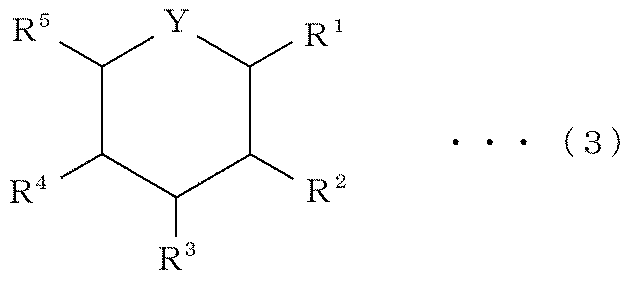
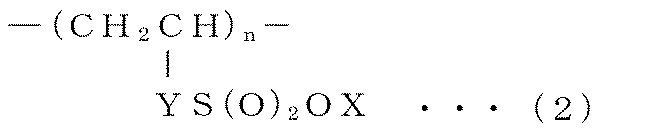
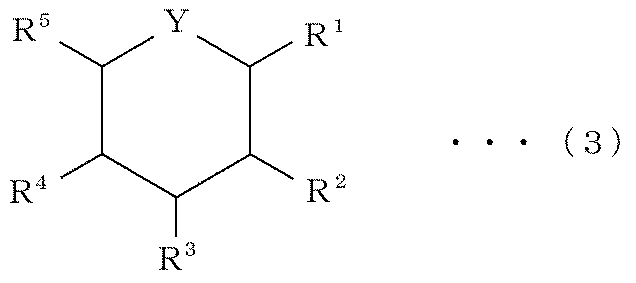
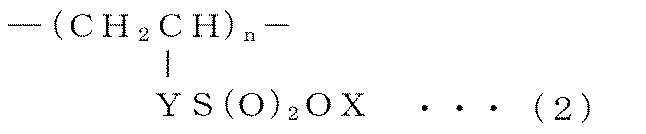
- the organic sulfonic acid, sulfate ester, or salt thereof is represented by the formula (1): (In formula (1), R is an alkyl, alkenyl, or alkynyl group having 1 to 3 carbon atoms, Y is a bond or an oxygen atom, and X is hydrogen or an alkali metal.) Is it expressed as Formula (2): (In formula (2), Y is a bond or an oxygen atom, n is an integer from 2 to 5000, and X is hydrogen or an alkali metal.) or having a repeat unit of Or, Equation (3): (In formula (3), Y is O or CH2 , two of R1 to R5 are O- or bonds, and at least two of the remaining are O-S(O) 2OX or S(O) 2OX (X is hydrogen or an alkali metal), and the one that does not fall into any of the above is OX or C(O)OX (X is hydrogen or an alkali metal).) The method according to [1] or
- [6] The method according to any one of [1] to [5], wherein the measurement is performed by an enzyme method, an enzyme immunoassay (EIA), an enzyme-linked immunosorbent assay (ELISA), a chemiluminescent enzyme immunoassay (CLEIA), a chemiluminescent immunoassay (CLIA), or a latex agglutination method.
- EIA enzyme immunoassay
- ELISA enzyme-linked immunosorbent assay
- CLIA chemiluminescent enzyme immunoassay
- CLIA chemiluminescent immunoassay
- a kit for measuring TRACP-5b comprising: A kit comprising an organic sulfonic acid, a sulfate ester and/or a salt thereof having a sulfo group (--S(O) 2 OH), a sulfate group (--OS(O) 2 OH) and/or a salt thereof at a density of 6.5 mmol/g or more.
- a kit for measuring TRACP-5b comprising: A kit comprising an organic sulfonic acid, a sulfate ester, and/or a salt thereof having 50% by mass or more of a sulfo group (-S(O) 2 OH), a sulfate group (-OS(O) 2 OH), or a salt thereof, calculated as an S(O) 2 O - equivalent, per unit structure; or the kit according to [8], in which the organic sulfonic acid, sulfate ester, and/or salt thereof has 50% by mass or more of a sulfo group (-S(O) 2 OH), a sulfate group (-OS(O) 2 OH), or a salt thereof, calculated as an S(O) 2 O - equivalent, per unit structure.
- the organic sulfonic acid, sulfate ester and/or salt thereof are represented by the formula (1): (In formula (1), R is an alkyl, alkenyl, or alkynyl group having 1 to 5 carbon atoms, Y is a bond or an oxygen atom, and X is hydrogen or an alkali metal.) Is it expressed as Formula (2): (In formula (2), Y is a bond or an oxygen atom, n is an integer from 2 to 5000, and X is hydrogen or an alkali metal.) or having a repeating structure of formula (3): (In formula (3), Y is O or CH2 , two of R1 to R5 are O- or bonds, and at least two of the remaining are O-S(O) 2OX or S(O) 2OX (X is hydrogen or an alkali metal), and the one that does not fall into any of the above is OX or C(O)OX (X is hydrogen or an alkali metal).)
- the repeat structure includes the structure The kit according
- kits according to any one of [8] to [11] for measuring TRACP-5b by an enzymatic method, A kit comprising a substrate for TRACP-5b, the organic sulfonic acid, sulfate ester or salt thereof, and optionally a reagent for diluting a specimen.
- kits according to any one of [8] to [11], which measures TRACP-5b by enzyme immunoassay (EIA),
- EIA enzyme immunoassay
- a kit comprising a solid support, an anti-TRACP-5b monoclonal antibody adsorbed to the solid support, a substrate for TRACP-5b, the organic sulfonic acid, sulfate ester or salt thereof, optionally a reagent for diluting a specimen, and optionally a washing solution.
- kits comprising: a solid support; a primary anti-TRACP-5b monoclonal antibody adsorbed to the solid support; a secondary anti-TRACP-5b monoclonal antibody that binds to TRACP-5b via an epitope different from that of the primary anti-TRACP-5b monoclonal antibody and is labeled with a substance that enables detection by an enzyme reaction; a reagent for detecting the labeled substance by an enzyme reaction; the organic sulfonic acid, sulfate ester or salt thereof; optionally a reagent for diluting a sample; and optionally a washing solution.
- ELISA enzyme-linked immunosorbent assay
- kits according to any one of [8] to [11], which measures TRACP-5b by chemiluminescent enzyme immunoassay (CLEIA),
- CLIA chemiluminescent enzyme immunoassay
- a kit comprising a solid support, an anti-TRACP-5b monoclonal antibody adsorbed to the solid support, a chemiluminescent substrate for TRACP-5b, the organic sulfonic acid, sulfate ester or salt thereof, optionally a reagent for diluting a specimen, and optionally a washing solution.
- kits comprising: a solid support; a primary anti-TRACP-5b monoclonal antibody adsorbed to the solid support; a secondary anti-TRACP-5b monoclonal antibody that binds to TRACP-5b at an epitope different from that of the primary anti-TRACP-5b monoclonal antibody and is labeled with a substance that enables detection by chemiluminescence; a reagent for detecting the labeled substance by chemiluminescence; the organic sulfonic acid, sulfate ester or salt thereof; optionally a reagent for diluting a sample; and optionally a washing solution.
- kits according to any one of [8] to [11], which measures TRACP-5b by a latex agglutination method, A kit comprising latex particles, an anti-TRACP-5b antibody adsorbed to the latex particles, the organic sulfonic acid, sulfate ester or salt thereof, and optionally a reagent for diluting a specimen.
- the reagent containing the anti-TRACP-5b antibody or the sample dilution reagent contains the organic sulfonic acid, sulfate ester, or a salt thereof.
- kits according to any one of [8] to [23], wherein the sample to be measured is blood, serum, or plasma.
- the present application provides a means for selectively detecting tartrate-resistant acid phosphatase 5b (TRACP-5b) by reducing the effects of TRACP-5b. This is therefore useful for diagnosing diseases using TRACP-5b as a marker.
- TRACP-5b tartrate-resistant acid phosphatase 5b
- the present invention provides a method for measuring tartrate-resistant acid phosphatase 5b (TRACP-5b) in a sample, the method comprising the step of carrying out a detection reaction for TRACP-5b in the presence of a specific organic sulfonic acid, a sulfate ester, or a salt thereof.
- the present invention provides a kit for measuring TRACP-5b, which comprises a specific organic sulfonic acid, sulfate ester, or a salt thereof.
- TRACP-5b 1-1 Organic sulfonic acid, sulfate ester, or salt thereof
- TRACP-5a is inhibited by the presence in the reaction system of an organic sulfonic acid, sulfate ester, or salt thereof having a sulfo group (-S(O) 2 OH), a sulfate group (-OS(O) 2 OH), and/or a salt thereof at a density of 6.5 mmol/g or more, thereby enabling selective measurement of TRACP-5b.
- a sulfo group -S(O) 2 OH
- -OS(O) 2 OH sulfate group
- the effect of inhibiting TRACP-5a increases depending on the density of the sulfo group, sulfate group, or salt thereof.
- the organic sulfonic acid, sulfate ester, or salt thereof has a sulfo group, sulfate group, and/or salt thereof at a density of 7.5 mmol/g or more, more preferably at a density of 8.5 mmol/g or more.
- such an organic sulfonic acid, sulfate ester, or salt thereof has a sulfo group, sulfate group, and/or salt thereof in an amount of 50 mass% or more, more preferably 60 mass% or more, and even more preferably 70 mass% or more, in terms of S(O) 2O- , per unit structure.
- unit structure refers to the structure of the repeating unit when the target compound has a repeating structure, and refers to the structure of the entire compound when the target compound does not have a repeating structure.
- the unit structure has a salt of a sulfo group (-S(O) 2 OH) or a sulfate group (-OS(O) 2 OH)
- the molecular weight of the unit structure is calculated as the sulfo group (-S(O) 2 OH) or the sulfate group (-OS(O) 2 OH).
- R is an alkyl, alkenyl, or alkynyl group having 1 to 3 carbon atoms, and is preferably an alkenyl group having 1 to 3 carbon atoms.
- Y is a bond or an oxygen atom, preferably a bond.
- X is hydrogen or an alkali metal, preferably hydrogen or Na.
- Exemplary compounds of this embodiment include, for example, methanesulfonic acid or a salt thereof (eg, the Na salt), vinylsulfonic acid or a salt thereof (eg, the Na salt), or vinyl sulfate or a salt thereof.
- Formula (2) examples of the compound include a compound having a repeating unit of the formula:
- Y is a bond or an oxygen atom, and is preferably a bond.
- n is an integer of 2 to 5,000, preferably 10 to 500, and more preferably 20 to 100.
- X is hydrogen or an alkali metal, preferably hydrogen or Na.
- Preferred examples of the compound of this embodiment include, for example, polyvinyl sulfonic acid or a salt thereof (e.g., Na salt) or polyvinyl sulfate or a salt thereof (e.g., Na salt), more preferably, a compound having the following repeating structure: (In formula (2-1), X is hydrogen or an alkali metal, and preferably hydrogen or Na.)
- the polyvinyl sulfonic acid or salt thereof has a molecular weight of 2 to 5,000, more preferably 10 to 500, and further preferably 20 to 100.
- Such polyvinyl sulfonic acid or salt thereof usually has a molecular weight of 200 to 500,000, preferably a molecular weight of 1,000 to 50,000, and more preferably a molecular weight of 4,000 to 6,000.
- molecular weight or “average molecular weight” refers to the weight average molecular weight (Mw) unless otherwise specified.
- the weight average molecular weight (Mw) refers to a value measured by gel permeation chromatography (GPC) using a liquid chromatograph.
- organic sulfonic acid, sulfate ester, or salt thereof include: Formula (3):
- the compound include a compound having a repeating unit containing the structure: In formula (3), Y is O or CH2 , and preferably O.
- R 1 to R 5 two are O- or a bond, and at least two of the remaining are O-S(O) 2 OX or S(O) 2 OX (X is hydrogen or an alkali metal (e.g., Na)), and the remaining one that does not fall into either category is OX or C(O)OX (X is hydrogen or an alkali metal (e.g., Na), preferably C(O)OX (X is hydrogen or an alkali metal (e.g., Na).
- two are O- or a bond, and the remaining one is O-S(O) 2 OX (X is hydrogen or an alkali metal (e.g., Na).
- repeating units containing this structure include: Examples include: In formula (3-1), Y is O or CH2 , and preferably O. L1 and L4 are each independently O or a bond, and preferably one is O-- and the other is a bond. L2 and L3 are each independently O, CH2 or a bond, and preferably one is O and the other is CH2 or a bond.
- At least two of R 1 to R 3 are each independently O-S(O) 2 OX or S(O) 2 OX (X is hydrogen or an alkali metal (e.g., Na)), and the rest, if present, are OX or C(O)OX (X is hydrogen or an alkali metal (e.g., Na), preferably C(O)OX (X is hydrogen or an alkali metal (e.g., Na).
- R 1 to R 3 are each preferably independently O-S(O) 2 OX or S(O) 2 OX (X is hydrogen or an alkali metal (e.g., Na), more preferably independently O-S(O) 2 OX (X is hydrogen or an alkali metal (e.g., Na).
- At least two of R 4 to R 6 are each independently O-S(O) 2 OX or S(O) 2 OX (X is hydrogen or an alkali metal (e.g., Na)), and the rest, if present, are OX or C(O)OX (X is hydrogen or an alkali metal (e.g., Na), preferably C(O)OX (X is hydrogen or an alkali metal (e.g., Na).
- R 4 to R 6 are preferably each independently O-S(O) 2 OX or S(O) 2 OX (X is hydrogen or an alkali metal (e.g., Na), more preferably each independently O-S(O) 2 OX (X is hydrogen or an alkali metal (e.g., Na).
- n is an integer from 2 to 1,000, preferably from 3 to 700, more preferably from 4 to 200, and even more preferably from 5 to 70.
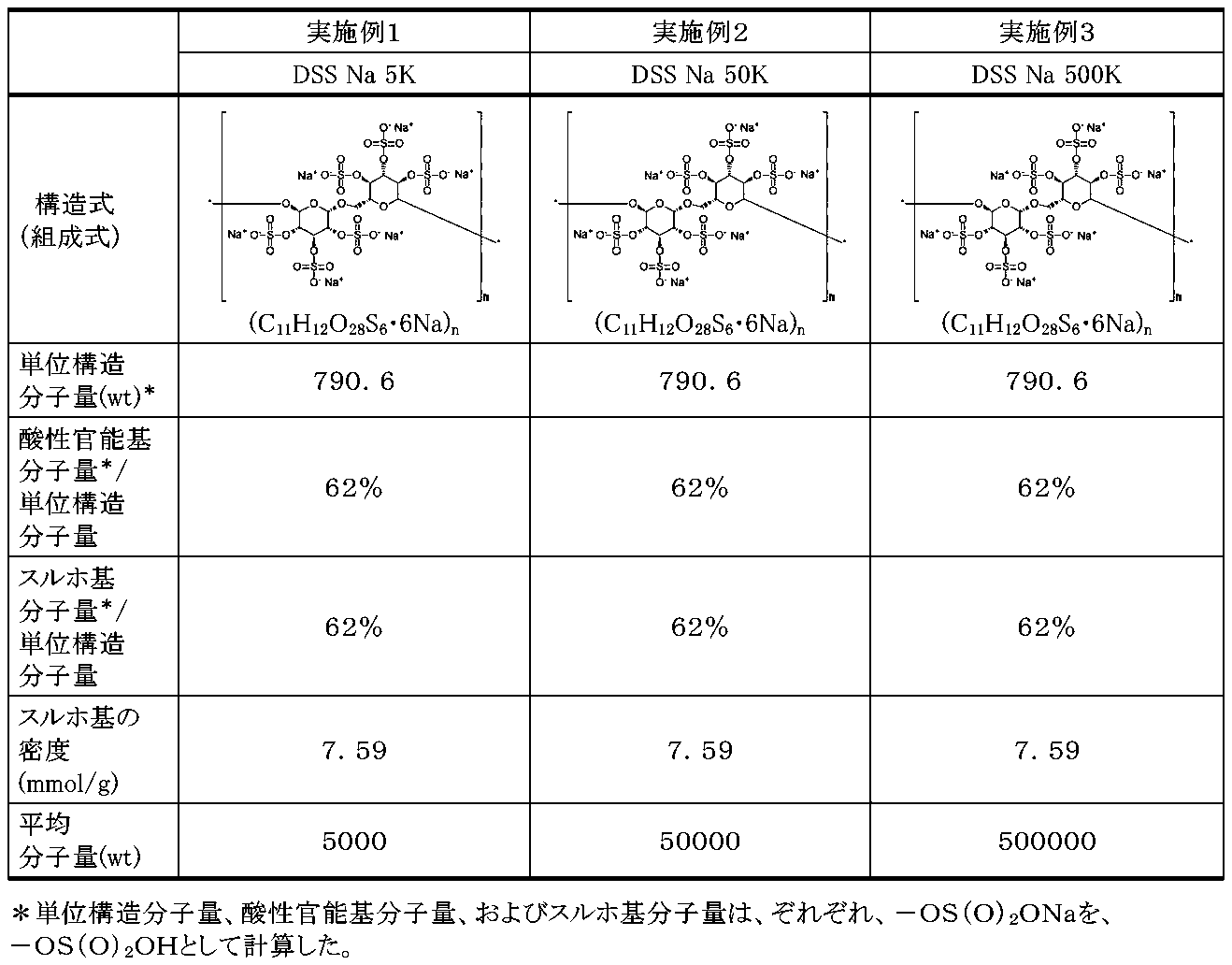
- a preferred example of the compound of this embodiment is dextran sulfate or a salt thereof (e.g., Na), more preferably a compound having the following repeating structure: (In formula (3-2), X is hydrogen or an alkali metal (e.g., Na).)
- dextran sulfates include dextran sulfates or salts thereof (e.g., Na) having a molecular weight of 2 to 1000, preferably 3 to 700, and more preferably 5 to 70.
- Such dextran sulfates or salts thereof usually have a molecular weight of 1,500 to 1,000,000, preferably a molecular weight of 2,000 to 550,000, and more preferably a molecular weight of 4,000 to 55,000.
- the above-mentioned organic sulfonic acid, sulfate ester, or salt thereof is present in the reaction system to modify the coexisting TRACP-5a antigen characteristics and inhibit its activity.
- TRACP-5a inhibitors can be present in the reaction system in various forms; for example, these TRACP-5a inhibitors or their solutions may be added separately to the reaction solution for detecting TRACP-5b, or they may be dissolved in a specimen dilution solution and added to the measurement sample, or, depending on the reaction system, they may be added to a reagent containing an enzyme substrate or a reagent containing an anti-TRACP-5b antibody, and a reaction (e.g., an enzyme reaction or an antigen-antibody reaction) may be carried out using these reagents.
- a reaction e.g., an enzyme reaction or an antigen-antibody reaction
- the TRACP-5a inhibitory activity of the above-mentioned organic sulfonic acid, sulfate ester, or salt thereof increases depending on the density and average molecular weight of the sulfo group, sulfate group, and salt thereof of the compound, and the lower limit of the concentration of the compound in the reaction solution required to exhibit the TRACP-5a inhibitory activity decreases depending on the density and average molecular weight.
- the inhibitory activity increases depending on the concentration within a certain range, but when the concentration reaches a certain level or higher, the inhibitory activity no longer increases depending on the concentration and is maintained at a certain level, and when the concentration reaches a certain level, the inhibitory activity gradually decreases.
- the concentration of the above-mentioned organic sulfonic acid, sulfate ester or salt thereof in the reaction solution taking these points into consideration.
- the concentration in the reaction solution is preferably 0.03 ⁇ 10 -3 to 10.0% by mass, more preferably 0.15 ⁇ 10 -3 to 5.0% by mass, and even more preferably 0.3 ⁇ 10 -3 to 1.0% by mass.
- the concentration in the reaction solution is preferably 0.03 ⁇ 10 -4 to 5.0% by mass, more preferably 0.15 ⁇ 10 -4 to 1.0% by mass, and even more preferably 0.5 ⁇ 10 -4 to 0.5% by mass.
- its concentration in the reaction solution is preferably 0.01 ⁇ 10 ⁇ 5 to 1.0% by mass, more preferably 0.3 ⁇ 10 ⁇ 4 to 0.1% by mass, and even more preferably 0.5 ⁇ 10 ⁇ 5 to 0.05% by mass.
- the concentration in the reaction solution is preferably 0.012 to 15.0% by mass, more preferably 0.020 to 5.0% by mass, and even more preferably 0.10 to 3.0% by mass.
- the concentration in the reaction solution is preferably 0.08 ⁇ 10 ⁇ 3 to 5.0% by mass, more preferably 0.3 ⁇ 10 ⁇ 3 to 1.0% by mass, and even more preferably 0.3 ⁇ 10 ⁇ 2 to 0.3% by mass.
- TRACP-5a is inhibited by making the above-mentioned organic sulfonic acid, sulfate ester or salt thereof present in a reaction system for detecting TRACP-5b.
- reaction system examples include enzyme reactions and antigen-antibody reactions, and the TRACP-5a inhibitor used in the method of the present invention can be used in any of these reaction systems.
- enzyme reaction refers to the reaction between TRACP-5b and its substrate, and examples of the substrate for TRACP-5b include, for example, p-nitrophenyl phosphate or a salt thereof, 2-chloro-4-nitrophenyl phosphate or a salt thereof, 1,2-dioxetane derivatives, acridan derivatives, and 4-methylumbelliferyl phosphate.
- antigen-antibody reaction refers to the reaction between TRACP-5b and an antibody thereagainst, and examples of the antibody thereagainst include, for example, a monoclonal antibody, a polyclonal antibody, and an antigen-binding fragment.
- monoclonal antibodies or antigen-binding fragments thereof include anti-TRACP-5b monoclonal antibodies or antigen-binding fragments thereof described in Patent Documents 6 and 7, etc., and more specifically, examples of antibodies or antigen-binding fragments thereof produced by hybridomas having accession numbers IPOD FERM BP-7889, IPOD FERM BP-8249, and IPOD FERM BP-7890 are included.
- enzyme immunoassay enzyme immunoassay
- ELISA enzyme-linked immunosorbent assay
- CLIA chemiluminescent enzyme immunoassay
- CLIA chemiluminescent immunoassay
- latex agglutination assay latex agglutination assay
- the enzymatic method is a method for measuring the enzymatic activity of TRACP-5b, for example, by reacting TRACP-5b in a sample with an enzyme substrate for TRACP-5b, such as p-nitrophenyl phosphate or a salt thereof, to measure the enzymatic activity of TRACP-5b. More specifically, a chromogenic substrate solution containing tartaric acid or a salt thereof (e.g., a 2-chloro-4-nitrophenyl phosphate solution) is added to the sample to initiate the enzymatic reaction, and the enzymatic activity is determined from the change in absorbance between specific time points.
- the above-mentioned organic sulfonic acid, sulfate ester, or salt thereof may be added independently to the reaction solution, to the sample, or to the chromogenic substrate solution.
- enzyme immunoassay is an immunoassay that utilizes the enzyme activity of TRACP-5b to detect TRACP-5b.
- TRACP-5b in a sample is bound to an anti-TRACP-5b monoclonal antibody, and an enzyme substrate for TRACP-5b, such as p-nitrophenyl phosphate or a salt thereof, is reacted with the bound TRACP-5b to measure the enzyme activity of TRACP-5b.
- the sample is first contacted with an anti-TRACP-5b monoclonal antibody adsorbed to a solid support, and TRACP-5b in the sample is bound to the immobilized antibody.
- the solid support is washed with a washing solution to remove components derived from the sample that have not been adsorbed to the antibody, and then an enzyme substrate for TRACP-5b, such as p-nitrophenyl phosphate or a salt thereof, is added to the reaction system, and the TRACP-5b bound to the antibody is reacted with the substrate.
- an enzyme substrate for TRACP-5b such as p-nitrophenyl phosphate or a salt thereof
- the above-mentioned organic sulfonic acid, sulfate ester, or salt thereof may be added independently to the support, to the sample or sample dilution solution, to a reagent containing an anti-TRACP-5b monoclonal antibody, or to a color-developing substrate solution.
- enzyme-linked immunosorbent assay is a method for measuring TRACP-5b by using two different antibodies against TRACP-5b, one of which is labeled with a substance that enables detection by an enzymatic reaction, and measuring the activity of the enzyme.
- a sample is contacted with a primary anti-TRACP-5b monoclonal antibody adsorbed on a solid support to allow TRACP-5b in the sample to bind to the primary antibody, and then a secondary anti-TRACP-5b monoclonal antibody that binds to TRACP-5b at an epitope different from that of the primary antibody and is labeled with a substance that enables detection by an enzymatic reaction is contacted with the immobilized TRACP-5b to allow the secondary antibody to bind to TRACP-5b, and RACP-5b is measured by an enzymatic reaction utilizing the label of the secondary antibody.
- a primary anti-TRACP-5b monoclonal antibody is adsorbed onto a solid support, and a specimen is contacted with the immobilized primary antibody to bind TRACP-5b in the specimen to the primary antibody.
- the solid support is washed with a washing solution to remove components derived from the specimen that have not been adsorbed to the antibody, and then the immobilized TRACP-5b is contacted with a secondary anti-TRACP-5b monoclonal or polyclonal antibody that is labeled with a substance that enables detection by an enzyme reaction, such as an enzyme or biotin, and binds to TRACP-5b at an epitope different from that of the primary antibody, to bind the secondary antibody to TRACP-5b.
- biotin is reacted with peroxidase-labeled streptavidin, followed by a peroxidase enzyme reaction, or by reacting the labeling enzyme with its substrate, to produce a color-developing substance, and the absorbance of this color-developing substance is measured, thereby measuring TRACP-5b.
- Enzymes used as substances that enable detection by enzymatic reactions include peroxidase, alkaline phosphatase, etc., and substances that enable detection by enzymatic reactions other than enzymes include avidin and substrates for various enzymes. When avidin is used, ABC color development can be utilized.
- the above-mentioned organic sulfonic acid, sulfate ester or salt thereof may be added independently to the support, to the specimen or specimen dilution solution, to a reagent containing a primary antibody and/or a secondary antibody, or to a color-developing substrate solution.
- the chemiluminescent enzyme immunoassay is an immunoassay for detecting the enzyme activity of TRACP-5b by chemiluminescence, and for example, a specimen is brought into contact with an anti-TRACP-5b monoclonal antibody adsorbed to a solid support such as beads to bind TRACP-5b in the specimen to the antibody, and a chemiluminescent substrate for TRACP-5b is brought into contact with the immobilized TRACP-5b, and the generated chemiluminescence is measured to measure TRACP-5b activity.
- a specimen is first brought into contact with an anti-TRACP-5b monoclonal antibody adsorbed to a solid support such as magnetic particles, and TRACP-5b in the specimen is bound to the immobilized antibody.
- a solid support such as magnetic particles
- TRACP-5b in the specimen is bound to the immobilized antibody.
- the solid support on which the magnetic particles are immobilized by magnetic force or the like is washed with a washing solution to remove components derived from the sample that are not adsorbed to the antibody, and then a chemiluminescent substrate for TRACP-5b, for example, 2-chloro-5- ⁇ 4-methoxyspiro[1,2-dioxetane-3,2'-(5'-chloro)tricyclo[3.3.1.13,7]decane]-4-yl ⁇ phenylphosphate disodium salt (CDP-Star, registered trademark) is added to the reaction system, and TRACP-5b bound to the antibody is reacted with the substrate to measure the lumin
- the luminescence intensity reflects the TRACP-5b enzyme activity, and the TRACP-5b in the sample can be measured from the value.
- the above-mentioned organic sulfonic acid, sulfate ester, or salt thereof may be added independently to the support, to the specimen or specimen dilution solution, to a reagent containing an anti-TRACP-5b monoclonal antibody, or to a color-developing substrate solution.
- Chemiluminescence enzyme immunoassay can also be used to measure TRACP-5b by contacting a specimen with a primary anti-TRACP-5b monoclonal antibody immobilized on a solid support to allow TRACP-5b in the specimen to bind to the primary antibody, then contacting the immobilized TRACP-5b with a secondary anti-TRACP-5b monoclonal antibody that binds to TRACP-5b at an epitope different from that of the primary antibody and is labeled with a chemiluminescent substrate or a substance that enables detection by chemiluminescence to allow TRACP-5b to bind to the secondary antibody, and generating chemiluminescence from or using the label of the secondary antibody, and measuring the luminescence intensity.
- the primary anti-TRACP-5b monoclonal antibody is adsorbed to a solid support, for example, magnetic particles, and the specimen is contacted with the immobilized primary antibody to allow TRACP-5b in the specimen to bind to the primary antibody.
- the solid support on which the magnetic particles are fixed is washed with a washing solution to remove components derived from the sample that have not been adsorbed to the antibody, and then the fixed TRACP-5b is contacted with a secondary anti-TRACP-5b monoclonal or polyclonal antibody that is labeled with an enzyme or a substance that can generate chemiluminescence using an enzyme reaction and binds to TRACP-5b at an epitope different from that of the primary antibody, allowing the secondary antibody to bind to TRACP-5b.
- chemiluminescence is generated from or by using the label of the secondary antibody, and the luminescence intensity is measured, thereby allowing TRACP-5b to be measured.
- the above-mentioned organic sulfonic acid, sulfate ester or salt thereof may be added independently to the support, may be added to the sample, or may be added to a reagent containing a primary antibody and/or a secondary antibody.
- the latex agglutination method is a method for measuring TRACP-5b by measuring the turbidity caused by the agglutination of latex particles as absorbance. For example, a specimen is brought into contact with an anti-TRACP-5b polyclonal antibody adsorbed to latex particles to cause agglutination of the latex particles via TRACP-5b, and the resulting turbidity (absorbance) is measured to measure TRACP-5b.
- the above-mentioned organic sulfonic acid, sulfate ester, or salt thereof may be added independently to the reaction solution, to the specimen, or to a reagent containing latex particles.
- the sample in which TRACP-5b is measured may be from any living organism, but is usually from a mammal, and in most cases, from a human.
- the sample may be from any tissue or body fluid, but in most cases, blood, serum, and plasma are used.
- TRACP-5b Assay Kit Another embodiment of the present invention relates to a TRACP-5b assay kit, which is characterized in that the kit contains the above-mentioned organic sulfonic acid, sulfate ester and/or salt thereof.
- the organic sulfonic acid, sulfate ester, or salt thereof may be included in the kit 1) as an independent solution, 2) contained in a sample diluent, 3) contained in a substrate-containing reagent, or 4) contained in a reagent containing an anti-TRACP-5b antibody, depending on the kit configuration and the measurement principle.
- the concentration of the organic sulfonic acid, sulfate ester, or salt thereof in each solution or reagent is preferably adjusted to the concentration in the reaction solution described above according to the density of the sulfo group (-S(O) 2 OH), sulfate group (-OS(O) 2 OH) and/or salt thereof of the organic sulfonic acid, sulfate ester, or salt thereof, the molecular weight of these compounds, and the measurement protocol (particularly, dilution factor (volume (vol) of reaction solution/volume (vol) of solution or reagent in which the organic sulfonic acid, sulfate ester, or salt thereof is dissolved or added)).
- the concentration (C) in the solution or reagent is preferably 0.03 ⁇ 10 -3 to 10.0% by mass, more preferably 0.15 ⁇ 10 -3 to 5.0% by mass, and even more preferably 0.3 ⁇ 10 -3 to 1.0% by mass.
- the concentration in the solution or reagent is preferably 0.03 ⁇ 10 -4 to 5.0% by mass, more preferably 0.15 ⁇ 10 -4 to 1.0% by mass, and even more preferably 0.5 ⁇ 10 -4 to 0.5% by mass.
- the concentration (C) in the solution or reagent is preferably 0.01 ⁇ 10 ⁇ 5 to 1.0% by mass, more preferably 0.3 ⁇ 10 ⁇ 4 to 0.1% by mass, and even more preferably 0.5 ⁇ 10 ⁇ 5 to 0.05% by mass.
- the concentration (C) in the solution or reagent is preferably 0.012 to 15.0% by mass, more preferably 0.020 to 5.0% by mass, and even more preferably 0.10 to 3.0% by mass.
- the concentration (C) in the solution or reagent is preferably 0.08 ⁇ 10 -3 to 5.0% by mass, more preferably 0.3 ⁇ 10 -3 to 1.0% by mass, and even more preferably 0.3 ⁇ 10 -2 to 0.3% by mass.
- TRACP-5b can be measured using a variety of methods, and TRACP-5b measurement kits have different reagent compositions depending on the measurement method.
- a kit for measuring TRACP-5b by an enzymatic method includes a substrate for TRACP-5b, the aforementioned organic sulfonic acid, sulfate ester, or salt thereof, and optionally a reagent for diluting a specimen.
- the aforementioned organic sulfonic acid, sulfate ester, or salt thereof can be contained in an independent solution, or in a reagent containing a substrate for TRACP-5b, or in a reagent for diluting a specimen.
- the aforementioned organic sulfonic acid, sulfate ester, or salt thereof can be dissolved in a buffer solution such as Tris.
- a kit for measuring TRACP-5b by enzyme immunoassay comprises a solid support such as a multiwell plate, an anti-TRACP-5b monoclonal antibody adsorbed to the solid support, a substrate for TRACP-5b, the above-mentioned organic sulfonic acid, sulfate ester or salt thereof, optionally a reagent for diluting a sample, and optionally a washing solution.
- the anti-TRACP-5b monoclonal antibody may be included in the kit as an antibody solution separate from the solid support, and in this case, when measuring TRACP-5b, the antibody is adsorbed to the solid support.
- the washing solution is used to remove components in the sample that have not been adsorbed after TRACP-5b in the sample is bound to the antibody.
- a Tris buffer solution containing a surfactant can be used as the washing solution.
- the specimen dilution solution is used to adjust the concentration of the specimen, and can be, for example, a buffer solution such as Tris etc.
- a chelating agent such as EDTA.2Na or an inorganic salt such as table salt may be added to the buffer solution.
- materials for the solid support include polystyrene, polypropylene, polycarbonate, polyethylene, nylon, methacrylate, etc.
- shapes of the solid support include plates, (magnetic) beads (particles), etc.
- the aforementioned organic sulfonic acid, sulfate ester, or salt thereof can be contained in an independent solution, or in a reagent containing a substrate for TRACP-5b, a reagent containing an anti-TRACP-5b monoclonal antibody, or a reagent for diluting a specimen.
- the aforementioned organic sulfonic acid, sulfate ester, or salt thereof can be dissolved in a buffer solution such as Tris.
- a kit for measuring TRACP-5b by enzyme-linked immunosorbent assay comprises a solid support, a primary anti-TRACP-5b monoclonal antibody immobilized on the solid support, a secondary anti-TRACP-5b monoclonal antibody that binds to TRACP-5b at an epitope different from that of the primary anti-TRACP-5b monoclonal antibody and is labeled with a substance that enables detection by enzyme reaction, a reagent for detecting the labeled substance of the secondary anti-TRACP-5b monoclonal antibody by enzyme reaction, the above-mentioned organic sulfonic acid, sulfate ester or salt thereof, optionally a reagent for diluting a sample, and optionally a washing solution.
- ELISA enzyme-linked immunosorbent assay
- the primary anti-TRACP-5b monoclonal antibody may be included in the kit as an antibody solution separate from the solid support. In this case, when measuring TRACP-5b, the primary antibody is adsorbed to the solid support.
- the washing solution is used to remove components that have not bound to the primary or secondary antibodies after TRACP-5b in the sample is bound to these antibodies.
- a Tris buffer solution containing a surfactant can be used as the washing solution.
- the specimen dilution solution is used to adjust the concentration of the specimen, and can be, for example, a buffer solution such as Tris etc. If necessary, a chelating agent such as EDTA.2Na or an inorganic salt such as table salt may be added to the buffer solution.
- the above-mentioned organic sulfonic acid, sulfate ester, or salt thereof can be contained in an independent solution, or in a reagent for making the label of the secondary anti-TRACP-5b monoclonal antibody detectable by an enzyme reaction, a reagent containing a primary antibody or a secondary antibody, or a reagent for diluting a specimen.
- a buffer solution such as Tris.
- Substances that enable detection in an enzyme reaction include enzymes other than ACP, substrates for enzymes other than ACP, and biotin.
- the reagent for detecting the labeling substance by an enzyme reaction is, for example, a reagent containing peroxidase-labeled streptavidin, a peroxidase enzyme substrate of tetramethylbenzidine, and hydrogen peroxide when the labeling substance is biotin, or a substrate thereof when the labeling substance is an enzyme, such as p-nitrophenyl phosphate when the labeling substance is alkaline phosphatase.
- Materials for the solid support include polystyrene, polypropylene, polycarbonate, polyethylene, nylon, methacrylate, etc. Shapes of the solid support include plates, (magnetic) beads (particles), etc.
- a kit for measuring TRACP-5b by chemiluminescent enzyme immunoassay contains, for example, a solid support, an anti-TRACP-5b monoclonal antibody adsorbed to the solid support, a chemiluminescent substrate for TRACP-5b, the above-mentioned organic sulfonic acid, sulfate ester or salt thereof, optionally a reagent for diluting a sample, and optionally a washing solution.
- the anti-TRACP-5b monoclonal antibody may be contained in the kit as an antibody solution separate from the solid support. In this case, when TRACP-5b is measured, the antibody is adsorbed to the solid support.
- chemiluminescent substrates include: (1) 3-(4-methoxyspiro ⁇ 1,2-dioxetane-3,2-(5'-chloro)tricyclo[3.3.1.13,7]decane ⁇ -4-yl)phenylphosphoric acid, disodium salt, 4-chloro-3-(methoxyspiro ⁇ 1,2-dioxetane-3,2'-(5'-chloro)tricyclo[3.3.1.13,7]decane ⁇ -4-yl)phenylphosphoric acid, disodium salt, 3-(4-methoxyspiro ⁇ 1,2-dioxetane- 1,2-dioxetane derivatives such as 3,2'-tricyclo[3.3.1.1(3,7)]decane ⁇ -4-yl)phenyl phosphate disodium salt and 4-methoxy-4-(3-phenyl phosphate)spiro[1,2-dioxetane-3,2'-adamantane
- the sample diluent is used to adjust the concentration of the sample, and examples of the diluent include 2-(N-morpholino)ethanesulfonic acid (MES) buffer solution, 3-(N-morpholino)propanesulfonic acid (MOPSO) buffer solution, 3-morpholinopropanesulfonic acid (MOPS) buffer solution, N,N-bis(2-hydroxyethyl)-2-aminoethanesulfonic acid (BES) buffer solution, N-tris(hydroxymethyl)methyl-2-aminoethanesulfonic acid (TES) buffer solution, 2-[4-(2- A buffer selected from the group consisting of N-(2-hydroxyethyl)-1-piperazinyl]ethanesulfonic acid (HEPES) buffer, N-(2-acetamido)iminodiacetic acid (ADA) buffer, N-(2-acetamido)-2-aminoethanesulfonic acid (ACES) buffer, bis(2-hydroxye
- Cobalt ions or manganese ions can be added as metal ions to the buffer, if necessary.
- the washing solution is used to remove unadsorbed components from the sample after TRACP-5b in the sample is bound to the antibody.
- the washing solution for example, the above-mentioned buffer solution containing a surfactant can be used.
- the aforementioned organic sulfonic acid, sulfate ester, or salt thereof can be contained in an independent solution, or in a reagent containing a chemiluminescent substrate for TRACP-5b, a reagent containing an anti-TRACP-5b monoclonal antibody, or a reagent for diluting a specimen.
- the aforementioned organic sulfonic acid, sulfate ester, or salt thereof can be dissolved in, for example, the above-mentioned buffer solution.
- a kit for measuring TRACP-5b by chemiluminescence immunoassay also comprises a solid support, a primary anti-TRACP-5b monoclonal antibody adsorbed to the solid support, a secondary anti-TRACP-5b monoclonal antibody that binds to TRACP-5b at an epitope different from that of the primary anti-TRACP-5b monoclonal antibody and is labeled with a substance that enables detection by chemiluminescence, a reagent that makes the label detectable by chemiluminescence, the aforementioned organic sulfonic acid, sulfate ester or salt thereof, optionally a reagent for diluting a sample, and optionally a washing solution.
- the primary anti-TRACP-5b monoclonal antibody may be included in the kit as an antibody solution separate from the solid support. In this case, when measuring TRACP-5b, the primary antibody is adsorbed to the solid support.
- the washing solution is used to remove components that have not bound to the primary or secondary antibodies after TRACP-5b in the sample is bound to these antibodies.
- the washing solution and sample dilution solution are the same as those described above.
- the reagent that makes the label detectable by chemiluminescence is, for example, a reagent containing peroxidase-labeled streptavidin, a peroxidase chemiluminescent substrate, and hydrogen peroxide when the label is biotin, and a substrate for the enzyme, for example, p-nitrophenyl phosphate, when the label is an enzyme, for example, alkaline phosphatase.
- the chemiluminescent substrate is the same as described above.
- materials for the solid support include polystyrene, polypropylene, polycarbonate, polyethylene, nylon, methacrylate, etc.
- shapes of the solid support include plates, (magnetic) beads (particles), etc.
- the aforementioned organic sulfonic acid, sulfate ester, or salt thereof can be contained in an independent solution, or in a reagent that renders the label detectable by chemiluminescence, a reagent containing a primary antibody or a secondary antibody, or a reagent for diluting a specimen.
- the aforementioned organic sulfonic acid, sulfate ester, or salt thereof can be dissolved in, for example, the above-mentioned buffer solution.
- a kit for measuring TRACP-5b by the latex agglutination method comprises latex particles, an anti-TRACP-5b polyclonal antibody or an anti-TRACP-5b monoclonal antibody adsorbed to the latex particles, the aforementioned organic sulfonic acid, sulfate ester or salt thereof, and optionally a reagent for diluting a specimen.
- the aforementioned organic sulfonic acid, sulfate ester or salt thereof can be contained in an independent solution, or in a reagent containing latex particles, or in a reagent for diluting a specimen.
- the aforementioned organic sulfonic acid, sulfate ester or salt thereof can be dissolved in, for example, a buffer solution.
- the buffer solution include 2-(N-morpholino)ethanesulfonic acid (MES) buffer solution, 3-(N-morpholino)propanesulfonic acid (MOPSO) buffer solution, 3-morpholinopropanesulfonic acid (MOPS) buffer solution, N,N-bis(2-hydroxyethyl)-2-aminoethanesulfonic acid (BES) buffer solution, N-tris(hydroxymethyl)methyl-2-aminoethanesulfonic acid (TES) buffer solution, 2-[4-(2-hydroxyethyl)-2-aminoethanesulfonic acid ( ...
- buffers examples include N-(2-(diethyl)-1-piperazinyl)ethanesulfonic acid (HEPES) buffer, N-(2-acetamido)iminodiacetic acid (ADA) buffer, N-(2-acetamido)-2-aminoethanesulfonic acid (ACES) buffer, bis(2-hydroxyethyl)iminotris(hydroxymethyl)methane (Bis-Tris) buffer, tris(hydroxymethyl)aminomethane (Tris) buffer, and phosphate buffer.
- HEPES diethyl)-1-piperazinyl)ethanesulfonic acid
- ADA N-(2-acetamido)iminodiacetic acid
- AVS N-(2-acetamido)-2-aminoethanesulfonic acid
- Bis-Tris bis(2-hydroxyethyl)iminotris(hydroxymethyl)methane
- Tris tris(hydroxymethyl)aminome
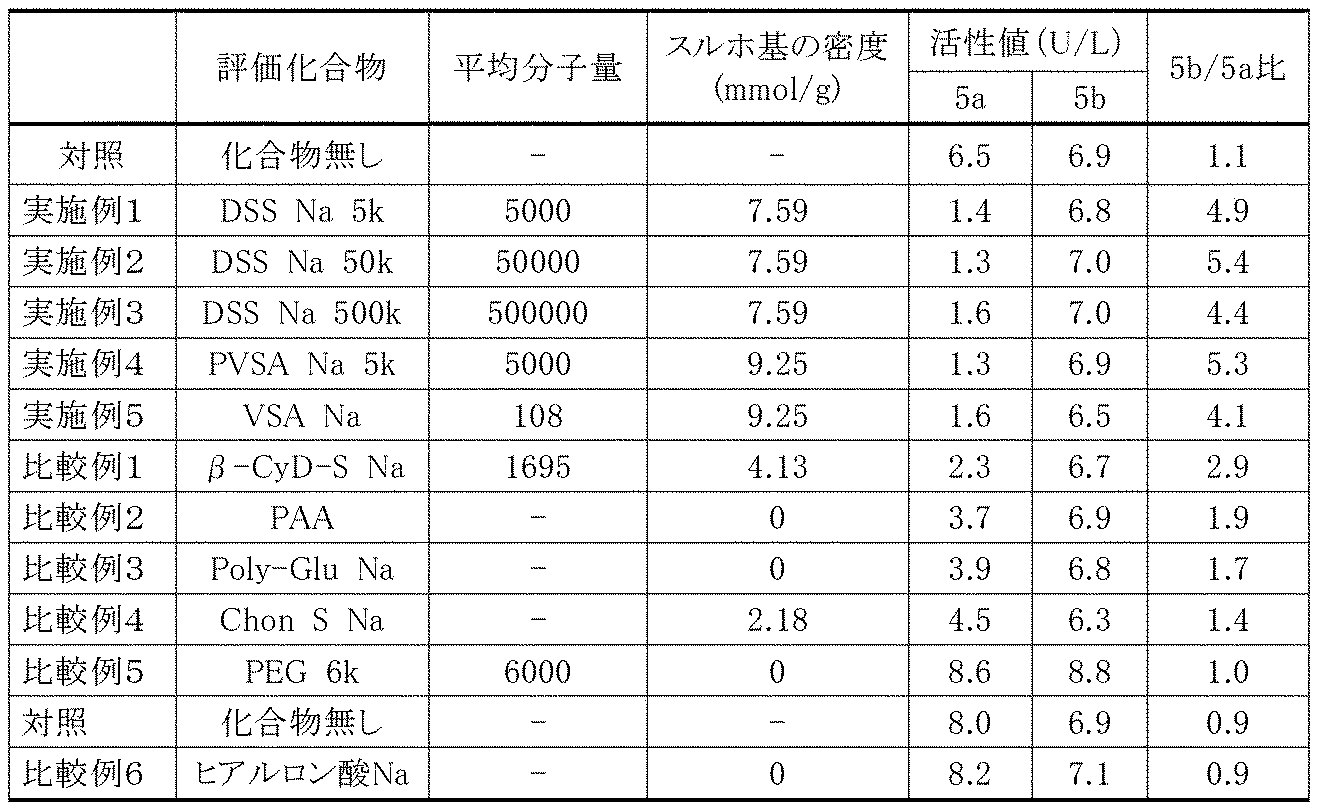
- Test 1 Evaluation of TRACP-5a Inhibitors by Enzymatic Method 1-1. Compounds Evaluated The following compounds were evaluated for their TRACP-5a inhibitory effect by the enzymatic method.
- Measurement sample TRACP-5b manufactured by Nittobo Medical Co., Ltd. and TRACP-5a manufactured by R&D Systems Co., Ltd. were diluted with 22 mM MES buffer (pH 5.0) to prepare 7 U/L TRACP-5b solution and 7 U/L TRACP-5a solution, which were used as the measurement sample.
- 7 U/L TRACP-5b solution and 8 U/L TRACP-5a solution prepared in the same manner were used.
- Measurement reagent (chromogenic substrate solution) A color-developing substrate solution having the following composition was used. 5mM 2-chloro-4-nitrophenyl phosphate 109mM MES 40mM Sodium Tartrate 0.1% by mass of the compound to be evaluated pH 6.6
- Measurement method A general-purpose Hitachi automatic analyzer 7180 (Hitachi High-Tech) was used for the measurement. 200 ⁇ L of a chromogenic substrate solution containing an evaluation compound was added to 16 ⁇ L of a 7 U/L TRACP-5b solution, or a 7 U/L TRACP-5a solution or an 8 U/L TRACP-5a solution to initiate the enzyme reaction, and the absorbance (main wavelength 405 nm, secondary wavelength 480 nm) was measured from 340.5 seconds to 516.0 seconds. The amount of absorbance change per minute (absorbance change per unit time during the enzyme reaction) was calculated from the change in absorbance between the two points in time.
- serial dilutions of TRACP-5b solutions with known activity in 22 mM MES buffer (pH 5.0) and 22 mM MES buffer (pH 5.0) as a blank were prepared, and serial dilutions of TRACP-5b solutions were measured using a chromogenic substrate solution containing each evaluation compound to prepare a standard line for TRACP-5b.
- serial dilutions of TRACP-5b solutions were measured using a chromogenic substrate solution not containing the evaluation compound to prepare a standard line for TRACP-5b.
- activity values were calculated from the change in absorbance obtained by measuring a TRACP-5b solution and a TRACP-5a solution using a chromogenic substrate solution containing each evaluation compound and a chromogenic substrate solution not containing the evaluation compound.
- the measurement using sodium hyaluronate was carried out in a batch separate from that for the other evaluation compounds.
- Measurement Reagent Chromogenic Substrate Solution
- Measurement Method A chromogenic substrate solution with the same composition as in Test 1 was used, except that the concentrations of each evaluation compound were as described above. The measurement method was performed in the same manner as in Test 1.
- Example 4 is data from a different batch, but the data from Test 1 is included for reference.
- Example 5 is data from a different batch, but the data from Test 1 is listed for reference.
- Example 1 is data from a different batch, but the data from Test 1 is listed for reference.
- Example 2 is data from a different batch, but the data from Test 1 is included for reference.
- TBS-T 50 mM Tris-HCl, 150 mM NaCl, 0.05% Tween 20, pH 7.5
- 300 ⁇ L of 1.5% BSA-containing TBS was added and the plate was left standing overnight in a refrigerator.
- a color-developing substrate solution (5 mM 2-chloro-4-nitrophenyl phosphate, 109 mM MES, 40 mM Na tartrate, pH 6.6) containing a compound to be evaluated at a concentration of 0.1% by mass was added to each well and allowed to stand at 37°C for 1 hour. Thereafter, 50 ⁇ L of 0.5 N NaOH was added, and the absorbance (main wavelength 405 nm, secondary wavelength 490 nm) was measured using a plate reader.
- a color-developing substrate solution 5 mM 2-chloro-4-nitrophenyl phosphate, 109 mM MES, 40 mM Na tartrate, pH 6.6
Landscapes
- Health & Medical Sciences (AREA)
- Life Sciences & Earth Sciences (AREA)
- Chemical & Material Sciences (AREA)
- Immunology (AREA)
- Engineering & Computer Science (AREA)
- Molecular Biology (AREA)
- Biomedical Technology (AREA)
- Hematology (AREA)
- Urology & Nephrology (AREA)
- Organic Chemistry (AREA)
- Biochemistry (AREA)
- General Health & Medical Sciences (AREA)
- Medicinal Chemistry (AREA)
- Microbiology (AREA)
- Biotechnology (AREA)
- Genetics & Genomics (AREA)
- Physics & Mathematics (AREA)
- Analytical Chemistry (AREA)
- General Physics & Mathematics (AREA)
- Pathology (AREA)
- Zoology (AREA)
- Wood Science & Technology (AREA)
- Food Science & Technology (AREA)
- Cell Biology (AREA)
- Bioinformatics & Cheminformatics (AREA)
- Proteomics, Peptides & Aminoacids (AREA)
- General Engineering & Computer Science (AREA)
- Biophysics (AREA)
- Chemical Kinetics & Catalysis (AREA)
- Measuring Or Testing Involving Enzymes Or Micro-Organisms (AREA)
Abstract
Description
[1] 検体中の酒石酸抵抗性酸性ホスファターゼ5b(TRACP-5b)の測定方法であって、
スルホ基(-S(O)2OH)、硫酸基(-OS(O)2OH)および/またはそれらの塩を、6.5mmol/g以上の密度で有する、有機スルホン酸、硫酸エステルまたはそれらの塩の存在下で、TRACP-5bを検出する反応を行う工程を含む、TRACP-5bの測定方法。
単位構造あたり、スルホ基(-S(O)2OH)、硫酸基(-OS(O)2OH)および/またはそれらの塩を、S(O)2O-換算値で、50質量%以上有する有機スルホン酸、硫酸エステルおよび/またはそれらの塩の存在下で、酵素反応または抗原抗体反応を行う工程を含む、TRACP-5bの測定方法;あるいは
前記有機スルホン酸、硫酸エステルまたはそれらの塩は、単位構造あたり、スルホ基(-S(O)2OH)、硫酸基(-OS(O)2OH)および/またはそれらの塩を、S(O)2O-換算値で、50質量%以上有する、[1]に記載の方法。

(式(1)中、Rは、炭素数1~3のアルキル、アルケニル、またはアルキニルであり、Yは結合、または酸素原子であり、Xは水素またはアルカリ金属である。)
で表されるか、
式(2):

(式(2)中、Yは結合、または酸素原子であり、nは、2~5000の整数であり、Xは水素またはアルカリ金属である。)
の繰り返し単位を有するか、
あるいは
式(3):
(式(3)中、Yは、OまたはCH2であり、R1~R5のうち、2つは、O-または結合手であり、残りのうち少なくとも2つは、O-S(O)2OXまたはS(O)2OX(Xは水素またはアルカリ金属である。)であり、いずれにも該当しないものは、OXまたはC(O)OX(Xは水素またはアルカリ金属である。)である。)
の構造を含む繰り返し単位を有する、[1]または[2]に記載の方法。
[7] 前記検体が、血液、血清または血漿である、[1]~[6]のいずれか1項に記載の方法。
スルホ基(-S(O)2OH)、硫酸基(-OS(O)2OH)および/またはそれらの塩を、6.5mmol/g以上の密度で有する有機スルホン酸、硫酸エステルおよび/またはそれらの塩を含む、キット。
単位構造あたり、スルホ基(-S(O)2OH)、硫酸基(-OS(O)2OH)またはそれらの塩を、S(O)2O-換算値で、50質量%以上有する有機スルホン酸、硫酸エステルおよび/またはそれらの塩を含む、キット;あるいは
前記有機スルホン酸、硫酸エステルおよび/またはそれらの塩は、単位構造あたり、スルホ基(-S(O)2OH)、硫酸基(-OS(O)2OH)またはそれらの塩を、S(O)2O-換算値で、50質量%以上有する、[8]に記載のキット。

(式(1)中、Rは、炭素数1~5のアルキル、アルケニル、またはアルキニルであり、Yは結合、または酸素原子であり、Xは水素またはアルカリ金属である。)
で表されるか、
式(2):
(式(2)中、Yは結合、または酸素原子であり、nは、2~5000の整数であり、Xは水素またはアルカリ金属である。)
の繰り返し構造を有するか、あるいは
式(3):
(式(3)中、Yは、OまたはCH2であり、R1~R5のうち、2つは、O-または結合手であり、残りのうち少なくとも2つは、O-S(O)2OXまたはS(O)2OX(Xは水素またはアルカリ金属である。)であり、いずれにも該当しないものは、OXまたはC(O)OX(Xは水素またはアルカリ金属である。)である。)
の構造を含む繰り返し構造を有する、
[8]または[9]に記載のキット。
TRACP-5bの基質と、前記有機スルホン酸、硫酸エステルまたはそれらの塩と、場合により検体希釈用試薬とを含む、キット。
固相支持体と、前記固相支持体に吸着される抗TRACP-5bモノクローナル抗体と、前記TRACP-5bの基質と、前記有機スルホン酸、硫酸エステルまたはそれらの塩と、場合により検体希釈用試薬と、場合により洗浄液とを含む、キット。
[15] 前記抗TRACP-5bモノクローナル抗体を含有する試薬、前記TRACP-5bの基質を含有する試薬、または前記検体希釈用試薬に、前記有機スルホン酸、硫酸エステルまたはそれらの塩を含む、[14]に記載のキット。
固相支持体と、前記固相支持体に吸着される第一次抗TRACP-5bモノクローナル抗体と、前記第一次抗TRACP-5bモノクローナル抗体と異なるエピトープでTRACP-5bに結合し、酵素反応での検出を可能とする物質で標識されている第二次抗TRACP-5bモノクローナル抗体と、前記標識物質を酵素反応で検出するための試薬と、前記有機スルホン酸、硫酸エステルまたはそれらの塩と、場合により検体希釈用試薬と、場合により洗浄液とを含む、キット。
[17] 前記第二次抗TRACP-5bモノクローナル抗体を含有する試薬、前記標識物質を酵素反応で検出するための試薬、または前記検体希釈用試薬に、前記有機スルホン酸、硫酸エステルまたはそれらの塩を含む、[16]に記載のキット。
固相支持体と、前記固相支持体に吸着される抗TRACP-5bモノクローナル抗体と、前記TRACP-5bの化学発光基質と、前記有機スルホン酸、硫酸エステルまたはそれらの塩と、場合により検体希釈用試薬と、場合により洗浄液とを含む、キット。
[19] 前記TRACP-5bの化学発光基質を含有する試薬、前記抗TRACP-5bモノクローナル抗体を含有する試薬、または前記検体希釈用試薬に、前記有機スルホン酸、硫酸エステルまたはそれらの塩を含む、[18]に記載のキット。
固相支持体と、前記固相支持体に吸着される第一次抗TRACP-5bモノクローナル抗体と、前記第一次抗TRACP-5bモノクローナル抗体と異なるエピトープでTRACP-5bに結合し、化学発光での検出を可能とする物質で標識されている第二次抗TRACP-5bモノクローナル抗体と、前記標識物質を化学発光で検出するための試薬と、前記有機スルホン酸、硫酸エステルまたはそれらの塩と、場合により検体希釈用試薬と、場合により洗浄液とを含む、キット。
[21] 前記第一次抗TRACP-5bモノクローナル抗体を含む試薬、前記第二次抗TRACP-5bモノクローナル抗体を含む試薬、前記標識物質を化学発光で検出するための試薬、または前記検体希釈用試薬を含む試薬に、前記有機スルホン酸、硫酸エステルまたはそれらの塩を含む、[20]に記載のキット。
ラテックス粒子と、前記ラテックス粒子に吸着された抗TRACP-5b抗体と、前記有機スルホン酸、硫酸エステルまたはそれらの塩と、場合により検体希釈用試薬とを含む、キット。
[23] 前記抗TRACP-5b抗体を含む試薬、または前記検体希釈用試薬に、前記有機スルホン酸、硫酸エステルまたはそれらの塩を含む、[22]に記載のキット。
また、本発明は、他の実施形態において、特定の有機スルホン酸、硫酸エステルまたはそれらの塩を含むTRACP-5b測定用キットを提供する。
以下では、これら実施形態を詳細に説明する。
1-1.有機スルホン酸、硫酸エステルまたはそれらの塩
この測定方法においては、スルホ基(-S(O)2OH)、硫酸基(-OS(O)2OH)および/またはそれらの塩を、6.5mmol/g以上の密度で有する、有機スルホン酸、硫酸エステルまたはそれらの塩を反応系に存在させることで、TRACP-5aを阻害し、TRACP-5bの選択的な測定を可能とする。
後述する実施例で示す通り、スルホ基、硫酸基またはそれらの塩の密度に応じて、TRACP-5aを阻害する効果が大きくなり、好ましい実施形態において、有機スルホン酸、硫酸エステルまたはそれらの塩は、スルホ基、硫酸基および/またはそれらの塩を、7.5mmol/g以上の密度で有し、より好ましくは、8.5mmol/g以上の密度で有する。
ここで、本願明細書で使用する場合に、「単位構造」とは、対象とする化合物が繰り返し構造を有する場合には、その繰り返し単位の構造を意味し、対象とする化合物が繰り返し構造を有しない場合には、化合物全体の構造を意味する。また、単位構造が、スルホ基(-S(O)2OH)、または硫酸基(-OS(O)2OH)の塩を有する場合には、スルホ基(-S(O)2OH)、または硫酸基(-OS(O)2OH)として単位構造の分子量を算出することとする。
式(1):

で表される化合物が挙げられる。
式(1)中、Rは、炭素数1~3のアルキル、アルケニル、またはアルキニルであり、好ましくは、炭素数1~3のアルケニルである。
Yは結合、または酸素原子であり、好ましくは、結合である。
Xは水素またはアルカリ金属であり、好ましくは、水素またはNaである。
この実施形態の化合物の例としては、例えば、メタンスルホン酸もしくはその塩(例えば、Na塩)、ビニルスルホン酸もしくはその塩(例えば、Na塩)、または硫酸ビニルもしくはその塩が挙げられる。
式(2):
の繰り返し単位を有する化合物が挙げられる。
式(2)中、Yは結合、または酸素原子であり、好ましくは、結合である。
nは、2~5000の整数であり、好ましくは、10~500であり、より好ましくは、20~100である。
Xは水素またはアルカリ金属であり、好ましくは、水素またはNaである。
この実施形態の化合物の好ましい例としては、例えば、ポリビニルスルホン酸もしくはその塩(例えば、Na塩)またはポリビニル硫酸もしくはその塩(例えば、Na塩)が挙げられ、より好ましくは、以下の繰り返し構造:
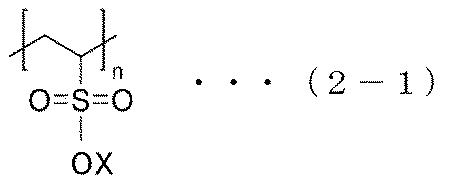
(式(2―1)中、Xは水素またはアルカリ金属であり、好ましくは、水素またはNaである。)
を2~5000、より好ましくは10~500、さらに好ましくは20~100有するポリビニルスルホン酸もしくはその塩が挙げられる。このようなポリビニルスルホン酸もしくはその塩は、通常、200~500000の分子量を有し、好ましくは、1000~50000の分子量を有し、より好ましくは、4000~6000の分子量を有する。
ここで、本願明細書で「分子量」または「平均分子量」という場合、特に異なる意味で使用しない限り、重量平均分子量(Mw)を意味する。また、重量平均分子量(Mw)は、液体クロマトグラフを使用し、ゲル・パーミエーション・クロマトグラフィー(GPC法)によって測定した値を意味する。
式(3):

の構造を含む繰り返し単位を有する、化合物が挙げられる。
式(3)中、Yは、OまたはCH2であり、好ましくは、Oである。
R1~R5のうち、2つは、O-または結合であり、残りのうち少なくとも2つは、O-S(O)2OXまたはS(O)2OX(Xは水素またはアルカリ金属(例えば、Na)である。)であり、いずれにも該当しないものは、OXまたはC(O)OX(Xは水素またはアルカリ金属(例えば、Na)であり、好ましくは、C(O)OX(Xは水素またはアルカリ金属(例えば、Na)である。好ましくは、R1~R5のうち、2つは、O-または結合であり、残りは、O-S(O)2OX(Xは水素またはアルカリ金属(例えば、Na)である。
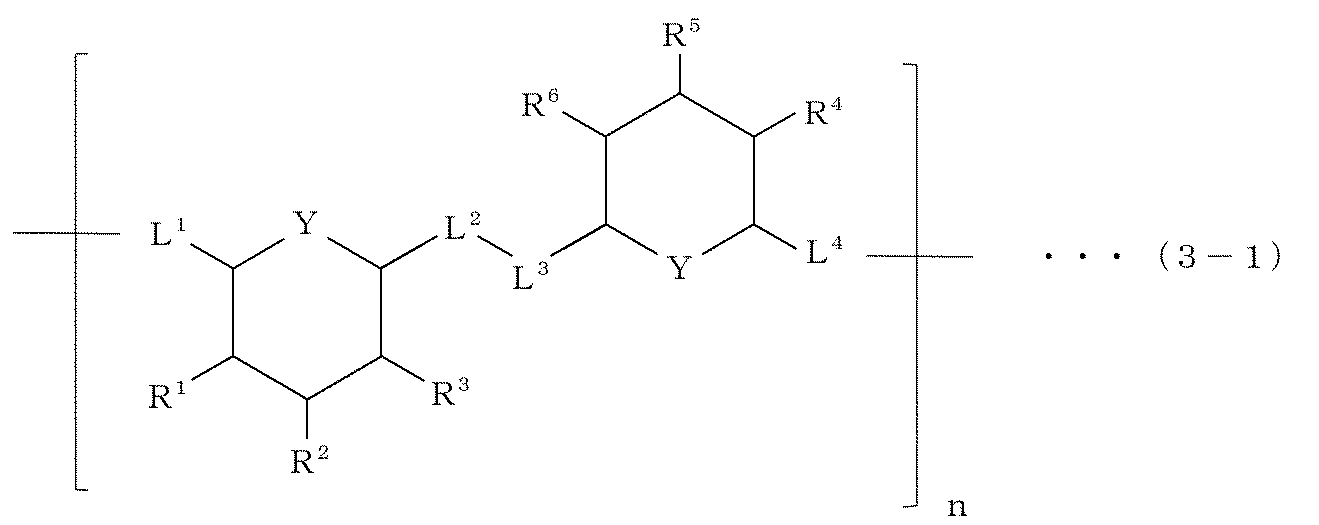
が挙げられる。
式(3-1)中、Yは、OまたはCH2であり、好ましくは、Oである。
L1およびL4は、それぞれ独立して、Oまたは結合であり、好ましくは、一方がO-であり、他方が結合である。
L2およびL3は、それぞれ独立して、O、CH2または結合であり、好ましくは、一方がOであり、他方がCH2または結合である。
R1~R3のうち、少なくとも2つは、それぞれ独立して、O-S(O)2OXまたはS(O)2OX(Xは、水素またはアルカリ金属(例えば、Na)である。)であり、残りは、存在する場合、OXまたはC(O)OX(Xは、水素またはアルカリ金属(例えば、Na)であり、好ましくは、C(O)OX(Xは、水素またはアルカリ金属(例えば、Na)である。R1~R3は、好ましくは、それぞれ独立して、O-S(O)2OXまたはS(O)2OX(Xは、水素またはアルカリ金属(例えば、Na)であり、より好ましくは、それぞれ独立して、O-S(O)2OX(Xは水素またはアルカリ金属(例えば、Na)である。
R4~R6のうち、少なくとも2つは、それぞれ独立して、O-S(O)2OXまたはS(O)2OX(Xは、水素またはアルカリ金属(例えば、Na)である。)であり、残りは、存在する場合、OXまたはC(O)OX(Xは、水素またはアルカリ金属(例えば、Na)であり、好ましくは、C(O)OX(Xは、水素またはアルカリ金属(例えば、Na)である。R4~R6は、好ましくは、それぞれ独立して、O-S(O)2OXまたはS(O)2OX(Xは、水素またはアルカリ金属(例えば、Na)であり、より好ましくは、それぞれ独立して、O-S(O)2OX(Xは水素またはアルカリ金属(例えば、Na)である。
nは、2~1000であり、好ましくは、3~700であり、より好ましくは、4~200であり、5~70がさらに好ましい。

(式(3-2)中、Xは水素またはアルカリ金属(例えば、Na)である。)
を2~1000、好ましくは3~700、より好ましくは5~70有するデキストラン硫酸もしくはその塩(例えば、Na)が挙げられる。このようなるデキストラン硫酸もしくはその塩は、通常、1500~1000000の分子量を有し、好ましくは、2000~550000の分子量を有し、より好ましくは、4000~55000の分子量を有する。
このため、前述の有機スルホン酸、硫酸エステルまたはそれらの塩の反応液中の濃度は、これらの点を考慮して決定することが好ましい。
より具体的には、まず、第一次抗TRACP-5bモノクローナル抗体を、固相支持体に吸着させ、固定された第一次抗体に検体を接触させ検体中のTRACP-5bを第一次抗体と結合させる。次いで、固相支持体を洗浄液で洗浄して、抗体に吸着しなかった検体由来の成分を除去した後、固定されたTRACP-5bに、酵素反応による検出を可能とする物質、例えば、酵素またはビオチンで標識し、第一次抗体と異なるエピトープでTRACP-5bに結合する第二次抗TRACP-5bモノクローナル抗体またはポリクローナル抗体を接触させて第二次抗体をTRACP-5bに結合させる。次いで、第二次抗体の標識から、例えば、ビオチンを、ペルオキシダーゼ標識ストレプトアビジンと反応させた後、ペルオキシダーゼ酵素反応を行う、あるいは標識酵素とその基質とを反応させるなどして、発色物質を生じさせ、この発色物質の吸光度を測定することにより、TRACP-5bを測定することができる。酵素反応による検出を可能とする物質として用いられる酵素としては、ペルオキシダーゼ、アルカリ性ホスファターゼ等が挙げられ、酵素以外の酵素反応による検出を可能とする物質としては、アビジン、各種酵素の基質が挙げられ、アビジンを用いる場合には、ABC系の発色を利用すればよい。
この酵素結合免疫吸着測定法(ELISA)において、上述した有機スルホン酸、硫酸エステルまたはそれらの塩は、独立に支持体に添加してもよいし、検体もしくは検体希釈液に添加してもよいし、第一次抗体および/または第二次抗体を含む試薬に添加してもよいし、発色基質溶液に添加してもよい。
この化学発光酵素免疫測定法(CLEIA法)において、上述した有機スルホン酸、硫酸エステルまたはそれらの塩は、独立に支持体に添加してもよいし、検体もしくは検体希釈液に添加してもよいし、抗TRACP-5bモノクローナル抗体を含む試薬に添加してもよいし、発色基質溶液に添加してもよい。
この化学発光酵素免疫測定法(CLEIA法)において、上述した有機スルホン酸、硫酸エステルまたはそれらの塩は、独立に支持体に添加してもよいし、検体に添加してもよいし、第一次抗体および/または第二次抗体を含む試薬に添加してもよい。
本発明の他の実施形態は、TRACP-5bの測定キットに関し、このキットは、前述した有機スルホン酸、硫酸エステルおよび/またはそれらの塩を含むことを特徴とする。
有機スルホン酸、硫酸エステルまたはそれらの塩は、キット構成および測定原理に応じて、1)独立した溶液として、2)検体希釈液に含有させて、3)基質含有試薬に含有させて、または4)抗TRACP-5b抗体を含有する試薬に含有させてキットに含ませることができる。
抗TRACP-5bモノクローナル抗体は、固相支持体とは別に抗体溶液としてキットに含まれてもよく、この場合には、TRACP-5bを測定する際、抗体を固相支持体に吸着させる。洗浄液は、検体中のTRACP-5bを抗体に結合させた後、吸着しなかった検体中の成分を除去するために使用され。洗浄液としては、例えば、界面活性剤を含むトリス緩衝液を使用することができる。
検体希釈液は、検体の濃度を調製する際に使用され、例えば、トリス等の緩衝液を使用できる。また、緩衝液には、必要に応じて、EDTA・2Na等のキレート剤、食塩等の無機塩を加えてもよい。
固相支持体の材料としては、ポリスチレン、ポリプロピレン、ポリカーボネイト、ポリエチレン、ナイロン、メタアクリレートなどが挙げられる。固相支持体の形状としては、プレート、(磁気)ビーズ(粒子)等が挙げられる。
このキットにおいて、前述した有機スルホン酸、硫酸エステルまたはそれらの塩は、独立の溶液中に、あるいは、TRACP-5bの基質を含む試薬、抗TRACP-5bモノクローナル抗体を含む試薬、または検体希釈用試薬に含有させることができる。独立してキットに含まれる溶液、および検体希釈用試薬では、例えば、トリス等の緩衝液中に前述した有機スルホン酸、硫酸エステルまたはそれらの塩を溶解することができる。
第一次抗TRACP-5bモノクローナル抗体は、固相支持体とは別に抗体溶液としてキットに含まれてもよく、この場合には、TRACP-5bを測定する際、第一次抗体を固相支持体に吸着させる。洗浄液は、検体中のTRACP-5bを第一次抗体または第二次抗体に結合させた後、これら抗体に結合しなかった成分を除去するために使用される。洗浄液としては、例えば、界面活性剤を含むトリス緩衝液を使用することができる。
検体希釈液は、検体の濃度を調製する際に使用され、例えば、トリス等の緩衝液を使用できる。また、緩衝液には、必要に応じて、EDTA・2Na等のキレート剤、食塩等の無機塩を加えてもよい。
このキットにおいて、前述した有機スルホン酸、硫酸エステルまたはそれらの塩は、独立の溶液中に、あるいは、第二次抗TRACP-5bモノクローナル抗体の標識を酵素反応で検出可能とするための試薬、第一次抗体または第二次抗体を含む試薬、または検体希釈用試薬に含有させることができる。独立してキットに含まれる溶液、および検体希釈用試薬では、例えば、トリス等の緩衝液中に前述した有機スルホン酸、硫酸エステルまたはそれらの塩を溶解することができる。
酵素反応での検出を可能とする物質としては、ACP以外の酵素、ACP以外の酵素の基質またはビオチンを上げることができる。
また、標識物質を酵素反応で検出するための試薬は、例えば、標識物質がビオチンの場合、ペルオキシダーゼ標識ストレプトアビジン、テトラメチルベンジジンのペルオキシダーゼ酵素基質、及び過酸化水素を含む試薬である。また、標識物質が、酵素である場合には、その基質であり、例えば、アルカリホスファターゼの場合は、その酵素の基質であるp-ニトロフェニルリン酸などである。
固相支持体の材料としては、ポリスチレン、ポリプロピレン、ポリカーボネイト、ポリエチレン、ナイロン、メタアクリレートなどが挙げられる。固相支持体の形状としては、プレート、(磁気)ビーズ(粒子)等が挙げられる。
抗TRACP-5bモノクローナル抗体は、固相支持体とは別に抗体溶液としてキットに含まれてもよく、この場合には、TRACP-5bを測定する際、抗体を固相支持体に吸着させる。
(1)3-(4-メトキシスピロ{1,2-ジオキセタン-3,2-(5'-クロロ)トリシクロ[3.3.1.13,7]デカン}-4-イル)フェニルリン酸・二ナトリウム塩、4-クロロ-3-(メトキシスピロ{1,2-ジオキセタン-3,2'―(5'-クロロ)トリクシロ[3.3.1.13,7]デカン}-4-イル)フェニルリン酸・二ナトリウム塩、3-(4-メトキシスピロ{1,2-ジオキセタン-3,2’-トリシクロ[3.3.1.1(3,7)]デカン}-4-イル)リン酸フェニル・二ナトリウム塩、4-メトキシ-4-(3-リン酸フェニル)スピロ[1,2-ジオキセタン-3,2’-アダマンタン]・二ナトリウム塩などの1,2-ジオキセタン誘導体;あるいは
(2)[10-メチル-9(10H)-アクリジニルイデン]フェノキシメチルリン酸・二ナトリウム塩などのアクリダン誘導体
が挙げられる。
洗浄液は、検体中のTRACP-5bを抗体に結合させた後、吸着しなかった検体中の成分を除去するために使用され。洗浄液としては、例えば、界面活性剤を含む上述の緩衝液を使用することができる。
このキットにおいて、前述した有機スルホン酸、硫酸エステルまたはそれらの塩は、独立の溶液中に、あるいは、TRACP-5bの化学発光基質を含む試薬、抗TRACP-5bモノクローナル抗体を含む試薬、または検体希釈用試薬に含有させることができる。独立してキットに含まれる溶液、および検体希釈用試薬では、例えば、上述の緩衝液中に前述した有機スルホン酸、硫酸エステルまたはそれらの塩を溶解することができる。
第一次抗TRACP-5bモノクローナル抗体は、固相支持体とは別に抗体溶液としてキットに含まれてもよく、この場合には、TRACP-5bを測定する際、第一次抗体を固相支持体に吸着させる。洗浄液は、検体中のTRACP-5bを第一次抗体または第二次抗体に結合させた後、これら抗体に結合しなかった成分を除去するために使用される。 洗浄液および検体希釈液は、上述と同様である。
標識を化学発光で検出可能とする試薬は、例えば、標識がビオチンの場合、ペルオキシダーゼ標識ストレプトアビジン、ペルオキシダーゼ化学発光基質、及び過酸化水素を含む試薬であり、標識が酵素、例えば、アルカリホスファターゼの場合は、その酵素の基質、例えば、p-ニトロフェニルリン酸などである。化学発光基質は、上述と同様である。
固相支持体の材料としては、ポリスチレン、ポリプロピレン、ポリカーボネイト、ポリエチレン、ナイロン、メタアクリレートなどが挙げられる。固相支持体の形状としては、プレート、(磁気)ビーズ(粒子)等が挙げられる。
このキットにおいて、前述した有機スルホン酸、硫酸エステルまたはそれらの塩は、独立の溶液中に、あるいは、標識を化学発光で検出可能とする試薬、第一次抗体または第二次抗体を含む試薬、または検体希釈用試薬に含有させることができる。独立してキットに含まれる溶液、および検体希釈用試薬では、例えば、上述の緩衝液中に前述した有機スルホン酸、硫酸エステルまたはそれらの塩を溶解することができる。
なお、実施例で使用されている略語の意味は以下の通りである。
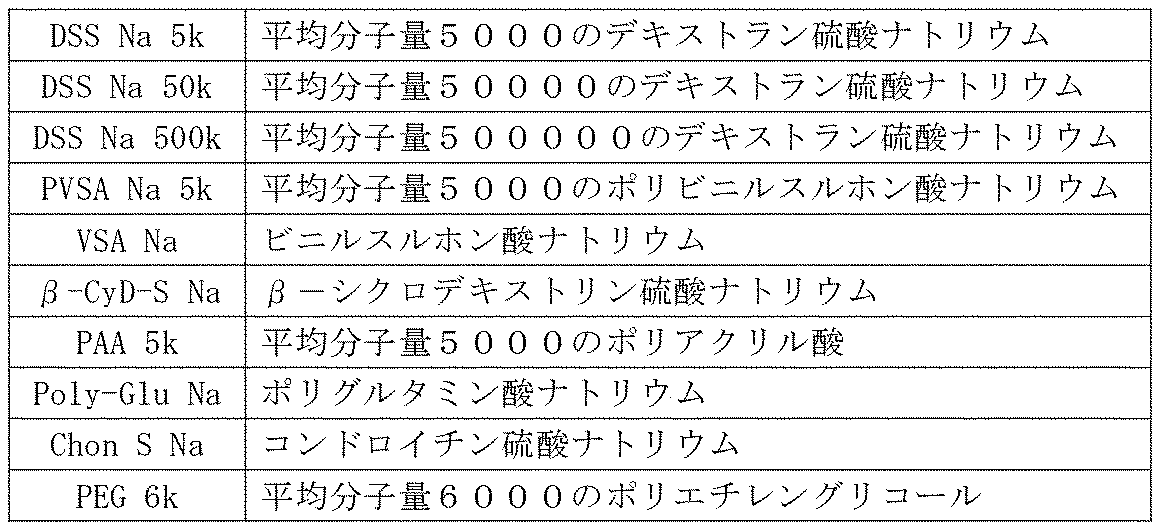
1-1.評価化合物
以下の化合物について、酵素法でのTRACP-5a阻害効果を評価した。
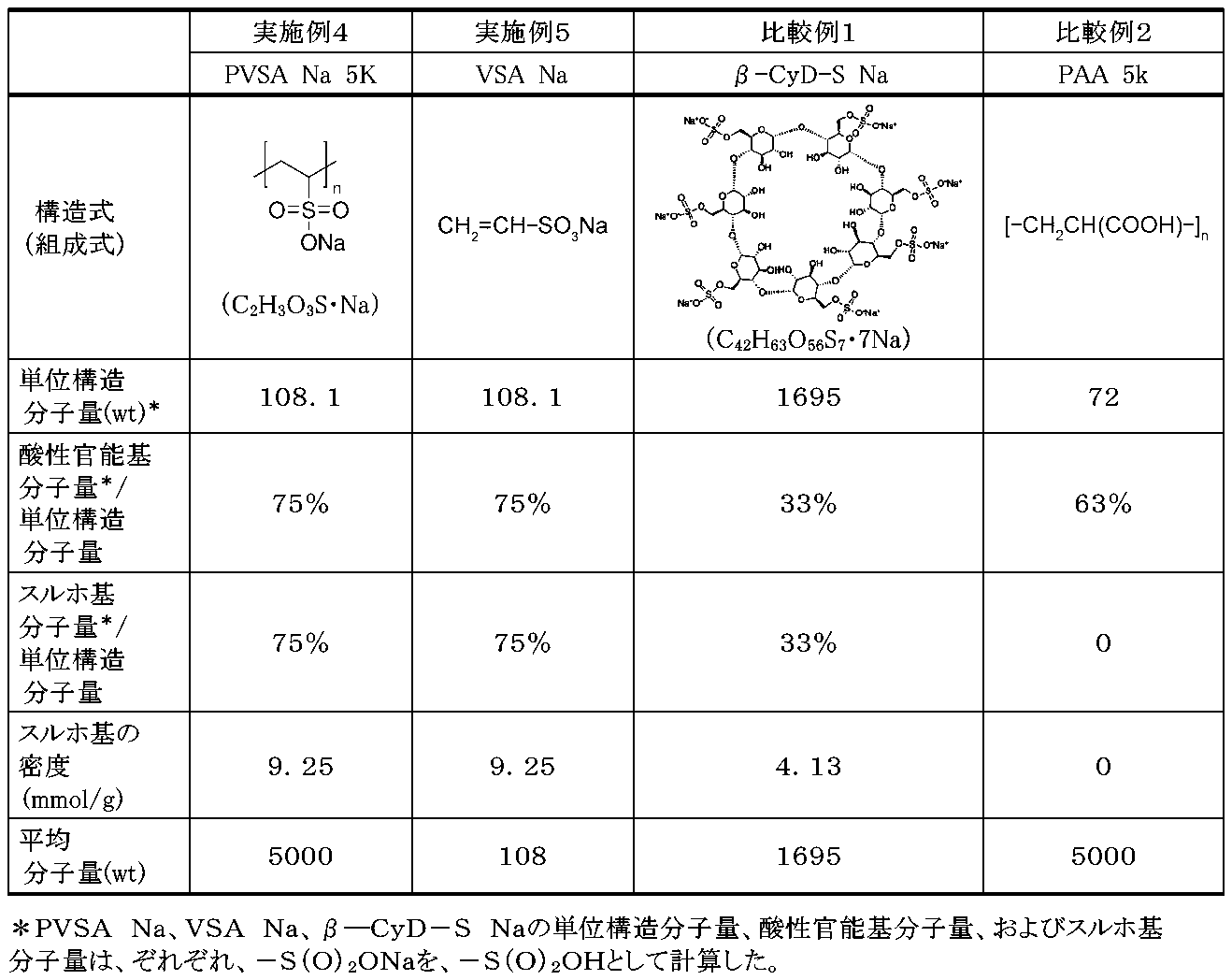

ニットーボーメディカル社製TRACP-5bおよびR&D Systems社製TRACP-5aを、22mM MES緩衝液(pH5.0)で希釈して、7U/L TRACP-5b溶液、および7U/L TRACP-5a溶液を調製し、測定試料とした。なお、ヒアルロン酸Naの測定では、同様に調製した、7U/L TRACP-5b溶液、および8U/L TRACP-5a溶液を用いた。
以下の組成の発色基質溶液を用いた。
5mM 2-クロロ-4-ニトロフェニルリン酸
109mM MES
40mM 酒石酸Na
0.1質量% 評価化合物
pH6.6
測定には汎用の日立自動分析装置7180形(日立ハイテク)を用いた。7U/L TRACP-5b溶液、または7U/L TRACP-5a溶液もしくは8U/L TRACP-5a溶液16μLに、評価化合物を含む発色基質溶液200μLを添加し酵素反応を開始させ、その340.5秒後から516.0秒間の吸光度(主波長405nm、副波長480nm)を測定した。両時点間の吸光度変化から1分間あたりの吸光度変化量(酵素反応中の単位時間当たりの吸光度変化量)を求めた。
また、活性既知のTRACP-5b溶液の22mM MES緩衝液(pH5.0)での連続希釈溶液、ならびにブランクとしての22mM MES緩衝液(pH5.0)を調製し、各評価化合物を含む発色基質溶液を用いてTRACP-5b溶液の連続希釈溶液を測定してTRACP-5bの標準直線を作製し、評価化合物を含まない発色基質溶液を用いて同様にTRACP-5b溶液の連続希釈溶液を測定してTRACP-5bの標準直線を作製した。これらの標準直線を用いて、各評価化合物を含む発色基質溶液および評価化合物を含まない発色基質溶液を用いてTRACP-5b溶液、およびTRACP-5a溶液を測定して得られた吸光度変化量から活性値を算出した。
なお、ヒアルロン酸Naを用いた測定は、他の評価化合物とは別バッチで測定した。
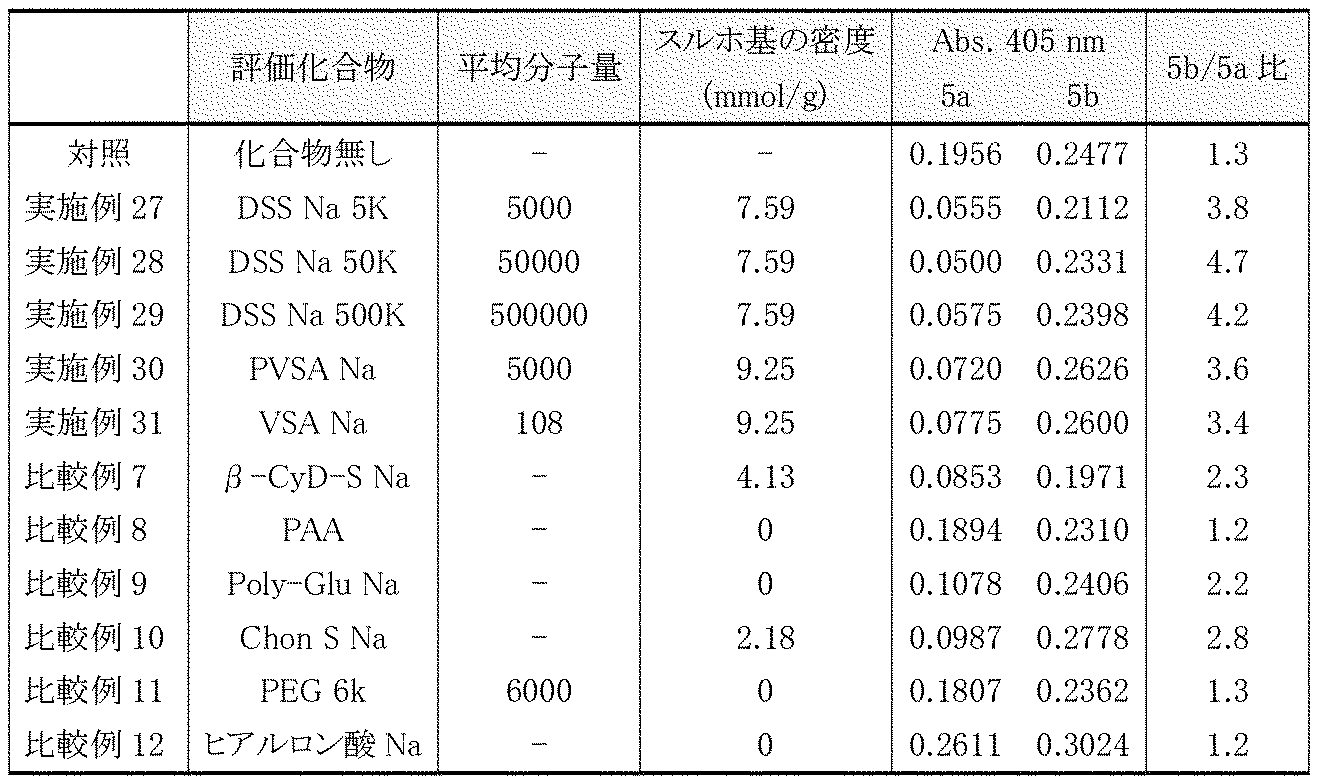
デキストラン硫酸Na(5K)、デキストラン硫酸Na(50K)、ポリビニルスルホン酸Na(5K)、およびビニルスルホン酸Naについて、添加濃度の阻害活性への影響を検討した。
各評価化合物の測定試薬(発色基質溶液)中の濃度を以下の通りに調整した。
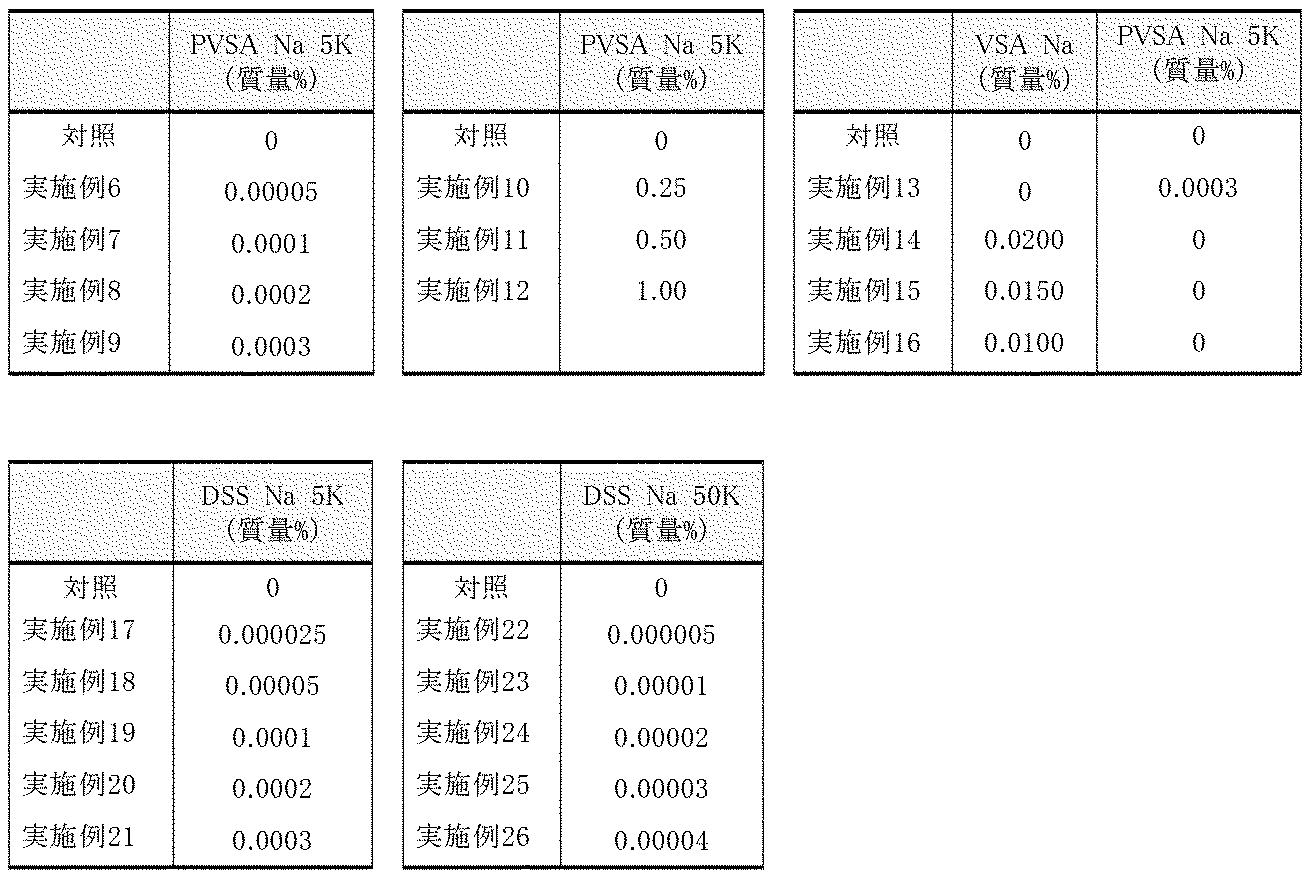
デキストラン硫酸Na(5K)、およびデキストラン硫酸Na(50K)を含む試薬を用いた試験では、7U/L TRACP-5b溶液、および7U/L TRACP-5a溶液を使用し、ポリビニルスルホン酸Na(5K)を含む試薬を用いた試験では、7U/L TRACP-5b溶液、および7U/Lもしくは8U/LTRACP-5a溶液を使用し、ビニルスルホン酸Naを含む試薬を用いた試験では、7U/L TRACP-5b溶液、および8U/LTRACP-5a溶液を使用した。
各評価化合物の濃度を上述にした以外は、試験1と同様の組成の発色基質溶液を用いた。また、測定方法は、試験1と同様の手順で実施した。
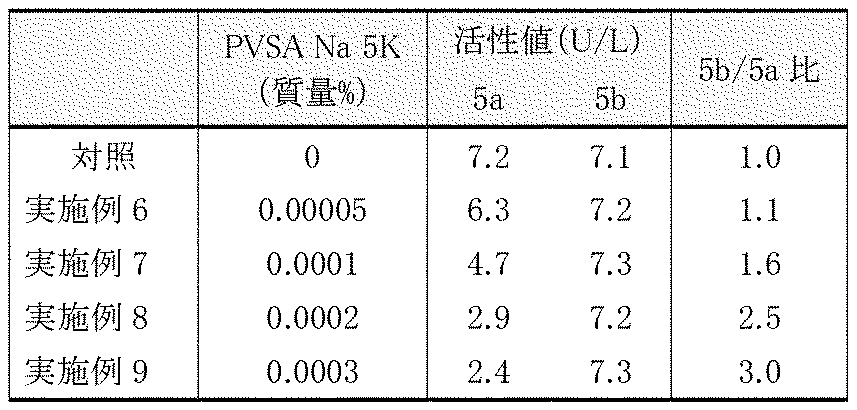
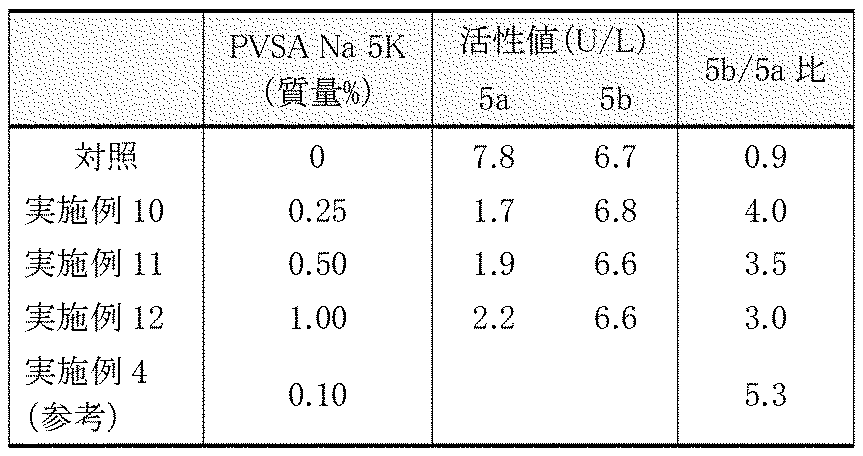
実施例4は、別バッチでのデータであるが、試験1でのデータを参考として掲載した。

実施例5は、別バッチでのデータであるが、試験1でのデータを参考として掲載した。

実施例1は、別バッチでのデータであるが、試験1でのデータを参考として掲載した。

実施例2は、別バッチでのデータであるが、試験1でのデータを参考として掲載した。
3-1.評価化合物
以下の化合物について、EIA法でのTRACP-5a阻害効果を評価した。
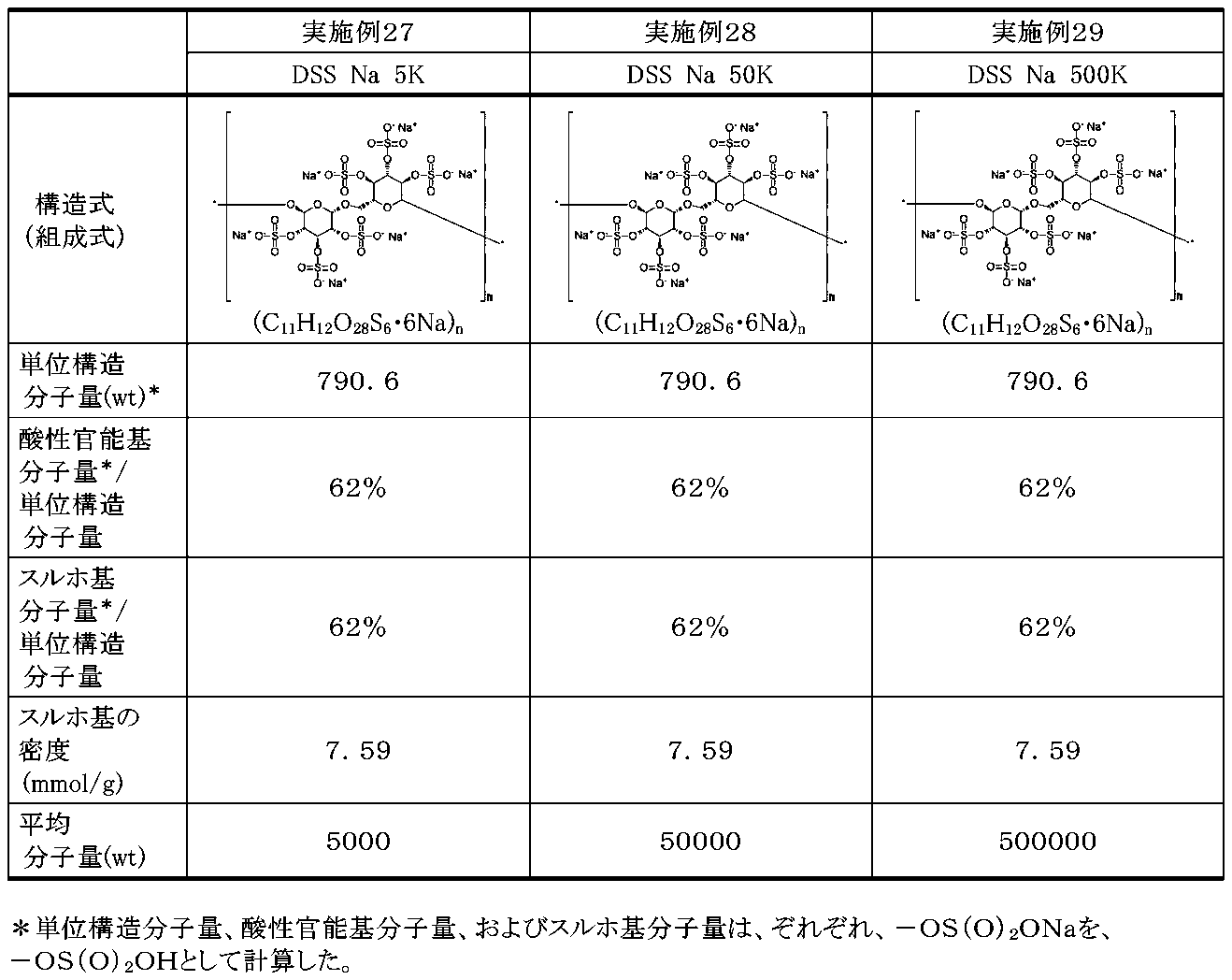
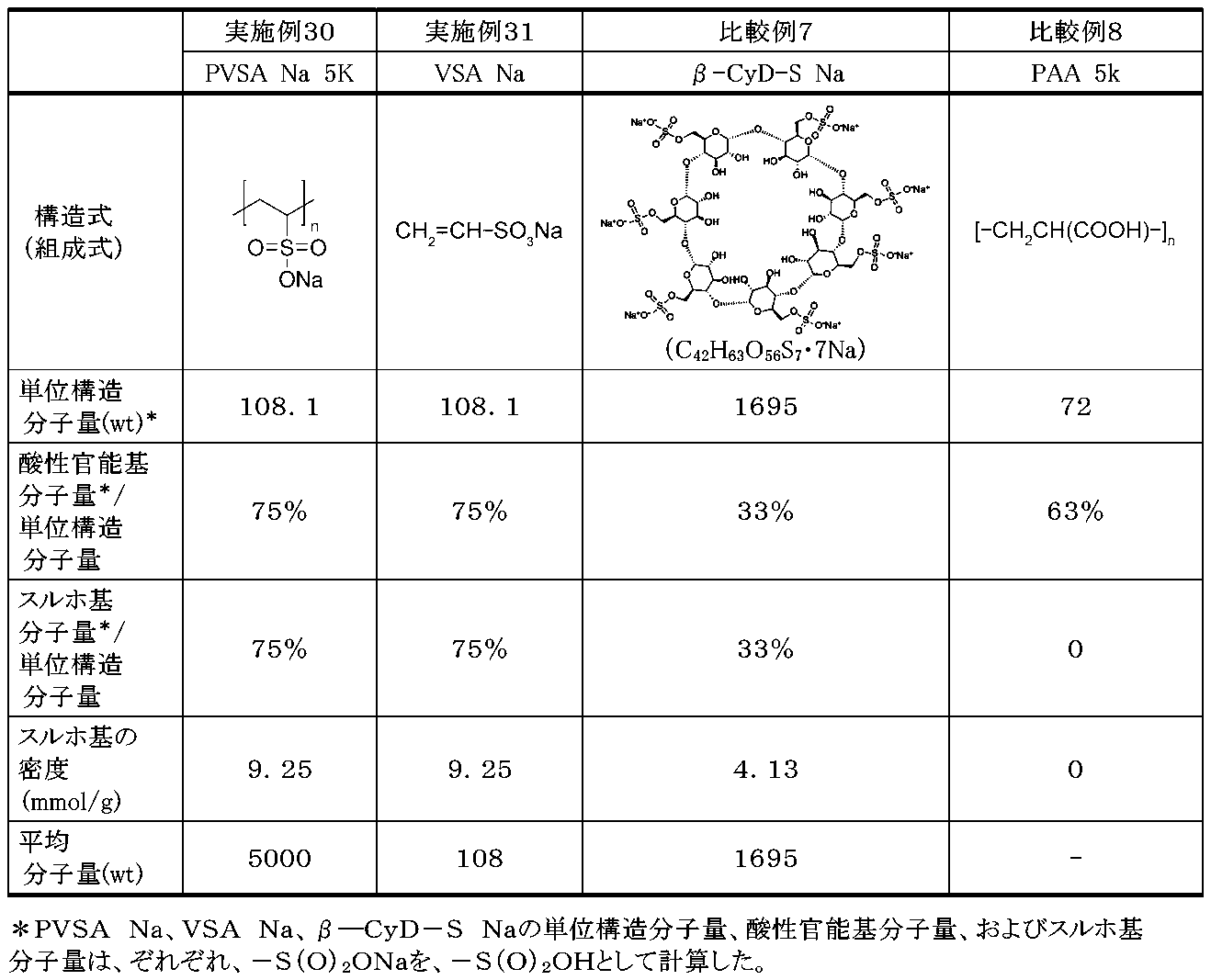
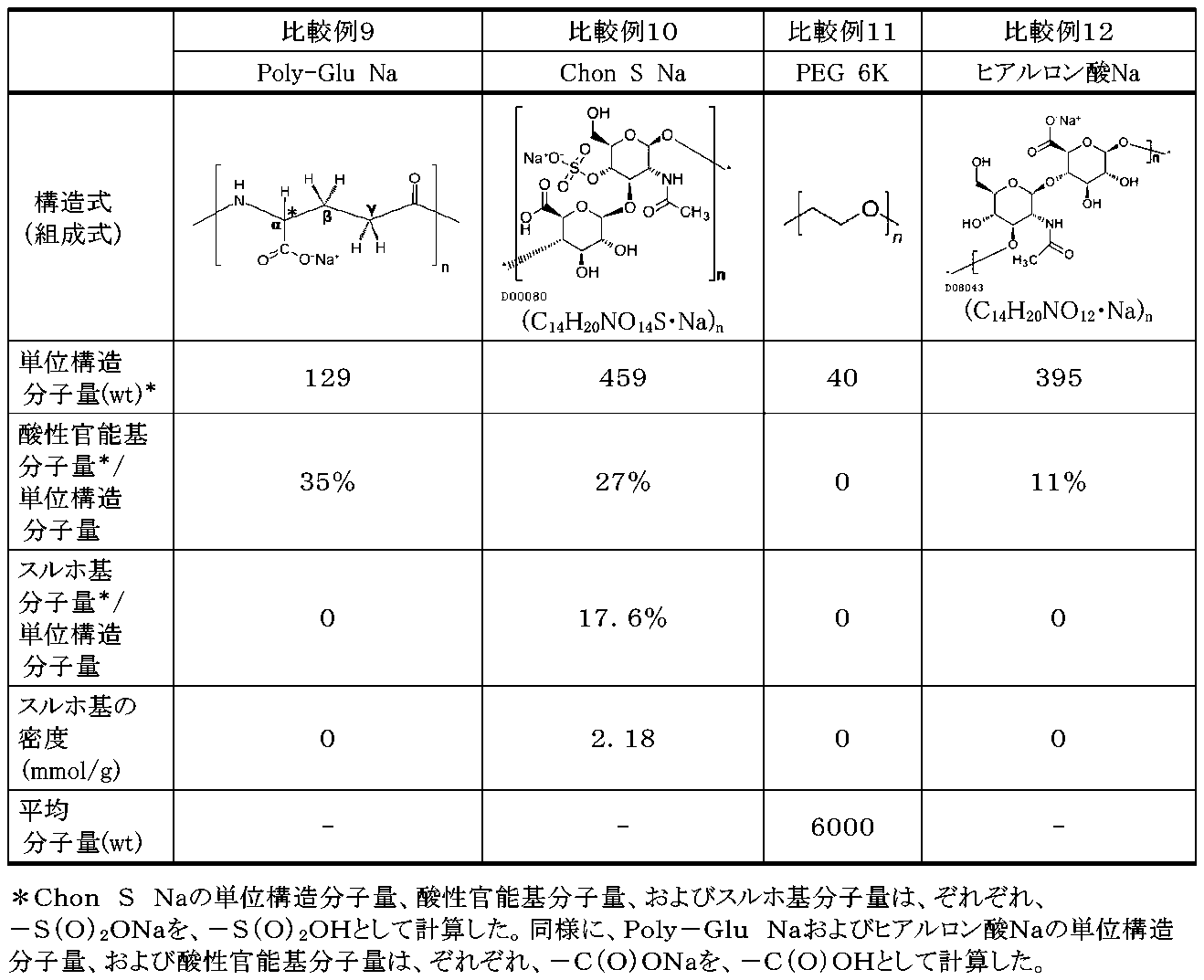
TRACP-5bモノクローナル抗体(受託番号IPOD FERM BP-7890)を、PBS(8mM リン酸水素二ナトリウム、1.5mM リン酸二水素ナトリウム、2.7mM KCl、137mM NaCl、pH7.5)にて10 μg/mLに希釈し、ELISAプレート(Thermo Fisher SCIENTIFIC社製、品番468667)の各ウェルに100μL添加した。一晩冷蔵で静置後、TBS-T(50mM Tris―HCl、150mM NaCl、0.05%Tween20、pH7.5)300μLで3回洗浄後、1.5%BSA含有TBSを300μL添加し一晩冷蔵で静置した。
作製した抗体固定化プレートから1.5%BSA含有TBSを除去後、TBS(50mM Tris―HCl、150mM NaCl、pH7.5)100μL、及び7U/L TRACP-5b溶液もしくは7U/L TRACP-5a溶液を各ウェルに50μL添加し、攪拌しながら1時間反応させた(25℃、700rpm)。TBS-T300μLで3回洗浄後、評価化合物を0.1質量%の濃度で添加した発色基質溶液(5mM 2-クロロ-4-ニトロフェニルリン酸、109mM MES、40mM 酒石酸Na、pH6.6)100μLを各ウェルに添加し、37℃で1時間静置した。その後、0.5N NaOHを50μL添加し、プレートリーダーにて吸光度(主波長405nm、副波長490nm)を測定した。
Claims (24)
- 検体中の酒石酸抵抗性酸性ホスファターゼ5b(TRACP-5b)の測定方法であって、
スルホ基(-S(O)2OH)、硫酸基(-OS(O)2OH)および/またはそれらの塩を、6.5mmol/g以上の密度で有する、有機スルホン酸、硫酸エステルまたはそれらの塩の存在下で、TRACP-5bを検出する反応を行う工程を含む、TRACP-5bの測定方法。 - 前記有機スルホン酸、硫酸エステルまたはそれらの塩は、単位構造あたり、スルホ基(-S(O)2OH)、硫酸基(-OS(O)2OH)および/またはそれらの塩を、S(O)2O-換算値で、50質量%以上有する、請求項1に記載の方法。
- 前記有機スルホン酸、硫酸エステルまたはそれらの塩は、式(1):

(式(1)中、Rは、炭素数1~3のアルキル、アルケニル、またはアルキニルであり、Yは結合、または酸素原子であり、Xは水素またはアルカリ金属である。)
で表されるか、
式(2):
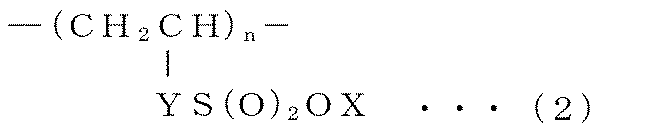
(式(2)中、Yは結合、または酸素原子であり、nは、2~5000の整数であり、Xは水素またはアルカリ金属である。)
の繰り返し単位を有するか、
あるいは
式(3):
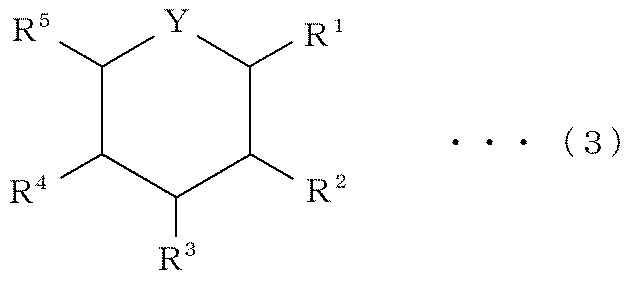
(式(3)中、Yは、OまたはCH2であり、R1~R5のうち、2つは、O-または結合であり、残りのうち少なくとも2つは、O-S(O)2OXまたはS(O)2OX(Xは水素またはアルカリ金属である。)であり、いずれにも該当しないものは、OXまたはC(O)OX(Xは水素またはアルカリ金属である。)である。)
の構造を含む繰り返し単位を有する、請求項1または2に記載の方法。 - 前記有機スルホン酸、硫酸エステルまたはそれらの塩が、ビニルスルホン酸もしくはその塩、硫酸ビニルもしくはその塩、ポリビニルスルホン酸もしくはその塩、ポリビニル硫酸もしくはその塩、メタンスルホン酸もしくはその塩、またはデキストラン硫酸もしくはその塩である、請求項1または2に記載の方法。
- 前記有機スルホン酸、硫酸エステルまたはそれらの塩が、1)独立して反応系または検体に添加され、あるいは2)検体希釈液、3)基質含有試薬、または4)抗TRACP-5b抗体を含有する試薬に含まれ、これにより、前記有機スルホン酸、硫酸エステルまたはそれらの塩の存在下で、TRACP-5bを検出する反応が行われる、請求項1~4のいずれか1項に記載の方法。
- 酵素法、酵素免疫測定法(EIA)、酵素結合免疫吸着測定法(ELISA)、化学発光酵素免疫測定法(CLEIA法)、化学発光免疫測定法(CLIA法)、またはラテックス凝集法で測定する、請求項1~5のいずれか1項に記載の方法。
- 前記検体が、血液、血清または血漿である、請求項1~6のいずれか1項に記載の方法。
- TRACP-5bの測定キットであって、
スルホ基(-S(O)2OH)、硫酸基(-OS(O)2OH)および/またはそれらの塩を、6.5mmol/g以上の密度で有する有機スルホン酸、硫酸エステルおよび/またはそれらの塩を含む、キット。 - 前記有機スルホン酸、硫酸エステルおよび/またはそれらの塩は、単位構造あたり、スルホ基(-S(O)2OH)、硫酸基(-OS(O)2OH)またはそれらの塩を、S(O)2O-換算値で、50質量%以上有する、請求項8に記載のキット。
- ・ 前記有機スルホン酸、硫酸エステルおよび/またはそれらの塩は、式(1):

(式(1)中、Rは、炭素数1~5のアルキル、アルケニル、またはアルキニルであり、Yは結合、または酸素原子であり、Xは水素またはアルカリ金属である。)
で表されるか、
式(2):
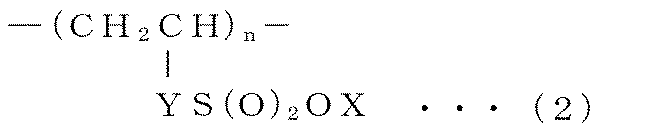
(式(2)中、Yは結合、または酸素原子であり、nは、2~5000の整数であり、Xは水素またはアルカリ金属である。)
の繰り返し構造を有するか、あるいは
式(3):

(式(3)中、Yは、OまたはCH2であり、R1~R5のうち、2つは、O-または結合手であり、残りのうち少なくとも2つは、O-S(O)2OXまたはS(O)2OX(Xは水素またはアルカリ金属である。)であり、いずれにも該当しないものは、OXまたはC(O)OX(Xは水素またはアルカリ金属である。)である。)
の構造を含む繰り返し構造を有する、
請求項8または9に記載のキット。 - 前記有機スルホン酸、硫酸エステルまたはそれらの塩が、ビニルスルホン酸もしくはその塩、硫酸ビニルもしくはその塩、ポリビニルスルホン酸もしくはその塩、ポリビニル硫酸もしくはその塩、メタンスルホン酸もしくはその塩、またはデキストラン硫酸もしくはその塩である、請求項8または9に記載のキット。
- 酵素法によりTRACP-5bを測定するための、請求項8~11のいずれか1項に記載のキットであって、
TRACP-5bの基質と、前記有機スルホン酸、硫酸エステルまたはそれらの塩と、場合により検体希釈用試薬とを含む、キット。 - 前記TRACP-5bの基質を含有する試薬、または前記検体希釈用試薬に、前記有機スルホン酸、硫酸エステルまたはそれらの塩を含む、請求項12に記載のキット。
- 酵素免疫測定法(EIA)によりTRACP-5bを測定する、請求項8~11のいずれか1項に記載のキットであって、
固相支持体と、前記固相支持体に吸着される抗TRACP-5bモノクローナル抗体と、前記TRACP-5bの基質と、前記有機スルホン酸、硫酸エステルまたはそれらの塩と、場合により検体希釈用試薬と、場合により洗浄液とを含む、キット。 - 前記抗TRACP-5bモノクローナル抗体を含有する試薬、前記TRACP-5bの基質を含有する試薬、または前記検体希釈用試薬に、前記有機スルホン酸、硫酸エステルまたはそれらの塩を含む、請求項14に記載のキット。
- 酵素結合免疫吸着測定法(ELISA)によりTRACP-5bを測定する、請求項8~11のいずれか1項に記載のキットであって、
固相支持体と、前記固相支持体に吸着される第一次抗TRACP-5bモノクローナル抗体と、前記第一次抗TRACP-5bモノクローナル抗体と異なるエピトープでTRACP-5bに結合し、酵素反応での検出を可能とする物質で標識されている第二次抗TRACP-5bモノクローナル抗体と、前記標識物質を酵素反応で検出を可能とするための試薬と、前記有機スルホン酸、硫酸エステルまたはそれらの塩と、場合により検体希釈用試薬と、場合により洗浄液とを含む、キット。 - 前記第二次抗TRACP-5bモノクローナル抗体を含有する試薬、前記標識物質を酵素反応で検出を可能とするための試薬、または検体希釈用試薬に、前記有機スルホン酸、硫酸エステルまたはそれらの塩を含む、請求項16に記載のキット。
- 化学発光酵素免疫測定法(CLEIA法)によりTRACP-5bを測定する、請求項8~11のいずれか1項に記載のキットであって、
固相支持体と、前記固相支持体に吸着される抗TRACP-5bモノクローナル抗体と、前記TRACP-5bの化学発光基質と、前記有機スルホン酸、硫酸エステルまたはそれらの塩と、場合により検体希釈用試薬と、場合により洗浄液とを含む、キット。 - 前記TRACP-5bの基質を含有する試薬、前記抗TRACP-5bモノクローナル抗体を含有する試薬、または前記検体希釈用試薬に、前記有機スルホン酸、硫酸エステルまたはそれらの塩を含む、請求項18に記載のキット。
- 化学発光免疫測定法(CLIA法)によりTRACP-5bを測定する、請求項8~11のいずれか1項に記載のキットであって、
固相支持体と、前記固相支持体に吸着される第一次抗TRACP-5bモノクローナル抗体と、前記第一次抗TRACP-5bモノクローナル抗体と異なるエピトープでTRACP-5bに結合し、化学発光での検出を可能とする物質で標識されている第二次抗TRACP-5bモノクローナル抗体と、前記標識物質を化学発光で検出可能とする試薬と、前記有機スルホン酸、硫酸エステルまたはそれらの塩と、場合により検体希釈用試薬と、場合により洗浄液とを含む、キット。 - 前記第一次抗TRACP-5bモノクローナル抗体を含む試薬、前記第二次抗TRACP-5bモノクローナル抗体を含む試薬、前記標識を化学発光で検出可能とする試薬、または前記検体希釈用試薬を含む試薬に、前記有機スルホン酸、硫酸エステルまたはそれらの塩を含む、請求項20に記載のキット。
- ラテックス凝集法によりTRACP-5bを測定する請求項8~11のいずれか1項に記載のキットであって、
ラテックス粒子と、前記ラテックス粒子に固定された抗TRACP-5b抗体と、前記有機スルホン酸、硫酸エステルまたはそれらの塩と、場合により検体希釈用試薬とを含む、キット。 - 前記抗TRACP-5b抗体を含む試薬、または前記検体希釈用試薬に、前記有機スルホン酸、硫酸エステルまたはそれらの塩を含む、請求項22に記載のキット。
- 測定される検体が、血液、血清または血漿である、請求項8~23のいずれか1項に記載のキット。
Priority Applications (5)
| Application Number | Priority Date | Filing Date | Title |
|---|---|---|---|
| KR1020247040608A KR102856502B1 (ko) | 2023-07-18 | 2024-07-01 | TRACP-5b 의 측정 방법 및 그것을 위한 키트 |
| CN202480003553.4A CN119630965B (zh) | 2023-07-18 | 2024-07-01 | TRACP-5b的测定方法和用于该方法的试剂盒 |
| JP2024559910A JP7653596B1 (ja) | 2023-07-18 | 2024-07-01 | TRACP-5bの測定方法およびそのためのキット |
| US19/104,930 US20260056197A1 (en) | 2023-07-18 | 2024-07-01 | METHOD FOR MEASURING TRACP-5b AND KIT THEREFOR |
| EP24842930.0A EP4560318A4 (en) | 2023-07-18 | 2024-07-01 | TRACP-5B MEASUREMENT METHOD AND ASSOCIATED KIT |
Applications Claiming Priority (2)
| Application Number | Priority Date | Filing Date | Title |
|---|---|---|---|
| JP2023-116935 | 2023-07-18 | ||
| JP2023116935 | 2023-07-18 |
Publications (1)
| Publication Number | Publication Date |
|---|---|
| WO2025018136A1 true WO2025018136A1 (ja) | 2025-01-23 |
Family
ID=94281875
Family Applications (1)
| Application Number | Title | Priority Date | Filing Date |
|---|---|---|---|
| PCT/JP2024/023774 Ceased WO2025018136A1 (ja) | 2023-07-18 | 2024-07-01 | TRACP-5bの測定方法およびそのためのキット |
Country Status (6)
| Country | Link |
|---|---|
| US (1) | US20260056197A1 (ja) |
| EP (1) | EP4560318A4 (ja) |
| JP (1) | JP7653596B1 (ja) |
| KR (1) | KR102856502B1 (ja) |
| CN (1) | CN119630965B (ja) |
| WO (1) | WO2025018136A1 (ja) |
Citations (6)
| Publication number | Priority date | Publication date | Assignee | Title |
|---|---|---|---|---|
| JP2001231595A (ja) * | 1999-12-15 | 2001-08-28 | Fuaruko Bio Syst:Kk | 特異的破骨細胞由来酸性ホスファターゼの測定方法 |
| JP2002510050A (ja) * | 1998-04-01 | 2002-04-02 | ハーリーン、ジュッシ | 骨吸収速度を測定する方法 |
| JP2004026805A (ja) * | 2002-04-30 | 2004-01-29 | Nitto Boseki Co Ltd | 酒石酸抵抗性酸性ホスファターゼ5bに特異的なモノクローナル抗体およびその用途 |
| WO2004077059A1 (ja) * | 2003-02-25 | 2004-09-10 | Nitto Boseki Co., Ltd. | 酒石酸抵抗性酸性ホスファタ-ゼ5bの免疫測定法およびそれに用いるキット |
| WO2016027697A1 (ja) * | 2014-08-22 | 2016-02-25 | 日東紡績株式会社 | TRACP-5b(酒石酸抵抗性酸性フォスファターゼ5b)に特異的なタンパク定量法 |
| JP2022174015A (ja) * | 2021-05-10 | 2022-11-22 | ヤマサ醤油株式会社 | 酒石酸抵抗性酸性ホスファターゼ5b活性の測定法 |
Family Cites Families (12)
| Publication number | Priority date | Publication date | Assignee | Title |
|---|---|---|---|---|
| US6037332A (en) * | 1996-02-20 | 2000-03-14 | Emory University | Method of urinary bladder instillation |
| JP3713901B2 (ja) | 1997-06-06 | 2005-11-09 | 日東紡績株式会社 | 破骨細胞由来酸性ホスファターゼの測定方法 |
| JP2004510161A (ja) * | 2000-09-25 | 2004-04-02 | アボット・ラボラトリーズ | 高分子ポリカチオンを用いることにより、特異的結合アッセイにおける血清または血漿含有アッセイ試料の干渉を減少させるための方法及びキット |
| JP4454885B2 (ja) * | 2001-05-21 | 2010-04-21 | アルフレッサファーマ株式会社 | 免疫測定方法およびそのための試薬 |
| JP2011024470A (ja) | 2009-07-24 | 2011-02-10 | Yamasa Shoyu Co Ltd | 化学発光性1,2−ジオキセタン系化合物を用いた酒石酸抵抗性酸性ホスファターゼ活性の測定法 |
| JP5563875B2 (ja) * | 2010-04-16 | 2014-07-30 | 花王株式会社 | 鋳型用組成物を製造するためのキット |
| EP2728354B1 (en) * | 2011-06-29 | 2018-06-13 | LSI Medience Corporation | Non-specific reaction inhibitor, method for inhibiting non-specific reaction, and kit |
| US9229005B2 (en) * | 2012-03-23 | 2016-01-05 | Surmodics Ivd, Inc. | Compositions and methods for in vitro diagnostic tests including sulfonic acid compound |
| CN102706861A (zh) * | 2012-05-24 | 2012-10-03 | 宁波美康生物科技股份有限公司 | 酸性磷酸酶活性测定试剂 |
| EP3413051B1 (de) * | 2017-06-09 | 2020-07-29 | Siemens Healthcare Diagnostics Products GmbH | Aktivierungstest zur diagnose einer heparin-induzierten thrombozytopenie |
| US11232587B2 (en) | 2019-11-06 | 2022-01-25 | Google Llc | Use of image sensors to query real world for geo-reference information |
| EP4130741B1 (en) * | 2020-03-31 | 2026-01-28 | Fujirebio Inc. | Method for immunoassay of amyloid beta in blood, and kit for same |
-
2024
- 2024-07-01 EP EP24842930.0A patent/EP4560318A4/en active Pending
- 2024-07-01 CN CN202480003553.4A patent/CN119630965B/zh active Active
- 2024-07-01 KR KR1020247040608A patent/KR102856502B1/ko active Active
- 2024-07-01 US US19/104,930 patent/US20260056197A1/en active Pending
- 2024-07-01 WO PCT/JP2024/023774 patent/WO2025018136A1/ja not_active Ceased
- 2024-07-01 JP JP2024559910A patent/JP7653596B1/ja active Active
Patent Citations (6)
| Publication number | Priority date | Publication date | Assignee | Title |
|---|---|---|---|---|
| JP2002510050A (ja) * | 1998-04-01 | 2002-04-02 | ハーリーン、ジュッシ | 骨吸収速度を測定する方法 |
| JP2001231595A (ja) * | 1999-12-15 | 2001-08-28 | Fuaruko Bio Syst:Kk | 特異的破骨細胞由来酸性ホスファターゼの測定方法 |
| JP2004026805A (ja) * | 2002-04-30 | 2004-01-29 | Nitto Boseki Co Ltd | 酒石酸抵抗性酸性ホスファターゼ5bに特異的なモノクローナル抗体およびその用途 |
| WO2004077059A1 (ja) * | 2003-02-25 | 2004-09-10 | Nitto Boseki Co., Ltd. | 酒石酸抵抗性酸性ホスファタ-ゼ5bの免疫測定法およびそれに用いるキット |
| WO2016027697A1 (ja) * | 2014-08-22 | 2016-02-25 | 日東紡績株式会社 | TRACP-5b(酒石酸抵抗性酸性フォスファターゼ5b)に特異的なタンパク定量法 |
| JP2022174015A (ja) * | 2021-05-10 | 2022-11-22 | ヤマサ醤油株式会社 | 酒石酸抵抗性酸性ホスファターゼ5b活性の測定法 |
Non-Patent Citations (5)
| Title |
|---|
| CLIN. CHEM., vol. 33, 1987, pages 458 - 462 |
| LAM W. K. W. ET AL., CLIN. BIOCHEM., vol. 14, 1981, pages 177 - 181 |
| LAM W. K. W. ET AL., CLIN. CHEM., vol. 24, no. 7, 1978, pages 1105 - 1108 |
| NAKANISHI, MAMORU: "P-84: Development of a method for measuring Band 5b TrACP activity.", THE JOURNAL OF TOXICOLOGICAL SCIENCES, TOKYO., JP, vol. 17, no. Suppl., 26 June 1999 (1999-06-26), JP , pages 250, XP009561308, ISSN: 0388-1350 * |
| See also references of EP4560318A4 |
Also Published As
| Publication number | Publication date |
|---|---|
| US20260056197A1 (en) | 2026-02-26 |
| JPWO2025018136A1 (ja) | 2025-01-23 |
| EP4560318A1 (en) | 2025-05-28 |
| CN119630965A (zh) | 2025-03-14 |
| KR20250016161A (ko) | 2025-02-03 |
| KR102856502B1 (ko) | 2025-09-05 |
| CN119630965B (zh) | 2026-02-03 |
| JP7653596B1 (ja) | 2025-03-31 |
| EP4560318A4 (en) | 2026-04-22 |
Similar Documents
| Publication | Publication Date | Title |
|---|---|---|
| EP3425406B1 (en) | Method for measuring lipoprotein's capacity to accept cholesterol and reagent kit | |
| US20240402163A1 (en) | Method for Measuring Fibroblast Growth Factor-23 and Reagent Therefor | |
| JP2019528438A (ja) | ビタミンdをアッセイするための方法および組成物 | |
| US10451624B2 (en) | Reagent kit used for detecting lipoprotein-associated phospholipase A2, and preparation method and application for reagent kit | |
| US20080299585A1 (en) | METHODS FOR DETECTION AND MEASUREMENT OF SECRETORY PHOSPHOLIPASE A2 LEVELS (sPLA2) IN BIOLOGICAL FLUIDS | |
| US20120237957A1 (en) | Method For Enhancing Enzyme Assays | |
| JP7653596B1 (ja) | TRACP-5bの測定方法およびそのためのキット | |
| JPWO2018079674A1 (ja) | 脂質異常症治療が必要な被検者の選別方法及び選別用試薬 | |
| WO2023068249A1 (ja) | I型コラーゲン架橋n-テロペプチドの測定試薬、その調製方法、及びそれを用いた免疫測定方法 | |
| JP7296875B2 (ja) | 線維芽細胞増殖因子-23の測定方法、測定試薬及び測定キット | |
| CN113406332A (zh) | 用于人Galectin-3含量检测的ELISA荧光检测试剂盒 | |
| WO2009127855A1 (en) | Use of a monophosphate ester of a phthalein compound as a substrate for tartrate-resistant acid phosphatase b5 (trap 5b) | |
| JP2006126166A (ja) | 測定感度を向上させるための組成物 | |
| JP5902714B2 (ja) | 検体中の測定対象物の連続的免疫測定法における非特異反応抑制方法 | |
| CN114200145A (zh) | 酪氨酸激酶浓度的检测方法及试剂盒 | |
| HK40014490B (en) | Method for measuring fibroblast growth factor-23 and reagent therefor | |
| HK40014490A (en) | Method for measuring fibroblast growth factor-23 and reagent therefor | |
| JP2004317502A (ja) | 抗リン脂質抗体測定試薬及び試薬キット | |
| HK1183939A (en) | Method for measuring fibroblast growth factor-23 and reagent therefor | |
| HK1229883B (en) | Method for measuring fibroblast growth factor-23 and reagent therefor | |
| HK1229883A (en) | Method for measuring fibroblast growth factor-23 and reagent therefor | |
| HK1183939B (en) | Method for measuring fibroblast growth factor-23 and reagent therefor | |
| CN103645330A (zh) | 检测尿液中纤维连接蛋白浓度的试剂盒及其制备方法 |
Legal Events
| Date | Code | Title | Description |
|---|---|---|---|
| WWE | Wipo information: entry into national phase |
Ref document number: 2024559910 Country of ref document: JP |
|
| ENP | Entry into the national phase |
Ref document number: 20247040608 Country of ref document: KR Kind code of ref document: A |
|
| WWE | Wipo information: entry into national phase |
Ref document number: 202480003553.4 Country of ref document: CN |
|
| WWP | Wipo information: published in national office |
Ref document number: 1020247040608 Country of ref document: KR |
|
| WWE | Wipo information: entry into national phase |
Ref document number: 2024842930 Country of ref document: EP |
|
| ENP | Entry into the national phase |
Ref document number: 2024842930 Country of ref document: EP Effective date: 20250224 |
|
| 121 | Ep: the epo has been informed by wipo that ep was designated in this application |
Ref document number: 24842930 Country of ref document: EP Kind code of ref document: A1 |
|
| WWP | Wipo information: published in national office |
Ref document number: 202480003553.4 Country of ref document: CN |
|
| WWP | Wipo information: published in national office |
Ref document number: 2024842930 Country of ref document: EP |
|
| NENP | Non-entry into the national phase |
Ref country code: DE |