WO2025047961A1 - 撥水剤組成物 - Google Patents
撥水剤組成物 Download PDFInfo
- Publication number
- WO2025047961A1 WO2025047961A1 PCT/JP2024/031323 JP2024031323W WO2025047961A1 WO 2025047961 A1 WO2025047961 A1 WO 2025047961A1 JP 2024031323 W JP2024031323 W JP 2024031323W WO 2025047961 A1 WO2025047961 A1 WO 2025047961A1
- Authority
- WO
- WIPO (PCT)
- Prior art keywords
- weight
- group
- less
- parts
- carbon atoms
- Prior art date
- Legal status (The legal status is an assumption and is not a legal conclusion. Google has not performed a legal analysis and makes no representation as to the accuracy of the status listed.)
- Pending
Links
Classifications
-
- D—TEXTILES; PAPER
- D06—TREATMENT OF TEXTILES OR THE LIKE; LAUNDERING; FLEXIBLE MATERIALS NOT OTHERWISE PROVIDED FOR
- D06M—TREATMENT, NOT PROVIDED FOR ELSEWHERE IN CLASS D06, OF FIBRES, THREADS, YARNS, FABRICS, FEATHERS OR FIBROUS GOODS MADE FROM SUCH MATERIALS
- D06M15/00—Treating fibres, threads, yarns, fabrics, or fibrous goods made from such materials, with macromolecular compounds; Such treatment combined with mechanical treatment
- D06M15/19—Treating fibres, threads, yarns, fabrics, or fibrous goods made from such materials, with macromolecular compounds; Such treatment combined with mechanical treatment with synthetic macromolecular compounds
- D06M15/21—Macromolecular compounds obtained by reactions only involving carbon-to-carbon unsaturated bonds
- D06M15/263—Macromolecular compounds obtained by reactions only involving carbon-to-carbon unsaturated bonds of unsaturated carboxylic acids; Salts or esters thereof
-
- C—CHEMISTRY; METALLURGY
- C08—ORGANIC MACROMOLECULAR COMPOUNDS; THEIR PREPARATION OR CHEMICAL WORKING-UP; COMPOSITIONS BASED THEREON
- C08F—MACROMOLECULAR COMPOUNDS OBTAINED BY REACTIONS ONLY INVOLVING CARBON-TO-CARBON UNSATURATED BONDS
- C08F2/00—Processes of polymerisation
- C08F2/12—Polymerisation in non-solvents
- C08F2/16—Aqueous medium
- C08F2/22—Emulsion polymerisation
- C08F2/24—Emulsion polymerisation with the aid of emulsifying agents
- C08F2/28—Emulsion polymerisation with the aid of emulsifying agents cationic
-
- C—CHEMISTRY; METALLURGY
- C08—ORGANIC MACROMOLECULAR COMPOUNDS; THEIR PREPARATION OR CHEMICAL WORKING-UP; COMPOSITIONS BASED THEREON
- C08F—MACROMOLECULAR COMPOUNDS OBTAINED BY REACTIONS ONLY INVOLVING CARBON-TO-CARBON UNSATURATED BONDS
- C08F2/00—Processes of polymerisation
- C08F2/12—Polymerisation in non-solvents
- C08F2/16—Aqueous medium
- C08F2/22—Emulsion polymerisation
- C08F2/24—Emulsion polymerisation with the aid of emulsifying agents
- C08F2/30—Emulsion polymerisation with the aid of emulsifying agents non-ionic
-
- C—CHEMISTRY; METALLURGY
- C08—ORGANIC MACROMOLECULAR COMPOUNDS; THEIR PREPARATION OR CHEMICAL WORKING-UP; COMPOSITIONS BASED THEREON
- C08F—MACROMOLECULAR COMPOUNDS OBTAINED BY REACTIONS ONLY INVOLVING CARBON-TO-CARBON UNSATURATED BONDS
- C08F2/00—Processes of polymerisation
- C08F2/38—Polymerisation using regulators, e.g. chain terminating agents, e.g. telomerisation
-
- C—CHEMISTRY; METALLURGY
- C08—ORGANIC MACROMOLECULAR COMPOUNDS; THEIR PREPARATION OR CHEMICAL WORKING-UP; COMPOSITIONS BASED THEREON
- C08F—MACROMOLECULAR COMPOUNDS OBTAINED BY REACTIONS ONLY INVOLVING CARBON-TO-CARBON UNSATURATED BONDS
- C08F4/00—Polymerisation catalysts
- C08F4/04—Azo-compounds
-
- D—TEXTILES; PAPER
- D06—TREATMENT OF TEXTILES OR THE LIKE; LAUNDERING; FLEXIBLE MATERIALS NOT OTHERWISE PROVIDED FOR
- D06M—TREATMENT, NOT PROVIDED FOR ELSEWHERE IN CLASS D06, OF FIBRES, THREADS, YARNS, FABRICS, FEATHERS OR FIBROUS GOODS MADE FROM SUCH MATERIALS
- D06M13/00—Treating fibres, threads, yarns, fabrics or fibrous goods made from such materials, with non-macromolecular organic compounds; Such treatment combined with mechanical treatment
- D06M13/322—Treating fibres, threads, yarns, fabrics or fibrous goods made from such materials, with non-macromolecular organic compounds; Such treatment combined with mechanical treatment with compounds containing nitrogen
- D06M13/395—Isocyanates
-
- D—TEXTILES; PAPER
- D06—TREATMENT OF TEXTILES OR THE LIKE; LAUNDERING; FLEXIBLE MATERIALS NOT OTHERWISE PROVIDED FOR
- D06M—TREATMENT, NOT PROVIDED FOR ELSEWHERE IN CLASS D06, OF FIBRES, THREADS, YARNS, FABRICS, FEATHERS OR FIBROUS GOODS MADE FROM SUCH MATERIALS
- D06M15/00—Treating fibres, threads, yarns, fabrics, or fibrous goods made from such materials, with macromolecular compounds; Such treatment combined with mechanical treatment
- D06M15/19—Treating fibres, threads, yarns, fabrics, or fibrous goods made from such materials, with macromolecular compounds; Such treatment combined with mechanical treatment with synthetic macromolecular compounds
- D06M15/21—Macromolecular compounds obtained by reactions only involving carbon-to-carbon unsaturated bonds
- D06M15/244—Macromolecular compounds obtained by reactions only involving carbon-to-carbon unsaturated bonds of halogenated hydrocarbons
- D06M15/248—Macromolecular compounds obtained by reactions only involving carbon-to-carbon unsaturated bonds of halogenated hydrocarbons containing chlorine
-
- D—TEXTILES; PAPER
- D06—TREATMENT OF TEXTILES OR THE LIKE; LAUNDERING; FLEXIBLE MATERIALS NOT OTHERWISE PROVIDED FOR
- D06M—TREATMENT, NOT PROVIDED FOR ELSEWHERE IN CLASS D06, OF FIBRES, THREADS, YARNS, FABRICS, FEATHERS OR FIBROUS GOODS MADE FROM SUCH MATERIALS
- D06M15/00—Treating fibres, threads, yarns, fabrics, or fibrous goods made from such materials, with macromolecular compounds; Such treatment combined with mechanical treatment
- D06M15/19—Treating fibres, threads, yarns, fabrics, or fibrous goods made from such materials, with macromolecular compounds; Such treatment combined with mechanical treatment with synthetic macromolecular compounds
- D06M15/37—Macromolecular compounds obtained otherwise than by reactions only involving carbon-to-carbon unsaturated bonds
- D06M15/564—Polyureas, polyurethanes or other polymers having ureide or urethane links; Precondensation products forming them
-
- D—TEXTILES; PAPER
- D06—TREATMENT OF TEXTILES OR THE LIKE; LAUNDERING; FLEXIBLE MATERIALS NOT OTHERWISE PROVIDED FOR
- D06M—TREATMENT, NOT PROVIDED FOR ELSEWHERE IN CLASS D06, OF FIBRES, THREADS, YARNS, FABRICS, FEATHERS OR FIBROUS GOODS MADE FROM SUCH MATERIALS
- D06M15/00—Treating fibres, threads, yarns, fabrics, or fibrous goods made from such materials, with macromolecular compounds; Such treatment combined with mechanical treatment
- D06M15/19—Treating fibres, threads, yarns, fabrics, or fibrous goods made from such materials, with macromolecular compounds; Such treatment combined with mechanical treatment with synthetic macromolecular compounds
- D06M15/37—Macromolecular compounds obtained otherwise than by reactions only involving carbon-to-carbon unsaturated bonds
- D06M15/643—Macromolecular compounds obtained otherwise than by reactions only involving carbon-to-carbon unsaturated bonds containing silicon in the main chain
-
- D—TEXTILES; PAPER
- D06—TREATMENT OF TEXTILES OR THE LIKE; LAUNDERING; FLEXIBLE MATERIALS NOT OTHERWISE PROVIDED FOR
- D06M—TREATMENT, NOT PROVIDED FOR ELSEWHERE IN CLASS D06, OF FIBRES, THREADS, YARNS, FABRICS, FEATHERS OR FIBROUS GOODS MADE FROM SUCH MATERIALS
- D06M15/00—Treating fibres, threads, yarns, fabrics, or fibrous goods made from such materials, with macromolecular compounds; Such treatment combined with mechanical treatment
- D06M15/19—Treating fibres, threads, yarns, fabrics, or fibrous goods made from such materials, with macromolecular compounds; Such treatment combined with mechanical treatment with synthetic macromolecular compounds
- D06M15/37—Macromolecular compounds obtained otherwise than by reactions only involving carbon-to-carbon unsaturated bonds
- D06M15/643—Macromolecular compounds obtained otherwise than by reactions only involving carbon-to-carbon unsaturated bonds containing silicon in the main chain
- D06M15/647—Macromolecular compounds obtained otherwise than by reactions only involving carbon-to-carbon unsaturated bonds containing silicon in the main chain containing polyether sequences
-
- D—TEXTILES; PAPER
- D06—TREATMENT OF TEXTILES OR THE LIKE; LAUNDERING; FLEXIBLE MATERIALS NOT OTHERWISE PROVIDED FOR
- D06M—TREATMENT, NOT PROVIDED FOR ELSEWHERE IN CLASS D06, OF FIBRES, THREADS, YARNS, FABRICS, FEATHERS OR FIBROUS GOODS MADE FROM SUCH MATERIALS
- D06M2200/00—Functionality of the treatment composition and/or properties imparted to the textile material
- D06M2200/10—Repellency against liquids
- D06M2200/12—Hydrophobic properties
Definitions
- This disclosure relates to a water repellent composition.
- the present disclosure aims to provide a water repellent composition that can impart both good water repellency and good slip resistance to textile products.
- a non-fluorinated copolymer (A) comprising a repeating unit derived from a hydrophobic monomer (a1) having a hydrocarbon group having 2 to 40 carbon atoms, and a repeating unit derived from at least one chloride monomer (a2) selected from the group consisting of vinyl chloride and vinylidene chloride; Contains an isocyanate derivative (B), a water repellent composition, wherein in the non-fluorinated copolymer (A), the amount of repeating units derived from the monomer (a2) is 1 to 15% by weight based on the total amount of repeating units derived from the monomer (a1) and the repeating units derived from the monomer (a2).
- Item 3 The water repellent composition according to item 1 or 2, wherein the compound is represented by the formula: [Item 4] Item 4.
- Item 5 Item 5.
- Item 6 Item 6.
- the isocyanate derivative (B) is a compound obtained by reacting at least one active hydrogen compound selected from the group consisting of hydrocarbon alcohols, sugar alcohol modifications, and hydroxy acid modifications with at least one raw material isocyanate selected from the group consisting of acyclic aliphatic polyisocyanates and derivatives thereof.
- Item 7 Item 7.
- the water repellent composition according to Item 7, wherein the amount of the silicone is 0.1 to 10 parts by weight per 100 parts by weight of the non-fluorinated copo
- the isocyanate derivative (B) is a compound obtained by reacting at least one active hydrogen compound having an alkyl group having from 12 to 30 carbon atoms and selected from the group consisting of hydrocarbon alcohols, sugar alcohol modifications, and hydroxy acid modifications with at least one raw material isocyanate selected from the group consisting of acyclic aliphatic polyisocyanates and derivatives thereof; Item 2.
- the isocyanate derivative (B) is a compound obtained by reacting a hydrocarbon alcohol having an alkyl group having from 12 to 25 carbon atoms with an isocyanurate derivative of an acyclic aliphatic polyisocyanate having an aliphatic hydrocarbon group having from 2 to 10 carbon atoms, or a compound obtained by reacting a sorbitan modified with an alkyl group having from 12 to 25 carbon atoms with a biuret derivative of an acyclic aliphatic polyisocyanate having an aliphatic hydrocarbon group having from 2 to 10 carbon atoms, Item 2.
- the water repellent composition according to Item 1 wherein the amount of the isocyanate derivative (B) is 1 part by weight to 10 parts by weight per 100 parts by weight of the non-fluorinated copolymer (A).
- Item 13 Item 13.
- a method for producing a textile product comprising applying the water repellent composition according to any one of items 1 to 12 to a textile substrate.
- a monovalent group represented by -SO 3 M 1 (wherein M 1 represents a monovalent cation) is added to the fiber. Item 14.
- a method for producing a textile product according to Item 13, comprising a step of providing one or more functional groups selected from the group consisting of a monovalent group represented by -COOM 2 (wherein M 2 represents a monovalent cation) and a monovalent group represented by -O-P(O)(OX 1 )(OX 2 ) (wherein X 1 and X 2 each independently represent a hydrogen atom or an alkyl group having 1 to 22 carbon atoms).
- X 1 and X 2 each independently represent a hydrogen atom or an alkyl group having 1 to 22 carbon atoms.
- [Item 16] a monovalent group represented by -SO 3 M 1 (wherein M 1 represents a monovalent cation); Item 16.
- the water repellent composition disclosed herein can impart both good water repellency and good slip resistance to a substrate (particularly a textile product).
- n-valent group refers to a group having n bonds, i.e., a group that forms n bonds.
- n-valent organic group refers to an n-valent group containing carbon.
- Such an organic group is not particularly limited, but may be a hydrocarbon group or a derivative thereof.
- the derivative of a hydrocarbon group refers to a group having one or more N, O, S, Si, amide, sulfonyl, siloxane, carbonyl, carbonyloxy, halogen, etc. at the end or molecular chain of the hydrocarbon group.
- hydrocarbon group refers to a group containing carbon and hydrogen, and resulting from the elimination of a hydrogen atom from a hydrocarbon.
- Such hydrocarbon groups are not particularly limited, but include C1-20 hydrocarbon groups, for example, aliphatic hydrocarbon groups, aromatic hydrocarbon groups, and the like.
- the above-mentioned "aliphatic hydrocarbon group” may be linear, branched, or cyclic, and may be saturated or unsaturated.
- the hydrocarbon group may contain one or more ring structures.
- the hydrocarbon group may be substituted with one or more substituents.
- the water-repellent composition of the present disclosure comprises a non-fluorinated copolymer (A) including a repeating unit derived from a hydrophobic monomer (a1) having a hydrocarbon group having 2 to 40 carbon atoms and a repeating unit derived from at least one chloride monomer (a2) selected from the group consisting of vinyl chloride and vinylidene chloride, and an isocyanate derivative (B).
- A non-fluorinated copolymer
- a1 having a hydrocarbon group having 2 to 40 carbon atoms
- a2 chloride monomer
- the water-repellent composition of the present disclosure is adhered to a substrate (particularly a textile product) and can impart both good water repellency and good slip resistance to the substrate.
- the water repellent composition may further contain other components (silicone, wax, organic acid, surfactant, organic solvent, etc.).
- the fluorine-free copolymer (A) does not contain fluorine atoms.
- the non-fluorinated copolymer (A) is The non-fluorinated copolymer (A) further comprises a repeating unit derived from a hydrophobic monomer (a1), and a repeating unit derived from a chloride monomer (a2).
- the non-fluorinated copolymer (A) further comprises a cyclic hydrocarbon group-containing monomer (a3), and/or a crosslinkable monomer (a4).
- the fluorine-free copolymer (A) may contain another monomer (a5).
- the hydrophobic monomer (a1) has one ethylenically unsaturated double bond and a hydrocarbon group having 2 to 40 carbon atoms.
- the hydrophobic monomer (a1) may have at least one hydrocarbon group having 2 to 40 carbon atoms.
- the hydrocarbon group is preferably an aliphatic hydrocarbon group, particularly a saturated aliphatic hydrocarbon group, especially an alkyl group.
- the hydrocarbon group may be linear or branched, and is preferably linear.
- the number of carbon atoms in the hydrocarbon group may be 2 or more, 3 or more, 4 or more, 6 or more, 8 or more, 10 or more, 11 or more, 12 or more, 14 or more, or 16 or more, and is preferably 6 or more.
- the number of carbon atoms in the hydrocarbon group may be 40 or less, 30 or less, 25 or less, 22 or less, or 20 or less, and is preferably 30 or less.
- the monomer may be represented by the formula:
- R 11 is preferably a branched or linear (preferably long-chain linear) hydrocarbon group.
- the hydrocarbon group is preferably an aliphatic hydrocarbon group, particularly a saturated aliphatic hydrocarbon group, and especially an alkyl group.
- the -CH 3 group has a lower surface free energy than -CH 2 - and is more likely to exhibit liquid repellency. For this reason, a structure with many branches and many -CH 3 groups is preferable.
- a long-chain alkyl group of a certain length exhibits high liquid repellency due to its crystallinity.
- R 11 may be a branched hydrocarbon group (for example, a branched alkyl group), particularly a t-butyl group or an isopropyl group, a group with a multi-branched structure, or a long-chain hydrocarbon group (or a long-chain linear hydrocarbon group), for example, an alkyl group.
- the number of carbon atoms in R 11 may be 2 or more, 3 or more, 4 or more, 6 or more, 8 or more, 10 or more, 11 or more, 12 or more, 14 or more, 16 or more, or 18 or more, and is preferably 10 or more.
- R 11 may have 40 or less, 30 or less, 25 or less, 20 or less, 15 or less, or 12 or less carbon atoms.
- k is 1, 2 or 3.
- Y 11 has a tetravalent hydrocarbon group having 1 carbon atom
- k 3.
- Y 11 has a trivalent hydrocarbon group having 1 carbon atom
- k 2.
- R 12 may be a hydrogen atom, a methyl group, a halogen atom, a substituted or unsubstituted benzyl group, or a substituted or unsubstituted phenyl group.
- R 12 are a hydrogen atom, a methyl group, a chlorine atom, a bromine atom, an iodine atom, and a cyano group.
- R 12 is preferably a hydrogen atom, a methyl group, or a chlorine atom.
- R 12 is more preferably a methyl group. By R 12 being a methyl group, higher liquid repellency can be obtained.
- R 12 may be a hydrogen atom, particularly from the viewpoint of reactivity.
- Y 11 is preferably a divalent group.
- Y 11 is —O—, —O—(CH 2 ) m —O—C( ⁇ O)—NH—, —O—(CH 2 ) m —NH—C( ⁇ O)—O—, or —O—(CH 2 ) m —NH—C( ⁇ O)— [wherein m is an integer of 1 to 5, particularly 2 or 4.].
- Y 11 is —O— or —O—(CH 2 ) 2 —NH—C( ⁇ O)—.
- the hydrophobic monomer (a1) preferably does not have a reactive group or a hydrophilic group.
- reactive groups are epoxy groups, chloromethyl groups, bromomethyl groups, iodomethyl groups, isocyanate groups, and blocked isocyanate groups.
- hydrophilic groups are hydroxyl groups, polyalkylene oxide groups, amino groups, carboxylic acid groups, sulfonic acid groups, phosphate groups, alkali metal or alkaline earth metal bases of carboxylic acid, sulfonic acid, and phosphate, ammonium bases with chlorine, bromine, and iodine ions as counter anions, and other ionic groups.
- the reactive groups and hydrophilic groups may overlap with each other.
- the hydrophobic monomer (a1) may have a water solubility at 25°C of 10 g/L or less, 5 g/L or less, 3 g/L or less, 1 g/L or less, 0.5 g/L or less, or 0.1 g/L or less, preferably 3 g/L or less.
- the homopolymer of the hydrophobic monomer (a1) may have a water solubility at 25°C of 10 g/L or less, 5 g/L or less, 3 g/L or less, 1 g/L or less, 0.5 g/L or less, or 0.1 g/L or less, preferably 3 g/L or less.
- the water contact angle of the homopolymer of hydrophobic monomer (a1) may be 75° or more, 80° or more, 85° or more, 90° or more, 95° or more, 100° or more, 101° or more, 103° or more, 105° or more, 110° or more, 115° or more, or 120° or more, and is preferably 90° or more or 100° or more.
- the water contact angle of the homopolymer of hydrophobic monomer (a1) may be 160° or less, 150° or less, 140° or less, 130° or less, 125° or less, or 110° or less. It is preferable that the water contact angle is within the above range from the viewpoint of the liquid repellency of the copolymer, especially water repellency.
- the water contact angle of the homopolymer may be a value obtained by spin-coating a chloroform solution of the homopolymer having a solid content concentration of 1.0% on a silicon wafer substrate, dropping 2 ⁇ L of water on the coating film, and measuring the contact angle 1 second after the drop has landed.
- hydrophobic monomer (a1) is as follows:
- the compound of the following formula is an acrylic compound having a hydrogen atom at the ⁇ -position, but may be a methacrylic compound having a methyl group at the ⁇ -position, or an ⁇ -chloroacrylic compound having a chlorine atom at the ⁇ -position.
- hydrophobic monomer (a1) examples include stearyl (meth)acrylate, butyl (meth)acrylate, t-butyl (meth)acrylate, octyl (meth)acrylate, isooctyl (meth)acrylate, decyl (meth)acrylate, isodecyl (meth)acrylate, nonyl (meth)acrylate, isononyl (meth)acrylate, lauryl (meth)acrylate, icosyl (meth)acrylate, behenyl (meth)acrylate, stearyl ⁇ -chloroacrylate, icosyl ⁇ -chloroacrylate, behenyl ⁇ -chloroacrylate, stearamide ethyl (meth)acrylate, 2-stearamide ethyl acrylate, CH 2 ⁇ CHC( ⁇ O)OC 2 H 4 NHSO 2 C 18 H 37 , etc. These may be used alone or in combination
- the hydrophobic monomer (a1) may contain a hydrophobic monomer (a1) having an amide group, a urea group, or a urethane group, or may be a combination of a hydrophobic monomer (a1) having an amide group, a urea group, or a urethane group and a hydrophobic monomer (a1) not having an amide group, a urea group, or a urethane group.
- the fluorine-free copolymer (A) contains a repeating unit derived from at least one chloride monomer (a2) selected from the group consisting of vinyl chloride and vinylidene chloride.
- the chloride monomer (a2) is preferably vinyl chloride.
- the fluorine-free copolymer (A) may have a repeating unit derived from a cyclic hydrocarbon group-containing monomer (a3).
- the cyclic hydrocarbon group-containing monomer (a3) is a monomer having a cyclic hydrocarbon group, and may be a monomer having one ethylenically unsaturated double bond and a cyclic hydrocarbon group.
- the cyclic hydrocarbon group-containing monomer (a3) preferably has a (meth)acrylic group as the ethylenically unsaturated double bond, and may, for example, have a (meth)acrylate group or a (meth)acrylamide group as the ethylenically unsaturated double bond.
- the cyclic hydrocarbon group may be aliphatic or aromatic, preferably aliphatic.
- the cyclic hydrocarbon group may be saturated or unsaturated, preferably saturated.
- the cyclic hydrocarbon group may be monocyclic, polycyclic, or bridged, preferably bridged.
- the cyclic hydrocarbon group may have a chain group (e.g., a straight-chain or branched-chain hydrocarbon group).
- the number of carbon atoms in the cyclic hydrocarbon group may be 4 or more, 6 or more, or 8 or more, and may be 30 or less, 26 or less, 22 or less, 18 or less, or 14 or less.
- cyclic hydrocarbon groups include cyclohexyl, t-butylcyclohexyl, adamantyl, 2-methyl-2-adamantyl, 2-ethyl-2-adamantyl, bornyl, isobornyl, norbornyl, dicyclopentanyl, dicyclopentenyl, benzyl, phenyl, naphthyl, 2-t-butylphenyl, residues obtained by removing one or more hydrogen atoms from these groups (e.g., cyclohexylene, adamantylene, phenylene, naphthylene, etc.), and groups that are substitution products of these groups.
- cyclic hydrocarbon group-containing monomer (a3) examples include cyclohexyl (meth)acrylate, t-butylcyclohexyl (meth)acrylate, benzyl (meth)acrylate, isobornyl (meth)acrylate, dicyclopentanyl (meth)acrylate, dicyclopentenyl (meth)acrylate, dicyclopentanyloxyethyl (meth)acrylate, tricyclopentanyl (meth)acrylate, adamantyl (meth)acrylate, 2-methyl-2-adamantyl (meth)acrylate, 2-ethyl-2-adamantyl (meth)acrylate, and compounds in which these acrylates are substituted with acrylamide. These may be used alone or in combination of two or more.
- the non-fluorinated copolymer (A) may have a repeating unit derived from a crosslinkable monomer (a4).
- the crosslinkable monomer (a4) is a monomer capable of imparting crosslinkability to the copolymer, and may have at least two selected from the group consisting of reactive groups and olefinic carbon-carbon double bonds.
- the crosslinkable monomer (a4) may be a compound having at least two ethylenically unsaturated double bonds, or a compound having at least one ethylenically unsaturated double bond and at least one reactive group.
- the crosslinkable monomer (a4) preferably has a (meth)acrylic group as the ethylenically unsaturated double bond, and may, for example, have a (meth)acrylate group or a (meth)acrylamide group as the ethylenically unsaturated double bond.
- reactive groups include hydroxyl groups, epoxy groups, chloromethyl groups, blocked isocyanate groups, amino groups, carboxyl groups, carbonyl groups, and isocyanate groups (blocked isocyanate groups).
- crosslinkable monomer (a4) examples include diacetone (meth)acrylamide, N-methylol (meth)acrylamide, hydroxyethyl (meth)acrylamide, glycidyl (meth)acrylate, hydroxymethyl (meth)acrylate, hydroxyethyl (meth)acrylate, 2,3-dihydroxypropyl (meth)acrylate, 3-chloro-2-hydroxypropyl (meth)acrylate, 2-acetoacetoxyethyl (meth)acrylate, butadiene, isoprene, chloroprene, vinyl monochloroacetate, vinyl methacrylate, glycidyl (meth)acrylate, 1,4-butanediol di(meth)acrylate, 1,6-hexanediol di(meth)acrylate, 1,9-nonanediol di(meth)acrylate, neopentyl glycol di(meth)acrylate, and compounds in which
- the fluorine-free copolymer (A) may contain a repeating unit derived from a monomer (a5) other than the monomers (a1) to (a4).
- the other monomer (a5) include, for example, ethylene, halogenated olefin, vinyl acetate, acrylonitrile, alkoxy polyalkylene glycol (meth)acrylate, and vinyl alkyl ether.
- the other non-fluorine monomer is not limited to these examples. These may be used alone or in combination of two or more.
- the amount of the repeating units derived from the hydrophobic monomer (a1) may be 50% by weight or more, 60% by weight or more, 65% by weight or more, 70% by weight or more, 75% by weight, 80% by weight or more, or 85% by weight or more, based on the non-fluorinated copolymer (A).
- the amount of the repeating units derived from the hydrophobic monomer (a1) may be 99% by weight or less, 98% by weight or less, 95% by weight or less, 90% by weight or less, 80% by weight or less, 70% by weight or less, or 60% by weight or less, based on the non-fluorinated copolymer (A).
- the ratio of hydrophobic monomer (a1) having an amide group, urea group, or urethane group may be 1% by weight or more, 3% by weight or more, 5% by weight or more, 10% by weight or more, 20% by weight or more, 30% by weight or more, 50% by weight or more, or 75% by weight or more.
- the ratio of hydrophobic monomer (a1) having an amide group, urea group, or urethane group may be 100% by weight or less, 90% by weight or less, 80% by weight or less, or 70% by weight or less.
- the amount of the repeating units derived from the chloride monomer (a2) may be 1% by weight or more, 2% by weight or more, 3% by weight or more, 4% by weight or more, or 5% by weight or more, based on the non-fluorinated copolymer (A).
- the amount of the repeating units derived from the chloride monomer (a2) may be 15% by weight or less, 13% by weight or less, 11% by weight or less, 10% by weight or less, 9% by weight or less, 8% by weight or less, 7% by weight or less, 6% by weight or less, or 5% by weight or less, based on the non-fluorinated copolymer (A).
- the amount of repeating units derived from the chloride monomer (a2) may be 1% by weight or more, 2% by weight or more, 3% by weight or more, 4% by weight or more, or 5% by weight or more, preferably 3% by weight or more, based on the total amount of repeating units derived from the hydrophobic monomer (a1) and the amount of repeating units derived from the chloride monomer (a2).
- the amount of repeating units derived from the chloride monomer (a2) may be 15% by weight or less, 13% by weight or less, 11% by weight or less, 10% by weight or less, 9% by weight or less, 8% by weight or less, 7% by weight or less, 6% by weight or less, or 5% by weight or less, preferably 10% by weight or less, more preferably 7% by weight or less, based on the total amount of repeating units derived from the hydrophobic monomer (a1) and the amount of repeating units derived from the chloride monomer (a2).
- the amount of repeating units derived from the cyclic hydrocarbon group-containing monomer (a3) may be 0.5% by weight or more, 1% by weight or more, 3% by weight or more, or 4% by weight or more, based on the non-fluorinated copolymer (A).
- the amount of repeating units derived from the cyclic hydrocarbon group-containing monomer (a3) may be 30% by weight or less, 20% by weight or less, 15% by weight or less, 10% by weight or less, 7.5% by weight or less, or 5% by weight or less, based on the non-fluorinated copolymer (A).
- the amount of the repeating units derived from the crosslinkable monomer (a4) may be 0.5% by weight or more, 1% by weight or more, 3% by weight or more, or 4% by weight or more, based on the non-fluorinated copolymer (A).
- the amount of the repeating units derived from the crosslinkable monomer (a4) may be 30% by weight or less, 20% by weight or less, 15% by weight or less, 10% by weight or less, 7.5% by weight or less, or 5% by weight or less, based on the non-fluorinated copolymer (A).
- the amount of the repeating units derived from the other monomer (a5) may be 0.5% by weight or more, 1% by weight or more, 3% by weight or more, or 4% by weight or more, based on the non-fluorinated copolymer (A).
- the amount of the repeating units derived from the other monomer (a5) may be 30% by weight or less, 20% by weight or less, 15% by weight or less, 10% by weight or less, or 5% by weight or less, based on the non-fluorinated copolymer (A).
- the amount of the repeating units derived from the chloride monomer (a2) may be 1 part by weight or more, 3 parts by weight or more, 5 parts by weight or more, 10 parts by weight or more, 25 parts by weight or more, 50 parts by weight or more, 75 parts by weight or more, or 100 parts by weight or more, based on 100 parts by weight of the repeating units derived from the hydrophobic monomer (a1).
- the amount of the repeating units derived from the chloride monomer (a2) may be 150 parts by weight or less, 125 parts by weight or less, 100 parts by weight or less, 75 parts by weight or less, 50 parts by weight or less, 30 parts by weight or less, 20 parts by weight or less, 10 parts by weight or less, 8 parts by weight or less, 7 parts by weight or less, or 6 parts by weight or less, based on 100 parts by weight of the repeating units derived from the hydrophobic monomer (a1).
- the amount of the repeating units derived from the cyclic hydrocarbon group-containing monomer (a3) may be 2.5 parts by weight or more, 5 parts by weight or more, 12.5 parts by weight or more, 25 parts by weight or more, 35 parts by weight or more, or 45 parts by weight or more, based on 100 parts by weight of the repeating units derived from the hydrophobic monomer (a1).
- the amount of the repeating units derived from the cyclic hydrocarbon group-containing monomer (a3) may be 75 parts by weight or less, 60 parts by weight or less, 50 parts by weight or less, 40 parts by weight or less, 30 parts by weight or less, 20 parts by weight or less, or 10 parts by weight or less, based on 100 parts by weight of the repeating units derived from the hydrophobic monomer (a1).
- the amount of the repeating units derived from the crosslinkable monomer (a4) may be 2.5 parts by weight or more, 5 parts by weight or more, 12.5 parts by weight or more, 25 parts by weight or more, 35 parts by weight or more, or 45 parts by weight or more, based on 100 parts by weight of the repeating units derived from the hydrophobic monomer (a1).
- the amount of the repeating units derived from the crosslinkable monomer (a4) may be 75 parts by weight or less, 60 parts by weight or less, 50 parts by weight or less, 40 parts by weight or less, 30 parts by weight or less, 20 parts by weight or less, or 10 parts by weight or less, based on 100 parts by weight of the repeating units derived from the hydrophobic monomer (a1).
- the amount of the repeating units derived from the other monomer (a5) may be 2.5 parts by weight or more, 5 parts by weight or more, 12.5 parts by weight or more, 25 parts by weight or more, 35 parts by weight or more, or 45 parts by weight or more, based on 100 parts by weight of the repeating units derived from the hydrophobic monomer (a1).
- the amount of the repeating units derived from the other monomer (a5) may be 75 parts by weight or less, 60 parts by weight or less, 50 parts by weight or less, 40 parts by weight or less, 30 parts by weight or less, 20 parts by weight or less, or 10 parts by weight or less, based on 100 parts by weight of the repeating units derived from the hydrophobic monomer (a1).
- the isocyanate derivative (B) is a compound obtained by reacting an active hydrogen compound with a raw material isocyanate, and has a portion derived from the active hydrogen-containing compound and a portion derived from the raw material isocyanate. Note that, unlike an isocyanate-based curing agent, the isocyanate derivative (B) does not usually have an isocyanate group.
- Isocyanate derivative (B) has -NHCO- formed by the reaction of an active hydrogen compound with a raw material isocyanate (here, -NHCO- may be part of a urethane group or a urea group).
- -NHCO- is a group formed by the reaction of an active hydrogen-containing group (typically a hydroxyl group) of compound (a) with an active hydrogen-reactive group (typically an isocyanate group) of compound (b).
- Isocyanate derivative (B) is typically a urethane (particularly a polyurethane).
- the isocyanate derivative (B) may have a hydrocarbon group having 6 to 40 carbon atoms.
- the hydrocarbon group having 6 to 40 carbon atoms may be a monovalent hydrocarbon group.
- the hydrocarbon group may be an aromatic hydrocarbon group or an aliphatic hydrocarbon group, and is preferably an aliphatic hydrocarbon group, particularly a saturated aliphatic hydrocarbon group (alkyl group).
- the hydrocarbon group may be branched, cyclic, or linear, and is more preferably linear, particularly linear.
- the number of carbon atoms in the hydrocarbon group may be 6 or more, 8 or more, 10 or more, 12 or more, 14 or more, 16 or more, 18 or more, 20 or more, or 22 or more, and is preferably 10 or more, 12 or more, or 16 or more.
- the number of carbon atoms in the hydrocarbon group may be 40 or less, 35 or less, 30 or less, 25 or less, 20 or less, 15 or less, or 10 or less, and is preferably 30 or less, 25 or less, or 20 or less.
- the active hydrogen compound may be a cationic active hydrogen compound ( ⁇ 3) having an active hydrogen group and a cationic group.
- the cationic active hydrogen compound ( ⁇ 3) preferably has two or more hydroxy groups per molecule.
- An example of a cationic group is a tertiary amino group.
- the cationic active hydrogen compound ( ⁇ 3) preferably has two or more hydroxyl groups per molecule as active hydrogen groups, and a tertiary amino group as a cationic group.
- Such cationic active hydrogen compounds can provide good dispersibility in liquid media (e.g., water), and can also introduce cationic groups that have affinity for textile products (described below) into the resin, improving washing durability.
- liquid media e.g., water
- cationic groups that have affinity for textile products (described below) into the resin, improving washing durability.
- the cationic active hydrogen compound has two hydroxyl groups per molecule as active hydrogen groups and a tertiary amino group as a cationic group.
- Such cationic active hydrogen compounds include, for example, alkyl dialkanolamines such as N-methyldiethanolamine, N-ethyldiethanolamine, N-propyldiethanolamine, N-butyldiethanolamine, N-methyldipropanolamine, and propanolamine, and trialkanolamines such as N-triethanolamine and N-triisopropanolamine, with N-methyldiethanolamine being preferred.
- alkyl dialkanolamines such as N-methyldiethanolamine, N-ethyldiethanolamine, N-propyldiethanolamine, N-butyldiethanolamine, N-methyldipropanolamine, and propanolamine
- trialkanolamines such as N-triethanolamine and N-triisopropanolamine, with N-methyldiethanolamine being preferred.
- the cationic active hydrogen compound (or the portion of the non-fluorinated copolymer derived from the cationic active hydrogen compound) may form a salt with an acid compound.
- Examples of the acid compound include organic acids and inorganic acids.
- Examples of the organic acid include acetic acid, lactic acid, tartaric acid, malic acid, and the like, preferably acetic acid and lactic acid, and more preferably acetic acid.
- Examples of the inorganic acid include hydrochloric acid, sulfuric acid, phosphoric acid, and the like, preferably hydrochloric acid.
- Examples of the acid compound include organic acids. If the acid compound contains an organic acid, the water repellency of the water repellent treated material treated with the water repellent composition can be improved by volatilizing the acid by heat treatment. In addition, the washing durability of the textile product can be improved from the viewpoint that the cationic group is easily adsorbed to the textile product by volatilizing the acid by heat treatment. [( ⁇ 4) Other active hydrogen-containing compounds]
- the active hydrogen compound ( ⁇ ) may further contain an active hydrogen compound ( ⁇ 4).
- R ⁇ 41 is C 1 -C 30 linear or branched alkyl which may contain at least one unsaturated group, hydroxy-functional C 1 -C 30 linear or branched alkyl, hydroxy-functional linear or branched C 1 -C 30 polyether, hydroxy-functional linear or branched polyester, hydroxy-functional linear or branched organosiloxane, thiol-functional C 1 -C 30 linear or branched alkyl, amine-functional C 1 -C 30 linear or branched alkyl, Y ⁇ R ⁇ 411 R ⁇ 412 R ⁇ 413 N + ⁇ R ⁇ 414 ⁇ (where Y is a halide ion, for example Cl ⁇ ), HOS( ⁇ O) 2 ⁇ R ⁇ 414 ⁇ , or R ⁇ 411 R ⁇ 412 C ⁇ N
- Compound ( ⁇ 41) may be a hydrophilic water-soluble material comprising at least one hydroxy-terminated polyether, where X ⁇ 41 is -O-( CH2CH2O ) s (CH( CH3 ) CH2O ) t -H or -C(O)-O-( CH2CH2O )s(CH( CH3 ) CH2O ) t -H, where -( CH2CH2O )- represents an oxyethylene group (EO) and -(CH( CH3 ) CH2O )- represents an oxypropylene group (PO).
- These polyethers may contain only EO groups, only PO groups, or mixtures thereof .
- These polyethers may also be present as designated PEG-PPG-PEG (polyethylene glycol-polypropylene glycol-polyethylene glycol) triblock copolymers.
- X ⁇ 41 is -OH, -C(O)OH, -SH, -NH(R ' ), and R ⁇ 41 is selected from C 1 to C 30 linear or branched alkyl, optionally containing at least one unsaturated group, hydroxy-functional C 1 to C 30 linear or branched alkyl, hydroxy-functional C 1 to C 30 linear or branched alkyl, hydroxy-functional C 1 to C 30 linear or branched polyether, hydroxy-functional linear or branched polyester, hydroxy- or amine-functional linear or branched organosiloxane, thiol-functional C 1 to C 30 linear or branched alkyl, amine-functional C 1 to C 30 linear or branched alkyl.
- X ⁇ 41 may be -OH, examples of such compounds ( ⁇ 41) include alkyl alcohols such as propanol, butanol, or aliphatic alcohols including stearyl alcohol (R ⁇ 41 is a C 1 -C 30 linear or branched alkyl, optionally containing at least one unsaturated group), alkyl diols or polyols such as ethanediol, propanediol, butanediol or hexanediol (R ⁇ 41 is a hydroxy-functional C 1 -C 30 linear or branched alkyl), alkylene glycol ethers such as triethylene glycol, tetraethylene glycol, poly(ethylene glycol) (PEG), poly(propylene glycol) (PPG), poly(tetrahydrofuran), or glycol ethers with a mixture of PEG, PPG or THF units (R ⁇ 41 is a hydroxy-functional linear or branched C 1 -
- Polyether polyols can contain only EO groups, only PO groups, only THF groups, or mixtures thereof. These polyethers can also exist as block copolymers, such as those designated by PEG-PPG-PEG (polyethylene glycol-polypropylene glycol-polyethylene glycol).
- the polyether glycols preferably have an average molecular weight of about 200 or greater, most preferably 350-2000.
- X ⁇ 41 may be -C(O)OH
- examples of such compounds ( ⁇ 41) include fatty acids such as caprylic acid, capric acid, lauric acid, myristic acid, palmitic acid, stearic acid, arachidic acid, behenic acid, lignoceric acid, palmitoleic acid, linoleic acid, arachidonic acid, oleic acid, or erucic acid
- R ⁇ 41 is a C 1 -C 30 straight or branched alkyl optionally containing at least one unsaturated group
- hydroxy-containing acids such as hydroxycaprylic acid, hydroxycapric acid, hydroxylauric acid, hydroxymyristic acid, hydroxypalmitic acid, hydroxystearic acid, hydroxyarachidic acid, hydroxybehenic acid, hydroxylignoceric acid, hydroxypalmitoleic acid, hydroxylinoleic acid, hydroxyarachidonic acid, hydroxyoleic acid, or hydroxyeruci
- X ⁇ 41 may be -SH, and examples of such compounds ( ⁇ 41) include, but are not limited to, alkyl thiols (R ⁇ 41 is a C 1 -C 30 straight or branched alkyl, optionally containing at least one unsaturated group), such as lauryl mercaptan or dodecyl mercaptan.
- X ⁇ 41 may be -NH(R'), and examples of such compounds ( ⁇ 41) include, but are not limited to, alkylamines such as diisopropylamine, propylamine, hexylamine, or laurylamine (R ⁇ 41 is a C 1 -C 30 linear or branched alkyl optionally containing at least one unsaturated group), alkanolamines such as ethanolamine or propanolamine (R ⁇ 41 is a hydroxy-functional C 1 -C 30 linear or branched alkyl), silicone prepolymer polyamines (R ⁇ 41 is an amine-functional linear or branched organosiloxane), alkyl diamines (R ⁇ 41 is an amine-functional C 1 -C 30 linear or branched alkyl), and aminoalkanesulfonic acids such as 2-aminoethanesulfonic acid (R ⁇ 41 is HO-S(O) 2 R ⁇ 414 -).
- the compound ( ⁇ 42) has the formula R ⁇ 421 -(OCH 2 CH(OR ⁇ 422 )CH 2 ) z -OR ⁇ 423 [Wherein, R ⁇ 421 , R ⁇ 422 and R ⁇ 423 are each independently -H, -R ⁇ 424 or -C(O)R ⁇ 424 , with at least one of R ⁇ 421 , R ⁇ 422 or R ⁇ 423 being -H, and R ⁇ 424 is independently a straight or branched alkyl group having 5 to 29 carbons which may contain at least one unsaturated bond, and z is 1 to 15.
- Compound ( ⁇ 42) may be a compound generally called polyglycerol.
- Other specific examples include, but are not limited to, triglycerol monostearate, triglycerol distearate, hexaglycerol monostearate, hexaglycerol distearate, decaglyceryl mono(caprylate/caprate), decaglyceryl di(caprylate/caprate), decaglycerol, polyglycerol-3, and C18 diglyceride.
- the compound ( ⁇ 4) may be a chain extender ( ⁇ 43).
- the chain extender ( ⁇ 43) is a compound having two or more (for example, two) functional groups containing active hydrogen in the molecule.
- known chain extenders can be used, and examples thereof include aliphatic or aromatic diols or polyols such as ethylene glycol, diethylene glycol, triethylene glycol, propylene glycol, dipropylene glycol, tripropylene glycol, 1,4-butanediol, 1,6-hexanediol, and cyclohexanedimethanol; aliphatic or aromatic diamines or polyamines such as ethylenediamine, piperazine, aminoethylpiperazine, phenylenediamine, and diethyltoluenediamine; phenol hydroxyl group-containing compounds such as resorcinol, catechol, hydroquinone, bisphenol, bisphenol A, bisphenol AP (1
- the active hydrogen compound may be at least one selected from the group consisting of hydrocarbon alcohols, modified sugar alcohols, and modified hydroxy acids.
- the isocyanate derivative (B) has a moiety derived from the starting isocyanate.
- the raw material isocyanate may be an aromatic polyisocyanate, an acyclic aliphatic polyisocyanate, a cyclic alicyclic polyisocyanate, or a bridged cyclic alicyclic polyisocyanate.
- Aromatic polyisocyanates are compounds that have aromatic rings and isocyanate groups.
- the aromatic rings that aromatic polyisocyanates have may be 1 or more, 2 or more, or 3 or more, and 5 or less, 4 or less, or 3 or less.
- the acyclic aliphatic polyisocyanate is an aliphatic polyisocyanate that does not have a ring structure.
- the acyclic aliphatic polyisocyanate may have an aliphatic hydrocarbon group having 2 to 20 carbon atoms.
- the aliphatic hydrocarbon group having 2 to 20 carbon atoms may be a divalent aliphatic hydrocarbon group.
- the carbon number of the aliphatic hydrocarbon group may be 2 or more, 4 or more, 6 or more, 8 or more, 10 or more, 12 or more, or 14 or more, and preferably 4 or more, 6 or more, or 8 or more.
- the carbon number of the aliphatic hydrocarbon group may be 20 or less, 18 or less, 16 or less, 14 or less, 12 or less, or 10 or less, and preferably 14 or less, 12 or less, or 10 or less.
- the acyclic aliphatic polyisocyanate may be a polyisocyanate compound having an isocyanate group at the end of an alkylene group.
- Cyclic alicyclic polyisocyanates are aliphatic polyisocyanates that have a ring structure. Cyclic alicyclic polyisocyanates have a carbon ring rather than an aromatic ring. Cyclic alicyclic polyisocyanates may have an aliphatic hydrocarbon group having 2 to 20 carbon atoms. The explanation for the aliphatic hydrocarbon group having 2 to 20 carbon atoms applies to the acyclic aliphatic polyisocyanates described above.
- Bridged cyclic alicyclic polyisocyanates are polycyclic compounds that have a crosslinked structure in the ring structure due to methylene groups or the like.
- Bridged cyclic alicyclic polyisocyanates may have an aliphatic hydrocarbon group having 2 to 20 carbon atoms.
- the explanation for the acyclic aliphatic polyisocyanates above is used.
- the raw material isocyanate may be a derivative of the raw material isocyanate.
- examples of the derivative include isocyanurate derivatives, allophanate derivatives, polyol derivatives, biuret derivatives, urea derivatives, oxadiazinetrione derivatives, carbodiimide derivatives, uretdione derivatives, and uretonimine derivatives.
- the raw material isocyanate may be a derivative of a polyisocyanate selected from the group consisting of aromatic polyisocyanates, acyclic aliphatic polyisocyanates, cyclic alicyclic polyisocyanates, and bridged cyclic alicyclic polyisocyanates.
- the starting isocyanate may be an isocyanurate derivative or a biuret derivative.
- the starting isocyanate may be an acyclic aliphatic polyisocyanate.
- raw material isocyanates include tolylene diisocyanate (2,4- or 2,6-tolylene diisocyanate or a mixture thereof) (TDI), phenylene diisocyanate (m-, p-phenylene diisocyanate or a mixture thereof, 4,4'-diphenyl diisocyanate, diphenylmethane diisocyanate (4,4'-, 2,4', or 2,2'-diphenylmethane diisocyanate or a mixture thereof) (MDI), 4,4'-toluidine isocyanate (TODI), 4,4'-diphenyl ether diisocyanate, xylylene diisocyanate (1,3- or 1,4-xylylene diisocyanate or a mixture thereof) (XDI), tetramethyl xylylene diisocyanate (1,3- or aromatic polyisocyanates selected from 1,4-tetramethylxylylene diisocyanate or mixtures thereof
- Biuret derivatives for example, biuret derivatives produced by reacting the above-mentioned polyisocyanates with water or amines, etc.
- Urea derivatives for example, the urea derivatives produced by the reaction of the above-mentioned polyisocyanates with diamines, etc.
- oxadiazinetrione derivatives for example, the oxadiazinetriones produced by the reaction of the above-mentioned polyisocyanates with carbon dioxide gas, etc.
- Carbodiimide derivatives such as the carbodiimide derivatives produced by the above-mentioned decarboxylation condensation reaction of polyisocyanates), Uretdione derivatives, uretonimine derivatives, etc.
- the average number of isocyanate groups in the raw material isocyanate is 2 or more, preferably 2.5, more preferably 2.9, and is, for example, 3.8 or less.
- the raw material isocyanate may be a polyisocyanate having multiple isocyanate groups.
- the active hydrogen compound is reacted with the raw material isocyanate.
- the reaction may be carried out in one step, or may be carried out successively in multiple steps.
- the synthesis may be carried out successively.
- the successive reaction is particularly useful when using a substituted sugar alcohol having a high OH number.
- the reaction conditions such as the reaction concentration and reaction temperature, are not particularly limited and can be determined by a person skilled in the art.
- the active hydrogen compound and the raw material isocyanate may be mixed so that the equivalent ratio of the active hydrogen reactive group (isocyanate group) to the active hydrogen group (active hydrogen reactive group/active hydrogen group) is, for example, 1.2 or more, preferably 1.5 or more, and, for example, 2.0 or less.
- composition of isocyanate derivative The amount of the portion derived from compound ( ⁇ ) may be 10% by weight or more, 20% by weight or more, 30% by weight or more, 40% by weight or more, 50% by weight or more, 60% by weight or more, or 70% by weight or more, based on the isocyanate derivative (B).
- the amount of the portion derived from the monomer ( ⁇ ) may be 75% by weight or less, 65% by weight or less, 55% by weight or less, 45% by weight or less, 35% by weight or less, 25% by weight or less, or 15% by weight or less, based on the isocyanate derivative (B).
- the amount of the portion derived from the hydrocarbon alcohol ( ⁇ 1) may be 10% by weight or more, 20% by weight or more, 30% by weight or more, 40% by weight or more, 50% by weight or more, 60% by weight or more, or 70% by weight or more, based on the portion derived from the active hydrogen compound.
- the amount of the portion derived from the hydrocarbon alcohol ( ⁇ 1) may be 75% by weight or less, 65% by weight or less, 55% by weight or less, 45% by weight or less, 35% by weight or less, 25% by weight or less, or 15% by weight or less, based on the portion derived from the active hydrogen compound.
- the amount of the portion derived from the sugar alcohol/hydroxy acid modified product ( ⁇ 2) may be 10% by weight or more, 20% by weight or more, 30% by weight or more, 40% by weight or more, 50% by weight or more, 60% by weight or more, or 70% by weight or more relative to the portion derived from the active hydrogen compound.
- the amount of moieties derived from sugar alcohol/hydroxy acid modifications may be 75% by weight or less, 65% by weight or less, 55% by weight or less, 45% by weight or less, 35% by weight or less, 25% by weight or less, or 15% by weight or less relative to the moieties derived from active hydrogen compounds.
- the amount of the portion derived from the cationic active hydrogen compound ( ⁇ 3) may be 10% by weight or more, 20% by weight or more, 30% by weight or more, 40% by weight or more, 50% by weight or more, 60% by weight or more, or 70% by weight or more, based on the portion derived from the active hydrogen compound.
- the amount of the portion derived from the cationic active hydrogen compound ( ⁇ 3) may be 75% by weight or less, 65% by weight or less, 55% by weight or less, 45% by weight or less, 35% by weight or less, 25% by weight or less, or 15% by weight or less, based on the portion derived from the active hydrogen compound.
- the amount of the portion derived from the other active hydrogen-containing compound ( ⁇ 4) may be 10% by weight or more, 20% by weight or more, 30% by weight or more, 40% by weight or more, 50% by weight or more, 60% by weight or more, or 70% by weight or more relative to the portion derived from the other active hydrogen-containing compound ( ⁇ 4).
- the amount of the portion derived from the other active hydrogen-containing compound ( ⁇ 4) may be 75% by weight or less, 65% by weight or less, 55% by weight or less, 45% by weight or less, 35% by weight or less, 25% by weight or less, or 15% by weight or less, relative to the portion derived from the active hydrogen compound.
- the amount of the portion derived from the raw material isocyanate may be 10% by weight or more, 20% by weight or more, 30% by weight or more, 40% by weight or more, 50% by weight or more, 60% by weight or more, or 70% by weight or more, based on the isocyanate derivative (B).
- the amount of the portion derived from the raw isocyanate may be 75% by weight or less, 65% by weight or less, 55% by weight or less, 45% by weight or less, 35% by weight or less, 25% by weight or less, or 15% by weight or less, based on the isocyanate derivative (B).
- the amount of the isocyanate derivative (B) may be 0.1 parts by weight or more, 1 part by weight or more, 3 parts by weight or more, 5 parts by weight or more, 10 parts by weight or more, 15 parts by weight or more, or 20 parts by weight or more, per 100 parts by weight of the non-fluorinated copolymer (A).
- the amount of the isocyanate derivative (B) may be 50 parts by weight or less, 40 parts by weight or less, 30 parts by weight or less, 20 parts by weight or less, 10 parts by weight or less, or 5 parts by weight or less, per 100 parts by weight of the non-fluorinated copolymer (A).
- the water repellent composition of the present disclosure preferably contains silicone in addition to the hydrophobic monomer (a1). By containing silicone, the water repellency and slip resistance can be satisfactorily achieved.
- Silicones have the formula: (R 53 ) 3 Si-O-[-Si(R 51 ) 2 -O-] a -[-Si(R 51 ) 2 -O-] b -Si(R 53 ) 3 (S1)
- each R 51 independently represents a hydrogen atom, an alkyl group having 1 to 40 carbon atoms, an aryl group having 6 to 40 carbon atoms, or an alkoxy group having 1 to 40 carbon atoms
- Each R 53 independently represents a hydrogen atom, an alkyl group having 1 to 40 carbon atoms, an aryl group having 6 to 40 carbon atoms, an alkoxy group having 1 to 40 carbon atoms, or a saturated hydrocarbon group having 1 to 40 carbon atoms
- a represents an integer of 0 or more
- b represents an integer of 1 or more
- (a+b) is 5 to 200.
- the polymer may be represented by the formula:
- R 51 and R 53 the alkyl group having 1 to 40 carbon atoms and the aryl group having 6 to 40 carbon atoms may be unsubstituted or substituted.
- R 51 and R 53 include a methyl group, an ethyl group, a propyl group, a butyl group, a pentyl group, a hexyl group, a heptyl group, an octyl group, a nonyl group, a decyl group, a dodecyl group, a tetradecyl group, a hexadecyl group, an octadecyl group; a cyclopentyl group, a cyclohexyl group, a cycloheptyl group; a phenyl group, a tolyl group, a naphthyl group, or a group in which some or all of the hydrogen atoms bonded to these groups are
- R 51 and R 53 are preferably a methyl group or an ethyl group.
- the alkoxy group having 1 to 40 carbon atoms may be linear or branched. Examples of the alkoxy group having 1 to 40 carbon atoms include a methoxy group, an ethoxy group, a propoxy group, and a butoxy group.
- Silicone may have at least one long chain hydrocarbon group.
- at least one of R51 , at least one of R53 , or at least one of R51 and R53 in formula (S1) may be a long chain hydrocarbon group, and at least one (for example, one) of R51 may be a long chain hydrocarbon group.
- the long chain hydrocarbon group may be a saturated hydrocarbon group having 6 or more, 10 or more, 15 or more, or 20 or more, preferably 10 or more or 23 or more.
- the hydrocarbon group may be linear or branched, and is preferably an alkyl group.
- hydrocarbon groups include hexyl group (6 carbon atoms), octyl group (8 carbon atoms), lauryl group (12 carbon atoms), myristyl group (14 carbon atoms), stearyl group (18 carbon atoms), behenyl group (22 carbon atoms), tricosyl group (23 carbon atoms), lignoceryl group (tetracosyl group, 24 carbon atoms), cellotyl group (hexacosyl group, 26 carbon atoms), monthyl group (octacosyl group, 28 carbon atoms), melissyl group (triacontane group, 30 carbon atoms), and dotriacontane group (32 carbon atoms).
- R 51 and R 53 other than R 51 and R 53 which are long-chain hydrocarbon groups are preferably a hydrogen atom or a methyl group, and more preferably a methyl group.
- a is an integer of 0 or more. In terms of ease of industrial production and availability, a may be 40 or less, 30 or less, or 20 or less, and is preferably 30 or less.
- the sum of a and b is 5 to 200. From the viewpoints of ease of industrial production, availability, and handling, the sum of a and b is preferably 10 to 100, and more preferably 40 to 60. a may be 0 to 150, for example 1 to 100. The lower limit of b may be 1, 2, or 3, and the upper limit of b may be 150, 10, or 5.
- a plurality of R 51 and a plurality of R 52 may be the same or different.
- R 51 and R 53 groups are methyl groups.
- the order of the repeating units bounded by a or b is not limited to the order shown in the chemical formula, but can be any order.
- silicones can be either random polymers or block polymers.
- silicones have the formula: (R 53 ) 3 Si-O-[-Si(R 51 ) 2 -O-] a -[-Si(R 51 )(R 52 )-O-] b -Si(R 53 ) 3 (S2)
- each R 51 independently represents a hydrogen atom, an alkyl group having 1 to 40 carbon atoms, an aryl group having 6 to 40 carbon atoms, an alkoxy group having 1 to 40 carbon atoms, or a long-chain hydrocarbon group
- Each R 52 independently represents a long chain hydrocarbon group
- Each R 53 independently represents a hydrogen atom, an alkyl group having 1 to 40 carbon atoms, an aryl group having 6 to 40 carbon atoms, an alkoxy group having 1 to 40 carbon atoms, or a long-chain hydrocarbon group
- a represents an integer of 0 or more
- b represents an integer of 1 or more
- (a+b) is 5 to 200.
- R 51 and R 53 may each have an alkyl group having 3 to 40 carbon atoms or an unsaturated hydrocarbon group having 6 to 40 carbon atoms (for example, a hydrocarbon group having an aromatic ring), but it is preferable that they do not have these groups.
- silicones are: [In the formula, a represents an integer of 0 to 150, b represents an integer from 1 to 150; (a+b) is 5 to 200; n is an integer from 1 to 36 (preferably n is a long chain hydrocarbon group).
- Silicones can be synthesized by conventional methods. For example, silicones can be obtained by subjecting silicones having SiH groups to a hydrosilylation reaction with ⁇ -olefins.
- silicones having SiH groups include methylhydrogensilicones with a degree of polymerization of 10 to 200, or copolymers of dimethylsiloxane and methylhydrogensiloxane. Among these, methylhydrogensilicones are preferred because they are easy to produce industrially and obtain.
- Hydrogensilicones e.g., methylhydrogensilicones
- a catalyst may be used to improve reactivity. For example, zinc, tin, manganese, cobalt, iron, and amine-based catalysts can be used.
- ⁇ -olefins are compounds from which long-chain hydrocarbon groups in silicones are derived. Specific examples of ⁇ -olefins are 1-tricosene, 1-tetracosene, 1-hexacosene, 1-octacosene, 1-triacontene, and 1-dotriacontene.
- the hydrosilylation reaction may be carried out by reacting the above-mentioned silicone having a SiH group with an ⁇ -olefin in a stepwise manner or all at once, if necessary in the presence of a catalyst.
- the amounts of the silicone having a SiH group and the ⁇ -olefin used in the hydrosilylation reaction can be appropriately selected depending on the SiH group equivalent weight or number average molecular weight of the silicone having a SiH group, etc.
- Catalysts used in hydrosilylation reactions include, for example, platinum and palladium compounds, with platinum compounds being preferred.
- platinum compounds include platinum(IV) chloride.
- the reaction conditions for the hydrosilylation reaction are not particularly limited and can be appropriately adjusted.
- the reaction temperature is, for example, 10 to 200° C., preferably 50 to 150° C.
- the reaction time can be, for example, 3 to 12 hours when the reaction temperature is 50 to 150° C.
- the hydrosilylation reaction is preferably carried out under an inert gas atmosphere. Examples of the inert gas include nitrogen and argon.
- the reaction proceeds without a solvent, but a solvent may be used. Examples of the solvent include dioxane, methyl isobutyl ketone, toluene, xylene, and butyl acetate.
- the silicone may include reactive silicone.
- reactive silicone include polysiloxanes having reactive groups at the side chain, one end, both ends, or at the side chain and both ends. From the viewpoint of excellent slip resistance and excellent water repellency at the same time, polysiloxanes having reactive groups at the side chain and/or both ends may be used.
- the reactive silicone is not particularly limited as long as it has a reactive group in the molecule, and examples thereof include amino-modified silicone, epoxy-modified silicone, carboxy-modified silicone, and hydrogen-modified silicone.
- the reactive silicone may be one in which one or more substituents in the above formula (S1) or formula (S2) are replaced with reactive groups.
- Amino-modified silicones include those having a structure in which an amino group is bonded to an organic group directly bonded to a silicon atom.
- the organic group may be either an alkylene group or a divalent aromatic group.
- the alkylene group is preferably one having 2 or more carbon atoms.
- the divalent aromatic group is preferably one having 6 or more carbon atoms.
- the amino group may be either a primary amino group, a secondary amino group, or a tertiary amino group.
- organic groups to which an amino group is bonded include the following: 2-aminoethyl group, N-methyl-2-aminoethyl group, N,N-dimethyl-2-aminoethyl group, N-ethyl-2-aminoethyl group, N,N-diethyl-2-aminoethyl group, N,N-methylethyl-2-aminoethyl group, 3-aminopropyl group, N-methyl-3-aminopropyl group, N,N-dimethyl-3-aminopropyl group, N-ethyl-3-anopropyl group, N,N-diethyl-3-aminopropyl group, and N,N-methylethyl-3-aminopropyl group.
- These functional groups may be on the side chains of the polysiloxane or at the ends.
- Epoxy-modified silicones include those that have a structure in which an epoxy group is bonded to an organic group directly bonded to a silicon atom.
- the organic group may be either an alkylene group or a divalent aromatic group.
- the bond between the organic group and the epoxy group is usually in the form of a glycidyl ether.
- Examples of such functional groups include a 3-glycidoxypropyl group and a 2-glycidoxyethyl group. These functional groups may be on the side chain of the polysiloxane or at the end.
- Carboxy-modified silicones include those that have a structure in which a carboxy group is bonded to an organic group directly bonded to a silicon atom.
- the organic group may be either an alkylene group or a divalent aromatic group.
- the alkylene group is preferably one with 2 or more carbon atoms.
- the divalent aromatic group is preferably one with 6 or more carbon atoms.
- Examples of such functional groups include a 3-carboxypropyl group and a 2-carboxyethyl group. These functional groups may be on the side chain of the polysiloxane or at the end.
- the silicone may include a silicone resin.
- the silicone resin is a silicone resin consisting of at least one selected from R 3 SiO 1/2 units (M units), RSiO 3/2 units (T units) and SiO 4/2 units (Q units), where R is a linear or branched monovalent alkyl group having 1 to 18 carbon atoms, excluding silicone resins consisting only of M units and only of Q units). From the viewpoint of exerting the effects of the present application, it is preferable that the silicone resin (B) does not include R 2 SiO 2/2 units (D units).
- the silicone resin is preferably in a sol state.
- R include methyl, ethyl, propyl, isopropyl, butyl, isobutyl, hexyl, octyl, 2-ethylhexyl, decyl, cetyl, and stearyl groups. From the standpoint of stability when the silicone resin (B) is in a sol state, ease of obtaining raw materials, and cost, it is preferable that R is a methyl group, and it is particularly preferable that 90% or more of all R are methyl groups. Different types of R groups may be used in combination.
- the silicone resin contains R 2 SiO 2/2 units (D units)
- the low slip properties of the water repellent composition may be impaired, and if the silicone resin contains only Q units, the water repellent performance of the water repellent composition may be impaired.
- the structure of the silicone resin can be exemplified by (i) silicone resins consisting of M units and Q units, (ii) M units, T units and Q units, (iii) M units and T units, (iv) T units and Q units, and (v) silicone resins consisting only of T units.
- it is (i) a silicone resin consisting of M units and Q units, and (v) a silicone resin consisting only of T units.
- the silicone resin (B) may also contain a structural unit containing a hydroxyl group bonded to a silicon atom.
- a structural unit containing a hydroxyl group bonded to a silicon atom.
- Specific examples of such a structural unit include (HO)RSiO2 /2 units, (HO)2RSiO1 /2 units , (HO)SiO3 /2 units, (HO)2SiO2 /2 units , and (HO) 3SiO1 /2 units, and some of the hydroxyl groups may be alkoxy groups represented by RO groups.
- sols containing silicone resins can be obtained by a manufacturing method in which organodisiloxane, tetraalkoxysilane, and their partial hydrolysis condensates are uniformly dispersed and polymerized in water containing a surfactant, or by a manufacturing method in which the silane compounds shown below are hydrolyzed in water.
- silane compound is hydrolyzed in water.
- Any silane compound can be used as the raw material for manufacturing, as long as the hydrolyzable group type is chloro or alkoxy, the compound contains one, three or four hydrolyzable groups, and has an alkyl group that satisfies the above conditions.
- tetrachlorosilane tetramethoxysilane, tetraethoxysilane, tetrabutoxysilane, methyltrichlorosilane, methyltrimethoxysilane, methyltriethoxysilane, methyltriisopropoxysilane, methyltributoxysilane, ethyltrichlorosilane, ethyltrimethoxysilane, ethyltriethoxysilane, propyltrichlorosilane, propyltrimethoxysilane, propyltriethoxysilane, isopropyltrichlorosilane, isopropyltrimethoxysilane, isopropyltriethoxysilane, butyltrichlorosilane, butyltrimethoxysilane, butyltrimethoxysilane, butyltriethoxy ...
- methoxysilane or ethoxysilane In view of operability, ease of distilling off by-products, and ease of obtaining raw materials, it is more preferable to use methoxysilane or ethoxysilane. One or a mixture of two or more of these silane compounds may be used.
- a method for hydrolyzing a silane compound in water a commonly known method can be used, such as a method in which the hydrolysis reaction is carried out while dropping the silane compound into water, or a method in which water and the silane compound are mixed together and then the hydrolysis reaction is carried out.
- a hydrolysis catalyst may be used when carrying out the hydrolysis reaction.
- the hydrolysis catalyst a conventionally known catalyst may be used, and it is preferable to use an acidic or alkaline one.
- an acidic catalyst a solid acid such as hydrogen halide, carboxylic acid, sulfonic acid, acidic or weakly acidic inorganic salt, or ion exchange resin is preferable.
- an alkali metal salt such as sodium hydroxide, potassium hydroxide, sodium carbonate, potassium carbonate, or sodium hydrogen carbonate
- an alkali metal silanolate such as sodium silanolate or potassium silanolate
- an amine such as triethylamine, diethylamine, or aniline
- an aqueous ammonia may be used.
- the amount of catalyst added is preferably adjusted so that the pH of the aqueous solution is 2 to 7 or 7 to 12.
- a neutralizing agent for neutralizing the acidic or alkaline catalyst may be added as necessary.
- a surfactant may be added to the aqueous solution to disperse the silane compound and the hydrolysis reaction product in water.
- the surfactant includes anionic surfactants such as alkyl sulfates, alkylbenzene sulfonates, and alkyl phosphates; nonionic surfactants such as polyoxyethylene alkyl ethers, polyoxyethylene oxypropylene alkyl ethers, polyoxyethylene alkyl phenyl ethers, and polyoxyethylene fatty acid esters; cationic surfactants such as quaternary ammonium salts and alkylamine acetates; and amphoteric surfactants such as alkyl betaines and alkyl imidazolines.
- Surfactants that exhibit acidity or alkalinity can also be used as hydrolysis catalysts.
- a hydrolysis catalyst and a surfactant can be added to the mixture of water and silane compound, and the hydrolysis reaction can be carried out at 0 to 90°C for 10 minutes to 24 hours.
- Silicone resin can then be obtained by carrying out a neutralization reaction as necessary.
- alcohols and neutralization salts that are by-produced in the hydrolysis reaction can be removed by vacuum distillation or filtration.
- Various additives can be added to this silicone resin. For example, preservatives, thickeners, etc. can be added depending on the purpose.
- the amount of silicone may be 0.1 parts by weight or more, 1 part by weight or more, 3 parts by weight or more, 5 parts by weight or more, 10 parts by weight or more, 15 parts by weight or more, or 20 parts by weight or more, relative to 100 parts by weight of the non-fluorinated copolymer (A).
- the amount of silicone may be 50 parts by weight or less, 40 parts by weight or less, 30 parts by weight or less, 20 parts by weight or less, 10 parts by weight or less, or 5 parts by weight or less, relative to 100 parts by weight of the non-fluorinated copolymer (A).
- the water repellent composition of the present disclosure preferably contains a wax in addition to the hydrophobic monomer (a1). By containing a wax, water repellency and slip resistance can be well combined.
- the water repellent composition of the present disclosure may contain both silicone and wax, or may contain only one of silicone and wax.
- waxes examples include paraffin wax, microcrystalline wax, Fischer-Tropsch wax, polyolefin wax (polyethylene wax, polypropylene wax, etc.), oxidized polyolefin wax, animal and vegetable wax, and mineral wax. Paraffin wax is preferred.
- compounds constituting the wax include normal alkanes (e.g., tricosane, tetracosane, pentacosane, hexacosane, heptacosane, octacosane, nonacosane, triacontane, hentriacontane, dotriacontane, tritriacontane, tetratriacontane, pentatriacontane, hexatriacontane), and normal alkenes (e.g., 1-eicosene, 1-docosene, 1-tricosene, 1-tetracosene, 1-pentacosene, 1-hexacosene, 1-heptacosene, 1-octacosene, nonacosane, triacontane, hentriacontane, dotriacontane, tritritria
- the number of carbon atoms in the compound constituting the wax is preferably 20 to 60, for example, 25 to 45.
- the molecular weight of the wax may be 200 to 2000, for example, 250 to 1500, or 300 to 1000. These may be used alone or in combination of two or more.
- the melting point of the wax may be 50°C or higher, 55°C or higher, 60°C or higher, 65°C or higher, or 70°C or higher, preferably 55°C or higher, and more preferably 60°C or higher.
- the melting point of the wax is measured in accordance with JIS K 2235-1991.
- the amount of the wax may be 0.1 part by weight or more, 1 part by weight or more, 3 parts by weight or more, 5 parts by weight or more, 10 parts by weight or more, 15 parts by weight or more, or 20 parts by weight or more, relative to 100 parts by weight of the non-fluorinated copolymer (A).
- the amount of the wax may be 50 parts by weight or less, 40 parts by weight or less, 30 parts by weight or less, 20 parts by weight or less, 10 parts by weight or less, or 5 parts by weight or less, relative to 100 parts by weight of the non-fluorinated copolymer (A).
- the water repellent composition of the present disclosure may contain inorganic particles.
- inorganic particles By containing inorganic particles, water repellency and slip resistance can be better imparted.
- the inorganic particles may be an aluminum compound (e.g., alumina), a silicon compound (e.g., silica), a titanium compound, etc. These may be used alone or in combination of two or more.
- the inorganic particles may be subjected to a hydrophilic surface treatment or a hydrophobic surface treatment.
- the average primary particle diameter of the inorganic particles may be 5 nm or more, 10 nm or more, 15 nm or more, 20 nm or more, 25 nm or more, or 30 nm or more.
- the average primary particle diameter of the inorganic particles may be 600 nm or less, 400 nm or less, 200 nm or less, 100 nm or less, 40 nm or less, 37.5 nm or less, 35 nm or less, 32.5 nm or less, 30 nm or less, 27.5 nm or less, 25 nm or less, or 22.5 nm or less, and is preferably 40 nm or less.
- water repellency and slip resistance can be well combined.
- the average primary particle diameter can be measured with a microscope (scanning electron microscope or transmission electron microscope). Specifically, an arbitrary position of the fabric is observed from above with an arbitrary magnification using a microscope. Next, when the particle shape is spherical, the diameter is regarded as the particle diameter (particle diameter), and when it is non-spherical, the average value of the longest diameter and the shortest diameter is regarded as the particle diameter (particle diameter). The particle size of all particles present within the field of view is measured, and then the field of view is moved and the particle size is measured again. This process is repeated until the particle size is measured at 10 or more points, and the average value is the average primary particle size.
- a microscope scanning electron microscope or transmission electron microscope
- the amount of the inorganic particles may be 0.1 parts by weight or more, 1 part by weight or more, 3 parts by weight or more, 5 parts by weight or more, 10 parts by weight or more, 15 parts by weight or more, or 20 parts by weight or more, relative to 100 parts by weight of the non-fluorinated copolymer (A).
- the amount of the inorganic particles may be 50 parts by weight or less, 40 parts by weight or less, 30 parts by weight or less, 20 parts by weight or less, 10 parts by weight or less, or 5 parts by weight or less, relative to 100 parts by weight of the non-fluorinated copolymer (A).
- the water repellent composition may contain a liquid medium.
- the liquid medium is water, an organic solvent, or a mixture of water and an organic solvent. A mixture of water and an organic solvent is preferable. By containing an organic solvent, the water repellency and slip resistance can be well combined.
- organic solvents examples include esters (e.g., esters having 2 to 40 carbon atoms, specifically, ethyl acetate, butyl acetate), ketones (e.g., ketones having 2 to 40 carbon atoms, specifically, methyl ethyl ketone, diisobutyl ketone), alcohols (e.g., alcohols having 1 to 40 carbon atoms, specifically, isopropyl alcohol), aromatic solvents (e.g., toluene and xylene), and petroleum solvents (e.g., alkanes having 5 to 10 carbon atoms, specifically, naphtha, kerosene).
- the organic solvent is preferably a water-soluble organic solvent.
- the water-soluble organic solvent may contain a compound having at least one hydroxyl group (e.g., polyhydric alcohols such as alcohols, glycol-based solvents, ethers of polyhydric alcohols (e.g., monoethers), etc.). These may be used alone or in combination of two or more.
- polyhydric alcohols such as alcohols, glycol-based solvents, ethers of polyhydric alcohols (e.g., monoethers), etc.
- the amount of the liquid medium may be 40% by weight or more, 50% by weight or more, 60% by weight or more, 70% by weight or more, 80% by weight or more, 90% by weight or more, 95% by weight or more, or 97% by weight or more, based on the water repellent composition.
- the amount of the liquid medium may be 99.9% by weight or less, 99% by weight or less, 95% by weight or less, 90% by weight or less, 80% by weight or less, 70% by weight or less, 60% by weight or less, or 50% by weight or less, based on the water repellent composition.
- the amount of the organic solvent may be 0.5% by weight or more, 1% by weight or more, 2% by weight or more, 3% by weight or more, 5% by weight or more, 7.5% by weight or more, 10% by weight or more, 12.5% by weight or more, 15% by weight or more, or 20% by weight or more, based on the water repellent composition.
- the amount of the organic solvent may be 75% by weight or less, 50% by weight or less, 40% by weight or less, 30% by weight or less, 25% by weight or less, 20% by weight or less, 15% by weight or less, 10% by weight or less, or 5% by weight or less, based on the water repellent composition.
- the amount of organic solvent may be 1% by weight or more, 3% by weight or more, 5% by weight or more, 10% by weight or more, 20% by weight or more, 30% by weight or more, or 40% by weight or more, based on the liquid medium.
- the amount of organic solvent may be 55% by weight or less, 45% by weight or less, 35% by weight or less, 25% by weight or less, 15% by weight or less, 12.5% by weight or less, 7.5% by weight or less, or 5.0% by weight or less, based on the liquid medium.
- the amount of the organic solvent may be 1 part by weight or more, 3 parts by weight or more, 5 parts by weight or more, 10 parts by weight or more, 20 parts by weight or more, 30 parts by weight or more, 40 parts by weight or more, or 50 parts by weight or more, relative to 100 parts by weight of the non-fluorinated copolymer (A).
- the amount of the organic solvent may be 200 parts by weight or less, 175 parts by weight or less, 150 parts by weight or less, 125 parts by weight or less, 100 parts by weight or less, 80 parts by weight or less, 60 parts by weight or less, 40 parts by weight or less, 20 parts by weight or less, or 10 parts by weight or less, relative to 100 parts by weight of the non-fluorinated copolymer (A).
- the amount of organic solvent may be 0.5 parts by weight or more, 1 part by weight or more, 1.5 parts by weight or more, 3 parts by weight or more, 5 parts by weight or more, 10 parts by weight or more, 15 parts by weight or more, 20 parts by weight or more, 30 parts by weight or more, or 40 parts by weight or more, based on 100 parts by weight of water.
- the amount of organic solvent may be 100 parts by weight or less, 75 parts by weight or less, 50 parts by weight or less, 25 parts by weight or less, 10 parts by weight or less, or 5 parts by weight or less, based on 100 parts by weight of water.
- the water repellent composition may contain a dispersant to enhance the dispersibility of the non-fluorinated copolymer (A).
- the dispersant may be a polymer dispersant, preferably a hydrophilic polymer dispersant.
- As the dispersant polyvinylpyrrolidone, polyvinyl alcohol, polyglycerin, polyacrylate, etc. may be used. These may be used alone or in combination of two or more.
- the amount of the dispersant may be 0.1 parts by weight or more, 1 part by weight or more, 3 parts by weight or more, 5 parts by weight or more, 10 parts by weight or more, 15 parts by weight or more, or 20 parts by weight or more, relative to 100 parts by weight of the non-fluorinated copolymer (A).
- the amount of the dispersant may be 50 parts by weight or less, 40 parts by weight or less, 30 parts by weight or less, 20 parts by weight or less, 10 parts by weight or less, or 5 parts by weight or less, relative to 100 parts by weight of the non-fluorinated copolymer (A).
- the water repellent composition preferably contains a surfactant.
- the surfactant may contain a nonionic surfactant. By containing a surfactant, water repellency and slip resistance can be well combined.
- the surfactant may contain one or more surfactants selected from cationic surfactants, anionic surfactants, and amphoteric surfactants. It is preferable to use a combination of a nonionic surfactant and a cationic surfactant.
- Nonionic surfactant examples include ethers, esters, ester ethers, alkanolamides, polyhydric alcohols and amine oxides.
- An example of an ether is a compound having an oxyalkylene group (preferably a polyoxyethylene group).
- an ester is an ester of an alcohol and a fatty acid.
- An example of an alcohol is a monohydric to hexahydric (particularly dihydric to pentahydric) alcohol (e.g., aliphatic alcohol) having 1 to 50 carbon atoms (particularly 10 to 30 carbon atoms).
- An example of a fatty acid is a saturated or unsaturated fatty acid having 2 to 50 carbon atoms, particularly 5 to 30 carbon atoms.
- an ester ether is a compound in which an alkylene oxide (particularly ethylene oxide) is added to an ester of an alcohol and a fatty acid.
- An example of an alcohol is a monohydric to hexahydric (particularly dihydric to pentahydric) alcohol (e.g., aliphatic alcohol) having 1 to 50 carbon atoms (particularly 3 to 30 carbon atoms).
- An example of a fatty acid is a saturated or unsaturated fatty acid having 2 to 50 carbon atoms, particularly 5 to 30 carbon atoms.
- an alkanolamide is formed from a fatty acid and an alkanolamine.
- the alkanolamide may be a monoalkanolamide or a dialkanolamine.
- An example of a fatty acid is a saturated or unsaturated fatty acid having 2 to 50 carbon atoms, particularly 5 to 30 carbon atoms.
- the alkanolamine may be an alkanol having 2 to 50 carbon atoms, particularly 5 to 30 carbon atoms, with 1 to 3 amino groups and 1 to 5 hydroxyl groups.
- the polyhydric alcohol may be a dihydric to pentahydric alcohol having 10 to 30 carbon atoms.
- the amine oxide may be an oxide (eg, having 5 to 50 carbon atoms) of an amine (secondary or preferably tertiary amine).
- the nonionic surfactant is preferably a nonionic surfactant having an oxyalkylene group (preferably a polyoxyethylene group).
- the number of carbon atoms in the alkylene group in the oxyalkylene group is preferably 2 to 10.
- the number of oxyalkylene groups in the molecule of the nonionic surfactant is generally preferably 2 to 100.
- the nonionic surfactant is selected from the group consisting of ethers, esters, ester ethers, alkanolamides, polyhydric alcohols and amine oxides, and is preferably a nonionic surfactant having an oxyalkylene group.
- the nonionic surfactant may be an alkylene oxide adduct of a linear and/or branched aliphatic (saturated and/or unsaturated) group, a polyalkylene glycol ester of a linear and/or branched fatty acid (saturated and/or unsaturated), a polyoxyethylene (POE)/polyoxypropylene (POP) copolymer (random copolymer or block copolymer), an alkylene oxide adduct of acetylene glycol, etc.
- a polyoxyethylene (POE)/polyoxypropylene (POP) copolymer random copolymer or block copolymer
- an alkylene oxide adduct of acetylene glycol etc.
- the nonionic surfactant preferably has a structure that does not contain an aromatic group in view of environmental issues (biodegradability, environmental hormones, etc.).
- R 1 preferably has a carbon number of 8 to 20, particularly 10 to 18. Specific preferred examples of R 1 include a lauryl group, a tridecyl group, and an oleyl group. Examples of R2 include a propylene group and a butylene group.
- p may be a number of 3 or more (for example, 5 to 200), and q may be a number of 2 or more (for example, 5 to 200). That is, --(R 2 O) q -- may form a polyoxyalkylene chain.
- the nonionic surfactant may be a polyoxyethylene alkylene alkyl ether containing a hydrophilic polyoxyethylene chain and a hydrophobic oxyalkylene chain (particularly a polyoxyalkylene chain) in the center.
- a hydrophilic polyoxyethylene chain and a hydrophobic oxyalkylene chain (particularly a polyoxyalkylene chain) in the center.
- the hydrophobic oxyalkylene chain include an oxypropylene chain, an oxybutylene chain, and a styrene chain, and among these, an oxypropylene chain is preferred.
- nonionic surfactants include condensation products of ethylene oxide with hexylphenol, isooctatylphenol, hexadecanol, oleic acid, alkane (C 12 -C 16 ) thiols, sorbitan mono fatty acids (C 7 -C 19 ) or alkyl (C 12 -C 18 ) amines, and the like.
- the proportion of polyoxyethylene blocks can be from 5 to 80% by weight, for example from 30 to 75% by weight, in particular from 40 to 70% by weight, based on the molecular weight of the nonionic surfactant (copolymer).
- the average molecular weight of the nonionic surfactant is generally from 300 to 5,000, for example, from 500 to 3,000.
- the nonionic surfactant may be a mixture of a compound having an HLB (hydrophilic-hydrophobic balance) of less than 15 (particularly 5 or less) and a compound having an HLB of 15 or more.
- An example of a compound having an HLB of less than 15 is a sorbitan fatty acid ester.
- An example of a compound having an HLB of 15 or more is a polyoxyethylene alkyl ether.
- the weight ratio of the compound having an HLB of less than 15 to the compound having an HLB of 15 or more may be 90:10 to 20:80, for example 85:15 to 55:45.
- the nonionic surfactant may be used alone or in combination of two or more kinds.
- the cationic surfactant is preferably a compound having no amide group.
- the cationic surfactant may be an amine salt, a quaternary ammonium salt, or an oxyethylene adduct type ammonium salt.
- cationic surfactants include, but are not limited to, amine salt type surfactants such as alkylamine salts, amino alcohol fatty acid derivatives, polyamine fatty acid derivatives, imidazolines, and quaternary ammonium salt type surfactants such as alkyltrimethylammonium salts, dialkyldimethylammonium salts, alkyldimethylbenzylammonium salts, pyridinium salts, alkylisoquinolinium salts, and benzethonium chloride.
- Preferred examples of the cationic surfactant are: R 21 -N + (-R 22 )(-R 23 )(-R 24 ) X - [In the formula, R 21 , R 22 , R 23 and R 24 each represent a hydrocarbon group having 1 to 40 carbon atoms; X is an anionic group. It is a compound of the formula: Specific examples of R21 , R22 , R23 and -R24 are alkyl groups (e.g., methyl, butyl, stearyl, palmityl).Specific examples of X are halogens (e.g., chlorine) and acids (e.g., hydrochloric acid, acetic acid).
- the cationic surfactant is particularly preferably a monoalkyltrimethylammonium salt (alkyl having 4 to 40 carbon atoms).
- the cationic surfactant is preferably an ammonium salt.
- the carbon number of R 1 may be 12 to 50, for example 12 to 30.
- cationic surfactants include dodecyltrimethylammonium acetate, trimethyltetradecylammonium chloride, hexadecyltrimethylammonium bromide, trimethyloctadecylammonium chloride, (dodecylmethylbenzyl)trimethylammonium chloride, benzyldodecyldimethylammonium chloride, methyldodecyldi(hydropolyoxyethylene)ammonium chloride, benzyldodecyldi(hydropolyoxyethylene)ammonium chloride, and N-[2-(diethylamino)ethyl]oleamide hydrochloride.
- anionic surfactants include alkyl ether sulfates, alkyl sulfates, alkenyl ether sulfates, alkenyl sulfates, olefin sulfonates, alkanesulfonates, saturated or unsaturated fatty acid salts, alkyl or alkenyl ether carboxylates, ⁇ -sulfonic acid salts, N-acyl amino acid type surfactants, mono- or diester phosphate type surfactants, and sulfosuccinate esters.
- amphoteric surfactants include alanines, imidazolinium betaines, amido betaines, and betaine acetate, and more specifically, lauryl betaine, stearyl betaine, lauryl carboxymethyl hydroxyethyl imidazolinium betaine, lauryl dimethylamino acetate betaine, and fatty acid amidopropyl dimethylamino acetate betaine.
- the surfactant may be one or a combination of two or more of a nonionic surfactant, a cationic surfactant, and an amphoteric surfactant.
- the amount of the surfactant may be 0.1 part by weight or more, 1 part by weight or more, 3 parts by weight or more, 5 parts by weight or more, 10 parts by weight or more, 15 parts by weight or more, or 20 parts by weight or more, relative to 100 parts by weight of the non-fluorinated copolymer (A).
- the amount of the surfactant may be 50 parts by weight or less, 40 parts by weight or less, 30 parts by weight or less, 20 parts by weight or less, 10 parts by weight or less, or 5 parts by weight or less, relative to 100 parts by weight of the non-fluorinated copolymer (A).
- the amount of the cationic surfactant may be 5% by weight or more, preferably 10% by weight or more, more preferably 20% by weight or more, based on the total amount of surfactants.
- the weight ratio of the nonionic surfactant to the cationic surfactant is preferably 95:5 to 20:80, more preferably 85:15 to 40:60.
- the amount of the cationic surfactant may be 0.05 to 10 parts by weight, for example, 0.1 to 8 parts by weight, based on 100 parts by weight of the water-repellent resin.
- the total amount of the surfactants may be 0.1 to 20 parts by weight, for example, 0.2 to 10 parts by weight, based on 100 parts by weight of the water-repellent resin.
- the water repellent composition may contain a curing agent (an active hydrogen reactive compound or an active hydrogen-containing compound). After the polymerization to obtain the non-fluorinated copolymer (A), the curing agent may be added to the water repellent composition.
- a curing agent an active hydrogen reactive compound or an active hydrogen-containing compound.
- the curing agent (crosslinking agent) in the water repellent composition can satisfactorily cure the non-fluorinated copolymer (A).
- the curing agent may be an active hydrogen-reactive compound or an active hydrogen-containing compound that reacts with the active hydrogen or active hydrogen-reactive group of the non-fluorinated copolymer (A).
- the active hydrogen-reactive compound are polyisocyanate compounds, epoxy compounds, chloromethyl group-containing compounds, carboxyl group-containing compounds, and hydrazide compounds.
- Examples of the active hydrogen-containing compound are hydroxyl group-containing compounds, amino group-containing compounds, carboxyl group-containing compounds, ketone group-containing compounds, hydrazide compounds, and melamine compounds.
- the curing agent may be a polyisocyanate compound.
- a polyisocyanate compound is a compound that has two or more isocyanate groups in one molecule.
- the polyisocyanate compound acts as a crosslinking agent.
- Examples of polyisocyanate compounds include aliphatic polyisocyanates, alicyclic polyisocyanates, araliphatic polyisocyanates, aromatic polyisocyanates, and derivatives of these polyisocyanates.
- aliphatic polyisocyanates are trimethylene diisocyanate, tetramethylene diisocyanate, hexamethylene diisocyanate, pentamethylene diisocyanate, 1,2-propylene diisocyanate, 1,2-butylene diisocyanate, 2,3-butylene diisocyanate, 1,03-butylene diisocyanate, 2,4,4- or 2,2,4-trimethylhexamethylene diisocyanate, 2,6-diisocyanate, Aliphatic diisocyanates such as isocyanatomethyl caproate, and aliphatic triisocyanates such as lysine ester triisocyanate, 1,4,8-triisocyanatooctane, 1,6,11-triisocyanatoundecane, 1,8-diisocyanato-4-isocyanatomethyloctane, 1,3,6-triisocyanatohexane, and 2,5,7-trimethyl-1,8-
- alicyclic polyisocyanates examples include alicyclic diisocyanates and alicyclic triisocyanates. Specific examples of alicyclic polyisocyanates are 1,3-cyclopentene diisocyanate, 3-isocyanatomethyl-3,5,5-trimethylcyclohexyl isocyanate (isophorone diisocyanate), and 1,3,5-triisocyanatocyclohexane. These may be used alone or in combination of two or more.
- araliphatic polyisocyanates examples include araliphatic diisocyanates and araliphatic triisocyanates.
- Specific examples of araliphatic polyisocyanates are 1,3- or 1,4-xylylene diisocyanate or mixtures thereof, 1,3- or 1,4-bis(1-isocyanato-1-methylethyl)benzene (tetramethylxylylene diisocyanate) or mixtures thereof, and 1,3,5-triisocyanatomethylbenzene. These may be used alone or in combination of two or more.
- aromatic polyisocyanates are aromatic diisocyanates, aromatic triisocyanates, and aromatic tetraisocyanates.
- aromatic polyisocyanates are m-phenylene diisocyanate, p-phenylene diisocyanate, 4,4'-diphenyl diisocyanate, 1,5-naphthalene diisocyanate, 2,4'- or 4,4'-diphenylmethane diisocyanate or mixtures thereof, 2,4- or 2,6-tolylene diisocyanate or mixtures thereof, triphenylmethane-4,4',4''-triisocyanate, and 4,4'-diphenylmethane-2,2',5,5'-tetraisocyanate. These may be used alone or in combination of two or more.
- polyisocyanate derivatives include various derivatives of the above-mentioned polyisocyanate compounds, such as dimers, trimers, biurets, allophanates, carbodiimides, uretdione, uretoimine, isocyanurates, and iminooxadiazinedione. These may be used alone or in combination of two or more.
- polyisocyanates can be used alone or in combination of two or more.
- a blocked polyisocyanate compound blocked isocyanate
- blocked isocyanate is a compound in which the isocyanate group of a polyisocyanate compound is blocked with a blocking agent. It is preferable to use a blocked polyisocyanate compound because it is relatively stable in an aqueous solution and can be used in the same aqueous solution as the water repellent composition.
- Blocking agents block free isocyanate groups.
- a blocked polyisocyanate compound is heated to, for example, 100°C or higher, such as 130°C or higher, the isocyanate groups are regenerated and can easily react with hydroxyl groups.
- blocking agents include phenolic compounds, lactam compounds, aliphatic alcohol compounds, and oxime compounds.
- the polyisocyanate compounds can be used alone or in combination of two or more.
- An epoxy compound is a compound having an epoxy group.
- the epoxy compound include epoxy compounds having a polyoxyalkylene group, such as polyglycerol polyglycidyl ether and polypropylene glycol diglycidyl ether; and sorbitol polyglycidyl ether.
- the chloromethyl group-containing compound is a compound having a chloromethyl group.
- An example of the chloromethyl group-containing compound is chloromethyl polystyrene.
- the carboxyl group-containing compound is a compound having a carboxyl group. Examples of the carboxyl group-containing compound include (poly)acrylic acid and (poly)methacrylic acid.
- ketone group-containing compound examples include (poly)diacetone acrylamide and diacetone alcohol.
- hydrazide compound examples include hydrazine, carbohydrazide, and adipic acid hydrazide.
- melamine compound examples include melamine resins and methyl etherified melamine resins.
- the amount of the curing agent may be 0.1 parts by weight or more, 1 part by weight or more, 3 parts by weight or more, 5 parts by weight or more, 10 parts by weight or more, 15 parts by weight or more, or 20 parts by weight or more, based on 100 parts by weight of the non-fluorinated copolymer (A).
- the amount of the curing agent may be 50 parts by weight or less, 40 parts by weight or more, based on 100 parts by weight of the non-fluorinated copolymer (A).
- the above-mentioned silicone, wax, inorganic particles, liquid medium, dispersant, surfactant or curing agent may be added after the production of the fluorine-free copolymer (A), or the fluorine-free copolymer (A) may be produced by polymerizing the monomers of the fluorine-free copolymer (A) in the presence of the above-mentioned silicone, wax, inorganic particles, liquid medium, dispersant, surfactant or curing agent. It may be at most 30 parts by weight, at most 20 parts by weight, at most 10 parts by weight, or at most 5 parts by weight.
- the water repellent composition may contain other components other than the above components. After producing the non-fluorinated copolymer (A), other components may be added. Examples of other components include water and/or oil repellents, antislip agents, antistatic agents, preservatives, UV absorbers, antibacterial agents, deodorants, fragrances, etc. These may be used alone or in combination of two or more.
- other components include texture adjusters, fabric softeners, antibacterial agents, flame retardants, paint fixing agents, anti-wrinkle agents, drying speed adjusters, crosslinking agents, film-forming assistants, compatibilizers, antifreeze agents, viscosity adjusters, UV absorbers, antioxidants, pH adjusters, insect repellents, defoamers, shrink prevention agents, laundry wrinkle prevention agents, shape retention agents, drape retention agents, ironing improvers, whitening agents, whitening agents, fabric softening clay, dye transfer inhibitors such as polyvinylpyrrolidone, polymer dispersants, stain removers, scum dispersants, fluorescent whitening agents such as 4,4-bis(2-sulfostyryl)biphenyl disodium (Tinopal CBS-X manufactured by Chiba Specialty Chemicals), dye fixatives, discoloration inhibitors such as 1,4-bis(3-aminopropyl)piperazine, and stain removers.
- texture adjusters such as polyvinylpyrroli
- enzymes such as cellulase, amylase, protease, lipase, keratinase, etc., foam inhibitors, and agents capable of imparting silk texture and functions such as moisture absorption and release properties are available as silk protein powders, surface modified products thereof, and emulsified dispersions, and specifically, K-50, K-30, K-10, A-705, S-702, L-710, FP series (Idemitsu Petrochemicals), hydrolyzed silk liquid (Jomo), Silkgen G Soluble S (Ichimaru Falcos), non-ionic polymeric compounds consisting of alkylene terephthalate and/or alkylene isophthalate units and polyoxyalkylene units, such as FR627 manufactured by GOO Chemical Industry Co., Ltd. and SRC-1 manufactured by Clariant Japan, and other stain inhibitors can be blended. These may be used alone or in combination of two or more.
- antistatic agent examples include cationic antistatic agents having cationic functional groups such as quaternary ammonium salts, pyridinium salts, and primary, secondary, and tertiary amino groups; anionic antistatic agents having anionic functional groups such as sulfonates, sulfates, phosphonates, and phosphates; amphoteric antistatic agents such as alkylbetaine and its derivatives, imidazoline and its derivatives, alanine and its derivatives, nonionic antistatic agents such as aminoalcohols and its derivatives, glycerin and its derivatives, and polyethylene glycol and its derivatives.
- cationic antistatic agents having cationic functional groups such as quaternary ammonium salts, pyridinium salts, and primary, secondary, and tertiary amino groups
- anionic antistatic agents having anionic functional groups such as sulfonates, sulfates, phosphonates, and phosphates
- the antibacterial and antifungal agent is at least one type of antibacterial and antifungal agent that inhibits the growth of microorganisms such as bacteria, preferably both fungi and bacteria.
- the antibacterial and antifungal agent is not particularly limited, but the following commonly used antibacterial and antifungal agents listed in the Journal of the Japanese Society of Antibacterial and Antifungal Agents, Vol. 26, 1998, can be used.
- Amines such as Bis(3-aminopropyl)dodecylamine (trialkyltriamine), Alcohols such as Ethyl alcohol (Ethanol), Isopropyl alcohol, Propyl alcohol (Propanol), Tris (hydroxymethyl) nitromethane, 1,1,1-Trichloro-2-methyl-2-propanol, 2-Bromo-2-nitropropane-1,3-diol (Pronobol, Pronosol, Pronocot), Aldehydes such as 1,5-Pentanediol (glutaraldehyde), formaldehyde, and ⁇ -Bromocinnamic aldehyde, Isothiazolinones such as 2-n-Octyl-4-isothiazolin-3-one (Skein M-8), 5-Chloro-2-methyl-4-isothiazolin-3-one/2-Methyl-4-isothiazolin-3-one (Caisson
- Quinoline-based compounds such as 8-Hydroxyquinoline and Bis(quinolin-8-olate) copper (quinoline copper, oxine copper, 8-quinolinol copper), Sulfide-based compounds such as Bis (dimethylthiocarbamoyl) disulfide (TMTD, thiuram), Diphenyl ethers such as 2,4,4'-Trichloro-2'-hydroxydiphenyl (Triclosan, Irgasan DP300), Sulfamides such as N,N-Dimethyl-N'-(fluorodichloromethylthio)-N"-phenylsulfamide (Cyclofluanid, Preventol A4-S) and N-Dichlorofluoromethylthio-N',N'-dimethyl-N-p-torylsulfamide (Trifluanid, Preventol A5) Proteins such as Protamine (milt protein, milt hydrolysate, nuclear protein) and Hen
- isothiazoline-based antibacterial and antifungal agents such as 2-n-octyl-4-isothiazolin-3-one (Skein M6), a mixture of 5-chloro-2-methyl-4-isothiazolin-3-one/2-methyl-4-isothiazolin-3-one, 1,2-benzisothiazolin-3-one (BIT), and N-n-butyl-1,2-benzisothiazolin-3-one (BBIT) are preferred.
- isothiazoline-based antibacterial and antifungal agents such as 2-n-octyl-4-isothiazolin-3-one, a mixture of 5-chloro-2-methyl-4-isothiazolin-3-one/2-methyl-4-isothiazolin-3-one, 1,2-benzisothiazolin-3-one (BIT), and N-n-butyl-1,2-benzisothiazolin-3-one (BBIT) are preferred.
- BIT 1,2-benzisothiazolin-3-one
- BBIT N-n-butyl-1,2-benzisothiazolin-3-one
- the amount of the antibacterial and antifungal agent may be 1.5 ppm or more, 7.5 ppm or more, 30 ppm or more, 75 ppm or more, or 100 ppm or more in terms of active ingredient concentration relative to the entire water repellent composition, and may be 600 ppm or less, 450 ppm or less, 300 ppm or less, 200 ppm or less, 150 ppm or less, or 100 ppm or less.
- the amount of the antibacterial and antifungal agent may be 1.5 to 450 ppm, preferably 7.5 to 300 ppm, and particularly preferably 75 to 150 ppm, relative to the entire water repellent composition.
- the amount of the antibacterial and antifungal agent may be 1.5 ppm or more, 7.5 ppm or more, 30 ppm or more, 75 ppm or more, 150 ppm or more, 250 ppm or more, or 300 ppm or more, or 1500 ppm or less, 1000 ppm or less, 750 ppm or less, 450 ppm or less, 300 ppm or less, 200 ppm or less, 150 ppm or less, or 150 ppm or less, relative to the non-fluorinated copolymer (A).
- the amount of the antibacterial and antifungal agent may be 4.5 to 1350 ppm, preferably 22.5 to 900 ppm, and particularly preferably 225 to 450 ppm, relative to the non-fluorinated copolymer (A).
- Antibacterial and fungicidal agents may be used as preservatives or antibacterial agents for the following:
- the preservative can be used mainly to enhance the preservative power and the bactericidal power, and to maintain the preservative property during long-term storage.
- the preservative include isothiazolone-based organic sulfur compounds, benzisothiazolone-based organic sulfur compounds, benzoic acids, 2-bromo-2-nitro-1,3-propanediol, and the like.
- the amount of the preservative is preferably 0.0001 to 1% by weight based on the total weight of the water repellent composition. When the amount of the preservative is equal to or more than the lower limit of the above range, the effect of adding the preservative is sufficiently obtained, and when the amount is equal to or less than the upper limit, the storage stability of the water repellent composition is good.
- the antibacterial agent is a component that has the effect of suppressing the growth of bacteria on fibers and further suppressing the generation of unpleasant odors resulting from the decomposition products of microorganisms.
- the antibacterial agent include cationic bactericides such as quaternary ammonium salts, bis-(2-pyridylthio-1-oxide) zinc, polyhexamethylene biguanidine hydrochloride, 8-oxyquinoline, polylysine, etc.
- An ultraviolet absorber is a drug that has an ultraviolet protection effect, and is a component that absorbs ultraviolet light and converts it into infrared light, visible light, etc.
- ultraviolet absorbers include aminobenzoic acid derivatives, salicylic acid derivatives, cinnamic acid derivatives, benzophenone derivatives, azole compounds, 4-t-butyl-4'-methoxybenzoylmethane, etc.
- deodorant examples include cluster dextrin, methyl- ⁇ -cyclodextrin, 2-hydroxypropyl- ⁇ -cyclodextrin, monoacetyl- ⁇ -cyclodextrin, acylamidopropyldimethylamine oxide, and aminocarboxylic acid metal complexes (zinc complex of trisodium methylglycine diacetate described in WO 2012/090580).
- the fragrance is not particularly limited, and a list of usable fragrance raw materials can be found in various documents, for example, "Perfume and Flavor Chemicals", Vol. I and II, Steffen Arctander, Allured Pub. Co. (1994), “Synthetic Fragrances: Chemistry and Product Knowledge”, Genichi Indo, Chemical Daily Co. (1996), and “Perfume and Flavor Materials of Natural Origin”, Steffen Arctander, Allured Pub. Co. (1997). (1994), "Encyclopedia of Fragrance”, edited by the Japan Fragrance Association, Asakura Publishing Co., Ltd.
- the amount of the other components may be 0.1 parts by weight or more, 1 part by weight or more, 3 parts by weight or more, 5 parts by weight or more, 10 parts by weight or more, 15 parts by weight or more, or 20 parts by weight or more, relative to 100 parts by weight of the non-fluorinated copolymer (A).
- the amount of the other components may be 50 parts by weight or less, 40 parts by weight or less, 30 parts by weight or less, 20 parts by weight or less, 10 parts by weight or less, or 5 parts by weight or less, relative to 100 parts by weight of the non-fluorinated copolymer (A).
- the method for producing the water repellent composition may include copolymerizing a hydrophobic monomer (a1) having a hydrocarbon group having 2 to 40 carbon atoms with at least one chloride monomer (a2) selected from the group consisting of vinyl chloride and vinylidene chloride in the presence of an isocyanate derivative (B) to obtain a non-fluorinated copolymer (A).
- a hydrophobic monomer a1 having a hydrocarbon group having 2 to 40 carbon atoms
- chloride monomer (a2) selected from the group consisting of vinyl chloride and vinylidene chloride in the presence of an isocyanate derivative (B) to obtain a non-fluorinated copolymer (A).
- the method for producing the water repellent composition includes copolymerizing a hydrophobic monomer (a1) having a hydrocarbon group having 2 to 40 carbon atoms with at least one chloride monomer (a2) selected from the group consisting of vinyl chloride and vinylidene chloride in the presence of an isocyanate derivative (B), a surfactant, and a liquid medium to obtain a non-fluorinated copolymer (A).
- a hydrophobic monomer a1 having a hydrocarbon group having 2 to 40 carbon atoms
- chloride monomer (a2) selected from the group consisting of vinyl chloride and vinylidene chloride in the presence of an isocyanate derivative (B), a surfactant, and a liquid medium to obtain a non-fluorinated copolymer (A).
- Polymerization methods include, for example, suspension polymerization and emulsion polymerization, and from the viewpoint of obtaining an emulsion of the non-fluorinated copolymer (A), emulsion polymerization is used.
- hydrophobic monomer (a1) having a hydrocarbon group with 2 to 40 carbon atoms, at least one chloride monomer (a2) selected from the group consisting of vinyl chloride and vinylidene chloride, cyclic hydrocarbon group-containing monomer (a3) which is blended as necessary, crosslinkable monomer (a4) which is blended as necessary, and other monomers (a5) which are blended as necessary) are mixed with isocyanate derivative (B), surfactant, and liquid medium to prepare a mixed liquid.
- the surfactant may be added in an amount of, for example, 1 part by weight or more, preferably 3 parts by weight or more, and, for example, 10 parts by weight or less, preferably 5 parts by weight or less, per 100 parts by weight of the total amount of monomers (specifically, a hydrophobic monomer (a1) having a hydrocarbon group with 2 to 40 carbon atoms, at least one chloride monomer (a2) selected from the group consisting of vinyl chloride and vinylidene chloride, a cyclic hydrocarbon group-containing monomer (a3) that is added as needed, a crosslinkable monomer (a4) that is added as needed, and other monomers (a5) that are added as needed, hereinafter the same).
- monomers specifically, a hydrophobic monomer (a1) having a hydrocarbon group with 2 to 40 carbon atoms, at least one chloride monomer (a2) selected from the group consisting of vinyl chloride and vinylidene chloride, a cyclic hydrocarbon group-containing monomer (a3) that is added
- the mixing ratio of the liquid medium may be, for example, 100 parts by weight or more, preferably 200 parts by weight or more, and for example, 400 parts by weight or less, preferably 300 parts by weight or less, relative to 100 parts by weight of the total amount of monomers.
- the liquid medium may be any of those listed above.
- the liquid medium may be water.
- an organic solvent may further be added.
- the organic solvent may be any of those listed above.
- the organic solvent may be a water-soluble glycol-based solvent, for example, ethylene glycol or propylene glycol.
- the organic acids listed above may be added.
- the organic acid may be a carboxylic acid such as acetic acid.
- the organic acid may be, for example, 0.01 parts by weight or more, 0.1 parts by weight or more, 1 part by weight or less, 0.5 parts by weight or less, based on 100 parts by weight of the total amount of monomers.
- an emulsifier may be added to this mixture.
- the emulsifier may be any known emulsifier, such as a cationic emulsifier or an anionic emulsifier.
- the above-mentioned surfactants can also be used as emulsifiers.
- the emulsifier may also contain a reactive emulsifier.
- the non-fluorinated copolymer (A) (polymer of the above-mentioned monomers) becomes a polymer containing structural units derived from the reactive emulsifier.
- non-fluorinated copolymer (A) is a polymer containing structural units derived from a reactive emulsifier, the product stability of the aqueous dispersion (repellent composition) is improved without reducing the water repellency.
- the reactive emulsifier is an emulsifying dispersant having radical reactivity, that is, an emulsifier having one or more polymerizable unsaturated groups in the molecule, and is copolymerizable with the above-mentioned monomer.
- the reactive emulsifier include the reactive emulsifiers described in JP-A-2017-25440, and preferably the reactive emulsifier represented by the following formula.
- R 10 represents an organic residue having an ethylenically unsaturated double bond group having 12 to 20 carbon atoms.
- R 11 represents an oxyalkylene group having 2 to 10 carbon atoms, and preferably represents an oxyethylene group.
- the reactive emulsifier is a reactive emulsifier represented by the above formula
- the product stability of the aqueous dispersion (repellent composition) is improved without decreasing the water repellency.
- the reactive emulsifier represented by the above formula preferably, polyoxyethylene alkylphenol and the like are used.
- Emulsifiers can be used alone or in combination of two or more types.
- the emulsifier content may be, for example, 5 parts by weight or more and, for example, 18 parts by weight or less per 100 parts by weight of the total amount of monomers.
- the emulsifier may be added in an amount of, for example, 8 parts by weight or more and, for example, 20 parts by weight or less, per 100 parts by weight of the total amount of the isocyanate derivative (B) and the non-fluorinated copolymer (A).
- the emulsifier may be present in an amount of, for example, 0.5% by weight or more and, for example, 5% by weight or less, relative to the water repellent composition.
- the mixture is stirred and subjected to ultrasonic waves to emulsify the mixture.
- a dispersing machine such as a homomixer (homogenizer), ultrasonic homogenizer, pressure homogenizer, milder, or porous membrane press-in dispersing machine is used, and preferably a homomixer is used.
- the stirring conditions are set appropriately.
- the rotation speed is set to, for example, 500 rpm or more and, for example, 10,000 rpm or less.
- the stirring time is, for example, 0.5 minutes or more and, for example, 10 minutes or less, preferably 5 minutes or less.
- the stirring temperature is, for example, 50°C or more and, for example, 90°C or less.
- polymerization initiator examples include azo compounds such as azobisisobutylamidine dihydrochloride and azobisisobutyronitrile, water-soluble polymerization initiators such as persulfates such as potassium persulfate and ammonium persulfate, and oil-soluble polymerization initiators such as organic peroxides such as benzoyl peroxide, di-t-butyl peroxide, lauryl peroxide, cumene hydroperoxide, t-butyl peroxypivalate and diisopropyl peroxydicarbonate, with azo compounds being preferred, and azobisisobutyronitrile being more preferred.
- azo compounds such as azobisisobutylamidine dihydrochloride and azobisisobutyronitrile
- water-soluble polymerization initiators such as persulfates such as potassium persulfate and ammonium persulfate
- oil-soluble polymerization initiators such as organic peroxide
- the proportion of the polymerization initiator may be, for example, 0.01 parts by weight or more, for example, 10 parts by weight or less, per 100 parts by weight of the monomer.
- a chain transfer agent can be added to this mixture.
- chain transfer agents examples include mercaptan group-containing compounds such as lauryl mercaptan, thioglycol, and thioglycerol (particularly alkyl mercaptans (e.g., having 1 to 30 carbon atoms)), inorganic salts such as sodium hypophosphite and sodium hydrogen sulfite, and preferably lauryl mercaptan.
- mercaptan group-containing compounds such as lauryl mercaptan, thioglycol, and thioglycerol (particularly alkyl mercaptans (e.g., having 1 to 30 carbon atoms)), inorganic salts such as sodium hypophosphite and sodium hydrogen sulfite, and preferably lauryl mercaptan.
- the proportion of the chain transfer agent may be, for example, 0.01 parts by weight or more and, for example, 10 parts by weight or less per 100 parts by weight of the monomer.
- the heating conditions are such that the heating temperature is, for example, 40° C. or more and, for example, 80° C. or less, and the heating time is, for example, 1 hour or more and, for example, 6 hours or less.
- the heating temperature is, for example, 40° C. or more and, for example, 80° C. or less
- the heating time is, for example, 1 hour or more and, for example, 6 hours or less.
- the monomers constituting the non-fluorinated copolymer (A) are polymerized in the presence of the isocyanate derivative (B), but the isocyanate derivative (B) can also be blended after the monomers have been polymerized (second method). Also, the isocyanate derivative (B) can be blended after the monomers have been polymerized in the presence of a surfactant and a liquid medium (third method).
- the third method is similar to the above-mentioned production method, except that the monomers constituting the above-mentioned non-fluorinated copolymer (A) are polymerized in the absence of the isocyanate derivative (B).
- the non-fluorinated copolymer (A) obtained by the third method can be combined with the isocyanate derivative (B) to obtain the water-repellent composition of the present disclosure.
- the monomers may be polymerized to prepare a non-fluorinated copolymer (A), and then the obtained non-fluorinated copolymer (A) may be blended with an isocyanate derivative (B) (fourth method).
- the monomers may be polymerized to prepare a non-fluorinated copolymer (A), and then the obtained non-fluorinated copolymer (A) may be blended with an isocyanate derivative (B), a surfactant, and a liquid medium (fifth method).
- examples of the polymerization method include solution polymerization, suspension polymerization, and emulsion polymerization.
- the monomer When solution polymerization is used, the monomer is dissolved in an organic solvent in the presence of the above-mentioned polymerization initiator, and after replacing with nitrogen, the mixture is heated while stirring.
- the above-mentioned polymerization initiators may be used.
- the mixing ratio of the polymerization initiator may be, for example, 0.01 parts by weight or more and, for example, 20 parts by weight or less, preferably 10 parts by weight or less, relative to 100 parts by weight of the monomer.
- the organic solvent may be, for example, the solvents listed in the liquid medium described above.
- the organic solvent may be, for example, glycol (e.g., glycol having 2 to 40 carbon atoms, specifically, ethylene glycol, propylene glycol, etc.), ester (e.g., ester having 2 to 40 carbon atoms, specifically, ethyl acetate, butyl acetate), ketone (e.g., ketone having 2 to 40 carbon atoms, specifically, methyl ethyl ketone, diisobutyl ketone, methyl isobutyl ketone), alcohol (e.g., alcohol having 1 to 40 carbon atoms, specifically, ethanol, butanol, isopropyl alcohol).
- a water-soluble glycol-based solvent e.g., ethylene glycol, propylene glycol, etc.
- a water-soluble glycol-based solvent e.g., ethylene glycol, propylene glycol, etc.
- the blending ratio of the organic solvent may be, for example, 10 parts by weight or more, preferably 50 parts by weight or more, and, for example, 2000 parts by weight or less, preferably 1000 parts by weight or less, per 100 parts by weight of the monomer.
- the heating temperature may be, for example, 30°C or higher and, for example, 120°C or lower
- the heating time may be, for example, 1 hour or higher and, for example, 10 hours or lower.
- non-fluorinated copolymer (A) is obtained.
- the organic solvent is removed, and the non-fluorinated copolymer (A) is blended with the isocyanate derivative (B) and a surfactant and a liquid medium to prepare an emulsion of the non-fluorinated copolymer (A).
- Examples of applications of the water repellent composition in the present disclosure include an external treatment agent (surface treatment agent) or an internal treatment agent, a repellent (a water repellent, an oil repellent, or a water and oil repellent, particularly a water repellent), an antifouling agent, a soil release agent, a stripping agent, a release agent (an external release agent or an internal release agent), and the like.
- a method of making a treatment product according to the present disclosure includes applying a water repellent composition according to the present disclosure to a substrate, particularly a fibrous substrate.
- substrates treated with the water repellent composition of the present disclosure include textile products, stone materials, filters (e.g., electrostatic filters), dust masks, fuel cell components (e.g., gas diffusion electrodes and gas diffusion supports), glass, paper, wood, leather, fur, asbestos, bricks, cement, metals and oxides, ceramic products, plastics, painted surfaces, and plasters.
- filters e.g., electrostatic filters
- dust masks e.g., fuel cell components
- gas diffusion electrodes and gas diffusion supports e.g., gas diffusion electrodes and gas diffusion supports
- textile products include various types of natural fibers from animals and plants, such as cotton, hemp, wool, and silk; synthetic fibers, such as polyamide, polyester, polyvinyl alcohol, polyacrylonitrile, polyvinyl chloride, and polypropylene; semi-synthetic fibers, such as rayon and acetate; inorganic fibers, such as glass fibers, carbon fibers, and asbestos fibers, or mixed fibers thereof.
- synthetic fibers such as polyamide, polyester, polyvinyl alcohol, polyacrylonitrile, polyvinyl chloride, and polypropylene
- semi-synthetic fibers such as rayon and acetate
- inorganic fibers such as glass fibers, carbon fibers, and asbestos fibers, or mixed fibers thereof.
- the woven fabric can be obtained by weaving and knitting the mixed fiber entangled yarn to obtain a green fabric, and then post-processing and water repellent treatment of the green fabric.
- the weaving and knitting can be performed using a known weaving machine and knitting machine, and the preparation process prior to the weaving and knitting can also be performed using known equipment.
- the grey fabric is first scoured and relaxed. Scouring and relaxation can be carried out at a temperature of 80-130°C using a continuous or batch method. It is usually preferable to carry out the process at 100°C or less using a batch method, and it is particularly preferable to use a high-pressure jet dyeing machine equipped with a jet nozzle.
- the woven or knitted fabric is preset. Presetting is usually done by dry heat treatment at 170-200°C for 30-120 seconds using a pin tenter. After presetting, the fabric is dyed according to standard methods, and then a final set is performed if necessary.
- the woven or knitted fabric may be subjected to a water-repellent treatment.
- a water-repellent treatment first, an aqueous solution containing a water repellent (which may be the water-repellent composition of the present disclosure) is prepared.
- the aqueous solution is applied to the woven or knitted fabric after the post-processing using a padding method, a spray method, a kiss roll coater method, a slit coater method, or the like, and then a dry heat treatment is performed at 105 to 190°C for 30 to 150 seconds.
- the aqueous solution may also contain a crosslinking agent, a softener, an antistatic agent, or the like as necessary.
- the woven or knitted fabric may be calendered to further improve the water-repellent performance.
- Woven and knitted fabrics are suitable for use in clothing, particularly uniforms, women's wear, and sportswear.
- the woven/knitted fabric of the present disclosure may be provided as a laminated fabric having a moisture-permeable waterproof layer on one side thereof.
- the moisture-permeable waterproof layer may be laminated directly onto the woven/knitted fabric, or may be laminated onto the woven/knitted fabric via an adhesive layer.
- the laminated fabric of the present disclosure is used for clothing applications, it is arranged so that the woven/knitted fabric side is exposed to rainwater, etc.
- the moisture-permeable waterproof layer is a layer that covers one side of the woven or knitted fabric, and is a layer formed from a resin that has waterproof and moisture-permeable properties.
- the breathable waterproof layer may be formed by applying a resin (resin constituting the breathable waterproof layer) directly to the woven or knitted fabric, or may be laminated on one side of the woven or knitted fabric via an adhesive layer described below.
- a resin resin constituting the breathable waterproof layer
- a mixed fiber intertwined yarn having minute protrusions due to loops or slackness is used in the woven or knitted fabric. Therefore, the protrusions are firmly entangled with the adhesive layer or the breathable waterproof layer, and an anchor effect is exerted, making it even more difficult for the woven or knitted fabric and the breathable waterproof layer to peel off.
- the resin that constitutes the moisture-permeable waterproof layer is not particularly limited, but is preferably composed of polyurethane resin as the main component, and for example, it is preferable that the polyurethane resin is contained in a proportion of 80% by weight or more.
- Polyurethane resin is generally suitable for forming a resin layer that is moisture-permeable and waterproof.
- the microporous type is preferable in terms of moisture permeability, but in cases where there is a possibility of exposure to rain for long periods of time or repeated use through washing, etc. is expected, a non-porous type of moisture-permeable urethane may be used instead of the microporous type.
- polyurethane resin a conventionally known material obtained by reacting a polyisocyanate component with a polyol component can be used.
- the moisture-permeable waterproof layer may have a microporous structure or a non-porous structure. If it has a microporous structure, the moisture-permeable waterproof layer may contain inorganic micropowder to ensure the desired moisture permeability.
- inorganic fine powders examples include fine powders made of silicon dioxide, aluminum dioxide, titanium dioxide, etc.
- the average primary particle size of the inorganic fine powder is preferably about 7 to 40 nm.
- the amount of inorganic fine powder is preferably 3 to 50% by weight, and more preferably 5 to 50% by weight, of the total amount of the moisture-permeable waterproof layer.
- the thickness of the moisture-permeable waterproof layer is preferably 5 ⁇ m or more, and more preferably 10 to 30 ⁇ m. A thickness within the above range provides an excellent balance between waterproofness and moisture permeability, and also has advantages in terms of texture and tear strength.
- Adhesive layer The laminated fabric preferably includes an adhesive layer.
- the woven/knitted fabric and the moisture-permeable waterproof layer are preferably laminated via an adhesive layer.
- the reason for this is described below.
- the woven/knitted fabric has fine protrusions on the surface due to loops or sagging. Therefore, the protrusions are firmly entangled with the adhesive layer, and an anchor effect is exerted, making it even more difficult for the woven/knitted fabric and the moisture-permeable waterproof layer to peel off.
- the protrusions on the surface of the woven or knitted fabric may penetrate the breathable waterproof layer, resulting in the formation of pinholes and reduced water resistance and strength.
- the coating may not be uniform, resulting in uneven thickness of the breathable waterproof layer. If attempts are made to smooth the surface of the woven or knitted fabric by, for example, calendaring in order to prevent this, the protrusions or air retaining layer may be reduced, resulting in reduced water repellency. Therefore, in the present disclosure, it is preferable to laminate the woven or knitted fabric and the breathable waterproof layer via an adhesive layer.
- the type of adhesive that constitutes the adhesive layer is not particularly limited, but it is preferable that it has excellent compatibility with the moisture-permeable waterproof layer.
- a resin that is mainly composed of polyurethane resin is selected as the resin that constitutes the moisture-permeable waterproof layer, it is preferable to adopt an adhesive layer made of a polyurethane-based adhesive.
- the polyurethane-based adhesive may be of any structure, such as ether-based, ester-based, or polycarbonate-based, but from the viewpoint of imparting excellent moisture permeability, an ether-based adhesive is preferable.
- the adhesive layer may be formed over the entire surface of one side of the woven or knitted fabric, or may be formed in a pattern from the viewpoint of moisture permeability or texture.
- the pattern shape is not particularly limited, but examples include dots, lines, lattice, checkered, and tortoiseshell patterns, and it is preferable that all of these are uniformly arranged over the entire surface.
- the thickness of the adhesive layer is preferably about 10 to 100 ⁇ m, and more preferably 20 to 80 ⁇ m. If the thickness is less than 10 ⁇ m, it is difficult to obtain a durable laminated fabric even if the adhesive occupies a large area, and if it exceeds 100 ⁇ m, not only will the manufacturing costs increase, but further adhesiveness will not be expected, and neither is preferable.
- a fiber fabric for lining may be laminated on the moisture-permeable waterproof layer (the surface of the moisture-permeable waterproof layer opposite to the surface on which the woven or knitted fabric of the present disclosure is laminated).
- the fiber fabric for lining can protect the moisture-permeable waterproof layer, and can provide even better waterproofness (water pressure resistance) and strength.
- laminating the fiber fabric for lining can suppress the elongation of the entire laminated fabric, so that the reduction of the protruding parts of the mixed fiber composite yarn as a result of the protruding parts being pulled by the elongation of the woven or knitted fabric due to the finishing process after lamination or tension during wearing can be suppressed, and the above-mentioned water repellency can be maintained at a higher level.
- laminating the fiber fabric for lining can further improve the water repellency.
- Fiber fabrics for linings include various woven and knitted fabrics. Among them, knitted fabrics are preferred because, compared to woven fabrics, the constituent threads are more likely to protrude from the surface and the surface does not become flat, so the anchor effect is more pronounced and the fabric is less likely to peel off from the moisture-permeable waterproof layer. Tricot knitted fabrics are particularly preferred because they have less stretchability compared to knitted fabrics with other structures, so the stitch gaps do not become too large and the water-repellent properties are more effectively achieved. Tricot knitted fabrics are also preferred because they can produce a long grey fabric during knitting, have few seams, and can be evenly layered on the moisture-permeable waterproof layer.
- the material of the fibers constituting the lining fiber fabric is not particularly limited and can be selected as appropriate, but nylon fiber is preferable. This is because acid dyes are generally used in nylon fibers, and migration and sublimation of disperse dyes into the moisture-permeable waterproof layer is unlikely to occur, which is a problem with polyester fibers and the like in which disperse dyes are used.
- the laminated fabric has excellent waterproofness.
- a suitable example of the waterproofness of the laminated fabric of the present disclosure is, for example, a water level measured according to the water resistance test specified in JIS L 1092:2009 A method (low water pressure method) of 10,000 mm or more, preferably 15,000 mm or more, more preferably 16,000 mm or more, and particularly preferably 20,000 mm or more.
- the upper limit of the water level is not particularly limited, but may be, for example, 50,000 mm or 25,000 mm.
- the laminated fabric has excellent moisture permeability.
- a suitable example of the moisture permeability of the laminated fabric of the present disclosure is, for example, a moisture permeability measured according to JIS L 1099:2012 B-1 method (potassium acetate method) of 10,000 g/m 2 ⁇ 24 h or more, preferably 15,000 g/m 2 ⁇ 24 h or more, more preferably 20,000 g/m 2 ⁇ 24 h or more.
- the upper limit of the moisture permeability is not particularly limited, but examples thereof include 40,000 g/m 2 ⁇ 24 h or 35,000 g/m 2 ⁇ 24 h ⁇ mm.
- a suitable example of the peel strength between the woven or knitted fabric and the moisture-permeable waterproof layer is, for example, 5 N/2.54 cm or more, preferably 5 to 50 N/2.54 cm, more preferably 6 to 30 N/2.54 cm, and particularly preferably 9 to 25 N/2.54 cm, as measured according to the method of JIS L 1089.
- a woven or knitted fabric that has not been calendared may be used, or an adhesive layer may be provided.
- the manufacturing method of the laminated dough is not particularly limited, and examples thereof include the first manufacturing method and the second manufacturing method described below.
- First manufacturing method The first manufacturing method includes a step of forming the moisture-permeable waterproof layer by applying a resin that constitutes the moisture-permeable waterproof layer to the surface of a woven or knitted fabric.
- Second manufacturing method This method includes a step of forming an adhesive layer on the woven/knitted fabric or the moisture-permeable waterproof layer, and a step of bonding the woven/knitted fabric and the moisture-permeable waterproof layer together via the adhesive layer.
- the woven or knitted fabric when the woven or knitted fabric is subjected to a calendar process, normal conditions (e.g., temperature of 130°C or higher, linear pressure of 200 to 20,000 N/cm) that do not reduce the protrusions of the mixed interlaced yarns too much may be adopted.
- the calendar process may be performed without heating.
- the resin that constitutes the moisture-permeable waterproof layer can be applied to the surface of the woven or knitted fabric by, for example, a coating method.
- a coating method a knife coater or a comma coater can be used. From the viewpoint of providing excellent moisture permeability, it is preferable to obtain the moisture-permeable waterproof layer by a wet method.
- the adhesive layer can be formed on the woven or knitted fabric or the moisture-permeable waterproof layer by, for example, lamination.
- the adhesive layer can be formed by using a resin solution or a hot melt method.
- a resin composition for forming a moisture-permeable waterproof layer for example, a resin composition containing a resin and an organic solvent
- a release material such as release paper, release cloth, or release film
- the release material can be removed as appropriate after lamination or aging.
- an adhesive layer is formed on the woven or knitted fabric or the moisture-permeable waterproof layer.
- a resin solution if a resin solution is used, a two-component curing polyurethane resin solution with a viscosity adjusted to the range of 500 to 5000 mPa ⁇ s may be applied over the entire surface or in a pattern. This is then dried to form an adhesive layer, and the woven or knitted fabric and the moisture-permeable waterproof layer are bonded together via the adhesive layer, and the two are then pressed or thermocompressed together to carry out the second manufacturing method.
- hot melt it is preferable to use a moisture-curing resin that reacts with moisture in the air, and in practical terms, it is more preferable to use one that melts in a temperature range of about 80 to 150°C.
- the hot melt resin is melted while taking into consideration the melting point of the resin and its viscosity when melted.
- the molten resin is then applied onto the woven or knitted fabric or the moisture-permeable waterproof layer, and allowed to mature while cooling at room temperature to form an adhesive layer.
- the woven or knitted fabric and the moisture-permeable waterproof layer are then bonded together via the adhesive layer and pressed together to carry out the second manufacturing method.
- the manufacturing method it is preferable to adopt the second manufacturing method.
- a moisture-permeable waterproof layer is laminated using a coating method, there is a concern that pinholes will occur in the moisture-permeable waterproof layer due to minute protrusions on the surface of the woven or knitted fabric, which will tend to reduce water pressure resistance.
- a calendar process is applied to the woven or knitted fabric in an attempt to form a uniform moisture-permeable waterproof layer, there is a concern that the protrusions or air-retaining layer will be reduced and the desired water repellency will not be achieved, and since a separate examination of the calendar conditions is required, the process itself may become complicated.
- a lining fiber fabric can be laminated onto the moisture-permeable waterproof layer using any suitable known method.
- the laminated fabric has excellent water repellency and moisture-permeable waterproof properties, and the moisture-permeable waterproof layer does not peel off even in harsh environments, so it is suitable for use in fields such as uniform clothing, sports clothing, and outdoor products used outdoors.
- the water repellent composition of the present disclosure can be applied to a substrate as a treatment agent (particularly a surface treatment agent) by a conventionally known method.
- the water repellent composition of the present disclosure may be dispersed and diluted in an organic solvent or water as necessary, and attached to the surface of a substrate by a known method such as dip coating, spray coating, foam coating, etc., and then dried. After drying, a textile product to which the solid components of the water repellent composition are attached is obtained. If necessary, it may be applied together with a suitable crosslinking agent and cured.
- water repellent composition of the present disclosure in combination with various additives such as water and/or oil repellents, antislip agents, antistatic agents, texture adjusters, softeners, antibacterial agents, flame retardants, paint fixing agents, anti-wrinkle agents, drying speed adjusters, crosslinking agents, film-forming assistants, compatibilizers, antifreeze agents, viscosity adjusters, ultraviolet absorbers, antioxidants, pH adjusters, insect repellents, and defoamers.
- additives may be the same as those described in the "other components" of the water repellent composition described above.
- concentration of the non-fluorinated copolymer (A) in the treating agent to be brought into contact with the substrate may be appropriately changed depending on the application, but may be 0.01 to 10% by weight, for example 0.05 to 5% by weight.
- Textile products There are various examples of textile products that serve as substrates, such as cloth products and paper products. Textile products that serve as substrates are also called fiber substrates.
- textile products include natural fibers of animal or vegetable origin, such as cotton, hemp, wool, and silk; synthetic fibers, such as polyamide, polyester, polyvinyl alcohol, polyacrylonitrile, polyvinyl chloride, and polypropylene; semi-synthetic fibers, such as rayon and acetate; inorganic fibers, such as glass fiber, carbon fiber, and asbestos fiber, or mixtures of these fibers.
- Textile products include woven fabrics, knitted fabrics, and nonwoven fabrics, as well as clothing-type cloth and carpets, but processing may also be performed on fibers, yarns, and intermediate textile products (e.g., slivers or rovings) before they are made into cloth.
- paper products include paper made from bleached or unbleached chemical pulp such as kraft pulp or sulfite pulp, bleached or unbleached high-yield pulp such as groundwood pulp, mechanical pulp or thermomechanical pulp, waste paper pulp such as newspaper, magazine, corrugated cardboard or deinked waste paper, paper containers, paper molded articles, etc.
- bleached or unbleached chemical pulp such as kraft pulp or sulfite pulp
- bleached or unbleached high-yield pulp such as groundwood pulp, mechanical pulp or thermomechanical pulp
- waste paper pulp such as newspaper, magazine, corrugated cardboard or deinked waste paper
- paper containers paper molded articles, etc.
- paper products include food packaging paper, gypsum board base paper, coated base paper, medium quality paper, general liners and cores, neutral pure white roll paper, neutral liners, rust-proof liners and metal interleaving paper, kraft paper, neutral printing and writing paper, neutral coated base paper, neutral PPC paper, neutral thermal paper, neutral pressure-sensitive base paper, neutral inkjet paper and neutral information paper, molded paper (molded containers), etc.
- the water repellent composition can be applied to the textile by any of the methods known for treating textiles (e.g., fabrics) with liquids.
- the textile may be immersed in the water repellent composition, or the textile may be coated or sprayed with a solution.
- the treated textile is preferably dried and cured by heating to develop water repellency.
- the heating temperature may be, for example, 100°C to 200°C, 100°C to 170°C, or 100°C to 120°C. In the present disclosure, good performance is obtained even with low-temperature heating (e.g., 100°C to 140°C).
- the heating time may be 5 seconds to 60 minutes, for example, 30 seconds to 3 minutes.
- the water repellent composition may be applied to the textile product by a cleaning method, such as by laundering or dry cleaning.
- the textile product to be treated may be a fabric, including woven, knitted and nonwoven fabrics, apparel fabrics and carpets, but may also be a fiber or yarn or an intermediate textile product (e.g., sliver or roving, etc.).
- the water repellent compositions of the present disclosure are particularly effective in rendering textile products (e.g., synthetic fibers) water repellent.
- the fibers constituting the textile product may be natural fibers, synthetic fibers, semi-synthetic fibers, regenerated fibers, or inorganic fibers.
- the fibers may be used alone or in combination of two or more types.
- wood pulp examples include mechanical pulps such as ground wood pulp (GP), pressure-risen ground wood pulp (PGW), and thermomechanical pulp (TMP); chemical pulps such as high yield unbleached softwood kraft pulp (HNKP; N material), bleached softwood kraft pulp (NBKP; N material, NB material), unbleached hardwood kraft pulp (LUKP; L material), and bleached hardwood kraft pulp (LBKP, L material); deinking pulp (DIP), waste pulp (WP), and other waste paper pulps and semi-chemical pulps (CP).
- GP ground wood pulp
- PGW pressure-risen ground wood pulp
- TMP thermomechanical pulp
- HNKP high yield unbleached softwood kraft pulp
- NKP bleached softwood kraft pulp
- N material bleached softwood kraft pulp
- LKP unbleached hardwood kraft pulp
- LKP bleached hardwood kraft pulp
- LKP bleached hardwood kraft pulp
- CP bleached hardwood kraft pulp
- polyesters such as polyethylene terephthalate, polybutylene terephthalate, polytrimethylene terephthalate, and copolymer polyesters
- polyolefins such as linear low-density polyethylene, low-density polyethylene, high-density polyethylene, and polypropylene
- polyamides such as nylon 6, nylon 66, nylon 610, and nylon 46
- acrylic fibers such as polyacrylonitrile
- polyvinyl alcohol, polyurethane, and polyvinyl chloride examples of semi-synthetic fibers are acetate and triacetate.
- regenerated fibers are rayon, cupra, polynosic rayon, lyocell, and tencel.
- inorganic fibers are glass fiber and carbon fiber.
- the textile product may be leather.
- the manufactured polymer may be applied to the leather from an aqueous solution or emulsion at various stages of the leather processing, for example during the wet processing of the leather or during the finishing of the leather, to render the leather hydrophobic and oleophobic.
- the textile product may be paper.
- the manufacturing polymer may be applied to preformed paper or may be applied at various stages of papermaking, for example during the drying period of the paper.
- Treatment means that the water repellent composition is applied to a substrate by immersion, spraying, coating, or the like.
- the treatment causes the non-fluorinated copolymer (A) and the isocyanate derivative (B), which are the active ingredients of the water repellent composition, to penetrate into the substrate and/or adhere to the substrate surface.
- the treatment results in a substrate (e.g., a textile product) to which the non-fluorinated copolymer (A) and the isocyanate derivative (B) in the water repellent composition of the present disclosure are adhered.
- the textile product may be pretreated before being treated with the water repellent composition of the present disclosure.
- Pretreatment of the textile product can impart excellent fastness to the textile product after treatment with the water repellent composition.
- pretreatments for textile products include cationization treatments such as reactions with reactive quaternary ammonium salts, anionization treatments such as sulfonation, carboxylation, and phosphation, and acetylation, benzoylation, carboxymethylation, grafting, tannic acid treatment, and polymer coating treatments after anionization treatments.
- the method for pretreating a textile product is not limited, but the textile product can be pretreated by a conventionally known method.
- the pretreatment liquid may be dispersed and diluted in an organic solvent or water as necessary, and applied to the surface of the textile product by a known method such as dip coating, spray coating, foam coating, etc., and then dried.
- the pH and temperature of the pretreatment liquid may be adjusted depending on the desired degree of treatment.
- a method for pretreating a textile product a method for pretreating a textile product with a hydrocarbon-based water repellent will be described in detail.
- the method for pretreating a textile product may include a step of providing a fiber with at least one functional group (hereinafter sometimes referred to as a "specific functional group") selected from the group consisting of a monovalent group represented by -SO 3 M 1 (wherein M 1 represents a monovalent cation), a monovalent group represented by -COOM 2 (wherein M 2 represents a monovalent cation), and a monovalent group represented by -O-P(O)(OX 1 )(OX 2 ) (wherein X 1 and X 2 each independently represent a hydrogen atom or an alkyl group having 1 to 22 carbon atoms).
- a functional group hereinafter sometimes referred to as a "specific functional group”
- a monovalent group represented by -SO 3 M 1 wherein M 1 represents a monovalent cation
- M 2 represents a monovalent cation
- -O-P(O)(OX 1 )(OX 2 ) wherein X 1 and X 2
- Examples of M 1 include H, K, Na, or an ammonium ion which may have a substituent.
- M 2 include H, K, Na, or an ammonium ion which may have a substituent.
- X 1 or X 2 is an alkyl group, it is preferably an alkyl group having 1 to 22 carbon atoms, and more preferably an alkyl group having 4 to 12 carbon atoms.
- a functional group-containing fiber can be obtained by a functional group introduction process in which a fiber material is treated with a pretreatment liquid containing one or more compounds having the specific functional group.
- the fiber material is not particularly limited, and examples include natural fibers such as cotton, linen, silk, and wool; semi-synthetic fibers such as rayon and acetate; synthetic fibers such as polyamide (nylon, etc.), polyester, polyurethane, and polypropylene; and composite fibers and blended fibers thereof.
- the fiber material may be in any form, such as fiber (tow, sliver, etc.), yarn, knitted fabric (including interwoven fabric), woven fabric (including interwoven fabric), nonwoven fabric, paper, etc.
- a phenol-based polymer can be used as the compound having the above-mentioned —SO 3 M 1.
- Such a phenol-based polymer can be, for example, one containing at least one compound represented by the following general formula.
- M4 represents a monovalent cation.
- the above M4 includes H, K, Na, or an ammonium ion which may have a substituent.
- the compound having the above-mentioned -COOM2 includes a polycarboxylic acid polymer.
- a method for producing a polycarboxylic acid polymer includes, for example, adding a radical polymerization initiator to an aqueous solution of the above-mentioned monomer and/or its salt, and reacting the mixture at 30 to 150°C for 2 to 5 hours.
- a radical polymerization initiator such as methanol, ethanol, isopropyl alcohol, or an aqueous solvent such as acetone may be added to the aqueous solution of the above-mentioned monomer and/or its salt.
- radical polymerization initiator examples include persulfates such as potassium persulfate, sodium persulfate, and ammonium persulfate, redox-based polymerization initiators such as combinations of persulfates and sodium bisulfite, hydrogen peroxide, and water-soluble azo-based polymerization initiators. These radical polymerization initiators may be used alone or in combination of two or more. Furthermore, during radical polymerization, a chain transfer agent (e.g., octyl thioglycolate) may be added to adjust the degree of polymerization.
- a chain transfer agent e.g., octyl thioglycolate
- copolymerizable monomers can be used in radical polymerization.
- copolymerizable monomers include vinyl monomers such as ethylene, vinyl chloride, and vinyl acetate, acrylamide, acrylates, and methacrylates.
- the acrylates and methacrylates preferably have a hydrocarbon group having 1 to 3 carbon atoms which may have a substituent such as a hydroxyl group.
- examples of such acrylates or methacrylates include methyl acrylate, methyl methacrylate, ethyl acrylate, ethyl methacrylate, 2-hydroxyethyl acrylate, 2-hydroxyethyl methacrylate, propyl acrylate, and propyl methacrylate.
- These copolymerizable monomers may be used alone or in combination of two or more.
- the carboxyl groups in the polycarboxylic acid polymer may be free or neutralized with an alkali metal or an amine compound.
- alkali metals include sodium, potassium, and lithium
- amine compounds include ammonia, monoethanolamine, diethanolamine, and triethanolamine.
- the weight average molecular weight of the polycarboxylic acid polymer is preferably 1,000 to 20,000, and more preferably 3,000 to 15,000, from the viewpoint of improving the water repellency of the resulting textile product.
- Polycarboxylic acid-based polymers that can be used include commercially available products such as "Neo Crystal 770" (product name, manufactured by Nicca Chemical Co., Ltd.) and “Ceropol PC-300” (product name, manufactured by Sanyo Chemical Industries, Ltd.).
- An example of the compound having the above-mentioned --O--P(O)(OX 1 )(OX 2 ) is a phosphate compound represented by the following general formula: [In the formula, X1 and X2 are as defined above, and X3 represents an alkyl group having 1 to 22 carbon atoms.]
- the above phosphate ester compounds can be phosphate monoesters, diesters, and triesters, in which the alkyl ester portion is an alkyl group having 1 to 22 carbon atoms, as well as mixtures of these.
- lauryl phosphate ester or decyl phosphate ester In order to improve the water repellency of the resulting textile product, it is preferable to use lauryl phosphate ester or decyl phosphate ester.
- phosphate ester compound for example, commercially available products such as "Phosphanol ML-200" (product name, manufactured by Toho Chemical Industry Co., Ltd.) can be used.
- the pretreatment liquid containing one or more compounds having the specific functional groups can be, for example, an aqueous solution of the compounds described above.
- the pretreatment liquid may also contain an acid, an alkali, a surfactant, a chelating agent, etc.
- Methods for treating textile materials with the above pretreatment liquid include, for example, padding, immersion, spraying, and coating.
- padding include the padding device described on pages 396-397 of Textile Dyeing and Processing Dictionary (published by Nikkan Kogyo Shimbun, 1963) and pages 256-260 of Color Dyeing Chemistry III (published by Jikkyo Publishing Co., Ltd., 1975).
- coating include the coating machine described on pages 473-477 of Dyeing and Finishing Equipment Directory (published by Sen-i-sha, 1981).
- Examples of immersion include the batch dyeing machine described on pages 196-247 of Dyeing and Finishing Equipment Directory (published by Sen-i-sha, 1981), and a liquid flow dyeing machine, air flow dyeing machine, drum dyeing machine, winch dyeing machine, washer dyeing machine, cheese dyeing machine, etc. can be used.
- Examples of spray treatment include air spraying, which uses compressed air to spray the treatment liquid in the form of a mist, and air spraying using a liquid pressure atomization method.
- the treatment conditions such as the concentration of the treatment liquid and the heat treatment after application, can be appropriately adjusted taking into account various conditions such as the purpose and performance.
- the pretreatment liquid contains water, it is preferable to dry the pretreatment liquid after it is applied to the fiber material in order to remove the water.
- drying method there is no particular limit to the drying method, and either a dry heat method or a wet heat method may be used. There is also no particular limit to the drying temperature, but for example, drying at room temperature to 200°C for 10 seconds to several days may be sufficient. If necessary, heat treatment at a temperature of 100 to 180°C for about 10 seconds to 5 minutes may be performed after drying.
- the treatment with the pretreatment liquid may be carried out before dyeing or in the same bath as the dyeing.
- reduction soaping there is a risk that the compounds having the above-mentioned specific functional groups (e.g., phenolic polymer compounds, etc.) that have been adsorbed during the process may fall off, so it is preferable to carry out the treatment after reduction soaping after dyeing.
- the processing temperature for the immersion process can be 60 to 130°C.
- the processing time can be 5 to 60 minutes.
- the functional group introduction process using a pretreatment liquid is preferably carried out in such an amount that the amount of the compound having the specific functional group adhered is 1.0 to 7.0 parts by weight per 100 parts by weight of the textile material. Within this range, it is possible to achieve a high level of both durable water repellency and texture.
- the pH of the pretreatment liquid is preferably adjusted to 3 to 5.
- a pH adjuster such as acetic acid or malic acid can be used to adjust the pH.
- the pretreatment liquid may contain a salt in order to effectively adsorb the compound having the specific functional group onto the fiber material by a salting-out effect.
- a salt examples include sodium chloride, sodium carbonate, ammonium sulfate, and sodium sulfate.
- the functional group introduction step using a pretreatment liquid it is preferable to remove the compound having the specific functional group that has been treated in excess.
- An example of a removal method is washing with water. By removing the compound sufficiently, it is possible to prevent the expression of water repellency from being hindered in the subsequent water repellent treatment, and in addition, the feel of the resulting textile product is improved. In addition, it is preferable to thoroughly dry the resulting functional group-containing fiber before contacting it with a hydrocarbon-based water repellent agent.
- CD-PET cationic dyeable polyester
- the functional group-containing fiber preferably has a surface zeta potential of -100 to -0.1 mV, and more preferably -50 to -1 mV.
- the zeta potential of the fiber surface can be measured, for example, using a zeta potential/particle size measuring system ELSZ-1000ZS (manufactured by Otsuka Electronics Co., Ltd.).
- Water repellency test The water repellency of the treated test fabric was evaluated according to the spray method of JIS-L-1092 (AATCC-22). The water repellency was evaluated according to the following criteria, where a higher score indicates better water repellency.
- This dispersion was further diluted with pure water to prepare an aqueous dispersion of a hydrocarbon-based water-repellent resin with a solid content concentration of 30% (specifically, an aqueous dispersion containing a hydrocarbon-based water-repellent resin, a surfactant, and a liquid medium).
- Production Examples 2 to 8 Except for changing the compounding recipe according to Table 1, an aqueous dispersion containing an acrylic polymer, a surfactant, and a liquid medium was prepared in the same manner as in Production Example 1.
- this reaction mixture was passed through a thin-film distillation apparatus (temperature 150°C, vacuum degree 93.3 Pa) and distilled until the amount of remaining HDI monomer was 0.5% or less, to obtain an aliphatic polyisocyanate derivative (isocyanurate derivative of hexamethylene diisocyanate).
- the isocyanate group content of the obtained aliphatic polyisocyanate derivative was 20.9%, and the average number of isocyanate functional groups was 3.0.
- the solvent was removed using an evaporator at a water bath temperature of 60° C. under reduced pressure until the solid content concentration reached 20% by weight or more.
- the solids concentration excluding the acid compound (acetic acid) was adjusted to 20% by weight with ion-exchanged water to obtain an aqueous dispersion containing polyurethane.
- Production Example 10 A 500 mL four-neck flask equipped with a stirring rod, a thermometer, and a reflux tube was charged with 116 g of sorbitan tristearate and 150 g of 4-methyl-2-pentanone (MIBK). Next, in order to remove excess water vapor from this mixture, the mixture was stirred while maintaining the temperature of the mixture at 70° C., refluxed for 1 hour, and then cooled to 50° C. Then, while maintaining stirring, 30 g of Desmodur N-100 (biuret derivative of hexamethylene diisocyanate, Covestro) was dropped into the mixture using a dropping funnel.
- MIBK 4-methyl-2-pentanone
- Production Example 11 A 500 mL four-neck flask equipped with a stirring rod, a thermometer, and a reflux tube was charged with 150 g of methyl ethyl ketone (MEK) and 51 g of stearyl alcohol. Next, in order to remove excess water vapor from the mixture, the mixture was stirred while maintaining the temperature of the mixture at 70° C., refluxed for 1 hour, and then cooled to 50° C. Then, 30 g of Desmodur N3200A (a biuret derivative of hexamethylene diisocyanate, manufactured by Covestro) was added to the mixture, and the mixture was further reacted at 80° C. for 4 hours.
- MEK methyl ethyl ketone
- reaction liquid was recovered and slowly mixed with water containing an arbitrary amount of polyoxyethylene alkyl ether at 60° C.
- the mixture was stirred at 6000 rpm for 1 minute with a homomixer, and then emulsified and dispersed with ultrasound for 15 minutes.
- the solvent (MEK) was removed under reduced pressure, and pure water was added to adjust the concentration, to obtain an aqueous dispersion containing polyurethane with a solids concentration of 20%.
- Production Example 14 A reaction vessel was charged with 150 g of oxidized polypropylene wax having a melting point of 150° C., an acid value of 44 mgKOH/g, and a density of 0.93, 325 g of ion-exchanged water, 25 g of a surfactant having an HLB of 15, and 5 g of a 48% aqueous potassium hydroxide solution, and the reaction vessel was sealed, and the temperature was raised to 160° C. with stirring, and then the mixture was emulsified under high pressure for 1 hour and cooled to 90° C. to obtain an aqueous dispersion of polypropylene wax. Pure water was then added to prepare an aqueous dispersion of polypropylene wax with a solid content of 30% by weight.
- Examples 1 to 13, Comparative Examples 1 to 3 The above-mentioned aqueous dispersion and hydrophilic particles (average temporary particle size 25 nm, zeta potential +45 mV, turbidity 2.0 ppm) shown in Table 2 were added and mixed to obtain an aqueous dispersion having a solid content concentration of 30% in accordance with the composition weight ratio shown in Table 2.
- This aqueous dispersion was diluted with tap water to prepare 1000 g of a test liquid having a solid content concentration of 1.0 wt %.
- test cloths polyyester fabric, nylon fabric
- test cloths were impregnated with this test liquid and passed through a mangle, and the test cloths were passed through a pin tenter at 160° C. for 1 minute, dried and cured, and the above-mentioned tests were performed.
- Example 14 The above-mentioned aqueous dispersion was mixed with an antibacterial and antifungal agent shown in Table 2 (75 ppm of benzisothiazolin-3-one, and 75 ppm of a mixture of 5-chloro-2-methyl-2H-isothiazol-3-one and 2-methyl-2H-isothiazol-3-one (weight ratio 3:1)) to obtain an aqueous dispersion having a solid content of 30% in accordance with the composition weight ratio shown in Table 2.
- This aqueous dispersion was diluted with tap water to prepare 1000 g of a test liquid having a solid content of 1.0 wt %.
- test cloths polyester fabric, nylon fabric
- test cloths were impregnated with this test liquid and passed through a mangle, and the test cloths were passed through a pin tenter at 160° C. for 1 minute, dried, cured, and subjected to the above-mentioned tests.
Landscapes
- Chemical & Material Sciences (AREA)
- Chemical Kinetics & Catalysis (AREA)
- Engineering & Computer Science (AREA)
- Textile Engineering (AREA)
- Health & Medical Sciences (AREA)
- Medicinal Chemistry (AREA)
- Polymers & Plastics (AREA)
- Organic Chemistry (AREA)
- Materials Engineering (AREA)
- Treatments For Attaching Organic Compounds To Fibrous Goods (AREA)
- Addition Polymer Or Copolymer, Post-Treatments, Or Chemical Modifications (AREA)
- Materials Applied To Surfaces To Minimize Adherence Of Mist Or Water (AREA)
Abstract
Description
[項1]
炭素数2~40の炭化水素基を有する疎水性単量体(a1)から誘導される繰り返し単位、及び、塩化ビニル及び塩化ビニリデンからなる群から選択される少なくとも一の塩化物単量体(a2)から誘導される繰り返し単位を含む非フッ素共重合体(A)と、
イソシアネート誘導体(B)を含み、
前記非フッ素共重合体(A)において、前記単量体(a2)から誘導される繰り返し単位の量が、前記単量体(a1)から誘導される繰り返し単位の量と前記単量体(a2)から誘導される繰り返し単位の量との合計に対して、1~15重量%である、撥水剤組成物。
[項2]
前記疎水性単量体(a1)における前記炭化水素基が炭素数10以上の直鎖状アルキル基
である、項1に記載の撥水剤組成物。
[項3]
前記疎水性単量体(a1)が式:
CH2=C(-R12)-C(=O)-Y11-(R11)k
[式中、
R11は炭素数2~40の炭化水素基であり、
R12は水素原子、一価の有機基又はハロゲン原子であり、
Y11は直接結合、2~4価の炭素数1の炭化水素基、-C6H4-、-O-、-C(=O)-、-S(=O)2-及び-NR’-(R’は、水素原子又は炭素数1~4の炭化水素基)から選ばれる少なくとも一以上で構成される2~4価の基であり、
kは1~3である。]
で示される化合物である、項1または2に記載の撥水剤組成物。
[項4]
前記イソシアネート誘導体(B)は、炭素数12以上30以下のアルキル基を有する、項1~3のいずれか一項に記載の撥水剤組成物。
[項5]
前記イソシアネート誘導体(B)は、ポリウレタンである、項1~4のいずれか一項に記載の撥水剤組成物。
[項6]
前記イソシアネート誘導体(B)は、炭化水素アルコール、糖アルコール修飾体、及びヒドロキシ酸修飾体からなる群から選択される少なくとも1種の活性水素化合物と、非環式脂肪族ポリイソシアネート及びその誘導体からなる群から選択される少なくとも1種の原料イソシアネートとの反応により得られる化合物である、項1~5のいずれか一項に記載の撥水剤組成物。
[項7]
シリコーンを含む、項1~6のいずれか一項に記載の撥水剤組成物。
[項8]
前記シリコーンの量が、前記非フッ素共重合体(A)100重量部あたり0.1重量部~10重量部である、項7に記載の撥水剤組成物。
[項9]
前記非フッ素共重合体(A)において、前記単量体(a2)から誘導される繰り返し単位の量が、前記単量体(a1)から誘導される繰り返し単位の量と前記単量体(a2)から誘導される繰り返し単位の量との合計に対して、1~9重量%である、項1~8のいずれか一項に記載の撥水剤組成物。
[項10]
前記イソシアネート誘導体(B)の量が、前記非フッ素共重合体(A)100重量部あたり0.1重量部~10重量部である、項1~9のいずれか一項に記載の撥水剤組成物。
[項11]
前記疎水性単量体(a1)が式:
CH2=C(-R12)-C(=O)-Y11-(R11)k
[式中、
R11は炭素数2~40の炭化水素基であり、
R12は水素原子、一価の有機基又はハロゲン原子であり、
Y11は直接結合、2~4価の炭素数1の炭化水素基、-C6H4-、-O-、-C(=O)-、-S(=O)2-及び-NR’-(R’は、水素原子又は炭素数1~4の炭化水素基)から選ばれる少なくとも一以上で構成される2~4価の基であり、
kは1~3である。]
で示される化合物であり、
前記イソシアネート誘導体(B)は、炭素数12以上30以下のアルキル基を有し、及び炭化水素アルコール、糖アルコール修飾体、及びヒドロキシ酸修飾体からなる群から選択される少なくとも1種の活性水素化合物と、非環式脂肪族ポリイソシアネート及びその誘導体からなる群から選択される少なくとも1種の原料イソシアネートとの反応により得られる化合物であり、
前記イソシアネート誘導体(B)の量が、前記非フッ素共重合体(A)100重量部あたり0.1重量部~20重量部である、項1に記載の撥水剤組成物。
[項12]
前記疎水性単量体(a1)が式:
CH2=CH-C(=O)-Y11-R11
[式中、
R11は炭素数12以上25以下のアルキル基であり、
Y11は-O-又は-O-(CH2)m-NH-C(=O)-であり、
mは、2又は4の整数である。]で示される化合物であり、
前記塩化物単量体(a2)が塩化ビニルであり、
前記イソシアネート誘導体(B)が、
炭素数12以上25以下のアルキル基を有する炭化水素アルコールと、炭素数2以上10以下の脂肪族炭化水素基を有する非環式脂肪族ポリイソシアネートのイソシアヌレート誘導体との反応により得られる化合物又は
炭素数12以上25以下のアルキル基で修飾したソルビタン修飾体と、炭素数2以上10以下の脂肪族炭化水素基を有する非環式脂肪族ポリイソシアネートのビウレット誘導体との反応により得られる化合物であり、
前記イソシアネート誘導体(B)の量が、前記非フッ素共重合体(A)100重量部あたり1重量部~10重量部である、項1に記載の撥水剤組成物。
[項13]
項1~12のいずれか一項に記載の撥水剤組成物を繊維基材に適用することを含む、繊維製品の製造方法。
[項14]
前記撥水剤組成物を前記繊維基材に適用する前に、繊維に
-SO3M1(式中、M1は一価のカチオンを示す)で示される1価の基、
-COOM2(式中、M2は一価のカチオンを示す)で示される1価の基、及び
-O-P(O)(OX1)(OX2)(式中、X1及びX2はそれぞれ独立に水素原子又は炭素数1~22のアルキル基を示す)で示される1価の基からなる群より選ばれる一以上の官能基を付与する工程を含む、項13に記載の繊維製品の製造方法。
[項15]
項1~12のいずれか一項に記載の撥水剤組成物における前記非フッ素共重合体(A)及び前記イソシアネート誘導体(B)が付着している繊維製品。
[項16]
-SO3M1(式中、M1は一価のカチオンを示す)で示される1価の基、
-COOM2(式中、M2は一価のカチオンを示す)で示される1価の基、及び
-O-P(O)(OX1)(OX2)(式中、X1及びX2はそれぞれ独立に水素原子又は炭素数1~22のアルキル基を示す)で示される1価の基からなる群より選ばれる一以上の官能基を有する化合物が付着している、項15に記載の繊維製品。
本明細書において用いられる場合、「n価の基」とは、n個の結合手を有する基、すなわちn個の結合を形成する基を意味する。また、「n価の有機基」とは、炭素を含有するn価の基を意味する。かかる有機基としては、特に限定されないが、炭化水素基又はその誘導体であり得る。炭化水素基の誘導体とは、炭化水素基の末端又は分子鎖において、1つ又はそれ以上のN、O、S、Si、アミド、スルホニル、シロキサン、カルボニル、カルボニルオキシ、ハロゲン等を有している基を意味する。
本開示における撥水性組成物は、炭素数2~40の炭化水素基を有する疎水性単量体(a1)から誘導される繰り返し単位、及び、塩化ビニル及び塩化ビニリデンからなる群から選択される少なくとも一の塩化物単量体(a2)から誘導される繰り返し単位を含む非フッ素共重合体(A)と、イソシアネート誘導体(B)を含む。本開示における撥水性組成物は、基材(特に繊維製品)に付着して、基材に良好な撥水性と良好な耐スリップ性との両方を付与可能である。
非フッ素共重合体(A)は、フッ素原子を有しない。
疎水性単量体(a1)から誘導される繰り返し単位、及び
塩化物単量体(a2)から誘導される繰り返し単位
を含む。非フッ素共重合体(A)は、さらに
環状炭化水素基含有単量体(a3)、及び/又は
架橋性単量体(a4)
を含んでもよい。非フッ素共重合体(A)は、その他単量体(a5)を含んでもよい。
疎水性単量体(a1)は、一のエチレン性不飽和二重結合及び炭素数2~40の炭化水素基を有する。
CH2=C(-R12)-C(=O)-Y11-(R11)k
[式中、
R11は炭素数2~40の炭化水素基であり、
R12は水素原子、一価の有機基又はハロゲン原子であり、
Y11は直接結合、2~4価の炭素数1の炭化水素基、-C6H4-、-O-、-C(=O)-、-S(=O)2-及び-NR’-(R’は、水素原子又は炭素数1~4の炭化水素基)から選ばれる少なくとも一以上で構成される2~4価の基であり、
kは1~3である。]
で示される単量体であってよい。
[式中、Y’はそれぞれ独立して、直接結合、-O-、-NR’-(R’は、水素原子又は炭素数1~4の炭化水素基)又は-S(=O)2-であり、
X’は-(CH2)m-(mは1~5の整数である)、炭素数1~5の不飽和結合を有する直鎖状の炭化水素基、炭素数1~5の枝分かれ構造を有する炭化水素基、又は-(CH2)l-C6H4-(CH2)l-(lはそれぞれ独立して0~5の整数であり、-C6H4-はフェニレン基である)である。]
であってよい。Y11は2価の炭化水素基のみでないことが好ましい。
[式中、mは1~5の整数、特に2又は4である。]
であることが好ましい。Y11は、-O-、-O-(CH2)m-O-C(=O)-NH-、-O-(CH2)m-NH-C(=O)-O-、又は-O-(CH2)m-NH-C(=O)-、-O-(CH2)m-NH-S(=O)2-又は-O-(CH2)m-S(=O)2-NH-、特に-O-(CH2)m-NH-C(=O)-であることがより好ましい。
CH2=CHC(=O)OC18H37
CH2=CHC(=O)OCnH2n+1
CH2=CHC(=O)OC2H4OC(=O)NHC18H37
CH2=CHC(=O)OC2H4NHC(=O)OC18H37
CH2=CHC(=O)OCmH2mNHC(=O)CnH2n+1
CH2=CHC(=O)OC2H4OC(=O)NHCnH2n+1
CH2=CHC(=O)OC2H4NHC(=O)OCnH2n+1
CH2=CHC(=O)OC2H4NHC(=O)NHCnH2n+1
CH2=CHC(=O)OC4H8OC(=O)NHCnH2n+1
CH2=CHC(=O)NHCmH2mOC(=O)NHCnH2n+1


CH2=CHC(=O)OCmH2mNHSO2CnH2n+1
CH2=CHC(=O)OCmH2mSO2NHCnH2n+1
[上記式中、nは3~40の数であり、mは1~5の数である。]
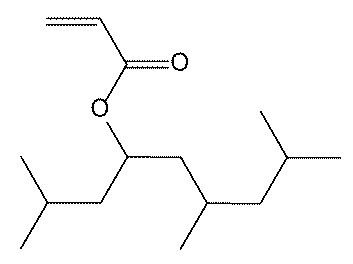
非フッ素共重合体(A)は、塩化ビニル及び塩化ビニリデンからなる群から選択される少なくとも一の塩化物単量体(a2)から誘導された繰り返し単位を含む。塩化物単量体(a2)は塩化ビニルであることが好ましい。
非フッ素共重合体(A)は環状炭化水素基含有単量体(a3)から誘導される繰り返し単位を有してよい。環状炭化水素基含有単量体(a3)は、環状炭化水素基を有する単量体であり、一のエチレン性不飽和二重結合と、環状炭化水素基とを有する単量体であってよい。
非フッ素共重合体(A)は架橋性単量体(a4)から誘導される繰り返し単位を有してよい。架橋性単量体(a4)は共重合体に架橋性を付与することが可能な単量体であって、反応性基及びオレフィン性炭素-炭素二重結合からなる群からなる群から選択される少なくとも二を有してよい。架橋性単量体(a4)は、少なくとも二のエチレン性不飽和二重結合を有する化合物、又は少なくとも一のエチレン性不飽和二重結合及び少なくとも一の反応性基を有する化合物であってよい。
非フッ素共重合体(A)は単量体(a1)~(a4)以外のその他単量体(a5)から誘導された繰り返し単位を含有してもよい。
疎水性単量体(a1)から誘導された繰り返し単位の量は、非フッ素共重合体(A)に対して、50重量%以上、60重量%以上、65重量%以上、70重量%以上、75重量%、80重量%以上、又は85重量%以上であってよい。疎水性単量体(a1)から誘導された繰り返し単位の量は、非フッ素共重合体(A)に対して、99重量%以下、98重量%以下、95重量%以下、90重量%以下、80重量%以下、70重量%以下、又は60重量%以下であってよい。
イソシアネート誘導体(B)は、活性水素化合物と原料イソシアネートとの反応により得られる化合物であって、活性水素含有化合物から誘導された部分と、原料イソシアネートから誘導された部分とを有する。なお、イソシアネート誘導体(B)はイソシアネート系硬化剤とは異なり、イソシアネート基を通常有しない。
活性水素化合物は、イソシアネート基と反応する活性水素基を含む。
活性水素化合物は、炭化水素基とヒドロキシとから構成される炭化水素アルコール(α1)であってよい。
活性水素化合物は、炭素数6以上40以下の炭化水素基が修飾された糖アルコール/ヒドロキシ酸(糖アルコール及び/又はヒドロキシ酸)である、糖アルコール/ヒドロキシ酸修飾体(α2)であってよい。糖アルコール/ヒドロキシ酸の種類は限定されず、環式又は非環式であってよく、糖アルコールの例としては単糖類、還元糖、アミノ糖、アルドン酸、アルドン酸ラクトンが挙げられ、ヒドロキシ酸の例としてはヒドロキシ多価カルボン酸等が挙げられる。糖アルコール/ヒドロキシ酸は、生体内に存在する物質であってもよい。糖アルコール/ヒドロキシ酸の例としては、アルドース及びケトース、例えば、テトロース、ペントース、ヘキソース及びヘプトース由来の化合物が挙げられるが、これらに限定されず、具体例としては、グルコース、グリセルアルデヒド、エリトロース、アラビノース、リボース、アラビノース、アロース、アルトロース、マンノース、キシロース、リキソース、グロース、ガラクトース、タロース、フルクトース、リブロース、マンノヘプツロース、セドヘプツロース、トレオース、エリスリトール、トレイトール、グルコピラノース、マンノピラノース、タロピラノース、アロピラノース、アルトロピラノース、イドピラノース、グロピラノース、グルシトール、マンニトール、エリスリトール、ソルビトール、アラビトール、キシリトール、リビトール、ガラクチトール、フシトール、イジトール、イノシトール、ペンタエリスリトール、ジペンタエリスリトール、ボレミトール、グルコン酸、グリセリン酸、キシロン酸、ガラクタル酸、アスコルビン酸、クエン酸、グルコン酸ラクトン、グリセリン酸ラクトン、キシロン酸ラクトン、グルコサミン、ガラクトサミン又はこれらの混合物が挙げられる。糖アルコール/ヒドロキシ酸の炭素数は、2以上、4以上、又は6以上であってよく、30以下、20以下、又は10以下であってよい。化合物(α2)の平均OH値は、0超~約230、好ましくは約10~約175、最も好ましくは約25~約140の範囲であってよい。
糖アルコール/ヒドロキシ酸修飾体(α2)は、ソルビタンを炭素数6以上40以下の炭化水素基で修飾したソルビタン修飾体(α21)であってよく、特にアルキルソルビタンであってよく、ソルビタンを-Rα2、-C(O)Rα2、-(CH2CH2O)n(CH(CH3)CH2O)mRα2、-(CH2CH2O)n(CH(CH3)CH2O)mC(O)Rα2、又はこれらの混合物で置換した化合物であってよい(ここで、Rα2は炭素数6以上40の炭化水素基である)。例えばソルビタンを-C(O)Rα2で一置換、二置換、又は三置換した化合物であってよい。ここで、ソルビタンは、ソルビトール、イソソルビド又はその他の中間体若しくは副生成物の量を含んでもよい。ソルビタン修飾体(α21)における炭化水素基は、上述した炭素数6以上40以下の炭化水素基であってよく、上記の説明を援用する。ソルビタン修飾体(α21)は、炭素数12以上30以下のアルキル基を有していてもよい。炭素数12以上30以下のアルキル基については、上記の説明を援用する。スパン(SPAN)などの市販のソルビタン等を上記アルキルソルビタンとして利用可能である。
糖アルコール/ヒドロキシ酸修飾体(α2)は、クエン酸に炭素数6以上40以下の炭化水素基を修飾したクエン酸修飾体(α22)であってよく、特にアルキルシトレートであってよい。例えば、クエン酸修飾体(α22)は、アルキル基を有する一置換体、二置換体、又は三置換体として存在し得る。クエン酸修飾体(α22)における炭化水素基は、上述した炭素数6以上40以下の炭化水素基であってよく、上記の説明を援用する。クエン酸修飾体(α22)は、炭素数12以上30以下のアルキル基を有していてもよい。炭素数12以上30以下のアルキル基については、上記の説明を援用する。活性水素置換基が様々な値を有するシトレートの混合物を使用してもよく、また、Rα2が少なくとも1つの不飽和結合を有する炭化水素基を有する化合物と、Rα2が完全に飽和炭化水素である化合物との混合物を含んでもよい。クエン酸修飾体(α22)は、-(CH2CH2O)n(CH(CH3)CH2O)mRα2又は、-(CH2CH2O)n(CH(CH3)CH2O)mC(O)Rα2から選択される活性水素置換基を有してもよい(ここで、Rα2は炭素数6以上40以下の炭化水素基である)。クエン酸修飾体(α22)の例としては、トリアルキルシトレートが挙げられるが、これらに限定されない。
糖アルコール/ヒドロキシ酸修飾体(α21)は、ペンタエリスリトールに炭素数6以上40以下の炭化水素基を修飾したペンタエリスリトール修飾体(α23)であってよく、炭素数6以上40以下の炭化水素基(特にアルキル基)を有する一置換体、二置換体、又は三置換体であってよく、例えば、ジペンタエリスリオールエステルである。活性水素置換基は、-CH2C[CH2ORα2]3を含んでもよい(ここで、Rα2は炭素数6以上40以下の炭化水素基である)。また、ペンタエリスリトール修飾体(α23)は、炭化水素基の鎖長が異なる混合物を有する化合物、又はRα2が少なくとも1つの不飽和結合を含む化合物と、Rα2が完全に飽和した化合物との、混合物を含有してもよい。ペンタエリスリトール修飾体(α23)における炭化水素基は、上述した炭素数6以上40以下の炭化水素基であってよく、上記の説明を援用する。ペンタエリスリトール修飾体(α23)は、炭素数12以上30以下のアルキル基を有していてもよい。炭素数12以上30以下のアルキル基については、上記の説明を援用する。
活性水素化合物は、活性水素基、及び、カチオン性基を有するカチオン性活性水素化合物(α3)であってよい。
[(α4)その他活性水素含有化合物]
活性水素化合物(α)はその他活性水素化合物(α4)を含んでよい。
活性水素化合物(α4)は、式
Rα41-Xα41
[式中、
式中、Rα41は、
少なくとも1つの不飽和基を含んでよいC1~C30直鎖又は分岐鎖アルキル、ヒドロキシ官能性C1~C30直鎖又は分岐鎖アルキル、ヒドロキシ官能性直鎖又は分岐鎖C1~C30ポリエーテル、ヒドロキシ官能性直鎖又は分岐鎖ポリエステル、ヒドロキシ官能性直鎖又は分岐鎖オルガノシロキサン、チオール官能性C1~C30直鎖又は分岐鎖アルキル、アミン官能性C1~C30直鎖又は分岐鎖アルキル、Y-Rα411Rα412Rα413N+-Rα414-(ここで、Yはハロゲン化物イオン、例えばCl-である。)、HOS(=O)2-Rα414-、又はRα411Rα412C=N-(ここで、Rα411、Rα412、Rα413はそれぞれ独立して-H、C1~C6アルキルであり、Rα414は炭素数1~20の二価アルキル基であ。)であり、
Xα41は、-OH、-C(O)OH、-SH、-NH(R’)、-O-(CH2CH2O)s(CH(CH3)CH2O)t-H又は-C(O)-O-(CH2CH2O)s(CH(CH3)CH2O)t-Hなどのイソシアネート反応性官能基であり(ここで、R’は、-H又は一価の有機基であり、sは0~50の整数であり、tは0~50の整数であり、s+tは0より大きい。)。]
で表される化合物(α41)であってよい。
化合物(α42)は、式
Rα421-(OCH2CH(ORα422)CH2)z-ORα423
[式中、
Rα421、Rα422及びRα423は、少なくとも1つのRα421、Rα422又はRα423が-Hであって、それぞれ独立して、-H、-Rα424、-C(O)Rα424であり、Rα424は、独立して、少なくとも1つの不飽和結合を含んでもよい5~29個の炭素を有する直鎖又は分岐鎖アルキル基であり、zは1~15である。]
化合物(α4)は鎖延長剤(α43)であってもよい。鎖延長剤(α43)は分子内に活性水素を含有する官能基を2個以上(例えば2個)有する化合物である。鎖延長剤としては公知の鎖延長剤を使用でき、その例としては、エチレングリコール、ジエチレングリコール、トリエチレングリコール、プロピレングリコール、ジプロピレングリコール、トリプロピレングリコール、1,4-ブタンジオール、1,6-ヘキサンジオール、シクロヘキサンジメタノールなどの脂肪族又は芳香族ジオール又はポリオール類;エチレンジアミン、ピペラジン、アミノエチルピペラジン、フェニレンジアミン、ジエチルトルエンジアミン等の脂肪族又は芳香族ジアミン又はポリアミン類;例えばレゾルシノール、カテコール、ヒドロキノン、ビスフェノール、ビスフェノールA、ビスフェノールAP(1,1-ビス(4-ヒドロキシルフェニル)-1-フェニルエタン)、ビスフェノールF、ビスフェノールK、ビスフェノールM、テトラメチルビフェノール及びo,o’-ジアリル-ビスフェノールA等のフェノールヒドロキシル基含有化合物等;アミノエチルエタノールアミン、アミノプロピルエタノールアミン、アミノヘキシルエタノールアミン、アミノエチルプロパノールアミン、アミノプロピルプロパノールアミン、およびアミノヘキシルプロパノールアミン等のアルコールアミンが挙げられる。
イソシアネート誘導体(B)は、原料イソシアネートから誘導された部分を有する。
トリメチレンジイソシアネート、1,2-プロピレンジイソシアネート、ブチレンジイソシアネート(テトラメチレンジイソシアネ-ト、1,2-ブチレンジイソシアネート、2,3-ブチレンジイソシアネート、1,3-ブチレンジイソシアネート)、ヘキサメチレンジイソシアネート、ペンタメチレンジイソシアネート、2,2,4-トリメチルヘキサメチレンジイソシアネート、2,4,4-トリメチルヘキサメチレンジイソシアネート、2,6-ジイソシアネートメチルカプエート、リジンジイソシアネート、リジンエステルトリイソシアネート、1,6,11-ウンデカントリイソシアネート、1,3,6-ヘキサメチレントリイソシアネート、トリメチルヘキサメチレンジイソシアネート、デカメチレンジイソシアネートから選択される、非環式脂肪族ポリイソシアネート;
1,3-シクロペンタンジイソシアネート、1,3-シクロペンテンジイソシアネート、シクロヘキサンジイソシアネート(1,4-シクロヘキサンジイソシアネ-ト、1,3-シクロヘキサンジイソシアネート)、3-イソシアネートメチル-3,5,5-トリメチルシクロヘキシルイソシアネート(イソホロンジイソシアネート、IPDI)、メチレンビス(シクロヘキシルイソシアネート(4,4’-、2,4’-または2,2’-メチレンビス(シクロヘキシルイソシアネート若しくはこれらの混合物)(水添MDI)、メチルシクロヘキサンジイソシアネート(メチル-2,4-シクロヘキサンジイソシアネート、メチル-2,6-シクロヘキサンジイソシアネート、ビス(イソシネートメチル)シクロヘキサン(1,3-または1,4-ビス(イソシアネートメチル)シクロヘキサン若しくはその混合物)(水添XDI)、ダイマー酸ジイソシアネート、トランスシクロヘキサン1,4-ジイソシアネート、水素添加トリレンジイソシアネート(水添TDI)、水素添加テトラメチルキシリレンジイソシアネート(水加TMXDI)から選択される、環式脂環族ポリイソシアネート;
ノルボルネンジイソシアネート、ノルボルナンジイソシアネートメチル、ビシクロヘプタントリイソシアネート、ジイソシアナートメチルビシクロヘプタン、ジ(ジイソシアナートメチル)トリシクロデカンから選択される、橋架環式脂環族ポリイソシアネート;

および上記イソシアネートの、
ビウレット変性体、
ポリイソシアネートの多量体(例えば、2量体、3量体(例えば、イソシアヌレート誘導体、イミノオキサジアジンジオン誘導体)、5量体、7量体など)、
アロファネート誘導体(例えば、上記したポリイソシアネートと、1価アルコールまたは2価アルコールとの反応より生成するアロファネート誘導体など)、
ポリオール誘導体(例えば、上記したポリイソシアネートと3価アルコール(例えば、トリメチロールプロパンなど)との反応より生成するポリオール誘導体(アルコール付加体、好ましくは、トリメチロールプロパン付加体)など)、
ビウレット誘導体(例えば、上記したポリイソシアネートと、水またはアミン類との反応により生成するビウレット誘導体など)、
ウレア誘導体(例えば、上記したポリイソシアネートとジアミンとの反応により生成するウレア誘導体など)、
オキサジアジントリオン誘導体(例えば、上記したポリイソシアネートと炭酸ガスとの反応により生成するオキサジアジントリオンなど)、
カルボジイミド誘導体(上記したポリイソシアネートの脱炭酸縮合反応により生成するカルボジイミド誘導体など)、
ウレトジオン誘導体、
ウレトンイミン誘導体等;が挙げられる。
化合物(α)から誘導される部分の量は、イソシアネート誘導体(B)に対して、10重量%以上、20重量%以上、30重量%以上、40重量%以上、50重量%以上、60重量%以上、又は70重量%以上であってよい。
単量体(α)から誘導される部分の量は、イソシアネート誘導体(B)に対して、75重量%以下、65重量%以下、55重量%以下、45重量%以下、35重量%以下、25重量%以下、又は15重量%以下であってよい。
炭化水素アルコール(α1)から誘導される部分の量は、活性水素化合物から誘導される部分に対して、75重量%以下、65重量%以下、55重量%以下、45重量%以下、35重量%以下、25重量%以下、又は15重量%以下であってよい。
糖アルコール/ヒドロキシ酸修飾体から誘導される部分の量は、活性水素化合物から誘導される部分に対して、75重量%以下、65重量%以下、55重量%以下、45重量%以下、35重量%以下、25重量%以下、又は15重量%以下であってよい。
カチオン性活性水素化合物(α3)から誘導される部分の量は、活性水素化合物から誘導される部分に対して、75重量%以下、65重量%以下、55重量%以下、45重量%以下、35重量%以下、25重量%以下、又は15重量%以下であってよい。
その他活性水素含有化合物(α4)から誘導される部分の量は、活性水素化合物から誘導される部分に対して、75重量%以下、65重量%以下、55重量%以下、45重量%以下、35重量%以下、25重量%以下、又は15重量%以下であってよい。
原料イソシアネートから誘導される部分の量は、イソシアネート誘導体(B)に対して、75重量%以下、65重量%以下、55重量%以下、45重量%以下、35重量%以下、25重量%以下、又は15重量%以下であってよい。
イソシアネート誘導体(B)の量は、非フッ素共重合体(A)100重量部あたり0.1重量部以上、1重量部以上、3重量部以上、5重量部以上、10重量部以上、15重量部以上、又は20重量部以上であってよい。イソシアネート誘導体(B)の量は、非フッ素共重合体(A)100重量部に対して、50重量部以下、40重量部以下、30重量部以下、20重量部以下、10重量部以下、又は5重量部以下であってよい。
本開示における撥水剤組成物は、疎水性単量体(a1)とは別に、シリコーンを含むことが好ましい。シリコーンを含むことで、撥水性、及び耐スリップ性を良好に兼ね備え得る。
(R53)3Si-O-[-Si(R51)2-O-]a-[-Si(R51)2-O-]b-Si(R53)3 (S1)
[式中、R51のそれぞれは、独立に、水素原子、炭素数1~40のアルキル基、炭素数6~40のアリール基又は炭素数1~40のアルコキシ基を表し、
R53のそれぞれは、独立に、水素原子、炭素数1~40のアルキル基、炭素数6~40のアリール基、炭素数1~40のアルコキシ基又は炭素数1~40の飽和の炭化水素基を表し、
aは0以上の整数を表し、bは1以上の整数を表し、(a+b)は5~200である。]
で示される重合体であってよい。
R51及びR53の具体例は、メチル基、エチル基、プロピル基、ブチル基、ペンチル基、ヘキシル基、ヘプチル基、オクチル基、ノニル基、デシル基、ドデシル基、テトラデシル基、ヘキサデシル基、オクタデシル基;シクロペンチル基、シクロヘキシル基、シクロヘプチル基;フェニル基、トリル基、ナフチル基、又はこれらの基に結合する水素原子の一部又は全部がハロゲン原子、アミノ基、シアノ基等で置換された基等が挙げられる。R51及びR53は、メチル基又はエチル基であることが好ましい。
R51及びR53において、炭素数1~40のアルコキシ基は、直鎖状であっても分岐状であってもよい。炭素数1~40のアルコキシ基の例は、メトキシ基、エトキシ基、プロポキシ基、ブトキシ基である。
(R53)3Si-O-[-Si(R51)2-O-]a-[-Si(R51)(R52)-O-]b-Si(R53)3 (S2)
[式中、R51のそれぞれは、独立に、水素原子、炭素数1~40のアルキル基、炭素数6~40のアリール基、炭素数1~40のアルコキシ基、又は長鎖炭化水素基を表し、
R52のそれぞれは、独立に、長鎖炭化水素基を表し、
R53のそれぞれは、独立に、水素原子、炭素数1~40のアルキル基、炭素数6~40のアリール基、炭素数1~40のアルコキシ基、又は長鎖炭化水素基を表し、
aは0以上の整数を表し、bは1以上の整数を表し、(a+b)は5~200である。]
で示される重合体であってよい。
式(S2)において、R51及びR53は、炭素数3~40のアルキル基又は炭素数6~40の不飽和炭化水素基(例えば芳香族環を有する炭化水素基)を有していてもよいが、これら基を有しないことが好ましい。

[式中、aは0~150の整数を表し、
bは1~150の整数を表し、
(a+b)は5~200であり、
nは1~36(好ましくはnは長鎖炭化水素基)の整数である。]
ヒドロシリル化反応は、必要に応じて触媒の存在下、上記SiH基を有するシリコーンに、α-オレフィンを段階的に或いは一度に反応させることにより行ってもよい。
ヒドロシリル化反応は、不活性ガス雰囲気下で行うことが好ましい。不活性ガスとしては、例えば、窒素、アルゴン等が挙げられる。無溶媒下でも反応は進行するが、溶媒を使用してもよい。溶媒としては、例えば、ジオキサン、メチルイソブチルケトン、トルエン、キシレン、酢酸ブチル等が挙げられる。
シリコーンは反応性シリコーンを含んでいてよい。反応性シリコーンには、側鎖、片末端、両末端、又は側鎖及び両末端において、反応基を有するポリシロキサンが挙げられるが、耐滑脱性に優れると同時に撥水性に優れる観点から、側鎖及び/又は両末端に反応基を有するポリシロキサンであってもよい。反応性シリコーンとしては、分子内に反応基を有するものであれば、特に限定されないが、たとえば、アミノ変性シリコーン、エポキシ変性シリコーン、カルボキシ変性シリコーン、ハイドロジェン変成シリコーン等が挙げられる。反応性シリコーンは上述の式(S1)又は式(S2)における一以上の置換基が反応基に置換されたものであってよい。
シリコーンはシリコーンレジンを含んでいてよい。シリコーンレジンは、R3SiO1/2単位(M単位)、RSiO3/2単位(T単位)及びSiO4/2単位(Q単位)から選ばれる少なくとも1種からなるシリコーンレジンであり、Rは直鎖又は分岐の炭素数1~18の一価アルキル基である、またM単位のみ及びQ単位のみからなるシリコーンレジンを除く)。シリコーンレジン(B)は、R2SiO2/2単位(D単位)を含まない方が、本願効果を発揮する観点から、好ましい。
加水分解反応を実施するに際し、加水分解触媒を使用してもよい。加水分解触媒としては従来公知の触媒を使用することができ、酸性又はアルカリ性のものを使用するのがよい。酸性触媒の場合はハロゲン化水素、カルボン酸、スルホン酸、酸性或いは弱酸性の無機塩、イオン交換樹脂等の固体酸が好ましい。アルカリ性触媒の場合は水酸化ナトリウム、水酸化カリウム、炭酸ナトリウム、炭酸カリウム、炭酸水素ナトリウム等のアルカリ金属塩、ナトリウムシラノレート、カリウムシラノレート等のアルカリ金属シラノレート、トリエチルアミン、ジエチルアミン、アニリン等のアミン類、アンモニア水等を用いることができる。触媒量は水溶液のpHが2~7および7~12になるように添加量を調整することが好ましい。また反応終了後には必要に応じて、酸性又はアルカリ性触媒を中和する中和剤を添加してもよい。
シリコーンの量は、非フッ素共重合体(A)100重量部に対して、0.1重量部以上、1重量部以上、3重量部以上、5重量部以上、10重量部以上、15重量部以上、又は20重量部以上であってよい。シリコーンの量は、非フッ素共重合体(A)100重量部に対して、50重量部以下、40重量部以下、30重量部以下、20重量部以下、10重量部以下、又は5重量部以下であってよい。
本開示における撥水剤組成物は、疎水性単量体(a1)とは別に、ワックスを含むことが好ましい。ワックスを含むことで、撥水性、及び耐スリップ性を良好に兼ね備え得る。本開示における撥水剤組成物はシリコーン及びワックスの両方を含んでもよいし、シリコーン及びワックスのいずれか一方のみを含んでもよい。
ワックスの量は、非フッ素共重合体(A)100重量部に対して、0.1重量部以上、1重量部以上、3重量部以上、5重量部以上、10重量部以上、15重量部以上、又は20重量部以上であってよい。ワックスの量は、非フッ素共重合体(A)100重量部に対して、50重量部以下、40重量部以下、30重量部以下、20重量部以下、10重量部以下、5重量部以下であってよい。
本開示における撥水剤組成物は、無機粒子を含んでもよい。無機粒子を含むことで、撥水性、および耐スリップ性をより良好に付与し得る。無機粒子は、アルミニウム化合物(例えばアルミナ)、ケイ素化合物(例えばシリカ)、チタン化合物等であってよい。これらは単独で使用してもよく、また二以上を併用して使用してもよい。無機粒子は、親水性表面処理がなされていてもよく、又は疎水性表面処理がなされていてもよい。
無機粒子の量は、非フッ素共重合体(A)100重量部に対して、0.1重量部以上、1重量部以上、3重量部以上、5重量部以上、10重量部以上、15重量部以上、又は20重量部以上であってよい。無機粒子の量は、非フッ素共重合体(A)100重量部に対して、50重量部以下、40重量部以下、30重量部以下、20重量部以下、10重量部以下、5重量部以下であってよい。
撥水剤組成物は液状媒体を含んでもよい。液状媒体は水、有機溶媒、又は水と有機溶媒との混合物である。好ましくは水と有機溶媒との混合物である。有機溶媒を含むことにより、撥水性、及び耐スリップ性を良好に兼ね備え得る。
液状媒体の量は、撥水剤組成物に対して、40重量%以上、50重量%以上、60重量%以上、70重量%以上、80重量%以上、90重量%以上、95重量%以上、又は97重量%以上であってよい。液状媒体の量は、撥水剤組成物に対して、99.9重量%以下、99重量%以下、95重量%以下、90重量%以下、80重量%以下、70重量%以下、60重量%以下、又は50重量%以下であってよい。
撥水剤組成物は、非フッ素共重合体(A)の分散性を高めるために分散剤を含んでいてよい。分散剤は高分子分散剤であってよく、好ましくは親水性高分子系分散剤である。分散剤としては、ポリビニルピロリドンやポリビニルアルコール、ポリグリセリン、ポリアクリル酸塩等を用いることができる。これらは単独で用いてもよいし、又は二以上を併用してもよい。
分散剤の量は、非フッ素共重合体(A)100重量部に対して、0.1重量部以上、1重量部以上、3重量部以上、5重量部以上、10重量部以上、15重量部以上、又は20重量部以上であってよい。分散剤の量は、非フッ素共重合体(A)100重量部に対して、50重量部以下、40重量部以下、30重量部以下、20重量部以下、10重量部以下、5重量部以下であってよい。
撥水剤組成物は、界面活性剤を含むことが好ましい。撥水剤組成物において、界面活性剤は、ノニオン性界面活性剤を含んでよい。界面活性剤を含むことにより、撥水性、及び耐スリップ性を良好に兼ね備え得る。さらに、界面活性剤は、カチオン性界面活性剤、アニオン性界面活性剤、及び両性界面活性剤から選択された一種以上の界面活性剤を含んでもよい。ノニオン性界面活性剤とカチオン性界面活性剤の組み合わせを用いることが好ましい。
ノニオン性界面活性剤の例としては、エーテル、エステル、エステルエーテル、アルカノールアミド、多価アルコール及びアミンオキシドが挙げられる。
アミンオキシドは、アミン(二級アミン又は好ましくは三級アミン)の酸化物(例えば炭素数5~50)であってよい。
ノニオン性界面活性剤は、エーテル、エステル、エステルエーテル、アルカノールアミド、多価アルコール及びアミンオキシドからなる群から選択されており、オキシアルキレン基を有するノニオン性界面活性剤であることが好ましい。
また、ノニオン性界面活性剤は、環境上の問題(生分解性、環境ホルモン等)から芳香族基を含まない構造が好ましい。
R1O-(CH2CH2O)p-(R2O)q-R3
[式中、R1は炭素数1~22のアルキル基又は炭素数2~22のアルケニル基又はアシル基であり、
R2のそれぞれは、独立的に同一又は異なって、炭素数3以上(例えば、3~10)のアルキレン基であり、
R3は水素原子、炭素数1~22のアルキル基又は炭素数2~22のアルケニル基であり、
pは2以上の数であり、
qは0又は1以上の数である。]
で示される化合物であってよい。
R2の例は、プロピレン基、ブチレン基である。
ノニオン性界面活性剤において、pは3以上の数(例えば、5~200)であってよい。qは、2以上の数(例えば5~200)であってよい。すなわち、-(R2O)q-がポリオキシアルキレン鎖を形成してもよい。
ノニオン性界面活性剤は、中央に親水性のポリオキシエチレン鎖と疎水性のオキシアルキレン鎖(特に、ポリオキシアルキレン鎖)を含有したポリオキシエチレンアルキレンアルキルエーテルであってよい。疎水性のオキシアルキレン鎖としては、オキシプロピレン鎖、オキシブチレン鎖、スチレン鎖等が挙げられるが、中でも、オキシプロピレン鎖が好ましい。
ノニオン性界面活性剤の平均分子量は、一般に300~5,000、例えば、500~3,000である。
ノニオン界面活性剤は、HLB(親水性疎水性バランス)が15未満(特に5以下)である化合物とHLBが15以上である化合物の混合物であってよい。HLBが15未満である化合物の例は、ソルビタン脂肪酸エステルである。HLBが15以上である化合物の例はポリオキシエチレンアルキルエーテルである。HLB15未満の化合物とHLB15以上の化合物の重量比は、90:10~20:80、例えば85:15~55:45であってよい。
ノニオン性界面活性剤は、一種単独であってよく、あるいは二種以上の混合物であってもよい。
カチオン性界面活性剤は、アミド基を有しない化合物であることが好ましい。
R21-N+(-R22)(-R23)(-R24) X-
[式中、R21、R22、R23及びR24は炭素数1~40の炭化水素基、
Xはアニオン性基である。]
の化合物である。
R21、R22、R23及び-R24の具体例は、アルキル基(例えば、メチル基、ブチル基、ステアリル基、パルミチル基)である。Xの具体例は、ハロゲン(例えば、塩素)、酸(例えば、塩酸、酢酸)である。
カチオン性界面活性剤は、モノアルキルトリメチルアンモニウム塩(アルキルの炭素数4~40)であることが特に好ましい。
R1 p - N+R2 qX-
[式中、R1はC12以上(例えばC12~C50)の直鎖状及び/又は分岐状の脂肪族(飽和及び/又は不飽和)基、
R2はH又はC1~4のアルキル基、ベンジル基、ポリオキシエチレン基(オキシエチレン基の数例えば1(特に2、特別には3)~50)
(CH3、C2H5が特に好ましい)、
Xはハロゲン原子(例えば、)、C1~C4の脂肪酸塩基、
pは1又は2、qは2又は3で、p+q=4である。]
で示されるアンモニウム塩であってよい。R1の炭素数は、12~50、例えば12~30であってよい。
界面活性剤の量は、非フッ素共重合体(A)100重量部に対して、0.1重量部以上、1重量部以上、3重量部以上、5重量部以上、10重量部以上、15重量部以上、又は20重量部以上であってよい。界面活性剤の量は、非フッ素共重合体(A)100重量部に対して、50重量部以下、40重量部以下、30重量部以下、20重量部以下、10重量部以下、5重量部以下であってよい。
カチオン性界面活性剤の量は、界面活性剤の全量に対して、5重量%以上、好ましくは10重量%以上、より好ましくは20重量%以上であってよい。ノニオン性界面活性剤とカチオン性界面活性剤の重量比は、好ましくは95:5~20:80、より好ましくは85:15~40:60である。
カチオン性界面活性剤の量は、撥水性樹脂100重量部に対して、0.05~10重量部、例えば、0.1~8重量部であってよい。界面活性剤の合計量は、撥水性樹脂100重量部に対して、0.1~20重量部、例えば、0.2~10重量部であってよい。
撥水剤組成物は、硬化剤(活性水素反応性化合物又は活性水素含有化合物)を含んでよい。重合して非フッ素共重合体(A)を得た後に、撥水剤組成物に硬化剤を加えてもよい。
ポリイソシアネート化合物として、ポリイソシアネート化合物のイソシアネート基をブロック剤でブロックした化合物であるブロック化ポリイソシアネート化合物(ブロックイソシアネート)を使用することが好ましい。水溶液中でも比較的安定であり、撥水剤組成物と同じ水溶液中でも使用可能である等の理由からブロック化ポリイソシアネート化合物を使用することが好ましい。
クロロメチル基含有化合物はクロロメチル基を有する化合物である。クロロメチル基含有化合物の例は、クロロメチルポリスチレン等である。
カルボキシル基含有化合物はカルボキシル基を有する化合物である。カルボキシル基含有化合物の例は、(ポリ)アクリル酸、(ポリ)メタクリル酸等である。
ヒドラジド化合物の具体例としては、ヒドラジン、カルボヒドラジド、アジピン酸ヒドラジド等が挙げられる。
メラミン化合物の具体例としては、メラミン樹脂、メチルエーテル化メラミン樹脂等が挙げられる。
硬化剤の量は、非フッ素共重合体(A)100重量部に対して、0.1重量部以上、1重量部以上、3重量部以上、5重量部以上、10重量部以上、15重量部以上、又は20重量部以上であってよい。硬化剤の量は、非フッ素共重合体(A)100重量部に対して、50重量部以下、40重量部以
下、30重量部以下、20重量部以下、10重量部以下、5重量部以下であってよい。
撥水剤組成物は、上記成分以外の他の成分を含んでよい。非フッ素共重合体(A)を製造した後に、他の成分を加えてもよい。他の成分の例としては、撥水及び/又は撥油剤、スリップ防止剤、帯電防止剤、防腐剤、紫外線吸収剤、抗菌剤、消臭剤、香料等が挙げられる。これらは単独で用いてもよいし、又は二以上を併用して用いてもよい。前記の成分以外に、その他成分として、風合い調整剤、柔軟剤、抗菌剤、難燃剤、塗料定着剤、防シワ剤、乾燥速度調整剤、架橋剤、造膜助剤、相溶化剤、凍結防止剤、粘度調整剤、紫外線吸収剤、酸化防止剤、pH調整剤、防虫剤、消泡剤、縮み防止剤、洗濯じわ防止剤、形状保持剤、ドレープ性保持剤、アイロン性向上剤、増白剤、白化剤、布地柔軟化クレイ、ポリビニルピロリドン等の移染防止剤、高分子分散剤、汚れ剥離剤、スカム分散剤、4,4-ビス(2-スルホスチリル)ビフェニルジナトリウム(チバスペシャルティケミカルズ製チノパールCBS-X)等の蛍光増白剤、染料固定剤、1,4-ビス(3-アミノプロピル)ピペラジン等の退色防止剤、染み抜き剤、繊維表面改質剤としてセルラーゼ、アミラーゼ、プロテアーゼ、リパーゼ、ケラチナーゼ等の酵素、抑泡剤、水分吸放出性等絹の風合い・機能を付与できるものとしてシルクプロテインパウダー、それらの表面改質物、乳化分散液があり、具体的にはK-50、K-30、K-10、A-705、S-702、L-710、FPシリーズ(出光石油化学)、加水分解シルク液(上毛)、シルクゲンGソルブルS(一丸ファルコス)、アルキレンテレフタレート及び/又はアルキレンイソフタレート単位とポリオキシアルキレン単位からなる非イオン性高分子化合物、例えば互応化学工業製FR627、クラリアントジャパン製SRC-1等の汚染防止剤等を配合することができる。これらは単独で使用してもよく、また二以上を併用して使用してもよい。
帯電防止剤の例としては、第4級アンモニウム塩、ピリジニウム塩、第1、第2、第3アミノ基等のカチオン性官能基を有すカチオン型帯電防止剤;スルホン酸塩や硫酸エステル塩、ホスホン酸塩、リン酸エステル塩等のアニオン性官能基を有するアニオン型帯電防止剤;アルキルベタイン及びその誘導体、イミダゾリン及びその誘導体、アラニン及びその誘導体等の両性型帯電防止剤、アミノアルコール及びその誘導体、グリセリン及びその誘導体、ポリエチレングリコール及びその誘導体等のノニオン型帯電防止剤等が挙げられる。これらのカチオン型、アニオン型、両性イオン型のイオン導電性基を有する単量体を重合若しくは共重合して得られたイオン導電性重合体であってもよい。これらは単独で使用してもよく、また二以上を併用してもよい。
防菌防カビ剤は、菌などの微生物、好ましくは真菌および細菌の両方の増殖を抑制する少なくとも1種の防菌防カビ剤である。防菌防カビ剤は、特に限定されるものでないが、日本防菌防黴学会誌 1998 VOL.26に列挙されている、以下のような一般的に使用される防菌防カビ剤を使用することができる。
Ethyl alcohol(エチルアルコール、エタノール)、Iso-propyl alcohol(イソプロパノール)、Propyl alcohol(プロピルアルコール、プロパノール)、Tris(hydroxymethyl)nitromethane(トリスニトロ)、1,1,1-Trichloro-2-methyl-2-propanol(クロロブタノール)、2-Bromo-2-nitropropane-1,3-diol(プロノボール、プロノゾール、プロノコット)などのアルコール系、
1,5-Pentanediol(グルタルアルデヒド)、Formaldehyde(ホルムアルデヒド)、α-Bromocinnamic aldehyde(α-ブロムシンアムアルデヒド)などのアルデヒド系、
2-n-Octyl-4-isothiazolin-3-one(スケーンM-8)、5-Chloro-2-methyl-4-isothiazolin-3-one/2-Methyl-4-isothiazolin-3-one(ケーソンCG, NS-500W)、1,2-Benzisothiazolone-3(BIT)、N-n-Butyl-1,2-benzisothiazolone-3(n-プチルBIT)などのイソチアゾリン系、
Allyl isothiocyanate(アリールイソチオシアネート,イソチオシアン酸アリル)などのイソチオシアネート系、
2-(4-Thiazolyl)-benzimidazol(チアベンダゾール,TBZ)、Methyl-2-benzimidazole carbamate(2-ベンツイミダゾリルカルバミン酸メチル,プリベントールBCM)などのイミダゾール系、
Glycerol laurate(ラウリシジン,グリセルモノラウレート,モノグリセリド)などのエステル系、
4,4-Dimethyl-1,3-oxazolidine(バイオパンCS-1135,オキサジンA)などのオキサゾリジン系、
3,4,4'-Trichlorocarbanilide(トリクロカルバン,トリクロロカルバニリド),4,4'-Dichloro-3-(3-Fluoromethyl)-carbanilide(ハロカルバン,クロフルカルバン)などのカーバニリド系、
3-Iodo-2-propynylbutyl carbamate(グライシカル)などのカーバメート系、
Benzoic acid(安息香酸,ベンゼンカルボン酸)、Flexa-2,4-dienoic acid(ソルビン酸,2-プロパニルアクリル酸)、Octanoic acid(カプリル酸)、Propionic acid(プロピオン酸)、Undecylenic acid(10-ウンデシレン酸、10-ウンデセン酸)、Potassium hexa-2,4-dienoic acid(ソルビン酸カリウム,2-プロペニルアクリル酸カリウム)、Potassium propionate(プロピオン酸カリウム)、Calcium propionate(プロピオン酸カルシウム)、Sodium benzoate(安息香酸ナトリウム)、Sodium propionate(プロピオン酸ナトリウム)、Magnesate(2-),bis(2-carboxybenzene carboperoxato)dihydrogene(フタル酸モノマグネシウム)、Zinc undecylenate(ウンデシレン酸亜鉛)などのカルボン酸系、
8-Hydroxyquinoline(8-ヒドロキシキノリン)、Bis(quinolin-8-olate)copper(キノリン銅,オキシン銅,8-キノリノール銅)などのキノリン系、
Bis(dimethylthiocarbamoyl)disulfide(TMTD,チウラム)などのサルファイド系、
2,4,4'-Trichloro-2'-hydroxydiphenyl(トリクロサン,イルガサン DP300)などのジフェニルエーテル系、
N,N-Dimethyl-N'-(fluorodichloromethylthio)-N"-phenylsulfamide(シクロフルアニド,プリベントールA4-S)、N-Dichlorofluoromethylthio-N',N'-dimethyl-N-p-torylsulfamide(トリフルアミド,プリベントールA5)などのスルファミド系、
Protamine(しらこタンパク,しらこ分解物,核タンパク)Hen egg lysozyme(卵白リゾチーム)などのタンパク質系、
2-(4-Thiocyanomethylthio)benzothiazol(ベンチアゾール)などのチアゾール系、
Sodium N-methyldithiocarbamate(N-メチルジチオカルバミン酸ナトリウム、カ-バムナトリウム)などのチオカーバメート系、
Hexahydro-1,3,5-tris(hydroxyethyl)-S-triadine(バイオパンGK,トリアジン)、
CAVINON(100,200)(カビノン(100,200))、α-[2-(4-Chlorophenyl)ethyl]-α-(1,1-dimethylethyl)-1H-1,2,4-triazole-1-ethanol(デブコナゾール)などのトリアジン系、
4-Isopropyl-2-hydroxy-cyclohepta-2,4,6-triene-1-one(ヒノキチオール、β-ツヤプリシン)などのトロポロン系、
2,4,5,6-Tetrachloroisophthalonitrile(テトラクロロイソフタロニトリル)、1,2-Dibromo-2,4-dicyanobutane(テクタマール38)などのニトリル系、
1,1'-(Hexamethylene bis[5-(4-chlorophenyl)biguanide]digluconate(グルクロン酸クロルヘキシジン)、Bis(p-chlorophenyldiguanide)hexane dihydrochloride(クロルヘキシジン塩酸塩)などのビグアナイド系、
1-Bromo-3-chloro-5,5'-dimethyl hydantoin(ダントブロム)、1,3-Bis-(hydroxymethyl)-5,5'-dimethyl hydantoin(グライダント、ダントガード)などのヒダントイン系、
Sodium pyridine thiol-1-oxide(ピリチオンナトリウム)、Zinc bis(2-pyridylthio-1-oxide)(ジンクピリチオン,ジンクオマジン、ZPT)、2,3,5,6-Tetrachloro-4-(methylsulphonyl)pyridine(デンシル)、Copper bis(2-pyridylthio-1-oxide)(カッパーピリチオン,カッパーオマージン,CuPT)などのピリジン系、
2-Isopropyl-5-methylphenol(チモール,2-イソプロピル-5-メチルフェノール)、3-Methyl-4-iso-propylphenol(イソプロピルメチルフェノール、ピオゾール)、o-Phenylphenol(OPP、オルトフェニルフェノール)、Phenol(フェノール、石炭酸)、Butyl-p-hydroxybenzoate(ブチルパラベン)、Ethyl-p-hydroxybenzoate(エチルパラベン)、Methyl-p-hydroxybenzoate(メチルパラベン)、Propyl-p-hydroxybenzoate(プロピルパラベン)、m-Methylphenol(メタクレゾール)、o-Methylphenol(オルトクレゾール)、p-Methylphenol(パラクレゾール)、o-Phenylsodiumphenoxide(オルトフェニルフェノールナトリウム)、2-Benzyl-4-chlorophenol(クロロフェン)、p-Chlorophenol(パラクロルフェノール)、4-Chloro-3,5-dimethylphenol(パラクロロメタキシレノール)、2-Methyl-3-chlorophenol(パラクロロメタクレゾール)などのフェノール系、
N-(Fluorodichloromethylthio)-phthalimide(フルオロフォルペット,ブリベントールA3)などのフタルイミド系、
ε-Poly-L-lysine(ポリリジン、ε-ポリリジン)などのペプチド系、
4-(2-Nitrobutyl)morpholine/4,4'-(2-nitrotrimethylene)dimorpholine(バイオパンP-1487)などのモルフォリン系、
Diiodomethyl-p-trylsulfone(ジヨージドメチルパラトリルスルフォン)、Polyvinylpyrolidone iodide(ポリビニルピロリドンヨード、ポビドンヨード、イソジン)、p-Chlorophenyl-3-iodopropagyl formal(パラクロロフェニル-3-ヨウ化プロパギルフォルマール)、3-Bromo-2,3-diiodo-2-propenylethylcarbonate(サンプラス)などのヨウ素系、
Sodium hypochlorite(次亜塩素酸ナトリウム、次亜塩素酸ソーダ)、Sodium dichlorinated isocyanurate(ジクロロイソシアヌル酸ナトリウム)、Trichlorinated isocyanuric acid(トリクロロイソジアヌル酸)などの塩素系、
Hydrogen peroxide(過酸化水素)、Chlorine dioxide(安定化二酸化塩素、ビオトーク)、Peracetic acid(過酢酸)などの過酸化物系、
Copper naphthenate(ナフテン酸銅)、Silver/Zirconium phosphate(ノバロンAG300)、Silver chloride/Titanium oxide(塩化銀/酸化チタン)、Silver-Zinc/Calcium phosphate(銀・リン酸亜鉛カルシウム、シルバーエース)、Silver-Zinc/Zeolite(銀亜鉛アルミノケイ酸塩、銀亜鉛ゼオライト)、Zinc oxide, Silver/Zirconium phosphate(ノバロンAGZ330)、N-Stearoyl-L-glutamic acid AgCu salt(ホロンキラー)などの金属塩系、
1-L-(1,3,5/2,4)-1,5-Diamino-4-O-(2,5-dideoxy-α-D-glucopyranosyl)-2,3-cyclohexandiol(ST-7)などの抗生物質系、
Ethylene oxide(EO、エチレンオキサイド)、Propylene oxide(PO、プロピレンオキサイド)などの酸化物系、
4,4'-(Tetramethylenedicarbonyldiamino)bis(1-decylpyridinium bromide)(ダイマー135)、Decyldimethylbenzylammonium chloride(ベンザルコニウムクロライド)、Didecyldimethylammonium chloride(ジデシルジメチルアンモニウムクロライド、バーダック2250/80)、Diisobutylphenoxyethoxydimethylbenzylammonium chloride(塩化ベンゾトニウム、ハイアミン1622)、Hexadecyl trimethyl ammonium bromide(臭化セチルアンモニウム、セトリミド、CTAB、セクブロン)、N,N'-Hexamethylenebis(4-carbamoyl-1-decylpyridinium bromide)(ダイマー38)、N-Alkyl-N,N-dimethyl-N-benzylammonium chloride(塩化ベンザルコニウム、ハイアミン3500J)、N-Decyl-N-isononyl-N,N'-dimethylammonium chloride(バーダック170P)、5-(Trimethoxysilyl)propyldimethyloctadecylammonium(DC-5700)、Hexadecyl pyridinium chloride(セチルピリジニウムクロライド)などの第四級アンモニウム塩系、
β-1,4-Poly-D-glucosamine(キトサン)などの糖質、
N'-(3,4-Dichlorophenyl)-N,N-dimethylurea(デュウロン、DCMU、ブリベントールA6)などの尿素系などが挙げられる。特に2-n-オクチル-4-イソチアゾリン-3-オン(スケーンM6)、5-クロロ-2-メチル-4-イソチアゾリン-3-オン/2-メチル-4-イソチアゾリン-3-オンの混合物、1,2-ベンズイソチアゾリン-3-オン(BIT)、N-n-ブチル-1,2-ベンズイソチアゾリン-3-オン(BBIT)などのイソチアゾリン系の防菌防カビ剤が好ましい。
防腐剤は、主に、防腐力、殺菌力を強化し、長期保存中の防腐性を保つために用いられ得る。防腐剤としては、例えば、イソチアゾロン系有機硫黄化合物、ベンズイソチアゾロン系有機硫黄化合物、安息香酸類、2-ブロモ-2-ニトロ-1,3-プロパンジオール等が挙げられる。防腐剤の量は、撥水剤組成物の総重量に対し、0.0001~1重量%であることが好ましい。防腐剤の量が前記範囲の下限値以上であると、防腐剤の添加効果が充分に得られ、上限値以下であると、撥水剤組成物の保存安定性が良好である。
抗菌剤は、繊維上での菌の増殖を抑え、さらには微生物の分解物由来の嫌なにおいの発生を抑える効果を有する成分である。抗菌剤としては、例えば、四級アンモニウム塩等のカチオン性殺菌剤、ビス-(2-ピリジルチオ-1-オキシド)亜鉛、ポリヘキサメチレンビグアニジン塩酸塩、8-オキシキノリン、ポリリジン等が挙げられる。
紫外線吸収剤は、紫外線を防御する効果のある薬剤であり、紫外線を吸収し、赤外線や可視光線等に変換して放出する成分である。紫外線吸収剤としては、例えば、アミノ安息香酸誘導体、サリチル酸誘導体、ケイ皮酸誘導体、ベンゾフェノン誘導体、アゾール系化合物、4-t-ブチル-4'-メトキシベンゾイルメタン等が挙げられる。
消臭剤としては、クラスターデキストリン、メチル-β-シクロデキストリン、2-ヒドロキシプロピル-β-シクロデキストリン、モノアセチル-β-シクロデキストリン、アシルアミドプロピルジメチルアミンオキシド、アミノカルボン酸系金属錯体(国際公開第2012/090580号記載のメチルグリシンジ酢酸3ナトリウムの亜鉛錯体)等が挙げられる。
香料としては特に限定されないが、使用できる香料原料のリストは、様々な文献、例えば「Perfume and Flavor Chemicals 」,Vol.Iand II,Steffen Arctander,Allured Pub.Co.(1994)及び「合成香料 化学と商品知識」、印藤元一著、化学工業日報社(1996)及び「Perfume and Flavor Materials of Natural Origin 」,Steffen Arctander,Allured Pub.Co.(1994)及び「香りの百科」、日本香料協会編、朝倉書店(1989)及び「Perfumery Material Performance V.3.3」,Boelens Aroma Chemical Information Service(1996)及び「Flower oils and Floral Compounds In Perfumery」,Danute Lajaujis Anonis,Allured Pub.Co.(1993)等で見られ、それぞれを引用することにより本明細書の開示の一部とされる。
他の成分の量は、非フッ素共重合体(A)100重量部に対して、0.1重量部以上、1重量部以上、3重量部以上、5重量部以上、10重量部以上、15重量部以上、又は20重量部以上であってよい。他の成分の量は、非フッ素共重合体(A)100重量部に対して、50重量部以下、40重量部以下、30重量部以下、20重量部以下、10重量部以下、5重量部以下であってよい。
撥水剤組成物の製造方法は、イソシアネート誘導体(B)の存在下において、炭素数2~40の炭化水素基を有する疎水性単量体(a1)と塩化ビニル及び塩化ビニリデンからなる群から選択される少なくとも一の塩化物単量体(a2)とを共重合することにより非フッ素共重合体(A)を得ることを含んでよい。かかる方法(以下、第1方法とする。)により、本開示の撥水剤組成物を得ることができる。
反応性乳化剤として、例えば、特開2017-25440号公報の反応性乳化剤などが挙げられ、好ましくは、下記式で示される反応性乳化剤が挙げられる。

上記式で示される反応性乳化剤として、好ましくは、ポリオキシエチレンアルキルフェノールなどが挙げられる。
これにより、非フッ素共重合体(A)のエマルションが得られ、イソシアネート誘導体(B)と、非フッ素共重合体(A)(エマルション)とを含む撥水剤組成物が得られる。
本開示における撥水剤組成物の用途の例としては、外的処理剤(表面処理剤)又は内的処理剤、撥剤(撥水剤、撥油剤又は撥水撥油剤等、特に撥水剤)、防汚剤、汚れ脱離剤、剥離剤、離型剤(外部離型剤又は内部離型剤)等が挙げられる。
本開示における処理製品の製造方法は、本開示の撥水剤組成物を基材(特に繊維基材)に適用する工程を含む。
本開示の撥水剤組成物で処理され基材としては、繊維製品、石材、フィルター(例えば、静電フィルター)、防塵マスク、燃料電池の部品(例えば、ガス拡散電極及びガス拡散支持体)、ガラス、紙、木、皮革、毛皮、石綿、レンガ、セメント、金属及び酸化物、窯業製品、プラスチック、塗面、及びプラスター等を挙げることができる。繊維製品としては種々の例を挙げることができる。例えば、綿、麻、羊毛、絹等の動植物性天然繊維、ポリアミド、ポリエステル、ポリビニルアルコール、ポリアクリロニトリル、ポリ塩化ビニル、ポリプロピレン等の合成繊維、レーヨン、アセテート等の半合成繊維、ガラス繊維、炭素繊維、アスベスト繊維等の無機繊維、あるいはこれらの混合繊維が挙げられる。撥水剤組成物で処理される基材の一例として、織編物の例について詳述する。
・編織物の製造方法
織編物は、上記の混繊交絡糸を製織編して生機を得た後、これを後加工及び撥水加工することにより得ることができる。製織編は、公知の織機、編機を用いて行えばよく、製織編に先立つ準備工程も公知の設備を使用すればよい。
本開示の織編物の片面に透湿防水層を設けた積層生地として提供してもよい。透湿防水層は織編物へ直接積層されてなるものであってもよいし、接着剤層を介して織編物に積層されてなるものであってもよい。なお、本開示の積層生地を衣料用途等に用いる場合は、織編物側が雨水等に晒されるように配置される。
透湿防水層とは、織編物の一方面を被覆している層であって、防水性及び透湿性を有する樹脂によって形成された層である。
積層生地は、接着剤層を含むことが好ましい。つまり、織編物と透湿防水層とは接着剤層を介して積層されることが好ましい。その理由について、以下に述べる。本開示においては織編物として、上述のように、表面にループ又はたるみに起因する微細な突出部を有するものを採用している。そのため、突出部が接着剤層と強固に絡むことで、アンカー効果が発現するために、織編物と透湿防水層とがより一層剥離し難くなる。
本開示の積層生地では、透湿防水層上(透湿防水層において、本開示の織編物が積層されている面とは反対側の面)に裏地用繊維布帛が積層されていてもよい。裏地用繊維布帛により透湿防水層を保護することができ、防水性(耐水圧)及び強度に一層優れたものとすることができる。また、裏地用繊維布帛を積層することによって、積層生地全体の伸長を抑えることができるため、積層後の仕上工程や着用時のテンション等による織編物の伸長によって、混繊複合糸の突出部が引っ張られた結果として突出部が低減することを抑制でき、上記の撥水性をより高く維持することができる。また、裏地用繊維布帛が積層されると、撥水性をより一層向上させることもできる。
積層生地は、優れた防水性を有している。本開示の積層生地が有する防水性の好適な例として、JIS L 1092:2009 A法(低水圧法)に規定される耐水試験に従って測定される水位が、例えば、10000mm以上、好ましくは15000mm以上、更に好ましくは16000mm以上、特に好ましくは20000mm以上が挙げられる。当該水位の上限値については、特に制限されないが、例えば例えば50000mm又は25000mmが挙げられる。
積層生地の製造方法については、特に制限されないが、例えば、以下に示す第一の製造方法及び第二の製造方法が挙げられる。
第一の製造方法:織編物の表面に、前記透湿防水層を構成する樹脂を塗布することで、前記透湿防水層を形成する工程を含む。
第二の製造方法:織編物又は透湿防水層上に接着剤層を形成する工程と、接着剤層を介して織編物と透湿防水層とを貼り合わせる工程、とを含む。
積層生地は、撥水性及び透湿防水性に優れ、過酷な環境下でも透湿防水層が剥離しないため、屋外にて使用されるユニフォーム衣料、スポーツ衣料、アウトドア製品等の分野において、好適に用いられる。
本開示の撥水剤組成物は、処理剤(特に表面処理剤)として、従来既知の方法により基材に適用することができる。本開示における撥水剤組成物を、必要により有機溶媒又は水に分散して希釈して、浸漬塗布、スプレー塗布、泡塗布等のような既知の方法により、基材の表面に付着させ、乾燥する方法であってよい。乾燥後、撥水剤組成物における固形成分が付着した繊維製品が得られる。また、必要ならば、適当な架橋剤と共に適用し、キュアリングを行ってもよい。さらに、本開示の撥水剤組成物と、撥水及び/又は撥油剤、スリップ防止剤、帯電防止剤、風合い調整剤、柔軟剤、抗菌剤、難燃剤、塗料定着剤、防シワ剤、乾燥速度調整剤、架橋剤、造膜助剤、相溶化剤、凍結防止剤、粘度調整剤、紫外線吸収剤、酸化防止剤、pH調整剤、防虫剤、消泡剤等の各種添加剤とを併用することも可能である。各種添加剤の例としては、上述の撥水剤組成物における「他の成分」で説明したものと同様であってよい。基材と接触させる処理剤における非フッ素共重合体(A)の濃度は、用途によって適宜変更されてよいが、0.01~10重量%、例えば0.05~5重量%であってよい。
基材である繊維製品としては種々の例を挙げることができるが、例えば布製品や紙製品が挙げられる。基材である繊維製品は、繊維基材とも称す。
半合成繊維の例は、アセテート、トリアセテートである。再生繊維の例は、レーヨン、キュプラ、ポリノジックレーヨン、リヨセル、テンセルである。無機繊維の例は、ガラス繊維、炭素繊維である。
あるいは、繊維製品は紙であってもよい。製造重合体を、予め形成した紙に適用してよく、又は、製紙の様々な段階で、例えば、紙の乾燥期間中に適用してもよい。
繊維製品は、本開示の撥水剤組成物で処理する前に前処理されていてもよい。繊維製品の前処理を行うことで、撥水剤組成物で処理後の繊維製品に優れた堅牢性を付与し得る。
(i)繊維材料に、上記特定官能基を有する化合物を付着させる。なお、化合物の付着は、上記特定官能基が十分な量で残される範囲で化合物の一部と繊維の一部とが化学的に結合している状態であってもよい。
(ii)繊維を構成する材料に上記特定官能基が直接導入されている繊維を用意する。
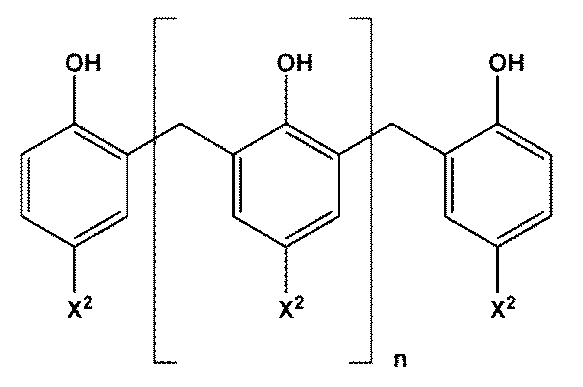
[式(2)中、X2は-SO3M3(式中、M3は1価のカチオンを示す)又は下記一般式で表される基を表し、nは20~3000の整数である。]

[式中、M4は1価のカチオンを表す。]
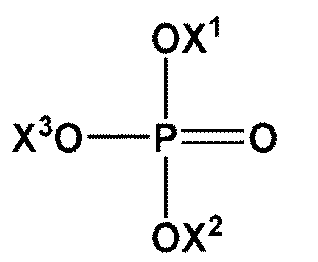
[式中、X1又はX2は上記と同義であり、X3は炭素数1~22のアルキル基を示す。]
ム、炭酸ナトリウム、硫酸アンモニウム、硫酸ナトリウムが挙げられる。
JIS-L-1092(AATCC-22)のスプレー法に準じて試験用処理布の撥水性を評価した。
以下に示す基準で撥水性を評価した。なお、点数が大きいほど、撥水性が良好であることを意味する。
90 表面に湿潤しないが、小さな水滴の付着が観測された。
80 表面に小さな個々の水滴上の湿潤が観測された。
70 表面の半分に湿潤を示し、小さな個々の湿潤が布を浸透する状態が観測された。
50 表面全体に湿潤が観測された。
0 表面および裏面が全体に湿潤が観測された。
試験用布について、JIS L 1930 附属書F C4Mに従い、20回洗濯した後、タンブラー(60℃で30分)で乾燥された試験布の撥水性を評価した。
試験用布をISO 13936-2に準じて、荷重160Nにて経糸滑脱で試験を行い、縫目滑脱(mm)を測定した。縫目滑脱の値が小さいほど耐スリップ性に優れる。
(アクリル重合体含有水分散液の製造例)
製造例1
500mlのプラスチック製容器に、有機溶媒として、水溶性グリコール系溶剤30g、液状媒体として、純水120g、長鎖脂肪族炭化水素基含有(メタ)アクリレートとして、ステアリルアクリレート58.2g、界面活性剤として、ソルビタン脂肪酸エステル2g、有機酸として酢酸を0.1g、カチオン性乳化剤2gおよびポリオキシエチレンアルキルエーテル6gを仕込み、80℃に加熱し、ホモミキサーで1分、2000rpmで攪拌した後、超音波で15分間、乳化分散させた。
次いで、この混合物を500mlのオートクレーブに移し、窒素置換後、連鎖移動剤として、ラウリルメルカプタン0.2g、共重合性モノマーとして、塩化ビニルを1.8g仕込んだ。さらに、重合開始剤として、アゾ基含有水溶性開始剤1gを添加し、60℃で昇温し、4時間反応させてアクリル重合体(炭化水素系撥水性樹脂)の水分散液を得た。この分散液を、さらに、純水で希釈して固形分濃度30%の炭化水素系撥水性樹脂の水分散液(詳しくは、炭化水素系撥水性樹脂と界面活性剤と液状媒体とを含む水分散液)を調製した。
表1に従って、配合処方を変更した以外は、製造例1と同様にして、アクリル重合体と界面活性剤と液体媒体とを含む水分散液を調製した。

製造例9
1.脂肪族ポリイソシアネート誘導体の合成
温度計、攪拌装置、窒素導入管および冷却管が装着された反応器において、窒素雰囲気下、1,6-ヘキサメチレンジイソシアネート(HDI、三井化学社製、商品名:タケネート700)500質量部、2,6-ジ(tert-ブチル)-4-メチルフェノール(別名:ジブチルヒドロキシトルエン、BHT、ヒンダードフェノール系酸化防止剤)0.25質量部、テトラフェニル・ジプロピレングリコール・ジホスファイト(有機亜リン酸エステル、助触媒)0.25質量を混合した後、この混合液に1,3-ブタンジオール 10.7質量部を加え、窒素を、その液相に1時間導入した。その後、混合液を80℃に昇温し3時間反応後、60℃に降温した。その後、イソシアヌレート化触媒として、トリメチル-N-2-ヒドロキシプロピルアンモニウム・2-エチルヘキサノエート 0.2質量部加え、1.5時間反応させた。その後、HDI 100質量部に対して、o-トルエンスルホンアミド 0.04質量部を添加した。その後、この反応混合液を、薄膜蒸留装置(温度150℃、真空度93.3Pa)に通液して、残存HDIモノマー量が0.5%以下になるまで蒸留し、脂肪族ポリイソシアネート誘導体(ヘキサメチレンジイソシアネートのイソシアヌレート誘導体)を得た。得られた脂肪族ポリイソシアネート誘導体の、イソシアネート基含有率は20.9%、平均イソシアネート官能基数は3.0であった。
攪拌機、温度計、冷却器および窒素ガス導入管を備えた反応器に、前記脂肪族ポリイソシアネート誘導体100.20g、長鎖活性水素化合物として、カルコール8098(ステアリルアルコール、花王株式会社製)67.60gおよびオレインアルコール22.30gを混合し、窒素雰囲気化110℃で、イソシアネート基の濃度が3.67%になるまで4時間反応させた。
次いで、反応液を80℃に冷却し、カチオン性活性水素化合物として、N-メチルジエタノールアミン9.90gを加え、80℃で1時間反応させた。
次いで、溶剤として、メチルエチルケトン50.00gを加え、80℃で、赤外吸収スペクトルによりイソシアネート基が消失したことが確認できるまで反応させた。
次いで、反応液にメチルエルケトン57.69gを加え、80℃に昇温し、反応液が完全に溶解するまで混合した後、75℃に冷却した。
その後、酸化合物として酢酸18.96gを加えて中和させた。
次いで、反応液を75℃に保ちながら、70℃に加温したイオン交換水800.0gを徐々に加えて乳化(内部乳化)させた。
次いで、エバポレーターにて、水浴温度60℃減圧下で、固形分濃度が20重量%以上となるまで脱溶剤した。
次いで、酸化合物(酢酸)を除く固形分濃度が20重量%となるようにイオン交換水にて調整することにより、ポリウレタンを含む水分散液を得た。
攪拌棒、温度計、還流管を備えた500mLの四つ口フラスコに、ソルビタントリステアレート116g、4-メチル-2-ペンタノン(MIBK)150gを仕込んだ。次いで、この混合液の余分な水蒸気を除去するために、混合液の温度を70℃に維持しながら、混合液を撹拌し、混合液を1時間還流し、その後、50℃まで放冷した。そして、撹拌を維持しながら、混合液に、デスモジュールN-100(ヘキサメチレンジイソシアネートのビウレット誘導体、コベストロ社)30gを滴下ロートで滴下した。滴下終了後、触媒として、ジブチルスズジラウレートを1滴加えて、80℃で1時間反応させた。次いで、ソルビタンモノステアレート25gを加えて、さらに、80℃で4時間反応させた。
次いで、60℃に冷却後、反応液を回収し、反応液と、任意量のカチオン性乳化剤およびポリオキシエチレンアルキルエーテルを含む60℃の水とをゆっくり混和させた。混和液を、ホモミキサーを用いて、1分6000rpmで撹拌後、超音波で15分間、乳化分散した。その後、減圧操作で溶剤(MIBK)を除去した後、純水を加えて濃度調製し、固形分濃度が20%のポリウレタンを含む水分散液を得た。
攪拌棒、温度計、還流管を備えた500mLの四つ口フラスコに、メチルエチルケトン(MEK)150g、ステアリルアルコール51gを仕込んだ。次いで、この混合液の余分な水蒸気を除去するために、混合液の温度を70℃に維持しながら、混合液を撹拌し、混合液を1時間還流し、その後、50℃まで放冷した。そして、混合液に、デスモジュールN3200A(ヘキサメチレンジイソシアネートのビウレット誘導体、コベストロ社製)30gを加え、さらに、80℃で4時間反応させた。
次いで、60℃に冷却後、反応液を回収し、反応液と、任意量のポリオキシエチレンアルキルエーテルを含む60℃の水とをゆっくり混和した。この混和液を、ホモミキサーで1分6000rpmで撹拌後、超音波で15分間、乳化分散した。
次いで、減圧操作で溶剤(MEK)を除去した後、純水を加えて濃度調製し、固形分濃度が20%のポリウレタンを含む水分散液を得た。
製造例12
攪拌棒、温度計、還流管を備えた200mLの四つ口フラスコに、メチルハイドロジェンシリコーンオイル(1H NMRにより測定したSiH:SiCH3モル比=50:50)12gおよび白金触媒0.02gを仕込んだ。次いで、1-ヘキサコセン36gを滴下ロートに仕込み、70℃に維持しながら、滴下ロートから1-ヘキサコセンを滴下した。滴下終了後、さらに、70℃3時間反応させた。赤外分光法(IR)によりSiHのピークが消失したことを確認し、固体状のシリコーン重合体47gを得た。
次いで、シリコーン重合体28g、水溶性グリコール系溶剤5.6g、純水60g、ソルビタン脂肪酸エステル1.7g、ポリオキシエチレンアルキルエーテル0.7g、カチオン性乳化剤0.6gを250mlガラス製容器へ仕込み、75℃に加熱し、ホモミキサーで1分、2000rpmで攪拌した後、超音波で10分間、乳化分散させ、シリコーン重合体の水分散液を得た。その後、純水を追加し、固形分濃度が30重量%のシリコーン重合体の水分散液を調製した。
製造例13
圧反応容器にパラフィンワックス(融点 75℃)150g、純水350g、ポリオキシエチレンアルキルエーテル4.5g、ソルビタン脂肪酸エステル3gを入れて密封し、攪拌しながら、110~120℃に昇温後、高圧下で30分間高圧乳化することにより、ワックスの水分散液を調製した。その後、純水を追加し、固形分を30重量%のワックスの水分散液を調製した。
反応容器に融点150℃、酸価44mgKOH/g、密度0.93の酸化ポリプロピレンワックス150g、イオン交換水325g、HLB15の界面活性剤を25g、48%水酸化カリウム水溶液5g、を入れて密封し、撹拌しながら160℃に昇温後、高圧下で1時間高圧乳化後、90℃に冷却し、ポリプロピレンワックスの水分散液を得た。その後、純水を追加し、固形分30重量%のポリプロピレンワックスの水分散液を調製した。
上述した水分散液と表2に示す親水性粒子(平均一時粒子径 25nm、ゼータ電位+45mV、濁度2.0ppm)を添加混合して、表2に示す組成重量比に合わせた固形分濃度30%の水分散液を得た。この水分散液を水道水によって希釈して、固形分濃度1.0重量%の試験液1000gを調製した。次いで、この試験液に、試験用布(ポリエステル生地、ナイロン生地)を含浸した後、マングルに通し、試験用布を160℃で1分間、ピンテンターに通し、乾燥、キュアリングして、上述した試験を行った。
上述した水分散液と表2に示す防菌防カビ剤(ベンズイソチアゾリン-3-オン75ppm、さらに5-クロロ-2-メチル-2H-イソチアゾール-3-オンおよび2-メチル-2H-イソチアゾール-3-オンの混合物(重量比3:1)75ppm)を添加混合して、表2に示す組成重量比に合わせた固形分濃度30%の水分散液を得た。この水分散液を水道水によって希釈して、固形分濃度1.0重量%の試験液1000gを調製した。次いで、この試験液に、試験用布(ポリエステル生地、ナイロン生地)を含浸した後、マングルに通し、試験用布を160℃で1分間、ピンテンターに通し、乾燥、キュアリングして、上述した試験を行った。
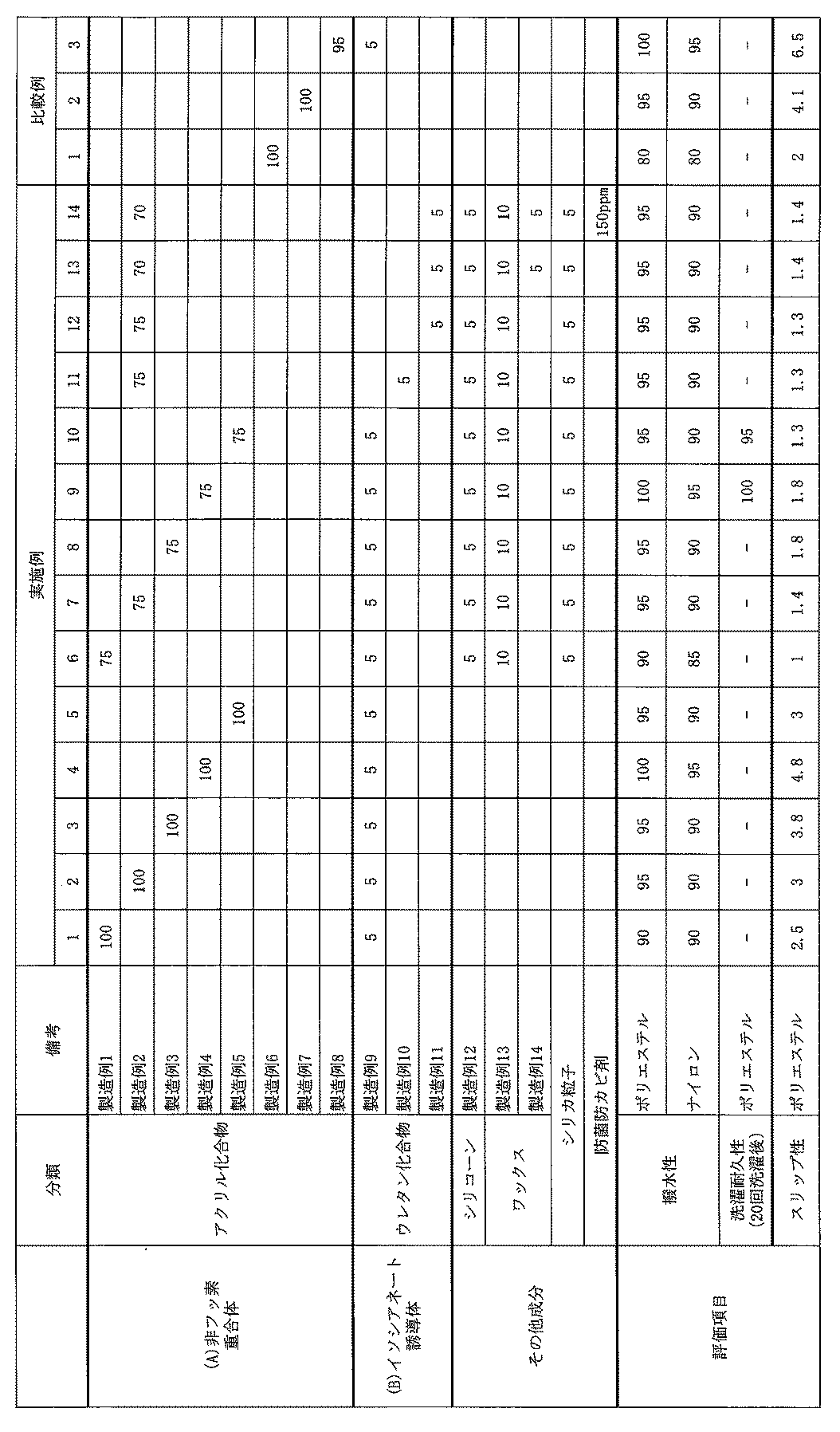
Claims (16)
- 炭素数2~40の炭化水素基を有する疎水性単量体(a1)から誘導される繰り返し単位、及び、塩化ビニル及び塩化ビニリデンからなる群から選択される少なくとも一の塩化物単量体(a2)から誘導される繰り返し単位を含む非フッ素共重合体(A)と、
イソシアネート誘導体(B)を含み、
前記非フッ素共重合体(A)において、前記単量体(a2)から誘導される繰り返し単位の量が、前記単量体(a1)から誘導される繰り返し単位の量と前記単量体(a2)から誘導される繰り返し単位の量との合計に対して、1~15重量%である、撥水剤組成物。 - 前記疎水性単量体(a1)における前記炭化水素基が炭素数10以上の直鎖状アルキル基
である、請求項1に記載の撥水剤組成物。 - 前記疎水性単量体(a1)が式:
CH2=C(-R12)-C(=O)-Y11-(R11)k
[式中、
R11は炭素数2~40の炭化水素基であり、
R12は水素原子、一価の有機基又はハロゲン原子であり、
Y11は直接結合、2~4価の炭素数1の炭化水素基、-C6H4-、-O-、-C(=O)-、-S(=O)2-及び-NR’-(R’は、水素原子又は炭素数1~4の炭化水素基)から選ばれる少なくとも一以上で構成される2~4価の基であり、
kは1~3である。]
で示される化合物である、請求項1または2に記載の撥水剤組成物。 - 前記イソシアネート誘導体(B)は、炭素数12以上30以下のアルキル基を有する、請求項1~3のいずれか一項に記載の撥水剤組成物。
- 前記イソシアネート誘導体(B)は、ポリウレタンである、請求項1~4のいずれか一項に記載の撥水剤組成物。
- 前記イソシアネート誘導体(B)は、炭化水素アルコール、糖アルコール修飾体、及びヒドロキシ酸修飾体からなる群から選択される少なくとも1種の活性水素化合物と、非環式脂肪族ポリイソシアネート及びその誘導体からなる群から選択される少なくとも1種の原料イソシアネートとの反応により得られる化合物である、請求項1~5のいずれか一項に記載の撥水剤組成物。
- シリコーンを含む、請求項1~6のいずれか一項に記載の撥水剤組成物。
- 前記シリコーンの量が、前記非フッ素共重合体(A)100重量部あたり0.1重量部~20重量部である、請求項7に記載の撥水剤組成物。
- 前記非フッ素共重合体(A)において、前記単量体(a2)から誘導される繰り返し単位の量が、前記単量体(a1)から誘導される繰り返し単位の量と前記単量体(a2)から誘導される繰り返し単位の量との合計に対して、1~9重量%である、請求項1~8のいずれか一項に記載の撥水剤組成物。
- 前記イソシアネート誘導体(B)の量が、前記非フッ素共重合体(A)100重量部あたり0.1重量部~20重量部である、請求項1~9のいずれか一項に記載の撥水剤組成物。
- 前記疎水性単量体(a1)が式:
CH2=C(-R12)-C(=O)-Y11-(R11)k
[式中、
R11は炭素数2~40の炭化水素基であり、
R12は水素原子、一価の有機基又はハロゲン原子であり、
Y11は直接結合、2~4価の炭素数1の炭化水素基、-C6H4-、-O-、-C(=O)-、-S(=O)2-及び-NR’-(R’は、水素原子又は炭素数1~4の炭化水素基)から選ばれる少なくとも一以上で構成される2~4価の基であり、
kは1~3である。]
で示される化合物であり、
前記イソシアネート誘導体(B)は、炭素数12以上30以下のアルキル基を有し、及び炭化水素アルコール、糖アルコール修飾体、及びヒドロキシ酸修飾体からなる群から選択される少なくとも1種の活性水素化合物と、非環式脂肪族ポリイソシアネート及びその誘導体からなる群から選択される少なくとも1種の原料イソシアネートとの反応により得られる化合物であり、
前記イソシアネート誘導体(B)の量が、前記非フッ素共重合体(A)100重量部あたり0.1重量部~20重量部である、請求項1に記載の撥水剤組成物。 - 前記疎水性単量体(a1)が式:
CH2=CH-C(=O)-Y11-R11
[式中、
R11は炭素数12以上25以下のアルキル基であり、
Y11は-O-又は-O-(CH2)m-NH-C(=O)-であり、
mは、2又は4の整数である。]で示される化合物であり、
前記塩化物単量体(a2)が塩化ビニルであり、
前記イソシアネート誘導体(B)が、
炭素数12以上25以下のアルキル基を有する炭化水素アルコールと、炭素数2以上10以下の脂肪族炭化水素基を有する非環式脂肪族ポリイソシアネートのイソシアヌレート誘導体との反応により得られる化合物又は
炭素数12以上25以下のアルキル基で修飾したソルビタン修飾体と、炭素数2以上10以下の脂肪族炭化水素基を有する非環式脂肪族ポリイソシアネートのビウレット誘導体との反応により得られる化合物であり、
前記イソシアネート誘導体(B)の量が、前記非フッ素共重合体(A)100重量部あたり1重量部~10重量部である、請求項1に記載の撥水剤組成物。 - 請求項1~12のいずれか一項に記載の撥水剤組成物を繊維基材に適用することを含む、繊維製品の製造方法。
- 前記撥水剤組成物を前記繊維基材に適用する前に、繊維に
-SO3M1(式中、M1は一価のカチオンを示す)で示される1価の基、
-COOM2(式中、M2は一価のカチオンを示す)で示される1価の基、及び
-O-P(O)(OX1)(OX2)(式中、X1及びX2はそれぞれ独立に水素原子又は炭素数1~22のアルキル基を示す)で示される1価の基からなる群より選ばれる一以上の官能基を付与する工程を含む、請求項13に記載の繊維製品の製造方法。 - 請求項1~12のいずれか一項に記載の撥水剤組成物における前記非フッ素共重合体(A)及び前記イソシアネート誘導体(B)が付着している繊維製品。
- -SO3M1(式中、M1は一価のカチオンを示す)で示される1価の基、
-COOM2(式中、M2は一価のカチオンを示す)で示される1価の基、及び
-O-P(O)(OX1)(OX2)(式中、X1及びX2はそれぞれ独立に水素原子又は炭素数1~22のアルキル基を示す)で示される1価の基からなる群より選ばれる一以上の官能基を有する化合物が付着している、請求項15に記載の繊維製品。
Priority Applications (3)
| Application Number | Priority Date | Filing Date | Title |
|---|---|---|---|
| CN202480054633.2A CN121729468A (zh) | 2023-09-01 | 2024-08-30 | 拨水剂组合物 |
| KR1020267005829A KR20260038947A (ko) | 2023-09-01 | 2024-08-30 | 발수제 조성물 |
| EP24859986.2A EP4617341A1 (en) | 2023-09-01 | 2024-08-30 | Water repellent composition |
Applications Claiming Priority (2)
| Application Number | Priority Date | Filing Date | Title |
|---|---|---|---|
| JP2023-142398 | 2023-09-01 | ||
| JP2023142398 | 2023-09-01 |
Publications (1)
| Publication Number | Publication Date |
|---|---|
| WO2025047961A1 true WO2025047961A1 (ja) | 2025-03-06 |
Family
ID=94819479
Family Applications (1)
| Application Number | Title | Priority Date | Filing Date |
|---|---|---|---|
| PCT/JP2024/031323 Pending WO2025047961A1 (ja) | 2023-09-01 | 2024-08-30 | 撥水剤組成物 |
Country Status (6)
| Country | Link |
|---|---|
| EP (1) | EP4617341A1 (ja) |
| JP (1) | JP7705080B2 (ja) |
| KR (1) | KR20260038947A (ja) |
| CN (1) | CN121729468A (ja) |
| TW (1) | TW202525978A (ja) |
| WO (1) | WO2025047961A1 (ja) |
Citations (9)
| Publication number | Priority date | Publication date | Assignee | Title |
|---|---|---|---|---|
| FR627E (fr) | 1901-10-29 | 1903-02-18 | Mauguin Pierre | Dispositif d'allumage pour moteurs à explosions |
| JP3852921B2 (ja) | 2002-01-23 | 2006-12-06 | 信越化学工業株式会社 | トリアルキルシロキシシリケートエマルジョンの製造方法 |
| WO2012090580A1 (ja) | 2010-12-27 | 2012-07-05 | ライオン株式会社 | 繊維製品用液体消臭剤組成物 |
| JP2017025440A (ja) | 2015-07-23 | 2017-02-02 | 日華化学株式会社 | 非フッ素系ポリマー、撥水剤組成物、撥水性繊維製品及び撥水性繊維製品の製造方法 |
| WO2020162547A1 (ja) * | 2019-02-08 | 2020-08-13 | ダイキン工業株式会社 | 撥水剤組成物 |
| JP2020189980A (ja) | 2020-07-27 | 2020-11-26 | 日華化学株式会社 | 非フッ素系撥水剤組成物、及び撥水性繊維製品の製造方法 |
| WO2021132172A1 (ja) | 2019-12-24 | 2021-07-01 | 三井化学株式会社 | 撥水剤組成物、撥水剤組成物の製造方法、および、繊維製品 |
| JP2021195407A (ja) * | 2020-06-10 | 2021-12-27 | 明成化学工業株式会社 | 撥水剤組成物、キット、撥水性繊維製品及びその製造方法 |
| JP2022169275A (ja) * | 2021-04-27 | 2022-11-09 | ダイキン工業株式会社 | 分散液 |
-
2024
- 2024-08-30 CN CN202480054633.2A patent/CN121729468A/zh active Pending
- 2024-08-30 JP JP2024148486A patent/JP7705080B2/ja active Active
- 2024-08-30 EP EP24859986.2A patent/EP4617341A1/en active Pending
- 2024-08-30 TW TW113132966A patent/TW202525978A/zh unknown
- 2024-08-30 WO PCT/JP2024/031323 patent/WO2025047961A1/ja active Pending
- 2024-08-30 KR KR1020267005829A patent/KR20260038947A/ko active Pending
Patent Citations (9)
| Publication number | Priority date | Publication date | Assignee | Title |
|---|---|---|---|---|
| FR627E (fr) | 1901-10-29 | 1903-02-18 | Mauguin Pierre | Dispositif d'allumage pour moteurs à explosions |
| JP3852921B2 (ja) | 2002-01-23 | 2006-12-06 | 信越化学工業株式会社 | トリアルキルシロキシシリケートエマルジョンの製造方法 |
| WO2012090580A1 (ja) | 2010-12-27 | 2012-07-05 | ライオン株式会社 | 繊維製品用液体消臭剤組成物 |
| JP2017025440A (ja) | 2015-07-23 | 2017-02-02 | 日華化学株式会社 | 非フッ素系ポリマー、撥水剤組成物、撥水性繊維製品及び撥水性繊維製品の製造方法 |
| WO2020162547A1 (ja) * | 2019-02-08 | 2020-08-13 | ダイキン工業株式会社 | 撥水剤組成物 |
| WO2021132172A1 (ja) | 2019-12-24 | 2021-07-01 | 三井化学株式会社 | 撥水剤組成物、撥水剤組成物の製造方法、および、繊維製品 |
| JP2021195407A (ja) * | 2020-06-10 | 2021-12-27 | 明成化学工業株式会社 | 撥水剤組成物、キット、撥水性繊維製品及びその製造方法 |
| JP2020189980A (ja) | 2020-07-27 | 2020-11-26 | 日華化学株式会社 | 非フッ素系撥水剤組成物、及び撥水性繊維製品の製造方法 |
| JP2022169275A (ja) * | 2021-04-27 | 2022-11-09 | ダイキン工業株式会社 | 分散液 |
Non-Patent Citations (2)
| Title |
|---|
| JOURNAL OF THE JAPANESE SOCIETY FOR ANTIBACTERIAL AND ANTIFUNGAL AGENTS, vol. 26, 1998 |
| See also references of EP4617341A1 |
Also Published As
| Publication number | Publication date |
|---|---|
| TW202525978A (zh) | 2025-07-01 |
| JP7705080B2 (ja) | 2025-07-09 |
| CN121729468A (zh) | 2026-03-24 |
| JP2025036366A (ja) | 2025-03-14 |
| EP4617341A1 (en) | 2025-09-17 |
| KR20260038947A (ko) | 2026-03-19 |
Similar Documents
| Publication | Publication Date | Title |
|---|---|---|
| US20240060232A1 (en) | Dispersion | |
| TW202328253A (zh) | 撥水劑組成物 | |
| WO2025234489A1 (ja) | 撥水剤組成物、及びその製造方法 | |
| JP7712587B2 (ja) | 重合体、撥水剤、繊維製品、及び繊維製品の製造方法 | |
| JP7705080B2 (ja) | 撥水剤組成物 | |
| JP2025076414A (ja) | 重合体、撥水剤、繊維製品、及び繊維製品の製造方法 | |
| WO2025047963A1 (ja) | 撥水剤組成物 | |
| JP7846437B2 (ja) | 撥水剤組成物 | |
| JP7791477B2 (ja) | 撥水剤組成物 | |
| JP2025172044A (ja) | 撥水剤組成物 | |
| WO2025023238A1 (ja) | 繊維構造物 | |
| WO2026071181A1 (ja) | 撥水剤組成物、及びその製造方法 | |
| JP2026067929A (ja) | 含フッ素化合物 |
Legal Events
| Date | Code | Title | Description |
|---|---|---|---|
| 121 | Ep: the epo has been informed by wipo that ep was designated in this application |
Ref document number: 24859986 Country of ref document: EP Kind code of ref document: A1 |
|
| WWE | Wipo information: entry into national phase |
Ref document number: 2024859986 Country of ref document: EP |
|
| ENP | Entry into the national phase |
Ref document number: 2024859986 Country of ref document: EP Effective date: 20250612 |
|
| WWP | Wipo information: published in national office |
Ref document number: 2024859986 Country of ref document: EP |
|
| ENP | Entry into the national phase |
Ref document number: 1020267005829 Country of ref document: KR Free format text: ST27 STATUS EVENT CODE: A-0-1-A10-A15-NAP-PA0105 (AS PROVIDED BY THE NATIONAL OFFICE) |