AT520101A1 - Sealing wax for application in the printing process - Google Patents
Sealing wax for application in the printing process Download PDFInfo
- Publication number
- AT520101A1 AT520101A1 ATA50510/2017A AT505102017A AT520101A1 AT 520101 A1 AT520101 A1 AT 520101A1 AT 505102017 A AT505102017 A AT 505102017A AT 520101 A1 AT520101 A1 AT 520101A1
- Authority
- AT
- Austria
- Prior art keywords
- block
- sealing
- weight
- sealing wax
- styrene
- Prior art date
Links
- 239000012173 sealing wax Substances 0.000 title claims abstract description 28
- 238000000034 method Methods 0.000 title claims abstract description 13
- 238000007789 sealing Methods 0.000 claims abstract description 43
- 229920000728 polyester Polymers 0.000 claims abstract description 14
- 238000004806 packaging method and process Methods 0.000 claims abstract description 13
- 239000002904 solvent Substances 0.000 claims abstract description 10
- 239000003963 antioxidant agent Substances 0.000 claims abstract description 7
- 230000003078 antioxidant effect Effects 0.000 claims abstract description 7
- 229920003048 styrene butadiene rubber Polymers 0.000 claims abstract description 5
- 239000000203 mixture Substances 0.000 claims description 14
- 239000004922 lacquer Substances 0.000 claims description 8
- ZWEHNKRNPOVVGH-UHFFFAOYSA-N 2-Butanone Chemical compound CCC(C)=O ZWEHNKRNPOVVGH-UHFFFAOYSA-N 0.000 claims description 3
- 239000002530 phenolic antioxidant Substances 0.000 claims description 3
- 229920001577 copolymer Polymers 0.000 claims description 2
- 230000009477 glass transition Effects 0.000 claims description 2
- JHIVVAPYMSGYDF-UHFFFAOYSA-N cyclohexanone Chemical compound O=C1CCCCC1 JHIVVAPYMSGYDF-UHFFFAOYSA-N 0.000 claims 2
- ZUZSFMQBICMDEZ-UHFFFAOYSA-N prop-1-enylbenzene;styrene Chemical compound C=CC1=CC=CC=C1.CC=CC1=CC=CC=C1 ZUZSFMQBICMDEZ-UHFFFAOYSA-N 0.000 claims 1
- 238000012360 testing method Methods 0.000 abstract description 12
- 239000002966 varnish Substances 0.000 abstract description 8
- ZAKVZVDDGSFVRG-UHFFFAOYSA-N prop-1-en-2-ylbenzene;styrene Chemical compound C=CC1=CC=CC=C1.CC(=C)C1=CC=CC=C1 ZAKVZVDDGSFVRG-UHFFFAOYSA-N 0.000 abstract 1
- 239000000853 adhesive Substances 0.000 description 28
- 230000001070 adhesive effect Effects 0.000 description 28
- 229920000139 polyethylene terephthalate Polymers 0.000 description 22
- 239000005020 polyethylene terephthalate Substances 0.000 description 22
- 239000000758 substrate Substances 0.000 description 16
- 239000010408 film Substances 0.000 description 15
- 239000004793 Polystyrene Substances 0.000 description 10
- PPBRXRYQALVLMV-UHFFFAOYSA-N Styrene Chemical compound C=CC1=CC=CC=C1 PPBRXRYQALVLMV-UHFFFAOYSA-N 0.000 description 10
- 239000000463 material Substances 0.000 description 10
- 238000009472 formulation Methods 0.000 description 8
- 229920008790 Amorphous Polyethylene terephthalate Polymers 0.000 description 6
- 238000009864 tensile test Methods 0.000 description 5
- KAKZBPTYRLMSJV-UHFFFAOYSA-N Butadiene Chemical compound C=CC=C KAKZBPTYRLMSJV-UHFFFAOYSA-N 0.000 description 4
- 239000010421 standard material Substances 0.000 description 4
- 239000011248 coating agent Substances 0.000 description 3
- 238000000576 coating method Methods 0.000 description 3
- 239000003973 paint Substances 0.000 description 3
- 229920000642 polymer Polymers 0.000 description 3
- 239000003566 sealing material Substances 0.000 description 3
- 239000007787 solid Substances 0.000 description 3
- 229920001634 Copolyester Polymers 0.000 description 2
- 239000002174 Styrene-butadiene Substances 0.000 description 2
- 229920001400 block copolymer Polymers 0.000 description 2
- MTAZNLWOLGHBHU-UHFFFAOYSA-N butadiene-styrene rubber Chemical compound C=CC=C.C=CC1=CC=CC=C1 MTAZNLWOLGHBHU-UHFFFAOYSA-N 0.000 description 2
- 239000013039 cover film Substances 0.000 description 2
- 230000001066 destructive effect Effects 0.000 description 2
- 238000010438 heat treatment Methods 0.000 description 2
- 229920006395 saturated elastomer Polymers 0.000 description 2
- 238000003756 stirring Methods 0.000 description 2
- 238000005728 strengthening Methods 0.000 description 2
- 239000011115 styrene butadiene Substances 0.000 description 2
- 229920001169 thermoplastic Polymers 0.000 description 2
- 239000004416 thermosoftening plastic Substances 0.000 description 2
- KGRVJHAUYBGFFP-UHFFFAOYSA-N 2,2'-Methylenebis(4-methyl-6-tert-butylphenol) Chemical compound CC(C)(C)C1=CC(C)=CC(CC=2C(=C(C=C(C)C=2)C(C)(C)C)O)=C1O KGRVJHAUYBGFFP-UHFFFAOYSA-N 0.000 description 1
- 101150116940 AGPS gene Proteins 0.000 description 1
- 241000238876 Acari Species 0.000 description 1
- 229920008712 Copo Polymers 0.000 description 1
- 101710094173 Otefin Proteins 0.000 description 1
- 239000005062 Polybutadiene Substances 0.000 description 1
- 102100037681 Protein FEV Human genes 0.000 description 1
- 101710198166 Protein FEV Proteins 0.000 description 1
- 229920006328 Styrofoam Polymers 0.000 description 1
- XAGFODPZIPBFFR-UHFFFAOYSA-N aluminium Chemical compound [Al] XAGFODPZIPBFFR-UHFFFAOYSA-N 0.000 description 1
- 229910052782 aluminium Inorganic materials 0.000 description 1
- 238000013459 approach Methods 0.000 description 1
- 238000005452 bending Methods 0.000 description 1
- 239000011230 binding agent Substances 0.000 description 1
- 238000009835 boiling Methods 0.000 description 1
- 230000000052 comparative effect Effects 0.000 description 1
- 239000000470 constituent Substances 0.000 description 1
- 238000013461 design Methods 0.000 description 1
- 238000001035 drying Methods 0.000 description 1
- 230000000694 effects Effects 0.000 description 1
- 239000011888 foil Substances 0.000 description 1
- 230000004927 fusion Effects 0.000 description 1
- 239000011521 glass Substances 0.000 description 1
- 239000004920 heat-sealing lacquer Substances 0.000 description 1
- 235000015243 ice cream Nutrition 0.000 description 1
- 238000011835 investigation Methods 0.000 description 1
- 239000010985 leather Substances 0.000 description 1
- 239000007788 liquid Substances 0.000 description 1
- 238000004519 manufacturing process Methods 0.000 description 1
- 238000002156 mixing Methods 0.000 description 1
- 239000003921 oil Substances 0.000 description 1
- 230000003287 optical effect Effects 0.000 description 1
- 239000005022 packaging material Substances 0.000 description 1
- 238000012858 packaging process Methods 0.000 description 1
- 238000012856 packing Methods 0.000 description 1
- 239000006069 physical mixture Substances 0.000 description 1
- 229920002857 polybutadiene Polymers 0.000 description 1
- 229920006267 polyester film Polymers 0.000 description 1
- -1 polyethylene terephthalate Polymers 0.000 description 1
- 229920002223 polystyrene Polymers 0.000 description 1
- 238000011160 research Methods 0.000 description 1
- 239000011347 resin Substances 0.000 description 1
- 229920005989 resin Polymers 0.000 description 1
- 239000000565 sealant Substances 0.000 description 1
- 239000008261 styrofoam Substances 0.000 description 1
- 239000000126 substance Substances 0.000 description 1
- 239000003760 tallow Substances 0.000 description 1
- 208000008918 voyeurism Diseases 0.000 description 1
- 238000003466 welding Methods 0.000 description 1
Classifications
-
- C—CHEMISTRY; METALLURGY
- C09—DYES; PAINTS; POLISHES; NATURAL RESINS; ADHESIVES; COMPOSITIONS NOT OTHERWISE PROVIDED FOR; APPLICATIONS OF MATERIALS NOT OTHERWISE PROVIDED FOR
- C09D—COATING COMPOSITIONS, e.g. PAINTS, VARNISHES OR LACQUERS; FILLING PASTES; CHEMICAL PAINT OR INK REMOVERS; INKS; CORRECTING FLUIDS; WOODSTAINS; PASTES OR SOLIDS FOR COLOURING OR PRINTING; USE OF MATERIALS THEREFOR
- C09D125/00—Coating compositions based on homopolymers or copolymers of compounds having one or more unsaturated aliphatic radicals, each having only one carbon-to-carbon double bond, and at least one being terminated by an aromatic carbocyclic ring; Coating compositions based on derivatives of such polymers
- C09D125/02—Homopolymers or copolymers of hydrocarbons
- C09D125/04—Homopolymers or copolymers of styrene
- C09D125/08—Copolymers of styrene
- C09D125/10—Copolymers of styrene with conjugated dienes
-
- C—CHEMISTRY; METALLURGY
- C09—DYES; PAINTS; POLISHES; NATURAL RESINS; ADHESIVES; COMPOSITIONS NOT OTHERWISE PROVIDED FOR; APPLICATIONS OF MATERIALS NOT OTHERWISE PROVIDED FOR
- C09D—COATING COMPOSITIONS, e.g. PAINTS, VARNISHES OR LACQUERS; FILLING PASTES; CHEMICAL PAINT OR INK REMOVERS; INKS; CORRECTING FLUIDS; WOODSTAINS; PASTES OR SOLIDS FOR COLOURING OR PRINTING; USE OF MATERIALS THEREFOR
- C09D7/00—Features of coating compositions, not provided for in group C09D5/00; Processes for incorporating ingredients in coating compositions
- C09D7/40—Additives
- C09D7/48—Stabilisers against degradation by oxygen, light or heat
-
- C—CHEMISTRY; METALLURGY
- C09—DYES; PAINTS; POLISHES; NATURAL RESINS; ADHESIVES; COMPOSITIONS NOT OTHERWISE PROVIDED FOR; APPLICATIONS OF MATERIALS NOT OTHERWISE PROVIDED FOR
- C09D—COATING COMPOSITIONS, e.g. PAINTS, VARNISHES OR LACQUERS; FILLING PASTES; CHEMICAL PAINT OR INK REMOVERS; INKS; CORRECTING FLUIDS; WOODSTAINS; PASTES OR SOLIDS FOR COLOURING OR PRINTING; USE OF MATERIALS THEREFOR
- C09D11/00—Inks
- C09D11/02—Printing inks
- C09D11/10—Printing inks based on artificial resins
- C09D11/102—Printing inks based on artificial resins containing macromolecular compounds obtained by reactions other than those only involving unsaturated carbon-to-carbon bonds
- C09D11/104—Polyesters
-
- C—CHEMISTRY; METALLURGY
- C09—DYES; PAINTS; POLISHES; NATURAL RESINS; ADHESIVES; COMPOSITIONS NOT OTHERWISE PROVIDED FOR; APPLICATIONS OF MATERIALS NOT OTHERWISE PROVIDED FOR
- C09D—COATING COMPOSITIONS, e.g. PAINTS, VARNISHES OR LACQUERS; FILLING PASTES; CHEMICAL PAINT OR INK REMOVERS; INKS; CORRECTING FLUIDS; WOODSTAINS; PASTES OR SOLIDS FOR COLOURING OR PRINTING; USE OF MATERIALS THEREFOR
- C09D11/00—Inks
- C09D11/02—Printing inks
- C09D11/03—Printing inks characterised by features other than the chemical nature of the binder
- C09D11/033—Printing inks characterised by features other than the chemical nature of the binder characterised by the solvent
-
- C—CHEMISTRY; METALLURGY
- C09—DYES; PAINTS; POLISHES; NATURAL RESINS; ADHESIVES; COMPOSITIONS NOT OTHERWISE PROVIDED FOR; APPLICATIONS OF MATERIALS NOT OTHERWISE PROVIDED FOR
- C09D—COATING COMPOSITIONS, e.g. PAINTS, VARNISHES OR LACQUERS; FILLING PASTES; CHEMICAL PAINT OR INK REMOVERS; INKS; CORRECTING FLUIDS; WOODSTAINS; PASTES OR SOLIDS FOR COLOURING OR PRINTING; USE OF MATERIALS THEREFOR
- C09D125/00—Coating compositions based on homopolymers or copolymers of compounds having one or more unsaturated aliphatic radicals, each having only one carbon-to-carbon double bond, and at least one being terminated by an aromatic carbocyclic ring; Coating compositions based on derivatives of such polymers
- C09D125/02—Homopolymers or copolymers of hydrocarbons
- C09D125/16—Homopolymers or copolymers of alkyl-substituted styrenes
-
- C—CHEMISTRY; METALLURGY
- C09—DYES; PAINTS; POLISHES; NATURAL RESINS; ADHESIVES; COMPOSITIONS NOT OTHERWISE PROVIDED FOR; APPLICATIONS OF MATERIALS NOT OTHERWISE PROVIDED FOR
- C09D—COATING COMPOSITIONS, e.g. PAINTS, VARNISHES OR LACQUERS; FILLING PASTES; CHEMICAL PAINT OR INK REMOVERS; INKS; CORRECTING FLUIDS; WOODSTAINS; PASTES OR SOLIDS FOR COLOURING OR PRINTING; USE OF MATERIALS THEREFOR
- C09D153/00—Coating compositions based on block copolymers containing at least one sequence of a polymer obtained by reactions only involving carbon-to-carbon unsaturated bonds; Coating compositions based on derivatives of such polymers
- C09D153/02—Vinyl aromatic monomers and conjugated dienes
-
- C—CHEMISTRY; METALLURGY
- C09—DYES; PAINTS; POLISHES; NATURAL RESINS; ADHESIVES; COMPOSITIONS NOT OTHERWISE PROVIDED FOR; APPLICATIONS OF MATERIALS NOT OTHERWISE PROVIDED FOR
- C09D—COATING COMPOSITIONS, e.g. PAINTS, VARNISHES OR LACQUERS; FILLING PASTES; CHEMICAL PAINT OR INK REMOVERS; INKS; CORRECTING FLUIDS; WOODSTAINS; PASTES OR SOLIDS FOR COLOURING OR PRINTING; USE OF MATERIALS THEREFOR
- C09D167/00—Coating compositions based on polyesters obtained by reactions forming a carboxylic ester link in the main chain; Coating compositions based on derivatives of such polymers
-
- C—CHEMISTRY; METALLURGY
- C09—DYES; PAINTS; POLISHES; NATURAL RESINS; ADHESIVES; COMPOSITIONS NOT OTHERWISE PROVIDED FOR; APPLICATIONS OF MATERIALS NOT OTHERWISE PROVIDED FOR
- C09J—ADHESIVES; NON-MECHANICAL ASPECTS OF ADHESIVE PROCESSES IN GENERAL; ADHESIVE PROCESSES NOT PROVIDED FOR ELSEWHERE; USE OF MATERIALS AS ADHESIVES
- C09J125/00—Adhesives based on homopolymers or copolymers of compounds having one or more unsaturated aliphatic radicals, each having only one carbon-to-carbon double bond, and at least one being terminated by an aromatic carbocyclic ring; Adhesives based on derivatives of such polymers
- C09J125/02—Homopolymers or copolymers of hydrocarbons
- C09J125/04—Homopolymers or copolymers of styrene
- C09J125/08—Copolymers of styrene
- C09J125/10—Copolymers of styrene with conjugated dienes
-
- C—CHEMISTRY; METALLURGY
- C09—DYES; PAINTS; POLISHES; NATURAL RESINS; ADHESIVES; COMPOSITIONS NOT OTHERWISE PROVIDED FOR; APPLICATIONS OF MATERIALS NOT OTHERWISE PROVIDED FOR
- C09J—ADHESIVES; NON-MECHANICAL ASPECTS OF ADHESIVE PROCESSES IN GENERAL; ADHESIVE PROCESSES NOT PROVIDED FOR ELSEWHERE; USE OF MATERIALS AS ADHESIVES
- C09J125/00—Adhesives based on homopolymers or copolymers of compounds having one or more unsaturated aliphatic radicals, each having only one carbon-to-carbon double bond, and at least one being terminated by an aromatic carbocyclic ring; Adhesives based on derivatives of such polymers
- C09J125/02—Homopolymers or copolymers of hydrocarbons
- C09J125/16—Homopolymers or copolymers of alkyl-substituted styrenes
-
- C—CHEMISTRY; METALLURGY
- C09—DYES; PAINTS; POLISHES; NATURAL RESINS; ADHESIVES; COMPOSITIONS NOT OTHERWISE PROVIDED FOR; APPLICATIONS OF MATERIALS NOT OTHERWISE PROVIDED FOR
- C09J—ADHESIVES; NON-MECHANICAL ASPECTS OF ADHESIVE PROCESSES IN GENERAL; ADHESIVE PROCESSES NOT PROVIDED FOR ELSEWHERE; USE OF MATERIALS AS ADHESIVES
- C09J167/00—Adhesives based on polyesters obtained by reactions forming a carboxylic ester link in the main chain; Adhesives based on derivatives of such polymers
-
- C—CHEMISTRY; METALLURGY
- C09—DYES; PAINTS; POLISHES; NATURAL RESINS; ADHESIVES; COMPOSITIONS NOT OTHERWISE PROVIDED FOR; APPLICATIONS OF MATERIALS NOT OTHERWISE PROVIDED FOR
- C09J—ADHESIVES; NON-MECHANICAL ASPECTS OF ADHESIVE PROCESSES IN GENERAL; ADHESIVE PROCESSES NOT PROVIDED FOR ELSEWHERE; USE OF MATERIALS AS ADHESIVES
- C09J167/00—Adhesives based on polyesters obtained by reactions forming a carboxylic ester link in the main chain; Adhesives based on derivatives of such polymers
- C09J167/02—Polyesters derived from dicarboxylic acids and dihydroxy compounds
-
- C—CHEMISTRY; METALLURGY
- C08—ORGANIC MACROMOLECULAR COMPOUNDS; THEIR PREPARATION OR CHEMICAL WORKING-UP; COMPOSITIONS BASED THEREON
- C08K—Use of inorganic or non-macromolecular organic substances as compounding ingredients
- C08K5/00—Use of organic ingredients
- C08K5/0008—Organic ingredients according to more than one of the "one dot" groups of C08K5/01 - C08K5/59
- C08K5/005—Stabilisers against oxidation, heat, light, ozone
-
- C—CHEMISTRY; METALLURGY
- C08—ORGANIC MACROMOLECULAR COMPOUNDS; THEIR PREPARATION OR CHEMICAL WORKING-UP; COMPOSITIONS BASED THEREON
- C08L—COMPOSITIONS OF MACROMOLECULAR COMPOUNDS
- C08L2205/00—Polymer mixtures characterised by other features
- C08L2205/03—Polymer mixtures characterised by other features containing three or more polymers in a blend
- C08L2205/035—Polymer mixtures characterised by other features containing three or more polymers in a blend containing four or more polymers in a blend
Landscapes
- Chemical & Material Sciences (AREA)
- Organic Chemistry (AREA)
- Life Sciences & Earth Sciences (AREA)
- Engineering & Computer Science (AREA)
- Materials Engineering (AREA)
- Wood Science & Technology (AREA)
- Chemical Kinetics & Catalysis (AREA)
- General Chemical & Material Sciences (AREA)
- Adhesives Or Adhesive Processes (AREA)
- Laminated Bodies (AREA)
Abstract
Die Erfindung betrifft einen Siegellack zur Aufbringung im Druckverfahren, insbesondere zum Siegeln voneinander abpeelbarer V erpackungsteile. Um die Siegelkraft leicht auf gewünschte Werte zu bringen ist vorgesehen, dass beim Abpeelen, entweder durch das bestimmungsgemäße Öffnen oder bei Durchstoßverpackungen beim Testen, der Siegellack einen Kohäsionsbruch erleidet, wobei die Stärke der Haltekraft bis zum Kohäsionsbruch durch die beim Siegeln verwendeten Drücke und Temperaturen bestimmt ist. Insbesondere weist der Siegellack a) 40 bis 65 Gew. % Lösemittel, b) 0 bis 10 Gew.% Styrol-Butadien-Blockcopolymer, c) 8 bis 12 Gew.% Styrol-alpha-methyl-Styrol, d) 6 bis 12 Gew.% linearen und/oder radialen Tri-Block (SBS)-Block, e) 0 bis 10 Gew.% linearen Di-Block (SB)-Block f) 15 bis 30 Gew. % Polyester und g) bis zu 3 Gew. % Antioxidans aufThe invention relates to a sealing varnish for application in the printing process, in particular for sealing off each other packable packaging parts. In order to easily bring the sealing force to desired values, it is envisaged that during deflaking, either by proper opening or puncture packaging during testing, the sealing wax suffers a cohesive failure, the strength of the holding force until cohesive failure being determined by the pressures and temperatures used in sealing is. In particular, the sealing wax has a) 40 to 65% by weight of solvent, b) 0 to 10% by weight of styrene-butadiene block copolymer, c) 8 to 12% by weight of styrene-alpha-methyl-styrene, d) 6 to 12% by weight % linear and / or radial tri-block (SBS) block, e) 0 to 10 wt% linear di-block (SB) block f) 15 to 30 wt% polyester and g) up to 3 wt. % Antioxidant on
Description
Tusanwrenfassung::Tusan draft ::
Siegellack. zur Aufbringung kn DmokverthhrenSealing wax. to apply kn Dmokverthhren
Die Erfindung beiriiit einen Siegellack zur Anbringung im Druckverfahren, insbesondere xwru Siegeln voneinander abpeelbater Verpackungsteile.The invention provides a sealing wax for application in the printing process, in particular xwru seals of peelable packaging parts.
U® die Siegelkraft leicht auf gewünschte Werte zu bringen ist vorgesehen, dass beim Abpeelen, entweder durch das bestirnrmmgsgemäSe Offnen oder bei DurchstobverpacDrngen beim Testen, der Siegellack einen Kohäsionsbmch erleidet, wobei die Stärke der Haltekraft bis zum Kohäsionsbmca durch die beim Siegeln verwendeten Drücke und Temperaturen bestimmt ist.In order to easily bring the sealing force to the desired values, it is envisaged that when peeling off, either by opening according to the intended purpose or by pushing through the seal during testing, the sealing wax suffers a cohesive strength, whereby the strength of the holding force up to the cohesive strength is due to the pressures and temperatures used in the sealing is determined.
Insbesondere wem der SiegellackEspecially to whom the sealing wax
a) 40 bis 65 Gew. % Lösemittel,a) 40 to 65% by weight of solvent,
b) 0 bis 10 Gew. % StyroI~ButadienBlockuopuiymer,b) 0 to 10% by weight of styrene-butadiene blockuopuiymer,
c) 8 bis 12 Gew. % Styrol·abha-methy I· Somü,c) 8 to 12% by weight of styreneabha-methy I
d) 6 bis 12 Gew. G linearen und/oder radialen Tri drfoek (SBS)rfilock,d) 6 to 12% by weight of linear and / or radial tri drfoek (SBS) rfilock,
e) 0 bis 10 Gew. % linearen Di-Block (SBi-BIoeke) 0 to 10% by weight linear di-block (SBi-BIoek
f) 15 bis 30 Gew, % Polyester undf) 15 to 30 wt.% polyester and
g) bis zu 3 Gew. % Antioxidans autg) up to 3% by weight of antioxidant aut
1/211/21
Die Erbndung betrifft einen durch eia Druckverfahren auizubri;'geudes, bevorzugt hanspareuten, Hcißsiegellack entsprechend dem Oberbegriff des Anspruches i.The invention relates to a heat sealing lacquer according to the preamble of claim i.
Heißsiegellaoke werden in der Verpackungsbrauohe vielfach verwendet, Ihre wesentliehe Aufgabe ist es, beim Verschließen einer Verpackung für einen sicheren und dichten Zusammenhalt zwischen zwei Teilen oder Abschnitten des Verpackungsmaterials zu schaffen. Klassische Arrwendungsbeispiele sind, das Au&iegeln einer Flatine, Im deutschen Sprachgebrauch muw'mdrntMh auch Deckel gommnt. zumeist aus einer mehrschichtigen Folie bestehend, am den Rand eines Bechers,: einer Schale: oder eines anderen Gebildes aus einem zumeist anderen und. mechanisch, zumeist festerem. Material,Heat seal laoke is widely used in packaging brewing. Your main task is to create a secure and tight bond between two parts or sections of the packaging material when closing a packaging. Classical examples of use are, the sealing of a flatine, in the German usage muw'mdrntMh also lid comes. usually consisting of a multilayer film, at the edge of a cup: a shell: or another structure of a usually different and. mechanical, mostly firmer. Material,
Ein anderes klassisches Anwendungsgebiet ist das. Verschließen von beutelartigen Verpackungen, die aus einer einzigen Folie durch Aufbiegen und Umschlagen zu. einer Verpackung geformt werden und wobei dann, zumeist,, Innenseite gegen Innenseite gesiegelt wird; verschiedentlich wird auch Außenseite auf Innenseite gesiegelt, all dies ist in der Verpackungsmdustrle bestens bekannt und bedarf keinen näheren .Erläuterung,Another classic area of application is that of sealing pouch-like packages that are made from a single film by bending and folding. a package is formed and then, mostly, the inside is sealed against the inside; Sometimes the outside is sealed on the inside, all of this is well known in the packaging industry and does not require any further explanation.
Eine weitere klassische Verwendung und Anwendung liegt bei der Herstellung einer Blisterverpackung vor, bei der eine Blisterbodenfbiie, die im klassischen Fall kaitverformt ist und einzelne napfchenformige Ausnehmungen 'besitzt, mit einer Blisterdeckfohe versiegelt wird, üblicherweise, aber ohne darauf beschrankt zu. sein, weist die Blisferbodenfolte eine Mehrzahl von Näpfchen auf und diese sind mit einer gemeinsamen Deckfolie abgedeckt und versiegelt, Eine zweite Art von Blisterverpackung hat Ähnlichkeiten mit den obengenannten beutelfbrmigen Verpackungen und weist zwei, zumeist gleich oder gleichartig aufgebaute Folien au.11 in die das zu verpackende Gut Angebracht imd m der Folge in Langs- und Querrichtimg gesiegelt wird, um die einzelnen Geist ticke einzeln verpackt vmlie gen zu haben.Another classic use and application is in the production of a blister pack, in which a blister bottom film, which in the classic case is deformed into cavities and has individual cup-shaped recesses, is sealed with a blister cover film, usually but not limited to this. the Blisferbodenfolte has a plurality of cups and these are covered and sealed with a common cover film, a second type of blister pack has similarities to the above-mentioned bag-shaped packs and has two, mostly identical or similarly constructed films in which 11 Packing goods Attached and subsequently sealed in the longitudinal and transverse directions in order to have the individual ghost ticks individually packaged.
Ein wesentlicher Punkt derartiger Verpackungen mit Siegeistreifen oder Siegelrändern oder Siegeikreisen etc,, ist mm, dass es je nach Verwendungszweck gewünscht, ist, die Siegelstärke unterschiedlich auszubilden, wobei man unter Siegelstärke die Hahekrafl der mechanischen Vcrbmdnng versteht. Dies kann von einer Versiegelung eines leicht abpeelbarem Film, vom Untergrund am einen Ende der Siegelstärke bis zu Verbindungen fuhren, die zerstörungsfrei für eine der beiden Folien bzw. Verpackungsbestandtehe nicht mehr zu. lösen sind, beispielsAn important point of such packaging with sealing strips or sealing edges or sealing circles, etc., is that depending on the intended use, it is desirable to design the sealing thickness differently, the sealing strength being the mechanical strength of the mechanical seal. This can lead to the sealing of an easily peelable film, from the surface at one end of the sealing strength to connections that are no longer non-destructive for one of the two films or packaging. are to solve, for example
2/21 webe bei Dm'cbdräckföliem be; denen gewünsclticrmaßen die Sügehdirke größer sein nmss als die Reißfestigkeit der Folie. Ein geni sses Probiere dabei ist dass es Je nach Verwem dungszweuk. bei der 1aerstellang der Verpackuugsduzcdedc notwendig ist, unterschiedliche SiegelnwieriäUen und uaterscltiediiche Aufbringungsvertehren. bzw. Verfährensparameter zu verwenden um hier zum gewünschten- Resultat zu komme». Es besteh t somit ein Bedarf an einem Siegeimaterial., welches so lest und zuverlässig am Untergrund haftet, dass cs auch bei der gewunsehteri stärksten. Siegte kraft zu keiner Ablösung vom. Uräergruml kommt, und dass andererseits durch einfaches Variieren der Verfahmnsparameter beim Siegeln und -damit Verschließen der Verpackung eine in weiten Grenzen beeinflussbare und problemlos festlegbare Siegeikraft xuveriässig erreicht wird.2/21 weave at Dm'cbdräckföliem be; for which the sweetness is larger than the tensile strength of the film. A delightful try is that it depends on the intended use. When the packaging process is necessary, different seals and various application methods are necessary. or use process parameters to get the desired result here ». There is therefore a need for a winning material that reads and adheres to the surface so reliably that cs also with the strongest. Was victorious by no detachment from. Uräergruml comes, and that on the other hand, by simply varying the process parameters when sealing and thus closing the packaging, a victory force that can be influenced within a wide range and easily defined can be reliably achieved.
Aus WÜ201516E897 und DE1Ö20142Ö860S ist ein Material bekannt, das unter dem Namen Degalan VP 4311 E von der Fa. Evonlk Röhm produziert; wird, Weiters bekannt ist der sehr ähnliche Siegellack Degalan VP 4322 E. ebenfalls von der Fa. Evonlk Röhm. Nachteilig an diesen Siegellacken ist der Umstand, dass es zu einem Adhäsionsbruch konrrnt, wodurch sich die Bruchlinie im Regelfall nicht innerhalb des Lacks, sondern zwischen. Lack arte gesiegelter Oberfläche ausprägt. Eine zerstörungsfreie Ablösung, kann damit nicht sichergestellt werde», 'Weiters nachteilig ist, dass sich bei den oben genannten Siegellacken die Slegclkr-a.fi ab einer Temperatur von 150°C nichtmehr einstellen lässt. Dies stellt insofern einen Nachteil dar als bei den am Markt verwendeten Siegelverfahren erst ab einer Temperatur von 150öC gesiegelt wird und es daher keine Möglichkeit zur Einstellung der Siegeikraft gibt.A material is known from WÜ201516E897 and DE1Ö20142Ö860S, which produces under the name Degalan VP 4311 E from Evonlk Röhm; The very similar sealing wax Degalan VP 4322 E. is also known from Evonlk Röhm. A disadvantage of these sealing lacquers is the fact that they break into an adhesive bond, as a result of which the breaking line is usually not within the lacquer, but between. Varnish arte sealed surface. A non-destructive detachment cannot be ensured with this », 'Another disadvantage is that the Slegclkr-a.fi can no longer be set with a temperature of 150 ° C for the sealing waxes mentioned above. This is a disadvantage insofar as the sealing processes used on the market only seal from a temperature of 150 ° C and there is therefore no possibility of adjusting the victorious force.
Es ist das Ziel und die Aufgabe der Erfindung ein solches Material und die entsprechenden verfahrensmäßigen Parameter aezugeben.It is the aim and the object of the invention to provide such a material and the corresponding procedural parameters.
Diese Ziele werden erflndungsgemäß dadurch erreicht dass das Stegeimaterial die im kennzeichnenden Teil des Anspruches 1 angegebenen· Merkmale aufweist.According to the invention, these objectives are achieved in that the web material has the features specified in the characterizing part of claim 1.
Mit anderen Worten, es wird ein Siegelmaterial verwendet, das beim Abpeelen, entweder durch das bestimmungsgemäße Öffnen oder bei Dmxhsioßverpackungen beim Testen, einen Kohäsionsbruch erleidet, wobei die Stärke der Haltekraft bis zum Kohasionsbruch durch die beim Siegeln verwendeten Drucke und Temperamren bestimmt ist. Unter Kohäsionsbruch ist zu verstehen, dass der Bruch innerhalb des Siegel-ehe· Als verläuft und muht durch AblösenIn other words, a sealing material is used which, when peeled off, either by opening it as intended or by testing in the case of diaxial packaging, suffers from a break in cohesion, the strength of the holding force up to the break in cohesion being determined by the pressures and temperatures used in the sealing. A cohesive break is to be understood to mean that the break runs within the seal-before · As and mows by detaching
3/21 des Siegelmaterials vom Untergrund, entsteht. Das Siegelmaterial ist bevorzugt chlorffeE aromatenfrei, aerylatfini und epoxidfrei.3/21 of the sealing material from the surface is created. The sealing material is preferably chlorine-free, aromatic-free, aerylate-fine and epoxy-free.
Die erfinderischen Aufgaben w«len somit durch ein transparentes heibsiegelfähiges, zur Versiegelung hauptsächlich von coextmdierten PET-Folien bzW. PET--besehichtete Folien verwendbares Besuhichtungssystem wie es im Folgenden aiihand des Beispiels ersichtlich ist gelöst, welches verschiedene Bindemittel enthält end anhand der im Folgenden angeführten Beispiele naher erläutert wird,, alle Angaben ohne näheren Hinweis sind Gewichtsprozent:The inventive tasks are chosen by means of a transparent heat sealable, mainly for sealing coextruded PET foils or. A coating system that can be used with PET-coated films, as can be seen from the example below, has been solved, which contains various binders and is explained in more detail with reference to the examples given below.
Beispiel 1example 1
Eine Harz- und Ldsemlttellmmblnation, bestehend aus verschiedenen Lusemifieln mit einemA resin and leather packaging consisting of various luxury items with one
Siedebereich von t-30°C und ElöCBC, wie z.B..:Boiling range of t-30 ° C and ElöCBC, such as:
Hart» und Weichsegmenten mit einem Glastemperaturbereich von ~löö°C und +1S1BC,Hard and soft segments with a glass temperature range of ~ löö ° C and + 1S1BC,
z.B.:e.g .:
Dieser Lack wurde dmvh folgendes Verfahren hergestelii:This varnish was produced by the following process:
s sx x \ \ - o x χχ xx \ v m \ ' ο o' s sx x \ \ - o x χχ xx \ vm \ 'ο o'
Mischkessel wird nicht beheizt. Das jeweilige Lösemittel wird vorgelegt und unter Bühren beiMixing kettle is not heated. The respective solvent is introduced and with stirring
4/214/21
.. 4 mittlerer Drehzahl die jeweiligen Gewlclnsantelle felgender fester Rohsimre langsam dem Lösemittel Zuge geben. Die Mlschrsihenfolge sieht wie felgt aus:.. 4 medium speed slowly add the respective rim of the solid solid rim to the solvent. The rubble order looks like this:
Zuerst wird dem Lösemittel das (SB)n-Blockpolymezs das Styrolpölymen das Trl-Blockpolymer und zum Schluss das Di-Blookpolymer angegeben.First, the solvent, the (SB) n-S Blockpolymez the Styrolpölymen the Trl-block polymer and finally the di-Blookpolymer specified.
Die Mischung wird ohne zu Erhitzen bei erhöhter Drehzahl ca. ö Stunden gelöst.The mixture is dissolved without heating at high speed for approx. Hours.
Zum Schluss werden dann die Copolyesterlösung und das Antioxidans unter mittlerem Rühren zugegeben. Es wird noch ca. Hl Minuten bei mittlerer Meschwindigkeit nachgerührt.Finally, the copolyester solution and the antioxidant are added with moderate stirring. The mixture is stirred for about another half an hour at medium speed.
Bei weiteren Tests wurden die aus Tabelle 1 ersichtlichen Zusammensetzungen verwendet, in der Tabelle I ist auch das Beispiel 1 mit angegeben::In further tests, the compositions shown in Table 1 were used, and Table 1 also gives Example 1:
Zusätzliche Untersuchungen und Tests wurden anhand der Formulierungen aus Tabelle I auf verschiedenen Substraten durchgeßihrt. Die in der Tabelle 1 und 2 genannte „Formulierung I' entspricht dem im Text genarmten Beispiel 1 >Additional investigations and tests were carried out using the formulations from Table I on various substrates. "Formulation I 'mentioned in Tables 1 and 2 corresponds to Example 1>, which is stated in the text
Von diesen Subtraten wurden hauptsächlichOf these subtracts were mainly
Aluminium 0,015mm/PET 0,012mm.Aluminum 0.015mm / PET 0.012mm.
metallisiertes bzw. transparentes Polyester der Stärken TT'Tun, ö,006mm und 0,050mm verwendet, Zusätzlich wurde ebenfalls ein PET der Stärke 0s050mm in deckend wehi beschichtet.metallized or transparent polyester strengths TT'Tun, ö, 006mm and 0,050mm used also addition, a PET of the thickness was 0 s coated in opaque WEHI 050mm.
5/215/21
Tabelle I:Table I:
verschiedene. Fomnil'iemngen des HSE .in Gew.% irikL Siegdnahifestigkeftea gegen PS nnd AFET (Substrat ALI5/PET12)various. Fomnil'iemngen des HSE. In Gew.% IrikL Siegdnahifestigkeftea against PS and AFET (substrate ALI5 / PET12)
6/216/21
Die beste;· Ergebnisse lassen sich mit iolgeudeu Kombinationen erreichen; LM 40-60 Gew.%,. Zugabe von (SB)n-Block 0-10 Gew.%, Styrohalpha-methyl-Styro! S-15 Gew.%, vorwiegend Trl-Block linear oder radial jeweils allein oder als Mischung (SBS)-BIock; 5-20 Gew.%? vorwiegend Di-Block (SB)-Block 0-15 Gew %, Co-Polyester 15-30 Gew.%, PhenoUsches Antioxidans 1~S Gew.%, Bel einer linearen KeUeaeinhen sind die Moleküleinheiten SBS-Blöeke hintereinander aüigebam bis: sie ein gewisses BW erhalten haben. Für radiale Ketteneinheiten gilt ein gewisses Verzweigungsmuster der SBS-Blöcke untereinander. Kombinationen sind physikalische Mischungen. von beiden Molekölsystemen. miteinanderThe best; · Results can be achieved with new combinations; LM 40-60% by weight. Add (SB) n-Block 0-10 wt.%, Styrohalpha-methyl-Styro! S-15% by weight, predominantly Trl-Block linear or radial each alone or as a mixture (SBS) -Bock; 5-20% by weight ? predominantly di-block (SB) block 0-15% by weight, co-polyester 15-30% by weight, phenolic antioxidant 1 ~ S% by weight, with a linear keu unit the molecular units SBS blocks are used one after the other until: they have received certain BW. For radial chain units, there is a certain branching pattern between the SBS blocks. Combinations are physical mixtures. of both molecular systems. together
Der Polyesterfilm. (mono oder im Verbund) auf Basis Folyethylenterephthalat Ist mit einer (uo-)exirudlerten Schicht zwischen (15 - 4g/nr auf Basis thewnoplastischem, linear gesättigtem, hochmolekularem und teilkristallinem k'o-polyester als Hafigrund für die Formulierungen aus Tabelle 1 ausgerüstet. Beide Schichten sind transparent mit einem dransrnlssionsgrad von >99%.The polyester film. (mono or in combination) based on polyethylene terephthalate Is equipped with a (uo) exudated layer between (15 - 4g / nr based on the thermoplastic, linearly saturated, high molecular and semi-crystalline k'o-polyester as a base for the formulations from Table 1. Both layers are transparent with a degree of transparency of> 99%.
Diese Substrate wurden mit einem HSL (Beispiel 1 aus. dem Text) der Formulierungen aus Tabelle 1 beschichtet und die Stegeinahtfestigkeiten gegen PS und APET gemessen. Zusätzlich wurden auch Platzdruckversuche durchgetuhrt. Die Ugebnissc sind in Tabelle 2 xusammengefasst.These substrates were coated with an HSL (Example 1 from the text) of the formulations from Table 1 and the web seam strength against PS and APET was measured. In addition, burst pressure tests were also carried out. The results are summarized in Table 2 x.
Verwendete Abkürzungen im Text und TabellenAbbreviations used in the text and tables
7/217/21
Tabelle 2:Table 2:
Unterschiedliche Substrate beschichtet mit HSE 1 aus Tabelle 1 und Tesiergehmsse, Dey Lack wurde jeweils auf die Poiyesiersehe· appliziertDifferent substrates coated with HSE 1 from Table 1 and Tesiergehmsse, Dey lacquer was applied to the Poiyesierse · each
\ \ ec y ' c\ \s x c s -x x x\ \ ec y 'c \ \ s x c s -x x x
Verbindung auf dem Untergrund durch Wärme und Zelt zu beschreiben.To describe the connection on the ground by heat and tent.
Die Definition der Siegelnafofestigkeit des Lackfilms za einem definierten Bodenmateriai ist die thermoplastische Verschmelzung zum Bodenmstsrial. durch Wärme und Zeit zu beschreiben.The definition of the sealing nafo strength of the coating film for a defined floor material is the thermoplastic fusion to the floor material. to describe by warmth and time.
hwfeiWUkethödemhwfeiWUkethedema
Die NahtfesbgkeitS bzw. Siegelprüfimg erfolgt über ein BRÜGGER HSC, obere Backe einseitig beheizt, iefmnbescfocbtet.The seam strength or sealing test is carried out via a BRÜGGER HSC, upper jaw heated on one side, deep-frozen.
Die Prüfung der Nahtfestigkeit erfolgt durch 15 mm. Pmbestreifen und der Verschweißung mittels Wärme, meistens bei fod ik 1 sec und 235 bat Lackfilm gegen Lackfilm, oder gegenThe seam strength is checked by 15 mm. Pstrip and the welding with heat, mostly at fod ik 1 sec and 235 bat paint film against paint film, or against
8/218/21
--SAmmimum oder gegen das eingesetzte Bodcmnuteriul. Durch Zugprüfung zwischen 90' und. ISO'·' mittels Zugprüfmaschmo (z.B. Zwick) muss d-.r La-Afilm in sieh rolisulmüg Donnen. Es darf kein Ablösen, des Lackfiims vorn Substrat erfolgen.. Der erreichte Wert (Krafefidxnm) ist ein Maß für die Haftfestigkeit.--SAmmimum or against the used body groove. By tensile test between 90 'and. ISO '·' by means of tensile testing machine (e.g. Zwick) must d-.r La-Afilm in see rolisulmüg dunes. There must be no peeling off of the lacquer film in front of the substrate. The value achieved (force) is a measure of the adhesive strength.
Die Siegelprüftmg erfblgt bei 180W Siegel temperattm 1 sec Siegelzeit .und 2,35 bar Siegeldruck. Dabei werden 15mm breite lackierte Streifen ausgeschnitten und gegen das zu prüfende Bodenmaterial gesiegelt. Mittels Zugprüfung wird die Siegelnahtfestigkeit (N/15mm) ermitteltThe seal test is carried out at 180W seal temperatm 1 sec sealing time. And 2.35 bar sealing pressure. 15mm wide lacquered strips are cut out and sealed against the floor material to be tested. The seal seam strength (N / 15mm) is determined using a tensile test
Die Bedingungen für das Erstellen einer Siegelkurve bei verschiedenen Temperaturen erfolgt mit einer Siegelzeit von 1 sec und einein Siegeldruck von 2,35 bar. Dabei werden I5mm breite lackierte Streifen ausgeschnitten: und gegen das zu prüfende Bodenmaieriai gesiegelt, Mittels Zugprüftalg wird die Siegelnahtfestigkeit (1M/15mm) nach DIN 55529 ermittelt.The conditions for creating a sealing curve at different temperatures are with a sealing time of 1 sec and a sealing pressure of 2.35 bar. I5mm wide lacquered strips are cut out: and sealed against the Bodenmaieriai to be tested. The seal seam strength (1M / 15mm) according to DIN 55529 is determined using tensile test tallow.
Die Warmnahtfestigkeitsprüfimg, hier als Platzdruck ausgedrückt und ermittelt, erfolgt mittels Vakumnteren geftilher mit einer Felle versiegelter Becher bei einer Umgebungstemperatur von 6ö°C. Die Werte bei der die geschlossenen Becher dem Irmendraek nachgeben und aufgehen, ist der für die Versiegelung spezifische Druck und ein Maß für die Warnmahtfestigkeit.The hot seam strength test, expressed and determined here as burst pressure, is carried out using vacuum interiors with a mug sealed with a skin at an ambient temperature of 6 ° C. The values at which the closed cups yield and open up to the Irmendraek is the pressure specific to the seal and a measure of the strength of the warning seam.
Die Formulierungen aus Tabelle 1 sind alle flüssig mit Feststoffgehalten zwischen 20 und 40 Oew,-%, und einer relativen Viskosität vtm 20-25 sec,: als Auslanfeeft aus einem normierten Becher (DIN 4 Becher) gemessen mittels Stoppuhr. Die Applikation auf das jeweilige Subsims wüd ului G’mmal \u- b. w. R i.ue> ul <u< n.t 1 ackfer- ober lioftku mna-'- bmc > m.getragen. Dabei werden in der Regel zwischen 3,5 - 4,5 gftfe auf das Polyestersubstrat, aufgebracht.The formulations of Table 1 are all liquid having a solids content between 20 and 40 OEW, -%, and a relative viscosity of 20-25 sec vtm: as Auslanfeeft from a normalized cup (DIN 4 cup) measured by stopwatch. The application to the respective subsims was carried by ului G'mmal \ u- bw R i.ue> ul <u <nt 1 ackfer- ober lioftku mna -'- bmc> m. As a rule, between 3.5 and 4.5 gftfe are applied to the polyester substrate.
Die Maschineugeschwindigkeiten betragen in der Regel zwischen 120 und 200 ' bei einer Trocknertemperatur zwischen 120 und 221DC und einer Trockenzeit von 3-5 sec. Dabei ist der Lackfilm homogen, bhserdrei und gut haftend müimbrmgem welches mittels optischer Beurteilung mtter dem Mikroskop geprüft Mm.The machine speeds are usually between 120 and 200 'at a dryer temperature between 120 and 221DC and a drying time of 3-5 seconds. The paint film is homogeneous, three and well adhering to the surface, which is checked by means of optical assessment using a microscope Mm.
9/219/21
Als entscheidendes Kriterium zum Unterschied der Eigenschaften zu den am Markt befindlichen Formulierungen auf Basis Poiyester/Aerylat/Otefin ist die Haftfestigkeit zum Substrat.The decisive criterion for distinguishing the properties from the formulations based on polyester / aerylate / otefin on the market is the adhesive strength to the substrate.
Als Substrat sind liier Poiyester-Oberfiäehim zu neunem Die Im Folgenden untersuchten Systeme entsprechend dem Stand der Technik haben Haftfestigkeiten deutlich unterhalb der Siegelnahtfestigkeit und das Bruchbild ist adhäsiv (einseitig).The following systems according to the state of the art have adhesive strengths well below the seal seam strength and the fracture pattern is adhesive (one-sided).
Fiarzkombination, bestehend ans: den Staudardmaterialien 1-ti werden, mit MEK auf eine Lackierviskosität: von ca. 22--3:5 sec/DIN 4 Becher eingestellt Die Amtragsmenge trocken beträgt jeweils 4g/ms ± 10%.. Der Lack wird jeweils auf die PET-Seite aufgetragen..Fiarz combination, consisting of : the 1-ti standard materials, with MEK set to a coating viscosity: from approx. 22--3: 5 sec / DIN 4 cups. The amount of dry applied is 4g / m s ± 10% each applied to the PET side ..
Vor glei ehsb eis p-efe:In front of ehsb eis p-efe:
Auf dem Markt befindlichen. Produkte als fitandardmaterlalenOn the market. Products as fit standard materials
ACTEseal HSC-500 HVACTEseal HSC-500 HV
Fa. Aotega RnenanlaAotega Rnenanla
Degalan ¥P 4311 E:Degalan ¥ P 4311 E:
Hepdan VP 4322 EHepdan VP 4322 E
EKP 230 EEKP 230 E.
EKP 245 EEKP 245 E.
Breiaek LSL 1177/45Breiaek LSL 1177/45
Fa. Evonik RöhmEvonik Röhm
Fa> Evonik RöhmFa> Evonik Röhm
Fa. ERP ? a EKPERP? a EKP
Fa. AdesivAdesiv
Die Materialien (Degalan VI’ 4311 E und VP 4322 E: Fa. Evomk Rohm, entsprechend der Patente DE 10 2014 208 608 Al und WD2015/169897) wurden als siaudardgemäPe Vesglefehsbelspiele herangezogen, auf das Substrat ΑΠ5/ΡΕΤ12 und auf metPET 36 μm am der PET-Seite aufgetragen, und die Haftfestigkeit, Siegelnahtfestigkeii und der öErmnahrfeu.-gkelt untersucht (siehe Tabelle 3, Stendardmaterialien 2 und 3).The materials (Degalan VI '4311 E and VP 4322 E: Evomk Rohm, in accordance with patents DE 10 2014 208 608 Al and WD2015 / 169897) were used as vaudeville games, on the substrate ΑΠ5 / ΡΕΤ12 and on metPET 36 μm applied to the PET side, and the adhesive strength, sealing seam strength and the oil consumption were examined (see Table 3, standard materials 2 and 3).
10/2110/21
Tabelle 3:Table 3:
Versuchsergebnisse mit Standard HSL Materialien. Die Heißsiegellacke wurden jeweils auf die Polyesterseite appliziertTest results with standard HSL materials. The heat seal lacquers were each applied to the polyester side
Die Ergebnisse zeigen eindeutig die teilweise adhäsive bzw. adhäsive Zibtrennung des Lackes vom Substrat, weiche auf eine größere Siegelnahtfestigkeit als Haftfestigkeit hindeutet und dadurch den Nachteil hat, dass die Haftfestigkeit zum Untergrund die maximale Siegelnahtfestigkeit dominiert Es ist keine Einstellung einer gewünschten Siegeinahtfestigkeit möglichThe results clearly show the partially adhesive or adhesive tearing of the lacquer from the substrate, which indicates a greater seal seam strength than adhesive strength and therefore has the disadvantage that the adhesive strength to the substrate dominates the maximum seal seam strength. It is not possible to set a desired seal seam strength
Des Weiteren ist beim Abschälen bzw. Zugversuch ein teilweise adhäsives bzw. adhäsives Brucbbild gegeben, dass bei einem Ahschälwinkel von 180“ (Aufziehwinkel) ein teilweise adhäsives bzw. adhäsives Brachbild und rnekariiges Peel verhalten zeigt uuä bei 9tft t AmaFurthermore, when peeling or tensile testing, there is a partially adhesive or adhesive fracture pattern that shows a partially adhesive or adhesive fracture pattern with a peeling angle of 180 “(pull-on angle), and the peel behavior shows with 9tft t Ama
11/2111/21
Hehwinkel) das gleichmäßige Peelverhalten gänmich vergdnHndet und eine vollständige Ab msnnung der Siegelsehleht von Substrat erfolgt Dagegen liegt bei erfindungsgemäßen Laaken ein kohäsives Bruehblid vor, das Offnen des Bechers oder Behältnisses (Peelverhalten) erfbigt gleichmäßig und ohne ein ruekartlges OEhen.Vertical angle) the uniform peeling behavior is completely compensated for and the sealing of the substrate is completely removed. On the other hand, in the case of the sheets according to the invention there is a cohesive brewing lid, the opening of the cup or container (peeling behavior) is carried out uniformly and without a problem-free approach.
Die: erhaltenen Resultate sind in der Zeichnnng graphisch dargestellt. Dabei neigt:The results obtained are shown graphically in the drawing. It tends to:
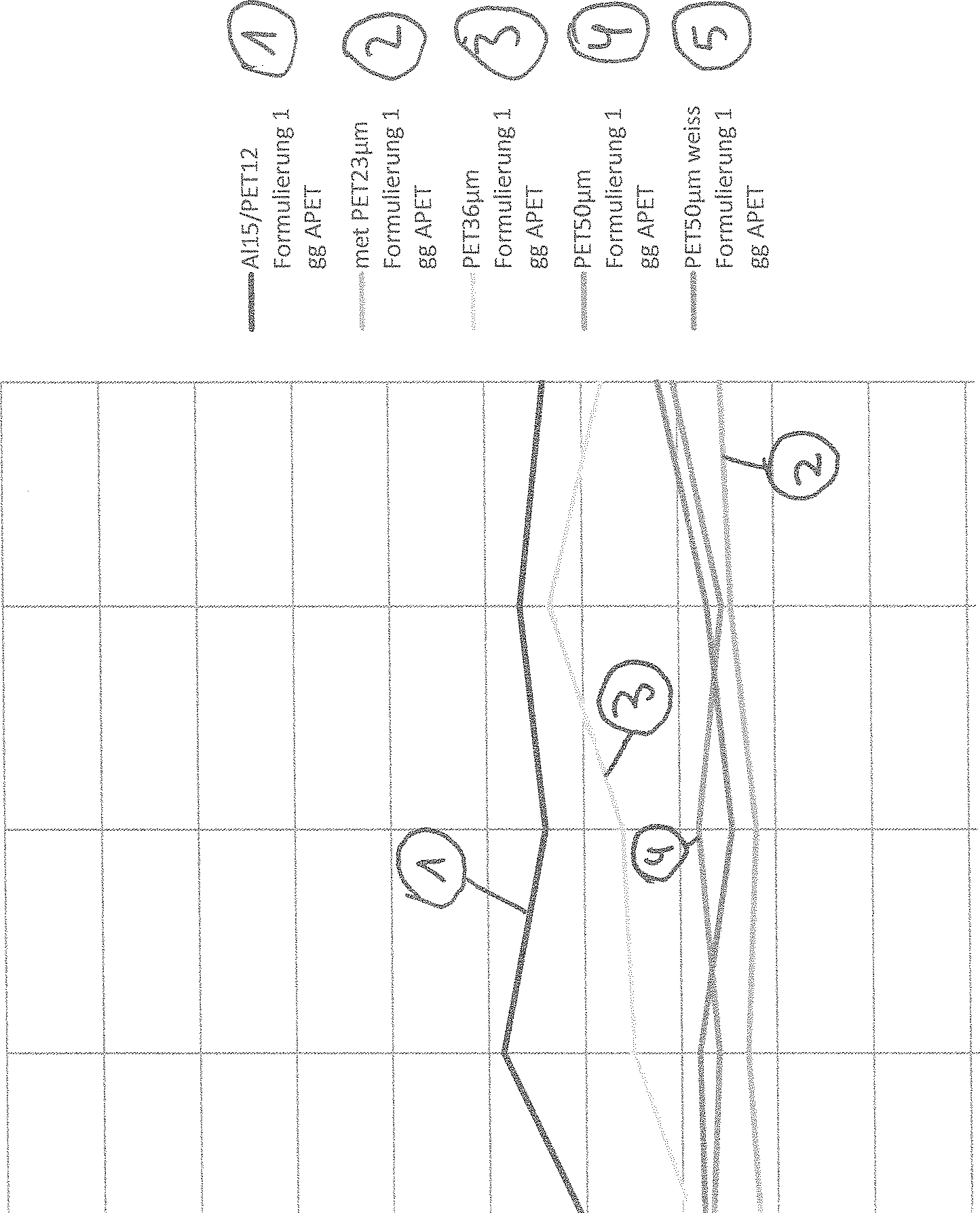
Fig. 1 die Slegelnahtfesiigkeiten [NHSmrn] der Formulierung 1 aus Tabelle 1 bzw. das Beispiel 1 -aus dem Text» aafgetragen auf die Substrate 1), 3), 4). 6) und 7) aus Tabelle 2 gegen PS über der Siegeltemperatur In PC]1 shows the seam seam strengths [NHSmrn] of formulation 1 from table 1 or example 1 - carried from the text »onto the substrates 1), 3), 4). 6) and 7) from Table 2 against PS above the sealing temperature in PC]
Fig. 2 die Siegelnahtfestigkerten IWlfmm] der Formulierung 1 aus Tabelle 1 bzw. das Beispiel 1 aus dem Text, aufgetragen auf die Substrate I), 3). 4), 6) und 7) aus Tabelle 2 gegen AFET über der Siegeltemperatür m RCl2 the seal seam strengthening IWlfmm] of the formulation 1 from Table 1 or Example 1 from the text, applied to the substrates I), 3). 4), 6) and 7) from Table 2 against AFET above the sealing temperature m RCl
Fig. 3 die Siegelnahtfesdgkeiten 04/1Smml des Verglelehsbeispielseisplels (Beispiel 2 der Tabelle 3; Degaian VP 43 Π E der Fa. Evordk. Röhm) auf ΑΠ5/ΡΕΤΙ2 Substrat tmd nrefPET ängm, auf der. PET Seite r n ;e n; w gegen PS und APET über der Siegeltemperatur in PC]..3 shows the seal seam strengths 04 / 1Smml of the comparative example ice cream (example 2 of table 3; Degaian VP 43 Π E from Evordk. Röhm) on ΑΠ5 / ΡΕΤΙ2 substrate tmd nrefPET ängm, on which. PET side ; w against PS and APET above the sealing temperature in PC] ..
Fig. 4 die Siegemuhtfestlgkelten [N/lSimn] des VergleiehsbeispleteerSpiels (Beispiel 3 der 'ebeV. \ Degatm VP 43. F der * ι l voe-.k Roum) auf M13 PEIL' Sob-w.\a und medh l 36gms auf der PET Seite aufgetragen, gegen PS und APET über der Siegeltemperatur in [C‘C].Fig. 4 the Siegemuhtfestlgkelten [N / lSimn] of the Vergleiehsbeispleteer game (example 3 of the 'ebeV. \ Degatm VP 43.F the * ι l voe-.k Roum) on M13 PEIL' Sob-w. \ A and medh l 36gm s applied on the PET side, against PS and APET above the sealing temperature in [ C 'C].
Die aus den Figuren ersichtlichen Siegelstarken zeigen, dass mit den erfmdungsgemäßen Heißsiegeliaeken im Vergleich zu denen des Standes der Technik gleich gute oder bessere Siegelnahtfesrigkeiten bei niedrigeren Siegeitemperaturen erzielt werden können. Die Siegellacke in den Fig, 1 und 2 weisen jedoch aufgrund des sich einstellenden, kohäsiven Bruchs wünschenswertere mechanische Eigenschaften, als der adhäsive oder teilweise adhäsive Bruch der in Fig. 3 und 4 dargestellten Siegellacke auf. Welters ergibt sieh aus den Tähelien 2 und 3, dass Die Verglelehsbelspieie eine schlechtere Haftfestigkeit und eine schlechtere Warmnahtfesügkeit gegenüber den erfimhmgsgemäßen Siegellacken, aufweisen, was,, aufgrund des durch die Erwärmung bei der Siegelung erhöhten Innendrucks, für die Siegelung emmnsUn ku l\w e ündungspemtefe -dj lufeeo S.egcteahuesugkeä bei eteivfeni^The seal strengths shown in the figures show that the heat sealants according to the invention can be used to achieve equally good or better seal seam strengths at lower sealing temperatures compared to those of the prior art. The sealing waxes in FIGS. 1 and 2, however, have more desirable mechanical properties than the adhesive or partially adhesive breakage of the sealing waxes shown in FIGS. 3 and 4 due to the resulting cohesive break. Welters see from Täelien 2 and 3 that the Verglelehsbelspiee have poorer adhesive strength and poorer hot-seam suitability compared to the sealing waxes according to the requirements, which, owing to the increased internal pressure due to the heating during the sealing process, meant for the sealing process -dj lufeeo S.egcteahuesugkeä at eteivfeni ^
12/21 .gmcr Abpeelba.rkeit der Platine vom Üntergrend, in Verbindung nm verbesserter· VernihmnsEigenschaften, ist damit erfüllt.12/21 .gmcr peelability of the board from the background, in connection with improved · sound properties, is fulfilled.
Die anderen erdndangsmäßigen Lacke bringen ähnliche Ergebnisse wie das des errindungS gemäßen Lackes, die anderes im Text genannten Vergielehsbeisplete zeigen sogar schlechtere Siegelnahtfestigkeilern es w-r- -le das beste Standardbeispiel znm Vergleich genommen.The other varnishes according to the earth's end bring similar results to that of the varnish according to the invention, the other example mentioned in the text shows even worse sealing seam strengthening wedges - it was the best standard example taken in comparison.
13/2113/21
Falcmausprüchü;Falcmausprüüü;
1. Siegellack zur Aufbringung im Druckverfahren, insbesondere xmu Siegeln voneinander abpeelbaxer Vmpackimgstcijc. dadurch gekennzeichnet, dass beim Abpeeien, entweder durch das besilmnmngsgemäSg: Offnen oder bei Dumhstoßverpackimgen beim Testen, der Siegellack einen Kohäsionsbruch erleidet, wobei die Stärke der. Haltekraft bis zum Kohäsionsbruch durch die beim Siegeln verwendeten, Drücke und Temperaturen bestimmt ist.1. sealing wax for application in the printing process, in particular xmu seals from each other peelbaxer Vmpackimgstcijc. characterized in that when peeping off, either by opening or in the case of dumping packaging during testing, the sealing wax suffers a cohesive break, the strength of the. Holding force until the cohesive break is determined by the pressures and temperatures used in sealing.
2. Siegellack zur Aufbringung im Druckverfahrens insbesondere zum Siegeln voneinander abpeelbarer Verpaekunpteiie. dadurch, gekennzeichnet, dass er2. Sealing varnish for application in the printing process, in particular for sealing packs that can be peeled off from one another. characterized in that he
a) 40 bis 65 Gew<% Lösemittel, b> 0 bis 10 Gew. % StyrohButadien-BlookeopuIssuer,a) 40 to 65% by weight of solvent, b> 0 to 10% by weight of styrofoam butadiene blookeopuce,
c) 8 bis 12 Ο·$νν,·~% Styrel-alpha-mediyLStyroi,c) 8 to 12 Ο · $ νν, · ~% Styrel-alpha-mediyLStyroi,
d) : 6 bis: 12 Gew.-% linearen und/oder radialen Tri-Bloek (SBS)-Block,d): 6 to: 12% by weight of linear and / or radial tri-block (SBS) block,
e) 0 bis 10. Gew. % linearen Di-Block (SB>BIeeke) 0 to 10.% by weight linear di-block (SB> BIeek
f) 15 bis 3 0 Gew. % Polyester undf) 15 to 30% by weight of polyester and
g) bis zu 3 Gew.-% Antioxidans aufweistg) has up to 3% by weight of antioxidant
3. Siegellack nach Anspruch ?, dadurch gekennzeichnet, dass als Lösungsmittel 2-Butanon und Cyelohexanon oder Kombinationen davon verwendet wird,3. sealing wax according to claim?, Characterized in that 2-butanone and cyelohexanone or combinations thereof is used as solvent,
4. Siegellack nach Anspruch 2 oder 3, dadurch gekemmeichnet, dass er statistisches (SB)nBlock enthält.4. sealing wax according to claim 2 or 3, gekemmeichnet that it contains statistical (SB) nBlock.
5. Siegellack nach einem der Ansprüche 2 bis 4, dadurch gekennzeichnet, dass er ein statistisches Styrol-alph^-Methyisryro'l-Copolymer enthält.5. sealing wax according to one of claims 2 to 4, characterized in that it contains a random styrene-alph ^ -Methyisryro'l copolymer.
6. Siegellack nach einem der Ansprüche 2 bis 5, dadmch gekennzeichnet. dass der 3'ri Block linear oder radial vorltegt.6. sealing wax according to one of claims 2 to 5, dadmch marked. that the 3'ri block is linear or radial.
< -χ> a x \\ Λ' ' ' \ x ', x v‘ s χΌ Ά xvk 'w c ode' als vds.xssng _u^'..uK' xftul, md c us dm h'BUoek ans T· den w>i D;-8loek und Tri-Bmck besteht, wobei der Tri-Biock Anteil größer ab der Di-Block Anteil ist.<-χ> ax \\ Λ '''\x', xv 's χΌ Ά xvk' wc ode 'as vds.xssng _u ^' .. uK 'xftul, md c us dm h'BUoek ans T · den w > i D ; -8loek and Tri-Bmck exists, whereby the Tri-Biock portion is larger from the Di-Block portion.
14/21 „ η-14/21 "η-
8. Siegellack nach einem der Ansprüche 2 bis 7, dadurch gekermzeiehnel, dass der Di-Rlock linear vorhegt und aus Teilen von Dl-SIoek und Tri-Bieck besteht, wobei der Di-Block Anteil großer als der Trl-Biuck Arde.il in.8. sealing wax according to one of claims 2 to 7, characterized gekermzeiehnel that the Di-Rlock prevails linearly and consists of parts of Dl-SIoek and Tri-Bieck, the Di-Block portion larger than the Trl-Biuck Arde.il in .
Siegellack nach einem der Ansprüche 2 bis g, dadurch gekermeädinet, dass die Glasübergangstemperaturen des Polyesmrs zwischen -5Ö°C imd TgiTC liegen.Sealing varnish according to one of Claims 2 to g, characterized by the fact that the glass transition temperatures of the polymer are between -5 ° C and TgiTC.
id. Siege Sack nach einem der Ansprüche 2 bis 9. dadurch gekennzeichnet, dass der Lack bis zu 3 Gew. % pherföiisches Antioxidans enthält.id. Siege sack according to one of claims 2 to 9, characterized in that the lacquer contains up to 3% by weight of phherofoic antioxidant.
15/21 .ob15/21

100X 120°C 140°C 160°C 180X 2OO°C 220°C 240°C100X 120 ° C 140 ° C 160 ° C 180X 2OO ° C 220 ° C 240 ° C
Siegeltemperaturen [°C] [uiUäSl/N] JNSSealing temperatures [° C] [uiUäSl / N] JNS
16/2116/21
Fig.2Fig. 2

100T 12OX 140X 160X 180X 2OOT 22OT100T 12OX 140X 160X 180X 2OOT 22OT
Siegeitemperaturen [°C]Siegeit Temperatures [° C]
17/21 .ob ΰ-<17/21 .ob ΰ- <
LL!LL!
!Χ! Χ
LDLD
ΓΝΓΝ
Φ -WΦ -W
ΦΦ
Ε ΟΕ Ο
u.u.
φφ
Τ5 C φ cnΤ5 C φ cn
CL (Ν ’L.CL (Ν ’L.
Φ φΦ φ
Ε “Ο *_>Ε “Ο * _>
φ Όφ Ό
CC.
Φ •W U1Φ • W U1
ΓΜ φ 4~>ΓΜ φ 4 ~>
ΦΦ
Ε “ΌΕ “Ό
Φ “α c φΦ “α c φ
4-(Λ cl4- (Λ cl
ΓΜ φΓΜ φ
φ £φ £
Ό λφΌ λφ
ΌΌ
CC.
Φ ί (ΜΦ ί (Μ

Γ1) Temperatur [°C]Γ1) temperature [° C]
18/2118/21

Τ'Τ '
Fig. 4Fig. 4
ΟΟ
CN cdCN cd

LA rlLA rl

CN coCN co
CDCD
ΓΝΓΝ
100 X 120 X 140 X 160 X 180 X 200 X 240 X100 X 120 X 140 X 160 X 180 X 200 X 240 X
Temperatur [°C] [luiusT/M] }B>$jS9jjueqpSa!$Temperature [° C] [luiusT / M]} B> $ jS9jjueqpSa! $
19/2119/21
Recherchenbericht zu A 50510/2017Search report for A 50510/2017

20/2120/21
Claims (9)
Priority Applications (4)
| Application Number | Priority Date | Filing Date | Title |
|---|---|---|---|
| ATA50510/2017A AT520101B1 (en) | 2017-06-20 | 2017-06-20 | Sealing wax for application in the printing process |
| PCT/EP2018/066251 WO2018234306A1 (en) | 2017-06-20 | 2018-06-19 | SEALING VARNISH FOR APPLICATION IN THE PRESSURE PROCESS |
| US16/624,269 US10954401B2 (en) | 2017-06-20 | 2018-06-19 | Sealing lacquer for application in a printing process |
| EP18733829.8A EP3642286A1 (en) | 2017-06-20 | 2018-06-19 | Sealing lacquer for application in a printing process |
Applications Claiming Priority (1)
| Application Number | Priority Date | Filing Date | Title |
|---|---|---|---|
| ATA50510/2017A AT520101B1 (en) | 2017-06-20 | 2017-06-20 | Sealing wax for application in the printing process |
Publications (2)
| Publication Number | Publication Date |
|---|---|
| AT520101A1 true AT520101A1 (en) | 2019-01-15 |
| AT520101B1 AT520101B1 (en) | 2022-02-15 |
Family
ID=62716057
Family Applications (1)
| Application Number | Title | Priority Date | Filing Date |
|---|---|---|---|
| ATA50510/2017A AT520101B1 (en) | 2017-06-20 | 2017-06-20 | Sealing wax for application in the printing process |
Country Status (4)
| Country | Link |
|---|---|
| US (1) | US10954401B2 (en) |
| EP (1) | EP3642286A1 (en) |
| AT (1) | AT520101B1 (en) |
| WO (1) | WO2018234306A1 (en) |
Families Citing this family (1)
| Publication number | Priority date | Publication date | Assignee | Title |
|---|---|---|---|---|
| WO2022165346A1 (en) | 2021-02-01 | 2022-08-04 | Amcor Flexibles North America, Inc. | Barrier paper packaging film |
Citations (1)
| Publication number | Priority date | Publication date | Assignee | Title |
|---|---|---|---|---|
| US4096203A (en) * | 1976-07-30 | 1978-06-20 | Shell Oil Company | Process to control cohesive strength of block copolymer composition |
Family Cites Families (6)
| Publication number | Priority date | Publication date | Assignee | Title |
|---|---|---|---|---|
| US6172156B1 (en) | 1996-07-03 | 2001-01-09 | H. B. Fuller Licensing & Financing, Inc. | Cohesively failing hot melt pressure sensitive adhesive |
| DE10321074B3 (en) * | 2003-05-10 | 2004-06-03 | Tscheulin-Rothal Gmbh | Packaging material, useful as easy-peel cover for packaging food, e.g. dairy product, in polystyrene or polypropylene container, contains block or graft copolymer with hard and soft segments and polymer with polar groups |
| US6838520B2 (en) * | 2003-05-29 | 2005-01-04 | Equistar Chemicals, Lp | Adhesives for fluoropolymer films and structures containing same |
| DE102011081873A1 (en) * | 2011-08-31 | 2013-02-28 | Constantia Hueck Folien Gmbh & Co. Kg | sealing wax |
| DE102014208608A1 (en) | 2014-05-08 | 2015-11-12 | Evonik Röhm Gmbh | Direct-bonding, halogen-free, quick-drying heat-sealable binder for sealing polyester films against polystyrene, polyester or PVC |
| JP6481425B2 (en) * | 2015-03-04 | 2019-03-13 | Mcppイノベーション合同会社 | Thermoplastic resin composition, easy-open lid and easy-open container |
-
2017
- 2017-06-20 AT ATA50510/2017A patent/AT520101B1/en not_active IP Right Cessation
-
2018
- 2018-06-19 US US16/624,269 patent/US10954401B2/en not_active Expired - Fee Related
- 2018-06-19 WO PCT/EP2018/066251 patent/WO2018234306A1/en not_active Ceased
- 2018-06-19 EP EP18733829.8A patent/EP3642286A1/en not_active Withdrawn
Patent Citations (1)
| Publication number | Priority date | Publication date | Assignee | Title |
|---|---|---|---|---|
| US4096203A (en) * | 1976-07-30 | 1978-06-20 | Shell Oil Company | Process to control cohesive strength of block copolymer composition |
Also Published As
| Publication number | Publication date |
|---|---|
| US20200115573A1 (en) | 2020-04-16 |
| EP3642286A1 (en) | 2020-04-29 |
| WO2018234306A1 (en) | 2018-12-27 |
| US10954401B2 (en) | 2021-03-23 |
| AT520101B1 (en) | 2022-02-15 |
Similar Documents
| Publication | Publication Date | Title |
|---|---|---|
| DE60213847T2 (en) | PACKAGING COVER, METHOD OF MANUFACTURING THEREFOR AND COVERED WITH THE COVER | |
| DE69917480T2 (en) | MULTILAYER, METHOD FOR THE PRODUCTION THEREOF AND PRODUCTS MANUFACTURED THEREWITH | |
| DE69433597T2 (en) | ORIENTED, MULTILAYER MULTILAYER | |
| EP2152512A1 (en) | Packaging material | |
| AT7937U1 (en) | TWO MANAGEMENT BOARD | |
| EP3743480B1 (en) | Printed and coated release foil | |
| WO2019034706A1 (en) | A CONTAINER WITH AN UNFOLDED CONTAINER LAYER CONTAINING A VARIETY OF PARTICLES AND A POLYMER LAYER | |
| EP3795746A1 (en) | Printable and heat-sealable barrier paper | |
| EP3821074B1 (en) | Heat-sealable barrier paper | |
| DE1644821C3 (en) | Varnish mixture | |
| DE102019126762B4 (en) | Foil for food and / or pharmaceutical products | |
| DE102018212797A1 (en) | FLAT-SHAPED COMPOSITE FOR THE PRODUCTION OF STABLE FOOD CONTAINERS, INCLUDING A POLYMER LAYER WITH A POLYESTER AND ISOTROPICAL E-MODULE | |
| AT520101B1 (en) | Sealing wax for application in the printing process | |
| AT519701B1 (en) | packaging element | |
| DE102018212799A1 (en) | FLAT-SHAPED COMPOSITE, ESPECIALLY FOR THE PRODUCTION OF STABLE FOOD CONTAINERS, INCLUDING A POLYMER OUTER LAYER WITH A POLYESTER | |
| EP2556953A1 (en) | Method for producing a paper-foam composite | |
| EP4198198A1 (en) | Laminate for covering containers | |
| DE102016222128A1 (en) | Sheet-like composite for producing dimensionally stable food containers with an outer polymer layer having a ratio of aromatic groups to carbonyl groups | |
| AT527131B1 (en) | packaging film | |
| EP4686671A1 (en) | Use of a dispersion glue as a barrier coating of a plastic-free, fiber-containing substrate for producing supd-compliant packagings | |
| DE202016006881U1 (en) | Sheet-like composite for producing dimensionally stable food containers with an outer polymer layer having a ratio of aromatic groups to carbonyl groups | |
| DE10321074B3 (en) | Packaging material, useful as easy-peel cover for packaging food, e.g. dairy product, in polystyrene or polypropylene container, contains block or graft copolymer with hard and soft segments and polymer with polar groups | |
| DE202012009286U1 (en) | Drinking cup with drinking foil | |
| DE102011002166B4 (en) | Film material for producing a flexible package for alkaline products and alkali-resistant packaging made therefrom | |
| DE102022202764A1 (en) | LIQUID-TIGHT CONTAINER WITH WEDGE-SHAPED BOTTOM OR TOP SEAM |
Legal Events
| Date | Code | Title | Description |
|---|---|---|---|
| MM01 | Lapse because of not paying annual fees |
Effective date: 20230620 |